NEW DELHI (TIP): The Government will roll out by next week the muchawaited electronic-visa system for tourists from select countries including US and Japan. Home minister Rajnath Singh along with tourism minister Sripad Naik will unveil the first phase of e-visa system for tourists from two dozens countries including US and Japan at a function here shortly, a senior Tourism Ministry official said.
While Australia is likely to be accorded the e-visa facility during Prime Minister Narendra Modi’s visit Down Under, some countries belonging to BRICS and African region are likely to be announced in the first phase. The e-visa is expected to give a big boost to the foreign tourist arrivals in the country. While in January about 4.95 lakh foreign tourists arrived in India, there were a total of 51.79 lakh during January-September this year. All the arrangements including the software for this system is ready now and will be operational at nine international airports including Delhi, Mumbai, Chennai, Kolkata, Hyderabad, Bengaluru, Kochi, Thiruvananthapuram, and Goa.
The official said though there are certain issues yet to be resolved for the Goa Airport, the Government has decided in principle to extend it to Goa as well. According to the official, about 25 countries including the 13 countries which are currently having the Visaon- Arrival (VoA) facility in India to be covered under e-visa regime. US, Japan, South Korea, Thailand, Vietnam, the Philippines, Singapore are among the countries which will be given e-visa facility in the first phase. Barring a few countries like Pakistan, Sudan, Afghanistan, Iran, Iraq, Nigeria, Sri Lanka and Somalia, all 180 countries will be covered under e-visa regime in phases, the official said.
He said China is definitely on the list of countries to be provided e-visa facility, but not in the first list. China is a big-thrust market for India and Tourism Ministry has taken various steps to woo maximum Chinese tourists. While the Incredible India website is being translated into the Chinese language and an infoline will also be established in that language. Besides guides are being trained in Chinese language to help tourists from that country. In order to get e-visa, one would need to apply in the designated website along the required fees. They would be granted an electronic version of the visa within 96 hours.
Tag: Philippines
-

THE BIRTH AND GROWTH OF AN IDEA
Every big idea has a small beginning. Gift of Life has been no exception.
In 1974, Rotary District 7250 brought a little 5-year old named Grace Agwaru on an intercontinental voyage from Uganda to New York. Grace suffered from a hole between the two lower chambers of her young but strong heart. On November 15, 1974 surgeons at Saint Francis Hospital in Roslyn, New York successfully operated on little Grace. A big idea was born that day. The Gift of Life now includes Rotarians from all over the world, with independent chapters in countries as far away as Korea and India.
Today, the Gift of Life is a worldwide Rotary International Service Program responsible for approximately 5000 heart surgeries for children from over 30 countries. The Gift of Life has gone global. Every good idea grows exponentially. In 2001, PDG of District 7250 Eileen Gentlecore had a simple conversation with a friend of hers and related the altruistic vision of the Gift of Life. Her friend, Past District Governor Ravishankar Bhooplapur, with the assistance of Past RI Director Sushil Gupta – Trustee of Rotary Foundation , Dr. Rajan Deshpande and many other devoted Rotarians, AC Peter, PDG Rajendra Rai, Rtn OP Khanna, DGE Kamlesh Raheja, took up the challenge to provide critical heart surgeries for the children of India.
PDG Ravishankar Bhooplapur still serves as Honorary Chairman of Gift of Life, India today. Is it not amazing what can come of a conversation? The sole purpose of the Gift of Life, India is to secure life saving heart surgery for children in desperate need regardless of race, creed, color or country of origin. The Gift of Life, India is a not-for-profit, tax-exempt corporation with no administrative costs. All of our team members work voluntarily; all of the monies are generously donated by caring donors and through the numerous matching grants disbursed by the Rotary Foundation.
Gift of Life program in New York has the unique distinction of bringing children from all over the world to the New York Metro Area and providing free heart Surgeries to them. These children are housed in Ronald McDonald house which is specifically given to us for this purpose. Rotarians have significantly contributed to build the Ronald McDonald house and continue to give financial support on the local level in exchange our children are accommodated pre & post-operative their surgeries. The Gift of Life still grows. We reach more children in more countries than ever before. We would like to reach more. There is no limit to this idea as long as we remain committed to saving children’s lives.
Mission:
To further the cause of world peace and understanding by facilitating free medical services to children suffering from heart disease regardless of race, creed, sex or national origin and who otherwise lack access to such services.
“A Crusade of the Heart”
The Gift of Life is a crusade of the heart, touching children in peril. An idea born in 1975 to a group of Rotarians from Manhasset, Long Island, NY, is today a global effort. We reach out to many children, who would otherwise die, and heal their failing hearts with the miracle of cardiac surgery. Our outreach spans the world, nurtured by compassion for young victims we alone can cure. Each child whose future we restore is a tribute to humanity and love, helping build bridges of friendship and peace among people everywhere.
History
The lives of more than 10,000 children from countries throughout the world have been saved through the miracle of open-heart surgery, in medical centers throughout the U.S. and in participating Gift of Life hospitals in Russia, Israel, Malaysia, China, Ukraine, India, Dominican Republic and the Philippines. Dedicated surgeons and nurses donate their skill to the cause. American families assist Rotarians as hosts and interpreters, bringing warmth and comfort to children and their escorts.
Board of Directors and Officers
Gift of Life is a dynamic program of Rotarians of Brooklyn, Queens and Nassau in partnership with the Rotary members and physicians worldwide who evaluate children for treatment in our country. Foreign doctors may also receive technical training on these shores and return to help children in their own lands. We have since opened pathways to Korea, Poland, the Russian Republics, China, Caribbean Nations and to places as distant as Mongolia, medically screening many thousands of children for lifesaving surgery.
The spirit of the Gift of Life ignores borders. Medically advanced countries are being encouraged to do as we do – to open their own hospital doors to imperiled youngsters from developing nations. With the Gift of Life as an international model, cardiac medicine will extend its power to save many who were unreachable before. The Gift of Life has also become more of a public presence through our fund raising program Save-A-Child. In addition we hold four annual fundraisers: the Crusade of the Heart Kick-Off Dinner and black tie Gala, the Agnes T. Funk Kids for Kids Memorial 5K Walk, and our new skydiving event Jump for Life.
Partnering Hospitals
The following hospitals support the Gift of Life program:
● Loma Linda University Medical Center, Loma Linda, California
● Maria Fareri Children’s Hospital at Westchester Medical Center Valhalla, New York
● St. Francis Hospital, The Heart Center Roslyn, New York
● The Children’s Hospital at Montefiiore Medical Center Bronx, New York
● The Hospital for Sick Children Toronto, Canada
● The Steven and Alexandra Cohen Children’s Medical Center of New York New Hyde Park, New York -

Floods shut down Philippine capital
MANILA, PHILIPPINES (TIP): Heavy rain due to a storm and the seasonal monsoon has caused widespread flooding in the Philippine capital and nearby provinces, shutting down schools and government offices. Local officials interviewed on radio reported hundreds were evacuated early on Friday from severely inundated communities, some under rapid-flowing flood waters more than neck high. Manila airport authorities said that the rain and a broken radar caused delays and the cancellation of at least 28 domestic flights to and from northern and central Philippines affected by Tropical Storm Fung- Wong. At least three international flights heading to Manila were diverted to Clark International Airport in northern Pampanga province. Presidential spokeswoman Abigal Valte said that work in government offices in the capital and 15 other provinces has been suspended.
-

JAPANESE NEWSPAPER APOLOGIZES FOR FALSE FUKUSHIMA REPORT
TOKYO (TIP): The publisher of Japan’s leading newspaper apologized to readers on Sep 11 for several serious errors in its reporting, retracting an article that claimed workers abandoned their posts during the Fukushima nuclear disaster.
Asahi’s publisher Tadakazu Kimura, speaking at a hastily arranged news conference, made the apology after a confidential government document cited in the daily’s report was finally released to the public with no mention of a mutiny by plant workers. “I offer profound apologies to our readers and people at Tokyo Electric Power Co. (TEPCO),” the 60-year-old publisher said. He said he would decide whether or not to resign after enacting “revival through sweeping reform.” The article published on May 20 said 90 per cent of workers at the Fukushima Dai-ichi nuclear power plant had left the complex, disobeying the plant chief’s order to stay put in the worst nuclear accident since Chernobyl in 1986.
TEPCO operates the plant, located 220 kilometres (138 miles) northeast of Tokyo. A massive earthquake and tsunami crippled its cooling systems and sent reactors into meltdown in March 2011. The daily said about 650 employees, or 90 per cent of the plant’s workforce, retreated to another seaside TEPCO nuclear plant 12 kilometres away when the nuclear crisis worsened a few days after the accident.
The official document released on Thursday recounted the testimony of plant chief Masao Yoshida to a government investigative panel, with no trace of staff “disobeying Yoshida’s order” as Asahi had claimed. Yoshida died of cancer in July last year. Other dailies which also had access to the then confidential statement had already cast doubt on the article.
In the same news conference, Kimura also admitted a highly contentious report published 32 years ago on the topic of Japan’s wartime sexual enslavement of Korean women was also false. That report cited a Japanese writer who claimed to have witnessed the kidnapping of women on the South Korean island of Jeju for the purposes of sex slavery, which has since been discredited by independent research by rival newspapers and academics. Asahi admitted in early August that its 1982 article on the comfort women and follow-up reports were based on a “false” statement by the witness, but Kimura’s apology was the publication’s first in relation to it.
“I apologize to readers for publishing the erroneous articles and being too late in making the correction,” he said. The admission of the mistake has boosted the country’s conservative forces, which have insisted there was no “sex slavery” at the frontline brothels and that many of the comfort women were highly paid prostitutes. Prime Minister Shinzo Abe told a radio talk show on Thursday the report had “agonized many people and impaired Japan’s reputation in the international community”. With few official records available, researchers have estimated up to 200,000 women, many from Korea but also from China, Indonesia, the Philippines and Taiwan, served Japanese soldiers in “comfort stations”. -

Expansion not in Chinese DNA, says premier Li
BEIJING: Seeking to allay fears over China’s expansionist agenda, Premier Li Keqiang said territorial expansion is not part of the Chinese DNA and the country will never indulge in it. “Expansion is not in the Chinese DNA, nor can we accept the logic that a strong country is bound to become hegemonic,” Li said in London on Wednesday amid Vietnam’s move to obtain international arbitration over its South China Sea dispute with China. China will “have to take resolute measures to stop acts that provoke incidents and damage peace,” Li said.
China is determined to prevent the regional situation from getting out of control, to uphold order and stability and bring the issue of South China Sea back on track. Beijing wants to make sure Vietnam, the Philippines and Japan do not receive Western support in their territorial quarrels with China. “China’s development over the past three decades has been achieved in a peaceful and stable environment,” he said.
“We have benefited from this environment. Why should we give up this benefit and environment?” Li also dismissed the possibility of a “hard landing” for the Chinese economy. “I can promise everyone honestly and solemnly there won’t be a hard landing,” he said, adding the Chinese economy will move within a “reasonable range”. This means economic growth of around 7% and inflation of less than 3.5% — through “targeted regulation”, instead of large stimulus packages.
-

Japan summons China envoy over ‘dangerous’ flights
TOKYO (TIP): Japan on June 13 summoned the Chinese ambassador to complain about fighter jets flying “dangerously” close to two of its military planes over the East China Sea, officials said. In the latest up-close confrontation between the two sides, Tokyo says two Chinese SU-27 jets flew just 30 metres away from its aircraft in a spot where the two countries’ air defence zones overlap.
“It was an action that was extremely regrettable, and which cannot be tolerated,” said top government spokesman Yoshihide Suga, of the yesterday’s incident. It was the second time in less than three weeks that Tokyo has accused Beijing of playing chicken in the skies near the hotly-contested Japanese-controlled Senkaku islands, which China also claims and calls the Diaoyus.
It comes after a similar event which occurred last month,” Suga said. “The government will continue urging China to prevent an accident and restrain itself. “Japan will seek cooperation from countries concerned.” Japan’s vice minister for foreign affairs, Akitaka Saiki, called the Chinese ambassador to Japan, Cheng Yonghua, to the ministry, where he was expected to have urged Beijing to create a maritime communication system with Tokyo.
The incident occurred as Japan and Australia held the fifth round of so-called “2+2” talks between their defence and foreign affairs chiefs in Tokyo. The meeting was part of a trend in which military and political alliances are being forged and strengthened around the Asia-Pacific, as countries in the region look with alarm at China’s growing willingness to forcefully push its claims in territorial disputes. The two sides reached a broad agreement on a legal framework to allow them to conduct joint research and trade in defence equipment.
That comes as Japanese Prime Minister Shinzo Abe has relaxed strictures on his country’s arms industry to allow it to sell its high-tech weaponry abroad, and as Canberra is known to be shopping for submarines. Abe has also made great play of offering Japan as a benign counterweight for countries looking askance at China’s recent heavy-handedness, which has seen it involved in destabilizing rows with Vietnam and with the Philippines.
-

US warns China not to attempt Crimea-style action in Asia
WASHINGTON: China should not doubt the US commitment to defend its Asian allies and the prospect of economic retaliation should also discourage Beijing from using force to pursue territorial claims in Asia in the way Russia has in Crimea, a senior US official said on April 3.
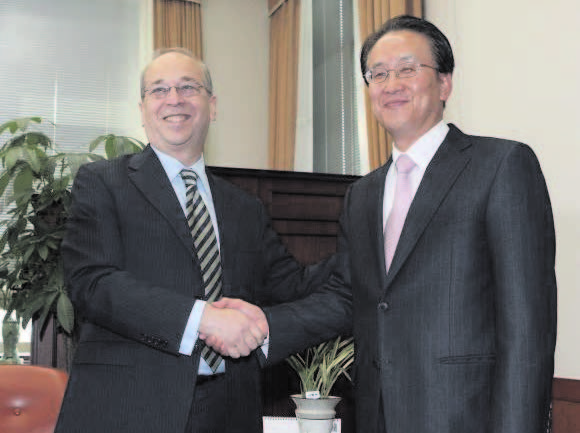
Daniel Russel, President Barack Obama’s diplomatic point man for East Asia, said it was difficult to determine what China’s intentions might be, but Russia’s annexation of Crimea had heightened concerns among US allies in the region about the possibility of China using force to pursue its claims.
“The net effect is to put more pressure on China to demonstrate that it remains committed to the peaceful resolution of the problems,” Russel, the US assistant secretary of state for East Asia, told the Senate Foreign Relations Committee. Russel said the retaliatory sanctions imposed on Russia by the United States, the European Union and others should have a “chilling effect on anyone in China who might contemplate the Crimea annexation as a model.”
This was especially so given the extent of China’s economic interdependence with the United States and its Asia neighbors, Russel said. Russel said that while the United States did not take a position on rival territorial claims in East Asia, China should be in no doubt about Washington’s resolve to defend its allies if necessary. “The president of the United States and the Obama administration is firmly committed to honoring our defense commitments to our allies,” he said.
While Washington stood by its commitments – which include defense treaties with Japan, the Philippines and South Korea – Russel said there was no reason why the rival territorial claims could not be resolved by peaceful means. He said he hoped the fact that the Philippines had filed a case against China on Sunday at an arbitration tribunal in The Hague would encourage China to clarify and remove the ambiguity surrounding its own claims.
Russel termed the deployment of large numbers of Chinese vessels in its dispute with the Philippines in the South China Sea “problematic” and said that Beijing had taken “what to us appears to be intimidating steps.” “It is incumbent of all of the claimants to foreswear intimidation, coercion and other non-diplomatic or extra-legal means,” he said. In Asia, China also has competing territorial claims with Japan and South Korea, as well as with Vietnam, Malaysia, Brunei and Taiwan in potentially energy-rich waters. Obama is due to visit Japan, South Korea, Malaysia and the Philippines from April 22, when he is expected to stress his commitment to a rebalancing of US strategic and economic focus towards the Asia-Pacific region in the face of an increasingly assertive China.
-

India, US keep horns locked over Khobragade
NEW YORK (TIP): India and the US still seem locked in a battle for righteousness over the Khobragade issue as the strategic partners pick up the pieces after the bitter standoff, bringing the bilateral engagement back on track by scheduling the energy dialogue next month.
With the US authorities refusing to withdraw visa fraud charges against Indian diplomat Devyani Khobragade, Indian authorities are proceeding with the pursuit of tax issues related to American school employment contracts and are also closely following contracts entered into by US diplomats here with their domestic helps. One such contract between a Mumbai based US diplomat and his Filipino maid, a copy of which is with the Times of India, as claimed by the paper, suggests that the maid is being paid less than $ 3 per hour.
The minimum hourly wage in the US is $ 7.25. According to her lawyer, Khobragade actually paid $ 9.75 per hour to her maid in New York, as promised by her in the employment contract, in the form of the amount paid here to her husband and also cash payments and “permissible deductions” for various services in the US. The US State Department says that the salary paid to local staff of US diplomats is based on “prevailing wage rates and compensation practices”.
Unlike the contract between Khobragade and her maid Sangeeta Richard though, this one between the US official and his maid doesn’t carry any stipulation of hours of work. The contract, which came into effect December 1 last year, says that the Filipino maid would work “six full workdays per week” at a salary of $ 458 per month. Even at only 8 hours per day, it is perhaps safe to assume she works well over 40 hours every week. Authorities here believe that the Khobragade contract was more favorably inclined towards the maid also because it restricted work to 5 days and 40 hours per week.
The Filipino also has only 5 holidays apart from a 12-day annual leave and no ticket for home leave during the period of 3 years. On the other hand all domestics going with Indian diplomats are entitled to a return air ticket after completing a year’s stay abroad. There was no response from the US embassy here on questions about the contract between the US diplomat and the Filipino maid. Like Richard, the Filipino maid too has rent-free accommodation, free internet and food allowance. She also has “appropriate contributions” to Filipino Social Security System.
While the Filipino maid has medical insurance, Richard had a “100 per cent” medical cover under which all such expenses were borne by the Indian government. In case of any negligence, the contract with the Filipino maid also specifies that all such issues will be decided by the employer only. There is no option of any recourse to local courts or US courts or even courts in the Philippines. CNN reported in 2009, quoting a State Department report, that many local staff of US diplomats across the world were being paid less than a dollar per day.
The State Department mandated contract between Khobragade and Richard projected an average of 40 working hours per week (approximately a salary of $ 1560 per month at an hourly wage of $ 9.75). Around $ 560 was given in the form of INR 30,000 transferred to her husband’s account, another $ 625 in cash and remaining in deductions. Meanwhile, India’s Income Tax department has also begun a probe into alleged tax violations by the American Embassy school in New Delhi. “Once the preliminary information is gathered, the tax department would be taking a view on issuing notices to the authorities concerned. Also, the CBDT would be informed as this is not a regular case and involves relations between two countries,” an agency report quoting government sources said. As per the information available with the government, several teachers at the American Embassy School were working “illegally”, in violation of both tax laws and their visa status.
-

Typhoon Haiyan,
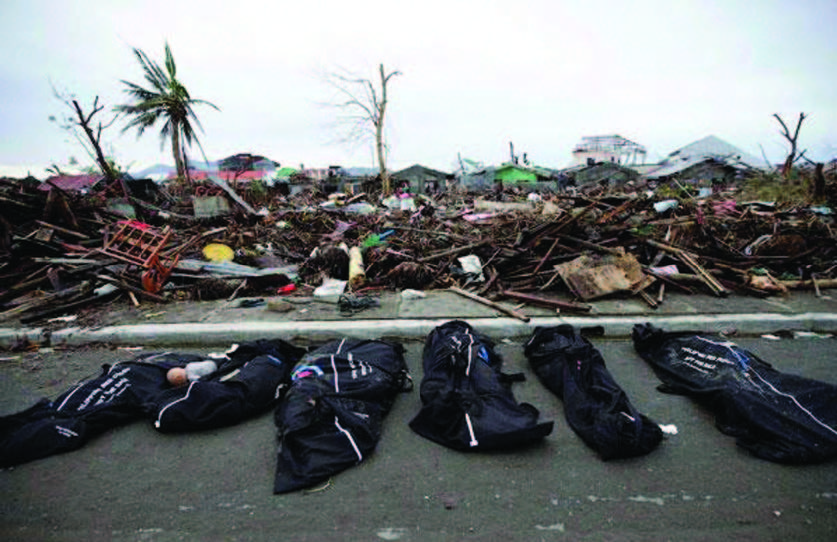
Typhoon Haiyan, an exceptionally powerful tropical cyclone, devastated the Philippines in early November. Over 6,000 people were killed in the typhoon.
-

Christmas Celebrated around the World
NEW YORK (TIP):
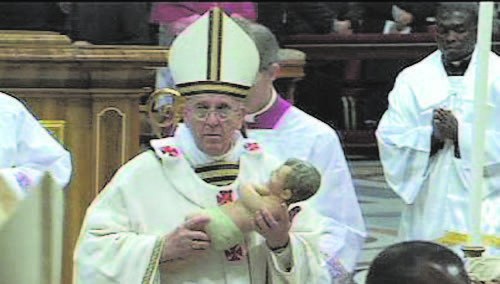
Christmas Eve was marked by festivities and preparations around the world today. The faithful prepared for midnight services in places both traditional and unusual. At the Vatican, worshipers filled Saint Peter’s Basilica for Pope Francis’s first Christmas midnight mass as pontiff. Thousands more gathered outside in St. Peter’s Square. He was assisted by more than 300 cardinals, bishops and priests. In his homily, Pope Francis urged people to lead humble lives. “If our heart is closed, if we are dominated by pride, deceit, and the constant pursuit of self interest, then darkness falls within and around us,” he said.In a break with tradition, Pope Francis himself performed a task usually given to an aide. He carried a figurine of the baby Jesus to the altar at the start of the mass. The statue of Jesus was then placed in the manger of a life-size nativity scene behind the altar. Pope Francis offered a Christmas wish for a better world, praying for protection for Christians under attack, battered women and trafficked children, peace in the Middle East and Africa, and dignity for refugees fleeing misery and conflict around the globe. Francis delivered the traditional ”Urbi et Orbi” (Latin for ”to the city and to the world”) speech from the central balcony of St. Peter’s Basilica to 70,000 cheering tourists, pilgrims and Romans in the square below.
He said he was joining all those hoping ”for a better world.” In his first Christmas message since being elected pontiff in March, he asked for all to share in the song of Christmas angels, ”for every man or woman … who hopes for a better world, who cares for others,” humbly. Among places ravaged by conflict, Francis singled out Syria, which saw its third Christmas during civil war; South Sudan; the Central African Republic; Nigeria; and Iraq. In Iraq on Wednesday, militants targeted Christians in two attacks, including a bomb that exploded near a church during Christmas Mass in Baghdad.
The separate bombings killed dozens of people. The Vatican has been trying to raise concern in the world for persecution and attacks on Christians in parts of the Middle East and Africa. ”Lord of life, protect all who are persecuted in your name,” Francis said. pope also prayed that God ”bless the land where you chose to come into the world and grant a favorable outcome to the peace talks between Israelis and Palestinians.” Francis then explained his concept of peace. ”True peace is not a balancing of opposing forces. It’s not a lovely facade which conceals conflicts and divisions,” the pope said. ”Peace calls for daily commitment,” Francis said, reading the pages of his speech.
Francis also spoke about the lives of everyday people, especially those struggling for a better life. In Bethlehem, parades filled the streets, as Christian pilgrims and tourists from around the world poured into Manger Square, considered the birthplace of Jesus. Decorations and holiday lights adorned the West Bank for the evening’s celebrations. And in Afghanistan, U.S. troops in Kabul marked the 13th Christmas Eve for American forces in Afghanistan with candles and hymns. In India which has a sizeable Christian population, Christmas was celebrated with zeal and enthusiasm.
The faithful attended midnight mass in churches while a general atmosphere of celebration was witnessed in all major cities. Santa Claus has been a major attraction, as always. In the Philippines, survivors of last month’s catastrophic typhoon erected giant Christmas lanterns across the devastation in Tacloban. People in other towns sang and danced to holiday songs as they remembered lost loved ones.
Devyani Khobragade had…
December 12 for allegedly presenting fraudulent documents to the United States State Department in support of a visa application for an Indian national employed as a babysitter at housekeeper at Khobragade’s home in Manhattan? As it now turns out, diplomat Devyani Khobragade was accredited as an advisor to the Permanent Mission of India to the UN, allowing her full immunity from personal arrest or detention, when she was picked up from her children’s school by US authorities. India Government sources said Khobragade was accredited advisor to the Indian mission to the UN on August 26, 2013 to help the mission with work related to the General Assembly, and her accreditation was valid until December 31.The sources claimed the Convention on the Privileges and Immunities of the United Nations Article 4 Section 11A specifies “immunities from personal arrest or detention and from the seizure of their personal baggage” of all representatives of members to the United Nations. Section 16 of the same Article specifies that the expression “Representative” shall be deemed to include all delegates, deputy delegates, advisors, technical experts and secretaries of delegations. She was accredited as advisor on August 26 and was transferred to the permanent mission after the arrest and is currently holding the position of counselor. Because she was attached to the permanent mission only temporarily (until December 31), the State Department was not required to issue its own identity card and it is possible that they may not have known about Khobragade’s status.
Sources said this was all the more reason for the State Department to have informed India about the move to arrest Khobragade. As the diplomat was working as acting consul general, the US ought to have notified India about her arrest under the Vienna Convention on Consular Relations. The MEA joint secretary who handles the US desk, Vikram Doraiswamy, was in that country on the day Khobragade was arrested, but he wasn’t informed about it. The alacrity with which the US “evacuated” Khobragade’s domestic help Sangeeta Richard’s family, two days before the diplomat’s arrest, rattled New Delhi. Bharara later justified this in a statement saying the Justice Department was “compelled” to make sure that victim, witnesses and their families “are safe and secure while cases are pending”.
As the case now unravels fast, several US officials, especially those who handled Khobragade’s arrest,may have opened themselves to claims for damages and liability. The government has also discovered that the amount of $4,500 quoted by Bharara as salary promised to Sangeeta by Khobragade was actually just a mention of the employer’s salary on the help’s visa application form. The State Department’s own guidelines on diplomatic and consular immunity emphasize that law enforcement officials need to be sensitive because short-term official visitors from other States to the United Nations or to international conferences convened by the UN may enjoy full diplomatic immunity equivalent to that afforded to diplomatic agents.
“Owing to the temporary nature of their visit, such officials will normally not have the usual official identity documents recognizable in the United States. Law enforcement officials (particularly in New York) should be sensitive to the existence of this situation and always coordinate with the US authorities indicated in the list of Useful Phone Numbers if confronted with an apparent offender appearing to fall into this category’,” it states. A diplomat’s daughter, Krittika Biswas, had last year filed a lawsuit in a NYC court seeking $1.5 million as damages for her wrongful arrest.
Ambassador Dr. S.Jaishankar…
Rao who has since retired. Dr. Jaishankar comes to Washington, DC with more than three decades of diplomatic experience. Joining the Indian Foreign Service in 1977, Dr. Jaishankar has represented India’s interests and fostered friendly working relationships in countries around the world. Dr. Jaishankar’s first postings abroad were as Third and Second Secretary (Political) at the Embassy of India in Moscow from 1979 to 1981. From 1981 to 1985, he served as Under Secretary (Americas) and Policy Planning in the Ministry of External Affairs.He then spent three years from 1985 to 1988 as First Secretary handling political affairs at the Indian Embassy in Washington, DC, followed by two years as First Secretary and Political Advisor to the Indian Peace Keeping Force (IPKF) in Sri Lanka. In 1990, Dr. Jaishankar became Commercial Counsellor in Budapest. After three years in that position, he returned to India where he served first as Director of East Europe Division of the Ministry of External Affairs, and then as Press Secretary for the President of India. Following this service in India, Dr. Jaishankar went abroad again – to Tokyo in 1996 as Deputy Chief of Mission. In the year 2000, he was appointed the Ambassador of India to Czech Republic and served in Prague till 2004.
Upon completing his time as Ambassador in Prague, Dr. Jaishankar returned once again to India, where he led the Americas Division in the Ministry of External Affairs. After three years heading the division, he again left India in 2007 to serve as High Commissioner to Singapore for two years. Most recently, Dr. Jaishankar was the Ambassador of India to China from 2009 to 2013. Dr. Jaishankar holds a Ph.D. and M.Phil in International Relations and a M.A. in Political Science. He is a member of the International Institute for Strategic Studies in London. Dr. Jaishankar is married to Kyoko Jaishankar and has two sons and a daughter.
-

Christmas Celebrated around the World
NEW YORK (TIP): Christmas Eve was marked by festivities and preparations around the world today. The faithful prepared for midnight services in places both traditional and unusual. At the Vatican, worshipers filled Saint Peter’s Basilica for Pope Francis’s first Christmas midnight mass as pontiff. Thousands more gathered outside in St. Peter’s Square. He was assisted by more than 300 cardinals, bishops and priests. In his homily, Pope Francis urged people to lead humble lives. “If our heart is closed, if we are dominated by pride, deceit, and the constant pursuit of self interest, then darkness falls within and around us,” he said.
In a break with tradition, Pope Francis himself performed a task usually given to an aide. He carried a figurine of the baby Jesus to the altar at the start of the mass. The statue of Jesus was then placed in the manger of a life-size nativity scene behind the altar. In Bethlehem, parades filled the streets, as Christian pilgrims and tourists from around the world poured into Manger Square, considered the birthplace of Jesus. Decorations and holiday lights adorned the West Bank for the evening’s celebrations. And in Afghanistan, U.S. troops in Kabul marked the 13th Christmas Eve for American forces in Afghanistan with candles and hymns. In India which has a sizeable Christian population, Christmas was celebrated with zeal and enthusiasm.
The faithful attended midnight mass in churches while a general atmosphere of celebration was witnessed in all major cities. Santa Claus has been a major attraction, as always. In the Philippines, survivors of last month’s catastrophic typhoon erected giant Christmas lanterns across the devastation in Tacloban. People in other towns sang and danced to holiday songs as they remembered lost loved ones. Some of 2013’s first Christmas Eve celebrations occurred in China, where guards and volunteers held back hundreds crowding into a Beijing cathedral for holiday services. And far above the planet, astronauts on the International Space Station performed a rare Christmas Eve space walk, only the second in NASA’s history, the goal, to replace a faulty cooling system that failed December 11, all this as American shoppers raced against time to find last- minute gifts.
-

Typhoon Haiyan: US carrier boosts Philippines relief effort
TACLOBAN (TIP): The relief operation in the central Philippines to help those affected by Typhoon Haiyan is making progress following the arrival of a US aircraft carrier and its escort of two cruisers. More victims are receiving help but a BBC correspondent at the scene says there is still no largescale food distribution taking place. The first mass burials have been carried out in Tacloban. The confirmed death toll, more than 2,300, is expected to continue rising. More than 11 million people have been affected by the typhoon, according to the UN.
-

India gets 101st rank on global gender gap index
NEW DELHI/GENEVA (TIP): Indicating a poor state of affairs on gender parity front, India was today ranked at a low 101st position on a global Gender Gap Index despite an improvement by four places since last year. The index, compiled by Geneva-based World Economic Forum (WEF), has ranked 136 countries on how well resources and opportunities are divided between men and women in four broad areas of economy, education, politics, education and health. While India has been ranked very high at 9th place globally for political empowerment, it has got second-lowest position (135th) for health and survival. Its rankings for economic participation and opportunity are also low at 124th and for educational attainment at 120th. The high rank for political empowerment is mostly because of India getting the top-most score in terms of number of years with a female head of state (President), as its political scores is not very good for factors like number of women in Parliament and women in ministerial positions. While India has moved up four positions from its 105th position in 2012, it still remains lowest-ranked among the five BRICS nations.
Top-four positions on the global have been retained by Iceland, Finland, Norway and Sweden. Philippines has moved up to 5th place, while Ireland has slipped one position to sixth rank. They are followed by New Zealand, Denmark, Switzerland and Nicaragua in the top ten. Other major countries on the list include Germany at 14th, South Africa at 17th, UK at 23rd, Russia at 61st, Brazil at 62nd and China at 69th. Those ranked lowest include Pakistan at 135th and Yemen at 136th. The countries that are ranked below India also include Japan (105th), UAE (109th), Republic of Korea (111th), Bahrain (112th) and Qatar (115th). About India, WEF said that India continues to struggle to demonstrate solid progress towards gender parity. Its economic participation and opportunity score has actually gone down in the past twelve months, although it has done well on political empowerment front. “This is largely down to the number of years it has had a female head of state and for the other two indicators — women in parliament and women in ministerial positions — it ranks 106 and 100 respectively,” it said. While no country has reached parity in terms of years with a female head of state, India has managed to get top rank for this indicator, whereas 65 per cent of countries have never had a female head of state over the past 50 years.
India’s ninth position on political empowerment front is also its best-ever rank for this sub-index, where it was ranked 17th in 2012 and its lowest score was 25th in 2008. The overall ranking of 101st is also its highest in the past seven years. India had ranked better at 98th position in the WEF’s inaugural Gender Gap Index in 2006. WEF said that increased political participation has helped narrow the global gender gap across the world. A total of 86 countries have improved their rankings since last year, while Iceland has maintained narrowest gender gap for fifth year running. Globally, progress is being made in narrowing the gender gap for economic equality, but women’s presence is economic leadership positions is still limited in both developing and developed countries alike. “Countries will need to start thinking of human capital very differently ? including how they integrate women into leadership roles. This shift in mindset and practice is not a goal for the future, it is an imperative today,” WEF founder and executive chairman Klaus Schwab said. “Both within countries and between countries are two distinct tracks to economic gender equality, with education serving as the accelerator,” said Saadia Zahidi, co-author of the Report and Head of the Women Leaders and Gender Parity Programme at WEF. “For countries that provide this basic investment, women’s integration in the workforce is the next frontier of change. For those that have not invested in women’s education, addressing this obstacle is critical to women’s lives as well as the strength of economies,” Zahidi added.
-

India progressing well on ASEAN partnership
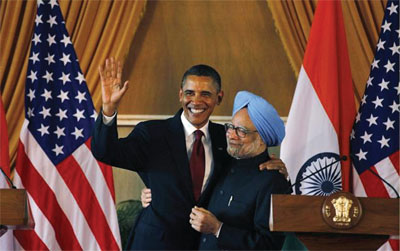
JAKARTA (TIP): India has made significant progress on its proposed plan of action for expanding partnership with the 10-nation ASEAN grouping in areas of economic, political, security and socio-cultural cooperation, and the two sides are on track to meet $100 billion trade by 2015. The assessment has been made in an executive report on the progress in the implementation of the projects and activities under the Plan of Action to Implement the ‘ASEANIndia Partnership for Peace, Progress and Shared Prosperity (2010-15)’. Prime Minister Manmohan Singh last night arrived here in Indonesia, a key ASEAN country, for a bilateral visit after attending ASEAN summits in another South East Asian nation Brunei from October 9-10. Besides attending the ASEAN and East Asia Summits, Singh also held bilateral meetings with various government leaders on the sidelines in Brunei and would hold bilateral talks with Indonesian leaders here. The key members of ASEAN block include Brunei, Cambodia, Indonesia, Myanmar, Singapore, Thailand, Philippines and Vietnam. Singh also announced that India would set up a separate mission for ASEAN with a full time ambassador, who would be based in Jakarta where the ASEAN Secretariat is also located.
The report highlighted that the past three years have “witnessed remarkable progress” in the implementation of the Plan of Action. “The successful conduct of a large number of activities and collaborative projects in a range of sectors covering all three pillars — political security, economic and sociocultural — was made possible through concerted efforts by both ASEAN Member States and India, and efficient coordination by Brunei Darussalam, Cambodia, and the ASEAN Secretariat,” it said. The Mid-Term review would be undertaken by the Committee of Permanent Representatives to ASEAN and the Ambassador of India to ASEAN. On the economic front, volume of trade and investment flows between ASEAN and India has increased considerably, but remains relatively low compared with other dialogue partners of ASEAN. The bilateral trade grew by 4.6 per cent from $68.4 billion in 2011 to USD 71.6 billion in 2012. ASEAN’s exports were valued at $43.84 billion and imports from India amounted to $27.72 billion in 2012. The target has been set at $100 billion by 2015 for ASEAN-India trade.
-

Obama cancels trip to Asia
WASHINGTON (TIP): The White House announced October 3 late night that President Obama’s upcoming trip to Asia has been canceled. “Due to the government shutdown, President Obama’s travel to Indonesia and Brunei has been cancelled,” White House press secretary Jay Carney said in a statement. “The President made this decision based on the difficulty in moving forward with foreign travel in the face of a shutdown, and his determination to continue pressing his case that Republicans should immediately allow a vote to reopen the government. Secretary (of State John) Kerry will lead delegations to both countries in place of the President.” Earlier this week, the White House announced Obama’s trip has been scaled back, canceling stops in Malaysia and the Philippines.Carney added that: “The cancellation of this trip is another consequence of the House Republicans forcing a shutdown of the government.”The trip was scheduled to begin on Saturday.The White House said Obama will schedule the trip for another date. “The President looks forward to continuing his work with our allies and partners in the Asia-Pacific and to returning to the region at a later date,” Carney said.
-

Upbeat Moneydart plans to operate in 50 states of United States by 2014
WOODBRIDGE , NJ (TIP): UAE Exchange, an Abu Dhabi based financial services company,which operates its money transfer business in USA under its wholly owned subsidiary Moneydart Global Services, is aggressively pushing forward to expanding its operations in all 50 states of USA by the next year. Moneydart Global Services Chief Operating Officer Y. Sudhir Kumar Shetty and Promoth Manghat, its Global Operations Vice-President,who are currently visiting USA to study the market, told media persons here that Moneydart made impressive gains in spite of recession in United States and downturn in world economy. “We are a trusted name in the world market of fund remittance in major currencies of the world”, he claimed.
Addressing media persons at company’s US headquarters in Woodbridge, NJ, Shetty unveiled Moneydart App,which can be easily uploaded on Android and other Smartphone operating systems. “The new App will meet the needs of our customers who preferred to complete their transaction using their mobile phones twenty four hours a day without visiting a branch”, said Shetty. According to Promoth Manghat, Moneydart is the only money transfer company,which acquired a SWIFT membership,which is normally given to banks. “Using our SWIFT membership we plan to launch our Business 2 Business product in North America. This service will benefit businesses that require wire transfer in more than one currency. He said that Moneydart’s online portal money2anywhere.com facilitated moneytransfer to a bank account and allows beneficiaries to pick up from our branches. He added that Moneydart’s ‘FLASHremit’ service was helping customers in India, Pakistan, Philippines, Bangladesh, Indonesia and Sri Lanka for money transfer within minutes. Moneydart’s Regional Head for Americas, Ajit Paul said his company was committed to various community activities and helping a number of community organizations conducting cultural and social activities
-

Indians Across World Celebrate Independence Day With Gusto
BEIJING/MELBOURNE (TIP): Indians across the globe on August 15 donned patriotic colours as they celebrated the country’s 67th Independence Day, unfurling the national flag and organising cultural events to mark the occasion. India’s ambassador to China S Jaishankar hoisted the tri-colour at the embassy premises in Beijing to celebrate the Independence Day.
A large gathering of Indian expatriates working in Beijing attended the ceremony. Jaishankar read out President Pranab Mukharjee’s national address and later hosted a reception on the occasion. The national tricolour also fluttered proudly across southeast Asia, as Indians and friends of India thronged to witness the unfurling of the flag by Indian envoys in the region to mark India’s 67th Independence Day. In Bangkok, India’s ambassador to Thailand Anil Wadhwa unfurled the flag and read out the President’s speech.
School children sang patriotic songs while 14 dancers from Arunachal Pradesh’s Tawang district performed the Snow Lion dance much to the delight of hundreds of Indians present at the Embassy. The tricolour was also unfurled by Indian envoys in neighbouring Myanmar, Singapore, Laos, Indonesia, Malaysia, the Philippines, Cambodia and Vietnam. In Tokyo, India’s ambassador to Japan Deepa Wadhwa unfurled the national flag. About 300 Indians and friends of India attended the function. Patriotic songs were sung by school children from two Indian schools in Tokyo.
In Singapore, India’s high commissioner Vijay Thakur Singh led more than 500-strong Indian community in celebrating the Independence Day. Singh read out the President’s message which was followed by three hours of cultural performances and singing of patriotic songs. Students from Indian schools in Singapore also performed during the cultural events. Singh hosted a morning reception for the Indian community and businessmen in Singapore.
In Australia, Indian diaspora celebrated the 67th Independence Day by organising flag hoisting ceremonies across the country followed by gala dinners and events. Speaking on the occasion, India’s high commissioner to Australia Biren Nanda extended greetings to Indian nationals and persons of Indian origin in the country. He said India’s relations with Australia have grown from strength to strength since the establishment of a strategic partnership between the two countries in 2009. “Our bilateral trade has reached $20 billion. There has been a very significant growth in two-way investment.
Indian companies have invested significantly in the resources sector and have propelled our economic relationship to the strategic level,” he said. Nanda further took note of Indian companies which have established joint ventures in Australia in the manufacturing sector in areas like auto components, aircraft manufacture, the manufacture of tractors and refining of vegetable oils. “The Free Trade Agreement that we are now negotiating will diversify and deepen our economic engagement,” Nanda said.
Indian government is organising Regional Pravasi Diwas this year in Sydney which is expected to be attended by over 1000 participants across the region. In the southern Chinese city of Guangzhou, consul general K Nagaraj Naidu hoisted the tricolour and read the President’s address to the nation at the Indian Consulate.
-

Six-fold increase in Green cards for Indians
NEW YORK (TIP): Indians chasing the American dream have reason to cheer. In 2012, as many as 35,472 Indians with H- 1B visas got green cards, up from 6,000 in 2011 – accounting for more than 50% of all green cards issued to H-1B holders for all countries in the year.
The data from the US Citizenship and Immigration Services (USCIS) comes in the wake of a new Bill that focuses on attracting knowledge workers to the US by providing them citizenship. The common impression is that the US is increasingly trying to keep foreigners out with new immigration walls. But that’s only a partial truth; it pertains to less skilled overseas workers. In reality, the US is also trying to attract the best brains from around the world and among the biggest beneficiaries are talented Indians.
A green card allows a person to live and work anywhere in America, and is a path to citizenship. An H-1B visaholder is beholden to the employer who hired him or her, and can be deported unless the holder can find another H-1B sponsor. Most Indians who got green cards in 2012 came from the EB-2 category, which includes professionals with advanced degrees in STEM (science, technology, engineering and math).
Clearly, the US wants to retain its competitive edge and accelerate R&D. “They need people with specialized skills who can substantially contribute to the knowledge economy. The large base of Indians with advanced degrees and domain expertise is highly sought after and given preferential treatment,” said Rakesh Prabhu, partner, immigration practice, ALMT Legal. The number of green cards a country gets in a year cannot exceed 7% of the total available. The limit primarily restricts those born in India, China, Mexico and the Philippines, given the large numbers of applicants from these countries.
However, most of the rest of the world does not come anywhere close to this quota. The unused numbers in a year from other countries are often given to countries that have long queues. In 2012, India appears to have benefited. “The US visa office seeks to use the available visa numbers by the time the fiscal year ends, at the end of September. They don’t like to waste numbers. So there could be a new surge (Indians becoming eligible for green cards) in August 2013 and in subsequent months,” said Cyrus D Mehta, managing attorney and founder of the New York-based law firm Cyrus D Mehta & Associates.
Now, there’s a serious effort to remove country quotas, which has a broad agreement among Republicans and Democrats. The Comprehensive Immigration Bill, which is before the Senate, seeks to remove the country caps to attract the best minds to the US. The political consensus right now is that knowledge workers with permanent residency are valuable to the economy. “If Congress removes country quotas, it should help Indian citizens. However, it will affect the rest of the world adversely,” said Denyse Sabagh, partner in the Philadelphia-headquartered law firm Duane Morris.
-

Pew Survey On Attitudes Towards Homosexuality Released
UNITED NATIONS (TIP): “Should Society Accept Homosexuality?” A global Pew Research Centre survey was released June 4, finding a wide variety of regional opinion on the question. Pew found that generally more positive attitudes were observed amongst younger people, and that in countries where a gender gap was observed, women tended to be more accepting than men. The survey polled nearly forty thousand people in 39 countries, asking questions about religion, age and gender.
Senior Researcher at Pew Global Attitudes Juliana Menasce Horowitz observed, “What is surprising is the level of global polarization that we see on this subject. We have been collecting public opinion data all over the world on various issues, and I can’t think of any questions or subjects where we see such large percentages on one side in a group of countries and equally high percentages on the other side in other parts of the world.” The most tolerant responses to the question were predominantly secular and affluent, and either Latin American and Western.
The least tolerant were found to be the 13 Middle Eastern and African nations polled. The strongest support came from Spain where 88 per cent of respondents answered “Yes” to the question. The study found a strong relationship between a country’s religiosity and its opinion on homosexuality. In countries where religiosity was low, attitudes were mostly positive. This was measured by three factors; whether they believe faith in god to be a necessity for morality; whether or not they say that religion is important in their lives; and whether they pray every day.
This trend excluded Russia and China where religiosity was found to be low, but only around 20 percent answered “Yes” on the question of whether homosexuality should be accepted in society. In 2012, Russia’s top court upheld a ban on gay pride marches for the next 100 years in Moscow. On the other hand religiosity was measured to be high in the Philippines and attitudes were positive, with 73 per cent of respondents answering “Yes.”
The results of the survey have been published at a time when many countries are debating same-sex marriage, France in particular having conducted its first official ceremony last week, and the UK preparing to pass a law soon. There are currently fifteen countries worldwide in which there is legal recognition of same-sex marriages.
-

China Emerging As New Force In Drone Warfare
BEIJING (TIP): Determined to kill or capture a murderous Mekong River drug lord, China’s security forces considered a tactic they’d never tried before: calling a drone strike on his remote hideaway deep in the hills of Myanmar. The attack didn’t happen — the man was later captured and brought to China for trial — but the fact that authorities were considering such an option cast new light on China’s unmanned aerial vehicle program, which has been quietly percolating for years and now appears to be moving into overdrive. Chinese aerospace firms have developed dozens of drones, known also as unmanned aerial vehicles, or UAVs. Many have appeared at air shows and military parades, including some that bear an uncanny resemblance to the Predator, Global Hawk and Reaper models used with deadly effect by the US Air Force and CIA.
Analysts say that although China still trails the US and Israel, the industry leaders, its technology is maturing rapidly and on the cusp of widespread use for surveillance and combat strikes. “My sense is that China is moving into large-scale deployments of UAVs,” said Ian Easton, co-author of a recent report on Chinese drones for the Project 2049 Institute security think tank. China’s move into large-scale drone deployment displays its military’s growing sophistication and could challenge US military dominance in the Asia-Pacific. It also could elevate the threat to neighbors with territorial disputes with Beijing, including Vietnam, Japan, India and the Philippines. China says its drones are capable of carrying bombs and missiles as well as conducting reconnaissance, potentially turning them into offensive weapons in a border conflict. China’s increased use of drones also adds to concerns about the lack of internationally recognized standards for drone attacks.
The United States has widely employed drones as a means of eliminating terror suspects in Pakistan and the Arabian Peninsula. “China is following the precedent set by the US The thinking is that, ‘If the US can do it, so can we. They’re a big country with security interests and so are we’,” said Siemon Wezeman, a senior fellow at the arms transfers program at the Stockholm International Peace Research Institute in Sweden, or SIPRI. “The justification for an attack would be that Beijing too has a responsibility for the safety of its citizens. There needs to be agreement on what the limits are,” he said. Though China claims its military posture is entirely defensive, its navy and civilian maritime services have engaged in repeated standoffs with ships from other nations in the South China and East China seas. India, meanwhile, says Chinese troops have set up camp almost 20 kilometers (12 miles) into Indian-claimed territory.
It isn’t yet known exactly what China’s latest drones are capable of, because, like most Chinese equipment, they remain untested in battle. The military and associated aerospace firms have offered little information, although in an interview last month with the official Xinhua News Agency, Yang Baikui, chief designer at plane maker COSIC, said Chinese drones were closing the gap but still needed to progress in half a dozen major areas, from airframe design to digital linkups. Executives at COSIC and drone makers ASN, Avic, and the 611 Institute declined to be interviewed by The Associated Press, citing their military links. The Defense Ministry’s latest report on the status of the military released in mid-April made no mention of drones, and spokesman Yang Yujun made only the barest acknowledgement of their existence in response to a question.