Tag: Punjab Farmers

  • The season of defections is here

    The season of defections is here

    • Structural weakness in Indian democracy needs to be addressed urgently

    “Poaching legislators is not new to our democracy. The terms ‘Aaya Ram’ and ‘Gaya Ram’ were coined decades ago when political leaders of Haryana adopted the method of enticing elected members of rival parties to cross over to bring down governments. Some sense of shame must have seeped in because there was a lull in such shenanigans for some time till Congress lawmakers shifted en masse to the BJP in Goa in 2019, tempted by the lure of office.”

    By Julio Ribeiro

    Very soon, the BJP ranks will be stacked with Congress leaders seeking a lucrative future. After former Maharashtra Chief Minister Ashok Chavan left the Congress and joined the BJP, former Madhya Pradesh CM Kamal Nath seems ready to jump the ‘sinking ship’.

    The inability of INDIA parties to look beyond their noses has virtually sealed their fate.
    Nath had handed over Madhya Pradesh to the BJP on a platter due to his misreading of the voters’ preferences and mishandling of other anti-BJP parties.

    Chavan’s standing in Maharashtra politics was visibly on the decline. He had even lost his Nanded seat to the BJP’s Prataprao Govindrao Chikhalikar in the 2019 Lok Sabha elections. His father, Shankarrao Chavan, was a highly respected politician who had served as the CM and Union Home Minister. Shankarrao had scruples about corruption which his son did not share.

    Chavan has been nominated to the Rajya Sabha by his new-found friends. He will have to compete for a ministership with other turncoats from Maharashtra like Narayan Rane, who was another ‘candidate’ for probes by investigation agencies had he not crossed over a few years ago.

    The migration of the inglorious from the Opposition to the ruling party has picked up steam before the Lok Sabha polls. Is the BJP’s goal a Congress-mukt polity or an Opposition-mukt one? Starting with those with skeletons in their cupboards, others who hanker for the spoils of office or just want to feel important will gravitate to the winning side. Greed is the guide. The BJP capitalizes on this.

    Recently, the AAP-Congress combine was assured of victory in the Chandigarh mayoral poll with 20 votes out of 36. The returning officer invalidated eight votes to ensure the BJP’s win. The Supreme Court had to intervene and order the prosecution of the returning officer. It declared the AAP-Congress candidate as the winner. Before the SC verdict, the BJP, the party that had once proclaimed that it was ‘different’, carried out ‘Operation Lotus’ to make three AAP councilors switch camps.

    Poaching legislators is not new to our democracy. The terms ‘Aaya Ram’ and ‘Gaya Ram’ were coined decades ago when political leaders of Haryana adopted the method of enticing elected members of rival parties to cross over to bring down governments. Some sense of shame must have seeped in because there was a lull in such shenanigans for some time till Congress lawmakers shifted en masse to the BJP in Goa in 2019, tempted by the lure of office.

    The BJP has sharpened this unethical method to a fine art after tasting blood. In Karnataka, it displaced the Congress government by successfully luring a good number of its legislators to change sides. In Maharashtra, this game is being played out even today. The voters who voted against the BJP have been short-changed. They vote for a particular party on ideological grounds but cannot be sure that those whom the party has chosen to represent them will continue to reflect their aspirations, once elected.

    This is a structural weakness of Indian democracy. It needs to be urgently addressed. No legislator or corporator should be allowed to cross over mid-term. If he has concerns about the policies of the party on whose ticket he was elected, he should resign from the Assembly and re-contest on the ticket of his new party. If he is popular in his constituency, he may well win again, but at least those who voted for him or her on ideological grounds will not be let down.

    Since the BJP’s new tactic of remaining in power at any cost, fair or foul, has obviously kicked in, it is urgent to restore our good name in the democratic world by devising a mechanism to combat this menace of ‘Aaya Rams’ coming and ‘Gaya Rams’ going for reasons far removed from dissatisfaction with the policies followed by the party which they have decided to discard.

    The inability of INDIA parties to look beyond their noses has virtually sealed their fate. After the votes are counted and Modi is back in North Block for another term of five years, expect Opposition leaders to face the music in a much more defined degree. The ED, the CBI and other Central agencies will make their lives uncomfortable. Only those who cross over can expect to be absolved of their sins.

    If the BJP gets a two-thirds majority in Parliament, the Constitution will be subject to revision. Women, in particular, will have to conform to a rigid standard of morality. Live-in relationships, which are now common among the urban liberated youth, will be frowned upon, like we have seen in Uttarakhand, whose holier-than-thou Chief Minister Pushkar Singh Dhami has introduced the Uniform Civil Code (UCC), which restricts choices in love and marriage.

    I have no objection to the UCC as long as the objective is to ensure that women are treated on a par with men. The rights of the woman in inheritance of her father’s property and her right to choose her life partner should be upheld. There are myriad related issues like divorce and adoption, but the right to inheritance and the right to choose one’s spouse are paramount.

    It is not wise to advise the BJP to desist from accepting tainted members of Opposition parties in its fold. The BJP is on a roll. Modi consecrated the Ram Mandir at Ayodhya, secured the release of eight former Navy personnel sentenced to death by a court in Qatar for alleged spying, and inaugurated a Hindu temple in a Muslim-majority country (UAE).

    Unfortunately, there are counter-balancing issues. The farmers’ agitation for legal guarantee for procurement at the MSP is one such issue. If the demand is conceded, it will compromise fiscal responsibility. The unabated violence in Manipur is another. The BJP knows the people responsible for the raging fire, but its hands are tied. If the incompetent CM Biren Singh is replaced, the Meitei vote will be in doubt. Reservation for Marathas is yet another issue that defies accepted solutions. It is not going to be an easy ride!

    There are many other such problems that Modi will have to solve, but he is postponing action till the Lok Sabha polls are over.
    (The author is a former governor, and a highly decorated Indian Police Service officer)

  • The Unyielding Spirit of Punjab Farmers

    The Unyielding Spirit of Punjab Farmers

    • Death of an Individual is not the end of an idea

    In the heartland of India, a battle is raging. The agrarian community of Punjab, resilient and united, is on a warpath, demanding fair prices for their produce and an end to oppressive government policies. The conflict has escalated as the government, seemingly serving the interests of capitalist cronies, remains adamant on enforcing controversial agricultural laws. This struggle, reminiscent of the past, echoes a powerful truth – the death of an individual does not extinguish the flame of an idea.

    A year ago, the farmers took to the streets, demanding the repeal of certain agricultural laws imposed by the Modi government. The initial response from the government was repression, attempting to stifle the movement. However, the farmers, standing united and supported by their counterparts from Uttar Pradesh and Haryana, refused to back down. Faced with the strength of this collective resolve, the government succumbed to pressure, promising to reevaluate and revise its agricultural policies.
    Despite assurances, the government failed to initiate substantial changes in agricultural policies. Disillusioned, the farmers resumed their struggle, realizing that the promises made were nothing more than empty words. The government’s lack of action fueled the flames of discontent, prompting the agricultural community to intensify their protests.

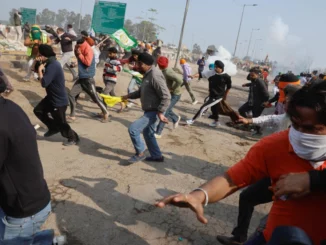
    In a disturbing turn of events, the BJP-led government, both at the central and state levels, unleashed repressive measures against the protesting farmers. Border points between Punjab and Haryana were barricaded to thwart the march to Delhi. The use of water cannons and, shockingly, reports of firing upon peaceful farmers became tools employed by the authorities to crush the dissent.

    The conflict reached a critical juncture when, as claimed by agitating farmers’ leaders, a 21-year-old award winning farmer Shubhkaran Singh was shot in the head by the Haryana police. Despite police denials of any firing, numerous farmers sustained injuries in the alleged incident. The agitating leaders also reported the disappearance of several farmers, accusing the government of using such tactics to instill fear among the protesting community.

    The government’s heavy-handed approach seems to be rooted in a short memory. A year ago, similar repressive measures failed to deter the farmers. The authorities forget that the death of an individual does not equate to the death of an idea. History is replete with examples of ideas that survived the demise of their proponents.

    Reflecting on history, we find poignant examples of individuals whose ideas endured despite their tragic deaths. Mahatma Gandhi, an apostle of non-violence, was assassinated by Nathuram Godse, who subscribed to the Hindutva ideology. Yet, Gandhism remains alive, shaping the moral fabric of societies worldwide. In the United States, Martin Luther King Jr., a champion of civil rights, was assassinated, but his vision persists, inspiring movements for civil liberties, justice and equality globally.The Punjab farmers’ struggle embodies the unbroken spirit of individuals united by a common cause. The government’s attempts to suppress dissent through repressive measures might temporarily subdue the protests, but history has shown that the death of an individual does not extinguish the flame of an idea. The farmers’ fight for fair prices and agricultural autonomy transcends individual tragedies, evolving into a movement that refuses to be silenced. As the echoes of protests reverberate, it serves as a stark reminder that ideas born from the collective consciousness of a determined community can withstand the harshest of challenges, ensuring that their voices are not easily silenced or forgotten.