Tag: S Jaishankar

  • India-US dialogue: Both nations maintain focus on strategic cooperation

    The India-US 2+2 Ministerial Dialogue, held amid the Russia-Ukraine war, has ticked all the bilateral boxes, with both nations reaffirming their commitment to enhancing defense and strategic cooperation in various domains, including relatively new ones such as space, artificial intelligence and cyberspace. It’s laudable that the US delegation, led by Secretary of State Antony Blinken and Secretary of Defense Lloyd Austin, and the Indian side, represented by Defense Minister Rajnath Singh and External Affairs Minister S. Jaishankar, did not let the two countries’ differences over engagement with Russia cast a shadow on their talks.

    The US has reiterated its support for India’s permanent membership in a reformed UN Security Council and New Delhi’s induction into the Nuclear Suppliers’ Group (NSG). India is keen to join the elite club whose members are entitled to hassle-free procurement of supplies from international markets for building and operating nuclear reactors, but China has been playing spoilsport in league with Pakistan. As of now, India’s N-push is powered by initiatives under the India-US Civil Nuclear Energy Working Group. Timely transfer of technology holds the key to a mutually beneficial strategic partnership, particularly in defense and energy sectors. India and the US need to redouble efforts to get the best results on this front.

    Both countries are on the same page when it comes to envisioning a free, open and inclusive Indo-Pacific and turning Quad into a formidable force that can make a lasting impact beyond its multilateral framework. With a new government set to take charge in Pakistan, it is significant that the troubled and troublesome country finds a mention in the joint statement. The ministers have called on Pakistan to take ‘immediate, sustained, and irreversible action to ensure that no territory under its control is used for terrorist attacks’. A similarly strong message has been conveyed to Afghanistan’s rulers, the Taliban. All in all, the dialogue makes it clear that India and the US will continue to give precedence to their common strategic interests, irrespective of geopolitical upheaval anywhere in the world.

    (The Hindu)

  • SBI to give $1-billion loan to Sri Lanka for food, medicine and other essential items

    SBI to give $1-billion loan to Sri Lanka for food, medicine and other essential items

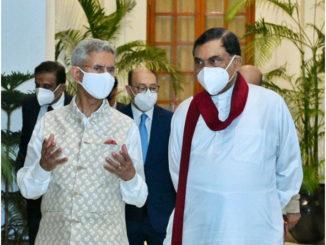
    Colombo/New Delhi (TIP): The State Bank of India on March 17 signed an agreement for extending a credit line of $1 billion to Sri Lanka enabling it to buy food, medicine and other essential items. The agreement was signed after Union Ministers S Jaishankar and NirmalaSitharaman held discussions on economic cooperation and “issues of mutual interest’’ with Sri Lanka Finance Minister Basil Rajapaksa, said an official news release. Basil Rajapaksa visited India for financial assistance which will temporarily enable the cash-strapped Sri Lanka to stave off an unprecedented economic crisis.

    On the eve of his visit, Colombo sent a positive signal by signing a joint venture with India three days back for a 100 mw solar power plant at Sampur in Trincomalee to compensate for the scrapping of an Indo-Japan coal power project on environmental grounds. On the security side, Colombo last week hosted another conference of NSAs of regional countries for a collective approach to maritime security.

    In January, India had bailed out Sri Lanka from its balance of payments difficulties by extending a $400 million swap facility and deferring the settlement of $515.2 million. Thus, the help extended by India is worth over $900 million and about $1.5 billion more is in the pipeline.

    Basil Rajapaksa had met PM NarendraModi for the assistance provided to Sri Lanka at this critical time. The two leaders discussed a wide range of issues pertaining to the bilateral relationship. These included agriculture, renewable energy, digitalisation, tourism and fisheries among others, said a release from the Sri Lanka High Commission.

    Basil Rajapaksa also held talks with Jaishankar the same evening, which were followed by a working dinner. Rajapaksa was accompanied to the meeting by Sri Lanka’s High Commissioner to India MilindaMoragoda, Secretary to the Ministry of Finance S.R. Attygalle and Sri Lanka’s Deputy High Commissioner to India NilukaKadurugamuwa. (TNS)

  • We will take all possible steps to bring back Indians from Ukraine, says  Foreign Secretary Shringla

    We will take all possible steps to bring back Indians from Ukraine, says  Foreign Secretary Shringla

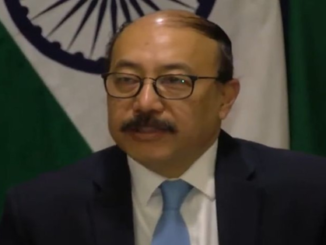
    NEW DELHI (TIP): India on Thursday, February 24,  assured its citizens stranded in Ukraine that it will take all possible steps to bring them back safe and sound. Foreign Secretary Harsh Vardhan Shringla said at a media briefing that the Indian embassy in Ukraine is extending all possible assistance to the Indians notwithstanding the complicated situation.

    He said a meeting of the Cabinet Committee on Security (CCS), chaired by PM Narendra Modi, was underway on the Ukraine crisis.

    Shringla said Modi conveyed at the CCS meeting that the topmost priority of the government is the safety and security of Indians and their evacuation from Ukraine.

    The foreign secretary said around 4,000 Indian nationals out of 20,000 have already left Ukraine in the past few days.

    “The situation on the ground is difficult and rapidly evolving,” he said. “I want to assure all Indian citizens including students in Ukraine that we will take all possible steps to bring you back safe and sound,” he said. Shringla said External Affairs Minister S Jaishankar will speak to foreign ministers of Romania, Slovakia, Poland and Hungary on the Ukraine crisis.

    (Source: PTI)

  • Indian-origin Gujrati family of four found frozen to death near US-Canada border

    Indian-origin Gujrati family of four found frozen to death near US-Canada border

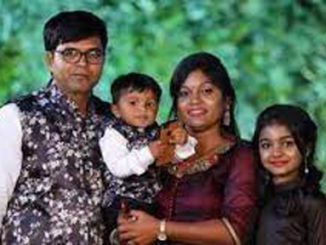
    WASHINGTON, D.C. (TIP):  A family of four Indians from Gujarat — including a baby and a teenager — froze to death in -40F blizzard after walking for 11 hours through waist-high snow to illegally cross border into the US from Canada. Canadian police found the bodies Wednesday, January 19,  33 feet from the border near Emerson, Manitoba, after the arrest of a Florida man Steve Shand, 47, on charges of human smuggling in the US, according to media reports. Searching officers found three bodies – a man, a woman and a baby – together and a teen boy a short distance away. It is believed they all died from exposure to the cold.

    Shand was arrested after a US Border Patrol in North Dakota stopped a 15-passenger van just south of the Canadian border and found him driving with two allegedly undocumented Indian nationals, the reports said.

    Inside the vehicle, officers found cases of plastic cups, bottled water, bottled juice and snacks with one of the adults carrying items for a baby, but there was no infant with the group, reports said citing US court documents.

    Later, the authorities came across another group of five Indian nationals who said they had walked across the border for an estimated 11 hours. A search was initiated immediately and Shand was charged with smuggling seven Indian nationals into the US. One of those people allegedly spent a significant amount of money to come to Canada with a fraudulent student visa, the reports said. Meanwhile, in New Delhi, Indian External Affairs Minister S Jaishankar said on Friday, January 21,  he was shocked to hear about the incident and had asked the Indian ambassadors in the US and Canada to urgently respond to the situation.

    “Shocked by the report that 4 Indian nationals, including an infant, have lost their lives at the Canada-US border,” he tweeted. “Have asked our Ambassadors in the US and Canada to urgently respond to the situation.”

    In Ottawa, Canadian Prime Minister Justin Trudeau calling it a “mind blowing tragedy,” said on Friday Canada is doing all it can to stop people-smuggling across the US border.

    “It was an absolutely mind-blowing story. It’s so tragic to see a family die like that, victims of human traffickers … and of people who took advantage of their desire to build a better life,” Trudeau told a news conference, according to Winnipeg Sun.

    “This is why we are doing all we can to discourage people from crossing the border in an irregular or illicit manner. We know there are great risks in doing so,” he continued.

    Canada, Trudeau said, was working very closely with the United States to stop smuggling and help people “taking unacceptable risks”. Meanwhile, a criminal complaint filed in the US District Court for the District of Minnesota charged Shand with human smuggling.

    Shand, a “suspected smuggler of undocumented foreign nationals, was arrested near the US/Canadian border for transporting two Indian nationals, who were illegally present in the US,” the complaint said. The two Indian nationals have been identified as ‘SP’ and ‘YP’ in the complaint.

    The complaint said that five Indian nationals illegally present in the United States were also identified and arrested around the time of Shand’s arrest.

    All the foreign nationals spoke Gujarati, a language spoken in Gujarat in western India. Most had limited or no English language speaking ability, the complaint said. There are significant Gujarati populations outside of India, including in Canada and the US, it noted.

    The family of four that was found dead was apparently separated from others while walking through blizzards and snow, according to one of the persons arrested on the US side of the border.

    “It is an absolute and heartbreaking tragedy,” Royal Canadian Mounted Police (RCMP) Assistant Commissioner Jane MacLatchy said in Winnipeg on Thursday. “They were wearing winter clothing, she said, but it would not have been enough to save them with the freezing conditions” she said.

    “The group was on its own in the middle of a blizzard and faced not only the cold weather, but endless fields, large snowdrifts and complete darkness,” MacLatchy added.

    “At this early stage of the investigation, it appears that they all died due to exposure to the cold weather,” she said.

    The RCMP said it was working with the US authorities on further investigation.

  • Modi holds first bilateral meeting with President Biden; discusses Indo-Pacific, climate and COVID

    Modi holds first bilateral meeting with President Biden; discusses Indo-Pacific, climate and COVID

    US – India relationship is destined to be “stronger, closer and tighter”, says Bide

    TIP Special Correspondent

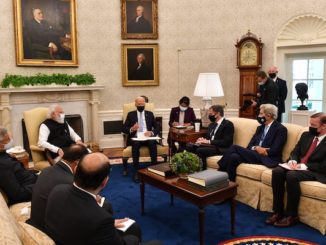
    WASHINGTON, DC (TIP): Prime Minister Narendra Modi on Friday, September 24, described as “outstanding” his first bilateral meeting with US President Joe Biden who said the Indo-US relationship is destined to be “stronger, closer and tighter” as the two leaders discussed a wide range of issues, including combating COVID-19, climate change, trade and the Indo-Pacific. President Biden, who welcomed Prime Minister Modi in the Oval Office of the White House said that today they are starting a new chapter in US-India relationship.

    Observing that he has long believed that the US, India relationship can help them solve global challenges, Biden in his opening remarks before a battery of India and American media said they are now “are launching a new chapter in history of India US ties, taking on some of the toughest challenges we face together.”

    And this starts with a shared commitment to end COVID-19, he said. Prime Minister Modi, who is visiting the US for the 7th time after assuming office in 2014, described Friday’s bilateral meeting with Biden that lasted more than 60 minutes as “important” as they’re meeting at the start of the third decade of this century.

    “Your leadership will certainly play an important role in how this decade is shaped. The seeds have been sown for an even stronger friendship between India and the US,” Prime Minister Modi told Biden.

    “Had an outstanding meeting with @POTUS @JoeBiden. His leadership on critical global issues is commendable. We discussed how India and USA will further scale-up cooperation in different spheres and work together to overcome key challenges like COVID-19 and climate change,” Modi tweeted after the meeting. Biden said the relationship between India and the US, the largest democracies in the world, is “destined to be stronger, closer and tighter.” “I’ve long believed that the US-India relationship can help us solve a lot of global challenges. In fact, back in 2006, I had said that by 2020 India and the US will be among the closest nations in the world,” Biden told Modi. “Today, we’re launching a new chapter in the history of US-India ties, taking on some of the toughest challenges we face together, starting with a shared commitment,” he said.

    Biden said he and Prime Minister Modi would talk about what more they can do to fight COVID-19, take on the climate challenge that the world face, and ensure stability in the Indo-Pacific, including with their quiet partners.

    India, the US and several other world powers have been talking about the need to ensure a free, open and thriving Indo-Pacific in the backdrop of China’s rising military maneuvering in the region.

    “Of course, our partnership is more than just what we do. It’s about who we are in our shared responsibility to uphold democratic values, our joint commitment to diversity, and it’s about family ties, including four million Indian-Americans make the United States, stronger every single day,” he said.

    Noting that the world would celebrate Mahatma Gandhi’s birthday next week, Biden said, “We’re all reminded that his message of non-violence, respect, tolerance, matters today maybe more than ever had.”

    On this, Modi said, “Gandhi Ji spoke about trusteeship, a concept which is very important for our planet in the times to come.” Noting that trade will be an important factor in the Indo-US ties in the coming decade, the Prime Minister said that there is much to be done in the area.

    Modi said this decade will be shaped by talent and people-to-people linkages. “I am glad the Indian diaspora is making an active contribution towards the US’ progress.” He said that technology is becoming a driving force. “We have to utilize our talents to leverage technology for greater global good.”

    Modi recalled his interactions with Biden in 2014 and 2016, saying “that time you had shared your vision for ties between India and US. I am glad to see you are working to realize this vision.”

    He said that each of the subjects mentioned by the president are crucial for the India-US friendship. “His efforts on COVID-19, mitigating climate change and the Quad are noteworthy,” Modi added.

    “This morning I’m hosting Indian Prime Minister Narendra Modi at the White House for a bilateral meeting. I look forward to strengthening the deep ties between our two nations, working to uphold a free and open Indo-Pacific, and tackling everything from COVID-19 to climate change,” President Biden had tweeted minutes before the meeting. While the two leaders have met earlier when Biden was the Vice President of the country, this is for the first time that Biden is meeting Modi after he became the 46th president of the US in January.

    Both Biden and Prime Minister Modi have spoken over the phone multiple times and have attended a few virtual summits, including that of the Quad in March hosted by the US president. The last telephone conversation between them took place on April 26.

    Spokesperson of the Ministry of External Affairs Arindam Bagchi said that India US relationship is a partnership of trust. “Globally we will make a difference!” he tweeted.

    “Vibrant discussions between” Modi and Biden. “Joseph Biden on global, regional & bilateral issues. An expansive agenda including defense, security, health, education, trade, IT, economic, Science and Technology energy and People to People ties,” Bagchi said. The Prime Minister also signed the visitor book in the Roosevelt Room of the White House. “Registering the spirit of India United States friendship in ink,” the spokesperson tweeted. The Indian delegation included S Jaishankar, Minister of External Affairs; Ajit Doval, National Security Advisor; Harsh Vardhan Shringla, Foreign Secretary and Taranjit Singh Sandhu, India’s Ambassador to the United States.

    The American delegation included Antony Blinken, Secretary of State; Jake Sullivan, National Security Advisor; John Kerry, Special Presidential Envoy for Climate; Kurt Campbell, Deputy Assistant to the President and Coordinator for Indo-Pacific Affairs; Donald Lu, Assistant Secretary of State for South and Central Asian Affairs and Sumona Guha, Special Assistant to the President & Senior Director for South Asia at National Security Council.

    Visit www.theindianpanorama.news for more stories on PM Modi’s US visit


  • India’s External Affairs Minister Jaishankar Makes Remarks at the UNSC

    India’s External Affairs Minister Jaishankar Makes Remarks at the UNSC

    UNITED NATIONS (TIP): On Wednesday, August 18, External Affairs Minister S. Jaishankar made remarks on UN Peacekeeping efforts and the critical role technology plays in gathering intel and information, the second pillar of India’s presidency at the UNSC. He announced India’s decision to support to the UNITE Aware Platform, an initiative which will support UN peacekeeping missions to visualize, coordinate, and monitor all events on a real time basis. He further emphasized that attacks on a peacekeeper or a civilian should be predictable, preventable, or responded to immediately. You can find the text of his remarks here.

    On Thursday, August 19, External Affairs Minister S. Jaishankar chaired a UNSC session on terrorism. He proposed an eight-point action plan for consideration, including: no justification and support to terrorism, no double standards on terrorists, support and strengthen FATF, and increased funding to the UN Office of Counter Terrorism.

  • Keep distance from Taliban

    Keep distance from Taliban

    The Modi government has rightly ignored the calls for ‘talks’

    By G Parthasarathy

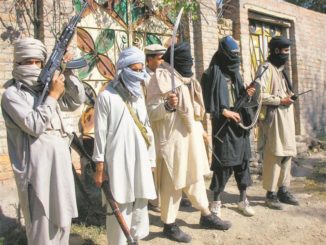
    There is an erroneous perception in India that Afghanistan is a monolithic country, where the Taliban represents the majority of the country. The Taliban is made up almost exclusively of Pashtuns, who constitute around 45% of Afghanistan’s population. The Taliban’s leaders and its cadres returned to Afghanistan from their hideouts in Pakistan, just as the occupying Soviet Forces began withdrawing from Afghanistan in February 1989. Having been trained and ideologically indoctrinated in some of the most fundamentalist madrasas, the Taliban sought to fill the political and security vacuum after the Soviets withdrew from Afghanistan. The Taliban let loose a reign of terror and oppression in Afghanistan, which was quite unique.

    The Taliban faced armed opposition from virtually every other Afghan ethnic grouping. This resistance was spearheaded by the Tajiks, who constitute around 35% of Afghanistan’s population. The Taliban ruled Afghanistan and soon became a safe haven for radical Islamist terrorist groups from across the world. American intervention in Afghanistan commenced in 2003, after the 9/11 terrorist strikes. Driven out of Afghanistan, the Taliban operated from Pakistan. Strangely, the Americans accepted Pakistani claims of innocence, despite the ISI’s obvious support for Taliban’s terrorism. Washington provided Pakistan all economic and military aid it could absorb. The Taliban, however, retained close links with terrorist groups, like the JeM and LeT, while colluding with the ISI.

    The US presence in Afghanistan did not deter or prevent the Taliban from strengthening its ties with radical Islamic groups across the world, while hosting these radicals in Afghanistan. These groups included the Al Qaeda, the IS, the Tehriq-e-Taliban (Pakistan), and the East Turkistan Independence Movement, which operated in China’s Xinjiang province. China received assurances from the Taliban that they would cease support for insurrection and seek peace with the Afghan government. That has not happened. Pakistan had led the US up the garden path by providing safe haven to Osama bin Laden, who was the mastermind of the 9/11 attacks.

    The Taliban leadership has made it clear how it will rule Afghanistan. Its spokesman Zabihullah Mujahid recently announced that they would rule according to the Sharia, which will be enforced ‘rigorously’. He asserted that elections did not yield positive results in Islamic countries. Women would not be permitted to sing and can work only in some areas. They would have to be accompanied by a male ‘for their protection’ whenever they leave the house. Men, in turn, are barred from wearing western clothes, and would have to grow a beard. They believe that war as an option is not ruled out, and that jihad will continue.

    The Taliban are giving high attention to capturing Kandahar, located close to the borders with Pakistan. Kandahar is equivalent of another Mecca for the people of Afghanistan. The then ruler of Afghanistan, Ahmed Shah Abdali, received a cloak, said to have been worn by the Prophet, during his visit to Bokhara (now in Uzbekistan), from the kingdom’s ruler, Amir Murad Beg. The cloak is now placed in a mosque near Abdali’s tomb. The normally reclusive Taliban leader Mullah Omar shot to fame when he emerged from the mosque, with the cloak, in 1996.

    There are fears that the Taliban will overrun the Afghan forces. The impression also prevails that the Afghan army lacks the sagacity to overcome the Taliban challenge, as there are areas in southern and western Afghanistan, near the country’s borders with Iran and Tajikistan, which are presently under Taliban control. Pakistani involvement is evident, as large numbers of Pakistani terrorists are now fighting alongside the Taliban. Russia has concerns about the conflict crossing into the territory of its erstwhile Central Asian republics like Tajikistan. Iran has similar concerns about Taliban attacks on its allies, the Shia Hazaras, living just across its borders in Afghanistan. Future Russian and Iranian involvement on the western borders of Afghanistan cannot, therefore, be ruled out.

    External Affairs Minister S Jaishankar has held wide-ranging talks with the US, Russia, and virtually all of Afghanistan’s Central Asian neighbors, both bilaterally and in the Shanghai Cooperation Organisation. His unprecedented meeting with Iran’s President-elect Ebrahim Raisi in Tehran was of particular significance. Iran has already warned of serious consequences if the Taliban should cause any harm to its Shia Hazara brethren. Iran was New Delhi’s close regional ally, when India, Iran and Russia backed groups in the Northern Alliance, drawn from the non-Pashtun majority in Afghanistan, even before the US intervention.

    While Taliban successes in an estimated 200 of the 424 districts across Afghanistan have received substantial attention, the Taliban are finding it hard to take over a provincial capital in even one of Afghanistan’s 34 provinces. The US left the Afghan army ill equipped, with hardly any tanks and artillery. The Afghan air force has an estimated 200 aircraft, which include 69 light attack helicopters. Washington would have to substantially strengthen Afghanistan’s armed forces. It remains to be seen if Pakistan provides the Taliban with Stinger surface-to-air missiles. There are calls for ‘talks’ with the Taliban, which the Modi government has rightly ignored. The Taliban are, and will remain, tools of the ISI. While contacts can be maintained with Taliban leaders like Mullah Baradar in Qatar, there is no need to follow the Chinese example, with moves like formally inviting Taliban leaders to New Delhi. The Taliban colluded with the hijackers of IC 814 and maintained close ties with ISI-backed terrorist groups. Pakistan, in turn, needs a weak and internationally discredited Afghanistan to constitute its ‘strategic depth’ against India.

    (The author is Chancellor, Jammu Central University & former High Commissioner to Pakistan)

  • “Both of our democracies are works in progress”:US Secretary of State Antony Blinken

    “Both of our democracies are works in progress”:US Secretary of State Antony Blinken

    “Shared values – freedom and equality – are key and none of us have done enough,” Blinken said

    NEW DELHI (TIP): Two of the world’s biggest democracies should do more to strengthen democratic institutions, US Secretary of State Antony Blinken said today during his India visit.

    “Shared values – freedom and equality – are key and none of us have done enough. We need to strengthen our democratic institutions. This is at the core of our relationship, beyond strategic and economic ties,” Mr Blinken said.

    “One of the elements Americans admire most is fundamental freedom and human rights. That’s how we define India. India’s democracy is powered by free-thinking citizens,” Mr Blinken said.

    Mr Blinken told civil society groups – his first appointment before meeting External Affairs Minister S Jaishankar and Prime Minister Narendra Modi – that the US and India are “connected by shared values” such as rule of law and freedom of religion.

    “Both of our democracies are works in progress… As I said before, sometimes that process is painful. Sometimes it’s ugly. But the strength of democracy is to embrace it,” Mr Blinken said.

    The Modi government has faced criticism over growing use of anti-terrorism legislation and sedition laws to arrest campaigners, journalists and students. The Supreme Court on July 15 described the British-era sedition law as “colonial”, and questioned whether the law was “still necessary after 75 years of Independence”.

    In the talks with Mr Blinken, Indian officials are expected to express alarm over Taliban gains in Afghanistan. India is worried that a possible takeover of Afghanistan by the Taliban, which it sees as backed by Pakistan, will turn the country into a base for terrorists to attack India.

    The Taliban welcomed virulently anti-Indian terrorists when it ruled Afghanistan from 1996 to 2001. A hijacked Indian airliner was flown to the Taliban bastion of Kandahar in 1999.

    India, a firm backer of the Afghan government with billions of dollars in development aid, recently evacuated some of its staff from its Kandahar consulate due to the worsening security situation.

    (With inputs from PTI)

  • Antonio Guterres re-elected as UN Secretary-General for a second five-year term

    Antonio Guterres re-elected as UN Secretary-General for a second five-year term

    “India values Secretary General’s leadership of the United Nations”: India’s External Affairs Minister Jaishankar

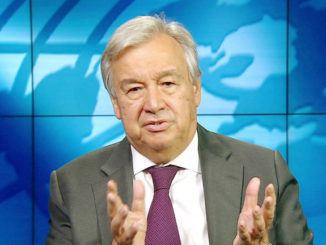
    UNITED NATIONS (TIP): UN General Assembly on Friday, June 18, appointed Antonio Guterres as the UN Secretary-General for a second term beginning January 1, 2022, days after the powerful Security Council had unanimously recommended his name to the 193-member body for re-election.

    President of the 75th session of the UN General Assembly Volkan Bozkir announced that Mr. Guterres “has been appointed by acclamation Secretary-General of the United Nations for the second term of office beginning on January 1, 2022, and ending on December 31, 2026.” Mr. Bozkir then administered the oath of office to 72-year-old Guterres at the podium of the UN General Assembly Hall.

    On June 8, the 15-nation Council had held a closed meeting where it adopted by acclamation the resolution that recommended Mr. Guterres’ name to the General Assembly for a second five-year term as Secretary General from January 1, 2022-December 31, 2026.

    Estonia’s Ambassador to the UN Sven Jurgenson, President of the Council for the month of June, had told reporters after the meeting: “We have all seen actually the Secretary General in action. I think he has been an excellent Secretary General. He’s a bridge builder, his views on the conflict zones in the world and he’s able to speak to everybody. And I think this is something that is expected from the Secretary General, and he has proven worthy of the post already with the five years that he has been in office,” Mr. Jurgenson said.

    India had expressed its support for re-election of Mr. Guterres as UN Chief and welcomed the adoption of the resolution recommending his name.

    India’s Permanent Representative to the UN Ambassador T.S. Tirumurti tweeted “India welcomes the adoption of @UN #SecurityCouncil resolution recommending a second term to #UnitedNations Secretary-General @antonioguterres.” Last month, External Affairs Minister S. Jaishankar met Mr. Guterres at the United Nations headquarters and expressed New Delhi’s support to him for his second term as the world’s top diplomat.

    “India values UNSG’s leadership of the UN, especially in these challenging times. Conveyed our support for his candidature for a second term,” Mr. Jaishankar had said in a tweet after the meeting.

    Later a press release issued by the Permanent Mission of India to the UN also stated that Mr. Jaishankar “conveyed that India values Secretary General’s leadership of the United Nations, especially in these challenging times. He conveyed India’s support for his candidature for re-election for a second term.” Under the UN Charter, the Secretary-General is appointed by the General Assembly upon the recommendation of the Security Council. Each Secretary-General has the option of a second term if they can garner enough support from Member States.

    Mr. Guterres, the ninth Secretary-General of the United Nations, took over on January 1, 2017, and his first term ends on December 31 this year. Former Prime Minister of Portugal, Mr. Guterres served as the United Nations High Commissioner for Refugees for a decade from June 2005 to December 2015.

    Mr. Guterres, nominated by the Government of Portugal, has been the only official candidate for the position of Secretary General and his re-election was a given. There has been no woman Secretary General in the UN’s 75-year history and Mr. Guterres’ re-election will mean that any possibility of having a female lead the world organization can come only after 2026.

    In March, Mr. Guterres had circulated his vision statement and earlier in May, laid out his case for a second term to UN Member States during an informal interactive dialogue convened in the General Assembly Hall.

    Mr. Guterres was elected after a reformed selection process that included a public informal dialogue session in the General Assembly, involving civil society representatives, aimed at ensuring transparency and inclusivity.

    In his vision statement ‘Restoring trust and inspiring hope’, Mr. Guterres said that the imperatives for the next five years include mounting a massive and enduring response to the COVID-19 pandemic and its consequences in the short-term, leaving no stone unturned in the search for peace and security, making peace with nature and climate action, turbocharging the Decade of Action to achieve the Sustainable Development Goals and advocating for a more equitable world, ensuring the centrality of human rights, taking gender equality to the next level, focusing on people, rising to the challenge of digital transformation, advancing multilateralism and the common agenda, embarking on a ‘United Nations 2.0’ and rekindling shared commitment to enduring values.

    “As we emerge from the pandemic, the UN is more relevant than ever…We must act as a catalyst and a platform for more inclusive, networked and effective forms of multilateralism. Our direction of travel is clear on peace and security, climate action, sustainable development, human rights and the humanitarian imperative. Our power to transform the current situation into a better world and future for all depends on everyone everywhere and can only be done successfully if we are resolute and resolved to combine our efforts towards our common agenda for the benefit of humanity and the planet,” Mr. Guterres said in his vision statement.

    (Agencies)

  • Jaishankar, Kuwait FM discuss business, bilateral cooperation

    Jaishankar, Kuwait FM discuss business, bilateral cooperation

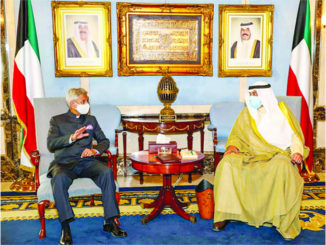
    External Affairs Minister S Jaishankar held “productive discussions” with his Kuwaiti counterpart Sheikh Ahmed Nasser Al-Mohammad Al-Sabah on Thursday during which the two sides discussed a range of issues including health, food, education, energy, digital and business cooperation.

    Jaishankar, who arrived in Kuwait on his first bilateral visit to the oil-rich Gulf nation early on Thursday, also appreciated Commerce Minister Dr Abdullah Issa Al-Salman who was present during the talks.

    “Productive discussions with FM @anmas71 of Kuwait. Aimed at taking forward our traditional friendship. Appreciate the presence of Commerce Minister Dr Abdullah Issa Al-Salman in the talks,” Jaishankar tweeted.

    He said the agenda of talks included health, food, education, energy, digital and business cooperation. “Agreed to review progress with early meeting of our joint commission,” he tweeted.

    The two sides also signed a memorandum of understanding (MoU) that will give Indian workers greater legal protection in Kuwait.

    “Welcomed the openness to address the issues of Indian community in Kuwait. Witnessed signing of a MoU that will give our workers greater legal protection. Launched the celebration of 60th anniversary of our ties,” Jaishankar tweeted.

    Jaishankar, who is carrying a personal letter from PM Narendra Modi to Kuwait’s Emir Sheikh Nawaf al-Ahmad al-Jaber al-Sabah, earlier called on Prime Minister Sheikh Sabah Khaled Al-Hamad Al-Sabah.

    Kuwaiti Foreign Minister Sheikh Ahmed visited India in March during which both sides decided to set up the joint commission.

                    Source: PTI

  • India’s External Affairs Minister meets U.S. officials, lawmakers in Washington

    India’s External Affairs Minister meets U.S. officials, lawmakers in Washington

    “Conveyed appreciation for U.S. solidarity in addressing the Covid challenge”, the Minister says.

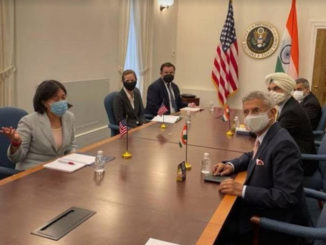
    WASHINGTON (TIP): External Affairs Minister S. Jaishankar has had a hectic day and a half in Washington DC, where he met government officials, including National Security Advisor Jake Sullivan and the U.S. Trade Representative (USTR) ambassador Katherine Tai, lawmakers, and the private sector.

    Mr. Jaishankar, who is on his first visit to the U.S. during the Biden administration, met with Mr. Sullivan on Thursday, May 27. Both sides indicated that there was a discussion on regional (Indo-Pacific) or global issues, with Mr Jaishankar specifying, via a tweet, that Afghanistan came up.

    “Conveyed appreciation for US solidarity in addressing the Covid challenge. India-US vaccine partnership can make a real difference,” the tweet said.

    The U.S. readout said Mr. Jaishankar and Mr. Sullivan “welcomed” cooperation that has resulted in the delivery of over $ 500 million in relief materials (state, federal and private sector sources) from the U.S. to India.

    “They agreed that people-to-people ties, and shared values are the foundation of the U.S.-India strategic partnership that is helping to end the pandemic, supporting a free and open Indo-Pacific, and providing global leadership on climate change,” it said.

    Mr. Jaishankar said he had “good discussions” with Ms. Tai, who recently announced that the Biden administration would support an India-South Africa initiative at the World Trade Organisation (WTO) to waive intellectual property protections for COVID-19 vaccines.

    “Our trade, technology & business cooperation are at the core of our strategic partnership. Enhancing them is vital to post-Covid economic recovery. Welcomed her positive stance on IPR issues & support for efficient & robust supply chains,” Mr. Jaishankar said on Twitter.

    The Hindu had reported that procuring vaccines and sorting out issues around this, such as early Emergency Use Authorization and liability are central to Mr. Jaishankar’s trip agenda, though officials have been keen to stress that this is not the focus of the visit and that discussions would cover a more comprehensive list of topics pertinent to the strategic relationship between the two countries.

    Mr. Jaishankar had breakfast and lunch meetings on Thursday, May 27, organized by advocacy and industry groups, the U.S. India Business Council (USIBC) and the U.S. India Strategic Partnership Forum (USISPF).

    The USIBC meeting included a discussion on how the private sector, working via a consortium of 40 companies called the ‘Global Task Force for Pandemic Response’, could “support India’s health infrastructure and further ways to continue relief efforts,” said Priyanka Sethi, a spokesperson for the group.

    Pfizer and Johnson and Johnson – both companies that manufacture COVID-19 vaccines of interest to India – are part of the Task Force. The group has sent 1,000 ventilators, 4,850 oxygen concentrators to India and convened the chief HR officers of close to 200 companies to help their employees and their families, Ms Sethi said.

    Representatives of pharmaceutical firm Abbot and courier and shipping firm FedEx were among the companies present at the USISPF meeting, industry sources told The Hindu.

    Mr. Jaishankar also spoke on the phone with the (Democratic) Chairman of the House Foreign Affairs Committee, Gregory Meeks and its ranking member (Republican) Michael McCaul. He also had a phone call with House India Co-Chairs Steve Chabot (Republican).

    Brad Sherman, the other co-chair, was among those present at a dinner for Mr. Jaishankar on Wednesday, at the house of Indian Ambassador Taranjit Singh Sandhu. Others present there, according to US official sources, included Virginia Senator Tim Kaine, Senator Michael Bennet from Colorado and Jon Ossoff, the new Senator from Georgia.

    On Friday, May 28, the Minister is scheduled to meet with Defense Secretary Lloyd Austin and Secretary of State Antony Blinken who has been on a trip to Egypt and West Asia since Monday.

    According to sources, the high-level (Minister level) meetings with the Treasury, Commerce and Energy Departments, US Agency for International Aid (USAID) and the National Science Foundation are likely to take place during Mr Jaishankar’s visit to Washington.

    (With inputs from PTI)

  • Indian –origin Oxford University student’s alleged cyber bullying probe begins

    Indian –origin Oxford University student’s alleged cyber bullying probe begins

    Nirpal S. Shergill

    LONDON (TIP): The University of Oxford on Tuesday, March 23, said a probe is underway and that it “investigates thoroughly” every complaint related to harassment or equality, following allegations of cyber bullying surrounding Rashmi Samant, the first Indian woman to be elected President of the Oxford Student Union (SU) who was forced to resign amidst controversy over some of her past social media posts. Some British Hindu groups have also raised concerns around comments made online by a university staffer from the history faculty with the local Thames Valley Police, urging an investigation into a possible hate crime.

    The police force confirmed that it has “received a report of an alleged hate incident”. The comments under scrutiny, posted with an image of Samant’s family on Instagram by Dr Abhijit Sarkar, made references to their Hindu faith and also categorized their home state of Karnataka as a “bastion of Islamophobic forces”.

    “An investigation into these online comments is ongoing and we must allow time for this formal process to be followed. In cases such as these, student support is provided through their college and department,” an Oxford University spokesperson said.

    “The university is fully committed to creating an environment where people of all backgrounds, including our Hindu students and staff, can feel welcome, valued and respected,” the university said, adding that it has strong policies in place to protect staff and students against “all forms of harassment, including online harassment”.

    Samant has been working on completing her MSc course in Energy Systems at the university remotely from her hometown in Udupi, after she flew back to India in the wake of her resignation.

    She said the continued “cyber bullying” makes it difficult for her to consider returning to the university at this stage.

    “I’m just very glad that the university and the police have launched an investigation into my complaint, and I look forward to resolving it in the best manner possible,” said Samant, in a statement from India.

    “I think it’s a long road for me to feel safe about the prospect of coming back and getting respite from the cyber bullying,” she said, adding that the Indian community in the UK had been “super supportive” through the course of the incident since last month. The issue even found its way to the Indian Parliament last week, when BJP MP Ashwini Vaishnav raised it as a question of “racial discrimination” in the Rajya Sabha.

    External Affairs Minister S Jaishankar had responded to say that India would “never ever turn our eyes away from racism wherever it is” and that these developments will be monitored “very, very closely”.

    This resulted in a joint statement from the Oxford India Society, Oxford University Hindu Society and Oxford South Asian Society against what they branded a “misleading narrative” being played out in India.

    “We reiterate that these calls [Samant’s resignation] did not have anything to do with the fact that she is Indian or Hindu or a woman,” the statement reads.

    However, the groups agreed that the faculty member at the center of the controversial online comments must apologize for his social media posts.

    “We further strongly disapprove of the actions of Dr Abhijit Sarkar, Postdoctoral History Researcher at New College. Dr Sarkar’s social media posts about Ms Samant’s parents and their religious beliefs had no place in a conversation about Ms Samant’s reprehensible actions… It is imperative that Dr Sarkar take responsibility for his words and apologize to Ms Samant,” the statement adds.

    Earlier this month, the online remarks of the staffer were raised by a former Oxford University alumnus and British Indian entrepreneur Alpesh Patel, who had issued a formal complaint to the Vice-Chancellor’s office.

    “This matter deserves a police investigation into the bullies on incitement to racial hatred,” said Alpesh Patel, Chair of the City Hindus Network (CHN).

    Satish K Sharma, Senior Managing Director of the Global Hindu Federation, has taken up the matter of following up on the police complaint and accused the faculty member of “unlawful conduct and inexcusable bigotry”.

    “Rest assured that the British Hindu community will persist until a just conclusion has been reached,” he said.

  • UK PM Boris to visit India in April-end

    UK PM Boris to visit India in April-end

    Will shift focus to Indo-Pacific in post-Brexit review

    NEW DELHI (TIP): UK Prime Minister Boris Johnson will visit India at the end of April, his first major international tour after London’s exit from the EU. The announcement from London came after the minister for South Asia Tariq Ahmad wrapped up his visits where which included interactions with External Affairs Minister S Jaishankar and Foreign Secretary Harsh Vardhan Shringla. During his meeting with Minister of State for Home Affairs G Kishan Reddy, Ahmad is learnt to have raised the detention of Christian Michel, the alleged middleman in the AgustaWestland VVIP helicopter deal, whose prolonged incarceration has been flagged by the UN Working Group on Aribtrary Detentions. The visit is understood to have cleared the decks for an Enhanced Trade Partnership (ETP) to be inked during Johnson’s visit. The ETP could serve as a precursor to a free trade agreement (FTA). The PM was to be the chief guest at this year’s Republic Day parade but had to put off his visit due to Covid surge in the UK. Since then London has wrapped up the integrated review of defense, security, development and foreign policy. A key takeaway is the accent on the Indo-Pacific region, which includes theUK applying for partner status of the ASEAN economic union.

    (Source: TNS)