Tag: Shekhawati

  • Churu: Gateway to Thar Desert

    Churu: Gateway to Thar Desert

    At the edge of the Thar desert and situated amidst the shifting golden sand dunes, lies a small city called Churu, resplendent with havelis, fresco paintings and unique architecture. Known as the ‘Gateway to the Thar desert’, Churu lies in the historic Shekhawati region in northern Rajasthan. Churu is a popular attraction for tourists due to its architecture – the grand palaces of havelis of Kanhaiya Lal Bagla and Surana, and its 400-year-old fort, among other things.

    Black Buck Santuary

    Talchhapar Sanctuary, situated in Churu is famous for endangered black-buck. Other wild animals found in the sanctuary are chinkara, fox, juangle cat, rojra along with many resident and migratory birds. It lies on the way of migratory pass of many birds and therefore it is also popular with bird lovers. Talchhapar, actually a flat saline depression, has a unique ecosystem.

    Talchhapar area was a game reservoir for the erstwhile Maharaja of Bikaner State and was declared a reserved area for the protection of wild animals and birds in the year 1962. Total area of Talchhapar Sanctuary is 719 hectare. The sanctuary area is mostly covered by grasses with a very few and sparse trees of Khejri, Salvadora, Ber, Ker and Neem. Main grasses found in the area are Sewan, Doob, Dhaman Lampla, Lana and Moth etc. The area gives a lush green look during rainy season but again dries up during summer season.

    Chhatries (Cenotaph)

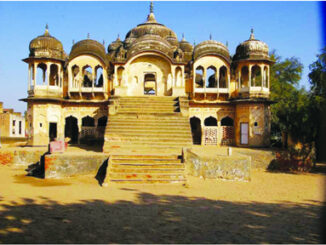
    Churu has some good memorial domes, mostly raised to rich merchants, north of the town. Historically the most significant is ‘Aath Kambh Chhatri’ (Eight Pillar Dome) west of the vegetable market. Built in 1776 on a Rajput’s cremation site. Its base has been virtually buried by windblown sand. The interior is covered with murals, one detail depicting an early European mercenary on foot, bearing a musket. Further north are chhatris of the Mantri , Bagla and Lohia merchant families.

    Dudhwa Khara

    Just 36 kms from Churu It is an historical village which lies on Thar desert. The village has enticing topography and have huge beautifully designed havelis.One can enjoy the rural life and camel safaris in the village.

    Gogaji

    Gogaji also known as Gugga is a folk deity of Rajasthan state in India. He is an eminent warrior-hero of the region. Hindus and Muslims alike honor him. He is also venerated as a saint and even as ‘snake-god’. He is known as Goga among the Hindus and Jahar Peer among the Muslims. Gogaji is popular as a snake-god and almost every village in Rajasthan has a Than (sacred place) dedicated to him.Rabari community in Gujarat and Rajasthan is great believer in Gogaji.

    It is believed that Gogaji went into samadhi at Gogamedi. Thousands of devotees gather to pay homage at this memorial annually in the month of Bhadrapada during the Gogaji fair, which lasts for 3 days.The fair is held from the ninth day of the dark half of Bhadrapada (Goga Navami) to the eleventh day of the dark half of the same month.

    Kanhaiyalal Bagla Haveli

    Just south of the main bazaar, this haveli built around 1880 boasts the finest frieze in all the Shekhawati region. It illustrates Dhola and Maru on a camel fleeing the wicked Umra-Sumra, Sassi and Punu side by side on horseback, two set of lovers from folk tales. To the south-west is a mosque, Jama Masjid, and a little Muslim haveli decorated with non-figurative work.

    Kothari and Surana Haveli

    A group of handsome painted havelis built by two prominent Oswal Jain merchant families, the Kothari and Surana clans. Amongst them are ‘Malji Ka Kamra’ (Malji’s Haveli), an exotic stucco extravagaza built by Malaji Kothari around 1925 and the massive Surana Double Haveli, said to boast 1111 windows and doors built in the 1870s.

    Mantri Haveli

    The Mantri Haveli is one of the most beautifully designed Havelis in India. The Mantri Haveli, Churu reflects the rich grandeur and splendor of the Rajput era. One of the major tourist attractions of Rajasthan, the Mantri Haveli, Churu attracts tourists from all over to Rajasthan. The Mantri Haveli is truly a beautiful symbol of Rajput grandeur and beauty. In the Mantri Haveli, Churu you can get to see beautiful paintings and exquisite mirror work that brings travelers from all over.

    Mantri Haveli, Churu was built in the 18th century and is completely covered with paintings. From exotic images to beautiful and unique silhouettes the paintings are simply a class apart. One of the oldest Havelis in Churu, the Mantri Haveli is an art gallery. Dedicated to one of the ministers of the royal family the Mantri Haveli in Churu attracts tourists for its beauty and uniqueness.

    From floral swirls, motifs, and excellent mirror work, to balconies and alcoves, the exquisite artistry of the Rajputs are explicitly reflected in its artwork as well as architecture. From lavish ornamentation, spacious courtyards to sprawling areas, the Mantri Haveli, Churu attracts people from all over. However the front facade is completely worn out and you can feel the medieval aura and ambience once you enter inside the Mantri Haveli.

  • Rainbow shades of Holi in Rajasthan desert 

    Rainbow shades of Holi in Rajasthan desert 

    By Dr Yash Goyal

    TIP Representative at Jaipur

    Geographically, in the largest desert of the country, not only the ‘dialect’ (dialect/language) changes on every twenty ‘Kos’ (less than Km), but also the manner and ritual of celebrating the Teej-Tyohar (festivals). Holi Dahan and Dhulandi have their own adventures in India after Deepotsav. There was a period of playing Holi in Rajasthan against the background of the kings, which is changing with the times today.

    The people living in the cities may be seen in the colors of Holi, but the ancestral customs which are prevailing in the rural area, they look very seductive and amazing. The enthusiasm and mutual love of the villagers in celebrating Holi with their splashes of color and their unique way attracts not only the city dwellers but also foreign guests so much that in many places they are also seen in Holi. After Agra, Rajasthan is also the main tourist destination of foreigners.

    In this vast region, the festival of Holi is celebrated somewhere with splashes of color, while in the districts of Barmer and Dungarpur, the stones of Holi are enjoyed. LathmarHoli in Barmer, Pali and Mewar in Karauli and Bharatpur, MurdaRide in Bhilwara, Chang and Gidar dance in Shekhawati, Kodamar in Ganganagar, Gota Gar in Bhinmal, Kando (cow dung) rod in Dungarpur, Holi of flowers in Govind-Devji temple in Jaipur, cutting of strings in Bikaner, clothes-tearing in Pushkar and the riot of Hela Khayal in Lalsot (Dausa) are also popular and include their own history to celebrate this colorful festival.

    Although this festival is of brotherhood and harmony, but Muslim families of Gulabinagri make ‘Gulal Gota’ for Hindus. To play Holi from the four-year-old ‘Gulal Gota’, people still go to the narrow streets of Manihars-Ka-Rasta in the four walls of Jaipur. The ball is dried by the ladies with their fingers in the lokh (resins used in the bangle) in a slow flame, giving it the shape of a ball and taping it.

    Since the forts in Rajasthan are still there, where the descendants of the erstwhile kings, living in heritage palaces and princely states, keep the tradition of Holika Dahan and Dhulandi alive even today, which attracts the residents of small towns even today. There was an old time when it was a pleasure to celebrate Teej festival among the kings and queens. In Jaipur’s City Palace, where many people came into active politics, and even today Diya Kumari is BJP’s MP from Rajsamand, this trend has been made alive.

    Before Independence then, first of all, the Raj family’s Holi celebrations at the City Palace. After this, Holi Dahan would take place in other mohallas of the city. Citizens (subjects) used to race to light the Holi of their neighborhood with the spark of fire / upleap of Holi, which was lit in the City Palace. Then Holi would have a beautiful atmosphere of Nandotsav in the city. The Maharaja visited Govinddev Maharaj in the morning and came out to celebrate Holi Day. The music of Janani Diyodhi and City Palace would be accompanied by sajtis, mujra and mands, and saffron with saffron.

    Jitendra Singh Shekhawat, the iconic historian and journalist of the ‘Heritage Window’, says that for the Maharaja Holi Day at Chandramhal’s Jayanivas Bagh on Dhulandi in the City Palace, there was a buzz of music after colors, gulal and dolchiis. Later the court of the Maharaja was used. In this royal procession, the feudatories of the princely state of Jaipur, Umrao, Nawab, Nagar Seth, Tajimi Sardar, and would be special guests of the country and abroad, who honored him by presenting him an eyeful after playing Holi with the court. In the royal dress of Phaganis Safa, Jodhpuri Achkan and Churidar Pajama, the Maharaja used to lift his hose pipe and show it colors. There were drums, Shehnai ringing at the door. Dholania sings songs of Holi.

    The pranksters used to display their art, causing fountains of laughter to erupt. In addition to liquor made of saffron, grapes, raisins, pistachios, there were also jams of foreign liquor. Gulal was also offered as a gift in small skins. Only kings could go to see the game of holi of queens in Janani Deodhi.

    The era changed but the former royal family recites the history of wet and dry colors in a pool of water, with former guests celebrating Holi at the City Palace. Now these Rangotsavs organize event management on one theme. Jaipur is also called Chhoti Kashi because of Govinddevji Maharaj. That is why the historical Holi culture is still prevalent here. In the courtyard of the temple of Govinddevji, women, men and big and small devotees spend hours in Holi in the flowers of Holi and get lost in Radha-Govind.

    There are also many types of Ras Leela during the Holi and Shitala Ashtami of Lalsot in Dausa district in Jaipur division, ‘Hela Khayal Dangal’ is also an important occasion for all the castes (Gurjars, Meena especially) to be threaded in the same color. In this, the legislators and ministers of the ruling and opposition also openly enhance the dignity of the ceremony. In the 10 to 20 congregations of the pro-opposition, the men squarely sing sarcasm on political-socio-business issues. Let us sing whatever thought comes to mind immediately. A second sarcasm is carried out amidst the banging of the dhol-nagade-other folk instrument that the participants listeners are enchanted and throw colors of Holi. There is also special food and drink. This riot lasts for 36 to 72 hours continuously. The city of Lalsot is covered in a hue and cry of color.

    The Chaugan Stadium in Gulabi Nagar and the Rajasthan Tourism Department in Khasakothi also organize Dhulandi festivities for foreigners with invites and focal points of foreign tourist attractions. Before Holi in Bharatpur, the Firangi in Braj Holi festival is seen with Indian colors.

    Playing ‘cloth tearing’ Holi of Indian tourists with foreigners in Brahma’s city of Pushkar has also gained a lot of fame. Under the prior permission and supervision of the police and the district administration, the cloth tearing celebrations are celebrated at the Varah Ghat Chowk and the Trans Party is celebrated. Varaha is an incarnation of Lord Vishnu. In this, the participants tore each other’s clothes decently. But there is no indecency or physical vulgarity in him. Women and men have different enclosures for those who get drenched in the colors of Holi. It is not allowed to bring any kind of liquor and drugs here.

    Stoning during Holi from Barmer has also been prevalent in history since the beginning of the last century. The festival of Holi was played with joy and affection amidst the killing of mutual stones, keeping away mutual disharmony, antipathy, enmity. This love of Holi was played between two parties and two mohallas. The people of both the parties had already collected stone shelves on the high roofs of their houses, shops, religious establishments, and the way the shield is used in the war to avoid this, people like iron. Tagari vomited and attacked each other. Some people were also injured. This practice of Holi is still heard in this district. By the way, the Holi of these stones started celebrating slowly with dust and mud. Children also enjoy raining dust on passers-by. Holi is celebrated in all areas of the country, but due to a belief in the tribal villages of Rajasthan, there is bloodshed on the occasion of Holi.

     Due to this strange recognition of the tribal dominated area of Banswara and Dungarpur districts of Rajasthan, many people are injured every year on Holi. Ambulance 108 is placed on the occasion of Holi in Bhiluda and Ramgarh villages of Dungarpur. Many people reach the hospital here. People have collected stones. This game starts from the night after Holika Dahan and runs till Dhundi. In the atmosphere, drums and Chang are played to fill the heroic juices. People call this Holi as Holi of Raad, Rada or enmity. If the elders of the tribal area believe that the cause of the stone-pelting Holi, then the king here had killed a Patidar caste person on the day of Holi centuries ago. The wife of the deceased got sati with her corpse in her lap and cursed while dying has collected stones This game starts from the night after Holika Dahan and runs till Dhulndi. In the atmosphere, drums and Chang are played to fill the heroic juices. People call this Holi as Holi of Raad, Rada or enmity. If the elders of the tribal area believe that the cause of the stone-pelting Holi, then the king here had killed a Patidar caste person on the day of Holi centuries ago. The wife of the deceased got sati with her corpse in her lap and cursed while dying Has gone. He said that if human blood does not fall here on the day of Holi, then natural calamity will come. Only due to this belief, Holi is played here every year on the occasion of Holi.

    In Bhilwara of Mewar region, stones are also sung, the Murday (effigy) ride from the mansion of Chittorgarh, non-dance in Pali, Dandi-non dance in Marwar and singing with phag songs, and Dewar-Bhabhi in Sriganganagar. The beach-whipped Holi is very popular.

    (Yash Goyal recently wrote the article inHindi for Dainik Tribune, and translated in English for TIP with original pictures obtained from professional photojournalists)