Tag: Spain

  • Euro 2016 quarter-final: Portugal beat Poland in shootout to reach semis

    Euro 2016 quarter-final: Portugal beat Poland in shootout to reach semis

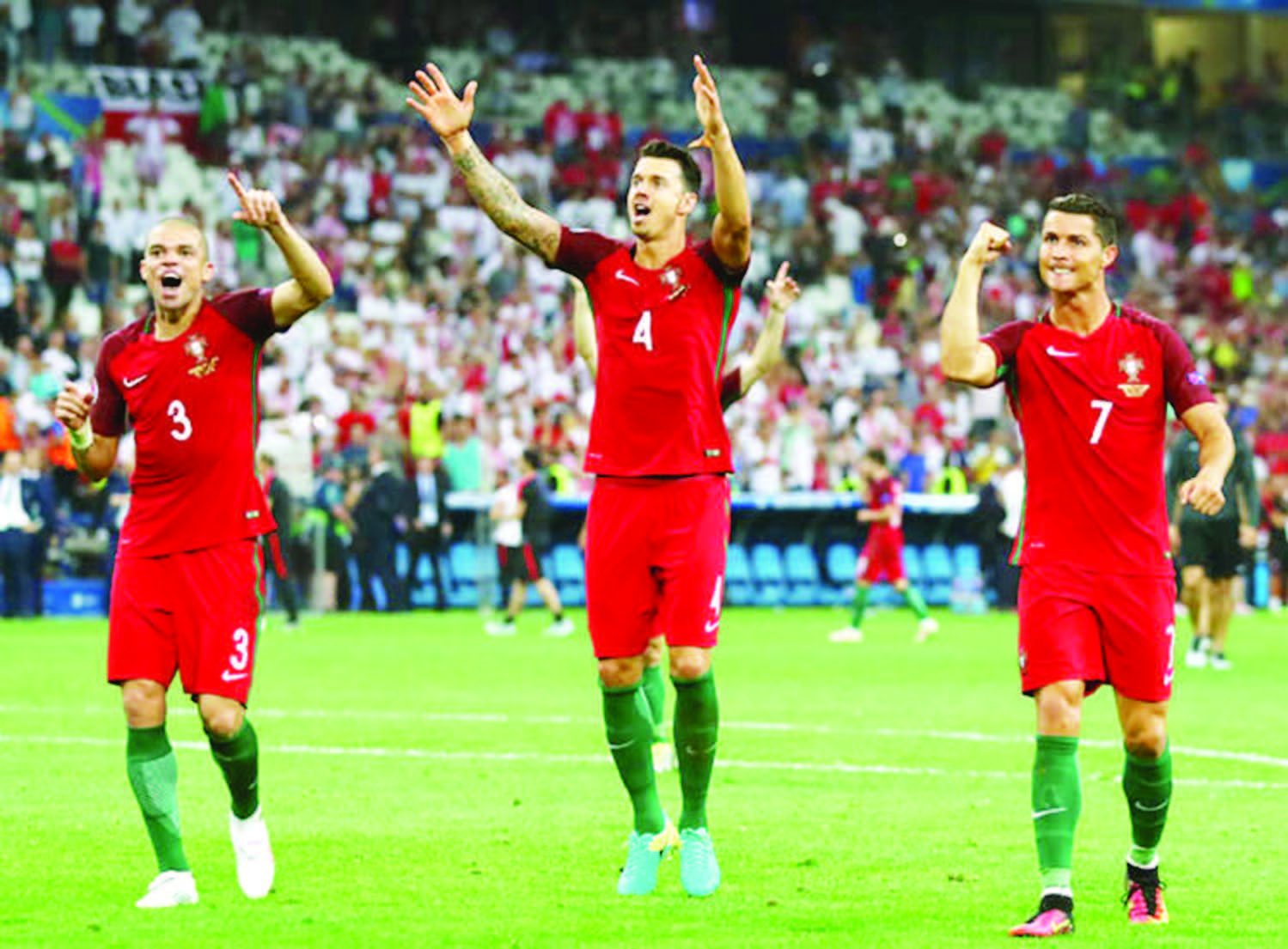
    MARSEILLE (TIP): A superb shootout save by Portugal’s Rui Patricio allowed Ricardo Quaresma to be the hero again as his spot kick against Poland sent them into the Euro 2016 semi-finals 5-3 on penalties after a 1-1 finish following extra time on June 30.

    Patricio dived full length to block Jakub Blaszczykowski’s penalty, Poland’s fourth, allowing substitute Quaresma, whose goal late in extra-time beat Croatia in the round of 16, to bang in Portugal’s fifth from the spot.

    Two hours earlier striker Robert Lewandowski had put Poland ahead in the second minute only for 18-year-old Renato Sanches to equalise with a superb shot 33 minutes into his first international start for Portugal.

    Precious little happened from then on but Portugal, beaten on penalties by Spain in the semi-finals four years ago, will not care as they advance to the last four at the Euros for the fourth time in five tournaments to face either Belgium or Wales.

    Poland, who had never won a European Championship match before this tournament and finished bottom of their group on home soil four years ago, will bemoan their early missed opportunities and probably backed themselves in the shootout having got past Switzerland that way in the last round.

    Defensive misjudgement
    They went ahead almost from kickoff when Portugal defender Cedric’s misjudgement allowed a long ball to bounce over his head to Kamil Grosicki. He drove on down the left and squared for Lewandowski to guide the ball in.

    It was the striker’s first goal of the tournament and, at one minute, 40 seconds, the second-fastest in European Championship history after Dmitri Kirichenko’s for Russia against Greece after 65 seconds in 2004.

    Poland looked the more confident team for the next 20 minutes but Portugal settled and began to make inroads. Sanches, on his first international start, played a neat 1-2 with Nani and found time to shift the ball onto his left foot at the edge of the box and smash it past Lukasz Fabianski, with the aid of a deflection.

    Both sides came out for the second half seemingly under instruction to slow things down and the life bled from the game. The only really clear chance of the half came in the 85th minute when substitute Joao Moutinho lobbed a clever pass over the top only for Cristiano Ronaldo who, having taken the time to glance at the keeper’s positioning, failed to make any contact on the dropping ball with the goal gaping.

    Little changed in the additional 30 minutes, with the near-64,000 crowd drugged into a drowsy-near silence, knowing what was afoot almost from the restart.

    Poland had followed the same routine in their last-16 clash with Switzerland and won the shootout and, looking very weary on June 30, clearly had another in their sights.

    This time, however, the gamble backfired as Ronaldo, Sanches, Moutinho and Nani all scored before Quaresma’s coup de grace. (Reuters)

  • It’s Time for Summer Leisure and Learning!

    It’s Time for Summer Leisure and Learning!

    Summertime brings opportunities to cheer on friends at neighborhood baseball games, visit a local playground or community pool, venture to the beach or enjoy a block party. After a school year full of hard work, leisurely activities are important for us all. As parents, grandparents, aunts, uncles and caretakers we must also encourage innovative and fun ways to continue learning this summer.

    Time and time again, researchers and advocates attribute some of the achievement gap to summer learning loss. Students can lose months of academic knowledge during the summer, impacting our most vulnerable communities. As caretakers, we must build a drum-beat of reading, writing, and exploring. A great way to start is by checking out NYC Reads 365 or asking your child’s teacher for a summer reading list.

    New York City’s cultural institutions offer children and teens a wide range of either low cost or free summer activities during the long summer days. I enjoy visiting the American Museum of Natural History and The New York Hall of Science with my grandchildren and learning with them. They love robotics and STEM, which can provide countless hours of enjoyment while developing their critical thinking and analytical skills in a creative way.

    A museum, Botanical Garden, zoo, historical burial ground, or public library are all great ways to explore your child’s interests, get extra support, and help them retain what they learned during the school year.

    Setting aside time for daily independent reading and writing during down time at a family vacation or before heading to a playdate can make all the difference and help cultivate and foster a child’s imagination. In my role as a grandmother, I am insistent that my grandchildren write or read daily- no matter where we are or what we are doing on that particular day, I carve out time for learning.

    In one way or another, as parents and caretakers we play a vital role and have so much to offer that can inspire our children. Some of my most treasured memories include listening to my father’s stories about his native country Spain. He would weave his real life experiences with a war torn country which ignited my passion for reading and led me to where I am today. I strive to channel my father’s love for storytelling with my own grandchildren, which always ends with fruitful and candid conversations of the world we live in today.

    Showing our children the fruits of being a lifelong learner can also be a transformative way to lead by example. We can also continue or restart our own education through the DOE’s Office of Adult and Continuing Education (OACE) where there is a variety of basic education and vocational classes for adults over the age of 21. During the summer months hundreds of classes for adults will be available completely free of charge. For more information, stop by any of our Registration locations or visit http://oacenyc.org/.

    Teaching our kids to value reading and writing purely for oneself, to encounter new worlds, to learn new information, and to be inspired will lead to a greater success in school and beyond. So whether it’s for you, your children or a nephew, learn about the fun summer learning opportunities in your community, borough, and city. Have a fun and safe summer!

    Here are just a few family friendly resources and places to visit this summer free of charge:

    The African Burial Ground National Monument  https://www.nps.gov/afbg/index.htm Socrates Sculpture Park http://www.nycgo.com/museums-galleries/socrates-sculpture-park

    The National Museum of the American Indian http://nmai.si.edu/visit/newyork/Brooklyn Children’s Museum (free every Thursday, 12-2 pm) http://www.brooklynkids.org/
    NYC Reads 365
    http://schools.nyc.gov/Academics/NYCR eads365 New York Public Library – Summer Reading Challenge 2016 http://www.nypl.org/events/summer/rea ding-challenge For a full list of museums that are either always free, free on specific days of the week or free for select hours visit http://www.nycgo.com/articles/free-nyc-museums

  • Blacklist tax havens like Panama: 5 EU countries

    Blacklist tax havens like Panama: 5 EU countries

    WASHINGTON (TIP): Europe’s five leading economies on April 14 called for a crackdown on tax havens, urging the G20 powers to end the secrecy of shell companies that enables tax evasion and money laundering.

    In the strongest reaction yet to the leaked “Panama Papers,” the finance ministers of Britain, France, Germany, Italy and Spain also proposed a blacklist of havens like Panama if they do not share corporate registry data with others.

    They proposed establishing transnational registries that identify the beneficial owners of companies, trusts, foundations and other entities that had been able to hide from tax administrators and law enforcement.

    “We want to have lists which make it possible to place sanctions on countries which don’t respect the rules,” said French Finance Minister Michel Sapin.

    The proposal of the five was to be submitted to the finance ministers of the G20 meeting in Washington on Thursday and Friday.

    “The recent extensive leaks from Panama show the critical importance of the fight against tax evasion, aggressive tax planning and money laundering,” the five said.

  • In Germany, woman caught smuggling cocaine in breast implants

    In Germany, woman caught smuggling cocaine in breast implants

    BERLIN (TIP): A 24-year-old Colombian woman was arrested at Frankfurt airport after she was found to be carrying 1kg (2.2 pounds) of cocaine inside her breasts, German customs officials said on March 9.

    Airport officials became suspicious after they found fresh operation scars below the woman’s breasts during a search on February 24 and she complained of severe pain.

    The woman admitted to carrying drugs, which had been inserted into her body during a hastily arranged operation.

    She was sent to a local hospital where doctors removed two 500-gram lumps of cocaine wrapped in plastic from each of her breasts.

    The drugs have a market value of 200,000 euros ($220,000) and were destined for Spain, a customs spokesman said.

    “This is the first case in Germany in which drugs have been smuggled in this fashion,” said spokesman Hans-Juergen Schmidt. Customs agents were shocked by what they said was the amateurish surgery. Schmidt said it showed how drugs smugglers “are completely indifferent to human life and the life-threatening conditions of their drug carriers”. The woman, who said she has three children in Colombia where she worked in agriculture, will be charged with drug trafficking and faces jail time.

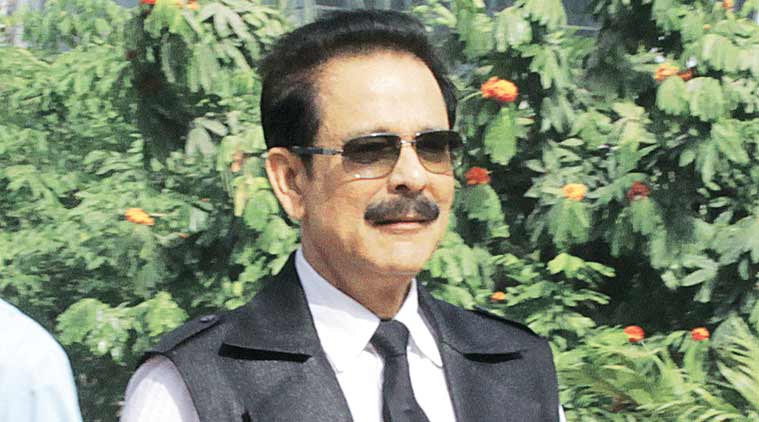
  • ‘Life Mantras’ by Sahara’s Jailed Boss Subrata Roy tops in Nielsen BookScan

    ‘Life Mantras’ by Sahara’s Jailed Boss Subrata Roy tops in Nielsen BookScan

    NEW DELHI: ‘Life Mantras’ a book by Sahara Group chief Subrata Roy has topped the non-fiction category of Nielsen BookScan.

    According to Nielsen best-seller list, the recently unveiled book brought out by Rupa Publication, has topped the non-fiction book list this week, pushing into second spot the popular Manorama Yearbook 2016.

    The Nielsen BookScan service is the world’s largest continuous book sales tracking service operating in India, the UK, Ireland, Australia, US, South Africa, New Zealand, Italy, Brazil and Spain.

    It collects total transaction data at the point of sale directly from the tills and dispatch systems of all major book retailers. Nielsen BookScan collects data from online and offline booksellers, including Bookadda, Crosswords, Connexion, DC Books, Flipkart, Indiatimes, Infibeam, Landmark, Landmarketail, Capital Book Depot, Rediff, Odyssey, Pageturners, TV18 Homeshopping, WH Smith India, ebay, Mahindra
    Retail, Reliance Timeout, and Snapdeal etc.

    In his book, Roy puts forth the “various psychological and emotional aspects of life, vis-a-vis the basic instincts inherent in all human beings.”

    The book, is the first in the “Thoughts from Tihar” trilogy penned by Roy while in judicial custody in Tihar Jail in connection with a long-running investor refund case, running into thousands of crores of rupees, with the markets regulator Sebi.

    The forthcoming books of the said trilogy are “Think with Me – How to make our country ideal”, and “Reflections from Tihar – A book on Tihar Jail”.

  • Underworld don Dawood Ibrahim’s nephew Sohail Kaskar held in US for narco-terrorism

    Underworld don Dawood Ibrahim’s nephew Sohail Kaskar held in US for narco-terrorism

    Mumbai: While underworld don Dawood Ibrahim continues to live in hiding, his nephew Sohail Kaskar has been arrested by the US authorities for narco-terrorism.

    According to a Times of India report, Sohail Kaskar, 36, has been arrested for conspiring to commit narco-terrorism, provide material support to a foreign terrorist organization and unlawfully sell missile launching systems.

    Sohail Kaskar has been linked with Colombia’s FARC terrorist group.

    As per report, Sohail and two Pakistani nationals were arrested by the US’s dreaded Drug Enforcement Administration (DEA) in December 2015 after extradition from Spain, but Dawood’s henchmen used all their might and money power to suppress the news to save Dawood’s “international image” from getting tarnished.

    Sohail, alias Ali Danish, is Dawood’s deceased younger brother Noora’s older son.

    Report also quoted sources as saying that Dawood has engaged a top lawyer for Sohail, who, if convicted, can face a maximum sentence of life in jail and a mandatory minim-um term of 25 years in prison.

    The lawyer, Tom Keniff, is representing him in the Manhattan federal court, which charged him in December 2015 for supplying surface to-air missiles to FARC and for bringing drugs, mainly heroin, into the US from Pakistan.

  • Oil Prices may rise as Top oil producers agree to freeze output

    Oil Prices may rise as Top oil producers agree to freeze output

    Russia, Saudi Arabia, Qatar and Venezuela are ready to freeze oil production at January’s level if other producers do the same.

    The agreement came after a meeting in Doha on Tuesday.

    Oil prices have dropped below $30 a barrel in recent months, a fall of 70 percent since 2014.

    The challenge would be to get other producing countries, including Iran, to freeze production as well.

    Iran’s IRNA news agency said on Sunday the country had exported its first crude shipment to Europe since it reached a landmark deal last year with world powers.

    IRNA quoted Rokneddin Javadi, Iran’s deputy oil minister, as saying the shipment, the first in five years, marked “a new chapter” in Iran’s oil industry.

    Javadi said Iran had already reached an agreement to export oil to France, Russia and Spain.

    Iran said in January that it planned to add to its production, which stands at 3.1 million barrels per day (bpd) despite the drop in price, and should not be blamed for further price falls.

    Saadallah al Fathi, a former adviser to Iraq’s Ministry of Oil and former head of the Energy Studies Department, OPEC Secretariat, told Al Jazeera that freezing output at January’s levels was not going to immediately cut supplies.

    “There is already too much oil on the market,” Fathi said.

    “I don’t think freezing production is going to mean anything, unless other producers come into the picture. Within the next few weeks or few months I think there will be a flurry of activity to get other producers on board.”

    Source: Al Jazeera and agencies

  • Bajirao Mastani of Manoj Vyas

    Bajirao Mastani of Manoj Vyas

    Born in India in 1956, Manoj Vyas began painting at the age of 8 when he
    amazed his father with his first mixed medium painting that he created out of
    whole rice. His father gave him paper and pencil encouraging him to draw on
    paper. But Manoj’s drawing found other mediums also. Many times he
    painted with coal and brick on the walls of the neighbors’ houses in his block
    and school rooms, and got scolded and spanked by them.

    He began participating in all drawing and painting competitions at his school
    and soon won a Drawing and Rangoli competition. He also sketched all his
    classmates’ portraits at school. His first recognition came when he won the
    Second Prize from Gujarat state in statewide competition. To continue his
    passion for painting, he joined the SSG School of Arts first, and then the
    famous Sir J.J. School of Arts in Bombay from where he got his Art degree.

    His first job was with Bombay’s prestigious daily newspaper Indian Express as
    a sketch and layout artist. His struggle continued even when he immigrated
    to the U.S. in 1985. But even here, his first job took him to the then
    prestigious and famous India Abroad newspapers where he worked 7 days a
    week. Unable to travel to participate in painting competitions and shows due
    to family obligations, he turned his profession into his hobby.

    Manoj has now started traveling to Europe in the last 5 years and has visited
    art galleries and museums at United Kingdom, Barcelona and other cities in
    Spain, and Rome and other areas in Italy. Painting still remains his passion
    and he now devotes more time to it, sometimes even waking up from sleep to
    quickly sketch ideas on canvas. He draws inspiration for painting from
    legends, folk tales and real life.

    The mediums for the little boy who used walls and coal have changed to
    canvas. Manoj has made a successful transition from his Indian background
    to his current American home. Today his canvas is large, covering real life
    portraits, religious paintings, and even Nudes as and when required by
    clients. And his mediums range from water colors and acrylics to oil and wax
    colors. His work depicts the conflicts between the spiritual and the material
    world, and conflicts between family obligations and the call of his heart, his
    art. Drawn from life, his work also represents his fears, hopes, pleasures and
    pains.

    About Bajiro Mastani:

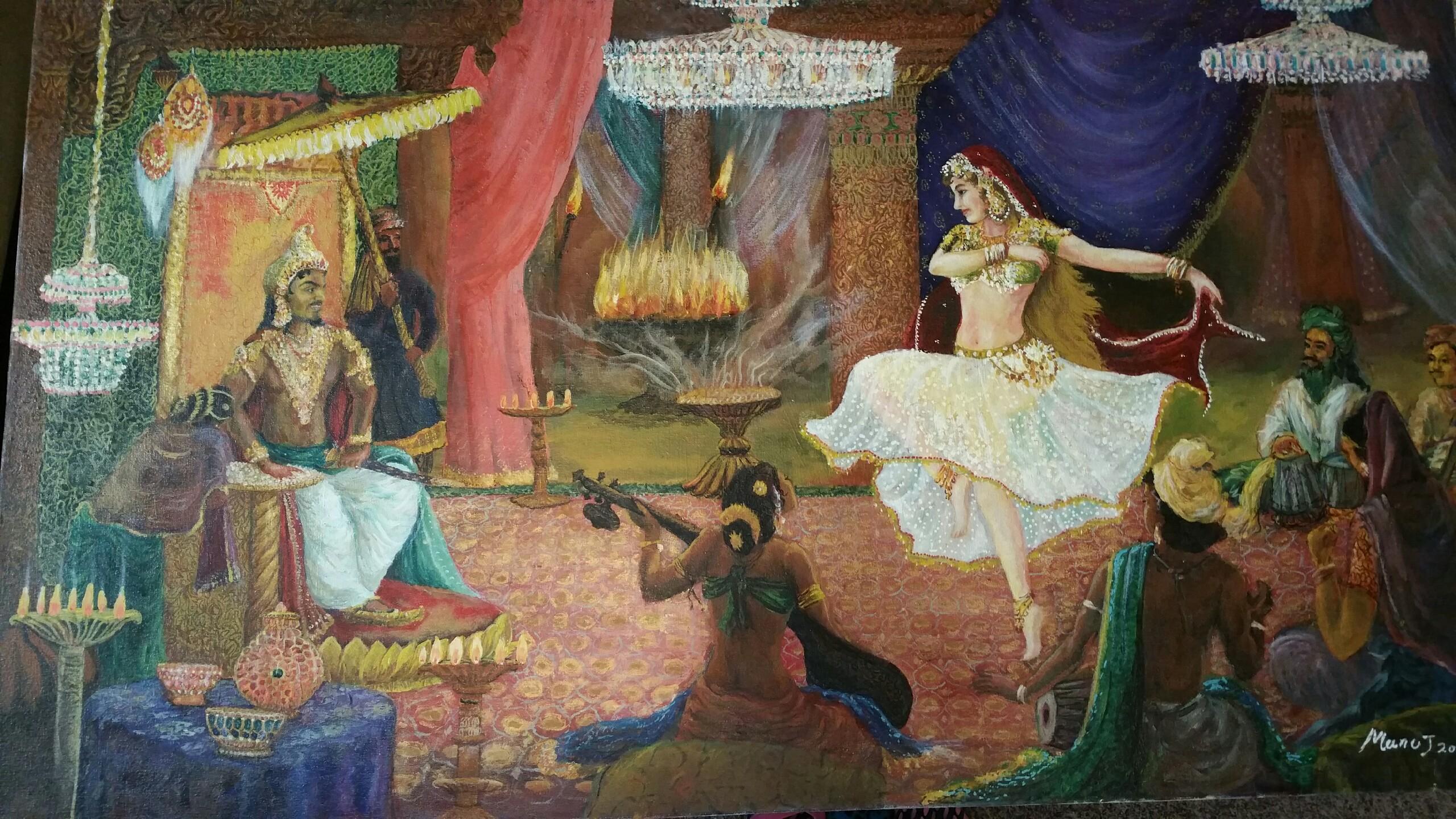
    Manoj says about Bajirao Mastani: “I started this painting in the year of 1997 and it came to a completion in the year of 2005. After the painting was displayed, a lot of people asked me why did it take so long to finish this masterpiece.

    These were my descriptions for the painting:

    When I was in college, I had done many sketches on this subject but because of other obligations I could not start on the painting then. After that I researched a lot on the history of Bajirao Mastani, but due to the lack of information available at that time I was not successful at finding relevant information. My depiction of Mastani is clearly based on my imagination. Her beauty is so transparent that even in my painting you can visualize that when she devoured paan we can see the red juice going down her neck. Even the sketch of Bajirao was a struggle because once again I did not have any physical pictures. At my best knowledge I thought for having a male figure to draw, I would need a live person to visualize Bajiraos figure. I had a good friend who is an art lover, a south Indian movie actor and who has the understanding of the depth for art. He himself relates to Bajirao because he also married out of his caste because he was in love.

    “In the painting I have shown nine figures from which five of them are musicians, two of them are Bajiraos servants, and two are Bajirao and Mastani themselves. In the painting, I have shown that Mastani is dancing for the first time in front of Bajirao and this is when they both fall in love and he is ready to shower her with pearls which you can see in the beautiful painting. I even tried to reflect the historical interior that was used back in those days. The lavish, grand, and unique decor which also reflect the royal colors. The musicians that I have shown in the painting are described as wearing traditional Indian clothes, jewelry and are playing the traditional Indian instruments. They are sitting on majlis, which is a traditional sitting is surrounding Bajirao and Mastani. Out of the five musicians, four of them are Hindu and one male is a Muslim man that always went around with Mastani as her tabla player.

    “The painting has so much details that you cannot imagine by these few words written here. The words do not do justice to the original beauty that this painting showers.

    “I have purposely chosen not to spread the word about this painting in the past because ninety percent of the Indian people did not know about the historical part of the story. Now that movie has been released, I have decided to let this painting of mine go public.”
    Manoj is a versatile painter who paints in almost every medium- water color, acrylic, oil, pastel & stowing colors; on paper, wood, canvas & metal.
    He desires to make big paintings on mythological subjects like Ramayana and Baghvat Gita.

    Manoj’s paintings have been displayed at a number of art galleries in India, UK and USA. Recently, one of his paintings was on display at Ashok Jain Gallery in New York.
    For more information, please visit the website manojvyas.com

  • Zinedine Zidane is the new Coach for Real Madrid FC

    Zinedine Zidane is the new Coach for Real Madrid FC

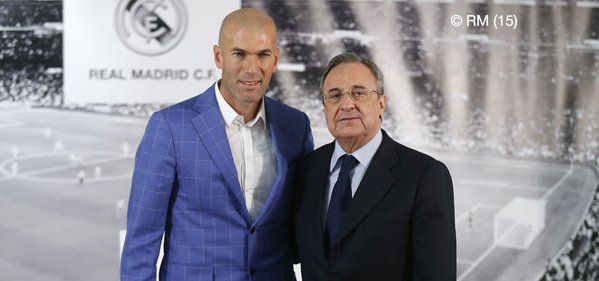
    Real Madrid FC promoted France legend Zinedine Zidane as the Coach and sacked Rafael Benitez on Monday, January 4.

    Club president Florentino Perez announced the news after a club board meeting on Monday afternoon.

    He called Zidane “one of the greatest figures in football history” and told him: “This is your stadium, your club, you have all our confidence. Madridismo is at your side. As president, I am proud to have you by my side. I know for you, the word ‘impossible’ does not exist.”

    The Frenchman is loved at the Santiago Bernabeu thanks to his five stellar years to end his playing career in the Spanish capital, most memorably scoring a stunning winning goal in the 2002 Champions League final.

    Yet, his coaching experience is limited to a season-and-a-half in charge of Madrid’s feeder team Castilla where he failed to secure promotion from Spanish football’s third tier last season.

    However, Madrid hope to recreate the magic formula enjoyed by Pep Guardiola and Barcelona during his glorious 14-trophy haul with the Catalans between 2008 and 2012.

    Like Zidane, Guardiola was a club legend as a player who graduated from a season in charge of Barca’s B team to become the most successful coach in the club’s history.

    Moreover, unlike Benitez, Zidane is at least sure to have the respect of Madrid’s star-studded dressing room, who constantly clashed with the former Liverpool and Chelsea manager.

    Zidane doesn’t just have the kudos of being a former Ballon d’Or winner, but he was Carlo Ancelotti’s assistant as Madrid won their long-awaited 10th Champions League crown in 2014.

    “We have the best club in the world, the best fans and what we have to do now, and what I will try my best to do, is ensure the team wins at the end of the season,” said the normally ice-cool Zidane, who admitted to feeling more emotional than the day he joined Madrid for a then world-record fee from Juventus in 2001.

    “It is an important day for me and like all coaches I am a bit emotional, more emotion that when I signed as a player, but that is normal and from tomorrow I will put my heart into doing all I can for this club.”

    It will take more than heart for Zidane to arrest a year-long slump that has seen Madrid burn through two Champions League winning coaches, see eternal rivals Barcelona win the treble and become embarrassed in numerous off-field scandals.

    “The best man for the job,” said Zidane’s ex-Madrid teammate David Beckham on Instagram.

    “A man that has been the best at a game we all love, taking over a club that myself and many more people love. Someone with drive, passion and also doesn’t accept failure on any level.”

    Despite being thrown out of the Copa del Rey for fielding an ineligible player last month, there is still plenty of time for Madrid to turn their season around.

    They trail La Liga leaders Atletico Madrid by just four points with over half the season to play and are strong favourites to see off Roma in the last 16 of the Champions League.

    Blind faith that Zidane can recreate his playing success as a coach is all club president Florentino Perez has left with his credit running low as Barca have dominated in Spain over the past decade despite Perez’s lavish spending on transfer fees.

    Should Zidane’s managerial stock slump as quickly as it has risen, then it may finally be Perez and not the coach who takes the fall.

  • Spanish policeman killed in Kabul attack

    MADRID (TIP): A Spanish policeman was killed in an attack near the country’s embassy in Kabul on Friday, prime minister Mariano Rajoy said in a statement on his party’s Twitter account. Rajoy had said earlier the policeman had been wounded in the attack and had been transferred to a nearby hospital. The attack, which the Taliban said was targeted at a guest house attached to the embassy near a heavily protected area of the capital close to many foreign embassies and government buildings, wounded at least seven people. The car bomb was not directed against Spain and no other embassy staff were hurt, Rajoy said in the earlier statement to reporters. (Reuters)

  • Police arrest seven men in Kosovo for printing fake EU passports

    Police arrest seven men in Kosovo for printing fake EU passports

    PRISTINA: Police in Kosovo said on Thursday they had arrested seven men after an investigation during which they found hundreds of fake passports and other ID documents from EU countries, probably intended to be sold to Kosovan migrants hoping to work abroad.

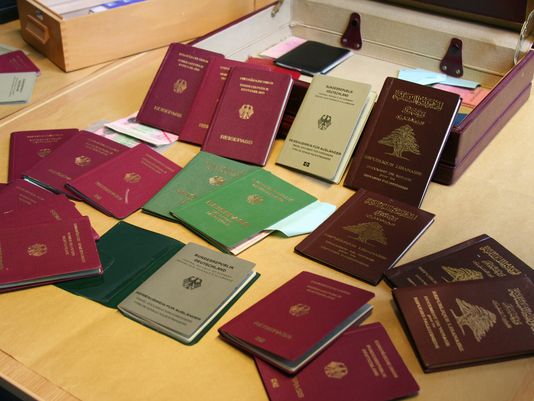
    With an accompanying statement, police showed photographs of computers, printers and fake passports supposedly from Slovenia, Finland, Czech Republic, Bulgaria, Spain and Greece found in two raids. Six other sites were also searched.

    “Those arrested are believed to be involved in organised crime, migrants smuggling, faking documents and trafficking narcotics,” the statement said.

    Police said the perpetrators used very high technology appliances to make the passports, driving licences and other documents mainly from EU countries.

    Kosovo, which declared independence in 2008, has a population of 1.8 million and about 800,000 Kosovars live abroad, mainly in western Europe, some of them illegally.

    “During the investigation we have identified a lot of Kosovars that have these documents,” police said.

    “All those who have these documents now will face criminal charges.” (Reuters)

  • Why China’s millennials are happy to own nothing

    Why China’s millennials are happy to own nothing

    BLOOMBERG (TIP): Two decades ago, Tyler Xiong and his parents had to live in a commune guided by the strict socialist teachings of Mao Zedong.

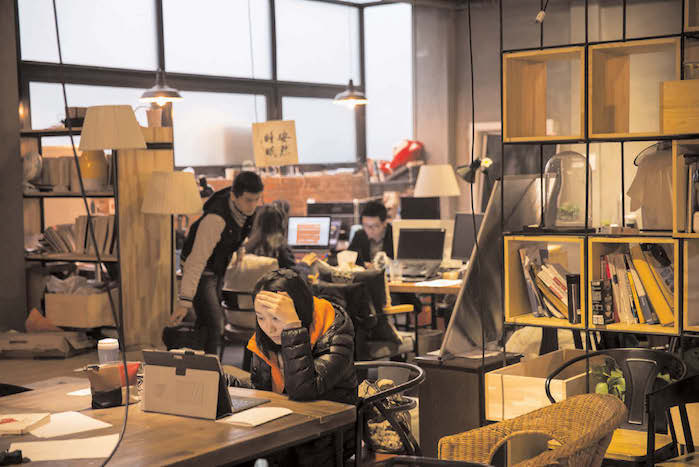
    Today Xiong, a 28-year-old tech entrepreneur, voluntarily lives among 500 people in a co-sharing community near Beijing’s Silicon Valley .Xiong has two pairs of shoes and fewer than 10 outfits. He does not use a car and travels by taxi. His philosophy: if you can rent it, why own it.

    Faced with a widening wealth gap and the slowest economic growth in more than two decades, millions like Xiong find themselves priced out of the big cities and are rejecting the consumer trappings of a modern lifestyle.Instead, they’re embracing the sharing economy to a far greater degree than their Western counterparts. In a recent survey , Nielsen found that 94%of Chinese are willing to share, compared with just 43% of North Americans.

    Xiong is one of nearly 5,000 people across China who have moved into co-living spaces called You+, a name meant to inspire young people to infinitely expand their horizons. His community , located in a shuttered school, holds business workshops, helps register companies and s now trying to create a database to match skills and rela ionships. About 60 startups call the location home.

    You+ echoes a similar movement in the West, where startups like Common (US), Nest Copenhagen (Denmark) and Sende (Spain) are selling mostly young urbanites on he co-living lifestyle.

    For as little as about $500 a month, You+ residents gain access to a private room with a bathroom, co-working space that functions as an office, and entertainment facilities ncluding a bar, disco and game room. “Instead of working for years at a company to gain some capital, such a pla ce allows young people to experiment with their startup ideas at very low costs,” says Su Di, the 36-year-old You+ cofounder.

    As Xiong sees it, China’s communal history combined with his generation’s embrace of social and economic change, is driving the rapid growth of the sharing economy . In China’s most recent fi ve-year plan for economic de velopment, officials highlighted the sharing economy as a way to help the county naviga te a tricky path from exportled growth to consumption.The sharing economy will generate $335 billion by 2025, up from $15 billion today , accor ding to PWC. (PTI)

  • CBI gets permission to conduct polygraph test on Peter Mukerjea

    CBI gets permission to conduct polygraph test on Peter Mukerjea

    NEW DELHI (TIP): A Delhi court on Friday granted permission to the Central Bureau of Investigation (CBI) to conduct a polygraph test on former media baron Peter Mukerjea in its probe into the April 2012 murder of his step-daughter Sheena Bora.

    Probing the suspected ‘financial motive’, the agency has accessed seven Indian bank accounts allegedly held by Peter and his wife Indrani Mukerjea, apart from their accounts in East Asia.

    “A Delhi court has granted its permission to our request for conducting a polygraph test on Peter Mukerjea and it will be done by Monday. Peter has not been forthcoming about the details connected to the crime and the polygraph test may help establish the truth,” said a CBI source.

    “The agency is scrutinising the transactions of the couple’s seven bank accounts, which they control jointly or alone, for any suspected inflow or outflow of funds during the months just before and after April 2012,” said the source.

    It is also gathering information on ownership details of two alleged assets in Spain and UK.

    The source said the agency will pose questions to Peter on suspicions that he and Indrani had allegedly siphoned off nearly 900 crore to bank accounts in Singapore and probably Hong Kong.

  • Sania on top, pairs with Hingis to win WTA finals

    Sania on top, pairs with Hingis to win WTA finals

    ‘When you start off as a child playing tennis, you dream of being No. 1 in the world. I feel honored to be No. 1… she (Hingis) really helped me get there.” — Sania Mirza

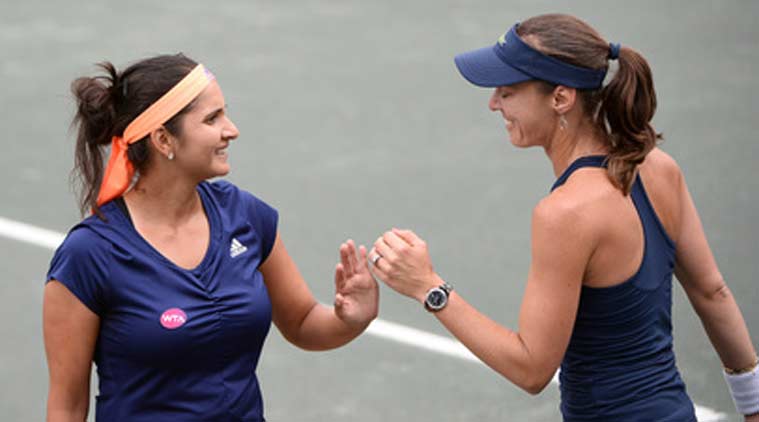
    NEW YORK: Swiss veteran Martina Hingis and India’s Sania Mirza crowned a stunning year for their partnership on Sunday by winning their ninth title at the WTA Finals in Singapore.

    The top seeds beat Spain’s eighth seeds Garbine Muguruza and Carla Suarez Navarro 6-0, 6-3 in 66 minutes a spectacular season finale and completely outclassed their Spanish counterparts. The Indo-Swiss pair have not lost as a single match since joining forces in March.

    Before this, Sania and Martina had won eight titles, with two Grand Slam titles (Wimbledon, US Open), five WTA Premier titles (BNP Paribas Open – Indian Wells, Miami Open, Family Circle Cup – Charleston, Dongfeng Motor Wuhan Open, China Open – Beijing), and one WTA International title (Guangzhou International Women’s Open). They have now stretched their unbeaten streak to 22 matches.

    “I feel like it was a perfect day,” Hingis said. “Sania just played out of her mind – she was everywhere today, getting everything back and playing incredible tennis.”


  • INDO AMERICAN celebrates its success on the 10th Anniversary, Nov 7th

    INDO AMERICAN celebrates its success on the 10th Anniversary, Nov 7th

    RUTHERFORD, NJ (TIP): One of the largest distributors of Natural Stones, INDO AMERICAN is celebrating their 10th anniversary on Nov 7th 2015 at the Renaissance in Rutherford, NJ. Felicitating their key associates and partners in the growth of the Company

    INDO AMERICAN has acquired their new warehouse located in Kearny, just outside of Manhattan, comprising of 88000 sq ft warehouse of natural and artificial stones.

    They began their journey in 2005 from just one row of basic granite procured locally; the company has grown to one of the largest distributors of natural stones in the country with over 250 shades of colors from around the world.

    We directly import Material from all over the world, such as Italy, Brazil, China, India, Spain, Turkey, etc., and it is stored in our own warehouse and distributed to places around the country

    Devraj N Aiyar with his nieceOne long-term goal is to establish remote locations in North America and set up factories in (at least three) the exporting countries to facilitate material acquisition, processing and self-export onward to North America.

    To stay ahead of the curve, INDO AMERICAN is investing heavily in capital expenditure on its indoor and outdoor products. We are also continually expanding our fleet of trucks and manpower to extend the beat services to our clients.

    In addition to our current 2,400-square-foot office space and an equally spacious ‘state of art’ new showroom is being created for high-end designers and architects, which would be one of a kind in the Tri State.

    “The growth of the company could be largely attributed to the excellent teamwork, focus and 100% commitment of our key members and hence our team needs to be fighting fit, both physically and mentally” believes Mr. Devraj N Aiyar, CEO of the organization. Hence their new location is also being outfitted with a gymnasium and an indoor games room.

    “Work is Play” is the motto at Indo American.

    INDO AMERICAN delivers materials to destinations over 250 miles away, which is a testament to its commitment towards customer service and competitiveness. The company prides itself on maintaining a steady stream of loyal customers by offering quality products and service.

    According to Usha “The key ingredients to our growth are maintaining a client base with strong credit and keeping close tabs on receivables.”

    INDO AMERICAN is celebrating their 10th anniversary on Nov 7th, 2015 at the Renaissance in Rutherford, NJ felicitating their key associates and partners in the growth of the Company.

  • LEGAL IMPRESSION : The Religious Land Use and Institutionalized Persons Act of 2000

    A lot of Indians running Gurudwaras/temples/mosques or being in detention centers, either owing to deportation or based on criminal convictions, are not aware of a big federal relief provided to them. And that is Religious Land Use and Institutionalized Persons Act of 2000 (RLUIPA), 42 U.S.C. §§ 2000cc, a federal law which protects individuals in detentions, houses of worship, and other religious institutions from discrimination in zoning and landmarking laws. What is it?

    Let us talk about a Sikh boy in a detention center. Immigration detention facilities, private or public have at times, rather most of the times forced Sikh detainees to have their hair cut. This is illegal. One of the Sikh’s religious tenets/beliefs is not cutting their hair. RLUIPA protects it–it is to include “any exercise of religion, whether, or not compelled by, or central to, a system of religious belief.” So, it is enough for the Sikh boy to say that it is part of his religion to have no hair cut. Government cannot compel him to do otherwise.

    Now, another example.  

    If some Sikh members want to open a Gurudwara and they buy a property, say, in Richmond Hill, in an area that is primarily residential. So, the members of the Gurudwara applied for a variance, so that they could construct the building of their choice and have a religious assembly or kirtan on a regular basis. But the zoning board or related authorities deny that permit. But meanwhile, a private non-religious school nearby acquires a piece of property and has successfully got it rezoned. Here, the Gurudwara can challenge that denial of the permit. Because it violated all of the RLUIPA’s discrimination laws. RLUIA prohibits the local land authorities, the following three:

    Equal Terms: 

    No government shall impose or implement a land use regulation in a manner that treats a religious assembly or institution on less than equal terms with a non religious assembly or institution.

    Nondiscrimination: 

    No government shall impose or implement a land use regulation that discriminates against any assembly or institution on the bases of religion or religious denomination.

    Exclusion and limits: 

    No government shall impose or implement a land use regulation that (a) totally excludes religious assemblies from a jurisdiction; or (b) unreasonably limits religious assemblies, institutions, or structures within a jurisdiction.

    If you feel that your religious rights were violated either in a detention center or regarding city or authorities denying you permission to have a temple or Gurudwara or a mosque, then you have a case.

    Attorney Karamvir Dahiya(The author is a graduate of Harvard Law School, studied tax law at New York University School of Law, bankruptcy law at St. Johns University School of Law and sociology of law from the International Institute of Sociology of Law, Onati, Spain.

    Karam has established a name in the bankruptcy courts combating predatory lenders’ claims and lawsuits as well as defending the debtors and their family members from predatory reach of the Chapter 7 trustees. He has, against jurisdictional and statutory odds, successfully taken the cases out of the bankruptcy courts (‘withdrawal of reference’) to the District Courts for a fuller and better adjudication of the clients’ claims including those related to constitutional protection and privileges. He is regularly called upon by his colleagues in matters and issues dealing with consumer protections laws related to TILA, HOEPA, NY usury and high cost loans.

    Dahiya’s special interest and expertise are federal jurisdiction and constitutional rights. He has successfully argued and obtained relief for several individuals under habeas and
    mandamus writs and navigated complicated immigration matters through the agencies to the circuit courts. In addition to New York State and Federal Courts, he is also certified to practice law in the Delhi High Court and Supreme Court of India. He can be reached at karam@legalpundit.com)

  • Spanish enclaves’ towering fences offer glimpse of fortress Europe

    MELILLA (SPAIN) (TIP): In September 2005, hundreds of African migrants stormed the barbed wire fences in the Spanish enclaves of Ceuta and Melilla in Morocco, seeking to make their way into Europe. Five died and many were severely injured.Today , the flow of migrants trying to climb over what has become a towering fence in Melilla has slowed to a trickle. The fence in Melilla offers a glimpse of what other European frontiers could look like in the future. In recent weeks several European countries have reinstated border checks to control migrants. Hungary has gone much further, barricading its border with Serbia.

    “The process that started in Ceuta and Melilla a decade ago is the blue print for the militarization of borders across Euro pe especially at choke points where you have the main migrant routes,” says Jan Semmelroggen, expert on migration policy at Nottingham Trent University .
    “Spain’s two North African enclaves are a sign of things to come.”

  • Europe’s Refugee Crisis

    Europe’s Refugee Crisis

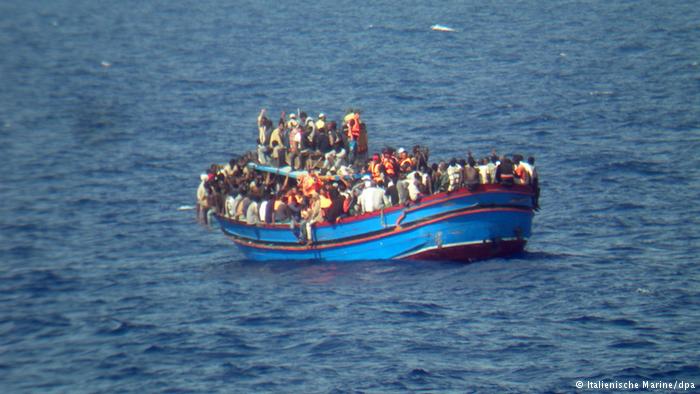
    Another major crisis is unfolding in Europe. Still struggling to find solutions for the Eurozone and Ukrainian crises, The European elite was hardly prepared to face a serious refugee and migration challenge. The problem has already been unfolding for some time. This year alone, more than 300,000 people have risked their lives to cross the Mediterranean Sea (including 200,000 to Greece). Over 2,600 did not survive this dangerous journey. More than 70 people were found dead in an abandoned truck in Austria. Even last year about 3500 people were reported dead or missing in the Mediterranean Sea. For years, these people were seen by many Europeans merely as economic migrants. The images of Syrian toddler Aylan Kurdi whose body was found on Turkish shores after a failed attempt to reach Greece finally shocked the Europeans and the world. Further, chaotic scenes in Budapest, where the Hungarian government tried to stop Syrian refugees’ journey towards Germany, forced the European media and its institutions to change the narrative. The UNHCR has clearly declared now that “this is a primarily refugee crisis, not only a migration phenomenon”.

    The way different EU governments have responded to the present crisis has again exposed structural flaws of common EU policies. The Dublin procedure established that the first EU country where a migrant or refugees enters, is responsible for processing his or her asylum claim. This obviously put tremendous pressure on countries like Greece and Italy where most asylum seekers arrived first. In recent months, Hungary has also joined frontline status as refugees are entering its territory from neigbouring Serbia. As most asylum seekers want to go to Germany, Sweden, France or Italy, questions are raised as to why register and house them in a country where they do not want to stay any way.

    To alleviate the problem, the EU proposed a quota system to distribute migrants among different nations. All 28 EU member states were required to accept asylum seekers in proportion to the size of their economy, unemployment rate and population. Although the plan was initially backed by Germany, France and Italy, they have now suggested many corrections. The UK was already out of the system. Many East Europeans say it will not work as most asylum seekers want to settle in West Europe. Spain has also rejected the plan. Some have objected to the principle itself. The Hungarian Prime Minister Victor Orban asserted that “the idea that somebody allows some refugees in their own country and then distributes them to other member states is mad and unfair”. Later he even added that “the problem is not European, it’s German. Nobody would like to stay in Hungary, neither Slovakia, Poland or Estonia”. The smaller nations in former Eastern bloc feel that policies are being imposed on them by bigger members.

    The number of asylum seekers in the EU has increased significantly in the last few years. Eurostat data shows that about 625,000 claimed asylum in the EU in 2014. The numbers were high but perhaps not as alarming as presented in European media. Europe has seen high numbers even before, particularly during the Yugoslav crisis. In 1992 alone, there were close to 700,000 applications. In the first half of 2015, close to 434,000 people have filed applications for asylum in Europe. Last year, the largest number of asylum seekers came from Syria (20%), followed by Afghanistan (7%), Kosovo (6%), Eritrea (5%), Serbia (3.5%) and Pakistan (3%). In fact, more people from Pakistan applied for asylum than from Iraq. About one third people applied for asylum in Germany only. One in four asylum seekers was a minor.

    As per the UNHCR, over 4 million Syrians are now refugees. It is not that all Syrians are moving towards Europe. About 1.9 million have taken refuge in Turkey. Similarly, about 1.1 million and 630,000 have found shelter in Lebanon and Jordon respectively. Only about 350,000 Syrians have applied for asylum in Europe.
    Europeans know that they cannot run away from their responsibility as many of these people have become refugees due to European involvement in shaping conflict outcomes in Syria, Iraq, Afghanistan, Libya and Kosovo. Both Russian and Turkish presidents have blamed the western world for their policies on this crisis.

    To tackle the crisis, the EU has urged member states to work out a common strategy based on responsibility and trust. So instead of accusing each other, can Europe’s nations agree on some joint action? Many new plans including EU-wide border protection force, destruction of smuggler ships, reallocation plan for already entered refugees, list of safe countries of origin (Balkan states, Bangladesh, Pakistan, Senegal etc) and reception centres closer to conflict areas will be discussed in the coming weeks. European Commission president Jean-Claude Juncker is soon going to outline his plans to relocate 160,000 asylum seekers across Europe over the next two years.

    In the meanwhile, Hungary is building 175 km fence on its border with Serbia. Germany has suspended Dublin rules for Syrian refugees. The Visegrad group (Hungary, Poland, Czech Republic and Slovakia) has declared that any proposal to introduce quota system is unacceptable to them.

    As political and military solutions to the conflicts in Syria and Afghanistan are nowhere in sight, the refugee crisis in Europe is not going to disappear in a hurry. UN High Commissioner for Refugees, Antonio Guterres has urged Europe to “reaffirm the values upon which it was built”. Many West European countries led by Germany have shown courage to accept large numbers of refugees this year. Still the message from the Hungarian prime minister to Syrian refugees was entirely different – “please don’t come. Why you have to go from Turkey to Europe? Turkey is a safe country. Stay there, it’s risky to come. We can’t guarantee that you will be accepted here”.

    (Gulshan Sachdeva is Chairperson, Centre for European Studies, School of International Studies, JNU)

    Views expressed are of the author and do not necessarily reflect the views of the IDSA or of the Government of India

  • The Bilingual Advantage: Dual Language give students a competitive edge

    The Bilingual Advantage: Dual Language give students a competitive edge

    I grew up speaking Spanish with my parents, who fled their native Spain during its Civil War and settled in Brooklyn. I didn’t know any English when I started kindergarten and the teacher marked me absent for six weeks because I didn’t understand her mangled pronunciation of my last name. Like many of you, I struggled to be bilingual and bicultural, trying to hold on to my parents’ traditions while finding my footing in their adopted land.

    Today, approximately 14% of New York City’s public school students -about 150,000 boys and girls – are English Language Learners (ELLs), like I was when I started school. I am proud that this fall, the Department of Education will open or expand Dual Language programs across the five boroughs, offering students the opportunity to acquire fluency in two languages and, at the same time, foster their respect and appreciation for multiple cultures.

    In Dual Language classes, 50% of students are ELLs and 50% are English-proficient students. Both groups of students receive instruction in English and a target second language. Among the programs is the City’s first Japanese Dual Language classroom; other programs include Spanish, French, Haitian- Creole, and Mandarin.

    Last year the Division of English Language Learners and Student Support (DELLSS) was created to provide a high-quality education and targeted support to prepare ELLs for college and career readiness. Deputy Chancellor Milady Baez, an immigrant from the Dominican Republic who like me did not know any English when she began school in New York City, is the first to lead the DOE’s robust efforts to support ELLs. Ms. Baez has been a champion of ELLs throughout the span of her career in bilingual education.

    I dream of a New York City where every child speaks and writes two languages and is a true member of a global citizenry. Dual Language programs make a difference for students and families in our increasingly globalized world. Speaking multiple languages and understanding different cultures is an asset for students, families, schools, and our entire City – and they’re critical skills students will need for highly coveted 21st century jobs.

    You can help bring a Dual Language program to your school if many parents express interest. We welcome any school community that would like to implement a Dual Language program and we will continue to offer planning grants every year to expand this program.

    Academic research has demonstrated that these programs contribute to great educational gains. A number of studies have shown that students in Dual Language programs academically outperform other students; other studies demonstrate that when students learn to read in their primary languages, they become more fluent in English. One scientist, Ellen Bialystok, has produced almost 40 years of research showing how bilingualism sharpens the mind.

    Dual Language programs will strengthen our students’ language skills, teach them about new cultures, and welcome parents into classrooms in new ways.

    As a former ELL, a lifelong educator, and an abuela, I am excited and confident that this initiative is a critical step forward that will put more students on the path to college and meaningful careers.

    To learn how to apply for these programs, families can call 718-935-3500 or visit one of our family welcome centers http://on.nyc.gov/1SZrXpH.

  • Coins worth $4.5m recovered from shipwreck

    MIAMI (TIP): Treasure hunters off Florida have found$4.5 million in gold coins from a Spanish ship that sunk during a hurricane in the 18th century , the sal vage company said on August 19.

    The ship ‘Ten Galleons’ traveling from Havana to Spain went down off Florida’s east coast in the July 1715 storm, on whose impact the vesse broke up and the booty was flung far and wide.

    “Over 350 gold coins, including 9 Royals were recovered on July 30 & 31 on the actual 300th anniversary of the wreck,” said Brent Brisben, the head of 1715 Fleet-Queens Jewels. It was the second major find by the treasure hunters in recent months, after, in June they found about 50 coins with a total of about $1 million. The latest coins found are extremely rare and are worth about $300,000 each, Brisben said. ” These Royals are perfect speci mens of coinage of the time and they were made on royal order for the king of Spain,” he explained.

    ” These shipwrecks were pushed by the hurricane into the outer edge of the reef and then they were utterly de stroyed by the wave action. So pieces of these ships have floated for miles al the way into the beach up into the dunes,” Brisben added. Under the US state law, Florida gets 20% of the returns on treasure found off its coasts.

  • Transnationals | Tax Havens | Terrorism

    Transnationals | Tax Havens | Terrorism

    “Westphalian sovereignty is the principle of international law that each nation state has sovereignty over its territory and domestic affairs, to the exclusion of all external powers. The principle of non-interference in another country’s domestic affairs, and that each state (no matter how large or small) is equal in international law is recognized. This doctrine is named after the Peace of Westphalia, signed in 1648, which ended the Thirty Years’ War.” 

    “It is ironical that Terror organizations on one side and Tax havens on the other have completely undermined Westphalia consensus. In that context countries like India have every right to exercise its freedom to pursue terrorists who are undermining its existence whether sponsored by foreign countries or home grown. The concept of territorial jurisdictions and sovereignty are no more valid in the context of terror organizations since they damage both India and its own host countries over period of time. India must protect its national interests and institutions by challenging inimical forces wherever they are located without worrying about Westphalia consensus”.


    In the context of the strikes made against terror camps on the border of Manipur/Nagaland by the Indian Army; there has been number of discussions about national sovereignty and the role of individual States. Actually in the last few decades the activities of transnational corporations aided by tax havens on one side and terrorists on the other side have destroyed the concept of nation state and its sovereignty evolved after the 30 years’ war in 1648 in Westphalia. Westphalian sovereignty is the principle of international law that each nation state has sovereignty over its territory and domestic affairs, to the exclusion of all external powers. The principle of non-interference in another country’s domestic affairs, and that each state (no matter how large or small) is equal in international law is recognized. This doctrine is named after the Peace of Westphalia, signed in 1648, which ended the Thirty Years’ War .After that war major continental European states – the Holy Roman Empire, Spain, France, Sweden and the Dutch Republic – agreed to respect one another’s territorial integrity. As European influence spread across the globe, the Westphalian principles, especially the concept of sovereign states, became central to international law and to the prevailing world order.

    Scholars of international relations have identified the modern, Western-originated, international system of states, multinational corporations, and organizations, as having begun at the Peace of Westphalia. Henry Kissinger in his important book on “world Order” says:

    “No truly global “world order’ has ever existed. What passes for order in our time was devised in Western Europe nearly four centuries ago, at a peace conference in the German region of Westphalia, conducted without the involvement or even the awareness of most other continents or civilizations. A century of sectarian conflict and political upheaval across Central Europe had culminated in the Thirty Years’ war of 1618-48- a conflagration in which political and religious disputes commingled, combatants resorted to “total war” against population centers, and nearly a quarter of the population of Central Europe died from combat, disease, or starvation. The exhausted participants met to define a set of arrangements that world stanch the bloodletting. Religious unity had fractured with the survival and spread of Protestantism; Political diversity was inherent in the number of autonomous political units that had fought to a draw. So it was that in Europe the conditions of the contemporary world were approximated: a multiplicity of political units, none powerful enough to defeat all others, many adhering to contradictory philosophies and internal practices, in search of neutral rules to regulate their conduct and mitigate conflict.

    “The Westphalian peace reflected a practical accommodation to reality, not a unique moral insight. It relied on a system of independent states refraining from interference in each other’s domestic affairs and checking each other’s ambitions through a general equilibrium of power. No single claim to truth or universal rule had prevailed in Europe’s contests. Instead, each state was assigned the attribute of sovereign power over its territory. Each would acknowledge the domestic structures and religious vocations of its fellow states as realities and refrain from challenging their existence. With a balance of power now perceived as natural and desirable, the ambitions of rules would be set in counterpoise against each other, at least in theory curtailing the scope of conflicts. Division and multiplicity, an accident of Europe’s history, became the hallmarks of a new system of international order with its own distinct philosophical outlook. In this sense the European effort to end its conflagration shaped and prefigured the modern sensibility: it reserved judgment on the absolute in favor of the practical and ecumenical; it sought to distill order from multiplicity and restraint.

    “The seventeenth-century negotiators who crafted the peace of Westphalia did not think they were laying the foundation for a globally applicable system. They made no attempt to include neighboring Russia, which was then reconsolidating its own order after the nightmarish “Time of Troubles” by enshrining principles distinctly at odds with Westphalian balance; a single absolute ruler, a unified religious orthodoxy, and a program of territorial expansion in all directions. Nor did the other major power centers regard the Westphalian settlement (to the extent they learned of it at all) as relevant to their own regions.1

    The three core principles on which the consensus rested are:

    1. The principle of the sovereignty of states and the fundamental right of political self determination
    2. The principle of legal equality between states
    3. The principle of non-intervention of one state in the internal affairs of another state

    Interestingly, all three are questioned by contemporary leaders of West and radical Islam.

    Tony Blair the then Prime Minister of UK in his famous Chicago Address -1999-suggests

    “The most pressing foreign policy problem we face is to identify the circumstances in which we should get actively involved in other people’s conflicts. Non -interference has long been considered an important principle of international order….

    “But the principle of non-interference must be qualified in important respects. Acts of genocide can never be a purely internal matter. When oppression produces massive flows of refugees which unsettle neighboring countries then they can properly be described as “threats to international peace and security”.2

    The NATO intervention in Kosovo and Afghanistan as well as US intervention in Iraq provide recent examples of breakdown of idea of Westphalia. Similar is the humanitarian crisis faced by India regarding refugees from East Pakistan.

    Interestingly Radical Islam also considered that the world order based on Westphalian consensus will collapse. “In the aftermath of the 11 March 2004 Madrid attacks, Lewis ‘Atiyyatullah, who claims to represent the terrorist network al-Qaeda, declared that “the international system built up by the West since the Treaty of Westphalia will collapse; and a new international system will rise under the leadership of a mighty Islamic state.”3

    The spread of ISIS across countries and activities of Boko Haram based in Nigeria in Kenya and Chad re-emphasis this point. Radical Islam do not accept territorial boundaries since it works for a global regime for global Ummah.

    The recruitment by these terror organizations is also across continents and countries which does not respect territorial sovereignty. The talk about Caliphate indicates that they are trans-border organizations.

    On the other side we find global corporations transcending sovereignty in search of global profits. For this they use tax havens as a tool.

    Tax havens–numbering more than 70 jurisdictions–facilitate bank facilities with zero taxes and no-disclosure of the names and in many cases anonymous trusts holding accounts on behalf of beneficiary. Basically lawyers and Chartered accountants will deal with mattes. Sometimes a post box alone will be operative system. In the case of Bahamas one building seems to have had tens of thousands of companies registered there.

    Luxemburg (population half a million!) registered companies of various countries have evaded taxes significantly from their legal jurisdiction. The key findings of the activities of transnational companies cutting across territorial jurisdiction is given below.

    • Pepsi, IKEA, AIG, Coach, Deutsche Bank, Abbott Laboratories and nearly 340 other companies have secured secret deals from Luxembourg that allowed many of them to slash their global tax bills.
    • PricewaterhouseCoopers has helped multinational companies obtain at least 548 tax rulings in Luxembourg from 2002 to 2010. These legal secret deals feature complex financial structures designed to create drastic tax reductions. The rulings provide written assurance that companies’ tax-saving plans will be viewed favorably by Luxembourg authorities.
    • Companies have channeled hundreds of billions of dollars through Luxembourg and saved billions of dollars in taxes. Some firms have enjoyed effective tax rates of less than 1 percent on the profits they’ve shuffled into Luxembourg.
    • Many of the tax deals exploited international tax mismatches that allowed companies to avoid taxes both in Luxembourg and elsewhere through the use of so-called hybrid loans.
    • In many cases Luxembourg subsidiaries handling hundreds of millions of dollars in business maintain little presence and conduct little economic activity in Luxembourg. One popular address – 5, rue Guillaume Kroll – is home to more than 1,600 companies.
    • A separate set of documents reported on by ICIJ on Dec. 9 expanded the list of companies seeking tax rulings from Luxembourg to include American entertainment icon The Walt Disney Co., politically controversial Koch industries and 33 other firms. The new files revealed that alongside PwC tax rulings were also brokered by Ernst & Young, Deloitte and KPMG, among other accounting firms.4

    The big four accounting firms namely KPMG/E&Y/Deloitte and PwC have facilitated the movement of funds of clients across borders and territories to make tax “planning” easier for these companies. USA is literally waging war with major Giants like Amazon/Google/Microsoft etc. for not paying adequate taxes in USA in spite of being US based companies. Most of these companies have moved their profits to other Tax Havens.

    Global firms such as Starbucks, Google and Amazon have come under fire for avoiding paying tax on their British sales. There seems to be a growing culture of naming and shaming companies. But what impact does it have?5

    Royal Commission into tax loopholes a must—says a report in Australia.6

    There is an increasing clamor in USA about Congress Should Pass the Stop Tax Haven Abuse Act to Combat International Tax Avoidance. This has been highlighted by both TAX justice network as well as Global Financial Integrity.

    A simple method of trade mis-invoicing by global companies using tax-havens have impacted developing countries nearly 730Billion USD in 2012 says Global Financial integrity. Another interesting finding by GFI is about terror financing using Tax haven route.

    Because of the increasing wariness of MNCs using Tax havens for avoidance of taxes and the opaque ways of functioning of these off-shore structures, demands are growing about their activities and even closing down of these tax havens by European parliament etc.

    Due to relentless pressure from OECD as well as G20 many of these secretive jurisdictions are becoming more transparent.

    But the fact of the matter is these Trans National Companies and Tax Havens together have significantly undermined the concept of sovereignty and territorial jurisdictions.

    It is ironical that Terror organizations on one side and Tax havens on the other have completely undermined Westphalia consensus. In that context countries like India have every right to exercise its freedom to pursue terrorists who are undermining its existence whether sponsored by foreign countries or home grown. The concept of territorial jurisdictions and sovereignty are no more valid in the context of terror organizations since they damage both India and its own host countries over period of time. India must protect its national interests and institutions by challenging inimical forces wherever they are located without worrying about Westphalia consensus.

    (The author is Professor of Finance at IIM-Bangalore)

  • The Greek deal has lessons for all nations

    The Greek deal has lessons for all nations

    ATHENS (TIP) : After all the brinkmanship, including holding of a referendum, Greece has finally agreed to the conditional bailout package offered to it, thus averting an exit from the eurozone and setting a precedent for other countries.

    It took 17 hours of marathon talks between the European Council and Greece to hammer out a third bailout worth $95 billion under the European Stability Mechanism. If the talks had been unsuccessful and a Grexit could not have been avoided, it could have led to a precedent for a similar exit by Spain, Italy or Portugal to knock down the very idea of a stable and economically stable Europe.

    The bailout has, however, bound Greece to initiate economic reforms including increase in taxes and restructuring of its pension scheme. The banks in Greece, which are nearly insolvent, were ordered to close over a fortnight ago and are likely to re-open within a week. If the talks a failed, the country would have slipped into a dark abyss and could have had international ramifications.

    Even as the deal has been done, the tougher part of its implementation remains. Greek Prime Minister Alexi Tsipras was forced to accept an austerity package which was worse than what he had rejected some time ago. Its implementation would be a tough task for him. He will have to sell the austerity package to his party as well as to the opposition in order to revive its economy which is in complete mess.

    The agreement which helped avert a tragedy makes it mandatory for Greece to initiate measures including simplifying VAT rates, impose more taxes and cutback pensions. It is also supposed to request continued IMF support from March 2016. It also needs to cut cost of administration, ensure creditor approval for key legislation, go in for privatization, involving transfer of assets to the independent fund designed to raise 50 billions euros. The country is to set a clear time table for pensions reforms, privatizing electricity network and strengthening financial sector including action on non performing loans.

    European Commission president Jean-Claude Juncker later said that “in this compromise there are no winners and no losers…..it is a typical european arrangement”.

    The lesson for other governments clearly is to set their own house in order and set in economic reforms rather than go in for populist measures.


  • Woman carrying cocaine in breast implants arrested at Colombia airport

    COLOMBIA (TIP): A Honduran woman carrying 1.5kg (3.3 lbs) of liquid cocaine in her breast implants was arrested at the airport in Colombia’s capital Bogota on Friday, police said.

    Paola Deyanira Sabillon, 22, was attempting to travel to Spain when her apparent nervousness aroused suspicion in the security line, airport police colonel Diego Rosero told journalists.

    X-rays revealed a recent surgery on Sabillon’s breasts and she confessed that an unknown substance had been implanted which she was meant to take to Barcelona, police added. Authorities said a preliminary investigation showed that the surgery took place at a clandestine clinic in the city of Pereira, in western Colombia.

    The implants were removed at a Bogota hospital where Sabillon is also being treated for an infection.

    Some 300 tonnes of cocaine are produced per year in Colombia, long a hub for drug production and trafficking.

  • Germany lobbies India to buy Eurofighters, submarines

    Germany lobbies India to buy Eurofighters, submarines

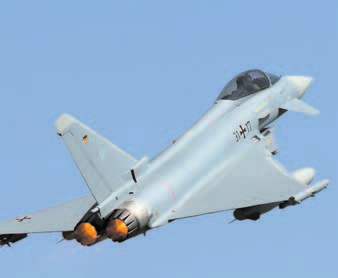
    NEW DELHI (TIP): Germany’s defence minister held out the prospect of more talks on a possible sale of Eurofighter jets to India and, on a visit to New Delhi, said Berlin stood ready to back a multi-billion-dollar Indian submarine project.

    Prime Minister Narendra Modi, who has just marked his first year in office, cut through an impasse over a troubled tender for high-end combat jets by announcing a deal in France last month to buy 36 Rafales from Dassault.

    India has since said the original tender, launched by the last government to acquire 126 Medium Multi-Role Combat Aircraft, is all but dead, but rival jet makers are hoping the $14 billion tender will be reopened.

    The Eurofighter, made by Britain, Germany, Italy and Spain, was knocked out in the final round of the tender by Rafale. But controversy over the lifetime cost of operating the French plane blocked a final deal.

    “I again conveyed to the defence minister the interest of the Eurofighter nations in continuing talks, should the Indian side be interested,” German defence minister Ursula von der Leyen said.

    “That was was taken on board positively,” she added, after meeting her counterpart, Manohar Parrikar, on Tuesday evening.

    Germany has taken the lead in the sales pitch to India for the Eurofighter, made by Alenia Aermacchi, a subsidiary of Finmeccanica, Airbus Group and BAE Systems .

    A spokesman for the Indian defence ministry said the focus now was on finalizing the government-to-government deal for 36 ready-to-fly Rafales.

    Von der Leyen said Berlin was also willing to support a project initiated by India last autumn to build six submarines at an estimated cost of 530 billion rupees ($8.3 billion).

    In a first stage, local shipyards would have to prove their fitness to build the diesel-electric subs, before being invited to bid for the deal, possibly with foreign partners.

    “There is an Indian interest in industrial cooperation in building submarines,” von der Leyen said. “Talks are already under way and I made it clear that German industry is supported by the German government.”

    Initial talks on submarine cooperation were under way involving ThyssenKrupp Marine Systems, a unit of ThyssenKrupp AG , German media reported.

    Von der Leyen met Modi on Wednesday and said the two had touched on the issue of defence equipment, but the conversation focused on sharing knowledge on high-technology areas.

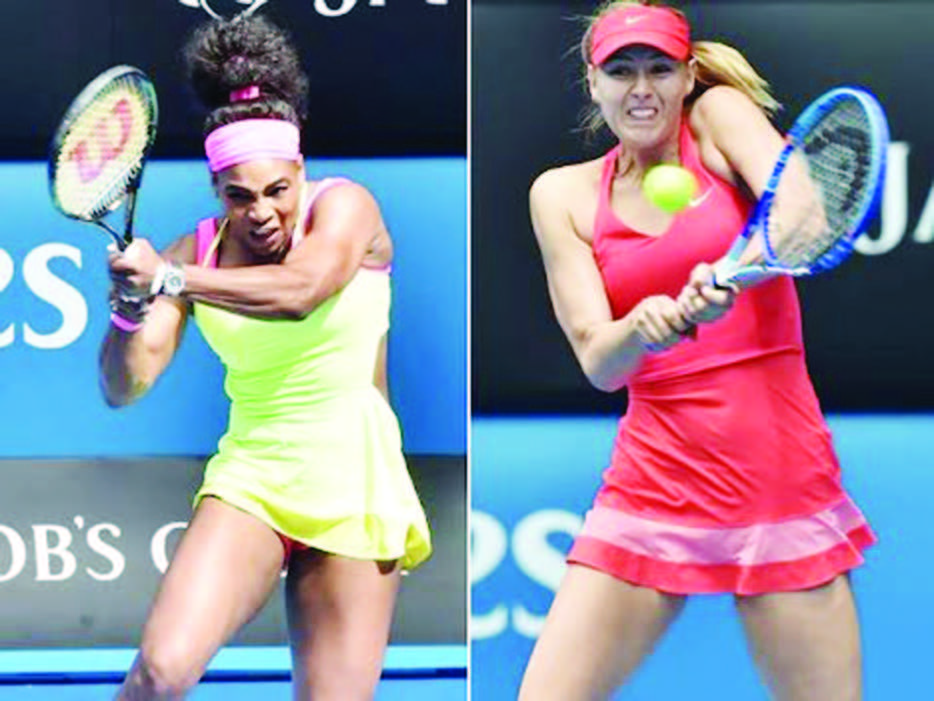
  • Serena and Sharapova set for Paris showdown

    Serena and Sharapova set for Paris showdown

    PARIS (TIP): The two biggest names and highest earners in women’s sport will set off on another collision course when the French Open gets underway at Roland Garros on May 18.

    Serena Williams is a 19-time Grand Slam winner, at 33 still the undisputed queen of tennis and the top seed.

    Maria Sharapova has won two out of the last three titles in Paris, including last year, and at 28 is in the prime of her glittering career.

    Should the seedings hold firm and the American plays the Russian in the final on June 6, however, past experience points to there being only one winner.

    Williams has not lost to Sharapova since 2004 and leads their head-to-heads by an astounding 17-2, the last of these coming in the Australian Open final at the start of the year.

    The outcome was the same in 2013 when the pair met for the first, and to date only time, in the French Open final leaving Sharapova no doubt hoping that someone can do her a huge favour by downing Williams in the early rounds as did Spain’s Garbine Muguruza last year.

    Still, Sharapova believes she is hitting form at the right time and fancies her chances on clay, Williams’ least-favourite surface

    “I feel I’m in a much better spot to where I was physically. I am prepared enough to be ready,” she said after her win in Rome at the weekend.

    “I’ve definitely progressed on clay, that’s no secret. It wasn’t an overnight success for sure. It was a lot of work, physical and mental to get to that stage.”

    An upset for Williams is not out of the question as she has been vulnerable in the past on the Paris clay and, after losing her 27-match unbeaten run in the semi-finals of the Madrid Open earlier this month, she subsequently withdrew from the Italian Open with a sore elbow.

    Asked then if her decision could harm her chances in Paris, where she crashed out at the first round last year having triumphed in Rome, Williams said: “I don’t think it will. If I continue to play it could get worse and I could have a situation on my hands.”

    Williams will have motivation in full as her win in Melbourne was her 19th Grand Slam singles title, just three shy of the Open-era record of 22 set by Steffi Graf.

    It would also leave her halfway to becoming just the fourth woman to achieve the fabled calendar-year Grand Slam after Graf (1988), Margaret Court (1970) and Maureen Connolly (1953).

    Williams and Sharapova will start as strong favourites to reach the final, but there are players in the draw who could derail them. Romanian Simona Halep made the final last year and took Sharapova all the way, Petra Kvitova is the reigning Wimbledon champion who is returning to form after a bout of exhaustion and Caroline Wozniacki is enjoying a return to form that followed on from her run into the US Open final last September.

    There is also much interest in the performances of two former golden girls — Victoria Azarenka and Eugenie Bouchard. Belarusian Azarenka was seen as the heir apparent to Williams in 2013 when she won her second Australian Open title and took the world number one spot.

    But all that ground to a halt last year when her form collapsed due to injury and a bout of depression and she has gradually been clawing her way back up the world rankings this year.