Tag: Spain

  • Spain’s National Court issues ill-advised warrants against China’s former President Jiang Zemin and Prime Minister Li Peng

    Spain’s National Court issues ill-advised warrants against China’s former President Jiang Zemin and Prime Minister Li Peng

    Having been involved in cases dealing with Alien Tort Statute and Torture Victims Protection Act, I have a thought or two for consideration. Nations should be wary of passing laws that have extra-territorial reach as Chief Justice Roberts forcefully explained in the Kiobel case in April 2013.

    I would argue that the presumption against extra-territoriality is a ferocious watchdog of every nation’s sovereignty, no less than an army watching the border. After all, where one nation’s border ends, another’s begins (leaving aside the high seas and the poles). To allow otherwise, invites retaliatory reciprocity. While humanitarian concerns are touching to the soul and who doesn’t love the Buddhists, every nation must decide what’s more important that its sovereignty.

    Under law, if one nation can reach conduct in another country, what’s to stop that other country from doing likewise – the Achilles Heel of law – leading to chaos, not order. The Tibet issue is a matter for diplomacy or war. Squatters need to be evicted – perhaps when there is a court with binding jurisdiction on all countries, then law will suffice (but with such a court will come loss of sovereignty).

  • Britain deploys Royal Marines to help with floods

    Britain deploys Royal Marines to help with floods

    LONDON (TIP): Britain deployed Royal Marines on Thursday to help with devastating floods after what officials said was likely the worst winter rainfall in 250 years.

    Around 40 marines were helping reinforce flood defences near Taunton in Somerset in southwest England, parts of which have been under water for a month. Local police said the marines would stack nearly 1,000 sandbags along a 1-2 kilometre stretch of wall near the River Tone, which has been swelled by heavy rain — more of which was expected overnight.

    Prime Minister David Cameron’s government has faced criticism for its handling of a crisis that has left swathes of the country under water, with a key railway line washed away. Several people had to be rescued from deluged homes on February 6.. More storms are expected this weekend.

    Britain’s Communities Secretary Eric Pickles said the government would make an extra £30 million ($48 million, 36 million euros) available for emergency repairs, on top of £100 million announced by Cameron on Wednesday. Pickles said the winter was the wettest since King George III was on the throne, from 1760-1820, and the flood victims had “literally been through hell and high water”.

    The Meterological Office confirmed in a statement that for southern England, “regional statistics suggest that this is one of, if not the most, exceptional periods of winter rainfall in at least 248 years”. Parts of the region received five months of rainfall between December 12 and January 31.

    The rainy winter has set records tumbling, being the wettest combined period for December and January across the United Kingdom since 1910, the Met Office said. It was also the windiest December since 1969, based on the occurrence of winds over 111 kilometres per hour (69 miles per hour). For England alone it was the wettest December to January since 1876-1877 and the second wettest since rainfall records began in 1766.

    “Nothing happened for so long” Firefighters in Somerset and the neighbouring county of Devon rescued 14 people from homes and stranded vehicles late Wednesday and early Thursday. Rescuers in inflatable boats reached four adults and three children from one house after a river burst its banks in Stoke St Gregory, a village that Prince Charles visited on Tuesday, a fire brigade spokesman said. The heir to the throne said on his trip that the “tragedy is that nothing happened for so long”.

    Cameron personally took charge of the government’s response on Wednesday after facing a growing tide of criticism for being too slow to aid stricken communities. “The Environment Agency has ordered specialist pumping equipment to clear roads, in addition to the extra pumps we have already sent, and they will keep looking at all options for pumping and dredging,” Cameron said after chairing a meeting of the government’s emergency response committee Cobra.

    Across the English Channel, France’s western tip jutting out into the Atlantic was placed on highest alert for flooding as tides wreaked havoc. Finestere, a department of coastal Brittany, was placed on red flooding alert and braced for two of its rivers, the Morlaix and the Laita, to burst their banks as a result of heavy rain forecast. The warning was issued by Meteo- France shortly after the agency placed 29 departments from Brittany to the Paris region on a second-tier orange alert.

    Recent days have seen huge waves, gale-force winds and torrential rains combine to batter sea defences from the Basque country on France’s border with Spain. The storms sent a Spanish cargo ship crashing into a sea wall at the French port of Bayonne on Wednesday, splitting it clean in two. In Spain, roofs were torn off and planes overturned as 130km/h winds and eight-metre waves battered the northern coast, causing millions of euros worth of damage.

  • American Association of Cardiologists of Indian Origin Honors 4 at 2013 Fall Meeting

    American Association of Cardiologists of Indian Origin Honors 4 at 2013 Fall Meeting

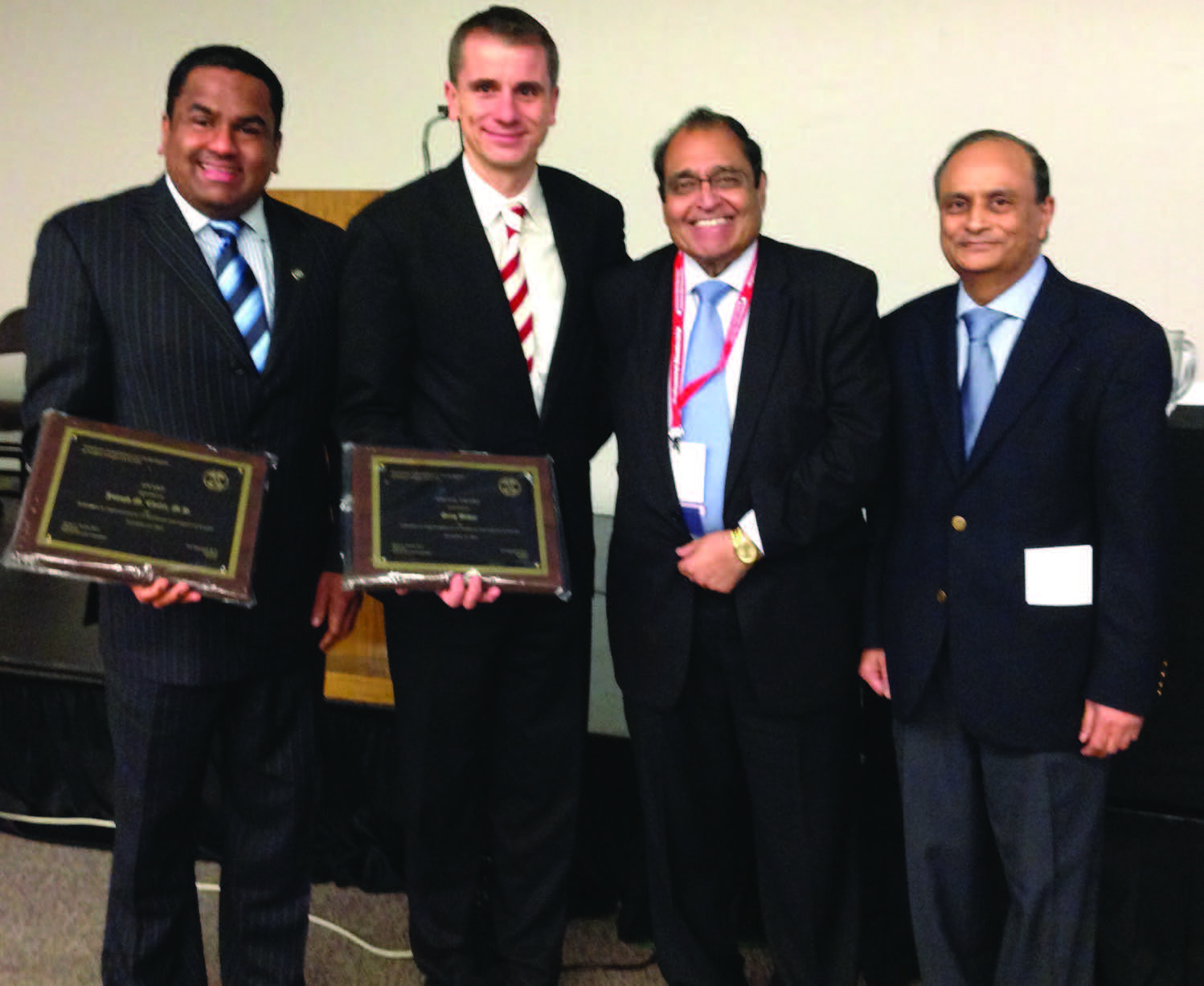
    DALLAS (TIP): American Association of Cardiologists of Indian Origin (AACIO), at its Fall meeting December 4, honored Greg Behar, President and CEO of Boehringer lngelheim Pharmaceuticals, Inc., Dr. Joseph M. Chalil, Associate Director, Health Science Executives, Boehringer Ingelheim USA, and Dr. Dinender K. Singla, a graduate of Post Graduate Institute of Medical Education and Research, Chandigarh, India for their achievements in the field of Cardiology.

    In addition, AACIO Young Investors Award was given to Dr. Ganesh Athappan and the Dr. Madhukar Deshmukh awards were given to Dr. Forum Kamdar and Dr. Manavjot Siddhu. AACIO awards the Dr. Krishna Ramaswamy and two Dr. Madhukar Deshmukh Young Investigator Awards at the AACIO dinner meetings held each year during the American College of Cardiology and the American Heart Association annual convention in March and November. The finalists presented their abstract at the meeting and each received $1000.00 award and a plaque The Fall 2013 annual event, organized by AACIO in coordination with Texas Indo- American Physicians Society (TIPS), North East Chapter and American Association of Physicians of Indian Origin was held at the Dallas Convention Center Theater Complex in Dallas, TX on November 17th, and was attended by over 200 physicians from around the nation.

    Dr. Navin Nanda, the Founding President and Chairman of the AACIO Board of Directors, while lauding honorees for their contributions and achievements, said, “AACIO is proud to honor some of the stalwarts of the pharmaceutical industry like Greg Behar and Chris Kaplan as well as some of the upcoming personalities like Jo Chalil. They have made significant contributions to medical therapeutics in the area of cardiology.” Dr. Nanda is a Distinguished Professor of Medicine and Cardiovascular Disease, Senior Scientist, Minority Health and Research Center and UAB Center for Aging, and UAB Comprehensive Cardiovascular Center, University of Alabama at Birmingham, Alabama. Dr. Ravi Jahagirdar, President Elect, who had represented AAPI at the event, congratulated AACIO for its consistent good work, both in the academic and the applied fields, and reaching out successfully to American Heart Association, and working in tandem with them in many spheres.

    He had special praise for the three Scholarship Awards that are given out each year to young aspiring medical students for poster sessions and in investigative sectors. “We at the national AAPI are proud of these activities,” he said. Dr. Jahagirdar, who will assume charge as the president of the national AAPI in June next year, pledged AAPI’s continued support in the future. In his inaugural address, Dr. Kul Aggarwal, president of AACIO, and Professor of Clinical Medicine, University of Missouri and Chief, Cardiology Section, Harry S. Truman Veterans Hospital, Columbia, Missouri, stated that AACIO provides a central forum for physicians and scientists of Indian origin, living in the United States, who have interest in Cardiovascular Medicine. “Indian Cardiologists are playing an increasingly important role in the provision of Cardiovascular services and also as academic thought leaders in the United States. We are proud of our colleagues.

    AACIO is your organization and joining it adds strength to all of us,” he said. The American Association of Cardiologists of Indian Origin (aacio.org) was formed in 1986 and after crossing puberty, the organization has reached the excited stage of youth after nineteen years. A Symposium, which was part of the meeting was organized by Drs. Navin C. Nanda and Kul Aggarwal. In his insightful presentation on “Newer anticoagulants in the management of a trial fibrillation and stroke prevention” Dr. Sanjeev Saksena, Clinical Professor of Medicine, Rutgers-RWJ Medical School Medical Director, Piscataway, New Jersey, Electrophysiology Research Foundation, Warren, New Jersey & Editor-in- Chief, Journal of Interventional Cardiac Electrophysiology, provided an overview of modern trends. Dr. Amit Khera, Associate Professor, Director, Preventive Cardiology Program, Program Director, Cardiology Fellowship and Dallas Heart Ball Chair in Hypertension and Heart Disease, UT Southwestern Medical Center, Dallas Texas, addressed the audience on “Emerging therapies in dyslipidemia management, beyond statins.” Dr. Nanda educated the audience on “Choice of anti-platelet therapy in acute coronary syndromes.”

    With more than 15 years in the pharmaceutical industry, Greg’s experience includes leadership roles in marketing, sales, business operations and general management. Greg joined Boehringer lngelheim in 2009 as Corporate Vice President of the Cardiovascular and Metabolic Franchise. That same year he became Vice President, Corporate Division Prescription Medicine, leading 14 countries including Northern Europe, Canada and Australia. Prior to Boehringer lngelheim, Greg worked at Novartis Pharma AG in roles of increasing responsibility in Spain and at global headquarters in Switzerland. Another honoree, Dr. Singla has received numerous honors and awards, and has been invited to give talks throughout the world. He also served as a chair/co-chair for scientific meetings, and well published in various peer reviewed journals. He is funded by the National Institute of Health and the American Heart Association grant awards since 2004.

    He has served as an editorial board member for different journals, and is the current Academic Editor for Plos one and Associate Editor for Canadian Journal of Physiology and Pharmacology. Srinivas Reddy Gunukula serves on the Board of Directors of The Heart Hospital Baylor Plano and Director of Center for Advanced Cardiovascular Care at the Heart Hospital McKinnney Campus. He is well known among the Cardiology community in Dallas. Dr. Joseph M. Chalil is a Fellow of American College of Healthcare Executives and is Board Certified in Healthcare Management. He serves as Co-Chair, AAPI Industry Physician Committee and Scientific Advisor, AAPI Cardiovascular, Diabetes and Stroke Network. Dr. Chalil holds three US Patents involving usage of sensors inside Human Body in addition to other applications. His research background includes Clinical Trial Management in Cystic Fibrosis, Multiple Myeloma, and publications in American Journal of Respiratory and Critical Care Medicine. The Asian American Business Development Center, NY has awarded Dr. Chalil the 2013 Outstanding 50 Asian Americans in Business Award. He is a Visiting Professor at various Universities and serves on various company Boards. He is an expert in US Healthcare policy and a strong advocate for patient centered care.

  • Let us Know Texas – The State

    Let us Know Texas – The State

    Texas, the second most populous (after California) and the second -largest state (after Alaska) in the United States of America, has had a checkered history which all residents need to know. A state of immigrants, the state has made tremendous progress in the last few decades, and is growing. The Indian Panorama readers will get to know the state of Texas from a series of articles that will appear each week. – EDITOR

    Texas is the second most populous (after California) and the secondlargest of the 50 states (after Alaska) in the United States of America, and the largest state in the 48 contiguous United States. Geographically located in the South Central part of the country, Texas shares an international border with the Mexican states of Chihunahua, Coahuila, Nuevo León, and Tamaulipas to the south and borders the U.S. states of New Mexico to the west, Oklahoma to the north, Arkansas to the northeast, and Louisiana to the east. Texas has an area of 268,820 square miles (696,200 km2) and a growing population of 26.1 million residents. Houston is the largest city in Texas and the fourth-largest in the United States, while San Antonio is the second largest in the state and seventh largest in the United States. Dallas- Fort Worth and Greater Houston are the fourth and fifth largest United States metropolitan areas, respectively. Other major cities include El Paso and Austin-the state capital.

    Texas is nicknamed the Lone Star State to signify Texas as a former independent republic and as a reminder of the state’s struggle for independence from Mexico. The “Lone Star” can be found on the Texas state flag and on the Texas state seal today. The origin of the state name, Texas, is from the word, “Tejas”, which means ‘friends’ in the Caddo language. Due to its size and geologic features such as the Balcones Fault, Texas contains diverse landscapes that resemble both the American South and Southwest. Although Texas is popularly associated with the Southwestern deserts, less than 10 percent of the land area is desert. Most of the population centers are located in areas of former prairies, grasslands, forests, and the coastline. Traveling from east to west, one can observe terrain that ranges from coastal swamps and piney woods, to rolling plains and rugged hills, and finally the desert and mountains of the Big Bend. The term “six flags over Texas”, as can be seen in the Grand Prairie-based large national and international amusement park operator Six Flags, came from the several nations that had ruled over the territory. Spain was the first European country to claim the area of Texas. France held a shortlived colony in Texas.

    Mexico controlled the territory until 1836 when Texas won its independence, becoming an independent Republic. In 1845 it joined the United States as the 28th state. The state’s annexation set off a chain of events that caused the Mexican-American War in 1846. A slave state, Texas declared its secession from the United States in early 1861, joining the Confederate States of America during the American Civil War. After the war and its restoration to the Union, Texas entered a long period of economic stagnation. One Texas industry that thrived after the Civil War was cattle. Due to its long history as a center of the industry, Texas is associated with the image of the cowboy. The state’s economic fortunes changed in the early 20th century, when oil discoveries initiated an economic boom in the state. With strong investments in universities, Texas developed a diversified economy and high tech industry in the mid-20th century. As of 2010 it shares the top of the list of the most Fortune 500 companies with California at 57. With a growing base of industry, the state leads in many industries, including agriculture, petrochemicals, energy, computers and electronics, aerospace, and biomedical sciences. Texas has led the nation in export revenue since 2002 and has the second-highest gross state product.

    History
    Texas lies between two major cultural spheres of Pre-Columbian North America: the Southwestern and the Plains areas. Archaeologists have found that three major indigenous cultures lived in this territory, and reached their developmental peak before the first European contact. These were: ● the Pueblo from the upper Rio Grande region, centered west of Texas; ● the Mississippian culture, also known as Mound Builder, which extended along the Mississippi River Valley east of Texas; and ● the civilizations of Mesoamerica, centered south of Texas. Influence of Teotihuacan in northern Mexico peaked around AD 500 and declined over the 8th to 10th centuries. No culture was dominant in the presentday Texas region, and many peoples inhabited the area. Native American tribes that lived inside the boundaries of presentday Texas include the Alabama, Apache, Atakapan, Bidai, Caddo, Coahuiltecan, Comanche, Choctaw, Coushatta,Hasinai, Jumano, Karankawa, Kickapoo, Kiowa, Tonkawa, and Wichita.

    The name Texas derives from táysha?, a word in the Caddoan language of the Hasinai, which means “friends” or “allies”. Whether a Native American tribe was friendly or warlike was critical to the fates of European explorers and settlers in that land. Friendly tribes taught newcomers how to grow indigenous crops, prepare foods, and hunt wild game. Warlike tribes made life difficult and dangerous for Europeans through their attacks and resistance to the newcomers.[ The first historical document related to Texas was a map of the Gulf Coast, created in 1519 by Spanish explorer Alonso Álvarez de Pineda. Nine years later, shipwrecked Spanish explorer Álvar Núñez Cabeza de Vaca and his cohort became the first Europeans in what is now Texas. Cabeza de Vaca reported that in 1528, when the Spanish landed in the area, “half the natives died from a disease of the bowels and blamed us.” Francisco Vasquez de Coronado describes his 1541 encounter with “Two kinds of people travel around these plains with the cows; one is called Querechos and the others Teyas; they are very well built, and painted, and are enemies of each other. They have no other settlement or location than comes from traveling around with the cows.

    They kill all of these they wish, and tan the hides, with which they clothe themselves and make their tents, and they eat the flesh, sometimes even raw, and they also even drink the blood when thirsty. The tents they make are like field tents, and they set them up over some poles they have made for this purpose, which come together and are tied at the top, and when they go from one place to another they carry them on some dogs they have, of which they have many, and they load them with the tents and poles and other things, for the country is so level, as I said, that they can make use of these, because they carry the poles dragging along on the ground. The sun is what they worship most.” European powers ignored the area until accidentally settling there in 1685. Miscalculations by René Robert Cavelier de La Salle resulted in his establishing the colony of Fort Saint Louis at Matagorda Bay rather than along the Mississippi River. The colony lasted only four years before succumbing to harsh conditions and hostile natives. In 1690 Spanish authorities, concerned that France posed competitive threat, constructed several missions in East Texas. After Native American resistance, the Spanish missionaries returned to Mexico. When France began settling Louisiana, mostly in the southern part of the state, in 1716 Spanish authorities responded by founding a new series of missions in East Texas.

    Two years later, they created San Antonio as the first Spanish civilian settlement in the area. Hostile native tribes and distance from nearby Spanish colonies discouraged settlers from moving to the area. It was one of New Spain’s least populated provinces. In 1749, the Spanish peace treaty with the Lipan Apache angered many tribes, including the Comanche, Tonkawa, and Hasinai. The Comanche signed a treaty with Spain in 1785 and later helped to defeat the Lipan Apache and Karankawa tribes. With more numerous missions being established, priests led a peaceful conversion of most tribes. By the end of the 18th century only a few nomadic tribes had not converted to Christianity. When the United States purchased Louisiana from France in 1803, American authorities insisted that the agreement also included Texas. The boundary between New Spain and the United States was finally set at the Sabine River in 1819, at what is now the border between Texas and Louisiana. Eager for new land, many United States settlers refused to recognize the agreement. Several filibusters raised armies to invade the area west of the Sabine River.

    In 1821, the Mexican War of Independence included the Texas territory, which became part of Mexico. Due to its low population, Mexico made the area part of the state of Coahuila y Tejas. Hoping that more settlers would reduce the near-constant Comanche raids, Mexican Texas liberalized its immigration policies to permit immigrants from outside Mexico and Spain. Under the Mexican immigration system, large swathes of land were allotted to empresarios, who recruited settlers from the United States, Europe, and the Mexican interior. The first grant, to Moses Austin, was passed to his son Stephen F. Austin after his death. Austin’s settlers, the Old Three Hundred, made places along the Brazos River in 1822. Twenty-three other empresarios brought settlers to the state, the majority of whom were from the United States. The population of Texas grew rapidly. In 1825, Texas had a population of approximately 3,500, with most

  • Harley Davidson to export India-made Street 750 to Europe

    Harley Davidson to export India-made Street 750 to Europe

    PUNE (TIP):India is the only country outside of the US to be making the new bike, which is built on the completely new “Street” platform. Also, it will be the first Harley Davidson product to be exported from the facility. The first Harley Davidson member in the sub-Rs 5 lakh segment, the Street 750 is to be unveiled at the India Bike Week in Goa in early January, following which it will be showcased at the forthcoming Delhi Auto Expo. Here last week to inaugurate HDI’s 11th dealership in India, Anoop Prakash, MD of HD India, said commercial deliveries of the Street 750 will begin by April or May next year. The Made-in- India bike will also be exported to Italy, Portugal and Spain. Total shipments of the model are pegged at 7,000-10,000 units. HD will increase its investment in the Indian facility by around 35 per cent for assembling the Street 750.

  • Police arrest 348 in global child porn investigation

    Police arrest 348 in global child porn investigation

    TORONTO (TIP): More than 300 people, including teachers, coaches and doctors, have been arrested worldwide on child pornography charges after a Canadianled investigation. Toronto police said on Thursday the arrest of 348 people, including 108 in Canada, 76 in the United States and 164 in other countries from Spain to Australia, came after a threeyear investigation of a Toronto company that distributed child porn. “Of concern to the investigators was the number of people (arrested) who have close contact with children. The arrests included 40 school teachers, nine doctors and nurses, 32 people who volunteered with children, six law enforcement personnel, nine pastors or priests, and three foster parents,” Inspector Joanna Beaven-Desjardins, head of Toronto’s Sex Crimes Unit, told a news conference.

  • Unemployment & Inequality

    Unemployment & Inequality

    Social safety net for jobless and sick needed

    Even if GDP growth rises, there will be growing inequalities unless there are strong policies aimed at the uplift of the vulnerable sections and the rich are taxed in an efficient and judicious manner. There should be some insurance against unemployment and sickness which will enable low income families to live with dignity”, suggests the author.
    The Indian economy is faltering even though there are some rays of hope. Exports are rising again due to the weakened rupee and agricultural growth is poised to be higher after a good monsoon. But one bad news is that unemployment has risen in the last one year from 3.8 per cent to 4.7 per cent, according to the Labor Bureau’s survey. This is hardly surprising because there has been a slackening of manufacturing growth to unprecedented levels and it is the manufacturing sector which creates jobs for the semi-skilled labor force. Agricultural growth has not been high either and it is the paucity of nonagricultural jobs that is causing an increase in unemployment in the villages. India’s unemployment rate, however, is lower than some of the member countries of the EU, such as Spain, Portugal, Greece and France. In India, even part-time workers call themselves ’employed’, so there is always an underestimation involved. Even if unemployment has risen to 4.7 per cent, it is still much lower than the unemployment in European countries, the US or UK. But unlike in the EU, the Indian unemployed do not get any dole.

    The unemployed youth in India pose a big problem for the future. There are going to be 423 million jobseekers by 2030. Only rigorous skill training of youth will enable them to get jobs. Unemployment, especially in the lower income groups, is a personal disaster and people with meager savings recede into debt rapidly. One illness in the family can reduce the family to penury and push it below the poverty line. The lack of any kind of social insurance or security is what is lacking in India and has to be corrected. We are wasting millions of rupees on unnecessary expenditure like foreign travel of ministers and dignitaries but we still do not have in place a social safety net that may provide a minimum income to the poorest families to tide over their education and health expenditure. Families with low incomes, and who are without job guarantee or pension, are most vulnerable today, yet no one is talking of a universal social safety net. On the other hand, an increase in unemployment will only widen the income inequalities in the country. Already the inequalities are rising as is evident from an increase in the Gini coefficient (a number between 0 and 1) which has risen in recent years from 0.34 to 0.38 (at perfect equality of incomes, Gini is 0). But according to experts, India’s Gini coefficient is not a proper indicator of rising inequalities because it takes into account the expenditure data rather than income data.

    According to them, the Gini coefficient is much higher at 0.54 when it is measured by income levels. Inequalities are rising because in every sector there is wide disparity between the big players and the small ones. In agriculture, 80 per cent are small and marginal farmers and the disparity of income between the big farmers and the small ones is huge. This disparity is increasing further with fall in agricultural incomes and inflation. Also as has been pointed out, the agricultural subsidies like free power and low priced fertilizers are cornered by big farmers rather than the small and marginal. In manufacturing sector too, most units are small or medium scale. There is a profusion of micro units and the small-scale sector contributes to 45 per cent of exports and employs 60 million people. Their productivity and incomes are low. Around 40 per cent of the employees in the manufacturing sector are in the lowpaying food, beverages, textiles, leather, and garment units. The large industrialists have big incomes and capability to invest and earn high profits. Their deep pockets enable them to undersell their products and wean away competitors. In the service sector, too, only 2 per cent are high earners, who are in the finance, insurance or real estate sectors.

    Most of the service sector employees are in the informal or unorganized sector and are low-income earners. All domestic servants, guards, cleaners, street vendors, construction workers are in the service sector, but the difference in income between the top earners and the bottom ones is huge. This widening income disparity is evident everywhere – in towns, villages and big cities. The ultra-high net worth Indians are growing at the fastest rate among BRICS. They are worth $30 million and their number is at 7,850 in India. Counting in dollars, there are 69 billionaires and 2 lakh millionaires in India who can afford the lifestyle of the richest in the world. There is inequality in every country and Joseph Stiglitz in his book “The Price of Inequality” describes the growing inequality in the US. But in India, the contrast is glaring and unpalatable. People living without basic needs and human dignity are within a stone’s throw of big mansions of the rich. The fatalistic nature of Indians enables them to tolerate such contrasts with stoic silence. There are few protests in India, considering the way the poor live and how they are treated. In the past, Indian industrialists were known for their simple living and philanthropic acts. Unfortunately, that era is gone and today only 19 per cent of the rich engage in philanthropic deeds. If we go deeper we find that government policies have been somewhat pro poor since Independence but have been diluted over the years.

    With the latest food security Bill as an example of equitable distribution, the UPA government can earn kudos for thinking about the poor. But on the whole, the government has not been able to eradicate corruption or establish better governance so that expenditure meant for the poor reaches them. All we hear of is how the middle men have pocketed the food grain meant for the poor or the money meant for the welfare of the downtrodden. Every country has had problems after the global financial crisis but many have tried to provide for the low income population in a humane and efficient manner. Hopefully with the news of rising unemployment there will be some action taken for the benefit of those in the lowest income bracket. Even if GDP growth rises, there will be growing inequalities unless there are strong policies aimed at the uplift of the vulnerable sections and the rich are taxed in an efficient and judicious manner. There should be some insurance against unemployment and sickness which will enable low income families to live with dignity.

  • INDIA, CHINA TO SIGN COOPERATION PACT IN ROAD SECTOR

    INDIA, CHINA TO SIGN COOPERATION PACT IN ROAD SECTOR

    NEW DELHI (TIP): India and China are set to sign an agreement for cooperation in the road and transport sector when Prime Minister Manmohan Singh visits Beijing in October. One of the areas would be cooperation in sharing of information on transport infrastructure. Government sources said the transport ministries of both sides have approved the details of the proposed agreement.

    Sources said the identified areas of cooperation include sharing best practices in road and bridge building technologies, policies, intelligent traffic system besides road-related issues. China has taken huge strides in building world class highways, and has built over 60,000 km of expressways. Plans are afoot to build around 18,000 km of expressways in India. China has also made a mark in speedy implementation of infrastructure projects, particularly road and rail. “Once we have technology sharing, it will help us push the pace of construction. They have also improved their record in reducing road deaths in the past sixseven years.

    Cooperation will open a window of opportunity for both the countries,” an official said. Around half-a-dozen road projects are being built with participation of Chinese companies. Sources said all these projects were bagged by private entities in which Chinese firms had a share. Sources said no project has been identified that can be taken up under this cooperation. “This is just a beginning. As we progress, projects will be identified,” the official said. The other major area of cooperation will in the electronic mode of collecting toll (ETC).

    China is way ahead of India in this sector. India also plans to bring all toll plazas on national highways under ETC so that people can pass through all plazas using a single smart card. India and China will also cooperate in the field of intelligent traffic system, vehicle specifications and their certification. While India is likely to benefit from Chinese sharing of information and knowledge, China will learn from India’s success in implementing public-private-partnership projects.

    Last year, former highways minister C P Joshi had reached out to Chinese infrastructure companies to invest in the road sector. He had said around 40 road construction projects were being undertaken by companies from China, Russia, the UK, Dubai, Singapore, Italy, South Korea, Malaysia, Spain and Thailand.

  • Ethnic-Based Violence Highlights Need For Greater Dialogue: UN OFFICIAL

    Ethnic-Based Violence Highlights Need For Greater Dialogue: UN OFFICIAL

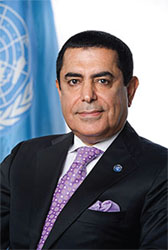
    NEW YORK (TIP): Deeply concerned about the increasing number of acts of violence worldwide based on ethnicity and religion, a senior United Nations official has called for addressing the root causes of such violence and promoting dialogue and tolerance. “Such acts develop into incitement to hatred, racism, and xenophobia that often lead to national, regional and international instability,” Nassir Abdulaziz Al-Nasser, the High Representative for the Alliance of Civilizations said.

    “These acts are contrary to the values the Alliance of Civilizations is striving to promote such as cultural diversity, inclusiveness, religious tolerance and meaningful dialogue in accordance with the UN Charter.” Al-Nasser urged concerned religious and political leaders to address the root causes of ethnic and religious violence and uphold the rule of law, as well as engage in preventive diplomacy efforts with the aim of ensuring peace and security, protecting human rights and strengthening efforts leading to sustainable development.

    “The High Representative reiterates the importance of building bridges between ethnic groups to create an environment conducive to reconciliation, peace and prosperity for all,” he said. Launched in 2005 through the initiative of Spain and Turkey, and under the auspices of the UN, the Alliance seeks to promote better cross-cultural relations worldwide.

  • Spain Train Tragedy Blamed On Excessive Speed, 80 Dead

    Spain Train Tragedy Blamed On Excessive Speed, 80 Dead

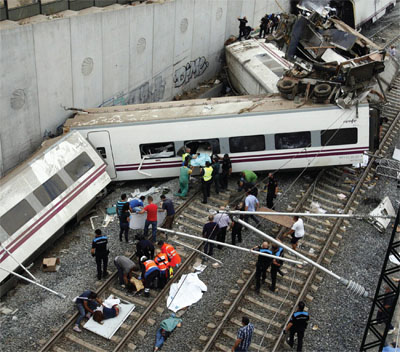
    SANTIAGO DE COMPOSTELA, Spain (TIP): A Spanish train that hurtled off the rails and smashed into a security wall as it rounded a bend was going so fast that carriages tumbled off the tracks like dominos, killing 80 people, according to eyewitness accounts and video footage obtained on July 25. An Associated Press analysis of video images suggests that the train may have been traveling at twice the speed limit for that stretch of track.

    Spain’s government said two probes have been launched into the cause of Wednesday night’s crash near this Christian festival city in northwest Spain. The interior ministry raised the death toll to 80 in what was Spain’s deadliest train wreck in four decades, while 95 remained hospitalized, 36 in critical condition, among them four children. Prime Minister Mariano Rajoy, a native of Santiago de Compostela, toured the crash scene alongside rescue workers and went to a nearby hospital to visit those wounded and their families.

    “For a native of Santiago, like me, this is the saddest day,” said Rajoy, who declared Spain would observe a three-day period of mourning. He said judicial authorities and the public works ministry had launched parallel investigations into what caused the crash. Eyewitness accounts backed by securitycamera footage of the moment of disaster suggested that the eight-carriage train was going too fast as it tried to turn left underneath a road bridge. The train company Renfe said 218 passengers and five crew members were on board.

    Spanish officials said the speed limit on that section of track is 80 kilometers (50 miles) per hour. An Associated Press estimate of the train’s speed at the moment of impact using the frame rate of the video and the estimated distance between two pylons gives a range of 144-192 kph (89-119 mph). Another estimate calculated on the basis of the typical distance between railroad ties gives a range of 156-182 kph (96-112 mph).

    The video footage, which the Spanish railway authority Adif said probably came from one of its cameras, shows the train carriages start to buckle soon into the turn. Murray Hughes, consultant editor of Railway Gazette International, said it appeared that a diesel-powered unit behind the lead locomotive was the first to derail. The front engine itself quickly followed, violently tipping on to its right side as it crashes into a concrete security wall and bulldozes along the ground.

    In the background, all the rear carriages can be seen starting to decouple and come off the tracks. The picture goes blank as the engine appears to crash directly into the camera. After impact, witnesses said a fire which engulfed passengers trapped in at least one carriage most likely from the diesel fuel carried in the locomotive units.

    “I saw the train coming out of the bend at great speed and then there was a big noise,” one eyewitness who lives beside the train line, Consuelo Domingues, told The Associated Press. “… Then everybody tried to get out of the train.” Santiago officials had been preparing for the city’s internationally celebrated Catholic festival Thursday but canceled it and took control of the city’s main indoor sports arena to use as a makeshift morgue.

    There, relatives of the dead could be seen sobbing and embracing each other. The US state department said five American citizens were among the injured. The interior ministry, responsible for law and order, ruled out terrorism as a cause. It was Spain’s deadliest train accident since 1972, when a train collided with a bus in southwest Spain, killing 86 people and injuring 112.

    “July 24 will no longer be the eve of a day of celebration but rather one commemorating one of the saddest days in the history of Galicia,” said Alberto Nunez Feijoo, regional president of Galicia. Santiago de Compostela is its capital. The accident created a scene that was “Dante-esque,” Feijoo said. He said Galicia would observe seven days of mourning. Rescue workers spent the night searching through smashed carriages alongside the tracks.

    As dawn broke, cranes brought to the scene were used to lift the carriages away from the tracks. Rescue workers collected passengers’ scattered luggage and loaded it into a truck next to the tracks. Rescuers described a scene of horror immediately after the crash. Smoke billowed from at least one carriage that had caught fire, while another had been torn into two parts.

    Residents of the residential neighborhood closest to the rail line struggled to help victims out of the toppled cars. Some passengers were pulled out of broken windows. Television images showed one man atop a carriage lying on its side, using a pickaxe to try to smash through a window. Other rescuers used rocks to try to free survivors from the fiery wreckage. Nearby, rescue workers lined up bodies covered in blankets alongside the tracks.

    State-owned train operator Renfe said the crash happened at 8.41pm (1841 GMT) about 2.5 miles (4 kilometers) south of Santiago de Compostela. Spanish media said the train had two drivers aboard and both survived. However, Galician court officials said the train had only one driver. Court spokeswoman Maria Pardo Rios said the driver survived and was expected to give a statement to police later Thursday.

    She declined to name the driver but said he was not being treated as the suspect of a crime. Renfe said it and Adif, another stateowned company that manages tracks, signals and other railway infrastructure, were cooperating with a judge appointed to investigate the accident. It was the world’s third major rail accident this month. On July 12, six people were killed and nearly 200 were injured when four cars of a passenger train derailed south of Paris.

    On July 6, 72 cars carrying crude oil derailed in Lac-Megantic, Ontario, setting off explosions and fires that killed 47 people. Catholic pilgrims converge on Santiago de Compostela annually to celebrate a festival honoring St. James, a disciple of Jesus whose remains are said to rest in a shrine. The city is the main gathering point for those who reach the end of the El Camino de Santiago pilgrimage route that has drawn Christians since the Middle Ages.

    Several injured passengers said they felt a strong vibration just before the cars jumped the tracks, according to Xabier Martinez, a photographer who talked with them after arriving at the scene as rescue workers were still removing bodies. One passenger, Ricardo Montero, told the Cadena Ser radio station that “when the train reached that bend it began to flip over, many times, with some carriages ending up on top of others, leaving many people trapped below. We had to get under the carriages to get out.”

    Another passenger, Sergio Prego, told Cadena Ser the train “traveled very fast” just before it derailed and the cars flipped upside down, on their sides and into the air. “I’ve been very lucky because I’m one of the few able to walk out,” Prego said. The Alvia 730 series train started from Madrid and was scheduled to end its journey at El Ferrol, about 95 kilometers (60 miles) north of Santiago de Compostela. Alvias operate high-speed services but do not go as fast as Spain’s fastest bullet trains, called AVEs.

    The maximum Alvia speed is 250 kph (155 mph) on tracks made especially for the AVEs, and they travel at a maximum speed of 220 kph (137 mph) on normal gauge rails. Other major train crashes in Spain include a 1944 accident involving three trains that crashed in a tunnel. That disaster produced wildly disputed death tolls ranging from the government’s official count of 78 to more than 500, according to later research.

    In 2006, 43 people died when a subway train crashed because of excessive speed in the southern city of Valencia. In 2004, 191 died when al-Qaida-inspired terrorists detonated 10 bombs on four Madrid commuter trains.

  • DHONI WINS TRI-SERIES FOR INDIA

    DHONI WINS TRI-SERIES FOR INDIA

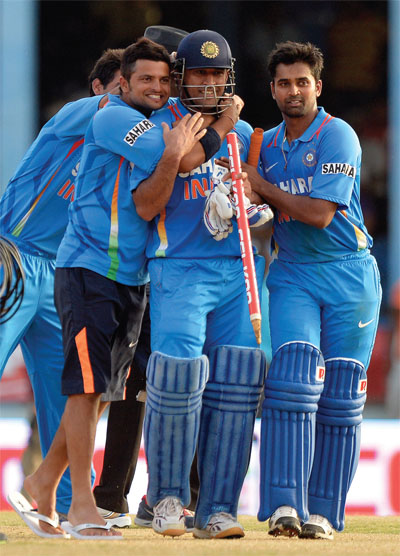
    PORT-OF-SPAIN (TIP): Leave it to me, he says. I want to take this to the last over. Me against one man. One on one. I know I am better than the last man the other team can put up against me. Once again, MS Dhoni reduced a lost match into a one-on-one contest with an opposition bowler, and knocked off the 15 required in just three hits.

    You could see the bowler – Shaminda Eranga, 9-2-34-2 until then, wickets of Shikhar Dhawan and Virat Kohli to his name – was intimidated the moment he saw the first one fly into the top of the top tier. Bear in mind that this was a treacherous pitch with seam, spin and uneven bounce. Dhoni was injured, and had come back only for this match. He wasn’t running as hard as he does, and wickets were falling at the other end.

    When Dhoni came in, the asking-rate was 3.35, but with falling wickets and turned-down singles, it hit the improbable towards the end. Dhoni, though, kept refusing singles, kept admonishing the last man Ishant Sharma for taking off for panic-stricken singles.

    Ishant couldn’t be blamed. The game had unravelled fast for India. They were cruising when Rohit Sharma had braved for yet another fifty despite another painful blow to his body (which makes it atleast four in two innings against Sri Lanka), despite many balls that seamed past his edge, despite the slow start. When India were 139 for 3 in the 32nd over, though, Rangana Herath delivered a grubber, and it squeezed under Rohit’s bat. Things were about to change. The pitch was still difficult to bat on as Suresh Raina soon found out.

    He thought he had a half-volley from Suranga Lakmal when he went for the drive, but even after pitching that full the ball seamed away appreciably and took his edge. The accurate and wily Herath saw an opening now. And burst through it. In the 38th over, his last, Herath trapped Ravindra Jadeja and R Ashwin – whose combined figures had been 17.5-1-65-6 – in successive deliveries.

    India 152 for 7. The drama had begun. Only a few minutes earlier, Mahela Jayawardene and Kumar Sangakkara had gone on and on – for overs it seemed – about an obstructing-the-field appeal against Dhoni. He had taken two steps down the wicket, and then realised he would have hit the other batsman if he ran straight. So he ran, nay hared on a bad hamstring, at an angle, but didn’t change his direction for the remaining 20 yards. The throw hit him, and the two senior Sri Lankans would not leave the umpire’s side.

    They knew they needed this man out as soon as possible. For the next half hour, though, Sri Lanka would have thought they didn’t need to get Dhoni out. Dhoni tried to intimidate Lakmal once during the Powerplay, but after that he began playing the percentage game. Sri Lanka knew Dhoni couldn’t manipulate the strike with that hamstring, and controlled the game well. Lasith Malinga – seven overs for 54 runs until then – finally got his radar right, and got Bhuvneshwar Kumar toe before wicket with his dipping slower yorker.

    In the tense overs that followed, R Vinay Kumar lost his cool, and slogged and got out. India 182 for 9 after 46.2 overs. With any other batsman than Dhoni, you would expect panic. Dhoni, though, wanted to corner just one man. He wanted to bring it down to that one man. He was also daring Sri Lanka to keep back Malinga, who had one over left, for the last. Sri Lanka didn’t. Malinga bowled the 48th. Dhoni faced the whole over, looking unhurried, for just a scrambled couple.

    The only man hurried was Ishant, who tried a suicidal single off the last ball of Malinga’s over to keep Dhoni on strike. The ball, though, had gone straight to the fielder, and Dhoni was miffed Ishant tried such desperation. It was not becoming of someone batting with the coolest and the best batsman in ODI cricket. Ishant would do that again off the first ball of the next over. Twice Dhoni let Ishant know what he did was not right. Ishant faced another dot. Then another dot. Seventeen off nine. Dhoni was cool at the other end.

    He had marked out his man. He knew it wouldn’t be an experienced bowler in the last over. Two runs came off the last three balls of the 49th over, but Ishant was made to feel under no pressure. He had been told to leave it to the man who knew his way around these lanes. Then began the great show. As soon as Ishant left alone – yes, left alone – the last ball of the 49th over, Dhoni signalled to the dressing room for a new, heavier bat.

    As Angelo Mathews psyched Shaminda Eranga up for the last over, Dhoni practised a few swings with two bats held together. Calculatedly he picked out one. Eranga went to his mark. This match should not have been on, but in Dhoni’s book this was even odds. Eranga bowled a nervous first ball: a wide length ball, which Dhoni swung hard at. That was a nervous ball, and would have been out of the ground had Dhoni connected. Dhoni didn’t. The second ball, though, was closer to Dhoni – swing, and met that hunk on the up.

    And up it went. And far. And kept going. Over the top of the stands. You could see it in Eranga’s eyes now. It was now going to be nigh impossible for Eranga to execute his skill. In one hit, Dhoni had brought it down to just luck for Sri Lanka. The luck was not with them. Eranga bowed length again, Dhoni went hard again, and the ball flew off the outside half of the bat, and over point. It was over already.

    Eranga just ran up for the formalities, delivered another length ball, and was dispatched over extra cover. The iceman had done it again, but he hadn’t had a great first half of the day as a keeper and a captain. Apart from not having been at his best with the gloves, Dhoni had also let Sri Lanka off the hook with his choice of part-time bowlers ahead of the specialist spinners, who would eventually go on to cut Sri Lanka’s effort short.

    Bhuvneshwar had given India his customary breakthroughs in the first spell, the scoring was difficult, but Virat Kohli and Raina provided Sangakkara and Lahiru Thirimanne relief with their odd long hop or big wides. Their partnership took Sri Lanka to 171 for 2, but then Thirimanne made a mistake, and almost every batsman that followed.

    In over-aiming during that Powerplay, Sri Lanka had lost their last eight wickets for 30 runs, letting Dhoni off the hook now. You will be justified to think of Dhoni’s choice of bowlers as odd. As you would have been with his persistence against all logic with Ishant in the Champions Trophy final. Just that the results were drastically different.

  • NASA to support ISRO in India’s Mars mission

    NASA to support ISRO in India’s Mars mission

    MUMBAI (TIP): The US would support India in its much-awaited Rs 450-crore Mars Orbiter Mission (MOM) slated for lift off from Sriharikota in October-November 2013. “Nasa is providing the deep space navigation and tracking support to this mission during the non-visible period of the Indian Deep Space Network,” said a US state department announcement.

    The decision to cooperate was taken at the fourth meeting of the US-India joint working group on civil space cooperation held in Washington on March 21. But the details of the meeting were made public on Monday through the US-India joint fact sheet. Its release coincided with the Indo-US Strategic dialogue, and the talks between Isro chairman K Radhakrishnan and Nasa administrator Charles Bolden in New Delhi.

    Nasa will provide support from its facilities at Goldstone in the US, Madrid in Spain and Canberra in Australia. The teaming up for the Mars mission assumes significance in the context of Bolden calling for strengthened co-operation in this programme, when he addressed Isro staffers nationwide from the Ahmedabad-based Space Applications Centre.

    The American state department document also stated that both countries have “agreed to cooperate in potential future missions to the moon and Mars”. Isro officials have not ruled out a second mission to Mars, which they said will have more scientific content. It is learnt that Nasa was keen on participating with Isro in the analysis of data from the Methane Sensor For Mars, which is one of the five instruments on board the present Indian Mars orbiter. But Isro has not given any firm response so far.

  • European Union leaders clinch deals on banks, budget

    European Union leaders clinch deals on banks, budget

    BRUSSELS (TIP): European leaders agreed on new steps to fight youth unemployment and promote lending to credit-starved small business on Thursday after deals on banking resolution and the long-term EU budget gave their summit a much needed lift. The 27 leaders resolved to spend 6 billion euros over the next two years to support job creation, training and apprenticeships for young people, and to raid unspent EU budget funds to keep the effort going thereafter.

    Critics say the money is a drop in the ocean with more than 19 million people unemployed in the EU, and more than half of all young people under 25 without a job in Spain and Greece. Leaders also approved plans for the European Investment Bank to lend hundreds of billions of euros to small and medium-sized enterprises (SMEs) particularly in southern EU states where bank finance has largely dried up due to the euro zone’s debt crisis. “The last 24 hours have been a great success,” European Commission President Jose Manuel Barroso told a news conference. “Today we have agreed the money to back up our words.” After late-night talks in Luxembourg, European Union finance ministers agreed how to share the cost of future bank failures among investors and wealthy savers as far as possible. Separately, negotiators for the European Parliament, the European Commission and EU member governments clinched a deal on a 960 billion euro ($1.25 trillion) seven-year budget for the bloc for the period 2014-20, ending months of squabbling.

    The leaders unanimously endorsed the agreement, EU Council President Herman Van Rompuy said, overcoming a last minute snag over Britain’s rebate, which will remain intact. The European Parliament must approve the deal next month so the new budget can take effect next January. The banking resolution agreement designed to shield European taxpayers from having to foot the bill for rescuing troubled banks will be implemented on a national basis from 2018. It lays the ground for a single system to resolve failed banks in the euro zone and the 27-nation EU, the second stage of what policymakers call a European banking union, meant to strengthen supervision and stability of the financial sector.

    The European Commission, the EU’s executive, will put forward proposals for a single resolution mechanism next week, but any deal on it is a long way off because EU paymaster Germany opposes taking any liability for other countries’ banks. German Chancellor Angela Merkel welcomed the EU budget breakthrough, saying it would allow new spending on everything from agriculture to research, roads, bridges and development aid to move ahead, promoting economic growth in Europe.

  • Pew Survey On Attitudes Towards Homosexuality Released

    Pew Survey On Attitudes Towards Homosexuality Released

    UNITED NATIONS (TIP): “Should Society Accept Homosexuality?” A global Pew Research Centre survey was released June 4, finding a wide variety of regional opinion on the question. Pew found that generally more positive attitudes were observed amongst younger people, and that in countries where a gender gap was observed, women tended to be more accepting than men. The survey polled nearly forty thousand people in 39 countries, asking questions about religion, age and gender.

    Senior Researcher at Pew Global Attitudes Juliana Menasce Horowitz observed, “What is surprising is the level of global polarization that we see on this subject. We have been collecting public opinion data all over the world on various issues, and I can’t think of any questions or subjects where we see such large percentages on one side in a group of countries and equally high percentages on the other side in other parts of the world.” The most tolerant responses to the question were predominantly secular and affluent, and either Latin American and Western.

    The least tolerant were found to be the 13 Middle Eastern and African nations polled. The strongest support came from Spain where 88 per cent of respondents answered “Yes” to the question. The study found a strong relationship between a country’s religiosity and its opinion on homosexuality. In countries where religiosity was low, attitudes were mostly positive. This was measured by three factors; whether they believe faith in god to be a necessity for morality; whether or not they say that religion is important in their lives; and whether they pray every day.

    This trend excluded Russia and China where religiosity was found to be low, but only around 20 percent answered “Yes” on the question of whether homosexuality should be accepted in society. In 2012, Russia’s top court upheld a ban on gay pride marches for the next 100 years in Moscow. On the other hand religiosity was measured to be high in the Philippines and attitudes were positive, with 73 per cent of respondents answering “Yes.”

    The results of the survey have been published at a time when many countries are debating same-sex marriage, France in particular having conducted its first official ceremony last week, and the UK preparing to pass a law soon. There are currently fifteen countries worldwide in which there is legal recognition of same-sex marriages.

  • RAJASTHAN MINISTER INAUGURATES RAJASTHAN CHAPTER OF INOC (I)

    RAJASTHAN MINISTER INAUGURATES RAJASTHAN CHAPTER OF INOC (I)

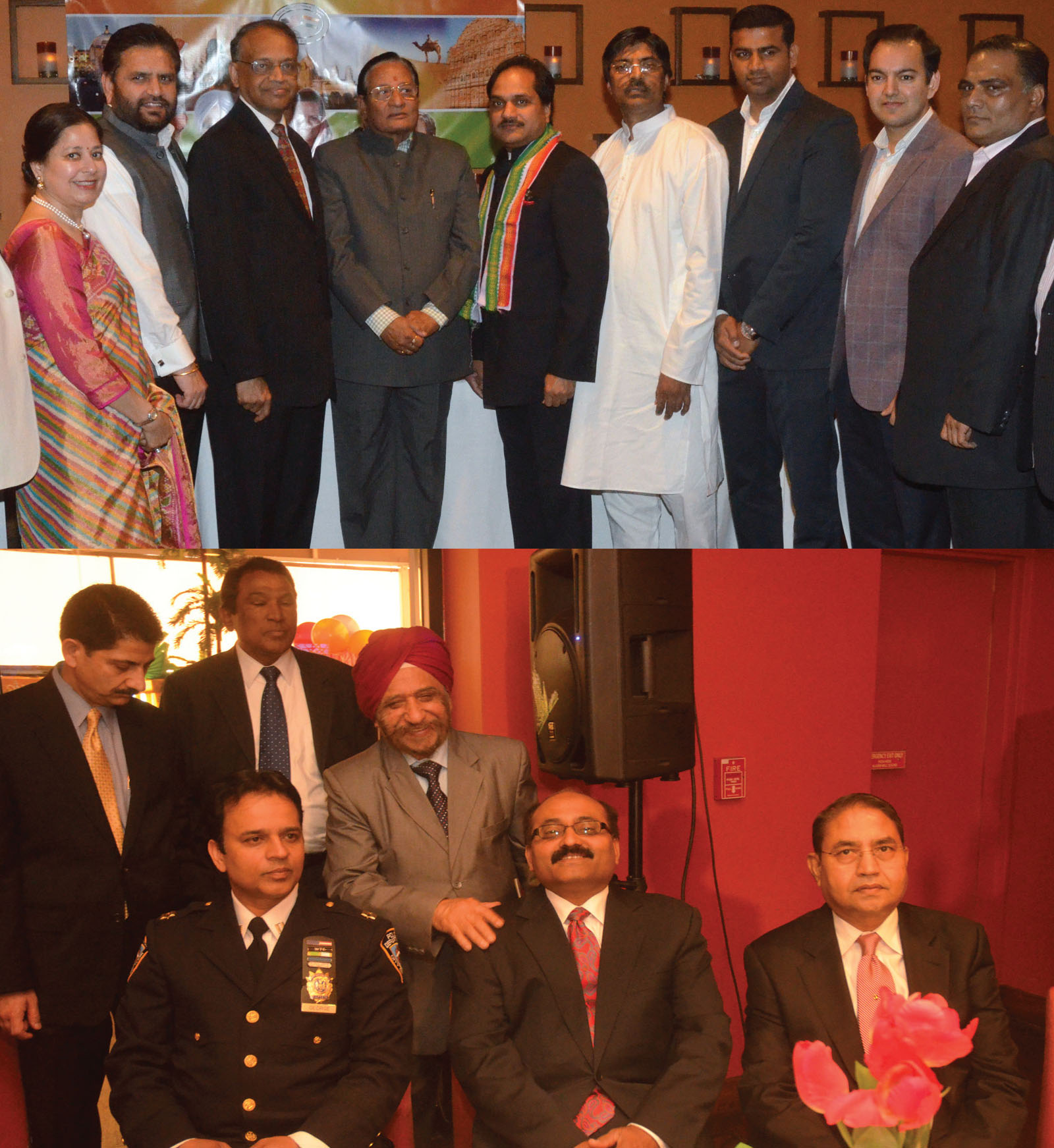
    NEW YORK (TIP): Rajasthan government Minister for Urban Development and Housing Shanti Dhariwal inaugurated on May 25 Rajasthan chapter of Indian National Overseas Congress (I) at Mint Restaurant in Long Island, New York. Inaugurating the chapter, the Minister said Rajasthan has been making all-round progress in many fields under the able leadership of Chief Minister Ashok Gehlot.

    He said the party is sure to return to power in view of numerous welfare measures undertaken by the Congress government. He took pains to describe various schemes undertaken for the weaker sections and the middle classes. Tom Suozzi, former Executive of Nassau County, in his remarks praised the role of Indian-Americans for their hard work and dedication in making Nassau County a better place to live.

    He introduced four of his running mates of which three are Indian-Americans and the other – an American with an Indian connection and who had worked with Mother Teresa in Kolkata. George Abraham, president of Indian National Overseas Congress (I) who presided over the function said that Rajasthan was the 12th chapter to be formed since the inception of INOC in 2000 and the INOC has become the voice of the Indian Diaspora. He said following the story of the massive victory in Karnataka will surely be repeated in the state elections to be held soon.

    The INOC-I will be playing its part to ensure the success, he said. Shudh Parkash Singh, senior vice president of INOC-I, said the Diaspora Indians will work hard to bring back the Congress to power in federal and state level elections. The Minister honored five prominent personalities – Jagdish Chandra, head of ETV Hindi and Urdu TV channels; Padam Mehta, chief editor and publisher of Manak; Capt. Stanley George of New York Police Department; Kanak Golia, a prominent businessman and Naveen C Shah, CEO of Navika Group of Companies.

    Stanley George was promoted to Captain of New York Police Department (NYPD) in 2007, the largest police department in the world. He is the first Indian Malayalee to reach the position and is currently the only captain of NYPD. After his graduation in Kerala, he migrated to the US and began his career as a civilian accountant in NYPD in 1989. He joined the Police Academy and graduated as police officer – he became Sergeant in 2000, Lieutenant in 2003 and Captain in 2007.

    He had worked in various units such as counterterrorism, criminal justice and patrol service bureau. He was recognized by President APJ Abdul Kalam in New York for his rescue and recovery service during the 9/11 tragedy. Kanak Golia is the president and CEO of Perfume Center of America, a multinational global company he founded in 1993. A wholesale distributor that prides itself on service, its clientele is worldwide.

    The company stocks over 4,000 major designer brands from France, Italy, Germany, Spain and the US. He has been distinguished as a recipient of the Top 10 Asian American Business Awards. Golia grew up in Johdpur, Rajasthan with his brother and three sisters. While managing his father’s business, he continued his academic career in accounting and law and served as Vice President of the Department of Law at the University of Rajasthan.

    Golia also serves as a Board of Trustee of New York Hospital for Queens; he and his wife Prabha Golia are instrumental in developing new cancer center and they were bestowed with Pacesetter Award, New York Hospital’s highest honor. They had established Kanak and Prabha Golia Foundation focused on women’s education, medical care for the disabled and orphanages. Naveen C. Shah is a prominent CPA and President and CEO of Navika Group of Companies, a premier commercial, real estate and hospitality enterprise in the US.

    He is also a partner of accounting and tax associates. Shah migrated to the US in 1982 and became a CPA in 1984. He has served as Board of Director of many professional and banking institutions and had been on the business banking advisory board of Wells Fargo and South Asian Business Advisory Board of Merrill Lynch. He is the founding member and past president of Rajasthan Association of North America (RANA); Indian Association of Long Island (IALI), Nargis Dutt Memorial Foundation to name a few.

    Shah founded Navika Capital Group LLC in 2005 with an objective to invest capital in commercial real estate and branded hotels in the US. Under his stellar leadership, the Navika Group has excelled in its performance and currently has substantial real estate and hospitality asset base under its ownership. It has an ownership stake in 43 prime real estate properties including 35 branded hotels in high value markets and is the direct result of Shah’s business acumen. Chandra Prakash Sukhwal, vice president of Rajasthan chapter, said Congress Party had made India a super power in the comity of nations and provided a strong and stable government in the center.

    He said a new slogan “Chalo Rajasthan, Jeeto Rajasthan” has been coined by Rajasthani non- residents to ensure the victory of Congress Party in Rajasthan. Sukhwal was a senior Congress leader who had worked with Indira Gandhi and Rajiv Gandhi before migrating to the US. Minister was presented Proclamations from Nassau County Chief Executive Edward Mangano and another from New York State Senate by Dilip Chauhan on behalf of the New York State Senator Toby Stavisky. Sushil Goyal, President of Rajasthan chapter of INOC-I welcomed the gathering. Sushma Kotahwala, Secretary, acted ably as emcee of the event.

  • Bangladesh Building Disaster Death Toll Crosses 500

    Bangladesh Building Disaster Death Toll Crosses 500

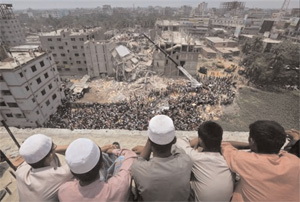
    DHAKA (TIP): The death toll from the past week’s collapse of a garment factory complex in Bangladesh passed 500 on May 3 as the country’s prime minister said Western retailers had to share some of the blame for the tragedy.With bulldozers now clawing away at the mountain of rubble at the site of the disaster, the number of bodies being recovered from the country’s deadliest industrial disaster has been increasing sharply. Lieutenant Mir Rabbi, an officer in a special army control room set up to coordinate the rescue operation, told AFP the “death toll now stands at 501”, a sharp rise on the figure of 441 compiled by authorities on May 2 evening.

    Dozens more people are thought to have been buried alive after the eight-storey building collapsed on April 24 in Savar, which lies around 30 kilometres (20 miles) to the northwest of Dhaka. Around 3,000 garment workers were on shift at the time of the disaster in the Rana Plaza compound which housed five different textile factories. Spain’s Mango, Britain’s low-cost Primark chain and the Italian label Benetton were among the retailers who have confirmed having products made at Rana Plaza where the typical worker took home less than 40 dollars a month

  • Hundreds missing as Bangladesh toll tops 270

    Hundreds missing as Bangladesh toll tops 270

    DHAKA (TIP): The search for survivors from Bangladesh’s worst industrial accident stretched into a third day with the death toll rising to 273 after the collapse of a building housing factories that made lowcost garments for Western brands. Almost miraculously, 41 people trapped inside the rubble of the eight-storey building were rescued alive late on Thursday, government minister Jahangir Kabir Nanak said, about 40 hours after the disaster on the outskirts of Dhaka. Nanak said they had been working on the fourth floor of the Rana Plaza building and had all been found trapped in one room. Few other details were available.

    Around 2,000 people have been rescued over the past two days, at least half of them injured, but as many as 1,000 people remain unaccounted for. An industry official has said 3,122 people, mainly female garment workers, were inside the building despite warnings that it was structurally unsafe.

    Rescuers from Bangladesh’s army, navy and air force, as well as police and fire services, pored over huge piles of rubble and twisted metal in the search for survivors, using their bare hands as well as mechanical equipment. “We are not sure how many people are still trapped under the rubble,” said Dhaka District police chief Habibur Rahman, who updated the death toll early on Friday to 273. “Priority has been given to save people who are still alive,” he said. Wednesday’s disaster refocused attention on Western high-street brands that use Bangladesh as a source of low-cost goods. North American and European chains, including British retailer Primark and Canada’s Loblaw, said they were supplied by factories in the Rana Plaza building, which is in the commercial suburb of Savar, about 30 km (20 miles) from the capital.

    TRAPPED WORKERS CALL FOR HELP
    Savar residents and rescuers dropped bottled water and food on Thursday night to people who called out from between floors. Relatives identified their dead among dozens of corpses wrapped in cloth on the veranda of a nearby school. Police said the owner of the building, Mohammed Sohel Rana, a local politician from the ruling Awami League, was told of dangerous cracks on Tuesday. While a bank in the building closed on Wednesday because of the warnings, the five clothing companies told their workers there was no danger, industry officials said. Rana is now on the run, according to police. “We asked the garment owners to keep it closed,” said Bangladesh Garment Manufacturers and Exporters Association (BGMEA) President Mohammad Atiqul Islam.

    Despite the overnight rescue of 41 people, officials conceded the chances of finding more alive were growing slimmer. “We can’t be certain of getting them all out alive. We are losing a bit of hope,” fire brigade rescue worker Mizanur Rahman said earlier on Thursday. Special prayers will be offered at mosques, temples and pagodas across Bangladesh on Friday for the dead, injured and missing. The government declared a national day of mourning and flags were flown at half mast at all official buildings. Anger over the working conditions of Bangladesh’s 3.6 million garment workers, the overwhelming majority of them women, has grown steadily since the building collapse.

    More than 1,000 textile workers besieged the BGMEA on Thursday, pelting it with stones and clashing with riot police. The workers demanded all garment factories be shut and the owners harshly punished for accidents. Bangladesh is the world’s second-largest apparel exporter, with the bulk of exports – 60 percent – going to Europe. The United States takes 23 percent and Canada takes 5 percent. Primark, a unit of Associated British Foods, has confirmed one of its suppliers occupied the second floor of the building. Danish retailer PWT Group, which owns the Texman brand, said it had been using a factory in the building for seven years.

    Canada’s Loblaw, a unit of food processing and distribution firm George Weston Ltd, said one factory made a small number items for its “Joe Fresh” label. Primark, Loblaw and PWT operate under codes of conduct aimed at ensuring products are made in good working conditions. Documents including order sheets and cutting plans obtained by Reuters appeared to show that other major brands such as Benetton had used suppliers in the building in the past year. A Benetton spokesman said none of the factories were suppliers to the company. Spain’s Mango said it had an unfulfilled sample order at the plaza with Phantom Apparel.

  • Nadal Wins In Singles Debut At Brazil Open

    Nadal Wins In Singles Debut At Brazil Open

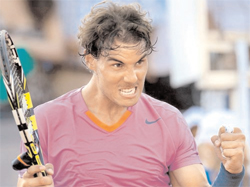
    SAO PAULO (TIP): Spain’s Rafael Nadal scored an easy two-set victory in his singles debut at the Brazil Open late Thursday.

    The former world number one needed only 78 minutes to prevail over Brazilian Joao Souza, ranked 101st in the world 6-3, 6-4. Nadal advanced to the quarterfinals which will be played Friday. “It was an important victory for me,” Nadal said. “the conditions are very difficult.

    The court is very fast, the ball too.” Asked about his injured left knee, he replied: “Today I think it was acceptable, normal. Let’s hope it will be the same tomorrow. The important things is that it (the knee) does not hurt.” The Spanish star withdrew from a scheduled doubles match he was to have played with Argentina’s David Nalbandian against Argentine Horacio Zeballos and Austrian Oliver Marach, citing “knee overuse”.

    Nadal, currently ranked number five in the world, only returned to the tour in Chile last week after a seven-month injury absence.

    The 11-time grand slam champion, who lost both the singles and doubles finals Sunday at his comeback event in Vina del Mar, Chile, is the top seed at this week’s event here.

    The $455,775 Brazil Open is part of the Latin American clay court circuit, along with the Vina del Mar and the Mexico Open in Acapulco where Nadal plans to play later this month.

  • Spain create history, wins Euro 2012

    Spain create history, wins Euro 2012

    Throughout the tournament, Spain were tagged of being ‘boring’ but they silenced the critics as they defeated Italy 4-0 in the final, which was the biggest victory margin in any World Cup or European championship decider. The Spaniards created history as they became the European Champions for the second time in a row, a feat that has never been achieved before. The Italians looked clueless in the final and couldn’t match with the pace of their opponents. There were speculations ahead of the tournament whether Ukraine and Poland would be able to successfully organize the tournament, but it was indeed a very successful tournament, one of the best the football fraternity has ever seen. Spain create history, wins Euro 2012.

  • Spain Seizes 28 Million Euros in Hosni Mubarak-Linked Assets

    Spain Seizes 28 Million Euros in Hosni Mubarak-Linked Assets

    MADRID (TIP): Spain announced on Thursday it had seized 28 million euros ($37 million) in financial products, luxury cars and buildings linked to ousted Egyptian president Hosni Mubarak. Egypt requested Spain’s help under UN anti-corruption conventions to find and block assets owned by Mubarak, his family, top aides and their related companies, a national police statement said. Police blocked 18.4 million euros in financial products held in three Spanish banks; two buildings in Madrid’s wealthy Moraleja district worth a combined seven million euros; and seven properties in the holiday resort of Malaga worth more than three million euros.

    They also seized seven luxury cars. “The assets could be the proceeds of crimes such as the embezzlement of public funds, corruption, or the illegal enrichment committed during his mandate,” police said. The Egyptian request targeted some 130 people, they said. Mubarak was ousted on February 11 last year after nearly three weeks of mass protests that left 846 people dead and more than 6,000 injured. Both the interim military government that took over after his overthrow and the administration of elected Islamist President Mohamed Morsi have repeatedly promised to bring to justice all those responsible for the deaths. Mubarak and his interior minister Habib al-Adly were both jailed for life for their role in ordering the killings.

  • WE GAVE IT EVERYTHING Leander Paes after US open loss

    WE GAVE IT EVERYTHING Leander Paes after US open loss

    NEW YORK (TIP): He missed out on a third US Open men’s doubles title but Indian tennis star Leander Paes was far from dejected as he insisted that he and his Czech partner Radek Stepanek gave all that they had in the final clash against champions Mike and Bob Bryan.

    Fifth seeds Paes and Stepanek lost 6-3 6-4 to the second-seeded Bryan brothers in the summit clash Friday night. Paes was equally complimentary of both his partner and his opponent. “Even though we got beaten today by one of the greatest teams of all time, my team and Radek’s team came out and brought everything they had to this tournament,” Paes said.

    “I can guarantee you we will be giving it everything we have every single day for the rest of the year,” he added. Paes felt the Bryans produced a magical performance to clinch the title. “These guys always bring magic to the court,” said 39-year-old. “But we put it on the line today and we will come back and keep doing it.

    ” Paes has won two US Open men’s doubles title in 2006 (with Martin Damm) and 2009 (with Lukas Dlouhy), as well as a mixed doubles title in 2008 (with Cara Black). The win was a measure of revenge for the Bryans who lost to Paes-Stepanek in the finals of the Australian Open earlier this year. “I think they started really well,” Stepanek said.

    “They were all over our serve from the beginning and making life very difficult for us out there. They were the better team today, so they deserve the win.” The Bryan brothers won their previous US Open titles together in 2005, 2008 and 2010. In addition, Bob has won four US Open mixed doubles title while Mike has one to his name. The brothers will now head to Spain with the rest of the US Davis Cup team to do battle next weekend against David Ferrer and the rest of the Spanish Cup team in a semifinal tie.

  • The rise and fall of the euro

    The rise and fall of the euro

    LONDON (TIP): Just one decade after the European single currency was launched amid fanfare and fireworks, its future looks uncertain as the debt crisis that engulfed Greece, Ireland and Portugal threatens the entire bloc — and the wider global economy.

    Spain, the bloc’s fourth-largest economy, is the latest country to be swept. In June, it was forced to seek up to €100 billion in aid from its eurozone peers to shore up its banking sector, says a CNN report.
    Spanish Prime Minister Mariano Rajoy said the deal had demonstrated the advantages of cooperation within the bloc and meant “European credibility won, the future of the euro won [and] Europe won.”

    But the markets have remained skeptical, pushing up the costs of Spain’s borrowings despite the bailout. Italian borrowing costs have also gone up as investors fret the problems will spread. Greece, meanwhile, faces its second election on June 17 and risks being ejected from the bloc.

    Many analysts saw it all coming of course, arguing that one fiscal system could never work for 17 EU countries that adopted the euro, serving more than 330 million people.

    The flaws were exacerbated after some countries were suspected of fudging their numbers, including Greece which in 2004 admitted it gave misleading information to gain admission to the eurozone. The crisis exploded after Greece revised its figures to show its 2009 budget deficit would be 12.7% of gross domestic product — far higher than the eurozone limit of 3%.
    The bloc — whose financial fractures may not have been apparent during the boom years — then began to unravel.
    After Greece’s dire numbers were revealed, investors panicked and the country was unable to raise money to fund itself. The country was forced to take a €110 billion bailout from its eurozone peers and the International Monetary Fund.

    But Greece’s bailout, rather than stemming the panic, served as a harbinger to the debt crisis.
    The European Financial Stability Facility, or European bailout fund — set up to deal with further financial stumbles — was quickly tapped again..

    Ireland, felled by a black hole in its banking system, was forced to take a €67.5 billion bailout package in November 2010. After the markets then closed their doors to Portugal, it was also forced to take a €78 billion bailout.
    The troubled nations implemented austerity measures to try to rein in their hefty piles of debt, but confidence in the bloc’s ability to stabilize itself continued to fall.

    The crisis may yet engulf Italy, which makes up 17% of the eurozone economy. Greece, Ireland and Portugal make up less than 6% between them.

    And so Europe’s politicians and officials have desperately tried to sort out the mess by coming up with ideas including boosting the bailout fund, bringing the disparate economies closer financially, and tapping other markets for funds.

    Their previous measures proved ineffective, as the markets — and the world — remained unconvinced at the bloc’s ability to survive in its existing form

  • Paes, Stepanek enter US Open men’s doubles final

    Paes, Stepanek enter US Open men’s doubles final

    NEW YORK (TIP): Leander Paes put himself in contention for a third US Open men’s doubles title after the Indian and his Czech partner Radek Stepanek entered the final following their rivals’ injury-forced exit from the semifinals here. Fifth seeds Paes and Stepanek were tied 5-5 in the first set when their sixth-seeded rivals Marcel Granollers and Marc Lopez of Spain retired due to injury. The match was halted when Lopez received a lengthy medical timeout due to a calf injury.

    Two games later, Lopez gestured that he would be unable to continue before limping off the court. The Indian offered his sympathies to Lopez at the end of the proceedings. “I wish Marc all the best because both he and Marcel are great guys,” said Paes afterwards. “This is our livelihood and we come out to work hard and put on a show for you guys, so he definitely deserves respect.” The Indian-Czech team grabbed an early break on Lopez’s serve to lead 2-1 after Stepanek fired a volley at Granollers.

    Even though the Spanish team had fewer opportunities, they made the most of them. A nine deuce game on Lopez’s next service outing at 2-4 resulted in six missed break point opportunities for Paes and Stepanek. Meanwhile, the fifth seeds converted the lone break point chance they had in the very next game. That levelled the set at 4-4 when Paes dumped a backhand volley into the net.

    Lopez called the trainer at 5-5, 15-15 to address his calf injury that had begun to affect his movement. He managed to stave off two break points and hold serve, but Paes began hitting drop shots and Lopez was unable to even run for them. When Paes held serve to send the match into a tiebreak, Lopez told his partner that he would be unable to continue. Paes has won two US Open men’s doubles title in 2006 (with Martin Damm) and 2009 (with Lukas Dlouhy), as well as a mixed doubles title in 2008 (with Cara Black).