Tag: Sushma Swaraj

  • Ancient Wisdom in Modern Times at Bharatiya Vidya Bhavan

    Ancient Wisdom in Modern Times at Bharatiya Vidya Bhavan

    NEW YORK CITY (TIP): Bharatiya Vidya Bhavan, has been functioning in the USA since 1981 and is committed to the promotion of Indian culture and values through the media of arts, languages and literature. It has had a great impact on the local community – Indian and non-Indian, through its courses, lectures, seminars, concerts and publications.

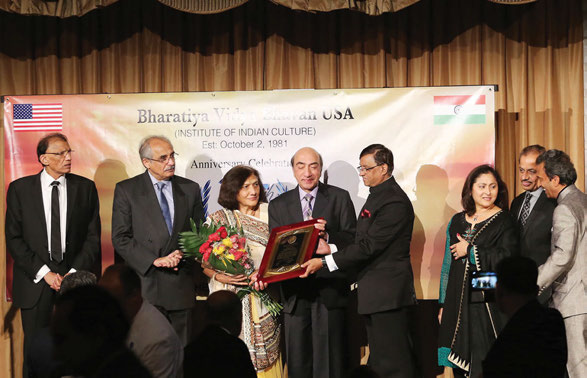
    Mr. A. R. Rahman Honored. L to R:  Sadhguru Jaggi Vasudev, A.R.Rahman, Mr. Kenny Desai, Mrs. Swati Vaishnav and Mr. Sudhir Vaishnav
    Mr. A. R. Rahman Honored. L to R: Sadhguru Jaggi Vasudev, A.R.Rahman, Mr. Kenny Desai, Mrs. Swati Vaishnav and Mr. Sudhir Vaishnav

    The founder of BVB Dr. K. M. Munshi, always said that “India will once again be acknowledged as the Vishwa Guru – a superpower that embodies the ideals of
    “Vasudhaiva Kutumbakam” – the global family and supremacy of “Dharma” which stands for moral and ethical values.

    Bhavan, USA has entered the 35th year of serving the Indian American community of the United States on October 2nd. To commemorate and celebrate this milestone the Bhavan will be organizing several cultural, educational and literary events to spread the message of unity and harmony.

    Dr. P. Jayaraman Honored. L to R : Sadhguru Jaggi Vasudev , H. R. Shah, Dr. P. Jayaraman, Ms Chandrika Krishnamurthy Tandon, Dr. Navin Mehta Ambassador Vijay Nambiar, Ambassador Dnyaneshwar Mulay, Mr. Kenny Desai
    Dr. P. Jayaraman Honored. L to R : Sadhguru Jaggi Vasudev , H. R. Shah, Dr. P. Jayaraman, Ms Chandrika Krishnamurthy Tandon, Dr. Navin Mehta Ambassador Vijay Nambiar, Ambassador Dnyaneshwar Mulay, Mr. Kenny Desai

    In light of this, Bharatiya Vidya Bhavan, USA organized a marquee sit down dinner event on Sunday, 18th October, 2015 at The Pierre Hotel, Central Park, New York City. At this prestigious event a select few individuals who have excelled in their chosen fields and touched many lives were acknowledged and honored namely Founder Executive Director Dr. P. Jayaraman, Late Prof. Robert Goheen-Former US Ambassador to India (Past Chairman for 23 years), Mr. Harishchandra Mistry a renowned philanthropist and Musical genius Mr. A. R. Rahman.

    Sadhguru Jaggi Vasudev, Dr. Deepak Chopra and Ms Chandrika Krishnamurthy Tandon presented very interesting symposium “Ancient Wisdom in Modern Times”. Enthralling and in-depth discussion left the audience spell bound. Ms. Tandon who is a long time supporter of the Bhavan, a Grammy award Nominee-A humanitarian and astute businesswoman initiated the evening with melodious prayers to Ma Durga with students from New York University. Mr. Anurag Harsh a renowned performer and Mr. Manu Narayan (Bombay Dreams) kept audience on the edge of the seats. Ms Gayatri Devi and Mrs. Sanjukta Sen offered prayers to Lord Shiva -Rudrashtakam and Ms. Siddhi Vaishnav and  students of Bhavan’s Nartanrang Dance School offered prayers to Lord Ganesha.

    Invocation. Ms Chandrika Krishnamurthy Tandon and  NYU students
    Invocation. Ms Chandrika Krishnamurthy Tandon and NYU students

    Bhavan’s former Chairman and Current President of Trustee Committee Dr. Navin C. Mehta conducted the whole evening with grace and aplomb.

    Chairman Mr. H. R. Shah welcomed everyone in his opening speech and was delighted to see former Bhavanites joining celebrations.

    Prime Minister of India, Mr. Narendra Modi and External Affairs Minister-Government of India, Mrs. Sushma Swaraj sent their good wishes on the occasion. Governor of New York state Hon. Andrew Cuomo and New York City Mayor Hon. Bill de Blasio, Consul General of India-New York, Ambassador Mr. Dnyaneshwar Mulay, Secretary-General’s Special Adviser on Myanmar Ambassador Mr. Vijay Nambiar, Sant Shri Morari Bapu, Shri S. P. Hinduja with whose support Bhavan started functioning and host of dignitaries wished Bharatiya Vidya Bhavan on this occasion.

    An animated  discussion on ancient wisdom in modern times . L to R:  Dr. Deepak Chopra, Sadhguru Jaggi Vasudev and Ms Chandrika Krishnamurthy Tandon
    An animated discussion on ancient wisdom in modern times . L to R: Dr. Deepak Chopra, Sadhguru Jaggi Vasudev and Ms Chandrika Krishnamurthy Tandon
    Mr. Harishchandra Mistry Honored: L to R :  H. R. Shah, Ambassador Vijay Nambiar, Mrs. And Mr. Harishchandra Mistry, Ambassador Dnyaneshwar Mulay, Mrs. Damini and Mr. Girish Soni and Mr. Kenny Desai
    Mr. Harishchandra Mistry Honored: L to R : H. R. Shah, Ambassador Vijay
    Nambiar, Mrs. And Mr. Harishchandra Mistry, Ambassador Dnyaneshwar Mulay, Mrs. Damini and Mr. Girish Soni and Mr. Kenny Desai

    It was a memorable evening for a rich cultural content and the presence of the gracious guests who all were profusely thanked for their participation.

  • Geeta arrives in India, after 15 years

    Geeta arrives in India, after 15 years

    A deaf-mute woman who lost her family when she wandered over one of the world’s most militarized borders as a child made an emotional return to India on Monday, Oct 26, to be reunited with the family she has identified from a photograph.

    Developing Story : Live Updates

    Oct 26 3:42 pm IST : After meeting the family which she had earlier recognized in the photo, Geeta has refused to recognize them.

    Oct 26 3:44 pm IST:  We will still get a DNA test done to rule out all possibilities, says EAM Sushma Swaraj.

    Oct 26 3:46 pm IST: No matter if we find her parents or not, Geeta is a daughter of India & we will take care of her, says EAM Sushma Swaraj.


    Some 15 years have passed since speech and hearing impaired Geeta strayed across the border into Pakistan.

    Geeta flew into the international airport in Delhi on a Pakistan International Airlines flight from Karachi at 10.20am, accompanied by five representatives of the Edhi Foundation, including Bilqees Edhi, the Pakistani woman who cared for her and led a campaign for her return to India.

    External affairs minister Sushma Swaraj greeted the profoundly hearing and speech impaired woman with a tweet: “Geeta – welcome home our daughter.” As she emerged from the airport, Geeta shyly waved to TV camera crews and smiled before being driven away.

    pakistan-india-reunion_5aa52122-7ba0-11e5-ba56-8cfa9414553dSwaraj later met Geeta, clad in a red and white salwar-kameez, and the team from Edhi Foundation. Photos tweeted by the external affairs ministry spokesperson showed Swaraj embracing Geeta, whose story captivated people on both sides of the border after the recent success of Bajrangi Bhaijaan, a film with a similar storyline.

    Though Geeta, believed to be 23, has identified a family in Bihar from a photograph provided by the Indian high commission in Islamabad, she will be reunited with them only after DNA tests. If the tests turn out negative, she will be placed in a home either in Delhi or Indore.


  • Pakistan PM fails to win US support against India

    Pakistan PM fails to win US support against India

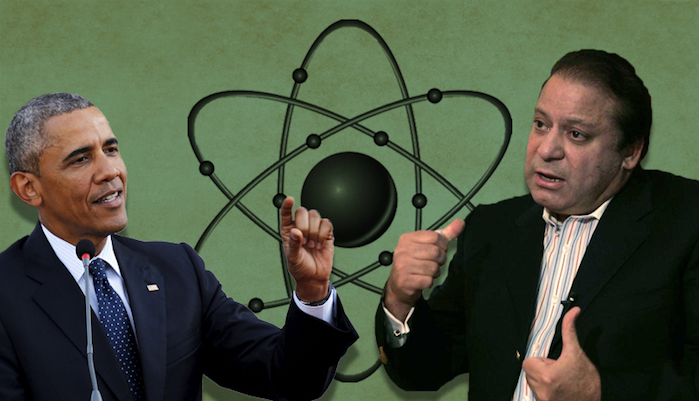
    WASHINGTON (TIP): Pakistan Prime Minister must be a disappointed man. His bilateral with US President Barack Obama is being viewed as a diplomatic failure. India has watched the Sharif-Obama summit in Washington keenly, and while it is clear that Prime Minister Nawaz Sharif returns to Islamabad without any big announcement to show for the bilateral, and no progress on US-Pakistan civil nuclear negotiations, there are many parts to the 2015 joint statement issued by the two that could  be worrisome for India.

    Here are the key statements in the US-Pakistan joint statement which may cause concern to India.

    1.  Hydroelectric projects in PoK/Gilgit-Baltistan 

    President Obama expressed support for Pakistan’s efforts to secure funding for the Diamer Bhasha and Dasu dams to help meet Pakistan’s energy and water needs.

    India has opposed the construction of hydro-electric projects in the disputed region of Kashmir that includes PoK and Gilgit-Baltistan. Most recently, External Affairs Minister Sushma Swaraj had called the China-Pakistan Economic Corridor (CPEC) unacceptable because it includes these projects, while India had told the UNGA that “India’s reservations about the proposed China-Pakistan Economic Corridor stem from the fact that it passes through Indian territory illegally occupied by Pakistan for many years.”

    In recent years, the 4,500 m W Diamer Bhasha dam (DBD) project, that the Pakistan government says will halve its electricity shortfall when constructed, had come to a standstill over funding. In 2013, prospective investors – the ADB, China and Russia – had asked Pakistan to obtain an NOC (No objection certificate) from India before they could proceed on loans. Even after the announcement of the China-Pakistan Economic Corridor by President Xi Jinping for projects including dams in PoK in April 2015, China has shown a preference for the $1.6 billion Karot project, rather than DBD, which would now cost an estimated $14 billion. It is significant that the US wants to play ‘White Knight’ on these two dams, and for India, the construction of major projects like these endorsed by the US would be a blow to its claim on PoK. Earlier this month, reports suggested India had protested over a USAID event aimed raising funding for DBD, where US firm Mott McDonald has been contracted to perform a technical engineering review.

    2.  Talks with the Taliban
    President Obama commended Pakistan for hosting and facilitating the first public talks between the Afghan government and the Taliban in July 2015 and highlighted the opportunity presented by Pakistan’s willingness to facilitate a reconciliation process that would help end insurgent violence in Afghanistan.

    India has felt cut out of the Taliban peace process, and relations with President Ghani’s government underwent a strain when New Delhi learned that Pakistan would be allowed to host the talks in Murree. “This is an open acknowledgement that Pakistan controls the Taliban,” a senior official had told The Hindu at the time, “And rather than castigate Pakistan for not curbing the Taliban’s violence, these talks will legitimize its actions.”

    When the talks collapsed over the announcement of Mullah Omar’s death, it was felt Pakistan’s claim of being a ‘peacemaker’ rather than a sponsor of Taliban-terror would end. However, despite a surge in violence by the Taliban, including the brutal siege of Kunduz that was overthrown by Afghan and US special forces last month, the Joint statement seems to indicate the US is prepared to let Pakistan host the talks again.

    3.  Resume India-Pakistan talks
    President Obama and Prime Minister Sharif stressed that improvement in Pakistan-India bilateral relations would greatly enhance prospects for lasting peace, stability, and prosperity in the region. The two leaders expressed concern over violence along the Line of Control, and noted their support for confidence-building measures and effective mechanisms that are acceptable to both parties. The leaders emphasized the importance of a sustained and resilient dialogue process between the two neighbors aimed at resolving all outstanding territorial and other disputes, including Kashmir, through peaceful means and working together to address mutual concerns of India and Pakistan regarding terrorism.

    For over a decade, the US has stayed away from openly pushing India towards talks with Pakistan. In the period between 2003-2008, this was because India and Pakistan were engaging each other, and both the composite dialogue and back-channel diplomacy yielded many important confidence building measures between them. After the Mumbai 26/11 attacks, the US recognized India’s legitimate anger over the attacks being planned and funded in Pakistan, and abstained from making any comments on the resumption of India-Pakistan dialogue, restricting itself only to “welcoming” talks between their leaders in Thimphu, Delhi, New York and Ufa. The US-Pakistan joint statement doesn’t just put the importance of “sustained and resilient dialogue process” (codeword for comprehensive dialogue) back in focus, it makes a new mention of “violence along the LoC” which India squarely blames Pakistan for initiating. India believes ceasefire violations are aimed at “infiltrating terrorists”, a charge the government repeated when the NSA talks were cancelled. Of particular worry for India will be the US-Pakistan joint statement’s reference to “mutual concerns of terrorism”, as it comes in the wake of Pakistan’s latest claims of Indian support to terrorism inside Pakistan. Pakistan NSA Sartaj Aziz had told the press that Indian agency “involvement” in Balochistan and FATA would be taken up during the summit.

    4.  Action on LeT?
    In this context, the Prime Minister apprised the President about Pakistan’s resolve to take effective action against United Nations-designated terrorist individuals and entities, including Lashkar-e-Tayyiba and its affiliates, as per its international commitments and obligations under UN Security Council resolutions and the Financial Action Task Force.

    Action against the LeT has been India’s most sustained demand from Pakistan, especially after the 26/11 attacks, when the LeT’s top leadership was charged with planning and executing the carnage in Mumbai. Yet years later, chief Hafiz Saeed is free, LeT operations chief Zaki Ur Rahman Lakhvi is out on bail, and there seems little evidence that Pakistani forces have conducted any sort of crackdown on the Lashkar e Toiba, especially when compared to action against other groups after the Peshawar school attack of December 2014. While the US-Pakistan joint statement doesn’t note President Obama’s acceptance of Pakistan’s claims of keeping its “international commitments and obligations”, it is significant that the US has not raised the obvious violation of the UNSC and FATF requirements earlier this year during the bail process of Lakhvi. Despite Indian representations to the US and UN, there has been little pressure on Pakistan how Lakhvi raised the funds when according to the UNSC 1267 Committee rules, a designated terrorist cannot be allowed recourse to finances.

    5.  Nuclear talks
    The leaders noted Pakistan’s efforts to improve its strategic trade controls and enhance its engagement with multilateral export control regimes. Recognizing the importance of bilateral engagement in the Security, Strategic Stability and Non-Proliferation Working Group, the two leaders noted that both sides will continue to stay engaged to further build on the ongoing discussions in the working group.

    Both, the US and Pakistan, have denied a report in the Washington Post that they had planned what it called a “diplomatic blockbuster”: negotiations over a civil nuclear deal on the lines the US and India signed in 2005. Pakistan’s foreign secretary reacted to the report with a detailed account of Pakistan’s “low-yield tactical nuclear weapons” aimed at India, to calm fears in Pakistan that the government was giving up its weapons program. Even so the details in the Post have left lingering doubts over what the US intends, including pushing for a possible NSG waiver for Pakistan in exchange for limiting Pakistan’s missile capability. The report goaded the MEA into counseling the US on taking a closer look at Pakistan’s past on supplying nuclear weapons to North Korea and Iran, “Whosoever is examining that particular dossier should be well aware of Pakistan’s track record in proliferation. And when India got this particular deal, it was on the basis of our own impeccable non-proliferation track record,” the MEA spokesperson said on October 9, given that India will watch this space closely, particularly the phrase on “engagement with multilateral export regimes” mentioned in the US-Pakistan joint statement.

  • India to Declassify Netaji Files in January, 2016

    India to Declassify Netaji Files in January, 2016

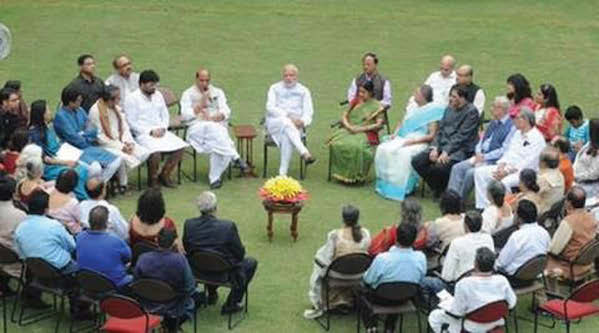
    NEW DELHI (TIP): The process to declassify files relating to Netaji Subhas Chandra Bose will begin on his birth anniversary, January 23, Prime Minister Narendra Modi said on Wednesday, October 14, after meeting 35 members of Netaji’s extended family at his 7, Race Course Road residence. While making the announcement, the PM also said that he sees no reason to “strangle history”.

    Modi said this in a series of tweets after meeting members of Bose’s extended family at his residence here. The prime minister said the government would also request foreign governments to declassify their files on Bose, whose reported death in a plane crash in 1945 in present-day Taiwan is widely disputed.

    Modi said he will begin the process involving other countries with Russia in December when he visits Moscow. Bose, a leading light of India’s freedom movement, was said to be fleeing to Russia when his plane reportedly crashed and caught fire.

    This version has been challenged for decades by innumerable Bose followers who have held varying versions of what happened to him after 1945. Bose’s family members met Modi on Wednesday in the light of the West Bengal government’s declassification of official files related to the last days of Bose, founder of the Indian National Army.

    “It was a privilege to welcome family members of Subhas Babu to 7RCR. We had a remarkable and extensive interaction,” Modi said.

    The PM said that those nations who forget history also lose the power to create it. “Consider me a part of your family,” the PM said to the family members of Netaji. Union Ministers Rajnath Singh, Sushma Swaraj, and Minister of State Babul Supriyo were present on the occasion

    Modi said: “There is no need to strangle history. Nations that forget their history lack the power to create it.”

    The prime minister had said in September that he would meet over 50 members of Bose’s extended family living in India and abroad.

  • Indian maid’s hand chopped off in Saudi, govt calls it unacceptable

    Indian maid’s hand chopped off in Saudi, govt calls it unacceptable

    NEW DELHI (TIP): The family of a 55-year-old Indian woman, working as a domestic help in Saudi Arabia, has alleged her right hand was chopped off by her employer, with external affairs minister Sushma Swaraj on October 8 describing the assault as “unacceptable”.

    Kashturi Munirathinam’s hand was allegedly chopped off on the intervening night of September 29-30 when she tried to escape harassment and torture, said her sister S Vijayakumari.

    Chopping of hand of Indian lady – We are very much disturbed over the brutal manner in which Indian lady has been treated in Saudi Arabia. — Sushma Swaraj (@SushmaSwaraj) October 9, 2015

    Seeking help to bring Munirathinam back from Saudi Arabia, her family has sent representations to the state and Central governments. DMK MP Kanimozhi has sent a letter to Swaraj seeking her help.

    On Friday, Swaraj tweeted the Indian embassy in Saudi Arabia was in touch with Munirathinam.

    “Chopping of hand of Indian lady – We are very much disturbed over the brutal manner in which Indian lady has been treated in Saudi Arabia,” she tweeted. “This is unacceptable. We have taken this up with Saudi authorities.”

    This is unacceptable. We have taken this up with Saudi authorities. — Sushma Swaraj (@SushmaSwaraj) October 9, 2015

    Vijayakumari said Munirathinam went to Saudi Arabia to work as a domestic help three months ago.

    “When she tried to escape harassment and torture, her right hand was chopped off by the woman employer. She fell down and sustained serious spinal injuries,” Vijayakumari said.

    “Kasturi’s employer was angered after she apprised local officials about the harassment she was facing there, she was not even provided food.”

    The family learnt about the incident from “agents who sent her to Saudi”, Vijayakumari said

    “She has now been hospitalised in Riyadh and is in a serious condition, our appeal is please bring her back home immediately and help in her treatment,” she said.

    While Munirathinam’s sister lives in Chennai, her family is in Moongilarei village of Vellore district in Tamil Nadu.

    In her letter to Swaraj, Kanimozhi said Munirathinam’s condition was deteriorating. “Steps should be taken to bring home Kasturi as soon as possible, I appeal on behalf of the victim’s family,” she wrote.

  • Pravasi Bharatiya Divas – Format Change

    Pravasi Bharatiya Divas – Format Change

    In a departure from the past, the government on Tuesday announced a change in the annual Pravasi Bharatiya Divas and its engagement with the diaspora. The mega jamboree will now be held every other year and a new event “focused on outcomes” will be held every other year.

    External Affairs Minister Sushma Swaraj, who is also minister of overseas Indian affairs, announced the changed format of India’s engagement with its diaspora at a press conference here.


    Swaraj said a scaled-down event would be held in January 2016 with the participation of just 150 invited foreign delegates.

    The invited diaspora guests will be experts who would attend various sessions to brainstorm on issues, including the problem of the Indian diaspora in the Gulf; on the government’s flagship programs like Make in India, Skill India, Digital India, and problems that Persons of Indian Origin face, she said.

    Sushma Swaraj announced that the “smaller events” of the PBD would be held in the Delhi office every alternate year, while the major “mela” would be held every two years in a different state in partnership with that state government.

    Besides, she announced that the Regional PBD, which is held abroad, will be held this year in Los Angeles, U.S., on November 14-15. She said U.S. Secretary of State John Kerry has said he would attend.

    She also announced a quiz competition “Bharat ko Janiye” in order to involve the diaspora youth in learning about India.

    The 20 winners — 10 from PIO countries and 10 from countries with NRIs — would be awarded at the PBD.

    Announcing the competition, Swaraj said diaspora Indians between the ages 18-35 could apply to join the quiz, in which there would be two rounds.

    After the second round, 10 successful candidates each from the PIO nations and with NRI population would be selected.

    They would be invited to the summit where they would have to participate in the third round.

    The first three winners would be awarded at the plenary of the PBD. The 20 youth would be taken on a “Bharat Darshan”, she announced, with the aim to acquaint them about Indian art, culture, heritage and also modern India.

  • India Responds in UN | Sushma to Pakistan: Give up terrorism and then let’s talk

    India Responds in UN | Sushma to Pakistan: Give up terrorism and then let’s talk

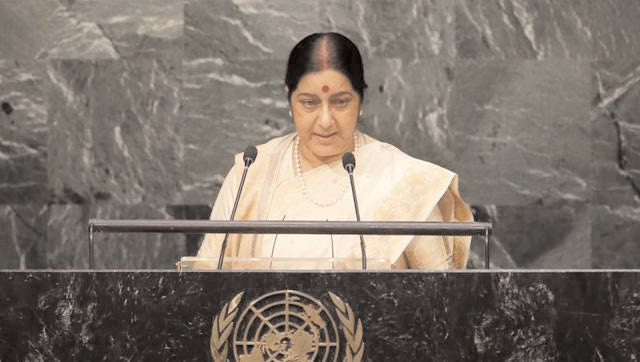
    WASHINGTON (TIP): India on October 1 countered Pakistan Prime Minister Nawaz Sharif ’s four-point peace initiative with a one-point offer. “We don’t need four points, just one — give up terrorism and let’s sit down and talk,” external affairs minister Sushma Swaraj said in an address to the UN general assembly.

    In his UN speech on Wednesday, Sharif had proposed a four-point initiative: demilitarization of Kashmir, ceasefire along the Line of Control, affirmation to not use force and withdrawal from Siachen.

    Reaction from India was sharp and swift. It rubbished elements of the initiative and attempts by Sharif to portray Pakistan as a victim of terrorism, and blame India for its troubles.

    Swaraj rejected his initiative in toto, saying there was just one issue that needed to be taken care of. “Talks and terror cannot go together,” she said, adding that this was what was discussed and decided by Prime Minister Narendra Modi and Sharif in Ufa, Russia, in July.

    The national security advisers of the two countries can meet and discuss all issues connected to terrorism and the directors general of military operations can meet to tackle the border situation, she said.

    “If the response is serious and credible,” the minister said, “India is prepared to address all outstanding issues (which includes Kashmir in diplomacy-speak) through a bilateral dialogue.”

    “None of us can accept that terrorism is a legitimate instrument of statecraft,” she said, drawing attention to India’s frustration with continued cross-border terrorism despite assurances.

    She said these attacks are “meant to destabilize India and legitimize Pakistan’s illegal occupation of parts of the Indian state of Jammu and Kashmir”.

    The mastermind of the Mumbai 2008 attacks walks free, she said, calling it an “affront to the entire international community”.

    In an earlier response to Sharif ’s offer, foreign ministry spokesperson Vikas Swarup tweeted, “To demilitarize Kashmir is not the answer, to de-terrorize Pakistan is.”

    On Sharif ’s claim that Pakistan was a victim of terrorism, India said in a right-to-reply statement in the UN, “In truth, it is actually a victim of its own policies of breeding and sponsoring terrorists.”

    “Pak PM gets foreign occupation right, occupier wrong,” Swarup said about Sharif ’s charge of “foreign occupation” in Kashmir. “We urge early vacation of Pak-occupied Kashmir”.

    Relations between the neighbours have plummeted in recent days and weeks amid tension and firing along the border and cancellation of high-level talks. Both have withdrawn into their respective corners, saying it’s for the other side to make the next move; a long way from the optimism following talks in Ufa. Also, the August 24 NSA-level talks between Sartaj Aziz and his Indian counterpart Ajit Doval were cancelled after Pakistani high commissioner Abdul Basit invited Kashmiri separatists to a tea reception.

    In his speech, Sharif had sought to portray Pakistan, and himself, as more keen on peace than India. He had said after taking office in June 2013 that normalization of ties was one of his first priorities.

    He had reached out to the Indian leadership, he said, yet “today ceasefire violations along the LoC and working boundary are intensifying, causing civilian deaths”.

    “Wisdom dictates our immediate neighbour refrain from fomenting instability in Pakistan,” he said, concluding his attempt to take the moral high ground.

    India’s response was sharp and unsparing. “Pakistan’s instability arises from its breeding of terrorists. Blaming neighbours is not a solution,” Swarup said.

    Harping on Prime Minister Narendra Modi’s demand for the expansion of the UN security council, Swaraj said “if security, development and international peace is to be maintained, then security council needs to be reformed”.

    “We have to include more developing nations in the decision making structures of the security council,” Swaraj said.

  • INDIA TO BE PART OF ELITE ANTI-MISSILE GROUPING NEXT WEEK

    NEW DELHI (TIP): Barring an unpleasant last-minute surprise, India could be accepted as a member in the Missile Technology Control Regime (MTCR) next week. One of the world’s top four non-proliferation regimes, the MTCR plenary will be held in Oslo where the Indian application for membership will be considered. The 34-nation grouping takes decisions by consensus.

    Since India made a formal application for membership in summer this year, India has worked closely with key countries who have promised to support its membership. If India is accepted in the grouping it would be a huge fillip to its missile and space programmes, even allowing it to export its own technology to member countries. In recent years, MTCR has even assumed oversight regarding non-proliferation of UAVs -ironically, Pakistan, not a member of MTCR, has just developed its own armed drones which it has recently used on its own people.

    Accession to MTCR is one of the leftover tasks of the India-US nuclear deal. The US had promised to support India’s membership to all four – Wassenaar Arrangement, Nuclear Suppliers Group and Australia Group, along with MTCR. Initially, Indian diplomatic push was to bundle its membership to all four. The Indian thinking then was India could leverage its candidature all at once rather than lobby separately for all four. However, that thinking underwent a change and the MEA decided to approach all four regimes separately.

    It was originally believed that Australia Group would be the easiest to get into. But India still has to harmonize some of its controls on chemicals etc to make the cut. Instead the government has worked hard to harmonize its export control lists, called SCOMET with MTCR regulations. In March 2015, Indian government put in a host of new items on the SCOMET list which would need prior permission before exports and invite strict oversight by government agencies. A second list on military items also served to harmonize export licensing of military stores, a key compliance demand for MTCR. Acceptance to MTCR might make it easier for India to access the other regimes, though no one is in any doubt about how difficult it would be for India to get into the NSG, where China remains opposed. Between the PM, foreign minister Sushma Swaraj and even President Pranab Mukherjee, the government has lobbied with all the members of the MTCR in the past year. Officials said Indians have been ready with answers to any question put to them by MTCR members. The US has worked closely as well, lobbying for India, the first time after the nuclear deal waiver at the NSG. In the recently concluded Strategic Dialogue between Swaraj and John Kerry, the joint statement noted, “The US side affirms its support for India’s membership in the Missile Technology Control Regime at its upcoming plenary, the Nuclear Suppliers Group, and in the other global non-proliferation export control regimes.”

    China is not a member of the MTCR but has promised to abide by the original 1987 Guidelines and Annexure, but not the subsequent revisions. China has also asked for membership, but China, like Pakistan, is believed to have lax export control systems.

    Established in 1987, the MTCR aims to curb the spread of delivery systems like missiles which carry a minimum payload of 500 kg to a distance of a minimum of 300km.

  • USIBC 40th Annual Leadership Summit

    USIBC 40th Annual Leadership Summit

    WASHINGTON (TIP): Vice President Joe Biden, Secretary of State John Kerry, India’s Minister of External Affairs Sushma Swaraj, and other high-ranking officials from both governments, along with captains of industry from both countries, will address the U.S.-India Business Council on the occasion of its 40th anniversary on September 21 in Washington, DC, to kick off the first U.S.-India Strategic and Commercial Dialogue.

    “It’s a privilege for USIBC to host government and business leaders from both countries on the eve of the U.S.-India Strategic and Commercial Dialogue and on the occasion of the council’s 40th anniversary. The founding principle of the council four decades ago – which grew out of the vision of then-U.S. Secretary of State, Henry Kissinger – remains even more true today: the world’s largest democracies share a love of freedom and an entrepreneurial spirit that – if nurtured -can help realize the full potential of India-U.S. relations,” said USIBC Chairman and MasterCard President and CEO, Ajay Banga.

    “The U.S. business relationship with India is one of the most valuable in the world, and we have seen great progress over the last 40 years,” said President of USIBC Mukesh Aghi. “We are honored to welcome these distinguished speakers from both countries – from both public and private sectors – on the occasion of this milestone anniversary. This level of bilateral engagement and commitment to furthering trust and cooperation has been one of USIBC’s hallmarks for the past four decades and will be for decades more to come,” said USIBC President, Mukesh Aghi.

    The government to government dialogue at this year’s summit will also include U.S. Secretary of Commerce Penny Pritzker, Minister of State for Commerce and Industry Nirmala Sitharaman, Minister of State with Independent Charge for Power, Coal and New & Renewable Energy Piyush Goyal.

    The Council also honors business and government leaders for their commitment towards building a more inclusive global economy. This year’s honorees include CEO and Chairman of PepsiCo Indra Nooyi and Chairperson and Editorial Director of the Hindustan Times Group, Shobhana Bhartia.

  • A Sarsanghchalak’s very own Sarkaar

    A Sarsanghchalak’s very own Sarkaar

    15 years ago, this month, a prime minister of India had traveled to the United States for the annual United Nations General Assembly mela. During that visit, he found time to attend a Vishwa Hindu Parishad event in Staten Island where he declared himself a swayamsevak – yes, as in the Rashtriya Swayamsevak Sangh. This was music to the ears of the Nagpur Gharana. A prime minister who all along was pretending to have little to do with this Hindu outfit suddenly got into a confessional mood.

    Back in New Delhi, Atal Behari Vajpayee’s exuberance did not last long. The conflict between the demands the RSS would make on a prime minister and his constitutional oath was too palpable to permit any kind of meaningful jugalbandi. Though Vajpayee continued to mark his token attendance at the annual guru dakshina rites, he was not afraid to antagonize the Nagpur crowd. After the 2002 anti-Muslim riots in Gujarat, it was simply not possible for Vajpayee to maintain any civilized conversation with these comrades among the swayamsevaks. The gurus never forgave Vajpayee for wanting to draw outside the lines.

    And, again, 10 years ago, July 2005 to be precise, three designated gurus of the Nagpur Gharana traveled to Delhi to tell the then BJP president, LK Advani, to put in his papers. Advani had committed the solecism of saying something vaguely in praise of Muhammad Ali Jinnah. All the top leaders of the BJP held their collective peace as the “unknown, unelected, unaccountable” Nagpur-empowered busybodies roughed up Advani as if he was just a taluka-level politician. Advani was rendered hors de combat. By the end of the year, he was gone as the party president. The Nagpur bosses wanted to reaffirm the first principle: No BJP leader would be allowed any deviation. They had had enough of Vajpayee and his liberal tantrums.

    And, last week, it was this very first principle that was re-asserted when the Sarsanghchalak summoned Prime Minister Modi and his ministers. Well, if you are a swayamsevak, you do respond to summons from the superior in the hierarchy. Period. That is the code of the saffron brotherhood. Admitted, Sushma Swaraj is not an RSS bhakt. Nor is Arun Jaitley. Unless, he has managed to keep this fact away from his “moderate and decent” friends in Delhi. But neither of them had any choice.

    Why are the liberal souls losing their shirt just because the Prime Minister and his ministerial colleagues had all chosen to put in an appearance before the RSS chief and his advisers? After all, the Modi-RSS connection is not new.

    It was no secret that it was the RSS’s unequivocal endorsement of Modi that proved decisive in the BJP making him its prime ministerial mascot. Nor was the RSS’s involvement on behalf of Narendra Modi in the 2014 electoral process a secret affair. It was open and fairly well documented.

    From his Gujarat days, Modi has written the blue book on how to look after the RSS and its functionaries. Modi is smarter – which is not the same thing as being wiser – than Vajpayee. He has shrewdly sized up the small men and their small needs.

    To be fair, Modi never kept anyone in the dark about his RSS links. Yet, if the best and the brightest among the New Delhi-based intellectuals and others ‘thought leaders’ chose to be taken in by the ‘vikas’ mantra, it is their problem – not Modi’s.

    Instead of having the buyer’s regret, every moderate voice should welcome this national-level seduction of the RSS. There is no dark side to it.

    Look at what has already happened: The RSS, which has arrogated to itself the role of the sole arbiter of moral values, is now wasting its breath on explaining the excesses and aberrations of the BJP chief ministers – Shivraj Singh Chouhan in Madhya Pradesh and Vasundhara Raje in Rajasthan. It would be instructive to find out how that fly-by-night entrepreneur, Lalit Modi, is described in the morning shakha meetings in Jaipur. Just as it would be revealing to know what explanation the swayamsevaks in Bhopal offered regarding the horror of a scandal called Vyapam.

    Indeed, none seems to have noticed that the RSS has reduced itself to being a BJP spokesperson.

    Its two other chief ministers – in Haryana and Maharashtra – both proud products of the Sangh brain-washing factory system – have turned out to be such poor advertisements for good governance or for the RSS brand. Apart from exhibiting a new willingness to provoke -Manohar Lal Khattar’s absurd infatuation with Baba Ramdev and Devendra Fadnavis’ with petty preoccupations with bans – these two have hardly enhanced the reputation of the RSS.

    More interestingly, the BJP apologists have cockily explained Modi and his ministers’ attendance at the Sangh Shivir as not very dissimilar to some Congress ministers and Prime Minister Manmohan Singh’s response to the Sonia Gandhi-led National Advisory Council.

    Never mind that the NAC was a government-constituted, gazetted body; it has now been easily done away with. Never mind that Sonia Gandhi is the head of a legally recognized political party, which enters the electoral fray with its own symbol. Yet any suggestion of a moral equivalence between Sonia Gandhi and Mohan Bhagwat should not be resented.

    Perhaps, it should even be a matter of some satisfaction that the RSS has come out of its bogus pretence of being just a cultural organization. The democratic forces should welcome it and demand that it should be brought within the ambit of the Right-to-Information regime.

    Nonetheless, a matter of grave concern is the new attempt aimed at an intellectual hegemony. For instance, the culture minister in the Modi government.

    Mahesh Sharma, a black-belt saffronite, has argued that by voting for Modi and the BJP, the voters have given a mandate for “saffronisation” of education, culture and other institutions. With just 31 per cent of the votes, the Modi sarkaar would like to believe that it has been given a license to operationalize the RSS agenda?

    This is an anti-democratic argument and is laced with morally unpleasant smells. Whatever obedience the Prime Minister and his ministers may choose to render to the Sarsanghchalak, they need to be reminded that they are still governed and bound by something called the Constitution of India. India is still a constitutional democracy and its rulers, irrespective of the number of seats in the Lok Sabha, are still answerable to a robust Parliament and an independent judiciary.

  • How Pakistan Gains From the Cancelled NSA-Level Talks

    How Pakistan Gains From the Cancelled NSA-Level Talks

    Now that the dust has settled down on the planned, and then cancelled, meeting between the National Security Advisors (NSAs) of India and Pakistan, one can calmly and rationally analyse the reasons for and assess the loss/gain arising from the cancelled meeting. However, one must be clear about few things before one can proceed further on the analysis. The first is that the Indian position that the NSA talks were about terrorism was absolutely correct. A simple reading and understanding of the English language makes that amply clear. The second is that India not only set out some preconditions for the meeting, but set out an additional pre-condition that Pakistan should accept these preconditions as not being pre-conditions.  To be more specific the following was the exchange that took place at the media briefing by the Foreign Minister:

    प्रश्न (ग़ीता मोहन) Question (Geeta Mohan): Ma’am, the red lines have been drawn. No talk barring on terror and no meeting with the separatists. Pakistan has not given an assurance yet. If Pakistan does not give assurance the talk would go ahead?

    विदेश मंत्री श्रीमती सुषमा स्‍वराज (Foreign Minister Sushma Swaraj): Then talks will not be held. I have answered thrice this question. I have answered thrice अगर उनका जवाब हाँ में है, अगर वो आज कहते है हाँ सुषमा जी आपने यह clear कर दिया प्रि-कंडिशन नही है, यह तो एक शिमला समझोता की स्पिरिट है और दूसरी उफा की, ठीक है मै आता हूँ, आईए । लेकिन अगर वो कह रहे कि नही हम तो अभी भी इसको प्रि-कंडिशन मानते है या हम नही इस चीज़ को मानते है तो बातचीत नही होगी।

    (Translation: …if their answer is a ‘yes’, if they say today that Sushma ji you have made it very clear that these are not preconditions, then this is in the spirit of the Simla Accord and the Ufa statement, so fine, I will come; we welcome them. But if they are saying that we still regard this as a precondition or that we do not agree with this, then there will be no talks.)

    India having arrested or put under house arrest all the separatist leaders, there was no reason for seeking an assurance from the Pakistan NSA that they will not meet the separatists. Taking a cue from the popular movie Kung Fu Panda, wherein the Kung Fu master tells the panda that he is free to eat if he can get hold of the food, the Pakistanis were free to meet the separatists if they could get hold of them! Having cleared this, with both sides seemingly bent on cancelling the meet, overall who gained and who lost?

    With talks being limited to terrorism, India with a strong dossier on specific persons and groups with addresses and telephone numbers with travel records, had a decisive advantage over the Pakistanis who did not, and who in any case could not have produced such a detailed dossier on the alleged Indian hand in terrorism in Pakistan. That would have been to Pakistan’s disadvantage.

    Dawood Ibrahim is listed in the Al-Qaida sanctions List. Persons listed in the Al Qaida sanctions list are subject to all the sanctions measures mandated by the UN Security Council through its various resolutions starting with UNSC 1267(1999). One of these measures pertains to assets freeze. This requires the Member States to take appropriate measures, in accordance with domestic laws and practices, to ensure that no funds, financial assets or economic resources are made available directly or indirectly for the benefit of those listed in the sanctions list.

    The Security Council Committee pursuant to its resolutions concerning Al-Qaida and Associated Individuals and Entities, constituted a committee known as the “Al-Qaida Sanctions Committee”, also known as the 1267 Committee. This Committee is supported in its work by an Analytical Support and Sanctions Monitoring Team (the ‘Monitoring Team’), which is composed of independent experts, appointed by the Secretary-General, with expertise in counter-terrorism, financing of terrorism, arms embargoes, travel bans and related legal issues. The Monitoring Team assists the Committee in evaluating the implementation of the sanctions regime by Member States. In its latest report of June 2015, the Monitoring team had the following to say about asset freeze:

    “in cases in which the current locations of the listed individuals are known and they are not imprisoned, it is difficult to understand how they can operate without any exempted finances. How do they eat? How do they pay for accommodation or, if they own property, cover utility expenses alone?

    Under such circumstances, a legitimate question to ask is whether the State of residence is properly and fully implementing the Al-Qaida sanctions obligation. If the State of residence is allowing expenditure in breach of the assets freeze, without pre-notifying the Al-Qaida Sanctions Committee, that could constitute a breach of the obligations under the Al-Qaida sanctions regime.”

    India has now ample documentary proof to establish that Dawood Ibrahim has multiple residential properties in Pakistan, maintains the establishments at all these addresses including all the necessary utility facilities.  If in spite of extensive documentation made available to the Pakistan Government through various channels, including official bilateral discussions on terrorism, Dawood Ibrahim is able to sustain his activities in Pakistan, it can only be because of availability of funds which should have been blocked/frozen by the Pakistan government. India has a strong case for projecting to the Al-Qaida Sanctions Committee that Pakistan government’s inaction in this respect constitutes a breach of its Obligations under UN charter.

    Had the NSAs’ meeting taken place, India could have presented the documentary evidence to the Pakistan Government and later to the Al-Qaida Sanctions Committee. It was not in Pakistan’s interest that the NSA meeting should take place. It is to their credit that they managed to do that by waving a red flag at the Indians through their first briefing on the planned NSA talks by mentioning their invitation to the Hurriyat leaders for a meeting in Delhi prior to the NSA talks. India took the bait and the rest is history.

    The main gainer from the cancelled talks was Pakistan.

    Views expressed are of the author and do not necessarily reflect the views of the IDSA or of the Government of India


  • By 2020, India will be Hindu nation: Singhal

    By 2020, India will be Hindu nation: Singhal

    NEW DELHI (TIP): The VHP has put the NDA government in a tight spot with its patron Ashok Singhal on Saturday declaring that India will be a Hindu nation by 2020, following the BJP’s victory in the 2014 polls.

    Singh described the 2014 general elections as a “revolution” in the country. “I was at the Sai Baba Ashram where Sai Baba told me by 2020 the entire country will be Hindu by 2030 the entire world will be Hindu. I feel that revolution has started,” he said at a function to mark the release of a book on the life and work of former RSS chief K S Sudarshan, who died in 2012.

    The VHP leader said the BJP’s electoral win ended 800 years of “slavery” and “this is not a modest revolution. It will not remain confined to India but present a new ideology before the world”. “Sudarshan ji was not only a saint but a visionary who had predicted that a revolutionary change in the country will begin in 2012 and ultimately that happened in 2014,” he said, alluding to the BJP-led alliance’s victory in the 2014 Lok Sabha polls. External Affairs Minister Sushma Swaraj, who took part in the function, spoke about the role of Sudarshan who, she said, had genuine concern for the development of the country and advocated the “swadeshi” model of development.

    Singhal’s remarks came after a break in controversial statements by the Sangh hotheads, who were asked by the RSS leadership to fall silent.

    Modi and the BJP chief had complained that rows created by them were aiding the opposition to divert attention from the work of the NDA government, which was keen to revive the economy and bring much needed investment in infrastructure and other sectors.

    Modi, who avoided the controversies initially, was later forced by the opposition to break his silence in February over religious freedom. Since then, he has spoken a number of times on protecting the rights of minority communities, with the latest one being in June, when he told Muslim leaders that he doesn’t believe in politics that divides people on communal lines.

  • Monsoon session set for a washout as NDA, Opposition take rigid stand

    Monsoon session set for a washout as NDA, Opposition take rigid stand

    NEW DELHI (TIP): “In one year, Parliament runs for eighty days during sessions. Each day, business in both Houses are transacted for around six hours. If we take into account the total annual expenditure on Parliament, then for each minute of running the House costs Rs. 2.5 lakh,” the author of this statement could be the Parliamentary Affairs Minister of the Modi Government after the continued logjam in Parliament.

    However, ironically, this statement was made by a former Parliamentary Affairs Minister Pawan Kumar Bansal to the Opposition as the monsoon session of Parliament was almost completely washed out in 2012 over the controversy on coal block allocations with BJP insistent on Prime Minister Manmohan Singh’s resignation.

    Pawan Kumar Bansal, who later had to resign as the union Railways minister, went on to say that Parliament will lose its relevance and significance if only disruptions take place in the House. He added that “77 % of the session’s business time in Lok Sabha and 72 % in Rajya Sabha was lost due to disruptions in this session and asked the Opposition to realize that “enough is enough”.

    According to official estimates, Parliament meets on an average 100 days in a year. The total budgeted cost of running Parliament is around Rs 600 crore per year which translates in to Rs six crore every day.

    The BJP had on several occasions in the past declined to let Parliament function and is now finding itself in a similar situation. The current Minister of State for Parliamentary Affairs Mukhtar Abbas Naqvi had this to say for the current impasse: We pray for wisdom to the protesting Congress and other opposition members to help allow smooth functioning of Parliament….. We hope better sense prevails upon Congress and other members.

    The conflict between the treasury benches and the opposition stems from the fact that while the opposition is demanding resignation of external Affairs minister Sushma Swaraj and Madhya Pradesh chief minister Shivraj Chauhan, the treasury benches assert they are willing to discuss and debate the issue but the ministers shall not resign. The government has also ruled out a statement by Prime Minister Modi, as demanded through a notice in Rajya Sabha, to speak on the issue.

    As the left leader Sitaram Yechuri put it, Parliament is not an investigative agency and , therefore, a debate on the issue would not serve the purpose. He said that as per tradition, and the law, the accused must be placed under suspension till the investigation in to the allegations are complete as there is a chance of the investigations getting hampered by the accused in office. He said discussion was no substitute for investigations.

    Given the adamant stand on both the sides, it is unlikely that the House would be allowed to function and important legislations awaiting Parliament’s nod – like the GST Bill and amendments to the land acquisition Bill, are not likely to be passed.

    Political experts point out that though brief disruptions had taken place in parliament over the years but there were leaders would fund a way through discussions or involve neutral senior parliamentarians to sort out the issues. However, with stakes high and with Rahul Gandhi trying to assert himself, there is little possibility of an early resolution of the situation. With the elections to the critical Bihar Assembly looming large, it has become a prestigious issue for the rival parties to hold on to their stand despite the high cost of the functioning of parliament and wastage of public resources in the process. Perhaps there would be lesson for them in the outcome of the Bihar elections.

  • Putting India Emphatically on Global Map – Part 2

    Putting India Emphatically on Global Map – Part 2

    Continued from Putting India Emphatically on Global Map – Part 1

    It defies logic that a country that is considered as our most serious adversary and whose policies in our region has done us incalculable strategic harm should have been accepted as India’s strategic partner during Manmohan Singh’s time. Such a concession that clouds realities serves China’s purpose and once given cannot be reversed. Pursuant to discussions already held during the tenure of the previous government, the Chinese announced during Xi’s visit the establishment of two industrial parks in India, one in Gujarat and the other in Maharashtra, and the “endeavour to realise” an investment of US $ 20 billion in the next five years in various industrial and infrastructure development projects in India, including in the railways sector. The Chinese Prime Minister’s statement just before Modi goes to China on May 14 that China is looking for preferential policies and investment facilitation for its businesses to make this investment suggests that the promised investment may not materialise in a hurry. While the decision during Xi’s visit to continue defence contacts is useful in order to obtain an insight into PLA’s thinking and capacities at first hand, the agreement, carried forward from Manmohan Singh’s time, to explore possibilities of civilian nuclear cooperation puzzles because this helps to legitimise China’s nuclear cooperation with Pakistan.

    Even as Modi has been making his overall interest in forging stronger ties with China clear, he has not shied away from allusions to Chinese expansionism, not only on Indian soil but also during his visit to Japan. During his own visit to US in September 2014 and President Obama’s visit to India in January 2015, the joint statements issued have language on South China Sea and Asia-Pacific which is China-directed. A stand alone US-India Joint Vision for Asia Pacific and the Indian Ocean Region issued during Obama’s Delhi visit was a departure from previous Indian reticence to show convergence with the US on China-related issues. India has now indirectly accepted a link between its Act East policy and US rebalance towards Asia. The Chinese have officially chosen to overlook these statements as they would want to wean away India from too strong a US embrace. During Sushma Swaraj’s call on Xi during her visit to China in February 2015 she seems to have pushed for an early resolution of the border issue, with out-of-the-box thinking between the two strong leaders that lead their respective countries today. Turning the Chinese formulation on its head, she called for leaving a resolved border issue for future generations.

    It is not clear what the External Affairs Minister had in mind when she advocated
    “out-of-the-box” thinking, as such an approach can recoil on us. That China has no intention to look at any out-of-the-box solution has been made clear by the unusual vehemence of its reaction to Modi’s visit to Arunachal Pradesh in February 2015 to inaugurate two development projects on the anniversary of the state’s formation in 1987. The pressure will be on us to do out-of-the-box thinking as it is we who suggested this approach. China is making clear that it considers Arunachal Pradesh not “disputed territory” but China’s sovereign territory. This intemperate Chinese reaction came despite Modi’s visit to China in May. The 18th round of talks between the Special Representatives (SRs) on the boundary question has taken place without any significant result, which is not surprising in view of China’s position on the border. The Chinese PM has recited the mantra a few days ago of settling the boundary issue “as early as possible” and has referred to “the historical responsibility that falls on both governments” to resolve the issue, which means nothing in practical terms. As against this, India has chosen to remain silent on the China-Pakistan Economic Corridor (CPEC) which will traverse territory that is legally Indian, and which even the 1963 China-Pakistan border agreement recognises as territory whose legal status has not been finally settled. The CPEC cannot be built if China were to respect its own position with regard to “disputed” territories which it applies aggressively to Arunachal Pradesh. Why we are hesitant to put China under pressure on this subject is another puzzle.

    Modi’s visit to Seychelles, Mauritius and Sri Lanka in March 2015 signified heightened attention to our critical interests in the Indian Ocean area. The bulk of our trade- 77% by value and 90% by volume- is seaborne. Modi was the first Indian Prime Minister to visit Seychelles in 34 years, which demonstrates our neglect of the Indian Ocean area at high political level and Modi’s strategic sense in making political amends. During his visit Modi focused on maritime security with agreement on a Coastal Surveillance Radar Project and the supply of another Dornier aircraft. In Mauritius, Modi signed an agreement on the development of Agalega Island and also attended the commissioning of the Barracuda, a 1300 tonne Indian-built patrol vessel ship for the country’s National Coast Guard, with more such vessels to follow. According to Sushma Swaraj, Modi’s visit to Seychelles and Mauritius was intended to integrate these two countries in our trilateral maritime cooperation with Sri Lanka and Maldives.

    In Pakistan’s case, Modi too seems unsure of the policy he should follow- whether he should wait for Pakistan to change its conduct before engaging it or engage it nevertheless in the hope that its conduct will change for the better in the future. Modi announced FS level talks with Pakistan when Nawaz Sharif visited Delhi for the swearing-in ceremony, even though Pakistan had made no moves to control the activities of Hafiz Saeed and the jihadi groups in Pakistan.

    The Pakistani argument that Nawaz Sharif was bold in visiting India for the occasion and that he has not been politically rewarded for it is a bogus one. He had a choice to attend or not attend, and it was no favour to India that he did. Indeed he did a favour to himself as Pakistan would have voluntarily isolated itself. The FS level talks were cancelled when just before they were to be held when the Pakistan High Commissioner met the Hurriyet leaders in Delhi. Pakistan’s argument that we over-reacted is again dishonest because it wanted to retrieve the ground it thought it had lost when Nawaz Sharif did not meet the Hurriyet leaders in March 2014.

    Modi ordered a robust response to Pakistani cease-fire violations across the LOC and the international border during the year, which suggested less tolerance of Pakistan’s provocative conduct. We have also been stating that talks and terrorism cannot go together. Yet, in a repetition of a wavering approach, the government sent the FS to Islamabad in March 2015 on a so-called “SAARC Yatra”. Pakistan responded by releasing the mastermind of the Mumbai attack, Lakhvi, on bail and followed it up by several provocative statements on recent demonstrations by pro-Pakistani separatists in Srinagar, without any real response from our side. Surprisingly, in an internal political document involving the BJP and the PDP in J&K, we agreed to include a reference to engaging Pakistan in a dialogue as part of a common minimum programme, undermining our diplomacy with Pakistan in the process.

    Pakistan believes that it is US intervention that spurred India to take the initiative to send the FS to Pakistan, which is why it feels it can remain intransigent. Pakistan chose to make the bilateral agenda even more contentious after the visit by the FS by raising not only the Kashmir cause, but also Indian involvement in Balochistan and FATA. On our side, we raised the issue of cross border terrorism, the Mumbai terror trial and LOC violations, with only negative statements on these issues by Pakistan. Since then the Pakistani army chief has accused India of abetting terrorism in Pakistan. The huge gulf in our respective positions will not enable us to “find common ground and narrow differences” in further rounds of dialogue, about which the Pakistani High Commissioner in Delhi is now publicly sceptical.

    Even though one is used to Pakistan’s pathological hostility towards India, the tantrums that Nawaz Sharif’s Foreign Policy Adviser, Sartaj Aziz, threw after President Obama’s successful visit to India were unconscionable. He objected to US support for India’s permanent seat in the UNSC and to its membership of the Nuclear Suppliers Group (NSG). He castigated the Indo-US nuclear deal, projecting it as directed against Pakistan and threatened to take all necessary steps to safeguard Pakistan’s security- in other words, to continue to expand its nuclear arsenal.

    Chinese President Xi’s April 2015 visit to Pakistan risks to entrench Pakistan in all its negative attitudes towards India. The huge investments China intends making through POK constitutes a major security threat to India. China is boosting a militarily dominated, terrorist infested, jihadi riven country marked by sectarian conflict and one that is fast expanding its nuclear arsenal, including the development of tactical nuclear weapons, without much reaction from the West. President Ashraf Ghani’s assumption of power in Afghanistan and his tilt towards Pakistan and China, as well as the West’s support for accommodating the Taliban in Afghanistan with Pakistan’s help will further bolster Pakistan’s negative strategic policies directed at India. Ghani’s delayed visit to India in April 2015 has not helped to clarify the scenario in Afghanistan for us, as no change of course in Ghani’s policies can be expected unless Pakistan compels him to do by overplaying its hand in his country. Modi is right in biding his time in Afghanistan and not expressing any undue anxiety about developments there while continuing our policies of assistance so that the goodwill we have earned there is nurtured.

    Prime Minister Modi, belying expectations, moved rapidly and decisively towards the US on assuming office. He blindsided political analysts by putting aside his personal feelings at having been denied a visa to visit the US for nine years for violating the US law on religious freedoms.

  • Swaraj meets Chinese counterpart, raises Lakhvi issue

    Swaraj meets Chinese counterpart, raises Lakhvi issue

    NEW DELHI (TIP): External Affairs Minister Sushma Swaraj on June 25 raised with her Chinese counterpart Wang Yi China’s blocking of India’s move in the UN for action against Pakistan over 26/11 mastermind Zaki-ur-Rehman Lakhvi’s release, saying it was at “variance” with progress in ties.

    In the meeting held on the sidelines of an international donors conference in Kathmandu, Swaraj told the Chinese Foreign Minister that Lakhvi was “no ordinary terrorist” as he masterminded the Mumbai terror attack in which more than 166 people were killed.”The External Affairs Minister raised the issue of Zaki-ur-Rehman Lakhvi on the stand China has taken on this matter in the United Nations 1267 committee. She said both India and China have been victims of terrorism and therefore there should be no distinction made between good terrorists and bad terrorists,” External Affairs Ministry Spokesperson Vikas Swarup said.

    “She said China’s stand on the matter appears to be at variance with the excellent progress otherwise being achieved in India-China bilateral relationship,” Swarup said.

    He said Wang assured Swaraj that China opposes all forms of terrorism and that he will look into the matter.

    “He (Wang) assured that there was no reason why India and China could not cooperate more closely on anti-terrorism efforts,” Swarup said.

    At a meeting of the UN Sanctions Committee, India had sought action against Pakistan for release of Lakhvi in the 26/11 trial in violation of a UN resolution but the Chinese representatives blocked the move on grounds that New Delhi did not provide sufficient information.

    Lakhvi, the mastermind of the 26/11 terror attack, was released from a Pakistani jail in April. The UN Sanctions Committee met at India’s request last week.In a letter to the current Chair of the UN Sanctions Committee Jim McLay, India’s Permanent Representative to the UN Asoke Mukherjee last month had said Lakhvi’s release by a Pakistani court was in violation of the 1267 UN resolution dealing with designated entities and individuals.

    The sanctions measures apply to designated individuals and entities associated with terror groups including al-Qaeda and LeT, wherever located.

  • Nepal to hold donor conference on post-quake reconstruction

    KATHMANDU (TIP): External Affairs Minister Sushma Swaraj will be among a host of leaders who will attend an international donor conference here for reconstruction efforts following the devastating earthquake that hit Nepal in April.

    The International Conference on Nepal’s Reconstruction (ICNR) 2015 is scheduled to take place here on June 25 to raise international assistance for rebuilding the country ravaged by the April 25 earthquake and its aftershocks.

    Besides Swaraj, foreign ministers from China and Norway, finance ministers from Bhutan and Bangladesh and disaster management minister from Sri Lanka have confirmed their participation in the international conference, Nepalese finance minister Ram Shara Mahat said today.

    Nepal had initially invited PM Narendra Modi to attend the conference. President of the Manila-based Asian Development Bank, vice-president of the World Bank, president of Japan International Technical Cooperation (JAICA), commissioner of the European Union and the UN deputy general secretary of the United Nations have also confirmed their participation.

  • BJP BLEEDS: Lalitgate and now Advani Emergency Remark

    BJP BLEEDS: Lalitgate and now Advani Emergency Remark

    NEW DELHI  (TIP): As if the pain of Lalitgate involving Sushma Swaraj and Vasundhara Raje Scindia was not enough , Advani chose to inject a little more of it with his emergency remarks.

    Already in the line of opposition’s fire over the Lalit Modi issue, the ruling BJP on Thursday, June 18, was further driven to a corner over remarks of party senior L.K. Advani that he did not rule out another Emergency-like situation in the country.

    As the Congress continued its attacks on the Bharatiya Janata Party over the help provided to “fugitive” former IPL commissioner Lalit Modi by External Affairs Minister Sushma Swaraj and also allegedly Rajasthan Chief Minister Vasundara Raje, other opposition parties like AAP, the JD-U, the RJD and the CPI-M also attacked the party on Advani’s remarks, terming them a veiled swipe at Prime Minister Narendra Modi. The BJP however denied it.

    In an interview to the Indian Express ahead of the 40th anniversary of the Emergency, during which he had been jailed, Advani had said that “forces that can crush democracy” (in the country) were stronger and that there were “not enough safeguards in India in 2015” to prevent an Emergency-like situation.

    “Advani ji is correct in saying that Emergency can’t be ruled out. Is Delhi their first experiment,” Delhi Chief Minister Arvind Kejriwal tweeted. Besides Kejriwal, Advani found another supporter in Bihar Chief Minister Nitish Kumar of the Janata Dal-United, who told media persons in Patna, that the BJP veteran was “right to a large extent”. Rashtriya Janata Dal chief Lalu Prasad tweeted: “Already there is undeclared emergency as authoritarian & Hitlerian tendencies prevailing in country since May14.” “Advani Ji proved that our concerns regarding anti-democratic elements & activities being sponsored & promoted by union government are correct.”


    Congress spokesperson Tom Vadakkan said it is not only his party which is questioning the government “but even senior BJP leadership is raising questions on the efficacy of the government”, while his colleague Sanjay Jha, tweeted: “A totalitarian system is gradually overwhelming India; Advani Ji’s warnings confirm our worst apprehensions.”

    Aam Aadmi Party leader Ashutosh also tweeted that Advani’s interview is first
    “indictment of Modi’s politics” and that Advani indicated “democracy is not safe, emergency is not far, under Modi’s leadership”.”

    Slamming the NDA government at the centre over a host of issues, veteran Communist Party of India-Marxist leader Biman Bose too expressed apprehension that an emergency may be proclaimed to stifle democracy as Modi’s “aachhe din (good days)” promise had fallen flat. “So, unable to solve all these problems, there may come a situation, when to stifle democracy, these people may resort to emergency,” he told media persons in Kolkata. BJP spokesperson M.J. Akbar said that Advani may have been referring to institutions rather than individuals. Internal emergency was imposed on the country by then Prime Minister Indira Gandhi on June 25-26, 1975 and lasted 19 months.

    The Congress on Thursday also demanded a “decisive” reply from Prime Minister Modi on the Lalit Modi controversy while clarifying that it was not mulling any legal recourse against the government as of now. “The silence of the prime minister is deafening. He must tell the people of India about his views,” Congress leader C.P. Joshi told the media, also asking him to clarify whether Sushma Swaraj decided to give the go-ahead for travel documents for Lalit Modi as an individual minister or on behalf of the entire government. “He (the prime minister) should give a quick reply. He should put forward his views in a decisive manner,” he said. The former union minister from Rajasthan also sought the resignation of Vasundhara Raje and asked the RSS to clarify its stand on her, noting it had spoken for Sushma Swaraj but was silent on the state chief minister. “We request BJP president Amit Shah to sack her immediately,” he added.

    The external affairs minister as well as the Rajasthan chief minister are facing flak for their association with former IPL chief Lalit Modi, who is wanted by the Enforcement Directorate for alleged financial impropriety in the money-spinning IPL, and currently living in London. In Hyderabad, Minister of State for External Affairs V.K. Singh defended his senior cabinet colleague saying that matters were being blown out of proportion. “What is happening is, many things are being blown out of proportion. Lot of noise is being made. For example, it was said that because Sushma-ji’s daughter is Lalit Modi’s lawyer, so something is fishy…. Chidambaram’s wife is a lawyer in Sardha scam. Should he come under scanner for that? I leave this question to you,” he told reporters.

  • Putting India Emphatically on Global Map – Part 1

    Putting India Emphatically on Global Map – Part 1

    Prime Minister Modi has surprised his own people and, no doubt, external observers, by his foreign policy activism since he took office. In his year in power he has travelled abroad 16 times- and 19 if the forthcoming visits to China, Mongolia and South Korea are included- inviting some criticism that these peregrinations have meant less attention devoted to domestic affairs. This is misplaced criticism because today, with the change in the nature of diplomacy, the heads of governments play a critical role in external affairs. Frequent personal contacts at the highest political level have now become the norm, leaders often are on first name terms and difficult knots are untied by exertions at their level, sometimes in an unorthodox manner. Modi, even if seemingly inexperienced in the foreign policy domain, has had to, therefore, wade into the deep waters of diplomacy as soon as he took over because his position has demanded this. But no one was prepared for a Modi with a natural flair for diplomacy, to which he has brought a surprising degree of imagination and self-assurance. From the start, he seemed to have a clear idea of where the interests of his country lay and the initiatives needed to advance them.

    All Indian Prime Ministers on taking over give priority to ties with neighbouring countries. The belief is that either India has neglected its neighbours or has been insensitive and overbearing, leading to their alienation and consequent opportunities for external powers to intervene at the cost of India’s interests. Modi too began by reaching out to the neighbours, but in a manner not anticipated. He invited all the SAARC leaders to his swearing-in, with the intention no doubt to signal that his elevation to power would usher in a new era of South Asian relations, that the clear victory in elections of a supposedly nationalist party did not denote a more muscular policy towards neighbours and that, on the contrary, India intended to work together with them to move the whole region forward towards peace and prosperity. This gesture had most meaning for India-Pakistan relations, and Nawaz Sharif’s decision to attend the swearing-in was “rewarded” with the announcement of FS level talks between the two countries.

    Continuing the emphasis on the neighbourhood, he chose Bhutan as the first country to visit in June 2014. This made sense as Bhutan is the only neighbour that has not played an external card against us or politically resisted building ties of mutual benefit. His August 2014 visit to Nepal made a notable impact in local political and popular thinking about India as a well-wisher. His extempore address to the Nepalese parliament was a tour de force. He handled sensitive issues during his visit with finesse and played the cultural and religious card dextrously. External Affairs Minister Sushma Swaraj visited Bangladesh in June 2014. A very notable development is the approval of the Land Boundary Agreement with Bangladesh approved by the Indian parliament in May 2015. Modi visited Myanmar in November 2014 to take part in the East Asia summit and for bilateral discussions with this strategically placed neighbour whose honeymoon with China is waning.

    SAARC figures prominently in Modi’s foreign policy vision. He invited all SAARC leaders to his swearing-in ceremony, which was unprecedented. It is true that SAARC is one of the least integrated regions economically speaking, which means that the potential of the region remains unexploited. This also means that external actors find it easier to intrude into the loose equations in the subcontinent. While in terms of aspirations for the region, Modi is right in imagining a more tightly textured SAARC, India’s capacity to do this is limited in the face of Pakistani recalcitrance. A strengthened SAARC means a stronger Indian role in it, which is anathema to a Pakistan that is obsessed with countering Indian “hegemony” in South Asia. Pakistan will be reduced to its true importance if it ceases to confront India, which is why it will continue its confrontational policies. it also means that Afghanistan will not be adequately integrated into SAARC structures as that is contingent on Pakistan’s willingness to facilitate access to this landlocked country. At the Kathmandu SAARC summit in November 2014, Modi encouraged neighbours to benefit from opportunities provided by India’s growth, promised a special funding vehicle overseen by India to finance infrastructure projects in the region and announced India’s readiness to develop a satellite specifically for the region by 2016. He warned at the Kathmandu summit that regional integration will proceed with all or without some, which suggested that if Pakistan did not cooperate, others could go ahead without it, though under the SAARC charter this is not possible and other countries may not support a strategy of isolating Pakistan.

    Modi seems to admire China’s economic achievements, which would not be surprising given China’s spectacular rise. His several visits to China as Gujarat Chief Minister no doubt gave him familiarity with the country and take its pulse. His view that economic cooperation is the key driver in relations between countries and that all countries give more importance to economic growth and prosperity for their peoples than creating conditions of conflict evidently guides his thinking towards China. He was quick to court China after assuming power, with reinforcement of economic ties as the primary objective. The huge financial resources at China’s disposal, its expertise in infrastructure building, its need for external markets for off-loading the excess capacity it has built in certain sectors has made cooperation with China a theoretically win-win situation. The Chinese Foreign Minister was the first foreign dignitary to be received by Modi. He invited the Chinese President to make a state visit to India in September 2014, during which unprecedented personal gestures were made to him in an informal setting in Ahmedabad on Modi’s birthday. This imaginative courting was marred by the serious border incident in Ladakh coinciding with Xi’s visit- one more case of China reaching out to India and simultaneously staging a provocation so that India remains unsure about China’s intentions and finds it difficult to make a clear choice about what policy to pursue, and in the process has to accept faits accomplish that are to China’s advantage.

    Unlike the timidity of the previous government to treat such incidents as acne on the beautiful face of India-China relations, Modi raised the border issue frontally with XI at their joint press conference, expressing
    “our serious concern over repeated incidents along the border”. His call for resuming the stalled process of clarifying the Line of Actual Control (LAC) and mention of “India’s concerns relating to China’s visa policy and Trans Border Rivers” while standing alongside Xi Jinping at the joint press conference indicated a refreshing change from the past in terms of a more open expression of India’s concerns. With regard to Bangladesh-China-India-Myanmar Economic Corridor that China has been pushing hard, Modi was cautious. Why we accepted to discuss such a proposal in a working group in the first place is a puzzle. Engagement with China ought not to mean that we let it set the agenda when the downsides to us of what it seeks are clear. Equally importantly, he did not back another pet proposal of Xi: the Maritime Silk Road, which is a repackaged version of the notorious “string of pearls” strategy, as the joint statement omitted any mention of it. Since then China is pushing its One Belt One Road (OBOR) proposal which seeks to tie Asian and Eurasian economies to China, create opportunities for Chinese companies to bag major projects in this region financed by the Asian Infrastructure Investment Bank (AIIB) that China has floated. This ambitious concept is intended to establish China’s hegemony in Asia and outflank India strategically.

    On a more positive side, during Xi’s visit, the two sides agreed to further consolidate their Strategic and Cooperative Partnership, recognised that their developments goals are interlinked and agreed to make this developmental partnership a core component of this partnership.

    Read More : Putting India Emphatically on Global Map – Part 2

  • AMID LALITGATE ROW, RAJE CANCELS ANANDPUR SAHIB AVOIDS MEETING AMIT SHAH

    AMID LALITGATE ROW, RAJE CANCELS ANANDPUR SAHIB AVOIDS MEETING AMIT SHAH

    JAIPUR (TIP): Amid raging Lalitgate row, Rajasthan chief minister Vasundhara Raje on June 19 cancelled her visit to Punjab where she would have come face-to-face with BJP president Amit Shah for the first time since the damaging revelations.

    “Due to back pain, the chief minister’s doctor has advised her to take rest so she has cancelled her visit to Punjab today,” Raje’s press advisor said.

    Raje, who is embroiled in a controversy over allegedly favouring tainted IPL chief Lalit Modi’s immigration plea in London, was scheduled to share the dais with BJP chief Amit Shah and Union home minister Rajnath Singh at the function in Anandpur Sahib celebrating 350 years of the key Sikh shrine. Significance was being attached to the meeting as none of the BJP central leaders or the government have come to her defence since the issue came out in public.

    Raje had spoken to Shah over phone on Wednesday to explain her position.

    Congress has been demanding her immediate resignation along with that of external affairs minister Sushma Swaraj, saying they have no right to continue in office after helping the former IPL chairman who is facing money laundering and other charges.

    However, Rajasthan health minister Rajendra Rathore rejected demands for Raje’s resignation, saying the entire national BJP and party MLAs were with her.

    “The entire BJP be it at the Centre or the state are with her. She has been leading us and will continue to do so. The entire legislature party is standing strongly with her. Our leadership is standing by her. The question of her resignation does not arise,” he had said.

  • India set to ramp up engagement with Tehran

    NEW DELHI (TIP): India is reopening its engagement with Tehran even as a game-changing nuclear deal between Iran and world powers looks potentially around the corner. After Nitin Gadkari’s visit to the Iranian capital in May to sign an MOU on the Chahbahar port, foreign secretary S Jaishankar will be in Tehran on Saturday for political consultations.

    While India had reduced its oil imports from Iran during the US sanctions, it will be keen to restart the trade relationship as well as push the Iranian leadership to expedite the necessary clearances for building the Chahbahar port. India has even set up a special purpose vehicle (SPV) India Ports Global, to handle the port project.

    India would want to revive its oil interests in Iran as well. India, Afghanistan and Iran have signed a transit agreement, and India is keen to build the connections through Iran into Afghanistan and central Asia. The port and its attendant railway lines, once built, would give India an alternative to Pakistan’s Karachi port.

    Foreign minister Sushma Swaraj has already said she would be visiting Iran in the coming weeks for bilateral and NAM consultations. After engaging its immediate neighbourhood and east Asia, the Indian government is working on the Connect Central Asia project.

    Prime Minister Modi will be visiting all the five “Stans” during his trip to Ufa, Russia for the BRICS summit.

  • All 39 Indian IS hostages alive, says Sushma

    NEW DELHI (TIP): India was informed by “eight different sources” that 39 citizens of the country abducted in Iraq 11 months ago were still alive, External Affairs Minister Sushma Swaraj said on May 14.

    Swaraj, who had a meeting with members of the families of the hostages, dismissed media reports claiming that the Indians abducted by Islamic State militants at Mosul in northern Iraq in June 2014 had been killed. The media-reports quoted Harjit Masih, who was among the hostages, but managed to flee, telling journalists that all others abducted by the IS had been killed. “We are not sparing any efforts to find them. We are hopeful that we will be able to find them and bring them back home. I have eight different sources who are saying they are alive,” Swaraj said.

    She assured the families of the hostages that the government was making sincere efforts for the safe and early release of the Indian workers.She said she had earlier personally spoken to her counterparts in the countries.

  • Indian-American Parents of ‘Abducted’ Children Seek US Help

    Indian-American Parents of ‘Abducted’ Children Seek US Help

    WASHINGTON:  Around 60 Indian-Americans have asked the US government and the Congress to consider imposing sanctions on India, alleging that they have “not been able to get justice” from the Indian system in reuniting with their kids who have been “abducted” by their spouses there.

    In all the cases, the “abduction” is by their spouses, who fled to India after marital dispute and got court orders against them.

    All these “abducted” kids are American citizens and in the past few months American lawmakers have joined hands in urging the Obama Administration to consider imposing sanctions on countries like India where the government is not helping them getting back the abducted US kids.

    Nearly a dozen of these Indian-American parents from various parts of the US last week held a series of meetings with officials from the State Department, testified before a Congressional committee, met a large number of lawmakers urging to help them get their kids back to the US.

    They held a candle light vigil at the White House and also went to the Indian Embassy to submit a memorandum to the Indian Government.

    These Indian-American parents are part of the larger group – Bring Our Kids Home – which consists of parents facing the same traumatic problem of “abducted children” in other countries like Pakistan, Russia, Japan  and Greece.

    International Parental Child Abduction (IPCA) is a form of child abuse and a violation of US and International law.

    Several nations have signed the Hague Convention on Civil Aspects of International Parental Child Abductions (“Hague Convention”), India is not a signatory to it. As per State Department reports, between 2012-13 India ranked as the number one non-Hague signatory country, said Ravi Parmar, one of the Indian-American parents.

    A law was passed by US Congress last year after years of inaction on the part of successive US Administrations to enforce existing US laws and Hague Convention obligations.

    “This new law could result in sanctions on those countries that don’t cooperate in returning US children, victims of IPCA,” said Vikram Jagtiani, another parent.

    Most of these Indian-American parents have written multiple letters to both Prime Minister Narendra Modi and External Affairs Minister Sushma Swaraj, but have received no response so far.

    “Why I am not getting my children back. They need to be me,” Bindu Philip, who testified before a Congressional committee last week, told PTI.

    National Center for Missing and Exploited Children (NCMEC) says 86 per cent of all active cases of abductions to India are open two years or more and 51 per cent of all active India related cases are open five years or more. 21 per cent of all India related cases close without the child returning or child turning 18 years.

     
  • AMIT SHAH REVAMPS BJP NATIONAL EXECUTIVE

    AMIT SHAH REVAMPS BJP NATIONAL EXECUTIVE

    NEW DELHI (TIP): The first meeting of BJP’s new national executive finalised on March 12 by party president Amit Shah is expected in the first week of April in Bangalore.

    Shah finalised the party’s 111-member national executive, which includes top party leaders including Prime Minister Narendra Modi and former prime minister AB Vajpayee besides a host of top party leaders.

    All the eight chief ministers of BJP-ruled states and two deputy chief ministers, including that in Jammu and Kashmir where the party shares power with PDP, besides 24 former chief ministers and three former deputy chief ministers are permanent invitees to the national executive.

    The BJP chief has also made 40 senior leaders from across the country special invitees to the national executive.

    The new list comes ahead of the party’s national executive meeting and party’s restructuring by Shah.

    Among those who are part of the new national body include party veterans LK Advani and Murli Manohar Joshi, besides Union ministers Rajnath Singh, Sushma Swaraj, Arun Jaitley, M Venkaiah Naidu, Nitin Gadkari, Ananth Kumar, Thawarchand Gehlot, Jagat Prakash Nadda, Ravi Shankar Prasad, Kalraj Mishra, Narendra Singh Tomar, Harsh Vardhan, Bandaru Dattatreya and Radha Mohan Singh. However, HRD minister Smriti Irani and minority affairs minister Najma Heptulla are among the prominent faces who have been dropped from party’s national executive . Even Mathura MP Hema Malini and BJP’s Mumbai spokesperson Shaina NC did not find mention in the list.

    Others include Yashwant Sinha, Vinay Katiyar, CP Thakur, Jual Oram, SS Ahluwalia, Vijay K Malhotra, besides Hukumdev Narayan Singh, L Ganeshan, Lalji Tandon, O Rajgopal, Tathagat Roy, Gulab Chand Katariya and Subramanyam Swami.

    Ministers Mukhtar Abbas Naqvi, Dharmendra Pradhan, Rajeev Pratap Rudy, Prakash Javadekar, (Gen) VK Singh, Suresh Prabhu, Birendra Singh, Piyush Goyal and Nirmala Sitharaman are also part of the new executive.

    Other leaders like Varun Gandhi, Tapir Gaon, Vijay Goyal Satpal Maharaj, Vishnubhushan Harichandan, Vijay Mahapatra and PK Krishna Das, V Shanmughanathan, are also its members.

    Party’s firebrand leaders like Yogi Adityanath and Navjot Singh Sidhu are part of the executive, while another such leader Sadhvi Niranjan Jyoti is a special invitee.

    All the BJP chief ministers Shivraj Singh Chauhan, Raman Singh, Vasundhra Raje Scindia, Anandiben Patel, Raghuvar Das, Devendra Gandadharrao Fadnavis, Manohar Lal Khattar and Laxmikant Parsekar, besides deputy Chief Ministers Fracesco De D’souza and Nirmal Singh are also invitees. Besides, all Legislative Assembly and Legislative Council party leaders, state presidents of all states, all General Secretaries (Organisation) will be special invitees in National Executive.

  • No dilution of nuclear liability law, says Swaraj

    NEW DELHI (TIP): The government on Thursday reiterated that no clause connected to the amount of compensation under the Civil Liability for Nuclear Damage (CLND) Act was waived off in the recent India-US agreement during US President Barack Obama’s visit. Foreign minister Sushma Swaraj told Rajya Sabha that Rs 1,500 crore was meant for “immediate compensation” of victims in case of a nuclear accident through the nuclear insurance pool, but the amount was “not the outer limit”.

    She said the CLND Act prescribes that the maximum amount of liability in respect of each nuclear incident shall be the rupee equivalent of 300 million Special Drawing Rights (SDRs), which amounts to around Rs 2,610 crore at present.

    India will also be able to access international funds under the Convention on Supplementary Compensation for Nuclear Damage (CSC) once it is a party to that convention. Moreover, Swaraj said the government could also notify a higher amount if required

  • Government Launches Portal ‘Madad’ to Redress Consular Grievances

    Government Launches Portal ‘Madad’ to Redress Consular Grievances

    NEW DELHI:  Indian citizens living abroad will now be able to file consular grievances online as the government today launched an e-portal to address such complaints promptly with a high degree of “accountability”.

    The portal ‘Madad'(Help) was launched at the Ministry of External Affairs or MEA headquarters in Delhi by External Affairs Minister Sushma Swaraj, who said the grievance monitoring facility would enhance “accessibility” for people and fix greater “accountability and responsibility” on officials.

    “The portal seeks to significantly reform the linear process adopted to post grievances from the originator of the grievance to the concerned Embassy or Consulate of India abroad and cut down the time required for grievances to be sent from Delhi to our Missions abroad and to get them to take necessary action,” Ms Swaraj said.


    The speedy handling of complaints, improve tracking and redressal and escalation of unresolved cases are among the chief characteristics of ‘Madad’.

    “After registering, the complainant can log in and file his or her complaints, and the entire history of that grievance would be maintained online. The authorities would be assigned the responsibility through a colour-coded dashboard that would change the colour if the response in not given in a stipulated time,” a senior official of the MEA said.

    Ms Swaraj said such “Healthy intra-department competition” would act as a deterrent for officials to not let work slide and they would therefore respond with greater accountability now, which would ultimately benefit people.

    “The colour code system will follow red-amber-green pattern, that is, missions performing well in redressing grievances would be in ‘green’, while say those keeping inordinately pending cases would show as ‘red’.

    “Also, when the colour code changes, it will escalate the case to higher authorities and the entire history can later be accessed by the complainant in a summary or detailed format,” the official added.

    All the stakeholders, in this consular grievance monitoring, are tightly linked to the portal, including Missions and Posts abroad and MEA’s Branch Secretariats in Chennai, Guwahati, Hyderabad and Kolkata, he added.

    “The plan is also to have a call centre linked to the Ministry of Overseas Indian Affairs. Besides, we are also currently working on a mobile application to let people use the system on the go,” he said.

    Ms Swaraj, who is also the Minister of Overseas Indian Affairs (MoIA), said, she brought a team together from the two ministries to effect the plan.

    “MEA and MoIA have been separate and I realised that sometimes, the scope of the problem in such matters lied with MoIA but the solution lied with the MEA. And, since I hold both the ministries, I brought them together and the team worked beyond my expectations,” she said.

    The Union minister said the project was started as a pilot project in some of the missions abroad, including in Oman, where “I had recently visited.”

    The pilot project for the system was started with seven countries, the six Gulf Cooperation Council (GCC) countries including UAE, Saudi Arabia, Oman, among others, and Malaysia.

    Ms Swaraj further said that the logo and tagline for ‘Madad’ was selected through an online competition on www.mygov.in.

    The logo represents the image of two persons holding hands, side by side, forming, the letter ‘M’ of the ‘Madad’, written in blue, and the tagline is ‘Because You Are Us’.

    “And, instead of awarding Rs. 1 lakh to one winner, we have selected the logo of one candidate and tagline of another, and they will evenly share the prize money,” she said.

    The portal has been designed by Tata Consultancy Services in collaboration with the government.

    Members of Parliament Arjun Ram Meghwal and Arun Kumar were also present on the occasion.