Tag: United States Politics


  POLITICS & POLICY  

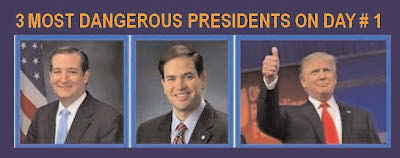
  • Three most dangerous Presidents in America on Day one

    Three most dangerous Presidents in America on Day one

    On Day #1, they want to repeal Obama care. Forget their hatred for the President, but look at their political meanness to deprive 22 Million Americans of their health insurance. Many of those Americans may be facing life threatening ailments. When they repeal Obama-care on Day # 1, a number of them may die for lack of access to the necessary health care. Do American lives matter to them?

    For the first time in American history, the U.S. Government has put the money to right use, to care for Americans rather than blow it on destroying other nations like Iraq and Afghanistan. For the first time pre-existing conditions were covered by health insurance, it is important to know that many American lives have been saved and will continue to be saved. These three men care less about ordinary Americans. While they can afford to buy any insurance, the average Americans living from pay check to pay check cannot.

    Our country needs a strong defense system to fight off external aggression as well as internal health aggressions. The three should be grateful to Obama for having implemented the measures and means of paving the way for a healthier America and saving American lives.

    Furthermore, on Day #1 – they also want to tear up the Iran deal. That would certainly appease Netanyahu, but completely disregards the long term security of Israel, and as a consequence it would free Iran to pursue the Nuclear Weapons program which brings uncertainty and instability to the region.

    President Obama has removed a potential threat to Israel with this deal; and the American Jews have the wisdom to recognize this and support it.

    President Carter, the architect and the facilitator of a permanent Peace Treaty between Israel and its onetime arch enemy Egypt brought relief, after that Israel had one less enemy to worry and thus saved tension, tanks and lives. I am sure the thoughtful American Jewry will express their gratitude to President Carter. Indeed, Israel should install a statue of President Carter at the Ben Gurion Airport to express their gratitude to him.

    President Clinton on the other hand took out another enemy on the east; Jordan, and President Obama has given the iron dome to Israel and has removed another enemy; Iran.

    Tearing up the Iran Deal would be one of the gravest blunders in the US Foreign policy. It would amount to recklessly rejecting Iran’s partnership treaty with Russia, China, UK, Germany, France and the United States. How do you build coalitions if you are disrespectful to nations that work with us on common goals of reducing conflicts and focusing on economic development?  If we mess with this deal; Iran is likely to become another Rogue Nuclear nation like North Korea and pose a direct and greater threat to Israel.

    For the first time in fifty years, a U.S., President has done the right thing, a conservative thing to develop and implement a foreign policy based on friendship and treaties rather than animosity and hostilities.

    We may destroy Iran, but we will also destroy ourselves much more. Gas prices will go up for millions of servicemen/repairmen to make service calls, as it happened towards the end of the Bush era. Small businesses will fold, divorces will become routine, home foreclosures will be back, loss of lives of our men and women, and a few more trillion dollars of deficit will be added to our budget.

    Why is little Rubio screaming in every sentence to save our ally Israel? Israel does not need friends like him who will ruin their long term security. Israel needs prudent, wise and visionaries like Obama, Clinton and Carter who will bring long term peace and security to them by turning enemies into friends and partners in peace and cooperation.

    The things Rubio has been clinging on to are repeal Obama-care, tearing up the Iran Deal and supporting Israel’s paranoia. Every sentence he utters is about supporting Israel, and I am sure Trump supporters resent that, because they want America first and not Israel. Rubio’s non-sensual rhetoric may increase anti-Semitism in the form of resentment. He and Cruz are dangerous to Israel not only from Americans, but also from those five nations (Russia, China, UK, France and Germany) whose nuclear contracts with Iran they plan to trash, and it is like spitting in their faces. The costs of the idiotic behavior of Rubio will not fall on themselves, but on the average. I wonder if Saudi Arabia, Germany or UK can throw enough bones at him to let him bark for them. He does not give a crap about the 22 Million Americans’ health care or our economy. He has a serious character flaw.

    Ted Cruz, the bloody war monger will carpet bomb other nations like Bush did, and he will add a few more trillion dollars of deficit to the budget, and shoot the unemployment rate through the roof to go up to 12%, more divorces will follow, home foreclosures will rise, and businesses will start closing down. Yes, neither Cruz does care what happens to America. He and some of his macho men may draw sadistic pleasure from destroying other nations, but we the people do not want destruction, for which we end up paying again.

    Furthermore, Cruz has been disrespectful towards the Supreme Court Justices and their decisions. Is he above the law to use such vulgar language about them?  He does not seem care, he would let our government shut down and ruin our credit ratings, and he does not give a rat’s ass about the 22 Million Americans’ health care either. Voting for Cruz is regressing to the big bad times of Bush Administration.

    Trump will turn his back on nuclear Non-proliferation Deals and peace negotiations just to advance his own agenda, and not necessarily what is good for America. Foreign leaders are not his employees whom he fires at his whim; instead they will turn around and tell him to take a hike. The Muslim nations, some 56 of them would not want to be humiliated by these idiots and will turn to Russia or the UK to purchase their military hardware. Who will be the losers? The men and women employed in our export and defense industry. That is a large number of people and it may hurt our economy severely.

    These three men, Rubio, Cruz and Trump are wrecking balls, and we will be screwed on Day # 1 if we were to elect them as our President. It is time to redefine conservatism; none of the three loose mouths are conservatives in my books.


    (The author is a community consultant, social scientist, thinker, writer, news maker, and a speaker on Pluralism, Interfaith, Islam, politics, terrorism, human rights, India, Israel-Palestine and foreign policy. He is committed to building cohesive societies and offers pluralistic solutions on issues of the day. Visit his 63 links at www.MikeGhouse.net and TheGhousediary.com for his writings)

  • The Final Four at the GOP Presidential Debate Speak out on various Issues

    The Final Four at the GOP Presidential Debate Speak out on various Issues

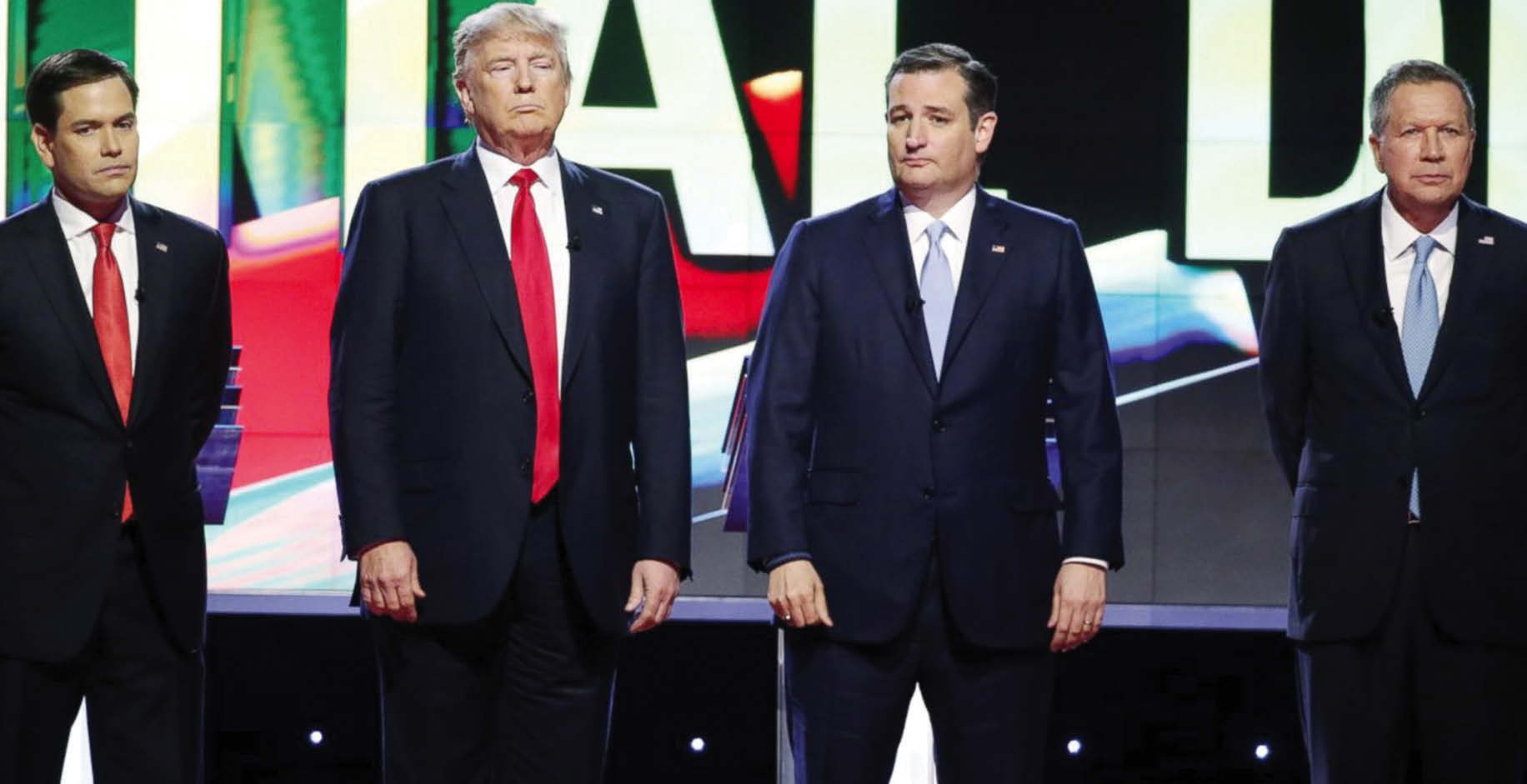
    CORAL GABLES (TIP): The GOP Presidential debate at Coral Gables, Florida, March 19, kicked off on a somber note with a moment of silence in honor of the late Nancy Reagan.

    The final four candidates Donald Trump, Ted Cruz, Marco Rubio and John Kasich stated their positions on various issues.

    Here are some excerpts of the debate hosted by CNN at the University of Miami.

    ON THE 2016 PRESIDENTIAL ELECTION

    SEN. TED CRUZ: “This election is about you and your children. It’s about the freedom America has always had.”

    DONALD TRUMP: “Frankly, the Republican establishment, or whatever you want to call it, should embrace what’s happening. We’re having millions of extra people join. We are going to beat the Democrats. We are going to beat Hillary [Clinton] or whoever it may be. And we’re going to beat them soundly.”

    ON IMMIGRATION

    GOV. JOHN KASICH: “I believe in immigration, but it has to be controlled.”

    “I’d be maybe running for president of Croatia if we didn’t have immigration. Immigration is something that brings youths and vibrance and energy to our country. We clearly have to control our borders. We can’t have people just walking in. We lock our doors at home at night. The country has to be able to lock its doors as well,” the Ohio governor added.

    ON BEN CARSON

    TRUMP: “I was with Dr. Ben Carson today, who is endorsing me, by the way, tomorrow morning.”

    Retired neurosurgeon Ben Carson told ABC News Thursday he is leaning in the direction of endorsing Trump.

    ON EDUCATION

    KASICH: “We ought to get them to pursue their God-given talents and connect them with the things that give them passion.”

    ON SOCIAL SECURITY

    SEN. MARCO RUBIO: “There are about 3 million seniors in Florida, with Social Security and Medicare. One of them is my mother, who happens to be here today. I’m against any changes to Social Security that are bad for my mother.”

    TRUMP: “I want you to understand the Democrats, and I’ve watched them very intensely, even though it’s a very, very boring thing to watch, that the Democrats are doing nothing with Social Security. They are leaving it the way it is. They want to increase it.”

    Trump later said, “So far, I cannot believe how civil it’s been up here.”

    ON TRUMP’S SAYING ‘ISLAM HATES US’

    When asked by debate moderator Jake Tapper whether his comment that “Islam hates us” meant all 1.6 billion Muslims, Trump responded by saying, “I mean a lot of them. I mean a lot of them.”

    He added, “Well, you know, I’ve been watching the debate today. And they’re talking about radical Islamic terrorism or radical Islam. But, I will tell you there’s something going on that maybe you don’t know about, and maybe a lot of other people don’t know about, but there’s tremendous hatred. And I will stick with exactly what I said to Anderson Cooper.”

    RUBIO: “Let me say, I know that a lot of people find appeal in the things Donald says because he says what people wish they could say. The problem is presidents can’t just say anything they want. It has consequences here and around the world.”

    Trump hit back, “Marco talks about consequences. Well, we’ve had a lot of consequences, including airplanes flying into the World Trade Center, the Pentagon and could have been the White House.”

    “I don’t want to be so politically correct,” Trump added. “I like to solve problems. We have a serious, serious problem of hate. There is tremendous hate. There is tremendous hate.”

    “Politically correct,” Rubio replied. “I’m not interested in being politically correct. I’m interested in being correct.”

    CRUZ: “The answer is not to yell, ‘China, bad, Muslim, bad.’ You have to understand the nature of the threats we’re facing and how you deal with them.”

    ON ISIS

    TRUMP: “We have to knock out ISIS. We have to knock the hell out of them.”

    ON DIPLOMATIC TIES WITH CUBA

    “I would love a relationship between Cuba and the United States to change, but it would require Cuba to change, at least its government,” Cuban-American Rubio said.

    TRUMP: “I do agree something should take place. After 50 years, it’s enough time, folks.”

    ON CLIMATE CHANGE

    “Sure, the climate is changing and one of the reasons is because the climate has always been changing,” Rubio said. “A law that we can pass in Washington to change the weather, there’s no such thing.”

    ON VLADIMIR PUTIN

    KASICH: “Mr. Putin, you better understand you’re either with us or against us.”

    TRUMP: “I think Putin has been a strong leader for Russia. He’s been a lot stronger than our leader and that doesn’t mean I’m endorsing Putin.”

    The New York real estate mogul added, “I don’t say that as a good way or bad way. I say it as a fact.”

    ON TRUMP’S RALLIES

    When asked to comment on video thatsurfaced of a protester being punched by a man attending a Trump rally Wednesday, Trump said, “I certainly do not condone that at all, Jake.”

    Trump went on, “we have some protesters who are bad dudes, they have done bad things. They are swinging, they are really dangerous.”

    Cruz fired back, saying, “The only hand raising I’m interested in doing is on January 20, 2017, raising my hand with the left hand on the bible.”

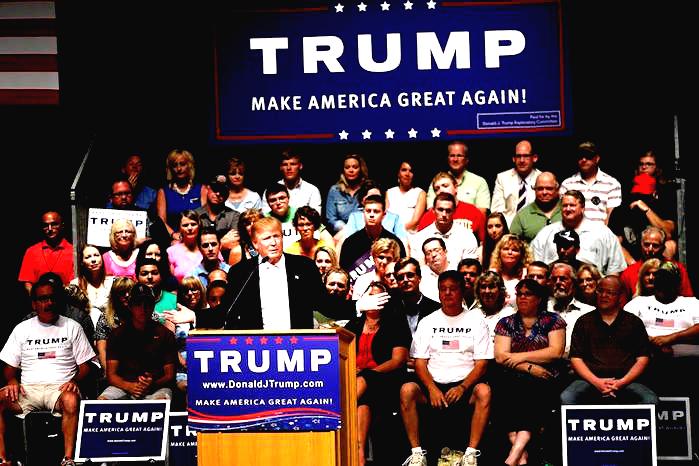
    Trump said, “Everyone’s laughing, we’re all having a good time. That’s why I have much bigger crowds than Ted, because we have a good time at mine.”

    ON A CONTESTED CONVENTION

    TRUMP: “First of all, I think I’m going to have the delegates, OK?

    “There’s two of us up here that can [have the delegates] and there are two of us that cannot, at this moment. By the way, that is not meant to be a criticism, that’s just a mathematical fact, OK?

    “I think that whoever gets the most delegates should win.”

    “Make me president,” Trump said under his breath.

    Cruz joked, “Donald, you are welcome to be president of the Smithsonian.”

    ON TUESDAY’S PRIMARIES

    RUBIO: “On Tuesday night, I didn’t do as well, obviously, as I wanted to and I was a little bit disappointed,” the Florida senator admitted.

    “My wife told me a story that night. There’s a gentleman here in South Florida who just got out of surgery. His doctors told him he needs to be home resting. Every day, he sits outside of a polling center and holds a sign that says, ‘Marco Rubio.’”

  • Sikhs and Muslims join Trump bandwagon

    Sikhs and Muslims join Trump bandwagon

    A group of Sikhs and Muslims mostly from South Asian countries have joined the Donald Trump bandwagon in the US state of Maryland, asserting that the Republican presidential front runner is “not against” their communities.

    Under the banner of “Sikh Americans for Trump” and “Muslim Americans for Trump” scores of Sikhs and Muslims held their first meeting in a suburb of Washington DC in Maryland, wherein a representative from the Trump campaign addressed them.

    Organisers of the event from both the Sikh and Muslim communities argued that the view of Trump about minority community has been “twisted” and “taken out of context” by the mainstream media and claimed that the 69-year-old billionaire real estate magnet would create more jobs in the country which would benefit he minorities.

    “He (Trump) is not at all against the Sikhs or the Muslim community. What he says is given spin. The mainstream media gives a spin. Because they are scared of him. He is not the status quo. He is not taking anybodys money,” said Jasdip Singh, who helped organised the “Sikh Americans for Trump” in Maryland.

    A prominent member of the Sikh community, Singh is Chairman of the Maryland Governors Commission on South Asian Affairs and Chairman of the Board of Sikh Associations of Baltimore.

    “When he talks about Muslims, he does not talk about all Muslims or American Muslims. He spoke in the context of the refugee crisis that was happening in Syria. We (Sikhs) agree with him. Muslim (Americans) agree with him that we should not bring people into this country before we can vet them. And this was a temporary measures proposed by him,” Singh said.
    “He is not against minorities. I have even heard that he is not good for India. I believe, he is very good for India. He has businesses in Pune and Mumbai. He understands all these countries and cultures better than any other candidates,” said Singh, who in September led a delegation of Sikh leaders to meet Prime Minister Narendra Modi in the Silicon Valley.

    “Trump built Tajmahal (Casino) in Atlantic City 25 years ago and brought a piece of India to the US and tried to bring things from India into Taj.

    “So he has a very strong affinity and relationship with India. We should not listen to the spin that is coming from the media,” Singh added.

    Of all the presidential candidates, Trump is the only one who has achievements to show, argued Sajid Tarar, a Pakistani American, who helped organise the Muslim Americans for Trump.

    “We believe, he has the ability and capacity to change America. He has built a huge empire. He is self-funding the campaign. There is no special interest behind him,” Tarar said.

    “There is a war going on against Trump. Every message and speech of his has been twisted,” he said referring to the Trumps call to temporarily ban Muslims from entering the country.

  • We need to torture ISIS terrorists, their families – Donald Trump

    We need to torture ISIS terrorists, their families – Donald Trump

    Republican presidential front-runner Donald Trump says that, as president, he would push to change laws that prohibit waterboarding and other enhanced interrogation methods, arguing that banning them puts the US at a strategic disadvantage against Islamic State militants.

    During the past week, in a series of interviews and events, Trump has articulated a loose, but expansive set of principles that, if enacted, would mark a fundamental shift in US foreign policy from the limits put in place by Democratic President Barack Obama and the Republican-led Congress. In addition to arguing in favor of reinstating waterboarding, a technique that mimics the sensation of drowning, and “much more than that,” Trump has advocated the killing of suspected terrorists’ wives and children, which appears in violation of international law.

    “We have to play the game the way they’re playing the game,” Trump said in an interview on CBS’s “Face the Nation” Sunday, one day after he told an audience in Florida that he would fight to expand and broaden the laws that regulate interrogation.

    “I would like to strengthen the laws,” he added Sunday, “so that we can better compete.”

    Trump’s comments come as the U.S. continues its uphill battle against IS militants across the Middle East. Trump has repeatedly pointed to the tactics used by the group, including public beheadings and drownings in locked cages, as evidence that the U.S. needs to dramatically escalate the tactics it uses.

    During a press conference Saturday in West Palm Beach, Florida, to mark his latest election wins, Trump refused, however, to articulate specifically which techniques he would like to see added, despite repeated questions. Instead, he said: “It’s very hard to be successful in beating someone when your rules are very soft and their rules are unlimited, they have unlimited, they can do whatever they want to do.”

    Pressed Sunday on why he believed waterboarding had been banned, Trump said the U.S. was being “weak” by not employing the militants’ tactics.

    “Because I think we’re a weak – I think we’ve become very weak and ineffective. I think that’s why we’re not beating ISIS. It’s that mentality,” he said using an acronym for the militant group.

    “Isn’t that what separates us from the savages?” ”Fact the Nation” host John Dickerson asked.

    “No, I don’t think so,” answered Trump. “No, we have to beat the savages.”

    “We have to play the game the way they’re playing the game. You’re not going to win if we’re soft and they’re – they have no rules,” he said.

    In 2009, Obama issued an executive order saying all U.S. government personnel and contractors – not just those in the military – are prohibited from using any interrogation techniques that aren’t in the Army Field Manual. That was reaffirmed last June, when many Republicans joined all 44 Senate Democrats in a 78-21 vote months after a Senate intelligence committee report denounced brutal interrogation methods, arguing they had proven ineffective.

    However, other former CIA officials, including former deputy CIA director Mike Morell, maintain that waterboarding and other harsh methods have yielded vital intelligence.

    Trump appeared, at least briefly, to soften his stance after nearly 100 foreign policy experts signed an open letter denouncing him, saying his “embrace of the expansive use of torture” was “inexcusable.”

    Former CIA Director Michael Hayden and others also have weighed in, saying military officials would refuse to carry out any Trump order that violated the law.

    During the last Republican debate, Trump insisted that U.S. military officials would obey any orders he gave them, saying, “They’re not going to refuse me. Believe me.”

    The next day, his campaign released a statement clarifying that Trump would “use every legal power” to stop “terrorist enemies.” But it said that he recognized the U.S. is bound by laws and treaties and that, as president, he would not order the military or other officials to disobey the law.

  • US election 2016: Sanders beats Clinton in Maine caucuses

    US election 2016: Sanders beats Clinton in Maine caucuses

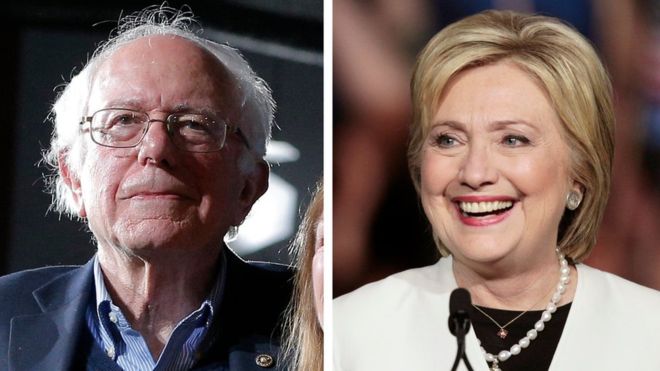
    Bernie Sanders has beaten Hillary Clinton in the Maine caucuses, the latest contest in the battle to be the Democratic presidential candidate.

    With 80% of the vote counted, Vermont Senator Mr Sanders is polling 64%, while former Secretary of State Mrs Clinton has 36%.

    In the Republican race, Marco Rubio easily won Puerto Rico’s primary, beating billionaire Donald Trump.

    Mrs Clinton and Mr Trump remain overall leaders in the nomination campaigns.

    Sunday night saw Mrs Clinton and Mr Sanders clash in a CNN-hosted debate in Flint, Michigan.

    In Saturday’s round of voting, Mr Sanders took two states – Kansas and Nebraska – but Mrs Clinton maintained her Democratic front-runner status after a big victory in Louisiana.

    While the win in Puerto Rico – a US territory – will boost Florida Senator Mr Rubio’s campaign, it sends just 23 delegates to the Republican convention which nominates a presidential candidate.

    Republican hopefuls need the votes of 1,237 delegates to get the nod for the presidential race proper.

    Mr Rubio still trails Donald Trump and Texas Senator Ted Cruz.

    Speaking after wins in the Republican Kentucky caucuses and Louisiana primary election on Saturday, Mr Trump told a news conference: “I would love to take on Ted Cruz one on one.”

    “Marco Rubio had a very very bad night and personally I call for him to drop out of the race. I think it’s time now that he dropped out of the race. I really think so.”

    Meanwhile, Texas Senator Mr Cruz – who won Republican caucuses in Kansas and Maine – said he believed that “as long as the field remains divided, it gives Donald an advantage”.

  • Trump and Baghdadi

    Trump and Baghdadi

    How does the leading Republican candidate for the US presidency, Donald Trump, square off with Abu Bakr al-Baghdadi at the helm of the so-called Islamic State group?

    For many, shoving the two names in the same headline is anathema. Drawing any association between them is an abomination.

    After all, how could anyone in their right mind dare to compare the clean-shaven, white businessman and leading candidate to the highest public office in the oldest liberal democracy, with the bearded fundamentalist preacher, former inmate, and head of the world’s most notorious terrorist group, ISIL?

    Defining extremism

    Extremism is a loaded word. Its use in geopolitical newspeak has never been objective.

    Conferring labels such as “extremist” or “moderate” on individuals, movements, leaders and regimes has generally been ideological and therefore unproductive. It has, however, been a useful imperial construct.

    Allies of global powers are described as “moderates”, whereas political opponents are classified as “extremists” or “terrorists”.

    In this regard, extremism is reliant – mainly if not exclusively – on the actors and not on their actions. For example, if you are a US ally, you are by definition a moderate, because it is assumed that the US epitomises moderation.

    Lumping together different peoples and groups as ‘extremists’ out of distaste for their ideas or religion is as wrong as it is counterproductive.

    It is irrelevant in this context whether a group or a regime wages wars, commits acts of terror, and occupies other people, or, if they are religiously intolerant and totalitarian. On the contrary, they are defined as being moderate according to their political orientation. Even after the US invaded and occupied Iraq on false pretenses, it continued to label Iraqis as moderates and extremists, depending on their support of its endeavour.

    The same applies to Russia and other imperial or regional powers. In Moscow, the Syrian regime is portrayed as moderate despite the government’s brutal policies.

    The opposition movement, on the other hand, according to Russia, falls on the “extremist” end of the spectrum simply for not being in line with the Kremlin’s foreign policy. This is as false as it is misleading.

    Lumping together different peoples and groups as “extremists” out of distaste for their ideas or religion is as wrong as it is counterproductive.

    For the sake of brevity, let me just say that, beyond the realm of imperial constructs and “language control”, extremism as moderation can only be defined in terms of how the moral imperative is found or lost in the use of means and attainment of ends. Or more precisely, how far the “ends justify the means”, regardless of their immorality or wickedness.

    Back to Trump and Baghdadi

    Trump, in the words of The New York Times, is a “shady, bombastic liar”, who is hardening the image of the Republican party “as a symbol of intolerance and division”.

    Trump’s call for banning Muslims from entering the US presumably to maintain security, or his disdain for Latinos under the pretext of protecting the “American” workers are all a case in point. He has even accused Mexico of sending rapists and drug runners to the US.

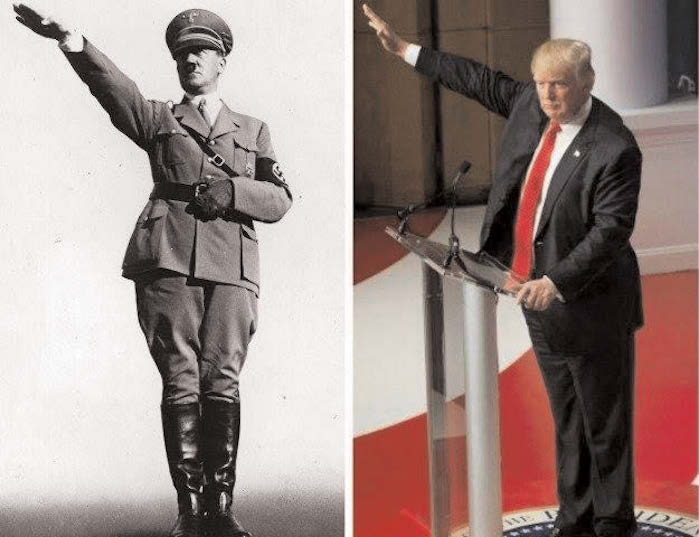
    Two former Mexican presidents, not known for their haste, have compared Trump to Hitler.

    Trump’s racist and extremist rhetoric, for the time being, has allowed him to succeed in rallying the support of angry white Americans in order to win the presidency.

    On the face of it, such extremism could be seen as no more than a campaign tactic to eclipse his opponents, who have been repeating the same old tired slogans and cliches.

    Or, as I wrote previously, Trump’s danger lies not in his political or ideological extremism but rather his vulgar populism. In the process, however, he is further radicalising the American Right.

    And yet, Trump’s rhetoric does not measure up to Baghdadi’s actions. The latter has established a totalitarian “rule” that constantly represses non-Muslims and enslaves the likes of Yazidis in the name of a Caliphate.

    The Bush-Bin Laden precedence

    But when I think of these provocative men dominating global news and of what they may become, I remember George W Bush and Osama bin Laden.

    I remember how they drove the world to the brink through terror and by labelling each other “evil”, each claiming to be holier than thou.

    They gained no greater legitimacy and support than from feeding into each other’s hatred and incitement.

    Each side seemed to sanction the other, and bringing down the evil empire justified all means, including the horrific attacks of 9/11, just as defeating al-Qaeda justified all means, including war and occupation, in addition to torture for good measure.

    Trump is yet to be nominated, let alone elected. Yet his incitement is already feeding into ISIL’s conspiratorial propaganda, just as the latter’s actions are pushing more Americans into Trump’s lap.

    It remains to be seen if or when a “President Trump” will indeed be as reckless as Bush.

    Confronting extremism

    There is no doubt that grievances matter, especially to those most affected. But these should not be used as a ploy to inflame the souls, and drive further extremism.

    Extremism could have different roots and ideologies, and it could harden in self-defence or for self-preservation, and it can result in minor or devastating damage, but in general, the record shows that extremism on one side is no remedy for extremism on the other.

    On the contrary, it provokes more of the same violence and war. And even if it results in short-term gains, the long-term consequences of extremism on the very cause they claim to be fighting for, are generally catastrophic.

    That is why it is high time for the true moderates on all sides; those who believe the means are no less important than the ends; those driven by moral imperatives – not religious bigotry and political and geopolitical greed – to stand together against the immoral extremism that has fuelled the cycle of hatred and violence.

    ——–
    By Marwan Bishara at Al Jazeera.

  • Super Tuesday: Hillary Clinton and Donald Trump rack up more wins

    Super Tuesday: Hillary Clinton and Donald Trump rack up more wins

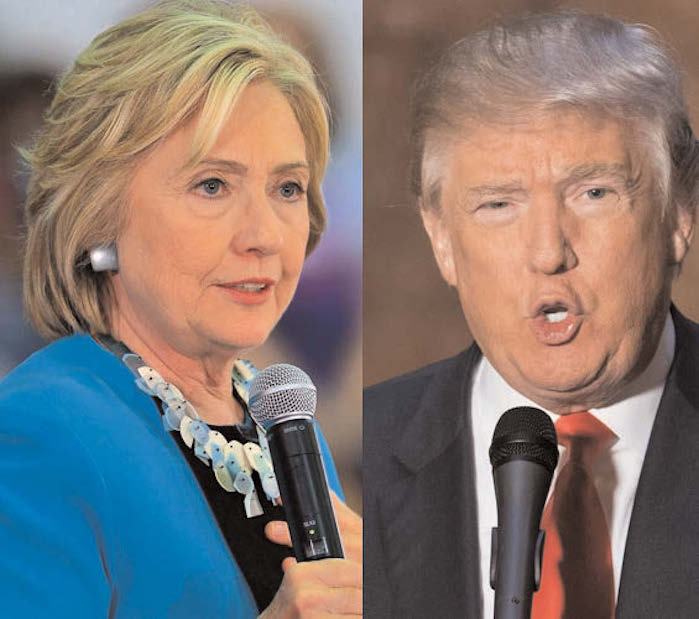
    WASHINGTON (TIP): Democrat Hillary Clinton and Republican Donald Trump have each won the most states on the biggest day of the race for the US presidential nominations.

    The Frontrunners - Democrat Hillary Clinton and Republican Donald Trump
    The Frontrunners – Democrat Hillary Clinton and Republican Donald Trump

    Key Points

    • Republican Donald Trump and Democrat Hillary Clinton dominate ‘Super Tuesday’ primaries
    • Clinton wins seven states but Democrat rival Bernie Sanders has four
    • In Republican race, Senator Ted Cruz wins Texas, Oklahoma and Alaska to prevent a Trump clean sweep. Trump won seven
    • Florida Senator Marco Rubio wins his first state in the race in Minnesota caucuses
    • After earlier votes in four states in recent weeks, Trump leads the Republican field and Clinton the Democratic contest
    • Mr. Trump won seven states while his closest rival, Ted Cruz, took three. The third-placed Republican, Marco Rubio, came in with one.

    Speaking in his home state of Texas, Mr. Cruz urged other Republicans to quit the race and join him against Mr. Trump.

    Democrat Bernie Sanders had wins in four states.

    Super Tuesday saw 11 states voting, from Massachusetts in the east to Alaska in the north-west. A 12th state, Colorado, held a caucus – won by Mr. Sanders – but does not actually select its delegates until April.

    Tuesday allocates nearly a quarter of Republican delegates, and about a fifth of Democratic delegates, who will elect their respective presidential candidates at party conventions in July. No candidate has yet won enough delegates to secure their party’s nomination.

    Mrs Clinton, a former secretary of state, and Mr. Trump, a property tycoon, entered Super Tuesday as favorites to win the vast majority of states for their respective parties.

    The Democratic frontrunner won in Alabama, Georgia, Tennessee, Virginia, Arkansas, Texas and Massachusetts, polling well among blocs of black voters.

    Delivering her victory speech from Miami, having moved her campaign to Florida for the primary there on 15 March, in common with other candidates, she appeared to already be looking towards a potential presidential race against Mr. Trump.

    “The stakes in this election have never been higher and the rhetoric we’re hearing on the other side has never been lower,” she said.

    Donald Trump won the Republican primaries in  Alabama, Georgia, Massachusetts, Tennessee, Virginia, Arkansas and Vermont.

    The billionaire insisted he had “expanded the Republican party”, referring to higher turnout from a broad demographic in states that have already voted.

    He described himself as a “unifier” who could put internal fighting in the Republican party behind him and told reporters in Florida: “Once we get all this finished, I’m going after one person – Hillary Clinton.”

    Super Tuesday states won:

    Donald Trump (Republican): Alabama, Georgia, Massachusetts, Tennessee, Virginia, Arkansas, Vermont

    Ted Cruz (Republican): Texas, Oklahoma, Alaska

    Marco Rubio (Republican): Minnesota

    Hillary Clinton (Democrat): Alabama, Georgia, Tennessee, Virginia, Arkansas, Texas, Massachusetts, and the South Pacific territory of American Samoa

    Bernie Sanders (Democrat): Vermont, Oklahoma, Minnesota, Colorado

  • As we approach Super Tuesday, why most Indian Americans are saying ‘Hillary Clinton Zindabad’

    As we approach Super Tuesday, why most Indian Americans are saying ‘Hillary Clinton Zindabad’

    In my discussions with several fellow Indian Americans, I have heard a common theme when I inquired why they are supporting Hillary Clinton over Bernie Sanders and why they will support her in November over the Republican nominee; Clinton has the most domestic as well as foreign policy experience out of any candidate running and has built close friendships with the Indian American community over the years.  Currently, her key advisors are Indian American and we will likely have more Indian Americans appointed to key posts during a Hillary Clinton administration than any previous administration.

    Super Tuesday

    h-clintonAs we approach Super Tuesday on 1 March, I believe we will see a lot of Indian Americans active in their communities Getting Out The Vote (GOTV) in support of Hillary Clinton.  On Super Tuesday, a total of 865 delegates are up for grabs on the Democratic side.  Alabama, American Samoa, Arkansas, Colorado, Georgia, Massachusetts, Minnesota, Oklahoma, Tennessee, Texas, Vermont, Virginia and democrats abroad will cast their votes.

    I am currently in Virginia joining fellow veterans who are supporting Hillary Clinton as a part of Operation Rolling Victory for Hillary.  Veterans and military families have convened in Virginia to canvass and make calls to Get Out The Vote for Hillary.  Campaign surrogates kicked off the event on Saturday and hundreds of Hillary supporters joined us in Arlington and Alexandria, Virginia.  Senator Tim Kaine (D – Virginia) joined us during a stop at a Latinos for Hillary event in Arlington, Virginia.  He highlighted why he is supporting Hillary over Bernie Sanders and why forty out of forty-four of his democratic colleagues in the United States Senate, who have worked with both Bernie and Hillary have endorsed Hillary instead of Bernie.  He said the reason for their endorsement is definitely not because they believe she is the “establishment” candidate, but it is because they have seen her get things done and keep her promises over and over again.

    Conversations with Indian Americans

    I recently spoke with Mr. Frank Islam, an Indian American business leader and entrepreneur who is my colleague on Hillary for America’s India Policy Working group. Frank currently heads the FI Investment Group, a private investment holding company that he established in 2007 after he sold his information technology firm, the QSS Group.  Frank founded the QSS Group in 1994 and built it from 1 employee to more than 2,000 employees and revenues of approximately $300M before its sale.

    Frank IslamFrank Islam | Frank is a major fundraiser for Hillary’s Campaign and serves on the Campaign’s National Finance Committee.  He has worked hard to engage the Indian American community to get involved and contribute to help Hillary.  Frank told me he is supporting her because Secretary Clinton “has a lifetime of accomplishments and will be able to govern effectively on day one. More importantly, she also has a demonstrated history of concern, compassion and commitment to fighting for the rights of all people no matter their caste, color or creed.  I support the Secretary because she will make America and the world a better place for everyone.”

    My friend Puja Mukherjee, who attended undergraduate studies with me, recently moved to Washington, DC and works for an IT recruiting firm.  While discussing her thoughts on the 2016 race, Puja stated that she is supporting Hillary because she has seen how her policy platforms relate to disability rights and heard her speak about issues pertaining to the protection of minority groups, which are not just limited to racial identities, but include gender identities, sexual identities, and labor groups as well.

    Puja MukerjeePuja Mukherjee | “My family, as immigrants from India have worked so hard to get to where we are now and I believe Hillary Clinton understands the struggle immigrants go through to make it in America. I identify with her not only as a woman, but as a seeker of the path to righteousness, unlike Bernie Sanders who seeks the easy road without paying attention to the groups who have struggled the most.   I also believe she has the best chance to win in November.  The anti-minorities and divisive rhetoric coming from the Republican side is troubling.  I will talk to all my Indian American friends and encourage them to support Hillary.”

    While chatting with my friend Anuj Patel, who went to law school with me, I asked him whom he was supporting for president.  I wasn’t surprised to hear his response.  He was also supporting Hillary Clinton.

    Anuj PatelAnuj Patel | He told me he’s supporting her because “he believes she is the right person to represent us in the world.” As Secretary of State, Hillary Clinton traveled to 112 countries, more than any other Secretary of State.  The international community respects her and with Hillary as our President we can probably bring new allies and partners to join the fight against terrorism and promote world peace.


    “Email Scandal”

    While I was at an event supporting Hillary on Saturday, someone asked me about the “email scandal,” and I’m sure a lot of us have seen misleading media reports about Hillary Clinton’s use of her personal email and that “classified information” may have been exchanged and that she is under FBI investigation. In my discussions with former senior military intelligence officials, they believe Hillary Clinton did not break the law and operated in a similar fashion as her predecessors Colin Powell and Condoleezza Rice.  Any information that has been marked as “classified” has been done retroactively, after she left the State Department.  The FBI also probed former Secretary of State Colin Powell and aides to former Secretary of State Condoleezza Rice.  This has turned into a fishing expedition into finding anything negative about Hillary Clinton and her staff, although her opponents have not had much luck so far. As someone who recently attained my JD from The George Washington University Law School, the key concept I learned while taking Evidence was that you need evidence to prove your case.  There is currently no evidence against Hillary.

  • Don’t know if America is ready for woman president: Hillary Clinton

    Don’t know if America is ready for woman president: Hillary Clinton

    WASHINGTON (TIP): Hillary Clinton has said she is not sure if the US is ready to elect its first woman president even as the Democratic presidential front-runner emphasised that there has been a “big improvement” in people’s perception in this regard.

    “I really don’t know. I think it’s gotten better. I think there still is a very deep set of concerns that people have, which very often they’re not even aware of or they couldn’t articulate,” Clinton, 68, said.

    The former First Lady and the top American diplomat who is aiming to create history by becoming the first woman president of the US was responding to question if the country is ready for it.

    “There’s nothing overt about it in most instances. People are very convinced they want to vote for the right person. And then you know, you get little hints that maybe they’re not as comfortable with a woman being in an executive position,” Clinton said in an interview with ‘Vogue’ magazine.

    “Especially in a big, rough-and-tumble setting like New York City or the United States of America. But I think it’s changing. I’ve noticed a big improvement between now and the last time I ran,” she said.

    Meanwhile, latest opinion polls said more women have shifted to her Democratic primary rival Bernie Sanders.

    Clinton said she believes she is a better candidate.

    “I’d be a good president, having now watched it up close: my husband’s administration, being in the Senate–especially after 9/11–being Secretary of State, spending a lot of time with the national security team and President Obama. I just have a lot of confidence in,” Clinton said.

    “Some people run for president and they don’t know what they don’t know. Some people run for president and they know how hard the job is, but they may not be entirely convinced that this daunting task is one that can be taken on,” Clinton said.

    “I know how hard it is, and I feel very ready and very confident to take it on,” she added.

  • After New Hampshire, Sanders in Focus

    After New Hampshire, Sanders in Focus

    In what is being hailed as a “victory for outsiders”, Bernie Sanders, the underdog in the U.S. Democratic nomination race, stole a march on former Secretary of State Hillary Clinton in the first primary elections of the season, in New Hampshire, and controversial property billionaire Donald Trump captured the most Republican votes. Mr. Sanders, a Senator from Vermont, won 60.4 per cent of the primary vote in the State, leading Ms. Clinton by nearly 22 points. In doing so, he scooped up 15 delegates to her nine and almost instantly attracted a wave of donor funding to his campaign, to the tune of$6.4 million. Although New Hampshire is preponderantly white, the self-proclaimed “Democratic Socialist” won a thumping majority across a variety of demographic cohorts, except for those over 65 years of age and for households earning more than $200,000. While he may have benefited from New Hampshire sharing a border with Vermont, this early upset in Ms. Clinton’s presumed-unassailable lead has thrust Mr. Sanders’s campaign into fourth gear and energized his supporters across the U.S. Importantly, his victory has put the Democratic Party establishment, which until now has thrown its weight behind Ms. Clinton, on notice. Although the party’s “super-delegates” are supporting Ms. Clinton over Mr. Sanders by a margin of 355-14, they may well switch their support to Mr. Sanders if he continues to snatch victories in other States.

    Yet, by no means is it obvious that Mr. Sanders’s call for a “revolution” will thus sway every State. At the national level Ms. Clinton outperforms Mr. Sanders in the support she enjoys with minorities by 71 to 20 per cent. She has vigorously courted the African-American demographic, with a recent visit to Flint, Michigan, to discuss its water-poisoning crisis; she has announced joint campaigns with the families of unarmed African-Americans who died in controversial encounters with law enforcement; and post-New Hampshire she will likely focus her campaign on systemic racism, criminal justice reform, voting rights and gun violence. Mr. Sanders, who will face his first big test with the African-American vote in the mixed demographics of South Carolina and is possibly aware of the weak link in his campaign strategy, met this week with civil rights leader Reverend Al Sharpton to amplify his message of support to this community. It is unclear what dividends such late man oeuvres could yield. The other critical factor is the rise and rise of Mr. Trump. Although he is the philosophical antithesis of Mr. Sanders, they share certain similarities: their attacks on dark pools of campaign finance dominating U.S. elections; their rejection, albeit for different reasons, of the notion of American exceptionalism; and their anti-establishment positions, including distrust of the mainstream media. If these two men float to the top through the primary races, that must reflect Americans’ frustration with the jaded politics of Washington. But equally they must know that each man holds firm to a radically different vision for reshaping their country.


  • Sending troops to Iraq, Syria will be terrible mistake: Hillary Clinton

    Sending troops to Iraq, Syria will be terrible mistake: Hillary Clinton

    WASHINGTON (TIP): Democratic presidential front-runner Hillary Clinton promised not to send US troops to war-torn Iraq or Syria if elected saying it would be a “terrible mistake”, but refused to give any “blanket statement” on overseas deployment of American combat forces.

    “I will not send American combat troops to Iraq or Syria. That is off the table. That would be a terrible mistake,” Clinton said.

    The US, however, will continue to use Special Forces because of the kind of threats America faces, she told a New Hampshire audience during a townhall organised by CNN.

    “The network of terrorist organisations – not just ISIS, but others who are part of this unfortunate network that stretches from North Africa to South Asia – pose serious threats to friends, allies, partners, as well as to ourselves,” she said, using an acronym of the Islamic State.

    “We have got to keep our country safe, and we have to work with the rest of the world to try to defeat ISIS, to end that terrorist threat. So I will be very careful, deliberate with decision makers when facing hard choices, because I know what’s at stake,” said the 68-year-old ex-secretary of state.

    In response to a query from the audience on overseas troop deployment, Clinton said she can’t give a “blanket statement.”

    “I know you can understand why there can’t be from me anyway a blanket statement. But, I want to assure you I will be transparent, I will be open, and I will explain to the American people if any occasion arises where we do have to take military action to protect ourselves or our close friends and partners,” Clinton said.

    Michael, who is opposed to “the US being the world’s policeman”, asked if she can assure him that as a president she would not expand US military involvement abroad?

    Clinton said she believes military force must always be the last resort not a first choice. “That is one of the biggest differences between me and the Republicans,” she said.

    “I will do everything I possibly can to avoid sending American troops abroad, getting us involved in military conflicts,” she said.

    “But I can’t in good conscious stand here and tell you that there would never be any circumstances in the time that I served as President where it very well might be in America’s best vital national security interest,” Clinton said.

    Appearing earlier at the same townhall, Sanders emphasised that the Islamic State needed to be defeated.

    “For a start, in my view, we have got to crush ISIS,” he said.

    “But we have to be not just tough, we have to be smart. That means we work with a large coalition, led by on-the-ground Muslim troops. King Abdullah of Jordan made the point, it will be Muslim troops who destroy ISIS, because ISIS has hijacked their religion,” he said.

    “The US, the UK, France, Germany, Russia provide support, in my view, to the troops on the ground. So we’ve got to crush them. Internally, what we have got to do is significantly improve intelligence,” Sanders said.

    – PTI

  • Donlad Trump holds forte, Hillary Clinton losing ground: Opinion poll

    Donlad Trump holds forte, Hillary Clinton losing ground: Opinion poll

    WASHINGTON (TIP): Republican presidential front-runner Donald Front is holding forte in New Hampshire with a double digit lead over his nearest rival Marco Rubio while Democratic presidential aspirant Bernie Sanders has a massive lead over Hillary Clinton, a latest opinion poll has shown.

    As the results of the Iowa Caucuses came in, the crowded Republican presidential race appeared to be narrowing down to a three-cornered contest with Florida Senator Rubio coming a close third behind Texas Senator Ted Cruz and Donald Trump.

    On the other hand, Vermont Senator Bernie Sanders has a massive two-to-one lead over Democratic presidential aspirant Hillary Clinton, who defeated him in the Iowa polls with a very slim margin of less than half a point, the opinion poll said yesterday.

    Sanders is favoured in New Hampshire’s first-in-the-nation February 9 primary as the state-by-state voting to collect delegates for the party’s nominating convention picks up speed.

    According to the new CNN/WMUR tracking poll was conducted entirely after Iowa Caucus early this week, Trump has support of 29 per cent of likely Republican primary goers, followed by Rubio who has support of 18 per cent. Senator Cruz, who surprised many by winning the Iowa caucus is now trailing third with 13 per cent and is followed very closely by Ohio Governor John Kaisch (12 per cent) and the former Florida Governor Jeb Bush (10 per cent). CNN/WMUR said Clinton is trailing massively in New Hampshire. Sanders has support of 61 per cent of the likely Democratic primary goers, while Clinton has support of just 30 per cent, a drop of four points from the last polls. (PTI)

  • IOWA DEFLATES TRUMP; HILLARY AND SANDERS TIE

    IOWA DEFLATES TRUMP; HILLARY AND SANDERS TIE

    DES MOINES (TIP): The races for the Republican and Democratic presidential nominations are taking shape now that brave Iowans have had their say.

    In some cases, the results confirmed conventional wisdom. In others, it totally reshaped it.

    For the Republicans, it was Ted Cruz with (28%) who bested Donald Trump who got 24% and Marco Rubio who surprisingly cut in to the vote share of Donald Trump to get an unexpected 23%.

    For the Democrats, it was a much keener competition between Hillary Clinton and Bernie Sanders who were tied at 50%.

    Here are five things we learned after a remarkable evening in America’s heartland.

    donald trump1. Donald Trump isn’t untouchable – For the past few months it seemed as though the New York real estate mogul had become an unrivalled political savant. Every move he made, no matter how questionable, only strengthened his standing among conservative voters.

    That bubble, however, has burst. Despite leading in the Iowa polls for the past several weeks, Mr. Trump was bested by rival Ted Cruz on caucus night. In the end Mr. Trump’s much-heralded cadre of new voters didn’t show up in the predicted numbers and Mr. Cruz’s formidable ground game, backed by strong evangelical support, carried the day.

    This hardly means it’s the end for Mr. Trump. He may well hold onto his large lead in New Hampshire, a state where the conservative voters often embrace the renegade outsider, and find success in the Southern primaries that follow. The notion that the New Yorker could steamroll his way to the Republican nomination, however, has now been firmly dispelled.

    marco rubio2. Marco Rubio has given the establishment hope – Florida Senator Marco Rubio’s speech in Iowa on Monday night sounded more like a victory celebration than the concession speech of a third-place finisher. By finishing with 23% of the vote, however – a hair’s breadth from second-place Trump – Mr. Rubio shattered pre-caucus expectations.

    This is the kind of Iowa result that candidates like New Jersey’s Chris Christie, former Florida Governor Jeb Bush and Ohio Governor John Kasich were dreading. They have placed all their hopes in New Hampshire, and now they’ll have to face off against a man who has the political wind at his back.

    This is the kind of Iowa result that candidates like New Jersey’s Chris Christie, former Florida Governor Jeb Bush and Ohio Governor John Kasich were dreading. They have placed all their hopes in New Hampshire, and now they’ll have to face off against a man who has the political wind at his back.

    The polls for Mr. Rubio in the coming states haven’t looked particularly encouraging, but that could quickly change. And even if he suffers setbacks in the Southern states that follow New Hampshire, he likely will have the resources to wage a long fight for the nomination.

    Democrats3. The Democrats are in a dogfight – At this point it comes as little surprise that Vermont Senator Bernie Sanders and former Secretary of State Hillary Clinton finished in a virtual tie in Iowa – polls had been indicating such a result was likely.

    Nevertheless, the outcome marks a significant achievement for Mr. Sanders, who was polling in single digits in Iowa six months ago.

    Mrs. Clinton is simply not going to be able to deliver the knockout punch to her rival the way she once had hoped. Instead, she faces a likely defeat in New Hampshire -where the Vermonter is strong – and then a protracted fight across the country that could last at least through March.

    She still has the greater financial resources and a much more developed campaign infrastructure, but she had those advantages in Iowa as well. The electorate will change, however – becoming more moderate and more ethnically diverse. There is more hospitable ground ahead for Mrs. Clinton – but a nomination victory, if it comes, will take time to realize.

    ted cruz4. Ted Cruz is built to last – If Mr. Cruz had been defeated in Iowa it would have been a devastating blow to his campaign. He had raised expectations of a victory in the caucuses and heralded it as proof that he could build a coalition of evangelical, grass-roots Tea Party and libertarian voters.

    As it turns out, that coalition exists – and it will likely re-emerge after New Hampshire, as South Carolina and other Southern states hold their primary contests.

    Mr. Cruz has nearly $20m in campaign cash on hand and supporting political committees with even greater resources. He’s built a political machine that can operate through the entire primary calendar and, if necessary, wage a two-front battle with Mr. Trump and an establishment-backed candidate like Mr. Rubio.

    In his victory speech on Monday night, Mr. Cruz credited his grass-roots organization – as he should – but he also gave Republicans a look at a more moderate, general-election version of himself. He’ll need to convince his party that he is a candidate who can beat the Democrats in November. This was his first step toward making that pitch.

    5. The field is about to thin dramatically – Democrat Martin O’Malley is gone, as is Republican Mike Huckabee & Rand Paul and – in all likelihood, Rick Santorum.

    There were rumors abounded that Ben Carson was poised to exit. Although his camp quickly denied this, the retired surgeon’s 9% performance in a state that once viewed him as a front-runner likely means the end is near.

    Carly Fiorina’s bid is on life support, and Rand Paul – at one point thought to be a contender for the nomination – garnered less than 5%, a far cry from his father’s 21%in Iowa just four years ago.

    New Hampshire will likely cull the herd even further, threatening the future of candidates like Mr. Bush, Mr. Christie and Mr. Kasich if they can’t slow Mr. Rubio’s momentum.

    The Republican race for the nomination isn’t likely to end anytime soon, but there are about to be a lot fewer candidates on the debate stage in the coming weeks.

    Also-Rans: 2016 Presidential Race – These are the candidates who have dropped out of the 2016 presidential race. Scott Walker (R),Rand Paul (R), Rick Perry (R), Mike Huckabee (R), Lindsey Graham (R), Bobby Jindal (R), Martin O’Malley (D),George Pataki (R), Rick Santorum R), Jim Webb (D).

  • Obama rebuts anti-Muslim rhetoric in first U.S. mosque visit

    Obama rebuts anti-Muslim rhetoric in first U.S. mosque visit

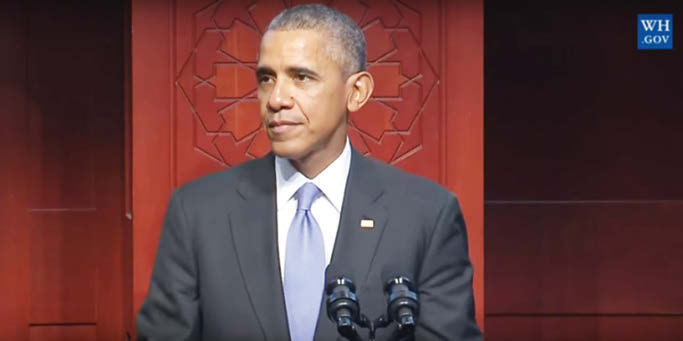
    NEW YORK (TIP): President Barack Obama, in his first presidential visit to a mosque in the United States, said Wednesday, Feb 3, he was seeking to rebut “inexcusable political rhetoric against Muslim-Americans” from Republican presidential candidates.

    Speaking to a packed house at the suburban mosque, Obama noted that violence against the Muslim American and Sikh American communities has surged in the aftermath of the Paris terrorist attacks last November – in which extremists affiliated with the Islamic State killed 183 people – and the San Bernardino shootings in December, when a Muslim American couple killed 14 people at a rehabilitation center for handicapped people.

    Attempting to recast what he said was a warped image of Islam while encouraging members of the faith to speak out against terror, Obama described Muslims as essential to the fabric of America.

    As he decried GOP counterterror plans that would single out Muslims for extra scrutiny, Obama insisted that applying religious screens would only amplify messages coming from terrorist groups. In his final year in office, Obama has sought to use his public platform — however waning –to advocate against what he sees as dangerous threads in the political discourse.

    “We can’t be bystanders to bigotry,” Obama said. “Together, we’ve got to show that America truly protects all faiths. As we protect our country from terrorism, we should not reinforce the ideas and the rhetoric of the terrorists themselves.”

    “I know that in Muslim communities across our country, this is a time of concern and, frankly, a time of some fear. Like all Americans, you’re worried about the threat of terrorism,” said the president, who removed his shoes before entering the mosque, in deference to Islamic custom. “But on top of that, as Muslim Americans, you also have another concern – that your entire community so often is targeted or blamed for the violent acts of the very few,” he said.

    “I’ve had people write to me and say, ‘I feel like I’m a second-class citizen.’ I’ve had mothers write and say, ‘my heart cries every night,’ thinking about how her daughter might be treated at school. A girl from Ohio, 13 years old, told me, ‘I’m scared.’ A girl from Texas signed her letter ‘a confused 14-year-old trying to find her place in the world,’” said Obama.

    “These are children just like mine. And the notion that they would be filled with doubt and questioning their places in this great country of ours at a time when they’ve got enough to worry about – it’s hard being a teenager already – that’s not who we are.”

    “We’re one American family. And when any part of our family starts to feel separate or second-class or targeted, it tears at the very fabric of our nation,” said the president, thanking Muslim Americans for serving the U.S.

    Obama stated that hate crimes must be reported and punished. He encouraged the community to speak out against hateful rhetoric and violence against any faith, and to reject religious extremism.

    The president rejected the notion that America is ‘at war with Islam’, stating: “We can’t be at war with any other religion, because the world’s religions are a part of the very fabric of the United States, our national character. And we can’t suggest that Islam itself is at the root of the problem. That betrays our values. It alienates Muslim Americans.”

    Obama said law enforcement should not use engagement with the Muslim American community as a tool for surveillance. He noted, however, that several government agencies are specifically targeting Muslim youth.

    “We’re going to have to be partners in this process. There will be times where the relationship is clumsy or mishandled. But I want you to know that from the president to the FBI director, to everybody in law enforcement, my directive and their understanding is that this is something we have to do together. And if we don’t do it well, then we’re actually not making ourselves safer; we’re making ourselves less safe,” he said.

    White House press secretary Josh Earnest told reporters Feb. 2: “It’s certainly true that we’ve seen an alarming willingness on the part of some Republicans to try to marginalize law-abiding, patriotic Muslim Americans.”

    “I think it’s just offensive to a lot of Americans who recognize that those kinds of cynical political tactics run directly contrary to the values that we hold dear in this country. And I think the president is looking forward to the opportunity to make that point,” Earnest told reporters, as reported by PTI.

    Trump chided Obama for the mosque visit. “He can go to lots of places. I don’t know, maybe he feels comfortable there,” Trump told Fox News.

    Republican presidential candidate Marco Rubio also lashed out against Obama’s mosque visit, criticizing the president for “pitting people against each other.”

    “He’s basically saying that America is discriminating against Muslims,” said Rubio during a town hall meeting in New Hampshire, acknowledging that there was discrimination, but radical Islam is a bigger threat.

  • Bill Clinton paints candidate Hillary as ‘changemaker’

    Bill Clinton paints candidate Hillary as ‘changemaker’

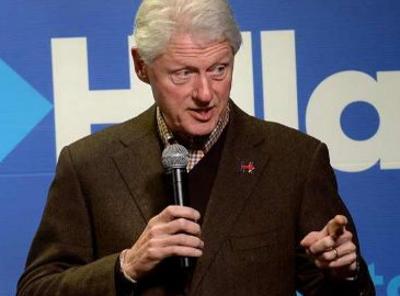
    MASON CITY: Former president Bill Clinton was back on the campaign trail in Iowa on Wednesday, calling his presidential candidate wife Hillary a changemaker as her rival surged ahead in a new poll.

    “There’s only one person who is a proven changemaker on hostile territory,” the ex-president told a crowd of 325 in Iowa state, which holds its caucuses Monday, with his wife in a close race for the Democratic party’s presidential nod.

    Across the small town of Mason City that same evening, her rival Senator Bernie Sanders was hosting a larger rally with Hollywood star Susan Sarandon on hand.

    Sanders, who calls himself a Democratic socialist, is calling for a revolution against the “billionaire class.”

    The Clintons say Sanders’ call for a single-payer universal health care system is unrealistic.

    “I will not make perfect the enemy of good. People can’t wait,” Bill Clinton thundered on health care policy.

    He said his wife’s gradual approach was best.

    “Everything she has ever touched, she made something good happen,” he said. “She’s a born changemaker.”

    “She is a walking, breathing change agent, the only person qualified and has the knowledge on economic and social issues, and political issues and national security issues,” Bill Clinton argued.

    A new poll showed Sanders leading Clinton by four percentage points among likely Democrat participants in Monday’s much-anticipated Iowa caucuses.

    The Quinnipiac University poll showed the former secretary of state at 45 percent with Sanders, a senator from Vermont, nudging ahead with 49 percent.

    (AP)

  • If Trump wins the nomination, prepare for the end of the conservative party

    If Trump wins the nomination, prepare for the end of the conservative party

    When Republicans gather for their next thought process before the primaries in 2016, one of the main issues all the candidates should be required to address is what each thinks of the controversial statements and arguments that Donald Trump has made about everything from Russia, Foreign Policy, Domestic Policy & how to fight ISIS.

    Playing to fears can help candidates gain attention from the news media and the electorate, and it offers an easy way to depict their opposition as incapable of leading. According to a recent New York Times/CBS News poll, fears of terrorism have boosted Trump’s position.

    Trump has a habit of taking campaign rhetoric to more dramatic places. In response to the horrific series of attacks conducted by ISIS, Trump kept saying things that led observers to ask whether he had finally reached the tipping point of going so far that there would be an electoral backlash.

    Last month, Trump said that he would ban all Muslims from traveling to the United States. He has called for a federal registry of Muslims, while also promising to “take out” the families of terrorists. Trump says he would bring back the use of waterboarding. If it didn’t work, well, “they deserve it anyway,” he said. Trump has complained that Americans are too politically sensitive about profiling people who could be potential terrorist threats and “that’s part of the problem we have with our country.”

    There has been a noticeably tough response from Republicans. “We need to aggressively take on radical Islamic terrorism but not at the expense of our American values,” said RNC Chairman Reince Priebus. “This is not conservatism,” said House Speaker Paul Ryan.

    But some are skeptical about where the GOP stands. The New York Times editorial board published a blistering piece about Trump’s influence, writing, “The Republican rivals rushing to distance themselves from his latest inflammatory proposal … have been peddling their own nativist policies for months or years. They have been harshening their campaign speeches and immigration proposals in response to the Trump effect.”

    Trump’s embrace of the politics of fear is not that surprising. There is a long tradition in campaigns of candidates who have played to the worst sentiments of the electorate during times when there are serious national security threats.

    History’s lessons
    Historically, when politicians recklessly use the politics of fear, bad things happen. On the most basic level, damaging rhetoric results in injustices being committed to innocent citizens. For example, World War I had a devastating impact on many German-Americans. Other immigrant groups were harassed and saw their loyalty questioned. In April 1918, Robert Prager, a German coal miner who had applied for U.S. citizenship, was lynched by a mob. In 1919 and 1920, Attorney General Mitchell Palmer led a massive crackdown on individuals and groups associated with the left during the “red scare.” In the years that followed, nativism fused with anti-communism to produce a severe crackdown on immigration.

    Japanese-Americans were forced to live in internment camps during World War II, an action that has remained a huge black mark on Franklin Roosevelt’s record as commander in chief, as was his adminstration’s refusal to admit Jewish refugees who were desperately fleeing from Nazi Germany.

    In 1968, George Wallace’s independent campaign for president stirred up racial and social resentment against the gains on racial equality and civil rights in the 1960s.

    There are also political dangers for the Republican Party in using this kind of rhetoric, even though it often seems appealing in the short term. For decades, Democrats paid the price for being the party that intensified the war in Vietnam.

    In the early 1980s, when Ronald Reagan used pointed language to speak about the “Evil Empire” of the Soviet Union, advisers urged him to be more proactive in pursuing peace after fears emerged in 1983 of the possibility of a nuclear war. President George W. Bush’s war in Iraq dragged down his presidency. It is not clear right now, even if polls temporarily show support for ground troops in Syria, that the nation would really be willing to take on another protracted ground war that will cost human lives and a big chunk of our national budget.

    Finally, there are huge policy dangers that come from this kind of fear strategy, as it has historically stimulated a dynamic that drives political parties into poor decision-making. This undermines the nation’s ability to effectively combat threats.

    During the 1950s, too many members of both parties sat by silently as Joseph McCarthy and his allies cast an extraordinarily wide net in the search for alleged communists in the United States, violating civil liberties and damaging lives in the process. These actions polarized and divided a nation otherwise united in the fight against communism.

    The end of the conservative party

    If you look beyond Donald Trump’s comprehensive unpleasantness – is there a disagreeable human trait he does not have? -you might see this: He is a fundamentally sad figure. His compulsive boasting is evidence of insecurity. His unassuageable neediness suggests an aching hunger for others’ approval to ratify his self-admiration. His incessant announcements of his self-esteem indicate that he is not self-persuaded. Now, panting with a puppy’s insatiable eagerness to be petted, Trump has reveled in the approval of Vladimir Putin, murderer and war criminal.

    Putin slyly stirred America’s politics by saying Trump is “very .?.?. talented,” adding that he welcomed Trump’s promise of “closer, deeper relations,” whatever that might mean, with Russia. Trump announced himself flattered to be “so nicely complimented” by a “highly respected” man: “When people call you brilliant, it’s always good.” When MSNBC’s Joe Scarborough said Putin “kills journalists, political opponents and invades countries,” Trump replied that “at least he’s a leader.”

    Besides, Trump breezily asserted, “I think our country does plenty of killing also.” Two days later, Trump, who rarely feigns judiciousness, said: “It has not been proven that he’s killed reporters.”

    Well. Perhaps the 56 journalists murdered were coincidental victims of amazingly random violence that the former KGB operative’s police state is powerless to stop. It has, however, been “proven,” perhaps even to Trump’s exacting standards, that Putin has dismembered Ukraine. (Counts one and two at the 1946 Nuremberg trials concerned conspiracy to wage, and waging, aggressive war.)

    Until now, Trump’s ever-more-exotic effusions have had an almost numbing effect. Almost. But by his embrace of Putin, and by postulating a slanderous moral equivalence -Putin kills journalists, the United States kills terrorists, what’s the big deal, or the difference? – Trump has forced conservatives to recognize their immediate priority.

    Certainly conservatives consider it crucial to deny the Democratic Party a third consecutive term controlling the executive branch. Extending from eight to 12 years its use of unbridled executive power would further emancipate the administrative state from control by either a withering legislative branch or a supine judiciary. But first things first. Conservatives’ highest priority now must be to prevent Trump from winning the Republican nomination in this, the GOP’s third epochal intraparty struggle in 104 years.

    In 1912, former president Theodore Roosevelt campaigned for the Republican nomination on an explicitly progressive platform. Having failed to win the nomination, he ran a third-party campaign against the Republican nominee, President William Howard Taft, and the Democratic nominee, New Jersey Gov. Woodrow Wilson, who that November would become the first person elected president who was deeply critical of the American founding.

    TR shared Wilson’s impatience with the separation of powers, which both men considered an 18th-century relic incompatible with a properly energetic executive. Espousing unconstrained majoritarianism, TR favored a passive judiciary deferential to elected legislatures and executives; he also endorsed the powers of popular majorities to overturn judicial decisions and recall all public officials.

    Taft finished third, carrying only Utah and Vermont. But because Taft hewed to conservatism, and was supported by some other leading Republicans (e.g., Sen. Henry Cabot Lodge, one of TR’s closest friends, and Elihu Root, TR’s secretary of war and then secretary of state), the Republican Party survived as a counterbalance to a progressive Democratic Party.

    In 1964, Barry Goldwater mounted a successful conservative insurgency against a Republican establishment that was content to blur and dilute the Republican distinctiveness that had been preserved 52 years earlier. Goldwater defeated New York Gov. Nelson Rockefeller for the nomination, just as Taft had defeated TR, a former New York governor. Like Taft, Goldwater was trounced (he carried six states). But the Republican Party won five of the next seven presidential elections. In two of them, Ronald Reagan secured the party’s continuity as the custodian of conservatism.

    In 2016, a Trump nomination would not just mean another Democratic presidency. It would also mean the loss of what Taft and then Goldwater made possible – a conservative party as a constant presence in U.S. politics.

    It is possible Trump will not win any primary, and that by the middle of March our long national embarrassment will be over. But this avatar of unfettered government and executive authoritarianism has mesmerized a large portion of Republicans for six months. The larger portion should understand this:

    One hundred and four years of history is in the balance. If Trump is the Republican nominee in 2016, there might not be a conservative party in 2020 either.

  • Hillary Clinton Disapproves of  Increased Deportations & Raids

    Hillary Clinton Disapproves of Increased Deportations & Raids

    WASHINGTON (TIP): Immigration is one of the leading issues in the 2016 race and a spike in raids in recent weeks, largely aimed at women and children, has drawn the ire of rights groups.

    Hillary Clinton has called for an end to deportation raids targeting Central American families living in the US illegally.

    Mrs. Clinton said the raids “have sown fear and division in immigrant communities across the country”.

    Scores of House Democrats on Tuesday, Jan 12, echoed Mrs. Clinton and demanded the raids stop.

    Democratic President Barack Obama has been assailed by both political parties on this issue.

    More than two million undocumented migrants have been deported from the US during his presidency, prompting accusations of being “deporter-in-chief” from within his own party.

    But his Republican critics attack his administration for not doing enough to secure the borders.

    They are also deeply opposed to his plan to lift the threat of deportation to 11 million people who have been living illegally in the US for some time.

    Thousands have come over the border with Mexico in the last two years, mostly fleeing violence in Central America.

    The raids spiked over the holiday season, with 121 adults and children arrested, mainly in Texas, Georgia and North Carolina.

    Why are the raids happening?
    They come as fears grow that a spike in immigration from Central America may be foreshadowing a repeat of the 2014 crisis that saw tens of thousands of migrants – especially unaccompanied children – cross the border.

    The White House has defended the raids, with spokesman Josh Earnest saying the president was aware of the outrage but that “the enforcement strategy and priorities that the administration has articulated are not going to change”.

    The Obama administration has unilaterally enacted immigration reform to protect undocumented immigrants who have been in the country a long time, but has said deportations would continue. In February, Mr. Obama said that the forced removals would be “focusing on potential felons”.

    What has the reaction been?
    The raids have riled lawmakers and activists, who say they are disruptive and ill-timed, and were breaking families apart as well as spreading fear across immigrant communities.

    Rep Nydia Vlazquez, a member of the Hispanic caucus, said that “immigrants and their families are terrorized”.

    “These are some of the most vulnerable members of society and we are treating them like criminals.”

    The anger prompted White House officials to meet with politicians on Thursday in an attempt to dampen the anger.

    That failed to stop 135 Democrats from co-signing a letter asking that the raids stop immediately.

    “We strongly condemn the Department of Homeland Security’s recent enforcement operation targeting refugee mothers and children from El Salvador, Honduras, and Guatemala,” the letter reads.

    How has immigration played in the 2016 campaign?
    Republican candidate Donald Trump prompted a weeks-long outrage over the summer when he described Mexican immigrants as “rapists” and “criminals” and called for a wall to be built on the southern border.

    Meanwhile, one of his rivals, Marco Rubio, is framing the issue as one of national security, saying that radical jihadist groups could exploit the immigration system.

    Mr. Rubio’s support for immigration reforms in the past could be a liability for the candidate during primary elections, as he attempts to climb to the top of the crowded and mainly conservative Republican pack.

    Democrats have taken a different approach to the issue, urging a humanitarian response.
    Senator Bernie Sanders, currently in second place, wrote a letter to President Obama earlier this month saying: “I urge you to immediately cease these raids and not deport families back to countries where a death sentence awaits.”

    Martin O’Malley, who is in a distant third place, has attacked his two rivals saying that their support for immigrants was recent and politically expedient.

  • Bill Clinton, the subdued spouse, makes his campaign debut

    Bill Clinton, the subdued spouse, makes his campaign debut

    WASHINGTON (TIP): Eight years after aggressively defending his wife during her first presidential campaign, Bill Clinton was unusually understated and subdued Monday during his first solo swing back in New Hampshire for Hillary Clinton, restraining himself even in the face of taunts from Donald Trump.

    Sticking mostly to descriptions of Hillary Clinton’s policy positions and biography, the former president made only glancing references to her opponents, saying that some were “kind of scary” but not naming names. He also suggested that he would not thrive politically today because he was not “mad at anybody,” an implicit jab at Trump’s harsh attacks on Muslims and others — and a signal that Trump had not gotten under Bill Clinton’s skin.

    With Trump campaigning Monday night just across the state line in Lowell, Massachusetts, Clinton did not bring up his onetime friend’s recent attacks on Clinton’s history of extramarital affairs. But after the first of his two campaign events, Clinton did respond to a reporter’s question about whether his own past was “fair game” to talk about in the race.

    “The Republicans have to decide who they want to nominate,” Clinton replied. “I think there’s always attempts to take the election away from people, so I’m just going to give it to them.”

    At a rally in Lowell, Massachusetts, just a few miles from New Hampshire, Trump, calling himself “a messenger in a sense,” harshly criticized Hillary Clinton but did not mention Bill Clinton. In an interview, Trump said he brought up Bill Clinton’s past simply as a response to provocation. “I would be inclined to just let it go” if the Clintons never again accused him of sexism, Trump said.

    If Bill Clinton was champing at the bit to attack Trump, he gave no sign of it Monday.

    Famed as the Big Dog of American politics, Bill Clinton seemed to be on a tight leash during his appearances in Nashua and Exeter, delivering performances far different from the ones he gave in 2008, when some Democrats criticized him for overshadowing Hillary Clinton with his attacks on then-Sen. Barack Obama.

    (NYT News Service)

  • The on-off ties with the US

    The on-off ties with the US

    Travelling from east to west in the US, from the Atlantic to the Pacific, gave one an occasion to see the world’s sole superpower totally preoccupied in dealing with the aftermath of a terrorist strike. This terrorist attack, in which 14 innocent people were gunned down in the small town of San Bernardino in southern California, was executed by an immigrant couple of Pakistani origin. The uproar and outrage that followed, led to strident calls for ending immigration of Muslims, who are facing personal attacks, insults and desecration of their places of worship across the country. It is ironic that in the recent past, the US has been pontificating on the need for “tolerance” in India.

    modi obamaOne consequence of these developments has been the admiration in important sections of the American Establishment at how India, with an estimated Muslim population of 180 million, has maintained communal peace and harmony. It has been noted, that unlike in the US and Europe, few, if any, Indian Muslims have shown interest in joining the ranks of global terrorist organisations like the Al-Qaeda earlier, or the IS now. While visiting the US recently, Defence Minister Manohar Parrikar asserted that India is confident that its Muslim citizens will not be radicalised. Meetings with well-connected US friends in Washington and New York revealed a marked improvement in the climate of relations and widespread bipartisan support for India in the US Congress. The India-US relationship is, however, viewed by the Obama Administration in predominantly transactional terms. There is little empathy, or understanding, for India’s policies and concerns in its western neighbourhood, ranging from Pakistan and Afghanistan, across the Mediterranean, to Turkey. There are also questions about the reliability of the US to abide by commitments made on India’s “Act East” policies.

    Whether in New York, Washington or California, one could not help noting the widespread feeling that Prime Minister Narendra Modi has introduced qualitatively new dimensions in reinvigorating the US-India relationship. This was especially evident in the growing confidence about India in large sections of the business, industrial and high-tech establishments. The target of expanding the levels of bilateral trade in goods and services from $100 billion annually to $500 billion is no longer regarded as a pipe dream. There is confidence that India will continue on the path of perhaps being the fastest growing economy in the world in the years ahead. American business is, for the first time, seriously taking note of Indian determination to emerge as a strong industrial power by enhancing its manufacturing capabilities. American industries, in areas ranging from aerospace to motorcars, are now showing increasing confidence in India’s emergence as a significant industrial partner.

    It is fortuitous that after an era when the Pentagon showed little interest in understanding India’s defence needs and strategic compulsions, the present Defence Secretary, Ashton Carter, recognises that India cannot be treated like Pakistan or Turkey. New Delhi has well-established defence partnerships with major arms suppliers like Russia, Israel, France, Germany and the UK. Japan has now joined this list of strategic partners. It is in this background, that readiness is now being shown by the US arms industry and the Pentagon to expand areas of cooperation into fields like aero-engines for multi-role combat aircraft, aircraft carriers, artillery and attack helicopters. This development has to be assiduously utilised to leverage our relations with other partners like Russia, where we have been experiencing problems of escalating prices and poor serviceability of critical weapons systems.

    These developments do not mean that relations with the US are free of problems. In our immediate western neighbourhood, we are seeing the emergence of a tripartite US-China-Pakistan partnership to promote reconciliation with the Taliban, in a process from which India has been deliberately excluded. A return of the Taliban to the corridors of power in Afghanistan will have serious consequences for India’s security, given the Taliban’s past record and close ties with anti-Indian groups like the Jaish-e-Mohammed and the Lashkar-e-Taiba. In deference to Pakistani exhortations, the US has left the Afghan armed forces ill-equipped to face the Taliban-ISI challenge to the country’s sovereignty. While India is providing three attack helicopters, it needs to do far more to strengthen Afghan capabilities in areas like artillery, armoured vehicles and aircraft. Proactive diplomacy with Russia, its Central Asian partners neighbouring Afghanistan and Iran is required to achieve this.

    The US shows little interest in a meaningful dialogue with India on developments in West Asia, evidently because of its traditional policy of looking at this region through a Pakistani prism. Washington needs to be reminded that India has crucial interests in this region, where six million Indians live, remitting back around $50 billion annually. India, which is a major importer of oil and gas, is one of the few countries which enjoys cordial relations with all three major regional powers – Saudi Arabia, Iran and Israel. India can play a useful role in encouraging de-escalation of regional tensions. Moreover, unlike its western neighbours, India is not afflicted by Shia-Sunni tensions.

    There are indications that even in India’s eastern neighbourhood, President Obama is backtracking on promises he made on India’s quest for greater integration with institutions across the Indo-Pacific Region. This includes Mr Obama’s written commitment to back India’s membership of APEC. Trade lobbies in the US are now linking APEC membership for India to New Delhi diluting its stand on a host of issues, ranging from Intellectual Property Rights to trade liberalisation. It is being pointed out that Indian policies do not permit it to get membership of the American-led Trans-Pacific Partnership – a free trade area in which all major trading partners across India’s eastern shores, except perhaps for the present China, are set to join. This could lead to a loss of about $50 billion in India’s exports, including crucial areas like textiles. While President Obama is determined to push through legislation approving the setting up of the Trans-Pacific Partnership, he has just over a year left in office. This is a period India should utilise to determine how it would deal with the incoming Administration. India is now well positioned to have a business-like relationship with anyone who comes to power, be it Hillary Clinton, or even the mercurial Donald Trump!

    (A former diplomat the author is Visiting Professor at the Centre for Policy Research, New Delhi, and a Senior Fellow at the Centre for Strategic and International Studies in New Delhi)

  • Petition seeking to get Donald Trump banned from entering UK already passes 370,000 signatures

    Petition seeking to get Donald Trump banned from entering UK already passes 370,000 signatures

    LONDON (TIP): A petition calling for Republican presidential hopeful Donald Trump to be barred from entering the UK has gathered more than 370,000 names, so MPs will have to consider debating it.

    The petition went on Parliament’s e-petition website on Tuesday, December 8, 2015. It was posted in response to Trump’s call for a temporary halt on Muslims entering the United States.

    Chancellor George Osborne criticized Trump’s comments but rejected calls for him to be banned from the UK.

    A counter-petition, set up on Wednesday, saying Trump should not be banned as it would be “totally illogical” has attracted more than 9,000 signatures.

    Any petition with more than 100,000 signatures is automatically considered for debate in Parliament.

    Trump is seeking the Republican nomination for next year’s US presidential election.

    He said on Wednesday, December 9, he would never leave the 2016 race, despite the volume of calls for him to step aside. In some related developments on the issue, Scotland’s First Minister Nicola Sturgeon has stripped Trump of his status as a business ambassador for Scotland.

    Aberdeen’s Robert Gordon University has revoked Trump’s honorary degree, which he received in 2010 in recognition of his achievements as an entrepreneur and businessman.

    One of the Middle East’s largest retail chains, Lifestyle, has withdrawn Donald Trump products from its shelves following his comments.

    The full text of the petition – entitled “Block Donald J Trump from UK entry” – reads: “The UK has banned entry to many individuals for hate speech. The same principles should apply to everyone who wishes to enter the UK.

    “If the United Kingdom is to continue applying the ‘unacceptable behaviour’ criteria to those who wish to enter its borders, it must be fairly applied to the rich as well as poor, and the weak as well as powerful.”


    Could Donald Trump be banned from the UK?

    • Labour home affairs spokesman Jack Dromey and Green Party leader Natalie Bennett have backed the petition to ban Trump from entering the country, with Conservative MP Sarah Wollaston saying the proposal merited “serious discussion”
    • The Home Office has powers to ban speakers from overseas coming to the UK under the “unacceptable behaviours or extremism exclusion policy”
    • Last year, Home Secretary Theresa May said she had excluded “hundreds” of people
    • People banned from entering the UK under the exclusion policy in recent years include leaders of the Westboro Baptist Church, Islamist preachers and Ku Klux Klan officials, and two anti-Muslim bloggers


    How Petitions work in UK

    In 2011, the coalition government launched a new e-petition site, with the prospect of a debate if 100,000 signatures are reached.

    Petitions which reach the required number of signatures are almost always debated in Parliament, but the government might decide not to put a petition forward for debate if the issue has already been debated recently or there is one scheduled for the near future. Petitions that pass 10,000 signatures receive a response from the government.

    The petition is initially handled by the Petitions Committee, set up by the House of Commons and comprising up to 11 backbench MPs from government and opposition parties. Petitions can be rejected for a number of reasons, including for being about something that the UK government or Parliament is not responsible for, or is nonsensical.

    Topics put up for petition have included the introduction of mandatory drugs tests for MPs, the full disclosure of all government documents relating to the Hillsborough disaster, and minimum prices for milk.

    But while a Parliament debate is a good way to raise the profile of an issue with lawmakers, it does not automatically follow that there will be a change in the law. In 2015 there were 14 petitions debated in Parliament, but none directly brought about any change in UK laws.

    Source: Petitions website


    Labour’s Tulip Siddiq, MP for Hampstead and Kilburn, also called for Mr Trump to be banned from the UK after he claimed that parts of London were “so radicalised” that police were “afraid for their own lives”.

    Mr Trump’s comments about the UK capital previously led to London Mayor Boris Johnson saying “the only reason I wouldn’t go to some parts of New York is the real risk of meeting Donald Trump”.

    He added: “Donald Trump’s ill-informed comments are complete and utter nonsense.

    “As a city where more than 300 languages are spoken, London has a proud history of tolerance and diversity and to suggest there are areas where police officers cannot go because of radicalisation is simply ridiculous.”

  • Hillary Clinton: Donald Trump no longer funny

    Hillary Clinton: Donald Trump no longer funny

    WASHINGTON: Hillary Clinton took aim at fellow White House hopeful Donald Trump over his call to ban Muslims from entering the United States, saying: “I no longer think he is funny.”

    Appearing on NBC’s “Late Night with Seth Meyers” later Thursday, the frontrunner for the Democratic presidential nomination said Trump had overstepped the mark with his latest comments.

    “You know, I have to say, Seth, I no longer think he is funny,” Clinton said, according to NBC News.

    “I think for weeks you and everybody else were just bringing folks to hysterical laughter, but now he has gone way over the line.

    “And what he is saying now is not only shameful and wrong, it is dangerous.”

    Trump, the frontrunner for the Republican nomination, came under fire at home and abroad this week for his proposal to temporarily bar Muslims from entering the US.

    It came in the wake of last week’s shooting by a Muslim couple in Sen Bernardino, California, that left 14 dead.

  • Donald Trump Vs. Adolf Hitler

    Donald Trump Vs. Adolf Hitler

    After Trump’s call to ban Muslims from America drew comparisons with the Nazi dictator, Adolf Hitler, some have started refereeing to him as “The New Fuhrer”. A spokesperson for the Council on America-Islamic Relations compared Trump’s  venomous attack on Muslims to Nazi rhetoric from the 1930s, saying the Republican candidate “sounds more like a leader of a lynch mob than a great nation like ours.”

    Whatever one may think of it, businessman Donald Trump’s recent call for a temporary ban on Muslim immigration is in no way directly comparable to the very genuine horrors of the Holocaust, or the murderous regime of Adolf Hitler; however, it does share some early signs of the horror to come which Hitler showed in his book “Mein Kampf”.

    Words can be wielded both for good and for evil. Mr. Trump’s continuous use of dark powerful words in his bid for the White House  will have an everlasting effect on American way and the values we are known for.

    Free speech Vs. Hate speech Vs. Plan Sedition – His way with words has rarely been seen in modern politics, except used by the very people that Trump is trying to save America from. He continues to move on hate politics with his potent language to connect with, and often stoke the fears and grievances of Americans.

    Difference of Opinion Vs Right to Co-Exist – We have seen this grow into the WWII and must see this together from the philosophical as well logical viewpoint.

    Philosophical view tells us that to have dissent is a way of life and logically if everyone shared the same view, then there would not have been any disagreement  ever. There is no limit to how much a person can rise or fall when it comes to morals and we have had plenty of examples from the last 2000 years of documented history on this.

    But it is because of history that our society has evolved and it has taken us a long time to break from the clutches of slavery, oppression and dictatorship.

    In this era  where radicalization /suppression has become the tool to justify one man’s fight for justice to become terrorism for another man words play a much larger role and have to be weighed properly.

    Still Donald Trump has said he will never leave the 2016 race despite widespread criticism of his remarks, especially about Muslims. Mr. Trump is the current frontrunner among the Republicans running for president, six weeks before the primary contests begin for each party to pick their nominee. Republican Party officials fear a third-party Trump campaign would spilt the Republican vote, and give Democrats a winning advantage.

    A White House spokesperson said Mr. Trump was “disqualified” from running after he said the US should ban Muslims from entering the country.

    The latest world leader to reject his remarks was Israeli Prime Minister Benjamin Netanyahu, who said Israel “respects all religions”, hours after Mr. Trump announced he will be visiting the country this month.

    Here are some of Mr. Trump’s comments :

    • Arab Americans cheered on the 9/11 attacks, despite a lack of evidence
    • A “great, great wall” should be built between the US and Mexico
    • Many Mexicans in the US are criminals and rapists
    • There should be a mass deportation of illegal migrants in the US
    • Muslims should be banned from entering the US solely on grounds of their religion

    5 Ways Donald Trump Perfectly Mirrors Hitler’s Rise to Power

    ● 5. He blames a Specific Group of Immigrants for all our problems (and promises to eliminate them from our society)

    ● 4. He’ll sell his hate as hope for the poorest citizens in this country

    ● 3. Don’t think concentration camps; just think prisons

    ● 2. Not taking him seriously makes him more dangerous

    ● 1. He used to keep a copy of Hitler’s sequel to Mein Kampf by his bed

    Reasons Why Trump might  just Win

    • Despair: Imagine if on almost every issue important to you over the last eight years you’re watching the other side win. It is hard to underestimate the anger of the Republican primary voter. First, The President and then the Pope and it feels to you like the world is collapsing. Think about gay marriages and socialized medicine.
    • Issues: Three of the main issues animating Trump’s candidacy?- ?immigration, free trade, and political corruption.
    • Desire: One of the things about political campaigns is that generally speaking the candidate who wants it most tends to win. You have to really want it.
    • Poll trends: Opinion Polls don’t always tell the truth in a snapshot but that the trends in polls over time are worth trusting.
    • Confidence: Trump sticks to his guns and seemed untroubled even after making wrong statements. He doesn’t apologize

    Republican Party voters will begin voting on 1st  February in Iowa, followed by New Hampshire and then a bevy of other states, to decide who will represent the party against the Democratic nominee.

    Ideally, time will prove if there are more crazy comments in store, but approaching the Trump candidacy as a comedy sketch that will never come true could potentially be the most tragic mistake this country will ever make, and you don’t need to look any further than the publicly documented words and actions of the man himself to see just how true that is.

    My Opinion: No to nomination or presidency. 

    For the avoidance of doubt, we are merely comparing rhetoric here. Whatever the perceived similarities  in the things they say, there remains a vital difference in what they do: Hitler caused the deaths of millions; Mr. Trump has no criminal record and is a democratic politician running in a free election.

  • German Leader Angela Merkel is Time Magazine’s Person of the Year

    German Leader Angela Merkel is Time Magazine’s Person of the Year

    NEW YORK (TIP): Angela Merkel, the Chancellor of Germany, has been named Time Magazine’s Person of the Year 2015. She is the fourth woman to win the award since its inception in 1927 – until 1999 it was known as the Man of the Year award.

    German Leader Angela MerkelIn a profile of Merkel, clocking in at almost 10,000 words, Time dubbed her “Chancellor of the Free World”.

    The magazine’s editor, Nancy Gibbs, wrote in an article announcing the decision : “For asking more of her country than most politicians would dare, for standing firm against tyranny as well as expedience and for providing steadfast moral leadership in a world where it is in short supply, Angela Merkel is Time’s Person of the Year”.

    From helping avert a ‘Grexit’, to taking a leading diplomatic role mediating the conflict in Ukraine, to spearheading Europe’s response to the refugee crisis, 2015 has been a landmark year for Merkel. This year also marked her tenth year as leader of Germany, during which time she has been credited with overseeing the rebuilding of the nation’s economy and its return to power on the world stage.

    In late August, when tens of thousands of migrants fleeing war in the Middle East streamed into Hungary, threatening a humanitarian crisis, Merkel agreed to suspend the European Union’s asylum rules and allow them to continue into Germany. She declared to skeptical countrymen: “Wir schaffen das,” which translates as, “We can do this.”

    Her “open-door” stance has led to a fall in support for her conservatives and in her own popularity ratings, which have slid to 54 percent from 75 percent over eight months.

    Time also noted her leadership this year in leading the West’s response to Vladimir Putin’s “creeping theft of Ukraine” and welcoming refugees to Germany despite “the reflex to slam doors, build walls and trust no one.”

    Merkel topped a short list of finalists that included U.S. Republican presidential candidate Donald Trump, who came in third, and Islamic State leader Abu Bakr al-Baghdadi, who was runner-up.

    She is the first individual woman to hold the title since Corazon Aquino in 1986, though women have been honored as part of a group. Last year, a group of Ebola doctors and survivors won the title.

  • Stirring the communal pot | Crushing a minority’s way of life will only lead to more alienation

    Stirring the communal pot | Crushing a minority’s way of life will only lead to more alienation

    Since November 13, when seven coordinated attacks in Paris causing 130 deaths, reminiscent of the 26/11 carnage in Mumbai in 2008, shook Europe and made the world pause, public opinion in Western Europe and the US has lurched more to the right. The December 2 shooting spree by a couple of Pakistani origin in Bernardino, California, that left 14 dead has raised questions about the role of Islam in the West.

    In the US, a paroxysm of anti-Islam sentiment has erupted, reflected in the 24 Republican governors, almost half the total, plus a Democrat, refusing to admit any of the 10,000 Syrian refugees that President Barack Obama announced will be admitted. They refused to take even infant orphans, compelling the President to dub such behavior “potent recruitment tool” for the Islamic State. President Obama, quoting Pope Francis in support, added that the US must “protect people who are vulnerable”, irrespective of their faith.

    France reacted to the attack with unforeseen ferocity, with French President Francoise Hollande asserting they will act “without pity”. The unprecedented success thereafter in regional polls of right-wing National Front, combining star power of niece Marion and aunt Marine Le Pen, sweeping six out of 13 regions, had the German Social Democrats declaring it as “wake-up call for democrats in Europe”.

    The most politically incorrect statement came from Donald Trump, front runner amongst US presidential Republican candidates. He said if elected, he would shut the door for all Muslim immigrants, pending a proper review. The White House reacted saying this disqualifies Trump from the race.

    Against this backdrop, India chose to allow its National Security Adviser meet that of Pakistan in Bangkok on December 6-7, accompanied by the foreign secretaries. Questions were raised by the Indian media and the Opposition how this squared with BJP’s much-professed red-lines. In reality, both nations readjusted their positions for mutual accommodation. The Indian condition that the Ufa statement only required terror to be discussed first was dropped as the joint statement indicated discussions having covered peace and security, terrorism and Jammu and Kashmir.

    Pakistan’s insistence to mainstream its proxy, the Hurriyat, was negated by the dialogue moving overseas. On the positive side, Pakistan has positioned Lt Gen Janjua, recently retired corps commander based in Quetta, overseeing operations in Baluchistan, as their NSA, in lieu of Sartaj Aziz. This opens a line to the Pakistani military, though it could also backfire if an obdurate line is adopted by the nominee, who may not be amenable to urgings from the civilian government.

    Literally hours after this meeting, Ms Sushma Swaraj, External Affairs Minister, landed in Pakistan to attend a 14-nation Hearts of Asia conference, pursuant to the Istanbul Process on the regional nations acting in concert to stabilize Afghanistan via confidence-building measures. As is normal, the focus was more on Ms Swaraj’s interaction with Pakistani leaders than the conference. Counting on Pakistani assurances on curbing India-specific terror machinery on Pakistani soil will be risky till concrete change is visible. Afghanistan in this context can be either a bridge for India-Pakistan cooperation or a theatre for lethal contestation.

    In an unprecedented move, Anton Blinken, visiting US Deputy Secretary of State, in a press interview in Delhi, revealed that the US had urged Gen Raheel Sharif, Pakistan’s chief of army staff, during his Washington trip to act against Lashkar-e-Taiba and Jaish-e- Mohammed with the same vigor he was showing against the Tehrike Taleban Pakistan. The US planned to hold the general to his promise.

    The conclusion from these choreographed events is that much spade work has gone into reviving the India-Pakistan parleys and mutual commitments on each side addressing the other’s core agenda. However, the lesson from observing the flip-flops in the Modi government’s Pakistan policy, with bonhomie suddenly dissipating into public acrimony, is that there may be more turbulence in the future, particularly once electioneering commences for the polls in W Bengal and Assam.

    The bigger danger to India is from succumbing to the mindless majoritarianism being witnessed in the US and Europe. The debate in India on tolerance has been dismissed by figures close to the Modi regime as baseless. Also ignored is the reasoning that making any group – religious, ethnic or ideological -insecure causes its alienation and increases the possibility of it resorting to extra-constitutional means. Many Donald Trumps occupy responsible positions in India today, but there is no President Barack Obama to confront their bigotry. Even during his state visit to India in January this year, one of Obama’s last messages to PM Modi was for India to retain its commitment to freedom of faith and expression.

    India has, so far correctly, focused on Pakistan-sponsored terror. But today, global jihad emanating from the caliphate of the ISIS is a parallel danger to the entire South Asia. Its initial manifestation is visible in Bangladesh with attacks on foreigners by self-starter groups. As the IS finds itself starved of funds and recruits in its current catchment area, due to migration of population and military pressure by the US and its allies on the one side and Iran and Russia on the other, it may seek to expand to new domains like South Asia.

    Thus the BJP must not ignore when its misguided elements stir the communal pot. Punjab has just seen the shadows of old passions swirling at the behest of politicians losing relevance or others seeking to re-emerge from the sidelines where history cast them. Let two examples suffice. The Congress let the Punjabi Suba agitation persist from 1956 to 1966 before finally conceding a linguistic state, obtained by other regions a decade earlier. It was, in fact, PM Lal Bahadur Shastri’s gift to a state that proved more than its loyalty in the 1965 War. But after his demise, a moth-eaten award was handed out, leaving bitterness and alienation that eventually allowed the radicals to seize control of political processes. Secondly, the fate of Kashmiri Pandits shows that majoritarianism crushing a minority’s way of life is not religion specific.Hopefully, PM Modi having imbibed the Bihar lesson will now deliver on his own slogan – Sabka saath, sabka vikaas, not just nationally but regionally.

  • Long Island: Political Winners & Losers

    Long Island: Political Winners & Losers

    Winners

    Madeline Singas: Madeline Singas  Nassau’s acting-District Attorney earned a four-year term promoting her credentials as a non-political career prosecutor committed to rooting out corruption wherever it is and whoever is responsible.

    Tired of countywide GOP scandals, Republicans and Conservatives deserted their party’s unqualified candidate, Kate Murray, in droves to vote for the competent and experienced Singas.

    John Venditto-John Venditto:  The long-time Oyster Bay town supervisor won re-election by only 99 votes. His unknown and under-financed Democratic opponent John Mangelli surged in this
    Republican stronghold after the indictment of big-time politically connected vendor Harendra Singh, who had questionable contracts and financial arrangements that were blessed by Venditto and the township’s legislative body.

    With Federal investigators searching every nook and cranny in Oyster Bay, one can only wonder if he will serve out his 10th term of office.

    Judi BosworthJudi Bosworth:  Unlike her predecessor, Jon Kaiman, who barely skated by in his last two campaigns for North Hempstead supervisor, Bosworth won in a landslide receiving 68 percent of the vote.

    She proved that voters reward honest hard work, civil demeanor and dedication to public service.


    Anthony SantinoAnthony Santino: He pulled off an impressive victory in the race for Hempstead Town Supervisor. Santino, Nassau County GOP spokesman for many years, managed to garner 60 percent of the vote, as incumbent Town Supervisor Kate Murray went down in flames in the DA’s race.

    It will be interesting to learn if his first allegiance is to the taxpayers or to Boss Joe Mondello.

    Bruce BlakemanBruce Blakeman:  After losing races for state Comptroller, U.S. Senator, Congress and county Legislature, Nassau’s leading political narcissist finally won a race. The downwardly-mobile Blakeman was elected to the Hempstead Town Council.

    Boy oh boy, what an accomplishment for the 60-year-old Blakeman.


    LOSERS

    Ed Mangano:  Ed ManganoThe county executive’s administration is in shambles. He has an ever-growing structural operating deficit he is incapable of fixing. Court transcripts indicate Mangano said he would invoke Fifth Amendment rights if called to testify in the Skelos trial.

    There are allegations he accepted expensive free vacations and tens of thousands of dollars of free meals from indicted vendor and restaurateur Harendra Singh.

    Rob WalkerRob Walker: Nassau’s first deputy county executive testified against his political crony, Sen. Dean Skelos. Although Walker received federal immunity for taking the stand in the Skelos trial, he admitted he received no protection from ongoing federal investigations involving county contracts for campaign donors and business pushed to a personal friend.

    Will Walker soon cut a deal and throw Mangano under a NICE bus?

    Kate MurrayKate Murray:  The popular Hempstead Town Supervisor permitted herself to be talked into running for Nassau DA despite the fact she had no prosecutorial experience.

    Appalled by her lack of credentials, the voters overwhelmingly rejected her. She even lost Hempstead receiving only 45 percent of the vote. Will her next job be acting county executive if Mangano resigns his post?

    Jon_KaimanJon Kaiman: The NIFA Chairman’s self-proclaimed cost-neutral wage deal with the public employees union has been a disaster. It has driven the county deeper into the red to the tune of $70 million annually. Political wags are asking what Kaiman actually does to earn the $150,000 he’s paid annually as Gov. Cuomo’s Long Island’s Hurricane Sandy Recovery Czar. Given references to NIFA’s role in approving the controversial AbTech contract and former North Hempstead Councilman Tom Dwyer’s role with Adam Skelos, there are questions if one of NIFA’s board members has been interviewed or deposed by the feds.