Tag: United States Politics


  POLITICS & POLICY  

  • Outlandish Trump & His Politics of Fear

    Outlandish Trump & His Politics of Fear

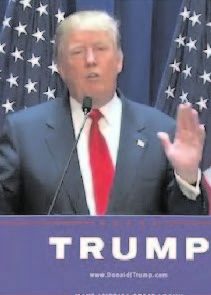
    Trump has garnered huge support among the Republican voters by playing the fear trump card. Since the Paris attacks, while the “serious” GOP contenders have proposed establishing no-fly zones and arming Kurdish rebels in Syria, Trump has focused on registering Muslims and closing mosques in the U.S. while insisting that he “watched … thousands” of Muslims in New Jersey celebrate 9/11 as the Twin Towers were coming down.

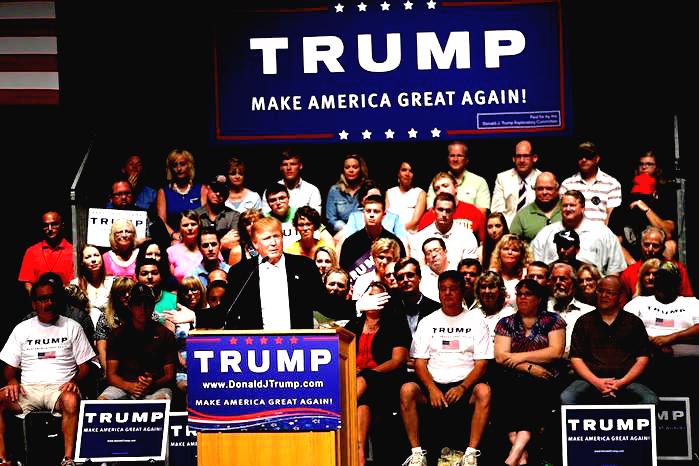
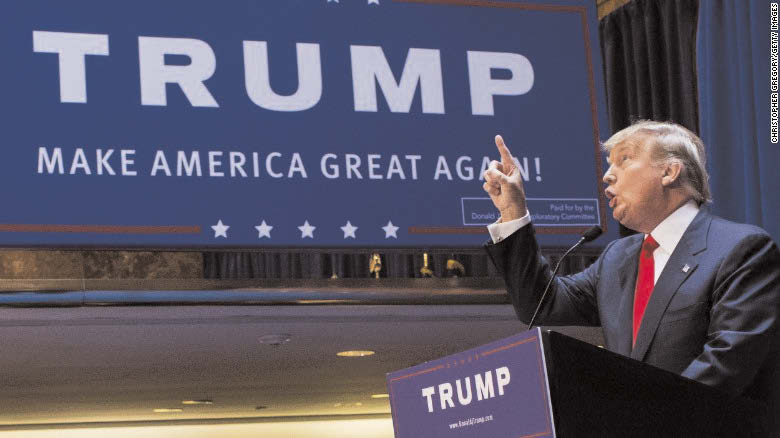
    Republican presidential hopeful Donald Trump at a rally in Oskaloosa, Iowa, July 25.
    Republican presidential hopeful Donald Trump at a rally in Oskaloosa, Iowa, July 25.

    He’s turned the focus of the debate on the right candidate to terrorism and immigration, with a vociferous anti-Muslim rhetoric. His racist approach and fear mongering statements are propelling him in debates. This needs a reality check.

    Let us see what Trump has to say on various issues.

    On Domestic Issues

    1. Arab-Americans cheered the attacks on 9/11 – Trump repeatedly claimed that on September 11, 2001, there were thousands of Arab-Americans celebrating in New Jersey after two planes flew into the Twin Towers. He says such public demonstrations “tell you something” about Muslims living in the US. However, there are no media reports or police records to back up the claim.

    2. There should be surveillance on US mosques – Trump believes Muslims should be tracked by law enforcement as a counterterrorism initiative. He has walked back some comments about keeping a database on all American Muslims, but says he doesn’t care if watching mosques is seen as “politically incorrect”.

    3. The US should use waterboarding and other methods of “strong interrogation” in its fight against the Islamic State.

    4. “Would build a “great, great wall” between the US and Mexico. In some of his earliest campaign comments, Trump suggested that Mexicans coming to the US are largely criminals. “They are bringing drugs, and bringing crime, and they’re rapists,” he said. A wall on the border, he claims, will not only keep out undocumented immigrants but Syrian migrants as well. He also believes that Mexico should have to pay for the wall, which could cost between $2.2bn and $13bn (BBC analyst).

    5. A mass deportation of the estimated 11 million illegal immigrants living in the US should go into effect. Despite criticism that this idea is xenophobic and prohibitively expensive – estimated at $114bn – Trump says his deportation plan is as achievable as it will be humane. In addition, his immigration reforms would end “birthright citizenship”, the policy that grants the children of illegal immigrants citizenship so long as they are born on American soil. He does not support creating a new path to citizenship for undocumented workers.

    6. In order to end mass shootings, the US should invest in mental health treatment rather than Gun Control. In a position paper on gun rights, Trump revealed he has a concealed carry permit and that when it comes to gun and magazine bans, “the government has no business dictating what types of firearms good, honest people are allowed to own”. He would also oppose an expansion of background checks.

    7. The Black Lives Matter movement is “trouble”. Trump mocks Democratic candidates like Martin O’Malley for apologizing to members of the protest movement against police brutality and casts himself as a pro-law enforcement candidate. “I think they’re looking for trouble,” he once said of the activist group. He also tweeted a controversial graphic purporting to show that African Americans kill whites and blacks at a far higher rates than whites or police officers. However, the graphic cites a fictitious “Crime Statistics Bureau” for its numbers, and has been widely debunked using real FBI data.

    On Foreign Policy

    1. Trump and Vladmir Putin would “get along very well”. In an interview with CNN, Trump said that Putin and Obama dislike one another too much to negotiate, but that “I would probably get along with him very well. And I don’t think you’d be having the kind of problems that you’re having right now”.

    2. Climate change is just “weather” . While Trump believes that maintaining “clean air” and “clean water” is important, he dismissed climate change science as a “hoax” and believes environmental restrictions on businesses makes them less competitive in the global marketplace. “I do not believe that we should imperil the companies within our country,” he told CNN on the issue. “It costs so much and nobody knows exactly if it’s going to work.”

    3. The world would be better off if Saddam Hussein and Muammar Gaddhafi were still in power . Trump told CNN that he believes the situation in both Libya and Iraq is “far worse” than it ever was under the two deceased dictators. While he concedes Hussein was a “horrible guy”, he says he did a better job combating terrorists.

    4. No asylum to Syrian migrants . He says that the Paris attacks prove that even a handful of terrorists posing as migrants could do catastrophic damage, and so he will oppose resettling any Syrians in the US, and deport those who have already been placed here.

    5. “Bomb the hell” out of IS. Trump claims that no other candidate would be tougher on the Islamic State and he would weaken the militants by cutting off their access to oil.

    On Healthcare

    1. Veteran healthcare in the US needs a major overhaul . Trump wants to clear out the executive level in the Department of Veterans Affairs, saying that wait times for doctor visits have only increased after previous interventions failed. Thousands of veterans have died while waiting for care, he says. He will invest in the treatment of “invisible wounds” like post-traumatic stress disorder and depression. He would also increase the number of doctors who specialize in women’s health to help care for the increasing number of female veterans.

    2. Obamacare is a “disaster”. Trump says he favors repealing the president’s Affordable Care Act, which aims at extending the number of Americans with health insurance, but he believes that “everybody’s got to be covered”. A spokesman for Trump told Forbes that he will propose “a health plan that will return authority to the states and operate under free market principles”.

    On Economy

    1. Create a simpler tax code . Trump wants anyone who earns less than $25,000 to pay no income tax. They would submit nothing more than a single page tax form that reads “I win”. He would lower the business tax to 15%. He would also allow multinational companies keeping money overseas to repatriate their cash at a 10% tax rate.

    2. Hedge fund managers are “getting away with murder” . Trump found common ground with Democrats like Senator Elizabeth Warren when he said that hedge fund managers and the ultra-wealthy do not pay enough taxes. However, after the campaign released specifics of his plan, analysts argued that hedge fund managers would actually get a tax cut along with the middle class.

    3. China should be taken to task . If elected , Trump says he will make China stop undervaluing its currency, and force it to step up its environmental and labor standards. He is also critical of the county’s lax attitude towards American intellectual property and hacking.

    4. Unemployment. Trump has said repeatedly that unemployment in the US is at 20% – once commenting it may be as high as 42% – despite the fact that the Bureau of Labor Statistics pegs the number at 5.1%. Trump says he doesn’t believe that figure is real.

    But can Americans buy the stuff Trump is so zealously dishing out?

    Americans know well presidential candidates must make unrealistic guarantees. The difference in Trump’s blather is that it is dangerous. Trump’s megalomania borders craziness.

    Everyone who has bought into Trump needs take a step back, rethink and make informed decisions about what America stands for and who will uphold the great values and tradition of America. Those who care deeply about the values of this nation need to recognize where we are. Throughout history, anxiety has brought out the worst in people.

  • Hillary Clinton wants minimum wage increased to $12 an hour

    Hillary Clinton wants minimum wage increased to $12 an hour

    U.S. Democratic presidential candidate Hillary Clinton said on Tuesday, November 3, at two campaign stops in Iowa that she would like to raise the federal minimum wage to $12 an hour from the current $7.25.

    Clinton has said repeatedly she wants to raise wages for working Americans, including by raising the minimum hourly wage, but she has rarely named a specific figure.

    “I want to raise the federal minimum wage to $12, and encourage other communities to go even higher,” Clinton told a campaign event in Coralville, Iowa.

    “I think we can manage it, and I don’t think there should be any unintended consequences to job creation,” Clinton said at another campaign stop at Grinnell College.

    Many U.S. cities and municipalities have established a higher minimum wage than the federal rate. Bernie Sanders, who is Clinton’s chief challenger for the Democratic Party nomination for the 2016 presidential election, has said the federal minimum wage should be raised to $15 an hour.

    “I’m more comfortable saying let’s get to $12,” Clinton said at Grinnell, “in a reasonable, expeditious way.”


  • Madeline Singas wins Nassau County DA Seat

    Madeline Singas wins Nassau County DA Seat

    NEW YORK (TIP): Notwithstanding a Newsday/News 12/Siena College poll showing the race nearly tied going into Election Day, Democratic Acting District Attorney Madeline Singas won a full term in office Tuesday, November 3 night, winning nearly 58 percent of the vote (113,110 votes) to Republican Kate Murray’s 42 percent (82,028 votes). Singas beat former Hempstead Town Supervisor Murray by a 15-percent margin, trashing the latter’s record of never losing.

    Singas was though humble in her resounding victory, saying “This victory transcends Republican or Democrat. This victory means the voters put aside their partisan issues. The voters overwhelmingly said we’re going to put our community first.”

    Speaking to fellow Republicans in Westbury, Murray said she had “never been prouder” of any campaign she had run.

    “When you’re in a tight race, you see who your friends are, and my goodness, I never knew I had so many friends,” she said.

    The swing in favor of Singas is possibly because of the strong position she had taken on corruption in the County. The South Asian community, in particular, feels strongly about the issue. When we carried on the front page on October 30th the story “Madeline Singas favors review of town contracting practices”, we were told by many that Singas was the right person to be in the job. Well, the voters have done their job. It is for Singas now to deliver on her promise.

    The Indian Panorama will in particular like to remind Singas that catching a Harendra Singh should not be the end of the story. There are others in the gang who need to be identified and brought to book. We hope Singas will keep her promise to the voters, and we wish her well.

  • At Benghazi hearing, shouting match over Hillary Clinton’s emails

    At Benghazi hearing, shouting match over Hillary Clinton’s emails

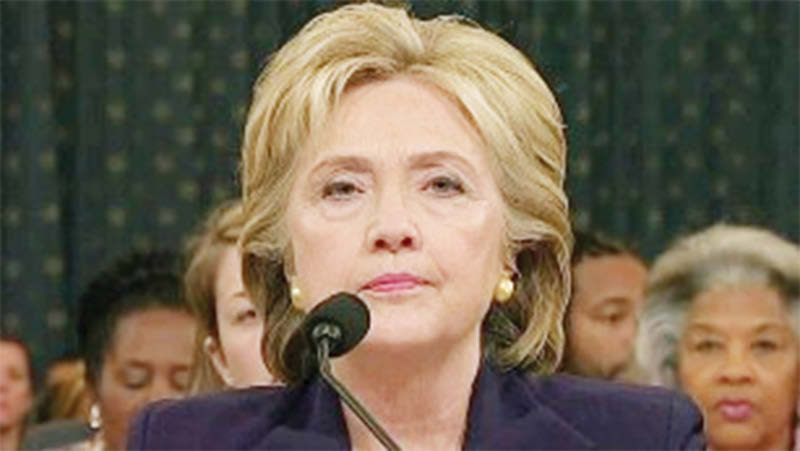
    WASHINGTON (TIP): Republican lawmakers spent more than eight hours aggressively questioning Hillary Rodham Clinton on Thursday, seeking to build a case that the former secretary of state had been derelict in her duty to secure the American diplomatic mission in Benghazi, Libya, in the months before the 2012 terrorist attacks that killed four Americans.

    •  Clinton was questioned about about the American diplomatic mission in Benghazi, Libya, in the months before the 2012 terrorist attacks that killed four Americans.
    •  The marathon hearing began at 10am and, with breaks, lasted until 9pm.
    •  The questioning gave Mrs Clinton her first opportunity since early 2013 to respond directly to her fiercest critics.

    Billed by Republican leaders of the select House committee investigating the Benghazi attacks as a critical moment in its inquiry, the long-awaited appearance by Mrs Clinton, the leading Democratic presidential candidate, served largely as a replay of highly contested arguments from previous congressional hearings, press examinations and Sunday-morning talk shows.

    “Why were there so many requests for security equipment and personnel, and why were those requests denied in Washington?” Representative Trey Gowdy of South Carolina, the committee chairman, demanded to know as he opened the hearing on Thursday morning. “What did our leaders in Washington do or not do, and when?”

    But the long day of often-testy exchanges between committee members and their prominent witness revealed little new information about an episode that has been the subject of seven previous investigations, and that Republicans have long seen as a blemish on Mrs Clinton’s record that could be exploited as she sought the presidency.

    Held in the ornate room that is home to the House Ways and Means Committee, the marathon hearing began at 10am and, with breaks, lasted until 9pm. It provided Republicans with a national audience as they questioned Mrs Clinton, often using her own words from thousands of pages of emails obtained by the committee. But it also gave Mrs Clinton her first opportunity since early 2013 to respond directly to her fiercest critics, and she used the platform to offer lengthy explanations of her diplomatic efforts around the world and her actions before and after the Benghazi attacks.

    Perhaps stung by recent admissions that the pursuit of Mrs Clinton’s emails was politically motivated, Republican lawmakers on the panel for the most part avoided any mention of her use of a private email server. Still, Representative Jim Jordan of Ohio did raise the issue late in the hearing, accusing her of repeatedly changing her account of the server and why she had used it. In a heated exchange, Mrs Clinton repeated that she had made a mistake in using a private email account, but maintained that she had never sent or received anything marked classified and had sought to be transparent by publicly releasing her emails.

    But committee Republicans focused mostly on accusations that Mrs Clinton had ignored security needs in Benghazi in the months before the attacks, a charge she repeatedly rejected.

    Throughout the day, Democrats on the committee portrayed Republicans as the leaders of a partisan crusade against Mrs Clinton, while Republicans responded angrily that Democrats were seeking to block a legitimate inquiry into fatal security lapses at an American diplomatic outpost. Shortly before the committee broke for lunch, a shouting match erupted between Mr. Gowdy and two Democrats, Adam B. Schiff and Elijah E. Cummings, over the focus on Mrs Clinton’s email exchanges with Sidney Blumenthal, a former aide to her husband and a friend.

    Late in the evening, Mrs Clinton had a coughing fit that stopped testimony for two minutes. Hoarse and visibly tired, she responded testily to comments by Mr. Gowdy questioning the independence of a Benghazi review led by Thomas R Pickering, a retired diplomat, and Mike Mullen, a former chairman of the Joint Chiefs of Staff.

  • US vice-president Joe Biden says he will not run for president in 2016

    US vice-president Joe Biden says he will not run for president in 2016

    WASHINGTON (TIP): Vice-president Joe Biden will not run for president in 2016, he said on Oct 21, ending a month-long flirtation with a third White House campaign and setting him on a glide path toward the end of his decades-long US political career.

    Biden’s decision finalizes the Democratic field of White House candidates and bolsters Hillary Rodham Clinton’s standing as the front-runner by sparing her a challenge from the popular vice-president.

    In an extraordinary appearance in the White House Rose Garden, Biden said he always knew the window for a viable campaign might close before he could determine whether his family was emotionally prepared for another campaign so soon after losing his son, Beau Biden, in May. Biden said his family was prepared to back him, but that he nonetheless would not be a candidate.

    “Unfortunately, I believe we’re out of time,” he said, flanked by President Barack Obama and Biden’s wife, Jill.

    Encouraged by Democrats seeking an alternative to Clinton, Biden had spent the past several months deeply engaged in discussions with his family and political advisers about entering the primary. Yet as the deliberations dragged on, Democrats began publicly questioning whether it was too late for him to run, a notion that hardened after Clinton’s strong performance in last week’s Democratic debate.

    Notably, Biden did not endorse Clinton or any of the other Democratic candidates. Instead, he used the announcement to outline the path he said Democrats should take in the 2016 campaign, including a call for them to run on Obama’s record. In what could have been a campaign speech, Biden deplored the influence of unlimited contributions on politics, called for expanding access to college educations and called on Democrats to recognize that while Republicans may be the opposition, they are “not our enemy.”

    “While I will not be a candidate, I will not be silent,” Biden said.

    Wednesday’s announcement was a letdown for Biden supporters who had pleaded with him to run, and in increasingly loud tones as his deliberations dragged on through the summer and into the fall.

    For months, the 72-year-old Democrat made front pages and appeared on cable news screens as pundits mused about his prospects and Clinton’s perceived vulnerability. A super political action committee, Draft Biden, was formed with the explicit goal of getting him into the race.

    At the White House, aides and longtime Biden loyalists had prepared for a potential bid, putting together a campaign-in-waiting should he decide to jump in. Last week one of those aides, former Sen. Ted Kaufman, wrote an email to former Biden staffers laying out the potential rationale for a Biden run and promising a decision soon.

    Biden spoke personally to many supporters. As speculation about his plans reached a fever pitch, he kept up an intense schedule of public appearances, seemingly testing his own stamina for an exhausting presidential campaign. But he also continued to broadcast his reluctance amid doubts that he and his family were emotionally ready in the wake of Beau Biden’s death. In a September appearance on “The Late Show,” Biden told host Stephen Colbert he was still experiencing moments of uncontrollable grief that he deemed unacceptable for a presidential aspirant.

  • Hillary emerges stronger from 11 hour marathon Congressional hearing on Benghazi

    Hillary emerges stronger from 11 hour marathon Congressional hearing on Benghazi

    WASHINGTON (TIP): At times, appearing impatient but never losing control of self, Hillary Clinton answered questions at a nearly 11-hour congressional hearing Thursday, October 22. The Congressional hearing was dominated by Republican criticism of her response to the Benghazi attacks. After a day-long grilling on the details of the attack and how Clinton handled it, the former secretary of state was forced to defend her use of a private email account while in office from a flurry of late evening attacks by GOP lawmakers.

    CNN reports that she also came under testy cross-examination over the extent to which she has taken responsibility for the deaths of the Americans in the September 11, 2012, attacks and her contact with U.S. Ambassador to Libya Chris Stevens, one of the victims, after sending him to the North African country.

    “I came here because I said I would. And I’ve done everything I know to do, as have the people with whom I worked, to try to answer your questions. I cannot do any more than that,” Clinton said towards the end of the grueling day — before later breaking into a coughing fit and taking a throat lozenge to ease her failing voice.

    One of the most dramatic moments of the hearing came when Clinton was asked about her contact with Stevens. She acknowledged that she couldn’t recall having talked to him after having sworn him in as ambassador, though she believed they had spoken.

    Despite the day’s intensity, Clinton appeared cool and in command for much of the hearing. But as the day wore on, she seemed to be increasingly impatient with the Republican line of questioning and with the constant interruptions from the GOP members on the panel.

    In her most emotive testimony, Clinton sought to defang the GOP attacks by arguing that she was agonized over the deaths of four Americans in Libya more than anyone else on the panel.

    “I would imagine I have thought more about what happened than all of you put together,” she said. “I have lost more sleep than all of you put together. I have been wracking my brain about what more could have been done or should have been done.”

    Clinton noted that an independent Accountability Review Board that she set up as secretary had pulled no punches, unveiling 29 recommendations for improving security for U.S. diplomats overseas. She also noted that previous attacks on Americans abroad, including in 1983 on a U.S. Marines barracks and the U.S. Embassy in Beirut, had produced changes to U.S. security procedures after nonpartisan investigations by Congress.

  • Hillary Clinton’s Call to turn Texas Blue

    Hillary Clinton’s Call to turn Texas Blue

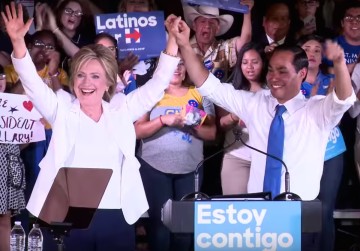
    SAN ANTONIO, TX (TIP): Hillary Clinton came to San Antonio Thursday, October 15 to receive the blessing of the Castro brothers, making her first official campaign stop in Texas and marking a significant moment in her second bid for the White House. At two events — a Q&A with the U.S. Hispanic Chamber of Commerce and an outdoor rally at Sunset Station — she sought to appeal to Hispanic voters, a core constituency of the Obama coalition, and underline the possibility that her campaign could mount a serious bid to win Texas in the 2016 general election.

    Clinton is one of the most fascinating figures in modern American politics, in part because of the remarkable, even Sisyphean, way that the nation’s political architecture rearranges itself seemingly with the intention of thwarting her.

    The Clintons appeared to have finally found the path to return Democrats from exile in 1992, with Hillary playing an unusually prominent role in making policy, but the Republican revolution of 1994 put a damper on that, and much of the rest of her time as first lady was derailed by other matters. She came back to independent prominence as a respectably centrist senator from New York in the 2000s, an Iraq war hawk and a defender of Wall Street, but when it came time to run for president, those positions helped sink her.

    Now, her supporters say, she’s one of the most experienced presidential contenders ever, and it’s a claim with some merit — she’s been the closest advisor of a governor and a president, and she’s served in the U.S. Senate and the cabinet. She’s been privy to history in the last quarter-century like few other people on the planet. And yet she’s running in a year of seemingly unprecedented hatred of the establishment, where her experience and record is in some ways a liability. She’s popular with Dems, for the most part, but she still needs to bolster her left credentials to win over parts of the base afflicted with Clinton fatigue.

    At the launch of the “Latinos for Hillary” initiative, October 16 Clinton was introduced by Julián Castro, who was in turn introduced by Joaquin Castro. Both brothers have now endorsed Clinton, and emphasized to the crowd that Clinton was someone for whom Hispanic issues were, and had always been, close to heart. “She’s always been there for us,” Julián Castro told the crowd, “and today we’re there for her.”

    Some Democrats had hoped to see Clinton take on more of the mantle of the left. On Thursday, she spoke about the wage gap and family leave policies, thanked the #BlackLivesMatter movement for their activism, and told the crowd she would take up immigration reform from the beginning of her presidency, aggressively pursuing a reform package with a full pathway to citizenship for undocumented people. She told the crowd that she would actively pursue gun control in office. “If you join me,” she said, “I will continue taking on the NRA!”

    Introducing Clinton, Julián Castro told the crowd he looked forward to seeing Fox News announce Clinton’s taking of Texas’ electoral votes come November, and Clinton responded by asking the audience to help her “turn Texas blue.” She lauded former San Antonio mayor Julián Castro’s advocacy for pre-K in San Antonio. She emphasized her belief that government could help level the playing field. “Talent is universal, and opportunity is not in America,” she said.

    And she lavished praise on the sitting president: “This country’s come a long way in the last six and-a-half years,” she said, thanks to the “leadership of President Obama.” He didn’t get enough credit for avoiding a second great depression, she said, to cheers. In other arenas, particularly when it comes to foreign policy, Clinton has carefully underlined differences with Obama. In front of this crowd of Texas Democrats, there was no such distancing.

    Another important thread at the Clinton event on Thursday was the possibility that Clinton’s campaign will invest some of its massive resources in Texas during the general election, with an eye to strengthening the party’s infrastructure here. That’s a hope related to long-running speculation that Clinton will pick Julián Castro to be her running mate when the time comes.

    Texas Democrats would love that, but there’s always been plenty of reason to be skeptical of the idea that Clinton would invest heavily in Texas. In a close presidential race, putting a lot of money in a state Democrats are exceptionally unlikely to win would be an inefficient use of resources, especially given the problems with party unity and competency that surfaced in 2014, and given that the third election for an incumbent party after two terms in office is traditionally a time of atrophying energy and turnout.

    But Thursday, it seemed clear that the Clinton campaign was trying to lay the foundation for a Lone Star subplot this cycle. There was the simple fact that today’s rally, the launch of the campaign’s Hispanic outreach project, happened in San Antonio, with the Castros. Introducing Clinton, Julián Castro told the crowd he looked forward to seeing Fox News announce Clinton’s taking of Texas’ electoral votes come November, and Clinton responded by asking the audience to help her “turn Texas blue.”

    Clinton also emphasized her time, spent with then-boyfriend Bill, doing organizing work in South Texas, by all accounts a formative experience for the two. Back then, she said, she and Bill, with his beard and big head of hair “like a Viking,” had a grand old time in Texas. They ate “a lot of green enchiladas,” and “drank our share of Shiner Bocks.” They “ate way too much mango ice cream at the Menger Hotel.”

    When Bill and Hillary came to Texas in 1972, they came to do campaign work for George McGovern, the liberal no-hope Democratic nominee who limped to a crushing defeat against Richard Nixon, winning only one state. That crushing defeat is one of the things that pushed the Clintons toward finding a kind of Democratic identity that could win in what was becoming a more conservative country. That search changed the Clintons in surprising ways: Years later, after Bill Clinton won the White House, Nixon and Bill became friends.

    History’s funny that way. Now the winds have changed again. The country is shifting, in some ways, to the left — at least in presidential elections, when younger and more diverse voters come out. And again, a Clinton is trying to surf the wave. Can she manage it this time? While most people are transfixed by the vulgar Republican primary, Clinton’s the best show in politics right now.


  • Hillary Clinton turns up heat on Sanders in sharp first Democratic presidential debate

    Hillary Clinton turns up heat on Sanders in sharp first Democratic presidential debate

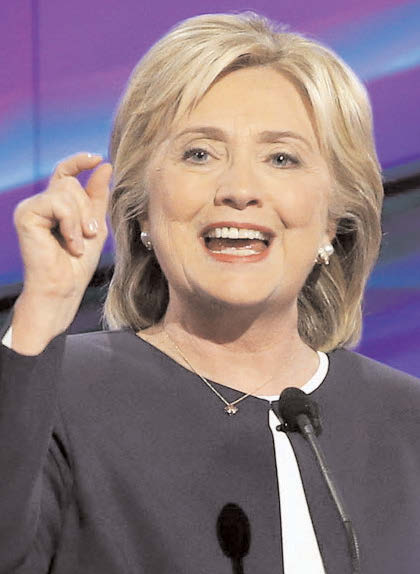
    WASHINGTON (TIP): Hillary Rodham Clinton, seeking to halt the momentum of her insurgent challenger, Sen Bernie Sanders of Vermont, aggressively questioned his values, positions and voting history on Tuesday night in the first Democratic presidential debate, turning a showdown that had been expected to scrutinize her character into a forceful critique of his record.

    In a series of sometimes biting exchanges, Clinton declared that Sanders was mistaken in his handling of crucial votes on gun control and misguided in his grasp of the essentialness of capitalism to the American identity. Mocking Sanders’ admiration for the health care system of Denmark, she interrupted a moderator to offer a stinging assessment of his logic, suggesting he was unprepared to grapple with the realities of governing a superpower.

    “We are not Denmark,” Clinton said, adding, “We are the United States of America.”

    The crowd erupted in applause.

    A few moments later, Clinton took aim at what may be Sanders’ greatest vulnerability with the Democratic left, asking why he had voted to shield gun-makers and dealers from liability lawsuits. Sanders, who linked his record on gun control to his representation of a rural state, called the bill “large and complicated.”

    “I was in the Senate at the same time,” Clinton replied. “It wasn’t that complicated to me. It was pretty straightforward.”

    Asked if Sanders had been tough enough on guns during nearly a decade in the Senate, Clinton offered a sharp reply: “No, not at all.”

    “I think that we have to look at the fact that we lose 90 people a day from gun violence,” she said. “This has gone on too long, and it’s time the entire country stood up against the NRA.”

    It was a dominant performance that showcased Clinton’s political arsenal: a long record of appearances in presidential debates, intense and diligent preparation, and a nimbleness and humor largely lacking in her male counterparts. She let no opportunity pass her by. When Sanders described the conflict in Syria as “a quagmire within a quagmire” but said he did not support sending U.S. ground troops there, Clinton interjected energetically: “Nobody does. Nobody does, Senator Sanders.”

    For Sanders, the gathering in Las Vegas provided an evening of unexpectedly forceful challenges, both from Clinton and from the moderator, Anderson Cooper of CNN. At times, he seemed somewhat exasperated and unsure about how to match Clinton’s agility. A memorable moment came when he sought to shield Clinton from criticism of her email practices.

    “Let me say something that may not be great politics,” he said. “But I think the secretary is right, and that is that the American people are sick and tired of hearing about your damn emails.”

    Clinton flashed a wide smile and shook her rival’s hand. “Thank you,” she said, setting off huge applause in the auditorium.

    Sanders regained his footing when the debate turned to one of his signature issues: Wall Street and its excesses.

  • US Elections: Donald Trump’s top campaign expense: hats and t-shirts

    US Elections: Donald Trump’s top campaign expense: hats and t-shirts

    WASHINGTON(TIP): Republican frontrunner Donald Trump spent more on hats, bumper stickers, yard signs and t-shirts than he did on any other category in the third quarter, according to his latest campaign finance report filed on October 15.

    Donald Trump's top campaign expense1The Trump campaign shelled out $825,000 on the logo-emblazoned gear that he sells on a website and routinely tosses to supporters at his rock concert-like campaign events.His next biggest line item was for flights on his personal 757 jet: more than $700,000. The finance report is just the latest illustration of how, when it comes to the 2016 presidential election, Trump is breaking with tradition.

    Donald Trump's top campaign expenseThe real estate developer and former star of the hit television show ‘The Apprentice’ stunned the Republican political elite last summer when he blew past establishment contenders like former Florida Governor Jeb Bush to become an unlikely frontrunner, a title he has maintained since then.

    In typical presidential campaigns, top expenditures are usually payroll, mailings and consultants.

    But those items did not feature largely on Trump’s report. The filing, made with the Federal Election Commission, contained no line item for payroll at all. The Trump campaign did not respond to a request for comment.

    Trump raised nearly $4 million in the third quarter. In total, the campaign has raised $5.8 million and spent $5.6 million. Despite proclamations that he would self-fund his candidacy, Trump still raked in unsolicited donations from nearly 74,000 people, who gave an average of $50.46.

    By contrast, Democratic frontrunner Hillary Clinton raised $30 million in the third quarter. Bush, once the Republican favorite, raised $13.4 million. Despite his lesser standing in the money race, Trump has benefited from a seemingly endless stream of free news and television coverage, a trend that has irked his competitors and helped to upend the conventional political thinking about how the 2016 race for the White House would play out. He has also drawn record crowds, who routinely leap and claw for the free hats that are mostly emblazed with the campaign slogan “Make America Great Again.”

  • Trump, Carson threaten Republican debate boycott

    Trump, Carson threaten Republican debate boycott

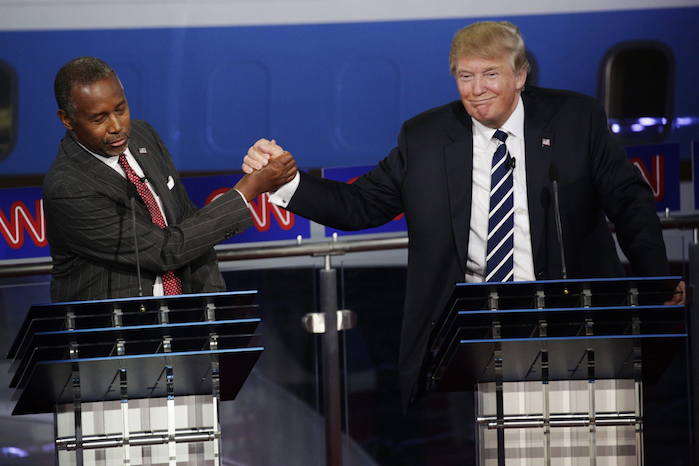
    WASHINGTON (TIP): Republican US presidential frontrunner Donald Trump and the candidate who is hot on his heels on Thursday threatened to boycott their party’s next televised debate over its “ridiculous” format.

    Trump and Ben Carson wrote to cable broadcaster CNBC, host of the October 28 showdown, to say they were displeased with an agenda recently sent to their campaign teams that explained the debate would last two hours plus four commercial breaks that would add 16 minutes to the format.

    In another major change, candidates’ opening and closing statements will not be included in the show.

    Trump took to Twitter to blast the “ridiculous” format as a way for CNBC to sell more ads.

    “Why is the GOP being asked to do a debate that is so much longer than the just-aired and very boring #DemDebate?”

    In their letter published by NBC News — NBC Universal owns CNBC — Trump and Carson wrote that neither of the changes were acceptable.

    “Neither Mr. Trump or Dr. Carson will participate in your debate if it is longer than 120 minutes including commercials and does not include opening and closing statements.”

    Trump has dominated the broad Republican field. He leads with 23.4 percent, according to a RealClearPolitics poll average. Carson, a retired neurosurgeon, is second at 19.1 percent. A boycott by Trump, the brash billionaire largely responsible for drawing record viewership to the Republican Party’s first two debates, would spell trouble for CNBC — and for the Republicans — because it could risk driving away viewers.

    The Democrats, led by former secretary of state Hillary Clinton, held their first debate of the 2016 cycle Tuesday, with a party record 15.8 million tuning in. But that was well shy of the Republican debut in August, which drew 24 million viewers, the largest-ever audience for a primary debate.

  • Hillary Clinton proposes plan to hold Wall Street accountable

    Hillary Clinton proposes plan to hold Wall Street accountable

    WASHINGTON (TIP): Leading Democratic presidential candidate Hillary Clinton has proposed measures including new taxes for trading to hold Wall Street accountable and reduce risk of the failure of big banks and investor firms.

    “The bottom line is that we can never allow what happened in 2008 to happen again. Just as important, we have to encourage Wall Street to live up to its proper role in our economy — helping Main Street grow and prosper,” Clinton wrote in an op-ed as she rolled out her new set of proposals.

    “I will propose a new fee on risk that would discourage the type of excessive leverage and short-term borrowing that could spark another crisis,” she said, adding that her plan would give regulators the authority they need to reorganise, downsize or even break apart any financial institution that is too large and risky to be managed effectively.

    “It is a comprehensive and flexible approach. It allows regulators to adapt to changing markets and help ensure that large financial firms never pose a danger to our entire economy,” she said.

    Clinton said it is time for more accountability on Wall Street.

    Stories of misconduct in the financial industry are shocking – like HSBC allowing drug cartels to launder money or five major banks pleading guilty to felony charges for conspiring to manipulate currency exchange rates, she said.

    This is criminal behavior, yet the individuals responsible often get off with limited consequences — or none at all. “I want to change that,” she said.

    Following her announcement, The Wall Street Journal said the proposed tax on excessive order cancellations could increase costs, cause market problems.

    “We don’t yet know how good or bad this idea could be,” said James Angel, a professor at Georgetown University who studies markets.

    “If it’s a small fee used for regulatory purposes, then it could be helpful. If it’s more than that, it could end up costing investors more money in a lot of ways,” he told The Wall Street Journal.

    By focusing on cancellations, Clinton runs the risk of hampering an important function of trading firms called market making, according to some market observers, the daily noted.

    Bill Harts, spokesman for the high-frequency trading group Modern Markets Initiative, said taxes on trading firms will only “end up costing investors more” because market-makers would have to widen their spreads to accommodate the added cost.

    Widening the spread means increasing the difference between offered buy and sell order, which would make it more expensive for buyers and sellers of stocks, Harts said.

    However, Joseph Saluzzi from Themis Trading said Clinton’s proposal — if designed correctly — could reduce some of the “noise” in the markets.

    “You’re not going to fix things with a tax, but there should be a fee that helps distribute the costs more fairly and reduces manipulative activity,” he told Journal.

  • Some Indian-Americans in Silicon Valley Upset with Hillary Clinton

    Some Indian-Americans in Silicon Valley Upset with Hillary Clinton

    SAN JOSE (TIP): Hillary Clinton, who has long cultivated the Indian-American community for both funds and votes, is tapping into the excitement around the Silicon Valley visit of Prime Minister Narendra Modi this weekend. according to a Reuters report.

    Next Monday she is holding a presidential campaign fundraiser expected to attract many prominent Californians with ties to India.

    But some Indian-American Democrats from the region have told Reuters they won’t be attending the event, in part because they are upset about the way a candidate was treated in a 2014 race for a Silicon Valley congressional seat.

    Their frustration extends to other Democratic candidates and causes besides Ms Clinton, who wasn’t involved in the race, but ignoring her campaign is a high-profile way to vent.

    Supporters of the candidate, Ro Khanna, an intellectual-property lawyer of South Indian heritage, accuse his opponent, fellow Democrat Mike Honda, of using race-baiting to undermine Mr. Khanna.

    Mr. Honda narrowly beat out Mr. Khanna, a former trade official in President Barack Obama’s administration, in the election for a seat in the House of Representatives.

    Just weeks before the election, Mr. Honda attacked Mr. Khanna in a television ad for supporting “companies that send our jobs overseas.” In the same ad, a shadow briefly appeared on Mr. Khanna’s forehead that some Khanna supporters interpreted as a ‘bindi’.

    Mr. Khanna’s supporters point out that in 2012 he published a book on the importance of US manufacturing jobs, and they say that the shadow was an attempt to spark unease among non-Indians. They say the Democratic Party should have intervened to stop what they saw as unfair attacks.

    Mr. Honda’s spokesman Adam Alberti says Mr. Khanna’s financial backers included supporters of outsourcing, and no dot was placed, or is visible, on Khanna’s forehead in the ad in question.

    “The issue of racial baiting is both unfounded and is shallow political theater,” said Mr. Alberti, adding that as a Japanese-American who was held in an internment camp as a baby during World War II, Mr. Honda is especially committed to racial diversity.

    In March, Mr. Honda co-hosted a networking and fundraising event for “Ready for Clinton,” the organization that sought to draft Ms Clinton to run for president.

    Among those who say they aren’t going to Monday’s Mr. Clinton fundraiser, or getting involved in other Democratic campaigns out of concern at Khanna’s treatment, is Rahul Roy, a software entrepreneur. “It hurts,” he says. Mr. Roy recently hosted a fundraiser for Mr. Khanna, who is  running for the seat again in 2016.

    The Clinton campaign says it is concentrating on the large numbers of Indian Americans that back her.

    “Hillary Clinton is grateful for the broad support she is receiving across the Indian-American and Asian-American and Pacific Islander communities in California and around the country,” a spokesman said. He did not respond to questions from Reuters about the disquiet over the 2014 election.

    SOCIAL JUSTICE

    Certainly Ms Clinton has been raising funds in Silicon Valley, where donations to her and an organization raising money on her behalf from area technology employees have totaled $1.07 million through June 30, according to the Center for Responsive Politics.

    And some Khanna supporters are raising money for her. Monday’s Clinton fundraiser – which she is due to attend in person – is being hosted in their home by Khanna supporters Kamil Hasan, a venture capitalist, and his wife Talat Hasan, an entrepreneur. Tickets start at $1,000, and it is expected to attract at least 150 donors, according to a person familiar with the event.

    Mr. Khanna’s supporters have shown a largesse that any presidential candidate would want to tap into. He has raised$1.25 million through June 30, far more than most congressional candidates, and more than double the $608,000 raised by Honda.

    “Some of the attacks were very xenophobic,” said Naren Gupta, a Khanna donor and co-founder of investment firm Nexus Ventures, who said the party should have stepped in.

    He stopped short of saying the issue would affect his support for other Democratic candidates. He is not expected at the Hasan fundraiser, according to the person familiar with the event. Mr. Gupta is also co-chairman of the Indo-American Community of the West Coast, which is helping organize Modi’s appearance before a capacity crowd of 18,000 at the SAP Center in San Joseon Sunday.

    Other donors, like Facebook millionaire turned venture capitalist Chamath Palihapitiya, think Mr. Khanna should have hit back harder.

    “You’ve got to be willing to take the gloves off and fight,” said Mr. Palihapitya, who donated $2,600 to Khanna in the last race and said he planned to support him again this time. He hasn’t made up his mind about who he might support in the presidential race, he said.

    Through spokesman Hari Sevugan, Mr. Khanna took credit for bringing many South Asians and technology workers into the political arena for the first time. Now, many of those recruits feel alienated, the spokesman said.

    Mr. Khanna himself didn’t comment directly on the 2014 race or its fallout, but in an email said Indian Americans feel strongly about social justice, and the Democratic Party “needs to do a better job recognizing that.”

  • Personal Accusations mark the Republican Presidential debate

    Personal Accusations mark the Republican Presidential debate

    NEW YORK (TIP): It has been an acrimonious debate, with presidential candidates hurling accusations at each other. It was an unimpressive debate which did not probably bring out the best in the candidates. And if it were the best in them, God save America!

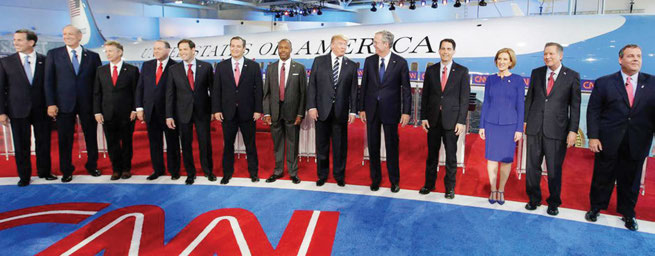
    Fifteen Republican candidates spent the better part of five hours debating at the Ronald Reagan presidential library on Wednesday, September 16 night.

    Nearly all candidates were critical of the utterances and policy declarations of Donald Trump.

    Indian-American US presidential aspirant Bobby Jindal impressed everyone as he took the lead in launching an attack against Republican front-runner Donald Trump, whose growing popularity has unnerved other party candidates, during the second-tier presidential debate.

  • Fiorina trumps Trump in GOP debate

    Fiorina trumps Trump in GOP debate

    WASHINGTON (TIP): Eleven Republican candidates vying for the party nomination on the road to the White House battered each other in a three-hour debate on Sept 15 night at the end of which, the sole woman in mix, former Hewlett Packard executive Carly Fiorina, shone with her poise and intelligence at the expense of frontrunner Donald Trump. The backdrop of their clash was Trump’s crude remark in a Rolling Stone interview about Fiorina’s looks (“Look at that face! Would anyone vote for that?”), and he paid for that with a public dressing down, despite trying to reel it back, saying “I think she’s got a beautiful face and I think she’s a beautiful woman.”

    “I think women all over this country heard very clearly what Trump said,” Fiorina responded curtly , as the two leading candidates eviscerated each other on their business record -Trump saying she was a disaster as HP CEO, and Fiorina calling out Trump’s multiple bankruptcies. Trump was also on the ropes after he was cornered for his remarks on Jeb Bush’s Hispanic wife, which suggested that her being Mexican could cause Bush to be soft on Mexico.

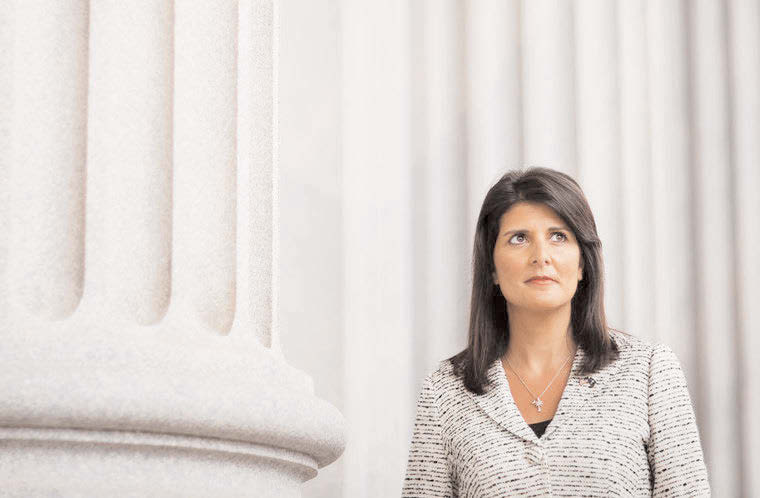
  • Nikki Haley is among four Indian Americans recognized in Politico Magazine’s ‘Politico 50’

    Nikki Haley is among four Indian Americans recognized in Politico Magazine’s ‘Politico 50’

    WASHINGTON (TIP): Four Indian Americans have been recognized in Politico Magazine’s
    “Politico 50” this year for their contributions to politics in the U.S. The magazine names a list of 50 people whom they deem to be “thinkers, doers and visionaries transforming American politics” in the current year.

    Among those acknowledged on the list include South Carolina Gov. Nikki Haley, columnist Ramesh Ponnuru (and his wife, political adviser April Ponnuru), economist Raj Chetty, and surgeon and writer Atul Gawande.

    Haley, coming in at No. 9 on the list, was integral in the removal of the Confederate flag from outside the statehouse in the wake of the Charleston shootings, noted Politico. “It was a bright spot in a year marked by racial tension,” according to the magazine’s bio on Haley.

    Ramesh Ponnuru and his wife April both came in at No. 32 on the list. Politico describes them as “the young reigning couple of forward-thinking conservative ideas.” Ramesh is a senior editor at National Review and a columnist for Bloomberg View, and is a critic within the Republican party, according to Politico.

    At No. 39 on the list is Chetty, an economist at Stanford and Harvard universities. Chetty and a team of researchers did a study and found out that growing up in different neighborhoods has a serious impact on social mobility. As stated in the magazine, “Little political attention has been paid to the role of neighborhoods in social mobility since civil rights reform efforts in the 1970s. But thanks at least in part to Chetty’s fresh approach to the data, politicians are taking note again.”

    Presidential hopeful Hillary Clinton, D-N.Y., is now using Chetty’s ideas in public speaking events.

    Gawande came in at No. 50 on the list. His essay in 2009 on skyrocketing healthcare costs indirectly led to President Barack Obama’s push for what would become the Affordable Care Act. The surgeon wrote a book released in the fall of 2014 saying doctors are not prepared to help terminally ill people die well.

    Supreme Court Justice Anthony Kennedy topped the list. Other notable figures included Pope Francis (No. 4), Secretary of State John Kerry (No. 7) and Facebook CEO Mark Zuckerberg (No. 8).

  • Clinton’s lead over Sanders thins even as her edge over GOP shrinks

    Clinton’s lead over Sanders thins even as her edge over GOP shrinks

    WASHINGTON (TIP): A new CNN/ORC poll has found that Hillary Clinton’s lead in the race for the Democratic nomination has fallen to just 10 points, and at the same time, her advantage against the top Republican contenders has vanished. The new poll finds Clinton with 37%support among Democratic and Democratic-leaning voters, down 10 points since August, followed by Vermont Sen. Bernie Sanders at 27% and Vice President Joe Biden at 20%. Sanders’ support is about the same as it was in August, making Biden the only candidate to post significant gains in the last month. His support is up 6 points in the last month as he weighs making a run for the presidency.

    Behind the top three, former Maryland Gov. Martin O’Malley holds 3%, former Virginia Sen. Jim Webb is at 2% and former Rhode Island Gov. Lincoln Chafee logs less than 1% support.

    In the general election match ups, Clinton trails former neurosurgeon Ben Carson by a significant margin (51% Carson to 46%Clinton among registered voters) while running about evenly with both former Florida Gov. Jeb Bush (49% Bush to 47%Clinton) and businessman Donald Trump (48% back each).

    The shift away from the former secretary of state stems from shrinking support among women. Clinton’s advantage among women has disappeared in match ups against Bush and Carson. Facing Trump, Clinton still carries women by a large, though tighter, margin. In August, 60% of women favored Clinton to 37% for Trump, but that’s narrowed slightly to 55% Clinton, 41%Trump now. Clinton’s advantage among women against Trump is fueled by independent women, despite that group shifting away from Clinton in the head-to-head against Bush.

    The poll suggests Republican women have consolidated their support around their party’s front-runners in the last month, and are now more apt to back both Bush and Trump than they were a month ago. At the same time, the near-universal support for Clinton among Democratic women has softened slightly, bringing it more in-line with her support among Democratic men.

    With Biden’s consideration of a run for the White House gaining attention, the poll finds he outperforms Clinton in these hypothetical general election matchups, topping Bush and Trump while falling just slightly behind Carson. Biden tops Trump by 10 points (54%to 44% among registered voters), leads Bush by 8 points (52% to 44%) and is 3 points behind Carson (50% Carson to 47% Biden). Biden’s advantages against Bush and Trump rest on the same kind of gender gap that Clinton appears to have lost: Biden leads Bush by 16 points among women while tying him among men, he tops Trump by 26 points among women while trailing him by 7 among men, and he leads Carson by 5 among women while trailing by 10 among men.

    The poll also finds Democrats’ overall enthusiasm for Clinton has waned. In April, shortly after she launched her campaign, 60% of Democratic and Democratic-leaning voters said they would be enthusiastic about her candidacy should she win the party’s nomination for president. Now, just 43% feel that way. But neither Biden nor Sanders has mustered that level of enthusiasm among the Democratic faithful, 37% say they would be enthusiastic about Biden, 31% about Sanders.

    And Sanders prompts the greatest potential dissatisfaction, with 30% saying they would be dissatisfied or upset if he eventually won the party’s nomination.

    Clinton’s fade in the Democratic race comes as an ideological divide within the party grows into a chasm. In August, Clinton held support from 43% of moderates and 46%of liberals. In the new poll, her support among moderates holds at 47%, while among liberals, it has plummeted to just 23%. Sanders has increased his share of the liberal vote (from 42% to 49%), while falling 9 points among moderates (from 24% to 15%). Meanwhile, Biden has gained ground in both groups.

    And enthusiasm for Clinton among liberals has fallen nearly 40 points. Just 29%of liberal Democrats say they would be enthusiastic if she were the party’s nominee, down from 68% in an April poll.

    Asked why they back their candidate, most Clinton supporters said her experience is the draw: 58% say it’s mostly on account of her on the job experience, 32% because of her positions on the issues, and 9% because they don’t like the other candidates. Among those Democrats backing her rivals for the nomination, 55% say their choice was driven by the candidate’s positions on the issues, while 27% cite experience and 17% say it’s due to dislike of the other candidates.

    There is some good news for Clinton in the poll, however, since most Democrats still say they expect her to be the party’s eventual nominee and the more enthusiastic Democratic voters are more apt to be Clinton backers. Among Democrats and Democatic-leaning voters, 65% expect Clinton to top the party’s ticket in 2016. And among those Democratic voters who say they are extremely or very enthusiastic about voting for president next year — a group which may be more likely to cast ballots in next year’s primary contests — 42% back Clinton, 29%Sanders and 15% Biden.

    The CNN/ORC Poll was conducted by telephone September 4-8 among a random national sample of 1,012 adults. This sample included 930 interviews with registered voters, 395 of whom were self-identified Democrats or Democratic-leaning independents. For results among all registered voters, the margin of sampling error is plus or minus 3 percentage points. Among Democratic voters, it is plus or minus 5 points.

    A Quinnipiac University poll released Thursday, September 10, showed Sanders continues to build momentum against Clinton, pulling even with her in Iowa, 41%to 40%. That’s up from a 21-point deficit with Clinton two months ago. Other recent polling that has shown Sanders ahead in another key early primary state, New Hampshire, although Clinton still maintains double-digit leads in national polling.

    Sanders said his campaign has received contributions from more than 400,000 people with an average donation of $31.20, while eschewing raising money for super PACs.

  • US presidential election: The rise and rise of Donald Trump

    US presidential election: The rise and rise of Donald Trump

    HOUSTON (TIP): All 172 people on board a British Airways plane had a miraculous escape Sept 11 after an engine of the aircraft burst into flames on the runway just before taking off from Las Vegas to London.

    The left engine of 257-seat Boeing 777 burst into flames on the runway at McCarran International Airport in Las Vegas shortly after 0430 IST while it was about to depart for London’s Gatwick Airport with 159 passengers and 13 crew members on board, according to the airport authorities.

    Heavy black smoke and orange flames could be seen pouring from under the plane’s wings, sending passengers fleeing quickly from the aircraft and across the tarmac before about 50 firefighters doused the aircraft in minutes.

    Officials said 14 people aboard the Flight 2276 were taken to hospital for minor injuries, most as a result of sliding down the inflatable chutes to escape.

    Fire officials said paramedics on the scene were also evaluating some passengers.

    Firefighters stationed at the airport reached the plane two minutes after getting reports of flames and within another three minutes, everyone inside the plane had escaped.

    After firefighters extinguished the flames, emergency vehicles could be seen surrounding the aircraft which was left a sooty gray from the smoke and fire retardant.

    Federal Aviation Administration spokesman Ian Gregor said the plane’s left engine caught fire and an investigation was underway.

    The National Transportation Safety Board was collecting information about the incident, said Eric Weiss, a spokesman for the agency in Washington.

    Clark County deputy fire chief Jon Klassen said the cause of the fire wasn’t clear yet, but the fire didn’t appear to breach the cabin.

    One of the airport’s runways was shut down but operations continued on the other three runways, officials said.

    Las Vegas’ airport is the ninth-busiest in the US and had nearly 43 million passengers last year.

    The airport has been taking steps to accommodate more international travellers seeking direct flights to Europe and Asia, including adding new gates to accommodate wide-body double-decker jets.

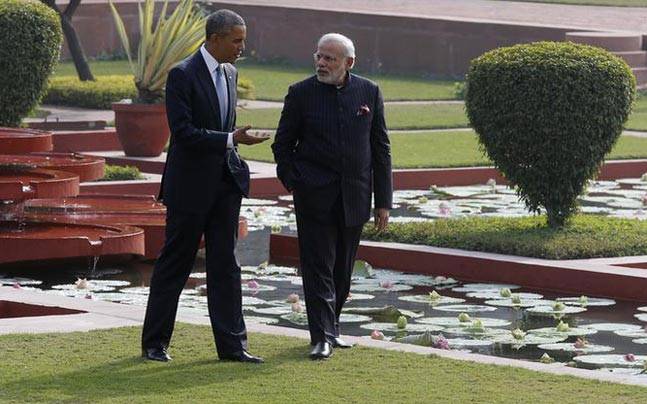
  • Obama, Biden to lead high decibel US engagement with India

    WASHINGTON (TIP): US President Barack Obama along with vice president Joe Biden and several of his cabinet ministers are all set for a high-level engagement with the Indian leadership in a series of meetings later this month.

    This would be the highest level of engagement between the two countries after Obama’s trip to New Delhi in January to attend the Republic Day parade as the chief guest of Prime Minister Narendra Modi.

    Obama and Modi are expected to meet in New York on September 28.

    While no official announcement has been made yet, the proposed meeting itself is a reflection of the seriousness and commitment of the two leaders to this bilateral relationship.

    On a day, which is said to be one of the busiest days for the US President given his address to the UN General Assembly on the first day of the annual session, Obama’s schedulers had a tough time in creating space for his meeting with Modi.

    Modi, on the other hand for all practical purpose would be taking an overnight flight – although it would be Air India One – from Silicon Valley on September 27 after addressing the Indian-Americans at the SAP Center in San Jose to be back to Big Apple for his likely meeting with Obama, sources said.

    Notably in the January joint statement, the two leaders had committed themselves for a more regular meeting.

    Modi-Obama meeting in New York would cap more than a week of high level India-US engagement – most of which would be held in Washington DC, the sources said.

    It is learnt that Vice President Biden is himself keen to be part of this highest level of India-US engagement. It was Biden who, during his visit to India a few years ago, had set the ambitious goal of increasing the bilateral trade from the current USD 100 billion to USD 500 billion per annum.

    It is in this backdrop, it might not be surprising that Biden is seen taking a lead once again when it comes to the economic dimension of the India US relationship.

  • Barack Obama’s big plans to engage with Modi’s India

    Barack Obama’s big plans to engage with Modi’s India

    US President Barack Obama along with Vice-President Joe Biden and several of their government officials are all set for a high-level engagement with the Indian leadership in a series of meetings later this month. This would be the highest level of engagement between the two countries after Obama’s trip to New Delhi in January to attend the Republic Day parade as the chief guest of Prime Minister Narendra Modi.

    Obama and Modi are expected to meet in New York on September 28. While no official announcement has been made yet, the proposed meeting itself is a reflection of the seriousness and commitment of the two leaders to this bilateral relationship.

    On a day, which is said to be one of the busiest days for the US President given his address to the UN General Assembly on the first day of the annual session, Obama’s schedulers had a tough time finding a slot for his meeting with Modi.

    Modi, on the other hand, is likely to take an overnight flight to New York in his Air India One from Silicon Valley on September 27 after addressing the Indian-Americans in San Jose for his likely meeting with Obama.

    Notably, in their joint statement in January, the two leaders had committed themselves for a more regular meeting. The Modi-Obama meeting in New York would cap more than a week of high-level India-US engagement, most of which would be held in capital Washington DC.

    It is learnt that Vice-President Biden is himself keen to be part of this highest level of India-US engagement. It was Biden who, during his visit to India a few years ago, had set the ambitious goal of increasing the bilateral trade from the current USD 100 billion to USD 500 billion per annum.

    It is in this backdrop that Biden has been seen taking a lead once again when it comes to the economic dimension of the India US relationship. Several cabinet ranking officials along with corporate leaders from both the countries are expected to be present at the 40th Anniversary Leadership Summit of the US-India Business Council (USIBC) on September 21.

    Among others, it would be attended by Energy Minister Piyush Goyal and Commerce Minister Nirmala Sitharaman and US Commerce Secretary Penny Pritzeker along with who’s who of corporate leaders from the two countries. The next day, TERI North America would host the 6th India-US Energy Partnership Summit.

    However, it is the first ever India-US Strategic and Economic Dialogue to be hosted by Secretary of State John Kerry that will be the center of attraction when Modi is in the US. While the dates of this dialogue has not been announced yet, it is most likely to be held on September 22. The decision to expand India-US Strategic Dialogue to Commercial one was taken during Obama’s January visit to India.

    Kerry along with Pritzeker would lead the US delegation, while the Indian delegation would be led by External Affairs Minister Sushma Swaraj and Sitharaman. Foreign Secretary S Jaishankar will also expected to be part of the Indian delegation. Indian Ambassador to the US Arun K Singh and his American counterpart in India Richard Verma would also be part of their respective terms.

  • Obama finds the 34th vote to save Iran deal

    Obama finds the 34th vote to save Iran deal

    WASHINGTON (TIP): It is all but assured the international agreement, which took years to craft, will play out at least for the rest of Obama’s presidency.

    When the Senate returns from its August recess after Labor Day, it will vote on a resolution disapproving the Iran deal.

    With that measure virtually guaranteed to be defeated – whether by filibuster or presidential veto – it removes the final major hurdle standing in the way of the deal being implemented.

    On Oct. 18, a date known as adoption day, the parties will begin taking steps to put the agreement into place.

    For the U.S. and its negotiating partners, that means issuing waivers to roll back crippling economic sanctions on Iran once international inspectors certify Tehran is abiding by limits on its nuclear program. Republicans in Congress and many pro-Israel groups sought to use the congressional review process to kill the deal, which they argue fails to permanently cut off Iran’s path to a nuclear weapon while providing billions of dollars in sanctions relief that could be funneled to terrorist groups.

    Obama was determined to prevent Congress from derailing the nascent agreement, warning of a “historic mistake” that would do permanent damage to the U.S.’s credibility abroad.

    The White House mounted an intense lobbying campaign this summer to win support for the deal. The goal was to secure enough Democratic votes to prevent Republicans from amassing a veto-proof majority against the agreement.

    The president has gotten personally involved, speaking with more than 100 lawmakers in individual or small-group settings since the deal was reached, according to a White House official.

    That effort has largely been a success. During the August recess, dozens of Democratic lawmakers declared that they back the deal, blunting critics’ efforts to build broad bipartisan opposition against it.

    “We are encouraged by the growing number of lawmakers who have announced support for the deal in the past weeks,” White House spokesperson Jennifer Friedman said. “We remain confident that ultimately a strong majority of Democrats in both the House and the Senate will support of the deal, and if necessary, sustain the president’s veto.”

    Known for his distant relationship with lawmakers, the president has given an unprecedented amount of one-on-one attention to fence-sitting Democrats.

    He hosted them for receptions in the East Room of the White House, made 30 calls from his Martha’s Vineyard vacation rental and wrote them lengthy letters to answer their concerns about the deal.

    Coons said that he has spoken with Obama, Vice President Biden and other members of the administration within the past 10 days, and gotten them to agree to a handful of measures including increasing military support for Israel, fully funding the International Atomic Energy Agency and briefing Congress on how it plans to combat Iran’s support for terrorism.

    The Delaware senator, an important swing vote, said he received a letter from Obama answering his concerns on Tuesday – just before he was scheduled to give a speech announcing his position.

    He indicated the response played a decisive role in his announcement.

    “I spent time last night thinking about delaying the speech,” he said.

    Coons said a lengthy conversation with Biden, who previously occupied his Senate seat, helped win his support.

    Obama’s tactics also succeeded with Rep. Jerrold Nadler, the only New York Jewish Democrat to back the deal, and seen as an important counterweight to Schumer.

    He sent Nadler a three-and-a-half-page letter answering his concerns about the agreement a day before the congressman announced his support.

    The president used his bully pulpit in speeches and interviews to rally Democrats around the deal, lumping critics together with those who supported the Iraq War.

    Liberal groups responded by giving Obama cover at town halls and meet-and-greets with lawmakers, even as the American Israel Public Affairs Committee poured tens of millions of dollars into television ads against the deal to bolster its in-person lobbying.

    Even if Obama succeeds in stopping Congress from killing the agreement, opponents are still claiming a symbolic victory.

    “Unfortunately we’re now going to have a deal that goes forward with a large majority vote of the Senate and the House against it and a large majority of the American people against it,” Sen. Tom Cotton (R-Ark.) said Tuesday on MSNBC. “And that truly is unprecedented.”

  • Obama caught between Clinton, Biden ambitions

    Obama caught between Clinton, Biden ambitions

    WASHINGTON (TIP): President Barack Obama is caught between the White House aspirations of two of his closest advisers: Vice President Joe Biden and former Secretary of State Hillary Rodham Clinton.

    For months, White House officials expected Clinton to be the Democratic nominee in the 2016 election. Some of Obama’s top political advisers moved to New York to run her campaign and Obama appeared to give his tacit approval, saying she would be an “excellent president.”

    But that bet on Clinton suddenly looks less certain. With Biden weighing his own presidential run more seriously amid signs of weakness in Clinton’s campaign, the White House faces the prospect of a family feud over who will become heir to Obama’s legacy.

    “Certainly he’s got something at stake here,” White House spokesman Josh Earnest said Monday of Obama’s interest in the 2016 election.

    Biden’s recent overtures to donors and Democratic officials have led to palpable awkwardness in the West Wing as aides _ many with close ties to Clinton, the vice president or both try to maintain impartiality.

    Earnest raised the prospect that Obama could endorse a candidate in the Democratic primary, though others close to the president say it’s unlikely he’d publicly put his thumb on the scale if Clinton and Biden were locked in a close contest. In picking between Biden and Clinton, Obama would be making a choice between two of the most influential members of his administration.

    Obama and Clinton long ago turned their political rivalry from the 2008 primary into an alliance. Clinton left the administration in early 2013 after four years as Obama’s secretary of state, but she and the president still get together for occasional meetings.

  • State Senator Anthony Avella backs Satnam Singh Parhar for City Council

    State Senator Anthony Avella backs Satnam Singh Parhar for City Council

    BELLEROSE, NEW YORK (TIP): State Senator Anthony Avella (D-Queens), August 16, endorsed Satnam Singh Parhar for City Council District 23, in Northeastern Queens. Parhar is on the ballot for the September 10 Democratic Primary to replace City Councilman Mark Weprin, who gave up his seat to work for Governor Andrew Cuomo.

    Parhar, a well-known community activist, successful businessman and philanthropist with a reputation for getting results, is running on a platform of economic development, support for small business, quality education, increased transportation alternatives, more senior centers, clean and safe streets, and a freeze on property taxes and water and sewer bills.

    “I am proud to announce my endorsement of Satnam Singh Parhar for City Council in District 23,” Senator Avella said today. “Over the years that I have known him, Parhar has a strong record of getting results. His commitment to serving all the constituents of District 23 makes him a fantastic advocate for this community.”

    “It is time this District elects a candidate who reflects its great diversity, who understands the issues it faces, and who will tirelessly fight to secure its fair share of city funding and services,” said Avella. “Satnam Singh Parhar has demonstrated his value as a community advocate, and as a successful businessman. As a Council Member he will be a strong voice, and more than that he will get things done.”

    Parhar said, “Senator Tony Avella always has our backs in Albany, and I’m proud to have his support. Where some other elected officials just show their faces when they want votes, Senator Avella is always there for all of us. Just as he is here tonight.”

    “I’m looking forward to working with him once I am elected to the City Council, and I know that together we will make a difference in both the Capitol and in City Hall,” said Parhar. City Council District 23, with some of the most diverse electorates in the city, has seen significant demographic change in recent years. Forty percent of the District is Asian, with the overwhelming majority South-Asian.

  • Obama administration warns Beijing about covert agents operating in US

    Obama administration warns Beijing about covert agents operating in US

    WASHINGTON: The Obama administration has delivered a warning to Beijing about the presence of Chinese government agents operating secretly in the United States to pressure prominent expatriates — some wanted in China on charges of corruption — to return home immediately, according to American officials.

    The American officials said that Chinese law enforcement agents covertly in this country are part of Beijing’s global campaign to hunt down and repatriate Chinese fugitives and, in some cases, recover allegedly ill-gotten gains.

    The Chinese government has officially named the effort Operation Fox Hunt.

    The American warning, which was delivered to Chinese officials in recent weeks and demanded a halt to the activities, reflects escalating anger in Washington about intimidation tactics used by the agents. And it comes at a time of growing tension between Washington and Beijing on a number of issues: from the computer theft of millions of government personnel files that American officials suspect was directed by China, to China’s crackdown on civil liberties, to the devaluation of its currency.

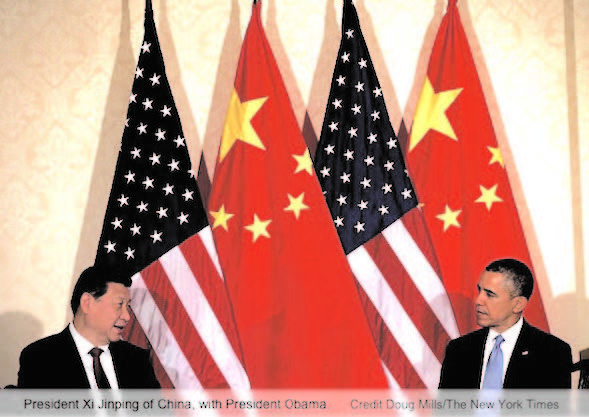
    Those tensions are expected to complicate the state visit to Washington next month by Xi Jinping, the Chinese president.

    The work of the agents is a departure from the routine practice of secret government intelligence gathering that the United States and China have carried out on each other’s soil for decades. The Central Intelligence Agency has a cadre of spies in China, just as China has long deployed its own intelligence operatives into the United States to steal political, economic, military and industrial secrets.

    In this case, said American officials, who discussed details of the operation only on the condition of anonymity because of the tense diplomacy surrounding the issue, the Chinese agents are undercover operatives with the ministry of public security, China’s law enforcement branch charged with carrying out Operation Fox Hunt.

    The campaign, a central element of Xi’s wider battle against corruption, has proved popular with the Chinese public. Since 2014, according to the ministry of public security, more than 930 suspects have been repatriated, including more than 70 who have returned this year voluntarily, the ministry’s website reported in June. According to Chinese media accounts, teams of agents have been dispatched around the globe.

    American officials said they had solid evidence that the Chinese agents — who are not in the United States on acknowledged government business, and most likely are entering on tourist or trade visas — use various strong-arm tactics to get fugitives to return. The harassment, which has included threats against family members in China, has intensified recently, officials said.

    The officials declined to provide specific evidence of the activities of the agents.

    The United States has its own history of sending operatives undercover to other nations — sometimes under orders to kidnap or kill. In the years after the September 11, 2001, attacks, the CIA dispatched teams abroad to snatch Qaeda suspects and spirit them either to secret CIA prisons or hand them over to other governments for interrogation.

    Neither China’s ministry of public security nor the ministry of foreign affairs responded to faxes requesting comment. But Chinese officials have often boasted about their global efforts to hunt economic fugitives, and the state news media has featured reports detailing the aims and successes of Operation Fox Hunt.

    According to the Chinese news media, Beijing has sent scores of security agents abroad to “persuade” their targets to return home. Just how they accomplish their aims is unclear, and questions have been raised about why a number of suspects, presumably sitting on significant wealth abroad, have willingly returned to China.

    Liu Dong, a director of Operation Fox Hunt, has said Chinese agents must comply with local laws abroad and that they depend on cooperation with the police in other countries, according to a news report last year. But in a telling admission, he added, “Our principle is thus: Whether or not there is an agreement in place, as long as there is information that there is a criminal suspect, we will chase them over there, we will take our work to them, anywhere.”

    It is unclear whether the FBI or the Department of Homeland Security has advocated within the Obama administration to have the Chinese agents expelled from the country, but the White House decision to have the state department issue a warning to the Chinese government about the activities could be one initial step in the process.

  • HILLARY CLINTON’S EMAILS Hilary Camp’s clarifications

    HILLARY CLINTON’S EMAILS Hilary Camp’s clarifications

    WASHINGTON (TIP): The Hilary emails issue boils over and over again, with politicians and now the issue is before the courts, too. And Hilary camp keeps offering explanations. The latest explanation has come from the Hilary Campaign Communications Director Jennifer Palmieri. She released the following explanation on August 12.

    Here are the basics: 

    Like other Secretaries of State who served before her, Hillary used a personal email address, and the rules of the State Department permitted it. She’s already acknowledged that, in hindsight, it would have been better just to use separate work and personal email accounts. No one disputes that.

    The State Department’s request: 

    Last year, as part of a review of its records, the State Department asked the last four former Secretaries of State to provide any work-related emails they had. Hillary was the only former Secretary of State to provide any materials — more than 30,000 emails. In fact, she handed over too many –the Department said it will be returning over 1,200 messages to her because, in their and the National Archives’ judgment, these messages were completely personal in nature.

    Hillary didn’t send any classified materials over email: 

    Hillary only used her personal account for unclassified email. No information in her emails was marked classified at the time she sent or received them. She viewed classified materials in hard copy in her office or via other secure means while traveling, not on email.

    What makes it complicated: 

    It’s common for information previously considered unclassified to be upgraded to classified before being publicly released. Some emails that weren’t secret at the time she sent or received them might be secret now. And sometimes government agencies disagree about what should be classified, so it isn’t surprising that another agency might want to conduct its own review, even though the State Department has repeatedly confirmed that Hillary’s emails contained no classified information at the time she sent or received them.

    To be clear, there is absolutely no criminal inquiry into Hillary’s email or email server.

    Any and all reports to that effect have been widely debunked. Hillary directed her team to provide her email server and a thumb drive in order to cooperate with the review process and to ensure these materials were stored in a safe and secure manner.

    What about the Benghazi committee?

    While you may hear from the Republican-led Benghazi committee about Hillary’s emails, it is important to remember that the committee was formed to focus on learning lessons from Benghazi to help prevent future tragedies at our embassies and consulates around the globe. Instead, the committee, led by Republican Representative Trey Gowdy, is spending nearly $6 million in taxpayer money to conduct a partisan witch-hunt designed to do political damage to Hillary in the run-up to the election.

    Hillary has remained absolutely committed to cooperating.

    That’s why, just as she gave her email server to the government, she’s also testifying before the Benghazi committee in October and is actively working with the Justice Department to make sure they have what they need. She hopes that her emails will continue to be released in a timely fashion.

    It’s worth noting: 

    Many of the Republican candidates for president have done the same things for which they’re now criticizing Hillary. As governor, Jeb Bush owned his own private server and his staff decided which emails he turned over as work-related from his private account. Bobby Jindal went a step further, using private email to communicate with his immediate staff but refusing to release his work-related emails. Scott Walker and Rick Perry had email issues themselves.

    The bottom line: 

    Look, Indrajit, this kind of nonsense comes with the territory of running for president. We know it, Hillary knows it, and we expect it to continue from now until Election Day.

    It’s okay. We’ll be ready. We have the facts, our principles, and you on our side. And it’s vital that you read and absorb the real story so that you know what to say the next time you hear about this around the dinner table or the water cooler.

  • Chuck Schumer says he will Oppose Iran Deal

    Chuck Schumer says he will Oppose Iran Deal

    WASHINGTON (TIP): New York Sen. Chuck Schumer dealt a blow to President Barack Obama’s nuclear deal with Iran, announcing during the Republican presidential debate Thursday night that he planned to vote against the agreement now under review in Congress.

    Schumer’s opposition hurts the president’s efforts to woo the support of Senate Democrats, who he needs to be his bulwark against a likely Republican attempt to override a veto. But although Schumer said in a 1,600-word statement that he would side against the deal, he did not say whether he would vote to override a veto.

    “I believe Iran will not change, and under this agreement, it will be able to achieve its dual goals of eliminating sanctions while ultimately retaining its nuclear and non-nuclear power,” Schumer said.

    The Iran nuclear deal was also a big target during the Republican presidential debate. Scott Walker said he’d cancel it on Day One. Mike Huckabee said it left “hostages” behind. And Donald Trump said it was “a disgrace” for a president “who doesn’t have a clue.”