Tag: United States Politics


  POLITICS & POLICY  

  • Thousands of Hillary Clinton emails deleted without identifying if they were personal

    Thousands of Hillary Clinton emails deleted without identifying if they were personal

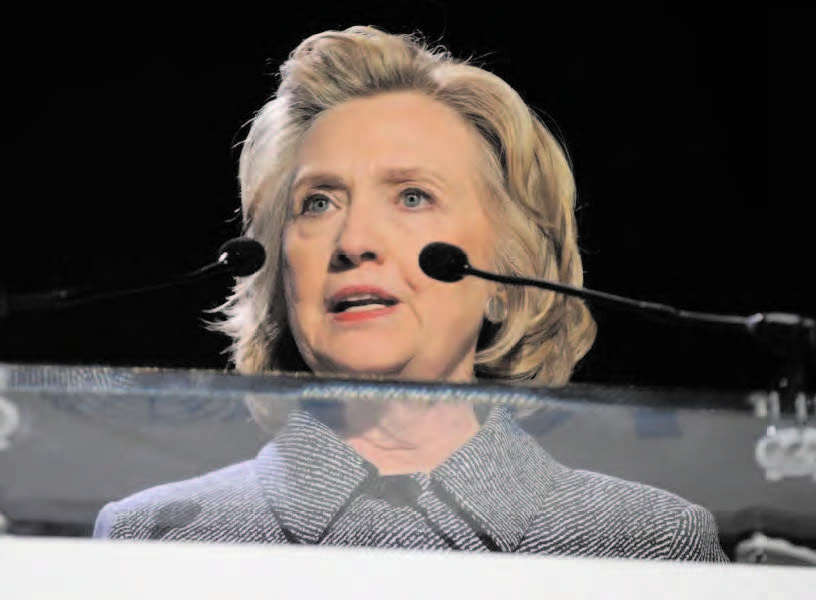
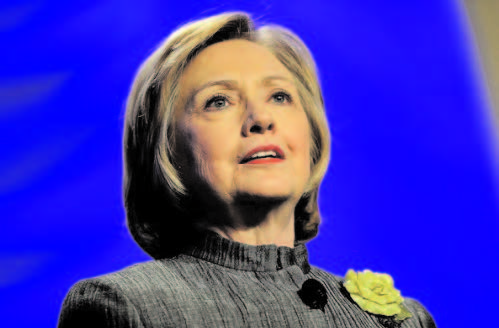
    NEW YORK (TIP): Neither Hillary Clinton nor anyone working for her read tens of thousands of emails she stored on a private server to identify personal emails before she deleted 31,830 of them, says a report in Daily News.

    Lawyers for the former Secretary of State instead used a simple series of keyword searches to review the emails, Time Magazine reported. The attorneys used the search results to divide Clinton’s 62,320 messages between official emails, which she handed over to the State Department last year after they requested them, and those Clinton deemed “personal and private.” Clinton said on Tuesday, March 10, she deleted all those personal messages she “had no reason to save them.”

    The news is sure to raise doubts among critics who suspect Clinton’s aim in maintaining a personal server and deleting material was to keep important official communications she made as Secretary of State, and potentially damaging information, out of the public eye as she prepares for a 2016 presidential campaign. She is expected to officially launch her bid next month.

    Clinton did not mention the rudimentary search process during a news conference she held Tuesday on the email scandal.

    The former New York senator claimed the review was “thorough” and went “above and beyond” what requirements she faced before releasing them.

    “We went through a thorough process to identify all of my work-related emails and deliver them to the State Department,” Clinton said.

    She insisted all other emails were personal and related matters like “yoga routines,” “family vacations,” and planning her daughter Chelsea’s wedding.

    According to Time, which cited Clinton aides, her emails were searched through a four-step process.

    First, lawyers searched emails Clinton received from a .gov or state.gov account from 2007 to 2013, while she served as secretary of state.

    Then they searched remaining emails for names of 100 State Department and other U.S. government officials Clinton may have corresponded with during her tenure.

    Next, the emails were reviewed by sender and recipient to “account for non-obvious or non-recognizable email addresses or misspellings or other idiosyncrasies.”

    Lawyers searched the emails still left over for a “number of terms” including “Benghazi” and “Libya.”

    The results of the searching were that Clinton’s attorneys found 30,490 work-related emails and 31,830 emails that were deemed “private and personal.”

  • Hillary’s private email account opens up political virus

    Hillary’s private email account opens up political virus

    WASHINGTON (TIP): A March 5 CNN report says Hillary Clinton broke her 48-hour silence over the use of her personal email account while she served as secretary of state with a late-night tweet Wednesday, March 4, saying she wants “the public to see my email.” But her response is unlikely to tamp down the pressure for answers as she faces the deepest scrutiny she’s been under since leaving the government. “I asked State to release them,” Clinton tweeted at 11:35 p.m. ET
    “They said they will review them for release as soon as possible.” The developments have escalated since the personal email account was first revealed Monday night, turning into both a political tug-of-war between Republicans and Democrats. The account raises questions — even from within her party — about transparency, security in the government and her future.

    While the Clintons have plenty of allies, some on the left are using this opportunity as a sign to flag that the Democrats’ front-runner in the 2016 campaign might still face some of the same organizational challenges and public relations gaffes her campaign had eight years ago.

    New York Times says Mrs. Clinton’s aides on Tuesday sought to play down the significance of her exclusive use of a personal email account for State Department business. But an examination of records requests sent to the department reveals how the practice protected a significant amount of her correspondence from the eyes of investigators and the public.

    Mrs. Clinton’s exclusive use of personal email for her government business is unusual for a high-level official, archive experts have said. Federal regulations, since 2009, have required that all emails be preserved as part of an agency’s record-keeping system. In Mrs. Clinton’s case, her emails were kept on her personal account and her staff took no steps to have them preserved as part of State Department record.

    In response to a State Department request, Mrs. Clinton’s advisers, late last year, reviewed her account and decided which emails to turn over to the State Department.

    The State Department says it will now search the 50,000 emails Mrs. Clinton provided in response to Freedom of Information and congressional requests.

  • HILLARY, JEB UNDER FINANCIAL LENS AHEAD OF ’16 PREZ RACE

    HILLARY, JEB UNDER FINANCIAL LENS AHEAD OF ’16 PREZ RACE

    WASHINGTON (TIP): Former first lady Hillary Clinton’s presumptive bid for the White House in 2016 has run into rough weather amid allegations that the Clinton Foundation established by her husband and former president Bill Clinton received millions of dollars from foreign governments, some of which may have violated ethics agreement the foundation signed with the Obama administration when she was nominated secretary of state.

    The organization, now called the Bill, Hillary, and Chelsea Clinton Foundation, is said to have raised nearly $2 billion since its creation in 2001 from “a vast global network that includes corporate titans, political donors, foreign governments and other wealthy interests”.

    According to a Washington Post investigation, some of those donations, including a $500,000 contribution from an Algerian government that was simultaneously lobbying the state department on human rights issue, do not the meet high standards the foundation set for itself. Other countries with “complicated diplomatic, military and financial relationships with the US government”, that donated to the fund include Kuwait, Qatar, and Oman.

    Contributions to the foundation have also come from the NRI steel baron Laxmi Mittal, the politician Amar Singh (both more than $1 million each) and the Confederation of Indian Industries (over
    $500,000) but they were not cited as being controversial.

    The paper’s review of the foundation data found substantial overlap between the Clinton political machinery and the foundation. Nearly half of the major donors who are backing Ready for Hillary, a group promoting her 2016 presidential bid, as well as nearly half of the bundlers from her 2008 campaign, have given at least $10,000 to the foundation, the paper said.

    The conclusion: Foreign donors and countries that are likely to have interests before a potential Clinton administration —and yet are ineligible to give to US political campaigns — have bought their way in ahead of the curve. Clinton Foundation officials strenuously challenged the conclusion saying their work was purely philanthropic.

    Also under the scrutiny in course of his candidature for the White House in 2016 is former Florida governor Jeb Bush, whose wife’s jewellery buying binge from more than a decade ago has attracted media attention now. Colombo Bush, who is Mexican-American, is said to have taken a loan of more than $40,000 in 2000 (when her husband was the Florida governor) to buy among other items, a pair of platinum diamond studs worth more than $25,000 and a Bulgari gold and diamond bracelet worth$10,500.

    Some months before that she was stopped at the Atlanta airport when she was found carrying nearly $20,000 worth of clothing and jewelry after declaring only $500 worth of merchandize. She was allowed to go after paying a $4,100 fine.

  • Obama taps Indian Americans to fix things at home and abroad

    Obama taps Indian Americans to fix things at home and abroad

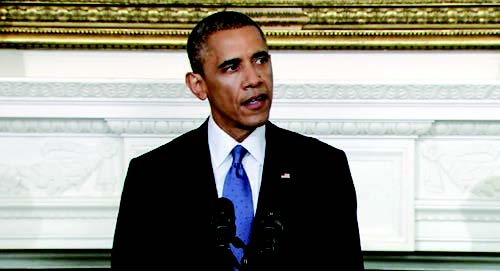
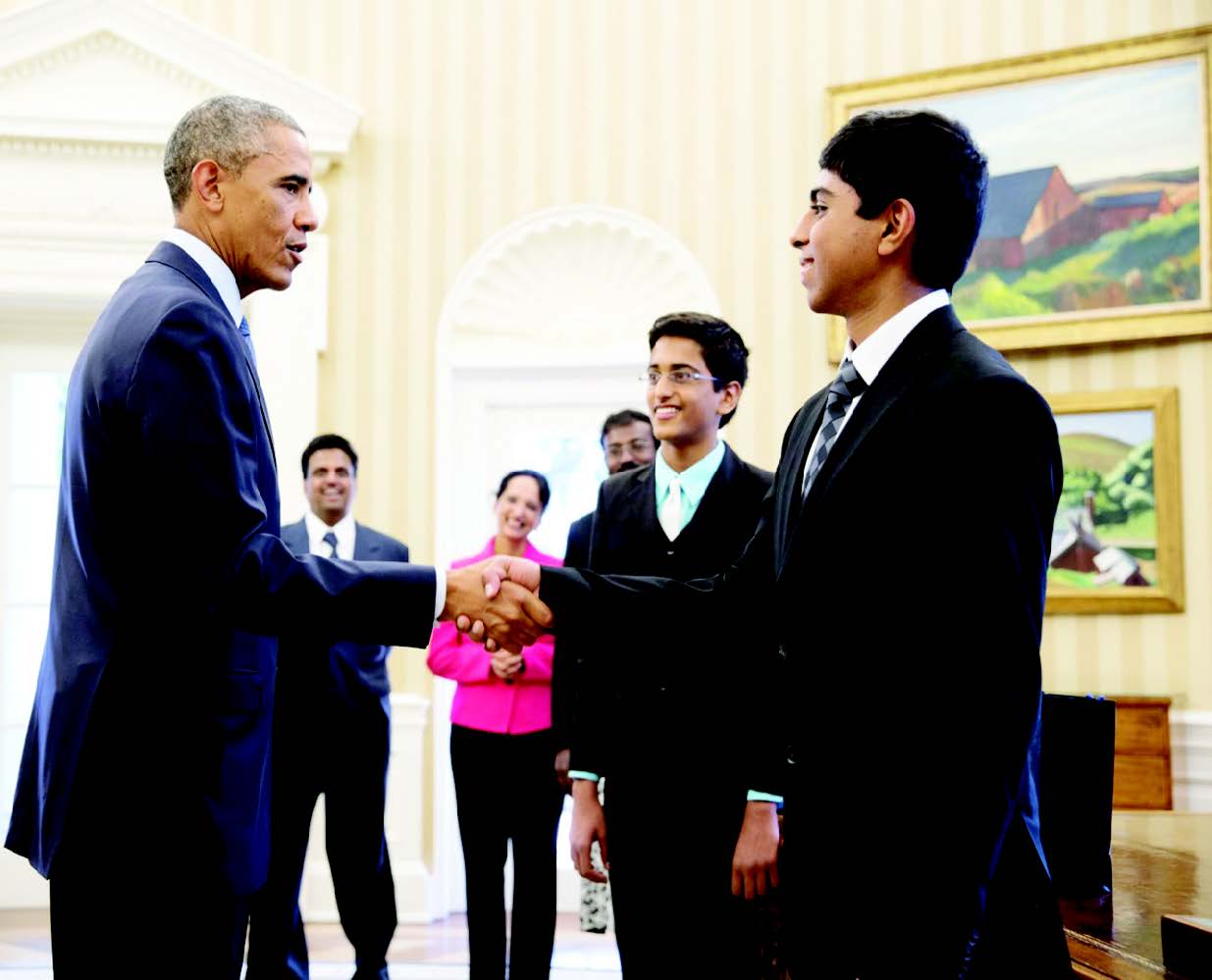
    WASHINGTON (TIP): President Barack Obama, with the largest number of Indian Americans in his administration, keeps dipping into the expanding talent pool of the three million-strong Indian American community, to take care of issues ranging from combating terrorist propaganda abroad to nation’s health at home, says a February 24  IANS report.

    Obama taps Indian Americans post image

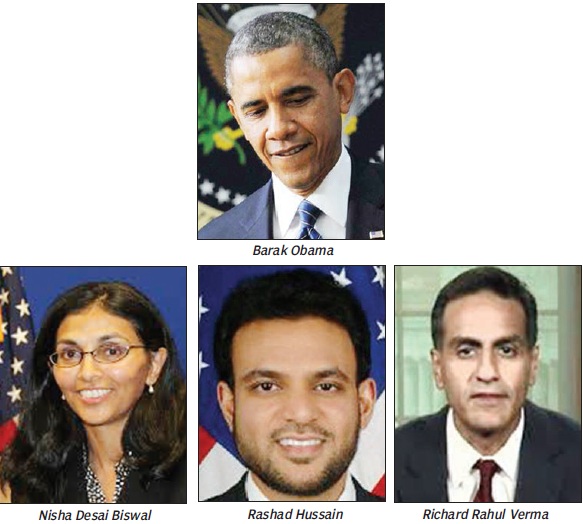
    Last week, after an international conference on terrorism, Obama named Rashad Hussain, a Muslim of Indian heritage, as US Special Envoy and Coordinator for Strategic Counter-Terrorism Communications. Son of immigrant parents from India, Hussain had since 2010 served as US Special Envoy to the 57-member Organisation for Islamic Cooperation (OIC), to build partnerships with Muslim communities around the world.

    Also last week, the White House named Dhanurjay ‘DJ’ Patil as its first chief data scientist to help shape policies and practices to help the US remain a leader in technology and innovation. Rajiv Shah, another son of immigrant Indian parents, Friday, February 20, left the US Agency for International Development (USAID) after five years at the helm of the agency engaged in a mission of ending extreme poverty and promoting resilient, democratic societies.

    At a little over three million, Americans of Indian ancestry make up about one percent of the US population, the country’s third largest Asian ancestry group after Chinese Americans and Filipino Americans. But they are America’s best educated and the richest lot gaining prominence in every field from academia to science and technology.

    They run various businesses, own about 80,000 convenience stores and manage over 20,000 motels — or Potels as they have come to be known as most of these are run by the Patel community from Gujarat.

    Over 100,000 physicians of Indian origin take care of the nation’s health. Many head America’s top educational institutions, including the prestigious Harvard Business School. Now they are gaining a foothold in government and politics too.

    With over a score direct Obama appointees in high places, two governors, a House member, a state attorney general and eight state legislators, Indian Americans have over the years gained power and influence far beyond their numbers. And their power keeps growing.

    Among the recent Obama nominees was Arun Majumdar, an Indian Institute of Technology (Bombay) alumnus who began serving as one of four US science envoys Last month.

    Earlier in December, Vivek Murthy created history as the youngest US Surgeon General and the first of Indian descent after cooling his heels for more than a year for Senate confirmation as ‘America’s doctor’ in the face of strong opposition by the powerful gun lobby.

    But unlike Murthy, Richard Rahul Verma sailed through the Senate to take up his position as Washington’s first Indian American envoy in New Delhi ahead of Obama’s historic visit to become the first US president to be the guest of honour at India’s Republic Day.

    With Verma in New Delhi and Nisha Desai Biswal heading the State Department’s South Asia bureau, Indian Americans are now watching US interests in both capitals.

    Biswal is assisted by Atul Keshap, another Indian American, while Puneet Talwar as assistant secretary for political-military affairs serves as a bridge between the State and Defense departments. And Arun Madhavan Kumar as assistant secretary of commerce and director general of the US and Foreign Commercial Service is charged with boosting US trade.

    Amid growing protests over the treatment of blacks, Obama chose Vanita Gupta to lead the US justice department’s civil rights division charged with enforcing laws that prevent discrimination.

    Another Indian American Anita M. Singh was picked up for a key job in the Justice Department’s National Security Division
    (NSD) to counter state-sponsored economic espionage and proliferation, including through cyberspace. Indira Talwani and Manish Shah became the first Asian American federal judges in Massachusetts and Obama’s home state of Illinois, respectively.

    To clean up the Wall Street, Obama picked up Preet Bharara as New York’s US attorney. Known in India for his dogged prosecution of Indian diplomat Devyani Khobragade, Bharara tasted his first defeat in July after winning 85 insider trading cases.

    Earlier in his first term, Obama chose Aneesh Paul Chopra as America’s first chief technology officer and Vivek Kundra as the first US chief information officer.

    Rohit “Ro” Khanna served as deputy assistant secretary in the US Commerce department before making an unsuccessful bid for the US House seat last November.

    And Neel Tushar Kashkari, who made a failed run for California governor in November, earned the nickname of “700 billion-dollar man” for leading the federal bank bailout plan from October 2008 to May 2009.

  • Mahatma Gandhi would have been shocked by religious intolerance in India: Obama

    Mahatma Gandhi would have been shocked by religious intolerance in India: Obama

    WASHINGTON  (TIP): US President Barack Obama on Thursday, February 5, said the “acts of intolerance” experienced by religious faiths of all types in India in the past few years would have shocked Mahatma Gandhi.


    The comments by Obama came a day after the White House refuted suggestions that the US President’s public speech in New Delhi in which he touched upon religious tolerance was a “parting shot” aimed at the ruling BJP.


    President Obama was speaking at the National Prayer Breakfast, an annual gathering that draws faith leaders from around the country.


    “Michelle and I returned from India – an incredible, beautiful country, full of magnificent diversity – but a place where, in past years, religious faiths of all types have, on occasion, been targeted by other peoples of faith, simply due to their heritage and their beliefs – acts of intolerance that would have shocked Gandhiji, the person who helped to liberate that nation,” Obama said in his remarks at the high-profile National Prayer Breakfast.


    The US President, who has just returned from India, was referring to violence against followers of various religions in India in the past few years.


    He, however, did not name any particular religion and said the violence is not unique to one group or one religion.


    “Humanity has been grappling with these questions throughout human history. And lest we get on our high horse and think this is unique to some other place, remember that during the Crusades and the Inquisition, people committed terrible deeds in the name of Christ.


    “In our home country, slavery and Jim Crow (racial segregation state and local laws) all too often was justified in the name of Christ,” he said, addressing the gathering of over 3,000 US and international leaders.


    “There is a tendency in us, a sinful tendency that can pervert and distort our faith. In today’s world, when hate groups have their own Twitter accounts and bigotry can fester in hidden places in cyberspace, it can be even harder to counteract such intolerance.


    “But God compels us to try. “And in this mission, I believe there are a few principles that can guide us, particularly those of us who profess to believe,” he said.


    In a US-style Town Hall address in New Delhi on January 27, the last day of his India trip, Obama had made a strong pitch for religious tolerance, cautioning that India will succeed so long as it was not “splintered along the lines of religious faith”.


    The White House , on February 5 strongly refuted allegations that Obama’s remarks on religious tolerance were aimed at the ruling Bharatiya Janata Party (BJP), saying the speech in its entirety was about the “core democratic values and principles” of both the US and India.

  • MODI GOVERNMENT ENTERS PHASE II

    MODI GOVERNMENT ENTERS PHASE II

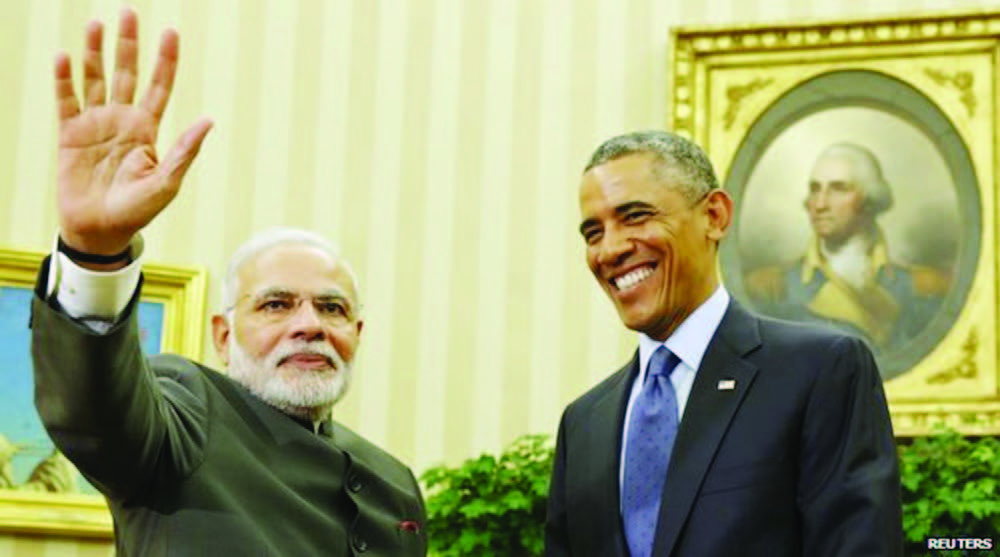
    We are now in the second phase of the Modi government. The first phase consisted of positioning the brickwork for a five-year term. Key states had to be won in elections to buttress the Modi image and to seek to augment the Bharatiya Janata Party’s (BJP’s) strength in the Rajya Sabha over time. And in a surprise sprung upon the country, Mr Narendra Modi showed an unsuspected sure touch in making foreign policy moves, including in getting President Barack Obama to witness the Republic Day parade.


    What then can the country expect now that the Prime Minister has his initial structure of government in place? The journey thus far has demonstrated the strengths and weaknesses of the Modi dispensation. The irony is that the baggage that is pulling him down was an essential element in catapulting him from Gujarat to the pinnacle of power in New Delhi. But apart from a sure-footed approach to foreign policy, he has also given many signals of his economic objectives the world is watching with anticipation.


    On the negative side, Mr Modi’s compact with the Rashtriya Swayamsevak Sangh (RSS) is proving an increasing liability for his party and government. Apart from the RSS’s own belief in Hindutva, which the organisation’s chief Mohan Bhagwat keeps stressing, the more embarrassing part, which is bringing great opprobrium and some disbelief, is a continuing army of BJP members of Parliament and other eminences declaiming the virtues of obscurantist ideas.


    For a time, the BJP received a pass by a helpful media describing them as fringe elements. But each day these venerable men and women are proving that they represent the mainstream, not the fringe of the party. What seems to have changed is that they are in a mood of triumphalism, relishing the first BJP victory with a majority at the national level in the country’s history.


    That the Prime Minister has chosen to offer his apology only in one instance in Parliament after constant needling reveals his Achilles’ heel. After all, the ludicrous propositions his members are expressing are very much part of the RSS diet on which Mr Modi himself was reared. The jury is still out on whether he himself subscribes to such sentiments (judging by his public remarks, he does believe in ancient Indians possessing knowledge of plastic surgery). But even if one assumes that he is willing to disguise his feelings at the altar of realpolitik, he is apparently in no position to penalise his supporters for such beliefs.


    It is for similar reasons that Mr Modi has had to give a carte blanche to the RSS in shaping the country’s future education policy, with the minister concerned, Ms Smriti Irani, having to carry the can. And in appointing a new censor board for film certification after the previous lot resigned in protest, the government has outdone itself in getting a chief censor who proclaims his worshipful attitude to Mr Modi. What kind of education the country’s young generation will receive in the years ahead is too dreadful to contemplate.


    There are, of course, many positives to take away from Modi’s innings at the Centre so far. After years of a lackadaisical government of the UPA-II vintage, the firm slap of decisive decision-making is welcome. Second, it is good for a new regime not merely to see the cobwebs, for instance, but do something about removing them. Clearly, the Manmohan Singh government had outlived its usefulness and it was good to have a successor question the logic of how things were done.


    In any case, changes in governments are an essential aspect of the democratic system. The Congress, which built up modern India, lost power only to regain it after the incompetence of successor regimes, bar a coalition spell led by the BJP, seemed to have fallen into a rut compounded by the dual-key arrangement. Mr Modi capitalised on his good fortune and took office in a wave of great optimism and every initial decision it took was welcomed almost because it demonstrated that New Delhi could take decisions.


    Inevitably, the euphoria has somewhat worn off and the second phase of the Modi government will be more testing, depending as it will be on concrete results and the harm the disruptive capacity of Mr Modi’s supporters can cause. There is a built-in dilemma here in the Prime Minister’s own mind and in that his mentor, the RSS. Some contradictions are part of life, but anomalies seem to be the rule, rather than the exception, in the BJP’s persona.


    For a man so taken up by modern technology and the power of digital wonders, Mr Modi coexists with a mixture of fact and fiction that is an essential element of the Sangh Parivar’s belief systems. It remains to be seen how he will resolve this dilemma and at what cost to his essential self and the tolerance levels of the RSS leadership.


    For a leader obsessed with controlling his public image, Mr Modi must be aware that the pearls of wisdom one sometimes hears from the Prime Minister himself and much too often from his supporters are objects of great derision for the outside world. Indeed, it is difficult to imagine that the same mind that can think big in terms of modern technology can be partial to theories of ancient Indians’ ability to fly aeroplanes, employ human cell transfer and other feats associated with the progress of science and technology in the last and present centuries.


    Possessing a sharp political mind, an ability to connect with people and dramatising objectives in people’s language, Mr Modi must be conscious of his handicap in taking the Indian development story ahead. The case of Turkish President Recep Tayyip Erdogan is an object lesson in what to avoid. His ruling Justice and Development Party (AKP) has already taken his country in an Islamic direction, compared to modern Turkey’s founder, Ataturk. Lately he has been dispensing such gems as Muslims having discovered America 200 years before Columbus and declaring that women are not the equal of men.


    (By S Nihal Singh The author is a senior journalist)

  • NUCLEAR DEAL AMONG FIVE KEY TAKEAWAYS FROM OBAMA VISIT

    NUCLEAR DEAL AMONG FIVE KEY TAKEAWAYS FROM OBAMA VISIT

    NEW DELHI (TIP): US President Barack Obama’s India visit was initially seen as more about symbolism than substance, but as it turned out, this was one of the most substantive engagements between the two countries with senior foreign ministry officials describing it as historic. Obama backed India to play a bigger role on global issues as he reiterated support to India’s candidature for a permanent membership of UN Security Council. The following are some of the most important takeaways:


    Nuclear Deal 


    The end of the nuclear logjam was a big takeaway because it was alone acting as an impediment in deepening strategic ties. India didn’t give in to any intrusive monitoring of its nuclear facilities and supplies and removed the liability hurdle through an insurance pool without diluting its liability law. It remains to be seen though if a nuclear accident victim retains the right to sue suppliers as envisaged in the law. But with the governments out of the way, it is over to businesses to do a cost-benefit analysis for building nuclear reactors in India.


    Asia-Pacific Vision 


    The two governments issued a joint strategic vision for Asia Pacific and Indian Ocean in what may be one of the most significant foreign policy statements by the Modi government. Coupled with last year’s Modi-Obama joint statement, it shows that Prime Minister Narendra Modi is not averse to an eventual amalgamation of India’s Act East and US’ Asia pivot. Modi is himself said to have been very keen on signing the China-centric strategic vision after he shared his fear of an “expansive” China with Obama. This is a considerable shift from the stand of the UPA administration which was more inhibited about endorsing the US pivot to Asia.


    Defense Ties 


    India and the US renewed their broad 10-year defense framework, with the Defense Trade and Technology Initiative (DTTI) being the key new element. Under it, the two have chosen four relatively modest military products – Raven mini-UAVs, aircraft reconnaissance modules, mobile electric power sources & soldier protective gear – for co-development and production. Plus, the two nations have also agreed to set up two working groups to explore development of aircraft carrier technologies and jet engines, which are more high-end.


    Best Partners 


    The decision to elevate the strategic partnership with a Declaration of Friendship strengthens and expands the relationship between India and the US. Among other things, it also envisages regular summit meets. Signaling the natural affinity enjoyed by the two nations, as the White House said in a press release, this declaration proclaims a higher level of trust and coordination that will
    “continue to draw the two governments and people together across the spectrum of human endeavor for a better world”.


    Thinly Veiled Warning 


    Obama may have handed another takeaway in the form of a thinly veiled warning that religious tolerance is imperative for India’s success. Coming from a country the Modi government sees as indispensable for its own economic success and overall global standing, it may not be easy to just wish Obama’s assertion away. If this leads Modi to, at some stage, publicly shun fringe elements associated with BJP and their controversial religious conversion program, it will only help raise India’s and his stature.

  • Hillary Clinton Campaign may be delayed

    Hillary Clinton Campaign may be delayed

    NEW YORK (TIP): Hillary Clinton, expecting no major challenge for the Democratic nomination, is strongly considering delaying the formal launch of her presidential campaign until July, three months later than originally planned, says a Politico report quoting “top democrats”. The delay from the original April target will give her more time to develop her message, policy and organization, without the chaos and spotlight of a public campaign.


    A Democrat familiar with Clinton’s thinking said: “She doesn’t feel under any pressure, and they see no primary challenge on the horizon. If you have the luxury of time, you take it.”


    Advisers said the biggest reason for the delay is simple: She feels no rush.


    “She doesn’t want to feel pressured by the press to do something before she’s ready,” one adviser said. “She’s better off as a non-candidate. Why not wait?”


    A huge advantage to waiting is that Clinton postpones the time when she goes before the public as a politician rather than as a former secretary of state. Polling by both Democrats and Republicans shows that one of her biggest vulnerabilities is looking political.


    One option being considered would be to announce an exploratory committee earlier -perhaps in April, at the beginning of a new fundraising quarter, in the timeframe when insiders originally expected her to launch her campaign.


    Then the actual kickoff would be in July, near the start of the next quarter. By launching at the beginning of a quarter, supporters have the maximum amount of time to generate a blockbuster total for their first report.


    The delay would pose complications for the infrastructure that has been built in anticipation of her candidacy. Ready for Hillary, a super PAC that expects to go out of business once the campaign begins, now may have to fund its data-gathering and grassroots activities longer than expected.


    The danger – and a reason the plan could be scrapped – is that the comparatively leisurely rollout could fuel complaints that Clinton sees the nomination fight as a coronation. Already, her allies are contemplating the possibility that she might not have to debate before the general election.

  • Delhi Elections | BJP ROPES IN 120 MPs

    Delhi Elections | BJP ROPES IN 120 MPs

    NEW DELHI (TIP): The stakes are high and the Bharatiya Janata Party is pooling in massive resources at hand for the maximum impact before Delhi goes to polls on February 7.


    As many as 120 MPs from 13 states will address over 250 public meetings in the last week of campaigning. The party is coming out with newer strategies to trump rivals, specially AAP’s reach out to the voters.

    No manifesto just vision document for BJP – The BJP may not go through with earlier poll promises of providing full Statehood to Delhi with the party’s chief ministerial candidate Kiran Bedi and senior BJP leaders skirting the issue. Full Statehood demand which was on top of the manifesto released ahead of the 2013 Delhi Assembly elections seems to have been kept aside for the time being. The party on January 29 decided that it would not even bring out an election manifesto but would instead put out a vision document this time. The decision was taken at a meeting chaired by BJP president Amit Shah during which various aspects relating to the election campaign were discussed. “We will not release the party’s manifesto for the Delhi Assembly elections this time. Instead, we will come out with a vision document. The party has set a target to win the upcoming polls,” senior party leader and Union Minister Ananth Kumar said after the meeting.

    The party had earlier asked 22 ministers to campaign specifically on eight issues shortlisted by the party — power and water, education, health, skill development and information technology, housing, transport, Yamuna and welfare measures for the Purvanchalis.


    Now, the party MPs will ask AAP chief Arvind Kejriwal five questions every day. Party president Amit Shah convened a meeting of MPs involved in Delhi election on Thursday and asked them to give their best.


    “He reviewed election preparations and asked MPs to focus on unauthorized colonies and slums,” said a senior BJP leader. Sources said Shah would review the party campaign on a daily basis at the Pandit Pant Marg office of the BJP.


    “We will do all that it takes, and win by a two-third majority,” said BJP leader Ananth Kumar. Sources also said that workers from other states have also been called to campaign at the grassroots level.


    “We want to have 1.24 lakh panna pramukh (in-charge of pages of electoral roll) who will connect with voters. They will strengthen the party at the booth level,” said a senior leader.


    A senior BJP leader said the move to include senior leaders was largely aimed at nipping in the bud the factionalism which reared its head soon after the party announced its candidates.


    Supporters of many of those who were denied tickets portested in front of the party office, embarassing the party brass. “BJP has MPs, ministers, MLAs. I can’t help it if other parties don’t have such leaders for campaigning. We are not feeling the pressure. The campaign is on and people of Delhi would certainly like to have a BJP government in Delhi,” said BJP MP Rajiv Pratap Rudy in response to a question if the party was nervous.


    Delhi has been divided into 14 districts by and an MP has been asked to take charge of each district. Also one MP each has been asked to be in regular touch with the various
    ‘pannna pramukh’.

  • Obama cancels Agra Visit |Air Force One takes off from Andrews Air Base

    Obama cancels Agra Visit |Air Force One takes off from Andrews Air Base

    US President Barack Obama just (saturday Morning 24th January) embarked on his highly watched three-day landmark trip to India where is he a special special for the Indian Republic Day. He is the first US president who has been invited and participating in the Indian grand event of the year.


    Earlier today, the White House issued a statement confirming that The US President Barack Obama regrets the cancellation of his visit to the Taj Mahal during his three-day visit to India. 


    Barack Obama is scheduled to fly to Saudi Arabia on 27th January instead to meet the new Saudi king following the demise of King Abdullah.


    The US President is being accompanied by multiple members of his cabinet, influential business leaders and lawmakers, including Nancy Pelosi, the minority leader of the US House of Representatives during the Historic India Visit.

    Air Force One will have a refuelling halt in Germany (Ramstein) and will touch down in Delhi at 10 am on Sunday at Air Force Station, Palam

  • Obama outlines India vision – from natural to global partners

    Obama outlines India vision – from natural to global partners

    NEW DELHI (TIP): As he arrives in India for a three-day visit, his second in six years, US President Barack Obama has exuded hope about enhanced ties with “natural partner” India, saying he would like to think that the stars are aligned to finally realize his vision of the two countries being “global partners”.


    In an email interview with India Today weekly magazine, which is to be published in its upcoming issue, the US president, who arrives January 25, touched on several issues, including his relationship with former Prime Minister Manmohan Singh, acknowledging that the two countries have differences and can work around them, his appreciation of Prime Minister Narendra Modi’s desire for wanting to take the relationship forward, and also the reason for accepting the invite.


    ‘ Obama, who is the first US president to be chief guest at the Republic Day parade, also spoke strongly on terror emanating from Pakistan, saying that Washington has made it clear that “even as the US works with Pakistan to meet the threat of terrorism, safe havens within Pakistan are not acceptable and that those behind the Mumbai terrorist attacks must face justice”.


    He said Modi’s “remarkable life story – from tea-seller to Prime Minister – is a reflection of the determination of the Indian people to succeed”.


    Obama said Modi has a “clear vision of the big things he wants India to achieve, and I’ve been impressed with his energy and his readiness to address many of the barriers that have stood in the way of greater economic growth… In particular, I appreciate the prime minister’s eagerness to take the India-us partnership to the next level”.


    On former prime minister Singh, with whom he had interacted several times during bilateral summits, Obama said he had “a strong relationship with prime minister Singh, and he was a close partner”.


    “Now, Prime Minister Modi’s election and his commitment to a new chapter in the relationship between our countries gives us an opportunity to further energies our partnership.” 


    “I’d like to think that the stars are aligned to finally realize the vision I outlined in Parliament – India and America as true global partners,” he said.


    “That’s why I accepted the generous invitation to become the first US president to attend Republic Day as the chief guest,” he said and added that he was deeply honored to join in celebrating the 65th anniversary of the Indian Constitution.


    Acknowledging the differences between the two nations, the US president said: “No two nations agree on everything, and so, of course, sometimes India and the United States will disagree. But I believe that we can work through any differences in a spirit of mutual respect. Moreover, whatever differences we may have are greatly outweighed by the many interests we have in common.” 


    He said that for this, “good communication and coordination” is required not just between the leaders but between governments.


    “When those of us at the leadership level agree on a course of action, our governments have to actually implement our decisions. We have to make sure that words are matched by deeds,” he said, in a tacit indication of the delay in implementation of the Indo-US civil nuclear deal. The deal was inked in 2005 and the US Congress approved of the 123 agreement bill and it was signed into law in 2008. But India’s tough civil nuclear liability law, which puts the onus on suppliers, has held up implementation of the mega deal.


    Obama also voiced keenness in working together with India in multilateral fora, saying no country can alone meet the challenges thrown up by the world. “That’s why I’m committed to forging a greater partnership with India, both on a bilateral basis and within multilateral organizations.” 


    “And even as we expand our cooperation on a bilateral basis, we have to keep working to make sure that multilateral institutions are effective. That’s why I pushed for elevating the role of the G20 to give emerging economies, including India, a greater voice in global economic decision making. And that’s why I believe that a reformed UN security council should include India as a permanent member.” 


    On ways to improve the bilateral relationship, Obama said the specific areas that both can improve ties in include creating jobs, improving education and creating more opportunities, including for girls and women. He called for reducing the barriers to trade, investment, and high-tech collaboration.


    “American companies are ready to help build the infrastructure that will be the catalyst for the next wave of Indian growth,” he said and outlined other areas of cooperation including deeper security cooperation, including in maritime security in the Asia-Pacific, and climate change.

  • OBAMA ITINERARY A MIX OF EXPERIENCES

    OBAMA ITINERARY A MIX OF EXPERIENCES

    NEW DELHI (TIP): U.S. President Barack Obama will finish his first day of a landmark India trip on Sunday, Jan. 25, at a star-studded ceremonial banquet within the Rashtrapati Bhavan — the official residence of India’s President Pranab Mukherjee — where the guest list boasts up to 200 of India’s leading industrialists, politicians, academics, physicians, and actors . Expected guests include Bollywood legend Amitabh Bachchan, cricket star Sachin Tendulkar, Tata Sons Chairman Emeritus Ratan Tata, and a host of other top industry leaders. The business-heavy invitation list reflects the high priority the United States and India are placing on reviving bilateral trade ties.


    Sunday’s grand affair will follow a lunch between Obama and Indian Prime Minister Narendra Modi and a series of bilateral meetings spanning a range of issues at Hyderabad House.


    On Monday, Obama will attend India’s Republic Day Parade alongside Modi, becoming the first U.S. president to attend this occasion. Obama is then expected to join Modi for back-to-back meetings with Indian business leaders: the Indo-U.S. CEO Forum and the India-U.S. Business Council.


    Obama will visit Agra to have a look at the monument of love and the 8th wonder of the world The Taj Mahal, the following day, before returning to Washington.

  • Obama’s visit to India: what’s at stake?

    Obama’s visit to India: what’s at stake?

    U.S. President Obama’s visit to India as the chief guest for the Republic Day celebrations underscores the determination of both administrations to revitalise the bilateral relationship. This visit might not be high on deliverables but emphasises the efforts being made to create a common ground for cooperation


    President Barack Obama’s upcoming visit to India, his second as a serving president, is historic for both its optics and the potential to fast track the slow moving train of India-U.S. relations.


    Obama as the chief guest for India’s Republic Day parade-the first U.S. president to be invited for the occasion-has great symbolism. The White House recognised the significance of the first-ever invitation and acted despite difficulties of scheduling. The president’s State of the Union address to the U.S. Congress, typically in the last week of January, was brought forward so Obama could be in New Delhi.


    The U.S. establishment rightly determined that accepting Prime Minister Narendra Modi’s invitation and clocking this “first” was important. Also important was to reinforce Modi’s bold move-the invitation effectively jettisoned traditional Indian reluctance to go public with the Americans. By honoring the U.S. president thus, the Indian government has taken a step to shed some of the past insecurities to finally catch up with the people.


    That’s all for the good. Obama’s visit is also an acknowledgment that the India story is resonating once again in the world and the Americans ought to be in front not behind other countries. The U.S. Administration has responded well to the new energy coming out of official India despite being pulled in different directions by multiple foreign crises. Foreign crises will form a big part of the discussion between Obama and Modi-the turmoil in the Muslim world at large, the rise of ISIS, the recruitment of youth through the internet, the Afghanistan-Pakistan situation and China. All of these point for greater cooperation between the US administration and India.


    Secretary of State John Kerry was in India last week-his second visit since Modi became prime minister-to attend the Vibrant Gujarat summit where the U.S. was a partner country for the first time. Kerry’s trip was meant to nail down concrete progress in the India file that can be showcased during Obama’sJanuary 25-26 visit.


    It’s worth noting that the Obama Administration has significantly toned down the harsh rhetoric on India’s trade policies. Recognising the progress made recently, the U.S. Trade Representative last month closed its “301 out-of-cycle” review of India’s intellectual property (IP) laws, giving this perennial sword over bilateral relations a rest, even if temporarily. Discussions on contentious issues such as IP are being held in private rather than in the public domain, which has led to an automatic improvement in the atmospherics.


    The level of activity between the two governments since Modi became prime minister has gone up by leaps and bounds. Various bilateral groups, which hadn’t met for nearly three years but were always counted as proof that we had a “strong” relationship, have actually been meeting. These include the Trade Policy Forum, the Defence Trade and Technology Initiative and the High Technology Cooperation Group.


    Then there are newly established contact groups-one to sort differences on India’s nuclear liability law, an investment forum and an infrastructure platform. The US side is happily surprised at the responsiveness of the Modi government.


    Potential areas of progress include a finalised text for a Bilateral Investment Treaty (BIT), an agreement on climate change and a renewal of the Defence Framework Agreement for another 10 years. In addition, India and the US are likely to further enhance their intelligence cooperation but without public pronouncements.


    Aligning the needs of the two systems sometimes has proven difficult but what’s different this time is the desire to find solutions. And that is a definite change after losing nearly three years in limbo. The question is how much can India push the United States to change its systems and make exceptions.


    The U.S. has its way of negotiating-what it says is normally accepted by other countries. India, which doesn’t fall in an easy category, has its perspective. Its positions are well argued and can’t be easily dismissed. The Americans, often unwilling to change their processes, find it frustrating to have to justify themselves.


    it is differences on intellectual property protection or obtaining basic development needs for Indians but also curbing emissions, buying high-end U.S. defence technology but without signing basic agreements the Pentagon requires-every tussle brings out the difference in worldview.


    The Americans want India to promise not to use the tool of compulsory license (CL) to force prices of life-saving drugs down except in an emergency. India is unlikely to commit to the demand because no government would give up a policy instrument, especially when it has not abused it. India has used CL only once.


    Indian IP laws are TRIPS-compliant under the World Trade Organization rules. In essence, what the U.S. is demanding on behalf of its pharma industry is something that can be described as “TRIPS plus” which would go beyond WTO agreements. More discussions may yield a new fuzzy position but the fundamental Indian stand will likely remain.


    Similarly, the requirements of the U.S. system hamper transfer of sensitive U.S. defence technologies to India because New Delhi has refused to sign what Washington calls
    “foundational agreements”. There are at least five but two are seen as key to getting over regulatory hurdles-CISMOA or the Communications Interoperability and Security Memorandum of Agreement and LSA or the Logistics Support Agreement.


    Even though U.S. officials are “working around them”-as former deputy defence secretary Ash Carter put it-they say life would be a lot simpler if India just signed the agreements which all other U.S. partners have. The flow of defence technology would be a lot smoother.


    But New Delhi remains constant in its refusal-it feels it doesn’t need to tie itself down with these agreements, which may allow U.S. an entre it is unwilling to grant as yet.


    Another suggestion from Washington is for India to buy more off-the-shelf technology instead of trying to reinvent every wheel and make a quick “qualitative” jump in defence capability. Border security can be improved in new ways with what’s already available on the market.


    Whether there are many breakthroughs or none, the fact that Obama and Modi are meeting again within a short span will keep the two systems focused and geared for progress.


    (Seema Sirohi is a Washington-based analyst and a frequent contributor to Gateway House: Indian Council on Global Relations. Seema is also on Twitter and her handle is @seemasirohi.

    This feature was written exclusively for Gateway House: Indian Council on Global Relations. It is being republished with permission from Reetika Joshi (joshi.reetika@gatewayhouse.in)


    © Copyright 2014 Gateway House: Indian Council on Global Relations. All rights reserved. Any unauthorised copying or reproduction is strictly prohibited.(British English)

  • The Obama Enigma

    The Obama Enigma

    Is it a handicap for a leader to be cerebral? This is a question that admirers of President Barack Obama are asking as they ponder over the remaining two years of his not so successful Presidency.

    And for us in India, the issue is topical too as Obama comes calling at the end of the month to engage with our PM, a very different personality type, as we shall see.

    Obama in 2015 is a different personality than the “Yes, we can” trail-blazer that captivated the world in 2008. He had changed American polity then, by becoming the first ‘black’ President, by transcending the racial prejudice, and in some ways by his sober and ultra- rational approach to divisive issues.

    He was sure-footed in winning the Presidential race, and once in office seemingly resolute to clean up the mess left by his predecessor. However, as the quip goes, the biggest challenges for any leader are the ‘events’ that impinge. Starting with the financial crisis that soon engulfed America in 2008, it has been a difficult ride in one way or the other for Obama.

    As 2015 dawns and as we get ready to receive him, his persona is more of an enigma. In the US, his detractors seem to be more vociferous than his supporters. What are the opponents saying, how fair is the criticism, and delving deeper, are there underlying traits that characterize his functioning?

    Obama is accused by his critics of presiding over an America that is in decline. On the external front, he gets blamed for the continued problems of the US in the conflicts in Iraq and Afghanistan though Obama’s effort has been to gradually disengage from these theatres.

    He is seen as having vacillated with regard to American policies in West Asia, specially Libya, Egypt, and Syria. He is blamed for not being robustly aggressive with Putin’s Russia, an inexorably rising China, or an unbeaten Cuba.

    On all these, if his hawkish opponents on the Republican right accuse him of weakness, his erstwhile liberal supporters believe that he has turned too centrist and has compromised on his core values.

    Internally, Obama is perceived as having accomplished little by not having had the stamina to bring closure to his agenda. The health care reforms that he did bring about have not enjoyed wide support; he failed in efforts to push through immigration reforms or regulate guns; minorities including blacks feel that he has not done much for them.

    While this is the public perception, largely based on prejudices, the reality is different. Compared to the stagflation of 2008, the economy is growing and analysts talk of an American resurgence, supported by its innovation, technological competitiveness, and successes in shale gas.

    Externally, America continues to be a pre-eminent power, though it is more meaningful today to envisage a multi-polar rather than a unipolar world order.

    It will be reasonable then to assess that the doubts and criticism about Obama are more due to partisanship and polarization in American polity than an impartial evaluation of his track record.

    Washington has been deeply divided between Republican conservatives and Democrats with little space for compromise or consensus. This mistrust and hostility has steadily grown worse and for the last six years, Obama’s efforts have been frustrated by a determined opposition in the US Congress.

    Much needed reforms whether on fiscal discipline, balancing the budget, or immigration have been prevented because of the gridlock between the President and the legislative branch.

    There are deeper structural issues in American society and politics that underlie the impasse on many fronts which may continue.

    What could have Obama done in spite of them? It is here, that his Hamlet like personality, a widely held pejorative description, comes into the picture.

    Sympathetic observers of Obama-admirers of his intellectual caliber and enlightened world view -acknowledging his lack of popular support and tangible success, voice the view that there are personality traits that have compounded the predicament that he faces.

    The two aspects often noted are: disengagement from the political process, and the inclination to see many sides of an issue to the point of being indecisive.

    With his professorial intellect, Socratic instinct for debate, and fondness for nuanced positions, Obama is certainly interested in public policy, but is weary of the political process involved in transforming that policy to legislation.

    He has shown a tendency to stay above the fray, is allergic to the give and take and to arrive at unsatisfactory half-solutions that seem inescapable when consensus is impossible.

    As a result, he has been unable to make breakthroughs in some of the areas mentioned. This disinclination has made him an aloof player unable to determine outcomes. Added to this factor is the seeming self- doubt natural in a cerebral figure, but apparently not a virtue in a ruler.

    No doubt, Obama was resolute in a crucial test, the decision to ‘take out’ Osama, but he has shown a sensitivity to see nuance and complexity where it exists as in the case of Syria or Ukraine.

    From what we can fathom so far, Modi, again an extremely intelligent and capable personality, relishes the political process. He does not appear to be troubled by self-doubt or a have a tendency to look over his shoulder.

    For amateur observers like us, the encounter between the two leaders should be as interesting as the engagement between the two countries.

    (The author is a former Ambassador and a visiting Professor)

  • National counter to terror

    National counter to terror

    Bipartisan security policy is of paramount importance

    The Indian government’s seasoned response to the horrific killing of students in Pakistan has been commendable; it’s not the time to score points or point fingers. Expressing deeply-felt sorrow over an unspeakable tragedy next door was the need of the hour. Pakistan will do what it has to for dealing with the terror knots it has tied itself in. Realism now calls for New Delhi having a serious look within. The Peshawar attack, coming a day after the Sydney cafe siege, is a grim reminder of the dangers that lurk at just an arm’s length. A national bipartisan security policy thus should become a priority of utmost importance and urgency. A knee-jerk undocumented reaction to any activity that threatens security just won’t do anymore.

    Reaching out to the states and making them partners in countering terrorism for firming up internal security can no longer be ignored by the Centre. If the proposed National Counter Terrorism Centre needs changes, deal with it and get it running. An all-India institution like this is imperative for the national security management system. The country’s security apparatus planning and working in one voice and direction and not at cross purposes is no more a fancy idea; unitary, with all in it together, is the only approach that can work.

    The United States of America may falter in how it gets on with the world, but the way it handles security on its own soil is a lesson for all. Just hours after the Taliban attack, President Barack Obama convened a meeting with his National Security Council to review potential threats to the US homeland personnel and those overseas ahead of the busy travel season and public gatherings expected during the holidays. Such is the planning that goes into making America secure. Given the vast economic and social challenges that India faces, a national security doctrine is the essential step forward, its contours shaped by a holistic construct of strengthening the country.

  • Nobel Peace Prize for ‘Indian Father & Pakistani Daughter’

    Nobel Peace Prize for ‘Indian Father & Pakistani Daughter’

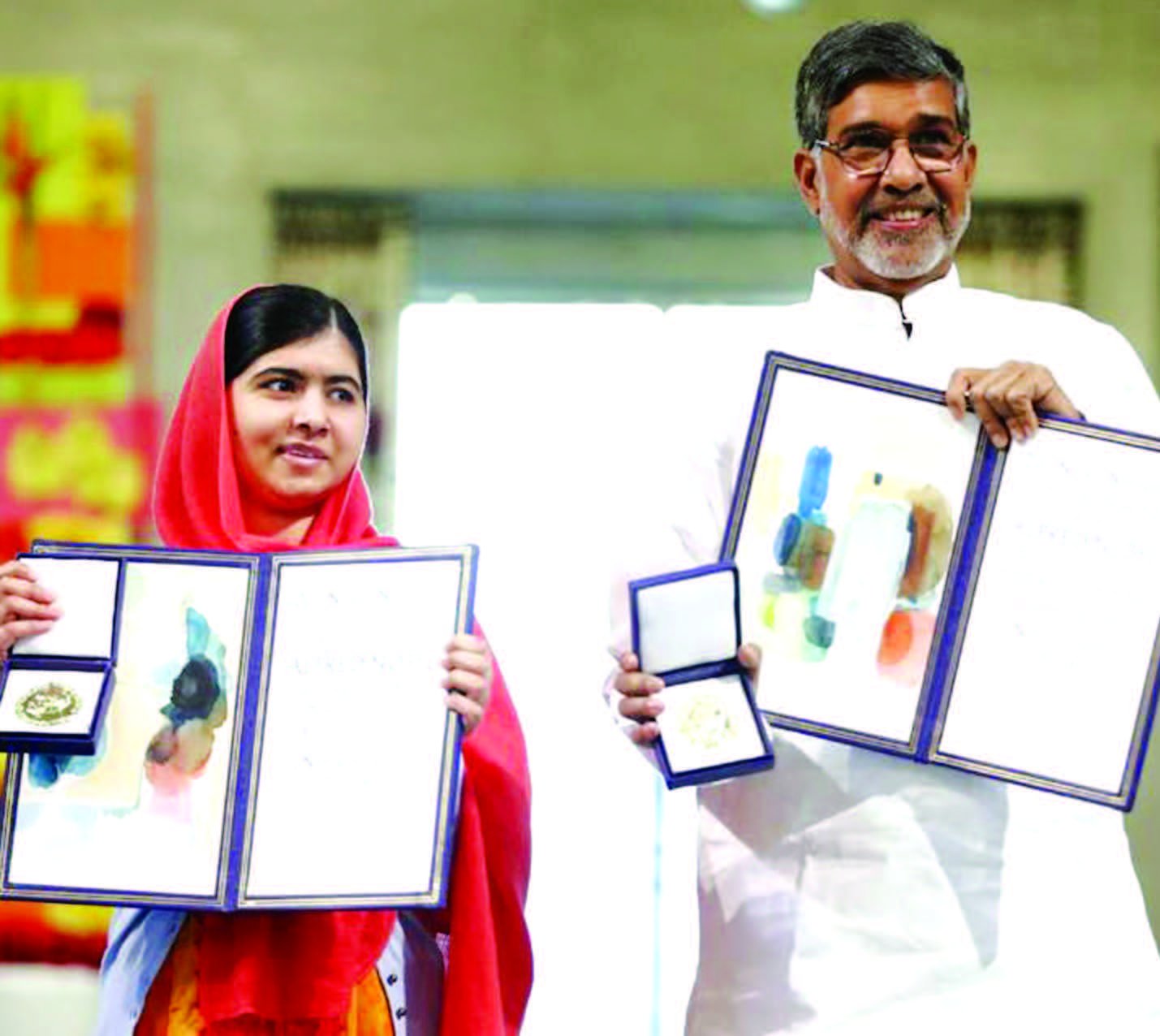
    OSLO (TIP): It was a proud moment for an “Indian father and a Pakistani daughter” to stand together to accept the applause of a gathering of royals, dignitaries, family members and others in the vast and ornate chamber at the Oslo City Hall , Wednesday, December 10. The 60 year old Kailash Satyarthi of India and the 17 year old Malala Yousafzai of Pakistan shared the Nobel Peace Prize. Standing side by side to receive medals and diplomas, the two winners drew a standing ovation from the audience before them.


    1
    Malala Yousafzai at the U.N. on July 12, 2013


    Speaking at the ceremony, his speech steeped in emotion, Kailash Satyarthi, declared that he represented “the sound of silence, the cry of innocence, and the face of invisibility.” “I have come here to share the voices and dreams of our children, because they are all our children,” he said. “There is no greater violence than to deny the dreams of our children,” he said. “I refuse to accept that the shackles of slavery can ever be more stronger than the quest for freedom,” he added. “The single aim of my life is that every child is free to be a child.” “We live in an age of rapid globalization,” he continued. “We are connected through high-speed Internet.We exchange goods and services in one single global market.


    3
    Kailash Satyarthi attends a human trafficking special session during the 2009 Clinton Global Initiative


    Thousands of flights every day connect us to every corner of the globe. “But there is one serious disconnect. It is the lack of compassion,” he said, adding: “Let us globalize compassion.” Malala Yousafzai began her speech with acknowledging her gratitude to her parents and teachers. Malala went on to say the Nobel Prize “is not just for me.” “It is for those forgotten children who want education,” she continued. “It is for those frightened children who want peace.


    4
    Kailash Satyarthi: “Let us globalize compassion.”


    It is for those voiceless children who want change.” “This is where I will begin, but it is not where I will stop,” she said. “I will continue this fight until I see every child in school.” She added: “Why is it that countries which we call so strong are so powerful in creating wars but so weak in bringing peace? Why is it that giving guns is so easy but giving books is so hard? Why is it that making tanks is so easy, but building schools is so hard?” Even before the ceremony, Ms. Yousafzai and Mr. Satyarthi seemed intent on using the occasion not simply as a platform for acknowledgment of their achievements, but also as a podium from which to renew their campaigns.


    5
    “We are here to tell children, especially, that you need to stand up. You need to speak up for your rights. It is you who can change the world”, said Malala .


    “We are not here just to accept our award, get this medal and go back home,” Ms. Yousafzai told a news conference on the eve of the ceremony, according to Agence France-Presse. “We are here to tell children, especially, that you need to stand up. You need to speak up for your rights. It is you who can change the world.” “In this world, if we are thinking we are modern and have achieved so much development,” she said on Tuesday, “then why is it that there are so many countries where children are not asking for any iPad or computer or anything? What they are asking for is just a book, just a pen, so why can’t we do that?”


    6
    The Indian father and the Pakistani daughter greet people before the start of the ceremony


    Pakistani youth activist Malala Yousafzai was awarded the 2014 Nobel Peace Prize on Wednesday, December 10, an honor she shares with Kailash Satyarthi, who has long been campaigning against child exploitation in neighboring India. But until about two years ago, Malala was just a 15-year old blogger on a school bus with her friends. It was Oct. 9, 2012, when armed Taliban men boarded Malala’s bus and shot her in the head, transforming her from a minor Internet celebrity into an international symbol.

    It’s hard to believe that she’s accomplished so much – including recovery from her injuries – in only two years, but Malala’s story actually started long before the assassination attempt that launched her to worldwide fame. She was born in the Swat valley in Pakistan, in 1997, to parents who encouraged her love for education from a young age. As a toddler, Malala would sit in classrooms in her father’s school and follow lessons for 10-year olds. Aryn Baker wrote in her 2012 profile of Malala for TIME: By the time she was 2½, she was sitting in class with 10-yearolds, according to a close family friend and teacher at the school founded by Malala’s father.

    The little girl with the huge hazel eyes didn’t say much, but “she could follow, and she never got bored,” says the teacher, who asked to remain anonymous for fear that she too might become a Taliban target. Malalaloved the school, a rundown concrete-block building with a large rooftop terrace open to views of the snowcapped mountains that surround the Swat Valley. As she grew older, she was always first in her class. “She was an ordinary girl with extraordinary abilities,” says the teacher, “but she never had a feeling of being special.” In 2008, everything changed.

    The Taliban gained control of the Swat region, banning DVDs, dancing, and beauty parlors. By the end of the year, over 400 schools were closed. Ziauddin took Malala to Peshawar, where she made a famous speech in front of national press titled “How Dare the Taliban Take Away My Basic Right to Education?” She was only 11. In early 2009, Malala started blogging anonymously for the BBC about what it was like to live under the Taliban. Just a few days after she started, all girls schools were closed. In retrospect, some parts of Malala’s blog seem like ominous foreshadowing: “On my way from school to home I heard a man saying ‘I will kill you’,” she wrote on Jan. 3, 2009. “I hastened my pace and after a while I looked back if the man was still coming behind me. But to my utter relief he was talking on his mobile and must have been threatening someone else over the phone.” But there are also humorous parts that remind us that, at the time, she was only 11: “My mother liked my pen name ‘Gul Makai’ and said to my father ‘why not change her name to Gul Makai?’ I also like the name because my real name means ‘grief stricken’.” In December 2009, Ziauddin publicly identified his daughter, even though her real name has been widely suspected for months. That proved to be a dangerous move.

    “We did not want to kill her, as we knew it would cause us a bad name in the media,” Sirajuddin Ahmad, a senior commander and spokesman for the Swat Taliban, told TIME for the 2012 magazine profile. “But there was no other option.” In 2012, armed men boarded the converted truck that Malala and her classmates used as a makeshift school bus. “Which one is Malala?” one of them asked. “I think we must have looked at her,” Malala’s classmate Shazia Ramzan told TIME’s Aryn Baker. “We didn’t say anything, but we must have looked, because then he shot her.” Malala took a bullet to the head.

    She endured a traumatic operation in Pakistan that left her with a (temporary) metal plate in her head while they stored a piece of her skull in her abdomen, to reattach when she’s healed enough. She was then airlifted to a hospital in Birmingham, England, where she had more medical treatment and extensive rehabilitation. The rest of her story has played out in the public eye. Nine months after she was shot, Malala gave a now-famous speech at the UN. “They thought that the bullets would silence us. But they failed,” she said. “And then, out of that silence came thousands of voices.… Weakness, fear and hopelessness died.

    Strength, power and courage was born.” Now relocated to England, Malala goes to Edgbaston School for Girls. She’s continued her high-profile campaign for girls’ education with The Malala Fund, which raises money to promote girls’ education. She’s used the fund as a platform to confront Barack Obama about drone strikes, help Syrian refugee children and demand the return of the Nigerian girls kidnapped by Boko Haram. And this September, she announced a $3 million multi-year commitment to partner with Echidna Giving to support girls education in developing countries.

    Malala won Pakistan’s National Youth Peace Prize in 2011, before she was shot, but the prize been since renamed in her honor; it’s now the National Malala Peace Prize. She was shortlisted for TIME’s Person of the Year in 2012, and was one of the TIME 100 in 2013. She won a Mother Teresa Memorial Award for Social Justice in 2012 and the 2013 Simone de Beauvoir Prize for international human rights work on behalf of women’s equality.

    India’s Kailash Satyarthi , born on January 11, 1954, is a human rights activist who has been at the forefront of the global movement to end child slavery and exploitative child labor since 1980 when he gave up a lucrative career as an Electrical Engineer for initiating crusade against Child Servitude. As a grassroots activist, he has led the rescue of over 78,500 child slaves and developed a successful model for their education and rehabilitation. As a worldwide campaigner, he has been the architect of the single largest civil society network for the most exploited children, the Global March Against Child Labor, which is a worldwide coalition of NGOs, Teachers’ Union and Trade Unions.

    As an analytical thinker, he made the issue of child labor a human rights issue, not a welfare matter or a charitable cause. He has established that child labor is responsible for the perpetuation of poverty, unemployment, illiteracy, population explosion and many other social evils. He has also played an important role in linking the fight against child labor with the efforts for achieving ‘Education for All’. Mr. Satyarthi is a member of a High Level Group formed by UNESCO on Education for All comprising of select Presidents,

    Prime Ministers and UN Agency Heads. As one of the rare civil society leaders he has addressed the United Nations General Assembly, International Labour Conference, UN Human Rights Commission, UNESCO, etc and has been invited to several Parliamentary Hearings and Committees in USA, Germany and UK in the recent past. As an advocate for quality and meaningful education, Mr. Kailash Satyarthi has addressed some of the biggest worldwide congregations of Workers and Teachers Congresses, Christian Assembly, Students Conferences, etc. as a keynote speaker on the issue of child labor and education.

    He is on the Board and Committee of several International Organizations. Amongst all the prominent ones being in the Center for Victims of Torture (USA), International Labor Rights Fund (USA), etc.Mr. Satyarthi is an executive Board Member of International Cocoa Foundation with the Headquarters in Geneva representing the global civil society. He has survived numerous attacks on his life during his crusade to end child labor, the most recent being the attack on him and his colleagues while rescuing child slaves from garment sweatshops in Delhi on 17 March 2011.

    Earlier in 2004 while rescuing children from the clutches of a local circus mafia and the owner of Great Roman Circus,Mr. Satyarthi and his colleagues were brutally attacked. Despite of these attacks and his office being ransacked by anti social elements a number of times in the past his commitment to stand tall for the cause of child slaves has been unwavering. He has set up three rehabilitation-cumeducational centers for freed bonded children that resulted in the transformation of victims of child servitude into leaders and liberators. His life and work has been explicitly covered in hundreds of programs on all the prominent television and radio channels including Wall Street Journal, BBC, CNN, ABC, NHK, Japan Broadcasting Corporation, Canadian T.V., ARD, Austrian News, Lok Sabha TV etc. and profoundly featured in several magazines like The Time, Life, Reader’s Digest, Far Eastern Economist,Washington Post, New York Times, Times London, Los Angeles Times, Guardian, Independent, The Times of India, etc.

    In addition, to the Global March Against Child Labor, other organizations he has founded and/or led include Bachpan Bachao Andolan, the Global Campaign for Education, and the Rugmark Foundation now known as Goodweave. He is the Chair of another world body International Center on Child Labor and Education (ICCLE) in Washington, D.C. ICCLE is one of the foremost policy institution to bring authentic and abiding southern grassroots perspective in the US policy domain.

    “The Global March Against Child Labour is a movement to mobilize worldwide efforts to protect and promote the rights of all children, especially the right to receive a free, meaningful education and to be free from economic exploitation and from performing any work that is likely to be harmful to the child’s physical, mental, spiritual, moral or social development.” Global March Against Child Labour is a movement born out of hope and the need felt by thousands of people across the globe – the desire to set children free from servitude. Bachpan Bachao Andolan (BBA) founded by Mr. Kailash Satyarthi is the ray of hope in millions of hearts, the first dream in their eyes, and the first smile on their faces.

    It is the sky and wings together for innumerable children, excluded from human identity and dignity, with a desire to fly in freedom. It is the tears of joy of a mother who finds her rescued child back in her lap after years of helplessness and hopelessness. It is a battle to open the doors of opportunities, a fire for freedom and education in the hearts and souls of thousands of youth committed to wipe out the scourge of slavery and ignorance from the face of mankind. ” http://www.bba.org.in/ Rugmark (brainchild of Mr. Kailash Satyarthi) (now known as Goodweave) is an international consortium of independent bodies from a dozen carpet exporting and importing countries, which take part in a voluntary social labeling initiative to ensure that rugs have not been produced with child labor.

    The International Center on Child Labor and Education (ICCLE) is a 501 (c) 3 nonprofit organization dedicated to mobilizing worldwide efforts to advance the rights of all children, especially to receive a free and meaningful education and to be free from economic exploitation and any work that is hazardous, interferes with a child’s education, or is harmful to a child’s health or physical, mental, spiritual, moral or social development. The Center serves as the international advocacy office of the Global March Against Child Labor, a movement representing some 2,000 organizations in 140 countries intended to highlight child slavery and hazardous child labor. The Center also serves as a clearinghouse – for the dissemination and sharing of information and knowledge on global child labor issues.

    ICCLE has built up a great deal of goodwill and respect by being a key player in the establishment of the Global Task Force on Child Labor and Education with UNESCO, the World Bank, ILO, UNICEF, and the Global March.Mr. Kailash Satyarthi is the founder of ICCLE and is on the Board. The life and work of Kailash Satyarthi have been the subject of a number of documentaries, television series, talk shows, advocacy and awareness films,Magazines and news items of all leading print and electronic media worldwide. Satyarthi’s contribution has been recognized through several prestigious international awards. These include the recently awarded Nobel Peace Prize 2014. Satyarthi lives in New Delhi, India. His family includes his wife, a son, daughter-inlaw, a daughter, children , friends and colleagues.

  • Racism and Law enforcement

    Racism and Law enforcement

    Agrand jury’s exoneration of Darren Wilson, the white police officer who on August 9 shot dead an unarmed teenager on the streets of Ferguson, Missouri, sent shock waves across the United States this week. The fact that 18-year-old Michael Brown died violently on the streets of the quiet St. Louis suburb and no one will be held accountable for his death has left Americans of all colors once again searching their souls for answers. Some of them made their anger known to the world.

    Thousands took to the streets across major cities, braving the likelihood of yet another heavy-handed crackdown by the police and the National Guard. In Ferguson, the rage spilled over and took an ugly turn as gunfire erupted across the night, dozens of buildings and police cars were set ablaze, and looters had a free run in parts of the city.

    President Barack Obama reiterated his muted call for calm on all sides, but had clearly not sensed the mood of collective anguish that was engulfing the African-American community, or did not wish to confront the questions that they were asking: why had a behindclosed- doors grand jury that was 75 per cent white decided that there was no probable cause to take the case to trial? Why was police officers’ use of deadly force, especially against minorities, considered an acceptable practice? The Brown-Wilson case holds up a mirror unto the troubling state of race relations in America.

    First, it is only the latest in a long list of flashpoints triggered by law enforcement brutality towards unarmed African- Americans, including the 2012 shooting of Trayvon Martin (17) and the videotaped 1991 beating of Rodney King, both cases in which the accused officers were acquitted. Second, it shows how public prosecutors or other government officials may maneuver juridical proceedings in a manner that renders a plaintiff victory effectively impossible. Since the verdict was announced, the St. Louis County Prosecutor, Robert McCulloch, has come under fire for his decision to use a grand jury in this highly sensitive case, thus precluding a transparent and exhaustive trial involving detailed cross-examination.

    Third, the imprint of the racist stereotyping of African-Americans amongst police officers, which was arguably evident in the testimony of Mr. Wilson, has a wider echo in terms of relatively higher incarceration rates. The searing racism in the U.S. has often made it an uncomfortable place for minorities, as it was for Muslims, Sikhs and even Hindus in the aftermath of the 9/11 terror attacks. African- Americans of all backgrounds, however, face a daily, ongoing threat to their lives and security, given the toxic mix of historical prejudice and law enforcement’s gun culture.

    (The Hindu)

  • Modi’s new pitch for NRIs

    Modi’s new pitch for NRIs

    Harnessing a potential for the country’s good

    Harnessing the potential of Indians living abroad for long is a tried method for Mr. Modi. As Chief Minister of Gujarat, he tapped into the rich Non-Resident Indian’s deep pockets to induce him to invest in his state by institutionalizing the policy through annual jamborees lauding the role the NRI is playing. The underlying theme is that far from being looked down upon for his adventurous ventures around the world, he is welcome for having fought arduous battles to emerge on top,” says the author.

    Perhaps the most significant aspect of Mr. Narendra Modi’s tours abroad as Prime Minister is his employment of the considerable number of Indians and persons of Indian origin settled around the world as instruments of Indian foreign policy. No previous Indian Prime Minister has tackled the potential of Indians abroad as assiduously as Mr. Modi.

    This was clear yet again during his Australian tour. There is a measure of stage management involved, but the formula has become standard after his American visit. You gather Indians in their various avatars in a metropolis, enthuse them about the properties of the self-made Prime Minister, give him a rock-star reception and you have the ingredients of the gracious guest announcing goodies such as visas on arrival and no police reporting even for those with other passports.

    And everybody goes home happily singing praises of Modi. In a sense, the Prime Minister is following a path trod by China for generations. Perhaps because the Chinese have distinctive racial and facial characteristics, they do not easily meld into local populations. But several shades of different Chinese governments have used their compatriots as instruments of their foreign policy. In independent India, on the other hand, the Nehruvian philosophy was to tell Indians who had left home shores to settle abroad to give their full allegiance to their new countries whose passports they had taken.

    At the same time, he advised expatriate Indians to retain their cultural links with their original homes. Mr. Modi is now turning this approach on its head by following the Chinese model. There has always been great Indian pride in the achievements of Indians in the new homes they have adopted. Look at the columns of publicity in the print medium on an exceptional student or scientist who shines, an original Indian or his progeny making it to the political and administrative heights in his adopted home.

    Indians living abroad, however remote their connection, have for their part observed Indian religious and cultural traditions, sometimes to an anachronistic extent. This is particularly true of Gujaratis in view of their distinctive dietary habits and taboos. As is true of all countries, Indian missions abroad seek to promote their merits through cultural centers and trade promotion initiatives.

    The Indian dancing Siva, for instance, is a staple of all Indian embassies around the world. But no other Indian Prime Minister other than Mr. Modi has mined the potential of the born Indian or his progeny as he is setting out to. On the contrary, the typical attitude of the ordinary Indian is that there is an element of guilt and disloyalty in anyone’s decision to give up the homeland for pieces of silver and rosier prospects abroad. This is, of course, not true of the humble migrant worker who goes abroad to keep his family’s head above water. Harnessing the potential of Indians living abroad for long is a tried method for Mr. Modi.

    As Chief Minister of Gujarat, he tapped into the rich Non- Resident Indian’s deep pockets to induce him to invest in his state by institutionalizing the policy through annual jamborees lauding the role the NRI is playing. The underlying theme is that far from being looked down upon for his adventurous ventures around the world, he is welcome for having fought arduous battles to emerge on top. Perhaps the tinge of envy many Indians feel towards the successful NRI is sublimated by the latter’s decision to share his fortune with his original home. One striking aspect of the NRI’s success is the new trend in countries extending from the United States to Fiji in deciding to send persons of Indian origin to their original homes as their ambassadors.

    The jury is still out on how successful this experiment will be, but there can be no doubt of the success of these Indians who have reached the top in the diplomatic pecking order to merit the honor. As far as Mr. Modi is concerned, the Indian living abroad in his or her various forms is an asset to be cultivated and honored. He might have his cheer leaders to lionize him. Cheers of “Modi, Modi” at the big gatherings of NRIs in New York and Sydney are well rehearsed. His by now familiar theme of discourse of his own humble origin is meant to strike a chord with his audience who boast similar stories.

    And in announcing goodies, he makes the point that he is a leader who keeps his word. In other words, he is the leader his overseas audiences have been waiting for. Judging by the unrehearsed reactions in New York, Sydney and elsewhere, Mr. Modi’s theme song seems to be working. For some, he is the decisive Indian leader they have been waiting for. For others, the promise of greater prosperity and less rule-bound administration are welcome steps. And despite the dark clouds of 2002 in Gujarat hanging over him, the world from President Barack Obama to Prime Minister Tony Abbot has accepted his new credentials as the dynamic leader of India set to take the country forward more in keeping with its true potential.

    There are, of course, some dangers in lionizing the Indian settled abroad. India does not offer double passports, unlike many other countries, despite Mr. Modi’s audiences’ demands in New York, Sydney and elsewhere. But Nehru’s constant advice to his countrymen settled abroad to offer full loyalty to their new home governments, despite their cultural and emotional attachment to India, has some merit. Essentially, it is a question of finetuning what Mr. Modi expects from persons of Indian origin, apart from the obvious advantage of exploiting their wealth for the country’s development. But the new mantra is there to stay.

    The NRI is not merely an honored guest but one who has a special responsibility of helping the country in various ways in whatever job he is doing in his adopted home. If Mr. Modi can combine his new evangelism without raising suspicions, he would have achieved a purpose.

  • Hillary Clinton called to party duty ahead of 2016 presidential elections

    Hillary Clinton called to party duty ahead of 2016 presidential elections

    DENVER (TIP): Hillary Clinton is used to being introduced as the “next” US president. But lacking any pre- 2016 announcement, the Democratic icon is busy putting her popularity to work for others in the party. For the second time in eight days, the “Hillary Tour” has come to embattled Colorado Senator Mark Udall’s patch. Last week, the pair publicly sat down for coffee in Denver.

    She will visit three more states by the end of the week. It is part of a double-barrelled effort by Clinton and her husband and former president Bill Clinton, two of the most popular Democrats in America, to ride to the rescue of several incumbents facing particularly tough reelections in battleground states like Colorado, Louisiana, North Carolina and Bill’s home state of Arkansas. On Tuesday, Hillary stood before several hundred supporters at a suburban Denver hotel where she lauded fellow Democrats and launched an offensive against Republicans.

    The candidates — for Senate, House of Representatives and governor — kept their stump speeches short, all too aware they were not the night’s featured attraction. “Are you ready to hear from the next president of the United States?” Democratic House candidate Andrew Romanoff called out by way of introducing Clinton. “I guess she just can’t stay away from Colorado, and we hope she’s going to come back a few more times in the next couple of years,” added Udall in an unveiled suggestion of another Clinton presidential run, which would no doubt bring her back to this strategic western state.

    Clinton criticized Republicans for downplaying Democratic accomplishments and leadership. “It appears to me that the campaigns being run against (Democrats) are depending on the voters of Colorado having a mass case of amnesia,” she sniped, urging voters to support candidates who unite Americans. “Don’t vote for people who proudly tell you they will never compromise, don’t vote for people whose image of the future sounds awfully like the past,” she added.

    Clinton’s sharpest arrows against Republicans addressed women’s rights. At her Clinton Foundation and as chief US diplomat she made humanitarian progress on rights an economic priority and point of common ground. But in the home stretch of a brutal election campaign, the tone was more partisan as she denigrated a Republican Party whose countless elected officials nationwide have pushed to restrict abortion rights and access to contraception. “Women’s rights here at home and around the world are clearly at risk unless people of good will, both women and men, regardless of political ideology, understand that women’s rights are like the canaries in the mine,” she said. “If women’s rights are denied or rolled back anywhere, it is a threat to everyone’s rights.” Hammering home the point, Clinton invoked her baby grand-daughter Charlotte, who was born last month.

    Hillary has said she wanted to wait a few months after the birth to make a decision about her political aspirations — an announcement that is widely expected in early 2015. “You look at an infant, at this precious little baby, and you can’t help to think about our future, her future,” she said. Described as “intelligent” and “strong,” Clinton is likely to enjoy a historic presidential run, said activists who gathered in the hotel ballroom.

    Most appeared unfazed about an extended wait for a candidacy they see as inevitable, but they hope an announcement comes sooner rather than later. “She needs to tell all of us what she’s going to do so we can then do what we need to do,” said Judy Taylor, a retired teacher eager to join a “Hillary” campaign. But Clinton, at least officially, remains focused on helping Democrats win on November 4 — even as each trip garners her political support that will be useful in any future presidential bid.

  • MODI, OBAMA LOOK AHEAD

    MODI, OBAMA LOOK AHEAD

    U.S. President Barack Obama and India’s Prime Minister Narendra Modi in the Oval Office at the White House. The two leaders have pledged to work to forge stronger ties.

    WASHINGTON (TIP): India’s Prime Minister, after a hectic three days in New York, proceeded to Washington, September 29, to be with President Obama. The US president hosted a dinner for the visiting Prime Minister on Monday, September 29, in Washington and held official talks with the Indian leader on Tuesday, September 30.

    Addressing the daily White House press briefing, on Wednesday, October 1, Josh Earnest, the White House spokesman told journalists, “The President was very pleased with the opportunity that he had to visit with Prime Minister Modi. It reflects that depth of the strong relationship between the United States and India that the two leaders were able to come together and discuss a broad array of topics. Each of those topics represents an area of important cooperation between our two countries.”

    Ties between the two countries deteriorated last year after an Indian diplomat in the US was arrested over allegations of visa fraud and underpaying her Indian maid.

    The US administration allowed her to leave the country after she was granted diplomatic immunity.

    Modi and Obama appear to have made a fresh start in an attempt to bury old hatchets when they met for the first time over dinner on Monday in the East Wing of the White House.

    The Times of India says both leaders looked prepared “to jettison all personal, bureaucratic, and diplomatic baggage to focus on elevating the overused expression of the underachieving ‘strategic partnership’”.

    Apart from discussing issues related to terrorism, security and trade, the leaders highlighted the partnership between the two countries in a vision statement titled “Chalein Saath Saath” (Forward Together We Go) and a jointly written article in the Washington Post.

    The Times of India says that the article “largely echoed the vision statement, which, while short of announcing a formal US-India alliance, is redolent of a transcendental partnership aimed at elevating the relationship to an even higher plane than it enjoys now”.

    Some papers, however, feel that it remains to be seen if the initial camaraderie will result in a strong working relationship.

    “The question now is whether the good vibes generated in the meeting between Mr. Modi and Mr. Obama translate into an excellent working relationship between the two leaders,” the Economic Times says.

  • President Obama meets Indian-American Spelling bee champs

    President Obama meets Indian-American Spelling bee champs

    Ansun Sujoe from Fort Worth, Texas and Sriram Hathwar from Painted Post, New York

    WASHINGTON (TIP): US President Barack Obama might be one of the world’s most powerful man but he is no spelling champion as he failed to spell two words correctly given to him by this year’s Indian-American cochampions of the prestigious Spelling Bee contest. “He (the President) is very humble. I think he (Obama) is appropriate for the job,” Sriram Hathway from New York told PTI in an interview, moments after he and co-champion of Scripps National Spelling Bee Ansun Sujoe from Texas met the US President at his Oval Office, Monday, September 15. The two co-champions were accompanied by their proud parents in their interaction with Obama, who had invited them to the White House.

    Soon after Sriram, 14, and Ansun, 13, were declared co-champions of this year’s Spelling Bee, Obama had tweeted, “Congrats to Ansun and Sriram, the incredible co-champs of the #ScrippsNationalSpellingBee. You make us all proud!”. This was for the first time since 1962 that the annual spelling contest had ended in a tie. “The President greeted us. He is very nice. He talked to us little bit. He gave us some advice. He also spelled a couple of words for us. Like the two words we misspelled — corpsbruder and antigropelos. He did not spell them correctly.

    But it was quite fun to hear it and to talk with the President and interact,” Ansun told PTI outside the White House after his memorable meeting with Obama. During the spelling bee competition this year both Sriram and Ansun stumbled one time with the words “Corpsbruder (a close comrade)” and “Antigropelos (waterproof leggings)” respectively. And both passed on these words to Obama for spelling. For the Spelling bee champions, this was not a surprise. “He (tried) to spell those two words. We got to shake hands with him. He greeted us very humbly…very welcoming. It was an honor to meet him,” Sriram said.

    Obama presented the two young Indian- Americans a book of constitutional amendments in which he wrote “Dream, Big Dreams.” For the past several years, Indian Americans have dominated the annual spelling bee contest. “Just try to give your best. Do not give up your passion,” Sriram said when asked about his message to other young Indian- Americans. “Without hard work, you can’t succeed. If anybody is interested in spelling or any other competition, I would just tell them to persuade. Do not give up. Work hard at it and try the best,” said Ansun, who wants to become a computer engineer like his father. Sriram said he wants to become an ophthalmologist. “I have always been interested in the eye,” he said.

  • US HAS TO SEE ITS ROLE IN MH17

    US HAS TO SEE ITS ROLE IN MH17

    By Kanwal Sibal

    “President Obama is right in strongly condemning the MH 17 incident and seeking an independent international enquiry, which Putin too endorses. But he is wrong to admonish Russia on its responsibilities for de-escalation and threaten more sanctions, as the US itself bears great responsibility for the turmoil in Ukraine”, says the author.

    In India, we need to separate our reactions to the human dimension of the tragic downing of the Malaysian passenger plane over Ukrainian airspace by a missile and its political dimension. On the humanitarian side, this incident deserves unalloyed condemnation, no matter who is responsible, as apart from the individual tragedies of those who lost their lives in this egregious act, the crucial question air travel safety is involved. President Obama is wrong to admonish Russia on its responsibilities for deescalation and threaten more sanctions, as the US itself bears great responsibility for the turmoil in Ukraine.

    Under no circumstances should civilian passenger planes become targets in conflict situations, especially as international flights carry individuals belonging to many nationalities with no connection with disputes on the ground. In turn, international airlines too should stringently avoid overflying disturbed areas and not seek to economise on fuel costs by taking short cuts on the assumption that they are secure against any attack, even accidental.

    Agenda
    The political dimension of this reprehensible incident is murky and we, including the media, must not get influenced by narratives emanating from quarters intent on squeezing the maximum geopolitical capital out of this tragedy against Russia. Ever since the Soviet collapse, the West’s agenda has been to sever Ukraine from Russia and bring it into NATO’s and EU’s orbit, the thinking being that Russia without Ukraine would lose vital strategic depth, its European dimension would be severely impaired and its geopolitical vulnerability to western pressures would increase.

    This could eventually facilitate a regime change in Russia itself, with Europe-inclined “democratic” forces inside the country, currently suppressed by the authoritarian KGB type regime represented by president Putin, gaining power with outside encouragement and support and, instead of seeking an “equal” partnership with the EU, reconciling themselves to the modest stature of an additional member of the Euro-Atlantic political, security and economic structures. This would explain why Putin is so vilified in the West.

    Unsurprisingly, therefore, even the responsibility for the downed Malaysian airliner is being laid, directly or indirectly, at his door in view of Russia’s support for the disaffected anti-Kiev forces in eastern Ukraine and the presumption that MH 17 was downed by them with equipment of Russian origin. The West has unleashed a propaganda campaign against Putin personally for arming the anti-Kiev forces and not doing enough to de-escalate the conflict, even though Putin has repeatedly appealed for a peaceful political solution and against the use of force in eastern Ukraine.

    In revived Cold War posturing, Senator McCain and Hillary Clinton, with pro forma ifs, have effectively held Russia responsible and advocated additional sanctions if investigations confirm its culpability. US is the largest exporter of arms in the world and any use of US arms by recipient governments that causes innocent civilians to die anywhere would make the US and its president accountable? To see matters in perspective, when US forces downed an Iranian Airbus passenger plane in 1988 in Iranian airspace killing 290 on board, there was no US apology, no international probe to fix responsibility and no scope, naturally, for punitive sanctions.

    President Obama is right in strongly condemning the MH 17 incident and seeking an independent international enquiry, which Putin too endorses. But he is wrong to admonish Russia on its responsibilities for de-escalation and threaten more sanctions, as the US itself bears great responsibility for the turmoil in Ukraine. For years it has sought to promote a “democratic” revolution in Ukraine, repeatedly supporting its membership of NATO, condoning street violence to bring about a regime change in Kiev and endorsing the new leadership of questionable legitimacy by inviting it to the White House.

    It sent its vice-president, the CIA chief and special operations teams to Kiev to bolster the Ukrainian government. Despite the Poroschenko government’s dependence on the IMF and EU for survival, the West has failed to pressure Kiev to deescalate, end military operations and attendant civilian casualties in eastern Ukraine, and seek a negotiated political solution that takes into account the internal political, ethnic and linguistic cleavages in the country.

    Casualties
    Russia is, in fact, blaming the Kiev government’s decision to use military force against the opposition forces for creating conditions under which this tragedy occurred. The US, while consolidating itself strategically in Ukraine, cannot ignore wide-ranging legitimate Russian interests in a country that was part of an erstwhile mother entity, including genuine security concerns about Ukraine becoming part of a western military alliance with a vocation to counter revived Russian power. Pakistan was politically shielded and, instead of sanctions, it has continued to receive US economic and military assistance.

    That Russian arms were used to down MH 17 and hence Russia is culpable is an argument best not used by the US as it is the largest exporter of arms in the world and any use of US arms by recipient governments that causes innocent civilians to die anywhere would make the US and its president accountable. That Pakistan has used US arms against us in the past, and even now receives American arms that could be used in the future against us, would, in Obama’s logic, make the US president answerable to us and the international community.

    Propaganda
    In this terrible incident, one American holding dual nationality has been killed. In the Mumbai terrorist attack which was planned and wilful, six Americans lost their lives. In that case, unlike in the case of MH 17 where no direct Russian action is being alleged, the US from its own sources such as Headley, knew of Pakistan’s complicity, and yet the then US president made no long declaration to strongly deplore the brutal Mumbai massacre, affirm that available evidence indicated planning on Pakistani soil, and threaten sanctions on Pakistan if further investigations proved the involvement of its agencies.

    On the contrary, Pakistan was politically shielded and, instead of sanctions, it has continued to receive US economic and military assistance. The manner in which the US political class and the western media have already used the MH 17 tragedy to castigate Russia and its president makes any so-called impartial international enquiry another geopolitical play.

  • Obama takes on ‘corporate deserters’

    Obama takes on ‘corporate deserters’

    WASHINGTON (TIP): President Barack Obama called companies that re-incorporate overseas to avoid taxes “corporate deserters” on Thursday, July 24, stepping up a drive to close a tax loophole that could affect deals already in the works for Walgreens and AbbVie, two giant firms headquartered in Chicago’s suburbs. At issue are mergers between U.S. corporations and smaller foreign companies that legally allow a U.S. company headquarters to relocate – mainly on paper – to a nation with lower tax rates.

    It is a perfectly legal tax-avoidance strategy, but one that Obama and many Democrats find indefensible. Taking on “inversion” – the technical term for the overseas relocations – is becoming a rallying cry of the progressive wing of the Democratic family and could prove potent in the run-up to the November elections. Republicans counter that businesses are justified in taking logical steps to enhance profitability in the wake of high U.S. corporate tax rates and say the government should keep out of the way.

  • Obama invites Modi to the US

    Obama invites Modi to the US

    NEW DELHI (TIP): Prime Minister Narendra Modi was on July 10 invited by US President Barack Obama to visit Washington in September, saying he wants to “work closely with Prime Minister to makeIndia-US relations a defining partnership for the 21st century”. This should be music to the ears of a man who was told, after the Gujarat riots of 2002, that he would be unwelcome in the US, if he were to visit to address Gujaratis in that country on a tourist visa. Subsequently the US cancelled his tourist visa.But things have changed.

    US Deputy Secretary of StateWilliam Burns called on Modi and delivered Obama’s invite. “The prime minister thanked President Obama for the invitation and looked forward to a result-oriented visit with concrete outcomes that imparts new momentum and energy to the India-US strategic partnership,” stated the Press Information Bureau. “The relationship between the world’s oldest and largest democracies should not only be for the benefit of the two countries but should emerge as a powerful force of good for peace, stability and prosperity in the world,” Modi was quoted as saying, in the press release.

    Modi is to go to the US to attend the UN General Assembly, sometime in September. Soon after the Lok Sabha election results, chatter had started in the Bharatiya Janata Party (BJP) that Modi should not go to the US unless that country apologised for denying him a visa. However, that was put down firmly by the party’s senior leadership. The bilateral aspect of Modi’s visit will be an important milestone for Indo-US relations. It was quite clear from the statement by the government that this would be a focussed results-oriented visit, not just a networking exercise or a pleasure trip.

    The is whether Modi will meet Pakistan Prime Minister Nawaz Sharif in the US. In 2013, a meeting between the two PMs turned into a media disaster with Nawaz Sharif supposedly likening the Indian PM to a “dehaati aurat” (village woman) who would bring in third parties to settle disputes with her husband.With hardly any formal forward movement in relations with Pakistan after Sharif’s visit to attend Modi’s oath-taking ceremony, exactly what if anything such a meeting will achieve will have to be assessed. The Sangh family will also give its inputs on such a meeting.

  • What if Hillary Clinton doesn’t run?

    What if Hillary Clinton doesn’t run?

    WASHINGTON (TIP): Hillary Clinton’s book launch looks undeniably like the prelude to a presidential campaign, but despite growing buzz, Democrats are scraping together Plans B, C and D in case she doesn’t run. The former secretary of state has criss-crossed the country on a speaking tour. Political action committees have raised millions for her. And she has now written a risk-free memoir that does little to jostle the narrative that she circled the globe wielding a brand of firm but flexible US power.

    Clinton, 66, towers over Democratic and Republican prospective challengers in poll after poll. And if she balks? “If Hillary doesn’t run, it’s an open free-for-all,” former Vermont governor Howard Dean, who ran for president 10 years ago and headed the Democratic National Committee from 2005 to 2009, told AFP in a telephone interview. “I truly don’t believe she’s made up her mind.

    There’s a good chance she won’t run,” he added. Clinton, who narrowly lost the 2008 Democratic nomination to Barack Obama, has said she will likely decide after November’s mid-term elections. But she stands accused of freezing the field until her decision is announced, a charge Clinton herself appeared to bristle at. “No. People can do whatever they choose to do on whatever timetable they decide,” Clinton told ABC News on the eve of the Tuesday book rollout. A handful of Democratic alternatives are already being floated, including Vice President Joe Biden, who has acknowledged mulling another White House campaign.

    Some Republicans openly mock that scenario. “When you’re talking about Joe Biden as your next best option, that’s a problem,” said political strategist Kevin Madden, who served as spokesman for 2012 Republican presidential nominee Mitt Romney. Biden “has run before a number of times and never really garnered much enthusiasm for his own candidacy,” Madden said. Biden is 71, five years older than Clinton and 19 years older than Obama. Turning back the generational clock rarely works with American voters.

    “Joe would have a tough time convincing 25-year-olds to go back another generation,” Dean said. One of the rising Democrats is Maryland Governor Martin O’Malley, who is perhaps most vocal about a 2016 run. In February, he said he was “preparing in terms of the tough work, the policy work, the ground work necessary to offer a better direction for our country.” Trouble is, O’Malley barely registers nationally. Sunday’s ABC News- Washington Post poll showed Clinton lapping the field at 69 percent, Biden with 12 percent and O’Malley at two percent. Brian Schweitzer, Montana’s straighttalking former governor who recently told Time magazine that “of course” he would be a better president than Clinton, is down at one percent.

    New York Governor Andrew Cuomo is also discussed as a contender, but he too is a radar blip. Faring better at seven percent is Senator Elizabeth Warren, the anti-Wall Street crusader whose populist message and commitment to rein in corporate abuse has struck a cord with many working-class Americans. But Warren has said she is not running — in 2016, anyway. Should she reverse course, her demonstrated fundraising prowess would position her well, although Republican analysts peg her as too leftist to win. Still, “everybody’s got to wait for Hillary. She’s got the lead on the money train,” said University of Minnesota Professor Larry Jacobs, who has tracked political races for years.

    Amid the willshe- or-won’t-she lull, Republicans are not idle. They have attacked Clinton over her handling of the Benghazi crisis, launched websites aimed at derailing her potential candidacy and published an anti-Hillary e-book, “Failed Choices.” Many Republicans simply assume Clinton is the one to beat in 2016. “All the signals are go” for a Clinton run, observed Senate Republican Dan Coats, citing her book and her whirlwind speaking schedule. “I’m just assuming she’s going to run until she says otherwise.

    ” Even if Clinton pulls out, there is no wellfinanced Republican front-runner to put Democrats at a disadvantage, noted strategist Madden. “Republicans still have to get our own house in order on who our nominee will be, and it is as wide open as it has been in a number of cycles,” he said.