Tag: United States Politics


  POLITICS & POLICY  

  • Hillary Clinton recalls foreign policy disagreements with Obama in book: Report

    Hillary Clinton recalls foreign policy disagreements with Obama in book: Report

    WASHINGTON (TIP): Potential presidential candidate Hillary Clinton writes in her new book that she raised concerns about a swap of Taliban prisoners when she was President Barack Obama’s secretary of state and disagreed with his decision not to arm Syrian rebels, CBS News reported. CBS News said it obtained a copy of her forthcoming memoir, “Hard Choices,” on Thursday, before its planned publication next Tuesday.

    Clinton is widely considered the Democratic front-runner if she enters the 2016 White House race. With controversy swirling over Obama’s move to swap five Taliban militants held at the US prison at Guantanamo Bay, Cuba, for captive US army sergeant Bowe Bergdahl, the book discloses that a much earlier discussion about him took place among top foreign policy advisers, including Clinton.

    “I acknowledged, as I had many times before, that opening the door to negotiations with the Taliban would be hard to swallow for many Americans after so many years of war,” she wrote. The excerpts published by CBS News also reveal Clinton’s disagreement with Obama over his decision not to arm Syrian rebels fighting the government of Syrian President Bashar al-Assad. “The President’s inclination was to stay the present course and not take the significant further step of arming rebels.

    No one likes to lose a debate, including me,” Clinton wrote. In a speech last week, Obama said he would increase support for the Syrian opposition, but he did not provide details. Clinton’s book, a memoir of her tenure at the State Department, is being published by Simon and Schuster, a unit of CBS’ parent company, CBS Corp. She will then launch a high-profile book tour across the country. Russia reset? As the top US diplomat from 2009 to 2013, Clinton also acknowledged making a linguistic misstep in declaring a “reset” in American relations with Russia. Russia’s annexation of Crimea in March has raised questions about the so-called reset.

    In the book, Clinton calls Russian President Vladimir Putin “thin-skinned and autocratic, resenting criticism and eventually cracking down on dissent and debate.” In March, she drew parallels at a closed-door fundraiser between Putin’s actions and those of Nazi dictator Adolf Hitler before World War Two. She later backtracked from those comments. Asked in an interview on Wednesday about Clinton’s comments comparing him with Hitler, Putin said: “It’s better not to argue with women.

    “When people push boundaries too far, it’s not because they are strong but because they are weak. But maybe weakness is not the worst quality for a woman,” he added. Clinton also addressed her experiences surrounding the 2012 attacks on the US diplomatic post in Benghazi, Libya, saying: “There will never be perfect clarity on everything that happened.” Republican critics have condemned her handling of the incident, in which four Americans, including Ambassador Chris Stevens, were killed.

    The book also details Clinton’s meeting with Obama after she lost the Democratic presidential nomination to him in 2008. “We stared at each other like two teenagers on an awkward first date, taking a few sips of Chardonnay,” she writes.

  • Obama invites Modi to US

    Obama invites Modi to US

    WASHINGTON (TIP): US President Barack Obama on Friday, May 17, called Narendra Modi to congratulate him on the Bharatiya Janata Party’s electoral success. Obama invited Modi to visit Washington “at a mutually agreeable time to further strengthen our bilateral relationship”, the White House said in its readout of the phone call. Obama “noted he looks forward to working closely with Modi to fulfill the extraordinary promise of the US-India strategic partnership, and they agreed to continue expanding and deepening the wide-ranging cooperation between our two democracies,” the White House said.

    The George W Bush administration had barred Modi from receiving a US visa in 2005 following the 2002 Gujarat riot accusations, which Modi denies. With Modi’s election the visa issue has become a nonissue. State Department spokeswoman Jen Psaki said Modi, as head of government, would be eligible for an A-1 US visa. On Friday, White House spokesman Jay Carney referred to the State Department a question about the wisdom of the decision to deny Modi a US visa. “Once the government is formed, we look forward to working closely with the prime minister and the Cabinet to advance our strong bilateral relationship based on shared democratic values,” he added.

  • BJP Election campaign: Developmental agenda as a pretext for stirring Hate campaign

    BJP Election campaign: Developmental agenda as a pretext for stirring Hate campaign

    His (Modi’s) strategy is becoming increasingly clear; he wants to divide the people of India along religious lines and to communalize them for his narrow political objective, says the author.

    Modi’s Public Relations campaign has been in high gear for several years trumpeting his economic agenda and Gujarat’s development stories as the Chief Minister was preparing for the 2014 Lok Sabha election. In the early part of the campaign, the Gujarat model of development portrayed Mr. Narendra Modi as someone who is so unique compared to his contemporary peers in politics when it comes to dynamism and visionary leadership.

    He would even go to places like Kerala, a state far ahead of Gujarat in its Human Development Index to advocate his so-called prescription to cure all ills; i.e., the Modi’s model of development. The ‘fourth estate’, that is supposed to be objective in their reporting and analysis, faithfully repeated his every word and pretty much gave him a pass. However, something happened along the way as people began to take a serious look at the real picture of development and found Modi and BJP to be woefully short of their pronouncements.

    Rahul Gandhi was compelled to make a sarcastic reference to the development in Gujarat calling it a ‘Tofee Model’ as it has benefited only one industrialist in the state, ignoring the interests of the farmers and the poor. “Land of Aurangabad’s size…45,000 acres…has been given for a mere Rs. 300 crore. This is toffee model not Gujarat model. For Rs. 1, you get a toffee here. There land was sold at Rs. 1 per meter…it was the land of the poor and the farmers,” Mr. Gandhi said. Obviously, what is practiced in Gujarat under Modi is crony capitalism helping an Industrialist like Adani at the expense of the Dalits, minorities, women, children, small businesses, tribals and poor farmers.

    That explains how the Modi campaign coffers are loaded with funds from these crony capitalists to the tune of 10,000 crore. That is more than President Barack Obama spent on his entire Presidential campaign with one big difference,Mr. Obama had to declare every penny of it. India, under the UPA I and UPA II has tripled the Gross National product and created more wealth and value for business than anytime in history. However, Modi’s desire to favor one or two business houses and to practice crony capitalism truly makes a mockery of the industriousness of the people of Gujarat and might even be questioning their commercial business acumen.

    Now that Modi’s Campaign has realized that the incumbent can no longer defend his record on the contested Gujarat model of development,Modi is resorting more to personal attacks on the Gandhi family or playing the communal cards through his surrogates. His constant reference to Rahul Gandhi as ‘shehzada’ is demeaning to the political discourse and shows the mindset of a man who is angry and abusive to the opposition. He has also embarked upon making a mockery of Sonia Gandhi’s campaigning for Rahul Gandhi to the amusement of his audience. Obviously, this election has lost an element of decorum that was prevalent among the political parties in the past. The authoritarian nature of the man and his attributes are on public display all throughout this campaign. His strategy is becoming increasingly clear; he wants to divide the people of India along religious lines and to communalize them for his narrow political objectives.

    In a recent interview Rahul Gandhi remarked ‘The core philosophy of the BJP has always had a strong communal and centralizing tendency. It is an ideology that seeks to perpetuate status quo which makes it impossible for the poor and the disadvantaged to rise above their stations through hard work. Under the current BJP leadership, this ideology has acquired a particularly virulent character. It has shed any semblance of respect for the democratic, secular and inclusive fabric of our nation. It is a politics of hubris, anger, and divisiveness. The BJP manifesto and [the] recent statements of senior leaders of the BJP and the Sangh Parivar clearly suggest that this is indeed the direction they are taking. Tolerance and mutual respect appears to have little place in their thought process”.

    Some of the recent outbursts of the BJP leaders and its affiliates manifest and reveal their true intentions very well. Pravin Togadia, President of Vishwa Hindu Parishad (VHP) ignited a firestorm with his statement that Muslims should be evicted from Hindu areas. On camera, at a gathering in a house in Bhavanagar, Gujarat, Pravin Togadia is seen offering advice on how to prevent Muslims from buying properties where Hindus are a majority. “We should have it in us to take the law in our own hands in an area where we are a majority and scare them”, Mr. Togadia says. The VHP is a key constituent of the Sangh Parivar, an umbrella of Hindu nationalist organizations that includes BJP.

    Togadia also told the gathering that another option was to occupy a Muslim’s property by force and knit the owner in a legal case that could take years to resolve. At a rally in Mumbai on April 21st, just a few minutes before Mr. Modi arrived, Ramdas Kadam, a leader from Shiva Sena said to the large crowd, “Narendra Modi will destroy Pakistan within six months if he comes to power”. Mr. Kadam’s party, the Shiva Sena, is the oldest ally of the BJP which declared Modi as the Prime Ministerial candidate. After Mr. Modi arrived at the venue with Sena Chief Uddhav Thackeray, Mr. Kadam continued with his inflammatory rhetoric “if 5 lakh Muslims can gather at the Azad Maidan, desecrate memorials, attack policemen and molest policewomen…Narendra Modi will teach them a lesson”.

    Lok Sabha candidate Giriraj Singh in a campaign stop on April 18 at Bokaro and Deoghar in Jharkhand stated that those who oppose Narendra Modi ‘will only have place in Pakistan’. Mr. Singh is running on a BJP ticket from Nawada in Bihar. An FIR was filed against Mr. Singh by the election commission and issued the following statement; “the commission has particularly noted that part of his public utterance that voters who do not vote for Modi shall have to find their place in Pakistan, is totally violative of the principles of the Indian constitution…”

    Mr. Amit Shah, the campaign manager for Modi in Western U.P. said the following “The elections in Uttar Pradesh, especially in western Uttar Pradesh, is an election for honour, for seeking revenge for the insult, and for teaching a lesson to those who committed injustice,” Mr. Shah told a gathering of Jats on Thursday in Shamli, one of the worst-affected areas in the riots. Interestingly, the 50-year-old was flanked by BJP legislator Suresh Rana, who is one of those accused of inciting tension between Jats and Muslims during the riots. Kapil Sibal, Law Minister of India, at a press conference, recently read out the excerpts from a CBI report accusing Mr. Shah for complicity in the triple murders of Sohrabuddin, Kausar Bi and Tulsi Ram Prajapati.

    As per the CBI report, Mr. Sibal added that there is strong circumstantial evidence which suggests that Shah is involved in the “murders”. “Amit Shah, accused in three murder cases, is leading Narendra Modi’s campaign,” Sibal said. “Evidence suggests that Gujarat chief minister’s office was directly involved in the 2002 (‘murder’) conspiracy,” Sibal said. Sibal said call records show that an OSD in the chief minister’s office, Parag Shah, was in constant touch with suspended IPS officers DG Vanzara and Rajkumar Pandian. Shah was an OSD in Modi’s office between 2003 and 2008. “I am just producing documents before you (journalists), I want to know why this investigation has not been carried forward,” Sibal added. Modi on his part has never apologized for his inaction during the Gujarat riots.

    In an interview to Reuters, Modi refuted allegations that he had failed to do enough to stop hundreds of Muslims from being killed in his state in 2002, during his first term as chief minister. When asked if he regretted the violence, Mr. Modi responded, “If someone else is driving a car and we’re sitting behind, even then if a puppy comes under the wheel, will it be painful or not? Of course it is.” If this is how a leader of the BJP who is a prime ministerial candidate feels and reacts to the suffering of people, what else can be expected from his cohorts! This election is all about choices. It is extremely important for the voters to make the right choices.

    The question is whether the Non-Resident Indians would like to see a pluralistic India with an inclusive agenda or a majoritarian regime with a theocratic one? The BJP manifesto gives a glimpse of the Hindutva agenda such as the building of Ram temple; doing away with existing civil codes;changing the status of Kashmir; banning cow slaughter; etc. These are camouflaged by the developmental agenda which is ironically almost an identical copy of the Congress manifesto. Rahul Gandhi in a recent interview summarized the points very clearly “We are now faced with a contest between two competing ideas of India. The Congress’ idea of India is about inclusion, decentralization, empowering people and building partnerships for economic growth.

    The Opposition’s idea seeks to divide the country on communal lines, capture resources for a select few, and centralized decision-making by putting all power into the hands of one individual. Our opponents want an India, in which there is no place for the poor, no place for those with a different religion or ideology. This is a dangerous idea. It has been the proud legacy of the Congress party to fight and defeat this idea since the birth of our nation.We are committed to continuing this fight”.

    For the NRIs who breathe and live by the fresh air of democracy and freedom and enjoy equal opportunities in the United States despite being a small minority, the choice is abundantly clear. They ought to hope for a vibrant and thriving democratic India that can be an equal partner with United States in a challenging global arena defending human rights, freedom and justice for all.

  • What to expect when a Clinton is expecting

    What to expect when a Clinton is expecting

    In some alternate universe, a distant political galaxy unlike our own, Chelsea Clinton might be able to have her first child quietly. No one would care about the size of her baby bump. If and when Hillary Rodham Clinton announces a presidential run, her status as a grandparent would receive exactly the same scrutiny as her male predecessors who were grandfathers. That is not the country we live in.

    Here is what to expect now that Chelsea Clinton is expecting: Her child, due in the fall, will arrive just months before Hillary Clinton may announce her next run for president. Even nonfamous women find that when they are pregnant, “your body becomes a public object,” as Julia Cheiffetz, a book editor and new mother in Brooklyn, put it. So imagine what could happen to Ms. Clinton, whose entry into motherhood could coincide with her family’s kickoff of a billion-dollar campaign in which biography and family are central strategic assets. Most pregnant women make a birth plan for when they go into labor: what to pack, how to get to the hospital.

    Chelsea Clinton’s arrangements might involve disguises, private security consultants and public relations strategy. Ms. Clinton has been in the public eye for so long that she may be prepared for this kind of pregnancy. In 1992, at age 12, Ms. Clinton was featured in the “Man from Hope” video broadcast at the Democratic convention, assuring voters about her father’s character in the face of accusations of marital misconduct. Her graduation party at Stanford included two receiving lines, one for those who wanted to meet her father, another for meeting her mother, a fellow student recalled. Her 2010 wedding drew so much attention that her parents had to turn it into a covert operation, barring cameras and keeping the location secret.

  • Hillary Clinton dodges shoe during Las Vegas speech

    Hillary Clinton dodges shoe during Las Vegas speech

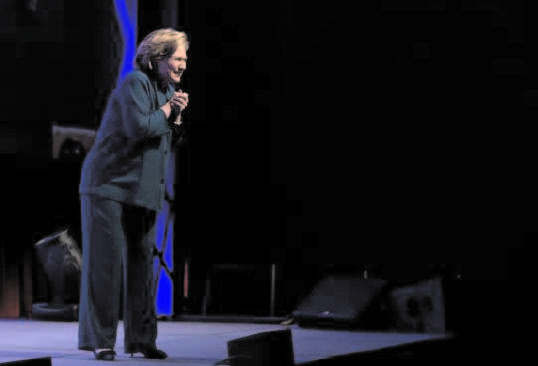
    LAS VEGAS (TIP): A woman hurled a shoe at Hillary Clinton on April 10 as the former secretary of state was delivering a speech at a Las Vegas hotel, but Clinton dodged it and continued with her remarks, a US Secret Service spokesman said.

    Secret Service spokesman George Ogilvie said the protester was not a ticketed guest for Clinton’s speech at the Mandalay Bay hotel and had been spotted by Secret Service agents and hotel security guards before the incident. “As agents and hotel security approached her she threw a shoe and was immediately taken into custody by the Secret Service and hotel security,” Ogilvie said.

    Footage of the incident broadcast by KTNV-TV showed Clinton, 66, crouching to dodge an object as she stood on stage. The Las Vegas Review-Journal newspaper reported that the former first lady joked about the incident as she continued her speech to some 1,000 people attending a metal recycling conference “Is that somebody throwing something at me?” Clinton asked, according to the Review- Journal.

    “Is that part of Cirque du Soleil?” The newspaper quoted Clinton as saying, “My goodness, I didn’t know that solid waste management was so controversial.” Mark Carpenter, a spokesman for the Institute of Scrap Recycling Industries, which hosted the speech, said that the woman was not affiliated with the event. “Our staff denied her access before she later rushed past security. An ISRI staffer then stopped her as she approached the stage.

    She was then handed over to law enforcement,” Carpenter said. The throwing of shoes at political figures is a form of protest in many parts of the world. In 2008 a shoe was hurled at then- President George W Bush when he appeared at a Baghdad press conference with the Iraqi prime minister.

    Clinton, who lost the Democratic presidential nomination to then-Senator Barack Obama, said at a marketing conference in San Francisco earlier this week that she was thinking about running for president again in 2016. She has been giving speeches across the country since leaving the State Department last year. A hotel spokeswoman told Reuters she had no information on the episode, and a spokesman for Clinton did not immediately reply to a request for comment.

  • Indian ambassador presents credentials to Obama

    Indian ambassador presents credentials to Obama

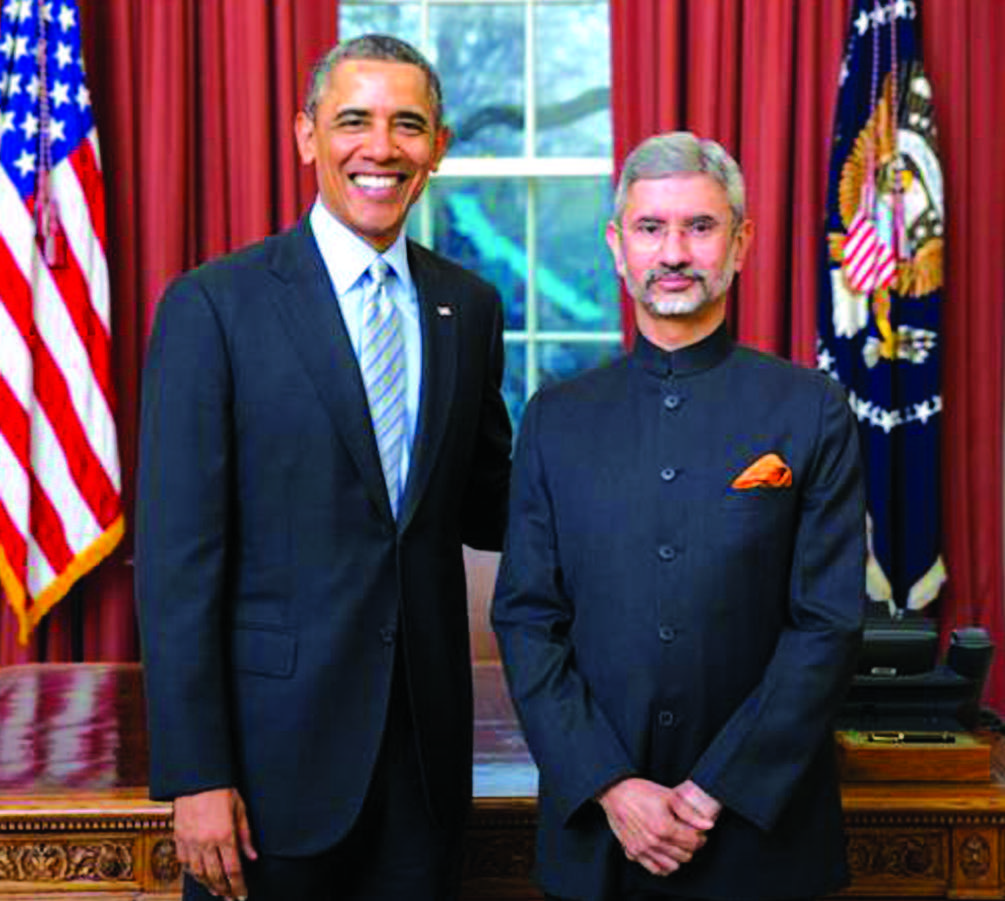
    WASHINGTON (TIP): The new Indian ambassador to the US, Dr. S Jaishankar formally presented his credentials to President Barack Obama at his oval office at the White House on March 10. Jaishankar was second of the six ambassadors who presented their credentials to Obama one by one in a traditional ceremony that marks the formal beginning of an ambassador’s service in Washington.

    Pakistan’s Ambassador Jalil Abbas Jilani also presented his credentials along with the new envoys of Tunisia, Papua New Guinea, Belgium and Qatar. Although he formally presented his credentials to Obama only March 10, Jaishankar spent the last couple of months since his arrival here on Christmas eve to put the India-US relations back on track after the diplomatic row over the Khobragade affair.

    Jaishankar, who played a key role in negotiating the landmark India-US civil nuclear deal and other initiatives, used his wide contacts with the Washington bureaucracy dealing with South Asia to defuse the crisis over the December 12 arrest and strip search of India’s then consul general in New York, Devyani Khobragade. Coming to Washington after four years as the Indian ambassador in China, he succeeded Nirupama Rao, whom he had replaced in Beijing too when she returned to New Delhi to become foreign secretary.

    Son of India’s leading strategic thinker, the late K.Subrahmanyam, Jaishankar comes to Washington, DC with more than three decades of diplomatic experience. Joining the Indian Foreign Service in 1977, he spent three years from 1985 to 1988 as first secretary handling political affairs at the Indian embassy in Washington.

    He has also served as India’s ambassador to the Czech Republic, High Commissioner to Singapore and as head of Americas division in the ministry of external affairs. Jaishankar holds a Ph.D and M.Phil in International Relations and a Master in Political Science. He is a member of the International Institute for Strategic Studies in London. He is married to Kyoko Jaishankar and they have two sons and a daughter.

  • Library releasing documents from Clinton years

    Library releasing documents from Clinton years

    The Clinton Presidential Library is making available about 5,000 pages of previously unreleased documents involving former President Bill Clinton’s administration

    WASHINGTON (TIP): The documents being made public Friday, February 28, part of a larger set of records being prepared for release by the National Archives, are expected to include confidential communications between the former president and his advisers along with records related to Clinton’s federal appointments.

    The records could also include communications involving former first lady Hillary Rodham Clinton, who is considering a 2016 presidential campaign, an AP report says. The former secretary of state’s potential White House campaign has renewed interest in documents from her husband’s administration during the 1990s and her decades in public service. Clinton, a former New York senator, is the leading Democratic contender to succeed President Barack Obama should she seek the presidency again.

    While the specific content remains unclear, the records could offer an unvarnished look at Clinton’s decisionmaking during his two terms in the White House. The records also could offer insight into the advice Clinton received from top aides and how the White House made appointments during his administration. In total, about 33,000 pages of previously confidential records from Clinton’s administration could be made public in the coming weeks.

    The expected release of the documents was first reported by Politico. Miriam Kleiman, a spokeswoman for the National Archives, said the federal agency has cleared for release about 25,000 pages of previously confidential documents during the next two weeks. The initial release Friday will be about 4,000 to 5,000 pages of records, she said. The documents will be posted online by the National Archives while paper copies will be made available at the former president’s library in Little Rock, Ark. An additional 7,000 to 8,000 pages of records are under review until March 26 and could be opened to the public sometime after that date.

    The records were previously withheld by the National Archives because they were exempt from disclosure under restrictions related to appointments to federal office and confidential advice among the president and his advisers. Under a law involving the handling and release of presidential records since the Reagan White House, presidential records can be withheld from the public for 12 years after the end of an administration if they fall under certain restricted categories. Once the restrictions expired in January 2013, the National Archives notified Obama’s and Clinton’s offices that they intended to release the records so both offices could conduct a review of the records. Both offices recently signed off on the documents.

  • In Strategic Interest, and for Self-Respect

    In Strategic Interest, and for Self-Respect

    India must resist the unilateral US control of internet governance

    India’s long-term interests lie in advancing the cause of democratizing global internet governance. We need to free ourselves from the existing situation where advocates for the current model of unilateral control dominate the discussion and preclude any debate on efforts to make global internet governance truly “multilateral, transparent and democratic”, says the author.

    President Barack Obama’s remarks on the review of signals intelligence at the US department of justice on January 17 deserve close attention. Two conclusions suggest themselves. First, it is only “our close friends and allies” or “with whom we work closely”, the communications of whose heads of state and government would not be monitored.

    Clearly, unless we are explicitly told so, India cannot presume inclusion in this category. Second, the declaration by the president applies only to heads of state and government. It does not cover other leaders, such as the ministers of defense, home affairs, external affairs, finance, communications, the national security advisor, chiefs of armed forces, security and intelligence agencies and other functionaries handling sensitive portfolios – those who could be expected to be covered by the Foreign Intelligence Surveillance Act (FISA) and its various subsequent revisions.

    Again, unless specifically advised to the contrary, there would be no basis to believe that the aforementioned are not covered. India’s deafening silence on the Edward Snowden disclosures has been noted and commented upon by observers the world over. Almost a year after the disclosures, a few reports appeared in the Indian media, based on official briefings and apologetic in tone, about how India had indeed made low-level noises both in New Delhi and Washington, DC, expressing concern. Strong encouragement from internet majors, both global and Indian, and industry associations, probably explains our silence.

    The matter has also received scant attention in Parliament or from other stakeholders; clearly, the damage that such silence can cause to the longterm strategic interests of the nation has not been fully comprehended. In a piece last year, this writer had argued (‘Wide asleep on the Net’, IE, June 27, 2013) that the disclosures by Snowden pointed to the urgency of overhauling the current system of global internet governance. The fact that some crumbs are thrown in the direction of developing countries in the form of participation in toothless advisory bodies does not alter this reality.

    In an interview earlier this month discussing his new book, which covered the process leading up to the 2012 World Conference on International Telecommunications (WCIT), Richard Hill, formerly a senior official of the UN International Telecommunications Union (ITU), has described how the proceedings of the conference were manipulated by both over-the-top [OTT] internet companies representing powerful economic interests and powerful nations, in particular the US. On why freedom of speech and expression was made into a make-orbreak issue at WCIT, Hill responded that “it is easier to generate support for a ‘stop censorship’ campaign than for a ‘save my profits’ or ‘let me keep invading privacy’ campaign”.

    Brazil cancelled a visit by its president, Dilma Rousseff, to the US in September 2013; media reports at that time indicated that major US companies lost contracts worth billions of dollars as a result of the cancellation. Even allies such as France and Germany registered public protests about the US. The government of India decided yet again to allow short-term private sector interests to trump public policy considerations. The implications for national security and long-term socio-economic development were sacrificed.

    These reasons explain why India has chosen to backtrack on the vital subject of global internet governance in the last couple of years, after taking a proactive stand in the first half of the last decade and in 2010-11. India had been pursuing the goal of making the international management of the internet truly “multilateral, transparent and democratic”, as provided in the Tunis Agenda adopted in 2005. Apologists for the current model of unilateral control soon occupied the space for discussion and thwarted all efforts to democratize global internet governance, even calling for the withdrawal of proposals made by India in this respect. A course correction is called for right away.

    It is high time that India embarked on creating the next generation of IT companies, which can move up the value chain. They should lead global innovation in IT by creating their own branded services and products and in the process, producing the next generation of Murthys and Premjis. For this, the current ecosystem, architecture and infrastructure need to be modified, both nationally and internationally, where such ventures can be grown and nurtured. At the global level, it is imperative for India to become a lead player and shape the global ICT industry architecture that helps Indian ICT companies of the future. India’s longterm interests lie in advancing the cause of democratizing global internet governance.

    We need to free ourselves from the existing situation where advocates for the current model of unilateral control dominate the discussion and preclude any debate on efforts to make global internet governance truly “multilateral, transparent and democratic”. The Khobragade episode, four months ahead of the general elections, is a wakeup call. As the non-reaction to the Snowden affair shows, if the former had happened one or two years earlier, the Indian establishment would have brushed it under the carpet in the name of the “larger picture”, “long-term strategic interests” and such like. Strategic partnerships cannot imply unilateral and premature capitulation.

    Equally, they cannot entail accepting non-reciprocal obligations and the selfrighteousness and exceptionalism of the stronger partner. Areas such as intellectual property and the internet have been identified as growth areas for the coming decades. They are the engines that could drive our quest to modernize our economy and leapfrog technological development. There are numerous examples such as China, Japan, the Republic of Korea, Israel and Taiwan for us to draw inspiration from. Developing and putting in place national ecosystems that would promote comprehensive development of these areas in a forward-looking manner, rather than preserving the narrow shortterm interests of a few current players, is a challenging task facing our policy and decision-makers.

  • Of hope and reality President Obama seeks to scale down expectations

    Of hope and reality President Obama seeks to scale down expectations

    Obama promised a ‘year of action’ during which he would raise the minimum wage and tackle economic inequality. US President Barack Obama also used his State-of-the-Union Address to bring in a dash of reality into the audacity of hope that aroused high expectations.

    He said he would revamp the US taxation system to decrease the gap between the rich and the poor in the US. He plans to raise the federal minimum wage from $7.25 an hour to $10.10. Naturally, this move is opposed by business leaders, but it would mean a major boost to household incomes across the US.

    The US President also plans to overhaul the country’s immigration laws, withdraw US troops substantially from Afghanistan and act aggressively on climate them. Over the years, President Obama has found his sweeping vision of bipartisan consensus swept away by the partisan reality of politics. The Republican majority in the House of Representatives and their ability to block or delay legislation in the Senate have created a situation where the Democrats have found themselves checkmated on a regular basis.

    No wonder, President Obama said that he would bypass the Congress, if necessary, to usher in the change that he wants. How this confrontational stance plays out remains to be seen; it certainly is going to bring about some interesting times ahead. In fact, confrontation was what the President’s supporters were looking for. In his second term, he can afford to take on the Republicans.

    By an executive order, a US President can make substantial changes in policy, even though these can be reversed by the next incumbent. The State-of-the-Union Address focused largely on domestic policies and many of the issues that President Obama raised find resonance among voters, especially his emphasis on pay-check parity. He will have to find ways to deliver his promises, even if it leads to some confrontation with the Congress, which has hobbled him since 2010 when the Democrats lost their hold.

  • Joe Biden says Hillary Clinton will not impact his 2016 choice

    Joe Biden says Hillary Clinton will not impact his 2016 choice

    WASHINGTON (TIP): Joe Biden said on Wednesday he was not yet sure if he would run for president but that his decision would not be directly influenced by prohibitive Democratic favorite Hillary Clinton.

    The US vice-president was asked about his intentions for 2016 during a round of interviews to push the themes of President Barack Obama’s State of the Union address on Tuesday. “I haven’t made the decision what I’m going to do. I haven’t decided to run or not run,” Biden told broadcaster ABC.

    Many analysts believe that Biden, who has unsuccessfully run for president twice before, would not get into the field if Clinton — already the dominant potential candidate for the Democrats, gets into the race. “If I run, it won’t be because of who’s in the field. It’ll be whether or not I honestly believe I have a chance to be able to really move this country in a direction that is different than those who are running and that I can get that done,” Biden said.

    On CBS television, Biden said Clinton’s decision about her own potential race would “not directly” impact his own intentions. “The only reason a man or woman should run for president — I’m sure Hillary views it the exact same way — is if they think they’re better positioned to be able to do what the nation needs at the moment.” Biden is put on the spot by such questions because they leave him balancing a desire not to overshadow Obama’s current agenda and an imperative to keep his political options open.

    Biden, though fit and sprightly, would face questions over his age should he decide to run for president. He would be 74 in January 2017 and would become the oldest president inaugurated for a first term. Clinton, the former secretary of state, has said she will make a decision this year on whether to take aim at the White House again, after her 2008 primary loss to Obama. Her allies have already started assuming control of key parts of the Democratic Party infrastructure to prepare the way for a race, should she decide to go for it.

  • Hillary Clinton has a Massive Lead in Early Primary Polling

    Hillary Clinton has a Massive Lead in Early Primary Polling

    NEW YORK (TIP): The Washington Post and ABC News, January 30 morning, bring an early look at the leader board for the 2016 presidential nominations. The fact that Hillary Clinton is the front-runner for the Democrats will surprise absolutely no one-but the sheer size of her lead is something to behold: 61 points.

    If the 2016 Democratic primary were today, 73 percent of Democrats and Democratic-leaning independents would vote for Clinton, according to a new Washington Post/ ABC poll. Just 12 percent said they would vote for Vice President Biden, while 8 percent said they’d vote for Sen. Elizabeth Warren, D-Mass. While Warren is a favorite among liberals, she is among the several lawmakers who have said they’d support Clinton if she were to run.

    Clinton’s lead in the survey, conducted Jan. 20-23 among a national sample of 1,003 adults, is the largest lead in an early primary match up that the Post/ABC poll has recorded in 30 years. The overall margin of error for the poll is 3.5 points. Over on the GOP side of things, meanwhile, we find a much more crowded field.

    Here’s the full breakdown of the Republican field: Paul Ryan, 20 percent; Jeb Bush, 18 percent; Chris Christie, 13 percent; Ted Cruz, 12 percent; Marco Rubio, 10 percent; and Rand Paul, 11 percent. 9 per cent had no opinion. 4 per cent said none of these. 2 per cent said favored other and 1 per cent would not vote. Meanwhile, reports are coming in that the major super PAC that supported President Obama’s re-election now will begin raising money to help elect Hillary Clinton to the White House if she chooses to run. CNN said the group confirmed its support for Hillary.

    Priorities USA Action is reaching out to major Democratic donors as it starts to build support for her potential run and plans to raise tens of millions of dollars to begin to lay the groundwork for a potential candidacy. But the big question is:Will Hillary agree to run? She has yet to say whether she’ll run for President in 2016.Vice President Joe Biden, who harbors ambition to be the President, says Hillary Clinton’s decision on whether she will or won’t run for president in 2016 will not directly impact his own decision on whether to launch another bid for the White House. And Biden, making the rounds on the morning network newscasts, said he thinks he’d “make a good president.”

  • The tenure of Hillary Clinton

    The tenure of Hillary Clinton

    The tenure of Hillary Clinton, wife of former US President Bill Clinton, as the US Secretary of State came to an end on February 1. She was succeeded by John Kerry. Clinton, sources said, is likely to be on the race for the US Presidency in 2016.

  • Remembering a True Friend of India

    Remembering a True Friend of India

    Had JF Kennedy not been prematurely eliminated by an assassin, he would have brought India-US relations to a new high, opines the author.

    India was as much shocked as the rest of the world by the news of the tragic assassination of US President John F Kennedy in Dallas on November 22, 1963. Kennedy’s 50th death anniversary was recently observed, with the top leadership of the Democrats including President Barack Obama and former President Bill Clinton and his wife Hillary present on the occasion. There are many who believe that had Kennedy lived longer, India- US relations would have bloomed and taken a different direction.

    During his brief tenure, besides food aid, there were several US projects that emerged including the Tarapur plant, IIT Kanpur and the Nagarjuna Sagar project in Andhra Pradesh. As veteran US diplomat Dennis Kux points out in his book, Estranged Democracies, Kennedy’s love for India began from his days as a Senator. When he became President in January 1961, Kennedy had brought India-US relations to an entirely new qualitative level from where they had been under the Truman and especially the Eisenhower Administrations. This was during the Cold War when India was seen to be closer to the Soviet Union.

    It is interesting to understand the chemistry between Kennedy and Jawaharlal Nehru. Kennedy praised him in the State of the Union address on January 31, 1961; no other US President had done that for any Indian Prime Minister. Prior to the action in Goa, Nehru had paid his last visit to the US. BK Nehru, the then Indian Ambassador to the US writes in his Nice Guys Finish Second, that Kennedy wanted to have special relations with Pandit Nehru and broke protocol by receiving him when Nehru visited his private home at Hammersmith Farm. During their informal talks, while Kennedy tried to evoke some response from Nehru on the Vietnam issue, the latter remained silent throughout.


    24
    John F. Kennedy came to India’s rescue in the wake of India’s border dispute with China in 1962. “We should defend India, and therefore we will defend India if she were attacked,” he had said. His visit to India, made possible by John Kenneth Galbraith, US Ambassador to India during Kennedy Administration brought the two countries closer. Seen in the picture: – Extreme left: John Kenneth Galbraith, John F. Kennedy at the mikes, Vice President Lyndon B. Johnson (second from right) and Prime Minister of India, Pandit Jawaharlal Nehru (extreme right).

    However, later Nehru told his private secretary MJ Desai, “Tell them, tell them not to go into Vietnam, They will be bogged down and they will never be able to get out”. BK Nehru observes that if only the Prime Minister had conveyed this to Kennedy, things might have turned out differently. Arthur M Schlesinger, a close aide to Kennedy, notes in his book, A Thousand Days, “Reminiscing about the meeting, Kennedy described it to me as “a disaster-the worst head-of-state visit I have had”. Kennedy’s vision of India had been much larger before the visit, than it would ever be again. Nehru obviously is in decline.” All hell broke loose when three weeks after Nehru returned to India, Goa was ‘liberated’ from the Portuguese on December 19, 1961. This was condemned by the US and the UK, while the Soviet bloc hailed it.

    A resolution condemning India’s role was vetoed by the Soviet Union in the Security Council. Kennedy was miffed that Nehru did not discuss Goa with him. He wrote in a letter to Nehru on January 18, 1962: “One difficulty was, of course, that the action followed so soon after your visit. I had naturally hoped that the candor of our exchange might have extended to all of the problems with which we were mutually concerned. I confess to a feeling that we should have discussed this problem; it is at least possible that if we had talked about it, our efforts to help prevent a solution by force could have been more helpful.”

    Kennedy ended the letter thus: “Meanwhile, you can count on me to do all that I can to ensure that any damage to our common interests is temporary… I believe we can and must get back on this high road, and I shall work steadily toward this end.” When Jacqueline Kennedy visited India in March 1962. Nehru moved her into his own house and played host as the US embassy was under renovation, according to then the US Ambassador Galbraith. According to the US Ambassador JK Galbraith the visit went off quite well. Months later, Kennedy kept his word when China attacked India on October 20, 1962, leading to a month-long war between the two Asian giants over territorial issues.

    The Indian military was not prepared to meet the Chinese challenge. In the book, Listening In: The Secret White House Recordings of John F Kennedy, written by Ted Widmer and Caroline Kennedy, the President declared at a meeting in the Oval Office with defense aides, including Robert McNamara: “I don’t think there’s any doubt that this country (US) is determined that we couldn’t permit the Chinese to defeat the Indians.”

  • Obama, Bill Clinton unite at JF Kennedy’s grave

    Obama, Bill Clinton unite at JF Kennedy’s grave

    WASHINGTON (TIP): A pair of Democratic presidents, Barack Obama and Bill Clinton silently honored John F. Kennedy at the former US leader’s grave November 19, marking the 50th anniversary of his assassination. Obama and Clinton, along with First Lady Michelle Obama and former secretary of state Hillary Clinton, laid a large blue and white wreath on the sun-dappled grave of JFK, who was gunned down in Dallas on November 22, 1963.

    They then stood together, with hands on hearts, as a bugler played the US military lament “Taps” before observing a moment of silence. Extended members of the Kennedy clan looked on at the tableau of presidential power — past, present, and possibly future. The observance came after Obama awarded Bill Clinton and 15 other luminaries of the arts, sport, science and innovation the highest honor for US civilians, the Presidential Medal of Freedom, which was first minted by Kennedy. Later Wednesday, Obama will pay tribute to Kennedy’s legacy at a speech at the Smithsonian Institution in Washington honoring medal awardees.


    6

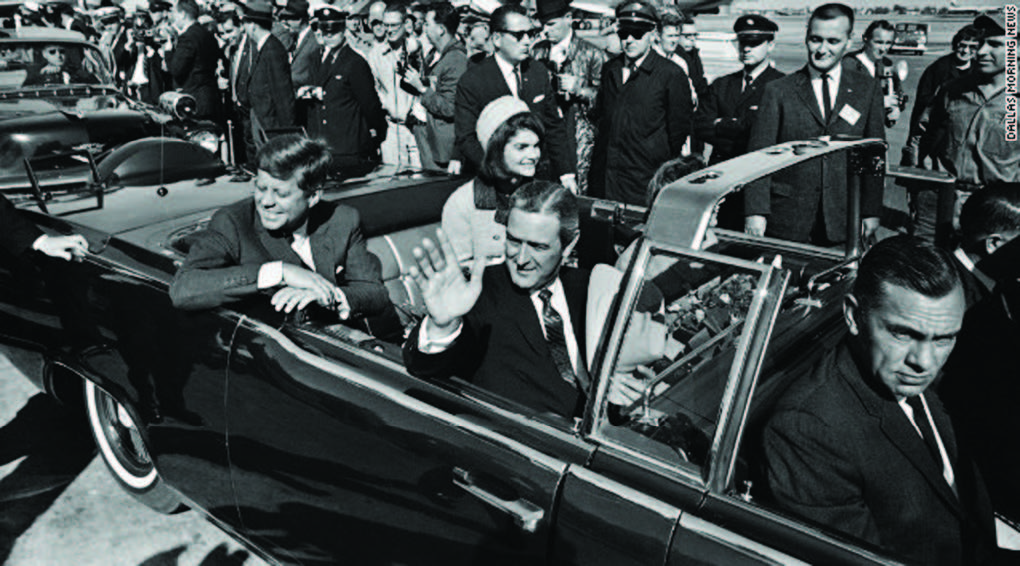
    Kennedy grave and eternal flame is in Arlington National Cemetery outside Washington on a hillside with a paved area fashioned from Cape Cod granite quarried from near the Kennedy clan’s home base in Massachusetts. The eternal flame was lit by Kennedy’s wife Jacqueline Kennedy during his funeral in 1963 and she was buried beside her husband after her own death in 1994. The poignant moment of remembrance came two days before the official half-century anniversary of the death of Kennedy, who was gunned down in an open-top limousine in Dallas, Texas, in a crime which traumatized the world.

    The ceremonies have sparked a prolonged period of national and media reflection on the unfinished legacy of Kennedy, his tragedy-crossed family and of the evocative period in the early 1960s when his political star illuminated the world. Kennedy’s closest living relative, his daughter Caroline, however, was not at Wednesday’s ceremony. An early supporter of Obama’s presidential ambitions, she has just set off on a new chapter of her life as the US ambassador to Tokyo.

    The joint Obama-Clinton appearance at the grave site represented the latest show of unity between two political power families who waged a bitter 2008 Democratic presidential nominating duel. Hillary Clinton is now the red-hot favorite to land the Democratic nomination for the 2016 election — but has not said whether she will make another run for the White House. Presidents Clinton and Obama, two-term leaders both, laid claim to the legacy of John F. Kennedy in their own White House runs. Clinton was famously pictured meeting Kennedy at an event in the White House Rose Garden in July 1963, and has reminisced about how he set eyes on the presidency himself after shaking JFK’s hand.

    Obama, who was two years old when the 35th US president was killed, accepted Kennedy’s torch of Democratic Party idealism in a key moment in the 2008 campaign — which irked the Clintons — when president Kennedy’s late brother, senator Edward Kennedy endorsed Obama at American University in Washington. The two presidents stood together at a painful political moment for Obama, when he may be looking for political inspiration, after being brought low by the botched implementation of his signature health care law.

    A CBS News poll published Wednesday found that the president’s approval rating was down to 37% — his lowest ever. In the Medal of Freedom ceremony, Obama said that Clinton’s presidency proved that it was possible to grow the economy, cut the deficit and invest in science, technology and education — remarks which mirrored his own core political argument to American voters. Kennedy’s killing was blamed on a gunman, Lee Harvey Oswald, who was said to be acting alone. But the 50 years since have been replete with conspiracy theories centering on whether Oswald was the true culprit and if he was acting on his own initiative or was part of a wider plot.

  • Hillary Clinton gets a parking ticket from London traffic warden

    Hillary Clinton gets a parking ticket from London traffic warden

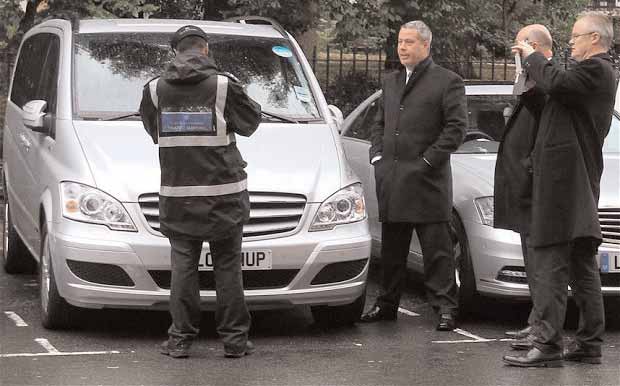
    LONDON (TIP): Hillary Clinton may be tipped as a future US president, but that did not impress a London traffic warden who slapped her vehicle with an £80 (95-euro, $130) parking fine. The former US secretary of state was in town to receive a prize from the Chatham House think tank last week for her work in promoting “a new era of US diplomatic engagement”. But her entourage failed to buy the £3.30 ticket required to park the Mercedes for an hour on the exclusive St James’ Square in central London, and received a £80 fine. “The former US secretary of state was parked for nearly 45 minutes without paying,” said Daniel Astaire, an elected member of Westminster City Council. “I’m sure she will understand that we have to be fair to everyone, regardless of their status on the world stage.” There is some good news for former first lady Clinton, however — if she pays up within 14 days, the fine will be halved to £40. London Mayor Boris Johnson has previously complained about the refusal of US diplomats to pay a ten pound daily charge for the congestion zone in the centre of the capital.

  • Obama meets Indian-American Miss America, Nina Davuluri

    Obama meets Indian-American Miss America, Nina Davuluri

    WASHINGTON (TIP): Despite tough ongoing negotiations to reopen the government and avoid a US debt default, President Barack Obama found time to meet Miss America, Nina Davuluri, the first Indian- American to win the coveted crown. “Had the pleasure of having a conversation with President @BarackObama in the Oval Office today! @NinaDavuluri #Celebration13,” Davuluri tweeted shortly after meeting the president at the White House Wednesday morning. “Miss America participated in a group photo with the president in honor of the Children’s Miracle Network Hospital Champions,” a White House official said. “Following the photo, she briefly visited the Oval Office,” the official said. Incidentally, Obama had referred to Davuluri’s achievement as he spoke about “incredible people-to-people ties that exist” between India and the US during his Sep 27 summit meeting with Prime Minister Manmohan Singh here. “You know, Indian-Americans make extraordinary contributions to the United States every single day — businessmen, scientists, academics. Now Miss America is of Indian-American descent. And I think it’s a signal of how close our countries are,” he then said. (Source: Arun Kumar. He can be contacted at arun.kumar@ians.in)

  • Obama makes case for Syria strike, British house votes no

    Obama makes case for Syria strike, British house votes no

    WASHINGTON/BEIRUT (TIP): The British parliament on August 29 rejected a motion supporting military action in Syria, reflecting deep divisions about using force to punish President Bashar al- Assad for what Western governments believe was his use of chemical weapons against civilians. U.S. officials conceded on August 29 that they lacked conclusive evidence that Assad personally ordered last week’s poison gas attack, and some allies have warned that military action without U.N. Security Council authorization risks making the situation worse. President Barack Obama’s top national security officials were due to brief Congress on Syria later on Thursday, but any intervention looked set to be delayed at least until U.N. investigators report back after leaving Syria on Saturday.

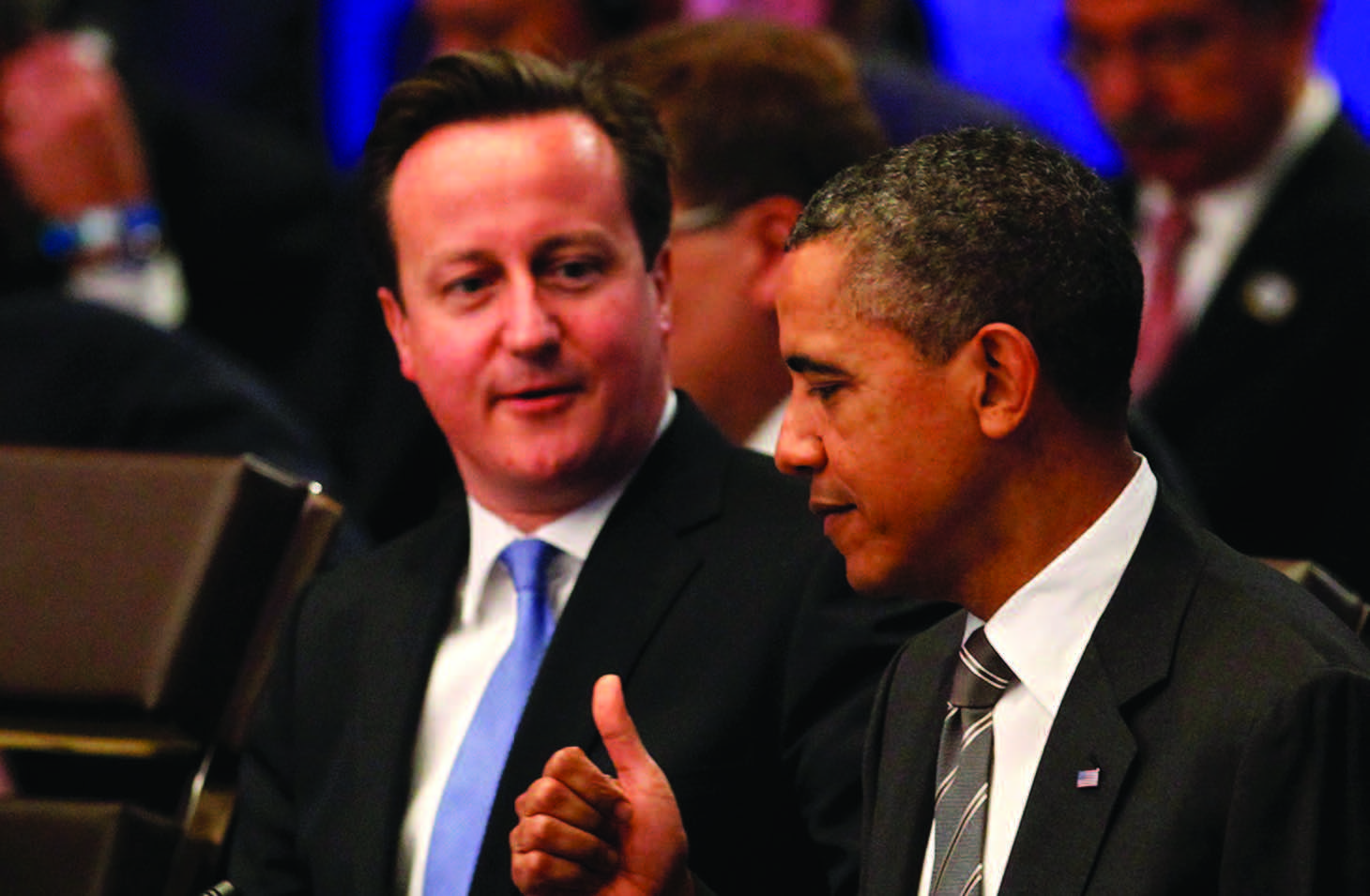
    The British parliament’s rejection of the largely symbolic motion proposed by Prime Minister David Cameron, which would have given authorization in principle for action subject to a second vote, was a setback for Obama’s efforts to build a coalition for action. Cameron said afterward he would not override the will of parliament and approve such action, saying it was clear that parliament did not want to see a military strike on Syria to punish it for chemical weapons use and that he would act accordingly. White House spokesman Josh Earnest suggested before the British vote that the United States might be willing to act on its own. “When the president reaches a determination about the appropriate response … and a legal justification is required to substantiate or to back up that decision, we’ll produce one on our own,” Earnest said.

    Syrian opposition sources said Assad’s forces had removed several Scud missiles and dozens of launchers from a base north of Damascus, possibly to protect them from a Western attack, and Russia was reported to be moving ships into the region. But expectations of imminent turmoil eased as the diplomatic process was seen playing out into next week, and the White House emphasized that any action would be “very discrete and limited,” and in no way comparable to the Iraq war. The United States and its allies have “no smoking gun” proving Assad personally ordered the attack on a rebel-held Damascus neighbourhood in which hundreds of people were killed, U.S. national security officials said. In secret intelligence assessments and a still-unreleased report summarizing U.S. intelligence on the alleged gas attack on August 21, U.S. agencies expressed high confidence that Syrian government forces carried out the attack, and that Assad’s government therefore bears responsibility, U.S. national security officials said. Syria denies blame for the gas attacks and says they were perpetrated by rebels. Washington and its allies say the denial is not credible. Secretary of State John Kerry and Secretary of Defense Chuck Hagel were among senior U.S. officials expected to brief congressional leaders later on Thursday. Some lawmakers complained they had not been properly consulted. While U.N. chemical weapons inspectors spent a third day combing the rebel-held area where the attack took place, traffic moved normally elsewhere in Damascus, with some extra army presence but little indication of any high alert.

    An extended parliamentary debate in London revealed deep misgivings stemming from the 2003 invasion of Iraq. After pressure from lawmakers, the British government – a key player in any proposed air assault on Syria – had promised parliament that even if it voted in favor, there would be a second decisive vote once the U.N. weapons inspectors report their findings. Even that motion was defeated by 285 to 272 votes. ‘MONSTROUS CRIME’ The United Nations said its team of inspectors would leave Syria on Saturday and report to Secretary-General Ban Ki-moon. France and Germany urged the world body to pass its report on to the decision-making Security Council as soon as possible “so that it can fulfil its responsibility with regards to this monstrous crime.” The United States, Britain and France say they can act with or without a U.N. Security Council resolution, which would likely be vetoed by Russia, a close ally of Assad. But some countries are more cautious: Italy said it would not join any military operation without Security Council authorization. Western diplomats say they are seeking a vote in the 15-member Council to isolate Moscow and demonstrate that other countries are behind air strikes.

    A report from Moscow that Russia is sending two warships to the eastern Mediterranean underscored the complications surrounding even a limited military strike, although Russia has said it will not be drawn into military conflict. The ambassadors of the five veto-wielding permanent U.N. Security Council members appeared to have made no progress at a meeting on Thursday, a council diplomat said. The five – the United States, Russia, China, Britain and France – had held an inconclusive meeting on Wednesday to discuss a draft Security Council resolution that would authorize “all necessary force” in response to the alleged gas attack. Cameron told Britain’s parliament it would be “unthinkable” to proceed if there was overwhelming opposition in the Security Council. But he published legal advice given to the government under which military action would be lawful for humanitarian reasons even if a Security Council resolution were blocked by a veto. The International Committee of the Red Cross joined a chorus of international voices urging caution. “Further escalation will likely trigger more displacement and add to humanitarian needs, which are already immense,” said Magne Barth, head of the ICRC delegation in Syria. Increasing expectations that any action will be delayed ended a three-day selloff on world share markets on Thursday, although investors were still on edge over fears of future turmoil in the Middle East.

    ‘SHOT ACROSS THE BOW’ Obama sought to win over a war-weary American public on Wednesday evening by saying intervention in Syria, where more than 100,000 people have been killed in 2 1/2 years of civil war, would serve U.S. national security interests. “If we are saying in a clear and decisive but very limited way, we send a shot across the bow saying, ‘Stop doing this,’ this can have a positive impact on our national security over the long term,” he told “PBS Newshour” in a televised interview. According to the U.S. national security officials, evidence that forces loyal to Assad were responsible goes beyond the circumstantial to include electronic intercepts and some tentative scientific samples from the site. “This was not a rogue operation,” one U.S. official said. Western leaders are expected in Russia next Thursday for a meeting of the Group of 20 big economies, an event that could influence the timing of any strikes. The hosts have made clear their view that Western leaders are using human rights as a pretext to impose their will on other sovereign states. A spokesman for the main Syrian opposition umbrella group, the Syrian National Coalition, said the opposition was confident Western leaders were prepared to act.

    SNC leader Ahmed Jarba met French President Francois Hollande. An SNC spokesman said they discussed a two-wave intervention to first target installations used to launch chemical weapons and then hit other government bases in Syria. “We are very happy. France and its partners are quite decided to punish the Syrian regime,” SNC envoy Monzer Makhous told Reuters after the talks. “Then there will be military aid to help the opposition to change the balance of power.” Hollande urged Jarba to create a credible military force, highlighting Western concern that the mainstream opposition is unable to control al Qaeda-linked militias on the ground in Syria. Syrian officials say the West is playing into the hands of its al Qaeda enemies. In Damascus, residents and opposition forces said Assad’s forces appeared to have evacuated most personnel from army and security command headquarters in the centre in preparation for Western military action. People unable to decide whether to leave for neighboring Lebanon said the border was already jammed. “We’re hearing people are spending hours – like 12 or 14 hours – waiting in line at the border,” said Nabil, who was considering leaving town for Beirut with his wife and young daughter, “just until the strike is over.”

    Diplomats based in the Middle East told Reuters the removal of some of Assad’s Scud missiles and launchers from the foothills of the Qalamoun mountains, one of Syria’s most heavily militarized districts, appeared to be part of a precautionary but limited redeployment of armaments. Despite opinion polls showing most Americans oppose deeper involvement in the Syrian conflict, Obama has been under pressure to enforce a “red line” against chemical weapons use, which he declared just over a year ago. “I have no interest in any open-ended conflict in Syria, but we do have to make sure that when countries break international norms on weapons like chemical weapons that could threaten us, that they are held accountable,” Obama said. The likeliest option, U.S. officials say, would be to launch cruise missiles from U.S. ships in the Mediterranean in a campaign that would last days. A fifth U.S. destroyer, the USS Stout, was headed toward the coast off Syria, according to one defense official. That would bring the total of U.S. destroyers in the eastern Mediterranean to five, although the Stout is likely to relieve the USS Mahan, which had been due to return to its U.S. base but stayed in the region due to the situation in Syria. Still the decision to replace the Mahan with another destroyer means the United States will be maintaining an expanded presence in the region.

  • Obama cancels meeting with Putin over asylum to Snowden

    Obama cancels meeting with Putin over asylum to Snowden

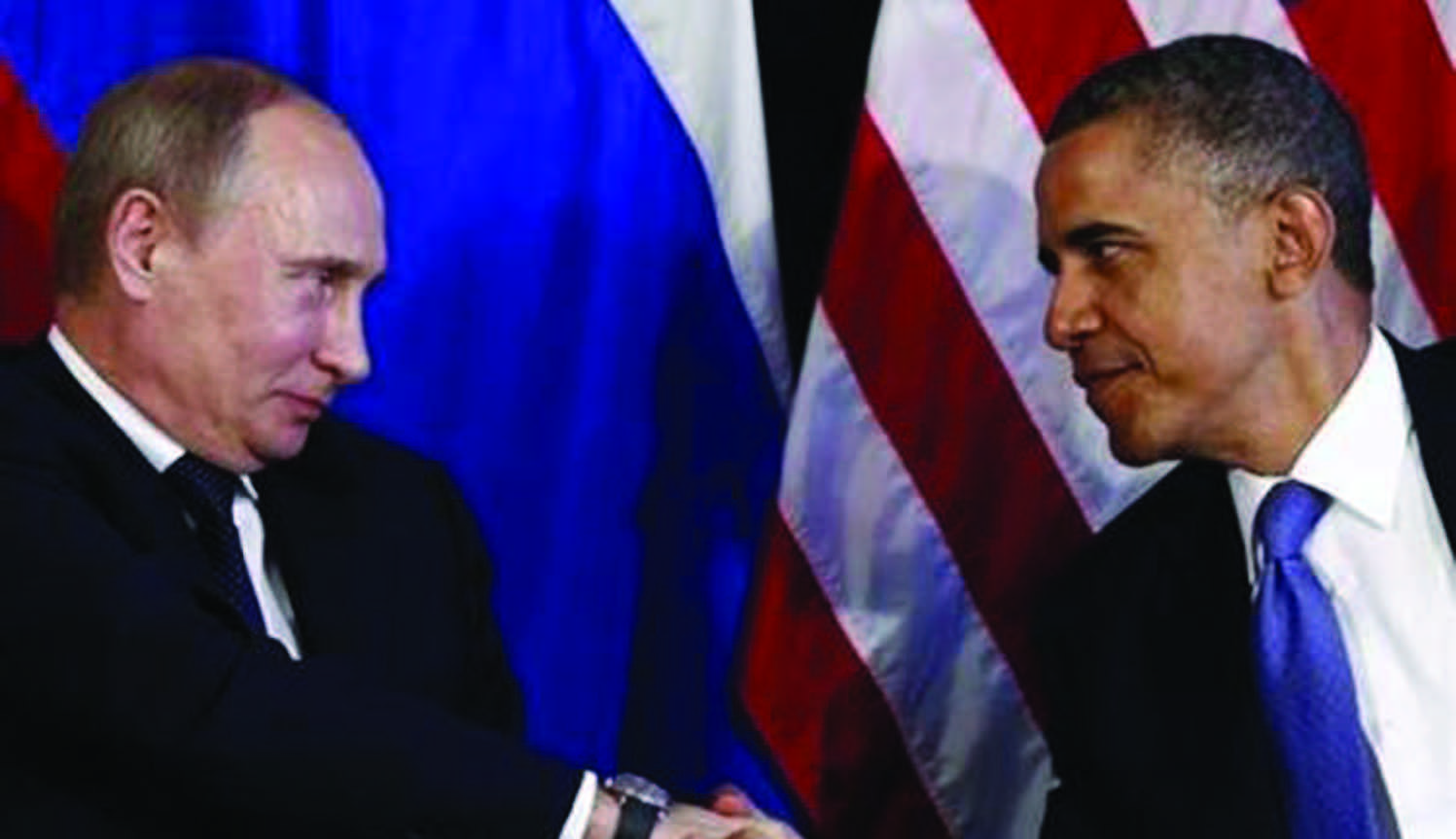
    WASHINGTON (TIP): Relations between the United States and Russia deteriorated further on Wednesday, August 7 when Barack Obama abandoned a presidential summit with Vladimir Putin that was due to be held next month, amid fury in Washington over Moscow’s decision to grant asylum to the NSA whistleblower Edward Snowden.

    US President Barack Obama has canceled his scheduled visit to Moscow to meet his Russian counterpart Vladimir Putin, as tension builds up between two countries over fugitive intelligence leaker Edward Snowden.

    The mini-summit had been scheduled for early September, days before the G-20 meeting of world economic leaders in St. Petersburg, Russia. Obama still plans to attend the main G-20 summit. Authorities in Moscow last week granted temporary asylum to Snowden, who is wanted by U.S. authorities for leaking classified intelligence information to newspapers. That decision infuriated Washington. Sen. John McCain, R-Ariz., called on the U.S. “to fundamentally rethink our relationship with Putin’s Russia.”

    In a statement Wednesday, the White House noted cooperation in some areas, such as policies toward Afghanistan and Iran, but said Moscow’s decision to help Snowden was “disappointing.” “Given our lack of progress on issues such as missile defense and arms control, trade and commercial relations, global security issues, and human rights and civil society in the last twelve months, we have informed the Russian Government that we believe it would be more constructive to postpone the summit until we have more results from our shared agenda,” the White House said. Senator Charles E. Schumer, who had urged Obama to cancel the summit, welcomed the White House decision. State Department spokeswoman Jen Psaki said the decision to abandon the summit was made after a unanimous decision by the White House national Security Council.

    A meeting between defense secretary Chuck Hagel, secretary of state John Kerry and their Russian counterparts will go ahead in Washington on Friday as planned. In a separate announcement, the White House said Obama will visit Sweden instead, traveling to Stockholm the day before the St Petersburg summit. “Sweden is a close friend and partner to the United States,” it said in a statement. “[It] plays a key leadership role on the international stage including in opening new trade and investment opportunities.” Speaking on Tuesday night, Obama said he was disappointed that Russia had allowed Swowden to stay instead of sending the former government contractor back to the US to face espionage charges.

    In his first direct comments about Snowden since Russia’s decision last week, the president said the situation reflected “underlying challenges” in dealing with Moscow. “There have been times where they slip back into cold war thinking and a cold war mentality,” Obama said on NBC’s Tonight Show. The decision to cancel the meeting was greeted with little surprise in Moscow, where analysts and lawmakers have been predicting such a step.

    Presidential aide Yuri Ushakov said the Kremlin was disappointed that Obama cancelled the meeting with Putin, state news agency RIANovosti reported. “It’s obvious that this decision is connected to the situation with the American intelligence services employee Snowden, which was not created by us,” he said.

  • A Big Game And A Big Player

    A Big Game And A Big Player

    Bharatiya Janata Party President Rajnath Singh flew in to New York last week on a five day visit of the U.S. The purpose, said Singh was twofold. One, to meet and interact with the Indian diaspora; and, two, to meet with the U.S. lawmakers, policymakers and business community.

    What did Rajnath Singh want to discuss with the U.S. lawmakers and policymakers? Whatever else it may have been, one of the issues top on his agenda was to lobby with them for a Visa to Modi. Shalli Kumar, a Republican from Chicago is said to have been actively involved in arranging meetings between Rajnath Singh and Republican Senators and Congressmen to firm up support for a Visa to Modi. Shalli Kumar had only a few weeks ago taken to Gujarat a delegation of Republican Senators and Congressmen who were received warmly by Modi.

    The delegation had felt pleased with Modi and the state of Gujarat which has made tremendous progress under Modi. The Republican delegation is reported to have then assured of their support for Visa to Modi. Rajnath Singh’s visit must be looked in to proper perspective. It was primarily meant to garner support for a Visa to Modi. And secondly, it was to carry a message in the US corridors of power that the BJP was on way to succeed the Congress led UPA government.

    The BJP wanted to create that impression emphatically and who more competent than the President of the party himself. The question is why a Visa to Modi is so important? Why a sense of urgency that the BJP president himself had to dash to Washington? The answer is not that complicated. The BJP is keen that Modi visit the U.S. now and as early as possible, before the elections, to earn legitimacy for himself.

    The cases relating to state violence against people of one community and fake encounters in which many were killed, at the behest of people in the Modi government, seem to stretch on.With that the needle of suspicion keeps pointing to Modi and his cohorts. It may take quite some time before they come out clean or are penalized. The BJP wants the U.S. to give Modi a Visa which will then be interpreted as U.S. acknowledging that Modi is innocent.

    That is why there is this sense of hurry. Visa to Modi in the year 2005 was declined under 214(b) of the U.S. Immigration and Nationality Act under which foreign government officials are considered ineligible for a visa should the State Department view them as “responsible for, or directly carried out, at any time, particularly severe violations of religious freedom.”

    In April, 2012, when the question of Visa to Modi was raised by U.S. Congressman Joe Walsh, Republican of Illinois, in a letter to Secretary of State Hillary Clinton, regarding whether the U.S.’s 2005 decision to not to issue Mr. Modi a visa would be reviewed, State Department Spokesperson Victoria Nuland had clarified in a press conference that there was no change in its decision to deny Mr. Modi a visa to enter the country.

    However, it is a general perception that the decision can be reviewed if there is any change in the circumstances. And the BJP is keen to get Modi a Visa so that it can claim the U.S. recognized the change in circumstances, which here means that the U.S. does not any more consider Modi guilty of any violation of religious freedom. Again, it is interesting to note how much money and effort are being put in to securing a visa for Modi. It is no small game. It is a big one, really big.

  • Rice Named Obama’s National Security Adviser

    Rice Named Obama’s National Security Adviser

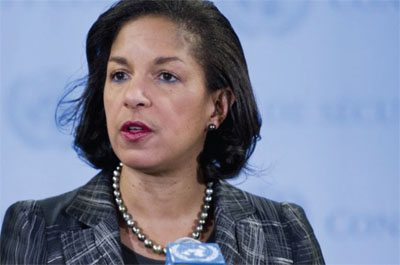
    NEW YORK (TIP): In a reshuffle of top foreign policy posts in his second term, U.S. President Barack Obama, on June 5, announced the appointment of the controversial and blunt-spoken U.S. Ambassador to the United Nations, Susan Rice to replace Tom Donilon as his national security adviser.

    He also announced that another longtime aide on the National Security Council staff who began working with Obama when he was still a freshman senator from Illinois, Samantha Power, will replace Rice as Washington’s U.N. envoy, a cabinet position. The moves, which had been anticipated but whose precise timing was uncertain, are considered unlikely to signal major changes in U.S. policy, despite the fact that both Power and Rice have been associated with the more-interventionist tendencies within the Democratic Party.

    “I don’t think this change in personnel marks a turning point in policy,” said Charles Kupchan, a senior fellow at the Council on Foreign Relations. “From the get-go, foreign policy under Obama has been run from the Oval Office, and Obama’s brain trust has included primarily a small inner circle of folks that cut their teeth on the (2008) campaign. Susan Rice and Samantha Power have been part of that inner circle all along.”

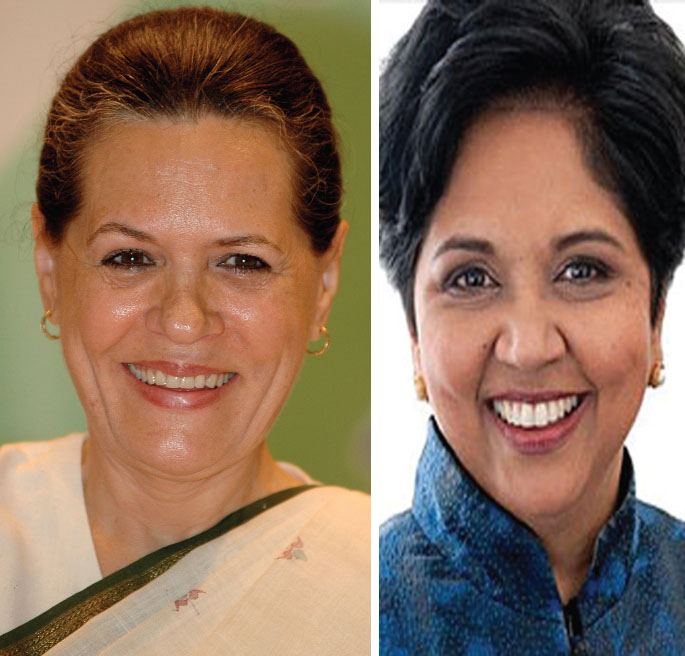
  • Sonia Gandhi, Indra Nooyi among 10 Most Powerful Women in the World

    Sonia Gandhi, Indra Nooyi among 10 Most Powerful Women in the World

    NEW YORK (TIP): Sonia Gandhi is the ninth most powerful woman in the world, followed by Indra Nooyi at number 10 in the 10 ‘most powerful women in the world’ list compiled by Forbes. The women acknowledged by Forbes are the ones who go ahead by the traditional taxonomy of Indra Nooyi, an Indian-origin American executive who hails from Chennai is the current Chairman and CEO of PepsiCo.

    Nooyi’s name appeared in the list of 50 women to watch in 2007 and 2008, according to a survey conducted by Wall Street Journal.She was one among Time’s list of 100 most influential people in the world and she also bagged the top position of most powerful woman in business, by a ranking done by Forbes (2009 and 2010).

    Others who figure in the Top 10, from 1 to 8 in that order are, Angela Merkel, Chancellor, Germany; Dilma Roussef, President, Brazil; Melinda Gates, Co chair, Bill & Melinda Gates Foundation, US; Michelle Obama, First Lady, US; Hillary Clinton, Former Secretary of State, US; Sheryl Sandberg, CEO, Facebook, US; Christine Lagarde, Managing Director, IMF, France; and Janet Napolitano, Secretary, Homeland Security, US.

  • US Honours Two Indian-Americans As ‘Champions Of Change’

    US Honours Two Indian-Americans As ‘Champions Of Change’

    WASHINGTON (TIP): The US has honoured 15 Asian American and Pacific Islander (AAPI) women, including two Indian-Americans, as “champions of change” in recognition of their significant contribution to the community. The two Indian American women — Aparna Bhattacharyya from Atlanta and Pramila Jayapal from Washington State — were recognised at a White House event yesterday.

    A passionate advocate for immigrant survivors of family and sexual violence and ensuring they have access to safety, justice and healing, Bhattacharyya is the Executive Director of ‘Raksha’, in Atlanta, Georgia. She has worked to ensure that attorneys, law enforcement, and service providers are culturally competent to serve immigrant survivors.

    Bhattacharyya is currently a board member for the Georgia Coalition Against Domestic Violence, VIDA Legal Assistance and the National Immigrant Women’s Advocacy Project.In the aftermath of 9/11, Jayapal founded the nonprofit organization ‘OneAmerica’, now the largest immigrant advocacy organisation in Washington State. She has worked to advance immigration reform in the state as well as nationally, and served in leadership roles for the Fair Immigration Reform Movement and the Rights Working Group.

    She continues to advocate for immigration reform as the Co-Chair of ‘We Belong Together: Women for Common- Sense Immigration Reform campaign’. Jayapal is currently the Distinguished Taconic Fellow at Center for Community Change and a Distinguished Fellow at the University of Washington Law School.

    The ‘Champions of Change’ programme was created as an opportunity for the White house to feature groups of Americans, individuals, businesses and organisations, who are doing extraordinary things to empower and inspire members of their communities.

  • Argentina’s Bergoglio elected as new Pope Francis

    Argentina’s Bergoglio elected as new Pope Francis

    VATICAN CITY (TIP): Cardinal Jorge Mario Bergoglio from Argentina has been elected the Catholic Church’s 266th Pope. He is first Latin American to be pontiff, and will call himself Francis I. After his election, the 76-year-old Pope appeared on a balcony and greeted crowds in St. Peter’s Square. He was the archbishop of Buenos Aires. He asked the faithful to pray for him. Cheers erupted as he gave a blessing. Earlier, white smoke from the Sistine Chapel chimney announced the new Pope’s election crowds in St. Peter’s Square cheered and bells rang out as the smoke appeared. Pope Francis replaces Benedict XVI, who resigned Feb 28 at the age of 85, saying he was not strong enough to lead the Church. He is the first Jesuit to become pope.

    A member of the Jesuits and ordained in 1936 after four years as priest, Bergoglio became head of all the Jesuits in Argentina, Xinhua reported. After studying in Germany, he became bishop of Buenos Aires in 1992 and archbishop in 1998. A strong supporter of helping the poor, Bergoglio was made cardinal in 2001. French Cardinal Jean-Louis Tauran announced the Pope’s election with the Latin words “Annuntio vobis gaudium magnum.

    Habemus Papam” (“I announce to you a great joy. We have a Pope”). In his first address, Pope Francis I told the crowd in St. Peter’s Square: “It seems my brother cardinals went almost to the end of the world (to choose a pope).” Moments after the announcement of his election, he tweeted: “Immensely happy to be the new Pope, Francis I.” The 115 cardinals have been in isolation since Tuesday, and held four inconclusive votes. At least 77 of them, or two-thirds, would have had to vote for a single candidate for him to be elected Pope. Pope Francis I was a surprise choice and not among a small group of frontrunners before the election, BBC said. Many observers were also expecting a younger pope to be elected. Crowds with umbrellas gathered in the square waving flags from around the world.

    The Catholic News Agency said people were running through the streets of Rome, hoping to reach St. Peter’s Square in time for the appearance of the new Pope. “It’s so emotional. We thought we were going home and the smoke was going to be black,” one Catholic told the BBC. “We’re so touched. It was really incredible.” BBC said there was elation on the rain-strewn St. Peter’s Square. The crowd swelled as flags swayed and the basilica bells rang out. “Viva il papa!” they chanted, as they waited to learn his name.

    Once the name was announced, the chants turned to: “Fran-ces-co! Fran-ces-co!” And then, to trumpet fanfare, the balcony curtains parted and the new Pope appeared to bless them. He asked them to pray with him, and for him. The people roared their approval. In the crowd was Jenny Uebbing. Originally from Denver but now living in Rome, she said her son John-Paul was one of the last babies Benedict XVI blessed before he resigned. “We had to be here to say hello to the new papa,” she told the BBC. “Now it feels like Easter has come early.” US President Barack Obama sent “warm wishes” on behalf of the American people to the newly elected pontiff, hailing the Argentine as “the first pope from the Americas”, BBC reported.

  • Hillary Clinton tops 2016 US presidential poll

    Hillary Clinton tops 2016 US presidential poll

    WASHINGTON (TIP): The 2016 US election might be a full three and a half years away, but that is not stopping pollsters from asking voters who has the early presidential edge. And the advantage goes to Hillary Clinton. The recently retired secretary of state and former first lady would handily defeat any of three leading potential Republican candidates, including New Jersey Governor Chris Christie, the Quinnipiac University poll said on Thursday.

    The blunt-talking Christie came in second in the poll, well ahead of fellow Republicans Marco Rubio, a first-term senator from Florida, and congressman Paul Ryan, who was Mitt Romney’s running mate in 2012. “Former secretary of state Hillary Clinton would start a 2016 presidential campaign with enormous advantages,” said the polling institute’s assistant director Peter Brown. “She obviously is by far the best known, and her more than 20 years in the public spotlight allows her to create a very favorable impression on the American people.” Clinton topped Christie 45-37 per cent in the poll, bested Ryan 50-38 and trounced Rubio, seen as a Republican rising star, 50- 34 per cent.

    But Christie, who was recently snubbed when he was not invited to the upcoming Conservative Political Action Conference, outperformed the other two Democrats in the poll, edging vice president Joe Biden 43-40 per cent and comfortably topping New York Governor Andrew Cuomo 45-28. “Although some Republicans don’t think… Christie is conservative enough for their taste, he runs best of the three Republicans tested,” Brown said. “He obviously is doing better than… Cuomo, despite other indications of anti- Republican sentiment.” Clinton, 65, is the early frontrunner in part because of her ability to attract independent voters. She tied Christie 36-36 per cent among independents, whereas Biden trails Christie 44-32 per cent and Cuomo is in the cellar among independents, losing to Christie 47-20.