Tag: United States Politics


  POLITICS & POLICY  

  • As I See It : Emerging US Policies

    As I See It : Emerging US Policies

    One of the key policy initiatives during President Obama’s first term was what Secretary of State Hillary Clinton described in her article published in October 2011, titled “America’s Pacific Century”, as a “pivot” the “Indo-Pacific”” region, straddling the Asia-Pacific and the shores of the western Indian Ocean. This meant that the primary focus of American policies, diplomatically and militarily,would shift to the Pacific Ocean from its Atlantic shores.

    It was manifested by American participation in the East Asia Summit and a determination not to be excluded from the emerging economic, diplomatic and security architecture in the “Indo-Pacific” area. But the American confusion and uncertainty remain on how to deal with an “assertive” and growingly powerful China,which is not averse to using force to enforcing territorial claims on neighbors ranging from Japan, South Korea and Taiwan to Vietnam, the Philippines, Brunei and Malaysia.

    Within days of the commencement of the Obama Administration’s second term, an ebullient Vice-President Joe Biden returned from the Munich security conference. He turned the entire Asia- Pacific “pivot” on its head by proclaiming: “President Obama and I continue to believe that Europe is the cornerstone of our engagement with the rest of the world. It’s that basic. Nothing has changed. Europe remains America’s indispensable partner of first resort.”

    This was an astonishing U-turn from the earlier emphasis on the 21st century being America’s “Pacific Century” and its assertion that the global balance of power was shifting to Asia from Europe. President Obama confirmed the US intention to launch talks for a “comprehensive trade and investment partnership” with the European Union in his State of the Union Address.

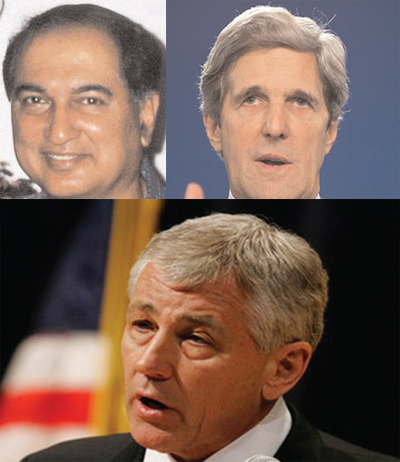
    This comes at a time when the US is confident that it will not only be a net exporter of gas but also the largest producer of oil in the world before the end of this decade. It has also led to the confidence of re-emergence of the US as a growing industrial power, readying to market its gas surpluses across the Atlantic. Given these developments, it cannot be a mere coincidence that both Senators Kerry and Chuck Hagel,who will steward the State and Defense Departments, favor the establishment of a trans-Atlantic trade and economic zone as the cornerstone of the 2013 agenda. Both are veterans of the Vietnam War and share President Obama’s aversion to military involvements abroad.

    This is evident from Obama’s decision on avoiding direct military involvement in the Anglo-French intervention in Libya and his caution in not getting excessively drawn into events in Syria, or the French military intervention in Mali. This same approach will guide the American approach to its “end game” in Afghanistan. The doubt that remains is whether the US will leave adequate forces behind in Afghanistan and how their role will be fashioned. The policy of using drones in a counterterrorism role against Pakistan-based terrorists operating in Afghanistan is also under review.

    Senator Chuck Hagel, labeled as “peacenik” by Republican Party colleagues, has been a critic of the American military policies in Afghanistan. He remarked: “One of the reasons why we’re in trouble in Afghanistan is because we went well beyond our mission. Is our mission to eliminate the Taliban? That never was our mission”? Hagel conveniently forgets that even before military operations commenced after 9/11, both the Saudis and the Americans tried to persuade Mullah Omar to hand over Osama bin Laden.

    The then ISI chief encouraged Mullah Omar to reject the American proposal. Mullah Omar flatly refused to yield.With the help of the Taliban and the ISI, Osama bin Laden was shifted to live comfortably with his many wives and children in the Abbotabad cantonment. Senator Kerry,who agreed in 2011 to a proposal involving the payment of “blood money” to secure the release of CIA operative Raymond Davis from Pakistani custody and was the co-author of the Kerry-Lugar Bill tripling economic assistance to Pakistan, has unique views on Pakistan’s support for terrorism.

    He lauded Pakistan for its “logistical” support,which he claimed led to the American forces getting Osama bin Laden. “Our folks were able to cooperate on the ground with Pakistan. That’s one of the reasons we were able to get Osama bin Laden. I don’t think the Pakistanis have gotten enough credit for the fact that they were helpful”. Kerry also observed that the Pakistanis “have lost some 6000 people just last year in their efforts to go after terrorists”.

    He pointedly failed to mention that while the Pakistan army targeted its citizens, whom it labeled as terrorists, it was not merely permissive, but colluding with outfits like the Mullah Omar-led Quetta Shura and the Haqqani Network in Afghanistan and their affiliates like the Lashkar-e-Toiba,which is now operating on Pakistan’s borders with both Afghanistan and India. Moreover,what Kerry has been saying contradicts everything said earlier on Pakistani support for terrorist outfits by President Obama, Hillary Clinton, Leon Panetta and General David Petraeus. It is doubtful if Obama shares the optimism of John Kerry on Pakistan’s support for terrorism.

    The American end-game in Afghanistan under the new dispensation is set to pose formidable challenges to Indian diplomacy in its Af-Pak neighborhood. Changes in the American policy vis-avis the Asia-Pacific in the coming years also appear to be underway. Senator Hagel has noted: “China is going to emerge and grow.We should welcome that. There are going to be competitors like India, Brazil and other nations. They (the Chinese) are a great power today and are going to remain a great power.

    But we should not cower in the wake of that.” There are indications that the new Obama team is going to ask its allies like Japan to avoid actions which displease or provoke China on disputed maritime frontiers. Priority is reportedly being given to “modifying the harder edges of the (Asia-Pacific) pivot and quietly reassuring China”. The outgoing Assistant Secretary of State for East Asian Affairs, Kurt Campbell, recently observed: “China is predominant in every aspect of political, financial, economic and security relations in Asia.

    India is still a nascent player in Asia. I think everyone has high hopes for the role India will play moving forward”. The message is that not much can be expected from a “nascent” India unless it sets its house in order, accelerates economic growth and enhances its defense potential. India’s relationship with the US will remain cordial and correct, but largely transactional.We will have to refashion our Af-Pak and Look East policies accordingly.

    (The author is a former career diplomat who retired from Indian Foreign Service in 2000. Presently, he is a Visiting Professor in the Centre for Policy Research in New Delhi. He can be reached at partha0@gmail.com)

  • Hillary Clinton to charge $200,000 per speech

    Hillary Clinton to charge $200,000 per speech

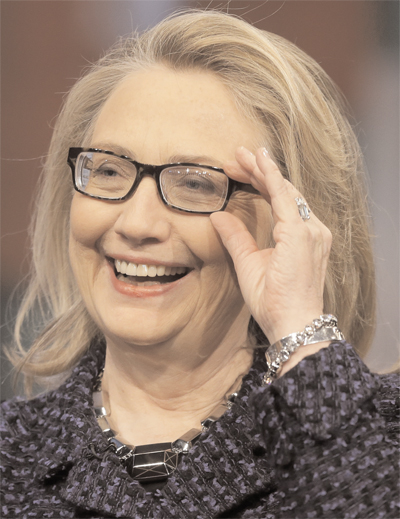
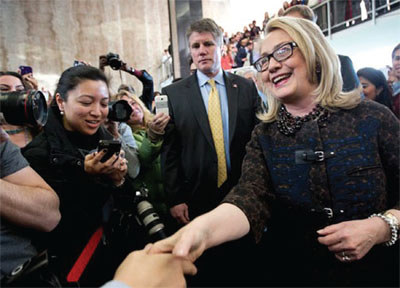
    WASHINGTON (TIP): Hillary Clinton has signed up for speaking circuit and will charge a whopping $200,000 per appearance, an amount more than her annual salaray as the US Secretary of State. The $200,000-per-speech fee will be a sizable increase for 65-year-old Clinton, who made $186,000 annually as secretary of state before stepping down earlier this month. “Now that she’s out as Secretary of State, Hillary Clinton isn’t going to be hurting for money, thanks to speaking fees of more $200,000 per speaking appearance, according to a source familiar with the situation,” Buzzfeed reported. Clinton will be represented by the New York-based Harry Walker agency, which also represents her husband Bill Clinton, the former US President.

    According to CNN, Clinton gave 471 paid speeches during his 11 years as a private citizen and raked in an average of $1,89,000 per event – joining the speaking industry’s rarefied six-figure circle occupied by Arnold Schwarzenegger, Al Gore, Dick Cheney and Sarah Palin. Clinton, however, according to Politico, will do some speeches pro bono, particularly those for the charities and causes she champions. She will also be involved in non-profit works.

  • Japan’s New PM Arrives In US For Obama Meeting

    Japan’s New PM Arrives In US For Obama Meeting

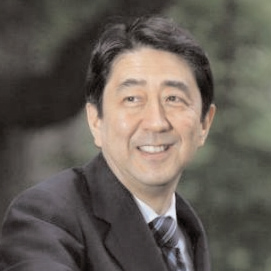
    WASHINGTON (TIP): Japanese Prime MinisterShinzo Abe has arrived in the United States for a WhiteHouse meeting with President Barack Obama.Abe, who was elected in December, is seeking toreinforce the longstanding U.S.-Japan alliance at a timeof high tension stoked by a Japan-China territorialdispute and a North Korean nuclear test.He arrived at Andrews Air Force Base outsideWashington on Thursday.

    He meets Obama at the WhiteHouse on Friday.They will also discuss economic ties. Theadministration will be gauging Japan’s intent to join atrans-Pacific trade agreement under negotiation.Abe is a nationalist and wants to rebuild Japan’sglobal standing, diminished by years of economicmalaise.He is the fifth Japanese prime minister duringObama’s time in office.

  • Obama State Of The Union Speech Demands Vote On Gun Control Bills

    Obama State Of The Union Speech Demands Vote On Gun Control Bills

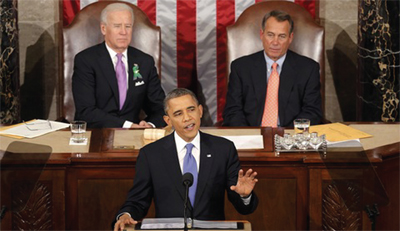
    WASHINGTON (TIP): President Barack Obama on February 12 called for Congress to vote on a variety of gun control proposals that are currently up for debate, and heoffered a heartfelt, but not sharply political, endorsement for the proposals. Towards the end of his State of the Union address, as the speech reached a crescendo, the president turned to the topic of gun violence: “What I’ve said tonight matters little if we don’t come together to protect our most precious resource — our children.” “This is not the first time this country has debated how to reduce gun violence,” Obama said.

    But two months after the shooting of20 children and six adults at anelementary school in Newtown, Conn.,he said, “This time is different.””Overwhelming majorities ofAmericans -– Americans who believe inthe 2nd Amendment — have cometogether around common-sense reform,like background checks that will makeit harder for criminals to get theirhands on a gun,” Obama continued.

    “Senators of both parties are workingtogether on tough new laws to preventanyone from buying guns for resale tocriminals. Police chiefs are asking ourhelp to get weapons of war and massiveammunition magazines off our streets,because they are tired of being outgunned.

    “Universal background checks, andthe tougher penalties for “strawpurchases” of guns, are some of themost popular gun-control proposalsamong voters, and both may eventuallywin bipartisan support. But a ban onmilitary-style weapons faces an uphillbattle in Congress, where Sen. DianneFeinstein (D-Calif.) has championed arenewal of the 1994 Assault WeaponsBan, which expired in 2004.The measures face opposition largelyfrom Republicans, but in an unexpectedmove, Obama did not single out any ofthe biggest obstacles to the bills, whichinclude the powerful National RifleAssociation. Instead, he asked onlythey be put to a vote.”Each of these proposals deserves avote in Congress,” he said.

    “If you wantto vote no, that’s your choice. But theseproposals deserve a vote. Because in thetwo months since Newtown, more thana thousand birthdays, graduations andanniversaries have been stolen fromour lives by a bullet from a gun.”The president’s take is similar to thatof Senate Majority Leader Harry Reid(D-Nev.), who enjoys a positive ratingfrom the NRA. Reid has so far beennoncommittal on specific gun-controlproposals, but said in a recentinterview that lawmakers should voteon each of them.To drive home his point on the needfor action on gun control, Obamainvoked a string of mass shootings thathave occurred during hisadministration. The State of the Unionaudience included dozens of peoplewhose lives had been affected by gunviolence, invited as guests ofcongressional Democrats and the WhiteHouse.Obama received one of the biggeststanding ovations of the night as hesaluted the parents of HadiyaPendleton, a young woman killed bygun violence, and demanded thatCongress vote on gun-control measures.”One of those we lost was a younggirl named Hadiya Pendleton. She was15 years old. She loved Fig Newtons andlip gloss. She was a majorette.

    She wasso good to her friends, they all thoughtthey were her best friend. Just threeweeks ago, she was here, inWashington, with her classmates,performing for her country at myinauguration. And a week later, she wasshot and killed in a Chicago park afterschool, just a mile away from myhouse,” he said.”Hadiya’s parents, Nate and Cleo, arein this chamber tonight, along withmore than two dozen Americans whoselives have been torn apart by gunviolence. They deserve a vote,” he said.”[Former Rep.] Gabby Giffords deservesa vote. The families of Newtowndeserve a vote. The families of Auroradeserve a vote. The families of OakCreek, and Tucson, and Blacksburg,and the countless other communitiesripped open by gun violence — theydeserve a simple vote.

    “As he prepared to finish the speech,the president acknowledged — and somemight say disarmed — the argumentfavored by many who oppose guncontrol laws that no law can eliminateall gun violence.”Our actions will not prevent everysenseless act of violence in thiscountry. Indeed, no laws, no initiatives,no administrative acts will perfectlysolve all the challenges I’ve outlinedtonight,” Obama said. “But we werenever sent here to be perfect. We weresent here to make what difference wecan, to secure this nation, expandopportunity, and uphold our idealsthrough the hard, often frustrating, butabsolutely necessary work of selfgovernment.”Two official responses are expectedafter Obama’s speech, one fromRepublican Sen. Marco Rubio (Fla.),and another from Tea Party favoriteSen. Rand Paul (R-Ky.). As two of themost conservative members of theSenate, both Paul and Rubio arestaunchly opposed to gun control.

  • ‘Thank You, Hillary’, Says Gillibrand

    ‘Thank You, Hillary’, Says Gillibrand

    NEW YORK (TIP): Even as HillaryClinton stepped down as Secretary ofState, Senator Kirsten Gillibrand, aprotégé of Hillary Clinton, paid richtributes to her in a statement to TheIndian Panorama.Kirsten said, “Hillary Clinton has beena role model for me since she traveled toBeijing as first lady and announced that”human rights are women’s rights, andwomen’s rights are human rights.” In fact,it was that speech that inspired me to getoff the sidelines and pursue a career inpublic service.

    “Ever since, Hillary has continued toinspire me and so many others, first assenator from New York, then as a historymakingpresidential candidate, and, mostrecently, representing the United Statesaround the world as our secretary of state.”As Hillary steps down from the Obamaadministration this week, I hope you’lljoin me in thanking her and letting herknow how much she’s meant to us.”I can’t tell you what an honor it hasbeen to follow in her footsteps as senatorfrom New York. She’s not only been a rolemodel, but also a mentor and friend. I willalways be grateful to her.”But I know I’m not alone. She’stouched so many of you as well with herstrength, dignity and grace as she’snavigated the highest positions of powerin our nation.

  • Us Stands With You, Clinton Assures India

    Us Stands With You, Clinton Assures India

    WASHINGTON (TIP): Greeting the people of India on its Republic Day, US Secretary of State Hillary Clinton has said the US-India strategic partnership is making the world more united, prosperous, and secure. “Together we are strengthening our ties and working to address some of the most difficult global challenges,” she said in a Republic day message holding out an assurance “that the United States stands with you.” Noting that the United States and India share an unwavering commitment to democratic government, Clinton said: “Our shared values are the foundation for the innovative, entrepreneurial drive that is allowing more and more of our 1.5 billion people to realize their potential.” “My three trips to India as Secretary of State reinforced my unyielding belief that the US-India strategic partnership is making the world more united, prosperous, and secure,” said America’s top diplomat considered a prime mover of stronger India-US ties. “Together we are strengthening our ties and working to address some of the most difficult global challenges,” she said.

    Here is the full text of the message:
    “On behalf of President Obama and the people of the United States, I am delighted to send my best wishes to the people and government of India as you celebrate your 64th Republic Day this January 26th. ‘The United States and India share an unwavering commitment to democratic government. Our shared values are the foundation for the innovative, entrepreneurial drive that is allowing more and more of our 1.5 billion people to realize their potential. ‘My three trips to India as Secretary of State reinforced my unyielding belief that the US-India strategic partnership is making the world more united, prosperous, and secure. Together we are strengthening our ties and working to address some of the most difficult global challenges. ‘As you celebrate this special day, know that the United States stands with you. Best wishes for a year filled with peace and prosperity.’

  • As I See It : Is it time for India to inject greater realism into its Pakistan policy?

    As I See It : Is it time for India to inject greater realism into its Pakistan policy?

    “Regrettably, no policy lessons were drawn by New Delhi from the Mumbai terrorist siege, which occurred because India presented itself as a weak and tempting target. The latest episode â ” one of the worst acts of Pakistani savagery in peacetime ever â ” has followed a dozen Pakistani violations of the line of control in the past one month. The question to ask is what has prompted the Pakistani military establishment to adopt an overtly aggressive posture visa-vis India of late”, says the author.

    Words like “brutal”, “heinous” and “savage” aptly describe the way a Pakistani army unit raided Indian territory and chopped two soldiers, taking away one severed head as a “trophy”. The Indian outrage, however, must not blind us to the unpalatable truth: India is reaping what it sowed. New Delhi is staring at the bitter harvest of a decade-long policy seeking to appease a recalcitrant neighbor with unilateral concessions and gestures. The “peace-at-any-price diplomacy” was started by prime minister Atal Behari Vajpayee in an abrupt policy U-turn in 2003, and has been pursued with greater vigor by his successor, Manmohan Singh, interrupted only by the Pakistan-orchestrated Mumbai terrorist rampage of 2008.

    Regrettably, no policy lessons were drawn by New Delhi from the Mumbai terrorist siege, which occurred because India presented itself as a weak and tempting target. The latest episode, one of the worst acts of Pakistani savagery in peacetime ever, has followed a dozen Pakistani violations of the line of control in the past one month. The question to ask is what has prompted the Pakistani military establishment to adopt an overtly aggressive posture visa-vis India of late. The Pakistani military is drawing encouragement from two factors. The first factor is that the US-Pakistan relationship, after being on the boil for more than a year, has gradually returned to normalcy. That the USPakistan rift has healed is apparent from Washington’s resumption of large-scale military aid and its coddling of the Pakistan army and ISI.

    US aid to Pakistan is now at a historic high â ” at more than $3 billion a year. US policy, because of the exigencies of an exit strategy from Afghanistan, has permitted political expediency to trump long-term interests vis-a-vis Pakistan. The US has allowed even a key issue to fade away: how was Osama bin Laden able to hide deep inside Pakistan? The reason for that is the same as to why the US didn’t pursue the AQ Khan case. The second factor is the series of unilateral political concessions by India, including delinking dialogue from terrorism, and recognizing Pakistan, the sponsor of terror, as a victim of terror. Whereas US policy has increased the Pakistani military’s room for maneuver against India, Indian policy has both solidified Pakistani reluctance to bring the Mumbai-attack masterminds to justice and emboldened the Pakistani military to commit yet another act of aggression.

    India has considerably eased pressure on Pakistan, both on the Mumbai-attack issue and on Hafiz Saeed, the militant leader who still preaches terrorism against India. India has also pursued a host of goodwill gestures, including resuming high-level political exchanges and cricketing ties and introducing a lessrestricted visa regime for Pakistanis. All these moves, unfortunately, have sent the wrong message to Islamabad. Being nice with a determined adversary in the hope that this will change its behavior is not strategy. With Singh dreaming of open borders with terror-exporting Pakistan, India’s Pakistan policy remains driven by hopes and gushy expectations, not statecraft.

    In fact, some of the public statements Singh has made in recent years have not only been insensitive in relation to those slain by Pakistantrained terrorists but may also have inadvertently encouraged Pakistani intransigence and aggression. Consider the following examples: “We both [Pakistani Prime Minister Gilani and myself] recognize that if there is another attack like Mumbai, it will be a setback to the normalization of relations”. In other words, if there were another Mumbai style terrorist attack, it will merely be a “setback” to ties â ” that, too, a temporary setback followed by Indian concessions. “India-Pakistan relations are prone to accidents.”

    Were the attacks on the Indian Parliament and Red Fort, the Mumbai terrorist strikes, and the myriad other Pakistan-scripted outrages just “accidents”? Will the latest savagery also be treated as another “accident” after the current public indignation fades? “We cannot wish away the fact that Pakistan is our neighbor”. And, therefore, “a stable, peaceful and prosperous Pakistan” is in India’s “own interest”. But the breaking away of South Sudan, East Timor, and Eritrea and the disintegration of the Soviet Union and Yugoslavia since the 1990s have shown that political maps are not carved in stone.

    In fact, the most profound global events in recent history have been the fragmentation of several countries. Didn’t Indira Gandhi change political geography in 1971? India and Pakistan are locked by a “shared destiny”, and thus “our objective must be a permanent peace with Pakistan, where we are bound together by a shared future and a common prosperity”. How can a plural, inclusive and democratic India share a common destiny with a theocratic, militarized, fundamentalist and failing Pakistan?

  • Susan Rice Withdraws As Nominee For Secretary Of State

    Susan Rice Withdraws As Nominee For Secretary Of State

    NEW YORK (TIP): Susan Rice withdrew from consideration for the secretary of State position on Thursday, December 13, citing Republican criticism of her record that had signaled a tough confirmation battle. In a letter to President Obama, Rice said she could have done the job “ably and effectively,” but added that “I am now convinced that the confirmation process would be lengthy, disruptive and costly — to you and to our most pressing national and international priorities.” Rice will continue as the U.S. ambassador to the United Nations. In a statement, Obama praised Rice, while criticizing the “unfair and misleading attacks” on her by Senate Republicans and others over the Sept. 11 attack on the U.S. consulate in Benghazi, Libya.

    “Her decision demonstrates the strength of her character, and an admirable commitment to rise above the politics of the moment to put our national interests first,” Obama said. Sen. John McCain, R-Ariz., and other Republicans had criticized Rice over a string of Sept. 16 television interviews in which she attributed the Benghazi attack to the protest over an anti-Islam video. Officials later said organized terrorists carried out the attack that killed U.S. ambassador Christopher Stevens and three other Americans.

    Rice also faced criticism for owning stocks in a Canadian energy company seeking State Department approval to build the Keystone XL oil pipeline in the United States. Others questioned her past support for controversial African leaders, such as Paul Kagame of Rwanda. Rice had been one of the leading contenders for the secretary of State slot soon to be vacated by Hillary Rodham Clinton.

  • Hillary Clinton hints at keeping post in a second Obama term

    Hillary Clinton hints at keeping post in a second Obama term

    WASHINGTON (TIP): US secretary of state Hillary left the door open on Friday to continuing to serve under President Barack Obama should he win a second term that would begin in January.

    One of Obama’s most popular cabinet members, Clinton has repeatedly insisted she would leave her office as America’s top diplomat at the end of the Obama administration’s first term.

    But she hinted at serving beyond then in an interview with The Wall Street Journal.

    “A lot of people have talked to me about staying,” Clinton said.

    She said it was “unlikely” that the fallout from the deadly September 11 attack on the US consulate in the eastern Libyan city of Benghazi would force her to stay on, though left that possibility open for the first time since she took office in 2009.

    The hint not only suggests continuity in Obama’s foreign policy, but also broadens the president’s appeal among women voters, who have backed him in the past but are increasingly supporting his Republican challenger Mitt Romney. Clinton, who lost her 2008 Democratic presidential nomination bid to Obama, has long been seen as a possible White House contender in 2016. But she has been adamant in quashing the rumours.

    “I have ruled it out,” said Clinton, who turned 65 on Friday. “It’s important for me to step off this incredibly high wire I’ve been on… to take stock of the rest of my life.” In a separate interview with The Washington Post, Clinton reiterated her intention to step down after a single term, even if Obama is reelected.

    “I’m aiming to leave shortly after the inauguration; that’s my plan,” she said, explaining she would stay until her successor is confirmed. “But I haven’t been able to sit down and talk to the president yet because he’s trying to win an election, which hopefully will be finalized shortly. And then we will talk through how to do the transition.”

  • India, US discuss Regional and Global Issues

    India, US discuss Regional and Global Issues

    NEW YORK (TIP): External Affairs Minister S.M. Krishna has conveyed India’s concerns to Secretary of State Hillary Clinton over the US visa fee hike and discussed a host of regional and global issues, including ways of advancing bilateral cooperation over Afghanistan.

    Krishna held a 45-minute meeting with Clinton on the sidelines of the UN General Assembly (UNGA) session Monday, October 1.

    Krishna and Clinton “held a positive discussion on a broad range of bilateral and regional issues”, a State Department official said..

    During the discussions, Clinton thanked India for its prompt condemnation of the attack on its Benghazi consulate that killed the US ambassador to Libya Christopher Stevens, said official sources in India’s Foreign Office.
    Krishna thanked the US government for swift response in the wake of attack on a Sikh gurdwara in Wisconsin, US.
    Issues relating to the hike in the US visa fee, which has hurt the Indian IT industry, figured prominently in the talks. The US raised visa fee in 2010 to finance its enhanced costs of securing its border with Mexico under the Border Security Act.

    This was Krishna’s third meeting with Clinton this year. The two had previously met in New Delhi in April and, again in Washington in June.

    Against the backdrop of the phased withdrawal of international combat troops from Afghanistan by 2014, Krishna and Clinton also discussed prospects of a closer collaboration between India and the US to stabilize the strife-torn country and for joint development projects in that country.

    India, the US and Afghanistan held a trilateral dialogue on the Afghan situation on the sidelines of the UNGA in New York last week.

    The two reviewed last week’s trilateral dialogue and discussed regional economic integration projects including the Turkmenistan-Afghanistan-Pakistan-India (TAPI) pipeline, he said.

    Krishna raised the possibility of the US permitting the export of shale gas in liquefied form to India and was told that Washington would keep India’s energy needs in mind as they decide on some domestic issues relating to export of shale gas, sources said.

    Krishna and Clinton also discussed their joint efforts on energy, civil nuclear cooperation, visas, trade and bilateral investment, and expanding cooperation with India’s neighbors and near-neighbors, the State Department official said.

    Clinton welcomed the steps India and Pakistan have recently taken to develop closer trade and commercial ties, he said.

    India updated the US on steps taken by New Delhi to normalize trade relations with Islamabad and the dialogue process with Pakistan.

    Besides Afghanistan, regional issues that came up during discussions included regional cooperation in South Asia and support for India’s Look East policy, said the sources.

  • Anti-Islam film Protests set Middle East afire

    Anti-Islam film Protests set Middle East afire

    NEW YORK (TIP): Protests against the anti-Islam film “Innocence of Muslims”, made in the US, have spread across the Middle East and North Africa, a BBC report says.

    In Yemen, demonstrators briefly stormed the grounds of the US embassy in Sanaa and burnt the US flag, but were driven back by security forces.

    In Egypt, 224 people were injured in protests, the health ministry said.

    In Libya, where the US ambassador J Christopher Stevens and 3 others were killed during protests in Benghazi on Tuesday, September 11, officials said they had made some arrests over the attack. Meanwhile, President Obama has vowed that “Justice will be done”.

    The demonstrations, and violence, which have spread through the Middle East and North Africa, are a reminder that, in this part of the world, religion and politics are often the same thing. Religion defines lives and is part of people’s identities in a way that secular Europeans forgot long ago.

    It is a big part of the political transformation that has been happening since the Arab uprisings started last year. In the old Middle East, there used to be protests against the United States and its Western allies when they were perceived to be attacking Islam – everything from insulting the Prophet Muhammad to invading or bombing.
    The authoritarian rulers of police states who depended on western support always kept them in check. But now the old red lines have gone.

    US officials say they are investigating whether the attack in Libya was planned, citing suspicions that a militant jihadist group may have co-coordinated the violence.

    Libya’s new Prime Minister Mustafa Abu Shagur told the AFP news agency there had been a “big advance” in the investigation in Benghazi.

    “Arrests have been made and more are under way as we speak,” he said.

    Deputy Interior Minister Wanis al-Sharif said that police were gathering evidence and, in addition to those arrested, some militants were being closely monitored.

    US Secretary of State Hillary Clinton condemned the film which gave rise to the protests as “disgusting” and “reprehensible”.

    The US utterly rejected its contents and its message, she said, but the film was no excuse for violence

    Anti-American anger

    Police in Sanaa shot in the air, but failed to prevent crowds from gaining access to the embassy compound and setting fire to vehicles.

    Security force reinforcements used tear gas, water cannon and live fire to drive protesters back.
    There were reports of injuries on both sides, although the Reuters news agency carried a statement from the embassy saying there were none.

    “The exact origin of the movie and the internet clip, and the motivation behind its production, remains a mystery”, says BBC’s Alastair Leithead.

    Windows were smashed. A US flag was torn down and replaced with a black flag bearing the Muslim statement of faith, “There is no God but Allah”.

    In Washington, a White House spokesman said all those working in the Sanaa embassy were safe and accounted for.
    In Egypt, protests erupted for a third day outside the US embassy in Cairo, with some demonstrators demanding the expulsion of the ambassador.

    Police fired tear gas at crowds throwing stones.

    Islamist groups and others have called for a “million-man march” in Cairo on Friday, September 14.
    The Muslim Brotherhood, the Salafist al-Nour party and non-religious groups including the “Ultra” fans of Zamalek football club have invited Muslims, Coptic Christians and all Egyptian citizens to join them.
    President Mohammed Mursi appealed for calm, saying Egyptians “reject any kind of assault or insult” against the Prophet Muhammad.

    “I condemn and oppose all who… insult our prophet. [But] it is our duty to protect our guests and visitors from abroad,” he said in a statement broadcast by state media.

    “I call on everyone to take that into consideration, to not violate Egyptian law… to not assault embassies.”
    Some other developments:

    Mr. Abu Shagur says there is “no justification” for the Benghazi attack and investigations are under way to find the “criminals” responsible

    Russia says it fears “chaos” in the Middle East and Saudi Arabia condemns both the film and the violence

    Iranians chanting anti-US and anti-Israel slogans stage a protest outside the Swiss embassy in the Iranian capital, Tehran, which represents US interests

    Afghan President Hamid Karzai has postponed a planned visit to Norway, fearing violence could erupt in his country

    There were small protests in Bangladesh and Iraq, in addition to Morocco, Sudan and Tunisia

    Security has been increased at US embassies and consulates around the world; US officials say a marine anti-terrorism team is being deployed to Libya and two destroyers to the Libyan coast as a precautionary measure

    Protests Time line:

    11 September

    1. US embassy in Cairo attacked, flag torn down and replaced with an Islamist banner
    2. Mob attacks US consulate in Benghazi, US ambassador Chris Stevens and three other Americans killed

    13 September

    3. Protesters break into the US embassy compound in Sanaa, Yemen, amid clashes with security forces
    4. Further violence reported in Cairo

    US officials have described the Benghazi attack as complex and professional, and suggested the attackers may have used the film protest as a pretext for the attack.

    Reuters quoted officials as saying there were suspicions that a militia known as the Ansar al-Sharia brigade was responsible, although the group has denied the claim.

    The officials said there were also reports that al-Qaeda’s North Africa-based affiliate, al-Qaeda in the Islamic Maghreb, may have been involved, the news agency reports.

    The obscure film which has sparked anger, called Innocence of Muslims, was shot in the US and posted online earlier this year. Clips have since been shown on Arab TV stations.

    It depicts the Prophet Muhammad as a womanizer and the bloodthirsty leader of a ragtag group of men who enjoy killing.

    The BBC’s Alastair Leithead says the exact origin of the movie and the internet clip, and the motivation behind its production, remains a mystery.

    The most offensive comments regarding Muhammad appear to have been dubbed on later, says a BBC Correspondent.

    Some of the actors involved have since condemned the film, and said they had no idea it was to be used as anti-Islam propaganda. Makers of the movies have reportedly said they were “grossly misled”.

    (BBC)