Tag: United States Politics


  POLITICS & POLICY  

  • Biden keeps out Democrats with RSS links

    Biden keeps out Democrats with RSS links

    • Obama administration staffer Sonal Shah as well as Amit Jani, who worked on the Biden campaign team have so far been excluded

    NEW YORK (TIP): As strategists parse the nearly 20 Indian-Americans appointed in the Biden administration, what is noteworthy are those who didn’t make it, says Sandeep Dixit in a TNS report.

    An Obama administration staffer Sonal Shah as well as Amit Jani, who worked on the Biden campaign team have so far been excluded, allegedly due their RSS/BJP links which has been brought into the limelight by over a dozen Indian-American organizations. Biden’s team has people like senior diplomat Uzra Zeya who had played a role in the Devyani Khobargade case or Samira Fazili who had joined protest rallies in the US against the CAA, NRC and the Kashmir lockdown. Those with RSS/BJP links have not found a place while secular Indian-American organizations have maintained the pressure on the Biden-Harris Transition Team to keep such individuals on the sidelines, said sources.

    The Democrats may have been more circumspect over accommodating pro-BJP/RSS elements in the government following renewed activism by organizations opposed to the Hindutva project and also after witnessing the fate of such candidates, added the sources. Congressional candidate Sri Preston Kulkarni lost the elections after strident opposition from Indian-American organizations and former US Congressperson Tulsi Gabbard also lost political ground because of this reason. Sonal Shah has served on Biden’s Unity Task Force but her father was the President of Overseas Friends of BJP-USA and is the founder of RSS-run Ekal Vidyalaya for which she has raised friends.Jani’s may have been the case of lax vetting. Named Biden campaign’s Muslim Outreach Coordinator, he was re-appointed as National Asian American and Pacific Islander Director after it was pointed out that his family has ties with PM Modi and other BJP leaders.In order to ensure that the Biden administration does not backtrack on excluding those with RSS/BJP links, 19 Indian-American organizations have written to Biden pointing out that many South Asian-Americans individuals with ties to far-right Hindu organizations in India are affiliated with the Democratic Party.

    (Source: TNS)

  • Will Trump again escape impeachment conviction?

    Will Trump again escape impeachment conviction?

    By Prabhu Dayal

    It may be noted that in terms of the provisions relating to impeachment proceedings, the House of Representatives charges an official of the federal government by approving the articles of impeachment by majority vote, but the Constitution requires a two-thirds vote of the Senate to convict the person being impeached. The Democrat-controlled House had impeached Trump in December 2019 for pressurizing the president of Ukraine to investigate Biden, but the Republican-held Senate had acquitted him in February 2020.”

    In December 2019, when House Speaker Nancy Pelosi had announced a formal impeachment enquiry against President Trump, she recounted an anecdote to back her arguments. Pelosi said, “On the final day of the Constitutional Convention in 1787, when our Constitution was adopted, Americans gathered on the steps of Independence Hall to await the news of the government our founders had crafted. They asked Benjamin Franklin, ‘What do we have, a republic or a monarchy?’ Franklin replied, ‘A republic, if you can keep it.’

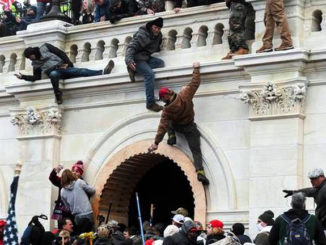
    Pelosi was again in the forefront of efforts to ‘ Keep the Republic’ in the wake of fresh, unprecedented challenges.  Wednesday 6th January 2021 will go down as perhaps the darkest and most embarrassing day in history for most Americans because on that day the country’s President incited a mob of his supporters to attack and ransack the Capitol, the temple of America’s democracy which houses the Senate and the House of Representatives.

    More than two months had elapsed since the US Presidential elections were held on November 3, but President Trump refused to accept the verdict which had gone in favor of his rival, Joe Biden. He complained that the Presidential election results were “rigged” due to widespread fraud, while election officials repeatedly said that there was no evidence to back Trump’s claims. The Trump campaign also filed dozens of lawsuits challenging the election results but was rebuffed in most state and federal courts.

    Claiming that the election had been stolen from him, Trump incited a mob of his supporters to storm the U.S. Capitol when the US Congress met on January 6 to formally count the Electoral College votes. Violence broke out as the mob ransacked the Capitol, and members of Congress were forced to go into hiding for their safety. Five persons died in the mayhem, including a policeman. Reports indicate that eighty-two persons have been arrested and police are on the hunt for others who were involved in the attack.

    Although Congress reconvened the following day and certified Biden’s election victory, Trump was severely criticized for inciting the violence, including by some members of his own Party. Top Democratic Party leaders including Nancy Pelosi and Chuck Schumer (leader of the Democrats in the Senate) called on Vice President Mike Pence and Trump’s Cabinet to invoke the U.S. Constitution’s 25th Amendment, which allows them to strip the president of his powers if he is unfit to discharge the duties of his office. They also said that if Pence and Trump’s Cabinet refuse to do so, they would call for Trump to be impeached. “The president’s dangerous and seditious acts necessitate his immediate removal from office,” they said in a statement accusing Trump of inciting an “insurrection.” As expected, Pence refused to rule that Trump was no longer capable of discharging his duties, setting the stage for the impeachment.

    President Donald Trump, who was charged with “incitement of insurrection” over the mob siege of the Capitol, becomes the first President in the history of the United States to be impeached by the House of Representatives for the second time. The House voted 232-197 to impeach Trump. Significantly, ten Republicans joined the Democrats saying that he should be held accountable and warned of a “danger” if Congress should leave him unchecked ahead of Joe Biden’s inauguration.

    What now lies on the road ahead?

    This time also, while the Democrat-dominated House has impeached him, will the two-thirds majority of the Senate required for conviction be obtained? There is so far no indication that enough members of the president’s party would agree to convict him. Thus, the impeachment proceedings started for a second time against Trump might end with the same outcome as before.

    Thus, in other words, Trump could again escape conviction by the Senate even though he has been impeached by the House. However, nothing can be ruled out in politics. Trump has said that he will be running for President in 2024; he will be 78 years old at that time, but so is Biden right now! Therefore, his age may not work against him. Going by present indications, he has a strong support base which might again propel him ahead of other Republican candidates and help him get his party’s nomination as it did in 2016″.

    Would his rivals relish that possibility? Or, would they rather have him elbowed out of the way? In other words, will Trump’s rivals work with the Democrats in the impeachment process in order to put an end to his political career? The drift of public opinion is against Trump, and they might find it convenient to go along. Politics, like adversity makes strange bed-fellows, and nothing can be ruled out at this juncture.

    Can the process continue even after Trump leaves office? Legal experts are divided on this matter. There are some who believe that Trump can only be impeached while he is office, while there are others who believe that if the process has commenced in the House, it could continue in the Senate even after he has left office. In this regard, they have cited a legal precedent. In 1876, Secretary of War William Belknap was investigated by the House for corruption. Just minutes before the House was set to vote on his impeachment, he went to the White House and handed his resignation to President Ulysses Grant. However, the House went ahead and impeached him. The Senate also proceeded to have a trial though he was acquitted as two-thirds of the Senators did not vote in favor of the conviction.

    The coming days, therefore, will be watched with great interest not just in America but all across the globe.

    (The author is a retired diplomat)

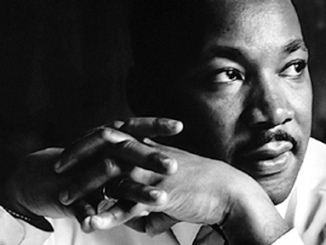
  • Remembering Martin Luther King Jr. on his 92nd birthday

    Remembering Martin Luther King Jr. on his 92nd birthday

    Minister, civil rights activist, and public opinion leader who changed the face of America

    January 15, 1929, Atlanta, Georgia

    Died

    April 4, 1968, Memphis, Tennessee

    Spouse

    Coretta Scott King

    Accomplishments

    Leader of African American Civil Rights Leader

    Nobel Peace Prize (1964)

    Presidential Medal of Freedom (1977)

    Congressional Gold Medal (2004)

    Famous letters and speeches

    “I have a dream” Speech

    Letter from Birmingham jail

    Letter to Coretta

    Our God is Marching On (How Long? Not Long)

    Martin Luther King Jr. became the predominant leader in the civil rights movement to end racial segregation and discrimination in America during the 1950s and 1960s, and was a leading spokesperson for nonviolent methods of achieving social change. His eloquence as a speaker and his personal charism—combined with a deeply rooted determination to establish equality among all races despite personal risk—won him a worldwide following. He was awarded the Nobel Peace Prize in 1964 and was selected by Time magazine as its Man of the Year. His “I Have a Dream “speech, which is now considered to be among the great speeches of American history, is frequently quoted. His success in galvanizing the drive for civil rights, however, made him the target of conservative segregationists who believed firmly in the superiority of the white race and feared social change. He was arrested over 20 times and had his home was bombed. Ultimately, he was assassinated on April 4, 1968, on the balcony of a motel where he was staying in Memphis. A monument to Dr. King was unveiled in the national capital in 2012.

    Early Life of Martin Luther King Jr.

    Martin Luther King Jr. was born Michael Luther King Jr., in Atlanta, Georgia, on January 15, 1929. His father, in a 1957 interview, said that both he and his son were supposed to be named for the leader of the Protestant Reformation but misunderstandings led to Michael being the name on birth records. The boy became the third member of his family to serve as pastor of the Ebenezer Baptist Church in Atlanta, following in the footsteps of his grandfather and father. His training and experience as a minister undoubtedly contributed to his renowned oratorical style and cadence.

    He also followed the educational path taken by his father and grandfather: he got his education in Georgia’s segregated public schools (from which he graduated at age 15). And he received a B.A. degree from Atlanta’s Morehouse College, a traditionally black college. He then went on to study theology at Crozer Theological Seminary in Pennsylvania, an integrated school where he was elected president of his senior class although it was comprised primarily of white students. In 1955, he received an advanced degree from Boston College in Massachusetts; he had completed the residence for his doctorate two years earlier. (In 1991, a Boston University investigatory committee determined he had plagiarized portions of his doctoral dissertation; plagiarism was also discovered in his word at Crozer. However, the committee did not recommend his degree be revoked. Evidence of plagiarism had been discovered by Boston University archivists in the 1980s.)

    While in Boston, he met and married Coretta Scott, who would be his lifetime partner in both marriage and his campaign for civil rights. In 1954, the couple moved to Montgomery, Alabama, where King had been hired as the pastor of the Dexter Avenue Baptist Church.

    He was already active in the National Association for the Advancement of Colored People, America’s leading African-American organization. At the time of his move to Montgomery, he was a member of its executive committee, and in December 1955, he led a 382-day boycott of Montgomery’s segregated public bus system. Negroes, the term then used for those of African descent, were relegated to the back of the bus and forced to give up their seats if a white person wanted to sit. Since many blacks lived in poverty or near-poverty, few could afford automobiles, and public busses were essential to them for traveling to and from work and elsewhere. During the boycott, King became a target for segregationists. Personal abuse, arrest, and the bombing of his home made clear the risks he would be taking if he continued to work with the movement for civil rights.

    In 1957, that movement spawned a new organization, the Southern Christian Leadership Conference, to focus on achieving civil rights. King was elected president. By dropping reference to Negroes or colored people in its title and instead using the term “Christian Leadership” the organization was declaring its goals were not just those of one race but should be those of all Christian people. King strongly influenced the ideals of the organization.

    During the next 11 years, he would speak over 2,500 times at public events, traveling over six million miles. He also wrote articles and five books to spread the message farther. In 1963, he was a leader in the massive civil rights protests at Birmingham, Alabama, that drew the attention of all America—indeed, of the entire world—to the discrimination African Americans faced and their demands for change. Arrested during the protests, he penned “Letter from a Birmingham Jail,” which became a manifesto for the civil rights revolution and placed King among America’s renowned essayists such as Henry David Thoreau and Ralph Waldo Emerson.

    Civil rights leader Martin Luther King Jr. during the March on Washington for Jobs and Freedom on Aug. 28, 1963, in Washington.

    Influence of Mohandas Karamchand Gandhi

    His tactics for achieving social change were drawn from those of Mohandas Karamchand Gandhi (known as Mahatma, “great soul”), who had used nonviolent civil disobedience to bring about change in his native India (as he had done with some success previously to win concessions for Indian immigrants living in South Africa’s apartheid system). Gandhi’s methods included boycotts of British goods and institutions. (Like Martin Luther King, Jr., Gandhi was repeatedly arrested and ultimately was assassinated by a fanatic.)

    Although King stressed nonviolence, even when confronted by violence, those who opposed change did not observe such niceties. Protestors were beaten, sprayed with high-pressure water hoses, tear-gassed, and attacked by police dogs; bombings at black churches, homes, and other locations took a number of lives; some—both black and white—who agitated for civil rights such as the right to vote were murdered, but the movement pressed on.

    King was the most prominent leader in the drive to register black voters in Atlanta and the march on Washington, D.C., that drew a quarter-million participants. His message had moved beyond African Americans and was drawing supporters from all segments of society, many of them appalled by the violence they saw being conducted against peaceful protestors night after night on television news.

    Martin Luther King’s Nobel Peace Prize

    His oratory and impassioned drive, not just for equality under the law, but for true understanding and acceptance of all races and creeds by all races and creeds, led Time magazine to select Martin Luther King, Jr., as its Man of the Year for 1963. The following year, the Nobel Prize Committee in Stockholm, Sweden, awarded him the Nobel Peace Prize. Then 35, he is the youngest man ever to have received it. The prize included an award of over $54,000, which he promised to donate to the furtherance of the civil rights movement.

    As the Vietnam War escalated, King spoke out against America’s involvement in the conflict. His antiwar position was an outgrowth of his belief in nonviolence, but to those who opposed King it intensified their belief he was pro-Communist and anti-American.

    Martin Luther King, Jr. Assassinated

    In the spring of 1968, King traveled to Memphis, Tennessee, where the majority of the city’s black sanitation workers had been striking since February 12 for increased job safety measures, better wages and benefits, and union recognition. The mayor, Henry Loeb, staunchly opposed all these measures. King was solicited to come to Memphis to lead a planned march and work stoppage on March 28.

    Funeral procession for Martin Luther King, Jr., April 9, 1968, Atlanta. 

    That protest march turned violent when sign-carrying students at the end of the parade began breaking windows of businesses, which led to looting. One looter was killed and about 60 people were injured. The city of Memphis lodged a formal complaint in the U.S. District Court against King and several other leaders of the Southern Christian Leadership Conference. He and those leaders negotiated with the factions among the workers and their supporters who had initiated the march.

    Assured that they would observe the creed of nonviolent civil disobedience, King agreed to return to Memphis for the rescheduled march on April 5. The district court had issued a restraining order, however, representatives of the SCLC met with the judge on April 4 and worked out a broad agreement that would permit the protest march to be held on April 8. Details were to be worked out on April 5.

    On the evening of April 4, one of the SCLC representatives, Andrew Young (who would later serve as President Jimmy Carter’s ambassador to the United Nations and would be elected mayor of Atlanta), came to King’s room at the Lorraine Motel and informed him of what had been worked out with the judge. They prepared to go out to dinner, along with their colleagues. When King stepped onto the balcony in front of his room, he was shot and killed. He was just 39 years old. In direct contrast to the nonviolence he had preached, riots broke out following Martin Luther King, Jr.’s death. In Chicago alone, nearly a dozen people died, 350 were arrested for looting, and 162 buildings were destroyed by arson.

    Martin Luther King Jr’s Legacy

    By the time of Martin Luther King Jr.’s death, the civil rights movement was evolving; in some ways, it seemed to be leaving him behind. New black power activists did not accept his philosophy of nonviolence as a way to achieve their goals. The FBI was breaking the power of the Ku Klux Klan, which had stood squarely in the way of racial equality. After successfully campaigning for Carl Stokes, the first black mayor of Cleveland, King was not invited to the victory celebration. The next civil rights challenges, such as fighting poverty, were more abstract compared with the clarity of issues like discrimination in hiring and the use of public amenities. These new concerns would likely have proven more difficult for him to achieve the same levels of success as he had in his previous campaigns for equality and justice. On the last Saturday of his life, he mused about quitting his full-time role in the movement, though he seemed to talk himself out of that, according to one of his fellow activists, Jesse Jackson.

    Yet, the lasting legacy of Martin Luther King Jr. as a vibrant catalyst for social change cannot be denied. Among the prominent legacies of his ability to organize and energize the movement for equality are the Civil Rights Act of 1964 and the Voting Rights Act of 1965. His birthday has become a national holiday, when government offices and many private businesses close to honor his memory. A portion of the Lorraine Motel, including two persevered rooms and the balcony on which he was assassinated, are part of the National Civil Rights Museum. King’sbirthplace is now part of the National Park System.

    His eloquent words live on, inspiring others who see injustices and seek to change them. He had a dream, and though it is still a long way from being fully realized, the America of his racially segregated youth and that of today’s integrated society—in which a black man was elected president of the United States having served two full terms from 2008-2016—are as far apart and different from each other as the planet Mars is from Neptune. It is impossible to imagine such sweeping change would occur as quickly as it did without a leader like Martin Luther King Jr. driving it forward.

    But 60 years after the March on Washington, there is no gainsaying that Martin Luther King Jr.’s “I Have a Dream” has entered American public culture as “the oratorical equivalent of the Declaration of Independence,” as Hansen puts it. If its fame threatens to swamp the balance of King’s legacy, and if its stature directs historical memory only toward the brightest and not the bleakest days of the 1960s black freedom movement, it nonetheless remains the most notable oratorical achievement of the 20th century—a “sort of a Gettysburg Address” indeed.

    (This article was written by David J. Garrow and originally published in August 2003 issue of American History Magazine. Courtesy / HistoryNet)

  • Senators Must Stand Up For America

    President Donald Trump has the rare distinction of being impeached twice by the House of Representatives. Just as he created history in 2016 by getting elected after beating 16 Republicans in primaries, and finally defeating Democrat Hilary Clinton, he created history again on January 6, 2021 by being the first siting President to incite insurrection. The article of impeachment stated that Trump “repeatedly issued false statements asserting that the presidential election results were fraudulent and should not be accepted”.

    It says he then repeated these claims and “willfully made statements to the crowd that encouraged and foreseeably resulted in lawless action at the Capitol”, leading to the violence and loss of life.

    “President Trump gravely endangered the security of the United States and its institutions of government, threatened the integrity of the democratic system, interfered with the peaceful transition of power, and imperiled a coequal branch of government.”

    However, it remains to be seen if the Republican Senators will embrace moral values or continue to be the blind followers of Trump.  It is going to be a tough choice for them, though. But they had better know it is now or never for them to get rid of a person who has dictatorial mindset , and who has usurped all power of the Republican party, and has created an aura around himself, which is no good for any political outfit. There already are some who have declared their intention to support the House impeachment when it comes to the Senate. But then, many more Republican Senators will be needed to uphold the House impeachment and convict President  Trump. Will they stand up to the hour? The next few days will decide on the future course of history of America.

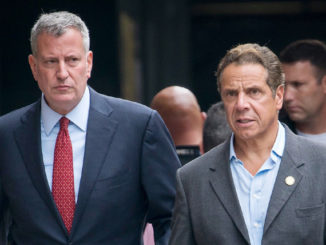
  • NY City Mayor pressures Governor  to expand vaccinations

    NY City Mayor pressures Governor to expand vaccinations

    • New York reported 31,164 total statewide deaths of New Yorkers who tested positive for COVID-19, as of Jan. 6.
    • There were 197 more fatalities in New York on Jan. 6.

    NEW YORK (TIP): The long list of disagreements between Gov. Andrew Cuomo and New York City Mayor Bill de Blasio through the course of the coronavirus pandemic continues to grow, as the mayor – like other local officials across the state – asks the governor to expand administration of the COVID-19 vaccine to more eligible groups. So far, Cuomo has resisted allowing additional groups beyond “category 1A” recipients – health care workers and nursing home staff and residents – to start receiving the vaccine, saying that there are still many more of those individuals who should receive the vaccine before moving on to other groups. “The prioritization of health care 1A is federal guidance, state guidance, and it’s virtually universal across the country,” Cuomo said yesterday.

    But New York City officials have said that thousands of vaccine doses risk going unused and wasted because of the limited number of people who can access them. On Friday, de Blasio continued to call for expanding vaccinations to groups including first responders and New Yorkers over 75 years old. “All around the state, people are asking for the freedom to vaccinate,” de Blasio said at a press conference today. “We have to assume at some point the state is going to hear us.”

    The New York Times reported today that small numbers of vaccine doses have been thrown out in New York City after going unused. “It’s stressful and frustrating to have (the) vaccine and to be unable to start giving it to our patients as quickly as we would like,” one doctor told the Times.

  • Expecting trouble, DC locks down a week before inauguration

    Expecting trouble, DC locks down a week before inauguration

    WASHINGTON (TIP): There were no cars or scooters and seemingly no tourists on Wednesday, January 13, just the occasional jogger and multiple construction crews at work.

    All through downtown Washington, the primary sound for several blocks was the beeping of forklifts unloading more fencing. There were no cars or scooters and seemingly no tourists on Wednesday, just the occasional jogger and multiple construction crews at work. The US Capitol that proved such a soft target last week was visible only through lines of tall, black fence.

    Two blocks from the White House, a group of uniformed National Guard troops emerged from a tour bus and headed into a hotel as a state of lockdown descended on Washington that will last through the January 20 inauguration. “Clearly we are in uncharted waters,” said Washington Mayor Muriel Bowser.

    Last weeks “violent insurrection” at the Capitol by supporters of outgoing President Donald Trump has “impacted the way we are approaching working with our federal partners in planning for the 59th inauguration,” Ms. Bowser said Wednesday. The FBI has warned that armed protests by violent Trump supporters were being planned in all 50 state capitals as well as in Washington for the days leading up to the inauguration of President-elect Joe Biden.

    Between the pandemic and the security threat, Ms. Bowser is flat-out asking people not to come to the District of Columbia for the inauguration. And at Ms. Bowsers request, a National Special Security Event declaration was moved up to January 13, a distinction which she said “puts in place an entirely different command and control structure” for security.

    The NSSE status is normal for a presidential inauguration and other major events like an international summit or the Super Bowl. But it’s rare to start the lockdown so far in advance of the event.

    Police vehicles sealed off a huge swath of downtown DC Wednesday, causing immediate traffic snarls. Starting Wednesday, Ms. Bowser said, “Anyone inside the inauguration perimeter might be stopped and questioned. Starting Friday, all parking garages in the downtown restricted zone will be sealed through the inauguration.”

    Ms. Bowser is also being pushed to deny lodging options to potentially violent protesters. The local Black Lives Matter affiliate and Shutdown DC issued a joint statement on Wednesday urging all downtown hotels to voluntarily close and pay their staffs. In addition to the threat of violence, the activist groups say Trump supporters are a threat to the health of hotel staff for their general refusal to wear facemasks amid the pandemic. Several downtown hotels, including one which had become a favorite hangout of the militant Proud Boy faction, chose to avoid trouble by closing last week.

    “Closing hotels completely for these six nights is the only way to guarantee the safety of hotel workers, neighbors, vulnerable and unhoused residents, incoming administration officials, members of Congress, and our democracy,” the statement said. “If hotels do not willingly close, we ask Mayor Bowser to extend todays emergency order and close all hotels in the city.” On Wednesday, Airbnb announced it was cancelling all reservations in the Washington metro area. Ms. Bowser said she had been in regular contact with Airbnb officials since last week, but did not specifically request this step.

    “We are aware of reports emerging yesterday afternoon regarding armed militias and known hate groups that are attempting to travel and disrupt the Inauguration,” a company statement said. “We are continuing our work to ensure hate group members are not part of the Airbnb community.” On the ground, much of the most visible security will come in the form of more than 15,000 National Guardsmen from multiple states, some of them armed.

    According to officials, the number of Guardsmen who will actually be carrying guns will be limited. Some Guard members nearer the Capitol will have long guns, and others will have their sidearms.

    It is likely that those closer to the crowds or on fence lines won’t be armed, but those up closer to the building may be. National Guard members operate under strict rules of engagement on the use of force. But generally speaking, troops can use lethal force to protect the lives of others and themselves.

    Officials also said that while 15,000 Guard members have been activated, more may be called. DC Police Chief Robert Contee estimated Wednesday that more than 20,000 National Guardsmen would be active in the District of Columbia on Inauguration Day.

    Officials are continuing to review requests from law enforcement, and some believe several thousand more could be brought in. Defense and military officials have been calling governors and adjutants general to ask if they might have people they could send, if requested.

    So far, officials said state leaders have said that protecting their own capitols will be their top priority, but they still have some guard members they will be able to send, if needed.

    (Source: PTI)

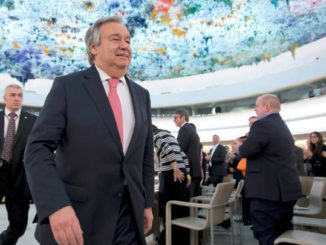
  • UN Secretary General Guterres’ path to reelection might be a quick one, experts say

    UN Secretary General Guterres’ path to reelection might be a quick one, experts say

    NEW YORK (TIP): After months of speculation, United Nations chief António Guterres officially announced his bid for reelection this week through his spokesperson’s office.

    The race might be a relatively straightforward and possibly short one; so far, no other candidates have stepped forward. And Guterres’ good standing with all five permanent members of the U.N. Security Council might discourage potential competitors, according to U.N. expert Richard Gowan. The Security Council holds the final vote to select the U.N. leader, and candidates require their government’s endorsement.

    “It is fundamentally different from the last race in 2016, and I think the working assumption around the U.N. is that Guterres will win a second term without too much struggle,” Gowan said. “He gets a lot of credit from diplomats here for navigating the [U.S. President Donald] Trump era pretty well, overall, and the general idea is that if he wants a second term, which he clearly does, then he should have a chance to stay on.”

    Guterres unofficially laid out a vision for a second term in July, when he called for a new social contract to better address “two seismic shifts” that will shape this century: the climate crisis and digital transformation. “Both could widen inequalities even further,” Guterres said in the speech. The COVID-19 pandemic, meanwhile, has presented a once-in-a-lifetime opportunity to “build back a more equal and sustainable world,” he said.

    From aviation to trade to industrial development, a number of top jobs at the United Nations are up for grabs this year. A second five-year term for Guterres would give him the chance to build on these efforts, which, in some cases, have suffered political blows. The U.S., one of the world’s largest greenhouse gas emitters, is likely to rejoin the Paris climate agreement under President-elect Joe Biden’s administration, among other expected reversals from Trump administration policies.

    “When I read that [2020 speech], I felt confident Guterres assumed that if Biden won, he would run again. In a sense, that speech was his stump speech, and he was already laying out what this campaign is all about and a level of ambition that is much greater than would have been feasible in the last four years,” Gowan said.

    The presidents of the General Assembly and Security Council are expected to soon release a letter that would formally initiate the selection process for the next secretary-general. Officially opening up the election process, as the General Assembly last did in 2015, to include more candidates will be an important step, even if they do not immediately appear, according to Enyseh Teimory, communications officer at the United Nations Association – UK. Setting a deadline for nominations, likely in the early spring, will also be part of this process.

    “I don’t know if there will be other candidates coming forward, and so far, Guterres hasn’t done much to rock the boat.”

    — Mandeep Tiwana, chief programs officer, CIVICUS

    “We have not had anything specific from anybody, but we hope that someone somewhere will step forward, kind of just in terms of having an open and transparent process,” Teimory said.

    “I think they [the president of the General Assembly and Guterres] have demonstrated in the language a commitment to opening up the process and to receiving potential multiple nominations,” Teimory continued.

    Russia or China proposing another candidate would potentially change the election forecast, but so far there is no clear indication of this, according to Mandeep Tiwana, chief programs officer at civil society coalition CIVICUS.

    “The incumbent usually has such an advantage. I don’t know if there will be other candidates coming forward, and so far, Guterres hasn’t done much to rock the boat,” Tiwana said.

    Civil society organizations such as UNA-UK and CIVICUS have voiced concerns about the election process remaining transparent. In 2016, Guterres initially ran against 12 other candidates, but the number of competitors was eventually whittled down to four finalists, including Helen Clark, then-head of the U.N. Development Programme and former prime minister of New Zealand.

    That election marked the first time that the race for secretary-general included public debates and speeches, instead of centering solely on closed-door political appeals and negotiations. The 1 for 7 Billion civil society campaign — a group of NGOs that convened for a transparent secretary-general election process — pushed for a woman to be selected as U.N. chief for the first time.

    While Guterres was selected for secretary-general in October 2016, predecessors were confirmed for a second term earlier in the year. For example, Ban Ki-moon was reselected for secretary-general in June 2011.

    “I think if it becomes clear that there isn’t an alternative candidate, then quite frankly the bulk of the Security Council members and the bulk of the General Assembly members would probably want it out of the way, and they might want it out of the way before the GA in September,” Gowan said.

    Going through the motions of a traditional campaign would still set an important precedent for future campaigns and would also lend credibility to Guterres’ reelection bid.

    “At the end of the day, the key for us is [that] the process is consolidated. It lends to legitimacy for whoever the SG is or continues to be. That legitimacy is fundamental at this time while they are leading and international organizations like the U.N. face such challenging times,” Teimory said.

  • BJP’s new power orderTweaked hierarchy gives it full control, reducing RSS’s interventions

    BJP’s new power orderTweaked hierarchy gives it full control, reducing RSS’s interventions

    By Radhika Ramaseshan

    The BJP took advantage of its commanding position to minimize the presence of the RSS pracharaks in Nadda’s team and overturned an arrangement ostensibly cast in stone.

    An organizational restructuring in the BJP is rarely newsworthy unless the change is effected at the top or a big-time functionary such as Ram Madhav is dropped from the central team of office-bearers and Vasundhara Raje is shafted to pave the way for a leadership makeover in Rajasthan. Recently, JP Nadda, the BJP president, quietly tweaked the organizational hierarchy to reinforce a significant political message: the BJP will exercise complete control over the party and its apparatuses and the patriarch RSS’s interventions could become minimal, if not nominal. The Sangh-BJP equation that was in a permanent flux has settled into a constant in the Modi regime. PM Modi rules over a BJP-majority government that is not rocked by the coalition partners or an Opposition. Until he confronted his first challenge in the farmers’ movement, his authority appeared incontestable. The RSS is hands-off towards the protests. Its farmers’ front, the Bharatiya Kisan Sangh (BKS) issued innocuous statements. The paterfamilias is in no mood to rock the boat.

    The BJP took advantage of its commanding position to minimize the presence of the RSS pracharaks in Nadda’s team and overturned an arrangement ostensibly cast in stone. BL Santhosh remains the general secretary (organization), and there is no dilution in the power he wields as the second-most important person in the party. In the past, a general secretary, however influential, had two or more deputies ‘assisting’ him. This line-up of the general secretary and the joint general secretaries (organization) under him was generally made up of obscure figures who avoided the media, although Sunder Singh Bhandari and KN Govindacharya were exceptions and liberally shared information and political insights. Santhosh and Ramlal, his predecessor, had a trio under them, comprising V Satish, Saudan Singh and Shiv Prakash all of who were ‘loaned’ to the BJP for long-term work.

    Last week, the loanees were relocated in the BJP with new designations, their mandate vastly diminished. It is unclear whether the joint general secretary’s post will remain. Essentially the recast means the Sangh will have only Santhosh to deal with. He will be the sole conduit between the RSS and the BJP, and for all intent and purpose both will depend largely on the feedback he gives and the inputs he shares. A quintessential pracharak from Karnataka, he earned the moniker, poornavadi karyakarta (full-time volunteer). Every pracharak is a full-time volunteer but the sobriquet denoted Santhosh’s ‘exceptional dedication’. During his stint in the Karnataka BJP, also as a general secretary, he allegedly played his share of intra-BJP politics and was rarely on the same page as CM Yediyurappa. But he is credited with ‘discovering’ and nurturing young ‘talent’ such as Lok Sabha MPs Tejaswi Surya and Prathap Simha and the Karnataka BJP president, Nalin Kumar Kateel. The choice of protégés reveals Santhosh’s unmistakable preference for those who are wedded to hard Hindutva.

    In that sense, Santhosh, as also the BJP brass, sorted out the existential dilemma that dogged Vajpayee when he was the PM. Vajpayee had the RSS snapping at his heels. If the VHP got aggressive and amped up the Ram temple demand with violent consequences, on occasions, it was the Swadeshi Jagran Manch (SJM) and the Bharatiya Mazdoor Sangh (BMS) that scuttled Vajpayee’s pet reforms. He was disinclined to give the Sangh fronts unbridled latitude, and suffered as a result.

    Modi has no such issues, regardless of the problems he lived with in Gujarat from the VHP and BKS. He is adept in managing their occasional tantrums. In December 2019, when the VHP threatened to besiege the government if it would not intervene decisively to seek a ‘resolution’ of the Ayodhya ‘dispute’ and got the RSS sarsanghachalak’s endorsement for the agenda, the Centre earned more than a breather when the apex court cleared the way. For Modi, it was an opportune moment to dispel the few misgivings the VHP cast over his ‘commitment’. He presided over an elaborate ground-laying ceremony in Ayodhya to mark the start of the construction.

    Of all RSS fronts, the VHP has the greatest potential to marshal agent provocateurs, whip up communal passions and immobilize an administration. If the outfit is given a free pass to flout the law, a government can breathe easy. This is what has happened in MP. The VHP galvanized its storm-troopers to strike terror in the minority-dominated pockets in the guise of collecting funds for the temple. CM Shivraj Singh Chouhan has embraced hard-core Hindutva, and giving the VHP leeway suits him politically. In UP, the temple’s epicenter, the VHP does little or nothing because CM Yogi Adityanath has everything laid out: a pliant state machinery, public opinion and the voluntary militia of his Hindu Vahini in case action was demanded.

    In contrast, an issue stares the BKS in the face, but it refused to react. In the Centre-farmer face-off, all that the Sangh’s peasant wing asked for was guaranteeing the MSP in the open market and a designated court to adjudicate disputes related to contract farming. At no point did it suggest that the farming laws should be relooked, let alone repealed. Like the BKS, the SJM opted for the straight and narrow.

    Had the RSS, the BKS and the SJM confronted the Centre on the peasantry, it would have been forced to respond and perhaps withdraw the laws. In 2015, it was an ultimatum the SJM served that nudged the government to freeze the proposed amendments in the Land Acquisition Act. The RSS astutely figured that keeping the peace with the Modi dispensation is mutually advantageous and disputes must be buried.

    (The author is a senior journalist)

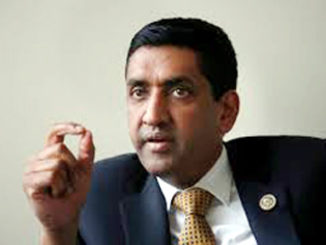
  • Indian American Lawmaker Ro Khanna Sees Two challenges before America after Capitol riot

    Indian American Lawmaker Ro Khanna Sees Two challenges before America after Capitol riot

    WASHINGTON (TIP): In the aftermath of the Capital riot by supporters of outgoing President Donald Trump, Indian American lawmaker Ro Khanna believes America faces two challenges on the economic and cultural fronts to rebuild faith in democracy.

    “It’s a big challenge for us,” the third-term progressive Democrat in the House told Business Insider in a telephonic interview on Jan 8, two days after the riot when asked about the state of American democracy.

    “I think there’s two challenges for the country,” Khanna said. “The challenge of economically-left behind places and people where you don’t have economic wealth generation, without basic healthcare, without basic housing.”

    “And then you have the deeper question, and that is the cultural challenge,” he said noting “how we’ve become a multi-racial multi-ethnic democracy” thanks to the immigration post-’65 from non-European countries.

    “I mean we’re the most diverse we’ve ever been in our nation’s history — it’s easy to conceive of a nation on philosophical principles if there is also a cultural similarity,” Khanna said.

    “To conceive of a nation on philosophical principles, of a commitment to our constitution, when you have such incredible racial diversity, such incredible religious diversity and the racial history we do, is a very, very difficult project,” he said.

    “And I think a large part of our challenges — how do we begin to improve the communication between Americans who come perhaps from very different perspectives,” Khanna said.

    “I guess the point is we need a bold economic vision, but we need to couple that with leadership that looks for finding commonalities of Americans with great differences,” he said.

    “And it’s a difficult project, but there’s never been a multiracial, multiethnic democracy in the history of the world. And so what we’re trying to do is very hard as well,” Khanna said.

    “In the Congress, we need to begin a dialogue with each other in ways that lowers the volume of the screaming on cable news and looks for ways to respect Americans and understand their anxieties, understand their perspectives, and find some common fabric for this country,” he said.

    Khanna also stressed the “need to rethink the role that social media has had in encouraging diversion realities and how we try to structure and design social media so that there are common sources of information.”

    “We have to look at education across the country in terms of giving people the ability to sort out facts from conspiracy theory,” Khanna said.

    “And then we have to look at the communities that have been left out and why and why some of the anger may be there and the anxiousness may be there with the changes the country is going through, and how to respect the dignity of these places that have been left behind,” he said.

    “And if we can do that, you’re not going to get to everyone, but maybe you’ll get to some, and that builds a coalition of people going forward,” Khanna said.

    Khanna, who has made a name for himself as a strident opponent of the US government’s interminable support for the “forever wars”, hoped the US would end the war in Yemen and pull out the remaining US troops in Afghanistan.

    The Indian American lawmaker said he was also “working with Sen. Bernie Sanders on a war powers resolution to make sure that Congress has to be consulted before we get into any other wars.”

    Asked about his expectations from the Biden administration on the national security and foreign policy front, Khanna said, “I’m hoping we end the war in Yemen.”

    Encouraged by preliminary conversations with people in Biden’s team, he believed the new administration is “going to make it a priority to stop our support for the Saudis and stop the bombing in Yemen. That has to be a priority.”

    Favoring a pull out of the remaining US troops in Afghanistan, Khanna said, “There needs to be a peace negotiation, and then we ought to leave.”

    “We should make it clear that if there’s ever emerging threats or terrorist threats to our homeland from [Afghanistan], we reserve the right to conduct and we reserve the right to go in again,” he said. “But there’s no point in having a permanent presence there.”

    Asked if after the Capitol insurrection, Republicans will still support Trump, Khanna said, “It’s the first time I’ve seen a break. Not just by lawmakers, but also by [Trump’s] Republican friends.”

    “I think the images of the Capitol being stormed, it really shifted people’s mindsets,” Khanna said. “There’s something about the sacredness of the Capitol, about a belief in stability for American democracy.”

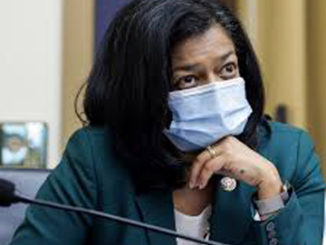
  • Indian American Congresswoman Pramila Jayapal Tests Positive for COVID-19 

    Indian American Congresswoman Pramila Jayapal Tests Positive for COVID-19 

    WASHINGTON  (TIP): Indian American Congresswoman Pramila Jayapal said on Tuesday, January 12 ,  that she has tested positive for coronavirus after being locked down in a secured room at the US Capitol where several Republican lawmakers recklessly refused to wear masks in the moments after the January 6 attack.

    “I just received a positive COVID-19 test result after being locked down in a secured room at the Capitol where several Republicans not only cruelly refused to wear a mask but recklessly mocked colleagues and staff who offered them one,” 55-year-old Ms Jayapal tweeted.

    In a statement, Ms Jayapal said she began quarantining immediately after the attack on the Capitol, fearing and foreseeing exactly what would occur given the number of maskless lawmakers sitting in the same room with her.

    The duration in the room was multiple hours, she said.

    “Too many Republicans have refused to take this pandemic and virus seriously, and in doing so, they endanger everyone around them,” she said.

    “Only hours after President (Donald) Trump incited a deadly assault on our Capitol, our country, and our democracy, many Republicans still refused to take the bare minimum COVID-19 precaution and simply wear a damn mask in a crowded room during a pandemic – creating a superspreader event on top of a domestic terrorist attack,” she added.

    “While I am isolating per the Capitol Physician’s instructions, I will continue to work to the best of my ability because the deep urgency of our many crises is paramount,” she said.

    Dr. Brian Monahan, the Attending Physician of the US Congress, advised representatives and Congressional staff on Sunday that those in the secured room could have, “been exposed to another occupant with coronavirus infection.”

    “I am also calling for serious fines to be immediately levied on every single Member who refuses to wear a mask in the Capitol,” Ms Jayapal said. “Additionally, any Member who refuses to wear a mask should be immediately removed from the floor by the Sergeant at Arms. This is not a joke. Our lives and our livelihoods are at risk, and anyone who refuses to wear a mask should be fully held accountable for endangering our lives because of their selfish idiocy.”

    In December, Ms Jayapal was elected as the chair of the Congressional Progressive Caucus (CPC), making her one of the most powerful US lawmakers in the 117th Congress.

    On Monday, January 11,  Rep. Bonnie Watson Coleman of New Jersey said that she had tested positive for COVID-19.

    “Following the events of Wednesday, including sheltering with several colleagues who refused to wear masks, I decided to take a Covid test. I have tested positive,” Mr Coleman tweeted on Monday.

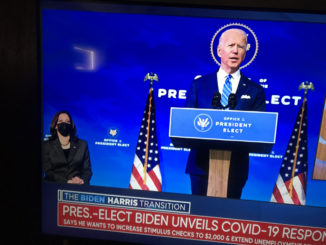
  • President-Elect Joe Biden unveils  ambitious 1.9 trillion ‘American Rescue Plan’

    President-Elect Joe Biden unveils ambitious 1.9 trillion ‘American Rescue Plan’

    • $1 trillion to assist families needing direct financial support: $1400.00 more to each American
    • $440 billion to emergency funds for small businesses and communities
    • $400 billion for COVID-19 response and increasing vaccine capabilities
    • Outlines plan to revive manufacturing and a minimum wage of $15

    I.S. Saluja

    WILMINGTON, DEL (TIP): Emphasizing on the  strength of unity of Americans,  President-elect Joe Biden in his speech, January 14 here  said,  “Unity is not some pie-in-the-sky dream. It’s a practical step to get any of the things we have to get done as a country, get done together,” Biden said .

    “I’m convinced we are ready to get this done,” he said. “The very health of our nation is at stake.”

    The package is titled the “American Rescue Plan.” Biden described it as a package of emergency measures to meet the nation’s immediate economic and health-care needs, to be followed in February by a broader relief plan he will unveil in his first appearance before a joint meeting of Congress.

    January 14 proposal comes at a critical time for the nation. More than 4,200 people in the United States died of the coronavirus on Tuesday, a new daily-record high. The economic recovery appears to be backsliding, with jobless claims spiking to a new high since August, as nearly 1 million people filed for unemployment last week, says a  Washington Post report.

    It also comes six days before Biden’s inauguration, and a day after the House of Representatives impeached President Trump, highlighting the president-elect’s challenge of trying to get his top agenda item passed as the Senate is likely to be enmeshed in an impeachment trial. Biden has expressed the hope that the Senate can simultaneously move forward on his agenda while weighing impeachment, although it’s unclear how well that might work in practice. Biden alluded only in passing to the political challenges his proposal will confront, remarking of his proposal to raise the minimum wage: “People tell me that’s going to be hard to do,” but noting that it just happened in Florida.

    The plan contains a raft of provisions that build on the approximately $4 trillion Congress has already devoted to addressing the pandemic, which included a $900 billion measure Trump signed last month. Biden has repeatedly described that last bill as unfinished business, saying Thursday, “We will finish the job.”

    Biden’s proposal is divided into three major areas: $400 billion for provisions to fight the coronavirus with more vaccines and testing, while reopening schools; more than $1 trillion in direct relief to families, including through stimulus payments and increased unemployment insurance benefits; and $440 billion for aid to communities and businesses, including $350 billion in emergency funding to state, local and tribal governments.

    The proposal will aim to make good on Biden’s plan for a universal vaccination program, devoting $20 billion to that goal, as well as $50 billion for a “massive expansion” of testing and $130 billion to help schools reopen safely. Among the many goals laid out in the proposal, Biden hopes to deliver 100 million vaccine shots in 100 days, and reopen a majority of K-12 public schools in that time frame.

    Incoming Senate majority leader Charles E. Schumer (D-N.Y.) had urged Biden to consider a higher price tag than what he was initially eyeing for the proposal, according to a person familiar with the conversation who spoke on the condition of anonymity to recount the private conversation freely. Still, the size and scope of the package exceeded the expectations of a number of outside advocates, while answering demands from economists for a major new investment to get the economy on a sounder footing. “I know what I just described will not come cheaply,” Biden said Thursday night. “But failure to do so will cost us dearly.”

    The legislation includes a number of priorities sought by top congressional Democrats, including some of the more liberal members, from increasing the federal minimum wage to $15 an hour to adding billions in funding for childcare. Biden called for increasing federal unemployment benefits from $300 per week to $400 per week for millions of jobless Americans. The benefits would be extended through September, preventing millions of people from losing their jobless aid in March, as would occur under current law. Biden’s plan states that he will also seek to link the level of unemployment benefits to general economic factors, so that benefits increase automatically when the unemployment rate spikes.

    As expected, Biden’s proposal would also increase from $600 to $2,000 per person the stimulus payments approved by Congress last month. Trump enthusiastically endorsed the $2,000 stimulus payments, as did congressional Democratic leaders, but many Republicans opposed the idea. Biden’s plan would also expand eligibility for the stimulus payments to families where one parent is an immigrant, as well as to adult children claimed as dependents on their parents’ tax returns. Both categories were excluded in the last relief packages due to GOP opposition. About 13.5 million adult dependents were excluded from the checks as a result, including millions of disabled people.

    A major expansion of tax credits is also included in Biden’s proposal, for children and lower-income workers. Biden’s plan would expand a tax credit for children to $3,600 a year per child under 6, as well as $3,000 a year for children under 17. It would also extend eligibility for the credit to millions of very poor families. It would dramatically boost the Earned Income Tax Credit, a benefit for workers, from $530 to $1,500.

    Biden’s plan also contains new initiatives aimed at buoying the ailing U.S. economy, such as a combined 14 weeks of paid sick and family medical leave for millions of workers. It would provide grants to more than 1 million small businesses, and approve about $35 billion toward making low-interest loans available, particularly for clean-energy investments. Biden’s plan would put tens of billions of dollars into other needs facing the country, from food and water assistance, food stamps, and funding for U.S. territories such as Puerto Rico.

    CBSN Screenshot

    The size of the package and its embrace of multiple liberal priorities that are anathema to Republicans — including a large sum for state and local governments — raises questions about how much bipartisan support Biden will be able to get for the proposal. He is already facing pressure from liberals on Capitol Hill who want to use Democrats’ newfound control of Congress to push through aggressive and costly legislation.

    Sen. Bernie Sanders (I-Vt.), who will chair the Budget Committee, has said he is working to put together a massive stimulus bill that could pass under special budget rules with a simple majority vote in the Senate, instead of the 60-vote margin normally required.

    Biden, however, wants to try for a bipartisan majority on his first bill — although his team appears to have conducted little outreach to congressional Republicans on the plan. Democratic aides say that if Republicans do not appear willing to cooperate, they can shift gears quickly and move to “budget reconciliation,” the procedure that would allow them to pass legislation without GOP votes. That’s how Republicans passed their big tax-cut bill after Trump took office, and how President Barack Obama passed the Affordable Care Act.

    The Senate will be divided 50-to-50 between Republicans and Democrats in the new Congress, giving Democrats control because Vice President-elect Kamala D. Harris will have the tie-breaking vote. Democrats’ 222-to-211 majority in the House is the narrowest for either party in years.

    With those margins, even holding enough Democrats together to pass legislation along party lines could prove a challenge. The most conservative Senate Democrat, Sen. Joe Manchin III (W.Va.), has already expressed skepticism about the need for a new round of stimulus checks, while Rep. Alexandria Ocasio-Cortez (D-N.Y.) said Thursday that Biden isn’t going far enough by proposing $1,400 checks, even though Biden’s approach means most people will end up with $2,000 given the earlier batch of $600 checks. “$2,000 means $2,000. $2,000 does not mean $1,400,″ Ocasio-Cortez said.

    “I know what I just described will not come cheaply,” Biden said Thursday night. “But failure to do so will cost us dearly.” (CBSN Screenshot)

    Foreshadowing the legislative fight to come, Biden’s plan quickly attracted criticism from advocates on the right and the left. Stephen Moore, an outside economic adviser to Trump, slammed it as “fiscally irresponsible.” Mark Wolfe, head of the National Energy Assistance Directors’ Association, said he was disappointed the proposal didn’t include more money for rental assistance or low-income energy assistance.

    The $130 billion in K-12 funding in the proposal is aimed at paying expenses associated with mitigating the spread of virus inside schools, such as improving ventilation systems. Although Biden has said he wants to open a majority of schools, there is no federal tally of how many are open to date, and some research suggests a majority of them may be offering in-person options already.

    (With inputs from Washington Post and agencies)

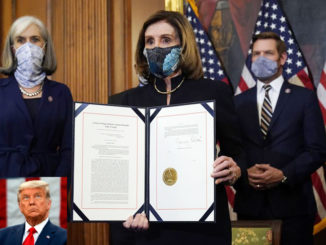
  • President Donald Trump is Impeached

    President Donald Trump is Impeached

    Becomes the first U.S. President in US history to be impeached twice

    WASHINGTON (TIP): President Donald Trump was impeached by the U.S. House for a historic second time on January 13, charged with “incitement of insurrection” over the deadly mob siege of the Capitol in a swift and stunning collapse of his final days in office.

    With the Capitol secured by armed National Guard troops inside and out, the House voted 232-197 to impeach Mr. Trump. The proceedings moved at lightning speed, with lawmakers voting just one week after violent pro-Mr. Trump loyalists stormed the U.S. Capitol, urged on by the President’s calls for them to “fight like hell” against the election results. Ten Republicans deserted  Mr. Trump, joining Democrats who said he needed to be held accountable and warned ominously of a “clear and present danger” if Congress should leave him unchecked before Democrat Joe Biden’s inauguration Jan. 20.

    The Capitol insurrection stunned and angered lawmakers, who were sent scrambling for safety as the mob descended, and it revealed the fragility of the nation’s history of peaceful transfers of power. The riot also forced a reckoning among some Republicans, who have stood by Mr. Trump throughout his presidency and largely allowed him to spread false attacks against the integrity of the 2020 election.

    Chaos and mayhem at the Capitol on January 6.

    House Speaker Nancy Pelosi invoked Abraham Lincoln and the Bible, imploring lawmakers to uphold their oath to defend the Constitution from all enemies, foreign “and domestic”.

    She said of Mr. Trump: “He must go, he is a clear and present danger to the nation that we all love.”

    Holed up at the White House, watching the proceedings on TV, Mr. Trump took no responsibility for the bloody riot seen around the world, but issued a statement urging “NO violence, NO lawbreaking and NO vandalism of any kind” to disrupt Mr. Biden’s ascension to the White House.

    In the face of the accusations against him and with the FBI warning of more violence, Mr. Trump said, “That is not what I stand for, and it is not what America stands for. I call on ALL Americans to help ease tensions and calm tempers.” Mr. Trump was first impeached by the House in 2019 over his dealings with Ukraine, but the Senate voted in 2020 to acquit him. He is the first President to be impeached twice. None have been convicted by the Senate, but Republicans said on Wednesday that could change in the rapidly shifting political environment as officeholders, donors, big business and others peel away from the defeated President.

    The soonest Republican Senate leader Mitch McConnell would start an impeachment trial is next Tuesday, the day before Mr. Trump is already set to leave the White House, Mr. McConnell’s office said. The legislation is also intended to prevent Mr. Trump from ever running again.

    Mr. McConnell believes Mr. Trump committed impeachable offences and considers the Democrats’ impeachment drive an opportunity to reduce the divisive, chaotic President’s hold on the GOP, a Republican strategist told The Associated Press on Wednesday.

    Mr. McConnell told major donors over the weekend that he was through with Mr. Trump, said the strategist, who demanded anonymity to describe Mr. McConnell’s conversations.

    In a note to colleagues on Wednesday, Mr. McConnell said he had “not made a final decision on how I will vote.”

    Unlike his first time, Mr. Trump faces this impeachment as a weakened leader, having lost his own re-election as well as the Senate Republican majority.

    Even Trump ally Kevin McCarthy, the House Republican leader, shifted his position and said Wednesday the President bears responsibility for the horrifying day at the Capitol.

    In making a case for the “high crimes and misdemeanors” demanded in the Constitution, the four-page impeachment resolution approved on Wednesday relies on Mr. Trump’s own incendiary rhetoric and the falsehoods he spread about Mr. Biden’s election victory, including at a rally near the White House on the day of the Jan. 6 attack on the Capitol.

    A Capitol Police officer died from injuries suffered in the riot, and police shot and killed a woman during the siege. Three other people died in what authorities said were medical emergencies. The riot delayed the tally of Electoral College votes that was the last step in finalizing Mr. Biden’s victory.

    Ten Republican lawmakers, including third-ranking House GOP leader Liz Cheney of Wyoming, voted to impeach Mr. Trump, cleaving the Republican leadership, and the party itself.

    Ms. Cheney, whose father is the former Republican Vice-President, said of Mr. Trump’s actions summoning the mob that “there has never been a greater betrayal by a President” of his office.

    Mr. Trump was said to be livid with perceived disloyalty from Mr. McConnell and Ms. Cheney.

    With the team around Mr. Trump hollowed out and his Twitter account silenced by the social media company, the President was deeply frustrated that he could not hit back, according to White House officials and Republicans close to the West Wing who weren’t authorized to speak publicly about private conversations.

    From the White House, Mr. Trump leaned on Sen. Lindsey Graham of South Carolina to push Republican senators to resist, while chief of staff Mark Meadows called some of his former colleagues on Capitol Hill.

    The President’s sturdy popularity with the GOP lawmakers’ constituents still had some sway, and most House Republicans voted not to impeach.

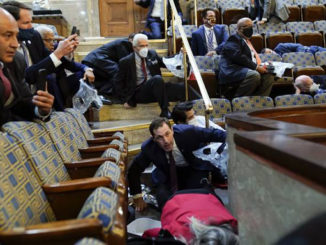
    Security was exceptionally tight at the Capitol, with tall fences around the complex. Metal-detector screenings were required for lawmakers entering the House chamber, where a week earlier lawmakers huddled inside as police, guns drawn, barricade the door from rioters.

    “We are debating this historic measure at a crime scene,” said Rep. Jim McGovern, D-Mass.

    During the debate, some Republicans repeated the falsehoods spread by Mr. Trump about the election and argued that the President has been treated unfairly by Democrats from the day he took office.

    Other Republicans argued the impeachment was a rushed sham and complained about a double standard applied to his supporters but not to the liberal left. Some simply appealed for the nation to move on.

    Rep. Tom McClintock of California said, “Every movement has a lunatic fringe.”

    Yet Democratic Rep. Jason Crow, D-Colo. and others recounted the harrowing day as rioters pounded on the chamber door trying to break in. Some called it a “coup” attempt.

    Rep. Maxine Waters, D-Calif., contended that Mr. Trump was “capable of starting a civil war”.

    Conviction and removal of Mr. Trump would require a two-thirds vote in the Senate, which will be evenly divided. Republican Sen. Pat Toomey of Pennsylvania joined Sen. Lisa Murkowski of Alaska over the weekend in calling for Mr. Trump to “go away as soon as possible”.

    Fending off concerns that an impeachment trial would bog down his first days in office, Mr. Biden is messaging Senators to divide their time between taking up his priorities of confirming his nominees and approving COVID-19 relief while also conducting the trial.

    The impeachment bill draws from Mr. Trump’s own false statements about his election defeat to Mr. Biden. Judges across the country, including some nominated by Mr. Trump, have repeatedly dismissed cases challenging the election results, and former Attorney General William Barr, a Trump ally, has said there was no sign of widespread fraud.

    The House had first tried to persuade Vice-President Mike Pence and the Cabinet to invoke their authority under the 25th Amendment to remove Mr. Trump from office. Pence declined to do so, but the House passed the resolution anyway.

    The impeachment bill also details Mr. Trump’s pressure on state officials in Georgia to “find” him more votes.

    While some have questioned impeaching the President so close to the end of his term, there is precedent. In 1876, during the Ulysses Grant administration, War Secretary William Belknap was impeached by the House the day he resigned, and the Senate convened a trial months later. He was acquitted.

    (Based on AP story)

  • South Korea to dispatch diplomat for Tehran talks after Iran seizes tanker

    Seoul (TIP): South Korea is dispatching a delegation to Iran as early as on Tuesday to seek the release of a tanker seized in the Gulf waters by Iranian forces, with a senior diplomat set to go ahead with a planned visit Tehran on Sunday amid tensions over $7 billion in Iranian funds frozen in Korean banks due to US sanctions. A screenshot taken on January 4, 2021, from Refinitiv Eikon shows the location of a South Korean-flagged tanker seized by Iran’s Revolutionary Guards Corps in Gulf. REFINITIV EIKON via REUTERS
    The news of the visits came as Seoul’s Foreign Ministry called in the Iranian ambassador to South Korea for a meeting and urged the early release of the South Korean-flagged tanker and its crew of 20.
    It was carrying a cargo of more than 7,000 tonnes of ethanol when it was seized on Monday over what Iranian media said were pollution violations.
    The incident comes as Iran shows increasing signs of willingness to assert its claims in the region as US President-elect Joe Biden prepares to take office later this month, succeeding Donald Trump. Reuters

  • Reading Hannah Arendt in Joe Biden’s America

    Reading Hannah Arendt in Joe Biden’s America

    By Shelley Walia.

    Afflicted with an escalating novel coronavirus pandemic, an ailing economy, racial discrimination, and a climate crisis rebuffed by millions, Mr. Biden’s America has four long years to undo the tragic consequences of intolerance and division left behind by the incumbent. No wonder Mr. Biden has taken keen interest in pressing humanitarian issues such as Sudan’s political crisis or the dark contemporary history of Syria. He has already introduced a national security team designed to repudiate Mr. Trump’s nationalistic isolationism in order to usher in humility and confidence among America’s allies.

    For the first time in the history of the United States, a President has incited insurrection by his neo-Nazi brigade of right-wing supporters, opposing the peaceful transfer of power. It is tantamount to encouraging hostility when the world stood horrified as a witness to the rioters storming the U.S. Capitol. The violence against democracy, a blotch on the American constitutional democracy, interestingly, changed the minds of senators like Kelly Loeffler (Republican) who had previously said that they would object to the Electoral College results.

    Healing a polarized nation
    The unhinged and angry authoritarian at last stands crushed and humiliated after trying his best to undercut one of the oldest democratic systems in existence. With Joe Biden walking into the White House on January 20, there can be no overplaying the enormity of the tasks ahead of him, what with the deeply polarized nation divided into two belligerent camps. Afflicted with an escalating novel coronavirus pandemic, an ailing economy, racial discrimination, and a climate crisis rebuffed by millions, Mr. Biden’s America has four long years to undo the tragic consequences of intolerance and division left behind by the incumbent.

    Tragedy, for Joe Biden, is the very condition of life. Having lost his wife and daughter in an accident and a son to cancer, Joe Biden has always had the deep-seated desire to urge politics towards humanism in the wake of the overwhelming systemic racism that has underpinned American culture recently. The bitter assault on democracy is better understood in the recent revelation of his letter written in 1975 to the famous German-American philosopher, Hannah Arendt, requesting her to send him a copy of her paper read at the Boston Bicentennial Forum. It reflects his desire to find “deeper causes” underlying the economic and social collapse as well as the scourge of racism.

    A contrast to Trump’s politics
    Arendt sent out a warning in her paper entitled “Coming Home to Roost” which the present generation must heed: “All speculation about deeper causes returns from the shock of reality… the stark, naked brutality of facts, of things as they are.” Her focus is largely on her deep-seated interest in political humanism and a free space in the world inhabited by people who are inspired by public principles and an ethics that stands in stark contradiction to the inherent ethno-nationalist populism and alternate-reality politics of Donald Trump. Boastful and deluded like Mussolini, and with an overriding penchant for self-glorification, he is overwhelmingly obsessed with not letting go of his power. More frighteningly, his conception of reality is different and facts have no significance for him.

    Arendt returns repeatedly to this theme of the difference in things as they are and things as they can be made to seem — the difference, for example, in “our … outright humiliating defeat” in Vietnam and what Americans had been led to believe would be “peace with honor”. The image projected by Mr. Trump of an America for the whites, where there is no place for immigrant “termites”, coheres with the public sentiment of the white non-college going population that relates fondly with the language of a President that is no better than a junior school third rater. The invasion of Mr. Trump into the political life of America has been more of a politics of lies projected through the dominance of an image to convince the people that only he could save America. And now when the shaky putsch has failed and the Trump loyalists have departed for home, he has begun to exactly do what the American government is an old hand at: “finding ways and means of how to avoid admitting defeat” and keeping the image of a President as the ‘mightiest power on earth’ and the only one who can keep it intact. A bully is no different. In asking for the paper, Mr. Biden, to use Arendt’s words with which she described President Ford’s attitude after the defeat in Vietnam, has taken on the responsibility “to heal the wounds of a divided nation,” urging the people to begin a new chapter. As a young man in his thirties, he had already become aware of America’s “image-making as global policy”, a fundamentally American version of “big lie” techniques devised in Nazi Germany and the Soviet Union. There, Arendt argues, “lying was guided by ideology and backed by terror”; here, it has been directed at creating images and bolstered by “hidden persuasion” through the manipulation of public opinion.

    A parallel, then and now
    Interestingly, Mr. Biden, in keeping with the intellectual leanings of the 1960s and the 1970s, had begun to think at a young age of Arendt as a contemporary philosopher speaking on the idea of “image and lies”, on disinformation, on violence, on public and private freedom, and on political action. It was the war on terror, on Afghanistan and Iraq that echo Arendt’s report on the Holocaust organizer, Adolf Eichmann and his trial which derives its significance from the complex notions of justice and responsibility, ethics and duty. The war, for instance in Iraq or a few decades earlier in Vietnam was not in support of defending democracy and human rights but to exhibit the power and might of the American hegemon. The fabrication of the hypothesis of “weapons of mass destruction” was exposed when no such lethal nuclear arsenal was discovered. The sham left both the United States and Britain red in the face.

    Setting policy right
    Mr. Biden had early on in life learnt from political philosophy that the rise of a more workable political and public humanism depends singularly on Arendt’s “free spectators of action” who determine the meaning of action and its public relevance that saves humans from the abyss of a miserable existence.

    No wonder Mr. Biden has taken keen interest in pressing humanitarian issues such as Sudan’s political crisis or the dark contemporary history of Syria. He has already introduced a national security team designed to repudiate Mr. Trump’s nationalistic isolationism in order to usher in humility and confidence among America’s allies.

    His choice to execute the nation’s immigration policy is a Cuban-American (Alejandro Mayorkas). Avril Haines will be the first woman to serve as director of national intelligence. And possibly Lloyd Austin would be the first African-American in America’s history to head the Department of Defense. As Mr. Biden’s choice for Interior Secretary, Deb Haaland will be the first Native American Cabinet Secretary to ensure that the nation would make right the wrongs in the long history of bloodshed and extermination of the natives. This counters not only Mr. Trump’s misogynism but also his agenda of withdrawing shamelessly from America’s role in the world as a defender of democracy and human rights. Arendt’s castigation of Zionism and the fascism of the American supported Israeli leadership brings us to the question of how authoritarian regimes fail to notice the lack of any sense of ethics or humanitarian necessity. It is true that “biological racism” that is visible in the history of apartheid, or in Germany under Nazism, or the resurgence of racist politics under Mr. Trump subsists on the major ideology of enforcing complete submission of the individual self to the state, the evil of incorrigible megalomaniacs striking out at the very dignity of being human.

    Schooled in Arendt’s writings on totalitarianism and the nature of the human condition in times of crises, Mr. Biden is the right choice for President who hopefully, has the vision for an exceptionally progressive change. It is expected that he will constantly be on his toes with the same readiness as Barack Obama, and alive to what George Santayana warned, “Those who cannot remember the past are condemned to repeat it.”

    Writings that inspire
    America must know that politics of terrorism will not work any more at home or abroad. And it is hoped that many around the world would go to Arendt if only to learn a lesson or two about the vulnerability of our democracy that allows people like Mr. Trump to even stand for election when he is guilty of allowing thousands to die of the pandemic. Her writings have always been a powerful foundation of inspiration to the people’s movements fighting against totalitarian lying and the infringement of basic human rights. Her persistent warnings of failure of the American republican tradition for self-government asks for an ideological position underpinned by a more cognitive existence that is mindful of the facts ‘coming home to roost’. For Arendt, if you remain an onlooker and express no reaction appropriate to the circumstances, your inertia will amount to deliberately perpetrating violence and accepting lies to prevail.

    (The author is Professor Emeritus, Department of English, Panjab University, Chandigarh)

  • Blot on US democracy

    President Trump deserves to be prosecuted

    An attempted coup, a failed insurrection or mob madness, however it gets labelled for posterity, the attack on the United States Capitol will remain a blot on American democracy, for it was instigated by President Donald Trump through his speeches and tweets full of lies, disinformation and fake news. He is solely responsible for the death of four and injury to scores of rioters, whom he unleashed in an attempt to derail the joint session of the Congress certifying Joe Biden’s presidential victory. An institution’s strength lies in its permanence and equally in the impermanence of individuals who hold power for fixed tenures. The office of the US President will overcome this temporary loss of glory on January 20 when Trump makes way for Biden, for which upholders of institutional integrity should be applauded.

    First among those to restore order was US Vice President Mike Pence, who called in the National Guard and returned to the dais of the Senate to reconvene the Congressional proceedings and count the votes. He told Trump’s thugs, ‘You didn’t win.’ Equally strong was the condemnation by the Republican Senator and Chairman of Senate Committee on Judiciary, Lindsey Graham, who said, ‘Count me out. Enough is enough.’ Many Republican Congressmen have not just proclaimed Biden the legitimate President of the US, but have also denounced Trump by voting against his objections to the election process.

    This attack against the American bicameral legislature was fuelled by fake news and conspiracy theories spread over social media; thus, it is a fearsome trailer of new media’s potential to distort public opinion through white lies. Even the presidential election result of 2000 was challenged and was settled only after a US Supreme Court verdict, though it triggered works like The Best Democracy Money Can Buy by Greg Palast. While a book illuminates, a tweet incites, as discovered by Twitter and Facebook, which belatedly suspended Trump’s account for 12 hours. The National Association of Manufacturers, a pro-Trump lobbying firm, and many others have termed the mob attack seditious and asked Pence to invoke the 25th amendment to sack Trump. He deserves to be prosecuted.
    (The Tribune, Chandigarh)

  • Pro-Trump mob storms and lays a siege of  Capitol Hill, 5 die

    Pro-Trump mob storms and lays a siege of Capitol Hill, 5 die

    • Joint session certifies Biden win; Hold Trump accountable, demands media ; World leaders horrified

    WASHINGTON (TIP): In an unprecedented assault on democracy in the US, thousands of President Donald Trump’s supporters, on January 6, stormed the Capitol complex and clashed with the police, resulting in five deaths and interrupting a constitutional process by the Congress to affirm the victory of President-elect Joe Biden and Vice-President-elect Kamala Harris.
    Trump-fueled insurrection
    Alleging poll fraud, Trump, in a December 20 tweet, had called his supporters for a “wild” rally on the day President-elect Biden’s victory was to be certified.
    At January 6 rally, he exhorted his supporters to “never give up” and march towards the Capitol.
    Armed protesters stormed the building, forcing Biden’s certification process to halt.
    Vice-President Mike Pence and Congress members were evacuated and the building was sealed.
    The mayhem left 5 persons, including a woman and a police officer dead.
    President Trump’s top White House adviser on Russia Ryan Tully quit over the storming of Capitol Hill. So have three others.
    Trump’s Secretary of Transportation, and Secretary of Education too have quit. So have quite a few others. There seems to be a race among White House and Trump officials to jump the sinking ship.
    15-day Public emergency
    Washington DC Mayor Muriel Bowser announced the extension of public emergency in the American capital for 15 days.
    The world was shocked to learn about the assault on the temple of democracy . Trump’s role appalled many leaders.
    World leaders, including Prime Minister Narendra Modi, have expressed shock and concern over the rioting and violence in Washington DC
    China likens the mob assault to that of Hong Kong protesters’ attack on the legislative building in 2019.
    It is important that political leaders impress on their followers the need to refrain from violence and respect democratic processes. UN Chief.
    Distressed. The democratic process cannot be allowed to be subverted through unlawful protests. Narendra Modi, Prime Minister
    The Electoral College votes of Biden and Harris were finally approved Thursday, January 7 morning after the Senate and the House of Representatives rejected all objections raised by the Republicans to the votes in Pennsylvania and Arizona.In the presidential election held on November 3, Biden and Harris received 306 electoral votes, while President Trump and Vice-President Mike Pence got 232.
    The 78-year-old Democratic leader and his 56-year-old Indian-origin deputy will be inaugurated on January 20, it was announced after the constitutional process was finally completed at a joint session of the Congress.
    In the violence on Wednesday, five persons were killed, including one woman who was shot by a police officer and a police officer named Brian Sicknick, 42, who was reportedly struck in head, amid protests and rioting, the police said.
    Trump later acknowledged his election loss. He said although he disagreed with the outcome, “there will be an orderly transition on January 20”. The Congress joint session, which is normally a ceremonial step, was halted for several hours when Trump supporters breached the Capitol. Proceedings resumed and continued through the night after the building was got cleared.
    President-elect Joe Biden said, “The scenes of chaos at the Capitol do not reflect a true America. What we’re seeing are a small number of extremists dedicated to lawlessness. This is not dissent. It’s disorder. It’s chaos. It borders on sedition. And it must end now.” House of Representatives Speaker Nancy Pelosi said, “Today, a shameful assault was made on our democracy.” All four living former US Presidents — Barack Obama, George W Bush, Bill Clinton and Jimmy Carter—also condemned the incident.
    Several US media outlets asserted that Donald Trump, whose “seditious rhetoric” incited a violent attack on the Capitol, is a “menace” and unfit to remain in the office and must be removed.
    Twitter and Facebook suspended Trump’s accounts after he continued to push conspiracy theories about the election. Twitter suspended Trump’s account for 12 hours and also blocked three of his tweets, including a video of his address to his supporters. Facebook and Instagram announced to block the accounts of the President for the rest of his term (till January 20). The FBI has sought the people’s help in identifying the rioters who stormed the US Capitol, as the Justice Department said on Thursday a policy adopted in the summer to consider sedition charges for anti-racism protesters would also apply in this case.
    ( Agencies)

  • Twitter bans Donald Trump’s account, citing risk of violent incitement

    Twitter bans Donald Trump’s account, citing risk of violent incitement

    Facebook, Snapchat also suspend Trump’s account

    WASHINGTON (TIP): Twitter banned President Donald Trump's account citing
    “the risk of further incitement of violence.”

    The social platform has been under growing pressure to take further action against
    Mr. Trump following the deadly insurrection at the U.S. Capitol. Twitter initially
    suspended Mr. Trump's account for 12 hours after he posted a video that repeated
    false claims about election fraud and praised the rioters who stormed the Capitol.

    Twitter's move deprives Mr. Trump of a potent tool he has used to communicate
    directly with the American people for more than a decade. He has used Twitter to
    announce policy changes, challenge opponents, insult enemies, praise his allies
    (and himself), and to spread misinformation.

    Twitter has long given Mr. Trump and other world leaders broad exemptions from
    its rules against personal attacks, hate speech and other behaviors. But in a lengthy
    explanation posted on its blog Friday, the company said recent Mr. Trump tweets

    amounted to glorification of violence when read in the context of the Capitol riot
    and plans circulating online for future armed protests around the inauguration of
    President-elect Joe Biden.

    Also read: U.S. Capitol breach | Democrats tell 'unhinged' Trump to step down or
    be impeached

    In those tweets, Mr. Trump stated that he will not be attending the inauguration
    and referred to his supporters as “American Patriots,” saying they will have “a
    GIANT VOICE long into the future.” Twitter said these statements “are likely to
    inspire others to replicate the violent acts that took place on January 6, 2021, and
    that there are multiple indicators that they are being received and understood as
    encouragement to do so."

    Here is the full statement from Twitter:
    Permanent suspension of @realDonaldTrump

    After close review of recent Tweets from the @realDonaldTrump account and the
    context around them — specifically how they are being received and interpreted on
    and off Twitter — we have permanently suspended the account due to the risk of
    further incitement of violence.

    In the context of horrific events this week, we made it clear on Wednesday that
    additional violations of the Twitter Rules would potentially result in this very
    course of action. Our public interest framework exists to enable the public to hear
    from elected officials and world leaders directly. It is built on a principle that the
    people have a right to hold power to account in the open.

    However, we made it clear going back years that these accounts are not above our
    rules entirely and cannot use Twitter to incite violence, among other things. We
    will continue to be transparent around our policies and their enforcement.

    The below is a comprehensive analysis of our policy enforcement approach in this
    case.

    Overview

    On January 8, 2021, President Donald J. Trump tweeted:

    “The 75,000,000 great American Patriots who voted for me, AMERICA FIRST,
    and MAKE AMERICA GREAT AGAIN, will have a GIANT VOICE long into the
    future. They will not be disrespected or treated unfairly in any way, shape or
    form!!!”

    Shortly thereafter, the President tweeted:

    “To all of those who have asked, I will not be going to the Inauguration on January
    20th.”

    Due to the ongoing tensions in the United States, and an uptick in the global
    conversation in regard to the people who violently stormed the Capitol on January
    6, 2021, these two Tweets must be read in the context of broader events in the
    country and the ways in which the President’s statements can be mobilized by
    different audiences, including to incite violence, as well as in the context of the
    pattern of behavior from this account in recent weeks. After assessing the language
    in these Tweets against our Glorification of Violence policy, we have determined
    that these Tweets are in violation of the Glorification of Violence Policy and the
    user @realDonaldTrump should be immediately permanently suspended from the
    service.

    Assessment

    We assessed the two Tweets referenced above under our Glorification of Violence
    policy, which aims to prevent the glorification of violence that could inspire others
    to replicate violent acts and determined that they were highly likely to encourage
    and inspire people to replicate the criminal acts that took place at the U.S. Capitol
    on January 6, 2021.

    This determination is based on a number of factors, including:

    President Trump’s statement that he will not be attending the Inauguration is being
    received by a number of his supporters as further confirmation that the election
    was not legitimate and is seen as him disavowing his previous claim made via two
    Tweets (1, 2) by his Deputy Chief of Staff, Dan Scavino, that there would be an
    “orderly transition” on January 20th.
    The second Tweet may also serve as encouragement to those potentially
    considering violent acts that the Inauguration would be a “safe” target, as he will
    not be attending.
    The use of the words “American Patriots” to describe some of his supporters is
    also being interpreted as support for those committing violent acts at the US
    Capitol.
    The mention of his supporters having a “GIANT VOICE long into the future” and
    that “They will not be disrespected or treated unfairly in any way, shape or
    form!!!” is being interpreted as further indication that President Trump does not
    plan to facilitate an “orderly transition” and instead that he plans to continue to
    support, empower, and shield those who believe he won the election.
    Plans for future armed protests have already begun proliferating on and off-
    Twitter, including a proposed secondary attack on the US Capitol and state capitol
    buildings on January 17, 2021.
    As such, our determination is that the two Tweets above are likely to inspire others
    to replicate the violent acts that took place on January 6, 2021, and that there are
    multiple indicators that they are being received and understood as encouragement
    to do so.

    Facebook also banned Trump indefinitely.
    "We believe the risks of allowing the President to continue to use our service are
    simply too great," Facebook CEO Mark Zuckerberg said as he banned Mr. Trump
    from Instagram too.
    Facebook banned President Donald Trump from the platform "indefinitely" due to
    his efforts to incite violence at the U.S. Capitol, chief executive Mark Zuckerberg
    said on January 7.

    Mr. Zuckerberg said the 24-hour ban announced on January 6 on Mr. Trump's
    accounts including on Instagram was extended because of Mr. Trump's "use of our
    platform to incite violent insurrection against a democratically elected
    government".

    The Facebook CEO added: "The shocking events of the last 24 hours clearly
    demonstrate that President Donald Trump intends to use his remaining time in
    office to undermine the peaceful and lawful transition of power to his elected
    successor, Joe Biden."

    The announcement came the day after the outgoing U.S. leader was locked out of
    all major social media platforms due to his false claims about the legitimacy of his
    loss to Mr. Biden, and for inciting the angry mob that stormed the U.S. Capitol.

    "We believe the risks of allowing the President to continue to use our service
    during this period are simply too great," Mr. Zuckerberg wrote on his Facebook
    page. "Therefore, we are extending the block we have placed on his Facebook and
    Instagram accounts indefinitely and for at least the next two weeks until the
    peaceful transition of power is complete."

    Snapchat suspension
    Snapchat confirmed on January 7 that it locked Mr. Trump out of the photo sharing
    platform amid concerns over his dangerous rhetoric.

    The social media announcements came after Mr. Trump's supporters stormed the
    U.S. Capitol on January 6 in an unprecedented attack that led to one woman being
    shot and killed by police, interrupting the normally ceremonial procedure to certify
    Mr. Biden's election victory.

    Mr. Trump, who had addressed the mob and urged them to march on the Capitol,
    later released a video on social media in which he repeated the false claim of
    election fraud — even telling the mob "we love you".

    YouTube removed the video in line with its policy barring claims challenging
    election results.

    Twitter said Mr. Trump's messages were violations of the platform's rules on civic
    integrity and that any future violations "will result in permanent suspension of the
    @realDonaldTrump account".

    The messaging platform said Mr. Trump's account would be locked for 12 hours
    and that if the offending tweets were not removed, "the account will remain
    locked."

    Critics of the online platforms argued they moved too slowly as the January 6
    violence was organized on social media, directing their ire at Mr. Zuckerberg and
    Twitter CEO Jack Dorsey.

    "You’ve got blood on your hands, @jack and Zuck," tweeted Chris Sacca, an early
    Facebook investor who has become one of its harshest critics. "For four years
    you’ve rationalized this terror. Inciting violent treason is not a free speech exercise.
    If you work at those companies, it’s on you too."

  • Russell Moore, prominent evangelical leader, called on Trump to step down

    Russell Moore, prominent evangelical leader, called on Trump to step down

    “Mr. President, people are dead. The Capitol is ransacked. There are 12 dangerous days for our country left,” Moore tweeted. “Could you please step down and let our country heal?” Moore was critical of Trump in 2016, saying he “stirs up racial animosity” and calling on Christians to support a third-party candidate. Once Trump was elected, Moore quieted his criticism. This bold rebuke of Trump came from an influential member of the Baptist church after the large evangelical embrace of Trump during his presidency.

  • Clamor for Trump to step down

    Clamor for Trump to step down

    Former Secretary of State Colin Powell calls on Trump to step down

    WASHINGTON (TIP): Former secretary of state Colin Powell said Friday,
    January 8, that Trump should follow the lead of former president Richard M.
    Nixon and resign before being forced out of office.

    Appearing on NBC’s “Today” show, Powell said that both impeachment and
    removing Trump under the 25 th Amendment would be “time-consuming” and that
    Trump should simply resign “as quickly as possible.”

    “I wish he would just do what Nixon did, and that’s step down,” Powell said.
    “Somebody ought to go up there and tell him, ‘It’s over. The plane’s waiting for
    you. You’re out.’ That way he would not only step down, he would in addition sort
    of cut the guts out from underneath this group of people who he has working for
    him.”

    The retired four-star general said: “What he is responsible for is one of the most
    disgusting things I’ve ever seen in all my years as a government employee here in

    the United States of America and in Washington, D.C. He should be totally
    ashamed of himself, and he should take that shame and turn it into a resignation as
    quickly as possible.”

  • The unprecedented  assault on the Capitol-the temple of Democracy the world looks to on January 6

    The unprecedented assault on the Capitol-the temple of Democracy the world looks to on January 6

    • Chaos and violence as Pro-Trump mob occupies U.S. Capitol
    • The shameful and disgraceful act in pictures

    A violent mob loyal to President Donald Trump stormed the U.S. Capitol on Wednesday, January 6,  and forced lawmakers into hiding, in a stunning attempt to overturn America’s Presidential election, undercut the nation’s democracy and keep Democrat Joe Biden from replacing Mr. Trump in the White House.

    The nation’s elected representatives scrambled to crouch under desks and don gas marks, while police futilely tried to barricade the building, one of the most jarring scenes ever to unfold in a seat of American political power. Four people died on the Capitol grounds, and Washington’s mayor instituted an evening curfew in an attempt to contain the violence.

    The rioters were egged on by Mr. Trump, who has spent weeks falsely attacking the integrity of the election and had urged his supporters to descend on Washington Wednesday to protest Congress’ formal approval of Mr, Biden’s victory. Some Republican lawmakers were in the midst of raising objections to the results on his behalf when the proceedings were abruptly halted by the mob.


  • Boris Johnson celebrates ‘amazing moment’ of UK’s exit from the EU

    Boris Johnson celebrates ‘amazing moment’ of UK’s exit from the EU

    LONDON (TIP): Prime Minister Boris Johnson on Friday, January 1,  hailed the “amazing moment” of the UK’s formal exit from the European Union and in his New Year message voiced his government’s ability to do things “differently” and “better” after leaving the 27-member economic bloc following arduous negotiations.

    Despite technically leaving the European Union on January 31, 2020, the UK remained tied to the economic bloc’s rules as a member of the single market and Customs Union, which ended at 11 pm on Thursday night as the UK and EU began a brand-new trading partnership under the terms of a new free trade agreement (FTA).The UK officially left the EU, three and half years after the UK public voted to leave in the Brexit referendum held in 2016. But it stuck to the EU’s trading rules for 11 months while the two sides intensively negotiated their future economic partnership. A landmark treaty was finally agreed on Christmas Eve, and became law in the UK on Wednesday. The end of the Brexit transition period concludes Britain’s membership of the economic bloc on the basis of the last-minute FTA, raced through Parliament to become law after the Queen’s Royal Assent earlier this week.

    “This is an amazing moment for this country. We have our freedom in our hands and it is up to us to make the most of it,” said Johnson, who took the UK out of the EU in January six months after becoming prime minister. “And I think it will be the overwhelming instinct of the people of this country to come together as one United Kingdom – England, Scotland, Wales and Northern Ireland working together to express our values around the world,” he said.

    In reference to Oxford University’s “beacon of hope” in the form of an approved vaccine against COVID-19, he noted: “As the sun rises on 2021, we have the certainty of those vaccines.

    “Pioneered in a UK that is also free to do things differently, and if necessary better, than our friends in the EU. Free to do trade deals around the world. And free to turbocharge our ambition to be a science superpower.

    “A new room temperature vaccine that can be produced cheaply and at scale, and that offers literally a new lease of life to people in this country and around the world,” he said. Under the new arrangements, UK manufacturers will have tariff-free access to the EU’s internal market, meaning there will be no import taxes on goods crossing between Britain and the continent. But it does mean more paperwork for businesses and people travelling to EU countries, while there is still uncertainty about what will happen to banking and services, the BBC reported.

    While the full implications of the new UK-EU FTA will become known in the coming weeks and months, there is some anxiety about the impact on the logistics industry. UK ports, including Dover and the Eurotunnel, have been bracing for delays as a result of new changes that come into force from Friday.

    The Northern Ireland protocol agreement with the EU will keep the land border with EU member-country Republic of Ireland free-flowing, after the EU and UK agreed to move new regulatory and customs processes to the Irish Sea, but that means checks are focused on trade between Great Britain and Northern Ireland.

    The end of the Brexit transition period concludes the UK and EU’s years of bitter rowing in the wake of the EU referendum, which saw 17.4 million voters (52 per cent) back Brexit while 16.1 million (48 per cent) voted to stay in the bloc.

    The UK’s lengthy divorce from the bloc has dominated the political landscape on both sides since the vote in June 2016 and brought Johnson to power in 2019 with a promise to “get Brexit done”.While Brexit was at the heart of the UK prime minister’s New Year message, it was largely dominated by references to the hardships brought on by the coronavirus pandemic and the government being forced to tell people “how to live their lives, how long to wash their hands, how many households could meet together”.

    “I can imagine that there will be plenty of people who will be only too happy to say goodbye to the grimness of 2020. But just before we do, I want to remind you that this was also the year when we rediscovered a spirit of togetherness, of community,” he said.And striking an optimistic note, he pointed to the UK’s upcoming leadership of both the G7 and the United Nation’s COP26 climate change summit in Glasgow this year. “And an open, generous, outward-looking, internationalist and free trading global Britain, that campaigns for 12 years of quality education for every girl in the world; 2021 is the year we can do it, and I believe 2021 is above all, the year when we will eventually do those everyday things that now seem lost in the past,” he said.  UK remained a “friend and ally”, but he added that the choice to leave the EU was “the child of European malaise and many lies and false promises”.President of the European Commission, Ursula von der Leyen said: “It was worth fighting for this deal because we now have a fair and balanced agreement with the UK, which will protect our European interests, ensure fair competition, and provide much needed predictability for our fishing communities. “Finally, we can leave Brexit behind us and look to the future. Europe is now moving on,” she said on December 24.

    (Source: PTI)

  • RECOVERY AGENDA: MAYOR DE BLASIO ANNOUNCES EXTENSION OF OPEN STOREFRONTS PROGRAM

    RECOVERY AGENDA: MAYOR DE BLASIO ANNOUNCES EXTENSION OF OPEN STOREFRONTS PROGRAM

    NEW YORK (TIP) Mayor Bill de Blasio  announced, December 29,  the Open Storefronts program, which permits storefront businesses to use a portion of their sidewalk to display merchandise, sell goods, complete transactions, and provide queuing areas, will be extended through September 30, 2021. The mayor announced the program will also allow businesses to sell pre-packaged food on sidewalks and allow restaurants to use sidewalks for take-out orders. This program is a part of an effort to make New York City the world’s capital for healthy outdoor living and to advance the Mayor’s recovery agenda, which is centered on public health and social justice.

    “Open Storefronts has given business owners an easy way to maximize their space and keep customers safe as they shop. And by introducing restaurants into the program, we’re giving local eateries more ways than ever to keep their communities vibrant,” said Mayor Bill de Blasio. “We remain committed to giving small businesses more chances to thrive, and we’re excited to give them more opportunities to participate in this program throughout the winter and warmer months.””There’s no question our small businesses have taken a tremendous hit because of this pandemic and we will continue to find new and creative ways to help them,” said Laura Anglin, Deputy Mayor for Operations . “Continuing and expanding Open Storefronts will not only give businesses valuable space outside of their building but continues to transform the streetscape of this city for the better.”

    “The City is committed to finding innovative ways to support small businesses during this pandemic, especially those in our hardest hit neighborhoods,” said J. Philip Thompson, Deputy Mayor for Strategic Policy Initiatives. “The extension of the Open Storefronts program, combined with our efforts to urge New Yorkers to shop local, will help our small businesses come back stronger than ever.”

    An eight-foot clear path of sidewalk from the curb must be maintained for Open Storefronts to operate. Retailers cannot use the space of adjacent businesses, and they must bring all furniture and goods indoors when closed. For existing Open Streets: Restaurants locations, the Open Storefronts program will also permit businesses to use the curb lane directly fronting their storefront to conduct business activities during operating hours. Businesses can visit www.nyc.gov/openstorefronts to review eligibility requirements and to complete a brief online application.

    “The pandemic has caused the City to reimagine the way we use our public spaces to help our small business economy, while adhering to health and safety regulations,” said Jonnel Doris, Commissioner of NYC Department of Small Business Services. “Extending the Open Storefronts program will help both retail and restaurant businesses stay resilient and provide a much-needed boost during these unprecedented times.”

    “Open Storefronts is an essential part of the effort to help small businesses survive as the City continues its work to recover from the impacts of the COVID crisis, and we thank Mayor de Blasio for extending this initiative,” said Margaret Forgione, Acting Commissioner of the New York City Department of Transportation. “We have seen how the ability to use a portion of the sidewalk as sales space has given merchants a much-needed boost, and we hope more store owners will take advantage of this program in the new year.” “We are extremely happy to hear about the storefront program extension,” said Bobby Sansarran, SHAKTI Saree & Spiritual.

  • Trump signs $900 Billion Covid Relief Bill

    Trump signs $900 Billion Covid Relief Bill

    WASHINGTON (TIP): President Donald Trump signed a $900 billion pandemic relief package on Sunday, December 27,  ending days of drama over his refusal to accept the bipartisan deal, which will deliver long-sought cash to businesses and individuals and avert a federal government shutdown.

    Trump announced the signing in a statement on Sunday night where he conveyed his displeasure over the fact that the Covid-19 relief package included only $600 checks to most Americans.

    “I am signing this bill to restore unemployment benefits, stop evictions, provide rental assistance, add money for PPP, return our airline workers back to work, add substantially more money for vaccine distribution, and much more,” Trump said in a statement from his Christmas vacation at his Mar-a-Lago resort in Florida.

    For days, Trump had refused to put his signature on the relief package approved overwhelmingly by Congress following months of negotiation, calling it a “disgrace”.

    He also complained about what he considered unnecessary spending by the government at large. But Trump’s eleventh-hour objections created turmoil because lawmakers had thought he was supportive of the bill, which had been negotiated for months with White House input. “I will sign the Omnibus and Covid package with a strong message that makes clear to Congress that wasteful items need to be removed,” Trump said in his statement.

  • How world leaders handled the pandemic crisis

    How world leaders handled the pandemic crisis

    2020 was, arguably, one of the toughest years in the history of mankind, and even as it comes to a close, uncertainly over a new coronavirus strain, vaccine distribution and reopening continues to loom over the horizon. Some critics would argue that while living through a pandemic was hard, it was made tougher by the response from leaders of countries across the world. Others, however, would claim that it was precisely because of these leaders that the unprecedented crisis became easier to sail through. Whatever one’s personal opinion, the crisis brought out the best and the worst in world leaders. Here’s how they reacted to one of the gravest crisis humanity has had to face.

    Donald Trump

    U.S. President Donald Trump’s response to the coronavirus has been the most divisive, at least in the United States. In fact, according to reports, his response, or the lack of it for some, might have been one of the significant reasons for his defeat in the November Presidential elections, which saw President-elect Joe Biden win the Presidency. In January, Trump had said that the US administration has the pandemic “totally under control” and that “it’s going to be just fine”. From that statement about a year ago to now, as US reels through increasing virus cases and is the worst-affected country in the world, things have changed rapidly. Trump’s critics blame the pandemic’s effects solely on him, while his supporters insist that he did all that he could.

    Xi Jinping

    Considering the fact that coronavirus originated in China, Xi Jinping, the Chinese President, has been under considerable pressure to answer uncomfortable questions about the pandemic. But in China itself, reports suggest that the administration has been able to bring the spread of the virus under control using strict and authoritarian measures, which critics have said are anti-democratic in nature. Through this all, the Japan Center for Economic Research has said that China’s economy is on its way to maintaining a positive year-on-year GDP growth rate.

    Narendra Modi

    Prime Minister Narendra Modi has arguably been one of the more successful leaders to have responded in a timely manner to the pandemic. In March, he declared a ‘Janata Curfew’, which was followed by a nationwide lockdown. Throughout the extensions of the lockdown, and the subsequent reopening process, PM Modi continued to address the nation and meet Chief Ministers of states virtually. His critics have, however, slammed the sudden lockdown announcement and the government’s handling of the migrant crisis, as also the unchecked effects of the government’s moves during the pandemic on economy.

    Jacinda Ardern

    New Zealand Prime Minister Jacinda Ardern has been highly praised for her handling of the pandemic in her nation. Ardern had announced Level 4 restrictions in March, when New Zealand had 102 cases. “But so did Italy once,” she had reasoned. The restrictions were unprecedented in the country’s history, with police forces and military personnel being deployed to ensure that they are followed. While cases were reported in August after months of the nation going virus-free, the pandemic has been under control in New Zealand, and for her efforts, Ardern was named as one of the world’s 100 most powerful women in 2020 by Forbes.

    Boris Johnson

    The new strain of coronavirus and the fresh set of crises brought forth by it for the United Kingdom apart, UK Prime Minister Boris Johnson hasn’t been viewed too positively for his handling of the pandemic, if reports are to be believed. In March he had said that he is shaking hands “continuously” and that he did, in fact, shook hands “with everybody” at a hospital with coronavirus patients. By the end of that month, he had tested positive for the virus, and was hospitalised in April. Ever since, 2020 has been a year of intermittent lockdowns for the UK, with the latest lockdown being imposed after a fast-spreading variant of coronavirus was detected.

    Jair Bolsonaro

    Brazilian President Jair Bolsonaro has been perhaps the most criticised leader on this list for his handling of the pandemic. He has called coronavirus “little flu” and “fantasy” among other adjectives, which doesn’t make his response to it hard to imagine. Moreover, even as the death numbers soared, he had said, “… You can’t stop a factory because of traffic deaths”. Brazil now has the third highest number of coronavirus cases in the world, and it remains one of the few countries to have never imposed a nationwide lockdown since according to Bolsonaro it ends up affecting the economy. Now he has said that he won’t be taking the vaccine since that’s his “right”.

    Tsai Ing-wen

    Taiwanese President Tsai Ing-wen has been credited with controlling the pandemic in Taiwan successfully without actually imposing any lockdown. According to reports, this was due to a quick response which was assisted by effective monitoring and tracing of contacts. Travelling to Taiwan now requires a negative COVID-19 test result taken three days before boarding a flight to the country, not to mention 14 days of quarantine. Forbes called Tsai one of the 100 most powerful women in 2020.

    Vladimir Putin

    The Russian President has claimed that Russia’s handling of the pandemic has been better than the US’, and while that is up for debate, some critics have said that the top Russian leadership is unaware about the pandemic’s scale on the ground. Although cases have been rising, Putin had in October said that the country won’t be going into a lockdown again (Russia had imposed a nationwide lockdown from March to May), though certain restrictions will continue to be in place.                (Source: Moneycontrol)