Tag: United States Politics


  POLITICS & POLICY  

  • Indian-American Group launches Campaign against Hate Crimes

    Indian-American Group launches Campaign against Hate Crimes

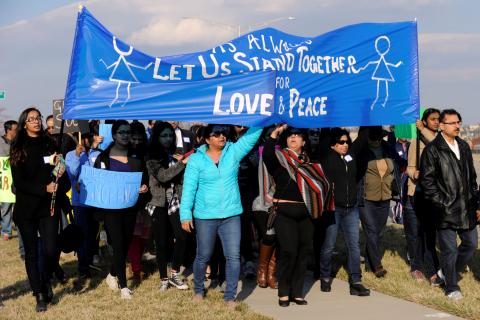
    CHICAGO, IL (TIP): Chicago-based Indian-American Public Affairs Committee (IAPAC) has launched a campaign across the US to spread awareness about hate crimes against the community.

    The committee plans to organize a series of grass root events and town halls across the country. “There is a need to bring understanding about the people of Indian-American and represent their interests,” Ashwani Dhall, one of the founding members of IAPAC, said in a statement.

    The committee plans to highlight how Indian-Americans have been an intrinsic part of the American fabric and will also ask different state governments and cities to announce Indian-American awareness month.

    “By bringing together elected officials, local and business leaders and the media, the aim is to assure Indian-American community that incidents like the hate-crime in Kansas City are not tolerated or repeated,” the statement read.

    IAPAC will also organize events in San Francisco Bay Area, New York, New Jersey, Chicago, Dallas and Seattle as part of the campaign. It wants to ensure that correct information, not rumors, on existing policies is disseminated to people, according to the statement.

    “It was heartening to hear [President] Trump denounce the Kansas City incident right at the start of his address to the Congress,” IAPAC president Vinesh Virani said. “We have hope that the current administration will work to bring everyone together,” he added.

  • Federal Judges Block President Trump’s Revised Executive Order on Travel Ban

    Federal Judges Block President Trump’s Revised Executive Order on Travel Ban

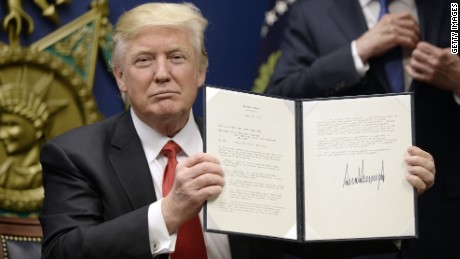
    WASHINGTON (TIP): Hours before it was to take effect, President Donald Trump’s revised travel ban was put on hold March 15 by a federal judge in Hawaii after hearing arguments that the executive order discriminates on the basis of nationality.

    District Judge Derrick Watson in Hawaii issued a temporary restraining order followed by District Judge Theodore Chuang in Maryland. Both judges attacked the executive order in part by analyzing intent. They found Trump’s actions were based on the motive of targeting Muslims, and they reached their conclusions by examining the record of what he and others connected to him had said. Both judges cited Trump’s statements about Muslims during the presidential campaign as part of their rulings.

    Rep. Tulsi Gabbard (HI-02) released a statement after U.S. District Court Judge Derrick Watson in Honolulu issued a nationwide stay temporarily preventing the Trump Administration’s travel ban from going into effect:

    “Hawaiʻi is a place where people with different ideas, backgrounds, religions, and ethnicities feel welcomed and respected. It’s only right that our Attorney General Doug Chin represent those values in working to stop this blanket travel ban from going into effect. This travel ban is bad policy, plain and simple.”

    The Justice Department said it will defend the new travel ban. “The Department of Justice strongly disagrees with the federal district court’s ruling, which is flawed both in reasoning and in scope. The President’s Executive Order falls squarely within his lawful authority in seeking to protect our Nation’s security, and the Department will continue to defend this Executive Order in the courts,” DOJ said in a statement.

  • Indian American Prasad Srinivasan announced his candidacy for Governor of Connecticut

    Indian American Prasad Srinivasan announced his candidacy for Governor of Connecticut

    STAMFORD, CT (TIP): Indian American State Representative Dr. Prasad Srinivasan, R-Conn., who serves as the representative in the state’s 31st Assembly District, announced his candidacy for Governor of Connecticut in 2018.

    “Connecticut has been prosperous in our lifetimes, and we can get back to prosperity again. But the path of divisive special interest politics that Governor Malloy and the Democrats in the legislature have chosen is not working. We need to change things around to revive our state. We need new leadership and new vision to conquer the old problems that are continuing to hold us back. That is why I want to be your governor”, he said in a statement.

    Dr. Prasad Srinivasan (Dr.S) is a long time resident of the town of Glastonbury. He has been practicing in Glastonbury and the Hartford area for over 30 years. He treats pediatric and adult patients with allergies. Dr. Srinivasan has been accomplished Legislator, Physician, Business Owner and Philanthropist and won many endorsements, accolades, awards and recognitions.

    On November 8th 2016, Prasad Srinivasan was elected to his fourth term as the State Representative of the Glastonbury 31st Assembly District. He is an Assistant Republican Leader and Ranking Member of the Public Health committee in Connecticut General Assembly besides being a member of Environment and Judiciary committees.

    Prasad Srinivasan was chief pediatric resident at Brookdale Hospital in Brooklyn, NY. He did his fellowship in allergy and immunology at Michael Reese Hospital in Chicago. He is a graduate of Baroda Medical College in India. He is certified by the American Board of Pediatrics and the American Board of Allergy and Immunology. His community involvement is remarkable and has been recognized on numerous occasions.

  • Jeff Sessions Recuses Himself from Russia Inquiry

    Jeff Sessions Recuses Himself from Russia Inquiry

    Could this Russian Angle be bigger than just Sessions, or Flynn???

    NEW YORK (TIP) : Russian involvement in the US presidential elections and President Donald Trump’s ties with Putin began during his campaign and is now having effect on his month-old Presidency with members of his top circle getting hit every week.

    First Manafort then Flynn and now Sessions. It seems everyone from his core team met and spoke to Russian officials during his campaign (which he knows nothing about) and then lied about these interactions.

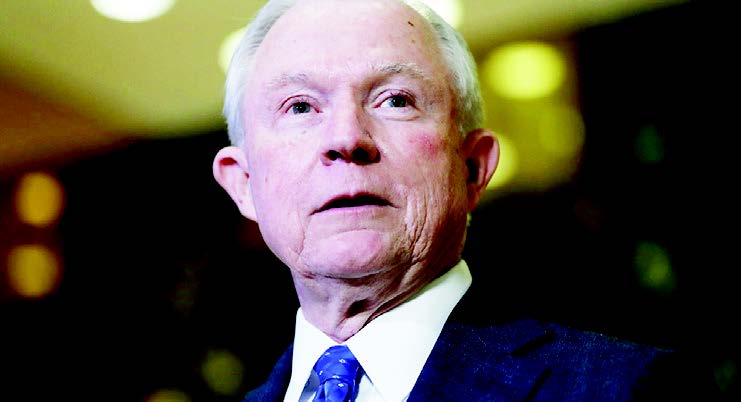
    Attorney General Jeff Sessions now finds himself in the Russian seat for not disclosing at his confirmation hearing that he spoke twice last year with Russian Ambassador Sergey Kislyak which amounts to perjury.

    U.S. intelligence agencies concluded last year that Russia hacked and leaked Democratic emails during the election campaign as part of an effort to tilt the vote in Trump’s favor. The Kremlin has denied the allegations.

    Under fire, Jeff Sessions removes himself from campaign probes

    U.S. Attorney General Jeff Sessions said on Thursday, March 2, that he would stay out of any probe into alleged Russian meddling in the 2016 presidential election but maintained he did nothing wrong by failing to disclose he met last year with Russia’s ambassador.

    “I have recused myself in the matters that deal with the Trump campaign,” Sessions told reporters at a hastily arranged news conference.

    Did Jeff Sessions lie under oath?

    Yes, He Did!!!Here’s why: Jeff Sessions met twice with the Russian ambassador to the United States, Sergey Kislyak in July and September 2016.

    At the time of Sessions’ contact with Kislyak, Sessions was not only serving as a surrogate for Donald Trump but had been named chairman of the Trump campaign’s National Security Advisory Committee.

    Sessions denied he had contact with Russian officials when he was asked directly during his Senate confirmation hearing to become attorney general whether he had exchanged information with Russian operatives during the election campaign.

    Now-Attorney General Sessions omitted both these meetings in his testimony during his confirmation hearings.

    Sessions and his Trump backers pushed back against the revelations saying that it was, essentially, a misunderstanding—Sessions conducted those meetings in his role as United States Senator, not a Trump campaign adviser, therefore he didn’t perjure himself.

    “He was literally conducting himself as a United States Senator,” Press Secretary Sean Spicer said Thursday. “This is what senators do in the course of conducting themselves in their jobs.”

    But for now its on record that while still in the Senate, Jeff Sessions met with the Russian Ambassador at least twice—once at his Senate office in September and once at an event at the Republican National Convention in July.

    (Read The transcript of Jeff Sessions’s recusal news conference, annotated)

    Trump’s & White House’s Response : President Trump said earlier Thursday, March 2, he “wasn’t aware at all” of Sessions’ meetings and that the attorney general still has his “total” confidence.

    Trump, Kellyanne Conway, Sean Spicer, Sessions and others on the Trump team have denied campaign officials’ communications and connections with Russian officials at least 20 times since July.

    Trump and Republicans who control Congress are trying to move past early administration missteps and focus on issues important to them, including immigration, tax cuts and repealing the Obamacare healthcare law.

    What questions remain?

    It is still unclear what Sessions discussed with Kislyak, although either side could have recorded it or taken notes.

    “As long as the conversation remains unknown, people will still be suspicious of what was said, whether that’s merited or not,” said Robert Walker, a former chief counsel to Senate and House ethics committees.

    Investigators need to find out about anyone involved with Trump who spoke to Russian officials before he was inaugurated. Short of that, Russia potentially could use those conversations to its advantage if it’s being denied by Trump and his administration.

    So far, investigators have found information showing contacts between Trump associates and Russians, including Russians linked to the Kremlin, NBC News has reported. Some of the information came from “routine intercepts” that normally might never have been examined, the source close to the investigation says.

    It’s unclear whether that is how the information about the Sessions meetings came to light, but it has become clear that the Russian ambassador was under FBI scrutiny and his communications were being monitored.

    A declassified report from U.S. intelligence agencies released in January concluded just that, saying, “Putin and the Russian government aspired to help President-elect Trump’s election chances when possible by discrediting Secretary Clinton and publicly contrasting her unfavorably to him.”

    Russia is Laughing with eyes wide Open: The Kremlin, increasingly convinced that President Trump will not fundamentally change relations with Russia, is instead seeking to bolster its global influence by exploiting what it considers weakness in Washington, according to political advisers, diplomats, journalists and other analysts.

    Russia has continued to test the United States on the military front, with fighter jets flying close to an American warship in the Black Sea this month and a Russian naval vessel steaming conspicuously in the Atlantic off the coast of Delaware.

    “They think he is unstable, that he can be manipulated, that he is authoritarian and a person without a team,” Alexei A. Venediktov, the editor in chief of Echo of Moscow, a liberal radio station, said of President Trump.

  • Time for a frank debate on freedom of speech and nationalism

    Time for a frank debate on freedom of speech and nationalism

    Bundle of nerves: Are we getting paranoid about freedom of speech?

    KC Singh

    The rise of Modi and the continued Cabinet slots for those preaching sectarian hatred is not much different from President Trump listening to the whisperings of Rasputin-like Stephen Bannon, erstwhile publisher of Breitbart News – the mouthpiece of ‘alt-right’, who is White House chief strategist”, observes the author – KC Singh


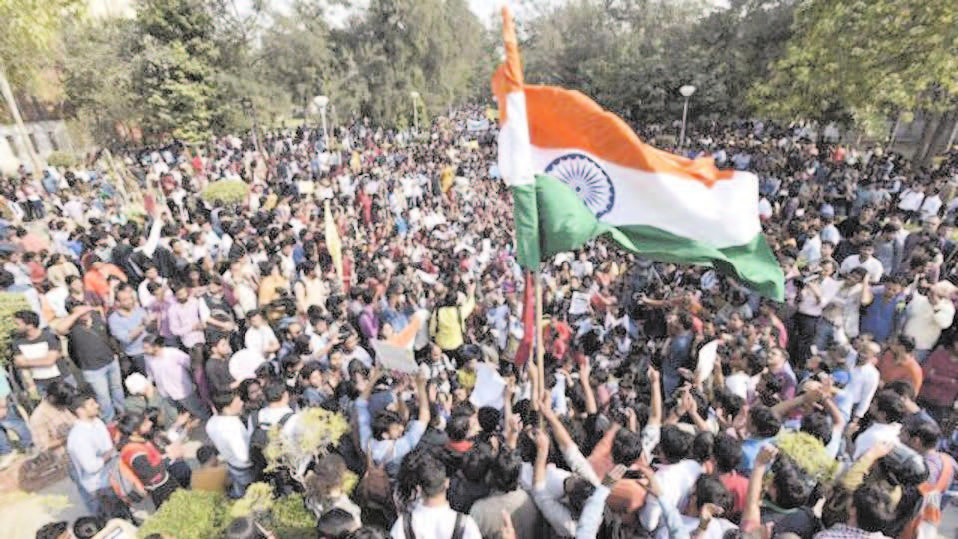
    Two events over the last few days, on opposite continents of the world, raise questions about the future of democracy in the US, the world’s most powerful, and India, the world’s most populous. On February 22, Srinivas Kunchibhotla was gunned down in Kansas, sharing a drink with a friend after work, by a white US navy veteran, in patently a hate crime. In India, at Ramjas College, New Delhi, a fracas broke out when BJP-aligned students’ union, ABVP, disrupted a function organized by campus students not aligned to them and invitees from JNU. The passively observant police intervened, more to rough-up the organizers than restrain ABVP disruptors. The allegation is that anti-national slogans were in the air.

    The attention got diverted from the melee when a young student, Gurmehar Kaur posted on social media placards denouncing the ABVP high-handedness, arguing that like her father – martyred fighting militants in Kashmir when she was little – she was unafraid to confront intolerance. The battle lines got promptly drawn, with intemperate remarks or tweets by an actor, a cricketer, a Union minister of state, and so on. In Gurmehar’s defense rose up senior journalists, retired soldiers, television anchors, etc. By nightfall, BJP spokesmen began distancing themselves from Gurmehar’s tormentors as their standard dubbing of any critic as anti-national did not work against a martyr’s daughter. The elections in UP also made it unwise to offend serving and retired servicemen.

    The distraction aside, the issues in the US and India are not that apart. The rise of Modi and the continued Cabinet slots for those preaching sectarian hatred is not much different from President Trump listening to the whisperings of Rasputin-like Stephen Bannon, erstwhile publisher of Breitbart News -the mouthpiece of ‘alt-right’, who is White House chief strategist. Both leaders prefer political rallies and one-way communication with chosen media outlets than transparent and frank interaction with the media. If Modi has never contradicted ministerial colleagues tarring the media with the abusive phrase ‘presstitutes’, Trump does one better by directly and almost daily referring to ‘The Fake News’. At a Florida rally, he confidently advocated -uncaring that independent media strengthens democracy – that media ‘is not my enemy, it is the enemy of the American people’. A former President, George Bush, has been constrained to contradict Trump’s condemnation of the media, despite both being Republicans.

    Both the racist killing of an Indian techie in Kansas and the ABVP use of violence to drown alternative views spring from identical philosophies and narrow visions. In case of India, it brings up the freedom of speech, while in the US it raises the spectra of nativism fed by a mix of xenophobia and fear of Islam. It is thus supremely ironical that while the Indian Government sends Foreign Secretary S Jaishankar to intervene with the US on the rising danger to Indian diaspora from white vigilantism, when under their noses similar intolerance is being happily marketed daily from election platforms in UP.

    Illustratively, RL Stevenson related the story about George Meredith, author of the 19th century novel, The Egoist, written to purge Victorian England of this evil, that when a young friend of the writer complained that the protagonist ‘Willoughby is me’, the writer replied: ‘No, my dear fellow, he is all of us.’

    The issues arising need a closer analysis. At stake in India is the definition of freedom of speech. Having inherited the common law-based criminal justice system from the British, India clings to antiquated laws on sedition. In the US too, immediately after their independence they enacted a sedition Act, which was allowed to lapse in 1801 as the nation matured and gained self-confidence. Following the Bolshevik Revolution in Russia, the fear of Communism made the US pass the Federal Espionage Act in 1917. Thus, while the British Common Law treats freedom of speech as ‘residual freedom’, circumscribed by societal needs of morality and public order, the US Supreme Court started treating it as a ‘fundamental right’ flowing from the First Amendment from 1925. In 1969, it upheld the right of students to wear black bands to protest Vietnam War. Justice OW Holmes ruled that while a nation is at war, many things that can be said in time of peace are taboo, but the test has to be whether there is ‘clear and present danger’ of sedition, not merely the expression of an opinion or a thought. What a person, in the exercise of his freedom of expression, is doing must be more than public inconvenience or annoyance, or even unrest.

    India, with a concept of ‘Fundamental Rights’ borrowed from the US practice has to assess if what happened at JNU earlier, or now at Ramjas College, passes the Holmes test. The definition of nationalism cannot be crafted in Nagpur and implemented by an evangelical lynch mob. Is that not the same question that the US is today required to answer, whether ordinary whites carrying guns can ask any non-white to prove their immigration status, or why they are in the US at all. So, the diaspora that came to Madison Square Garden to chant ‘Bharat Mata ki Jai’, in response to Modi’s incantations, are being put to the kind of test of loyalty that misguided flag-carriers of the BJP, or fringe organizations of the Sangh Parivar, have been putting to their own countrymen. How does India ask Trump to be more considerate when President Obama reminded the Modi government before emplaning for the US in 2015, in his speech at Siri Fort, that Article 25 ensured freedom of conscience and it was the government’s responsibility to uphold it.

    While it is true that the Indian geo-political environment does compel the government to be ever-alert to forces endangering Indian territorial integrity or sovereignty, but surely campus students holding placards, or sloganeering do not compose such a threat. As Voltaire, some say wrongly quoted, said: ‘I disapprove of what you say, but I will defend to the death your right to say it.’ Perhaps like the US Supreme Court, India’s highest court needs to re-balance the fundamental rights and the State’s obligations, and in the process, re-educate the lawyer-ministers of the BJP.

    (The author, KC Singh, is a former Secretary, Ministry of External Affairs, Government of India)

  • Measured rhetoric: President Trump’s gaffe-less surprise

    Measured rhetoric: President Trump’s gaffe-less surprise

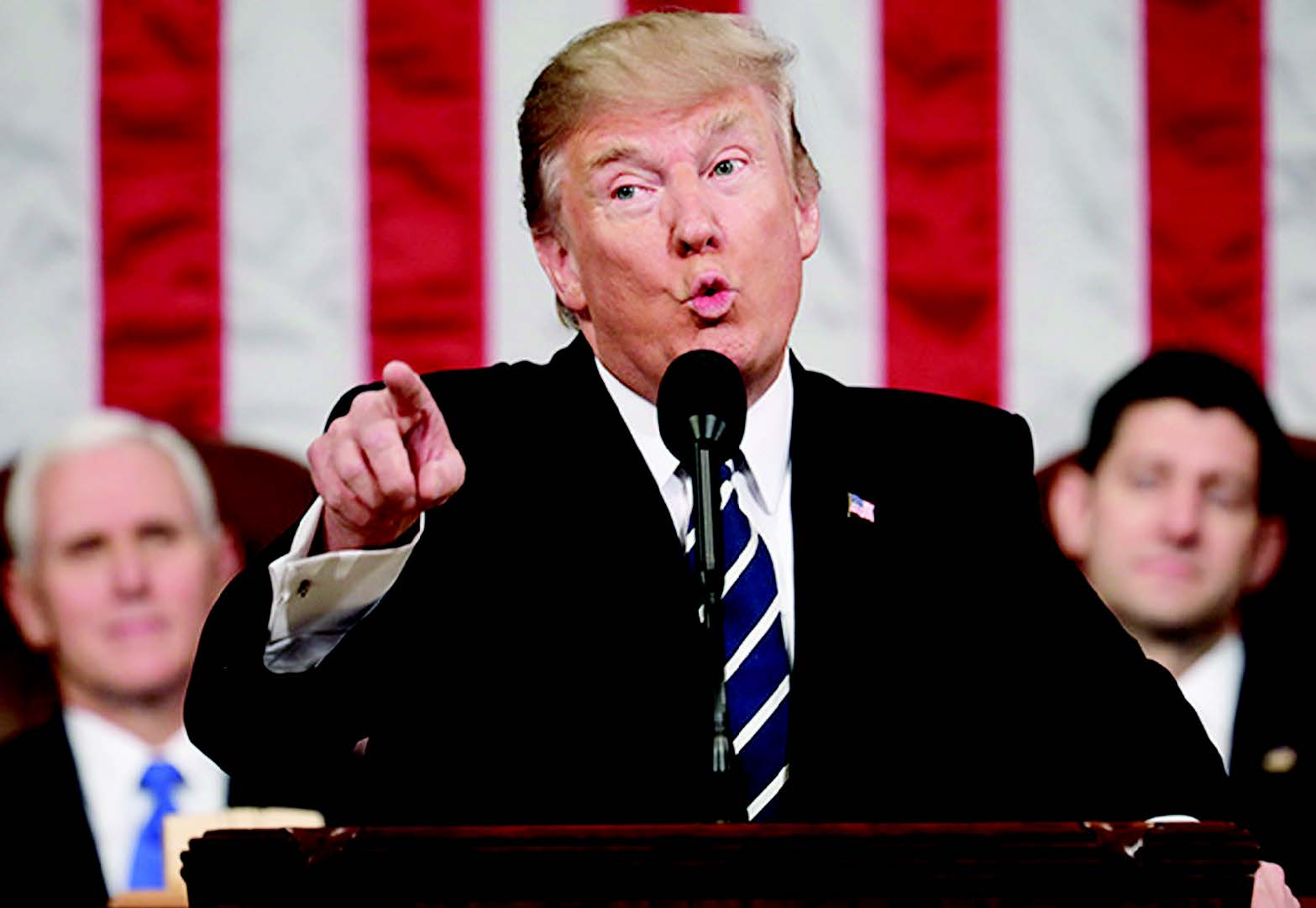
    US President Donald Trump sounded upbeat as he addressed a joint session of Congress for the first time. He condemned the murder of Srinivas Kuchibhotla, who was shot dead in Kansas by a white veteran, just as he deplored the vandalism of a Jewish cemetery. He spoke of a “new chapter of American greatness”, and said the country was seeing a “renewal of the American spirit”. In short, he sounded presidential-something not quite seen since he took over as the 45th President.

    Many of the campaign promises were, predictably, repeated. The rhetoric, too, was familiar. The speech was woefully devoid of specifics, but he did spell out his agenda in a gaffe-less and measured manner, without the shrillness that has often dominated his pronouncements. He managed to reassure NATO, even as he asked the member-countries to “meet financial obligations”. He promised a strengthened military. He spoke of his replacement for Obamacare and addressed concerns about coverage of pre-existing health conditions. Trump outlined a huge $1 trillion infrastructure package, and said that he would give “massive” tax relief to the middle class. As expected, he was tough on immigration, and promised to “demolish and destroy” the ISIS.

    It is clear that Trump’s mindset remains intact. Some details were fleshed out in the address; there was a wisp of nuance, on the immigration issue for instance; he refrained from attacking the Press this one time. However, what was most notable about President Trump’s address was not its content, but the moderate tone he adopted. It may be tempting to believe that the change in tone could be a case of the office asserting itself on the individual. Even if this is reading too much, in one performance, Trump’s address did manage to reassure the American people and the world at large that he was not a loony. A moment of relief.

    (Tribune, India)

  • New Yorkers send a clear message – Activists drape Lady Liberty with ‘Refugees Welcome’ banner

    New Yorkers send a clear message – Activists drape Lady Liberty with ‘Refugees Welcome’ banner

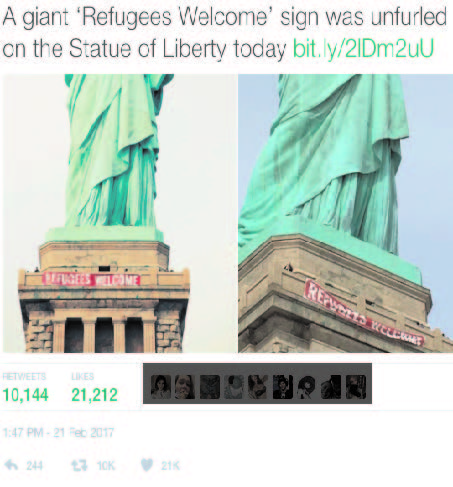
    NEW YORK (TIP): Activist scaled the Statue of Liberty and unfurled a red and white “Refugees Welcome” banner on Tuesday, just hours after the Department of Homeland Security unveiled its sweeping plan to deport undocumented immigrants across the U.S.

    The banner, which measured 3 feet by 20 feet in length, was unrolled and dangled from the statue’s observation deck, the National Park Service said.

    The sign was removed more than an hour later after it surfaced, the Associated Press reported, but not before images spread like wildfire on social media.

    According to CNN, an activist group called Alt Lady Liberty claimed responsibility for the banner. “Almost all Americans have descendants from somewhere else,” the group told CNN. “Immigrants and refugees make this country great. And turning away refugees, like we did to Anne Frank, does not make us great.”

  • Pramila Jayapal Elected Vice Ranking Member of House Budget Committee

    Pramila Jayapal Elected Vice Ranking Member of House Budget Committee

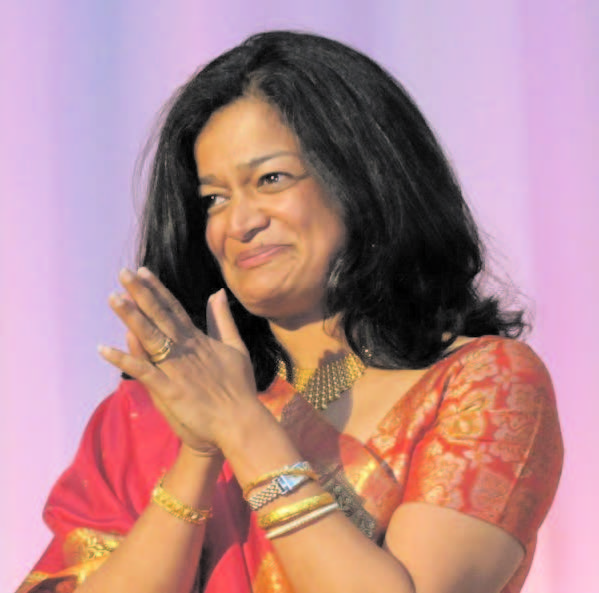
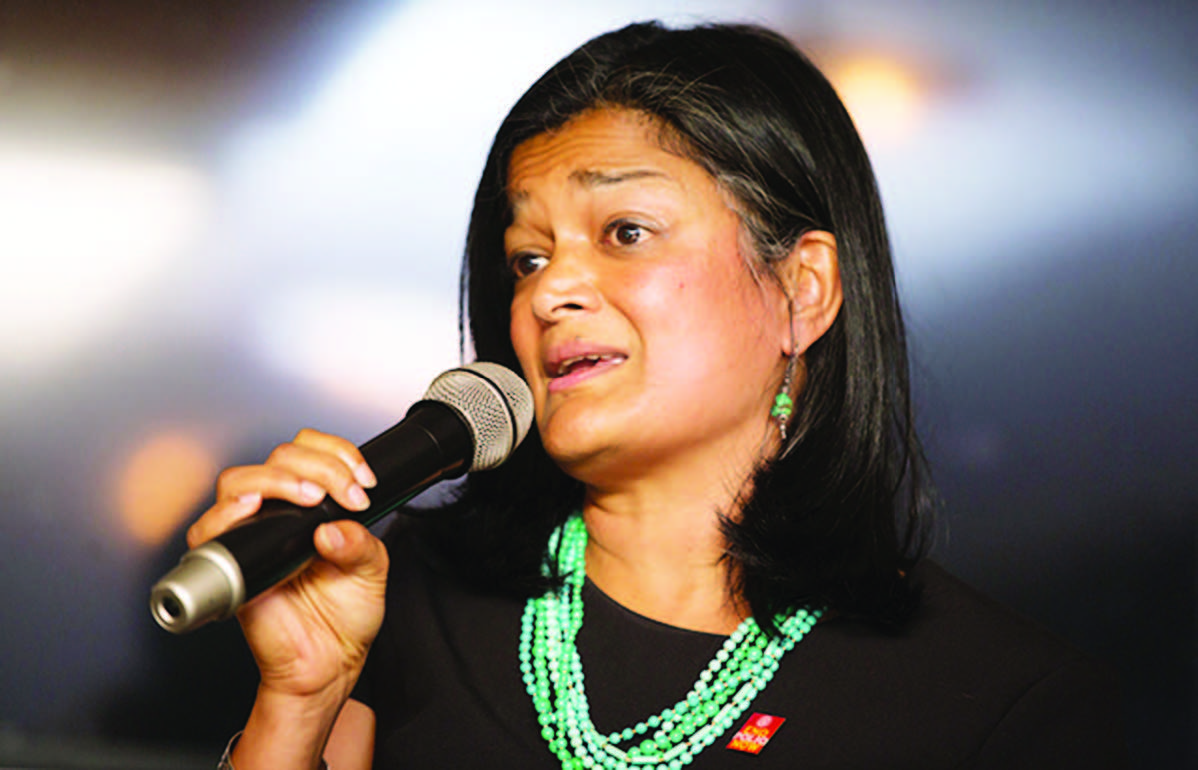
    WASHINGTON (TIP): Last week, Kentucky Congressman John Yarmuth, Ranking Member of the House Budget Committee, announced that Congresswoman Pramila Jayapal (WA-07) will serve as the committee’s Vice Ranking Member.

    “I’m pleased to congratulate our new Vice Ranking Member Congresswoman Jayapal, whose years of experience in the private, non-profit, and public sectors will be invaluable to the committee as we prepare to take on a number of challenging issues this year,” said Rep. Yarmuth. “I look forward to working with her and all of the outstanding Democrats on the committee as we fight to enact smart budget priorities that build upon the progress of the past eight years, protect Americans’ health security, and increase economic opportunity for all American families.”

    “The budget, at the end of the day, is a powerful moral document,” said Rep. Jayapal. “It reflects our priorities and investments as a country. With every budget we pass, we should be standing up for the working class, protecting those who are most vulnerable, and fighting income inequality. I am honored to have this opportunity to help show what Democrats stand for, and to organize and engage people across the country in standing up for that vision. I thank my colleagues for electing me as Vice Ranking Member of the House Budget Committee and look forward to working with them to put forth a budget that upholds our values.”

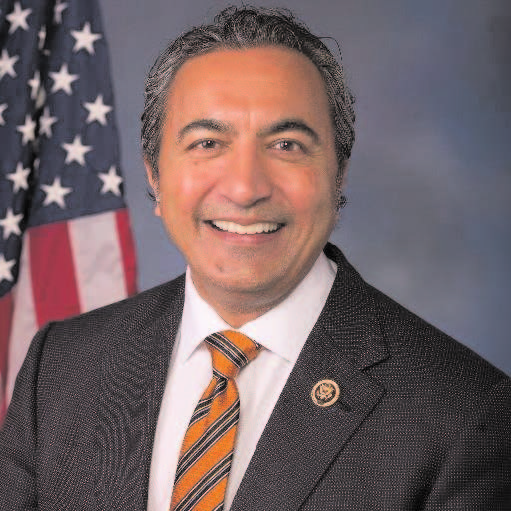
  • Indian American Congressman Ami Bera named ranking member of House space subcommittee

    Indian American Congressman Ami Bera named ranking member of House space subcommittee

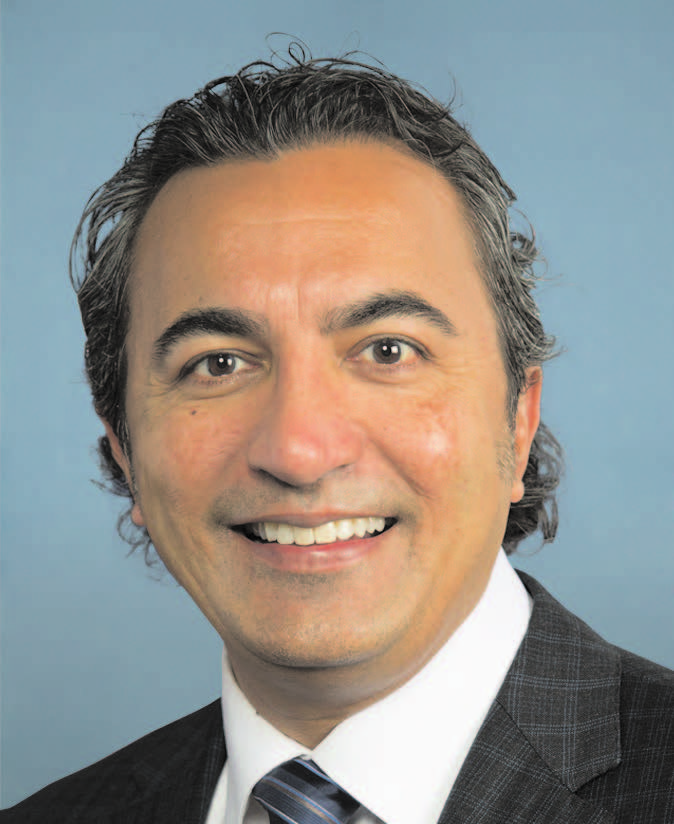
    WASHINGTON (TIP): House Democrats have named Rep. Ami Bera (D-Calif.) as the new ranking member of the space subcommittee as they finalized the roster of members who will serve on that subcommittee.

    Bera, entering his third term in the House, succeeds Donna Edwards, a Maryland Democrat who previous served as the top Democrat on the subcommittee. Edwards chose not to run for reelection to the House in 2016, unsuccessfully running for the Senate instead.

    “As a kid who grew up during the height of the space race dreaming of what lay beyond us, it’s an honor to be selected to serve as the ranking member for the subcommittee on space,” Bera, 51, said in a Feb. 14 statement about his selection as subcommittee ranking member. His district, which covers part of the Sacramento area, includes a major Aerojet Rocketdyne facility.

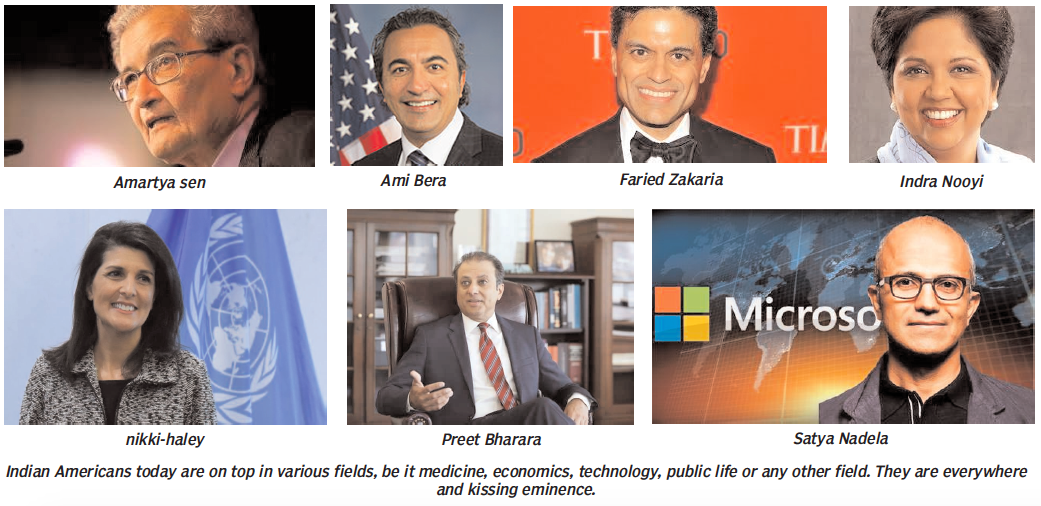
  • Indians in the United States of America: Significant Achievers

    Indians in the United States of America: Significant Achievers

    India gained independence from British raj on August 15,1947 and adapted a constitution becoming a Republic on 26th January 1950. On this occasion of 68th Republic Day, we can very proudly say that Indians have been contributing significantly in the building and progress of their homeland and adapted land-USA.With a population of about 3.8million (either born in India or reported Indian ancestry or race), they are among the wealthiest communities in the US, with a median annual household income of $88,000 compared with the national median of $49,800. They are among the most highly educated racial or ethnic groups in the U.S. According to the data from the American Community Survey, 40.6% of Indian Americans 25 and older have graduate or professional degrees, and 32.3% have bachelor’s degrees; an additional 10.4% have some college education. constitute ten percent of all medical students in America.

    Indian migrants began arriving in the United States in the beginning of 19th century. In 1813, a group of daring Indians established a Ghadar Party with dedicated patriots like Lala Har Dayal, Sohan Singh Bhakna, Kartar Singh Sarabha, Abdul Hafiz Mohamed Barakatullah, and Rashbehari Bose. They started a weekly Urdu newspaper “Ghadar” launching Ghadar Movement seeking India’s independence from Britain. Many members of this Party were later executed by the British Sarkar on their visit to India. The Washington Chapter of the Global Organization of People of Indian Origin (GOPIO) launched centenary celebration of the Ghadar Movement that was followed up by multiple events at different parts of the USA. I had the great honor and privilege to be the president of GOPIO at that time.

    Indian Americans are becoming increasingly visible in US politics, journalism, academia, or business.In the field of science and technology, Indians have become back bone of recent inventions. Two Indians have been awarded Nobel Prize for their contributions to science and medicine. They are: Hargovind Khorana Nobel Prize for Physiology & Medicine in 1968, and S. Chandrashekar Nobel Prize for Physics in 1983.

    Indian doctors, numbering more than 35,000, constitute over five percent of all physicians in USA and about 36% of scientists at NASA are Indians.

    Indians with significant achievements as academicians, inventors, and high-level administrators include: Vinod Khosla (co-founder of Sun Microsystems), Vinod Dham (creator of the Pentium chip), Sabeer Bhatia (founder and creator of Hotmail), Arun Netravalli (president of AT & T-Bell Labs), Rajiv Gupta (GM of Hewlett Packard), Sanjay Tejwrika (Microsoft Testing Director of Windows 2000, Victor Menezes, Rajat Gupta, and Rana Talwar (Chief Executives of CitiBank, Mckensey & Stanchart), Rakesh Khurana (Dean of Harvard College), Jamshed Bharucha, (President Emeritus of Cooper Union previously Dean of Arts & Sciences at Dartmouth College and Provost at Tufts University), Vijay K. Dhir (Dean of the UCLA Henry Samueli School of Engineering and Applied Science), Dinesh D’Souza (President of The King’s College, New York), Anjli Jain (Executive Director of CampusEAI Consortium, Dipak C. Jain (former Dean of the Kellogg School of Management at Northwestern University), Vistasp Karbhari (President of the University of Texas at Arlington), Pramod P. Khargonekar (Vice Chancellor of Research, University of California, Irvine), Renu KhatorChancellor of the University of Houston System and President of the University of Houston), Pradeep Khosla (Chancellor of the University of California, San Diego), Vijay Kumar (Associate Dean of School of Engineering and Applied Science at the University of Pennsylvania), Geeta Menon (Dean of the Undergraduate College at New York University Stern School of Business), Nitin Nohria (Dean of Harvard Business School), Sethuraman Panchanathan (Executive Vice President and Chief Research and Innovation Officer at Arizona State University), Michael Rao (President of Virginia Commonwealth University), Beheruz Sethna (President of the University of West Georgia), Dr. Paul Shrivastava ( Distinguished Professor and Director, David O’Brien Centre for Sustainable Enterprise, Concordia University), Molly Easo Smith (President of Manhattanville  College), Kumble R. Subbaswamy (Chancellor of the University of Massachusetts Amherst), Subra Suresh (President of Carnegie Mellon University), Satish K. Tripathi (President of University at Buffalo).

    Other academicians of international fame are: Manjul Bhargava (Professor of mathematics at Princeton University and winner of Fields Medal, 2014), Abhijit Banerjee (Ford Foundation International Professor of Economics at MIT), Kaushik Basu (Chief Economist of the World Bank), Jagdish Natwarlal Bhagwati (Professor of Economics at Columbia University), Raghuram Rajan, Professor University of Chicago and former Governor of Reserve Bank of India), (Salman Akhtar, Distinguished Professor at the Jefferson Medical College), Muzaffar Alam and C. M. Nain (Professors in South Asian Languages & Civilizations at the University of Chicago), Akhil Amar (Professor of Law at Yale Law School).

    Indra Nooyi (Chairman and Chief Executive Officer of PepsiCo), Satya Nadella (CEO of Microsoft), Sundar Pichai (CEO of Google), Ajay Banga (President and CEO of MasterCard), Rono Dutta (former President of United Airlines; Chairman of Air Sahara), Rajiv Gupta (General Manager of Hewlett Packard), Anshu Jain (former co-CEO of Deutsche Bank), Sanjay Jha (CEO of Global Foundries and former CEO of Motorola Mobile Devices), Vyomesh Joshi (Executive Vice President of Imaging and Printing Group, Hewlett-Packard Company), Thomas Kurian (President of Product Development at Oracle Corporation), Victor Menezes (Chairman of Clearing House Association; former Chairman and CEO of Citibank), Satya Nadella (CEO of Microsoft), Ranji H. Nagaswami (Chief Investment Officer for AllianceBernstein Fund Investors), Shantanu Narayen (CEO of Adobe Systems), Dinesh Paliwal (Chairman and CEO of Harman International), Arati Prabhakar (Director of DARPA), Rajeev Suri (CEO of Nokia), Padmasree Warrior (CTO of Cisco Systems), Rakesh Gangwal (former CEO and Chairman of US Airways Group), Rajat Gupta (former Managing Director of McKinsey & Company), Vikram Pandit (former CEO of Citigroup), Kanwal Rekhi (former EVP and CTO of Novell), Deven Sharma (former president of Standard & Poor’s), Salman ‘Sal’ Khan (founder of Khan Academy, a free online education platform), Amar Bose (founder and chairman of Bose Corporation), Bharat Desai (co-founder and chairman of Syntel), Sant Singh Chatwal owner of the Bombay Palace chain of restaurants and Hampshire Hotels & Resorts), Vinod Khosla (founder of Khosla Ventures; co-founder of SUN Microsystems), Vinod Dham (designed the Intel Pentium Chip Processor).

    Indians are being recognized in the field of arts and entertainment. Some of the recent successes include:Nina Davuluri, Miss America 2014; M. Night Shyamalan (Hollywood director), Mira Nair (director and producer), Kal Penn (actor), Omi Vaidya (actor), Sheetal Sheth (actress),Waris Ahluwalia (fashion designer), Aziz Ansari, Russell Peters, Aman Ali, Russell Peters,Rajiv Satyal, Anish Shah, Azhar Usman ((actors and comedians). Norah Jones (singer and winner of multiple Grammy Awards).

    Fareed Zakaria (columnist for Time magazine and host of Fareed Zakaria GPS on CNN), Zubin Mehta (former conductor, New York Philharmonic Orchestra; receiver of a star on the Hollywood Walk of Fame), Zarin Mehta (executive director of the New York Philharmonic Orchestra), Nicki Minaj (pop singer and rapper), Nina Davuluri (crowned Miss America 2014).

    Kiran Desai (winner of the 2006 Man Booker Prize), Siddhartha Mukherjee (physician and 2011 winner of the Pulitzer Prize for General Non-Fiction), Anita Desai (novelist; shortlisted for the Booker prize three times), Vikram Seth (poet, novelist, travel writer), Uday Singh Taunque (first Indian American to die in Operation Iraqi Freedom; posthumously awarded Bronze Star and Purple Heart gallantry awards),

    Indians have started making their mark in political and administration both at local and national level. Notables include: Kamala Harris (United States Senator from California), Nikki Haley (former Governor of South Carolina and now US Ambassador to the UN), Kumar P. Barve (majority leader Maryland House of Delegates), Mervyn M. Dymally (41st Lieutenant Governor of California, (1975-1979); member of the U.S. House of Representatives (1981-1993), Kashmir Gill (mayor of Yuba City, California, Faz Husain (first native of India to win elected office in Michigan), Bobby Jindal (former Governor of Louisiana; Vice Chairman of the Republican Governors Association), Aruna Miller (member of the Maryland House of Delegates), Ami Bera (U.S. Representative for California’s 7th congressional district), Raja Krishnamoorthi (U.S. Representative for Illinois’s 8th congressional district), Ro Khanna (U.S. Representative for California’s 17th congressional district), Pramila Jayapal (U.S. Representative for Washington’s 7th congressional district), and Dalip Singh Saund (first Asian-American member of the U.S. House of Representatives from California).

    Preet Bharara (United States Attorney for the Southern District of New York), Cathy Bissoon (judge for the United States District Court for the Western District of Pennsylvania), Nisha Desai Biswal (Assistant Secretary of State for South and Central Asian Affairs), Joy Cherian (first Asian head of the Equal Employment Opportunity Commission), Huma Abedin (aide to United States Secretary of State Hillary Clinton), Arif Alikhan (former Assistant Secretary for Policy Development at the U.S. Department of Homeland Security; former Deputy Mayor for Homeland Security and Public Safety for the City of Los Angeles), Preeta D. Bansal (member and past chair of the United States Commission on International Religious Freedom; former Solicitor General of New York), Aneesh Chopra (Federal Chief Technology Officer of the US), Rashad Hussain (U.S. Special Envoy to the Organization of Islamic Cooperation), Neel Kashkari (former interim Assistant Secretary of the Treasury for Financial Stability in the United States Department of the Treasury), Neal Katyal (Solicitor General of the United States), Gopal Khanna (Chief Information Officer of Minnesota), Narayana Kocherlakota (President of Federal Reserve Bank of Minneapolis), Kris Kolluri (New Jersey Commissioner of Transportation), Vivek Kundra (Federal Chief Information Officer of the US), Farah Pandith (Special Representative to Muslim Communities for the United States Department of State), Rachel Paulose (former United States Attorney for the District of Minnesota), Anant Raut (counsel to the U.S. House Judiciary Committee), Rajiv Shah (formerUnder Secretary of Agriculture for Research, Education, and Economics; current Administrator of USAID), Ambassador Islam A. Siddiqui (Chief Agricultural Negotiator in the Office of the United States Trade Representative), Rajen Anand (Executive Director, USDA Center for Nutrition Policy and Promotion), Sabita Singh (first judge of Indian descent in Massachusetts history), Subra Suresh (Director of National Science Foundation), Vinai Thummalapally (served as U.S. Ambassador to Belize), Richard Verma (Assistant Secretary for Legislative and Intergovernmental Affairs, at the Department of State), Vince Girdhari Chhabria (judge of the United States District Court for the Northern District of California), Manish S. Shah (judge of the United States District Court for the Northern District of Illinois), Srikanth Srinivasan (judge of the United States Court of Appeals for the District of Columbia Circuit), Kalpana Chawla (NASA space shuttle astronaut, who died in space shuttle blast), Sunita Williams (NASA astronaut), Vivek Murthy (Surgeon General of U.S.; former Vice Admiral of U.S. Health Corps), Sanjay Gupta (neurosurgeon; CNN chief medical correspondent; declined offer by President Barack Obama to be nominated U.S. Surgeon General) Our young generation is making us proud. About 73% of National Spelling Bee winners since 1999 have been Indian Americans. Indian Americans Account for Nearly One-Third of Science Talent Search Finalists.

    (The author can be reached at 1509 Coat Ridge Road, Herndon, VA 20170; raabta.india@gmail.com)

  • PREDICTED UPCOMING H-1B CHANGES (NOT LAW YET)

    PREDICTED UPCOMING H-1B CHANGES (NOT LAW YET)

    UNCONFIRMED AND UNSIGNED LEAKED PROPOSED EXECUTIVE ORDER ON H1B VISA & IMMIGRATION.

    President Trump has already signed several immigration-related executive orders. One unconfirmed and unsigned leaked proposed order, entitled “Executive Order on Protecting American Jobs and Workers by Strengthening the Integrity of Foreign Worker Visa Programs” includes a number of provisions related to the employment-based immigration system.

    None of these provisions is in effect. It is possible that this order will never be signed, or that it will be substantially modified prior to being signed. The order proposes the following:

    • “in consultation with the Secretaries of State and Labor … restore the integrity of employment-based nonimmigrant worker programs and better protect U.S. and foreign workers affected by those programs”
    • “consider ways to make the process for allocating H1B visas more efficient and ensure that beneficiaries of the program are the best and the brightest”
    • “… provide recommendations for making U.S. immigration policy better serve the national interest; and to recommend changes to the immigrations laws to move towards a merit-based system”

    • Secretary of Labor to issue a report on “… the actual or potential injury to U.S. workers caused … by work performed by nonimmigrant workers in the H1B, L-1, and B-1 visa categories.”

    • DHS to draft a regulation that would clarify the types of activities that are or are not permissible for B-1/B-2 visitors. More specifically, the order seeks to eliminate situations in which a B-1/B-2 is permitted to work while in the United States.

    • DHS to “review all regulations that allow foreign nationals to work in the United States, determine which of those regulations violate immigration laws or are otherwise not in the national interest and should be rescinded, and propose … a rule … to rescind or modify such regulations.” This may affect H-4 EAD program.

    • DHS to start work on a regulation that would “… reform practical training programs for foreign students to prevent the disadvantaging of U.S. students in the workforce, better protect U.S. and foreign workers affected by such programs, … and improve monitoring of foreign students.” This may affect OPT and CPT.

    • Department of State (DOS) and the DHS to “conform to Congressional intent … [in] determin[ing] when an immigrant visa is ‘immediately available.’” This may affect dual-chart visa bulletin system implement in October 2015, which, at times, allows for the filing of an adjustment of status application (form I-485) based on a ‘dates for filing’ chart.

    • DHS to propose regulatory reforms to the E-2 visa category. Details about the form and intent of any such reforms, however, remain unclear.

    • Immediate termination of parole programs that do not comply with the principles laid out in the memo, or that otherwise do not comport with immigration law.

    LEGISLATION PROPOSED BY U.S. REP. DARRELL ISSA (R-CALIFORNIA)

    On January 4, 2017, Congressman Darrell Issa (R-Calif.) today re-introduced the “Protect and Grow American Jobs Act,” in an effort to help stop the outsourcing of American jobs and to reform the nation’s high-skilled immigration program. The bill proposes to:

    • Raise salary requirement for H-1B visa positions to $100,000/year (up from $60,000/year currently); and
    • Require successful candidates to have a master’s degree from accredited institutions as determined by the Department of Homeland Security.

    The rules, if enacted, would apply only to US-based companies which have more than 50 employees and with more than 15% of that workforce comprising of H-1B visa workers.

    LEGISLATION PROPOSED BY U.S. REP. ZOE LOFGREN (D-CALIFORNIA)

    On January 4, 2017, U.S. Rep. Zoe Lofgren (D-Calif.) introduced “The High-Skilled Integrity and Fairness Act of 2017” to curtail abuse of the H-1B program.

    Among other reforms, the High-Skilled Integrity and Fairness Act of 2017 proposes:

    • Increases prevailing wage requirements to protect U.S. workers by replacing the current 4-level wage calculation with a new, more balanced, geographically based 3-level formula which eliminates the lowest wage level and puts upward pressure on the wages in the remaining levels.

    o Level 1 = mean of bottom 2/3 of wages surveyed
    o Level 2 = mean of all wages surveyed
    o Level 3 = mean of top 2/3 of wages surveyed

    • Prioritizes market-based allocation of H-1B visas as follows:
    1) Employers paying 200% of level 3 prevailing wage, then 150% of level 3
    2) Employers paying 200% of level 2 prevailing wage, then 150% of level 2
    3) Employers paying 200% of level 1 prevailing wage, them 150% of level 1

    • Removes the ‘per country’ cap for employment based immigrant visas so that all workers are treated more fairly and to move to a system where employers hire the most skilled workers without regard to national origin.

    • Raises the salary level at which H-1B dependent employer are exempt from attestation requirements to a new required wage level of 35 percentile points above the median national annual wage for Computer and Mathematical Occupations published by the Department of Labor Occupational Employment Statistics (roughly $132,000), which would be adjusted in the future without the need for new legislation, and eliminates the Master’s Degree exemption for dependent employers.

    • Sets aside 20% of the annually allocated H-1B visas for small and start-up employers (50 or fewer employers) to ensure small businesses have an opportunity to compete for high-skilled workers, while still protecting against outsourcing.

    • Removes visa hurdles for students and other temporary visa holders by building a bridge from F-1 student status to Lawful Permanent Residence.

    • Removes paperwork burdens by streamlining H-1B filing requirements and reducing administrative costs.

    • The legislation tightens employee protection by stipulating that employers may not reduce beneficiary wages, regardless of whether the deduction is in accordance with a voluntary authorization by the employee.

    • It makes exceptions for taxes, garnishments, and deductions that are reasonable and customary in the occupation.

    LEGISLATION PROPOSED BY SENATORS CHUCK GRASSLEY (R-IOWA) AND DICK DURBIN (D-ILLINOIS)

    On January 19, 2017, Senators Chuck Grassley and Dick Durbin, announced that they would reintroduce their bill for revamping the H-1B and L-1 visa programs. The bill was first introduced in 2007.

    • The bill will require U.S. Citizenship and Immigration Services to prioritize for the first time the annual allocation of H-1B visas. The new system would ensure that the best and brightest students being educated in the United States receive preference for an H-1B visa. The preference system also gives a leg up to advanced degree holders, those being paid a high wage, and those with valuable skills.

    • The bill would crack down on outsourcing companies that import large numbers of H-1B and L-1 workers. Specifically, the bill would prohibit companies with more than 50 employees, of which at least half are H-1B or L-1 holders, from hiring additional H-1B employees.

    • The bill also gives the Department of Labor enhanced authority to review, investigate, and audit employer compliance with program requirements, as well as to penalize fraudulent or abusive conduct. It requires the production of extensive statistical data about the H-1B and L-1 programs, including wage data, worker education levels, place of employment and gender.

    • The bill clarifies that working conditions of similarly employed American workers may not be adversely affected by the hiring of the H-1B worker, including H-1B workers who have been placed by another employer at the American worker’s worksite. In addition, it explicitly prohibits the replacement of American workers by H-1B or L-1 visa holders.

    • In addition, the bill includes several reforms of the L-1 visa program. These include establishment of a wage floor for L-1 workers; authority for the Department of Homeland Security to investigate, audit and enforce compliance with L-1 program requirements; assurance that intra-company transfers occur between legitimate branches of a company and don’t involve “shell” facilities; and a change to the definition of “specialized knowledge” to ensure that L-1 visas are reserved only for truly key personnel.

    LEGISLATION PROPOSED BY SENATOR SHERROD BROWN (D-OHIO)

    Senator Sherrod Brown also announced he would introduce an H-1B and L-1 Visa Reform Act in the Senate which would close loopholes in the H-1B and L-1 visa programs and provide increased protections for both American workers and visa holders. The bill would:

    • Require that employers first offer a vacant position to an equally or better qualified American worker before seeking an H-1B or L-1 visa holder.

    • Establish wage requirements for L-1 workers and improve H-1B wage requirements to encourage companies to hire qualified American workers and prevent them from using foreign workers as a source of cheap labour.

    • Under the H-1B and L-1 Visa Reform, the Department of Labor (DOL) and the Department of Homeland Security (DHS) would have additional oversight authority to investigate fraud and abuse as well as to increase penalties for companies that violate the bill’s requirements.

    • The bill also requires DOL and DHS to share information so that visa petitions are effectively scrutinized.

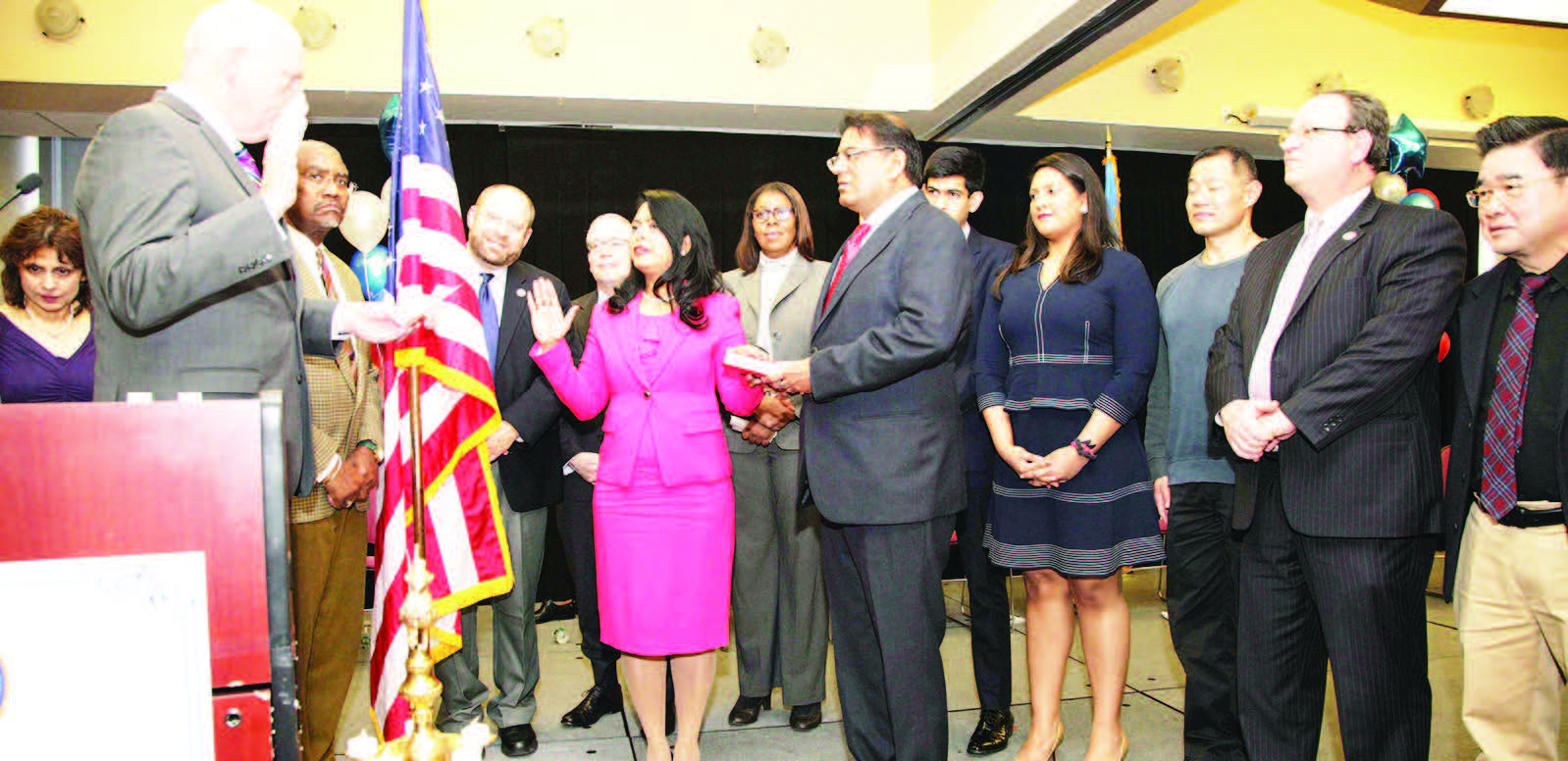
  • Dr. Neeta Jain sworn in as Democratic District Leader for Assembly District 25

    Dr. Neeta Jain sworn in as Democratic District Leader for Assembly District 25

    NEW YORK (TIP): New York City Democrats were at Queens College on January 21st, 2017 for the swearing in ceremony of Dr. Neeta Jain as the Democratic District Leader for Assembly District 25, Part B which includes Flushing, Kew Gardens Hills, Hillcrest, and Hillside Avenue. Celebrity broadcaster and activist Renee Mehrra was the emcee of the prestigious event. Over 400 people attended the ceremony which included  Dr. Jain’s constituents, civic leaders, members of the South Asian community and Queens district leaders.

    The ceremony opened with the presentation of colors by Francis Lewis High School JROTC color guard commanded by Sergeant Major Charles Cabrera. Dr. Uma Mysorekar, President of the Hindu Temple Society of North America, recited the auspicious opening prayer to Lord Ganesha and Anandita Guha performed Ganesha Vandhana, a traditional Indian dance honoring Lord Ganesha.

    Dr. Jain joined the Queens community over 20 years ago and has a long history of serving the community both socially and politically. Her core values of humanity and peace have fueled her passion to serve the community. She has also represented the South Asian community and worked hard to give them a voice in politics. Due to her hard work as a team member of Diwali Stamp Project and collaboration with other officials and organizations, the US Postal Service launched a forever stamp for the Indian New Year Diwali in 2016. She would like to further advocate for the Hindu Holidays Campaign and continue to petition for Diwali as a religious holiday in New York City schools calendar.

    Dr. Jain’s passion for the South Asian community extends to all in the community as is evidenced by the support from officials and district leaders of all faiths and backgrounds. Diversity and inclusiveness was a common theme among the speakers at the event. Keynote Speaker, Congressman Crowley chairman of the House Democratic caucus administered the oath of office to Dr. Jain over the Jinvani, the sacred book of Jains. Dr. Jain was recognized for her laurels and accomplishments by Congressman Gregory Meeks, Queens Borough President Melinda Katz, NYC Public Advocate Letitia James, NYC Comptroller Scott M. Stringer as well as NYC Council members Rory Lancman, Barry Grodenchik and Peter Koo. New York State Governor Andrew Cuomo and Lt. Governor Hochul send her congratulations and good wishes for her new endeavors. Mayor De Blasio, who could not be there in person, sent a congratulatory letter to Dr. Jain applauding her for her civic work. Attorney Ravi Batra and Harish Thakkar congratulated Dr. Jain on behalf of the Indian American community.

    In her speech, Dr. Neeta Jain made a commitment to address issues of her district including healthcare, education, women and senior citizens. The program concluded with entertainment from Sandra Productions, Korean American Association of Queens and the NYC Bhangra Group.

  • Indian-American lawmakers slam RHC

    Indian-American lawmakers slam RHC

    Indian-American lawmakers have slammed the US-based Republican Hindu Coalition for supporting President Donald Trump’s executive order on immigration, which they alleged takes the country backwards “towards dark times”.

    “As the most senior Indian-American member of Congress, I believe that Donald Trump’s executive order does not reflect who we are as Americans,” Ami Bera, a three-time Congressman, said.

    “The actions of the Republican Hindu Coalition (RHC) on Wednesday do not reflect the breadth and diversity of the Indian-American community, or our diaspora,” he said in a rare criticism of an Indian-American organization related to the Republican Party.

    Bera, along with three other Indian-American lawmakers, vented out his anger against the Coalition. The Coalition has supported Trump’s executive order on immigration and refugees.

    “We applaud the Trump administration for taking this decisive move to protect our citizens from Islamic terror,” its chairman Shalabh Kumar said on Tuesday.

    The executive order signed on Friday, indefinitely barred Syrian refugees from entering the US, and blocked citizens of seven Muslim-majority countries – Iran, Iraq, Somalia, Sudan, Syria, and Yemen – for 90 days.

    Bera said it was very difficult for people of Indian origin to immigrate to the US before 1965, “and this order takes us backwards towards that dark time.”

    Congresswoman Pramila Jayapal said the Coalition does not represent them. “As Indian-Americans, we believe deeply in pluralism, in freedom of religion, in freedom of speech and in a democratic diverse society.”

    “To them, I would say, shame. Shame for trying to divide the Indian-American community.

    As a Hindu, I can tell you that this group does not represent the much larger Indian- American community that honor our birth countries commitment to religious freedom and democracy,” Jayapal said asserting that Indian-Americans “will not be bullied” by this president.

    “I call on our communities to condemn and resist these executive orders,” Jayapal said. Congressman Raja Krishnamoorthi termed the executive order an assault on Constitution which “only serves to divide Americans, not unify them.

    It is no longer time to agonies but to organize. It is time to do everything we can to oppose this executive order,” he said.

    Congressman Ro Khanna said, “We cannot allow policies to exist that are not consistent with our founding ideals and values. I swore in on the Constitution, and will always stand up for Constitutional principles.”

    Former Assistant Secretary of State for South and Central Asian Affairs Nisha Desai Biswal said, “This executive order does not make us safer; it imposes the most severe of burdens on the most vulnerable among us.

    It goes against our responsibilities from the Geneva Conventions and poses an unjust, un-American and what we believe to be an unconstitutional ban on immigrants and refugees,” Biswal said.

  • Indian American leaders Condemn Trump’s “Extreme Vetting” Executive Order

    Indian American leaders Condemn Trump’s “Extreme Vetting” Executive Order

    WASHINGTON (TIP): On February 1, the Asian American and Pacific Islanders (AAPI) Victory Fund held a press conference with Members of Congress and Indian American leaders at the National Press Club to condemn the Trump administration’s immigration executive orders. On behalf of the Asian American and Pacific Islander community representing a diversity of faiths, ethnicities and backgrounds, speakers stood together in opposing these discriminatory executive orders.

    “As the most senior Indian American Member of Congress, I believe that Donald Trump’s executive order does not reflect who we are as Americans,” said Rep. Ami Bera, M.D. (CA-7). “The actions of the Republican Hindu Coalition today do not reflect the breadth and diversity of the Indian American community, or our diaspora. Prior to 1965, it was very difficult for people of Indian origin to immigrate to the United States, and this order takes us backwards toward that dark time. That’s why I’m fighting back, and today sponsored the SOLVe Act to repeal this discriminatory executive order.”

    “I was elected to help unify our country. This executive order from President Trump is an assault on our Constitution; it hurts working families; and it only serves to divide Americans, not unify them,” said Rep. Raja Krishnamoorthi (IL-8). “It is no longer time to agonize but to organize. It is time to do everything we can to oppose this executive order.”

    “It is unthinkable that this country, which welcomed me when I arrived at 16 years old, would so boldly, defiantly and barbarically turn its back on immigrants and refugees,” said Rep. Pramila Jayapal (WA-7). “Let us be clear that President Trump came into office by demonizing and ‘otherizing’ immigrants and refugees. While we had hoped that perhaps he would move from being a divisive candidate to being a unifying President, he is failing us. I call on our communities to condemn and resist these executive orders.”

    “The temporary ban in the executive order is not constitutional,” said Rep. Ro Khanna (CA-17). “We cannot allow policies to exist that are not consistent with our founding ideals and values. I swore in on the Constitution, and will always stand up for Constitutional principles.”

    “This executive order does not make us safer; it imposes the most severe of burdens on the most vulnerable among us,” said Nisha Desai Biswal, former Assistant Secretary of State for South and Central Asian Affairs at the U.S. Department of State. “To single out people because of their nationality or their faith is unethical. It goes against our responsibilities from the Geneva Conventions and poses an unjust, un-American and what we believe to be an unconstitutional ban on immigrants and refugees.”

    “I believe this executive order will not only be ineffective, it will be counterproductive,” said Manpreet Singh Anand, former Deputy Assistant Secretary in the Bureau of South and Central Asian Affairs at the U.S. Department of State. “National security cooperation, partnership and building trust with other countries in our efforts. This executive order will not achieve its intended policy outcomes. By not including interagency government professionals, the order was horribly executed and will end up being unlawful as well as alienate our partners. Executive orders like this one will be counterproductive to the very national security goals that it purports to achieve.”

    “We cannot allow ourselves to be divided by this un-American executive order. It is a stain on our history, just like slavery, internment and denial or voting rights,” said Shekar Narasimhan, chair of the AAPI Victory Fund. “Americans confronted and overcame these challenges and we will do the same here. We unite and call on our Members of Congress to deny President Trump the funds to carry out these unlawful executive orders.”

  • PRESIDENTS AREN’T CEOS ~ On the meaning and implications of the country’s first true businessman president

    PRESIDENTS AREN’T CEOS ~ On the meaning and implications of the country’s first true businessman president

    John Paul Rollert

    With respect to the best, unlike a president who has spent decades cultivating the hard skills that lend themselves to complex bureaucratic management and quantitative acumen, Trump consistently boasts of shunning hard analysis and expert opinion (“I don’t hire a lot of number-crunchers”) in favor of the oracle of gut instinct. On the other hand, in terms of the worst, Trump maintains a “my way or the highway” ethic that makes even the most stubborn CEOs look positively accommodating”, says the author – John Paul Rollert.

    Among the more arid and promiscuous expressions in the English language is saying that someone is “in business.” The pawnbroker, the accounts executive at CBS, and the risk arbitrageur are all nominally engaged “in business,” but that fact probably does more to obscure the differences in their daily affairs than to reveal any fundamental similarities.

    Donald J. Trump has certainly been “in business” for the better part of 50 years. And while his electoral success has made him a global face for American capitalism, the fact that he’s the first businessman to vault from the C-Suite straight to the presidency says little about what the country might expect from the next four years-or at least not nearly as much as many tend to think.

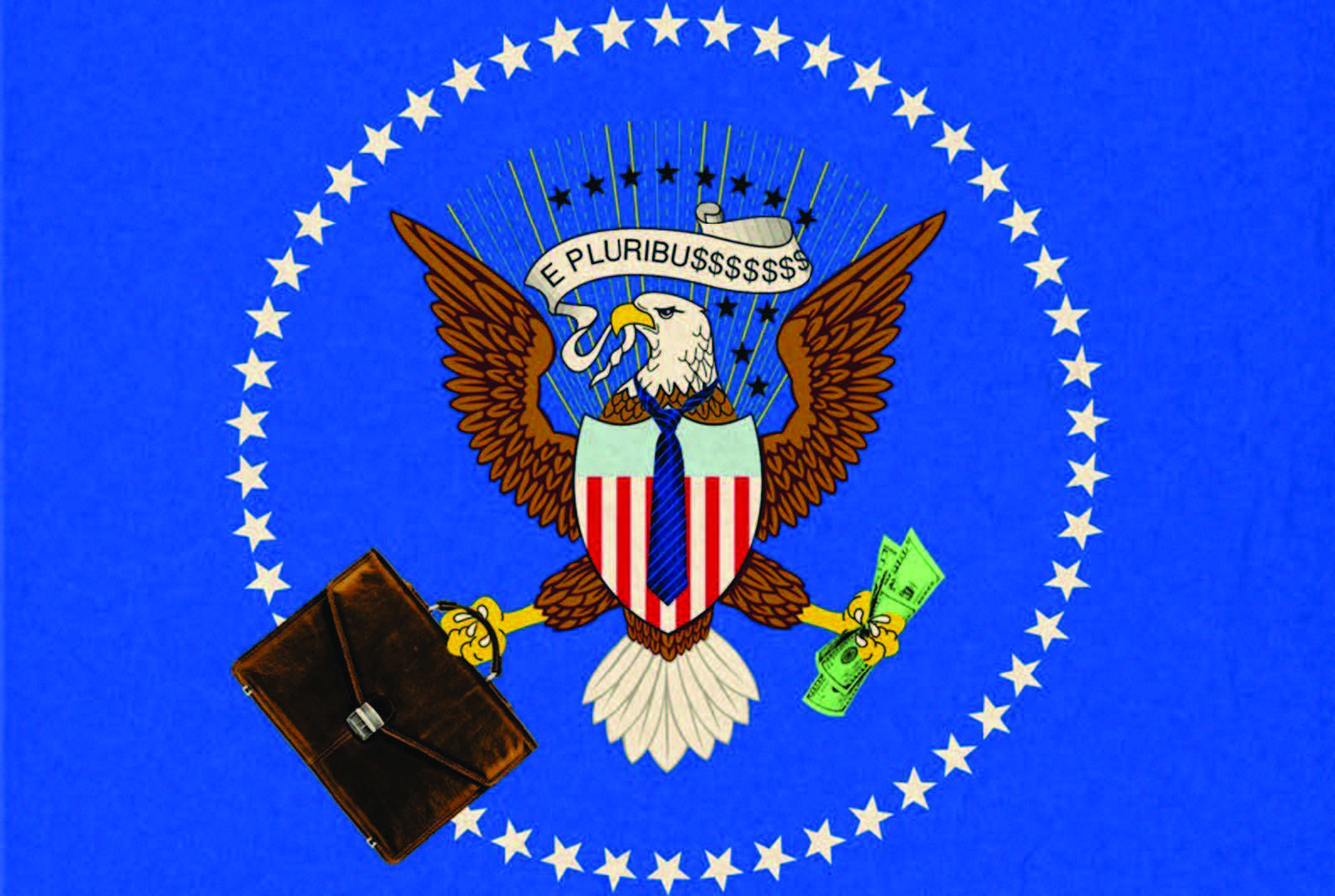
    Most presidents have had some experience in private enterprises before entering the Oval Office, a few of them quite substantial. Herbert Hoover made millions as a mining consultant; Jimmy Carter managed a successful peanut farm; and George W. Bush ran an oil company. No president, however, has ever spent his entire adult life immersed in the hustle and bustle of business or, to use Trump’s preferred nomenclature, deal-making. That activity-global in scope, arcane in detail-has received special scrutiny in light of the president-elect’s refusal to release his tax returns, and not without reason. Conflicts of interests come in many forms, but few are as worrisome as the leader of the free world keeping one eye on his portfolio whenever he contemplates some policy decision.

    Such concerns have always dogged presidential contenders who campaign on their business acumen, and the reason why so many Americans are willing to overlook the opportunities for cronyism and self-dealing is an abiding belief that spending time “in business” is ideal training for being the commander-in-chief. That assumption is hardly outrageous, but it is too often predicated on the belief that the president is essentially the nation’s CEO, a common misconception that warps one’s understanding of how exactly the federal government works.
    Instead of an obvious and (as far as the Founders were concerned) highly desirable consequence of the division of powers and divided government, Washington’s inability to “get things done” is unmistakable evidence of gross deficits in the character and competency of its leaders. If the president were simply more technically gifted, managerially adroit, and decisive in his decision-making-in other words, if he had the skills we often associate with successful CEOs-Washington would at last “work,” a remarkable conclusion that assumes surprising unanimity about the “work” that most American would like to see done.

    Beyond a strange insensitivity to the contending interests that enliven American politics as well as the dubious presumption that most political leaders are either knaves or fools (for otherwise they would just “get things done”), those who labor under the fallacy of the CEO president betray a profound ignorance about the actual powers of the American presidency. Then again, they’re in good company. “The most startling thing a new President discovers is that his world is not monolithic,” an unnamed Truman aide told Theodore White in The Making of the President 1960. “In the world of the presidency, giving an order does not end the matter. You can pound your fist on the table or you can get mad or you can blot it all and go out to the golf course. But nothing gets done except by endless follow-up, endless kissing and coaxing, endless threatening and compelling.”

    The contrast to the head honcho of a Fortune 500 company should be obvious. CEOs may assume their orders will be dispatched faithfully by subordinates, if not always to their full satisfaction, but when dealing with members of Congress, a president’s power is by and large confined to the power of persuasion. Yes, the president does have a limited battery of carrots and sticks-the promise of a political appointment, for example, or the threat of withholding support in the case of a bruising primary-but for the most part, when one can neither freely promote nor fire the individuals one must work with to get anything substantial accomplished, they are power centers unto themselves rather than pawns to be moved at will.

    The impotence of presidential authority is not without exception or work-around-the commander-in-chief has wide discretion in foreign affairs, and the use of executive orders is an example, albeit a circumscribed and highly controversial one, of unilateral decree-but relative to a CEO, the opportunity to fully envision and implement a single complex project, much less a comprehensive vision, is limited to the degree that a president can convince others to sign on. The same may be said for other high-ranking officials across the federal government. One cannot simply divine a remedy, channel one’s inner pharaoh, and expect one’s will be done.

    Not that this prevents some from trying. “I’ve seen a lot of people suck in government,” the TV host and former congressman Joe Scarborough observed in early December on Morning Joe, sounding a warning to Trump’s Cabinet-level nominees. “Some of the people that suck the worst are CEOs that go in there [saying], ‘This is the way I worked Trans-Saw Enterprises, and it’s going to work here!’ No, actually it doesn’t work that way.” He continued, making reference to the speed-trap of career civil servants. “They’re like vultures-they will pick your eyeballs out of your face.”

    As of yet, the president-elect’s eyes remain intact, as does his abiding belief that brute determination will overcome any obstacles to his ambition. “You can get any job done through sheer force of will,” Trump contends in The Art of the Deal, “and by knowing what you’re talking about.” If his presidential campaign seemed, at once, to affirm and embarrass this declaration, it suggests that a Trump presidency is likely to exhibit too little of the best, and too much of the worst, of what might be expected from a commander-in-chief who’s spent a lifetime “in business.”

    With respect to the best, unlike a president who has spent decades cultivating the hard skills that lend themselves to complex bureaucratic management and quantitative acumen, Trump consistently boasts of shunning hard analysis and expert opinion (“I don’t hire a lot of number-crunchers”) in favor of the oracle of gut instinct. On the other hand, in terms of the worst, Trump maintains a “my way or the highway” ethic that makes even the most stubborn CEOs look positively accommodating.

    In The Art of the Deal, the president-elect is unapologetic about his heedless determination when pursuing some initiative (“I’ll do nearly anything within legal bounds to win”) and entirely spiteful when things don’t go his way. Recounting the difficulties, the hotel magnate Barron Hilton had in the 1980s obtaining a gambling license in New Jersey even as Hilton Hotels had already started construction on a massive casino complex in Atlantic City, Trump says that, had he been in Hilton’s place, he would have been relentless in pursuit of the license. “I’m not saying I would also have won,” he admits, “but if I went down, it would have been kicking and screaming. I would have closed the hotel and let it rot. That’s just my makeup.”

    It shouldn’t escape notice that, while Donald Trump is president, this reckless approach to “getting things done” will be underwritten by the American people. To that end, The Art of the Deal, the vade mecum of Trumpology, is both instructive and admonitory, like a home-repair estimate prospectively authored by an arsonist. “I fight when I feel I’m getting screwed,” Trump warns his readers, “even if it’s costly and difficult and highly risky.”

    Hopefully this scorched-earth inclination will be reserved for bureaucratic infighting. Indeed, whatever the effective limits of executive authority, it is obviously true that President Trump will have far greater scope for his grand ambitions than he ever did “in business,” and he would hardly be the first commander-in-chief to believe that he shouldn’t be confined to the water’s edge. Even for an erstwhile casino magnate with six bankruptcies under his belt, this is high-stakes poker. Domestically, the president-elect will be playing with house money. Overseas, he will be gambling with blood and treasure.

    Whatever one makes of this prospect, the better framework for assessing what one may expect from a Trump presidency is less what might be extrapolated from the behavior of a conventional CEO than from that of a showboating businessman who has proven himself a mass-marketing savant and a master of self-promotion. To this end, rather than a proving ground for technocratic expertise, Trump favors another far less flattering vision of business, one in which the essential “arts,” as the economist Thorstein Veblen acidly described them, are “bargaining, effrontery, salesmanship, [and] make-believe.”

    Trump’s success in the 2016 campaign surely involved all four of Veblen’s ingredients, and, in fairness, he is far from the only political candidate to have called upon them. Since the advent of television advertising, politicians have consistently relied on sales techniques more familiar to selling Doritos than domestic policy; the president-elect’s was a virtuoso performance. “Trump created a sense of what the problem was, framed it and then juxtaposed himself as the solution,” the CEO of the American Marketing Association, Russ Klein, told The Washington Post shortly after the election. If anything, this undersells Trump’s success. Think of how many campaign catchphrases are now stamped in the popular consciousness. There are the primitive epithets (“Little Marco,” “Lyin’ Ted,” “Crooked Hillary”), the crude promises (“Drain the Swamp,” “Build the Wall,” “The Muslim Ban”), and, most importantly, the very premise of Trump’s entire campaign (“Make America Great Again”). In every one of these respects, the electoral apprentice proved himself a master of political sloganeering.

    Throughout the fall, Trump’s success was obvious to anyone watching his rallies. It wasn’t so much that the attendees knew all the old standards by heart; it was that, when they chanted “Lock her up!,” they believed fervently in the sordid request and that there was only one man who would honor it. In this conviction, they had encouragement. “I am your voice,” Trump declared at the Republican National Convention, adding “I alone can fix it.”

    That promise was consistent with the bombast of the GOP nominee, and more than any other artifact of his outrageous campaign, or any element of his business record, it portends his likely undoing as president. Consider the warning of Jerry Cave, a media consultant and enthusiast of Trump’s. In a recent interview with The Atlantic, he described the perils that lie ahead for a president who has shown himself to be uniquely gifted at selfpromotion in a campaign context. “It was the message and who he is and all this other stuff [that enabled him to win,]” he said. “But that has nothing to do with who’s governing.” Cave likened Trump’s electoral success to a used-car salesman getting a potential buyer to make his way to the dealership. Once the customer’s inside the front door, however, heady optimism soon gives way to hard reality, and there is almost inevitably a good deal of messy negotiation before the driver takes to the road.

    As a matter of policy making, for reasons already discussed, Trump will almost certainly fall short of his bluster, but even more than the failure to cut the extraordinary deals he’s promised, the fact that his powers of persuasion will be shown insufficient will risk breaking the spell among many of his supporters. Indeed, Trump’s marketing genius during the

    campaign effectively turned him into a textbook example of what’s called a “charismatic leader,” a figure whose hold on power is sturdiest only when it might be exercised in a distant tomorrow rather than the plain light of today.

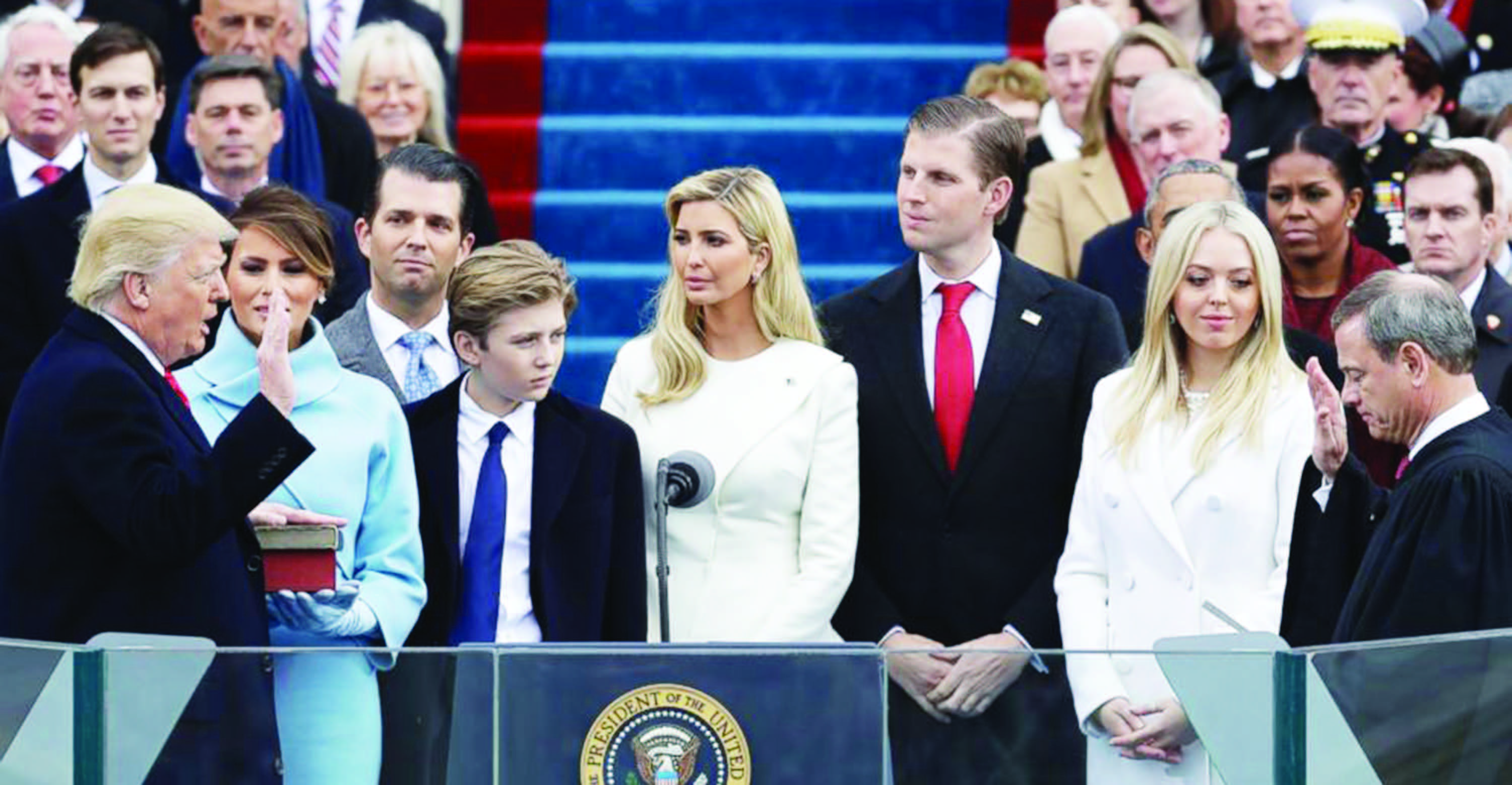
    US President-elect Donald Trump and his wife Melania leave St. John’s Episcopal Church on January 20, 2017, before Trump’s inauguration

    The reason for this is simple: Charismatic leaders labor under impossible expectations of their own creation. As the sociologist Max Weber famously defined it, charisma typically describes a certain “supernatural, superhuman” quality that sets a leader apart from “ordinary men.” Indeed, it is often regarded as being of “divine origin” and is not infrequently supposed to be “resting on magical powers.” If, unlike Julius Caesar’s claim to be a direct descendant of Venus, the president-elect has yet to acknowledge his divinity, he has shown himself to be highly sympathetic to the notion that some people are simply exemplary by nature. In a 2009 conversation with the journalist and critic Deborah Solomon, he expressed confusion about the constitutional premise that all men are created equal. “It’s not true,” he said. “Some people are born very smart, some people are born not so smart. Some people are born very beautiful and some people are not, so you can’t say they’re all created equal.”

    Whatever one makes of this claim, Weber believed that it was a working assumption of those who gravitate to charismatic authority. Their loyalty tended to be characterized by “complete personal devotion,” he said, that is, until the promises of the leaders prove empty, at which point, like a crystal vase in careless hands, the fragile quality of charisma becomes strikingly evident. “If he is for long unsuccessful,” Weber writes, “above all if his leadership fails to benefit his followers, it is likely that his charismatic authority will disappear.” And once it is evaporated, followers have a tendency to be bitter and brutal, for having put their stock in no substantial talents or experience, they are saddled with a figurehead who is a constant reminder of their foolishness.

    This is the danger President Trump faces if he fails to live up to his bluster, and it is one reason why Peter Drucker, the godfather of modern management theory, inveighed against an over-reliance on charisma in business executives. “Every CEO, it seems, has to be made to look like a dashing Confederate cavalry general or a boardroom Elvis Presley,” Drucker wrote in one of his most famous essays. He not only scorned the emphasis on style over substantial accomplishment (the essay is pointedly titled “Leadership as Work”), he believed that powerful personalities became dangerously enchanted with the personas they had lovingly confected. Charisma is ultimately “the undoing of leaders,” he contended. “It makes them inflexible, convinced of their own infallibility, unable to change.”

    The tendencies toward inflexibility and assumed infallibility are occupational hazards of CEOs, which often makes them poorly equipped for the wheedling, cajoling, and occasional arm-twisting of government. Congenitally unapologetic and given to megalomania, Trump has made virtues of these traits, which helps to explain his successful claim to charismatic authority during the campaign season.

    What follows from such commitments as he ascends to the presidency remains to be seen, but as he prepares to become the most powerful person on earth, Trump might recall the slogan most often attributed to another showboating businessman, P. T. Barnum: “There’s a sucker born every minute.” Insofar as the president-elect has embraced the comparison with Barnum, he might bear in mind that the circus comes to town for only a few days at a time before departing, again, in the dead of night. Even if Barnum never said a sucker is born every minute-and history is unclear on this matter-he certainly knew that a sucker was best conned quickly, and that a showman risked his advantage when he stuck around for the moment of reckoning.

    Moments of reckoning mark the beginning and end of things. Last weekend, Ringling Bros. and Barnum & Bailey announced that it was shutting down its tour after a 146-year run. This weekend, a new show begins. The world will soon find out whether a stationary circus can endure for four years straight without the acts becoming tiresome, the customers wanting a refund, and the ringmaster having good reason to look for safe escape.

    (The author is an adjunct assistant professor at the Booth School of Business, and a lecturer at the Harris School of Public Policy, at the University of Chicago. He has written for The New York Times, Harper’s, and The New Republic)

    (Source: The Atlantic)

  • Redefining Leadership ~ Obama makes way for Trump, and shallowness

    Redefining Leadership ~ Obama makes way for Trump, and shallowness

    America is going through, what historian Arthur M Schlesinger Jr. calls “cycles” in American history, when the tide of action, passion, idealism and reform gives way to seasons of drift, quiescence, hedonism, and cynicism. The cheapness and shoddiness of the moment that saw Americans put their money on a salesman like Donald Trump will peter out. The liberal moorings of the traditional Americans and the innovative and exciting energy of the immigrants would see the Trump interregnum off, without permanent damage to the American soul”, says the author.

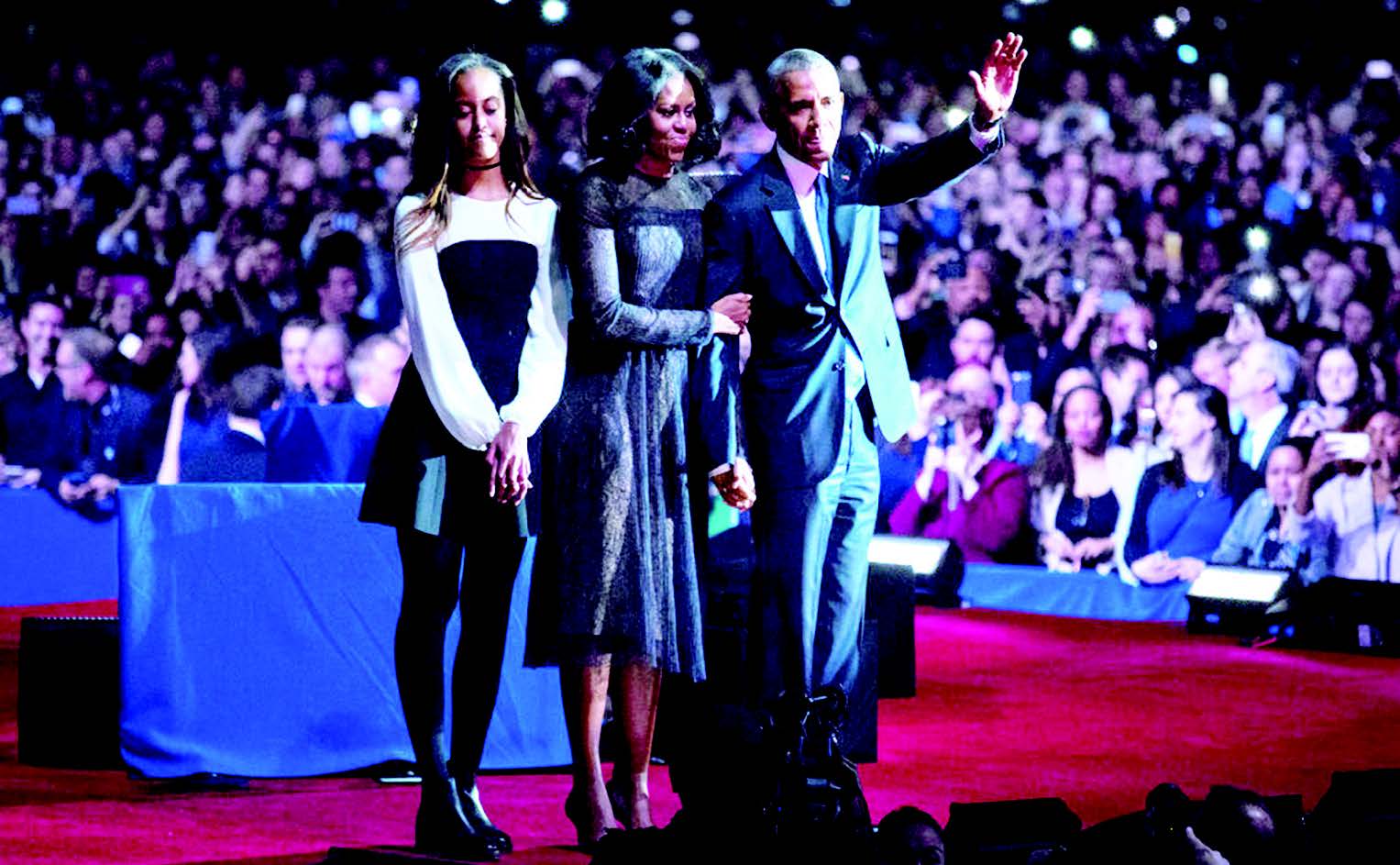
    Barack Obama hasvacated the presidency of the United States, the most powerful and still the most consequential office in the world. As his successor, the Americans have opted for a man who has not held an elective office before nor has any record of public service. Modern day advertisement mechanisms and social media gladiators ensure that the winner is deemed to be endowed with all the virtues of a noble ruler; Donald Trump is already being serenaded as a worthy tribute to the American democracy and its capacity for innovation and inclusion. Inversely, the Democrats’ defeat in the race for the White House is seen – both by the Trump fanatics and the liberals themselves – as a repudiation of Obama’s legacy and his leadership. But a fair question needs to be asked: do we necessarily have to lower our standards by which to judge a leader just because Mr. Trump has managed to swagger his way to the White House?Are democracies increasingly doomed to be saddled with skilled demagogues?

    Every nation constitutes itself into a political community, with its own peculiar history and geography, with its own sense of comfort over distribution of power, wealth and privilege, and with its own set of ideals and principles. Every political community experiences convulsions and conflict when the realities of power do not match the professed ideals. The Americans see themselves as having organized the United States into a unique political community, premised on lofted principles of equality, openness and opportunity. Historically the United States benefited, economically and culturally, from the raw energy and enterprise of the immigrant; and, in the post-World War the American political community redeemed itself as it struggled to redesign its civil rights regime in line with its own protestations of equality for all citizens. Post 9/11, the United States took it upon itself to be the global prosecutor for democracy.

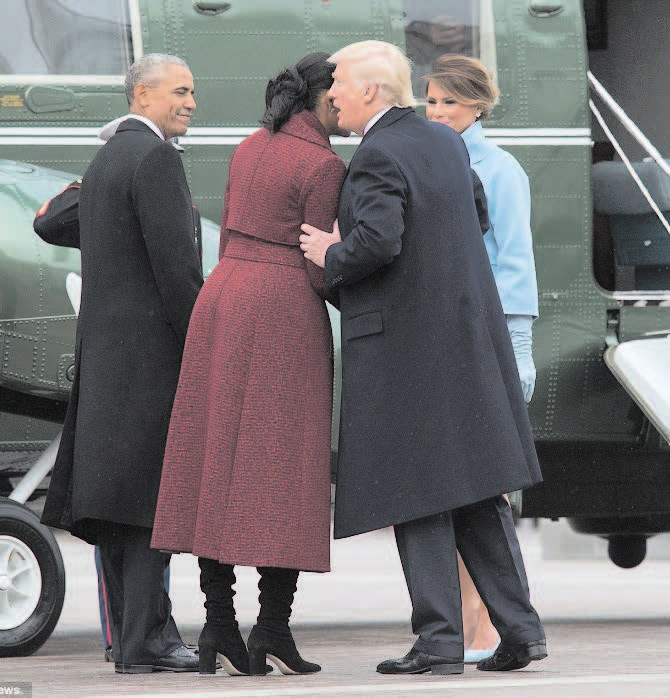
    When Obama won the presidency in 2008, his victory was a triumph of the American ideal. The Americans were finally beginning – or, so it seemed – to come to terms with the logic of their own democratic history. A black man had come to live in the White House. A glorious moment that redeemed the uniqueness of the American experiment. And, it was comforting that Obama had won the presidential race not by inciting racial animosities in the manner of a Malcolm X but by inviting the Americans to be true to their own nobler instincts, by offering intelligent and worthy answers to America’s problems, and by assuring the outside world of a moderate, reasonable American leadership. Ironically enough, he is often chided for being too professorial, too cerebral, and too nuanced to be an “effective” leader.

    Was he a bad leader? Obama’s eight years in the White House turned out, at best, to be a mixed blessing. As a matter of fact, this “mixed blessing” is now perhaps the inevitable verdict on almost every leader in the modern democracy; more so in the American political arrangement where the Executive is institutionally obliged to negotiate power and authority with the Legislature. Effective leadership does not easily or automatically accrue to the President. And, it was sought to be denied to the first black President from the moment he walked into the Oval Office. That, of course, is simply politics.

    Yet the basic question that students of democracy around the world have to ask and answer for themselves is: do we need to redefine the qualities we look for in our leaders? Just because a real-estate mogul can successfully tap into the presumed anger and resentment of the white Americans, does the task of leadership stand redefined? Do leaders have necessarily to be crude and corny, always over-eager to appeal to our ugliest and baser instincts? Ultra-nationalists are on the rampage in Europe and there seems to be inevitability about these rogues. Compassionate competence of an Angela Merkel is sought to be belittled, while demagogues are being heard respectfully. And, depressingly enough, the narrative industry is working overtime to rationalize the rise of Trump and other ultra-right leaders in Europe as a justifiable revolt against the elites and their presumed indifference to the masses’ concern. The so-called elites are deemed to have received their well-deserved karmic comeuppance.

    America is going through, what historian Arthur M Schlesinger Jr. calls “cycles” in American history, when the tide of action, passion, idealism and reform gives way to seasons of drift, quiescence, hedonism, and cynicism. The cheapness and shoddiness of the moment that saw Americans put their money on a salesman like Donald Trump will peter out. The liberal moorings of the traditional Americans and the innovative and exciting energy of the immigrants would see the Trump interregnum off, without permanent damage to the American soul.

    While arguments and slogans are necessarily designed to mobilize a section of the electorate in a partisan way, the task of the political leadership is inherently a noble quest, especially in a democratic format. The political leadership imposes a noble burden on a President or a Prime Minister – the burden of pursuit of national interest, even national glory, in a manner that redeems, rather than diminishes, the citizen. Whenever a leader fails to live up to the spirit of that noble burden, his own fellow-citizens end up paying a price as does the world at large.

    We increasingly like to live un-historically. While it may be fashionably easy to castigate Barack Obama’s inadequacies, it would be worthwhile to ponder what would have been America’s – and, the world’s – fate if he had failed to defeat his Republican rival in 2008. America and the world would have certainly hurtled down to the path of one confrontation after another, instigating instability and disorder on a grand global scale. If nothing else, we should be thankful that Obama could roll back the George Bush-Dick Chenny era’s excesses. At home, on Obama’s watch, the United States became a calmer and easier society, even if a lot of Americans did become angrier and wilder. Trump’s success in no way diminishes Obama’s accomplishments. It would be a terrible historical mistake to read Trump’s arrival as historically inevitable.

    Centuries ago Aristotle had hinted at our present-day dilemma: the man or group of men to govern solely for the best interests of the people at large is rare and hard to be found. Democracy, of course, constitutes the best and fairest mechanism to locate and anoint such honorable rulers. And, precisely for that reason, Trump’s victory cannot be used to lower the bar in democracies around the world.

    (The author is Editor in chief of Tribune group of newspapers)

  • Indian American Congresswoman Pramila Jayapal won’t attend Donald Trump’s Inauguration

    Indian American Congresswoman Pramila Jayapal won’t attend Donald Trump’s Inauguration

    Ms Jayapal said in a statement on Sunday, January15, that she will remain in her Seattle district to “be with constituents who are immigrants and immigrant advocates to hear their stories and concerns, and discuss a plan of action moving forward”, according to a report in the Stranger newspaper.

    “I was being specific about my duty as the Congresswoman for the 7th Congressional District to be right here in this district with constituents who are terrified about whether they’re gonna have a place in this city or country, and to make a plan for how we go forward,” Ms Jayapal told her supporters during a rally at Westlake Park in Washington.

    “I wanted to be with kids who don’t know if their mom is gonna be there when they come home because of this President-elect’s policies,” she said.

    The Democrats are boycotting the inauguration after Trump criticized US Representative and civil rights icon John Lewis, who said he doesn’t see Trump as a “legitimate President”. Ms Jayapal tweeted her support of Lewis on Sunday after Trump shot back that Lewis is “all talk, talk, talk”. “If I had any doubts about my decision, however, my resolve has only strengthened in the past few days as I watched Donald Trump’s response to one of our country’s great civil rights icons and a personal hero of mine, Congressman John Lewis,” Ms Jayapal said.

    “With Donald Trump’s tweet, he himself has inflamed the situation and now two dozen of my colleagues will also not be attending the inauguration. It has become a boycott,” she said.

  • Inauguration of the 45th President of the US in pictures

    Inauguration of the 45th President of the US in pictures

    US President-elect Donald Trump and his wife Melania leave St. John’s Episcopal Church on January 20, 2017, before Trump’s inauguration

    On January 20, 2017, the peaceful transfer of American power took place in Washington, DC, as the 44th President of the United States, Barack Obama passed the office to President-elect Donald J. Trump.

    Hundreds of thousands attended the ceremony, gathering in the National Mall to hear the swearing in and Trump’s inaugural address, while groups of protesters clashed with police in some of Washington’s streets.

    President Trump, Vice President Mike Pence, and their wives then bid farewell to former President Obama and his wife, as the Obamas headed to Air Force One for one last flight.


    Au Revoir. Former President Barack Obama waves as he departs the U.S. Capitol
    Au Revoir. Former President Barack Obama waves as he departs the U.S. Capitol


  • Trump takes oath as 45th President of the United States of America

    Trump takes oath as 45th President of the United States of America

    Says he is restoring power back from Washington to people and “Together we will make America Great again”

     Donald Trump became the 45th president of the United States Friday, January 20, as he was administered oath of office at a ceremony at the Capitol Hill. The oath was administered by the US Supreme Court Chief Justice John Roberts at 12 pm.

    An estimated around 800,000 guests attended the inaugural ceremonies – a number far below the crowd that came out for President Obama’s first inaugural.

    The 70-year-old billionaire was joined by his wife and children.

    Also on hand were three of the four living former presidents George W Bush, Bill Clinton, and Barack Obama, members of the Supreme Court and leaders of Congress. In addition, his Democratic rival in the election, Hillary Clinton was in attendance.

    In his inaugural speech as president Trump thanked outgoing president Obama for ensuring ‘A gracious transition.’ But his speech was almost copied from his many election campaign speeches.

    “January 20, 2017, people of America became the rulers of the country again. This is the transition of power from DC to you – you the people. Now government will be controlled by our people. The world has never seen this before”, said Trump.

    Here is look at the electoral promises that Trump reassured in his first presidential speech:

    Will put our interest first

    Will bring back our jobs

    Will protect our border first

    Rebuild America with American hands and labor

    Will change education system 

    Will make sure that people buy American and hire American

    Will eradicate Islamic terrorism

    Trump concluded his speech by saying “We’ll make America strong again, wealthy again, proud again, safe again, and great again.” Only time will say how he will do that.

    Some Images

    But Trump took over as President without his complete team. Various important offices in State Department and the all important intelligence agencies look for askance.

    The three days of inaugural festivities kicked off Thursday. Trump left his Trump-branded jet in New York and flew to Washington in a government plane, saluting an Air Force officer as he descended the steps with his wife, Melania. He and the incoming vice president, Mike Pence, solemnly laid a wreath at Arlington National Cemetery before joining supporters for an evening concert at the Lincoln Memorial.

    Cheerful Trump supporters flocked to the nation’s capital for the inaugural festivities, some wearing red hats emblazoned with his “Make America Great Again” campaign slogan.

    Trump tweeted Friday morning, “It all begins today! I will see you at 11:00 A.M. for the swearing-in.

    THE MOVEMENT CONTINUES – THE WORK BEGINS!

    On Friday morning, Trump, Vice President-elect Mike Pence and their families attended services at St. John’s Episcopal Church near the White House, a precedent set by Franklin D. Roosevelt and followed by every president since.

    The president-in-waiting then arrived at the White House for tea with President Barack Obama and first lady Michelle Obama. Before welcoming his successor, Obama took a final stroll from the Oval Office through the Rose Garden as a sitting president.

    Donald Trump scored an upset win in 2016 elections. With a clear victory in sight for Hillary Clinton at one point of time, a couple of factors weighed in his favor in the ultimate upset results to give him presidency.

    Trump won the White House on promises: Deporting immigrants, Banning and surveilling Muslims, building a wall at US-Mexico border, bringing back water boarding, making it easier to sue the press.

    Donald Trump, probably takes over as the least popular incumbent to the White House because of his treatment of women, minorities and the disabled during the campaign He takes over control of the most powerful nation of the world with a lot of baggage which is likely to impede his movement forward.

    Americans have never handed their highest office to a businessman with no experience in public service. Trump, the real estate mogul and reality television star is the only president to break away from the tradition of President divesting himself from his business interests. “The law’s totally on my side ? meaning, the president can’t have a conflict of interest,” Trump has said, dismissing warnings from a government ethics watchdog and experts with experience under Republican and Democratic presidents who have charged that his business entanglements will find him in violation of his oath from the very moment he takes it.

    This is a serious issue; some ethics experts point out.

    “There’s an issue about whether the president and his family will use the presidency for self-enrichment,” says Robert Weissman, president of the advocacy group Public Citizen in an interview with NPR. “The most important part of the problem is how these conflicts will affect policy-making. That is an inescapable and pervasive problem. It doesn’t matter whether Donald Trump is operating in good faith. So long as he has these conflicts, he can’t not know what he owns and he also can’t not know how policy decisions will affect his businesses.”

    Trump has indicated he will continue to own his many U.S. and foreign businesses, and has rejected calls to sell them and said that he will hand them over to his sons to manage – which falls well short of addressing the ethical conundrum he faces. “Stepping back from running his positions is meaningless from a conflicts of interest perspective. Nothing short of divestiture will resolve these conflicts,” Walter Shaub, director of the Office of Government Ethics, said earlier this month.

    For full text of Trump’s inauguration speech, click here

    View Trump’s inauguration speech

  • Thousands Attend Women’s March On Washington

    Thousands Attend Women’s March On Washington

    Hundreds of thousands of people protesting Donald Trump’s presidency swarmed events in U.S. cities and around the world in a rebuke to an incoming president unlike any seen in modern times.

    In the nation’s capital, marchers jammed city streets and filled the large swath of parkland between the U.S. Capitol and the White House known as the National Mall.

    Organizers expected 200,000 people, but officials were prepared for at least twice that many – The city’s public transit service, the Washington Metropolitan Area Transit Authority, recorded about 275,000 trips as of 11 a.m. Saturday, more than the 193,000 it recorded by 11 a.m. Friday ahead of Trump’s inauguration speech and parade.

    The huge crowd comes a day after empty space was spotted on the National Mall ahead of Trump’s inauguration speech and bare bleachers were noticeable along the inaugural parade route. Officials estimated about 900,000 people would file into D.C. for Friday’s parade and speech. That’s about half the attendance at former President Obama’s 2009 swearing-in, the largest event in the history of the nation’s capital.

    At a train station blocks from the White House on Saturday, trains filled with participants would stop, but there was no room for passengers. Finally, after three trains went by, a USA TODAY reporter was able to squeeze on.

  • Optimistic Obama: ‘We’re going to be OK’

    Optimistic Obama: ‘We’re going to be OK’

    WASHINGTON (TIP): In his parting message before Donald Trump took over, President Barack Obama assured Americans that “we’re going to be OK” but vowed to protect US’ “core values” and speak up against issues like discrimination, muzzling of press freedom and rounding up of young immigrants.

    “At my core, I think we’re going to be OK,” Obama said as he concluded his final news conference at the White House. “We just have to fight for it, work for it, and not take it for granted,” he said.

    Obama said he has given his best advice to his successor Trump to whom he passed on the baton January 20. “I have offered my best advice, counsel about certain issues both foreign and domestic,” Obama said, describing his conversations with the President-elect.

    “And my working assumption is, is that having won an election opposed to a number of my initiatives and certain aspects of my vision for where the country needs to go, it is appropriate for him to go forward with his vision and his values. I don’t expect that there’s going to be enormous overlap,” he said.

    He said now his priorities would be to do some writing, spend some time with his two daughters and Michelle. “I want to do some writing, I want to be quiet a little bit and not hear myself talk so darn much. I want to spend precious time with my girls,” he said.

    However, he said any effort to enforce systematic discrimination, erode voting rights, muzzle the press or round up young immigrants, would cause him to speak out.

    During the campaign, Trump vowed to ban Muslims from entering the United States and deport millions of illegal immigrants.

    After Trump’s victory in the November 8 presidential elections, Obama has met his successor only once, but the two leaders have spoken over phone quite frequently with the last one being reported to be on Monday.

    Obama said it may be that on certain issues, once Trump comes into office and he looks at the complexities of how to, in fact, provide healthcare for everybody-something he says he wants to do or wants to make sure that he is encouraging job creation and wage growth in this country, “that may lead him to some of the same conclusions that he arrived at once I got here”.

    Asked for a commenton his relations with his successor, Obama said: “I won’t go into details of my conversations with President-elect Trump. They are cordial. At times, they’ve been lengthy and they’ve been substantive. I can’t tell you how convincing I’ve been. I think you’d had to ask him whether I’ve been convincing or not,” he said when asked about the details of his conversations.”

  • President Trump begins his work

    President Trump begins his work

    WASHINGTON (TIP): Immediately after taking oath, January 20, President Donald J Trump issued an executive order to minimize the Economic Burden of The Patient Protection (Obamacare) and Affordable Care Act, Pending Repeal.

    By another order, he granted a waiver to General James Mattis, his nominee for Secretary of Defense, clearing his way to assume the office.

  • Farewell, President Obama: A passionate reminder of US liberal values

    Farewell, President Obama: A passionate reminder of US liberal values

    Soaring oratory and strong emotions marked the farewell speech of the 45th US President, Barack Obama, 10 days before his successor is sworn in. The tradition dates back to President George Washington, reflecting the concerns of the outgoing leaders. President Obama, speaking in his hometown Chicago, strongly batted for his legacy, when he said: “By almost every measure, America is a better, stronger place” than when he was elected the first black President of the US in 2008. Expectedly, he listed out his achievements, domestic – tackling recession, revitalizing the automobile industry, creating new jobs – and international – establishing diplomatic relations with Cuba and the Iran nuclear deal.

    What also came through in this elegant address was his worry about the state of the country after a toxic election. “Democracy is threatened whenever we take it for granted,” said the US President even as he regretted that “race remains a potent and often divisive force in our society.” Much is wrong with politics in America, from low turnouts to naked partisanship. “I reject discrimination against Muslim Americans,” he said, underlining the need to combat religious discrimination.

    President Obama has reminded the world of liberal values, multiculturalism and economic inclusiveness at a time when narrow-minded nationalism seeks to reverse the gains of the past several decades. He leaves office with a reputation of being an honorable and decent man, untarnished by personal scandals. In many ways he represented an aspirational vision of America, but one that was disconnected from the wide underbelly of the voting public that was successfully tapped by his successor. Obama created history with his election, he made history while in office, and going by what he said at his farewell speech, he may not be ready to become history just yet. He remains a powerful voice that we need to hear.

    (Tribune, India)

  • Indian-American in Texas seeks re-election to US city Council seat

    Indian-American in Texas seeks re-election to US city Council seat

    SUGAR LAND, TX (TIP): Harish Jajoo, a licensed professional engineer and small business owner, has served on the city council since 2011.An Indian-American engineer is seeking re-election for the post of the mayor of a city in Texas that has 35 per cent Asian population. Harish Jajoo, a City Councilman in Texas, lost out in his quest to become the mayor of Sugar Land city to Joe Zimmerman last year, pledged to the city’s residents to remain an independent voice for the Indian Americans there.

    “I have lived in Sugar Land for 32 years. It is where I raised my family, built my life and came to admire its people and to value their friendship,” Jajoo was quoted as saying by the Fort Bend Star newspaper.

    “As a member of city council, I have always worked to be a clear voice for conservative principles and fiscal responsibility,” he added.

    “My single goal for Sugar Land has been to see that progress and tradition receive equal attention as we build our city together,” Jajoo said. “Our community’s values are my values and as Texans we all know that family and community come first in our lives. That has been my guiding principle on council.”

    Jajoo, a licensed professional engineer and small business owner, has served on the city council since 2011.

    Founded as a sugar plantation in the mid 1800s and incorporated in 1959, Sugar Land is located in Fort Bend county, some 30 kilometers southwest of Houston.

    The county’s Asian population has grown more quickly than any other group, according to a 2013 report by Stephen Klineberg, sociology professor at Rice University and his colleague Jie Wu.

  • President Obama delivers Nostalgic and Hopeful Farewell Address in Chicago

    President Obama delivers Nostalgic and Hopeful Farewell Address in Chicago

    An emotional President Barack Obama with the First Lady Michelle Obama and their daughter Malia Obama at his farewell address to the nation from McCormick Place in Chicago, January 10, Obama dwelt on the challenges before America’s democracy and sought to give a message of hope to American. “Let’s be vigilant. But not afraid”, he said.

    CHICAGO (TIP): President Barack Obama became nostalgic while delivering his Farewell Address in Chicago on January 10, 2017. Joined by first lady Michelle Obama, daughter Malia, and Vice President Joe Biden, the president credited Chicago for playing a crucial role in his life. “I first came to Chicago when I was in my early 20s, still trying to figure out who I was; still searching for a purpose to my life’, said Obama. “. It was on these streets where I witnessed the power of faith, and the quiet dignity of working people in the face of struggle and loss. This is where I learned that change only happens when ordinary people get involved, get engaged, and come together to demand it.”

    Noting the increasing partisanship that marked his tenure as president, Obama warned another threat to democracy was the trend of people becoming “so secure in our bubbles that we start accepting only information, whether true or not, that fits our opinions instead of basing our opinions on the evidence is out there.”

    Obama mentioned the incoming president only once by name. “I committed to President-elect Trump that my administration would ensure the smoothest possible transition, just as President Bush did for me. Because it’s up to all of us to make sure our government can help us meet the many challenges we still face.”

    President Obama delivered his Farewell Address in Chicago on January 10, 2017. Watch it here:

    Here is an unedited transcript of President Obama’s remarks, as provided by the White House.