Tag: United States Politics


  POLITICS & POLICY  

  • Donald Trump’s investments in India could raise conflicts, If Elected US President: Report

    Donald Trump’s investments in India could raise conflicts, If Elected US President: Report

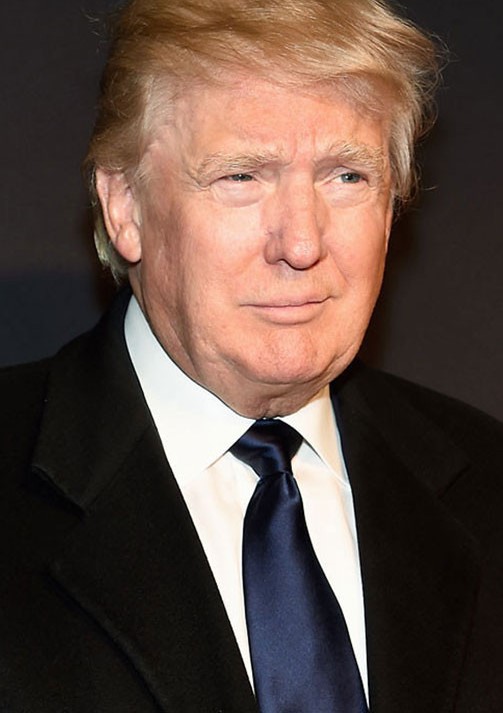
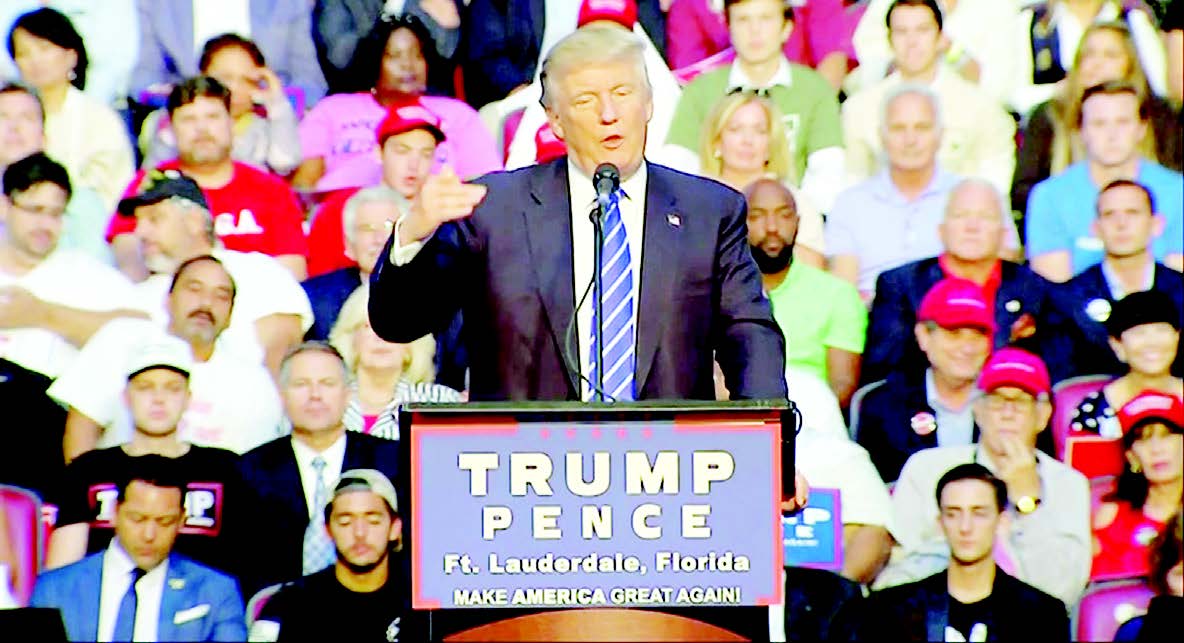
    Republican presidential candidate Donald Trump’s real estate investments in Indian cities including Pune and Gurgaon may impact US foreign policy in case he becomes the next President of the United States, according to a report in ‘Newsweek’.

    Giving details of Donald Trump’s overseas investments, the report says that the Trump organization had declared its plans for a massive expansion in India when the Republican National Convention was about to get underway in July this year.

    The report terms it a chilling example of the many looming conflicts of interest in a Trump presidency.

    “If he plays tough with India, will the government assume it has to clear the way for projects in that ‘aggressive pipeline’ and kill the investigations involving Trump’s Pune partners?

    “And if Trump takes a hard line with Pakistan, will it be for America’s strategic interests or to appease Indian government officials who might jeopardize his profits from Trump Towers Pune?” the weekly asked.

    According to the weekly, several Indian political leaders and major political parties have established close relationship with the Trump family as a result of its real estate investments in Pune and Gurgaon.

    In India, the conflicts between the interests of the Trump Organization and American foreign policy are starker, Newsweek said.

    Trump signed an agreement in 2011 with an Indian property developer that wanted to construct a 65-story building with his name on it.

    Leading the talks was a director of the company who would later become the exclusive representative of Trump’s businesses in India, the weekly said.

    However, government regulatory hurdles soon impeded the project, the cover story said, adding that Donald Trump Jr. flew to India to plead with authorities asking them to remove the hurdles.

    But state authorities in Maharashtra refused to make an exception for the Trump Organization, the report said.

    “It would be extremely difficult for a foreign politician to make that call if he were speaking to the son of the President of the United States,” Newsweek said.

    “Last month, scandal erupted over the development, called Trump Towers Pune, after the state government and local police started looking into discrepancies in the land records suggesting that the land on which the building was constructed may not have been legally obtained,” the weekly said.

  • Clinton reclaims National Lead as Voters continue to get divided by race, sex and education

    Clinton reclaims National Lead as Voters continue to get divided by race, sex and education

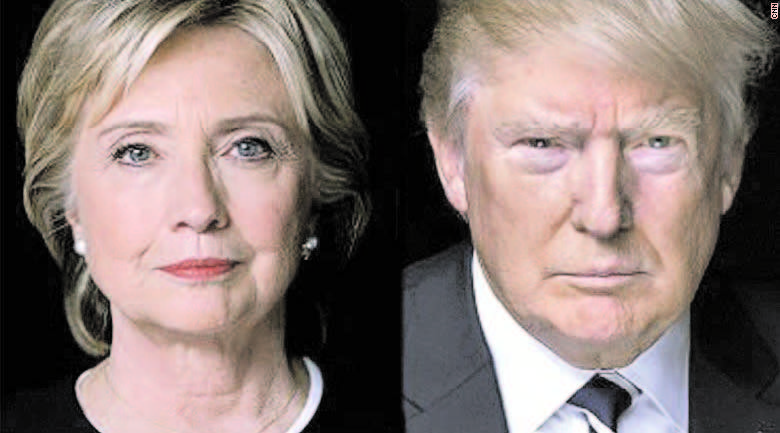
    WASHINGTON (TIP): With 52 days left to the big day, Hillary Clinton leads Donald Trump by five points in a head-to-head matchup in the latest national poll of likely voters from Quinnipiac University released Wednesday, Sep 14, but the margin has been chopped in half since the last time the poll was released in August.

    Clinton was ahead of Trump 48%-43% in a head-to-head matchup with likely voters nationally on Sep 14. (In a survey released in late August, Clinton had 51% and Trump was at 41%.) Regardless of whom they are supporting, majority of the voters were supporting their candidate because of the opponent rather than liking their choice.

    More than half-54 percent of Clinton supporters said opposing Trump was their main reason for backing the Democratic nominee. Approximately two-thirds of likely Trump voters-66 percent-said their main reason for supporting him is because they opposed Clinton.

    The latest results come as other state and national polls show similarly tightening margins between both major candidates, who have traded words in recent days over concerns about transparency and health.

    The Quinnipiac poll began last Thursday, Sep 8, a day after the Commander in Chief Forum, and remained active in the field until Tuesday, Sep 13, after days of public attention on Clinton’s health following her early departure from a 9/11 memorial on Sunday and subsequent revelation that she had been diagnosed with pneumonia.

    When third-party candidates were included in poll, Clinton and Trump were separated by just 2 points, which is within the margin of error.

    CLINTON HAD 41%, TRUMP HAD 39%, LIBERTARIAN PARTY CANDIDATE GARY JOHNSON HAD 13%, AND THE GREEN PARTY’S JILL STEIN CAME IN AT 4%.

    Trump led with white voters by 10 points (51%-41%), while Clinton was ahead with non-white voters 66%-19%.

    Trump led with men 50%-41%, while Clinton led with female voters 54%-36%.

    TRUMP LEADS CLINTON IN NEW OHIO, NEVADA, FLORIDA POLLS

    The Republican nominee is enjoying a 5-point lead in Ohio in a new Bloomberg Politics poll. In a head-to-head matchup between Clinton and Trump, he led 48%-43%.

    The margin remained the same when third-party candidates were added. Trump had 44%, Clinton had 39%, Libertarian Gary Johnson had 10% and Green Party candidate Jill Stein had 3%.

    The Bloomberg Politics poll was taken over some of Clinton’s most difficult days of the cycle.

    She said “half” of Trump’s supporters were “deplorable” Friday night, and on Sunday she wobbled as she left a 9/11 memorial, while recovering from previously undisclosed pneumonia.

    Trump’s lead in Ohio is consistent with a CNN/ORC poll of likely voters released Wednesday which had him at 46%, Clinton at 41%. Johnson had 8% support and Stein had 2%.

    Trump was also ahead in Florida in the CNN/ORC poll – though the 3-point difference fell within the margin of error. Trump had 47%and Clinton had 44%. Johnson had 6% and Stein had 1%.

    And in Nevada, Trump had a 2-point lead over Clinton – also within the margin of error – in a new Monmouth University poll released Wednesday.

    Trump had the support of 44% of likely voters in Nevada, while Clinton had 42%. Johnson had the backing of 8%; Stein was not included.

  • Obama talks about American Values on 9/11 anniversary

    Obama talks about American Values on 9/11 anniversary

    WASHINGTON: On the 15th anniversary of the 9/11 attacks, US President Barack Obama paid tribute to the victims of 9/11 at the Pentagon in Washington. He called on Americans to protect the ideals that made their country the diverse nation that it is, and said America would never give in to fear.

    “Our diversity, our patchwork heritage, is not a weakness. It is still and always will be one of our greatest strengths,” Obama said at a remembrance service at the Pentagon, one of the sites attacked on 9/11.

    “This is the America that was attacked that September morning. This is the America that we must remain true to.”

    President Barack Obama urged Americans to remain united in the face of terrorist attacks, in a barely-veiled jab at Republican White House nominee Donald Trump 15 years after 9/11.

    “In the face of terrorism, how we respond matters,” Obama said in his weekly radio and online address, delivered on the eve of the 15th anniversary of the September 11 terror attacks in the United States.

    “We cannot give in to those who would divide us. We cannot react in ways that erode the fabric of our society,” he added.

    “Because it’s our diversity, our welcoming of all talent, our treating of everybody fairly no matter their race, gender, ethnicity, or faith, that’s part of what makes our country great. It’s what makes us resilient,” Obama said.

    “And if we stay true to those values, we’ll uphold the legacy of those we?ve lost, and keep our nation strong and free.”

    On several occasions Obama has denounced Trump’s bombastic rhetoric towards Muslims.

    Following the December shooting rampage in San Bernardino, California for example, Trump called for a temporary ban on the entry to the United States of all Muslims.

    Obama was speaking two months before the presidential election in which real estate magnate Trump will face Democrat Hillary Clinton.

    The al-Qaida hijackings of September 11, 2001 – the first foreign attack on the US mainland in nearly two centuries – ruptured a sense of safety and plunged the West into wars still being fought today.

    More than 2,750 people were killed when two passenger jets destroyed the Twin Towers, the symbol of New York’s financial wealth and confidence. Another jet slammed into the Pentagon, and a fourth jet crashed in a field in Pennsylvania after those on board tried to overpower the hijackers.

    Evoking “one of the darkest (days) in our nation’s history,” Obama noted that much had changed over the past 15 years since the attacks.

    “We delivered justice to (al-Qaida leader) Osama bin Laden. We’ve strengthened our homeland security. We’ve prevented attacks. We’ve saved lives,” Obama said.

    But at the same time, he said, referring to attacks in Boston, San Bernardino, and Orlando, Florida, “the terrorist threat has evolved.”

    “So in Afghanistan, Iraq, Syria and beyond, we’ll stay relentless against terrorists like al-Qaida and [the Islamic State group] ISIS.

    “We will destroy them. And we’ll keep doing everything in our power to protect our homeland,” Obama said.

    Here are ten key points from his speech:

    1. 3,000 beautiful lives

    We will never forget the nearly 3,000 beautiful lives taken from us so cruelly. We honour the courage of those who put themselves in harm’s way to save people we never new.

    2. Families lost a piece of their heart

    15 years may seem like a long time, but for the families that lost a piece of their heart, I understand that it can seem like yesterday.

    3. 9/11 survivors and their kin an inspiration

    The survivors and families of 9/11—your steadfast love and faithfulness has been an inspiration to me and for our entire country.

    4. Justice delivered to Osama bin Laden

    Thanks to our security forces, we gave an appropriate response to al-Qaida. We have dealt devastating blows to al-Qaida. We delivered justice to Osama Bin Laden.

    5. Protecting America

    We resolve to continue doing everything in our power to protect this country that we love.

    6. Defending ideals

    We stay true to the spirit of this day by defending not just our country, but our ideals.

    7. Hateful ideologies leading to violence

    Fifteen years into this fight, the threat has evolved. With our stronger defenses, terrorists often attempt attacks on a smaller but still deadly scale. Hateful ideologies urge people in their own country to commit unspeakable violence. We’ve mourned the loss of innocents from Boston to San Bernandino to Orlando.

    8. Al-Qaida and ISIS can’t defeat us, so they try to stoke fear

    Groups like al-Qaida, like ISIS, know that they will never be able to defeat a nation as great and strong as America. So, instead they try to terrorize, in the hope that they can stoke enough fear that we turn on each other, that we change who we are, how we live.

    9. Our diversity is a strength

    And that’s why it is so important today that we re-affirm our character as a nation: a people drawn from every corner of the world, every colour, every religion, every background – bound by a creed as old a our founders – E Pluribus Unum. Out of many we are one. We know that our diversity, our patchwork heritage, is not a weakness. It is still and always will be one of our greatest strengths. This is the America that was attacked that September morning. This is the America we must stay true to.

    10. An enduring memorial

    The most enduring memorial to those we lost is ensuring the America we continue to be.

  • NY State Comptroller DiNapoli Releases Lower Manhattan Economic Snapshot

    NY State Comptroller DiNapoli Releases Lower Manhattan Economic Snapshot

    NEW YORK (TIP): The terror attacks on September 11, 2001 killed 2,753 people in Lower Manhattan, leaving the nation devastated and Lower Manhattan struggling to rebuild. Fifteen years later, Lower Manhattan continues to recover as it evolves into a neighborhood that is increasingly residential, young and family-oriented and supports an influx of tourism and shopping, according to an economic snapshot released September 6 by New York State Comptroller Thomas P. DiNapoli.

    The neighborhood’s growth shows no sign of slowing as it continues to add new residential units, office space and more than 2 million square feet of new or redeveloped retail space that will be completed by 2019, according to the Downtown Alliance. The report is part of a series by DiNapoli examining economic issues across the five boroughs.

    “It would have been impossible, in the midst of the unspeakable tragedy suffered 15 years ago, to imagine Lower Manhattan as we know it today,” DiNapoli said. “The terror attacks forged determined partnerships – between the local community, government, and the private and not-for-profit sectors – that made Lower Manhattan’s renaissance possible. The downtown Manhattan area enjoys a diversified employment base and strong annual job growth. Lower Manhattan is doing more than rebuilding, it is transforming and moving forward with resilience and hope.”

    “We’ve witnessed a remarkable transformation of Lower Manhattan over the past 15 years,” said Jessica Lappin, President of the Alliance for Downtown New York. “In the wake of one of the country’s most tragic events, the neighborhood has rallied to rebuild itself as one of the most desirable places in the city to live, work and visit. We’ve seen the migration of creative businesses, tech startups and some of the world’s most innovative media companies alongside the addition of new restaurants, stores and schools. Top that off with the completion of one of the most connected transportation hubs in the world, and it’s no mystery why Lower Manhattan is proudly drawing more people than ever to spend their time here.”


  • Young Politico of Queens arrested for faking donations to campaign fund

    Young Politico of Queens arrested for faking donations to campaign fund

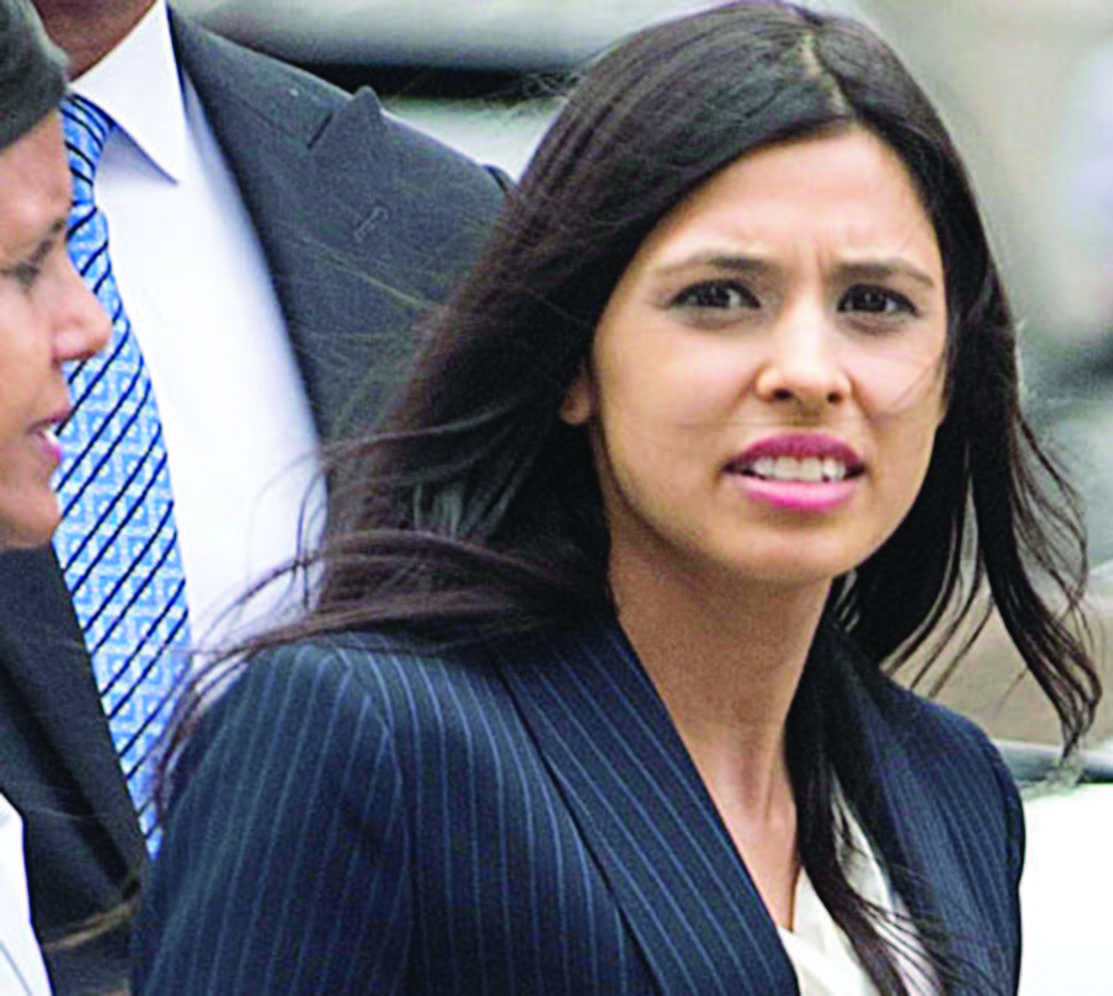
    QUEENS, NY (TIP): A young Queens politico who ran for City Council in 2015 was arrested Tuesday, September 6 for faking donations to get 6-for-1 matching taxpayer funds for her losing campaign, authorities said.

    A news report published in New York Post says that Celia Dosamantes, 25, allegedly forged 32 contribution cards totaling $3,255, then filed the documents with the Campaign Finance Board in an attempt to get matching funds of nearly $19,530 from the city, officials said.

    CFB allegedly caught Dosamantes red-handed during a compliance visit last summer, according to assistant district attorney Nicholas Leddy.

    “Forged contribution cards were recovered from a folder defendant attempted to conceal in her lap,” the prosecutor said in Manhattan Supreme Court as Dosamantes sat at the defense table in a pin-striped navy pant suit, her hands cuffed behind her back.

    The SUNY grad filed two disclosure statements with the CFB in August 2015, court papers show.

    “These fillings included dozens of forged documents that purported to show contributions to her campaign that were never, in fact, made,” Leddy said. “The forged contribution cards appear to have been digitally altered from legitimate contribution cards.”

    She’s also charged with submitting a copy of a digitally altered check, officials said.

    “All of the donors who appear on the contribution cards and the check at issue in this indictment confirmed that they did not make the donations reflected in those documents,” Leddy said.

    She faces 1 ¹/? to 4 years in prison on 35 counts of offering a false instrument and attempted grand larceny.

    Justice Michael Sonberg set bail at $15,000, which was promptly posted by bondsman Ira Judelson. Dosamantes previously worked as an aide to Assemblyman David Weprin (D-Queens), who was surprised to hear of her arrest.

    “She was a good worker, I had no problem with her,” said Weprin. “You never want to hear something like this.”

    Defense lawyer Joseph Corozzo said, “We deny any allegations of criminality in this matter and feel that the evidence will vindicate Miss Dosamantes.”

    Celia’s arrest has upset many politicians who are believed to be under investigation for similar offences.

  • Stop boring us, Mr. Trump

    Stop boring us, Mr. Trump

    As the sole surviving super power, the United States demands the attention of the world. And every four years it enacts a long-running circus that often entertains the universe by its weirdness, if nothing else. But the most recent extravaganza is beginning to pall because it has become plainly boring.

    Everyone knows that the contest is between Donald Trump, the billionaire realty mogul and one-time beauty pageant impresario, and Hillary Clinton, one-time First Lady, a senator from New York and Secretary of State. Trump has abundantly proved that he is a loudmouth who delights in insulting women, Muslims, Mexicans and anyone else he hates on a particular day on his way to winning his Republican Party nomination in the primaries.

    For her part, Hillary was no shoo-in for the Democratic Party’s nomination, with Bernie Sanders with his Left platform giving her a tough fight till the very end. Given the tantalizing prospect of becoming the first woman president of her country, Clinton has met with apathy, if not worse, from many women voters.

    In fact, the contest has become one between two unpopular candidates for very different reasons. Trump the showman has got thus far by treading on everyone’s toes and living to fight another day. Hillary is saddled with the sea of emails she unwisely sent on a private server while secretary of state. Trump has a legion of enemies for good reasons but Hillary has many detractors because she has a trust deficit.

    Expectedly, American newspapers and television stations and websites are giving the presidential contest acres of space and time. But why should the world be subjected to a repetitive circus that seems to have a predictable end? Every event or happening in the US is not of great import to the rest of the world unless Trump emerges as the unlikely winner with his outlandish ideas on foreign policy. Former establishment figures are reduced to writing open letters dissociating themselves from his foreign policy adventures.

    How then can the world insulate itself from a predictable tale of human folly?The French, with their nuanced view of history and social life, have made a feast of Trump’s foibles (read Le Monde Diplomatique). Others have sought to laugh off such Trumpisms as referring to a woman’s menstrual cycle or the size of his own manliness. Yet others have bemoaned the depth of depravity in American public discourse.

    Looking at it, the American political contest does not present a pretty picture. Some rough jokes and backslapping and backstabbing one can take in one’s stride but misogyny is not funny nor a taunting description of a woman’s body functions. Nothing, it seems, is out of bounds for Trump.

  • DONALD TRUMP LEADS IN LATEST POLLS

    DONALD TRUMP LEADS IN LATEST POLLS

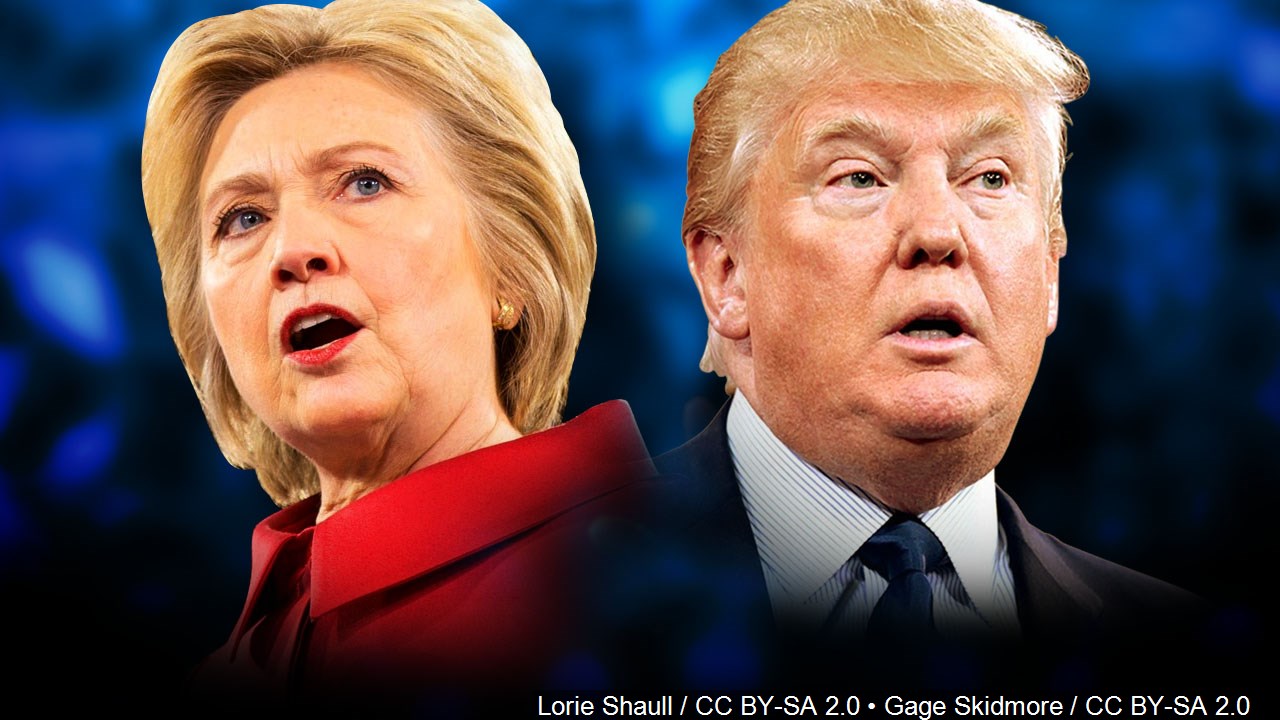
    NEW YORK (TIP): In 60 days we will vote for our next President. And, the new CNN/ORC poll suggests an extremely close contest contrary to what political pundits had speculated a year ago.

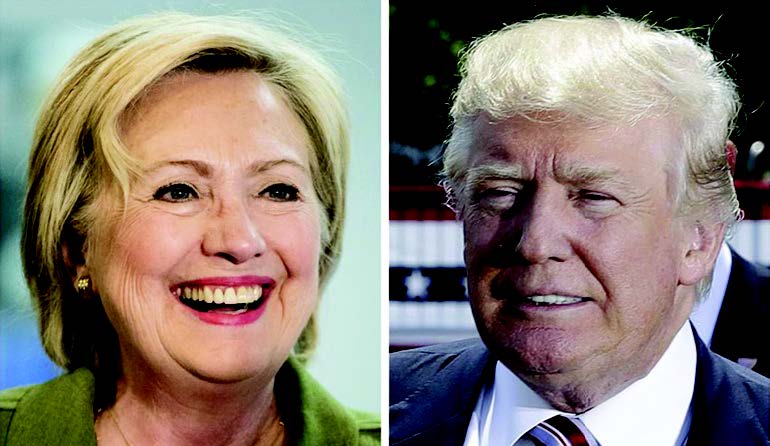
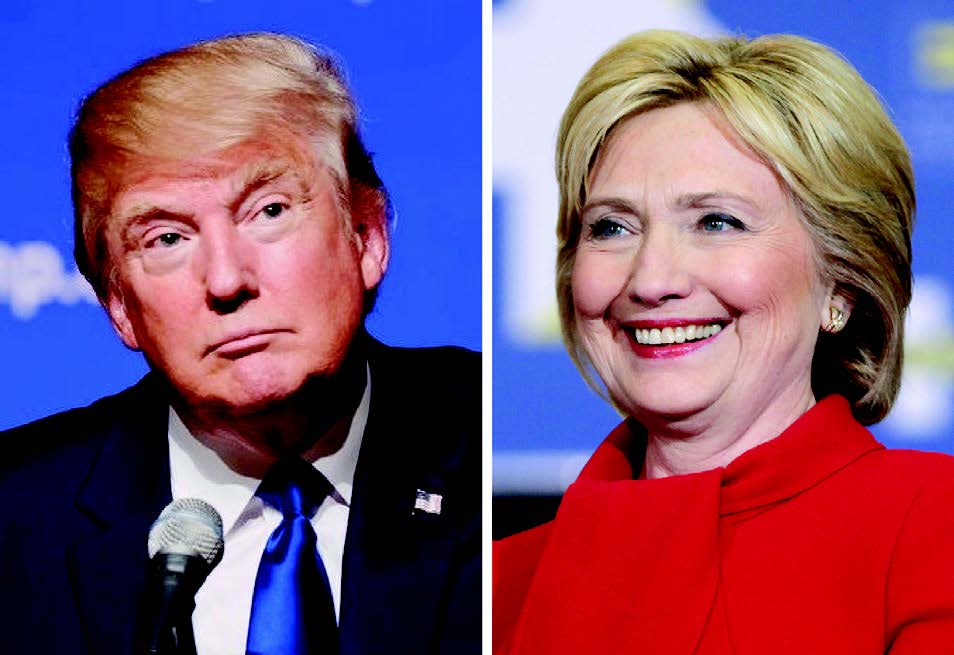
    trump-clintonSince this is a CNN poll, it cannot be easily dismissed by Clinton campaign as a right-wing media outlet-finds that Clinton’s lead over GOP nominee Donald Trump has evaporated.

    Trump tops Clinton 45% to 43% in the new survey, with Libertarian Gary Johnson standing at 7% among likely voters in this poll and the Green Party’s Jill Stein at just 2%.

    Just a couple weeks ago, Clinton’s convention propelled her to an 8-point lead among registered voters in an early-August CNN/ORC Poll. And now, Clinton’s lead has largely evaporated despite a challenging month for Trump, which saw an overhaul of his campaign staff, announcements of support for Clinton from several high-profile Republicans and criticism of his campaign strategy.

    But most voters say they still expect to see Clinton prevail in November, and 59% think she will be the one to get to 270 electoral votes vs. 34% who think Trump has the better shot at winning.

    Wit is worth noting here that Clinton and her allies have outspent Trump and his allies by an eye-popping 4.5-to-1 margin in August as reported by the Observer.

    The Analysis

    Women break for Clinton (53% to 38%) while men shift Trump’s way (54% to 32%). Among women, those who are unmarried make up the core of her support, 73% of unmarried women back Clinton compared with just 36% of married women. Among men, no such marriage gap emerges, as both unmarried and married men favor Trump.

    Younger voters are in Clinton’s corner (54% to 29%among those under age 45) while the older ones are more apt to back Trump (54% to 39% among those age 45 or older).

    Whites mostly support Trump (55% to 34%), while non-whites favor Clinton by a nearly 4-to-1 margin (71% to 18%).

    Most college grads back Clinton while those without degrees mostly support Trump, and that divide deepens among white voters.

    Whites who do not hold college degrees support Trump by an almost 3-to-1 margin (68% to 24%) while whites who do have college degrees split 49% for Clinton to 36% for Trump and 11% for Johnson.

    “I really pay no attention to polls. When they are good for me — and there have been a lot of them that have been good for me recently — I don’t pay attention,” Clinton said. “When they are not so good, I don’t pay attention. We are on a course that we are sticking with.”

    Among the broader pool of registered voters, Clinton edges Trump by 3 points. The shift among these voters since the convention is largely due to a rebound in Trump’s numbers rather than a slide in Clinton’s. He’s gone from 37% support then to 41% among registered voters now.

    Trump holds an edge over Clinton as more trusted to handle two of voters’ top four issues — the economy (56%trust Trump vs. 41% Clinton) and terrorism (51% Trump to 45% Clinton). Clinton holds a solid edge on foreign policy (56% trust her to Trump’s 40%), and the public is divided over the fourth issue in the bunch, immigration. On that, 49% favor Clinton’s approach, 47% Trump’s. At Trump’s recent campaign appearances, he has argued that he would do more to improve life for racial and ethnic minorities, but voters seem to disagree, 58% say Clinton is better on that score vs. 36% who choose Trump, and among non-whites, 86% choose Clinton to just 12% who think Trump would better improve their lives.

    Trump has his largest edge of the campaign as the more honest and trustworthy of the two major candidates (50%say he is more honest and trustworthy vs. just 35%choosing Clinton) and as the stronger leader, 50% to 42%. Clinton continues to be seen as holding the better temperament to serve effectively as president (56% to 36%) and better able to handle the responsibilities of commander in chief (50% to 45%).

    Read the complete poll results @

    http://www.documentcloud.org/documents/3098806-Post-Labor-Day.html

  • Aleppo Confounds Libertarian Presidential Candidate Johnson: ‘What’s Aleppo?’

    Aleppo Confounds Libertarian Presidential Candidate Johnson: ‘What’s Aleppo?’

    NEW YORK (TIP): If it was greater attention Libertarian presidential candidate Gary Johnson wanted, he got it but probably not the kind he wanted.

    As part of a media blitz in New York to try to raise his polling numbers enough to qualify for the upcoming presidential debate, Johnson fielded a range of questions Thursday, September 8 with the aim of demonstrating he can take on Hillary Clinton and Donald Trump. But one very pressing question stumped him.

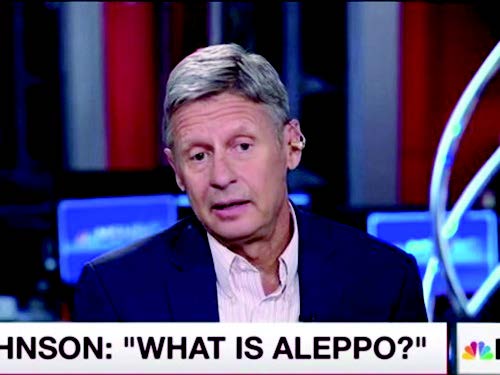
    “What would you do, if you were elected, about Aleppo?”  Johnson was asked by Barnicle on MSNBC’s “Morning Joe” Thursday, September 8 referring to Syria’s largest city, which has been engulfed by the country’s ongoing civil war.

    Johnson said: “About…?”

    “Aleppo,” Barnicle repeated.

    “And,” Johnson asked, “what is Aleppo?” Barnicle, in seeming disbelief, said: “You’re kidding.”

    “No,” Johnson said.

    “Aleppo is in Syria,” Barnicle explained. “It’s the epicenter of the refugee crisis.”

    “OK, got it, got it,” Johnson interrupted.

    “Well, with regard to Syria, I do think that it’s a mess and that the only way that we deal with Syria is to join hands with Russia to diplomatically bring that at an end.”

    Later, Johnson was asked by Bloomberg’s Mark Halperin how he felt about the interview.

    “I’m incredibly frustrated with myself,” he said.

    When pressed whether Johnson felt it should be considered a “big flap,” the former New Mexico governor replied: “Well sure, it should. Absolutely.”

    Following the interview, Johnson attempted some damage control, releasing a statement that said he “blanked” when asked about Aleppo.

    “This morning, I began my day by setting aside any doubt that I’m human. Yes, I understand the dynamics of the Syrian conflict — I talk about them every day. But hit with ‘What about Aleppo?’, I immediately was thinking about an acronym, not the Syrian conflict,” Johnson wrote. “I blanked. It happens, and it will happen again during the course of this campaign.”

    “Can I name every city in Syria? No,” he continued. “Should I have identified Aleppo?Yes. Do I understand its significance? Yes.”

    Johnson went on to say that while he served as New Mexico’s governor, “there were many things I didn’t know off the top of my head.”

    But, he said, “I succeeded by surrounding myself with the right people, getting to the bottom of important issues, and making principled decisions. It worked. That is what a President must do.”

    Syria’s 2011 pro-democracy uprising, which gradually devolved into civil war, has sparked a refugee crisis across the Middle East and Europe as millions fled their homes for safety. When reminded by MSNBC on Thursday, Mr. Johnson said he’d work with Russia to find a diplomatic solution to the civil war and that the conflict was an example of the dangers of meddling in the region.

    Mr. Johnson’s blunder has sparked widespread mockery, with #WhatisAleppo becoming a trending hashtag on Twitter, and Hillary Clinton chuckling at a press conference when asked about Johnson’s flub. “You can find Aleppo on a map,” she said.

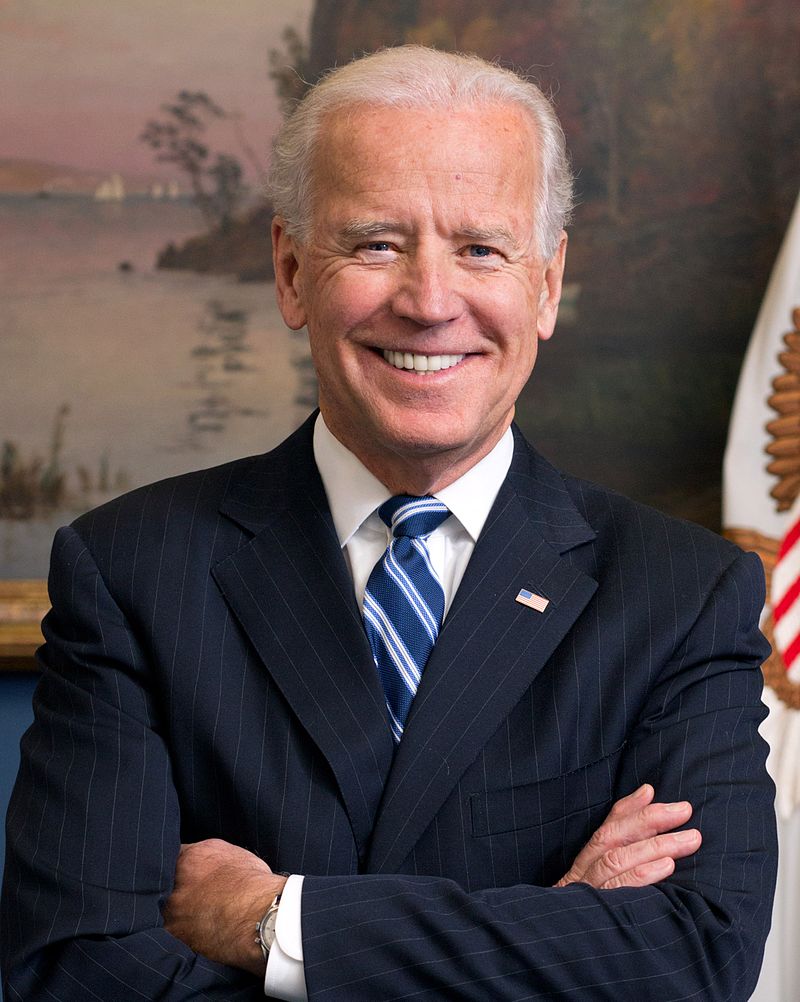
  • US cant elect a man who belittles allies: Biden

    US cant elect a man who belittles allies: Biden

    Hinting at Republican presidential nominee Donald Trump, US Vice President Joe Biden has said that Americans cant elect a man who belittles closest allies and embraces Russian President Vladimir Putin.

    “We cant elect a man who belittles our closest allies and embraces Vladimir Putin. A man who seeks to sow division among our allies for his own gain. And disorder around the world,” Biden said addressing the Pittsburgh Labor Day Parade along with Senator Tim Kaine, the vice presidential running mate of Hillary Clinton.

    Biden endorsed Clinton as next occupant of the White House.

    “Its time we get out of our own way and get Trump out of the way and elect this guy and Hillary Clinton, president and vice president of the United States of America,” Biden said.

    “Folks, we cant let it happen. Let me tell you what I literally tell every world leader. And I want you guys to be reminded of it. Its never, never, never, ever been a good bet to bet against the American people. Not one single time,” said the Vice President.

    “In America, we never bow. We never bend. We never break when confronted with crisis. We endure and we overcome and its because of you weve been able to do it. Its time to get up and holler. Its time to get up and get back. I am more optimistic about the prospects America today than I ever have been in my whole career,” Biden said.

  • 88 former military leaders write letter backing Donald Trump for president

    88 former military leaders write letter backing Donald Trump for president

    Donald Trump’s campaign released a letter Tuesday signed by 88 retired military leaders endorsing his presidential candidacy, including four four-star generals and 14 three-star flag officers, according to the campaign.

    The group, which was organized by Maj. Gen. Sidney Shachnow and Rear Admiral Charles Williams, praised Trump and declared that “the 2016 election affords the American people an urgently needed opportunity to make a long-overdue course correction in our national security posture and policy.”

    Also included in the letter was Gen. Burwell Bell, a retired four-star general who commanded US forces in Korea from 2006 until his retirement in 2008, and a notable inclusion in light of Trump’s rhetoric allowing for the possibility of nuclear proliferation in the Asia-Pacific region.
    “As retired senior leaders of America’s military, we believe that such a change can only be made by someone who has not been deeply involved with, and substantially responsible for, the hollowing out of our military and the burgeoning threats facing our country around the world. For this reason, we support Donald Trump’s candidacy to be our next Commander-in-Chief,” the group wrote in their letter.

    The former US military leaders were sharply critical of the Obama administration’s national security and foreign policy, warning that “enemies have become emboldened, sensing weakness and irresolution in Washington” and that “in our professional judgment, the combined effort is potentially extremely perilous.”
    “We support Donald Trump and his commitment to rebuild our military, secure our borders, to defeat our Islamic supremacist adversaries, and restore law and order domestically. We urge our fellow Americans to do the same.”
    One of the letter’s signers told CNN his endorsement for Trump was not unqualified, citing how the Republican presidential nominee’s comments about torture and his suggestion that the military should target terrorists’ families were cause for concern.
    “Yes, they did concern me and I’ll tell you why: a lot of times people say things not really understanding the consequences of their statements,” Brigadier General Remo Butler (Ret) told CNN’s Carol Costello on the “Newsroom.”
    However Butler, who last worked as chief of staff at Special Operations Command in Tampa, Florida, said his concerns were assuaged by the team of national security advisers Trump had assembled.
    “I would be a fool to give anyone my unqualified support,” Butler said. “I am listening to what he says. I am listening and watching his actions, and right now today, … I am supporting him.”
    Other Republican nominees in recent election cycles have managed to secure a larger number of generals and admirals as public backers.
    Sen. John McCain, a former Naval Aviator, was endorsed by 300 generals and admirals in his 2008 contest with Barack Obama.
    An even bigger number backed former Massachusetts Gov. Mitt Romney in 2012 via a full-page ad in the Washington Times.
    Clinton has yet to release a full list of senior officers backing her presidential bid, but several former generals have made their support for her public, including the former commander of US forces in Afghanistan, US Marine Gen. John Allen, as well as US Army four-star generals Bob Sennewald and David Maddox.
    Some of the most high-profile generals from recent conflicts, like David Petraeus, Stanley McChrystal, James Mattis and Raymond Odierno as well as Adm. William McRaven have not publicly said who they are voting for this election.
    And former chairman of the Joint Chiefs of Staff, retired Gen. Martin Dempsey, recently wrote an open letter lambasting generals for being overtly political.
    The other four-stars on the list, Gen. Alfred Hansen, Adm. Jerry Johnson, US Navy, Retired and Gen. Crosbie “Butch” Saint, all retired almost a decade before 9/11.
    Among the three-star generals on the list, Lt. Gen. Marvin Covault commanded the military’s response to the Rodney King riots of 1992 in Los Angeles. Covault has also publicly advocated for Common Core education standards, something Trump has regularly slammed on the campaign trail.
    Lt. Gen. William Boykin a former officer in the Army’s elite Delta Force encountered controversy when he expressed overt religious views while serving as a commanding officer during the Global War on Terror.
  • Donald Trump’s Remarks Unnerve Indian-Americans claims Aruna Miller

    Donald Trump’s Remarks Unnerve Indian-Americans claims Aruna Miller

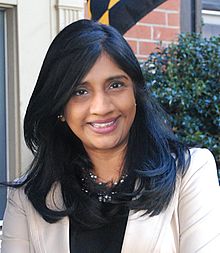
    The Indian-American community in the United States is greatly concerned by Republican presidential nominee Donald Trump’s remark against Mexicans and Muslims and that Indians were taking away jobs from the country, Democratic legislator Aruna Miller has said.

    “The rhetoric that all Mexicans are rapists and Muslims are terrorists are of great concern to the Indian-American community. He continues to ridicule outsourcing and call centres,” Miller, a legislator from Maryland told reporters.

    A Democratic representative and a member of the House of Delegates since 2011, she is on a visit to Kolkata and New Delhi to talk about the ongoing US presidential elections, which has generated global interest.

    The Hyderabad-born American citizen said Trump’s statements against immigrants are not going down well with the Indian-American community as well.

    Republican senator Wayne Harper, who is also accompanying her on the visit, however, defended Trump, saying people around Trump were now expecting that he would make people understand his point of view without being rough.

    “I am anticipating that relationships will increase between India and USA because both need each other. The relationship is more than just based on business but it’s about partnership and about national and international security,” he said.

    The two politicians are impressed by the high voter turnout in India.

    “I wish the high level of interest that the people here have about American elections was the same in America,” Miller said , adding in the mid-term polls, about 38 per cent of eligible voters turned out last time.

    “We have built up barriers for voters as in some states it is mandatory to have a voter ID card to cast ballots. It is easier to buy weapons than vote. We need to drop those barriers,” she said.

  • Indian Americans Launch Door-To-Door Support Campaign for Trump in New Jersey

    Indian Americans Launch Door-To-Door Support Campaign for Trump in New Jersey

    In a desperate attempt to gather more ethnic (non-white) support for Donald Trump’s Presidential bid, a PAC called Volunteers of Indian-Americans for Trump 2016 has launched a door-to-door campaign in New Jersey’s Mercer and Monmouth counties, reported PTI.

    The agenda of the campaign is to raise awareness of Trump’s agenda among perspective voters with evidence based on past behavior of Hillary Clinton  and why she will not be a good president.

    Indian-American supporters of the Republican presidential nominee argue that this mode of campaigning is still an effective tool to win people’s heart ahead of the November 8 general elections.

    AD Amar, president, Indian-Americans for Donald Trump was joined by political activist Satya Dosapati Narayana, West Windsor Township Republican Committeeperson Rimma Rosenberg, Mercer County Republican Committee Second Vice Chair Colleen DiPastina and her husband and Monmouth County Republican State Committeeman John Costigan and his wife, the media release said.

    “The campaigners presented evidence in the form of past behavior to convince the voters why Hillary Clinton will not be a good president and why Trump will be good. With a few exceptions, they hope they changed minds of some voters,” the media release said.

  • Method in US Madness

    Method in US Madness

    It is possible to sense relief, even guarded optimism, among US Democrats and right-thinking people everywhere. Donald Trump, the tycoon and political neophyte, who swept to the Republican nomination despite the hostility of party stalwarts, has had a bad couple of weeks, very bad, in fact.

    Trump’s showing in the opinion polls has been inexorably downwards since Hillary Clinton’s triumph at the Democratic National Convention. He has reshuffled his top team for what seems the umpteenth time, and muttering can be heard to the effect that he never really wanted the job anyway. Wishful thinking even has sundry Republicans asking whether Trump might decide to make way for someone supposedly more electable.

    Of course, it’s not over until it’s over. Trump’s whole campaign to date has defied the odds, and his camp insist -quite rightly – that it is very early days. The campaign proper never really begins until after Labor Day, the first Monday in September. Even then it will have two full months to run. What is more, there are legitimate questions about both the accuracy of polling and the volatility of US opinion. Americans vote on November 8. Throughout this time, the Europeans will be commenting from the margins, comparing our variegated systems with theirs, almost entirely to our advantage. US presidential campaigns, we will say, are far too long, far too expensive and borderline corrupt. Even the voting system, with its differences between states, those ancient machines that frustrate recounts and the inequalities seemingly built into the registration system will be cited as proof of our superiority. Many Americans would agree; they are some of the least sparing critics.

    What Donald Trump’s unpredicted rise and, current, fall already show, however, is something we tend to neglect. What looks like a mad electoral marathon that serves no one well and costs extortionate amounts of cash is not a bad test of presidential potential. What is more or less a year-long campaign has a pace and a logic that ruthlessly exposes those who cannot make the grade.

    A US election campaign has something of the medieval tournament about it. It offers a grueling series of obstacles to be surmounted and trials to be endured. Whoever wins will have proved to be equal to the task of presiding over the most powerful country in the world. And yes, by the way, it still is. The most basic requirement is stamina. Would-be presidents have to put in the time and the miles. Trump and Clinton have now been on the road more or less continuously since last autumn. They cannot be seen to flag. From September they will be crisscrossing the country, speaking at venues from vast sport stadiums to tiny parish halls, fitting in several meetings in one day. It is an intense replication of what it is like to be President of the United States. The last frantic dash, coast-to-coast, battle-ground to battle-ground is one of the ultimate in electoral challenges, and – in a close race – one of the most thrilling.

    The second is the capacity to raise money; a lot of it. Like it or not, though, the role of corporate money in the United States makes the confidence of business a pre-requisite for any US president.

    There are different ways to acquire it. Hillary Clinton has the benefit of her husband’s presidential network, and her own from her time as New York Senator and Secretary of State – corporate support which risks also being a liability this electoral year, because it associates her so closely with “the establishment”. George W Bush had the Bush networks and his own business ties. Donald Trump can boast – as could Michael Bloomberg – that his money is largely his own, and his business record stands for itself. Barack Obama’s biggest task eight years ago was arguably to convince corporate America that he was a winner. As the personification of the state, a US President must also be at least, on the presentational front, competent. Bill Clinton was the master communicator; he grasps at once the disposition of his audience. He makes the connection, conveys the message, wins the argument – and all with an ease that his wife has had to learn. A future president must convince, both in person and, crucially, on television – even in this time of social media. If he or she isn’t born with the ability, they acquire it over the months of campaigning.

    A US presidential campaign is the longest and most demanding political stress test conducted anywhere, and it’s always in the public eye. Candidates must keep cool under pressure and cope with reversals. Personal flaws, past and present, can surface at any time. These need not be fatal, as Bill Clinton and Trump – so far – showed. It depends how the candidate handles them and how the public responds. As the polls now stand, it looks as though the voters will have the sense to reject Donald Trump. If he nonetheless prevails, however, it would be wrong to dismiss his victory as a fluke. He will have won not primarily because of money or showmanship, but because, in emerging victorious from the trials of a US presidential campaign, he will have convinced Americans that he can do the job.

  • ‘It’s too late now to say sorry’ : Clinton to Trump

    ‘It’s too late now to say sorry’ : Clinton to Trump

    WASHINGTON (TIP): Democratic US Presidential nominee Hillary Clinton on August 23 told her Republican opponent Donald Trump on Twitter that it was too late to apologize for the highly controversial remarks he’s been making throughout his campaign. Clinton’s message to Trump – accompanied by a video compilation of Trump’s comments – came after the real estate magnate on Saturday said at a North Carolina rally that he regretted saying things that “may have caused personal pain.”

    “It’s too late now to say sorry,” Clinton’s tweet reads. The accompanying video begins with a clip from the rally where Trump attempted to express regret for his past comments. “Sometimes, in the heat of debate, and speaking on a multitude of issues, you don’t choose the right words…And believe it or not, I regret it, particularly where it may have caused personal pain,” he’d said.

    In the video, the Clinton campaign interspersed the clip of that conciliatory statement with clips from older speeches and interviews featuring the Republican nominee. In these clips, he is seen calling Republican primary candidate Marco Rubio ‘Little Marco,’ (allegedly a reference to Rubio’s height) calling for a ban on Muslims entering the US, and referring to an unnamed woman as “a disgusting pig.”

    The video goes on to show other controversial statements involving Trump – notably his suggestion that the mother of a fallen Pakistani-origin Muslim American soldier wasn’t allowed to speak at the Democratic National Convention, while her husband famously criticized Trump’s call for a ban on Muslims coming to America. It also shows him categorically refusing – on a number of occasions – to express regret or apologize for his views and remarks, in response to questions from journalists. “I like not to regret anything,” he is heard saying. (Agencies)

  • Hillary Clinton leads Donald Trump by double digits in new national poll

    Hillary Clinton leads Donald Trump by double digits in new national poll

    NEW YORK (TIP): A Quinnipiac University survey released Thursday, August 25, found 51 percent of likely voters in the U.S. support Clinton while 41 percent said they support Trump.

    In a four-way race, Clinton leads Trump 45 percent to 38 percent while 10 percent support Libertarian Gary Johnson and 4 percent back Green Party candidate Jill Stein.

    Clinton’s expansive lead is due to support from women and non-white voters, Quinnipiac said. Trump, meanwhile, leads among men and white voters.

    The poll found that 32 percent of Clinton’s supporters actually back her while 47 percent of them are voting to oppose Trump. On the other hand, a quarter of Trump’s supporters actually support him compared to nearly two-thirds who are voting for him mainly to oppose Clinton.

    Both candidates, according to the poll have negative favorability ratings –Clinton’s favorable/unfavorable rating is 41 percent/53 percent, while Trump’s is 33 percent favorable / 61 percent unfavorable. Thirty-seven percent of likely voters said they’d consider a third-party candidate.

    But two-thirds of voters said Clinton is qualified to serve as president, the poll found, whereas 58 percent said Trump is not qualified.

    Three-quarters of voters said that Trump should release his tax returns, including 62 percent of Republicans. Nearly 60 percent of voters said “the way Donald Trump talks appeals to bigotry.”

    A Suffolk University poll released Thursday, August 25, found Clinton leads Trump by 7 percentage points in Michigan.

    The Quinnipiac poll surveyed 1,498 voters between August 18 and 24 with a 2.5 percentage point margin of error.

  • 3 Indian-American Women In Race To Make History In November Polls

    3 Indian-American Women In Race To Make History In November Polls

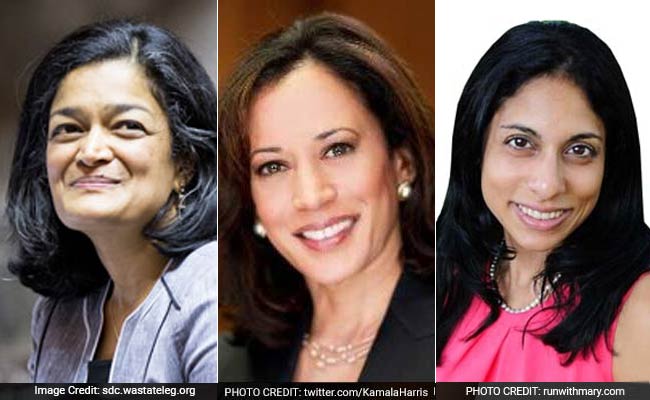
    WASHINGTON: As Democratic presidential candidate Hillary Clinton targets to break the “highest glass ceiling” in the US, three Indian-Americans figure in a list of 19 women who could make history if elected to the US Congress in November.

    In a Congress that has only 19 per cent women, over a dozen women from both sides of the aisle could end up breaking barriers if elected in the November polls, the popular Cosmopolitan magazine said as it released the list of the women.

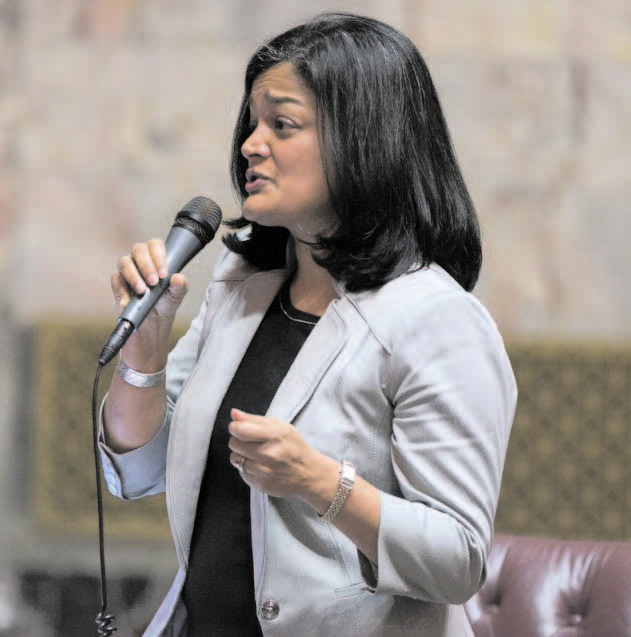
    The three Indian-American women who figure in the list are Pramila Jayapal, who is running for House of Representatives from Washington state; Kamala Harris, who is seeking to enter the Senate from California; and Lathika Mary Thomas, who is running for the House on a Republican ticket from Florida. Jayapal and Harris are from Democratic party.

    If elected, Harris would be the second black woman in Senate after Carul Mosley Braun in 1992 and the first Indian-American in the Senate.

    Ms Harris, who has been endorsed by US President Barack Obama is currently the California Attorney-General.

    Ms Jayapal, who earned an endorsement from Vermont Senator Bernie Sanders, would be the first Indian-American woman in Congress, if she wins the elections in November.

    According to latest polls, both Ms Jayapal and Ms Harris are expected to win their respective elections.

    Like Ms Jayapal, Latika Mary Thomas if elected to the US House of Representatives seat from Florida would be the first Indian-American woman in the Congress.

    Ami Bera from California is the only Indian-American Congressman in the current Congress. He is among the three Indian-Americans elected to the Congress ever.

    Among other women politicians who figure in this list are Denise Gitsham, who if elected would be the first Republican Chinese-American in the Congress; Misty Snow, who could become the first openly transgender person in the Congress and Tammy Duckworth, who could become the first Thai-American to be elected to the US Senate.

  • Point Counterpoint – Hillary Clinton Immigration Policies Would Widely Benefit the South Asian Community

    Point Counterpoint – Hillary Clinton Immigration Policies Would Widely Benefit the South Asian Community

    Donald Trump’s criticism of Khizr and Ghazala Khan, Pakistani American parents of the United States Army Captain Humayun Khan who was killed in action in Iraq, has raised red flags in the South Asian community. Trump stated that Mrs. Khan was not able to speak at the Democratic National Convention, insinuating because she was a Muslim. Like many of you, I found Trump’s response to be vile and disrespectful. Trump’s remark about the Khan family demonstrates he is insensitive to the South Asian community. This presidential election is crucial time for South Asians and I encourage you to vote.

    Although numerous voters say the presidential election is a choice between the lesser of two evils, the choice for South Asians is clear if we weigh the candidates’ immigration policies. Hillary Clinton’s policies are non-discriminatory, practical and will provide opportunities for immigrants and for America that thrives when immigrants are welcomed.

    Donald Trump, in contrast, proposes to ban Muslims from the U.S., at least temporarily. Hillary Clinton has dismissed that idea as un-American. In fact, according to her website, she will continue the J-1 visa exchange visitor program, increase H1-B visa holders in the STEM field, allow fee waivers to defray the cost of the naturalization process, and provide supplementary educational support during the complex and tedious naturalization application process.

    Trump’s policy on barring Muslims is not only discriminatory but also unconstitutional. His policy assumes every Muslim is a threat to national security. This is simply not true. The Pew Research Center finds roughly 1.6 billion people practice the religionof Islam. Yet, “extremist” Muslims make-up only.00625% percent of all Muslims.

    Let’s take a look at the constitutionality of the ban. I echo Khizr Khan’s sentiment to Trump: “Have you ever read the U.S. Constitution?”. According to Richard Friedman, a law professor at the University of Michigan, banning one religion is unconstitutional under the U.S. Equal Protection Clause and the First Amendment’s doctrine of freedom of religion. Also, there is no due process involved which is unconstitutional under the Fifth and Fourteen Amendments.

    Another concerning matter is the H1-B and J-1 visa policies. As Secretary of State, Hillary Clinton affirmed the J-1 visa policy which is the exchange visitor program. Under this program, many of the best and the brightest international students come on J-1 visa including the Fulbright Scholars. This visa program enhances international diplomacy and helps spread democratic ideas back to the student’s home country. Trump on the other hand wants to scrap the J-1 visa work requirement or/and end the J-1 visa exchange program.

    On H-1B policy, Hillary Clinton intends to raise the cap on H1-B visa holders. Many of our South Asian population gain vast opportunities to flourish under the H1-B visa. Raising the cap is pivotal in the STEM industries due to the shortages in the field. To further validate the H-1B visa, the late Steve Jobs CEO of Apple and Mark Zuckerberg CEO of Facebook, are both advocates in expanding the cap.

    In terms of the naturalization process, Hillary Clinton wants to promote visa holders to become U.S. citizens by expanding the fee waivers to minimize the cost of naturalization. Furthermore, her immigration policies provide educational assistance during the naturalization application process. Through these policies, she acknowledges the “American dream” to become a U.S. citizen because America represents freedom and the social mobility to climb the ladder. Trump on the other hand does not grasp this concept. Michelle Obama said at the Democratic National Convention “don’t let anyone ever tell you that this country isn’t great”. As South Asian immigrants and the children of South Asian immigrants, we know America is great. We don’t take freedom for granted. There is no question the Khan family fervently values this belief.

    Overall, Hillary Clinton’s immigration policies are not discriminatory. It is logical and practical. It follows the basic American principles of diversity, unity, and life, liberty and the pursuit of happiness. We must stand with Khizr and Ghazala Khan in defending their religion, their son’s honor, and freedom. Many of South Asians that emigrated to the U.S. and the children of South Asian immigrants deeply cherish the basic freedom given to us by the U.S. Constitution. Hillary stands with the South Asian community. I am with her. I urge you to be with her and vote for her. We are stronger together.

    (The views expressed are author’s own. The author, a graduate of Columbia University, currently works as an educator in New York City)

  • Point Counterpoint – TRUMP WILL BE A BETTER SUPPORT FOR INDIA THAN HILLARY CLINTON

    Point Counterpoint – TRUMP WILL BE A BETTER SUPPORT FOR INDIA THAN HILLARY CLINTON

    Hillary will be an extension of Obama Administration a proven anti-India administration. Since April 2015 to March 2016 only Obama gave most sophisticated military hardware worth of $ 1.62 Billion to Pakistan despite strong opposition from some American lawmakers and India. History speaks for itself Republican Presidents are more friendly with India.Democrats have never given anything of significance to India rather they are pro Pakistan. Democrat Bill Clinton visited India only near the end of 7th year of his presidency to enjoy camel & elephant rides, sightseeing and authentic Indian cuisines paid by Indians.

    In 2008 it was Republican President George Bush that gave the Civil Nuclear deal to India and Hillary Clinton as Democrat Senator voted against the deal. When Hillary became Secretary of State she wanted the parallel approach to India and Pakistan on nuclear matters. That is besides the point China gave Pakistan two 300 MW’s reactors to be financed, constructed and operated by Chinese companies. There are no stringent conditions attached to this deal like IAEA inspections or other safe guards imposed on India.

    Hillary Clinton is a dangerous Candidate for President of America for Americans & other peace loving nations around the world: Hillary Clinton during her 2008 presidential run threatened to “totally obliterate” Iran with nuclear weapons. As Secretary of State under Obama, she participated in the overthrow of the democratic government of Honduras. Her contribution to the destruction of Libya in 2011 was almost gleeful and is known to the entire world. Her tacit support to Israel and Saudi Arabia has given birth to ISIS. Saudi Arabia wants to hurt its arch enemy Iran and Israel wants to createGreater Israelby occupying land of other countries.

    One of Clinton’s closest allies is Madeleine Albright, the former Secretary of State, who has been attacking young women for not supporting “Hillary”. This is the same Madeleine Albright who infamously celebrated on TV the death of half a million Iraqi children as “worth it”. Then Huma Mahmood Abedin a Saudi mole since 1996 is serving as Hillary’s “body woman,” a sort of glorified personal maid, gentle confidant. Under Hillary advanced her carrier to unprecedented heights including job at state department. At present serving as Vice Chairwomen for Hillary Clinton’s 2016 campaign for President!

    In 2010 Huma married a Jewish then US Congressman Anthony Weiner and wedding ceremonies were performed by Bill Clinton. Huma was born to an Indian father and Pakistani mother in America and when she was 2 years old the family migrated to Saudi Arabia and at the age of 18 she came to study in America and right away became an intern at White House. Her family still lives in Saudi Arabia. Above all Hillary represents systemic corruption and moral failings that define her who would gladly sell out our country to the highest bidder.

    Clintons are running their Foundation as their personal piggy bank and taking money from Muslim Countries and organizations specializing to spread sharia laws with least regards to their record on human rights and inhuman treatment to women. On the other hand Trump says the invasion of Iraq was a crime; he doesn’t want to go to war with Russia and China. He will stay neutral in the conflict between Israel and Palestine. He says America has no business to change regimes or toppling leaders of other countries, exporting democracy and building other nations after destroying them.

    Trump is anti-Pakistan and pro India. Trump is for legal immigration and he wants to simplify rules for family immigration visa. More over those who come here from India for professional studies in prestigious universities as students, Trump wants to give them green cards. On top of that Trump is not financed by Israeli or Saudi lobby or arms companies or defense contractors or the Wall Street or the billionaires club. The danger to the Americans and rest of the peace loving countries is not Trump, but Clinton. Trump is the only candidate that is able to deliver on the economy, rebuilding America and immigration promises because his campaign is not financed by any special interest group.

    This election is not about Trump or Republican party or Democratic party. This is about the future of every American. This is an historic, unprecedented and exciting movement as well as a fight in which Trump on behalf of the American voters has challenged; The Elite, The Power Brokers, The Billionaire Donors Club & their dubious Super PAC’s financed with dirty money. They are trying to dictate the voters who to vote for and are trying to trample the voters’ intent, those who have already voted for Trump in primaries. 2/3 of the Republicans as well as 2/3 of the Democrat voters want an outsider not an establishment supported career politician. The proof is when Trump started his campaign he was at 14% in the polls and now he is at 41.7%. vs Hillary’s 42.5% in National Polling average. He created a history by polling more than 14 million votes in the Republican Primaries. Trump is the anti-politician, the anti-elite, the anti-establishment candidate Americans have been waiting for a long time.

    Trump as a wild-card candidate with unpredictable pockets of support, potentially capable of changing the political landscape even late in the election season.In the end Trump will win the general election to be the next President of America by defeating the establishment nominee a carrier politician Hillary Clinton since 1976 with not a single achievement being marketed on a budget of over $3 billion by a convincing margin. Americans are looking for a strong President in the White House not the 2 co-Presidents living with the ghost of President Obama in the White House.

    Trump will correct the imbalances created by carrier politicians by signing bad trade dealsto hurt Americans to favor their donors. He will create better business opportunities to create more jobs. This will benefit every American, especially the highly educated and affluent community Indian-American community. Their living standards and wages will improve and India will also benefit under Trump presidency with a preferred nation status.

    (The views expressed are author’s own. The author is Secretary, INDIAN-AMERICANS FOR
    TRUMP 2016 (Registered as a PAC with FEC) 11 Pinewood Lane ● Warren, New Jersey ● 07059)

  • WHY TRUMP’S CRAZY TALK ABOUT OBAMA AND ISIS MATTERS

    WHY TRUMP’S CRAZY TALK ABOUT OBAMA AND ISIS MATTERS

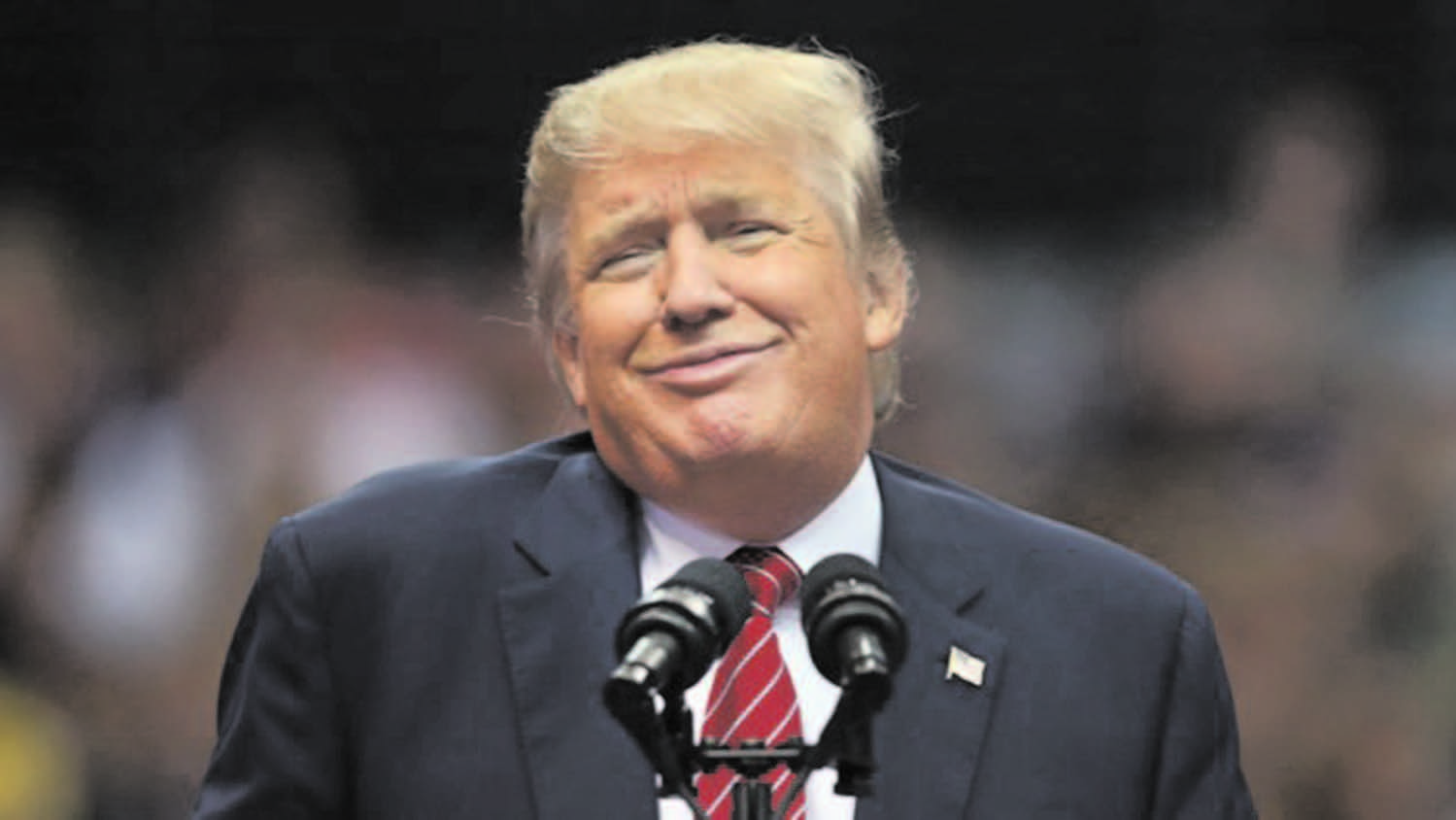
    On Thursday, August 11 morning, Donald Trump doubled down on his latest verbal outrage: the claim that President Obama was the “founder” of ISIS Actually, the Republican Presidential nominee tripled down. Appearing on CNBC’s “Squawk Box,” he described himself as “a truth teller” and went on to say that the President was “the founder of ISISabsolutely, the way he removed our troops.” Referring to Hillary Clinton, Trump added, “I call them co-founders.”

    Peripatetic as ever, Trump gave another interview, a short time later, to Hugh Hewitt, the conservative radio host, who said to him, “Last night, you said that the President was the founder of ISIS. I know what you meant. You meant that he created the vacuum, he lost the peace.”

    Trump wasn’t having it. “No. I meant that he’s the founder of ISIS,” he said. “He was the most valuable player. I gave him the Most Valuable Player award. I give her”-Clinton-“too, by the way.” Hewitt evidently thought that this was unfair to Obama. “But he’s not sympathetic to them,” he said. “He hates them; he’s trying to kill them.” Trump was unabashed. “He was the founder,” he said, referring to Obama. “His, the way he got out of Iraq, that was the founding of ISIS.”

    What are we to make of all this? At this stage, some will argue that it isn’t worth the effort to interpret Trump’s misstatements, or to point out the truth of the matter-in this case, that a Jordanian named Abu Musab al-Zarqawi founded ISIS, in 2004. At the very least, it should be obvious to everyone by now that Trump doesn’t deal in reality; he deals in mythmaking, demagoguery, and carnival barking.

    When he’s not tied to a teleprompter, Trump often seems to say the most provocative thing that comes into his head, with little thought for the consequences for his campaign, or for the campaigns of other Republicans. He’s like a small child, trying to be the center of attention, even if that means he has turned himself into an object of outrage and ridicule.

    If you take this view of Trump, there isn’t much more to be said. He’s the melting figure on the cover of this weeks’ Time magazine: a reality-television shyster who somehow captured the nomination of a major political party and is now dissolving in front of us. The only remaining questions for you are how big a majority Clinton will rack up, and whether the Republicans can limit the damage in the Senate and the House of Representatives.

    I’ve got a lot of sympathy for this interpretation. But, just for the sake of argument, let’s assume that Trump is smarter and less myopic than he seems. Let’s assume that what he’s really focused on isn’t winning this year’s election, a task he now realizes is beyond him, but creating a long-term Trumpian movement. A nationalistic, nativist, protectionist, and authoritarian movement that will forever be associated with him, but which also has the capacity to survive beyond him. A movement that in some ways would resemble other right-wing political parties around the world, such as France’s National Front, Austria’s Freedom Party, and the U.K. Independence Party, but which would also harken back to earlier moments in American history, such as the rise of the anti-immigrant Know Nothing movement of the eighteen-forties, and the formation, a century later, of the isolationist America First Committee, which sought a negotiated peace with Hitler.

    If establishing such a following, and bringing about a historic realignment on the right, was Trump’s real intention-rather than moving into the Oval Office next January-some of what he has been saying lately would be more comprehensible. Not more accurate or less odious, but more explicable on its own terms.

    History tells us that for right-wing populist movements to succeed, a number of things need to be in place. For one thing, they need a narrative that mainstream political leaders, and political parties, are guilty of not merely incompetence but betrayal. The most notorious example is the “stab-in-the-back” myth, widely believed in Germany after 1918. That narrative held that the German military didn’t really lose the First World War; the soldiers were betrayed by traitorous civilian politicians who signed an armistice. Later examples include the conviction in French conservative circles, during the nineteen-sixties, that Charles de Gaulle, in giving up Algeria, had betrayed France, and the accusation, thirty years later, that François Mitterrand and other French leaders had turned their backs on la Mère-Patrie by supporting the Maastricht Treaty, which created the European Union.

    Trump has been arguing for months that the Obama Administration, in withdrawing almost all U.S. troops from Iraq, helped bring about the conditions that enabled ISIS to seize territory and create a self-styled caliphate. (He fails to point out that the Bush Administration initiated the troop withdrawal.) He first suggested that Obama and Clinton created ISIS seven months ago, long before this week’s comments. At a rally in January, he said, “They’ve created ISIS. Hillary Clinton created ISIS with Obama.”

    At the time, Trump’s comments attracted some attention and criticism, but not very much. His principal adversaries then were his rivals in the Republican primary, and there was something of a competition going on to demonize Obama and Clinton. In returning to this sort of language now that he’s got the nomination-and escalating it with his use of the phrase “founder of ISIS”-Trump is, on the face of it, harming his prospects for November. He certainly doesn’t sound like he’s trying to win over the soccer moms in Columbus, or the office workers in Tampa, that he needs to win the election. He sounds like he is talking to his angry base, and supplying them with an inflammatory narrative that can be trotted out for years, and decades, to come. It’s a tactic that politicians outside the United States, such as Jean-Marie Le Pen and Jörg Haider, have used to good effect in building up far-right nationalist movements.

    Then there are Trump’s increasingly frequent references to the likelihood of his losing in November, and to the possibility that foul play will be responsible. “I’m afraid the election’s gonna be rigged, I have to be honest,” he told a rally in Ohio, on August 1st. A day later, talking to Fox News’s Sean Hannity, Trump returned to the theme, saying, “I’m telling you, November 8th, we’d better be careful because that election is going to be rigged. And I hope the Republicans are watching closely or it’s going to be taken away from us.”

    It is, of course, a staple of extremist parties of the left and right that democracy is a sham, and that elections count for nothing. And once you have delegitimized an election result, or an elected leader, you can justify all sorts of extra-electoral, and indeed anti-democratic, actions.

    In the wake of Trump’s remarks, some commentators pointed this out. “Suggesting an election is going to be stolen, this is Third World dictatorship stuff,” CNN’s Brian Stelter said. “The problem for Trump is that his supporters believe what he says,” Vox’s Dara Lind wrote. “If he says a Trump loss means the election has been stolen, there are millions of people prepared to believe it.” Just as there are many people who are willing to believe-or to internalize and accept, anyway-that Obama created ISIS, even though it was founded four years before he came to office.

    So is this what Trump is up to-diligently seeking to create an enduring America First movement that will eventually supplant the Republican Party? I wouldn’t give him that much credit. He’s precisely the self-centered, shortsighted, and insecure figure he appears to be, and he’s now flailing around for excuses to explain a humiliating defeat in the making. In his interview with CNBC, he said, “If, at the end of ninety days, I’ve fallen short . . . it’s O.K. I go back to a very good way of life.”

    But even if Trump is just along for the ride, that doesn’t excuse what he is doing. Four years from now, or eight years from now, a more disciplined and self-controlled figure could take up where he left off. If at that time the United States were facing a serious economic or national-security crisis, more Americans-conceivably even a majority of them-might be willing to accept the argument that regular politicians have failed and betrayed them, and that drastic measures are called for. Healthy democracies don’t decay overnight. They gradually rot from within, with termites like Trump undermining their foundations.

    (Source: newyorker.com)

  • Trump calls Obama founder of ISIS and Hillary Clinton the co-founder

    Trump calls Obama founder of ISIS and Hillary Clinton the co-founder

    SUNRISE, FLORIDA (TIP): “They honor President Obama,” he told a rally inSunrise, Florida on Wednesday, August 10. “He is the founder of Isis “.

    Trump also attacked his Democratic rival for the White House, Hillary Clinton, calling her a “co-founder”.

    Hillary responded by accusing him of “trash-talking” the US and echoing the talking points of Russian President Vladimir Putin. Trump stood by his remarks on Thursday, August 11, using a sports phrase to say Obama and Clinton were the Islamic State’s “most valuable players”.

    The Republican presidential nominee has endured 10 days of negative headlines after a string of controversial comments.

    Most recently, he appeared to urge his supporters to take up arms against Clinton to stop her from appointing liberal judges to the US Supreme Court if she wins the election.

    The hotel developer-turned-politician denied he was inciting violence, but the daughter of former President Ronald Reagan, who was shot in 1981, condemned his “verbal violence”.

    Trump’s unfounded off the cuff comments have received wide disapproval, including from Republican politicians who are increasingly getting worried that Trump’s adventures with his tongue may alienate voters and bring them suffering.

    IS can trace its roots back to the late Abu Musab al-Zarqawi, a Jordanian who formed al-Qaeda in Iraq (AQI) after the US-led invasion in 2003. It became a major force in the insurgency, carrying out dozens of attacks a month.

    After Zarqawi’s death in 2006, AQI created a militant umbrella organization, Islamic State in Iraq (ISI). Over the next four years, it was steadily weakened by a US troop surge and Sunni Arab tribal fighters who rejected its brutality.

    Abu Bakr al-Baghdadi became leader in 2010 and began rebuilding ISI. The following year, ISI joined the rebellion in Syria, which offered it a safe haven and easy access to weapons, some of them supplied by US allies opposed to President Bashar al-Assad.

    The group also exploited withdrawal of US troops from Iraq at the end of 2011 and widespread Sunni anger at the sectarian policies of the country’s Shia-led government.

    ISI changed its name to Islamic State in Iraq and the Levant (Isis or Isil) in 2013 and began seizing territory in Syria. In 2014, Isis overran large swathes of northern and western Iraq, proclaimed the creation of a “caliphate”, and became Islamic State.

    The White House has not commented on the “IS founder” claim but a spokesman for Clinton said: “This is another example of Donald Trump trash-talking the United States.

    “What’s remarkable about Trump’s comments is that once again, he’s echoing the talking points of Putin and our adversaries to attack American leaders and American interests, while failing to offer any serious plans to confront terrorism or make this country more secure.”

    In recent weeks, several leading Republicans have deserted Trump over his outspoken attacks.

    Most recently, Senator Susan Collins said she would not be voting for him, pointing to a time he seemed to mock a disabled journalist.

    Time Magazine on Thursday reported that the chairman of the Republican National Committee, Reince Priebus, had threatened to withdraw funding from the Trump campaign, and instead direct it to Congressional campaigns.

    Trump denies that this conversation ever took place.

    Polls suggest support for the embattled candidate has been falling in key battleground states in recent weeks.

  • The Russian Angle in US Elections – What we know so far…

    The Russian Angle in US Elections – What we know so far…

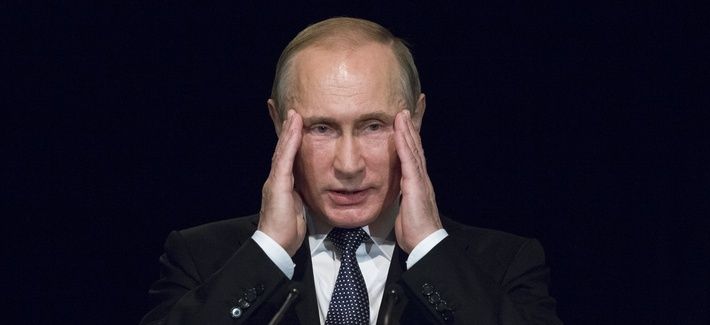
    The intrusion into the Democratic National Committee’s computers, allegedly by Russian hackers, has put a renewed spotlight on Donald Trump’s connections to Russia and its leader, Vladimir Putin.

    Democratic presidential candidate Hillary Clinton has slammed Donald Trump for his “absolute allegiance” to Russia that raises “national security” concerns, prompting her Republican rival to deny having any “relationship” with Russian President Vladimir Putin.

    “We know that Donald Trump has shown a very troubling willingness to back up Putin, to support Putin, whether it’s saying that NATO wouldn’t come to the rescue of allies if they were invaded, talking about removing sanctions from Russian officials after they were imposed by the US and Europe together, because of Russia’s aggressiveness in Crimea and Ukraine, his praise for Putin which is I think quite remarkable,” she said.

    “And for Trump to both encourage that and to praise Putin despite what appears to be a deliberate effort to try to affect the election I think raises national security issues,” the Democratic presidential nominee alleged.

    She also said that Trump has absolute allegiance to Russia.

    Last week, Trump during a news conference had appeared to have asked Russia to find out the missing 30,000 emails of Clinton and release them.

    Trump later said he was just kidding and being sarcastic. Clinton, however, did not appear to be convinced by that clarification.

    “I think if you take his encouragement that the Russians hack into American e-mail accounts, if you take his quite excessive praise for Putin, his absolute allegiance to a lot of Russian wish-list foreign policy position, his effort then to try to distance himself from that backlash which rightly came not just from Democrats, but Republicans, independents and national security and intelligence experts leads us once again to include he is not temperamentally fit to be president and commander in chief,” Clinton said.

    I have no relationship with Putin: Donald Trump

    Republican presidential candidate Donald Trump said he has no relationship with Russian President Vladimir Putin as being alleged by his opponents.

    “I have no relationship with him (Putin),” Trump said, adding that he had praised him the in the past because he had said some nice things about him.

    “He said very nice things about me, but I have no relationship with him. I don’t — I’ve never met him,” Trump said.

    “I mean he treats me … with great respect. I have no relationship with Putin. I don’t think I’ve ever met him. I never met him. I don’t think I’ve ever met him,” Trump reiterated.

    The real estate mogul said he has never spoken to Putin on the phone.

    “When we had the Miss Universe contest a number of years ago, we had Miss Universe in Moscow, in the Moscow area, he was invited. He wanted to come. He wasn’t able to come. That would have been a time when I would have met him,” he said.

    However, Trump insisted that there is nothing wrong in having a good relationship with Russia.

    “If our country got along with Russia, that would be a great thing … But if we can have a good relationship with Russia and if Russia would help us get rid of ISIS, frankly, as far as I’m concerned, you’re talking about tremendous amounts of money and lives and everything else, that would be a positive thing, not a negative thing,” Trump said.

    He also attacked his Democratic rival Hillary Clinton, calling her a dishonest person with a bad temperament.

    “She’s a very dishonest person. I have one of the great temperaments. I have a winning temperament. She has a bad temperament. She’s weak. We need a strong temperament and that’s all it is, I have a strong temperament,” Trump told ABC News in an interview.

    Appearing on a Sunday talk show, Trump claimed that he is leading in polls and is headed to win general elections in November.

    “I think I have a great temperament. I beat 16 very talented people in and I’ve never done this before. You don’t do that with a bad temperament. I’m leading her in the polls,” he said and alleged that Clinton She doesn’t know how to win.

    “She’s not a winner. She doesn’t know how to win … I had a flawless campaign … She could barely beat Bernie,” he said.

    Trump’s earlier comments suggesting a relationship with Putin

    Here are four occasions between 2013 and 2015 when Trump touted his ties to Putin.

    • When Thomas Roberts of MSNBC asked Trump, “Do you have a relationship with Vladimir Putin? A conversational relationship or anything that you feel you have sway or influence over his government?” Trump responded, “I do have a relationship, and I can tell you that he’s very interested in what we’re doing here today. He’s probably very interested in what you and I am saying today, and I’m sure he’s going to be seeing it in some form.” — interview, November, 2013
    • “You know, I was in Moscow a couple of months ago. I own the Miss Universe Pageant and they treated me so great. Putin even sent me a present, a beautiful present.” — address at the CPAC conference, March 2014
    • “Russia does not respect our country any longer. They see we’ve been greatly weakened, both militarily and otherwise, and he certainly does not respect President Obama. So what I would do—as an example, I own Miss Universe, I was in Russia, I was in Moscow recently and I spoke, indirectly and directly, with President Putin, who could not have been nicer, and we had a tremendous success. The show was live from Moscow, and we had tremendous success there and it was amazing, but to do well, you have to get the other side to respect you, and he does not respect our president, which is very sad.” — address at the National Press Club, May 2014
    • “As far as the Ukraine is concerned … if Putin wants to go in — and I got to know him very well because we were both on 60 Minutes. We were stablemates, and we did very well that night.” — portion of an answer at the Fox Business News debate, Nov. 2015. (The notion that the two men appeared together on 60 Minutes has been debunked. As Time magazine put it succinctly, “In fact, they weren’t even on the same continent.”)
  • Who will win and why?

    Who will win and why?

    Right now (July), polls suggest that Hillary Clinton will win the presidential election, but I think Donald Trump actually has a much better chance of winning than most people seem to think.

    Donald Trump would be a truly terrible president, but he is getting support because he is tapping into fears held by the white middle class that are genuine. Fears about income inequality. Fears about control of government by elites. Fears about good jobs moving to a small number of cities with unaffordable housing. Fears about large scale immigration of people from a different culture putting at risk an existing culture that many people value. Fears that the country is being controlled by a group of people who dehumanize them as “bigots”.

    Media’s Role: To diffuse those fears, Hillary Clinton needs to convince the middle class that she really does care about their concerns, but her cautious approach to the media has prevented her getting that message across. Donald Trump has shown that in the new media world, the best way to reach voters is via the media, rather than via advertising. However the media will only carry your message if it at least somewhat controversial. Hillary Clinton has so far taken a “play it safe” approach in what she says, which means that the media rarely quotes her and few people know what she thinks.

    Hillary’s failure to tell people who she is has allowed Donald Trump to define her by caricature. Since Hillary rarely says anything controversial enough to get quoted, the only information people have about her are the misleading claims made by her opponents. This has created a false impression that Hillary Clinton is dishonest and doesn’t care about the middle class.

    Trump is a master salesman, and is using the same skills to sell his presidency as he used to sell Trump University, Trump Steaks, and Trump Casinos. In all cases, the actual product was terrible for the people who bought it, but Trump was able to convince people that he had the product that would solve all their problems. So long as Trump is able to stoke up fears about (real or imagined) problems, and convince people that he has solutions, there is a real risk that he could win – even if his promised solutions are make-believe.

    Democrats are being lulled into a false sense of security by the same experts who thought Trump had no chance of winning the GOP primary. Trump is running to win, not to govern, and definitely not to serve the interests of his party. This has caused him to run a very different kind of campaign, which analysts fail to properly understand. In addition, the fact that Trump is so divisive means that it’s likely that many people who plan to vote for Trump are unwilling to say that to a pollster.

    What makes Trump so dangerous is that he isn’t actually running because he wants to “make America great again”, but simply because he wants to win. This means that he is prepared to do things that a more conventional candidate would not be prepared to do if it increases his chance of winning – such as stoking up irrational anger, claiming to have solutions that he knows have no realistic chance of succeeding, and blatantly lying. I don’t think Donald Trump really cares about what would actually happen to America after he won, and that makes him a very risky candidate to campaign against.

    Hillary Clinton would be a vastly better president than Donald Trump, but Trump is a better salesman. The biggest thing that Hillary needs to do is reassure people who would otherwise vote for Trump that she respects them and cares deeply about the things that concern them.

    Don’t demonize Trump supporters – Trump’s supporters are not bad people, or “bigots”. They are decent people, with genuine concerns, being led astray by a man who is selling them a make-believe story about “bad people” and “simple solutions”. If she wants his supporters to vote for her, then she needs to convince them that she respects them. 

    Assure Trump’s supporters that she cares about their concerns – Trump gets the support he does because he taps into fears that are legitimate. Fears about the decline of the middle class. Fears about control of government by elites that don’t understand the concerns of the middle class. Fears about large-scale immigration from people with a different culture putting at risk an existing culture that people value. I believe Hillary Clinton does care about these issues, but that message is not being heard in the media.

    Say things that are surprising enough to get media coverage – Donald Trump has demonstrated that in the new media landscape the best way to reach voters is through the media, rather than through advertising. However, the media will only carry your message if it is at least somewhat controversial. Hillary has so far taken a “play it safe” approach in what she says, which means that the media rarely quotes her, creating the risk that Trump can define who Hillary is through caricature. 

    Put a wedge between Donald Trump and his supporters – Find areas where the views and actions of Trump are clearly misaligned with the views of his supporters – and push on them. Make it clear that she is supporting the middle class against Trump, rather than opposing both Trump and his supporters.

    Put forward an inspirational vision of the future, including for Trump’s supporters – People vote for Trump because they are worried about the future and think that they need to “push the eject button” in order to avoid catastrophe. To prevent that, she needs to reassure them that they have an exciting future to look forward to, including the expectation that the issues Trump is making them afraid of will be addressed.

  • Indian American State Senator Pramila Jayapal Wins Congressional Primary in Washington

    Indian American State Senator Pramila Jayapal Wins Congressional Primary in Washington

    SEATTLE (TIP): Indian-American Pramila Jayapal has swept an open Congressional primary in Washington State with 38.2 per cent of the votes and could make history as the first woman from the community to be elected to the US House of Representatives if she wins the November general election.

    Born in India and raised in Indonesia and Singapore, 50-year-old Jayapal would be facing either of the two candidates she defeated in the open primary by more than 16 per cent.

    Besides Pramila there are three other serious Indian-American contenders for seat in US House of Representatives.

    Ami Bera is seeking his third term from California. He is the only Indian American in the current Congress. Two others running for a House seat are Raja Krishnamoorthi from a suburb of Chicago and Ro Khanna from Silicon Valley.

    All four are considered to have a bright chance of winning the November general elections.

    The Indian American Democrat emerged victorious in the Aug. 2 primary election for the state’s 7th Congressional district, which is vacant with incumbent Jim McDermott not seeking reelection.

    Her two other rivals were Joe McDermott (21.5 per cent) and Brady Walkinshaw (20.9).

    “Thank you so much to the voters of the 7th Congressional District! You have fueled the flame of our movement with the clear belief that we together can and will reclaim our government to work for all of us!” Jayapal told her supporters at a victory speech.

    Jayapal was endorsed by former Democratic presidential candidate Senator Bernie Sanders.

    “Pramila just proved that candidates can run a strong progressive campaign funded by small-dollar donors and win big,” Sanders said.

    “The people-powered movement that propelled our campaign to victory in states around the country is already changing how campaigns are run up and down the ticket,” he added. Jayapal trailed early in the race, but saw a steady climb in the polls following Sanders’ endorsement on April 13.

    In addition to campaigning with her, the Vermont senator helped Jayapal raise USD 226,000 from 27,692 individual donations and recruited volunteers to make 140,314 phone calls and knock doors.

    “When you think of the political revolution, I want you to think about Pramila,” Sanders said.

    Jayapal has spent the last 20 years working both internationally and domestically as a leading national advocate for human rights.

    She led one of the largest voter registration efforts in Washington State, helping over 23,000 new Americans to register to vote.

    In the aftermath of the 9/11 terror attacks, Jayapal founded Hate Free Zone to advocate on behalf of Arab, Muslim and South-Asian American victims of hate crimes targeted after the attacks. After eleven years at the helm of the organization, which was later renamed OneAmerica, she was recognized by the White House as a “Champion of Change” for her work on behalf of the immigrant community.

    A Chennai-born Malayali, she came to the US in 1982 to attend Georgetown University.

    She worked on Wall Street as a financial analyst and went on to earn a Master of Business Administration from Northwestern University.

    After working in the medical equipment industry for a year she found her passion in the social justice arena. She now lives in Seattle.

  • Fox News Poll: Hillary Leads Trump by 10 Points

    Fox News Poll: Hillary Leads Trump by 10 Points

    WASHINGTON (TIP): Though 62 percent of poll respondents say they see Clinton as dishonest, they nevertheless view the former secretary of state as more qualified for the highest office in the land than the brash, billionaire businessman.

    A new Fox News poll shows Democrat Hillary Clinton leading Republican Donald Trump by 10 points.
    A new Fox News poll shows Democrat Hillary Clinton
    leading Republican Donald Trump by 10 points.

    Clinton leads Trump 49 percent to 39 percent in the latest poll, the first taken since both candidates named their running mates last month. The difference falls outside the poll’s 3-point margin of error.

    When Libertarian Gary Johnson is included, Clinton’s lead is cut to 9 points, with Clinton at 44 and Trump at 35. Johnson pulls 12 percent of the vote.

    Among the poll’s findings:

    Qualified:
    Clinton: 65 percent,
    Trump: 43 percent
    Right temperament:
    Clinton: 64 percent
    Trump: 37 percent
    Knowledge to serve effectively:
    Clinton: 72 percent
    Trump: 40 percent

    Trump does have more support from veterans (53-39) but Clinton draws more Republicans (12 percent) than Trump draws Democrats (5 percent.)

    The poll talked to 1,022 randomly chosen registered voters nationwide by telephone July 31-August 2.

  • A Trump Victory is a Scary Thought; A Disputed Loss might be Scarier

    A Trump Victory is a Scary Thought; A Disputed Loss might be Scarier

    We have a tradition in the United States. When you lose an election, you take the L, and you move on. It’s what John Adams did after he lost to Thomas Jefferson in the 1800 election, marking the first ever peaceful transfer of power after a bitterly contested democratic election. It’s what Samuel Tilden and Al Gore did after their respective elections, in 1876 and 2000, when they won the national popular vote but lost the tally in the Electoral College. And it’s what Richard Nixon did after losing the 1960 election in an incredibly close race with John F. Kennedy, despite evidence of fraud in Illinois and suspicions of it in Texas.

    Republican presidential nominee Donald Trump has started to surface claims that the election will be rigged.
    Republican presidential nominee Donald Trump has started to surface claims that the election will be rigged.

    We have a great track record on this count, with one exception in our 228-year history of presidential elections. (It didn’t work out.) And we owe that track record to a set of shared norms about our political institutions. In the modern era, those norms are straightforward. We all agree in the principle of one person, one vote. We all agree that, in each state’s Electoral College, electors go to the winner of the popular vote. And for the most part, we all agree that the major parties are legitimate groupings of citizens and interests, with a legitimate claim on power should their candidates win an election.

    That hedge— “for the most part”—is intentional. For the most part, we do agree that the winners are legitimate. For as much as Republicans worked to stymie Barack Obama’s presidency through unprecedented obstruction, they never sought to delegitimize the election results or argue that his wins didn’t count. At the same time, Republican lawmakers throughout the country—and especially in the South—have engaged in a project of voter suppression, animated by the barely veiled idea that some voters are more legitimate than others. They cry “fraud”—ignoring all evidence to the contrary—and suggest stolen elections. It’s corrosive and dangerous, not the least because these voter laws target black and Latino citizens in a clear echo of Jim Crow.

    “Fraud” is part of the backdrop of Republican politics on the state and local level, but conspiracy theorists aside, it hasn’t bubbled up into national politics. Republican leaders opposed Obama (and Bill Clinton before him) and even challenged his authority as president. But they didn’t attack the election itself, or suggest the results were illegitimate. Enter Donald Trump.

    Trump has no use for norms. He violates them at will, from relatively trivial transgressions such as his personal attacks on other presidential candidates (“Little Marco,” “low-energy” Jeb), to the worrying ones such as his habit of spreading conspiracy theories (e.g., the charge that Ted Cruz’s father helped assassinate John F. Kennedy), to the serious ones such as his calls for religious tests, his tolerance of white supremacists, and his exploitation (and occasional use) of explicit racism.

    Trump’s contempt for norms has only gotten worse in the past few days, as he reacts to the Democratic National Convention—and his subsequent collapse in the polls—with rage and anger. And on Monday, he crossed one of the brightest lines in American politics, the one that deals directly with our tradition of peaceful transfer of power.

    “I’m afraid the election is going to be rigged, I have to be honest,” he said to a crowd in Columbus, Ohio. He followed up on this in an interview with Fox News’ Sean Hannity. “I’m telling you, November 8th, we’d better be careful because that election is going to be rigged. And I hope the Republicans are watching closely, or it’s going to be taken away from us.”

    The simple truth of American politics—and of democratic life at large—is that our institutions are only as strong as the norms around them.
    This was in line with comments from Roger Stone, a longtime adviser to Trump. In a recent interview with Breitbart’s Milo Yiannopoulos, Stone said that Trump should start talking “constantly” about the chance of voter fraud and a rigged election. “He needs to say for example, today would be a perfect example: ‘I am leading in Florida. The polls all show it. If I lose Florida, we will know that there’s voter fraud.’” Stone continued in this vein. “‘If there’s voter fraud, this election will be illegitimate, the election of the winner will be illegitimate, we will have a constitutional crisis, widespread civil disobedience, and the government will no longer be the government.’”

    From here, Stone’s language gets ominous. “If you can’t have an honest election, nothing else counts,” he said. “The government will be shut down if they attempt to steal this and swear Hillary in. No, we will not stand for it. We will not stand for it,” Stone said, promising a “bloodbath” of “civil disobedience.”

    You could say that there’s nothing new here, that earlier Republicans have brought similar rhetoric to the table, and thus that this—if there’s a difference at all—is one of degree and not of kind. In the aftermath of 1960, allies of Nixon alleged fraud. And again, in the wake of Obama’s 2012 victory, Alex Jones and other conspiratorial figures obsessed over the idea that the election was stolen. But this elides fine details. For instance, neither Nixon’s allies nor Alex Jones was a candidate for the presidency of the United States. This world we’re in, in which a major party campaign maligns the election as rigged well before the fact and promises a proverbial “bloodbath” in the event of defeat, is a new one.

    It’s possible that this is just impulsive nonsense from unscrupulous men with no bearing on the election. But I wouldn’t dismiss it. Presidential nominees matter. What they say matters. Trump is a major party leader in an age of rigid partisanship. Not only has this bound reluctant lawmaker to his campaign, but it’s given him a definite floor for votes in the general election. If he loses, it won’t be a landslide. It might even be close. Which makes this language dangerous.

    A Donald Trump who accuses the Democratic campaign of fraud—who says Hillary stole the election from him—is one who has allies and enablers within his party. It’s one who has an audience with millions of voters, primed to believe in an epidemic of fraud and stolen elections, where “fraud” often means black and Latino voting.

    What happens if Trump loses the election, and he claims fraud? What happens when hundreds of thousands of his most loyal followers—fed on a diet of anger and rage—convince themselves that the race was stolen from their tribune? The simple truth of American politics—and of democratic life at large—is that our institutions are only as strong as the norms around them. Those norms are the superstructure of democracy; they help us navigate conflict and mediate change. When they’re violated, either by unaccountable elites or by reckless politicians, we suffer. And right now, one of those elites is undermining them for the sake of his own ego, stoking fear and distrust just so he can lose the election without losing face.