Tag: Yoga

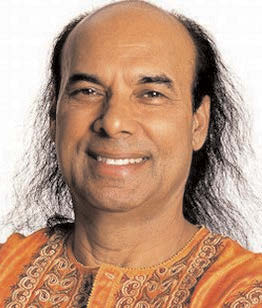
  • Bikram Yoga Founder fined $6.5 Million for Harassment by LA Court

    Bikram Yoga Founder fined $6.5 Million for Harassment by LA Court

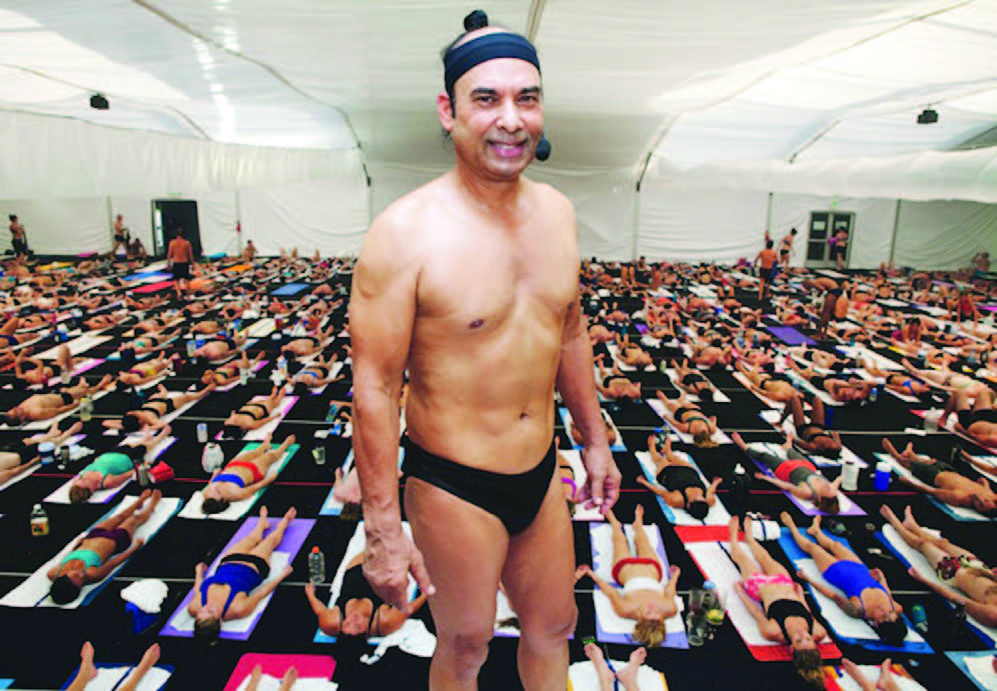
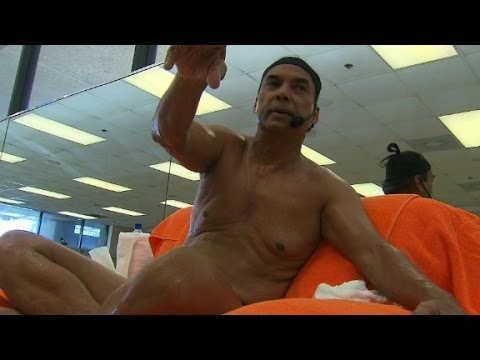
    LOS ANGELES (TIP): The founder of Bikram yoga, the heated exercise and breathing routine that enjoys worldwide popularity, was ordered in the United States Tuesday, January 26 to pay more than $6 million in damages for harassment.

    Bikram Choudhury, the man behind the Bikram yoga empire, was sued by a lawyer who worked for him, complaining that she suffered damaging consequences after she spoke out against his alleged sexual harassment of other women.

    A jury in Los Angeles Superior Court deliberated for two hours before ordering the 69-year-old guru to pay a massive $6.47 million fine in punitive damages.

    The jury had already awarded the plaintiff, Minakshi Jafa-Bodden, nearly$1 million in compensation, after it decided that she was the subject of harassment, discrimination and retaliation.

    Jafa-Bodden smiled after the verdict was announced while the famed yogi remained impassive. His lawyer, Robert Tafoya, gave no comment.

    Jafa-Bodden’s lawyer Mark Quigley said in his closing statement that Choudhury “thinks that he can do whatever he wants to do.”

    Participants in Bikram yoga go through a series of postures in a room heated to 104 degrees Fahrenheit (40 degrees Celsius).

    Bikram yoga first came under an unwanted spotlight when Choudhury tried to copyright the routine. He said Tuesday he had earned little money in the last three years and was near bankruptcy.

    Choudhury, originally from India, was said to have made a fortune after he moved to California.

    During the trial, he said that even though he has a garage of 30 to 40 luxury cars, they contain old parts from other vehicles and he plans to give them to the state and charitable organizations.

    His lawyers said Jafa-Bodden, who filed her lawsuit in 2013, was sacked by Choudhury because she was not licensed to practice law in California.

  • PADMA AWARDS 2016

    PADMA AWARDS 2016

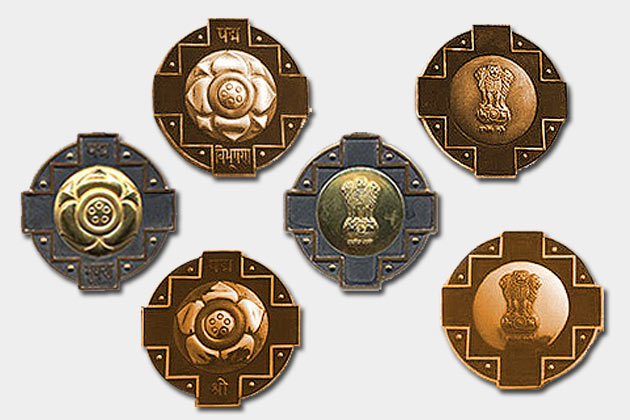
    NEW DELHI (TIP): Former Comptroller and Auditor General of India Vinod Rai, actor Rajinikanth, spiritual guru Sri Sri Ravishankar and tennis player Sania Mirza are on the list of 112 Padma awardees whose names were announced on Monday by the government.

    The awards will be given across three categories: the Padma Vibhushan, Padma Bhushan and Padma Shri. These awards are given on Republic Day, for the over six decades now, to people who the government recognises have excelled in their fields.

    Padma Vibhushan

    1. Shri Rajinikanth    Art-Cinema    Tamil Nadu
    2. Ms. Yamini Krishnamurthi Art- Classical dance Delhi
    3. Smt. Girija Devi    Art-Classical Vocal    West Bengal
    4. Shri Ramoji Rao    Literature & Education-Journalism   Andhra Pradesh
    5. Dr. Viswanathan Shanta    Medicine- Oncology    Tamil Nadu
    6. Shri Shri Ravi Shankar    Others-Spiritualism    Karnataka
    7. Shri Jagmohan    Public Affairs    Delhi
    8. Dr.Vasudev Kalkunte Aatre    Science & Engineering    Karnataka
    9. Shri Avinash Dixit (Foreigner)    Literature & Education
    10. Late Shri Dhiru Bhai Ambani (Posthumous)    Trade & Industry    Maharashtra

    Padma Bhushan

    11. Shri Anupam Kher Art-Cinema Maharashtra
    12. Shri Udit Narayan Jha Art-Playback Singing Maharashtra
    13. Shri Ram V. Sutar Art-Sculpture Uttar Pradesh
    14. Shri Heisnam Kanhailal Art-Theatre Manipur
    15. Shri Vinod Rai Civil Service Kerala
    16. Dr. Yarlagadda Lakshmi Prasad Literature & Education Andhra Pradesh
    17. Prof. N. S. Ramanuja Tatacharya Literature & Education Maharashtra
    18. Dr. Barjinder Singh Hamdard Literature & Education – Journalism Punjab
    19. Prof. D. Nageshwar Reddy Medicine-Gastroenterology Telangana
    20. Swami Tejomayananda Other-Spiritualism Maharashtra
    21. Shri Hafeez Contractor Others-Architecture Maharashtra
    22. Shri Ravindra Chandra Bhargava Public Affairs Uttar Pradesh
    23. Dr.Venkata Rama Rao Alla Science & Engineering Andhra Pradesh
    24. Ms. Saina Nehwal Sports-Badminton Telangana
    25. Ms. Sania Mirza Sports-Tennis Telangana
    26. Ms. Indu Jain Trade & Industry Delhi
    27. Late Swami Dayanand Sarawasati (Posthumous) Others- Spiritualism Uttarakhand
    28. Shri Robert Blackwill (Foreigner) Public Affairs USA
    29. Shri Pallonji Shapoorji Mistry (NRI/PIO) Trade & Industry Ireland

    Padma Shri

    30. Smt. Prathibha Prahlad Art- Classical Dance Delhi
    31. Shri Bhikhudan Gadhvi Art- Folk Music Gujarat
    32. Shri Sribhas Chandra Supakar Art- Textile Designing Uttar Pradesh
    33. Shri Ajay Devgn Art-Cinema Maharashtra
    34. Ms. Priyanka Chopra Art-Cinema Maharashtra
    35. Pt. Tulsidas Borkar Art-Classical Music Goa
    36. Dr. Soma Ghosh Art-Classical Vocal Uttar Pradesh
    37. Shri Nila Madhab Panda Art-Film Direction and Production Delhi
    38. Shri S.S. Rajamouli Art-Film Direction and Production Karnataka
    39. Shri Madhur Bhandarkar Art-Film Direction and Production Maharashtra
    40. Prof. M. Venkatesh Kumar Art-Folk Artist Karnataka
    41. Ms. Gulabi Sapera Art-Folk Dance Rajasthan
    42. Smt. Mamta Chandrakar Art-Folk Music Chhattisgarh
    43. Ms. Malini Awasthi Art-Folk Music Uttar Pradesh
    44. Shri Jai Prakash Lekhiwal Art-Miniature Painting Delhi
    45. Shri K. Laxma Goud Art-Painting Telangana
    46. Shri Bhalchandra Dattatray Mondhe Art-Photography Madhya Pradesh
    47. Shri Naresh Chander Lal Art-Theatre & Cinema Andaman & Nicobar
    48. Shri Dhirendra Nath Bezbaruah Literature & Education Assam
    49. Shri Prahlad Chandra Tasa Literature & Education Assam
    50. Dr.Ravindra Nagar Literature & Education Delhi
    51. Shri Dahyabhai Shastri Literature & Education Gujarat
    52. Dr.Santeshivara Bhyrappa Literature & Education Karnataka
    53. Shri Haldar Nag Literature & Education Odisha
    54. Shri Kameshwaram Brahma Literature & Education – Journalism Assam
    55. Prof. Pushpesh Pant Literature & Education-Journalism Delhi
    56. Shri Jawaharlal Kaul Literature & Education-Journalism Jammu & Kashmir
    57. Shri Ashok Malik Literature &Education Delhi
    58. Dr.Mannam Gopi Chand Medicine-Cardio Thoracic Surgery Telangana
    59. Prof. Ravi Kant Medicine-Surgery Uttar Pradesh
    60. Prof. Ram Harsh Singh Medicine- Ayurveda Uttar Pradesh
    61. Prof. Shiv Narain Kureel Medicine- Paediatric Surgery Uttar Pradesh
    62. Dr.Sabya Sachi Sarkar Medicine -Radiology Uttar Pradesh
    63. Dr. Alla Gopala Krishna Gokhale Medicine-Cardiac Surgery Andhra Pradesh
    64. Prof. T.K. Lahiri Medicine-Cardio Thoracic Surgery Uttar Pradesh
    65. Dr. Praveen Chandra Medicine-Cardiology Delhi
    66. Prof. (Dr) Daljeet Singh Gambhir Medicine-Cardiology Uttar Pradesh
    67. Dr.Chandrasekar Shesadri Thoguluva Medicine- Gastroenterology Tamil Nadu
    68. Dr. (Mrs.) Anil Kumari Malhotra Medicine-Homeopathy Delhi
    69. Prof. M.V. Padma Srivastava Medicine-Neurology Delhi
    70. Dr. Sudhir V. Shah Medicine-Neurology Gujarat
    71. Dr. M. M. Joshi Medicine-Ophthalmology Karnataka
    72. Prof. (Dr) John Ebnezar Medicine-Orthopaedic Surgery Karnataka
    73. Dr. Nayudamma Yarlagadda Medicine-Paediatric Surgery Andhra Pradesh
    74. Shri Simon Oraon Other -Environment Conservation Jharkhand
    75. Shri Imitiaz Qureshi Other-Culinary Delhi
    76. Shri Piyush Pandey Others-Advertising & Communication Maharashtra
    77. Shri Subhash Palekar Others-Farming Maharashtra
    78. Shri Ravinder Kumar Sinha Others-Wildlife Conservation Bihar
    79. Dr. H.R. Nagendra Others-Yoga Karnataka
    80. Shri M. C. Mehta Public Affairs Delhi
    81. Shri M. N. Krishna Mani Public Affairs Delhi
    82. Shri Ujjwal Nikam Public Affairs Maharashtra
    83. Shri Tokheho Sema Public Affairs Nagaland
    84. Dr. Satish Kumar Science & Engineering Delhi
    85. Dr.Mylswamy Annadurai Science & Engineering Karnataka
    86. Prof. Dipankar Chatterji Science & Engineering Karnataka
    87. Prof.(Dr.) Ganapati Dadasaheb Yadav Science & Engineering Maharashtra
    88. Smt. (Prof.) Veena Tandon Science & Engineering Meghalaya
    89. Shri Onkar Nath Srivastava Science and Engineering Uttar Pradesh
    90. Ms. Sunita Krishnan Social Work Andhra Pradesh
    91. Shri Ajoy Kumar Dutta Social Work Assam
    92. Shri M. Pandit Dasa Social Work Karnataka
    93. Shri P. P. Gopinathan Nair Social Work Kerala
    94. Smt. Madeleine Herman de Blic Social Work Puducherry
    95. Shri Srinivasan Damal Kandalai Social work Tamil Nadu
    96. Shri Sudhakar Olwe Social Work Maharashtra
    97. Dr. T.V. Narayana Social Work Telangana
    98. Shri Arunachalam Murugantham Social Work Tamil Nadu
    99. Ms. Deepika Kumari Sports-Archery Jharkhand
    100. Shri Sushil Doshi Sports-commentary Madhya Pradesh
    101. Shri Mahesh Sharma Trade & Industry Delhi
    102. Shri Saurabh Srivastava Trade & Industry Delhi
    103. Sh Dilip Sanghvi Trade & Industry Maharashtra
    104. Dr. Keki Hormusji Gharda Trade & Industry Maharashtra
    105. Late Shri Prakash Chand Surana (Posthumous) Art – Classical Music Rajasthan
    106. Late Shri Saeed Jaffrey (NRI/PIO/Posthumous) Art- Cinema UK
    107. Shri Michael Postel (Foreigner) Art-Archaeology France
    108. Shri Salman Amin Sal Khan (NRI/PIO) Literature & Education USA
    109. Smt. Hui Lan Zhang (Foreigner) Others-Yoga China
    110. Shri Predrag K. Nikic (Foreigner) Others-Yoga Serbia
    111. Dr.Sundar Aditya Menon (NRI/PIO) Social Work UAE
    112. Shri Ajaypal Singh Banga (NRI/PIO) Trade & Industry USA

  • Hot Yoga Guru Bikram Choudhury Fined $924,000 In Sexual Harassment Suit: Report

    Hot Yoga Guru Bikram Choudhury Fined $924,000 In Sexual Harassment Suit: Report

    The founder of the Bikram yoga practice, Bikram Choudhury, was ordered to pay $924,500 on Monday, Jan 25, to a former legal adviser who said she was fired for investigating sexual misconduct charges against her employer, media reported.

    Minakshi Jafa-Bodden, the former personal attorney of celebrity hot yoga guru Bikram Choudhury, was awarded compensatory damages by a Los Angeles jury for claims of discrimination, retaliation and of suffering sexual harassment herself, The Los Angeles Times reported.

    During the trial, Choudhury had dismissed the accusations and said Jafa-Bodden was let go because she did not have a license to practice law in the United States, the Times and other media reported.

    Choudhury published a book in 1979 with descriptions, photographs and drawings of his signature 26 postures and two breathing exercises yoga sequence, which is practiced in a room heated to 105 degrees Fahrenheit (41 degrees Celsius).

  • SHILLONG: SCOTLAND OF EAST

    SHILLONG: SCOTLAND OF EAST

    The city of Shillong has a lot to offer —from museums, cafés and markets that are perfect for those evening strolls, to old-school cathedrals and lakes (yes, in the middle of the city).

    What to see – Living Root Bridge

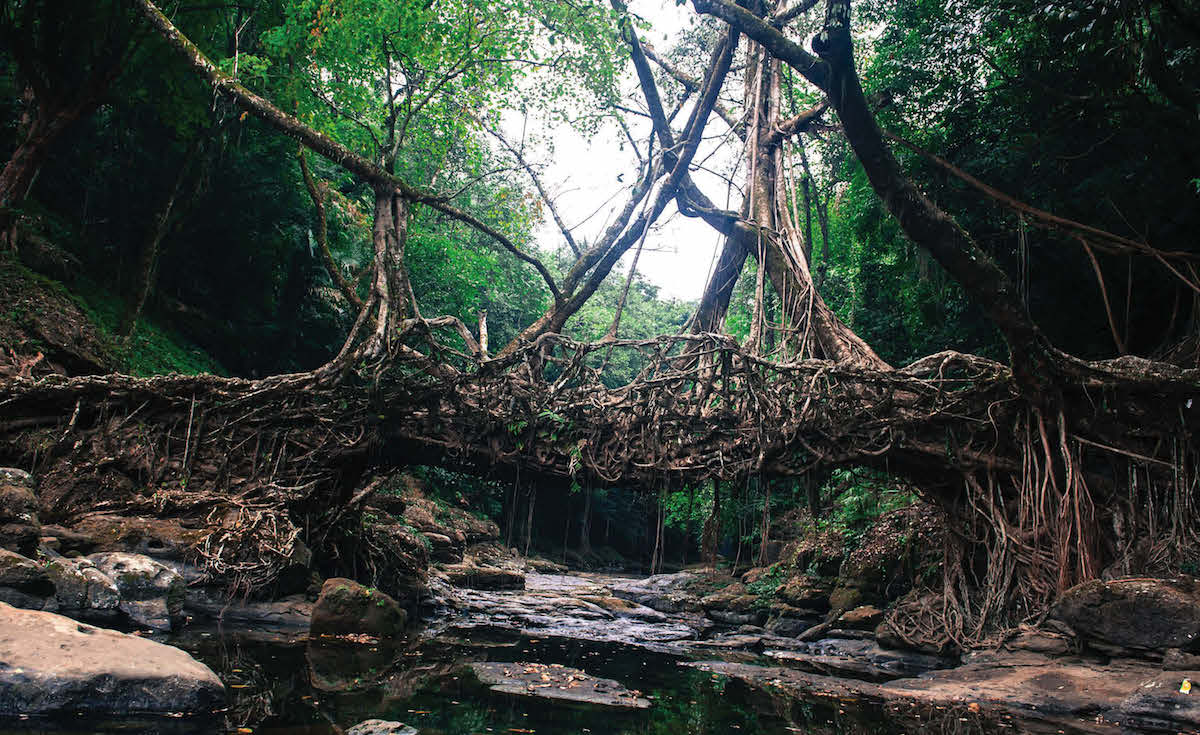
    In Meghalaya, bridges aren’t built, they are grown. The Living Root Bridge is an example of that. About a two-hour drive from Shillong, near Mawlynnong, the bridge is made of sturdy roots and is often used by villagers. While this bridge is a popular tourist attraction because of its accessibility, the one situated in Cherrapunji is not for the weak-hearted; it involves trekking down over 3,000 steps.

    SHILLONG- SCOTLAND OF EAST1Mawlynnong

    You’ll pass through this village on your way to the Living Root Bridge. We suggest making a pit stop here, on your way back.

    The village is very clean and the people from the village are friendly and welcoming. Walk through the tiny lanes and make it a point to check out the neatly-divided residential areas, small drainage canals built along the huts and the bamboo dustbins installed every few meters. Make it a point to grab a meal at the local shacks; these offer a peek into the cuisine from the state. A vegetarian meal here consists of plain dal, rice and a curry, and a non-vegetarian meal is usually chicken cooked with bamboo shoots and served with rice and spicy pickle.

    Dawki, Umngot River

    Crystal clear water is not just an expression, but a reality at Dawki. Passing through the India-Bangladesh border, the Umngot River makes for an ideal spot for camping and barbecues, or just to laze around. Take a boat ride (priced at `400 per hour) along the river and go nuts gawking at the large pebbles on the river bed. Yes, you can see through the water — even 15ft deep at some places.

    SHILLONG- SCOTLAND OF EAST

    Mawphlang Sacred Forest

    The Khasi Hills have many forests that have been preserved by local religious sanctions, which means that these forests cannot be harmed or tampered with. “Don’t even dare picking up a leaf as a souvenir,” instructed our guide. About 25km from Shillong, this sacred forest is an ideal spot for nature lovers, and those who are looking for a moment of peace and quiet. Dense trees, orchids and butterflies are in abundance, and so are religious stones that stand tall in the forest.

    Where to stay

    Aerodene – This charming homestay is part of a restored bungalow built in Assamese and Chinese style, with walls in pastel shades and wooden flooring. Run by the charming and helpful Sharlene, Aerodene is perfect for those who like to soak into local culture and enjoy the slow-paced life. Though the homestay is quaint, it boasts of all modern amenities like Wi-Fi, LCD TVs, room heaters, a mini library and yoga classes for guests.

    Lakkhotaa Lodge – Built by a couple who are Feng Shui practitioners, this lodge can be a perfect spot for those looking to channelise their zen energies. The food menu is conceptualised by a Le Cordon Bleu pass-out and offers continental fare.

    Where to eat

    Café Shillong – A popular haunt with the locals, Café Shillong hosts regular gigs over the weekends. In fact, Lou Majaw (who organises the famous annual Bob Dylan festival in the city) is a regular here. Order a warm cup of coffee or dig into the Khow Suey here, while you listen to some good old rock ‘n’ roll. Another dish worth mentioning is the Shillong Noodles served with smoked pork, a local delicacy.

    City Hut Dhaba – Situated close to the main square at Police Bazaar, City Hut Dhaba is popular with the tourists. The menu boasts of a mix of Indian and Chinese favourites including Manchurian, momos and wantons. However, the restaurant’s best feature is its quaint, yet vintage-y vibe.

    Royal Heritage Tripura Castle – Built in the 1920s by the royal family of the Manikya Dynasty of Tripura, the castle houses The Rice Court, a multi-cuisine restaurant and Café Shillong Heritage that is often a preferred venue by the elite for weekend gigs with barbecue. The castle also offers luxurious rooms to stay.

  • Interview: Ambassador Asoke K Mukerji  The Issue of the Nature of Human  Beings is of Vital Importance in Diplomacy

    Interview: Ambassador Asoke K Mukerji

    The Issue of the Nature of Human Beings is of Vital Importance in Diplomacy

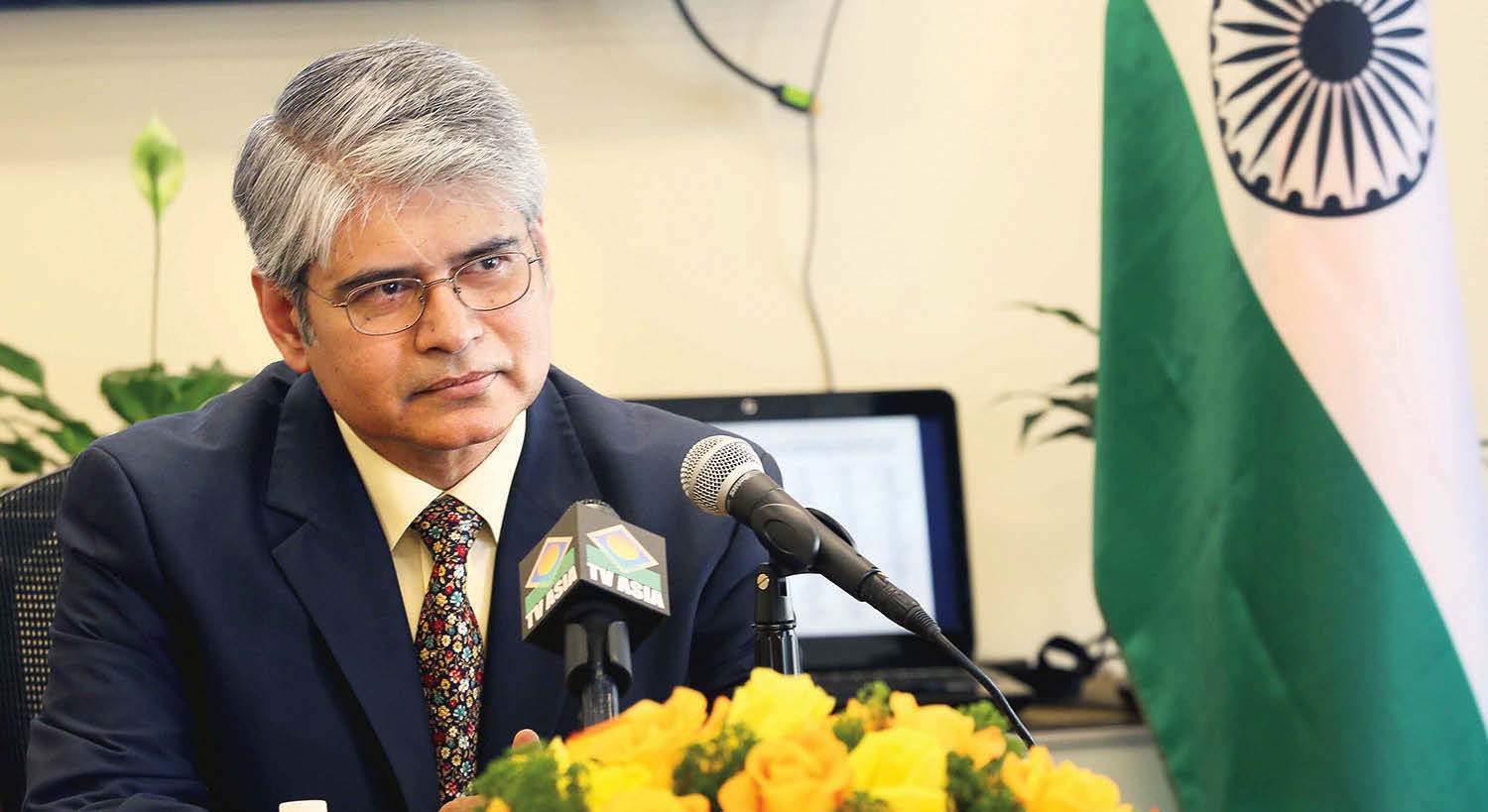
    Ambassador Asoke K Mukerji has been the Permanent Representative  of India at the United Nations  from early 2013 to  December 31, 2015.

    Ambassador Mukerji  who has served with distinction the MEA  for almost 38 years was widely regarded as a “diplomat with spine”.

    Ambassador Mukerji greets the Prime Minister of India, Narendra Modi. Seen from L to R: The then Ambassador to the US Jai Shankar, Mrs. Shankar, Ambassador Asoke Mukerji, Mrs. Mukerji, Consul General Dnyaneshwar Mulay and Mrs. Sadhna Mulay
    Ambassador Mukerji greets the Prime Minister of India, Narendra Modi. Seen from L to R: The then Ambassador to the US Jai Shankar, Mrs. Shankar, Ambassador Asoke Mukerji, Mrs. Mukerji, Consul General Dnyaneshwar Mulay and Mrs. Sadhna Mulay

    In this interview which he had given to  Prof. Indrajit S Saluja, Chief Editor of The Indian Panorama just a few days before relinquishing office, Ambassador Mukerji speaks about how well India was articulated at the United Nations during his tenure as Permanent Representative and what have been the significant achievements for India. He also speaks frankly about the need for the United Nations to go forward with reforms to the Security Council.

    However, he was appreciative of the role the United Nations has played  over the years  and taken effective  measures  to resolve conflicts, even though there are many unresolved ones, and to bring about empowerment of women, just to mention a few.

    Here are excerpts from the interview 

    Prof. Saluja: Remember Sir, in an earlier interview which you had very kindly given to The Indian Panorama on 30 April 2013 you had said that India’s ability to articulate has always been very high. How good has been the articulation at the UN. during the 3 years that you have been at the UN as India’s Permanent representative.?Do you think India has articulated well through you at the UN?

    Ambassador Mukerji: I think we have articulated the perspective that we have as a country on the issues which are the major issues facing the world today.And if you look at it in the broad areas, then you can see, for example, in the area of peace & security, we have consistently articulated  the need for resolving problems, resolving disputes through negotiations and peaceful means and today even disputes that 3 years ago seemed to  be open for military solutions are now moving towards peacefully negotiated solutions. The latest being the Syria dispute after the talks in Vienna. So I think the view that India has consistently articulated in the United Nations which is based on the provisions of the United Nations charter which is to resolve disputes peacefully is a view that enjoys a very vast degree of support.

    And including among the permanent members of the UNSC .

    In matter  of peace and security dealing with peacekeeping we have been among the most articulate of voices.

    I think that the views that we have actuated have a resonance within the UN System and as we complete the review of the peace building activities of the United Nations in the coming few months we should be able to see the combining  of the pools available to the United Nations for creating conditions for the reconstruction… peaceful reconstruction of conflict regions and societies.

    I think that’s a very important point that we have made that it has to be a holistic exercise, that you cannot expect any society or country or region to be able to sustain peace without having the institutions

    And in our own country and the reason we articulate this in our own country we have invested in building  and  nurturing institutions which are there to help the society to reach solutions through peaceful institutional methods

    And I think that this is something that has been appreciated .

    And the 3rd area of peace and security unfortunately where we have not probably succeeded but where India’s articulation has been consistent is in the need to investigate & prosecute terrorism .We are a country who have been confronting terrorism nationally for a very long time over 30 years… but in the international context… the main tool available to UN is the legal tool – the rule of law to counter and prosecute terrorism . It’s a pity that so far we have not been able to see the effective utilization of these legal tools by the United Nations

    The one example we have been putting forward for many years now is the comprehensive convention on International Terrorism (CCIT)

    Now the important role that this convention will play is to require member countries of the united nations to either prosecute a terrorist or if they cannot prosecute a terrorist, to extradite the terrorist for prosecution…. So prosecute or extradite .

    This is a very well established legal principle but unfortunately there has been no agreement so far on adopting this convention… so this is…..

    Prof Saluja: Have all the countries yet agreed for such a convention?

    Ambassador Mukerji: You see… all countries have participated in the discussions on the convention and right now the main issue on which the convention is still deadlocked is on the definition of terrorism

    There are some countries who are asking for the definition of terrorism to exclude freedom fighters…. this is not acceptable to many countries .So we need to find a way to bridge this issue because while we discuss the definition of terrorism the world is facing the impact of terrorism and when we face the impact of terrorism then we understand what the definition of terrorism is…

    So we would argue therefore that this is an area in which initiatives like this convention should be given priority and this is something we are articulating at the United Nations but this is an area where I think more needs to be done. So this is on the peace and security areas.

    Now on the second big area of the UN which is economic & social area

    I think …our articulation in the last 3 years has been very successful… if you remember in 2013 we started this process of discussing and then developing the goals which would replace the millennium development goals…. And in July last year , 2014… we were able to agree  and adopt 17 goals which are known as the sustainable development goals -that was in 2014 July.

    So this is to illustrate that all 193 countries can actually work together if they are helped to accommodate each other… and I think India’s role has been really constructive in that context… that we have not tried to polarize this exercise… we have tried to play a constructive role of also building bridges and the fact that we have these 17 goals and… and the 17 goals are now at the heart of this agenda for the next 15 years also known as Agenda 2030 which was adopted when Prime Minister Modi was here in September .…So for the next 15 years what is the economic and social agenda of the world is now set in the UN.. in this document called the Agenda 2030… at the heart of which are these 17 goals.

    So this has been a tremendous success and I think recognition of India’s articulation of its experience and perspective as a country which is transitioning… we are in some senses… we have reached the status of an advanced country of putting space crafts into space and going to mars and so on…

    But on the other hand we have 300 million who live below $1.25 a day; so we are among the poorest societies in the world… so I think that this diversity -this enables us to actually articulate issues in a more credible manner… because we know both the sides…we know the side of the developed and advanced and cutting edge … as well as the side of the poorest of the poor… so this has been a major achievement & outcome and we are just finishing this week review  of the way in which technology can help development and the United Nations General Assembly is adopting this review day after tomorrow in which an area where India is really focused a lot on is how to use technology to accelerate development and this review of what is called the ‘Tunis Agenda’ focuses on the use of Information & communication technology – ICT. Information & communication technology for development and this is an important area. In India we have an initiative called the digital India in which we are trying to use technology for accelerating development, for creating empowerment, for generating information, right to information for example, or empowerment of women. So these issues we are now bringing to the global stage and I think that this  area for the next 10 years is going to be an area of immense importance and priority for India so that by the time the next review takes place in 2025 we should be able to demonstrate how important it is for the International community to agree on using this technology for development in an affordable and global manner because the problem with all these issues is of affordability  and unless it becomes affordable and accessible it cannot have the full impact that it otherwise  contains the potential of having.

    This is the second big area of our work in United Nations.

    The third area of our work in the United Nations is related to human rights and the rule of law. And here again this year we are beginning the 70th anniversary commemoration of the universal declaration of human rights now for a long time probably because so many years have passed , people have forgotten what were the contributions which India has made in this area and which we are building on for the future so if you look back in time, in 1946 we brought in the issue of racial discrimination when we talked about apartheid and that concluded in 1994 with the emergence of independent South Africa.

    In 1948 we co-sponsored the resolution on genocide and today the United Nations has  a very vibrant anti-genocide convention on which people are building new ideas such as responsibility to protect.

    In  1948 we brought in the idea of gender equality into the universal declaration of human rights where the Indian delegate Hansa Mehta proposed the phrase “all human beings are created equal” . So that was agreed to in 1948 and since then the role that has been played in empowering women has been something that we have been at the forefront of and now we have our own program in India called Beti Bachao Beti Padhao .

    So this program is based on the principle that it is  through education that you can empower women and also safeguard their rights . So, this is something that we have been advocating and we are one of the strongest and earliest supporters of the UN Womenwhere you will be happy that an eminent Indian diplomat ambassador Lakshmi Puri is the number 2 person in the UN Women.

    So in the area of women’s rights we are very much out there.

    This year earlier in 2015 we inaugurated and contributed to the memorial in the united nations against slavery… and the reason why apart from being completely involved with the issues relating to slavery… the reason why India is also prominent in this area is because we feel that attention has to be paid to the phenomenon of indentured labor.

    If you remember when slavery was abolished in 1832 by the United Kingdom that in a legal way removed the issue of slavery or made slavery illegal but in 1834 the British parliament passed the Indentured Labor Act. Under that act millions of people including from India were transported to various countries around the world and made to work in plantations. Now, the whole issue of indentured labor.. and  Mahatma Gandhi himself wrote about it -that indentured labor was another form of slavery  and I think this is an issue with the Indian diaspora being so vibrant today and more than 25 million people living in countries across the world… that a lot of this diaspora originally- the older diaspora went as indentured labor whether it was to Fiji, whether it was to South Africa , Canada, the Caribbean . So we need to provide a focus so that if we say never again to slavery then we also do something to recognize the tremendous suffering that was endured by  our population when they were transported as indentured labor.

    So this is something that we are focusing on but I think in the area of human rights and human dignity one of the most important contributions that we have made in this period is our contribution on yoga… because while yoga is linked with health, and  without health you cannot enjoy human dignity and human rights. I think that there is a synergy between the physical activity of yoga and the impact it has on the human character and I think that the fact the 177 countries were able to join us and take ownership on this idea shows that this is an idea which brings people together and as I have kept saying in these 3 years – India’s voice is one of inclusion. We do not believe in exceptionalism. We do not ever say that we are a unique country and that we have an experience which is not relevant or not applicable to other parts of the world. What ever we have experienced we have shared with others and that is something that we have tried to do with the two international days that we celebrate in the United Nations – the day of Yoga which is on June 21st and the day of non-violence which is on October 2nd.

    And in these 3 years what we have tried to do with the day of Non-violence is like with the day of yoga which is to bring the message beyond the meeting rooms of the United Nations out into the wider public space. So for Yoga it was easy to see that we were able to reach out to 192 countries. Even in Times Square in NY there were 30000 people but for day of non-violence our involvement is now with the school children and with university students because we have to carry forward this message of non-violence to the next generation and it is only by bringing   them into the celebrations that we organize in the United Nations that they are able to appreciate the discussion on the importance of non-violence and apply this discussion to their own lives as  school children or university students.. If you teach your child and a conscious child… secondary school or university student the virtues of non-violence and that there are people who have spent their lives weather it is Mahatma Gandhi on whose birthday we celebrate it or Martin Luther King, Nelson Mandela, Ramos- you know these are the people who through their own lives are able to show that you can achieve things through non-violent means and I am being very fortunate that for these 3 years that we have done this event in the United Nations we have always had speakers who have talked about how they have applied non-violence in their own lives and this I believe since 1/3rd of the audience is of children and young people… I think that in our own way we have tried to carry forward this important contribution that we make to work in United Nations. So, in all their areas whether it is peace & security whether it is economic & social or whether it is human rights we have been articulate and effective.

    Prof Saluja: In-fact you know when you said that the charter of UN says that we have to resolve all the issues peacefully so the very idea of promoting peace comes through non-violence and again through yoga because there you learn to control yourself, discipline yourself… so both the ideas I think they come together; they come together to promote the vision of the UN… can I put it that way?

    Ambassador Mukerji: I Think so . I think that is the right way to put it and you yourself- when you practice yoga … I saw you on that yoga day… you can see that eventually there was a harmony between the inner  self and the outer world and it is this harmony which we need to focus on because it exists. But I think there are too many pressures on individuals and on countries probably which make them distracted from recognizing that there is a harmony and equilibrium between the inner self and the external world and I think that is something we need to do. It is sometimes a challenge but if you  keep going and if you keep collecting more and more people to join you… I think that is something and that’s been one of the biggest and most enjoyable part of the job here — to collect people and bring them together. So, I think this is something that India stands for that . We always try and bring people together… and then together you are stronger.

    Prof Saluja: Do you think you have made any progress with regard to the easing of procedures so that the decisions of the UN body are taken a little earlier than they have been taken in the past?

    Ambassador Mukerji: I think that when we spoke in 2013, we were the first country to start looking at it in terms of a roadmap and a realistic roadmap which in 2013 we had said 70th anniversary of the United Nations. In April that year I was probably the first delegate to use this idea of 70th anniversary.

    Today, the 70th anniversary idea has been endorsed by more than a hundred heads of states and governments in their speeches to the United Nations. So it is an expectation that something will happen in the 70th anniversary year of the United Nations.

    Now this 70th anniversary year started in September this year (2015) and concludes on the 14th of September 2016. So how are we able to use this historic opportunity to enable us to achieve this objective that we have of reforming the Security Council?

    I think what we saw was the difficulty that the United Nations membership faced with the top down approach. I don’t think people like the idea that somewhere, some people will decide behind closed doors and outside the public domain,. Who are these people /countries who they will bring into the Security Council and do a package solution.?So, the first thing that we started from 2013 was to address this issue and convince people that it is better to do a bottom – up approach and not a drop down approach.

    To that extent we have succeeded because after 23 years of discussing this top down approach, in September this year, we adopted the historic decision in the UN General Assembly. We have now got a 121 countries’ views in favor of reforms in a document. So the document is now a negotiating document. We have to negotiate the give and take of positions of different countries on the issues of the how the United Nations Security Council will be reformed. There are 5 sets of issues which you know, so, on each of these 5 sets of issues there are different views but all 121 countries agree that these are the areas which we have to address to reform.

    One issue of which I thought we could make progress on was to create a permanent memorial for our UN peace keepers. This has been an area in which I have personally got more involved than probably any other predecessor of mine.

    I feel that we need to focus on the human dimensions of the peace keepers. They are not statistics. Each soldier, each troop has a personality, a family a village or a city from where he or she comes. So we need to look at the human dimensions of UN peace keepers and as the numbers of the peace keepers who are dying in UN operations is growing every year, I think apart from looking into the reasons why they are dying which is for the Security Council to look at, we also need to honor the bravery and sacrifice of these peace keepers and for me this issue comes very vividly in that month I came in April 2013, when we lost 5 peace keepers in South Sudan. So One thing that I wanted to do and, I am happy that the General Assembly has agreed with this proposal  to build a permanent wall, a memorial wall, which will have the names of all the more than 3000 soldiers from all the countries who have died in peace keeping.

    It is the UN peace keepers Memorial wall and this idea was, I thought, we would be able to do it by this year (2015) but it is the only regret I have that the process is so slow in the UN.

    Prof Saluja : I remember,  something was done there, I was there.

    Ambassador Mukerji: We launched a virtual wall, that is the reason I launched a virtual wall. So I could do it for our peace keepers . So, all 161 peace keepers who have died from India -their names are on a virtual wall which is on a website.

    The idea was to build a wall like the Vietnam Wall in Washington which will have the names of peacekeepers of all the countries not only Indians but all countries -more than 3300 soldiers who have died and this number goes up every year by 100/150.

    So, this proposal moved by India was approved by the United Nations General Assembly and the reason why I am not completely unhappy is that our Prime Minister had in his speech at the Peace Keeping Summit  said that India stands ready to contribute to this memorial including financially. So, I think this is something I would very much like to see happen because unless we recognize the value of human life being given for the principles of the UN Charter we do not connect to the real world outside and some of the conditions in which the soldiers have to work are really very , very challenging; very, very difficult; and this is something that like I said is an obsession with me.

    Prof. Saluja :  How far is the idea to its fruition?

    Ambassador Mukerji: Given our previous experience, I would say 5 to 7 years, because, the slavery memorial project took 7 years from  the day it was approved by the UNGA. So, I would say 5 years. By the 75th anniversary of the United Nations this wall should be there.

    All 193 countries are supporting this.

    Prof.  Saluja: Give me briefly your view on Diplomacy as it has evolved; there was a time when diplomacy only meant talking about conflicts,  talking about peace and now diplomacy involves a very important economic aspect to it.

    What is your world view would be my last question.

    Ambassador Mukerji:You know the essence of diplomacy has not changed and I don’t think it will change because essentially diplomacy relates to human nature and human beings. It is only the tools that keep changing but without an understanding of human nature and human beings it would not be possible to practice the profession of diplomacy. Now there are different aspects of human behavior which have thrown up challenges. You mentioned the economic activity. The world is today economically globalized and that throws its own challenges. But I think at the heart of even those challenges is the issue of the nature of human beings; what do human beings want from a globalized world?  I think this is the key question that any diplomat will have to understand and answer before he or she practices diplomacy. The tools have changed and I think as you rightly said there is a tremendous focus therefore on what is called soft power. Professor Joseph coined the word soft power. India is one of the countries which is fortunate in having a large population, a population which is also focused on the acquisition of knowledge. it is probably a civilizational characterization of India  and as a knowledge based society we therefore are well placed to not only understand human nature but also to use various tools (if I may call it that) for the pursuit of our diplomacy in relating with other countries and other negotiators. And, I think this shows in the way we are able to build bridges; this is something which is very important even in economic diplomacy. There is no black and white solution to anything. It is always a give and take.

    My worldview is that we are in a multilateral institution like the United Nations. We have managed to avoid a world war – a 3rd world war but we need to be conscious that unless we invest in strengthening these multilateral impulses and these multilateral institutions, we run the risk of fragmenting the world into regional and sub regional units which, in a holistic way , does not contribute to world peace.


  • THE COOLEST THINGS TO DO IN PONDICHERRY  Incredible India

    THE COOLEST THINGS TO DO IN PONDICHERRY
    Incredible India

    A destination like no other, Pondicherry is fascinating. Owing to its popularity as a laid back destination, also a great hit with expats and backpackers, this town boasts of a number of things to do. Dabble in surfing, take cooking classes, sweat away stress in a yoga session, go diving amid corals and more?there is plenty to keep your hands busy in this beautiful, once French, settlement. Add to this list, volunteering at one of the many NGOs in town or Auroville and you are in for an experience of a lifetime.

    SHOPPING FOR SOUVENIRS

    Pondicherry is the place for artsy souvenirs and other such stuff. You will fall for handmade lampshades, trinkets, paintings, candles, Indian wear among other items that are sold in the many stores here. Most of these are made with expert precision in the self-sustainable, experimental town of Auroville. A huge hit with backpackers, markets in Pondicherry offer an interesting line up of a number of stores selling such souvenirs. Get ready to pack your bag with a lot of memories from the lanes here.

    POLISH YOUR CULINARY SKILLS

    Wish to dabble in a culinary experience of a different kind in Pondicherry? If yes then this is for you. This town is home to Sita Cultural Centre, hailed as one of the best places in India, for anyone eager to learn South Indian or French cuisine. Their short haul two-three-day cooking courses aimed at foodies is a key highlight of the city. You can choose one or more courses to learn the art of traditional Tamil menu (both vegetarian and non-vegetarian), an exclusive Kerala menu and basics of French cuisine, including some amazing desserts. Be prepared to have folks at home pleasantly surprised with your new found culinary prowess.

    PONDICHERRYYOGA AT YOGANJALI NATYALAYAM

    Learn the ancient practice of yoga at some of India’s best yoga schools in Pondicherry. Choose from vinyasa, hatha yoga, Iyenagar, Bikram, ashtanga or therapeutic form of yoga, Pondicherry has expert teachers for it all. You can also go for day long yoga and meditation retreats for a more spiritual experience. Some of the best names for these classes and retreats are Yogaalayam and Yoganjali Natyalayam. While Yogaalayam is run by Mr RK Gopinath, a yoga practitioner from decades, Yoganjali Natyalayam is a 160 years old institution. Both the places offer beginners as well as advanced courses. You can also go for a teacher’s training course at any of the places. Experience bliss sweeping over as you practice yoga at one of the solitary beaches, waves for a background score.

    PONDICHERRY2VOLUNTEERING AT AUROVILLE

    If travelling for a cause is on your mind, Pondicherry has a lot to offer. Pondicherry’s neighbour Auroville wears the tag of India’s first experiential town, a major centre for volunteers interested in healthcare, education, women empowerment, child development, gender equality, organic farming and more. Other than Auroville, Pondicherry itself has a number of NGOs that take volunteers. The town sees a huge number of travellers from outside India owing to these volunteering activities, making it a perfect opportunity for some cultural exchange as well.

    SURFING ON SERENITY BEACH

    Riding waves is probably the coolest thing to do in Pondicherry. Visiting Kallialay Surf School? run by two brothers fromSpain? should be on the top of your to-do list if adventure is on your mind. The school has won accolades from various tourism boards and is a huge hit with travellers as well. Classes start from around INR 1000 per person and range from beginners to expert level. Lessons on surfing take place in the inviting blue waters of Serenity Beach that lies at a distance of some 10 km from the city centre. While group lessons are more fun, private classes are also available on request. If you have landed in Pondicherry and wish to experience surfing from your wishlist, this is the place to be at.

    Source: Happy Trips

  • Philadelphia Museum showcasing India | Art, Textiles & Photography

    Philadelphia Museum showcasing India | Art, Textiles & Photography

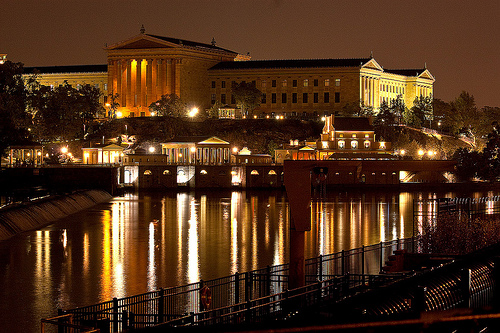
    Philadelphia Museum of Art (PMA) is showcasing ‘India’ with multiple exhibitions currently on display. These exhibitions showcase Art collections, traditional textiles & contemporary photography from 15th century onwards and provide a glimpse of India’s talent.

    Drawn from Courtly IndiaThis exhibition “Drawn from Courtly India” presents masterful drawings from the royal courts of northern India. Lovingly amassed by artist Conley Harris and architectural designer Howard Truelove, the collection features practice sketches, preparatory drawings, subtly modeled scenes, and lightly colored compositions created between the 1500s and 1800s. With images at different stages of completion, the collection allows for a fascinating look at Indian workshop practice. Although the majority of the drawings served as studies for paintings, they are accomplished works of art in their own right.

    This exhibition will also showcase drawings of Lord Krishna dancing atop many-headed Kaliya demon and six naginis (Kaliya’s part-human part-snake wives); Krishna and the gopis shelter from the rain; festive image of the birth of Krishna; walking Vaishnava disciples; Devi and the Shakti forces attack Nishumbha, Shumbha, and their army; battle scene with demons; etc.

    PMA is also organizing yoga party to “Celebrate the Holidays” on December 30; involving yoga through meditative exercises, yoga postures, and breathing techniques.  Calling it a “peaceful stretch”, PMA is also making “Henna tattoos” available at this event.

    Art of the Zo: Textiles from Myanmar, India, and Bangladesh, Now Through March 20, 2016, offers a look at beautiful woven textiles of the Zo people of Myanmar, India, and Bangladesh. It spotlights traditional weavings worn for daily life and ceremonial occasions, such as weddings, funerals, and feasts of merit. Patterns, techniques, and local variations are closely examined, revealing the extraordinary beauty and craftsmanship of these distinctive creations.

    Picture This: Contemporary Photography and India, Now Through April 3, 2016, features the work of four contemporary photographers for whom India is an important subject or setting: Gauri Gill, Sunil Gupta, Max Pinckers, and Pamela Singh. Diverse in nationality and place of residence, each of these artists brings a cosmopolitan perspective to his or her work. Whether photographing in rural Rajasthan or major cities like Mumbai or New York, they offer points of view that do not fit easily into categories of “insider” or “outsider.”

    PMA, which began as a legacy of the great Centennial Exhibition of 1876, claims to have “world-renowned collection” and to inspire the visitors “to discover the spirit of imagination that lies in everyone”. Timothy Rub, Gail Harrity and Constance H. Williams are Director, President and Trustees Chair respectively of the Museum; while Ainsley M. Cameron is the Curator of this exhibition.

  • ESCAPE TO DHARAMSALA AND MCLEODGANJ

    ESCAPE TO DHARAMSALA AND MCLEODGANJ

    Who says you can’t escape to the hills when winter hits? After all, what better place to escape the smog and the crowd of the Capital than the quaint mountains and valleys of Himachal Pradesh?

    While popular tourist spots in the region, like Shimla and Manali, may be bustling with vacationers now, places like Dharamsala offer you the opportunity to leave the crowds behind, and instead, visit -monasteries, volunteer at community centres, and check out all the sights in a relaxed manner.

    Dharamkot

    Dharamkot is a small, quaint village to the north of McLeodganj. It offers a host of upbeat cafés, retreats and Ayurvedic massage centres. Most -importantly, we found a view to kill for, with the entire Kangra Valley in front of us. Also, as yoga retreats gain momentum, most tourists these days hike to Dharamkot to enrol themselves in the Vipassana meditation centre here. Homestays are also easily available.

    HPCA Cricket Ground

    Amid a picturesque canopy of Deodar woods and green meadows, Himachal Pradesh Cricket Association’s ground stands tall with the snow-capped Dhauladhar range providing a formidable backdrop. This is also the fourth-highest stadium in the world, located at an altitude of 1,457m. Although smaller than, say Mumbai’s famous Wankhede Stadium, visitors will not be disappointed with it at all. Although tourists are not allowed inside the pavilion, the postcard view from the stands more than makes up for it.

    One-stop shop

    Do not believe people who tell you that Dharamsala is as commercial as Shimla or Dalhousie. It is not. It is a small town that you can probably explore by foot in a day. However, McLeodganj is vibrant and bustling, especially McLeodganj Square (as it is popularly called), with two parallel boulevards of retail outlets. Here, you can steal deals on almost everything — from handicrafts and winter wear to musical instruments and accessories — by bargaining hard.

    DHARAMSALATsuglagkhang Complex

    This is reportedly the biggest Tibetan monastery outside Tibet. Close to McLeod Square — the main market area, tourists can attend sermons by the Dalai Lama here. His residence is also on the premises of this magnificent temple. With the sounds of holy chants filling the air, the spacious meditation hall -resonates with serenity. However, you can’t use your cell phone here or talk loudly. So, keep your decibel levels in check. At the entrance, one will also spot pillars dedicated to the Tibetan martyrs.

    The Tibetan Museum, also located here, may not be extraordinary, but has a massive collection of photographs documenting Tibetan history, heritage and culture.

    St John in the Wilderness

    DHARAMSALA1This Anglican church is located at a walkable distance from both Dharamsala and McLeodganj, at a place called Forsythganj. The church has a cemetery on its premises, and gives an eerie feeling, especially since it’s situated almost in the middle of nowhere. The beautiful Neo-Gothic structure is ornamented with intricate Belgian-stained glass panes. Built in 1852, the then–viceroy of the country, Lord Elgin, was buried here in 1863.

    Good food

    There are countless cafés across Dharamsala and McLeodganj serving a range of cuisines, including Chinese, Tibetan, Kashmiri and Israeli. Giving them stiff competition are the roadside stalls with their steamed momos, fried baklebs (tiny Tibetan-styled samosas) and filling thukpas (thick noodle soup with vegetables, boiled chicken pieces and egg slices).

    Community service

    There are a bunch of places where you can contribute during your stay here. We enrolled ourselves for a couple of hour-long conversation sessions at Tibet World in McLeodganj. Here, we conversed in English with locals to boost their proficiency in the language. To register, submit a passport or stamp-sized photo of yourself, and fill a form with your contact details.

    Triund: A trekkers’ paradise

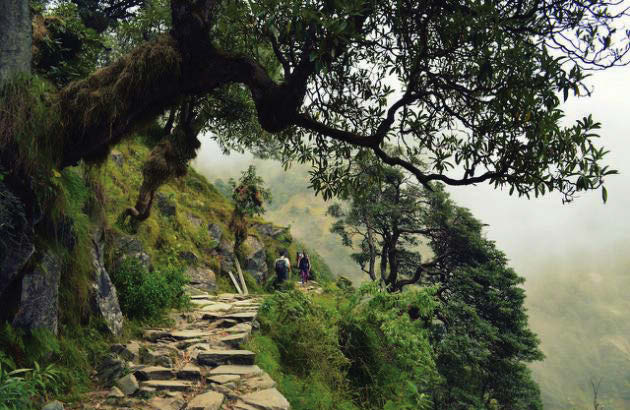
    DHARAMSALA2Triund, situated at an elevation of nearly 2,900 m above sea level, lies between the Kangra valley and the lofty Dhauladhar range of the Himalaya in Himachal Pradesh. You can get there by a pleasant trek of 9-10 km from the hill town of McLeod Ganj (about 2080 m), known as the Little Lhasa for it houses the headquarters of the Tibetan Government in Exile and its spiritual leader His Holiness the 14th Dalai Lama.

    The trail to Triund is also one of the old routes followed by the Gaddi shepherds of Chamba and Kangra valleys. Two trails lead to Triund from McLeod Ganj: one via Bhagsu, which is a bit roundabout, and the other one through Dharamkot, which is 2 km uphill from McLeod Ganj. From Dharamkot, you can choose either a motorable road or an amazing walk through an alpine forest-covered short cut to reach Gulu Devi temple in upper Dharamkot.

    The breathtaking trail to Triund starts here. After the first moderate half of the trek, you will come across two two small but fully loaded shops to reenergize yourself. Snacks, Maggi noodles, energy drinks, cold drinks and tea — everything is available. But the bigger attraction here is the serene view of the valley below. Hence the names: Magic View Café and Best View Café. They do absolute honour to their names. The peace, the calmness and the purity seem so special; it’s not only rare, it’s out-of-this-world. There is nothing more revitalising than a hot bowl of Maggi and a hot sip of strong tea as clouds float around you to carry away your grogginess. A relaxing break here is helpful before you walk the much steeper and more tiring second half of the trail.

    The greenery of the surroundings, the misty mountain top, the crisp and pure breeze, various Himalayan flowers and the constant chirping of birds will divert your mind from the strenuous walk uphill. On reaching the top, you have plenty of options to continue ahead. Triund is only the gateway to a number of longer treks deep into the Dhauladhar range. Rooms are available in a guesthouse maintained by the Forest Department (you need prior permission to stay here as it has only six rooms). You can also hire a tent — highly recommended for the unforgettable experience of spending the night atop a hill without electricity. Only nature prevails. There are three shops, or cafes, as they are commonly known, to provide you with food and drinks. Considering the transportation cost, the expensive food will seem reasonable. The tranquillity of the place is indescribable. Just a few hours here will wash away your worries.

    To be surrounded by larger-than-life mountains makes you realise the futility of worldliness and leave you feeling that you are merely part of a grander design.

    How to reach

    1 Dharamsala is a 30-minute drive from Gaggal Airport (also known as Kangra Airport).

    2 Alternatively, board a train to Pathankot. Dharamsala is a two-and-a-half hour journey via road from there.

    3 McLeodganj is situated 5km away from Dharamsala.

    4 You can use cabs or choose to walk.

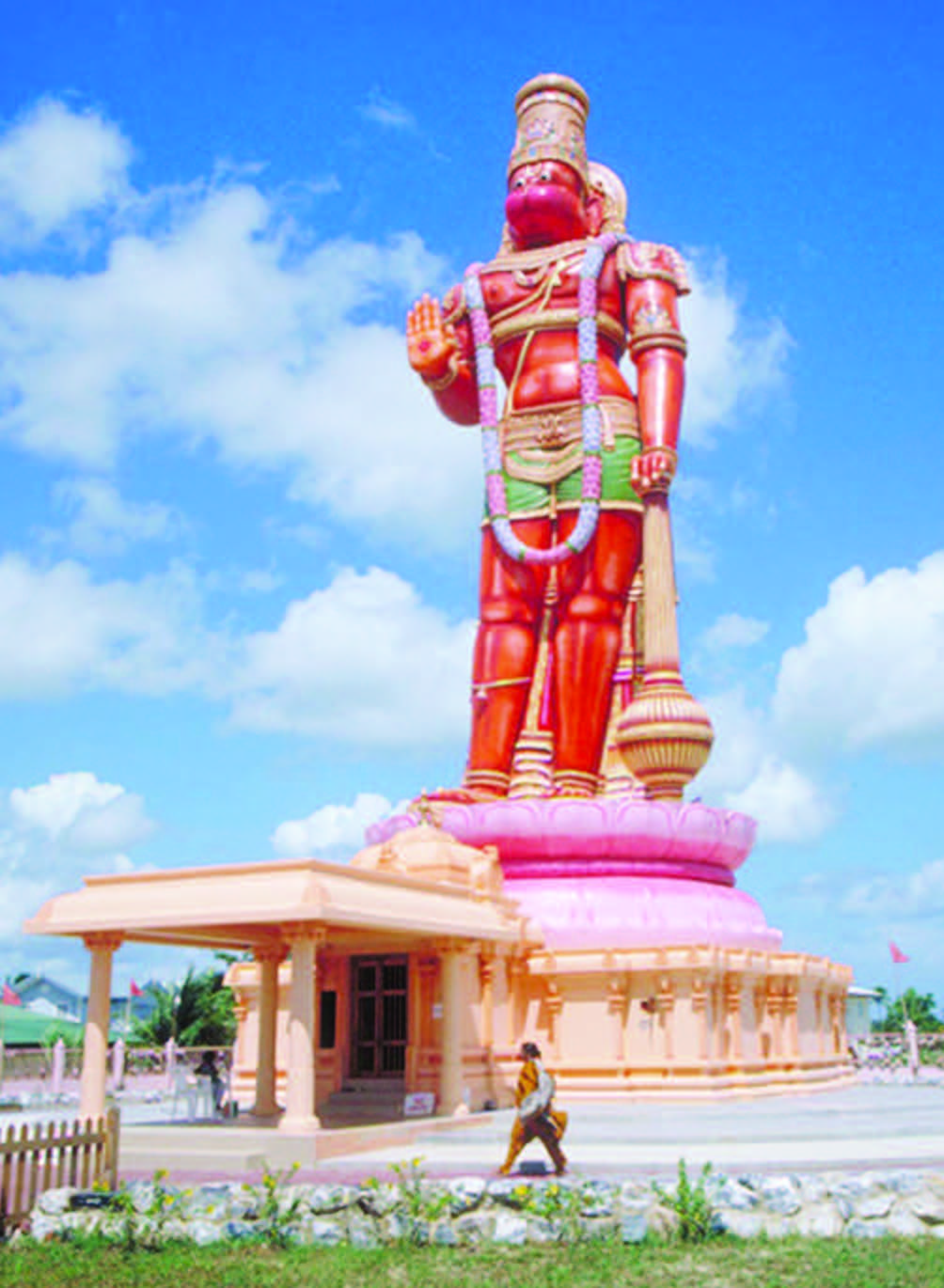
  • Construction continuing on Hindu Hanuman Temple of Greater Chicago

    CHICAGO (TIP): Construction is reportedly continuing on large two-storey Hanuman Mandir of Greater Chicago in Glenview (Illinois).

    According to reports, construction is expected to wind-up in 2016 on this 37,200 square feet white-marble and glass temple on a 3.98 acres lot; which is said to include fountains, tall glass dome and tall sikhras. Besides sanctuary, it will also include a community center for various cultural, educational, social and spiritual programs. Meanwhile, distinguished Hindu statesman Rajan Zed has  commended efforts of temple leaders and area community for realizing this Hindu temple complex.

    Rajan Zed, who is President of Universal Society of Hinduism, further said that it was important to pass on Hindu spirituality, concepts and traditions to coming generations amidst so many distractions in the consumerist society and hoped that this new temple would help in this direction. Zed stressed that instead of running after materialism; we should focus on inner search and realization of Self and work towards achieving moksh (liberation), which was the goal of Hinduism.

    Mandir has announced various Sunday School programs, including Indian languages, Bhagavad-Gita, yoga, religion and culture, etc.

    Lord Hanuman, greatly revered and worshipped in Hinduism, is known for incredible strength and was a perfect grammarian. Hinduism, oldest and third largest religion of the world, has about one billion adherents. There are about three million Hindus in USA.

  • India’s leading Ayurveda destinations

    India’s leading Ayurveda destinations

    From being the ‘science of life’, Ayurveda has become the ‘slice of life’ for many with the advent and positive growth of rejuvenation centres and Ayurvedic resorts in the country.
    People are willing to experience a ‘healthier’ side to an otherwise indulgent holiday by touring healing resorts as an escape from the mundane, hectic everyday existence. These resorts located at the outskirts of the cityscape over sprawling and pristine forests lure tourists into its peaceful and quiet edifices.

    Let’s discover and learn about some of the best Ayurveda resorts our country has:

    Somatheeram Ayurveda Resort, Kerala: Nestled on a hillock a few kilometres south of the Kovalam beach is the world’s first Ayurvedic resort Somatheeram. Spread across a wide expanse of greenery, Kerala prides in Somatheeram as a getaway destination for those in search of an Ayurvedic haven away from the cacophony of city life. Established in 1985, Somatheeram has emerged as one of the frontrunners in encouraging a culture of Ayurvedic holidays and meditation tours among travel enthusiasts. The serenity of the resort by the sea, goodness of traditional Ayurvedic therapies and a healthy diet routine help people unwind here.

    Acute health conditions of paralysis, fluctuating levels of blood pressure, arthritis, high cholesterol and breathing problems are first examined by a team of yoga experts and doctors after which a series of corresponding healing exercises and diet regime ensue.

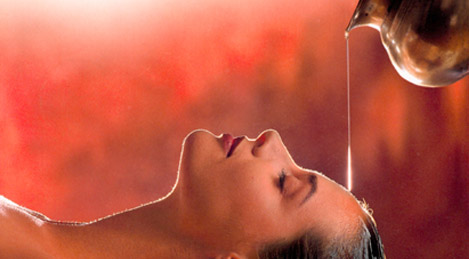
    Massage therapies: The massages here at Somatheeram serve more than a short-term purpose; the sessions are extensive and extend till days. ‘Pizhichil’ for instance is a special massage that uses a variety of herbal oils (lukewarm) and has been effective in curing diseases like paralysis and nervous disorders. Every session lasts 60-90 minutes over a span of 7-21 days. People with diabetes and obesity can go for the Ayurvedic ‘Abhyangam’ treatment which is again a type of oil massage for 45 minutes a day. ‘Nasyam’, ‘Snehapanam’ and ‘Kizhi’ are among the many treatments that have been proven medically capable of battling severe skin diseases, leukemia and sports injuries.

    Yoga classes and boat tours in the backwaters too are included in Ayurveda packages at Somatheeram.

    Where: Somatheeram Ayurveda Resort, South of Kovalam, Thiruvananthapuram. About 21 kms from International Airport at Thiruvananthapuram and about 9 kms south of the famous Kovalam beach.

    1)Ananda in the Himalayas, Uttarakhand: As the name suggests, the experience too replicates a blissful journey amid the towering and guarding Himalayas. Ananda focuses on an interesting and fruitful blend of Ayurveda and Aromatherapy with contemporary spa technology for complete wellness of the human body. Located 260 kms north of New Delhi, Ananda stands tall around Maharaja’s palace estate with the views of the Ganges on one side and the mountain peaks on the other pleasing the tourist’s eyes, mind and spirit upon waking up every morning. Yoga pavilions, landscaped gardens, terraces facing a clear sky, spas equipped with hydrotherapy services, a golf course on its Himalayan axle and Rejuvenation Cuisine are some of the many distinguishing features of the resort you can indulge in.
    Ayurveda, yoga & meditation:

    European and Thai treatments are employed in the spa boutiques here at Ananda. The Viceregal Hall is the quaint hillside garden that doubles as a refuge post an exhaustive yoga session. Marvel at the breathtaking panorama as you sip on the Himalayan tea. For couples, the Kama Suite with steam shower and exclusive massage facilities can surely add a sensual flavour to the Ayurveda tour. The Ayurvedic treatments are fashioned according to the Himalayan conditions. Use of less oil, slow and synchronised massages and regulation of a nutritious diet go into the making of customised treatments for guests under the supervision of physicians and therapists. An aftercare programme is planned for the benefit of the client at the last leg of the Ayurveda trip.

    Where: The Palace Estate, Narendra Nagar, Dist. Tehri-Garhwal, Uttarakhand

    Air: A 45-minute flight from New Delhi to Dehradun Jolly Grant airport followed by a one-hour drive.

    Train: A four-hour journey from New Delhi to Haridwar railway station followed by a one-hour drive.

    Road: The driving time between New Delhi and Narendra Nagar is approximately five and a half hours.

    1)Devaaya, The Ayurveda and Nature Cure Centre, Goa: If beaches and nightlife are the first things that come to mind upon hearing Goa, then probably it’s time to widen your horizon. As much as it is a ‘party’ destination, Goa as a city has carved an identity that appreciates art, culture and holistic living. And speaking of holistic living, the city has emerged as one of the potential tourist spots on the map of Ayurveda tourism in India. Coconut palms swinging to the rhythm of the breeze and the Mandovi River flowing alongside one of the islands in Goa complete the scenery at Devaaya Ayurveda Centre in Goa. Naturopathy becomes a way of life at this Ayurvedic paradise that brings together the essential elements of ‘Panchakarma’ treatments with yoga, meditation, music, lifestyle correction, diet planning and medicines for tourists. The centre has been designed on the science of ‘Vaastu Shastra’ that adds to the harmony of the overall rejuvenation process.

    Where: Devaaya – Ayurveda & Nature Cure Centre, Divar Island, Goa

    1)Kairali Ayurvedic Health Village, Kerala: The captivating beauty of the Western Ghats and the rich flora define the picturesque town of Palakkad in Kerala which is home to the Kairali Ayurvedic Health Resort. Ram Mohan, Vice President of the Resort is proud to declare how the Ayurveda village has travelled miles over the recent years, “Today, we have over 20 centres abroad apart from the 25 centres across India.” Ask him about the future of Ayurveda tourism in India and he has his reservations, “The Indian mindset is still not ready to embrace the culture of Ayurveda in a manner that the European market has possibly built an industry around. Patience is a virtue we have still not mastered the art of. It is believed that Ayurveda is an expensive affair but so is allopathy. If we are willing to shed a fortune on a bypass surgery then why not spend half the money on a recreational therapy that will guarantee the elimination of the ailment from its root?”, asks Ram. The system of Ayurveda he asserts is “not superficial but comes with permanent and effective results.”

    Agrees Niika Quistgard, Founder and Director Rasa Ayurveda Traditional Healing Centre for Women, Kerala and says, “People are often dissatisfied with allopathic medicines and are wary of the side-effects of drugs; natural alternatives and organic methods of healing are the preferred options. At Rasa Ayurveda we offer free consultation and treatment to women. All remedies are derived from herbal plants, a tradition that dates back to the era of our grandmothers,” adds Niika.

    The Leela, Udaipur:

    The city of lakes and palaces, The Leela’s ESPA Spa is yet another hot spot for Ayurvedic retreat. The ‘haveli’ style architecture of spas, tents done up in shades of royalty and opulence and the welcoming gardens contribute to the development of a relaxed mind and soul of the human body. Tricia Bannister, Group Spa Manager, says, “Our clientele has grown from in-house guests to both in-house and local guests requesting for a wellness experience set amidst the cultural heritage of Rajasthan.” From hot stone massages, facials, yoga and meditation, The Leela also features private yoga studio for visitors. On being asked if Ayurveda treatment is a rich man’s pastime Bannister replies, “There is a range of Ayurvedic resorts available for spa travellers, from more relaxed, to 5-star properties. Ayurveda tourism is growing dramatically in India; both for pure Ayurvedic treatments as well as Ayurvedic-inspired experiences. Travellers from all income-levels are curious to experience new wellness treatments,” adds Tricia.

    Where: The Leela Palace, Lake Pichola, Udaipur

  • No Copyright on Yoga Poses: US Court – Bikram Choudhury loses Lawsuit

    No Copyright on Yoga Poses: US Court – Bikram Choudhury loses Lawsuit

    Indian-American yoga guru Bikram Choudhury is not entitled to copyright protection over yoga poses and breathing exercises he uses in hot rooms developed by him, a US appeals court has ruled.

    In an order by the Court of Appeals for the Ninth Circuit in California yesterday, a bench of three judges ruled in favour of city-based Evolation Yoga, against whom Mr Choudhury had filed a lawsuit in 2011.

    In the lawsuit, Mr Choudhury had claimed that Evolation founders, the husband-wife duo of Mark Drost and Zefea Samson had set up a “copy-cat yoga system that offers classes that utilise and infringe” on his copyrighted sequence of yoga postures.

    The appeals court ruled that the sequence of yoga poses and breathing exercises developed by Choudhury was not entitled to copyright protection because “it was an idea, process, or system designed to improve health, rather than an expression of an idea”.

    “Because the Sequence (of yoga postures) was an unprotectable idea, it was also ineligible for copyright protection as a compilation or choreographic work,” it said.

    Mr Choudhury founded the ‘Bikram Yoga’ form of exercise, which is among the most renowned forms of the art, with participants performing yoga postures in rooms heated to 40.6 degrees Celsius.

    The court noted that the Indian practice and philosophy of yoga date back thousands of years and “derived from ancient Hindu scriptures, including the Bhagavad Gita” and that the practice of yoga teaches students to attain spiritual fulfillment through control of the mind and body.

    The judges said that the question of whether the sequence of 26 yoga poses and two breathing exercises developed by Mr Choudhury “implicates a fundamental principle underlying constitutional and statutory copyright protection – the idea/expression dichotomy.

    “Because copyright protection is limited to the expression of ideas, and does not extend to the ideas themselves, the Bikram Yoga Sequence is not a proper subject of copyright protection,” they said, adding that by claiming copyright protection for the sequence of yoga postures, Mr Choudhury “misconstrues” the scope of copyright protection for compilations.

    “Our day-to-day lives consist of many routinised physical movements, from brushing one’s teeth to pushing a lawnmower to shaking a Polaroid picture, that could be… characterised as forms of dance,” the judges said.

  • Hindus criticize ban on yoga in Los Angeles parks & beaches

    LOS ANGELES (TIP): Hindus are critical of Los Angeles City Council’s recent reported decision of banning yoga, among other things, at public beaches and parks.

    A Hindu leader Rajan Zed, who strongly criticized the attempts to regulate yoga in the past by various states in USA said that it seemed like an unnecessary obtrusion and burdensome on yoga in Los Angeles. Zed, who

    is President of Universal Society of Hinduism, urged Los Angeles City Council to reconsider and exclude yoga from the vending ban in city parks and beaches, which appeared to be criminalizing of yoga.

    Zed noted that yoga was a mental and physical discipline by means of which the human-soul (jivatman) united with universal-soul (parmatman). For Patanjali, author of the basic text, the Yoga Sutra, yoga was a methodical effort to attain perfection, through the control of the different elements of human nature, physical and psychical.

    Rajan Zed further said that yoga, referred as “a living fossil”, was the repository of something basic in the human soul and psyche; and regulating it was kind of a religious infringement. Although introduced and nourished by Hinduism, yoga was a world heritage and liberation powerhouse to be utilized by all, Zed added.

    According to US National Institutes of Health, yoga may help one to feel more relaxed, be more flexible, improve posture, breathe deeply, and get rid of stress. According to an estimate, about 21 million Americans, including many celebrities, now practice yoga.

  • Global Harmony, Yoga, Social Issues discussed at Dharma Conference

    Global Harmony, Yoga, Social Issues discussed at Dharma Conference

    EDISON, NJ (TIP): Attendees representing 13 countries now have greater insight into the philosophy of “Dharma” for a conflict free and pluralistic world as well as ancient spiritual roots of yoga and the social issues faced by Hindus globally. The largest Hindu students’ organization in North America brought more than 40 saints, scientists, yogis and experts to New Jersey on the “Never Forget” September 11th anniversaries for Dharma and world harmony.

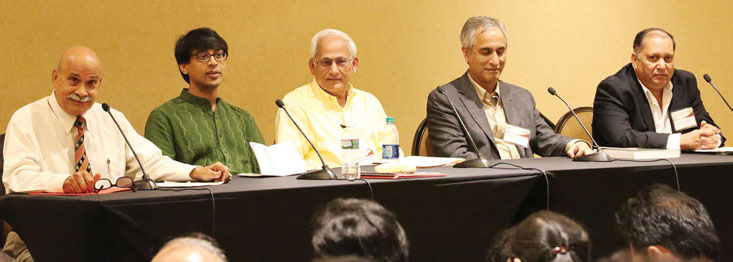
    Organized by the Hindu Students Council and supported by over 35 organizations, the conference featured luminaries such as Sri Sri Ravi Shankar, the founder of Art of Living, Swami Paripoornananda, the head of Sreepeetham in India, Dr. HR Nagendra, Chairman of the Indian Government’s Experts Committee for the International Day of Yoga, Fields Medalist Dr. Manjul Bhargava and many others. Sri Sri Ravi Shankar provided insights on how the principles of Dharma can help develop a conflict free society, while Dr. Nagendra discussed Indian Government’s efforts in making yoga available to millions of Indian people in order to appreciate its roots and medical benefits.

    The Council also recognized Indian Prime Minister Narendra Modi, who will be visiting the US this month, along with Sri Sri Ravi Shankar, Swami Dayananda Saraswati and Dr. HR Nagendra, with the “Light of Yoga Award” for their pioneering contributions in making the International Day of Yoga a major success.

    “The fact that some of the most renowned saints, a former NASA scientist, a Fields Medalist and 40 others came together on HSC’s platform is testament to the organization’s 25 year history and brand value,” added HSC Chairman and Conference Chair Nikunj Trivedi. “This conference is therefore a celebration of HSC’s legacy and an opportunity to map out the course for decades to come.”

    The conference opened with HSC students chanting the sacred symbol “Om”, which was followed by a moment of silence for the victims of the September 11th terrorist attacks.

    Dr. Bhargava, along with physicist Dr. GNR Tripathi, computer scientist Dr. Subhash Kak and Professor Alok Kumar, discussed the need to recognize the significant contributions of ancient Hindus in the field of science and mathematics. For example, Dr. Bhargava argued that the number system used today should be called “the Hindu Number System” rather than Arabic Number System and the Fibonacci Sequence (of integers) outlined in the 12th century, should be renamed “Hemchandra Numbers” after Jain scholar Acharya Hemchandra who developed them 900 years earlier.

    In his keynote speech at the opening plenary session, Dr. David Frawley
    (Vamadeva Shastri), founder of the American Institute of Vedic Studies and the winner of the prestigious Padma Bhushan award by the Government of India, said that yoga was a gift of the ancient Hindu sages and should be not cut-off from its roots and holistic benefits.

    On a panel on women’s empowerment, female monk Swamini Svatmavidyananda, female yogi Shambhavi Chopra, and Dr. Indrani Rampersad challenged western feminism, which often does not take into account transnational and spiritual concerns, and proposed ways in which females can find strength in understandings of gender found within the Indic traditions. Another panel on Human Rights featured noted human rights activist Tapan Ghosh of Hindu Samhati and Dr. Ali Alyami, Executive Director and founder of the Center for Democracy and Human Rights in Saudi Arabia. Both spoke passionately about the persecution of Hindus around the world and implored the global community to take action to protect the rights of Hindus where they are minorities and are denied religious freedom.

    An inter-faith panel, moderated by noted public intellectual and writer Rajiv Malhotra, discussed a framework for a pluralistic world order. It featured Rabbi Justus N. Baird, Dean of Auburn Theological Seminary in New York, Pastor David Davis of the Nassau Presbyterian Church in Princeton, Buddhist Monk Venerable Bhante Kondanna, Jain Monk Venerable Amrinder Muni, noted Sikh speaker Ratanjit Sondhe and Hindu leader Dr. Mahesh Mehta.

    “What you see here is youth taking charge of Dharma and moving it forward in a bold and holistic way”, remarked Ravindra Jaishankar, HSC President and Conference Program Chair. “The conference, while epic in its scale, also marks a new beginning for the American Hindu youth and their engagement with the community and the greater society.”

    Along with a weekend of intellectual and spiritual rejuvenation, the conference included an international concert emceed by former Miss America Nina Davuluri. It featured thrilling classical Indian dances, a dramatic Balinese theatrical act based on the Hindu epic Ramayana as well as a mesmerizing musical performance by renowned Flautist Rakesh Chaurasia, Mandolin player U Rajesh, Ghatam (Indian clay pot) player Giridhar Udupa and Percussionist Rajeev Mahavir.

    Allegra Lovejoy, a recent graduate of Princeton University, noted: “I was deeply inspired to see so many people – both presenters and attendees – who exhibited a humble and dedicated seva [selfless service] attitude. Many traditions and backgrounds were represented, and I learned something from each person I interacted with. Participating in this conference has motivated me to learn and practice dharmic spirituality much more seriously than before.”

    As the conference came to a close, attendees appreciated the multiple applications of Dharma beyond religion as well as the need to preserve the holistic nature of yoga beyond exercises. The Council hopes that future conferences produce an even greater impact regarding Dharma’s potential to guide and support sustainable society throughout the world.

    About HSC:

    Hindu Students Council (HSC) is an international forum providing opportunities to learn about Hindu heritage and culture. It is the largest Hindu youth organization in North America, with over 50 chapters across university campuses. Over 130,000 students and youth have participated in HSC activities since its inception in 1990. For more information, please visit www.hindustudentscouncil.org or email us at info@hindustudentscouncil.org.

  • Unique $11 million Hindu Hanuman Temple opens in Texas

    Unique $11 million Hindu Hanuman Temple opens in Texas

    FRISCO, TEXAS (TIP): Frisco (Texas) now has a 34,000 square-foot Marakata Karya Siddhi Hanuman Temple, reportedly costing over $11 million.

    This Temple, which opens daily, besides Hanuman as the main deity, also carries the murtis of Hindu deities Ganapati, Shiva, Rajeshwari, Ram Parivar, Venkateshwara, Dattatreya, Subramanyam, Ayyappa and Nagendra. Its history goes back to 2007 and it conducts aarti twice daily and offers free lunch on Saturdays. It already has a Cultural Center and intends to build a library and a museum, reports suggest.

    Meanwhile, distinguished Hindu statesman Rajan Zed, in a statement in Nevada today, commended efforts of Temple leaders and area community for realizing this unique Hindu temple complex.Rajan Zed, who is President of Universal Society of Hinduism, further said that it was important to pass on Hindu spirituality, concepts and traditions to coming generations amidst so many distractions in the consumerist society and hoped that this new Temple would help in this direction. Zed stressed that instead of running after materialism; we should focus on inner search and realization of Self and work towards achieving moksh (liberation), which was the goal of Hinduism.

    Besides regular worship services, this Temple also offers classes on yoga; art; Carnatic music; bhajans; Hindi, Telugu, Marathi, Tamil, Kannada and Gujarati languages; Bhagavad-Gita chanting; Kuchipudi dance; and Sri Vishnu Sahasranama. It also conducts Datta Kriya Yoga workshops, youth activities and religious instruction for children and youth under Bala Datta program, etc. It also performs Vaahana Puja (vehicle prayer) for divine blessing for the new vehicle; and requires five lemons, one coconut, few flowers and few fruits for this prayer ceremony.

    Built under the guidance of Sri Ganapathy Sachchidananda Swamiji of Avadhoota Datta Peetham of Mysuru (India), it also has a multi-purpose hall, homa-kund, yoga center and six classrooms. Temple Chairman is Prakasa Rao Velagapudiand; while Priests include Narasimhamurthy Garudadri, Vishwaksena Chandrasekhara, Shardul Pandya, Ganapati Rama Aiyer Kalyana Krishnan and Harihara Sastry. Food with onion and garlic is not allowed inside.

    Lord Hanuman, who is greatly revered and worshipped in Hinduism, is known for incredible strength and was a perfect grammarian. Hinduism is oldest and third largest religion of the world with about one billion adherents. There are about three million Hindus in USA. Frisco, formed in 1902 and an affluent city part of Dallas-Fort Worth metroplex, is one of the fastest-growing cities in USA and has been ranked as one of the “best places to live” in the nation.

  • Let us Celebrate Yoga

    Prime Minister of India , Narendra Modi  is known to be deeply steeped in the Hindu tradition. Imbibing pristine Hindu values early on in his life through his association with Rashtriya Swayamsevak Sangh (RSS) , Modi well understands the significance  of traditional values  and  the importance of culture.

    Ever since he came in to politics, and more particularly, on the national political scene, India has witnessed  a clear inclination on the part of the government to promote  the tradition and values of the age old Hindu culture. Modi’s concern is pretty obvious the way changes are sought to be brought about in the domain of education and culture.

    Moving on to Yoga, a distinct mark of Hindu way of life  from olden times, Yoga has always  been placed on a high pedestal and considered to have  a formative and curative power. In the words of one of the earliest and the greatest practitioners of Yoga, B.K.S. Iyengar, “Yoga means union – the union of body with consciousness, and consciousness with the soul. Yoga cultivates the way of maintaining a balanced attitude in day to day life, and endows skill in the performance of one’s actions”.

    Yoga is health giving- an aspect of Yoga which is the most popular one. And it is this aspect which more or less gets emphasized and proves attractive to people.

    Thus, on the suggestion of Prime Minister of India, during his address to the UN General Assembly in October, 2014 , 177 member  nations  of the United Nations adopted unanimously a resolution to observe June 21 as International Day of Yoga.

    It is heartening to know that an old science of India has received such overwhelming  support among the nations of the world who are now all set to celebrate the day this coming Sunday.

    On the purely material side, Yoga holds promise of a multi-billion dollar business. A Yogi Harbhajan not only created  a large following in the US but also made a lot of money through Yoga. One can expect great job opportunities for thousands of yoga instructors and gurus who would  reach over to distant parts of the world, and like Yogi Harbhajan, create their own empires. One can expect these people to bring to India a lot of foreign exchange. Yoga then would be a sound business proposition and Prime Minister Modi understands business well, as he himself has claimed.

    Let us celebrate, them, with all enthusiasm and zeal, the first International Day of Yoga, this coming Sunday, June 21, 2015.

  • MODI IN CHINA – A high-octane reception

    MODI IN CHINA – A high-octane reception

    [vc_row][vc_column width=”1/1″][vc_images_carousel images=”35692,35693,35694,35695″ onclick=”link_no” custom_links_target=”_self” mode=”horizontal” speed=”1500″ slides_per_view=”2″ autoplay=”yes” hide_pagination_control=”yes” hide_prev_next_buttons=”yes” partial_view=”” wrap=”yes” title=”LIST OF 24 AGREEMENTS SIGNED BETWEEN INDIA AND CHINA – India and China on Friday signed 24 deals worth over $10 billion during Modi’s visit to the country.” img_size=”full”][/vc_column][/vc_row][vc_row][vc_column][vc_column_text][quote_box_center]Here’s the complete list[/quote_box_center]

    1. Protocols between India and China on the establishment of cousulates-general at Chengdu and Chennai and the extension of the consular district of the consulate general of India in Guanzhou to include Jiangxi province.
    2. MoU between the ministry of skill development and entrepreneurship of India and the ministry of human resources and social security of China on cooperation in the field of vocational education and skill development.
    3. Action plan on cooperation in setting up of the Mahatma Gandhi National Institute for Skill Development and Entrepreneurship in Ahmedabad/Gandhinagar in Gujarat.
    4. MoU between India and China on consultative mechanism for cooperation in TRADE negotiations.
    5. MoU on cooperation between the ministry of external affairs of India and international department of the central committee of the Communist Party of China.
    6. Action plan between the National Railway Administration of China and the ministry of railways of India on enhancing cooperation in the railway sector. (2015-16).
    7. MoU on education exchange programme.
    8. MoU between the ministry of mines of India and the ministry of land and resources of China on the cooperation in the mining and minerals sector.
    9. Space Cooperation Outline (2015-2020).
    10. Protocol on health and safety regulations on importing Indian rapeseed meal between the export inspection council, ministry of commerce and industry of India and the general administration of quality supervision, inspection and quarantine.
    11. MoU between Doordarshan and China Central Television on cooperation in the field of broadcasting.
    12. Agreement between the ministry of tourism of India and the national tourism administration of China on cooperation in the field of tourism.
    13. MoU on establishing India-China think-tanks forum.
    14. MoU between India’s Niti Aayog and the Development Research Centre, State Council of China.
    15. MoU between India’s ministry of earth sciences and the China Earthquake Administration concerning cooperation in the field of earthquake science and earthquake engineering.
    16. MoU between India’s ministry of earth sciences and the State Oceanic Administration of China on cooperation in the field of ocean science, ocean technology, climate change, polar science and cryosphere.
    17. MoU on scientific cooperation between Geological Survey of India, ministry of mines of India and the China Geological Survey, ministry of land and resources of China in geoscience.
    18. MoU between the ministry of external affairs of India and ministry of foreign affairs of China on establishment of states/provincial leaders’ forum.
    19. Agreement on the establishment of sister-state/province relations between state government of Karnataka and provincial government of Sichuan of China.
    20. Agreement on establishment of sister-city relations between Chennai and Chongqing of China.
    21. Agreement on establishment of sister-city relations between Hyderabad and Qingdao of China.
    22. Agreement on establishment of sister-city relations between Aurangabad and Dunhuang of China.
    23. MoU between the Indian Council for Cultural Relations and Fudan University on the establishment of a centre for Gandhian and Indian studies.
    24. MoU between Indian Council for Cultural Relations and Yunnan Minzu University on the establishment of a yoga college.

    [/vc_column_text][/vc_column][/vc_row]

  • Hindu-American Tulsi Gabbard Gets Married in a Vedic Ceremony in Hawaii

    Hindu-American Tulsi Gabbard Gets Married in a Vedic Ceremony in Hawaii

    WASHINGTON (TIP): 33-year-old Indian_American member of the US Congress Tulsi Gabbard, tied the knot with 26-year-old cinematographer Abraham Williams in a Vedic ceremony in her home state of Hawaii.

    The marriage, which took place at the historic Kahaluu Fishpond , April 9, concluded with a traditional yoga ‘kirtan’ and was attended by a large number of US lawmakers besides Ms Gabbard’s friends and family.

    The marriage ceremony that was conducted in a Vedic fashion ended with song and dance, local media reported.

    In previous media interviews, Ms Gabbard said she will retain her last name.

    Hawaii will always be the couple’s primary home, local media reported.

    The Democratic Congresswoman from Hawaii, Ms Gabbard, had announced her engagement in January.

    “Both Abraham and I are generally kind of private people. He has nothing to do with politics. He’s a humble, great guy who doesn’t want to be in the limelight, so this is something new to the both of us,” she told the Honolulu Star Advertiser in an interview published in February.

    This is Ms Gabbard’s second marriage and the first for Mr Williams.

    The guest list included former U.S. Sen. Daniel Akaka, Former Gov. Neil Abercrombie, U.S. Rep. Mark Takai, Honolulu Mayor Kirk Caldwell and former U.S. Rep. Colleen Hanabusa.

  • Wife Refuses to Give Up on Husband in Coma After Crash – Then He Wakes Up

    Wife Refuses to Give Up on Husband in Coma After Crash – Then He Wakes Up

    Danielle Josey Davis had been married only seven months when a devastating motorcycle accident left her husband on life support and in a coma.

    Doctors recommended letting Matt Davis die because there was a 90 percent chance he would never wake up, but Danielle told ABC News she decided it just wasn’t time yet. Then, one day, he woke up.

    PHOTO- Danielle and Matt Davis are shown in this undated photo.
    PHOTO- Danielle and Matt Davis are shown in this undated photo.

    “I’m sure glad I married her,” Matt Davis told ABC News today, though he doesn’t remember Danielle from before the 2010 crash that caused his traumatic brain injury.

    Danielle was 24 when the accident happened, and had only started dating Matt, then 23, two months before their wedding.

    Matt’s father had died two years before the accident, and his mother was too ill to take care of him, Danielle said. But Danielle made the decision to keep him on life support and eventually fought to get him into rehab and to take him home, moving back into her mother’s house.

    “If we’ve got to bring him home, let’s make sure he has the best view in the world,” she remembered telling her mother. “If he’s going to be a body in a bed, let’s give him something to look at.”

    Soon, Matt started following them with his eyes, and then he started communicating, Danielle said.

    PHOTO- Today, Matt can drive a stick shift, crack jokes and play scrabble. He didn't remember his wedding, but he and Danielle are doing great.
    PHOTO- Today, Matt can drive a stick shift, crack jokes and play scrabble. He didn’t remember his wedding, but he and Danielle are doing great.

    Three months after the accident, Danielle was holding Matt up in his bed trying to emulate what his therapist had done in rehab by asking him to reach out and grab a toy motorcycle. He’d never done it before, but this day, he did it, Danielle recalled. It was a start.

    The moment Danielle really felt that her husband’s personality was still intact was when they asked him what he wanted to eat, and he responded in a barely audible whisper. “I kid you not, he says, ‘buffalo chicken wrap from Cheddar’s,’” she said, explaining that it had been his favorite food. “We all whipped around because we all knew what he said.”


    They eventually got him to another rehabilitation program for two and a half months. And he left on his own

    two feet with a walker, Danielle said.

    PHOTO- Today, Matt can drive a stick shift, crack jokes and play scrabble. He didn't remember his wedding, but he and Danielle are doing great.
    PHOTO- Today, Matt can drive a stick shift, crack jokes and play scrabble. He didn’t remember his wedding, but he and Danielle are doing great.

    It’s taken some time for Matt to regain his sense of humor and his long-term memory, but he doesn’t remember dating or marrying Danielle. He’s gotten to know her all over again. She calls him “Mattie” or “cake,” and he calls her “baby” or “doughnut.”

    They play scrabble and enjoy going to yoga classes together, and he’s recently started driving a stick shift car for fun because he loves cars, she said.

  • Bikram yoga founder denies sexual assault allegations in exclusive interview to CNN

    Bikram yoga founder denies sexual assault allegations in exclusive interview to CNN

    Bikram Choudhury, the 69-year-old hot-yoga guru  who has built his name and fame over 5 decades has been accused of rape and sexual assault by six former students.

    Bikram has spoken out for the first time in an exclusive interview with CNN – and says he would never have to resort to physical aggression for sex because “women love me.” 

    Now with the Bikram brand is in jeopardy some yoga studios are already dropping his name.

    “If I really wanted to involve with the women, I don’t have to assault [them],” Choudhury said in an interview with CNN, which aired Wednesday. “I never assaulted them.” 

    “I don’t think they’re bad people,” he said of his accusers. “They’re influenced by lawyers.”  

    But Sarah Baughn and five others claim the Bikram founder – an icon to celebrities such as Madonna, George Clooney, Brooke Shields and Jennifer Aniston – indeed sexually assaulted them. 

    “We need to make this a relationship … I’ve known you from a past life,” Baughn said Choudhury told her during her first week of teacher training when he called her into his office. “I felt like my whole system imploded.” 

    Continued Baughn, who initially credited Bikram with transforming her life: “He crawled on top of me, he put his hand on the inside of my thigh …  he told me he needed someone to hold him, to brush his hair … to have sex.” 

    Baughn, who has a trial date set for August according to The New York Times, claims Choudhury made it clear she had to sleep with him in order to advance her career, stating she would never win a yoga competition if she didn’t have sex with him. 

    “I pushed him off me, and I said, ‘I can do this by myself.’ And he said, ‘No you can’t.’ ” 

    An emotional Choudhury said the allegations have devastated his family and that his wife of 30 years will no longer “look” at him. 

    “We die only once in our life. I die every day,” he said. “I work harder than any human being on this earth. And this is the reward? I’m a rapist?” 

    Concluded Choudhury: “Shame on your Western culture. It’s your job to go and tell the world the truth.”

    Choudhury is the founder of Bikram’s Yoga College of India. He’s featured prominently on its website, which details his system of performing 26 unique yoga poses while in a very hot room.

  • Kent: Another hindu temple attack in US – Indians Concerned

    Kent: Another hindu temple attack in US – Indians Concerned

    A Sanatan Dharam temple was vandalised in Washington state with windows broken and the word “Fear” painted on it, less than a fortnight after another temple was attacked.

    Members of the the Sanatan Dharma Temple in Kent, about 30 km from Seattle, who came for worship Friday “were greeted by shards of broken glass after vandals targeted the building,” KING5-TV, a Seattle NBC affiliate, reported. According to the temple web site, “Amalaki Ekadashi” was to be observed Saturday.


    Bricks were used to smash every window of the building and parts of the structure were ripped apart, said KOMO-TV, an ABC affiliate in Seattle. “The crime is small-minded with big intentions, shattering calm with hate,” the station’s reporter, John Humbert, said. “Silence isn’t the answer.”

    Universal Society of Hinduism President Rajan Zed, said: “Hindus nationwide are highly concerned” by the second attack on a temple in recent days.

    “It was shocking for the hard-working, harmonious and peaceful US Hindu community numbering about three million, who had made (a) lot of contribution to the nation and society, to receive such signals of hatred and anger.”

    On February 15, the Hindu Temple Cultural Centre in Bothell city, about 35 km from Seattle, found a swastika painted on it and “Get Out” scrawled in large letters with spray paint. In the US, white supremacists have adopted the Nazi swastika as an ideological symbol.

    The two temple attacks came after President Barack Obama’s criticism of India at an inter-religious prayer meeting earlier in February where he said intolerance there “would have shocked Gandhiji”.

    Both temples do not have security cameras “and info on the vandals remains elusive,” KOMO-TV said. The incidents are under police investigation.

    Several attacks on Hindu temples have taken place across the US in the last few months. In August a murti (idol) of Shiva at the Vishwa Bhavan Hindu Mandir in Monroe in the state of Georgia was desecrated with black paint. The local sheriff’s office arrested two people in connection with the attack.

    Between July and October in Loudon county in Virginia, police have documented 17 separate incidents of anti-Hindu vandalism, the Hindu American Foundation said.

    In a twist to the Kent incident, an Islamic organisation tried to deflect attention away from Hinduism, claiming that the attack was directed against Muslims, even though the building had a large sign, “Kent Hindu Temple.”

    According to KOMO-TV, Arsalan Bukahari of the Washington Council on American-Islamic Relations said many of these acts of aggression target smaller religious groups that some bigots think are Muslim.

    Leading US Christian fundamentalists have attacked Hinduism. Pat Robertson, who has called Hinduism “demonic,” criticised the practice of yoga this week.

    While doing yoga, he said on the 700 Club TV programme, “you don’t know what the Hindu says, but actually it’s a prayer to a Hindu deity and so it sounds like gibberish.” Robertson is a pastor who was once a candidate for the Republican Party’s presidential nomination and has a following of millions.

    Another Christian pastor, Franklin Graham, has denounced Hinduism as a “false religion” and said that “none of their 9,000 gods is going to lead me to salvation. We are fooling ourselves”.

  • PADMA AWARDS 2015 : REPORTS

    PADMA AWARDS 2015 : REPORTS

    PADMA AWARDS 2015 TO RAMDEV, AMITABH BACHCHAN, RAJINIKANTH, ADVANI, OTHERS: REPORTS NEW DELHI (TIP): Yoga exponent Baba Ramdev, Bharatiya Janata Party patriarch LK Advani, spiritual leader Shri Shri Ravi Shankar and veteran actors Amitabh Bachchan and Rajinikanth are among this year’s recipients of the prestigious Padma awards that recognises lifelong service to the country, according to a report.


    The awards this year, to be conferred on Republic Day, has several names seen as sympathetic to the ruling party, including lyricist and adman Prasoon Joshi, who worked on the BJP’s advertisement campaign for the Lok Sabha elections, and journalists Swapan Dasgupta and Rajat Sharma. Economist Bibek Debroy, a member of the newly instituted NITI Aayog, is also on the list.


    Padma awards, given since 1954 on Republic Day in honour of contributions in wide-ranging pursuits, have often been subject of controversy due to the arbitrary nature of the selection process and inevitable charges of favouritism by the government and the ruling party. They are given in three categories–Padma Shri, Padma Bhushan and Padma Vibhushan, in ascending order of distinction. It’s unclear which names have been picked for which awards.


    Punjab Chief Minister Prakash Singh Badal and Advani are the only two politicians in the list of 148 recipients, the report stated.


    Yoga exponent Ramdev, whose dedicated yoga television channel and camps are popular, is nonetheless a controversial figure, having said in the past that he can
    “cure” homosexuality, among other things. His company Patanjali Ayurveda makes consumer products such as soaps, oil and breakfast cereals and in five years had sales worth Rs. 450 crore, with a turnover expected to touch Rs. 2,000 crore.


    Actor Dilip Kumar, director Sanjay Leela Bhansali and scriptwriter Salim Khan, badminton player P V Sindhu, wrestler Sushil Kumar and Arunima Sinha, the first woman amputee mountaineer to climb Mount Everest, are among those honoured.


    Badminton player Saina Nehwal, who had kicked up a storm about not being nominated and was subsequently included in the list of contenders, has not been awarded, if reports are accurate. The official list is expected to be out today or tomorrow.


    T V Mohandas Pai, the Chairman of Manipal Global Education and a former director of Infosys, shares the honour with former bureaucrat N Gopalaswami (ex chief election commissioner), K S Bajpai and P V Rajaraman.


    Eminent vocalists Sudha Raghunathan, A Kanyakumari, Girija Devi and Malini Awasthi, actor Smriti Biswas, music directors Anu Malik and Ravindra Jain and Assamese film director Jahnu Barua are said to be on the list. This year two scientists from ISRO–S Arunan of the Mars Mission and S K Shivkumar of Chandrayaan–will also be felicitated, the Express report said.


    Padma Awards not yet announced: Govt 


    The Ministry of Home Affairs on January 23 said that the government has not yet announced any names for the Padma Awards, 2015, and added that the names appearing in the media are speculative.


    “Government has not yet announced Padma Awards for 2015. These awards are announced on 25th of Jan every year, on the eve of the Republic Day,” it said.


    “The names appearing in the media are speculative and there is no official confirmation for the same,” it added.


    Media 3reports have been speculating that spiritual guru Baba Ramdev, actor Amitabh Bachchan and BJP veteran L K Advani may be conferred the Padma awards on Republic Day.

  • Fifty Shades of Saffron

    Fifty Shades of Saffron

    On December 11, 2014, when the U.N. General Assembly adopted June 21 as the International Day of Yoga, as recommended by Prime Minister Narendra Modi, India rejoiced. Never mind that the day before was the first Human Rights Day under his watch; this crept by unnoticed.

    At the SAARC Summit, Mr. Modi declaimed, “As we seek to build bridges to prosperity, we must not lose sight of our responsibility to the millions living without hope.” He was, as always, matchless as a kathakar, an artiste whose fabulous retelling of fables reinforces them in the minds of the faithful as fact. But while his performances have zero defects, on the lives of the multitudes hanging on to his words, believing in them and daring to hope, they have had zero effect so far, because the responsibility of which the Prime Minister spoke is usually ignored.

    In 1990, the U.N. launched the Human Development Report based on the challenging predicate that “people are the real wealth of a nation.” How wealthy are we really? After two decades of rapid GDP growth, we bestride SAARC like a colossus doing the splits, one foot splayed eastward to keep China out, the other westward to keep Pakistan down. We loom like a giant among midgets, but on every parameter that measures equity in development, there is little to choose between us and our neighbors.

    The Human Development Index (HDI) for 2014 ranks us at 135 among 187 countries; Sri Lanka at 73 did way better than us, and we were shadowed by Bhutan at 136, Bangladesh at 142, Nepal at 145 and Pakistan at 146. The fact that India was a stable democracy, as the others were not, that our economy had galloped along, as theirs had not, had made very little difference to the lives of our citizens.

    Within the HDI, the Gender Inequality Index which measures three critical parameters – reproductive health, women’s empowerment and their participation in the labor market – is particularly important because it shows how a society treats its more vulnerable half. Sri Lanka at 75 is well ahead of us, but so is Nepal at 98, Bhutan at 102 and Bangladesh at 115. India is in lock-step with Pakistan, both ranked at 127. The Criminal Law Amendment Act, which brought in far-reaching measures to protect women, is now almost two years old; sadly, it has made little difference.

    Depth of deprivation

    My five years on the National Human Rights Commission were a humbling experience. In 2009, we had 82,000 complaints, in 2013, a lakh. A five-member Commission could not possibly do justice to more than a fraction of these. We dismissed 60 per cent of complaints in limine, or at the outset, 11 per cent with directions to officials to act (but never had the time to check if they did) and transferred 6 per cent to the State Human Rights Commissions, which were mostly ramshackle.

    Our investigative visits to rural India were dives into the darkness that contained the mass of the iceberg of which the complaints coming to us were only the tip. In a country still largely illiterate, a terrible violation of human rights in itself, very few knew the NHRC existed. Those who did wondered if it would be able to help; many thought it would not. For every complaint that came to us, a hundred did not, but since so many were on systemic problems affecting entire communities, they brought home to us the range, depth and persistence of discrimination and deprivation in India. The two are often linked, and that is the real cause of worry with our new dispensation. The poorest and the most vulnerable – women, Scheduled Tribes, Scheduled Castes and Muslims – suffer because the social bias against them is rooted in Hindu belief and practice, and still so strong that the laws meant to protect them are impotent. Even under a secular government, public servants would plead with the NHRC that there would be law and order problems if they tried to implement these. The danger now is that under a government so overtly Hindu, these practices will flourish even more. The hate speeches of Cabinet members signal where this could lead us.

    “Discrimination and deprivation are often linked to one another, and that is the real cause of worry with our new dispensation”

    Mr. Modi wants his party to be careful with their words, but there are fifty shades of saffron around, most of it strident. He wants civil servants to be sensitive, but they always are, to the wishes of the powers that be. He wants the police to be SMART, but they already are, reporting to the National Crime Records Bureau that in 2013 there were only two incidents of human rights violations by their personnel. The same year, 33,753 complaints to the NHRC, a third of the total received, were against the police, detailing how they preyed on those they should protect.

    In Mr. Modi’s defense, these are national problems he has inherited, not created, but Gujarat is the template he holds up to the rest of India, and there are a range of impartial reports that show how cavalier it has been about the lives of the State’s people. A 2013 Lancet study found that among the 11 rich States, Gujarat had done the worst in bringing down the mortality rate of children under five, one of the Millennium Development Goals. The Census established that the sex ratio in Gujarat has declined from 934 in 1991 to 920 in 2001 to 918 in 2011. Not surprisingly, the NCRB data shows a high incidence of crimes against women. So too, the data shows, are crimes against Scheduled Castes, at levels higher than in the other developed States: Maharashtra, Punjab and Tamil Nadu. The ASER/Pratham Reports on Education show low percentages of students in Standard V who could read a Standard II text, and could do divisions. That is not a model to copy.

    Dreadful cost

    Despite what he said in Kathmandu, Mr. Modi’s record as Gujarat Chief Minister shows that his sights are set on prosperity, not on “the millions living without hope.” ‘Make in India’ is his priority, and there the signs are ominous. A few weeks back, ASSOCHAM issued an advertisement which announced, “Repeal of archaic laws is the need of modern times…ASSOCHAM has identified 105 laws for review, which can promote a better regulatory framework for successfully actualizing Mr. Modi’s vision of ‘Make in India’.” These include 43 laws that protect human rights and safeguard labor welfare, including the Bonded Labor System (Abolition) Act, Protection of Forest Rights Act, Inter-State Migrant Workers Act, Child Labor (Prohibition and Regulation) Act, and the Minimum Wages Act. If these are the voices he listens to, development will come at a dreadful cost.

    India’s governments have so far pursued development with a human face. Vast social welfare programs protect those whom the market forces savage, but these are riddled with huge problems. For instance, hardly any materials go into the rural employment guarantee projects, but each year material costs claimed are well over 20 per cent of its budget. A survey done for the NHRC showed that 60 per cent of the allocation for the Integrated Child Development Services was being stolen. The list goes on. The answer does not lie in jettisoning these programs, but in making them work better. Without them, rural India will empty out.

    Our Prime Minister’s many admirers believe that Sardar Patel’s mantle has descended on him. Vallabhbhai Patel made India, Narendra Modi can unmake it. But with his extraordinary talents, integrity and ability, our Prime Minister can also be the making of India, and make India, all of India, proud. That should be his tribute to his idol, not the monstrous statue of the Sardar now rising in Gujarat like a prelapsarian Ozymandias.

    By Satyabrata Pal

  • Eternal Vigilance is the Price of Liberty

    Eternal Vigilance is the Price of Liberty

    I.S. Saluja

    Prime Minister Narendra Modi addressed the nation from the ramparts of the Red Fort on the 68th Independence Day of India on 15th August, 2014. It has been almost 4 months since he spoke of his vision of India in his first address to the nation as Prime Minister. In his long speech, inter alia, he reminded the people of India that “Eternal vigilance is the price of liberty”.

    I must agree with him as would the whole world. A people need to be vigilant and constantly evaluate their leaders. Hence, we are giving below the full text of Prime Minister Narendra Modi’s address to the nation and would like our readers to evaluate India’s Prime Minister. Please send in your comments to editor@theindianpanorama.news or to salujaindra@gmail.com. We will be happy to publish your valuable evaluation and comments.

    Following is the English rendering of the Prime Minister’s address on the occasion. My dear countrymen,

    Today, all Indians in the country and also abroad are celebrating the festival of independence. On this day of sacred festival of independence, the prime servant of India extends greetings to all dear countrymen. I am present amidst you not as the Prime Minister, but as the Prime Servant. The freedom struggle was fought for so many years, so many generations laid down their lives, innumerable people sacrificed their lives and youth, spent their entire lives behind bars.

    Today, I pay my respect, greetings and homage to all those who laid their lives for the country`s independence. I also pay my respects to the crores of citizens of this country on the pious occasion of India`s independence, and recall all those martyrs who had laid down their lives in India`s struggle for freedom. The day of independence is a festival when we take a solemn pledge of working for the welfare of mother India, and also for the welfare of the poor, oppressed, dalits, the exploited & the backward people of our country.

    What he stressed on during the speech My dear countrymen, a national festival is an occasion to refine and rebuild the national character. This National festival inspires us to resolve ourselves to lead a life where our character gets refined further, to dedicate ourselves to the nation and our every activity is linked to the interest of the nation and only then this festival of freedom can be a festival of inspiration to take India to newer heights. My dear countrymen, this nation has neither been built by political leaders nor by rulers nor by governments. This nation has been built by our farmers, our workers, our mothers and sisters, our youth.

    The country has reached here today because of generation to generation rigours undertaken by our sages, our saints, our maestros, our teachers, our scientists and social workers. These great people and these great generations, who had worked for the country throughout their lives, deserve our deepest respect. This is the beauty of India’s Constitution, this is its capability which has made it possible that today a boy from small town, a poor family has got the opportunity to pay homage to the tri-colour of India at the ramparts of Lal Quila(Red Fort). This is the strength of India’s democracy. This is an invaluable legacy which we have inherited from our architects of the constitution.

    I pay my respects to those architects of the constitution of India today. Brothers and sisters, today if we have reached here after independence, it is because of the contribution of all the PrimeMinisters, all the governments and even the governments of all the States. I want to express my feelings of respect and gratitude to all those previous governments and ex-Prime Ministers who have endeavoured to take our present day India to such heights and who have added to the country’s glory. This country has been built on such foundation of ancient cultural heritage, where we were told of only onemantra during Vedic period, which is indicative of our work culture, which we have learnt, we have memorized – “Sangachchhdhvam Samvadadhvam sam wo manansi jaanataam.” We walk together, we move together, we think together, we resolve together and together we take this country forward. Having imbibed this basic mantra, 125 crores of countrymen have taken the nation forward.

    Yesterday only the first Parliamentary Session of the new Government had concluded. Today, I can proudly say that the Session of Parliament reflects our thinking and it is a reflection of our intentions. We are not for moving forward on the basis of majority, we are not interested to move forward by virtue of majority. We want to move ahead on the basis of strong consensus. “Sangachhadhwam” and, therefore, the nation has witnessed the entire Session of Parliament. Having taken all the Parties and Opposition along while working shoulder to shoulder, we achieved an unprecedented success and the credit for this does not go to the Prime Minister alone, the credit does not go to the people sitting in the Government, the credit for this goes to the Opposition also, the credit goes to all the leaders of Opposition too and also all the Members from Opposition.

    From the ramparts of Red Fort, quite proudly I salute all the Members of Parliament, I also salute all the Political Parties and by virtue of their strong support, we could take some important decisions intended to take the nation forward and yesterday the Session of Parliament had concluded. Brothers and sisters, I am an outsider for Delhi, I am not a native of Delhi. I have no idea about the administration and working of this place. I have been quite isolated from the elite class of this place but during the last two months while being an outsider, I had an insider view and I was astonished.

    It is not a political platform, rather it is a platform of a national policy and, therefore, my views should not be evaluated from a political perspective. I have already said, I salute all the ex-Prime Ministers and earlier governments who have brought the country thus far. But I am going to say something else and it may not be seen from political point of view. When I came to Delhi and noticed an insider view, I felt what it was and I was surprised to see it. It seemed as if dozens of separate governments are running at the same time in one main government.

    It appeared that everyone has its own fiefdom. I could observe disunity and conflict among them. One department is taking on the other department and taking on to the extent that two departments of the same government are fighting against each other by approaching Supreme Court.This disunity, this conflict among people of the same country! How come we can take the country forward? And that is why I have started making efforts for razing those walls; I have started making efforts at making the Government, not an assembled entity, but an organic unity, an organic entity, a harmonious whole- with one aim, one mind, one direction, one energy. Let`s resolve to steer the country to one destination. We have it in us to move in that direction. A few days back…Nowadays newspapers are full of news that Modiji`s Government has come, officers are reaching office on time, offices open in time, and people get there in time. I observed that India`s National newspapers, TV media were carrying these news items prominently.

    As the Head of the Government I could have derived pleasure in the fact that everything started going on time, cleanliness got the attention, but I was not taking pleasure, I was feeling pained. That thing, I want to tell today in public. And why, because if government officers arrive office in time, does that make a news? And if that makes news, it shows how low we have fallen. It becomes a proof of that, and that`s how, brothers and sisters, the governments have run? Today in the face of global competition, when we have to realize the dreams of millions of Indians, the country cannot run on the lines of ” it happens”, ” it goes”. In order to fulfil the aspirations of masses, we have to sharpen the tool called the Government machinery, we have to make it keen, more dynamic, and it is in this direction that we are working.

    My countrymen, it`s not long since I have come from outside Delhi, but I give you an assurance that the people in the Government are very capable – from the peon to the Cabinet Secretary, everybody is capable, everybody has a power, they have experience. I want to awaken that power, I want to unite that power and want to accelerate the pace of the welfare of nation through that power and I shall definitely do it. I want to assure the countrymen that we will achieve that, we will definitely do that. I could not say this on 16th May, but today after my experience of twotwo and half months, keeping the tricolor as witness, I am saying on 15th of August that it is possible, it will be achieved.

    Brothers and sisters, time has come to give a serious thought to the fact that whether we have a duty to create India of the dreams of those great people who gave us freedom, whether we have a national character? Brothers and sisters, can someone please tell me as to whether he or she has ever introspected in the evening after a full day`s work as to whether his or her acts have helped the poor of the country or not, whether his or her actions have resulted in safeguarding the interest of the country or not, whether the actions have been directed in country`s welfare or not? Whether it should not be the motto of one and a quarter billion countrymen that every step in life should be in the country`s interests? Unfortunately, we have an environment today wherein if you approach anyone with some work, he begins by saying “what does it mean for me?” He begins by saying “what does it involve for me?” and when he come to know that it does not entail any benefit for him, immediately he says “why should I bother?” we have to rise above the feelings of “what does it mean for me” and “why should I bother”. Everything is not for self interest only.

    There are certain things which are meant for the country and we have to refine this national character. We have to rise above the feelings of “why should I bother” and “what does it mean for me” and instead we have to think that “I am for nation`s interest and in this field, I am going to lead”. We have to inculcate this sentiment. Brothers and sisters, when we hear about the incidents of rape, we hang our heads in shame. People come out with different arguments, someone indulges in psycho analysis, but brothers and sisters, today from this platform, I want to ask those parents, I want to ask every parent that you have a daughter of 10 or 12 years age, you are always on the alert, every now and then you keep on asking where are you going, when would you come back, inform immediately after you reach.

    Parents ask their daughters hundreds of questions, but have any parents ever dared to ask their son as to where he is going, why he is going out, who his friends are. After all, a rapist is also somebody`s son. He also has parents. As parents, have we ever asked our son as to what he is doing and where he is going. If every parent decides to impose as many restrictions on the sons as have been imposed on our daughters, try to do this with your sons, try to ask such questions of them. \My dear brothers and sisters, the law will take its own course, strict action will be taken, but as a member of the society, as parents, we also have some responsibilities. If somebody tells me that those who have taken guns on their shoulders and kill innocent people are Maoists, are terrorists, but they are also somebody`s children.

    I would like to ask of such parents if they had ever asked their children as to why they were taking a wrong path. Every parent must take this responsibility, he must know that his misguided son is bent on killing innocent people. He is not able to serve himself nor his family nor the country. I want to say to those youngsters who have chosen the path of violence that whatever they are and wherever they are, it is all because of mother India only that they have got it. Whoever you are it is all because of your parents. I want to ask you to think how green, how beautiful and how beneficial this earth can become if you shoulder the plough instead of the gun which spills blood on this land.

    How long shall we have bloodshed on this land, how long shall we take the lives of the innocent people and what have we got after all this? The path of violence has not yielded anything to us. Brothers and sisters, I had gone to Nepal recently. There I said something publicly to draw the attention of the whole world. There was a time when the Emperor Ashoka who had chosen the path of wars, got converted to the path of Buddha at the sight of violence. There was a time in Nepal when their youngsters had opted for the path of violence but today I witness that the same youngsters are waiting for their constitution. The same people associated with them are framing the constitution.

    And I further said that if Nepal could present the best example of moving from the weapons to the books then it could provide inspiration to the youngsters in the world to abandon the path of violence. Brothers and sisters, If Nepal, land of Budha, can give message to the world then why can`t India too do the same? So it`s the call of the hour that we renounce the path of violence and take the path of brotherhood. Brothers and sisters, for one reason or the other, we have had communal tensions for ages. This led to the division of the country. Even after Independence, we have had to face the poison of casteism and communalism. How long these evils will continue? Whom does it benefit? We have had enough of fights, many have been killed. Friends, look behind and you will find that nobody has benefited from it.

    Except casting a slur on Mother India, we have done nothing. Therefore, I appeal to all those people that whether it is the poison of casteism, communalism, regionalism, discrimination on social and economic basis, all these are obstacles in our way forward. Let`s resolve for once in our hearts, let`s put a moratorium on all such activities for ten years, we shall march ahead to a society which will be free from all such tensions. And you will see that how much strength we get from peace, unity, goodwill and brotherhood. Let`s experiment it for once. My dear countrymen, believe in my words, I do assure you. Shun all the sins committed so far, give up that way, follow the way of goodwill and brotherhood, and let`s resolve to take the country forward.

    I believe we can do that. With advancement of science, brothers and sisters, we have a rising feeling of modernity in our mind, but what do we do? Have we ever thought what the sex ratio in the country is like? 940 girls are born against per thousand boys. Who is causing this imbalance in the society? Certainly not God. I request the doctors not to kill the girl growing in the womb of a mother just to line their own pockets. I advise mothers and sisters not to sacrifice daughters in the hope of son. Sometimes mother-father feel tempted to have son in the hope of supporting them in old age.

    I am a person who has worked in public life. I have come across families with five sons, each having bungalows, access to fleet of cars, but parents are forced to live in old-age homes, Vriddhashrams. I have seen such families. I have also seen families with only daughter as progeny, that daughter sacrifices her dreams, doesn`t get married, and spends entire life in taking care of old parents. This disparity points to female foeticide and the polluted and tainted mind the 21st century has.

    We will have to liberate from it, and that is message to us of this Freedom festival. Recently Commonwealth Games were organized. Indian sportspersons brought glory to the country. Nearly 64 of our sportspersons won. Our sportspersons brought 64 medals. But of them 29 are girls. Let`s feel proud and clap for them. Girls also contribute to India`s fame and glory. Let`s recognise it. Let`s take them along, shoulder to shoulder. This way we can get over the evils that have crept in social life. Therefore, brothers and sisters, we have to proceed in that direction as a social and national character.

    Brothers and Sisters, Development is the only way forward for the country. Good governance is the only way. There are only these two tracks to take the country forward – good governance and development, we can move forward only by taking them with us. We wish to move forward with the intent of taking them with us. When I talk of good governance, you tell me, when I ask a person in private job, he tells that he does the job; when you ask the same from a person in government job, he says that I do the service. Both earn, but for one it is job while for the other it is service. I ask a question from all brothers and sisters in government service, whether the word “Service” has not lost its strength, its identity? Persons in government service are not doing “job”, they are doing “service”. We have to revive this feeling, we have to take this feeling forward as a national character, we have to move forward in this direction.

    Brothers and Sisters, whether the citizens of the country should take steps for the welfare of the nation or not? You imagine, ifthis 125 crores of countrymen move one step forward, then the country moves 125 crore steps forward. The meaning of democracy is not just limited to electing a government, but its meaning is that 125 crore of citizens work together joining shoulder with the government to fulfill hopes and aspirations of the country, this is the meaning of democracy. We have to create partnership with the people. We have to proceed under Public-Private Partnership. We have to proceed along with the participation of the people. But, please tell me why our farmers commit suicide? A farmer takes loan from the moneylender, but fails to repay his loans. He takes loan for the wedding of his daughter, but fails to repay.

    He will have to suffer hardships during his whole life. He chooses to commit suicide. Who will save the poor families of such farmers? Brothers and sisters, I have come here with a pledge to launch a scheme on this festival of Freedom. It will be called`Pradhanmantri Jan-Dhan Yojana`. I wish to connect the poorest citizens of the country with the facility of bank accounts through this yojana. There are millions of families who have mobile phones but no bank accounts. We have to change this scenario. Economic resources of the country should be utilized for the well-being of the poor.

    The change will commence from this point. This yojana will open the window. Therefore, an account holder under `Pradhanmantri Jan-Dhan Yojana` will be given a debit card. An insurance of One Lakh Rupees will be guaranteed with that debit card for each poor family, so that such families are covered with the insurance of One Lakh Rupees in case of any crisis in their lives. My brothers and sisters, it is a country of young people. The 65 percent population of the country happens to be under the age of 35 years. Our country has the largest number of youths in the world. Have we ever thought of deriving an advantage out of it? Today, the world needs a skilled workforce. Today, India also needs a skilled workforce. At times, we look for a good driver but he is not available, we look for a plumber, but he is not available.

    If we need a good cook, he is not available. We have young people, they are unemployed but the kind of young people we seek for are not available. If we have to promote the development of our country then our mission has to be `skill development` and `skilled India`. Millions and Millions of Indian youth should go for acquisition of skills and there should be a network across the country for this and not the archaic systems. They should acquire the skills which could contribute towards making India a modern country. Whenever they go to any country in the world, their skills must be appreciated and we want to go for a two pronged development.

    I also want to create a pool of young people who are able to create jobs and the ones who are not capable of creating jobs and do not have the opportunities, they must be in a position to face their counterparts in any corner of the world while keeping their heads high by virtue of their hard work and their dexterity of hands and win the hearts of people around the world through their skills. We want to go for the capacity building of such young people. My brothers and sisters, having taken a resolve to enhance the skill development at a highly rapid pace, I want to accomplish this.

    Brothers and sisters, the world has undergone a change. My dear countrymen, the world has changed. Now India can not decide its future by remaining isolated and sitting alone in a corner. The economics of the world have changed and, therefore, we will have to act accordingly. Government have taken many decisions recently, made some announcements in the budget and I call upon the world and call upon the Indians spread world over that if we have to provide more and more employment to the youth, we will have to promote manufacturing sector. If we have to develop a balance between imports and exports, we will have to strengthen manufacturing sector. If we have to put in use the education, the capability of the youth, we will have to go for manufacturing sector and for this Hindustan also will have to lend its full strength, but we also invite world powers.

    Therefore I want to appeal all the people world over, from the ramparts of the Red Fort, “Come, make in India”, “Come, manufacture in India”. Sell in any country of the world but manufacture here. We have got skill, talent, discipline, and determination to do something. We want to give the world an favourable opportunity that come here, “Come, Make in India” and we will say to the world, from electrical to electronics, “Come, Make in India”, from automobiles to agro value addition “Come, Make in India”, paper or plastic, “Come, Make in India”, satellite or submarine “Come, Make in India”. Our country is powerful. Come, I am giving you an invitation.

    Brothers and sisters, I want to call upon the youth of the country, particularly the small people engaged in the industrial sector. I want to call upon the youth working in the field of technical education in the country. As I say to the world “Come, Make in India”, I say to the youth of the country – it should be our dream that this message reaches every corner of the world, “Made in India”. This should be our dream. Whether, to serve the country, is it necessary for the youth of the country to be hanged like Bhagat Singh? Brothers and sisters, Lal Bahadur Shastri had given the slogan “Jai Jawan, Jai Kisan”.

    A soldier sacrifices himself at the border and protects Mother India. Similarly, a farmer serves Mother India by filling the godowns with grains. This is also nation`s service. Filling the granary is the biggest nation`s service that a farmer provides. That is why Lal Bahadur Shashtri had given the slogan of “Jai Jawan, Jai Kisan”. Brothers and Sisters, I would like to pose a question to my youngsters as to why despite them, we are forced to import even the smallest of things? My country`s youth can resolve it, they should conduct research, try to find out as to what type of items are imported by India and then each one should resolve that, through may be micro or small industries only, he would manufacture atleast one such item so that we need not import the same in future. We should even advance to a situation wherein we are able to export such items.

    If each one of our millions of youngsters resolves to manufacture atleast one such item, India can become a net exporter of goods. I, therefore, urge upon the youth, in particular our small entrepreneurs that they would never compromise, atleast on two counts. First, zero defect and, second again zero effect. We should manufacture goods in such a way that they carry zero defect, that our exported goods are never returned to us. We should manufacture goods with zero effect that they should not have a negative impact on the environment. If we march ahead with the dream of zero defect in the manufacturing sector then, my brothers and sisters, I am confident that we would be able to achieve our goals.

    Brothers and sisters, the youth of India has completely transformed the identity of India in the world. Earlier, in what manner did the world know our country? Till only 25-30 years back, if not more, there were many people in the world who thought that India was a country of snake charmers, it was a country which practiced in black magic. The real identity of India had not reached the world, but my dear brothers and sisters, our youngsters, 20-22-23 years old youngsters have mesmerized the whole world with their skills in computers. Our young I.T. professionals have given a new path of making a new identity of India. If our country has this strength, can we think something about the country? Our dream is, therefore, of “Digital India”. When I talk of “Digital India”, I don`t speak of the elite, it is for the poor people. You can imagine what a quality education the children in villages will get, if all the villages of India are connected with Broadband Connectivity and if we are able to give long distance education to the schools in every remote corner of the villages.

    If we create a network oftelemedicine in the places where there is a shortage of doctors, we can have a clear guideline of the way in which health facilities have to be provided to the poor people living in those areas. The citizens of India have mobile phones in their hands, they have mobile connectivity, but can we walk in the direction of mobile governance? We have to move in a direction where every poor person is able to operate his bank account from his mobile, is able to demand various things from the government, can submit applications, can conduct all his business, while on the move, through mobile governance and if this has to be done, we have to move towards `digital India` and if we have to move towards `digital India` then we have a dream. Today we are importing electronic goods on a large scale. Friends, you will be surprised that we are bringing in these televisions, mobile phones, ipads and all these electronic goods.

    It is a necessity to import petroleum products, oil, diesel and petrol. Second to this is the import of our electronic goods. If we move ahead with the dream of `digital India` to manufacture electronic goods and become self reliant at least there, how big can be the benefit for the treasury! Therefore, e-governance is what we need to take this idea of `digital India` forward. E-governance is easy governance, effective governance and also economic governance. Egovernance paves the way for good governance. There was a time when we used to say that the railways provided connectivity to the country.

    That was it. I say that today it is IT that has the potential to connect each and every citizen of the country and that is why we want to realise the mantra of unity with the help of `digital India`. Brothers and sisters, if we move ahead with all this then I believe that a `digital India` will have the potential to stand with the world on equal footing. Our youth have that capability, it is an opportunity for them. Brothers and sisters, we want to promote tourism. Tourism provides employment to the poorest of the poor. Gram seller earns something, auto-rickshaw driver earns something, pakoda seller earns something and tea seller also earns something. When there is talk of tea seller, I feel a sense of belongingness.

    Tourism provide employment to the poorest of the poor. But there is a big obstacle in promoting tourism and in our national character and that is – the filthiness all around us. Whether after independence, after so many years of independence, when we stand at the threshold of one and half decade of 21stcentury, we still want to live in filthiness? The first work I started here after formation of Government is of cleanliness. People wondered whether it is a work of a Prime Minister? People may feel that it is a trivial work for a Prime Minister but for me this a big work. Cleanliness is very big work.

    Whether our country can not be clean? If one hundred and twenty five crore countrymen decide that they will never spread filthiness, which power in the world has ability to spread filthiness in our cities and villages? Can`t we resolve this much? Brothers and sisters it will be 150th birth anniversary of Mahatma Gandhi in 2019. How do we celebrate 150th birth anniversary of Mahatma Gandhi? Mahatma Gandhi, who gave us freedom, who brought so much honour to such a big country in the world, what do we give to Mahatma Gandhi? Brothers and Sisters, Mahatma Gandhi had cleanliness and sanitation closest to his heart.

    Whether we resolve not to leave a speck of dirt in our village, city, street, area, school, temple, hospital, and what have you, by 2019 when we celebrate 150th anniversary of Mahatma Gandhi? This happens not just with the Government, but with public participation. That`s why we have to do it together. Brother and Sisters, we are living in 21st century. Has it ever pained us that our mothers and sisters have to defecate in open? Whether dignity of women is not our collective responsibility? The poor womenfolk of the village wait for the night; until darkness descends, they can`t go out to defecate.What bodily torture they must be feeling, how many diseases that act might engender.

    Can`t we just make arrangements for toilets for the dignity of our mothers and sisters? Brothers and Sisters, somebody might feel that a big festival like 15th August is an occasion to talk big. Brothers and Sisters, talking big has its importance,making announcements too has importance, but sometimes announcements raise hopes and when the hopes are not fulfilled, the society sinks into a state of despondency. That`s why are in favour of telling those things, which we can fulfil just within our sight. Brothers and sisters, you must be getting shocked to hear the Prime Minister speaking of cleanliness and the need to build toilets from the ramparts of the Red Fort. Brothers and sisters, I do not know how my speech is going to be criticised and how will people take it. But this is my heartfelt conviction.

    I come from a poor family, I have seen poverty. The poor need respect and it begins with cleanliness. I, therefore, have to launch a `clean India` campaign from 2nd October this year and carry it forward in 4 years. I want to make a beginning today itself and that is – all schools in the country should have toilets with separate toilets for girls. Only then our daughters will not be compelled to leave schools midway. Our parliamentarians utilizing MPLAD fund are there. I appeal to them to spend it for constructing toilets in schools for a year. The government should utilise its budget on providing toilets.

    I call upon the corporate sector also to give priority to the provision of toilets in schools with your expenditure under Corporate Social Responsibility. This target should be finished within one year with the help of state governments and on the next 15th August, we should be in a firm position to announce that there is no school in India without separate toilets for boys and girls. Brothers and sisters, if we proceed with the dreams, we are in a position to realise them. Today, I wish to tell one more specific thing. It has its own importance to discuss the matters and express the views of nation`s interest. However, our Members of Parliament do not get opportunity though they are willing to do something.

    They can express themselves, write to the government, agitate, give memoranda. Still they do not get opportunity to do something on their own. Today I have come to you with a new idea. We are running so many schemes in the name of the Prime Minister in our country, there are numerous schemes in the name of various leaders. However, today I am going to announce a scheme on behalf of the Member of Parliament- `Sansad Aadarsh Gram Yojana`. We shall fix some parameters. I urge upon the Members of Parliament to select any one of the villages having population of three to five thousand in your constituency. The parameters will be according to the time, space and situation of that locality.

    It will include the conditions of health, cleanliness, atmosphere, greenery, cordiality etc. On the basis of those parameters, each of our MPs should make one village of his or her constituency a Model Village by 2016. Can`t we do at least this? Shouldn`t we do this? If we have to build a nation, we should start from the village. Make a Model Village. The reason of fixing this target for 2016 is that it is a new scheme. It takes time to formulate a scheme and then to implement it. After 2016, select two more villages for this purpose, before we go for the General Elections in 2019. And after 2019, each Member of Parliament, during his/her tenure of 5 years must establish atleast five model villages in his/her area. I also call upon the Members of Parliament from urban areas to adopt one village of their choice. I also urge upon the Members of Parliament from Rajya Sabha to adopt one of the villages. If we provide one model village in each district of India then the surrounding villages shall be automatically inspired to follow that model.

    Let us establish a model village, let us establish a village well equipped with all systems and facilities. The birth anniversary of Jai Prakash Narayan Ji happens to be on 11th October. On 11th October, the occasion of birth anniversary of Jai Prakash Narayan Ji, I will present a complete blueprint of “S?nsad Adharsh Gr?m Yojana” (Members of Parliament Model Village Scheme) before all Members of Parliament and State Governments, and I urge upon State Governments also that as per the feasibility in their respective states, all the Members of Legislative Assembly resolve to establish a model villageYou can imagine all the Members of Legislative Assembly and all the Members of Parliament in the country establishing a model village.

    All of a sudden, there would be a model village in each block of India which could inspire us to transform the amenities in rural areas and could give us a new direction and, therefore, we want to move ahead under this”S?nsad Adarsh Gr?m Yojana”. My dear brothers and sisters, ever since our government has taken charge, there has been a discussion in the newspapers, on T.V. channels as to what would happen to Planning Commission. I believe that when Planning Commission was constituted, it was done on the basis of the circumstances and the needs of those times. In recent years, Planning Commission has contributed to the growth of the country in its own way. I respect that, I am proud of that, but the prevalent situation in the country is different, global scenario has also changed, governments are no longer the centre of economic activities, the scope of such activities has broadened. State governments have been at the center of development and I consider this a good indication.

    If we have to take India forward, it can happen only by taking the states forward. India`s federal structure is more important today than in the last 60 years. To strengthen our federal structure, to make our federal structure vibrant, to take our federal structure as a heritage of development, a team of Chief Minister and Prime Minister should be there, a joint team of the Centre and the states should move forward, then to do this job, we will have to think about giving the Planning Commission a look. So, I am saying from the rampart of the Red Fort that it is a very old system and it will have to be rejuvenated, it will have to be changed a lot. Sometimes it costs more to repair the old house, but, it gives us no satisfaction.

    Thereafter, we have a feeling that it would be better to construct a new house altogether and therefore within a short period, we will replace the planning commission with a new institution having a new design and structure, a new body, a new soul, a new thinking, a new direction, a new faith towards forging a new direction to lead the country based on creative thinking, public-private partnership, optimum utilization of resources, utilization of youth power of the nation, to promote the aspirations of state governments seeking development, to empower the state governments and to empower the federal structure.

    Very shortly, we are about to move in a direction when this institute would be functioning in place of Planning Commission. Brothers and sisters, today, on 15th August, we also have the birth anniversary of Maharishi Aurobindo. Maharishi Aurobindo, being a rebel, moved on to achieve the status of a Yoga Guru. With regard to the destiny of India, he remarked, “I have a faith that the divine power and spiritual heritage of India will play an important role towards the welfare of the world.” Such sentiments were echoed by Maharishi Arvind. I strongly believe in the words of legends. I have great faith in the statements made by ascetics, sages & saints and that’s why today at the ramparts of Lal Quila I am reminded of the words of Swami Viveknanda. He had said – “I can see before my eyes Mother India awakening once again.

    My Mother India would be seated as the World Guru. Every Indian would render service towards welfare of humanity. This legacy of India would be useful for the welfare of the world”. These words were spoken by Swami Viveknanda ji in his own style. Friends, the words of Viveknanda ji can never be untrue. The words of Viveknanda ji, his dream of seeing India ensconced as World Guru, his vision, it is incumbent upon us to realize that dream. This capable country, blessed with natural bounty, this country of youth can do much for the world in the coming days. Brothers and sisters, our foreign policy is a much talked about issue. I clearly believe that India`s foreign policy can be multidimensional.

    But there is an important issue to which I want to draw your attention that the way we fought for freedom, we fought together, we were not separate at that time. We were together. Which was the government with us? What were the weapons available to us? There was a Gandhi, a Sardar and lakhs of freedom fighters and such a huge empire. Didn`t we win in the struggle of freedom against that empire? Did we not defeat the foreign powers? Did we not force them to leave India? We were the ones, they were our ancestors only who showed this might. If the people of India could remove such a big empire without the power of the government, without weapons and even without resources, then friends, it is the need of the hour to eradicate poverty, can we not overcome poverty? Can we not defeat poverty? My 125 crore dear countrymen, let us resolve to eradicate poverty, to win against it.

    Let us move with the dream of poverty eradication from India. Our neighbouring countries are also faced with the same problem. Why not get together with all the SAARC nations to plan out the fight against poverty? Let`s fight together and defeat poverty. Let us see at-least for once as to how wonderful is the feeling of being alive instead of killing and getting killed. This is the land where incidents from Siddharth`s life happened. One bird was shot with an arrow by one brother and the other took out that arrow to save it. They went to mother- whose bird, whose swan? Whether killer`s or saviour`s, they asked of mother. The mother replied, saviour`s. The saviour has more power than the killer and that makes him Buddha in future. And that`s why I seek cooperation from neighbouring countries for fighting against povertyin concert and cooperate with them, so that together with SAARC countries we can create our importance and emerge as a power in the world.

    It is imperative that we work together with a dream to win a fight against poverty, shoulder to shoulder. I went to Bhutan, Nepal, all the dignitaries from SAARC countries took part in oath-taking ceremony; this marked a good beginning. This will definitely yield good results, it is my belief and this thinking of India, in the country and the world, that we want to do well to the countrymen and be useful for the welfare of the world, India wants such a hand to be extended. We are trying to move forward with these dreams to achieve them. Brothers and Sisters, today on 15th August we will resolve to do something for the country.

    Let`s be useful for the country, we will move ahead with a resolve to take the country forward, and I assure you, Brothers and Sisters, as well as my colleagues in the Government, that if you work for 12 hours, I will do so for 13 hours. If you work for 14 hours, I will do for 15 hours. Why? Because I`m amidst you not as a Prime Minister, but as the first servant. I have formed the Government not as a ruler, but as a servant. Brothers and sisters, I assure that this country has a destiny. It is destined to work for the welfare of the world, it was said by Vivekanand ji. India is born, this Hindustan is born in order to achieve this destiny. One hundred and twenty five crore countrymen have to move forward wholeheartedly for the welfare of the nation. Once again I feel proud of the devotion, the sacrifices of the security forces of the country, para-military forces of the country, all the security forces of the country to protect Mother India. I say to the countrymen, jk”Vª;ke] tkxz;ke~ o;e~ Eternal vigilance is the price of liberty”. The army is vigilant, we should also be vigilant and the country scales new heights, we have to move forward with this resolution. Speak loudly with me with full force –

    Bharat mata ki jai, bharat mata ki jai, bharat mata ki jai. Jai Hind, Jai Hind, Jai Hind. Vande Mataram, Vande Mataram, Vande Mataram!

  • GOPIO Cosponsors First Successful Health Fair

    GOPIO Cosponsors First Successful Health Fair

    WASHINGTON (TIP): Healthcare is a big issue for new immigrants, especially elderly people. While Medicare is available to virtually all citizens, starting at age 65, immigrants legally present in the U.S. for less than five years are not eligible and private insurance companies generally do not offer health insurance plans for those over 65. Although there are health insurance options, but these are usually catastrophic traveler’s insurance.


    48
    Organizers. From L to R: Sam Mukherjee, Mayur Modi, Zafar Iqbal, Dr. Surinder Singh Gill


    They usually have a very high deductible and they are very expensive. In view of these harsh realities facing elderly community members from the Subcontinent, the Masjid Gulzar E Madina of Islamic Center Millford Mill Road, Pikesville, Maryland took a bold initiative to organize a first health fair on Sunday 23rd November2014. A number of area community organizations, such as the Global Organization of People of Indian Origin (GOPIO) – Metropolitan Washington, Philippines Nurses Association, Chinese Culture and Community Center, Muslim Community Clinic Inc., Silver Spring, Capital Region Telugu Society, Kerala Cultural Organization and Hindu Seva, co-sponsored this event.

    A large number of physicians, nurses, and healthcare workers volunteered their resources and worked tirelessly to provide their services for a large number of attendees covering a wide range of ages. An easy access to physicians of diverse specialties under one roof provided convenient consultation for wide range of medical issues. In addition to primary care, the medical specialties available for free consultations in a privacy setting included primary care, endocrinology, gastroenterology, hematology-oncology, otolaryngology, orthopedics, rheumatology, and medical ID cards for the community.

    Colgate-sponsored dental van provided dental consultation for children ages 1 to 12. Maryland Physicians Care Van made nutritional healthy food, Amerigroup sponsored Moon Bounce for children, and Columbia Lite House Van did eye sight screenings. The health fair also provided massage therapy and yoga enthusiasts displayed their skills and love for healthy living. Besides yoga sessions on site, there were diabetes and cancer prevention education vendors, healthy living demos and advice booths.

    Mental and behavioral health information, often a taboo topic, was sensitively offered by Counselors Helping South Asians/Indians (Chai). The Samar Group obtained bone marrow sign ups and the Washington Regional Transplant enrolled organ donor. Volunteers from a local Farm Market gave a wide range of fresh vegetables to all attendees. “The outstanding accomplishments of the day were made possible by the cohesive and dedicated collaboration of the Health Fair planning team, physicians, allied medical personnel, county and state health agencies, voluntary charitable organizations countless volunteers, Masjid management, and the Health Fair Advertising team as well as the support of the local organizations,” said Dr. Zafar Iqbal, President GOPIO DC Chapter.

    This successful event was coordinated by Mayur Mody and the management of Islamic Center thanked him for providing excellent leadership with efficient and indefatigable energy. The logistics for medical team was coordinated by Dr. Surinder Singh Gill and Dr. Alif Manijwala, and Dr. Sukhpal headed the team of volunteers. The health fair was open to people of all different ethnic, religious and socioeconomic backgrounds and over 400 people were able to get medical consultation.

  • REASONS TO VISIT KERALA IN MONSOON

    REASONS TO VISIT KERALA IN MONSOON

    During the rains, god’s own country transforms into a veritable paradise with lush greenery gracing its backwaters and hills, cloudy sunsets, cool breeze and the cheerful fervour of an array of festivals. Intermittent showers heighten the romance of the season. It might not be the best time to hit the beaches, but here are five reasons why Kerala in the monsoon will leave you singin’ in the rain.

    Snake boat races
    The months between July and September are water sports season, with the backwaters around Alappuzha playing host to a series of snake boat races. The most famous of the lot is the Nehru Trophy Boat Race, generally held on the second Saturday of August every year. The regatta takes place on the Punnamada Lake, and features ceremonial processions and magnificent floats. Its star attraction is the synchronised rowing of traditional 30-metre-long snake-boats or chudan valloms, which have a raised prow resembling a snake.


    10

    The Onam sadya feast
    This ten-day harvest festival celebrates the homecoming of the mythical king Mahabali, but it’s also a good excuse to feast on some of Kerala’s most lip-smacking vegetarian fare. Traditionally served on palm leaves, the ninecourse banquet is held on the last or tenth day. It’s best savoured at a local home, but you don’t manage to get an invite then most local restaurants also offer these meals. The preceding days are filled with costume parades, boat races and shopping discounts.

    Great hotel deals
    Sandwiched between Kerala’s sweltering summers and its peak tourist season (November to March), the monsoon is a great time to snag deals at otherwise expensive hotels and resorts. If you’ve ever fantasised about an indulgent houseboat trawl through the backwaters, then this is the time to get the best bargains. To avail the best discounts, make sure you plan your visit before the end of September, after which tariffs being climbing up again.


    11

    Ayurvedic therapies
    Kerala is home to several excellent spas and wellness resorts, and there’s no better time to pamper yourself than the monsoon season. According to Ayurveda, the cool, pleasant weather is ideal for rejuvenation. Sign up for a week-long retreat at top-notch stays such as the Kairali Ayurvedic Healing Village Health Resort in Palakkad or Somatheeram Ayurvedic Health Resort in Kovalam with relaxing oil-based therapies, massages, yoga and a balanced diet that’ll cleanse your mind, body and soul.

    Wayanad’s natural splendour
    With virescent hills carpeted with plantations, rainforests and tumbling waterfalls, Wayanad is a photographer’s delight. After you’ve had your fill of its misty coffee, tea and spice plantations, head to the Wayanad Wildlife Sanctuary that hosts numerous migrating birds in this period. Wayanad’s tourism department also holds an annual monsoon carnival in July with village excursions, rain treks as well as local sports such as mud football and archery.