Month: February 2013

  • Healthy Foods To Indulge In While Dieting

    Healthy Foods To Indulge In While Dieting

    While for some, dieting is all about depriving yourself of all the ‘good foods’, here are a couple of ways you can binge on healthy and tasty food while you are on a diet.

    Fruit smoothies
    If made properly, fruit smoothies are something that you must indulge in. Since they are made with real fruits, they are low-fat and loaded with antioxidants, fibre and protein. It not only keeps you feeling full but also satisfies your sweet tooth.

    Salads
    As long as they are not topped with any dressings or seasonings that contain unnecessary fat and calories, salads are definitely something that you can indulge in. Try a salad with chicken, dried fruits or low-cheese crumbles.

    Baked potatoes
    If you thought that while dieting, potatoes have no space in your kitchen, rethink about it. They are very good for you and you can indulge in one with a little dollop of butter or sour cream. They’re low in calories and contain lots of vitamin C and potassium. Truly a delight for all those dieting.

    Baked chicken
    It is not possible to survive on greens alone; it is a must that you include some sort of protein. Avoid breaded or fried chicken, instead go for a grilled one with lemon and pepper.

    Whole grain bread
    Omitting carbs from your diet is a big No. They are full of fibre and choosing something made out of healthy, hearty whole grains is the best choice you can make. They are tastier, healthier and will also keep you feeling full and satisfied a lot longer than white bread.

  • US Senate Introduces Bill For Doubling H1B Visa Cap

    US Senate Introduces Bill For Doubling H1B Visa Cap

    WASHINGTON (TIP): A bipartisan groupof top US Senators has introduced alegislation in the Senate aiming at severalchanges in immigration norms, includingdoubling of H-1B visa cap and establishing amarket-based escalator.The other proposed measures includerecapturing of unused Green Card numbers,eliminating country cap and recommendinga series of new provisions to provide legalpermanent residency to talented andbrilliant.Introduced by Senators Marco Rubio,Orrin Hatch, Amy Klobuchar, TheImmigration Innovation (I2) Act of 2013proposes to increase H-1B cap from 65,000 to115,000 and establish a market-based H-1Bescalator, so that the cap can adjust to thedemands of the economy.The bill includes a 300,000 ceiling on theability of the escalator to move.

    If the cap is hit in the first 45 days whenpetitions may be filed, an additional 20,000H-1B visas will be made availableimmediately.If it is hit in the first 60 days whenpetitions may be filed, an additional 15,000H-1B visas will be made availableimmediately and if the cap is hit in the first90 days when petitions may be filed, anadditional 10,000 H-1B visas will be madeavailable immediately.In case the cap is hit during the 185-dayperiod ending on the 275th day on whichpetitions may be filed, and additional 5,000H-1B will be made available immediately, thebill proposes and calls for uncapping theexisting US advanced degree exemption(currently limited to 20,000 per year).The legislation focuses on areas vital tokeep US competitiveness intact in the globaleconomy.

    It proposes increased access to GreenCards for high-skilled workers by expandingthe exemptions and eliminating the annualper country limits for employment basedGreen Cards.The legislation also aims at reforming thefees on H-1B and Green Cards so those feescan be used to promote American workerretraining and education.Furthermore, it authorizes employmentfor dependent spouses of H-1B visa holders,thus meeting a long pending demand.It also proposes to increase portability ofhigh skilled foreign workers by removingimpediments and costs of changingemployers, establishing a clear transitionperiod for foreign workers as they changejobs, and restoring visa revalidation for E,H, L, O, and P non-immigrant visacategories.

    The legislation, if passed by the Congressand signed into law by the US President,will enable the recapture of Green Cardnumbers that were approved by Congress inprevious years but were not used.It will exempt certain categories ofpersons from the employment-based GreenCard cap, including dependents ofemployment-based immigrant visarecipients, US STEM (Science, Technology,Engineering and Math) advance degreeholders, persons with extraordinary abilityand outstanding professors and researchers.The legislation also provides for the rolloverof unused employment-basedimmigrant visa numbers to the followingfiscal year so that future visas are not lostdue to bureaucratic delays, and eliminateannual per-country limits for employmentbased visa petitioners and adjust percountrycaps for family-based immigrantvisas.

    The legislation calls for reformingfees on H-1B visas and employment-basedGreen Cards and use money from these feesto fund a grant program to promote STEMeducation and worker. “Our immigrationsystem needs to be modernized to be morewelcoming of highly skilled immigrantsand the enormous contributions they canmake to our economy and society,” saidSenator Rubio.”This reform is as much aboutmodernizing our immigration system as itis about creating jobs. It’ll help us attractmore highly skilled workers, which will helpour unemployed, underemployed orunderpaid workers find better jobs,” he said.Senator Klobuchar called for making theUS a front-runner in research andinventions, and said the legislation willenvisage norms that will help hold back thetalented students in the country.”We don’t want them (the students)creating the next Medtronic or 3M in India,we want them creating it right here inMinnesota and across America,” he said.

  • Unemployment Rate 7.9 Percent In January, Up From 7.8 Percent In December

    Unemployment Rate 7.9 Percent In January, Up From 7.8 Percent In December

    WASHINGTON (TIP): The householdsurvey showed that the unemployment ratewas 7.9 percent in January, up from 7.8percent in December. The labor forceparticipation rate was unchanged at 63.6percent in January. Over the last 12 months,the unemployment rate has fallen by 0.4percentage point, and the labor forceparticipation rate has been essentiallyunchanged.According to a survey of the Bureau ofLabor Statistics, in January employmentrose notably in retail trade (+32,600),construction (+28,000), health care andsocial assistance (+27,600), professional andbusiness services (+25,000), and restaurantsand bars (+17,100).

    Manufacturing gained4,000 jobs in January. The manufacturingsector has added about a half-million jobsover the last three years, the most for anysuch period since 1996. Also of note, in thelast two years the construction sector hasgained nearly 300,000 jobs, with one-third ofthat gain occurring in the last four months.Government lost 9,000 jobs in January,including 5,000 Federal government jobs,and 4,700 jobs in local governmenteducation. The local government educationsector has now lost 339,400 jobs since itsrecent peak in November 2009.

  • Top Fat-Releasing Foods

    Top Fat-Releasing Foods

    If losing weight is on your mind, then running the whole day on the treadmill after over-eating unhealthy food won’t work. Without making some changes in your lifestyle, your goal to lose weight will not be achieved. Though there are many hoax assurances available in the market for fast weight loss, most of them are dangerous and unreal. The key to weight loss, besides exercise and diet changes is boosting your metabolism. The best way to kickstart your metabolism is by including some fat burning foods in your regular diet.

    Calcium
    You must have heard that calcium helps to strengthen bones and teeth, but you will be amazed to hear that calcium also helps to control hunger pangs. Consumption of dairy products and other calcium rich products have low fat mass in their body and have more control over appetite. Hence, consume more of calcium rich products, if you want to shift your body to a fat burning mode.

    Apples
    Besides keeping the doctor visits away, consumption of apple everyday also assists in reducing fat cells in the body. The skin of the apple possesses great magical properties towards fulfilling your goal of weight reduction. The presence of pectin limits the absorption of fat by the cells and also releases fat deposits through its water binding property.

    Walnuts
    Walnuts possess a healthy dose of omega-3 fat alphalinolenic acid and mono-unsaturated fats. The presence of mono-unsaturated fat helps to burn a large amount of fat and boosts the metabolism at the same time. Just a handful of walnuts are needed to reduce weight in a healthy way. It is also one of the healthiest nuts available.

    Beans
    Beans are low-fat, low glycemic index and high – fiber and protein. This is the best food for protein intake for vegetarians. Besides, it is the best fat burning food as it provides great a metabolic environment for releasing and metabolizing fatty acids.

    Ginger
    Ginger possesses many magical properties. It helps to relieve digestive problems, reduces inflammation, increases blood flow and aids muscle recovery. If you are on a weight loss program, include ginger in your diet as it helps to boost calories and fats.

    Oatmeal

    Include oatmeal in the morning after a workout or after a normal morning walk. Oatmeal is a slow-digesting carb which helps to keep blood sugar and insulin level at its minimum whilst fastening the fat burning process. Due to its slow-digesting carb property it is a must have food for every individual who wants to reduce some pounds.

    Green tea
    The presence of anti-oxidants EGCG creates a suitable environment for metabolism in healthy people. Besides, it also possesses anti cancer and cholesterol maintenance properties.

    Hot peppers
    Consuming hot peppers will help to speed up your metabolism by burning fat and calories at a faster rate, albeit for a short duration after meals. The presence of capsaicin helps to provide short-term stimulus to your body by releasing stress hormones. This process helps to boost your metabolism and hence burns calories and fats.

    Water
    Though it’s not a food, drinking enough water is essential – says Priya. This is the most important element needed by your body. If you don’t drink much water, within minutes you will feel dehydrated. At times we also mistake thirst pangs for hunger pangs and end up eating instead of drinking. Hence, it is essential to drink adequate amounts of water as it is helpful for fat loss.

    Eggs
    Eggs are one of the best fat burning foods available. The yolk present inside is very essential to burn fat and calories. Presence of dietary cholesterol has very little effect on blood cholesterol levels. Besides, eggs are packed with essential fatty acids and protein, which definitely makes it a great combination for fat burning.

  • Exhibition To Showcase Achievements Of Indian Americans In US

    Exhibition To Showcase Achievements Of Indian Americans In US

    WASHINGTON (TIP): In a first ofits kind expo in the US, aprestigious museum in Washingtonis organizing an exhibition toshowcase the history, culture andcontribution of Indian-Americanscommunity in the country.The exhibition, “BeyondBollywood: Indian Americans Shapethe Nation,” will bring to life therich history of immigrants fromIndia and Indian Americans in theUS and detail their manycontributions to America, theprestigious Smithsonian Museumsaid.Scheduled to open in late2013,”Beyond Bollywood” it willoccupy more than 5,000 square feetof space at the Smithsonian’sNational Museum of NaturalHistory.

    Over a two-year period theexhibition is expected to draw morethan seven million visitors beforeembarking on a national tour in2015.”The Indian American story hasyet to be fully told,” said Konrad Ng,director of the Smithsonian AsianPacific American Center.It is the largest projectundertaken by the SmithsonianAsian Pacific American Center inits 15-year history, and the first tofocus on Indian American culture.”Visitors of all ages will leave theexhibition with a deeperunderstanding of this vibrantcommunity as they strive to realizelife, liberty and the pursuit ofhappiness in America. Thisexhibition is about celebrating acommunity that embodies theAmerican spirit,” Ng said.Masum Momaya, curator of theexhibition said that there is stillsome public perception that IndianAmericans are foreigners oroutsiders in the United States.

    “But history shows the opposite istrue. We’ve been here since theearliest days of the nation and hadour hands in building it to what it istoday politically, professionally andculturally,” Momaya said.In a statement, SmithsonianInstitute said that it hastied up withTV Asia, the popular IndianAmerican channel, which iscelebrating its 20thyear.”Beyond Bollywood: IndianAmericans Shape the Nation’ is aproject of monumental significanceto our community and TV Asia,”said H R Shah, chairman and CEO ofTV Asia. “As a media sponsor we arehonored and excited to be a part ofthis program,” he said.”By partnering with TV Asia, wehave taken an important step inincreasing the public’s knowledgeand understanding of thisexhibition,” Ng said.”TV Asia connects to the IndianAmerican community day in andday out,” Momaya said.Through a collection ofphotographs, artifacts, videos,interactive stations and stories,visitors will learn about the IndianAmerican experience and the manydynamic roles they have played inshaping American society and culture,Smithsonian Museum said.

  • Manufacturing output growth weakens in January: Survey

    Manufacturing output growth weakens in January: Survey

    NEW DELHI: Growth in the country’s manufacturing sector slowed to a three-month low in January due to the impact of easing orders and power outages, a survey showed on Friday.

    The HSBC Purchasing Managers’ Index (PMI) – an indicator aimed at providing a snapshot of operating conditions in the manufacturing sector – posted 53.2 in January, down from 54.7 in December. The December reading was a six-month high on the back of solid orders. The latest reading signalled a further improvement in the health of the Indian manufacturing sector.

    But the improvement was slower, the survey said. The Indian manufacturing sector has been hit hard by the slowing economy, weakening global growth, high interest rates, stubborn inflation and rising input costs. Continuing the trend that started in April 2009, output at manufacturers in India rose during January.

    While solid, the rise in production was the slowest recorded in three months amid evidence from the survey panel that ongoing issues with the supply of power had restricted growth, according to the PMI survey. “The growth momentum in the manufacturing sector eased in January as a slower expansion in new orders and power outages slowed output growth,” said Leif Eskesen, chief economist for India & Asean at HSBC. “To meet new orders, manufacturers still rely on a draw down in stocks of finished goods, which should provide support for output growth in coming months as stocks are replenished,” Eskesen said.

    The survey said input and output prices both increased in January, with rates of inflation again marked. Input costs rose for the forty-sixth successive month, with respondents indicating that fuel and raw material prices had increased.

    Output charges were raised to protect margins in the face of higher costs, it said. “Encouragingly, input and output price inflation continued to ease, albeit only gradually, supporting the case for RBI’s cautious policy rate cut earlier this week,” Eskesen said. The RBI has reduced the repo rate and the cash reserve ratio to help support growth but has cautioned about the inflationary pressures prevalent in the economy. The volume of incoming new work expanded in January, the forty-sixth consecutive monthly increase recorded.

    Over one-fifth of the survey panel indicated higher levels of new orders, citing stronger demand and maintained product quality. Total new business rose solidly, although growth eased from December. New export orders increased for the fifth consecutive month, and also at a solid rate.

    Panel members stated that demand from foreign clients was higher. In line with stronger sales, manufacturers in India increased their input buying in January. The overall rate of growth, although solid, eased to a three-month low.

    The survey showed staffing levels in the manufacturing sector increased during January, amid reports of higher workloads but the pace of job creation was slight and unchanged from December.

  • Capitol Hill Internship For Indian American Students

    Capitol Hill Internship For Indian American Students

    WASHINGTON (TIP): Two Indian American studentswill get a chance to work with lawmakers in America foreight weeks, as part of an internship program by CapitolHill. The internship has been announced by a ChicagobasedIndian American organization.All Indo-American college undergraduates and graduatesfrom Illinois, who are interested in public service and policymaking, can be part of the program, announced the Indo-American Community Services (IACS).

    The selectedstudents will get the opportunity to do internship at theoffices of U.S. Senate and House lawmakers or in House andSenate leadership offices. Apart from this they will alsoreceive an amount of USD 1,500 from IACS, as stipend. “Thegoal of the Leadership Internship Program is to create acorps of young Indian American leaders with the skills,outlook and contacts necessary to generate and sustainpositive change in Washington DC and within their localcommunities,” IACS said in a statement.

  • Govt gets Rs 3,100cr through OIL selloff

    Govt gets Rs 3,100cr through OIL selloff

    MUMBAI (TIP): The government on Friday raised about Rs 3,100 crore through the divestment of 10% stake in Oil India (OIL), selling about 6.01 crore shares of the state-owned oil explorer at Rs 520 per share.

    The issue, which was open only for the day, generated a demand for about 15.4 crore shares, translating to an oversubscription of nearly 2.6% times. The OIL stock in the regular market closed at Rs 526, down 2.5% on the day.

    Post this sale, the government’s holding in the company will fall to about 68%, a shareholding level for the company that now confirms to Sebi-mandated compulsory public holding of 25%.

    The divestment in OIL also forms part of the government’s Rs 30,000 crore selloff target. The OIL divestment was also the government’s first sell-off in 2013, that last being the divestment in NMDC in December 2012. Market players said that the divestment in OIL, through the offer for sale (OFS) route, showed revival in investor interest for public offers.

    The success of the OFS issue also came on the back of government’s recent decision to partially deregulate diesel prices, which in turn could bring down the subsidy burden of the oil companies like ONGC, OIL, Indian Oil and other government-run companies in the oil & gas sector. The success of the issue may now prompt the government to launch similar offers for NTPC, SAIL and MMTC

  • RBI paper seeks to cut use of cheque books

    RBI paper seeks to cut use of cheque books

    MUMBAI (TIP): Cheque books may go the way of physical share certificates if proposals mooted by the Reserve Bank of India (RBI) are enforced. In a discussion paper on discouraging cheque usage, RBI has proposed charges for individuals when payments are made by cheques and penal processing fees for institutions that continue to issue warrants rather than credit amounts to investors’ accounts directly. RBI also wants every entity making or receiving bulk payments to move to direct electronic transfers to recipients’ bank accounts.

    Interestingly, the panel has found that one of the biggest culprits standing in the way of electronification of payments are banks themselves with their demand for post-dated cheques from borrowers.

    The paper points out that at present, the cheque issuer (drawer) does not bear any charges for issuing a cheque and proposes that the drawer is made to bear some charges when cheques are issued. “Such charges may be levied on an advalorem basis at par with charges applicable in electronic payment systems.

    Similarly, cheque collection charges may also be reviewed and charges levied (on the payee or beneficiary of the cheque) even for local cheques beyond certain amount limits.

    In case of corporates, charges may be levied irrespective of amount limits for cheques deposited into their current account considering the expenditure incurred by the collecting bank,” the paper said. The discussion paper comes out two months before RBI is set to roll out its cheque truncation system.

    Under this, cheques will be dematerialized after they are received by the bank and only their images transmitted for settlement.

  • Telcos’ future positive, but near-term pressure on margin to stay

    Telcos’ future positive, but near-term pressure on margin to stay

    NEW DELHI (TIP): The latest quarterly performance of the three publicly-listed telecom companies — Bharti Airtel, Idea Cellular and Reliance Communications (RCOM) — shows early signs of a pick up in data-driven revenue, helped by higher number of subscribers using data. Besides, operators are in the process of consolidating voice-based business by reducing the number of accounts that do not meet regulatory requirements.

    This has resulted in improved per user parameters. This, coupled with tariff hikes by telcos a few weeks ago, highlights a positive undertone about future revenue and profit growth. However, the nearterm pressure on margins is expected to continue as companies would strive to cut debt burdens, reduce interest outgo, and rationalise network operating costs.

    The pressure on profitability was visible from the performance of operators in the December 2012 quarter. The three operators reported a drop of 30-70 basis points (bps) in margin at earnings before interest, tax, depreciation, and amortisation (EBITDA) margin level. This is despite a moderate revenue growth. For Bharti, though revenue remained flat sequentially, it rose by over 3% after adjusting for one-time gain recorded in the previous quarter.

  • Ozone Thinning Affects Ocean Circulation

    Ozone Thinning Affects Ocean Circulation

    WASHINGTON (TIP): A gap in the Antarctic ozone layer has impacted the way the waters in the southern oceans mix, with the potential to alter the amount of atmospheric CO2 and possibly affect climate change, warn scientists. Darryn W. Waugh, from the John Hopkins Kriegar School of Arts and Sciences, said: “This may sound entirely academic, but believe me, it’s not.

    This matters because the southern oceans play an important role in the uptake of heat and carbon dioxide, so any changes in southern ocean circulation have the potential to change the global climate.” Waugh’s team used measurements taken from the early 1990s to the mid-to-late 2000s of the amount of a chemical compound known as “chlorofluorocarbon-12,” or CFC-12, in the southern oceans, the journal Science reports.

    CFC-12 was first produced commercially in the 1930s and its concentration in the atmosphere increased rapidly until the 1990s when it was phased out by the Montreal Protocol on substances that deplete the ozone layer. Prior to the Montreal Protocol, CFC-12 was used in products such as aerosol hairsprays and refrigerants and in air conditioning systems, according to a Johns Hopkins’ statement.

    From those ocean measurements, Waugh’s team was able to infer changes in how rapidly surface waters have mixed into the depths of the southern oceans. Because they knew that concentrations of CFCs at the ocean surface increased in tandem with those in the atmosphere, they were able to surmise that the higher the concentration of CFC-12 deeper in the ocean, the more recently those waters were at the surface.

  • 10m-Year-Old Star Still Giving Birth To Planets

    10m-Year-Old Star Still Giving Birth To Planets

    WASHINGTON (TIP): Scientists have discovered that an old star — 176 light years away from Earth — thought to be past its prime may still be creating new planets. The disk of material surrounding the surprising star called TW Hydrae may be massive enough to make even more planets than we have in our own solar system, Nasa said in a statement.

    The findings were made using the European Space Agency’s Herschel Space Telescope, a mission in which Nasa is a participant. At roughly 10 million years old and 176 light years away, TW Hydrae is relatively close to Earth by astronomical standards.

    It is relatively young but, in theory, it is past the age at which giant planets already may have formed. “We didn’t expect to see so much gas around this star,” said lead researcher Edwin Bergin of the University of Michigan in Ann Arbor. “Typically stars of this age have cleared out their surrounding material, but this star still has enough mass to make the equivalent of 50 Jupiters,” Bergin said. In addition to revealing the peculiar state of the star, the findings also demonstrate a new, more precise method for weighing planet-forming disks. The new method can directly probe the gas that typically goes into making planets.

  • 3d Printer To Help Build Moon Base?

    3d Printer To Help Build Moon Base?

    LONDON (TIP): The European Space Agency (ESA) plans to set up a base on Moon by using a 3D printer to build it from lunar materials, scientists say. Industrial partners including renowned architects Foster + Partners have joined with ESA to test the feasibility of 3D printing using lunar soil, the space agency said. ‘Terrestrial 3D printing technology has produced entire structures.

    Our industrial team investigated if it could similarly be employed to build a lunar habitat,” said Laurent Pambaguian, who heads the project for ESA. Foster + Partners devised a weight-bearing ‘catenary” dome design with a cellular structured wall to shield against micro-meteoroids and space radiation, incorporating a pressurized infl atable to shelter astronauts. A hollow closed-cell structure — reminiscent of bird bones — provides a good combination of strength and weight.

    The base’s design was guided in turn by the properties of 3D-printed lunar soil, with a 1.5 tonne building block produced as a demonstration. The UK’s Monolite supplied the D-Shape printer, with a mobile printing array of nozzles on a 6m frame to spray a binding solution onto a sand-like building material. ‘First, we needed to mix the simulated lunar material with magnesium oxide. This turns it into ‘paper”,” said Monolite founder Enrico Dini. ‘Then for our structural ‘ink’ we apply a binding salt which converts material to a stone-like solid.

  • Breakthrough: First Digital Atlas Of Brain

    Breakthrough: First Digital Atlas Of Brain

    LONDON (TIP): Understanding the most complex human organ — the brain, has now become a lot simpler. In a major breakthrough, scientists at Berkeley Lab has made it possible to get a front row view into how the brain develops and functions and pinpoint which part of the organ is playing truant during neurological disorders like autism, epilepsy and schizophrenia.

    The scientists have created the world’s fi rst genome-wide digital atlas of gene enhancers in the brain — the switches that tell genes when and where they need to be switched on or off.

    This atlas completely documents the cerebrum — the region that is of critical importance for cognition, motor functions and emotion identifies and locates thousands of gene-regulating elements which are the underlying causes of neurological disorders. Axel Visel, a geneticist with Berkeley Lab’s genomics division says, ‘Understanding how the brain functions and malfunctions in neurological disorders, remains one of the most daunting challenges in contemporary science. We’ve created a digital atlas of gene enhancers in the human brain.

    This atlas will enable other scientists to study in more detail how individual genes are regulated during development of the brain and how genetic mutations may impact human neurological disorders.” Visel added, ‘Enhancers are short pieces of DNA in the human genome — they are not actual genes, so they do not give rise to proteins. Instead, they are switches that tell the actual genes when to become active and make a protein. Each cell type in our body has different sets of these enhancers switched on or off, and collectively they help to orchestrate the activities of our 20,000 genes in each single cell.”

  • Reps. Maloney, Meng & South Asian Leaders Hold Press Conference Announcing Reintroduced Diwali Stamp Resolution

    Reps. Maloney, Meng & South Asian Leaders Hold Press Conference Announcing Reintroduced Diwali Stamp Resolution

    NEW YORK, NY (TIP): U.S.Congresswomen Carolyn Maloneyand Grace Meng will be joined byRanju Batra, President of theAssociation of Indians in America-NY February 2 at a press conferenceannouncing the introduction of aHouse Resolution calling for theissue of a United States PostalService stamp to commemorate thefestival of Diwali. The pressconference will rally grass-rootssupport to press the Citizens StampAdvisory Commission of the U.S.Postal Service to issue a postagestamp to honor Diwali, the “festivalof lights” observed by Hindus, Sikhs,Christians, Jains, and Buddhists inIndia, the United States, and aroundthe world.

    Congresswoman Carolyn Maloneyintroduced HR 47 on January 25th ofthis year to urge the Citizens’ StampAdvisory Committee, an entity ofthe United States Postal Service, toissue a commemorative stamp inhonor of the holiday of Diwali. Theresolution is co-sponsored by Indian-American Congressman Ami Bera(CA-07), and by CongresswomanGrace Meng of New York’s 6thdistrict who, like Rep. Maloney,represents a substantial South Asianpopulation. Rep. Tulsi Gabbard (HI-02) has also co-sponsored the HouseResolution.

  • Water Flow On Mars Hints At Ancient Life

    Water Flow On Mars Hints At Ancient Life

    WASHINGTON (TIP): Narrow ridges found in Martian craters may actually be fossilized remnants of underground cracks through which water once flowed on the red planet, a new study claims. Water flowing beneath the surface of ancient Mars suggests life may once have been possible on the Red planet, according to a new analysis by researchers from Brown University.

    The study, published in the journal Geophysical Research Letters, bolsters the idea that the subsurface environment on Mars once had an active hydrology and could be a good place to search for evidence of past life. The study conducted by Lee Saper and Jack Mustard suggest the ridges, many of them hundreds of metres in length and a few metres wide, had been noted in previous research, but how they had formed was not known.

    Saper and Mustard thought they might once have been faults and fractures that formed underground when impact events rattled the planet’s crust.Water, if present in the subsurface, would have circulated through the cracks, slowly filling them in with mineral deposits, which would have been harder than the surrounding rocks. As those surrounding rocks eroded away over millions of years, the seams of mineral-hardened material would remain in place, forming the ridges seen today.

  • Twenty20 Boom No Threat To Test Cricket, Says Brian Lara

    Twenty20 Boom No Threat To Test Cricket, Says Brian Lara

    DHAKA (TIP): The growing popularity of Twenty20 internationals will not harm Test cricket because the two formats of the game can thrive together, former West Indies captain Brian Lara said on Thursday. “I believe now with T20 cricket a lot more people are watching the game,” Lara told reporters in Bangladesh where he is an ambassador for the country’s T20 Premier League. “Just remember, we are all entertainers.

    And if this kind of cricket brings interest to the people, cricketers will be happy to indulge in it. “Test cricket is still important, so are ODIs (one-day internationals) but T20 should be there too because of the crowd factor,” Lara added. Lara, who played 131 Tests and 299 onedayers, never had the opportunity to play Twenty20 cricket at which West Indies are the current world champions.

    Lara believes the growing popularity of Twenty20 cricket will help West Indies generate more interest in the game among the younger generation. “In the Caribbean we found it difficult to encourage teenagers to take up the game,” said Lara. “We are now launching our own domestic T20 competition.

    We will try to seek more youngsters play the game in the Caribbean.” “You look at (David) Warner from Australia, (Chris) Gayle and (Virender) Sehwag. They are strong players in the T20 format. They bring a lot more excitement. “You look at Warner bat in a Test match. He can easily score 150 before tea. That’s what people want to see. And I think the effect will be a positive one,” he said.

    Lara, who scored more than 10,000 runs in both Tests and ODIs, added that it was unfair to blame the format for bowlers losing interest in Test cricket. “What I think is that the bowlers are pulling away from Test cricket probably due to the amount of work. The money on offer in T20 cricket is an attractive proposition for players,” he said. “You’ll find a lot more players making themselves available for T20s.

    But all in all I think Test cricket is still very strong. “This kind of competition (BPL) will make cricket more exciting I believe. Both can go on simultaneously.”

  • The Vedas Are Infinite

    The Vedas Are Infinite

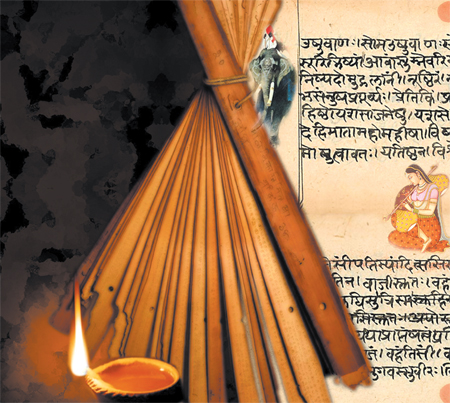
    If the cosmos of sound (sabda-prapanca) enfolds all creation and what is beyond it, it must naturally be immensely vast. However voluminous the Vedas are, one might wonder whether it would be right to claim that they embrace all activities of the universe. “Anantah vai Vedah”, the Vedas themselves proclaim so (the Vedas are endless).

    We cannot claim that all the Vedas have been revealed to the seers. Only about a thousand sakhas or recensions belonging to the four Vedas have been revealed to them.

    Brahma, the Creator, alone knows the Vedas in their entirety. Before the present Brahma there was a great deluge and, preceding it, there was another Brahma. And, similarly, before him too there must have been another Brahma. But through all these vast vistas of time, through successive deluges, the vibrations caused by the Paramatman’s breath have existed in space, the vibrations that urged the first Brahma to do the work of creation. These vibrations are indestructible.

    The Brahma who appears after each great deluge performs his function of creation with them. The sounds we produce are never destroyed. I remember reading that what Jesus Christ spoke 2, 000 years ago could still be recaptured in his own voice and that efforts are being made for the same.

    I don’t know how far these efforts have succeeded. But I do know that there does exist such a possibility (of receiving a voice or sound from the past). We know that a sound, once it is produced, remains in space without ever being destroyed. Brahma created this world with the sound of the Vedas and this sound is not destroyed even during a great deluge. We build a village or town with stone, earth, timber, iron, etc.

    All these materials are derived from the will of the Paramatman, from his thought, from the vibrations that are his will or thought. Brahma saw the sounds corresponding to these vibrations as the Vedas and the chanted them and brought all the world into existence. We often see reports in the newspapers of trees flowering or fruiting in abundance in response to the vibrations of certain sounds.

    Some vibrations have also the effect of stunting the growth of plants. Here is proof of the fact that sound can create, sustain and destroy. Brahma could create the universe with the sound of the Vedas because of his power of concentration. A siddha can cure a sick man if he intones the Pancakasara mantra – the mantra that we mutter every day – and applies holy ashes to the patient’s body.

    He is able to do it because he has greater power of concentration than we have. If the mantra is to be efficacious it has to be chanted without any tonal error whatsoever. Only then will it bring the desired result. Brahma had the power of concentration to the full since he came into being as an “instrument” for creation. Much could be accomplished from the void of space through electricity.

    From the spiritual reality called the Nirguna Brahman (the unconditioned Brahman without attributes) emanates everything. During the deluge, this spiritual reality goes to sleep. Take the case of a sandow. When he is asleep his strength is not evident. But when we see him wrestling with an opponent we realise how strong he is. Similarly, during the time of creation, the spiritual reality is revealed to perform manifold functions. From the Nirguna Brahman comes a flow of energy to perform such functions. Brahma came into being as a part of this flow. Since he was all tapas all concentration, he could grasp all the Vedas with his extraordinary power. He created the world with their sound. The Vedas are infinite and so too creation takes forms that are countless. The great sage Bharadvaja kept chanting the Vedas over three lifetimes.

    Paramesvra appeared before him and said to him: “I will grant you a fourth life. What will you do during it? “The sage replied: “I will keep chanting the Vedas again.” It is not possible to learn the Vedas in the entirety even over many, many lifetimes. Paramesvra took pity on Bharadvaja for all his efforts to accomplish a task that was impossible to accomplish. Wanting to change his mind, Paramesvara caused three great mountains to appear, took a handful of earth and said to the sage: “The Vedas you have learned all these years are like this handful of earth. What you have yet to learn is vast, like these mountains. “It is believed that Vedagiri or Tirukkazhukkunram is the place where the Vedas appeared in the form of these mountains. When I was circumambulating the hill there, people accompanying me intoned instead, “Veda, Veda, Mahaveda”. The story of Bharadvaja occurs in the Kathaka of the Vedas. We learn from it that the Vedas are so infinite.

    The classification into the four Vedas and the one thousand or so recensions was a later development. Brahma came into being, his heart was filled with all Vedic sound. The Vedas showed him the way to perform his function of creation.

    He recognized that the sound of the Vedas pervaded everywhere. To him occur all Vedas. Only some mantras have revealed themselves to the sages and these constitute the Vedas that are our heritage. At the time of chanting a mantra we usually mention the rsi associated with it, its chandas or metre and the name of the deity invoked. In the Telegu country they mention the three for all mantras. The sages learned the mantras with the power of concentration acquired through austerities.

    They were bestowed with celestial ears, so they could hear the mantras in space. It is said in the science of yoga that if our heartspace becomes one with the transcendent outward space we will be able to listen to the sounds in it.

    Only those who have attained the state of undifferentiated oneness of all can perceive them. It is in this way that the seers became aware of the mantras and made them known to the world.

    It must be remembered that they did not create them. They brought us immeasurable blessings by making the mantras known too us. If someone offers us water form the Ganga (Ganga-tirtha, Gangajal) we receive it, prostrating ourselves before him. The man did not of course create the Ganga, but all the same reverence him in recognition of the fact that the must have traveled a thousand miles to bring us the few drops of the holy water.

    We cannot adore the seers sufficiently for their having made us the gift of the mantras which are beyond the grasp of our ears. That is why before canting a mantra we hold the sacred feet of the rsi concerned with our head.

  • Kamini’s ton helps India thrash West Indies by 105 runs in World Cup opener

    Kamini’s ton helps India thrash West Indies by 105 runs in World Cup opener

    MUMBAI (TIP: India maintained their unbeaten record against the West Indies with a thumping 105-run win in the Women’s World Cup opener at the Brabourne Stadium here on Friday.

    With this victory, India improved their win-loss record against the Windies in the World Cup to 5-0. This is India’s biggest triumph in the quadrennial event against their Caribbean rivals and overall their third highest in terms of victory by runs. Spurred on by a brilliant maiden century from Chennai girl Thirush Kamini Murugesan and her 175- run opening stand with Poonam Raut (72: 94b, 7x4s), the hosts posted a formidable 284 and bowled out their rivals for 179 in 44.3 overs. India’s total was their highest ever in a World Cup tie, their previous best of 275 coming against New Zealand, in Christchurch, in 2000. A late charge by pinch-hitter Jhulan Goswami (36: 21b, 6x4s) and Harmanpreet Kaur (36: 22b, 4x4s, 2x6s) helped them breach the 250-run barrier.

    With her 146- ball knock, ‘player of the match’ Kamini also became the highest Indian scorer in the World Cup, surpassing India skipper Mithali Raj’s 91 scored against the Kiwis in Pochefstroom in the 2005 edition. Kamini’s hundred was studded with 11 fours and a six, her most effective stroke being the scoop. Faced with a huge target, the visitors made a disastrous start when a direct hit from Harmanpreet Kaur found one of the Knight twins, Kycia, short of her crease. ODI ‘Player of the Year’ Stafanie Taylor (9) tried to check the damage but failed, giving an easy catch to Karuna Jain off Amita Sharma, leaving the visitors reeling at 15-2.

    Shamaine Campbelle (21) and Kyshona (11) tried to revive the innings but made early exits. The fastest T20 centurion Deandra Dottin (39: 16b, 3x4s, 4x6s) was the only one who added some spice to the dull-looking contest, hitting some long sixes, way beyond the shortened boundary line. One of her sixes, hit above the mid-wicket region, went on to hit the fence – the longest in the match.

    The moment things seemed going the West Indies way, a slower delivery from Niranjana Nagarajan deceived Dottin, who in her attempt to flick the ball saw herself being dismissed leg before. Thereafter, Shanel Daley (28) and skipper Merissa Aguilleira (18) too succumbed in face of some good bowling and tight fielding by the Indians.

    Niranjana finished with 3-52 in nine overs, the best figures amongst Indians, with Gauher Sultana and Jhulan scalping two wickets apiece. Earlier, the visitors made a huge mistake by opting to field on a pitch which looked a definite belter.