Year: 2015

  • Ringleader of Paris attacks planned more strikes, mocked open borders

    Ringleader of Paris attacks planned more strikes, mocked open borders

    PARIS (TIP): The ringleader behind the November 13 attacks in Paris had plans to strike Jewish targets and to disrupt schools and the transport system in France, according to sources close to the investigation.

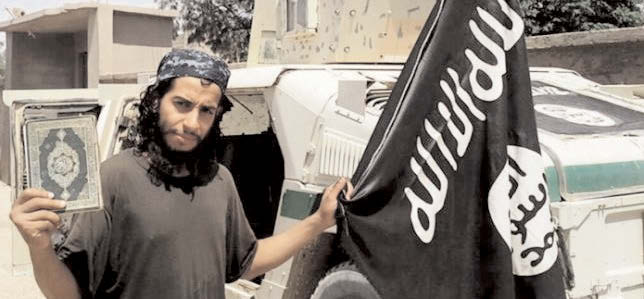
    Abdelhamid Abaaoud, a Belgian national of Moroccan origin, also boasted of the ease with which he had re-entered Europe from Syria via Greece two months earlier, exploiting the confusion of the migrant crisis and the continent’s passport-free Schengen system, the sources said on Friday.

    Their comments, confirming excerpts from a confidential police witness statement leaked to a French magazine this week, fleshed out a picture of the Islamic State militant who spearheaded the November 13 attacks targeting cafes, a concert hall and sports stadium in Paris in which 130 people were killed.

    The witness statement, quoted in the Valeurs Actuelles weekly magazine, describes how Abaaoud approached his cousin Hasna Ait Boulahcen two days after the killing spree asking her to hide him while he prepared further attacks.

    Both Abaaoud and Boulahecen died on November 18 in a shootout with police in St. Denis north of Paris at an apartment where the militant Islamist had been staying.

    Speaking of the planned future attacks, Abaaoud told his cousin on November 15 that “they would do worse (damage) in districts close to the Jews and would disrupt transport and schools”, the witness statement said.

    Abaaoud said he would give Boulahecen 5,000 euros ($5,289.50) to buy two suits and two pairs of shoes for him and an unidentified accomplice to “look the part” in a planned attack on Paris’ commercial district La Defense.

    Paris prosecutor Francois Molins confirmed on Tuesday the militants had been plotting to attack La Defense on November 18. Reuters had previously reported the planned attack.

    The witness statement also described how Abaaoud had boasted about slipping into Europe with refugees fleeing Syria’s civil war and then spending two months in France undetected prior to the November 13 attacks.

    “France – zero,” it quoted him as saying.

    On Friday, the Paris prosecutor’s office said it would open a preliminary investigation into how the confidential police witness statement was leaked to the press.

  • MILITANT ATTACKS ABROAD A DIPLOMATIC QUANDARY FOR CHINA’S XI

    MILITANT ATTACKS ABROAD A DIPLOMATIC QUANDARY FOR CHINA’S XI

    BEJING (TIP): The killings of Chinese citizens by Islamic militants in Syria and Mali place President Xi Jinping in a quandary: How can Beijing respond effectively without betraying its strict stance against intervention?

    The dilemma underscores the tension between China’s desire to be seen as a leading global power and its desire to maintain its own independent foreign policy while shunning the US-led Western liberal democratic political agenda.

    How Xi will square that ideological circle and what concrete actions he’ll take in response could mark an inflection point in Chinese diplomacy. More likely, analysts say, he’ll stick to China’s long-established neutrality while possibly taking limited behind-the-scenes measures to help in the global campaign against Islamic extremists.

    “For China, intervention would be a real game-changer,” said Australian National Security College expert Michael Clarke.

    “Frankly, I think Xi is in a very difficult position here.”

    Regardless of what it chooses to do, China has increasingly found itself confronted by Islamic militant groups.

    Three Chinese – all high-ranking executives with the state-owned China Railway Construction Corp.’s international group -were among the 19 victims of last week’s attack on the Radisson Blu hotel in Mali’s capital, Bamako. The al-Qaida-linked group known as Al-Mourabitoun – or The Sentinels -has claimed responsibility for the attack.

    That followed the killing of 50-year-old Beijing native Fan Jinghui by Islamic State group extremists. Xi vowed to bring Fan’s killers to justice, but China has offered no details on how it plans to do so.

    Foreign Ministry spokesman Hong Lei told reporters Monday that China was working to “increase our emergency reaction and early warning capabilities” to confront threats against overseas personnel and assets.

    Calls online from the Chinese public dismissing Beijing’s response and calling for action against militants have been suppressed by China’s Internet censors. With more Chinese than ever traveling abroad for work, study and travel, the government has been under growing pressure to identify threats and ensure their safety through its consulates and embassies.

    al-Qaida, and more recently IS leader Abu Bakr al-Baghdadi, have also threatened China over what they call the oppression of the Muslim Turkic Uighur people native to the northwestern region of Xinjiang. China says it is fighting a separatist insurgency in Xinjiang, and has been eager to equate that fight with the international struggle against extremist groups including IS and al-Qaida. Some critics see little evidence of substantial links between China’s Muslim Uighur groups and groups such as IS.

    Chinese forces, some equipped with flamethrowers, recently concluded a 56-day operation to kill or capture 30 suspects in a deadly attack on a Xinjiang coal mine. China blamed the attack on insurgents it says were directly led by an unidentified overseas group.

    A top Xinjiang official, Xi Hairong, this week warned that the continuing influence of “pan-Islamism and pan-Turkism thoughts” placed Xinjiang in “an active period for violent and terrorist activities and an acute period in the battle against separatists.”

    China says Uighur extremists have links to al-Qaida and that some have traveled to Syria to fight alongside IS, although Clarke and other outside observers question those claims.

    And while China’s campaign against Uighur extremism has been relentless, it has shown no appetite to apply such tactics when threatened abroad.

  • Moscow cuts coal supply to Kiev

    Moscow cuts coal supply to Kiev

    KIEV (TIP): Russia has begun to restrict coal supplies to Ukraine, energy minister Volody myr Demchyshyn told Ukrai ne’s parliament on Friday days after the Kremlin threa tened to punish Kiev for a po wer blackout of Russian-an nexed Crimea.

    Demchyshyn said pro Russian separatists who cont rol coal mines in eastern Uk raine had also halted coal supplies. He said Kiev had one month of its own coal supplies left and was seeking alternative supplies from So uth Africa.

    “Coal supplies ha ve been restricted from un controlled territory (Don bass) and from Russia,” said Demchyshyn.

    “Right now our power stations have enough coal reserves in storage to last for at least one month. But in the long-term problematic questions will arise.” Russian energy minister Alexander Novak said on Tuesday that Russia might cut coal supplies to punish Ukraine for what he said was its deliberate refusal to help rebuild power lines to Crimea, which were blown up by unknown saboteurs. Russia seized Crimea from Ukraine in March last year, plunging relations between the one-time allies into crisis.

    Minor repair work has been carried out on the sabotaged pylons and power lines in southern Ukraine which supply Crimea, but none of the four pylons which were destroyed are operational.

    Ukraine depends on coal to fulfil around 44% of its po wer needs. Nuclear energy makes up about the same proportion, with the rest of its needs being met by renewable sources.

  • ISIS: Muslim-majority countries across the world overwhelmingly detest terrorist group

    ISIS: Muslim-majority countries across the world overwhelmingly detest terrorist group

    LONDON (TIP): ISIS is almost universally detested across the Middle East, Asia and Africa, even in Muslim-majority countries, a new poll has shown.

    Despite rhetoric about supposed “sympathy” for the terrorist group among Muslims in the UK and around the world, research by the Pew Research Centre indicated almost non-existent support in 11 surveyed countries and territories.

    In Lebanon, where ISIS’ recent bombing in Beirut killed 43 people, 99 per cent of respondents said they had a “very unfavourable” opinion of the group, while 94 per cent of Israelis and 89 per cent of Jordanians felt the same.

    In the Palestinian territories, 84 per cent of people had a negative view of ISIS, both in the Gaza Strip (92 per cent) and the West Bank (79 per cent).

    Chris Doyle, director of the Council for Arab-British Understanding (Caabu), told The Independent that the results were no surprise.

    “I think it emphasises that ISIS are seen as a threat to communities across the Arab world – Muslims have been their primary victims after all, as was the case with al-Qaida,” he said.

    “The brutal nature of their rule, the way they have treated women, all the beheadings, have not endeared them to people.

    “(Respondents) also know that by their actions, ISIS are trying to turn the non-Muslim world against them.”

    Mr Doyle said that while all the surveyed areas had experience of jihadist groups, Lebanon was particularly conscious of the carnage next door in Syria, which has driven hundreds of thousands of refugees across its borders.

    In no country surveyed did more than 15 per cent of the population declare support for ISIS, but in Pakistan views appeared more mixed.

    The majority of respondents – 62 per cent – said they did not know how they felt, while almost a third held negative opinions and around nine per cent thought positively of the group.

    Mr Doyle said the high proportion of “don’t knows” could be a sign of reluctance to answer the question.

    “ISIS don’t have as much of presence there so I would like to see further analysis,” he added.

    Opinions differed across religious groups in some areas including Nigeria, where Boko Haram declared allegiance to ISIS earlier this year while attempting to establish its own “caliphate” with a bloody insurgency.

    Around three quarters of Nigerian Christians had an unfavourable view of ISIS, as did 61 per cent of Nigerian Muslims, although a fifth of the same group supported the so-called Islamic State.

    The Pew Research Centre took the figures from its Global Attitudes Survey conducted in spring this year, before ISIS’ latest round of atrocities targeting France, Russia, Lebanon, Egypt, Tunisia, Iraq and Syria.

    Its latest findings came after The Sun was criticised for claiming that one in five British Muslims “have sympathy” for extremists going to fight with ISIS in Syria.

    One in five respondents to the poll did say they had “some” or “a lot” of sympathy with people going to Syria but did not specify who they would be fighting for, following high-profile coverage of volunteers going to combat ISIS with the Kurds and other forces.

    It was also pointed out that the word “sympathy” does not necessarily indicate approval. (Source: Reuters)

  • China reduces sentence of journalist to 5 years from 7

    China reduces sentence of journalist to 5 years from 7

    BEIJING (TIP): An imprisoned 71-year-old Chinese journalist has had her sentence reduced to five years from seven following an appeal, her lawyer said today.

    Gao Yu appealed her April conviction for leaking state secrets at a closed hearing on Tuesday at Beijing’s high court. Her lawyer Shang Baojun said the court announced today that her sentence would be reduced.

    Gao was convicted of sharing with an overseas news magazine a document detailing the Communist Party leadership’s resolve to aggressively target constitutionality, press freedoms and groups that seek to change society but operate outside the party.

    The magazine, Mingjing News, has said Gao did not provide the document, and her lawyers said they presented evidence that Gao was not the source of the report at the appeal.

  • Father’s pride — Dad takes 90% pay cut to travel world with sick kid

    Father’s pride — Dad takes 90% pay cut to travel world with sick kid

    LONDON (TIP): A high-flying businessman has quit his job, taking a 90% pay cut, so he can show his terminally ill daughter around the world. John Silk, from Croydon, South London, who successfully managed his own employment agency for 13 years, gave up his lucrative business to take a part-time job as a school bus-driver so he could see his daughter Vicky every day .

    Vicky, 21, has Down’s Syndrome and pulmonary hypertension and receives support from Dreams Come True, a charity dedicated to helping terminally ill children. Silk was initially told Vicky would not live beyond age 15, however she has defied doctors’ predictions and Silk now uses all his earnings to take her on trips around the world, ITV reports. The family ha ve been on 24 trips in the last 14 years countries. and visited 15 countries.

    So far, with the help of Dreams Come True, Vicky has visited Florida’s Disney World, Niagara Falls, Barbados, Thailand and Hawa. Silk said the trips had broadened Vicky’s horizons and boosted her confidence.

  • Spectre – MOVIE REVIEW

    Spectre – MOVIE REVIEW

    STORY: James Bond is hunting the terrifying ‘Pale King’ – but what happens when Bond discovers the villain is a shadowy spectre from his own past?

    REVIEW: So, Spectre is one of Bond’s most thrilling action movies – but also one of his most ghostly, reaching into an eerie past. James Bond (Craig) is chasing ‘The Pale King’ (Waltz), head of criminal group Spectre, perpetrating terror on nations, forcing them to buy Spectre’s massive surveillance network. Tracking the villain who killed his first love and first boss, Bond reduces parts of Mexico and London to rubble, smashes cars, helicopters and a plane, battles hideous heavy Hinx (Bautista), beds sultry Mrs. Sciarra (Belucci), nearly drinks vegetable juice and meets Madeleine Swann (Seydoux) – who downs dirty Martinis and shoots deadly hard.

    But what happens when Bond finds The Pale King is Blofield – a shadow from his own past? And when the new ‘M’ (Fiennes) faces top bureaucrat Max Denbigh (Scott), who believes the ’00’ department – and democracy – must bow before drones.

    Can Bond save the world? And the ’00’ program too?

    Spectre features haunting cinematography, pale, misty lakes, snow-clad hills, helicopters gleaming like malevolent wasps, wicked shadows on glass walls. Traditional Bond imagery – golden roulette wheels, blush-red casino carpets, silky gowns falling upon ivory floors -are replaced with starker, darker shots.

    The action leaves you breathless as choppers burst, cars drown, a plane explodes on a Christmas cake landscape and Hinx breaks necks – but while Spectre’s hand-to-hand is thrilling, its tepid mouth-to-mouth, Bond’s kisses censoriously chopped, leaves you feeling the world is certainly not enough.

    Happily, Craig pleases, part-swagger, part-shudder, drawling one-liners – “I think we’re supposed to be impressed…” – with wry aplomb. Ben Whishaw presents the cutest ‘Q’, Naomie Harris imbues Moneypenny with bouncy life while Fiennes pulls off an ageing agent, each character carrying smartly-tailored dialogues.

    But the story has long, loose threads, including Blofield linked to Bond’s babyhood, plus references to murdered dads and lost loves. Literary allusions couldn’t be heavier, ‘Madeleine Swann’ straight out of Proust, emphasising remembrance while debating detectives versus drones. Looking back too often loosens the ground under Bond’s feet now – this could’ve been much tighter, as could be Waltz’s mildly mincing Blofield.

    However, a few moans aside, Spectre’s action still shakes and stirs, leaving you loving its oak and leather, champagne – and dynamite.

  • EMILY BROWNING ‘LOVED’ ESSAYING ‘LEGEND’ ROLE

    EMILY BROWNING ‘LOVED’ ESSAYING ‘LEGEND’ ROLE

    Actress Emily Browning, who plays the role of actor Tom Hardy’s wife Frances Shea in crime thriller film “Legend”, says she loved her character as what she does in the film is something that not many people can do in real life.

    Directed by Brian Helgeland, Legend captures the rise and fall of the Kray twins Ronald
    ‘Ronnie’ Kray and Reginald ‘Reggie’ Kray (played by Hardy); the relationship that bound them together, and charts their gruesome career to their downfall and imprisonment for life in 1961.

    Browning is shown as an ill-fated wife in the film.

    Talking about her character, she said in a statement: “It was really nice for me to see those two sides. That’s what I loved about the character… She was genuinely in love with this man and she was this fragile, sweet girl with a lot of her own issues, but she was also ballsy enough to stand up to someone that not many people would have stood up to.”

  • NICOLE KIDMAN NAMED BEST ACTRESS AT THEATRE AWARDS

    NICOLE KIDMAN NAMED BEST ACTRESS AT THEATRE AWARDS

    Nicole Kidman and James McAvoy took home the top prizes at this year’s London Evening Standard Theatre Awards.

    Kidman’s turn as British chemist Rosalind Franklin in Anna Ziegler’s drama
    “Photograph 51 landed her the Best Actress title, while X-Men star McAvoy was named Best Actor following his charismatic portrayal of Jack in “The Ruling Class”, reported Digital Spy.

    A total of 13 awards were presented on the night, including Best Musical Performance to Imelda Staunton for her role in Gypsy and Best Newcomer in a Musical to Gemma Arterton for her work in the stage show of Made in Dagenham.

  • X: Past Is Present | MOVIE REVIEW

    X: Past Is Present | MOVIE REVIEW

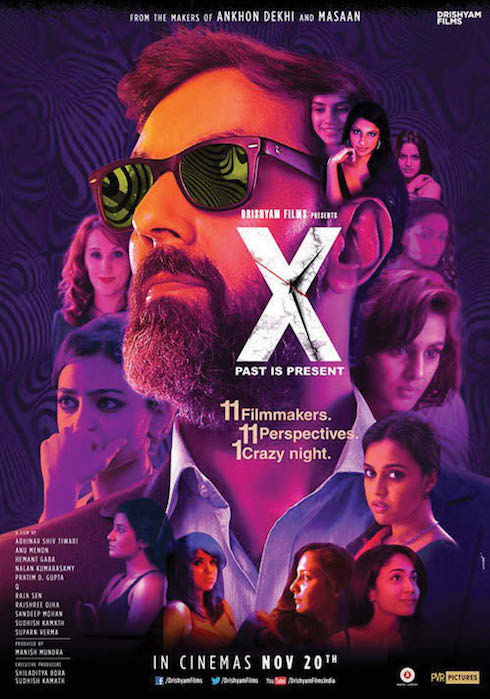
    STORY: This ambitious venture has 11 intertwined stories running in the same narrative about a filmmaker K and his many muses.

    Past Is PresentMOVIE REVIEW: This film can be best described as a bizarre, underwhelming hotch-potch. Though some of these 11 sub-stories do show that rare streak of brilliance, most of them are sheer duds. The common thing binding them all is that they are unmistakably pretentious.

    Of the many, it is Pratim D Gupta’s story about a man and a woman living under the same roof at different times and falling in love in a quaint way, which is striking. The old-world charm lies in its wooden almairah, the acoustic guitar and its poetry. None of the other plots quite condense the idea of love so deeply. Though all stories are about unrequited love, this one feels the most complete one of the lot.

    The most disappointing one came from Q,who tries his hand at an abstract idea, but his attempt doesn’t translate to good. His plot is sinister, paints a macabre milieu, has his risque quality and yet, the story doesn’t come together.

    A film is an amorphous mass and on that count this one doesn’t deliver. Its scattered screenplay makes the subplots feel disjointed. The protagonist K is caricaturish – a restless artist stuck in a creative limbo, narrating his escapades (romantic liaisons and sexcapades).

    Since a lot of the film plays out in flashback, the stories often jarringly? overlap. Sometime in middle of all the absurdity playing on screen, the film tells you that every filmmaker has one story that he retells differently each time, which justifies the repetitiveness of the plots.

    It is tolerable in parts, sometimes inventive, often mediocre but never half-as-good as it claims to be. As the protagonist shifts between startling you and disgusting you, the leading ladies take the cake. Radhika Apte, Swara Bhaskar and Huma Qureshi are unforgettable.

    Avoid, X : Past is Present. It will fail to suit your filmi palettes and make you stay away from biryani for life with a very grotesque reference. You can do without such negativity.

    The film is directed by a team of eleven filmmakers including Abhinav Shiv Tiwari, Anu Menon, Nalan Kumarasamy, Hemant Gaba, Pratim D. Gupta, Q, Raja Sen, Rajshree Ojha, Sandeep Mohan, Sudhish Kamath and Suparn Verma.

  • BEING FIT A HEALTHY CHANGE IN BOLLYWOOD: SOHA ALI KHAN

    BEING FIT A HEALTHY CHANGE IN BOLLYWOOD: SOHA ALI KHAN

    Actress Soha Ali Khan, whose mother and yesteryear screen icon Sharmila Tagore donned a bikini on-screen in the 1960s, says hitting the gym may not have been a trend back then, but a fit frame has now become essential in the movie industry.

    SOHA ALI KHANThe 37-year-old, who is blessed with a small frame, believes a lot has changed over the decades.

    “My mom wore a bikini, but back then nobody went to a gym. It’s good to be fit. You should try to be healthy. If that means to go to the gym, that’s a good thing. You can see in the industry… people are fitter,” Soha, who was in the capital for The Beauty Debate powered by Dove on ‘Evolving ideals of beauty in India’ at a summit, said.

    But she isn’t in favour of abruptly losing weight by relying on supplements just for a song or a scene.

    “It should be more about a lifestyle change and not done suddenly,” said the “Mr Joe B. Carvalho” actress, who added that even make-up has evolved in Bollywood.

    “Now, we have gone into HD definition. It’s all about looking natural where you can even see skin pores. Now, when you wake up in the morning, it looks like you have just woken up.

    “So, people need to understand that in a photo shoot there is a lot of airbrushing… So what is on-screen is not real. What you see on the magazine is not 100 percent real. Everything has been touched up a bit,” she said.Soha also admits that getting ready has now become more
    “complicated”.

  • VIDYA BALAN SHOOTS FOR SUJOY GHOSH’S TE3N

    VIDYA BALAN SHOOTS FOR SUJOY GHOSH’S TE3N

    Bollywood actress Vidya Balan, who considers Kolkata as her second home, returned to the city today to shoot for her next film, Te3n.

    Produced by Sujoy Ghosh, the Hindi film is the first movie for which the doors of the Victorian-era Writers’ Buildings have been opened for shooting.

    Balan, 37, was seen shooting with actor Nawazuddin Siddiqui inside the brick-red edifice, where megastar Amitabh Bachchan will also come on Friday to shoot. “I wanted to shoot inside this building for a long time. Now this wish has been fulfilled,” Balan told reporters. Besides Parineeta, the superhit Kahaani was shot in the city.

    Directed by Ribhu Dasgupta, Te3n will release next year.

  • Suspected ISI agent arrested in Meerut by Uttar Pradesh STF

    Suspected ISI agent arrested in Meerut by Uttar Pradesh STF

    Uttar Pradesh: An ISI agent today has been arrested from Meerut Cantt area by Special Task Force team of Uttar Pradesh, who has some sensitive documents related to Indian Army. IG Sujit Pandey of UP STF said the man had already relayed classified information about military establishments and the movement of Army units to his Pakistan handlers.

    According the reports from TNN, Mohammand Eizaz alias Mohammad Kalam, a resident of Taramadi Chowk, Irfanabad, Islamabad, Pakistan, was arrested from Meerut Cantt area when he was on his way to Delhi.

    IG Pandey said, “He sneaked into India from Bangladesh on February 9, 2013. He has already handed over classified information on the movement of the Sukhoi 30 combat aircraft and their hangars. He had information about the anti-tank guided missile programme. He had in his possession video images of Mirage’s emergency landing on Yamuna Expressway, the movement of the mountain brigade at Pithoragarh and information about an under-construction runway. His bank account in India showed transaction of more than Rs6 lakh in the last two years. This money was transferred in instalments, once from Saudi Arabia then from Dubai. He has sent his handlers information on cantonments in Bareilly, Meerut, Agra, Pithoragarh, Shahjahanpur and Mathura. He was in contact with a man called Salim, an officer of the ISI. His family was receiving Rs 50,000 per month in Pakistan for his services.”

    Besides classified Army documents, sleuths in Meerut recovered a fake Aadhar card with a Bareilly address, a fake voter ID card made in West Bengal, a Delhi Metro traveller card and Nepali and Saudi currency from him. His laptop, pen drive and ATM card have been seized. A NADRA card (Pakistani national identity card) was also found, Pandey said.

    Sources said Ejaz revealed during interrogation that he was sent from Karachi to Dhaka on January 31, 2013. He was received in Dhaka by a man named Probin, who enabled his travel by boat to West Bengal and dropped him at the house of Mohammad Irshad, a resident of Matiya Burj, West Bengal.

    Irshad and his son Ashraf, aided by a relative, helped Ejaz get a fake junior high school certificate, a voter ID and a ration card. These documents were used to open an account with the Central Bank of India.

    In West Bengal, he took up work as a videographer and married a woman from Ara district in Bihar. The man then lived in Bihar for a few months before moving to Bareilly in December 2014.

    At Bareilly, he began his spying assignment, working on a day job as a freelance video mixer. He got a fake Aadhar card made, showing his original address in Bihar. In his Aadhar card, his name is shown as Mohammad Kalam.

    The surveillance network received a tip-off on Friday, with the information that he would be boarding a train to Delhi at 3.00 pm from the Meerut Cantonment station. Acting on that information, the man was nabbed.

  • VEDIC GODS AND GODDESSES

    VEDIC GODS AND GODDESSES

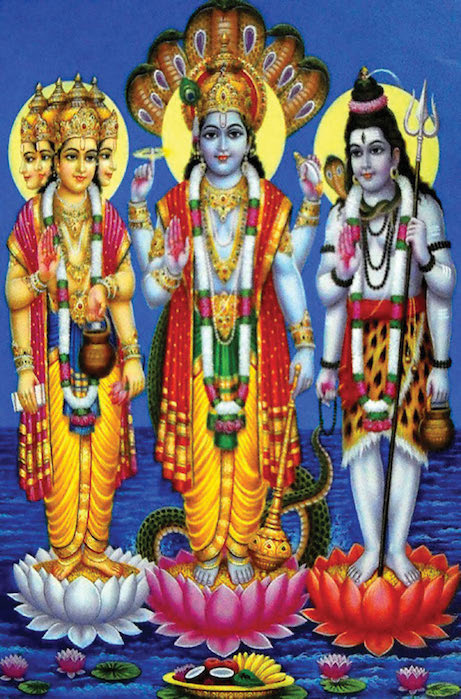
    In the Rig Veda the goddess Usha is consistently associated with and often identified with the dawn. She reveals herself in the daily coming of light to the world. She has been described in the Rig Veda as a young maiden drawn by one hundred horses. She brings forth light and is followed by the sun who urges her onwards. She is praised for driving away, or is petitioned to drive away, the oppressive darkness. She is asked to chase away evil demons. As the dawn she is said to rouse all life, to set all things in motion and to send people off to do their duties. She sends the curled-up sleepers on their way to offer their sacrifices and thus render service to the other gods.

    Usha gives strength and fame. She is that which impels life and is associated with the breath and life of all living creatures. She is associated with, or moves with cosmic, social and moral order. As the regularly recurring dawn she reveals and participates in cosmic order and is the foe of chaotic forces that threaten the world. Usha is generally held as an auspicious goddess associated with light and wealth, and is often likened to a cow.

    In the Rig Veda she is also called ‘the mother of cows’ and like a cow that yields its udder for the benefit of people, so Usha bares her breasts to bring light for the benefit of human kind. Although she is usually described as a young and beautiful maiden, she is also called ‘the mother of the gods and the ashwins’. Considered as mother by her petitioners she tends to all things like a good matron and goddess of the earth. She is said to be ‘the eye of the gods’ and is referred to as ‘she who sees all’, but is rarely invoked to forgive human transgressions. It is more typical to invoke her in times of need to drive away or punish one’s enemies.

    Usha is known as the goddess, reality or presence that bears away youth. She is described as ‘a skilled huntress who wastes away the lives of people’. In accordance with the ways of Rita she wakes all living things but does not disturb the person who sleeps in death. As the recurring dawn, Usha is not only celebrated for bringing light from darkness, she is also petitioned to grant long life, as she is a constant reminder of peoples’ limited time on earth. She is the mistress or marker of time.

    The ancient Vedic tradition has viewed Usha as the harbinger of light, awareness, activity. People divided time into the form of day and night. At night all creation rests and in the day the whole of creation is active. The transformation which takes place from night to day is known to be the attribute of Usha, the awareness that stirs up the activity of creation, the light that gives sight to the eyes, that gives power to the senses, that gives power to the mind and intellect, Usha has been regarded as the light, or the dawn of human consciousness.

    Another goddess commonly referred to in the Rig Veda is the goddess Prithvi who is nearly always associated with the earth, the terrestrial sphere where human beings live. In the Rig Veda furthermore she is always coupled with Dyaus the male deity associated with the sky. So dependent are these two deities in the Rig Veda that Prithvi is rarely addressed alone but almost always as part of the dual compound Dyaus-Prithvi, Sky-Earth. Together they are said to kiss the centre of the world. They sanctify each other in their complementary relationship. Together they are said to be the universal parents who created the world and the gods. As might be expected, Dyaus is often called ‘father’ and Prithvi ‘mother’.

    In addition to her maternal productive characteristics, Prithvi usually, along with Dyaus in the Rig Veda is praised for her supportive nature. She is frequently called ‘firm’, ‘she who upholds and supports all things’. She encompasses all things, is broad and wide, and is motionless. Although elsewhere she is said to move freely, Prithvi with Dyaus is often petitioned for wealth, riches and power. The waters they produce together are described as ‘fat, full, nourishing and fertile’. They are also petitioned to protect people from danger, to expiate sin and to bring happiness. Together they represent a wide, firm realm of abundance and safety, a realm pervaded by the order of Rita, which they strengthen and nourish. They are un-wasting, inexhaustible and rich in gems.

    In a funeral hymn the dead one is asked to go now to the lap of his mother earth, Prithvi who is described as gracious and kind. She is asked not to press down too heavily upon the dead person but to cover him gently as a mother covers her child with her skirt. The most extended hymn in praise of Prithvi in vedic literature is found in the Atharva Veda. The hymn is dedicated to Prithvi alone and no mention is made of Dyaus. The mighty god Indra is her consort and prefects her from all dangers. Vishnu strides over her, and Parjanya. Prajapati and Vishwakarma all either protect her, provide for her or are her consorts. Agni is said to pervade her. Despite this association with male deities, the hymn makes it clear that Prithvi is a great deity in her own right. The hymn repeatedly emphasises Prithvi’s fertility. She is the source of all plants, crops, and nourishes all creatures that live upon her. She is described as patient and strong, supporting the wicked and the good, the demons and the gods, She is frequently addressed as ‘Mother’ and is called to nurse all living things.

  • Nearly 35,000 comment on the proposed changes to the STEM OPT Extension – F1 Student Visa

    Nearly 35,000 comment on the proposed changes to the STEM OPT Extension – F1 Student Visa

    NEWYORK (TIP): On Oct. 19, the Department of Homeland Security (DHS) published a proposal for “Improving and Expanding Training Opportunities for F-1 Nonimmigrant Students with STEM Degrees and Cap-Gap Relief for All Eligible F-1 Students.” “The rule will benefit the U.S. educational system by helping ensure that the nation’s colleges and universities remain globally competitive in attracting international students in STEM fields,” said the U.S., in its description of the proposed changes.

    As of September, 2015, over 34,000 students were in the United States on a STEMOPT extension, according to the Federal Register.

    The proposed rule seeks to remedy the procedural deficiencies of the original STEMOPT Extension, ensure that the extensions can continue beyond February, and make several additional changes to the rules and procedures.

    Since 2008, those who complete a degree in a STEM field have also qualified for a one-time 17-month extension of OPT. This extension, however, was recently challenged in court by the Washington Alliance of Technology Workers, and this August, the District Court for the District of Columbia vacated the STEMOPT Extension on the grounds of procedural deficiency. The court order is set to take effect in February 2016 unless a new rule is enforced.


    DHS, in response to the August 2015 court order, increased the scope of the program. It took the original STEMOPT extension of 17 months and made it 24 months. That means the overall amount of time someone can work on a student visa has been will be extended from 29 months to 36 months.

    The proposed rule received nearly 35,000 comments on its plan to extend the Optional Training. The deadline for comments was November 19, 2015.

    By increasing the length of time someone can work on a student visa, the U.S. is trying to give these students more time to get an H-1B visa. Demand for H-1B visas, especially from IT offshore outsourcing firms, is making it harder for students who graduate from U.S. schools to get a work visa.

    The majority of comments received (view comments) support extending the program, which is not surprising. If the government effort fails, many STEM (science, technology, engineering and math) students may be forced to leave the U.S.

    The comments, some anonymous, were collected over the last month. Technically, the register says it has received about 50,000 comments, but it has only posted 35,000 and moderates before posting. The responses define the sharp divide on this issue.

    The question is whether this comment collection meets the obligations imposed in August by a federal court. That court had ruled that government erred by not seeking public comment in 2008, when it originally extended the OPT program from 12 months to 29 months for STEM students. The court gave the U.S. until Feb. 12 to fix the program or risk giving the students 60 days to return home.

    The Indian Panorama has zealously reported on STEM and will continue to update our readers on the changes on OPT as and when they become available.

  • Indian American Eye Surgeon Dr. V K Raju Lectures in Vietnam

    Indian American Eye Surgeon Dr. V K Raju Lectures in Vietnam

    It was some 2 years ago that I came across Dr. VK Raju. I hadn’t heard of him though I should have. It is a journalist’s task to have information about people-good and bad. Dr. Raju is not only an efficient eye surgeon, he is also a man endowed with a rare virtue of helping patients with eye affliction anywhere in the world. However, though he has provided vision and saved a large number of people from blindness in various parts of the world, he remains steadfast in his love for the country of his origin-India.

    Dr. VK Raju is founder and Medical director of Eye Foundation of America and Clinical professor of ophthalmology at West VirginiaUniversity. Since 1977, he, with his team, has examined 2 million outpatients, performed 300 thousand surgeries, including 25 thousand on children in India and 21 other developing countries.

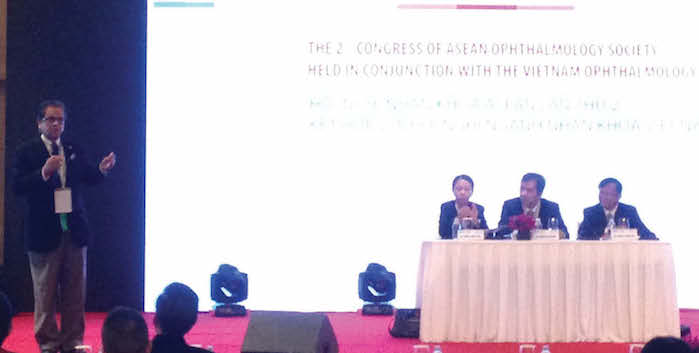
    Recently, Dr. Raju was invited as a guest speaker at Vietnam ASEAN Ophthalmology Congress. He delivered 4 lectures on Cataract surgery and dry eyes, and corneal transplants. The meeting took place in Hanoi on 29th, 30th and 31st of October 2015.

    Dr. Raju is passionately committed to preventing blindness among children, particularly in India where, he says, because of malnutrition millions are always in danger of losing vision. I have been told he makes it a point to rush to India to hold eye camps for children, whenever he gets an opportunity. Thank you, Dr. Raju for the great service you are doing to children in India and patients here in America and elsewhere I am sure, some day your enormous contribution will be adequately recognized.

  • Intolerance in India Echoes Home and Abroad

    Intolerance in India Echoes Home and Abroad

    As a young boy I attended Rashtriya Swayamsevak Sangh (RSS) Shakhas. I loved to go there to play and wield lathi. It provided me an opportunity to prove my strength and superiority. As part of our training, we were told to be patriotic, have respect and love for Bharat Mata. At times, we were told about the superiority of Hindu religion. But I don’t think it ever occurred to me to develop a staunch Hindu view of everything.

    As I grew, I distanced myself from RSS shakhas because I did not any more find an opportunity for the kind of sport I looked for. The primitive kabaddi and wielding lathi did not attract me any more.

    A few years later in my life I found the ideology of RSS not in consonance with the liberal values that my education had imbibed me with. I was drawn more to left than to the right where I saw RSS and the political party Jan Sangh.

    The right will always remain opposed to the left. It is like the East is East and the West is West and the twain can never meet. So, I  maintained distance from the right wing  Jan Sangh and the RSS which I considered to be a  religion-based group. I could never digest the aversion of the RSS for minority religious groups, though it pleased me as a Sikh to find some of the pracharaks of the RSS eulogizing  Guru Gobind Singh for the great sacrifice he and his father made to protect Hindus from the tyranny of the Muslim rulers.

    India has always been a country which absorbed all  who arrived on its soil, much as USA has. But, of late it appears India is being sought to be taken in a different direction. And the direction is certainly  not a welcome one; certainly not the one which would  strengthen the unity of the nation. The government of the day seems to be  bent upon creating divisions  in the name of religion. Surely, we have not forgotten the number of painful  incidents of communal clashes which, besides claiming life and property, have left deep scars on the psyche of the suffering people.

    People of India and Indians abroad will have to  find ways to oppose the Hindutva agenda of the RSS and the present government. It is either the people of India and India succeed or they succeed.

    Luckily, India has a number of intelligent people who could see through the game plans of the present government. They saw danger in rationalists being killed. They saw danger in the utterances of some representatives of the party in power. They saw danger in the studied silence of the Prime Minister on the issue of growing intolerance in India. So, they protested. Writers, artists, film makers returned their awards to register their protest. Instead of trying to allay their fears and  remedy the situation, the Modi government let the party workers organize counter protests. What a government we have?

    Every time somebody spoke of intolerance, the party in power made sure to come up with a condemnation of the protest. It happened in the case of Shahrukh Khan. It happened recently in the case of Aamir Khan.

    However, the number of protesters is growing and the protests are getting louder. These have not remained confined to India; Indians abroad have also protested.

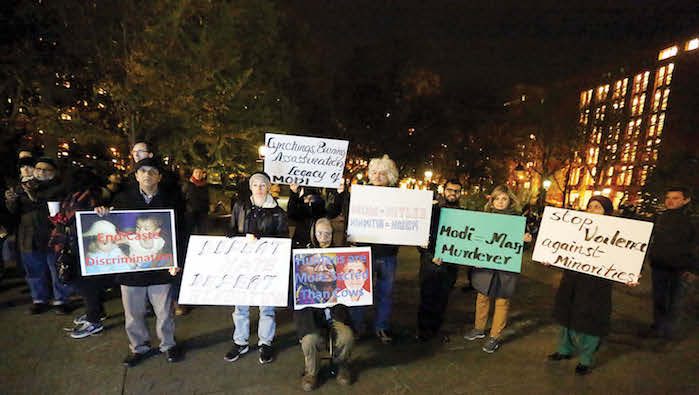
    The Alliance for Justice & Accountability held  a Public Demonstration & Candlelight Vigil on Saturday, November 14th from 3-5 pm in Washington Square Park, New York to stand in solidarity with India’s disenfranchised communities to raise their  voices to dissent the recent acceleration of killings of Muslims, Dalits, Adivasis, Christians and Sikhs.

    In USA, Indian Americans have raised their voice of protest.

    George Abraham, a former UN officer and Chairperson of Indian National Overseas Congress USA sent in his comment, which is being reproduced ad verbatim.

    “The very fact that Aamir Khan’s statement evoked so many vitriolic reactions from the Sanghis is another evidence of growing intolerance towards freedom of expression in Modi’s India. If anyone thinks that there is no anxiety among the minorities about the prevalent situation is fooling himself.

    People are getting lynched for their dietary habits, Dalit families are set on fire, NGOs like Greenpeace and Caritas International are being banned or FCNR denied, sedition charges are  being filed against human rights activists like Teesta Setalvad, eminent secular voices are silenced through murder in cases of Kalburgi and Pansare, respected writer such as Kulkarni being assaulted, cultural police raiding Bars and beating up women, 90 year old Dalit set on fire for entering the temple, another Dalit man’s hand chopped off because he was seen dining with an upper caste individual, MLAgetting beaten up in J&K Assembly building for expressing his freedom of thought on the issue of slaughter of cows and the list goes on and on.

    According to an NGO report, there were 800 incidents arising out of growing intolerance in last year alone. This is in addition to the ongoing purges in academic institutions of people with a pluralistic view, such as Amartya Sen in NalandaUniversity, who are being replaced by RSS ideologues across the board in institutions such as National Book Trust, National Film Institute, Historical Society and so forth to impose a kind of cultural hegemony based on Vedic history.

    The very fact that the current administration downplays the role Nehru has played in creating the very idea of India as we know it, is very troublesome as they are increasingly inclined to create divisions pitting one freedom fighter against the other for political ends. Yes, they have truly learned something ‘valuable’ for themselves from the British: ‘Divide and Rule’.!”

    Is the  Modi government not bothered about  the fall out of these protests on the image of India abroad? Is the Modi government not bothered about  feelings of the  minorities ? Is the Modi government not bothered  for the unity of the nation? Is the Modi government not bothered for the people of India? It would be very sad if the answer was a  “NO”.

  • Why it’s silly to link FDI and Intolerance

    Why it’s silly to link FDI and Intolerance

    “Those making a connection between an intolerant India and FDI are widely off the mark. Democracies by definition are tolerant and nobody is claiming that we are abandoning our democratic system……….At the heart of the controversy is Prime Minister Narendra Modi’s silence – specifically on the beef-linked murder of a Muslim – and his inaction in not reining in fringe elements of his party voicing communal views. His general statements against such acts and discourse which detracts from his development agenda are not considered sufficient to clear the air”, says the author.

    Many believe that rising intolerance in India is becoming an issue in our foreign relations, to the point that foreign investment flows into the country may be affected.

    The murder of a Muslim for allegedly stocking beef in one state, those of a couple of Dalits in another, the killing of a ‘rationalist’ in still another state, and some statements by BJP members inconsistent with our secular ethos are seen as instances of a dramatic surge in intolerance in India.

    This has been enough for writers, artists, historians and scientists to return awards, and others of public standing to express concern.

    The media has, of course, amplified the controversy, with denunciatory columns in some newspapers and unbridled TV debates.

    At the heart of the controversy is Prime Minister Narendra Modi’s silence -specifically on the beef-linked murder of a Muslim – and his inaction in not reining in fringe elements of his party voicing communal views.

    His general statements against such acts and discourse which detracts from his development agenda are not considered sufficient to clear the air.

    Debate

    Naturally, such an intensive debate in the country will be followed by local diplomatic missions – western in particular – and their assessment reports will reach their capitals.

    Foreign correspondents will inevitably follow the domestic sparring over the issue and publish articles without being too rigorous in their analysis, as their target is newspaper readership and not policy-makers.

    Indian or Indian-origin correspondents writing for foreign media are often inclined to write negative stories to make themselves more credible with head offices, besides catering to the biases of a few established US/UK newspapers who traditionally put the spotlight on some darker aspects of India’s social reality.

    The NGOs, domestic and foreign-funded, focused on community issues will be drawn into the debate on rising intolerance as part of civil society’s increasing political activism.

    Indian scholars and Western ones involved in India studies are networked and influence each other on the choice of issues to study and analyse and shaping perspectives on them.

    Some foreign scholars get unusually large space in our papers for airing views on sensitive subjects, which reinforce the impression of foreign concern about unwholesome developments at home.

    In addition, sections of India-origin populations, principally in some Western countries, have grievances against India which find sympathetic echoes in political, academic, media and religious circles there for a variety of reasons, including electoral.

    Incidents relating to minorities in India especially draw negative attention.

    The debate on rising intolerance in the country is closely linked to Modi’s rise to power, the political legitimacy that the Hindutva ideology is seen to have acquired as a result, and – what is anathema to devout secularists – the expanding influence of the RSS.

    Intolerance

    Those mounting a campaign against rising intolerance have been in their large majority always politically opposed to Modi and the Hindutva ideology.

    Despite the judicial process through which Modi has been wrung for years, this group has not forgiven him for the 2002 Gujarat riots – and it is this entrenched prejudice that found echo in the questions posed to him by the BBC and The Guardian journalists at his joint press conference with UK PM David Cameron during his London visit.

    Modi’s opponents at home and India-baiters in the US/UK establishment in particular are complicit in denigrating the Indian PM, and both feed on each other’s prejudices.

    +1

    The leadership of the Congress has begun to target Modi personally for the reprehensible crimes that have been lately in the news, holding him responsible for allowing an atmosphere to be created which has encouraged such acts.

    Such accusations, made recklessly in the context of domestic politics, do not serve India’s interests abroad as they give a handle to India’s opponents there to project a picture of India that is actually far from reality.

    Freedom 

    To say that dissent or freedom of expression in India is being suppressed overlooks the rampant criticism of the government in the media and the constraints that the judiciary has put on the power of the government and Parliament too.

    Attempts to impose some constraints on the social media as part of counter-terrorism efforts have failed because of public opposition.

    The government cannot even implement crucial parts of its economic reforms agenda because of political opposition.

    Those making a connection between an intolerant India and FDI are widely off the mark.

    Democracies by definition are tolerant and nobody is claiming that we are abandoning our democratic system.

    Most countries in the world are not democratic, and so by definition they should not be attractive for foreign investment.

    China has received vastly greater amounts of FDI than India and continues to do so, despite its open rejection of democracy and Western values and active suppression of dissent at home.

    The Gulf countries are not paragons of tolerance, but corporate heads and governments too do not seem to hold back investments there for this reason.

    Western businessmen are now thronging in Iran for economic opportunities.

    Singapore’s authoritarianism is actually an explanation for its economic success. Our own investments abroad, especially in the oil sector, are not contingent on tolerance or lack of it in the countries concerned.

    We can be our worst enemies.

    As an extension of domestic politics we want to leverage external forces to make a democratically elected government of a country of 1.25 billion inhabitants accountable for few sporadic crimes.

  • Aamir Khan speaks up | Voices of dissent need to be heard

    Aamir Khan speaks up | Voices of dissent need to be heard

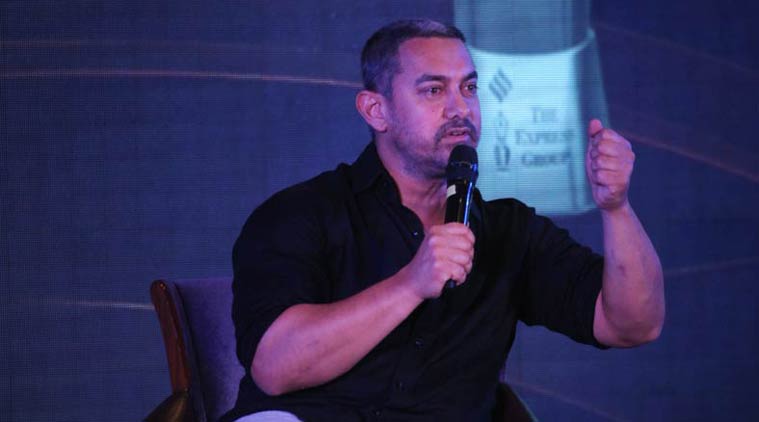
    The moment the poster boy of ‘Incredible India’ campaign, Aamir Khan, made a remark on
    ‘growing intolerance’, the sarkari brigade began questioning his credibility. The star, celebrated for handling social issues with sensitivity in his films and through highly popular TV show Satyamev Jayate, spoke on Monday of his wife, Kiran’s concerns over the safety of their child in an atmosphere of growing intolerance. His silence through the ‘award vapsi’ campaign by writers and his film fraternity was taken as an exception, for the actor is known to be vociferous to the extent of lending active support to social issues like Narmada Bachao Andolan and Anna Hazare’s movement against corruption.

    Aamir Khan’s comments should have been taken in the context they were made, as many other self-critical observations he has made through Satyamev Jayate on many ills afflicting Indian society. In the present context, these have been colored with communal connotations in the social media war waged between two factions: those who have reason to worry about threats to freedom and those who are just looking for an opportunity to jump on the bandwagon of establishing Hindutva supremacy.

    The tendency to reduce popular icons like Aamir Khan and Shah Rukh Khan to one community advocating a particular point of view by a handful undermines the tremendous concern they have shown for their country over the years with their body of work.

    The boorishly aggressive reaction from the Hindutva brigade is a reaffirmation of the very intolerance against which Aamir Khan and others have raised their voice. The BJP’s cultural warriors have raised a question over his deshbhakti. These new cultural vigilantes have unwittingly shown themselves to be lacking in respect for dissent and disagreement. No Aamir Khan needs a certificate of good conduct from the new intolerant Indian. The new itch to want to shut up any contrary voice or person is most unacceptable.

  • Woman in critical condition after being  struck by hit-and-run driver in the Bronx

    Woman in critical condition after being struck by hit-and-run driver in the Bronx

    NEW YORK (TIP): A woman was hospitalized in critical condition after she was slammed by a hit-and-run driver in the Bronx on Thursday, November 19, police said.

    The woman was hit on Westchester Ave. near Pilgrim Ave. in Pelham Bay at 4:39 p.m., cops said.

    She was rushed to Jacobi Medical Center in grave condition, cops said. The driver fled the scene, cops said.

    A vehicle description was not immediately available.

    The NYPD’s Collision Investigation Squad was called to the scene to probe the crash.

    The crash came in the midst of a ten-day NYPD crackdown on dangerous drivers in the city.

    On Wednesday, a man and a woman were killed in Brooklyn just blocks apart from each other in separate traffic crashes, cops said. Both victims were pedestrians.

  • Man plunges to death from fifth floor Queens window after stabbing girlfriend

    Man plunges to death from fifth floor Queens window after stabbing girlfriend

    QUEENS, NY (TIP): A 29-year-old man died after he plummeted from a fifth floor window, November 16 -moments after stabbing his girlfriend several times in Queens, police said.

    The 24-year-old woman was attacked when a domestic dispute turned violent in the fifth floor apartment on Grand Central Parkway near Commonwealth Blvd. in Little Neck shortly after 9:20 a.m., authorities said.

    Bloodied and panicked, she ran out onto the street and flagged down a passing NYPD patrol car, police said.

    The officers then went to up to the apartment to investigate but found the man had plunged from the window down to the ground on the side of the building, according to officials. Police were investigating whether the man leapt or fell.

    The man and woman were both rushed to North Shore LIJ Hospital, where the man died, police said. The woman was listed in stable condition.

    It was not immediately known what spurred the violence.

  • Winter session of  Parliament gets off with debate on Constitution

    Winter session of Parliament gets off with debate on Constitution

    NEW DELHI (TIP): The Winter session of Parliament got underway November 26 with an aggressive Opposition taking  on the government over the Constitution and the legacy of its framer BR Ambedkar.

    Congress president Sonia Gandhi said the basic ideals of the Constitution were in danger and the happenings of the past few months were against its values, a reference to the swirling debate on intolerance in the country, stoked by controversial statements by BJP leaders.

    “Those who have no respect for the Constitution and have no role in the making of the Constitution are claiming to be keeping the Constitution,” the Rae Bareli MP said, a possible reference to the BJP that has been accused by the Congress of attempting to usurp Ambedkar’s legacy.

    The session began on a heated note, with home minister Rajnath Singh saying the word ‘secular’ was the most misused word in Indian politics.

    He went on to say that Ambedkar didn’t find it necessary to insert the word along with ‘socialist’ in the Preamble because he felt it was already in the basic nature of people.

    “We know how many problems he (Ambedkar) faced, he must have been hurt, yet (kept) his emotions in control… But he never said I have faced discrimination in India, so I will go somewhere else,” Singh said, hitting out at actor Aamir Khan who revealed this week that his family contemplated moving abroad due to rising intolerance.

    But Gandhi rejected Singh’s charge, saying the Constitution undeniably upheld secularism and that Ambedkar worked to give a voice to people discriminated by society.

    “The Constitution is closely linked to the history of Congress party. It is the Congress that brought Dr Ambedkar into the Constituent Assembly,” she said, amid uproar by BJP parliamentarians.

    “Indian Constitution is a result of decades of struggle. Mahatma Gandhiji made a huge contribution in this struggle.”

    The heated argument came at a two-day long special sitting of Parliament to discuss commitment to the Constitution as part of Ambedkar’s 125th birth anniversary celebrations. The Rajya Sabha was adjourned on Thursday after an obituary reference to sitting member Khekiho Zhimomi who died on Thursday morning.

    The session, which ends on December 23, is expected to see fireworks with the government determined to push through its reform agenda, including the landmark goods and services tax bill. After intense negotiations, it has agreed to reach out to the Opposition and agreed to a debate on intolerance as part of its attempts to avoid a repeat of the monsoon session washout.

    Hours before Parliament opened, Prime Minister Narendra Modi said the government was ready for debates but all parties must work for the nation.

    “I’m confident we all MPs will leave no stone unturned to match the expectations of the people of the nation. I have spoken to all the political parties and all want the House to run smoothly,” the PM said, speaking to reporters outside Parliament. including price rise, Mohammad Ikhlaq’s mob lynching over cow slaughter remarks and the killing of Dalit children in Faridabad.

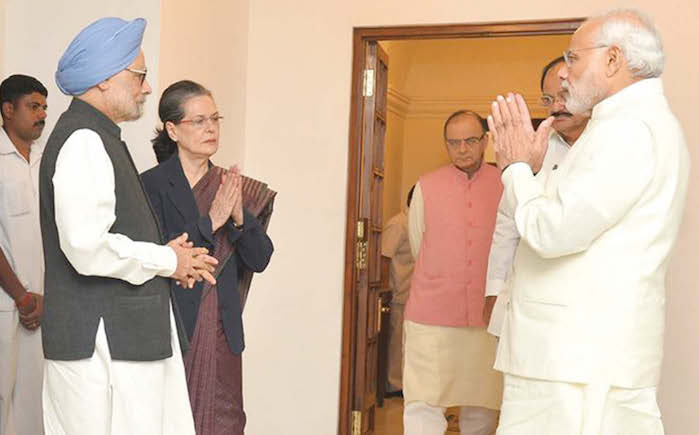
    Later, on November 27, PM Narendra Modi met the Congress leaders Sonia Gandhi and Dr. Manmohan Singh who he had invited for  a discussion on GST. The 45-minute meeting at 7, Race Course Road did not result in an immediate breakthrough, but it did serve to break the ice between the government and the Congress, with the latter consistently alleging that the ruling party was riding roughshod over the Opposition in Parliament. Finance Minister Arun Jaitley and Parliamentary Affairs Minister M Venkaiah Naidu were also present during the meeting. Sonia reiterated her party’s three main demands – 18 per cent cap on the tax, formation of a GST Disputes Settlement Authority and scrapping of the proposed one per cent additional tax that ends up favoring producer states. The government presented its viewpoint with facts and figures. All eyes are fixed on Monday, November 30 when the Parliament sits again to transact business.

  • Outlandish Trump & His Politics of Fear

    Outlandish Trump & His Politics of Fear

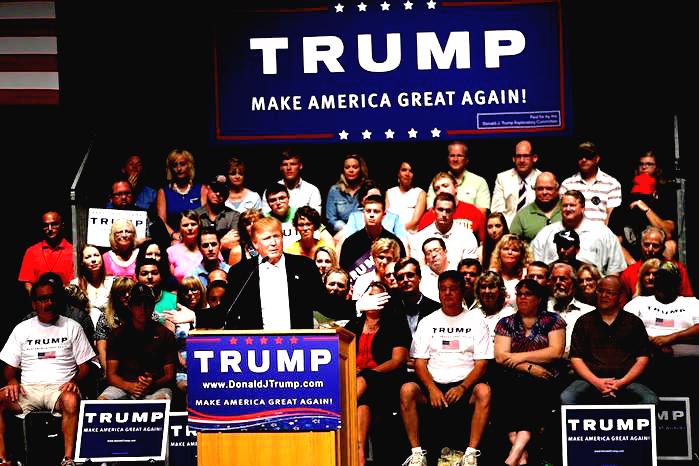
    Trump has garnered huge support among the Republican voters by playing the fear trump card. Since the Paris attacks, while the “serious” GOP contenders have proposed establishing no-fly zones and arming Kurdish rebels in Syria, Trump has focused on registering Muslims and closing mosques in the U.S. while insisting that he “watched … thousands” of Muslims in New Jersey celebrate 9/11 as the Twin Towers were coming down.

    Republican presidential hopeful Donald Trump at a rally in Oskaloosa, Iowa, July 25.
    Republican presidential hopeful Donald Trump at a rally in Oskaloosa, Iowa, July 25.

    He’s turned the focus of the debate on the right candidate to terrorism and immigration, with a vociferous anti-Muslim rhetoric. His racist approach and fear mongering statements are propelling him in debates. This needs a reality check.

    Let us see what Trump has to say on various issues.

    On Domestic Issues

    1. Arab-Americans cheered the attacks on 9/11 – Trump repeatedly claimed that on September 11, 2001, there were thousands of Arab-Americans celebrating in New Jersey after two planes flew into the Twin Towers. He says such public demonstrations “tell you something” about Muslims living in the US. However, there are no media reports or police records to back up the claim.

    2. There should be surveillance on US mosques – Trump believes Muslims should be tracked by law enforcement as a counterterrorism initiative. He has walked back some comments about keeping a database on all American Muslims, but says he doesn’t care if watching mosques is seen as “politically incorrect”.

    3. The US should use waterboarding and other methods of “strong interrogation” in its fight against the Islamic State.

    4. “Would build a “great, great wall” between the US and Mexico. In some of his earliest campaign comments, Trump suggested that Mexicans coming to the US are largely criminals. “They are bringing drugs, and bringing crime, and they’re rapists,” he said. A wall on the border, he claims, will not only keep out undocumented immigrants but Syrian migrants as well. He also believes that Mexico should have to pay for the wall, which could cost between $2.2bn and $13bn (BBC analyst).

    5. A mass deportation of the estimated 11 million illegal immigrants living in the US should go into effect. Despite criticism that this idea is xenophobic and prohibitively expensive – estimated at $114bn – Trump says his deportation plan is as achievable as it will be humane. In addition, his immigration reforms would end “birthright citizenship”, the policy that grants the children of illegal immigrants citizenship so long as they are born on American soil. He does not support creating a new path to citizenship for undocumented workers.

    6. In order to end mass shootings, the US should invest in mental health treatment rather than Gun Control. In a position paper on gun rights, Trump revealed he has a concealed carry permit and that when it comes to gun and magazine bans, “the government has no business dictating what types of firearms good, honest people are allowed to own”. He would also oppose an expansion of background checks.

    7. The Black Lives Matter movement is “trouble”. Trump mocks Democratic candidates like Martin O’Malley for apologizing to members of the protest movement against police brutality and casts himself as a pro-law enforcement candidate. “I think they’re looking for trouble,” he once said of the activist group. He also tweeted a controversial graphic purporting to show that African Americans kill whites and blacks at a far higher rates than whites or police officers. However, the graphic cites a fictitious “Crime Statistics Bureau” for its numbers, and has been widely debunked using real FBI data.

    On Foreign Policy

    1. Trump and Vladmir Putin would “get along very well”. In an interview with CNN, Trump said that Putin and Obama dislike one another too much to negotiate, but that “I would probably get along with him very well. And I don’t think you’d be having the kind of problems that you’re having right now”.

    2. Climate change is just “weather” . While Trump believes that maintaining “clean air” and “clean water” is important, he dismissed climate change science as a “hoax” and believes environmental restrictions on businesses makes them less competitive in the global marketplace. “I do not believe that we should imperil the companies within our country,” he told CNN on the issue. “It costs so much and nobody knows exactly if it’s going to work.”

    3. The world would be better off if Saddam Hussein and Muammar Gaddhafi were still in power . Trump told CNN that he believes the situation in both Libya and Iraq is “far worse” than it ever was under the two deceased dictators. While he concedes Hussein was a “horrible guy”, he says he did a better job combating terrorists.

    4. No asylum to Syrian migrants . He says that the Paris attacks prove that even a handful of terrorists posing as migrants could do catastrophic damage, and so he will oppose resettling any Syrians in the US, and deport those who have already been placed here.

    5. “Bomb the hell” out of IS. Trump claims that no other candidate would be tougher on the Islamic State and he would weaken the militants by cutting off their access to oil.

    On Healthcare

    1. Veteran healthcare in the US needs a major overhaul . Trump wants to clear out the executive level in the Department of Veterans Affairs, saying that wait times for doctor visits have only increased after previous interventions failed. Thousands of veterans have died while waiting for care, he says. He will invest in the treatment of “invisible wounds” like post-traumatic stress disorder and depression. He would also increase the number of doctors who specialize in women’s health to help care for the increasing number of female veterans.

    2. Obamacare is a “disaster”. Trump says he favors repealing the president’s Affordable Care Act, which aims at extending the number of Americans with health insurance, but he believes that “everybody’s got to be covered”. A spokesman for Trump told Forbes that he will propose “a health plan that will return authority to the states and operate under free market principles”.

    On Economy

    1. Create a simpler tax code . Trump wants anyone who earns less than $25,000 to pay no income tax. They would submit nothing more than a single page tax form that reads “I win”. He would lower the business tax to 15%. He would also allow multinational companies keeping money overseas to repatriate their cash at a 10% tax rate.

    2. Hedge fund managers are “getting away with murder” . Trump found common ground with Democrats like Senator Elizabeth Warren when he said that hedge fund managers and the ultra-wealthy do not pay enough taxes. However, after the campaign released specifics of his plan, analysts argued that hedge fund managers would actually get a tax cut along with the middle class.

    3. China should be taken to task . If elected , Trump says he will make China stop undervaluing its currency, and force it to step up its environmental and labor standards. He is also critical of the county’s lax attitude towards American intellectual property and hacking.

    4. Unemployment. Trump has said repeatedly that unemployment in the US is at 20% – once commenting it may be as high as 42% – despite the fact that the Bureau of Labor Statistics pegs the number at 5.1%. Trump says he doesn’t believe that figure is real.

    But can Americans buy the stuff Trump is so zealously dishing out?

    Americans know well presidential candidates must make unrealistic guarantees. The difference in Trump’s blather is that it is dangerous. Trump’s megalomania borders craziness.

    Everyone who has bought into Trump needs take a step back, rethink and make informed decisions about what America stands for and who will uphold the great values and tradition of America. Those who care deeply about the values of this nation need to recognize where we are. Throughout history, anxiety has brought out the worst in people.

  • Syed Akbaruddin to succeed Asoke K Mukherjee as India’s Permanent Representative to the United Nations

    Syed Akbaruddin to succeed Asoke K Mukherjee as India’s Permanent Representative to the United Nations

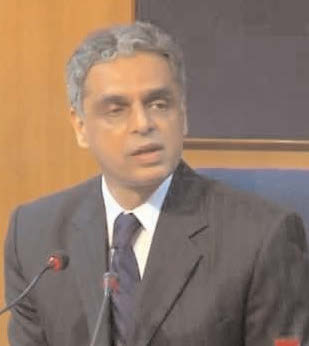
    NEWYORK (TIP): Syed Akbaruddin has been named  as the new permanent representative of India to the United Nations in New York. He succeeds Asoke Kumar Mukherjee who will be retiring at the end of December, 2015

    Syed Akbaruddin (left) willl succeed Ambassador Asoke K Mukerji as India's Permanent Representative to the United Nations. Ambassador Mukerji is retiring on 31st December
    Syed Akbaruddin (left) willl succeed Ambassador Asoke K Mukerji as India’s Permanent Representative to the United Nations. Ambassador Mukerji is retiring on 31st December

    The current reshuffle in the Ministry of External Affairs has facilitated the biggest career jump for Syed Akbaruddin, who stands promoted from the rank of Additional Secretary to a Secretary-level post.

    Asoke K Mukerji
    Asoke K Mukerji

    Mr. Akbaruddin, former MEA spokesperson, was the chief coordinator of the India-Africa Forum Summit (IAFS) held in New Delhi in October 2015. Prime Minister Narendra Modi had handpicked Mr. Akbaruddin to be the chief coordinator of the IAFS, a mega event that was attended by all the 54 countries of Africa.

    Mr. Syed Akbaruddin is the son of late Prof. S Bashiruddin, former Head of the Dept of Journalism and Communication, OsmaniaUniversity, Hyderabad. Bashiruddin also served as India’s Ambassador to Qatar.

    An alumnus of HyderabadPublic School, Akbaruddin is a 1985 batch civil servant and considered an “expert” on the West Asia issues.

  • Congress leaders fete INOC USA Chair

    Congress leaders fete INOC USA Chair

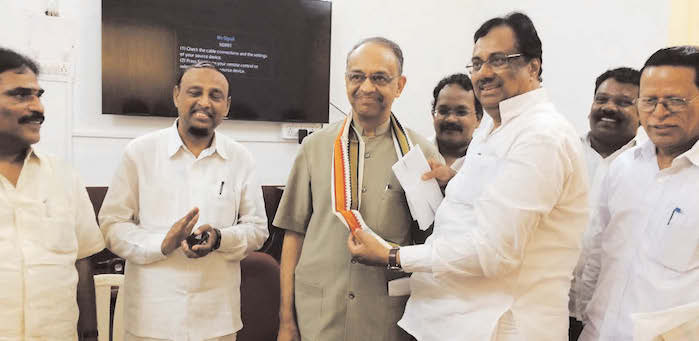
    CHENNAI (TIP): Senior Congress leaders of Tamil Nadu including Pradesh Congress Committee President and former Union Minister EVKS Elangovan felicitated George Abraham, chairman of Indian National Overseas Congress (INOC) in New York at a function held in Satyamurti Bhavan, the headquarters of the party, in Chennai recently.

    Elangovan placed a shawl on Abraham as mark of respect before the invited Congress leaders and workers and praised the efforts of Abraham in propagating the ideals of the grand old party in the US.

    Elangovan said the INOC not only invites Congress leaders visiting the US to attend events in New York but also actively involves itself in various national and state elections in India. He complimented the team headed by Abraham for their active involvement.

    Others who attended include Youth Congress leader Vazhapadi Rama Suganthan, State Congress spokespersons -Tiruchi Veluswamy, Ms. Jothimani, America Narayanan and SM Hidayathulah and Chairman of State SC and ST Wing Selva Perunthagai.

    Rama Suganthan recalled the receptions and hospitality arranged by the INOC to visiting senior Congress leaders such as Kumari Anandan, S Thirunavukkarasu and Mani Shankar Aiyar.

    Earlier, Abraham addressed a special meeting of the party’s social media team headed by EVKS Ram Elangovan and KT Lakshmikanth and shared some inputs on the role of social media in the American elections.

    He advised the members especially youth who are handling the wing to take social media campaign seriously as it could decide the fate of future elections in India with exponential growth of internet connections and use of Facebook and Whats App even in rural areas of India.