Month: May 2017

  • HERE’S THE RIGHT WAY TO SHAVE, LADIES

    HERE’S THE RIGHT WAY TO SHAVE, LADIES

    HERE’S THE RIGHT WAY TO SHAVE, LADIES

    GET THE RIGHT RAZOR: Make sure you find the right razor that works for you. A five-bladed one, a disposable one or a refillable one—it’s your choice depending on what gives you the best shave.

    WET SHAVE: Never shave without wetting your skin; this can lead to very dry skin. The best place to shave is in the shower. Let warm water run over your body. Apply shaving cream or conditioner on your arms and legs before you start shaving.

    DIFFERENT STROKES: For the legs, it’s most advisable to shave ankles upwards. For arms too, shave against the direction of hair growth. For underarms, you can shave from all angles until you are satisfied with the result. For the bikini area, shave in the direction of the hair growth first and then against for best results.

    POST-SHAVE CARE: After a shave, your skin will feel sensitive, so wash off the shaving cream with tepid water as hot water can sting. Moisturise with a cooling lotion that has skin-healing ingredients like aloe vera.

    RAZOR CARE: It’s not only your skin that needs aftershave care. Your razor does too. Keep rinsing the razor while shaving to remove the hair from the blades. After you are done, wash the razor well to remove all the hair between blades and shake dry. Rinse in antiseptic solution and dry well. Keep in a clean place.

  • BENEFITS OF HYDRAULIC ACID

    BENEFITS OF HYDRAULIC ACID

    BENEFITS OF HYDRAULIC ACID

    Hydraulic acid (HA) is making headlines as the magic ingredient in over-the-counter beauty products worldwide. And for good reason too! It is naturally found in the body (about 15g), and lends itself to moisturising the skin and staying youthful. However, as one ages, it doesn’t help to have that boost of HA from an external source and apply it topically.

    Using it regularly on your skin helps enhance tissue function. As the skin ages, and loses moisture and elasticity, HA helps hold in water and aids skin health and longevity. The skin is smoother and more supple. Microscopic studies across the world have shown a delay in the onset of wrinkles. Applying HA ensures that the moisture is locked in, and the layer of serum or cream on your skin means that harmful UVA and UVB rays of the sun don’t damage your skin.

    Worried that you might be getting too much moisture? HA is considered a ‘smart’ ingredient. It adjusts itself according to each body and skin type’s need, the weather conditions, humidity and so on. Taken only on the advice and prescription of your dermatologist, and as an oral supplement, HA can enhance collagen production, keeping the skin cell structure intact for longer. Collagen is one of the most effective proteins that makes the skin firmer and more supple, and HA boosts the synthesis of this protein. Certain HA creams are not meant for the face. Instead they are used on the joints topically to repair damaged tissue, and are particularly useful in cases of osteoarthritis.

    However, you need to watch out for a few things. Make sure that the serum or cream you’re opting for does not contain alcohol, parabens or sulfates, since these ingredients will counter all the good being done by HA, and could backfire. Consult your skin specialist before you make any choices.

  • IT’S WISE TO MOVE IN WITH YOUR BOYFRIEND

    IT’S WISE TO MOVE IN WITH YOUR BOYFRIEND

    IT’S WISE TO MOVE IN WITH YOUR BOYFRIEND

    The concept of living together or cohabitation tends to send conservatives and marriage evangelists into a self-righteous froth. However, leaving moral issues aside, there are some practical benefits of cohabiting with your lover boy. Here’s what you stand to gain if you shack up with him.

    An abundance of happiness

    According to recent research by Kelly Musick of Cornell’s College of Human Ecology and sociologist Larry Bumpass of the University of Wisconsin-Madison, published in Journal of Marriage and Family, couples who live together “experienced greater gains in happiness and self-esteem.”

    More personal growth

    Anyone who has been married knows that the “holy” institution takes a huge toll on your personal freedoms. Your life is not your own anymore and there are tonnes of familial and social obligations that come with it. However, study coauthor Musick says that, “For some, cohabitation may come with fewer unwanted obligations than marriage and allow for more flexibility, autonomy and personal growth.”

    No nasty surprises

    If you are looking at living together as a stepping stone to marriage, there is no better way to get to know your partner intimately, warts and all. From spending habits, to personal hygiene issues, to sexual appetites, you would have experienced it all, so there would be fewer nasty surprises if and when you do actually step into matrimony.

    It’s practical

    As a lot of younger people are finding out today, living today is simply a practical alternative to spending double on separate establishments. For young women who stay in expensive urban centres like Mumbai, shacking together means shared living costs, benefiting from the added security of a live-in partner and of course, all that extra time and opportunity to get busy in the bedroom!

    Learning to face reality

    While it is not quite marriage, living together does give you a sneak preview of what it would be like if you do decide to get hitched. For instance, a long-term relationship is not all fun and games. Living together means that you have to share household chores; deal with each other’s black moods; get used to the mundaneness of everyday living; take care of each other; and learn what commitment is all about.

    Source: Femina.in


  • 34 dead, 2,000 sick with suspected cholera in Yemen: WHO

    34 dead, 2,000 sick with suspected cholera in Yemen: WHO

    34 dead, 2,000 sick with suspected cholera in Yemen: WHO

    SANAA (TIP): Thirty-four people have died of cholerarelated causes and more than 2,000 have been taken ill in less than two weeks in Yemen, the World Health Organization said on Tuesday. “There have been 34 cholera-associated deaths and 2,022 cases of acute watery diarrhoea in nine governorates, including Sanaa, during the period of April 27 to May 7,” a WHO official told AFP.

    This is the second wave of cholera-associated deaths in a year in Yemen, where a deadly war has destroyed hospitals and left millions of people struggling to access food and clean water.

    The WHO now classifies Yemen as one of the worst humanitarian emergencies in the world alongside Syria, South Sudan, Nigeria and Iraq.

    Conflict in Yemen has escalated over the past two years, as the Saudi-supported government fights Iran-backed Huthi rebels for control of the impoverished country. The United Nations, which has called Yemen “the largest humanitarian crisis in the world”, estimates that more than 7,000 people have been killed since 2015 and three million displaced. (PTI)

  • EIGHT KILLED AFTER MAGNITUDE 5.5 EARTHQUAKE HIT CHINA’S NORTHWEST

    EIGHT KILLED AFTER MAGNITUDE 5.5 EARTHQUAKE HIT CHINA’S NORTHWEST

    EIGHT KILLED AFTER MAGNITUDE 5.5 EARTHQUAKE HIT CHINA’S NORTHWEST

    XINJIANG (TIP): Eight people were killed when an earthquake with a magnitude of 5.5 struck in China’s northwest Xinjiang region on May 10, the official Xinhua news agency said, with photographs online also showing damaged buildings.

    The China Earthquake Administration (CEA) said the quake occurred in the remote Taxkorgan County area of Kashgar Prefecture at a depth of 8 km (5 miles). Xinhua said in a microblog post 11 people were also injured.

    Xinjiang is frequently jolted by earthquakes, most of which cause little damage. Xinhua also reported that some building walls had been cracked or had collapsed and that casualty figures were still being compiled. (Reuters)

  • HACKERS CAME, BUT THE FRENCH WERE PREPARED

    HACKERS CAME, BUT THE FRENCH WERE PREPARED

    HACKERS CAME, BUT THE FRENCH      WERE PREPARED

    PARIS (TIP): Everyone saw the hackers coming. The National Security Agency in Washington picked up the signs. So did Emmanuel Macron’s bare-bones technology team. And mindful of what happened in the American presidential campaign, the team created dozens of false email accounts, complete with phony documents, to confuse the attackers.

    The staff at Macron’s makeshift headquarters in the 15th Arrondissement at the edge of Paris didn’t need the NSA to tell them they were being targeted: In December, after the former investment banker and finance minister had emerged as easily the most anti-Russian, pro-Nato and pro- European Union candidate in the presidential race, they began receiving phishing emails.

    The phishing mails were “high quality”, said Macron’s digital director, Mounir Mahjoubi: They included the actual names of members of the campaign staff, and at first glance appeared to come from them.

    Even before then, the Macron campaign had begun looking for ways to make life a little harder for the Russians “We went on a counteroffensive,” said Mahjoubi. “We couldn’t guarantee 100% protection” from the attacks, “so we asked: what can we do?” Mahjoubi opted for a classic “cyber blurring” strategy creating false email accounts and filled them with phony documents the way a bank teller keeps fake bills in the cash drawer in case of a robbery. “We created false accounts, with false content, as traps. We did this massively, to create the obligation for them to verify, to determine whether it was a real account,” Mahjoubi said. “I don’t think we prevented them. We just slowed them down,” he said. “Even if it made them lose one minute, we’re happy,” he said.

    The Russians did a poor job of covering their tracks. The metadata tied to a handful of documents —code that shows the origins of a document — show some passed through Russian computers and were edited by Russian users. Some Excel documents were modified using software unique to Russian versions of Microsoft Windows. (NYT Services)

  • Monitor says air strikes kill 11 people north of Syria’s Raqqa

    Monitor says air strikes kill 11 people north of Syria’s Raqqa

    Monitor says air strikes kill 11 people north of Syria’s Raqqa

    BEIRUT (TIP): Air strikes killed at least 11 people, including four children, in a village north of the Syrian city of Raqqa overnight, a war monitoring group said on Wednesday. The Syrian Observatory for Human Rights said warplanes, thought to belong to the U.S.-led coalition against Islamic State, hit al-Salihiya village before midnight and also injured several civilians.

    A spokesperson for the US-led coalition could not immediately be reached for comment. The US military has said it makes “extraordinary efforts” to avoid civilian deaths in its bombing runs in Syria and neighboring Iraq. The coalition has been supporting Syrian militias with air strikes and special forces in a campaign to isolate and capture Raqqa city, Islamic State’s base of operations in Syria.

    The Syrian Democratic Forces, a US-backed alliance of Kurdish and Arab fighters, have seized territory from the jihadist group and advanced on Raqqa from the north, east and west. The Observatory said air strikes, also believed to be by coalition planes, killed 10 people who were driving through desert areas that link Islamic State-held parts of Raqqa province and the nearby Hama countryside earlier this week.

  • China’s Silk Road forum latest effort to boost Xi Jinping’s stature

    China’s Silk Road forum latest effort to boost Xi Jinping’s stature

    China’s Silk Road forum latest effort to boost Xi Jinping’s stature

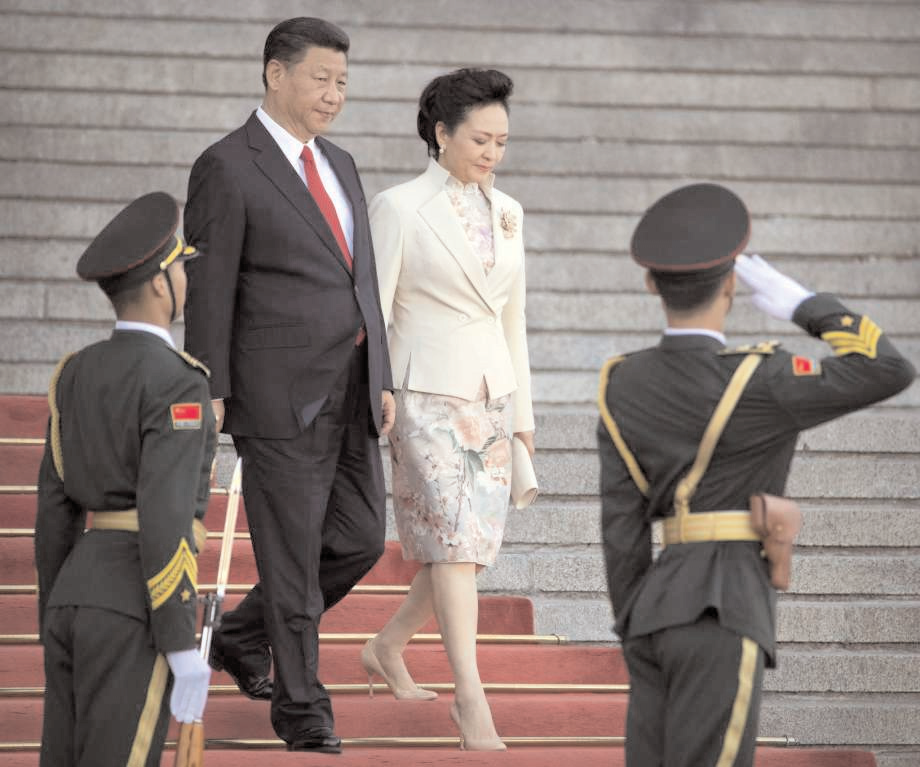
    BEIJING (TIP): China will seek to burnish President Xi Jinping’s stature as a world-class statesman at an international gathering centered on his signature foreign policy effort envisioning a future world order in which all roads lead to Beijing.

    The “Belt and Road Forum” opening on Sunday is the latest in a series of high-profile appearances aimed at projecting Xi’s influence on the global stage ahead of a key congress of the ruling Communist Party later this year. All feed a fundamental yearning among ordinary Chinese: to see their country’s prestige and status rise.

    “Xi is now seen as a world leader with a lot of influence and respect internationally and that will definitely boost his domestic appeal,” said Joseph Cheng, a long-time observer of Chinese politics now retired from the City University of Hong Kong.

    Leaders from 28 countries are set to attend, including Presidents Vladimir Putin of Russia and Rodrigo Duterte of the Philippines. The most prominent attendee from the West will be Prime Minister Paolo Gentiloni of Italy.

    Other Western nations, including the United States, will be represented by officials of significantly lower standing. Washington is sending a delegation led by Eric Branstad, senior White House adviser in the Department of Commerce. Britain, Germany and France are to be represented by finance officials.

    That’s partly because of developments at home, but also is a reflection of concerns that China may be exporting its standards on human rights, the environment and government transparency, while leaving poor countries with unsustainable levels of debt.

    Yet the forum is as much about promoting Xi’s image at home as it is about pushing his vision abroad.

    Chinese state media outlets have linked Xi inextricably to the two-day gathering in Beijing, which will be centered around their president’s plan for a vast network of ports, railways and roads expanding China’s trade with Asia, Africa and Europe. Xi has even popped up in a series of English language promotional videos produced by the official China Daily called “Belt and Road Bedtime Stories.”

    “He’s showing vision. Leaders have to be visionary. He’s showing hope in their economic future by proposing a very significant economic plan,” former U.S. ambassador to China Max Baucus told The Associated Press. “I think it’s going to help him very much ahead of the next party congress.”

    The party will hold its twice-a-decade congress this fall at which Xi will oversee an infusion of fresh blood in leading bodies, most importantly the all powerful Politburo Standing Committee. Xi rose to the top of an intensely competitive system riven by factions and rivalries to take the reins of the party in 2012, and has steadily accrued powers well beyond those of his predecessors in areas such as defense, internal security and the economy.

    He’s also fallen back on the hallowed tradition of political campaigns and sloganeering, preaching the “Chinese Dream” of prosperity and national rejuvenation, pushing a sweeping anticorruption campaign and cracking down on the infiltration of “Western” democratic values that could threaten party control.

    In the international sphere, he’s presided over both the Asia-Pacific Economic Cooperation forum and the G- 20 meeting of industrialized states, both of which were attended by former President Barack Obama. In January, Xi sought to portray himself as a champion of globalization and free trade at the World Economic Forum in Davos, in contrast to President Donald Trump’s protectionist rhetoric. On an entirely different level though is his signature initiative formally known as “One Belt, One Road.”

    It aims to reassert China’s past prominence as the dominant power in Asia whose culture and economy deeply influenced its neighbors as far as Africa and Europe. It speaks deeply to Chinese pride in their country’s explosive economic growth and political clout after a century of humiliation at the hands of foreign powers that formally ended with Mao Zedong’s communist revolution in 1949.

    The initiative also furthers the Xi administration’s reputation for muscular foreign policy. Under Xi, China has strongly asserted its claim to virtually the entire strategic South China Sea and established the Asian Infrastructure Development Bank as a global institution alongside such bodies as the World Bank, Asian Development Bank and International Monetary Fund.

    And unlike APEC and Davos, it involves the disbursal of potentially trillions of dollars in contracts, expanding both China’s economic reach and Xi’s personal authority as holder of the purse strings. The Asian Development Bank says the region, home to 60 percent of the world’s people, needs more than $26 trillion of infrastructure investment by 2030 to keep economies growing. (AP)


  • Tensions rise between Saudi rulers and clerics over cultural reforms

    Tensions rise between Saudi rulers and clerics over cultural reforms

    Tensions rise between Saudi rulers and clerics over cultural reforms

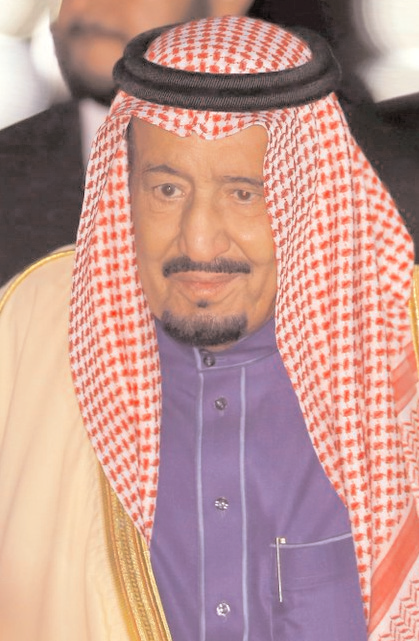
    JEDDAH (TIP): When senior Saudi cleric Abdulaziz al-Tarifi told his almost one million Twitter followers that musical instruments were ungodly, it helped spark a hashtag among likeminded Saudis that “the people reject music academies”.

    The hashtag, echoing the language of Arab Spring revolts elsewhere, captured the hostility to reforms that introduced entertainment events from rock concerts and comedy shows to kickboxing into the conservative kingdom.

    But Nora Shanar, a writer at Saudi newspaper Elaph, spoke for swathes of people when she shot back to defend a shake-up of the Saudi cultural scene: “Don’t speak in the name of the people.” “Speak in the name of those who don’t love life and forbid music when God himself did not.”

    Such exchanges highlight strains between the ruling family’s alliance with conservative clerics which have been exposed as a reformist and powerful prince works to diversify the economy away from oil and permit new freedoms among Saudis steeped in cleric-imposed puritanism.

    The entertainment events aimed at creating more jobs were allowed by Deputy Crown Prince Mohammed bin Salman, head of the royal court, defence minister and son of King Salman, as a matter of economic survival as well as entertainment for Saudi citizens, dependent for decades on welfare state benefits. The changes are also intended to capture up to a quarter of the $20 billion currently spent overseas by Saudis, who are accustomed to travelling abroad to see shows and visit amusement parks in nearby tourist hub Dubai or further afield.

    But the price for the Al Saud and for a powerful business class that supports modernisation and a greater role for women has been tensions with traditionalist clerics upon whose support the ruling family relies for its legitimacy.

    The Wahhabi religious establishment has had a symbiotic relationship with the Al Saud dynasty since the mid 18th century, offering its rule Islamic legitimacy in return for influence over important chunks of the state such as education and the judiciary, and a network of mosques and universities.

    The clergy suspect bold initiatives conceived by the prince in leisure and tourism presage sweeping reforms in education, a bastion of conservativism where clerical control is believed by Western nations to have encouraged Islamist radicals – not just in Saudi Arabia but across the Muslim and Arab worlds. As a result, resistance to reforms like women’s employment and the encouragement of teaching on technical subjects persists in many corners of Saudi Arabia, the birthplace of Islam, propelled by clerics with vast social media followings.

    REFORMS AIM TO BOOST ECONOMY:  Bernard Haykel, professor of Near Eastern Studies at Princeton, expected the “overwhelmingly powerful” Saudi state could drive its social and economic reforms through despite conservative unease, using the argument they were vital for economic survival.

    “The interesting thing about this moment is that you see, in effect, social liberalisation but not for ideological reasons but for purely economic, fiscal and budgetary reasons,” he said.

    Haykel suggested there was a risk that any future popular economic discontent might be manipulated or mobilised by disaffected religious conservatives or opponents of MbS, as the 31-year-old deputy crown prince, is known. (AP)

  • British PM May vows energy price cap if re-elected

    British PM May vows energy price cap if re-elected

    British PM May vows energy price cap if           re-elected

    LONDON (TIP): British Prime Minister Theresa May vowed on May 9 to introduce a cap on domestic energy prices that would cut tariffs for around 17 million families if she is re-elected on June 8.

    Energy bills have doubled in Britain over the past decade to about 1,200 pounds ($1,553.40) a year, angering consumers who face rising inflation and muted wage growth, and drawing the ire of politicians ahead of the national election.

    According to the Sun newspaper, May will order the energy regulator Ofgem to cap the maximum costs of standard variable tariffs, the package used by two thirds of customers in Britain.

    May, whose ruling Conservative Party is around 20 points ahead of the opposition Labour Party in opinion polls, said she expected the move to save families on poor value tariffs as much as 100 pounds a year.

    “It will protect around 17 million families on standard variable tariffs from being exploited with sudden and unjustified increases in bills,” May wrote in the Sun.

    Share prices in Centrica, which owns household energy supplier British Gas, and SSE, have fallen this year since the ruling Conservative Party indicated its intention to set a price cap. Centrica shares are down 14 percent.

    Centrica Chief Executive Iain Conn said last month that May’s plan to cap energy prices suggests some in her government do not believe in free markets at a time when it is pinning its post-Brexit hopes on free trade.

    May last year praised free markets and free trade in a speech to party activists but also said that she would be prepared to intervene where markets were dysfunctional or where companies were exploiting the failures of the market.

    May’s government has previously called for more competition in a sector dominated by the big six providers of Centrica, SSE, Scottish Power, Npower, E.ON and EDF.

    The energy industry has argued that a price cap will wipe out competition and force companies to increase the cost of their lowest tariffs.

    The policy echoes a pledge made by the opposition Labour party ahead of the 2015 election. Their plans for a cap on price hikes were lambasted at the time by the Conservatives who accused the then Labour leader Ed Miliband of wanting to live in a “Marxist universe”. (Reuters)

  • KREMLIN SAYS ‘TOO EARLY’ TO SPEAK OF THAW IN RUSSIA-US TIES

    KREMLIN SAYS ‘TOO EARLY’ TO SPEAK OF THAW IN RUSSIA-US TIES

    KREMLIN SAYS ‘TOO EARLY’ TO SPEAK OF THAW IN RUSSIA-US TIES

    MOSCOW (TIP): The Kremlin said on Thursday it was too early to speak of a thaw in ties with Washington, a day after Russian Foreign Minister Sergei Lavrov met US President Donald Trump.

    “It’s too early to draw this conclusion,” Kremlin spokesman Dmitry Peskov told reporters. But he added: “Of course the fact that a dialogue is taking place is very positive.”

    Peskov said both Trump and Russian President Vladimir Putin are expected to be at the G20 summit in Germany in July, which “could serve as a good occasion” for them to meet. Wednesday’s meeting came as Trump was embroiled in a political firestorm over the investigations into allegations his US presidential election campaign had colluded with Russia. Lavrov met both Trump and US counterpart Rex Tillerson in Washington, saying the US president was seeking “mutually beneficial” and “pragmatic” relations with Moscow.

    “The goal of both president Trump and president Putin is to have concrete results which will be tangible and which will allow (us) to alleviate problems, including on the international agenda,” he told reporters.

    Tillerson also travelled to Moscow last month for talks with Lavrov. Tillerson, who also had a closed-door meeting with Putin during his visit, deplored the “low level of trust” between the two powers, whose relations have sunk to a post-Cold War low over the conflicts in Ukraine and Syria.

    “The world’s two foremost nuclear powers cannot have this kind of relationship,” the US secretary of state said. In a shock move on Tuesday, Trump sacked FBI chief James Comey, the man overseeing federal investigations into suspected Kremlin interference in the 2016 US vote. (AFP)

  • THREE OF BRITAIN’S FOUR WEALTHIEST ARE INDIANS

    THREE OF BRITAIN’S FOUR WEALTHIEST ARE INDIANS

    THREE OF BRITAIN’S FOUR WEALTHIEST ARE INDIANS

    LONDON (TIP): The wealthiest persons in Britain are India-born, according to the Sunday Times Rich List 2017 which places the Hinduja brothers Srichand and Gopichand+ at the top of 134 billionaires. The brothers’ estimated riches: 16.2 billion pounds, 3.2 billion pounds more than last year.

    Overall, the United Kingdom has witnessed, contrary to all expectations, what can only be described as a Brexit boom. Its billionaires are richer than before, so much so that the combined wealth of the top 500 individuals and families is more than the total put up by last year’s wealthiest 1,000, the Sunday Times reported. And there are more of them; together, they have earned a staggering 658 billion pounds, a record. The list compiler credited their growing fortunes to a revival in the stock market.

    David and Simon Reuben, of Iraqi Jewish origin but Mumbai-born, have slipped from first to third place this year+ with an estimated wealth of 14 billion pounds. Steel magnate Lakshmi N Mittal is fourth with 13.2 billion pounds; the increase in his wealth from last year is quite phenomenal at 6.1 billion pounds.

    There isn’t a single Briton in the wealthiest top 4 in a land the economist Adam Smith wrote of as a “nation of shopkeepers”; second place this year belongs to the Ukrainian businessman Len Blavatnik. However, the current Duke of Westminster, Hugh Grosevenor, does make it to the list (ranked 9) with assets worth £9.52 billion. The compiler has placed a total of 40 Indian origin people in the rankings, including the Gujarati brothers Mohsin and Zuber Issa of Euro Garages whose one billion pounds puts them at 133rd position. Also among the new billionaires are the brothers Raj, Tony and Harpal Matharu of the Grange hotel chain with one billion pounds.

    Lord Swraj Paul+ , an NRI, finds himself at No.194, his wealth eroded by 80 million pounds since last year. The 2017 list estimates his fortune at 660 million pounds.

    (Reuters)

  • NEW SMARTWATCH CAN MOVE IN FIVE DIRECTIONS

    NEW SMARTWATCH CAN MOVE IN FIVE DIRECTIONS

    NEW SMARTWATCH CAN MOVE IN FIVE DIRECTIONS

    WASHINGTON (TIP): Scientists have developed a new smartwatch with a display that moves in five different directions — dramatically improving functionality and addressing limitations of today’s fixed-face watches.

    The watch, named Cito, has the ability to rotate, hinge, translate, rise and orbit. Beyond making the watches more convenient for users, the technology can provide important benefits to wearers with physical disabilities or other impairments, researchers said.

    “Users want smartwatches that fit their lifestyles and needs,” said Xing- Dong Yang, assistant professor at Dartmouth College in the US.

    “The Cito prototype is an exciting innovation that could give consumers even more great reasons to wear smartwatches,” said Yang.

    Most smartwatch research primarily addresses how users can more easily input information.

    Cito aims to remove awkward moments associated with using smartwatches by improving how the device presents data to the wearer.

    Examples of watch movement include automatically orbiting around the wristband to allow viewing when the wrist is facing away from the user; rising to alert the wearer of a notification if the user is playing a game; hinging to allow a companion to view the watch face; and translating to reveal the watch face from underneath a shirt sleeve.

    “Consumers will question the need for smartwatches if the devices are just not convenient enough. Cito proves the true potential of smartwatches and shows that they can be functional and fun,” said Yang. The five watch face movements can be performed independently or combined.

    “We recognise that our work investigates a radical idea, but our hope is that we also show how a methodical and principled approach can explore any such radical visions,” researchers said.

    In developing the prototype, researchers conducted two separate studies to confirm the usefulness, social acceptability and perceived comfort of different watch movements and usage contexts.

    Source: PTI


  • MASSIVE LAVA WAVES SPOTTED ON JUPITER’S MOON IO

    MASSIVE LAVA WAVES SPOTTED ON JUPITER’S MOON IO

    MASSIVE LAVA WAVES SPOTTED ON JUPITER’S MOON IO

    LOS ANGELES (TIP): Scientists have detected two massive waves sweeping across the largest lava lake on Jupiter’s moon Io — the most volcanically active body in our solar system.

    Taking advantage of a rare orbitalalignment between two of Jupiter’s moons, Io and Europa, researchers at University of California (UC) Berkeley have obtained an exceptionally detailed map of the largest lava lake on Io.

    On March 8 in 2015, Europa passed in front of Io, gradually blocking out light from the volcanic moon.

    Since Europa’s surface is coated in water ice, it reflects very little sunlight at infrared wavelengths, allowing researchers to accurately isolate the heat emanating from volcanoes on Io’s surface.

    The infrared data showed that the surface temperature of Io’s massive molten lake steadily increased from one end to the other, suggesting that the lava had overturned in two waves that each swept from west to east at about a kilometre per day.

    Overturning lava is a popular explanation for the periodic brightening and dimming of the hot spot, called Loki Patera after the Norse god.

    The most active volcanic site on Io, Loki Patera is about 200 km across. The hot region of the patera has a surface area of 21,500 square kilometres.

    “If Loki Patera is a sea of lava, it encompasses an area more than a million times that of a typical lava lake on Earth,” said Katherine de Kleer, a graduate student at UC Berkeley.

    “In this scenario, portions of cool crust sink, exposing the incandescent magma underneath and causing a brightening in the infrared,” said de Kleer.

    “This is the first useful map of the entire patera. It shows not one but two resurfacing waves sweeping around the patera. This is much more complex than what was previously thought,” said Ashley Davies, of the NASA’s Jet Propulsion Laboratory in the US.

    “This is a step forward in trying to understand volcanism on Io, which we have been observing for more than 15 years, and in particular the volcanic activity at Loki Patera,” said Imke de Pater, a UC Berkeley professor of astronomy.

    The images were obtained by the twin 8.4-metre mirrors of the Large Binocular Telescope Observatory in the mountains Arizona, linked together as an interferometer using advanced adaptive optics to remove atmospheric blurring.

    Source: PTI


  • Hubble captures massive galaxy cluster in stunning detail

    Hubble captures massive galaxy cluster in stunning detail

    Hubble captures massive galaxy cluster in stunning detail

    WASHINGTON (TIP): The Hubble Telescope has beamed back a stunning image of a massive galaxy cluster located six billion light years away, which shows extremely faint features that have never been seen before.

    Abell 370, located in the constellation Cetus (the Sea Monster), is made up of hundreds of galaxies. In the mid-1980s high-resolution images of the cluster showed that the giant luminous arc in the lower left of the image was not a curious structure within the cluster, but rather an astrophysical phenomenon — the gravitationally lensed image of a galaxy twice as far away as the cluster itself. The Hubble telescope, jointly operated by NASA and European Space Agency (ESA), helped show that this arc is composed of two distorted images of an ordinary spiral galaxy that just happens to lie behind the cluster.

    Abell 370’s enormous gravitational influence warps the shape of spacetime around it, causing the light of background galaxies to spread out along multiple paths and appear both distorted and magnified. The effect can be seen as a series of streaks and arcs curving around the centre of the image.

    Massive galaxy clusters can therefore act like natural telescopes, giving astronomers a close-up view of the very distant galaxies behind the cluster – a glimpse of the universe in its infancy, only a few hundred million years after the Big Bang. The new image of Abell 370 was captured as part of the Frontier Fields programme, which used a whopping 630 hours of Hubble observing time, over 560 orbits of the Earth.

  • ROBOT PERFORMS DELICATE EYE SURGERY ON SIX PATIENTS

    ROBOT PERFORMS DELICATE EYE SURGERY ON SIX PATIENTS

    ROBOT PERFORMS DELICATE EYE SURGERY ON SIX PATIENTS

    LONDON (TIP): A robot has been used to successfully perform a delicate eye surgery on six patients in a world- first trial which shows that robotic procedures can be more accurate than the trained human hand.

    In the trial, researchers from the University of Oxford in the UK performed the membrane-removal surgery on 12 patients. Six of those patients underwent the traditional procedure, and six underwent the new robotic technique. Researchers found that those patients in the robot group experienced significantly fewer hemorrhages and less damage to the retina.

    The robot acts like a mechanical hand with seven independent motors that can make movements as precise as one micron, researchers said.

    It operates inside the eye through a single hole less than one milli metre in diameter and goes in and out of the eye through this same hole during various steps of the procedure.

    However, the surgeon is in control, using a joystick and touch screen to manoeuvre the robot hand while monitoring movements through the operating microscope.

     “The robotic technology is very exciting, and the ability to operate under the retina safely will represent a huge advance in developing genetic and stem cell treatments for retinal disease,” Robert E MacLaren, professor at the University of Oxford was quoted as saying by ‘Live Science’.

    “We have demonstrated safety in a delicate operation. The system can provide high precision at 10 microns in all three primary directions,which is about 10 times more precise than what a surgeon can do,” said Marc de Smet from University of Eindhoven in the Netherlands, who helped design the robot.

    The team first used the system on a 70-year-old priest from UK, in September last year. Upon the success of that surgery, they conducted a study on 11 more patients in a randomised clinical trial, hoping to measure the robotic system’s accuracy compared to the human hand.

    Source: PTI


  • UTTARAKHAND Nestled in the lap of the Himalayas

    UTTARAKHAND Nestled in the lap of the Himalayas

    UTTARAKHAND

    Nestled in the lap of the Himalayas

    Uttarakhand is one of the most beautiful northern states of India located on the southern slope of the Himalayan range. Mighty Himalayan peaks and glaciers are on its north where it borders Tibet. Nepal is on its east, Indian state of Uttar Pradesh is on south and Himachal Pradesh lies on its west and northwest. 65% of its area is covered by dense forests that are home to Royal Bengal tiger, leopards and many other endangered animal and plant species. The glaciers of two of the most important rivers—Ganga and Yamuna— are located here.

    It has something to offer to every kind of traveller. For wildlife lovers, Jim Corbett National Park—the oldest national park of the Indian subcontinent is a must visit. Many rare Himalayan birds can also be spotted here besides Pangot and Sattal. For adventure seekers there are some of India’s best trekking trails like Valley Of Flowers, Roopkund, and Chopta-Chandrashila. It also provides immense opportunities for adventure sports, such as skiing at Auli and white water rafting at Shivpuri. Popularly known as the ‘Land of Gods’, it is home to numerous holy places like Gangotri, Yamnotri, Kedarnath, Badrinath, Rishkesh and Haridwar. Therefore, thousands of pilgrims throng the state every year. Amazing hill stations like Chakrata, Mukteshwar, Dhanaulti and Munsiyari make Uttarakhand a sought after tourist destination for leisure trips. Here’s a list of destinations in Uttarakhand that every nature lover would love to visit.

    CHAKRATA

    Having breakfast with the view of snow covered Himalayan peaks on a lazy morning while soft rays of winter sun embrace your body and soul while cool breeze kisses you is something city people always crave for. Chakrata located at a distance of 330 km from Delhi, is a tiny hamlet which is a perfect place to do so. There are two routes to drive from Delhi to Chakrata, one is via Panipat and Kurukshetra and the second one is via Loni and Saharanpur, which supposedly is more beautiful and has less traffic.

    Chakrata is a small cantonment town in Dehradun district resting at an elevation of about 7500 ft. The town gets a magnificent view of the snow covered Himalayas and is covered in deodar, Himalayan oak and rhododendron forest. Many day trips to places like Deoban, Koti, Kanasar can be done with Chakrata as base. There are some easy treks also around Chakrata that your hotel guys can arrange for you. There are not many hotels in the area so make sure to book your accommodation inadvance. Chakrata is a year round destination; the winter season is perfect to experience snow, greenery is at its best during the monsoon season and the summer season too is quite pleasant.

    AULI 

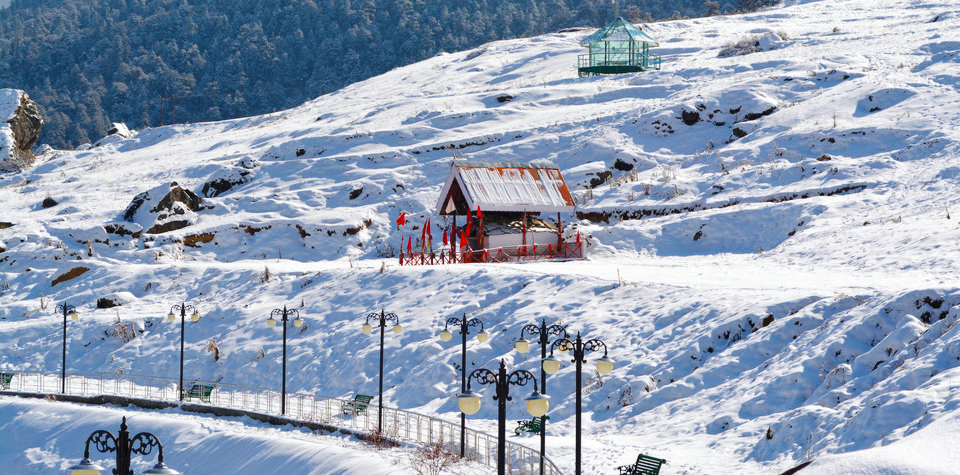
    Auli is one of the most beautiful places of Uttarakhand. Bordered by snow-covered Himalayan peaks, Auli is enveloped in dense golden oak and pine forest with green meadows and slopes ranging from a height of 2519 m to 3049 m. It is considered to be a world-class spot for skiing. GMVN winter resort here provides skiing facility, besides ski training for aspirants. Almost from everywhere in Auli, you can enjoy stunning views of the lofty mountain ranges—Nanda Devi, Mana Paravat and Kamat.

    The golden rays of sun on the snow-laden peaks fill the atmosphere with a divine glow. The 3rd highest peak of the world—Nanda Devi gleams like the crown of the region. There is an open cable-car to go up to the spot where skiing is done. Even if you do not want to ski, you have plenty of things to do. Climb up the slopes, play with snow, ride a sledge and who knows you might feel like trying skiing too. The best time to visit Auli is in between December and March.

    CORBETT

    Spread across an area of 520.8 sq km, Jim Corbett National Park is located in Nainital district of Uttarakhand. It is the oldest national park, and is named after Jim Corbett who was the main person behind this establishment. The park is divided in 5 zones—Bijrani, Jhirna, Durgadevi, Dhikala, Sitavani—and is inhabited by royal Bengal tiger, leopard, jungle cat, barking deer, hog deer, cheetal, sloth bears, otters, Himalayan goral, Indian pangolins, langur and many other wild animals.

    Many rare birds can also be spotted in the region. Gorgeous Corbett National Park is one of the favourite destinations equally for wildlife lovers and weekenders. It is just 235 km away from capital city and can be reached in couple of hours. It features splendid landscapes and offers a good amalgam of hills, rivers, forests, marshlands and grasslands. The park is open from the months of November through June. The park is kept closed in the monsoon season as the roads inside the park get washed away due to rain. After the monsoon season, repair work starts and ends only by November.

    TEHRI DAM

    A beautiful uphill drive through the hills covered in pines and small villages will take you to this dam. It is built on the Bhagirathi River in Uttarakhand and is the tallest dam in India. It is counted amongst 5 highest dams in the world, with 855 ft high rock and earth-fill embankment that makes it an engineering marvel. Its length is 1886 ft, crest width is 66 ft and base width is 3701 ft and generates 2400 MW of power. There is a viewpoint near the Bhagirathipuram bus stop from where you can have a majestic view of the entire dam. During the construction of the Tehri Dam, a huge water body was created. The tourism department has developed this 44 sq km artificial lake, as a tourist spot with arrangements of various water sports like jetski, kayaking, canoeing, boating, diving, snorkelling etc on the lake. You can also visit the botanical garden, located at New Tehri, that features a range of beautiful flowers.

    MUKTESHWAR

    Staying in middle of fruit orchards in tents and eating garden fresh meals while looking at the Himalayan peaks covered in fresh snow are a few of the many beautiful memories I have of Mukteshwar. You can walk through the dense pine forest and enjoy stunning views of the mighty mountains. Situated at an altitude of 7500 ft in the lap of Kumaon hills, Mukteshwar is an ideal nature get away from Delhi. It just takes 7 hrs from Delhi to reach Mukteshwar via Gajraula, Rampur, Haldwani and Bhowali. Summer months (March to July) are the best months to visit Mukteshwar. If you want to experience snow, visit during Jan or Feb when the whole area is covered in snow and looks stunningly beautiful. If you happen to visit this place around the month of June, the harvesting season, you’d find many fruits like peaches, plum and apricot. And if you still did not have your fill, Mukteshwar has many fruit orchards and you might get lucky to get offered the fruits just plucked from the trees by villagers.


  • Laughing Buddha

    Laughing Buddha

    Laughing Buddha

    PARVEEN CHOPRA

    MANAGING EDITOR, THE SOUTH ASIAN TIMES

    Two days before destiny and a brutal accident snatched him from us, I had the good fortune of enjoying Karan Beri’s hospitality at his welcoming home in Bangalore, India. Before that too I had met him many times in New York as his father-in-law, Prof Indrajit S. Saluja is a family friend.

    Professionally, Karan was a tech-savvy businessman who seemed to wield a magic wand to transform his clients’ business online to catapult them to top of line. But my enduring impression of him is two-fold: his encyclopedic knowledge and his (sometimes outrageous) sense of humor.

    Even before meeting him I had started noticing his bylined articles in The Indian Panorama, edited and published by Prof Saluja. Having lived and worked in America before returning to India, he was well versed in US affairs. Starting with the time Donald Trump was considered only an entertaining presidential candidate, Karan was employing his analytical skills in op-eds to expose the billionaire’s unsuitability to be the leader of the free world – calling a spade a spade. Then, realizing that saturation media attention was feeding Trump’s candidacy, Karan stopped writing about him.

    From politics to emerging tech trends to what happens at Proms in US high schools, Karan could marshal facts and figures to astonish you.

    That impressed me, but what endeared Karan to me was his ability to elicit laughs — at any cost. He would insert himself into any conversation or discussion to crack a joke. Anything for a laugh was his philosophy – even sexual innuendo or double entendre was not beyond him. Such jokes amid family and friends would often embarrass his audience.

    His to-and-fro and matching wits with Prof Saluja would make me roll with laughter. Laughter Therapy, I used to call those times spent with the duo who were buddies more than father-in-law and son-in-law. In my eyes, Karan was Laughing Buddha.

    Yet, behind all that wit and humor, Karan was a kind, considerate man ever willing to help you. I remember how at a fundraiser for Dr VK Raju’s Eye Foundation of America, organized by Prof Saluja, Karan promised to help the charity’s digital effort, even setting up and managing their Kickstarter crowdfunding campaign, all pro bono. Good soul and lovely company that Karan was, the Almighty called him early.

    Karan’s moments  in pictures:

    At the Indian American Press Club Gala on March 4, 2017 where Karan’s father-in-law Prof. Indrajit S Saluja was installed as President of
    IAPC. Seen in the picture,
    from L to R: Prof. Indrajit S Saluja; Master Kabir Raj Beri; Jaskiran Beri; Nassau County
    Comptroller George Maragos
    presenting a citation to
    Jaskiarn; Anny; Chitagam
    Saluja, and Karan Beri
    Joining in to honor the
    eminent eye surgeon Dr. VK Raju on December 13, 2016 in New York. Seen in the picture, from L to R: Ms Vandana Sharma, Regional Manager America, Air India;
    Prof. Indrajit S Saluja; Dr. VK Raju; HR Shah; Karan Beri
    Fun time – Having fun at Times Square, New York
    The Happy Family-Karan,
    Jaskiran & Kabir in New
    York
    The doting couple: Jaskiran and Karan
    Karan Beri got married to Jaskiran Saluja on May
    20, 2016. Also seen in the picture (center) is
    Jaskiran’s youngest brother Chitagam Saluja, now
    settled in the US.
    Loving Dad- Karan with son Kabir at Dave &
    Buster’s in New York
  • Flower that withered

    Flower that withered

    Flower that withered

    DR VK RAJU

    FOUNDER, EYE FOUNDATION OF AMERICA

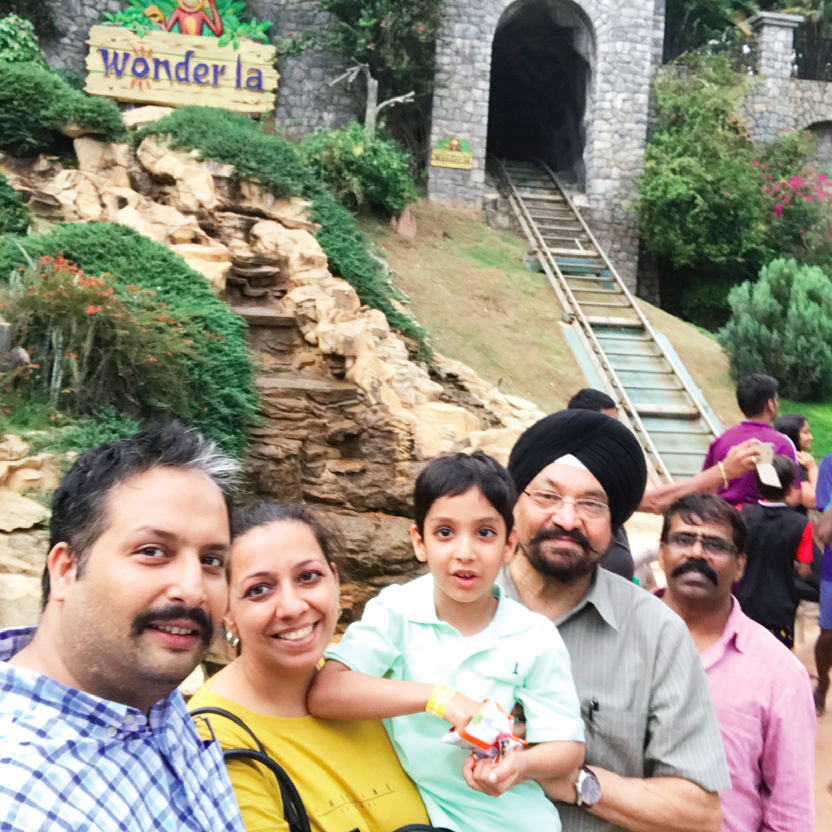
    The last outing of Karan’s life. At Wonderla, the best
    amusement park of Bengaluru on April 29, 2017, a week before he was snatched away from the family and the world. Seen in the picture, from L to R: Karan Beri, wife Jaskiran Beri, son Kabir Raj Beri, father in law Prof. Indrajit S Saluja, and office help Umapathi


    Karan was interested in helping our Eye Foundation of America from the first time we met. He embodied “service above self’ (Rotary International motto). In his death, we lost a worthy companion. A blossoming flower that withered away. God bless his soul. Ten trees were planted in US National Park in Karan’s name.


  • Love of India took him back

    Love of India took him back

    Love of India took him back

    GEORGE ABRAHAM
    CHAIRMAN, INDIAN NATIONAL OVERSEAS CONGRESS

    When I learned of the passing away of Karan Beri in a brief message from Prof. Saluja, it was simply shock and disbelief ! I was told a few months ago that Karan was returning from New York to India where he felt more at home and may even have enjoyed a better quality of life. However, I wondered whether he might have felt it as a duty to go back and contribute to the development of the nation using new tools of technology.

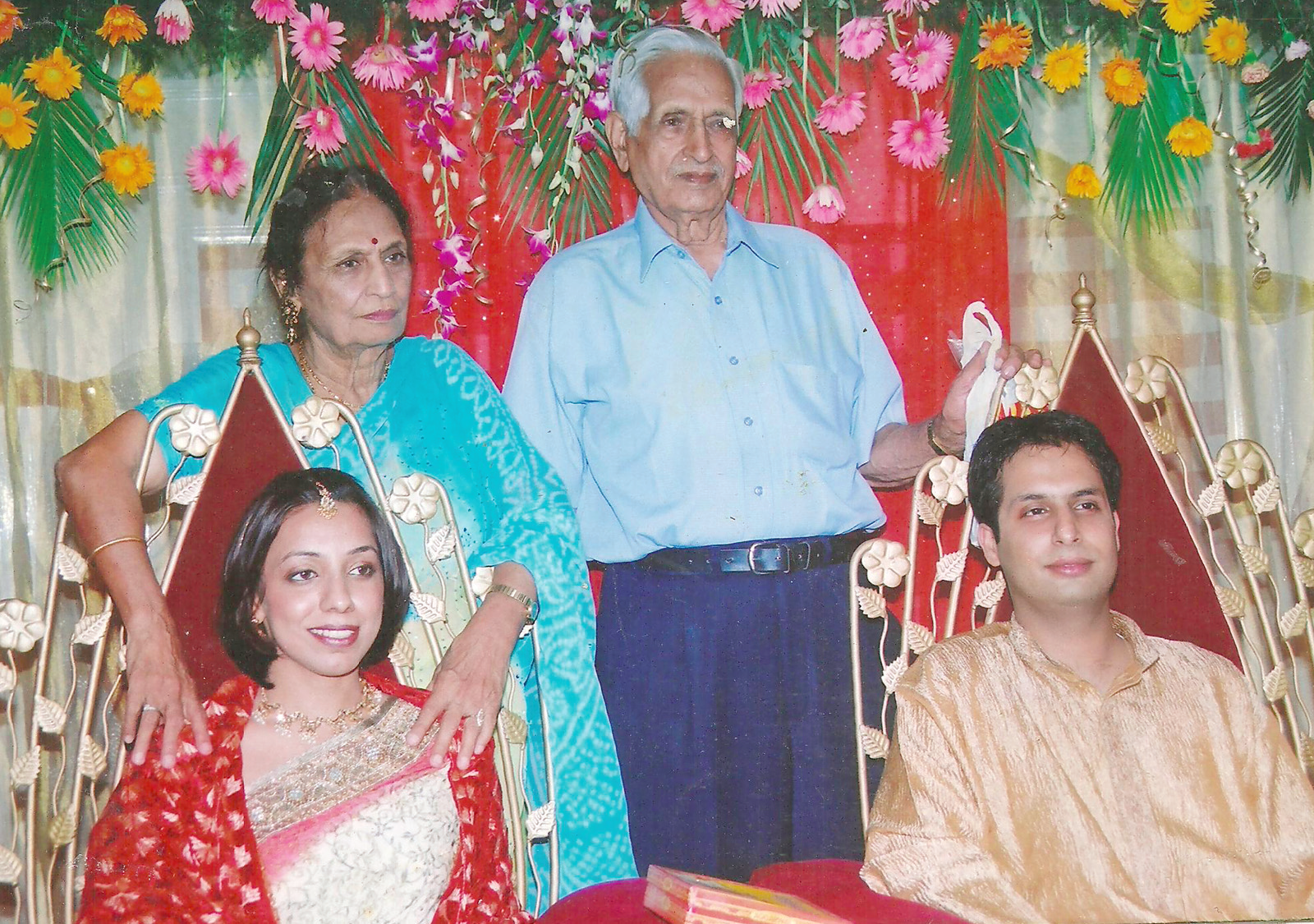
    Karan Beri got engaged to Jaskiran Saluja on 18th May, 2006. Blessing the two on the occasion are Karan’s maternal grandmother Swatantar Chaddha (left) and
    maternal grandfather Raj Inder Chadha

    His love for India and its culture was quite evident in all his conversations while expressing deep concern for the welfare of the community and people around him. However, he has never hesitated from questioning the unethical or immoral actions of a few who might tarnish the image of the nation or its standing in the world.

    The brief period I have come to know him, he has impressed me as a man of ideas, action and great intellect. Although he was immersed in running a business, he was so proficient in all aspects of life especially in contemporary politics where he minced no words in calling a spade a spade. He radiated a self-confidence that has become the hallmark of his generation.

    Above all, he was down to earth when it came to respecting the elders and taking care of the family and friends. He was a man who deeply cared for his family, his beloved wife and his only son. His love and respect for Salujaji was on full display whenever we all came together.

    Karan’s unexpected and untimely departure has indeed created a void everywhere, especially to many of us who have come to know him to love and respect. May God bless his soul!

  • A tech whiz no more

    A tech whiz no more

    A tech whiz no more

    Karan (Kay) Beri, President, RIC Technology & Services Pvt;
    Ltd. Bengaluru; Founder, Opinio Media, Inc. Director, The
    Indian Panorama (7th Jan 1979 to 6th May 2017)

    “Whom the gods love, die young.”

    Karan (Kay) Beri was President of RIC Technology & Services Pvt. Ltd. Bengaluru, and Founder of Opinio Media Inc. as well as a Director of The Indian Panorama newspaper. The only son-in law to Prof. Indrajit S Saluja, Publisher-Editor of The Indian Panorama, Karan Beri, 37, passed away on May 6 in Bengaluru, India, leaving behind wife Jaskiran Beri and a five-year-old son Kabir Raj Beri.

    Karan was born on 7thJanuary 1979 to Ravi Beri and Amita Beri, a wellknown family of Ludhiana. He had his early education in Ludhiana where he studied at Sacred Heart Boys’ School. He studied Business Administration, obtaining his MBA degree from Punjab Agricultural University, Ludhiana.

    He worked with companies like IBM, Convergys, Hero Group and AirTel in various capacities. He was a top performer in every company that he worked with. IBM, pleased with his performance and professional competence selected him for an assignment in the US where he remained on deputation for some time.

    Later, he decided to start his own information technology company and launched, in2011, RIC Technology & Services Pvt. Ltd. with headquarters in Bengaluru.

    With a view to expanding the horizon of his business, in January 2016, he founded Opinio Media Inc in the US, a company to serve media industry, with his father-in-law’s newspaper The Indian Panorama as his first client. The list of Opinio Media’s clients grew phenomenally and the business grew. Karan had plans to move to the US to further expand the company’s business, a responsibility which his wife Jaskiran will now shoulder.

    Baby Karan (left) in the arms of mother Amita Beri and with
    elder sister (right) Roshni Babbar

    Karan was a brilliant student and topped at every level of his educational career. Innovation was always on his mind. He created in the last few years very useful software for media which he was experimenting with at The Indian Panorama to give it the finishing touches of perfection.

    He got married to Jaskiran Saluja in 2006 and the couple were blessed with a wonderful son, Kabir in 2012. His sad and untimely demise is deeply mourned and we pray for eternal peace to the departed soul.

    (Friends, relations, staff at RIC Technology & Services Pvt. Ltd. India, Opinio Media, USA, and The Indian Panorama, USA)


  • TRIBUTE TO MOTHER

    TRIBUTE TO MOTHER

    TRIBUTE TO MOTHER

    Mothers are everything for us when we are small…our lives revolve around her. For everything that we need we call mother. To protect us from all perceivable dangers we want her around us. To take us out we hold her arms.


    Mother’s Day is a holiday honoring motherhood that is observed in different forms throughout the world. The American incarnation of Mother’s Day was created by Anna Jarvis in 1908 and became an official U.S. holiday in 1914. Jarvis would later denounce the holiday’s commercialization and spent the latter part of her life trying to remove it from the calendar. While dates and celebrations vary, Mother’s Day most commonly falls on the second Sunday in May and traditionally involves presenting mothers with flowers, cards and other gifts.

    HISTORY OF MOTHER’S DAY

    Celebrations of mothers and motherhood can be traced back to the ancient Greeks and Romans, who held festivals in honor of the mother goddesses Rhea and Cybele, but the clearest modern precedent for Mother’s Day is the early Christian festival known as “Mothering Sunday.” Once a major tradition in the United Kingdom and parts of Europe, this celebration fell on the fourth Sunday in Lent and was originally seen as a time when the faithful would return to their “mother church”—the main church in the vicinity of their home—for a special service. Over time the Mothering Sunday tradition shifted into a more secular holiday, and children would present their mothers with flowers and other tokens of appreciation. This custom eventually faded in popularity before merging with the American Mother’s Day in the 1930s and 1940s.

    ANN REEVES JARVIS AND JULIA WARD HOWE

    The origins of Mother’s Day as celebrated in the United States date back to the 19th century. In the years before the Civil War, Ann Reeves Jarvis of West Virginia helped start “Mothers’ Day Work Clubs” to teach local women how to properly care for their children.  These clubs later became a unifying force in a region of the country still divided over the Civil War. In 1868 Jarvis organized “Mothers’ Friendship Day,” at which mothers gathered with former Union and Confederate soldiers to promote reconciliation.

    Another precursor to Mother’s Day came from the abolitionist and suffragette Julia Ward Howe. In 1870 Howe wrote the “Mother’s Day Proclamation,” a call to action that asked mothers to unite in promoting world peace. In 1873 Howe campaigned for a “Mother’s Peace Day” to be celebrated every June 2.

    Other early Mother’s Day pioneers include Juliet Calhoun Blakely, a temperance activist who inspired a local Mother’s Day in Albion, Michigan, in the 1870s. The duo of Mary Towles Sasseen and Frank Hering, meanwhile, both worked to organize a Mothers’ Day in the late 19th and early 20th centuries. Some have even called Hering “the father of Mothers’ Day.”

    ANNA JARVIS

    The official Mother’s Day holiday arose in the 1900s as a result of the efforts of Anna Jarvis, daughter of Ann Reeves Jarvis. Following her mother’s 1905 death, Anna Jarvis conceived of Mother’s Day as a way of honoring the sacrifices mothers made for their children. After gaining financial backing from a Philadelphia department store owner named John Wanamaker, in May 1908 she organized the first official Mother’s Day celebration at a Methodist church in Grafton, West Virginia.

    That same day also saw thousands of people attend a Mother’s Day event at one of Wanamaker’s retail stores in Philadelphia. Following the success of her first Mother’s Day, Jarvis—who remained unmarried and childless her whole life—resolved to see her holiday added to the n a t i o n a l calendar.

    Arguing that American holidays were biased toward male achievements, she started a massive letter writing campaign to newspapers and prominent politicians urging the adoption of a special day honoring motherhood.

    By 1912 many states, towns and churches had adopted Mother’s Day as an annual holiday, and Jarvis had established the Mother’s Day International Association to help promote her cause. Her persistence paid off in 1914 when President Woodrow Wilson signed a measure officially establishing the second Sunday in May as Mother’s Day. Anna Jarvis had originally conceived of Mother’s Day as a day of personal celebration between mothers and families. Her version of the day involved wearing a white carnation as a badge and visiting one’s mother or attending church services. But once Mother’s Day became a national holiday, it was not long before florists, card companies and other m e r c h a n t s capitalized on its popularity. While Jarvis had initially worked with the floral industry to help raise Mother’s Day’s profile, by 1920 she had become disgusted with how the holiday had been commercialized. She outwardly denounced the transformation and urged people to stop buying Mother’s Day flowers, cards and candies.

    Jarvis eventually resorted to an open campaign against Mother’s Day profiteers, speaking out against confectioners, florists and even charities. She also launched countless lawsuits against groups that had used the name “Mother’s Day,” eventually spending most of her personal wealth in legal fees. By the time of her death in 1948 Jarvis had disowned the holiday altogether, and even actively lobbied the government to see it removed from the American calendar.

    MOTHER’S DAY AROUND THE WORLD

    While versions of Mother’s Day are celebrated worldwide, traditions vary depending on the country. In Thailand, for example, Mother’s Day is always celebrated in August on the birthday of the current queen, Sirikit.

    Another alternate observance of Mother’s Day can be found in Ethiopia, where families gather each fall to sing songs and eat a large feast as part of Antrosht, a multi-day celebration honoring motherhood.

    In the United States, Mother’s Day continues to be celebrated by presenting mothers and other women with gifts and flowers, and it has become one of the biggest holidays for consumer spending. Families also celebrate by giving mothers a day off from activities like cooking or other household chores.

    At times, Mother’s Day has also been a date for launching political or feminist causes. In 1968 Coretta Scott King, wife of Martin Luther King Jr., used Mother’s Day to host a march in support of underprivileged women and children. In the 1970s women’s groups also used the holiday as a time to highlight the need for equal rights and access to childcare.

    Thank your Mother

    There is simply no way we can ever really thank mother for all she has done for us. She is the one who will be awake all night when we are sick. Praying to God to make us well and be ever ready to bear the pain that we may be experiencing. She is the one to wake up early in the morning to make the nicest tiffin and endure all our tantrums. Mothers are the ones who would forever complain that we are not eating enough or not eating right. They would cook all sorts of things so that we be strong and healthy. Mothers infact, worry more for our examinations than we must. They would take pains to complete our school projects leaving all other works behind while we play around with friends or just while away time watching movies.

    Apologise to your Mother

    Mothers are the one on whom we put all the blame for our failures. We would not hesitate once to point her single faux pas though she would not miss even a slightest opportunity to praise us. Isn’t it tough to imagine how she must have borne our temper tantrums when we were teenagers. And how hard we must have made her life by behaving so rude and difficult. And yet she was so astonishingly cool. It it easy for the kids to be so demanding from parents, specially mothers as we take her affection and care so much for granted. Most often to the extent of selfishness. Mothers Day is the right time to apologise for all the troubles that we gave to our moms, without even realising at most times how troublesome we must have been to her.


  • BSF jawan injured as Pakistan again violates ceasefire

    BSF jawan injured as Pakistan again violates ceasefire

    BSF jawan injured as Pakistan again violates ceasefire

    JAMMU (TIP): Pakistani troops on Friday violated the ceasefire by firing mortars along the International Border in Jammu district, leaving a BSF jawan injured.

    BSF troops posted along the border retaliated. This is second ceasefire violation along the Indo-Pak border in Jammu and Kashmir in as many days.

    “Pakistani Rangers fired a few bullets warning troops working ahead of the fence in Arnia area in Jammu. Our troops retaliated with a few rounds of fire this morning,” a senior BSF officer said. “They also fired mortar shells. Some exchange of mortar shells also took place,” he said.

    A BSF jawan suffered minor injuries, he said. Pakistani troops had on Thursday shelled civilian areas near the Line of Control (LoC) in Jammu and Kashmir, killing a woman and injuring her husband and provoking retaliation by the Indian Army in which two Pakistani soldiers were injured.

    In the wake of the Pakistani action in Naushera tehsil of Rajouri district, the schools in the area were closed down and an evacuation plan was activated under which over 1,200 people from various border hamlets are being shifted to safer places. Source: PTI

  • NEXT PRESIDENT LIKELY TO BE FROM BJP; HERE’S WHY

    NEXT PRESIDENT LIKELY TO BE FROM BJP; HERE’S WHY

    NEXT PRESIDENT LIKELY TO BE FROM BJP; HERE’S WHY

    HIGHLIGHTS
    -? YSR Congress was being watched closely on which way they would tilt in the President’s election.
    -? Now, only BJD has not taken a call yet though Odisha CM has been approached by opposition.
    -? BJP sources say their candidate will be an insider and not an independent minded figure.

    NEW DELHI (TIP): The YSR Congress has announced support for BJP in the presidential election, further bolstering the ruling camp’s numbers for the key contest and nearly ensuring that a nominee of the ruling party gets to occupy the Rashtrapati Bhavan in July. Jaganmohan Reddy’s Andhra Pradeshbased outfit, which was noncommittal till now, was being watched closely along with AIADMK and BJD on which way they would tilt in the President’s election.

    Reddy met PM Narendra Modi on May 10 (Wednesday) and issued a public announcement on backing BJP’s candidate. Coming after strong indications from Telangana Rashtra Samithi that it might support BJP in the contest for Pranab Mukherjee’s successor in July, Reddy’s helping hand should all but ensure the appointment of a saffronite as as the next President.

    BJP sources on Thursday said their candidate will be an insider, ruling out the possibility of the party veering around to support an independent-minded figure, someone from the civil society sphere, and setting the stage for a “symbolic” ideological fight with the opposition. With its numbers in the electoral college boosted by the massive UP win, BJP was, in any case, only marginally short of the majority mark in the electoral college comprising elected members of the two Houses of Parliament and state assemblies. Support from YSR Congress and indication that TRS might follow suit has virtually killed the contest. They have also increased the possibility of more regional players breaking for BJP. AIADMK, for instance, has not spelt out its stand yet but BJP is confident of netting its support and the opposition too does not appear optimistic about the ruling party in Tamil Nadu.

    Now, only BJD has not taken a call yet though Odisha CM Naveen Patnaik has been approached by Congress as well as other opposition leaders like chief ministers Nitish Kumar and Mamata Banerjee as well as CPM chief Sitaram Yechury. The presidential election had always appeared an uphill task for the united opposition but it slowly seems to be becoming an impossible battle given the drift of key regional outfits. YSR Congress’s decision to side with BJP implies that the principal poles in Andhra politics will stand on the same side in the presidential polls and vote for the saffron candidate. TDP, which rules Andhra, is a BJP ally, while Jaganmohan is a rival of CM Chandrababu Naidu and nurses the ambition of replacing him. Source: TOI


  • PM Modi in Lanka to re-emphasise traditional Buddhist connect

    PM Modi in Lanka to re-emphasise traditional Buddhist connect

    PM Modi in Lanka to re-emphasise traditional Buddhist connect

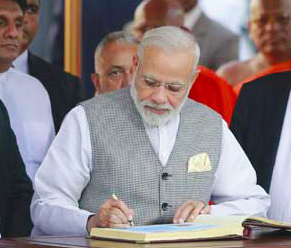
    NEW DELHI/COLOMBO (TIP):Prime Minister Narendra Modi arrived in Colombo on May 11 on a two-day visit which is mainly aimed at reinforcing the traditional connect between India and Sri Lanka at a time when China is seeking to make inroads in the island nation.

    Modi, on his second visit to Sri Lanka in two years, is here primarily to participate on Friday in the International Vesak Day celebrations, the biggest festival of Buddhists.

    He will inaugurate a hospital built with India’s assistance of Rs 150 crore. He will also address the Indian-origin Tamils against the backdrop of India’s insistence that Sri Lanka should undertake devolution of power to the ethnic community as part of the reconciliation process.

    Sri Lankan Prime Minister Ranil Wickremesinghe and several senior ministers, including foreign minister Mangala Samaraweera, were at the Colombo International Airport to receive the Indian Prime Minister.

    “As Sri Lanka proudly celebrates #InternationalVesakDay, I warmly welcome Indian Premier @narendramodi who will grace the occasion,” tweeted President Maithripala Srisena.

    Modi was accorded a guard of honour by the Sri Lankan Air Force at the airport. The visit and the agenda is mainly to re-emphasise the traditional connect between India and Sri Lanka, particularly in the context of Buddhism, which is a shared heritage.

    This assumes significance since China is aggressively trying to make inroads in Sri Lanka.