Month: February 2018

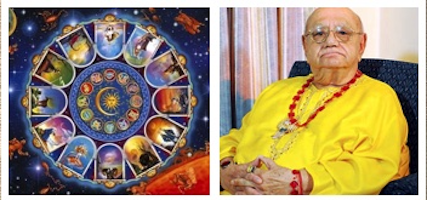
  • Predictions For February 5 – February 11, 2018 – Horoscope & Astrology By Bejan Daruwala

    Predictions For February 5 – February 11, 2018 – Horoscope & Astrology By Bejan Daruwala

    By Astrologer Bejan Daruwalla , Contact no: +91 8141234275

    Aries: Ganesha says this period in your own sign brings many unusual aspects into the light of day. The period is slowly coming to a close and it is a good time for reflection. You started off with ambition and grand plans on the work front and then saw a platter full of goodies coming to you. There have been twists and turns ranging from strange esoteric pursuits, to flights of fancy, the supernatural and even the supra natural, interest in spirits, witches and other occult phenomena.

    Taurus: You have put in a lot in terms of ideas, effort and commitment and this is the time for reaping the harvest. You like the sweet sound of good money in the bank and the social standing and perquisites that come in the form of pleasing symbols of success. You enjoy it all without a second thought, and why not? They bring joy to you and your family. You look back on the period and even seek to expand on the good fortune coming to you from time well spent.

    Gemini: You are in an introspection mode. You even look at parapsychology and / or psychic insights and ability. Nursing, healing, welfare interests, medicare, healing minds and bodies, charities will take your time and energy and quite happily too. You have many desires to be fulfilled and are filled with a new mindset of inquiry. Right now, Ganesha gives you a time of calm, introspection, thought. There is a good chance that you will also be involved in trade and travel.

    Cancer: You are pressured by commitments to work and family. Both will need hard work and effort. There will also be investments and outlays, both financial and with time. You will have a lot of coping to do as they are all linked. It can be a heavy burden and so guard against overdoing it. But, whatever you do now, the results that follow will be pleasant. I must also tell you now that this is a special time and is filled with favours coming your way. No more guessing and hoping for the best.

    Leo: You are enriched and Ganesha’s blessings are with you. Happy times are finally here and you are certainly on top of the world. Go for whatever you need but remember the saying: “There’s no such things as a free lunch”. But don’t let this deter you. Take your chances and plan for the future. Ganesha also tell you to read the fine print. There could be hidden clauses that could be less than favorable in the long run; watch out for deceit.

    Virgo: You are enthusiastic and energized with all that is happening in your life right now. You will be a human dynamo, a powerhouse of energy, ready to attain targets you’ve only been hoping to achieve. You make glorious plans for the future leading to great success and joy. There is new zest in your attitude to life itself, and you work exceptionally hard. You will achieve success in all spheres of life and will ride the wave. The world is your oyster, right now.

    Libra: There is free time and also a strong inclination to indulge in all kinds of mental activity. It will be back to mind games for you Librans, but of a very different sort. Once again, you look for fresh avenues of self – expression and of exploring new areas of both knowledge and experience. The family and work angles are both energized but there is a certain restlessness that might prove dangerous if it is not channelized properly. Despite it all, you do make sure that you manage all your commitments to the people who matter in your life.

    Scorpio: The trends are encouraging as the period draws to its end. You have had material rewards. Now you reach out for greater love and warmth in relationships and are appreciated, valued and cherished. Family life will be on a high and your children will give great joy. There is a good chance of an engagement or marriage happening in this period. It could be either yours or that of someone dear to you. You are in an adventurous mood and would like to try out new things. Nothing ventured, nothing gained!

    Sagittarius: The period may be approaching its end, but your energy remains undiminished. You are on the go all time and are filled with a sense of fulfilment and self-realization. Family and marital bonds are honored with deep commitment and genuine caring. You have introspected a lot and have arrived at this point in your life after a great deal of soul searching. Expenses continue to mount but you are not complaining, as you are confident you can cope.

    Capricorn: The tide changes here. Once again, from all the gusto and go, you get meditative. You look at the spiritual and the meditative areas with both sincerity and much commitment. Life’s meaning and, strangely enough, law and the social order, research, philosophical pursuits and even questions of justice keep you busy through the reaming period. You will still mesh beautifully with others and make gains in other spheres of life. Your ideas, ingenuity will set the stage of for stupendous achievements.

    Aquarius: Your confidence and charisma – 2 great C’s – will be at an all-time high. They will be reflected in your interactions, and your attitude to friends, colleagues, and family. Having achieved your targets, you look at the lighter, more pleasant side of life. You decide to have fun, relax, let your hair down. You dabble in the creative arts and make more contacts. Expression is the key word here and you also go all out to reach out to others. Your life is filled with an assortment of activities and you are enjoying them all.

    Pisces: You ­­­­­­­consciously go slow but can’t escape the intensity of the period. Finance and family will be well looked after, but there may also be a new love interest that takes a lot of your time and energy. Don’t overstep the line and hurt loved ones in the process. Tread softly, says Ganesha. It may just be a passing fancy and overindulgence may cost you dear. Don’t rock the boat where family harmony is concerned. You will have visitors and a lot of merrymaking. You will be the force behind the social whirligig. Enjoy!

  • Turning the diplomatic prism

    Turning the diplomatic prism

    Dealing with Pakistan; renewing ties with Canada

    By KC Singh
    Pakistan, Trudeau and Khalistanis need to be engaged not pilloried, while detoxifying the nation of bigotry and falsehood”, says the author.
     The one issue that still rankles bilateral relations is the activities of “Khalistani” elements in Canada and their links, if any, with Pakistan’s ISI. It played last year into the visit of Canadian defense minister, Lt Col Harjit Sajjan, when Capt Amarinder Singh literally boycotted him, piqued over the Canadian government denying him a visa before the Punjab election last year.”

    India-Pakistan relations under the Modi government are in a cryogenic state. A muscular response, advocated by PM Narendra Modi, has become not a means, but an end in itself. Despite “surgical strikes” and periodic cease-fire violations, the Pakistan army remains defiant. With elections around the corner in Pakistan and rumors Modi may advance the Lok Sabha elections, the scope for any meaningful dialogue appears bleak.

    India draws much solace from President Donald Trump’s periodic verbal assaults on the duplicity of Pakistani state and military. The US withholding military aid, amounting to $2 billion, including $900 million in coalition support funds to compensate Pakistan for its counter-terrorism operations along the Durand Line (Pak-Afghan border), is a first step to ratchet up pressure on Pakistan. US government sources are telling the media that there is an escalation plan if Pakistan does not heed the warnings. The action that the US seeks is Pakistan severing links with the Taliban and the deadly Haqqani network. The same source told Washington Post that there was “immense” frustration over Pakistan continuing to deny that there were any Pakistani safe havens for these groups.

    Senior US officials touring India recently displayed guarded optimism over change in Pakistani attitude. They take the cue from Pakistan not threatening to disrupt US supply routes via Pakistan. But recent terror attacks in Kabul, where an ambulance bomb caused severe casualties, negate that finding. Earlier a hotel was attacked, frequented by Afghan government officials and foreigners, in which among others, a senior police commander and a member of the High Peace Council were killed. The hotel attack on the topmost floor indicated that the attackers were well briefed as that floor normally is reserved for officials holding sensitive positions.

    Meanwhile, Pakistan blocked access to Hafiz Saeed when a team deputed by the UN Security Council sanctions committee arrived to assess Pakistan’s handling of a listed terror mastermind. Reports keep resurfacing that Pakistan was in the process of allowing the India-specific terror syndicates to enter the political field. This could be a double-edged sword to both legitimize the groups and undercut the Sharif brothers, who control the Pakistan Muslim League (N), in the forthcoming parliament election. China has been more forthrightly defending Pakistani credentials as a nation fighting terror and not abetting it.

    Against this background, two events invite attention. First, the Economist carried a story earlier this month on the reform of Pakistan’s school education. This has gone unnoticed in India as the dominant narrative is that Pakistan is a collapsing state which will soon end up in a big Islamic heap. The story holds a lesson for our Punjab. Under the direct leadership of chief minister Shahbaz Sharif, a private-public partnership (PPP) has successfully developed to rectify the skewed school completion data. The richest Pakistanis have 60 per cent completing nine years of schooling. For the poor, the number is 5 per cent and for the middle income group, a mere 25 per cent. A donation-based citizens’ foundation today has over 2 lakh students in its schools. Similarly, the Punjab Education Foundation, a quasi-independent body, is doing the same work even on a larger scale.

    The PPP works with the Shahbaz government handing over public schools to private partners and then closely monitoring their work while providing some subsidy. A Harvard University study shows that village schools saw 30 per cent higher enrolment after private parties were brought in. It has also been discovered by other studies that teachers on contract, who are paid less, produce as good or better results. A similar revamp of the primary and secondary school education in our Punjab is long overdue. CM Shahbaz takes a three-monthly meeting of all stakeholders to monitor the progress of this reform. Can the Punjab CM, Capt Amarinder Singh, do likewise?

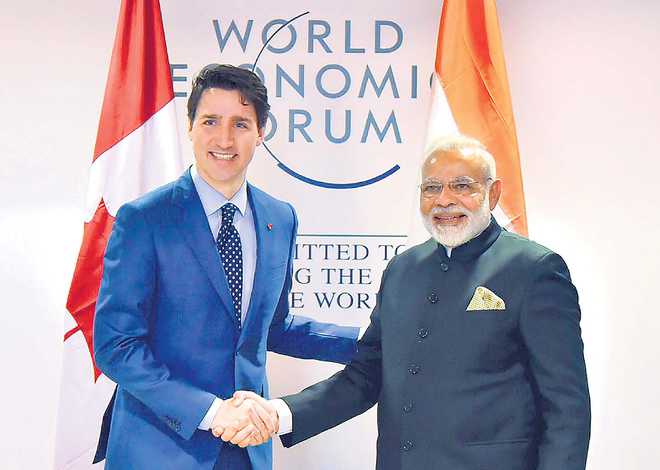
    The other event is the expected arrival of Canadian Prime Minister Justin Trudeau on a five-day visit on February 17. Among other cities he would be visiting Amritsar. The one issue that still rankles bilateral relations is the activities of “Khalistani” elements in Canada and their links, if any, with Pakistan’s ISI. It played last year into the visit of Canadian defense minister, Lt Col Harjit Sajjan, when Capt Amarinder Singh literally boycotted him, piqued over the Canadian government denying him a visa before the Punjab election last year.

    Trudeau’s visit provides a good opportunity for Capt Amarinder to bury the past. Sikhs constitute almost 40 per cent of the total population of Indian diaspora in Canada which numbers over a million. That huge number needs to be engaged and their energies channelized to contribute to Punjab’s development. The population profile of the Canadian Sikh diaspora is different from that in the US. The Canadian Sikhs are more closely linked to peasantry in Punjab. A number of episodes have riled Delhi as the Canadian government is seen as handling mischief-makers with kid gloves. When I dealt with them in 2006-07, the Canadian explanation was that they monitor the goings-on but would only step in if violence or terrorism was imminent. Slogans in favor of Khalistan are really solitary cries for attention. The Canadian Sikh fringe needs to be politically dealt with. Banning their entry into India will only exacerbate the situation.

    If Punjab was the laboratory of the Green Revolution, it now needs to reinvent itself. A revamped education system, a shift away from the rice-wheat agrarian model, laying of food-chain supply network and conservation of water aquifers and adoption of sustainable development goals. It is not a surprise that a recent study showed that South Indian states, which have the advantage of coastlines for connectivity, have cornered the export businesses of India. A new Punjab model could become the 21st century template for the land-locked and largely agrarian economy states of the North.

    The Modi government, having largely ignored rural distress, has awakened post-Gujarat election. Udayan Mukherjee wrote in another newspaper that the Modi government’s strategy was: “more wealth for the rich, Hindutva for the poor”. Religion may be, as Karl Marx quipped, the opiate of the masses. But when used to polarize for electoral gains it can be catastrophic. Thus Pakistan, Trudeau and Khalistanis need to be engaged not pilloried, while detoxifying the nation of bigotry and falsehood.

     (The author is a former Secretary, Ministry of External Affairs)

  • How Trump is making China and India great again

    How Trump is making China and India great again

    With his constant tirades against immigrants, particularly from what he calls “shithole countries”, Donald Trump is giving many countries the greatest gift of all: causing the trickle of returning talent to become a flood”.
    By Vivek Wadhwa
    At the same time, I also realized that protectionist demands by nativists were causing American political leaders to advocate immigration policies that were (and are) choking US innovation and economic growth. The government would constantly expand the number of H1-B visas in response to the demands of businesses but never the number of green cards, which were limited to 140,000 for the so-called key employment categories. The result? The queues kept increasing. I estimate that today there are around 1.5 million skilled workers and their families stuck in immigration limbo, and that more than a third of these are Indians”, says the author.

    “Thank you for what you are doing for America; your successes have put India in very positive light and shown us what is possible in India” said Atal Behari Vajpayee to me in a one-on-one meeting during his visit to the White House in September 2000. He added that he would love to see Indian-American entrepreneurs return home to help build India’s nascent technology industry.

    Bill Clinton and George W. Bush granted him his wish with their flawed immigration policies. The U.S. admitted hundreds of thousands of foreign students and engineers on temporary visas but did not have the fortitude to expand the numbers of green cards. The result was that the waiting time for permanent resident visas began to exceed 10 years for Indian and Chinese immigrants. Some began returning home.

    Now with his constant tirades against immigrants, particularly from what he calls “shithole countries”, Donald Trump is giving many countries the greatest gift of all: causing the trickle of returning talent to become a flood.

    For India, the timing could not be better. With hundreds of millions of people now gaining access to the Internet through inexpensive smartphones, India is about to experience a technology boom that will transform the country itself. And with the influx of capital and talent, it will be able to challenge Silicon Valley—just as China is doing.

    This is the irony of America’s rising nativism and protectionism.

    When I met Prime Minister Vajpayee, I was the CEO of a technology startup in North Carolina. Later, I became an academic and started researching why Silicon Valley was the most innovative place on this planet.

    I learnt that it was diversity and openness that gave Silicon Valley its global advantage; foreign-born people were dominating its entrepreneurial ecosystem and fueling innovation and job growth. My research teams at Duke, the University of California at Berkeley, New York University, and Harvard documented that between 1995 and 2005, immigrants founded 52% of Silicon Valley’s technology companies. The founders came from almost every nation in the world: Australia to Zimbabwe. Immigrants also contributed to the majority of patents filed by leading US companies in that period: 72% of the total at Qualcomm, 65% at Merck, 64% at General Electric, and 60% at Cisco Systems. Surprisingly, 40% of the international patent applications filed by the US government also had foreign-national authors.

    Indians have achieved the most extraordinary success in Silicon Valley. They have founded more start-ups than the next four immigrant groups, from Britain, China, Taiwan, and Japan, combined. Despite comprising only 6% of the Valley’s population and 1% of the nations, Indians founded 15.5% of Silicon Valley startups and contributed to 14% of US global patents.

    At the same time, I also realized that protectionist demands by nativists were causing American political leaders to advocate immigration policies that were (and are) choking US innovation and economic growth. The government would constantly expand the number of H1-B visas in response to the demands of businesses but never the number of green cards, which were limited to 140,000 for the so-called key employment categories. The result? The queues kept increasing. I estimate that today there are around 1.5 million skilled workers and their families stuck in immigration limbo, and that more than a third of these are Indians.

    Meanwhile, I have witnessed a rapid change in the aspirations among international students. The norm would be for students from China and India to stay in the US permanently because there were hardly any opportunities back home. This changed.

    My engineering students began to seek short-term employment in the US to gain experience after they graduated but their ultimate goal was to return home to their families and friends. Human resource directors of companies in India and China increasingly reported that they were flooded with resumés from US graduates.

    For students, the prospect of returning home and working for a hot company such as Baidu, Alibaba, Paytm, or Flipkart is far more enticing than working for an American company. You cannot blame them, especially given that delays in visa processing will lock them into a menial position for at least a decade during the most productive parts of their careers.

    This has been an incredible boon for China. One measure of the globalization of innovation is the number of technology start-ups with post-money valuations of $1 billion or higher. These companies are commonly called “unicorns”. As recently as 2000, nearly all of these were in the US; countries such as China and India could only dream of being home to a Google, Amazon, or Facebook.

    Now, according to South China Morning Post, China has 98 unicorns, which is 39% of the world’s 252 unicorns. In comparison, America has 106, or 42%, and India has 10 unicorns, 4%. An analysis by the National Foundation for American Policy revealed that 51% of the unicorns in the US have at least one immigrant founder. It is clear how shortsighted the US government has been.

    With the clouds of nativism circling the White House, things will only get worse. America’s share of successful technology startups will continue to shrink and Silicon Valley will see competition like never before.

    America’s loss is India’s gain.

    (The author is a Distinguished Fellow at Carnegie Mellon University at Silicon Valley and author of The Driver in the Driverless Car: How Our Technology Choices Will Create the Future)


  • Emergency and Now

    Emergency and Now

    By MG Devasahayam


    The author was District Magistrate of Chandigarh when Lok Nayak Jayprakash Narayan was incarcerated at PGI during Emergency. Over a time, he became an admirer of Lok Nayak and the two exchanged views quite often. -EDITOR

    “As the four senior most judges of the Supreme Court flagged their concern about the institution, it was reminiscent of the Emergency. Most people are these days moving in hushed silence, stunned and traumatized by the goings-on.”

    As I sat glued to the ‘idiot box’ watching the ‘historic’ event of four senior most judges of the Supreme Court ‘paying their debt to the nation’ and placing their case before ‘We, the People’, I was touched by two poignant references by Justice Jasti Chelameswar: “We are all…four of us are convinced that unless this institution is preserved and it maintains its equanimity, democracy will not survive in this country.” And: “We are left with no choice except to communicate it to the nation that ‘please take care of the institution and take care of the nation’… I don’t want another 20 years later some very wise men in this country blame that Chelameswar, Ranjan Gogoi, Madan Lokur and Kurian Joseph sold their souls and didn’t take care of this institution, they didn’t take care of the interest of this nation.”

    My thoughts went back to the special ward in the PGI, Chandigarh, and my conversations with Lok Nayak Jayaprakash Narayan (JP) who was incarcerated there during the Emergency. It was August 6, 1975. As was my wont, I had gone to see JP that morning. He asked me what the date was and I told him. He mumbled to himself that the Supreme Court hearing of the Prime Minister’s appeal against her disqualification by the Allahabad High Court was on the 11th. He asked me about the report of the case. He also asked me as to what was happening in Parliament.

    I could not mislead him by saying that there was nothing special. Hence, I told him about the amendments to the Representation of the People Act by Parliament the day before. He was upset as I narrated one by one the six amendments that had been made. The most prominent was the amendment granting immunity to the PM’s election from being challenged in a court of law. He looked sad and said with a deep sigh that there was no hope now. “Everything is finished. She will be there forever.”

    I also informed him of the convening of the state assemblies on August 8 and 9 and also the likely amendment of the Constitution rendering the elections of President, Vice-President, Prime Minister and Speaker of the Lok Sabha non-justiciable. He was more upset now. He said in a very sad tone: “Democracy is finished completely,” and after a pause, “at least for the present.” He said that his only hope was in the Supreme Court and that too had been shattered. “Now there is nothing to hope for and nothing to live for. This lady has demolished the very edifice of democracy so painfully constructed by her father and myriad others.” I was touched by his sentiments and the way he expressed it. I told him that this was inevitable and one could see it coming.

    But JP did not take it lying down. On August 10, he addressed a letter to the Prime Minister which was delivered to me around noon. In the letter, he had declared that from August 25, he would start a fast-unto-death unless the Emergency was revoked and all detainees released within two weeks. He would not take anything, except water, sour lemon and medicine meant only for ill health. Realizing its disastrous consequences, I rushed to JP immediately and after a sharp wordy duel lasting over two hours, dissuaded him from taking this extreme step. But not before he said these extremely anguished words: “I do not want to live to see the death of democracy before my very eyes. The least I could do would be to deny me that unparalleled agony and die before democracy is dead.”

    Be that as it may, the accuracy of JP’s prediction about the Supreme Court is narrated by Nayantara Sahgal in her book ‘Indira Gandhi’s Emergence and Style’: “The essence of Emergency was the pinnacle-power — a position above the multitude, unaccountable and unchallengeable — it sought to guarantee the Prime Minister. This was accomplished by three amendments to the Constitution and an Act of Parliament. The 38th Amendment put the declaration of Emergency beyond the scrutiny of the courts. The 39th Amendment made election disputes relating to the Prime Minister, President, Vice President and the Speaker non-justiciable. This wiped out the Allahabad High Court judgment with retrospective effect and ensured a Supreme Court judgment in her favor. On 7 November 1975, a 5-judge bench of the Supreme Court upheld the amendments and Indira’s 1971 election to Parliament.”

    Supreme Court judges then had not ‘taken care of the interest of the nation’ and some of them perhaps had ‘sold their soul’. This judgment shattered JP’s will to live and under intense agony and mental pressure, his kidneys, which were already under stress, failed. He took seriously ill which could have been life-threatening. Realizing the enormity of the situation, I initiated a ‘pincer movement’ to pressure the Union Home Ministry and PMO, got JP released on November 12 and sent him post haste to Bombay’s Jaslok Hospital just in time for his kidneys to be treated and life saved. JP lived for four more years, defeated the Emergency and returned India back to democracy.

    Since then, democracy has been limping and in recent years, again in dire danger. Basic violations of the democratic spirit and the crude attempts to legitimize a new type of regime and new criteria of allocation of rights and obligations continue unabated. There is no sense of boundary or restraint in the exercise of power, and there is a striking growth of arbitrariness and arrogance with which citizens are being turned into subjects, meekly accepting party/government diktats. Polarizing agenda, communal hatred, violence, demonetization and Aadhaar are the tools used.

    Reminiscent of the Emergency, most people are moving in hushed silence, stunned and traumatized by the goings-on. There is fear and anxiety all around. Across the nation, groveling administrators, media anchors, academicians, advocates and accountants are vying with each other to sing paeans to the rulers. The bulk of the civil service is crawling when only asked to bend. Higher echelons of the judiciary bow to the rulers and are willing to decree the way they want. Politicians of all hue and color, barring honorable exceptions, lay supine and inactive.

    In the event, India’s precious democracy is in peril again as openly stated by the four wise men of the highest court of the land. As an ordinary citizen, all I can do is to wail in the manner of our forefathers: “Democracy is in peril, defend it with all your might.” And, also salute these four men who have stood high and tall when most others have fallen asunder!

    (The author is a Former IAS officer and District Magistrate, Chandigarh)

  • A Political Storm imminent in the wake of release of classified Nunes memo

    A Political Storm imminent in the wake of release of classified Nunes memo

    WASHINGTON (TIP): Despite objections of Democrats and the FBI, President Trump is expected to make public Friday, February 2, a classified memo about the Russia investigation, which was written by the chairman of the House Intelligence Committee, which is bound to result in a political storm.

    The impending release of the memo has touched raw nerves in Washington. Throughout the day on Thursday, February 1 the White House batted down rumors FBI Director Christopher Wray was going to resign in protest

    Releasing the information, which is based on classified intelligence, would be unusual.

    The memo covers events during the 2016 campaign, when the FBI and the Department of Justice went to the Foreign Intelligence Surveillance Court (FISA) to get a warrant to monitor then-Trump campaign advisor Carter Page, who was suspected of having illegal contacts with Russian operatives.

    The four-page memo, authored by Republican Rep. Devin Nunes, the chairman of the Intelligence Committee, outlines alleged surveillance abuses. It has deepened a severe partisan divide.

    Rep. Adam Schiff, the top Democrat on the committee, says the document presents a distorted and unfair picture of how the FBI behaved, and jeopardizes the special counsel’s Russia investigation.

    “They ought to be sending the message instead to the White House that were the president to fire Bob Mueller or Rod Rosenstein, that would be considered obstruction of justice and it would bring down the administration,” Schiff said, referring to the special counsel and the deputy attorney general, who is overseeing the Russia probe.

    House Speaker Paul Ryan denied the memo is politically motivated.

    “The memo is not an indictment of the FBI, the Department of Justice,” Ryan said at a GOP retreat Thursday. “What it is, is Congress’ legitimate function of oversight to make sure the FISA process is being used correctly.”

    Thursday evening, former FBI Director James Comey — who was fired by the president — weighed in:

    James Comey

    @Comey

    All should appreciate the FBI speaking up. I wish more of our leaders would. But take heart: American history shows that, in the long run, weasels and liars never hold the field, so long as good people stand up. Not a lot of schools or streets named for Joe McCarthy.

    5:51 PM – Feb 1, 2018

    That is a reflection of how tense this controversy has become.

    (Source: CBS)

  • Trump calls for bipartisanship even as he sticks to his avowed agenda in State of the Union address

    Trump calls for bipartisanship even as he sticks to his avowed agenda in State of the Union address

    Immigration, border wall, infrastructure, strong military among priorities

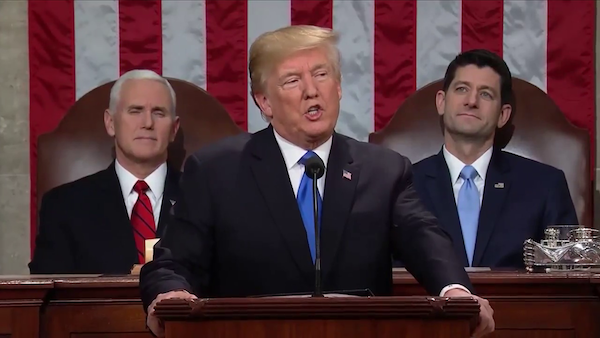
    WASHINGTON DC (TIP):  In his lengthy State of the Union address on January 30 night, Trump doubled down on themes which he has embraced since his campaign for the presidency. He again pushed for stricter immigration laws and the building of a “great wall” along the U.S. border with Mexico. He also repeated his call for an end to family-based immigration, connecting immigration to crime, saying that “loopholes” in the immigration system had allowed gangs to proliferate. Democrats and many in his own party may not agree with this view though.

    But in a marked departure from his earlier rhetoric, Trump also tried to sound enthusiastic about working with Democrats. At times, the speech even took on the feel of a pep rally for America, with Republicans briefly chanting “USA!” as the president spoke.

    “To every citizen watching at home tonight — no matter where you have been, or where you come from, this is your time,” Trump said. “If you work hard, if you believe in yourself, if you believe in America, then you can dream anything, you can be anything, and together, we can achieve anything.”

    At the top of the speech, Trump celebrated the booming economy, attributing the bullish stock market of recent months to his policies. He also took time to advertise the recent tax cuts championed by his administration, arguing that it would soon pay dividends for working Americans.

    “And just as I promised the American people from this podium 11 months ago, we enacted the biggest tax cuts and reforms in American history,” Trump said. “Our massive tax cuts provide tremendous relief for the middle class and small businesses. A typical family of four making $75,000 will see their tax bill reduced by $2,000 — slashing their tax bill in half. This April will be the last time you ever file under the old broken system — and millions of Americans will have more take-home pay starting next month.”

    As expected, the president also called for a massive infrastructure package, which he said he hopes will attract bipartisan support.

    “America is a nation of builders,” Trump said. “We built the Empire State Building in just one year – isn’t it a disgrace that it can now take 10 years just to get a minor permit approved for the building of a simple road?”

    “I am asking both parties to come together to give us safe, fast, reliable, and modern infrastructure that our economy needs, and our people deserve.”

    The tail end of the speech, which lasted over an hour, was devoted to military issues, with Trump calling for an end to spending caps for the military and the modernization of the U.S. nuclear arsenal. He also promised the final defeat of ISIS.

    “We will continue our fight until ISIS is defeated,” Trump said after touting recent victories in the war with the terror group.

    Trump also discussed North Korea’s nuclear provocations and its treatment of both its own citizens and Otto Warmbier, an American student who was arrested in the country. Warmbier was sentenced to 15 years of hard labor for allegedly taking a political sign from a hotel and died shortly after he was released from captivity.

    Various polls post the address indicated that Trump’s speech was well received by Americans. 72% Americans who watched the speech said they approved of it, with just over a quarter saying they did not.

    The days ahead are quite crucial. The DACA issue, the impending release of Republican Memo on FBI and Department of Justice, the budget approval, Mueller investigation -are some of the knotty issues to be tackled. Given the tough postures adopted by both the Republicans and the Democrats, the coming days indicate some interesting fireworks.

  • Free Karachi Campaign Launches its Next Phase in the USA

    Free Karachi Campaign Launches its Next Phase in the USA

    #FreeKarachi Ads Appear on Massive Digital Billboards in Los Angeles

    WASHINGTON DC (TIP):  The Free Karachi Campaign has launched its next phase in the U.S.A. with billboards advertisements. As part of the campaign, “#FreeKarachi and Urban Sindh from State Atrocities in Pakistan” advertisements have appeared on several highway billboards in the U.S. West Coast city of Los Angeles.

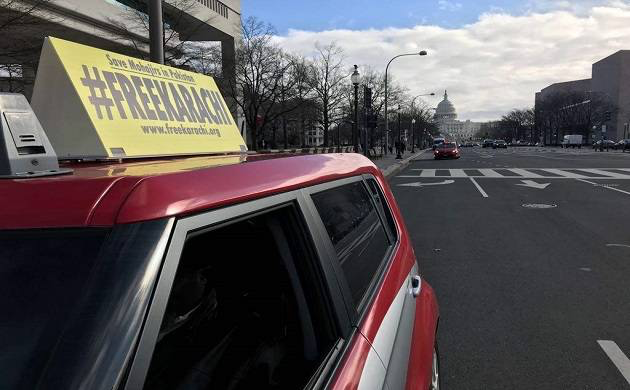
    The Free Karachi Campaign had started on 15 January in the U.S. capital Washington, D.C. when a number of taxis and cars with #FreeKarachi banners participated in the city’s annual Dr. Martin Luther King Jr. Day parade.

    The Washington Post, one of the most prominent newspapers of the U.S., had also published a special supplement that had carried details of the injustices that Sindh Province’s people, Urdu-speaking Mohajirs in particular, have been facing in Pakistan. A digital advertisement of Free Karachi is still running on the official website of the Washington Times.

    Commenting on the latest phase of the campaign, Free Karachi spokesperson Nadeem Nusrat said that “Karachi is Pakistan’s most secular city where religious extremists have always failed to develop a stronghold. Pakistan’s Punjabi-dominated deep-state, however, is trying to change this great, tolerant trait of this city by promoting forces of religious extremism.”

    “While Dr. Shakil Afridi languishes in prison and thousands of Mohajirs and Balochs gone missing after being taken into custody by Pakistani security forces, the UNO and U.S.-designated terrorists are allowed to hold rallies in Karachi. This clearly proves why Free Karachi is necessary”, added Mr. Nusrat.

    “The taxes paid by Karachi and other areas of urban Sindh run Pakistan’s economy. Karachi alone pays over 90 percent taxes for the treasury of Sindh Province, but it has no representation in the federal as well as the provincial governments. Karachi is ranked by most independent organizations as the second most populace city in the world, but its population is always reduced in the official census figures by both Larkana-based Sindh and Islamabad-based federal government,’ said Mr. Nusrat.

    Criticizing Pakistani judiciary, Mr. Nusrat said that “while Pakistani supreme courts are known for taking suo-moto action over petty issues, they have failed to take notice of the brutal murder of Harvard-educated, elderly Professor Hasan-Zafar Arif who was abducted and killed recently in Karachi.”

    “Mohajirs –those whose ancestors had migrated from India to Pakistan in 1947 – are the ones whose forefathers not only made Pakistan a reality but also played a key role in sustaining Pakistan in its most turbulent times. These Mohajirs have now been barred from governments jobs and security institutions. Their young generation is blatantly admission in public-funded professional educational institutions and government jobs. As recently as last week, over one thousand Karachi students were denied admission at Karachi University and the seats were instead given to students from rural Sindh.” Mr. Nusrat continued.

    “It is not possible for Mohajirs to raise their voice against state-sponsored injustices in Pakistan. Political offices of Mohajirs’ mainstream political party, MQM, have been illegally demolished in Pakistan and the party is facing an illegal, unannounced ban. The Mohajirs living overseas now have to highlight the brutal and undemocratic policies of Pakistani State at every possible international forum,” Mr. Nusrat added.

    (Press Release)

  • Justice for Sreejith: Indian ends protest after 782 days

    Justice for Sreejith: Indian ends protest after 782 days

    THIRUVANANTHPURAM (TIP): A man from the south Indian state of Kerala has ended a 782-day protest after a federal agency began investigating his brother’s death.

    SR Sreejith alleges his brother was murdered by police who arrested him on the charge of stealing a mobile phone.

    His demand for an independent inquiry into his brother’s death picked up in recent months through the social media movement #JusticeforSreejith.

    He ended the protest after federal investigators recorded his statement.

    In the face of mounting public pressure, state lawmakers ordered an internal police investigation into his brother’s death. But Mr Sreejith refused, insisting that the case be transferred to India’s federal investigation agency, the Central Bureau of Investigation (CBI).

    Police had said Sreejeev, 26, committed suicide in custody after he was arrested, but his family says he was killed because he was in love with a woman who happened to be related to one of the police officers.

    He was arrested one day before she was scheduled to get married to someone else. He died in hospital the following day where he was admitted as a result of the “suicide attempt”.

    Human Rights Watch (HRW) said in an August report on India that suicide and illness are common causes listed by authorities to cover up deaths likely caused by police torture.

    In a country only too familiar with police brutality and custodial deaths – India’s National Crime Records Bureau says 591 people died in police custody between 2010 and 2015 – his protest generated particular resonance.

    In the past few weeks and months, pictures of him and his protest have been shared widely on Facebook and Twitter along with messages of solidarity, including from some very high profile figures in the state.

    (Source: BBC)

  • Anti – Sikh Riots 1984: Rs 10 crore allocated for enhanced compensation to victims

    Anti – Sikh Riots 1984: Rs 10 crore allocated for enhanced compensation to victims

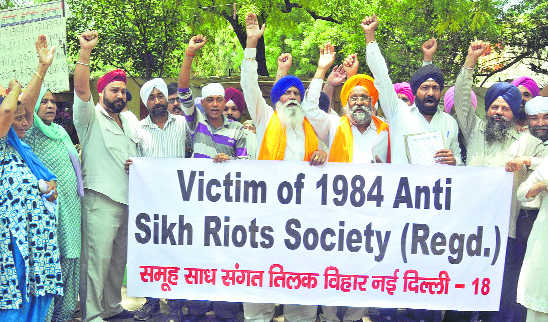
    NEW DELHI (TIP): A modest Rs 10 crore has been earmarked for handing out enhanced compensation to victims of the 1984 anti-Sikh riots in the Budget 2018-19.

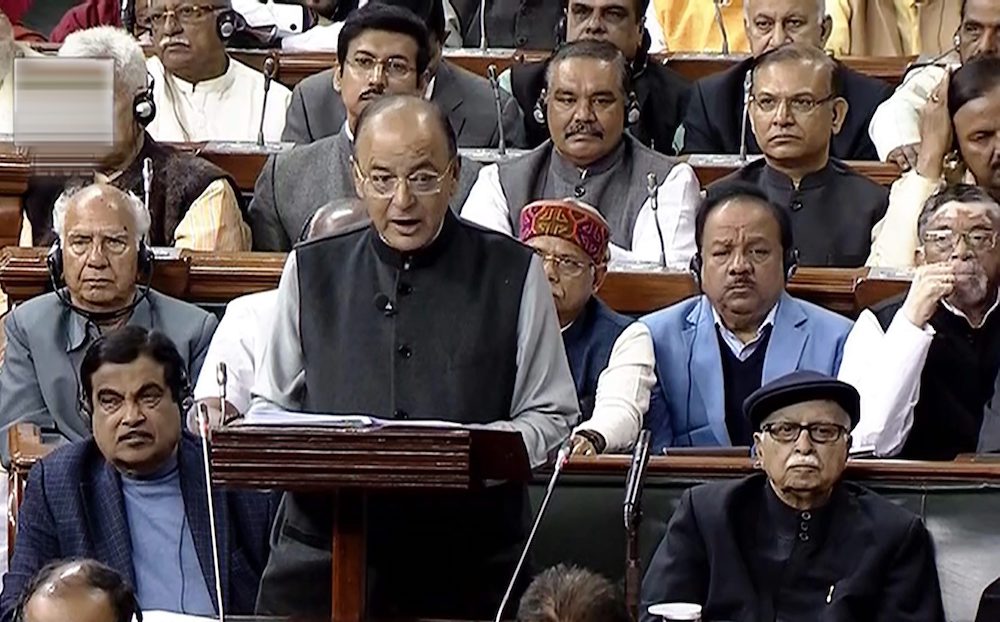
    The amount was allocated in the Budget, presented by Finance Minister Arun Jaitley in Parliament on Thursday, February 1, and it would be distributed among victims of the riots.

    The riots broke out following the assassination of the then Prime Minister Indira Gandhi by her Sikh bodyguards on October 31, 1984.

    Of the 3,325 victims, 2,733 were killed in Delhi while rest of the victims were from Uttar Pradesh, Haryana, Madhya Pradesh, Maharashtra and other states.

    Soon after the Narendra Modi government came to power in 2014, it had announced an additional compensation of Rs 5 lakh each to the next of kin of victims of the anti-Sikh riots.

    The amount in the 2017-18 Budget was Rs 15 crore.

    Some of the anti-Sikh riot cases are still continuing in courts and many Sikh organizations have alleged that the key conspirators of the violence were at large, and victims have not yet got justice.

    (Source: PTI)

  • Aadhaar, India: Personal data of about a billion people sold online for $8

    Aadhaar, India: Personal data of about a billion people sold online for $8

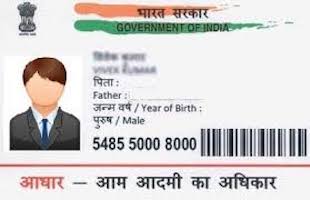
    NEW DELHI (TIP): Personal information from Aadhaar cards (personal identification card) of more than a billion Indians stored in the world’s largest biometric database was sold online for less than $8, according to a report by an Indian newspaper.

    An investigative story by The Tribune revealed that it is possible to buy login credentials of the Aadhaar database, which can collect the photographs, thumbprints and other identifying details of every citizen. It further added that fake Aadhar cards can be generated by purchasing software online and that the publication also bought access to such database by merely paying $7.89 on a WhatsApp group.

    The Unique Identification Authority of India (UIDAI), which controls the Aadhaar system said that the “case appears to be an instance of misuse.”

    UIDAI said that it has filed a police complaint against the people responsible for misusing the access but did not identify them.

    A follow-up story by The Tribune mentioned that the agency has denied any misuse of data. “UIDAI reassures that there has not been any data breach of biometric database which remains fully safe and secure with highest encryption at UIDAI and mere display of demographic information cannot be misused without biometrics,” it added. “Claims of bypassing or duping the Aadhaar enrolment system are totally unfounded.” This kind of problems in a program facing increasing scrutiny over privacy concerns will ask more questions about data safety.

    The current administration, under Prime Minister Narendra Modi, had also made it mandatory for individuals to link Aadhaar to private and public services. Now India’s Supreme court is holding hearings to decide whether the decision made by Modi will affect the privacy rights of individuals or not.

    Several national leaders in India have expressed concerns over the safety of private information.

    Sitaram Yechury, a leader of a communist party in India, tweeted, “The Perils of making Aadhaar mandatory and linking it to bank accounts, as insisted upon by the Modi government, are visible here.”

    Last month, the telecom firm Bharti Airtel was barred by the agency for using Aadhaar details to verify customers identities because the facility was being misused to open accounts on its payment platform.

  • India’s Budget focuses on farm sector, gives little to middle class

    India’s Budget focuses on farm sector, gives little to middle class

    National Health Protection scheme announced

    NEW DELHI (TIP): In his last budget before general elections, India’s Finance Minister Arun Jaitley on Feb 1 unveiled a slew of measures for agriculture as well as the rural sector and announced a new health insurance scheme for the poor but provided little relief to the middle class.

    With chaotic implementation of the Goods and Services Tax and demonetization causing distress in the economy, Jaitley announced massive spending on rural and urban infrastructure as also lower tax rates for small and medium enterprises.

    While continuing the 10-15 per cent surcharge on super-rich, he raised the health and education cess, levied on all taxable income, to 4 per cent from 3 per cent at present.

    Keeping the income tax rates and slabs unchanged, he introduced a Rs 40,000 Standard Deduction for salaried employees and pensioners in lieu of the present exemption in respect of transport and medical expenses.

    Presently, no tax is applicable on Rs 19,200 of transport allowance and medical expenditure of up to Rs 15,000. This has now been subsumed into the new Standard Deduction of Rs 40,000 which may mean very little benefit in tax saving considering that health and education cess has gone up.

    Senior citizens will get higher exemptions on income from interest on bank and post office deposits, health insurance premium and critical illness expense.

    Jaitley, however, made import of a host of products – from cellphone to perfumes and toiletry, from watches to parts of automobiles, sunglasses to truck and bus tires, footwear to diamonds and edible oils to fruit juices — costly by raising customs duty.

    Fourteen years after it was scrapped, he brought back tax on gains made from sale of shares to offset revenue losses.

    Capital gains exceeding Rs 1 lakh from shares held for more than a year will be taxed at 10 per cent. Presently, gains from equity investments held for more than 12 months are exempt from tax.

    In July 2004, the government had abolished long-term capital gains tax on shares and replaced it with the securities transaction tax (STT) – a same-day tax credit system that continues.

    In the 110-minute speech, in which he kept switching from English to Hindi for wider mass appeal, Jaitley announced plans for agriculture, rural housing, organic farming, animal husbandry and fisheries with a total allocation of Rs 14.34 lakh crore.

    “My government is committed for the welfare of farmers,” he said announcing that his party’s election promise of fixing a minimum support price (MSP) at 150 per cent of the cost will be implemented for all kharif crops this year.

    Also, credit to agriculture would be raised to Rs 11 lakh crore in the coming fiscal from Rs 10 lakh crore and kisan credit card extended to fisheries and animal husbandry farmers. Rs 2,000 crore will be provided for development of agri market and export of agriculture commodities will be liberalized.

    In a bid to provide universal healthcare, he announced a ‘National Health Protection scheme’, providing a cover of up to Rs 5 lakh per family per year for second and tertiary care hospitalization to 10 crore poor and vulnerable family (about 50 crore beneficiaries).

    This, Jaitley said, will be world’s largest health protection scheme.

    He committed an expenditure of Rs 1.38 lakh crore on health, education and social protection.

    But to fund these, he let go of the fiscal consolidation roadmap. As a result, fiscal deficit for the current fiscal will be 3.5 per cent of the GDP as against the previous target of 3.2 per cent, and 3.3 per cent in 2018-19, as opposed to 3 per cent set earlier.

    Fiscal deficit in 2016-17 was 3.5 per cent of the GDP.

    Jaitley, who had in 2015 promised to reduce corporate tax from current 30 per cent to 25 per cent over four years, proposed lower tax rate of 25 per cent for companies with turnover of up to Rs 250 crore in 2016-17.

    The Union Budget 2018-19 was the last full budget before the general elections next year, when a vote on account would be presented. The next full budget will be presented by the new government.

    With GST and demonetization pulling down GDP growth rate in Asia’s third largest economy to its lowest level in three years, he said economic growth was picking up and “firmly on path to achieve 8 per cent plus growth soon”.

    Gross domestic product (GDP) is expected to grow at 6.5 per cent to 6.75 per cent in 2017-18.

    “Indian economy is now USD 2.5 trillion – seventh largest in the world. India is expected to become the fifth largest economy very soon,” he said.

    Prime Minister Narendra Modi termed the Budget as “development-friendly” and said it will strengthen the vision of a ‘new India’.

    The budget is “farmer friendly, common citizen friendly, business environment friendly” and will add to ‘ease of living’ and ‘ease of doing business’, Modi added.

    A 100 per cent tax deduction will be given for the first five years to companies registered as farmer producer companies with a turnover of Rs 100 crore and above.

    “While making the proposals in this year’s budget, we have been guided by our mission to especially strengthen agriculture, rural development, health, education, employment, MSME (micro, small and medium enterprises) and infrastructure sectors of Indian economy,” Jaitley said.

    He put revised expenditure for 2017-18 at Rs 21.57 lakh crore and projected Rs 24.42 lakh crore expenditure in 2018-19.

    Railway capital expenditure has been put at Rs 1.49 lakh crore in 2018-19.

    Gross market borrowing is seen at Rs 6.06 lakh crore and net borrowing at Rs 4.62 lakh crore in 2018. Government will also switch Rs 28,000 crore of bonds next fiscal.

    Customs duty on import of mobile phones is proposed to be increased to 20 per cent from 15 per cent, on some of their parts and accessories to 15 per cent and certain TV parts to 15 per cent.

    Jaitley said measures to address bad loans of small and medium enterprises would be announced soon. He proposed setting up Rs 3 lakh crore target for lending to small enterprises.

    Three government-owned non-life insurers – National Insurance Co, United India Assurance Co and Oriental India Insurance Co — will be merged into a single entity and listed subsequently.

    The process of strategic sale in 24 state-run companies including privatization of Air India has begun and more exchange-traded fund offers including debt ETFs will come.

    Special schemes for states around Delhi will be implemented to address air pollution, he said adding removal of crop residue will be subsidized in order to tackle the problem of pollution due to burning of crop residue.

    (Source: PTI)

  • US State Department designates Hamas leader Ismail Haniyeh as terrorist

    US State Department designates Hamas leader Ismail Haniyeh as terrorist

    WASHINGTON (TIP): The US State Department said on Wednesday, January 31, it had designated Ismail Haniyeh, leader of the Islamist Palestinian group Hamas, as a terrorist.

    The State Department said in a statement that Haniyeh, along with two Islamist groups active in Egypt and one in the Palestinian territories, were listed as specially designated global terrorists.

    It quoted Secretary of State Rex Tillerson as saying the designations “target key terrorist groups and leaders – including two sponsored and directed by Iran – who are threatening the stability of the Middle East, undermining the peace process, and attacking our allies Egypt and Israel.”

    In Gaza, Hamas official Sami Abu Zuhri told media: “We reject and condemn the decision and we see it as a reflection of the domination by a gang of Zionists of the American decision.”The decision is worthless,” he added.

    Hamas, which dominates the Gaza Strip, advocates Israel`s destruction and is designated as a terrorist group by the United States and some other Western countries.

    In December, after US President Donald Trump recognized Jerusalem as the capital of Israel, Haniyeh told a rally in Gaza marking the 30th anniversary of Hamas`s founding: “We will knock down Trump`s decision. No superpower is capable of offering Jerusalem to Israel, there is no Israel that it should have a capital named Jerusalem.”

    The three groups designated by the State Department are:

    – Harakat al-Sabireen, which the statement said is backed by Iran, operates primarily in Gaza and the West Bank, and fired rockets into Israel;

    – Liwa al-Thawra, which it said has claimed responsibility for killing an Egyptian army general in Cairo in 2016 and a bombing in 2017;

    – Harakat Sawa’d Misr (HASM), which it said claimed responsibility for killing an Egyptian security officer and other attacks.

    The State Department designations deny Haniyeh and the three groups access to the U.S. financial system.


  • FIA Chicago celebrates India’s 69th Republic Day with Health and Wellness Camp

    FIA Chicago celebrates India’s 69th Republic Day with Health and Wellness Camp

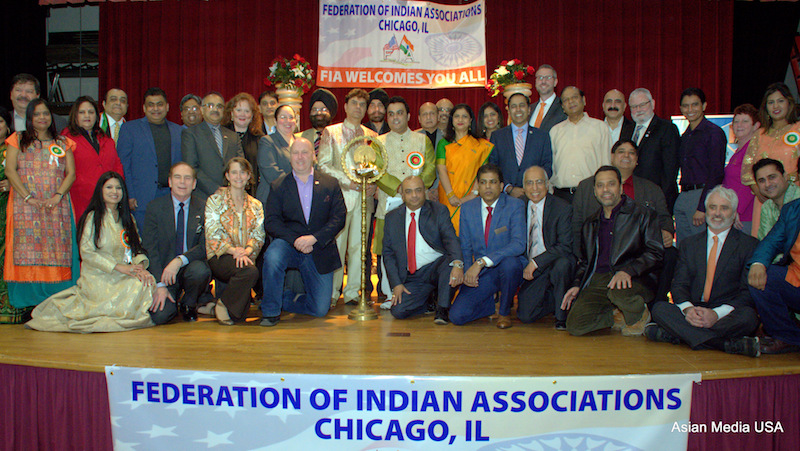
    CHICAGO, IL (TIP):  The Federation of Indian Associations Chicago (FIA) celebrated India’s 69th Republic Day by holding a Community Event at Shree Swaminarayan Temple, Itasca Illinois on Sunday, Jan 28, 2018. The event comprised of a blood Donation drive, a Health and Wellness Camp, Information on Medicare and Medicaid benefits, Information and advice on Taxation, College counselling, and Passport and Visa help.

    The event attracted more than one thousand people from the community who took advantage of the various services offered. The Blood Collection Drive was conducted by Heartland Blood Centers. The Health and Wellness Camp saw more than 25 doctors in attendance comprising of dentists, Internal Medicine, Orthopedic, Optometric, Cardiologist, Chiropractors, Urologists, Physiotherapists and Podiatrists taking care of people. Around 325 people had their blood and other vitals checked, and more than 55 had an on the spot EKG taken for their heart issues, while others went on to see other doctors with their general and specific health issues starting from dental issues, general and specific health issues, orthopedic issues, heart issues, not to forget muscle and joint issues.

    Dr Kamal Patel Checking Blood pressure for Ms. Neeta Bhushan, Consulate General of India in Chicago

    There were booths with experts and counselors giving people advice on Medicare and Medicaid, in home help for seniors, taxation advice, and college admission counseling and passport and visa advice booth with officers from the Indian Consulate in Chicago.

    The event began with the American National Anthem sung by Ashika Sachdev followed by the Indian National anthem sung by Geetanjali Maru. Sunil Shah, Founder President, in his speech welcomed the dignitaries to the event and appreciated volunteers who gave their valuable time for this event. Onkar Singh Sanga and Mukesh Shah (Past President) in their speeches welcomed and thanked the volunteers for showing up in large numbers for this community event, spending their valuable time to serve the community and welcomed all the dignitaries and the FIA Board on the stage.

    “This type of event would be the ongoing theme for the FIA. We are opening of non-emergency FIA Toll Free number 1 (833) FIA CARE. I thank all the supporters, doctors and volunteers and dignitaries for joining us in an overwhelming majority at this event, said Neil Khot, the current FIA president.

    FIA Executive Vice President Hitesh Gandhi quoted Sir Winston Churchill:   “We make a living by what we get, but we make a life by what we give”, and added: “One nation, One Vision, One Identity, Freedom in mind, faith in words, Pride in our heart, Memory in our soul, lets salute nation. FIA team serves community with Wellness Camp and celebrates 69th Indian Republic Day”.

    Mayor McLeod and Senator Tom Cullerton handed over the proclamation to the FIA. The event was well attended by dignitaries, elected officials, politicians and respected people from all walks of life. The dignitaries were led by Ms. Neeta Bhushan, Consulate General of Chicago, Mr. Raja Krishnamoorthi, Congressman, Mr. Michael Fredrichs, Illinois Treasurer, Ms. Michelle Mussman, Illinois State Rep, Senator Tom Cullerton, Senator Laura Murphy, Christina Castro, State Rep, Frank Avila, MWRD Commissioner, Bill Mc Leod Mayor Hoffman Estates, Rodney Craig Mayor Hanover Park, Tom Dailly Trustee Schaumburg, Khaja Moinuddin Trustee Hanover Township.

    A view of the gathering

    The traditional lamp lighting ceremony was performed once the dignitaries and the FIA board were on the stage. The dignitaries in their brief speeches extolled and praised the development India has seen since independence and the India USA collaboration in various fields and the friendship between the leaders of both the democracies. The FIA was praised by all the dignitaries for its growth over the last eight odd years. A progress that had put FIA in the forefront among Indian community organizations. Some even put FIA as the best organization amongst all other Indian community organizations.

    This was followed by a patriotic song by Geetanjali Maru. Then all the volunteers were presented with appreciation plaques on behalf of the FIA. A vote of thanks was given on behalf of the FIA by Mr. Hitesh Gandhi Executive Vice President.

    (Photographs and Press release by: Asian Media USA)


  • Goa beckons to  iconic  Carnival  from February 10 to 13, 2018

    Goa beckons to iconic Carnival from February 10 to 13, 2018

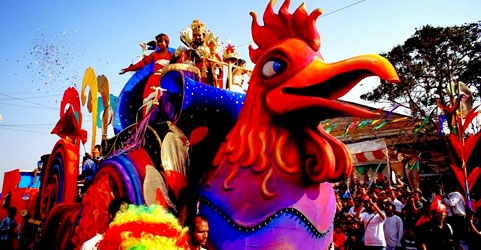
    During Goa carnival, every year a person from the is chosen to play King Momo – a mythological character who symbolically rules the state during the carnival time and leads the float parades held across Goa.

    PANAJI:  The popular annual Goa Carnival will be held across the coastal state from February 10 to 13. The main float parade of the festival will be held in the state capital Panaji on February 10 and  ‘King Momo’ will lead the float parades in all the major cities of the state. Every year, a person from the state is chosen to play King Momo – a mythological character who symbolically rules the state during the carnival time and leads the float parades held across Goa.

    This year, Bruno Azaredo (57), from Utorda village in South Goa district, has been selected to play the role of King Momo and lead the float parades, a spokesman of the state tourism department said.

    State tourism minister Manohar Ajgaonkar earlier took stock of the preparations, including security and traffic arrangements, for the four-day festival. The float parades will be held in Margao and Ponda on February 11, Vasco and Curchorem on February 12 and in Mapusa and Morjim on February 13, he said.

    The carnival committees, set up by the tourism department, have been asked to encourage participants to promote the state’s culture and traditions in the festival and minimise the commercialisation of floats, he said.

    “The vehicles which cause pollution will not be allowed in the parades. The consumption of liquor and carrying of weapons will also not be permitted during the event,” the spokesman said.

    The carnival is being celebrated in Goa since the 18th century and is meant for enjoyment and merry-making, just before the 40 days of Lent, which is the time of abstinence and spiritual preparation for Easter, one of the organisers said.

    The festival was introduced by the Portuguese, who ruled Goa for over 500 years, he added.

    History of Goa Carnival :

    Goa carnival was brought to India by Portuguese during the time they ruled here and approximately 500 years ago the first every carnival was organised in the state. But it was not the Portuguese originally who had these kind of exuberant riotous celebrations, the culture actually came from ancient Rome and Greece and spread to Spain and Portugal eventually. This quite explains that when Portuguese colonised Goa they wanted their culture to be dominant here and hence this carnival was organised. It had a Portuguese flavour to it earlier but with time the celebrations have taken up the essence of Goan culture and thus people identify with the festivities and take part in the carnival in crazily large numbers.

    Entry to Goa Carnival :

    There are no entry tickets for the carnival and you just have to come and take part in the celebrations. Everyone is invited with open arms to join in and revel in the four days of exhilaration and unmatched exuberance.

    Goa Carnival Celebrations :

    There would be no doubt in your mind by now that Goa Carnival is the most awaited event in the state. You can get this from the fact that preparations start in December to make the carnival a roaring success! Music, dance and entertainment are the shining features of the carnival and along with these there are plays of a short length which portray the Goan traditions and culture very beautifully.

    It is organised before the month of Lent is going to begin when people would have to completely abstain themselves from the consumption of meat. Starting with a grand procession on the Fat Saturday evening, the parade is lead by King Momo who sets out with his entourage of dancers, bands, clowns, acrobats and other entertainers to spread the message of merry making across the state.

    The parade moves down through the main street of Panaji, the capital city of Goa? to come to rest after some hours of what seems like “endless gaiety”. The festivities end with red and black dance where women and men dresses in red coloured upper garments and black coloured lower garments dance to the beats of the bands in a festooned procession. Ash Wednesday as it is called is the last day of the carnival when the month of Lent begins. One thing to note is that the feasting is a major part of the festivities and hence this is time for the foodies to venture out and taste some of the best cuisines, drinks and wines here. Pure indulgence, we must say!

    Important Tips to Goa Carnival :

    Booking hotels and travel tickets well in advance will be of huge benefit because you might get your hands on attractive discounts with early booking. Also, advance planning and booking will be good because you would not like to get stuck in the rush hour as Goa is flooded with tourists during the time of carnival.

    Take your best clothes with yourself and get ready to rock the carnival and also don’t wear any shoes that are uncomfortable or may give you a shoe bite as there are a lot of street activities which you may be taking part in.

  • Indian American lawmakers strongly criticize Trump’s anti-immigrant rhetoric

    Indian American lawmakers strongly criticize Trump’s anti-immigrant rhetoric

    WASHINGTON (TIP): All Indian Americans in Congress, much like their Democratic congressional colleagues, strongly criticized Trump’s State of the Union address.

    Reiterating his position on immigration and young Dreamers, Trump said the $25 billion border wall that he proposed in the immigration framework released last week will be the only solution for ending the DACA crisis.

    DACA, or the Deferred Action for Childhood Arrivals (DACA), allows individuals who entered the United States as minors and remained undocumented to get a renewable two-year period of deferred action from deportation. Those participating in the DACA program are called Dreamers.

    Forty-five minutes into his highly stretched first State of the Union address, Trump said the open borders have resulted in the inflow of “drugs and gangs” into the country.

    Trump said that slaying of Kayla Cuevas and Nisa Mickens, two teen girls in Long Island by MS-13 gang members, is the result of unchecked illegal immigrants crossing the national border. The parents of the victims were also present during the event.

    Ironically, Sunayana Dumala, the wife of Srinivas Kuchibhotla, an Indian American tech professional who was shot and killed by a white supremacist in Kansas, was present during the State of the Union address as the guest of Rep. Kevin Yoder when Trump said immigrants were spreading violence in the United States.

    Sen. Kamala Harris, who has been a strong advocate of Dreamers and immigrant, reacted strongly to the speech. “As the attorney general of California, my main area of focus was going after transnational criminal organizations involved in trafficking guns, drugs, and human beings,” speaking to MSNBC, she said. “MS 13 is one of the worst examples of criminal behavior. To equate that with dreamers and DACA was completely irresponsible and it was scapegoating, and it was fear mongering and it was wrong. It was wrong technically in terms of the nature and character of this populations and in terms of who they are and how they love their lives and that is wrong also because it not how leaders are supposed to do. We are not supposed to convince the American population a policy because   we make them afraid and that is exactly what this president is doing.”

    During the President’s speech, Harris tweeted, “Dreamers should not be used as a bargaining chip or held hostage in exchange for anti-immigrant policies.”

    Indian American Rep Pramila Jayapal, D-Washington, who boycotted the State of the Union, also ridiculed Trump’s rhetoric on immigrants and hosted their alternative State of Our Union address at the National Press Club on Tuesday night.

    Reacting to the president’s comments on the immigrants Jayapal tweeted, “the president’s rhetoric was absurd and more of the same. He wants to slash legal immigration and conflate immigrant families with terrorists and criminals and drains on our economy.”

    Speaking to MSNBC she said, “I came to this country as a 16-year-old and now I’m a United States Congresswoman, one among a dozen members of the Congress. But it is so insulting to see him (Trump) continually scapegoating immigrants, trying to make us the division, when we know that all of our ancestors have come here and helped build this county. For him to start with the MS 13 gang and that story and use that story in a way to say everybody is a criminal and therefore, we should cut family immigration to half and even safe family immigration. Even though he didn’t say family migration and said chain migration, what he really means is family reunification – the corner of immigration in this country for the last fifty years. It was outrageous and I’m so glad that I was not there.”

    The Democrat also said that, by holding Dreamers in a hostage-like situation, Trump is asking for ransom, which is to end the legal immigration by half. She also pointed that Dreamers were enjoying legal status and were not deportable until Trump ended the program.

    Another Indian American Democrat, Rep, Ro Khanna of California, after listening to Trump’s State of the Union address tweeted, “Tonight, Trump talked about immigration. His perception is flawed. Real lives are at stake, and I will not stop fighting for the 800,000 DREAMERs who deserve nothing less than a clean DREAM Act.”

    “I will continue to be a voice for jobs and equality, full funding for CHIP, a clean DREAM Act, and necessary disaster relief funding, as well as long-term economic solutions for working families,” he wrote in another tweet.

    A press release issued Rep. Raja Krishnamoorthi said: “I wish President Trump governed with the same tone of promise and cooperation that he used at times during his speech tonight. If only the first year of his presidency had focused on infrastructure, investments in workforce development, and career and technical education, what a different political moment we would all be living in today.”

    Voicing his support for the immigrants, Rep. Ami Bera invited a special guest for the State of the Union,  Dr. Bennet Omalu, a Nigerian immigrant who has made groundbreaking discoveries in caring for brain injuries. “We are a nation of immigrants and that should be celebrated,” Bera tweeted before leaving for the address.  “I’m honored to have him join me at the State of the Union to reaffirm our American values,” he said in another tweet.


  • Indian Origin techie Kuchibhotla’s widow attends Trump’s State of the Union Address

    Indian Origin techie Kuchibhotla’s widow attends Trump’s State of the Union Address

    WASHINGTON (TIP): Sunayana Dumala, the widow of Indian origin engineer Srinivas Kuchibhotla who was shot dead in a hate crime shooting in Kansas last year, attended President Donald Trump’s first State of the Union Address.

    Sunayana, 32, was invited as a guest by Congressman Kevin Yoder to attend the event.

    Kuchibhotla was shot dead while his colleague, also an Indian, sustained bullet injuries after an American navy veteran opened fire in a crowded suburban bar in Olathe city in February last year.

    The shooter thought they were Middle Easterners and was heard telling them to “get out of my country” at the time of the shooting.

    Earlier on Tuesday, Sunayana met a number of Congressional leaders, including House speaker Paul Ryan. The speaker said he knows Sunayana’s story and remembers her.

    Yoder said he asked Sunayana to be his guest as a recognition for her tireless efforts to promote peace, and as a message to the Indian community that the US is a nation of immigrants and they are welcome here.

    “Each year, I have the privilege of inviting one guest to attend the president’s State of the Union address. This year, I invited Sunayana Dumala, widow of Srinivas Kuchibhotla, the Indian immigrant who was tragically killed in the hate crime shooting last year at in Olathe,” Yoder said.

    The Indian American community appreciated the move.

    Brijpal Singh, the chairman of the India Association of Kansas City, said in a letter to Yoder, “This further strengthens our belief and confidence in the American system and its Constitution where everyone is respected, loved and is welcome.”

    The State of the Union Address is a traditional annual speech of the US president to a joint session of the Congress where he gives an account of the situation in the country.


  • Indian American Tech Firm Owner Indicted for Bribing US Official

    Indian American Tech Firm Owner Indicted for Bribing US Official

    The indictment alleges that Parimal Mehta paid bribes to Charles Dodd in exchange for preferential treatment for his company, FutureNet, which received approximately $7.5 million from Detroit in 2015 and 2016.

    MICHIGAN (TIP):  An Indian American and former CEO of an IT company based in Detroit, has been indicted for his alleged role in orchestrating a scheme to bribe a city official in lieu of benefits, the Department of Justice said.

    According to the 11-count indictment filed in the Eastern District of Michigan, Parimal D Mehta, 54, made multiple cash payments to Charles Dodd, former Director of Detroit’s Office of Departmental Technology Services between 2009 to 2016.

    This included two cash bribes hand delivered by Mr Mehta to Mr Dodd in the restrooms of restaurants in the Detroit-area in 2016, the DOJ alleged.

    Mr Mehta also allegedly employed Mr Dodd’s family members at FutureNet and its subsidiaries. Mr Dodd previously pleaded guilty to bribery on September 27, 2016.

    The indictment alleges that Parimal Mehta paid these bribes to Charles Dodd in exchange for preferential treatment for his company, FutureNet, which received approximately $7.5 million from Detroit in 2015 and 2016.

    According to the indictment, Mr Mehta and FutureNet benefitted from Mr Dodd’s influence over the administration of city contracts, expenditures under those contracts, and the hiring and selection of contract personnel.

    Parimal D Mehta obtained confidential information about Detroit’s internal budgets for specific technology projects, the indictment alleges.

    (Source: DOJ)