Author: Guest Author

  • Trump terror stalks Europe

    Trump terror stalks Europe

    His hardline policies go against the West’s political, economic philosophy

    Phobia: There is a mix of anger, frustration, and a sense of foreboding

    “The areas of particular concern include his protectionist economic agenda; threat to wind up “obsolete” Nato that Europe regards as the cornerstone of the transatlantic alliance; and a deep-seated hostility to EU which he has accused of gaining unfair trade advantages from a “grossly undervalued” euro. Europe’s worst fears about his policies have been confirmed by his travel ban on seven Muslim countries (since suspended by a court) and freeze on Syrian refugees provoking a strong reaction from across the continent. German Chancellor Angela Merkel had a sharp exchange with him over the phone reminding him of America’s obligations under the Geneva Convention to help those fleeing war”, says the author – Hasan Suroor.
    Author: Hasan Suroor
    Hasan Suroor

    For the best part of the past 70 years, the Europe-US transatlantic alliance has been paraded as a guarantor of world peace and stability; and the best deal for free trade and liberal democracy. Despite occasional hiccups it has survived, but coming months could test it to destruction if Donald Trump’s bite turns out to be as bad as his bark.

    A few weeks ago, I wrote here about concerns that Vladimir Putin was trying to “undermine” EU institutions and create divisions among its allies. That was before Trump got going with his “America First” agenda and started wagging his fingers at Europeans. Now, it seems, Putin was a laugh; the real menace is “The Donald”. He has a visceral dislike of the EU, has called Brexit a “blessing to the world”, and urged others to follow the British example. European leaders are rattled by his abrasive pronouncements and hardline policies which they find both morally repugnant and contrary to the fundamentals of the West’s political and economic philosophy. European Council president Donald Tusk says Trump poses a serious threat to Europe.

    The expectation that once in power Trump would be forced by the demands of office to tone down his incendiary campaign rhetoric and conduct international relations with a greater sense of responsibility has been belied by the decisions he has taken in the first two weeks of his presidency. The recklessness that characterized his election campaign continues to mark his style in office. In European capitals, struggling to make sense of the new American President, there’s a mix of anger, frustration, and a sense of foreboding. A fear of Trump’s unpredictable behavior – the fear of “what he will do to us?”, as a brilliant essay in The Atlantic put it.


    The areas of particular concern include his protectionist economic agenda; threat to wind up “obsolete” Nato that Europe regards as the cornerstone of the transatlantic alliance; and a deep-seated hostility to EU which he has accused of gaining unfair trade advantages from a “grossly undervalued” euro. Europe’s worst fears about his policies have been confirmed by his travel ban on seven Muslim countries (since suspended by a court) and freeze on Syrian refugees provoking a strong reaction from across the continent. German Chancellor Angela Merkel had a sharp exchange with him over the phone reminding him of America’s obligations under the Geneva Convention to help those fleeing war.

    “She is convinced even the necessary, decisive battle against terrorism does not justify putting people of a specific background or faith under general suspicion,” her spokesman said.

    Trump’s bullying behavior, especially his threats over economic issues, has prompted an unusually sharp response even from the soft-spoken French President Francois Hollande. Trump was trying to “destabilize” Europe and its economy, he said. “The talk we’re hearing from the US encourages populism and extremism.”

    Businesses, meanwhile, are deeply concerned over Trump’s plans to raise trade barriers. His threat to impose 35 per cent tariff on car imports brought a caustic response from Germans who told him that America should learn to “start making better cars” if he didn’t want to import foreign cars. Siemens chief executive was struck by the absurdity of an immigrant-nation turning its face against the world. Even in Britain where the government has shamelessly broken ranks with its European allies to cozy up to Trump in pursuit of an elusive “special relationship” with America, public mood is incandescent. More than 1.5 million people have signed a petition calling for the cancellation of his state visit to Britain in the summer which will earn him a stay at Buckingham Palace and a ceremonial ride along the Mall with the Queen.

    There’s fury over Theresa May’s appeasement of Trump prompting comparisons with another Conservative PM Neville Chamberlain’s policy of appeasement towards Hitler in 1938. She has been dubbed “Theresa the Appeaser” for her fawning behavior during her visit to Washington when she became the first foreign leader to have an audience with Trump after he assumed office. She has been widely condemned not only in Britain, but also by her European allies for her initial silence over Trump’s travel ban until she was forced to issue a mealy-mouthed statement. At a press conference in Ankara she was heckled by journalists frustrated by her refusal to answer their questions on the issue. She declined three times to comment; when pressed a fourth time, she said America was responsible for its own policy on refugees. “Ours is to let in a number of refugees, particularly the most vulnerable”. The lengths to which she has gone in recent days to please/appease Trump has shocked many in her own party and those who otherwise admire her cautious and diplomatic style.

    May’s decision to invite Trump on a full state visit has provoked nationwide protests, and dragged the Queen into a controversy who’s said to have been “put in a very difficult position”. Experts say it’s rare for a US President to be given a state visit in their very first year. There are fears that the visit could end up in a shambles. An extraordinary diplomatic row has already erupted after the Trump team told their British hosts that the President doesn’t wish to meet Prince Charles and be “lectured” on issues they don’t agree on, especially environment. It’s believed to be an unprecedented departure from protocol and “threatens to disrupt” the visit, The Sunday Times warned.

    In a telling cartoon, the Queen, informed of Trump’s visit, is shown throwing up her hand and saying: “One suddenly feels tempted to build a wall.”

    Meanwhile, for all its appeasement, the May government might discover that it hasn’t got anything from him while alienating its European allies who already see Britain as a black sheep. It’s not the first time that London has dumped the rest of Europe for a mythical “special relationship” with Washington. Remember Tony Blair over Iraq? At a summit last week, EU leaders rejected May’s gratuitous offer to be a “bridge” between Europe and America. Thank you, but we don’t need an unreliable broker; we can look after ourselves, she was told. Summing up the mood, Hollande said the best way to protect Europe was to  have “a European conception of our future. If not, there would be – in my opinion – no Europe”.

    His dire warning shows how much Europe has been shaken by Trump’s bully-boy tactics, but it also reveals a deeper crisis of confidence within Europe that it is so rattled by a political upstart in the White House.

    (The author is a London-based commentator)


  • HIGHER REACHES OF YOGA

    HIGHER REACHES OF YOGA

    You are healthy, fairly happy, and well-settled in life. Yet, there is a vague vacuum, a nagging feeling that there should be more to life. This amorphous condition ails many, often unbeknown even to them, but is known in psychiatry and psychology, more so in the past few decades when at least one of the streams of psychology started looking beyond mental illness at enhancing life and happiness, if not imbuing life with meaning.

    The hierarchy of needs in the model of human development postulated by Abraham Maslow, an American psychologist. The peak in this pyramid almost converges with the higher states of consciousness as described in mystic traditions.
    The hierarchy of needs in the model of human development postulated by Abraham Maslow, an American psychologist. The peak in this pyramid almost converges with the higher states of consciousness as described in mystic traditions.

    That stream is known as Humanistic Psychology-Transpersonal Psychology, which goes beyond the established Freudian and behaviorist schools. The most well known of the third school has been Abraham Maslow (1908-1970), an American psychologist who introduced a model of developmental psychology that has become well known not only in the field of psychology, but also in management and other human sciences. It describes five developmental stages, which are based on what Maslow calls human needs. Thus, his model is known as Maslow’s hierarchy of needs and depicted as a pyramid.

    At the base of this pyramid is Physiological Needs, including food, water, air, and sleep. And then on to Safety Needs Social Needs and Esteem Needs. At the peak is the need for Self-Actualization. In between Esteem and Self-Actualization needs, Maslow also later acknowledged the needs for aesthetics and knowledge.

    Point to be noted is that what the most enlightened, modern psychology is asserting lately has been addressed eons ago by the yogic sciences of India. Here we are, of course, talking about authentic yoga, which while possibly including body work or asana-pranayama as a foundation, is actually about encountering, examining, exploring, integrating and transcending the many levels, currents and crosscurrents of mind and consciousness.

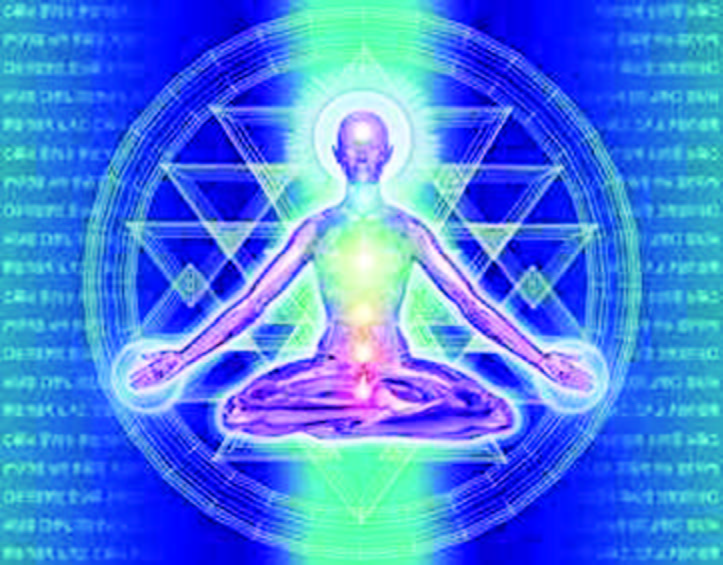
    Most of us routinely experience three states of consciousness, namely, sleep, waking and dreaming states. In meditation, even a novice has flashes of a fourth state, when you subjectively feel you had blanked out, but coming out it did not feel like sleep. Brain wave pattern using the electro-encephalogram will confirm that you were not sleeping, you were alert yet in a deep state of rest. In yoga they call the state Samadhi. It is better understood as pure consciousness –  you are conscious, not of anything outside or inside, but of consciousness itself. It is like the snake eating its own tail. Beyond time and space, samadhi is transcendence of our mundane experience. Perhaps the craving for this transcendence goads so many to experiment with drugs, in particular psychedelics. There is also bliss.

    It is, however, important to note that there is a great difference between the terms Self-Actualization as postulated by Maslow and Self-Realization as in spirituality, with the former having to do with higher levels of fulfillment at the personality level, while still in relation to worldliness. Self-Realization has to do with that knowing of pure consciousness (or many other such terms), which is beyond, transcendent, or transpersonal. Maslow, too, in his later years, expanded his model to include the higher levels of human experience.

    But the bliss and beatitude that we see and sense in depictions of a Buddha, Mahavir, Nanak, Jesus or Krishna seem many times more. That is because they have attained enlightenment  (often shown in pictures as a halo) where they are able to sustain the bliss, the transcendence, the pure consciousness alongside other three states of consciousness. Guru Nanak described it as ‘naam khumari Nanka chadi rahe din raat’.

    A still higher state of consciousness is when pure consciousness experienced within is also witnessed as the stuff of which everything in the universe – animate and inanimate- is made of. I am That, Thou art That, All This is That – declare the three Veda mahavakyas, containing the highest knowledge uttered so simply yet profoundly. Science and spirituality are converging again because Quantum Theory too has reached the point where the source of all matter and energy is described as a vacuum, a nothingness that contains all the possibilities of everything that has ever existed or could exist.

    Mystics and munis would rather say that it is Immanent God that permeates everything. As Pope Francis wrote this week in his encyclical (a controversial document because it calls upon the human world to combat climate change to save the earth),
    “The universe unfolds in God, who fills it completely. Hence, there is a mystical meaning to be found in a leaf, in a mountain trail, in a dewdrop, in a poor person’s face.” The Pope quotes a ninth century mystical Muslim poet Ali-al-Khawas to bridge the gap between the creatures of the world and the interior experience of God: “The initiate will capture what is being said when the wind blows, the trees sway, water flows, flies buzz, doors creak, birds sing, or in the sound of strings or flutes, the sighs of the sick, the groans of the afflicted.”

    Most of us, caught as we are in our daily struggles, transient desires, grasping at this and that, have no time and inclination to take the road not taken – not in these times of ever-present distractions of text messages and YouTube videos and many forms of instant gratification. But the untrodden path promises untold riches, and sublime experience beyond the reach of our ordinary mind and intellect. The mystic streams of major world religions offer the wherewithal to guide the seeker on the odyssey and shining examples in the many prophets and men of God who scaled the higher reaches of yoga and lived to tell the world.

  • YOGA IS SKILL IN ACTION

    YOGA IS SKILL IN ACTION

    HELPFUL TIPS FOR YOGA PRACTICE sideThough spelt yoga in English, the Hindi-Sanskrit pronunciation is yog. Every schoolboy in India knows the meaning of yog as ‘to add’. But here we are talking about  the meaning of yoga as “to join” or “to unite” from the root yuj.

    Although yoga as philosophy and system was codified by Sage Patanjali around 200 BC, it is much older, its references are found in Vedic literature.

    To understand the spiritual dimension of yoga, here we will confine ourselves to the definition of yoga by Patanjali himself and two widely known  and quoted fragments of verses in Bhagavad Gita.

    First, Patanjali. In the very second of his 192 sutras, he says,

    (Yogash chitta vritti nirodhah).
    (Yogash chitta vritti nirodhah)

    It means, yoga is the cessation of the fluctuations of the mind or thought impulses. In other words, you are doing yoga in order to achieve a stillness and clarity of mind. But many meditators take it to mean consciously and forcefully trying to stop thoughts. That is difficult to achieve. What does work is creating the right conditions allowing the mind to settle down. In Indian spirituality mind is often compared to a monkey, difficult to control. But lead the monkey to a bunch of bananas, and it will settle down. So it is with the mind. Lead it with meditation  towards the source of happiness within (the Kingdom of God is within you, said Jesus), and it gravitates towards that and thoughts subside, eventually leading to the yogic state of samadhi.

    In a later sutra, Patanjali also lists five things that cause klesha or obstacles in achieving a state of yoga. These are: ignorance, I-ness, desire, aversion and attachment. And he suggests ways to be rid of them.

    Now Gita.

    Screen Shot 2015-06-13 at 3.31.12 PM

    In this verse, Lord Krishna is advising Arjuna to perform action while established in yoga, or dwelling in union with the Divine, and at the same time renouncing all attachments. He is advising Arjuna to remain in a state of equipoise in both success and failure. This is Karma Yoga philosophy that leads to equilibrium or equanimity of mind. When all our actions are performed while dwelling in Divine in this manner, we truly start living the ‘Work is Worship’ philosophy. One common misinterpretation of this verse is: never desire the fruits of action. It is wrong because results are inevitable. Action begets reaction. It is the worrying about the desired results that causes anxiety.

    Yoga again is central to this statement of Gita.

    Screen Shot 2015-06-13 at 3.33.54 PM
    (Yogah Karmasu Kaushalam)

    It simply means, ‘yoga is skill in action’. Even the reverse may be true. Skill in action is yoga.

    The full verse ending in Yogah Karmasu Kaushalam says: One who is equipped with equanimity in this life discards both merit and sin. Therefore remain established in yoga; yoga results in perfect action.

    This is where Krishna starts addressing Arjuna’s inaction – almost a catatonic state. The warrior prince is bedeviled by doubts arising from concerns about fighting and slaying his uncles and cousins. Krishna argues that if one performs svadharma with equanimity, one doesn’t have to constantly ponder whether an action will beget merit or sin. We begin to detach ourselves from the results or fruits of our actions, we will also not get attached to merit and sin.

    Interestingly, Indian philosophy for long was considered renunciatory and escapist, for which partly to blame was this simplistic understanding of Gita: Karam karo phal ki ichcha mat karo. Imagine, the sermon of Gita is given on a battleground, the acme of action!

    You may think this is spiritual mumbo-jumbo, and ask, “What is in this for me in practical terms?”  Well, one can show ‘yoga is skill in action’ translating as increased efficiency and improved productivity. Yes, since the 1950 there have been umpteen research studies on meditation’s psycho-physiology  and the effects of regularly experiencing the meditative state (yoga)  on everyday life.

    What is well established by now is that meditation slows down the metabolism while mental alertness instead of reducing  (as seen when one is  drowsy) is actually enhanced. This unique state of consciousness called restful alertness is different from the three states of consciousness, which we normally experience, namely sleep, dreaming and wakefulness. And it washes away tension and stress. As a result, quality of sleep improves. There is relief in psychosomatic diseases like high blood pressure, ulcers, and migraine. Brain waves (as graphed by EEG or electroencephalogram) become more coherent and synchronous. More energy, ability to concentrate and a positive attitude all add up to improve efficiency and in turn productivity. The overall quality of life becomes better.

    From the various forms of meditation, Transcendental Meditation or TM as taught by Maharishi Mahesh Yogi ruled the roost for a few decades. Lately, mindfulness is finding favor in the corporate world as well as hospitals and health centers in America. Mindfulness comes from Buddhism if not the Buddha himself and has been popularized in our time by France based Vietnamese Zen master Thich Nhat Hanh. Mindfulness is a state of active, open attention on the present. When you’re mindful, you observe your thoughts and feelings from a distance, without judging them good or bad. Instead of letting your life pass you by, mindfulness means living in the moment and awakening to experience.

    As you can see, there is no religious symbolism, no belief system involved here. It is as secular as you can get. So is yoga.


  • HELPFUL TIPS FOR YOGA PRACTICE

    HELPFUL TIPS FOR YOGA PRACTICE

    If you have been practicing yoga asana for some time, some of these tips won’t be new to you. For the neophyte, certainly the advice will come handy.

    HELPFUL TIPS FOR YOGA PRACTICE sidePREPARATION: Best time to practice asanas is in the morning. Finish your ablutions, have a bath, and practice before breakfast. Wear loose, comfortable clothes. No shoes or belts. Best is to buy a sticky yoga mat (costs $10 onward) though a folded soft blanket will do too. The surface to do yoga should be neither too soft, nor too hard.

    YOGA STUDIO: In America, most neighborhoods have yoga studios, with varying price structures. Shop around. Look at lineage if any. Prefer one belonging to a larger organization, solid affiliation or certification.

    SELF-LEARNING: It is best to learn yoga from an experienced teacher or yoga master. At the same time, one can argue that while the results you  get from yoga practice may be profound and far-reaching, and its effects on the body-mind system subtle, the practice of asanas itself is not rocket science. You can learn on your own.

    [quote_center]Yoga apps and online[/quote_center]

    We know Baba Ramdev got his first surge of popularity when hundreds of thousands of people started practicing yoga following his instructions on his TV program on Aastha and other channels. Here in America with its DIY culture, many yoga studios and health clubs are offering online yoga classes that allow people to practice at home. Smartphone apps makes it still easier. Digital yoga lets beginners try it out away from strangers’ gaze, and without investing much. Yoga-gear giant Gaiam Inc has acquired the Yoga Studio app, which features 65 classes. It costs $3.99 but many other popular apps are free. While 60- to 90-minute classes are standard in a studio, online viewers often gravitate toward targeted workouts as short as 10-15 minutes. Adriene Mishler, an Austin, Texas,-based yogi, offers her classes free online at her YouTube channel, Yoga With Adriene.

    DO NOT OVER-REACH: Remember the only sutra in Patanjali’s Yoga Darshana about postures is – sthira sukham asanam. A posture should be stable and comfortable. You aspire and move towards the final position of the posture, but if you can reach only halfway, that is fine then. With regular practice you will get there one day. Some yoga schools like Iyengar’s have props like cubical blocks and ropes as aids, but better not try them on your own.

    [quote_center]A basic set of asanas[/quote_center]

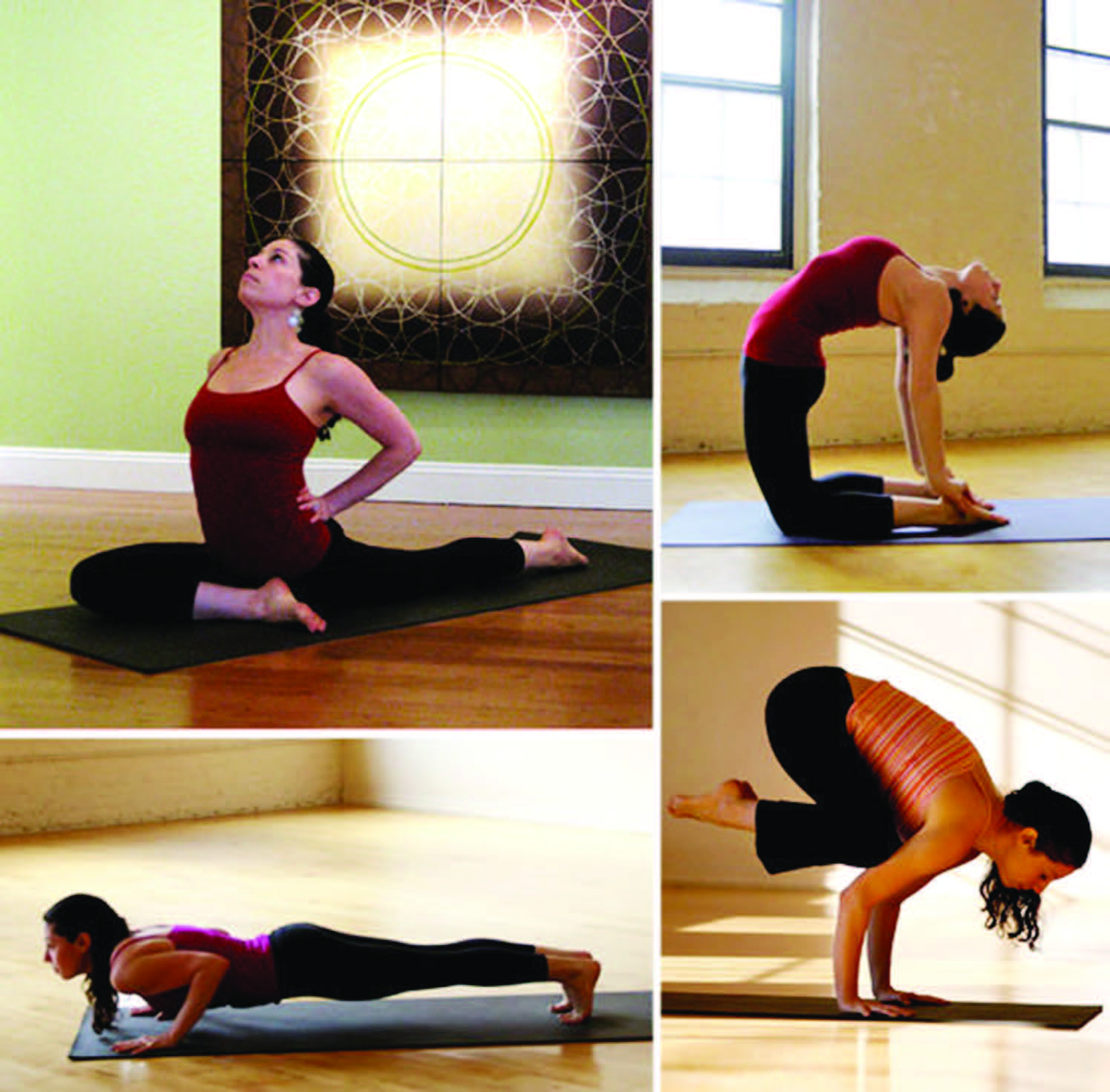
    HELPFUL TIPS FOR YOGA PRACTICE INNERIf you can spare just 10-15 minutes a day for yoga practice, this is one set of asanas and sequence to follow: Vajrasana (legs folded, sitting on soles of feet), Paschimottanasana (sitting forward bend), Sarvangasana (shoulder stand), Halasana (plough), Bhujangasana (cobra), Shalabhasana (locust), Ardha Matsyendrasana (spinal twist), and  Pada Hastasana (standing forward bend). Finish with shavasana or copse posture. Mind you, the best known asana – shirsasana or the headstand – is discouraged by many masters these days.

    SHAVASANA: You always end a session of yoga asanas with Shavasana, literally, the corpse pose. Many yoga classes may have an elaborate/longer version of the Shavasana. In the basic pose, you lie down on the back with legs stretched and about one foot apart; arms on the sides 6 inches away from the body; neck tilted to one side. Relax. Lie down in Shavasana after every asana or as and when you feel tired or strained.

    BREATHING DURING ASANAS: One idea is to keep aware of breathing during asanas. And, of course, in some asanas, automatically you will feel like exhaling long and deep and pausing for a while before inhaling – that is the way to consciously do it too.

    ANULOM VILOM PRANAYAMA: Thereare many elaborate pranayama (for example, Kapalbhati, which is Baba Ramdev’s favorite). Anulom vilom (alternate breathing) is the easiest and simple to practice. Sit erect in any meditative pose. Press your middle and ring finger on the left nostril and breathe out gently through the right nostril. Inhale through the right nostril. Now press down with the thumb on the right nostril and exhale through the left. Inhale through the left. Exhale through the right, and so on for about 5 minutes.

    SURYA NAMASKAR: Surya Namaskar or the Sun Salutation is one of the most well-known yoga routines. As stand alone you can do a few rounds of Surya Namaskar when having limited time available. Best done early in the morning  for several health benefits. The routine consists of 12 sequenced forward and backward bending movements that stretch and flex the spinal column. It has a deep effect in detoxifying the organs through copious oxygenation and has a deeper relaxing effect.

    COMPLEMENTARY/CONTRARY POSTURES: A forward bending asana should be followed by backward bending posture; a downward bending asana balanced by an upward bending.

    Yoga must before meditation When overzealous meditators start doing long sittings, the experienced teachers dissuade them and strongly recommend first grounding the mind with asana and pranayama. It is not a crass thing to focus too much on the body. Being physically fit is important in spiritual pursuits too. In fact, the yogis and rishis of yore devised
    asana/pranayama and even ayurveda so the spiritual aspirants stay healthy, physically and mentally. The higher chakra over-activation, caused by meditation without the grounding power of asanas and karma yoga can have deleterious consequences. I remember in the advanced residential courses I attended while in the Transcendental Meditation movement, each 20-30 minute meditation session was preceded by 10 minutes of yoga and 5 minutes of anulom vilom pranayama. Together this set was called a rounding. Depending on time available one could do 2-3 rounding in the morning and 2-3 in the evening.

  • The text and context of yoga

    The text and context of yoga

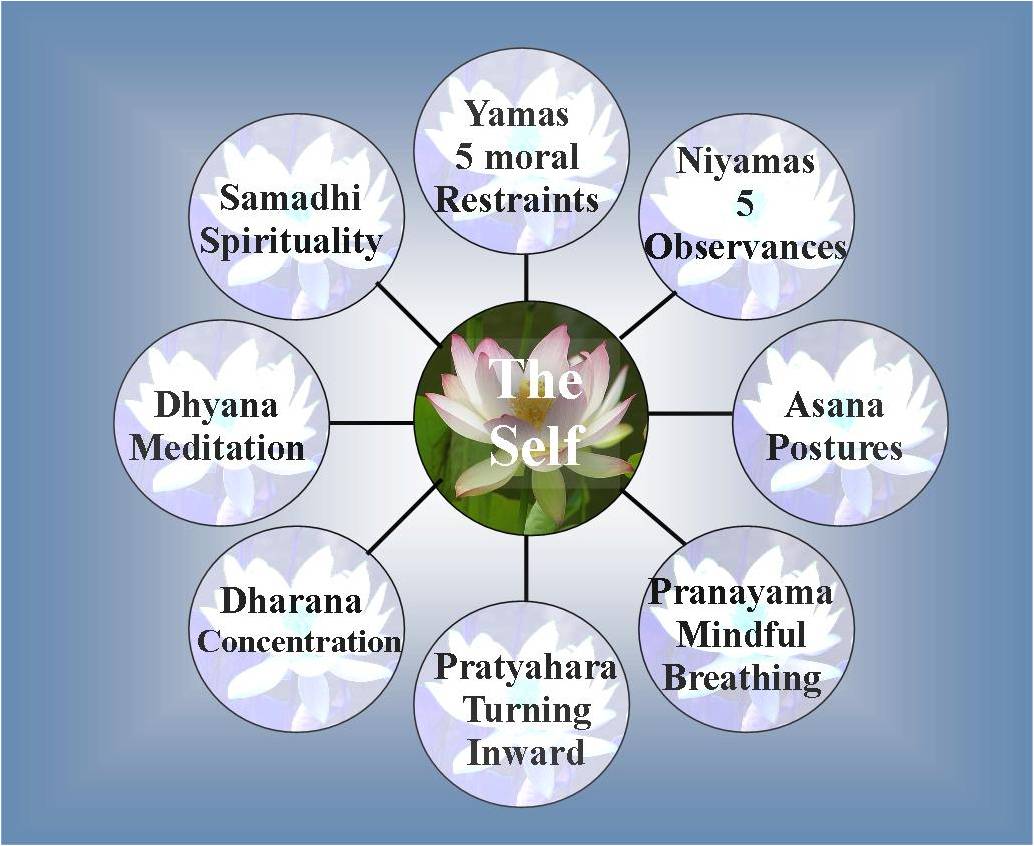
    [quote_box_center]“It will be worthwhile putting asanas in the context of the complete discipline of yoga – Patanjali’s ashtanga yoga or eight-limbed system as expounded in only 196 pithy sutras in his treatise titled Yoga Darshan. The eight parts are: Yama, Niyama, Asana, Pranayama, Pratyhara, Dharana, Dhyan and Samadhi. Yama (like nonviolence and truthfulness) and Niyama (like purity and contentment) are don’ts and do’s which are commandments universal in nature and common with ethical practices of world religions”.[/quote_box_center]

    YogaThe practice of yoga – even if it is only asanas or postures as is ubiquitous today – can serve as a window to the holistic and perennial philosophy of India. Frankly, the term ‘Indian philosophy’ is a misnomer. The Sanskrit equivalent is ‘Darshan’, which denotes seeing, witnessing, experiential learning. The font of Indian philosophy are, of course, the Vedas, which are considered ‘apaurashya’, meaning they are not what somebody wrote down, but a record of what our rishis (literally, seers) experienced in their consciousness. The truths and knowledge dawned in their consciousness after preparatory practices and tapas.

    Yoga is one of the six systems of Indian philosophy (Shat Darshan) that take their authority from the Vedas. These are Nyaya, Vaisheshik, Samkhya, Yoga, Purva Mimansa and Uttar Mimansa (Vedanta). There is enough play given to logic (as in Nyaya), or theoretical exposition of consciousness (as in Samkhya). But in time, Yoga and Vedanta have emerged as the cornerstone of Vedic religion, full flowering of the long-standing Indian tradition: Vedanta reaching the highest and noblest understanding of the ultimate reality as pure consciousness that underlies all creation animate and inanimate; and yoga offering practical and time-tested ways and means – asanas, pranayama and meditation – to experience that pure consciousness first hand. This is also considered the royal spiritual path- Raja Yoga.

    True, most of us, caught up in our mundane lives and struggles, are not worried overmuch about esoteric subjects like the ultimate reality, or pure consciousness. Yet we all wish for health and happiness. That is where yoga appeals. Once you attend a yoga class, you notice right away how it goes beyond mere physical exercise. The structured set of asanas also relaxes the body and mind, creating equanimity. The health and other benefits of yoga are well-known (we will review them in another article in this series) and the reason the western world has cottoned on to this Indian import.

    But, it will be worthwhile putting asanas in the context of the complete discipline of yoga – Patanjali’s ashtanga yoga or eight-limbed system as expounded in only 196 pithy sutras in his treatise titled Yoga Darshan. The eight parts are: Yama, Niyama, Asana, Pranayama, Pratyhara, Dharana, Dhyan and Samadhi. Yama (like nonviolence and truthfulness) and Niyama (like purity and contentment) are don’ts and do’s which are commandments universal in nature and common with ethical practices of world religions. They are suggested but not a pre-requisite to starting the practice of asanas and meditation. In fact, the system of yoga is as secular as you can get. You are not asked to worship any Hindu deity or sacred book, or have belief in God or a supreme power. Yoga can even claim to be scientific. As in any science experiment, if you practise yogic techniques properly and regularly, results are bound to accrue precisely like in H2+O making water. Asanas are physical postures. Pranayama is breathing practices. Pratyhara is withdrawal of the senses from sense objects. Dharana is concentration and cultivating inner perceptual awareness.

    Besides devising the elaborate sets of asanas and breathing techniques, what tells Vedic religion and yoga apart from Occidental religions is in the enormous R&D in meditation or Dhyan, the seventh limb of yoga. Numerous practices, varying in complexity and degree of difficulty, have come down to us, thanks mainly to the guru-shishya parampara and the oral tradition. They are better learnt from a teacher; some are easily accessible like Transcendental Meditation or TM as taught by Maharishi Mahesh Yogi of the Beatles fame. Buddhism too digged deep into states of mind and developed meditation practices such as Vipassana as popularized by S.N. Goenka from Igatpuri in Maharashtra, and mindfulness, which has caught on lately in certain medical and corporate circles in America. Jains rediscovered Preksha Dhyan a couple of decades ago at the behest of Acharya Tulsi.

    Samadhi is the meditative absorption attained by the practice of dhyāna. The mind becomes still. There are no thoughts; only consciousness, not of anything outside but of itself. That is why it is called pure or transcendental consciousness. Regular experience of this mystical state leads to it stabilizing outside the meditation sitting too. As Guru Nanak said in Japji sahib, ‘Naam khumari Nanka charhi rahe din raat’ – a permanent state of bliss and beatitude. Patanjali Yoga aims for Kaivalya or liberation. Buddhism targets Nirvana. Enlightenment and cosmic consciousness are terms used by others for the final fruit of a spiritual life.

    So, let a thousand yoga studios and classes bloom. Nobody can take away from the fact that yoga originated in India. At the same time, no faith or system can claim a copyright over the mystical states which are potentially accessible to and a birthright of every human on this earth.

  • International Day of Yoga – A GLOBAL CELEBRATION

    International Day of Yoga – A GLOBAL CELEBRATION

    YogaYoga has been growing exponentially – and organically -worldwide in the past few decades, but credit goes to Indian Prime Minister Narendra Modi for taking the initiative to get United Nations to declare June 21 as International Day of Yoga to be observed every year.

    The resolution in the UN General Assembly on Dec 11, 2014, endorsed by a record 177 members, recognized that “yoga provides a holistic approach to health and well-being, and that wider dissemination of information about the benefits of practicing yoga would be beneficial for the health of the world population.” The resolution invited all nations, UN and world organizations as well as civil society and NGOs to observe IDY to raise awareness of the benefits of practicing yoga.

    The UN resolution followed Modi’s call during his address to UNGA on Sept 27 last year wherein he stated: “Yoga is an invaluable gift of India’s ancient tradition. It embodies unity of mind and body; thought and action; restraint and fulfillment; harmony between man and nature; a holistic approach to health and well-being. It is not about exercise but to discover the sense of oneness with yourself, the world and the nature.”

    June 21 was suggested for yoga day because it is the Summer Solstice (longest day of the year in the northern hemisphere), and from the perspective of yoga, it marks the transition in the Sun’s celestial passage from north to south. This year June 21 falls on a Sunday.

    Lauding Modi for IDY, the Art of Living founder Sri Sri Ravi Shankar, who himself had earlier lent support for a yoga day, said, “It is very difficult for any philosophy, religion or culture to survive without state patronage. Now, official recognition by the UN would further spread the benefit of yoga to the entire world.” Sri Sri and Sadhguru Jaggi Vasudev (founder of Isha Yoga) are traveling around the world headlining events attended by thousands in the run up to the International Day of Yoga.

    Yoga is at least 5,000-year-old and one of the six systems of Indian philosophy. It was codified by Maharishi Patanjali in 200 AD as Yoga Darshan, containing 195 Yoga Sutras. The core essence of Patanjali is the eightfold path or Ashtanga Yoga containing observances and practices for the holistic growth of a human being – physical, moral, mental and spiritual. Yoga’s literal meaning of union (of individual consciousness with universal consciousness) lays out its higher reaches.

    In today’s world, though, yoga to most people has come to mean the practice of asanas – physical postures, but Patanjali’s treatise has only one sutra about postures- sthira-sukham asanam (2.46), which translated from Sanskrit means: posture should be stable and comfortable. So where are the numerous asanas practiced in yoga classes coming from?

    The answer is, they originate from the age-old Hatha Yoga tradition, one treatise for which is called Hatha Yoga Pradipika.

    The modern revival of yoga can be traced to T. Krishnamacharya, who started teaching it from Mysore in 1924. Among his students prominent in popularizing yoga in the West were B.K.S. Iyengar (Iyengar Yoga) and K. Pattabhi Jois (Viniyasa Yoga). Another major stream of influence within India and and abroad has been Swami Sivananda of Rishikesh and his equally formidable disciples including Swami Vishnu-devananda (Sivananda Yoga Vedanta Centers), Swami Satyananda (Bihar School of Yoga) and Swami Satchidananda (Integral Yoga). In India lately, Baba Ramdev has taken his yoga-pranayama mix for curing ailments to every nook and corner of the country.

    Yoga also received a fillip with the introduction of Indian spirituality to the West starting with Swami Vivekananda’s iconic address to the Parliament of the World’s Religions in 1893 in Chicago. Followed meditation movements of Yogananda Paramahamsa (‘Autobiography of a Yogi’; fame), TM guru Maharishi Mahesh Yoga, Swami Muktananda, Osho Rajneesh, Yogi Bhajan, and more recently Sri Sri Ravi Shankar. These too had a yoga component.

    Today, yoga is practiced by an estimated 300 million people worldwide. In the western countries, you can find a yoga studio almost every few blocks. In the US, the number pf yoga practitioners is estimated to be over 30 million. A survey by the redoubtable National Institutes of Health (NIH)  reported that in 2012, nearly 10% of US adults and 3% of children participated in yoga, almost double than 5% of adults and 2% of children a decade earlier.

    The purists can argue that in its current form, yoga has been reduced to a system of physical exercises. But the practitioners must be liking it, enjoying it and benefiting from it enough to continue to spend their time and energy and money on the practice. Besides, one can also argue that the asana practice, unlike gym workouts, does create a sense of peace and equanimity –  a meditative state in short. Interest is also kindled in practitioners about yoga’s other dimensions and its origins.

    Yoga is part of India’s great heritage. UNESCO’s director general Irina Bokova, who met PM  Modi in Paris earlier this year, affirmed that yoga is in the list of elements to be considered by the Intangible Heritage Committee for inscription on UNESCO’s register. She also told an Indian daily that “UNESCO’s general conference in October will also look to endorse the International Day of Yoga”.

    Modi launched a portal (www.Idayofyoga.Org) for the International Day of Yoga onApril 10 from Paris while addressing a gathering at UNESCO headquarters. The portal gives details of events and venues connected with the IDY, besides videos on individual yoga postures.

    The Government of India has planned to celebrate the IDY in countries around the world, including United States. In Washington DC, on June 21, Embassy of India is organizing a day-long event at the National Mall in collaboration with various yoga organizations, practitioners, and community organizations. In New York, Times Square is the leading official public site for  IDY and dignitaries from the UN and Indian government are scheduled to attend the day long event. It is special because Times Square Alliance has been holding a mass yoga event on Summer Solstice for the last 13 years at the Crossroads of the World.

    Undoubtedly, the global observance of the International Day of Yoga and related events will make  millions of people to become aware of the tenets of yoga, encouraging many to follow a yogic lifestyle, a life that is healthy and harmonious. In turn, IDY is an opening for the world community to realize human oneness, and move beyond war and strife towards peace and harmony.