Tag: BJP

  • Polls in WB, Kerala, Assam, TN from April 4 to May 16

    Polls in WB, Kerala, Assam, TN from April 4 to May 16

    NEW DELHI (TIP): The BJP, Congress, Trinamool Congress and Left parties are now all set for a mega electoral battle.

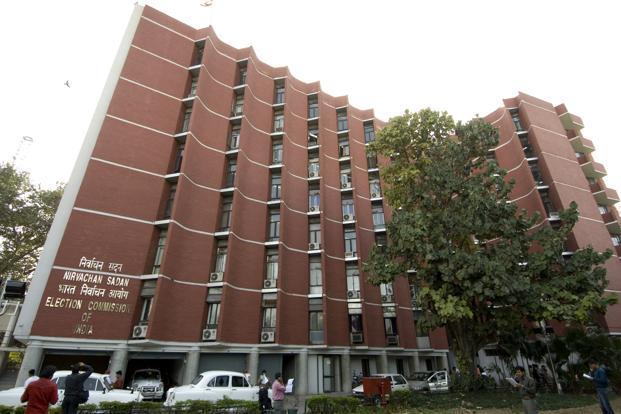
    Chief Election Commissioner Naseem Zaidi said on Friday that the 126-member Assam Assembly will go to polls in two phases on April 4 and 11. Polling for 294 seats in West Bengal will be held in six phases between April 4 and May 5. Kerala, Tamil Nadu and Puducherry will vote on May 16 to elect 140, 234 and 30 members respectively.

    The results of all the state elections will be out on May 19.

    The BJP, which now leads the rulingcoalition at the Centre, has tied up with the Asom Gana Parishad and the Bodo People’s Forum in Assam. It is keen to pose a tough challenge to the Congress which has been in power in since 2001.

    The All India United Democratic Front led by Badruddin Ajmal is likely to be another key player in the poll.

    The Congress and the Left parties are exploring possibilities of a tie-up in West Bengal to pose a tough challenge to ruling Trinamool Congress led by Chief Minister Mamata Banerjee.

    The CPM and other Left parties, however, will take on ruling Congress led by Chief Minister Oommen Chandy in Kerala.

    While the ruling AIADMK led by Chief Minister J Jayalalitha is going it all alone to seek re-election in Tamil Nadu, the Congress already declared alliance with main Opposition party DMK.

    The DMDK is yet to announce if it would join the Congress-DMK alliance. The PMK, too, has not made public its electoral strategy.

    The Model Code of Conduct came into force in the four states and Puducherry soon after the EC announced the poll-schedule on Friday. Zaidi, flanked by Election Commissioners O P Rawat and A K Joti, said that the EC, after visiting the poll-bound states, had directed a time-bound and systematic drive for “improvement in the quality and health of their respective electoral rolls, so as to enhance their fidelity for the conduct of free and fair elections”.

    He said that the Special Electoral Roll Purification Drive from February 15 to 29 focussed on enrolment of all eligible voters, removal of multiple entries and names of dead voters, correction of various types of errors in Electoral Photo Identity Cards and roll data.

    Source: Deccan Herald

  • OPPOSITION PROTESTS GOVT’S ‘INTERFERENCE’ IN ALIGARH MUSLIM UNIVERSITY AFFAIRS

    OPPOSITION PROTESTS GOVT’S ‘INTERFERENCE’ IN ALIGARH MUSLIM UNIVERSITY AFFAIRS

    NEW DELHI (TIP): Opposition parties led by Congress and SP on March 5 created a storm in Rajya Sabha over alleged government interference in the autonomy of Aligarh Muslim University (AMU), forcing adjournment of the House till noon.

    Opposition members trooped into the well, raising slogans against alleged threat to the minority status of the university and government interference.

    Deputy chairman PJ Kurien asked members to return to their seats and give notice if they wanted a discussion on the issue but as none relented, he adjourned the House till noon.

    Javed Ali Khan of SP, through a Zero Hour mention, raised the issue of human resource development Minister Smriti Irani declaring offsite centres of the university illegal and threatening to stop financial aid.

    The University’s executive committee and academic council, drawing rights from Section 12 of AMU Act, in 2008 had decided to set up five off campus centres. Three of them were made operational, he said adding the BJP government has now questioned that decision, Khan said.

    He said AMU vice-chancellor has in a statement said that HRD minister was declaring these centres illegal and threatening to stop assistance.

    “They talk of ‘sab ka saath, sab ka vikas’ but want to deprive a large section of population of education,” he said demanding a clarification from the government on the minority status of AMU and other such insitutions.

    Minister of state for parliamentary affairs Mukhtar Abbas Naqvi said the government is committed to protecting minority status of AMU and other minority institutions.

  • Want azadi within India and not from India: Kanhaiya

    Want azadi within India and not from India: Kanhaiya

    NEW DELHI (TIP): Thank you, Tihar. You took in an “anti-national” and sent out a national treasure.

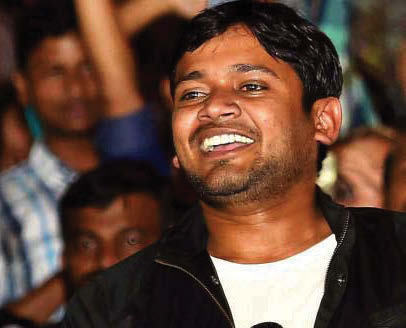
    Kanhaiya Kumar on March 3 night exploded on the collective consciousness of India, sending an electrifying spark down the nation’s spine and making fingers fly across keypads with one question: Did you watch the speech?

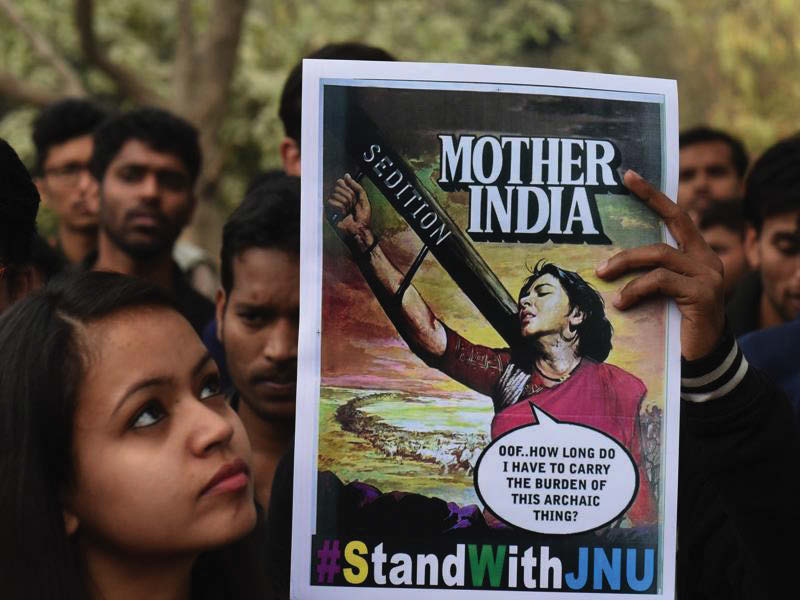
    Freed from Tihar jail this evening, the JNU student leader delivered a speech whose underlying theme was freedom itself: ” Bharat se nahin, mere bhaiyon, Bharat mein azadi chahte hain (we don’t want freedom from India, my brothers, we want freedom in India).”

    It is an idea of India that the Narendra Modi government will find difficult to crush with a sedition law. It is an idea of India that was embraced tonight by an unstoppable force on the planet: a generation in full flow in the very flower of its youth.

    ” Awaz do, hum ek hain, (Shout out aloud that we are one),” Kanhaiya told the cheering hordes on the campus.

    Prime Minister Modi and HRD minister Smriti Irani found mention in Kanhaiya’s speech, delivered in so fluid a manner and with nary a trace of rancour that it appeared he was born for the podium.

    The speech also had another far more potent narrative: the young man did not shy away from addressing the biggest criticism against the students – that they were insulting the soldiers who are risking their lives on the borders.

    ” Ek BJP ke saansad ne kaha ki sipahi shaheed hote hain seema par…. Main poochhna chahta hun, kya woh unka bhai hai? Khet mein jo kisan hai woh uska beta hai. Aap uske liye kya karte hain? Woh mera bhai hai, mere pita hain (one MP had said soldiers are being martyred on the borders…. I want to ask, ‘Is the soldier his brother?’ The soldier is the son of the farmer who toils in the fields. What are you doing for the farmer? The soldier is my brother and the farmer is my father),” Kanhaiya said.

    He said something that should send a shiver down the spine of any government or party in a country with millions of youngsters: “We will not forget.”

    ” Halaki hum Bharatiya log bhoolte jaldi hain, lekin is baar ka tamasha itna bada hua, ki bhool nahin paye. (We Indians forget easily, but this time the show was so big a farce that no one could forget the slogans),” Kanhaiya told the huge audience that included JNU students, faculty members, their relatives and students from other institutions.

    Over to the boy who delivered a masterly performance with a killer smile. Excerpts from the speech:

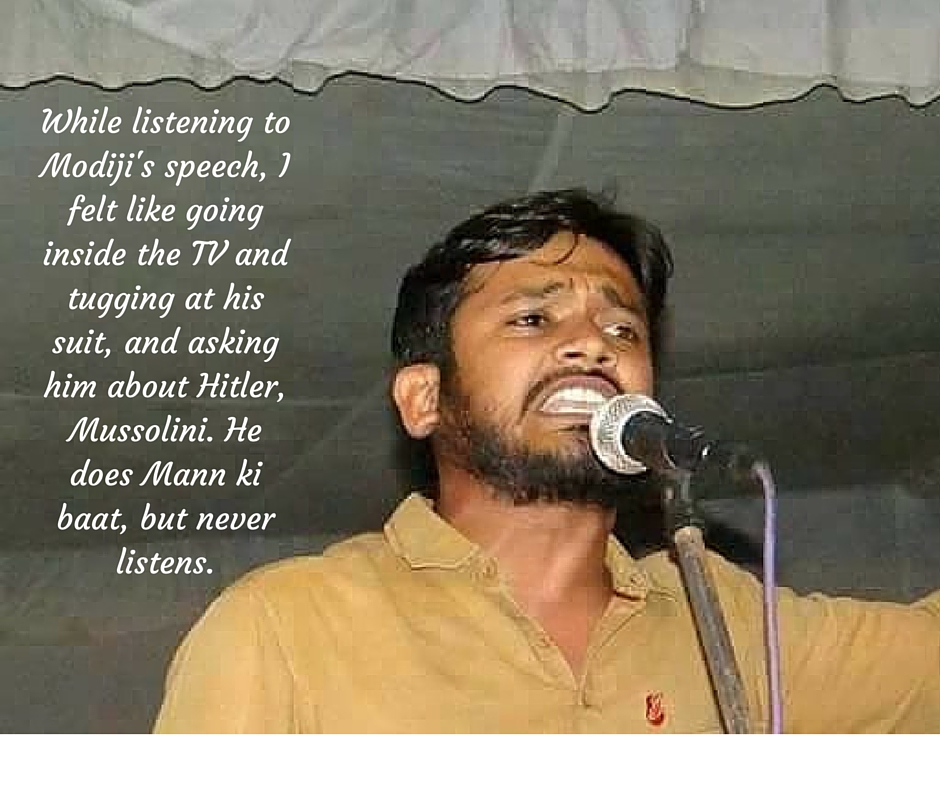
    Modiji Mann ki Baat karte hain, par sunte nahin hain. (Mr Modi delivers his Mann Ki Baat but doesn’t listen).

    Meri ichchha hui TV mein ghus jaoon aur unse kahoon ki thoda Hitler ki baat bhi kar lo (I felt like getting inside the TV and telling Modi to talk about Hitler too). Kanhaiya was referring to the Prime Minister’s speech in Parliament today during which Modi referred to Soviet leaders Khrushchev and Stalin.

    The PM has tweeted ‘ Satyamev Jayate‘. Although I have huge differences with his ideology, I want to say ‘Yes, Satyamev Jayate.

    To Smriti Irani, I would like to say: ‘We are not your child. We are JNUites’.

    We have no grudges against the ABVP as we are truly democratic people. We truly believe in the Indian Constitution.

    I do not hate the ABVP. I won’t hunt them. Why? Because they are not worth the hunt.

    I want to thank everyone who supported me…. special thanks to all the big leaders sitting in Parliament who claim to have the power to decide what is right and wrong.

    We will fight the government. They will set the cyber cell on us, doctor videos to trap us. They will even count the condoms in our dustbins. ( A BJP legislator had claimed that 3,000 used condoms, 2,000 liquor bottles, 10,000 butts of cigarettes, 50,000 big and small pieces of bones from non-vegetarian food had been found on the JNU campus.)

    Bandh karna chahte hain tamam awazon ko, chahe seema pe khada ho, chahe khet mein, chahe JNU mein (they want to snuff out all the voices, whether they are on the borders of the country, whether in the farm fields, whether in JNU).

    Hum Bharat se azadi nahin, Bharat mein azadi chahte hain; Bhukmari se azadi, bhrashtachar se azadi… RSS se azadi, Manuvad se azadi, jativad se azadi, hum le ke rahenge azadi (freedom from starvation, freedom from corruption… freedom from the RSS, freedom from caste, freedom from communal thought, we will get our freedom).

    I was given two bowls in the jail, one blue and one red, both on one plate. It symbolised India.

    Source: The Telegraph

  • Mehbooba hints at govt formation with BJP

    Mehbooba hints at govt formation with BJP

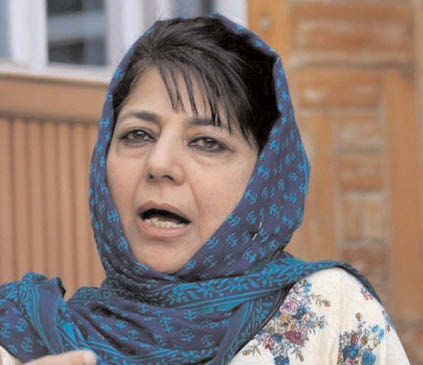
    JAMMU (TIP): After two-month suspense, Peoples Democratic Party (PDP) president Mehbooba Mufti has said that she is not ‘stubborn’ and hinted that the party would be going ahead with the Bharatiya Janata Party (BJP) to form the government in Jammu and Kashmir if the latter ensures that aspirations of people were met.

    Speaking during a party function on March 4, Mehbooba claimed that she was not afraid of criticism on the issue but wanted a signal from the BJP-led NDA Government at the Centre that it will do everything for the welfare of people of the state. “I am not a stubborn person, if I feel that the Centre is working for the welfare of the state then surely the government will be formed,” she said. “However, if it is only for the sake of government formation, or to delay polls, or to provide some work to MLAs, let me make it clear that I am not ready,” she added.

    Mehbooba, whose party has 27 MLAs in the 87-member Jammu and Kashmir Assembly, said if the promises are not fulfilled the formation of the government meant to keep away from the elections for five years.

    Source: ANI

  • BUDGET SPECIAL | UNION BUDGET 2016-17 | BUDGET REACTIONS

    BUDGET SPECIAL | UNION BUDGET 2016-17 | BUDGET REACTIONS

    “This Budget is pro-village, pro-poor, pro-farmer. The main focus is to bringing about qualitative change in the country. There will be a big change in the lives of common people. Several steps have been taken for the farmers. The most important is Pradhan Mantri Krishi Yojana.”

    – Narendra Modi, Prime Minister of india

    “The thrust of the budget is towards strengthening rural and agriculture sectors and boosting employment-generation…. There is a lot of focus on agriculture. There is a proposal to double farmers’ income by 2022. Families will get health insurance of Rs 1 lakh for free. This is a big step…. More than Rs 2000 crore will be spent on giving LPG connection to 1.5 crore families and it will help rural women in a big way.”

    – Amit Shah, BJP president

    “Unfortunately, what was needed to be done has not been done. Biggest challenge which we face today is in employment and agriculture sectors. There is not anything on that.”

    – Kamal Nath,Congress leader

    “The government has painted a very broad and general picture and it has to be seen how everything works out in practice.”

    – Shashi Tharoor, Congress MP

    “In totality it is going to shrink the economy. Markets have given the budget a thumbsdown.”

    – Manish Tewari, Congress leader

    “Modi govt walks the talk. Thank you Modiji and Arun Jaitley ji for giving a visionary budget in difficult times. Congrats for changing direction of budget speech from small geographic & sectoral announcement to broad focus plan. The social sector spending is not only increased but planned in targeted direction to ensure the quality of expenditure and outcome. The huge infra spending will create jobs and fuel growth while target of doubling farm income will change the future of the nation.”

    – Devendra Fadnavis, Maharashtra CM

    “The budget is for everybody. Budget has been provided for infrastructure like ports, rail, airports. In the health sector, for poor people, upto Rs one lakh cost of hospitalisation will be borne by the government. This is a progressive and visionary budget.”

    – Prakash Javadekar, Union Minister

    “India is a country where agriculture holds a prime place but it is after years that this has been reflected in a budget which gives priority to farmers as well as weaker sections. This budget is one which will also lead to empowerment of the youth.”

    – Mukhtar Abbas Naqvi, Union Minister

    “It is good that the budget has focussed on real areas, noting that at the same time it also has many things for the corporates. The overall philosophy has to take something from the super-rich for the benefit of the poor which is alright. Finance Minister has maintained fiscal discipline while also making provisions for measures like Pay Commission, OROP and road and transport investment. By these measures, the boost which we wanted in the economy will be possible.”

    – Yashwant Sinha, BJP leader

    “There is no relief for the common people in the budget. However, relief has been given to industrialists. The long-pending demand of waiving farmers loan has also not been considered. They criticised MNREGA and Aadhaar. The UPA government gave Rs 40,000 crore to MNREGA. This (the budget allocation) is not a big thing. If you compare the wages that have increased, then it is important. It is not important how much total allocation has increased. If it was Rs 100 a day, then we gave Rs 40,000 crore. Today the wages have become Rs 150. This is natural that the man-days will be reduced. You are seeing only the money part, but not the physical part.”

    – Mallikarjun Kharge, Congress leader

    “This is not a populist budget and that’s not easy because the global scenario has been difficult. Fiscal deficit is important because that is the single most important factor due to which the country rating is determined. When Moody and other research and rating companies rate the country, they look at the fiscal deficit. And that impacts inflation, rupee exchange rate, so that I think takes a lot of courage. From macro-economic point of view, this is a big step. All the massive allotments made for rural infrastructure, irrigation and farm sector as well as national infrastructure, cutting of red tape are growth oriented. I think it’s a good sign.”

    – Baijayant Panda, BJD leader

    “The budget is development-oriented. It is in the interest of poor, farmers, and youth. There is special focus on agriculture, infrastructure, rural development, education and social sectors.”

    – Ram Vilas Paswan, LJP leader

    “It is a common man’s budget as all the priorities have been included to cater to the needs of the ‘aam aadmi’. It is the budget of the farmers. It will give impetus to socio-economic developmentand will prove to be a historic budget in the days to come.”

    – Raman Singh, Chhattisgarh CM

    “As with the previous two budgets, this budget of the Modi govt is again full of hollow promises and slogans. The numbers just don’t add up. FM says Budget is about fulfilling
    ‘desires & dreams’ but it has no vision. The dead certainty from it is of a shrinking economy. Increasing cess hurts the common man, with indirect tax collections proposed to be up by Rs 20,600 cr. Direct tax proposals are down by Rs 1,060 cr. This means more burden on common people as indirect taxes are inflationary. So there will be no expansion in domestic demand.”

    – Sitaram Yechury, CPI-M general secretary

    “The budget has nothing for farmers in distress who are are committing suicides. Farmers are reeling under huge debt. Loans of industrialists have been waived but not that of farmers. Nothing for middle class in this budget. Modi govt cheated middle class which votes for them. BJP vowed to bring back black money through enforcement, not through amnesty schemes. This is what Chidambaram also did. What is the difference? There’s nothing for the treatment of farmers.”

    – Arvind Kejriwal, Delhi CM

    “It’s a pro-poor, pro-farmer, welfare and growth-oriented budget. The Budget will surely help de-stress the distressed rural sector. The proposals to set apart Rs 9 lakh crore for farm credit; Rs 5,500 crore for crop insurance scheme; dedicated irrigation fund worth Rs 20,000 crore under NABARD; highest ever compensation in case of crop loss under the “Prime Minister Fasal Bima Yojana” and allocation of Rs 412 crore for encouraging organic farming would open new opportunities for the farmers.”

    – Manohar Lal Khattar, Haryana CM

  • A star is born | Kanhaiya Kumar loads the rhetorical dice

    A star is born | Kanhaiya Kumar loads the rhetorical dice

    New information technology has become a great leveler. Just as it allows the jihadis to have their violent message registered across national boundaries, it also enables an Anna Hazare to hobble down political establishment. The same technology was used by the RSS-inspired security establishment to make a ‘seditious’ villain out of JNU student union president, Kanhaiya Kumar; the same technology has now been deployed by Kanhaiya and his friends to mount a counter-offensive. On Thursday afternoon, Kanhaiya emerged from jail, and, on Thursday night, he emerged as a star, a new voice of young India, boldly unintimidated and brilliantly unapologetic, staggeringly rhetorical.

    Suddenly, this otherwise un-prepossessing young man from Bihar has come to symbolize two struggles: one personal and immediate, and second, long-term and ideological. His arrest by an overzealous Delhi Police on a ‘sedition’ charge brought into sharp focus the question of freedom of speech. That fundamental freedom has now been sought to be trifled with, as per the political preferences of the ruling party of the day. The judiciary, thankfully, remains sufficiently independent to ensure that the Kanhaiya Kumars across the land are not robbed of their autonomy to think critical thoughts, even disturbing thoughts.

    Then, Kanhaiya Kumar represents the long-term struggle over this country’s soul. On the one hand, there is the RSS-BJP combine, armed with its Hindutva ideology; on the other, are voices, ideas and groups which refuse to accept the Hindutva-laced prescriptions and proscriptions. Because the BJP is the ruling party, the Hindutva forces feel empowered to insist on defining how this country would conduct itself, what the citizens would be allowed to believe and say. The ruling combine wants to shut down all arguments, or allow only those arguments it approves of. This arrogant interpretation of the ruling elites of its minatory right is being contested. This is both natural and desirable. Natural because India has travelled so far on the road to democracy that it would not countenance any ruler or his policemen to round up any inconvenient voice; desirable because democratic principles, indeed insist on dissent and criticism as a healthy antidote to overweening power structure. Kanhaiya Kumar’s Thursday performance was a reaffirmation of that right to speak up to the authority.

    (Tribune, Chandigarh) 

  • Purno Sangma, political legend from northeast, dead

    Purno Sangma, political legend from northeast, dead

    Purno Agitok Sangma, that legendary politician from Meghalaya, nay the northeast, who once controlled the proceedings of the Lok Sabha as its Speaker, is no more . It is difficult to associate this vibrant personality, gifted with wit and humour, with death and its stillness.

    His name is familiar to every Indian, yet he came from an obscure village called Chapahati in West Garo Hills. Sangma with his never-say-die spirit struggled his way up the political ladder, going on to become the presidential candidate in 2012 although he knew that he was up against a formidable foe–the Congress party.

    Sangma’s baptism in politics was through the Indian National Congress. He was anointed vice president of the Youth Congress in Meghalaya in 1973, two years after the state took birth. His political skills were honed by Meghalaya’s first chief minister Capt Williamson Sangma, a veteran in his own right.

    He fought the 6th Lok Sabha election in 1977 from Tura constituency, which was virtually his pocket borough. He never lost a single election hence, whether for the Lok Sabha or the state assembly. Sangma was MP for nine terms with brief stints in state politics during 1988-90 and 2008-12. As we all know, he held the reins of several key ministries.

    Ironically, Sangma entered state politics with the idealism of one who wanted to change the political history of Meghalaya.

    Little did he know that state politics does not lend itself to dynamic changes such as the one he nurtured then, which was to purge Meghalaya of corruption and to do away with the politician-contractor-engineer nexus. Land acquisition had become a huge business for the land mafia. Land compensation far exceeded the actual cost of the road.

    Sangma exhorted villagers that if they wanted roads, they should donate land to the government. This made him very unpopular. Sangma’s own party colleagues abandoned him and his government.

    So disillusioned was he with state politics that he resigned his MLA seat and went back to central politics in 1991, only to return in 2008 to contest as an NCP candidate.

    Sangma won that election and ensured the win of 14 NCP candidates. But he still could not become chief minister. He headed the Planning Board and helped prepare a plan document for Meghalaya after consulting experts from various fields, including famed economist NJ Kurian.

    As is the political history of Meghalaya, the government of which Sangma was a part was toppled in 2010 by the Congress. A frustrated Sangma again returned to central politics. The current chief minister, Mukul Sangma, remained PA Sangma’s chief political rival.

    His sons who too were in state politics have carried forward this animosity, thereby depriving Meghalaya of the best brains to add to its political capital.

    Every icon has feet of clay, we are told. Sangma’s attempts to create a political dynasty did not go down well with the people of Garo Hills. His sons Conrad Sangma, who graduated from the Wharton School of Business, and James Sangma, who passed out of a media school in the UK, and his daughter Agatha, who did her masters in environmental science, were all pushed into politics; in the case of Agatha, it could be said, much against her natural inclination.

    Conrad was finance minister between 2008 and 2010 and proved his mettle but lost the 2013 elections. His brother James continues as an MLA in the opposition.

    Sangma often recalled his own naivety in agreeing to move the anti-Sonia Gandhi campaign in 2004. When the plot was hatched, there were several senior Congressmen who pushed him to lead the charge. Sangma trusted them and even believed Sonia Gandhi would step down voluntarily because of the internal pressure.

    As it turned out, the Congress split and the NCP was born. Some senior members of the Congress virtually let him down. But that is politics. The “tribal” instinct in Sangma could not read the signs of the times.

    Sangma’s proclivity to change parties also took a toll. People were no longer ready to jump fences with this veteran politician. The Congress benefited from this and Sangma had no other option but to align with the BJP. He continued to nurse a fond hope that the BJP would award him with a ministry, considering his vast experiences. But that remained only a dream.

    Source: HT

  • Tulsi Gabbard, the first Hindu in the US Congress, on Modi, Hinduism, and linking Islam to terror

    Tulsi Gabbard, the first Hindu in the US Congress, on Modi, Hinduism, and linking Islam to terror

    Washington has no shortage of politicians struggling to be seen as a maverick. But Tulsi Gabbard isn’t one of them.

    As one of the first two female combat veterans elected to US Congress and also its first Hindu and first American Samoan representative, she wears the label quite easily. And this week, the 34-year-old congresswoman from Hawaii reminded everyone of it, as she broke ranks with the Democratic party establishment and relinquished her post as vice chair of the Democratic National Committee on Feb. 29 to endorse Bernie Sanders for president. (Her role with the DNC, the party’s governing body, would have required to stay neutral in the election.)

    Described last October by the Washington Post as “the Democrat that Republicans love and the DNC can’t control,” Gabbard offered a sample of her independent streak a year ago, when she spoke out of sync with her fellow Democrats and criticized US president Barack Obama’s handling of Islamic extremism—specifically over his unwillingness to brand ISIL an “Islamic” group. “[Obama] is completely missing the point of this radical Islamic ideology that’s fueling these people,” Gabbard told Fox News last February.

    Her viewpoint on this subject is all the more notable given her military experience in the Middle East, where she served in a field medical unit in Iraq and was a trainer for the Kuwait National Guard.

    But it also aligns nicely with the stance toward Islam held by India’s right-wing Bharatiya Janata Party (BJP) and its Hindu nationalist leader, Narendra Modi, with whom Gabbard shares a great rapport.

    Gabbard was among the few to criticize the US government’s decision to deny a visa to Modi before he was prime minister, in the wake of accusations that his government in the state of Gujarat did not do enough to save Muslims during the horrific communal violence carried out there in 2002. The Gujarat riots claimed more than 1,000 people, including close to 800 Muslims. Gabbard had called the no-visa decision a “great blunder.”

    And in November 2013, five months before Modi would win election as prime minister, Gabbard opposed a House resolution that called for “religious freedom and related human rights to be included in the United States-India Strategic Dialogue and for such issues to be raised directly with federal and state Indian government officials,” saying it would weaken the friendship between India and US.

    Critiques of her stance, like this one published on the American social-justice site Alternet.org, accused her of putting politics before policy:

    Rather than review the litany of abuses that have occurred in the country, Gabbard mused she did “not believe that the timing of this hearing is a coincidence….I am concerned that the goal of this hearing is to influence the outcome of India’s national elections.” She went on to state that even holding a hearing on the issue was “an attempt to foment fear and loathing purely for political purposes.” In other words, her concern was that Modi’s electoral chances would be hurt by an honest look at religious persecution in India.

    Speaking at a fundraising event for the BJP in August 2014, where she articulated the plight of Hindus around the world who have suffered persecution, Gabbard said that Modi’s election victory was only possible because “people stood up, one by one by one by one, and said we will demand that this change occurs.”

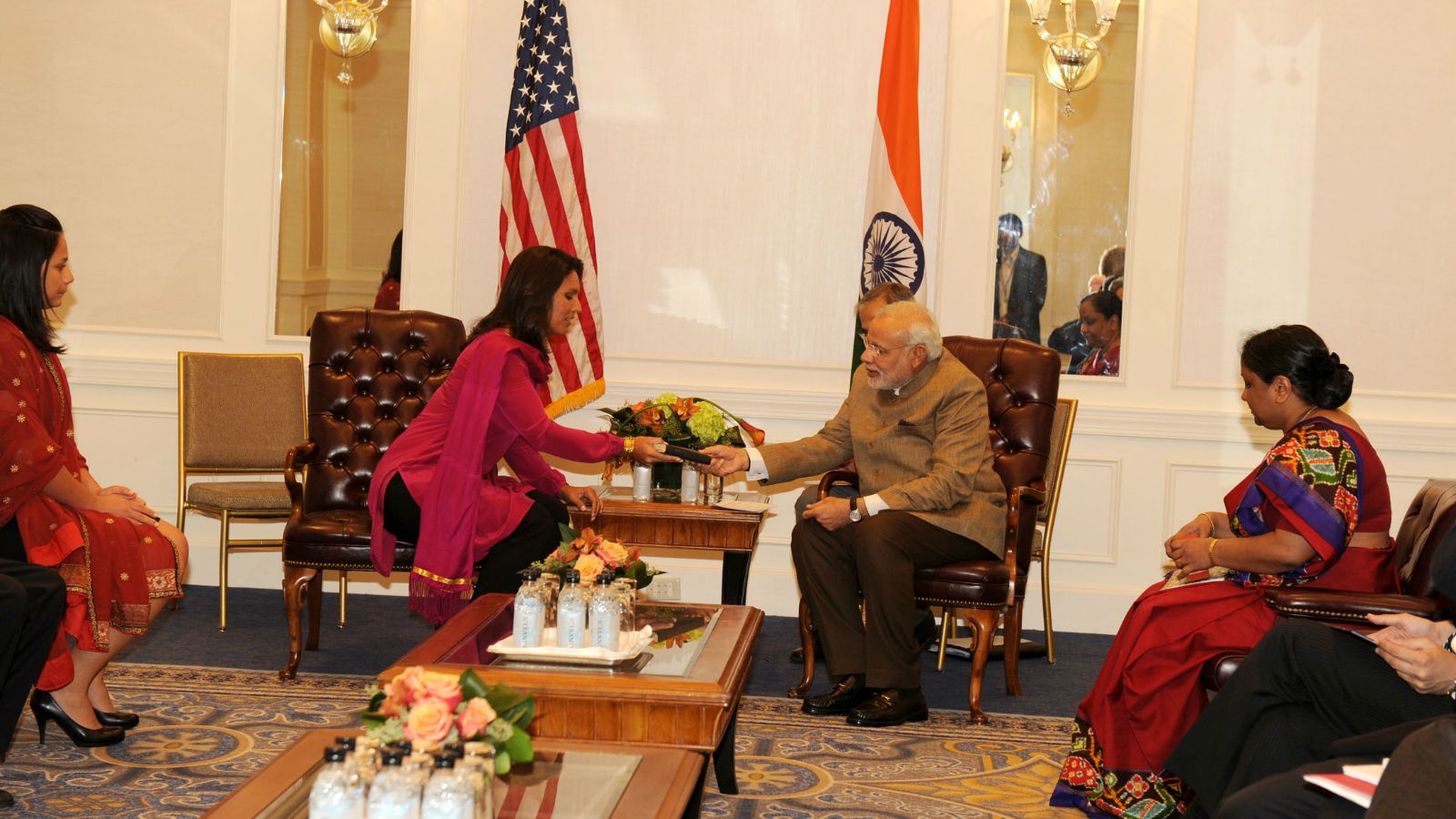
    In September 2014, the new Indian prime minister made it a point to meet Gabbard following his historic post-election speech at New York’s Madison Square Garden. And the congresswoman gave Modi a gift—a copy of the Bhagwad Gita that she swore by when elected to office—and assured him of her support for a Modi pet project of declaring an International Yoga day.

    “We had a wide-ranging discussion on several issues our countries have in common, including how America and India can work together to help combat the global threat posed by Islamic extremism,” Gabbard said after the meeting.

    For all that and more, Gabbard was treated as royalty on her visit to India last year. As she hobnobbed with the Indian prime minister and foreign minister among others, The Telegraph, a Kolkata-based newspaper, called her “the Sangh’s mascot” in the US. The Sangh, a moniker for the Rashtriya Swayamsevak Sangh (RSS), is a right-wing hindutva organisation and the ideological guardian of the BJP party that rules India now.

    With Modi set to stay in power until 2019, and Sanders doing better than expected in the Democratic primaries (or at least was up until March 1, when Democratic frontrunner Hillary Clinton handily won key states like Texas and Virginia in the “Super Tuesday” state contests), it can’t hurt the BJP and India to have a friend like Gabbard in the US.

    On March 2, Gabbard answered questions from Quartz via email about her support of Modi, her approach to Hinduism, and the connection she draws between Islam and terrorism. The transcript below has been condensed and lightly edited:

    Quartz: Could you tell us about your reasons for supporting the BJP and Narendra Modi, and why you referred to him being denied a visa as a “great blunder”?

    Tulsi Gabbard: There are many different areas and sectors where the United States and India’s growing friendship can cover mutually beneficial ground such as defense, renewable energy, bilateral trade, and global environmental concerns such as climate change. Modi impressed me as a person who cares deeply about these issues and as a leader whose example and dedication to the people he serves should be an inspiration to elected officials everywhere.

    It is very important that the US and India have a strong relationship of mutual respect. The denial of a visa to prime minister Modi could have undermined that relationship had he used it as an excuse to reject having a strong bilateral relationships with America. This would have been bad for both of our countries. For many reasons—not the least of which is the war against terrorists—the relationship between India and America is very important.

    QZ: You took on the US president for his reluctance to name ISIS as an Islamic extremist group. Do you still stand by this criticism?

    TG: In order to defeat the terrorists who have declared war on the United States and the rest of the world, we need to understand their ideology. In other words, the war can’t be won just militarily. We must defeat them in the ideological war, not just on the battlefield. In order to defeat their ideology, we need to recognize what their ideology is.

    The ideology of these terrorists is “Islamism.” It is a radical political ideology of violent jihad aimed at bringing about an establishment of a totalitarian society governed by a particular interpretation of Islam as state law. Referring to terrorists as “Islamist extremists” is simply an accurate way to identify ISIS and other Islamist extremist organizations whose ideology is rooted in one form of Islamism or another.

    The majority of Muslims are practicing the spiritual path of Islam within their own lives in a pluralistic, peaceful way. So by calling organizations like ISIS Islamic or Islamist extremists [emphasis hers], we are making a distinction between the vast majority of Muslims who are not extremists and a handful of those who are.

    QZ: How much of that sentiment is influenced by your experience serving in the military in the Middle East, versus your interest in Hindu/Muslim conflicts in India?

    TG: My experience serving in the Middle East has shaped many of my views. This has nothing to do with any “Hindus/Muslim” conflict in India or anywhere else. It comes from the understanding that in order to defeat the terrorists who have declared war on the United States and the rest of the world, we need to understand their ideology.

    My two deployments in the Middle East reinforced the fundamental military wisdom that you can’t defeat an enemy if you don’t understand him. We cannot win this war if we do not understand our enemy’s goals, [or the] ideology that inspires them and fuels their recruitment propaganda. And the first step to understanding an enemy is correctly identifying him in a way that makes clear his ideology.

    QZ: You referred to the suffering of Hindu minorities across the world, in a speech you gave during a fundraiser attended by some of the top leaders of the BJP. Do you think that in India there exists a similar situation?

    TG: Throughout the world, Hindus are victims of discrimination. Recently, a Hindu priest in Bangladesh was brutally hacked to death by ISIS terrorists and two others were injured trying to help him. Unfortunately, even in the United States, as well as different pockets of India, such discrimination exists.

    While there is no doubt there is some discrimination directed toward different “religious minorities” in India, throughout India you will find Muslims, Christians, and people of all kinds of religions free to practice their faith. However, you will not find this degree of tolerance or openness in countries like Pakistan, Saudi Arabia, Iran, or other Muslim countries. In fact, if you are not a member of the government-approved religion in those countries, it is government policy that you will be punished and discriminated against. To my knowledge, this does not exist in India. However, if India were to enact government policies that punish their citizens simply for being of a “minority religion,” I would condemn that action.

    The essence of the Hinduism that I practice is karma yoga and bhakti yoga, which means to love God and all [emphasis hers] of His children, regardless of their race, religion, etc., and to use my life working for the well-being of everyone.

    QZ: A report in The Telegraph, an Indian newspaper, referred to you as the mascot for the right-wing RSS in India. How do you respond to that? Do you think that is true and would you like to be associated with the RSS?

    TG: Both in India and here in the US, I have held meetings with members of both the BJP and the Congress Party. As a member of the US Congress, my interest is in helping produce a closer relationship between the United States and India, not just between the United States and one political party of India.

    I have no affiliation with the RSS. Sometimes people on both sides, for their own purposes, try to say I somehow favor, or am part, of the BJP or take photos of me at Indian events and circulate them for their own promotional reasons. But the fact is, I’m not partial to BJP, the Congress Party, or any other particular political party in India.

    QZ: Some media reports suggest that you seem to be supporting the Indian diaspora, mostly because they are huge contributors to your campaign, especially with your Hindu identity. How do you respond?

    TG: Through my election to Congress and my swearing in on Bhagavad-gita, those in the national media, my colleagues in Congress, and regular Americans across the country have all been very respectful, and even proud of America’s diversity. I assume the reason Hindus all across the country have been so supportive of me, is because when they see me, they see the potential for themselves and their sons and daughters.

    There are many Hindus in America who feel they need to convert to Christianity or take “Christian” names if they or their children are to succeed in this country. I have found that simply being the first Hindu elected in Congress has been liberating to so many because it shows that every American, regardless of their background, race, or religion, has the opportunity serve our community in any capacity he or she may choose.

  • JNU Row, Vemula’s Suicide Rocks Parliament; Emotional Smriti Attacks Opposition

    JNU Row, Vemula’s Suicide Rocks Parliament; Emotional Smriti Attacks Opposition

    NEW DELHI (TIP): In one of the fieriest debates in the recent times, the issue of Rohit Vemula, Dalit scholar who committed suicide, and JNU episode rocked both the houses of the parliament as Opposition and the treasury benches traded charges.

    Also Read – Watch: The Queen’s Speech – Smriti Irani’s Explosive Speech In Lok Sabha On Rohith Vemula And JNU Row

    HRD Minister Smriti Irani speaks in the Lok Sabha in New Delhi on Wednesday.
    HRD Minister Smriti Irani speaks in the Lok Sabha in New Delhi on Wednesday.
    Photo courtesy: PTI

    While, emotionally charged HRD minister Smriti Irani attacked opposition, particularly Congress vice president Rahul Gandhi, of politicising the death of a student and siding with those opposed to India, the united opposition pilloried the government for playing partisan politics. Congress, TMC, BJP, Left while denouncing anti-national slogans in JNU, they charged government was gunning against students opposed to their ideology.

    Full Coverage of the JNU ROW : Read ON

    Aggressive Irani took on the united Opposition in Lok Sabha head on while speaking during the discussion, saying she would leave politics if anyone of the vice chancellors appointed were to suggest she was indulging in saffronisation.

    “I am not certifying your patriotism. But don’t demean mine. I am not certifying your idea of India, but do not demean mine,” she said even as opposition parties staged a walkout.

    Rubbishing opposition charges over for her handling of Vemula’s death. Irani said, “My name is Smriti Irani. I challenge you to tell me my caste.”

    “No one can raise a finger against me on this issue. I am taking it personally as woman who gives birth can break from inside,” Irani said choking with emotion while referring to her criticism over Vemula’s death while adding “Our children are not vote-banks.”   She said Rohith Vemula said that no one was responsible for his death and even added that the executive council that took the decision to suspend Rohith was appointed by Congress.

    In Rajya Sabha, BSP supremo Mayawati clashed with Irani as her party members forced adjournments over non-inclusion of a dalit in the inquiry panel to probe Vemula’s death, and even insisting on separate discussion into Vemula’s death rather than clubbing it with the JNU issue. She also accused government being anti-dalit, even as no business could be conducted for the first day. responded to Mayawati by saying, “I am ready to reply to all questions. First you allow the discussion… You are senior to me. You are a woman. If you want, I am ready to reply. If you are not satisfied with my reply, I am ready to behead myself and lay it on your feet.”

    In Lok Sabha, Irani turned emotional several times as she read out from the posters and slogans used in the JNU against India, questioning the death penalty of Afzal Guru and even some uncharitable remarks against Goddess Durga. She questioned why was Rahul Gandhi siding with the anti-nationals and if attack on her was because she was Congress VP’s rivel in Amethi.

    “Even Indira Gandhi lost power. But her son never supported slogans demanding destruction of India,” Irani said targeting Rahul for supporting JNU students.

    Reffering to some in JNU also praising Yaqub Menon, she said bomb blasts took place in Mumbai on March, which is my mother’s birthday, how can i forget. They questioned Supreme Court and India, she added. Irani named all the student mentioned in the JNU report and said”Umar Khaild misled the university administration saying that he was organising a poetry reading event”.

    Referring to Rohit Vemula case, she said even other MPs had written to him several times, like Congress Hanumantha Rao, Assadudin Owasi, as it was her duty. “My ministry handled 61,000 complaints we never asked the caste or religious of them,” she charged. She accused Telangana government of playing politics over the death of a child. “

    Have you seen Rahul Gandhi going to a spot twice. He went there, as he was playing politics. Earlier gandhio speaking to reporters outside the parliament had said he was willing to speak but he was not being allowed to voice his opnion. Rajnath Singh responded with saying government will not stop anyone.

    Meanwhile, Home Minister Rajnath Singh assured the Lok Sabha that no innocent student will be harassed and said the issue of sedition charge slapped against some students should be left for the courts to decide.

    Earlier during the day, Congress MP Jyotiradtiya led the attack on government for death of Vemula and crushing dissent in JNU. “Bandaru Dattaterya in his letter had called Rohith a castiest and an anti-national. Where in the world can you see a HRD minister writing five letters in any case,” he said.

    While attacking BJP and RSS, Scindia also raised the issue of FTII, IIT Madras and JNU and said, “the government was trying to muzzle the voice of the youth.”

    He alleged that the government was angry with JNU because it stood against “saffron terrorism”, Dadri lynching, RSS and the suicide of Rohith Vemula in the Hyderabad University.

    From BJP side, Anurag Thakur raised the nationalist pitch over the JNU issue and attacked Congress, saying for the party, “it is ‘family first’, ‘party next’ and ‘nation last’. For us, it is ‘nation first’, ‘party next’ and ‘family last’.”

    He alleged that Rahul Gandhi went to the university to support such outfits which were named by the previous UPA government as “frontal organisations” for Maoists. “I want to ask Sonia ji, why your young leader was standing with those who stand with Afzal Guru,” Thakur said addressing the Congress President who was present there.

    TMC MP and former Harvard professor Sugata Bose accused the government of being “heartless” in dealing with the students and said the situation in the JNU should have been handled with sensitivity. He said BJP’s definition of nationalism was
    “narrow, selfish and arrogant” and even warned them for raising this pitch while qoting Tagore, Netaji and Aurobindo. He was heard with rapt attention. After his speech even Sonia and Rahul went to congratulate him.

    BJD member Tathagata Satpathy described Azfal Guru as a “scoundrel” and said the system gave the dreaded man full chance to defend himself. But he added, the government should have handled the JNU episode with care and the Home Ministry should not have made a statement on the basis of tweets.

    CPM MP M B Rajesh said the BJP was branding JNU as a centre of anti-national activities.

    Congress leader M Mallikarjun Kharge said nobody should politicise the issues of Hyderabad central University and JNU. “You have 80,000 constables and you are not able to catch 8-10 students and instead you are defaming all the people,” Kharge said and asked whether it was Congress’ fault.

  • FORMER MINISTERS TRASH NEW RAIL BUDGET

    FORMER MINISTERS TRASH NEW RAIL BUDGET

    NEW DELHI (TIP): The Railway Budget 2016 that was presented by Railway Minister Suresh Prabhu brought a pot of mixed reactions from several political parties and the common man. On the one hand, the commoners felt relieved as the minister spared any hike in passenger fares, while on the other hand, some termed it a lukewarm budget with no new changes.

    The railway minister announced many new amenities such as bio-vacuum toilets, baby food, lower berths for senior citizens, among few other initiatives, in a move to make the railways more consumer-friendly and as a push towards smart and digital services, such as feedback through social media.

    Former Railway Minister Pawan Bansal
    Former Railway Minister Pawan Bansal

    However, former rail minister Pawan Bansal said there was nothing new in the budget. On the unveiling of the two locomotive factories in the budget speech, Bansal said: “These two locomotive factories announced are also old, it was decided when I was Rail Minister,” according to ANI.

    Former railway minister Lalu Yadav
    Former railway minister Lalu Yadav

    Lalu Prasad Yadav, another former rail minister, called it a “light budget,” and added: “Under the BJP, the railway ministry has derailed totally. Railway was the lifeline of India. Indians don’t want bullet train.”

    Former railway minister Dinesh Trivedi
    Former railway minister Dinesh Trivedi

    At the same time, former Railway Minister Dinesh Trivedi criticised the budget saying that instead of “statement of vision” it was a “statement of illusion.”

    Home Minister Rajnath Singh
    Home Minister Rajnath Singh

    Meanwhile, praises and support for presenting a good budget came from the ruling BJP. Union Home Minister Rajnath Singh lauded the budget: “It was a visionary budget, many steps laid out which will improve infrastructure.”

    While Venkaiha Naidu called it a “realistic” budget, BJP’s Meenakshi Lekhi said it’s a very well thought-out railway budget.

    Prime Minister Narendra Modi
    Prime Minister Narendra Modi

    Prime Minister Narendra Modi, while congratulating Suresh Prabhu and his team, said: “We have been fairly successful over the past year, this Rail Budget 2016 will improve it further. I don’t want to criticise Budgets of earlier govts, but in this budget investment has seen 2 1/2-time jump,” adding that “cleanliness, customer benefit, technology upgradation has been the mantra of past two railway budgets.”

    Congress MP Shashi Tharoor
    Congress MP Shashi Tharoor

    Congress member and former Union minister Shashti Tharoor was quoted by ANI as saying: “We all were a bit mystified whether a budget was really presented or not.”

    Meanwhile, the common man took to social media to respond to the new rail budget.

    [td_block_trending_now style=”style2″ tag_slug=”Budget 2016″]

    More reactions

    “The budget comes out to be focused on consolidation rather than expansion. Therefore the budget has focused on key issues plaguing the railways which are customer experience, increasing efficiency, network decongestion, improving safety, improving stations, increasing revenues and increasing availability. It also gave a push to projects that will lay the foundation of next generation railways, which is primarily High Speed Railway, popularly referred to as bullet trains. Overall a mature rail budget that balances much needed investments with the revenue and funding constraints” – Jaijit Bhattacharya, Partner –Infrastructure and Government Services, KPMG in India

    “The railway budget has maintained the consistent path of railway reform and the measures announced can change the way freight logistics happen in India.” – Rajaji Meshram, Director –Infrastructure and Government Services, KPMG in India

    “The decline in operating ratio from 88% to 90%, and to 92% for next year is along expected lines, with freight and passenger traffic remaining nearly flat, and expenses continuing to increase. In this context, how the increased investment target of Rs 1.2 lakh crore will be met, becomes more pertinent. In fact, for the five year target of Rs 8.5 lakh crore, set last year, the annual spends will need to continue to grow faster.

    There is a reason to be optimistic. Several steps have been taken to speed up contracting and execution of contracts, and construction companies are already seeing their order books grow. Private Freight Terminals are growing, and the award of Madhepura and Marhowra manufacturing projects, are signs of progress. However, the port connectivity projects, JVs with State Govts and 4 BOT Annuity projects, remain work-in-progress. That new project announcements are limited indicates adherence to implementation focus, highlighted in the previous Budget. Among the new announcements, East coast connectivity through Dedicated Freight Corridor is perhaps the most impactful, as it would contribute to India participating in global production networks in south east Asia, and to Make in India.

    The proposed rationalisation of freight tariffs will be critical to improving financial health, and enabling investments. Railways have become less competitive than road even for 1200 – 1500 km distances for container movements. Coastal shipping and Inland waterways are also emerging as competition. A more pragmatic approach to freight, combining several measures like personalised service and bulk discounts, would be necessary. Commissioning of the dedicated freight corridors will take a few years; some reprioritisation of track access would be required in the meanwhile to enable time-tabled freight operations.

    Several reform measures remain on the agenda, though timeframe for their implementation is still unclear. These include setting up of an independent regulator through legislation, organisational restructuring (including enabling separate focus on suburban rail), large scale use of PPP’s, and successful monetisation of land and commercial assets. Speedier implementation of these is necessary to achieving the five year vision.” – Manish Agarwal, Partner and Leader – Infrastructure, PwC India

    The Rail Minister has done a fine job in setting achievable targets for FY17 keeping in mind the ground realities of the present times. He has rightly addressed the key issues like modernization, capacity augmentation, better governance, enhancement of customer experience, human resource development and at the same time readying Indian Railways for the future. In fact. what I found most impressive is the Minister’s shift of focus from ‘completion’ to ‘commissioning’ of rail projects.

    In particular, I liked the Minister’s intention to raise the revenues earned from freight handling through his 3-pronged approach of expansion of freight basket, rationalization of tariff structure and improvement and enhancement of terminal capacity. Incentivising containerisation of freight traffic is a step in the right direction as is the proposed move to enter into long-term tariff contracts with key customers. Setting up of logistics parks and warehouses under PPP mode will perfectly dovetail into this process. In addition, the steps announced towards development of rail infrastructure – be it development of stations, or creation of 3 new Dedicated Freight Corridors (DFCs), or improving coastal connectivity and port connectivity, or track upgradation – are steps which will be instrumental in providing a fillip to the “Make In India” programme. The Rail Minister has deftly interwoven these projects for the greater good of the economy and to enhance capacity creation.

    Allowing IR to procure power directly from power distribution companies, grid and power producers has been one of the proposals which we had made to the government as this would enable IR to procure power at reasonable costs. I am very pleased to see this featuring in the budget because this is a win-win proposition resulting in substantial savings for IR while benefitting the power producers as well. – Hemant Kanoria, CMD, Srei Infrastructure Finance Limited

    [td_block_trending_now style=”style2″ tag_slug=”Budget 2016″]

  • Why Delhi Police is going soft on Kashmiris who actually raised anti-India slogans in JNU

    Why Delhi Police is going soft on Kashmiris who actually raised anti-India slogans in JNU

    From the very beginning, it has been amply clear that the people who raised anti-India slogans at the Jawaharlal Nehru University on 9 February were Kashmiris. Yet, the Delhi Police has not even been looking for them, because arresting Kashmiri students in Delhi will finish any remaining chance of saving the PDP-BJP alliance in Jammu and Kashmir.

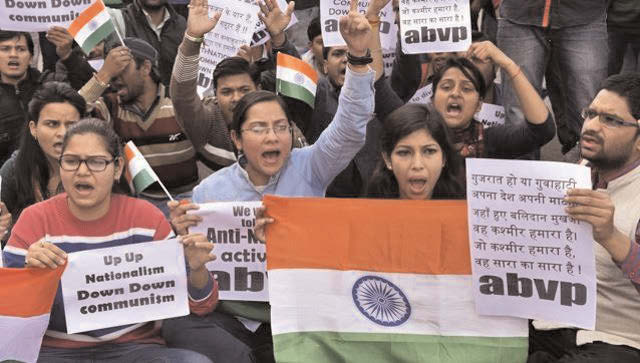
    Arresting no one was not an option given the nationalist hysteria whipped up by the Akhil Bharatiya Vidyarthi Parishad, the ABVP. As a result, Kanhaiya Kumar, Umar Khalid and Anirban Bhattacharya are in jail even though they raised no anti-India slogans. If anything, they tried to douse that fire.

    Kashmiri voices Initial eyewitness accounts made it clear that it was Kashmiris–who were neither students nor teachers at JNU–who had raised anti-India slogans. It is common for some Kashmiris living in Delhi to attend Kashmir-related events in Delhi, sometimes even raising azadi slogans. On 9 February in JNU, however, activists of the ABVP tried to block the event which they saw as an effort to paint terrorist Afzal Guru as a martyr. As ABVP activists provoked the Kashmiris with slogans such as “Kashmir hamara hai, saara ka saara hai,” the Kashmiris responded with equal provocation.

    “The organizers Umar Khalid, Banjyotsna Lahiri and Aswathi intervened twice to stop the students from chanting such slogans.”

    Here are two such eyewitness accounts JNU student Talha Chowdhry told Tehelka: “The Kashmiri students chanted slogans for Azaadi-‘Tum kitne Afzal maroge, ghar se Afzal niklega,’ ‘Afzal hum sharminda hei, tere khatil zinda hain’. The ABVP activists retaliated by shouting, ‘Doodh mangoge kheer denge, Kashmir mangoge cheer denge’, and ‘Jo Afzal ki baath karega, wo Afzal ki mauth marega’. In between, the Kashmiri students chanted slogans such as ‘Bharat ke barbadi tak jang rahegi’ to which the organizers objected. The organizers Umar Khalid, Banjyotsna Lahiri and Aswathi intervened twice to stop the students from chanting such slogans.”

    Agarwal, another student present at the event wrote, “In the meeting, there was a whole group of Kashmiri students which had come from outside JNU to attend the meeting. If you would even look closely at the video that is being circulated, you will only see these students who had formed a circle in the center of the gathering. And trust me, not one of whom was from JNU! I was present during the event for some time, and I could not recognise a single face from that group as being from JNU. This group of students who belonged to Kashmir, and had faced the wrath of the AFSPA (Armed Forces Special Powers Act) for decades, were angered to see the ABVP disrupt their meeting, and started shouting the slogans against India, like: “Bharat ki barbaadi tak, jung rahegi, jung rahegi!”, “India, Go Back”. In my almost 2.5 years of stay in JNU, I have never heard these slogans shouted anywhere. These are nowhere even close to the ideology of any left parties, let alone DSU.”

    Indeed, some of these slogans are common on the streets of the Kashmir Valley, and they are not the sort of slogans that the extreme left organizations like the Democratic Students Union raise. The Indian extreme left is not into India’s destruction, they are more interested in taking over the Indian state, but they do support the right to self-determination for Kashmiris. This meeting was not even called by DSU, but by its former members.

    It is curious that despite the presence of police at the 9 February event, the Delhi Police relied upon videos from news channels to arrest JNU students union president Kanhaiya Kumar. The videos turned out to be fake, but what did the police witnesses see that was not used to find and arrest the people who actually raised those slogans? The answer is Kashmiris.

    Indeed, some slogans are common on the streets of the Kashmir Valley, and they are not the sort of slogans that the extreme left organizations like the Democratic Students Union raise.

    After watching video clips of the event, Nilofer Qureshi, a Kashmiri writer, felt the “slogans had the unmistakable Kashmiri accent and the distinct style of delivery that one hears during protests in Kashmir!”

    Arrest the Indians, leave the Kashmiris Umar Khalid and Anirban Bhattacharya could at best be accused of organizing the event that saw Afzal Guru as a martyr, Kanhaiya Kumar not even that. While these students have fallen to the larger ABVP game-plan of discrediting JNU and leftists, the PDP subplot has meant that the whole case looks bizarre. The Kashmiris who raised the slogans are nowhere in the public discourse over láffaire JNU, and the issue at hand has been conveniently diverted to JNU’s leftists, not the Kashmiris.

    Speaking today in the Rajya Sabha, I&B and finance minister Arun Jaitley admitted the presence of “outsiders” in JNU that day, but failed to explain why the Delhi Police has not been able to find these outsiders, 16 days later. The Delhi Police calls them “foreign elements”.

    Ahmed Ali Fayyaz, a Jammu-based journalist well-known for stories based on intelligence sources, has written in State Times that the Ministry of Home Affairs has verbally asked the Delhi Police to not arrest Kashmiri students, but put them under surveillance and make detailed profiles of them.

    Fayyaz writes, “Sources in New Delhi told State Times that officials of the Union Ministry of Home Affairs communicated verbally to senior officials of Delhi Police that none of the Kashmiris, particularly the students, even if found involved in organizing or attending the recent anti-India demonstrations, should not be immediately booked in any FIR or arrested. Reasons behind withholding the action have not been specified. However, sources added, it was being done only to protect churning out of BJP’s possible coalition with Mehbooba Mufti’s PDP in Jammu and Kashmir.”

    “Reports in Hindustan Times and The Economic Times have also hinted at the government’s reluctance to go after the Kashmiris present at the 9 February event.”

    Reports in the Hindustan Times and the Economic Times have also hinted at the government’s reluctance to go after the Kashmiris present at the 9 February event.

    The confusion over Umar Khalid’s links with the Jaish-e-Mohammed also stems from the need to go slow against Kashmiris. While the intelligence agencies suspect a Kashmiri named Omar with links to Pakistan to have been present in JNU, one news report confused him with Umar Khalid, who hails from Delhi.

    This is also what explains why Kahsmiri students in JNU and other parts of Delhi initially feared a witch-hunt, but have calmed down since then.

    “I was having tea and as the situation worsened, I left the campus and stayed with a relative for three days. When I realized that Kashmiri students are not targeted, I decided to return,” one Kashmiri student at JNU told The Times of India.

    The Delhi Police has questioned many Kashmiris, but did not arrest any of them.

    Mehbooba draws the red line On 17 February, BJP general secretary Ram Madhav took a secret flight to Srinagar along with an Intelligence Bureau official to meet the PDP chief Mehbooba Mufti. By this time it was clear that the JNU issue had become a new stumbling block in forming afresh a BJP-PDP government after Mufti Mohammed Sayeed’s death.

    When Afzal Guru was hanged in 2013, the PDP had called it a “travesty of justice” and said the “constitutional requirements and processes were not followed in hanging him out of turn”. It is also the party’s stated position that Afzal Guru’s mortal remains, interred at the Tihar jail, be returned to his family.

    Nevertheless, the PDP has exercised restraint in not using the JNU row to issue any fresh statements on Afzal Guru. The BJP has kept its part by not arresting Kashmiri students.

    Two days after Ram Madhav met Mehbooba Mufti in Srinagar, top separatist leader Syed Ali Shah Geelani issued a statement in which he slammed the PDP’s silence on the issue. As the Kashmir Valley saw protests saying “Thank You, JNU,” it became difficult for the PDP to continue the silence.

    Breaking her silence, Mehbooba Mufti told journalists on 22 February, “I hope and I will request the Government of India that nothing should happen that would have a negative impact on Jammu and Kashmir, where the situation is already bad.” She also revealed she had asked Home Minister Rajnath Singh to make sure Kashmiri students are not harassed, and that she had asked PDP leaders Haseeb Drabu and Amitabh Mattoo, both alumni of JNU, to be in touch with Kashmiri students at JNU.

    Mehbooba’s position is understandable, as the separatists in Kashmir have already called for protests on Friday and a shutdown on Saturday to protest the JNU incident, as well as the arrest of Delhi University professor SAR Geelani. If the Kashmiris who raised anti-India slogans in JNU were to be arrested, it is certain that Kashmir would see large-scale protests that would make it impossible for the PDP to form government with BJP support.

    Three days later, Rajnath Singh gave a public assurance that innocent students won’t be harassed–ironic, as Kanhaiya Kumar, Umar Khalid and Anirban Bhattacharya are having to pay the price for the Kashmiris that the Modi government does not want arrested.


  • Sonia Accuses BJP Of Divisive Agenda While Modi Hints On Political Conspiracies

    Sonia Accuses BJP Of Divisive Agenda While Modi Hints On Political Conspiracies

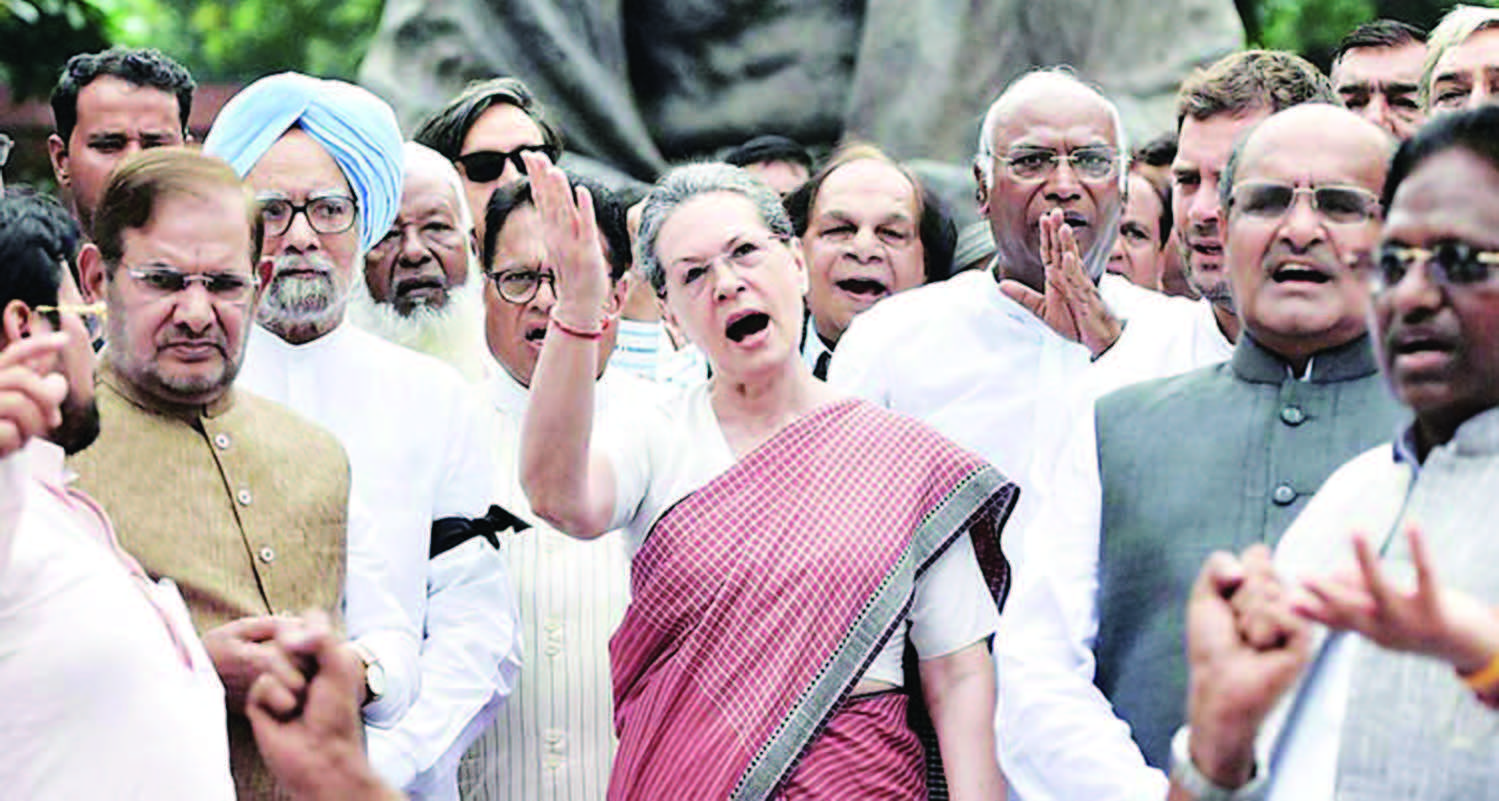
    Congress president Sonia Gandhi on Monday, Feb 22, accused BJP of unleashing its “divisive agenda by generating a wholly unwarranted debate on patriotism and nationalism” and said it was the government’s responsibility to ensure that parliament functions.

    Gandhi’s strong attack on the government came at a meeting of the Congress Working Committee (CWC) here ahead of the budget session of parliament that begins on Tuesday, Feb 23.

    “To cover up its many failures, the ruling establishment has once again unleashed its divisive agenda by generating a wholly unwarranted debate on patriotism and nationalism. Simply put, democratic and liberal value are under severe assault. The freedom to think and speak are being drastically curtailed,” Gandhi said.

    Meanwhile PM Modi said “some people” were not able to digest the fact that a “chai wala” (tea seller) has become the Prime Minister and hence were conspiring all the time to bring him down.

    “You would have seen in the recent past, there is attack on me all the time. Some people are continuously at it. They are not able to digest how Modi became the Prime Minister, how a ‘chai wala’ became the Prime Minister, they cannot swallow it,” a combative Modi said addressing a farmers’ rally in Odisha.

    Without naming anybody or any specific instance, he said he had taken some steps because of which “these people are facing problems”.

    Is Another Stormy Parliament Session in Store for bjp?

    Opposition parties led by the Congress have promised to cooperate with the government in passing Bills if issues that they want to raise are first discussed thoroughly in the Budget session of Parliament that begins Feb 23.

    The session is set to be stormy from right after the President’s Address to both Houses on Tuesday morning, with the opposition saying it favours a “disruption-free session,” but also making it clear it that it will not pause for breath as it attacks the government on issues like the JNU controversy, the suicide of Dalit scholar Rohith Vemula in Hyderabad last month, protests for reservation in Haryana and the Pathankot terror attack.

    “Contrary to what the government has been saying, let me once and for all make it absolutely clear — we want parliament to function, to legislate.

    “The problem is not with us, it is with the government which refuses to accept that the democratic right of the Opposition is to raise burning public issues.

    “It is the government’s responsibility to ensure that parliament functions,” Sonia Gandhi said.

    Making a veiled reference to the controversies surrounding Jawaharlal Nehru University, the suicide of a Dalit youth in Hyderabad university and the violence in a Delhi court ahead of proceedings concerning JNU student leader Kanhaiya Kumar, Gandhi said the CWC meeting took place in a “disturbing background” to take stock of what was happening on various fronts.

    She said universities were places where young people must have the fullest freedom to express themselves.

    The opposition says debate on these issues must precede bringing legislation over which there are differences – like the Goods and Services Tax bill which is crucial to the government’s reforms plans. Those Bills it suggested at a meeting of all parties today, can be  deferred to the second half of the budget session, which will see a recess this year of over a month.

    The government asserted that it is as eager to discuss issues like the controversy over an event at the prestigious JNU or the Jawaharlal Nehru University earlier this month where anti-India slogans were raised and urged Parliament to thoroughly discuss their causes and consequences and show the way forward.

    “The government is committed to uphold the Constitution in letter and spirit and firmly believes in peace, unity and integration of the nation as the key operational principles for delivering on the development promised to the people,” said Mr Naidu, in a clear indication that the government will counter the opposition’s attack over JNU students being charged with sedition with the nationalism argument that ruling party BJP has used.

    The Congress, the Left and others have pushed for a debate on JNU on Wednesday, the second day of the session. The government said it is willing to consider that. If that happens, a motion of thanks to the President’s address may take place only around March 1, after the rail budget, economic survey and the union Budget, which is scheduled for Monday, February 29.

    Regional parties like the Akali Dal, Telangana Rashtra Samithi and Janata Dal (United) have urged the Congress to let the houses function, allowing them as to raise issues critical to them. The last several parliament sessions have been washed out by opposition protests.

  • JNU ROW | PROTEST OVER AFZAL GURU HANGING, SEDITION ROW AND WHO SAID WHAT

    JNU ROW | PROTEST OVER AFZAL GURU HANGING, SEDITION ROW AND WHO SAID WHAT

    NEW DELHI (TIP): The protests in Jawaharlal Nehru University (JNU) began on Wednesday, Feb 10, when Left-oriented students’ group planned to organise a cultural program and a protest march to protest against the ‘Judicial Killing of Afzal Guru’ and also to dislplay solidarity with Kashmiri migrants who are struggling at varsity’s Sabarmati Dhaba.

    The Akhil Bhartiya Vidyarthi Parishad (ABVP) staged a protest outside the office of the vice chancellor to protest over the event against the hanging of 2001 Parliament attack convict Afzal Guru.

    Feb 11

    • JNU set up a proctorial committee on to inquire into an event organised by some former members of Democratic Students’ Union (DSU) that led to violent clashes on the campus.
    • Maheish Giri, the BJP Lok Sabha member from East Delhi, on Thursday, Feb 11 lodges an FIR against ‘anti-national’ students of Jawaharlal Nehru University who opposed the death penalty to parliament attack convict Afzal Guru.

    Feb 12

    • Talking tough, Home Minister Rajnath Singh on Friday, Feb 12, warns of
      “strongest possible” action against those involved in raising anti-India slogans at an event in JNU campus here, saying such activities will not be tolerated.
    • Former Delhi University lecturer SAR Geelani is booked for sedition in connection with an event at Press Club of India, in which a group shouted slogans hailing Parliament attack convict Afzal Guru.
    • The president of Jawaharlal Nehru University’s students union (JNUSU) is arrested by Delhi police, in a case of sedition and criminal conspiracy.
    • Left parties question the arrest of JNUSU president Kanhaiya Kumar and asks Delhi Police to not act in “connivance” with ABVP to target “entire Left” even as they likened the ongoing developments in the varsity campus to “situations during Emergency”.
    • Union minister Kiren Rijiju says the government will not allow anyone to spread anti-national sentiment in the country.
    • 8 students get debarred from academic activities by JNU pending a disciplinary enquiry into an event at varsity against hanging of Parliament attack convict Afzal Guru.
    • Congress Vice President Rahul Gandhi says Modi government “bullying” an institution like JNU was “completely condemnable”, but at the same time asserted that anti-India sentiment is “unquestionably unacceptable”.

    Feb 13

    • Delhi police issued an alert across the country in the wake of a tweet allegedly posted by 26/11 mastermind Hafiz Saeed. Tweet said, “We request our Pakistani Brothers to trend
      #SupportJNU for our pro-Pakistani JNUites brothers.”
    • A group of ex-army officials threaten to return their degrees as mark of protest. Communist Party of India-Marxist General Secretary Sitaram Yechury meets Union Home Minister Rajnath Singh regarding the JNU campus incidents and demands the release of a student leader arrested over sedition charges.
    • Home Minister Rajnath Singh asserts that no innocent will be harassed but the guilty “will not be spared” as Left leaders met him questioning the police action against students including arrest of JNUSU leader.
    • Delhi police have detains seven students in connection with the JNU campus row.
    • Union Minister Kiren Rijiju says the premier academic institute cannot be allowed to be a hub of anti-national activities.
    • Delhi Chief Minister Arvind Kejriwal orders a magisterial inquiry into the JNU incident and accuses Prime Minister Narendra Modi of using police to “terrorise everyone” even as he asserted that anti-national activities should not be tolerated under any circumstances and those guilty must be identified and punished.
    • Congress vice president Rahul Gandhi says the government is trying to crush students’ voice in the country by ordering police action in university campuses.
    • Hitting out at Rahul Gandhi and other opposition leaders who criticised the arrest of a JNU student leader, BJP alleges that they were speaking in the voice of terror outfit LeT which was an insult to the martyrs and would boost the morale of anti-national forces.
    • Senior Congress leader Anand Sharma alleges that he was attacked physically by ABVP activists in JNU campus when he was returning with Rahul Gandhi after attending a protest meeting held by students there.

    Feb 14

    • “Please do not call my son a terrorist,” says JNUSU President Kanhaiya’s mother as she breaks down while watching the news flashes on TV at a neighbour’s house in Bihar’s Begusarai district.
    • Rajnath Singh appeals to political parties to unite in opposing incidents where anti-national slogans are raised.
    • Delhi police says enough evidence for sedition charges.

    Feb 15

    • JNU students go on strike till Kanhaiya Kumar is released. Shiv Sena says all politicians who support the students’ agitation should be stripped off their ‘elected status’ and those raising slogans against India put behind bars.
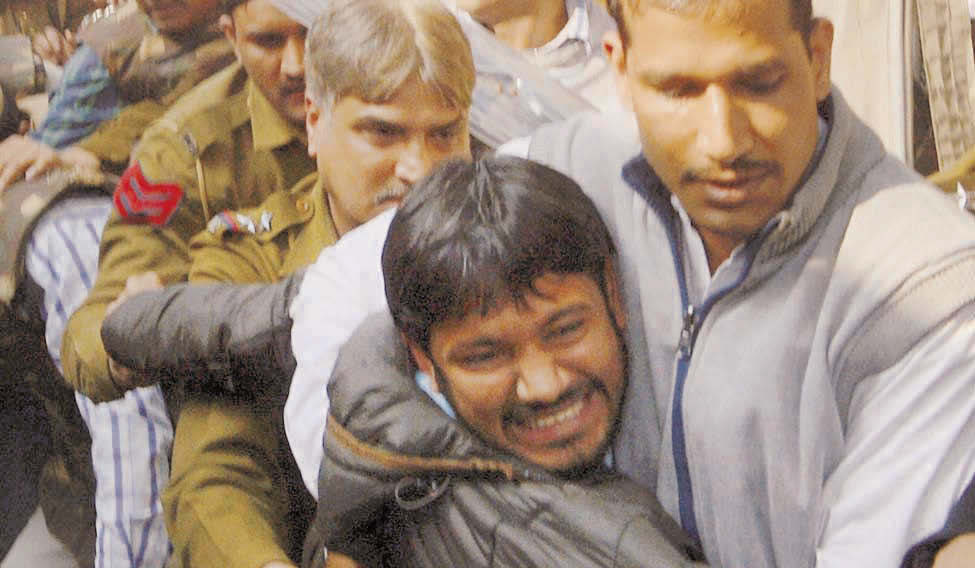
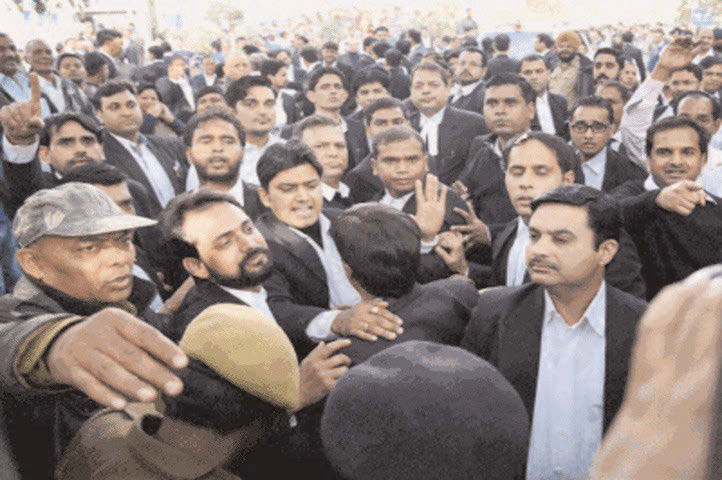
    • The Delhi Police again filled the role of a “silent spectator” as attackers defied the Supreme Court’s order for restricted entry to the trial court complex, bashed up Kanhiya Kumar en route to his court hearing and hurled the choicest abuse, gravel and a jagged end of a flowerpot piece at a six-member team of senior advocates, including Kapil Sibal, hand-picked by the Supreme Court to verify and report back on the ground situation in the court complex.

    Feb 16

    • Delhi police have formally arrested ex-Delhi university teacher S A R Geelani in connection with the JNU campus row case. Delhi police launches a hunt for several students who are on the run.
    • A First Information Report (FIR) registered over some lawyers thrashing journalists at Patiala House court. JNU teachers join students in boycotting classes in protest against arrest of its student union leader in a sedition case and say they would take classes on
      “nationalism” in the varsity lawns.
    • Congress condemns the attack on teachers and journalists in Patiala House court premises, calling it an “act of facism”. Delhi High Court rejects petition seeking NIA probe into JNU incident.
    • Delhi journalists stage a protest march against the violence that took place in Patiala House Courts on Monday, where some of them as well as students were beaten up.

    Feb 17

    • Lawyers turn lawless again. Mobs of lawyers heckled journalists and kicked and punched Kanhaiya Kumar when he was brought to court to face sedition charges on Wednesday, prompting the Supreme Court to ask officials to ensure the JNU student leader’s safety.

    Feb 18

    • A snowballing political row over the JNU crisis reached the President’s doorstep on Thursday as Congress vice-president Rahul Gandhi and Delhi chief minister Arvind Kejriwal attacked the Centre and sought Pranab Mukherjee’s intervention to resolve the issue.

    Feb 19

    • No relief for Kanhaiya Kumar, SC transfers bail plea to Delhi HC.
  • JNU Row: When dissent becomes sedition?

    JNU Row: When dissent becomes sedition?

    What is the issue at Jawaharlal Nehru University (JNU) in New Delhi? A radical left-wing student group as vocal and abusive as RSS/Parivar organized a function to discuss the ‘judicial murder of’ of Afzal Guru as they see it. The JNUSU President Kanhaiya Kumar was not at the function and had nothing to do with it.Yet he was arrested and charged with Sedition under the Indian Penal Code 124A. His speech to the students did not contain any anti-national sentiment, but rather only an affirmation of his faith in the constitution.

    A group of irate lawyers at Patiala House Court. Their violent conduct is a matter of investigation
    A group of irate lawyers at Patiala House Court. Their violent conduct is a matter of investigation

    This is the latest in a series of incidents where the Modi Government has determined to stifle dissent, shutting down debates, and muzzling the freedom of expression in the country, all in the name of nationalism. It is happening on the heels of the suicide death of RohithVemula, who was ostracized by right-wing elements for demanding his rights to be heard.

    ‘Sedition’ is a colonial era rule that was used to suppress the voice of the Indian people, who were demanding freedom and dignity from the British Empire. Today, the BJP government is using the same old arcane law – which should not have any place in a 21st-century democracy – to target individuals and institutions that are perceived to be non-conformist. Although the Indian law of sedition is different from the British law, law enforcement agencies have always used it against artists, public men and intellectuals for criticizing the Government.

    In the case of Kedarnath Singh vs State of Bihar (1962), a five-judge bench of the Supreme Court ruled that a charge of sedition would only apply if there were “an incitement to violence or public disorder”.There is no evidence to indicate that Kanhaiya Kumar raised slogans in favor of Pakistan, and against India.However, the heavy-handedness of the authorities on the campus and the speed in which the sedition charges were slapped on him clearly indicate that the government will not tolerate any dissent.

    JNU has long been a target of right-wing Hindu activists, who see the Institution as a laboratory of liberal and democratic thought process. It has been crucial in producing some of the finest minds in India who have become great proponents of freedom and liberty. It should be noted that while Prime Minister NarendraModiwas the Chief Minister of Gujarat, he branded JNU as a laboratory for secularists, which needed to be shut down.

    There is a certain pattern in how the HRD ministry, headed by Smithi Irani is dealing with institutions of higher learning. There was a growing acrimony with the students in FTII Pune, on the appointment of RSS ideologues to positions of power. Then, Ambedkar Periyar Study circle in IIT Madras was de-recognized. Then came the tragic suicide of Rohith Vemula, who was suspended after the complaints made by ABVP leaders to the HRD Ministry.

    Any independent observer can view a common pattern that is the ABVP, the student wing of BJP, has become a tool in the hands of the HRD ministry to advance the saffron agenda of the RSS across campuses, and around the country. Whenever they complain about political rivals, the ministry swoops in and takes actions on their behalf against the students who advocate academic freedom without any interference from the ruling class.

    University campuses ought to be a place where young minds can freely express their views, formulate their opinions, and create a forum where competing ideas and ideologies can germinate. A campus without vibrant intellectual discourse will fail in cultivating creative minds that are essential in coping with the challenges of globalizations and pressures of modernity.

    The effort to penalize parties who are critical of the Government or some of its regressive policies as ‘anti-national’ is an advancing of an agenda that mirrors fascism. The German historian Arthur Rosenberg, in his book, Fascism and Mass movement, refers to two conditions as prefiguring the rise of fascism: the rise of right-wing nationalism and an active connivance between the state and storm troopers. Let us hope that what we have witnessed in University of Hyderabad and JNU are not early indications of such an evolution.

    G. Sampath in a recent column described how according to the nationalist taxonomy of the SanghParivar, Adivasis in central India, Dalit students, Left Intellectuals, Human Rights activists, a certain Religious Minority, anti-nuclear activists, beef eaters, non-haters of Pakistan, inter-religious couples, homosexuals and labor activists are  all anti-nationals. He further stated that if what happened at the Patiala House in New Delhi is taken into account, journalists and anyone dressed like JNU students could also be lumped together in that category.

    What is more anti-national than justifying the murder of Mahatma Gandhi, the father of the nation or erecting a statue of NathuramGodse who had assassinated him? The Governmental hypocrisy was quite evident when Swami Omji from Hindu Mahasabha said the following “We killed Mahatma Gandhi. In the future, we will try to convince anti-nationals like Kejriwal. If he doesn’t listen, we will shoot him and kill him”. Doesn’t his statement constitute inciting violence or public disorder? Why then is the Government not responding to a charge of ‘sedition’ in these cases?

    Under Modi’s tenure in Gujarat, journalists were targeted for sedition charges as well as harassment and denial of entry into the State Assembly. In 2006, Modi’s administration brought sedition charges against the Gujarati-language daily editor, ManojShinde, for his criticism of Modi’s mishandling of a flood. Sedition and treason charges were also brought against Times of India editor, Bharat Desai and crime reporter PrashantDayal along with photographer Gautam Mehta at Gujarat Samachar due to an investigative series on crime questioning high-ranking police officers.

    If these developments continue unabated, it will constitute a growing threat to India’s democracy, a pluralistic framework which was preserved for the last six decades, under the successive Congress-led governments. According to PratapBanuMehta of Center for Policy research, ‘we are living under a government that is using nationalism to crush constitutional patriotism, legal tyranny to crush dissent, political power to settle petty scores and administrative power to destroy institutions”.

    Addressing the Editors Guild of India, the Nobel Laureate AmartyaSen recently said the following: “we should not tolerate the intolerance that undermines our democracy that impoverishes the lives of many Indians, and facilitates a culture of impunity of tormentors”. I hope the nation is listening!


    George Abraham
    George Abraham


    (The author is a former Chief Technology Officer of the United Nations. He can be reached at gta777@gmail.com)

  • Number of Indians seeking asylum in the United States rising

    Number of Indians seeking asylum in the United States rising

    JALANDHAR: In a surprising and unexplained trend, there has been a sudden rise in the number of Indian citizens seeking asylum in the US in 2015 compared to the two previous years. The figures were obtained from the US Citizenship and Immigration Services under Freedom of Information Act by North American Punjabi Association executive director Satnam Singh Chahal.

    The data reveals some crucial details. While the number of Indians seeking asylum has increased four times in three years, there is a marginal increase in the number of women applicants.

    It is generally men who make the treacherous journey with the help of human traffickers from Moscow into South America, and from there into the US through the Mexican border.

    The US authorities refused to give the backgrounds of the applicants or why they sought asylum but in the recent past there have been a number of cases of Punjabis illegally reaching the US shores and then asking for asylum.

    In April 2014 it was reported that 44 Punjabi detainees at the El Paso Detention Centre had gone on hunger strike. They said they were all political asylum seekers and alleged persecution by police and political authorities in India due to their political dissent.

    The 44 men were arrested by the US authorities for illegally entering the country through the US-Mexico border in 2013.

    Chahal, who had interviewed the men, said that all of them had taken help of human traffickers.

    Also, a large number of Punjabis had taken asylum in the US and elsewhere during the Khalistan militancy era in the late 1980s and early 1990s.

    Many are believed to be on a government ‘blacklist’ because of which they don’t get visas to India. This often becomes an issue when political leaders meet NRI groups.

    “Although the real reason behind the rise in asylum seekers from India is not known, a clear trend is noticeable. The way I read it, there is noticeable increase in their numbers after BJP came to power in Delhi in 2014,” said Chahal.

    “The reasons can be different from year to year, but the government should also look at the issues of intolerance in the country.”

    Punjab Governance Reforms Commission chairman Dr Parmod Kumar said that there is no strong factor, which can explain this trend of people fleeing the country and seek asylum in the US.

    “Illegal human trafficking can be one of the reasons,” he said.

    Delhi Sikh Gurdwara Management Committee president Manjit Singh GK, who has been working for review of the black list of Sikhs said that the rise in asylum seekers could be an embarrassment for the country.

    While the Indian government should look into the issue, this could also be a short cut for reaching the US for a better life, not necessarily for political reasons,” he said.

    –  TOI

  • SEDITION CASE FILED AGAINST JNU STUDENTS IN AFZAL GURU ROW

    SEDITION CASE FILED AGAINST JNU STUDENTS IN AFZAL GURU ROW

    NEW DELHI (TIP): Police on February 11 registered a case of sedition and criminal conspiracy against “unknown persons” for allegedly raising anti-India slogans at an event organised by some students in Jawaharlal Nehru University against the hanging of 2001 Parliament attack convict Afzal Guru.

    Delhi Police took suo moto cognizance and registered an FIR, although separate complaints were already filed against the organisers of Tuesday’s event, which included some former members of a Left-leaning student association.

    The Akhil Bharatiya Vidyarthi Parishad (ABVP), affiliated to the RSS, and the BJP’s east Delhi MP Maheish Girri were the complainants.

    “We have registered a case in connection with the event and necessary action will be taken,” said Deepak Mishra, the special commissioner of police (law and order). Video footage from the event was being examined for further action. The ABVP has been protesting against the event, titled “The country without a post office”. The Jawaharlal Nehru University Students Union (JNUSU) has also disassociated itself after anti-India slogans were allegedly raised at the event.

    The university vice-chancellor has called for an inquiry by the proctor, saying the event was an act of indiscipline. The JNU administration had cancelled permission for the event.

    The BJP MP met DCP (south) Prem Nath and filed a complaint, saying the event was anti-national, anti-social and unconstitutional.

    “Strict action should be taken against the offenders so that such shameful and anti-India activities are not repeated,” Girri said.

    Marking the death anniversary of Guru, a group of students had shouted slogans against the government for hanging him.

    Source: HT

  • INDIA’S GROWTH POTENTIAL MUCH HIGHER THAN 7 PER CENT, SAYS NOURIEL ROUBINI

    INDIA’S GROWTH POTENTIAL MUCH HIGHER THAN 7 PER CENT, SAYS NOURIEL ROUBINI

    NEW DELHI (TIP): India’s growth potential is much higher than seven per cent and can be eight to nine per cent, American economist Nouriel Roubini said on Saturday, pointing out that the reforms being undertaken by the Bharatiya Janata Party (BJP) government are in the right direction, but the passage is slow. Roubini pointed out that the Indian economic reform process was hurt by political opposition.

    Speaking at a global business summit in New Delhi, Roubini pointed out that the Indian economic reforms process is hurt by political opposition. “Potential growth for India is much higher than seven per cent. It can be eight to nine per cent. The key thing for India is to continue what they are doing but the country needs to accelerate their pace of reform,” Roubini said.

    India’s gross domestic product (GDP) growth for 2014-15 was revised to 7.2 per cent from an earlier estimate of 7.3 per cent by the Central Statistics Office on Friday. The government has forecast growth to range between 7 and 7.5 per cent in the current financial year. “Despite number of global economic headwinds, India’s economy remains strong, though the pace of growth should be stronger,” Roubini said.

    The key economic reform of rolling out the goods and services tax (GST) has been stuck in the Rajya Sabha, blocked by Congress-led opposition.

    Niti Aayog Vice-Chairman Arvind Panagariya, however, said that “GST will eventually be passed”. “If we stay on the reform path, there is scope for India to expand and touch even double-digit growth in the next three years,” added Panagariya.

    Roubini, professor at the New York University’s Stern School of Business, said that India must clarify on the retrospective taxation issue to attract foreign direct investment.

    “Many of the companies are concerned about retrospective tax, good infrastructure, and in India acquiring land is complicated,” he said, adding that land and labour reforms at the state level, if not at the central level, can help bring in more investment.

    Panagariya said that although the Indian economy remains in good shape, exports were a matter of concern.

  • CBI CAN NOW PROSECUTE CHAVAN IN ADARSH CASE

    CBI CAN NOW PROSECUTE CHAVAN IN ADARSH CASE

    MUMBAI (TIP): The ghost of the 2010 Adarsh Housing Society scam on February 4 came back to haunt former CM Ashok Chavan as Maharashtra Governor Ch Vidyasagar Rao granted sanction to the CBI to prosecute him, spelling trouble for the Congress MP from Nanded.

    Raj Bhavan sources said Rao gave his consent on Thursday to prosecute Chavan for offences under Section 120-B (criminal conspiracy) and 420 (cheating) of the Indian Penal Code.

    “By letter dated Octber 8, 2015, the Joint Director CBI, Mumbai had sought sanction for prosecution of Ashok Chavan under Section 197 Cr.PC on the basis of the additional or fresh material, namely, the report of the Justice Patil Commission of Enquiry and the observations of the Bombay High Court in the Criminal Revision Application No.136 of 2014,” a statement from Raj Bhavan said, adding, “The Governor sought the aid and advice of the Council of Ministers and was advised by the Council of Ministers to grant the sanction.”

    However, it cited no grounds for the sanction.

    Reacting to the development, Mr. Chavan questioned the legality of the CBI seeking sanction from the Governor for the second time.

    In 2013, the agency had moved a similar request under the same provisions and then Governor K. Sankaranarayanan had refused sanction.

    While rejecting the CBI request, Sankaranarayanan had stated: “Having considered the matter from all angles, the entire papers and documents, I do not find that even a prima facie case is made out and hence the request of the CBI for sanction to prosecute under Section 197 of the Cr.PC is liable to be rejected and, therefore, I am hereby constrained to refuse the same.”

    Alleging that the CBI’s re-application for sanction was done under BJP pressure to target Congress leaders, Mr. Chavan said: “The previous Governor had held legal consultations before refusing to sanction my prosecution. It is illegal on the part of the CBI to seek sanction once again from the new Governor. There is no such provision. I will fight this in court.”

    Chief Minister Devendra Fadnavis refuted the charge of “vendetta politics” by the BJP. He said the Governor had consulted State Advocate General Srihari Aney and he had opined that permission could be given to prosecute  Chavan in the light of new facts in the case.

  • Tug of War on Garbage Tarnishing Clean Delhi Image Worldwide: Jolly

    Tug of War on Garbage Tarnishing Clean Delhi Image Worldwide: Jolly

    NEW DELHI (TIP): Continued tug-war on garbage politics in the capital has tarnished the “Clean Delhi City” image worldwide, stated Senior BJP leader Vijay Jolly at New Delhi February 2, 2016.

    Foreign tourists especially Non Resident Indians (NRI’s) are baffled, surprised and shocked over the recent course of “Govt. & Civic” tussle in Delhi. Cancelation of travel to Delhi by foreign & domestic travelers is causing a tremendous loss to tourism revenue, deplored BJP leader Mr. Jolly.

    Due to piling garbage all over Delhi, foreign tourist arrivals are on the decline, said Jolly. The last quarter of year 2015 registered a growth of 6.1% in FTA in India. Delhi port recorded the highest FTA of 30.08% followed by Mumbai 17.21%, Chennai 8.91%, Bengaluru 6.5%, Kolkata 4.02% etc. The maximum number of foreign tourist arrivals last year were from 15 countries namely Bangladesh 18.81%, USA 10.99%, UK 7.96%, Malaysia 4.72% Sri Lanka 4.69%, China 3.37%, Pakistan 1.61% etc. But early January & February, the FTAs from these countries have considerably reduced, stated the Delhi BJP leader.

    Tussle over financial jugglery, safai karamcharies strike, followed by doctors & teachers strike, non-payment of civic salaries, scattered garbage, over flowing dustbins, stoppage of mid-day meals to children, failure of PWD to clean up Delhi & absence of CM Kejriwal from Delhi are spreading fears of epidemic in Delhi soon, stated BJP leader Mr. Jolly. Conciliation and not confrontation alone can save Delhi. Early bail-out and payment of 2 months pending salaries of civic staff by Arvind Kejriwal govt. is the only -solution stated Mr. Jolly.

  • Political appointees all – Arunachal case may redefine Governor’s powers

    Political appointees all – Arunachal case may redefine Governor’s powers

    The Supreme Court hearing in the political row in Arunachal Pradesh has thrown up three interesting issues concerning a Governor’s role under the Constitution. The first is about a Governor’s powers. Though it is too early to draw any conclusions, what a Bench headed by Justice J.S. Khehar has said makes it clear that a Governor cannot have unbridled powers. It was contended on behalf of the BJP MLAs who had joined hands with the Congress rebels to remove an elected government leading to President’s rule in the border state that (1) a Governor enjoys absolute immunity for his actions while in office (2) his actions cannot be questioned in court and (3) that he is answerable to the President only.

    While agreeing that a Governor cannot be made a party before a court, the Bench has said the court can intervene if there is an allegation of mala fide to examine whether it is personal or legal mala fide. The second point the court has made is that a Governor’s actions can be reviewed in court. In reply to the argument that a Governor has a discretionary power to summon, prorogue or convene a House which is not subject to judicial review, the Bench observed, “Article 163 (2) does not say anything done by the Governor is not justiciable”. The Constitution does not give a Governor unlimited powers. Otherwise it would mean, as the court said, he could even “trample upon democracy”. The Gauhati High Court has upheld the Arunachal Governor’s decision to convene a session before time to test the government’s majority.

    The third outcome of the hearing on Wednesday is that all gubernatorial appointments are political. The Congress has alleged that the Arunachal Governor has acted as an agent of the BJP government at the Centre. The argument made on behalf of the Arunachal Governor that, being a former Chief Secretary (of Assam), he was not a political appointee led the court to assert that: “Every Governor is a political appointee”. This contradicts the commonly held view that a Governor is a fair and objective Central representative in a state.

  • India, Taiwan and China Triangle Opportunity for Strategic Balancing

    India, Taiwan and China Triangle Opportunity for Strategic Balancing

    History, despite Francis Fukuyama’s prediction of it having ended, was made on Saturday, January 16th 2016 inthe “Separate Customs Territory of Taiwan, Penghu, Kinmen and Matsu”, aka Chinese Taipei, aka Republic of China or the de facto Republic of Taiwan. Tsai Ing-Wen of the Democratic Progressive Party was elected President with 56% of the vote defeating Kuomintang’s Eric Chu. Besides, electing its first ever female president from the Democratic Progressive Party, the citizens of this island nation thoroughly defeated the President Ma Ying-Jeau’s Kuomintang Party for excessively placatory and deferential postures towards Beijing. The people of the Republic of Taiwan democratically slapped the Communist China on the face despite its repeated catastrophic warnings. History was also made because per analysts, “A new Taiwanese identity won” in the elections. A new generation with pro-independence mind gave a resounding defeat to the status quoist KMT. The 59 years old Tsai, a former law Professor is an alumnus of the University of Cambridge. She made the history as being elected the first female leader of an Asian nation without having any prior family connections or following the path of dynastic succession.

    It was the 6th direct election for the President of Taiwan since 1988 when Taiwan became a de facto and de jure democracy. The Democratic Progressive Party, also secured a majority in the legislature, marking the first time that the DPP can govern alone with over a 50%majority. Results on the Central Election Commission’s website showed Ms. Tsai receiving 6.9 million votes, around 56% of the total, with her main rival, KMT candidate Eric Chu, getting 3.8 million, or 31%. A third-party candidate took the remainder. It is the first time the ruling KMT and its allies have lost control of the legislature since Chiang Kai-shek moved his Nationalist government across the Taiwan Strait after its defeat on the mainland by Communist forces in 1949.

    Government of India should send a large official delegation for inauguration of the President-elect Tsai on May 20th 2016. India needs to exploit this democratic opportunity of government transition in Taiwan to engage it strategically besides deepening the economic and mercantile ties. Over the years, this analyst has made case for deeper economic, mercantile and strategic engagement with Taiwan in an effort to balance Communist China (1, 2). India’s civil society and the hyperactive NGOs need to make their presence felt in the Republic of Taiwan. There are several levels at which Indian civil society should engage the Taiwanese people. Since our ruling party the BJP has party to party relations with the Communist Party of China and has sent several party delegations to China, it should seriously consider sending an official party delegation for the inaugural of President Tsai.

    From a more pragmatic perspective, the BJP delegation should consist of former heavy weight cabinet ministers like Yashwant Sinha, Dr. Subramanian Swami and Dr. Arun Shourie. Building party to party relations with the Democratic Progressive Party will serve India’s long-term strategic interests.

    The easy way forward would be for the Federation of Indian Chambers of Commerce & Industry (FICCI) and the Confederation of Indian Industry (CII) to send large delegations to drum up more business, investments and joint ventures with their Taiwanese counter-parts. Indian business houses must invest in the tourism and hospitality sector in Taiwan especially in the strategically important island of Penghu in the Taiwan Straits. Newer business entities like Patanjali Yoga Trust should consider exporting their organic consumer items in Taiwan.

    Besides the business leaders, Indian Think-tanks, civil society, cultural and religious organizations should step up to the plate to foster people to people relations. Dharmic organizations should foster the Buddhist-Hindu brotherhood using Dharma-Dhamma paradigm. Since the time of Asoka, the great, India has exercised cultural and Dharmic diplomacy. Perhaps, His Holiness Dalai Lama should grace the occasion of inaugural function of the President-elect Tsai with his divine presence and blessings. In the same analogy, one of the Shankaracharyas should be persuaded to travel to Taiwan for blessing the new woman president of that nation! Organizations like Dharmacharya Sabha, Art of Living and Bharat Swabhiman have a role to play in promoting Yoga, meditation and other instruments of India’s soft power in Taiwan. Even ex-servicemen organizations should be encouraged to send delegations to Taiwan for the presidential inaugural.

    India needs to focus on developing religious tourist facilities in the islands of Matsu and Penghu especially shrines to the Mazu (Matsu) Guardian Goddess of the sea whom Taiwanese revere. Because Taiwan is an island and relies on the sea for sustenance, the “sea goddess” Mazu (Matsu) is very important for the seafaring Taiwanese people. Taiwanese and Chinese Goddess Guanyin (Kuanyin) began her divine existence and origin in India as the male bodhisattva Avalokiteshwara, but is usually described in Chinese communities as the Buddhist goddess of mercy. Worshipped by people of Chinese origin – including many who don’t explicitly identify themselves as Buddhist – since the 12th century, her full name is translated as, ‘she who hears all of mankind’s cries’. Reciprocally, India should hard-sell the Buddhist circuit for the Taiwanese tourists to India. Owing to historical Indian cultural influences in the East Asia, we need to remember and reinforce our soft power diplomacy while engaging Taiwan.

    We both nations are the legitimate trading partners in the World Trade Organization (WTO). Chinese Taipei has been a member of the WTO since 1 January 2002. Taiwan is also a member of the Asia Pacific Economic Conference (APEC) where India’s application is pending for membership for the last twenty years (3). Taiwan is an aspiring candidate country for membership of the Trans Pacific Partnership (TPP). Officially, since we have trade and commerce going on with the Separate Customs Territory of Taiwan, Penghu, Kinmen and Matsu (Chinese Taipei), the official Indian delegation should be headed by the Commerce Minister or by the Finance Minister. Communist China has intense trade and investment relations with Taiwan, so it can’t possibly object if India adopts the same course (2). India must deepen economic engagement with Taiwan on a war footing. Taiwanese investments should be sought aggressively and tapped voraciously for the #Make-In-India Campaign. Cash-rich Taiwan is sitting on foreign exchange reserves of $425 billion as of December 31st 2015. Instead of letting this money be invested across the straits in the Communist China, India should raise the economic costs for China by providing an attractive alternative destination for the Taiwanese surplus capital for investment in India’s infrastructure.

    The only country that currently exports arms to the Republic of Taiwan is the US. Taiwan is desperately trying to modernize its armed forces in view of continued military threat from the Communist China. India is trying to enter the lucrative arms export market. India has 3-4 defense items/armament systems ready in its inventory that can be exported to Taiwan in the near future. These armaments include the Tejas fighter aircrafts, Dhruva attacks helicopters, Arjun battle tanks and Brahmos hypersonic missiles. Taiwan would be delighted to buy Indian hardware for its defense. India should also take future orders from Taiwan for supply of frigates and submarines. Since Communist China is exporting and supplying arms to Pakistan and building its capacity continuously, we should do the same with Taiwan.

    India’s strategic establishment must adopt diplomatic and strategic pragmatism and must learn to strike when the iron is hot! Our soft power and hard power must be complimentary to each other for sake of furthering our strategic interests.


    The author (Dr. Adityanjee) is President, The Council For Strategic Affairs, New Delhi. He can be reached at adityancsa@gmail.com ; twitter@DrThinkTank

  • Awards that divide | Being on the right side of the government

    Awards that divide | Being on the right side of the government

    Awards go up in public esteem if given on merit, and decline if extraneous considerations prevail.

    Of all the Padma awardees this year the most controversial is the choice of veteran actor Anupam Kher. That his wife is a BJP MP can be ignored. What cannot be forgotten and forgiven is his doublespeak. In 2010 he said, “Awards in our country have become a mockery of our system. There is no authenticity left in any one of them. Be it films, national or now Padma.” After getting a Republic Day award this year, he tweeted: “Happy, Humbled & Honoured to share that I have been awarded The PADMA BHUSHAN by the Govt. of India. Greatest news of my life:) #JaiHind” (sic).

    Anupam Kher is a hugely talented actor who fully deserves the award. But the timing is wrong. Getting awarded soon after leading a pro-BJP drive to counter the political fallout of the nationwide debate on intolerance and the return of awards by distinguished citizens from various fields reduces the significance of the honour. The impression has gained ground that he has been rewarded for the political services he has rendered rather than for his acting talent. The Modi government could have escaped the charge of politicisation of awards had it also chosen one of its critics in the intolerance debate – be it Shah Rukh Khan, Aamir Khan or Karan Johar instead of say Madhur Bhandarkar, the maker of “Calendar Girls”. A once secular, highly professional film industry stands divided today – those who see India as a tolerant nation under Modi and those who do not. The “Incredible India” campaign has been taken away from Aamir Khan and handed over to Amitabh Bachchan and Priyanka Chopra.

    Whether newspaper owners, journalists, retired bureaucrats and CAGs should accept awards is debatable. There are some who do not feel any sense of guilt in being partial towards a politician or a party, or flaunting their political connections and lobbying for favours, while others – and their number is shrinking – maintain a distance from politicians and governments in a bid to remain independent and objective.

  • A Pluralist’s Republic Day Message to Indian Americans

    A Pluralist’s Republic Day Message to Indian Americans

    I am proud of the pluralistic ethos of my motherland, India and my homeland, America. It is a pleasure to call both the nations, “God’s own countries.” Let me explain why, and make a few suggestions that you can act upon as an individual to sustain the pluralistic ethos of India. Let’s do our bit in restoring dharma, the righteous living.

    Our nations, Democratic Republic of India and the United States of America are microcosmic representations of the universe we inhabit. We are blessed geographically with a range of topography from deserts to fertile lands, from mountains to the shining sea and the flat lands to valleys. Seasons wise, we enjoy all the four full seasons – winter, spring, summer and the fall. Indeed, we are blessed to be represented by every race, ethnicity and religion.

    Pluralistic ethos

    My interest as a social scientist is in sustaining the pluralistic ethos of India and America, which are threatened by a few short-sighted, but powerful rabble rousers among us.

    Pluralistic ethos simply means, living our life and letting others live theirs. It is accepting the God given uniqueness to each one of us. No matter what language we speak, how we look, what we eat, drink, wear, or how we worship the creator, we will accept each other’s uniqueness as legitimate, and then respect the otherness of others. You are who you are, and I am who I am.

    Hinduism talks about Vasudhaiva Kutumbukum, an idea that we are all part of one family despite our differences. Islam, Judaism and Christianity talk about having a common father and mother; Adam and Eve and we are an extended family. Sikhism blends us all under Wahe Guru and the Baha’i faith wraps all of us as many paths but one source, similarly Jainism, Buddhism, Tribalism and other traditions have richly contributed to the idea of cohesive societies.

    Cohesive Societies are communities where people mind their own business, live their own lives and let others live theirs, but yet, work together as one composite unit.

    As an example of cohesiveness, look at our own bodies, we are made up of several items like heart, brain, kidneys, lungs, liver, anus, mouth, nose, ears etc. No part can claim that his role is the most important one. Indeed, there was a battle once when the organs were arguing about their role in normal functioning of human body. The Anus claimed that he was the most important organ in the body, the other organs laughed and ridiculed him, and to show them, he decided to assert his claim and shuts down for two days causing unbelievable misery and havoc! Frustrated with the pain, the other organs acknowledged his importance, and rightfully called him an ass hole but begged him to start functioning, so others can function normally. A cohesive society is when all of us function together for common good.

    Every Indian and American has a need to feel that he or she is a part of the society, rejection will certainly create problems.

    Prime Minister Modi had surprised the nation with his inclusionary statement made on November 1, 2014. As a Pluralist, I whole heartedly welcomed that statement and congratulated him for taking that step. He said, “The BJP should be like a bouquet so that every Indian felt there was a flower in it that he or she could identify with. “And, “A poor and illiterate person living in a slum should think, ‘Yes, there is a flower for me in this bouquet’.

    At this precise juncture in our history, the Dalits do not feel like a flower in the bouquet. I do invoke the Prime Minister to act on his talk, and create an environment of inclusion. Unless he gets his party men to believe in what he has said, his leadership will remain a mere talk. A few rogue elements from his party are hell bent on throwing his bouquet into gutter; and his legacy is on the line.

    Modi can finish his term as another promiser and talker, or become the doer. The choice is clearly his, and he alone is the driver of his legacy. All he has to do is give a 3-minute speech on each major incident like Rape, farmers Suicide, Dalit Suicide, homicide of writers, and witch-hunting for beef and murder of Akhlaq, to assure the people that he does believe in the principle of Vasudhaiva Kutumbukum, and that he will not tolerate any Indian making the life of another Indian miserable. That is all it takes for Ram’s sake. We are losing the ideal of live and let live, and PM Modi can restore it far more effectively than any one in India at this time.

    As Indian Americans, most of us have cherished the values of America and have become Americanized. Being American is respecting and believing in the rights of others, and being American is to value others life liberty and pursuit of their happiness; being American is letting each faith member practice his or her faith, and build his or her place of worship; and being American is NOT drawing sadistic pleasure by denying others rights. Unfortunately, we have a few in both nations who have not imbued the great values of these nations, and it is our duty, and responsibility of each one of us to the be pracharaks of American values.

    The idea of Liberty is I don’t agree with you, but I’ll fight for your rights. Yes, if we the Indian Americans can truly call ourselves Americans, we have to speak up.

    Suggested actions for the organizations and individuals

    We have to have the following actions in building a cohesive India, where no Indian has to live in apprehension or fear of the other, and feel included in every sphere of life.

    1. Today, on this Republic Day, let India’s flag be hoisted together with fellow Indians who are Adivasis, Atheists, Bahá’ís, Bos, Buddhists, Christians, Dalits, Hindus, Jains, Jewish, Muslim, Sikhs, Tribal, Zoroastrians and every Indian representation. Let no Indian representation be left out. Reach out and bring them together at the Red Fort, and let them all proudly hoist our Tiranga, then go ahead and give them a hug, it will speak million words of our good intentions. It will generate the spirit of sab ka saath on a social basis.

    2. The Indian American Organizations can do the same, invite Indians of all hues to come together, and celebrate the Republic Day in the spirit of India. If your heart is dirty and a sewer runs through it, the people can see through you, and not come, clean it up, they will come. I will be happy to make the calls to those who are unwilling for the sake of India.

    3. Acknowledge that we see God as one, none and many; and in every form; male, female, genderless and non-existent, being and non-being, nameless and with innumerable names, and as Indians, we should not be biased towards any one.

    4. Today, proclaim that India is God’s own country, and is represented by every race, nationality, ethnicity, language, culture and religion. Announce that we are Adivasis, Native Americans, Atheists, Baha’is, Bos, Buddhists, Christians, Dalits, Hindus, and Jains, Jewish, Muslim, Pagans, Shinto, Sikhs, , Wicca, Zoroastrians and every possible grouping out there on God’s earth. We are Brown, Black, White, and Yellow and come in all the colors nature has produced us.

    5. Aspire for an India that the world can emulate; and not the other way around. India is a pluralistic democracy where everyone can eat, drink, wear or believe whatever he or she wants to in his or her pursuit of happiness.

    6. Announce that from this day forward, every Indian will have equal access to education, employment, housing, business loans, and entrepreneurial opportunities and if anyone is denied that opportunity, you will step up and stand up against the violators.

    7. Every Indian wants justice and demands a fair treatment of every one of the 1.31 billion Indians; rich or poor, connected or not, we must come to grips with the social and community life to create an exemplary India that will become a model nation in the world. Create an Equal Opportunity Commission based on US Model. Ask not what others will do, ask yourselves, are you capable of being a good Samaritan?

    Pledge to One India

    You can institute a pledge that every public office holder from the Peon to the President of India and everyone in between must take and live by it. Violation should disqualify him or her from holding the public office. Let it be monitored publicly.

    As Indians we can that pledge to both India and America on the Republic Day:

    1. I pledge allegiance to India, one nation that stands for liberty and justice for all.
    2. I pledge that I honor and treat every Indian with “full” dignity.
    3. I pledge that all individuals would be treated on par.
    4. I pledge that I will treat all religions with equal respect, equal access and equal treatment.
    5. I pledge that I will oppose any act that treats any Indian less than me.
    6. I Pledge that I will work for an India, where every individual can live with security and aspire for prosperity.
    7. I pledge that I will protect, preserve and value every inch of India and every human soul in India

    This would be the first step towards ensuring a just, peaceful and prosperous India that can sustain its progress and peace. If you can do it, then you can expect others to do it.

    I love my India.

    Jai Hind.
    Mike GhouseMike Ghouse – The author is a community consultant, social scientist, thinker, writer, news maker, and a speaker on Pluralism, Interfaith, Islam, politics, terrorism, human rights, India, Israel-Palestine and foreign policy.

  • BJP RESTLESS OVER PDP’S ‘NEW’ CONDITION

    BJP RESTLESS OVER PDP’S ‘NEW’ CONDITION

    NEW DELHI (TIP): The Peoples Democratic Party’s (PDP) dilly-dallying on Jammu and Kashmir government formation despite seven-day state mourning ending on Wednesday, has left the BJP in a tizzy. The BJP leaders have been maintaining that there are no new conditions from the party except the common minimum programme agreed between the coalition partners to run the government. But, some statements coming from the PDP leaders, though not alarming, have in-between uncharitable comments that has triggered worries among BJP leaders. PDP leader Naeem Akhtar, who is close to Muftis, talked about review of the agenda of governance of the ten-month old coalition government to ascertain how much of it is reflected on the ground.

    Akhtar said in Srinagar that “an agenda of alliance was drafted…it has to be implemented”. At the same time, he insisted that a review was required for implementation of “the common vision of the PM (Modi) and Mufti Sahab regarding J&K”.

    Akhtar pointed out developing smart cities and return of power projects to assess  progress of development projects in the state.

    BJP leaders assess this statement as an indication of reshuffle of development portfolios which are mostly held by BJP ministers, starting from deputy chief minister Nirmal Singh who is minister for power, housing and urban development.The BJP had kept these ministries under a power sharing formula because it wanted to keep a check on pilferage of funds coming from the Centre besides taking credit of developing the Muslim dominated state bordering Pakistan.

  • Indian American political Star : Reverse Swing: Nikki of America

    Indian American political Star : Reverse Swing: Nikki of America

    Nikki Haley is a breath of fresh air; she is a moderate Republican representing the mainstream GOP values, that none of the current front line GOP candidates are able to articulate. I have used the word moderate because the right leaning Republicans do not value any one supporting immigration, religious freedom, liberty and freedom.
    They are usually anti-immigrants, anti-gays, bomb-every-country, and anti-anyone-who-is-not-a-Christian. They are war mongers and have destroyed America during the Bush years, the Indians may not have felt the pinch, but nearly 43 Million Americans lost their jobs, businesses were shut down, anti-Indian (job taken away) sentiment grew, homes were foreclosed… divorces were on rise. War is an enterprise of evil men.

    I sincerely hope, she gets to be nominated as VP, she will change the course of the dialogue and bring some sense on the campaign trail, to set herself up for 2020. The Hannity’s and other conservative talk show hosts like her – for only one reason – she went against Obama in relocating Boeing to her state. Once they hear “whole” of her, they may not like her as much. If you recall, Chris Christie was a star, just because, simply because he welcomed Obama to help his state during the devastating floods, he was cursed by the Republicans. Rush Limbaugh calls a good Republican is one who hates Obama.

    Way back when she was in Dallas to inaugurate Mahatma Gandhi statue, I wrote, ” Nikki Haley must be a moderate Republican like me, even though she is billed as a conservative Republican. She sounds like Obama with inclusiveness, a trait missing among the conservative Republicans and acutely deficit with regular Republicans.”

    Well, I am not a Republican anymore after 30 years of being one, but chose to go independent, because I want to support the candidates who are good for America and my loyalty is to America and American values and not any party. At one time independents were less than 10%, now it has grown to be a clear third.

    The article says, “Desis have a “Bobby and Nikki problem”, and it goes beyond the peculiar Indian-American rejection of conservatism. Their hatred of Jindal stems largely from his public statements that he is “American”, not “Indian-American”. Thin-skinned Indians misinterpret this as a rejection by Jindal of his Indian-ness, as opposed to seeing it as a pitch for an America that’s free of ethnic pigeonholes.”

    Tunku has opened a new window for Indians to consider, that is, “seeing it (Jindal’s approach) as a pitch for an America that’s free of ethnic pigeonholes.” Most of us did not see it that way, but glad to look at it in that manner. However, I am still trying to understand Jindal, here we are, proud of him as a fellow Indian and he does not want the Indian in his American descriptor and that is disappointing. He should proudly say, which most of us say, that no one can take the Indian out of me.

    Wonder if the BJP members of Indian Americans are fond of the Republican Party? As both of them have similar attitudes towards society, and those who differ with them. They are conformists and not free thinkers.

    Ms Haley is Indian-American, and Christian, and a political star.

    The article concludes, “But let’s remember that Nikki Haley is American and lives in America, and has the right to convert to any faith she fancies. It is no one else’s business but hers. Those who argue otherwise are primitive bigots who need to get a life.”

    Yes, every human should be free to believe whatever the hell he or she wants to believe, and eat, drink and wear what pleases him or her.

    Mike GhouseMike Ghouse : The author is a community consultant, social scientist, thinker, writer, news maker, and a speaker on Pluralism, Interfaith, Islam, politics, terrorism, human rights, India, Israel-Palestine and foreign policy.