Tag: BJP

  • Govt mulls appointment of new Governors

    Govt mulls appointment of new Governors

    NEW DELHI (TIP): The Centre is mulling filling vacancies of Governors in nine states — five of them ruled by the Congress— soon as one Governor is holding the charge of four states while five others are in charge of at least two states each.

    “Since some Governors are holding additional charge of 2-3 states, new appointments are expected in the coming weeks,” official sources said.

    There are vacancies in Raj Bhavans in Assam, Himachal Pradesh, Meghalaya, Mizoram and Manipur, all ruled by the Congress. Opposition parties like JD-U, Left and TRS are in power in Bihar, Tripura and Telangana respectively.

    There is also vacancy in Punjab, ruled by the Akali Dal-BJP combine. The post of Lieutenant Governor in Puducherry is also lying vacant.

    West Bengal Governor Keshari Nath Tripathi is holding the additional charge of Bihar, Meghalaya and Mizoram while Nagaland Governor Padmanabha Acharya is in charge of the Raj Bhavans in Assam and Tripura.

    Haryana Governor Kaptan Singh Solanki has been given the additional charge of Punjab Governor and administrator of Chandigarh; Rajasthan Governor Kalyan Singh is holding the additional charge of Himachal Pradesh. Uttarakhand Governor KK Paul is in charge of the Raj Bhavan of Manipur too.

    ESL Narasimhan, who was the Governor of undivided Andhra Pradesh, continues to be the Governor of both Telangana and residuary Andhra Pradesh after the bifurcation while Lieutenant Governor of Andaman and Nicobar Islands Lt General Ajay Kumar Singh (retd) is holding the additional charge of the LG of Puducherry.

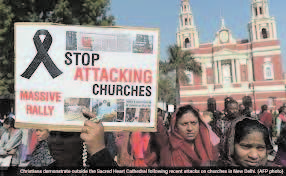
  • Strangers in their own land: Dilemma of the Christian populace in India

    Strangers in their own land: Dilemma of the Christian populace in India

    Mr. Julio Ribeiro, Retired IPS officer, former DGP of Mumbai and Gujarat recently said: ‘As a Christian, suddenly, I am a stranger in my own country’. He was merely reflecting on the recent dilemma of the Christian community in India since the ascendance of Mr. Narendra Modi as Prime Minister of India. It is indeed the anguish of a distinguished public servant who has served the country with great zeal and dedication to protect and preserve its territorial integrity.

    Today, scores of Indian Christians who have contributed in so many ways towards the development of India especially in the social and educational sectors are pained to feel the same way as Mr. Ribeiro does!As a Christian and a member of the Diaspora, I truly share the sentiment of Mr. Ribeiro and salute him for his forthrightness in speaking out.

    What exactly has happened to bring about such anxiety and insecurity to such a small community that poses no harm to its fellow citizens? The latest reports from India point to two more attacks  targeting the Christian religious places of worship, one at St. George Church in Navi, Maharashtra and the other at St.Peter and Paul Church at Jabalpur, Madhya Pradesh, along with two schools that are managed by the churches. Incidentally, both Maharashtra and Madhya Pradesh states are governed by Prime Minister Modi’s party-BJP.

    These may have happened at the heel of another incident in Nadia district in West Bengal where a 72 year old Nun was gang raped by six individuals at the Jesus and Mary convent school. Reacting to the gang rape of the Nun, Surendra Jain, Joint Secretary of the Vishwa Hindu Parishad (VHP) blamed the ‘Christian Culture’ for the incident. He also justified the vandalizing of a Church in Haryana and stated that these attacks would continue if conversions do not stop.Church Attacks In India

    Several Churches in Delhi were vandalized and desecrated by religious extremists in the past months including St. Sebastian Church in Dilshad Garden which was reduced to ashes with its altar charred and Bibles strewn all over the ground. Archbishop Anil Couto said that the arson in St. Sebastian Church was condemnable not just because it was act of sacrilege and hate against the community and its faith, but because it could happen in the national capital which is recovering from a series of communal incidents. Also distressing to him is the sense of police impunity that long hours were lost, and possible evidence destroyed, before police finally came. Most of the culprits still remain at large and the law enforcement officials seem to show very little urgency in bringing them to justice.

    These incidents are not just limited to certain parts of India but happening across the country. The recent incident in a village in Chattisgarh reveals the fear and insecurity of those who have embraced Christianity as their faith. Sukhram Kashyap, a Christian from Chattisgarh, has not only seen his church vandalized but was denied food rations from the Hindu dominated village council and several of his friends were beaten up when they protested. Some of his fellow worshippers were reconverted in an aggressive campaign called ‘Ghar Wapasi’ by Hindu fundamentalists who have also banned any Christian clergy from entering the village.

    Breaking a long silence on this continuing onslaught by the Hindutva brigade on Christians and their Institutions around the country Prime Minister Modi said the following; ‘the tradition of welcoming, respecting and honoring all faiths is as old as India itself’. One wonders whether his ardent followers in BJP and RSS are listening!

    The President of Catholic Bishops Conference of India Cardinal Baselios Cleemis said that the recent attacks on churches and Christians in India have made many ‘feel that their Christian identity is being questioned and it gives a sense of sadness. It showed that not everybody had taken seriously the Prime Minister Narendra Modi’s assurance to minorities’. ‘Irrespective of their faiths, anybody being attacked was an Indian citizen and it was the government’s duty to protect them’ Cardinal added.

    In an interview to Karan Thapar on Headlines Today, Cardianal Cleemis also described as “very painful and sad” the comments of RSS head Mohan Bhagwat that Mother Teresa’s humanitarian works were driven by her motive to convert those she served. “It was very painful and very sad to hear about Mother Teresa whom the nation honored with Bharat Ratna,” he said.

    There is no doubt that that Cardinal Cleemis spoke on behalf of all Christians in India that may very well include many of the faithful in the Diaspora. Although he did not single out any organization over many of these incidents but went on to criticize the Modi government for observing Christmas as Good Governance Day, saying good governance should be done everyday and the Christian festival should be respected.

    One of the most astounding observations that can be made about these attacks on minorities in India is that there is a deafening silence on the part of the Diaspora in the US. Hindu American Foundation, Vishwa Hindu Parishad of America, and GOPIO along with many other organizations have decided to look the other way. Though relatively new as immigrants to this great country, Indians continue to demand our rightful place, justifiably so, at the table in sharing the riches and defending our values and traditions while not tolerating any injustice that offends our sensibilities. A huge segment of the community has indeed made tremendous strides in this short period realizing the American dream and integrating itself into the mainstream.

    However, Christians in India who have lived there for almost two Millennia are made to feel as if they are strangers in their own land. How a personal choice of faith that is guaranteed under the article 25 and 26 of the Constitution of India could make or break the ‘Indian ness’ of its citizenry is beyond the comprehension of any rational mind!  

    Undoubtedly, the forces of polarization and divisions have come out of the woodwork and kept themselves busy transforming India at the expense of the values and principles of inclusiveness and tolerance that brought the nation together. The current Government’s dual-track policy of providing good optics for the consumption of the global community while unleashing the extremist forces to undo the social progress of the last 65 years, mostly under the Congress rule, is troublesome and disheartening to most of its citizens!

    President Obama in his Siri Fort speech prodded the new Government ‘India will succeed so long as it is not splintered along the lines of religious faith, as long as it is not splintered along any lines and it is unified as a nation’. It sounds prophetic and to plainly put it, unless the Prime Minister reins in these extremist elements that run amok now, his dream of ‘modern India’ could be in increasing peril!

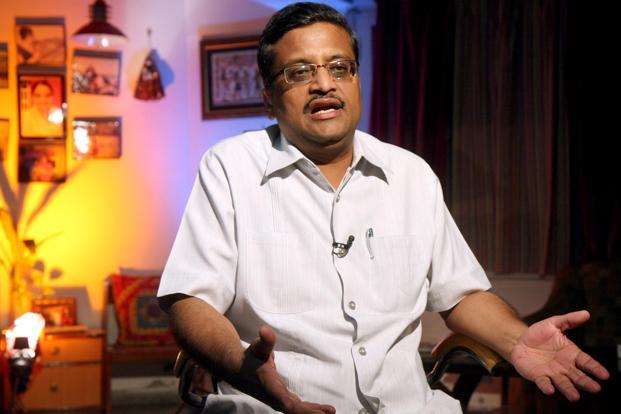
  • SPLIT IN HARYANA BJP OVER ASHOK KHEMKA’S TRANSFER

    SPLIT IN HARYANA BJP OVER ASHOK KHEMKA’S TRANSFER

    CHANDIGARH (TIP): Differences surfaced in Haryana BJP over the transfer of whistleblower IAS officer Ashok Khemka, with cabinet minister Anil Vij saying he stands by Khemka and chief minister Manohar Lal Khattar calling the transfer “routine”.

    Health minister Anil Vij said, “I am totally with Khemka. I am with him since he fought the battle against corruption. I will stand by him… comment about this after talking to the CM.” 

    Khattar, who was in Hisar on April 2, “Jo sarkar ko jahan aavashyakta hoti hai, wahin harek adhikari ko bulaya jata hai. Hamari aavashyakta us hisab se jaisi hai, waisa hamney lagaya hai (government appoints any officer as per its requirements. We have posted him as per our requirements).” He said Khemka was a good and honest officer.

    A 1991 batch IAS officer, Khemka has faced 46 transfers during 22 years of service. He reacted to his transfer on Thursday with a tweet, “Tried hard to address corruption and bring reforms in transport despite severe limitations and entrenched interests. Moment is truly painful.”

    The government has not given any reason for his transfer, but sources said that the influential transporters’ lobby was unhappy with the officers’ order for stringent checking of trucks plying the inter—state route, especially those moving between Haryana and Rajasthan.

    Brushing aside suggestion of any role in Khemka’s transfer, transport minister Ram Bilas Sharma said, “It’s a routine matter. I have still kept him in my department. The archaeology (department) is under me.”

    Agriculture minister Om Prakash Dhankar saw no controversy in Khemka’s transfer either, unlike the previous Congress regime when he was allegedly shunted out over the Vadra land deal.

    “If he (Khemka) sees any issue, then he should talk to us or the CM,” said Dhankar, urging officers to not go to the media. “He (Khemka) is among the officers who goes to the media the most,” he added.

    The government had on April 1 transferred Khemka, 49, to a “low profile” assignment of secretary and director general of state archaeology and museums department, just four months after he was made transport commissioner.

  • PRIME MINISTER TURNS TO BUREAUCRACY TO MAKE GOVERNMENT SHINE

    NEW DELHI (TIP): As his government heads towards completing one year in office, Prime Minister Narendra Modi is looking again to his bureaucrats to put in their best to bring back shine to the image of the BJP government.

    In his third such interaction since he became the prime minister, held on April 1 Modi assured them that they need not fear taking “honest decisions” as some officials expressed fear over repercussion and scrutiny in the future.

    Both Modi and Finance Minister Arun Jaitley, who was also present, told the officials that they were looking into the problem of filing of frivolous complaints against them, employing the Right to Information Act.

    But they must work fast for an effective campaign to showcase the achievement of his government in the last 11 months, Modi told the officials. In particular, the prime minister mentioned the success of coal block auctions and the Pradhan Mantri Jan Dhan Yojana.

    “The prime minister once again urged all secretaries to consult each other regularly, to eliminate silos, if any, and speed up the process of decision-making,” an official statement said.

    He underlined that a “communication gap” in “this team was absolutely untenable”, it added. Modi’s interaction came on a day when three more senior IAS officers from Gujarat cadre were appointed as joint secretaries in the Union Government, taking the number of Gujarat cadre officers in Delhi to over 20.

    Known as trusted lieutenants of Modi, G C Murmu, principal Secretary to the chief minister, was appointed as joint secretary expenditure, R P Gupta, principal secretary, civil supplies as joint secretary coal and Rajkumar, principal secretary agricultural, as joint secretary economic affairs.

    These officers will join other Gujarat cadre colleagues in Delhi, including A K Sharma, P K Mishra and Rajeev Topno, who are in the Prime Minister’s Office. Besides, Hasmukh Adhiya was deputed last year as finance secretary and Gauri Kumar is secretary cabinet (co-ordination).

    Soon after taking over as the prime minister on May 26 last year, Modi had met all the secretaries on June 4 and told them to fearlessly take decisions and that he would back them.

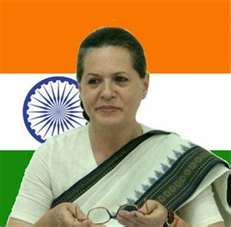
  • Cong loyalist says Sonia in grip of sycophants

    Cong loyalist says Sonia in grip of sycophants

    NEW DELHI (TIP): Former law minister H R Bhardwaj stunned Congress circles on March 26 when he attacked Sonia Gandhi for her alleged reluctance to share responsibility for the UPA government’s controversial decisions and former finance minister P Chidambaram for his “hypocrisy” in attacking Section 66A of the IT Act despite the fact that the contentious provision, which has been struck down by the Supreme Court, was drafted by the Congress-led coalition.

    In a series of TV interviews, Bhardwaj referred to the summons issued to former PM Manmohan Singh in a ‘Coalgate’ case to say, “It is a matter of great sorrow that our leaders are getting summons from the court… those at the top level, including at the level of PM.” 

    Surprisingly, Bhardwaj, a known Nehru-Gandhi family loyalist, trained his guns on Congress president Sonia Gandhi for the legal troubles facing the party. “Does Sonia Gandhi not understand what happened, why it happened and who did it? Everything is known. That is the style. Sharing no responsibility and yet do everything,” an agency report quoted him as telling a TV channel.

    He also claimed that Sonia was “in the grip of couple of sycophants and corrupt people”.

    Although Bhardwaj defended Rahul Gandhi, his remarks cannot amuse the Congress because they mark an endorsement of BJP’s charge that Sonia remote-controlled UPA governments and was party to all controversial decisions.

    The former law minister, known for outspokenness but who has been keeping a low profile after leaving as Karnataka governor, also targeted Chidambaram on Section 66A, marking the beginning of the blame game on the controversial provision which was struck down by the SC on Tuesday for being violative of the right to free speech provided for under the Constitution.

    A day after the former finance minister welcomed the SC judgment saying the controversial section was poorly drafted and was vulnerable to misuse, Bhardwaj termed his statement as “sheer hypocrisy”.

    Section 66A was not part of the original I-T Act enacted by the NDA government in 2000. The UPA government amended the Act in 2009 and brought Section 66A into force on October 27, 2009 when Chidambaram and Bhardwaj headed the crucial ministries of home and law.

  • SMART MOVES – Modi Government on US & China

    SMART MOVES – Modi Government on US & China

    [vc_row][vc_column][vc_column_text]

    “The Modi government will face the test of managing closer strategic relations with the US, which are in part directed against China, and forging closer ties with China that go against this strategic thrust, besides the reality that China has actually stronger ties with the US than it can ever have with India, though the underlying tensions between the two are of an altogether different order than between India and the US.”


    [/vc_column_text][/vc_column][/vc_row][vc_row][vc_column width=”1/2″][vc_column_text]

    [quote_box_center]China[/quote_box_center] 

    Prime Minister Modi has been quick to court both US and China. His first overtures were to China, prompted no doubt by his several visits there as Chief Minister of Gujarat, Chinese investments in his home state and his general admiration for China’s economic achievements. Beyond this personal element, many in the government and corporate sectors in India believe that our politically contentious issues with China, especially the unresolved border issue, should be held in abeyance and that economic cooperation with that country should be expanded, as India can gain much from China’s phenomenal rise and the expertise it has developed in specific sectors, especially in infrastructure. It is also believed that China, which is now sitting over $4 trillion of foreign exchange reserves, has huge surplus resources to invest and India should actively tap them for its own developmental needs. In this there is continuity in thinking and policy from the previous government, with Modi, as is his wont, giving it a strong personal imprint.

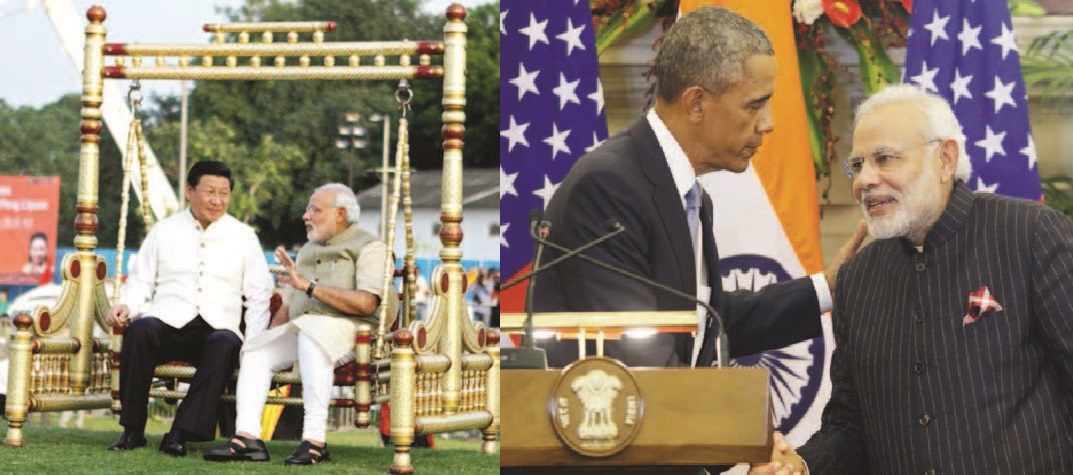
    The first foreign dignitary to be received by Modi after he became Prime Minister was the Chinese Foreign Minister, representing the Chinese President. This was followed by up by his unusually long conversation on the telephone with the Chinese Prime Minister. Our Vice-President was sent to Beijing to celebrate the 60th anniversary of the Panchsheel Agreement even though China has blatantly violated this agreement and India’s high level diplomatic endorsement of it only bolsters Chinese diplomacy, especially in the context of China-created tensions in the South China and East China Seas. Modi had occasion to meet President Xi Jinxing in July at the BRICS summit in July 2014, and this was followed up by the Chinese President’s state visit to India in September 2014, during which the Prime Minister made unprecedented personal gestures to him in an informal setting in Ahmedabad.

    The dramatics of Modi’s outreach to the Chinese aside, his objectives in strengthening economic ties with China, essentially imply a consolidation of the approach followed in the last decade or so, with some course correction here and there. In this period, China made very significant headway in our power and telecom sectors, disregarding obvious security concerns associated with China’s cyber capabilities and the links of Chinese companies to the Chinese military establishment. Many of our top companies have tapped Chinese banks and financial institutions for funds, and this has produced a pro-Chinese corporate lobby in our country. This lobby will obviously highlight the advantages of economic engagement over security concerns. The previous Prime Minister followed the approach of emphasizing shared interests with China rather than highlighting differences. The position his government took on the Depsang incident in May 2013 showed his inclination to temporize rather than confront. Externally, he took the line, which Chinese leaders repeated, that the world is big enough for India and China to grow, suggesting that he did not see potential conflict with China for access to global markets and resources. Under him, India’s participation in the triangular Russia-India-China format (RIC) and the BRICS format continued, with India-originated proposal for a BRICS Development Bank eventually materializing. Indian concerns about the imbalance in trade were voiced, but without any action by China to redress the situation. India sought more access to the Chinese domestic market for our competitive IT and pharmaceutical products, as well as agricultural commodities, without success. Concerns about cheap Chinese products flooding the India market and wiping out parts of our small-scale sector were voiced now and then, but without any notable remedial steps. The Strategic Economic Dialogue set up with China, which focused primarily on the railway sector and potential Chinese investments in India, did not produce tangible results.

    The Manmohan Singh government, despite China’s aggressive claims on Arunachal Pradesh and lack of progress in talks between the Special Representatives on the boundary issue as well as concerns about China’s strategic threats to our security flowing from its policies in our neighborhood, especially towards Pakistan and Sri Lanka, declared a strategic and cooperative partnership with that country. During Manmohan Singh’s visit to China in September 2013, we signed on to some contestable formulations, as, for example, the two sides committing themselves to taking a positive view of and supporting each other’s friendship with other countries, and even more surprisingly, to support each other enhancing friendly relations with their common neighbors for mutual benefit and win-win results. This wipes off on paper our concerns about Chinese policies in our neighborhood. We supported the BCIM (Bangladesh, China, India, Myanmar) Economic Corridor, including people to people exchanges, overlooking Chinese claims on Arunachal Pradesh and the dangers of giving the Chinese access to our northeast at people to people level. The agreement to carry out civil nuclear cooperation with China was surprising, as this makes our objections to China-Pakistan nuclear ties politically illogical. We also agreed to enhance bilateral cooperation on maritime security, which serves to legitimize China’s presence in the Indian Ocean when China’s penetration into this zone poses a strategic threat to us.

    As a mark of continuity under the Modi government, during President Xi Jinxing’s September 2014 visit to India, the two sides agreed to further consolidate their Strategic and Cooperative Partnership, recognized that their developments goals are interlinked and that their respective growth processes are mutually reinforcing. They agreed to make this developmental partnership a core component of their Strategic and Cooperative Partnership. The India-China Strategic Economic Dialogue was tasked to explore industrial investment and infrastructure development.

    To address the issue of the yawning trade imbalance, measures in the field of pharmaceuticals, IT, agro-products were identified and a Five-Year Development Program for economic and Trade Cooperation to deepen and balance bilateral trade engagement was signed. Pursuant to discussions during the tenure of the previous government, the Chinese announced the establishment of two industrial parks in India, one in Gujarat and the other in Maharashtra, and the “Endeavour to realize” an investment of US $ 20 billion in the next five years in various industrial and infrastructure development projects in India, with production and supply chain linkages also in view. In the railway sector, the two sides the two sides agreed to identify the technical inputs required to increase speed on the existing railway line from Chennai to Mysore via Bangalore, with the Chinese side agreeing to provide training in heavy haul for 100 Indian railway officials and cooperating in redevelopment of existing railway stations and establishment of a railway university in India. The Indian side agreed to actively consider cooperating with the Chinese on a High Speed Rail project. In the area of financial cooperation, the Indian side approved in principle the request of the Bank of China to open a branch in Mumbai.

    The Modi government has agreed to continue defense contacts, besides holding the first round of the maritime cooperation dialogue this year, even though by engaging India in this area it disarms our objections to its increasing presence in the Indian Ocean area, besides drawing negative attention away from its policies in the South China Sea as well as projecting itself as a country committed to maritime cooperation with reasonable partners. The joint statement issued during Xi Jinxing’s visit omitted any mention of developments in western Pacific, though it contained an anodyne formulation on Asia-Pacific. This becomes relevant in view of the statements on Asia-pacific and the Indian Ocean region issued during President Obama’s visit to India in January 2015.

    Our support, even if tepid, continues for the BCIM Economic Corridor. On our Security Council permanent membership, China continues its equivocal position, stating that it “understands and supports India’s aspiration to play a greater role in the United Nations including in the Security Council”. It is careful not to pronounce support for India’s “permanent membership”. During Foreign Minister Sushma Swaraj’s visit to China for the RIC Foreign Ministers meeting, China has maintained its equivocation, although the press has wrongly presented the formulation as an advance. China is openly opposed to Japan’s candidature in view of the sharp deterioration of their ties. In India’s case, it avoids creating a political hurdle to improved ties by openly opposing India’s candidature. “A greater role” could well mean a formula of immediately re-electable non-permanent members, of the kind being proposed by a former UN Secretary General and others.

    On counter-terrorism lip service is being paid to cooperation. On Climate Change, the two countries support the principle of “equity, common but differentiated responsibilities and respective capabilities”, although the US-China agreement on emission reduction targets has created a gap in Indian and Chinese positions, with the Modi government deciding to delink itself from China in international discussions to follow.

    In diplomacy, once concessions or mistakes are made, retrieval is very difficult unless a crisis supervenes. The Modi government, for reasons that are not too clear, repeated the intention of the two countries to carry out bilateral cooperation in civil nuclear energy in line with their respective international commitments, which has the unfortunate implication of India circumscribing its own headroom to object to the China-Pakistan nuclear nexus, besides the nuance introduced that China is observing its international commitments in engaging in such cooperation. The calculation that this might make China more amenable to support India’s NSG membership may well prove to be a mistaken one. Surprisingly, stepping back from the Manmohan government’s refusal towards the end to make one-sided statements in support of China’s sovereignty over Tibet when China continues to make claims on Indian territory, the new government yielded to the Chinese ruse in making us thank the “Tibetan Autonomous Region of the People’s Republic of China” as well as the Chinese Ministry of Foreign Affairs – as if both are independent of the Chinese government- for facilitating the Kailash Mansarovar Yatra and opening the new route through Nathu La, even though this is not the  most rational route because it involves a far longer journey, made easier of course by much better infrastructure. On receiving the flood season hydrological date the Chinese have stuck to their minimalist position.

    On the sensitive border issue, the disconnect between the joint statement which repeats the usual cliches and the serious incident in Chumar coinciding with Xi’s visit was obvious. China’s double game of reaching out to India- with greater confidence now as the gap between it and India has greatly widened and it has begun to believe that India now needs China for its growth and development goals- and staging a provocation at the time of a high level visit, continues. This is a way to remind India of its vulnerability and the likely cost of challenging China’s interests, unmindful that its conduct stokes the already high levels of India’s distrust of that country. It went to Modi’s credit that he raised the border issue frontally with XI Jinping at their joint press conference, expressing “our serious concern over repeated incidents along the border” and asking that the understanding to maintain peace and tranquility on the border “should be strictly observed”. He rightly called for resuming the stalled process of clarifying the Line of Actual Control (LAC). While this more confident approach towards China is to be lauded, we are unable to persuade China to be less obdurate on the border issue because we are signaling our willingness to embrace it nonetheless virtually in all other areas.

    That Modi mentioned “India’s concerns relating to China’s visa policy and Trans Border Rivers” while standing alongside Xi Jinping at the joint press conference indicated a refreshing change from the past in terms of a more open expression of India’s concerns. With regard to Bangladesh-China-India-Myanmar Economic Corridor that China is pushing hard, Modi rightly added a caveat by declaring that “our efforts to rebuild physical connectivity in the region would also require a peaceful, stable and cooperative environment”. He also did not back another pet proposal of Xi: the Maritime Silk Road, which is a re-packaged version of the notorious “string of pearls” strategy, as the joint statement omits any mention of it.

    Even as Modi has been making his overall interest in forging stronger ties with China clear, he has not shied away from allusions to Chinese expansionism, not only on Indian soil but also during his visit to Japan. After President Obama’s visit to India and the joint statements on South China Sea and Asia-Pacific issued on the occasion which can be construed as directed at China, Foreign Minister Sushma Swaraj’s recent visit there acquired more than normal interest in watching out for indications of China’s reaction. Her call on Xi Jinping was projected, quite wrongly, as going beyond normal protocol, when in actual fact the Chinese Foreign Minister gets access to the highest levels in India during visits. Swaraj seems to have pushed for an early resolution of the border issue, with out-of-the-box thinking between the two strong leaders that lead their respective countries today. Turning the Chinese formulation on its head, she called for leaving a resolved border issue for future generations.

    That China has no intention to look at any out-of-the-box solution- unless India is willing to make a concession under cover of “original thinking”- has been made clear by the vehemence of its reaction to Modi’s recent visit to Arunachal Pradesh to inaugurate two development projects on the anniversary of the state’s formation in 1987. It has fulminated over the Modi visit over two days, summoning the Indian Ambassador to lodge a protest, inventing Tibetan names for sub-divisions within Arunachal Pradesh to mark the point that this area has been under Tibetan administrative control historically. The Chinese Vice-Foreign Minister arrogantly told our Ambassador that Modi’s visit undermined “China’s territorial sovereignty, right and interests” and “violates the consensus to appropriately handle the border issue.” China is making clear that it considers Arunachal Pradesh not “disputed territory” but China’s sovereign territory. It is also inventing a non-existent “consensus” that Indian leaders will not visit Arunachal Pradesh to respect China’s position. There is a parallel between China’s position on the Senkakus where it accuses the Japanese government to change the status quo and inviting a Chinese reaction, and its latest broadside against India. This intemperate Chinese reaction casts a shadow on Modi’s planned visit to China in May and next round of talks between the Special Representatives (SRs) on the boundary question. If without a strong riposte these planned visits go ahead we would have allowed the Chinese to shift the ground on the outstanding border issue even more in their favor. It would be advisable for our Defense Minister to visit Tawang before Modi’s visit. A very categorical enunciation of our position that goes beyond previous formulations should be made by the Indian side. The Chinese position makes the SR talks pointless, as the terms of reference China is laying down cannot be agreed to by our side.

    [/vc_column_text][/vc_column][vc_column width=”1/2″][vc_column_text]

    [quote_box_center]UNITED STATES[/quote_box_center] 

    Prime Minister Modi, contrary to expectations, moved rapidly and decisively towards the US on assuming office. He confounded political analysts by putting aside his personal pique at having been denied a visa to visit the US for nine years for violating the US law on religious freedoms, the only individual to be sanctioned under this law. The first foreign visit by Modi to be announced was that to the US. Clearly, he believes that strong relations with the US gives India greater strategic space in foreign affairs and that its support is crucial for his developmental plans for India.

    To assess the Modi government’s policies towards the US, the results of his visit to Washington in September 2014 and that of Obama to India in January 2015 need to be analyzed, keeping in mind the approach of the previous government and the element of continuity and change that can be discerned.

    The joint statement issued during his US visit set out the future agenda of the relationship, with some goals clearly unachievable, but the ambitions of the two countries were underscored nonetheless. It was stated that both sides will facilitate actions to increase trade five-fold, implying US-China trade levels, which is not achievable in any realistic time-frame. They pledged to establish an Indo-US Investment Initiative and an Infrastructure Collaboration Platform to develop and finance infrastructure. An agreement on the Investment Initiative was signed in Washington prior to Obama’s visit to India, but bringing about capital reforms in India, which the Initiative aims at, is not something that can be realized quickly. India wants foreign investment in infrastructure and would want to tap into US capabilities in this broad sector, but the US is not in the game of developing industrial corridors like Japan or competitively building highways, ports or airports. Cooperation in the railway sector was identified, but it can only be in some specific technologies because this is the field in which Japan and China are competing for opportunities in India, whether by way of implementing high speed freight corridors or building high speed train networks in the country. India offered to the U.S. industry lead partnership in developing three smart cities, even if the concept of smart cities is not entirely clear. Some preliminary steps seem to have been taken by US companies to implement the concept. The decision to establish an annual high-level Intellectual Property (IP) Working Group with appropriate decision-making and technical-level meetings as part of this Forum was done at US insistence as IPR issues are high on the US agenda in the context of contentious issues that have arisen between the US companies and the Indian government on patent protection, compulsory licensing and local manufacturing content requirements.

    In his joint press briefing with Obama, Modi raised IT related issues, pressing Obama’s support  “for continued openness and ease of access for Indian services companies in the US market”, without obtaining a reaction from  the latter then or later when Obama visited India. On the food subsidy versus trade facilitation stand off in the WTO, Modi maintained his position firmly and compelling the US to accept a compromise. Modi’s firmness on an issue of vital political importance to India showed that he could stand up to US pressure if the country’s interest so demanded. He welcomed “the US defense companies to participate in developing the Indian defense industry”, without singling out any of the several co-development and co-production projects offered by the US as part of the Defense Technology and Trade Initiative (DTTI). Clearly, it was too early to conclude discussions on the US proposals before his September visit.

    The more broad based reference in the joint statement to India and the US intending to expand defense cooperation to bolster national, regional and global security was, on the contrary, rather bold and ambitious, the import of which became clearer during Obama’s January visit. While bolstering such cooperation for national security makes sense, regional security cannot be advanced together by both countries so long as the US continues to give military aid to Pakistan, which it is doing even now by issuing presidential waivers to overcome the provisions of the Kerry-Lugar legislation that requires Pakistan to act verifiably against terrorist groups on its soil before the aid can be released. As regards India-US defense cooperation bolstering global security, securing the sea lanes of communication in the Indian Ocean and the Asia-Pacific region is the obvious context. It was decided to renew for 10 years more the 2005 Framework for US-India Defense Relations, with defense teams of the two countries directed to “develop plans” for more ambitious programs, including enhanced technology partnerships for India’s Navy, including assessing possible areas of technology cooperation.

    The US reiterated its commitment to support India’s membership of the four technology control regimes: the Nuclear Suppliers Group (NSG), the Missile Technology Control Regime (MTCR), the Wassenaar Agreement and the Australia Group, with Obama noting that India met MTCR requirements and is ready for NSG membership, but without setting any time-tables. An actual push by the US in favor of India’s membership has been lacking because of issues of nuclear liability and administrative arrangements have remained unresolved until now and the US has wanted to use their resolution as a leverage. US support for India’s membership of these export control organizations was reiterated during Obama’s January visit, but how quickly the US will move remains unclear even after the political resolution of outstanding nuclear issues.

    The US at one time described India as a lynchpin of its pivot or rebalance towards Asia. The underlying motivation behind the pivot and US interest in drawing India into this strategy is China, though this is not stated publicly in such open terms. India has been cautious about the US pivot towards Asia as its capacity and willingness to “contain” Chinese power has been doubted because of the huge financial and commercial interdependence forged between the two countries. India seeks stable and economically productive relations with China and has wanted to avoid the risk of being used by the US to serve its China strategy that raises uncertainties in the mind of even the US allies in Asia. However, under the Modi government, India has become more affirmative in its statements about the situation in the western Pacific and the commonalities of interests between India and the US and other countries in the Indo-Pacific region. The government has decided to “Act East”, to strengthen strategic ties with Japan and Australia, as well as Vietnam, conduct more military exercises bilaterally with the US armed forces as well as naval exercises trilaterally with Japan. Modi has spoken publicly about greater India-US convergences in the Asia-Pacific region, to the point of calling the US  intrinsic to India’s Act East and Link West policies, a bold formulation in its geopolitical connotations never used before that suggested that India now viewed the US as being almost central to its foreign policy initiatives in both directions.

    On  geopolitical issues, India showed strategic boldness in the formulations that figured in the September joint statement. These laid the ground for more robust demonstration of strategic convergences between the two countries during Obama’s visit later. The reference in September to the great convergence on “peace and stability in the Asia Pacific region” was significant in terms of China’s growing assertiveness there. The joint statement spoke of a commitment to work more closely with other Asia Pacific countries, including through joint exercises, pointing implicitly to Japan and Australia, and even Vietnam. In this context, the decision to explore holding the trilateral India-US-Japan dialogue at Foreign Minister’s level- a proposition that figured also in the India-Japan joint statement during Modi’s visit there- was significant as it suggested an upgrading of the trilateral relationship at the political level, again with China in view.

    On the issue of terrorism and religious extremism, India and the US have rhetorical convergence  and some useful cooperation in specific counter-terrorism issues, but, on the whole, our concerns are  inadequately met because US regional interests are not fully aligned with those of India. The September joint statement called for the dismantling of safe havens for terrorist and criminal networks and disruption of all financial and tactical support for networks such as Al Qaeda, Lashkar-e-Taiba, Jaish-e-Mohammad, the D-company and the Haqqanis, but the Taliban were conspicuously omitted from the list. In any case, such statements against Pakistan-based terrorist groups have been made before but are ignored  by Pakistan in the absence of any real US pressure on it to curb Hafiz Saeed or credibly try Lakhvi despite repeated joint calls for bringing those responsible for the Mumbai terrorist massacre to justice.

    We had a paragraph on Iran in the joint statement in Washington, clearly at US insistence, which the Iranians would have noted with some displeasure. The Modi government is also willing to accommodate the US on Iran within acceptable limits. While the US supports India’s permanent membership of the UN Security Council, the support remains on paper as the US is not politically ready to promote the expansion of the Council.

    At Washington, India and the US agreed on an enhanced strategic partnership on climate change issues, and we committed ourselves to working with the US to make the UN Conference on Climate Change in Paris in December this year a success. This carried the risk of giving a handle to the US to ratchet up pressure to obtain some emission reduction commitments from India, encouraged  diplomatically by the US-China agreement.

    The unusually strong personal element in Modi’s diplomacy towards the US came apparent when during his Washington visit he invited Obama to be the chief guest at our Republic Day on January 26, 2015- a bold and imaginative move characteristic of his style of functioning. That this unprecedented invitation was made was surprising in itself, as was its acceptance by Obama at such short notice. Modi and Obama evidently struck a good personal equation, with the earlier alienation supplanted by empathy. Obama made the unprecedented gesture of accompanying Modi to the Martin Luther King Memorial in Washington, perhaps taking a leaf from the personal gestures made  to Modi in Japan by Prime Minister Abe.

    On the occasion of Obama’s January visit, Modi has moved decisively, if somewhat controversially, on the nuclear front, as this was the critical diplomatic moment to work for a breakthrough to underline India’s commitment to the strategic relationship with the US, which is the way that US commentators have looked at this issue. While in opposition the BJP had opposed the India-US nuclear agreement, introduced liability clauses that became a major hurdle in implementing the commitment to procure US supplied nuclear reactors for producing 10,000 MWs of power, and had even spoken of seeking a revision of the agreement whenever it came to power. During Obama’s  visit, the “breakthrough understandings” on the nuclear liability issue and that of administrative arrangements to track US supplied nuclear material or third party material passing through US supplied reactors, became the highlight of its success, with Modi himself calling nuclear cooperation issues as central to India-US ties. The supplier liability issue seems to have resolved at the level of the two governments by India’s decision to set up an insurance pool to cover supplier liability, as well as a written clarification through a Memorandum of Law on the applicability of Section 46 only to operators and not suppliers. On the national tracking issue the nature of the understanding has left some questions unanswered; it would appear that we have accepted monitoring beyond IAEA safeguards as required under the US law. However, the larger question of the commercial viability of US supplied reactors remains, a point that Modi alluded to in joint press conference. On the whole, whatever the ambiguities and shortfalls, transferring the subject away from government to company level to eliminate  the negative politics surrounding the subject is not an unwelcome development.

    For the US, defense cooperation has been another touchstone for the US to measure India’s willingness to deepen the strategic partnership. While the significant progress expected to be announced under the DTTI during Obama’s visit did not materialize, some advance was made with the announcement of four “pathfinder” projects involving minor technologies, with cooperation in the area of aircraft engines and aircraft carrier technologies to be explored later. The government has already chosen for price reasons the Israeli missile over the Javelin that was part of the several proposals made to India under the DTTI. As expected, the India-US Defense Framework Agreement of 2005 was extended for another 10 years, without disclosing the new text. It is believed  that India is now more open to discussions on the three foundational agreements that the US considers necessary for transfer of high defense technologies to India.

    The US-India Joint Strategic Vision for the Asia-Pacific and Indian Ocean Region signed during the visit is a major document which in the eyes of some reflects India’s move away from the shibboleths of the past associated with nonalignment and the obsession with strategic autonomy. Issuing a separate document was intended to highlight the growing strategic convergences between the two countries, with full awareness of how this might be interpreted by some countries, notably China. It affirms the “importance of safeguarding maritime security and ensuring freedom of navigation and overflight throughout the region , especially in the South China Sea”, while calling also on all parties to avoid the threat or use of force and pursue resolution of territorial and maritime disputes through all peaceful means in accordance with international law, including the Law of the Sea Convention. It speaks, in addition, of India and the US investing in making trilateral countries with third countries in the region, with Japan and Australia clearly in mind. This is a direct message addressed to China, reflecting less inhibition on India’s part both to pronounce on the subject and do it jointly with the US, irrespective of Chinese sensibilities. Some Chinese commentary has criticized this effort by the US to make India part of its containment strategy, without taking cognizance of how India views China’s maritime strategy in the Indian Ocean involving its strategic investments in Sri Lanka, Maldives, Pakistan and other countries. In the joint statement issued during  Obama’s visit, the two sides noted that India’s Act East Policy and the US rebalance to Asia provided opportunities to the two countries to work closely to strengthen regional ties, in what amounted to an indirect endorsement of the US pivot to Asia.

    Obama’s visit also demonstrated the consolidation of the good personal rapport established between him and Shri Modi, with embraces and first name familiarity- possibly overdone on Modi’s part- walk in the park and talk over tea, all of which boosted the prime minister’s personal stature as a man comfortable and confident in his dealings with the world’s most powerful leader on the basis of equality. This personal rapport should assist in greater White House oversight over the Administration’s policies towards India, which experience shows greatly benefits the bilateral relationship.

    Counter-terrorism is always highlighted as an expanding area of India-US cooperation because of shared threats. The joint statement in Delhi spoke dramatically of making the US-India partnership in this area a “defining” relationship for the 21st century. Does this mean that the US will share actionable intelligence on terrorist threats to us emanating from Pakistani soil? This is doubtful. The continued omission of the Afghan Taliban from the list of entities India and the US will work against is disquieting, as it indicates US determination to engage the Taliban, even when it knows that it is Pakistan’s only instrument to exert influence on developments in Afghanistan at India’s cost. The subsequent refusal of the US spokesperson to characterize the Taliban as a terrorist organization and preferring to call it an armed insurgency has only served to confirm this.

    On trade, investment and IPR issues, the two sides will continue their engagement with the impulse given to the overall relationship by the Obama-Modi exchanges. On a high standard Bilateral Investment Treaty the two sides will
    “assess the prospects for moving forward”, which indicates the hard work ahead. On the tantalization agreement the two will “hold a discussion on the elements requires in both countries to pursue” it, a language that is conspicuously non-committal. On IPRs there will be enhanced engagement in 2015 under the High Level Working Group.

    On climate change, we reiterated again the decision to work together this year to achieve a successful agreement at the UN conference in Paris, even when our respective positions are opposed on the core issue of India making specific emission reduction commitments. While stating  that neither the US nor the US-China agreement put any pressure on India, Modi spoke in his joint press conference about pressure on all countries to take steps for the sake of posterity. While  finessing the issue with high-sounding phraseology, he has left the door open for practical compromises with the US.

    As a general point, hyping-up our relations with the US is not wise as it reduces our political space to criticize its actions when we disagree. The previous government made this mistake and the Modi government is not being careful enough in this regard. Obama’s objectionable lecture to us at Siri Fort on religious freedom and his pointed reference to Article 25 of our Constitution, illustrates this. He showed unpardonable ignorance of Indian history and Hindu religious traditions in asking us to “look beyond any differences in religion” because “nowhere in the world is it going to more necessary for that foundational value to be upheld” than in India. To say that “India will succeed so long as it is not splintered around religious lines” was a wilful exaggeration of the import of some recent incidents  and amounted to playing the anti-Hindutva card by a foreign leader prompted by local Christian and “secular” lobbies. Reminding us of three national cinema and sport icons belonging only to minority religions- when their mass adulation is unconnected to their faith- was to actually encourage religiously fissured thinking in our society. On return to Washington Obama pursued his offensive line of exaggerating incidents of religious intolerance in India. On cue, a sanctimonious editorial also appeared in the New York Times. The government could not attack Obama for his insidious parting kick at Siri Fort so as not to dim the halo of a successful visit and therefore pretended that it was not directed at the Modi team. The opposition, instead of deprecating Obama’s remarks, chose to politically exploit them against Modi, as did some Obama-adoring Indians unencumbered by notions of self-respect.

    While giving gratuitous lessons on religious tolerance to the wrong country Obama announced $1 billion civil and military support to Pakistan that splintered from a united India because of religious intolerance in 1947 and has been decimating its minorities since. Obama has also invited the Chinese president to visit the US on a state visit this year, to balance his visit to India and the “strategic convergences” reached there on the Asia-Pacific region. Obama’s claim that the US can be India’s “best partner” remains to be tested as many contradictions in US policy towards India still exist.

    The Modi government will face the test of managing closer strategic relations with the US, which are in part directed against China, and forging closer ties with China that go against this strategic thrust, besides the reality that China has actually stronger ties with the US than it can ever have with India, though the underlying tensions between the two are of an altogether different order than between India and the US.

    [/vc_column_text][/vc_column][/vc_row]

  • Land Bill: BJP panel too favours 80% consent clause

    Land Bill: BJP panel too favours 80% consent clause

    NEW DELHI (TIP): Even as the NDA govern ment seems to be determined to pass the Right to Fair Compensation & Transparency in Land Acquisition, Rehabilitation & Resettlement Bill, 2015, an internal committee of BJP has found some sticking points on the consent clause even among farmer groups sympathetic to the party.

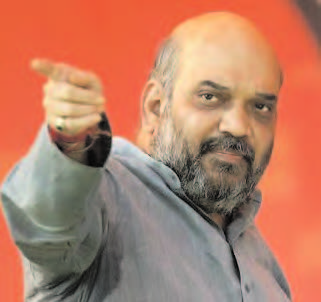
    According to top sources in BJP, the eight-member committee headed by party vice-president Satya Pal Malik has submitted its feedback to party chief Amit Shah. Though at least six out of the nine amendments made to the bill in the Lok Sabha were as a result of this committee’s feed back, one important sticking point has remained unresolved.

    “Most of the representations made by farmers groups and activists to the committee wanted restitution of the clause which stipulated that 80% of land owners should give consent for acquisition before the state can step in and acquire the remaining bit for any private project,” Malik said. “We haven’t submitted any written report; just given a feedback and written ideas suggested by stakeholders whom we spoke to for over 10 days,” he added.

    “I feel there is more propaganda around it than what is actually there. It is a fair bill, but like the rumour of grease ridden cartridges which had set off the revolt of 1857, rumours are strengthening the opposition to the bill,” he added.

    For example, he added, the acquisition of land one km deep from proposed industrial corridors was being touted as a grave rip off.”Yet, provision for acquisition of land 500 metres on either side of the corridor is there in the old UPA bill too,” Satya Pal Malik added.

  • BJP’s Goa CM opposes beef ban

    NEW DELHI (TIP): BJP-ruled Goa would not ban beef as it is an essential part of the cuisine of minority communities in the state, chief minister Laxmikant Parsekar told ET, adding that it had taken several years for his party to earn the trust of the state’s Christians and Muslims.

    “Regardless of what the Centre does -in Goa minorities are 3940% -if it is part of their food habits, why and how can we ban it? For people -especially minorities -eating beef is part of their food,” said Parsekar. The Goan CM’s comments assume significance as it comes days after Maharashtra and Haryana imposed blanket bans on beef. The move had also triggered speculation that the BJP-led Central government could be considering a nation-wide plan to ban beef distribution and consumption.

    Parsekar, a former state-level functionary of RSS, said that he is also conscious about the sentiments of a section of Hindus concerning slaughter of cows.

    “Sentiments are hurt with regards to killing cows, not in the case of oxen or bulls. We don’t permit killing of cows, and even oxen are not killed there (in Goa) now. It (beef) is brought from Karnataka and sold here, which we allow since it is a part of cuisine of Catholics and Muslims, and I feel it should not be banned,” he said.

    The Goa CM also felt that there was a concerted effort from some quarters, including media, to paint BJP as antiminority by blaming the recent attacks on churches on the party. Such incidents are happening even in states where BJP is not in power, but the party is being blamed, he said.

    Parsekar said the BJP managed to grow “gradually” and achieve a full majority government for the first time in the state because of it having “build confidence” among the minority community.

    “In fact, we favour the minorities,” he said, adding, “In Goa, we are always one step ahead (in reassuring the minority community). We favour the minorities -whether it is for (setting up their) institutions or any other help. For your information, exposition of the holy relics of Saint Xavier’s was organised this year. We spent a lot of money for raising infrastructure for that event. It went on for 45 days and 46 lakh people arrived from the world over. We had put up a secretariat comprising top officers for monitoring the event and spent more than Rs 50 crore at the campus.”


  • RSS MOUTHPIECE SHOWS POK AS PAK TERRITORY; GOVT TO PROBE

    RSS MOUTHPIECE SHOWS POK AS PAK TERRITORY; GOVT TO PROBE

    NEW DELHI (TIP): The publication of a map in RSS mouthpiece ‘Organiser’ depicting a part of Jammu and Kashmir as part of Pakistan, today evoked consternation in Rajya Sabha, with the Opposition asking whether the government approved it.

    An embarrassed government promised to investigate the matter saying this was not its stand and neither of the Sangh. The matter was raised by Leader of Opposition Ghulam Nabi Azad when the House met for the day, saying a map published in the ‘Organiser’ depicted Pak-occupied Kashmir (PoK) as part of Pakistan.

    “Jammu and Kashmir is the crown of India and numerous sacifices have been made to maintain it as the crown,” he said. Observing that the BJP and RSS have been in the forefront of protests whenever a foreign magazine showed PoK as part of Pakistan, Azad wanted to know from the government if it approved of the ‘Organiser’ map.

    Responding on behalf of the government, Telecom Minister Ravi Shankar Prasad said Jammu and Kashmir was an integral part of India and “we will investigate” the article in ‘Organiser’.

    This is “not the view of the Sangh, neither the BJP’s and nor that of the government,” Prasad said.

    Despite the Minister’s reply, Congress members continued to press the issue, with S Chaturvedi wanting to know what action the government proposes to take against the author. Deputy Chairman P J Kurien said the Minister has made a categorical statement that Jammu and Kashmir is part of India and nobody can change it.

  • MASARAT ALAM RELEASE: CONGRESS SMELLS A PDP-BJP FIXED MATCH

    MASARAT ALAM RELEASE: CONGRESS SMELLS A PDP-BJP FIXED MATCH

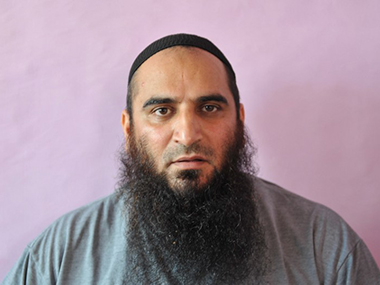
    NEW DELHI (TIP): The Congress on March 12 slammed the Modi government over the release of Masarat Alam, saying the way the entire episode unfolded smacked of a “fixed match” between BJP and PDP, coalition partners in the Jammu & Kashmir government.

    The party warned that the BJP government at the Centre would be squarely responsible if the situation in the Kashmir valley deteriorated after Alam’s release.

    Congress expressed skepticism over the Centre’s observation that J&K will have effective surveillance over the separatist’s activities. It tried to corner the ruling party over the statement of home minister Rajnath Singh in Parliament that the state had conveyed that Alam’s activities were under watch and legal action would be taken if anything adverse was noticed.

  • AMIT SHAH REVAMPS BJP NATIONAL EXECUTIVE

    AMIT SHAH REVAMPS BJP NATIONAL EXECUTIVE

    NEW DELHI (TIP): The first meeting of BJP’s new national executive finalised on March 12 by party president Amit Shah is expected in the first week of April in Bangalore.

    Shah finalised the party’s 111-member national executive, which includes top party leaders including Prime Minister Narendra Modi and former prime minister AB Vajpayee besides a host of top party leaders.

    All the eight chief ministers of BJP-ruled states and two deputy chief ministers, including that in Jammu and Kashmir where the party shares power with PDP, besides 24 former chief ministers and three former deputy chief ministers are permanent invitees to the national executive.

    The BJP chief has also made 40 senior leaders from across the country special invitees to the national executive.

    The new list comes ahead of the party’s national executive meeting and party’s restructuring by Shah.

    Among those who are part of the new national body include party veterans LK Advani and Murli Manohar Joshi, besides Union ministers Rajnath Singh, Sushma Swaraj, Arun Jaitley, M Venkaiah Naidu, Nitin Gadkari, Ananth Kumar, Thawarchand Gehlot, Jagat Prakash Nadda, Ravi Shankar Prasad, Kalraj Mishra, Narendra Singh Tomar, Harsh Vardhan, Bandaru Dattatreya and Radha Mohan Singh. However, HRD minister Smriti Irani and minority affairs minister Najma Heptulla are among the prominent faces who have been dropped from party’s national executive . Even Mathura MP Hema Malini and BJP’s Mumbai spokesperson Shaina NC did not find mention in the list.

    Others include Yashwant Sinha, Vinay Katiyar, CP Thakur, Jual Oram, SS Ahluwalia, Vijay K Malhotra, besides Hukumdev Narayan Singh, L Ganeshan, Lalji Tandon, O Rajgopal, Tathagat Roy, Gulab Chand Katariya and Subramanyam Swami.

    Ministers Mukhtar Abbas Naqvi, Dharmendra Pradhan, Rajeev Pratap Rudy, Prakash Javadekar, (Gen) VK Singh, Suresh Prabhu, Birendra Singh, Piyush Goyal and Nirmala Sitharaman are also part of the new executive.

    Other leaders like Varun Gandhi, Tapir Gaon, Vijay Goyal Satpal Maharaj, Vishnubhushan Harichandan, Vijay Mahapatra and PK Krishna Das, V Shanmughanathan, are also its members.

    Party’s firebrand leaders like Yogi Adityanath and Navjot Singh Sidhu are part of the executive, while another such leader Sadhvi Niranjan Jyoti is a special invitee.

    All the BJP chief ministers Shivraj Singh Chauhan, Raman Singh, Vasundhra Raje Scindia, Anandiben Patel, Raghuvar Das, Devendra Gandadharrao Fadnavis, Manohar Lal Khattar and Laxmikant Parsekar, besides deputy Chief Ministers Fracesco De D’souza and Nirmal Singh are also invitees. Besides, all Legislative Assembly and Legislative Council party leaders, state presidents of all states, all General Secretaries (Organisation) will be special invitees in National Executive.

  • SONIA RALLIES CONGRESS BEHIND MANMOHAN

    SONIA RALLIES CONGRESS BEHIND MANMOHAN

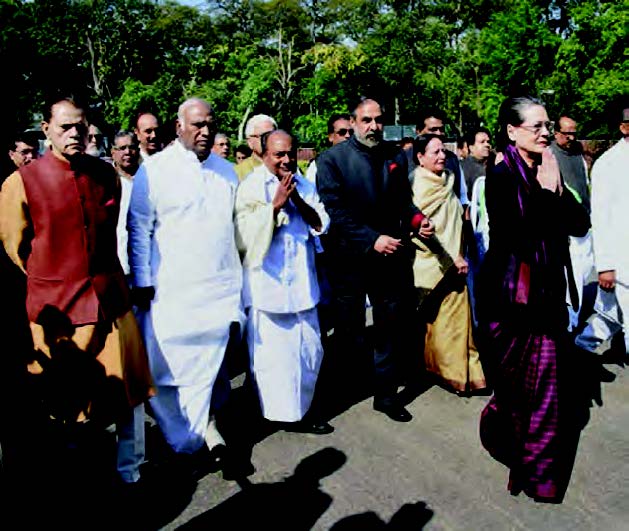
    NEW DELHI (TIP): Sonia Gandhi on March 12 morning led the Congress party in a solidarity march to the residence of Manmohan Singh who has been summoned as an accused in a coal-scam case, a move that sought to stub out doubts about the party’s support for the former prime minister as also make the populist point that an honest man was being targeted.

    [quote_box_right]

    MANMOHAN TO MOVE SUPREME COURT 

    NEW DELHI (TIP): Manmohan Singh’s lawyers, led by senior advocate Kapil Sibal, are likely to move the Supreme Court to challenge the trial court’s order summoning the former PM as an accused in the alleged irregular allotment of Odisha’s Talabira II coal block to a joint venture of Hindalco. The option of moving Delhi HC to challenge the trial court decision, the normal course of grievance redressal in a three-tier justice delivery system, is ruled out because of a July 25, 2014 apex court order, which monitored the CBI probe into the alleged irregular coal block allotments during the UPA and previous NDA governments and cancelled all 214 allocations during that period. “We make it clear that any prayer for stay or impeding the progress in the investigation/trial can be made only before this court and no other court shall entertain the same,” the July 25 order said. Special Judge Bharat Parashar, trying the coal scam cases investigated by CBI under SC supervision in his summoning order focused on Singh’s role, not as PM but as coal minister. 

    Congress-bachao march’ can’t save them: BJP

    NEW DELHI (TIP): The BJP on March 12 took a dig at Sonia Gandhi’s march in support of former Prime Minister Manmohan Singh and called it a
    “Congress-bachao march”. The party said it was an attempt by those who participated in the march to save their skins as they were afraid that their role in the coal scam would now be exposed. Saying that it would be the “last nail in the coffi n of Congress”, BJP also hoped that Singh would now reveal what pressure he was under when coal blocks were “arbitrarily” allocated by the previous UPA government.

    “Today’s march is a Congress-bachao march. Congress president Sonia Gandhi led it to save herself. A scared and worried Congress party is standing at (Singh’s) door out of fear that the truth will come out now. Everyone knows that Congress’s fi rst family was behind corruption. Allegations that corruption emanated during the Congress regime from the highest level will be proved once the truth comes out. Congress is trying to politicize the issue for its own political relevance,” BJP national secretary Shrikant Sharma said. 

    [/quote_box_right]

    The Congress supremo, who dubbed the summons to the former Prime Minister as “outrageous”, gathered members of Congress Working Committee and MPs — a crowd of around 100 people — at the party’s 24, Akbar Road headquarters before setting off to Singh’s house on Motilal Nehru Marg through the leafy Lutyens zone — around half-a-km away.

    Singh and his wife Gursharan Kaur received the Congress delegation which comprised his former Cabinet colleagues P Chidambaram, Anand Sharma, Ambika Soni, Veerappa Moily among others, in what appeared a unique political event given the warm smiles in the sombre mood. The timing was politically significant as most of the gathering, minutes later, left for Parliament to attend the proceedings.

    Manmohan Singh ‘grateful’

    “I was outraged at the news that summons had been served to Manmohan Singh,” Sonia said, adding, “The former PM is known not only in our country but throughout the world as a person of integrity and probity. We are here to offer our unstinted support. Congress is fully behind him. We shall fight this legally and with all our means at our command. We are sure, we are convinced, that he will be vindicated.”

    “I am more than pleased and grateful … the Congress party, Sonia Gandhi and all members of the CWC and senior leaders have come to my residence, expressed solidarity with me and that we will fight this case to the best of our ability,” Singh said. An MP quoted him as having told the delegation that there would not be a shadow of suspicion when the process ends.

    The bonhomie was significant given the BJP’s attempt to draw a distinction between “corrupt Congress” and “honest Singh”.

    The idea for the solidarity march emanated from Sonia at a meeting with confidants, leaders in Parliament and top in-house lawyers on March 11 evening.

    While the plan initially was to limit the power walk to members of CWC, Sonia decided to scale it up because she wanted to soothe Singh who was feeling “pretty low”. The sight of party MPs and senior leaders marching in Lutyens zone was seen as an emphatic way to comfort the mascot of its decade in power.

    Congress has desisted from pointing fingers at BJP because the CBI has already given a clean chit to Singh. However, Chidambaram questioned the Centre’s “tragic silence” on the summons while partymen found the timing of the summons intriguing as also the fact that the judicial order was too detailed for the summoning stage and that Section 319 of CrPC is also used sparingly.

    There is an apprehension that it can all go awry. Despite assurances from the BJP regime that there will be no vindictiveness on its part, there is a fear that any sympathy in government will be circumscribed by BJP’s compulsion to protect its narrative on corruption and scams under UPA.

    The saffron camp has been a major beneficiary of the allegations of scams, evident in the way they swept the 2014 elections. This may inhibit the Centre from going too far in helping the accused in the coal scam in whatever way it can if it wants to.


  • Adding Fuel to Fire – Congress claims ‘Secret pact’ between PDP, BJP over Masarat Alam

    Adding Fuel to Fire – Congress claims ‘Secret pact’ between PDP, BJP over Masarat Alam

    Senior Congress leader Abhishek Singhvi took to Twitter to take a dig at the Prime Minister and BJP over Alam’s release. “A party constantly speaking on nationalism & against separatism & terrorism in opposition now supine & impotent against coalition compulsions!,” he tweets.

    Uddhav Thackeray seeks criminal case against Mufti Sayeed, asks whether a CM has right to release people like Masarat Alam, say media reports.

    Madhya Pradesh Youth Congress stages a silent protest against Masarat Alam’s release.

    Members of various organizations including Shiv Sena, Kranti Dal hold protest in Jammu as they demand immediate re-arrest of Alam while asking the BJP to come clean on the issue.

    Life remains normal in the state despite a two-day shutdown call given by the Panthers Party in Jammu against the release of Masrat Alam at state Chief Minister Mufti Muhammad Sayeed`s orders.

    On Alam’s release, Communist Party India (CPI) leader D Raja says, “We have heard what our Prime Minister has said but the government in Jammu and Kashmir is a coalition government….The BJP cannot absolve its responsibility. The Bharatiya Janata Party (BJP) should own responsibility and explain its position.”

    Senior Congress leader Saifuddin Soz says, “Hurriyat shouldn`t go to the Pakistan High Commission to discuss politics because it is not going to benefit them. Hurriyat should instead talk to Government of India and the Government of India should also open a dialogue with them. That is the only option; there is no point in initiating dialogue with Government of Pakistan.”

    “I assure the House that after the clarification from the state government, if needed, we will issue a strong advisory,” Rajnath says in Lok Sabha.

    In an another tweet the HMO writes: “The Central govt is not satisfied with the J&K Home Dept. report. We have sought clarifications from the State.”

    The official twitter handle of Home Minister Rajnath Singh’s office (HMO) tweets: “Centre has got a report from J&K Home Dept on the release of Masrat Alam.It says he has been granted bail in all cases against him.”​

    BJP lawmakers in Jammu and Kashmir demand immediate arrest of hardliner Masarat Alam. “BJP strongly opposes and rejects the decision to release Masarat Alam and believes that the conduct of Alam, after his release and the statements made by him and situation existing now, are fresh inputs to consider his fresh detention under PSA immediately in the interest of the security of the state,” says state BJP General Secretary Rajiv Jasrotia.

    Criticising BJP for its “suicidal surrender and U-turn on its jingoistic rhetoric” on the release of hardline separatist leader Masarat Alam, Jammu and Kashmir National Panthers Party (JKNPP) says the party had compromised on all its policies for the sake of power. “We accuse BJP for its suicidal surrender and U-turn on its jingoistic rhetoric. The state unit of BJP owes an explanation to the people of state for its criminal silence over the spate of announcements and measures announced by PDP in furtherance of its highly controversial agenda,” JKNPP Chairman, Harsh Dev Singh tells reporters.


    In Srinagar, Masarat Alam tells reporters: “Mufti Sayeed should not try to take political mileage out of it. I was released through a normal legal procedure since my Public safety Act (PSA) detention was about to end in the next two to three days.” “What difference does it make if one person is released when there are thousands languishing in jails,” he adds while denying that he had been responsible for the killings of youths during the 2010 unrest in the Valley. “It was Omar Abdullah and not me who is responsible for those killings,” says Alam.  

    BJP legislators meet Jammu and Kashmir Chief Minister Mufti Mohammad Sayeed at his residence over Masarat Alam’s release. 

    Saying that Masarat Alam’s release is not a big deal, separatist leader Syed Ali Shah Geelani says the accusations against the Hurriyat hardliner are untrue.

    Talking to a news agency, Hurriyat Conference chairman Syed Ali Shah Geelani says India should accept the fact that Jammu and Kashmir is a disputed territory and not a part of India. Calling Jammu and Kashmir Chief Minister Mufti Mohammad Sayeed’s praise of Hurriyat as a mere political stunt, Geelani opined that there will be no change in Kashmir.

    Taking a jibe at the BJP, former Jammu and Kashmir chief minister Omar Abdullah says a CM has to be trusted to decide what is in the interest of his/her state. On microblogging website Twitter, Abdullah says:

  • PDP starts Pro-Separatist actions – Masarat Alam released – BJP clueless

    PDP starts Pro-Separatist actions – Masarat Alam released – BJP clueless

    Starting with Chief Minister Mufti Mohammad Sayeed’s statement on Pakistan and militants as his first speech as the Chief Minister of Jammu & Kashmir; Now the PDP led J&K Government has released hardline separatist leader Masarat Alam.

    Muslim League leader Masarat Alam, who was seen as being responsible for fanning trouble in 2010 in which over 100 people died in Kashmir.

    Relationship between PDP & BJP  has become tenuous, with the BJP claiming that they hadn’t even been consulted before the step was taken.

    The BJP  on Sunday reacted to the release saying that its ministers and MLAs would consult on the matter but said that the party was not consulted before the decision was taken.

    “This step does have consent of BJP. Nor was BJP consulted before taking such a decision,” state BJP chief and MP Jugal Kishore Sharma told reporters. “We were not asked before releasing Masarat Alam. If they had asked us, we would not have given approval from our side on this and even today our consent is not with this decision,” he added.

    On the issue of Mehbooba Mufti’s statement that she is not bothered about the coalition, Sharma said, “BJP have formed alliance on development agenda. The coalition has been formed on the agenda of betterment of people of J&K. We will continue to move forward on that. That is why we will hold meeting on this and will come back to you with our reaction.”

    The PDP today retaliated by downplaying the criticism and said engaging all stakeholders for establishing peace in Jammu and Kashmir was part of the Common Minimum Programme (CMP) of the two parties.

    “This (the release of Alam) has to be seen in proper perspective. It is an important part of our Common Minimum Programme to involve all stakeholders in the state, and across the Line of Control, for reconciliation and peace in the state,” PDP chief spokesman and Education Minister Naeem Akhtar told PTI.

    “If you want to have a dialogue with all stakeholders, which includes these leaders, you cannot engage them by keeping them in jail without anything substantial against them,” he added.

    Akhtar said the courts had intervened on the detention of some of the leaders and set them free. Asked about the opposition by BJP to Alam’s release, Akhtar said he does not want to get into a public debate on it.

  • India budget ‘a step in the right direction’  – Realistic Approach

    India budget ‘a step in the right direction’ – Realistic Approach

    The 2015 budget “will further reignite our growth engine, signaling the dawn of a prosperous future,” wrote PM Modi on Twitter, referring to his government’s recently unveiled budget, widely viewed as business-friendly.

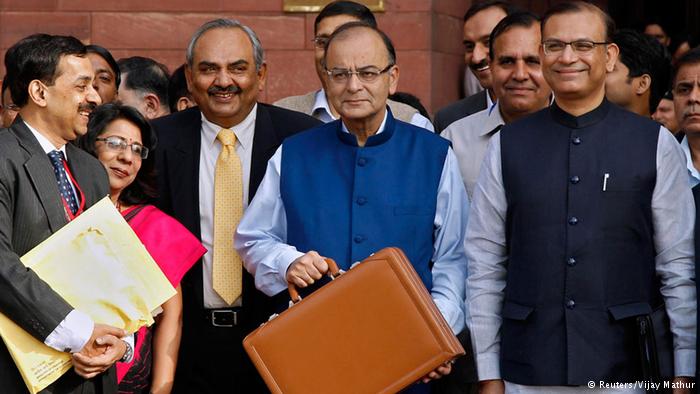
    On February 28, Finance Minister Arun Jaitley announced a host of new measures in the government’s first full budget, including increased spending in infrastructure, a universal social security scheme and an unprecedented corporate tax cut to 25 percent over the next four years. Jaitley said India was “about to take off” and it was time for a “quantum leap” on reforms.

    The finance minister also said he expects the country’s GDP to grow between 8 and 8.5 percent year-on-year, adding that a double digit growth rate may be achievable soon. The announcement comes a month after India’s Statistics Office unveiled changes in the way it calculates the country’s GDP.

    There were high expectations on the newly released budget as Modi’s ruling BJP party swept to power nine months ago on promises of reviving the country’s sluggish economy. Last year’s “mini budget” – unveiled by the ruling BJP in July – had been viewed by analysts as lacking on key issues.


    Full report to follow in the Friday Print Edition

  • Quick News – Bhagwat’s Teresa remark disrupts RS

    Quick News – Bhagwat’s Teresa remark disrupts RS

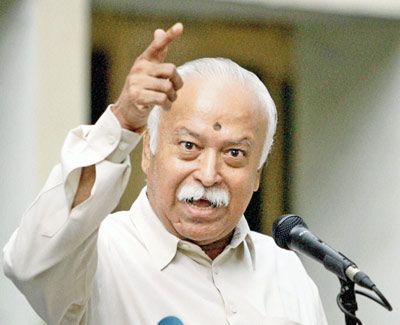
    Cornering the government over RSS chief Mohan Bhagwat’s statement against Mother Teresa, the Opposition in Rajya Sabha on Feb 26 demanded that PM himself condemn the controversial remarks. The uproar amid the heated exchange of words between BJP member Vinay Katiyar and almost the entire opposition led to the House being adjourned for 15 minutes after several slogan-shouting Congress, Samajwadi and JD(U) MPs rushed into the well.

  • Gujarat may let officials join RSS

    GANDHINAGAR (TIP): BJP-ruled Gujarat may follow Chhattisgarh in al lowing government employees to join the RSS.

    A senior official of the state general administration department (GAD) said the state government is considering delisting the RSS from its “negative list of organisations” which government employees cannot join.

    Senior cabinet minister Nitin Patel did not deny the move but said the matter has not yet been discussed formally as the state assembly session is in session. “We will decide after examining the Chhattisgarh government’s order,” Patel said.

    In an order issued on February 23, the Chhattisgarh government had allowed government staff to join RSS saying its rule dating back to 1965, restricting government staff from taking part in political activity , “does not apply to the RSS”.

    Earlier, in 1999, the then Gujarat CM Keshubhai Patel had made a similar attempt, but withdrew his orders soon following Congress-led protests. But this time, the Gujarat government might allow saffronisation of its employees using the Chhattisgarh government’s argument that RSS is not a political organisation.

    “Employees of the state government cannot join political parties or communal institutions, but the RSS falls in the category of cultural and social institutions.So government employees can be permitted to join it,” said the GAD official.

    Currently , as per the Gujarat Civil Services (Conduct) Rules, RSS figures in the list of organisations that employees can’t join.

  • J&K Update – Mufti to head 25-member cabinet in J&K; PM to attend his swearing-in on March 1

    J&K Update – Mufti to head 25-member cabinet in J&K; PM to attend his swearing-in on March 1

    NEW DELHI (TIP): PDP patron Mufti Mohammed Sayeed will head a 25-member cabinet, half of it from BJP, in Jammu and Kashmir and the swearing-in ceremony on March 1 in Jammu will be attended by Prime Minister Narendra Modi.

    With the PDP-BJP deal sealed after ironing out differences over contentions issues like Article 370 and AFSPA, 79-year- old Sayeed, who will be sworn in as Chief Minister, met the Prime Minister today, capping two-month long hard negotiations between the two parties on government formation.

    According to highly-placed sources, Sayeed will be heading a 25-member cabinet which will have 12 BJP MLAs including a Deputy Chief Minister post. This is the first time that BJP is in the government in the state.

    Accompanied by chief interlocutor of PDP Haseeb Drabu, Sayeed had a nearly one-hour long meeting with Modi during which he extended invitation to the PM for attending the swearing-in ceremony at Jammu on March one.

    Modi and Sayeed were all smiles as they hugged and posed for cameras with their photographs trending on social networks within minutes.

    “I have extended invitation to the Prime Minister for attending the ceremony and he has agreed,” Sayeed told reporters after the meeting at PM’s official residence at 7, Race Course Road.

    He refused to answer any specific questions on controversial issues like Armed Forces Special Powers Act
    (AFSPA) or Article 370 and said the Common Minimum programme (CMP) will be announced at 3 PM on Sunday.

    He said lot of discussions have taken place for the past two months to forge a common ground, a common agenda. He equated the PDP-BJP coalition with “bringing together of North Pole with South Pole”.

    “The mandate of election is clear that PDP is the choice of people in Kashmir and BJP in Jammu. So we decided that we will unite together to give a government which will give all round development to all the regions in the state,” he said.

    “It was discussed how a stable government should be formed. The PDP was of the view that we should not allow the opportunity to go waste as it was a historic opportunity with the government at the Centre that has a clear mandate of people to deliver,” he said.

    Sayeed, who will be returning to power after a gap of more than nine years, backed Modi’s slogan, saying, “I also want Sab ka saath, sab ka vikas (development for all).” He was the Chief Minister of the state from November, 2002 to 2005.

    When asked about Article 370 which gives special status to the state and AFSPA, Sayeed said, “Leave these issues. These are not issues. We have to do all this (hame karna padta hai)…All this will come in the Common Minimum Programme which will be announced after the swearing-in.”

    Asked whether PDP was joining NDA at the Centre, Sayeed said, “it is too early to say that. Ministers will be decided soon. We have found common ground.”

    To a question whether the CMP was for governance or for political alliance, he said, “It (the alliance) is both for political and governance. First political and then governance. When political atmosphere will be right then only governance will take place.”

    Questioned whether it is a tough road ahead, Sayeed said, “I think it is alright. The PM also has a vision. I think he also understands that it (the alliance) has to be made to work.”

    “Both regions (Kashmir and Jammu) should be brought together. On external dimension (mending ties with Pakistan), policy of Atal Bihari Vajpayee should be carried forward. Modiji has agreed,” he said.

    The PDP patron said he aims to give a “healing touch” as anguish in one part of the huge country is not a good thing.

    “My view was that an opportunity has come that Jammu region and Kashmir region will come together. If BJP got mandate in Jammu and PDP in Kashmir Valley, therefore they have got support of people. There is credibility. When they will merge, it will be dejure. It takes six hours from Jammu to the Valley, but opportunity is there to connect hearts and minds of people,” he said.

    Sayeed said second aspect is when former Prime Minister Vajpayee visited Kashmir in 2002-03, he started a journey of friendship in Srinagar.

    “He extended a hand of friendship towards Pakistan, saying we can change friends but not our neighbours. So (the then Pakistan President Pervez) Musharraf also responded. It is the dream of the Prime Minister and mine to develop Kashmir as an ‘island of peace’. So, in that process, it is necessary to engage Pakistan,” he said. 

    “….so I want to repeat history.

    Today, the Prime Minister has mandate of the people. He has got full legitimacy to deliver,” he said.

    The December 23 election results saw a highly-fractured mandate with PDP emerging as single-largest party with 28 MLAs followed by BJP with 25. Erstwhile allies National Conference and Congress ended with 15 and 12 seats respectively.

    BJP and PDP, which have been in negotiations for nearly two months now, have sorted out all the differences over Article 370, Armed Forces Special Powers Act, resettlement of West Pakistan Refugees and holding of talks with Pakistan and separatist leaders of the state.

  • Bihar Chief Minister Jitan Ram Manjhi resigns Alleges death threats to his supporters from Nitish camp

    Bihar Chief Minister Jitan Ram Manjhi resigns Alleges death threats to his supporters from Nitish camp

    PATNA (TIP): Bihar Chief Minister Jitan Ram Manjhi tendered his resignation ahead of floor test in assembly Friday, February 20. In a good news for the embattled CM, BJP announced yesterday, February 19 that it will support the ‘Mahadalit’ CM during the floor test.

    “After a long meeting of the BJP legislators, the party has decided to support Manjhi during his confidence vote in the Assembly,” said BJP leader Sushil Kumar Modi.

    The BJP’s offer of support came on a day when Bihar Speaker Uday Narain Choudhary notified JD-U leader Vijay Kumar Chaudhary as the leader of opposition, replacing Nand Kishore Yadav of the BJP.

    The Speaker also accepted former Chief Minister Nitish Kumar’s demand that Janata Dal (United) (JD-U) be given the status of the main opposition party.

    Following the Speaker’s decision, BJP MLAs created a ruckus and protested in the Assembly complex.

    “How could the Speaker take away the opposition party tag from the BJP?” asked senior party leader Shahnawaz Hussain.

    “We protest against this move as well as the way the JD-U is treating Manjhi, who is a Mahadalit,” Hussain said at a press conference in New Delhi.

    He also said that the BJP has nothing to do with the charges of horse-trading being made by the Nitish Kumar’s camp.

    Manjhi, after being expelled from the JD-U on February 9, has been declared as an unattached member in the Assembly. He was expelled for allegedly “indulging in anti-party activities”. But he had refused to resign and was  to prove his majority in the house on Friday, February 20.

    Throwing all ethical standards to wind, Manjhi said on February 19 that he will offer Cabinet berths to legislators, who will support him during the confidence motion. “Aaiye mera samarthan kijiye, mantri pad lijiye (come to support me and become a minister),” he told reporters, attending a function here.

    Also yesterday, the Patna High Court ordered that eight rebel JD-U legislators, considered close to Manjhi, would not vote during the confidence motion in the Assembly.

    A bench of Justice Iqbal Ahmad barred the JD-U MLAs from voting after hearing their petition, seeking permission to vote during the floor test.

    Manjhi was picked by Nitish Kumar as his replacement when he quit last year after JDU’s rout in the Lok Sabha polls.

    In the 243-member Assembly, the JDU has 115 legislators — most of whom are with Nitish Kumar. The party has the support of 24 Rashtriya Janata Dal (RJD) legislators, five Congress MLAs, two Independents and a CPI MLA.

    The BJP has 88 legislators and is supported by three Independents.

    The ball now is in governor’s court. Coming days will be watched with interest by all parties involved in the power play in Bihar.

  • Vijay Jolly assures BJP support to Chirag Patel on phone

    Vijay Jolly assures BJP support to Chirag Patel on phone

    NEW DELHI (TIP): Former Global Convener BJP Overseas Affairs Vijay Jolly today condemned US police brutal assault on Sureshbhai Patel Gujarati Indian national on a short visit to US in the state of Alabama.

    BJP leader Mr. Jolly telephoned his son Mr. Chirag Patel in Alabama and reiterated BJP support to the aggrieved family in a long distance call.

    Mr. Jolly found the whole Gujarati family is in a state of shock over this ugly incident. The unarmed Mr. Sureshbhai was brutally assaulted by US police officials in Huntsville Town in Alabama, USA revealed Mr. Chirag to Mr. Jolly.

    Though no crime was committed yet the 57 years old resident of Nadiad district from state of Gujarat was subject to illegal assault resulting in his temporary state of paralysis, stated Mr. Jolly.

    BJP has expressed its outrage on this ugly incident.

    BJP leader Mr. Jolly has written a protest letter to the US Ambassador in India Mr. Richard Verma on the issue. State help, counseling of the aggrieved, free medical treatment, monetary compensation to the family along with severe punishment to the three US police officer involved in this gruesome assault case has been demanded by BJP leader Mr. Vijay Jolly from New Delhi.

  • A welcome climb down – After speaking up, Modi must act

    The Obama visit and the Delhi verdict seem to have had some pleasant side-effects. President Obama’s sermons on religious tolerance have not been dismissed as unwarranted or treated as interference by the Modi government. These have, in fact, been taken seriously. On Tuesday Prime Minister Modi chose to speak out at a Christian function on virtues of religious freedom, guaranteed under Article 25 of the Constitution to which President Obama referred with telling effect. This is quite a climb down for a man who had stubbornly refused to condemn the 2002 massacre that happened when he was the Chief Minister of Gujarat.

    Two days after the Delhi verdict, which seems to have left Modi a changed man, the Prime Minister picked up the phone to launch cricket diplomacy, resuming the Foreign Secretary-level talks with Pakistan. In another unusual step he summoned the Delhi Police Commissioner to order a crackdown on those attacking Christian institutions in Delhi. In the usual course the Prime Minister should have acted through the Home Minister or sought the Home Minister’s, or through him, the Delhi Police Commissioner’s explanation for police inaction on the repeated attacks on churches – six in three months in Delhi – unless these were unofficially sanctioned for possible electoral gains. By calling the Police Commissioner, Modi perhaps wanted to send the signal to his critics that he was no longer a quiet spectator to the ugly goings-on.

    One hopes the Delhi outcome has taught the BJP leadership the importance of plurality in the Indian society. A serious introspection may drive the party to keep in check the hate-mongers in the larger Sangh Parivar. Whether the BJP has learnt any lessons in religious tolerance will be tested during the coming Bihar and UP elections in which communal flare-ups and caste divisions are often used for political advantage. Modi’s word to protect the minorities, welcome as it is, will not be enough unless followed by action on the ground. Any one engaging in or inciting communal hatred, vandalism and violence – regardless of his position, religion and party – must be booked immediately and brought to justice.

  • Lifting AFSPA from Valley not an option: Venkaiah Naidu

    Lifting AFSPA from Valley not an option: Venkaiah Naidu

    NEW DELHI (TIP): As negotiations between BJP and PDP continue on the contentious issues of Article 370 and Armed Forces Special Powers Act (AFSPA) before the two agree to form the government in Jammu and Kashmir, Union minister Venkaiah Naidu has hinted that while the former could be discussed, the latter was non-negotiable.

    The two parties are currently discussing a common minimum programme to formalize the alliance and form a government. Sources said the discussions were stuck on the issues of abrogation of Article 370 and removal of AFSPA from the Valley. While BJP has been pushing for the former, PDP has been batting for the latter.

    Parliamentary affairs minister Naidu on Feb 18 hinted that while the party could consider PDP’s demands on Article 370 given the electoral reality, it would not compromise on AFSPA as it was not just the Army which was a stakeholder in the issue but “the entire country”.

  • Developing Story: Ex-reporter held in petroleum ministry document leakage case

    Developing Story: Ex-reporter held in petroleum ministry document leakage case

    New Delhi (TIP): A former journalist along with a corporate employee have been arrested in connection with the petroleum ministry document leakage case, police said on Feb 20, adding that some more people would be arrested soon.

    Santanu Saikia, who runs a web portal and covered crime stories for several years, was arrested early Friday for his alleged role in providing secret documents of the petroleum ministry to corporate houses.

    Prayas Jain, an energy consultant, was also arrested on Friday.

    Delhi Police on Thursday had arrested two employees of the petroleum ministry and three others for stealing official documents and leaking them to corporate houses.

    Rakesh Kumar, 30, Lalta Prasad, 36, both brothers and residents of Delhi, and Raj Kumar Chaubey, 39, a resident of Ghaziabad in Uttar Pradesh, were held red-handed with the photocopy of some secret documents at Shastri Bhawan on February 17 night.

    On information provided by them, government employees -Asharam, 58, and Ishwar Singh, 56 – were also arrested. They were were part of multi-tasking staff (MTS) at Shastri Bhawan.

    Police on Thursday said that Kumar and Prasad were former MTS employees, while Chaubey was their associate who never worked at Shastri Bhawan.

    The theft of the secret documents had been taking place in the office of the ministry located in high-security Shastri Bhawan near the parliament house.

    Previous Update (below) – Two officials of the Petroleum Ministry were arrested today

    Two Petroleum Ministry employees are among five persons arrested for allegedly leaking

    confidential government documents to private companies, Delhi Police said today.

     Sources said a clerical staff and a peon of the Petroleum Ministry were apprehended by the police.

    They said provisions of Official Secrets Act may be slapped on them.

    The sources said the two Petroleum Ministry employees used to provide confidential information to private companies in return for money.

    Petroleum minister Dharmendra Pradhan told Times Nowthat the government will probe the matter as the leakage of information is a very serious issue. “We will provide assistance to Delhi police and law will take its course,” Pradhan was quoted as saying by Times Now.

    “Earlier, it was common for papers to be leaked, now strict measures are  in place. Cameras  have been installed everywhere and we have increased our surveillance,” Pradhan added. He also said that the the current govrnment will not allow  the kind of leakages that the UPA Government had allowed.

    BJP spokesperson GVL Narasimha also reiterated that those involved the ‘murky affairs’ will have to face the consequences of law.

    With inputs from Agencies

  • DELHI ELECTIONS – AAP TROUNCES BJP IN DELHI

    DELHI ELECTIONS – AAP TROUNCES BJP IN DELHI

    NEW DELHI (TIP): Arvind Kejriwal’s Aam Aadmi Party surged to a landslide win in Delhi that surpassed the wildest of expectations and left a routed Bharatiya Janata Party licking its wounds in the city-state from which it rules the country.

    Kejriwal, a former tax official who turned social activist and founded AAP just over two years ago, will become chief minister for the second time on February 14, the first anniversary of his controversial resignation after just 49 days in the job.

    AAP won a record 67 seats out of 70, far higher that even the most generous exit poll, and a full 39 seats more than it won as a fledgling unit in 2013. The BJP-led alliance, which ran a disjointed campaign marked by internal dissent, saw its share vapourise to just 3 seats, down 29.

    AAP TROUNCES BJP1

    “The people of Delhi want an honest government, the people want to get rid of hollow speeches or statements like women should give birth to four children or ghar wapsi. Instead they want a government that has an action plan for Delhi,” said AAP leader Manish Sisodia as party workers celebrated wildly.

    Kejriwal thanked the city for the unprecedented win, but termed the mandate “very scary” and asked party leaders not to be arrogant. Prime Minister Narendra Modi, who had participated in a bitter election campaign against AAP, tweeted that he had congratulated Kejriwal and assured him of “complete support in the development of Delhi”.

    AAP rode to the second-biggest election victory in India’s history on promises of cheaper electricity and water and probity in government. The party also has a strident position against Delhi’s famed culture of privilege; in its last stint, one of its more popular moves was the outlawing of red beacons on official cars.

    Its culture of handouts runs counter to the ruling principles of the BJP at the Centre, which espouses a market-friendly approach and wants to cut subsidies. Stock markets, which had fallen sharply on Monday after investors took fright from the exit polls, rebounded as people chose to look ahead to this month’s union Budget.

    For the BJP, this was its first significant defeat after sweeping last year’s general election. Though statistically tiny in the overall scheme of things, the capital is home to India’s two biggest national parties and many of its top politicians, giving it a disproportionately high profile.

    The saffron party was quick to distance the result from the performance of the Narendra Modi government at the Centre. It is also expected to try and ringfence blame around its chief ministerial candidate Kiran Bedi, a high profile former cop parachuted into the role by party president and ace strategist Amit Shah, for whom the result is a rare embarrassment.

    “It’s not a referendum on the BJP government. It will be a collective responsibility of the party…and winning will just be the first step for AAP. They had made many promises. AAP kaam karke dikhaye ab (AAP, now show us what you can do),” said BJP leader Shazia Ilmi. Senior leaders stayed away from the party’s Pandit Pant Marg office after seeing the initial trends.

    Kejriwal swept to an easy win in the New Delhi constituency, while Bedi and Ajay Maken, the Congress’ chief ministerial hopeful, bit the dust in seats thought to be relatively secure for their respective parties. Congress, which ruled the state for 15 years ending 2013, scored an embarrassing duck, and its offices wore a deserted look.

    Bedi stayed true to her reputation for gaffes, telling a news conference that she hadn’t lost the elections because she had given her best. “As far as the party is concerned, it is for them to introspect on the reasons for the loss,” she added.

    Kejriwal’s first essay as chief minister, with Congress support, was marked by chaos and a vigilante approach by some of his ministers. The CM himself famously went on a dharna against the police near Rail Bhavan that briefly threatened to disrupt the Republic Day parade. He flamed out in 49 days, a resignation he later conceded was a mistake.

  • Sonia seeks four weeks to respond to CIC notice

    Sonia seeks four weeks to respond to CIC notice

    NEW DELHI (TIP): Congress president Sonia Gandhi has sought four weeks time to respond to a notice of the Central Information Commission seeking an explanation on why her party had not complied with the commission’s June 2013 verdict bringing political parties under the Right to Information Act.

    Citing Delhi elections, Sonia said despite best efforts, she could not prepare the reply to the complaint within the timeframe.

    In her submission filed through her lawyer, Sonia said she was in the process of seeking legal advice and preparing appropriate response to be filed before the commission which is expected to be ready within four weeks. “The request for extension of time has been necessitated by reasons beyond the respondent’s control. The application is made bona fide and in the interest of justice,” Sonia’s lawyer said in the submission.

    The CIC had issued notice to Sonia asking her to explain why her party had not complied with the directives of a panel about responding to RTI queries and not replying to an RTI plea filed last year.

    Similar notices were issued by the CIC in separate cases to BJP as well but its chief Amit Shah has not responded till now.

    A full bench of CIC had declared that Congress and five other national parties –BJP, CPI, CPM, NCP and BSP — were public authorities under the RTI Act, but none of the parties had set up any mechanism to respond to such queries nor altered the law nor challenged the order in any high court.

    Activist R K Jain had filed the RTI application with Congress last February but with there being no response to it, he later made a complaint to the CIC.

    Alleging “non-action” on his complaint, Jain approached the Delhi High Court seeking directions for the CIC to take action on his plea. The high court gave six months to the commission to take action on Jain’s complaint.

    In a separate case filed by activist Subhash Agrawal, notices were sent to Shah and the chiefs of the other four political parties.

    Refusal to provide information or not furnishing complete information is deemed an offence under the RTI Act, which prescribes a penalty of Rs 250 per day on the public information officer of the public authority from the date the information became due to the day that it was finally made available.