Despite the nominal distance it maintains from the organisations of the Sangh Parivar, the RSS ensures that its writ runs where it matters: in the BJP governments at the Centre and in the States. The influence of the Rashtriya Swayamsevak Sangh on the Bharatiya Janata Party is always greater during periods when the party is in power. While the Sangh is sometimes ready to appear twice removed from the government, it is keen to exercise control over the party’s organisational affairs.
Little surprise then, the newly elected president of the BJP, Amit Shah, chose to pack the top rung of the party with those from the Sangh. Former RSS spokesman Ram Madhav is now general secretary and ideologue Vinay Sahasrabuddhe is vice-president; four of the joint secretaries (organisation) are RSS members without much of a background of work in the party. Despite the nominal distance it maintains from the organisations of the Sangh Parivar, the RSS ensures that its writ runs where it matters: in the BJP, and in the BJP governments at the Centre and in the States.
With its organisational strength, and the large number of committed cadre, the RSS is the backbone of the BJP, and not just an ideological mentor. In the 2014 general election, workers of the RSS and its affiliates threw their weight behind the BJP and contributed in no small measure to the party’s revival in States such as Uttar Pradesh and Bihar.
It was only natural for the BJP, especially Mr. Shah who was in charge of the party’s electoral management in Uttar Pradesh, to recognise this fact and accommodate RSS leaders in the decision-making structure of the party. What is problematic, however, is how the RSS will wield its influence in the BJP to remote-control the government. Mr. Shah enjoys a close rapport with Prime Minister Narendra Modi and it is feared he might indeed function as an extra-constitutional authority. Now, with the BJP being led by RSS hands, the party’s influence on the government can only get bigger.
Decision-making may not be confined to the Cabinet or legislative bodies, but may extend to party forums and Sangh meetings. Going by the statement of RSS sarsanghchalak Mohan Bhagwat that Hindutva is India’s identity, the RSS’s relations with the BJP and, by extension, with the government, could raise serious concerns in the public mind, and particularly among minorities. Prime Minister Modi spoke of ruling by consensus and not by the party’s majority in the Lok Sabha, but statements such as those made by Mr. Bhagwat seeking to equate Hindutva with Indianness and Hindustanis (Indians) with Hindus can only create doubts whether the BJP intends to return to a divisive majoritarian agenda.
Mr. Modi and the BJP need to distance themselves from such statements if these are not to be taken as reflective of the thinking of the ruling establishment. Otherwise, the Sangh, the BJP and the government would be widely seen as just different forms of the same entity.
Tag: BJP
-

RSS Influence over the BJP
-

Basics very much in Indian economy’s favor
INDIA’S JOURNEY TO DEVELOPMENT AND CHALLENGES
The economy of India is the tenthlargest in the world by nominal GDP and the third-largest by purchasing power parity (PPP).The country is one of the G-20 major economies, a member of BRICS and a developing economy that is among the top 20 global traders according to the WTO.
India was the 19th-largest merchandise and the 6th largest services exporter in the world in 2013. India’s economic growth slowed to 4.7% for the 2013-14 fiscal year, in contrast to higher economic growth rates in 2000s. However, India’s decisive election outcome has created the potential for further structural reform that could result in a near 7 per cent GDP growth rate over the coming decade, and bank capital injections could enable banks to facilitate funding for that growth.

This would have meaningful implications for India’s fixed income markets. It is believed that the next decade for India’s foreign exchange (FX) and fixed income markets will be marked by policy-driven reforms driving accelerated growth with increasing market liberalization. Recent figures already appear more encouraging than the dynamics that have been supporting stagflationary recession conditions: The country’s balance of payments has improved, spurred by FX depreciation and the Reserve Bank of India’s (RBI’s) non-conventional measures. The growth outlook has turned moderately positive, helped by a global recovery; and bad loan formation, even at state-owned banks, may now be moderating.

The narrative for Indian markets began to brighten even before the elections. Following the second stage of India’s economic liberalization and the foreign direct investment (FDI) reforms initiated in September 2012, foreign investment will likely be a major contributor to a jump in private investment. However, despite liberal FDI limits, it has remained moderate, constrained, in part, by administrative hurdles. As the obstacles are reduced, we expect FDI to lead an investment boom over the next decade, similar to China’s mid-1990s experience. We project FDI will rise to an average of 2.5 per cent of GDP (FY2014-24) from an average of 1.5 per cent of GDP (FY2008-14). We believe such foreign capital flow will lend significant support to India’s balance of payments trajectory.
Improving public health
Health care services in India have undergone a vast change over the past few decades and encompass the entire nation. The industry is expected to supersede China by 2030 in terms of population expansion. Hence, it becomes one of the essential duties of the state to raise the nutrition level, the standard of living of the people together with improving public health.
Health care Industry of India The rapidly increasing health care industry of India is one of country’s largest sectors, both in terms of revenue and employment. It has been estimated that the healthcare industry of India is will grow by & 40 billion. The continuous increase in the population of India is considered one of the principal reasons for the growth in the healthcare industry of India. The rise in the infectious as well as chronic degenerative diseases has contributed to the rise in the healthcare sector of India. Additionally, because of diseases like AIDS and several lifestyle diseases of India, the healthcare sector of India will have a constant growth.In spite of the fact that the Indian healthcare industry is rapidly expanding, healthcare infrastructure in India is very poor. A noticeable percentage of India suffers from poor standard of healthcare services. Most of the healthcare facilities of India provided by the various healthcare services are limited and of low standard. In order to understand the current status of the healthcare services in India, it is important to know about the different healthcare services found in the country.
Public health services, essential public health services, preventive health services, mental healthcare services, home health services, magellen health service and school health services are some of the healthcare services found in India. Companies providing Health Insurance in India The various companies providing health insurance policies in India can also be put under the healthcare services of India. Some of the companies that provide health insurance coverage in India are Appollo DKV Insurance Company Ltd., Bajaj Alliance General Insurance Co. Ltd., Birla Sun Life Insurance, Aviva Life Insurance and the like.
Points to note
1).It has been found out that while the private health services have been rising for meet the needs of the rich citizens and foreigners, public health services in India are lagging behind and suffering in a major way.
2).It has also been found out that less than 1% of the GDP is spent on the public health care services in India.
3).Surveys made throughout India points out that 65% of the Indian population cannot access to modern medicines.
4).In addition, a number of drugs and even many diagnostic tests are still unavailable in the public health care sector of India.
5).Most of the hospitals, one of the prime healthcare services in India, are located in the urban areas, thereby making it almost impossible for the rural people to access.
Indian industry sees green shoots of manufacturing growth
A green shoots of revival have started to appear in the manufacturing sector, which is critical for job creation, with a majority of segments likely to post higher output, according to industry bodies. The survey conducted by CII-Ascon for the April-June quarter indicates positive growth in important sectors like consumer durables including the vehicle industry and white goods industry, which recorded a growth of 5- 10 per cent, leading to improvement in the overall industry growth.
The FICCI survey found that eleven out of fourteen sectors are likely to show improvement in production during the second quarter (Jul-Sept) of the current fiscal. Over 64 per cent respondents are not likely to hire additional workforce in the next three months, though this proportion is less than that of the previous quarter (75 per cent), indicating improvement in hiring outlook in coming months.
The survey gauges the expectations of manufacturers for Q2 for fourteen major sectors namely textiles, capital goods, metals, chemicals, cement, electronics, automotive, leather and footwear, machine tools, FMCG, tyre, textile machinery and more. Responses have been drawn from 392 manufacturing units from both large and small and medium (SME) segments with a combined annual turnover of over Rs 4 lakh crore.
An upturn in demand condition is also reflected in the improved order books of the manufacturers, said Ficci survey. While only 36 per cent respondents reported higher order books for the April-June quarter in the last survey, 43 per cent respondents reported higher order books for July-September quarter.
Foreign relations
Soon after the 2014 Lok Sabha election results declared a thumping victory for the BJP-led NDA government, Prime Minister Narendra Modi invited the heads of all the SAARC countries including Pakistan, Bangladesh, Sri Lanka, Nepal, Maldives, Bhutan and Afghanistan, for his oath-taking ceremony, sending a major diplomatic signal to the global community.
Credited with being a focused administrator, Modi signalled that his decisive win would reshape India’s foreign relations and leverage the diaspora to increase investments, business opportunities and better relations. Modi went on to choose neighbouring country Bhutan over others for his first foreign visit.
“I will follow the (foreign) policies of the Vajpayee-led NDA government, and that also applies to the relationship with the United States. I don’t think a decision taken by any individual or one event should impact the overall policy,” Modi said in an interview. The winds of change were clearly being felt at home and abroad.

SAARC: A refocus on the neighbourhood
For the first time, leaders of all South Asian Association Regional Corporation (SAARC) countries were invited for the swearing-in ceremony of an Indian Prime Minister. The presence of all seven countries, Pakistan Prime Minister Nawaz Sharif, Afghanistan President Hamid Karzai, Sri Lanka President Mahinda Rajapaksa, Bhutan Prime Minister Tshering Tobgay, Maldives President Abdulla Yameen Abdul Gayoom, Nepal Prime Minister Sushil Koirala, Speaker of Jatiyo Sangshad in Bangladesh Shirin Sharmin Chaudhury, was a welcome step towards strengthening India’s relations with the SAARC countries. However, political parties in Tamil Nadu voiced their displeasure at Sri Lanka’s president Mahinda Rajapaksa attending the ceremony and held demonstrations against him.

Bhutan visit: Asserting influence in South Asia
PM Narendra Modi’s maiden foreign trip to Bhutan was intended to show that in the new scheme of things, the neighbourhood enjoys high priority. Inaugurating Bhutan’s Supreme Court building that was built with India’s assistance, Modi also laid the foundation stone of the 600MW Kholongchu Hydro-electric project, a joint venture between the two countries.
He also proposed to hold a joint sports festival between Bhutan and north-eastern states of India, doubling scholarships for Bhutanese students in India and establishing e-libraries in 20 districts in Bhutan Though his faux pas of referring to Bhutan as Nepal while addressing the Bhutan Parliament caused some embarrassment, Modi went ahead to say that “when Bhutan calculates its happiness quotient, having a friend in India is also a major factor.”
Meet with Pakistan Prime Minister Nawaz Sharif: Picking up the threads
Relations between India and Pakistan have always been tense, but differences between the two countries had escalated after the 26/11 Mumbai terror attack. Modi’s invitation to Pakistan’s Prime minister Nawaz Sharif for his oath ceremony was seen as an attempt at cooperation rather than confrontation, which was reciprocated by his Pakistani counterpart.
In their first meeting, Modi pressed for confidence-building measures, peace and security as well as enhancing bilateral trade, sending a positive message among the people of both the countries. Modi struck a pragmatic note with Sharif, underlining India’s concerns on terrorism and urging his Pakistani counterpart to crack down on militants and speed up trial of the 2008 Mumbai attack suspects.
Sharif also responded to the meeting positively, accepting the fact that the two countries must strive for better cooperation. In the interaction which was widely seen as an “icebreaker”, the leaders also decided that their foreign secretaries would be in touch and discuss a way forward on talks that had been suspended since January 2013.
BRICS Summit: New inroads
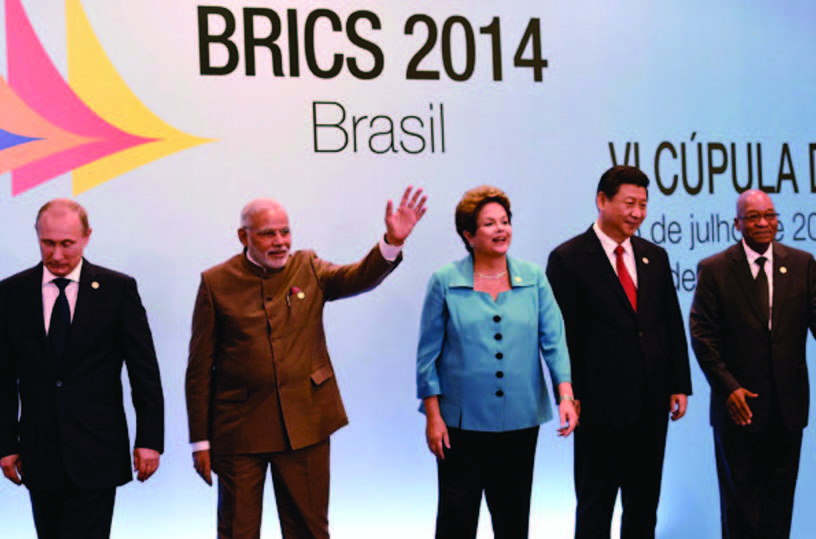
Pushing for better international governance, Narendra Modi said he favoured an open, rule-based, international trading regime which is critical for global economic growth. Modi’s first BRICS summit saw significant inroads towards the establishment of the New Development Bank and though the headquarters of the bank is slated to be in China, its first President will be from India.
Addressing the BRICS leaders, Modi also pressed for zero tolerance towards terrorism. He also met Chinese President Xi Jinping and both addressed the need for a solution to the boundary question. Further, Modi also favoured broadening the strategic partnership with Russia in nuclear, defence and energy sectors and invited President Vladimir Putin to visit the Kudankulam atomic power project during his trip in December.
India poised to make further progress on UN’s development goals
India has made progress on different indicators such as health and nutrition under the UN’s Millennium Development Goals and is expected to improve further upon them. “There has been progress in all the indicators and further progress is expected to be made in the remaining period up to 2015,” Planning Minister Rao Inderjit Singh had said recently.
Challenges
As far as India is concerned, 8 MDGs with 12 targets are relevant which are sought to be achieved during the period 1990 to 2015, the minister said. MDGs are international development goals that UN member states and numerous international organizations, including India, have agreed to achieve by the year 2015.
Eradicating poverty
These include eradicating extreme poverty and hunger; achieving universal primary education; promoting gender equality; reducing the child mortality rate and ensuring environmental sustainability. The minister’s said India had achieved the MDG target regarding poverty eradication. India had to halve the proportion of people whose income is less than one dollar a day between 1990 and 2015.
In 1990, India had 47.8 per cent such poor people and thus the proportion of this population is to be reduced to 23.9 per cent. However, India’s poverty ratio was 21.92 per cent for 2011-12. Similarly, India has to half the proportion of people who suffer from hunger by 2015 to 26 per cent. However, the latest figure for 2004-05 reveal that the percentage of such population was 40 per cent.
Education: Improving enrolment ratio
In the education sector, India has to improve the net enrolment ratio in primary schools to 100 per cent by 2015. The country achieved 99.89 per cent enrolment in primary education in 2011-12. The proportion of pupils starting grade 1 who reach grade 5 was 86.05 per cent in 2011- 12 against the target of 100 per cent. The literacy rate in India was 61 per cent in 1990. It went up to 86 per cent in 2017-08.
The ratio of girls to boys in primary education was 0.73 in 1990 which went up to 1.01 in 2011-12. Similarly the ratio of literate women to men (15-25 years) was 0.67 in 1990, which was 0.88 in 2007-08. MDGs target for both ratios is 1. The mortality ratio among children under the five-year age was 126 per 1,000 live births in 1990 which was brought down to 52 in 2012. The MDGs target is 42 for that.
Infant mortality ratio
The infant mortality ratio was 80 per 1,000 live births in 1990 which was brought down to 42 in 2012 against the MDGs target of 27. The proportion of one year old children immunized against measles was 42.2 per cent in 1990 which was improved to 74.1 per cent against targeted 100 per cent coverage.
Similarly, the maternal mortality ration per 1,00,000 live births was 437 in 1990 which was brought down to 178 by 2011-12 against targeted 109 by 2015. -

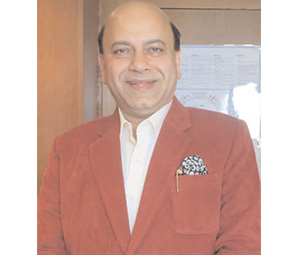
Vijay Jolly, BJP Global Convener, Overseas Affairs on US Tour
NEW YORK (TIP):
Vijay Jolly, BJP Global Convener, Overseas Affairs is on US Tour from August 18 to 30. During this period he will be crisscrossing the US, visiting Los Angeles, Dallas, Atlanta, Chicago, New York, New Jersey and Washington. Here is his proposed itinerary.
Aug 18 Mon: Canada to Los Angeles, CA
o Leaving Vancouver, Canada and reaching Los Angeles, CA, USA
o Dinner meeting with Karyakartas in LA
Aug 19 Tue: Los Angeles, CA
o Luncheon meeting with corporate leaders
o Quick city tour of LA
o Dinner and Community out-reach program
Aug 20 Wed: LA to Dallas, TX
o Leaving LA and reaching Dallas by evening
o Dinner meeting with Karyakartas in Dallas
o Press conference in Dallas
Aug 21 Thu: Dallas, TX
o Luncheon meeting with corporate leaders
o Tour of Kennedy assassination site
o Dinner and Community out-reach program
Aug 22 Fri: Dallas to Atlanta, GA
o Leaving Dallas in the morning and reaching Atlanta by Afternoon
o Coca Cola plant tour
o Dinner meeting with Karyakartas
Aug 23 Sat: Atlanta to Chicago, IL
o Luncheon meeting with FIA and Community out-reach program
o Early evening flight to Chicago, IL
o Dinner meeting with Karyakartas
Aug 24 Sun: Chicago, IL
o Luncheon meeting with community leaders
o Press Conference
Dinner and Community out-reach program
Aug 25 Mon: Chicago to New York, NY
o Leaving Chicago for NY – JFK airport
o Luncheon meeting with corporate leaders of NY
o Evening press conference with snacks in NY
o Dinner with top-notch community leaders of NY
Aug 26 Tue: New York to New Jersey
o Show the venue Madison Square Garden in NY
o Meeting with Indian Consul General in NY
o Dinner meeting with Karyakartas in New Jersey
Aug 27 Wed: New Jersey
o Luncheon meeting with corporate and community leaders of NJ
o Possible meeting with Congressman Frank Pallone or Senator Bob Menendez
o Dinner and Community out-reach program
Aug 28 Thu: New Jersey to Washington DC Metro
o Leaving NJ to DC BWI airport station by Amtrak
o Luncheon meeting with Think-Tank groups: Heritage Foundation, Cato Institute, and CAP in DC
o Meeting with India’s Ambassador and Dy. Ambassador in DC
o Dinner meeting with Corporate and Community leaders of DC
Aug 29 Fri: Washington DC Metro
o Meeting with US lawmakers
o Press conference with ethnic print media and US print media
o TV interviews
o Dinner with Karyakartas and Sangh leaders
Aug 30 Sat: Washington DC to Delhi, India
o Any remaining meetings -

Yashwant Sinha Frontrunner to be Next Planning Commission Chief: Sources
NEW DELHI (TIP):
Two months after coming to power, the Narendra Modi government seems ready to restructure the Planning Commission, the term of which is coterminus with that of the government. Sources in the government said a deputy chairman is to be named soon and three names are doing the rounds for the post — Yashwant Sinha, NK Singh and Arun Shourie. Veteran BJP leader and former finance minister Mr Sinha is said to be the the front-runner for the post. With the government dragging its feet on naming the commission so far, there were some doubts on whether the body would be reconstituted at all.
In fact, days after the new government came to power, the Independent Evaluation Office, which evaluates the effectiveness of the Central flagship schemes, had suggested that the commission be dismantled and replaced with a new Reforms and Solutions Commission. The report was submitted to Mr Modi on May 29 — three days after his government was sworn-in. But the evaluation was called internal, since it was not properly sanctioned, sources said. On August 7, in reply to a question in Rajya Sabha, Union minister of state for planning Rao Inderjit Singh had said, “There is no proposal at present under the consideration of the government to restructure the Planning Commission”.
On how the work will be handled in absence of members, he said, “The Prime Minister is the chairman of the Planning Commission. Besides, in the current council of ministers, the MoS (Planning) has been given Independent Charge”. Yashwant Sinha had not contested the Lok Sabha elections this time. Instead, his son Jayant Sinha had contested and won the Hazaribagh seat. Mr Sinha was the finance minister in the Atal Bihari Vajpayee government and is considered to be pro-reform. -

308 communal incidents till June: Govt
NEW DELHI (TIP):
Even as the Congress party tried to corner the BJP-led NDA government on communal riots, fresh data showed that the country witnessed 308 communal incidents this year until June, with Uttar Pradesh, Maharashtra and Karnataka topping the list. An analysis of two sets of statistics provided by the government over a period of one month also showed that there was a surge in communal incidents in the two months of May and June with 113 cases compared to the first four months of the year, which reported 195 incidents.
The government placed the statistics in the Rajya Sabha through a written reply on Tuesday on a day when Congress forced the government to discuss the “need for more effective mechanisms to deal with communal violence”. The Congress has been alleging that there is an increase in communal riots in the country after the new government took over on May 26. Leader of Opposition Mallikarjun Kharge claimed that 600 communal incidents took place after the Modi government took over, an allegation vehemently contested by the BJP.
Kharge’s claim could not be backed by any official data and when countered, he himself cited the figures for May and June. “Why are these incidents happening now? What is the reason? Who is behind these? These have increased in the last 2- 3 months since the new government came. This is not a good sign,” Kharge said in the Lok Sabha. As per the fresh figures, the Union Home Ministry said Uttar Pradesh recorded the highest number of communal incidents this year at 56 followed by Maharashtra at 51 and Karnataka 44.
Telangana, which came into existence on June 2, has already registered one case of communal incident. Interestingly, almost half (27) of the communal incidents (56) in UP took place during May and June while the 20 in Maharashtra took place during the same period. In Karnataka, 11 incidents took place during these two months. Gujarat reported 26 incidents out of which 11 happened in May and June. In these two months alone, 15 people were killed and 318 injured. Last year, the communal incidents numbered 823 while in 2012 it was 668. In 2010, it was 580. Except for 2011, Uttar Pradesh topped the list. -

BJP, Congress working on deal over Insurance Bill
NEW DELHI (TIP):
Tensions between BJP and Congress over the Insurance (Amendment) Bill appear to be thawing, with both sides seeking to negotiate a deal where the government will agree for the reforms legislation to be sent to a select committee in exchange of an assurance for its passage at the beginning of the winter session. Sources said the government has veered round to accept the demand for sending the bill to a select committee on the condition that the panel finishes its scrutiny in a time-bound manner and, more important, speedily enough for the bill to be brought to Rajya Sabha at the outset of the winter session.
Congress sources confirmed that negotiations are on between the two sides, and strongly indicated that the party will allow the bill smooth passage if the government drops the amendment which seeks to explicitly enlarge the definition of “foreign investment” to include foreign institutional investors. Although the Insurance Act does not bar FIIs from investing in insurance companies and, thus, the amendment proposed by the Modi government merely carries forward the current policy, Congress does not agree.
“This amounts to a substantive amendment,” said a Congress source familiar with details of the parleys. He also said all other amendments being insisted on by the opposition were “technical” in nature. Significantly, he said the issue of who should head the select committee was negotiation, reflecting a degree of flexibility which augurs well for passage of the long-pending legislation during the current year.
Government may be keen to have a BJP MP as the head of the committee in order to ensure that the legislation is readied in time to be moved in Rajya Sabha. Sources also said back channel negotiations were on with others in the opposition in order to get them to relent on their opposition to the insurance bill. A government source said some regional players appeared “ready to be persuaded”.
Government’s failure to get the insurance legislation passed was a setback for the BJP as the party was keen to display its reform intent as well as its capacity to deliver. However, government managers feel an understanding with Congress for passage of the bill in the winter session will repair the damage substantially. Whether they will be able to implement what is being called Plan B will be clear if they succeed in carrying through the amendments to three labour laws. -

Jaswant Singh suffers head injury, admitted to hospital
NEW DELHI: Former BJP leader Jaswant Singh has been admitted to the ICU of Army Research and Referral Hospital here after he slipped at his residence and sustained head injury. The 76-year-old former defence minister fell down at his residence around 11pm on August 7 following which he was rushed to the hospital, sources said.
-

US Bonhomie for India: US Secretaries Storm New Delhi
The recent visits of Secretary of Commerce Penny Pritzker, Secretary of State John Kerry, and Secretary of Defense Chuck Hagel are being seen as demonstrative of the resurgence of U.S. interest in India as both countries try to strengthen ties.
NEW DELHI (TIP): It may be a coincidence that the Union cabinet announced August 6, a day before US Secretary of Defense arrived in New Delhi, the decision to allow 49% FDI in Defense. Also announced were the cabinet decisions to allow 100% FDI in Close on the heels of the visits to India by U.S. Secretary of Commerce Penny Pritzker and U.S. Secretary of State John Kerry, U.S. Secretary of Defense Chuck Hagel arrived in India Thursday, August 7, for a three-day visit.
The fact that these high-profile trips by American officials have occurred so close to one another indicates the resurgence of American interest in India. Furthermore, the emergence of a strong, decisive, and reformist government under the Bharatiya Janata Party (BJP) in India has suddenly put India back on the U.S. agenda. India’s Prime Minister Narendra Modi is keen on reminding the world that India is a large country that cannot be ignored and whose interests must be taken seriously.
Secretary Hagel is scheduled to meet Prime Minister Narendra Modi and India’s Defense and Finance Minister Arun Jaitley on Friday, August 8 as well as U.S. and Indian defense company executives. Talks are expected to be fruitful for both countries. Hagel is in India to strengthen defense ties between the two nations. Although the two nations have been moving closer over the past decade, they have not become as close as some U.S. policymakers would have liked.
In fact, events of the past year, including India’s support for Russia in Crimea and the Devyani Khobragade case, show the limitations of a U.S.-India relationship. Nonetheless, both countries are interested in strengthening defense ties when possible, as they still share many common interests, including stability in Afghanistan, as well as concerns over China. It is unlikely that India and the U.S. will remain on anything but cordial terms, despite some occasional bumps. Secretary Hagel himself recognized this, stating that U.S. relationships with new partners in Asia represented both opportunities and challenges.
The Wall Street Journal quotes Rear Admiral John Kirby, the Pentagon press secretary, as saying that “Secretary Hagel’s meetings will focus on the United States’ and India’s converging interests in the Asia Pacific, our common interests in Afghanistan and initiatives to strengthen our defense cooperation, including military exercises, defense, trade, co-production and co-development and research.” One of Secretary Hagel’s goals is to seek more defense projects between the two countries.
There is much scope for this. India is the largest importer of U.S. arms, although it still imports up to 75 percent of its arms from Russia. The two countries are close to finalizing a $1.4 billion deal in which India will buy at least 22 U.S. Apache and 15 Chinook helicopters made by Boeing, as well as other aircraft. Discussion of this deal will be at the top of Hagel’s agenda during his visit. India is also keen on bringing in more foreign investment in its defense sector, so it can meet more of its defense needs indigenously.
India is becoming increasingly ambitious on this front, building, for example, ever-larger warships in India. U.S. investment in India’s defense sector could bolster India’s ability to meet its security needs and be another way in which both the U.S. and India cooperate and profit together. Hagel may also discuss a U.S. offer to jointly develop and produce the next generation of the Javelin missile in India for the Indian market as well for export.
Analysts are optimistic on the outcome of Hagel’s visit to India. According to Vivek Lall, a former Boeing executive and current chairman of the aerospace and defense committee of the Indo-American Chamber of Commerce, “this visit could be the inflection point of deeper defense ties between both countries, specifically to help boost defense production and state-of-the-art technology absorption.” -

MR. MODI’S BAGGAGE IN OFFICE
S Nihal Singh
There are obvious contradictions between Mr. Modi’s concept of tapping the very best in technology for the greater good and obscurantist and ludicrous beliefs that defy logic. The great danger is that the very constituency – the urban aspirational middle class that brought Mr. Modi to power – will be increasingly disillusioned with a ruling party still living in an imaginary ancient world”, says the author
With the Modi government settling down to its new responsibilities, it is becoming increasingly clear that it comes with its baggage. And each day brings a new gem of wisdom from the Bharatiya Janata Party’s (BJP’s) ranks and its allies to offer a concept of India and the world that is part medieval, part gauche. Judging by our six years of experience of the Vajpayee government, we had come to expect our education and allied ministries to be packed with Rashtriya Swayamsevak Sangh (RSS) ranks or sympathizers.
We have seen an obscure historian with pronounced RSS sympathies take over the Indian Council of Historical Research. In the ministry dealing with education and allied subjects, instead of an ideologue, the Modi Government has done better: appointing a novice and school leaver to provide the RSS a sheet of blank paper to write on. Indeed, the oratory of BJP ranks and allies has been in full flow in welcoming a Hindu India of Mr. Modi’s concept and in dilating upon the evils of such peril as bikinis and bars in Goa. On the sensitive issue of rape, very much in the public eye, BJP party men’s views are as conservative and retrograde as those of many other parties such as the Samajwadi Party.
The world’s gender revolution has still to catch up with the bulk of our male politicians who still live in a male-dominated society, with the country’s traditional and mythical tales reinforcing a chauvinist mindset. There are obvious contradictions between Mr. Modi’s concept of tapping the very best in technology for the greater good and obscurantist and ludicrous beliefs that defy logic. The great danger is that the very constituency – the urban aspirational middle class that brought Mr. Modi to power – will be increasingly disillusioned with a ruling party still living in an imaginary ancient world.
The fact that the scale of the BJP’s victory in the Lok Sabha election that brought the party to power, much to its own surprise, meant that many candidates were given the ticket indiscriminately without proper scrutiny and comprise a large element of the lumpen class. Some of the BJP’s allies are, of course, a class by themselves. We are therefore treated to the dubious entertainment of honorable members of Parliament stuffing rotis into the unwilling mouths of the catering staff.
Another aspect of Mr. Modi’s Gujarat model has made its appearance in Delhi. Indeed, the Prime Minister appears to be part sanitary inspector, part micromanager, part strict headmaster in running the national government. And such conduct must lead to serious doubt whether what would work in one state can be replicated nationally. If ministers cannot appoint their own private secretaries, it must leave question marks. Perhaps the quality most sought after by a majority of people who voted for him is the expectation of his decisiveness.
After the United Progressive Alliance II experiment with a dual key arrangement kicking problems to a bewildering array of committees, the people took Mr. Modi as advertised and voted for him. Many problems are too complex to be resolved instantly, but those who voted the BJP expect those that can be promptly dealt with to be attended forthwith. Language has proved to be another deal breaker, with an ambiguous government note on compulsory noting in files in Hindi riling non-Hindi speakers.
In any event, the missionary zeal with which the new government is promoting Hindi is counterproductive. One problem, of course, is that many of the BJP leaders are not fluent in English and choose to speak a Sanskrit’s Hindi hard to understand because it abandons commonly spoken Hindustani espoused by Mahatma Gandhi. The danger, of course, is that by using Hindi in their discourse, the BJP government is cutting out non-Hindi speakers from the South and the East in particular from the national dialogue.
Indeed, one delegate made known his predicament after a Hindidominated conference because he simply could not comprehend what was being said. There was no translation offered, whether of simultaneous or subsequent variety. The Gujarat model of governance can therefore lead Mr. Modi to go off at a tangent. India is not peopled by one homogeneous people or language. Language, as preceding upheavals have shown, strikes at the heart of a people’s being and deeply affects their outlook.
One hopes the brand new Modi government will learn its lesson in desisting from forcing Hindi on unwilling peoples. One conclusion one can draw from these early days of the Modi government is that scale makes an immense difference between how problems can be looked at and resolved. As Chief Minister, Mr. Modi was able to subdue the Opposition and largely govern the state as a single-party government, even worsting the Governor in diluting the Lokpal’s role.
The Opposition, singly or collectively, cannot be thus subdued at the national level. And in conducting parliamentary or other business, there has to be an element of give and take. Whatever decision the Speaker of the Lok Sabha takes on giving the official status of Leader of the Opposition to the Congress, the BJP lost an opportunity in not being immediately generous, instead of hiding behind precedents. Mr. Modi demonstrated in Gujarat that he could keep fringe and extremist elements of the Sangh Parivar at bay in his state.
His task is immensely more complicated at the national level because the RSS backed him to the hilt for leadership and will now demand its pound of flesh not only in appointing pliable or ideologues as ministers but also in doing its bidding on issues it considers important. Against Mr. Modi’s eloquence and vitriol on the election campaign, his silence on major issues of the day has been much commented upon.
The tasks of governance are, of course, quite distinct. Responsibilities of government impose restrictions on the free flow of ideas, but interactions with media restricted to short tweets or terse official press notes will prove to be a handicap in running the country. Mr. Modi is a quick learner and one hopes he will change course in some areas as he moves forward. -

Army chief Gen Dalbir Singh Suhag warns Pakistan on beheading-like incident
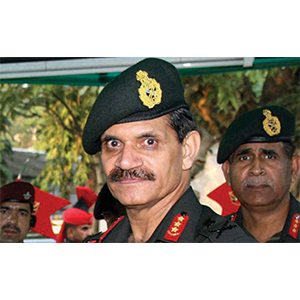
Dalbir Singh Suhag takes over as new Army chief
Lt Gen Dalbir Singh Suhag has taken over as the head of the 1.3 million strong Indian Army, succeeding General Bikram Singh. Suhag, whose appointment had kicked up a row, was designated as Army chief in May by the outgoing UPA government ignoring protests from his predecessor Gen VK Singh and BJP. 59-year-old Lt Gen Suhag, a Gurkha officer who had participated in the 1987 Indian Peace Keeping Force (IPKF) operation in Sri Lanka, is currently the Vice Chief of Army Staff. He will have a tenure of 30 months as the 26th Chief of the armed forces. Suhag was made the Vice Chief of Army Staff in December last year.
Earlier, he had taken over as the Eastern Army Commander on June 16, 2012. He was at the centre of a controversy triggered by ‘Discipline and Vigilance’ ban imposed on him by the then army chief Gen VK Singh in connection with an intelligence operation in Assam earlier. The ban on Suhag, the then 2 Corps Commander, was lifted soon after Gen Bikram Singh took over in May, 2012. BJP had questioned the “hurry” in making the appointment and insisted that the matter be left to the next government. However, soon after the NDA government took over, defence minister Arun Jaitley said the new dispensation will continue with the appointment made during UPA rule.
NEW DELHI (TIP): On his first day in office, Army chief Gen Dalbir Singh Suhag on August 1 warned Pakistan that India’s response to any beheading-like incident in future would be “more than adequate, intense and immediate”. “I can tell you that our response to any such act will be more than adequate in future. It will be intense and immediate,” he told reporters after his welcome guard of honour as chief of Army staff.
The new Army chief was asked how did India give a ‘befitting reply’ to Pakistan after the beheading of Indian soldier Lance Naik Hemraj along the line of control in Poonch sector on January 8, last year by Pakistani troops. Previous Army chief Gen Bikram Singh had on July 31 stated that India had given a befitting reply to Pakistan after the beheading incident. “It has been done. Please understand that when we use force, that use is from tactical to operational to strategic levels.
“When I mention that during that incident, it was aimed at operations at the tactical level, which have been undertaken. I think this has been done by the local commander, the chiefs have nothing to do with it,” Gen Singh had said. Pakistani Special Forces under the Border Area Teams (BAT) had carried out the operation of beheading Hemraj and mutilitating the body of Lance Naik Sudhakar Singh. Later in August, they had also killed five Indian troops in the same sector in a joint attack by Pakistani Special Forces and LeT terrorists. -

No room for complacency in state polls, Amit Shah tells BJP MPs
NEW DELHI (TIP):
On the back of BJP’s stupendous victory in the Lok Sabha polls, party chief Amit Shah has asked ministers and MPs to put their best foot forward to maintain the winning streak in the assembly polls slated in four states later this year. Addressing party MPs on July 31, for the first time since he took charge, Shah made it clear that there is no room for complacency and that the immediate focus of the party is to win the state polls in Maharashtra, Jammu and Kashmir, Jharkhand and Haryana.
Speaking at the parliamentary party meeting at the Central Hall, Shah, whose UP strategy changed BJP’s electoral fortunes, asked the MPs to adhere to “Sampark, Samvaad and Samanvay” (communication, dialogue and coordination) with the voters, so that they do not turn away from the party at the state level. He asked the MPs to utilize their MPLADS funds judiciously in consultation with local leaders to avoid any disconnect between the party and MPs. As a step in this direction, he said, each one of them should set up offices as well as coordination committees in their respective constituencies for effective utilisation of MPLADS funds.
Shah cautioned them against disconnect with voters and take the upcoming assembly elections and bypolls seriously. Prime Minister Narendra Modi, who chaired the BJP parliamentary party meeting, earlier introduced Shah to the party MPs. “The new BJP chief stressed on having coordination between the party MPs and the public and asked all party members to work at the booth-level,” said BJP vice president Mukhtar Abbas Naqvi after the meeting.
Shah told the MPs that this was the first time in independent India’s history that a non-Congress government got absolute majority and it will be the duty of MPs to ensure party’s victory in their respective states. MPs from those states which are not poll-bound will also be deployed for party work in the pollbound states. -

Rajya Sabha MP Birender Singh Removed From Congress Working Committee
NEW DELHI (TIP): Cracking the whip against its sulking Haryana MP Chaudhary Birender Singh who appears set to join the BJP, the Congress on July 31 night removed him from the party’s working committee and sought an explanation from the senior leader asking why he was associating with the saffron party. Singh, who has raised a banner of revolt against Haryana Chief Minister Bhupinder Singh Hooda, had recently met BJP President Amit Shah and there were indications that he may join the BJP.
Singh had earlier served as an All India Congress Committee (AICC) General Secretary and is a Rajya Sabha MP. He was made a member of Congress Working Committee (CWC), the party’s top decision-making body during the last AICC reshuffle. In a letter to Singh, AICC General Secretary in charge of party affairs in Haryana Shakeel Ahmed is learnt to have drawn his attention towards media reports of his meetings with BJP leaders including Shah.
The party is learnt to have pointed out that there are media reports that he is hobnobbing with BJP leaders without any contradiction or denial from his side. The party has also taken note of his meeting with Mr Shah two days back and his subsequent statement that he discussed political issues. “All these actions are detrimental to the party’s interests and have given the party a very bad name. As you are a party MP, you are requested to explain your position within three days,” the party is learnt to have told him. -

US snooping on BJP unacceptable, SUSHMA TELLS KERRY
NEW DELHI (TIP):
Alarmed by the disclosure last month that US authorities spied on BJP when it was not in power, foreign minister Sushma Swaraj raised the issue with visiting secretary of state John Kerry on July 31 saying this was totally unacceptable to India. India had registered a protest with senior US diplomats after the disclosure which was based on documents provided by whistleblower Edward Snowden but officials said Swaraj took up the issue with Kerry to drive home the point that there was anger in the country over alleged snooping by the National Security Agency (NSA). “I told Secretary Kerry that this was completely unacceptable to us as India and US are friendly countries.
Friends don’t snoop on each other,” Swaraj told reporters after the 5th India-US strategic dialogue and what was also the first high-level engagement between the two countries after the Narendra Modi government took over. In his response, Kerry sought to assuage India’s concerns as he said President Barack Obama had undertaken a unique and unprecedented exercise to review all intelligence activities carried out by US agencies. He also said the US valued its relations with India and also the partnership between the two countries in counter-terror operations. “We don’t discuss intelligence matter publicly.
But we value sharing of information regularly on counter-terrorism with India. US President Barack Obama clearly articulated that we fully respect and understand feelings expressed by Indian nationals,” Kerry said. The two leaders discussed all issues cutting across trade, energy, climate change, security and counter-terror operations. On the controversy over India’s stand at WTO over trade facilitation, Kerry expressed hope that a compromise deal would be worked out.
According to documents leaked by Snowden, BJP figured in the list of non-US political parties — along with Lebanon’s Amal which has links with Hezbollah, Egypt’s Muslim Brotherhood and the Pakistan Peoples Party — which were spied on by the NSA after an official authorization by the US government. In fact, Swaraj’s predecessor Salman Khurshid too had mentioned the issue of snooping on the Indian embassy in the US to Kerry last year but later seemed to defend it saying it was actually not snooping and that such information was used by the US to prevent serious terror strikes.
It was also discovered last year that India was the fifthmost- tracked country by US agencies which used a clandestine “data-mining programe” to monitor worldwide internet data. A joint statement issued later said that faced with a common threat from terrorism, including in South Asia, the two leaders committed to intensify efforts to “combat terrorism, proliferation of WMDs, nuclear terrorism, cross-border crime and address the misuse of the internet for terrorist purposes, in compliance with respective laws.”
On terrorism, the two leaders reiterated their condemnation of terrorism in all its forms and reaffirmed their commitment to eliminating terrorist safe havens and infrastructure, and disrupting terrorist networks including al-Qaida and the Lashkar-e-Taiba. “The leaders called for Pakistan to work toward bringing the perpetrators of the November 2008 Mumbai attacks to justice,” said the statement. The two leaders welcomed the continuation of the Counter-Terrorism Joint Working Group process, sustained exchanges of senior experts, and the upcoming meeting of the Working Group in 2014. -

No new VIP security duties for NSG
NEW DELHI (TIP):
VIPs may no more enjoy the cover of coveted ‘Black Cat’ commandos. Government is learnt to have decided that VIPs would no longer get the cover of NSG commandos and the force would be redirected to keep 100% focus on counter-terror operations. The elite commando force was established as an emergency force to respond to terror attacks but has been diluted over the years with the burden of VIP security. As the force’s commandos are known to be the best in the country, they are coveted for security cover by politicians and VIPs as a status symbol. This may change soon, though. NSG DG J N Choudhary on Thursday told TOI, “The government is aware that VIP security is not our core competence.
If any more responsibility of VIP cover is given to us, it would dilute our capability to counter terror attacks. That is why the government is not giving us such responsibility anymore.” He added that NSG was a lean force, as any specialized force should be, and increasing VIP duties would spread it thin and unavailable to consistent counter-terror training, an absolute essential for such a force. Though the force has been demanding for long that its VIP duties be limited, successive governments have only increased the number of VIPs under its protection. Chhattisgarh CM Raman Singh and UP CM Akhilesh Yadav were added to the list in recent years.
However, the new government has been careful of the force’s concerns and has assigned other paramilitary forces to secure VIP protectees. A case in point is that of BJP chief Amit Shah and NSA Ajit Doval, both having very high threat perception, but still given CRPF and CISF security respectively. It will, however, continue to provide security to the 15 VVIPs that it guards at present until further orders.
The NSG guards CMs like Raman Singh (Chhattisgarh), J Jayalalithaa (Tamil Nadu), Tarun Gogoi (Assam), Akhilesh Yadav (Uttar Pradesh), Parkash Singh Badal (Punjab) and a host of other political figures like senior BJP leaders L K Advani and Rajnath Singh. It is also securing former CMs like Prafulla Mahanta (Assam), K Karunanidhi (Tamil Nadu) and Mulayam Singh Yadav (Uttar Pradesh).
The concept and thought process to reduce VVIP security duties of the elite force was mooted about two years back when the force decided to pull out about 900 commandos from its VVIP security duties and train them for specialized operational tasks of counter-terror and counter-hijack operations for which it was raised in 1984. -

BJP president Amit Shah meets Rajasthan MPs
NEW DELHI (TIP): Bharatiya Janata Party (BJP) president Amit Shah on July 25 met the Members of Parliament from Rajasthan stateat New Delhi’s Rajasthan Bhawan. Rajasthan chief minister Vasundhara Raje was also present at the meeting. Amit Shah was earlier this month anointed as the BJP’s new president.
-

GIRLS NOT SAFE ON UP ROADS AFTER SUNSET, SAYS GOA CM
PANAJI (TIP):
In potentially controversial remarks, Goa chief minister Manohar Parrikar on Thursday said girls would “disappear” if they walk on the roads in Uttar Pradesh in the evening and invoked the legendary Bhagat Singh to justify foreign study trips by his cabinet colleagues. “Any girl can walk without fear on Goa streets even at midnight. But in Uttar Pradesh, if a girl walks at 6 in the evening, she will disappear,” he said in the assembly while seeking to address worries expressed by the ppposition on the law and order situation in the BJP-ruled coastal state.
He claimed some states with interest in tourism were busy spoiling the name of Goa which attracts millions of holiday-makers, both domestic and international, every year. Parrikar also alleged “a big news channel” has vested interest in “defaming” Goa. “There is a big news channel which has vested interest in defaming Goa. They act as if they have the right over Goa. I have stopped watching the channel, let them carry what they want”, he said. A beach in Goa visited by thousands of tourists every year Parrikar cited the life of revolutionary patriot Bhagat Singh to argue that there were two ways of looking at things.
His remark was in context of some ministers going abroad to study garbage disposal systems. “It was not a junket, it was a preoperative expense. If I had not sent them, I would have been accused of constructing (waste treatment) plants without studying them,” he said. “There are two ways of looking at anything. We look at Bhagat Singh as a martyr but Britishers used to look at him at as a terrorist. We need proper prospective to look at everything,” Parrikar added. -

AFTER BJP, AAP INDICATES IT WANTS TO FORM GOVERNMENT IN DELHI
NEW DELHI (TIP): The race to form the government in Delhi heated up after both the BJP and the AAP indicated that they were ready to stake claim. A day after the BJP suggested that it could form a government in Delhi, AAP leader Arvind Kejriwal sought an appointment with Delhi Lt. Governor Najeeb Jung. Kejriwal tweeted: “I have sought an appointment from LG for all AAP MLAs to meet him today. Waiting for his response.” Satish Upadhyay, the new president of the BJP in Delhi, told the media Wednesday that his party could consider government formation if Najeeb Jung gave an invitation.
“We might consider it,” he said in brief remarks as speculation mounted that the political logjam in the capital might soon end. “We will decide when the time comes,” added Jagdish Mukhi, a senior BJP leader after a meeting of party legislators. Kejriwal, who quit as chief minister of Delhi Feb 14 after 49 days in power, tweeted: “Can LG invite a party to form government without prima facie satisfying himself whether the party has numbers?” Kejriwal had led the AAP to a stunning victory in last year’s Delhi assembly election and had formed the government with Congress backing.
In another tweet, Kejriwal said: “Would LG encourage horse trading if he invites a party to form government despite knowing that they don’t have number?” Kejriwal also questioned whether Jung can invite the BJP, which has earlier declined to form the government. “If a party (BJP) has once already declined the offer to form government – can the LG invite the same party in the existing Vidhan Sabha again?” he said. The BJP won 31 of the 70 seats in the December 2013 assembly election in Delhi and the Aam Aadmi Party 28, ousting the Congress, which got only eight seats after being in power for 15 long years. Three of the 31 BJP legislators in Delhi were elected in May to the Lok Sabha, bringing down its tally in the assembly to 28. The AAP’s strength is 27 after one of its legislators broke away months ago.
It is not clear how the BJP hopes to form a government. It enjoys the support of an Akali Dal member. It will still need the backing of at least five legislators for a simple majority in the assembly whose effective strength now is 67. BJP sources seem confident that they will get the numbers, primarily from a demoralized Congress. “There is nothing we can do if people want to leave the party,” a senior Congress leader said. However, Arvinder Singh Lovely, who heads the Congress in Delhi, insisted that no Congress legislator would go with the BJP or AAP. Another Congress legislator, however, admitted on the condition of anonymity that some in his party were in touch with the AAP which they see as a better bet vis-avis the BJP.
A senior AAP leader admitted that there had been talks of government formation between the AAP and Congress legislators. The AAP, which has petitioned the Supreme Court seeking fresh elections, feels that it will make a move towards government formation only if it is sure that the Congress will back it once again. Kejriwal has admitted that he made a mistake in resigning, and some AAP legislators have pleaded with him to explore the chances of again forming a government. -

BUDGET A VALIDATION OF UPA POLICIES: CHIDAMBARAM
NEW DELHI (TIP): Former finance minister P Chidambaram, who presented the interim budget ahead of the Lok Sabha polls, has said he is happy to find the BJP government’s first Budget validating the figures presented by him. “The imprint of the UPA government’s policies can be found throughout the Budget speech and in the budget documents,” Chidambaram said in a statement. He said it’s not possible to come out with a “Congress- Mukt Budget”.
“Welcome to the real world… BJP sought a mandate for Congress-Mukt Bharat.My friend, Arun Jaitley, would have realised that it is not possible to have even a Congress- Mukt Budget,” the former finance minister said. He said Arun Jaitley’s Budget has the imprint of UPA policies on fiscal consolidation, GST, FDI cap in insurance and social sector schemes. “I am glad that Arun Jaitley has acknowledged the basic validity of the numbers presented in the Interim Budget for 2014-15 and has stuck to them…He has also maintained the tax revenue estimates for Corporation Tax, Customs and Service Tax,” he said. Chidambaram referred to the numbers with regard to the fiscal deficit at 4.1% and revenue deficit of 2.9% (marginally lower than 3%).
Mamata: Budget visionless
KOLKATA: Chief minister Mamata Banerjee came down heavily on the NDA for what she called a ‘visionless, missionless and actionless’ budget as far as the common man is concerned. According to her, the first Union Budget tabled by the Narendra Modi government can’t stimulate growth or lead to development of the poor. “We heard about a strong and vibrant India before the government came to power.
We thought that it will be delivered to provide good governance. But from the beginning, we are getting disappointed. Only one positive sign of the new government is established in two budgets that they have become a government of the FDI, by the FDI and for the FDI. Already, there is FDI in the retail. Now FDI is increased to 49% in Defence, and Insurance Sectors. In addition, disinvestment in banking sector is up to 49%. -

HARYANA ASSEMBLY PASSES BILL FOR SEPARATE SGPC
CHANDIGARH (TIP): Haryana Assembly on July 11 passed a bill paving the way for the formation of a separate body to manage affairs of Gurdwaras in the state even as the main opposition parties INLD and the BJP staged a walkout over the issue. The bill moved by Parliamentary Affairs Minister Randeep Surjewala was passed with a voice vote in the absence of the Indian National Lok Dal and BJP members, who had earlier staged a walkout opposing the legislation, claiming that the move was Congress’ “conspiracy” to “divide” the community.
Bhupinder Singh Hooda-led Congress government in Haryana passed the bill ignoring the stiff opposition of the Amritsarbased Shiromani Gurdwara Parbandhak Committee, the Shiromani Akali Dal and other groups. Congress had promised the formation of separate SGPC in its poll manifesto in 2005, but the issue remained unsettled in its first term and got carried over to Hooda’s second term. But with assembly elections due in Haryana in October this year, the issue was speeded up. Hooda, Surjewala and other treasury benches members described the bill as “historic” one which was long overdue as the Sikhs of Haryana had been “fighting” to have right over management of their Gurudwaras.
Heated arguments erupted between the ruling and opposition benches during the discussion on the Bill with the latter dubbing it as a “ploy” to garner votes ahead of the polls. “Dont divide the Sikhs on religious lines. They have a long history of sacrifice and the Sikhs of Haryana have not favoured this. This Bill should be taken back,” INLD’s State unit President Ashok Arora said, finding full support from his party MLAs including senior leaders Abhay Singh Chautala and Ramphal Majra. BJP’s senior leader Anil Vij said that the ruling party was “rushing through” and in a “hurry” to pass the 46-page Bill and had not given enough time to the Opposition to study and go through the contents of the important legislation, which was connected to the future of the Sikh community in the State. Vij said that the move was a “Congress conspiracy” to divide the community.
However, Hooda and Finance Minister Harmohinder Singh Chattha, who prepared the report which favoured the separate body, told the House that there was no politics being behind the move as the decision regarding it was taken considering sentiments and aspirations of the Sikhs of Haryana. Earlier in the day, Surjewala introduced the Haryana Sikh Gurdwaras (Management) Bill, 2014 “to provide for the better autonomous management and effective supervision of Sikh Gurdwaras and Gurdwara properties in Haryana and matters related thereto.” Haryana Sikh leaders including Jagdish Singh Jhinda, Didar Singh Nalwi, who spearheaded the campaign for separate SGPC in Haryana, besides Congress leaders from Punjab including state unit chief Pratap Singh Bajwa and some party MLAs watched the proceedings of the House from the visitors gallery.
SGPC wants Centre to intervene, stall move
Chandigarh (TIP): Dubbing the Haryana Government’s initiative to carve out a separate Sikh gurdwara panel for the state as ‘unconstitutional and illegal’, an anguished Shiromani Gurdwara Parbandhak Committee (SGPC) has urged the Central Government and the President to intervene and stall the move. The Amritsar-based apex religious body of the Sikhs on July 11 said it might take a legal route to block the creation of the Haryana Sikh Gurdwara Parbandhak Committee (HSGPC). “The party will decide the next course of action and do the needful. We will see…we might take legal action if necessary,” said SGPC chief Avtar Singh Makkar. The SGPC chief, who presided over a meeting at Nada Sahib, said: “It’s the prerogative of SAD patron Parkash Singh Badal and party chief Sukhbir Singh Badal to take up the matter with the Central Government and the President. We have also requested the Haryana Governor to not give his nod to the Bill for creation of the HSGPC.”
It is learnt that Badal during his recent meetings with top BJP leaders sought the Union Government’s support to stall the ongoing process for creation of a separate HSGPC. On being asked about the Modi government’s response, Makkar said: “It (response) was good.” The sources, however, said SAD leadership was given a ‘cold shoulder’ by central BJP leaders over the issue. Consequently, the SGPC has ‘toned down’ its stand on the HSGPC issue. The panel on Friday renewed its ‘truce’ offer to Haryana Sikh leaders. “We are all for the ‘panthic ekta’. To achieve it, we again offer our Haryana elected members two posts — that of Vice- President and Additional Secretary. We are also okay with Haryana gurdwaras spending the income being generated by them,” said Makkar. -

COLLEGIUM CLEARS UDAY UMESH LALIT AS SC JUDGE
NEW DELHI (TIP): The collegium headed by the Chief Justice of India has recommended to the Centre to appoint senior advocate Uday Umesh Lalit, a sought after criminal law practitioner, as a judge of the Supreme Court. Along with Lalit, the collegium also recommended the names of three chief justices of high courts – Justices Prafull Chandra Pant, Abhay Manohar Sapre and R Banumathi – to the Union government for appointment as judges of the apex court, official sources said. CJI R M Lodha, who has been advocating appointment of competent senior advocates directly to the Supreme Court, had last month recommended appointment of senior advocates R F Nariman and Gopal Subramanium as judges of the SC. But the government returned Subramanium’s name to the collegium for reconsideration citing adverse IB and CBI reports. The clearance for the appointment of Nariman and Justices Arun Kumar Mishra and Adarsh Goel while segregating Subramanium’s name did not go down well with both the CJI and Subramanium.
In fact, both Nariman and Subramanium were designated as senior advocates by the Supreme Court on the same day nearly 21 years ago on December 15, 1993. A miffed Subramanium severely criticized the government and the judiciary before withdrawing his consent for judgeship and declared that he would not practice in Supreme Court till Justice Lodha’s retirement. The lawyer said he had been discriminated against because he, as amicus curiae, sought the prosecution of Amit Shah, now the BJP president, in the Sohrabuddin Sheikh ‘encounter’ case.
Significantly, AAP leader Arvind Kejriwal sought to link the collegium’s choice of Lalit to Shah, saying he was the counsel of the ruling party chief in two cases. Justice Lodha had criticized the Centre’s unilateral decision to segregate Subramanium’s name while expressing shock over the way the lawyer went public with his unpleasant nine-page letter. The Supreme Court presently has 27 judges, four less than the sanctioned strength. If the government expeditiously clears the appointment of Lalit and Justices Pant, Sapre and Bhanumati, the apex court will have full working strength. But a vacancy will arise when Justice C K Prasad retires on July 14. Lalit was designated as senior advocate by the Supreme Court on April 29, 2004. -

Lok Sabha site names Advani a journalist, Rahul a strategy consultant
BHOPAL (TIP): Former deputy prime minister and BJP patriarch LK Advani is a journalist by profession and Congress vice-president Rahul Gandhi is a strategy consultant, according to the Lok Sabha website. Strangely, the nation’s top two politicians and members of the 16th Lok Sabha do not have politics as their profession in their profile on the portal. A Madhya Pradesh-based activist has written to Lok Sabha Speaker Sumitra Mahajan to check this crucial information and rectify it if found wrong.
“When they contested elections, Advani stated in his affidavit he was a social worker by profession and Rahul said he was a member of Parliament,” activist Chandra Shekar Gaur said. “I have also requested the Speaker to ensure that contact details like email id and official phone number of Prime Minister Narendra Modi should also be provided on the website as he’s also an MP. If complete details of other MPs are provided, then why should Modi be an exception? It will help people to connect with the prime minister whom they have elected,” Gaur, a resident of Neemuch, said. -

SEX EDUCATION IN SCHOOLS SHOULD BE BANNED: HEALTH MINISTER
NEW DELHI (TIP): After suggesting that to prevent AIDS fidelity in marriage was better than use of condoms, health minister Harsh Vardhan has generated another controversy – this time by stating in his website that sexeducation in schools should be banned. In his “vision” document for Delhi schools, Vardhan, himself a doctor, has said, “So-called ‘sex education’ (should) to be banned.” His website – drharshvardhan.com – also states the need to integrate value education with course content and put strong emphasis on exposing students to India’s cultural relations.
Vardhan couldn’t be contacted for his comments as he’s in the US. His office said this was the minister’s personal views. When contacted, Delhi BJP spokesperson Sanjay Kaul said, “The issue of banning sex education in schools has not been discussed on the party forum. We have no comment to offer.” Earlier, the health minister had created a stir by claiming the supremacy of fidelity as an AIDS prevention measure.
“Condoms promise safe sex, but the safest sex is through faithfulness to one’s partner. Prevention is always better than cure,” he was quoted as saying. Public health activists are angry with the “vision” of the doctor-turned politician. Some public health activists said that the health minister appeared to be pushing the RSS agenda.
-

COURT SUMMONS SONIA, RAHUL IN NATIONAL HERALD CASE
NEW DELHI (TIP): A court here Thursday issued summons to Congress chief Sonia Gandhi and her son and party vice president Rahul Gandhi for misappropriating the funds of the National Herald newspaper that was shut down some years ago. Metropolitian magistrate Gomati Manocha, while issuing the summons, said: “I have found prima facie evidence against all the accused.” The court has directed them to appear before it Aug 7.
Apart from Sonia Gandhi and Rahul Gandhi, the court has also summoned senior Congress leaders Motilal Vora and Oscar Fernandes. The court also issued summons to Sam Pitroda, former advisor to prime minister Manmohan Singh on public information, infrastructure and innovation, who also headed the National Innovation Council, a think tank to analyse and help implement strategies for inclusive innovation during the UPA regime. Former journalist Suman Dubey, who is close to the Gandhi family, was also summoned by the court.
The summons was issued on a private complaint filed by BJP leader Subramanian Swamy. Speaking to reporters, Swamy said: “This is a fraud, criminal breach of trust as they have managed to misappropriate the fund of Rs. 2,000 crore rupees.” “It is important for the court to take the passports of Sonia Gandhi and her son Rahul Gandhi so that they do not run away from the country before the hearing in the court,” added Swamy. The National Herald newspaper was established in 1938 by India’s first prime minister Jawaharlal Nehru. Rahul Gandhi is Nehru’s great grandson of Nehru. The newspaper was shut down in 2008.
-

RAIL BUDGET LIKELY TO FOCUS ON PASSENGER SAFETY
NEW DELHI (TIP): On the back of two train accidents within a month of Modi government taking charge, railway minister Sadanand Gowda is likely to announce a slew of measures in his July 8 budget to enhance passenger safety. The may include installing indigenous Train Collision Avoidance System (TCAS) on more routes to enable safe running of more trains on the same track even under low visibility. As railways are facing a huge fund crunch, the plan support for the staterun transporter for special projects, can see a significant hike in the budget. An official said the budget may propose to set up a dedicated safety fund. The fund is likely to be created by imposition of a safety cess on fares.
The budget is also expected to provide clarity on foreign direct investment in the sector as the BJP government has hinted at allowing 100% FDI in railway infrastructure (including high speed tracks, dedicated freight corridors and station development). Following Prime Minister Narendra Modi’s footsteps, Gowda is also pushing to make the railways go green. The budget is expected to announce projects related to harnessing solar energy and development of offshore wind energy, including those related to use of solar energy to power local trains and use of innovative technology to run AC coaches.
The focus is expected to be on electrification of around 2000 km of tracks, considering that the railways have almost 38% (24,800 km) of its network electrified, carrying almost 67% of the freight traffic and 51% of the passenger traffic. The budget is likely to have many sops for northeast region, another priority area for the Modi government.
The railways would announce to expedite the construction of 14 strategic projects — mainly in border areas — that are struck for environment clearance and paucity of funds. These projects involve laying down of 2,888 km of railway tracks in Jammu & Kashmir, Arunachal Pradesh, Assam, Himachal Pradesh, Uttarakhand, Rajasthan and Punjab. The budget could allocate more funds for faster execution of dedicated freight corridor to ensure speedier transportation of goods in important routes.