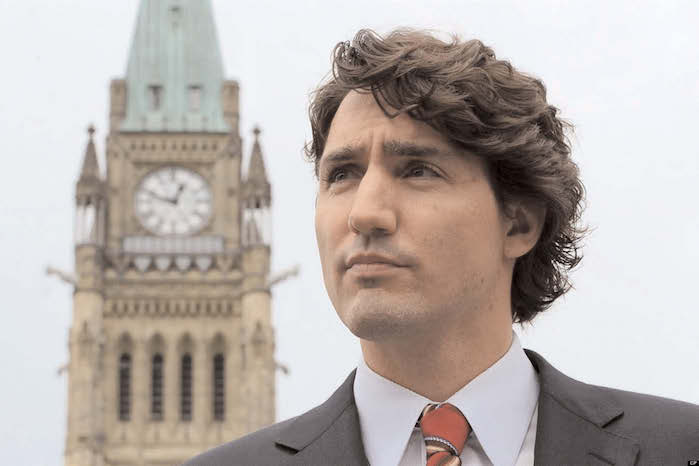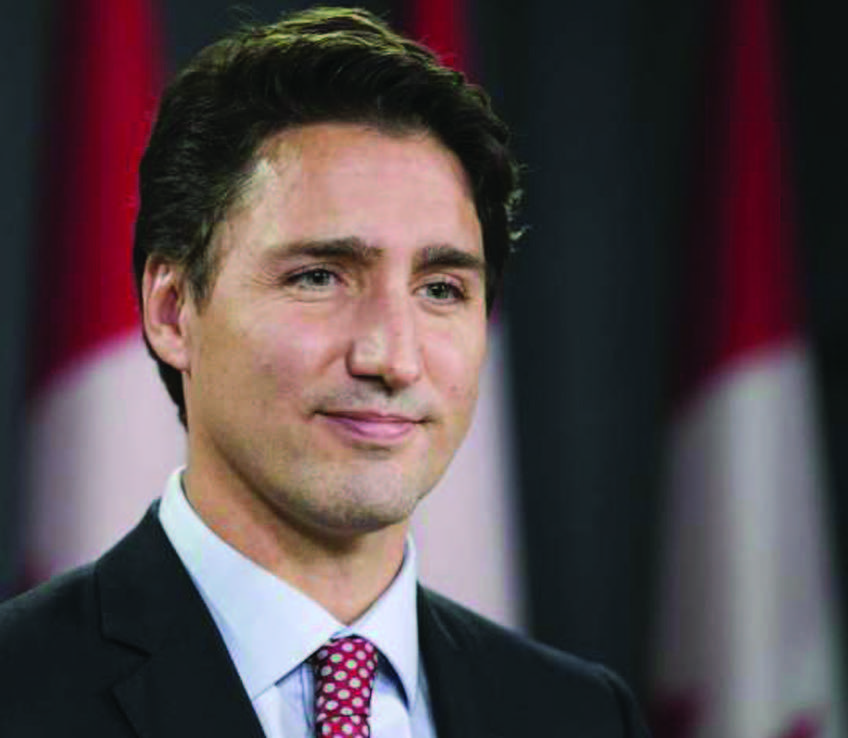
New Delhi: Canadian Prime Minister Justin Trudeau is expected to visit India either late this year or early next year, the country’s High Commissioner to India Nadir Patel said on Friday.
“The India-Canada relationship is blooming and thriving,” Mr Patel said at a media interaction organised by the Indian Association of Foreign Affairs Correspondents (IAFAC) here.
“We have already held four strategic dialogues,” he said.
Stating that Prime Minister Narendra Modi and PM Trudeau have met both formally and informally, he said that “our leaders have developed a very strong relationship”.
PM Modi had visited Canada in April 2015 when Stephen Harper was the Prime Minister. It was the first standalone prime ministerial visit from India to Canada in 42 years.
According to Mr Patel, PM Trudeau is scheduled to visit India either “late this year or early next year” at the invitation of PM Modi.
“We are yet to finalise the dates,” he said.
Seven Canadian cabinet ministers have visited India in the last eight months.
The High Commissioner said that both PM Trudeau and Canadian Foreign Minister Chrystia Freeland “have made it clear that India is top priority for Canada”.
“Delhi is our largest diplomatic mission in the world,” he said.
Stating that bilateral trade and investment was “largely balanced”, he said that there was “$14-15 billion of Canadian investment in India in the last two years”.
“There are around 1,000 Canadian companies in India of which 400 are physically present,” Patel said.
However, he lamented the fact that bilateral trade stood at only $8 billion given that “we do $2 billion of trade per day with the US”.
“There is potential do a lot more,” he said.
In terms of what Canada can offer to India, he cited food security, aviation, start-ups and clean energy among various sectors.
He said that Canada was keen to have a Comprehensive Economic Partnership Agreement (CEPA) with India.
“SMEs (small and medium enterprises) of both countries stand to gain the most,” the High Commissioner said.
As for the civil nuclear agreement signed during PM Modi’s visit, he said that administrative guidelines have been concluded and “things are moving fast”.
In this connection, he said a delegation of Canadian companies would be visiting India to discuss nuclear technology.
“Large-scale uranium supply is already happening,” he stated.
With around 1.2 million Indian-origin people in Canada, Mr Patel, who’s also an Indian-origin, said there are “very significant people-to-people links” with India.
Of this number, 5,00,000 hail from Punjab and there are 19 Indian-origin lawmakers, of whom 4 are cabinet ministers.
He also said that there has been a hike in the number of Indian student visas for Canada in the last four months. Asked if this was due to the policies of the Donald Trump administration in the US, he said that the surge started even before the US election and was “not attributable to the new US administration”.
The money will help replace what President Trump cut when he took office
OTTAWA (TIP): On International Women’s Day, March 8, Canadian prime minister Justin Trudeau announced Canada will contribute $650 million over the next three years to reproductive health and abortion-related services around the world, multiple outlets reported. The money will help fill a funding hole left when President Donald Trump signed the “global gag rule” on abortion, yanking funding from international health organizations that provide abortions or engage in abortion advocacy, even if they use their own funding for abortions, according to The Guardian.
Trudeau pledged the money for sex education and reproductive health programs, including money set aside for the abortion-related services Trump defunded. The goal, Trudeau said, is to give women access to resources that give them control over family planning.
“Like men, women should be able to choose when they want to start a family, how big their family should be, and who they want to start that family with,” Trudeau said in his announcement. “When women have equal power and equal weight and equal leadership influence, the kinds of decisions are better.”
The global gag rule was introduced by Ronald Reagan in 1984, and every Republican since then has signed on. Trump signed the rule when he took office, and while that move was fairly routine for a conservative leader, Trump expanded the rule to restrict all global health funding, not just family-planning funding, including for those organizations whose primary focus isn’t family planning but which may mention abortion, according to Slate. The rule has the potential to strip $9.5 billion in funding from international health organizations, including$600 million in family-planning funding. Trudeau’s announcement targets the family-planning funding Trump stripped away, providing an alternate source of money for the organizations.
By stripping family-planning funding, Trump is dealing a blow to reproductive health across the world, but since, according to Slate, he expanded the gag rule to include all health funding, even for those organizations whose focus is entirely different but which may mention abortion, he is endangering programs that do all kinds of things worldwide, including prevent HIV.
Giving money to women’s health organizations, Trudeau said, will empower women and therefore make for a better world all around.
“For far too many women and girls, unsafe abortions and lack of choices in reproductive health mean that they are either at risk, and at risk of death, or simply cannot contribute or achieve their potential through education, through involvement in their community, through a broad range of opportunities,” he said, according to CBC News. “It is important that as a world we recognize that empowering women, that respecting their rights, is fundamental to building a world in which everyone has a real and fair chance to succeed. “
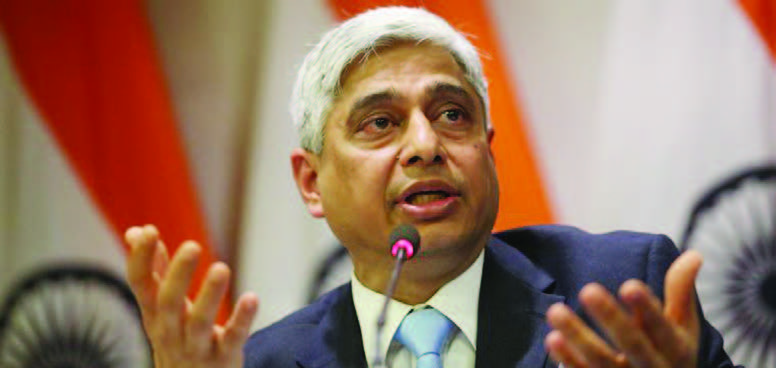
NEW DELHI (TIP): Ministry of external affairs spokesperson Vikas Swarup will be the next Indian high commissioner to Canada, the government said on Thursday.
Swarup, whose novel ‘Q & A’ was made into the Oscar-winning movie ‘Slumdog Millionaire’, had been at the helm of the MEA office since April 2015. He is credited with expanding MEA’s social media outreach.
Swarup is currently an additional secretary in the MEA.
Gopal Baglay, joint secretary in the Pakistan, Iran, Afghanistan division in MEA, will succeed Swarup.
NEW DELHI (TIP): The Ministry of External Affairs is all set to get a new public face with its current spokesperson Vikas Swarup headed to Canada as the High Commissioner.
Gopal Baglay, Joint Secretary in charge of Pakistan, Iran and Afghanistan Division in the ministry, is likely to succeed Swarup. Baglay earlier served as Deputy High Commissioner in Pakistan and as Director in MEA’s External Publicity Division.
Swarup, a 1986-batch Indian Foreign Service officer, had replaced Syed Akbaruddin as the MEA spokesperson in 2015. He shot to fame when his novel Q&A was made into a Hollywood movie, ‘Slumdog Millionaire’, which won eight Oscars. He is expected to take up his new assignment shortly.
The year 1984 may have been a tumultuous year for the Punjabi community in general and Sikh community. It may not be easy for anyone to put behind the dastardly and tragic events that rocked not only Punjab but also the Punjabi community elsewhere. As the community was drowning in gloom, two overseas Punjabis -Alexi Singh Grewal and Kulbir Singh Bhaura – provided the silver lining by telling the world how enterprising the community was. Not only they entered the history annals as first overseas Indians to win Olympic medals but they also set a new trend in motion that has been kept afloat by enterprising overseas Indian community ever since.
At the overall overseas Indian community has done exceedingly well in the world of sports, including Olympic games, Commonwealth games and cricket.
Their heroic deeds scripted a new chapter describing it as the launch of “Brand India”. Before 2016 ended, yet another overseas Indian – Rajeev Ram – kept the “Brand India” flame alive by winning an Olympic medal, a Silver in Rio Olympic games.
Contribution by overseas Indian community cannot by undermined for it has won cockles of many a heart in the contemporary sports world. In December when a field hockey team from Canada went to play in the 2016 Junior World Cup Hockey Tournament in Lucknow, 11 of its 16 members were of Indian origin.
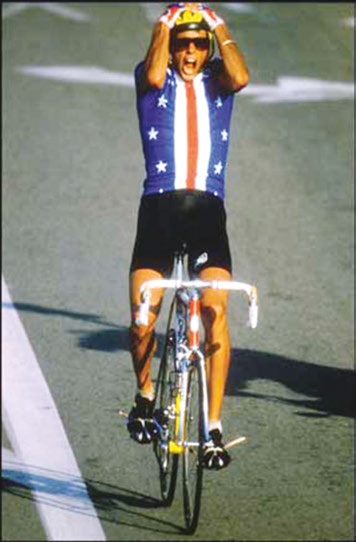
Alexi Singh Grewal became the first American to win an Olympic gold medal in cycling, at the 1984 Games in Los Angeles. Photo: Todd Buchanan
These players -Brandon Pereira, Harbir Sidhu,Parmeet Gill, Rohan Chopra, Rajan Kahlon, Kabir Aujla, Balraj Panesar (captain), Ganga Singh, Gavin Bains, Arshjit Sidhu and Iqwwinder Gill – need to be complemented as they self-financed their participation in the prestigious Lucknow tournament.
And the Australian team, too, had one player of Indian origin, Kiran Arunasalam. It is after a long time that any player of Indian origin is playing for Australia in hockey.
At the overall overseas Indian community has done exceedingly well in the world of sports, including Olympic games, Commonwealth games and cricket.
You name any sport in which the overseas Indian community has not won laurels for the countries of its present abode. Needless to say, that 17 countries, including Canada, the US, Australia, Malaysia, England, Kenya, Uganda and Hong Kong, have been represented by overseas Indians in Olympic games.
Kulbir Bhaura, who represented Great Britain in field hockey, is the only overseas Indian to have two Olympic medals to his credit, a bronze in Los Angeles and a gold in Seoul.
Then there is Shiv Jagday, a former Indian Universities colour holder; he had the distinction of working as National Coach of Field Hockey Canada. He also coached the US national team besides being on the panel of the select FIH coaches. His son Ronnie Jagday also played for Canada in Sydney Olympic games. One must not forget the contribution of Malkiat Singh Saund who was one of the best forwards of the 1972 Munich Olympic games. Malkiat represented Uganda. Now he is settled in England.
Sutinder had the distinction of leading England in one match in the Mumbai World Cup Hockey Tournament in 1981-82. He played for England and Great Britain for a number of years.
If Australia is a world power in field hockey, it is all because of efforts of Pearce brothers who immigrated to Australia from India and represented their new country of abode in Olympic games.
Hardial Singh Kular, besides playing for Kenya, also rose to be the Vice-President of the International Hockey Federation (FIH). He was one of many Indian expatriates who represented Kenya in 60s and 70s of the last centenary.
He stands tall with Alexi Grewal, the first overseas Indian, to win an individual Olympic gold medal. In the 1984 Olympic games, he won the road race event in cycling in style. His father, a Sikh, had migrated to the US.
Interestingly, Alexi Grewal’s individual gold, though for the US, came 24 years before Abhinav Bindra won the country’s first ever-individual gold medal in Olympic games.
The latest from the overseas Indian community to get on to the Olympic medallist list is tennis player Rajeev Ram who won a silver medal in mixed doubles in the 2016 Olympic games in Rio.
While the overseas Indians have done the country and the overseas Indian community proud, the Indian government is yet to reciprocate. Though it started organizing #PravasiBharatiyaDivas (PBD) where outstanding members of the overseas Indian community are felicitated, sportsmen and women are yet to get their due.
Besides Alexi Singh Grewal, Kulbir Singh Bhaura and Rajeev Ram, there are a large number of other sportsmen and women, who have done the overseas community and India proud.
Rajeev Ram has to his credit a silver medal. In partnership with Venus Williams,
Rajeev Ram, finished runners-up in mixed doubles event in Tennis. Thirty-two- year-old Rajeev is first generation American. His parents moved to States in 1981 and Rajeev was born in 1984.
Rajeev won his first major Tennis title in Chennai in 2009. Rated as one of the top doubles players in tennis, silver in Olympics has been his highest achievement. In the semi-finals, Rajeev and Venus had defeated Sania Mirza and Rohan Bopanna.
After Rajeev Ram, another athlete of Indian origin doing well for a country other than India is shutter Rajiv Ousef. Born in Indians dominated Hounslow area in England, Rajiv has already qualified for quarterfinals of men’s singles in Rio. On his way to last eight Rajiv have beaten Tommy Sugiarto of Indonesia, Sasaki Sho of Japan and Koukel Petr of Czech. At 30, this has been perhaps best ever performance by him in a major sporting event. He had won a silver medal in the 2010 Commonwealth games in New Delhi.
Cricket is a game that every person of Indian origin follows. Monty Panesar scripted a new chapter when he became the first turban-wearing player to represent a country other than India in Test cricket. Monty played for England. Ravi Bopara followed him.
Since I have been following the overseas community closely, I wrote the following piece in The Tribune in November 2010 talking about emerging “Icons” of the Indian community. My piece was re-read by many as the President-elect, Donald Trump, named Nikki Haley, as the US Ambassador to the United Nations,
My piece read:
“What do Nikki Haley Randhawa, Bobby Jindal and Arjan Bhullar have in common?They all belong to the second-generation Punjabi Diaspora of North America.
While Randhawa and Jindal share the rare distinction of being the first Indian Americans to be Governors in the US, Bhullar has become the first Indo-Canadian to win a gold medal for his adopted homeland in the just- concluded Commonwealth Games in New Delhi.
They all are now icons of successful second generation young overseas Punjabis — 20-40 age group– who have brought laurels to the motherland of their parents after scripting extraordinary success stories in their chosen fields.
Interestingly, both Randhawa and Jindal are almost of the same age group — both succeeding in their race for gubernatorial posts even before they turned 40.
Though Piyush Subhas Chandra Amrit Bobby Jindal created history in 2008 by getting elected as Governor of Louisiana at the age of 37, Nimrata Nikki Haley Randhawa, will be almost 39 when she assumes charge as Governor of Carolina in the New Year.
Similarities are not only limited to the age group but also extend to other areas. Parents of both Jindal and Randhawa migrated to the US in the early 70s. And fathers of both Jindal and Randhawa were university teachers before they decided to leave India for good.
While the Jindals belonged to the Malerkotla area in Punjab, Rancheria’s family moved from Amritsar to the United States.
Mothers of both Jindal and Randhawa have the same first name — Raj. If similarities can be taken a step further, “A” is the initial of their fathers’ first name, Amar Jindal and Ajit Randhawa. Both belonged to the middle-class families before getting lured by the greener pastures of the US.
Interestingly, Jindal married Supriya Jolly, also an Indian-American, Randhawa married an American, Michael Haley.
Like their parents, both Bobby and Nikki charted out their own ways to success and glory with their sheer hard work, determination and commitment.
Bhullar has been on a different turf. Born in a family of wrestlers — his father Avtar Singh Bhullar was a known wrestler of his times who contested against Asian games champion Kartar Singh – in Vancouver in British Columbia, Arjan had to choose between soccer and wrestling in his school days. Now while pursuing higher studies at Simon Fraser University in British Columbia, he is focused on wrestling and wants to make it to the podium at the 2012 Olympic games in London.
Never before any Indo-Canadian had won a gold medal for his or her adopted homeland in any international meet of the level of Commonwealth Games, Pan American games or the Olympic Games.”
Now coming to many other sports personalities who also deserve appreciation and honour for flying the Indian flag flying overseas.
Hockey Olympian Avtar Singh Sohal played for Kenya in 1960, 1964, 1968 and 1972 Olympics, captaining Kenya in the last three editions of the Olympic games. He went to 1984 Olympics as Chief Coach of Kenya Besides Avtar also played for Kenya in the inaugural 1971 World Cup as Captain. In the second World Cup (1973) in Amsterdam, he went as Assistant Coach. Avtar is also the FIH Coach and also a member of the FIH Development and Coaching Committee. No one in the history of Olympic hockey has captained a national team for three consecutive times. In India, Pargat Singh has the distinction of leading India in two Olympic games.
Avtar Singh was in Rio Olympic games on his own to watch the hockey competition and other events.
Naaz Shah belongs to select band of Indian women hockey players who played for India in the Olympic games. When India was represented in women’s hockey competition in the Moscow Olympics, she was a member of the team. She was also a member of the gold medal winning Indian team in the 1982 Asian Games. Now settled in Hamilton, NZ she continues to be passionate about hockey.
Four of her trainees represented New Zealand in the New Delhi Junior World Cup Hockey Tournament. In the 2016 Junior World Cup Hockey Tournament in Lucknow, another batch of her trainees also represented New Zealand. Naaz also went to Rio as a Volunteer where she had the distinction of becoming flag-bearer of Indian hockey team in one of its pool matches. Now she has been a coaching youngster, both boys and girls in Hamilton where she works as a teacher. While she won laurels for India, her contribution to hockey and sports have remained unrecognised.
Let us talk about the World’s richest league, NBA. It is in this league that members of the overseas Indian community have made dents.
Gursimran “Sim” Bhullar, Canada born Punjabi boy, has the distinction of becoming the first ever player of Indian origin to play in NBA. Though Satnam Singh Bhamara and Palpreet Singh, both Punjab born basketball players have been subsequently drafted into NBA, they too have brought good name to Indian sports worldwide.
BENGALURU (TIP): Japan car maker Nissan on Wednesday said that it is working on bringing the much-awaited electric car Nissan Leaf to India, but declined to put a date on it as it believes that issues relating to tax and infrastructure in the country are yet to be sorted out.
Arun Malhotra, managing director, Nissan India told FE that the company will launch the product at an opportune time. “We are ready, but there are some issues relating to government taxation and infrastructure. At this point of time, it does not make business sense to launch, you will have to wait and watch,” he said.
The car company claimed that it has the pedigree and the necessary R&D might to launch Leaf in India and the team in Chennai is on the ‘back-end job’, not only for Indian market, but also for other overseas markets. Nissan Leaf is a compact five-door hatchback electric car manufactured by Nissan and introduced in Japan and the United States in December 2010, followed by various European countries and Canada in 2011.
As of September 2016, the Nissan Leaf is the world’s all-time best selling highway-capable all-electric car with almost 240,000 units sold since 2010.
Malhotra said as part of its plan to have a bigger play in the domestic market , Nissan will be rolling out Nissan GT-R on December 2, in Mumbai. Nissan had in September announced the start of pre-booking for the 2017 Nissan GT-R in India. The new GT-R was unveiled at the New York International Auto Show in March this year . “It is going to be an engineering marvel,” he quipped.
Elaborating on the future plans, he said that the focus will be to increase the network and sales. Besides, number of products has to be scaled up.
Malhotra said that the senior management of the company has already announced that between now and 2021, it will introduce 8 new models in India across Nissan and Datsun brands. Nissan Motor India reported domestic sales of 6,108 vehicles in October2016 versus 3,246 units sold in the same month a year ago. Source: FE
Photo Caption: The personalities whose portraits have been put up include Bhai Santokh Singh, Bhai Vir Singh, Prof Puran Singh, Prof Mohan Singh, Amrita Pritam, Balwant Gargi, Balraj Sahni, Karam Singh Historian, Sant Ram Udasi, Gursharan Singh Natakar, Kirpal Singh Chitarkar, Principal Jodh Singh, Sadhu Singh Hamdard, Dhani Ram Chatrik, Shiv Kumar Batalvi, Master Tara Singh, Prof Ravinder Ravi, Dr Parminder Singh, Dr Ganda Singh, Avtar Pash, Jaswant Singh Rahi and Prof Gurmukh Singh.
With the objective to promote Punjabi literature, culture and art in Canada, Punjab Bhawan was inaugurated at Surrey in Canada today. It has been set up on Fraser Highway. The space for setting up the Bhawan where portraits of eminent Punjabi writers and others have been put up has been provided by Sukhi Bath, an NRI settled in Canada.
Portraits of more eminent Punjabi writers, artists and others would be added to the photo gallery soon, said Prof Gurbhajan Gill, an eminent Punjabi writer.
Gill, who was the chief guest at the function, was member of the committee set up to suggest the names of Punjabis for the photo gallery. Gill said soon another building of the bhawan would be ready to expand the scope of the activities related to Punjab.
Bath said various Punjabi organisations such as Bhai Kanayia Sabha would hold their functions at Punjab Bhawan. The inauguration ceremony of the Bhawan was performed by two women Bibi Gian Kaur and Nimrata Bath. No politician from any stream was invited for the function. It was a gathering of writers, artists and social activists.
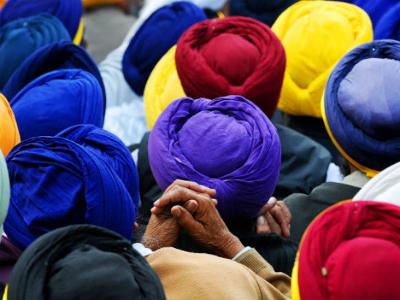
TORONTO: Three Sikh truck drivers have been ordered to wear hard hats at work by a Canadian court which ruled that no exception can be made for them as the men lost a 10-year-long legal battle against religious discrimination.
Three Sikh men who drove container trucks at the Port of Montreal had argued they had a right to wear a turban instead of a helmet based on Quebec and Canadian charter rights protecting freedom of religion.
In a ruling released Wednesday, Quebec Superior Court Justice Andre Prevost recognised that the requirement to wear helmets violated the mens’ charter rights but ruled that safety should trump religion in this case, the Canadian Press reported.
He ruled the port’s rules were justified because they protect workers against head injuries.
“The risks are not lower because the claimants are Sikh and wear turbans,” he wrote in his decision.
“The safety obligations of the defendants are not less stringent, either, towards the claimants than towards other workers,” the judge was quoted as saying.
In a case dating back to 2006, the men had argued they were victims of religious discrimination after they were no longer allowed to enter the port’s terminals without protective headgear. The safety measures were put in place in 2005.
Originally an accommodation was put in place allowing the drivers to stay in their trucks while containers were loaded, but that was eventually deemed not commercially viable because it increased the loading time.
Julius Gray, the lawyer representing the three men, said he was disappointed by the decision but was encouraged that the judge recognised his client’s charter rights had been violated.
Gray said he would meet with his clients next week to decide whether to appeal the decision.
“I personally believe it’s a case that can be very easily and effectively appealed, so I hope that’s what they’ll do,” he said.
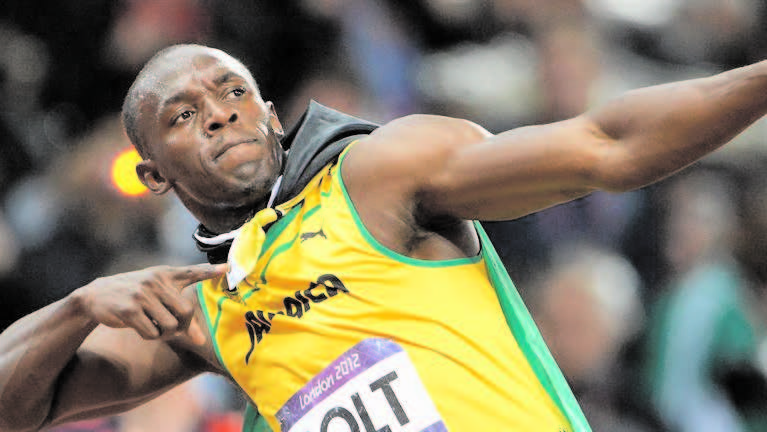
RIO DE JANEIRO (TIP): Jamaican sprinter Usain Bolt won gold again at Rio’s Summer Olympics, blowing away the field in the 200-meter race Thursday. Bolt won his eighth Olympic gold medal with a time of 19.78. Taking the silver was Canada’s Andre de Grasse in 20.02.
France’s Christophe Lemaitre won bronze, at 20.12 seconds. U.S. runner Lashawn Merritt placed sixth, coming in at 20.19 seconds. “I ran hard around the turn,” Bolt said. “On the straight, my body didn’t respond. I’m getting old.”
The Jamaican — who, we’ll note, is 29 — added that while he’s aiming to be among the greats when he retires, he doesn’t think he’ll be at the next Summer Olympics, in Tokyo.
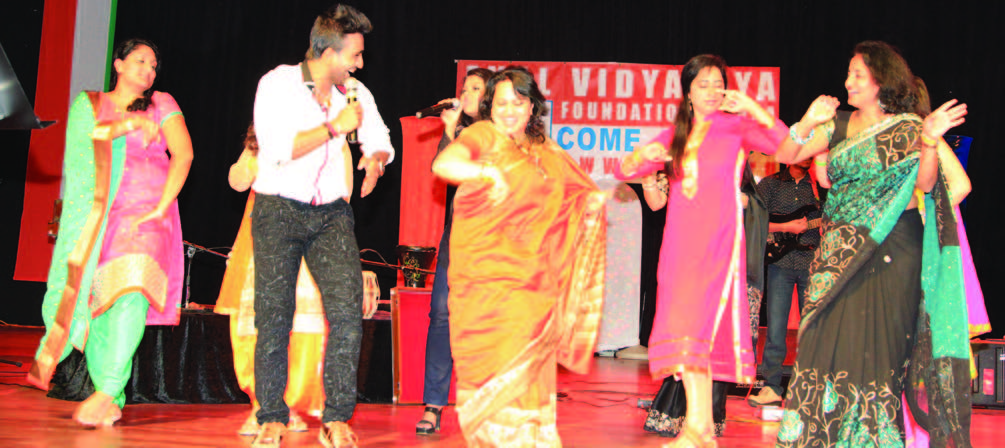
NEW YORK (TIP): As India is emerging as an economic power on the world stage, there is another contrarian reality by its side which is quite unsettling. Even in this technologically advance new millennium, there are tens of thousands rural-tribal areas in India, which are yet to be touched by the existential necessities and amenities, that we all routinely take for granted. Many of these areas seem frozen in time. There are noapproachable roads nor basic educational or healthcare facilitieswithin their reach. “Ekal Vidyalaya Foundation”,has been supporting functional-literacy, healthcare, and integral development in such places, for past 27 years. As of now, there are 53,000 Ekal-schools(and counting), in almost 30 statesthroughout India, including in Nepal & Jammu-Kashmir. For just $365, Ekal is able to provide education and healthcare trainingto a group of 30-40 children (termed as one Ekal school) for the entire year. The main objective of this social-venture is not only to eradicate illiteracy, but also, to empower these rural lives by providing sustainable village-based skills. ‘Ekal’ achieves this objective by raising funds, primarily in India and USA.
Every year Ekal-USA, hosts a series of fund-raising concerts, between February and June, in all major U.S. metropolises by bringing well-known Artistes from India. In addition, the funds are also raised by direct appeals to consistent, major donors. In recently concluded fund-raising efforts, ‘Ekal’ hosted 62 concerts, all across U.S. through its satellite ‘Chapters’. According to Dr. Jawahar Taunk, Regional President of Florida, $400,000 was raised in his region alone. Through concerts only, Ekal has raised more than $4 Million so far this year. In addition, for newly initiated ‘Endowment Fund’, $1 Million has been pledged by couple of generous donors in U.S. and Canada. A handful of entrepreneurs have also picked up their own specific projects based on necessities in certain areas. Inspired by Hon. PM Modi’s clarion call for ‘Clean-India’ campaign, Himanshu Shah of ‘Shah Capital’, has taken responsibility to make a cluster of villages ‘environmentally clean’ by devoting his personal resources. Moreover, considering30% of total funds come into Ekal-coffer, each year, during November-December, Ekal is pretty confident to cross $7.5 Million mark, this year, just for USA alone. This is also a great tribute its 1,000 strong selfless dedicated volunteers in USA.
This year ‘Ekal’ had invited two groups of artistes to headline its various events. One group was headed by ‘Rajdeep Chatterjee & Pallabi Roy Chowdhuri’ and another was headed by ‘Anand Vinod & Vibhavari Yadav’. All the concerts pulled record crowds everywhereconfirming, once again, not only the popularity of the quality programming by Ekal, but also, people’s overwhelming support to this divine cause. All concerts were preceded by DVD-briefing on Ekal’s major activities and futuristic plans. During the concerts, the peoplewere also treated to highly focus ‘Power-Point’ presentation that depicted Ekal’s historic progress from its inception, allocation of funds and the model for accountability, at every level. It is worth noting that Ekal renders its services without any credence to caste, creed, religion and region and its overhead is in single digit.
Iconic CEO of ‘ZEETV’, Dr. Subhash Chandra’s induction as the Chairman of ‘Ekal Global’ has been a boon to “Ekal Abhiyan” in attracting major industrial houses and entrepreneurs. Earlier this year, while releasing Subhash Chandra’s autobiographical book, ‘ZEE Factor’, Hon.PM Modi also lauded Ekal’s awe-inspiring comprehensive rural work as a role model for other organizations to follow. Now, Students and young adults around the country are also gravitating to Ekal to play a key role in this ‘people’s movement’. Earlier this year, “Health Foundation for Rural India (‘HFRI’)”, a health wing of “Ekal Abhiyan” had taken a group of Medical student from USA to Indian villages under its ‘Internship Program’. The rationale behind it was, not only to acquaint them with unique healthcare problems in rural areas,but also, to groom them for selfless service for these neglected masses. Every month, new donors are coming on board to support Ekal as they realize that it is the largest grass-root NGO movement of its kind, globally undertaken by Indians and NRIs. Ekal is in dozen countries, including in some ‘Middle-East’ regions. For your support and participation in ‘Ekal Movement’, kindly visit its web www.ekal.org.
WASHINGTON (TIP): OK, Peter Doig may have tried LSD a few times when he was growing up in Canada during the 1970s. But he still knows, he said, when a painting is or isn’t his.
So when Doig — whose eerie, magical landscapes have made him one of the world’s most popular artists — was sent a photograph of a canvas he said he didn’t recognize, he disavowed it.
“I said, ‘Nice painting,’” he recalled in an interview. “‘Not by me.’”
The owner, however, disagreed and sued him, setting up one of the stranger art authentication cases in recent history.
The owner, a former corrections officer who said he knew Doig while working in a Canadian detention facility, said the famous painter indeed created the work as a youthful inmate there. His suit contends that Doig is either confused or lying and that his denials blew up a plan to sell the work for millions of dollars.
But Doig, 57, has compelling evidence he was never near the facility, the Thunder Bay Correctional Center, about 15 hours northwest of Toronto.
“This case is a scam, and I’m being forced to jump through hoops to prove my whereabouts over 40 years ago,” he said.
To Doig’s surprise, though — and the astonishment of others in the art world — a federal judge in Chicago has set the case for trial next month in US District Court for Northern Illinois. Art law experts say they can’t recall anything like it, certainly not for a major artist like Doig.
“To have to disprove that you created a work seems somehow wrong and not fair,” said Amy M. Adler, a professor at New York University Law School. The stakes are high as well. A Doig painting has sold for more than $25 million. Other works have routinely sold at auction for as much as $10 million. The plaintiffs, who include the correction officer and the art dealer who agreed to help him sell the work, are suing the painter for at least $5 million in damages and seek a court declaration that it is authentic.
They have focused on what they say is a hole in Doig’s teenage years in Canada when, they assert, he cannot fully account for where he was or what he was doing.
“Every artist has destroyed work,” said William F. Zieske, the lawyer for the painting’s owner and the art dealer. “We can’t really get into his mind and say why he looked at this painting and said, ‘I am not going to own that.’ I don’t think anyone can.”
Disputes about authenticity, a vexatious topic in the art world, tend to center on the works of dead artists. Legal claims, when they arise, are usually made against experts who have doubted the art’s veracity, and not against the artist.
A decision against Doig, and any costly award for damages, would nevertheless probably send a shock wave through the art world. “It would,” said Nicholas M. O’Donnell, a Boston art lawyer who has no role in the case, “put all artists in the cross hairs.”
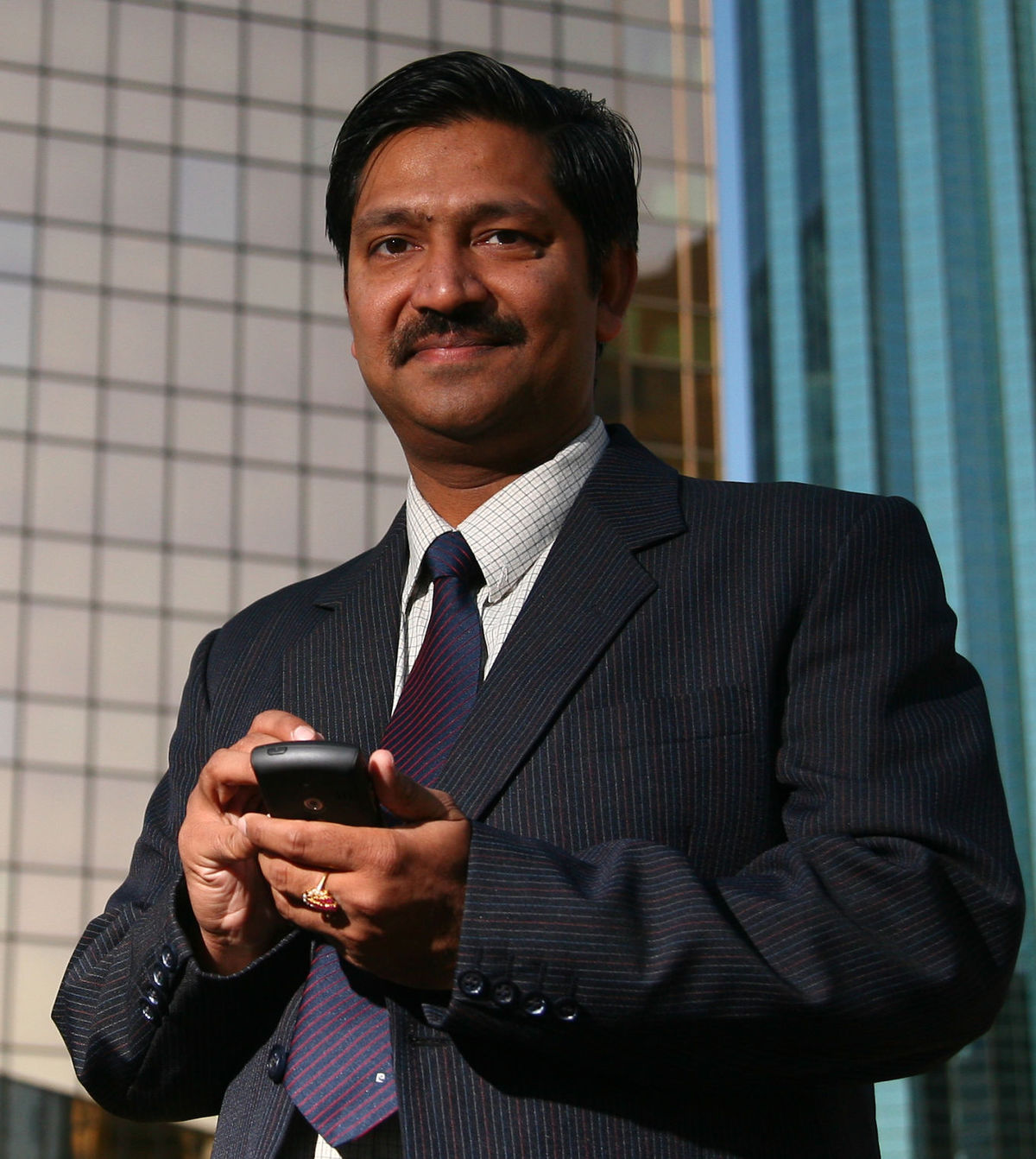
Dr Kinshuk, who goes by single name, has been named the dean of University of North Texas College of Information in the US.
He received his doctoral degree from De Montfort University in England, a master of science in mechanical computer aided engineering from Strathclyde University in Scotland and a bachelor’s degree in mechanical engineering from University of Rajasthan in India.
Prior to joining UNT, Kinshuk was the associate dean of the faculty of science of technology at Alberta, Canada-based Athabasca University, where he had been since 2010.
In that role, he helped start new graduate programmes, gained external research funding, developed strategies for student recruitment and promoted senior students and alumni to serve as mentors for new students.
Prior to this, he served as director in the School of Computing and Information Systems.
Kinshuk also served as Industrial Research Chair in Adaptivity and Personalisation in Informatics for the National Science and Engineering Council of Canada.
“Dr Kinshuk brings with him great leadership and research experience,” Finley Graves, provost and vice president for academic affairs at UNT, said in a statement.
“We look forward to Dr Kinshuk working with our faculty to articulate a clear vision for the future of the College of Information.”
Kinshuk will start his new position from August 15.
“I’m really looking forward to joining such a progressive university and my esteemed new colleagues,” Kinshuk, who also served as the president and chief executive officer of Smart Informatics Ltd., said in a statement. “I know the College of Information has high expectations and I hope to meet them and raise those even more. I am keen to contribute to the college’s success and help make the University of North Texas even more prestigious.”
Kinshuk’s career also includes a variety of other academic positions.
At Massey University in New Zealand, Kinshuk was the director of the Advanced Learning Technologies Research Center, as well as an associate professor, and before that, a senior lecturer.
He also was a research fellow for the German National Research Centre for Information Technology in St. Augustin, Germany.
Earlier in his career he was an instructor at the Academy of Computer Education in India, as well as a part-time lecturer at the Government Polytechnic College in India.
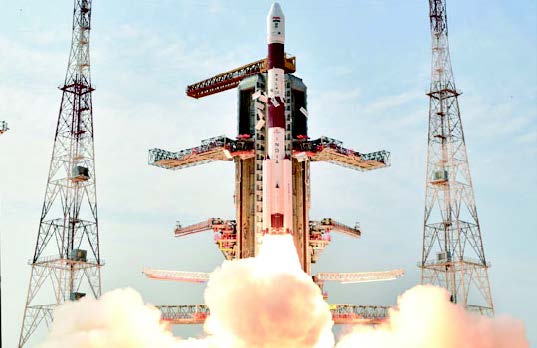
CHENNAI (TIP): India took a big leap in space technology on June 22 when Indian Space Research Organization (ISRO) used its workhorse PSLV-C34 to inject 20 satellites including 17 foreign satellites into orbit in a single mission and set a new record on Wednesday.
The 320-tonne Polar Satellite Launch Vehicle (PSLV-C34) took off on its 36th flight at 9.26am from the Satish Dhawan Space Centre with 20 satellites including its primary payload Cartosat-2 series, which provides remote sensing services, and earth observation and imaging satellites from US, Canada, Germany and Indonesia. It was also 14th flight of PSLV in ‘XL’configuration with the use of solid strap-on motors.
Cartosat-2 was placed in orbit at 9.44am. With Cartosat-2 weighing 727.5kg, PSLV lifted off a total of 1,288kg in to space and began placing the satellites into orbit about 17minutes later.
In the final stages of the mission, ISRO also demonstrated the vehicle’s capability to place satellites in different orbits. In the demonstration, the vehicle reignited twice after its fourth and final stage and moved further a few kilometres into another orbit.
ISRO scientists said the demonstration is for their next mission when they are planning to inject satellites in different orbits using a single rocket.
ISRO set a world record for the highest number of satellites launched in a single mission when it placed 10 satellites in a PSLV on April 28, 2008. Nasa in 2013 placed 29 satellites in a single mission and Russia in 2014 launched 33 satellites in one launch.
In December 2015, when PSLV-C29 injected six Singapore satellites in to orbit, ISRO conducted a major experiment where the fourth stage was reignited and switched off after the satellites were placed in orbit.
ISRO scientists said, the vehicle had been pre-programmed for today’s launch to perform tiny manoeuvring to place the 20 satellites into polar sun-synchronous orbits with different inclinations and velocities. It ensured that the satellites were placed with enough distance to prevent collision.
ISRO began launching foreign satellites on board PSLV in May 1999. Since then, it has gained popularity, as it launched foreign satellites successfully using PSLV by charging only 60% of the fee charged by foreign space agencies. It has so far launched 57 foreign satellites.
This is the story of an Indian woman who is now globally recognized as an award winning poet, author, educator and a celebrated journalist, whose inspirational journey to success could be a role model for many who want to make a mark in the society on their own.
A native of Jaipur, Dr Rashmee Sharma earned several awards as a journalist and took up teaching, serving as the English department chair at Sikkim. But at a young age Rashmee lost her husband who was in Indian military forces.
In early 80s, Sharma packed up her two young children and moved to the United States to pursue her Ph.D. in literature. While continuing to publish her features and poetry, Dr. Sharma taught journalism and literature at the University of Washington in Seattle, where she developed the concept that would eventually become her passion.
Dr Rashmee Sharma (left) and Co-owner of Roshni Media Group (@RoshniBook) Mani Kamboj pose with MasterCard CEO Ajay Banga
While teaching there, Rashmee sensed a distinct lack of cultural awareness of amazing South Asian achievers amongst her students. “The genesis of Roshni began about in the early 2000, once I discovered a distinct lack of recorded documentation of profound contribution inspirational role models have made in the US”, said Rashmee. Eventually she became driven to combat these stereotypes and educate Americans regarding the diverse and often stellar contributions of the South Asian community.
Hilary Clinton receives the book
In a quest to educate people about south Asian contribution she would spend hours in the library to collect documentation. She went on to conduct exhaustive research, digging up press coverage of the world’s foremost thinkers and achievers, and interviewing them.
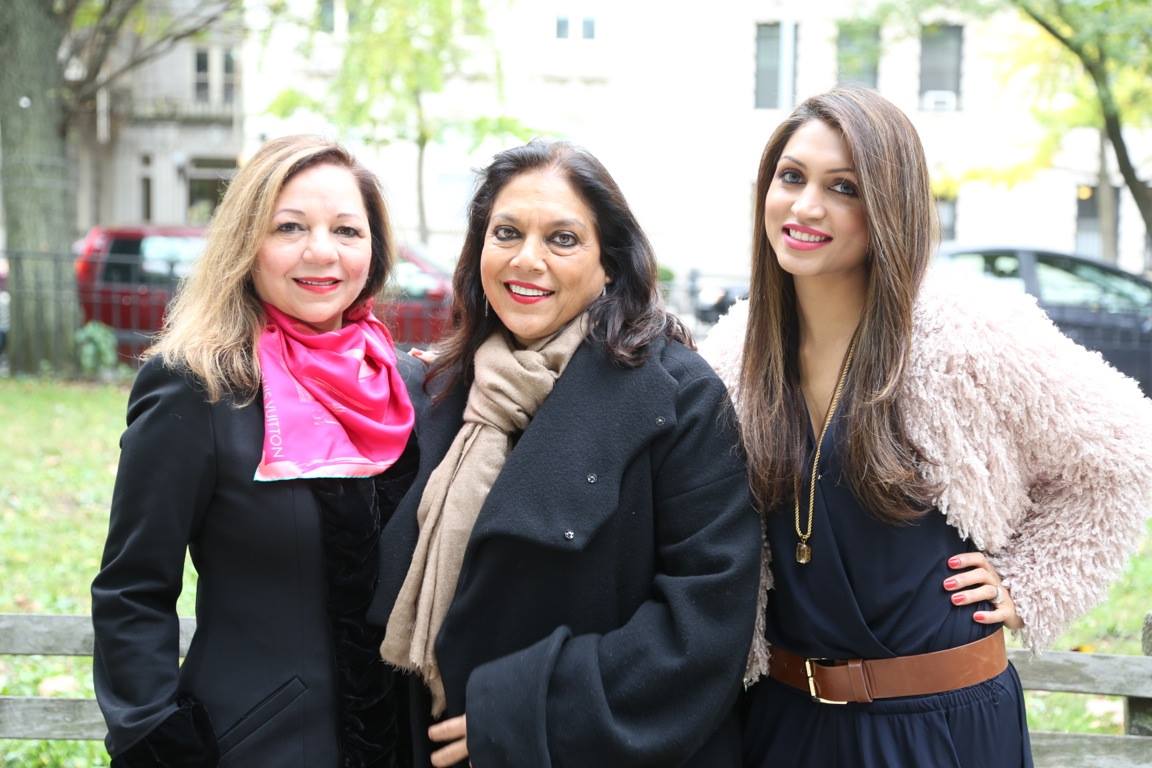
After many hours of research and miles of travel, in 2005, Roshni: The Light of South Asia – a coffee table book on valuable contributions of people of Indian origin was first launched in the US featuring over 100 prominent South Asians including Vijay Amrithraj Ashok Amrithraj, and Mira Nair.
“It’s my hope via Roshni to reach the first and future generations by building a bridge to communicate pride, strength and sacrifice of the first generation immigrants. My intent is also to focus on enlightening and making younger generation proud of our heritage and culture”, she explains.
It soon became clear that people were looking for more inspirational stories. In 2012 Rashmee released the second book – this time to cover North America including Canada. This offers professional profiles and in-depth interviews with 56 people of Indian origin who have achieved stellar success in the United States and Canada. Roshni, the Light of South Asia: North American Edition features Gov. Nikki Haley, Fareed Zakaria and Salman Rushdie among others. Their third Coffee Table book on Global & Emerging Leaders was launched last year.
Roshni hosted its first awards gala to recognize remarkable achievements of people of Indian origin. It was organized in May, 2015, in NYC.
Armed with the wealth of her findings, Rashmee, envisioned creating a first ever comprehensive documentation which is now- 15 years later become a multi-media platform to celebrate diversity- Roshni Media Group. Interestingly while researching and working on her third book on Global and Emerging Leaders, Rashmee interviewed Mani Kamoboj who is an accomplished woman. Rashmee and Mani hit it off instinctively driven by similar passion and objective that lead to becoming partners in Roshni Media Group in 2013. Since then there was no looking back. They have together worked hard to take the next step of recognizing Roshni Honorees in an awards gala which was first organized in May 2015, in NYC.
Roshni Media Group will also announce the nonprofit organization committed to create Global Autism Awareness.
CAIRO (TIP): A massive search was underway on Friday, May 20, for the wreckage of an EgyptAir plane en route from Paris to Cairo that crashed into the Mediterranean Sea with 66 people on board, with authorities saying the incident was likely a terror attack.
The search for EgyptAir Flight 804 was ongoing after reports that the plane’s wreckage had been found turned out to be false, prompting Egyptian President Abdel Fattah al-Sisi to demand an “intensified search”. There were no signs of survivors after the Airbus A320 “swerved and then plunged” into the Mediterranean. The plane, on its fifth journey of the day, was travelling at 37,000 feet when it disappeared from radar. It had made a stop in Tunisia before flying to Paris.
The Egyptian navy, air force and army are searching the sea to the north of Egypt’s coast, with French, Greek, British and US support. The plane made “sudden swerves” before dropping off radar over the Mediterranean, Greek defense minister Panos Kammenos said. It made a 90-degree turn left, and then dropped from 37,000 feet to 15,000 feet before swerving 360 degrees right.
The plane was carrying 56 passengers and 10 crew: two cockpit crew, five cabin crew and three security personnel.
EgyptAir said two babies and one child were on board. Among the passengers were 30 Egyptians, 15 French, two Iraqis, and one person each from the UK, Belgium, Kuwait, Saudi Arabia, Sudan, Chad, Portugal, Algeria and Canada.
The airline said captain Mohamed Said Shoukair had 6,275 flying hours, including 2,101 on the A320; while the copilot, Mohamed Mamdouh Ahmed, had 2,766. The plane was manufactured in 2003. EgyptAir initially said that Egyptian Foreign Ministry has “confirmed finding the wreckage” but later withdrew the claim. EgyptAir’s vice-chairman Ahmed Adel told CNN that when searchers got close to debris found in the Mediterranean Sea they realized it did not come from the missing airliner. “We stand corrected on finding the wreckage because what we identified is not a part of our plane. So the search and rescue is still going on,” Adel said.
He added that maintenance checks on the plane had been done on time and “no snags were reported”. In a statement issued by Sisi’s office, he also ordered an investigative committee formed by the civil aviation ministry to immediately start probing the causes of the plane’s disappearance. He ordered the civil aviation ministry, the army’s search and rescue center, the navy, and air force to take all necessary measures to locate debris from the jet.
Egyptian Civil Aviation Minister Sharif Fathi said technical failures and terror each are possible explanations.
“But if you analyses this situation properly, the possibility of having a different action aboard, of having a terror attack, is higher than having a technical problem,” Fathi said.
French-Egyptian cooperation
Three French investigators and a technical expert from Airbus arrived at Cairo International Airport early Friday morning to help investigate the fate of a missing EgyptAir plane that disappeared on Thursday, airport sources said.
The French investigators are part of the French civil aviation ministry’s office of investigations and analysis, the sources said.
France is participating in an Egypt-led investigative committee as it is the country where the plane was manufactured and the one with the second-most number of passengers on board.
The incident brought back horrors of the bombing of a Russian passenger jet by the Islamic State over Egypt last October that killed all 224 people on board. (Source: Agencies)
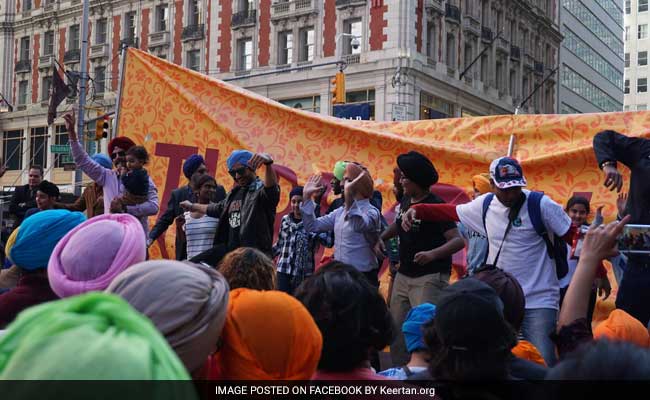
NEW YORK: The iconic Times Square was seeped in the colours of the Sikh culture as thousands of community members gathered in New York to celebrate Turban Day, an annual Vaisakhi celebration and a day to educate fellow Americans about Sikhism in the wake of growing incidents of hate crimes and discrimination against them.
Legendary Indian sportsman Milkha Singh addressed one of the largest such celebrations in the US, calling on the Sikh community to educate the new generation about the significance of the Sikh culture.
Hundreds of excited tourists and children queued up at the popular city destination to get turbans tied on their heads in bright colours by members of the Sikh community and took pictures and selfies wearing them as ‘Turban Day’ was also celebrated at the event.
The participants jostled to get a picture clicked with the elderly ‘Flying Sikh’, who had travelled from Canada for the event.
“Today if the Sikhs have a name, are known around the world, it is because of the turban. Milkha Singh is called a ‘Flying Sikh’ because I have the turban on my head and the beard on my face. My beard and turban are the reasons for the respect and recognition that I have across the world,” Mr Singh told PTI.
Non-profit organisation, Sikhs of New York and New Jersey and the event’s organisers Bobby Sidana, Kawaldeep Sahni, Chanpreet Singh and Gurmeet Sodhi said the event aimed at not only celebrating the festival marking the spring harvest but also educating Americans and thousands of tourists about the Sikh culture.
They said it would also make them aware of the significance of the Sikh articles of faith like turban and beard and to address the misinformation about Sikhism that leads to profiling and backlash against members of the community, particularly after the 9/11 attack.
“People here should know that Sikhs are warriors, they have fought for other people and will do everything to help others. The event will inspire people here and educate them about the Sikh culture, they will get to know who Sikhs are,” Mikha Singh said lauding the organisers for putting together the event.
In his message to the gathering, Mr Singh said he would like to see “one more Milkha Singh” from the Sikh community spread across the US and the world.
Lamenting that Sikh articles of faith such as the turban and beard are often still misconstrued and associated with terrorism, the organisers invited passers-by and those at the event to get a turban tied on their heads and to ask about the Sikh culture.
NEW DELHI: Canada’s Prime Minister Justin Trudeau notched up another signal honour as a liberal humanist by pledging to make a full apology in the House of Commons for a century-old slight against Indians, mainly Sikhs.
In 1914, the Canadian government turned away 376 immigrants from Punjab who had sailed from India on board the ship Komagata Maru, after quarantining the vessel off the port of Vancouver. Following a two month long stand-off during which the Canadians refused to allow passengers to disembark, the ship was escorted out by gunships — one of them ironically called HMCS Rainbow — and sent back to Calcutta, where clashes with British soldiers killed 19 and ended in prison sentence to others.
“The passengers of the Komagata Maru like millions of immigrants to Canada since were seeking refuge and better lives for their families. With so much to contribute to their new home, they chose Canada and we failed them utterly. As a nation, we should never forget the prejudice suffered by the Sikh community at the hands of the Canadian government of the day. We should not and we will not,” Trudeau said at an event to celebrate Baisakhi in Ottawa. “That is why next month, on May 18, I will stand in the House of Commons and offer a full apology for the Komagata Maru incident,” he added.
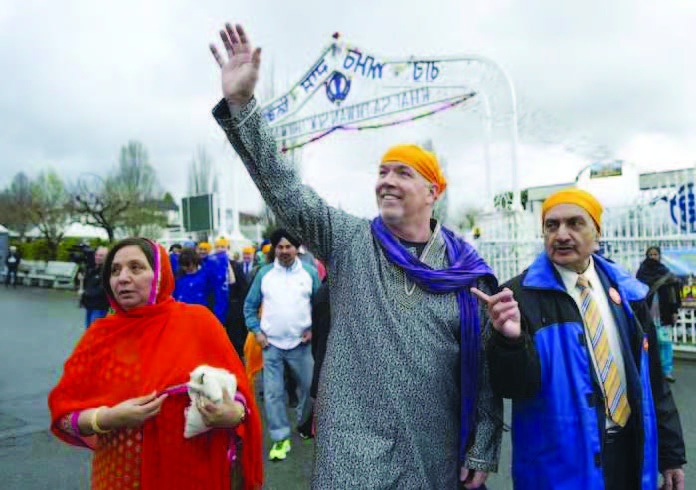
The Canadian premier, already a darling of the liberal constituency across the world, has particularly endeared himself to Sikhs in Canada even before he inducted four of them in his cabinet (and jokingly boasted he had more Sikhs in his government than Narendra Modi). The apology pledge on Monday, made at a prayer meeting where he wore a saffron headscarf, was preceded by a widely-distributed video greeting to Sikhs on the occasion of Baisakhi, ending with him greeting them with “Wahe Guruji da Khalsa Wahe Guruji da Fateh”, the traditional Sikh invocation.
Even before he was elected, the Sikh community was electrified by another video that showed him dancing the bhangra, and his actions since he was elected have enthralled the community so much that some have dubbed him “Justin Singh Trudeau.”
On Monday, Trudeau stepped it up several notches saying “an apology made in the House of Commons will not erase the pain and suffering of those who lives through that shameful experience, but an apology is not only the appropriate action to take, it’s the right action to take and the House is the appropriate place for it to happen.”
It was in the House of Commons that the laws that prevented the passengers from disembarking were first passed and so it’s fitting that the government should apologize there on behalf of all Canadians, he added, referring obliquely to an unmet Sikh demand for an apology in the legislature after then Canadian Prime Minister Stephen Harper had expressed regret outside the house in 2008.
Trudeau reminded the gathering that April is a special month not only for Sikhs but for all Canadians, since it marks the anniversary of the adoption of the charter of rights and freedoms which ensures that no Canadian needs to make the choice between their religion and activities in their day-to-day lives. The charter ensures that the five sacred Ks of the Sikhs are protected, he said, adding that as Canadian Sikhs gather with their loved ones to mark the creation of the Khalsa, it’s a chance to reflect on shared values and celebrate the successes of the past year.
The immense grace Trudeau has shown since coming to office has won him admirers across the world, including on social media. “I’m honored that 2 million people around the world have now ‘liked’ my Facebook page. Thank you to all 2 million of you!” he posted on Facebook on Monday.
WASHINGTON: An Indian Professor has become the president of a scholarly group in the US dedicated to international studies.
Professor TV Paul took over as the 56th president of International Studies Association (ISA), at its annual convention at Atlanta, Georgia this week.
In his address, which among others was attended by former Canadian Prime Minister, Joe Clarke, Mr Paul called on international relations scholars to explicitly deal with grand strategies of peaceful change more effectively, especially in the context of the rise of new powers such as China and India.
Born in Kerala, Mr Paul in his speech encouraged scholars with historical understanding to offer ideas for policy makers about which strategy produced conflict and which strategy generated unnecessary violence.
The James McGill Professor of International Relations at McGill University, Montreal, Canada he is a leading scholar of international security, nuclear proliferation, and South Asia.
In his speech he called upon the International Relations discipline to become the lead source of ideas for peaceful change and not to leave strategy to a narrow group of politicians, their advisors and diplomats who sometimes lack deep vision or historical understanding.
“The need for strategies for peaceful change is growing in a complex, globalised world, and with the rise of China, India and the resurgent Russia along with several other pivotal centers of power and transnational forces challenging peace,” Mr Paul said.
He was ISA’s vice president during 2013-14, founding Director of the McGill/-University of Montreal Center for international Peace and Security Studies (CIPSS) and founding Editor of the Georgetown University Press book series: South Asia in World Affairs.
Joann L. Chatfield, MoneyGram Vice President of Marketing was in town, February 24 to speak at the launch of her company sponsored Cricket Bee contest. Addressing a gathering of media persons at a Midtown Manhattan restaurant, she said, “We are proud to sponsor the 2016 Cricket Bee. We know that the passion for cricket unites friends and loved ones around the world and brings them closer together. It’s always exciting to be a part of initiatives that support our South Asian communities”.
Joann is enthusiastic about reaching out to the South Asian communities who have a lot of interest in cricket. She was particularly excited at the suggestion floated by The Indian Panorama editor Prof. Indrajit S Saluja that MoneyGram could establish a better rapport with the communities if they visited them at their places of worship and at their social and cultural events which are many and often huge, like Diwali, Dussehra, Vaisakhi and Eid.
Joann has served as vice president of marketing, since January 2013, most recently responsible for the US, Canada, UK, Ireland and northern Europe. Chatfield previously served as vice president, global marketing and services, and director of marketing, US and Canada. Since joining MoneyGram in May 2011, Chatfield has a proven track record of building and leading highly productive global teams, as well as demonstrated her proficiency in the intricacies of a complex, global, multi-cultural brand.
Joann has taken on several leadership roles and has consistently shown her business acumen with her innate ability to drive a wide range of internal and external marketing and communication strategies designed to establish market presence, and increase revenue and profitability.
Prior to joining MoneyGram, Joann served in a number of business development and marketing roles within the finance and telecommunication industries. She is a graduate of the University of New Mexico with a Bachelor of Arts degree in Communications.
Hindus have welcomed the idea of Meditation and Prayer Room in University of Wyoming (UW) campus in Laramie.
Rajan Zed, a hindu statesman based out of Nevada, said that an interfaith space in the shape of Meditation and Prayer Room would be a step in the positive direction for UW. Many educational institutions in USA and Canada already had prayer/meditation room for quiet reflection and spiritual exercise.
Zed pointed out that with the presence of Meditation and Prayer Room, UW students would have a spiritually meaningful life in addition to material success after they graduate from here. Meditation and Prayer Room would be another feather in UW’s cap in making it a top class and wholesome university.
Moreover, UW needed to recognize the intersection of spirituality and education, Rajan Zed added.
A meditation/prayer room is reportedly in the plans of UW’s new engineering building. In a resolution, Associated Students of the UW Student Government supported “the implementation of a designated meditation and prayer room, welcoming persons of all faith and belief systems on the University of Wyoming campus”, which was passed on November 17 last.
Founded in 1886, UW, claimed to be a nationally recognized research institution and ranked among nation’s top universities and top “adventure colleges”, serves about 14,000 students from all 50 states and over 90 countries in approximately 200 areas of study. Former Vice President Dick Cheney and father of modern Total Quality Management W. Edwards Deming are among its alumni. Richard McGinity is the UW President, while David F. Palmerlee is President of Trustees Board of UW, whose Mission includes: expose students to the “complexities of an interdependent world”.
The Trans-Pacific Partnership agreement (TPP) has been signed in Auckland on February 4 by Australia, Brunei, Canada, Chile, Japan, Malaysia, Mexico, New Zealand, Peru, Singapore, the U.S. and Vietnam. Even as it is touted as the world’s biggest trade deal to date, with signatory countries accounting for more than 50 per cent of global GDP, the TPP still has a long-drawn ratification process ahead of it. Signing of the agreement provides an opportune moment for India, which is not part of the TPP, to take stock and formulate its response to the trade challenges it now faces on both international and domestic fronts.
Discussing new issues
The TPP contains detailed obligations on so-called new issues such as labor, investment, environment, e-commerce, competition and government procurement. These issues are not covered under the World Trade Organization’s (WTO) multilateral umbrella. However, as the recent Nairobi Ministerial Declaration stated, “some” members want to explore and discuss new issues and architecture at the WTO. There is an increased likelihood of the U.S. pushing the TPP as the negotiating template for new issues at the WTO, since it better reflects the interests of its own domestic lobbies. As new issues are not likely to be in India’s overall interest, the country must firmly resist such attempts. But this may only be accomplished with a high degree of preparedness and smart coalition-building with like-minded allies.
India also needs to closely watch the regulatory regimes in TPP countries, ensuring that these countries do not violate their WTO commitments in the process of implementing the TPP. The WTO does allow a member to deviate from its obligations with respect to a free trade area; however, such a deviation is not unqualified. If a TPP country restricts the market access for non-TPP members such as India on account of higher labor standards, a potential violation of WTO provisions may arise, which India should not shy away from pursuing using the WTO’s dispute settlement mechanism.
India should actively seek disciplines on private standards at the WTO to restrict their proliferation. The TPP attempts to regulate and, according to some experts, legitimizes this regime. A number of studies have predicted that the TPP will lead to proliferation of private standards. However, the fact is that such standards have existed as a parallel regulatory regime in international trade for some time now. For instance, in 2006, the Sialkot sports goods manufacturing cluster in Pakistan came close to closure when Nike decided to stop sourcing footballs made in the area, on account of violation of its labor standards that prohibited child labor. Despite significantly impacting international trade, these standards have escaped regulation under the WTO. This is because they do not originate from the ‘state’ but from private bodies. Disciplining such private standards at the WTO is much needed and is something that should be urgently pursued.
Impelled by the looming onset of the TPP, India should conclude, on a priority basis, its ongoing free trade negotiations. These include the India-EU Bilateral Trade and Investment Agreement and the mega Regional Comprehensive Economic Partnership with the Association of Southeast Asian Nations, China and others. Benefits from these agreements will help mitigate some of the export losses that India may face in leather goods, textile, and plastics on account of trade diversion due to TPP. Aiming to diversify export destinations to hitherto untapped markets like Latin America and Africa would also help.
India also needs to identify its trade interest areas and propose alternative negotiating templates. One such area is biopiracy, protection of traditional knowledge, and the link between the WTO’s Trade-Related Aspects of Intellectual Property Rights agreement and the Convention on Biological Diversity. There have been several instances of biopiracy in the past, of Indian traditional knowledge, such as the patenting of the wound-healing properties of haldi (turmeric). Being among the 12 mega biodiversity-rich countries, India needs to bring this issue to the negotiating table in its own free trade agreements.
On the domestic front, India should accelerate the process of making its products more cost-competitive. There is no denying that India’s infrastructural deficiency, including port congestion and poor road connectivity, is one of the main hurdles in attaining this cost competitiveness. Addressing these will have the dual effect of not only making India’s exports cost-competitive, but will also make them more attractive for international lead firms to integrate India in global value chains.
The government should launch a comprehensive initiative to enable Indian exporters to not only comply with standards prevalent in the importing market, but also demonstrate the compliance through appropriate conformity-assessment procedures.
India should resist any attempt to converge its domestic public standards with the dominant private standards in TPP countries. If India’s public standards are harmonized with foreign standards, they will be equally applicable to domestic and export sales on account of the ‘national treatment’ principle of the WTO which prohibits less favorable treatment to imported products. The harmonized standards may result in most producers not only being excluded from export markets, but also being edged out of the domestic market, undermining the Make in India initiative in the process.
By not being part of the TPP, India will certainly incur losses on account of trade diversion. Yet, joining the TPP is not an option for the country. This would entail very heavy costs. Medicine prices, for instance, would see steep increases. That is precisely why mitigating such projected losses from the TPP should be a government imperative. This can only be achieved by a cohesive trade policy approach on the international as well as domestic front, aimed at protecting and promoting India’s trade interests.
(The author is an assistant professor at the Centre for WTO Studies, Indian Institute of Foreign Trade, New Delhi.)
WELLINGTON (TIP): The Trans-Pacific Partnership, one of the world’s biggest multinational trade deals, was signed by 12 member nations on Thursday in New Zealand, but the massive trade pact will still require years of tough negotiations before it becomes a reality.
The TPP, a deal which will cover 40 percent of the world economy, has already taken five years of negotiations to reach Thursday’s signing stage.
The signing is “an important step” but the agreement “is still just a piece of paper, or rather over 16,000 pieces of paper until it actually comes into force,” said New Zealand Prime Minister John Key at the ceremony in Auckland.
The TPP will now undergo a two-year ratification period in which at least six countries – that account for 85 percent of the combined gross domestic production of the 12 TPP nations -must approve the final text for the deal to be implemented.
The 12 nations include Australia, Brunei, Canada, Chile, Japan, Malaysia, Mexico, New Zealand, Peru, Singapore, the United States and Vietnam.
Given their size, both the United States and Japan would need to ratify the deal, which will set common standards on issues ranging from workers’ rights to intellectual property protection in 12 Pacific nations.
Opposition from many US Democrats and some Republicans could mean a vote on the TPP is unlikely before President Barack Obama, a supporter of the TPP, leaves office early in 2017.
US Trade Representative Michael Froman has said the current administration is doing everything in its power to move the deal and on Thursday told reporters he was confident the deal would get the necessary support in Congress.
In Japan, the resignation of Economics Minister Akira Amari – Japan’s main TPP negotiator – may make it more difficult to sell the deal in Japan.
NEW YORK (TIP): Indian American president and chief executive officer of MasterCard Ajay Banga has been named the chairman of the board of directors for 2016 by the Financial Services Roundtable.
The Financial Services Roundtable (FSR) announced its 2016 Officers and Board of Directors FSR, in a Jan. 6 statement.
“Ajay Banga is a highly respected financial services leader and we’ll benefit tremendously from his vision and experience as he serves as FSR’s 2016 chair,” FSR president and CEO Tim Pawlenty said in a statement.
Amer Sajed, Barclaycard Also a member of President Barack Obama’s advisory committee for trade policy and negotiations, Banga was previously director of Kraft Foods and has served on the board of trustees at the Asia Society, New York Hall of Science and National Urban League. Prior to MasterCard, Mr. Banga was chief executive officer of Citigroup Asia Pacific.
FSR’s 2016 Chairman-Elect is Brian T. Moynihan, chairman and CEO of Bank of America Corporation.
William H. Rogers, Jr., chairman and CEO of SunTrust Banks, Inc., will serve as chairman of BITS, FSR’s cybersecurity and technology policy division through 2017.
Kessel Stelling, chairman and CEO of Synovus, will continue as FSR’s 2016 Treasurer.
The following will also join the FSR Board as Directors:
Christopher B. Begy, BMO Financial Corp., Executive Committee Member
John P. Barnes, People’s United Bank
William Emerson, Quicken Loans
David I. McKay, Royal Bank of Canada
Richard McKenney, Unum
Robert L. Reynolds, Putnam Investments
A graduate of Delhi University and the Indian Institute of Management in Ahmedabad, Banga began his career at Nestlé India in a variety of roles. He also spent time at PepsiCo, helping launch fast food franchises in India.
Ambassador Asoke K Mukerji has been the Permanent Representative of India at the United Nations from early 2013 to December 31, 2015.
Ambassador Mukerji who has served with distinction the MEA for almost 38 years was widely regarded as a “diplomat with spine”.
Ambassador Mukerji greets the Prime Minister of India, Narendra Modi. Seen from L to R: The then Ambassador to the US Jai Shankar, Mrs. Shankar, Ambassador Asoke Mukerji, Mrs. Mukerji, Consul General Dnyaneshwar Mulay and Mrs. Sadhna Mulay
In this interview which he had given to Prof. Indrajit S Saluja, Chief Editor of The Indian Panorama just a few days before relinquishing office, Ambassador Mukerji speaks about how well India was articulated at the United Nations during his tenure as Permanent Representative and what have been the significant achievements for India. He also speaks frankly about the need for the United Nations to go forward with reforms to the Security Council.
However, he was appreciative of the role the United Nations has played over the years and taken effective measures to resolve conflicts, even though there are many unresolved ones, and to bring about empowerment of women, just to mention a few.
Here are excerpts from the interview
Prof. Saluja: Remember Sir, in an earlier interview which you had very kindly given to The Indian Panorama on 30 April 2013 you had said that India’s ability to articulate has always been very high. How good has been the articulation at the UN. during the 3 years that you have been at the UN as India’s Permanent representative.?Do you think India has articulated well through you at the UN?
Ambassador Mukerji: I think we have articulated the perspective that we have as a country on the issues which are the major issues facing the world today.And if you look at it in the broad areas, then you can see, for example, in the area of peace & security, we have consistently articulated the need for resolving problems, resolving disputes through negotiations and peaceful means and today even disputes that 3 years ago seemed to be open for military solutions are now moving towards peacefully negotiated solutions. The latest being the Syria dispute after the talks in Vienna. So I think the view that India has consistently articulated in the United Nations which is based on the provisions of the United Nations charter which is to resolve disputes peacefully is a view that enjoys a very vast degree of support.
And including among the permanent members of the UNSC .
In matter of peace and security dealing with peacekeeping we have been among the most articulate of voices.
I think that the views that we have actuated have a resonance within the UN System and as we complete the review of the peace building activities of the United Nations in the coming few months we should be able to see the combining of the pools available to the United Nations for creating conditions for the reconstruction… peaceful reconstruction of conflict regions and societies.
I think that’s a very important point that we have made that it has to be a holistic exercise, that you cannot expect any society or country or region to be able to sustain peace without having the institutions
And in our own country and the reason we articulate this in our own country we have invested in building and nurturing institutions which are there to help the society to reach solutions through peaceful institutional methods
And I think that this is something that has been appreciated .
And the 3rd area of peace and security unfortunately where we have not probably succeeded but where India’s articulation has been consistent is in the need to investigate & prosecute terrorism .We are a country who have been confronting terrorism nationally for a very long time over 30 years… but in the international context… the main tool available to UN is the legal tool – the rule of law to counter and prosecute terrorism . It’s a pity that so far we have not been able to see the effective utilization of these legal tools by the United Nations
The one example we have been putting forward for many years now is the comprehensive convention on International Terrorism (CCIT)
Now the important role that this convention will play is to require member countries of the united nations to either prosecute a terrorist or if they cannot prosecute a terrorist, to extradite the terrorist for prosecution…. So prosecute or extradite .
This is a very well established legal principle but unfortunately there has been no agreement so far on adopting this convention… so this is…..
Prof Saluja: Have all the countries yet agreed for such a convention?
Ambassador Mukerji: You see… all countries have participated in the discussions on the convention and right now the main issue on which the convention is still deadlocked is on the definition of terrorism
There are some countries who are asking for the definition of terrorism to exclude freedom fighters…. this is not acceptable to many countries .So we need to find a way to bridge this issue because while we discuss the definition of terrorism the world is facing the impact of terrorism and when we face the impact of terrorism then we understand what the definition of terrorism is…
So we would argue therefore that this is an area in which initiatives like this convention should be given priority and this is something we are articulating at the United Nations but this is an area where I think more needs to be done. So this is on the peace and security areas.
Now on the second big area of the UN which is economic & social area
I think …our articulation in the last 3 years has been very successful… if you remember in 2013 we started this process of discussing and then developing the goals which would replace the millennium development goals…. And in July last year , 2014… we were able to agree and adopt 17 goals which are known as the sustainable development goals -that was in 2014 July.
So this is to illustrate that all 193 countries can actually work together if they are helped to accommodate each other… and I think India’s role has been really constructive in that context… that we have not tried to polarize this exercise… we have tried to play a constructive role of also building bridges and the fact that we have these 17 goals and… and the 17 goals are now at the heart of this agenda for the next 15 years also known as Agenda 2030 which was adopted when Prime Minister Modi was here in September .…So for the next 15 years what is the economic and social agenda of the world is now set in the UN.. in this document called the Agenda 2030… at the heart of which are these 17 goals.
So this has been a tremendous success and I think recognition of India’s articulation of its experience and perspective as a country which is transitioning… we are in some senses… we have reached the status of an advanced country of putting space crafts into space and going to mars and so on…
But on the other hand we have 300 million who live below $1.25 a day; so we are among the poorest societies in the world… so I think that this diversity -this enables us to actually articulate issues in a more credible manner… because we know both the sides…we know the side of the developed and advanced and cutting edge … as well as the side of the poorest of the poor… so this has been a major achievement & outcome and we are just finishing this week review of the way in which technology can help development and the United Nations General Assembly is adopting this review day after tomorrow in which an area where India is really focused a lot on is how to use technology to accelerate development and this review of what is called the ‘Tunis Agenda’ focuses on the use of Information & communication technology – ICT. Information & communication technology for development and this is an important area. In India we have an initiative called the digital India in which we are trying to use technology for accelerating development, for creating empowerment, for generating information, right to information for example, or empowerment of women. So these issues we are now bringing to the global stage and I think that this area for the next 10 years is going to be an area of immense importance and priority for India so that by the time the next review takes place in 2025 we should be able to demonstrate how important it is for the International community to agree on using this technology for development in an affordable and global manner because the problem with all these issues is of affordability and unless it becomes affordable and accessible it cannot have the full impact that it otherwise contains the potential of having.
This is the second big area of our work in United Nations.
The third area of our work in the United Nations is related to human rights and the rule of law. And here again this year we are beginning the 70th anniversary commemoration of the universal declaration of human rights now for a long time probably because so many years have passed , people have forgotten what were the contributions which India has made in this area and which we are building on for the future so if you look back in time, in 1946 we brought in the issue of racial discrimination when we talked about apartheid and that concluded in 1994 with the emergence of independent South Africa.
In 1948 we co-sponsored the resolution on genocide and today the United Nations has a very vibrant anti-genocide convention on which people are building new ideas such as responsibility to protect.
In 1948 we brought in the idea of gender equality into the universal declaration of human rights where the Indian delegate Hansa Mehta proposed the phrase “all human beings are created equal” . So that was agreed to in 1948 and since then the role that has been played in empowering women has been something that we have been at the forefront of and now we have our own program in India called Beti Bachao Beti Padhao .
So this program is based on the principle that it is through education that you can empower women and also safeguard their rights . So, this is something that we have been advocating and we are one of the strongest and earliest supporters of the UN Womenwhere you will be happy that an eminent Indian diplomat ambassador Lakshmi Puri is the number 2 person in the UN Women.
So in the area of women’s rights we are very much out there.
This year earlier in 2015 we inaugurated and contributed to the memorial in the united nations against slavery… and the reason why apart from being completely involved with the issues relating to slavery… the reason why India is also prominent in this area is because we feel that attention has to be paid to the phenomenon of indentured labor.
If you remember when slavery was abolished in 1832 by the United Kingdom that in a legal way removed the issue of slavery or made slavery illegal but in 1834 the British parliament passed the Indentured Labor Act. Under that act millions of people including from India were transported to various countries around the world and made to work in plantations. Now, the whole issue of indentured labor.. and Mahatma Gandhi himself wrote about it -that indentured labor was another form of slavery and I think this is an issue with the Indian diaspora being so vibrant today and more than 25 million people living in countries across the world… that a lot of this diaspora originally- the older diaspora went as indentured labor whether it was to Fiji, whether it was to South Africa , Canada, the Caribbean . So we need to provide a focus so that if we say never again to slavery then we also do something to recognize the tremendous suffering that was endured by our population when they were transported as indentured labor.
So this is something that we are focusing on but I think in the area of human rights and human dignity one of the most important contributions that we have made in this period is our contribution on yoga… because while yoga is linked with health, and without health you cannot enjoy human dignity and human rights. I think that there is a synergy between the physical activity of yoga and the impact it has on the human character and I think that the fact the 177 countries were able to join us and take ownership on this idea shows that this is an idea which brings people together and as I have kept saying in these 3 years – India’s voice is one of inclusion. We do not believe in exceptionalism. We do not ever say that we are a unique country and that we have an experience which is not relevant or not applicable to other parts of the world. What ever we have experienced we have shared with others and that is something that we have tried to do with the two international days that we celebrate in the United Nations – the day of Yoga which is on June 21st and the day of non-violence which is on October 2nd.
And in these 3 years what we have tried to do with the day of Non-violence is like with the day of yoga which is to bring the message beyond the meeting rooms of the United Nations out into the wider public space. So for Yoga it was easy to see that we were able to reach out to 192 countries. Even in Times Square in NY there were 30000 people but for day of non-violence our involvement is now with the school children and with university students because we have to carry forward this message of non-violence to the next generation and it is only by bringing them into the celebrations that we organize in the United Nations that they are able to appreciate the discussion on the importance of non-violence and apply this discussion to their own lives as school children or university students.. If you teach your child and a conscious child… secondary school or university student the virtues of non-violence and that there are people who have spent their lives weather it is Mahatma Gandhi on whose birthday we celebrate it or Martin Luther King, Nelson Mandela, Ramos- you know these are the people who through their own lives are able to show that you can achieve things through non-violent means and I am being very fortunate that for these 3 years that we have done this event in the United Nations we have always had speakers who have talked about how they have applied non-violence in their own lives and this I believe since 1/3rd of the audience is of children and young people… I think that in our own way we have tried to carry forward this important contribution that we make to work in United Nations. So, in all their areas whether it is peace & security whether it is economic & social or whether it is human rights we have been articulate and effective.
Prof Saluja: In-fact you know when you said that the charter of UN says that we have to resolve all the issues peacefully so the very idea of promoting peace comes through non-violence and again through yoga because there you learn to control yourself, discipline yourself… so both the ideas I think they come together; they come together to promote the vision of the UN… can I put it that way?
Ambassador Mukerji: I Think so . I think that is the right way to put it and you yourself- when you practice yoga … I saw you on that yoga day… you can see that eventually there was a harmony between the inner self and the outer world and it is this harmony which we need to focus on because it exists. But I think there are too many pressures on individuals and on countries probably which make them distracted from recognizing that there is a harmony and equilibrium between the inner self and the external world and I think that is something we need to do. It is sometimes a challenge but if you keep going and if you keep collecting more and more people to join you… I think that is something and that’s been one of the biggest and most enjoyable part of the job here — to collect people and bring them together. So, I think this is something that India stands for that . We always try and bring people together… and then together you are stronger.
Prof Saluja: Do you think you have made any progress with regard to the easing of procedures so that the decisions of the UN body are taken a little earlier than they have been taken in the past?
Ambassador Mukerji: I think that when we spoke in 2013, we were the first country to start looking at it in terms of a roadmap and a realistic roadmap which in 2013 we had said 70th anniversary of the United Nations. In April that year I was probably the first delegate to use this idea of 70th anniversary.
Today, the 70th anniversary idea has been endorsed by more than a hundred heads of states and governments in their speeches to the United Nations. So it is an expectation that something will happen in the 70th anniversary year of the United Nations.
Now this 70th anniversary year started in September this year (2015) and concludes on the 14th of September 2016. So how are we able to use this historic opportunity to enable us to achieve this objective that we have of reforming the Security Council?
I think what we saw was the difficulty that the United Nations membership faced with the top down approach. I don’t think people like the idea that somewhere, some people will decide behind closed doors and outside the public domain,. Who are these people /countries who they will bring into the Security Council and do a package solution.?So, the first thing that we started from 2013 was to address this issue and convince people that it is better to do a bottom – up approach and not a drop down approach.
To that extent we have succeeded because after 23 years of discussing this top down approach, in September this year, we adopted the historic decision in the UN General Assembly. We have now got a 121 countries’ views in favor of reforms in a document. So the document is now a negotiating document. We have to negotiate the give and take of positions of different countries on the issues of the how the United Nations Security Council will be reformed. There are 5 sets of issues which you know, so, on each of these 5 sets of issues there are different views but all 121 countries agree that these are the areas which we have to address to reform.
One issue of which I thought we could make progress on was to create a permanent memorial for our UN peace keepers. This has been an area in which I have personally got more involved than probably any other predecessor of mine.
I feel that we need to focus on the human dimensions of the peace keepers. They are not statistics. Each soldier, each troop has a personality, a family a village or a city from where he or she comes. So we need to look at the human dimensions of UN peace keepers and as the numbers of the peace keepers who are dying in UN operations is growing every year, I think apart from looking into the reasons why they are dying which is for the Security Council to look at, we also need to honor the bravery and sacrifice of these peace keepers and for me this issue comes very vividly in that month I came in April 2013, when we lost 5 peace keepers in South Sudan. So One thing that I wanted to do and, I am happy that the General Assembly has agreed with this proposal to build a permanent wall, a memorial wall, which will have the names of all the more than 3000 soldiers from all the countries who have died in peace keeping.
It is the UN peace keepers Memorial wall and this idea was, I thought, we would be able to do it by this year (2015) but it is the only regret I have that the process is so slow in the UN.
Prof Saluja : I remember, something was done there, I was there.
Ambassador Mukerji: We launched a virtual wall, that is the reason I launched a virtual wall. So I could do it for our peace keepers . So, all 161 peace keepers who have died from India -their names are on a virtual wall which is on a website.
The idea was to build a wall like the Vietnam Wall in Washington which will have the names of peacekeepers of all the countries not only Indians but all countries -more than 3300 soldiers who have died and this number goes up every year by 100/150.
So, this proposal moved by India was approved by the United Nations General Assembly and the reason why I am not completely unhappy is that our Prime Minister had in his speech at the Peace Keeping Summit said that India stands ready to contribute to this memorial including financially. So, I think this is something I would very much like to see happen because unless we recognize the value of human life being given for the principles of the UN Charter we do not connect to the real world outside and some of the conditions in which the soldiers have to work are really very , very challenging; very, very difficult; and this is something that like I said is an obsession with me.
Prof. Saluja : How far is the idea to its fruition?
Ambassador Mukerji: Given our previous experience, I would say 5 to 7 years, because, the slavery memorial project took 7 years from the day it was approved by the UNGA. So, I would say 5 years. By the 75th anniversary of the United Nations this wall should be there.
All 193 countries are supporting this.
Prof. Saluja: Give me briefly your view on Diplomacy as it has evolved; there was a time when diplomacy only meant talking about conflicts, talking about peace and now diplomacy involves a very important economic aspect to it.
What is your world view would be my last question.
Ambassador Mukerji:You know the essence of diplomacy has not changed and I don’t think it will change because essentially diplomacy relates to human nature and human beings. It is only the tools that keep changing but without an understanding of human nature and human beings it would not be possible to practice the profession of diplomacy. Now there are different aspects of human behavior which have thrown up challenges. You mentioned the economic activity. The world is today economically globalized and that throws its own challenges. But I think at the heart of even those challenges is the issue of the nature of human beings; what do human beings want from a globalized world? I think this is the key question that any diplomat will have to understand and answer before he or she practices diplomacy. The tools have changed and I think as you rightly said there is a tremendous focus therefore on what is called soft power. Professor Joseph coined the word soft power. India is one of the countries which is fortunate in having a large population, a population which is also focused on the acquisition of knowledge. it is probably a civilizational characterization of India and as a knowledge based society we therefore are well placed to not only understand human nature but also to use various tools (if I may call it that) for the pursuit of our diplomacy in relating with other countries and other negotiators. And, I think this shows in the way we are able to build bridges; this is something which is very important even in economic diplomacy. There is no black and white solution to anything. It is always a give and take.
My worldview is that we are in a multilateral institution like the United Nations. We have managed to avoid a world war – a 3rd world war but we need to be conscious that unless we invest in strengthening these multilateral impulses and these multilateral institutions, we run the risk of fragmenting the world into regional and sub regional units which, in a holistic way , does not contribute to world peace.
Ambassador Asoke Mukerji at a press conference
Ambassador Mukerji greets the Prime Minister of India, Narendra Modi. Seen from L to R: The then Ambassador to the US Jai Shankar, Mrs. Shankar, Ambassador Asoke Mukerji, Mrs. Mukerji, Consul General Dnyaneshwar Mulay and Mrs. Sadhna Mulay
Ambassador Mukerji and Mrs. Mukerji with Ambassador Hardeep Puri, Ambassador Manjeev Puri and Mrs. Puri, and Sant Chatwal
Speaking with the media on the preparations of International Day of Yoga
As the battles raged in Syria and Iraq, millions of innocent civilians have sought refuge elsewhere to escape the dire straits in their home countries. Their prime destination: Europe. They came via planes, trains, ships, boats, cars, and for many, on foot: hundreds of thousands of displaced people fleeing a war no one asked for, leaving behind everything – their careers, property, families, their lives.
Most of the world, at first, did not seem to notice the crisis. Not until the photo of a boy in a red shirt, lying lifeless, face down on the sands of a Turkish beach, came up in newspapers, websites, and social media.
Three-year-old Syrian refugee Aylan Kurdi’s death shocked the world into consciousness, and spurred western governments to act on the worsening humanitarian crisis.
By the end of 2015, more than one million migrants and refugees reached the continent, nearly 970,000 of which made the journey crossing the waters of the Mediterranean. It wasn’t only Syrians and Iraqis fleeing the mess in their home countries; there were also thousands escaping poverty and persecution, mainly from other Mideast and African states.
Europe and other western countries scrambled to address the exodus, as the crisis became another test for the EU. Following a slew of emergency summits this year, EU leaders have acknowledged they were too slow to carry out a joint strategy to tackle Europe’s worst refugee crisis since World War II. Other countries have also stepped up, like Canada, which has already welcomed its first batch of Syrian refugees.
Asia, in particular Southeast Asia, also had its own refugee crisis. Impoverished, persecuted, and with nowhere to go, Rohingya took to rickety boats in their bid to escape the quagmire they were in. The crisis came to a head around May, when thousands of these refugees, mainly from Myanmar’s Rakhine state, were left abandoned at sea, setting off a regional crisis. Horror stories of kidnap, coercion, and hunger emerged from the hundreds who staggered ashore or were eventually rescued by Thai, Indonesian, and Malaysian authorities after weeks at sea.
Refugee exodus is seen as logical outcome of Syrian president’s survival strategy.
The crisis has ebbed somehow in the past few months, thanks to some action of regional governments involved, as well as due to the monsoon season. But with the monsoon ending, the crisis might again surge forward into the headlines – and a solution still seems far away.
Tensions defused? The Iran nuclear deal
The odds were stacked against it, but on July 14, weary foreign ministers from the US, Britain, France, China, Russia, Germany, the EU, and Iran announced to the world that a deal to curb Iran’s nuclear ambitions had been forged. It was a diplomatic victory for the parties involved, especially for Iran, which has been trying to shake off its long-time image as a pariah state.
The ministers of foreign affairs of France, Germany, the European Union, Iran, the United Kingdom and the United States as well as Chinese and Russian diplomats announcing the framework for a Comprehensive agreement on the Iranian nuclear programme (Lausanne, 2 April 2015).
Under the deal, Iran pledged to slash the number of centrifuges – which enrich uranium – from around 19,000 to 6,104, of which 5,060 will still enrich. It also has to change the design of a new nuclear reactor being built and shrink its stock of low-enriched uranium, shipping it to Russia. In return, outside powers will end some of the international sanctions that have severely squeezed the Iranian economy.
The road to the deal, however, wasn’t an easy one. For years, Iran has maintained that its nuclear program was for peaceful, civilian purposes, but a weary West always eyed it with suspicion. In the past few years, the two sides have see-sawed between coming close to a deal and coming close to conflict. The relative success of the deal was a result of months of non-stop negotiations, as well as the presence of a more moderate government in Tehran, led by President Hassan Rouhani.
The question now: Will both sides honor the deal?
Greek tragedyA country teetering on the brink of bankruptcy due to years of financial mismanagement. A hardline, leftist government. An economic bloc avoiding a region-wide collapse. These were the elements of a Greek tragedy that unfolded throughout the better part of 2015, as Greece and the European Union negotiated to save the Balkan nation from crashing out of the eurozone.
Fed up with the hated “troika” – the European Commission, European Central Bank, and the International Monetary Fund -Greeks in January voted into power their first leftist government, led by Alexis Tsipras’ SYRIZA party. Tsipras came into power with the promise to lead the country out of the debt crisis. However, after months of intense, pressure-filled negotiations and despite voters saying “no” to a new deal, Greece caved in to its creditors’ demands and signed its latest bailout deal. The deal, worth 86 billion euros ($93 billion) to be spread out over a 3-year period, ultimately saved the country from crashing out of the eurozone, but it came with strict conditions.
The fallout: Tsipras resigned August 20 after accepting the deal, reneging on a promise to stand its ground against the country’s creditors. A snap poll in September, however, saw Tsipras and his SYRIZA party hold on to power. Adding to Greece’s economic woes is the refugee crisis, with the country acting as migrants’ main gateway to the EU, straining the already burdened nation.
Russia and China: Show of force
From ISIS to Iran, Russia – long overshadowed by richer and more influential countries in the West – continued to assert itself as it seeks to revive its power and influence. From Ukraine to Syria, it has made its presence felt, mostly through its military. It has been steadily fortifying its army, building and expanding bases in the Arctic, growing its defense budget, and taunting its neighbors with its planes, submarines, and ships with clandestine – and in one case, deadly – side trips outside its territory.
China: Show of force.
Russia has also been making inroads on the political front, participating in some of the year’s major diplomatic issues, such as the Iran nuclear deal. But the centerpiece in the past 12 months has been Syria, as President Vladimir Putin’s government seeks to keep and gain more influence in the Middle East.
Meanwhile, China has also made aggressive moves economically, diplomatically, and militarily. As other world powers became stuck in other issues, bogged down by economic and political matters, the Middle Kingdom continued to expand its reach, primarily through billions of dollars in economic aid and infrastructure projects.
Despite winning a lot of new friends, China has one major thorn on its side: its long-simmering maritime and territorial disputes with its Asian neighbors. The East and South China Seas have become sensitive spots in the region – particularly the Spratlys, where Beijing has been building artificial islands in its attempt to bolster its claims in the area. The waters are now being tested by militaries from other countries, including the US and Australia, with an increasing number of confrontations near the disputed “islands.” China also lost in round one of an arbitration case lodged by the Philippines at the global maritime tribunal.
Signup to our Newsletter!
Don’t miss out on all the happenings around the world