Tag: Perspective Opinion EDITORIAL

  • Sack wrestling chief: Initiate probe into harassment charges against Brij Bhushan

    An ugly bout is playing out, not in the sporting arena but at Jantar Mantar in Delhi, and it calls for immediate and stringent action. Just like a wrestler is disqualified when she breaks the match rules, given the allegations of sexual misconduct against the Wrestling Federation of India (WFI) president Brij Bhushan Sharan Singh, who is also a BJP MP, he must be made to step down from his powerful position pending the inquiry into the charges. That the wrestling community — from Olympic stars to aspiring grapplers — is up in arms over Brij Bhushan’s character and manner of functioning lends gravitas to the situation and calls for a police probe. Spearheaded by Commonwealth Games medalistVignesh Phogat and Olympic medalists Bajrang Punia and Sakshi Malik, nearly 200 wrestlers have been demanding action against the federation chief and several coaches for sexually harassing many young women athletes at camps and running the game in a dictatorial way.

    The veteran wrestlers have taken up cudgels for their younger counterparts who are too scared to take on the powerful MP who has been ruling the akhada as WFI chief for three consecutive terms. It is a courageous bid to clean up the management of wrestling — a sport that has been bringing glory to India with its rich haul of medals at global platforms.

    The authorities must ensure Brij Bhushan’s ouster. For, it is not every day that one sees so many complainants coming out. The sad truth is that in a bid to achieve personal sporting glory, many sportspersons are forced to endure moral turpitude by those in control of things. Two recent exposes show how such perpetrators carry on with impunity for long before being called out. Last June, cycling coach RK Sharma was accused of sexually harassing a top female cyclist and threatening to derail her career. In 2021, the predatory behavior of a Tamil Nadu sports academy coach, P Nagarajan, was revealed when after a teenaged athlete accused him of sexual misconduct from 2013 to 2020, seven more women who had trained under him during his three-decade career said they had undergone similar torment. Zero tolerance for such transgressions should be the norm.

    (Tribune, India)

  • ‘A Small Indian Elite Controls Narrative, Talk Of India’s Decade Is Juvenile Economics’

    “A positive diffusion of institutionalized civic consciousness is possible because, when its energies are harnessed, it improves the delivery of public goods, increases economic productivity, and allow people to  live with dignity and integrity. 

    By Kavitha Iyer

    Today, anybody who talks about dignity and integrity is at risk of being labelled a hopeless romantic. What I hope is that we will have a time when people will admire those virtues. Rather than an existence where corruption, criminals in politics, and social violence are woven into the fabric of life, where it is rational to cheat others before they cheat you, to dig the groundwater deeper before your neighbor does, a moral restraint fosters trust and cooperation for shared economic progress.

    And it is my contention in the book that the decay of social norms and public accountability prevents the delivery of public goods. I use that interplay of the lived reality with norms and accountability to assess every leader.

    Ashoka Mody wrote his new book India Is Broken: A People Betrayed, Independence To Today to challenge prevailing narratives about India’s place on the world stage and to analyze the growth and development of ‘India at 75’ through the prism of human-welfare indicators. A former World Bank and International Monetary Fund economist and now a professor at Princeton university, Mody argues the country is celebrating ‘superficial gloss’ over rosy predictions made for its future.

    A provocative new account of how India moved relentlessly from its hope-filled founding in 1947 to the dramatic economic and democratic breakdowns of today. When Indian leaders first took control of their government in 1947, they proclaimed the ideals of national unity and secular democracy. …

    Ashoka Mody, economic historian at Princeton University’s School of Public and International Affairs.

    In his new book India Is Broken: A People Betrayed, Independence To Today, Ashoka Mody, an economic historian at Princeton University’s School of Public and International Affairs, spares no one who has ever led independent India, from Jawaharlal Nehru to Prime Minister Narendra Modi.

    Before arguing against Nehru’s heavy industrialization policy to build ‘temples of modern India’, he says in a chapter titled ‘Fake Socialism’ that Mahatma Gandhi’s choice of Nehru over Vallabhbhai Patel to lead the Congress party in 1946 emerged from Gandhi’s view of Nehru as “a Harrow boy, a Cambridge graduate”, who would “represent India in international affairs more effectively than Patel”.

    And yet, he says, while India came “tantalizingly close” to adopting the strategy  followed by Japan, already industrialized by the 1920s, the Nehru era saw the country neglect agriculture and labor-intensive small and medium-sized manufacturing that could have generated job-rich growth.

    Tracing the arc of India’s current unemployment crisis, poor quality education and public healthcare to the immediate post-Independence years, India Is Broken tells the story of how the hopes of a newly independent nation in 1947 eroded over decades; and of how uneven but measurable progress on key goals, on poverty, agriculture, industry and employment was gradually lost.

    A former World Bank and International Monetary Fund economist, Mody has also written EuroTragedy: A Drama in Nine Acts (2018).

    On recent rosy projections of India’s economy (see here, here, here and here), Mody told Article 14 that the country is celebrating “superficial gloss”, and that once the dust settled on the post-Covid base effect, gross domestic product (GDP) growth would be closer to 4% or 3%.

    GDP growth itself is a faulty measure of human welfare, Mody said, arguing that on all the metrics of liveability and human welfare including jobs, health, education, women’s participation in the labor force, the quality of life in cities, levels of pollution, the resilience of democratic institutions, India is lagging behind nations with which it competes.

    Excerpts from the interview:

    Iyer: I am re-reading India Is Broken right after re-reading several expert opinions that say this is India’s time on the world stage—a Morgan Stanley report says this is India’s decade, we are going to be the world’s third largest economy and stock market; Morgan Stanley’s top Asia economist has said India will offer “a compelling opportunity for investors in a world starved of growth”; a World Bank report says India will remain one of the fastest growing major economies; and the CEO of McKinsey says this is going to be India’s century. Is yours just a glass-half-empty assessment, or are all of these guys missing something?

    Mody: I know this sounds very presumptuous, but I have to say that all these guys are essentially clueless about the development process. Since about the early 1990s, an Indian elite, which lives first world lives, has set the domestic narrative in the media and politics. A corresponding group in the first world has echoed that narrative.

    The Indian elite does not easily relate to the subjects I deal with in the book. The members of that elite have an abstract notion that India has an employment problem. They’ve heard about or seen videos of rioting in January 2022 by young applicants for jobs with the Railways, who were frustrated because the Railways did not honor a promise of recruitment; they’ve heard about the protests against the Agniveer scheme for recruitment to the armed forces.

    Iyer: But none of the glowing assessments of India that you pointed to discusses our employment crisis. While most analysts concede that we need a better education system, they rarely focus on the enormity of the task; they are satisfied that most Indians have acquired basic literacy, not recognizing that the nations we compete with have set the bar much higher.

    We say we want to receive investments moving out of China. We don’t ask why China has been so successful in becoming the world’s manufacturing hub. The answer lies in a 1983 World Bank report, its first report on China. China had just become a member of the World Bank, having recently come out of its communist phase. Despite the scars inflicted by Communism, the report said, China starts from an extraordinary base of human development. Life expectancies were high because nutrition levels were good. In a pointed comparison with India, the World Bank said China was miles ahead of India in these metrics.

    China had similarly made big strides in girls’ education. You know the expression ‘women hold up half the sky’? It’s a phrase that the Chinese supreme leader Mao Zedong often used, and he lived up to it. Women were active members of the Chinese Communist Party, and they had a large presence in the labor force. I’m not saying Chinese women did not suffer from gender inequities, which they continue to do; but Chinese women have made much more progress than Indian women have.

    It is not surprising that the vast bulk of the movement of production out of China is going to Vietnam, where education standards match or exceed those in Western industrialized nations and women have high labor force participation rates. We keep recycling one story about Apple investing in Chennai, but if you look at the data, much of  the US investment moving from China is going to Mexico.

    In Asia, Vietnam, a country of a hundred million people in comparison to our 1.4 billion, now has export levels at par with ours; Vietnam has come from behind us and is poised to go ahead. Bangladesh is also on a superior trajectory, of commitment to education and greater agency of women. Recently, Cambodia is becoming another significant international production site.

    Despite the hype about the Apple project, India barely appears in the data on the production moving out of China.

    Since the industrial revolution nearly 350 years ago, no country has achieved success without two fundamental achievements: good education and an increase in the participation of women in the workforce. These work as a combination.

    As women come into the workforce, they have fewer children, they adopt better child-rearing practices, and they devote greater resources to educating the children. The children therefore grow up to be more productive. That cycle perpetuates itself over generations.

    India has an abysmally low labor force participation rate for women.

    Today, India does not have well educated kids and it has an abysmally low labor force participation rate for women. So when people say to me, oh but we’ve got this United Payments Interface, I ask if UPI is going to educate your kids? Is it going to reduce the violence against women? Is it going to prevent the sinking of Joshimath? Is it going to prevent the Hasdeo forest from being cut down? Is it going to prevent the denudation of the Aravallis? Is it going to revive all the dying rivers in this country? If not, are you telling me that none of that matters and UPI is going to be our ticket to success?

    Iyer: The Indian government’s production-linked incentives have attracted some investment in pharmaceuticals and in assembly of phones, but even there, the output targets are not being met, and certainly employment levels are falling well short of the targets.

    Mody: The problem with the elite commentary on India is that instead of examining the lived reality of Indians, it focuses on this animal called GDP growth, and more recently on some magical GDP targets of several trillions. This is juvenile economics. I am a former IMF economist who believes in the Marxian focus on power relations as key determinants of economic outcomes. In my IMF incarnation, I see so-called experts extrapolating from the growth rate this year to the next century, and I want to hold my head in my hand and sob uncontrollably. Because this is madness.

    Even if we look at GDP growth, which as I noted is a faulty measure of human welfare, we have a problem. Recall that GDP growth had slowed to between 3% and 4% in 2019, before Covid-19. That, I would say, is the best estimate we have of India’s potential growth. All current growth rates suffer from the base effect: if a number falls from 100 to one, that’s a 99% decrease; but if it goes from one to two, that is a 100% increase. So, today’s GDP growth rates are meaningless. My best reading is that Indian GDP growth rates will fall to 4% once the dust of the base effects settles.

    But we cannot allow these growth numbers to distract us from the important objectives: jobs, health, education, quality of cities, clean air and clean water, which are the right metrics of liveability, and hence in the long run are the foundation of sustainable long-term growth.

     I have given you a long response to your question on the commentary by so-called experts who have fantastical visions of India’s future but have no knowledge of economic and social success achieved both historically in western nations and in our contemporary world by East Asian countries.

    Human development and greater agency of women are the two fundamental ingredients why China succeeded despite having many of the pathologies we have, such as environmental degradation and over-reliance on construction as a motor of growth. China became the world’s manufacturing hub because of the foundation of strong investment in human development and women working in export-oriented factories.

    In India, the demand for jobs keeps growing much faster than the supply. If all you care about is GDP growth, you can achieve that with petrochemical plants and maybe a semiconductor factory eventually. But how many jobs does such activity create?

    The flip side of this highly capital-intensive growth is an economy that benefits maybe the top 5% of the people, their consumption embellished with a Louis Vuitton or a Lamborghini. The vast bulk are struggling to buy scooters and pressure cookers. And in the heat of summer, they have to wonder, can I afford a table fan?

    Iyer: So is the idea of a $7 trillion economy misplaced on our wishlist or is it an empty promise?

    Mody: It is both misplaced and empty.

    Iyer: Your book begins with a retelling of a scene from the 1946 film Dharti Ke Lal, in which you describe an exodus from famine-struck Bengal towards Calcutta. In greater numbers, climate migrants continue to alight at railway stations in Mumbai, Delhi, Chennai, etc. Is rural India’s move to the cities, persistent over decades, a crisis or is it a solution to unequal growth?

    Mody: I was struck in Dharti Ke Lal not so much by the migration to Calcutta but by the return of the migrants to their villages. That reverse trek sunk into my heart for that was the very moment I was writing about the Covid-19 reverse trek.

    The reverse trek from the city to the village is heartrending. It tells me that agriculture is distressed, which makes people want to move to the city, but the cities do not have jobs and are inhospitable, which forces people to go back to the very place they want to leave.

    We have made much progress since 1946, but in one fundamental sense we have failed: the lack of honorable jobs either on the farm or in the cities.

    On the day after the lockdown was announced in March 2020, the factories in Surat closed down. A story of two migrants, narrated beautifully in the New York Times, was about two men who decided to stay on in Surat because going back did not hold much promise for them. Their ancestral lands had been fragmented to a degree where, if they went back, they wouldn’t have a living. However, after a few weeks out of a job in Surat, their savings ran out and they were forced to go back.

    What happened during the pandemic was extreme and does not happen regularly, but it does tell you that the cities are still inhospitable because there are too few good jobs.

    Additionally, we are facing a climate crisis which, as you quite rightly point out, is forcing more people out of the rural areas. Where are we going to absorb them? What are the opportunities for them? Things will become even more serious as the climate crisis causes coastal erosion, causes more frequent extreme weather events in urban areas, and reduces productivity in industry. For rural migrants to urban areas, the future is set to get harder.

    Iyer: You write that the government’s promises on nutrition, health, education tend to be like Groundhog Day, a sort of a continuing winter despite promises of change, while development has tended to focus on construction of dams, riverfronts,  overpasses, etc. How far back do you do trace this misplaced focus on big capital expenditures, who got it wrong first?

    Mody: This process began with heavy industrialization under Jawaharlal Nehru, but as I have emphasized, Nehru was an idealist and had a vision, even if it was mistaken.

    With Mrs Gandhi onwards, policy-making became a business of headline-grabbing. In her case, it was bank nationalization and Garibi Hatao. With the onset of the so-called liberalisation, the focus shifted to mining and construction.

    The hard work of development, you will hear me say a million times, is human development, empowerment of women, making the judiciary fairer and responsive, cleaning the air and water.

    The river Musi that runs through Hyderabad is dying because the much-celebrated pharma industry is dumping its pollutants in the Musi. Does any of the elite reporting that believes in the Indian century refer to the slow death of that river or of virtually every Indian river? This raises the question, who is development for?

    In Varanasi, the river Assi, a tributary of the Ganga, gives the holy city its name along with the Varuna. The Assi has narrowed to a drain, and is extremely polluted, a fact that stays out of sight and out of mind, while the headline is that there is fancy riverfront development along the Ganga and a luxury cruise that only a handful can afford.

    Everybody knows of the Sabarmati riverfront, but do people know that downstream, the Sabarmati is a highly polluted river? How many people are aware that Sabarmati riverfront is essentially a lake that’s cordoned off on both sides to collect water so that a select few people can enjoy it.

    A seaplane service from the Statue of Unity (the Sardar Patel statue) to the Sabarmati riverfront is a glitzy detail embedded in the headline-grabbing pattern of development which, when extrapolated to an extreme, gives us a message that this is India’s century,

    Joshimath in Uttarakhand has been sinking since 1976 when the M C Mishra committee report directed that construction activity in the Himalayas be undertaken with the utmost care because those mountains are very fragile. For years, we did exactly the opposite, building on that fragile surface without restraint or discipline. In February 2021, there was another warning that went unheeded.

    Now when the town is sinking, people have suddenly woken up. But we don’t know how long this new concern will last. We also don’t know how much of the rest of the area is sinking and what we can do about it.

    These examples highlight the deep erosion of social norms and public accountability. We may be in a trap. Unaccountable politicians do not impose accountability on themselves, and this becomes a Catch 22: How do you restore norms and accountability once they have eroded to such an extent?

    The headline-grabbing will continue. The head of Microsoft, who was in India recently, said Indian kids are contributing to the growth of artificial intelligence. We have somehow developed a view that technology will be a substitute for long, time-honored processes of development, that the new technological tools will seamlessly take us out of the current situation into a blissful Nirvana.

    Iyer: Apart from Nehru’s temples of industry, what about extractive industry? How far back do you trace the collusion between government and extractive industry, and what has been the impact of that on the people of India?

    Mody: In its current form it first became manifest in the UPA period. If I had to give a precise date, I would say it was June 2005, when the Tatas signed an MoU to set up a steel plant in Bastar. Almost exactly at the same time, the vigilante group Salwa Judum was set up to protect corporate interests in the region.

    Salwa Judum is a historically important marker. Its leader was a Congressman who was also the opposition leader in the Chhattisgarh assembly. The government  was under the BJP. There was complete bipartisan consensus on this one thing:  exploitation of natural resources is crucial for India’s model of economic development, never mind the costs of deforestation, the pollution of rivers and waterways, and damage to the livelihoods of the long-time forest dwellers.

    In 2005, world trade was booming at a rate that had not been seen since the immediate post-War years. Subprime lending in the US had revved up that country’s growth. China, a recent member of the World Trade Organization, had burst on to the global scene and was importing gobs of iron and gobs of coal. Prices of coal and iron ore were rising giddily.

    Suddenly, Indian and international investors became interested in these areas that were mineral-rich. These areas were also forest-rich and were occupied by a population that had suffered the worst indignities since Independence and was now being further deprived of livelihoods. And the government couched its policy approach to protesting forest-dwellers not as a matter of social justice, which it was, but as a national security issue.

    We used the fig-leaf of national security to perpetuate inequities for another generation.

    The entire model of development shifted at the time to a contestation for natural resources—in effect, we were privatizing the environment, including land and water. This model of development then morphed in its full-blown form into the Gujarat model of development marked by easy access to land, cheap funding, and no-fuss environmental clearances. Indian and international elites celebrated.

    The examples continue to multiply. Look at the international seaport being constructed in Vizhinjam in Kerala. The fisherfolk are up in arms, as they should be for their livelihoods are at stake. To those who call this development, I ask what are you giving them in return for their displacement? Are you giving them urban jobs? Are you giving them a good education? Are you giving them good health? Will their next generation have greater opportunities?

    Iyer: The most number of index entries in your book are for Indira Gandhi and Jawaharlal Nehru. Did these two leaders have the most impact on India, with outcomes both good and bad?

    I don’t think that the book pays disproportionate importance to Nehru and Mrs Gandhi. Pandit Nehru gets about a quarter of the total number of pages of the book, Mrs Gandhi about the same, and the others more or less the other half of the book.

    As a storyteller, I have to tell the story through the words and actions of the leaders because that is where the drama is. But as an analyst, the leaders are less important than the frame, which I call the lived reality of people. That lived reality is jobs, education, and the other public goods we discussed earlier. And the quality of the lived reality depends on social norms and public accountability.

    And it is my contention in the book that the decay of social norms and public accountability prevents the delivery of public goods. I use that interplay of the lived reality with norms and accountability to assess every leader.

    Iyer: You have said the early years under Dr Manmohan Singh’s prime ministership saw a ‘deceptive’ economic glow. Would you compare that situation with the present markets, the addition of all these new Indian billionaires into the world’s richest list?

    Mody: I think the two are very different. The world economy grew very rapidly between approximately 2002 and 2007. For reasons we discussed a minute ago, world trade grew on a scale not seen since the immediate post-War years. All countries in the world participated in that boom, including India. But that boom was a bubble in the sense that it could not last.

    In India, we also developed a homegrown finance-construction bubble.

    By 2018, both these bubbles had fizzled. World trade growth had slowed down after about 2010 and, with the collapse of IL&FS in mid-2018, the finance-construction bubble deflated. That is why Indian growth slowed dramatically in 2019.

    Today there is no similar bubble to prop up growth. Some individuals are thriving, but the GDP growth of 6% or thereabouts this year is purely a bounce-back from Covid-19, with the underlying growth being closer to 4% or even 3%.

    Iyer: My final question is about communalism and right wing Hindutva in India, described in your book through the lens of the unrest around the time of Partition and then subsequently in 1992-1993. How do you see the current wave of Hindutva taking over India, and what do you think the impact of this is going to be, in the long term?

    Savarkar recognized in the 1920s the power of Hindutva 

    Hindutva lay hidden in the bloodstream of the Indian polity at least since the early 1900s. Gandhi and then Nehru, by the weight of their personalities, were able to marginalize this tendency. In Nehru’s case, a national unifying force based on a newfound freedom from colonial rule helped contain Hindutva, at least in the initial post-Independence years.

    But as has been the experience of other countries, national bonds forged by freedom from colonialism are apt to wear out, to be replaced by a more primitive national identification based on local origins and roots. For India, that meant that Hindu nationalism was bound to emerge as a political force.

    Even during the Nehru years, a sense of Hindu nationalism prevailed not just in non-Congress parties but in the Congress party itself. Mrs Gandhi began moving towards soft Hindutva for getting votes.

    And the 1983 textile strike was a precipitating moment. The many tentacles of that strike spread to this day. In terms of economics, the loss of jobs that followed the strike meant that labor’s bargaining power fell sharply. Millowners lost interest in manufacturing and instead found it more attractive to speculate in property and enter the construction and property development businesses.

    So, the de-industrialization of India began with the textile strike, which kept the bargaining power of labor low. Some workers were sucked into criminal gangs that formed around property speculation and construction, a fertile area for organized crime worldwide.

    And some workers were attracted to Hindutva’s silent call. They became foot soldiers of Hindutva. That is the moment in Bombay when the Shiv Sena turned away from its anti-south Indian rhetoric to an anti-Muslim stance.  And nationwide, the Vishva Hindu Parishad began organizing the first of the many yatras to propagate the Hindutva narrative. The Bombay riots in 1992-1993, which followed the demolition of the Babri Masjid, imparted further strength to Hindutva.

    Once unleashed, Hindutva forces had powerful momentum, a potential that Savarkar recognized in the 1920s. The political power of Hindutva stems from the friend-enemy relationship, a theme developed by the German legal theorist Carl Schmitt a few years after Savarkar emphasized that pointing an antagonistic finger at an enemy helps sustain a politically potent group identity.

     Therefore, I am not able to see a clear path out of Hindutva because it has very deep historical roots and is sustained by the friend-enemy distinction. To overcome it, we need a very deep cleansing of social norms, a process that is extraordinarily difficult.

    Iyer: Is there anything heartening at all? What’s your silver lining?

    We need to see more experiments such as the Kerala decentralization model. That model will help generate a new civic consciousness, which is essential to repair social norms, restore accountability, and overcome development deficits.

    Essentially, a decentralized governance structure places the governed and those who govern them into close proximity with each other, and for that reason it creates an institutional framework that demands a restoration of social norms and public accountability. My hope is that such institutionalized demand for restoration of norms and accountability spreads to jurisdictions beyond Kerala and percolates up to higher levels of government.

    A positive diffusion of institutionalized civic consciousness is possible because, when its energies are harnessed, it improves the delivery of public goods, increases economic productivity, and allow people to  live with dignity and integrity.

    Today, anybody who talks about dignity and integrity is at risk of being labelled a hopeless romantic. What I hope is that we will have a time when people will admire those virtues. Rather than an existence where corruption, criminals in politics, and social violence are woven into the fabric of life, where it is rational to cheat others before they cheat you, to dig the groundwater deeper before your neighbor does, a moral restraint fosters trust and cooperation for shared economic progress.

    And it is my contention in the book that the decay of social norms and public accountability prevents the delivery of public goods. I use that interplay of the lived reality with norms and accountability to assess every leader.

    That is the day I am waiting for, when change comes in a fundamental form, rather than in the superficial gloss we are now celebrating.

    (Kavitha Iyer is a senior editor with Article 14 and the author of ‘Landscapes of Loss’, a book on India’s farm crisis.) 

  • Admonishments that endanger the Constitution

    Admonishments that endanger the Constitution

    To suggest that the basic structure doctrine is by itself unsanctioned is to place the Constitution at the legislature’s whim

     “Since its judgment in Kesavananda, the Supreme Court has identified several features that are immutable. There is no doubt that on occasion, the Court’s interpretation of these features has suffered from incoherence. But to suggest that the basic structure doctrine is by itself unsanctioned is to place the Constitution at the legislature’s whim. When taken to its extreme, accepting the Vice-President’s claims would mean that, in theory, Parliament can abrogate its own powers and appoint a person of its choice as the country’s dictator. Consider the consequences. 

    By Suhrith Parthasarathy

    Come April and it will be 50 years since the Supreme Court of India delivered its verdict in Kesavananda Bharati vs State of Kerala. The judgment is widely recognized as a milestone in India’s history. In holding that Parliament’s power to amend the Constitution was not plenary, that any change that damages the document’s basic structure would be declared void, the Court, it was understood, had helped preserve the essence of our republic.

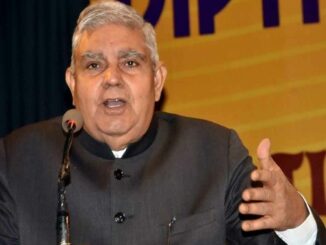
    In the years since the verdict – if not in its immediate aftermath – its importance has been recognized by successive governments. During this time, most criticism of the doctrine has been confined to the manner of its application rather than its legitimacy. But last week, India’s Vice-President Jagdeep Dhankhar launched a salvo of attacks at the Supreme Court, by calling into question the ruling’s correctness. Faced as we are with far greater issues of civic concern, this debate might well be regarded as tedious, if only the arguments made against the judgment were not part of what appears to be a concerted effort at undermining the judiciary’s importance.

    Collegium as target

    Over the course of the last few months, not a day has gone by without one member or the other of the political executive excoriating the Court over its apparent excesses. Much of this criticism has been aimed at the functioning of the collegium — a body of senior judges that makes binding recommendations on appointments and the transfer of judges. The Union Minister of Law and Justice, Kiren Rijiju, and indeed Mr. Dhankhar, have repeatedly doubted the Court’s judgment in 2015, in which it struck down efforts to replace the collegium with a National Judicial Appointments Commission (NJAC). That criticism has now turned sharper, with the Vice-President’s diatribe against Kesavananda.

    In his maiden address to the Rajya Sabha in December 2022, Mr. Dhankhar claimed that the striking down of the NJAC had no parallels in democratic history. A “duly legitimized constitutional prescription,” he claimed, “has been judicially undone.” Speaking on January 11 at the 83rd All India Presiding Officers (Assembly Speakers) Conference in Jaipur, Rajasthan, he said that “in a democratic society, the basic of any basic structure is supremacy of people, sovereignty of parliament…The ultimate power is with the legislature. Legislature also decides who will be there in other institutions. In such a situation, all institutions must confine to their domains. One must not make incursion in the domain of others.”

    Mr. Dhankar then heightened his criticism by doubting the legitimacy of the basic structure doctrine. The correctness of the Court’s view, he said, “must be deliberated…Can Parliament allow that its verdict will be subject to any other authority? In my maiden address after I assumed the office of Chairman of Rajya Sabha, I said this. I am not in doubt about it. This cannot happen.”

    To be sure, genuine criticism of both the Collegium’s functioning and the Court’s judgment upholding the body’s legality ought to be welcomed. But seeing as the Government, as Mr. Rijiju confirmed in Parliament last month, has no plans to implement any systemic change in the way we appoint judges, and given that the Government itself has done little to promote transparency in the process, the present reproach is, at its best, unprincipled, and, at its worst, an attempt at subverting the judiciary’s autonomy. That it is likely the latter is clear from the fact that the Vice-President has now carried his denunciation to a point where his admonishments are reserved not just for the collegium but also for the ruling in Kesavananda.

    The foundation of the Constitution

    Were we to begin with the elementary premise that India’s Constitution, as originally adopted, comprises a set of principles that together lend it an identity, we will see that the raison d’etre for the basic structure doctrine is not difficult to grasp. On any reasonable reading of constitutional history, one can see that the Constitution is a product of a collective vision. That vision was built on distinct, if interwoven, ideals: among others, that India would be governed by the rule of law, that our structure of governance would rest on Westminster parliamentarianism, that the powers of the legislature, the executive and the judiciary would be separate, that the courts would be independent of government, and that our States would have absolute power over defined spheres of governance.

    Now, ask yourself the following questions: what happens when an amendment made to the Constitution harms one or more of these principles in a manner that alters the Constitution’s identity? Would the Constitution remain the same Constitution that was adopted in 1950? Should Parliament amend the Constitution to replace the Westminster system with a presidential style of governance, would the Constitution’s character be preserved? Or consider something rather more radical: can Parliament, through amendment, efface the right to life guaranteed in Article 21? Would this not result in the creation of a document of governance that is no longer “the Constitution of India?”

    It is by pondering over questions of this nature that the majority in Kesavananda found that there was much that was correct in the German professor Dietrich Conrad’s address in February 1965 at the Banaras Hindu University, Varanasi. There, Conrad had pointed out, that “any amending body organized within the statutory scheme, howsoever verbally unlimited its power, cannot by its very structure change the fundamental pillars supporting its constitutional authority”.

    On ‘amendments’

    As the Court would later explained in Minerva Mills vs Union of India (1980) — and incidentally at stake there was the very survival of the idea that fundamental rights are inviolable — “Parliament too is a creature of the Constitution”. Therefore, it can only have such powers that are expressly vested on it. If those powers are seen as unlimited, Parliament, the Court found, “would cease to be an authority under the Constitution”; it would instead “become supreme over it, because it would have power to alter the entire Constitution including its basic structure”. In other words, the principle that Parliament is proscribed from changing the Constitution’s essential features is rooted in the knowledge that the Constitution, as originally adopted, was built on an intelligible moral foundation.

    On this construction, it is possible to see the basic structure doctrine as implicit on a reading of the Constitution as a whole. But it is also deductible, as Justice H.R. Khanna wrote in his controlling opinion in Kesavananda, through an interpretation of the word “amendment”. The dictionary defines “amendment” to mean a “minor change or addition designed to improve a text”. As Justice Khanna saw it, when the Constitution that emerges out of a process of amendment as stipulated in Article 368 is not merely the Constitution in an altered form but a Constitution that is devoid of its basic structure, the procedure undertaken ceases to be a mere amendment.

    Since its judgment in Kesavananda, the Supreme Court has identified several features that are immutable. There is no doubt that on occasion, the Court’s interpretation of these features has suffered from incoherence. But to suggest that the basic structure doctrine is by itself unsanctioned is to place the Constitution at the legislature’s whim. When taken to its extreme, accepting the Vice-President’s claims would mean that, in theory, Parliament can abrogate its own powers and appoint a person of its choice as the country’s dictator. Consider the consequences.

    (Suhrith Parthasarathy is an advocate practising in the Madras High Court)

  • Joshimaths in the making:  Save Karnaprayag, McLeodganj before it’s too late

    Rampant construction activity in callous disregard for the red flags and warnings flashed by geologists ever since land sinking was first noticed 50 years ago in Uttarakhand’s strategically located, ecologically fragile and landslide-sensitive zone in which Joshimath is located has come at a great cost. It has claimed a large part of the town, causing irreversible damage. Even as the authorities are trying to prevent an ominous human tragedy by evacuating the affected residents to safety, cracks have appeared in some houses at Karnaprayag, another municipality of Chamoli district, triggering fears of land subsidence there too.

    Meanwhile, the unfolding Uttarakhand disaster — sadly a manmade and preventable one — has put the spotlight on a similar hazardous situation prevailing at McLeodganj in the neighboring Himachal Pradesh. The alarm bells are ringing loud as attention is directed towards the increasing occurrences of landslides, sinking of the main McLeodganj-Dharamsala road, the recent cave-in of a market and the yet-to-be-rectified drainage system. Urgent heed must be paid to these warning signs to avoid another Joshimath.

    The Joshimath land subsidence underscores the imperativeness of preventive measures. Nature must be respected; it is only in its protection and sustainability that humans can survive. If the balance is tilted in favor of ‘development’ and ‘progress’, things cannot last for long. Hundreds of houses, hotels and roads are to be razed in Joshimath due to its foundational land subsiding and becoming incapable of carrying the weight of the buildings that have proliferated there. Declared as an unsafe zone, it will deprive around 30,000 people living in nearly 700 houses, identified as dangerous so far, of the emotional security of having a home. The government authorities are conducting a massive rescue and relief operation as the affected families are being shifted to temporary relief camps and compensated for their loss. But can there ever be enough recompense for people suffering that sinking feeling one gets when one is rendered homeless? The only way out is learning a lesson and preventing more such tragedies.

    (Tribune, India)

  • Peru in peril: On the political crisis in the South American country

    The government and opposition must agree on an early date for fresh elections

    With the killing of 17 civilians and one police officer on Monday amid anti-government protests, the month-long political crisis in Peru has crossed a bloody threshold and could trigger more waves of violence. The incident shows not only the barbarity of the country’s security personnel in dealing with protests, but also the failure of President Dina Boluarte and of her predecessor Pedro Castillo in uniting and stabilizing the country during the periods they have been in power. The crisis is the result of a power struggle between Mr. Castillo and Congress. Mr. Castillo, a former schoolteacher and a trade unionist, was elected President in 2021 on promises such as ensuring political stability, fighting corruption and addressing chronic inequality. But without any administrative and political experience, Mr. Castillo found it hard to negotiate the maze of Peruvian polity. As he struggled to get a grip on governance, a hostile Congress and the wealthy classes lined up against him. Corruption scandals and alleged links with criminal syndicates weakened Mr. Castillo’s position in Lima. Congress voted to fire him twice, but failed to garner enough support. As a third vote was due in December last year, Mr. Castillo made the drastic announcement of dissolving Congress, which also triggered his impeachment.

    But if Mr. Castillo, currently in jail, miscalculated the consequences of his decision to dissolve Parliament, his successor and legislators misjudged the leftist leader’s support among the poor. Violent protests broke out in Peru’s highlands demanding Mr. Castillo’s restoration or early elections. Mr. Castillo called Ms. Boluarte “usurper”, while his supporters said the president they voted for was not allowed to complete his legitimate term, which was to expire in 2026. At least 47 people, mostly civilians, have been killed in protests, ever since Mr. Castillo was ousted. As she came under enormous pressure, Ms. Boluarte promised to hold elections by April 2024 (pending approval from Congress), but this was dismissed by Mr. Castillo and his supporters, leaving the country in disarray. Both sides have a hand in the current crisis and should come together to find a way out. Restoring Mr. Castillo may not be practically and constitutionally possible, but Ms. Boluarte’s government could release him from prison in return for peace. To end the current impasse, the government, the opposition and Congress should agree on the earliest possible date for fresh elections. Peru’s political class should also be ready for broader constitutional reforms that allow the presidency and the legislature to function without confrontation.

    (The Hindu)

  • New York City needs attention of CityAdministration

    One of the world’s most populous megacities, with  over 8.5 million people New York City is a global cultural, financial, entertainment, and media center with a significant influence on commerce, health care and life sciences, research, technology, education, politics, tourism, dining, art, fashion, and sports. Home to the headquarters of the United Nations, New York is an important center for international diplomacy, an established safe haven for global investors, and is sometimes described as the capital of the world.

    The  name of the City creates visions of beauty, splendor  and grandeur in the minds of people across the world. It will not be an exaggeration to say that  it is the dream of every tourist in any part of the world  to see New York. They dream of a beautiful  New York with expansive gardens, walks along the Hudson, tall buildings, historic monuments, and endless sources of entertainment, exquisite shopping malls, and  a cultural variety not to be found anywhere else in the world.

    However, the majority is disappointed. It is not the Hudson River walks or the expansive gardens which  are missing. It is not that tall buildings and monuments are not there. It is not that the numerous entertainments are unavailable. It is the broken roads with potholes; it is the dirt and filth in the streets, including the Times Square area where the daily footfall numbers an astounding  330,000, many of them tourists, while over 460,000 pedestrians walk through Times Square on its busiest days. What do they see? Stinking garbage. Hardly any greenery. And, on top of that, there is ever-growing lawlessness. Times Square is no longer secure. In fact, the whole of New York is having to face insecurity. It is but natural that tourists will be reluctant to come, as do many who live in New York State itself.

    It appears that insanitary conditions- dirt, filth and garbage, broken roads with potholes ,  the barren, lifeless pavements , and the rising crime are the identity of New York.

    We wish the City administration  takes care of  once “the greatest city on the Earth”  before the conditions go from bad to worse , and a restoration becomes the more difficult.

  • Yatra lends purpose to Rahul’s political journey

    Yatra lends purpose to Rahul’s political journey

     In Indian electoral politics, alliances are formed on the basis of strengths rather than weaknesses of the participants. The aura of success surrounding Rahul’s Bharat Jodo Yatra is set to provide him with moral authority to play a pivotal role. In addition, in Sonia Gandhi, Rahul has a reserve bench of sorts; the former party chief can act as a line of communication with many non-NDA allies, including the Left, to keep the mahagathbandhan going. 

    This year, the Congress faces a litmus test in Karnataka, Madhya Pradesh, Rajasthan and Chhattisgarh. If it can win these states, the grand old party would emerge as a serious challenger for the 2024 General Election.

    By Rashid Kidwai

    There are many quotes that have been attributed to Mahatma Gandhi. In the Congress party office at 24, Akbar Road, one of them reads, “Kabhi kabhi hum apne virodhiyon ke karan aage badhte hain.” (At times, we move ahead due to our opponents). Then there is another one saying, “Pehle woh aap par dhyan nahin denge, phir who aap par hasenge, phir aapse ladengen, aur tab aap jeet jayenge.”(First they would not pay any attention to you, then they would mock you and then they would fight with you. You would win once these stages are completed).

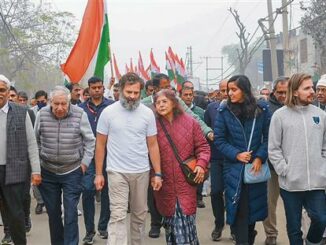
    In the context of Rahul Gandhi’s ongoing abstract, yet arduous, Bharat Jodo Yatra, these quotes ring a bell, bringing some relevance and hope for the Congress leader.

    There is a broader and growing consensus of sorts among Rahul’s detractors and well-wishers that finally, the Gandhi scion is showing signs of purpose, perseverance and hope in his political journey that began in 2004.

    Politically, the yatra may or may not be a game-changer, but it has succeeded in establishing Rahul as a credible politician who can walk the talk, intermingle with the masses and get support from a range of politicians and celebrities — from MK Stalin, Aaditya Thackeray, Supriya Sule and Farooq Abdullah to Raghuram Rajan, AS Dulat, Swara Bhaskar and Kamal Haasan.

    More importantly, the BJP’s stringent criticism, Union Health Minister Mansukh Mandaviya’s ‘appeal’ to suspend the yatra over Covid concerns, and the outrage over Rahul’s comments on China allegedly entering Indian territory have helped him become a singular dissenting voice.

    When the yatra began from Kanyakumari, Rahul’s popularity ratings were at an all-time low. The Congress organization was in a shambles and the leadership issue was far from settled. While the yatra was on the Kerala-Karnataka border, Rajasthan Chief Minister Ashok Gehlot, at that time tipped to be the next AICC president, stunned friends and foes alike by showing defiance, a throwback to the bygone era of Devaraj Urs, Arjun Singh and other party chief ministers.

    But throughout the Congress organizational election process, Rahul stayed away and focused on the yatra. The Assembly polls of Himachal Pradesh and Gujarat offered a mixed bag as the Congress went on to win HP. It was a surprise for those predicting the Congress’ death. The ‘corpse’ is, in fact, very much alive and kicking.

    This year, the Congress faces a litmus test in Karnataka, Madhya Pradesh, Rajasthan and Chhattisgarh. If it can win these states, the grand old party would emerge as a serious challenger for the 2024 General Election.

    We need to remember that the fortunes of the Congress and other non-BJP parties are closely linked to the 2024 Lok Sabha polls where the non-BJP, non-NDA Opposition and the Congress-UPA partners will have to target the ‘half of half’, i.e. half of the 272 Lok Sabha seats on their own — a challenging but not unmanageable number in the 2024 battle.

    There are four crucial states of West Bengal, Bihar, Maharashtra and Karnataka where the BJP-NDA had done exceedingly well in 2019 but the subsequent political developments have unfolded a new scenario. In West Bengal, for example, the BJP had won 18 Lok Sabha seats out of 42, while in Bihar, the alliance with the JD(U) had resulted in its netting 39 out of 40 parliamentary seats. In Karnataka, the BJP had won 25 out of 28 seats, while in Maharashtra, the alliance with the undivided Shiv Sena  had resulted in the NDA allies winning 42 out of 48 seats. Imagine a situation if the BJP’s strength from these four states gets reduced to half. A simple majority of 272 would become a distant dream and prospects of a khichdi government a reality.

    The Congress, in order to be a contender, has to win 100 or more Lok Sabha seats from states such as Kerala, Chhattisgarh, Maharashtra, Rajasthan, Madhya Pradesh, Assam, Karnataka, Uttarakhand, Himachal Pradesh and a few others where the grand old party has been in direct contest with the BJP or traditionally has a strong presence.

    Next year’s parliamentary polls are set to be contested in contrasting styles. If Team Modi is set to make full use of the Prime Minister’s personal ratings, big-ticket projects, Covid-19 handling in the context of the massive vaccination programme, achievements on the diplomatic front and reliance on emotive issues like the Ram Temple, the Congress and its potential allies are prepared to take the battle to the states where regional players are expected to hold sway.

    So, if the parties led by Mamata Banerjee, Nitish Kumar, Uddhav Thackeray, Sharad Pawar, MK Stalin, Naveen Patnaik, HD Kumaraswamy, Chandrababu Naidu and Akhilesh Yadav together manage to hold on to a chunk of the parliamentary seats, the Congress has the task of doing well in most of the Hindi-belt states and the Northeast.

    In Indian electoral politics, alliances are formed on the basis of strengths rather than weaknesses of the participants. The aura of success surrounding Rahul’s Bharat Jodo Yatra is set to provide him with moral authority to play a pivotal role. In addition, in Sonia Gandhi, Rahul has a reserve bench of sorts; the former party chief can act as a line of communication with many non-NDA allies, including the Left, to keep the mahagathbandhan going.

    (Rashid Kidwai is a Senior Journalist and Author)

  • Making diaspora invest in India a challenge

    Making diaspora invest in India a challenge

    “The unresolved issue with the NRIs is that the Indian government just does not know what it can do with them. The government wants their money, no doubt, and they are indeed sending money home, which accounts for 3 per cent of India’s GDP, according to the World Bank. The BJP’s foreign policy notion that the NRIs are its soldiers abroad to spread national glory is at best a delusion. And it could become a dangerous one if Indians abroad are seen as ‘fifth columnists’. Most NRIs have no interest in Indian politics nor are they motivated to push India’s case across the world. A time has to come when Indians need not migrate to other countries for better opportunities.”

    The NRIs remittances are higher than the foreign direct investment (FDI) that India is able to attract. The NRI remittances to India were $89.4 billion in 2021 and $100 billion in 2022.

    By Parsa Venkateshwar Rao Jr.

    The Bharatiya Janata Party (BJP), in its pursuit of overzealous nationalism, has looked upon the Indian diaspora across the world as an extension of India, politically as well as culturally. During the tenure of the then Prime Minister Atal Bihari Vajpayee, an attempt was made to woo overseas Indians, with the PM making it a point to interact with the Indians abroad rather than with other citizens of the host country. It was in 2002 that the first Pravasi Bharatiya Divas event was held in New Delhi.

    Prime Minister Narendra Modi intensified the outreach to the NRIs by addressing rallies in Madison Square Garden (New York) and then in Sydney after his party’s historic win in the 2014 Lok Sabha elections. But despite the enthusiasm to cultivate the NRI constituency in the past two decades, there is uncertainty and confusion over how to tap the potential of the NRIs to strengthen India at the global level or even at home.

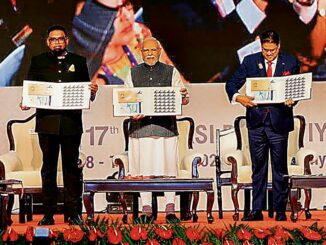
    The 17th Pravasi Bharatiya Divas event, held in Indore from January 8 to 10, reflected the confusion. The Indian government does not seem to be keen that the Indians living abroad should come back and help in the development of the country with the knowledge and expertise they have acquired abroad. It only wants that the NRIs invest in India. But it is in many ways a non sequitur.

    Indians settled abroad, whether in the Gulf countries, the UK, the US, Canada, Australia or Singapore, have been sending money home to their families. But they have not thought that it is profitable to do business in India or invest in India. Even today, the NRIs remittances are higher than the foreign direct investment (FDI) that India is able to attract. The NRI remittances to India were $89.4 billion in 2021 and $100 billion in 2022, higher than what the Chinese and Filipino emigrants send to their home countries.

    So, at successive conventions of the Pravasi Bharatiya Divas, the country’s leaders of the day give rhetorical messages to the few thousand delegates who attend the event. And this year seems to have been no different. PM Modi, Finance Minister Nirmala Sitharaman and Education and Entrepreneurship Minister Dharmendra Pradhan delivered homilies and the unintended ironies were there for all to see. PM Modi, in his inaugural speech on January 8, said, “In Pravasi Bhartiyas, we see myriad images of Vasudhaiva Kutumbakam and Ek Bharat Shreshtha Bharat,” and “Pravasi Bhartiyas echo the voice of a powerful and capable India.”

    Pradhan said, “We all agree that once upon a time India was a ‘Vishwaguru’, not in terms of military power but in terms of intellect.” And then he turned to the government’s programme of creating a skilled network in the country. He told the NRIs that India has a skilled workforce of 500 million. Sitharaman, echoing PM Modi’s statement of how cheap India’s Mars mission was, said, “The cost of the Chandrayaan, which goes to the moon, is far less than that of a Hollywood film.” And citing a NASSCOM (National Association of Software and Service Companies) report, she said Indian IT companies hired 2 lakh Americans at an average salary of $1,06,360 in 2021.

    These statements can only confuse NRIs. The government wants to woo them by telling them how good India has become since they left the country and what an attractive investment destination it is now. Surely, the NRIs would want to test the government’s claims on the ground and it will be reflected in the investment decisions they will make in the future.

    But there is also the fact that though Indians in the US are sending home more money than those in the Gulf countries, as was the case earlier, the Indian-Americans are less likely to return home and even start businesses in India. The Indians in Gulf countries will come back at some point of time because as yet there is no possibility of becoming citizens in those countries. In contrast, more Indians are getting the coveted Green Card in the US and they are more likely to become citizens there. Secondly, there are more billionaires in India than among the NRIs. Steel magnate Laxmi Narayan Mittal and metal magnate Anil Agarwal are among the exceptions. The NRIs in the US are prosperous but they are not super-rich yet. They do not have surplus capital to pump into India like Meta’s Mark Zuckerberg or Amazon’s Jeff Bezos.

    It is, however, true that more and more Indians in western countries are becoming part of the political mainstream of their adopted countries, and they are reaching positions of influence and power. Whether it is Indian-origin leaders such as US Vice-President Kamala Harris, British Prime Minister Rishi Sunak, President of Guyana Mohamed Irfaan Ali or President of Suriname Chandrikapersad Santokhi (the last two were special guests at the Pravasi Bharatiya Divas event in Indore), they owe nothing to India, and there is nothing that India can do to support or strengthen them. India is not the imperial power that the Modi government would imagine itself to be.

    The unresolved issue with the NRIs is that the Indian government just does not know what it can do with them. The government wants their money, no doubt, and they are indeed sending money home, which accounts for 3 per cent of India’s GDP, according to the World Bank. The BJP’s foreign policy notion that the NRIs are its soldiers abroad to spread national glory is at best a delusion. And it could become a dangerous one if Indians abroad are seen as ‘fifth columnists’. Most NRIs have no interest in Indian politics nor are they motivated to push India’s case across the world. A time has to come when Indians need not migrate to other countries for better opportunities.

    (The author is a senior journalist)

  • The onus of furthering constitutional values is on the film fraternity and on other progressive forces

    The onus of furthering constitutional values is on the film fraternity and on other progressive forces

    An open letter to the Indian film industry

    “There has also been a concerted effort to suppress projects which do not fit the BJP’s vision of and for India. Consequently, barring some notable exceptions, India’s film fraternity consciously self-censors itself, hoping to ride out the storm. Faced with a dispensation that stops at nothing, this self-preservation imperative is understandable. After all, why should an actor or producer or director stand up for constitutional values when they face boycotts and threats, when investigative agencies are unleashed on them, and when no one publicly stands with them?”

    By Pushparaj Deshpande

    In 1938, Charlie Chaplin started work on The Great Dictator. Even though it critiqued the Nazis, Chaplin was forced to self-sponsor, direct and write the project himself because most mainstream Hollywood studios were hesitant to disrupt ties to German finance, or risk making an overtly political project. Additionally, many in the establishment felt appeasing Adolf Hitler could work, so official censorship was also a real threat. Yet, showing tremendous personal and ideological fortitude, Chaplin forged ahead. The film belied expectations and became Chaplin’s biggest commercial success. It was nominated for five Academy awards and became a cult classic.

    Contextualize the enormity of Chaplin’s achievement. Swimming against the tide, his film mocked Hitler’s fetish for photo-ops, self-aggrandizing schemes and critiqued the attacks against minorities to distract from economic failures. Most importantly, it exposed the futility of placating authoritarian figures. This was when Hollywood consciously eschewed taking an anti-Nazi stand on screen, even if it privately opposed Nazism.

    A site of contestation

    A similar situation has come to pass in India. India’s film industries are now a site of ideological and political contestation, as The Kashmir Files and Pathaan controversies highlight. The BJP is consistently leveraging films to sway mass audiences. Mixing religious imagery, patriotism and nationalistic ideals, these films methodically propagate key Sangh Parivar mythologies. The importance given to this endeavor is demonstrated by the fact that no less than the Prime Minister had multiple meetings with key film industry stakeholders, in an effort to prod them into producing “nation-building films”.

    There has also been a concerted effort to suppress projects which do not fit the BJP’s vision of and for India. Consequently, barring some notable exceptions, India’s film fraternity consciously self-censors itself, hoping to ride out the storm. Faced with a dispensation that stops at nothing, this self-preservation imperative is understandable. After all, why should an actor or producer or director stand up for constitutional values when they face boycotts and threats, when investigative agencies are unleashed on them, and when no one publicly stands with them?

    Coincidentally, this assault comes at a time when the nature of film consumption is undergoing a structural shift. As the DVD and retail business model has been rendered obsolete, filmmakers no longer get a second shot at turning a profit. This has been exacerbated by the unfortunate reality that confronting regressive values and uncomfortable truths is now a high-risk endeavor, for it could invite the wrath of regressive forces. Faced with these legitimate concerns, filmmakers are opting to churn out extravagant, high-budget films that are divorced from reality, or ‘safe’ films.

    But India’s film industries do not have the luxury of escaping socioeconomic and political realities. First, the BJP is creating a ‘committed film sector’ by attacking the structural integrity of the film and television sectors. By marshalling the full resources of the state (the merging of four film media units ignoring criticism from the industry, subsidizing projects of aligned filmmakers, the censor board withholding clearances, etc.) and coaxing its core vote bank to support films that pander to its political and ideological projects, the BJP is gerrymandering the market. That is partly why films like The Kashmir Files and Tanhaji did well commercially.

    Second, progressives are targeted not just for their project choices or because they dissent from the BJP, but for what they represent — an India where you could succeed no matter who you are or where you came from. Motivated by their ideological imperatives, these regressive forces need to constantly reinforce two things to their core vote bank, namely that broad-minded, outspoken and disruptive actors/filmmakers cannot shape India’s image of itself, nor do they have an equal space in films.

    Third, audiences do not seem to be watching films as an escape from reality. An ideologically captive audience is seemingly endorsing films that mirror what they are force-fed daily through the electronic and digital media. This is not just an act of solidarity with populist mythologies connected to national, religious and community pride; it also enables them to exert illusionary control over those they don’t agree with.

    However, following Newton’s third law, it follows that there is a liberal audience that spurns films with regressive values. That is why films like Samrat Prithviraj, Dhaakad, Manikarnika, etc. tanked at the box office, despite the initial leg-up they got from the BJP’s ecosystem. If viewership trends on OTT and digital platforms are anything to go by, a silent majority is desperate for films that do not propagate communal, casteist, xenophobic, racist and undemocratic values. In this reading, films that objectively and sensitively address socioeconomic and political realities can succeed commercially. These include Jai Bhim, Mandela, Article 15, Sardar Udham, Raazi, Mulk and Pink. Similarly, films on the farmers’/students’ movements; the lived realities of women, Sikhs, Muslims, Christians, Kashmiri Pandits, OBCs, Adivasis and Dalits; and India’s multiple successes since 1947 could resonate with, and bind Indians together positively.

    Admittedly, actualizing these requires courage. But the film fraternity needs to realize that it is an equal partner in fostering a national consciousness. While it does not need to wade into polarized political debates, it can (and must) use its craft in defense of our shared values. Unless it spearheads films and serials that remind us to preserve our humanity, that weave a symphony from the many voices of India and that envision a better tomorrow (while being truthful about today), this tsunami of hatred will not pass.

    The shared work of progressives

    Yet, the onus of furthering constitutional values is not on India’s film fraternity alone. It is also on other progressive forces (including political parties). Given how insidiously regressive forces are colonizing the minds of our fellow Indians, all progressives need to support each other in this normative battle for India’s soul. We need to propagate our shared values creatively because high-sounding appeals to protect secular, democratic and liberal values do not sway the silent majority. Furthermore, given the state of a section of India’s media, we need to open up new fronts. Unless we display politico-cultural dynamism, the BJP will keep changing its goalposts and unleashing new culture wars that liberals will struggle to catch up to. That is why progressives need to support the film and television industries. Civil society/political action against outfits attacking film sets, raising their issues in the legislature, the media and the judiciary, and establishing new platforms and means of support are just a few ways in which India’s film industries can be tangibly supported.

    B.R. Ambedkar had argued that “constitutional morality is not a natural sentiment. It has to be cultivated”. Seen in this light, it is incumbent on progressives to collaborate in the cultivation of mass emotions. Doing this would mean influencing social consciousness through soaring political rhetoric, disruptive movements like the Bharat Jodo Yatra, and the strategic use of popular culture. Notwithstanding the attack on India’s constitutional edifice, we must recognize that this is also a moment of possibilities — to redesign our operational methodologies, to shed ideological infirmities and to create a more liberal, just and compassionate India.

     (Pushparaj Deshpande is the Director of the Samruddha Bharat Foundation, a multi-party platform that furthers India’s constitutional promise & the series editor of the Rethinking India series [Penguin] )

  • Happy birthday America!

    Happy birthday America!

    By Ravi Batra

    Did we survive January 6th’s Wake Up Call?

    Happy birthday America. May God continue to bless the United States of America, and may our actions cause the word “united,” to go from a useless noun to a satisfying adjective.
    Strikingly, the most significant difference between those 56 brave immortals on July 4, 1776 and today’s July 4, 2021 is in what they pledged vs today some of us are oppressed by our Pledge of Allegiance.  Their pledge was: “We Mutually Pledge To Each Other Our Lives, Our Fortunes, And Our Sacred Honor.” They pledged everything, including, their sacred Honor. Today, we are hard pressed to find personal honor, let alone collateralize it.

     American Exceptionalism burns brightly.

    Not since June 15, 1215 Magna Carta at Runnymede did the world evolve to its latest and highest milestone – still unsurpassed – the Declaration of Independence on July 4, 1776 penned by the great Thomas Jefferson and 56 brave delegates who put their “John Hancock” on it, courting either death or “freedom of man” from Kings & Emperors henceforth. It is that hallowed immortal moment that we celebrate now, as never before, thanks to the January 6th, an Insurrection to most, or a wake up call for our Republic by those who climbed the walls of Congress, as if storming the Bastille.

    Strikingly, the most significant difference between those 56 brave immortals on July 4, 1776 and today’s July 4, 2021 is in what they pledged vs today some of us are oppressed by our Pledge of Allegiance.  Their pledge was: “We Mutually Pledge To Each Other Our Lives, Our Fortunes, And Our Sacred Honor.” They pledged everything, including, their sacred Honor. Today, we are hard pressed to find personal honor, let alone collateralize it.

    Slavery, as a function of war, to the sin of Slave Trading, as an engine for Equity and Profit.

    Our original sin of slavery – 3/5th of a person in the 1787 Constitution – was to prevent the Slave-owning South from overpowering the Northern states and making slavery more permanent. Trying to minimize a “known” wrong (hat tip to the Donald Rumsfeld’s “known knowns, unknown knowns, and unknown unknowns”).

    We fought a Civil War to end slavery, and succeeded. Abraham Lincoln was a Republican. (To those who find his Emancipation Declaration statue objectionable need therapy, so they can learn to applaud a singular moral correction by civil war to end slavery.) Time and politics make strange bedfellows, together, even stranger. It was not until LBJ, after JFK, given significant prodding by MLK and passage of the “civil rights act of 1964,” that the Democratic party switched places with the Republican Party on racial discrimination. As a result, no one more than Lincoln was seen scratching his head endlessly and becoming an insomniac.

    Something ails America, and it’s us.

    It’s easy to ignore a former President, especially when his namesake company, Trump Organization, stands indicted by a grand jury in a prosecution led by Manhattan’s principled District Attorney Cy Vance Jr. and New York State Attorney General Tish James. But it would be wrong to dismiss over 70 million Americans who voted to re-elect him in November 2020. It is them, our fellow Americans, whom we must heed, and unite with.

    All of us should applaud Speaker Nancy Pelosi for creating a Select Committee to investigate the January 6th Insurrection, and the brave constitutional hero, the lady with an iron spine, Liz Cheney, who agreed to be a member of that Select committee. And to the GOP leadership caught in a vortex between their voters and their erstwhile Pied Piper of a former POTUS, our compassionate sympathy is theirs as an act of intrafamily healing.

    Still, we need to find out why patriots, or at least people who believe themselves to be patriots, would climb the walls of Congress to stop then-Vice President Mike Pence, one of the most loyal VPs in our history, from carrying out his constitutional duties as his Oath mandated and certify the electoral college vote, thereby finalizing Joseph R. Biden Junior as our 46th president of these United States.

    We need to save ourselves, from ourselves. We need to save our republic, from ourselves. We need to stand up, and tell Benjamin Franklin: thank you and all of your amazing colleagues who bequeathed to us this most exceptional and historic experiment of individual liberty under law, and despite our follies and our arrogance, we really mean to keep this republic alive and pass it down to our children and grandchildren.

    Humility in 1776 vs Hubris in 2020s.

    Our nation was founded on Judeo Christian principles, and their collective yearning for individual liberty and justice for all, free of an intemperate king or emperor’s mandates. And yes, our founders were primarily white Europeans. It is unacceptable, if our current generation of entitled-Americans, who have achieved nothing in comparison to our founders, think that their criticisms alone make them superior to those who pledged everything. A theater critic’s sarcasm, while possibly enjoyable as a soundbite, hardly qualifies that critic for being a star on the stage. Our current generation, and several generations before, need to eat “humble pie” for we have polluted the earth, the land, water and air with plastics and micro plastics, with chemicals like C8 (Teflon), and weaponizing viruses with illegal “gain of function” enhancements, such as COVID-19 – a bio warfare agent – that is reverse zoonotic, transmitting from humans to animals and creating an existential threat. It’s worthy to recall that science has no soul, and no moral compass. Unfortunately, human history is littered with leaders, like Hitler, who suffer from the same malady.

    “Equality “is a core principle of both constitutional law and justice. It is, however, inferior to its wiser sibling: “proportionality.” Our republic needs a tune up. Our wheels are misaligned, our pride misplaced, and our compass is irreverent as it is misdirected. We argue not to convince or to compromise, but to be belligerent. We need to find unity with our fellow citizens, and respect, not insult, is key. “BLM” must not mean White is bad or inferior. Lincoln for race relations and Teddy Roosevelt for environment must remain singular heroes. Columbus must grace our land, as Thomas Jefferson must be honored as the idea of America must be.

    Pride in our exceptional America that honors Natural Law.

    Every nation on earth, throughout history, has engaged in one form or another of discrimination. Indeed, Machiavelli taught political leaders to weaponize pride and ambition in order to enslave and control, and when that failed, fear worked. Our republic, founded under “natural law,” is now against nature itself and therefore, is in a self destruct mode. Our political correctness has run amok, as our compassionate push for equal civil rights for race or orientation seeks to erase the Compassionate Supporters. We go about the world beating our chests speaking loudly against ourselves. This is not a public confession, as much as ill-advised arrogant belief that our present tense comprehension of a sliver of motivated society has the cosmic truth for the ages. It does not.

    Benjamin Franklin and God.

    We need to save ourselves, from ourselves. We need to save our republic, from ourselves. We need to stand up, and tell Benjamin Franklin: thank you and all of your amazing colleagues who bequeathed to us this most exceptional and historic experiment of individual liberty under law, and despite our follies and our arrogance, we really mean to keep this republic alive and pass it down to our children and grandchildren. Happy birthday America. May God continue to bless the United States of America, and may our actions cause the word “united,” to go from a useless noun to a satisfying adjective.

    (The author is an eminent attorney based in New York. He is Chair, National Advisory Council on South Asian Affairs, besides holding many other positions. He can be reached at ravi@ravibatralaw.com)


  • How City Hall Saved Local News

    How City Hall Saved Local News

    By Sarah Bartlett and Julie Sandorf

    At a time when newsrooms nationwide are laying off reporters and some are closing down, a program begun by Mayor Bill de Blasio’s administration has been helping to sustain small, independent media outlets in every corner of the city.

    In May 2019 he signed an executive order requiring city agencies to direct at least half their budgets for digital and print advertising to community newspapers and websites. These media outlets are often their communities’ most trusted sources of information. They publish in more than 30 languages throughout the five boroughs, serving immigrants, ethnic and religious groups and communities of color.

    It has been a resounding success

    More than 220 of these news organizations received ads from 51 city agencies and departments totaling nearly $10 million in the program’s first year, according to a report from the Center for Community Media at CUNY’s Craig Newmark Graduate School of Journalism. During a period that included a census count, a presidential election and the pandemic, the ads provided a way for the outlets to get critical information to New Yorkers who don’t always consume English-language news from the city’s big daily papers or commercial TV and radio stations.

    Just as important, these ads from the city kept small news outlets alive when their usual sources of advertising — local businesses — dried up during the economic crash caused by the pandemic. “Without advertising from city agencies, many of us would not have survived the pandemic,” 59 editors and publishers wrote in an open letter to city and New York State officials.

    And when Mr. de Blasio recently announced he would spend $15 million to educate residents about ranked-choice voting, he indicated that a significant portion of those ads would be placed in community media. At least three New York mayoral candidates — Maya Wiley, Eric Adams and Kathryn Garcia — support using city advertising to assist community news operations.

    The Brooklyn-based Haitian Times, an online news outlet, is a good example. In March 2020, “we all thought we were going out of business,” its publisher, Garry Pierre-Pierre, told the Center for Community Media’s Advertising Boost Initiative. But $73,489 in ad buys from the city last year — up from $224 in 2019 — provided a lifeline. The Haitian Times was able to respond to the Covid-19 crisis with original reporting on the Haitian community, which was hard hit by coronavirus cases. That story was rarely covered in the mainstream media.

    The Haitian Times also reported on Black Lives Matter protests, highlighting the perspective of Black immigrants who were largely overlooked in national coverage, and served as an information hub for stories on Haitian women and girls. “We were able to hire freelancers to beef up our coverage, to increase the hours of our social media director and to bring on a managing editor as well as a copy editor,” Mr. Pierre-Pierre said.

    In 2013, in research one of us did for the Center for Community Media, just 18 percent of city ads were going to Black, Latino and immigrant-oriented news outlets, despite the fact that they reach 55 percent of the city’s population. At the time these news organizations were largely overlooked by city agencies directing ad campaigns and the private firms they used to help place the ads. The Center for Community Media now serves as a bridge between city agencies and these outlets to ensure that the ad buy policy works smoothly. The center tracks each city agency’s ad calendar and works with the ad agencies.

    Community publishers are now asking the City Council to institutionalize the advertising policy with legislation, and New York State legislators to adopt an equivalent program for state government spending. The center also is working with partners in Chicago and California to create similar initiatives there. And the Biden administration is on record supporting a bill that would require federal agencies to include in their budget requests just how much they would spend on ads in the Black, Latino and minority-owned press along with women-owned publications. There is also bipartisan support for legislation that would provide tax credits to subscribers of local news outlets.

    Government funding of media is not new. The longest-standing support has been through postal rate subsidies and legal notices in local media. And the federal government, through the Corporation for Public Broadcasting, has long invested in public radio and television and related online and mobile services.

    The federal government has an advertising budget of $5 billion, so a program like New York City’s could provide an enormous boost to community news organizations at a time when local journalism around the country is in crisis. As Penny Abernathy meticulously documented while at the Hussman School of Journalism and Media at the University of North Carolina, at least 25 percent of newspapers have disappeared since 2004, creating news deserts across the country. If cities and states choose to more equitably distribute their government ad spending, that could have a profound impact, even without help from Washington.

    Other solutions are emerging. More local news outlets, for instance, are considering becoming nonprofits to enable philanthropic support for their work. In the meantime, New York City has created a model that we know works, that doesn’t require new taxpayer funding and that can be readily adopted in communities across the nation.

    Sarah Bartlett is the dean of the Craig Newmark Graduate School of Journalism at CUNY. Julie Sandorf is the president of the Charles H. Revson Foundation and the author of a 2020 article in The Stanford Social Innovation Review about renewing philanthropy’s commitment to local journalism.

    (Ms. Bartlett is the dean of the Craig Newmark Graduate School of Journalism at CUNY, and Ms. Sandorf is the president of the Charles H. Revson Foundation)


  • Israel-Hamas violence fueled by emotive triggers

    Israel-Hamas violence fueled by emotive triggers

    By Lt Gen Sanjiv Langer (retd)
    Israel will have to introspect. Its hardline, extreme-right approach is pulling it into a black hole. The prospects of Hamas East and West, Hezbollah to the North and restive Palestinians within the country do not bode well for the long-term security and prosperity of its populace. When asymmetric entities engage in conflict, outcomes are unpredictable. Rocket salvo attacks by Hamas have broken through the Israeli Iron Dome, challenging its invincibility.

    Let there be no strife, I pray thee, between me and thee, and between my herdsmen and thy herdsmen; for we be brethren. — Abraham, Old Testament

     RAMZAN’S Laylat al Qadr, the Night of Destiny, catapulted Israel and Palestine to a crescendo of violence. With more than 200 killed in Gaza and at least 10 in Israel, the battle has entered its second week. Hamas, having fired about 3,000 rockets in salvos, and relentless Israeli air, land and sea bombardments on hundreds of targets are edging the protagonists towards an expanded conflict.

    The combat comes at a time when Israeli Premier Benjamin Netanyahu and Palestinian President Mahmoud Abbas are both in political quicksand. Netanyahu may gain a lifeline as his opponent Yair Lapid is unable to engineer support. President Abbas will, however, sink deeper, ceding vital space to Hamas. Al Fatah and Hamas took birth in the Palestinian Intifada of 1987. While Fatah and Arafat took center stage in the Palestine Liberation Organisation (PLO), Hamas unrelenting, fundamentally divergent, bided its time. Post elections in 2006, Hamas expelled Fatah from the Gaza Strip, resulting in a fractured Palestinian Authority: Hamas in Gaza and Fatah in Palestine territories, to the East of Israel.

    The conflict between Hamas and Israel is endemic, manifesting itself in the wars of 2009 and 2014. The present firestorm was preceded by a slow but definite burn. Stoking the fires of Palestinian resentment have been the US-supported declarations on Jerusalem, the Golan Heights and the ill-conceived Trump ‘Deal of the Century — Peace Plan’.

    The night of May 8 was nestled in an unfortunate convergence of emotive triggers: Heavy Israeli hand in crowd management for Ramzan; Israeli celebrations of their 1967 victory and capture of East Jerusalem; and Israeli Court permitting the eviction of four Palestinian families from Sheikh Jarrah (suburb of Jerusalem) for Jewish settlers.

    Consequently, this time, in an ominous departure, the Arab population within Israel has raised its hand. This explains the violence in the areas of Bat Yam, Lod, Sheikh Jarrah and the West Bank. While the move for eviction impacts 700 Palestinian families, the court order is seen as a precedent. The incendiary role and active precipitation by Hamas is, however, writ large in the fire. Hamas repeatedly threatened violence, treating Israeli actions in the vicinity of the Al-Aqsa Mosque as a Red Line.

    Hamas, equipped by Iran, modelling itself on the Lebanese Hezbollah, seeks supremacy in the Palestinian affairs. Its mass appeal is enhanced by its ability to confront the Israeli forces and take casualties. Civilian deaths are an unfortunate but necessary consequence of ‘The Struggle’. Violence works to its political advantage and diminishes the political signature of Fatah.

    Israel faces tough choices. Standoff attacks have a limited deterrence since Hamas cadres welcome death. Hamas has embedded its facilities deep into the civilian habitation. Enormous casualties are on show. The present targeting by Israel of the HQ, leaders and military facilities orchestrates casualties. Israeli polity is in turmoil. Sections of the resident 21 per cent Palestinian population are inflamed. They have challenges on both sides of the border. The Gaza Strip is one of the densest urban entities in the world. Concrete rises and spreads with little gaps. It is a nightmare for the land forces. Past land interventions have caused high casualties and had had no enduring gains.

    The Indian response has been nuanced. With a history of support to the Palestinian cause, a multi-dimensional robust, flourishing relationship with Israel since 1992, this is mandated. While Israeli centrality is unambiguous, India is autonomous on the larger issues. This has been echoed in the response of TS Tirumurti, Ambassador of India to the UN: deep concern over all clashes and violence, with specific reference to Hamas rocket attacks and violence on Temple Mount; concern over evictions in Sheikh Jarrah; insistence on maintaining status quo; adherence to UN Security Council Resolution 2334, which stigmatizes Israeli settlements, calls them flagrant violations; and commitment to the Two-State Solution.

    While India has stayed its hand on Hamas in the UN, the present specific reference to its rocket attacks is also due to the fact that Hamas initiated the violence as an act of war.

    Historic Indian commitment to the region also included a large presence in the UN Mission, UNEF I from 1956 to 1967. The mission had illustrious Indian Force Commanders — Generals PS Gyani and Inderjit Rikhye. While the mission was largely deployed in Gaza, Indians were a welcome presence in the region, as they continue to be today, in the UN Mission UNIFIL, Lebanon.

    It also bears mention that India’s support to the Palestinians has been unfailing and since 2018, the Indian contribution to them has been quadrupled to $5 million a year. The assistance has been sharpened with project-based interventions. Indian outreach is both in Gaza and the Eastern Palestinian territories.

    Hamas military spokesman Abu Ubaida has threatened: “…we have prepared for your kind of deaths that would make you curse yourselves…” Hamas may have chosen the moment well, but the Israelis will not oblige it. Israeli institutions are strong, their crisis response is outstanding and defense and security capabilities have a wide spectrum and bleeding edge.

    Hamas, undoubtedly, has an eye on the impending Palestinian elections, which President Abbas has postponed. This conflagration will possibly give electoral margins to Hamas for realizing its dream of control over all territories.

    Israel will have to introspect. Its hard-liner, extreme-right approach is pulling it into a black hole. The prospects of Hamas East and West, Hezbollah to the North and restive Palestinians within the country do not bode well for the long-term security and prosperity of its populace.

    When asymmetric entities engage in conflict, outcomes are unpredictable. Rocket salvo attacks by Hamas have broken through the Israeli Iron Dome, challenging its invincibility. There is a blurring of focus for Israel, with the incidence of domestic violence.

    Hamas is presently poised for political gains. Israeli military superiority will not transcend to assuage damaged psyche and heal emotional wounds. Hamas is on track, while Israel will have to review its existential challenges. We must pray for the innocent victims. We must also, in time, assist them to pick up the threads of their lives.

    (The author is a Former Deputy Chief, Defence Staff, India)


  • Trumping majoritarianism in the Hindi heartland

    Trumping majoritarianism in the Hindi heartland

    By Zoya Hasan
    While regional parties will continue to be significant in various States of the Union, the principal challenge of overcoming majoritarianism lies in the Hindi heartland, especially in U.P. Oppositional electoral alliances, notably the formation of a federal front, are important strategies in this battle but it is no less important to challenge the ideological foundations of the majoritarian project through progressive and inclusive politics.

    The landslide victory of the All India Trinamool Congress in the West Bengal Assembly elections and the pushback of the Bharatiya Janata Party (BJP) in West Bengal, Tamil Nadu and Kerala have given rise to a pervasive belief that right-wing politics can be defeated by regional assertions. Undoubtedly, regional and cultural assertion in these States acted as an effective bulwark against the BJP’s expansionary plans in southern and eastern India. The regional-cultural tropes deployed by Mamata Banerjee, for example, worked so well that at one point, Home Minister and BJP leader Amit Shah was even forced to clarify that if the BJP is elected, someone from Bengal would be the Chief Minister. This underlines the effectiveness of regional culture and politics in trumping communal politics. However, this claim needs to be tempered by the realism that it cannot work in the Hindi heartland, which is dominated by caste and communal politics, and has so far not seen any serious ideological and political challenge to politics based on these identities.

    Encompassing nine States whose official language is Hindi, namely Bihar, Chhattisgarh, Haryana, Himachal Pradesh, Jharkhand, Madhya Pradesh, Rajasthan, Uttar Pradesh (U.P.) and Uttarakhand, this region retains a central position in the electoral strategies of the BJP and its larger political imagination. The party’s stunning show in these States propelled it to power in the 2014 and 2019 parliamentary elections. Its continued political dominance in the heartland will neutralize its losses now as well as in future in States where it has been bested by regional players. I will focus here on U.P. to illustrate the limits of the regional assertion.

    Dimensions in the heartland

    The Hindi heartland is clearly different. There are at least four important dimensions of this difference. First is the absence of regional identity in States such as U.P. This is evident from the debate on States reorganization and the reorganization of Uttar Pradesh in the 1950s. The compulsions of nation-oriented identity emerged very clearly from the discussions in the States Reorganization Commission on suggestions for the division of U.P. for administrative convenience. U.P. leaders argued for a large and powerful State in the Gangetic valley as a guarantee of India’s unity.

    In this sense, U.P. was considered the backbone of India and the centerpiece of political identity in modern India. Importantly, it was supposed to provide the chief bulwark against growing regionalization and fragmentation elsewhere. Instilling a sense of regional pride, an essential part of Congress strategy in southern and coastal India, was not followed in U.P. U.P. was seen as the political heartland in contrast to Punjab and Bengal for instance, which were splintered and incorporated into two different nation states. As is well known, the bases of this post-colonial identity varied from its location in the freedom struggle to staking claim as the cultural homeland of Hindi and Hinduism. In both cases, it was centered in the idiom of the nation-state and strong central authority.

    Second, although U.P.’s cultural homogeneity remains a matter of disagreement, the idea of the heartland had great resonance among the political elite who opposed the demand for U.P.’s reorganization. The long-standing traditions of composite cultural identity and shared plural cultures began to yield place to a singular homogenized identity. The Hindi-Urdu divide, which mirrored the communal cleavage of U.P. society, played a crucial role in this process. Urdu was excluded as it was seen to symbolize Muslim cultural identity in independent India, while Hindi was boosted to promote the development of a Hindi-Hindu heritage for this region. The project of homogenization of Indian/U.P. culture as Hindu culture was quickened in later decades. Even though it would be hard to assume a direct link between Hindi dominance and communal politics of subsequent decades, it is nevertheless a fact that all political parties in the State used it as an ingredient of social and cultural differentiation and a means to consolidate political dominance.

    Role of communal politics

    Third, it is clear that communal politics and communal movements have played a key role in U.P.’s modern history which in turn have diluted other identities.

    In some respects, this process gained momentum in the wake of Partition which cast its long shadow upon political institutions and culture in U.P. and to a great extent affected the perspectives of Hindus and Muslims alike. Hindu nationalism was marginalized within the Congress party but many of its ideas were accepted in framing party policies. The State leadership was instrumental in forging a conservative consensus in the State under Chief Minister G.B. Pant who steered the affairs of the state for eight years after Independence.

    The intensification of communal politics took a new turn with the mass mobilization for the construction of a Ram temple at Ayodhya which was deftly used by the Hindu right to establish a major presence in U.P. and to facilitate the political reconstruction of U.P. through the promotion of a collective Hindu identity. The crusade for the appropriation of disputed shrines is central to the communalization of politics and short circuiting the more complex process of political expansion for the BJP.

    Importantly, this has laid the groundwork for building permanent electoral majorities through the deployment of ascriptive symbols in U.P. which, given its huge size, helps it to establish a strong base in the Hindi heartland to offset the appeal of countervailing identities elsewhere in India.

    Caste politics too

    Finally, caste politics which was expected to counter Hindutva expansion has failed to do so; in fact, caste politics has become a building block for the BJP’s expansion. The party has reached out to Dalits, actively mobilizing them and other backward castes to assimilate them into the Hindutva meta-narrative. Instead of erasing caste from electoral politics, the BJP-Rastriya Swayamsevak Sangh has sought to court fragments of castes as a way of undermining broad-based political movements and opposition to it. It has used the wider appeal of Hindu nationalism to co-opt backward castes and Dalits who are keen to align themselves to the larger narrative of Hindu nationalism.

    A reset is needed

    While regional parties will continue to be significant in various States of the Union, the principal challenge of overcoming majoritarianism lies in the Hindi heartland, especially in U.P. Oppositional electoral alliances, notably the formation of a federal front, are important strategies in this battle but it is no less important to challenge the ideological foundations of the majoritarian project through progressive and inclusive politics. This requires a reset of the basic political mindset in U.P. which can only be done by reviving the splendid heritage of the national movement in which this region played a central role and in which Gandhiji and Nehru played a heroic part. Invoking the spirit of the Bhakti movement which was the first major challenge to the religious orthodoxy of Hinduism would also help in resetting the cultural clock. This must, however, combine with much greater concern for the fundamental social and economic issues of the State, and making the struggle between communal and secular forces the central issue through public campaigns that address the problems of religious traditionalism and the cultural underpinning that this provides to the push to make India a Hindu state.

    (Zoya Hasan is Professor Emerita, Jawaharlal Nehru University)

  • On Religious Institutions: Sikh institutions show the way

    On Religious Institutions: Sikh institutions show the way

    The announcement by the Jathedar Baba Kulwant Singh ji of Takhat Hazoor Sahib, Nanded, Maharashtra, one of the four holy shrines releasing all the gold collected over the last 50 years to build hospitals and medical institutions. The objective that no ç or anybody should travel to Hyderabad or Bombay for medical studies or treatment away from the heartland is most gratifying and welcoming.

    As per law and our constitution, minority religious institutions and trusts enjoy freedom from government administration with collection and income exempt from income tax. In minority educational institutions up to 50% seats can be retained for minorities while the balance is open for general admission on merits and management discretion (capitation was common once).

    By certain acts of Parliament all the religious majority institutions were nationalized and taken over by government appointed trusts, mostly the biggest and most popular ones. The entire collection is property of the state government which is used for state activities.

    Minority trusts have built huge land banks with all Income free from tax. This runs or expands activities.

    Some even repatriate funds abroad to their controlling bodies.

    One or two were canonized (sainthood) mainly for service to the poor, conversions, and huge fund transfers to parent body.

    Each place of worship has a sort of target. Postings of clerics is on merit for growing the flock and the collections.

    These trusts are also entitled to government grants, subsidies for relief work. Some like the Takhat Huzoor Sahib go the extra mile to use the collected funds for good of the Khalsa and all who need help. In addition to contribution by followers and well-wishers to establish Institutions that provide relief these are eligible for ongoing government grants under various relief programs including medical relief plans.

    The goodwill, the community feeling, and wellbeing when visiting the well maintained and clean environs reposes faith and relieves pent up stress and thus serves its purpose to humanity.

    This is something that very few majoritarian faith institutions have achieved in our own country, unlike the other faiths have done in the countries of their origin and establishment, despite being younger by several thousand years.

    Society decides and follows what they believe in. Inducement and coercion were necessities for modern sects to grow their following. Sikhism is an exception that attracts by its simplicity of teaching and practice.

    Nothing that all of us do not know already. We shy away from discussing religious matters or stating facts openly, despite being a democracy and avowedly secular due sensitivity towards one and all, even to a level of causing harm to one’s own belief and faith systems.

    Fortunately, this tradition of not merely co-existing, but accepting the other faiths sets us apart in this galaxy of nations. This spirit needs to be universalized by all faiths by a series of self-introspection and find new directions for the future.

    Hardliners and extreme ideologies will constantly derail such evolution which must be fought from within. Each one is responsible to reform their own. If helping hand is asked, then by all means do step in but not step on.


    Rishi Singh

    rishikant.s@gmail.com

  • Time for the Sikh Community to Empower Itself

    Prof. Indrajit Saluja

    Though a mere drop in the ocean, the Sikh community in the US, numbering around 280,000, according to The World Religion Database at Boston University, has made its presence felt in the country. The community which began trickling into the US at the beginning of the century started to pour after 70’s, with trouble brewing in their home e State of Punjab in India. In the 80’s the Sikhs came in torrents in the US after the genocide of the community in the wake of the killing of the then Prime Minister Indira Gandhi.

    They came, they saw, they conquered. Their immediate concern was having food at the table. In the last about 50 years, every Sikh who came to the US is in a position to claim that he enjoys a certain amount of financial security. Their next generation started getting education here. With a certain amount of financial security rose a desire to empower themselves through the political processes. They began to know and mix with the people of their community who were already involved in whatever way in the political processes.

    However, the community organizations remained the first love. It was through the community organizations that many moved on to participate in the political process. The community has understood that real empowerment can come only when they have political power. They have also been reminded that back in 1955 one of them was elected the first Sikh Congressman. Dalip Singh Saund is remembered with reverence as a role model for the community.

    Dalip Singh Saund was the first Sikh and first Indian American elected to Congress.


    I must say a few words for the younger generation about this trailblazer.

    Dalip Singh Saund was the first Sikh and first Indian American elected to Congress.

    He emigrated from India in 1920 through way of Ellis Island, and attended the University of California, Berkeley, for his masters and Ph.D. in mathematics. After getting married, he and his family moved to the farming community of Westmorland, California, where Saund became interested in politics. But because he wasn’t a U.S. citizen, his ability to participate was limited.

    In the 1940s, he organized efforts to open citizenship to Indians living in the U.S. and eventually Congress passed a bill in 1946 allowing Indian immigrants to pursue naturalization. Saund officially became a U.S. citizen in 1949. The following year, he ran for a judgeship and won, but the election was vacated because he had been a citizen for less than a year. Saund successfully ran again two years later and served for four years.

    In 1955, Saund announced his campaign to run for the House of Representatives as a Democrat and was re-elected twice. He was a supporter of the 1957 Civil Rights Act and used his own story to advocate its passage.

    “No amount of sophistry or legal argument can deny the fact that in 13 counties in one state in the United States of America in the year 1957, not one Negro is a registered voter,” Saund, who died in 1973, at 73, said during a speech in support of the law. “Let us remove those difficulties, my friends.”

     Since the time of Congressman Saund, a number of Sikhs have entered politics. But never before now, there was never such an impressive gallery of the Sikhs taking part in electoral politics. I am not going to span the entire nation. I am inclined to confine myself to New York City where we are going to have the civic elections in November this year. The primaries next month will decide the fate of many aspiring candidates to various offices.

    I spoke with a number of people from different walks of life about this newfound love for politics. To the question “why so many Sikhs, particularly the young ones, now aspire for political positions, the answer invariably was that they want to empower themselves; they want to be heard; they want a pie of the political cake. Most said that the economic prosperity has no meaning until they are politically empowered.

    I am mentioning here my conversation with just two Indian Americans. The others I spoke to, including those in fray, will be presented to the readers next week.

    Dr. Renee Mehrra, the first South Asian Woman to run for a City office

    I spoke with Dr. Renee Mehrra who was one of the first in the community to contest an election in 2001 along with another, a Sikh gentleman Inderjit Singh. I asked for her experience. This is what she said.

    “Having a political identity and breaking the last frontier twenty years ago seemed like an insurmountable task. Reflecting back, someone had to take on this daunting challenge, so I decided to put my hat in the ring to become the first South Asian American woman to face the odds. With no mentor, roadmap and blueprint, I had to create for myself, and for our community new pathways in political activism. Strategy, innovation, ingenuity and emotional intelligence became of utmost importance for empowerment and visibility, and to engage both our community and my constituents. I was inspired by Dalip Singh Saund, an Amritsar-born mathematician and farmer who was the first Indian American to get elected to US Congress from California’s 29th district in 1955. Decades later, we were still underrepresented and underserved, and I worked relentlessly so we could have a seat at the table. With no political backing, and running from a district which was ethnically diverse, I was the new kid on the block making my voice heard over the clutter of so many candidates. Treading an unknown path was both exhilarating and challenging. It was too early in the process and though I got 37 percent of the vote the first time and 22 percent in my second bid, we were still in the embryonic stage. However, bringing home the significance of voter registration, petitioning and primaries to our community was itself rewarding, and in hindsight, I feel I helped to open a new door for our community in Queens, NY.

    Fast forward, we have come of age and started to achieve a substantial demographic critical mass, a crucial component for the community to become strong player in the political landscape for equity and inclusion. It is heartening to note that our community is getting to be politically savvy, and Indian Americans are running for local and state elections to make a difference.”

    George Abraham has been involved in politics in India for about 50 years. He is a keen student of US politics

    George Abraham, not from the Sikh community, but a keen student of politics, expressed his unhappiness with the goings on in the practiced politics arena.

    I would love to quote him here.

    “I have been a keen observer of American politics in the last five decades. I have witnessed the gradual rise of Asian Indians in various professional fields across the nation and the political arena.

    However, I have also wondered why the South Asian Community, probably the largest concentration anywhere in the U.S. has so far failed to get strong footing in the mainstream politics in the Northeast U.S! Indians who live even in the old Confederacy seem to have more success than their peers who live in New York, the most liberal city in the U.S.

    There may be manifold reasons for that predicament. The first generation that has come ashore to this great country focused on their economic well-being. We have come from an environment where there were shortages, joblessness, and heightened competition for basic human needs. Therefore, upon arrival, we have dug in focusing on our self-improvement by attaining educational qualifications, professional jobs, Houses, providing top-notch education to our children, and the time left was used for religious services or cultural expressions. Our economic insecurity became an obstacle to any progress in the political arena.

    In addition, for the same reason as I stated above, we pushed our children to take up professions that have job security in fields such as Medicine, Engineering, or Information Technology. Political Science or International Relations were mostly shunned in favor of subjects that would reward a higher paycheck after graduation. Those who studied Law preferred to join a successful law firm or practice outside in a lucrative real estate business. Let us look at the composition of the forces at play at the higher echelons of power in the U.S. It consisted primarily of two groups: Lawyers and Businessmen (CEOs with MBAs from prestigious Institutions). Almost fifty percent of those running USA Inc. come from the top 15 Colleges or Universities in this country. In the final analysis, most of our young people ended up in professions that supported the Enterprise from behind rather than leading up in the front.

    Moreover, the politicos in the Northeast, New York in particular, appear to show very little respect for the South Asian Community. To them, we are an ATM that they could push a button on and get their so-called campaign contributions. They seem to be reasonably confident as well that we are ‘simple-minded’ and would go away happily after an embrace and a Selfie shoot for the next edition of one of those Indian weekly newspapers.”

    “At the end of the day, Indians must come together to succeed. There are four Asian Indians who are running for District 23 for New York City Council in this election cycle. Although we pride ourselves as Indians, we act and behave like we are from different planets. Maybe that is true: after all, we are from 565 princely states put together by the British using force and called it one nation! That is our legacy; however, should that be our future?”

    For now, I must leave my readers to ponder over the question George has posed.

                                     (To be continued in the next edition)

  • Dig out Covid truth

    Dig out Covid truth

    The world must question China on bio-warfare documents

    Over 34 lakh (3.4 million) people have succumbed to the coronavirus pandemic in the past year and a half, but the world is still awaiting conclusive answers to the all-important questions: Is Covid-19 a man-made bioweapon? Did the virus leak accidentally from a lab in Wuhan? Or was there no human lapse at all? Was it just a case of transmission from animals to humans? Media reports referring to Chinese documents allegedly obtained by the US State Department have turned the spotlight on sinister possibilities. The papers written by Chinese military scientists and public health officers in 2015 describe SARS (Severe Acute Respiratory Syndrome) coronaviruses, of which Covid is an example, as presenting a ‘new era of genetic weapons’. According to the reports published in the Australian and British media, the People’s Liberation Army documents seem to fantasize that a bioweapon attack could cause the ‘enemy’s medical system to collapse’.

    These ‘revelations’, predictably dismissed by China’s state-run Global Times newspaper as an attempt to tarnish the country’s image, have reignited the global clamor for getting to the bottom of the matter. It’s a pity that the World Health Organisation (WHO), the UN nodal agency spearheading the fight against Covid-19, has not been able to bring us closer to the truth. A probe conducted by a team of experts from the WHO in Wuhan in January-February this year had dismissed as ‘unlikely’ the theory that the virus leaked from a lab. The investigation left a lot to be desired amid allegations that the Chinese authorities did not offer ‘full cooperation’ to the visiting contingent.

    China, which again finds itself under intense international scrutiny, needs to do a lot of explaining for the whys and wherefores of the 2015 documents. The WHO, on its part, has to ensure that a thorough investigation is conducted, making it incumbent on the Chinese government to keep the proceedings transparent. Reeling under the second wave of the pandemic, India should push harder for ascertaining the truth and fixing responsibility. With the Union Health Minister heading the WHO’s Executive Board, India needs to use this platform effectively so that Covid-like catastrophes don’t recur.

    (Tribune, India)

  • Covid corpses on Ganga

    Covid corpses on Ganga

    Visuals of Buxar and Ghazipur expose bogey of a new India

    Covid seems to have taken us back to the colonial times of pestilence and famines, when the poor just floated their dead down the nearest river. All the tall claims of a new India have washed up on the banks of the holy Ganga in Buxar in Bihar. Some say 48, others claim to have counted 150 bodies of suspected Covid victims on the Ganga at Chausa block in Buxar bordering Uttar Pradesh. The gruesome visuals leave us in no doubt, unless UP Chief Minister Yogi Adityanath disputes it to lock up those who have caught the corpses on camera. The officials on either side of the river are only trying to disown the corpses. Bihar’s officials believe that these bodies must have drifted downstream from neighboring Ghazipur or further up, Varanasi. Tuesday’s sighting of bodies at Ghazipur in UP leaves no doubt that villagers upstream are throwing their dead in the river, unable to afford their last rites.

    This is the story of Covid hitting the Hindi heartland, particularly UP, which has lost four ruling party MLAs to the pandemic. Union Minister Santosh Gangwar had last week written an angry letter to Adityanath pointing out the glaring lapses, apathy of medical officers and hoarding of oxygen cylinders. UP Minister and Lucknow MLA Brajesh Pathak, Bareilly MLA Kesar Singh (who later died), Mohanlalganj MP Kaushal Kishore, Basti MP Harish Dwivedi, Bhadohi MLA Dinanath Bhaskar, Kanpur MP Satyadev Pachauri and others have written similar letters expressing their inability to help their constituents. Jasrana MLA Pappu Lodhi released a video on social media of his wife lying on the floor of a Covid ward.

    There are BJP MLAs who have no qualms about blaming UP’s aggravated second surge on the state’s panchayat polls and the Kumbh Mela. While they claim that things are getting better, there is no denying that the situation is dismal in UP. This is the real India of mindless politico-religious priorities with no health infrastructure, no advance planning for a known disease, no treatment and finally, no dignity for its dead.

    (Tribune, India)

  • Election verdict a pushback for BJP policies

    Election verdict a pushback for BJP policies

    By Zoya Hasan

    “What the pandemic has done, unlike the disaster of demonetization, is bring to the fore the BJP’s incapacity for governance. It has shown the sheer incompetence of the majoritarian model of governance, which is just not suited for running a modern state. The administrative ineptitude is impossible to ignore even for those intoxicated by the right-wing’s electoral successes.”

    The BJP’s defeat in West Bengal, Kerala and Tamil Nadu shows the limits of Hindutva. It shows regional parties can overpower Hindutva at the state level and hence the BJP cannot assume a natural monopoly over state politics.

    The results of the just-concluded Assembly elections give us an indication of ground-level political changes in the key states of Assam, West Bengal, Kerala and Tamil Nadu. While it’s important to understand the results in terms of state-specific factors, the overall political outcome indicates a successful assertion of local/regional politics against the majoritarian-authoritarian politics of the BJP. The centrality of the local is visible from the Lokniti-CSDS survey which underlines the primacy of local factors and state leaders with a mass base in determining the choices of voters. The reasons for this vary from state to state but the limits of Hindutva’s expansionist politics and its agenda of polarization are apparent. This has decisively dashed the BJP’s avaricious plans of conquering new territories.

    These setbacks suggest that the polarizing rhetoric of Hindu nationalism doesn’t thrive everywhere in India, especially in regions with a distinct culture, a history of social movements, strong secular tradition, and where vernacular languages hold primacy instead of Hindi. It showed how stunningly out of touch the BJP is from the political reality in these states where it was holding Uttar Pradesh (UP) Chief Minister Yogi Adityanath’s road shows, chanting slogans of Jai Shri Ram, talking love jihad and trying to excite Hindus with anti-Muslim dog whistles. None of this seems to have worked. The BJP lost decisively in Kerala (not winning a single seat), its alliance lost in Tamil Nadu (BJP won only four seats), and it lost spectacularly in Bengal (winning 77 seats, way short of 200 it boasted). The central point of the election outcome is that the majority of Hindus voted against the BJP to keep it out of power in three important states.

    But this rebuff did not occur in the core areas of BJP’s support base in northern and north western India and these will be tested in the polls in 2022. The RSS has changed the political discourse in these states, especially in UP. But it would be a mistake to presume that issues of unemployment, jobs, farmers’ distress, regressive farm laws and the massive Covid mismanagement will not matter in India’s most significant state. In addition to Covid, the continuation of the farmers’ revolt, which began in November 2020, is likely to shift the balance of forces in many of these northern states, from Haryana to UP to Gujarat.

    The gross mismanagement of the public health crisis in UP makes it one of the worst hit states with high caseload and fatalities. UP has an archaic and creaky medical infrastructure which is collapsing as Covid rages unchecked through the state with people running from pillar to post in search of hospital beds, including in the big cities of Lucknow, Kanpur, Allahabad and Banaras. The situation in villages and small towns is much worse. The virus has now reached rural parts where people are struggling to breathe.

    However, the state government is claiming that it has the situation under control. This shows how completely unmindful it is of human suffering. Amid the surge of the virus, the Chief Minister has issued orders to set up help desks for the protection of cows in each district of the state and has directed that Covid-19 protocols are maintained at all cow shelters, including stocks of equipment like oximeters and thermal scanners “for cows and other animals as well”. The order comes while UP suffers from a crippling shortage of medical supplies and oxygen. Instead of tackling oxygen shortage, the government has slapped an FIR on a Lucknow city hospital, accusing it of spreading false rumors of shortage.

    While people in the state are desperate for oxygen, its Chief Minister denies there’s even a problem. The denialist rhetoric and the government’s indifference to the crisis will impact the BJP’s popularity in UP. A report in Mint pointed out that even hardcore BJP supporters and party workers are sharply criticizing the government’s maladministration in WhatsApp groups in UP. The growing anger against the BJP leadership’s handling of the Covid crisis has found resonance in the panchayat polls. Opposition parties have won close to 50 per cent of all seats contested and swept districts which are BJP strongholds. The BJP is losing ground in Ayodhya, Varanasi, Mathura and Gorakhpur which is an important development given how much political attention has been showered on these cities by the government.

    But let’s not forget that Modi and the BJP have the ability to turn things around. They did it after demonetization, sweeping UP in the 2017 Assembly elections even though everyone had predicted an adverse fallout for the party. However, the post-Covid situation is different. What the pandemic has done, unlike the disaster of demonetization, is bring to the fore the BJP’s incapacity for governance. It has shown the sheer incompetence of the majoritarian model of governance based on a politics of hate and obscurantism which is just not suited for running a modern state. It’s not simply a failure of the Indian State but a failure of the BJP model of the State. The administrative ineptitude and the government’s insensitivity are impossible to ignore even for those intoxicated by the right-wing’s electoral successes.

    The huge governance failure in UP, in contrast to Kerala, for example, reminds us during the worst crisis, that a governance model can make the difference between life and death, and the absolute criticality of a politics based on empathy, concern, planning and human development in comparison with one based on building religious places of worship and vanity projects such as the Central Vista in the Capital in midst of the calamitous second wave.

    The BJP’s defeat in West Bengal, Kerala and Tamil Nadu shows the limits of Hindutva. It shows regional parties can overpower Hindutva at the state level and hence the BJP cannot assume a natural monopoly over state politics. However, regional politics cannot counter the hold of Hindutva in UP which has been the BJP’s pathway to power in 2014 and 2019. The Hindutva project has built an enduring communal majority in the Hindi heartland. Its overwhelming size and support in this region give the BJP an overwhelming advantage over its rivals. Therefore, majoritarianism and the claim of the majority to dominate have to be challenged in these states. The most effective way of doing this, apart from building big-hearted alliances, is to claim greater equality of rights of every section of the people and region, and not simply the inclusion of minorities through the revival of pluralism.

    (The author is Professor Emerita, Jawaharlal Nehru University)

  • Sectarian strife in Pakistan

    Sectarian strife in Pakistan

    By G Parthasarathy

    Deobandi and Bareilvi alignments a challenge to governance and peace

     India has done well to establish a back channel for talks with Pakistan’s military. A major result has been the signing of an agreement for a ceasefire across the LoC in J&K.

    The two major schools of Islam, which emerged in the 19th century in the territories of present-day India, have traditionally been described as Deobandi and Bareilvi. The sects emerged from the efforts of many Muslim clerics and thinkers who fled from Delhi following their persecution by the British after the Mughal rule ended. Deobandi practices were widely adopted in Pakistan’s Khyber Pakhtunkhwa province, and by virtually all Pashtuns in Afghanistan. The Deobandis thus established a firm foothold amongst the Pashtun population in both Pakistan and Afghanistan. Most importantly, while the Bareilvis remained content with their influence in the subcontinent, the Deobandis reached out to people in the Arabian Peninsula in the 19th century. This was an initiative that has paid rich dividends through Saudi financial backing of Deobandi organizations.

    Thanks to the FATF and actions by the US and its allies, Pakistan is being squeezed to end support to such groups.

    The most far-reaching decision by India’s Deobandi leaders was to make common cause with the secular ideals of India, while supporting the struggle led by Mahatma Gandhi for India’s independence. The main center for study and learning of the Deobandi school of Islam was and remains the Darul Uloom, located at Deoband in UP. While sections of the Bareilvi leadership initially shared the views of their Deobandi compatriots, those mainly living in Pakistan, eventually chose to support the Partition. On November 3, 2009, Jamiat-i-Ulama-i-Hind, a group of Deobandi scholars, dedicated to the welfare of Muslims in India, met at Deoband and condemned suicide bombings and attacks targeting innocent civilians. This amounted to direct criticism of Pakistan’s propensity to use terrorism as an instrument of state policy.

    The Bareilvi population in Pakistan’s Punjab province soon found that it had little political space to operate in. The military extended support to groups like the Lashkar-e-Taiba (LeT), the Jaish-e-Mohammed (JeM) and the Afghan Taliban that worked jointly with the military establishment. While the JeM organized the attack on the Indian Parliament in 2001, the 2008 Mumbai terrorist attack was masterminded by the LeT. Moreover, the ISI midwifed the close relations of these groups with the Taliban in Afghanistan. The Bareilvis were soon finding that despite their influence and political support in Pakistani Punjab, they were losing political relevance in Pakistan. Ever since the Soviet invasion of Afghanistan, the Pashtuns, who are predominantly Deobandi, dominated the attention and patronage of the ISI, and, indeed, in the world. The Taliban also have what they believe to be Deobandi credentials and collaborate closely with Wahhabi-oriented groups like the LeT and the JeM.

    Pashtun Deobandis in Pakistan’s northwest and in southern Afghanistan became natural allies of Gen Zia-ul-Haq, after he overthrew and hanged ex-PM Zulfiqar Ali Bhutto. General Zia brought in a new phase of ‘Islamization’ of politics and developed close relations with radical Islamic elements in Pakistan, most notably the Jamaat-e-Islami in Punjab and Sind, and the Pashtun Deobandis in the north. The Soviet Union then made the folly of invading Afghanistan, enabling the US to join Pakistan in waging a Saudi-backed, Deobandi-oriented jihad against the Soviet forces. Wahhabi-oriented organizations in Pakistan joined this jihad. The ISI developed links with the Jamaat-e-Islami in J&K and used this Deobandi-oriented force to facilitate its jihad in J&K.

    Given Bareilvi practices of virtually worshipping the Prophet, Saudi Arabia treats them as heretics. According to Najam Sethi, the Editor of Pakistan’s Friday Times, the Bareilvis in Pakistan, and particularly in the majority Punjab province, have responded to critics by actions ‘borne of the religious passion to defend and uphold the Prophet of Islam, from blasphemy by Muslims and non-Muslims alike, at home and abroad’. This led to the establishment of a politically oriented, militant organization called the Tehriq-e-Labaik, which soon swept across towns and villages, preaching religious intolerance in Pakistan’s military-dominated Punjab.

    The first victim was a Punjabi Hindu woman, Asia Noreen, popularly known as Asia Bibi, who was convicted and sentenced to death for allegedly making blasphemous comments. She was arbitrarily handed the death sentence by hanging — a verdict that was overturned by the Supreme Court in 2011. She, thereafter, immediately fled to Canada.

    The Tehriq-e-Labaik attained notoriety, when one of its members, a security guard, assassinated the Governor of Punjab, Salman Taseer, for supporting Asia Bibi. The guard was treated like a revolutionary hero by the outfit. It now has substantial political clout in the Punjab province. It virtually brought Punjab to a standstill during recent demonstrations to demand the expulsion of the French ambassador, because of alleged disrespect shown in France to the Prophet.

    Thanks to the threats of sanctions by the Financial Action Task Force and strong actions by the US and its European allies, Pakistan is being squeezed to end support to such groups. Pakistan is also realizing that faith alone cannot hold a nation together, especially in the face of sectarian differences. Neither the Tehriq-e-Taliban, which is now waging a low-intensity conflict within Pakistan, or even the Taliban leadership in Afghanistan has ever recognized the Durand Line as an international border.

    India has done well to establish a back channel for talks with Pakistan’s military. A major result has been the signing of an agreement for a ceasefire across the LoC in J&K. Pakistan’s mercurial PM, Imran Khan, meanwhile, has rejected a proposal to import Indian agricultural products, which he had initiated and approved earlier. He certainly does not enjoy global popularity. The world has noted that it was General Bajwa who first met Crown Prince Salman in Saudi Arabia, before the Crown Prince gave an audience to Imran Khan last week. US President Biden is yet to meet or speak to Imran Khan.

    (The author is Chancellor, Jammu Central University & former High Commissioner to Pakistan)

  • Education in the Post- Pandemic New Normal

    Education in the Post- Pandemic New Normal

    By Bidisha Roy

    In the post pandemic ‘New normal’ era, undoubtedly everything is going to change forever.  Amongst them, education is of utmost importance as it would shape the future of the world. But how? The tone was set by the panel discussion organized by Newmark J-School for their fellows prior to the EWA National seminar which helped structure my line of thinking as a journalist.

    The first seminar I chose to attend was ‘A Conversation with Education Secretary Miguel Cardona’ because I was curious to know the Govts’ upcoming plans for education policy.

    While outlining the government’s efforts to help schools and students recover from the pandemic, Cardona said that to hit the reset button on things, they want to see more of ‘natural authentic engagement of families.’ Which triggered the immediate thought in my mind that – for proper ‘family engagement’, it’s very crucial to know the cultural background of families in America because it’s a country of immigrants. The upbringing of kids in an Indian family, for example, is totally different from that of an American family. So, bridging the cultural gap would be a key factor for this ‘natural authentic engagement’, isn’t it? I asked Sec Cardona that question; and his answer was – ‘Thank you for that question because it really highlights how our reopening efforts are not just about turning on the lights, it’s not just about making sure we have enough PPE. We have to be trained or learn the cultural norms of different places, then we have to do that in order to serve the students. So, Yes, that’s exactly what it means. It means that in communities that have high concentrations of cultural norms, it’s our responsibility and our privilege as educators to learn those norms, to help engage those families in ways that they’re comfortable, so that their students can be successful.”

    One of the next sessions I attended which related to the same context was “Family Engagement in a Post-COVID Era.” Experts explored how the role of families in education may shift as the pandemic changed the relationship of parents to their children’s learning, and ways in which schools and others can support the change; but as we came out of that session, many of the questions remained unanswered. I would love to hear more about research and new thinking in this space, which I am sure will emerge slowly.

    “What Pandemic-Driven Changes in Education Will Last, and Why?” – was one more session I attended, as I was trying to gather answers about the future of international students from countries severely hit by COVID like India and Brazil. In this session as well, total clarity did not emerge which is understandable at this stage as the education fraternity is trying their best to cater to the new norm.

    As a representative of ethnic media, I would definitely try to explore the unanswered questions further for the community that I serve with the information and understanding I gathered from the EWA national seminar.

  • My bridge over troubled waters

    My bridge over troubled waters

    By Prabhu Dayal
    • Bridge is the best intellectual exercise which doubles up as an engrossing game
    • You face new situations every ten minutes, and make decisions based on what you think is rational
    • You weigh gain versus loss, doing calculations all the time while playing the hand you are dealt
      In his message to bridge lovers, Sundarshan said: “The Second wave of COVID-19 has witnessed severe damage to human life and its activities with its reeling negative effect for the past few months. Our fellow bridge players have been patiently waiting for this pandemic to ease out and only online bridge has been a soothing medicine to most of them.” Moving beyond this, he also says: “In extreme cases for those suffering from COVID-19 infection, BFI under the current stressed environment will endeavor to seek financial assistance from its well-wishers towards meeting their medical needs so far as possible.”

      Thus, the BFI has taken on two enemies at the same time-Covid and boredom. People like me can stay inside the safety of their homes and still enjoy themselves to the hilt. Sundareshan and his BFI team are Covid-warriors of a different kind, coming to our aid in these dismal times.

      Yesterday morning, I received the heartbreaking message that one of my closest childhood friends had been snatched away by Covid-19. Last week, it was a retired colleague who was staying one floor above me in my apartment complex. The week before it was another dear friend with whom I had played a round of golf just a month earlier.

      My Facebook page is also becoming an obituary column these days.

      What is going on?  Have the Chinese unleashed biological warfare on us, as some experts are saying? Or are we simply inept, incompetent and incapable of handling the situation created by the pandemic?

      There are hundreds of opinions in the market. As regards the black market, it is simply thriving and making hay while the Covid- sun shines, conquering ever-newer horizons–antivirals, hospital beds, oxygen concentrators and even oxygen itself, which we always took for granted!

      A few months back, most people had not heard of Remdesivir, but now they are exchanging WhatsApp messages on where it can be procured if the need arises.

      Everyone is battle ready, so to say, but survival of the fittest can be a misleading axiom. Burning calories and developing six-packs may not save you. You will not know when, where and from whom you can get infected.

      Survival of the cautious is the new ‘mantra’. Lock yourselves indoors to keep the virus out of your lives; isolate yourself from the herd till there is herd immunity (another expression now getting embedded in our current daily lexicon).

      However, this is easier said than done. Apart from mundane needs such as groceries, there is the problem of ‘ennui’.

      Staying indoors for days on end can be so boring! A near septuagenarian like me can read, watch TV, exchange WhatsApp messages–but is that all?

      No, there is a wonderful game played with a pack of cards which is called bridge which brings great cheer to me and many others in these Covid-stricken times like nothing else. Warren Buffet had famously said “Bridge is such a sensational game that I wouldn’t mind being in jail if I had three cellmates who were decent players.”

      For the uninitiated, let me say that Bridge is the best intellectual exercise which doubles up as an engrossing game. You face new situations every ten minutes and make decisions based on what you think is rational. You weigh gain versus loss, doing calculations all the time while playing the hand you are dealt. The strategy involves deducing all the information you are provided by your hand and then keeping on adding to that base of information as things develop; you modify your approach as you get new information as the hand is played out.

      Like bridge, chess is also regarded as an intellectual game. Comparisons are sometimes unfair, but let me recall that in 1996-97, there were two six-game matches between Gary Kasparov, the reigning world champion and Deep Blue, an IBM supercomputer. Kasparov won the first match, but Deep Blue won the next. Deep Blue’s win was seen as a sign that artificial intelligence was catching up on human intelligence and could defeat one of the great intellectual champions of the human race. However, artificial intelligence has not been able to completely master the game of bridge, and human capability reigns supreme in this sport which has been described as a game that combines strategy, communication, creative deception, and of course, devilish tactics.

      In these Covid-dominated times, how does one get the three other players needed for a bridge foursome? As they say, a friend in need is a friend indeed. My laptop provides the solution, for there are sites where you can register and play online bridge. I play on a popular site called ‘Bridge Base Online’, or simply BBO. I cannot describe in mere words how it has converted what would have been hours of boredom into fun-filled hours of enjoyment.

      Of all the sporting bodies in India, one keeps hearing of the Board of Cricket Control (BCCI), but it has also been taken out of the action by Covid; the much-hyped IPL has been postponed indefinitely as BCCI looks on helplessly. In this grim scenario, a retired IAS officer Suresh Sundarshan, President of the Bridge Federation of India (BFI) has stepped in like a knight in shining armor, challenging the might of Covid and providing an amazing entertainment platform. Through his initiative, the Bridge Associations of various states have created several daily tournaments where people like me can play for as many hours as we want, competing for master-points and thoroughly enjoying ourselves without having to leave the safety of our homes.

      In his message to bridge lovers, Sundarshan said: “The Second wave of COVID-19 has witnessed severe damage to human life and its activities with its reeling negative effect for the past few months. Our fellow bridge players have been patiently waiting for this pandemic to ease out and only online bridge has been a soothing medicine to most of them.” Moving beyond this, he also says: “In extreme cases for those suffering from COVID-19 infection, BFI under the current stressed environment will endeavor to seek financial assistance from its well-wishers towards meeting their medical needs so far as possible.”

      Thus, the BFI has taken on two enemies at the same time-Covid and boredom. People like me can stay inside the safety of their homes and still enjoy themselves to the hilt. Sundareshan and his BFI team are Covid-warriors of a different kind, coming to our aid in these dismal times.

      I would like to end with another quotation from Warren Buffet: “If I’m playing bridge and a naked woman walks by, I don’t even see her.” Well, I do bring a great deal of concentration when I play, but can we lesser mortals ever aspire to be a Warren Buffet?

      Your guess is as good as mine!

      (The author is a retired diplomat)

  • Will Trump again escape impeachment conviction?

    Will Trump again escape impeachment conviction?

    By Prabhu Dayal

    It may be noted that in terms of the provisions relating to impeachment proceedings, the House of Representatives charges an official of the federal government by approving the articles of impeachment by majority vote, but the Constitution requires a two-thirds vote of the Senate to convict the person being impeached. The Democrat-controlled House had impeached Trump in December 2019 for pressurizing the president of Ukraine to investigate Biden, but the Republican-held Senate had acquitted him in February 2020.”

    In December 2019, when House Speaker Nancy Pelosi had announced a formal impeachment enquiry against President Trump, she recounted an anecdote to back her arguments. Pelosi said, “On the final day of the Constitutional Convention in 1787, when our Constitution was adopted, Americans gathered on the steps of Independence Hall to await the news of the government our founders had crafted. They asked Benjamin Franklin, ‘What do we have, a republic or a monarchy?’ Franklin replied, ‘A republic, if you can keep it.’

    Pelosi was again in the forefront of efforts to ‘ Keep the Republic’ in the wake of fresh, unprecedented challenges.  Wednesday 6th January 2021 will go down as perhaps the darkest and most embarrassing day in history for most Americans because on that day the country’s President incited a mob of his supporters to attack and ransack the Capitol, the temple of America’s democracy which houses the Senate and the House of Representatives.

    More than two months had elapsed since the US Presidential elections were held on November 3, but President Trump refused to accept the verdict which had gone in favor of his rival, Joe Biden. He complained that the Presidential election results were “rigged” due to widespread fraud, while election officials repeatedly said that there was no evidence to back Trump’s claims. The Trump campaign also filed dozens of lawsuits challenging the election results but was rebuffed in most state and federal courts.

    Claiming that the election had been stolen from him, Trump incited a mob of his supporters to storm the U.S. Capitol when the US Congress met on January 6 to formally count the Electoral College votes. Violence broke out as the mob ransacked the Capitol, and members of Congress were forced to go into hiding for their safety. Five persons died in the mayhem, including a policeman. Reports indicate that eighty-two persons have been arrested and police are on the hunt for others who were involved in the attack.

    Although Congress reconvened the following day and certified Biden’s election victory, Trump was severely criticized for inciting the violence, including by some members of his own Party. Top Democratic Party leaders including Nancy Pelosi and Chuck Schumer (leader of the Democrats in the Senate) called on Vice President Mike Pence and Trump’s Cabinet to invoke the U.S. Constitution’s 25th Amendment, which allows them to strip the president of his powers if he is unfit to discharge the duties of his office. They also said that if Pence and Trump’s Cabinet refuse to do so, they would call for Trump to be impeached. “The president’s dangerous and seditious acts necessitate his immediate removal from office,” they said in a statement accusing Trump of inciting an “insurrection.” As expected, Pence refused to rule that Trump was no longer capable of discharging his duties, setting the stage for the impeachment.

    President Donald Trump, who was charged with “incitement of insurrection” over the mob siege of the Capitol, becomes the first President in the history of the United States to be impeached by the House of Representatives for the second time. The House voted 232-197 to impeach Trump. Significantly, ten Republicans joined the Democrats saying that he should be held accountable and warned of a “danger” if Congress should leave him unchecked ahead of Joe Biden’s inauguration.

    What now lies on the road ahead?

    This time also, while the Democrat-dominated House has impeached him, will the two-thirds majority of the Senate required for conviction be obtained? There is so far no indication that enough members of the president’s party would agree to convict him. Thus, the impeachment proceedings started for a second time against Trump might end with the same outcome as before.

    Thus, in other words, Trump could again escape conviction by the Senate even though he has been impeached by the House. However, nothing can be ruled out in politics. Trump has said that he will be running for President in 2024; he will be 78 years old at that time, but so is Biden right now! Therefore, his age may not work against him. Going by present indications, he has a strong support base which might again propel him ahead of other Republican candidates and help him get his party’s nomination as it did in 2016″.

    Would his rivals relish that possibility? Or, would they rather have him elbowed out of the way? In other words, will Trump’s rivals work with the Democrats in the impeachment process in order to put an end to his political career? The drift of public opinion is against Trump, and they might find it convenient to go along. Politics, like adversity makes strange bed-fellows, and nothing can be ruled out at this juncture.

    Can the process continue even after Trump leaves office? Legal experts are divided on this matter. There are some who believe that Trump can only be impeached while he is office, while there are others who believe that if the process has commenced in the House, it could continue in the Senate even after he has left office. In this regard, they have cited a legal precedent. In 1876, Secretary of War William Belknap was investigated by the House for corruption. Just minutes before the House was set to vote on his impeachment, he went to the White House and handed his resignation to President Ulysses Grant. However, the House went ahead and impeached him. The Senate also proceeded to have a trial though he was acquitted as two-thirds of the Senators did not vote in favor of the conviction.

    The coming days, therefore, will be watched with great interest not just in America but all across the globe.

    (The author is a retired diplomat)

  • RING IN THE NEW YEAR!

    RING IN THE NEW YEAR!

    NORM LEWIS – NJPAC In Your Living Room (Thursday, Dec 31 at 12 a.m.)

    By Mabel Pais

    Norm Lewis (Photo / Courtesy NJPAC)

    Norm Lewis and his holiday shows at ‘Feinstein’s/54 Below’ have become a New York City tradition over the past five years and this year will be no different as Broadway’s charming and acclaimed leading man returns to perform a very special concert this year—online!

    Each December, Norm’s festive sold-out shows help ring in the season and audiences travel from across the globe to join in the hottest party in town. This year, NJPAC brings Norm and his holiday cheer directly from Broadway’s Living Room into your home. Norm will be joined by his swingin’ band: Musical Director Joseph Joubert on keyboards, George Farmer on Upright & Electric Bass and Perry Cavari on Drums & Percussion. He and the “boys” will perform material from past shows, songs from ‘The NORM LEWIS Christmas Album’ and some new songs he’s excited to debut for you as he reflects on 2020.

    For more information, visit events@broadwayworld.com

    ——————————

    HIP-HOP CINDERELLA – MUSICAL

      “We are thrilled with the positive response. Virtual Theater, Rap, Hip Hop, TikTok, Pop, combined with Musical Theatre are exciting new voices for female empowerment and diversity.” – Linda Chichester: Co-Founder, HipHopMusicals.com

    “HIP HOP CINDERELLA – A NEW MUSICAL”

    A FAMILY-FRIENDLY VIRTUAL THEATRICAL EXPERIENCE

    FEATURING ALUMNI STUDENTS OFTHE ROSETTA LENOIRE MUSICAL THEATRE ACADEMY

    NOW STREAMING THROUGH JANUARY 31, 2021

    Amas Musical Theatre (Donna Trinkoff, Artistic Producer) in association with HipHopMusicals.com (Linda Chichester and David Coffman, Co-Founders) announce that they are extending “Hip Hop Cinderella – A New Musical,” a family-friendly intergalactic romp with a cool, hip hop vibe, laughs, adventure and unforgettable songs. This virtual theatrical experience had its online launch on December 10 and will now be available on demand until January 31, 2021.

    In this reimagining of the classic fairy tale, teenage Cinderella and her rapping robot companion Runka live on planet Zolla. They toil under the thumb of Cinderella’s stepmom, Lady Zurka, and her two social media obsessed stepsisters, Zig and Zag. The galaxy has lost its groove, and the Prince is throwing a Hip Hop Ball and Rap Competition to turn the beat around. Traveling via a quantum time warp, Cinderella transforms into “Ella C” and fights to win the competition. Upon returning to planet Zolla, Ella C is forced into a royal rap battle against Lady Zurka

    Directed by Christopher Scott, Amas Artistic Associate, with musical direction by Evan Alparone, the cast features alumni students of the Rosetta LeNoire Musical Theatre Academy. They are: Alexis Aguiar, Cassandra Barckett, Jamiel Tako L. Burkhart, Brian Criado, Emily Lang and Lexy Piton. The stage manager is Benjamin A. Vigil and Nikki Wen is assistant stage manager. Video Editor is Matt Gurren.

    Tickets

    For more information about Amas Musical Theatre, and Ticket price-levels, visit amasmusical.org

    To learn more about Hip Hop Musicals, visit HipHopMusicals.com

    —————————

    FOOD FOR THOUGHT PRODUCTIONS (FFTP)

    Celebrates 20th Anniversary

    Presents in Collaboration withNational Action Network (NAN)

    A Special Taped Presentation In Atlanta

    On The Day Of Georgia’s Senate Run-Off Election

    January 5th, 2021 At The Atlanta Chapter Of NAN

    When Truth Is Not Enough

    by Susan Charlotte

    Directed By Antony Marsellis

    Excerpts from Oscar® Nominee Liz Garbus’ film

    “All In: The Fight For Democracy” with Stacey Abrams

    and “Rigged” – part of the program


    Followed By An Audience March To TheEbenezer Baptist Church, And Voting!

    The award-winning theatre company, “Food For Thought Productions,” and the National Action Network, a not-for-profit civil rights organization founded by the Reverend Al Sharpton are presenting “WHEN TRUTH IS NOT ENOUGH,” a compelling play about voter suppression. FFTP and NAN will present a filmed version of the play with Sean Dougherty, Ebony Jo-Ann, Angela Pierce and Dominique Sharpton, directed by Antony Marsellis at the NAN chapter in Atlanta, Georgia on Jan. 5, 2021 (Election day for the Senate run-offs). Excerpts from Oscar® Nominee Liz Garbus’ film “All In: The Fight For Democracy” with Stacey Abrams and “Rigged” will also be part of the program.

    A Q & A will follow with Dominque Sharpton, Director Antony Marsellis, and Susan Charlotte. The audience which will consist of approximately 15 people who have not voted, will leave NAN headquarters and go to the Ebenezer Baptist Church (Martin Luther King was its most famous member). Rev. Raphael Warnock has been the senior pastor of the Church since 2005 and is running for the Senate. Rev. Sailor, the Southeast Regional Director for the National Action Network, will speak for a few minutes at this site which is considered the spiritual home of Dr. Martin Luther King. This will be followed by audience members going  to the different polling sites to vote. Rev. Sailor, Dominque Sharpton, Antony Marsellis and Susan Charlotte will then go to Rev. Sailor’s polling site where Rev. Sailor will vote.

     “When Truth Is Not Enough” takes place on Election Day in an old rural town in the South. An elderly black woman, Margaret, has come to vote. She has been voting all her life. But today is different. Today she must show a picture ID. As she says, “I don’t have no passport.  But that doesn’t mean I can’t vote. And they lost my birth certificate. But that don’t mean I wasn’t born!”

    Originally produced in 2012 by Susan Charlotte’s Cause Celebre, a not-for-profit theatre company that connects theatre and film with causes, this play was part of a Project called the “Rosa’s Registration Ride” in honor of Rosa Parks.  The RRR, which first presented the play, offers audience members a chance to vote on site, has travelled throughout the country — from Macon, Georgia to Washington D.C. to New York City. Students registered over 100 people in the field after it was presented at the Democracy Prep HS in Harlem. FFTP recently presented the play in New York City in October just before the November 2020 election.

    Tickets for the January 5th presentation are FREE, but extremely limited, by calling +1.678.732.0405 and speaking with Edith. The National Action Network’s Atlanta Chapter is based at 632 Peoples Street, Atlanta GA 30310. The event starts at 2:00pm and will run through, 4:00pm followed by the March to the Ebenezer Baptist Church (101 Jackson St NE, Atlanta, GA 30312), and then to Reverend Sailor’s Polling site at 4:45pm.

    To learn more about NAN, visit www.nationalactionnetwork.net

    To learn more about FFTP, visit www.foodforthoughtproductions.com

    Atlanta Contact for FFTP & NAN’s presentation, march & voting event on January 5th, 2020: Dwain Smith, TDS Communications, 1.770.354.7678, tdwain@tdscommunications.net

    ( Mabel Pais writes on The Arts and Entertainment, Social Issues, Spirituality, and Health & Wellness)

    Norm Lewis (Photo / Courtesy NJPAC)
  • In agri-reforms, go back to the drawing board

    In agri-reforms, go back to the drawing board

    By Arun Maira
    • The intended beneficiaries often understand the realities of the systems better; policymakers need to build trust

    “The 1991 reforms changed industrial licensing and trade policies — both subjects of the Union government. ‘Factor market’ reforms, in land, agriculture, and labor regulations, which are necessary to realize the full benefits of the 1991 reforms are State subjects in which States have jurisdiction too, and with good reason. They affect the lives of people on the ground, and differently, around the country. Therefore, the central government, no matter how strong it is, must not force these reforms onto the States.”

    The purpose of agriculture reforms is to increase farmers’ incomes. Farmers want the laws (the Farm Bills) repealed. The Supreme Court of India has called for discussions between the government and farmers around the country. It is time to go back to the drawing board about the purpose and the process of agriculture reforms.

    Economists say fewer people must work on farms for farm productivity and incomes to be improved. Which begs the question how the millions displaced from farms will earn incomes. Indian industry is not growing much. There too, according to economists, humans should be replaced by technology for improving productivity.

    Flip side of productivity

    Landholdings are too small for mechanization to improve farm productivity, economists complain. Their solution is to ‘scale up’ farms. Since mechanization requires standardization of work, mechanized farming on scale requires monocropping. Large-scale specialization upsets the ecological balance. Reduced diversity of flora enables pests to spread more easily; soil quality is reduced; water resources get depleted. Solutions to these new problems require more industrial inputs, with more costs for farmers. The deleterious side-effects of this approach to improve agriculture productivity are very visible in Punjab now. Farm incomes have grown there while water resources have depleted and soils have been damaged.

    In Seeing Like A State: How Certain Schemes to Improve the Human Condition Have Failed, political scientist James C. Scott documents the history of ‘scientific forestry’ in Germany. The clearing out of other vegetation to plant a single variety of commercially useful tree in neatly spaced rows enabled mechanization of timber production. However, the ecological imbalance made the trees more vulnerable to pests, and over time, the quality of the timber also reduced. Nature is a complex ‘self-adaptive’ system. It knows how to take care of itself. When Man tries to overpower Nature with his science and industry, without understanding how Nature functions, he harms Nature — and ultimately himself.

    Twenty-first century challenges of environmental degradation and increasing inequalities require that the economic calculus shifts from ‘economies of scale with standardization’ to ‘economies of scope for sustainability’. This will make large-scale mechanization more difficult. However, it will require the use of more ‘flexible’ human labor. In the long run, not only will this be good for the ecology, it will also increase employment and incomes for people in the lower half of the economic pyramid.

    Market access

    Farm incomes can increase with access to wider markets for farm produce, which is an objective of the agricultural reforms. The fear of Indian farmers is that they will not have adequate pricing power when pushed into large supply systems and less regulated markets. Connections into global supply chains can increase volumes of sales. However, the terms of trade will always favor the larger players in the supply chains who have easier access to capital. In her book, The Travels of a T-Shirt in the Global Economy: An Economist Examines the Markets, Power, and Politics of World Trade, economist Pietra Rivoli reveals how small cotton farmers in Texas, unlike farmers in developing countries, became progressively richer as well as politically powerful in setting the rules of global trade. Texan farmers formed collectives to own upstream processing and marketing linkages when they joined global supply chains. Thus, they could obtain larger margins in trade. And their collective voice swayed national politicians.

    Strengthen cooperatives

    Institutions for cooperative ownership and collective bargaining must be strengthened to give power to small farmers before opening markets to large corporations. The Indian dairy sector is a good example. Its ‘per person productivity is much lower than New Zealand and Australian dairy producers’. However, it provides millions of tiny producers with reasonable incomes which large-scale industrial dairy producers do not. Moreover, with its cooperative aggregation, the Indian dairy sector has also acquired political clout. It has compelled the Indian government to withstand pressure from trade economists who are urging it to join the Regional Comprehensive Economic Partnership (of which New Zealand and Australia are members) to connect the Indian economy with larger supply chains.

    The problem of low incomes in India’s agriculture sector is a complex systems problem which cannot be solved by agriculture experts alone. Experts from many disciplines must collaborate to find systemic solutions. Also, the intended beneficiaries of the new policies must be included in the designing of the new policies right at the beginning. Often they understand the realities of systems better than experts do with their abstractions in mathematical equations of inputs, outputs, and productivity. When policymakers say ‘the people don’t get it’ after the policy is announced and the intended beneficiaries protest, it is an indication that the experts didn’t get it.

    The reforms of the 1990s

    The stand-off in agriculture reforms, with farmers besieging the national capital demanding they be heard, has caused a flurry of discussions about democracy, consultation, and processes for economic reforms. Economists point, wistfully, to the firmness with which bold reforms were brought about in 1991, and how the government stood up to the ‘Bombay Club’ of industrialists who opposed them. They also complain that politics (and even democracy) comes in the way of good economics. This reveals an inadequate understanding of processes by which complex economic reforms are evolved.

    The immediate beneficiaries of the 1991 reforms were all Indian consumers, rich and poor, who would benefit from access to better quality products from around the world. The principal opponents of the reforms were a few large industrialists whose products citizens were not satisfied with. Governments have more power over a few industrialists than they have over the masses.

    With a stroke of the pen, policies could be changed in the early 1990s, the immediate benefits of which were clear to the masses. Hundreds of millions of citizens who hope to be beneficiaries of the ‘big ticket’ reforms, in agriculture, and in industry too, now want to earn better incomes, to earn enough to buy all the good stuff they have begun to aspire for, and even to make both ends meet. They cannot see how the bold reforms being pushed through will result in improvement of their incomes. A trickle down is promised. When will that ever happen, they ask?

    The 1991 reforms changed industrial licensing and trade policies — both subjects of the Union government. ‘Factor market’ reforms, in land, agriculture, and labor regulations, which are necessary to realize the full benefits of the 1991 reforms are State subjects in which States have jurisdiction too, and with good reason. They affect the lives of people on the ground, and differently, around the country. Therefore, the central government, no matter how strong it is, must not force these reforms onto the States.

    Silo experts cannot help

    India’s policymakers must improve their expertise in solving complex, multi-disciplinary problems. They must apply the discipline of systems thinking, and not rely on siloed domain experts. Moreover, citizens around the country must be listened to at the very beginning, and throughout the evolution of policies; not communicated to at the end by experts who then complain that citizens are being misled by political forces.

    Prof. Mark H. Moore says, in Creating Public Value: Strategic Management in Government, “We might think of (the process of making policy) as helping to define rather than create public value. But this activity also creates value since it satisfies the desire of citizens for a well-ordered society, in which fair, efficient, and accountable public institutions exist.” Trust is essential for a well-governed society. The lesson for India’s leaders is: good processes for making public policies build trust between citizens and their governments.

    (The author  is a former Member, Planning Commission and the author of ‘Transforming Systems: Why the World Needs a New Ethical Toolkit’)

    (Source:  The Hindu)

  • Biden wins, according to polls sponsored by the mainstream media; Trafalgar poll predicts Trump will win

    Biden wins, according to polls sponsored by the mainstream media; Trafalgar poll predicts Trump will win

    By Ven Parameswaran

    There are only 12 days to the Presidential election on November 3, 2020.  Everyone is interested in knowing who has better chances to win – President Trump or former Vice President Biden.    This discussion and speculation will keep on going till the election.

    All the TV networks including Fox, CBS, ABC, NBC, CNN and the mainstream media including NYT and Washington Post and the polls sponsored by them have been predicting Biden will win by a comfortable margin.  How can one believe them?  They predicted in 2016 that Hillary Clinton would win.But Trump defeated Clinton by 306 electoral votes, though Clinton won the popular vote by 2%.

    Therefore, the decision will be made by the voters in battleground states of Florida, North Carolina, Arizona, Pennsylvania, Ohio, Michigan, and Wisconsin.    In 2016, Trump’s major victory against Clinton was in Pennsylvania, Wisconsin, Ohio, and Michigan.    He won with a narrow margin of 77,000 votes combined from these four states.    According to my calculations Trump has good chances to win New Hampshire, Nevada, and Minnesota this year.

    The upstart Trafalgar does not see 2020 the same way everyone else does.  Trafalgar’s strategist Robert Cahaly was born in Georgia and got involved in politics going door-to-door as a kid.  He started a political consulting firm with some others in the late 1990s.  Around 2008, he says, they realized that the polling they were getting was not very good, so they started doing their own.  He says they got good, accurate results in the races they were working.

    In the 2016 primaries, they started putting out some of their own polls.  “Our polls ended up being the best ones in South Carolina and Georgia, “ Cahaly says.  “So we started studying what it was that made those so different.”

    Then there was the breakthrough in the 2016 general election.  “We ended up having an incredible year,” he says.  “I mean, we got Pennsylvania right.  We got Michigan right.  We had the best poll in five of the battleground states in 2016.  And I actually predicted 306 to 232 on the electoral college.  And we went from doing a little bit of polling on the side to that (being) our primary business in about 24 hours.  And since then, that is what we have been doing.”

    As a general matter, he discounts national polls.  First, because the race for the presidency is won state by state, not on the basis of the national vote.  Second, because all the methodological difficulties involved in getting a balanced, representative sample in a state poll of 1,000 people are magnified in a national survey.  It is easily skewable at that point, and you start making assumptions.

    So how does he see the 2020 race? Fundamentally, as a motivation race, rather than a persuasion race, with perhaps 1.5 per cent, at most, of the electorate UNDECIDED in battleground states.

    The likeliest Trump electoral path to victory involves winning the battlegrounds of North Carolina, Georgia, Florida, Arizona, and either Michigan or Pennsylvania among the former Blue Wall states (assuming he does not lose states such as Iowa or Ohio).

    THIS IS CAHALY’S BREAKDOWN:  He believes Trump will win North Carolina and Florida and discount’s Biden’s chances in Georgia because the Republican-base vote is too big there (the same is true in Texas).

    As for Arizona, “I think Trump has the lead,” Cahaly says.  “I think Republican Senator Martha McSally has some ground to make up.  I see her about 5 points behind Trump, but I think Trump will probably win the state.  And win it by a couple of points or more.  And if he wins it big enough, McSally has a shot.”

    Trump is not there yet in Pennsylvania, according to Cahaly. “Right now, we have got him down in Pennsylvania,” he says, “I think if it were held today, the Undecides would break toward Trump and there would be some hidden vote.

    In Michigan, Trafalgar has Trump ahead.  “I think he will win Michigan, “ Cahaly says, citing fear of the Democratic economic agenda.

    Overall, Cahaly sees another Trump win.  “If it all happened right now,” he maintains, “my best guess would be an Electoral College victory in the high to 270s, low 280s.”

    THERE IT IS.  AMONG POLLSTERS, YOU HEARD IT FROM ROBERT CAHALY FIRST, AND PERHAPS EXCLUSIVELY—A POSITION HE HAS BEEN IN BEFORE.

    I must point out that the second Presidential debate scheduled for 22nd October can have an impact.

    Do not forget Trump has been most unpredictable.  President Obama said Trump won’t run, won’t be nominated and cannot win against Hillary Clinton.   Nobody expected Trump would defeat nine veteran governors and 5 senators in the Primaries.  Trump proved everyone wrong by defeating the most popular Hillary Clinton.  There are more women voters than men voters.

    Trump is generating more enthusiasm than Biden.  The working class of America cannot forget Trump brought the unemployment to 3.4%, a 50-year record.   Four organizations have nominated Trump for Nobel Peace Prize based on foreign policy achievements, especially peace in the Middle East.

    THE GALLUP POLL ASKED THE AMERICANS: Are you better off today than four years ago?  56% said they are better off.  This is the most favorable poll for Trump.The question was coined by President Ronald Reagan during the Presidential debate.

    (Ven Parameswaran, Chairman, Asian American Republican Committee (founded 1988), lives in Scarsdale, NY. He can be reached at vpwaren@gmail.com)