Mao-Tse-Tung established Peoples Republic of China in 1949. It was backward and far behind India. China continued to be behind India till 1979. The USA opened diplomatic relations with China in 1979. President Reagan offered friendship and full cooperation to help and develop China. He sent his Treasury Secretary, Don Regan, former CEO of Merrill Lynch to China to offer investment in building infrastructure and modernizing China in exchange for China opening up and liberalizing its economy.
China gave carte blanche to the U.S. and allowed the U.S. business to implant capitalistic tools. The U.S. and China built huge large-scale factories to manufacture consumer and industrial goods for export to the U.S. and other countries. As there was no holds bar, the U.S. private industry was able to establish its presence in China. China, unmindful of its communist ideology did not hesitate to plant capitalism in China. This process, in the next twenty years from 1980 to 2000 brought prosperity to China. China had a comparative advantage with the U.S. resulting in the U.S. closing much of its manufacturing. The U.S. relied on importing from China everything it wanted at a lower price.
From almost nothing, China became the second global economic superpower, thanks to the U.S.A. and capitalism. China became the most modern nation. Everyone who has visited China is highly impressed and pleasantly shocked with the gigantic progress China has made within a short period of two decades.
India’s opportunity
President Trump has made India America’s closest ally on a par with the U.K. He has offered 100% transfer of U.S. technology. He has also made deals for joint military and naval exercises and drills. Because of comparative advantage and oversupply of professional managers, engineers and scientists , the US is eager to set up large scale manufacturing in India to produce military hardware, planes, missiles, etc.
The U.S. is ready and willing to replicate with India what it did with China. India does not have to invent a new wheel. The big question is whether India is willing to open and liberalize its economy as China did?
India needs to set up large scale factories to manufacture consumer, industrial and military goods for export and domestic consumption. This will create huge employment opportunities. India needs to find at least 10 million new jobs every year.
Progress and development contribute to democracy. If India is failing to feed the poor, it is no democracy. India has a comparative advantage with China now. Wages in India are much lower than in China. India is the largest English-speaking country in the world. It has a large supply of cheap labor and professional engineers and managers.
President Trump is interested in diversifying US imports from China to India. There has never been a better opportunity for India.
If the path is well trodden, India can legitimately hope to grow @ 12% for the next decade.
(Ven Parameswaran, MBA, Columbia Business School, was President & CEO, First Asian Securities Corporation, New York; Senior Adviser to Imagindia Institute, a think tank in New Delhi. He can be reached at vpwaren@gmail.com)
“Both nuclear rivals have almost tried all options — wars, dialogues and trade — but to no avail. The two sensitive issues, Kashmir and terrorism, have been hampering progress in other areas for long……… In 2009, at Sharm-el-Sheikh, Pakistan’s former Prime Minister Yousaf Raza Gillani and his Indian counterpart Manmohan Singh agreed to cooperate on fighting terrorism together. That was the most remarkable development after the deadly Mumbai attacks.”
Pakistani schoolchildren of the 1980s had a great fascination with Indian classic Mahabharat, which was telecast on Doordarshan and used to reach TV sets across the border through analogue antennas. The character of Bheem was quite popular among viewers.
That generation of the late 1970s or early 1980s, which had no remorse watching Indian entertainment shows, transferred the same fascination to their children who had Chotta Bheem to enjoy. Those who had access to PTV in India would still remember the character of Chaudhry Hashmat Ali of one of the greatest Pakistani drama, Waris.
People were then beginning to forget the horrific memories of the Partition and two unfortunate wars. Pakistani agencies were not meddling in the Kashmir affairs and their Indian counterparts were not colluding with Afghans to fan separatism in Balochistan. Osama bin Laden and his jihadis were preparing to defeat the Red Army. Uncomprehending then was the frequent stalemates on multiple issues, including Kashmir, water, visas, trade, etc. India granted Pakistan MFN status, vying for access to Afghanistan and Central Asia. However, Pakistani policy makers did not respond.
Things changed drastically after the collapse of the Soviet Union, leaving Pakistan to bear the burden of refugees and radical ideologies. The jihadis had no inclination to return to their barracks like a regular army. Many of them joined Kashmir separatist groups, sparking serious tension between the two neighbors.
The complexities of proxy war were not suitable for both India and Pakistan, given their proximity, economies and cultural bonds. Yet, the two countries have been exhausting themselves since the end of the first Afghan war.
Both nuclear rivals have almost tried all options — wars, dialogues and trade — but to no avail. The two sensitive issues, Kashmir and terrorism, have been hampering progress in other areas for long. During Gen Pervez Musharraf’s regime, a remarkable progress was made on the Kashmir issue. The last People’s Party government almost convinced the then Indian government to stop accusing Pakistan of sponsoring terrorism. In 2009, at Sharm-el-Sheikh, former Prime Minister Yousaf Raza Gillani and his Indian counterpart Manmohan Singh agreed to cooperate on fighting terrorism together. That was the most remarkable development after the deadly Mumbai attacks.
The successive PML-Nawaz government took several bold initiatives but for one reason or other things went back to square one. For a long time, Indian policy makers kept on pressing Pakistan to leave the issue of Kashmir until there was a congenial atmosphere. Pakistani establishment was not listening. Now both civilian and military leaderships in Pakistan are talking about building the same atmosphere through economic and cultural ties. The Indians are not listening, perhaps because of the impending General Election.
Musharraf and his PM Shaukat Aziz envisioned if the bilateral trade was increased it would diminish the state-level animosity. They often cited the example of Germany and France that how the World War-II rivals rebuilt their relations through trade. The incumbent government of PTI in Pakistan feels the same. Germany and France are a classic example for the neighboring countries to repair the fractured relations. The South Asian rivals have their own Alsace-Lorraine — Kashmir. The nature of conflict and emotional attachment with the beautiful territory cannot be underestimated.
Both have their stakes in Afghanistan. What if the two sides, somehow, start considering that barren land their Alsace-Lorraine. What if Pakistan and India take over the process of rebuilding Afghanistan together? Dialogue with the Taliban seems to have entered the final stage. Pakistan can still use whatever leverage left over Taliban. And India can pull strings and make Afghani establishment toe the line. Together, the two countries could do wonders in Afghanistan. While shifting their joint interests into a third country, both neighbors must revive once strong cultural ties.
Warmongers need to take a back seat. The next course should be determined by the likes of late Asma Jehangir and Arundhati Roy. Can’t Pakistan’s real estate tycoon Malik Riaz build urban metropolises in Afghanistan, with steel provided by Lakshmi Mittal? Otherwise, dare one can say that sudden death is much better than prolonged and painful illness through slow poisoning.
In the Lok Sabha election, voters will assess whether they are better off today than they were five years ago
This summer will see a carnival of democracy in the general election. Much has changed in just five years. The elan of Narendra Modi’s party is more muted this time. Last weekend, key opponents, the Samajwadi Party and the Bahujan Samaj Party, joined forces in Uttar Pradesh, making the contest real and not a walkover. The Index of Opposition Unity cannot predict outcomes, but no one can afford to ignore it.
The Congress’s victories in the Assembly elections in three north Indian States have given it a shot in the arm. Equally important, the older party is firming up alliances in the southern States. The 131 Lok Sabha seats in five States (Andhra Pradesh, Karnataka, Kerala, Tamil Nadu and Telangana) and two Union Territories (Lakshadweep and Puducherry) have been critical to it in times of trouble.
The Telangana poll outcome was sobering for both the large national parties. Regional nationalism is not new to Indian politics: Jammu and Kashmir and Tamil Nadu were precursors. Regional formations have long governed West Bengal, Odisha and now Telangana. They may well hold the keys to power in New Delhi.
In 2014, it was the Bharatiya Janata Party (BJP) that led in securing allies. Between then and now, BJP president Amit Shah has helped expand its footprint. Not only does it have more MLAs than the Congress, but its cadre fights every election like there is no tomorrow.
The challenge lies elsewhere. The Congress may have lost in 2014 and come down to a historic low of less than one in five votes cast. Yet, only a decade age, in May 2009, the roles had been in reverse. It was Congress that had then polled 29% and the BJP just 19% of the popular vote.
Pages of political history
This time is different. It is 1971 that will be the textbook case for the ruling party. When the Grand Alliance said it would oust Indira Gandhi, she replied she wished to banish poverty. She won hands down.
Mrs. Gandhi did not have to contend with a powerful Dalit-led formation in the Ganga valley which commands 20% of the vote. Many of today’s regional parties were yet to be formed. She captured the public imagination. It was a gamble and she won hands down. Mr. Modi too will fight to the last voter. He will try to be the issue. He has sounded the tocsin against dynasty, caste and corruption. Hence the record in getting visible benefits to the individual and the family. The gas cylinder, the light bulb, that rural road: each will, he hopes, add to his appeal.
History has another instance too. The 2004 general election was held early. Atal Bihari Vajpayee was confident that ‘India was Shining’. The dream came apart on counting day. Rather than a unified Opposition (for there was none in the all-important State of Uttar Pradesh), ground-level discontent denied the ruling alliance another chance.
And yet, there is the cloud of the horizon. Even in 2004, the Congress was only a whisker ahead of the BJP — just seven seats more in the Lok Sabha. The Congress had 145 seats to the BJP’s 138. The key was on the ground, where the mood had shifted. The economic upturn began in 2003, but voters did not see gains early enough for the ruling bloc to reap an electoral harvest.
The poll planks
In 2014, the challenger drew on the tiredness with a decade of a Congress-led government and promised a fresh start. Runaway inflation and the specter of corruption undercut the appeal of the Congress. This time the issues have changed. It is the squeeze on farm incomes and rural debt that are the key poll planks. Similarly, the issue of jobs is more pressing than ever. Cultivators across all strata and young people seeking productive employment want answers.
Two States are key. Maharashtra, a State critical in the histories of both the Congress and the BJP, is not only seeing a coming together of Opposition forces; it is undergoing drought and rural distress. Ominously, key farmer-led allies have walked across. Uttar Pradesh, a bastion of the BJP, has rival Dalit- and Mandal-led parties coalesce for the first time in a quarter century. Both States have something in common. In both, sugarcane cultivation is a determinant of electoral fortunes.
Cane (not caste) and jobs (not community slogans) may hold the key. Ganna and Naukri, not reservations or the emotive Mandir issue. What matters more: bread or identity? Even when both count what takes precedence?
Government policy has had a key role in this denouement. By according priority to consumers in cities (who want low prices for cereals, oil seeds and pulses), the government did not have to pay heed to rural residents who need to earn more. The latter, as producers, are larger in number and percentage than in any other democracy.
India still lives and votes in its villages. Under Mr. Shah, the cadre, organization and outreach have made the BJP a vastly larger party than any other. But economic policies can strain such organizational gains.
Democracy is about more than development. In a polity where people can throw their rulers out, it is centrally about politics. Since 1999, there has been a bi-nodal system, and the choice is not simply between Mr. Modi and Congress president Rahul Gandhi.
The battle lines
We have effectively a one-party government with a firm hand on the wheel (but with the danger of an over-centralization of power). Against this, is ranged a looser coalition in which regional forces and rural interests have more play. Needless to add, the latter will be rockier, more contentious and tough to manage in a coherent fashion.
The Modi government is driven by ideology and not pragmatism on a range of issues. This is the first ever BJP government with a view of culture, history and politics that seeks to remake history as much as the future. Is this the party’s agenda or the country’s? This is a question in the background: if the Ram temple issue comes to the fore, it will be a major choice for the voter.
The pluralism and Hindutva debate have another dimension more so than ever, namely the federal question. Across the Northeast (including Sikkim), far more important to the country than its 25 Lok Sabha seats indicate, the idea of citizenship is at variance with the new Citizenship Bill passed by the Lok Sabha. Across the country, State-level parties see an accretion of powers in the federal government unseen since the 1980s.
True, Mr. Modi has a wider mass appeal than any one since Mrs. Gandhi. But history is witness that such appeal can also have limits if voters decide that enough is enough. Has that point been reached? We simply do not know.
More central is the question of questions. Are you better off than you were five years ago, and if not, why not? If so, and even if not, do you think we are moving in the right direction?
In 2014, The Economist observed that if India had the per capita wealth of Gujarat, the country would rank with Spain. Has that dream come true or it is unravelling and fast? How voters answer that will show who they stand with.
(The author is Professor of History and Environmental Studies at Ashoka University, Haryana)
The shutdown over the Mexico wall demand will long define Donald Trump’s presidency
It began as a populist campaign promise that brought President Donald Trump’s supporters cheering to their feet and paved the way for his election. Now, the border wall with Mexico has become a morass of partisan bickering that has stalemated the U.S. federal government into a three-week-long shutdown, leaving nearly 800,000 public sector workers furloughed without pay. At the heart of this political crisis is the increasingly bitter polarization of public opinion over immigration. On the one hand, Mr. Trump has steadily contributed to the strident and crude anti-migrant rhetoric, characterizing prospective migrants from Latin America as drug-dealers, rapists and violent criminals and shutting down the U.S. border to travelers from certain Muslim-majority countries. On the other, his insistence that he will not sign any appropriations bill to break the funding logjam in Congress and end what could soon become the longest shutdown in U.S. history, unless that bill includes $5.7 billion in financing for a border wall, has gone down badly with Democrats, who control the House. Matters took a darker turn as Mr. Trump doubled down on his refusal to negotiate over funding for the wall and said he may declare a state of national emergency over this uncomfortable status quo.
There are disquieting questions about the veracity of some of Mr. Trump’s claims: migrant border crossings have been in decline for the best part of two decades; it is through legal ports of entry and not unauthorized crossing points that hard drugs such as heroin enter the U.S.; and even the State Department has admitted that no terror operatives have entered the U.S. through Mexico. Then there is the more blatantly flawed reasoning touted by the President that “Mexico will pay” for the wall. Now it appears that even Mr. Trump is backing down on his claim, arguing that Mexico would only “indirectly” fund it through trade deals. It is well-known that only corporations pay tariffs under these deals, not governments, and hence no such payment will come from Mexico. Even as the acerbic back-and-forth between Mr. Trump and Congressional Democrats continues, the deeper malaise is a profound disagreement among Americans on what their nation’s very soul stands for. Is the U.S. truly a melting pot, a country built on the prowess of entrepreneurship and technology, in large part driven by immigrants seeking the “American dream”? Or is it a declining world power that has squandered too much to other nations and peoples and is readying itself for an uncompromising battle to claw back what it reckons it has lost? If it is the latter, then we could expect Mr. Trump’s vision to succeed, but if not, a course correction is in order.
“Bob Mueller is doing exactly the right thing by simply focusing on this investigation and trying to determine the truth,” says Panetta. “I don’t know what the final result is going to be, but I have a sense that whatever that final report shows that people are going to thank Bob Mueller for the way he handled this.”
Special counsel Robert Swan Mueller III is the second-most famous man in Washington. Time Magazine just ranked him No. 3 on their Person of the Year list, after crusading journalists and President Trump. It is impossible to spend a day in this town without hearing or reading Mueller’s name. He will go down in history, for better or worse, as one of the pivotal figures of the Trump era.
All this for a man who seldom speaks and is rarely seen. He is omnipresent and absent, inescapable but elusive, the invisible yang to Trump’s gold-plated yin.
“Mueller’s silence has invited noisy speculation from partisans,” writes Time. “To critics on the right, he is an overzealous prosecutor drunk on power and roaming beyond his mandate in a bid to drum Trump out of office. To liberals, he is a crusading hero who won’t quit until he brings the President to justice. The public narrative of Mueller’s investigation this year has often described its central character more as myth than man.”
Such is the peculiar nature of Washington that a powerful man who shuns the spotlight should become an object of fascination, and the specific character of Mueller — an old-school WASP indifferent to entreaties for speeches, interviews and photo-ops. More people have seen Robert De Niro playing Mueller on “Saturday Night Live” than have seen the special counsel himself.
“I always joke that Bob Mueller has turned down more interview requests in his career than most people in Washington ever get in the first place,” says Garrett Graff, author of “The Threat Matrix: Inside Robert Mueller’s FBI and the War on Global Terror” and Mueller’s de facto biographer. “Contrary to every single thing that the president tweets today, Mueller is and always has been probably the most apolitical nonpartisan person in the city. He does everything that he can to avoid the public spotlight and anything even slightly resembling politicking.”
Mueller is content to be known and respected within a very small circle of close friends and colleagues. That’s rare in a town filled with former high school class presidents with enough egos to “float battleships,” as former senator Alan Simpson put it. Politicians love cameras — and Twitter feeds, Instagram and more — but Mueller’s only public statement as special counsel came on May 17, 2017, the day he was appointed: “I accept this responsibility and will discharge it to the best of my ability.”
More than anything, silence has come to define Mueller. He’s become a meme, a cartoon superhero or supervillain, more powerful with every word he does not say.
“Like all the FBI directors I have known, including myself, Bob is not about to try his case or run his evidence by the court of public opinion,” says William Webster, the only man to head both the FBI and the CIA. “That’s not how our FBI works. It’s not how Bob Mueller works. It might make for good tv ratings, but it leaves too much open for misunderstanding and, in my opinion, creates a circus atmosphere around critically important cases.”
Kenneth W. Starr, the independent counsel investigating President Bill Clinton, had a different approach: He spoke to reporters during his five years in that job in hopes it would help Americans better understand the reasons for the investigation.
“Relationships between prosecutors and the press are inherently difficult and sensitive,” he says. “A federal prosecutor wields important powers and thus should always be held accountable by the American people. That accountability carries with it, in my view, a role for providing public information . . . without transgressing important limitations — especially the protection of grand jury secrecy.”
Mueller, says Starr, may have been chastened by former FBI director James B. Comey’s “inappropriate public relations approach” and wants the charging documents to speak for themselves. “All things considered, I think he has followed a wise strategy, albeit at the expense of a more complete public understanding of his important work.”
Leon Panetta, former White House chief of staff and head of the CIA, says there’s another reason for Mueller’s silence: He doesn’t want to give President Trump any ammunition that could compromise the case. “He really feels that the integrity of the investigation has to be protected and not allow the president to undermine it.”
Mueller is not instinctively somebody who plays the political game, says Panetta, who has known the prosecutor for years. “He didn’t even particularly like to testify before Congress, but he knew that he had to do it. He really thought that those who were out there in the press were only undercutting their position rather than strengthening it.”
“More than anything, silence has come to define Mueller. He’s become a meme, a cartoon superhero or supervillain, more powerful with every word he does not say”.
In fact, Mueller — by temperament and professional experience — has always preferred to be judged by his deeds, not his words. He grew up in Princeton, a childhood of privilege and private boarding schools, where self-aggrandizement and promotion were considered poor form. His stints as a Marine platoon leader during the Vietnam War and as a federal prosecutor emphasized teamwork rather than any individual effort. During his 12-year tenure as head of the FBI, he rarely appeared at public events and turned down virtually all the A-list invitations that came with that title.
During his trip to the Capitol to brief Congress in June 2017 — one month after becoming special counsel — Mueller and his team navigated back hallways and stairwells to avoid the media. There have been only three widely circulated sightings in the wild since then: One photo of Mueller standing on a street corner in March, one in July with Mueller and Donald Trump Jr. both waiting to catch a flight at Gate 35X at Reagan National Airport and one of Mueller and his wife in September at the Genius Bar in Georgetown’s Apple store, where they were getting help with a laptop.
The dearth of images led to this plea by Slate staff writer Heather Schwedel earlier this year: “Why are we clamoring for new Mueller pics like paparazzi stalking Jennifer Aniston? Because every time his investigation into Russia’s interference in the 2016 presidential election makes news — which is a lot these days — sites like Slate must use the same photos of Mueller we’ve been using since this past summer . . . . Our nation’s poor photo editors are stuck with a cache of boring, already-used shots of one of the most newsworthy figures of our political moment.”
Who is Robert Mueller?
By now, it goes without saying that Mueller and his prosecutors run the tightest ship in Washington. No interviews, no leaks, no whispers, no jokes, no nuthin’. In August, members of his team were spotted by the press waiting for a Shake Shack delivery at an Alexandria hotel during Paul Manafort’s trial. Shake Shack, huh? joked a reporter. Peter Carr, Mueller’s spokesman, would not even confirm the order.
Mueller rarely ventures outside his temporary office in a nondescript federal building. Even in his most public role before this, as head of the FBI, Mueller only appeared in public when it was important to the bureau. Most photos of him are from testimony to the Senate several years ago. His last speaking appearance (announced before he was named special counsel) was in May 2017 at the graduation of his granddaughter from a small boarding school in Massachusetts.
“One of the things that I think is important in understanding him is understanding the perspective that he brings to this job,” says Graff. “If you got him in a moment of candor, he would say that this is no more than the third-hardest job that he has ever had after the Marines in Vietnam and after being FBI director in the wake of 9/11. In that sense, the photo of him at the Apple Store is indicative of a lot: He’s just continuing to lead his life. His life has always been under the radar and non-showy, and that’s exactly how he has comported himself as special counsel.”
Mueller’s private life is even more circumspect. It is possible, after following the bread crumbs of his biography, to determine his comings and goings. He lives in a gated community in Georgetown with his wife of 52 years, Ann. They have two daughters, Melissa and Cynthia, seen only when they attended his 2001 confirmation hearing as head of the FBI. The couple regularly attends services at an Episcopal church in downtown Washington. They both play golf, although Ann’s the better golfer of the two.
And they have a weekly dinner date, usually at their favorite Italian restaurant a few miles from their home. The Muellers have been regulars for years, typically sitting unnoticed behind the bar in the back of the room. How, in this age of smartphones and cameras, does Mueller pull that off? Slip in a side door? The owner, as did everyone contacted for this article, declined to comment.
In fact, virtually everyone within Mueller’s orbit refused to talk about him. “I’ll pass along your request, but she never returns calls about Mueller,” explained the assistant of a lawyer who worked for him many years ago.
“The people that he has surrounded himself with throughout his career are temperamentally very like him,” explains Graff. “And he has a good set of longtime friends in D.C. that he primarily socializes with. He’s someone who draws a pretty firm line between work and home in terms of socializing. Part of the answer is just that the people around him don’t share the things that they do with him. And he has developed a series of places that he likes to go where I think that privacy is respected — and they’re also not the trendiest restaurants on 14th Street where he would be recognized.”
Even the press has been unwilling to cross Mueller’s invisible line. Salt Lake Tribune reporter Thomas Burr tweeted that he saw Mueller in June: “Gotta love DC. Walk into restaurant, run into the special counsel.” But Burr declined to say which restaurant, despite a flurry of responses to the tweet.
Some of this is respect for Mueller. Some of this is the fear of unintentionally providing a piece of information that could compromise the Russia investigation. And some of this is just fear for Mueller himself. Given the heated rhetoric surrounding President Trump — and a gunman who shot up Comet Ping Pong over the Pizzagate conspiracy theory — friends and colleagues are reluctant to say anything that could harm him in any way.
“Bob Mueller is doing exactly the right thing by simply focusing on this investigation and trying to determine the truth,” says Panetta. “I don’t know what the final result is going to be, but I have a sense that whatever that final report shows that people are going to thank Bob Mueller for the way he handled this.”
We asked Mueller’s spokesman if he had a response to . . . well, anything.
“We appreciate your reaching out,” replied Carr. “But we’ll decline comment at this time.”
India must shed its zero-sum style foreign policy-making, and work towards South Asian integration
By Happymon Jacob
“The Narendra Modi government’s neighbourhood policy began exceptionally well with Mr. Modi reaching out to the regional capitals and making grand foreign policy commitments. But almost immediately, it seemed to lose a sense of diplomatic balance, for instance, when it tried to interfere with the Constitution-making process in Nepal and was accused of trying to influence electoral outcomes in Sri Lanka. While India’s refugee policy went against its own traditional practices, it was found severely wanting on the Rohingya question, and seemed clueless on how to deal with the political crisis in the Maldives. Despite their characteristic bravado and grandstanding, the BJP government’s foreign policy mandarins looked out of their depth”, says the author.
“Whichever way one looks at it, India’s neighbourhood policy is at a critical juncture: while its past policies have ensured a steady decline in its influence and goodwill in the region, the persistent absence of a coherent and well-planned regional policy will most definitely ensure that it eventually slips out of India’s sphere of influence. India’s foreign policy planners therefore need to reimagine the country’s neighbourhood policy before it is too late.”
If South Asia is one of the world’s least integrated regions, India is one of the world’s least regionally-integrated major powers. While there indeed are structural impediments (posed by both India and its neighbours) in fostering regional integration, the most significant handicap is New Delhi’s ideational disinclination towards its neighbourhood. Successive regimes have considered the neighbourhood as an irritant and challenge, not an opportunity. Seldom have India’s policies displayed a sense of belonging to the region or a desire to work with the neighbourhood for greater integration and cooperation. Today, we have become even more transactional, impatient and small-minded towards our neighbourhood which has, as a result, restricted our space for maneuver in the regional geopolitical scheme of things.
At a critical juncture
Whichever way one looks at it, India’s neighbourhood policy is at a critical juncture: while its past policies have ensured a steady decline in its influence and goodwill in the region, the persistent absence of a coherent and well-planned regional policy will most definitely ensure that it eventually slips out of India’s sphere of influence. India’s foreign policy planners therefore need to reimagine the country’s neighbourhood policy before it is too late.
The Narendra Modi government’s neighbourhood policy began exceptionally well with Mr. Modi reaching out to the regional capitals and making grand foreign policy commitments. But almost immediately, it seemed to lose a sense of diplomatic balance, for instance, when it tried to interfere with the Constitution-making process in Nepal and was accused of trying to influence electoral outcomes in Sri Lanka. While India’s refugee policy went against its own traditional practices, it was found severely wanting on the Rohingya question, and seemed clueless on how to deal with the political crisis in the Maldives. Despite their characteristic bravado and grandstanding, the BJP government’s foreign policy mandarins looked out of their depth.
While it is true that 2018 seems to have brought some good news from the regional capitals, it has less to do with our diplomatic finesse than the natural course of events there. The arrival of an India-friendly Ibrahim Mohamed Solih regime in Male has brought much cheer, and the return of Ranil Wickremesinghe as Sri Lankan Prime Minister is to India’s advantage too. Nepal has reached out to India to put an end to the acrimony that persisted through 2015 to 2017. Bhutan, Myanmar and Bangladesh are also positively disposed towards India, though the relationship with Pakistan continues to be testy and directionless. What this then means is that New Delhi has a real opportunity today to recalibrate its neighbourhood relations.
Lessons from the past
First, let’s briefly examine what should not be done in dealing with a sensitive neighbourhood. For one, India must shed its aggression and deal with tricky situations with far more diplomatic subtlety and finesse. The manner in which it weighed down on Nepal in 2015 during the Constitution-making process is an example of how not to influence outcomes. The ability of diplomacy lies in subtly persuading the smaller neighbor to accept an argument rather than forcing it to, which is bound to backfire.
Second, it must be kept in mind that meddling in the domestic politics of neighbor countries is a recipe for disaster, even when invited to do so by one political faction or another. Preferring one faction or regime over another is unwise in the longer term. Take the example of incumbent Sri Lankan President Maithripala Sirisena. There was a great deal of cheer in New Delhi when he took office in January 2015 (with some saying India helped him cobble together a winnable coalition) after defeating Mahinda Rajapaksa, considered less well disposed toward India. However, Mr. Sirisena’s political transformation was quick, as were India’s fortunes in Colombo, at least temporarily.
Third, New Delhi must not fail to follow up on its promises to its neighbours. It has a terrible track record in this regard.
Fourth, there is no point in competing with China where China is at an advantage vis-à-vis India. This is especially true of regional infrastructure projects. India simply does not have the political, material or financial wherewithal to outdo China in building infrastructure. Hence India must invest where China falls short, especially at the level of institution-building and the use of soft power. However, even in those areas China seems to be forging ahead. India must therefore invest a great deal more in soft power promotion (and not the Hindutva kind of outreach). To begin with, India could expand the scope and work of the South Asian University (SAU), including by providing a proper campus (instead of allowing it to function out of a hotel building) and ensuring that its students get research visas to India without much hassle. If properly utilized, the SAU can become a point for regional integration.
Looking for convergence
Finally, while reimagining its neighbourhood policy, New Delhi must also look for convergence of interests with China in the Southern Asian region spanning from Afghanistan to Nepal to Sri Lanka. There are several possible areas of convergence, including counter terrorism, regional trade and infrastructure development. China and India’s engagement of the South Asian region needn’t be based on zero-sum calculations. For example, any non-military infrastructure constructed by China in the region can also be beneficial to India while it trades with those countries. A road or a rail line built by China in Bangladesh or Nepal can be used by India in trading with those countries.
Going forward, New Delhi must invest in three major policy areas. There needs to be better regional trading arrangements. The reason why South Asia is the least integrated region in the world is because the economic linkages are shockingly weak among the countries of the region. The lead to correct this must be taken by India even if this means offering better terms of trade for the smaller neighbours. While it is true that long ‘sensitive lists’ maintained by South Asian countries are a major impediment in the implementation of SAFTA, or the South Asian Free Trade Area, India could do a lot more to persuade them to reduce the items on such lists. Second, several of India’s border States have the capacity to engage in trading arrangements with neighboring counties. This should be made easier by the government by way of constructing border infrastructure and easing restrictions on such border trade.
Resurrect SAARC
Second, India prefers bilateral engagements in the region rather than deal with neighbours on multilateral forums. However, there is only so much that can be gained from bilateral arrangements, and there should be more attempts at forging multilateral arrangements, including by resurrecting the South Asian Association for Regional Cooperation (SAARC).
Third, India must have a coherent and long-term vision for the neighbourhood devoid of empty rhetoric and spectacular visits without follow up. We must ask ourselves, as the biggest country in the South Asian neighbourhood, what kind of a region do we want to be situated in, and work towards enabling that.
(The author is an associate professor at the Jawaharlal Nehru University and the author of ‘The Line of Control: Travelling with the Indian and Pakistani Armies’)
As I sit down to pen the last editorial comment of the year for The Indian Panorama, a few days before the end of the year, on December 27 evening, to be exact, my thoughts go to millions across the world who suffered on account of Nature’s fury, or were subjected to man’s inhumanity, in 2018.
I think of the wild fires in California which, besides causing colossal damage to property and displacement of people, caused hundreds of deaths. The earthquake and Tsunamis which struck Indonesia on two occasions in 2018 , mowed down hundreds of lives and caused huge damage to property. The volcanic eruptions in some parts of the world were responsible for much loss of life and property. Then, all the storms and hurricanes in US and elsewhere, mudslides and floods in Japan, dust storm in India, and many other natural calamities in various parts of the world played havoc with human life.
I am also reminded of the destruction and misery caused by man which is much greater in proportion than Nature’s wrath could cause. In the armed conflicts across the world hundreds and thousands of lives have been lost .Wars in Afghanistan, Iraq, Syria, Yemen have killed thousands. In 2018 alone, some 40,000 have lost life in Afghanistan; 5000 in Iraq; 30000 in Syrian Civil war; 25000 in Yemen. Then there are many countries having internal conflicts which caused a heavy loss of human life, besides bringing misery to many more.
Mass shootings in USA in 2018 which included shootings in schools and public places, numbered more than 300 and claimed lives of thousands who ranged from school going small kids of 5 to old people.
On this day, I remember all those who fell to Nature’s fury or man’s madness and pray for their souls. For all the sufferings of the people affected by the unfortunate incidents of 2018, I have deep regret and great sympathy. For all their sufferings, I have prayers to make that it does not happen again with God’s own people.
I have also to make an appeal to rulers all over the world to always keep in mind that their first obligation is to people and their wellbeing. Let them not sow the seeds of conflicts to satisfy their ego and please themselves. Let them work to ensure that peace alone prevails.
However, let me add, 2018 has not only been a year of terrible suffering for many; there have been considerable achievements and accomplishments to be proud of. Scientists and technologists made new discoveries, including that there is mineable ice on Mars, and there is a way to grow vegetables without earth or daylight. Many more. And many more in various other spheres.
We will follow up with details of what 2018 meant to the world, in our New Year special edition next week.
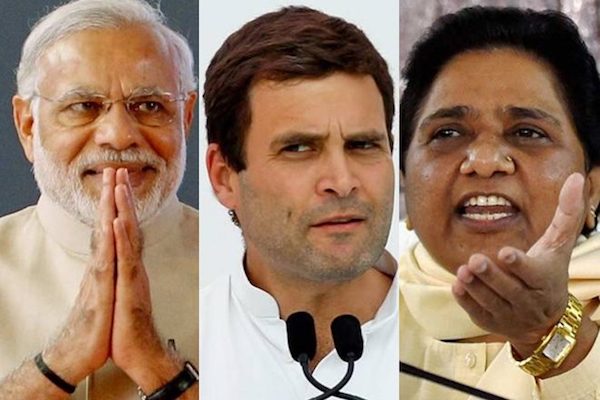
Modi, Mayawati, Rahul likely in Prime Ministerial race
By Ven Parmeswaran
“It’s too early to write off Modi’s prospects. He remains a popular figure and powerful orator, and his party is India’s best funded and best organized. Yet it is clear Modi’s tax-and-spend model of development is failing to enthuse voters. Tuesday’s results suggest discontent in the Hindi heartland, a region that in 2014 gave the BJP two-thirds of its parliamentary seats. Simply put, Modinomics is not working. When Modi was elected, he promised to invigorate the economy by providing “maximum governance” with “minimum government” and replacing red tape that would have allowed market forces to play a larger role in India’s inefficient economy.”
It could be anybody’s guess. But what appears for now, the 2019 general elections are more likely to throw up a hung parliament. Modi as Prime Minister for another term may not be a certainty. A dark horse like Mayawati could be the Prime Minister. Rahul Gandhi may also not be ruled out.
In the recent elections held in Madhya Pradesh, Rajasthan and Chhattisgarh, Modi’s BJP crashed to unexpected electoral defeats. The Congress has won in Rajasthan and Chhattisgarh and fell just short of an outright majority in Madhya Pradesh.
Madhya Pradesh and Chhattisgarh are widely regarded as BJP strongholds. To put the results in context, India’s main opposition party has been consistently losing elections since it was routed in the seismic 2014 elections that brought Modi to power, winning less than 20% of the popular vote and securing only 44 of the 543 seats. Prior to its latest victories ,the Congress was in power in only two large states.
The BJP won 62 of the 65 parliamentary seats in these three key states in the last general elections. Rajasthan, Madhya Pradesh and Chhattisgarh are also part of a bellwether region – the Northern Hindi speaking heartland of India – that gave the BJP and its allies 203 of the 225 seats that they won in 2014. So the Congress’s robust performance – it gained 163 assembly seats here since 2013 state polls – is a shot in the arm for the party. It will bolster the morale of party workers, make it more acceptable to skeptical regional allies, and boost the image of its leader Rahul Gandhi. It will also send out the significant message that Modi’s BJP is not invincible and can be defeated. All this will help Congress gain some much-needed momentum in the run-up to next year’s crucial elections. However, these state polls may be an unreliable barometer for next year’s big elections.
Modi won the general elections in 2014 with only 31% of votes. Today, his opposition is ruling Punjab, Delhi, West Bengal, Tamil Nadu, Kerala, Andhra, Telangana, Karnataka, Madhya Pradesh, Rajasthan, Chhattisgarh, representing majority of 535 parliamentary seats. Even in his home state of Gujarat, Modi’s party won only marginally. For ambitious political leaders of these States Mayawati-Samajwadi coalition could be very attractive to defeat Modi. Such an outcome could create power in the center for Modi’s opposition, even excluding the Congress.
There was considerable anti-incumbency against the BJP in these states – the party was trying for a record fourth term in both Madhya Pradesh and Chhattisgarh. People in Rajasthan have a consistent record of voting out the incumbent after one term. The BJP workers can take solace from the fact that the party still put up a spirited fight in two of the three states, despite the formidable odds of anti-incumbency. Secondly, the majority of seats in three states witnessed bipolar contests between the BJP and the Congress. In general elections, regional parties will hold the key. Next year much will depend on the kind of strategic regional alliances the Congress is able to stitch up and sustain in different states. Thirdly, one of the BJP’s greatest strengths is having capable leaders in several states, many of whom who have completed more than one term. Hobbled by dynastic politics, the Congress has failed to groom young local leaders, depending mainly on the charisma of the Nehru dynasty. Also, the Congress appears to lack political imagination and has been unable to produce a powerful alternative to the BJP.
“It seems to be courting on anti-incumbency to do the work, a complacent attitude that has made the BJP competitive in areas where it has gathered genuine discontent, against the lack of development outcome, unemployment and rural distress,” says political scientist Gilles Verniers of Ashoka University.
In their new book, Ideology and Identity, political scientists Pradeep K Chhibber and Rahul Verma from the University of California, argue that India “is no longer led by a Western oriented elite, and citizens have voted into power politicians closer to their roots, politicians who represent small town socially conservative values, in the BJP or regional parties”. This is a shift of power to a “more conservative and vernacular elite” which seems to have escaped the Congress.
WHAT REMAINS ABUNDANTLY CLEAR IS THAT THE 2019 GENERAL ELECTION WILL BE A REFERENDUM ON MODI, AND, WHO CAN LEAD IN WINNING COALITIONS AND FORM THE GOVERNMENT?
Modi’s grandiose promises – specially to create more jobs and increase incomes of farmers – have begun to bite. Lack of jobs and declining farm incomes will be the deciding issues next year, although whether the farmers will vote as an “angry bloc” against what is now being perceived as an “arrogant” government will become clear closer to the Summer polls.
But the failure to offer an alternative narrative of hope to the people will make it difficult for the Congress and its often fractious allies to mount a credible challenge to Modi, who still remains the BJP’s star vote-catcher.
MAYAWATI COULD EMERGE AS THE HERO OF THE OPPOSITION TO MODI
Mayawati is central to opposition plans to take government because rising sectarian tensions have led to increased Dalit support. A woman who represents millions of India’s poorest citizens (India has 300 million poor) is now India’s most sought after politician. Mayawati, an icon of the country’s traditionally oppressed Dalits who were once known as “untouchables,” is central to opposition efforts to prevent Prime Minister Modi’s reelection in 2019. With rising sectarian tensions leading to stronger political unity among Dalits – a swing force that consists of about 16.6 percent or 200 million of India’s population – many parties are turning to Mayawati to forge an alliance ahead of general election.
Mayawati, who was the former Chief Minister of Uttar Pradesh may be a front runner for Prime Minister if there is a hung parliament and neither Modi’s BJP nor Rahul Gandhi’s main opposition Congress Party can form government, said Ajoy Bose, a Delhi based political analyst who wrote a biography of the 62-year-old.
“Almost from a position of political oblivion, there are signs of the resurrection of Mayawati,” said Bose. “She has definitely regained ground dramatically. There is a possibility that she could even be a Prime Ministerial candidate – the whole idea of having such a prominent Dalit leader as Prime Minister will be tempting for a lot of other parties as it will give them some edge.”
In Uttar Pradesh, which holds the key to forming the national government, Modi’s ruling National Democratic Alliance would lose 35 seats compared to the 2014 elections if Mayawati’s Bahujan Samaj Party and the Samajwadi Party joined forces, according to one poll. Similarly, Congress could make sizeable gains in the State if it joins hands with those parties. Another survey, from India Today, predicted an alliance of opposition parties would come out neck and neck with Modi’s ruling coalition.
Modi won in the general elections in 2014 with only 31% of votes. Today, his opposition is ruling Punjab, Delhi, West Bengal, Tamil Nadu, Kerala, Andhra, Telangana, Karnataka, Madhya Pradesh, Rajasthan, Chhattisgarh representing majority of 535 parliamentary seats. Even in his home state, Modi’s party won only marginally. For ambitious political leaders of these States Mayawati-Samajwadi coalition could be very attractive to defeat Modi. Such an outcome could create power in the center for Modi’s opposition even excluding the Congress.
Sadanand Dhume of the WSJ wrote: “It’s too early to write off Modi’s prospects. He remains a popular figure and powerful orator, and his party is India’s best funded and best organized. Yet it is clear Modi’s tax-and-spend model of development is failing to enthuse voters. Tuesday’s results suggest discontent in the Hindi heartland, a region that in 2014 gave the BJP two-thirds of its parliamentary seats. Simply put, Modinomics is not working. When Modi was elected, he promised to invigorate the economy by providing “maximum governance” with “minimum government” and replacing red tape that would have allowed market forces to play a larger role in India’s inefficient economy.”
(Ven Parameswaran of Scarsdale, N.Y. is a Senior Adviser to the Imagindia Institute, a think tank in New Delhi)
The Delhi High Court judgment convicting Sajjan Kumar reminds the country that it must not forget mass killings
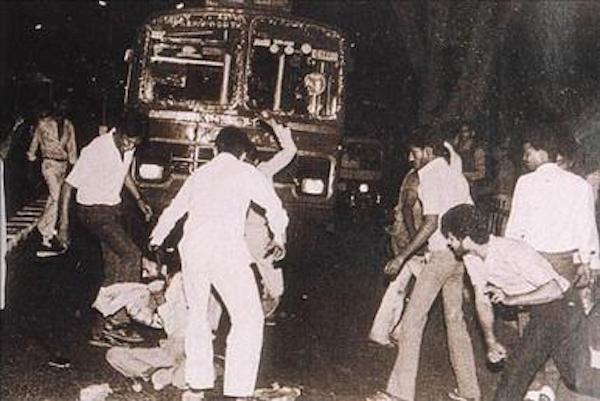
Thirty-four years after the assassination of Prime Minister Indira Gandhi and the killings of Sikhs that followed, a political leader who may have electorally benefitted from communal violence has been sentenced to imprisonment for life. The wheel of history has turned ever so slowly, as some believe, but its arc may have yet turned towards justice. The assassination of Indira Gandhi, on October 31, 1984, was a national tragedy. The anti-Sikh pogrom that followed in north India, with the worst violence taking place in Delhi, was a greater tragedy. But the greatest tragedy of all was the stonewalling of investigation by the law enforcement agencies, and the seeming deafness of the justice delivery system. The judgment reconstructs the scene of violence and all the waiting that followed.
Maze of inquiries
It took years of commissions of inquiry and other inquiries before six accused, including Sajjan Kumar, a formidable Congress leader in Delhi, who was a member of Parliament at the time, were sent up for trial sometime in 2010. Three years later, the trial court convicted five of the accused: three of them for the offences of armed rioting and murder, and two of them for the offence of armed rioting. Kumar stood acquitted by the trial court of all offences. Those convicted as well as the Central Bureau of Investigation appealed to the Delhi High Court. Now, the Bench of Justices S. Muralidhar and Vinod Goel has overturned the April 2013 judgment of the trial court and sent Kumar to prison for life. Their judgment carries the echo of the crimes committed in the days after Mrs. Gandhi’s assassination and failure to hold the guilty to account for so long.
The judgment finds: “The accused in this case have been brought to justice primarily on account of the courage and perseverance of three eyewitnesses. Jagdish Kaur whose husband, son and three cousins were the five killed; Jagsher Singh, another cousin of Jagdish Kaur, and Nirpreet Kaur who saw the Gurudwara being burnt down and her father being burnt alive by the raging mobs. It is only after the CBI entered the scene, that they were able to be assured and they spoke up. Admirably, they stuck firm to their truth at the trial.”
Staying the course
As a result of their testimony, Sajjan Kumar now stands convicted for conspiracy to murder and for the abetment of murder, in the deaths of Kehar Singh and his 18-year-old son Gurpreet Singh, and the killings of Raghuvinder Singh, Narender Pal Singh, and Kuldeep Singh — all members of the same family. I mention the names of the dead because the dead in communal violence should not lose their vestigial humanity by being simply reduced to a score of unnamed victims.
Kehar Singh’s wife, Jagdish Kaur, was one of the principal witnesses against Sajjan Kumar. The other principal witness is her cousin Jagsher Singh, whose brothers Raghuvinder and Narender Pal Singh were also killed on November 1, 1984. The high court judgment notes Jagdish Kaur’s recollection: “At around 9 am on 2nd November 1984, when she went to lodge a report at the PP, she saw that a public meeting was taking place which was attended by A-1 who was the local Member of Parliament (MP). She heard him declare, “Sikh sala ek nahin bachna chahiye, jo Hindu bhai unko sharan deta hai, uska ghar bhi jala do aur unko bhi maro.”
The judgment records Jagsher Singh’s recollection that “around 10 p.m., he saw an Ambassador car which stopped at the turning onto Shiv Mandir Marg. He stated that 30-40 persons gathered around the car from which emerged A-1 who enquired as to whether ‘they have done the work’. Thereafter, it is stated, A-1 approached the house of PW-6 (Jagsher Singh) to inspect it and came back and told the assembled mob that they had ‘only broken the gate of the thekedars’ house’. One of the members of the mob then allegedly informed him that ‘the thekedars are being saved by the Hindus only’. Upon hearing this, A-1 is stated to have instructed the mob to burn the houses of the Hindus who were sheltering the Sikhs. He then left in his car.”
The court rules: “To this Court, PW-1 [Jagdish Kaur] comes across as a fearless and truthful witness. Till she was absolutely certain that her making statements will serve a purpose, she did not come forward to do so. This is understandable given the fact that all previous attempts at securing justice for the victims had failed. The large number of acquittals in the cases demonstrated how the investigation was completely botched-up. It also demonstrated the power and influence of the accused and how witnesses could easily be won over. The atmosphere of distrust created as a result of these developments would have dissuaded the victims from coming forward to speak about what they knew. In the context of these cases, the factum of delay cannot be used to the advantage of the accused but would, in fact, explain the minor contradictions and inconsistencies in the statements of the key eye-witnesses in the present case. Nothing in the deposition of PW-1 points to either untruthfulness or unreliability. Her evidence deserves acceptance.”
A moment of reflection
Sajjan Kumar is not very different from many other politicians of this era, who use mob emotions to ride to power. However, he is probably the first to be held guilty of conspiring with the mob to cause the deaths of his constituents. It is for us as a country to ensure that mob violence yields no political dividends. If we as voters decide to electorally punish those who incite mobs, yield to them, or fail to stop their violence, the resort to politics of mass murders will simply stop. The judgment notes that “there has been a familiar pattern of mass killings in Mumbai in 1993, in Gujarat in 2002, in Kandhamal, Odisha in 2008, in Muzaffarnagar in U.P. in 2013 to name a few. Common to these mass crimes were the targeting of minorities and the attacks spearheaded by the dominant political actors being facilitated by the law enforcement agencies. The criminals responsible for the mass crimes have enjoyed political patronage and managed to evade prosecution and punishment.”
It also says: “While it is undeniable that it has taken over three decades to bring the accused in this case to justice, and that our criminal justice system stands severely tested in that process, it is essential, in a democracy governed by the rule of law to be able to call out those responsible for such mass crimes. It is important to assure those countless victims waiting patiently that despite the challenges, truth will prevail and justice will be done.”
While the 1984, 1993, 2002, 2008 and 2013 riots are painful episodes in our history, the judgments of the Delhi High Court of 2018 in the Sajjan Kumar and Hashimpura cases shine like good deeds in a naughty world. Milan Kundera wrote that “the struggle of man against power is the struggle of memory against forgetting”. The judgment tells Kehar Singh, Gurpreet Singh, Raghuvinder Singh, Narender Pal Singh and Kuldeep Singh, that neither Jagdish Kaur nor India have as yet forgotten them.
(The author is a senior advocate of the Supreme Court)
India needs to be cautious, but should not completely shut itself to talks
By G Parthasarathy
“Imran Khan has reached out to India, urging the resumption of dialogue and India’s participation at SAARC summit in Islamabad. Our standard reply ‘talks and terrorism can’t go together’ is not endorsed internationally and conveys rigidity. It needs to be nuanced”, says the author.
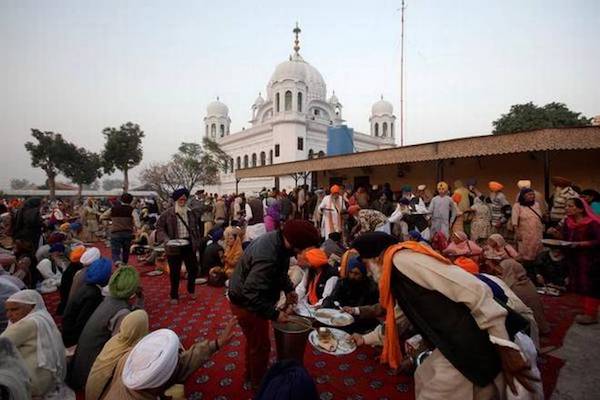
Pakistan’s sudden decision to open the Kartarpur shrine for Indian pilgrims predictably raised suspicions in India. Pakistan had earlier opened other Sikh holy shrines, like Gurdwara Nankana Sahib and Dera Sahib Gurdwara in Lahore, under a bilateral agreement. The decision to open the Kartarpur shrine, located virtually on the India-Pakistan border, was, however, conveyed ‘informally’ by Pakistan’s army chief Gen Bajwa to Punjab’s tempestuous minister, Navjot Sidhu. Interestingly, General Bajwa’s sudden interest was manifested much after repeated requests by Indian leaders, including former PM Vajpayee, were ignored.
This unusual action by Pakistan’s army chief raised hackles in New Delhi, as the Pakistan army controls the gurdwaras there through the Pakistani Gurudwara Prabandak Committee. This committee’s first head was former ISI chief, Lt Gen Javed Nasir, the mastermind of the 1993 Mumbai blasts. ‘Khalistani’ flags are often provocatively raised during visits of Sikh pilgrims from India. They are also constantly sought to be incited by specially invited ‘Khalistani’ activists from countries like Canada, the US and the UK. Obviously, the ISI is now again looking to fish in troubled waters in Punjab, evident from the recent terrorist strike in Amritsar and the continuing smuggling of narcotics across the border.
These developments took place when PM Imran Khan was engaged in organizing countrywide celebrations for his first hundred days in office. Contrary to his expectations, his first hundred days have been marked by a less than satisfactory performance in fulfilling the expectations he had raised. This happened despite being the blue-eyed boy of the army, which had facilitated his election as Prime Minister. Pakistan’s foreign exchange reserves have reached the perilously low level of $8 billion. With the country expecting to have a further $12 billion trade deficit in the current financial year, Pakistan had to go with bended knees to its past financial mentors — Saudi Arabia, China, US, EU, UAE and IMF — for a bailout.
The Saudis were not quite as generous as they have been in the past. On offer was a short-term deposit of $3 billion in a Pakistani bank and a similar offer of petroleum under a short-term, deferred payment arrangement. The IMF imposed strict conditionalities, including asking for details of repayment liabilities on Chinese loans for CPEC. Negotiations with the IMF are presently on hold. Pakistan’s expectations of long-term, low-interest/interest-free credits from China were not fulfilled. The US has ended military and economic aid for Pakistan. Pakistan’s finance minister Asad Umar recently proclaimed: ‘Right now, we have a $18 billion deficit and $9 billion of debt repayment due this year, which brings the total to $27 billion… we cannot afford that.’
Imran Khan has reached out to India, urging the resumption of dialogue and India’s participation at SAARC summit in Islamabad. Our standard reply ‘talks and terrorism can’t go together’ is not endorsed internationally and conveys rigidity. It needs to be nuanced. Detailed ‘back-channel’ negotiations after the JeM attack on our Parliament, resulted in an agreement in which General Musharraf assured Vajpayee that ‘territory under Pakistan’s control’ would not be used for terrorism against India. Pakistan abided by that assurance till 2007. The Composite Dialogue Process also resumed on all issues, including Kashmir. There was progress, based on PM Manmohan Singh’s offer that while ‘borders can’t be redrawn’, we can work towards making them ‘irrelevant’ by making them ‘just lines on a map’. The 26/11 attacks ended it.
Pakistan would like to resume the Composite Dialogue Process. This should be rejected as terrorism is accorded a low priority. This does not mean that India should cut off all diplomatic contacts with Pakistan. It is essential that we stand firm on refusing to discuss J&K unless the sponsorship of terrorism ends.
But we go wrong by equating the priorities of the Pakistan army, with the interest about India across wide sections of ordinary Pakistanis. Vajpayee’s directive on liberal issue of visas, particularly to Mohajirs in Karachi and urban Sind, produced dramatic results in changing public opinion about India. It pays us richly to expose ordinary Pakistanis to realities in contemporary India. We need to welcome exchanges of visits by students, academics, business organizations, cultural troupes and those with familial ties.
There also has to be firmness and realism in dealing with the Pakistan military establishment. Pakistan has to be told bluntly that it has rendered SAARC non-functional and SAARC Free Trade Agreement meaningless by its restrictions on Indian exports and by denial of transit to Afghanistan. Not just India, Bangladesh and Afghanistan should also have reservations on the next summit being hosted in Pakistan. Moreover, Pakistan wastes time and resources in pushing for China, which is not a South Asian country, to be admitted to SAARC. This is a proposal India will not accept. We need not, therefore, be in a hurry to respond positively to Imran Khan’s call for an early summit.
Apart from reaching out to people, back-channel contacts — free from the glare of publicity — between diplomats, army officials and intelligence agencies are essential to deal with terrorism and bilateral cooperation, while at the same time, maintaining pressure to respond to challenges of terrorism. With the snows closing the passes, cross-border terrorism in the Valley falls. Imran Khan has shown some readiness to consider moving forward on proposals to address the J&K issue, on lines akin to what happened in 2004-2007, when terrorism was minimal. We can, however, address major issues only after the general election. But we should spare no effort to raise the costs of sponsoring terrorism for the military establishment of Pakistan.
“If Congress were to wins elections in 2019, the BJP supporters will go ballistic against the elected government and that is the time Congress party needs to show its civility, and they will, as they have a proven record. Unlike our Goonga Prime Minister, the Congress Prime Minister will speak out against anyone calling the BJP supporters anti-National or anti-Hindu. No one is anti-National or anti-Hindu, it is the wild imagination of fanatics among BJP to sow the seeds of discord.”
Atsunami of good news has just hit India, five of the 29 states of India held the elections in December 2018, and produced amazing results, and the winner is the Indian Democracy.
Parties come and go, but what is constant is our freedom. Freedom to speak, freedom to prosper, and freedom to marry whom you want, eat what you want, drink what appeals to you, wear what works for you, and believe whatever the hell suits you.
I am sure no Indian wants someone to tell him or her how to live. The BJP followers will not like what the Congress may tell them to do, and the same is true the other way around. The durable policy is to follow the principles of freedom.
Modi has time to show that he really believes in Democracy and is not authoritarian. He can do that by initiating three national awards; Patriotic Citizen, Patriotic Media and National Chamcha Award. The award goes to those individuals and News Media who relentlessly criticize the government to keep them on their toes, and National Chamcha Award goes to the individuals who consistently equate support for Government as a Patriotic act. A true patriot would hold the feet of the government to the fire rather than do the chamchagiri and let the country make mistake after mistake.
If Congress were to wins elections in 2019, the BJP supporters will go ballistic against the elected government and that is the time Congress party needs to show its civility, and they will, as they have a proven record. Unlike our Goonga Prime Minister, the Congress Prime Minister will speak out against anyone calling the BJP supporters anti-National or anti-Hindu. No one is anti-National or anti-Hindu, it is the wild imagination of fanatics among BJP to sow the seeds of discord.
I am proud of India’s freedom and salute the men and women who went to jail and took the beatings but chose to fight for freedom. They not only got the freedom but set up great institutions for India. Today India is among the top 7 powerful nations, and the credit goes to Gandhi, Nehru, Azad, Patel, Ambedkar and a few others who had the vision and laid the foundation of a great nation.
Two BJP contestants in two states, a Minister for Cow Welfare and Minister for Happiness lost the elections badly. This is a major loss and a clear signal to the party that Indians cannot be fooled over and over again with the issue of cow or the building of a temple.
Whether you align with BJP, INC or other parties, you have the freedom to speak and prosper because the foundation of our nation was laid out on the principles of Democracy. We cannot let anyone curb those freedoms, the media needs to be free and people need to free.
I admire Modi’s supporters in America and their loyalty. I wish they show the same devotion to India by respecting every Indian without prejudice.
Do you recall a tyrant grandfather or even a father, who is all about control, he claims to live a simple life, but wants to keep everyone under his thumb? Our Prime Minister, under the guise of Sanyasi (hermit), claims that he has nothing to gain and wants nothing. How does he account for enriching his friends? Would a Sanyasi do that?
We cannot blame Modi for who he is, he is conditioned by the RSS schools where they teach exclusive ideology and disrespect to others who do not think like them. A majority of Hindus innocently believe that RSS is a service organization but fail to see the poison it injects into the innocent children. I wish Modi frees himself from the petty Hindutva ideology and becomes an all-embracing leader and a giant like Nehru.
I pray that a handful of right-leaning Hindu Americans fight their temptations to support the forces in India who want to deny the freedoms to ‘other’ Indians. Their American born children think they are stupid to have such hatred towards the other.
Whether you align with BJP, INC or other parties, you have the freedom to speak and prosper because the foundation of our nation was laid out on the principles of Democracy. We cannot let anyone curb those freedoms, the media needs to be free and people need to free.
A young Hindu Medical doctor doing his residency stayed with me for a month while attending a conference in Washington DC. We had terrific conversations on a daily basis. He wished his parents had the opportunity to know Muslims, Christians, Dalits, Sikhs, and the Blacks. He deplored their hatred towards them. He said, he has lived in the dorms, and everything they have said about others was wrong.
There are parents out there who are selfish and poison their kids by injecting ill-will towards others. Some Hindu parents tell their kids how bad Muslims, Christians and Sikhs are and vice versa goes as well, they even believe Dalits are untouchables. The dumb men (women are not as hateful) don’t realize that when the kids grow up in America, they have to work with the very people they were told to stay away from. It must be painful for the kids to work with others, many of them wish they did not have such ugly parents. I urge the Indian Americans not to poison their kids, the kids have sixty to seventy years to live, let them decide whom to love or hate based on their personal experience and not prejudice.
The Law of Karma does not spare anyone. Modi’s arrogance will bring him down in 2019. He has got to stop bullshitting Indians with issues that don’t put food on their tables or clothe their kids or have clean drinking water. Let him make one promise and keep rather than make ten and cheat.
All of us want the best for fellow humans including Modi. Mr. Modi can make a comeback in 2024 if he turns BJP into a party where every Indian, be it a Muslim, Sikh, Christian or Dalit wants to become a member of his party. He has got to do his praischit (repentance) for quietly letting a few goons to go on a killing spree in 2001. Indians will forgive him if seeks forgiveness. Hinduism is not a religion of violence or revenge, it is not about forcing others to eat, drink or believe against their will. It Hinduism is not a violent religion, then the moderate Hindus have an obligation to protect the image of Hinduism and not let the Hindutva guys tarnish it.
Indians are good people, they are as good as gold. They are clamoring for a leader who can bring jobs and don’t want to be fooled again.
Two BJP contestants in two states, a Minister for Cow Welfare and Minister for Happiness lost the elections badly. This is a major loss and a clear signal to the party that Indians cannot be fooled over and over again with the issue of cow or the building of a temple.
(The author is a public speaker and the Executive Director of the Center for Pluralism in Washington, DC. He is committed to building cohesive societies and offers pluralistic solutions on issues of the day. More about him at https://www.linkedin.com/in/mikeghouse/)
“It is quite confusing for an ordinary Indian to figure out the motivation for the Prime Minister to honor a devoted Congressman and freedom fighter who is a Gujarati ahead of another great leader from the state: Mohandas Karamchand Gandhi. Nevertheless, to the world, Gandhi, Nehru, and Patel will remain great icons of freedom and justice, and the height of the statues will not diminish their greatness one way or the other.”
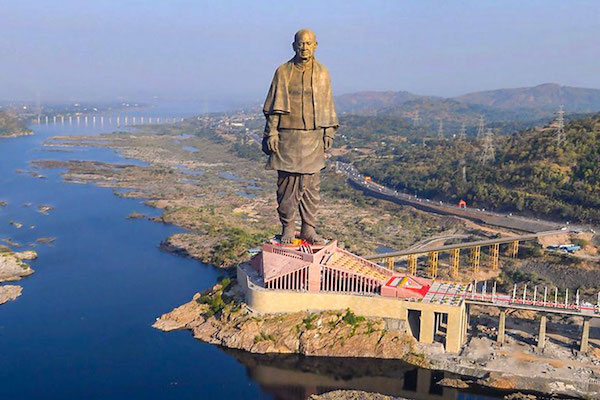
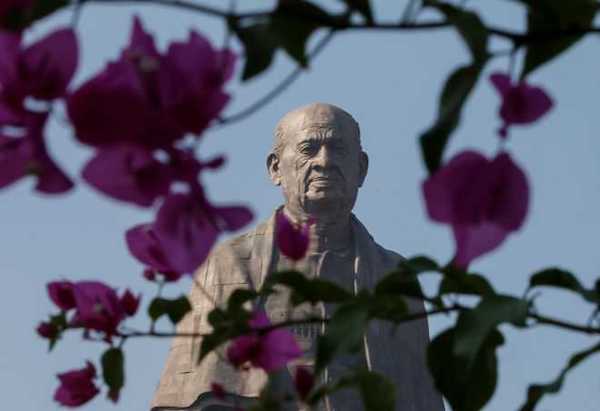
Prime Minister Narendra Modi inaugurated the world’s tallest statue of Sardar Vallabhbhai Patel, the Iron Man of India, who was the first home minister, on his 143rd birth anniversary in Gujarat recently. The country has spent about Rs 3000 crore (about $430 million) from the treasury on the monument, which is being promoted as a Statue of Unity. It reflects Patel’s efforts after Independence to consolidate the princely states into the current Republic of India.
We owe it ourselves to remember our heroes and icons of history and it is also the legacy of these legends that motivates us to go forward. Our lives are indeed built upon the shoulders of these giants who went through immeasurable hardships to guarantee us the freedom and liberty we enjoy today.
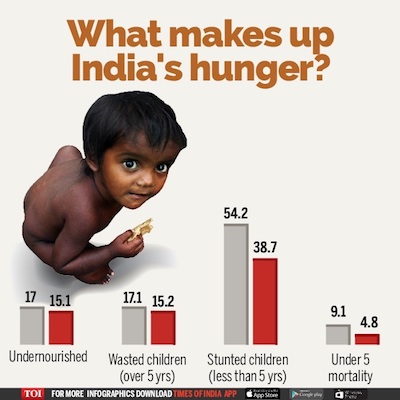
Nobody questions the wisdom of honoring Sardar Patel. However, they will be hard-pressed to explain how in a country that ranks at the bottom of the list of nations in ensuring food security for its people could afford such a luxury. According to the latest report on the Global Hunger Index, India ranks 100 out of 119 on an index that weighs the ability of countries to provide food for its citizens. India fares worse than Iraq, Bangladesh, and North Korea.
Then again, if we were to build the tallest statue for anyone, the first name on anybody’s list would be of Mahatma Gandhi, who is not only the father of the nation but also world-renowned for his philosophy of non-violence. Gandhi was considered a great inspiration for world leaders such as Nelson Mandela and Martin Luther King Jr and many cities in the world are adorned with his statues.
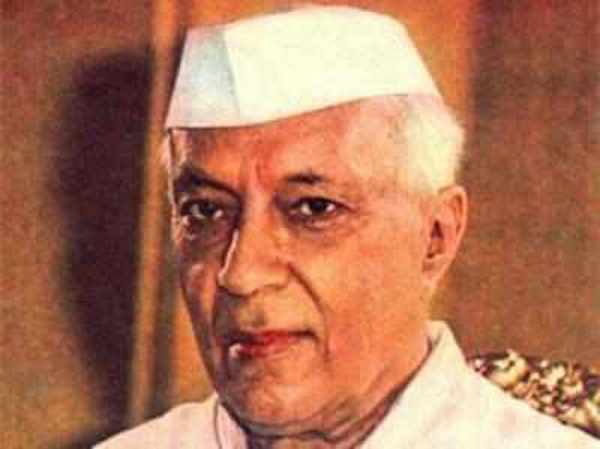
Then there was Jawaharlal Nehru, the first prime minister, and architect of modern India who spent almost ten years in prison under the British and was considered the foremost leader in the freedom struggle. It should be remembered that Patel’s heroic effort for national integration was conducted under Nehru’s leadership. Nehru inherited an India where life expectancy was 31 years, only 20 percent of the people could read or write, and 80 per cent of the people could not afford two meals a day.
It was Nehru along with B.R. Ambedkar who built institutions that have continued to provide freedom, justice, and opportunities to every Indian citizen regardless of caste, creed, region or religion. However, today, the ruling BJP is engaged in running a bitter campaign to undo and discredit his legacy of secularism and inclusiveness. It would be a grave injustice to forget Nehru’s significant role in building a post-independent democratic society and imbuing it with pride and purpose at a time of conflict and chaos.
Sardar Patel was a loyal Congressman who upheld the values and principles of the Congress party which he served throughout his . Since the ascendance of the BJP to power in New Delhi four years ago, it appears that a carefully crafted strategy is in place to appropriate icons and legacies that the party is sorely lacking. It is as if the party is so embarrassed by the lack of pedigree that it is even willing to go out and create some history of its own.
After Mahatma Gandhi was assassinated, it was Sardar Patel who was instrumental in banning the RSS. He subsequently wrote to RSS chief M.S. Golwalkar on September 11, 1948: ‘As regards to RSS and Hindu Mahasabha, our reports do confirm that as a result of the activities of these two bodies, particularly the former, an atmosphere was created in the country in which such ghastly tragedy became possible.’
It is known that the RSS remained aloof during the freedom struggle. The words and deeds of erstwhile leaders of the RSS from recorded history indicate that they were not only non-participants in the freedom struggle in which hundreds of people were risking their lives every day but also collaborators who supported the British on critical occasions. The British acknowledged that the RSS had ‘scrupulously kept itself within the law, and refrained from taking part in the disturbances that broke out in August 1942.’
Therefore, it is quite confusing for an ordinary Indian to figure out the motivation for the Prime Minister to honor a devoted Congressman and freedom fighter who is a Gujarati ahead of another great leader from the state: Mohandas Karamchand Gandhi. Nevertheless, to the world, Gandhi, Nehru, and Patel will remain great icons of freedom and justice, and the height of the statues will not diminish their greatness one way or the other.
(The author is a former Chief Technology Officer of the United Nations and Vice-Chairman of the Indian Overseas Congress, USA)
“Mr. Trump, wary of not disrupting his West Asia policy, may stay the course on Saudi Arabia for now. But the growing criticisms of the partnership on Capitol Hill can’t be ignored. The Senate has already voted with a huge majority to move forward legislation to end the U.S. involvement in the Yemen war.”
The Central Intelligence Agency (CIA) has reportedly concluded that Mohammed bin Salman, the Saudi Arabian Crown Prince, personally ordered the killing of Jamal Khashoggi. The murder of the Saudi dissident journalist at the Kingdom’s Istanbul consulate on October 2 has already triggered a global outrage against MBS, as the Crown Prince is known. But U.S. President Donald Trump seems unfazed by both the findings of his spy agency as well as the mounting global outcry. He called the CIA assessment “very premature”, while Secretary of State Mike Pompeo said the U.S.’s “historic commitment” to Saudi Arabia is “absolutely vital to America’s security” and its “interests in the Middle East”.
Thinking like realists
This is a popular argument in Washington. Realists would say the relationship with Saudi Arabia is so vital for American national interests that the U.S. should overlook certain aspects of Saudi behavior. The Trump administration repeats this argument to justify its lack of action against Riyadh in the wake of the murder of Khashoggi. But does Saudi Arabia actually have such leverage over America?
The Saudi-U.S. partnership can be dated back to the 1945 meeting between President Franklin D. Roosevelt and Saudi King Abdulaziz ibn Saud, the founder of modern Saudi Arabia and father of current monarch Salman bin Abdulaziz. In the meeting, held on board the USS Quincy in the Suez Canal, both leaders came to a two-way agreement: the U.S. would support and provide military training for Saudi Arabia, while the Kingdom would provide oil and political backing in return. This alliance made sense for both countries during the Cold War. The Saudis were anxious about communist expansion into the Arab/Muslim world. Half of Yemen fell into the hands of Marxists in 1967, and in 1978 communists took power in Afghanistan. And the U.S. wanted uninterrupted flow of oil for its own economic expansion and the post-war reconstruction of Europe. It also wanted a political ally in West Asia.
But the conditions that laid the foundation of this partnership have changed. The Soviet Union fell apart almost three decades ago. America’s dependency on Saudi Arabia for oil has also decreased over the years. True, Saudi Arabia remains a major supplier of oil to the U.S. But it doesn’t have the leverage over the American economy as it had in 1973 when Arab countries imposed an embargo on mostly Western nations in protest against their support for Israel during the Yom Kippur War with Egypt. The U.S. is now one of the top three crude producers, along with Russia and Saudi Arabia.
Other arguments in favor of stronger partnership cite the massive Saudi investments in the U.S., both treasury securities and private businesses. But Saudi Arabia acts in its interest, not with the goal of helping the U.S. economy. If it sells its U.S. assets, that would also hurt the Saudi economy badly. After all, from economic diversification at home to security guarantees, Saudi Arabia needs the U.S. more than the other way around, which offers Washington room for strategic man oeuvre.
While the strategic potential of the partnership has been shrinking, the U.S. has come under greater scrutiny, especially in the post-9/11 world, for its support for Saudi Arabia, the Wahhabi kingdom that stands opposed to everything the U.S. preaches on global stages — from democracy and respecting human rights to religious freedom and independent media. It was this broad context that allowed former U.S. President Barack Obama to take a different approach towards Saudi Arabia. He retained the fundamental elements of the partnership, including trade and economic ties, arms sales and security guarantees, while refusing to act in Syria on the Saudis’ behalf and moving further ahead to strike a nuclear deal with Iran. He even asked the Saudis and the Iranians to share West Asia and institute a “Cold Peace” in the region.
Back to square one
But President Trump has reversed this approach and rebuilt the administration’s West Asia policy, making Saudi Arabia its centerpiece. The twin objectives of the Trump policy are to ensure Israel’s security and roll back Iranian influence. It’s this tilt that is now stopping him from moving against the Saudis. The administration has already declared what its Iran policy is. It has already pulled the U.S. out of the Iran nuclear deal. And the Americans need Saudi support in their effort to isolate and weaken Iran, something Israel too has been demanding for years. But this is not a larger national security argument, nor is it a realistic one. When the fundamentals of a partnership get weakened and the region undergoes major changes, how long can the U.S. allow its Iran obsession to dictate its policies towards West Asia?
From the realpolitik point, even if the U.S. wants to limit Iranian influence, Saudi Arabia under MBS is not helping the cause. It lost the Syria war. Its intervention in Yemen drove the Houthis further into Iran’s embrace. The Qatar blockade has divided the Arab world (Qatar has now quit OPEC as well). The detention of the Lebanese Prime Minister last year has played Lebanese politics into the hands of Hezbollah, the Iran ally.
Mr. Trump, wary of not disrupting his West Asia policy, may stay the course on Saudi Arabia for now. But the growing criticisms of the partnership on Capitol Hill can’t be ignored. The Senate has already voted with a huge majority to move forward legislation to end the U.S. involvement in the Yemen war. Republican Senator Bob Corker accused the White House of “moonlighting as a public relations firm for the Crown Prince”. Rand Paul, another Republican Senator, says it’s time for America to stand up and tell Saudi Arabia, “enough”. These are not isolated moral outbursts; they suggest changing undercurrents. There is a growing realization in Washington that the Saudi pillar of its West Asia policy is getting weak. Mr. Trump, driven by his own notional obsessions, might overlook it. But future American Presidents can’t. They may have to start from where Mr. Obama stopped.
(Source: The Hindu. The author is a columnist. He can be reached at stanly.johny@thehindu.co.in)
“Nothing has worked, and we are today in suspended animation between Mr. Modi’s India-centric vision of the region and the Pakistani military’s control of the geopolitical discourse in Islamabad. At such a time comes the possibility held out by the Kartarpur Corridor.”
For a flickering moment in the last week of November, it seemed as if Congress provocateur and Punjab Minister Navjot Singh Sidhu might set the geopolitical agenda, when he unabashedly spoke of the need for India and Pakistan to mend fences. He was in Lahore on the occasion of the start of work on the Kartarpur Corridor, meant to ease the travel of Sikh pilgrims to the resting place of Guru Nanak.
Unfazed by ridicule on Indian television, the cricketer-turned-politician spoke of peace, trade and people-to-people contact, all of them lost causes of the ‘track two’ dialogues of past decades. His confidence seemed to emanate from being a Sikh and Punjabi reaching out to Pakistani Punjab, and in his wordy sermons one actually detected the formula for India-Pakistan cohabitation, which would also catalyze cooperation in the larger South Asian region.
Ultra-nationalist fog
Peace in the Subcontinent presupposes amity between India and Pakistan, and more than 40 years of efforts at regionalism has been held hostage by hostility of the two, with the other countries watching askance.
The abuse hurled by the state establishments of each side is a populist political tool that distracts the public from pressing matters of growth, equity, democracy and accountability. That the cost of maintaining massive militaries in each country drags down efforts at social justice is lost in the fog of ultra-nationalism.
India, as the more stable democracy, should inculcate empathy for the neighbor, but the New Delhi commentariat tends not to recognize the difference between the Pakistani state and its people, the latter struggling against extremism, military supremacy and state-centralism all at one go.
Indian media by and large is not bothered by the travails of Pakistanis, as right-wing trolls rule the airwaves and social media. Similar to how dissent is sought to be silenced with the ‘Urban Naxal’ tag, since long those seeking India-Pakistan amity and South Asian regionalism are rejected as romantic peaceniks lighting meaningless candles at Wagah-Atari.
The trolling and abuse on all matters related to Pakistan can be expected to peak as India’s general election of 2019 draws near, which will only help Islamabad’s military-intelligence complex tighten its grip on the society. It is high time to try once again for a plan for South Asian regionalism.
Opportunity costs
The potential of South Asia for sustained high growth has been blocked by the tightened national borders, with India playing its part by building barbed wire fences on the Pakistan and Bangladesh frontiers. In all of seven decades, the economic history of the Subcontinent has been forgotten, with the ultra-nationalist narrative having us believe that this separate living is how it has always been.
Until Cyril Radcliffe drew the map of Partition, the economic synergy across the different parts of the Subcontinent was an unquestioned historical reality. There is no one to remember or remind that this reality of sealed borders was set only in 1947 for most parts of the Subcontinent, or that the door actually slammed shut only after the India-Pakistan war of 1965.
As the historical ‘connectivity’ of the Subcontinent crumbled, it created massive dysfunction as economies of scale and production chains were disrupted. The opportunity costs have been incalculable in terms of infrastructure, production and commerce, and the loss in livelihoods would be heart-rending if only we cared to calculate.
The present-day failure of South Asian academia is its unwillingness to theorize on the promise of economic growth and social justice that regionalism holds, through soft/open borders. Of the Indian intelligentsia, the failure is also in seeing economic geography through the New Delhi lens rather than those of the ‘peripheral’ regions, from Rajasthan to the Northeast.
‘South Asia’ must be understood as a project for social justice, to be achieved through economic rationalization, sub-regional interactions and reduced military budgets – and open borders such as exists between Nepal and India.
Counter-populism
The goal of the future should be to learn to compartmentalize one’s perceptions of the ‘other’, that Pakistan is made up of its state and its people just as India too is made up of its state and its people. The mutual demonization has to do with conflating the two, state apparatus and citizenry, as one.
While the Pakistani state is rightfully critiqued for the way the military/intelligence calls the shots — from the Kargil misadventure to cross-border militancy, to even denying Punjab province the right to import energy from India — the self-perception of India as ‘good’ and Pakistan as ‘bad’ should have been abandoned long ago.
In Pakistan, the space of the public intellectual is circumscribed by the jihadists, the army and the military intelligence. In India, a much freer country no doubt, there is the rise of pernicious ultra-populism that keeps public figures from speaking up.
In the age of Narendra Modi, proposing South Asian solidarity is frowned upon to such an extent that academics and opinion makers, not to mention bureaucracy and even international funding agencies, all think it is better to keep aloof of the concept. Since 2016, the Prime Minister has been consistent in his refusal to attend the 19th SAARC Summit slated for Islamabad, which has rendered the regional organization comatose. His vision of South Asian regionalism is where the neighbors dance to India’s tune.
The fear that South Asia as a concept heralds some kind of supra-sovereignty is misplaced, for there is no plan afoot for supplanting of the nation-state and associated group privileges. No, the capitals are not being asked to relinquish their powers to a Subcontinental center.
Instead, a realistic formula for South Asian regionalism lies in allowing the federal units of the two largest countries — the provinces of Pakistan and the states of India — autonomy, which today exists only on paper. This is where the Punjab-Punjab formula comes in.
Even as television sought to lampoon Mr. Sidhu, we saw what was required to push for peace in South Asia — chutzpah. The Yiddish word implies the gall or audacity of a showman, and the gift of repartee to challenge the harshest of televangelist anchors.
It does seem that ultranationalist populism can only be cut by counter-populist hyperbole. Responding to the Pakistan Foreign Minister’s invitation to the Kartarpur Corridor ground-breaking, the Punjab Minister replied in a letter: “As our nations take this first step, the Kartarpur Spirit can make pilgrims of us all, venturing out on a journey that breaks the barriers of history and opens the borders of hearts and the mind, a journey that our people can walk together towards a future of shared peace and prosperity for India and Pakistan.”
If you read the words and not the perception some have of the gentleman, the future of Punjab-Punjab, India-Pakistan and South Asia as a whole can be found in the paragraph.
Punjabiyat
Nothing has been left untried in the effort to ease India-Pakistan tensions — Atal Behari Vajpayee visiting Minar-e-Pakistan in Lahore; Mr. Modi flying in for Nawaz Sharif’s birthday; secret emissaries rushing hither and yon; and ‘track two’ and ‘track three’ events of every kind.
Nothing has worked, and we are today in suspended animation between Mr. Modi’s India-centric vision of the region and the Pakistani military’s control of the geopolitical discourse in Islamabad. At such a time comes the possibility held out by the Kartarpur Corridor.
Punjab province is by far the most powerful sub-national unit of Pakistan. The Indian Punjab may not be as powerful within India in relative terms, but it is no pushover either. The two Punjabs have one history, as the stepping stone for invaders, battlegrounds that go back millennia, the shared tragedy of Partition, and the shared culture and language of Punjabiyat.
Given that South Asian regionalism can only come from a turn towards genuine federalism in India and Pakistan, Punjab Province and Punjab State are the places to start anew. It may just be Punjabiyat is the concept which will help bring India and Pakistan closer to peace, and make South Asia a safer and more prosperous place.
(Source: Tribune.. The author, a writer and journalist based in Kathmandu, is the founding editor of the magazine, ‘Himal Southasian’)
The notion that the far right is being muzzled despite the inordinate media attention it has garnered — from print, television, radio and digital — is one that it has managed to project with great success, feeding into the wider image the far right has attempted to propagate of it being an anti-establishment, revolutionary force
Last month, ‘Newsnight’, a weekday BBC current affairs program, faced much criticism online over a segment due to be aired that evening on 35-year-old Stephen Christopher Yaxley-Lennon, better known to the world as Tommy Robinson, co-founder of the English Defence League and a cause célèbre of the far right globally. Alongside the provision of yet another platform to him, it was the way the story was promoted that troubled observers the most. Ahead of the program, ‘Newsnight’ ran images of Mr. Robinson staring determinedly into the camera, his mouth covered with duct tape. “Is Tommy Robinson a man raising concerns that others ignore, or a far-right figure exploiting the victims of sexual abuse for his own ends?” asked the program on its social media promotional.
This image of Mr. Robinson muzzled was the very one that he and his supporters had been seeking to project, despite the fact that as Miqdaad Versi, a spokesperson for the Muslim Council of Britain, noted on Twitter that in the last three months he has been mentioned on broadcast over 100 times. Far from him being shunned by the media, he has been interviewed on prominent news shows in recent years, as well as being an invitee at the Oxford Union. “Is Tommy Robinson being ignored and silenced by the media asks the media who won’t stop reporting on him,” tweeted Amna Saleem, a Scottish-Pakistani writer rather fittingly. The preposterousness of the suggestion that he is being silenced is also evidenced by his social media profile: clips of him speaking, often looking furtively into the camera as if to emphasize the supposed silencing, attract millions of viewers.
Image Management
The notion that the far right is being muzzled despite the inordinate media attention it has garnered — from print, television, radio and digital — is one that it has managed to project with great success, feeding into the wider image the far right has attempted to propagate of it being an anti-establishment, revolutionary force. It also appears to be something that many of its proponents ardently believe. “We are being gagged,” a supporter of Mr. Robinson, wearing a t-shirt with the logo “#Free Speech #Free Tommy”, told the Canadian media website The Rebel Media outside a court recently. Hundreds of his supporters gathered outside the Old Bailey last month for a hearing over allegations of contempt of court that Mr. Robinson is facing over his filming of suspects in a criminal trial involving “grooming gangs”. While his supporters have insisted he is a “martyr” to the British cause, and the only one to speak out, others have rightly pointed out that he has simply exploited the case of grooming gangs to further his toxic, Islamophobic world view, exacerbating the situation and taking the attention away from the victims and the debate on real practicable ways in which grooming gangs could be prevented from harming more people in the future.
He is far from the only figure on the right in Britain to present himself as a “brave soldier” of free speech, and the “oppressed” — as among the only ones willing to take on the “dangerous liberals” supposedly trying to clamp down on free speech and impose their world view to the determinant of the marginalized majority. Katie Hopkins, an ultra-right campaigner, proclaimed herself the “Jesus of the outspoken”. In May, a “Day for Freedom” protest took place on London’s Parliament Square that attracted leading figures on the right. In April, Mark Meechan, a right-wing comedian, sought to portray a fine of £800 by a court in the U.K. for teaching a dog to do a Nazi salute for a YouTube video in terms of the curtailment of free speech.
In academia
The same contention has also been propagated by sections of the right more broadly. In an article last year, Niall Ferguson, the right-wing British historian of empire, insisted that the “biggest threat to free speech” came from the left. Last year, when academics and students protested against Oxford University’s support for the “ethics and empire” project that sought to create a list of the rights and wrongs of the empire, publications such as the Daily Mail accused them of bullying and attempting to silence Nigel Biggar, the professor behind the initiative. Last year, the Daily Telegraph ran an incendiary story accusing a young black student of “forcing” the University of Cambridge to replace white authors with black authors and only retracted the factually incorrect story after huge public outrage and a torrent of abuse directed at the student herself.
It has also manifested itself in other ways. Last year Britain’s Universities Minister gave priority to a requirement that universities be required to guarantee free speech or face fines and potential de-registration in a consultation that was set to take place, pointing to “examples of censorship”. This again appeared to be an acknowledgement of an argument propagated by those on the right that “snowflake” students — too easy to take offence — were somehow stifling voices on the right through no-platforming initiatives that sought to protest the space given to them to voice offensive perspectives. There have been a handful of cases where students have pushed for particularly controversial speakers not to be allowed to speak on campus, yet the right managed to put the issue at the top of the government’s agenda, despite the many challenges facing Britain’s university sector.
The mainstreaming of this perspective has been toxic and debilitating on public life in the U.K. and beyond. A fear of being perceived to be closed to the perspectives of the right — which has been labelled “balance” — has led to a willingness by media outlets to offer voices even on issues where scientific consensus leaves little doubt. Earlier this year, the BBC faced much criticism over the space it provided to climate change deniers, until a briefing note sent to the staff in September pointed to the danger of a “false balance”. “You do not need a ‘denier’ to balance the debate,” the organization was forced to clarify to its staff in a reference to man-made climate change.
Meanwhile, the far right has continued to rise steadily, spurred on by burgeoning acceptance of the issues raised by them that would once have been unthinkable, including by the media. There are over 100 live terror investigations related to the far-right as of October, while it emerged that MI5 is to take the lead in dealing with right-wing terrorism amid rising concern about its reach. Last week at least five men were arrested in connection with a video that showed the burning of an effigy of London’s Grenfell Tower. The blaze at the tower, home to largely ethnic minority residents, in June 2017 killed 72 people.
Beyond Britain
The usurpation of the free speech debate by the far right is, of course, not confined to Britain. It has become an essential part of the playbook of the movement across the world, while Mr. Robinson himself is held up by right-wing figures across the world as a poster-boy. The unwillingness of the media in Britain and beyond to call out those efforts for what they are will only continue to bolster that effort. The ability of the media to confront the far right, without unconsciously or otherwise adopting its rules of engagement, and its positioning of debates, is likely to be one of its biggest challenges going forward.
(Source: The Hindu. The author can be reached at vidya.ram@thehindu.co.in)
BJP government adopted a competitive-exam strategy to improve India’s rankings, meeting minutes and official correspondence show.
By Akshay Deshmane
“The elaborate filing requirements of the Goods and Services Tax had hurt medium and small enterprises while demonetization had hamstrung their cash flows, Hazari said and added, “I would think it is surprising if the MSMEs have said that their ease of doing business has improved.”
Yet, Modi and his government have been quick to market this improvement in India’s rank on an index prepared for mid-size firms operating in two of the most prosperous cities of India as evidence of an actual improvement of economic conditions across the country”.
Prime Minister Narendra Modi’s unhealthy obsession with the World Bank’s Doing Business ranking hijacked India’s reform agenda over the course of the Bharatiya Janata Party (BJP) government’s four-year tenure, according to hundreds of pages of meeting minutes, interviews with key players and official correspondence reviewed by HuffPost India.
The documents reveal how the Modi government first sought to lobby the World Bank into changing its methodology to reflect a better rank for India. When that didn’t achieve any significant success, the government prioritized minor institutional and procedural tweaks to game the ranking system, rather than embark on a bold agenda of economic reform as promised.
This monomaniacal focus on putting India among the top 50 countries in the ranking, economists said, gave the World Bank disproportionate influence in India’s economic reform process. It has also revived a persistent concern that the Modi government preferred to focus its energies on optics instead of actual governance and reform.
This monomaniacal focus on putting India among the top 50 countries in the ranking, economists said, gave the World Bank disproportionate influence in India’s economic reform process
“If you keep on finding the easiest things to change, then you are effectively letting the World Bank’s ratings decide what kind of changes you want, rather than deciding what is your own sense of priorities,” said Laveesh Bhandari, an economist and director of the Indicus Foundation, who had written a column for The Indian Express outlining these concerns.
Reports published immediately after India’s dramatic rise up the rankings— from 142 to 77 over four years— have surmised as much. But this is the first comprehensive account that relies on previously unreported documents—accessed through the Right To Information—to provide a blow-by-blow account of how Finance Minister Arun Jaitley and officials in the Prime Minister’s Office adopted the “competitive exam”, tuition-center approach familiar to most Indians eager to improve their rank in a competitive setting.
“You have literally to crack the code,” Jaitley said, at a self-congratulatory press conference on 31 October, the day when the latest ranking showed India rising up to the 77th position from 100 last year.
Yet cracking the code, former bureaucrats involved in the process said, wasn’t necessarily good for the economy, much like cracking the board exams isn’t a good indicator of actual learning.
“If we are improving our position, why are we not getting more investment?” said Arvind Mayaram, who served as Finance Secretary for the first few months of the Modi government’s tenure before he was shunted out to the Tourism Ministry.
“I would only say that the proof of pudding is in the eating. If the investment rate was around 38% of the GDP in 2011, obviously ease of doing business must have been much superior then than it is in 2018, when it is around 27%,” Mayaram said.
Cracking the code, former bureaucrats involved in the process said, wasn’t necessarily good for the economy, much like cracking the board exams isn’t a good indicator of actual learning.
Amitabh Kant, a Modi favorite and former secretary of the Department of Industrial Policy and Promotion (DIPP), pushed back at this characterization of his government’s performance.
“A lot of work has happened in the past four years on business reforms and the rankings are a reflection of that,” said Kant, now CEO of the NITI Aayog.
Yet much of this work, HuffPost India found, was akin to rearranging the procedural deck chairs on the listing ship of India’s faltering economy.
Preparing to crack the code
On 26 December 2017, Jaitley held an important meeting at his ministry’s office in North Block with the Modi government’s most senior bureaucrats—revenue secretary Hasmukh Adhia, DIPP secretary Ramesh Abhishek, economic affairs secretary and former World Bank Executive Director Subhash Chandra Garg, among others—to address a pressing problem.
The World Bank had moved the “cut-off date” for finalizing the Ease of Doing Business Report 2019 by a whole month. As a consequence, “the time available to introduce reforms is shorter by a month”, said DIPP secretary Abhishek, according to meeting minutes reviewed by HuffPost India.
Abhishek could not be reached for comments on this story.
The timeline and sequencing of the so-called reforms being discussed in the meeting, the minutes make clear, were not dictated by political considerations, discussions with coalition partners or, heaven forbid, an overarching economic vision or strategy. Rather, the reform process was treated like a World Bank-provided syllabus to be completed on time.
The World Bank would send out its questionnaires to respondents by February 2018, said Abhishek, and “it is therefore important that these reforms are implemented at the earliest”. The questionnaires Abhishek referred to are sent to select businessmen, analysts and other private parties to corroborate claims of reforms made by governments.
There are 10 quantitative indicators which the bank considers, including the ease of starting a business, getting construction permits and trading across borders, among others, for a mid-size firm, and each indicator is scored and ranked separately. These scores are then aggregated into an overall score for each country. Across the world, the Bank measures performance on the 10 indicators in two cities in the case of all large economies—in India, these cities are Mumbai and Delhi.
The agenda of Jaitley’s meeting was to ram through as many quick changes as possible.
To be sure, many of the changes sought in the meeting could have real benefits for a few. But while the government’s attempts to reduce red tape were laudable, analysts said, they were not a substitute for macro-economic reform.
At Jaitley’s meeting, for instance, proposed “reforms” included eliminating the need for a company seal or rubber stamp to open a bank account, and eliminating the need to submit a cancelled cheque as part of the employee provident fund application process.
His bureaucrats quickly identified streamlining cross-border trading as an easy way to improve rankings. Thus the department of revenue eliminated the need for traders to submit hard documents, and tried to improve the capacity of the online customs payment gateway.
According to the minutes, Gopal Krishna, Secretary of the Shipping Ministry, said the Jawaharlal Nehru Port Trust, which handles about 40% of India’s oceanic trade, would digitize import and export related documentation. Interestingly, the port had made the same claim in 2015 for exactly the same reason .
The focus on cross-border trade would pay off handsomely for the government, as India’s rankings in this specific indicator jumped to 80 in the Doing Business Report 2019 that was released on 31 October. A similar improvement of construction permit procedures saw India’s ranking jump from 181 to 52.
Another area of focus was the time and paperwork needed to start a new business.
At the meeting, Abhishek said India needed to reduce the number of official procedures to start a business to six, and the number of days to complete these procedures down to five, to rank amongst the top 50 economies.
At the time, it took 30 days to start a new business, and required 11 procedures in Mumbai and 12 in Delhi.
The latest report shows the government managed to eliminate one step by reducing procedures to 10, and also seemingly reduced the time required to 16 days for Delhi and 17 days for Mumbai. The rank for this indicator also jumped up by 21 ranks to 137 in the latest report for the preparation of which this was a key meeting of top officials.
On that afternoon, the meeting concluded with Jaitley telling the senior officials to submit an action-taken report on the points discussed by 31 January 2018.
Bhandari, the economist, said that allowing minor procedural changes to disproportionately influence the rankings in a significant way was not the government’s fault, but a flaw in the way the rankings were designed.
This flaw, Bhandari said, could skew reform priorities away from comprehensive measures that could help the economy as a whole—like improving contract enforcement, skilling and employability or internal trade—towards quick fixes that result in an inordinate rise in the rankings but narrowly affect particular sectors like construction, for instance. Thus he cautioned against resorting to this approach repeatedly.
How the efforts began
Jaitley’s 26 December 2017 meeting was one of the most recent instances of an approach adopted immediately in the aftermath of the 2014 general elections which installed a new bunch of decision makers on the Raisina Hill.
On 16 July 2014, two months after Modi swept to power on the promise of bringing jobs, investment and prosperity, his Principal Secretary Nripendra Misra held a meeting in the PMO to discuss a “concrete strategy for moving up India’s rank” on the EODB index with the secretaries of the corporate affairs ministry, department of economic affairs, DIPP and the ministry of commerce, according to meeting minutes reviewed by HuffPost India.
“The meeting focused on the more immediate and quickly doable process improvements.” Dr KP Krishnan, an official representing the department of economic affairs in the PMO meeting, subsequently summed up in an internal noting.
Interestingly, one of the tasks discussed at this meeting involved the streamlining and digitization of customs documents within one month, a “reform” measure that was also discussed in the December 2017 meeting with Jaitley.
In what would become a familiar pattern for the Modi government, the Information and Broadcasting Ministry was tasked with “Preparation of literature and preparatory activities for global campaign to be taken up on to priority”.
Crucially, all attendees were told to keep the World Bank abreast of all the good work they were doing.
“It was emphasized that all these measures should be brought to the notice of the World Bank. All concerned should engage with the World Bank in this regard,” the minutes read.
Two weeks later, on 29 July 2014, though they were not discussed in the meeting, the government announced changes to three central labor laws. The Indian press immediately hailed the changes as transformative; yet the government was sorely disappointed to learn that the World Bank was only planning to consider reforms made before 1 June 2014.
Mayaram, the then Finance Secretary and Kant, the then DIPP secretary, were tasked with writing to the World Bank to plead for the deadline to be extended, and the new reforms to be taken into account, so the government could show an immediate improvement in India’s business environment in the Doing Business Report 2015, which was scheduled to be released a few months later. The PMO kept a close track of this.
“It is learnt that the DBR, 2015 is at the stage of drafting and consolidation,” Mayaram, the then Finance secretary wrote to MN Prasad, Executive Director of the World Bank for Bangladesh, Bhutan, India and Sri Lanka, on 21 August 2014. “In this regard, it is important that the reference period for documenting reforms in the report is extended to the middle of August, 2014 (instead of 1st June, 2014) to cover the recent reform measures also.”
Kant, for his part, lobbied Kaushik Basu, then senior vice president and Chief Economist at the World Bank.
“The new Indian government is deeply concerned about India’s low ranking on the ease of doing business as reflected in the “Doing Business 2014″ report published by the World Bank Group,” Kant wrote in a letter dated September 10, 2014 and reviewed by HuffPost India. “I would like to emphasize that the methodology adopted to arrive at the rankings needs to be further refined so as to paint the correct picture. Drawing conclusions based on the studies conducted in only two cities, namely, Mumbai and Delhi, overdependence on the regulations in place for small and medium enterprises and responses received from a narrow set of services users such as lawyers, accountants and brokers, inadequate appreciation of factors impinging on general business climate such as conservation of environment & ecology may lead to skewed conclusions, especially for a country like India with a huge geographical canvas dotted by varying shades of regulatory mechanisms.”
Incidentally, this is one of the most persistent critiques made by independent experts about the ranking to this day.
Despite these letters, the World Bank refused to extend the deadline or change its methodology as per India’s demands and in October 2014, when the Doing Business Report 2015 came out, India’s EODB ranking actually fell from 134 to 142.
Methodology issues
The Modi government, in its initial years, also sought to lobby the Bank into changing its methodology while seeking to rise up the ranking at the same time. In its official communications, it also compared the World Bank methodology with the World Economic Forum’s Global Competitive Index and was favorably inclined towards the latter as it showed a better rank for India.
In his 21 August 2014 letter to the Bank’s Executive Director, Mayaram requested for a meeting with the “senior management” of the Bank with a delegation of Indian bureaucrats led by Kant to impress upon them India’s urgent concerns.
“We must effectively engage with the World Bank to convince them about the need to change the methodology so that the DBR reflects India’s position more correctly,” Mayaram wrote, referring to the Doing Business Report by its initials. Official correspondence, released under the RTI, shows while Kant did not go for a meeting with the Bank’s Chief Economist Basu, he wrote the above quoted letter lobbying for a change in the methodology.
When India’s rank improved marginally from 142 to 131 in October 2015 but still remained far from the ambitious target of top 50 countries set by Modi, senior government officials took to writing petulant letters to World Bank officials and to each other, questioning the basis of the rankings.
On 1 April 2016, for instance, Revenue Secretary Adhia wrote to the then World Bank Executive Director for India and other South Asian countries, Subhash Chandra Garg, saying, “Whether we look at the Doing Business Report in relative terms or absolute terms, the findings seem seriously skewed.”
(In July 2017, Garg would be repatriated from the Bank to the Indian government, where he was appointed as economic affairs secretary in the Finance Ministry.)
In September 2016, anticipating a lackluster ranking for India on the index, DIPP Secretary Abhishek wrote to then economic affairs secretary Shaktikanta Das, expressing his disappointment with the World Bank team for relying on the opinions of chosen respondents on the reforms process, rather than on government data.
“It was evident from the discussion that the Doing Business team is giving more credence to unsubstantiated averments of a few dozen respondents over the actual system log and individual case-wise database running in thousands of sheets” Abhishek wrote to Das following a video conference with the World Bank team to discuss the points of contention about reform claims made by the government for the then upcoming 2017 report, according to his letter dated 26 September 2016, reviewed by HuffPost India.
So, on 25 October 2016, when much to the government’s embarrassment, India’s rank improved by one spot from 131 to 130 despite hectic lobbying, Modi went on the warpath.
An official statement released by the PMO on 26 October 2016 about Modi’s sixteenth interaction through PRAGATI, a platform for the PM’s direct review meetings with officials, said, “Mentioning the World Bank’s latest Report on Ease of Doing Business, the Prime Minister asked all Chief Secretaries and all Secretaries of the Government of India to study the report, and analyze the potential areas where there is scope for improvement in their respective departments and states. He asked for a report from all concerned in this regard, within a month, and asked the Cabinet Secretary to review the same thereafter.”
In November 2016, Modi would announce demonetization—now almost universally acknowledged as a terrible idea. Meanwhile, the government lobbied relentlessly with the Bank, according to a senior government official with knowledge of the matter.
“Fact is, this government pleaded with the World Bank quite vehemently and initially, Amitabh Kant was at the vanguard of it. Indian government’s persuasion has worked,” this official said. He explained why he felt that Indian government’s “persuasion” (he chuckled at the word “lobbying” while saying this) worked with the Bank, “We are one of the largest borrowers which means that the interest we pay to the bank greases its salaries. So obviously there is a lot of clout that India also has over the bank.”
“If the Prime Minister also tells the President that look, this is not right, India should be better than what you are showing,” the official continued. “They also oblige.”
Whether we look at the Doing Business Report in relative terms or absolute terms, the findings seem seriously skewed: Revenue Secretary Hasmukh Adhia
Over the next two years, the government’s efforts bore fruit. From 2014 to the most recent report that came out early this month, as India’s rank jumped from 142 to 77, the government changed its views on the Bank’s methodology.
In late 2014, Jaitley told Parliament in a written reply to a question from a parliamentarian that the “government has indicated its concerns about the indicators used, methodology, sample size, use of ranking, neglect of qualitative and country specific business environment, etc. to the World Bank.”
This November, as the government’s five-year effort at lobbying the bank paid off, Jaitley hailed the ranking as the product of “independent research” based on “objective criteria”.
“Only a focused and a purpose oriented Government could have achieved this,” Jaitley concluded.
Small and medium sized businesses feel demonetization and GST have adversely affected their prospects.
An undesirable dream?
As the Modi government continues to invest efforts into improving India’s Doing Business rankings keeping in mind the target of joining the top 50, some question if the government should really care so much about what is ultimately an arbitrary index produced by a multilateral lending agency.
“They should be able to tell the investors which is a good country to invest in, right?” the former finance secretary Mayaram said about the ranking. “But if your methodology is flawed then it has no value. That’s what I said then and I still hold it today that there is not much value because the methodology is flawed.”
The 2019 ranking for instance, put China—arguably the one place where the world has done the most business in the past decade—at 46, while Rwanda is ranked 29th.
“If you consider yourself as the six largest economy or, by PPP, third largest economy in the world, then for you to get very upset or excited about what ranking the World Bank or World Economic Forum, or anyone else does, it only shows a little lack of confidence,” Mayaram concluded.
Mumbai-based independent analyst Hemindra Hazari said he was struck by India’s improved rankings in context of a difficult time for small and medium size Indian companies.
“If it is in terms of the large corporates, then it is perhaps possible that they have seen an improvement in the business,” Hazari said. “But when you talk about MSMEs, in the last two years, our dear government has given two mortal wounds in the form of demonetization and implementation of the GST.”
The elaborate filing requirements of the Goods and Services Tax had hurt medium and small enterprises while demonetization had hamstrung their cash flows, Hazari said and added, “I would think it is surprising if the MSMEs have said that their ease of doing business has improved.”
Yet, Modi and his government have been quick to market this improvement in India’s rank on an index prepared for mid-size firms operating in two of the most prosperous cities of India as evidence of an actual improvement of economic conditions across the country.
On 3 November, for instance, Modi said, the rankings are an “indicator of India’s strengthening economy and quick progress”. He said this while answering a question posed by a BJP volunteer from Korba, Chhattisgarh, who wanted to know the relevance of the rankings in the life of the ‘common man’. Modi further said that the improvement in rankings over four years by almost half —going from 142 in 2014 to 77 in 2018—shows the Indian economy had improved twice over ever since his government was sworn in, and this marked a definitive change from the previous government. He also told party volunteers from election-bound Chhattisgarh, Madhya Pradesh and Rajasthan during the online interaction that he wants the BJP volunteers to keep track of good news about the country and ensure that they repeatedly speak about it among people, presumably voters.
“Times have changed indeed, and some of the policies Nehru has pursued may have become irrelevant. However, critics would be deluding themselves if they are to deny his extraordinary legacy and his outstanding contribution in building a modern India in a traditional society. Nehru’s wisdom was the wisdom of the time, and we may be able to draw many lessons from that today. Our lives are not merely self-made instead we stand on the shoulders of those who have preceded us. Jawaharlal Nehru may have made his share of mistakes as any other human being, and yet, if we are to deny his rightful place in history, we will be doing it at our peril!”
Ever since the ascendance of BJP to the pinnacle of power in India, a visible campaign against one of the most influential leaders India had ever seen – Jawaharlal Nehru – is underway. One may wonder about this vitriolic campaign waged against a man who has contributed so much to the development of a nation and may ask why now?
As Shashi Tharoor has pointed out in his biography of Nehru “Nehru’s legacy is ours, whether we agree with everything he stood for or not. What we are today, both for good or for ill, we owe in great measure to one man”. He was a true visionary who has not only built many of India’s venerable institutions but also laid the foundation for a pluralistic India. However, many in the opposition today are afraid that Prime Minister Modi’s plan may include dismantling the legacy of Nehru while appropriating the legacy of Sardar Vallabhbhai Patel, another great leader of the Congress Party.
As Indians, we do take pride in the age-old civilization and culture and its lasting imprint on our lives. However, when the nation gained its independence, India was an impoverished country with 80 percent of the people who could not afford two meals a day. The average life span of an Indian was 31 years with only 20% of people who could read or write.
From that Nehru built a country that is democratic and inclusive uplifting the masses that previously held no hopes of redemption from feudalism and Casteism that plagued the land. He was a great advocate for equity and justice in an unequal society and used his superb influence to incorporate those protective provisions into the Constitution.
The constitution of India was amongst the largest in the world with 395 Articles and 9 Schedules. The preamble spells out the underlying philosophy and the solemn resolve of the people of India to secure justice, liberty, equality and fraternity for all its citizens. What Nehru has accomplished through this document with significant help and support from B.R. Ambedkar also is part of his vision to empower marginalized sections of the society.
Nehru was a strong proponent of self-reliance, apparently recognizing that underdevelopment was the result of a lack of technological progress. Consequently, a new Industrial policy was enacted to develop critical industries. While Independent India was in its infancy, he identified the production of power and steel for self-sufficiency and planning. In collaboration with other countries, India built steel plants in Rourkela (Orissa), Bhilai (M.P.) and Durgapur (W. Bengal). Dam projects were undertaken in various places to produce hydro-electric power, including the flagship Dam at Bhakra Nangal, Punjab. The first oil refinery was inaugurated in Noonmati, Assam in 1962 as another leap forward towards industrialization. Nehru called them ‘the temples of modern India’.
He built IITs, IIMs, and AIIMS for higher level education and thousands of Primary, Secondary and higher-secondary schools that have transformed the lives of millions of its citizens and many of those graduates from these prestigious institutions are heading multi-national corporations across the globe today and it is a matter of great pride and joy to India.
Nehru belonged to the privileged class, and he could have carried on while protecting the status-quo, yet he did not. He was a true visionary who saw the dire need to change the direction of the country in order to have a real transformation in the social order. Seventy years later, many of his dreams have come to fruition and at the uppermost; thanks to his stewardship, India remains a vibrant democracy and a beacon to many nations particularly in the developing world.
However, BJP and the RSS are carrying on a campaign to place blame on Nehru and criticize him for his failure on the partition and the current stalemate in Kashmir. They have not forgiven him either for pursuing a policy of non-alignment globally or upholding the values of secularism at home. For the hardcore Sangh Parivar forces, Nehru has become anathema, a legacy that has to be erased.
Since 2014, the status of Nehru Memorial and library has been diminished, and an earnest effort is underway to change the character and focus of the Museum. The Culture Minister in the BJP government not only approves discussions and seminars opposing Nehruvian ideology within its four walls but openly boasts about the place that it is no longer confined to Nehru. To add insult to injury, Mr. Arnab Goswami, a strident critic of Nehru family, has been added as a member of the Board to oversee the museum. According to some sources, the long-term plan may include converting the Nehru Memorial library into a Museum that houses the memory of all Prime Ministers.
The right-wing bodies including Rashtriya Swayamsevak Sangh (RSS) have been on an overdrive to erase Nehru’s name from history books after the BJP government unveiled a new education policy in 2015. In Rajasthan, a BJP-ruled state, references to Nehru has been already removed from textbooks. Students of Class VIII will no longer learn that Jawaharlal Nehru was India’s first Prime Minister. Asked about this serious omission, Education Minister Vasudev Devnani said the following” it was the decision of an autonomous body and the government and I have nothing to do with it.”
Prime Minister Modi, in his first Independence Day address to the nation, although he invoked great leaders like Mahatma Gandhi, Sardar Patel, and Jayaprakash Narayan but omitted any reference to Nehru. He also used the occasion to sentence the planning commission as the relics of the past, the signature machinery, Nehru promoted for making five-year plans for the effective use of the resources for development. The new President of India, Ramnath Kovind did not mention Nehru’s name either in his maiden address to the nation.
Times have changed indeed, and some of the policies Nehru has pursued may have become irrelevant. However, critics would be deluding themselves if they are to deny his extraordinary legacy and his outstanding contribution in building a modern India in a traditional society. Nehru’s wisdom was the wisdom of the time, and we may be able to draw many lessons from that today. Our lives are not merely self-made instead we stand on the shoulders of those who have preceded us. Jawaharlal Nehru may have made his share of mistakes as any other human being, and yet, if we are to deny his rightful place in history, we will be doing it at our peril!
(The author is a former Chief Technology Officer of the United Nations and Vice-Chairman of the Indian Overseas Congress, USA)
The Indian-Americans have a moral duty to prevent India from being labeled as a “Country of Particular Concern” by the United States Commission on International Religious Freedom (USCIRF).
By Mike Ghouse
“The quality of life is directly proportional to freedom from religious and cultural tensions”, says the author.
If India were to be ascribed with such a label, it would hinder the flow of foreign direct investments and subsequent reversal of economic prosperity achieved in the last twenty years. This label may not affect the poor Indians, but it will severely impact all those Indians working in information technology related jobs and businesses involved in software development and services.
South Africa once was an apartheid nation, and its prosperity came to a grinding halt when the foreign corporations realized that they are supporting a regime that discriminates her citizens. The harassment, lynching, and killing of Dalits, Muslims, Christians, Sikhs and others in India needs to stop; if not, it will hurt all Indians as the investors will start pulling out of the country. Who wants to invest in a place where their investment is not secure?
The success of the American economy is based on the rule of law, the law is enforced equally, and no criminal will get away with the power of his or he monies. If someone violates the rules, the individual or the company will pay the penalty, and this builds confidence and trust in the society and frees them from tensions. Every Indian should feel secure about his or her faith, ethnicity, language and culture.
The First Amendment of America’s constitution serves as a model of success for any government. “Congress shall make no law respecting an establishment of religion, or prohibiting the free exercise thereof, or abridging the freedom of speech, or of the press, or the right of the people peaceably to assemble, and to petition the Government for a redress of grievances.”
Ambassador Sam Brownback had once said that the prosperity of a nation hinges on religious freedom. Indeed, the success of a country is directly proportional to religious liberty. It frees people from the daily tensions of what to eat, drink, wear and believe. It allows them to become a productive employee to the company, and a fully participating member of the family by giving the family the full attention it deserves instead of worrying about a fellow employee at the place of work.
Furthermore, the quality of life is directly proportional to freedom from religious and cultural tensions.
The sense of security is diminishing rapidly. A Christian is apprehensive of going to the Church on a Sunday, and a Muslim is afraid of storing meat in his refrigerator should the vigilantes descend on him. The women including little girls are not safe either. The murderers and rapists got felicitated with Garlands from among the current leaders instead of sending them to prison. The man who lynched and brutally killed a Muslim man was videotaped and shared on WhatsApp, and the lyncher was rewarded with a party ticket to contest elections. This is shamefully a weekly occurrence.
Ambassador Brownback had once said referring to mob violence around the world. If the leaders respond immediately to such incidents and tell the nation that the lynching and harassment of fellow citizens will not be acceptable, then the violence will cease or at least mitigate. Unfortunately, the current Indian leadership has remained silent when vigilantes kill and maim the people, causing every Indian to live in fear – both the minorities and the ones who frighten.
Please note that Hindutva ideology propagated by RSS and its family of parties is not Hinduism. Hindutva is to Hinduism; what Islam is to Islamists. Hindutva and Islamist are anti-Hinduism and anti-Islam respectively. It may take a few generations for Hindutvavadis and Islamists to see the value of respecting the otherness of the other and accepting the God-given uniqueness of the other. When we get there, conflicts will fade, and solutions emerge. Ultimately, every Indian wants to live in peace and feel secure about his faith and focus on contributing to the common good of the nation.
The Indian Americans have equal access to all the opportunities in the market without discrimination, and I hope the Indian Americans would want India to treat her minorities as America does hers. It is an embarrassment to note that a few Indian Americans don’t want Muslims, Christians, and Dalits to have equal rights in India. On top of it, they are poisoning their children with ill-will towards each other.
The good news is that most of the American Indian youth are rejecting the ugliness of their parents and choose to respect the otherness of the other. After all, they have to work with people of different faiths and races, and it would be a pain for them to work with others if their parents have dumped their biases on their children. Should parents poison their children?
We appeal to all the India oriented American organizations including the Hindu America Foundation, the Indian American Muslim Council, Federation of Indian American Christian Organization of North American to support our petition.
The petition will be addressed to the Government of India to issue Visa’s to the Commissioners of USCRIF. They can do the investigations about the plight of Kashmiri Pandits, Sikh Genocides, Gujarat Massacre, Lynching and harassment of Dalits, Muslims, Christians, Sikhs, and others.
If India gets a “Clean Chit” it will ensure continued prosperity and investor confidence in India’s democracy. However, if the Indian government is found guilty of the violations of religious freedoms, then two choices left to deal with are; risk losing the confidence of the investors in the stability of India or fix the problems and earn a clean chit. Every Indian American must ensure the sustainability of India’s democracy and prosperity.
In Washington DC, there are three Indians who regularly attend the meetings about religious freedom issues from among about seventy-five individuals to talk about the concerns in different nations. Jay Kansara has been representing the Hindu America Foundation, John Prabhudoss represents Federation of Indian American Christians of North America, and Mike Ghouse serves the Center for Pluralism, standing up for the rights of people from all faiths. Now, Ajit Sahi of Indian American Muslim Council has joined the group to address Religious freedom issues of Indian minorities. The Dalits and Sikhs have been represented on an off by different visitors.
Swami Agnivesh was in Washington DC and spoke to a group of defenders of religious freedom across the world. The Ambassador of religious liberty Hon. Sam Brownback presided the meeting. He was eloquent and precise, and it was an honor to meet the man whom I have come to admire for his stand on eradicating bonded labor and fighting for religious freedom of all Indians.
“Dear Ambassador Brownback and my fellow campaigners for human rights and religious freedom. I am grateful to you for this opportunity to speak here. Since the time allotted for me to speak is limited, I will get to the point immediately.
There is a grave threat today to civil liberties in general and religious freedom in particular in India. Indeed, the levels of violence we see in today’s India against the social and religious minorities are in many ways unprecedented in recent decades. The victims of such vicious violence are some of India’s poorest and most disadvantaged communities. They include Muslims, Christians, the Dalits, who are the former untouchables of the Hindu caste society, and the Adivasis, or the indigenous tribal people whose very existence is under threat.
Moreover, the perpetrators of this violence are directly linked with the RSS, which is the mother organization of Prime Minister Narendra Modi’s BJP party. Especially since Mr. Modi became India’s prime minister in 2014, the attacks on the religious minorities have sharply increased. Armed mobs owing allegiance to the RSS and other Hindu groups have been lynching to death Muslims at will, accusing them of eating beef or slaughtering a cow. Such Hindu mobs also disrupt mixed-religion weddings in which the groom is Muslim, and the bride is Hindu because they don’t want Hindu girls to marry Muslim boys. There have been instances in which such Muslim grooms have been killed, too.
Similarly, these vigilante groups owing allegiance to the RSS have been attacking Christian Churches, priests, and congregants all over India. Once again, they blame the victims for the violence, accusing the Christians of converting Hindus to Christianity.
For thousands of years, the Dalits have suffered the worst violence and indignities at the hands of upper caste Hindus. However, now, that indignity is doubled because laws have been created to deny positive quota benefits to Dalits who convert out of Hinduism to Christianity and Islam. Converted Dalits face even greater violence and assault.
As for the Adivasis, the indigenous people, the RSS-BJP have for decades been forcing Hinduism on them even though millions of these Adivasis clearly state that they are not Hindus and they have their indigenous faiths. I have myself been a victim of their violence over the years. Twice in the last six months only I have been attacked by these violent mobs. Of course, it is futile to expect any police action against such violent perpetrators.
If I, being a prominent human rights defender in India, cannot expect the police to act against my attackers, you can imagine what would be the story of these social and religious minorities I have spoken about, the Dalits, the Adivasis, the Christians and the Muslims, who are being targeted in their hundreds of thousands across India.
Even more worrying is that some organizations in the United States that claim to represent the interest of the Hindus defend the highly divisive and violent activities of the RSS-BJP and instead blame the religious minorities. They try to create a false equivalence between the highly organized and structural violence of the RSS-BJP, who are in power in the federal government in India as well as more than a dozen and a half of India’s 29 states, and random acts of violence against Hindus that may occur.
The truth is that the biggest perpetrator of anti-minority violence in India is the RSS-BJP, which is now in power across India and is therefore grossly abusing its control of government machinery to provide impunity to its henchmen carrying out such violence. It would be a pity if the international community did not open its eyes and take notice of this worsening situation in the India of Mahatma Gandhi”.
Swami Agnivesh also added that he was coming from giving the keynote address at the Parliament for World’s Religions in Toronto, Canada and that the Hindu rightwing forces tried to prevent him from speaking there. He also said he had been a campaigner for justice for 50 years and had faced numerous attacks on his life, the most recent in Jharkhand in July, when hundreds of goons attacked him, and then again in Delhi in August. Swami Ji also spoke of his work with bonded laborers and said his organization had secured freedom and rehabilitation for more than 170,000 bonded laborers in India in the last thirty plus years.
(The author is a public speaker and the Executive Director of the Center for Pluralism in Washington, DC. He is committed to building cohesive societies and offers pluralistic solutions on issues of the day. More about him at https://www.linkedin.com/in/mikeghouse/)
His temporary replacement, Matthew Whitaker, has expressed skepticism over the scope of the Russia investigation—which he’ll now oversee.
Intelligence and law-enforcement experts—as well as sitting members of Congress—have pointed out that the question of whether Russia has any kind of financial leverage over the president is highly relevant to determining whether Trump could have been coerced into conspiring with Moscow’s election interference in 2016. Indeed, several of the Justice Department and FBI officials who have investigated Trump’s campaign—and who have been attacked by Trump directly—have extensive experience in probing money laundering and organized crime, particularly as they pertain to Russia.
President Donald Trump has forced out Attorney General Jeff Sessions just one day after the midterm elections and after nearly a year of berating him for recusing himself from the Justice Department’s Russia investigation. His temporary replacement—Matthew Whitaker, his chief of staff—is now effectively Special Counsel Robert Mueller’s new boss. But he’s expressed repeated skepticism over the scope of Mueller’s inquiry in the past, raising immediate questions about whether he will try to limit it.
Trump, who has been unsparing in publicly castigating his own Cabinet official, had been hinting that he would ask for Sessions’s resignation following the elections. Privately, Trump has reportedly called him an “idiot” and said that hiring him was a mistake. He first asked Sessions to resign following Mueller’s appointment to lead the probe in May 2017, according to The New York Times, but then wouldn’t accept his resignation.
Legal experts and political strategists who have either worked directly with the president or observed his behavior from afar attributed Trump’s reluctance to fire Sessions to two major considerations: fears in the White House that the move would cost the president support among GOP voters and members of Congress, who generally like and support Sessions, and the risk of provoking further allegations of obstruction of justice—both of which could deepen the challenges already facing the administration.
Elie Honig, a former federal prosecutor in the Southern District of New York, told me that Trump’s decision to oust Sessions and replace him with Whitaker probably wouldn’t be considered an obstructive act in and of itself. But it could add to the “totality of the circumstances” surrounding a series of moves Trump has taken to try to stymie the Russia investigation since early last year, Honig said, including his firing of former FBI Director James Comey and his attacks on Sessions.
David Kris, a founder of Culper Partners who served as the assistant attorney general for the DOJ’s National Security Division from 2009 to 2011, said it was “obvious” that Trump was motivated “by his well-expressed feelings of dislike toward the Mueller investigation. There can be no serious question about that.” Kris, like Honig, said that ousting Sessions and appointing Whitaker “could be another element in a bill of particulars” used by prosecutors to specify the ways that Trump “has used the powers of the presidency toward a corrupt end.”
With the midterms out of the way, however, Trump evidently feels freer to make changes to his Cabinet, regardless of how it may be perceived by investigators who have been closely examining his behavior for signs of corrupt intent with regard to the Russia investigation over the last 18 months.
Whitaker will be the acting attorney general until a permanent replacement is nominated, Trump tweeted on Wednesday, and he’ll be overseeing the Mueller investigation directly in his new post. While he has touted Mueller’s character—“There is no honest person that sits in the world of politics, in the world of law, that can find anything wrong with Bob Mueller,” he told CNN last year—he seems to have already formed an opinion on the probe itself. In a tweet, Whitaker said an article that characterized Mueller’s investigators as a “lynch mob” was a “must read,” and he told CNN that if Sessions were fired, his replacement could “reduce” Mueller’s budget in such a way that it would grind his investigation almost to a halt. He also shared an article on Twitter that explored the process by which Trump could fire Mueller, said in a radio interview that “there is no criminal obstruction-of-justice charge to be had” against Trump, and defended the Trump campaign’s decision to meet with Russian nationals to obtain dirt on Hillary Clinton—a meeting Mueller has been closely examining. “You would always take the meeting,” Whitaker told CNN last year. “You certainly want to have any advantage, any legal advantage you can.” Whitaker is also friendly with Sam Clovis—a key grand-jury witness in the Mueller probe—and chaired his state-treasurer campaign in 2014.
Whitaker most clearly expressed his view of the Mueller probe in an op-ed last year, writing that the inquiry had gone “too far,” and arguing that the president’s personal finances were a “red line” that the special counsel had come “dangerously close to crossing.” (Mueller subpoenaed the Trump Organization earlier this year, but it is not clear which documents his team had requested. ) Whitaker added that “investigating Donald Trump’s finances or his family’s finances falls completely outside of the realm of his 2016 campaign and allegations that the campaign coordinated with the Russian government or anyone else. That goes beyond the scope of the appointment of the special counsel.”
In reality, Deputy Attorney General Rod Rosenstein gave Mueller a fairly broad mandate when he appointed him following Sessions’s recusal in May 2017: Mueller was free to investigate not only Russia’s election interference and potential coordination between Trump’s campaign and Moscow, but “any matters that arose or may arise directly from the investigation” as well. Mueller has also been farming out aspects of the investigation to prosecutors in New York and Washington, D.C., that don’t fall squarely within his mandate.
Moreover, intelligence and law-enforcement experts—as well as sitting members of Congress—have pointed out that the question of whether Russia has any kind of financial leverage over the president is highly relevant to determining whether Trump could have been coerced into conspiring with Moscow’s election interference in 2016. Indeed, several of the Justice Department and FBI officials who have investigated Trump’s campaign—and who have been attacked by Trump directly—have extensive experience in probing money laundering and organized crime, particularly as they pertain to Russia.
David Laufman, a former high-ranking DOJ official who oversaw parts of the Russia investigation in his role as chief of the Counterintelligence and Export Control Section, said Trump’s “installation of a political loyalist who previously questioned the merits of the special counsel investigation must be viewed precisely for what it is: a preliminary assault on the special counsel’s latitude to complete his essential work and by extension on the rule of law.”
Senate Minority Leader Chuck Schumer said on Wednesday, following Sessions’s resignation, that Whitaker “should recuse himself from” the Russia probe “for the duration of his time as acting attorney general” given his previous comments “advocating defunding and imposing limitations on the Mueller investigation.” Democratic Representative Elijah Cummings, who is set to chair the House Oversight Committee when the new Congress convenes next year, called Whitaker’s supervision of the Russia probe “wholly inappropriate” and told the Justice Department to preserve documents in preparation for an inquiry into his appointment. House Democrats could also opt to subpoena Whitaker to testify under oath once they take power in January.
Trump’s move could still backfire. Without the administration’s protection, Sessions may now find himself both more vulnerable and more inclined to cooperate with Mueller, who has been investigating a period last summer when Trump privately discussed firing Sessions and attacked him in a series of tweets. At one point, the FBI opened an investigation into whether Sessions perjured himself in congressional testimony when he said he had no contact with Russians during the campaign. “It’s possible that Sessions will now be either angry or, at a minimum, no longer feel any need to curry favor with the president,” Kris said. Sessions’s conversations during the campaign with former Russian Ambassador Sergey Kislyak and the Trump campaign adviser George Papadopoulos have been closely scrutinized by the special counsel, moreover, and Sessions’s campaign-era interactions with Trump would not be covered by executive privilege, Kris noted.
Sessions had mostly laid low in the face of the president’s taunts, but he’s not shied away from defending himself when necessary. “I took control of the Department of Justice the day I was sworn in,” he said in August. “While I am attorney general, the actions of the Department of Justice will not be improperly influenced by political considerations. I demand the highest standards, and where they are not met, I take action.”
(The author is a staff writer at The Atlantic where she covers national security and the intelligence community)
(First published in The Atlantic, Nov 7. Republished courtesy The Atlantic)
“Modi with his mismanagement of economy and administration has brought the biggest insult and miseries to Indians with India now ranking 103rd out of 119 countries on the Global Hunger Index 2018. In 2014 India used to rank 55th on GHI. India stood 103rd on the Global Hunger Index along with Nigeria and has been categorized as a country with ‘serious levels of hunger’,”says the author.
According to Centre for Monitoring Indian Economy (CMIE), there are currently nearly 31 million unemployed Indians looking for jobs. CMIE is a board that tracks business and economic data of the country.
5 states with highest unemployment rate in descending order are; Tripura 39.1%, Chhattisgarh 22.2%, Haryana 17.6%, Chandigarh 15%, Himachal 14% and all 5 are ruled by the BJP.
5 states with lowest unemployment rates in ascending order are; Telangana 0.4%, Karnataka 0.8%, Tamilnadu 1.9%, Uttarakhand 2.4%, Puducherry 3.5%, except Uttarakhand that is ruled by BJP, rest 4 are ruled by opposition parties.
If there can be a grade below “F” in economy management and general administration Modi deserves to be awarded that grade for ruining Indian economy, general administration and above all peace and harmony among different sections of the Indian society. Modi inherited the economy when it was on an upswing, and oil prices were sliding down. His predecessor PM Singh steered the economy through the difficult Great Recession that practically bankrupted the world economy in 2008. Under him India made a commendable comeback averaging a GDP growth rate of 8.2 per cent (2004-014) despite steeply rising crude oil prices. Modi is still below this at 7.2 % average with a few months left of his 5 years term. That too after changing the base year for GDP calculation to 2010-11 from 2004-05 — the benchmark used under PM Singh. If previous bench mark is used for Modi than GDP growth rate will come down to below 5% and if Modi benchmark is used for Singh; than growth rate will be 10.4% under PM Singh!
India has become a laughing stock around the world because Modi is in perpetual election mode blurring rhetoric’s and no actions along with promoting Savarkar/Golwalkar’s understanding of religion to divide India. Truth, facts, reality, data, problems, challenges, genuine issues have become meaningless for Modi. Some of the world-renowned economist has ranked his government probably the worst ever in governance standards for his mindless demonetization to rob the poor, ill planned GST implementation with over 213 amendments in its first year, negligible to no recoveries by banks under NPA aka Bad Loans that has gone up to USD 135.6 Billion under Modi from USD 27 Billion in 2014, Aadhaar execution and foreign policy etc.
Foreign portfolio investors have withdrawn over USD 7.1 Billion in the first quarter of 2018-19. Under Modi Rupee that was 63.38 to a 1 USD in 2014 as of Oct 31, 2018 was trading at 74.02 to 1 USD; a whopping 16% devaluation. 52 per cent of India’s Foreign Exchange reserves are short-term foreign currency debt maturing this fiscal year which makes India highly vulnerable, especially when US Fed is raising interest rates to cool down the US economy from overheating and inflation.
Modi with his mismanagement of economy and administration has brought the biggest insult and miseries to Indians with India now ranking 103rd out of 119 countries on the Global Hunger Index 2018. In 2014 India used to rank 55th on GHI. India stood 103rd on the Global Hunger Index along with Nigeria and has been categorized as a country with ‘serious’ levels of hunger.
The World Bank released its first report on Human Capital Index (HCI) on Oct. 18, 2018, which placed India at the 115th position, lower than Nepal, Sri Lanka, Myanmar and Bangladesh. The report ranked 157 economies on parameters like child mortality, health and education. Singapore topped the list after it was highly rated for its universal healthcare system, education exams results and life expectancy figures, followed by South Korea, Japan, Hong Kong and Finland.
1
Recent Oxfam survey showed that that the share of the wealth of the richest 1% persons had increased to 73% this year. According to the survey, India’s poorest saw their wealth rising by one percent during the same period. In 2014 when Modi came to power the share of the 1% richest persons was 49%. A 25% gain for the wealthy in 4 years of Modi!
On the other hand under Singh, India lifted a miraculous 271 million out of poverty establishing irrevocably that “inclusive growth model”, is the most suitable option for India. Under Modi rule only his Crony Capitalist and Religious Gurus turned Crony Capitalist friends; their net worth has grown from 100% to 200%. None of these industrialist or Religious Gurus have ever invented anything; they have become rich by getting free access to PSU Banks aka public money, natural resources like oil, gas, minerals including land belonging to Indians and by exploiting or getting changed the trade & commerce policies to their advantage by bribing the politicians across the aisle.
According to a report by Centre for Sustainable Employment of the Azim Premji University; “The current rate of unemployment is the highest seen in India in the last 20 years.” This shortage of jobs is compounded by depressed wages, with 82% of men and 92% of women earning less than Rs 10,000 per month. The report also notes that the growth in GDP hasn’t resulted in a commensurate increase in employment.
A 10% increase in GDP now results in less than 1% increase in employment,” says the study. “Nationally, 67% of households reported monthly earnings of up to Rs 10,000 in 2015. In comparison, the minimum salary recommended by the Seventh Central Pay Commission (CPC) is Rs 18,000 per month. This suggests that a large majority of Indians are not being paid what may be termed a living wage, and it explains the intense hunger for government jobs,” the report observes. Worryingly, it adds that 90% of industries even in the organized manufacturing sector “pay wages below the CPC minimum. The situation is worse in the unorganized sector”.
According to Centre for Monitoring Indian Economy (CMIE), there are currently nearly 31 million unemployed Indians looking for jobs. CMIE is a board that tracks business and economic data of the country.
5 states with highest unemployment rate in descending order are; Tripura 39.1%, Chhattisgarh 22.2%, Haryana 17.6%, Chandigarh 15%, Himachal 14% and all 5 are ruled by the BJP.
5 states with lowest unemployment rates in ascending order are; Telangana 0.4%, Karnataka 0.8%, Tamilnadu 1.9%, Uttarakhand 2.4%, Puducherry 3.5%, except Uttarakhand that is ruled by BJP, rest 4 are ruled by opposition parties.
According to mathematician Anand Kumar, founder of Super 30 educational program for the underprivileged; “In India, there is a huge craving for education, but quality education is not accessible to all of them. There is no dearth of talent in India, but equal opportunities in terms of quality education and modern-day requirements often eluded a large number of students.” But for Modi with dubious educational record of his own, hardly educated ministers and the states ruled by his party BJP; “Education is not on their priority list.” Only Kerala ruled by left front and Delhi ruled by AAP in India had made “Education” a priority under their governance. Modi can spend almost a USD 1 Billion on 2 statues of Sardar Patel & Shivaji but not on Education! In the name of education he can grant $135 Million, subsidized land and “Institute of Eminence” status to yet to be born Jio Institute of his friend Mukesh Ambani a crony Capitalist that has grown from $19 billion to $43 Billion in net worth under Modi. Funniest part is Ambani group companies have no experience or expertise in the field of Education. Their experience is in how to get easy money/funding and natural wealth like oil wells, spectrum, land, mining rights etc. and defense contracts at terms favoring to them not to the owners the “Indian Public”. Team Modi is spreading lies and misinformation for last 41/2 years by using people’s money through ads in India’s morbid media: They have been shouting from the roof tops in India and the world arena that “India has superseded China as the world’s fastest growing economy. The fact is in 2017 India’s GDP was $2.59 Trillion and China’s $12.24 Trillion that is almost 5 times the Indian GDP. Per Capita GDP for China is $8,827.00 and for India it is $1,940.00 that is almost 1/5 of China. India’s Military spending was $63.9 billion, and China spent $228 billion almost 4 times than India. For India to take over China’s per capita GDP, the Indian economy needs to grow more than 30 percent annually. At the present rate of 6.1% at which Indian economy is growing it will take more than 125 years for India to match China’s success story. (Ashok Swain professor of Peace & Conflict Research at Uppsala University, Sweden)
India Under Modi is heading for the biggest humanitarian crisis:Modi’s moral police is more concerned with the length of a prominent celebrity women’s skirt or cleavage exposure or cows being transported or beef being consumed or love-Jihad or anti-Romeo squads than the lack of healthcare for the poor, modern education and employment opportunities for the youth or the unabated farmer suicides or rampant unemployment. The worst is cow transporters and beef eaters can be lynched to death by cow vigilantes with impunity from the government. The people’s courts dispensing instant justice without a trial and lynch mobs carry out the execution. Modi was describedby Katrina Lantos-Swett, vice-chair of the influential US Commission for International Religious Freedom (USCIRF) as the “poster child for India’s failure to punish the violent”. Cow protection has taken higher precedence over the right to life of humans. More precious resources are being directed for unproductive cow sheds, money to feed them, hospitals and ambulances than for the basic health care facilities for poor human beings. They don’t even get transportation for their dead loved ones from the hospitals.
3
Earlier, India was compared with modernizing countries like China, but today India is being bracketed with regressive Islamic fundamentalist regimes. India’s international image on being democratic, secular and scientific has been seriously dented. Modi himself gave examples of Karan and Ganesh to support the claim that cosmetic surgery and genetic science existed in India thousands of years ago. The first head transplant that of Lord Ganesh was done in India! An analysis of 198 countries by the Pew Research Center finds India is the fourth-worst country in the world for religious intolerance and violence. Only three countries – Syria, Nigeria and Iraq – are before India in this name-and-shame list, and even Pakistan fares much better than India on this front, being in the tenth position.
According to a very prominent economist, former High Commissioner to UK, journalist, author, human rights activist and former BJP Federal Minister Arun Shourie; current problems in India reflects “The Gujarat Model.”No Cabinet functions there and no cabinet functions here. The state legislature was reduced to impotence and irrelevance. The Parliament has been reduced to impotence and irrelevance. The judiciary was subordinated there and judiciary has been subordinated here. The Agencies and Police forces were made into Private Forces and Private Armies. That has been done here. It is exactly “The Gujarat Model.”
He further added that Modi invoke God and says it is God who has willed in whatever he is doing citing “Higher Purpose”. If anybody gets hurt, if any institution suffered upon or country is being torn apart; it is done for “Higher Purpose”. Modi has become the Agent of God!
All the above points to that Indian’s have been let down again byits morbid media, economist, intellectuals, religious, business & political leaders across the aisle. Whatever little integrity was left of them under Congress; that has been reduced to Zero rather negative under Modi. Barring a few dozen journalist, intellectuals, economist, religious & political leaders; the millions from the privileged class that could have spoken against the Modi’s atrocious regime either have been bribed to keep quiet rather to praise Modi government and some have chosen to keep quite under the extreme fear created by Modi supporters that any criticism of Modi regime is anti-national.
Behind most neighbors
Modi regime is propagating, encouraging and protecting misguided Hindus to impose their personal Hindutva beliefs on other Hindus as well as on non-Hindus. Some of their beliefs are indefensibly hateful and insulting, and do not concur with Hinduism.
It is a lesson for Indian voters as well as other voters around the world that they cannot vote for development only if it does not include tolerance, human rights, healthy debates on important issues like education, healthcare, employment, inclusive economics and progressive politics. Unfortunately Indians voted for Modi for his exclusive promise of development in 2014 that even after his 41/2 years of rule is nowhere to be seen rather country is facing a grim reality of biggest humanitarian crisis in the near future because of extreme poverty, massive unemployment, lack of healthcare, intolerance, fewer economic & education opportunities for majority of the population.
(Compiled by the author with inputs from eminent scholars, historians & journalists. The author is a New Jersey based social activist. He can be reached at davemakkar@yahoo.com)
Ireach back to scholarly remarks made in 2011 by a real legal scholar – whose views have the power of law – now-EDNY Federal District Judge William Kuntz II. Then distinguished Attorney-Bill Kuntz, as Keynote speaker celebrating Black History Month convened by NYS Office of Court Administration – explains why Birth Citizenship is embedded in our Constitution, and free of low-wattage Presidential Executive Action. We are a nation of laws, not men or women running for office and engaging in sexy mass electoral dating that is repugnant to our highest law: our Constitution.
“President Trump, who I voted for in 2016 as the American Dream had either died or become unrealizable for too many of my fellow Americans on the altar of “globalization,” beyond Ricardo’s Comparative Advantage principle in an analogue society that drives commerce, as digitalization has robbed jobs and Ricardo of geographic distance, has recently confused the Midterm electioneering with his threat of ending Birth Citizenship by Executive Order. While we are a presidential system of government, as opposed to parliamentary, we are exceptional because of Separated Powers that are untouched and un-trampled by presidential actions.
While I am against porous borders and sanctuary cities, I am all for our cherished Constitution, and having taken an Oath to defend and protect the Constitution from enemies foreign & domestic, I reach back to scholarly remarks made in 2011 by a real legal scholar – whose views have the power of law – now-EDNY Federal District Judge Dr. William F. Kuntz II. Then distinguished Attorney-Bill Kuntz, as Keynote speaker celebrating Black History Month convened by NYS Office of Court Administration – explains why Birth Citizenship is embedded in our Constitution, and free of low-wattage Presidential Executive Action. We are a nation of laws, not men or women running for office and engaging in sexy mass electoral dating that is repugnant to our highest law: our Constitution. Without protecting our Constitution, there can be no “Justice for all.” To truly enjoy Judge Kuntz’s erudite scholarship that honors the Constitution for us all, please write to him to get a copy, or email me, and I will send it. As the Editor has asked me to quote from the about 10,000-word Remarks, I do so gingerly – freely admitting that space, rather than juicy deliberative content, limits my quotations.
“The Real Debate Between Lincoln and Douglass,” starts with Professor Lino O. Graglia’s article [14 Texas Law Review of Law and Politics, pp 1-14] and his Question: “Why did he 14th Amendment to the Constitution, written in 1866 and ratified in 1868 provide birthright citizenship. As he put it, quote, “how, then, should the jurisdiction requirement of the citizenship
Clause be interpreted in regard to that question? Like any writing, or at least any law, it should be interpreted to mean what it was intended or understood to mean by those who adopted it – the ratifiers of the Fourteenth Amendment. They could not have considered the question of granting birthright Citizenship to the children of illegal aliens because, for one thing, there were no illegal aliens in 1868, when the Amendment was ratified, because there were no restrictions on immigration.” Washington Post columnist George Will agreed and wrote, “there were and had never been any illegal immigrants [up to that time] because no law ever had restricted immigration.” [IBID, PP. 5-6]
“I Found that hard to believe. And so I personally reviewed the historical Record, and indeed, at first concluded that they were, in fact, correct: No statutes enacted prior to 1868 restricted immigration to our country.”
“My efforts to solve this mystery, to understand why the 14th Amendment contains that birthright language led to me to the heart of my remarks this evening: to what I refer to as the real Lincoln-Douglass debates: Not the ones between the little judge named Stephen A. Douglass and the tall, laconic lawyer from Illinois named Abraham Lincoln… No I want to discuss the infinitely more subtle but ultimately vastly more important debate between Frederick Douglass and President Lincoln on the question of the Unity of Freedom. And In our analysis of that debate comes the answer to the question posed by the Professor and Mr. Will: Why the 14th Amendment provides unqualified citizenship to all born here when illegal immigration had not been the subject of a single statute between 1776 and end of the civil war.” Then taking a page from actor Nicholas Cage in National Treasure movie, Judge Kuntz said: “ I too found a treasure — not buried gold – but accessible text: the Declaration pointed me to the United States Constitution, and, moreover, I found in the Constitution particular clauses, clauses not often thought of as enhancing freedom but limiting it, clauses that provide the answer to the question raised by Mr. Will and the Professor.
Our starting point turned out to be Article I, Section 2 of the Constitution which provides that “representatives and direct taxes shall be apportioned among the several states which may be included within this union, according to their respective numbers, which shall be determined by adding to the whole number of free persons, including those bound to service for a term
of years, and excluding Indians not taxed, three fifths of all other persons.” … “Why is it that the same Men who seemed able only to write “all men are created equal” were quite able to use the modern sounding phrase persons? And, perhaps, above all, why on earth not mention slavery by name? The mystery deepened.
I next considered Article 1, Section 9 of the Constitution: The provision that provides, quote, “the migration or importation of such persons as any of the states now existing shall think proper to admit, shall not be prohibited by the Congress prior to the year one thousand eight hundred and eight, but a tax or duty may be imposed on such importation, not exceeding ten Dollars for each such person.”
“What is the strange reference, again to other persons? Why does this Clause limit its reach to the migration or importation of such other persons, but only to the states as are quote “now existing?” why a duty of ten dollars and why end that limitation to a duty or tax of ten dollars for each such – again gender neutral language — to 1808? What the heck is going on here?”
“What led to such extraordinary provisions? Well, the historical Record reveals that the founders, despite their personal flaws and well documented limitations knew that all people were created equal, that men and women were in fact created equal, and that as such they were all to be covered by and over time protected under our Constitution. They knew from their experiences with the British Imperial Crown, that the power to tax was the power to destroy. For them, limiting the power of the south by limiting the representational count of those other persons, the portion of the nation that did not fully empower human beings with full rights resulted in that odious 3/5ths provision.” … “the founders did it because the impetus, the power of the American call to freedom could not and would not countenance an express protection of slavery. In fact the Constitution provided the express mechanism for its extinction, for future generations to kill it by taxation after 1808 and by not extending it to newly admitted states in future generations.
And so we come to our heroes: Frederick Douglass and Abraham Lincoln….”
America has enjoyed unprecedented success in reforming the United Nations thanks to President Trump. First, he selected Nikki Haley – a distinguished conservative governor who is a proud daughter of Indian-American Sikh parents. Nikki went on to be an exceptionally effective team player with Secretary Rex Tillerson and now Secretary Mike Pompeo and NSA Ambassador. John Bolton. She has served America and President Trump without confusion, and enhanced America’s respect globally worthy of being the preeminent super power that we are and the security-umbrella we provide nation-States.
Nikki’s resignation, while a clear loss, was a difficult opportunity for President Trump to continue America’s necessary leadership in the geopolitical world that exists in the UN buildings in Manhattan. Just as the US Dollar is a reserve currency, the UN being in America adds American gravitas to geopolitics as humanity seeks to survive regional wars & destruction without end, while Mother Nature puts us all on notice of weaponized weather that knows no border, sovereignty or race.
Well, seems the world may get a second gift from President Trump by his appointment of the next US Ambassador to the UN: the nuance-rich Heather Nauert who has Olympic-level ability to safely dance in the minefield of geopolitics, more dangerous than land mines. The grand stilettos of Nikki Haley will be both honored and wore well if indeed Heather Nauert – already a trusted team player – becomes the latest protector of vital American interests, while spreading freedom and human rights to every dark corner of our globe. God bless Nikki, and Heather for agreeing to follow a giant – including, the United States continuing to support, by co-sponsorship at the UN, Diwali Foundation USA’s Power of One Awards celebrating victory of “Good over Evil” by now-former exceptional diplomats. Ranju Batra, chair of Diwali Foundation, joins me in celebrating President Trump’s wisdom in his appointments.”
Menon had said that the Political Department, instead of following Viceroy’s scheme of persuading the princes to accede, was secretly warning them of “the loss the rulers would suffer if they were to federate”.
There was something totally inappropriate about the idea of elevating a modest man like Sardar Patel to a Colossus of Hellenistic times. The Rhodians who built the statue for Sun God Helios, used to fling into the sea four horses and a chariot “for his use” every year. Left to himself, it is doubtful whether Patel would ever have liked his grand statue against the protests of 22 villages when throughout his life he cared more for them than tall statues or glittering public rallies.
That leads to a conclusion that the idea was to appropriate Patel into the BJP- Narendra Modi pantheon which Rajmohan Gandhi, the celebrated biographer of Patel, had rejected in 2013. He said, “The country’s first home minister would not have recognized Mr. Modi as his ideological heir and been very ‘pained’ with his behavior towards Muslims”. He said that Patel was a great “team builder” and “other people were prominent in his daily life”. On October 31, 2018, LK Advani who was the central figure during the foundation stone ceremony in 2013, was conspicuously absent.
That Patel and the BJP could not have coexisted will be evident if we read Patel’s speech of February 27, 1947 on minority protection while accepting the chairmanship of the Advisory Committee to the Constituent Assembly on fundamental rights. His frank speech on August 11, 1947 at a public meeting why the Congress accepted Partition needs to be quoted verbatim: “I would make no efforts to explain away the responsibility of the Congress for dividing the country. We took these extreme steps after great deliberation. In spite of my previous strong opposition to Partition, I agreed to it because I felt convinced that in order to keep India united, it must be divided now.”
PM Modi in his Op-Ed piece on October 31 had quoted VP Menon on how Patel led “from the front” the integration of 550 Indian States. May I point out that this was just one problem that the Congress leadership had faced during the process of independence. More serious was the pernicious plotting by some elements in the Viceroy’s administration to leave India in tatters. This would be clear if we read VP Menon’s another landmark book “The Transfer of Power in India” (1957) and Mountbatten’s frank memoirs published in 1949 which has received scant attention in India.
Menon was associated with constitutional developments since 1917. From 1942 till August 1947, he was Constitutional Adviser to the Viceroy. Mountbatten, who took over as Viceroy on March 22, 1947, had frankly admitted that his predecessor, Lord Wavell, had made secret plans of quick British withdrawal from India in 1946 with the anticipated chaos following the rejection of the Cabinet Mission’s plan “affecting the loyalty of the Indian Army”. If that had happened, it would have left a serious administrative vacuum in India since the superstructure was still with British civil and military officers although the “Interim Government” (Governor-General’s Executive Council) under Jawaharlal Nehru as Vice-President with Sardar Patel as Home Member had taken charge on September 2, 1946. The Constituent Assembly had first met from December 9, 1946.
During this period, Menon was the link between the Viceroy and Congress leadership, including Nehru and Patel, and at times even Gandhiji, and he kept them informed of some secret planning by a coterie of British officers in the Political Department.
The deliberate British mischief in our nation-building had started earlier. The 1935 Government of India Act on a “Federation” with three categories of constituents would have left the future Central government out of control of the Indian nation. While the British Indian provinces and Chief Commissioners’ Provinces would accede to India, the 562 Princely States would be entitled to decide their own accession.
Menon had said that the Political Department, instead of following Viceroy’s scheme of persuading the princes to accede, was secretly warning them of “the loss the rulers would suffer if they were to federate”. He said that such scheming princes were rudely jolted when Nehru declared, while addressing the annual session of the All-India States People’s Conference on April 18, 1947 that “any state which did not come into the Constituent assembly would be treated by the country as a hostile state”.
The British tried to stifle the process of nation-building even later. Their declaration to the Cripps Mission in 1942 gave the right to even British provinces to accede or not accede to the Union or to form a separate Union or Unions. Menon said, “This was really the death blow to Indian unity”. This trend continued even during Mountbatten Viceroyship. Mountbatten records one such difficult meeting on June 13, 1947 to discuss the “paramountcy” after the transfer of power and its effect princely states: “Pandit Nehru also attacked Sir Conrad Corfield, the political adviser, to his face and said that he ought to be tried for misfeasance”.
In June 1947, Patel asked Menon to take charge of the States Department. In fact, it was Mountbatten who had created the department. He says: “Mr. V.P. Menon, my Reforms Commissioner was, much to my delight, appointed Secretary”. Pakistan’s nominee Ikramullah was appointed as Joint Secretary. From then on till August 15, 1947, all negotiations with the princes were under the leadership of Mountbatten who says the idea of accession of Indian states on three subjects (Defence, External Affairs and Communications) was Menon’s idea to get as many accessions as quickly before the transfer of power on August 15, 1947.
Our independence was won under the leadership of Gandhiji with all top leaders like Nehru, Sardar Patel, Maulana Azad, Rajendra Prasad, Jagjivan Ram and others assuming equally important roles. Our nation-building was done after August 15, 1947 with the participation of several non-Congress leaders like Dr Ambedkar, Dr SP Mukherjee, Dr John Mathai and others. They all had their differences but were united on the task of nation-building. It will be highly facile for a new BJP pantheon to claim in 2018 that only Sardar Patel was responsible for our nation-building.
(The author is Ex-Special Secretary, Cabinet Secretariat. He is author of ‘A Life in Shadow: The Secret Story of ACN Nambiar’)
4 days before the midterms, the veteran of US politics hazards a guess about the Nov 6 elections. Keenly aware of the “anything can happen” syndrome , he makes a prediction, albeit hesitatingly, that Democrats are likely to wrest the House while Republicans may continue to have a superiority in the Senate. Well, we will know the outcome in the next 4 days.- EDITOR
It has been customary for the opponent of President’s party to win in the midterm elections. As of today, almost all polls are predicting that the Democrats are favored to take back the House from the Republicans. It must be pointed out that nobody predicted in 2016 that the most popular candidate, Hillary Clinton would be defeated by a newcomer Donald Trump. All predictions by all pollsters, pundits and the mass media were 100% wrong. Therefore, it is safe to conclude that it is impossible to predict President Trump, who is the leader of the Republican Party. He is one of the most important factors for the midterm election. What he says and does have an impact, good or bad.
Usually the polls keep on tightening as the voting day approaches. It happens fast and more within a week before the election. In 2016, the polls were tightening and changing every day in favor of Trump in the battleground states of PA, WI, OH, MI, MN, IW. The media refused to take this into account and publicize. If the media is not honest, people suffer. There is a reason why President Trump calls it ‘fake media’.
IMMIGRATION was an important factor for the 2016 Presidential election. President Trump capitalized on this issue. Because of his aggressive stand against illegal immigration and measures he is recommending to stop illegal immigration, polls show that more Independents and some Democrats are supporting President Trump.
President Trump’s decision to use military to defend the open border is gaining support of the voters.
ECONOMY: We had 4.2% GDP growth in the 2ndquarter and 3.5% in the third quarter. We are enjoying the lowest unemployment of 3.7%. Unemployment amongst all the minorities, especially the Blacks is the lowest historically speaking. The wages and profits have been gaining. America first policy seems to be benefiting the USA in trade, jobs, manufacturing and even in foreign policy. President Trump’s economy has 70% approval.
PRESIDENTIAL APPROVAL: President Trump’s approval is much higher than when he got elected. Now he has 47% approval, much higher than that of Obama or Bush during the same time of their presidencies. This should reflect on the polls. 90% of the Republicans support Trump now. This is also much higher than the figure in 2016. The Republicans, some Democrats, and many Independents have also been positively impacted by Trump’s appointment of two Supreme Court Judges.
The Whites are still the majority. Majority of the Whites support the GOP. Majority of women support the Republicans. Majority of college educated women support the Democrats. But there are more non-college educated voters than the college educated.
The new voters under 20 are likely to vote for the Democrats. Majority of the minority voters will be voting for the Democrats.
HEALTHCARE: The Democrats have made this an issue and it is helping them in the polls.
It is difficult to predict what happens between now and November 6. The dynamics of news cycles, President Trump’s rallies, last minute surprises (domestic and international) all could contribute to tightening the polls till the last minute. If the turn out is larger than normal for midterm elections, it should help the Democrats to easily gain 23 seats in the Congress and take back the House from the Republicans. The GOP is more likely to retain its majority in the U.S. Senate and may even add a seat or two.
(The author is Chairman, Asian American Republican Committee (founded 1988) is from Scarsdale, N.Y.)
The American economy under Trump has been very different from the economic cycles of the past several decades. It is growing within the inflation target of 2%. It has been incessantly creating employment, keeping the unemployment rate at or close to the historical low of 3.7%. There is no visible indicator prompting the Federal Reserve to manage the economy based on the old policy and practice. If it continued to do what it has been doing for more than a year, it will engage in actions very inapt from the new reality and will not only result in economic outcomes very diffident form the appropriate but would seriously disserve the American people.
The current stock market activity is being mainly influenced by the growth that is occurring due to the business activity as a result of the enhanced economic growth produced by the renegotiated trade and international agreements. It would naturally cause the GDP to grow at a historically higher rate. Controlling it to remain at the rates of the past by increasing the cost of capital for business by raising interest rates would cause an irreparable loss to the country. American corporations will not be able to bring back home the economic activity that we lost long ago. If it actually failed at that, our economic production will remain at a rate lower than our consumption. Our dependence on imports will continue.
Before using interest rate increases to thwart economic activity or asset valuation, the Federal Reserve should take into account the resultant fundamentals of the new stock market. It is operating very efficiently by producing historically low multiples of share price-to-earning and high return to investors for taking the risk. These are normal because of the growth due to the new economic activity. Something like this has not happened in decades. To serve the nation, the Federal Reserve has to operate within this new reality.
(The Author is Professor at Stillman School of Business, Seton Hall University in South Orange, New Jersey 07079. He can be reached at Ad.amar@shu.edu; Office Tel: (973) 761 9684; Cell: (908) 917 8999. )
Signup to our Newsletter!
Don’t miss out on all the happenings around the world