Tag: Perspective Opinion EDITORIAL

  • The Transatlantic Variants

    The Transatlantic Variants

    By Apar Gupta
    As India stands at a crossroads, it should chart its course picking up the best ideas and practices that promote user control over data. This requires adaptation from both the U.S. and the GDPR. Our challenges are extensive, and our interests diverse. Here virtue lies in the humility to learn from others and care to protect our residents. As a public policy goal, we should borrow freely but use such knowledge within legal regulation to enlarge individual liberty.

    While the Americans and Europeans both call a sport football, they play a very different game. This difference is rooted not only in culture but in the rules of the game that provide rewards for goals, and penalties for breaching allowances. In the case of privacy regulations too, such a marked distinction is visible. With the European General Data Protection Regulation (GDPR) coming into effect on May 25, 2018, the absence of a comparable regulation across the Atlantic poses a question for India: What path should it take? Should it follow the U.S. or Europe? Or, in fact, should India take the lead in this regard?

    American exceptionalism

     Last year, in November, the U.S. Supreme Court heard arguments in Carpenter v. United States, which many commentators termed as one of the most critical electronic surveillance case in decades. Among other finely threaded legal arguments was the “third party doctrine”. It reasons that once a person turns over her data to a third party (such as a bank or a website), her expectation of privacy ends. This severely cripples the immunity that protects people from “unreasonable search and seizures”, thereby permitting the government to requisition data from third parties such as banks. Our Supreme Court realized the error in this narrow doctrine, rejecting it more than a decade ago in the case of District Registrar v. Canara Bank, ruling that our privacy protections would continue to apply as they ultimately vest in a person rather than the possession of personal artefacts. Another area where the U.S. seems to be a poor defender of privacy and data protection is when it comes to the conduct of private parties. With revelations around Cambridge Analytica and growing concern around the power of technology companies, new concerns have come to the fore. The consumer interest approach enforced by the Federal Trade Commission for unfair and deceptive trade practices and a panoply of sectoral regulators and state laws are an ineffective substitute to a federal regulator that draws its power from a comprehensive data protection law. This is not only a deficiency in the absence of law, but a fundamental design error in which legal regulation has been designed to protect property, rather than people.

    While the U.S. may present a dismal picture for data protection, it has seen an incremental movement towards surveillance reform after the disclosures made by Edward Snowden on surveillance programs. While data protection and surveillance may seem like separate issues, they build off each other since they both concern personal data — greater government surveillance weakens and hurts data protection offered by private companies. Even before the disclosures, the U.S. had an imperfect body under the Foreign Intelligence Surveillance Court, which has the legal authority to pass interception orders. We in India have no such counterpart or even a bare acknowledgement that interception requires prior judicial sanction. Even existing procedures which are supposed to act as safeguards are flouted with little repercussions. For instance, evidence which is gathered illegally in the U.S. may eventually lead to an acquittal, but our courts have consistently reasoned that such an impropriety at best could lead to a departmental inquiry against the erring official. Even when it seems we are much more progressive in our constitutional doctrine, there always remains room for learning.

    Growing European influence

    In contrast, the GDPR seems like as a modern, progressive text. The GDPR is in a lot of ways closer to our constitutional understanding of data protection as articulated by the Puttaswamy judgement last August, in which nine judges of the Supreme Court unanimously held privacy to be a pivot for our fundamental rights. So, when the GDPR provides for an explicit consent-based mechanism and continuing control for users, it seems to be setting a legislative template for India. However, it is not as if there are no risks in parroting the European solution. When it provides a “strong law” for users, the GDPR also seems like a strong-arm law to trade and commerce. Two common business objections are made. The first cites a rise in costs that would impact users, in which a bureaucratic apparatus would require companies to pass on a data protection tax. Such an argument is clearly out of step with the realization of recent months that leaving personal data unprotected erodes trust in technology.

    The second objection concerns the wider, sectoral ambitions of India’s IT entrepreneurs who ideologize permission-less innovation. They argue that regulation will make them unable to compete globally. This is incorrect on several counts, besides being self-defeating. It ignores that privacy and data protection are inherent to the coming waves of innovation. Data protection will act as a regulatory springboard to the next generation of online products and services. This, in turn, will provide a cleaner, sustainable and rights-friendly alternative to the existing theology of treating data as a fossil fuel. If anything, “strong” data protection is beneficial for the long-term health of the technology sector by improving user trust and sectoral competitiveness.

    If we hasten, we are sure to fall. Blind adoption of the GDPR would present immediate peril for several reasons. As an ambitious project, the text of the GDPR has tremendous breadth and is riddled with business exceptions which may provide porous sieves for personal data. While refinements may be incrementally made in Europe, we in India at the outset need to have foresight in adopting the drafting choices of a foreign, even if influential, text. For instance, two areas where concern arises are its impact on the right to free speech and expression and the right to information laws. A joint statement by two of the leading digital rights organizations, the Electronic Frontier Foundation and Article 19, have stated that in the context of the right to be forgotten, the GDPR “poses a significant risk of misuse to stifle free expression online”.

    Much closer to home, there has been constant worry by activists defending the embattled Right to Information Act. Their prior experience makes them wary, as the judiciary has been frequently citing privacy to undermine government transparency. For instance, in Girish Deshpande v. Central Information Commissioner, the Supreme Court upheld an order denying access to the income tax returns of a public servant. Hence, every effort should be made that the motivation to correct the absence of a data protection law does not end up hurting individuals by making government opaque and unaccountable.

    Synthesize carefully

    As India stands at a crossroads, it should chart its course picking up the best ideas and practices that promote user control over data. This requires adaptation from both the U.S. and the GDPR. Our challenges are extensive, and our interests diverse. Here virtue lies in the humility to learn from others and care to protect our residents. As a public policy goal, we should borrow freely but use such knowledge within legal regulation to enlarge individual liberty.

    (The author practices law in New Delhi)

    (Source: The Hindu)

  • Reviving ‘Neighborhood First’

    Reviving ‘Neighborhood First’

    India’s regional reset won’t be complete without a change in its Pakistan policy

    By Rakesh Sood
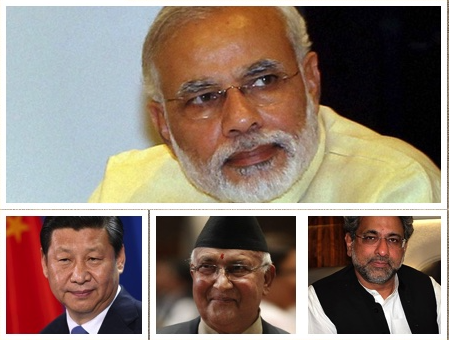
    Even Prime Minister Narendra Modi’s critics acknowledge his uncanny ability to take bold decisions and this reflects in his foreign policy initiatives. Interestingly, he is also demonstrating an ability to undertake course corrections. The informal summit at Wuhan, China, last month and a visit to Nepal this month reflect a change aimed at reviving the ‘neighborhood first’ policy, announced in 2014. The big challenge, however, will be providing a sense of direction to the policy on Pakistan which has oscillated between ‘jhappi’ and ‘katti’.”

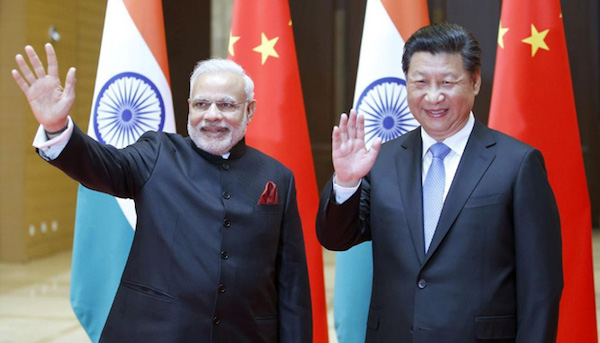
    Mr. Modi had received Chinese President Xi Jinping in September 2014 in Gujarat reflecting his personalized diplomacy even though the ongoing stand-off in Chumar in eastern Ladakh cast a shadow on the visit. The personalized diplomacy was reciprocated the following year when Mr. Modi visited China and Mr. Xi received him in Xian, but its limits soon became apparent.

    In mid-2016, China blocked India’s bit to join the Nuclear Suppliers Group (NSG) despite a meeting between the two leaders in Tashkent on the margins of the Shanghai Cooperation Organisation (SCO) summit. This was followed by China vetoing Masood Azhar’s listing as a terrorist in the UN Security Council even though the Jaish-e-Mohammed (JeM) is a banned entity. China’s veto continued even after the Uri Army camp attack by JeM cadres later that year, adding to India’s growing annoyance. Hydrological data sharing stopped amid reports of diversion of Brahmaputra river waters. The 73-day stand-off at Doklam last year and accompanying rhetoric reflected a marked downturn. India responded through all this by voicing skepticism regarding Mr. Xi’s Belt and Road Initiative (BRI), stepping up maritime engagement with the U.S. and Japan and reviving the Quad (with Australia) in Manila last year.

    Both leaders soon realized the risks of the downward spiral of confrontation and were pragmatic enough to understand the need to restore a degree of balance to the relationship. Mr. Xi had emerged stronger after the 19th Communist Party Congress and the decision by the Central Committee to remove the restriction of two terms for a President made it clear that he would continue beyond 2023.

    Significant messages were carried by Foreign Minister Wang Yi and Politburo member Yang Jiechi last December during their visits to Delhi. Follow-up visits to Beijing by Foreign Secretary Vijay Gokhale, National Security Adviser Ajit Doval, Foreign Minister Sushma Swaraj and Defense Minister Nirmala Sitharaman earlier this year prepared the ground for the informal summit meeting in Wuhan last month. The leak of the government circular advising officials to stay away from events commemorating 60 years of Dalai Lama’s exile in India and declining Australia’s suggestion to participate in Malabar naval exercises indicated Indian interest in a reset.

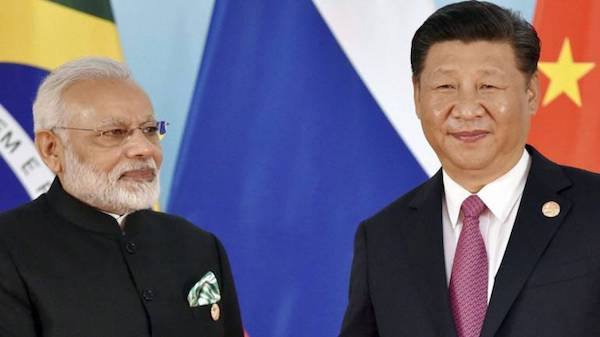
    The Wuhan summit was projected as ‘informal’ (something the Chinese have engaged in with U.S. Presidents Barack Obama and Donald Trump), without an agenda. Over two days, the two leaders met for 10 hours, four times one-on-one and twice with their delegations. Instead of a customary Joint Statement, there were separate briefings by Mr. Gokhale and Chinese Vice Foreign Minister Kong Xuanyou indicating the key takeaways. It is clear that messages have gone out to the Army to improve communications and understanding and prevent the stand-offs that were becoming frequent. Both sides have agreed to undertake a joint project in Afghanistan. No softening of Chinese position on the NSG or India’s reservations on the BRI was visible though these issues would have figured in the discussions. However, with three more meetings likely during the SCO, G-20 and BRICS summits later this year, it is clear that there is an effort to bring the relationship on track.

    Rebuilding trust with Nepal

    A similar exercise appears to be under way with Nepal. Mr. Modi’s visit in 2014 had generated considerable goodwill but subsequent decisions queered the pitch. India’s public display of unhappiness with Nepal’s new Constitution and support for the Madhesi cause created ill-will. The economic impact caused by the disruption of supplies of essential items such as liquefied petroleum gas, petroleum products and medicines fed the anti-Indian sentiment which K.P. Oli effectively exploited to score a decisive electoral victory late last year. Clearly, Delhi was disappointed with the election outcome but decided that the relationship with Nepal was too important to let past misunderstandings fester. A new beginning was necessary.

    A couple of phone calls between Mr. Modi and Mr. Oli followed in December-January and Foreign Minister Sushma Swaraj was in Kathmandu even before Mr. Oli was sworn in as Prime Minister to convey congratulations and an invitation from Mr. Modi to visit India. Mr. Oli responded positively, and much was made of the fact that in keeping with tradition, he made Delhi his first foreign destination last month. A surprise one-on-one meeting with Mr. Modi on the first day provided the two leaders an opportunity to clear the air about the past and rebuild a degree of trust.

    A return visit by Mr. Modi to Nepal within a month (on May 11-12) indicates that both sides are keen to show positive movement. Expectations are being kept low key, but the optics of positive messaging are evident. Included in the itinerary are a visit to Janakpur to offer prayers at Janaki Mandir and a public address which will announce the inauguration of the Ramayana pilgrimage circuit linking Ayodhya and Janakpur. The same idea had been shot down earlier when the Nepali authorities had cited ‘security issues’. In addition, Mr. Modi will visit Muktinath and the pension paying office at Pokhara, highlighting the historical, cultural and religious ties between the peoples of the two countries. Undoubtedly, the fact that he begins his visit to Nepal by landing in Janakpur, capital of the sole Madhes-ruled province will give comfort to the Madhesi community, but Mr. Modi realizes that his challenge is to repair ties with the wider Nepali community.

    The Pakistan challenge

    With Pakistan, after the opening when the then Prime Minister, Nawaz Sharif, visited Delhi in 2014 and Mr. Modi dropped in to have tea with him in Lahore in December 2015, relations stalled in 2016 following the Pathankot and Uri attacks. Firing across the Line of Control (LoC) has intensified leading to higher casualties on both sides, both civilian and military. In September 2016, India launched ‘surgical strikes’ as retaliation for the Uri attack but this has not reduced infiltration. Since Burhan Wani’s death, local recruitment by radical groups is also on the rise. India has successfully stalled the South Asian Association for Regional Cooperation (SAARC) summit since 2016 and Mr. Trump’s tweets criticizing Pakistan have given Delhi satisfaction. But limits to the policy of isolating Pakistan are also apparent.

    Elections are likely in July and the Army would prefer to keep Mr. Sharif’s PML(N) out of power. Mr. Sharif’s dismissal and disqualification for life from politics by the Supreme Court makes it clear that the Army is determined to control the political transition. Pakistan Army Chief Qamar Javed Bajwa has, on more than one occasion, emphasized the need for improving relations with both India and Afghanistan.

    The resumption of the stalled Track II Neemrana Dialogue last month in Islamabad indicates that a shift may be likely. Pakistan realizes that the time frame for a shift is limited before India goes into election mode. The question is whether Gen. Bajwa can make good on his suggestion by showing forward movement on the issues flagged by India — curbing the Lashkar-e-Toiba and JeM, the Kulbushan Jadhav and 26/11 trials, etc. Faced with a similar situation, Gen. Pervez Musharraf had gone in for a unilateral ceasefire on the LoC in 2003. The guns fell silent, tensions were defused, and Pakistan hosted the SAARC summit in 2004.

    A change in the Pakistan policy may well be the reset to enable Mr. Modi to reclaim his ‘neighborhood first’ policy.

    (The author is a former diplomat and is presently Distinguished Fellow at the Observer Research Foundation. E-mail: rakeshsood2001@yahoo.com)


  • Immigrant-Bashing Helps MS-13

    Immigrant-Bashing Helps MS-13

    By Tom Suozzi

    The president’s inflammatory rhetoric is counterproductive to the goal that we the people, including new arrivals in America, seek—to live in peace, security and happiness and to eradicate MS-13, says the author.

    I applaud President Trump’s mission to combat MS-13. The gang must be disrupted, dismantled and defeated. There should never be any disagreement about that, and presidential involvement is incredibly beneficial.

    MS-13 members are ruthless and depraved. The gang models itself on organized crime syndicates throughout history. It is a murderous and destructive force in too many good communities across America, including Long Island, where I’m from.

    But Mr. Trump’s failure to distinguish properly between MS-13 members and other immigrants, along with his divisive, discriminatory language, particularly against immigrants from Latin America, hampers efforts to rid our communities of MS-13. The president’s inflammatory rhetoric is counterproductive to the goal that we the people, including new arrivals in America, seek—to live in peace, security and happiness and to eradicate MS-13.

    During my tenure as mayor of Glen Cove, N.Y., we enjoyed the lowest crime rate of any community with more than 20,000 people on Long Island. My city is a mashup of immigrants and multigenerational families. We achieved public safety and harmony by relying on two fundamental American credos.

    First, all men and women are created equal. Not “all men and women with U.S. passports or green cards.” All human beings are entitled to the same respect and dignity. Issues from public safety to immigration reform cannot become an excuse for racism or other forms of discrimination.

    The second credo is “all men and women are equal under the eyes of the law.” If you live in America, whether you are a newcomer or a descendant of the Pilgrims, you must obey the law.

    And that’s where our 45th president’s words and actions become problematic. To protect those who obey the law, and to take down those who break it, particularly members of MS-13, community policing is central.

    The key to community policing is a healthy, respectful and productive relationship between police officers and the community they are sworn to serve and protect. Mr. Trump’s approach—his sweeping rhetoric that lumps all immigrants together, his proposal to curtail legal immigration drastically, his failure to support a bipartisan permanent fix for beneficiaries of Deferred Action for Childhood Arrivals, his elimination of temporary protection status safeguards—amounts to a war on immigrants, a war far beyond MS-13, which has a chilling effect on police-community relations with Latinos in America.

    Police must be able to work with law-abiding people to identify MS-13 members and movements in their communities. While overseeing police departments as Glen Cove mayor and Nassau County executive, I saw community-policing stop MS-13 in its tracks. During my time as executive, Nassau was the safest county of more than 500,000 inhabitants in the U.S.

    In contrast, when people are afraid to cooperate with the police because of Mr. Trump’s words and his administration’s crackdown on Latino immigrants, local leaders in the fight against MS-13 are pushed into the shadows. It’s a tragedy when people are afraid of the police and of government in general—afraid of reprisal from the officials every American relies on for protection.

    My grandfather and father were immigrants from Italy. As a first-generation American, I could not be prouder or more inspired by their success as newcomers to this great nation. I am also keenly aware of how the criminal actions of a sliver of Italian immigrants were once used to disparage and deny opportunity to all Italian newcomers to America in the first half of the 20th century.

    We cannot make the same mistakes by equating MS-13 with law-abiding immigrants from Latin America. Sadly, Mr. Trump—on a near daily basis—careens down this dangerous and destructive path. The president should put divisive language aside, support law-abiding immigrants, and make community policing more effective. And then he needs to be open to common-sense solutions for the DACA crisis and for comprehensive immigration reform.

    (Mr. Suozzi, a Democrat, represents New York’s Third Congressional District)

  • A time to think fast: on the US exit from the Iran deal

    A time to think fast: on the US exit from the Iran deal

    The U.S.’s exit from the Iran nuclear deal puts India in a spot on many counts

    By Happymon Jacob
    The global non-proliferation regime has taken a direct hit from the U.S.’s decision to renege on the Iran deal. It is important to understand that norms, rules, persuasion and good faith make up the moral foundation of the non-proliferation regime, and the inability of the great powers to abide by them will dissuade non-nuclear weapons states from signing on to or abiding by new or existing agreements, protocols or regimes

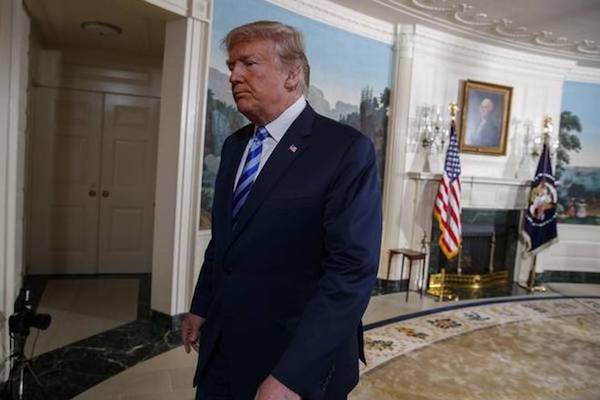
    American President Donald Trump’s decision to withdraw from the Joint Comprehensive Plan of Action (JCPOA), popularly called the Iran nuclear deal, is bound to have serious implications for the international system, and for India. To be sure, the least affected will be the U.S.; European Union countries will be moderately affected due to the business ties with Iran; and the most affected will be countries closer to the region, in particular India. Moreover, for a U.S. administration that has made it a habit of accusing other countries of “undermining the rules-based order”, this action has severely undermined the rules-based global order.

    Unreasonable act

    Washington’s decision is unjustified and unreasonable for several reasons. For one, the International Atomic Energy Agency (IAEA) has consistently maintained that Tehran has complied with the strictures of the JCPOA without fail. Moreover, Iran has signed the Nuclear Non-Proliferation Treaty (NPT) which prohibits it from developing nuclear weapons and has agreed to ratify the IAEA’s Additional Protocol five years from now which will grant IAEA inspectors wide-ranging access to monitor nuclear-related activities in Iran. And yet Mr. Trump has thoughtlessly undone the outcome of negotiations that went on for close to two years.

    Second, the argument that since the provisions of the JCPOA will become less strict over the years enabling Iran to move towards nuclear-weapon capability is not a credible rationale for undoing the deal. In fact, if indeed there are concerns about Iran potentially moving towards a nuclear option, efforts should be made to engage Tehran in negotiations rather than undo what has already been achieved. This is a classic case of throwing the baby out with the bathwater.

    With regard to Iran’s involvement in the various West Asian conflicts and “promotion of terrorism”, Iran is not the only country engaging in them. And in any case the way out, again, is diplomatic engagement rather than further unsettle an already volatile region.

    The implications

    The global non-proliferation regime has taken a direct hit from the U.S.’s decision to renege on the Iran deal. It is important to understand that norms, rules, persuasion and good faith make up the moral foundation of the non-proliferation regime, and the inability of the great powers to abide by them will dissuade non-nuclear weapons states from signing on to or abiding by new or existing agreements, protocols or regimes. Second, even though Mr. Trump might think that playing hardball with Tehran will help him to extract concessions from Pyongyang, it is equally possible that the North Koreans will think twice before entering into any agreement with the untrustworthy Trump administration.

    Third, Washington’s unilateral and dictatorial withdrawal from the deal would create deep fissures in the time-tested but increasingly shaky trans-Atlantic security partnership. Not least because it implies potential secondary sanctions against those European companies which are engaged in business deals with Iran. Here again, the U.S. does not have much to lose given its almost non-existent business contacts with Iran.

    Besides, Mr. Trump’s Iran decision follows a pattern of similar unilateral steps — such as the withdrawal from the Paris climate accord and formal recognition of Jerusalem as Israel’s capital. Let alone the loss of face suffered by European leaders and the financial losses by their countries’ firms, U.S. unilateralism has deep-running implications for the global security and governance architecture, and other multilateral arrangements and regimes. It is in this context that what French Foreign Minister Jean-Yves Le Drian said becomes significant: “The deal is not dead. There’s an American withdrawal from the deal, but the deal is still there.” The argument has found support in several global capitals.

    Hassan Rouhani, the moderate President of Iran, who negotiated the nuclear deal, might lose his standing in the country as hardliners pitch for more aggressive steps, including developing a nuclear weapon capability and more military engagement in the neighborhood. The chief of staff of the Iranian Armed Forces, Maj. Gen. Mohammad Bagheri, has said that the “Iranian people never favored the nuclear deal”. This is an indication of the hardline Iranian responses in the offing as and when sanctions are reimposed.

    Iran’s refusal to fall in line might prompt Israel and the U.S. to carry out attacks against Iran leading to Iranian counter-strikes against American allies in the region, or even Israel. This would further destabilize a region already reeling under terrorism, wars and internal conflicts. Americans, and the international community, should remember how the misguided military campaign against the Saddam Hussein regime in Iraq turned out to be a huge geopolitical disaster.

    India’s Persian dilemmas

    While the U.S. has almost nothing to lose in reneging on the JCPOA, India has a lot to lose both economically and geopolitically, and it will take deft diplomacy to adapt to the changing alignments. A more unstable West Asia would ipso facto mean more difficult choices for New Delhi. More conflict in the region would adversely impact the welfare and safety of Indian expatriates in West Asia, leading to a sharp decline in the remittances they send home, and an assured hike in oil prices. Low crude oil prices had given India the much-needed economic cushion in the past few years — that phase of cheaper oil has now ended. Recall how the U.S. war on Iraq had a debilitating impact on Indian workers and the West Asian remittances. India also had to abandon the Iran-Pakistan-India pipeline in 2008 thanks to U.S. sanctions against Iran.

    The Narendra Modi government’s efforts to maintain a fine balance between India’s relations with Iran on the one hand and with the U.S., Israel and Saudi Arabia on the other will be seriously tested in the days ahead. The new warmth between Iran and India could attract American ire. What is even more worrying is that unlike the last time when the U.S. imposed sanctions on Iran, and India had to choose the U.S. over Iran, the geopolitical realities are starkly different this time. Not only are the Americans going it alone this time, but the regional ganging-up against the U.S. and in support of Iran will be more pronounced this time around, making India’s ability to make a clear choice more difficult.

    India’s dreams of accessing Central Asia via Iran could also be dashed with the return of American sanctions against Iran. India’s projects in Iran’s Chabahar port have been widely viewed in New Delhi as a crucial plank of its Iran-Afghanistan-Central Asia strategy. With U.S. sanctions again tightening around Tehran, New Delhi may find it hard to continue with this project. As a matter of fact, thanks partly to India’s dilly-dallying on Chabahar during the previous round of U.S. sanctions against Iran, Iran had invited Pakistan to the Chabahar project. Some have even suggested a potential link between Chabahar and Gwadar in Pakistan.

    Given that there is little consensus around Mr. Trump’s withdrawal from the JCPOA, several of the dissenting parties might look for ways of thwarting U.S. efforts at isolating Iran. Such efforts, especially those led by China and Russia, both parties to the JCOPA, would have implications for the Southern Asian region as well. If indeed China manages to bring together a group of regional powers, including Russia, Iran, Pakistan and interested others, to counter Washington’s influence in the region, New Delhi might find itself in a corner.

    (The author is Associate Professor of Disarmament Studies, Centre for International Politics, Organization and Disarmament, School of International Studies, Jawaharlal Nehru University)

  • Architecture of the Mandate

    Architecture of the Mandate

    The lesson from Karnataka: the parties opposed to the BJP must work together from the word go

    By Gopalkrishna Gandhi
    With the two parties having come together, and out-numbering the BJP MLAs, the real test of their political integrity lies in their staying together and defeating the Yeddyurappa government in the first confidence vote. There is only one way in which they can do that. And that is by staying together, staying determined, and voting on vote day unitedly. Will they let their unity and determination, numerical strength, numerical integrity be diminished?  How may that be done? We know the way that happens.

    Mathematics is about numbers, and mathematics is an exact science. The addition, subtraction, division and multiplication of numbers in ganita is about getting problems right. Just that. Right. And a satisfaction is derived, both mathematical and aesthetic, in getting the exercise right. Precision is its sole dharma. Numbers, after a problem is done, stand still. They do not pull at each other, jumping from a plus to a minus, from the times or multiplication sign into an obelus or division sign. A sum does not try to or want to alter itself. The problem-solver or sum-beholder derives satisfaction from the purity of its precision.

    Integrity of the arithmetic

    Elections too are about numbers and are an exact exercise. But only until the sum is reached. That is, until the Election Commission finishes its calculations and declares the ‘sum’. The Election Commission counts and then announces the counts, and once it has done that, retires. After that has been done, the President in the case of Lok Sabha elections or the Governor in the case of Vidhan Sabha elections takes over. It is in their hands that the result of the counting converts itself into the pattern of seats in the elected House. The President or Governor then becomes the keeper of the sum’s integrity and has to see that the pattern of the sum is honored by the pattern of the seats. In other words, the architecture of the sum is retained by the architecture of their power. The keeper has to see that the integrity of that architecture is not garbled to create a house different in shape from the blueprint of the sum’s design.

    What was the blueprint of the design that the people of Karnataka drew? The blueprint came in four folds. All of us know them now only too well.

    The first fold for the single largest party was the Bharatiya Janata Party, or BJP’s.

    The second fold for the second largest party was the Congress’s.

    The third fold for the third largest party was that of the Janata Dal (Secular), or JD(S).

    The fourth fold, which showed the first three in a pie, gave their relative shares: the first was smaller, if only slightly, than the second and third seen together.

    We have to switch now from designs, graphs, squares and pies to what the Governor had to make of this four-fold design. We have to switch from arithmetic and geometry to a kind of algebra, the study of mathematical symbols, the rules for their handling, their groups, rings, fields. In other words, we have to switch now from how to move from the numbers to their mandate and see how a House is to be made from out of its mandate, a House for the mandate of the gana to dwell in. In this task, though working on and with numbers, a President or a Governor cannot function like a calculator. His task is mathematics plus ethics.

    The Governor’s options

    The Governor of Karnataka saw and may well have felt somewhat like this: If only Party One had just crossed the halfway mark and got a simple majority, his task would have been simple. He would have called its leader to form the government. But that did not happen. The people of Karnataka voted in greater strength against Party Number One than for it.

    If only Party Two and Party Three had entered the election as a joint team, in what is called a pre-poll alliance, his work would again have been simple. He would have had to call that two-colored rainbow to name its leader and invite him to take the oaths of office. But that too did not happen. The majority of the people of Karnataka voted against the BJP but they did not vote cohesively for the Congress-JD(S) combine.

    So, the Governor did not get it all that simple. But was what he did get all that complicated? Not really.

    Though not a pre-poll alliance, Parties Two and Three did get together with a verve and vim they did not show before the elections to become one, and not only drew up a joint list of the newly elected MLAs to be but also chose a joint leader, unconditionally. There is nothing in any electoral law or court verdict to say that a post-poll alliance is ab initio null, void and to be disregarded. True, a pre-poll alliance is a neater, more up-front arrangement, but a post-poll one is not out of order.

    The numbers in Karnataka were clear. They showed the people’s integrated will, albeit in two frames hinged together requiring Parties Two and Three to be asked to form the government and seek the approval of the House by its users on its floor. If defeated, then ask Party One to try its luck.

    That has not happened.

    Had Party Two and Party Three not come together post-poll, Governor Vajubhai Vala could have ignored the fact that the non-BJP MLAs outnumber the BJP MLAs — and left it to the Chief Minister or the putative leader of the House to navigate his majority through the first confidence vote. But he has decided and that is that.

    What now? With the two parties having come together, and out-numbering the BJP MLAs, the real test of their political integrity lies in their staying together and defeating the Yeddyurappa government in the first confidence vote. There is only one way in which they can do that. And that is by staying together, staying determined, and voting on vote day unitedly. Will they let their unity and determination, numerical strength, numerical integrity be diminished? How may that be done? We know the way that happens.

    The principle of it

    With millions of other Indians I have a political position that opposes the ideology of the BJP and the Rashtriya Swayamsevak Sangh (RSS). But I also have a sense, again with millions of others, of a political ethics that tells me if the Congress had been in the position of single largest party in Karnataka as the BJP is in, and if the BJP and the JD(S) had got together post-poll as the single largest group, and if Governor Vala, citing the single largest party line, had called the Congress to form the government, I would have said exactly the same thing I have said here – in the reverse.

    The lesson of the Karnataka Kanda is this: the parties opposed to the BJP and RSS’s ideology must work together from the word go, and not let the imponderables of post-election decision-making imperil the will of the people.

    (The author is a former Governor of West Bengal)

  • Can the BJP wrest Karnataka from the Congress?

    Can the BJP wrest Karnataka from the Congress?

    “Yes”, says Muralidhar Rao; Rajeev Gowda says “No”; For Sandeep Shastri, “It’s Complicated”

    Yes | Muralidhar Rao

    The JD(S) and the Congress are two faces of the same coin. The BJP will win with a majority

    Yes, we will definitely wrest power from the Congress. The Bharatiya Janata Party’s preparation, both organizationally and politically, points to a victory for the party. We can also sense that the mood of the people in Karnataka has changed. People have problems, which the State government has failed to address. Whether it is in the agricultural sector, infrastructure, or urban management, mismanagement has become a major issue. People have been agitating for quite some time and their disillusionment with the ruling Congress is complete. The BJP leadership has worked hard to mobilize public opinion against the ruling party. The BJP will continue to do what it has been doing in the rest of the country, which is to fight against the Congress.

    Issues in Karnataka

    As far as the issues in the campaign are concerned, in the last two years, the farm sector has been in the grip of an acute crisis and the government has been unable to address and arrest the problem of farmers’ suicides. Close to 3,800 farmers have committed suicide in the last five years. The government has been insensitive to the issue. Even before the elections, we organized a special campaign for farmers, collected grains from them, and pledged to put an end to the crisis.

    Look at Bengaluru. It has become a city of crime. It is full of potholes. It faced floods. Even the Lokayukta, P. Vishwanath Shetty, is not safe in his office and the attack on him demonstrated how law and order has deteriorated in the State. Corruption, scams and scandals have added to people’s restlessness with the ruling party. The attitude of the State government to terror groups, particularly in coastal areas, is appalling. More than 24 activists have been killed by extremists. Not a single case has been pursued; arrests have not been made. The Congress’s silence on the Popular Front of India, which should have been banned a long time ago, appears to indicate that the PFI enjoys protection from the government.

    We have been accused of associating ourselves with the Bellary brothers. This has been completely misrepresented. Janardhana Reddy, who has been named in the FIR, has not been given a ticket and we have not used him in the campaign. His brother is a sitting MLA. There is no case against him. Also, don’t you think Chief Minister Siddaramaiah could have taken action against the two brothers? Why didn’t he?

    The BJP’s promises

    I think the promises made in our manifesto will persuade people to vote for us. In the farming sector, we have spelt out the issues we are going to pursue. For instance, to address the debt crisis, we have declared a ₹1 lakh loan waiver for farmers rom nationalized banks and co-operative banks.

    Bengaluru is a hub for translating the global ambitions of India. Instead, we now see the city being associated with crime and corruption. On the welfare front, we have conceptualized many programs for the people of Karnataka: free education for all students in government colleges, for BPL families, smartphones for women. We are working on a growth-centric plan and that’s our promise to the people of Karnataka. We will get more than 150 seats. I have no doubt that a massive majority will come to the BJP. The Janata Dal (Secular) and Congress are two faces of the same coin. Both are pursuing vote-bank politics and are family-driven parties. We will win on the promise of development alone.

    (Muralidhar Rao is a national general secretary of the BJP)

    (As told to Anuradha Raman)

     NO | Rajeev Gowda

    The voters prefer a stable government that has ensured inclusive growth

    Prime Minister Narendra Modi belatedly descended on Karnataka in a desperate attempt to revive the BJP’s collapsing campaign. Unfortunately for him, the ground reality will demonstrate that Karnataka is not Gujarat. Mr. Siddaramaiah’s inclusive welfare programs have ensured that voters remain steadfastly with the Congress.

    Achievements of the Congress

    Hunger will soon be history due to the Anna Bhagya scheme. Mathru Poorna is transforming the health of women, during and after pregnancy, while ensuring healthier children. Indira canteens help the urban poor access a nutritious meal at low cost. Dairy farmers received higher prices and children get milk in schools. Farmers gained from a loan waiver, subsidized rental equipment, and farm ponds. An integrated e-market increased farmer’s income by 38% in 2015-16, according to a Niti Aayog report.

    Karnataka leads India in investment intentions and follow through. The youth flock to Bengaluru, India’s start-up capital. A quarter of jobs created in India were in Karnataka, as reported in April 2016. Mainstays like IT and biotechnology crossed revenues of $50 billion. With an average GSDP growth of 8% over five years, people will be happy to stay with a government that works.

    Nightmare years of the BJP

    Voters have not forgotten the five nightmare years, which were marked by incompetence and instability, when the BJP ran Karnataka. Three Chief Ministers took turns to defend corruption on a scale that shamed the State. B.S. Yeddyurappa led his Cabinet colleagues, the Reddy brothers, Katta Jagadish, Krishnaiah Setty, Harta Halappa, etc. to jail. Mr. Modi’s rhetoric and flood of falsehoods cannot cover up that sorry track record, especially when the same crew is back helming the BJP’s election campaign.

    A track record in abetting instability is also true for the JD(S). Widely regarded as untrustworthy, it is now confined to the Old Mysore region. It will garner at least 10 seats less than its 40 in 2013. However, it has kept the BJP from gaining a foothold in Old Mysore. The BJP’s absence in Old Mysore means that in 10 of Karnataka’s 30 districts, it is likely to win only a handful of seats. Its old Hindutva laboratory, the coast, rejected it in 2013, and will do so again, turned off by polarization. The BJP won nearly half of Bengaluru Urban last time but will do worse now. It is in closely fought Mumbai-Karnataka and Central Karnataka that the BJP is hoping to gain seats. While it may be aided here by the Karnataka Janata Paksha and the Badavara Shramikara Raithara Congress coming back to the BJP fold, the chemistry has gone all awry owing to competing factions. In Hyderabad-Karnataka, it is counting on the eight seats given to the Reddy family to help it, but the leadership of Mallikarjun Kharge and the fact that the United Progressive Alliance granted 371(J) status to this region will ensure that the Congress stays ahead. Dalit anger at the BJP’s injustice nationwide is reflecting across Karnataka. In contrast, Mr. Siddaramaiah has allocated budgets in proportion to the population percentage of Scheduled Castes and Scheduled Tribes.

    Opinion polls show that Mr. Siddaramaiah remains the number one choice for Chief Minister. According to polls, voters consider the BJP to be the most corrupt party. A section of the Lingayats is expected to quietly vote for the party that responded to their aspirations. The Supreme Court awarding a larger share of Cauvery water to Karnataka has marked Mr. Siddaramaiah as a champion of the State’s interests. He has also highlighted Kannada pride. A stable government which has delivered to all sections and ensured inclusive growth is what the voters prefer. On May 15, the Congress will be back with a bang, setting the trend for 2019.

    (Rajeev Gowda is a Congress MP and chairman of the AICC’s research department)

     It’s Complicated | Sandeep Shastri

    In several constituencies, the BJP, JD(S) and the Congress are engaged in a three-way fight

    The Karnataka electoral contest seems to be heading for a photo finish and is fascinatingly complex and suspense-filled.

    Contradictory trends

    For the last three decades, Karnataka has never given a clear majority to the ruling party. This should make it easier to make predictions. The BJP could argue that it is the natural alternative to the Congress. Yet politics often defies logic. Karnataka was also witness to another trend during the same period: it has almost always gone against the national trend during Assembly elections. Karnataka seems set to negate one of these two trends, but the question is which one.

    The BJP is convinced that it will wrest Karnataka from the Congress and make a grand entry in the south on the strength of what it will term as an anti-incumbency vote. Even if one were to assume that there is anti-incumbency, the BJP does not become the natural beneficiary of that. Opinion polls have pointed to the split of the anti-Congress vote between the BJP and the JD(S). The BJP is also heavily banking on its star campaigner, Prime Minister Narendra Modi, to help it. The dependence of the party on the Prime Minister was evident in the last-minute increase in the number of rallies that Mr. Modi was scheduled to address. Yet, the impact of his campaign is still a matter of debate.

    This is the first major test of Mr. Modi’s capacity to sway an electorate in a State Assembly poll south of the Vindhyas. But can the faction-ridden State unit of the BJP and an increasingly sidelined chief ministerial candidate take the possible momentum generated by the Prime Minister’s whirlwind campaign to the ground and translate that into votes? More importantly, has the BJP pitched its campaign on appropriate and relevant State-level issues and has its chief ministerial candidate inspired the electorate to favor the party?

    The ruling Congress has its visible strengths but could well have peaked too early and lost the momentum in the crucial final week of the campaign. In the run-up to the campaign, it was clearly setting the agenda, pushing the BJP on the defensive. In its Chief Minister, the party found a campaigner who could bring together the diverse elements within the party to take on the opposition with a conscious focus on the local. Yet, there are factors that could halt this movement. The responsibility of defending the State government has virtually been left to the Chief Minister, with other Ministers busy managing their own small constituencies and contributing very little to the State-wide campaign.

    The JD(S) question

    Further, the unhappiness of the electorate with the track record of the State government on the key issues of tackling price rise, generating employment, and controlling corruption is visible. A key strategy of the Congress to win over the Lingayats by recommending them a minority religion status appears to have backfired.

    The presence of the JD(S) as a key player in select regions has converted the electoral battle in several constituencies into a three-way fight. By carving out for itself a segment of the anti-Congress vote, the JD(S) is surely eating into the BJP vote. Yet, the same could be said about the anti-BJP vote, which, especially in communally sensitive areas, could be split between the JD (S) and the Congress. The JD(S)’s efforts to be king-maker has led to a debate on whether Karnataka is once again heading for an Assembly with no party securing a clear majority.

    (Sandeep Shastri is a political scientist and the national coordinator of the Lokniti network)

    (Source: The Hindu)


  • It’s not about the nuclear deal

    It’s not about the nuclear deal

    The U.S. won’t ease the terms of sanctions on Iran, as the goal is regime change in Tehran

    By Chinmaya R. Gharekhan
    The impact on India will be severe. The price of crude is already close to $80. Energy imports from Iran will become difficult and expensive. Fuel prices will go up. The Reserve Bank of India might have to increase interest rates to contain inflation and step in to check the fall in the rupee’s value. All this might have a direct bearing on politics, given the fact that the government was the beneficiary of low crude price for the first four years but may have to face consequences of inflation and attendant factors in its fifth, says the author.

    If — and that’s a big if — the leaders of the U.S., China, South Korea and North Korea succeed in concluding a deal on the denuclearization of the Korean peninsula as well as on a peace treaty formally ending the Korean War, they would be front runners for the Nobel Peace Prize. That deal could appropriately be called a Joint Comprehensive Plan of Action (JCPOA) if it lays down a detailed blueprint for denuclearization, with provisions of intrusive inspections. The only thing that could stand in their way is Iran.

    There should be little doubt that U.S. President Donald Trump’s real, but of necessity undeclared, objective in withdrawing from the Iran nuclear deal is a regime change in Tehran. This goal is even more ardently desired by Israel and Saudi Arabia. Ever since Iranian President Mahmoud Ahmadinejad made particularly provocative statements about Israel, Israelis of all political persuasions have wanted to get rid of the regime in Iran. The Saudis have openly called for cutting off the head of the (Iranian) snake. Thus, three important and powerful states have a congruence of interests seldom seen in recent times.

    Iranian discontent

    There have been frequent and persistent reports in the Western media for several months about large-scale demonstrations and protests by Iranian people against the regime. Living conditions are difficult. Iran did not get the goodies that it expected after signing the JCPOA. Inflation is high. The Iranian rial is trading at 75,000 to the dollar. People are angry with the government. According to the well-researched work Democracy in Iran: Why It Failed and How It Might Succeed by American academic Misagh Parsa, disaffection among the people has manifested itself in several forms. Hundreds of mosques do not have imams and the attendance at Friday prayers has dwindled dramatically. Some are converting to Christianity and, according to Professor Parsa, even to the Baha’i faith, which is the largest non-Muslim community in Iran. Professor Parsa states that there is massive corruption as well as economic inequality in Iran. All in all, he suggests that it is quite likely that there might be a revolutionary upsurge, though he is careful not to indicate any timeline for it.

    A different calculation

    It is this discontent that Mr. Trump might be counting on tapping. His calculation seems to be that the reimposition of severe sanctions would render life very difficult, almost unbearable, for the populace who might, in the absence of other avenues, take to the streets, as they did in 1979 to overthrow the Shah’s regime which too, like the present one, had strong military and oppressive secret services such as the Savak but which could not defeat public anger, frustration and rage. For these reasons, Mr. Trump is unlikely to listen to voices of reason or to appeals from his Western allies. He is equally not likely to grant exemptions from sanctions to any country engaging in any form of trade and other transactions with Iran. His administration will follow strict interpretation of the guidelines regarding the sanctions regime.

    Iranian restraint

    Iran has shown restraint, forsaking knee-jerk reaction. It did not declare that the deal was dead, as it might well have done. It did not announce immediate resumption of uranium enrichment, which it emphasized will be at the industrial level. It has so far not called off International Atomic Energy Agency (IAEA) inspections. Iran will consult with the other signatories to the JCPOA for several weeks before taking any further action. This shows the maturity of Iranian diplomacy. It remains to be seen how long France and others will stick to their position of continuing to adhere to the deal; they will eventually have to fall in line in some way with the Americans, if not for political then for economic considerations. For Mr. Trump, the Republicans are fully with him and the Democrats will be too eventually.

    Will Iran live up to the American calculation? For the present, Mr. Trump’s decision has strengthened the hardliners. President Hassan Rouhani, regarded as a moderate, has no option but to take a defiant stance. The Iranian people, proud as they are of their heritage, will stand behind their regime. But there may come a time when their hardships reach a stage when they might feel compelled to take to the streets.

    In the meanwhile, Iran will even more vigorously support the Bashar al-Assad regime in Damascus, in which it will be joined by Russia and Hezbollah, which has done very well in the parliamentary elections in Lebanon this month. The Houthi rebels in Yemen will feel more emboldened to take on the Saudi-led coalition; of course, the Yemeni people will continue to suffer, as will the Syrian people, for years to come. Iran will more directly intervene in Iraq and render the possibility of progress in the non-existent peace effort in Afghanistan even more difficult.

    If the regime in Tehran does not collapse, the Washington-Jerusalem-Riyadh axis might look for an alternative course of action, not excluding military. In that case, the Nobel Peace Prize will elude Mr. Trump.

    Prime Minister Narendra Modi has established special relationship with Israel and its present Prime Minister, Benjamin Netanyahu. He has also made efforts to forge intimate relations with the U.S. With both India has the upper hand, since it is they who want to sell expensive military hardware to India. Under the circumstances, India has made a well-drafted two-sentence statement on the Trump decision. The first strikes a balance between Iran’s right to develop nuclear energy for peaceful purposes as also the international community’s concern to ensure that its nuclear program remains strictly peaceful. The second sentence contains implicit disapproval of the American decision and warns, again implicitly, against any strong military action. For India, the question will also be: can it rely on the U.S. to honor even its written word embodied in international agreements? Mr. Trump wants to annul every single achievement of his predecessor — Obamacare, the North American Free Trade Agreement, the Trans-Pacific Partnership, the Paris Agreement, and now JCPOA. India will have to remain vigilant in dealing with this administration; it would not be prudent to assume that it is a special case.

    Fallout for India

    The impact on India will be severe. The price of crude is already close to $80. Energy imports from Iran will become difficult and expensive. Fuel prices will go up. The Reserve Bank of India might have to increase interest rates to contain inflation and step in to check the fall in the rupee’s value. All this might have a direct bearing on politics, given the fact that the government was the beneficiary of low crude price for the first four years but may have to face consequences of inflation and attendant factors in its fifth.

    (The author is a former Indian Ambassador to the United Nations, was Special Envoy for West Asia in the Manmohan Singh government)

  • Karnataka election: voters to choose between tainted leadership and clean governance

    Karnataka election: voters to choose between tainted leadership and clean governance

    By George Abraham

    “In contrast to the BJP rule, the Congress Party under the leadership of Siddaramaiah has fulfilled many of the promises that were made to the people of Karnataka. Key among them is the government’s social welfare policy”, says the author.

    Interacting with media during a tour of Lingayat and Dalit mutts in central Karnataka, Amit Shah, the national President of BJP began making allegations against the current Siddaramaiah government.

    “Recently, a Supreme Court judge said if ever there was a competition for the most corrupt government, then Yeddyurappa government will get number one,” shocking Yeddyurappa who was seated near him. It may have been a faux pas by Mr. Shah who immediately tried to control the damage. Congress Party wasted no time in seizing the original quote and expressing their total agreement.

    A few weeks later, Karnataka has witnessed the tainted Reddy brothers sharing a dais with Yeddyurappa and Madhya Pradesh Chief Minister Shivraj Chouhan at a rally in Molakalmur. It appears that Mr. Janardhana Reddy who came out of jail on bail from the noxious mining scam is back along with the Bellary gang asking people to vote for BJP. The party has also given tickets to his two brothers Somashekhara Reddy and Karunakara Reddy despite the statement by Mr. Shah that BJP has no links with Reddy brothers.

    In 2012, India’s Supreme Court ordered the CBI to probe charges of corruption against B S Yeddyurappa. That order followed a court-appointed committee’s suggestion that Mr. Yeddyurappa be investigated for alleged abuse of power. The anti-corruption report had indicted him in a mining scandal that cost the exchequer more than 3 Billion dollars. He also holds the distinction of being the first sitting Chief Minister of a State to spend time in jail.

    All the BJP talk about corruption in the opposition camps seem to fly in the face of what has happened under BJP rule in Karnataka. With openly courting the Bellary gang, Yeddyurappa is once again signaling to the Karnataka voters that nothing has been changed regarding their attitude towards corruption or abuse of power. Mr. Shivraj Chouhan, whose administration was embroiled in the VYPAM scandal in Madhya Pradesh, sharing the dais with Yeddyurappa and Janardhana Reddy may only reinforce the notion that corruption is endemic in the system and across the country and BJP pays merely lip service in countering it.

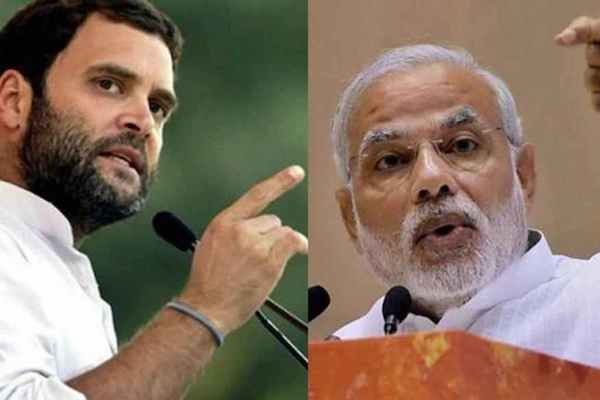
    Rahul Gandhi, President of the All India Congress Committee, tweeted the following in response to the latest developments: “When in power, Yeddyurappa and Reddy Brothers looted Karnataka. Our government brought them to justice. Now Modi is trying to take 8 of them from jail, into the Vidhan Sabha. This is an insult to every honest citizen, to Karnataka and to the spirit of Basavanna.”

    Congress High Command appears to be following a ‘Captain Model,’ strategy in Karnataka giving Chief Minister Siddaramaiah, enormous latitude in decision making as in regards the running of the election campaign. The decision may be based on the premise that strong regional and local leadership is critical in winning elections as in Punjab where Captain Amarinder Singh wrested away the power from Akali Dal in the last election where his charisma, leadership and independent decision making were all at full display.

    In contrast to the BJP rule, the Congress Party under the leadership of Siddaramaiah has fulfilled many of the promises that were made to the people of Karnataka. Key among them is the government’s social welfare policy.Within an hour of oath-taking as Chief Minister, he has implemented the food subsidy scheme to give 30kg rice per month at Re 1 per kg to 10.2 million families below poverty line across the State with a plan outlay of Rs.4300 crore. The State later on added Wheat, Ragi, and Jowar to the scheme. The State also started distributing 150ml milk thrice a week to 6.5 million children studying in state-run and aided schools across the state to check malnutrition and prevent dropouts.

    Under the Bhagyalakshmi and Kuteer Jyoti schemes, the state government waived off Rs.268 crore arrears due from two million energy consumers in the rural areas. It also waived off Rs. 1340 crore loans with interest borrowed by a million SCs, STs and OBCs and minorities for various economic activities and increased the housing subsidized loan to economically weaker sections to Rs. 120,000 per unit from Rs. 75,000 under the Rajiv Gandhi Housing Corporation.

    Programs and projects like the opening of the Indira Canteens, the introduction of the new economic policy that focused on Industries, construction of Medakettu Dam, Introduction of Bike Ambulance and the Scheme for Organ Donation etc. have shown the people of Karnataka that a government committed to the service of its people could still deliver results. Most importantly, there have been no significant financial scandals during its tenure that stands in stark contrast to the Yeddyurappa rule.

    Siddaramaiah in his tweet recently challenged Prime Minister Modi to walk the talk when it comes to dealing with corruption. He called on Modi to “appoint Lok Pal, investigate Judge Loya’s death, investigate the astronomical rise of Jay Shah, and appoint an untainted person as your CM candidate.”

    The fate of Karnataka is said to be hanging on the swing voters who are actively weighing in on the promises made on the campaign trail. Janata Dal (S), the third party in the puzzle may yet to play a critical role if there is a hung Assembly. For the Congress Party, stakes are very high in Karnataka. A win by the party in Karnataka will provide a huge momentum towards the upcoming elections in Madhya Pradesh, Rajasthan, and Chhattisgarh and eventually towards the 2019 general election. However, the party may require a better post-election strategy to prevent a repeat of what has been transpired in Goa, Manipur, and Meghalaya!

    (The author is a former Chief Technology Officer at the United Nations and Vice-Chairman of the Indian Overseas Congress, USA)


  • The Rocky Road to 2019

    The Rocky Road to 2019

    Concrete steps are needed to defuse crises that could disrupt India’s political and social equilibrium

    By M.K. Narayanan
    The authorities also need to be aware that as various State elections draw near, newer threats are likely to emerge. Among them are cyber threats. India is possibly the third most vulnerable country today from the point of view of cyberattacks. Many experts are of the view that as the digital economy expands, India will confront the specter of cyberattacks.

    As 2019 and the general election beckon, the situation within the country appears far from reassuring. Several events over the past few months seem to presage that there is worse to follow. Protests and agitations have a life of their own and underestimating their potential could be cause for grief. Hence, it might be worthwhile for the nation’s leaders to pay heed to the ancient Chinese proverb, “the wind sweeping through the tower heralds a storm rising in the mountain” and take anticipatory steps.

    Lowdown on internal security

    The authorities need to analyze why simultaneous upheavals are taking place on different planes across the country. Each day, a concatenation of events and situations are contributing to feelings of deep unease. Take internal security, for instance. The authorities may claim that the situation is stable, but the daily litany of violence tells a different story. Jammu and Kashmir is a good example where the situation has been steadily deteriorating. The past year has witnessed an increase in casualties, of civilians and security personnel, an upsurge in terrorist violence, a rise in cross-border terrorism and increased infiltration from Pakistan. Despite the surgical strikes by India, a palpable fear syndrome prevails in the areas bordering Pakistan.

    Likewise, claims made latterly of the eclipse of the Maoist menace — there are reports of scores of Maoists having been killed in Maharashtra’s Gadchiroli district in end-April — are clearly unconvincing. Maoist violence is not so prevalent in areas where it was once rampant; while the kill-ratio of Maoists to security force personnel appears to have gone in favor of the security forces, the capacity of Maoists in carrying out selective violence has not been significantly blunted, especially in their strongholds in Chhattisgarh, Odisha, Andhra Pradesh, Telangana and Maharashtra. As an ideology-based militant movement, Maoism needs to be countered by a sustained ideological campaign in rural and urban areas, but this is nowhere in evidence.

    Next is the growing specter of agrarian unrest. Over the past year, a series of protest movements by farmers have rocked the country. While the causes are varied, the basic issue remains the same, viz. the neglect of farmers and the agrarian community by those in authority. Large-scale protest marches by farmers such as the one in Maharashtra in March, evoke both concern and fear. More protests are in the offing. With cohesive leadership, the current peaceful agrarian protests could attain a dangerous dimension.

    Dalit identity and concerns

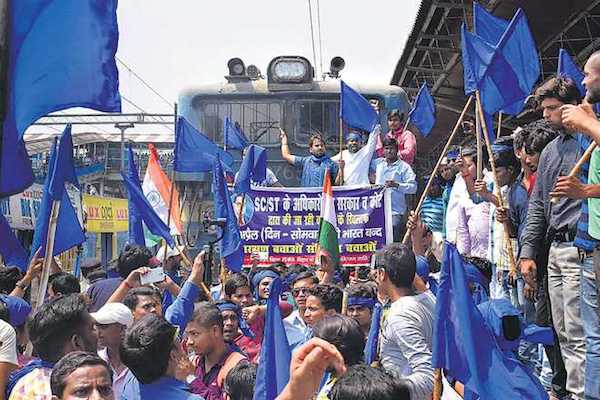
    An even bigger challenge confronts the nation today — on how to deal with the issue of Dalit “self-assertion”. This aspect was clearly manifest during the April 2 Bharat Bandh which was sponsored by different Dalit groups; its pan-India imprint was unprecedented. The bandh was to protest the judgment of the Supreme Court, amending the Scheduled Castes and Schedules Tribes (Prevention of Atrocities) Act. The outburst of violence, which resulted in some casualties and the destruction of property worth crores, went far beyond this aspect. There was and is no mistaking the pent-up resentment or the degree of mistrust.

    Anger and resentment have been building up within the Dalit community for quite some time. Growing numbers of atrocities against Dalits in recent years, which thanks to modern communications systems and social media have gained critical publicity, are undoubtedly the root cause of the pent-up anger. Instances in 2016, such as Rohith Vemula’s death at Hyderabad University, and, separately, in Una, have been triggers for the explosion of anger and violence.

    However, the recent outburst points to a new brand of Dalit “rejectionist politics” which should be a matter of utmost concern. Appeasement is no longer acceptable. Moderating or repealing cow protection laws will hardly matter or make a difference. More reservation in jobs is unlikely to assuage Dalit concerns. A group of alumni from the Indian Institutes of Technology have given up their jobs to form a political party to fight for the rights of the Scheduled Castes, the Scheduled Tribes and Other Backward Classes.

    Violence against children

     If the authorities have been found wanting or are being accused of their inept handling of the April 2 agitation, they are now being hauled over the coals for their inability to check the spate of incidents of rape across the country. The brutal assaults on young children have touched a raw nerve. Demands are being made to ensure that crimes of this nature end and that the administration sheds its helplessness and starts taking stringent action.

    Today, the place names, Kathua (Jammu) and Unnao (Uttar Pradesh), have become synonymous with the “epidemic” of rapes. But sexual violence still continues despite public outrage and the administration is seen to be helpless in preventing it, which is beginning to create a crisis of confidence in the ability of the administration and the government to deal with the situation. Questions are being asked as the administration is unable to fulfil one of its most basic responsibilities — to protect the honor and the dignity of women and children. Mere condemnation of rape by those in authority will not do.

    Cracks in the two pillars

     Distinct from these issues, but equally worrisome, is the extent of disruption seen in the functioning of Parliament. A disruption of parliamentary proceedings is not new, but the near total washout of the Budget session has shaken the faith of the nation.

    The view from the Treasury Benches that the Opposition is to blame for this has gained little traction. Most people believe that the responsibility to ensure the smooth functioning of Parliament rests equally, if not more, with the ruling dispensation, apart from the Presiding Officers of the two Houses. What the nation is demanding is a resolution of the impasse, and not the assigning of blame. A lack of demonstrable action is only adding to the sense of dismay.

    The prevailing dissonance in the higher judiciary, the display of divisions within the highest court of the land, and the charges levelled against the Chief Justice of India by Opposition parties which are seeking his impeachment, are again highly disturbing. There has been no precedent for such a situation. The persistence of such trends is giving rise to serious concerns as to where the nation is headed.

    Cyber concerns

    The authorities also need to be aware that as various State elections draw near, newer threats are likely to emerge. Among them are cyber threats. India is possibly the third most vulnerable country today from the point of view of cyberattacks. Many experts are of the view that as the digital economy expands, India will confront the specter of cyberattacks. Given that it is already struggling to deal with threats such as ransomware and cryptojacking, India will need to tone up its strategic mindset and increase its homegrown capabilities expeditiously; a devastating cyberattack could undermine public confidence in an election year.

    Finally, given the current resurgence in communal and caste aspirations, India cannot afford to overlook the danger of a rise in regional subnationalism, of which there are already some incipient signs. Such tendencies could gain a fillip, if as anticipated, the coming elections witness bitter electoral campaigns based on a variety of considerations that include caste and community.

    It is not that solutions for all these problems fall within the purview of the authorities or the government. However, it is in the nature of things that the responsibility for situations tends to devolve on the government. Hence, it is important that the road to 2019 is paved with not only professed good intentions but also concrete steps to mitigate and “defuse” a succession of crises that have the potential to disturb the political and social equilibrium in an election year.

    (The author is a former National Security Adviser and a former Governor of West Bengal)

  • When India and China Meet

    When India and China Meet

    By Nirupama Rao

    The message from Wuhan is: let us give each other space and rationalize our differences in a grown-up way.

    By Nirupama Rao
    The outcome statement from the Indian foreign office and from the Prime Minister’s social media network speaks about Mr. Modi and Mr. Xi having forged a common understanding in Wuhan on the future direction of India-China relations “built upon mutual respect for each other’s developmental aspirations and prudent management of differences with mutual sensitivity

    The path of India-China relations is strewn with the ghosts of summits past. The leaders of the two countries have met, expressed the loftiest of sentiments, gone their separate ways. No doubt, summits are good, nobody has a quarrel with them, the media at least loves them. The relationship has often benefited from such meetings.

    A note of hope was therefore sounded when Prime Minister Narendra Modi flew into the Chinese city of Wuhan to meet with President Xi Jinping for an “informal” summit last week. The aim, as announced, was to build strategic communication and provide a long-term perspective for what is a complex and adversarial bilateral relationship.

    Cautious optimism

    For the duration of a day and a half, the leaders of the world’s two most populous countries held talks against a classic Chinese landscape of gardens and lakes, with and without aides. The optics were reassuring and optimism about the outcome of these conversations was implied. Only a year ago, on the high Himalayan plateau of Doklam on the borders of Bhutan, India and China, overlooking the vital Siliguri Corridor connecting ‘mainland’ India to the Northeastern States, Indian and Chinese troops engaged in a tense stand-off lasting 73 days. The visit of the Dalai Lama, exiled in India for nearly six decades, to Tawang in Arunachal Pradesh engendered deep Chinese resentment. The voluble Indian opposition to China’s flagship Belt and Road Initiative (BRI), especially the China-Pakistan Economic Corridor (CPEC) being developed in Pakistan-occupied Kashmir, was also a source of serious friction. China’s growing inroads in the form of high-profile projects and support for anti-Indian political interests in India’s South Asian neighborhood fueled Indian distrust. Hawkish and hyper nationalist voices in both countries raised tensions further, and the specter of armed conflict on a shared but disputed frontier lurked in the shadows.

    Last year was an annus horribilis for the India-China relationship. The Wuhan summit signaled that the two countries are working on restoring a much-needed equilibrium in a deeply disturbed relationship. This is a relationship in therapy. For Mr. Modi, whose scorecard on neighborhood policy has been underwhelming, a detoxifying policy facelift with China is certainly advantageous both in terms of his domestic political image, with the 2019 parliamentary elections drawing near, as well as in improving his global profile.

    The outcome statement from the Indian foreign office and from the Prime Minister’s social media network speaks about Mr. Modi and Mr. Xi having forged a common understanding in Wuhan on the future direction of India-China relations “built upon mutual respect for each other’s developmental aspirations and prudent management of differences with mutual sensitivity”. These are words that can be variously interpreted. Their distilled essence is: let us give each other space and let us rationalize our opposition to each other and our differences in a grown-up way. The takeaway buzzword from Wuhan appears to be “strategic communication” by both leaderships in order to provide a more cogent sense of purpose and direction that helps heal the relationship.

    Two statements

    The Indian statement (the separate statement from the Chinese foreign ministry is not so full-bodied) also makes it known that the two leaders have “issued strategic guidance” to their militaries to strengthen communication in order to especially “enhance predictability and effectiveness in the management of border affairs”. The intention is to prevent incidents in border regions of the Doklam variety, it is presumed. The situation bears watching. There are many pockets along the 3,500 km border between the two countries where the Line of Actual Control is disputed. Transgressions from both sides occur regularly and military establishments, Indian and Chinese, are trained not to yield an inch. Efforts to establish a clearly delineated Line of Actual Control have not succeeded, mainly due to Chinese reluctance. The summit at Wuhan coincided with news that India will build 96 more border outposts along the frontier with China.

    The summit has apparently not yielded (and neither was it expected to) any significant reduction of differences on the CPEC. The Indian government can ill-afford to give the impression of any concession on this question to China given the Pakistan factor — a perennial trigger for public hysteria. The announcement that China and India will jointly work on a project (details yet to be announced) in war-torn Afghanistan is a first and unlikely to give Pakistan comfort, although China will no doubt provide undercover assurances to the former that its interests will not be harmed.

    A sober prognosis for the future of India-China relations is warranted despite the euphoria of Mr. Modi’s visit to Wuhan. The potential for tension on the Himalayan piedmont is aggravated by the clash of Chinese and Indian ambition in the maritime environment of the Indo-Pacific. The growing alignment of interest among three democracies — India, the U.S. (now termed an “indispensable” partner) and Japan — is a source for Chinese insecurity, just as China-Pakistan strategic cooperation and China’s inroads in South Asia make India uneasy. Twenty-first century Asia is not a pacific place. It is multi-polar and multi-aligned and a testing ground for the security architectures of the future.

    Securing the Asian century

    Decades ago, India’s first Prime Minister, Jawaharlal Nehru, famously said that the challenge between India and China “runs along the spine of Asia”. As India and China re-emerge from the shadows of history, hopes for the so far elusive dream of an Asia united will be center on the progress and development of these two nations. At the same time, tension or conflict between the two takes away from the prospects of the Asian century that their leaders speak of. Perhaps it is this realization that prompted the rendezvous in Wuhan. The world should have no quarrel with India and China beating swords into ploughshares. We need a regular pattern of more informal summits between the leaders of the two countries. The challenge across the spine of Asia does no one good.

    (The author is a former Foreign Secretary of India and Ambassador to the United States and to China. Twitter: @NMenonRao)

  • Prime Minister Narendra Modi’s visit to China should be seen in the context of the flux of global geopolitics

    Prime Minister Narendra Modi’s visit to China should be seen in the context of the flux of global geopolitics

    By P.S. Raghavan
    Prime Minister Narendra Modi goes to China on April 27, against the background of turbulence in global geopolitics and some domestic disquiet about “softening” of India’s China policy.

    The international backdrop is worrying in many respects. The face-off between the U.S. (and its allies) and Russia is arguably worse than during the Cold War. They confront each other, through proxy forces, in three active conflict zones — Ukraine, Syria and Afghanistan. The recent U.S.-French-British missile strikes in Syria were a stark reminder. It now emerges that prior communication to the Russians had ensured that equipment, personnel and civilians had been evacuated in advance. However, such deconfliction arrangements seem to be episodic, and there is a lurking danger that miscalculation or brinkmanship might spark off a direct conflict at a local level.

    Edgy confrontation

    Sanctions — particularly the new U.S. legislation, CAATSA (Countering America’s Adversaries Through Sanctions Act), under which it can impose sanctions on any company which engages with Russia in the defense or energy sector — impart a sharper edge to the confrontation. This weapon was not wielded in anything like this form in the Cold War; its impact could be far more devastating in today’s globalized world. Recent American sanctions on major Russian multinationals, whose stocks are internationally traded, widened the target beyond Russian oligarchs to a larger body of shareholders within and outside Russia.

    As the U.S. ratchets up pressure on Russia, it has donned kid gloves in dealing with China, as indicated by U.S. President Donald Trump’s tweets. A recent tweet appreciates Chinese President Xi Jinping’s “kind words on tariffs and automobile barriers” and “his enlightenment on intellectual property and technology transfers”.

    Trade issues

    While India is being asked to address its trade surplus of about $25 billion with the U.S., Mr. Trump asked China (in a tweet last month) to reduce its massive trade surplus of about $375 billion with the U.S. by just $1 billion! He probably meant $100 billion, as has been suggested by his Administration, but it is worth noting that in 2017 alone, the U.S.’s trade imbalance rose by about $28 billion. America’s decision to withdraw from the Trans-Pacific Partnership (TPP), a free trade grouping excluding China, effectively benefited China.

    India itself, running a trade deficit of over $50 billion with China, is in difficult negotiations on the Regional Comprehensive Economic Partnership (RCEP), a free trade grouping that includes China, ASEAN (Association of Southeast Asian Nations), Japan, Korea, Australia and New Zealand.

    Unpredictable U.S.

    The unpredictability of U.S. foreign policy is driving even its closest allies to hedge their options. Japanese Prime Minister Shinzō Abe and Mr. Xi are to exchange visits in the near future — a significant breakthrough in relations between two strategic rivals, who were on the verge of a military confrontation about five years ago. Japan (like India) is concerned about China’s assertiveness in its neighborhood and the geopolitical implications of its Belt and Road Initiative (BRI).

    Yet, having failed to persuade Mr. Trump (with whom he claims excellent personal chemistry) to rethink U.S. withdrawal from the TPP and uncertain about the consistency of U.S. policy in the region, Mr. Abe sees benefit in sustaining a dialogue with China, whose positive response reflects its own desire to keep in touch with a U.S. ally, in the face of conflicting U.S. signals on trade and security policies.

    The sharpening of U.S.-Russia acrimony has complicated India’s relations with both countries. Besides pressure to address the India-U.S. trade imbalance, India has been warned that its defense and energy links with Russia could attract U.S. sanctions under CAATSA — a development which could have a major impact on our defense preparedness. Russia’s intensifying defense cooperation with China and its actions in Afghanistan and with Pakistan are areas on which serious and delicate high-level India-Russia dialogue is being pursued.

    Mutual interest in serenity

     This is the backdrop to the current “reset” in India-China relations. With a strengthening Russia-China axis and with the U.S. taking its eye off China to deal with Russia, it is prudent for India to maintain a harmonious dialogue with China, even as we deal with the wrinkles in our relations with the other two great powers. China’s motivation in extending the olive branch may be similar: to maintain serenity in relations while it deals with its other challenges.

    This is not to say that India should not stand firm on its core interests, political, economic or strategic. We cannot overlook Chinese designs in our neighborhood — from Doklam to the China-Pakistan Economic Corridor (CPEC), Nepal, Bangladesh, Sri Lanka and the Maldives — or ignore the larger geopolitical threat posed by the land and sea corridors of the BRI. It is just that circumstances may have opened up some space for furthering mutual interests, without compromising on our other interests.

    Countries do not publicly admit adverse asymmetries in relations, but their policymakers have to factor them into their policies and actions. Of course, even countries in adverse asymmetric relationships have levers which can and should be used to further their vital interests. In most cases, this is best done through quiet dialogue instead of public airing of differences, which hardens attitudes.

    Importance of messaging

    It is a valid point that the public messaging on this change in tone of the India-China relationship could have been better. The course of India-China relations in the past couple of years had created a public narrative of bilateral frictions over CPEC, Doklam, our Nuclear Suppliers Group membership and other issues, on which India had to take strong public positions. The transformation in the international environment, creating opportunities for non-confrontational dialogue, could perhaps have been better explained. Foreign policy can be pursued far more effectively when it is supported by public perceptions.

    The reality is that India has to maintain a pragmatic balance in its relations with the three major powers, remaining conscious of the fact that elements of these relations will be continuously impacted by the dynamic flux of today’s global geopolitics.

    The Prime Minister’s visit to China should be seen in this context.

    (The author, a former diplomat, is Convener of the National Security Advisory Board)

  • Can the 3 Ms save Iran deal?

    Can the 3 Ms save Iran deal?

    By Arun Kumar

    The Macron-Merkel-May trio hopes to bear upon Trump to keep pact

    Besides the Europeans, the looming May 12 deadline also has India worried, as since the end of sanctions, it has greatly strengthened its bilateral relations and economic partnership with Iran. During Rouhani’s visit, the two countries signed nine agreements, including a crucial one on connectivity via the strategic Chabahar Port. India has also committed itself to completing the Chabahar- Zahedan rail link to provide an alternative route to Afghanistan, completely bypassing Pakistan, say the author.

    French President Emmanuel Macron has just ended a glitzy visit with President Donald Trump. German Chancellor Angela Merkel came calling today and British Prime Minister Theresa May has been burning the phone across the Atlantic. Their mission: to persuade the mercurial occupant of the White House not to tear up the Obama era 2015 landmark Iran nuclear deal as he threatened on the campaign trail.

    The wily Donald is not telling anyone what he would do on May 12 when he must either sign a fresh waiver on Western sanctions against Iran or walk away from what Trump has decried as an “insane” and “ridiculous” deal signed by P5+1 — the US, Russia, China, UK, France and Germany — world powers with Tehran to end its nuclear weapons program.

    But swept off his feet by what the American media called “Le Bromance” unleashed by Trump at the first State dinner of his presidency, Macron ended up calling for a new “big deal” with the old one limiting Iran’s uranium enrichment for 15 years serving as one of its four pillars.

    Or did the suave Frenchman charm the Manhattan mogul into buying these side deals he Merkel and May have been working on to convince Trump to stay on in the Iran deal? European leaders are also said to be crafting a “Plan B” to continue without the US. But Iran is unlikely on come on board without the US.

    The three new pillars that Macron suggested in Washington would rework the sunset clause in the accord to ensure there is no nuclear activity by Iran in the long run, as feared by the critics who have accused Europeans, particularly Germany, of putting business before security.

    The Macron proposal would also seek to limit Tehran’s ballistic missile program and curb its “regional influence” by ceasing support for militant groups across the Middle East, particularly Yemen and Syria.

    Even as he declined to show his hand, Trump suggested: “I think we will have a great shot at doing a much bigger maybe deal, maybe not deal” built on solid foundations. In an escalating war of words, he also cautioned Iran against restarting its nuclear program, warning it may “have bigger problems than they have ever had before.”

    Iranian President Hassan Rouhani, who during his February visit to India — the first by an Iranian head of state in 10 years — had dismissed Trump as a “haggler”, was quick to heap fresh insults on “a tradesman” with no understanding of diplomacy. Western powers, he asserted, had no right to make changes in the deal now.

    Earlier in February, Iranian deputy foreign minister Abbas Araqchi had assured that Iran’s commitment to not seek nuclear weapons is permanent and that there was no sunset clause in the deal.

    Besides the Europeans, the looming May 12 deadline also has India worried, as since the end of sanctions, it has greatly strengthened its bilateral relations and economic partnership with Iran. During Rouhani’s visit, the two countries signed nine agreements, including a crucial one on connectivity via the strategic Chabahar Port. India has also committed itself to completing the Chabahar- Zahedan rail link to provide an alternative route to Afghanistan, completely bypassing Pakistan.

    Chabahar Port, Rouhani declared, can serve as a bridge connecting India to Afghanistan, Central Asia and Eastern Europe.

    India, which backs “full and effective implementation” of the Iran nuclear deal, could use Afghanistan as a bargaining chip at the next India-US two plus two dialogue between Trump’s incoming Secretary of State Mike Pompeo and Defense Secretary James Mattis and their Indian counterparts, Sushma Swaraj and Nirmala Sitharaman. The dialogue earlier set for April 18-19 in New Delhi was postponed with the unceremonious dismissal of Trump’s previous chief diplomat Rex Tillerson.

    Pompeo, currently CIA Director, who is set to join Trump’s equally hawkish new National Security Adviser John Bolton, assured the Congress during his confirmation hearings that he would work to fix the “terrible flaws” in the Iran nuclear deal even if Trump walks away from it.

    Unlike Tillerson, who favored a somewhat softer approach towards Pakistan, Pompeo, Bolton and Mattis are all for ramping up US pressure on Pakistan to roll up its terrorism infrastructure to allow India to engage in institution building in Afghanistan.

    Trump’s declaration of a virtual trade war against friends and foes alike has sent diplomats across the world scrambling for new options. India and China, too, are coming closer with Chinese foreign minister Wang Yi declaring that the upcoming informal summit between Indian PM Narendra Modi and Chinese President Xi Jinping would be a “new starting point in relationship.” The two have, for long, put their vexed boundary dispute on the back burner to let their trade relations bloom. China has emerged as India’s largest trading partner with an 18 per cent growth, taking bilateral trade to $84 billion.

    The fate of the Iran deal would certainly cast a shadow on the upcoming nuclear summit between Trump and North Korean leader Kim Jong-un. If Trump tears up the Iran accord, can Kim trust him to keep his word on a peace pact with Pyongyang?

    Would the author of “The Art of the Deal”, who looks at every issue as a transaction, risk a legacy building landmark accord with Kim after bringing him to the negotiating table with threats of “fire and fury”?

    Not likely, as after a secret preparatory visit by Pompeo, a la Henry Kissinger, the legendary architect of Richard Nixon’s opening to China, he now sees Kim whom he once dismissed as the “Little Rocket Man” as “very open and very honorable.”

    At their joint presser, Macron declared that “together US and France would defeat terrorism, curtail weapons of mass destruction in North Korea and Iran and act together on behalf of the planet.” The last bit was seen as a hint that Trump may be open to revisiting the Paris Climate accord too.

    Earlier in January, Trump declared that he would reconsider joining the “terrible” Trans Pacific Partnership if the US got a “substantially better deal.”

    At his presser with Macron, Trump declared in a conspiratorial tone: “Nobody knows what I am going to do on the 12th (of May), although Mr President, you have a pretty good idea.” Macron responded with just a wink.

    It would, indeed, be hazardous to guess what Trump would or would not do. But given that he is open to revisiting every “terrible” deal in search for a “better” one, it may be safe to presume that the Iran accord will live another day.

    (The author is an expert on international affairs)

  • Modi will sink India if he does not rein in the rapists

    Modi will sink India if he does not rein in the rapists

    By Mike Ghouse
    Whenever adharma takes over a nation, it needs a Krishna to restore faith and trust in the society, and that Krishna is the collective consciousness of Indians resting in women, businessmen, and young men.  They have to take their nation back from irresponsible chaotic governance and restore the good old days of the past where people were not afraid of each other and lived their lives instead of battling their lives.

    The brutal rape of an 8-year old and the 4 –year-old is beyond anyone’s understanding. It was a brutal rape and murder. I hope as a nation we condemn what is bad and encourage what is good regardless of the politics or religion of the individual.

    This tragedy has united most of the Indians except a few party members of Mr. Modi and Mr. Yogi who are defending the rapists. What is disgusting is even women members of the party like Kirron Kher are discounting it by saying that the rape culture is not new in India.  With friends like her, BJP does not need enemies.

    My first response was apprehension.  How difficult must it have been for the child to endure the last few minutes of her life? Several images of 8-year-olds ran through my mind and could not help feel the anguish and anger.  How must mothers and fathers feel if their daughter is out on her way to school?

    My second response was, punish the criminals swiftly and restore the trust in society.

    I hoped the Prime Minister, and each Chief Minister with the State Police commissioners will jointly announce zero tolerance and severe punishment to criminals who hurt innocent people. If they don’t, we the people need to harass them to do it. At last, we the people have a right to decide whom we appoint to govern us, and how they are accountable to us.

    A Bill must be introduced in the Parliament that would require “married men and women” to run the public office, preference must be given to those candidates who have daughters. It is not to discriminate against single people but to ensure the men and women who are responsible for public safety have the heart to empathize with the pain of mothers.

    I urge Modi and Yogi to get married, and I am sure they are potent enough for God to bless them with a daughter each to understand at least the anguish of fathers, if not mothers. Sloganeering is good, but their actions determine if they are shooting their mouth off, or if they respect every man and woman of India.

    I would appeal to the moderate members of the BJP to take bold steps and correct the mistakes and restore justice and the rule of law in India.

    Ms. Prathiba Prahlad from New Delhi was one of the first few individuals in the nation to express her outrage well, and it reflects the sentiments of most mothers of India. Prathiba is a Dancer, Scholar, Culture Specialist, Festival Director at DIAF, Padma & Sangeet Natak Akademi Awardee.

    “I’m sick in the pit of my stomach & in deep, deep anguish! Just imagine what horrendous pain, fright & brutality little baby Asifa would have gone through! I’m ashamed of our politicians, I’m ashamed of our society, I’m ashamed of myself & my helplessness! I wish I didn’t live to see this day! India – hang your head in shame … so many of our children, adolescents & youngsters are brutalized every other day! And we call our land a holy land??? A holy land filled with ugly, twisted, violent, brutal, heartless, soulless psychos who commit beastly crimes in the name of religion, caste, honour or just because they view the innocent & the vulnerable an easy prey ??? This land can never be holy unless justice is done to these innocents – unless laws are amended, justice is fast-tracked & the guilty are castrated, tortured & publicly killed … they don’t deserve a trial for god’s sake – even at the risk of being termed undemocratic!”

    Whenever adharma takes over a nation, it needs a Krishna to restore faith and trust in the society, and that Krishna is the collective consciousness of Indians resting in women, businessmen, and young men.  They have to take their nation back from irresponsible chaotic governance and restore the good old days of the past where people were not afraid of each other and lived their lives instead of battling their lives. We did not have the lynchings, harassments, and murdering of people who differed with us. We did not regulate what one should eat, and that freedom had offered relative peace.

    Why should a mother support BJP?  What security she has for her daughter if these men don’t feel the pain of the mothers? Women tourists are scared to go to Modi’s India and Yogi’s Taj Mahal for fear of being raped. Is this the India we want?

    Ban those lawyers from practicing the law for defending the rapists, and ban the politicians from holding public office if they support and abet rapists.

    I am not sure if Modi has the guts to do it, but I urge him to take action before people completely write him off.

    I urge Hindus and Muslims to feel the pain together and never let the divisive men pit Hindus against Muslims or vice versa.  Let them be the losers and not the general public.

    What we need is sane voices – and not a Hindu Muslim conflict which the politicians would love it, but you and I will lose it.   In the last two months, we had two fathers; a Hindu and a Muslim; two great heroic fathers in India. Each one of them lost their sons to hate by Muslim and Hindus each, but the patriotic fathers urged the politicians keep calm and not allow them to pit one group of Indians against the other.  It must have been painful for them not to seek revenge.  I hope Mr. Modi honors them as heroes of India. More at http://mikeghouseforindia.blogspot.com/2018/04/a-way-out-of-hell-forgive-them-for-they.html

    Warning to Indians

    Let this be a warning to Indian businessmen, Indian women, and all the young people who are enjoying a good life at this time. All of this will come to an end if Law and Order are not restored.

    Modi and Yogi have nothing to lose, but ordinary people do, it is their livelihood.  Much of our prosperity hinges on foreign direct investments, export of software and contracting work and tourism including medical tourism.

    If the investors continue to see the chaos, rape, communal strife, lynching, harassment, and restrictions on what one eats and who he or she marries, they will pull out of India. Who wants to invest in a place where their investment is not secure?   Would you invest in Burma, Sri Lanka, Afghanistan and Ethiopia and even Pakistan?

    (The author is the president of the Center for Pluralism in Washington, DC. He is committed to building cohesive societies and offers pluralistic solutions on issues of the day.)

  • The Geopolitics of Oil: Gulf region volatile amid threat of US embargo

    The Geopolitics of Oil: Gulf region volatile amid threat of US embargo

    By G Parthasarathy
    Given the bitter rivalry between Saudi Arabia and Iran and the likelihood of the Trump administration reimposing sanctions on Iran, India will have to navigate its path through its western neighborhood with dexterity. Our primary interests lie in the safety and welfare of the over 7 million Indians living in Arab Gulf countries. These countries together with Iraq, which can remain our largest supplier of oil, should remain the focal point of our attention, even as we make every effort to sustain economic cooperation with Iran, especially on issues of connectivity, says the author.

    As sectarian Shia-Sunni and civilizational Arab-Persian-Israeli rivalries dominate the geopolitics of our western neighborhood today, India faces a very different situation from what it confronted four decades ago, when the 1973 Arab-Israeli conflict flared up. The Organisation of Arab Petroleum Oil Exporting Countries (OAPEC), led by Saudi Arabia, announced an oil boycott of countries like Canada, Japan, the Netherlands, the US and the UK, considered to be pro-Israeli. They found themselves squeezed by an Arab embargo on oil supplies. A cash-strapped India found itself in a desperate economic situation, as oil prices rose rapidly from $3 to $43 per barrel. Saudi Arabia demanded that New Delhi should close the Israeli Consulate in Mumbai or face an Arab oil boycott. An enraged Prime Minister Indira Gandhi refused to comply. India emerged relatively unscathed, thanks to developments like oil supplies from the Soviet Union, the discovery of Bombay High oil and gas and “assistance” by the Shah of Iran, who enjoyed a cozy relationship with Israel.

    Four decades later, the global energy and geopolitical scenario stands drastically changed. With the discovery of shale oil/gas in the US and Canada and huge oil reserves in Venezuela, untapped shale gas reserves in Argentina, and with Mexico adding to world oil supplies, North America and parts of Europe are relatively immune to blackmail. This is more so as Russian oil and gas contribute to meeting energy demands in Europe and across Eurasia. Saudi Arabia is now forced to seek Russian cooperation in regulating world energy supplies. Oil prices once at $130 a barrel slumped to $30 and now hover around $60-70 per barrel. The major markets for oil supplies from the Arab/Persian Gulf countries are China (8.4 million barrels per day, bpd), India (4.4 million bpd) and Japan (3.4 million bpd). In the meantime, the oil producing Gulf monarchies, who are major suppliers of oil, are today preoccupied in dealing with a resurgent Iran, which is presently free from Western-led international sanctions. Iran is evidently seeking to become the dominant power in the energy-rich Gulf region.

    The strategic scenario in our oil-rich West is now very different from what it was earlier. The advent of the Islamic Republic in Iran has led to a drastic downturn in Iran’s relations with Israel. Tel Aviv has fomented the hostility to Iran across the world. Iran, in turn, has behaved irresponsibly towards Israel, backing the radical Palestinian group Hamas and even calling for the destruction of Israel. Iran has also sought to change the balance of power in the Arab world, challenging Saudi pre-eminence, provoking former Saudi king Abdullah to ask American military Commander Petraeus to “cut off the head of the snake”. With the ambitious and impetuous Crown Prince Mohammed bin Salman now urging an all too willing President Trump to reimpose crippling economic sanctions on Iran, tensions are set to escalate in our western neighborhood. With some deft handling by Prime Minister Modi, our relations with the Arab Gulf states, notably Saudi Arabia and the UAE, have improved significantly, with the Saudis reaching out to us, to permit Air India over-flights to Israel.

    Despite these developments, the Gulf region is tense, given the Saudi intervention in neighboring Yemen, where thousands of innocents have perished amidst a bitter conflict with Iran-backed Yemeni rebels. There is today a significant Shia-Sunni dimension in rivalries across the Islamic world. With the American intervention in Iraq leading to majority Shia rule there, its effect is being inevitably felt in Shia-ruled, Sunni-majority Syria, where the Russians have intervened decisively in favor of the Iran-backed Assad regime, forcing the Americans on the back foot. India has wisely stayed away from any participation in this rivalry. Iraq is now our largest supplier of oil, overtaking Iran and even Saudi Arabia.

    Given the bitter rivalry between Saudi Arabia and Iran and the likelihood of the Trump administration reimposing sanctions on Iran, India will have to navigate its path through its western neighborhood with dexterity. Our primary interests lie in the safety and welfare of the over 7 million Indians living in Arab Gulf countries. These countries together with Iraq, which can remain our largest supplier of oil, should remain the focal point of our attention, even as we make every effort to sustain economic cooperation with Iran, especially on issues of connectivity. India should continue its emphasis on ties with Saudi Arabia, the UAE and Oman. While Iran remains the third largest supplier of oil to India, imports from Iran are showing signs of decline. Iran has notably been less than forthcoming, or transparent in dealing with projects for oil and gas exploration by India. We would, however, have to reassess the global energy scenario if, as appears likely, American sanctions are reimposed on Iran by the Trump administration, in coming months, though given the glut in global oil supplies, the effect on global oil prices would be manageable.

    Venezuela now has an important role to play in India’s oil imports. The new entrant is the US, where Indian companies have invested significantly in the exploration of shale gas, like they have done for oil and gas in Russia. The US will soon become the largest producer of oil and gas in the world. Gas supplies from the US have now commenced and are set to grow significantly. Thus India, which is today the third largest consumer of oil in the world, after the US and China, has wisely cast its net far and wide to meet its energy needs. We have learnt lessons from the past and are not over-dependent on any single country. While doing so, we have avoided getting involved in regional rivalries, tensions and conflicts in the Islamic world. We must always be prepared for crises in Islamic oil supplying countries, which may necessitate the use of our naval and air assets for evacuation and ensuring the safety and security of Indians living there. We are preparing to develop a significant storage capacity of petroleum in the event of any cut off of oil supplies because of regional tensions. We are also, wisely, placing greater emphasis on the country’s energy security. We are today, a significant exporter of refined petroleum products, estimated at $35.9 billion in 2017.

    (The author is a career diplomat)


  • America’s Taking on China is Good for the World

    America’s Taking on China is Good for the World

    By A.D. Amar
    His (Trump’s) taking on China for its flagrant violation of the trade and intellectual property rights has given courage to Europe and Japan to chime in the American challenge on China’s practices. The challenge will spread as Trump succeeds further in controlling China’s behavior, and that will benefit the whole world, says the author.     

    The implementation of China’s 75-year long project known as the “Great Trilogy of 21stCentury”that aims to erase the humiliating defeat China suffered at the hands of the British during the Anglo-Chinese trade wars or the Opium Wars of the 19thCentury and bring back its glorious past by taking the sole control of the world leadership. It started in 1978 and is to be completed by 2052. The strategy to achieve this populous goal involves benefiting from the laissez-faire policy of the free-market economies, particularly the USA and the countries in the Western Europe. Consequently, China decided to sell in these countries all types of products and services by applying predatory pricing policy with the goal to turn these countries into china’s captive markets.

    China devised policy to conduct its foreign trade as means to provide cash to fund its ambitious goal to displace the USA as the global leader. It has continued to build its cash reserves by selling but not buying or buying very little. To subvert the nations’ ability to export to China, it wrote or rewrote its laws and regulations more than 10,000 times a year, more that the rest of the world combined. The purpose has been to keep out competitive imports of any kind to preserve its huge cash reserves built by trade surpluses. While it worked to indigenize all products, services, processes, and technologies, it also worked to bring Chinese culture back to its past. This included displacing Buddha with Confucius by using the “Da Tong” that teaches achieving deals in the world with harmony.

    Since America is the world’s largest, freest market, China had larger designs to take over the US markets. It used its United Nations Security Council (UNSC) veto power as a strategy to achieve this goal. It used the veto power to negotiate the opening up of American import of goods from China whether it were apparels, consumer electronics, or whatever else. When so ever America got in conflict at any place in the world and went to the UNSC for its nod, China agreed to abstain from exercising its veto power against America for easing of Chinese imports into the USA. Also, this is how it made America have it become a member of the World Trade Organization and lift limits on import of apparel and other consumer goods that were supplied by many other smaller countries. In due course, it routed out other countries that competed against it in American market and turned America into China’s monopolistic market. Everything selling in the USA carried the China label.

    To maintain hefty cash reserves for its Great Trilogy of 21stCentury goal, globally, China imported one-dollar worth of goods for each five dollars of exports it made. This behavior became apparent in 2009 when it tremendously cut back on its imports to preserve its foreign cash reserves when its exports to some countries went down after the 2008-09 recession.

    In 2012, when the world was still going through an extended period of what was dubbed as “the greatest recession since the great depression”, China entered the global markets in a big strategic way with the cash it had preserved through the lopsided foreign trade. It started taking control of land and strategic natural resources and assets from mismanaged countries in Africa and Asia, and even in Europe by straightforward acquisition where possible or long-term leases. It started to build passageways to control its flow through the globe, building ports and strategic bases for monitoring and controlling global activities through international waters and to enhance the speed of its own movements along all continents. It started to claim its rights and, in some cases, forcibly take possession of lands based on its centuries, or in some cases millennia old dubious records.

    American presidents from the early seventies, starting with President Richard Nixon slowly but steadily, for one reason or another, gave in to China. This went on unchecked until President Bill Clinton. President George W. Bush, who had a strategy to reduce America’s dependence on China and get closer to India and other democratic countries, gave up on it after 9/11 as he decided to fight the Islamic terrorism for which he needed China’s support in the United Nations. President Barack Obama, as a candidate, had huge plans to confront China on its trade practices, the stealing of America’s intellectual property and constantly hacking into American business and government installations. After his election, in November 2009, during his first visit to China, he brought along plans to ask China to address its huge trade surplus with America and to open its markets to the USA to plug it. Instead, he was harangued by the Chinese President Hu Jintao on free trade. The meeting was so embarrassing for Obama that he did not have the courage to check on China for its trade imbalance, the stealing of intellectual property or the cyber hacking during any of his meetings with the Chinese for all of his eight years in the White House. He was afraid that China would carry forward its threat to withdraw its deposits at the US Treasury and cause a monetary havoc. Obama with the desire not to unravel the economy, kept low and China became bolder.

    No American president dared challenge China until President Donald Trump came in the White House. It is not just that Trump is bold to handle simultaneously problems along several fronts in the world but is smart and efficient to negotiate to get what is good for America. His taking on China for its flagrant violation of the trade and intellectual property rights has given courage to Europe and Japan to chime in the American challenge on China’s practices. The challenge will spread as Trump succeeds further in controlling China’s behavior, and that will benefit the whole world.

    (The author is Business Professor at Seton Hall University.  He can be reached at AD.Amar@shu.edu)


  • What democracy now means? Which way is India headed?

    What democracy now means? Which way is India headed?

    By KC Singh
    Thus, the current attempt to weaken institutional base of democracy needs countering. The attack on the independence of media has been thwarted after uproar over the “fake news” order of the Ministry of Information and Broadcasting, but the recasting of the Press Council of India leaves doubts about government’s intentions. The attempt to bend judiciary to the executive’s dictates surfaced dramatically after open defiance of the Chief Justice by his four senior colleagues when they went public with their angst. The government, not seriously attempting to make Parliament function, poses further questions about its commitment to constitutionalism, says the author.

    The Lok Sabha eventually adjourned sine die after weeks of being non-functional. The Opposition’s no-confidence motion was ruled by the Speaker as un-implementable as the House was not in order. Under similar conditions, the important annual Budget was allowed to be passed without debate. Prime Minister Narendra Modi has called for all BJP members of Parliament to observe a one-day fast against disruption by the Opposition. The Opposition, on the other hand, has alleged that those disturbing the House were, in fact, allies of the government.

    Denying Opposition the right to test the majority of a government sets a bad precedent as any government having lost majority can create conditions of chaos, with Speaker’s connivance, and preclude a floor test. Thus, a government can rule without a majority till its term ends while avoiding debate on important issues facing the nation. Democracies to succeed require not only written guidelines, but also many unwritten ground rules. Many books this year are addressing these fundamental questions.

    In How Democracies Die, authors Steven Levitsky and Daniel Ziblatt reach into history for answers. They hypothesize that in the US post-election of President Donald Trump “politicians say and do things that are unprecedented in the United States”. They add that “American politicians now treat their rivals as enemies, intimidate free Press, and threaten to reject the results of elections”. Even more worrisome, they “weaken the institutional buffers of our democracy, including the courts, intelligence services, and ethics offices”. Finally, they note that in 2016 Americans elected a President, who for first time in US history, had “no experience in public office, little observable commitment to constitutional rights, and clear authoritarian tendencies”. Larry Diamond, an authority on democracy worldwide, believes the world has entered a period of democratic recession.

    In India, too, as it enters the final year before parliamentary elections, attempts are afoot to weaken institutional sinews. India thus shares the global democratic recession referred to above. Of course, this is not happening for the first time, as worse was witnessed during the Emergency, or in the unwise move by the Rajiv Gandhi government to curb Press freedom via legislative action. Clearly, all Prime Ministers since the 1980s having single-party majorities have shown a tendency to override democratic principles.

    Europe, which saw in the 1930s the rise of authoritarian leaders and parties in Germany and Italy, using democratic processes to enter the political space, is again witnessing the slow strangulation of democratic principles. Take the example of Hungary, which gained freedom from communist stranglehold after the fall of the Berlin wall in 1989. Despite the history of its brave, but unsuccessful fight to overthrow communist shackles in 1956, and the memory of authoritarianism, its PM, Viktor Orban, is today allegedly centralizing political and economic power unknown since communist times. He is using the bugbear of immigration and external threats from the likes of his old patron Soros, who gave him a scholarship as a young dissident to study at Oxford in 1988, to get re-elected after eight years in power.

    Likewise, in Germany, the rise of extreme right-wing Alternative for Germany (AfD), particularly in former East Germany, is forcing other moderately right-of-center parties to adopt politics of identity and belonging. At the federal level, after the last election and following the new grand alliance, Chancellor Angela Merkel’s Christian Democratic Union (CDU) is, as The Economist states, “steering clear of culture wars in favor of bread and butter issues”. In faraway Costa Rica in central America, the victor Carlos Alvarado scored for liberal values by roundly defeating his fulminating rival Fabrico Alvarado who wanted to “put God in government”, targeting gays to start with. In Ethiopia, run for three decades by the Ethiopian People’s Revolutionary Front (EPRDF), this time, a charismatic and young Abiy Ahmed was elected by secret ballot among the top brass to be Prime Minister. Though hardly democracy in play, it showed a display of controlled freedom to choose a successor by all players representing different factions in the EPRDF. Whether this is the first step towards more open governance remains to be seen.

    Against this background and the consolidation of power by Chinese President Xi Jinping, the banner of democracy and liberalism has to be carried by India. It is a misnomer to think of these values as imports from the West. There is enough historical evidence in Greek and old Indian sources that India had thriving republics even at the time of Alexander’s invasion, though they existed alongside kingdoms run autocratically. The Dalai Lama puts it in Buddhist terms saying that the Himalayas were never as pristine white till the light came from India. That light includes liberal values strewed across Indian religious and philosophical discourses.

    Thus, the current attempt to weaken institutional base of democracy needs countering. The attack on the independence of media has been thwarted after uproar over the “fake news” order of the Ministry of Information and Broadcasting, but the recasting of the Press Council of India leaves doubts about government’s intentions. The attempt to bend judiciary to the executive’s dictates surfaced dramatically after open defiance of the Chief Justice by his four senior colleagues when they went public with their angst. The government, not seriously attempting to make Parliament function, poses further questions about its commitment to constitutionalism. That leaves the Election Commission as the last bastion to ensure free and fair elections. Many opposition parties are pointing fingers at the possibility of EVMs being tampered with. Belfer Centre at Harvard University has produced a report on EVMs in the US. In their federal system, the choice of machines is left to the states. The report calls machines, like the ones used in India, as “hackable”. It recommends the alternative machines used in the US, where vote is cast on paper and then scanned by machine. Thus, paper record remains in case of recount.

    Karnataka election is a watershed moment for Indian democracy. If the BJP wins, it can draw a wrong lesson that people endorse its tactics. If it loses, PM Narendra Modi will have a choice to go for reforms or perish.

    (The author is a former Secretary, Ministry of External Affairs)

  • Big thaw on the Korean peninsula

    Big thaw on the Korean peninsula

    By Rakesh Sood

    The big unknown is Mr. Trump’s idea of what is an acceptable ‘deal’. Will a process towards eventual denuclearization tempt him or will he reject it as ‘fake news’ and revert to relying on sanctions and military pressure as some of his advisers are inclined to? Major compromises will be needed for reconciling interests of all the key players for the high stakes summitry on the Korean peninsula to succeed, says the author.

    An unusual charm offensive is under way on the Korean peninsula and the unlikely architect is none other than the North Korean Supreme Leader, Kim Jong-un. During the last three months, he has played a deft political hand, a far cry from his rhetorical exchanges with U.S. President Donald Trump. Last year, Mr. Trump was threatening the “Rocket Man” with “fire and fury like the world has never seen”; the North Korean leader described him as a “dotard” and his military called his statement “as a load of nonsense”. Now the two leaders are planning a summit in May which according to Mr. Trump could lead to “the greatest deal in the world”.

    Since 2011 when Mr. Kim took over, North Korea has conducted four nuclear tests; the first two were conducted in 2006 and 2009. The sixth test, last September, had a yield more than six times the Hiroshima bomb. He has accelerated the missile program, conducting nearly 80 tests, compared to an estimated 16 by his father Kim Jong-il between 1994 and 2011.

    In his New Year address, Mr. Kim conveyed two messages — that the entire U.S. was within range and the nuclear button was on his table, and that he was open to dialogue with Seoul and could send a team to participate in the Winter Olympics being hosted by South Korea in February. Mr. Trump responded by tweeting that his “nuclear button” was “much bigger & more powerful”. But South Korea responded positively and reaffirmed willingness to talk with North Korea at anytime and anywhere. Thereafter events gathered pace.

    Mr. Kim’s younger sister Kim Yo-jong attended the opening ceremony of the Winter Olympics, with the two Korean teams marching together. She conveyed her brother’s handwritten note to South Korean President Moon Jae-in even as she mesmerized South Korean audiences, and TV channels carried endless discussions about her clothes, hair style and whether she was pregnant.

    In early March, a South Korean delegation led by National Security Adviser Chung Eui-yong and intelligence chief Suh Hoon visited Pyongyang to explore the idea of talks. According to the officials, Mr. Kim indicated continuing restraint on nuclear and missile tests (last test was a Hwasong-15 in November with a range of 12,000 km), joking that Mr. Moon would not need to wake up early in the morning for emergency meetings, since North Korean missile tests were normally timed for dawn. According to the South Koreans, “the North Korean side clearly showed willingness on denuclearization in the Korean peninsula if military threats to North Korea decrease and regime safety is guaranteed”. An April summit between the two Korean leaders was announced and is now scheduled for April 27 at the Peace House in Panmunjom.

    The two South Korean officials travelled to Washington to brief Mr. Trump on March 8. It was announced that Mr. Trump had agreed to a summit with the North Korean leader in May.

    This will be the first summit meeting between the U.S. and North Korea. Jimmy Carter and Bill Clinton have travelled to Pyongyang in 1994 and 2009, respectively, to meet Mr. Kim’s grandfather and father, respectively, but after their terms as U.S. President ended. There have been two earlier summits between the Korean leaders, in 2000 and 2007, though the outcomes proved to be short-lived. Mr. Moon has also mooted the idea of a trilateral summit though there has been no reaction to it from Pyongyang or Washington. In another surprise move, the North Korean leader, accompanied by his wife Ri Sol-ju, travelled by train to Beijing on March 25. It was Mr. Kim’s first foreign trip since he took over in 2011. Though described as an unofficial visit, it had the trappings of a state visit, complete with a guard of honor and a banquet with Chinese President Xi Jinping and his wife Peng Liyuan at the Great Hall of the People. The North Korean leader assured Mr. Xi that if South Korea and the U.S. responded with goodwill and took phased, synchronized measures, the issue of denuclearization of the peninsula could reach resolution.

    China has long been North Korea’s political ally and economic lifeline, accounting for 90% of North Korea’s foreign trade. It has often resisted tightening of sanctions that could lead to the collapse of the regime. However, relations between the two countries have soured since 2013 when Jang Song Thaek, Mr. Kim’s uncle who was responsible for managing the China relationship, was purged. Missile tests when China was hosting the G20 summit in 2016 and the Belt and Road Forum in 2017 together with a nuclear test during the BRICS summit in 2017 were embarrassments for China. As sanctions tightened under successive UN Security Council resolutions, North Korea blamed China for ‘dancing to the tune’ of the U.S.

    However, Mr. Kim realizes that he needs help to handle U.S. pressure. His China visit acknowledges Mr. Xi’s extension in power beyond 2022; and for China, it reflects its pivotal role in any negotiations regarding North Korea. Mr. Xi has sent a personal message to Mr. Trump about his meeting with Mr. Kim while Politburo Member Yang Jiechi is being dispatched to Seoul. In Washington, recent appointments of John Bolton as National Security Adviser and Mike Pompeo as Secretary of State, both hardliners, raise the stakes for North Korea.

    Mr. Kim’s objectives are clear — securing regime legitimacy, regime security and sanctions relief. A summit with Mr. Trump provides legitimacy as long as it begins a dialogue process leading towards diplomatic recognition. In 1992, despite North Korean reservations, China recognized South Korea and today it is one of the South’s largest partners and a major investment source. How South Korea and the U.S. deal with the move towards recognition will demand political creativity.

    Having achieved a certain threshold in its nuclear and missile capabilities, North Korea can afford a pause in testing in return for sanctions relief but ‘denuclearization’ will only happen at the end of a long-drawn process which will involve discussions regarding the U.S. nuclear umbrella for South Korea, the presence of 23,500 American troops and converting the 1953 armistice into a peace treaty which will guarantee regime security.

    South Korea would like to ensure that it has a veto over U.S. decisions regarding North Korea and gaining operational control over its own military forces, both of which will require protracted negotiations. Meanwhile, Mr. Moon will do his utmost to maintain credibility in Washington and Pyongyang to keep his ‘sunshine policy’ on track. In Europe, the two Germanys recognized each other in 1972 (the U.S. recognized East Germany in 1974) as part of Willy Brandt’s ‘ostpolitik’, long before German unification was achieved in 1990.

    North Korea’s aggressive testing provided justification for the deployment of the THAAD missile defense system aggravating Chinese concerns. China would prefer lowering tensions though it is in no hurry to see Korean unification.

    The big unknown is Mr. Trump’s idea of what is an acceptable ‘deal’. Will a process towards eventual denuclearization tempt him or will he reject it as ‘fake news’ and revert to relying on sanctions and military pressure as some of his advisers are inclined to? Major compromises will be needed for reconciling interests of all the key players for the high stakes summitry on the Korean peninsula to succeed.

    (The author is a former diplomat and currently Distinguished Fellow at the Observer Research Foundation. He can be reached at rakeshsood2001@yahoo.com)


  • Deeper reasons behind Dalit anger

    Deeper reasons behind Dalit anger

    By SN Sahu
    In fact, Dalit anger can be best understood by understanding the neoliberal policies which has resulted in joblessness and job loss growth. The affirmative action taken to economically empower Dalits, subjected to centuries of exploitation and exclusion, is being weakened because of neo-liberalism, which marks the withdrawal of the State and the predominance of market and corresponding lessening of employment opportunities within the government for which the architecture of reservation policy is available. It is in the neoliberal era that a new system of employment in the form of contractual jobs has been created across the government departments and permanent jobs are shrinking at a rapid pace,says the author.

    There is widespread Dalit anger across the country (India) and it is mounting and spreading at an accelerated pace. It was manifested in the Bhima Koregaon incident a few months back. It arose out of the flogging of Dalit youths who were skinning dead cows in Gujarat. Now it is manifested in the Bharat bandh.

    However, it is wrong to locate this anger only in the context of the bandh and the resultant unfortunate killing of seven precious lives and large-scale damage and devastation of property. While the violence during the bandh has been highlighted and flashed in the media, the corresponding media coverage of the atrocities committed on a day-to-day basis against Dalits even on such trivial issues as a Dalit mounting a mare on the occasion of his marriage are not adequate and widespread.

    There are deeper and sensitive causes behind Dalit anger and it would not be fair to look at it merely in the context of the Bharat bandh called to protest against the dilution of the legislation designed to prevent atrocities on Scheduled Castes.

    In fact, Dalit anger can be best understood by understanding the neoliberal policies which has resulted in joblessness and job loss growth. The affirmative action taken to economically empower Dalits, subjected to centuries of exploitation and exclusion, is being weakened because of neo-liberalism, which marks the withdrawal of the State and the predominance of market and corresponding lessening of employment opportunities within the government for which the architecture of reservation policy is available. It is in the neoliberal era that a new system of employment in the form of contractual jobs has been created across the government departments and permanent jobs are shrinking at a rapid pace.

    Tragically, the policies of reservation are not applicable to such contractual jobs and, as a result, the Dalits, for whom the reservation policy enabled their access to jobs, have been denied employment in such contractual jobs which constitutes a mechanism to negate and dilute the affirmative action for Dalits. Both directly and indirectly, the system of contractual employment means de facto withdrawal of reservation of jobs for Dalits and other backward classes and sections of society. The job loss in the neoliberal economy is thus spelling troubles for the Dalits and stoking their anger. In fact, it constitutes the key reason behind the mounting Dalit anger in the country. It is rather unfortunate that this reason behind their anger has not been highlighted by the media.

    The neoliberal policies have made quality education very expensive as it is now available mostly in private educational institutions which exact a heavy cost from those seeking access to such education. While the Chaturvarna system created opportunities for high castes to monopolize education, the neoliberal policy is enabling the high castes and wealthy to monopolize it in the 21st century on account of its prohibitively high cost.

    Dr Ambedkar, while giving evidence before the Southborough Committee in 1919, had noted: “The growth of education, if it is confined to one class, will not necessarily lead to liberalism. It may lead to the justification and conservation of class interest; and instead of creating the liberators of the down-trodden, it may create champions of the past and the supporters of the status quo.” From his evidences, we find his interpretation that with the confinement of education to a few, a kind of nationalism would emerge which would produce a few men of sympathy.

    In the neoliberal era marked by the monopolization of education by a few based on caste and wealth, we have today a few men of sympathy, protagonists of class interest, more people wedded to values which negate liberalism and perpetuate status quo. In such a situation, the Dalit anger will get multiplied as Dalits will continue to get victimized by the protagonists of status quo. Unless we take remedial measures, the Dalit anger which has taken a pan-Indian shape will cause a huge crisis, overwhelming the society and body polity. However, Dalit anger will have to be channelized by adopting constitutional methods as any other method, in the words of Dr BR Ambedkar, would spell grammar of anarchy.

    Gandhi on Dalits

    As early as 1926, Mahatma Gandhi wrote an article, “Crime of caste”, when a Dalit in a highly devotional and ecstatic mood entered a temple in South India and was caught by some caste Hindus and given to the police for prosecution. He was tried and fined Rs 75 for having offended his own religion by entering the temple which was prohibited to him. Luckily, because of arguments of a man like C Rajagopalachari, who appeared on behalf of the man who appealed against the fine, the punishment was set aside as the prosecution had forgotten to prove the insult in the lower court. Gandhi then put several questions, “What place shall the ‘untouchables’ occupy in our scheme of swaraj? If they are to be free from all special restraints and disabilities under swaraj, why can we not declare their freedom now? And if we are powerless today, shall we be less powerless under swaraj? We may shut our eyes and stuff our ears to these questions. But they are of the highest importance…. ” After 70 years of Independence, we are still grappling with such questions. They are of the highest importance to address the rising Dalit anger.

    (The author is a Press secretary to former President, the late KR Narayanan)

  • Defense outsourced

    Defense outsourced

     By Ajay Banerjee

    Despite various govts going slow on hi-tech defence acquisitions, it now emerges that India is the largest weapons importer. This is ‘inglorious’ in the face of stridency over ‘desi’ production. And as we struggle, our neighbors find ways to forge ahead with new defence partners, a fact we can ignore to our peril.

    Buying weapons to protect over 1.34 billion people and secure borders with seven nations — with a land frontier of over 15,000 km and a coastline extending to over 7,500 km — is a good idea. But the thought to be dependent on foreign defense supplies (India imports some 70 per cent of its equipment) is unsettling, self-defeating even.

    Accessing national data as to how we acquire the high-tech weapons and meet our defense needs could be a daunting task, given veils of secrecy. Yet an international resource on global security, the Stockholm International Peace Research Institute (SIPRI), regularly comes out with general figures indicating, among others, the scale to which our defense import has risen. On March 12, SIPRI released its data, reconfirming that India, yet again emerged as the biggest importer of weapons in the world. Clearly, there is a lack of ‘strategic autonomy’ ideally desired by a nuclear armed nation with the third largest armed forces.

    The SIPRI’s annual report ‘Trends in international arms transfers’ makes an assessment for a five-year block (2013-2017). It said: “India was the largest importer of major arms and accounted for 12 per cent of the global total.” SIPRI has been studying the conflict and arms sales for over 50 years. It compared this five-year block with the previous 2008-2012’s to conclude: “India’s imports increased by 24 per cent”.

    That means New Delhi was importing 24 per cent more military equipment, pointing at the sluggish ‘Make in India’ besides the failure to make its own cutting-edge weapons, equipment and war-fighting arsenal.

    For defense experts, that foreign component accretion over the decade is ‘inglorious.’ Amit Cowshish, former financial advisor, Ministry of Defense, says “It will keep on happening till India can have its own capacity to produce equipment.”

    Ambitious plans & realities

    On March 22, the Ministry of Defense laid out a draft defense production policy. It is ambitious at its best as it talks about making India among the top five countries in aerospace and defense industry.

    It also talks about self-reliance in key technologies by 2025 and puts India on the exporter-track. It sets a target of Rs 1,70,000-crore ($26 billion approx) turnover in defense goods and services involving additional investment of nearly Rs 70,000 crore (US $10 billion approx). It looks at achieving exports of Rs 35,000 crore (US $5 billion approx) by 2025. Commodore C Uday Bhaskar (retd), now director, Society for Policy Studies, terms this plan as “incongruous,” saying “India is living in a make-believe world.”

    Domestic defense production for 2016-17 stands at Rs 55, 894 crore, up from the Rs 43,746 crore in 2013-14. Efforts, so far, to make a military-industrial base have remained sluggish, hampered by budgets and a lack of cutting-edge technology. Lt Gen KJ Singh (retd), a former Western Army Commander avers: “It appears everyone has good intentions, sadly, that is not translating into action.”

    Successes & ironies – There are a few, take a look:

    Nuclear submarines of the Arihant class, made from scratch, in India; or the Scorpene class submarines made at Mazagon Docks Limited Mumbai.

    Supersonic BrahMos, Agni, Akash or the Prithvi missiles.

    Strangely, the country is struggling to produce a good rifle. Some 11 lakh of various types are needed for which Indian private companies have been allowed to have a tie-up with foreign partners and put up their proposals. Light combat aircraft Tejas faces delays and slow production rates (Only 6-8 planes are produced per annum, the need is for 16-20).

    Artillery guns produced jointly by the Defence Research and Development Organization and private companies — Tata Power SED and Bharat Forge — have been a success.

    The next version of the Arjun tank needs modifications, but the delay is due to the Army frequently changing the requirements.

    The Dhruv helicopter and its variants have finally been accepted as ‘superb’ machines.

    Budget pains

    In a report on March 13, a parliamentary panel said the defence budget for the year 2018-2019 was ‘inadequate’ and ‘barely enough’ to cater for inflation. Maj Gen BC Khanduri (retd), a BJP MP from Uttarakhand, heads the panel. “Capital budget allocation for the Army had dashed hopes as it was barely enough to cater to the rise in expenses on account of inflation, and did not even cater for the taxes,” the Vice Chief of the Army told the panel.

    For 2018-19, the Army projected a need for Rs 44,572 crore, it got Rs 26,815 crore. The Navy wanted Rs 35,695 crore but got only Rs 20,003 crore. The IAF is managing with Rs 35,770 crore against its need for Rs 77,694 crore.

    The Army today has 68 per cent of equipment in the ‘vintage category.’ Around 25 projects identified under Make in India may be foreclosed due to inadequate budget, the report said.

    “For a country that seeks strategic autonomy, the tag for being the largest importer of weapons and equipment is a contradiction,” says Commodore Bhaskar.

    The government has lined up a mix of private-public sectors. The hint lies in the numbers and the expansion of the nine defence public sector undertakings (DPSUs). In the financial year ending March 31, 2017 these companies collectively made a profit of Rs 5,482 crore. A report of the parliamentary panel says, “no budgetary support is being given to the DPSUs.” These nine companies are being modernized.

    “The best way to break the mould is to move away from the existing procedures of acquisition,” says Lt Gen KJ Singh

    Private sector potential

    To give a hint at the potential, the hull of the nuclear submarines series is being made by L&T. Amit Cowshish, former financial advisor, Ministry of Defence, has a word of caution: “The new draft production policy merely talks about private and public participation. In reality, it could take years for it to get rolling.”

    The Modi government has liberalized FDI and touted it as a major policy-shift to okay up to 49 per cent stake for foreign companies when partnering Indian companies. Now another tweak to the FDI is coming up. The Draft DPP-2018 says: “FDI regime in defence will be further liberalized. The FDI up to 74% under automatic route will be allowed in niche technology areas.”

    India needs…

    400 fighter jets

    1,700 tanks

    800 helicopters

    18 more

    Indigenously produced

    Tejas: HAL is making the first 40 Tejas. Upgraded 83 Tejas too will come. Another 201 Tejas Mark II are on the drawing board

    Artillery guns: The Dhanush gun is a copy of the Bofors gun, will go for final user trials in May. Both will fill the need for more than 2,700 guns over the next decade

    Copters: The biggest success story. Forces need some 800 copters. Some 200, Advance Light

    Helicopters, the Dhruv, are flying

    Arjun Mark-II: Two regiments of Arjun tanks were inducted. The Army wanted 93 improvements. Arjun Mark II is an improved version

    Aircraft carrier Vikrant: It is set to be commissioned 2020. The making of the ship takes the country into an exclusive league of nations

    BrahMos/Agni: The BrahMos is an Indo-Russian venture that adorns lead warships of the Navy. It’s deployed along Pak border. N-tipped Agni missiles have propelled India into the exclusive club of countries — US, UK, Russia, France & China.

  • India in Trumpland needs to cut Trade Deals with US to keep afloat

    India in Trumpland needs to cut Trade Deals with US to keep afloat

    By Arun Kumar

    The businessman-author of The Art of the Deal, who looks at every issue as a transaction, would also be in no hurry to tear up the Iran nuclear deal, Pompeo or no Pompeo. For him, threat is a negotiating tactic. So, India has little to lose sleep on this count”.

    Washington is said to be in turmoil sending shock waves across the world from New York to New Delhi, with a mercurial President Donald Trump firing aides left and right and courting controversy with his fiats.

    Will his new incoming hawkish National Security Adviser John Bolton, who has in the past advocated military strikes against both Iran and North Korea, push his boss into another war and upend the proposed summit between Trump and North Korean leader Kim Jong-un?

    Or would CIA director Mike Pompeo, another hardliner set to replace moderate Secretary of State Rex Tillerson, spur the President to make good on his campaign promise to tear up the “disastrous” Iran nuclear deal forcing nations like India into yet another balancing act?

    And would Trump’s imposition of steel and aluminum tariffs, essentially aimed at China, set off a trade war catching India in the crossfire?  Or perhaps the brash billionaire would implode in a clash of wills with special counsel Robert Mueller, former FBI director, probing alleged Russian interference in the 2016 presidential election and any collusion with the Trump campaign?

    Or maybe the juicy tales of alleged dalliances with a porn star and a Playmate would finally prove the undoing of “The Donald”, as the first wife of the thrice married former reality TV star lovingly called him?

    As pundits on either side of the political divide fill the airwaves with such kite flying, “There is no news anymore. It’s all Trump,” as noted TV host Larry King lamented ripping into TV channels going after eyeballs and newspapers savoring the circulation windfall.

    With Trump setting the agenda, there is hardly any attempt to look at the issues dispassionately and give the devil his due. For instance, when the President ordered the expulsion 60 Russian diplomats in response to nerve agent attack on a former Soviet spy in Britain, Los Angeles Times, among others, had a different take.

    “Trump quiet as US expels 60 suspected Russian spies,” read the Times’ headline, even as the liberal daily acknowledged lower down that it was the “most aggressive diplomatic slap down since the end of Cold War”.

    Thus, contrary to instant analysts’ fears there is little danger of Trump, who in 2004 described the Iraq war as a “big fat mistake”, leading the US into another conflagration as his “America First” policy leaves no room for “regime change” or “nation building” abroad.

    The businessman-author of The Art of the Deal, who looks at every issue as a transaction, would also be in no hurry to tear up the Iran nuclear deal, Pompeo or no Pompeo. For him, threat is a negotiating tactic. So, India has little to lose sleep on this count.

    North Korea too would likely be a different story. Trump has often been painted as getting his strategic advice from TV shows, particularly Fox News, and influenced by the last man he sees before making up his mind. But contrary to conventional wisdom, the President keeps his own counsel. Witness the number of men who have been shown the door. These include Steve Bannon, his former chief strategist, who was once portrayed by influential Time on its cover as “The Great Manipulator” and “The second most powerful man in the world”.

    Trump surprised the world by accepting an invitation for nuclear talks with Kim in May after trading childish barbs with the “little rocket man” about the size of their nuclear buttons as he threatened to respond with “fire and fury” to any provocations from Pyongyang.

    Ahead of the crucial summit that he agreed to despite telling Tillerson that “our wonderful Secretary of State was wasting his time trying to negotiate” with Kim, Trump has scored his first victory on the tariff issue with South Korea.

    Under the significant one-on-one deal, Seoul has agreed to limit its steel exports to the US and ease US auto imports. Pundits concede that Trump might well pull a rabbit out of his hat at the summit. Henry Kissinger, the legendary architect of Richard Nixon’s opening up to China, has endorsed the summit attributing it to Trump’s unique style. As he told the New York Times that it may not be what “we traditionalists would have recommended in the first place” but “it could restore a political initiative to us, and could compel a conversation with countries (who may not otherwise want one).”

    During the presidential campaign, Trump had vowed to be a “true friend” to and “best friends” with India.

    But that has not prevented him from slamming India’s “high” import duties on Harley-Davidson bikes. His administration has also taken India, which has a $24 billion trade surplus with the US, to the WTO, challenging export subsidies that benefit $7 billion Indian exports. But given Prime Minister Narendra Modi’s bonhomie with Trump, they too could well work out a deal like South Korea.

    Indians are also concerned about the Trump administration’s plans to restrict H-1B visas for professionals, which are largely cornered by Indians, and limiting visas to relatives to immediate family. But his plans to introduce a point-based merit system for immigration may well work to the advantage of Indians in the long run.

    Other than that, thanks to bipartisan political support, Trump has continued to consolidate ties with India that have been growing stronger under three previous Presidents — Bill Clinton, George Bush and Barack Obama. As he told Modi last June, “The relationship between India and the United States has never been stronger, never been better.”

    His national strategy unveiled last January also welcomes “India’s emergence as a leading power and stronger strategic and defense partner” as a counterbalance to China in the Indo-Pacific Region.

    With the fight against terrorism emerging as an important area of convergence, the Trump administration also did something unprecedented in suspending security assistance to Pakistan after several warnings to Islamabad to stop supporting terrorists fell on deaf ears.

    Indian interests may be safe in Trumpland, but the ongoing Russia probe has been hanging like a cloud on Trump with all his Russia-related actions viewed as suspect. He has been itching to fire Mueller to end what he deems as the “single greatest witch-hunt in American political history”.

    Republican leaders have cautioned him against sparking a constitutional crisis by firing Mueller with Lindsey Graham, former Republican presidential rival turned supporter, warning that it would be “the beginning of the end of his presidency”.

    But Trump being Trump, he may well do the unthinkable — and yet survive!

    (The author is an expert on India-US relations)

  • CONSULAR OUTREACH VERSUS CKGS LOOT

    CONSULAR OUTREACH VERSUS CKGS LOOT

    Will the Consulate General of India in New York stop fleecing of users of consular services? The Consulate General of India in New York, as elsewhere, under an initiative of External Affairs Ministry, crafted a plan, some 5 years ago, to deal with mounting complaints with regard to deficient Consular services being provided in Indian missions abroad. Organizations like GOPIO have over the years voiced the concerns of the vast non – resident Indian.

    Year after years, GOPIO and other smaller organizations continued to register complaints and offer suggestions and solutions at both the local Consulate level and at the level of the government of India. And, after years of coaxing and cajoling, government of India decided to come up with a community relations plan, under which, among other things, Indian consulates will reach out to Indian community abroad to provide Consular services. The service providers, (in this case, Cox & King Global Services), were made a part of the exercise.

    As part of the plan, a Consulate organizes, periodically, open house at different locations in its jurisdiction to listen to grievances of community and take care of their needs with regard to consular services they may need. At times, the consulates organized seminars, too, with a view to educating the community about the latest government of India policies with regard to a number of issues, including travel rules and requirements, and laws which concerned them which included property laws. Another role the outreach program played was building bridges through the community, with the American administration. The Consular Outreach program hasbeen helpful in bringing down the decibel level of the outcry of the community, but problems persist. There are many. And a solution to them may not be possible straightaway. However, there is one which needs immediate attention and can be taken care of without government of India needing to make a law.

    While the Indian missions abroad are making all efforts to establish a rapport with the community through the outreach program and through opening their doors to community where all, without discrimination, are welcome, the service provider for New York Consulate CKGS has made community very unhappy.

    A couple of weeks ago, a reader of The Indian Panorama called to complain that she was trying to contact CKGS helpline 888-585-5431 with a query about her husband’s passport and the automated service said she will be required to pay at the rate of $2.59 per minute of the call and that she should provide credit card details. She was taken aback that a service provider to the Consulate should be asking for fees to be paid for making an inquiry.

    We made a call on the number provided by the lady (888-585- 543)and found the complainant lady was reporting correctly. We spoke with the local Manager Raghu Duindi who pleaded his ignorance about the phone charge but said he would look in to it.We received two days later an email from a third party who referred to our conversation with CKGS manager on the subject, saying the call charge was a part of the contract. It was a surprise for us to have received this kind of explanation from a third party, unrelated to the issue. The explanation did not come from the CKGS, nor from the Indian Consulate in New York.

    We decided to refer the issue to the Consul General. We forwarded the email received from the third party to the Consul General on February 21. The CG was good enough to convey that he would look in to the complaint. On February 23, the CG informed us that the phone charge was valid under “the contract”. The question now is: why should a customer be asked to pay for seeking information from the service provider? Where is the concept of “service”? Is it ethical on the part of the CKGS to ask for a payment for answering queries of its customers, or the government of India to allow the call charge? It is simply “atrocious”, as a seniorcolleague from media put it, when we mentioned the issue to him. And, many members of the community we spoke to about the issue described the phone charge as “CKGS loot”. Will the Consulate General of India take necessary steps to stop this fleecing of users of consular services?

  • Religious freedom in India, Pakistan, Bangladesh, Nepal and Sri Lanka:  A Summary of Religious Freedom concerns in South Asia.

    Religious freedom in India, Pakistan, Bangladesh, Nepal and Sri Lanka: A Summary of Religious Freedom concerns in South Asia.

    The South Asia working group’s initial report to the International Religious Freedom Round-table

    By Dr. Mike Ghouse
    “The many millennia old caste systems and the ‘unparalleled social abuse of untouchability (A.J. Toynbee)’ are based on religious doctrines of Brahminical Hinduism. Thus, caste-based violations of human rights in India are expressions of the utter lack of religious freedom.
    “In Pakistan, the Hindu population is steadily declining as a percentage of the overall population with forced conversions. Christians are targeted with blasphemy and apostasy laws.
     “In Bangladesh, Atheists, Buddhists, Hindus, and Ahmadiyya Muslims live in apprehension; the Atheist bloggers have been killed.  There is a deficiency of law and order.
    “In Sri Lanka, the ethnic violence continues between the Buddhists and Hindus and Buddhists and Muslims.

    There is a dire need to address the violations of religious and political freedoms in South Asia comprising the nations of India, Pakistan, Bangladesh, Nepal, and Sri Lanka.

    A critical note – when a reference is made to the Hindus, Buddhists, Muslims, Christians, India, Russia or others, it is not “all” people of that faith or country.  It is usually a small percent of disaffected people from among the majority who feel threatened about their future and their way of life.

    The Center for Pluralism offers a solution to counter that – We need to reassure each other in conflict, particularly those who may be troubled by the changing paradigms and demographics of the society that we are committed to safeguarding the way of life for everyone.  As Citizens of a given nation, we uphold, protect, defend and celebrate the values of liberty and freedom enshrined in the Constitution. We acknowledge that not all constitutions have the element of freedom embedded in it – an example would be the rights of Ahmadiyya Muslims in Pakistan and rights of Arab Israelis.

    There are pending issues that are simmering and may boil over one day. We hope to understand these issues and do our share of reporting them to the International Religious Freedom Round Table, an informal group.

    This group will identify problems and offer recommendations and possible solutions, and they are;

    Monitoring to ensure the individual rights of people are protected.

    Facilitate democratic values and hoping for stable political and economic climate

    Secure our long-term interests of the safety of Americans and their investments

    Governor Sam Brownback, the newly appointed Ambassador for religious freedom, said in the inaugural reception.  The essence of which was -if you want a nation to have peace, give the people their freedom, but if you push them to the corner, their anger will morph into extremism, and everyone will lose in the end.

    Here is a summary; a detailed report is in the making and will be produced upon a request.

    There is no doubt a lot of good things are happening, but our focus is how to identify exceptional violations of human rights and religious freedom.

    India

    The commissioners of USCRIF have been the denied visa to India to investigate, among other things; Sikh Genocide, Massacre of Muslims in Gujarat, the plight of Hindu Pundits and the caster system that mistreats the Dalits who are shamefully called untouchables. Most of the Hindu American organizations have an affiliation with the ruling party in India; we need them to stand up for the religious rights of the people and work on getting the Visas to the commissioners for an honest evaluation of the situation.

    The policies of the government will lead to mass suicides by the farmers. The Farmers raise the cattle to sell and eke out a living.  Now, they are afraid to sell the cattle for fear of being killed by the vigilantes and the Government does nothing.  The Cows have gone astray and are eating the farmer’s crops and eating trash on the streets – the cows are treated with disrespect and left on their own, its gross violation of animal rights.

    In India currently, you do not have the freedom to eat, drink, wear or believe in the pursuit of your happiness.

    A Dalit groom rode a horse on his wedding Baraat (Procession) in the state of Uttar Pradesh last month; the upper caste Hindus could not stomach the “neech –i.e., the low caste untouchable” ride above them and they ended beat him up. Last week an Adivasi (Tribal) Girl was burnt alive. The upper caste Hindus feel entitled to the Dalit women for their pleasures.  It is an endless agony for the Dalits. They cannot even convert to other faiths to escape these attitudes due to enforced anti-conversion laws.

    Here is a report from the Dalit Leaders in India.

    “The many millennia old caste systems and the ‘unparalleled social abuse of untouchability (A.J. Toynbee)’ are based on religious doctrines of Brahminical Hinduism. Thus, caste-based violations of human rights in India are expressions of the utter lack of religious freedom.

    This perilous situation is aggravated by anti-conversion laws that have been passed in many states of India. Their purpose is to prevent Dalits from converting to other religions where they would not be considered untouchable’. https://www.loc.gov/law/help/anti-conversion-laws/india.php

    The inferior status that Hinduism accords to Dalits, in spite of the equalities guaranteed by the constitution of the country, reflects in severe social, economic, and educational inequalities.

    Dalits continue to suffer extreme prejudice and deprivation, apart from institutional harassment. Violence against Dalits – public shaming, beatings, rape, murder – is a daily occurrence. The law enforcement agencies, police and the judiciary, largely remain mute spectators, if not actively conniving in the violence.

    Statistics show that violence against Dalits has only increased in recent years. Religious freedom and equality thus remain a mirage for 200 million Dalits in India.”

    The Muslims are lynched and killed for doubt of possessing beef; fake encounters are common practice to trap the young Muslim boys; RSS (political Hindus in the guise of culture) set the bomb blasts in Mumbai and other places and blamed Muslims.  Muzaffarnagar and other riots were created to pit Hindus against Indians.

    Christian Nuns are raped; pastors are chased and beat up in the public. The Christians Churches are burned, and the couples are constantly harassed on Valentine’s Day and Christmas Day. The Dalits are forced to convert back to Hinduism.

    Justice to Sikhs is not done yet; mothers are still waiting for their unaccounted children from the Sikh Genocide of 84 where in three days, the extremists among Hindus butchered about 3000 Sikhs.

    Blatant discrimination births frustration leading to violent expressions, when that happens the foreign investors will pull out, who wants to invest in a place where their investments are not secure.  It’s happened in India in the mid-60’s, mid 70’s and it has happened in South Africa. The consequences do not bring goodwill.

    There is a significant crisis brewing in India, and the Supreme Court will render a judgment about the disputed land and authority to build or not build a Hindu temple, where a 500-year-old Muslim Mosque was razed to the ground.

    The Supreme Court of India would review the documents if that Mosque were built razing a temple.  The internationally famed Guru of Art of Living, Sri Sri Ravi Shankar has sowed the seeds of discontentment.  Instead of suggesting the public to respect the Supreme Court’s decision, he has predicted civil war if the Court decides one way or the other. He has shown disrespect to the average Hindu and average Muslim who have demonstrated respect to the decisions of the Apex Court, several times in the recent past.

    We pray that the Modi government and the State Government will offer strong safety protections to the public at least for a few months after December 5, 2018, the new date of the verdict.

    Pakistan

    Harassment of all minorities continues unabated. Ahmadiyya Muslims are denied their right to call themselves Muslims. There are numerous billboards that proclaim that it is legitimate to kill Ahmadiyya. The Hindu population is steadily declining as a percentage of the overall population with forced conversions. Christians are targeted with blasphemy and apostasy laws; these are the fake encounters. The Apostasy and Blasphemy laws were created to appease the tyrant kings and have no basis in the religion of Islam, and both are tools of oppression.

    Bangladesh

    The Atheists, Buddhists, Hindus, and Ahmadiyya Muslims live in apprehension; the Atheist bloggers have been killed.  There is a deficiency of law and order.

    Sri Lanka

    The ethnic violence continues between the Buddhists and Hindus and Buddhists and Muslims. Sri Lanka’s president declared a state of emergency Tuesday amid fears that anti-Muslim attacks in several central hill towns could spread. The emergency announcement came after Buddhist mobs swept through the cities outside Kandy, burning at least 11 Muslim-owned shops and homes. The attacks followed reports that a group of Muslims had killed a Buddhist man. Police fired tear gas into the crowds, and later announced a curfew in the town. The government will “act sternly against groups that are inciting religious hatred,” Cabinet minister Rauff Hakeem said after a meeting with the president.

    Nepal

    It seems this nation is free from religious strife at this time, as it has undergone tumultuous political conflicts including a change in the form of Government from Monarchy to a democratic Republic.

    A full report is available upon request to Mike Ghouse.

     (The author is Chair, South Asia working group – IRF Roundtable. He can be reached at Mike@CenterforPluralism.com / Phone no. (214) 325-1916

  • The neighborhood tangle: Opportunity lies in harnessing its history and complexities

    The neighborhood tangle: Opportunity lies in harnessing its history and complexities

    By G Parthasarthy
    While the Russians will continue to play second fiddle to China whenever it suits them, both Russia and India have an interest in keeping their relationship forward looking, given their common interest in developing a multipolar world order. Moscow needs to be told clearly that the US, Australia, Japan, India “Quad” is to primarily maintain a viable balance of power in the Indo-Pacific Region, even as we seek an increasingly cooperative partnership with Russia, says the author.

    Given its size, potential and pride in its history, culture and democratic institutions, India has sought to retain its strategic autonomy, by maintaining a careful balance in its relationships with major centers of power-notably the US, Russia, China and the European Union. This has never been easy, given the inherent geopolitical rivalries between major centers of global power. The challenges we now face are unprecedented, because of the determination of a growingly aggressive China to become the unchallenged, sole center of power in Asia, while it prepares to match the United States, in wielding power globally. An assertive China will not brook the thought of India having a vital interest in asserting its right to influence events, especially across the Indian Ocean Region.

    While the US and powers like Japan regard the role of India as important in maintaining a viable balance of power in Asia, there are doubts and misgivings about Russia’s approach towards India. Moscow’s policies are driven largely by the relentless hostility of the US, to oppose and contain Russia’s influence, even on its very doorstep in former Soviet Republics, which often have large Russian populations. Moscow has thus been literally driven into the arms of Beijing, resulting in a virtual Moscow-Beijing alliance, to counter American hegemony. Despite this, India has remained steadfast in endeavoring to maintain its strategic autonomy, by seeking to expand its relationship with Russia. This is being done internationally, by working with Moscow in forums like BRICS, the Shanghai Cooperation Organization and the India-Russia, China triangle, which was initially promoted by Russia. India has also sought to complement Moscow’s efforts to stabilize the secular Assad regime in Syria.

    While limited connectivity has served as an obstacle to trade with Russia, the defense relationship between the two countries remains vibrant. The approximately 270 Russian Sukhoi 30 fighters are the main element of our Air Force’s strike and air defense potential. The lethal Brahmos missile, multi barreled rocket launchers, around 900 T 90 Tanks, an aircraft carrier with Mig 29 aircraft, guided missile stealth frigates and even a leased Russian nuclear submarine, are all meant for frontline use. These are but a small portion of the vast amount of Russian defense equipment with our armed forces. New acquisitions underway from Russia include highly advanced S 400 air defense systems and a large fleet of light helicopters. Russian defense exports to India in recent years account for around 39 per cent of its total exports and far exceed exports to China, which unlike India, has successfully developed a vibrant defense industry, with significant export potential.

    Russia and India have a mutual interest in carrying forward defense and security cooperation, with regular meetings and exchanges between their Defense Ministers and National Security Advisers and periodic joint military exercises. While some concern has been voiced about Russian arms supplies to Pakistan, the Russians are well aware of the fact that a cash-strapped Pakistan cannot afford to buy its frontline equipment, which is presently confined to purchase of some MI 35 attack helicopters. The Russians also know that the Indian market will be closed for the equipment they supply to Pakistan. The greater concern in New Delhi, however, arises from Russian readiness to join with China and Pakistan in seeking to give legitimacy to the Afghan Taliban. This is rather ironic, given the fact that approximately 14,000 Soviet soldiers were killed and more than 35,000 wounded in action between 1979 and 1989 against ISI backed radical Islamic armed Afghan groups. This effort to legitimize the Taliban has been neutralized, by the Afghan Government’s insistence on direct talks with the Taliban.

    While India’s trade with Russia remains limited because of problems in connectivity, mutual cooperation in investments in the petro-chemical sector is substantial and significant. The recent $ 12.9 billion deal for the acquisition of Essar Oil refinery by Russia’s largest oil producer Rosneft, is one of the single biggest foreign investments in India. India’s investments in Russia’s oil and gas industry are presently around $8 billion. They are likely to reach $15 billion by 2020, with India set to acquire an almost 50% stake in Rosneft Siberian oil project. Moreover, there are substantial prospects for increasing Russian supplies of coal, diamonds, LNG and fertilizers to India. Interestingly, while the much touted 2014 Russian gas deal with China was expected to generate $ 400 billion by gas sales to China, the drastic fall in gas prices is likely to reduce the returns by well over 60%. There is also considerable potential for Russia and India to reinforce each other, in executing energy and rail transportation projects in third countries, like Afghanistan and Vietnam. Russia and India are presently cooperating in the construction of the first nuclear power plant in Bangladesh.

    It is evident that India cannot match China’s economic power in its relations with Russia. One should, however, remember that there has been grave mutual distrust between Russia and China for centuries. The Russians view China’s meteoric rise and its growing population, as a threat to their Siberian region and even to Vladivostok. The Soviet Union and Mao’s China, loathed each other, from the very inception of Communist rule in China. Mao was kept waiting for months in 1949, before he got to call on Stalin, who met him only after he met Indian Ambassador Dr. Sarvapalli Radhakrishnan, in January 1950. Mao made no secret about his contempt for both Stalin and Khrushchev. The two countries had several border skirmishes in 1968-1970, in which the Chinese were badly mauled. Just after the 1971 Bangladesh conflict, which saw the emergence of a US-China strategic nexus, the Indian Ambassador in Moscow was informed by a senior Communist Party functionary that the Soviet Union had deployed massive armored formations on the border with China, to deter Beijing from getting involved militarily, in the Bangladesh conflict.

    These are historical and geopolitical realities that neither the Russians, nor the Chinese will forget easily. While the Russians will continue to play second fiddle to China whenever it suits them, both Russia and India have an interest in keeping their relationship forward looking, given their common interest in developing a multipolar world order. Moscow needs to be told clearly that the US, Australia, Japan, India “Quad” is to primarily maintain a viable balance of power in the Indo-Pacific Region, even as we seek an increasingly cooperative partnership with Russia.

    (The author is a career diplomat)

  • The French Connections

    The French Connections

    The Macron visit underlined the growing strategic convergence that draws India and France together

    By Rakesh Sood
    The slew of bilateral agreements and memoranda of understanding signed, the detailed ‘joint statement’ and accompanying ‘vision statements’ on cooperation in space and the Indian Ocean Region, the boat ride in Varanasi, and Prime Minister Narendra Modi’s warmly reciprocated diplohugs indicate that the relationship has received a momentum that gives it critical mass and greater coherence, says the author.

    With French President Emmanuel Macron’s recent visit to India, the India-France Strategic Partnership launched in 1998 seems finally to have come of age. In these two decades, both sides have gradually enhanced cooperation in diverse fields covering civil nuclear, defense, space, counter-terrorism, education, research and development in science and technology, culture, urban development, climate change, trade and economics and people-to-people contacts. The slew of bilateral agreements and memoranda of understanding signed, the detailed ‘joint statement’ and accompanying ‘vision statements’ on cooperation in space and the Indian Ocean Region, the boat ride in Varanasi, and Prime Minister Narendra Modi’s warmly reciprocated diplohugs indicate that the relationship has received a momentum that gives it critical mass and greater coherence.

     A shared worldview

    As a country that has prided itself on its ‘exceptionalism’, France has always been sympathetic to similar Indian claims based on its ancient civilization. This is why both countries were quick to voice support for global multi-polarity once the Cold War ended. French discomfort with the U.S.’s unipolar moment in the 1990s was evident when it described it as a ‘hyperpower’.

    Defense cooperation with France began in the 1950s when India acquired the Ouragan aircraft and continued with the Mystères, Jaguar (Anglo-French), Mirage 2000, Alizè planes and the Alouette helicopter. Joint naval exercises, later christened Varuna, date back to 1983.

    Cooperation in the space sector has continued since the 1960s when France helped India set up the Sriharikota launch site, followed by liquid engine development and hosting of payloads. Today, it is a relationship of near equals and the ‘vision statement’ refers to world class joint missions for space situational awareness, high resolution earth observation missions with applications in meteorology, oceanography and cartography. Inter-planetary exploration and space transportation systems are cutting edge science and technology areas that have also been identified.

    Yet the Cold War imposed limitations on the partnership. After the Cold War, France decided that its preferred partner in the Indian Ocean Region would be India. In January 1998, President Jacques Chirac declared that India’s exclusion from the global nuclear order was an anomaly that needed to be rectified. After the nuclear tests in May 1998 when India declared itself a nuclear weapon state, France was the first major power to open dialogue and displayed a far greater understanding of India’s security compulsions compared to other countries. It was the first P-5 country to support India’s claim for a permanent seat in an expanded and reformed UN Security Council.

     Building a partnership

    With the establishment of a Strategic Dialogue, cooperation in defense, civil nuclear, space, intelligence sharing, and counter-terrorism has grown. An agreement for building six Scorpène submarines in India with French help was signed in 2005. Similarly, technology sharing, and acquisitions of short range missiles and radar equipment were concluded. Joint exercises between the air forces and the armies were instituted in 2003 and 2011, respectively. The government-to-government agreement for 36 Rafale aircraft, salvaged out of the prolonged negotiations for the original 126 which were at an impasse, was as much driven by technical requirements as by political considerations. The ambitious offset target of 50% (nearly ₹25,000 crore), properly implemented, can help in building up India’s budding aerospace industry.

    In the nuclear field, an agreement was signed about a decade ago for building six EPR nuclear power reactors with a total capacity of 9.6 GW for which negotiations have been ongoing between the Nuclear Power Corporation of India (NPCIL) and Areva, and now EdF. Terror strikes in France in recent years by home-grown terrorists have enlarged the scope of counter-terrorism cooperation to include cyber security and discussions on radicalization.

    Even though these areas provided a robust basis for engagement, it remained primarily at a government-to-government level. In recent years, it was clear that for a wider partnership, strengthening business-to-business and people-to-people relationships was essential. Climate change and renewable energy resources, particularly solar, soon emerged as a new plank, reflected in the multilateral initiative of the International Solar Alliance. Another area identified was urban planning and management of services like housing, transport, water, sanitation, etc. using the public private partnership model which the French have employed successfully. Mr. Macron’s visit has enabled progress to be registered across a variety of sectors including the strategic partnership areas.

    There has been a growing convergence of interests in maritime cooperation. Like India, France has expressed concern about China’s growing presence in the Indian Ocean Region. French overseas territories in the Indian and the Pacific Oceans provide it with the second largest exclusive economic zone globally. It has long maintained bases in Reunion Islands and Djibouti and established one in Abu Dhabi in 2009. This regional dimension is reflected in the Vision Statement on cooperation in the Indian Ocean Region.

    The signing of MoUs regarding the provision of reciprocal logistics support to each other’s armed forces, exchange and reciprocal protection of classified information and developing shared space studies and assets for maritime awareness provide the basis on which to strengthen joint naval exercises. With the U.S., naval cooperation has been easier with the Pacific Command which covers China and the region up to the Bay of Bengal but more difficult with the Central Command which covers western Indian Ocean and the Arabian Sea because of Central Command’s privileged relationship with Pakistan. Therefore, strengthening cooperation with France, particularly in the western Indian Ocean Region makes eminent strategic sense even as India develops its presence in Oman (Duqm) and Seychelles (Assumption Island).

    The agreement on the industrial way forward between NPCIL and EdF affirms that work at Jaitapur will commence before the end of 2018. Equally significant are the two agreements signed between EdF and other French entities and L&T and Reliance, respectively, reflecting the engagement of Indian industry.

    Trade has grown in recent years but at $10 billion is half of the trade with Germany. The signing of nearly $16 billion worth of agreements at the business summit indicates that private sectors in both countries are beginning to take notice. There are nearly 1,000 French companies present in India including 39 of the CAC 40 while over a hundred Indian businesses have established a presence in France. In the past, Indian companies saw the U.K. as the entry point for Europe; now with Brexit approaching, Mr. Macron has cleverly pitched that India should look at France as its entry point for Europe and Francophonie! The flagship program of Smart Cities in which France is focusing on Chandigarh, Nagpur and Puducherry is taking shape as more than half the business agreements signed related to electric mobility, water supply, waste management and smart grids.

     Educational links

    Potentially, the most significant was the focus on youth and student exchanges. Currently about 2,500 Indians go to France annually to pursue higher education, compared to more than 250,000 from China. A target has been set to raise it to 10,000 by 2020. The agreement on mutual recognition of academic degrees and the follow-on Knowledge Summit, where 14 MoUs between educational and scientific institutions were signed, is a welcome move.

    Tourism is another area that has received attention. A target of a million Indian tourists and 335,000 French tourists has been set for 2020. Given that France receives over 80 million tourists a year and India around nine million, these targets may seem modest but reflect that while there are only about 20 flights a week between India and France, there are four times as many to Germany and 10 times as many to the U.K.

    The Strategic Partnership has already created a solid foundation; other aspects have now received the much needed focus and with proper implementation, it can add to the growing strategic convergence that draws India and France together.

    (The author is a former Ambassador to France and currently Distinguished Fellow at the Observer Research Foundation. E-mail: rakeshsood2001@yahoo.com)

  • Democracy put to test: Change in paradigms of contemporary polity

    Democracy put to test: Change in paradigms of contemporary polity

    By KC Singh
    The debate now veers around the reliability of the EVMs. Would they be the determinant of victory rather than public’s will? Two recent books and a Belfer Center, Harvard Kennedy School, report on the risks to democratic elections of cyber attacks and information operations raise some uncomfortable questions. How Democracies Die by Steven Levitsky and Daniel Ziblatt and People v. Democracy by Yascha Mounk debate the direction of democracy globally. The lessons apply to India under Modi.

    While Prime Minister Narendra Modi accompanied visiting French President Emmanuel Macron on the Ganges at Varanasi, at times hand-in-hand, for an iconic view of the Ghats, India hovered over multiple domestic inflexion points. While agreements were signed with France for strategic engagement, either by “reciprocal logistics” to enable mutual utilization of military facilities in the Indian Ocean or by advancing opaque defense purchases like the Rafale deal, or the kick-starting of the stalled giant nuclear project at Jataipur, promising untested EPR design reactors; farmers marched, many barefooted and hungry, towards the center of India’s financial capital Mumbai. Rural India, where still a majority of Indian voters reside, was signaling that India could not become a great power by lopsided growth and mere promises of achhe din.

    The Modi government has, at best, just a year left or less, if early Lok Sabha elections are held, in tandem with the crucial state elections, due by December, in Rajasthan, Madhya Pradesh and Chhattisgarh, where the BJP faces anti-incumbency. But the Modi slogan of a corruption-free India is no longer paraded. The Nirav Modi and Mehul Choksi duo fleeing after swindling Punjab National Bank of over Rs 13,000 crore have dented the government’s reputation. A photo of Nirav amid top Indian businessman with PM Modi, and a video with prominent jewelers where the PM identifies “Mehul Bhai” by name while speaking, are  seen as clues to their coziness with the regime.

    The BJP’s poor performance in the recent bypolls in Rajasthan, Madhya Pradesh and even Uttar Pradesh fuel the debate that the re-election of Modi, taken as a given months ago, may no longer be certain. The debate now veers around the reliability of the EVMs. Would they be the determinant of victory rather than public’s will? Two recent books and a Belfer Center, Harvard Kennedy School, report on the risks to democratic elections of cyber attacks and information operations raise some uncomfortable questions. How Democracies Die by Steven Levitsky and Daniel Ziblatt and People v. Democracy by Yascha Mounk debate the direction of democracy globally. The lessons apply to India under Modi.

    Levitsky-Ziblatt argue that in the 21st century democracies are endangered, not so much by military coups, like in the 20th century South Asia, or by younger hereditary rulers in the Gulf or by clerical rule (supreme leader in Iran), but the election of populist autocrats. The playbook is old, as Mussolini and Hitler also took the electoral route, albeit laced with threat of street violence, but the methodology is now subtler. The elected leader debases state institutions by weakening the judiciary, putting compliant appointees in control of the Election Commission, handing over investigative agencies to reliable and ruthless protégés for targeting businessmen and opposition figures, emasculates Parliament by negating its checks and balances. Intelligence agencies are co-opted or devalued, as Trump does regularly, and media bought or bludgeoned into submission.

    The Mounk book explores flagging interest in democracy amongst youth and the millennials. While 71 per cent of those born in the 1930s in Europe and the US value living in a democracy, only 29 per cent of those born in the 1980s are so inclined. In fact, a quarter of the millennials think democracy is a bad way to run a nation. In polls in India, there is a tendency to favor authoritarian rulers, something that feeds Modi’s persona as a leader unmatched by his peers. Social media algorithms entrap users in vacuum chambers of similar prejudices and thus curtail debate. The leaders use the reach of Twitter and Facebook to perpetuate their skewed thoughts and browbeat opponents directly, or by their armies of bots. President Donald Trump routinely terms independent news outlets as “fake news”. A former Indian Army Chief, and now minister of state in the Modi government, coined the phrase “presstitutes”. As Rudyard Kipling wrote: “For the colonel’s lady and Judy O’Grady, Are sisters under their skins”. It seems so are the new breed of populist, rabble-rousing politicians across all continents.

    The Belfer report is more worrisome as it reflects a debate in India that the Aam Aadmi Party initiated but was ignored — the possibility of integrity of EVMs being compromised — and thus the electoral process itself getting highjacked by the ruling party. In the US, the states have greater control over the electoral process, but two methods are used for vote casting. One, is optical scanners (OS), where voters cast a ballot by traditional pen and paper, or electronic ballot marking device, and then, the ballot is run through scanning machines. Thus, while an electronic tabulation is retained in the machine, so are the original paper ballots as physical record for subsequent audit or vote verification. Two, is direct recording electronic (DRE), as is done in India with option, as now proposed, of voter-verified paper audit trail (VVPAT). The problem is that the test audit of VVPATs by the Election Commission is of small samples and in a few constituencies.

    The Belfer report concludes that “voting machines can be compromised via physical tampering (including using removable media) or through external connectivity (e.g. WiFi)”. It recommends that the OS method is safer than the DRE machines, including with VVPATs. This is a matter that needs debate in India, as a second time, after Indira Gandhi in the 1970s, a powerful Prime Minister is bending institutions to his own will. Therefore, the integrity of the electoral process needs to be not only safeguarded against the slightest doubt, but also done so publicly.

    The next year is critical for Indian democracy, as indeed the idea of India as enshrined in the Constitution. While in 1975-77, when the Emergency was declared, the world was still mired in Cold War and democratic rule had not flowered globally. Now even the US and its Western allies are casting doubts on the efficacy of its functioning. President Xi Jinping having seized almost total power from the party and the military posits the Chinese model of economic success via authoritarian structures. Can India keep the flame of democracy and liberalism alive in Asia as a counterpoint? That is the drama that is about to unfold in coming year.

    (The author is a former Secretary, Ministry of External Affairs)