Tag: Facebook

  • Israel Bans Travel To 7 Countries, Including India

    The Israeli government on Friday, April 30, decided to ban travel of Israeli citizens to seven countries over high Covid-19 morbidity and fear of the spread of variants of the virus, according to a joint statement issued by Prime Minister’s Office and Health Ministry.

    The seven are Ukraine, Ethiopia, Brazil, South Africa, India, Mexico and Turkey, the Xinhua news agency reported.

    The ban will take effect on Monday, and will last at least 13 days, the statement said.

    The decision follows a ministry’s warning against travel to the seven destinations, reflecting both the current situation and the morbidity levels according to several criteria such as the countries’ declarations, the percentage of vaccination and recovery, and evidence of variants.

    The ban does not include non-Israelis who live in these countries permanently, nor does it apply to stays at airports of these countries for connecting flights.

    On Friday, Israel reported 87 new Covid-19 cases, raising the total number in the country to 838,481.

  • Indian Americans Physicians body AAPI to ship 200 oxygen concentrators to Covid-19 hit India

    Indian Americans Physicians body AAPI to ship 200 oxygen concentrators to Covid-19 hit India

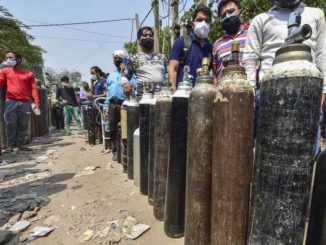
    CHICAGO (TIP): Amid a devastating second Covid-19 wave in India, American Association of Physicians of Indian Origin (APPI), plans to send 200 oxygen concentrators to Indian hospitals with the help of non-profit SEWA International. The largest ethnic medical organization in the US also plans to offer tele-Consult services in India in local languages and organize webinars to educate AAPI members and their counterparts in India on zoom. AAPI has also identified three telehealth platforms that would offer free service to physicians from India/US and patients.

    “In the past week, we have been receiving nothing but mind-numbing news from many countries around the world, particularly in India, the land of our birth,” stated AAPI President Dr. Sudhakar Jonnalgadda. Pointing to the chilling statistics, Jonnalagadda also urged AAPI members and the general public to step up and donate generously as India, our motherland is facing one of the most serious health crises in decades, according to an AAPI press release. “This is the time for immediate AAPI action. As doctors, we all share a visceral urge to do something about it,” he said.

    200 Oxygen concentrators costing around $500 each will be delivered direct to hospitals in India with the help of SEWA International with Indian missions in the US helping with shipping and customs, Jonnalagadda said.

    Describing the current spike in Covid cases in India as “the worst nightmare” Dr. Sajni Shah, Chair of AAPI Board of Trustees pointed out, “This is a far cry from the picture a few months ago about our motherland India, which depicted the virus to be on the decline.” Dr. Anupama Gotimukula, President-Elect, who is leading the AAPI Initiative to help and support plans to help the physicians and the people in India thanked hundreds of AAPI members at the conclusion of a brain storming session on how to help India.

    Dr. Gotimukula announced following steps to help India.

    Groups of physicians will form smaller groups with Indian physicians in their own state/region, and do it yourselves in their own language for Tele-Consult. The Google sheet prepared by AAPI has a list of volunteers that would be updated regularly.

    AAPI has identified three Telehealth platforms that would offer free service to physicians from India/US and patients: 1. EglobalDoctors.com; 2. http://Mdtok.com; and, 3. Click2clinic.com. Apps are available on iOS and Android.

    In addition, with the purpose of educating AAPI members and their counterparts in India, AAPI is organizing educational webinars with small groups of doctors on zoom.

    Dr. Gotimukula urged the physician fraternity to educate their communities on the need to double masking and everyone taking “the vaccine to reduce the intensity of disease if we become Covid positive.”

    AAPI is offering MD-To-MD zoom chats and discussions about one’s patients, disease, course of medicines, and progress daily 7-8 am IST/9:30-10:30 am EST.

    Dr. Ravi Kolli, Vice President of AAPI noted that AAPI members have risen to “the occasion and are offering the much-needed services to their motherland in several ways, individually and collectively.”

    Dr. Amit Chakrabarty, Secretary of AAPI giving details about covid tele-consulting services for Indian doctors said, “We are extremely delighted about the overwhelming response to this.”

    Dr. Satheesh Kathula, Treasurer of AAPI thanked all the volunteers and tele-health platform companies for sharing platforms and offering services at no cost to AAPI members, Indian doctors and patients for treating Covid-19.

    For more details, please visit: AAPI website: http://www.appiusa.orgwww.appiusa.org.

  • Indian American Lawmaker Welcomes US Government Decision

    Indian American Lawmaker Welcomes US Government Decision

    WASHINGTON (TIP):  An Indian American Democratic lawmaker on Monday, April 26,  welcomed the US government’s decision to provide material and healthcare help to India in its fight against a spike in COVID-19 cases, but said this is “no time for symbolism” or “lip service” and the Joe Biden administration must act now.

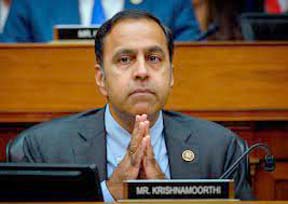
    India is struggling with a second wave of the pandemic with more than 3,00,000 daily new coronavirus cases being reported in the past few days, and hospitals in several states are reeling under a shortage of medical oxygen and beds. “The Biden administration’s commitment that it will export raw materials for the Indian manufacturer of the Covishield vaccine is a welcome decision,” Indian American Congressman Raja Krishnamoorthi said.

    “However, this is no time for symbolism, half-measures or lip service. We must act now,” he asserted.

    The Biden administration had come under criticism from several quarters, including from members and supporters of the Democratic Party, for not releasing surplus COVID-19 vaccines to India when the country was experiencing its worst-ever public health crisis. India had urged the US to supply the raw materials for manufacturing the Covishield vaccine. Following the criticism, US National Security Advisor (NSA) Jake Sullivan in a telephonic call with his Indian counterpart Ajit Doval on Sunday affirmed America’s solidarity with India.

    After the phone call, Emily Horne, spokesperson of the US NSA, underlined that America is “working around the clock” to deploy available resources and supplies and has “identified sources of specific raw material urgently required for Indian manufacturer of the Covishield vaccine that will immediately be made available for India”.

    Mr Krishnamoorthi, who is also the chair of the Oversight Subcommittee on Economic and Consumer Policy, said it is imperative that the US government double down on its commitment by exporting these materials expeditiously, by opening its stockpile of AstraZeneca vaccines currently sitting unused on shelves.

    He said the US government should also follow the actions of other countries this weekend by shipping medical supplies, including oxygen concentrators, to help treat COVID-19 victims in India and other nations hardest-hit by the deadly virus. India logged a record of 3,52,991 new coronavirus infections in a day on Monday, taking its total tally of COVID-19 cases to 1,73,13,163. The death count increased to 1,95,123 with a record 2,812 daily new fatalities, according to the Union Health Ministry data.

    “The Lend-Lease Act of World War II states that America could lend or lease supplies to any nation deemed vital to the defense of the US. This is no different. We are fighting a war together with India, Argentina and others. We can only defeat COVID-19 by defeating it everywhere. Our success in ending this pandemic hinges on the leadership of the US and our ability to help allies in need,” said Krishnamoorthi, who also serves on the House Oversight Committee and the House Permanent Select Committee on Intelligence.

    Meanwhile, Ro Khanna, another Democratic Indian American Congressman, said international cooperation and humanitarian assistance are the hallmarks of a truly progressive foreign policy.

    “In the face of apocalyptic numbers of COVID-19 cases and new variants exploding in India, I applaud the Biden administration’s decision to put people over profits and provide additional Personal Protective Equipment, oxygen and other medical supplies to India,” he said.

    Mr. Khanna said he is pleased to see the USAID’s (United States Agency for International Development) work with the Centers for Disease Control and Prevention to expedite the mobilization of emergency resources for India through the Global Fund.

    “This must be done with the utmost speed and urgency,” he said, adding that the Biden administration can still do more, like give India its stockpile of AstraZeneca vaccines that won’t be used in the US.

    The government should facilitate the Indian community in America to help assist hospitals in India. It can also call on Pfizer and Moderna to provide an intellectual property waiver for six months to a year as India grapples with this health crisis, Mr. Khanna said.

    “The White House should also convene Indian business leaders to make the case for why this is in these companies” long-term strategic interest. Many Indian American business leaders such as Vinod Khosla are happy to make the case to them why this is a good business decision,” he said.

    The Democratic lawmaker noted that Khosla has committed to financially help any hospitals in India in need of supplies and will also be speaking with the India Caucus leadership to discuss what else can be done to assist.

    “This is a very tough time for the Indian people and underscores the continued threat of COVID-19. These new strains of the virus are gravely alarming and could pose a threat here in America and across the globe if we do not do all we can to contain the virus and its new variants,” Mr Khanna said.

    US Surgeon General Dr Vivek Murthy said the aid extended by the US to India includes raw material for vaccine production, therapeutics, rapid diagnostic kits, ventilators, oxygen generation and related supplies, financial support for vaccine manufacturing expansion and deployment of American public health teams.

    “This is an important step forward,” Indian American Congresswoman Pramila Jayapal said, thanking Joe Biden for recognizing that “our fates” are all tied together.

  • “India deserves our attention right now”: Sundar Pichai

    “India deserves our attention right now”: Sundar Pichai

    SAN JOSE (TIP): Witnessing the “heartbreaking” Covid-19 crisis in India amid a deadly second wave, Google’s Indian American CEO Sundar Pichai would like other US companies to also come forward to help in a coordinated way.

    “India deserves our attention right now,” Pichai told media Wednesday, April 28 discussing how his company is responding and what others can similarly do to lend support.

    Pichai, who became head of Google’s parent company Alphabet in 2019, and Microsoft’s Indian American CEO Satya Nadella publicly pledged Monday, April 26 to help battle the surge of coronavirus cases.

    “The situation there is dire, and it’s been heartbreaking to see. I think the worst is yet to come,” he said on witnessing the unfolding crisis in India from afar.”

    “Being here, seeing the attention here, I realize at the highest levels from President (Joe) Biden, Secretary (of State Antony) Blinken — there’s been focus on seeing how we can help India and the other countries being affected.”

    “From our side, we really focused on providing the most helpful information,” he said noting there are 600 million people connected to the internet and they’re looking for information about vaccine and testing.

    “So, working with the Ministry of Health in India, making sure we can get the right information on the ground has been a big focus for us.”

    “As for us partnering with NGOs and public health organizations to get the messaging out,” Pichai said, “It’s important that people are able to stay home and mask and stay safe. So, we’re helping get the message out in partnership.”

    Other companies can similarly take their expertise where they “can and being ready to help in a coordinated way is going to be helpful,” he said. “The second, it’s very possible to provide cash and other resources to organizations on the ground I think can make a big difference.”

    Asked about vaccine supply and a possible intellectual property waiver, Pichai said he was more involved in the conversations around providing raw materials, supply access so India can begin manufacturing its vaccines.

    “I’m not familiar enough around the issues around IP to weigh in on them” he said. “I was encouraged by the AstraZeneca doses to India.

    “This pandemic will involve us tackling it globally. The US, we’re very fortunate. We need to work hard to make sure we can get access to vaccine supply around the world as soon as possible,” Pichai said.

    On Indian Prime Minister Narendra Modi’s handling of the pandemic, Pichai said, “If you look around the world, Covid has been humbling in the sense that, when you think you’re on top of it, there can be a surge back.”

    “I think encouraging good public safety measures and paying attention to crisis is the only thing you can do in the short term. That’s the effort I’m seeing,” he said adding, “As a company, we stand by ready to help.”

    Commenting on recent take-down requests from the Modi government over critical pandemic posts on Twitter, Facebook, Pichai said, “Normally we do comply with local laws, particularly in democratic countries which through their norms and processes have passed laws.”

    “I think one of India’s strengths is a deeply rooted democratic tradition, based in freedom of expression and allowing for diversity of viewpoints,” he said. “That’s a strength.”

    “We haven’t had any requests,” Pichai said, In the past we’ve been able to work constructively with governments around the world, and we’ll continue that approach here.”

  • Indian American physicians, artists offer India support in Covid-19 crisis

    Indian American physicians, artists offer India support in Covid-19 crisis

    Paramjit Aujla

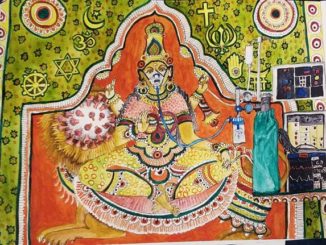
    SACRAMENTO (TIP):  For Indian Americans living thousands of miles away from the country of their origin, the past few weeks have been nothing short of harrowing. As India continues to be in the grip of a deadly second wave of Covid pandemic, relatives in America are often at a loss wondering how they can come to the aid of India in its hour of crisis. While many organizations are creating fundraisers, some others are using creative outlets not only to cope with the worries, but to also create awareness and raise funds. California-based Indian American artist Sujata Tibrewala spent the past few days completing a new painting she titled, “Sick Mother India.”

    From her San Jose home, the artist explained to a news outlet, why she resorted to the creative medium to help her calm down as distressing news continues coming out of India.

    “I started to paint a traditional kalamkari art to take my mind off all the happenings in India,” she said. “But halfway through I saw the goddess having difficulty breathing due to all Covid around and I felt compelled to give her oxygen.” The artist-activist thinks that it is calamities such as these that make us realize how futile our differences and divides have been.

    She says, “In the recent past, there have been conversations (in India) around mandir and masjid. But those who are affected are people from all religions.”

    “Corona does not care. If Hindus go for a congregation, they will get affected. Same is the case with Muslims or any political party,” Tibrewala says.

    “My country, the melting pot of all cultures has been reduced to this fighting in the name of religion, caste, political ideology. This is cruel reminder that instead we should be all fighting the common enemy – Covid.”

    The artist however stresses that her painting is not just a creative outlet for healing for her, but through it she also intends to encourage fellow Indians in America to raise funds.

    “I am amplifying my request to raise funds for India through my painting,” she says urging everyone to donate to any charity of their choice for Covid relief and send her a proof of donation.

    “As a Thank You gesture, I will send them a digital print of this painting or my Mandala artwork if they are within US. If the contributors are outside of US they will get an online print.”

    If art is serving as a medium to help some, many other organizations have come together to raise funds – an important in fact acute urgency during these times. American Association of Physicians of Indian Origin are also collecting funds. The money raised would be used to send oxygen concentrators to India. Readers can go to https://events.aapiusa.org/donation-oxygen/ for donating.

    Another fundraiser by Asha for Education, an NGO that works for education of underprivileged children in India will go towards purchasing medicine and hygiene kits, pulse oximeter kits and oxygen concentrators.

    Readers can go to https://www.facebook.com/donate/318833112965921/10159189122663187/ for details.

  • Indian American activists launch ‘National Call In Day’ for India Covid-19 relief

    Indian American activists launch ‘National Call In Day’ for India Covid-19 relief

    WASHINGTON (TIP): Following the Biden administration’s offer to help India, currently in the middle of a cataclysmic Covid surge, some civil rights activists and lawyers based in the United States and abroad have demanded more swift and transparent action on the part of the US government and accountability from the Indian government in distribution of these medical resources.

    The activists, who describe themselves as a concerned group of civil and human rights defenders, activists and organizers based in India, the United States, and across the world, organized a “Rise for India – National Call in Day” on Wednesday, April 28.

    President Joe Biden assured on Tuesday that the United States will be rushing immediate help to India in the form of Covid vaccines, Remdesivir injections and other medical aid. However, some U.S. activists say that his administration’s announcement of its revised policy on the export of vaccines and the supply of raw materials to produce vaccines does not detail how the policy will be administered.

    The White House faced flak for not rushing to announce the aid package.

    The Indian government has been criticized for mismanaging the crisis and under-reporting the infection and death rates.

    The activists include civil, political and human rights lawyer Arjun Sethi, international human rights lawyer Ramya Reddy, and Georgetown Women’s Law and Public Policy Fellow Asees Bhasin.

    Sethi tweeted, “Covid-19 is a global pandemic & the people of India need our support. We’re asking everyone to join a National Call In Day on Wed, April 28. Please use the app & urge Congress to take swift, comprehensive & transparent action to provide relief to India.”

    Covid-19 is a global pandemic & the people of India need our support.

    We’re asking everyone to join a National Call In Day on Wed, April 28.

    Please use the app & urge Congress to take swift, comprehensive & transparent action to provide relief to India.https://t.co/RWwc0dm4Vn

    — Arjun Sethi (@arjunsethi81) April 28, 2021

    The group urged people to call their senators and representatives and ask them to demand President Biden to release information on how many doses of the AstraZeneca vaccine will be dispatched to India, share additional portions of the US vaccine stockpile, and provide a fully transparent timeline of when, how, and to what extent these measures, including the export of raw materials to ramp up the vaccine production, will be implemented.

    They also asked Indian Americans to ask their representatives to continue to provide humanitarian assistance in the form of oxygen, testing kits, protective equipment and medical supplies. The group also demand ethical leadership and accountability from the Indian government on how it will distribute these resources and called on New Delhi to allow open and free reporting on the Covid crisis.

    Here’s the full text with the details of the National Call in Day

    The Biden Administration’s announcement of their revised policy on the export of vaccines and the supplying of raw materials to produce vaccines does not detail how the policy will be administered. Join us for a National Call-In Day on April 28th, 2021. Call your Senators and Representatives and ask them to demand President Biden:

    • Release information on how many doses of the AstraZeneca vaccine will be dispatched to India, share additional portions of the US vaccine stockpile, and provide a fully transparent timeline of when, how, and to what extent these measures, including the export of raw materials to ramp up the vaccine production, will be implemented.
    • Continue to provide humanitarian assistance in the form of oxygen, testing kits, protective equipment, and medical supplies.
    • Support the global campaign calling for an Intellectual Property Rights waiver from the WTO for COVID-19 vaccines.
    • Demand ethical leadership and accountability from the Indian government on how they will distribute these resources & order them to allow open & free reporting on the COVID crisis.
    • You can find more details on the National Call in Day here

    https://www.notion.so/Rise-for-India-National-Call-in-Day-79e1608061a540bdaf59591550a2386d


  • GOPIO Thanks President Biden and Appeals to Release AstraZeneca Vaccines to India

    GOPIO Thanks President Biden and Appeals to Release AstraZeneca Vaccines to India

    NEW YORK (TIP): Global Organization of People of Indian Origin (GOPIO) thanked US President Joe Biden for his announcement of USA sending raw materials for COVID-19 vaccines, medical equipment and protective gear to help India respond to a massive surge in coronavirus infections. India is going through a grim situation now in Covid Pandemic infection and deaths. The latest report says that the new infections are about 350,000 and deaths about 3,000 per day.GOPIO Chairman Dr. Thomas Abraham said that in the last three months, India acted as a global leader in sending vaccines to many countries. However, with the sudden unexpected Covid-19 outbreak, India needs an enormous quantity of vaccines for its 1.3 billion population. As a close ally of India, our country must help India in this grave situation.“We appeal to you to send AstraZeneca vaccines which are stored by US manufacturers in their warehouses since the US is yet to authorize its use here while it has been used in India,” Dr. Abraham appealed in his letter to President Biden. GOPIO also requested President Biden to facilitate manufacturing of other vaccines in India so that the global demand can be met sooner.

  • Koshy Thomas Candidacy for District 23 of NYC Council is gaining momentum.

    Koshy Thomas Candidacy for District 23 of NYC Council is gaining momentum.

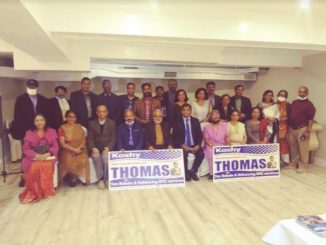
    QUEENS, NY (TIP): Koshy Thomas Campaign is gaining momentum as the Asian Indian Queens community gathered to throw their full support to him in his efforts to become the first New York city council member in the upcoming elections on June 22nd. The meeting took place in Santoor Restaurant in Floral Park and was attended by community leaders and activists. The meeting was convened in light of increasing endorsements and enthusiastic reception from voters for his candidacy. The challenge for Koshy Thomas is to translate the newly created enthusiasm into votes in the days ahead! Mr. Koshy Thomas, in his speech, talked about his involvement with the community for the last 27 years and said he knows the community well and their concerns and aspirations. “I consider this upcoming election as a great opportunity to serve the people in the District. There is so much to be done in terms of helping the community and the small business in these COVID times. “If you walk around this District, you may see so many small businesses are closing down, and they are truly hurting. They need help with tax breaks and other financial incentives to survive in this economic downturn”, he said.

    Dr. Annie Paul, Legislator from Rockland county, called for unity among us and encouraged everyone present at the meeting to get involved.  “when I ran for the election, people from all over the country extended help. I am expecting the same for Koshy’s campaign. This District has so many Asian Indians, and if we come together, victory is certain”. She said.  She also offered whatever assistance in this effort and urged the community to join her in this great endeavor to elect the first Asian Indian to the NYC Council.

    Mr. Aniayan George, President of FOMAA (Federation Of Malayalee Associations of Americas), characterized Koshy Thomas as someone who identifies with the community regardless of their background and someone who has the energy, willingness, and capacity to elevate his contributions further as an NYC Councilman. “I believe Koshy Thomas can win this election, and he will be our first Asian Indian representation in the City Council,” he added.

    Father John Thomas, Vicar of the Orthodox Church in Jackson Heights, reminded the people of our duty as responsible citizens to participate in the elections and specially to vote.  He cited “the issue of non-participation in voting as one of the serious concerns involving our community.” He also urged the participants to discharge our constitutional responsibility as new citizens of this great country. Mr. Denzel George, President of the North Hempstead Malayalee Association, reiterated the basic principle of faith and said, ‘we ought to believe in the candidacy of Koshy as the first step towards winning this great challenge. If we do, it is achievable”.

    George Abraham, Vice-Chairman of the Indian overseas Congress, encouraged the community to take advantage of this historic opportunity to place Koshy Thomas in the City Council. He lauded him for his work in the community in the last several decades as an indication of his commitment and dedication to serving the people. ‘Undoubtedly, for anyone to succeed in an election, it requires financial resources and manpower. There is no shortage of that in our community; the question is whether we are willing to help in the next two months to attain our goal,” he asked.

    Mr. Robin Singh, representing the Caribbean community, said, “Koshy’s candidacy is appealing to all sectors of the community, and having known him over the years, I wholeheartedly endorse his candidacy and assure you of our support for his campaign.”

    Mr. V.M. Chacko, a leading community activist in Queens over four decades, pointed out the potential the community has in this upcoming election and said, “this is not the time to be lackadaisical, and please get involved for the sake of the safety and wellbeing of our community.” Mr. V. Abraham (Raju) described the success the campaign has had in terms of timely submission of the nomination forms and increased awareness of Koshy’s candidacy across the District. Mr. George Parampil, who has been urging Koshy Thomas to run over the years, applauded his dedication to the community and threw his full support behind him.

    Mrs. Mary Philip, Thressiamma Sebastian, Dr. Anna George, George Kottarathil, Leelamma Appukuttan, Lizzy Kochupura also spoke.

    Ajit Abraham emceed the event.

  • Dan Quart Joins Lawmakers and Community Leaders to Denounce Hate Towards Asian Americans and Demand Justice for Yao Pan Ma

    Dan Quart Joins Lawmakers and Community Leaders to Denounce Hate Towards Asian Americans and Demand Justice for Yao Pan Ma

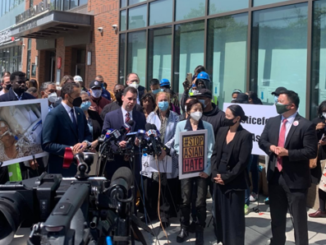
    MANHATTAN (TIP): Candidate for Manhattan District Attorney Dan Quart, on April 27, joined lawmakers and community leaders in East Harlem to denounce hatred towards Asian Americans and demand justice for Yao Pan Ma. Yao Pan Ma was brutally attacked Monday night and remains in critical condition at Harlem Hospital.

    “The vicious attack on Yao Pan Ma was unacceptable, and the problem of Anti-Asian hate goes even deeper than what we’re seeing because so many crimes go unreported,” said Quart. “There is a valid conversation to be had about the root causes of the attack on Yao Pan Ma, but this is a moment where accountability and justice is required, and that includes aggressive prosecution.”

    Dan Quart is one of NYC’s top pro bono attorneys and a New York State Assembly member representing Manhattan’s East Side. A Washington Heights native who grew up in subsidized housing with working-class parents, Dan was raised by a public-school teacher and a social worker who taught him the value of public service. Since graduating law school, he has dedicated his career to standing up for tenants’ rights and advocating for criminal justice reform.

    As Manhattan’s next District Attorney, Dan will fight to end mass incarceration, hold law enforcement accountable for police brutality, and ensure that all Manhattanites feel safe. Learn more at DanQuart.com.

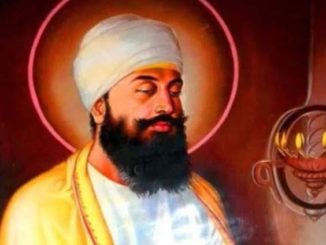
  • The Making of a Martyr: Guru Teg Bahadur and his Times

    The Making of a Martyr: Guru Teg Bahadur and his Times

    By Rupinder S. Brar MD FACC

    Guru Teg Bahadur was preaching in faraway Assam when he received a short disquieting message from the Sangat of Burya, a small town near Sirhind, in Punjab. Some fanatic Muslims had taken it upon themselves to destroy a Sikh house of worship and erect a Mosque instead. They appointed a local dervish name Sayyed Muzaffar as its caretaker. The act so enraged the Sikhs living in the area that they not only destroyed the illegal Mosque but also killed the dervish in the ensuing violence.  The matter reached the emperor of Hindustan and fearing harsh retribution the Sangat reached out to their Guru. Guru Teg Bahadur heard the message calmly but understood the gravity of the situation. At the root of the seemingly insignificant local dispute lay a country wide imperial farman (order) issued on April the 9th, 1669 issued by emperor Aurangzeb Alamgir which informed all the provincial governors that Hindu temples and other non-Muslim houses of worship were to be destroyed and only Mosques could be built in their place.  It was an unprecedented order that threatened the very basis of the communal harmony that the various Pirs, Sufis and the Sikh Gurus had created over the years. Fortunately, the order had been ignored at most places until then but now things seemed to be getting out of hand.

    Many people were convinced that such policies were driven by Aurangzeb’s puritanical zeal to create Daar ul Islam—an Islamic society but there were others who were not so sure. Among them was Guru Teg Bahadur’s friend and benefactor, Kunwar Ram Singh Kachwaha, the Rajput prince of Amber. Like his father and forefathers before him, Ram Singh was an imperial Mansabdar and a close Mughal ally. He was present at the imperial court in Agra on May the 12th, 1666 when a certain unpleasant incident took place from which point onwards one could see in hindsight, began the slow but progressive hardening of royal attitude towards his Hindu subjects.

    On that day, Ram Singh’s father Raja Jai Singh brought with him to the court the Maratha chief Shivaji to meet with the emperor. Shivaji was known to be a fierce warrior who had fought the Mughals to a standstill. It was only after Jai Singh took command of the Mughal armies in the Deccan and forced him out of his mountain hideouts that Shivaji decided to negotiate. Jai Singh treated him with respect and prevailed upon him to make peace with the Mughals. He even offered to intercede on his behalf. The proud Maratha was reluctant at first but left with little choice eventually agreed to meet the emperor.

    The meeting was a disaster.

    Firstly, the free-spirited warrior felt stifled by the formal court etiquette. Secondly, he felt humiliated at having to stand quietly in the back among minor officials to wait his turn. He decided enough was enough and ignoring protocol began to complain loudly. Ram Singh tried to calm him down but Shivaji was inconsolable.

    “I am the chief of the Marathas and will not be treated thusly, he loudly wailed. “Even if you cut off my head, I will not stay here a moment longer.”

    Having thus created a scene, he angrily stomped out of the court. Offended at such insolence, the emperor had him placed under guard and put Ram Singh in charge of his captivity. Unfortunately for the prince, Shivaji easily escaped from his custody and was soon back in the Deccan, now a national hero where he resumed his rebellion with renewed vigor. The entire incident left Aurangzeb humiliated and bitter. He also felt politically outsmarted. A suspicious man anyway he decided to lay the entire blame on the father and son duo, Jai Singh and Ram Singh. Overlooking his own mishandling of the situation he convinced himself that the two had perhaps deliberately let Shivaji escape because they were all fellow Hindus. Following the episode Aurangzeb never completely trusted the Hindus again. Within months his attitude towards the Rajputs too changed as he gradually began to seek favor with the orthodox Sunni elements instead. Ram Singh’s rank was reduced, and he was sent away to fight on the Eastern frontier as a punishment. Meanwhile, the imperial policies became decidedly anti Hindu. The Muslim orthodoxy were delighted further when Aurangzeb fell under the influence of Sheikh Masum, the grandson of the ultra-conservative Naqshabandi scholar Sheikh Ahmed of Sirhind.

    Soon thereafter, the emperor banned the celebration of Navroj, the Shia new year festival and the popular Hindu festival of Holi.  Next, maybe because it was reported that Shivaji had travelled incognito disguised as a Hindu pilgrim, the emperor vented his ire upon the respected Hindu centers of pilgrimage.  In October of 1666 he issued a royal order to destroy the intricate marble railing around the landmark Hindu temple of Keshwa in Mathura that had been designed and paid for by his liberal brother Dara Shikoh.  The following year he destroyed another famous Hindu temple, that of Kalkaji near Delhi.

    The worst was yet to come.

    In 1667 Aurangzeb invited five hundred Muslim religious scholars to write Fatwa e Alamgiri, a legal code based on Islamic Sharia that was to become the law of the land. It would be a first time in history that a non-Muslim majority country would be governed by Islamic Sharia.  In 1669 came the infamous order to destroy the Hindu temples and build Mosques instead.  The order was not only immoral it was also colossal political blunder. From the days of Akbar, the Great, internal stability of the Mughal empire had rested upon the twin pillars of religious tolerance socially and a Mughal Rajput alliance politically. Now Aurangzeb was messing with both and playing with fire.

    Within months of the temple desecration at Mathura, Jats of that area rebelled and kicked out the local Mughal faujdar.  When a large Mughal force was sent to capture them, they united under a charismatic Zamindar named Gocula and destroyed that force too. Though eventually Gocula and his supporters were captured and executed, the uprising encouraged others to follow suit. At other times the Muslim fanatics themselves began the trouble as they did in Punjab. It seemed the entire burden of holding together the communal consensus now fell upon the shoulders of one unassuming, mild mannered man—poet, philosopher, scholar and the ninth inheritor of Nanak—Guru Teg Bahadur.

    He had never actively sought that role. As a child he had been tutored by two community icons, Baba Buddha and Bhai Gurdas.  Between them the two men had lived through the entire Guru period from Guru Nanak onwards and embodied the Nanakian values of self-sacrifice, courage, patience, and high mindedness. Under their influence, the young Tyag Mal, as he was then known, grew up to be a quiet and introspective youth, almost too much so, perhaps which is why his father passed him over and picked his brother’s son as the seventh Guru instead.  While other relatives protested, Guru Teg Bahadur gladly accepted the verdict and went away from Kiratpur, to spend his days meditating in the relative obscurity of Bakala. However, the seventh and the eighth Gurus tragically died in quick succession leaving behind a vacuum and a shaken community, Teg Bahadur, now a mature scholar and a seasoned man, came out of seclusion just as easily and without much fanfare assumed his anointed calling as the ninth Guru. His new role would require him to demonstrate all the patience, discipline, and resoluteness he had learnt from his two tutors and he would not disappoint.

    Golden Temple

    In one of his first acts as a Guru he travelled to Ramdaspur to pray at the Harmandir built by his grandfather but found the doors of the shrine shut in his face by a rival pretender.  Undaunted, he sat on the doorsteps to say his prayers and then left without a fuss. When the supporters of another rival, Dhirmal shot and wounded him in the shoulder, the Guru refused to retaliate. When his own supporters ransacked Dhirmal’s dera and brought to him the original copy of the Adi Granth that Dhirmal had taken away without permission from his grandfather’s house at Kiratpur, the Guru had the Adi Granth restored back to Dhirmal. Let his wayward nephew keep the original copy—the Sacred Word was universal anyway.

    Forgiving and non-confrontational he maybe but the new Guru was no pushover—something people close to him discovered around the Diwali of 1665 when he was preaching to mixed caste audiences at the village of Dhamtan near Jind. His sermons offended the upper castes of the area who threatened him with grave consequences, but the Guru ignored them. He was reported to the emperor at Agra as a troublemaker and a threat to social order.  Aurangzeb promptly had him arrested and brought before him. The Guru still refused to backdown, but neither would he acknowledge any wrongdoing. He was almost executed on the spot but for the timely intervention by prince Ram Singh Kachwaha, who happened to be in the imperial attendance, and impressed by the Guru’s fearlessness, became an instant devotee. Ram Singh interceded with the emperor and begged for a reprieve.  The emperor reluctantly released the Guru into the custody of the Rajput prince, but the image of a stubborn ‘troublemaker’ would settle firmly in his mind.

    Prince Ram Singh was headed for the eastern frontier as the commander of an imperial army and at his insistence Guru Teg Bahadur decided to join him. It was familiar territory for him anyway for no other Guru with the exception of Guru Nanak had travelled so extensively in Hindustan as he. Even before his investiture Guru Teg Bahadur had been up and down the Gangetic valley several times and knew the land and its people very well. He decided to use the opportunity to renew his links once again. Over the next four years he travelled through Agra and Awadh, Bihar and Bengal, to reach the far province of Assam.  He preached to throngs of admirers along the way and wherever he went, he taught the Nanakian values of spiritual strength and personal humility, of introspection and meditation.

    Now four years later, tensions were rising across the land and had reached Punjab. He quickly made up his mind, he was needed there and decided to head back. Within days the Guru household was on the road. His wife, Mata Gujri and his young son, Gobind Rai went separately in the care of a small group of retainers while the Guru himself took a slightly different route.

    Over the next few months, he travelled once again through familiar towns and cities, Sasaram and Bodh Gaya, Benares/Kashi and Mathura and once again people flocked to see him and to hear him speak, to touch his feet and feed him and his companions. It was like the old times and yet the Guru could see firsthand, the violence that was being done to his people and his land. In Kashi he passed by the fresh heap of ruins that was once the ancient Vishwanath temple, its graceful pillars barely visible under a newly built Muslim shrine, the Gyanvapi mosque erected in its place on the imperial orders—a grotesque testament to the humiliation of one faith and the perversion of another.

    Further west stood another new mosque in Mathura dominating the very place where the much-revered Keshava Dev temple once was. It seemed not only Hinduism but even the gentle Islam, of Sheikh Farid and Mian Mir was under assault for here it was told that to humiliate the Hindus further, the sacred idols from the temple had been carried away to Agra and buried beneath the steps of another mosque so that the feet of the Muslim faithful may walk over them every day.

    The Guru and his party threaded their way slowly through the Indo-Gangetic heartland and reached Delhi by late June. By then the hot summer sun was upon them and they took a few weeks break from the journey there. The capital was rife with rumors and people as anxious as elsewhere. The Guru listened to one and all as he continued to propagate his message of kindness and compassion. Several holy men came to see him and pay respect. Among them were a group of men who arrived from the nearby town of Narnaul. They introduced themselves as Satnamis, a sect made up of low caste Hindus whose beliefs were very similar to the Nanakpanthis. Guru Teg Bahadur received them warmly and blessed them.  Never threaten anyone nor be afraid of anyone or anything, he told their leader. Soon thereafter, he left for Punjab. The Satnamis too headed back to Narnaul. Aurangzeb Alamgir was in Delhi at the time but took no notice of the meeting.

    Apparently, he had much more important things on his mind.

    II.A Beleaguered Badshah

    Even as Guru Teg Bahadur was passing through, a sense of siege was settling in the capital. Dissent and rebellion seemed to be everywhere. From the Subah of Kandahar came reports of a Pashtun uprising under a Yusufzai leader named Bhaku who drove out the Mughal officials.  The emperor ordered fresh forces rushed from Lahore and Kabul. After some intense fighting the rebels were crushed but pockets of resistance remained. Then worse news came from the South. For a while, the spies had warned that the Marathas were restive once again. In February of 1670 they began a fresh offensive. In a night raid a handful of daring Marathas scaled the steep walls of Singhagad fort and massacred its surprised Mughal garrison.  The fall of Singhagad was a singular disaster for it was a strategic outpost in the heart of enemy territory and its fall left Shivaji unchecked. Soon he began his punishing raids into Mughal territories including an audacious one on the rich port of Surat. The demoralized Mughals could only look helplessly on.

    Stung by such reverses, Aurangzeb was forced to pour men and material into the troubled provinces. New Mansabdars were appointed, and new estates created and distributed among them. Such measures began to put an additional strain on the already seething heartlands. Now, fresh trouble began to brew, this time barely fifty kos from the capital, at a place called Narnaul where a new egalitarian movement had taken hold some decades ago among the lower caste Hindus. Exactly when and how that movement originated is disputed by historians but what is not disputed is its remarkable roots in the Nanakian philosophy.

    Even the name of the community—Satnami—came from Guru Nanak’s name for the Divine in his credal statement, the Mool Mantar. Like the Sikh Panth in Punjab the Satnamis eschewed caste, class or gender differences and believed in a formless God, Sat Naam that manifested itself in the form of the Shabad. They rejected empty rituals and asceticism, believed in hard work and simple living as householders. Like the Sikhs, they called their community—the Panth. Their commune was made up almost entirely of the low caste Chamars and like the early Sikh community at Kartarpur, men and women worked together all day and read their sacred Pothis in the evening. Over time Satnami community began to insist on being treated at par with the upper caste Hindus, an assertiveness that was reinforced by their recent meeting with the Sikh Guru. Unfortunately, such assertiveness was considered an affront to the centuries old caste system and Mughal absolutism therefore a clash soon became inevitable. Trouble started in 1672 over a very ordinary event. A Mughal trooper finding a Satnami peasant too insolent for his liking, split his head with a blow from a stick. It was nothing unusual, such things happened all the time. Unfortunately, that day it turned out poorly for the trooper for in no time dozens of peasants surrounded him and almost beat him to death. Such audacity from low caste peasants was unheard of and could not go unpunished. The local shiqqdār (petty revenue collector) sent a contingent of troops to drag the miscreants to justice.

    The Satnamis however had anticipated such a move and were ready.

    Aware that the flower of the Mughal army was far away in the Deccan they not only drove the troops away, but went on the offensive and after overrunning the neighboring town of Bairat marched on to Shahjahanabad (Delhi) itself.  It was an audacious move. Believing that the Mughals were on the run, other peasants and artisans flocked to the Satnami cause and their ranks swelled into thousands. Too late, the Mughals realized that they had a full-fledged rebellion on their hands and the lightly defended city went into panic. People buried their valuables and the price of food grain shot up. Sensing the imperial weakness, even upper caste Rajputs and Muslim Zamindars around Delhi refused to pay revenue. Rumors flew. It was said that the Satnamis were backed by magic spells and were immune to Mughal arrows or bullets.

    The dread reached such a level that emperor Aurangzeb himself had to step in. He announced that he would counter Satnami magic by inscribing the holy Koranic verses on green banners in his own hand that would dispel all evil spells. The banners were held high by foot soldiers and an army was hastily put together.  Artillery pieces were stripped off from the city walls and desperately pressed into service. Ten thousand imperial troops were somehow gathered under a seasoned commander. The two sides clashed a few miles from the capital on Friday, the 15th of March 1672. Outgunned and outclassed, the Satnamis were wiped out but not before winning a grudging admiration of their adversaries.

    As the news of this unusual uprising spread, rebels elsewhere took heart. From the Subah of Kabul came fresh news that the Pashtuns were on warpath once again, this time fueled by the fiery rhetoric of a warrior poet named Khushal Khan Khattak. Encouraged by Khattak the Afridi Pashtuns massacred a force of forty thousand men and the provincial governor, Muhammed Amin Khan barely escaped with his life.  The alarmed emperor decided to take the field himself. In early 1674 he moved to a desolate military outpost of Hasan Abdal located on the North West frontier. By using a combination of deceit, coercion, subterfuge, and bribery, he somehow pacified the Afghan tribesmen but his absence from the capital took a toll elsewhere. Far away in the Deccan Shivaji decided to take advantage of the imperial distractions to take on the emperor on equal terms.  He announced the establishment of a new Hindu empire in the Deccan with himself crowned as its independent ruler. The coronation was a grand affair that cleverly appealed to the Hindu sentiments by harking back to the pre-Islamic culture and extinct Hindu empires.  The entire proceedings were carried out in Sanskrit and fifty thousand Brahmins were invited from all over Hindustan to preside over the ceremony. They were led by the venerable Gaga Bhatta of Benares, who declared Shivaji’s bloodline the most noble in the land, surpassing even the Sisodhiyas of Mewar. Lavish gifts were showered over the Brahmins and elaborate feasts were provided to them and their families for four long months. On June the 6th, 1674 Shivaji woke up early after days of fasting and prayers for purification and mounted the auspicious throne of a Hindu Sawrajaya.  The waters from all the sacred rivers of Hindustan, Indus, Ganga, Yamuna, Narbada, Tapti, Godavari, Krishna and Cauveri were poured over his head by his eight chosen ministers, his Ashtpardhan. Shivaji was given a new title—Kshatriya Kulavantas Chhtrapati Raje Shivaji, and a new Hindu golden age—the ‘Shiv Rajyabhisheka Shaka,’ was officially declared as literally tons of gold, silver and precious metals were distributed among the guests and the Hindu temples all over the land.  The symbolism of this grand spectacle was not lost on anyone, least of all on the shrewd emperor. Until that point, all the noble Hindu ruling houses were Rajputs from Rajputana and all of them had accepted Mughal suzerainty, Mughal service. Now by declaring himself as a blue-blooded Rajput and an independent Hindu ruler at that, Shivaji had staked a claim to the leadership of the entire Hindu population of the land. Moreover, by resurrecting the ancient Hindu imperial traditions he artfully bypassed the Mughal emperor’s authority to confer kingship. Instead, he claimed legitimacy from the Hindu Shastras as the inheritor of India’s ancient empires. It was high propaganda but a political masterstroke that challenged the very hegemony of the Mughal rule in Hindustan. To add insult to injury, Shivaji who was now nearly bankrupt thanks to his elaborate ceremonies, sent his generals to once again raid and plunder deep into the Mughal territories to pay for the extravaganza.The emperor was left seething but there was little he could do immediately about it. Around the same time, he received another intelligence report from the nearby Subahs of Lahore that caught his attention. Spies reported that the Sikh Guru was moving around in the countryside of Malwa and Doaba in Punjab with thousands of soldiers and horsemen in tow. That ‘whosoever was refractory towards the officials took refuge with him.’ The report warned the emperor that if no notice was taken immediately an insurrection was likely that would be extremely difficult to deal with (later).”

    Aurangzeb was a suspicious individual anyway and surrounded as he was by insurgents and threatened by a new Hindu political revival in the land, he had every reason to assume the worst. The Satnami uprising was still fresh in his mind, and neither had he forgotten the support, limited though it was, that Guru Har Rai had extended to his brother and rival Dara Shikoh in 1658. Now with a new rival rising in the Deccan he could not risk another infidel uprising in Punjab. Thus, assuming the worst and sure that he was acting in the best interest of the empire, Aurangzeb Alamgir sent a secret message to the Subedar of Lahore. Guru Teg Bahadur was to be arrested immediately and executed lest he became a bigger threat to the empire.

    III. The Protector of Hindustan

    Guru Teg Bahadur had arrived in Punjab just in time for the festive season around the Dussehra of 1670. He caught up with his family at Lakhnaur near Ambala from where they all proceeded to Anandpur, then known as Chakk Nanaki. By 1672 however he was back again touring the areas of south east Punjab known as Malwa and Bangar.  He met as many people as he could and listened to their concerns. The entire region was in an appalling state. Mismanagement and poor governance had driven the peasantry to the edge and many of them were in a sullen and rebellious mood.

    Besides the obvious social and inter faith tensions generated by the imperial orders, another big problem haunting the peasantry was economic exploitation. Because the near constant imperial wars needed men and resources a huge burden fell upon the peasantry. Large Jagirs or estates were squeezed as smaller ones were carved out of them to pay for the expanding list of Mansabdars who lived off these estates. The matters were made worse by constantly rotating the Mansabdars among the estates. Sometimes a single estate changed hand more than once in a single year and the peasants were forced to pay the taxes twice.  Because most able-bodied men were drawn away to serve in the Mughal armies, lawless elements could not be checked. Unfortunately, the imperial officers blamed the local peasantry for any crimes committed in their areas and punished their leaders.

    Such pressures created a dangerous situation especially since the entire countryside in the 17th century was one large armed camp in which peasants everywhere carried arms.  Many villages had fortified compounds and when the peasants were in a bad mood even a simple act of tax collection by the authorities had to be backed by force.  Just like the Jats in Mathura and the Satnamis of Narnaul, the peasants in Punjab had grown bold and were but one incident away from rebellion. Banditry was endemic.  In such trying times, it was the Guru who tried to calm tempers. In Assam, he had mediated a peace between the warring Ahoms, and the Mughal forces led by Ram Singh.  Now back in Punjab, he did the same, acting both as their spiritual guide as well as their conscience keeper. Meditation and introspection alone, he preached, was the way to survive in the Kaliyug.

    Jagat bhikhari phiraat hai,

    sabh ko daata Ram; he wrote;

    (the world is full of beggars,

    and yet there is only one true Giver).


    At another place he said:

    ‘One who is neither given to anger nor despair,

    but considers both friends and foes alike,

    know that person as truly liberated.

    One who is untouched by pride nor greed,

    know only such a person an image of the Divine.

    Unfortunately, the Guru’s job was a difficult one. As the pressure on the land revenue continued unabated, the destitute peasants often abandoned their lands and turned to the only institution available to them for aid—the house of Guru Nanak. Yet because the abandonment of the land was technically considered illegal, the Mughals looked upon many such followers of the Guru as criminals. The Guru however felt duty bound to help one and all, regardless of caste or class, region, or religion. He went about providing for the needy, digging wells and ponds in parched lands, providing cattle where there was need and feeding those who had to be fed.  While social and political tensions rose and fell, the Guru preached nothing but patience, compassion and humility. However, it was these large crowds of disenchanted peasantry following the Guru that probably frightened the Mughal spies who dutifully reported their fears to the emperor with tragic consequences.

    It was a false alarm.

    The Guru had no political ambitions. His strength was chiefly spiritual, his weapons were his conscience, and his goals were Dharmic—wellbeing of all. There was never any thought of a rebellion in the Guru’s mind.

    It was not his style.

    The key to living within the Hukam the Guru famously preached, was to never fear anyone nor to threaten anyone.  Even as he watched the likeminded Satnamis rebel in Narnaul next door, he never encouraged anyone to take up arms.

    In 1675 a group of Kashmiri pandits despondent over forced conversions in their area approached the Guru to mediate with the emperor on their behalf.

    According to oral Sikh tradition, in 1675 a group of Kashmiri pandits despondent over forced conversions in their area approached the Guru to mediate with the emperor on their behalf.  It was not an unusual request; the Sikh Gurus had mediated on the behalf of the people before from time to time. For example, in 1598 Guru Arjan had met with emperor Akbar on the behalf of the peasantry suffering from drought and had their taxes remitted.  Having seen the pain and suffering in the land, Guru Teg Bahadur probably meant to meet with the emperor anyway to appeal to his conscience and stop the brutalizing of his people. Not wanting to wait any longer, he set out on July the 10th, 1675, on a peaceful mission to the capital accompanied by three close followers—the brothers Bhai Mati Das and Sati Das, and Bhai Dayala.  The party had only gone a short distance when they were stopped by Mirza Nur Mohammed Khan near Ropar on July the 12th. Acting upon the royal instructions, the official arrested the Guru and his companions and sent them to the lockup in Sirhind.

    Days turned to weeks and weeks to months, but the Guru remained in prison without any clear reason. Finally, it became obvious that he was unlikely to make it out of the prison alive. Guru Teg Bahadur accepted his fate calmly and took solace in two of his favorite activities—meditation and poetry. His writings reflected the urgency of the moment, yet he would not let the community despair.

    “Strength departs, fetters remain; all remedies are gone.

    You alone (God) remain a hope,

    as once you helped a trapped elephant,” 

     he wrote. But then he followed it by:

     “Strength is restored,

    all fetters break,

    in your (God’s) hands lie all remedies.” 

     Four months later, the Guru was transported to Shahjahanabad (Delhi) under imperial orders. Reportedly attempts were made to get the Guru to confess and accept Islam, the usual option offered to the political prisoners, but the Guru rejected such pressures even as his companions were tortured to death in front of his eyes. Loyal followers in the capital were able to maintain some communication with the Guru but to them too he advised only patience and submission to Divine will. Some of his most beautiful and poignant verses were composed during those final difficult months. The world was false, he observed, its petty attractions an entanglement, yet the only unchanging reality was the impermanence of life.

    “Chinta tan ki kijiye ja anhoni hoye,

    ehu maraag sansaar ko Nanak Thir nahin koye”

    (Fear only that which is unexpected,

    not the (changing) ways of the world—nothing stays forever).

    His words were read, repeated, and shared by anguished followers hoping for a miracle. Later generations would come to believe that the Guru perhaps used supernatural powers to leave the royal prison at will to visit the faithful yet the Guru himself eschewed all such talk when he lived. According to one account, when asked to perform a miracle, he agreed to do so but only on the day of his execution. He said he would tie a talisman around his neck that would allow him to defy death.

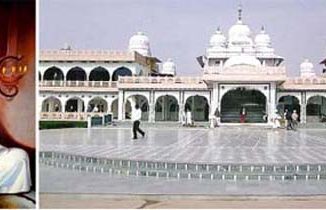
    Gurdwara Sis Ganj at Chandni Chowk where on November the 24th, 1675 Guru Tegh Bahadur ji was executed

    On November the 24th, 1675 he was brought out of prison at Chandni Chowk for the last time and seated under a large banyan tree. In front of a large crowd of spectators and wailing followers, the executioner’s sword performed its ghastly deed and the piece of paper tied around the Guru’s neck was opened and read aloud.

    ‘I gave my head but not my creed,’ it simply said.

    Guru Hargobind had named his youngest son, Tyag Mal (hero of sacrifice) when he was born and renamed him Teg Bahadur (mighty hero) on account of his courage. The son did not disappoint. He lived and died an embodiment of both his names—a fearless hero while he lived and a sacrificing one until the very end. Baba Buddha and Bhai Gurdas would have been proud.

    His body was ordered to be quartered and exposed to public view but according to oral accounts a fierce dust storm arose momentarily blinding all those present. In the ensuing confusion courageous followers, Bhai Jaita snatched the severed head and transported it to Anandpur where it was consecrated to the flames by his nine-year-old son and successor. Another follower, Lakhi Shah Banjara snatched the body of the Guru and hiding it in his wagon full of limestone took it home and cremated it by setting his house on fire.

    Such heroism revived the spirit of the small Sikh community that became even more emboldened. A Mughal historian was to record that when the emperor returned to his capital ‘Sikh miscreants’ threw two bricks at him. One of these struck his movable throne.’

    As the news of the martyrdom spread, the Sikh Guru and his principles became an object of admiration and pride throughout the land. In faraway Deccan lived Samarth Guru Ramdas, the spiritual mentor to Shivaji. He recorded in his diary a chance encounter he once had with Guru Hargobind. In an answer to the question as to why the Guru dressed like a prince and carried twin swords, he was told the swords were to protect the weak.

    “Batan faquiri Zahir Amiri,’

    (Externally I look like a prince, but internally I am a hermit), the Guru had replied.

    “I liked his reply very much,” wrote Samarth Ramdas, admiringly of the Guru in his diary. Now his son had died a martyr for a similar cause and earned the admiration of millions. Guru Teg Bahadur was promptly given a new title by the people living in the Gangetic valley, Hind-di-Chaddar—the protector of Hindustan. In Punjab, his contemporary Bulleh Shah labeled him a Ghazi—martyr to the cause.

    Yet it was his son, Guru Gobind Singh who said it the best:

     ‘To protect their right to wear tilaks and sacred threads,

    did he—in the dark age—perform the supreme sacrifice.


    To help the saintly he went to extremes.

    His head he gave, yet uttered no sigh.


    For the sake of Dharma, he did this deed,

    His head he gave, yet not his creed.

    None could match such a deed.’ 

    Epilogue

    On September 25th, 1857, a British officer named William Hodson led a contingent of Sikh troops to arrest the last Mughal Emperor and his three fugitive sons. Soon thereafter he shot the three princes in cold blood and ordered the soldiers to transport their bodies to the city kotwali and lay them at the same spot where Guru Teg Bahadur had been executed 182 years earlier.  Ironically, in this way, another murderous imperial rationalized his own crimes by evoking the memory of a saintly man whose only fault had been to try to be the conscience keeper of his troubled land.

  • Lal Qila and Guru Teg Bahadur’s 400 th Anniversary: A Sikh History Perspective

    Lal Qila and Guru Teg Bahadur’s 400 th Anniversary: A Sikh History Perspective

    By Sajjan Singh Dhaliwal
    By Roshan Attrey
    By Harbans Lal

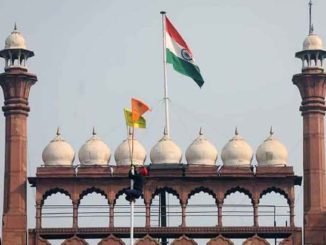
    On January 26, 2021, when Indian Republic Day celebrations were taking place at Rajpath, New Delhi – and the world Sikh community was preparing to celebrate GuruTeg Bahadur’s400thbirth anniversary – a young Sikh farmer from Punjab’s heartland was hoisting the Nishan Sahib on Lal Qila in Old Delhi. He was protesting, apparently, with the farmers’ march against India’s new agricultural laws. Indian media, politicians, and numerous observers were shocked at the spectacle. Some thoughthis action a disgrace to the Red Fort; some considered it a desecration of the Indian Tiranga flying on this monument. And some saw it as tainting of the Republic Day and an embarrassment to the country. We have a different take, however. The young Sikh’s defiant feat was none of the above. He was seeking to achieve a very different objective unrelated to the farmers’ rally. In part I of this two-part article, we want to explore implications of his daring act beyond his role in the farmers’ march – to reframe his deed as an expression of the Sikh community’s grievances against authoritiesof the past and present. We focus on the role that Lal Qila as the Mughal Emperors’ palace has played in Sikh history by citing events that are indelibly etched in the collective Sikh memory. We also cite those events to remind India and the worldof the sacrifices made by the Sikh Gurus and their followers for the religious freedom of all people. With these words, we especially dedicate this article to Guru Teg Bahadur on his quadricentennial. In part II, we offer a few suggestions about how the Sikh community’s grievances embedded inits history may be mitigated. Since the Sikh communityis inevitably part of other Indian communities, its history can’t be separated fromtheir histories. Therefore, the suggestions we offer are for India to work on and apply as feasible, with the willingness and cooperation of all communities, since all Indian communities’ function within the Indian cultural, legal, and geographical boundaries.

    I.Lal Qila’s History with Sikhs

    It was no coincidence that on Republic Day, aSikh – not a Hindu, Muslim, Christian, Jain, Buddhist, Baha’i,or Parsee – climbed up the flagpole and, with other Sikhs and Hindus cheering from down below, hoisted the Nishan Sahib on Lal Quila. Then, it would be relevant to ask: Is there something about Lal Qila that galvanizes Sikhs, in particular, moresothanother Indians?

    Most Indians may not know the Sikh connection with Lal Qila (also “Lal Kila,” or “Red Fort” in English), rather two Lal Qilas, as the Mughal Emperors’ principal residence, court, and seat of power.With the change of the Mughal capital, the first one in Agra was superseded by the secondin Delhi. Both affected the course of Sikh historyto a very great extent.

    Lal Qila has beendesignated a national monument, a UNESCO World Heritage Site, and the Indian primeminister’s venue for the Independence Day celebration. It is also a significant part of the MuslimIndian legacy,contributingmuch to Indiain terms ofetiquette, dress, food, music, architecture, art, craft, language, and literature.

    However, that legacy often overlooks the consequencesand collective memories that mostnon-Muslims associate with this great monument.From Lal Qila, the Mughal Emperors deployed their might to subjugate the Indian subcontinent, and from there emanated the power wielded by their dominions. Hundreds of years later, Sikhs, Hindus, Parsees,and many others, while visitingLal Qila, are reminded ofthe crueloppressionof their cultures and religions, violent takeovers of their lands, enslavement, mass genocide, and mass proselytization.

    Indians visiting this monumentwhile admiring its grandeurhark back to the Mughals proclaiming and committing atrocities – far back to Babar, first Mughal Emperor, much before Lal Qila. Babar (or Babur), a descendant of Timur or Tamerlane and a Sunni Muslim, invaded India and established his dynasty in 1526.Guru Nanak, the founder of Sikhism, refers critically and propheticallyto the horrific acts committed by the first Mughal Emperor, describing himas “the Agent of Death,” who ruthlessly massacred and pillaged Indians, causing endless sufferingin the subcontinent.

    Now we provide a brief outline showing the Lal Qila connection with the course of Sikh history.The instances cited below to provide context to better understand why this national monument and historic seat of the Mughals triggers horrible memories for Sikhs and does not let them forget the past.

    Lal Qila – Mughal Court, Agra: Emperor Jahangir

    Guru Arjan Dev, 5th Sikh Guru, executed in Lahore, May30, 1606

    Guru Arjan Dev was summoned to appear in Lahore court before one of Emperor Jahangir’s representatives. He was accused of promoting a belief system contrary to Islam –the sacred Sikh scripture he had compiled did not conform to the Holy Quran. And it didn’t help matters that the Guru was also friends with the Emperor’s rebellious son Khusrau and that the new religion even was attracting many Muslims.Therefore,as dictated by the imperial protocol or desire, he was arrestedat Lahore Fort, interrogated, asked to embrace Islam,and, on his refusal, executed most cruelly. Besides being subjected to other cruelties, the Guru was made to sit on a burning hot ironplate, and burning hot sand was poured on his head until he died. Guru Arjan Dev,a prolific poet, philosopher, and visionary,compiled the Sikh scripture, the Guru Granth Sahib, in 1604. He inspired his followers to emulate divine attributes and gave a message of love, hope, justice, and prosperity for all.

    Lal Quila, possibly during the later Mughal period

    Lal Qila – Mughal Court, Delhi:Emperor Aurangzeb

    Guru Teg Bahadur, 9th Sikh Guru, and his devotees executed in Delhi

    Aurangzebruled India for almost half a century (1659-1707). Adevout Sunni Muslim, he declared and enforced Islam as the law and religion of his empire.His goal was to make India an Islamic state, meaning, according to Sir Jadunath Sarkar,”the conversion of the entire population to Islam and extinction of every form of dissent.”

    Aurangzeb viewed Hindus and Sikhs as his natural enemies. They were required to pay jizya tax for being Hindu or Sikh.Hegalvanized all his religious and secular powers to rule and convert them and, if needed, subjected them to unheard-of atrocities, culminating in death.

    From Lal Qila,Aurangzebannounced the following orders that transformed Indian history in general and Sikh history in particular.

    November 5, 1675

    Three followers of Guru Teg Bahadur were executed in Chandni Chowk, Delhi, as ordered by Aurangzeb because they refused to embrace Islam:

    • Bhai Mati Das was tied between two posts and sawedoff intotwo halves from head to loin.
    • Bhai Sati Das (Mati Das’s brother) was hacked to death, limb by limb, piece by piece.
    • Bhai Dyal Das was tied and thrown into a cauldron of boiling oil.

    Guru Teg Bahadur was made to witness these gruesome killings of his followers.

    November 11, 1675

    Six days later,Guru Teg Bahadur was beheaded publiclywithin walking distance from Lal Qila.

    Reason?He had petitionedthe Emperor on behalf of helpless Kashmiri Brahmins, Satnamis, and other non-Muslims from Indiathat their forced conversion to Islam and “the Quran or the sword”policy be stopped, and that they be allowed to live by their own religious beliefs. The Guru also said”No” to his own conversion to Islam.

    Guru Gobind Singh, 10th Sikh Guru, and his sons

    December 22, 1704

    Subsequently, Aurangzebdeployedhis vast administrativemachinery to go afterGuru Gobind Singh,10thSikh Guru, and his four sons. The Guru had to sacrifice his two older sons to battle to protect his faith and his people:

    • Ajit Singh, 17years old, died fighting the Mughal army in Chamkaur.
    • Jujhar Singh, 14years old, also died on the same battlefield.

    December 27, 1704

    Five days later, the remaining family of Guru Gobind Singh was murdered in the custody of Aurangzeb’s Governor of Sirhind, Punjab:

    • Zoravar Singh,seven years old, was bricked alive and then beheaded in Sirhind.
    • Fateh Singh, five years old, was bricked alive, along with his brother,and then beheaded.

    Their crime? They said “No” to their conversion to Islam. Mata Gujri, the mother of Guru Gobind Singh, died along with her two grandsons.

    Perpetuation of Aurangzeb’s Atrocities

    Aurangzeb, the last Great Mughal, died on March 3, 1707, but his laws and edicts didn’t die with him. They were continued by his successors and those who derived power from the imperial throne. The tradition of Mughal atrocities remained unbroken for a long time.

    Lal Qila, Delhi:Emperor Bahadur Shah I

    December 10, 1710

    Bahadur Shah proclaimed a Sikh genocide – ordering that the Sikhs be murdered wherever they are found. Reason: The Emperor had issued a “capture or kill”order for Sikh general Banda Bahadur, but the great Sikh had disappeared despite all the Mughal forces hunting for him.

    Banda Bahadur (earlier named Madho Das, a Hindu recluse)was anointed a Sikh warrior by Guru Gobind Singh before he died in 1708.He had pledged to fight against the oppressive Muslim rule.

    Lal Qila, Delhi: Emperor Farrukhsiyar

    Banda Bahadur, his family, and 714 Sikhs

    February 29, 1716

    Banda Bahadurwas captured by the Mughal army and brought to Lal Qila, Delhi, along with his wife Sushila Devi (Princess of Chamba) and their 4-year-old son Ajay Singh. Sushila Devi committed suicide when she was forcibly separated from her son and ordered to submit to Emperor Farrukhsiyar’s harem. The same day a large number of Sikhs were massacred. Their headswere arranged in pyramids at the gates of Lal Quila. And he hung up the bleeding heads of the murdered Sikhson Lal Quila’s walls, as wellason trees and buildings leading to Chandni Chowk, Delhi. 714 Sikhs were beheaded publicly, 100 each day. Not a single person accepted Islam or asked for mercy.

    June 9, 1716

    The Moghul ruler brought Banda Bahadur to the Qutab Minar area.There, his 4-year-oldson, Ajay Singh, was slain in front of him. And the executioner took out little Ajay’s throbbing heart and entrails and thrust them into his father’s mouth. Banda shut his mouth and remained unmoved.

    Then Banda Bahadur was executed.Here is an excerpt from a witness account letter describing Banda’s execution. C. R. Wilson,an East India Company representative and guest of the courtwrote to the British Viceroy:

    First, with a dagger his right eye was removed.

    Then his left eye was turned out with dagger.

    Then his both feet were cut.

    Both arms were chopped off.

    Then with pincers, his flesh was cut off bit by bit.

    Then his legs, nose,and ears were cut one by one.

    Then his brain was blown out with sledgehammer.

    Last of all his body was cut topieces.

     Farrukhsiyar’s Edict: Convert to Islam or die-1716

    Emperor Farrukhsiyar ordered Sikhs to convert to Islam or die.He offered a reward for each head. MostSikhs retreated to jungles.An East India Company envoy traveling from Delhi to Lahore saw pyramids of Sikh skulls along the highway. The Mughal government declared the Sikhs extinct.

    Many more were the atrocities perpetrated by the Mughals. The culture of cruelties, firmly established, continued its course, with Lal Qila as the ruling throne of Sunni Islam.

    Lal Qila capturedby Marathas in 1757 and Sikhs in 1783

    It would be pertinentalso to add that, during the long Mughal rule, c.1526-1857, two times the Sunni Muslim emperorslost Lal Qila to Hindus and Sikhs.Here is a brief account of both.

    La Quila during British times.


    Saffron Hindu flag hoisted on Lal Qila:The Maratha Victory, 1757

    The great Maratha King Shivaji posed the only other notable resistance to Aurangzeb’s tyrannic rule. He fought and won many wars against the Mughals. The Mughal-Maratha Wars or the Deccan Wars were fought from 1680 to 1707.

    After Shivaji’s death, his son Sambaji also stood up bravely against the Mughals until he was captured at Sangameshwar in February 1689. Sambhaji and his prime minister Kavi Kalash (a Brahmin) were tortured to death. It took over a fortnight to kill them.

    The process of killing them included plucking their eyes and tongue, pulling their nails, and removing their skin. Sambhaji was finally killed on March11, 1689, reportedly by tearing his front and back, beheading him, and then hacking his body to pieces at Tulapur on the banks of the Bhim river near Pune.

    But after Aurangzeb’s death, the Marathas rose again and started their expansion toward the north. They conquered the land up to Punjab and beyond as far up as the Khyber Pass. In 1757 they hoisted their Hindu saffron flag on Lal Qila, Delhi.

    Nishan Sahib hoisted on Lal Qila: The Sikh Victory

    March 11, 1783

    In 1783,Baghel Singh, Jassa Singh Ahluwalia, and Jassa Singh Ramgariah united their forces into a joint Sikh army,defeated the Mughal army, conquered Delhi, and hoisted the Sikhflag on Lal Qila.

    Subsequently, once Delhi was under their control, they built sevenhistorical Sikh Gurdwaras in Delhi, the most important of which are:Gurdwara Bangla Sahib, near Connaught Place, memorializing Guru Har Krishan; Gurdwara Sis Ganj,in Chandni Chowk, memorializing Guru Teg Bahadur;and Gurdwara Rakab Ganj, near Parliament House,all commemorating Guru Teg Bahadur.

    Nishan Sahib vis-à-vis Lal Qila

    Unmistakably, the above portrait of the Mughals,enthroned in Lal Qila, should propel us Indians to ask:

    • How could a mon­­ument that reminds us of centuries of oppression, forced conversions, and destruction of our people be so respect worthy as writers, scholars, and politicians would have us believe?
    • How does Lal Qila represent Indian culture andits values?
    • And howdid the hoisting of the Sikh flag by the young Sikh on Republic Day disrespect the Indian Tiranga or the monument itself?

    To clarify, the Nishan Sahib is not the flag of so-called Khalistan. It is the Sikh flag, the flag of Khalsa (the Sikh community), hoisted on all Sikh gurdwaras and numerous other memorable Sikh places in India and the world.

    The Nishan Sahib is a symbol of bravery and protection of the persecuted. It is hoisted at the China border, Pakistan border, and wherever Sikh soldiers are protecting India.And this January 26, the Nishan Sahib – along with the Indian national flag – was hoisted in front of the Sikh battalion marching on Rajpath, New Delhi, and saluted by both Prime Minister Modi and President Kovind.

    Furthermore, just a peek into history – the Sikh flag was hoisted all over Kashmir, Leh, Ladakh, and Aksai Chin when Sikh General Zoravar Singh conquered those areas.

    And, finally, to return to the young Sikh farmer’s act of hoisting the Sikh flag, it was a symbolic attempt at cleansing the Indian psyche, particularly the Sikh, of the gory past that harbors in it andhaunts it. It was his protest against the nightmares of Sikh history in particular, and Indian history in general,associated with this national monument. This unfortunatehistory brings us to the second part of the article.

     II.  ecommendations to Deal with the Intercommunal Baggage of History

    That India is perhaps the world’s most diverse country is not an overstatement. In its diversity – ethnically, culturally, linguistically, and religiously –Indiais more like a continent. That Indians share a common history is true, but theirreligion, language, state know their communitiesor ethnicity have their distinctpasts, too. And those histories – often shaped byself-centered/communal interacting, intersecting, and relating with one another – have primarily contributed to the making of numerous challenges facing modern India.The most severechallenge that India must contend with is the effect of religion and history on intercommunal relations. As individuals, we all have to come to terms with our past – with what we have done and what has happened to us.Much in the same sense, India as one nation has to come to terms with its past, that is, its cumulative history. India’s past is a mammoth story of its achievements and failures. It includes, too, what has happened to its communities and what the communities have done to one another, resulting in countless grievances against one another.In other words, India has to deal with its histories of various communities, especially the conflicting communal histories. Let us call it the intercommunal baggage of the past. We believe that religion and history have shaped India’s intercommunal relations over the centuries and are an essential part of Indian life. WhileIndian democracy is secular by and large, the practice of secularism is often at odds with people’s religious sentiments and their politics. Unless one religious community is willing to respect another religious community with a divergent view of history, India will continue to be confronted – as it has been until this day – with challenges from any society based on their grievances. This confrontation will impede the progress India has made as a country and democracy. Therefore, we would like to offer the following suggestions for India:the government, political leaders and reformers, civic and religious organizations, historians, academics, literati, and the media. If practiced, these suggestions will significantly lower socio-religious tensions and increase mutual understanding among religious communities, e.g., Hindu vs. Muslim, Muslim vs. Sikh, and Sikh vs.Hindu.And their practice, evolving continually, will creategreater cohesiveness and harmony in Indian society and, on the whole, make the country a better and more prosperous democracy:

    1. Provide an unbiased and updated version of India’s cumulative history.Make sure it is free from the imperialistic biases traditionally built into it and the Indian education system. Incorporate in it the content/themes/areas previously neglected, disparaged, or understated.
    2. Educate all Indians about India’s cumulative history, as far back as feasible. Include in itthe social, political, and religious history of each religious community.Thus, each communitywill know not only its own historybutalso other communities’ histories. As a result, they willlikely develop a new and positive understanding of one another.
    3. Create awareness among peopleabout the unsavory aspects of imperialism, Mughal as well asBritish.
    4. Teach students to critically examine Indian histories written from the imperialistic point of view– which extoll the oppressors’cultures, arts, literatures, philosophies, and judgments, as well as their other contributions, and de-emphasize theiratrocities.
    5. Help minimize communal conflicts, mainly Hindu vs Muslim, Muslim vs Sikh, and Sikh vs Hindu, by spreading awarenessthat the ancestors of a considerable majority of Indian Muslims or Indian Sikhs wereHindus.Simultaneously, create awareness that many of those Muslim-convert ancestors, too, were victims of the Mughal power like other Hindusand thattoday’s Indian Muslimsshouldn’t be blamed for what the imperialistsdid to Hindus, Sikhs, and others.
    6. Create consciousness in the country that all Indians are equal beforethe law, irrespective of their religion or community,and must be treated equally and held responsible for their conduct,not that of their ancestors.
    7. Launch a new tradition in schools to celebrate and learn community histories.Start with the Sikh History Month, for example,in which every year students will learn about Sikhs and Sikhism. Develop this tradition by choosing another month for another community. Thus, students will learn about other communities and religions in a positive spirit.

    To conclude, most Indians carry the baggage of their history. How big their baggage is depends on who they are; that is,their baggage depends on their community, ethnicity, religion, and their perceptions. Hindus, Muslims, Sikhs, Christians, Jains, Buddhists, Parsees, Jews, and others have all their unique histories that have shaped their communities. They tend to believe that they are significantly different from others because they belong to a different community. But the truth is that they all being Indian have so much in common, much more to connect them than to divide them.

    Lal Quila with Indian Flag.

    We sincerely hope and trust that India – i.e., the Indian government and its opposition; leaders, writers, and media of the right, left, and center; all diverse religious organizations; and Indian society – will find our suggestions helpful in devising new ways to deal with the divisive issues of history and religion.

    And we believe that an updated cumulative history of India, which includes records of different religious communities, will enlighten Indians about themselves and, more importantly, result in alleviating the social and religious tensions amongst and between various communities. That willlead to a harmonious multireligious, multiethnic, and secular democracy and a more progressive and prosperous society in India.


    (The authors- Sajjan Singh Dhaliwal is a retired engineer and lives in Charlotte, North Carolina, USA. Contact: sajjan@jasamgroup.com. Roshan Attrey is a retired English professor and lives in Charlotte, North Carolina, USA. Contact: rattrey@aol.com. Harbans Lal is a retired professor of Pharmacology and Neuroscience. He lives inDallas-Fort Worth, Texas. Contact: harbansl@gmail.com

  • Promises to keep: On Joe Biden’s first address to U.S. Congress

    Biden is on course to fulfilling agenda despite opposition at home and challenges abroad

    In his first address to a joint session of Congress, U.S. President Joe Biden made clear that his administration would continue pressing forward with promises made during his election campaign last year, including vigorously meeting the health challenges of the ongoing COVID-19 pandemic, kick-starting the engines of the U.S. economy to provide sustainable job opportunities in the digital era, and reasserting the position of his country as a driving force for democracy worldwide including pushing back on China’s aspiration to be a regional hegemon in Asia. Mr. Biden’s first 100 days in office have been coterminous with arguably the most fraught times in recent U.S. history, given the devastation wreaked by the coronavirus on life and economic activity — making the U.S. the worst performer worldwide until recently surpassed on this grim scale by India. However, the Democrat has risen to the challenge posed by the virus, when compared to his predecessor Donald Trump’s response, in terms of signing into law a $1.9 trillion pandemic relief bill and funneling direct payments of $1,400 per person to more than 160 million households. Reports suggest that this shot in the arm could boost economic growth this year to 6% or higher and revive the nearly 8.4 million jobs lost to COVID-19 by 2022. Whether this will be enough to mollify the likely anger of wealthy Americans for the tax hikes he proposes to slap them with is unclear. Yet, it is not the economy but the wounds of racist hatred that he will have to work even harder to heal. The recent conviction of the police officer responsible for the death of African-American George Floyd represents but the first step toward bridging the chasm between prejudiced, overzealous law enforcement and racial minorities. Notwithstanding the considerable progress made by the Biden administration in domestic politics, it is in the international arena that much work remains unfinished to repair the damage wrought by his predecessor, an isolationist who prioritizedtransnationalism and bilateral quid pro quo over strengthening the U.S. as a global voice for plurilateral cooperation and regional engagement. Mr. Biden, contrarily, has thrown down the gauntlet to China, assuring its President Xi Jinping that Washington would continue to maintain a strong military presence in the Indo-Pacific “not to start conflict, but to prevent one”. Recognizing the multi-dimensional character of Beijing’s challenge to the rules-based international order, Mr. Biden has also vowed to stand up to “unfair” trade practices, including disallowed subsidies for Chinese state-owned enterprises and industrial espionage, as well as speak out on perceived violations of fundamental freedoms and rights relating to, for example, Beijing’s aggression in the South China Sea and in Hong Kong and the Xinjiang region, respectively. Whether facing conservative opposition to domestic policies or hostile pushback on the global stage from geopolitical rivals, Mr. Biden must hold fast to the values that saw him elevated to the White House.

    (The Hindu)

  • Election Commission of India in the dock

    Constitutional body is being held responsible for Covid surge

    The Madras High Court has pulled no punches in holding the Election Commission of India (ECI) ‘singularly’ responsible for the spread of the second wave of Covid-19 in the country. The court has even said that ECI officials may be booked on murder charges. This is a scathing indictment of the poll panel’s conduct of the elections in four states and a UT over the past month amid the devastating pandemic. Sadly, the strictures have shown the ECI in a poor light because of its decisions, though the polling staff had accomplished the Herculean task of holding elections during a health emergency. There is no doubt that polls are a constitutional obligation that the ECI has to fulfil, come what may, but the sheer chaos they unleashed could have been avoided with foresight and planning. The poll schedule for West Bengal — eight phases spread over 34 days — had come under fire from the outset. Such a long-drawn-out exercise was a recipe for disaster as the virus was getting uncontrollable by the day. Even as Covid cases kept rising in recent weeks, the ECI refused to club the remaining phases, citing logistic challenges and legal constraints. Though the specter of large gatherings becoming superspreaders of infection loomed large, the commission allowed crowded roadshows and rallies. It was as late as April 22, with only two phases of polling left, that the ECI imposed a ban on roadshows and vehicle rallies in the state. The poll panel has now prohibited all victory processions and celebrations after the counting of votes on May 2. The move is welcome, but it will all boil down to enforcement. It remains to be seen what action, if any, would be taken against the offenders. There is a growing perception that the ECI is reluctant to act against certain big fish. The credibility of this constitutional body has repeatedly come under a cloud as doubts have been raised about its neutrality. The ECI needs to go the extra mile to dispel such notions and reaffirm its commitment to remain Indian democracy’s watchdog.

    (Tribune, Chandigarh)

  • Gasping for air, gasping for answers

    Gasping for air, gasping for answers

    By Vikram Patel

    The people of India are entitled to a full and honest account of what led more than a billion people into a catastrophe

    The struggle to breathe, or asphyxia, is the most terrifying human experience. Something one takes for granted, which we do more than a dozen times every minute, suddenly becomes an ordeal. I know how this feel having lived through tormenting bouts of asthma in my younger years and, more recently, when I found myself trapped under a raft in the freezing, raging, Zanskar river in Ladakh. The memories of gasping for air and the fear of dying are seared into my brain. Death typically comes as a relief from the terror, as multiple organ systems collapse due to the lack of oxygen, a colorless, odorless, tasteless gas which we are not even aware of until we cannot get enough of it. Oxygen. A word which should signify vitality and exuberance, but which in recent weeks has become synonymous with death and suffering. Who would have ever imagined that the India of 2021 which boasts sending rockets to the stars and manufactures oxygen on an industrial scale, would one day be unable to supply oxygen to save her own people?

    The trauma of asphyxia

    The word ‘trauma’ typically evokes extreme events such as rape, sexual abuse and war-related violence. This is not surprising given that the word gained currency as a medical condition in the aftermath of the Vietnam war when tens of thousands of soldiers from the United States returning from the brutal conflict exhibited a range of distressing symptoms, giving birth to the diagnosis of Post-traumatic Stress Disorder (PTSD). But the truth is that trauma can occur in many more diverse ways, and it is only now, with COVID-19 sweeping the world, that gasping for air has been recognized as a traumatic event. What ties these seemingly unconnected experiences together is that they all evoke the same intense emotions: a toxic brew of extreme fear and utter helplessness. These experiences, especially when sustained over hours or days, literally leave an imprint in the brain so that the hallmark features of PTSD symptoms such as nightmares, flashbacks and feeling on edge, recur at any time, sometimes triggered by a totally unrelated event which bear similarity to the trauma.

    A recent study from the United Kingdom of over 13,000 survivors of COVID-19 reported a strong correlation between the severity of the infection and subsequent PTSD. While just over 1% of the patients reported breathing problems or hospital admission, the prevalence of PTSD in the months which followed were staggering: 35% of the sickest, and 15% of even those who only needed home assistance. The most prominent symptoms were frightening intrusive images of being breathless or ventilated. Thus, for those who do survive these nightmarish moments on the edge of life, the ordeal is far from over. Even as we struggle to keep those gasping for air alive, we must simultaneously attend to the long-term mental health consequences of survivors, a task even more daunting in a country where trauma-related mental health problems are barely even acknowledged.

    A traumatized country

    But there is also another kind of trauma which is sweeping across India, as millions of stories of suffering, despair and death percolate into the consciousness of every person. There has been a feverish rise of anxiety and fear across the population, twinned with helplessness as the comfort of knowing that there is a government which they can rely on has evaporated. India has been engulfed, in a matter of a few weeks, into the world’s most serious humanitarian crisis, fueled not just by a more infectious strain of the virus, but also a stunning level of arrogance, greed, incompetence and complacency. The terror reminds me of the weeks that followed the brutal lock-down imposed on the same population a year ago, without any warning or preparation. A year on, the horrors have returned to their lives, only this time for exactly the opposite reason: the state did nothing at all as tens of thousands, and then hundreds of thousands, of people were getting infected every day, watching millions congregate at religious festivals and election rallies, oblivious or uncaring about the inevitable cataclysm this would lead to.

    The concept of collective trauma has emerged only in recent times, in the aftermath of terrifying events which have affected entire populations, such as following the 9/11 attacks in New York or disasters such as the tsunami in 2004. These events were followed by a dramatic increase in symptoms of psychological distress, including the cardinal features of trauma, for months and years after the event itself had passed into history. And so we also must prepare the country for healing from this mass traumatic experience and we can draw upon lessons from other humanitarian crises to guide our actions. Most immediately, we must find a place to park our anger and rage, as justified as these reactions may be, and search for the compassion lurking beneath it, and support in any way we can the efforts of the thousands of civil society organizations to support those who are gasping for air, not forgetting the continuing support they will need after they can breathe again. The outpouring of community action we are witnessing is a soothing balm for the anxiety many are experiencing as they fear that the state seems to have collapsed.


    Healing through truth

    But, long-term recovery of the collective trauma will need resolution of the pent-up rage that is burning a hole in our souls. This will need the equivalent of the Truth and Reconciliation Commissions which have served to heal the collective traumas of events which affected entire populations, such as apartheid in South Africa. Such an independent Commission would document the facts behind the tragedy unfolding across India, hold individuals and institutions accountable, and offer a path towards restorative justice to heal a deeply wounded nation. Last week, when the Delhi High Court issued an order to the Central Government to ensure the supply of oxygen, I was puzzled by its statement that “As it stands, we all know this country is being run by God.” I will never know who was being referred to as God, but I am assuming it must be the spiritual being we pray to in our myriad places of worship. If so, then we must ensure that this is not the final judgment of the apocalypse that has befallen India. The people of this country are entitled to a full and honest account of what led more than a billion people into a catastrophe, if only to put at rest our troubled minds, restore the fractured trust between the people and the state, and be better prepared for the next pandemic.

    (The author is The Pershing Square Professor of Global Health at Harvard Medical School, and a member of the Lancet Citizen’s Commission on Re-imagining India’s Health System)

  • A timely warning: On Supreme Court intervention against clampdown on information

    SC’s caution against harassing those needing help will deter ill-advised action

    The Supreme Court has issued a timely warning to the States against any attempt to clamp down on the dissemination of information about the serious health crisis besetting the country, or calls for help through social media from citizens affected by COVID-19. The comment, obviously in response to the utterly despotic threat issued by U.P. Chief Minister Yogi Adityanath that those “spreading misinformation” or “rumor” would be detained under the National Security Act (NSA) and their property seized, will surely help prevent ill-advised action by the police and the administration to treat appeals concerning shortage of hospital beds, medical oxygen and vital drugs as attempts to bring the government into disrepute. The police in Amethi registered an FIR against a man who appealed on Twitter for an oxygen cylinder for a family member for allegedly circulating a rumor and seeking to cause fear and alarm. Mr. Adityanath appears quite convinced that complaints about oxygen shortage in his State are either imaginary or, worse, malicious, and wants to treat them as attempts to “spoil the atmosphere”. While it is entirely in order that the government has directed the police to crack down on the profiteering on medicines in the black market, it is quite a different matter if the administration starts seeing all appeals for help in a grave crisis as nothing more than activities aimed at tarnishing the government’s image.

    Given the propensity of such leaders to treat the voicing of grievances by citizens as a personal affront to their administrative capabilities, the Court’s warning that any attempt to stifle the people’s voices would attract action for contempt of court is quite timely and necessary. As Justice D.Y. Chandrachud, who heads the Bench, remarked, any clampdown on information is contrary to basic precepts. He underscored the significance and necessity for the free flow of information during a grave crisis by recalling the role it played in containing a famine in 1970. The Court was apparently drawing inspiration from the theory, articulated by economist Amartya Sen, that the fundamental attributes of democracy — such as a free press and the need to face the people at elections and respond to political criticism — help prevent famines. However, how far the present regime feels itself accountable to the people at large is now unclear. It faces criticism both within the country and from the international media that a major cause of the crisis is its reluctance to acknowledge its own failure to prepare for a calamitous second wave. Questions fired at it by High Courts are also on these lines. Any move to stifle such criticism or believe that this is a problem of managing perceptions will be of no avail if the infections and body count keep rising alarmingly and the health system draws close to a collapse.

    (The Hindu)

  • When govt fails its people

    When govt fails its people

    The onus of protecting lives in the middle of death & destruction is on the citizen

    By Neera Chandhoke

    Sadly, our civil society has been pulverized, courts abdicate their responsibility, and the rule of law is missing.

    Deep anguish, deeper desolation, and immeasurable sadness defeat us as we witness death after death. Death is no longer a stranger, it has become familiar: a neighbor, a visitor, even family. We have looked death in the face and found it merciless. We do not personally know the people who died, we only know how many died. But we do know they left a part of themselves with us and took away a part of us. ‘No man is an island’, wrote English poet John Donne, ‘…any man’s death diminishes me, because I am involved in mankind. And therefore, never send to know for whom the bell tolls, it tolls for thee.’ Sadly, our civil society has been pulverized, courts abdicate their responsibility, and the rule of law is missing. This is a moment of unending grief. It is also a moment for asking hard questions. There is nothing more tragic than avoidable death. Who is responsible? We asked for statesmen, wrote Wole Soyinka, we were sent executioners. Indians asked for statesmen, we got politicians for whom democracy is reducible to elections; a route to grab power and privilege.

    Democracy has disappointed democrats across the world. We had hoped for democracy because this is the form of rule that recognizes the political competence of ordinary people to participate in decision making. Democracy is of value not because of its outcomes, whether peace, increased GDP, or world-class infrastructure, but because of its presumption that every citizen is equal.

    Democrats realized early enough that no one can be equal if she is poor, non-literate, malnourished, unemployed amidst opulent affluence. Political equality has meaning only when the holders of power recognize that people should not be poor/ non-literate/malnourished/ unemployed because that compromises the fundamentals of democracy. A well-conceived educational system, a functioning health infrastructure, jobs, housing and a regular income represent the core of redistributive justice. This notion is not new to India. The Constitution draft, authored by a nine-member committee, with Motilal Nehru as the chairman, conceptualized an integrated system of rights from universal adult suffrage to the right to liberty. Prominence was given to social rights. Motilal Nehru observed that political power could be justified only when it was used to ameliorate poverty, ill health and education through the grant and implementation of social and economic rights. The report obliged a future Parliament of independent India to make suitable laws for the maintenance of health and fitness for work for all citizens, for securing a living wage for all workers, and for the protection of motherhood, welfare of children, and to counter economic consequences of old age, infirmity, and unemployment.

    In the Constituent Assembly, the integrated list of rights was split between the Fundamental Rights Chapter and the Directive Principles of State Policy. Many decades thereon, social rights were given attention only in 2004-2009 by the UPA government headed by PM Manmohan Singh. Aided by a Supreme Court anxious to reclaim its image after its sorry record during the Emergency, and by civil society groups, the UPA-I legislated several social rights. The RTE was made a part of the right to life and granted the status of a fundamental right. However, the right to health was left out. Article 21, which guarantees the right to life, has been interpreted to cover the right to health. The right is thus derived rather than couched in terms of a specific good that all have a right to. In 1946, the committee on public health chaired by Sir Joseph Bhore had recommended that a web of primary health centers be established to focus on preventive and curative measures. Our public health system has functioned poorly. Since 1991, the private sector, promoting health tourism, has stepped into the field in a major way. Dominated by a few corporates, private hospitals are driven by profit. The private sector is uninterested in the concept of delivering health to all through preventive measures and is unconcerned about equity. The present government has devolved responsibility for health to the private sector. Consider the pricing policy of vaccination for the 18-44 age group. The onus of protecting lives in the middle of death and destruction has been placed on the citizen.

    That the focus on curative health has resulted in inadequate health services, is made painfully evident today. Preventive healthcare is related to the establishment of supportive infrastructure: networks of free or reasonably priced services, high literacy rates, exposure to information, social movements, and, above all, political will, as is the case of Tamil Nadu and Kerala. Social activists and scholars have suggested a move away from a policy-oriented approach to health, towards a human rights approach which might manage to secure universal access to health.

    Today, we are paying heavily for privatization and commercialization of a basic precondition to life. The leadership is content with demoting democracy to elections, and to mandates secured by elections. The ruling class might do something about the lives, liberties, education and health of citizens. It might not do anything. The presumption of democracy can be belied by the outcome. Important as elections are, they are not sufficient for ensuring democracy and well-being. Democracy has to be protected by citizen activism in the space of civil society, by the judiciary and by the rule of law. In India, civil society has been pulverized, courts abdicate their responsibility, and the rule of law has gone missing.

    So, when the pandemic massacres, the only agent that can hold a mirror to overweening power is the foreign media, a few newspapers and some online news portals. Leaders continue to lust for power, as those who voted for them gasp for breath. This is not the democracy our forebears fought for and conceived of.

    (The author is a political scientist)

  • SRI GURU TEGH BAHADUR SAHIB A PROPHET AND A MARTYR

    SRI GURU TEGH BAHADUR SAHIB A PROPHET AND A MARTYR

    Special on the occasion of the 400th birth anniversary celebrations of Sri Guru Tegh Bahadur Ji

    By Dr. Amrit Kaur

    Sri Guru Tegh Bahadur Sahib was a protector of the oppressed class. He fought against oppression and laid down his life to protect the right of the people to follow the religion of their own choice. His bani consists of 59 sabdas and 57 slokas. These sabdas and slokas essentialize the same spiritual experience and insights as does the bani of his predecessor Gurus.

    Sri Guru Tegh Bahadur Sahib, the Ninth Guru (Revealer of the Sikh faith) of the Sikhs was born on Baisakh vadi 5, 1678 Birkimi i.e., April 1, 1621 in Amritsar, Punjab. He was the youngest of the five sons of Sri Guru Hargobind Sahib, the Sixth Guru of the Sikhs and Bibi Nanaki. His childhood name was Tyag Mal, tyag means ‘giving away’ or parting with what one possesses. As a small child he gave away his clothes to a poor child in charity. On being asked by his mother as to why he had done so, he promptly answered that no one else would have given ‘that boy’ any clothes whereas you will immediately give me new clothes. From his early childhood, he was very humble, religious and detached from worldly possessions. During his childhood, Bhai Buddha Ji, a very revered Sikh of the time, taught him the manly arts of archery and horsemanship and Bhai Gurdas Ji, another renowned Sikh was in-charge of his religious instruction.

    At the age of 13 he took part in the battle of Kartarpur in District Jallandhar of Punjab fought by his father Sri Guru Hargobind Sahib against one of his own former warriors who had deserted him and subsequently invaded him. In this battle (Guru) Tegh Bahadur Sahib evinced so much bravery and valor that his father, Sri Guru Hargobind Sahib renamed him as Tegh Bahadur, tegh means sword and bahadur means brave. In his life to come he lived up to the ‘meaning’ implied in this name. At the age of 12 he was married to (Mata) Gujri Ji, daughter of Bhai Lal Chand Ji and Bibi Bishan Kaur Ji of Kartarpur in District Jallandhar of Punjab who had migrated from village Lakhnaur near Ambala in Haryana. After this, his father Sri Guru Hargobind Sahib, along with the whole family went to Kiratpur Sahib, a small township in the foothill of Himalayas in District Ropar of Punjab, where they lived for nine years. After his father left for his heavenly abode in 1644, he left Kiratpur Sahib alongwith his mother Bibi Nanaki Ji and wife Mata Gujri Ji and shifted to Baba Bakala in District Amritsar of Punjab, the ancestral village of Bibi Nanaki Ji’s father.

    On March 30, 1664 before leaving for his heavenly abode, the Eighth Sikh Guru, Sri Guru Har Krishan Sahib bestowed Guruship on him. Thus, on March 30, 1664 he assumed Guruship but was formally anointed Guru on August 11, 1664. After assuming this high seat of Guruship, he started preaching the message of the First Sikh Guru, Sri Guru Nanak Dev Ji’s that (i) God is one (ii) God is omnipresent and omnipotent (iii) God is the creator of the whole world and of all human beings (iv) all human beings are equal, thus persons of all religions and castes should be given equal respect (v) women should be given equal status (vi) we should recite the name of God Almighty (vii) we should earn our livelihood honestly and share it with the needy persons. The spiritual pathway as revealed by Sri Guru Nanak Dev Ji is a pathway of gradual growth and leads to union with God.

    After assuming Guruship, as a first step, with a view to establish a place for the congregation of Sikhs he bought some land at a place 8 kms. north of Kiratpur Sahib, from Deep Chand the King of Kahlur. He bought three villages Makhopur, Mataur and Lodhipur from Deep Chand at a cost of Rs. 2200 and in June 1665 established the town Chakk Nanaki which later came to be called Anandpur Sahib (the City of Bliss). This town is now one of the five spiritual seats (Takhts) of the Sikhs, and this is where in April 1699, Sri Guru Gobind Singh Ji, the Tenth Sikh Guru created the Khalsa. After establishing this place of pilgrimage, to further strengthen the preaching activity, he left for an extensive tour of Banger area which now partly falls in Punjab and partly in Haryana. During this tour he visited more than 120 places in the Districts of Amritsar, Ropar, Patiala, Jallandhar, Nawan Shahar, Fatehgarh Sahib, Sangrur, Bathinda and Mansa in Punjab. In fond memory of his visits, historical Gurdwaras have been established at all of the places that he visited. After his he visited several places in the districts of Ambala, Kaithal, Kurukshetra, Mohindergarh, Narnaul, Rohtak, Yamuna Nagar and Jind in Haryana State. To commemorate his holy visits in Haryana more than 30 historical Gurdwaras have been established.

    During his tour of Punjab and Haryana, in addition to conveying the message of Sikhism, he (i) got several wells dug in the areas which faced scarcity of water due to draught (ii) campaigned against drug addiction (iii) campaigned against growing of tobacco, and (iv) dispelled the miseries of sick and suffering population. Although, his tours were purely religious in nature, but they created many doubts in the mind of Aurangzeb, the emperor on the Delhi throne. Several false complaints to this effect were received by Aurangzeb and he sent orders for his arrest. Aurangzeb who had acceded to the Delhi throne in July 1658 after sending his father to prison and killing his brothers wanted to please Mughals by giving torture to non-Mughals. As part of his mission, he wanted to arrest Sri Guru Tegh Bahadur Sahib. But Raja Ram Singh, son of Mirza Raja Jai Singh intervened and convinced the ruler that Guru Sahib’s activities were religious and social and not any threat to his empire. Thus, his arrest was averted.

    After this, Sri Guru Tegh Bahadur Sahib started on an extensive tour of the eastern part of India to further spread the message of Sikhism. During this tour, he visited Agra, Mathura, Etawah, Kanpur, Fatehpur, Mirzapur, Allahabad, Jaunpur, Nizamabad and Banaras in U.P.; Gaya, Sasaram, Bhagalpur, Patna Sahib, Lakshmipur (District Katihar) and Monghyr in Bihar; Sahibganj in Jharkhand; Calcutta in West Bengal, Dhubri in Assam and Dhaka, Pabna, Comilla, Sylhet and Chittagong (now in Bangladesh) and Sondip Island.

    By the time he returned to Punjab, Aurangzeb’s pro-Islam policies and programs were in full swing. Aurangzeb wanted to completely destroy the Hindu old civilization. Under his orders centuries old temples in Ayodhya, Banaras and Mathura in U.P. were demolished. A very renowned temple Vishwanath which had been built by Raja Nar Singh Dev at a cost of Rs. 33 lacs was destroyed. ‘Mathura’, the holy city of Hindus was renamed as ‘Islamabad’. Ancient Hindu temples in Bihar and Orissa were also demolished. Ban was imposed on Hindu fairs and festivals. Aurangzeb had established a Jatha of Mullans consisting of horse riders who would go from place to place to destroy Hindu idols and temples. All Governors were directed not to give jobs to Hindus and wherever possible to dismiss them and replace them by Muslims. Employees in various sectors were issued orders to get converted to Islam up to a specific date or be prepared to lose their jobs. Aurangzeb had established a full-fledged Department for this purpose and appointed a Director General as its in-charge. Under his policies and programs thousands of Brahmins were imprisoned and put to torture to pressurize them to get converted to Islam. As per historical evidence, Aurangzeb would not eat any meal unless the janeu (sacred thread) taken away from the bodies of Brahmins weighing a quarter and a maund (one quintal) were presented to him. This means that thousands of Hindus were being converted to Islam.

    It was part of this policy that Aurangzeb sent directions to Iftikhar Khan the Governor of Kashmir that all Hindus in Kashmir be converted to Islam. Within a few months more than half of the Brahmins adopted Islam. As a result of this, Kashmiri Brahmins became awe stricken. As reported by PNK Bamzai, a Kashmiri historian, in his book History of Kashmir when the cruelty became unbearable, some Pandits got together and went to Amar Nath for pilgrimage and praying. After that, under the leadership of Pandit Kirpa Ram, about 500 Brahmins decided to meet Sri Guru Tegh Bahadur Sahib for help. This desperate group met Sri Guru Tegh Bahadur Sahib at Anandpur Sahib on May 25, 1675 and requested for help. After listening to the woeful stories of Pandits Sri Guru Tegh Bahadur Sahib decided to sacrifice his life to dispel their tortures and save the Hindu Community from extinction. He resolved to lay down his life to uphold the people’s right to practice the religion of their own choice. He told the Pandits to return to Kashmir and tell the Mughal Governor that if they convert their Guru i.e., Sri Guru Tegh Bahadur Sahib to Islam they would all get converted to Islam. Getting furious over this development Aurangzeb ordered that Guru Sahib be arrested, put to torture and executed.

    By that time, Guru Sahib himself had left Anandpur Sahib and was traveling towards Delhi via Agra. As per Aurangzeb’s orders the soldiers arrested him at Sikandra, District Agra in U.P. At this place now stands Gurdwara Guru Ka Taal Sahib. At Sikandra he was put in an iron cage and then subjected to torture and then under a heavy escort brought to Delhi on November 4, 1675. At Delhi, he was bound in chains and as per Aurangzeb’s orders was to be tortured until he accepted Islam. Thus, he was subjected to severe torture. But he firmly refused to abandon his religion. When Mullans became sure that he could not be persuaded to abandon his religion, he was asked to perform some miracle, which he firmly refused. Finally, on November 11, 1675 he was brutally beheaded in Chandni Chowk, Delhi in public view. At this place now stands Gurdwara Sisganj Sahib. At nightfall, a devout Sikh Lakkhi Shah Lubana Ji helped by three of his sons Nagahia, Hema and Harhi, not caring for the Mughal reprisal placed the headless trunk in a cart and took it to his home in Raisina village. To avoid direct confrontation with the Mughals, instead of an open cremation, he set fire to his whole house and thus cremated the sacred headless body of the martyred Guru Sahib. At this spot now stands Gurdwara Rikabganj Sahib.

    Bhai Jaita Ji, another devout Sikh alongwith Bhai Uda Ji and Bhai Nanu Ji secretly carried the severed sacred head in a basket to Kiratpur Sahib. On the way they stopped to take rest at Taraori, District Karnal in Haryana; two places in Ambala, Haryana and village Nabha which now falls in district SAS Nagar, Punjab. In village Nabha now stands Gurdwara Sis Asthan Patshahi Naumi ate Dasmi. After Nabha, Bhai Jaita Ji and his companions reached Kiratpur Sahib in District Ropar of Punjab. At the spot where the sacred head of the martyred Guru was handed over to his son (Sri Guru) Gobind Singh Ji, now stands Gurdwara Bibangarh Sahib. From here the sacred head was taken in a decorated palanquin by (Sri Guru) Gobind Singh Ji, who became the Tenth Guru, to Anandpur Sahib and cremated there on November 16, 1675. In fond memory of Sri Guru Tegh Bahadur Sahib Gurdwara Sisganj Sahib has been established at this place.

    Sri Guru Tegh Bahadur Sahib was a protector of the oppressed class. He fought against oppression and laid down his life to protect the right of the people to follow the religion of their own choice. His bani consists of 59 sabdas and 57 slokas. These sabdas and slokas essentialize the same spiritual experience and insights as does the bani of his predecessor Gurus.

    Dhan Sri Guru Tegh Bahadur Sahib!

    (The author is a Retd. Professor, Punjabi University, Patiala, Punjab, India)

    Gurdwara Sisganj Sahib, Delhi and Gurdwara Rikabganj Sahib, New Delhi
  • Sardar Manmohan Singh Dhall Passes away

    Sardar Manmohan Singh Dhall Passes away

    LONG ISLAND, NY (TIP):  Sardar Manmohan Singh Dhall, a well-known Sikh community leader, has passed away on April 26. He was 89. His funeral, attended by hundreds of relations, friends and admirers, despite Covid restrictions, observed in letter and spirit, took place on April 29 at Moloney Funeral Home in Ronkonkoma.

    As is customary among the Sikhs, prayers for the eternal peace of the departed soul, were offered at Gurdwara Plainview where rich tributes were paid to Sardar Manmohan Singh by Varinder Singh Sikka, President of the gurdwara on behalf of the gurdwara management, Mr. Sikka described Sardar Manmohan Singh as a perfect gentleman, always smiling and ready to help anyone. He took keen interest in the gurdwara affairs and helped greatly in the construction of the new building of the gurdwara.

    Vikas Singh Dhall, one of the sons of Sardar Manmohan Singh, and chairman of Gurdwara Plainview, described his father as his mentor who guided him in every way. He felt sad that he has now been deprived of the wise counsel of his Dad. He thanked all for their presence at the funeral and at the prayers.

     Grandchildren of Sardar Manmohan Singh also paid rich tributes to their grandfather.

    Sardar Manmohan Singh Dhall is survived by his wife Sardarni Pritpal Kaur Dhall. Children Inderpal Singh, Harinderpal Singh, Gurinder Kaur and Vikas Dhall. Father-in-law to Manmohan Singh Bhasin, Daman Kaur, Gogli and Indu Dhall. Grandfather to Simardeep, Raymon, Kinsi, Jasmine, Sherry, Angelica, Gurtej, HarSahib & Raunak Dhall. Great-Grandfather to Aarna, Noor and Pavan Singh.

    Speaking with The Indian Panorama, Vikas Singh Dhall gave a brief life story of his father. At the Age of 15, Manmohan Singh witnessed the Partition of India and Pakistan in 1947. He joined Army at the age of 17 and took an early discharge to further his professional career and joined Gestetner Duplicators (A British Firm), served there for 20 years.

    While working in the company, he married Pritpal Kaur and had four children. During the massacre of 1984 in Indore, India, he had massive financial losses.

     In 1987 he decided to move to the US and to fulfill his dream for a better life with his family. After his arrival in the US, he became very active in Local Sikh Community. One of his very passionate things to do was, SEWA (service to community),and he always distributed left over langer (food) to the Sikh and non-Sikh working class youth. Raising a family with Sikh values was his number one priority and he has set an example for many families across the tri-state area of New York. “Sardar Manmohan Singh Dhall leaves us on a path to being humble, working hard and taking care of family”, said Vikas Singh Dhall.

  • India sees record 3.79 lakh new Covid cases, 3,645 more deaths

    India sees record 3.79 lakh new Covid cases, 3,645 more deaths

    • Registering a steady increase, the active cases have increased to 30,84,814
    • Caught unawares, India accepts aid from the world for the first time in 17 years

    NEW DELHI (TIP): India saw a record single-day rise of 3,79,257 new coronavirus infections pushing the total tally of Covid cases to 1,83,76,524, while active cases crossed the 30-lakh mark, according to the Union Health Ministry data updated on Thursday, April 29.

    The death toll increased to 2,04,832 with a record 3,645 daily new fatalities, the data updated at 8 am showed.

    Registering a steady increase, the active cases have increased to 30,84,814, comprising 16.79 per cent of the total infections, while the national Covid recovery rate has further dropped to 82.1 per cent.

    The number of people who have recuperated from the disease surged to 1, 50, 86,878. The case fatality rate has further dropped to 1.11 per cent, the data stated.

    According to the ICMR, 28,44,71,979 samples have been tested up to April 28 with 17,68,190 samples being tested on Wednesday, April 28. The new fatalities include 1,035 from Maharashtra, 368 from Delhi, 279 from Chhattisgarh, 265 from Uttar Pradesh, 229 from Karnataka, 174 from Gujarat, 149 from Jharkhand, 142 from Punjab, 120 from Rajasthan, 108 from Uttarakhand and 105 from Madhya Pradesh.

    A total of 2,04,832 deaths have been reported so far in the country, including 67,214 from Maharashtra, 15,377 from Delhi, 15,036 from Karnataka, 13,826 from Tamil Nadu, 11,943 from Uttar Pradesh, 11,159 from West Bengal, 8,772 from Punjab and 8,061 from Chhattisgarh.

    As the pandemic is growing in proportions, the world is worried, and sending in all help to India to overcome the dire situation. It is for the first time in 17 years that India has accepted aid from the world.


  • Indian envoy interacts with U.S. business community on COVID-19 relief efforts

    Indian envoy interacts with U.S. business community on COVID-19 relief efforts

    WASHINGTON (TIP): India’s Ambassador to the U.S. Taranjit Singh Sandhu held an interaction with members of the business community on the current COVID-19 pandemic situation in the country.

    The virtual meeting was hosted by the U.S. Chamber of Commerce on Thursday, April 29.

    During the talks, Mr. Sandhu appraised the business community of the items that India is trying to identify and source, including oxygen concentrators, cylinders, ventilators and oxygen generation plants and COVID-19-related drugs like Remdesivir and Tocilizumab.

    “Appreciated the Chamber for coordinating the swift response and resource mobilization by the U.S. business community in support of India to meet the Covid challenge,” Mr. Sandhu said in a tweet.

    In the past few days, the U.S. Chamber of Commerce has mobilized support, brought together partners from other industry bodies and coordinated with the U.S. government to deliver critical medical supplies to India.

    Significant additional supplies of medical equipment are being dispatched by the private sector. Earlier the U.S. Chamber had urged the Biden administration to release unused AstraZeneca vaccine doses for use in India.

    Mr. Sandhu said he had an “important conversation” with Albert Bourla, CEO of Pfizer.

    The Ambassador said he highlighted the Indian government’s decisions to facilitate import of vaccines and to fast-track emergency-use authorizations for those which have already been given approval in other countries.

    Also read | U.S. defends restrictions on export of COVID-19 vaccine raw materials amid India’s request to lift ban

    “Discussed ways in which Pfizer could support healthcare efforts including vaccines in India, and strengthen our pandemic response,” he added.

    Two U.S. aircraft on their way

    The Ambassador said two U.S. aircraft with oxygen equipment and other COVID-related supplies are on their way to India.

    “Thank you @POTUS (President Joe Biden) for standing shoulder-to-shoulder with India during this challenging time,” Mr. Sandhu tweeted.

    WalMart CEO Dough McMillion had interacted with Sandhu a day earlier.

    “My heart is breaking for our friends and associates across India as they battle a devastating surge in pandemic cases,” Mr. McMillion said in a statement.

    Walmart is diligently working to deliver oxygen and vital equipment to communities across the country, he said.

    FedEx also issued a statement saying it was continuing its support to the fight against COVID-19 and had plans to send a dedicated aircraft with thousands of oxygen concentrators and critical aid for healthcare facilities in India.

    (Source: PTI)

  • New York mayor envisions full reopening by July 1

    New York mayor envisions full reopening by July 1

    NEW YORK (TIP): New York City aims to “fully reopen” on July 1 after more than a year of closures and capacity restrictions, Mayor Bill de Blasio said on Thursday, April 29, citing satisfactory progress in its vaccination campaign. “We are ready to bring New York City back fully on July 1,” de Blasio told a news briefing. “Now we can see that light at the end of the tunnel.” De Blasio said he had not discussed the city’s reopening date with Governor Andrew Cuomo, but his announcement comes a day after Cuomo lifted restrictions that would clear the way for a revival of the city’s nightlife. The state has the power to impose or lift restrictions on restaurants and other venues. “I think the best way to proceed here is to set out the city’s vision,” de Blasio said. Even though the July 1 date is still aspirational, the mayor’s announcement is significant in that New York is the country’s most populous city and was the early epicenter of the pandemic as the virus began sweeping across the United States last spring. The mayor said his optimism on the city’s imminent return to normal reflected the success of a massive drive to get New Yorkers vaccinated. He said 6.4 million doses of vaccine have been administered in the city of more than 8 million residents. While the mayor acknowledged the city needed to make more progress on vaccinations, he said more than 70% of New Yorkers have had at least one dose of a coronavirus vaccine. “People are showing up,” he said. “We need to keep the momentum going,” he added. “This is exactly how we get to the full reopening we’re all looking forward to.” Coronavirus cases, hospitalizations and deaths have trended lower in New York City since the beginning of the year. On a seven-day rolling average, the city reported over 7,000 new cases a day at the outbreak’s peak in January. By March new infections ebbed to 4,000 a day and now average about 2,000 a day.

    De Blasio did not provide clear guidelines on whether those attending shows, dining indoors or frequenting gyms and salons would have to adhere to any specific requirements, such as presenting proof of vaccination.

    “There certainly will be particular institutions that may choose to have rules around a vaccination or testing,” de Blasio told reporters, adding that the city will keep monitoring COVID-19 data and adjust its approach accordingly.

    Currently, the New York Yankees and Mets require those attending baseball games to take a rapid COVID-19 test or show proof of vaccination before gaining admission to their ballparks in keeping with New York state guidelines. Attendance is limited to 20% of capacity.

    New York City theaters have started to reopen this month for special events in front of limited indoor audiences. Some producers have targeted June 1 for their reopening dates, though many Broadway shows are not expected to pull back the curtains until September.

    On Wednesday, Cuomo set a date for the end of a curfew that had forced city restaurants to end their bar and food service by midnight.

    The curfew would end on May 17 for outdoor dining areas and on May 31 for indoors, he said. The governor also allowed seating at bars across the state to reopen for the first time on May 3.

    In addition, Cuomo said capacity limits would increase starting May 15 for several businesses outside of New York City, including gyms and casinos. Offices across the state, including in the city, will be able to increase capacity from 50% to 75%, the governor said.

    (Agencies)

  • U.S. to restrict travel from India starting May 4

    U.S. to restrict travel from India starting May 4

    The entry restrictions do not apply to lawful permanent residents

    WASHINGTON (TIP): Due to the very high numbers of COVID-19 cases and multiple strains of the virus in India, the United States will restrict travel of non-citizens from the country, starting Tuesday, May 4 Eastern U.S. time.

    U.S. President Joe Biden issued a proclamation on Friday, April 30, afternoon prohibiting the entry of non-citizens (the administration has done away with the term ‘alien’) who have been physically present in India for 14 days prior to their entry or attempted entry into the U.S.

    There is a long list of exemptions to the entry restrictions and the order will be reviewed every thirty days. H-1B, L and J visa holders and their dependents are not exempt from the restrictions. The entry restrictions do not apply to lawful permanent residents’ (LPRs or green card holders); non-citizens married to Americans or green card holders; non-citizen parents or legal guardians of minors (under 21) who are U.S. citizens or green card holders; siblings of unmarried citizens or LPRs, provided they are both under 21 and unmarried and other categories of travelers. The exemption list is longer than similar lists under the Trump administration’s pandemic-related restrictions.

    Other exemptions include foreigners traveling at the invitation of the administration for the purposes of containment of the virus, those whose entry into the U.S. is in its national interest, diplomats of various categories, crew members, and other categories. Significantly, the order also states that the rights of individuals to claim asylum shall not be diminished by the order. “After reviewing the public health situation within the Republic of India, CDC has concluded that proactive measures are required to protect the Nation’s public health from travelers entering the United States from that jurisdiction,” Mr. Biden said. News of the order came earlier on Friday with White House Press Secretary Jen Psaki releasing a statement announcing it. “It is the policy of my Administration to implement science-based public health measures, across all areas of the Federal Government, to act swiftly and aggressively to prevent further spread of the disease,” Mr. Biden said in the order.

    The order says India accounts for over a third of the new cases of the virus, and that they are increasing at a ‘rapid rate’. The order says that India has seen circulating a variant called B.1.617, among others, such as the U.K. variant (B.1.1.7) and South African variant (B.1.351). These variants may be less susceptible to vaccines and more easily transmitted as per the CDC.

    Mr. Biden’s order invokes section 212(f) of the U.S.’s Immigration and Nationality Act, which was among the laws invoked on January this year by U.S. President Biden to extend a Trump-era restriction on travel from the UK, Ireland, EU, Brazil and South Africa due to COVID-19 concerns.

    Airlines have been informed of the administration’s decision, as per a CNN report.

  • Covid-19 surge: Indiaspora raises USD 1 million for India in less than 48 hours

    Covid-19 surge: Indiaspora raises USD 1 million for India in less than 48 hours

    WASHINGTON (TIP): Indiaspora, a nonprofit community of global Indian diaspora leaders, has raised USD 1 million towards COVID-19 relief efforts within the last 48 hours as the organization announced on Friday to launch the “Help India Breathe” fundraiser campaign.

    The campaign with a virtual event on Saturday will aim to double the impact of the donations by offering to match funds, Indiaspora said.

    The virtual event will bring together several powerful voices from the Indian and AAPI community, including Lilly Singh, Deepak Chopra, Dhar Mann, Payal Kadakia, Kunal Nayyar, Humble the Poet, Jay Sean, Radhanath Swami, Janina Gavankar, Vishen Lakhiani, Deepica Mutyala, a statement said.

    “I am heartbroken by the deepening COVID crisis in India. Urgent action is needed to help those suffering,” said Indiaspora Founders Circle member Reshma Kewalramani, chief executive officer and president at Vertex, a global biotechnology company, who contributed towards the campaign.

    “Please join me in giving as generously as you can to support India in her time of need,” she said.

    The USD1 million raised by the organization so far will address three major areas of COVID-19 relief on the ground: the creation of urgently needed COVID care centers and makeshift hospitals through nonprofit WISH Foundation, direct cash transfer to families who have lost a primary earning member through nonprofit giving platform GiveIndia, and food relief and livelihood assistance for migrant workers and other underserved populations through nonprofits Goonj and Jan Sahas, the statement said.

    “We are proud of our community’s response. The outpouring of support from the Indian diaspora has been immediate and overwhelming,” said Sanjeev Joshipura, executive director of Indiaspora.

    “We are devastated by the news of the rising tragedies in India. They urgently need our help, and we are so grateful to our friends, communities and audiences that will participate in making a difference this weekend. We know you’ll show up,” said best-selling author, award winning storyteller & podcast host and former monk Jay Shetty, who has put together the two-hour event, which will be livestreamed on his and Indiaspora’s Facebook and YouTube pages.

    (Source: PTI)

  • TV journalist Rohit Sardana dies of cardiac arrest after testing positive for COVID-19

    TV journalist Rohit Sardana dies of cardiac arrest after testing positive for COVID-19

    NOIDA, INDIA (TIP): Television journalist Rohit Sardana died here of cardiac arrest on Friday, April 30, days after he tested positive for COVID-19, according to Aaj Tak, the channel he worked for, He was 41. Sardana, who was an executive editor and TV news anchor with Aaj Tak of the India Today Group, is survived by his wife, two daughters and parents.

    Read more on page


  • Arrogant Modi-Shah Regime Dismissed Scientific Warnings

    Arrogant Modi-Shah Regime Dismissed Scientific Warnings

    By Brinda Karat

    In the current crisis, of immediate concern are the disastrous omissions and commissions of the government concerning the building of health infrastructure, including, crucially, the problem with oxygen supplies and its recently announced vaccine policy.

    George Floyd’s last words, “I can’t breathe”, resonated across the world to symbolize the brutal reality of a racist police force in the US. Today in India, there is a different context: these tragic words are whispered across homes and outside hospitals as Covid patients struggle to breathe, deprived of life-saving oxygen. “I can’t breathe”, symbolizing the arrogance of a chest-thumping central leadership of the government of India, a leadership that dismissed warnings of the coming Covid tsunami from experts, based on scientific research and concrete data, a leadership mesmerised by its own self-serving propaganda of being the vishwa guru who would save the world, a leadership which led the way in breaking every single rule of Covid-appropriate behavior and encouraged others to do so too, a leadership that promoted a platform of fake nationalism to hide its failures. And echoing the tone and tenor of the top two leaders of the present regime, the Prime Minister and the Home Minister, are their minions across the country who exist because they obey.

    In the current crisis, of immediate concern are the disastrous omissions and commissions of the government concerning the building of health infrastructure, including, crucially, the problem with oxygen supplies and its recently announced vaccine policy. As far as the oxygen supply situation is concerned, much is being made of the data put out that there is no shortage of oxygen which is mainly used by industry, but of transportation. The bottom line is that because of lack of planning and execution, people are dying. A few days ago, the Prime Minister made a grand announcement that an additional 150 oxygen plants would be set up – with no explanation as to why the earlier decision taken a year ago to set up 162 oxygen plants is still not implemented. An investigation by the website Scroll showed that till April 2021, only 11 were installed and just three were functional. In response, the Health Ministry claimed that 33 were installed, an official admission nevertheless of the non-implementation of the decision. Take the case of Delhi, the capital of India, which has the highest number of deaths due to oxygen supply shortages. In its recent affidavit in an ongoing petition in the Delhi High Court, the union Health Ministry admitted that of seven oxygen plants to be installed in Delhi, only one oxygen plant had been installed. The government counsel could not say whether it was functional or not. If the central government had acted as it should have, many of the precious lives lost in the capital could have been saved.

    By mid-March, there was an alarming rise in cases in Delhi. The central government had usurped all the powers of the elected government in Delhi through the amendments pushed through in the recent session of parliament. Having got the power, where were the central agencies at the time? Was the Lieutenant Governor waiting for instructions from the Home Minister, who was busy campaigning for votes? Why were no preparations made for the inevitable increase in infections and the need for hospitalization? If such assessments had been done, the emergency measures of bringing oxygen through tankers to Delhi would have been in place much earlier.

    Delhi’s premier hospitals have flagged oxygen shortage amid spurt in Covid cases.

    But equally importantly, the privatization of the health care system has taken its toll. Why do top private hospitals in the capital for example not have their own captive oxygen plants? They charge obscene amounts for medical treatment, including during Covid. Setting up oxygen plants would cut into their profits. Privatization of health care has been a key “reform” measure of successive government since the decade of the 90s. This is reflected in low budgetary allocations. India is paying the price today with the collapse of the system in almost all its states.

    Kerala is an exception. For oxygen supplies, Kerala used to depend on other states; today, Kerala has been transformed into an oxygen-surplus state, helping others with oxygen supplies. From March 2020, its government was monitoring the use of oxygen and estimating requirements. The government had invested in state public sector undertakings to increase oxygen production capacity. The state-owned KMML set up an oxygen plant in October last year which produces 70 metric tons a day. Oxygen plants in the public and private sectors have been set up over the past two years which now have a production of 207 metric tons a day. Given the expected increase in oxygen demand with the fast-growing cases in the state, the government is preparing itself to deal with all emergencies. The key has been investment in public health infrastructure.

    Just as in its failure to build health infrastructure, including oxygen plants, in the last year, the vaccine policy of the government is going to create havoc and lead to another disaster. The Cowin dashboard shows that from January 2021 till April 24, only 139 million doses of vaccines had been administered. Of these, only 22 million people had been administered their second dose. 117 million people had taken their first dose. This is much below the official first phase target of 300 million to be completed by July.

    The current combined numbers of vaccine production is around 7.6 crore doses a month, which, according to recent announcements by manufacturing companies, will be increased to about 13 crore by the end of May. Taking the population as 140 crore people and a projected 60 per cent as eligible, the requirement is of 168 crore doses. Even taking the optimistic and unlikely projections of production as the base, and assuming the entire production will be for domestic use, it will take over a year to vaccinate the adult population.

    The central government policy, while opening up the criteria for eligibility, has declared that it will be responsible for providing free vaccines only for those over the age of 45 years and will take control of over 50 per cent of the production for this purpose. States and private hospitals will have to make their own arrangements to divide the remaining 50 per cent between themselves at prices fixed by the companies. The country and indeed the world has watched with dismay and concern the tensions created between states to “capture” oxygen tankers passing through their territories marked for a different destination, the most recent example being that of UP and Madhya Pradesh. This will happen on a much larger scale for vaccines, given the shortage of supplies and the license given to the companies to decide their priorities. Only they will benefit, while India gets divided by a vaccine war initiated by the central government’s policy.

    There is a two-fold solution. First, the central government has to withdraw this divisive, market-oriented policy of vaccine access and ensure a universal, free vaccination programme with a scientific method of distribution to each state. It is estimated that the entire cost will be less than one per cent of GDP.

    Secondly, public sector vaccine units which were virtually destroyed by “reform” policies have to be swiftly revamped through urgent government investment and involved in the manufacturing of vaccines. Multiple PSUs producing quality vaccines is an urgent necessity. Patent monopolies used by big manufacturers to make super-profits cannot be permitted. It is important to emphasize that Covaxin was developed by the Institute of Virology, a public sector institution under ICMR, in collaboration with a private company, Bharat Biotech. Why did ICMR not include PSUs in this collaborative exercise? India had excellent facilities in at least seven public sector undertakings to produce vaccines which were the driving force behind India’s universal immunization programs for decades. Logically, given the intensity of the pandemic, the central government should have invested funds in these idle units to help them prepare for manufacture of vaccines as part of a private-public partnership. PSUs could have been used as critical platforms to ramp up vaccine supplies. Even today, there are provisions of compulsory licensing in the Patents Law which make transfer of technology to PSUs possible. Under Section 92, pursuant to a notification issued by the central government, if there is either a “national emergency” or “extreme urgency”, or in cases of “public non-commercial use”, such technology transfers are permitted. This clause can and must be used to include PSUs to ramp up manufacture vaccines. However, instead of showing the political will to reboot its approach and policy framework, the Modi Government has resorted to its default mechanism – suppress the facts, the truth, dissent in the name of spreading anti-national fake news.

    A cremation ground in Delhi.

    The Modi-Shah regime has already sent out warnings to Twitter to delete posts which they describe as “fake news.” Critical views are equated with fake news and are being taken down. The RSS, through a statement by its second-in-command, warned of a “conspiracy “by” destructive and anti-Bharat forces (who) can create a feeling of negativity and mistrust” against the government. Veiled threats were made to be “more restrained and positive on social media.” This has been implemented in UP by an official warning from the Chief Minister and police officials that property would be seized, and the NSA and the Gangster Act used against those “spreading rumors and fake news.” An unnamed hospital that had reported a shortage of oxygen was cited as an example. The message is clear enough: suffer in silence, allow the court jesters the stage for their grotesque competitions in praise of the rulers, or face the consequences.

    Truth telling is not a blame game. It is not “playing politics when people are dying.” When people die due to wrong policy decisions, then it is the patriotic duty of every citizen to point it out, to fight and resist it, to force change, to hold governments responsible for omissions and commissions which take people’s lives so as to save others.

    (The author is a Politburo member of the CPI(M) and a former Member of the Rajya Sabha)