Tag: Facebook

  • Helen Mirren cast as villain in Shazam: Fury of the Gods

    Helen Mirren cast as villain in Shazam: Fury of the Gods

    Hollywood veteran Helen Mirren will be playing the main villain in DC Films and New Line’s upcoming superhero movie Shazam! Fury of the Gods. Mirren, the star of films such as The Queen, Hitchcock and Red series, will play Hespera, the villainous daughter of the god Atlas, reported Variety. Zachary Levi will return as the titular superhero for the movie, which is a sequel to 2019 hit Shazam!. David F Sandberg, who helmed the first part, is also coming back to direct the sequel from a screenplay by Henry Gayden. Actor Asher Angel will reprise his role of teenager Billy Batson. Newcomer Rachel Zegler, who is set to make her screen debut as Maria in Steven Spielberg’s take on classic movie West Side Story, will also feature in the new movie in a key role.

  • NIA claims suspended Mumbai Police officer Vaze admitted to planting explosives

    NIA claims suspended Mumbai Police officer Vaze admitted to planting explosives

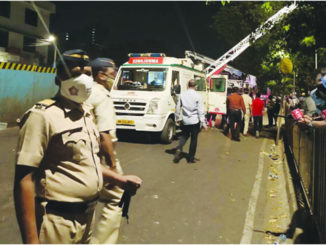
    Mumbai (TIP): The suspended Mumbai police officer, Sachin Vaze, said that he is being made a scapegoat after an NIA officer claimed that he admitted to planting explosives outside Mukesh Ambani’s house in Mumbai. Sachin Vaze has been sent to NIA custody till April 3. Upon extension of custody, Vaze told the court that he is being made a scapegoat. “I have nothing to do with the crime,” he added.

    During the hearing Vaze said: “I had investigated this case till I was in charge of it. Also, I wasn’t the only one, the crime branch and Mumbai Police did what they had to. Now, suddenly these charges have come up against me.”

    The senior cop said that he had gone to the NIA all by himself but was suddenly arrested. “It is being said that I have accepted my crime. This is not true,” Vaze said.

    Court has now asked Vaze to give his statement in writing.

    Suspended Mumbai cop Sachin Vaze was today produced in the National Investigation Agency (NIA) court. He has been in NIA’s custody for his alleged role in planting an explosive-laden SUV near industrialist Mukesh Ambani’s residence Antilia in Mumbai on February 25.

    Vaze’s NIA’s custody was supposed to end on march 25. Meanwhile, on Wednesday, the NIA had invoked provisions of the Unlawful Activities (Prevention) Act (UAPA) in the case.

    Vaze, an assistant police inspector (API) with the Mumbai police, has been charged under sections 16 and 18 of the UAPA, sources said.

    The NIA authority said that they have so far recorded statements of 35 people and their team is also scanning through 112TB of data. Meanwhile, sources saidNIA officers have also recorded the statement of the mysterious woman who was seen with Vaze.

    ‘Motive’

    Investigating officer Vikram Khatale said: “During the probe, Sachin Vaze claimed that he wanted to be a super cop. He had planned to plant the explosives and later detect them. He wanted to make some name for himself.”

    “We are, however, verifying his claim,” added the officer.            Source: India Today

  • 2nd wave of Covid-19 in India could last up to 100 days, peak in April: Report

    2nd wave of Covid-19 in India could last up to 100 days, peak in April: Report

    New Delhi (TIP): India is in the midst of a second wave of the Covid-19 pandemic. Considering the duration from the present level of daily new cases to the peak India saw last year, the country is expected to reach the high in the second half of April. The second wave, which could last until the end of May, could see an addition of 25 lakh cases if trends till March 23 are taken into consideration.

    These projections are part of findings of a State Bank of India (SBI) research report titled ‘The second wave of infections: The beginning of the end’ by Chief Economic Advisor Soumya Kanti Ghosh.

    In the report, Ghosh assessed that the duration of the second Covi-19 wave might last up to 100 days starting from Feb 15, while he added that vaccination is a more effective way than lockdown to beat the pandemic.

    “Though global Covid-19 experience shows the second wave much higher in intensity than the first wave, presence of vaccine makes the difference currently. But India will be able to manage the situation better,” the report said.

    India reported 53,476 cases in a day on March 25, the highest since November 6, 2020 — Maharashtra and Punjab being the worst-affected states.

    The daily spike in coronavirus cases during the peak in the second wave could be much higher than last year, the report warns as it cites France which saw the peak of daily cases around 11.5 times more than the first wave.

    The only silver lining this time, according to the report, is the availability of vaccines against Covid-19.

    The report argued that if one considers the number of days taken to reach the current level from the lowest level of daily new cases witnessed on February 21, the time it took for the second Covid-19 wave to hit India is similar to what happened in the first wave.

    “However, the difference lies in the speed of spread of infection in states like Gujarat, MP, Maharashtra, Punjab and Chhattisgarh, where the cases have increased at a much faster pace during the current second wave,” the report stated.

    Considering the number of days from the current level of daily new cases to the peak level during the first wave, India might reach the peak in the second half of April, the report says and adds that the entire duration of the second wave might last up to 100 days counted (from Feb 15). A district-wise analysis in the report revealed that cases have again started rising in the top 15 districts of India, mostly urban, while the spread in rural districts is almost stable.

    It says that cases are largely localised and concentrated and while Rajasthan, Gujarat, Kerala, Uttarakhand, Haryana have vaccinated more than 20 per cent of their elderly population, other states with a higher elderly population (>60 years) like Punjab, Tamil Nadu, Andhra Pradesh, Maharashtra and West Bengal have vaccinated a lesser percentage.

    The report points out that Kerala had the maximum number of worst-affected districts in January 2021. However, all districts in this top-10 list are now rural districts of Maharashtra.

    Recommending a strong push to the vaccination programme, the report says, “If the daily vaccine inoculation increases to 40-45 lakh from the current maximum level of 34 lakh, then we can vaccinate our population above 45 years in four months from now.”

    The SBI report also proposes restrictions to prevent the spread of Covid-19. “Air travel has slowly inched towards the level it was at…However, a plethora of new variants emerging still make a case for being wary about the overall recovery in air travel,” the report noted.

    Source: India Today

  • India, US agree to work towards resolving key bilateral trade issues

    India and the United States have agreed to work constructively to resolve key outstanding bilateral trade issues and to take a comprehensive look at ways to expand the trade relationship, the Biden administration has said.

    United States Trade Representative Katherine Tai discussed the important trade and investment relationship between the two countries during her maiden phone call with her Indian counterpart Commerce and Industry Minister Piyush Goyal. “They committed to strengthening cooperation on shared objectives and to revitalise engagement through the US-India Trade Policy Forum. They also agreed to work constructively to resolve key outstanding bilateral trade issues and to take a comprehensive look at ways to expand the trade relationship,” the United States Trade Representative (USTR) said in a readout of the call on Thursday.

    Tai, who was confirmed by the Senate only a few days ago, stressed the critical importance of cooperation on a broad set of issues, including digital trade, intellectual property, agriculture, labor, and climate and environment.

    Tai and Goyal agreed to hold the next ministerial-level meeting of the Trade Policy Forum during 2021, the USTR said. Supreme Court upholds Tata Sons’ appeal in Mistry case

    The Supreme Court on Friday set aside a 2019 order of the National Company Law Appellate Tribunal (NCLAT) which reinstated Cyrus Mistry as the executive chairman of the over $100 billion Tata Sons. It allowed Tata Sons’ appeal, holding that well-settled principles had been overturned by the NCLAT when it decided the dispute in the previous round.

    “All the appeals filed by Tata Sons against Cyrus Mistry are allowed,” the bench headed by Chief Justice of India (CJI) SA Bobde added.

    Mistry had succeeded Ratan Tata as chairman of Tata Sons in 2012 but was ousted four years later in a board meeti.

    About the issues relating to valuation of shares and the Shapoorji Pallonji (SP) Group pledging its shares in Tata Sons to raise funds, the top court maintained that both parties were at liberty to raise these before appropriate forum and that the court would not pass any order.

  • Regional names of Holi

    Regional names of Holi

    Popularity of Holi can be gauged from the number of names Holi has in different states. Also of great interest is the story behind each of these names.

    As one moves across from one state to another, one can surely discover the myriad shades of human emotions behind the story that goes with each of these names of holi.

    These stories will make you feel proud of the rich cultural diversity of India. Besides, what is to be appreciated is the underlying strong bond of unity that binds this uniquely culturally diverse country.

    Even the Gods that are worshiped on Holi differ in different corners of the country. The way the festival is celebrated also differs but the spirit is same – the one of love and brotherhood. Inspite of their uniqueness in different states, the festival is considered to be the one which enhances the secular fabric of India.

    Lathmaar Holi

    In what is known as the hub of holi in India – Barsana, Holi is known as Lathmaar Holi. Sounds violence?? There is more violece than the name signals off. The stick is in the hands of the women on this day and the men need to work a lot to save themselves from the immensely charged up womenfolk.

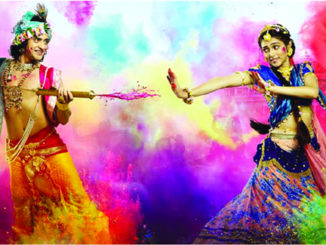
    The birth place of Lord Krishna’s beloved Radha, Barsana celebrates Holi with extreme enthusiasm as Krishna was famous for playing pranks on Radha and gopis. In fact, it was Krishna who started the tradition of colours by first applying colour on Radha’s face.

    Womenfolk, of Barsana it seems, after thousands of centuries want to take a sweet revenge of that prank of Krishna. Even men have not left their mischief and are still eager to apply colour on the women of Barsana.

    Dulandi Holi

    Holi recieves this name in the state of Haryana. Here, bhabhi – the brothers wife gets an upper hand on the day of holi. And, devar’s – husband’s younger brothers need to watchout.

    The bhabhi’s on this day get a social sanction on Holi to beat their devars and make them pay the price of all the pranks they played on them for the entire year. Bhabhi’s roll up their saris in the form of a rope in a mock rage, and give a good run to their devars.

    In the evening, devars are supposed to bring sweets for their dear bhabhi.

    Besides, there is also a tradition of breaking the pot of buttermilk hung high in the street by forming a human pyramid.

    Rangpanchami

    People of Maharashtra commonly know this festival of colours by the name of Rangpanchami as the play of colours is reserved for the fifth day here. Locals of Maharashtra also know Holi as Shimga or Shimgo.

    The festival is particularly popular amongst fisher folk. They celebrate it in on a large scale and revel in the festivities by singing, dancing and merry-making. This special dance provide them means to release all their repressed feelings, needs and desires. People also utter sound through their mouths in a peculiar fashion by striking their mouths with the back of their hands.

    Basant Utsav

    Holi by the name of Basant Utsav is celebrated with fervour in the state of West Bengal. The tradition of Vasantotsav, meaning Spring Festival was started by poet and Nobel laureate Rabindranath Tagore at Shantiniketan, the University he founded.

    What is appreciated is the grace and diginified manner in which Vasant Utsav is celebrated in West Bengal as compared to boisterous Holi witnessed in most parts of India. Boys and girls joyfully welcome Spring, the season of hope not just with colours but with songs, dance, chanting of hymns in the serene ambiance of Shantiniketan. Anybody who got a chance to witness this elegant way of celebrating Holi in Bengal remembers it with fond memory for the rest of his life.

    Dol Purnima

    Holi is also known by the name of Dol Purnima in West Bengal.

    Early in the morning, on the Dol Purnima day students dress up in saffron-coloured clothes and wear garlands of fragrant flowers. They sing and dance to the accompaniment of musical instruments presenting an enchanting view to the onlookers and a memory to cherish for years.

    The festival is also known as ‘Dol Jatra’, ‘Dol Purnima’ or the ‘Swing Festival’. The festival is celebrated in a dignified manner by placing the idols of Krishna and Radha on a picturesquely decorated palanquin which is then taken round the main streets of the city. The devotees take turns to swing them while women dance around the swing and sing devotional songs. Throughout the procession men keep spraying coloured water and colour powder, ‘abeer’ at them.

    Hola Mohalla

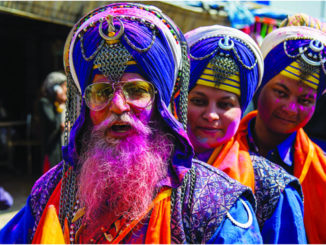
    Holi gets this joyful name in the state of Punjab. The festival is celebrated in an entirely different manner, it’s meaning and significance also shifts a little here.

    Hola Mohalla is actually an annual fair that is organised in a large scale at Anandpur Sahib in Punjab on the day following the festival of Holi. Practise of holding a fair of this kind was initiated by Guru Gobind Singh, the tenth Sikh guru. Purpose of the fair was to physically strengthen the Sikh community by holding military exercises and mock battles.

    The festival is celebrated for three consecutive days, in which members of Sikh community display their physical strength by performing dare-devil acts like bareback horse-riding, standing erect on two speeding horses, Gatka (mock encounters), tent pegging etc. This is followed by music and poetry competition to lighten the charged up atmosphere.

    A number of durbars are also held where Sri Guru Granth Sahib is present and kirtan and religious lectures take place. This helps strengthening the soul of community. On the last day a long procession, led by Panj Pyaras, starts from Takth Keshgarh Sahib, one of the five Sikh religious seats, and passes through various important gurdwaras like Qila Anandgarh, Lohgarh Sahib, Mata Jitoji and terminates at the Takth.

    For people visiting Anandpur Sahib, langars (voluntary community kitchens) are organized by the local people as a part of sewa (community service). Raw materials like wheat flour, rice, vegetables, milk and sugar is provided by the villagers living nearby. Women volunteer to cook and others take part in cleaning the utensils. Traditional cuisine is served to the pilgrims who eat while sitting in rows on the ground.

  • Holi and Bollywood: A nostalgic walk down the memory lane

    Holi and Bollywood: A nostalgic walk down the memory lane

    By Murtaza Ali Khan

    Holi celebrations have been a part of Hindi films for as long as one can remember. Right from the early 1940s, Indian filmmakers have tried to include Holi songs in movies in order to embellish the stories so much so that some of the most popular songs of all time happen to be Holi songs. In fact, Holi has always been an important festival for the Indian film fraternity, not just on-screen but off-screen too. RK Studio hosted some of the biggest Holi parties in Bollywood with the legendary Raj Kapoor serving as a great host to the who’s who of the film industry. And it remained so for decades. The photos from the time reveal how Holi was an integral part of the studio’s celebrations. In fact, taking a leaf out of RK Studios, many others started hosting similar Holi parties and the trend continuestill date.

    One of the earliest Holi songs that we come across in Hindi cinema is a song called “Jamuna Tat Shyam Khele Horee” from the 1940 film titled “Aurat”. As we move into the 1950s, we come across more and more of these songs with “Holi Khele Nandalal Biraj Mein” from the 1953 film titled “Rahi”, “KheloRang HamareSang” from the 1953 film titled “Aan”, “Mat Maro Shyam Pichkari” from the 1956 film “Durgesh Nandini”, “Holi AayiRe KanhaiRang Barse” from the 1958 film “Mother India”, and “Are JareNatkhat” from the 1959 film “Navrang” amongst the most famous ones.

    In the 1960s, Bollywood unleashed evergreen Holi songs such as”Tan rang lo ji aaj man rang lo” from the 1960 classic “Kohinoor”, “Holi KhelatNandlal” from the 1963 film “Godaan”, “PiyaToseNaina” from the 1965 Vijay Anand masterpiece “Guide”, “LayiHain HazaronRang Holi” from the 1966 classic “PhoolAurPatthar”. As Hindi cinema moved into the 1970s, the writer duo of Salim-Javed injected a new kind of rage and angst in the depiction of the hero that catapulted Amitabh Bachchan’s Angry Young Man to superstardom even as the likes of Rajesh Khanna, Dharamendra, Dev Anand and others continued to play more conventional romantic heroes.

    Some of the most popular Holi songs from the 1970s include “AajNa Chhodenge” from the 1970 Shakti Samanta classic “Kati Patang”,”Holi AayiRe” from the 1970 film”Holi AayiRe”, “Holi Re Holi Rangon Ki Holi” from the 1971 film “ParayaDhan”, “Nadiya Se Dariya” from Hrishikesh Mukherjee’s 1973 classic “Namak Haram”, “PhagunAayoRe” from the 1973 Rajinder Singh Bedi classic “Phagun”,”Holi AayiRe MastanoKi Toil” from the 1975 film “Zakhmee” and”Holi KeDin” from Ramesh Sippy’s epic magnum opus”Sholay”.

    Bollywood’s craze for Holi songs continued in the 1980s with hits like “Rang BarseBheegeChunarwali” from the 1981 Yash Chopra classic “Silsila”, “BhagiRe BhagiBrij Bala” from the 1982 film “Rajput”, “SaatRang Main Khel Rahi Hain” from the 1985 film “Akhir Kyon”, and “Diwani Tum Jawanon Ki Toli” from the 1988 film “Dayavan”. The 1990s saw Hoi songs like “Ang Se Ang Lagana” from the 1993 Yash Chopra blockbuster “Darr”, “Rang Di Rang Di” from the 1993 film “Dhanwaan”, and “JhankaroJhankaro” from the 1994 film “Krantiveer”.

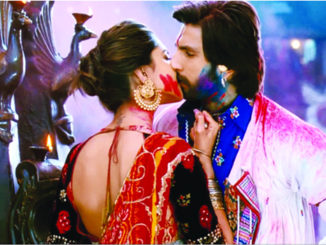
    The turn of the millennium witnessed Amitabh Bachchan successfully embarking upon his second innings after a few hiccups. The song “Hori Khele Raghuveera” from the 2003 film “Baghban” went on to become one of the biggest hits of Bachchan’s stellar career. Some other popular Holi songs from the decade include “SoniSoni” from the 2000 Aditya Chopra film “Mohabbatein”, “Do Me A Favour Lets Play Holi”from the 2005 Vipul Amrutlal Shah directorial “Waqt: The Race Against Time”. The most recent superhit Holi number include “BalamPichkari” from the 2013 Ayan Mukerji film “BalamPichkari”, “LahuMunh Lag Gaya” from the 2014 Sanjay Leela Bhansali blockbuster “Goliyon Ki Rasleela Ram-leela”, and “Jai JaiShivshankar” from the 2019 Siddharth Anand blockbuster “War”.

    With the death of Raj Kapoor in the year 1988, RK Studios stopped having these Holi parties but others continued hosting these Holi parties. In the recent years, the likes of Shabana Azmi and Javed Akhtar, Ekta Kapoor, Varun Dhawan, Sidharth Malhotra, Ranveer Singh, Alia Bhatt, etc. have kept the tradition alive.

    The growing concerns over use of chemical colors and water shortage have led to a few changes in the way the festival is celebrated but the spirit has pretty much kept alive. This year, however, with the ongoing pandemic, the Holi celebrations in the B-town are expected to be little mellow. So it appears that one would have to wait for at least one more year to see the same old zeal in B-town’s Holi celebrations once again.

    (Murtaza Ali Khan is a Delhi-based Film & TV Critic / Journalist who has been covering entertainment for over 10 years. He can be reached at murtaza@apotpourriofvestiges.com)

  • Rainbow shades of Holi in Rajasthan desert 

    Rainbow shades of Holi in Rajasthan desert 

    By Dr Yash Goyal

    TIP Representative at Jaipur

    Geographically, in the largest desert of the country, not only the ‘dialect’ (dialect/language) changes on every twenty ‘Kos’ (less than Km), but also the manner and ritual of celebrating the Teej-Tyohar (festivals). Holi Dahan and Dhulandi have their own adventures in India after Deepotsav. There was a period of playing Holi in Rajasthan against the background of the kings, which is changing with the times today.

    The people living in the cities may be seen in the colors of Holi, but the ancestral customs which are prevailing in the rural area, they look very seductive and amazing. The enthusiasm and mutual love of the villagers in celebrating Holi with their splashes of color and their unique way attracts not only the city dwellers but also foreign guests so much that in many places they are also seen in Holi. After Agra, Rajasthan is also the main tourist destination of foreigners.

    In this vast region, the festival of Holi is celebrated somewhere with splashes of color, while in the districts of Barmer and Dungarpur, the stones of Holi are enjoyed. LathmarHoli in Barmer, Pali and Mewar in Karauli and Bharatpur, MurdaRide in Bhilwara, Chang and Gidar dance in Shekhawati, Kodamar in Ganganagar, Gota Gar in Bhinmal, Kando (cow dung) rod in Dungarpur, Holi of flowers in Govind-Devji temple in Jaipur, cutting of strings in Bikaner, clothes-tearing in Pushkar and the riot of Hela Khayal in Lalsot (Dausa) are also popular and include their own history to celebrate this colorful festival.

    Although this festival is of brotherhood and harmony, but Muslim families of Gulabinagri make ‘Gulal Gota’ for Hindus. To play Holi from the four-year-old ‘Gulal Gota’, people still go to the narrow streets of Manihars-Ka-Rasta in the four walls of Jaipur. The ball is dried by the ladies with their fingers in the lokh (resins used in the bangle) in a slow flame, giving it the shape of a ball and taping it.

    Since the forts in Rajasthan are still there, where the descendants of the erstwhile kings, living in heritage palaces and princely states, keep the tradition of Holika Dahan and Dhulandi alive even today, which attracts the residents of small towns even today. There was an old time when it was a pleasure to celebrate Teej festival among the kings and queens. In Jaipur’s City Palace, where many people came into active politics, and even today Diya Kumari is BJP’s MP from Rajsamand, this trend has been made alive.

    Before Independence then, first of all, the Raj family’s Holi celebrations at the City Palace. After this, Holi Dahan would take place in other mohallas of the city. Citizens (subjects) used to race to light the Holi of their neighborhood with the spark of fire / upleap of Holi, which was lit in the City Palace. Then Holi would have a beautiful atmosphere of Nandotsav in the city. The Maharaja visited Govinddev Maharaj in the morning and came out to celebrate Holi Day. The music of Janani Diyodhi and City Palace would be accompanied by sajtis, mujra and mands, and saffron with saffron.

    Jitendra Singh Shekhawat, the iconic historian and journalist of the ‘Heritage Window’, says that for the Maharaja Holi Day at Chandramhal’s Jayanivas Bagh on Dhulandi in the City Palace, there was a buzz of music after colors, gulal and dolchiis. Later the court of the Maharaja was used. In this royal procession, the feudatories of the princely state of Jaipur, Umrao, Nawab, Nagar Seth, Tajimi Sardar, and would be special guests of the country and abroad, who honored him by presenting him an eyeful after playing Holi with the court. In the royal dress of Phaganis Safa, Jodhpuri Achkan and Churidar Pajama, the Maharaja used to lift his hose pipe and show it colors. There were drums, Shehnai ringing at the door. Dholania sings songs of Holi.

    The pranksters used to display their art, causing fountains of laughter to erupt. In addition to liquor made of saffron, grapes, raisins, pistachios, there were also jams of foreign liquor. Gulal was also offered as a gift in small skins. Only kings could go to see the game of holi of queens in Janani Deodhi.

    The era changed but the former royal family recites the history of wet and dry colors in a pool of water, with former guests celebrating Holi at the City Palace. Now these Rangotsavs organize event management on one theme. Jaipur is also called Chhoti Kashi because of Govinddevji Maharaj. That is why the historical Holi culture is still prevalent here. In the courtyard of the temple of Govinddevji, women, men and big and small devotees spend hours in Holi in the flowers of Holi and get lost in Radha-Govind.

    There are also many types of Ras Leela during the Holi and Shitala Ashtami of Lalsot in Dausa district in Jaipur division, ‘Hela Khayal Dangal’ is also an important occasion for all the castes (Gurjars, Meena especially) to be threaded in the same color. In this, the legislators and ministers of the ruling and opposition also openly enhance the dignity of the ceremony. In the 10 to 20 congregations of the pro-opposition, the men squarely sing sarcasm on political-socio-business issues. Let us sing whatever thought comes to mind immediately. A second sarcasm is carried out amidst the banging of the dhol-nagade-other folk instrument that the participants listeners are enchanted and throw colors of Holi. There is also special food and drink. This riot lasts for 36 to 72 hours continuously. The city of Lalsot is covered in a hue and cry of color.

    The Chaugan Stadium in Gulabi Nagar and the Rajasthan Tourism Department in Khasakothi also organize Dhulandi festivities for foreigners with invites and focal points of foreign tourist attractions. Before Holi in Bharatpur, the Firangi in Braj Holi festival is seen with Indian colors.

    Playing ‘cloth tearing’ Holi of Indian tourists with foreigners in Brahma’s city of Pushkar has also gained a lot of fame. Under the prior permission and supervision of the police and the district administration, the cloth tearing celebrations are celebrated at the Varah Ghat Chowk and the Trans Party is celebrated. Varaha is an incarnation of Lord Vishnu. In this, the participants tore each other’s clothes decently. But there is no indecency or physical vulgarity in him. Women and men have different enclosures for those who get drenched in the colors of Holi. It is not allowed to bring any kind of liquor and drugs here.

    Stoning during Holi from Barmer has also been prevalent in history since the beginning of the last century. The festival of Holi was played with joy and affection amidst the killing of mutual stones, keeping away mutual disharmony, antipathy, enmity. This love of Holi was played between two parties and two mohallas. The people of both the parties had already collected stone shelves on the high roofs of their houses, shops, religious establishments, and the way the shield is used in the war to avoid this, people like iron. Tagari vomited and attacked each other. Some people were also injured. This practice of Holi is still heard in this district. By the way, the Holi of these stones started celebrating slowly with dust and mud. Children also enjoy raining dust on passers-by. Holi is celebrated in all areas of the country, but due to a belief in the tribal villages of Rajasthan, there is bloodshed on the occasion of Holi.

     Due to this strange recognition of the tribal dominated area of Banswara and Dungarpur districts of Rajasthan, many people are injured every year on Holi. Ambulance 108 is placed on the occasion of Holi in Bhiluda and Ramgarh villages of Dungarpur. Many people reach the hospital here. People have collected stones. This game starts from the night after Holika Dahan and runs till Dhundi. In the atmosphere, drums and Chang are played to fill the heroic juices. People call this Holi as Holi of Raad, Rada or enmity. If the elders of the tribal area believe that the cause of the stone-pelting Holi, then the king here had killed a Patidar caste person on the day of Holi centuries ago. The wife of the deceased got sati with her corpse in her lap and cursed while dying has collected stones This game starts from the night after Holika Dahan and runs till Dhulndi. In the atmosphere, drums and Chang are played to fill the heroic juices. People call this Holi as Holi of Raad, Rada or enmity. If the elders of the tribal area believe that the cause of the stone-pelting Holi, then the king here had killed a Patidar caste person on the day of Holi centuries ago. The wife of the deceased got sati with her corpse in her lap and cursed while dying Has gone. He said that if human blood does not fall here on the day of Holi, then natural calamity will come. Only due to this belief, Holi is played here every year on the occasion of Holi.

    In Bhilwara of Mewar region, stones are also sung, the Murday (effigy) ride from the mansion of Chittorgarh, non-dance in Pali, Dandi-non dance in Marwar and singing with phag songs, and Dewar-Bhabhi in Sriganganagar. The beach-whipped Holi is very popular.

    (Yash Goyal recently wrote the article inHindi for Dainik Tribune, and translated in English for TIP with original pictures obtained from professional photojournalists)

  • Significance of Holi

    Significance of Holi

    In spite of being such a colorful and gay festival, there are various aspects of Holi which makes it so significant for our lives. Though they might not be so apparent but a closer look and a little thought will reveal the significance of Holi in more ways than meets the eyes. Ranging from socio-cultural, religious to biological there is every reason why we must heartily enjoy the festival and cherish the reasons for its celebrations.

    So when, its time for Holi, please don’t hold yourself back and enjoy the festival to the hilt by participating with full enthusiasm in every small tradition related to the festival.

    Mythological Significance

    Holi gets us close to our religion and our mythology as it is essentially the celebration of various legends associated with the festival.

    Foremost is the legend of Prahlad and Hiranyakshyap. The legend says there once lived a devil and powerful king, Hiranyakshyap who considered himself a god and wanted everybody to worship him. To his great ire, his son, Prahlad began to worship, Lord Vishnu. To get rid of his son, Hiranyakshyap asked his sister, Holika to enter a blazing fire with Prahlad in her lap, as she had a boon to enter fire unscathed. Legend has it that Prahlad was saved for his extreme devotion for the lord while Holika paid a price for her sinister desire. The tradition of burning Holika or the ‘Holika dahan’ comes mainly from this legend.

    Holi also celebrates the legend of Radha and Krishna which describes the extreme delight, Krishna took in applying colour on Radha and other gopis. This prank of Krishna later, became a trend and a part of the Holi festivities.

    Mythology also states that Holi is the celebration of death of Ogress Pootana who tried to kill infant, Krishna by feeding poisonous milk to it.

    Another legend of Holi which is extremely popular in Southern India is that of Lord Shiva and Kaamadeva. According to the legend, people in south celebrate the sacrifice of Lord of Passion Kaamadeva who risked his life to revoke Lord Shiva from meditation and save the world.

    Also, popular is the legend of Ogress Dhundhi who used to trouble children in the kingdom of Raghu and was ultimately chased away by the pranks of the children on the day of Holi. Showing their belief in the legend, children till date play pranks and hurl abuses at the time of Holika Dahan.

    Cultural Significance

    Celebration of the various legends associated with Holi reassure the people of the power of the truth as the moral of all these legends is the ultimate victory of good over evil. The legend of Hiranyakashyap and Prahlad also points to the fact that extreme devotion to god pays as god always takes his true devotee in his shelter.

    All these legends help the people to follow a good conduct in their lives and believe in the virtue of being truthful. This is extremely important in the modern day society when so many people resort to evil practices for small gains and torture one who is honest. Holi helps the people to believe in the virtue of being truthful and honest and also to fight away the evil.

    Besides, Holi is celebrated at a time of the year when the fields are in full bloom and people are expecting a good harvest. This gives a people a good reason to rejoice, make merry and submerge themselves in the spirit of Holi.

    Social Significance

    Holi helps to bring the society together and strengthen the secular fabric of our country. For, the festival is celebrated by non-Hindus also as everybody like to be a part of such a colouful and joyous festival.

    Also, the tradition of the Holi is that even the enemies turn friends on Holi and forget any feeling of hardship that may be present. Besides, on this day people do not differentiate between the rich and poor and everybody celebrate the festival together with a spirit of bonhomie and brotherhood.

    In the evening people visit friends and relatives and exchange gifts, sweets and greetings. This helps in revatalising relationships and strengthening emotional bonds between people.

    Biological Significance

    It is interesting to note that the festival of Holi is significant for our lives and body in many other ways than providing joy and fun.

    We also need to thank our forefathers who started the trend of celebrating Holi at such a scientifically accurate time. And, also for incorporating so much fun in the festival.

    As Holi comes at a time of the year when people have a tendency to feel sleepy and lazy. This is natural for the body to experiences some tardiness due to the change from the cold to the heat in the atmosphere. To counteract this tardiness of the body, people sing loudly or even speak loudly. Their movements are brisk and their music is loud. All of this helps to rejuvenate the system of the human body.

    Besides, the colours when sprayed on the body have a great impact on it. Biologists believe the liquid dye or Abeer penetrates the body and enters into the pores. It has the effect of strengthening the ions in the body and adds health and beauty to it.

    There is yet another scientific reason for celebrating the Holi, this however pertains to the tradition of Holika Dahan. The mutation period of winter and spring, induces the growth of bacteria in the atmosphere as well as in the body. When Holika is burnt, temperature rises to about 145 degrees Fahrenhiet. Following the tradition when people perform Parikrima (circumambulation or going around) around the fire, the heat from the fire kills the bacteria in the body thus, cleansing it.

    The way Holi is celebrated in south, the festival also promotes good health. For, the day after the burning of Holika people put ash (Vibhuti) on their forehead and they would mix Chandan (sandalpaste) with the young leaves and flowers of the Mango tree and consume it to promote good health.

    Some also believe that play with colours help to promote good health as colours are said to have great impact on our body and our health. Western-Physicians and doctors believe that for a healthy body, colours too have an important place besides the other vital elements. Deficiency of a particular colour in our body causes ailment, which can be cured only after supplementing the body with that particular colour.

    People also clean-up their houses on Holi which helps in clearing up the dust and mess in the house and get rid of mosquitoes and others pests. A clean house generally makes the residents feel good and generate positive energies.

  • Holi: Let the color shower joy

    Holi: Let the color shower joy

    Holi is an ancient festival of India and was originally known as ‘Holika’. The festivals finds a detailed description in early religious works such as Jaimini’s Purvamimamsa-Sutras and Kathaka-Grhya-Sutras. Historians also believe that Holi was celebrated by all Aryans but more so in the Eastern part of India.

    It is said that Holi existed several centuries before Christ. However, the meaning of the festival is believed to have changed over the years. Earlier it was a special rite performed by married women for the happiness and well-being of their families and the full moon (Raka) was worshiped.

    This year, Holi falls on  Monday, March 29, while Holika Dahan is on Sunday, March 28.

    Calculating the Day of Holi

    There are two ways of reckoning a lunar month- ‘purnimanta’ and ‘amanta’. In the former, the first day starts after the full moon; and in the latter, after the new moon. Though the amanta reckoning is more common now, the purnimanta was very much in vogue in the earlier days.

    According to this purnimanta reckoning, Phalguna purnima was the last day of the year and the new year heralding the Vasanta-ritu (with spring starting from next day). Thus the full moon festival of Holika gradually became a festival of merrymaking, announcing the commencement of the spring season. This perhaps explains the other names of this festival – Vasanta-Mahotsava and Kama-Mahotsava.

    Reference in Ancient Texts

    and Inscriptions

    Besides having a detailed description in the Vedas and Puranas such as Narad Purana and Bhavishya Purana, the festival of Holi finds a mention in Jaimini Mimansa. A stone incription belonging to 300 BC found at Ramgarh in the province of Vindhya has mention of Holikotsav on it. King Harsha, too has mentioned about holikotsav in his work Ratnavali that was written during the 7th century. The famous Muslim tourist – Ulbaruni too has mentioned about holikotsav in his historical memories. Other Muslim writers of that period have mentioned, that holikotsav were not only celebrated by the Hindus but also by the Muslims.

    Reference in Ancient Paintings and Murals

    The festival of Holi also finds a reference in the sculptures on walls of old temples. A 16th century panel sculpted in a temple at Hampi, capital of Vijayanagar, shows a joyous scene of Holi. The painting depicts a Prince and his Princess standing amidst maids waiting with syringes or pichkaris to drench the Royal couple in coloured water.

    A 16th century Ahmednagar painting is on the theme of Vasanta Ragini – spring song or music. It shows a royal couple sitting on a grand swing, while maidens are playing music and spraying colors with pichkaris.

    There are a lot of other paintings and murals in the temples of medieval India which provide a pictoral description of Holi. For instance, a Mewar painting (circa 1755) shows the Maharana with his courtiers. While the ruler is bestowing gifts on some people, a merry dance is on, and in the center is a tank filled with colored water. Also, a Bundi miniature shows a king seated on a tusker and from a balcony above some damsels are showering gulal (colored powders) on him.

    Legends and Mythology

    In some parts of India, specially in Bengal and Orissa, Holi Purnima is also celebrated as the birthday of Shri Chaitanya Mahaprabhu (A.D. 1486-1533). However, the literal meaning of the word ‘Holi’ is ‘burning’. There are various legends to explain the meaning of this word, most prominent of all is the legend associated with demon king Hiranyakashyap.

    Hiranyakashyap wanted everybody in his kingdom to worship only him but to his great disappointment, his son, Prahlad became an ardent devotee of Lord Naarayana. Hiaranyakashyap commanded his sister, Holika to enter a blazing fire with Prahlad in her lap. Holika had a boon whereby she could enter fire without any damage on herself. However, she was not aware that the boon worked only when she enters the fire alone. As a result she paid a price for her sinister desires, while Prahlad was saved by the grace of the god for his extreme devotion. The festival, therefore, celebrates the victory of good over evil and also the triumph of devotion.

    Legend of Lord Krishna is also associated with play with colors as the Lord started the tradition of play with colours by applying colour on his beloved Radha and other gopis. Gradually, the play gained popularity with the people and became a tradition.

    There are also a few other legends associated with the festival – like the legend of Shiva and Kaamadeva and those of Ogress Dhundhi and Pootana. All depict triumph of good over evil – lending a philosophy to the festival.

  • Global Covid-19 caseload tops 125.3 mn

    Global Covid-19 caseload tops 125.3 mn

    Washington (TIP): The overall number of global Covid-19 cases has surpassed 125.3 million, while the deaths have surged to more than 2.75 million, according to the Johns Hopkins University.

    In its latest update on Friday morning, the University’s Center for Systems Science and Engineering (CSSE) revealed that the current global caseload and death toll stood at 125,399,418 and 2,754,289, respectively.

    The US is the worst-hit country with the world’s highest number of cases and deaths at 30,076,486 and 546,507, respectively, according to the CSSE.

    Brazil follows in the second place with 12,320,169 cases and 303,462 fatalities.

    The other countries with more than 2 million confirmed coronavirus cases are India (11,787,534), France (4,484,658), Russia (4,442,492), the UK (4,332,907), Italy (3,464,543), Spain (3,247,738), Turkey (3,120,013), Germany (2,732,130), Colombia (2,359,942), Argentina (2,278,115), Mexico (2,214,542) and Poland (2,154,821), the CSSE figures showed.

    In terms of deaths, Mexico comes in the third place with 200,211 fatalities.

    Nations with a death toll of over 50,000 are India (160,692), the UK (126,684), Italy (106,799), Russia (95,010), France (93,535), Germany (75,549), Spain (74,420), Colombia (62,519), Iran (62,142), Argentina (55,092), South Africa (52,535), Poland (50,860) and Peru (50,656).

    Source: IANS

  • UK govt mulling Covid vax certification

    UK Prime Minister Boris Johnson said that his government is considering coronavirus vaccine certification but suggested it might only be implemented once all adults in the country have been offered a jab by the end of July.

    Speaking in London on Thursday,  March 25, Johnson said “no decisions have been taken at all” before the publishing of a government review into Covid-19 certification early next month, reports Xinhua news agency.

    “All sorts of things are being considered,” Johnson said, adding it was “a bit premature” to speculate on whether pubs could run entirely by implementing a certification scheme while scrapping social distancing and mask-wearing rules. “What we want to do is (to) roll out the vaccine program and see what that builds in terms of general resistance to the virus,” he told Sky News.

    “I do think there is going to be a role for certification,” he said.

    However, Johnson said Britain needs to think carefully about the issue.  “As I’ve said before there are lots of difficult issues, because there are some people who, for medical reasons, can’t get a vaccination, pregnant women can’t get a vaccination at the moment,” the Prime Minister said.

    Johnson suggested that whether someone’s vaccine status, any possible immunity after having recovered from the virus or a negative test “could work together” in a possible certification scheme.

  • Biden announces 200mn vax doses in 100 days

    US President Joe Biden announced a new goal of administering 200 million Covid-19 vaccine doses to Americans in his first 100 days in office. Biden made the announcement at a press conference on Thursday, March 25, which was his first since taking office on January 20, Xinhua news agency reported.

    He had initially set the plan of having 100 million shots in the arms of Americans by his 100th day in office, but is now increasing the objective to 200 million.

    “I know it’s ambitious, twice our original goal, but no other country in the world has come close to what we’re doing,” Biden told reporters.

    “I believe we can do it,” he added.

    As of Thursday, the US Centers for Disease Control and Prevention reported that a total of 133 million Covid-19 vaccine shots had been administered, and that 14 per cent of the American population is fully vaccinated.

    The federal government has a deal with Johnson & Johnson for delivery of 200 million doses, a CNBC News report said. The first half of that order expected by the end of June.

    Merck is helping to make J&J’s shot, which is a single-dose vaccination.

  • Sonam suggests measures to tackle anonymous trolls

    Sonam suggests measures to tackle anonymous trolls

    Actor Sonam Kapoor wondered if Twitter has ‘become too toxic’ after model and television personality Chrissy Teigen announced her decision to quit the platform on Wednesday night, citing negativity. Sonam suggested that ID proofs be made mandatory while creating social media accounts to combat the menace of anonymous trolling.

    Sonam shared an excerpt from Chrissy’s tweets: “My life goal is to make people happy. The pain I feel when I don’t is too much for me.” She then asked, “Has Twitter become too toxic? @Twitter @TwitterIndia @jack.”

    Giving a suggestion to reduce negativity on Twitter, Sonam added, “Should we all quit Twitter? I’m not very active but I get my news through it. But there is no accountability on the social media platform. Opening social media accounts should be like opening any other accounts in the real world. You should need an ID proof.”

  • Bhagyashree returning to Bollywood After 11 years

    Bhagyashree returning to Bollywood After 11 years

    Maine Pyaar Kiya actress Bhagyashree is making her acting comeback with Thalaivi after 11 years. Bhagyashree, who had quit films after marriage to focus on her family, will be seen playing the role of J Jayalalithaa’s mother in the Kangana Ranaut starrer biopic. The actress was seen for a few seconds in the trailer of the film that was released on Tuesday. While the 52-year-old actress was seen in the 2019 Kannada film Seetharama Kalyana, her last Bollywood film was ‘Red Alert: The War Within’ co-starring Suniel Shetty.

    After the trailer released on Kangana’s birthday, Bhagyashree posted a still with her co-star and wrote, “Wish you a very happy birthday @kanganaranaut Congratulations on yet another national award. I am sure your sincere portrayal of Jayalaitha is going to win you more accolades …brilliant performance. Shine bright as #thalaivi #birthdaywishes #thalaivi #kanganaranaut #allthebest #congratulations.”

    Offering a sneak peek into the life of the legendary J Jayalalithaa, the trailer of Thalaivi gave a peek into the untold story across the varied stages of the superstar-turned-politician’s life. The diverse looks of Kangana as J Jayalalithaa and Arvind Swamy as MGR have generated excitement. Fans are waiting eagerly to witness the characters bring alive the past, owing to the striking similarities of their looks.

  • Apple Music ‘Saylists’ will help children with speech-sound disorders

    Apple Music has partnered with Rothco and Warner Music to develop a series of playlists with over a hundred tracks called ‘Saylists’ in order to help young listeners with speech-sound disorders, according to reports. According to a report by the BBC, the streaming service and Warner Music have relied on algorithms to identify songs that feature challenging sounds that young children with speech-sound disorders, especially those that repeat the sounds.

    Apple Music has so far added 173 tracks to the playlist and the tracks include Don’t Start Now by Dua Lipa, and Right Now by Fatboy Slim, according to the report. It also states that the algorithm analysed the lyrics of all the music in Apple’s 70 million song catalogue and identified the tracks that would repeat those sounds most often before adding them to the playlist.

    A speech sound disorder is also known as an articulation disorder or a phonological disorder and is used to describe the issues faced by children who do not say sounds by the time they reach the appropriate age. Typically sounds like mm, n, h, w, p, b, t, d, k, and g are learnt early on, but some sounds like y, v, s, sh, ch, j, ng, th, z, l, and r are more difficult and are learnt by the age of four along with all other speech sounds, according to the American Speech-Language-Hearing Association (or ASHA).

    “Every speech and language therapist wants to keep children engaged during the therapy sessions as well as help them generalise the target sounds, both in school and at home. Saylists provide a fun, new way to practise the sounds I teach them – without feeling pressured or getting bored. Having fun is the first step to learning,” said Anna Biavati-Smith, speech and language therapist.

  • New bacterial strains found on International Space Station may help grow plants in space

    New bacterial strains found on International Space Station may help grow plants in space

    Discovery of novel bacterial strains aboard the International Space Station (ISS) suggests the possibility of astronauts growing their own vegetables while in space, says a new study by researchers  based at University of Hyderabad (UoH) and NASA’s Jet Propulsion Laboratory(JPL), among other institutions. The new bacterial strains discovered from different locations aboard the ISS flights may help in creating the “fuel” to help plants withstand such stressful situations. The findings of the study were published in a recent issue of the journal Frontiers in Microbiology The research teams were led by Dr. Kasthuri Venkateswaran of NASA’s Jet Propulsion Laboratory, C.C. Wang of WorldQuant Initiative for Quantitative Prediction, Professor Appa Rao Podile from the University of Hyderabad (UoH) with expertise on plant growth promoting bacteria and plant microbiome and Dr. Ramprasad, a CSIR-pool Scientist. The bacterial strains belonging to the family Methylobacteriaceae were isolated from different locations aboard the ISS across two consecutive flights.

  • A new image gives a closer look at M87 black hole and its magnetic field

    A new image gives a closer look at M87 black hole and its magnetic field

    Astronomers have used Event Horizon Telescope (EHT) to release a new and more detailed image of the M87 black hole, showcasing spiraling lines with mysterious magnetic forces close to its edges. The image showing the gigantic black hole at the center of the M87 galaxy, which is nearly 55 million light-years away. The image was obtained using polarised lights. Astronomers believe that this will help them understand how black holes are able to launch energetic jets from their core which extend “far beyond the galaxy”. “We are now seeing the next crucial piece of evidence to understand how magnetic fields behave around black holes, and how activity in this very compact region of space can drive powerful jets that extend far beyond the galaxy,” Monika Moscibrodzka, coordinator of the EHT Polarimetry Working Group and Assistant Professor at Radboud University in the Netherlands said.

  • WhatsApp rolls out Chat Threads to beta testers

    WhatsApp is working on a number of features that will enable users to interact with the company. One of those features is Chat Threads. In the past, reports have talked about such a feature being in the works at the company. Now, a new report gives more details about it. WABetaInfo, the tipster that tracks development in the Facebook-owned messaging platform, says that WhatsApp has finally released the Chat Threads feature for specific beta testers on Android. This means that not all beta testers have access to this feature yet. If you are a beta test, you can verify if this feature is enabled for you by going to the Settings menu in WhatsApp and then tapping on the Contact Us option in the Help section. If you have got the access to the feature, you would see a dialogue box where you can type in your issue. You can also select if you want to give away technical details about your phone, such as your phone’s model and settings, to WhatsApp so that it is able to solve your queries better. Once you send the message, WhatsApp will start a Chat Thread that will appear in the main menu alongside your other chats. It will close once your query has been resolved. Windows 10 users can now access Microsoft Power Automate Desktop for free

    Microsoft on Thursday announced that it was making its Power Automate Desktop solution for Windows 10 available to Windows 10 users in the country for free. The company’s low-code automation system allows businesses to automate certain tasks — especially repetitive and manual ones, as part of its Power Automate Service.

    Running a business today involves a lot of constantly changing factors, some of them out of the control of those at the helm — such as the novel coronavirus pandemic. Performing manual tasks repetitively can impact employee productivity, according to the company. Power Automate Desktop for Windows 10 features a low-code Robotic Process Automate (RPA) application which essentially automates these tedious tasks and helps streamline workflows, the company said on Thursday. Microsoft’s Power Automate Desktop system allows companies to record actions such as mouse and keyboard clicks as part of the RPA solution that was first announced at Microsoft Ignite in 2019. Once a user has recorded those actions, they can be “re-played” repeatedly, on various applications like Microsoft Outlook, Microsoft Excel and Sharepoint.

  • India ranks 40th on International Intellectual Property Index

    India ranks 40th on International Intellectual Property Index

    Washington (TIP): India ranked 40 among 53 global economies on the latest annual edition of the International Intellectual Property (IP) Index released on Tuesday, March 23. Released annually by the US Chamber of Commerce Global Innovation Policy Centre (GIPC), the Index evaluates Intellectual Property rights in 53 global economies—from patent and copyright policies to commercialisation of IP assets and ratification of international treaties.

    The overall global IP environment improved in 2020, with positive score increasing in 32 of the 53 economies measured by the IP Index. This is the ninth IP index released by the GIPC. “India ranked 40th in 2020, scoring 38.4 out of 100 on a set of 50 intellectual property-related indicators,” the GIPC said in a media release. India’s overall score has increased from 36.04 per cent (16.22 out of 45) in the seventh edition to 38.46 per cent (19.23 out of 50) in the eighth edition. India has shown real improvement over the past few years, the report said, adding that it has made a string of positive efforts which resulted in a score increase because of stronger enforcement efforts and precedent-setting court cases involving copyright and trademark infringement. Nevertheless, rights-holders in India continue to face substantive challenges, particularly regarding the patenting environment, in which India’s policy framework continues to deny patent eligibility to a broad range of innovations, it said.

  • Oil prices slide as coronavirus lockdown concerns outweigh Suez Canal disruptions

    Oil prices slide as coronavirus lockdown concerns outweigh Suez Canal disruptions

    Oil prices skidded around 2% as fuel demand concerns re-emerged alongside fresh coronavirus pandemic lockdowns, trimming overnight gains spurred by the grounding of a giant container ship blocking crude shipments through the Suez Canal. Brent crude futures slid $1.14, or 1.8%, to $63.27 a barrel at 0139 GMT, after jumping 6% overnight. US West Texas Intermediate (WTI) crude futures dropped by $1.27, or 2.1%, to $59.91 a barrel, after climbing 5.9% overnight. Prices had tumbled earlier in the week on worries about tighter pandemic curbs in Europe and vaccine delays stalling growth in demand for fuel, but sharply reversed on Wednesday with the grounded ship in the Suez Canal potentially blocking 10 tankers carrying 13 million barrels of oil. The market was also helped on Wednesday by data showing US gasoline demand improved and refinery run rates were picking up. However, those factors supporting the market were short-lived, even as tugs struggled to free the stranded Suez Canal ship.

  • India’s economy on path of gradual recovery: IMF

    India’s economy is on the path of gradual recovery, the International Monetary Fund has said ahead of its next month’s spring meeting with the World Bank. “India’s economy is on the path of gradual recovery, real GDP growth, return to positive territory in fourth quarter of 2020. And that’s for the first time actually since the start of the pandemic and it’s supported by a pickup in gross, fixed capital formation,” IMF’s spokesperson Gerry Rice told reporters at a news conference here on Thursday. “Beyond that, I can say that high frequency indicators including PMIs trade and mobility suggests a continued recovery in the first quarter of this year, ’21; however, the recent emergence of the variants and localised lockdowns could pose risks to a sustained recovery,” Rice said. The IMF is scheduled to release its World Economic Outlook on April 6.

  • SEBI relaxes norms for listing of startups

    SEBI relaxes norms for listing of startups

    Seeking to boost listing of startups, markets watchdog SEBI on Thursday decided a slew of relaxations to norms, including reducing holding period for pre-issue capital and allowing discretionary allotment to eligible investors. The changes have been approved to the framework for listing on the Innovators Growth Platform, SEBI said after the Board meeting. Other proposals approved include easing delisting requirements and relaxation in guidelines for migrating to main Board. “The Board has approved the proposals with respect to framework of Innovators Growth Platform (IGP) under the SEBI (Issue of Capital and Disclosure Requirements) Regulations, 2018, with an objective to make the platform more accessible to companies in view of the evolving startup ecosystem,” SEBI said.

    The regulator has decided to reduce the period of holding of 25% of pre-issue capital of the issuer company by eligible investors to one year from the current requirement of two years. The term ‘Accredited Investor’ for the purpose of IGP is renamed as ‘Innovators Growth Platform Investors’.

  • H&M, Nike face boycotts in China as Xinjiang becomes wedge issue

    H&M, Nike face boycotts in China as Xinjiang becomes wedge issue

    US and European retail brands in China are suddenly facing a dilemma: Embrace cotton from Xinjiang and come under attack in the West, or reject it and risk a boycott in the world’s second-biggest economy. Hennes & Mauritz AB was blasted by the Communist Youth League and the People’s Liberation Army on Wednesday after social-media users dug out an undated company statement about accusations of forced labor in Xinjiang. Calls to boycott the Swedish retailer quickly spread to include Nike Inc., which has previously said it won’t source products from the region due to labor concerns. Brand ambassadors in China for both firms cut ties with the companies in recent days.

    “Want to make money in China while spreading false rumors and boycotting Xinjiang cotton? Wishful thinking!” the Communist Youth League said in a post on Weibo, referring to H&M. One of the PLA’s Weibo accounts called H&M’s statement “ignorant and arrogant.”

    The Communist Party’s move to target companies over Xinjiang shows President Xi Jinping’s government is seeking to impose real costs for governments and businesses that criticize China’s human-rights record as the Biden administration aims to unite allies over the issue. Bejing slapped reciprocal sanctions on European Union officials on Monday, following coordinated sanctions and statements by the EU, US, Canada, Australia and New Zealand.

    At a testy meeting between top diplomats of the US and China last week, Politburo member Yang Jiechi made extended remarks attacking the US’s human-rights record and calling on the world to stop interfering in China’s “internal affairs.” Foreign Ministry spokeswoman Hua Chunying continued the pushback this week, hitting the US and Europe over everything from the slave trade and Nazism to the killing of George Floyd and alleged hoarding of coronavirus vaccines.

    Chinese firms are now rallying around Xinjiang, which produces more than 80% of the country’s cotton. Anta Sports Products Ltd. and Hongxing Erke Sports Products Co. were among companies that issued statements saying they will continue to source the material from the region. Shareholders rewarded firms that displayed patriotism, while punishing those with links to Western brands.

  • Agni deva: The acceptor of sacrifices

    Agni deva: The acceptor of sacrifices

    Agni deva is the fire god and acceptor of sacrifices. He is the god of divine knowledge. He is also the ashta-dikapala (guardians of the directions) of the southeast direction. To invoke Agni deva the mantra is ‘Om Agnidevaya Namaha’. In the Vedas, Agni is the second-most important deva after Devapati Indra. His mount is a goat named Rama (not Rama, the avatar of Lord Vishnu).

    Family

    Father: Brahma

    Wife: Svaha

    Sons: Pavak, Pavanmaan, Shuchi

    Marrying Swaha

    Once Agni attended a yagna. The Saptarishis and their wives had also come to this yagna. Agni fell in love with them, but he knew that none of them would cheat on their husbands. Dejected, Agni wandered around in the forest. Swaha, the daughter of Daksha, had wanted to marry Agni for a long time. She took advantage of this opportunity and disguised herself as the wife of Angiras. Disguised as the wife of Angiras, she was able to seduce Agni. Swaha then went on to disguise herself as six of the wives of the Saptarishis. However, when she tried took the form of Arundhati, Vashishta’s wife, and seduced Agni, Agni realized it was a trick. This is because Arundhati is really devoted to Vashishta.

    Agni said to Swaha, “Thanks to you, I was able to fulfill my desire of making love with the wives of the Saptarishis without breaking the rules of marriage. I am very pleased with you and wish to have you as my wife,” Agni said.

    Swaha was really happy and accepted the proposal. Agni and Swaha were then married. Agni declared that in a yagna, he would not accept an offering unless the name “Swaha” was uttered. That is why priests say Swaha before pouring anything into the fire.

    Conflict with Bhrigu

    In this second birth, Bhrigu rishi married Puloma, a daughter of Kashyapa. Puloma and Bhrigu started living together in an ashram. She soon became pregnant with a son.

    Once, Bhrigu went for his morning ablutions and left Puloma in the care of Agni deva. At that time, a rakshasa named Puloma came to the ashram and saw the beauty of Puloma. This rakshasa had actually been betrothed to Puloma before she married Bhrigu and was still enamored by her. But the Rakshasa then saw Agni deva and asked him, “Was Puloma wedded with Bhrigu through sacred Vedic rights?” Reluctantly, Agni said no. Hearing this, Puloma rakshasa decided to abduct Puloma. He turned into the form of a boar and he ran away with her. Frightened by this, Puloma gave birth to a son who fell to the ground. He was called Chyavana, which means “fallen from the womb”, and he was shining brightly. Overwhelmed by this, Puloma rakshasa ran away.

    Puloma then came back to the ashram and told Bhrigu what had happened to her and her son. Bhrigu was pleased with the birth of their son, but he was enraged when he was told that Agni had revealed Puloma’s status. In a fit of rage, Bhrigu cursed, “Agni! You will become the consumer of all things!”

    Agni became furious after hearing Bhrigu’s curse. “I am omnipresent. The gods and the pitrs (ancestors) accept oblations offered to me. Thus, it would be improper for me to consume an offering of unclean things,” he thundered. Agni refrained from cursing Bhrigu because he was a revered Brahmin and rishi. After this incident, Agni went into incognito. Brahma then called Agni and told him that the curse stands modified because his flames will consume everything but his body will remain pure. Satisfied, Agni went back to his duties.

    Angiras becomes the Son of Agni

    Once, sage Angiras performed severe penance and became more brilliant than Agni. The entire world was illuminated by his brilliant flames. Since Angiras was fulfilling the role of Agni, the people of the world started disregarding Agni. Agni was really upset by this and he once again went into hiding in a forest. When Agni disappeared, everyone was dismayed. Angiras went to the forest and consoled Agni and took him to Brahma. Brahma declared that from that day on, Angiras would be known as the son of Agni. Agni then resumed his regular duties.

    Testing King Shibi

    Shibi was a famous king. He was very righteous and virtuous. Once, he was doing a large yagna that would elevate him to the status of a minor deva. When Agni and Indra heard about this, they decided to test him. Agni turned into a pigeon and flew to King Shibi. Indra turned into a hawk which was trying to eat the pigeon (Agni). Agni settled in Shibi’s hand and said, “King, please protect me from this hawk that is trying to eat me.” Shibi replied, “I will protect you.” The hawk arrived there and said, “Give up that pigeon, it is my food.” The king replied,” It has sought my protection. I cannot give it to you.” “I too need your protection. If I don’t catch that pigeon, my wife, my children and I will starve to death,” the hawk said. The pigeon whispered,” Please do not give me to him!” The king said, “I won’t.” The hawk replied, “If you care so much about that pigeon, slice a piece of your flesh from your right thigh equal to the pigeon.” The king immediately agreed to cut his thigh. He cut a portion of his thigh and weighed it with the pigeon. Since the pigeon weighed more, Shibi cut even more of his thigh.

    Suddenly, the pigeon turned back into Agni and the hawk turned back into Indra. The part that Shibi had cut from his thigh was restored. Shibi bowed down to Agni and Indra. Agni and Indra gave Shbi the blessing that his name would remain immortal and that there would have a special place in Swarga reserved for Shibi.

    Agni’s Indigestion

    There was once a mighty king called Svetaki. He conducted many long yagnas. Not able to tolerate the high amounts of smoke in the yagna hall, all the sages left the king. Undismayed, Svetaki started another 12-year yagna in which no sages took part. Instead, the sages said that if he wanted to conduct another yagna, he could invite sudras (the lowest caste). Svetaki could not tolerate this insult and started doing penance on Mount Kailash. Soon, Lord Shiva appeared before him and made Durvasa rishi his priest. Durvasa rishi agreed to conduct the 12-year yagna. Throughout the 12-year period, Durvasa rishi fed the Agni (fire) lots of food. Agni was overfed and he developed indigestion. He lost his appetite, became weak, and his brilliance vanished.

    Agni and the Khandava Forest

    Agni’s indigestion continued for a long time. Dismayed, Agni approached Brahma for advice. Brahma said that Agni’s indigestion would be cured if he could burn the Khandava forest, the abode of the Nagas. Agni tried to consume the forest by burning it, but the Nagas quickly extinguished his fires. Agni was disheartened and once again approached Brahma. Brahma told him to wait for the arrival of Nara-Narayana at the forest. They would be the ones who would assist him.

    Agni waited for the arrival of the pair for many years. At that time, Arjuna and Krishna, who were Nara and Narayana, were living in Indraprastha. The Khandava forest was part of their half of the Kuru kingdom. Wishing to explore and civilize their lands, Arjuna and Krishna arrived at the Khandava forest. Hearing about the arrival of Arjuna and Krishna, Agni disguised himself as a Brahmin and requested their help.

    “I have tried countless times to burn this forest, but my efforts are always futile due to Indra. His friend Takshaka, the king of the Nagas, resides in this forest. Every time I set off a fire, Indra sends down rains to protect his friend’s tribe,” Agni explained.

    Arjuna and Krishna agreed to help Agni. But they needed to arm themselves. Agni gave Arjuna a chariot bearing the flag of Hanuman and four white horses. Arjuna then prayed to Varuna deva, who gave him the Gandiva bow and two inexhaustible quivers.

    Agni then started burning the forest. Immediately, Indra sent down a rainstorm, but Arjuna created a canopy of arrows above the forest to block the rain. Krishna used his Sudarshan chakra and assisted Arjuna. Soon, the entire forest was reduced to ashes and Agni was cured of his indigestion.

    Agni and Sudarshana

    King Nila of Mahishmati had a beautiful daughter named Sudarshana. Once, Agni took a small glance at her and immediately fell in love. Agni started dreaming about the beautiful lips of Sudarshana. In the end, Agni married Sudarshana and started staying at the palace of King Nila.

    At this time, Yudhistira launched the Rajasuya military campaign and Sahadeva was sent south. After conquering Vidarbha, Sahadeva entered the kingdom of Nila. Before long, a fire erupted in his camp. Sahadeva was distressed by this setback and started praying to Agni deva. This lead to him learning about the relationship between Nila and Agni.

    But Agni deva knew that for the Rajasuya yagna to be successful, Nila would have to surrender and pay tribute. He advised Nila to peacefully surrender. Nila listened to the advice of Agni and surrendered. Sahadeva then moved on to other southern kingdoms.

                    Source: Glorioushinduism

  • Rishikesh: The celestial city of hermit’s hermitage

    Rishikesh: The celestial city of hermit’s hermitage

    The celestial city of Rishikesh is a hermit’s hermitage, a sage’s abode and an adventure lover’s hub. This lively city is among the holiest places of Hindus. The tranquil and sometimes raging river of Ganges flows in eternity in this holy city, providing nourishment and life to many the earthly beings. After having a rendezvous with Rishikesh, the river Ganga leaves the Shivalik hills behind and flows into the plains of northern India.

    The word Rishikesh literally suggests the ‘locks or hairs of a sage’. The city is famously known as the ‘Gateway to the Garhwal Himalayas’ and the ‘Yoga Capital of the World’. Many locals, as well as foreign tourists, visit this place in the quest for spirituality and peace. Rishikesh is also a commercial as well as a communication hub that lavishly sprawls over the suburban area of Muni ki Reti or the ‘sands of the sages’.

    Places to visit

    NEERGARH FALLS

    Rishikhesh is the home to many lesser-known waterfalls and the beauty of these hidden treasures is that one has to take a trek of few Kilometres to reach the falls. If you wish to spend some quality time with your family and friends amidst nature-rich environs, you can definitely plan a waterfall trekking in Rishikesh. The trekking to Neergadh Waterfall starts 3 km away from Laxman Jhula on the Badrinath Highway. It is one of the most frequented waterfalls as it is easiest to access. Visit Neergarh Waterfall just after monsoon season and you will witness water cascading thousands of feet from the mountain top. There are small pools along the hike where a hiker can sit and enjoy the serenity of falls, while soaking the tired feet. You can also consider taking a dip into the pool of fresh water. Trekking through Neergarh waterfall and passing by shallow pool will give you a feel and touch of what the state of Uttarakhand is all about. The best thing about this adventure activity is that it does not require any special skill to trek, owning to easy path and can be undertaken by people from all age group. Vendors are also available here to sell the beverages, which will cost slightly higher but a cup of tea in hand will be a good idea to enjoy the surreal beauty of the place.

    NEELKANTH TEMPLE

    Neelkanth temple is one of the most sacred places of worship for Hindus. It is situated on a hill above Swargashram and located at a distance of 32 km from Rishikhesh. Neelkanth temple is considered to be an apt example of complete natural hill heaven that lies adjacent to mountain ranges of Nar-Narayan. Owing to its raw beauty & religious significance, both the devotees and nature lovers visit the place round the year. The way to the temple is quite exhilarating. There are steep & narrow roads taking above the hill, which will add the extra spice of adventure amidst the beauty. There is river flowing on one side and mountain terrain is on the other side. Road is very curvy and narrow with steep slopes.

    TREKKING

    Trekking is all about reconnecting yourself with nature and exploring the wonders of the Himalayas. For adventure enthusiasts, it is a much sought after option to escape the daily mundane life to find themselves in the lap of nature. Walking through verdant landscape, lush greenery and waterfall, and breathing in fresh air really prove to be a refreshing experience. Located in the lap of the Shivalik Himalayas, the picturesque town of Rishikhesh offers a host of scenic locales for trekkers. It gives the trekker a chance to witness the outstanding scenery of flowery green meadows, dense forests, fascinating local communities and astounding landscape of the eastern part of the Garhwal Himalayan ranges. There are all sorts of treks available near Rishikhesh, which can be categorised into easy, moderate and hard treks. Small treks can be done in the adjoining villages and waterfalls while longer treks can be taken in near-by mountains. Few famous treks which can be taken near Rishikhesh are Neer Garh waterfall trek, Kunjapuri trek, Neelkanth Temple Trek, and Jhilmil Gufa Trek. Longer treks which serve route from Rishikhesh are Gomukh (Gaumukh) Trek, Valley of flower Trek, Tungnath-Chandrasheela Trek, Deoria Taal Trek, Hemkund sahib trek, Kuari Pass Trek and Roop Kund Trek.

    DEVPRAYAG

    In Sanskrit, prayag means ‘confluence’ and Devprayag stands for ‘holy confluence’. Devprayag is the confluence of two holy rivers Alaknanda and Bhagirathi to form Ganga. According to religious scriptures, Devprayag is one of the five important holy confluences. Rivers like Bhagirathi, Alaknanda & the mythological river Saraswati (flowing underground) meet to from the River Ganga. River Bhagirathi originates from Gangotri and Alaknanda originates from Badrinath, both of which are considered sacred destinations for Hindus across the world. Devprayag is the last prayag of River Alaknanda. Religiously, the site is very sacred and holds immense significance among the Hindu followers. It is believed that Lord Rama and the King Dushratha did penance here. There is an ancient temple of Raghunathji built above the confluence with massive rocks. It is believed that the temple was built more than ten thousand years ago. There is a small water spring called Baitalshila, which is believed to have powers to cure leprosy. Devprayag is also hugely blessed with divine natural beauty and showers tourists with its serenity. The place is accessible throughout the year and can be visited anytime. .

    RAJAJI NATIONAL PARK

    Rajaji National Park is known for its pristine scenic beauty and rich bio-diversity. A paradise for nature lovers and wildlife enthusiasts, Rajaji National Park or Chilla Park is just 25 km away from Rishikhesh. A normal safari by jeep usually takes 3 to 4 hours to complete the 36 km stretch of safari range and costs around Rs. 1200-1500 per person. It is carried out twice in a day; at 7 am in the morning and around 2 pm in the afternoon. Rajaji National Park is home to Asian elephants, deers, birds, tigers (only few), and antelopes such as the Nilgai, langoors etc. This park is the first staging ground for the migratory birds when they cross Himalayas to enter India.