Tag: Facebook

  • South Africa has world’s most dangerous roads: Study

    South Africa has world’s most dangerous roads: Study

    Johannesburg (TIP): South Africa has been ranked as the world’s most dangerous country to drive in while India came in at a fourth place, according to a research study undertaken by international driver education company Zutobi. Among the list of 56 countries in the study, Thailand came in the second position and the US took up the third spot. The safest roads in the world can be found in Norway, with its Scandinavian neighbour Sweden having the third safest roads while Japan took second place, according to the study. “We analysed each country on five factors, giving each one a normalised score out of ten for each factor, before taking an average final score across all five factors,” Zutobi said. These factors included estimates on the number of road traffic deaths per 100,000 population; the percentage of car occupants who use a seat-belt when travelling in the front of a vehicle; and the proportion of road traffic deaths that have been attributed to alcohol consumption over the national legal limit. These estimates were based on the World Health Organization’s Global Health Observatory data repository. The maximum speed limit on motorway and blood alcohol content restrictions in the various countries were also taken into account.

    But Zutobi’s findings have been challenged by the Justice Project SA (JPSA), an NGO that aims to improve road traffic laws and their enforcement in South Africa. JPSA Chairperson Howard Dembovsky, while agreeing that South Africans tended to be poor drivers, said that Zutobi had used outdated figures in its study.

    Dembovsky also queried why South Africa was the only African country on its list.

    “So to accuse us of being the worst in the world is a little bit unfair. If you are going to talk about the worst countries in the world, then you need to adopt a balanced approach,” Dembovsky said as he commented on poor driving in his country in an interview with radio station Cape Talk.

    “(South African drivers) do have a shocking road safety record. As much as I would not place much reliance on that so-called study, there is still plenty of evidence to show that South Africans are dangerous drivers and inconsiderate drivers and have very little regard for the safety of others on our roads,” he said. PTI

  • China busts $770 million refined oil smuggling ring in massive swoop

    Beijing (TIP): China foiled criminals seeking to smuggle nearly 1 million tonnes of refined oil worth 5 billion yuan ($770 million), with officials seizing 11 ships and detaining 171 suspects in a sprawling swoop on Tuesday, customs authorities said. The operation, which saw customs officers from the port city of Ningbo join forces with local law enforcement and maritime police, spanned eight Chinese regions, including the coastal provinces of Zhejiang, Jiangsu, Shandong and Fujian, the General Administration of Customs said in a statement.

    A total of 14 gangs were busted on Tuesday, the agency added. It was not immediately clear if the gangs were trying to smuggle the oil into or out of the country. China is Asia’s biggest refiner and consumer of oil products such as gasoline and diesel. Customs authorities described the swoop as “one of the most extensive operations” to combat refined oil smuggling along China’s southeast coast in recent years, in terms of area.

    Such smuggling disrupts the retail fuel market, brings serious safety hazards and causes pollution, it said, adding that smuggled refined oil was of inferior quality and had a sulphur content that greatly exceeded stipulated limits. The customs agency said it had launched a coordinated nationwide campaign against refined oil smuggling in August last year, focusing on hotspots like the Pearl River and Yangtze River Deltas and had recorded 170 cases involving products worth 5.4 billion yuan by the end of February. Reuters

  • Tanzania’s Prez Magufuli dies

    Nakuru (Kenya) (TIP): President John Magufuli of Tanzania, a prominent Covid-19 skeptic in Africa whose populist rule often cast his East African country in a harsh international spotlight, has died. He was 61. Magufuli’s death was announced on Wednesday by Vice-President Samia Suluhu, who said the president died of heart failure. “Our beloved president passed on at 6 pm this evening,” said Suluhu on national television. “All flags will be flown at half-mast for 14 days. It is sad news. The president has had this illness for the past 10 years.” The vice president said that Magufuli died at a hospital in Dar es Salaam, the Indian Ocean port that is Tanzania’s largest city. Although the Vice-President said the cause of Magufuli’s death was heart failure, opposition politicians had earlier alleged that he had Covid. — AP

  • Myanmar faces growing isolation as military tightens grip

    Myanmar (TIP): Myanmar faced growing isolation on Thursday with increasingly limited internet services and its last private newspaper ceasing publication as the military built its case against ousted elected leader Aung San Suu Kyi. Nobel peace laureate Suu Kyi was overthrown and detained in a February 1 military coup, triggering mass protests across the country that security forces have struggled to suppress with increasingly violent methods. The total documented number of people killed in the unrest stood at 217 but the actual toll was probably much higher, the Assistance Association for Political Prisoners activist group said. Western countries have condemned the coup and called for an end to the violence and for the release of Suu Kyi and others.  Asian neighbours have offered to help find a solution, but the military has a long record of shunning outside pressure. Large parts of an economy already reeling from the novel coronavirus have been paralysed by the protests and a parallel civil disobedience campaign of strikes against military rule, while many foreign investors are reassessing plans.(Reuters)

  • Two Indian-origin South African women won International accolades for their exemplary leadership

    Two Indian-origin South African women won International accolades for their exemplary leadership

    JOHANNESBURG (TIP): Two young Indian-origin women from South Africa’s Pretoria city, a 21-year-old beauty products entrepreneur and a 30-year-old architect, have won international accolades for their exemplary leadership this week. Beauty products entrepreneur, Rabia Ghoor, received the Forbes Woman Africa ‘Young Achievers’ Award for 2021, while architect Sumayya Vally, was included in the 2021 Times100 list that acknowledges leaders who are shaping the future. Ghoor’s award was announced during a virtual Forbes summit to celebrate African women leaders who are committed to economic and social transformation on the continent. Ghoor started ‘Swiitch Beauty’, her make-up and skincare online beauty store at just 14, dropping out of school two years later to concentrate full-time on the business, which was inspired after she spotted a gap for the African market.

    “American, European or Asian brands that are unavailable here in South Africa were constantly innovating and evolving, especially in the digital space, while South African brands lagged behind or just straight up didn’t exist.

    “I began researching product sourcing, formulation, e-commerce, packaging, manufacturing, design with the end goal in mind being to create a beauty brand that firstly, didn’t break the bank and secondly – made things that people would actually use in real life – things that did what they said they were going to do,” Ghoor said.

    “After being announced as the winner, I received tones of emails for collaborations. That is exposure for my brand and myself. I think winning opened networking opportunities,” she added.

    Vally became the youngest ever architect to make in the Times100 list for her role in the design of the pavilion for London’s Serpentine Galleries. She joins such internationally celebrated architects as Frank Gehry and Zaha Hadid.

    Vally established the company Counterspace five years ago in partnership with a group of friends while still lecturing at the Graduate School of Architecture at the University of Johannesburg. She said the company was formed with the aim of developing a design language that acknowledges and celebrates the African continent. “It is an absolute privilege to be on a list with so many artists, innovators and leaders who I look up to. It has deepened the sense of responsibility to our histories, our hybrid identities and our futures that I strive to embody in my work, and the sense of responsibility that I have to my communities,” Vally told the website Laudium Today in her hometown.

  • Indian-origin man charged for cyber-stalking

    Indian-origin man charged for cyber-stalking

    WASHINGTON (TIP): A 31-year-old Indian-origin computer security consultant has been charged in the US for allegedly engaging in cyber-stalking campaign against a woman and threatening multiple people, including a deputy prosecutor and a police officer investigating him. Sumit Garg from Seattle was indicted on Wednesday, March 17 by a federal grand jury for conspiracy to engage in cyber-stalking, three counts of cyber-stalking in violation of criminal order, and two counts of cyber-stalking, Acting US Attorney Tessa M Gorman announced.

    Garg was transferred to federal custody last week and was ordered detained at the Federal Detention Centre at SeaTac on March 15, 2021, the US Department of Justice said in a statement.

    He will be arraigned on the indictment on March 25.

    According to a detailed criminal complaint and the indictment in the case, Garg has been involved in an extensive campaign of threats and sexually explicit messaging and posts about a woman who used to share an apartment with his spouse. Using her personal information, Garg threatened and tormented the former roommate in violation of court order.

    He allegedly also used his computer skills to threaten multiple people in the former roommate’s life, including her uncle who represented her in obtaining a civil protection order; her current boyfriend; the Seattle Police Detective who investigated the threats; and even the Deputy Prosecuting Attorney who filed charges against Garg for his illegal stalking conduct.

    He used his computer skills to try to hide who was sending the threats or making the posts.

    The case is being investigated by the United States Secret Service with assistance from the Seattle Police Department.

    Conspiracy to engage in cyber-stalking is punishable by up to five years in prison. Cyber-stalking in violation of criminal order is punishable by a mandatory minimum of one year and a maximum of five years in prison. Cyber-stalking is punishable by up to five years in prison.

  • Indian – OriginSmall Business Owner Attends Round Table with Kamala Harris

    Indian – OriginSmall Business Owner Attends Round Table with Kamala Harris

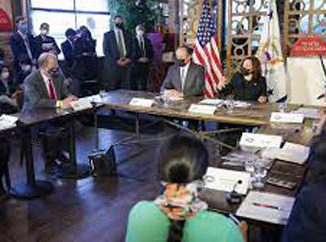
    WASHINGTON (TIP): An Indian –origin businesswoman, who imports goods and supports widowed women in India, has participated in a round table with Kamala Harris and asked the US Vice President to back a global plastic policy.

    Lalitha Chittoor, the owner of Eco All Trading LLC, a small micro business involved in wholesale trading of sustainable products such as stainless steel, bamboo, birch wood attended the round table with Harris in Denver, Colorado on Tuesday along with her daughter. Ms Harris brought up the administration’s climate change efforts and said a policy staffer would follow up with her. Ms. Chittoor’s business founded in 2019, is women-owned and imports goods from India and supports widowed women in India. She told the round table that the small businesses were really part of the heartbeat of every community. “Our small business leaders are not only business leaders, you are civic leaders, community leaders, role models,” she said. “It is our small businesses that hire from the community, that uplift the community, that have regular customers who come in and you can recognize if they’re having a bad day and you already know what they want to they don’t even have to put in an order,” she said.

    Ms Harris said those in need of assistance have been opening up their car trunks to pick up food boxes but leave handwritten notes and sometimes a tip thanking the volunteers.

    “These families who have nothing because they’ve lost so much, tipping the volunteers for their generosity and recognizing the dignity of their work,” she said, Born in Chennai and a naturalized citizen of the US, Ms Chittoor started her business at the behest of her daughter. Her primary customers are restaurants, federal government, state government, school cafeterias, prison cafeterias, hospital cafeterias.

    During the round table, Ms Chittoor asked Ms. Harris to back a global plastic policy.

  • Atlanta shootings leave 8 dead at Asian businesses

    Atlanta shootings leave 8 dead at Asian businesses

    • Six of the victims at the three businesses were Asian women
    • Asian American community shocked and fear-stricken
    • Nationwide condemnation of the attack on Asian -Americans

    I.S. Saluja

    ATLANTA (TIP): Eight people were killed in shootings at three businesses in the Atlanta area on Tuesday, March 16. Six of the eight victims were Asian women, authorities said. The attacks began at around 5 pm Tuesday, March 16afternoon. Atlanta police officers first responded to a crime scene at Young’s Asian Massage, where four people were killed, in Cherokee County, just north of Atlanta. The victims were Delaina Ashley Yaun, Paul Andre Michels, Xiaojie Tan, and Daoyou Feng, according to police. A fifth person, Elcias R. Hernandez-Ortiz, sustained non-life-threatening injuries. About 45 minutes later, four more people were killed at two other businesses — Aromatherapy Spa and Gold Spa — just across the street from each other. While the names of the victims have not yet been released, all four of them were of Korean descent, South Korea’s Foreign Ministry officials said in a statement, though their nationalities have yet to be verified.

    In Cherokee County, authorities arrested the suspect, 21-year-old Robert Aaron Long, on the side of Interstate 75, roughly 150 miles south of Georgia Tuesday night after a police chase. Long, who officers believe was heading to Florida to commit similar crimes prior to the arrest, has been charged with eight counts of murder and homicide and one count of aggravated assault. Officials are still investigating possible motives for the shootings.

    Federal agents are joining local authorities to investigate the shootings, and many officials remain wary about pointing to any motives. “A motive is still not clear, but a crime against any community is a crime against us all,” Atlanta Mayor Keisha Lance Bottoms said in a statement Wednesday. “I have remained in close contact with the White House and APD as they work with federal, state and local partners to investigate the suspect who is responsible for this senseless violence in our city.”

    President Joe Biden on Wednesday, March 17, said that he is “very concerned” about the Atlanta shootings, adding that he’s been speaking out about the “very troubling” anti-Asian violence in recent months.

    “I’m making no connection at this moment to the motivation of the killer,” Biden said. “I’m waiting for an answer as the investigation proceeds from the FBI and from the Justice Department. I’ll have more to say when the investigation is completed.” Motives remain unclear, but advocacy groups point to a rise in anti-Asian hate

    While Atlanta officials say it is still early to know what motivated the shootings, Tuesday’s attacks sparked outrage and sorrow among advocacy groups across the country, particularly Asians, as they continue to face a growing number of pandemic-related anti-Asian hate incidents.

    At a press conference Wednesday morning, Cherokee County sheriff’s Capt. Jay Baker said the suspect indicated in police interviews that he targeted the locations because he was angry at the “porn industry,” and saw the businesses as something “he wanted to eliminate.” Officials also said the suspect claimed that he had a “sexual addiction” and that the shooting “was not racially motivated.”

    The Atlanta police chief said it was too “early in this investigation to determine [the shooting] a hate crime, even though we made an arrest.”

    But many advocates say it is impossible to divorce race from misogynist crimes that disproportionately impacted Asians. “Many of the victims are Asian. These murders occurred at a time when anti-Asian violence has been spiking,” Rep. Ted Lieu (D-CA) tweeted in response to the attacks. “All officials should do their part to condemn violence and not inflame further discrimination.”

    On Wednesday, Rep. Judy Chu (D-CA) called out former President Donald Trump for spurring anti-Asian sentiment and violence with his racist named for the virus. “President Trump clearly stoked the flames of xenophobia against AAPIs with his rhetoric,” she said at a news conference. “The CDC and the World Health Organization said we should all use the official term covid-19 in order to make sure this disease is not associated with a particular geographical location or ethnicity due to the stigma it causes. And President Trump refused to acknowledge that and instead used the terms ‘China virus,’ ‘Wuhan Virus’ and ‘Kung flu.’” On Tuesday, Stop AAPI Hate, an organization that has been tracking anti-Asian violence reports, also released its latest report that nearly 3,800 incidents had been reported since March 2020. The report also shows that a disproportionate number of anti-Asian attacks were directed at women, who reported hate incidents twice as often as men.

    Since the shootings took place at spas, Atlanta police said they have dispatched officers to similar businesses. Baker said homicides are rare for the area, adding that the county “had one homicide” in 2020. The incidents also stoked responses from places like New York City, which deployed counterterrorism officers to Asian communities for caution.

    (With input from Agencies)

  • UK PM Boris to visit India in April-end

    UK PM Boris to visit India in April-end

    Will shift focus to Indo-Pacific in post-Brexit review

    NEW DELHI (TIP): UK Prime Minister Boris Johnson will visit India at the end of April, his first major international tour after London’s exit from the EU. The announcement from London came after the minister for South Asia Tariq Ahmad wrapped up his visits where which included interactions with External Affairs Minister S Jaishankar and Foreign Secretary Harsh Vardhan Shringla. During his meeting with Minister of State for Home Affairs G Kishan Reddy, Ahmad is learnt to have raised the detention of Christian Michel, the alleged middleman in the AgustaWestland VVIP helicopter deal, whose prolonged incarceration has been flagged by the UN Working Group on Aribtrary Detentions. The visit is understood to have cleared the decks for an Enhanced Trade Partnership (ETP) to be inked during Johnson’s visit. The ETP could serve as a precursor to a free trade agreement (FTA). The PM was to be the chief guest at this year’s Republic Day parade but had to put off his visit due to Covid surge in the UK. Since then London has wrapped up the integrated review of defense, security, development and foreign policy. A key takeaway is the accent on the Indo-Pacific region, which includes theUK applying for partner status of the ASEAN economic union.

    (Source: TNS)

  • How America’s Big Ag swallowed the family farms

    By Chris McGreal

    “This is an eye opener for the majority of India’s middle class who are being fed the narrative that ‘Big Ag’ is the panacea for Indian farmers difficult situation, and especially for small farmers. I distinctly remember late Arun Jaitley had argued against Congress initiative bring in corporate investment to farming by quoting American farmers’ plight!

    Why are we still so adamant to bring in the new farm laws?”

     Did monopoly power reduce food prices? In the past 40 years, average food prices in America have shot up by more than 200%, while the earnings of the bottom 90%

    have increased by less than 25%. Joe Maxwell, who leads a campaign group called Family Farm Action, told us about entrenched rural poverty, child hunger, and food-insecure homes. Not what you’d expect to hear about the most powerful nation. Today, rural America feels abandoned, its dignity stripped away. As we drove home, one thing had become clear to us: far from being a panacea, the opening up of US agriculture, the elimination of MSP-like parity schemes, and the rise of contract farming has been a lose-lose proposition for everybody other than Big Ag.

    India had better learn from American experience.

    Dave Makkar


    —————————————————————

    Across the Midwest, the rise of factory farming is destroying rural communities. And the massive corporations behind this devastation are now eyeing a post-Brexit UK market

    Corporate agriculture evolved to take control of the entire production line from “farm to fork”, from the genetics of breeding to wholesalers in the US or far east. As factory farms spread, their demands dictated the workings of slaughterhouses. Smaller abattoirs, which offered choice and competitive prices to family farmers, disappeared, to be replaced by huge operations that were further away and imposed lower prices on small-scale breeders such as the Kalbachs.

    “Over time, it has extracted wealth and power from communities. We can see how that has impacted rural main streets. You can see the boarded-up storefronts. You can see the lack of economic opportunity.” 

    An abandoned farmhouse with graffiti on the front
    Across the state, farmhouses where generations grew up lie abandoned.
    Photo / Courtesy Scott Morgan/The Observer

    When the vast expanse of rural Iowa was carved up for settlers in the 19th century, it was often divided into 160-acre lots. Four farms made a square mile, with a crisscross of dead-straight roads marking the boundaries like a sprawling chess board.

    Within each square, generations of families tended pigs and cattle, grew oats and raised children, with the sons most likely to take over the farm. That is how Barb Kalbach saw the future when she left her family’s land to marry and begin farming with her new husband, Jim, 47 years ago.

    “When we very first were married, we had cattle and calves,” she says. “We raised hogs from farrow to finish, and we had corn, beans, hay and oats. So did everyone around us.”

    Half a century later, Kalbach surveys the destruction within the section of chessboard she shared with other farms near Dexter in southwestern Iowa. Barb and Jim are the last family still working the land, after their neighbors were picked off by waves of collapsing commodity prices and the rise of factory farming. With that came a vast transfer in wealth as farm profits funneled into corporations or the diminishing number of families that own an increasing share of the land. Rural communities have been hollowed out.

    And while the Kalbachs have hung on to their farm, they long ago abandoned livestock and mixed arable farming for the only thing they can make money at any more – growing corn and soya beans to sell to corporate buyers as feed for animals crammed by the thousands into the huge semi-automated sheds that now dominate farming, and the landscape, in large parts of Iowa.

    Kalbach comes from five generations of farmers and suspects she may be the last. As she drives the roads around her farmhouse, she ticks off the disappearances.

    “That’s the Shoesmiths’ place,” she said. “Two years ago, it had cattle, pigs and pasture.”

    Now the land is rented out and is all given over to corn. A little further along, the Watts family’s farmhouse stands empty, its roof falling in. There are a few relics of the old farm at the place that used to be owned by the Williamses – an abandoned hen house and a bit of machinery – but the land is all corn and soya beans. The Denning house, on Walnut Avenue, was bulldozed after the land was sold and rolled into a bigger operation.

    It’s a story replicated across America’s Midwest, with the rapid expansion of farming methods at the heart of the row over US attempts to erode Britain’s food standards and lever open access to the UK market as part of a post-Brexit trade deal. Last weekend, the US ambassador to Britain, Woody Johnson, appealed to the UK to embrace US farming, arguing that those who warned against practices such as washing chicken in chlorine had been “deployed” to cast it “in the worst possible light”.

    His message was greeted with anger by campaigners. Nick Dearden of Global Justice Now warned: “It is really an animal welfare issue here. If UK farmers want to compete against American imports, they will have to lower their standards or go out of business.” His words would come as no surprise to Rosemary Partridge, who farms in Sac County, western Iowa. She grew up on an Iowa family farm and then moved with her husband in the late 1970s to raise pigs and grow crops.

    “In the past 20 years, where I am, independent hog farming just silently disappeared as the corporates came in,” says Partridge. “I live on a hilltop. I can see seven farm families, people my kids went to school with. They’re all gone now. My county has 11 small towns, and it’s almost like I could look back in slow motion and just see the businesses change and disappear. We’ve become poorer. Our communities are basically shattered and in more than just an economic way – in a social way too.”

    This collapse has in good part been driven by the rise of concentrated animal feeding operations, or Cafos. In these industrial farming units, pigs, cows and chickens are crammed by the thousand into rows of barns. Many units are semi-automated, with feeding run by computer and the animals watched by video, with periodic visits by workers who drive between several operations.

    “That’s how I end up with 40,000 hogs around me,” says Partridge.

    Cafos account for only a small proportion of America’s 2 million farms, but they dominate animal production and have an outsize influence on crop growing, particularly in the Midwest.

    By one calculation, the US has around 250,000 factory farms of one kind or another. They have their roots in the 1930s, with the mechanization of pig slaughterhouses. By the 1950s, chickens were routinely packed into huge sheds, in appalling conditions.

    In the early 1970s, US agriculture secretary Earl Butz pushed the idea of large-scale farming with the mantra “get big or get out”. He wanted to see farmers embrace what he regarded as a more efficient strategy of growing commodity crops, such as corn and soya beans. Some farmers invested heavily in buying land and new machinery to increase production – taking on large amounts of debt to do so.

    A decade later, the farm crisis hit as overproduction, the US grain embargo against the Soviet Union and high interest rates dramatically drove up costs and debt for family farms. Land prices collapsed and foreclosures escalated. “Every blow to independent farming made it more of an opportunity for large corporations to come in,” said Partridge. In 1990, small and medium-sized farms accounted for nearly half of all agricultural production in the US. Now it is less than a quarter.

    As the medium-sized family farms retreated, the businesses they helped support disappeared. Local seed and equipment suppliers shut up shop because corporations went straight to wholesalers or manufacturers. Demand for local vets collapsed. As those businesses packed up and left, communities shrank. Shops, restaurants and doctors’ surgeries closed. People found they had to drive for an hour or more for medical treatment. Towns and counties began to share ambulances.

    Corporate agriculture evolved to take control of the entire production line from “farm to fork”, from the genetics of breeding to wholesalers in the US or far east. As factory farms spread, their demands dictated the workings of slaughterhouses. Smaller abattoirs, which offered choice and competitive prices to family farmers, disappeared, to be replaced by huge operations that were further away and imposed lower prices on small-scale breeders such as the Kalbachs. “By the time you paid to transport them the extra distance, and they were paying you less than they paid the corporations because you weren’t bringing the big numbers, there was really no money in it,” says Kalbach. The buying power of the Cafos also helps drive farmers’ decisions on which crops to grow. With no livestock, the Kalbachs were forced into growing corn and soya beans to sell to factory farms as animal feed or to corporations for ethanol. Iowa is not alone. Missouri, to the south, had 23,000 independent pig farmers in 1985. Today it has just over 2,000. The number of independent cattle farms has fallen by 40% over the same period.

    Tim Gibbons of Missouri Rural Crisis Center, a support group for family farmers set up during the 1980s farm crisis, says the cycle of economic shocks has blended with government policies to create a “monopolization of the livestock industry, where a few multinational corporations control a vast majority of the livestock”.

    Gibbons explains: “They are vertically integrated, from animal genetics to grocery store. What they charge isn’t based upon what it costs to produce, and it’s not based on supply and demand, because they know what they need to make a profit. What they have done, through government support and taxpayer support, is to intentionally overproduce so that the price stays low, sometimes below the cost of production. That kicks their competition out of the market. Then they become the only player in town.

    “Over time, it has extracted wealth and power from communities. We can see how that has impacted rural main streets. You can see the boarded-up storefronts. You can see the lack of economic opportunity.”

    Gibbons says that corporations game the system by obtaining low-interest, federally guaranteed loans to build Cafos that then overproduce. But they know the government will buy up the surplus to stabilize prices.

    “The system has been set up for the benefit of the factory farm corporations and their shareholders at the expense of family farmers, the real people, our environment, our food system,” he adds.

    Semi automated pig barns now dominate large parts of rural Iowa (Photo / Courtesy Scott Morgan/The Observer)

    “The thing that is really pervasive about it is that they control the rules of the game because they control the democratic process. It’s a blueprint. We’re paying for our own demise.

    “It would be a different argument if it was just based upon inevitability or based on competition. But it’s not based upon competition: it’s based upon squelching competition.”

    There are about 70 million pigs in the US at any time, most of them destined for the dinner plate. But one in 10 are breeding sows, and the majority of those are in Cafos. The biggest pig farmer in the country is Virginia-based Smithfield Foods, which has nearly a million sows in the US (and more in Mexico and eastern Europe). Iowa Select Farms has one of the fastest-growing Cafo operations in the country, with 800 farms spread through half of the counties in Iowa. Yet few of the economic benefits spill down to the communities around them. Workers are often poorly paid; many are bussed in. That they often include immigrants has sharpened the criticism from men like Nick Schutt, who used to work at Iowa Select, driving pigs in livestock trucks and handling sows. He says he earned $23,000 a year for 12-hour days and no overtime.

    “These companies claim they’re creating all these jobs, but who’s coming? Not people with families who create communities.” Schutt lives in Williams, a small town in central Iowa, which is surrounded by Cafos and currently fighting to keep a big new one out, saying factory farms pollute the environment and depress property values. When the wind blows in the wrong direction, the stench from huge lakes of pig manure wafts across the town.

    The high school Nick Schutt attended has closed. His daughter was in the last class to graduate. As Williams declined, the only doctor shut his clinic and left town. Schutt’s mother used to own a restaurant: that closed along with the town’s three grocery stores.

    In Blairsburg, seven miles away, pretty much every shop except the post office is gone. The neighboring hamlet of Wilke now consists of three animal sheds on land where dwellings were bulldozed from existence. Two-thirds of the counties in Iowa, almost all of them rural, have seen their populations decline since 2010, according to the US census. North of Williams is a Cafo whose name, Quality Egg, has come to represent the worst of factory farming. In 1988, New York temporarily banned the sale of its eggs after salmonella killed 11 people. In 2017, its former owner, Jack DeCoster, went to prison, along with his son Peter, over a 2010 salmonella outbreak that made tens of thousands sick, left some with permanent injuries and prompted the recall of more than half a billion eggs shipped from Iowa factory farms. Quality Egg pleaded guilty to selling eggs with false expiry dates and to bribing an agriculture department inspector to approve the sale.

    DeCoster had a long history of paying fines worth millions of dollars for animal cruelty, falsifying records, swindling contractors and polluting – without much impact on the way he did business. He was found to have made immigrant workers, many of them in the US illegally, live and work in squalid and unsafe conditions. The company paid $1.5m to settle allegations that supervisors at Iowa plants raped female workers.

    DeCoster is an extreme case, but around Iowa he’s seen as emblematic of how the industry uses its money and influence to impose its will, including changing planning and environmental regulations. Much of this is the result of agricultural corporations pouring millions into lobbying state governments. But Gibbons says Washington also bears some responsibility. He accuses President Barack Obama’s administration of failing to deliver on promised reforms that would have benefited smaller farmers. It is this, he says, that damaged Obama’s standing among farmers and drove up their support for Donald Trump.

    Barb Kalbach is not optimistic about the future. Her son will not be taking over the farm. She hopes the land will stay in the family for at least another generation, but expects it to be rented out and subsumed into some larger operation. But Kalbach fears something bigger than the loss of her own farm. Farmers are ageing and their children either have little interest in working the land or cannot afford the sophisticated equipment needed to compete with corporations.

    “Investors buy the land, and they have tractors and combines that you can run by computer,” she said. “They’ll hire somebody to sit in a little office somewhere and run that stuff off the computer and farm the land that way. Now what you’ve done is you have lost the innate knowledge of how to grow food and raise animals. You’ve lost a whole generation of it, probably two. Now we are going to rely on a few corporations to decide who is going to eat and who isn’t. We’re one generation away from that picture right now.”

     In Williams, Schutt says he’s seeing a community of owners becoming workers: “It’s going to be like Russia with serfs. If you want to work on a farm, you’ll have to work for them. We’ll give you a job, but you’re going to be working on our terms. We control everything. Small farms can’t survive.”

    Kalbach agrees. “I think they’re done,” she said.

    (The article authored by Chris McGreal was first published in The Guardian on March 9,2019. It has been republished with the addition of a comment of Dave Makkar)

  • Boris,beware the Ides of March!

    Boris,beware the Ides of March!

    • India’s External Affairs Ministers S Jaishankar made a strong statement in the Parliament that set the tone for the ensuing period of Indo-UK relations
    • Jaishankar’s statement came after a question about racism in the UK by an MP Ashwini Vaishnaw
    • Vaishnaw alleged that an Indian student and former president-elect of the Oxford University Student Union was “cyberbullied”
    By Prabhu Dayal

    It is indeed a cause of some concern that some mischievous, anti-India elements in the UK have an unambiguous agenda of pushing their country’s relationship with India on a downward spiral. These include Khalistan supporters and Kashmiri activists who have the backing of Pakistan’s ISI.  A series of unfortunate developments engineered by such elements have been threatening to derail the bilateral relationship.

    On the Ides of March (15th March), India’s External Affairs Minister S Jaishankar made a strong statement in the Indian Parliament which set the tone for the ensuing period of Indo-UK relations. Jaishankar’s statement came after a question about racism in the UK by an MP Ashwini Vaishnaw who alleged that Rashmi Samant, a student from Karnataka and the former president-elect of the Oxford University Student Union, was “cyberbullied to the point that she had to resign (from the post).” Jaishankar said in his reply: “As the land of Mahatma Gandhi, we can never ever turn our eyes away from racism wherever it is. Particularly so when it is in a country where we have such a large diaspora.”

    Through this statement, the Indian government sent out a message that if the British parliament can debate India’s internal affairs, so can the Indian parliament debate the internal affairs of Britain. Thus, the clear message sent by New Delhi to London is that the trend being witnessed in Britain to interfere in India’s internal affairs must be brought to an end or else it will adversely affect the growth of bilateral ties.

    It is indeed a cause of some concern that some mischievous, anti-India elements in the UK have an unambiguous agenda of pushing their country’s relationship with India on a downward spiral. These include Khalistan supporters and Kashmiri activists who have the backing of Pakistan’s ISI.  A series of unfortunate developments engineered by such elements have been threatening to derail the bilateral relationship.

    A quick review of recent events is needed to put matters in the correct perspective. Tension has slowly built up between some British political groups and the Indian Government in regard to the farmers protests in India. When British PM Boris Johnson was slated to come to India in January this year as the Chief Guest for the Republic Day celebrations, more than a hundred members of the British Parliament had signed a letter asking him to raise the concerns of India’s protesting farmers in his discussions with Prime Minister Narendra Modi, as also the “brute force” employed against them. However, Johnson had to cancel his visit due to the surge in the Coronavirus cases in the UK.  Later, as a follow up of a petition which was started by a UK Sikh activist Gurch Singh and signed by more than 1 lakh persons, the House of Commons had assigned 90 minutes for a debate on March 8, 2021 on matters relating to the farmers’ protests in India.  During this debate, several MPs from the Liberal Democrats, Labour Party and the Scottish National Party expressed concern about the safety of the farmers protesting against the agricultural laws on Delhi’s borders and the targeting of journalists covering the agitation. They made adverse comments against India over press freedom, freedom of speech and domestic values.

    The Indian High Commission in London issued a strong statement against these British Parliamentarians over their comments. The High Commission said that it would “normally refrain from commenting on an internal discussion involving a small group of Parliamentarians in a limited quorum. However, when aspersions are cast against India by anyone, there’s a need to set the record straight.”

    To further underline India’s displeasure, Foreign Secretary Harsh Shringla summoned the British High Commissioner and conveyed strong opposition to the unwarranted and tendentious discussion on India’s agricultural reforms in the British Parliament. The Foreign Secretary made it clear that this represented a gross interference in the politics of another democratic country. He advised that the British MPs should refrain from practicing vote bank politics by misrepresenting events, especially in relation to another fellow democracy.

    Thus Jaishankar’s ‘Ides of March’ statement in Parliament was a firm signal that the demarche made recently by the Foreign Secretary with the UK high commissioner last week was more than just a passing phenomenon. However, Jaishankar went on to say during the very same statement that “as a friend of the UK, we also have concerns about its reputational impact,” adding “What I do want to say is that we have strong ties with the UK (and) we will take up such matters with great candor when required.” The use of the expressions ‘a friend of the UK’ and ‘strong ties with the UK’ indicates that having made known his displeasure, he perhaps signaled the Indian Government’s willingness to put the relationship back on track.

     Notably, within a few hours of making his statement in Parliament yesterday, Minister Jaishankar and Foreign Secretary Harsh Shringla held talks covering bilateral ties and global cooperation with Lord Tariq Ahmad, the visiting UK Minister of State for South Asia. The talks assume a great deal of significance in view of the fact that British Prime Minister Boris Johnson will visit India at the end of next month in what will be his first major international trip after Britain’s exit from the European Union and will be part of his efforts to boost the UK’s opportunities in the Indo-Pacific region.

    It is a truism that in diplomacy, overcoming the main threats to national interests must always override other concerns. India’s national interests are threatened by serious challenges such as the ongoing stand-off with China, the unending tension with Pakistan and the Covid-19 pandemic with its resultant slowing-down of the economy. No doubt, at this critical juncture, India can ill-afford a deterioration in its relationship with the UK, but the latter must also realize that the reverse is equally true. Hopefully, the combination of tough posturing and deft diplomacy by India will perhaps be able to put things back on track.

    (The author is a retired Indian diplomat)

    (Courtesy OPOYI)

  • Facebook sees computing’s future on your wrist

    Facebook sees computing’s future on your wrist

    The science behind Facebook’s new vision for the human-computer interface — electromyography, or EMG — can read nerve signals in muscles anywhere in the body. But Facebook researchers said the wrist is the ideal spot to apply it.

    NEW YORK (TIP): Facebook researchers are rapidly learning how to replace mouse clicks and screen taps with finger twitches. They’re doing it by putting a band on your wrist that reads nerve impulses sent by your brain to your hand. The big picture: Tech insiders widely expect the next generation of computing after the smartphone will be built around some combination of glasses, headphones and other worn devices. The challenge is figuring out how users navigate information and make choices in such a world.

    What’s new: By picking up brain signals, Facebook’s futuristic wristband can interpret small finger-motions as, for instance, typing on an invisible keyboard or clicking on a button that isn’t there.

    This “intelligent click” will be paired with images you’ll likely see via augmented-reality glasses — so that the menu items you’re selecting, for instance, might appear to be hanging in the air around you.

    The whole system is stage-managed by predictive AI programs that work to understand where you are and what you might need. When you step into the kitchen, for instance, you might see a recipe.

    The goal is to give users “exactly the right interaction at the right time,” says Tanya Jonker — one of a crew of Facebook Reality Labs researchers who demoed the new technology for reporters this week.

    The science behind Facebook’s new vision for the human-computer interface — electromyography, or EMG — can read nerve signals in muscles anywhere in the body. But Facebook researchers said the wrist is the ideal spot to apply it. The brain devotes lots of neurons to fine control of hand motion, providing plenty of information for the devices to read. Also, people are already used to wearing stuff on their wrists.

    “Brain-computer interfaces” is a field Facebook has been talking about and investing in for years now, but the company is emphasizing that we won’t get our hands on this technology for some time.

    Sean Keller, Facebook Reality Labs director of research, said Facebook was unveiling details of this work early because it knows there are pitfalls and hopes to steer around them with input from outside the company. “We want to open up an important discussion with the public about how to build this technology responsibly,” he said.

     Likely trouble spots:

    The more “context” your device knows, the more data it has on you, and Facebook has a long record of playing fast and loose with user information.

    Researchers say they know they’ve entered a potential minefield. “Building a new platform allows us to build security, privacy and safety in from the very start,” said Facebook CTO Mike Schroepfer.

    Facebook is all about connecting people. But the examples the researchers discussed, where lone users are cooking a recipe or choosing music to play, are far simpler than interactions between people using these tools, where the potential for privacy problems multiply.

    Facebook makes money by selling ads, and the “all around you” interface it’s building could easily become overloaded with commercial come-ons.

    Of note: The Facebook team nodded to the scope of their ambition by showing a still from Douglas Engelbart’s celebrated 1968 “mother of all demos.”

    That event introduced the mouse and many other foundations of the graphical computer interfaces we use today.

    Facebook wants to invent the pieces for what comes after that.

  • UN’s largest gathering on women’s rights calls on enhancing women’s leadership in public life in the run up to the 2021 Generation Equality Forum

    UN’s largest gathering on women’s rights calls on enhancing women’s leadership in public life in the run up to the 2021 Generation Equality Forum

    Against the backdrop of the COVID-19 pandemic, the 65th session of the Commission on the Status of Women called for increasing women’s participation and leadership in decision-making to solve global challenges.

    NEW YORK (TIP):  The 65th session of the Commission on the Status of Women (CSW65), the UN’s largest gathering on gender equality and women’s rights, opened March 15,  as an almost entirely virtual session, with the devastating impacts of the COVID-19 pandemic in the foreground, and preparing the ground for the forthcoming Generation Equality Forum, which will kick off in Mexico City from 29-31 March.

    The two-week long gathering for UN Member States, civil society organizations, gender experts, and other international actors aims to build consensus and agree on a roadmap to advance gender equality, with the focus this year on the theme, “Women’s full and effective participation and decision-making in public life, as well as the elimination of violence, for achieving gender equality and the empowerment of all women and girls”.

    Recent reports on the theme have reconfirmed that the glass ceiling remains for women around the world, restricting their participation in decision-making, with women serving as Heads of State and/or Government in only 22 countries; women holding just 25 per cent of parliamentary seats, and 12 countries having no women ministers in cabinets at all. The COVID-19 pandemic has exacerbated existing inequalities – from increased reports of domestic violence, unpaid care responsibilities, rates of child marriage and millions of women plunging into extreme poverty as they lose their jobs in higher numbers than men.

    UN Women Executive Director Phumzile Mlambo-Ngcuka said: “This pandemic has been the most directly discriminatory crisis the world has ever seen. It has treated most harshly those most deprived, and affected women’s lives across the world. But with firm political will to achieve fast-tracked, equal power-sharing, women and men can together address this and the other urgent challenges of our time, from climate change to conflict.”

    “This is the vision of the 2030 Agenda and the Sustainable Development Goals and the vision of the Beijing Declaration and Platform for Action. It is the vision of civil society and multitudes of young people who are already leading the way, and of all those who will join us in the Generation Equality Action Coalitions. It is surely also the vision of those assembled for the Commission on the Status of Women,” she added.

    As the UN Secretary-General report published on this year’s theme underlines, for power-sharing to become today’s reality, violence against women in public life must be significantly eliminated, and social norms, access to financing, and legal and institutional frameworks, have to be transformed, so that they support women’s equal participation and decision-making. Governments should also strengthen normative, legal, and regulatory frameworks, especially the implementation of gender quotas. Enhancing women’s civil society activism is also critical for transformative change at national and global levels.

    High-profile speakers including US Vice-President Kamala Harris, France Minister for Gender Equality, Diversity and Equal Opportunities Élisabeth Moreno, Mexico Vice-Minister for Multilateral Affairs and Human Rights Martha Delgado Peralta, European Commissioner For International Partnerships Jutta Urpilainen, among others, are expected to address the Commission this year. The full list of speakers is available here.

    CSW65 is an important bridge to the Generation Equality Forum, convened by UN Women and co-hosted by the Governments of Mexico and France, in conjunction with youth and civil society. The Forum will kick-off in Mexico City from 29 – 31 March, and culminate  in Paris from 29 June – 2 July.  It is designed to inspire urgent action, commitments and investments in gender equality. An interactive virtual side event on 19 March will be a curtain-raiser to the Generation Equality Forum kick-off in Mexico.

    As part of its efforts to catapult progress on gender equality, leaders of the Generation Equality Forum Action Coalitions – new and innovative partnerships including governments, feminist and youth movements and organizations, the private sector and international organizations – have unveiled the concrete action steps that they see as central to a new and bold feminist agenda within the next five years. These range from the accelerated introduction and implementation of laws and policies prohibiting all forms of gender-based violence to protect 550 million more women and girls worldwide, to introducing policy measures to recognize, reduce and redistribute unpaid care work and create at least 250 million decent care jobs or doubling the annual growth rate of funding for feminist, youth-led and grass-roots women’s groups.

    The opening session of CSW65 on March 15 featured statements from global leaders, including the Chair of the 65th Commission on the Status of Women MherMargaryan; the UN Secretary-General António Guterres; UN Women Executive Director Phumzile Mlambo-Ngcuka; civil society representative VirisilaBuadromo and youth leader Renata Koch Alvarenga.

    Along with the 18 official meetings that include Ministerial Round Tables, the general discussion and interactive dialogues, hundreds of side events and parallel events hosted by UN Member States, UN Agencies and civil society organizations will take place in the coming two weeks, mostly in a virtual format.

    Ahead of CSW65, UN Women supported partners to organize regional consultations with Ministers, gender equality experts and civil society organizations in Latin America and the Caribbean, Africa and Arab States, to build consensus and action priorities towards the Commission’s outcome, which is expected to be adopted at the conclusion of the second week.

  • The Fascinating Stories of Achievements of Women

    By Anu Jain
    Realtor

    What women have achieved and what they are capable to achieving is a fascinating topic to write about, I suppose it’s a topic every woman has thought about at one point in her life, at least those of us old enough to know that roles have changed over time. In 21st century, women enjoy more freedom and power than ever before, entering in the job market and the political arena in greater number than ever. Women’s education and income continue to rise in the 21st century due to the steadily growing percentage of women in college in the past few years.

    Women are taking care of their responsibility with pride in all fields precisely; we have many examples around usincluding our Vice President Kamla Harris is strong example of women achievements Indra Nooyi a business executive and the past Chairperson and CEO of PepsiCo, the second largest food and beverage business in the world. Indra Gandhi who was the Prime Minister of India and Janet Louise Yellen is an American economist. She is serving as the United States secretary of the treasury and she

    was the Chair of the Board of Governors of the Federal Reserve System and there are many woman entrepreneurs who are successfully leading and handling businesses.

    A decade ago, they were given roll in the movies mostly for singing dancing or supporting male actors, nowadays their rolls are so diversified including roles as a police officer or detective etc. which were initially played only by male actors. And I am convinced that women’s value will not be in trying to imitate men or in becoming more like men. Our value will be in honoring our womanhood and femininity and offering to the world the wisdom that we hold. Many women who don’t have enough confidence think that by not obtaining a degree or having work experience it means that they are not contributing anything to the world. It is very clear to me that what the world needs most urgently is not another business executive, not another PhD holder or not another lawyer. These things may be important but alone they won’t bring us a world of peace in the next century.

    What the world needs very simply are individuals with commitments and genuineness at heart. The world is starving for this heart! And as a woman of commitment, we must have the confidence that we can, and we will make a difference despite of what our background is.

    Let us remember that with our special qualities as women also comes a unique responsibility. Only a woman can bear a child. Only a woman can be a mother. In addition to bearing, nurturing and raising our own children, we share a united responsibility to maintain, uplift and improve each of our hometown cities and nation. Personally, I feel more confident and have a great feeling of flowing with the time and adjusting with whatever comes in my way and I am enjoying the new and improved womanhood on a day-to-day basis………. Naree tum Shakti ho…

  • Empowered Women Empower Women: CII Hosts Women Leaders in the US-India Corridor to Reflect on International Women’s Day 2021

    Empowered Women Empower Women: CII Hosts Women Leaders in the US-India Corridor to Reflect on International Women’s Day 2021

    NEW DELHI / NEW YORK (TIP): To commemorate International Women’s Day, the Confederation of Indian Industry (CII) brought together leaders within the US – India partnership to discuss innovative and empowering solutions to daily challenges women face in the workplace. Countries around the world have rallied for international gender parity with International Women’s Day celebrations for over 100 years, highlighting the social, economic, cultural and political achievements of women. CII’s own first female president, Ms Shobana Kamineni, Executive Vice-Chairperson of Apollo Hospitals Enterprise Limited, moderated Monday’s panel that reflected the vast diversity of women’s experiences from government to the corporate boardroom and even outer space.

    CII’s “Women Leaders in the US – India Corridor” panel featured remarks from Ms Diane Farrell, Acting Undersecretary of Commerce for International Trade, US Department of Commerce;n Dr Swati Moha, Lead, Guidance and Operations – Mars 2020 Perseverance Mission, JPL, NASA; Ms Bhavani Parameswar, Executive Director and President, Indivate Inc (ITC Group); and Dr Sofia Mumtaz, past Chair, CII – India Business Forum USA and President, Lupin Ltd, who graciously joined together to share their experiences and insights, as well as a few words of advice for women navigating the post-COVID workforce.

    Acting Undersecretary Farrell, reflecting on her years of service within the US Government, attributed much of her success to remaining flexible in her career path, staying open to opportunities, and taking risks. She stressed perseverance and working through emotions to free oneself to try new things and solutions to professional struggles. Dr Mohan spoke to studying, working, and building a family within a STEM field known for its gender disparity, and how she strives for the elusive “work/life balance.”  She called for diversity and particularly increasing the representation of women and minorities in every career field and at every level, as all the panelists concurred that women proliferate throughout educational institutions and entry-level positions, but are still largely missing from upper-level, management roles.

    From the corporate sector, Ms. Parameswar noted her organization’s dedication to mentoring and supporting women throughout their careers, and remarked that in addition to gender constructs, she faced cultural barriers as well when she began working in the US from India. Besides learning about American football to build relationships with her predominately male US colleagues, Ms Parameswar also worked within her company to eliminate the “motherhood penalty” and prevent women who chose to have children from suffering lost wages, equity, and leadership opportunities.

    Dr Mumtaz was also quick to point out that gender discrimination is both a US and India issue, citing that for women to succeed in the workplace, they must overcome society’s expectations as well as their male peers’ prejudices, as being called pejorative names like “aggressive” to family pressures to quit after marriage are prolific in both countries. Empowerment, she declared, begins in the home, and young girls have to be taught to see themselves as equal to persist in a world that tells them otherwise.

    While all the panelists agreed that things are not as they should be, the general consensus of CII’s 2021 Women’s Day Panel is that the world is certainly improving in terms of women’s access and empowerment within the US – India Corridor.  Dr Mohan cited that she was selected to work at NASA by a woman leader whose supervisor was also a woman, and reiterated the imperativeness of supporting and mentoring women particularly within male-dominated career fields. She also noted that her daughters have access to a plethora of resources like STEM camps, classes, etc. that did not exist when she was younger. Dr Mumtaz concurred, praising the positive impact of increasing levels of female education, as well as companies like Lupin that directly focus on encouraging women in the workforce. Ms Parameswar stressed the advantages for companies and countries’ overall GDP to increase and retain women workers, noting specifically that continued success depends upon examining policies and how they either effect or enable women to excel in their fields. To conclude, Acting Undersecretary Farrell engendered another cause for hope by suggesting to the panel that the new Biden – Harris Administration in the US is expected to focus more on gender equity for women all around the world.

  • IRS Pushes Tax Deadline Back by One Month

    IRS Pushes Tax Deadline Back by One Month

    Filers will have until May 17, the agency said Wednesday, March 17.

    WASHINGTON (TIP): The Internal Revenue Service will give Americans extra time to file their taxes as a result of the pandemic. Instead of the usual April 15 deadline, filers will instead have until May 17, the agency said Wednesday, an extension that will ease the burden on filers dealing with the economic upheaval caused by the coronavirus, which has put millions out of work or caused their hours to be cut.

    “This continues to be a tough time for many people, and the IRS wants to continue to do everything possible to help taxpayers navigate the unusual circumstances related to the pandemic,” said Chuck Rettig, the IRS commissioner.

    The one-month delay is not as much extra time as the IRS offered last year, when the filing deadline was pushed to July 15. But it should make it easier for taxpayers to get a handle on their finances — as well as tax changes that took effect just this month with the signing of the American Rescue Plan.

    The new law made the first $10,200 of unemployment benefits received in 2020 tax-free for people with incomes of less than $150,000, a significant change for many whose jobs were affected by the pandemic. The IRS said last week that it would provide a worksheet for paper filers and coordinate with tax-software companies. The agency also asked those who were eligible for the tax break but had already filed their 2020 returns not to file an amended return until it had issued additional guidance.

    But Mr. Rettig said taxpayers should not unnecessarily delay filing, especially if they will be receiving money back.

    “Filing electronically with direct deposit is the quickest way to get refunds,” he said. (Taxpayers who file electronically can generally expect to receive any refund within 21 days.)

    The IRS emphasized that the extra time is only for federal returns, not state returns, so taxpayers should check with their state tax agencies about any deadline changes. It also does not apply to estimated tax payments that are due on April 15, which are still due on that day.

    Filing quickly also can benefit people whose 2020 income makes them newly eligible for a stimulus payment, or eligible for a larger one. (The latest stimulus bill includes a provision for the Treasury Department to make supplemental payments by September; if you don’t get one by then, you should be able to claim what you’re owed when you file your 2021 taxes.)

    (Source: NY Times)

  • The IRS is behind in processing nearly 7 million tax returns, slowing refunds as it implements new stimulus

    The IRS is behind in processing nearly 7 million tax returns, slowing refunds as it implements new stimulus

    • IRS commissioner says he hopes to clear tax refund backlog by summer
    • Lawmakers told him Americans need the refunds as a lifeline during the pandemic.

    WASHINGTON (TIP): Nearly 7 million tax filers are in limbo and facing substantial delays in getting refunds so far this tax filing season, as the Internal Revenue Service struggles to keep up with the demands of issuing stimulus checks and implementing myriad tax code changes from coronavirus relief packages, including the one President Biden signed this week. There are 6.7 million returns that have not yet been processed, more than three times the number in the same period last year, when fewer than 2 million returns faced delayed processing, IRS data shows.

    The delays are largely a result of a year’s worth of extraordinary stimulus measures that have created more complicated tax returns for millions of Americans. The IRS was already straining to adjust after the December stimulus package. The newest package, the American Rescue Plan, adds even more tasks for the agency, including sending out another round of one-time payments, making changes to tax rules to help unemployed workers and paying out a new child tax benefit. Many Americans who did not receive the correct stimulus payments in January or last year are filing for additional money now. And some low-income filers are newly eligible for more tax credits than usual. The IRS is having to manually review a lot of these returns, a slow process that is delaying refunds for millions of low-income families, after the agency has faced a decade’s worth of budget cuts and staffing losses.

    More than 100 people still waiting for the IRS to process their returns shared their stories with The Washington Post. Most filed electronically on Feb. 12, when the IRS opened tax filing season. They were eager to get their refunds and to update their information with the IRS ahead of the $1,400 stimulus payments going out. But a month later, many of these early filers are still waiting for their returns to be processed — and their refunds to be deposited.

    “I’m supposed to get a $5,600 refund. I absolutely need that money, and the IRS just won’t give me any answers,” said Frances Johnson, a single mother in Burlington, Wash., who filed on Feb. 12 and needs the money to repair her car. “When I call, they say I will have to wait until the end of April.”

    The main two issues to emerge so far this tax filing season are a large number of returns being sent for manual review and the malfunctioning of the popular “Where’s My Refund?” tool for weeks. The tool was fixed last weekend, the IRS confirmed, but the processing delays persist.

    National Taxpayer Advocate Erin Collins has been urging the IRS to let people know why returns are delayed. She is also concerned that the processing delays could get even worse if millions of people who already filed their taxes have to file amended returns to benefit from the changes Congress just enacted.

    For example, unemployed workers could see tax breaks, because Congress agreed to make the first $10,200 of unemployment benefits received from the government in 2020 nontaxable.

    The backlog is severe for any tax return requiring a manual review by an experienced IRS staffer. Amended returns typically require a manual review, and many of the 6.7 million returns that have yet to be processed are also sitting in line for a manual review, according to Collins.

    The IRS said that 36 million refunds have gone out so far and that the agency is moving as fast as it can to get stimulus payments out in the coming days, all while processing more returns.

    “While the IRS issues most tax refunds within 21 days of the filing season start, it’s possible some refunds may take longer,” said IRS spokesman Robert Marvin. “Many factors can affect the timing of your refund after we receive your return. Some tax returns take longer to process than others. For example, returns with an error, incomplete information or those affected by theft or fraud may take longer to process.”

    Marvin said the IRS would send taxpayers letters if more information is needed to process a return.

    Jacob White is one of the frustrated Americans desperate for a refund to arrive, so that he can pay March rent. He and his girlfriend both filed their tax returns on the same day: Feb. 12. Her refund arrived two weeks later. He has not seen his, and the IRS reports that it is still “processing.”

    An IRS call center agent told White on Wednesday that “over 7 million returns were sent to the Error Resolution System to buy time.” “It’s just the wrong time for all of this. People need the money,” White said. “My rent and my car payment are due next week, and the electric.”

    The Error Resolution System is the group involved in the manual review of returns. Most years, it deals mainly with returns that are flagged as potentially fraudulent, but this year millions of returns claiming stimulus money or involving the earned-income tax credit or the child tax credit have also gone to the error department. Most of these filers are low-income families who lost a job or who had a new baby in 2020, and should have received stimulus checks based on those events but did not.

    “We had a 2020 baby, and we also had our income drop in 2020, so we claimed that we had missed out on some stimulus,” said Caitlyn Primiano, who lives in Syracuse, N.Y., with her husband and five children. “The IRS is telling everyone like me that their returns are in the ‘review and errors’ department and to expect 10 weeks.”

    The other problem is that Congress said low-income tax filers could use either 2019 or 2020 income to qualify for the highest possible tax credits for children. IRS systems have struggled to handle two different years of income qualification.

    Current and former IRS staffers say it was inevitable that something would go awry since there are not enough employees to handle the workload, especially with Congress adding more tasks.

    The IRS had its budget slashed by 20 percent from 2010 to 2019, and staffing is down by 23 percent — or more than 22,000 positions, according to the Government Accountability Office.

    “At some point when you take so much money out of an agency, it will do less with less, and that’s showing up across the IRS — from the time it takes to process a return to how many calls it can answer to lower enforcement,” said Chye-Ching Huang, executive director of the Tax Law Center at the New York University School of Law.

    The IRS “has gone from being solely a tax administration system to also implementing social programs,” Collins said in an interview. “The IRS will get it done, but at what cost?”

    Collins said the consequences for the nation’s tax filers include slower processing of returns and less help from taxpayer assistance services, since fewer staffers are available to take calls and look at returns. Most IRS employees are already working mandatory overtime, she noted. While the American Rescue Plan provides about $1.9 billion in additional funding for the IRS, it takes time to hire and train employees to work with sensitive data.

    The mounting backlog at the IRS — and the lingering burdens created by the coronavirus — have led some Democratic lawmakers to call on the agency to extend the filing deadline beyond April 15, as it did last year.

    Rep. Bill Pascrell Jr. (D-N.J.) even asked the IRS formally in a letter last week to push the tax filing deadline to October. But the lawmaker, who chairs an oversight panel with the House Ways and Means Committee, said Friday that he had not heard back, setting the stage for a tense clash between lawmakers and the agency when IRS Commissioner Charles Rettig testifies at a hearing next week.

    “If they don’t answer me by then, I don’t think that’s going to be a pretty discussion,” Pascrell said, adding that the agency generally “has to do a better job.”

    Sen. Ron Wyden (D-Ore.), the chairman of Senate Finance Committee, pledged that his panel would provide vigorous oversight of the IRS as it implements the new stimulus law, starting with an expected hearing featuring Rettig in early April.

    Wyden said lawmakers seek a “concrete work plan” from the agency as it embarks on a process to implement vast changes to the tax code that would provide new aid to jobless workers and families with children.

    “We are making this clear to the IRS, we want this done as soon as possible,” he said.

    Yet millions of Americans are still waiting on their refunds.

    “It’s just so frustrating,” said Jason Weiler, who works in the film industry in Los Angeles and was counting on money from the refund and the latest stimulus to plug a hole when his latest gig ends shortly. “The IRS told us to get these in, but what do we have to show for it?”

    (Source: Washington Post)

  • Elon Musk sets a new record. His wealth jumps $25 billion in a day

    Elon Musk sets a new record. His wealth jumps $25 billion in a day

    Elon Musk just hit a new milestone: He made a record $25 billion in one day. Tesla Inc.’s 20% jump on Tuesday, March 9 — its biggest in more than a year — pushed the billionaire founder’s fortune to $174 billion, closing the gap with Jeff Bezos, the world’s richest person, according to the Bloomberg Billionaires Index. Overnight, Nasdaq surged 3.7%, led by gains in Big Tech companies such as Apple, Amazon and Facebook. The surge in Bezos’s Amazon.com Inc shares helped him gain $6 billion, taking his net worth to $180 billion. In January, Elon Musk unseated Bezos as the world’s richest person. Musk’s fortune peaked later that month at $210 billion, according to the index, a ranking of the world’s 500 wealthiest people. Consistent quarterly profits, the election of President Joe Biden with his embrace of clean technologies and enthusiasm from retail investors fueled the rise in Tesla shares. Shares of electric vehicle maker Tesla Inc surged nearly 20% on Tuesday, rebounding from a deep selloff with its largest daily gain in a year after data showed an increase in China sales and an analyst raised his rating on the stock. On Tuesday, New Street Research analyst Pierre Ferragu upgraded Tesla to buy from the equivalent of a hold, saying the company has two years of earnings momentum ahead and its demand outlook is stronger than supply could ever be.

  • Priyanka Chopra names Sophia Loren as her Hollywood icon

    Priyanka Chopra names Sophia Loren as her Hollywood icon

    Priyanka Chopra Jonas has been named as one of the 27 biggest stars in the world by a magazine. The actor, who recently impressed the critics with her performance in The White Tiger, features on the international list alongside Kate Winslet, Zendaya, Frances McDormand, Eddie Redmayne among others.

    The actor was honoured with the mention in the British Vogue’s 2021 Hollywood Portfolio. As part of the feature, Priyanka was asked who is her Hollywood icon. The actor named acclaimed international star Sophia Loren. The White Tiger star explained the reason she picked Sophia. She said she could relate to the Italian actor.

    “Sophia Loren. I love her. She reminds me of me, working in two different countries and two different languages,” she said. Sophia has worked in both Italian and Hollywood movies through her seven-decade journey. She has starred in movies like Nine (2009), The Fall of the Roman Empire (1964) and Marriage Italian Style (1964). She has also picked up an Oscar for Best Actress for her role in Two Women (1962).

  • Facebook blocks Australians from accessing news on platform

    Facebook blocks Australians from accessing news on platform

    Canberra (TIP): Facebook announced on Thursday, February 17,  that it has blocked Australians from viewing and sharing news on the platform because of proposed laws in the country to make digital giants pay for journalism.

    Australian publishers can continue to publish news content on Facebook, but links and posts can’t be viewed or shared by Australian audiences, the US-based company said in a statement.

    Australian users cannot share Australian or international news.

    International users outside Australia also cannot share Australian news.

    “The proposed law fundamentally misunderstands the relationship between our platform and publishers who use it to share news content,” Facebook regional managing director William Easton said.

    “It has left us facing a stark choice: attempt to comply with a law that ignores the realities of this relationship, or stop allowing news content on our services in Australia. With a heavy heart, we are choosing the latter,” Easton added.

    The announcement comes a day after Treasurer Josh Frydenberg described as “very promising” negotiations between Facebook and Google with Australian media companies.

    Frydenberg said after weekend talks with Facebook CEO Mark Zuckerberg and Sundar Pichai, chief executive of Alphabet Inc and its subsidiary Google, he was convinced that the platforms “do want to enter into these commercial arrangements”.

    Frydenberg said he had had a “a constructive discussion” with Zuckerberg after Facebook blocked Australian news.

    “He raised a few remaining issues with the Government’s news media bargaining code and we agreed to continue our conversation to try to find a pathway forward,” Frydenberg tweeted.

    But communications Minister Paul Fletcher said the government would not back down on its legislative agenda.

    “This announcement from Facebook, if they were to maintain this position, of course would call into question the credibility of the platform in terms of the news on it,” Fletcher told Australian Broadcasting Corp.

  • Facebook reducing distribution of Myanmar military content

    Myanmar (TIP): Facebook said on Friday that it would reduce the distribution of all content and profiles run by Myanmar’s military, saying they have “continued to spread misinformation” after the army seized power and detained civilian leaders in a coup on February 1. “The measures – which are not a ban but are aimed at reducing the number of people who see the content – will apply to an official page run by the army and one by a spokesperson,” the company said in a statement, as well as “any additional pages that the military controls that repeatedly violate our misinformation policies”. The pages will also not appear on newsfeeds as “recommended”. The social media giant said it had also suspended the ability for Myanmar government agencies to send content-removal requests to Facebook through the normal channels used by authorities across the world. “Simultaneously, we are protecting content, including political speech, that allows the people of Myanmar to express themselves and to show the world what is transpiring inside their country,” said Rafael Frankel, director of public policy, APAC emerging countries. Hundreds of thousands of people have been protesting across Myanmar since the army overthrew the civilian government led by Aung San Suu Kyi and detained most top leaders. Reuters

  • The Farmer has bypassed Delhi

    The Farmer has bypassed Delhi

    Subterranean tsunami

    By Avay Shukla

    A subterranean tsunami is slowly building in the country and the power elite, the pampered middle class and wheeler dealers of the capital are blissfully unaware of it.

    It’s a dismal picture, but not dismal enough for our politicians and wanna-be billionaires. The farm laws were intended to speed up this process, and the barricades are a statement that the government will enforce them, come hell, high water, Rihanna or Greta Thunberg.

    The irony of this is lost on a government drowning in its testosterone: with every nail studded barricade installed at Tikri, Ghazipur or Singhu, Delhi is making itself progressively redundant to the ongoing course of events, and perhaps even to the future shape of things in India. A subterranean tsunami is slowly building in the country and the power elite, the pampered middle class and wheeler dealers of the capital are blissfully unaware of it. The farmers do not need Delhi to survive or even to prosper, they are creatures of the soil and the elements and know how to live in harmony with them. They have been at our borders for almost three months now and have taken nothing from Delhi except perhaps water, the internet- and a lot of abuse. Now the rulers have stopped even the supply of these essentials, having practiced the art for a long time in Kashmir. But the farmers are unfazed- they now get them in abundance from their villages.

    For me, in fact, Mr. Modi’s cat was let out of the bag by an economist friend who (indefense of the farm laws) informed me that rural unemployment on a huge scale was inevitable as a country progressed to ” developed nation” status. He sent me some charts to establish the correlation between GDP and rural unemployment: the higher the GDP, the higher the unemployment in agricultural communities!

    This is the neo liberal, IMF-cum-World Bank formula which has ensured that 100 of the world’s richest billionaires have more wealth than half the world’s population. Mr. Modi’s farm laws will be the Indian version of this formula.

    The invidious objective is to create cheap labor for industry and big Capital. This is already happening in India- 34 million farmers have left farming between 2004 and 2012 (Census figures), 50 million have been ” displaced” by capital projects and 500,000 more are uprooted every year, tribals are being evicted from forests, there are already 120 million migrant labor. It’s a dismal picture, but not dismal enough for our politicians and wanna-be billionaires. The farm laws were intended to speed up this process, and the barricades are a statement that the government will enforce them, come hell, high water, Rihanna or Greta Thunberg.

    But our sturdy farmers, who are more intelligent than we Dilliwallahs give them credit for, have little interest in the barricades, the concertina wires, the-foot-long embedded nails blocking their way to Delhi, the product of the fear, paranoia, incompetence and malice of those who rule in Delhi. For the farmers have no reason to go to Delhi anymore, after leaving their visiting card there on the 26thof January. Every institution they appealed to for the last six months has let them down: Parliament, the Supreme Court, the Media, mainstream political parties, even the wealthy burghers of South Delhi. The lawyers are silent, the veterans are citing discipline as an excuse for their timidity, the celebrities have tucked their heads beneath their tails, the Embassies are ” watching the situation”, the IMF and World Bank are hopeful that Mr. Modi would carry the day. Delhi has let down the farmer, and he no longer has any need for India’s capital- the word ” capital” signifying many things.

    And so, the farmer has decided to BYPASS Delhi and take it out of the equation: Rakesh Tikait went to Jind to attend a mahapanchayat on the 3rd of this month, he avoided Delhi and took the longer route via Haryana. The symbolism of this cannot be ignored. And at Jind he announced that he will now take the protests to other parts of India. This reminds me of two historical events. One: the Maginot line was built by France on its borders with Germany to deter any invasion by Hitler. It was so heavily fortified that it was considered impregnable. But when the time came the Germans simply bypassed it and rolled their Panzers through the Ardennes forest into France without any opposition. Two, and I am thankful to Punya Prasun Bajpai for pointing this out in a video, when Mahatma Gandhi saw that he was making no progress with the British in Delhi and Shimla, he decided to head in the opposite direction- to Dandi in Gujarat- to get a pinch of salt. That further helped to spread his message to the rest of India, to universalize it and give it more strength. By closing off Delhi, literally and figuratively, to the farmers Mr. Modi and Shah may have committed their biggest miscalculation. They have forced Mr. Tikait to change his strategy mid-way. He is doing three things now: one, he has made Western UP, not Punjab, the hub of the movement now. This is the region which enabled the BJP to come to power in the state in 2017, winning more than 100 Vidhan Sabha seats in just this belt. The BJP did so by creating a communal rift (remember the Muzaffarnagar riots?) between the dominant communities here, the Jats and the Muslims. Now, Tikait has healed the rift, united both against the government, and demolished the formula that won BJP western UP.

    Two, as the de-facto Supremo of the farmers’ movement now, Tikait is more acceptable to the rest of the Hindi (or Hindu) heartland than the earlier Sikh leaders and he will be able to take the protests to the other states- MP, Rajasthan, Haryana, UP, Uttarakhand, Himachal, Bihar, Chhattisgarh, Jharkhand- more successfully. This is precisely the belt which allows BJP to win big in Parliamentary elections, and the spread of the agitation here does not augur well for it. It would have made more sense for the BJP to have limited the protests to Delhi and its vicinity.

    Third, in India political parties have always won elections, not on the basis of their track records or manifestos, but on manipulation of identities- religion, caste, backwardness, region. The BJP has been particularly smart at this. But the farmers’ movement has now begun to erase these sub- identities in favor of a larger one- the farmer identity (which includes the landless laborer, the artisan, even the village shopkeeper). There will be only one identity now, one concern and one demand. With nothing to divide, the Great Divider will not be able to rule. it was a lesson the British had finally learnt, and the BJP will now learn it the hard way. The game has changed but the farmers have made it clear that the rules have not- winner takes all. This rule had been made by an arrogant and overreaching government and it may just come back to bite it. The pampered and indifferent upper middle classes of Delhi can now live in peace- the battle has been taken away from them, they no longer count.

    (The author is retired from the Indian Administrative Service)

  • Padma Awards: 7 awarded Padma Vibhushan, 10 Padma Bhushan, 102 Padma Shri

    Padma Awards: 7 awarded Padma Vibhushan, 10 Padma Bhushan, 102 Padma Shri

    Narinder Singh Kapany (US) awarded Padma Vibhushan (posthumously); 2 more from US-Srikant Datar and Rattan Lal- awarded Padma Shri

    Clockwise from top: Singer KS Chithra, Ram Vilas Paswan, Shinzo Abe are among Padma awardees.

    NEW DELHI/ NEW YORK(TIP): Padma Awards – one of the highest civilian Awards of the country, are conferred in three categories, namely, Padma Vibhushan, Padma Bhushan and Padma Shri. The Awards are given in various disciplines/ fields of activities, viz.- art, social work, public affairs, science and engineering, trade and industry, medicine, literature and education, sports, civil service, etc. ‘Padma Vibhushan’ is awarded for exceptional and distinguished service; ‘Padma Bhushan’ for distinguished service of high order and ‘Padma Shri’ for distinguished service in any field. The awards are announced on the occasion of Republic Day every year.

    These awards are conferred by the President of India at ceremonial functions which are held at Rashtrapati Bhawan usually around March/ April every year. This year the President has approved conferment of 119 Padma Awards including 1 duo case (in a duo case, the Award is counted as one) as per list below. The list comprises 7 Padma Vibhushan, 10 Padma Bhushan and 102 Padma Shri Awards. 29 of the awardees are women and the list also includes 10 persons from the category of Foreigners/NRI/PIO/OCI, 16 Posthumous awardees and 1 transgender awardee.

    Here is a complete list of Padma awardees 2021.

    Padma Vibhushan (7)

    Shri Shinzo Abe – Public Affairs – Japan

    Shri S P Balasubramaniam (Posthumous) – Art – Tamil Nadu

    Dr. Belle Monappa Hegde – Medicine – Karnataka

    Shri Narinder Singh Kapany (Posthumous) – Science and Engineering – United States of America

    Maulana Wahiduddin Khan – Others – Spiritualism – Delhi

    Shri B. B. Lal Others – Archaeology – Delhi

    Shri Sudarshan Sahoo – Art – Odisha

    Padma Bhushan (10)

    Ms. Krishnan Nair Shantakumari Chithra – Art – Kerala

    Shri Tarun Gogoi (Posthumous) – Public Affairs – Assam

    Shri Chandrashekhar Kambara – Literature and Education – Karnataka

    Ms. Sumitra Mahajan – Public Affairs – Madhya Pradesh

    Shri Nripendra Misra – Civil Service – Uttar Pradesh

    Shri Ram Vilas Paswan (Posthumous) – Public Affairs Bihar

    Shri Keshubhai Patel (Posthumous) Public Affairs Gujarat

    Shri Kalbe Sadiq (Posthumous) Others-Spiritualism Uttar Pradesh

    Shri Rajnikant Devidas Shroff Trade and Industry Maharashtra

    Shri Tarlochan Singh Public Affairs Haryana

    Padma Shri (102)

    Shri Gulfam Ahmed Art Uttar Pradesh

    Ms. P. Anitha Sports Tamil Nadu

    Shri Rama Swamy Annavarapu Art Andhra Pradesh

    Shri Subbu Arumugam Art Tamil Nadu

    Shri Prakasarao Asavadi Literature and Education Andhra Pradesh

    Ms. Bhuri Bai Art Madhya Pradesh

    Shri Radhe Shyam Barle Art Chhattisgarh

    Shri Dharma Narayan Barma Literature and Education West Bengal

    Ms. Lakhimi Baruah Social Work Assam

    Shri Biren Kumar Basak Art West Bengal

    Ms. Rajni Bector Trade and Industry Punjab

    Shri Peter Brook Art United Kingdom

    Ms. Sangkhumi Bualchhuak Social Work Mizoram

    Shri Gopiram Bargayn Burabhakat Art Assam

    Bijoya Chakravarty Public Affairs Assam

    Shri Sujit Chattopadhyay Literature and Education West Bengal

    Shri Jagdish Chaudhary (Posthumous) Social Work Uttar Pradesh

    Shri Tsultrim Chonjor Social Work Ladakh

    Ms. Mouma Das Sports West Bengal

    Shri Srikant Datar Literature and Education United States of America

    Shri Narayan Debnath Art West Bengal

    Chutni Devi Social Work Jharkhand

    Ms. Dulari Devi Art Bihar

    Ms. Radhe Devi Art Manipur

    Ms. Shanti Devi Social Work Odisha

    Shri Wayan Dibia Art Indonesia

    Shri Dadudan Gadhavi Literature & Education Gujarat

    Shri Parshuram Atmaram Gangavane Art Maharashtra

    Shri Jai Bhagwan Goyal Literature and Education Haryana

    Shri Jagadish Chandra Halder Literature and Education West Bengal

    Shri Mangal Singh Hazowary Literature and Education Assam

    Ms. Anshu Jamsenpa Sports Arunachal Pradesh

    Ms. Purnamasi Jani Art Odisha

    Matha B. Manjamma Jogati Art Karnataka

    Shri Damodaran Kaithapram Art Kerala

    Shri Namdeo C Kamble Literature and Education Maharashtra

    Shri Maheshbhai & Shri Nareshbhai Kanodia (Duo) * (Posthumous) Art Gujarat

    Shri Rajat Kumar Kar Literature and Education Odisha

    Shri Rangasami Lakshminarayana Kashyap Literature and Education Karnataka

    Ms. Prakash Kaur Social Work Punjab

    Shri Nicholas Kazanas Literature and Education Greece

    Shri K Kesavasamy Art Puducherry

    Shri Ghulam Rasool Khan Art Jammu and Kashmir

    Shri Lakha Khan Art Rajasthan

    Ms. Sanjida Khatun Art Bangladesh

    Shri Vinayak Vishnu Khedekar Art Goa

    Ms. Niru Kumar Social Work Delhi

    Ms. Lajwanti Art Punjab

    Shri Rattan Lal Science and Engineering United States of America

    Shri Ali Manikfan Others-Grassroots Innovation Lakshadweep

    Shri Ramachandra Manjhi Art Bihar

    Shri Dulal Manki Art Assam

    Shri Nanadro B Marak Others- Agriculture Meghalaya

    Shri Rewben Mashangva Art Manipur

    Shri Chandrakant Mehta Literature and Education Gujarat

    Dr. Rattan Lal Mittal Medicine Punjab

    Shri Madhavan Nambiar Sports Kerala

    Shri Shyam Sundar Paliwal Social Work Rajasthan

    Dr. Chandrakant Sambhaji Pandav Medicine Delhi

    Dr. J N Pande (Posthumous) Medicine Delhi

    Shri Solomon Pappaiah Literature and Education- Journalism Tamil Nadu

    Ms. Pappammal Others- Agriculture Tamil Nadu

    Dr. Krishna Mohan Pathi Medicine Odisha

    Ms. Jaswantiben Jamnadas Popat Trade and Industry Maharashtra

    Shri Girish Prabhune Social Work Maharashtra

    Shri Nanda Prusty Literature and Education Odisha

    Shri K Ramachandra Pulavar Art Kerala

    Shri Balan Putheri Literature and Education Kerala

    Ms. Birubala Rabha Social Work Assam

    Shri Kanaka Raju Art Telangana

    Ms. Bombay Jayashri Ramnath Art Tamil Nadu

    Shri Satyaram Reang Art Tripura

    Dr. Dhananjay Diwakar Sagdeo Medicine Kerala

    Shri Ashok Kumar Sahu Medicine Uttar Pradesh

    Dr. Bhupendra Kumar Singh Sanjay Medicine Uttarakhand

    Ms. Sindhutai Sapkal Social Work Maharashtra

    Shri Chaman Lal Sapru (Posthumous) Literature and Education Jammu and Kashmir

    Shri Roman Sarmah Literature and Education- Journalism Assam

    Shri Imran Shah Literature and Education Assam

    Shri Prem Chand Sharma Others- Agriculture Uttarakhand

    Shri Arjun Singh Shekhawat Literature and Education Rajasthan

    Shri Ram Yatna Shukla Literature and Education Uttar Pradesh

    Shri Jitender Singh Shunty Social Work Delhi

    Shri Kartar Paras Ram Singh Art Himachal Pradesh

    Shri Kartar Singh Art Punjab

    Dr. Dilip Kumar Singh Medicine Bihar

    Shri Chandra Shekhar Singh Others-Agriculture Uttar Pradesh

    Ms. Sudha Hari Narayan Singh Sports Uttar Pradesh

    Shri Virender Singh Sports Haryana

    Ms. Mridula Sinha (Posthumous) Literature and Education Bihar

    Shri K C Sivasankar (Posthumous) Art Tamil Nadu

    Guru Maa Kamali Soren Social Work West Bengal

    Shri Marachi Subburaman Social Work Tamil Nadu

    Shri P Subramanian (Posthumous) Trade and Industry Tamil Nadu

    Ms. Nidumolu Sumathi Art Andhra Pradesh

    Shri Kapil Tiwari Literature and Education Madhya Pradesh

    Father Vallés (Posthumous) Literature and Education Spain

    Dr. Thiruvengadam Veeraraghavan (Posthumous) Medicine Tamil Nadu

    Shri Sridhar Vembu Trade and Industry Tamil Nadu

    Shri K Y Venkatesh Sports Karnataka

    Ms. Usha Yadav Literature and Education Uttar Pradesh

    Col Quazi Sajjad Ali Zahir Public Affairs Bangladesh

  • Jaipur Literature Festival Goes Virtual from February 19

    Jaipur Literature Festival Goes Virtual from February 19

    Dr. Yash Goyal

    The world-famous Jaipur Literature Festival (JLf) this year not only rescheduled its date but is also going with a stellar online programme, spread over 10 days, for its 14th edition between 19th and 28th February 2021. The ‘greatest literary show on Earth’ returns in a virtual avatar, featuring a spectacular line-up of speakers from across the world, consisting of writers, poets, playwrights, thinkers, politicians, journalists, cultural icons and recipients of major literary awards including the Man Booker, the Pulitzer, JCB Prize for Literature, Commonwealth, European Union Prize, the DSC Prize for South Asian Literature, PEN Award for Poetry in Translation etc.

    Facing the strict Corona-19 guidelines, author and Festival Co-Director Namita Gokhale said, “It’s been a joyous challenge to work on the programming for Jaipur Literature Festival 2021. We look at our transformative times and try to understand the future through the lens of the present and the past.  Our hybrid digital outreach has opened up a new universe of possibilities. I’m excited at having Italian astrophysicist and writer Carlo Rovelli in conversation with Professor Priyamvada Natarajan, on Nagarjuna, Sunyata, and Stardust. Winner of the 2020 Booker prize, Douglas Stuart, speaks of his award-winning debut novel. We rediscover Emperor Ashoka’s ancient edicts through music with T.M. Krishna.”

    Some highlights from the programme include Glasgow-born author Douglas Stuart whose 2020 Booker Prize-winning debut novel Shuggie Bain evokes the essence of addiction, parenthood, courage and love.

    Celebrated American linguist, philosopher, cognitive scientist, historian, social critic, and political activist Noam Chomsky’s latest book, Requiem for the American Dream: The 10 Principles of Concentration of Wealth & Power, sharply questions the utopian idea of neoliberalism and the consequences of markets dictating all aspects of society. Covering the ongoing pandemic, doctors and co-authors RandeepGuleria, Chandrakant Lahariya and Gagandeep Kang will discuss their exciting new project in conversation with award-winning journalist Maya Mirchandani.

    During the Festival, award-winning Irish writer Colm Tóibín will take us through the rhythm and roots of his writing process and celebrated career.

    Marina Wheeler, a Queen’s Counsel in England, opens the portals of memory as the daughter of a woman traumatized by the Partition of 1947 that divided British India into Pakistan and India.

    Acclaimed author and historian Vincent Brown’s groundbreaking geopolitical thriller Tacky′s Revolt: The Story of an Atlantic Slave War takes on the Atlantic slave trade with a subversive and powerful reconstruction of the history of insurgency, rebellion, victory and defeat.

    Journalist and writer George Packer’s Our Man: Richard Holbrooke and the End of the American Century is an enduring account of the force behind the Dayton Accords which famously ended the Balkan wars.

    Sanjoy K. Roy, Managing Director of Teamwork Arts, producer of the Jaipur Literature Festival, said, “A year after the world was felled by the pandemic, we have persevered and shown that human endurance can and will prevail, fueled by knowledge and information, empathy and the right to justice. The Jaipur Literature Festival is representative of these ideals and will continue to be a platform to celebrate the joy of knowledge.”

    For more information about the festival, please email to jlf@teamworkarts.com

    www.jaipurliteraturefestival.org

     (Dr. Yash Goyal is Foreign Correspondent for The Indian Panorama, based in Jaipur, India. He has been a correspondent with the Tribune.  He can be reached at tribune.yg@gmail.com )

  • 1965 Indo-Pak war First Railway Martyrs’ memorial opens at Gadra Road border

    1965 Indo-Pak war First Railway Martyrs’ memorial opens at Gadra Road border

    History is inscribed on the Memorial
    BSF Barmer DIG Gurupal Singh salutes the martyrs.
    Divisional Railway Manager of Jodhpur DivisionGeetika Pandey offers a floral tribute. (Photos: Courtesy NWR PR office in Jodhpur)

    Dr. Yash Goyal

    JAIPUR (TIP): India’s first Railway Martyrs’ Memorial dedicated to 17 rail employees who had lost lives in the Indo-Pak war in 1965 was set up at Gadra Road Station in Barmer district on January 19. This sounds surprising that a martyrs’ memorial for railway employees who sacrificed their lives has come up now along the Indo-Pak border in Rajasthan.Google reveals: “The Indo-Pakistani War of 1965 was a culmination of skirmishes that took place between April 1965 and September 1965 between Pakistan and India. The conflict began following Pakistan’s Operation Gibraltar, which was designed to infiltrate forces into Jammu and Kashmir to precipitate an insurgency against Indian rule. India had the upper hand over Pakistan when the ceasefire was declared. Although the two countries fought to a standoff, the conflict is seen as a strategic and political defeat for Pakistan, as it had neither succeeded in fomenting insurrection in Kashmir nor had it been able to gain meaningful support at an international level”. After 55 years, a new generation people might not be knowing that in the neighboring countries’ war Pakistani army had bombarded the Bhartiya railway track in Barmer district where its employees were transporting ‘Rasad” (food and other supplies) to defense forces fighting the war on land in air. In twice attack of air bomb shelling on moving train and on the track by Pakistani army during the war, 12 employees martyred in first hostile attack and 5 in the second one.  All the deceased were very young employees and left behind their family members including old age parents and children. Later the Railway has given jobs to their kins on compassionate ground, Gopal Sharma, North-Western Railway PR Officer, told TIP while sharing the war memories. Every year on September 9, scores of villagers, family members of the martyred and railway employees’ union used to observe a ‘shaheed diwas’ at the two sites, 1 to 2 km away from Gadra Road Railway station. They had to reach there by their own means of transportation and facing hard time. Now NWR has built the granite made memorial with 17 names inscribed on it as “Amar Jawan, Amar Shaheed” just outside the Gadra Road Station.

    On January 19, NWR General Manager Anand Prakash along with BSF Barmer DIG Gurupal Singh and DRM-Jodhpur Geetika Pandey dedicated the first memorial of its kind to the nation by placing flower wreaths. The 142nd Battalion of BSF gave the guard of honor. GM Prakash also felicitated the family members of martyred railway personnel at a simple function there. BSF DIG hailed the contribution and cooperation of Railway employees and India’s victory terming it a historic one. (EOM)

    (Dr. Yash Goyal is Foreign Correspondent, The Indian Panorama, based in Jaipur, Rajasthan. He can be reached at 91 94140 43334 / 0141 2942777)