Tag: Justin Trudeau

  • Obama has private dinner with Trudeau in Montreal

    Obama has private dinner with Trudeau in Montreal

    MONTREAL (TIP): Canadian Prime Minister Justin Trudeau tweeted his thanks to former US President Barack Obama after the two shared a private dinner at a Montreal restaurant.

    Trudeau posted a picture of the pair talking in the eatery, with the caption “How do we get young leaders to take action in their communities? Thanks Barack Obama for your visit & insights tonight in my hometown.”

    A crowd cheered the two leaders as they left. Last year, Obama hosted Trudeau for a state dinner at the White House, the first for Canada since 1997.

    Obama spoke to the Montreal Board of Trade yesterday and decried what he called the lack of American leadership on climate change, a swipe at new President Donald Trump’s administration .

    (AP)

  • Son of an Indian Immigrant is set to be Ireland’s new leader

    Son of an Indian Immigrant is set to be Ireland’s new leader

    Leo Varadkar, the son of an Indian immigrant, is set to be Ireland’s Prime Minister after he won an internal contest to lead the Centre-right Fine Gael, the senior coalition partner in the Republic’s minority government. The outspoken Mr. Varadkar, the incumbent Social Protection Minister, is to take over the reins of the party and country from Enda Kenny, who is stepping down after heading the party for 15 years and the country for six. Mr. Varadkar will be Ireland’s first-ever openly gay Prime Minister with minority and immigrant roots. He is just 38 years old, and thus in a club of young world leaders with France’s Emmanuel Macron and Canada’s Justin Trudeau. While it is indeed remarkable that a person of Mr. Varadkar’s background has been elected to lead Ireland, what is even more striking is that during the ruling party’s elections voters focused not on his background but on his policies.

    This speaks volumes for how far the country has come on its social attitudes. Ireland is deeply religious. Catholicism, the state religion, has a far-reaching influence on many aspects of Irish life, including birth, death and marriage.

    Abortions, except to save the mother’s life, are illegal; divorce, legalized in the 1990s, requires a four-year separation; and gay marriage was legalized just recently.

    As Prime Minister, Mr. Kenny steered Ireland out of the financial collapse of 2008-2010 and campaigned, successfully, for the European Union (EU) to recognize Ireland’s unique position during the forthcoming Brexit negotiations between Brussels and London. The Republic of Ireland is contiguous with Northern Ireland, and therefore the only EU country that shares a land border with the U.K. Mr. Kenny leaves office having convinced the EU to address the fallout for Ireland during Brexit negotiations. He also leaves Mr. Varadkar a vastly improved economy, with an unemployment rate close to 7%, about half of what it was in 2012. Mr. Varadkar will now have to build on his predecessor’s success and address his failures, including a severe housing shortage and a police service that has demonstrated an ability to collude with other public agencies to punish whistle-blowers and cover up corruption. As regards Brexit, Mr. Varadkar will have to ensure that the Common Travel Area, a mechanism by which British and Irish citizens can live and work in the two countries, is maintained, and that the border between the Republic of Ireland and Northern Ireland is not reinstated. He will also have to manage the economic impact of Brexit on trade and jobs in the event that the negotiations diminish Britain’s access to the European single market. Finally, as Prime Minister, he will be expected to shepherd further reforms in laws relating to divorce and abortion if he wishes to further align the Republic’s values with those of the EU and other liberal democracies.

    (The Hindu)

  • Canada to work with India for justice for victims of 1984 riots: Sajjan

    Canada to work with India for justice for victims of 1984 riots: Sajjan

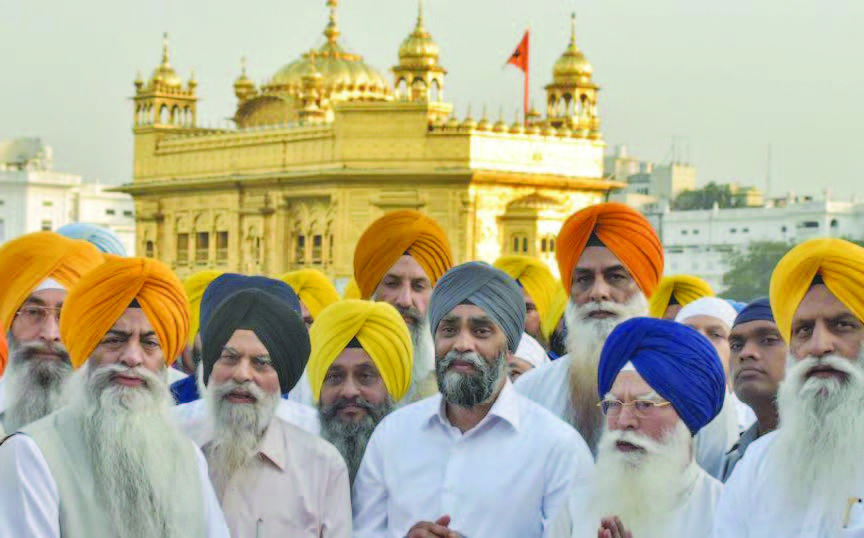
    AMRITSAR/TORONTO (TIP): As the visit to India by Canada’s defence minister, Harjit Sajjan, has been marred by Punjab chief minister Capt Amarinder Singh accusing him of having Khalistani sympathies, the minister now says that he was “disappointed” by those comments but they did “not bother” him.

    Responding to a question during a conference call with Canada-based media on Wednesday, Sajjan said, “I was disappointed with the chief minister of Punjab’s comments.”

    Sajjan went on to add in that context: “It does not bother me in the least. I’m focused on building my relationship with India, being able to discuss important issues including the issue of 1984 as well.”

    He was referring to anti-Sikh violence following the assassination of then prime minister Indira Gandhi in 1984, a sensitive issue in India-Canada relations after the Ontario Assembly recently passed a motion that described the event as “genocide”.

    As the carrying of the motion in the Ontario Assembly preceded his visit, the issue figured in Sajjan’s meetings with Indian officials and ministers. But he did not use the word genocide, as he said, “Our government looks at working with Prime Minister (Narendra) Modi’s government in dealing with and getting justice for the victims of the organised massacres in 1984.”

    He added, “I appreciated their efforts on this and look forward to them actually moving forward even further.”

    Sajjan also said he explained to Indian officials that the vote in the Ontario Assembly was caused by a private member’s motion and there was a difference between the ruling Liberal Party of the province and that of Prime Minister Justin Trudeau at the federal level.

    But Sajjan also said that Canadians had a right to express their viewpoint in “a peaceful way”.

    The Punjab chief minister’s allegations have made headlines in the Canadian media. Sajjan said, as was routine, a meeting with Amarinder Singh was sought as a “courtesy”.

    “But I will not be meeting with him now because he had originally refused,” Sajjan said, as he arrived in Amritsar from New Delhi. Similar requests were also made to the chief ministers of Maharashtra and Haryana.

    Referring to Amarinder Singh’s remarks, Sajjan said, “I don’t know what the motivations were around that.”

    On the issue of Khalistani separatism, he asserted, “There is no movement within Canada.” Sajjan pointed out that “if there was any evidence, any type of intelligence, our security forces would be looking at this immediately”.

    As he travels in India, Sajjan said, “in some ways it’s very emotional” for him. He was last in India in 2002, when his family gathered in their native village in Hoshiapur for a reunion of sorts.

    “For me to come back, it’s a very proud moment for me personally. Even though people look at me coming back as a minister, I look at it coming back as somebody who’s from here. So I’m kind of playing a dual role here. While representing Canada and our government, at the same time, trying to take in as much as I can.”

    As controversies swirled around his visit, Sajjan addressed government-to-government interaction: “We’re looking forward to furthering this conversation and the relationship that we’re still developing.”

    Canada and India are looking at a potential defence MoU, though not committing to a timeframe in that regard. “That will possibly lead to further discussions, towards possibly a defence cooperation agreement but we’re not there yet,” Sajjan said.

    Despite the setbacks dogging the trip, Sajjan said his focus was on how to “discuss the way forward”. Source: HT

  • Canadian Prime Minister Justin Trudeau To Visit India Soon

    Canadian Prime Minister Justin Trudeau To Visit India Soon

    New Delhi:  Canadian Prime Minister Justin Trudeau is expected to visit India either late this year or early next year, the country’s High Commissioner to India Nadir Patel said on Friday.

    “The India-Canada relationship is blooming and thriving,” Mr Patel said at a media interaction organised by the Indian Association of Foreign Affairs Correspondents (IAFAC) here.

    “We have already held four strategic dialogues,” he said.

    Stating that Prime Minister Narendra Modi and PM Trudeau have met both formally and informally, he said that “our leaders have developed a very strong relationship”.

    PM Modi had visited Canada in April 2015 when Stephen Harper was the Prime Minister. It was the first standalone prime ministerial visit from India to Canada in 42 years.

    According to Mr Patel, PM Trudeau is scheduled to visit India either “late this year or early next year” at the invitation of PM Modi.

    “We are yet to finalise the dates,” he said.

    Seven Canadian cabinet ministers have visited India in the last eight months.

    The High Commissioner said that both PM Trudeau and Canadian Foreign Minister Chrystia Freeland “have made it clear that India is top priority for Canada”.

    “Delhi is our largest diplomatic mission in the world,” he said.

    Stating that bilateral trade and investment was “largely balanced”, he said that there was “$14-15 billion of Canadian investment in India in the last two years”.

    “There are around 1,000 Canadian companies in India of which 400 are physically present,” Patel said.

    However, he lamented the fact that bilateral trade stood at only $8 billion given that “we do $2 billion of trade per day with the US”.

    “There is potential do a lot more,” he said.

    In terms of what Canada can offer to India, he cited food security, aviation, start-ups and clean energy among various sectors.

    He said that Canada was keen to have a Comprehensive Economic Partnership Agreement (CEPA) with India.

    “SMEs (small and medium enterprises) of both countries stand to gain the most,” the High Commissioner said.

    As for the civil nuclear agreement signed during PM Modi’s visit, he said that administrative guidelines have been concluded and “things are moving fast”.

    In this connection, he said a delegation of Canadian companies would be visiting India to discuss nuclear technology.

    “Large-scale uranium supply is already happening,” he stated.

    With around 1.2 million Indian-origin people in Canada, Mr Patel, who’s also an Indian-origin, said there are “very significant people-to-people links” with India.

    Of this number, 5,00,000 hail from Punjab and there are 19 Indian-origin lawmakers, of whom 4 are cabinet ministers.

    He also said that there has been a hike in the number of Indian student visas for Canada in the last four months. Asked if this was due to the policies of the Donald Trump administration in the US, he said that the surge started even before the US election and was “not attributable to the new US administration”.

  • Canada allocates $650 Million for Global Reproductive Health

    Canada allocates $650 Million for Global Reproductive Health

    The money will help replace what President Trump cut when he took office

    OTTAWA (TIP): On International Women’s Day, March 8, Canadian prime minister Justin Trudeau announced Canada will contribute $650 million over the next three years to reproductive health and abortion-related services around the world, multiple outlets reported. The money will help fill a funding hole left when President Donald Trump signed the “global gag rule” on abortion, yanking funding from international health organizations that provide abortions or engage in abortion advocacy, even if they use their own funding for abortions, according to The Guardian.

    Trudeau pledged the money for sex education and reproductive health programs, including money set aside for the abortion-related services Trump defunded. The goal, Trudeau said, is to give women access to resources that give them control over family planning.

    “Like men, women should be able to choose when they want to start a family, how big their family should be, and who they want to start that family with,” Trudeau said in his announcement. “When women have equal power and equal weight and equal leadership influence, the kinds of decisions are better.”

    The global gag rule was introduced by Ronald Reagan in 1984, and every Republican since then has signed on. Trump signed the rule when he took office, and while that move was fairly routine for a conservative leader, Trump expanded the rule to restrict all global health funding, not just family-planning funding, including for those organizations whose primary focus isn’t family planning but which may mention abortion, according to Slate. The rule has the potential to strip $9.5 billion in funding from international health organizations, including$600 million in family-planning funding. Trudeau’s announcement targets the family-planning funding Trump stripped away, providing an alternate source of money for the organizations.

    By stripping family-planning funding, Trump is dealing a blow to reproductive health across the world, but since, according to Slate, he expanded the gag rule to include all health funding, even for those organizations whose focus is entirely different but which may mention abortion, he is endangering programs that do all kinds of things worldwide, including prevent HIV.

    Giving money to women’s health organizations, Trudeau said, will empower women and therefore make for a better world all around.

    “For far too many women and girls, unsafe abortions and lack of choices in reproductive health mean that they are either at risk, and at risk of death, or simply cannot contribute or achieve their potential through education, through involvement in their community, through a broad range of opportunities,” he said, according to CBC News. “It is important that as a world we recognize that empowering women, that respecting their rights, is fundamental to building a world in which everyone has a real and fair chance to succeed. “

  • Canada PM to apologise to Sikhs for Komagata Maru episode

    Canada PM to apologise to Sikhs for Komagata Maru episode

    NEW DELHI: Canada’s Prime Minister Justin Trudeau notched up another signal honour as a liberal humanist by pledging to make a full apology in the House of Commons for a century-old slight against Indians, mainly Sikhs.

    In 1914, the Canadian government turned away 376 immigrants from Punjab who had sailed from India on board the ship Komagata Maru, after quarantining the vessel off the port of Vancouver. Following a two month long stand-off during which the Canadians refused to allow passengers to disembark, the ship was escorted out by gunships — one of them ironically called HMCS Rainbow — and sent back to Calcutta, where clashes with British soldiers killed 19 and ended in prison sentence to others.

    “The passengers of the Komagata Maru like millions of immigrants to Canada since were seeking refuge and better lives for their families. With so much to contribute to their new home, they chose Canada and we failed them utterly. As a nation, we should never forget the prejudice suffered by the Sikh community at the hands of the Canadian government of the day. We should not and we will not,” Trudeau said at an event to celebrate Baisakhi in Ottawa. “That is why next month, on May 18, I will stand in the House of Commons and offer a full apology for the Komagata Maru incident,” he added.

    The Canadian premier, already a darling of the liberal constituency across the world, has particularly endeared himself to Sikhs in Canada even before he inducted four of them in his cabinet (and jokingly boasted he had more Sikhs in his government than Narendra Modi). The apology pledge on Monday, made at a prayer meeting where he wore a saffron headscarf, was preceded by a widely-distributed video greeting to Sikhs on the occasion of Baisakhi, ending with him greeting them with “Wahe Guruji da Khalsa Wahe Guruji da Fateh”, the traditional Sikh invocation.

    Even before he was elected, the Sikh community was electrified by another video that showed him dancing the bhangra, and his actions since he was elected have enthralled the community so much that some have dubbed him “Justin Singh Trudeau.”

    On Monday, Trudeau stepped it up several notches saying “an apology made in the House of Commons will not erase the pain and suffering of those who lives through that shameful experience, but an apology is not only the appropriate action to take, it’s the right action to take and the House is the appropriate place for it to happen.”

    It was in the House of Commons that the laws that prevented the passengers from disembarking were first passed and so it’s fitting that the government should apologize there on behalf of all Canadians, he added, referring obliquely to an unmet Sikh demand for an apology in the legislature after then Canadian Prime Minister Stephen Harper had expressed regret outside the house in 2008.

    Trudeau reminded the gathering that April is a special month not only for Sikhs but for all Canadians, since it marks the anniversary of the adoption of the charter of rights and freedoms which ensures that no Canadian needs to make the choice between their religion and activities in their day-to-day lives. The charter ensures that the five sacred Ks of the Sikhs are protected, he said, adding that as Canadian Sikhs gather with their loved ones to mark the creation of the Khalsa, it’s a chance to reflect on shared values and celebrate the successes of the past year.

    The immense grace Trudeau has shown since coming to office has won him admirers across the world, including on social media. “I’m honored that 2 million people around the world have now ‘liked’ my Facebook page. Thank you to all 2 million of you!” he posted on Facebook on Monday.

  • Four Sikhs sworn in as cabinet ministers in Canada

    Four Sikhs sworn in as cabinet ministers in Canada

    OTTAWA Nov 4: The Punjabi community in Canada made history when two turbaned Sikhs, among four Indo-Canadians, were sworn in as cabinet ministers, as 42-year-old Justin Trudeau took oath as the country’s 23rd prime minister at a grand public ceremony here.

    The World Sikh Organization (WSO) in a statement said: “Today was a historic day for Canada.  Prime Minister Trudeau’s cabinet for the first time includes an equal number of men and women, and is the most diverse and inclusive group in recent history.”

    “The appointment of ministers Judy-Wilson Raybould and Hunter Tootoo has sent a strong message that this government is serious about ensuring that cabinet reflects the strengths, talents, and diversity of Canadians,” said Dr. Amritpal Singh Shergill, WSO President.

    The ministers:

    * Navdeep Bains: Minister of Innovation, Science and Economic Development.

    * Harjit Sajjan: Minister of Defence.

    * Amarjeet Sohi: Minister of Infrastructure and Communities.

    * Bardish Chagger: Minister of Small Business and Tourism.

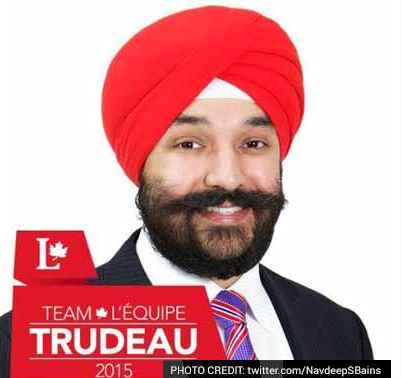
    NAVDEEP Singh Bains, Minister of Innovation, Science and Economic Development and MP for Mississauga-Malton (Ontario), played a key role in Trudeau’s leadership bid in 2013.

    He was a distinguished visiting professor at Ryerson University’s Ted Rogers School of Management and holds an MBA with a specialization in finance. As a Certified Management Accountant, he has worked several years in accounting and financial analysis for the Ford Motor Company of Canada.

    HARJIT Singh Sajjan, Minister of Defence and MP for Vancouver South, is a retired Lieutenant-Colonel in the Canadian Armed Forces and a combat veteran. He was deployed to Bosnia-Herzegovina and served three separate deployments to Kandahar, Afghanistan. Sajjan has received numerous recognitions for his service, including the Meritorious Service Medal for reducing the Taliban’s influence in Kandahar Province. He is also a recipient of the Order of Military Merit, one of the military’s highest recognitions. Sajjan also served as an Aide-de-Camp to the Lieutenant Governor of British Columbia.

    Sajjan was a police officer with the Vancouver Police Department for 11 years. He completed his last assignment as a Detective-Constable with the Gang Crime Unit specializing in organized crime. He proudly tackled gang violence and drug crimes in Vancouver. Sajjan is also a human security specialist, and has lectured to a wide audience in both Canada and the United States.

    AMARJEET Sohi, Minister of Infrastructure and Communities and MP for Edmonton Mill Woods in Alberta, was elected three times as an Edmonton City Councillor.

    Dedicated to improving Edmonton’s infrastructure and livability, Sohi represented the city on the Canadian Urban Transit Association, and has been a strong advocate for light rail transit. Sohi also advocated municipal interests to other levels of government through his delegation to the Alberta Urban Municipalities Association. He has been a prominent leader on municipal and provincial issues, volunteering with Public Interest Alberta, the Centre for International Alternatives, and the Canadian Labour Congress.

    BARDISH Chagger, Minister of Small Business and Tourism and MP for Waterloo (Ontario), is a natural leader and organizer and is devoted to inclusion and community building. From assisting with recreational sports for kids to volunteering with seniors, Chagger is committed to strengthening the bonds of the Waterloo community.

    In her role with the Kitchener-Waterloo Multicultural Centre, Chagger has worked to foster diversity within the community providing opportunities for social and economic engagement. As the former executive assistant to former Member of Parliament Andrew Telegdi, Chagger has a deep understanding of the issues that are important to residents of Waterloo, including manufacturing, technology and innovation.
    Justin Trudeau, the 42-year-old son of charismatic former prime minister Pierre Trudeau who is credited with opening Canada to new immigrants in the 1970s, led the Liberal Party to win 184 seats in the 338-member House of Commons.

    Trudeau is the second youngest prime minister of Canada.

  • Indo-Canadian Sikh Lawmaker Navdeep Bains Likely to Get Ministerial Berth

    Indo-Canadian Sikh Lawmaker Navdeep Bains Likely to Get Ministerial Berth

    TORONTO:  Navdeep Bains, 38-year-old Indian-origin Canadian Sikh MP who played a key role in prime minister-designate Justin Trudeau’s leadership bid in 2013, is likely to get a ministerial berth, Toronto Star reports. The Prime Minister-elect Justin Trudeau has chosen his cabinet and the members-to-be have been sworn to secrecy until the swearing-in on November 4.

    Speculation is rife that Mr Bains, a Liberal Member of Parliament (MP) from Mississauga city, may end up getting a ministry as Trudeau has already chosen ministers for his upcoming cabinet, according to The Star newspaper.

    Mr Bains, who played a key role in Mr Trudeau’s leadership bid in 2013, is presently a distinguished visiting professor at Ryerson University – Ted Rogers School of Management and holds an MBA with a specialization in Finance.

    As an MP for Mississauga-Brampton South from 2004 to 2011, Mr Bains also served as the Parliamentary Secretary to the Prime Minister in 2005.

    The Liberals won a majority government and 184 seats in the October 19 election.

    According to The Star factors to select members for the cabinet included “the size of the cabinet, gender equality, ethnic diversity, regional distribution and a balance of new and veteran MPs, but leaning to young and new versus old and experienced.”

    The cabinet is expected to have 28 members.

    In contrast, Prime Minister Stephen Harper’s cabinet had 39 ministers, including 26 senior ministers and 12 junior ministers of state.

    The Star suggests the cabinet will have 10 members from Ontario, six from Quebec, five from Atlantic Canada, three from B.C. and one each from Manitoba, Alberta and Saskatchewan and one representing the three northern territories.

    According to The Star:

    * Ralph Goodale is expected to be announced as deputy prime minister and House leader.

    * Scott Brison is expected to become finance minister.

    * Stéphane Dion, former Liberal party leader, is expected be named environment minister.

    * Chrystia Freeland (Toronto) could be foreign affairs or international trade minister. Marc Garneau could also be chosen foreign affairs minister.
    Mr Trudeau’s first big international test will come at the UN climate change conference in Paris from November 30 to December 11.

  • Canada’s new PM urged to fast track free trade agreement with India

    Canada’s new PM urged to fast track free trade agreement with India

    TORONTO (TIP): Welcoming the incoming Canadian Prime Minister Justin Trudeau whose Liberal Party was swept to power October 19 major Indo-Canadian organizations have urged him to fast-track the long-pending free trade agreement with India.

    Ajit Someshawar, chairman of the Canada-India Foundation (CIF), urged Trudeau to make a state visit to India as one of his foreign policy priorities and conclude the long-pending Comprehensive Economic Partnership Agreement(CEPA) and the Foreign Investment Protection Agreement (FIPA) between the Canada and India.

    Canada and India have agreed to triple their trade to $15 billion, but the progress has been tardy even as the visit by Modi – the first by any Indian PM in 42 years – here in April and two trips to India by his Canadian counterpart have reinforced this pledge.

    “The growth in bilateral trade between the two countries has still not reached its full potential and even the modest goal of $15 billion annually is still far away,” said the chairman of the Canada-India Foundation which has honored many great Indians such as former President APJ Abdul Kalam, Ratan Tata, Narayana Murthy and Deepak Chopra with its annual CIF Chanchlani Global Indian Award of $50,000 since its inception in 2008.

    Someshawar also urged the new Canadian prime minister to reinforce the Canada-India Inter-parliamentary Friendship Group to bring parliamentarians of the two countries together. He also welcomed the new Family Class Reunification plan announced by the incoming government as it will help the 1.2-million-strong Indo-Canadian community to bring their dependents into Canada quickly.

    Canada-India Business Council (C-IBC) vice-chairman Kam Rathee also urged the new Canadian prime minister to conclude the long-pending free trade agreement with India on a priority basis.

    “The new prime minister should also set in motion a process to develop trade investment and services so that non-profit associations and organizations that promote Canada-India business get financial support,” added Rathee.

  • 5 turbaned Sikhs among 19 Indo-Canadians elected to Canadian Parliament

    5 turbaned Sikhs among 19 Indo-Canadians elected to Canadian Parliament

    TORONTO (TIP): The 1.25 million-strong Indo-Canadian community had much to cheer about on Tuesday, October 20, as it doubled its representation in the new Parliament with the election of a record number of 19 MPs.

    Though comprising only about 3% of the population of Canada, the community outperformed those numbers. The new number of Indo-Canadian lawmakers far outstripped the previous high of nine.

    In 2011, almost all the Indo-Canadians MPs were Conservatives, with no Liberals elected, reflecting the overall mandate. The triumph of Justin Trudeau catapulted at least 15 Indo-Canadian Liberals to the Parliament in Ottawa.

    Two Turbaned Sikh MPs Lt Col Harjit Singh Sajjan (left) and Randeep Singh Sarai
    Two Turbaned Sikh MPs Lt Col Harjit Singh Sajjan (left) and Randeep Singh Sarai

    There will also be an overhaul in the ranks of the community’s MPs, with only a couple of sitting members re-elected. Indo-Canadians won seats in four provinces – Ontario, Quebec, British Columbia and Alberta.

    Canadians voted out the Conservative Party by handing a landslide to the Liberal Party on Monday, October19.

    Winners Ruby Sahota
    Ruby Sahota

    If there were significant victors among these candidates, the biggest loser was minister of state for sports Bal Gosal, who lost by about 6,000 votes to Liberal Party candidate Ramesh Sangha in Brampton Centre constituency of Ontario, once held by Liberal Gurbax Singh Malhi.

    Among the prominent winners was Harjit Sajjan of the Liberal Party, a Canadian Armed Forces veteran who served three operational deployments in Afghanistan.

    The longest-serving Indo-Canadian MP, Deepak Obhrai, won for the seventh time from Calgary Forest Lawn, while four-time MP Nina Grewal lost the elections.

    Winners Deepak Obhrai
    Winners Deepak Obhrai

    Also a winner was Sukh Dhaliwal, another Liberal, who as an MP in 2010 had moved a resolution in the Canadian Parliament to have the 1984 riots in India declared a “genocide”. Dhaliwal lost in 2011 but he turned the tables on his opponent, sitting MP Jinny Sims of the New Democratic Party, this time.

    Some candidates emerged victorious in ridings (as constituencies are called in Canada) where the Indo-Canadian vote wasn’t a major factor. Among them was Liberal candidate Chandra Arya, a former executive and chair of the Indo-Canada Ottawa Business Chamber, who won from Nepean that falls within the boundary of Ottawa, Canada’s capital.

    His party colleague, Anju Dhillon, won from Dorval-Lachine-LaSalle, a constituency on Montreal island, becoming the first Indo-Canadian to win a seat in the French-speaking province of Quebec.

    Most Indo-Canadian victories came in Canada’s biggest province of Ontario as many seats in Brampton and Mississauga cities went to candidates from the community.

    Some Indo-Canadian MPs

    • Anju Dhillon: Liberal, won the Quebec constituency of Dorval-Lachine-LaSalle
    • Chandra Arya: Liberal, won from Nepean in Ontario
    • Ramesh Sangha: Liberal, won from Brampton Centre in Ontario, defeating minister of state Bal Gosal
    • Gagan Sikand: Liberal, won from Missauga-Streetsville in Ontario
    • Deepak Obhrai: Conservative, won from Calgary Forest Lawn in Alberta
    • Harjit Sajjan: Liberal, won from Vancouver South in British Columbia
    • Sukh Dhaliwal: Liberal, won from Surrey Newton in British Columbia
    • Raj Saini: Liberal, won from Kitchener Centre in Ontario
    • Bardish Chagger: Liberal, won from Waterloo in Ontario
    • Bob Saroya: Conservative, won from Markham-Unionville in Ontario