Tag: NASA

  • NASA scientists crack 60-year-old mystery of explosions on Sun

    Scientists at NASA have developed a theory that explains how explosions occur on the Sun, and help better predict geomagnetic storms and solar flares that can impact Earth. An explosive process called magnetic reconnection triggers solar flares, which can, in just minutes, release enough energy to power the whole world for 20,000 years. Scientists have spent the last half-century trying to understand how this process happens. The team at NASA’s Magnetospheric Multiscale Mission (MMS) has a new theory that explains how the most explosive type of magnetic reconnection – called fast reconnection – occurs and why it happens at a consistent speed. Magnetic reconnection is a process that occurs in plasma – energetic, fluid-like material that is exquisitely sensitive to magnetic fields. From flares on the Sun, to near Earth space, to black holes, plasmas throughout the universe undergo magnetic reconnection, which rapidly converts magnetic energy into heat and acceleration. While there are several types of magnetic reconnection, one particularly puzzling variant is known as fast reconnection, which occurs at a predictable rate.

    “We have known for a while that fast reconnection happens at a certain rate that seems to be pretty constant,” said Barbara Giles, project scientist for MMS and research scientist at NASA’s Goddard Space Flight Center in Greenbelt, Maryland. “But what really drives that rate has been a mystery, until now.” The new research, published in a paper in Nature’s Communications Physics journal, explained how fast reconnection occurs specifically in collisionless plasmas – a type of plasma whose particles are spread out enough that the individual particles don’t collide with one another. Where reconnection happens in space, most plasma is in this collisionless state, including the plasma in solar flares and the space around Earth.

  • Latest astronaut crew of 4 welcomed aboard International Space Station

    Latest astronaut crew of 4 welcomed aboard International Space Station

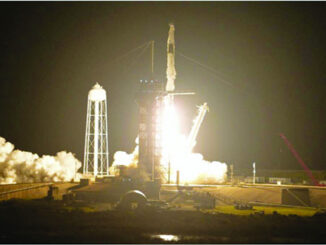
    Four astronauts, three from NASA and one from the European Space Agency, arrived at the International Space Station (ISS) on Wednesday and docked their SpaceX capsule, just two days after the last crew to depart the orbiting outpost returned to Earth. Rendezvous of the Crew Dragon capsule with the station less than 16 hours after launch from NASA’s Kennedy Space Center in Cape Canaveral, Florida, marked one of the fastest flights by Elon Musk’s SpaceX to the ISS from liftoff to docking, NASA webcast commentators said. The fully automated docking took place at about 7:37 p.m. EDT (2337 GMT) while the Crew Dragon capsule, dubbed Freedom, and the space station were flying about 260 miles (420 km) above the central Pacific Ocean, according to NASA.

    The Freedom crew consists of three American NASA astronauts – flight commander Kjell Lindgren, 49; mission pilot Bob Hines, 47; and mission specialist Jessica Watkins, 33 – as well as Italian astronaut Samantha Cristoforetti, 45, of the European Space Agency (ESA).

    After docking ahead of schedule to the station’s Harmony module, crew members spent two hours conducting standard leak checks and pressurizing the chamber between the capsule and the ISS before opening the entry hatches.

    A live NASA video feed showed the smiling new arrivals floating headfirst through the padded passageway one by one into the station. They were greeted with hugs and handshakes by the four-member team they will be replacing – three Americans and a German ESA crewmate due to end their mission next week.

    Three Russian cosmonauts currently sharing the station but preparing for a spacewalk on Thursday were not present for the welcome. The four latest astronauts, designated Crew 4, are the fourth full-fledged ISS crew NASA has launched aboard a SpaceX vehicle since the California-based rocket company began flying U.S. space agency astronauts in 2020.

    Source: Reuters

  • NASA studies 50-year-old lunar sample to prepare for return to Moon’s surface

    NASA studies 50-year-old lunar sample to prepare for return to Moon’s surface

    Scientists at NASA are tapping into one of the last unopened Apollo-era lunar samples to learn more about the Moon and prepare for a return to its surface. NASA’s Artemis mission aims to bring back cold and sealed samples from near the lunar South Pole. The sample is being opened at NASA’s Johnson Space Center in Houston and studied by the Apollo Next Generation Sample Analysis Program (ANGSA) — a science team which aims to learn more about the sample and the lunar surface in advance of the upcoming Artemis missions to the Moon’s South Pole. “Understanding the geologic history and evolution of the Moon samples at the Apollo landing sites will help us prepare for the types of samples that may be encountered during Artemis,” Thomas Zurbuchen, associate administrator of NASA’s Science Mission Directorate in Washington, said in a statement. When Apollo astronauts returned with these samples around 50 years ago, NASA had the foresight to keep some of them unopened and pristine. The ANGSA 73001 sample is part of an Apollo 17 drive tube sample collected by astronauts Eugene Cernan and Harrison “Jack” Schmitt in December 1972. The astronauts hammered a pair of connected 1.5-by-14-inch tubes into the lunar surface to collect segments of rocks and soil from a landslide deposit in the Moon’s Taurus-Littrow Valley.

                    Source: IANS

  • Tons of space junk likely to punch hole up to 20-metre hole in moon

    Tons of space junk likely to punch hole up to 20-metre hole in moon

    The moon is about to get walloped by 3 tons of space junk, a punch that will carve out a crater that could fit several semitractor-trailers. The leftover rocket will smash into the far side of the moon at 5,800 mph (9,300 kph) on Friday, March 4, away from telescopes’ prying eyes. It may take weeks, even months, to confirm the impact through satellite images. It’s been tumbling haphazardly through space, experts believe, since China launched it nearly a decade ago. But Chinese officials are dubious it’s theirs. No matter whose it is, scientists expect the object to carve out a hole 33 feet to 66 feet (10 to 20 meters) across and send moon dust flying hundreds of miles (kilometers) across the barren, pockmarked surface. Low-orbiting space junk is relatively easy to track. Objects launching deeper into space are unlikely to hit anything and these far-flung pieces are usually soon forgotten, except by a handful of observers who enjoy playing celestial detective on the side. SpaceX originally took the rap for the upcoming lunar litter after asteroid tracker Bill Gray identified the collision course in January. He corrected himself a month later, saying the “mystery” object was not a SpaceX Falcon rocket upper stage from the 2015 launch of a deep space climate observatory for NASA. Gray said it was likely the third stage of a Chinese rocket that sent a test sample capsule to the moon and back in 2014. But Chinese ministry officials said the upper stage had reentered Earth’s atmosphere and burned up. But there were two Chinese missions with similar designations — the test flight and 2020’s lunar sample return mission — and U.S. observers believe the two are getting mixed up. The U.S. Space Command, which tracks lower space junk, confirmed Tuesday that the Chinese upper stage from the 2014 lunar mission never deorbited, as previously indicated in its database. But it could not confirm the country of origin for the object about to strike the moon. “We focus on objects closer to the Earth,” a spokesperson said in a statement.

    Gray, a mathematician and physicist, said he’s confident now that it’s China’s rocket.

    “I’ve become a little bit more cautious of such matters,” he said. “But I really just don’t see any way it could be anything else.”

    Jonathan McDowell of the Harvard and Smithsonian Center for Astrophysics supports Gray’s revised assessment, but notes: “The effect will be the same. It’ll leave yet another small crater on the moon.”

              Source: AP

  • NASA’s new space telescope sees 1st starlight, takes selfie

    NASA’s new space telescope sees 1st starlight, takes selfie

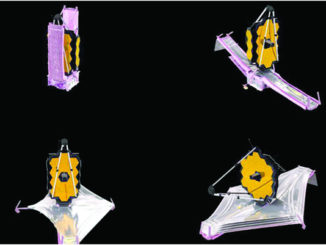
    Nasa’s new space telescope has captured its first starlight and even taken a selfie of its giant, gold mirror. All 18 segments of the primary mirror on the James Webb Space Telescope seem to be working properly one and half months into the mission, officials said Friday.

    The telescope’s first target was a bright star 258 light-years away in the constellation Ursa Major. “That was just a real wow moment,” said Marshall Perrin of the Space Telescope Science Institute in Baltimore. Over the next few months, the hexagonal mirror segments — each the size of a coffee table — will be aligned and focused as one, allowing science observations to begin by the end of June.

    The $10 billion infrared observatory — considered the successor to the aging Hubble Space Telescope — will seek light from the first stars and galaxies that formed in the universe nearly 14 billion years ago. It will also examine the atmospheres of alien worlds for any possible signs of life.

    NASA did not detect the crippling flaw in Hubble’s mirror until after its 1990 launch; more than three years passed before spacewalking astronauts were able to correct the telescope’s blurry vision.

    While everything is looking good so far with Webb, engineers should be able to rule out any major mirror flaws by next month, Feinberg said.

    Webb’s 21-foot (6.5-meter), gold-plated mirror is the largest ever launched into space. An infrared camera on the telescope snapped a picture of the mirror as one segment gazed upon the targeted star.

    “Pretty much the reaction was ‘Holy Cow!’,” Feinberg said.

    NASA released the selfie, along with a mosaic of starlight from each of the mirror segments. The 18 points of starlight resemble bright fireflies flitting against a black night sky.

    After 20 years with the project, “it is just unbelievably satisfying” to see everything working so well so far, said the University of Arizona’s Marcia Rieke, principal scientist for the infrared camera.

    Webb blasted off from South America in December and reached its designated perch 1 million miles (1.6 million kilometers) away last month.             Source: AP

  • Europe narrows hunt for next astronauts, eyes crewed flights

    Europe narrows hunt for next astronauts, eyes crewed flights

    The European Space Agency has narrowed the candidate list for its next generation of astronauts, including dozens who have a physical disability. The agency announced last year that it had received a record number of 22,589 applications from people hoping to become the continent’s next generation of space travelers.

    ESA said on Jan 18, Tuesda,y it has reduced these to fewer than 1,400 — 29 of whom have a physical disability — and hopes to cut the shortlist down to several tens of candidates by the end of the year for the four to six positions on its astronaut training program.

    The agency’s director-general, Josef Aschbacher, said the selection process would be accompanied by a feasibility study to determine the implications of choosing candidates with disabilities “but, yes, we are committed at ESA to open space to everyone.” ESA has for decades relied on its Russian and American counterparts to launch astronauts into space. Currently the agency has several places booked on American commercial launches. But Aschbacher said Europe may finally get its own crewed spacecraft if ESA member states approve the idea at a meeting later this year.

    “We are not only talking of launches, we are talking of human exploration,” he said, adding that future missions would seek to send astronauts to the moon “and beyond.” In the meantime, the agency will continue to develop its robotic capability, including a spacecraft capable of carrying large loads to the Moon that would support joint missions with partners such as NASA. ESA is also in the early stages of working on a probe that would fly to an ice moon, such as Saturn’s Enceladus, to recover a sample and bring it back to Earth. “It could be that there’s very simple, primitive life in the water underneath the ice cover,” said Aschbacher.       Source: AP

  • Lucknow Woman Scientist Plays a Key Role in Launching of Ten Billion Dollar NASA’s Webb Space Telescope

    Lucknow Woman Scientist Plays a Key Role in Launching of Ten Billion Dollar NASA’s Webb Space Telescope

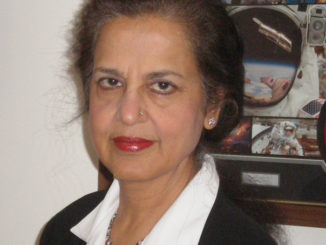
    WASHINGTON, D.C. (TIP): “What are the odds of a girl child born in the newly formed Republic of India to become a Program Scientist at NASA,” said Dr. Hashima Hasan reminiscing about her early school days during a recent NASA podcast interview. The words of her Class VI teacher in Loreto Convent, Lucknow, that they could do anything if worked hard made a big impact on her. Loreto Convent—an educational institution established in 1872 for girls—had recently allowed girls to take science subjects for their studies. She took the challenge and got interested in science. She was inspired by the scientific career of her great-uncle, Dr. Husain Zaheer, who was the Director-General of India’s Council of Scientific and Industrial Research (CSIR), and later her aunt Dr. Najma Zaheer, a renowned biological scientist. Hashima recalled that her mother had unwavering faith in her capabilities and she encouraged her to pursue her ambitions. The inspiration to pursue space science was born when, in 1957, her grandmother gathered the entire family in the backyard of her home in the early dawn to watch Sputnik pass by. It was very fascinating to see the Sputnik in the clear sky.

    Hashima completed a B.Sc. degree at Lucknow University, securing the fifth position, and went on to Aligarh Muslim University (AMU) and obtained an M.Sc. (Physics) degree securing first place and a gold medal. She started a Ph. D. program under the tutelage of the legendary Dr. Zillur Rahman Khan. After completing the pre-requisite degree of M. Phil., she took the bold step of applying to the University of Oxford. With encouragement from Dr. Rais Ahmad, Head, Department of Physics, she applied and received a Commonwealth Scholarship and joined the University of Oxford, U.K. Three years later, with a D.Phil. (Theoretical Nuclear Physics) in hand, she returned to India as a post-doctoral scholar at the Tata Institute of Fundamental Research (TIFR), Bombay. With scholars like Dr. J. V. Narlikar, and Dr. Obaid Siddiqi, TIFR was a haven of intellectual thought. After two intense years at TIFR, she secured a faculty position at the Physics Department, University of Poona, Pune. She was the only non-Marathi-speaking faculty member. The atmosphere at Poona University was welcoming, respectful, academic, idyllic, and she enjoyed teaching the post-graduate students.

    Her life took an important turn when her family arranged her marriage and she moved to Raleigh, NC, joining her husband, Dr. Aftab Ansari. She pursued her passion for Nuclear Physics at Duke University, Durham NC, switching gears two years later to Atmospheric Science when she was awarded a Resident Research Associateship by the U.S. National Research Council.

    A year later, they were back in India, this time with an infant son. Her first experience as a working mother came when she started research in Nuclear Physics at the Bhabha Atomic Research Center, Mumbai. When they returned to the USA with their second son, her journey took a turn towards NASA.

    Arriving in Baltimore, she sought research opportunities and was hired by the newly formed Space Telescope Science Institute to write the simulation software for the optics of the soon-to-be-launched Hubble Space Telescope and its science instruments. Never one to turn down a challenge, she once again switched gears from Nuclear Physics – this time towards optics and astronomy.

    Little did she know that within a few years she would be using her software to analyze the optical error of the Hubble mirror and would be assigned the responsibility of keeping Hubble in the best focus till a fix was designed.

    Once Hubble was repaired after the first servicing mission, she took advantage of an opportunity at NASA Headquarters, Washington DC, to work as a Senior Scientist. Thus started her career in science management. There was never a dull moment at NASA Headquarters. Every second keeps one intellectually on the edge – whether it is involved in the strategic planning for the next flight mission; the solicitation, review, and selection of new technology, research program, payloads on sounding rockets and balloons; the next Explorer mission; direction of the data archives; or management of advisory committees and communication with educators and the public.

    Hashima has managed every aspect of Astrophysics during her 27 years+ services at NASA Headquarters. One of her significant responsibilities is that of the Deputy Program Scientist, James Webb Space Telescope (JWST), a successor to the Hubble Space Telescope. Her responsibilities included oversight during the mission development phase to make sure that the science requirements were being met, and the best science observation program selected for the operation phase. She is currently serving as a spokesperson for JWST to the media and delivering invited talks to school students.

    After many years of hard work with its partners, the European Space Agency, and the Canadian Space Agency, NASA launched JSWT from the European spaceport of Kourou in French Guiana on 25th December 2021. The telescope equipped with multiple instruments will be positioned at a spot called Lagrange Point 2, 1.5million km from earth or more than four times beyond the moon. Its mission stretches from five to 15 years. As Deputy Program Scientist for the JWST, she was part of the team on board when the world’s largest and most powerful telescope was launched. This was an exhilarating moment for her, the entire JWST team, and indeed the entire world. Once in operation, JWST will show the wonders of the Universe never seen before. The world is eagerly waiting for those first science images. Hashima is gazing at the night skies at her home in the USA with the same wonder that she gazed at it as a little girl in Lucknow – it is the same sky with the same mysteries waiting for all of us to discover.

    A few selected videos.

    https://www.bhaskar.com/international/news/james-webb-spaDce-telescope-news-and-updates-worlds-most-powerful-space-telescope-is-ready-to-launch-129239575.html?media=1

    https://m-timesofindia-com.cdn.ampproject.org/c/s/m.timesofindia.com/city/mumbai/touch-of-india-

    AMU Alumna Dr Hashima Hasan plays a key role in the launch of NASA telescope

  • NASA nails trickiest job on newly launched James Webb Space Telescope

    NASA nails trickiest job on newly launched James Webb Space Telescope

    NASA aced the most complicated, critical job on its newly launched space telescope Tuesday: unrolling and stretching a sunshade the size of a tennis court. Ground controllers cheered and bumped fists once the fifth and final layer of the sunshield was tightly secured. It took just 1 1/2 days to tighten the ultra-thin layers using motor-driven cables, half the expected time.

    The 7-ton James Webb Space Telescope is so big that the sunshield and the primary gold-plated mirror had to be folded for launch. The sunshield is especially unwieldly — it spans 70 feet by 46 feet (21 metres by 14 metres) to keep all the infrared, heat-sensing science instruments in constant subzero shadow.

    The $10 billion telescope is more than halfway toward its destination 1 million miles (1.6 million kilometers) away, following its Christmas Day send-off. It is the biggest and most powerful observatory ever launched — 100 times more powerful than the Hubble Space Telescope — enabling it to peer back to almost the beginning of time.

    Considered Hubble’s successor, Webb will attempt to hunt down light from the universe’s first stars and galaxies, created 3.7 billion years ago. “This is a really big moment,” project manager Bill Ochs told the control team in Baltimore. “We’ve still got a lot of work to do, but getting the sunshield out and deployed is really, really big.”

    Engineers spent years redoing and tweaking the shade. At one point, dozens of fasteners fell off during a vibration test. That made Tuesday’s success all the sweeter, since nothing like this had ever been attempted before in space.

  • Indian-origin USAF doctor among 10 chosen by NASA for as astronauts future missions

    Indian-origin USAF doctor among 10 chosen by NASA for as astronauts future missions

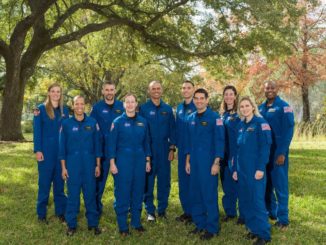
    Houston (TIP): Indian-origin physician Anil Menon, a lieutenant colonel at the US Air Force, has been selected by NASA along with nine others to be astronauts for future missions, the American space agency has announced.

    Menon, 45, was born and raised in Minneapolis, Minnesota, to Ukrainian and Indian immigrants.

    He was SpaceX’s first flight surgeon, helping to launch the company’s first humans to space during NASA’s SpaceX Demo-2 mission and building a medical organisation to support the human system during future missions.

    In a statement, NASA announced that it has chosen 10 new astronaut candidates from a field of more than 12,000 applicants to represent the US and work for humanity’s benefit in space.

    NASA Administrator Bill Nelson introduced the members of the 2021 astronaut class, the first new class in four years, during a Monday, December 6 event at Ellington Field near NASA’s Johnson Space Center in Houston.

    “Today we welcome 10 new explorers, 10 members of the Artemis generation, NASA’s 2021 astronaut candidate class,” Nelson said. “Alone, each candidate has ‘the right stuff,’ but together they represent the creed of our country: E pluribus unum—out of many, one,” he said.

    The astronaut candidates will report for duty at Johnson in January 2022 to begin two years of training.

    Astronaut candidate training falls into five major categories: operating and maintaining the International Space Station’s complex systems, training for spacewalks, developing complex robotics skills, safely operating a T-38 training jet, and Russian language skills.

    Upon completion, they could be assigned to missions that involve performing research aboard the space station, launching from American soil on spacecraft built by commercial companies, as well as deep space missions to destinations including the Moon on NASA’s Orion spacecraft and Space Launch System rocket.

    “Each of you has amazing backgrounds,” Pam Melroy, former NASA astronaut and NASA’s deputy administrator, told the candidates. “You bring diversity in so many forms to our astronaut corps and you stepped up to one of the highest and most exciting forms of public service.” Applicants included US citizens from all 50 states, the District of Columbia, and US territories Puerto Rico, Guam, the Virgin Islands, and Northern Mariana Islands.For the first time ever, NASA required candidates to hold a master’s degree in a STEM field and used an online assessment tool. The women and men selected for the new astronaut class represent the diversity of America and the career paths that can lead to a place in America’s astronaut corps.

                    Source: PTI

  • Indian American US Air Force physician among 10 chosen by NASA for as astronauts future missions

    Indian American US Air Force physician among 10 chosen by NASA for as astronauts future missions

    HOUSTON (TIP): Indian American physician Anil Menon, a lieutenant colonel at the US Air Force, has been selected by NASA along with nine others to be astronauts for future missions, the American space agency has announced.

    Menon, 45, was born and raised in Minneapolis, Minnesota, to Ukrainian and Indian immigrants. He was SpaceX’s first flight surgeon, helping to launch the company’s first humans to space during NASA’s SpaceX Demo-2 mission and building a medical organization to support the human system during future missions. In a statement, NASA announced that it has chosen 10 new astronaut candidates from a field of more than 12,000 applicants to represent the US and work for humanity’s benefit in space.

    NASA Administrator Bill Nelson introduced the members of the 2021 astronaut class, the first new class in four years, during a Monday, December 6 event at Ellington Field near NASA’s Johnson Space Center in Houston.

    “Today we welcome 10 new explorers, 10 members of the Artemis generation, NASA’s 2021 astronaut candidate class,” Nelson said. “Alone, each candidate has ‘the right stuff,’ but together they represent the creed of our country: E pluribus Unum—out of many, one,” he said. The astronaut candidates will report for duty at Johnson in January 2022 to begin two years of training. Astronaut candidate training falls into five major categories: operating and maintaining the International Space Station’s complex systems, training for spacewalks, developing complex robotics skills, safely operating a T-38 training jet, and Russian language skills.

    Upon completion, they could be assigned to missions that involve performing research aboard the space station, launching from American soil on spacecraft built by commercial companies, as well as deep space missions to destinations including the Moon on NASA’s Orion spacecraft and Space Launch System rocket.

    “Each of you has amazing backgrounds,” Pam Melroy, former NASA astronaut and NASA’s deputy administrator, told the candidates. “You bring diversity in so many forms to our astronaut corps and you stepped up to one of the highest and most exciting forms of public service.” Applicants included US citizens from all 50 states, the District of Columbia, and US territories Puerto Rico, Guam, the Virgin Islands, and Northern Mariana Islands.

    For the first time ever, NASA required candidates to hold a master’s degree in a STEM field and used an online assessment tool. The women and men selected for the new astronaut class represent the diversity of America and the career paths that can lead to a place in America’s astronaut corps.

    Menon previously served NASA as the crew flight surgeon for various expeditions taking astronauts to the International Space Station. He is an actively practicing emergency medicine physician with fellowship training in wilderness and aerospace medicine. As a physician, he was a first responder during the 2010 earthquake in Haiti, 2015 earthquake in Nepal, and the 2011 Reno Air Show accident. In the Air Force, Menon supported the 45th Space Wing as a flight surgeon and the 173rd Fighter Wing, where he logged over 100 sorties in the F-15 fighter jet and transported over 100 patients as part of the critical care air transport team.

  • Jessica Watkins to be first Black woman on International Space Station crew

    Jessica Watkins to be first Black woman on International Space Station crew

    WASHINGTON, D.C. (TIP): When NASA astronaut Jessica Watkins launches to the International Space Station next year, her debut spaceflight will make history. Watkins is set to become the first Black woman to join the space station crew, and live and work in space on a long-duration mission on the orbiting outpost. The agency announced Tuesday that Watkins will fly to the space station in April 2022, alongside NASA astronauts Kjell Lindgren and Robert Hines and astronaut Samantha Cristoforetti of the European Space Agency.

    They are slated to launch aboard SpaceX’s Crew Dragon capsule from NASA’s Kennedy Space Center in Cape Canaveral, Florida. The mission, known as Crew-4, is expected to last six months.

    Watkins, a geologist who earned an undergraduate degree from Stanford University and a doctorate from the University of California, Los Angeles, will serve as a mission specialist during the Crew-4 flight. She was chosen to become an astronaut candidate in 2017 and the April mission will be her first trip to space, according to the agency.

    Though a handful of Black astronauts have visited the space station over the course of its 21-year history, almost all had short stays typically lasting less than two weeks during NASA’s space shuttle program.

    Last year, Victor Glover became the first Black astronaut to embark on a long-term mission at the space station, and Watkins is set to become the first Black woman to do the same.

    In 2018, NASA astronaut Jeanette Epps was expected to become the first Black astronaut — man or woman — to launch on an extended mission at the space station, but she was unexpectedly replaced less than six months before the flight. NASA did not offer an explanation for the switch and The Washington Post reported at the time that Epps’ brother blamed racism at the space agency for the abrupt crew change.

    (Agencies)

  • SpaceX returns 4 astronauts to Earth, ending 200-day flight

    SpaceX returns 4 astronauts to Earth, ending 200-day flight

    Cape Canaveral (TIP): Four astronauts returned to Earth, riding home with SpaceX to end a 200-day space station mission that began last spring. Their capsule parachuted into the Gulf of Mexico off the coast of Pensacola, Florida, in darkness. Recovery boats quickly moved in with spotlights. Their homecoming — coming just eight hours after leaving the International Space Station — paved the way for SpaceX’s launch of their four replacements as early as Wednesday night. The newcomers were scheduled to launch first, but NASA switched the order because of bad weather and an astronaut’s undisclosed medical condition. The welcoming duties will now fall to the lone American and two Russians left behind at the space station.

    Before Monday afternoon’s undocking, German astronaut Matthias Maurer, who’s waiting to launch at NASA’s Kennedy Space Center, tweeted it was a shame the two crews wouldn’t overlap at the space station but “we trust you’ll leave everything nice and tidy.” His will be SpaceX’s fourth crew flight for NASA in just 1 1/2 years.

    NASA astronauts Shane Kimbrough and Megan McArthur, Japan’s Akihiko Hoshide and France’s Thomas Pesquet should have been back Monday morning, but high wind in the recovery zone delayed their return.

     “One more night with this magical view. Who could complain? I’ll miss our spaceship!” Pesquet tweeted alongside a brief video showing the space station illuminated against the blackness of space and the twinkling city lights on the nighttime side of Earth.

    From the space station, NASA astronaut Mark Vande Hei — midway through a one-year flight — bid farewell to each of his departing friends, telling McArthur “I’ll miss hearing your laughter in adjacent modules.”

    Before leaving the neighbourhood, the four took a spin around the space station, taking pictures. This was a first for SpaceX; NASA’s shuttles used to do it all the time before their retirement a decade ago. The last Russian capsule fly-around was three years ago.

    It wasn’t the most comfortable ride back. The toilet in their capsule was broken, and so the astronauts needed to rely on diapers for the eight-hour trip home. They shrugged it off late last week as just one more challenge in their mission.                 Source: AP

  • NASA finds first signs of planet outside Milky Way galaxy

    NASA finds first signs of planet outside Milky Way galaxy

    WASHINGTON (TIP): NASA’s Chandra X-ray Observatory has for the first time spotted signs of a planet transiting a star outside of the Milky Way galaxy, opening up a new avenue to search for exoplanets at greater distances than ever before. The possible exoplanet—or planets outside of our Solar System—candidate is located in the spiral galaxy Messier 51 (M51), also called the Whirlpool Galaxy because of its distinctive profile, NASA said in a statement.

    Astronomers have, so far, found all other known exoplanets and exoplanet candidates in the Milky Way galaxy, almost all of them less than about 3,000 light years from Earth.

    An exoplanet in M51 would be about 28 million light years away, meaning it would be thousands of times farther away than those in the Milky Way, NASA said.

    “We are trying to open up a whole new arena for finding other worlds by searching for planet candidates at X-ray wavelengths, a strategy that makes it possible to discover them in other galaxies,” said Rosanne Di Stefano of the Center for Astrophysics at Harvard and Smithsonian (CfA) in Cambridge, Massachusetts, who led the study.

    The findings are published in the journal Nature Astronomy.

    The exoplanet candidate was spotted in a binary system called M51-ULS-1, located in M51. This binary system contains a black hole or neutron star orbiting a companion star with a mass about 20 times that of the Sun. The X-ray transit they found using Chandra data lasted about three hours, during which the X-ray emission decreased to zero.

    Based on this and other information, the team estimate the exoplanet candidate in M51-ULS-1 would be roughly the size of Saturn, and orbit the neutron star or black hole at about twice the distance of Saturn from the Sun.

    The team looked for X-ray transits in three galaxies beyond the Milky Way galaxy, using both Chandra and the European Space Agency’s XMM-Newton. Their search covered 55 systems in M51, 64 systems in Messier 101 (the “Pinwheel” galaxy), and 119 systems in Messier 104 (the “Sombrero” galaxy).

    However, more data would be needed to verify the interpretation as an extragalactic exoplanet. One challenge is that the planet candidate’s large orbit means it would not cross in front of its binary partner again for about 70 years, thwarting any attempts for a confirming observation for decades, NASA said.

    Named in honor of the late Indian-American Nobel laureate, Subrahmanyan Chandrasekhar, the Chandra X-ray Observatory is the world’s most powerful X-ray telescope. It has eight times greater resolution and is able to detect sources more than 20-times fainter than any previous X-ray telescope.

    Known to the world as Chandra (which means “moon” or “luminous” in Sanskrit), Chandrasekhar was widely regarded as one of the foremost astrophysicists of the twentieth century.

                    Source: IANS

  • Indian American astronaut Raja Chari all set to lead NASA’s next mission

    Indian American astronaut Raja Chari all set to lead NASA’s next mission

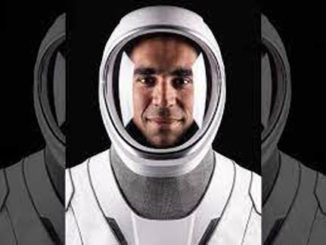
    NEW YORK (TIP): Indian American Astronaut Raja Chari is all set to lead NASA’s next mission to the International Space Station on Sunday, October 31, the Halloween Day, on his very first space flight.

    The third operational crewed flight of SpaceX’s Crew Dragon spacecraft, called Crew-3, is slated to lift off before dawn on Oct. 31 from Pad 39A at NASA’s Kennedy Space Center in Florida at 2:21 a.m. EDT.

    If all goes as planned, after a 22-hour journey, Crew Dragon will be in position to rendezvous and dock with the space station at 12:10 a.m. Monday, Nov. 1.

    Strapped inside the gumdrop-shaped SpaceX capsule will be NASA astronauts Raja Chari, Tom Marshburn, and Kayla Barron, along with German astronaut Matthias Maurer from the European Space Agency (ESA).

    As commander of the Crew Dragon spacecraft and the Crew-3 mission, Chari, 44, is responsible for all phases of flight, from launch to re-entry, according to a NASA press release. He also will serve as an Expedition 66 flight engineer aboard the station.

    This will be the first spaceflight for Chari, who was selected as a NASA astronaut candidate in 2017. It’s also the first time a rookie commercial crew astronaut has been named mission commander.

    A colonel in the US Air Force, Chari joins the mission with extensive experience as a test pilot. He has accumulated more than 2,500 hours of flight time in his career.

    Chari was the commander of the 461st Flight Test Squadron at Edwards Air Force Base in California when he was selected as an astronaut. After two years of astronaut training, he went on to become the Director of the Joint Test Team for NASA’s commercial crew program.

    Chari was also one of the 18 astronauts selected for NASA’s Artemis Team and is now eligible for assignment to a future lunar mission. He was born in Milwaukee, but considers Cedar Falls, Iowa, his hometown.

    The four astronauts are scheduled for a long duration stay aboard the orbiting laboratory, spending several months conducting science and maintenance before they return to Earth in spring 2022, according to NASA.

    The Crew-3 mission will fly a new Crew Dragon spacecraft and will be the first mission to fly a previously used nosecone.

    Lifting off from Launch Pad 39A on a Falcon 9 rocket, Crew Dragon will accelerate its four passengers to approximately 17,500 mph and put it on an intercept course with the International Space Station.

    The Falcon 9 first stage that will be used to launch this mission flew previously on SpaceX’s 22nd commercial resupply mission to the station in June 2021.

    Once in orbit, the crew and SpaceX mission control will monitor a series of automatic maneuvers that will guide the Crew-3 astronauts to their new home in orbit at the forward end of the station’s Harmony module.

    The spacecraft is designed to dock autonomously with the ability for astronauts aboard the spacecraft to take control and pilot manually, if necessary, NASA said.

    The Crew-3 astronauts will spend approximately six months aboard the International Space Station conducting new and exciting scientific research in areas such as materials science, health technologies, and plant science to prepare for human exploration beyond low-Earth orbit and benefit life on Earth, NASA said.

    During their stay aboard the orbiting laboratory, astronauts of Crew-3 will see cargo spacecraft including the SpaceX cargo Dragon in December and the Northrop Grumman Cygnus in early 2022.

    They will also welcome two different private crews to the station, including Japanese tourists aboard a Russian Soyuz spacecraft at the end of 2021, and the Axiom Mission 1 crew, the first private astronaut mission to the International Space Station, scheduled to launch no earlier than Feb. 21, 2022.

    The Crew-3 astronauts are scheduled to conduct a series of spacewalks to outfit the station’s power system in preparation for new solar arrays that will increase the station’s total available power supply.

    At the conclusion of the mission, Crew Dragon will autonomously undock with the four astronauts aboard, depart the space station and re-enter Earth’s atmosphere.

    After splashdown just off Florida’s coast, a SpaceX recovery vessel will pick up the crew and bring them back to shore to board a plane for return to NASA’s Johnson Space Center in Houston.

  • NASA’s Lucy mission to probe Jupiter’s mysterious Trojan asteroids

    NASA’s Lucy mission to probe Jupiter’s mysterious Trojan asteroids

    WASHINGTON, DC (TIP): Lucy will launch on October 16 from Cape Canaveral Space Force Station. NASA is poised to send its first spacecraft to study Jupiter’s Trojan asteroids to glean new insights into the solar system’s formation 4.5 billion years ago, the space agency said September 28. The probe, called Lucy after an ancient fossil that provided insights into the evolution of human species, will launch on October 16 from Cape Canaveral Space Force Station in Florida. Its mission is to investigate the group of rocky bodies circling the Sun in two swarms, one preceding Jupiter in its orbital path and the other trailing behind it. After receiving boosts from Earth’s gravity, Lucy will embark on a 12-year journey to eight different asteroids — one in the Main Belt between Mars and Jupiter and then seven Trojans. “Despite the fact that they really are in a very small region of space, they’re very physically different from one another,” Hal Levison, the mission’s principal scientist told reporters, about the Trojan asteroids, which number more than 7,000 in total. “For example, they have very different colors, some are grey, some are red,” he added, with the differences indicating how far away from the Sun they might have formed before assuming their present trajectory.

    “Whatever Lucy finds will give us vital clues about the formation of our solar system,” added Lori Glaze, director of NASA’s planetary science division.

    Lucy will fly by its target objects within 250 miles (400 kilometers) of their surfaces and use its onboard instruments and large antenna to investigate their geology, including composition, mass, density and volume. The ship was built by Lockheed Martin and includes over two miles of wire and solar panels that, placed end-to-end, would be as tall as a five-story building.

    It will be the first solar powered to venture this far from the Sun and will observe more asteroids than any other spacecraft before it. The total mission cost is $981 million. The researchers who discovered Lucy the fossil in Ethiopia in 1974 named her after the Beatles’ song “Lucy in the Sky with Diamonds” which they were playing loudly at the expedition camp. In a nod to this heritage, the official logo of the NASA mission is diamond shaped.

  • NASA rover Perseverance collects first Martian rock sample

    NASA’s Mars science rover Perseverance has collected and stashed away the first of numerous mineral samples that the US space agency hopes to retrieve from the surface of the Red Planet for analysis on Earth.

    Tools attached to Perseverance and operated by mission specialists from NASA’s Jet Propulsion Laboratory (JPL) near Los Angeles drilled a rock core slightly thicker than a pencil from an ancient Martian lake bed, then hermetically sealed it in a titanium specimen tube inside the rover.

    The feat, accomplished on September 1 and publicly confirmed by NASA late on Monday, marked the first such mineral sample obtained from the surface of another planet, according to the space agency.

    NASA chief and former astronaut Bill Nelson hailed it as “a momentous achievement.”

    The space agency plans to collect as many as 43 mineral samples over the next few months from the floor of Jerezo Crater, a wide basin where scientists think water flowed and microbial life may have flourished billions of years ago.

    The six-wheeled, SUV-sized vehicle is also expected to explore walls of sediment deposited at the foot of a remnant river delta once etched into a corner of the crater and considered a prime spot for study.

  • Nasa scientists spot unusual set of rings around black hole with companion star

    Nasa scientists spot unusual set of rings around black hole with companion star

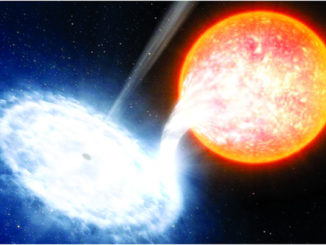
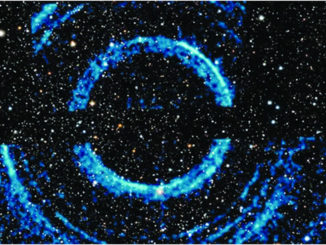
    Astronomers have spotted a spectacular set of rings around a black hole in an image captured using Nasa’s Chandra X-ray Observatory and Neil Gehrels Swift Observatory. Nasa said that the X-ray images of the giant ring reveal information about the black hole, its companion star, and the intervening dust clouds.

    “The black hole is part of a binary system called V404 Cygni, located about 7,800 light-years away from Earth. The black hole is actively pulling material away from a companion star — with about half the mass of the Sun — into a disk around the invisible object. This material glows in X-rays, so astronomers refer to these systems as “X-ray binaries,” the US space agency said.

    In 2015, Neil Gehrels Swift Observatory discovered a burst of X-rays from V404 Cygni creating high energy rings. These rings were generated when a burst of X-rays from the black hole system bounced off of dust clouds between V404 Cygni and Earth, a phenomenon called light echoes. Cosmic dust consists of tiny, solid particles.

    The rings tell astronomers about the landscape between V404 Cygni and Earth. According to Nasa, the diameter of the rings reveals the distances to the intervening dust clouds the light ricocheted off. When the cloud is closer to Earth, the high energy ring appears larger and vice versa.

    “The light echoes appear as narrow rings rather than wide rings or haloes because the X-ray burst lasted only a relatively short period of time,” said Nasa.

    NASA Mars rover fails to collect rock in search of alien life

    NASA’s Perseverance drilled into the surface of Mars but failed in its initial attempt to collect rock samples that would be picked up by future missions for analysis by scientists on Earth.

    The US space agency published images Friday of a small mound with a hole in its center next to the rover — the first ever dug into the Red Planet by a robot.

    But data sent to Earth by the rover after its first attempt to collect a sample and seal it in a tube indicated no rock had been gathered.

    “While this is not the ‘hole-in-one’ we hoped for, there is always risk with breaking new ground,” said Thomas Zurbuchen, associate administrator for NASA’s science mission directorate, in a statement.

    “I’m confident we have the right team working this, and we will persevere toward a solution to ensure future success.”

    The drill hole is the first step of a sampling process that is expected to take about 11 days, with the aim of looking for signs of ancient microbial life that may have been preserved in ancient lakebed deposits.

    Scientists also hope to better understand Martian geology.

    The mission took off from Florida a little over a year ago and Perseverance, which is the size of a large family car, landed on February 18 in the Jezero Crater.

    Scientists believe the crater contained a deep lake 3.5 billion years ago, where the conditions may have been able to support extraterrestrial life.

    NASA plans a mission to bring around 30 samples back to Earth in the 2030s, to be analyzed by instruments that are much more sophisticated than those that can be brought to Mars at present

  • Bezos offers NASA $2 billion in exchange for moon mission contract

    Bezos offers NASA $2 billion in exchange for moon mission contract

    Seattle (TIP): Fresh off his trip to space, billionaire businessman Jeff Bezos on Monday offered to cover up to $2 billion in NASA costs if the U.S. space agency awards his company Blue Origin a contract to make a spacecraft designed to land astronauts back on the moon.

    NASA in April awarded rival billionaire entrepreneur Elon Musk’s SpaceX a $2.9 billion contract to build a spacecraft to bring astronauts to the lunar surface as early as 2024, rejecting bids from Blue Origin and defence contractor Dynetics. Blue Origin had partnered with Lockheed Martin Corp, Northrop Grumman Corp and Draper in the bid.

    The space agency cited its own funding shortfalls, SpaceX’s proven record of orbital missions and other factors in a contract decision that senior NASA official Kathy Lueders called “what’s the best value to the government.” In a letter to NASA Administrator Bill Nelson, Bezos said Blue Origin would waive payments in the government’s current fiscal year and the next ones after that up to $2 billion, and pay for an orbital mission to vet its technology. In exchange, Blue Origin would accept a firm, fixed-priced contract, and cover any system development cost overruns, Bezos said.

    “NASA veered from its original dual-source acquisition strategy due to perceived near-term budgetary issues, and this offer removes that obstacle,” Bezos wrote.        Source: Reuters

  • Hubble finds first evidence of water vapour on Jupiter’s moon Ganymede

    Hubble finds first evidence of water vapour on Jupiter’s moon Ganymede

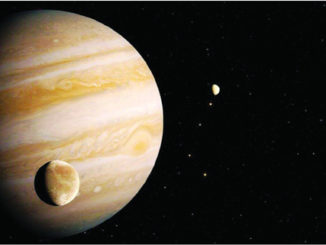
    Washington (TIP): Astronomers have uncovered the first evidence of water vapour in the atmosphere of Jupiter’s moon Ganymede by using new and archival datasets from NASA’s Hubble Space Telescope.

    According to the study published in the journal Nature Astronomy on Monday, the water vapour forms when ice from the moon’s surface turns from solid to gas.

    Previous studies have offered circumstantial evidence that Ganymede, the largest moon in the solar system, contains more water than all of Earth’s oceans, NASA said.

    However, temperatures there are so cold that water on the surface is frozen solid, according to the US space agency.

    Ganymede’s ocean would reside roughly 160 kilometres below the crust, therefore, the water vapour would not represent the evaporation of this ocean.

    Astronomers re-examined Hubble observations from the last two decades to find this evidence of water vapour.

    In 1998, Hubble’s Space Telescope Imaging Spectrograph took the first ultraviolet (UV) images of Ganymede, which revealed colourful ribbons of electrified gas called auroral bands, and provided further evidence that Ganymede has a weak magnetic field.

    The similarities in these UV observations were explained by the presence of molecular oxygen (O2).

    However, some observed features did not match the expected emissions from a pure O2 atmosphere.

    At the same time, scientists concluded this discrepancy was likely related to higher concentrations of atomic oxygen (O).

    Lorenz Roth of the KTH Royal Institute of Technology in Stockholm, Sweden led the team to measure the amount of atomic oxygen with Hubble.

    The team’s analysis combined the data from two instruments: Hubble’s Cosmic Origins Spectrograph in 2018 and archival images from the Space Telescope Imaging Spectrograph (STIS) from 1998 to 2010.

    Contrary to the original interpretations of the data from 1998, they discovered there was hardly any atomic oxygen in Ganymede’s atmosphere.

    Roth and his team then took a closer look at the relative distribution of the aurora in the UV images.

    Ganymede’s surface temperature varies strongly throughout the day, and around noon near the equator it may become sufficiently warm that the ice surface releases some small amounts of water molecules, the researchers said.

    The perceived differences in the UV images are directly correlated with where water would be expected in the moon’s atmosphere, they said.

    “So far only the molecular oxygen had been observed,” explained Roth.

    “This is produced when charged particles erode the ice surface. The water vapour that we measured now originates from ice sublimation caused by the thermal escape of water vapour from warm icy regions,” he said.

    The finding adds anticipation to European Space Agency (ESA)’s upcoming mission JUpiter ICy moons Explorer (JUICE).

    Planned for launch in 2022 and arrival at Jupiter in 2029, JUICE will spend at least three years making detailed observations of Jupiter and three of its largest moons, with particular emphasis on Ganymede as a planetary body and potential habitat.

    “Our results can provide the JUICE instrument teams with valuable information that may be used to refine their observation plans to optimise the use of the spacecraft,” Roth added.

    Source: PTI

  • “Best day ever as Jeff Bezos endshis ride into space on own rocket

    “Best day ever as Jeff Bezos endshis ride into space on own rocket

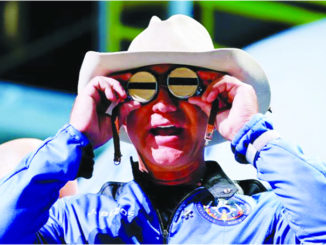
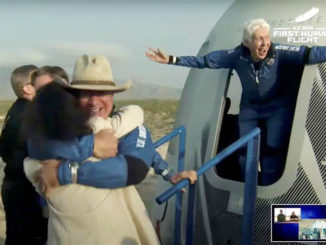
    DALLAS (TIP): Jeff Bezos, the world’s richest man, went to space and back Tuesday, July 20 morning on an 11-minute, supersonic joy ride aboard the rocket and capsule system developed by his space company, Blue Origin. Riding alongside the multibillionaire were Bezos’ brother, Mark Bezos; Wally Funk, an 82-year-old pilot and one of the “Mercury 13” women who trained to go to space in the 20th century but never got to fly; and an 18-year old recent high school graduate named Oliver Daemen who was Blue Origin’s first paying customer and whose father, an investor, purchased his ticket. Funk and Daemen became the oldest and youngest people, respectively, ever to travel to space. And this flight marked the first-ever crewed mission for Blue Origin’s New Shepard suborbital space tourism rocket, which the company plans to use to take wealthy thrill seekers on high-flying joy rides in the months and years to come.

    “Best day ever!” Bezos said when the capsule touched down on the desert floor at the end of the 10-minute flight. Named after America’s first astronaut, Blue Origin’s New Shepard rocket soared from remote West Texas on the 52nd anniversary of the Apollo 11 moon landing, a date chosen by Bezos for its historical significance. He held fast to it, even as Virgin Galactic’s Richard Branson pushed up his own flight from New Mexico in the race for space tourist dollars and beat him to space by nine days.

    Unlike Branson’s piloted rocket plane, Bezos’ capsule was completely automated and required no official staff on board for the up-and-down flight. Blue Origin reached an altitude of about 66 miles (106 kilometers), more than 10 miles (16 kilometers) higher than Branson’s July 11 ride. The 60-foot (18-meter) booster accelerated to Mach 3 or three times the speed of sound to get the capsule high enough, before separating and landing upright.

    The passengers had several minutes of weightlessness to float around the spacious white capsule. The window-filled capsule landed under parachutes, with Bezos and his guests briefly experiencing nearly six times the force of gravity, or 6 G’s, on the way back.

    Led by Bezos, they climbed out of the capsule after touchdown with wide grins, embracing parents, partners and children, then popped open bottles of sparkling wine, spraying one another.

    haring Bezos’ dream-come-true adventure was Wally Funk, from the Dallas area, one of 13 female pilots who went through the same tests as NASA’s all-male astronaut corps in the early 1960s but never made it into space.

    “I got goose bumps,” said Angel Herrera after the capsule landed. “The hair on the back of my neck stood up, just witnessing history.” Herrera, who lives in El Paso, was one of a few dozen people who watched the launch from inside Van Horn High School, about 25 miles (40 kilometers) away.

    Blue Origin — founded by Bezos in 2000 in Kent, Washington, near Amazon’s Seattle headquarters — hasn’t revealed its price for a ride to space. Two more passenger flights are planned by year’s end, said Blue Origin CEO Bob Smith.

    The recycled rocket and capsule that carried up Tuesday’s passengers were used on the last two space demos, according to company officials.

    Blue Origin is working on a massive rocket, New Glenn, to put payloads and people into orbit from Cape Canaveral, Florida. The company also wants to put astronauts back on the moon with its proposed lunar lander Blue Moon; it’s challenging NASA’s sole contract award to SpaceX. (AP)

    (Agencies)

  • NASA captures a stunning image of the spiral galaxy NGC 4680

    NASA captures a stunning image of the spiral galaxy NGC 4680

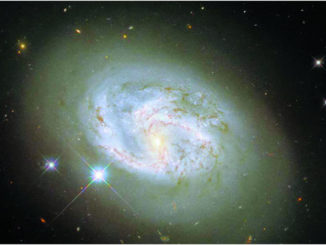
    NASA has shared a stunning image of the spiral galaxy NGC 4680 in all its glory. The image is said to have been taken by the Hubble’s Wide Field Camera 3. The NGC 4680 galaxy had earlier made news in 1997, as it played host to a supernova explosion known as SN 1997bp according to NASA. The supernova had been identified by Australian amateur astronomer Robert Evans who is said to have identified  42 supernova explosions.

    NASA states that the NGC 4680 is a tricky galaxy to classify. The space agency further states that this is because the galaxy is sometimes referred to as a spiral galaxy, but it is also sometimes classified as a lenticular galaxy.

    Lenticular galaxies are said to fall somewhere in between spiral galaxies and elliptical galaxies. The NGC 4680 galaxy is said to have distinguishable spiral arms that are not clearly defined, and the tip of one arm appears very diffuse.

    NASA says that Galaxies are not static, and their morphologies vary throughout their lifetimes. Over time, Spiral galaxies are believed to evolve into elliptical galaxies. NASA states that this is most likely due to the galaxies merging with one another, causing them to lose their distinctive spiral structures.

    Source: Indian Express

  • NASA’s Juno sends 1st images of Jupiter’s largest moon

    NASA’s Juno sends 1st images of Jupiter’s largest moon

    After flying closer to Jupiter’s largest moon than any other in more than two decades, NASA’s Juno spacecraft has sent back two images offering dramatic glimpses of the icy orb.

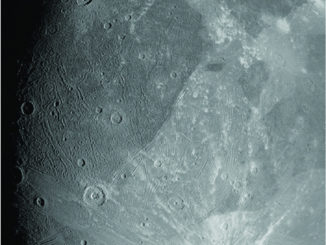
    During the flyby on June 7, Juno came within 645 miles (1,038 kilometres) of the surface of Jupiter’s largest moon Ganymede and took two images from the Jupiter orbiter’s JunoCam imager and from its Stellar Reference Unit star camera.

    The photos show the surface of Ganymede in remarkable detail, including craters, clearly distinct dark and bright terrain, and long structural features possibly linked to tectonic faults.

    “This is the closest any spacecraft has come to this mammoth moon in a generation,” said Juno Principal Investigator Scott Bolton of the Southwest Research Institute in San Antonio, in a statement. “We are going to take our time before we draw any scientific conclusions, but until then we can simply marvel at this celestial wonder,” he added.

  • NASA’s Venus missions to probe divergent fate of Earth’s hothouse sister planet

    NASA’s Venus missions to probe divergent fate of Earth’s hothouse sister planet

    NASA has announced plans to launch a pair of missions to Venus between 2028 and 2030 – its first in decades – to study the atmosphere and geologic features of Earth’s so-called sister planet and better understand why the two emerged so differently.

    The U.S. space agency said it was awarding about $500 million each to develop the two missions, dubbed DAVINCI+ (short for Deep Atmosphere Venus Investigation of Noble Gases, Chemistry and Imaging) and VERITAS (an acronym for Venus Emissivity, Radio Science, InSAR, Topography and Spectroscopy).

    DAVINCI+ will measure the composition of the dense, hothouse atmosphere of Venus to further understand how it evolved, while VERITAS will map the planet’s surface from orbit to help determine its geologic history, NASA said.

    DAVINCI+, consisting of a fly-by spacecraft and an atmospheric descent probe, is also expected to return the first high-resolution images of unique geological characteristics on Venus called “tesserae.” Scientists believe those features may be comparable to Earth’s continents and suggest that Venus has plate tectonics, according to NASA’s announcement.

  • Mars Curiosity Rover snaps shining clouds on Red Planet

    NASA’s Mars Curiosity rover has captured shining clouds on the Red Planet, which arrived earlier and formed higher than expected.

    The atmosphere on Mars is usually thin, dry and cloudy days are rare. And clouds are typically found at the planet’s equator in the coldest time of year, when Mars is the farthest from the Sun in its oval-shaped orbit. But the scientists noticed clouds forming over NASA’s Curiosity rover earlier than expected, one full Martian year ago – two Earth years.

    In late January this year, the team started documenting these “early” clouds. The images show wispy puffs filled with ice crystals that scattered light from the setting Sun, some of them shimmering with colour.

    The rover’s Mast Camera, or Mastcam snapped colour images and the iridescent, or “mother of pearl” clouds on March 5, 2021, the 3,048th Martian day, or sol, of the mission. “If you see a cloud with a shimmery pastel set of colors in it, that’s because the cloud particles are all nearly identical in size. That’s usually happening just after the clouds have formed and have all grown at the same rate,” said Mark Lemmon, an atmospheric scientist with the Space Science Institute in Boulder, Colorado.

    These clouds are among the more colorful things on the Red Planet, Lemmon added. If you were skygazing next to Curiosity, you could see the colours with the naked eye, although they’d be faint.

  • NASA astronaut successfully harvests 2 plants in space

    NASA astronaut successfully harvests 2 plants in space

    Washington (TIP): NASA’s Expedition 64 crew member Michael Hopkins has harvested two crops in space—‘Amara mustard, and a previously grown crop, ‘Extra Dwarf pak choi. They were grown for 64 days, the longest leafy greens have grown on station, the US space agency said.

    The pak choi grew for so long that it began to flower as part of its reproduction cycle. Hopkins’ efforts in eclipsing the mark included using a small paintbrush to pollinate plant flowers.

    “I wasn’t all at surprised that he chose this route to make sure the plants were fully pollinated because he has always wanted to be very involved,” Matt Romeyn, a space crop production project scientist and science lead on the four-plant experiments, said in a statement on Tuesday.

    “After he used the paintbrush, we saw a high seed production rate,” he added.

    Hopkins ate the pak choi as a side dish, with leaves marinated in an empty tortilla package. He added soy sauce and garlic, and put it in a small food warmer for 20 to 30 minutes, NASA shared in a post.

    Astronauts have been enjoying the Amara mustard “like a lettuce wrap,” Hopkins explained, adding ingredients such as chicken, soy sauce, and balsamic vinegar.

    “Delicious, plus the texture or crunch,” he wrote in the experiment notes after sampling Amara mustard grown in space.

    While the astronauts’ pre-packaged food offers variety and nutrition, fresh crops deliver an appealing addition. Hopkins said the plants were a much appreciated “connection to Earth” and that connection is one reason he uses his personal time to be a space gardener.

    The experiment is important because fruit crops require pollination, and crews need to understand how the process works in microgravity and, eventually, in reduced gravity.

    As part of the Plant Habitat-04 experiment, the Kennedy Space Centre will send pepper seeds to the space station later this year. The pepper seeds will fly on SpaceX’s 22nd Commercial Resupply Services mission and will grow in the Advanced Plant Habitat. A VEG-05 experiment with dwarf tomatoes also is planned for Veggie next year, NASA said.