Tag: NASA

  • NASA MAY SEND ROBOTIC SPACECRAFT TO SUN NEXT YEAR

    NASA MAY SEND ROBOTIC SPACECRAFT TO SUN NEXT YEAR

    WASHINGTON (TIP): NASA plans to send its first robotic spacecraft to the Sun next year that is slated to get within six million kilometres of the blazing star to probe its atmosphere.

    Humans have sent spacecraft to the Moon, Mars and even distant interstellar space. Now, NASA plans to launch the Solar Probe Plus mission to the Sun which is about 149 million kilometres from the Earth.

    “This is going to be our first mission to fly to the Sun,” said Eric Christian, a NASA research scientist at Goddard Space Flight Centre.

    “We can’t get to the very surface of the Sun,” but the mission will get close enough to answer three important questions, Christian said.

    First, the mission will hopefully unveil why the surface of the Sun, called the photosphere, is not as hot as its atmosphere, called the corona.

    According to NASA, the surface temperature of the Sun is only about 5,500 degrees Celsius. However, the atmosphere above it is a sizzling two million degrees Celsius.

    “You would think the farther away you get from a heat source, you would get colder. Why the atmosphere is hotter than the surface is a big puzzle,” Christian said.

    The scientists also want to know how solar wind gets its speed, ‘Live Science’ reported. “The Sun blows a stream of charged particles in all directions at a million miles an hour. But we do not understand how that gets accelerated,” he said. The mission may also ascertain why the Sun occasionally emits high-energy particles that are a danger to unprotected astronauts and spacecraft.

    NASA has designed a 11.4 centimetres carbon-composite shield, which is designed to withstand temperatures outside the spacecraft of 1,370 degrees Celsius.

    The unmanned probe will have special heat tubes called thermal radiators that will radiate heat that permeates the heat shield to open space, “so it does not go to the instruments, which are sensitive to heat,” Christian added.

  • NASA may build ice homes on Mars to protect astronauts

    NASA may build ice homes on Mars to protect astronauts

    WASHINGTON (TIP): To protect astronauts from the harsh Martian environment, the best building material for a new home on the Red Planet may lie in ice, say NASA researchers.

    The surface of Mars has extreme temperatures and the atmosphere does not provide adequate protection from high-energy radiation. The researchers believe that their “Ice Home” design provides a sound engineering solution to offer astronauts a safe place to call home. The Mars Ice Home is a large inflatable torus, a shape similar to an inner tube that is surrounded by a shell of water ice. This is just one of many potential concepts for sustainable habitation on the Red Planet in support of NASA’s journey to Mars. “After a day dedicated to identifying needs, goals and constraints we rapidly assessed many crazy, out of the box ideas and finally converged on the current Ice Home design, which provides a sound engineering solution,” Kevin Vipavetz from NASA’s Langley Research Center in Hampton, Virginia, said in a statement on Thursday.

    The Mars Ice Home design has several advantages that make it an appealing concept, according to the scientists.

    Source: IANS

  • NASA’S CASSINI SET TO  FLY CLOSEST EVER TO SATURN’S RINGS

    NASA’S CASSINI SET TO FLY CLOSEST EVER TO SATURN’S RINGS

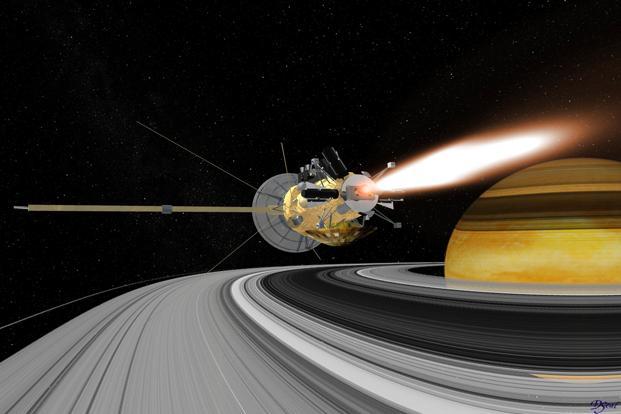
    WASHINGTON (TIP): NASA’s Cassini spacecraft is set to begin a thrilling ride around Saturn, grazing past its outer rings to provide the closest-ever insight into the planet’s features.

    Between November 30 and April 22, the Cassini spacecraft will circle high over and under the poles of Saturn, diving every seven days – a total of 20 times -through the unexplored region at the outer edge of the main rings.

    Engineers at NASA have been pumping up the spacecraft’s orbit around Saturn this year to increase its tilt with respect to the planet’s equator and rings.

    On November 30, following a gravitational nudge from Saturn’s moon Titan, Cassini will enter the first phase of the mission’s dramatic endgame.

    Launched in 1997, Cassini has been touring the Saturn system since arriving there in 2004 for an up-close study of the planet, its rings and moons.

    During its journey, Cassini has made numerous dramatic discoveries, including a global ocean within Enceladus and liquid methane seas on Titan.

    “We’re calling this phase of the mission Cassini’s Ring-Grazing Orbits, because we’ll be skimming past the outer edge of the rings,” said Linda Spilker, Cassini project scientist at NASA’s Jet Propulsion Laboratory in the US.

    “In addition, we have two instruments that can sample particles and gases as we cross the ringplane, so in a sense Cassini is also ‘grazing’ on the rings,” said Spilker.

    On many of these passes, Cassini’s instruments will attempt to directly sample ring particles and molecules of faint gases that are found close to the rings.

    During the first two orbits, the spacecraft will pass directly through an extremely faint ring produced by tiny meteors striking the two small moons Janus and Epimetheus.Ring crossings in March and April will send the spacecraft through the dusty outer reaches of the F ring. “Even though we’re flying closer to the F ring than we ever have, we’ll still be more than 7,800 kilometres distant. There’s very little concern over dust hazard at that range,” said Earl Maize, Cassini project manager at JPL. The F ring marks the outer boundary of the main ring system; Saturn has several other, much fainter rings that lie farther from the planet.

    The F ring is complex and constantly changing. Earlier Cassini images have shown structures like bright streamers, wispy filaments and dark channels that appear and develop over mere hours.

    The ring is also quite narrow – only about 800 kilometres wide. At its core is a denser region about 50 kilometres wide.

    Cassini’s ring-grazing orbits offer unprecedented opportunities to observe the menagerie of small moons that orbit in or near the edges of the rings, including best-ever looks at the moons Pandora, Atlas, Pan and Daphnis.

    Grazing the edges of the rings also will provide some of the closest-ever studies of the outer portions of Saturn’s main rings (the A, B and F rings).


  • Best weather satellite ever  built rockets into space

    Best weather satellite ever built rockets into space

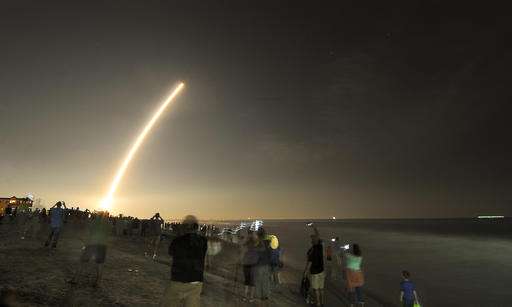
    CAPE CANAVERAL, FLORIDA (TIP): The most advanced weather satellite ever built rocketed into space on Saturday night, part of an $11 billion effort to revolutionize forecasting and save lives.

    This new GOES-R spacecraft will track US weather as never before: hurricanes, tornadoes, flooding, volcanic ash clouds, wildfires, lightning storms, even solar flares. Indeed, about 50 TV meteorologists from around the country converged on the launch site including NBC’s Al Roker along with 8,000 space program workers and guests. “What’s so exciting is that we’re going to be getting more data, more often, much more detailed, higher resolution,” Roker said. In the case of tornadoes, “if we can give people another 10, 15, 20 minutes, we’re talking about lives being saved.” Think superhero speed and accuracy for forecasting. Super high-definition TV, versus black-and-white. “Really a quantum leap above any satellite NOAA has ever flown,” said Stephen Volz, the National Oceanic and Atmospheric Administration’s director of satellites.

    “For the American public, that will mean faster, more accurate weather forecasts and warnings,” Volz said earlier in the week. “That also will mean more lives saved and better environmental intelligence” for government officials responsible for hurricane and other evacuations.

  • MARS SURFACE TOO DRY TO BE HABITABLE: SCIENTISTS

    MARS SURFACE TOO DRY TO BE HABITABLE: SCIENTISTS

    LONDON (TIP): Mars is a primary target in the search for life outside Earth, and liquid water is the most important pre-requisite for life. But a team of international researchers has found that Mars is incredibly dry, and has been that way for millions of years.

    “Evidence shows that more than three billion years ago Mars was wet and habitable. However, this latest research reaffirms just how dry the environment is today,” said Christian Schroder, Lecturer at the University of Stirling in Britain

    “For life to exist in the areas we investigated, it would need to find pockets far beneath the surface, located away from the dryness and radiation present on the ground,” Schroder, who is also science team collaborator for NASA’s Mars Exploration Rover Opportunity mission, noted.

    The discovery, published in the journal Nature Communications, provides vital insight into the planet’s current environment and shows how difficult it would be for life to exist on Mars today.

    Using data from the Opportunity mission, the scientists examined a cluster of meteorites at Meridiani Planum — a plain just south of the planet’s equator and at a similar latitude to Gale crater.

    The researchers calculated a chemical weathering rate for Mars, in this case how long it takes for rust to form from the metallic iron present in meteorites.

    This chemical weathering process depends on the presence of water. It takes at least 10 and possibly up to 10,000 times longer on Mars to reach the same levels of rust formation than in the driest deserts on Earth and points to the present-day extreme aridity that has persisted on Mars for millions of years, the study said.

    A study published last year, which used data from the Curiosity Rover investigating Gale crater on Mars, suggested that very salty liquid water might be able to condense in the top layers of Martian soil overnight.

    “But, as our data show, this moisture is much less than the moisture present even in the driest places on Earth,” Schroder explained. Source: IANS

  • NASA SPACE TELESCOPES REVEAL A BROWN DWARF

    NASA SPACE TELESCOPES REVEAL A BROWN DWARF

    WASHINGTON (TIP): In a first-of-its-kind collaboration, Nasa’s Spitzer and Swift space telescopes joined forces to reveal a brown dwarf – thought to be the missing link between planets and stars, with masses up to 80 times that of our solar system’s most massive planet, Jupiter.

    The discovery of this brown dwarf, with the unwieldy name OGLE-2015-BLG-1319, marks the first time two space telescopes have collaborated to observe a microlensing event — when a distant star brightens due to the gravitational field of at least one foreground cosmic object, Nasa said in a statement on Thursday.

    “We want to understand how brown dwarfs form around stars, and why there is a gap in where they are found relative to their host stars,” said Yossi Shvartzvald from Nasa’s Jet Propulsion Laboratory, Pasadena, California, and lead author of a study published in the Astrophysical Journal.

    Spitzer and Swift observed the microlensing event after being tipped off by ground-based microlensing surveys, including the Optical Gravitational Lensing Experiment (OGLE).

    By combining data from these space-based and ground-based telescopes, researchers determined that the newly discovered brown dwarf is between 30 and 65 Jupiter masses.

    They also found that the brown dwarf orbits a K dwarf, a type of star that tends to have about half the mass of the sun.

    “In the future, we hope to have more observations of microlensing events from multiple viewing perspectives, allowing us to probe further the characteristics of brown dwarfs and planetary systems,” co-author of the study Geoffrey Bryden Jet Propulsion Laboratory.

  • NASA’S CURIOSITY ROVER BEGINS EXPLORING NEW MARS DESTINATIONS

    NASA’S CURIOSITY ROVER BEGINS EXPLORING NEW MARS DESTINATIONS

    WASHINGTON (TIP): Nasa’s Curiosity Mars rover is driving towards new uphill destinations to further study ancient, water-rich environments and potential for life on the red planet.

    The destinations include a ridge capped with material rich in the iron-oxide mineral hematite, about two-and-a-half kilometres from its current location, and an exposure of clay-rich bedrock beyond that.

    These are key exploration sites on lower Mount Sharp, which is a layered mound where the Curiosity rover is studying evidence of ancient, water-rich environments that contrast with the harsh, dry conditions on the surface of Mars today.

    “We continue to reach higher and younger layers on Mount Sharp,” said Curiosity Project Scientist Ashwin Vasavada, of NASA’s Jet Propulsion Laboratory in the US.

    Hundreds of photos Curiosity took in recent weeks amid a cluster of mesas and buttes of diverse shapes are fresh highlights among the more than 180,000 images the rover has taken since landing on Mars in August 2012.

    Newly available vistas include the rover’s self-portrait from the colour camera at the end of its arm and a scenic panorama from the colour camera at the top of the mast.

    “Bidding good-bye to ‘Murray Buttes,’ Curiosity’s assignment is the ongoing study of ancient habitability and the potential for life,” said Curiosity Programme Scientist Michael Meyer at NASA Headquarters, Washington.

    “This mission, as it explores the succession of rock layers, is reading the ‘pages’ of Martian history -changing our understanding of Mars and how the planet has evolved,” Meyer said.

    The latest drill site – the 14th for Curiosity – is in a geological layer about 180 meters thick, called the Murray formation. Curiosity has climbed nearly half of this formation’s thickness so far and found it consists primarily of mudstone, formed from mud that accumulated at the bottom of ancient lakes. The findings indicate that the lake environment was enduring, not fleeting.

    For roughly the first half of the new two-year extended mission, the rover team anticipates investigating the upper half of the Murray formation.

    “We will see whether that record of lakes continues further,” Vasavada said.

    “The more vertical thickness we see, the longer the lakes were present, and the longer habitable conditions existed here,” he said.

  • SPACECRAFT SENT TO ASTEROID TO TRY AND STOP ARMAGEDDON

    SPACECRAFT SENT TO ASTEROID TO TRY AND STOP ARMAGEDDON

    #Nasa has sent a spacecraft chasing after an unexplored asteroid, in the hope that it might one day keep us from being destroyed.

    The OSIRIS-REx robotic hunter has blasted off to the asteroid Bennu. When it gets there it will scoop up bits of ancient space rock – which could eventually tell us not just about where we came from but whether there is life elsewhere as well.

    But before it helps us find aliens, the craft might help us save ourselves.

    Bennu comes past Earth every six years – and could come so close in 150 years that it hits us. The odds are tiny – less than one-tenth of 1 per cent – but that is still significant.

    And while the rock itself wouldn’t destroy Earth, though could cause huge destruction, there are asteroids flying around

    By sending the craft to Bennu, scientists will be able to learn more about the still somewhat mysterious paths of asteroids, and help them predict when one might collide with us. It might also help them learn more about what to do if one is.

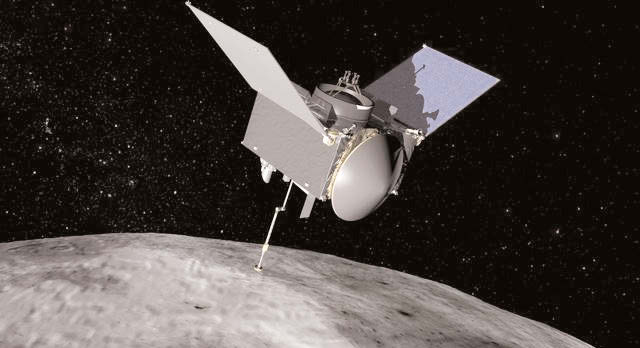
    OSIRIS-REx will hover like a hummingbird over Bennu, according to Lauretta, as the spacecraft’s 10 ft (3m) mechanical arm touches down like a pogo stick on the surface for three to five seconds. Thrusters will shoot out nitrogen gas to stir up the surface, and the loose particles will be sucked up into the device. Spacecraft managers call it “the gentle high five.” They get just three shots at this, before the nitrogen gas runs out and the effort abandoned.

    The team opted for this touch-and-go procedure instead of landing to increase the odds of success. Despite extensive observations of Bennu from ground and space telescopes, no one knows exactly what to expect there, and it could be difficult if not impossible to anchor a spacecraft on the surface, Lauretta said.

    Osiris-Rex’s freed sample container – the same kind used for the comet-dust retrieval – will parachute down with the pristine asteroid treasure in Utah. The mother spacecraft, meanwhile, will continue its orbit of the sun.

    Among the 8,000 Nasa launch guests was the schoolboy who came up with the asteroid’s name for a contest.

    Twelve-year-old Mike Puzio of Greensboro, North Carolina, cheered as he watched his first up-close rocket launch: “It was awesome!”

    “Unbelievable,” added Dr. Larry Puzio, his pediatrician dad.

    The name Bennu comes from the heron of Egyptian mythology. Mike thought OSIRIS-REx looked like a bird, with its twin solar wings and long arm outstretched for a sample grab. And with the spacecraft named after the Egyptian god Osiris, Bennu was an obvious choice, he said.

    OSIRIS-REx is also a Nasa acronym for origins, spectral interpretation, resource identification, security-regolith explorer. The estimated cost of the mission is more than $800m (£603m).

    “Space exploration brings out the best in us,” Nye said shortly before OSIRIS-REx began its journey. “It is an extraordinary use of our intellect and treasure to elevate humankind, to help us know our place in the cosmos.” Source: The Independent

    Space agency starts to unfold

    atlas of 1 billion stars in 3D

    MADRID: If space is the final frontier, it will help to have an accurate map, and the European Space Agency says its mission to chart more than 1 billion stars in the Milky Way is on track for completion in a year’s time.

    The agency released the first data on Wednesday from its ongoing effort to draw the biggest and most precise three-dimensional map of our galaxy.

    Mission manager Fred Jansen told a news conference in Madrid that he is “extremely happy” with the precision of the data gathered so far. It is being distributed among scientists for analysis.

    At the heart of the five-year mission is the 10-meter (33-foot)-wide Gaia spacecraft, which resembles a barrel sitting on a saucer. It carries two telescopes and is orbiting slowly around the sun.

  • NASA images unveil origins of solar wind

    NASA images unveil origins of solar wind

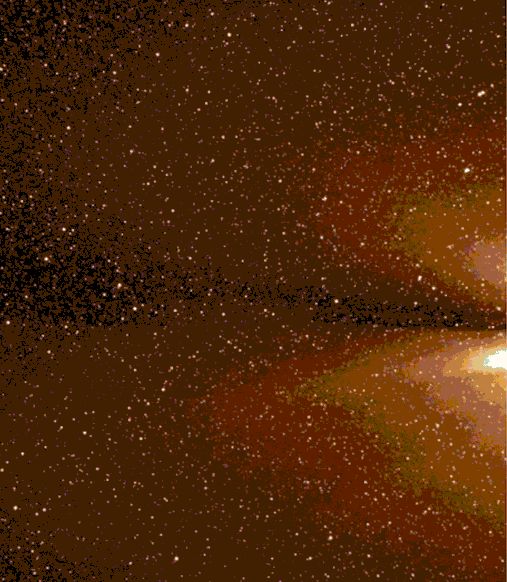
    WASHINGTON (TIP): Nasa scientists have for the first time imaged the edge of the Sun, enabling them to describe the mysterious origins of solar wind.

    Ever since the 1950s discovery of the solar wind —the constant flow of charged particles from the Sun —there has been a disconnect between this outpouring and the Sun itself.

    As it approaches Earth, the solar wind is gusty and turbulent. But near the Sun where it originates, this wind is structured in distinct rays, much like a child’s simple drawing of the Sun.

    The details of the transition from defined rays in the corona, the Sun’s upper atmosphere, to the solar wind have been, until now, a mystery.

    Now, using Nasa’s Solar Terrestrial Relations Observatory, or STEREO, scientists have for the first time imaged the edge of the Sun and described that transition, where the solar wind starts.

    Defining the details of this boundary helps us learn more about our solar neighbourhood, which is bathed throughout by solar material — a space environment that we must understand to safely explore beyond our planet, researchers said.

    “Now we have a global picture of solar wind evolution,” said Nicholeen Viall, scientist at Nasa’s Goddard Space Flight Centre in the US.

    “This is really going to change our understanding of how the space environment develops,” said Viall.

    Both near Earth and far past Pluto, our space environment is dominated by activity on the Sun.

    The Sun and its atmosphere are made of plasma – a mix of positively and negatively charged particles which have separated at extremely high temperatures, that both carries and travels along magnetic field lines.

    Material from the corona streams out into space, filling the solar system with the solar wind.

  • 2 Indian-American Women Named White House Fellows

    2 Indian-American Women Named White House Fellows

    WASHINGTON: Two Indian-American women have been selected for the prestigious White House Fellow programme that offers first-hand experience of working at the highest levels of the US federal government.

    Astrophysicist Anjali Tripathi from California and physician Tina R Shah from Chicago are among the 16 White House Fellows appointed from across the nation for the year 2016-17, officials said.

    Shah is a Pulmonary and Critical Care physician-scientist focused on transforming healthcare delivery for patients with chronic diseases.

    She recently completed her clinical fellowship at the University of Chicago (UC), where she redesigned the care cycle for patients with Chronic Obstructive Pulmonary Disease (COPD), dramatically reducing hospital re-admissions.

    As the recipient of the inaugural UC Innovations Grant, Shah also led an inter-professional research team to evaluate this value-based care delivery programme.

    Shah was a trustee for the Chicago Medical Society and has held leadership positions in other medical societies to advocate for her patients and for a sustainable medical workforce. She received a BS and an MD from the Pennsylvania State University/Jefferson Medical College accelerated six- year medical program and MPH from Harvard.

    Tripathi, an astrophysicist recently at Harvard University, focuses on the formation and evolution of planets. She has pioneered the characterisation of planet forming environments and developed the first 3D simulations of planets evaporating due to extreme atmospheric heating.

    Tripathi has also been involved in modelling the Milky Way and the search for dark matter. Previously, she has conducted particle physics, seismology and engineering research at Fermilab, Caltech, MIT, and NASA JPL, as part of the mission operations team for the Mars Rovers, Spirit and Opportunity.

    Her commitment to improving her community has been recognised by Harvard, MIT, and the American Red Cross. Tripathi will receive her Ph.D. in Astronomy from Harvard, where she earned an AM in Astronomy as an NSF Graduate Research Fellow. She received M Phil in Astronomy from Cambridge University as a Marshall Scholar and SB in Physics, with a minor in Applied International Studies, from MIT.

    The White House Fellows Program was created in 1964 by President Lyndon B Johnson to give promising American leaders “first hand, high-level experience with the workings of the Federal government and to increase their sense of participation in national affairs”.

    Selection as a White House Fellow is highly competitive and based on a record of professional achievement, evidence of leadership potential and a proven commitment to public service. Each Fellow must possess the knowledge and skills necessary to contribute meaningfully at senior levels of the Federal government.

  • NASA to launch first asteroid sample return mission next month

    NASA to launch first asteroid sample return mission next month

    WASHINGTON (TIP): NASA, the US space agency is set to launch its first mission to return a sample of an asteroid to Earth on September 8 from Cape Canaveral Air Force Station in Florida.

    The mission will help scientists investigate how planets formed and how life began, as well as improve our understanding of asteroids that could impact Earth, NASA said in a statement on Wednesday.

    The Origins, Spectral Interpretation, Resource Identification, Security-Regolith Explorer (OSIRIS-REx) spacecraft will travel to the near-Earth asteroid Bennu and bring a sample back to Earth for intensive study.

    “The launch of OSIRIS-REx is the beginning a seven-year journey to return pristine samples from asteroid Bennu,” said OSIRIS-REx Principal Investigator Dante Lauretta of the University of Arizona, Tucson.

    “The team has built an amazing spacecraft, and we are well-equipped to investigate Bennu and return with our scientific treasure,” Lauretta said.

    The 2,110-kg fully-fuelled spacecraft will launch aboard an Atlas V 411 rocket during a 34-day launch period that begins on September 8, and reach its asteroid target in 2018.

    After a careful survey of Bennu to characterise the asteroid and locate the most promising sample sites, OSIRIS-REx will collect between 60 to 2,000 grams of surface material with its robotic arm and return the sample to Earth via a detachable capsule in 2023, the US space agency said.

  • NASA’s Juno spacecraft beams first pictures from Jupiter

    NASA’s Juno spacecraft beams first pictures from Jupiter

    PASADENA (TIP): NASA’s Juno spacecraft has sent back the first pictures since arriving at Jupiter.

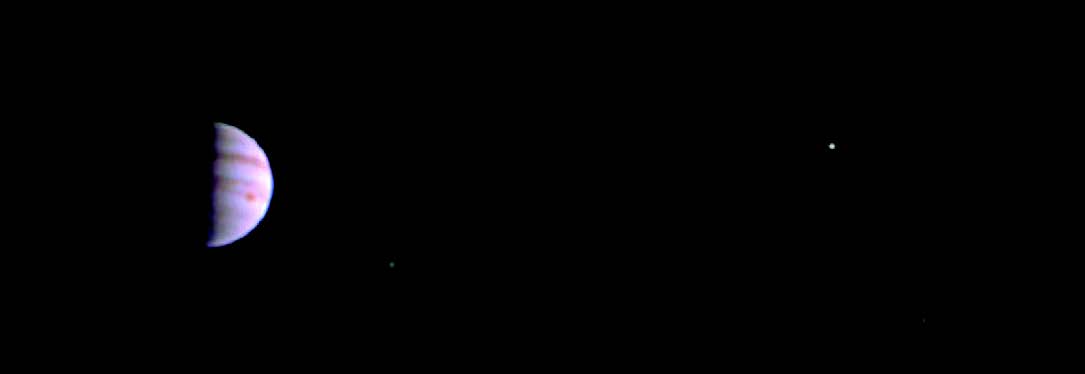
    An image released Tuesday shows Jupiter surrounded by three of its four largest moons. The picture was taken on Saturday when the Juno spacecraft was circling 3 million miles away. Even at that distance, Jupiter’s Great Red Spot- a centuries-old atmospheric storm- was visible.

    Juno entered orbit around Jupiter last week after a five-year journey. It’s on a 20-month mission to map the giant planet’s poles, atmosphere and interior.

    During the approach, the camera and instruments were powered off as a precaution as Juno braved intense radiation. The instruments were turned back on several days after the arrival.

    Scientists have said close-ups of Jupiter won’t come until next month when Juno swings back around.

  • Eid Mubarak, Happy Ramadan, Eid al-fitr

    Eid Mubarak, Happy Ramadan, Eid al-fitr

    The Word Ramadan is also pronounced Ramzan and in many other ways depending on the linguistic influence.

    The Arabic influenced languages call it Ramadan, whereas the Persian affiliated languages call it Ramzan, and with the touch of Sanskrit, it is also called Hari Raya. I am pleased to include the various names of Ramadan around the world in the list below. It is like the British and American variations in English.

    Please note the simplicity in writing is designed for people of other faiths to learn and to know, so we can relate with each other. If you like to wish a Muslim on this happy occasion, you can say Eid Mubarak, Happy Eid, Eid ki Shubh Kamnaeyien, Best wishes, Ramadan Kareem or Happy Ramadan.

    After fasting for 29 or 30 days, and based on the moon sighting, NASA calculations or other traditions, the fasting would come to an end with the celebration. It is one of the three major events for Muslims besides Bakrid and Muharram. Muslims typically gather in a large space and perform their thanksgiving prayer. Doctor Saab, add the link as a Reference previous article

    In the Hindu tradition at the end of Navaratri, Dussehra is celebrated on the 10th day; women fast for Karva Chouth, similarly in the Jain tradition; Paryushan and Daslakshan are celebrated after fasting for 7 to 9 days. The Jews observe fasting during Yom Kippur and Christians during lent through Easter Sunday. Fasting is also observed for medical reasons.

    Although Ramadan is popularly known in the West for its culinary delicacies and fancy Iftaar (ceremonial breaking of fast at sun down), the spirit and intent of Ramadan lies in a human transformation in a month long inner spiritual journey of finding oneself in tune with spirituality. God has no need for the hunger or thirst of someone who hurts others, violates their dignity or usurps their rights, said Prophet Muhammad (PBUH). The fasting of the stomach must be matched by the fasting of the limbs. The eyes, ears, tongue, hands and feet all have their respective fasts to undergo. The tongue’s temptations, for example – lies, backbiting, slander, vulgarity and senseless argumentation – must be challenged and curbed to maintain the integrity of the fast.

    Consciousness of behavior and vigilance over action are the most profound dimensions of fasting: the fasting of the heart focuses on the attachment to the divine. That is when Ramadan really becomes a source of peace and solace, just as Christmas goes beyond the rituals to bring forth kindness, charity and caring.

    True fasting is self-purification; and from this, a rich inner life that bring about values such as justice, generosity, patience, kindness, forgiveness, mercy and empathy – values that are indispensable for the success of the community.

    The purpose of fasting, i.e., abstaining from consuming food, liquids and sensual pleasures during a specified period brings self discipline, self-checking on one’s own integrity and health benefits.

    During fasting one is supposed to become honest, caring, just and a kind human being, a majority of people get that right, some don’t. It’s like the class room where the teacher teaches the same book to every student, yet one become the top scorer and one fails, while most of them pass at varying grades. Fasting is no different.

    Piety (Taqwa) is all about- getting closer to God, or becoming God-like. What is God like? It is to be free from prejudice and to be just, fair, safe and secure.

    So what do Muslims do on the day of Eid?

    From the moment we are born to the last rites of our life and every moment in-between is loaded with rituals, though some of us may deny it. Whether we go to the gym, eat our food; go to sleep, wear clothes, drive some place, in our intimate moments, or picking that phone up, we follow rituals or a system.

    Discipline is necessary to do things on time, managing personal relationships, driving to a destination or keeping within budget to achieve the goals; the result is worth the discipline to most people. When joyous, whether we are a theist or not, we have to express that sentiment, otherwise a sense of incompleteness lingers in our hearts.

    1. Chand Raat is the evening when moon is sighted; everyone gets out and goes shopping for a variety of things to wear the next day. It is really the first day out from 29 days of fasting and everyone looks forward to it.
    2. Mehendi (henna) is applied to female hands over night – these traditions vary from region to region and nation to nation.
    3. Most Muslims wear new clothes signifying a new beginning and that tradition is prevalent in almost every faith.
    4. Zakat is due; it is tithe, like tax, and it is approximately 2.5% of your wealth that you share with your less fortunate fellow beings. It is a way to reduce your guilt that you are blessed with resources while some are not, and also to ensure the society you are not a hoarder.
    5. On the morning, usually around 8 AM -Muslims gather up near a Mosque and walk to a central place to pray together.
    6. It’s a short prayer with a sermon before and after the Namaz. We need an improvement in this area; most of the Sermons are boring and irrelevant.
    7. In the United States, if the Mosque is big enough, they all gather up at the Mosque, or rent a large hall for the congregation.
    8. In many nations people gather up near the cemetery to pray. We did that in my town Yelahanka, a suburb of Bangalore.
    9. Invariably, Muslim throughout the world visits a cemetery to honor their dead. However, the long held tradition is losing its tractions as we become more and more mobile. Memorial Day -http://centerforpluralism.com/memorial-day-and-muslims/
    10. Almost all Muslims hug each other, it is time to put aside the differences and reconnect with each other, they hug three times, each time signifying, I seek your forgiveness and lastly both seek friendship.
    11. On the day of Eid, Muslims cook the best of their foods. Usually it is an open house to friends and family members; no one eats full meal anyplace, but eats a little at each home they visit.
    12. Dessert made out of Vermicelli is the most common item across the world, most of the Desi’s be it Indians, Pakistanis, Bangladeshis and Sri Lankans enjoy Sheer Khurma -Vermicelli’s in liquid form with cashew, dried grapes, pistachio and their likes. I like the thin version that I can pour in a cup of tea and drink.
    13. As it happens on Ugadi, Baisakhi, Dussehra, Christmas and Thanksgiving, people eat more that they can consume on that day and complain that they should not have had that much food, including this writer.

    Everything you had always wanted to know about Ramadan is finally here at this website. www.RamadanNews.com. It has got everything about Ramadan – from how it is celebrated around the world (including Mayans) to what the world leaders say to fantastic TV commercials about Ramadan – The essence, politics, rituals and traditions of Ramadan and more. Plus the most read articles and the current articles about Ramadan.

    “Festivals of the World” is an educational series by Mike Ghouse since 1993 with a belief that, when we live as neighbors, we might as well learn about each other. The best way to build cohesive societies is for its members to understand each other’s sorrows and joys, and festivities and commemorations. We are updating the website www.CenterforPluralism.com , until such time, you can Google the name of Festival with my name and hopefully you will have some information about most festivals of the world.

    (The author is President of the Center for Pluralism, a think tank that offers pluralistic solutions on issues of the day, be it religious, political, social, cultural or racial. He is a motivational speaker on Pluralism, Interfaith, Islam, politics, terrorism, human rights and foreign policy. A community consultant, pluralist, social scientist, thinker, writer, activist, news maker and an Interfaith Wedding Officiant. He is committed to building cohesive societies and offers pluralistic solutions on issues of the day. Please visit www.CenterforPluralism.com and www.MikeGhouse.net)

  • Houston Celebrates Yoga Event At NASA Space Center

    Houston Celebrates Yoga Event At NASA Space Center

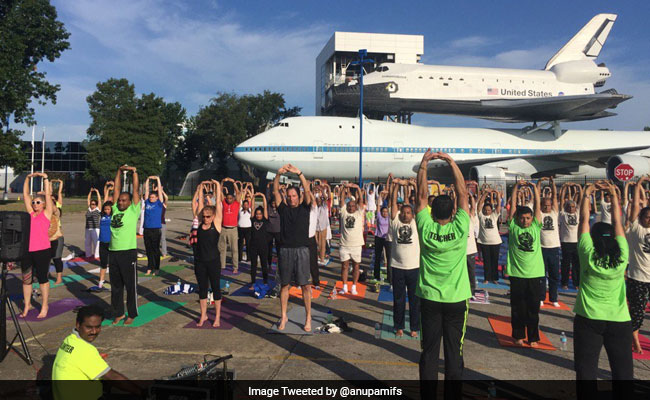
    Hundreds of American yoga enthusiasts rolled out their colourful mats, twisting their bodies and performing ‘Surya Namaskar’ in front of the space shuttle at NASA’s landmark Johnson Space Center early on Sunday.

    Consulate General of India, Houston, in partnership with Patanjali Yogpeeth (USA), yoga studios and several community and supporting organisations held this repeat event on public demand, within a week of the successful International Day of Yoga on June 21.

    “It is our pleasure to bring together a large number of diverse Houstonians and institutions for celebrating the second International Day of Yoga in a befitting manner,” Anupam Ray, Consul General of India, told PTI.

    “NASA and Johnson Space Center are Houston icons and represent the finest of human endeavour. There is no better way to commemorate International Day of Yoga than by linking timeless Yoga with the best of modern-science”.

    “Being a Yoga practitioner myself, I encourage all Houstonians to perform Yoga and actively participate in these events with interactive Yoga sessions to spread the message of Yoga for peace and harmony,” he said.

    The free event had everything for yoga lovers from interactive yoga sessions and demonstrations to Collective Yoga Session for Harmony and Peace consisting of Asanas, Relaxation, Pranayama as well as Meditation.

    Many attendees were excited to perform Yoga in the backdrop of the landmark Space Shuttle, International Yoga Day was observed for only the second year this year.

  • NASA MISSION DISCOVERS INFANT EXOPLANET AROUND YOUNG STAR

    NASA MISSION DISCOVERS INFANT EXOPLANET AROUND YOUNG STAR

    WASHINGTON (TIP): Using NASA’s Kepler Space Telescope and its extended K2 mission, astronomers have discovered a newborn fully-formed exoplanet –planets that orbit stars beyond our Sun — ever detected around a young star.

    The newfound planet named K2-33b is a bit larger than Neptune and whips tightly around its star every five days.

    It is only five to 10 million years old, making it one of a very few newborn planets found to date.

    “Our Earth is roughly 4.5 billion years old. By comparison, the planet K2-33b is very young. You might think of it as an infant,” said led researcher Trevor David from California Institute of Technology (Caltech).

    Astronomers have discovered and confirmed roughly 3,000 exoplanets so far. However, nearly all of them are hosted by middle-aged stars, with ages of a billion years or more.

    “The newborn planet will help us better understand how planets form, which is important for understanding the processes that led to the formation of the Earth,” added co-author Erik Petigura from Caltech.

    The first signals of the planet’s existence were measured by K2. The telescope’s camera detected a periodic dimming of the light emitted by the planet’s host star, a sign that an orbiting planet could be regularly passing in front of the star and blocking the light.

    “Initially, this material may obscure any forming planets, but after a few million years, the dust starts to dissipate,” said co-author Anne Marie Cody, a NASA postdoctoral programme fellow.

    A surprising feature in the discovery of K2-33b is how close the newborn planet lies to its star. The planet is nearly 10 times closer to its star than Mercury is to our sun, making it hot.

    While numerous older exoplanets were found orbiting very tightly to their stars, astronomers have long struggled to understand how more massive planets like this one wind up in such small orbits.

    Some theories propose that it takes hundreds of millions of years to bring a planet from a more distant orbit into a close one and, therefore, cannot explain K2-33b which is quite a bit younger.

    K2-33b could have migrated there in a process called disk migration that takes hundreds of thousands of years.

    Or, the planet could have formed “in situ” — right where it is.

    The discovery of K2-33b, therefore, gives theorists a new data point to ponder.

    “The question we are answering is: Did those planets take a long time to get into those hot orbits or could they have been there from a very early stage? We are saying, at least in this one case, that they can indeed be there at a very early stage,” David noted in a paper appeared in the journal Nature.

  • AT A STROKE, PSLV C-34 LOBS 20 SATELLITES INTO ORBIT

    AT A STROKE, PSLV C-34 LOBS 20 SATELLITES INTO ORBIT

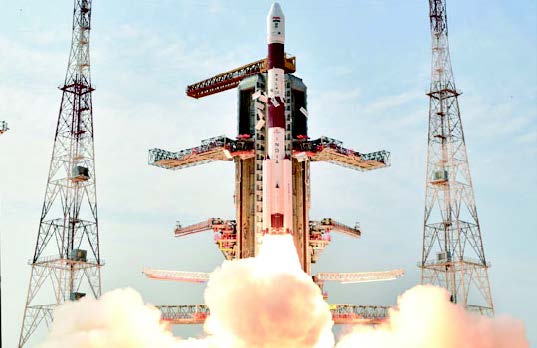
    CHENNAI (TIP): India took a big leap in space technology on June 22 when Indian Space Research Organization (ISRO) used its workhorse PSLV-C34 to inject 20 satellites including 17 foreign satellites into orbit in a single mission and set a new record on Wednesday.

    The 320-tonne Polar Satellite Launch Vehicle (PSLV-C34) took off on its 36th flight at 9.26am from the Satish Dhawan Space Centre with 20 satellites including its primary payload Cartosat-2 series, which provides remote sensing services, and earth observation and imaging satellites from US, Canada, Germany and Indonesia. It was also 14th flight of PSLV in ‘XL’configuration with the use of solid strap-on motors.

    Cartosat-2 was placed in orbit at 9.44am. With Cartosat-2 weighing 727.5kg, PSLV lifted off a total of 1,288kg in to space and began placing the satellites into orbit about 17minutes later.

    In the final stages of the mission, ISRO also demonstrated the vehicle’s capability to place satellites in different orbits. In the demonstration, the vehicle reignited twice after its fourth and final stage and moved further a few kilometres into another orbit.

    ISRO scientists said the demonstration is for their next mission when they are planning to inject satellites in different orbits using a single rocket.

    ISRO set a world record for the highest number of satellites launched in a single mission when it placed 10 satellites in a PSLV on April 28, 2008. Nasa in 2013 placed 29 satellites in a single mission and Russia in 2014 launched 33 satellites in one launch.

    In December 2015, when PSLV-C29 injected six Singapore satellites in to orbit, ISRO conducted a major experiment where the fourth stage was reignited and switched off after the satellites were placed in orbit.

    ISRO scientists said, the vehicle had been pre-programmed for today’s launch to perform tiny manoeuvring to place the 20 satellites into polar sun-synchronous orbits with different inclinations and velocities. It ensured that the satellites were placed with enough distance to prevent collision.

    ISRO began launching foreign satellites on board PSLV in May 1999. Since then, it has gained popularity, as it launched foreign satellites successfully using PSLV by charging only 60% of the fee charged by foreign space agencies. It has so far launched 57 foreign satellites.

  • UNIVERSE EXPANDING FASTER THAN EXPECTED: NASA

    UNIVERSE EXPANDING FASTER THAN EXPECTED: NASA

    WASHINGTON (TIP): The universe is expanding 5 to 9 per cent faster than thought, astronomers using Nasa’s Hubble Space Telescope have discovered.

    “This surprising finding may be an important clue to understanding those mysterious parts of the universe that make up 95 per cent of everything and don’t emit light, such as dark energy, dark matter, and dark radiation,” said study leader and Nobel Laureate Adam Riess of the Space Telescope Science Institute and The Johns Hopkins University in the US.

    Researchers made the discovery by refining the universe’s current expansion rate to unprecedented accuracy, reducing the uncertainty to only 2.4 per cent.

    The team made the refinements by developing innovative techniques that improved the precision of distance measurements to faraway galaxies.

    They looked for galaxies containing both Cepheid stars and Type Ia supernovae. Cepheid stars pulsate at rates that correspond to their true brightness, which can be compared with their apparent brightness as seen from Earth to accurately determine their distance.

    Type Ia supernovae, another commonly used cosmic yardstick, are exploding stars that flare with the same brightness and are brilliant enough to be seen from relatively longer distances.

    By measuring about 2,400 Cepheid stars in 19 galaxies and comparing the observed brightness of both types of stars, researchers accurately calculated distances to roughly 300 Type Ia supernovae in far-flung galaxies.

    They compared those distances with the expansion of space as measured by the stretching of light from receding galaxies.

    The team used these two values to calculate how fast the universe expands with time, or the Hubble constant.

    The improved Hubble constant value is 73.2 kilometres per second per megaparsec. A megaparsec equals 3.26 million light-years.

    The new value means the distance between cosmic objects will double in another 9.8 billion years.

    This refined calibration presents a puzzle, however, because it does not quite match the expansion rate predicted for the universe from its trajectory seen shortly after the Big Bang. Measurements of the afterglow from the Big Bang by Nasa’s Wilkinson Microwave Anisotropy Probe and the European Space Agency’s Planck satellite mission yield predictions for the Hubble constant that are 5 per cent and 9 per cent smaller.

    “If we know the initial amounts of stuff in the universe, such as dark energy and dark matter, and we have the physics correct, then you can go from a measurement at the time shortly after the big bang and use that understanding to predict how fast the universe should be expanding today,” said Riess.

    “However, if this discrepancy holds up, it appears we may not have the right understanding, and it changes how big the Hubble constant should be today,” he said.

  • NASA tries again to inflate spare room in space

    NASA tries again to inflate spare room in space

    WASHINGTON (TIP): Nasa tried again Saturday to inflate an add-on room at the International Space Station, after the first attempt ran into problems due to too much friction.

    Efforts to inflate the flexible habitat, known as the Bigelow Expandable Activity Module (Beam), got under way at about 9am.

    Space scientists monitoring the expansion at mission control in Houston, Texas, early Saturday expressed optimism that they were having early success this time around, as images on Nasa television showed the module slowly expanding after receiving three initial bursts of air.

    “Beam (is) continuing to slowly expand,” said Nasa spokesman Daniel Huot.

    “Everything going smoothly so far this morning, seeing good expansion both along the length and the diameter of BEAM. The pressure is well within what was expected.”

    Nasa is testing expandable habitats astronauts might use on the Moon or Mars in the coming decades. Operations to expand the module were led by Nasa astronaut Jeff Williams. A first attempt on Thursday was not successful. Nasa said that after a series of leak checks and other preparations, space station astronauts will enter the habitat through the station’s Tranquility module.

  • OCEAN ON JUPITER’S MOON MAY HARBOR LIFE: NASA

    OCEAN ON JUPITER’S MOON MAY HARBOR LIFE: NASA

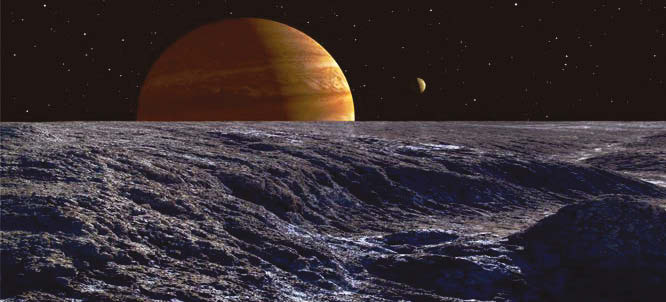
    WASHINGTON (TIP): The Europa ocean on Jupiter’s icy moon may have the Earth-like balance of chemical energy necessary for life, even if the moon lacks volcanic hydrothermal activity, a new Nasa study suggests.

    Europa is strongly believed to hide a deep ocean of salty liquid water beneath its icy shell. Whether the Jovian moon has the raw materials and chemical energy in the right proportions to support biology is a topic of intense scientific interest.

    The answer may hinge on whether Europa has environments where chemicals are matched in the right proportions to power biological processes. Life on Earth exploits such niches.

    In a new study, scientists at Nasa’s Jet Propulsion Laboratory (JPL) in California compared Europa’s potential for producing hydrogen and oxygen with that of Earth, through processes that do not directly involve volcanism.

    The balance of these two elements is a key indicator of the energy available for life. The study found that the amounts would be comparable in scale; on both worlds, oxygen production is about 10 times higher than hydrogen production.

    The work draws attention to the ways that Europa’s rocky interior may be much more complex and possibly Earth-like than people typically think, according to Steve Vance, a planetary scientist at JPL and lead author of the study.

    “We’re studying an alien ocean using methods developed to understand the movement of energy and nutrients in Earth’s own systems. The cycling of oxygen and hydrogen in Europa’s ocean will be a major driver for Europa’s ocean chemistry and any life there, just as it is on Earth,” said Vance.

    Ultimately, Vance and colleagues want to also understand the cycling of life’s other major elements in the ocean: carbon, nitrogen, phosphorus and sulphur.

    The researchers calculated how much hydrogen that could potentially be produced in Europa’s ocean as seawater reacts with rock, in a process called serpentinisation.

    In this process, water percolates into spaces between mineral grains and reacts with the rock to form new minerals, releasing hydrogen in the process.

    Researchers considered how cracks in Europa’s seafloor likely open up over time, as the moon’s rocky interior continues to cool since its formation billions of years ago.

    New cracks expose fresh rock to seawater, where more hydrogen-producing reactions can take place.

    In Earth’s oceanic crust, such fractures are believed to penetrate to a depth of 5 to 6 kilometres. On present-day Europa, the researchers expect water could reach as deep as 25 kilometres into the rocky interior, driving these key chemical reactions throughout a deeper fraction of Europa’s seafloor.

    The other half of Europa’s chemical-energy-for-life equation would be provided by oxidants – oxygen and other compounds that could react with the hydrogen – being cycled into the Europan ocean from the icy surface above.

    Europa is bathed in radiation from Jupiter, which splits apart water ice molecules to create these materials.

  • Two Indians win NASA’s Textile Test Methods Challenge managed by NineSigma

    Two Indians win NASA’s Textile Test Methods Challenge managed by NineSigma

    HOUSTON (TIP) NASA recently announced the winners of two challenges to create new concepts for construction and human habitation on future space exploration missions, including the agency’s journey to Mars.

    Ahilan Anantha Krishnan from Indian Institute of Technology Bombay for Evaluating Space Suit Textile Abrasion in Planetary Environments

    Himel Barua, a student at the University of Akron along with his team mates for Cylindrical Abrasion Method (team includes Himel Barua, Thomas L. Collins, Riniah Foor, Evan Hess, Joey Stavale, Christopher Daniels, Heather Oravec, Janice Mather and M.J. Braun)

    The Space Suit Textile Testing and In-Situ Materials Challenges, managed for NASA by NineSigma, launched in October 2015 under the umbrella of the NASA Tournament Lab, yielded innovative concepts for spacesuit testing and in-situ building materials use for habitat construction.

    “These two challenges offered the opportunity to think about two basic needs of exploration – protective suits and building materials – in a new way,” said Steve Rader, deputy manager of NASA’s Center of Excellence for Collaborative Innovation (CoECI). “Our journey to Mars will require innovations in design and technology; opening our process up to the public gives us more creative paths to follow.”

    The Space Suit Textile Testing Challenge offered three prizes of $5,000 for winning ideas on how to test the outer protective layer of spacesuit material for performance in different kinds of planetary environments, such as like Mars or large asteroids.

  • No ‘Goddard’ scholarship, internship offered to West Bengal teen: NASA

    No ‘Goddard’ scholarship, internship offered to West Bengal teen: NASA

    Earlier this week, Indian media carried reports of an 18-year-old girl from a village in eastern India being selected for NASA’s Goddard Internship Programme — a story that quickly went viral.

    It was reported that Sataparna Mukherjee was one of the five students chosen by the Goddard Institute of Space Studies. Mukherjee had said that she had never formally studied astrophysics but was selected after she shared her thoughts on ‘black hole theory’ on a Facebook group. According to her, a scientist from the group told her to share here findings with NASA, which then awarded her the scholarship to study in London.

    The US National Aeronautics and Space Administration (NASA) has denied an Indian teen girl’s claim that she was selected for its prestigious Goddard Internship Program (GIP) under the Goddard Institute for Space Studies (GISS). However, the girl still sticks to her stand.

    Eighteen-year-old suburban West Bengal resident Sataparna Mukherjee has attested to being the “youngest Indian to have been chosen for a NASA research project”.

    The resident of Madhyamgram in North 24 Parganas district claimed in an interview to IANS that the space agency had offered her a full scholarship to pursue graduation, post-graduation and PhD (as NASA faculty) in aerospace engineering at its “London Astrobiology Centre in Oxford University.”

    In an e-mail to IANS, a NASA official clarified: “We have no record of anyone by that name receiving an internship, scholarship or any form of academic or financial assistance from any NASA institute, center or program.”

    Further the official highlighted: “The program noted by multiple Indian media outlets does not exist.”

    The agency said its NASA GISS education program is the New York City Research Initiative (NYCRI), “where teams of high school and undergraduate students and faculty work alongside graduate students and the lead scientists of NASA-funded research projects at universities within a 50-mile radius of New York City…, or at the NASA Goddard Institute for Space Studies (GISS) under the mentorship of a GISS scientist.”

    NASA said the NYCRI application deadline has just passed and applications for its summer program were currently under review. “Selections have not been made.”

    However, an unfazed Mukherjee, who claims she is scheduled to leave for Britain in August, maintains she has the necessary documents to prove her assertions.

    Mukherjee had earlier sent a screen-shot to IANS of a purported correspondence from the space agency stating “Goddard Internship program as an employee and researchist. Technical writing for NASA’s Applied Earth Science and Technology Development Program.”

    Quizzed on NASA’s reaction, Mukherjee told IANS that the agency was issuing denials to maintain confidentiality.

    “I have the necessary documents and I can’t send them via mail as I was asked by NASA to maintain confidentiality. I also have my visa. You can come and see them.”

    On the widespread media coverage and the interviews she willingly appeared for, the student said she was “forced by media channels” to tell her story.

    “Since I am the only Indian selected, I was asked to maintain confidentiality. They (NASA) are denying it now because it’s in the news now.”

    Mukherjee has maintained she had posted a paper on NASA’s website on black hole theory which landed her the scholarship. She had also talked about getting through an exam (as one of top three scorers) for doing major in English at the Oxford University. However, even after repeated requests she failed to provide documentary evidence.

    Media reports have quoted Sataparna as saying she verified the authenticity of the NASA website at the Chennai office of the British Council.

    However, the British Council termed the claims as “false”.

    “British Council would like to refute and condemn false claims as they are baseless and without any premise. As per our records, nobody with this stated identity visited or contacted our office in Chennai,” a British Council official told IANS over e-mail.

  • 4 Indian-Americans Selected To US National Academy Of Engineering

    4 Indian-Americans Selected To US National Academy Of Engineering

    WASHINGTON:  Four Indian-Americans have been selected to the prestigious US National Academy of Engineering (NAE) to be part of its new list of 80 members for their valuable contributions to the society.

    Anil K Jain, Dr Arati Prabhakar, Ganesh Thakur and Dr K R Sridhar were formally made part of the NAE during a ceremony at its annual meeting here, the academy announced in a statement yesterday.

    Mr Jain, a distinguished professor in the department of computer science and engineering at the Michigan State University in East Lansing, was elected for his contributions to the field of engineering and practice of biometrics.

    An IIT-Kanpur alumnus, Mr Jain’s research focuses on pattern recognition, computer vision and biometric recognition.

    Dr Prabhakar, director of the US Defense Advanced Research Projects Agency (DARPA) in Virginia, was chosen for national leadership to advance semiconductor and information technologies.

    Beginning her career as a Congressional Fellow, Dr Prabhakar has also chaired the Efficiency and Renewables Advisory Committee for the US Department of Energy.

    Mr Thakur, who is the president of Thakur Services Inc. in Houston, Texas, was named a member for leadership in the implementation of integrated reservoir management techniques.

    Mr Sridhar, the principal co-founder and chief executive officer of Bloom Energy Corporation in California, was selected for the “contributions to transport phenomena and thermal packaging of electrochemical systems and generation of clean, reliable and affordable power”.

    Earlier, Mr Sridhar was director of the Space Technologies Laboratory (STL) at the University of Arizona where he was also a professor of aerospace and mechanical engineering.

    His contributions to the NASA Mars programme to convert Martian atmospheric gases to oxygen for propulsion and life support was recognised by Fortune magazine which cited him as “one of the top five futurists inventing tomorrow, today.”

    Along with the new members, the total US NAE membership has up to 2,275, selection to which is considered the highest professional distinctions accorded to an engineer.

    Founded in 1964, the NAE is a non-profit institution that provides engineering leadership in service to the nation.

  • NASA calls off next Mars mission because of instrument leak

    NASA calls off next Mars mission because of instrument leak

    WASHINGTON (TIP): Nasa has called off its next Mars mission because of a leak in a science instrument.

    The Insight spacecraft was supposed to take off in March and land on the red planet next year. But Nasa said today that managers have suspended the launch because of an air leak in one of two prime science instruments, a seismometer which belongs to the French Space Agency. It was supposed to ship to the Southern California launch site next month. Nasa said attempts to fix the leak have failed.

    The lander is designed to examine the geology of Mars in depth. Launch opportunities for Mars only occur every two years. It wasn’t immediately clear whether Nasa had canceled the mission entirely or would delay it until 2018.

  • Indian American Appointed as Secretary Of Texas’ Board of Professional Engineers

    Indian American Appointed as Secretary Of Texas’ Board of Professional Engineers

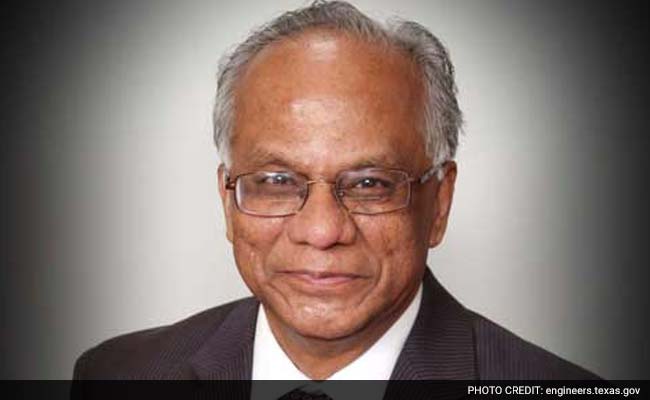
    HOUSTON:  An Indian-American has been appointed as the Secretary of the Texas Board of Professional Engineers that licenses qualified engineers and regulates the practice of professional engineering in the US state.

    Sockalingam “Sam” Kannappan, a professional engineer and senior design engineer for SNC-Lavalin Hydrocarbons and Chemicals, has been appointed as the Secretary of the Texas Board of Professional Engineers (TBPE) in Austin.

    Houston-based Kannappan also serves as a board member of the Society of Piping Engineers and Designers and an advisory board member of the Asia Society’s Texas centre.

    The Indian-American engineer will be signing all newly-issued licenses, TBPE said in a statement.

    The board issues, monitors and renews roughly 57,000 licenses for engineers.

    The board’s role in the protection of the public is to license qualified engineers, enforce the Texas Engineering Practice Act and to regulate the practice of professional engineering in Texas.

    Kannappan is a mechanical engineering graduate of Annamalai University in Tamil Nadu and received his MS in mechanical engineering at the University of Texas in Austin.

    Previously, Kannappan also served as a member of the American Society of Mechanical Engineers Gas Pipeline Safety Research Committee, which defends Houston against bio-terrorism.

    Additionally, from 2006 to 2011, he was on the Texas On-Site Wastewater Treatment Research Council.

    Throughout his career, Kannappan has received a number of honours and awards, including an award from Crystal Dynamics group of NASA’s Goddard Space Flight Center in Maryland for improving laser measurement accuracy.

  • FIRST MIRROR INSTALLED ON NASA’S JAMES WEBB TELESCOPE

    FIRST MIRROR INSTALLED ON NASA’S JAMES WEBB TELESCOPE

    WASHINGTON (TIP): NASA has successfully installed the first of 18 flight mirrors onto the James Webb Space Telescope, beginning a critical piece of the observatory’s construction to replace the Hubble Space Telescope in 2018.

    At NASA’s Goddard Space Flight Centre in Greenbelt, Maryland this week, the engineering team used a robot arm to lift and lower the hexagonal-shaped segment that measures just over 1.3 meters across and weighs approximately 40 kilogrammes.

    After being pieced together, the 18 primary mirror segments will work together as one large 6.5-metre mirror. The full installation is expected to be complete early next year.

    “The James Webb Space Telescope will be the premier astronomical observatory of the next decade,” said John Grunsfeld, astronaut and associate administrator of the Science Mission Directorate at NASA.

    “This first-mirror installation milestone symbolises all the new and specialised technology that was developed to enable the observatory to study the first stars and galaxies, examine the formation stellar systems and planetary formation, provide answers to the evolution of our own solar system, and make the next big steps in the search for life beyond Earth on exoplanets,” said Grunsfeld.

    Several innovative technologies have been developed for the Webb Telescope, which is targeted for launch in 2018, and is the successor to NASA’s Hubble Space Telescope.

    Webb will study every phase in the history of our universe, including the cosmos’ first luminous glows, the formation of solar systems capable of supporting life on planets like Earth, and the evolution of our own solar system.

    The 18 separate segments unfold and adjust to shape after launch. The mirrors are made of ultra-lightweight beryllium chosen for its thermal and mechanical properties at cryogenic temperatures. Each segment also has a thin gold coating chosen for its ability to reflect infrared light.

    The telescope’s biggest feature is a tennis court sized five-layer sunshield that attenuates heat from the Sun more than a million times.

    “After a tremendous amount of work by an incredibly dedicated team across the country, it is very exciting to start the primary mirror segment installation process,” said Lee Feinberg, James Webb Space Telescope optical telescope element manager at Goddard.

    “This starts the final assembly phase of the telescope,” said Feinberg.