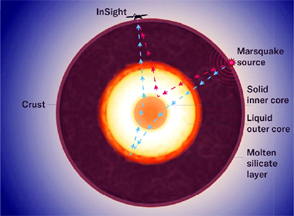
Mars may have a hardened heart. Marsquake reverberations detected by NASA’s InSight lander revealed that the Red Planet probably possesses a solid inner core, researchers report in the Sept. 4 Nature. That firm interior, tucked within a liquid outer core, could help researchers better understand Mars’ evolutionary history.
From late 2018 to late 2022, InSight sat atop Mars’ surface and listened to tremors from more than 1,300 Marsquakes to probe the planet’s innards. When seismic waves travel through Mars’ interior, they can bounce off or bend at the boundaries of different layers, uncovering clues about what lies deep within.
“We’re building a picture of the inside of the planet, but we hadn’t yet seen evidence of … a solid inner core,” says seismologist Vedran Lekic of the University of Maryland in College Park, who wasn’t involved in the new study. InSight data previously hinted at the presence of a liquid metal core, but researchers remained unsure if it also has a solid component, like Earth’s center.
Seismologist Daoyuan Sun of the University of Science and Technology of China in Hefei and colleagues examined 23 low-frequency Marsquakes whose epicenters — the surface locations at or above the quakes’ origins — were about 1,600 to 2,400 kilometers away from the lander.
Some of the Marsquake waves traveled through the planet’s core, reflecting off its far side. Tremors travel more quickly through a hard medium than a fluid one, and the studied waves arrived at InSight around 50 to 200 seconds earlier than they should have if the core was purely liquid. “That gave us some ideas that [there] must be some faster stuff in the very center,” possibly something solid, Sun says. Further analysis revealed waves that had ricocheted off a border between an inner core and an outer core, which could be there only if Mars has a solid heart.
Based on various seismic waves’ travel speeds and paths, Sun and his colleagues calculated that the inner core’s radius is roughly 600 kilometers, about one-fifth of Mars’ thickness. Computer simulations considering core density and wave speeds through the planet’s heart hint that the mostly iron-and-nickel core might contain the lighter element oxygen within its hard interior, and certain percentages of sulfur, oxygen and carbon are present in the liquid outer region.
“I’m more convinced [by the findings] than I thought I would be,” Lekic says. The authors have “clearly detected something cool.” Still, he questions whether the specified percentages of elements could realistically exist in the core at temperatures consistent with prior knowledge about Mars’ interior.
Seismic waves suggest Mars has a solid heart