Tag: US President Donald Trump

  • Battleground States hold the Key to Victory -US Election 2020

    Battleground States hold the Key to Victory -US Election 2020

    By Ven Parameswaran

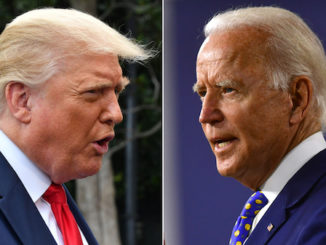
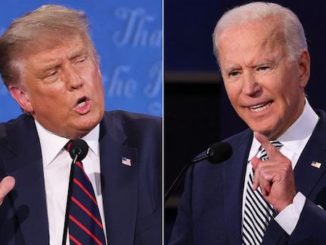
    The first Presidential debate on September 29 was watched by 73 million people.   Trump is a gambler, and not just because he owned casinos.  He ran one of the biggest gambles of his life in the debate, and whether it pays off now is very uncertain.    The President’s ultra-aggressive performance in the first presidential debate—aggressive to the point where moderator Chris Wallace had to ask him three times to simply let challenger Joe Biden answer a question—can’t have been an accident.  It was an effort by a candidate behind in the polls to shake up the race by driving home his principal line of attack: that Biden is too weak to be the president of America.

    Trump chose not simply to say that his opponent is too weak, or too old, or too afraid of his party’s left wing, but rather to try to demonstrate it before a world-wide audience by attacking and belittling him.  The subliminal message: If you can’t stand up to me, how can you stand up to the leader of China, or those perpetrating violence in the streets of Portland?

    And perhaps it worked.  Nobody who watched was left in any doubt about the core argument of Trump’s campaign, which is in large measure about the assertion that his foe is not up to the demanding job of sitting behind the Resolute Desk.

    Biden did,  at times , seem taken aback by the relentless ferocity of the onslaught—and if the plan was to get the challenger to overreact by calling the president a “clown,” well, that did happen at one point.  This is what those who call Trump undisciplined don’t entirely grasp:  He is very disciplined in driving home his main message, and will do so again and again, without remorse or apology, as he did Tuesday night.

    It is important to recall how Trump used almost the same technique in defeating 16 Republican candidates in 2016 and Hillary Clinton.  He succeeded in burying Bush and Clinton dynasties, against all odds, including vehement opposition of the mainstream media, continuous investigations, impeachment he has won.  Therefore, it is possible his strategy to defeat Biden could work.

    Trump was able to impress the audience that he was for law and order and strong economy.  He also took credit for appointing 200 judges and 3 Supreme Court judges in his first term (third appointment is in process).

    There was little likable about the presidential persona that came across in the debate stage.  Maybe that does not matter as much as it used to in politics.  Trump has demonstrated that people don’t have to like him to support him.  A common refrain among Trump voters, in fact, is that he is rough and tough, but that they see that as part of his strength.  Yes, they say, he is a bully, but he is our bully.

    Trump’s main strategy is to attract new voters from the uneducated working class located in the battleground states.  If so, his aggressive performance in the debate should help him achieve his goals.  Rush Limbaugh, most popular talk radio host has praised Trump’s debate performance.    As mentioned in my previous dispatches, Trump is not appealing to the elites.

    If Trump knew how to get elected as President in 2016, his strategy to get reelected could succeed.

    (Ven Parameswaran, Chairman, Asian American Republican Committee (founded 1988) lives in Scarsdale, NY.  H can be reached at vpwaren@gmail.com)

  • US Presidential elections: You ain’t seen nothing yet

    US Presidential elections: You ain’t seen nothing yet

    By Prabhu Dayal
    • Winning more votes in the US Presidential election does not assure a candidate victory

    • Biden’s chances of defeating Trump look good, but there’s a long way to go and things can change very quickly

    • One factor which is affecting Trump’s re-election prospects is his handling of the coronavirus pandemic

    It cannot be overstated that U.S. Presidential elections are always contested over a host of political, economic, and social issues on which the positions of both the Republicans and the Democrats have evolved over time. As part of its economic conservatism, the Republican Party supports lower taxes, free-market capitalism, the removal of restrictions and regulations on corporations, and restrictions on labor unions. The party is also socially conservative and supports gun-rights and traditional values with a Christian foundation, such as restrictions on abortion. In foreign policy, Republicans usually favor increased military expenditure and tough action against America’s enemies. Republicans also want restrictions on immigration.
    The Democrats support social programs, labor unions, worker’s rights and work-place safety regulations, disability rights and racial equality and reform of the criminal justice system. They also support abortion rights, LGBT rights and a pathway to citizenship for undocumented workers. In foreign policy, they favor a multilateral approach, from which America under Trump has been distancing itself.


    There are fewer than 35 days to go before American voters decide on November 3 whether Donald Trump remains in the White House for another four years. Given the hugely important role played by the US President on the global stage, psephologists all over the world are working overtime as they try to analyze various trends and developments which could indicate what the final outcome is likely to be. Opinion polls are the flavor of the election season.

    However, experience has shown that opinion polls may give an idea of how popular a candidate is across the United States, but they are not necessarily an accurate way to predict the eventual election result.

    In 2016, for example, Hillary Clinton led in most of the opinion polls and even secured more votes in the election, but she ended up losing to Trump. Thus, even winning more votes in the US Presidential election does not assure a candidate victory.

    One important reason for this is that the U.S. voters do not elect the President and Vice President directly; rather, they do so indirectly through the electoral college system. The electoral college is a body of electors who are elected by the voters in each state every four years for the sole purpose of electing the President and Vice President. The number of each state’s electors equals the sum of its representation in the Senate and the House of Representatives. Currently, there are 538 electors, based on 435 Representatives, 100 Senators from the fifty states and three electors from the Capital, Washington, D.C. An absolute majority of at least 270 electoral votes is required to win the election.

    The three electors were given to D.C. following the Twenty-third Amendment of 1961 which states that the seat of the federal government is entitled to ‘the number it would have if it were a state, but in no case more than that of the least populous state’. The seven least populous states (Alaska, Delaware, Montana, North Dakota, South Dakota, Vermont and Wyoming) have three electors each; thus, Washington D.C. was also given three seats in the electoral college.

    The six states with the most electors are California, (55), Texas (38), New York (29), Florida (29), Illinois (20), and Pennsylvania (20). U.S. territories (Puerto Rico, U.S. Virgin Islands, Guam, Northern Marina Islands and American Samoa) are not entitled to any electors.

    Thus, each state gets a minimum of three electoral votes, regardless of population, which gives states with a low population a disproportionate number of electors per capita. An electoral college member in Wyoming represents only about one-fourth the number of people as compared to an elector from California. This is one factor which explains how a Presidential candidate can secure more electors while winning lesser votes nationally. Over time, people have been migrating to the bigger states like California, Texas or New York which provide better employment opportunities, and as a result sparsely populated states are becoming increasingly over-represented in the electoral college.

    In this regard, another factor which needs to be mentioned is the winner-take-all rule. In all the states except Nebraska and Maine, the party which wins the highest votes wins all of that state’s electors. This gives the bigger states the ability to deliver a large number of votes as a single bloc. For example, even if the Republican Party wins 49% of the votes in Florida while the Democratic Party gets 51%, the latter will win all the 29 electoral seats from that state. This fact also distorts the relationship between votes secured and seats won nationwide.

    Generally, most states always vote the same way (either always Republican or always Democrat). However, there are some states where both candidates stand a chance of winning. These are the states where the election could be won or lost, and they have come to be known as the battleground states (or swing states).

    For the 2020 election, the battleground states (with their electoral numbers) are: Texas(38), Florida(29), Pennsylvania(20), Ohio(18), Michigan( 16), Georgia(16), North Carolina(15), Arizona(11), Minnesota(10), Wisconsin(10), Nevada(6), Iowa(6) and New Hampshire(4). According to analysts, Texas, Ohio and Iowa are leaning towards Trump; in Florida, Georgia and North Carolina there is a toss-up; the remainder are leaning towards Biden.

    It was on account of so many complexities that Hillary Clinton found herself losing the 2016 election to Trump even though she won more votes than him. It may be mentioned, though, that her lead over Trump in the opinion polls had been just 2 percentage points, while Biden leads his rival by at least 7-8 percentage points.

    By that reckoning, Biden’s chances of defeating Trump look good, but there’s a long way to go and things can change very quickly. Betting markets are certainly not writing Trump off just yet, though seasoned analysts are less convinced about his chances of re-election. The Economist says that Biden is very likely to beat Trump, and this view is echoed by ‘FiveThirtyEight’, a well-known US website that does poll analysis. Not surprisingly, Trump has dismissed the opinion polls and forecasts of his defeat as biased and incompetent.

    One factor which is affecting Trump’s re-election prospects is his handling of the coronavirus pandemic; there is dis-satisfaction among voters about the President’s response. Trump declared a national emergency in March and made $50 billion available to states to stop the spread of the virus, after which support for him rose to 55%. However, this support has been waning recently. His response to the pandemic is being increasingly questioned as the death toll rises; it has crossed 209,000 and it is feared that it may reach 230,000 by November 3, the election date.

    Naturally, Trump is worried on this account and wants to show that he is taking decisive action for combating the virus. He is hopeful that ‘Operation Warp Speed’, his administration’s vaccine initiative, can produce something soon which could swing things in his favor. Trump has repeatedly said a vaccine could be ready as soon as October.

    COVID-19 Vaccine. COVID-19 Corona Virus 2019-ncov Vaccine Injection Vials Medicine bottles. Vaccination, immunization, treatment to cure Covid-19 Corona Virus infection. Healthcare And Medical concept

    However, the vaccine is getting mired in controversy even before it has arrived. According to U.S. media reports, the Federal Drug Administration(FDA) has been developing stricter guidelines for the emergency authorization of a COVID-19 vaccine which will include a requirement for a median of two months of data on clinical vaccine trial participants. In other words, the vaccine may not be available before November 3, the date of the election. Trump has dismissed this as a politically motivated move and said that if the F.D.A. does propose such a two-month trial, he may not approve it (i.e. the trial period).Trump said he wants to avoid any unnecessary delay in the release of a vaccine, adding that he has “tremendous trust” in companies working on its development.

    “I don’t see any reason why it should be delayed further. Because if they delay it a week or two weeks or three weeks, you know, that’s a lot of lives you’re talking about,” he said.

    The economy is typically a top voter-issue in presidential elections. Issues that are deeply personal to their everyday lives rank among the most important priorities that influence voters; their pay-cheques often figure at the top of the list of such issues.

    Consequently, having a job is itself an important factor. This aspect has taken on new urgency with millions out of work because of the coronavirus pandemic.

    Another issue that is gaining prominence during the build-up to the election relates to racism. Donald Trump has a history of speech and actions that have been widely viewed as racist or racially charged. Although Trump has repeatedly denied accusations of racism, he is increasingly viewed as championing white supremacy. Several studies and surveys have shown that racist attitudes and racial resentment have fueled Trump’s political ascendance. Thus, matters that impact communities of color are taking center stage in the elections as non-white voters make up about one-third of the 2020 electorate.

    Joe Biden’s decision to nominate Senator Kamala Harris, the first Black woman and first Asian American woman as his running mate is an out-reach to colored voters as well as to women voters.

    In this background, Joe Biden’s decision to nominate Senator Kamala Harris, the first Black woman and first Asian American woman as his running mate is an out-reach to colored voters as well as to women voters.

    It cannot be overstated that U.S. Presidential elections are always contested over a host of political, economic, and social issues on which the positions of both the Republicans and the Democrats have evolved over time. As part of its economic conservatism, the Republican Party supports lower taxes, free-market capitalism, the removal of restrictions and regulations on corporations, and restrictions on labor unions. The party is also socially conservative and supports gun-rights and traditional values with a Christian foundation, such as restrictions on abortion. In foreign policy, Republicans usually favor increased military expenditure and tough action against America’s enemies. Republicans also want restrictions on immigration.

    The Democrats support social programs, labor unions, worker’s rights and work-place safety regulations, disability rights and racial equality and reform of the criminal justice system. They also support abortion rights, LGBT rights and a pathway to citizenship for undocumented workers. In foreign policy, they favor a multilateral approach, from which America under Trump has been distancing itself.

    While the calculations involved in a U.S. Presidential election are not at all simple, present indications are that Trump faces an uphill task for getting re-elected. Interestingly, Trump is sending out signals that he will not accept defeat. In a press briefing at the White House a few days back, he refused to say whether he would support a peaceful transfer of power if he loses November’s election, ignoring a precedent that every other president in American history has accepted.

    As a matter of fact, a crisis is developing on account of the concerns which Trump has repeatedly voiced about postal ballots. He has claimed that the postal-ballot route will be misused by the Democrats, that it will result in voter fraud and thus cause his defeat. However, Ellen Weintraub, commissioner of the Federal Election Commission, has responded: “There’s simply no basis for the conspiracy theory that voting by mail causes fraud.”

    Individual states decide their own voting rules for federal elections in the U.S. About half of the states allow any registered voter to vote by post on request. In the remaining states, you have to have a valid reason for voting by post – such as being over 65, being ill, or being away from the state you are registered to vote in.

    Interestingly, President Trump himself has voted by post in the past, such as in Florida’s 2020 primary election as he is a registered voter in that state but is currently living in Washington DC.

    In the 2016 U.S. Presidential election, about 25% of votes were cast by post. That number is expected to rise this time due to public health concerns over coronavirus. Many states are encouraging mail-in voting, citing the need to keep voters safe from it. They want to prevent large gatherings at polling stations on election day–a justifiable approach given the prevailing situation.

    Moreover, six states will hold “all-mail” ballot elections this November– California, Utah, Hawaii, Colorado, Oregon and Washington. These states will automatically send all registered voters their postal ballots, which then have to be sent back or dropped off on election day – although some in-person voting is still available in certain limited circumstances. More states could follow this route due to public health concerns over coronavirus.

    Although every losing Presidential candidate in U.S. history has conceded defeat once he lost the election, Trump has refused to commit to a peaceful transfer of power in such an eventuality. When a reporter asked him a direct question on this issue, he did not say yes or no; instead, he gave an insight into his thinking and said, ” I’ve been complaining very strongly about the ballots”, adding, ” Mail-in ballots are very dangerous–there’s tremendous fraud involved”.

    At a rally in Newport News, Virginia on Friday 25 September, Trump again refused to say whether he would peacefully transition out of the White House if he loses the presidential election, suggesting he would only do so if he was convinced Democrats and their presidential nominee, Joe Biden, did not cheat. “We’ve gotta watch this ballot scam, because they’re scamming us. And then they say, ‘He doesn’t want to turn over [power].’ Of course, I do. But it’s gotta be a fair election,” Trump told the crowd at the rally. Biden has said that in this scenario he believes the military would be deployed to remove Trump from the White House!

    If he loses the election, Trump may still have some cards up his sleeve. He has said that he believes that the election result could end up in the U.S. Supreme Court. Backed by his battery of attorneys, he is believed to be preparing the groundwork to undermine an election result that does not announce him as victor.

    In this context, importance is being attached to Trump’s selection of Judge Amy Coney Barrett, a favorite of the Republicans as a new Supreme Court Judge. She will take the place of Justice Ruth Bader Ginsburg, a liberal and a Clinton appointee who died recently. Trump has announced that he will try to obtain Senate confirmation for this appointment before Election Day. Biden and the Democrats are urging that the appointment should be made by the winner of the Nov 3 election, but the Senate, which has a Republican majority is likely to go ahead and give the confirmation. This is so because a Supreme Court judge in the U.S. serves for life , and Judge Amy Coney Barret, an avowed Conservative would significantly alter the ideological makeup of the Supreme Court for years to come and ensure that the Republican agenda is not obstructed by the Court.

    For Trump, this appointment could be vital. The US Supreme Court has nine judges. After the death of Justice Ginsberg, there are three judges who are regarded as liberal, while four are conservative.  The eighth is Chief Justice Roberts who has been described as having a conservative judicial philosophy but has also shown a willingness to work with the Supreme Court’s liberal judges. Thus, he has come to be regarded as a swing vote on the Court and Trump cannot rely on him to give a favorable judgement if his own election case is to be decided. Thus, if Judge Barrett is elevated to the Supreme Court, there will be at least five conservative judges, if not six who may side with Trump, which explains his rush to appoint her, as also Biden’s opposition to it.

    To sum up, if you think that the Nov. 3 election battle has become ugly, then I would just say, “You ain’t seen nothing yet”.

    (The author is a retired career diplomat. He can be reached at prabhu_dayal70@hotmail.com)

     (Courtesy OPOYI)

  • Implications of Donald Trump testing positive for COVID-19

    Implications of Donald Trump testing positive for COVID-19

    By Prabhu Dayal
    • Medical experts say that Donald Trump falls in the highest risk category for serious complications from COVID-19 as he is 74 years old and obese
    • A rally scheduled for October 2 in Florida has been cancelled, raising the question of whether COVID-19 will derail the president’s campaign
    • The Democrats have consistently attacked Trump for taking a cavalier approach towards COVID-19

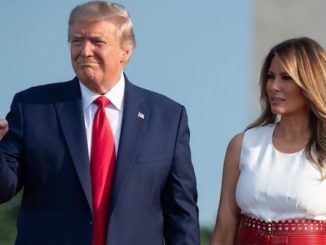
    Immediately after the US President announced that he and his wife Melania had tested positive for COVID-19, Prime Minister Narendra Modi was among the first world leaders to react when he tweeted: “Wishing my friend @POTUS @realDonaldTrump and @FLOTUS a quick recovery and good health”.

    Pakistan’s Prime Minister Imran Khan also tweeted: “Wishing President Trump and First Lady Melania Trump speedy recovery from COVID-19”.

    The editor-in-chief of China’s government-backed newspaper, the Global Times, took a less sympathetic line, suggesting that Trump only had himself to blame for contracting the disease. “President Trump and the first lady have paid the price for his gamble to play down the COVID-19,” tweeted Hu Xijin.

    As CNN put it, “The diagnosis amounts to the most serious known health threat to a sitting American president in decades”.

    Trump is not the first world leader to be infected. British Prime Minister Boris Johnson of Britain and President Jair Bolsonaro of Brazil had both tested positive earlier. However, Trump is older and at higher risk than either of those men.

    In fact, medical experts feel that ‘Trump falls into the highest risk category for serious complications from COVID-19 as he is 74 years old and obese’. Coronavirus has killed more than 212,000 Americans and more than 1 million people worldwide.

    In the ongoing election scenario, this news is not good at all for Trump and it will negatively affect his re-election prospects. Voters will naturally ask: If the President can’t take care of his own health, how will he take care of us?

    On many occasions, President Trump had made statements which showed that he had refused to take COVID-19 seriously. For months, he downplayed its severity, refusing to regularly wear a mask and rejecting the advice of the country’s top medical experts.

    During the recent presidential debate on September 29, President Donald Trump’s family members did not wear masks though attendees were told to do so. According to media reports, some members of the Trump administration who were there were also not wearing masks, while people who were there to support Biden wore masks.

    During the debate, Trump mocked Joe Biden for frequently wearing masks in public. “Every time you see him, he’s got a mask. He could be speaking 200 feet away from it. And he shows up with the biggest mask I’ve ever seen,” he said. Further, he defended his decision to often appear in public without a facial covering, explaining that he wears a mask “when needed.”

    The Democrats have consistently attacked Trump for taking a cavalier approach towards COVID-19, and they will naturally say how right they were! Ironically, Trump told a political dinner just hours before he was diagnosed that the end of the pandemic is in sight.

    As it is, Trump has been trailing in the opinion polls, and analysts also feel that Biden fared better during the presidential debate. So, at a time when the Trump campaign needed to accelerate, it will actually slow down considerably. This is not good news for Trump and the Republicans. A rally scheduled for October 2 in Florida has been cancelled, raising the question of whether COVID-19 will derail the president’s campaign just 32 days before Election Day on November 3.

    However, in an effort to minimize the damage, Trump’s physician Sean Conley has said: “Rest assured I expect the President to continue carrying out his duties without disruption while recovering, and I will keep you updated on any future developments”.

    The first Presidential debate was held recently on September 29. It was widely criticized not just in the US but also in the international media. In the UK, The Guardian described it as a “national humiliation”, while The Times wrote that the clearest loser from the debate was America.” It further said that the event “was not a debate in any meaningful sense” but rather “an ill-tempered and at times incomprehensible squabble between two angry septuagenarians who palpably loathe each other”.

    “Chaotic, childish, grueling” – that’s how French newspaper Libération described the debate, and Le Monde termed it a “terrible storm”, while also saying that the President had sought to “push his opponent off his hinges” with constant interruptions and by mocking his answers. A Russian TV channel described it as a “one and a half-hour exchange of insults”.

    The remaining Presidential debates are scheduled to be held on October 15 and 22 October respectively, but it is not clear now whether they will take place at all. Thus, attention in America and elsewhere will focus on the Vice-Presidential debate between Mike Pence and Kamala Harris on October 7.

    Indians will watch it with interest not just because Kamala  has a connection to India but also because of her meteoric rise from being the daughter of immigrant parents to a potential Vice President and perhaps even a President in the not so distant a future. As the saying goes, ‘Who knows what the stars foretell’?

    (The author is a retired career diplomat. He can be reached at prabhu_dayal70@hotmail.com)


    (Courtesy OPOYI)


  • US coronavirus death toll passes 150,000: Johns Hopkins

    US coronavirus death toll passes 150,000: Johns Hopkins

    The country recorded more than 4.38 million total cases.

    WASHINGTON (TIP): More than 150,000 people have died of COVID-19 in the United States, according to a tally maintained by Johns Hopkins University.

    The world’s worst-hit country announced its first coronavirus-related death at the end of February and has now recorded more than 4.38 million total cases, the Baltimore-based university reported on Wednesday, July 29.

    Trump ally who skipped mask tests positive

    A Republican lawmaker who made a habit of walking around Congress without a mask tested positive for the coronavirus Wednesday, July 29, as he prepared to leave for his native Texas with President Donald Trump.

    Louie Gohmert announced his diagnosis a day after attending a major hearing featuring testimony from Attorney General Bill Barr, with whom he was seen walking and chatting at a close distance while neither wore a mask.

    Gohmert, 66, said he was asymptomatic and downplayed his diagnosis.

    He has worn a mask sporadically in recent weeks, and suggested Wednesday that moving it around on his face because it is uncomfortable “puts some germs in the mask” and maybe this caused his infection.

    Even as the pandemic has raged in the US, President Donald Trump steadfastly ignored recommendations from US medical experts that people wear masks to help curb the spread of the virus and he did not wear one in public until July 11.

    Since then, Republican lawmakers who shunned masks have begun to wear them more regularly. But to wear or not wear a mask remains a political flashpoint in America.

    Gohmert was tested Wednesday at the White House because he was supposed to accompany Mr. Trump on a visit to Texas.

    “So I’m asymptomatic, I don’t have any of the symptoms that are listed as part of COVID-19, but apparently I have the Wuhan virus,” Gohmert said in a video using a term that angers China.

    Gohmert said he has worn the mask more in the last week or two than in all of the past four months and did so during Tuesday’s hearing with Barr.

    But he took it off a few times and was seen walking and talking with Barr before the hearing.

    “Wear a damn mask,” said Democratic representative Jennifer Wexton from Virginia.

    “I don’t know who needs to hear this, but if you’re a Member of Congress who refuses to wear a mask on Capitol Hill, you’re not only putting your colleagues at risk — you’re endangering the staff who works here, including many of my constituents,” she said.

    (Source: AFP) )

  • Trump raises possibility of delaying the election—but that power rests in Congress

    Trump raises possibility of delaying the election—but that power rests in Congress

    Trump also said he would not trust results of an election that included widespread mail voting

    WASHINGTON (TIP): US President Donald Trump on Thursday, July 30, raised the possibility of delaying the nation’s November 3 presidential election, though the Constitution bestows that power on Congress, not the president.

    The move drew immediate objections from Democrats and it was not clear whether Trump was serious.

    Trump also said he would not trust the results of an election that included widespread mail voting—a measure that many election observers see as critical given the coronavirus pandemic.

    Trump, without evidence, repeated his claims of mail-in voter fraud and raised the question of a delay, tweeting: “delay the election until people can properly, securely and safely vote???”

    Trump’s tweet came shortly after the United States reported its worst economic downturn since the Great Depression: a second-quarter crash in gross domestic product due to widespread shutdowns prompted by the coronavirus pandemic.

    Trump, who is trailing challenger and former Vice President Joe Biden in opinion polls, had previously intended to focus his re-election bid on the nation’s economic performance.

    Trump had previously suggested he would not trust election results—complaints similar to those he raised going into the runup to the 2016 election—but had not so directly suggested changing the November 3 date.

    Representatives for the White House did not immediately respond to a request for comment, the Reuter report says.

    Trump has cast doubt on the legitimacy of mail-in ballots, which have been used in far greater numbers in primary elections amid the pandemic.

    He has also made unsubstantiated allegations that voting will be rigged and has refused to say he would accept official election results if he lost.

    Democrats, including Biden, have already begun preparations to protect voters and the election amid fears that Trump will try to interfere with the November election.

    “A sitting president is peddling lies and suggesting delaying the election to keep himself in power,” Democratic Representative Dan Kildee wrote on Twitter.

    “Don’t let it happen. Every American — Republican, Independent and Democrat — should be speaking out against this President’s lawlessness and complete disregard of the Constitution.”

    US Senator Tom Udall, also a Democrat, said, “There is no way @POTUS can delay the election. We shouldn’t let him distract us from his #COVID19 incompetence.”

    Nonpartisan US election analyst Kyle Kondik of the University of Virginia said the tweet seemed to follow Trump’s typical approach of trying to distract voters from bad news.

    “Trump suggesting delaying the election (he can’t do this w/o congressional approval) seems to be one of his more obvious attempts to change the subject given this morning’s wretched GDP numbers,” Kondik wrote on Twitter.

    Attorney General William Barr was asked in congressional testimony earlier this week whether Trump could change the election date: “I’ve never been asked the question before. I’ve never looked into it.”

    Barr also testified that to his knowledge, a sitting president cannot contest the results of an election if the vote tallies are clear.

    (Source: Reuters)

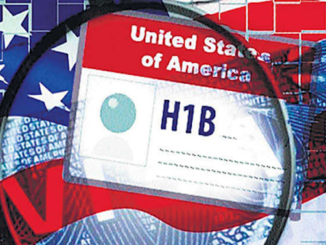
  • 174 Indian nationals file lawsuit against presidential proclamation on H-1B

    174 Indian nationals file lawsuit against presidential proclamation on H-1B

    WASHINGTON (TIP): A lawsuit has been filed by a group of 174 Indians, including seven minors, against the recent presidential proclamation on H-1B that would prevent them from entering the US due to the suspension of issuing of foreign work visas for the rest of the year.

    In his presidential proclamation on June 22, President Donald Trump temporarily suspended issuing of H-1B work visas till the end of the year.

    The H-1B visa is a non-immigrant visa that allows US companies to employ foreign workers in specialty occupations that require theoretical or technical expertise. The technology companies depend on it to hire tens of thousands of employees each year from countries namely India and China.

    The lawsuit was filed by the Indians in the US District Court in the District of Columbia on Tuesday, July 14.

    Judge Ketanji Brown Jackson at the US District Court for the District of Columbia issued summonses on Wednesday to Secretary of State Mike Pompeo and acting Secretary of Homeland Security Chad F Wolf, along with Labor Secretary Eugene Scalia.

    “The proclamation 10052’s H-1B/H-4 visa ban hurts the United States’ economy, separates families and defies the Congress. While the two former points render it unseemly, the latter point renders it unlawful,” said the lawsuit filed by lawyer Wasden Banias on behalf of the 174 Indian nationals.

    The lawsuit seeks an order declaring the presidential proclamation restriction on issuing new H-1B or H-4 visas or admitting new H-1B or H-4 visa holders as unlawful.

    An H-4 visa is a visa issued by the US Citizenship and Immigration Services (USCIS) to immediate family members of the H-1B visa holders.

    The lawsuit also urges the court to compel the Department of State to issue decisions on pending requests for H-1B and H-4 visas.

    “In the administration of our nation’s immigration system, we must remain mindful of the impact of foreign workers on the United States labor market, particularly in the current extraordinary environment of high domestic unemployment and depressed demand for labor,” said the proclamation issued by Trump.

    Trump said the overall unemployment rate in the US nearly quadrupled between February and May of 2020, producing some of the most extreme unemployment ever recorded by the Bureau of Labor Statistics.

    While the May rate of 13.3 per cent reflects a marked decline from April, millions of Americans remain out of work.

    The proclamation also extends till year-end his previous executive order that had banned issuance of new green cards of lawful permanent residency.

    Green Card holders, once admitted pursuant to immigrant visas, are granted “open-market” employment authorization documents, allowing them immediate eligibility to compete for almost any job in any sector of the economy, Trump said.

    Forbes, which first reported the lawsuit filed by the Indian nationals, said the complaint points out that the Congress specified the rules under which H-1B visa holders could work in the US and balanced the interests of US workers and employers.

    “The complaint seeks to protect H-1B professionals, including those who have passed the labor certification process and possess approved immigrant petitions. Such individuals are waiting for their priority date to obtain permanent residence, a wait that can take many years for Indian nationals,” Forbes reported.

    Meanwhile, several lawmakers urged Scalia on Tuesday to reverse the work visa ban.

    “Throughout this administration, the president has continued to lament the alleged abuses of the immigration system while failing to address the systemic problems that have persisted and allowed businesses and employers to exploit and underpay immigrant workers, guest workers and American workers,” the lawmakers wrote.

    “This misguided attempt by the president to scapegoat immigrants for policy failures during the pandemic not only serves to hurt immigrants but dismisses the true problem of a broken work visa programme that is in desperate need of reform,” said the letter.

    The letter among others was signed by congressmen Joaquin Castro, Chair of the Congressional Hispanic Caucus; Bobby Scott, Chair of the Education and Labor Committee; Karen Bass, Chair of the Congressional Black Caucus; Judy Chu, Raul Grijalva, Vicente Gonzalez, Yvette Clarke and Linda Sánchez.

    (Source: PTI)

  • Trump says he will soon sign new merit-based immigration act

    Trump says he will soon sign new merit-based immigration act

    WASHINGTON (TIP) :  President Donald Trump on Tuesday, July 14 said he will soon sign a merit-based immigration act that will also take care of the immigrants brought to the country illegally as children and protected under the Deferred Action for Childhood Arrivals (DACA) programme.

    “We’re going to be signing an immigration act very soon,” Trump told reporters Tuesday, July 14  at a White House press briefing. “It’s going to be based on merit. It’s going to be very strong.”

    Trump has previously said he would seek sweeping changes to U.S. immigration policy through an executive order. Critics — including high-profile lawmakers in the president’s own party — have questioned whether he has the legal authority to overhaul immigration laws without passing legislation through Congress.

    The president cast immigration in partisan terms on Tuesday, attacking Democratic rival Joe Biden over what he described as lax policies toward those illegally entering the U.S. Trump is seeking to reprise an issue that helped him win election in 2016 as he lags in polls behind Biden.

    Trump, who has been repeatedly stymied on Capitol Hill as he has pursued efforts to toughen immigration criteria, said he believed the Supreme Court provided him new powers when it rejected the administration’s efforts to dismantle the Deferred Action for Childhood Arrivals program, or DACA, which provides legal status for some young migrants in the country illegally.

    “Very importantly, we’ll be taking care of people from DACA in a very Republican way,” Trump said.

    Last month, a divided Supreme Court rebuked Trump by blocking him from ending the Obama administration program.

    Trump has offered no specific explanation of why he believes the Supreme Court decision — which found his administration did not follow proper procedure in eliminating DACA — granted him substantial new immigration authority.

    His foray into immigration comes even as the U.S. has largely shut down the issuance of new work visas and green cards for the remainder of the year because of the coronavirus pandemic.

    (With inputs from PTI)

  • Visa politics: On Trump’s immigration policy

    Visa politics: On Trump’s immigration policy

    Changes to U.S. visa rules might do more harm than good to US economy in the long term

    The administration of U.S. President Donald Trump seems bent on pursuing controversial immigration policy measures following the COVID-19 pandemic. Now, visa issuance to students enrolled in universities or programs that are conducted entirely online for the fall 2020 semester will be stopped; such students will not be permitted to enter the U.S. The federal Immigration and Customs Enforcement agency also advised that active students currently in the U.S. enrolled in programs that would be administered in online mode are required to leave the country or transfer to a university with in-person instruction to remain in lawful status. If not, ICE cautioned, they risk the initiation of removal proceedings or similar immigration consequences. Palpable ripples of anger across the U.S. education system took the form of lawsuits, led by Harvard University and the Massachusetts Institute of Technology to block the ICE directive. This is the latest twist in an ongoing immigration policy crackdown by the Trump administration, which includes a halt in the issuance of visas for skilled workers, or H-1B and their dependents, visas for intra-company transfers, or L-1 and their dependents, and several other visa categories as well as a halt in green card processing, all until the end of the calendar year.

    Taking a step back, the evolving Trump immigration paradigm leaves several big questions unanswered. First, while an argument, however harsh and myopic, could be made that the U.S. economy has suffered a battering in the wake of the COVID-19 pandemic and a key to recovery is to protect U.S. jobs from being cornered by foreign workers, what could the possible rationale be to imperil the lives of foreign students — all of them admitted to universities on merit, and none of them posing an immediate threat to jobs? Second, given that market forces of demand and supply have led to the U.S. economy being suffused with immigrant workers across sectors for many decades, how could the Trump administration now posit that its local population has adequate skilled labor to do the jobs that millions of Indians, Chinese and other foreign workers have so efficiently been doing all this while? Unless Mr. Trump is planning to massively overhaul the U.S. higher and professional education systems to imbue Americans with technical know-how and a culture of advanced learning, it may be futile to wall off large swathes of the economy to those capable of delivering value in such jobs. If Mr. Trump is only doing this to shore up his election campaign through political signaling, then it is the economic prospects of the very people he claims to be fighting for that he will damage in the longer term.

    (The Hindu)


  • India Diaspora Integrated in Modi’s New Style of International Diplomacy

    India Diaspora Integrated in Modi’s New Style of International Diplomacy

    By Ven Parmeswaran

    Modi succeeds but Foreign Office and diplomats fail to deliver

    In Public Relations, P stands for Performance.  R stands for Reporting.   Though Prime Minister Modi performs at his highest levels, his diplomats and bureaucrats are failing India.  Is there a brief fact sheet on Kashmir?  If so, was it handed  personally to each and every elected official ?    Does the Indian Embassy’s  P.R. wing provide the American and Indian American media with material on Indian issues? Is there a White Paper on Kashmir?

    While Modi succeeds in his personal diplomacy, his diplomats fail in their duties, disappointing Modi, the Indian Diaspora and India.   And Pakistan has capitalized on the failure of Indian  foreign office and its diplomats.    

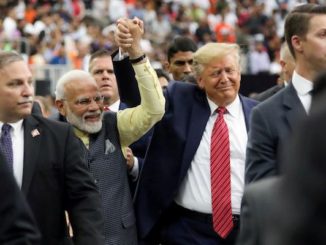
    Prime Minister Modi provides a refreshing contrast to International Relations during the Nehru dynasty era.  Modi has mastered the art of high-level diplomacy.  His diplomatic skills and personality have transformed India’s foreign policy fulfilling the self-interest of India.  In building close relations with the heads of states , he has formulated his personal strategy to work with the leaders of the Indian diaspora in the USA, Canada, U.K., Japan, Singapore, Australia,  South Africa and the Middle Eastern countries. Though the Indian diaspora are loyal to the countries they are  settled in they have time and again displayed their  love of India and  its Prime Minister.  The “Howdy Modi” spectacular event drawing 50,000 Indian Americans in Houston became an epoch-making event because Modi invited President Trump as his guest. The Indian diaspora organized rallies for Modi in various locations of the world and through their loyalty and political strength, Modi was able to create his own style of diplomacy.  As a result, the diplomats in foreign embassies were just onlookers or honored guests at these Indian diaspora sponsored events.

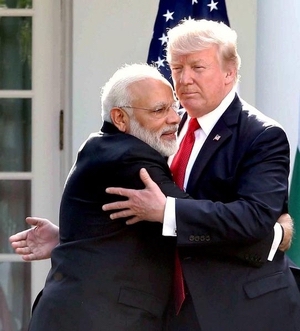
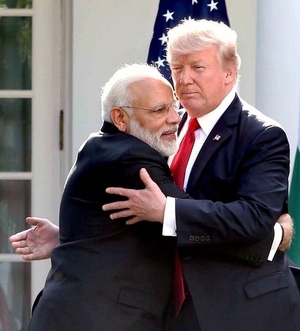
    We have seen how Prime Minister Modi has been highly successful in initiating, developing and nurturing personal relationships with the heads of states.  The photographs showing the body language are a testament to his personality and likeability.   Thus, he is creating not only his personal image but also reinforcing the image of India and the Indians through the Indian  diaspora.  What Modi has achieved is quite novel because this was never done before.

    While Modi succeeds in his personal diplomacy, his diplomats fail in their duties, disappointing Modi, the Indian Diaspora and India.   And Pakistan has capitalized on the failure of Indian  foreign office and its diplomats.    One may like to know how.  Pakistan succeeded in planting an op ed column by Prime Minister Imran Khan of Pakistan in the New York Times, just a week before the U.N. General Assembly session in New York and the “Howdy Modi” event in Houston on September 22, 2019.  This article was a propaganda piece condemning India based on misstatement of facts on Kashmir.  When such a column appears, it is customary for the NYT to publish a counter column by India.  Unfortunately no column was written and published by Prime Minister Modi or Foreign Minister Jayashankar or Indian Ambassador to the USA Shringla.  I am sure if a counter column  had been written and sent to the NYT, it would have published it.

    It must be pointed out that Pakistan’s diplomacy and public relations are more efficient than India’s.  Failure of Indian Foreign Office to follow up on the goodwill and friendship created by Prime Minister Modi has created opportunity for Pakistan to make propaganda against India.  The Washington Post and the New York Times have been writing editorials and columns against India’s policies in Kashmir.   These two important media keep on publishing dispatches from India against India’s policies in Kashmir.     India has adequate resources to employ a topnotch Communications and Public Relations firm to handle its publicity.  It is important they engage one immediately because the NYT and the Washington Post continue to publish anti-India articles on Kashmir.  I recall Indian Ambassador Naresh Chandra was on all TV channels for several days consecutively to educate Americans on India’s testing of nuclear bomb in 1998.

    Failure of Indian diplomacy and lobbying have resulted  in anti-India resolution by the U.S. House of Representatives . It was reported that Foreign Minister Jayashankar stayed in Washington D.C. after the “Howdy Modi” event to attend India-US Strategic Partners meeting.  Failure of Indian diplomats to convince Indian American Congressman Khanna of California made him  join the Pakistan caucus in the Congress.  Indian Americans are protesting.    This is disgrace for India and very disappointing. Khanna along with Congresswoman Jayapal  of Washington State ganged up and convinced the Congress to sponsor and adopt resolution against India on Kashmir.     There are approximately 100 Indian diplomats in the USA working in Washington D.C and elsewhere in  San Francisco, New York, Chicago, Houston, Atlanta and the Indian Mission to the U.N.   These diplomats should be cultivating every elected official to the U.S. House of Representatives and  the U.S. Senate.   Dinners and cocktail parties are no substitutes to educating and tutoring India’s policies to the elected officials.

    In Public Relations, P stands for Performance.  R stands for Reporting.   Though Prime Minister Modi performs at his highest levels, his diplomats and bureaucrats are failing India.  Is there a brief fact sheet on Kashmir?  If so, was it handed  personally to each and every elected official ?    Does the Indian Embassy’s  P.R. wing provide the American and Indian American media with material on Indian issues? Is there a White Paper on Kashmir?

    If the Indian Embassy headed by its Ambassador had provided better leadership in educating each and every elected official, I am sure the Congress would not have ventured into sponsoring an anti-India resolution.  This is the first of its kind since I arrived here in 1954.

    Modi is the conductor for his diplomatic orchestra and India can succeed only if all his foreign office officials and the diplomats play their instruments in unison. Modi’s personal diplomacy and foreign policy should be played like an orchestra.   Now, of course, Prime Minister Modi has brought in  the Indian diaspora.  President Bush, Obama and Trump have credited the Indian Americans as an important factor in U.S.—India relations.  The Indian American leadership has been making its contributions to foster Indo US relations to oppose military aid to Pakistan; to take action against Pakistani terrorists who attacked Mumbai and the Indian Parliament, and  in support  Civil Nuclear Deal, etc.

    I was with the Permanent Mission of India to the U.N. from 1954 to 1964, first as Private Secretary to V. K. Krishna Menon, Defence Minister and Chairman of Indian Delegation to the U.N. and later as Adviser, Security Council, Economic and Social Council, and the General Assembly.   I recall, Krishna Menon put the Indian Mission on a war footing for three days and all officials and the staff worked 24/7 to produce a 300-page document as annexure to his 7-hour speech on Kashmir in 1957.   Pakistan had the political support and wanted a plebiscite in Kashmir in accordance with the U.N. resolution.  Krishna Menon argued and reiterated that Kashmir’s accession to India is full, final and complete.  He pointed out that the resolution on Kashmir had three operative paragraphs. Therefore, the first step in the process is for Pakistan to vacate its aggression in Kashmir.  Unless and until Pakistan vacates its aggression and normal conditions of peace exist, no steps can be taken towards processing plebiscite.     The Mission was lean and mean with three First Secretaries and an Ambassador, but everyone worked creatively and hard.   The Indian Delegation was the most active delegation amongst 60 members at that time. India made huge contributions in solving major political issues – Korean War; Suez War; Decolonization of the world; creation of International Atomic Agency, etc.

    India has highly qualified and experienced diplomats and I respect them.    The purpose of this article is  to serve as a reminder to Indian Foreign Minister Jayashankar and Indian Ambassador to the USA, Shringla that they have to make sure they educate all elected officials on major Indian issues, be it Kashmir or Investment or others.    Failure of Indian diplomats to compete with Pakistan’s diplomats has  resulted in an anti-India resolution in the Congress. All planning and steps should be taken to make sure such major mistakes are not repeated.  I do not think there is any excuse for not planting an OPED column by Prime Minister Modi in the NYTimes immediately after Prime Minister Imran Khan published his.

     (The author  came to the USA in 1954  on Mrs.Vijayalakshmi Pandit Scholarship. He is a Senior Adviser to the Imagindia Institute, a think tank in New Delhi; Chairman, Asian American Republican Committee (founded  in 1988); former President & CEO, First Asian Securities Corporation, NY.  Lives in Scarsdale, NY.  He can be reached at vpwaren@gmail.com)

  • US hostage negotiator is new NSA

    US hostage negotiator is new NSA

    WASHINGTON(TIP): US President Donald Trump on Wednesday, Sept 18,  named his chief hostage negotiator Robert O’Brien as the new National Security Adviser to replace John Bolton, who was fired last week.

    O’Brien, who has been serving as the special envoy for hostage affairs at the Department of State, has been chosen for the role, Trump tweeted.

    “I am pleased to announce that I will name Robert C O’Brien, currently serving as the very successful Special Presidential Envoy for Hostage Affairs at the State Department, as our new National Security Adviser. I have worked long and hard with Robert. He will do a great job!” he said.

    In his role as special presidential envoy for hostage affairs, O’Brien works with families of American hostages and advises on related issues, including recovery policies. O’Brien would be Trump’s fourth national security adviser of his presidency.

    (With inputs from PTI)

  • Trump to Join ‘Howdy Modi’: Delighted for Special Gesture, Says Modi

    Trump to Join ‘Howdy Modi’: Delighted for Special Gesture, Says Modi

    WASHINGTON(TIP): India’s Prime Minister Narendra Modi expressed delight at the news of US President Donald. J. Trump  joining the special community program, ‘Howdy Modi’, in Houston, Texas on September 22. Prime Minister said that U.S President’s participation signifies the special friendship between India and USA.

    Terming President Trump’s participation in the event as a special gesture, Prime Minister said that it highlights the strength of the India-US bilateral relationship and recognition of the contribution of the Indian community to American society and economy.

    Prime Minister Modi tweeted, “A special gesture by @POTUS, signifying the special friendship between India and USA! Delighted that President @realDonaldTrump will join the community programme in Houston on the 22nd. Looking forward to joining the Indian origin community in welcoming him at the programme.”

    “The special gesture of President @realDonaldTrump to join us in Houston highlights the strength of the relationship and recognition of the contribution of the Indian community to American society and economy.”

    On Sept 16, White House had issued a press statement confirming Donald Trump’s participation in the event. Highlighting the importance of the event, the press statement noted, “It will be a great opportunity to emphasize the strong ties between the people of the United States and India, to reaffirm the strategic partnership between the world’s oldest and largest democracies, and to discuss ways to deepen their energy and trade relationship.”

    ‘Howdy Modi – Shared Dreams, Bright Futures’ is a community summit hosted by Texas India Forum, for Prime Minister Narendra Modi on Sunday, September 22 at the NRG Stadium in Houston, Texas. Over fifty thousand people are expected to attend the event who will get to experience “Woven: The Indian-American Story,” a 90-minute cultural program that is a celebration of Indian-Americans and their contributions to the cultural, intellectual, and social landscape of the United States.

    Presented by the Texas India Forum, Woven is a 90-minute music, dance, and multimedia show featuring close to 400 artists and community members from Texas and across the nation. There are 27 groups performing in a seamless live and multimedia experience that will showcase the diversity in the Indian-American community. Two original songs have been written for the program, which will trace the journey of Indian-American youth learning their roots to understanding how to put that together with the contemporary world.

    “A challenge that many second and third generation Indian-Americans go through is navigating the complexity of having a hyphenated identity as an Indian and an American. Woven showcases the multiplicity of Indian-American experience. Our hope is that each person sees themselves in at least one form of expression and recognizes that whatever mix of Indian and American they are, it is just right,” said Heena Patel, CEO of MELA Arts Connect and co-producer of the program.

    The show will also shine a light on unsung heroes in the Indian-American community who have undertaken selfless acts benefiting the broader American community without any need of recognition. From the classical and folk traditions passed on in basements across America to the creative exchange between Eastern and Western arts and ideas, Woven illuminates the stories of generations of Indian Americans and snapshots of home, and builds on the theme of “Shared Dreams, Bright Futures” that is the foundation of the event.

    “We really look forward to presenting this unique and interesting cultural show at the event, which will tell the story of our community in a way that’s never really been done before. We want all the attendees and those watching from home to connect with a program that shows the Indian-American community and understand what drives our community to be part of the larger American experience,” said Gitesh Desai, spokesperson for the event.

    The live audience will be the largest gathering for an invited foreign leader visiting the United States other than the Pope. The “Howdy Modi” summit has been organized with the support of more than 1,000 volunteers and 650 Texas-based Welcome Partner organizations.

    This unique event brings together the President of the world’s most influential democracy, the Prime Minister of the world’s largest democracy, and a bipartisan delegation of Governors, Members of Congress, Mayors, and other public officials.


  • The right call: Modi-Trump conversation can reduce tension

    The right call: Modi-Trump conversation can reduce tension

    Good diplomacy is extreme flexibility. Prime Minister Narendra Modi, after smarting from US President Donald Trump’s offer of mediation, took a big step forward by talking to the White House. This was his first interaction with Trump after the abrogation of Article 370. China’s move at the United Nation’s Security Council last Friday had cornered India. After over 50 years, the two countries that had carved up a disputed territory were using the United Nations forum to embarrass India over an internal legislative and administrative measure. The new status of Jammu and Kashmir does not alter the Line of Control or the Line of Actual Control, yet Pakistan and China have decided to internationalize it, virtually making a claim for Pakistan as a spokesperson for J&K, simply because of the state’s religious composition. The United Kingdom still has not officially denied the allegation that it had helped China call for the UN consultative meeting.

    It was in this context that Modi spoke to Trump about ‘the extreme rhetoric and incitement to anti-India violence’ being done by Pakistan Prime Minister Imran Khan, who has been labelling India ‘fascist and racist’ and using terms like ‘ethnic cleansing, genocide and Nazi ideology’. In fact, this sort of incitement is the prime reason for the lockdown in J&K. Soon after talking to Modi, Trump asked Khan to moderate the rhetoric. And tweeted later: ‘A tough situation, but good conversations!’ For a change, it sounded truly Presidential and has the potential to normalize the situation.

    This crisis is an opportunity for India to have a relook at the way it has been conducting business and diplomacy. After India’s liberalization we had thrown open our economy for foreign companies — private and state-run — to make billions, without getting any R&D or manufacturing facilities in return. Now, a beneficiary nation has dragged us to the UNSC for repealing our own laws through Parliament — democratically. India needs to leverage its domestic market and external buying power to safeguard its national interests. A closed-door, consultative meeting of the UNSC does not cause irreparable damage if it ends with just that. But it has definitely dented our relationship with China.

    (Tribune, India)

  • Inviting Investors: Trump World Top Resort in Kashmir

    Inviting Investors: Trump World Top Resort in Kashmir

    By Robinder Nath Sachdev  &  Ven Parameswaran

    On August 5, 2019, the government of India took a historic step, executed in an elegant manner, to reorganize the governance of the Indian state of Jammu & Kashmir, into a Union Territory of Jammu & Kashmir, with a far-reaching vision of peace and beautiful ecology in the vales and rooftops of the Himalayas. To students of history, governments and policies, and international relations, this is a landmark step in the chronicles of India about which historians shall write a hundred years hence. Whereas in the now and present, over 1.3 billion people of India are feeling as if a burden of the past has been lifted, with a new dawn in the one-ness of India. No doubt there are also some voices within India that disagree with this decision of the Prime Minister Narendra Modi government. But that is the strength, beauty, and challenge that any democracy must navigate. By reasonable estimates this step and way forward has more than overwhelming goodwill in India, and the few dissenting voices will always be welcome to contribute to a healthy argument and debate which will help shape a more perfect Union of India.

    The Opening Gambit

    Above being said, what none should doubt is that this gambit by India has opened the gateways to peace and prosperity for the people of Kashmir, and for the people of India to contribute and participate in the harmony and its dividends, as within any territory of India. The next 6-12 months are critical and important as the security blanket in Kashmir is slowly lifted and life returns to normalcy. As the routine of lifestyles and business kicks back into gear, the challenge for the Modi government will be to deliver a seamless and smooth transition concurrent with an economic take-off in the Kashmir region. Within one-year Kashmir should be vibrant with peace, culturally colorful with life, and Mother Nature’s vast and gorgeous abundance of the region being shared by Indian and foreign tourists, nature enthusiasts, and seekers of calm and spirituality, minus its image as a region of “bombs-bombs-bombs”, that President Donald Trump talked about in his presser couple weeks ago.

    The entire might of India, strategic, and military, is now applied to ensuring the success of Kashmir as a peaceful, culturally vibrant, and the most beautiful of Himalayan region as captured in the simple words of the German philosopher F. Max Muller when he said that if there is a heaven anywhere on this earth – then it is only, and only, in Kashmir.

    The Business Opportunity for the Trump World Top Resort in Kashmir

    Based upon the expectation that positive scenario as above shall unfold, and that the alternative scenario of bombs and violence in Kashmir will be a thing of the past, this column proposes creative thinking and an unprecedented business opportunity for top investors of India.

    Though the chances of what we propose are slim, yet it must also be remembered that when ideas, audacity, and the universe align, then the returns on investments are beyond imagination and shape the tomorrow of history and generations. It is also well acknowledged that the project may be a non-starter due to the nuances and vagaries of geo-political and security issues, and the associated financial risk.

    Therefore this opportunity that we suggest is squarely and aimed at only such Indian investors and promoters who have accumulated significant corporate and personal wealth, and who are nationalist in their worldview, and would like to bring positive change in Kashmir, and, who will be patient and long term in their returns. So, what are we proposing? As a new age think tank and incubator that has seeded and succeeded in pioneering out-of-the-box initiatives over the past 20 years between countries globally, and including experience of over 40 years in investment banking deals on Wall Street, we believe that the historic opportunity in Kashmir can also be converted into a business opportunity.

    The Trump World Top Resort at Kashmir

    Nestled in the high woods and forests of the Himalayas, a vast estate that sprawls over the mountains, with its own airport and helipad, green and clean energy, conventions, conferences, festivals and arena facilities, hotel and villas, golf course, wellness and relaxation centers, lakes, rivers and springs, adventure sports, skiing and hiking trails, flower and herbal gardens, organic farms, art and cultural fairs, horse-riding, and more, the resort can be marketed very well as a destination for the upper income and rich of the world, and for world summits, global and national conferences, meetings, and retreats.

    A combination of Indian investment and the Trump brand, situated in one of the most exquisite locales virtually on the roof-top of the world, with savvy networks for worldwide promotion, coupled with unparalleled comfort, luxury and service.

    Some readers of this column may have visited the Trump International Hotel in Washington, DC. There is no hotel in this world which can compare to the luxury, service, and experience – the large reception and lounge area, rooms and beds are better than best of anywhere in the world.

    Of course, part of reason that the Trump International Hotel makes sense for visitors in DC to stay is that for businessmen and diplomats this is the best place to collect intelligence and make contacts. No need to make an appointment – you may run into a senior administration official at the bar, or at the lobby, or while sitting down for dinner. Liberally sprinkled with glamour of music, beauty, and dance shows that are unparalleled, this is where the elite and rich of America confabulate and shape the America and world of tomorrow.

    While the Trump International is famous for its excellence in luxury and networking with mere mortals, the Trump World Top Resort will be famous for the luxury and joy of living in the clouds of Himalayas. The Trump World Top Resort can truly be and become the elusive Shangri-La up in the Himalayas that the world travelers have been searching.

    And if not the Trump brand, then why not an Indian brand, with Indian promoters?

     (Robinder Nath Sachdev is president of The Imagindia Institute and Ven Parameswaran is Senior Advisor of Imagindia. The views expressed are those of the authors)

  • Trump has made it clear mediation offer on Kashmir not on table anymore: Shringla

    Trump has made it clear mediation offer on Kashmir not on table anymore: Shringla

    WASHINGTON (TIP): US President Donald Trump has made it clear that his offer of mediation on Kashmir is not on the table anymore, a top Indian diplomat said on Monday.

    India’s Ambassador to the US, Harsh Vardhan Shringla, said America’s decades-old policy on Kashmir had been no mediation but to encourage India and Pakistan to resolve their differences bilaterally.

    “President Trump has made it very clear that his offer to mediate on Jammu and Kashmir is dependent on both India and Pakistan accepting it. Since India has not accepted the offer of mediation, he has made it clear that this is not on the table anymore,” Shringla told Fox News.

    On July 22, during his joint media appearance with Pakistan Prime Minister Imran Khan at the White House, President Trump stunned India by saying that Prime Minister Narendra Modi sought his mediation/arbitration on the Kashmir issue.

    India asserted that no such request was made by Modi to the US President and all issues would have to be resolved with Islamabad bilaterally.

    A week later, Trump said he would “certainly intervene” between India and Pakistan on Kashmir if they wanted him to. He said it was up to India and Pakistan to resolve the Kashmir issue, but he was ready to assist if the two South Asian neighbors wanted him to help in resolving the issue.

    India made it clear to America that any discussion on the issue, if at all warranted, would only be with Pakistan and only bilaterally.

    Shringla said America’s policy on Kashmir had been no mediation but to encourage the two South Asian neighbors to resolve their differences bilaterally, including Kashmir, the pace and scope of which would be chosen by New Delhi and Islamabad.

    “That has been the United States’ longstanding policy,” he said in response to a question referring to America’s decades-old policy.

    UN Secretary General Antonio Guterres, the ambassador said, was also very clear on the issue.

    “He says this issue has to be resolved bilaterally between India and Pakistan in keeping with the agreements that the two countries have signed: the Simla Agreement and the Lahore Declaration,” he said.

    “So, this is not an issue that is to be settled with, third parties. I think that was something that President Trump clarified and made clear,” Shringla said.

    State Department Spokesperson Morgan Ortagus last week said there is no change in its policy on Kashmir as it called on India and Pakistan to maintain restraint and hold direct dialogue to resolve their differences.

    (Source: PTI)

  • Trump tweets & turmoil

    Trump tweets & turmoil

    By G Parthasarathy

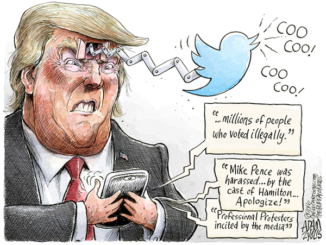
    “Twitter was initially his mode of communication in domestic politics, during his bitterly fought presidential election campaign against Hillary Clinton. It has now become his favorite instrument to chastise America’s foes and friends alike, ranging from China and Iran to neighbors like Canada and Mexico, apart from allies like the EU and partners like India.”

    Governments across the world and most notably the US use instruments of state power like military pressures, diplomatic isolation, travel bans and economic sanctions as instruments of persuasion. President Trump has, however, devised a new instrument of state coercion to express his displeasure and announce his proposed actions. This 21st century diplomatic innovation by Trump is his ‘Twitter handle’.

    Twitter was initially his mode of communication in domestic politics, during his bitterly fought presidential election campaign against Hillary Clinton. It has now become his favorite instrument to chastise America’s foes and friends alike, ranging from China and Iran to neighbors like Canada and Mexico, apart from allies like the EU and partners like India. American friends, however, aver that Trump uses this unique method of addressing foreign rulers, primarily to cheer up his domestic base, apart from informing the world of his late-night thoughts!

    Trump has excelled himself before, when he took on an exceptional target — his country’s most loyal ally — the UK. He poured scorn on and ridiculed the serving British ambassador in Washington, Kim Darroch, who regards himself as the prima donna of Washington’s diplomatic corps. Trump also hit out at British PM Theresa May, now resigned, for allegedly mishandling the Brexit negotiations to fashion a ‘soft exit’.

    His epithets included a description of Darroch as Britain’s ‘wacky ambassador’, a ‘very stupid guy’ and a ‘stupid fool’. May received her share of abuses for her ‘failed Brexit negotiation’. He described her diplomacy as ‘badly handled’ and accused her of going ‘her own foolish way’, while leading her country into a ‘disaster’. True to form, his tweet ended with inevitable boasting about American military and economic might! All this followed leaks of confidential reports Darroch had sent to Whitehall, which were highly uncomplimentary about Trump’s qualities of head and heart.

    Only Israel and Saudi Arabia appear to be free from any ‘Trump tirades and tantrums’. Many in Washington aver that this arises from the closeness of the Saudi and Israeli leadership to Jared Kushner, Trump’s son-in-law. Kushner was recently in Bahrain, trying to sell his solution for Middle East peace to Arab leaders. The Kushner ‘solution’ required the Palestinians to renounce all claims to Jerusalem and the West Bank, in return for petrodollars from oil-rich Arab countries. The proposals were received coldly in Bahrain, with even Saudi Arabia making it clear that its approach to the Palestinian issue was distinctly different. Trump’s approach to crucial contemporary issues enjoys little international support. Even NATO allies differ with him on important issues like climate change and sanctions on Iran.

    Trump’s desire to target India on trade issues became evident when Indian steel and aluminum products were hit with import duties of 25% and 10%, respectively, in March 2018. India’s exports of steel to the US of $761 million have fallen by 46% since. Trump also abolished the preferential duties that India was getting as a developing country. Trump’s tariff increases substantially hit India’s exports of mechanical and electrical machinery, chemicals, steel and auto parts. India retaliated in a measured manner, just over a month ago, targeting industries and agricultural products produced by Trump’s political/electoral supporters. They included new tariffs on imports ranging from almonds and walnuts to steel products.

    The two sides decided to resolve these differences bilaterally, following the Modi-Trump summit in Osaka. Preliminary talks were held recently in New Delhi, with a visiting US delegation. India should, however, bear in mind that it is not the US alone that is unhappy with what it sees as growing Indian protectionist measures. The problems India faces from Trump’s policies pale in comparison to the impact of enhanced US duties on China’s exports. India’s annual exports to US amount to around $54.3 billion while China’s exports to the US amount to $539.67 billion annually. Recent restrictions curb China’s easy access to US high-tech products. The impact is being increasingly felt by China, whose remarkable industrial and technological transformation has been largely facilitated by access to US technology.

    Resolving these issues is going to be more difficult than dealing with the protectionist restrictions that India faces now. While India’s exports to China have shown signs of rising, New Delhi has to devise strategies on how it could best utilize Chinese 5G networks and encourage Chinese investments in its industrial sector, at the same time ensuring that its national security is not compromised.

    India is going to face other challenges which are the creation of the US Congress. The most important of these are the prospects of sanctions flowing from India’s acquisitions of Russian arms. India has let it be known that it has no intention of buckling under US pressure.

    Banking and financial measures to bypass US sanctions were discussed during President Putin’s visit to India. They have since been put in place. While the US has threatened Turkey with sanctions for acquiring S-400 missile systems by ending the proposed supply of F-35 fifth-generation fighters, India has wisely stayed away from attempting to acquire such equipment from the US. The US Indo-Pacific strategy is premised on receiving support from Japan, South Korea, Vietnam, Indonesia and India — a strategy which would have little relevance without the participation of India.

    The US uses the dollar in international finance to coerce others by resorting to threats of financial sanctions, without securing international approval. The time has come to counter this coercive use of power by increasing the use of euro and Chinese renminbi for global transactions. The EU is not too happy at being tied up by unilateral US sanctions on Iran, despite Iran abiding by all provisions of an agreement the EU signed, together with Russia, China and the Obama administration.

    (The author is a former diplomat)

  • Trump arrives in Osaka  for G-20 Summit;  to meet Modi, Xi and Putin

    Trump arrives in Osaka for G-20 Summit; to meet Modi, Xi and Putin

    OSAKA /WASHINGTON (TIP): US President Donald Trump on Thursday, June 27, arrived in Osaka, Japan  to attend the G-20 Summit over the weekend and to hold discussions on a host of bilateral and global issues with leaders of top 20 economies of the world.

    Besides Prime Minister Narendra Modi, the US president will meet his Chinese and Russian counterparts Xi Jinping and Vladimir Putin on the sidelines of the G-20 Summit.

    The White House said Mr. Trump and Mr. Modi would hold a bilateral meeting on June 28. This would be the third engagement of Mr. Trump on Friday, which would start with his meeting with Japanese Prime Minister Shinzo Abe at 8.30 am local time. Thereafter, Mr. Modi would join Mr. Abe and Mr. Trump for a tri-lateral meeting at 9.15 am.

    The Trump-Modi bilateral is scheduled to start at 9.35 am. Trump’s next engagement is with German Chancellor Angel Merkel at 10.15 am, according to the White House. He will also meet the Russian and Brazilian presidents later in the afternoon.

    This would be Mr. Trump’s first meeting with Mr. Modi after his recent electoral victory. It comes in the immediate aftermath of the India visit of Secretary of State Mike Pompeo, during which he met Modi, External Affairs Minister S Jaishankar and National Security Advisor Ajit Doval.

    The Trump-Modi meeting assumes significance in the wake of the strain that has popped up in the bilateral relationship on a host of trade and economic issues.

    This is Mr. Trump’s second visit to Japan in less than a month.

    The G20 is an opportunity for world leaders to discuss the biggest challenges facing the global economy, the White House said.

    Mr. Trump’s goal this week is to fight for the best deals and outcomes possible to lift up America’s workers, it said.

    A truly level-playing field means breaking down foreign barriers — both the tariff and non-tariff kind — that have stifled America’s economy and taken away too many jobs, the White House said.

    “Unlike his predecessors, Mr. Trump is willing to use every tool at his disposal to bring these countries to the negotiating table and agree to better terms for our citizens, it said.”

     (Source: PTI)

  • World leaders Congratulate Modi: Great things are in store for US-India partnership, says Trump

    World leaders Congratulate Modi: Great things are in store for US-India partnership, says Trump

    World leaders on Thursday congratulated Prime Minister Narendra Modi for his landslide victory for a second term in office. Congratulatory messages from various parts of the world poured in. While most of them congratulated him over telephone, some leaders took it to social media to extend their greetings.

    US President Donald Trump – Congratulations to Prime Minister @NarendraModi and his BJP party on their BIG election victory! Great things are in store for the US-India partnership with the return of PM Modi at the helm. I look forward to continuing our important work together!

    Bangladesh PM Sheikh Hasina – The Prime Minister of Bangladesh had initiated the call to Modi to extend her congratulations on the clear mandate given by the people of India to the NDA Government. In doing so, PM Sheikh Hasina became one of the first foreign leaders to congratulate the Prime Minister, thus reflecting the extraordinarily close and cordial ties between India and Bangladesh, and the excellent rapport that the two leaders enjoy.

    President of the Russian Federation Vladimir V. Putin – Putin called Modi and congratulated him on his victory in the general elections. President Putin expressed his conviction that the Prime Minister would further strengthen the longstanding friendship between the peoples of both countries and enhance the Special and Privileged Strategic Partnership that bind the two countries together.

    French President Emmanuel Macron – President of France congratulated Prime Minister Narendra Modi over telephone, describing him as one of the foremost leaders of the democratic world. President Macron reiterated his invitation to Prime Minister Modi to visit France in August 2019 for a bilateral meeting and also to attend the G7 Summit at Biarritz.

    Prime Minister of Nepal, K.P. Sharma Oli  – K.P. Sharma Oli called Prime Minister Modi and congratulated him on the electoral victory in the Lok Sabha elections.

    Prime Minister of Japan, Shinzo Abe  – Shinzo Abe called Narendra Modi and congratulated him for the resounding victory of his party in the 2019 General Elections.

    Chinese President Xi Jinping – President of People’s Republic of China, Xi Jinping sent a letter to Prime Minister Modi congratulating him on the electoral victory of National Democratic Alliance under his leadership. In the letter, President Xi noted the great importance he attached to the development of India-China relations and his desire to work with Prime Minister Modi to take the Closer Development Partnership between the two countries to a new height. President Xi also expressed satisfaction at the strong momentum of development in India-China relations in recent years with the joint efforts of both sides.

    Israel Prime Minister Benjamin Netanyahu – Benjamin Netanyahu called his Indian counterpart Narendra Modi to personally congratulate him. “Narendra my friend, congratulation, what an enormous victory. I hope, Narendra, that we can see each other soon, as soon as you form a government and as soon as we form a government,” Netanyahu said in a short video clip of the phone call released by the Prime Minister’s Office. “Well, thank you for your congratulations on my victory, but there’s one difference: You don’t need a coalition, I do, and there’s a big difference.”

  • Former Trump campaign Chairman Paul Manafort sentenced to 47 months in Prison

    Former Trump campaign Chairman Paul Manafort sentenced to 47 months in Prison

    Freshman New York Rep. Alexandria Ocasio-Cortez slammed Paul Manafort’s “little” jail sentence

    ALEXANDRIA, VA(TIP):  Former Trump campaign chairman Paul Manafort was sentenced on Thursday, March 8,  to 47 months in prison for tax and bank fraud related to his work advising Ukrainian politicians, much less than what was called for under sentencing guidelines.

    Manafort, sitting in a wheelchair as he deals with complications from gout, had  no visible reaction as he heard the 47-month sentence. While that was the longest sentence to date to come from special counsel Robert Mueller’s probe, it could have been much worse for Manafort. Sentencing guidelines called for a 20-year-term, effectively a lifetime sentence for the 69-year-old.

    Manafort has been jailed since June, so he will receive credit for the nine months he has already served. He still faces the possibility of additional time from his sentencing in a separate case in the District of Columbia, where he pleaded guilty to charges related to illegal lobbying.

    Before Judge T.S. Ellis III imposed the sentence, Manafort told him that “saying I feel humiliated and ashamed would be a gross understatement.” But he offered no explicit apology, something Judge Ellis noted before issuing his sentence.

    Manafort steered Donald Trump’s election efforts during crucial months of the 2016 campaign as Russia sought to meddle in the election through hacking of Democratic email accounts. He was among the first of Mr. Trump’s  associates charged in the Mueller investigation and has been a high-profile defendant.

    But the charges against Manafort were unrelated to his work on the campaign or the focus of Mr. Mueller’s investigation- whether the Trump campaign coordinated with Russians.

    A jury last year convicted Manafort on eight counts, concluding that he hid from the IRS millions of dollars he earned from his work in Ukraine.

    Manafort’s lawyers argued that their client had engaged in what amounted to a routine tax evasion case and cited numerous past sentences in which defendants had hidden millions from the IRS and served less than a year in prison.

    Prosecutors said Manafort’s conduct was egregious, but Judge Ellis ultimately agreed more with defense attorneys. “These guidelines are quite high,” Judge Ellis said.

    Neither prosecutors nor defense attorneys had requested a particular sentence length in their sentencing memoranda, but prosecutors had urged a “significant” sentence.

    Outside court, Manafort’s lawyer, Kevin Downing, said his client accepted responsibility for his conduct “and there was absolutely no evidence that Mr. Manafort was involved in any collusion with the government of Russia.”

    Though Manafort hasn’t faced charges related to collusion, he has been seen as one of the most pivotal figures in the Mueller investigation. Prosecutors, for instance, have scrutinized his relationship with Konstantin Kilimnik, a business associate U.S. authority say is tied to Russian intelligence, and have described a furtive meeting the men had in August 2016 as cutting to the heart of the investigation.

    After pleading guilty in the D.C. case, Manafort met with investigators for more than 50 hours as part of a requirement to cooperate with the probe. But prosecutors reiterated at Thursday’s hearing that they believe Manafort was evasive and untruthful in his testimony to a grand jury.

    Manafort was wheeled into the courtroom about 3-45 p.m. in a green jumpsuit from the Alexandria jail, where he spent the last several months in solitary confinement. The jet-black hair he bore in 2016 when serving as campaign chairman was gone, replaced by a shaggy gray. He spent much of the hearing hunched at the shoulders, bearing what appeared to be an air of resignation.

    Defense lawyers had argued that Manafort would never have been charged if it were not for Mueller’s probe. At the outset of the trial, even Judge Ellis agreed with that assessment, suggesting that Manafort was being prosecuted only to pressure him to “sing” against Mr. Trump. Prosecutors said the Manafort investigation preceded Mr. Mueller’s appointment.

    The jury convicted Manafort on eight felonies related to tax and bank fraud charges for hiding foreign income from his work in Ukraine from the IRS and later inflating his income on bank loan applications. Prosecutors have said the work in Ukraine was on behalf of politicians who were closely aligned with Russia, though Manafort insisted his work helped those politicians distance themselves from Russia and align with the West.

    In arguing for a significant sentence, prosecutor Greg Andres said Manafort still hasn’t accepted responsibility for his misconduct.

    “His sentencing positions are replete with blaming others,” Mr. Andres said. He also said Manafort still has not provided a full account of his finances for purposes of restitution, a particularly egregious omission given that his crime involved hiding more than $55 million in overseas bank accounts to evade paying more than $6 million in federal income taxes.

    The lack of certainty about Manafort’s finances complicated the judge’s efforts to impose restitution, but Ellis ultimately ordered that Manafort could be required to pay back up to $24 million.

    Freshman New York Rep. Alexandria Ocasio-Cortez slammed Paul Manafort’s “little” jail sentence Thursday, saying it’s proof the US justice system is broken.

    “Paul Manafort getting such little jail time for such serious crimes lays out for the world how it’s almost impossible for rich people to go to jail for the same amount of time as someone who is lower income,” the Bronx-born congresswoman tweeted.

    She added: “In our current broken system, ‘justice’ isn’t blind. It’s bought.”

    Earlier Thursday, President Trump’s former campaign chairman was sentenced to just under four years in prison for a massive fraud scheme tied to his work as a political consultant for Ukraine’s pro-Russian government.

    Sentencing guidelines recommended 19 1/2 to 24 years. But Judge T.S. Ellis III said that was “excessive.”

    In the D.C. case, Manafort faces up to five years in prison on each of two counts to which he pleaded guilty. The judge will have the option to impose any sentence there concurrent or consecutive to the sentence imposed by Judge Ellis.

  • US regards India as the “Closest Ally” & will be ready to support its war on terrorism

    US regards India as the “Closest Ally” & will be ready to support its war on terrorism

    It is for India to take advantage of a sea of  US goodwill

    By Ven Parmeswaran

    The US has recommended that India must get rid of Jaish-e-Mohammed and Lashkar-e-Taiba thru surgical strikes.  It is implied that once India decides, both the U.S. and India would jointly formulate military strategy and execute it.

    Pakistan sponsored Jaish-e-Mohammed, a terrorist organization,  killed 41 Indian para  military personnel  on February 13th.  Immediately upon hearing the news, a  chain of successive events took place in Washington D.C.  The Secretary of State and the National Security Adviser issued statements of strongest support to India.  This was followed by discussion on the situation  in the U.S. Senate and the U.S. House of Representatives.  All important and leading senators and congressmen/women condemned Pakistan and extended political support to India.  The Chief of the US Central Command, General Joseph Votel  gave his assessment to  the Congress and offered support to India.

    The US has recommended that India must get rid of Jaish-e-Mohammed and Lashkar-e-Taiba thru surgical strikes.  It is implied that once India decides, both the U.S. and India would jointly formulate military strategy and execute it. Indian Ambassador Shringla said: “The designation of India as a Major Defense Partner was also codified into law by the US Congress in the National Defense Authorization Act of 2017, thanks to the unstinted  support of the members of the India Caucus.”

    President Trump has been demanding  that Pakistan dismantle all terror cells and organizations inside Pakistan.  He is the first US President  to cancel military aid to Pakistan. Prime Minister Imran Khan of Pakistan  has been wanting to meet President Trump to seek support for loans from the I.M.F. President Trump has told him that unless he gets rid of all terror outfits and terrorists from Pakistan, he would not support Pakistan’s request.

    Pakistan was defeated by India in three conventional wars.  India defeated Pakistan in its third war and Pakistan lost East Pakistan. Since then, Pakistan has been using the homegrown terrorist organizations, such as Jaish-e-Mohammed; Lashkar-e-Taiba; and others as proxy to fight India.  This resulted in attacks on the Indian Parliament, , New Delhi shopping mall, and the City of Mumbai that killed 165 Indians and foreigners.

    Pakistan is controlled by its military and the I.S.I.,  its intelligence agency.  The military has selected its Prime Minister and therefore the Parliament is a joke.  Because India so far has not retaliated, Pakistan has taken advantage and continues to use the terrorists to attack India.

    India’s new Ambassador to the U.S.A., Harsh Vardhan Shringla  after presenting his credentials to President Trump was given the most enthusiastic reception at the Capitol Hill.   This was attended by more senators and congressmen/women than ever before.   The grand reception given to Ambassador Shringla is a reflection of India-US relations, with India now  branded as “CLOSEST  ALLY”. The chain of events in Washington after Pakistan’s attack in Kashmir reinforces President Trump’s new policy towards South Asia.  India should be pleased because the “CLOSEST ALLY” status has bipartisan support. It is time for India to take full advantage of the US support and  draw up a plan to end the scourge of terrorism from inside Pakistan.

    (The author,  in  the U.S. for 65 years, lives in Scarsdale, N.Y. He  is a Senior Adviser to Imagindia Institute, New Delhi, a think tank. He can be reached at vpwaren@gmail.com)

  • House Launches New Investigation into President Trump’s Foreign Financial Interests and Russia Ties

    House Launches New Investigation into President Trump’s Foreign Financial Interests and Russia Ties

    WASHINGTON(TIP): The House intelligence committee will launch a broad new investigation looking at Russian interference in the 2016 election and President Donald Trump’s foreign financial interests, Chairman Adam Schiff announced Wednesday, February 6, moving ahead with the aggressive oversight that Democrats have promised now that they are in the majority.

    Schiff said the investigation will include “the scope and scale” of Russian intervention in the 2016 presidential election, the “extent of any links and/or coordination” between Russians and Trump’s associates, whether foreign actors have sought to hold leverage over Trump or his family and associates, and whether anyone has sought to obstruct any of the relevant investigations.

    The announcement came one day after Trump criticized “ridiculous partisan investigations” in his State of the Union speech. Schiff dismissed those comments Wednesday.

    “We’re going to do our jobs and the president needs to do his,” Schiff said. “Our job involves making sure that the policy of the United States is being driven by the national interest, not by any financial entanglement, financial leverage or other form of compromise.”

    The California Democrat also announced a delay in an upcoming closed-door interview with Trump’s former fixer and personal lawyer, Michael Cohen, “in the interests of the investigation.” The interview was originally scheduled for Friday. It will now be held on Feb. 28, Schiff said.

    Schiff said he could not speak about the reason for the delay. Hours after the meeting was pushed back, a document was filed under seal in the criminal case against Cohen brought by special counsel Robert Mueller’s office. The court’s docket did not contain any details about the nature of the document.

    Special counsel spokesman Peter Carr declined comment, as did Lanny Davis, an attorney for Cohen.

    The intelligence committee also voted Wednesday to send Mueller the transcripts from the panel’s earlier Russia investigation. Republicans ended that probe in March, concluding there was no evidence of conspiracy or collusion between Russia and Trump’s presidential campaign. Democrats strongly objected at the time, saying the move was premature.

    Since then, both Cohen and Trump’s longtime adviser Roger Stone have been charged with lying to the panel. Cohen pleaded guilty in November to lying to the House and Senate intelligence committees about his role in a Trump business proposal in Moscow. He acknowledged that he misled lawmakers by saying he had abandoned the project in January 2016 when he actually continued pursuing it for months after that.

    Stone pleaded not guilty to charges last month that he lied to the House panel about his discussions during the 2016 election about WikiLeaks, the anti-secrecy group that released thousands of emails stolen from Democrats. Stone is also charged with obstructing the House probe by encouraging one of his associates, New York radio host Randy Credico, to refuse to testify before the House panel in an effort to conceal Stone’s false statements.

    Schiff has said Mueller should consider whether additional perjury charges are warranted.

    The committee had already voted to release most of the transcripts to the public, but they are still being reviewed by the intelligence community for classified information.

    Mueller requested Stone’s interview transcript last year and the panel voted to release it in December. Schiff wouldn’t say whether Mueller had requested other transcripts but noted that the committee had voted to withhold a small number of transcripts from the public and also that some witnesses had been interviewed since then. The transmission of the transcripts to Mueller, expected immediately, will give him full access to all of the committee’s interviews.

    Among the transcripts are interviews with Trump’s eldest son, Donald Trump Jr.; his son-in-law, Jared Kushner; his longtime spokeswoman, Hope Hicks; and his former bodyguard Keith Schiller. There are dozens of other transcripts of interviews with former Obama administration officials and Trump associates.

    Democrats also opposed a Republican motion at the meeting Wednesday to subpoena several witnesses. Republicans said they were witnesses who Democrats had previously wanted to come before the panel.

    A Republican aide said that witness list included FBI and Justice Department officials involved in the Russia investigation and others who could shed more light on research by former British spy Christopher Steele. The aide spoke on condition of anonymity because the committee’s business is confidential.

    Steele’s research was funded by Democrats and later compiled into an anti-Trump dossier that became public.

    (Source: Time)

  • A failed coup in Venezuela

    A failed coup in Venezuela

    The country was once the heartbeat of leftist assertion. But with change in the Americas, matters are now complex

    By Vijay Prashad

    Thus far, the government of Mr. Maduro remains in power, and the military has pledged its fealty to the re-elected president. It is unlikely that the Venezuelan Opposition — controlled by the old oligarchy — will be able to engineer a coup from within the country. It tried such a political maneuver in 2002, which failed. This time it has failed again.

    The fulcrum of geopolitical tension sits on Caracas, the capital of Venezuela. An attempted coup on January 23 has failed. The U.S. decided to recognize a member of the Opposition, Juan Guaidó, as the President of Venezuela. U.S. officials called upon the military to rise up against the government of President Nicolás Maduro. This was against the charters of the United Nations and of the Organisation of American States (OAS). None of that mattered. The drumbeats sounded from Washington to Caracas. There was a minor drum playing from many Latin American capitals, those whose governments had joined the Lima Group — set up in Peru in 2017 to overthrow the government of Venezuela.

    There is little respite for the country, where tension sits heavily from one end to another. Thus far, the government of Mr. Maduro remains in power, and the military has pledged its fealty to the re-elected president. It is unlikely that the Venezuelan Opposition — controlled by the old oligarchy — will be able to engineer a coup from within the country. It tried such a political maneuver in 2002, which failed. This time it has failed again.

    Venezuela’s Foreign Minister Jorge Arreaza, 45, has been understandably busy on the day after the attempted coup. The U.S. tried to isolate the Maduro government. The OAS met in Washington DC, where the U.S. government tried to get it to unanimously vote against Mr. Maduro. Even that meeting could not go as scripted. A veteran activist from Code Pink, Medea Benjamin, sneaked into the room and chanted slogans against the attempted coup. Many Latin American states, despite intense pressure from the U.S. government, either voted against the OAS motion or abstained. Mr. Arreaza watched these

    When I asked him about the coup, he went back to 2017, the last time that the oligarchy tried to wrest control of the government from the socialists. The socialists, led by Hugo Chávez, came to power in 1999. After the U.S. attempted to overthrow Chávez and the socialists in 2002, things calmed down. Oil prices rose and the U.S. was distracted by events in Iraq and Afghanistan. For a decade, Venezuela was able to lead a regional process of integration on an anti-imperialist foundation. But, when Chávez died in 2013, the experiment began to unravel. Oil prices fell dramatically, and the U.S. had already turned its attention to Latin America. A coup in 2009 overthrew the democratically elected government of Honduras. The gunsights turned toward Venezuela. The oligarchy, backed fully by the U.S., attempted to foment trouble in 2017.

    Mr. Arreaza recalled one man, Orlando Figuera, 21, who was going through an Opposition stronghold in May 2017. “He was accused of being a government supporter and brutally beaten by masked protesters who then soaked him in gasoline and set him on fire,” Mr. Arreaza told me. He brought up this story to offer an illustration of the character of the Opposition. Mr. Arreaza called this a ‘violent fascist movement’. He wanted to make it clear that the coup attempt was a part of that movement — one that is less interested in democracy and more interested in power and wealth.

    Venezuela is in trouble. No one doubts that. Oil prices have fallen to half of what they were at the highpoint of Chávez’s government. Since the treasury of Venezuela is almost entirely replenished by the incomes from oil sales, the collapse of oil prices means the collapse of Venezuela’s public finances. Unable to borrow easily, the country faces serious economic difficulties. Sanctions by the U.S. and the seizure of refining sites in the Caribbean put the country into a situation of great crisis. No wonder that people are leaving the country, fleeing their homeland as it is suffocated for political purposes by the U.S. and its Latin American allies in the Lima Group.

    Colombia’s Iván Duque and Brazil’s Jair Bolsonaro are both right-wing politicians who control the governments of Venezuela’s neighbors. They have committed themselves to the overthrow of the Venezuelan government. Mr. Arreaza and others in Venezuela told me that Mr. Duque, Mr. Bolsonaro and U.S. President Donald Trump have overplayed their hands. After the attempted overthrow in 2017, the Venezuelan government tried to deepen public participation by the formation of a Constituent Assembly. It is true that the oligarchy hated this idea and that the western press amplified its views about this being anti-democratic. But, as many Venezuelans say, the Constituent Assembly and the many elections for candidates and referendums that came before 2017 have sharpened their political consciousness. It will be hard to befuddle them with talk of dictatorship.

    The isolation of Venezuela is remarkable. Not long ago, the country was the heartbeat of the leftist assertion in the hemisphere. Now, with the emergence of right-of-center governments in Latin America and with an explosive energy for regime change in Washington, matters are more complex. Mr. Arreaza said that Mr. Maduro had invited the UN High Commissioner for Human Rights, Michelle Bachelet, to visit Venezuela. She has not yet come. Mr. Maduro, he said, wanted the UN to host a dialogue with the Opposition to restore some balance to the politics in the country. No such assistance has been provided. A hand is outstretched from Caracas, Mr. Arreaza said. It is waiting for someone to take hold of it.

    (The author is  Executive Director, Tricontinental: Institute for Social Research)

  • Wall of shame: on Mexico border wall

    Wall of shame: on Mexico border wall

    The shutdown over the Mexico wall demand will long define Donald Trump’s presidency

    It began as a populist campaign promise that brought President Donald Trump’s supporters cheering to their feet and paved the way for his election. Now, the border wall with Mexico has become a morass of partisan bickering that has stalemated the U.S. federal government into a three-week-long shutdown, leaving nearly 800,000 public sector workers furloughed without pay. At the heart of this political crisis is the increasingly bitter polarization of public opinion over immigration. On the one hand, Mr. Trump has steadily contributed to the strident and crude anti-migrant rhetoric, characterizing prospective migrants from Latin America as drug-dealers, rapists and violent criminals and shutting down the U.S. border to travelers from certain Muslim-majority countries. On the other, his insistence that he will not sign any appropriations bill to break the funding logjam in Congress and end what could soon become the longest shutdown in U.S. history, unless that bill includes $5.7 billion in financing for a border wall, has gone down badly with Democrats, who control the House. Matters took a darker turn as Mr. Trump doubled down on his refusal to negotiate over funding for the wall and said he may declare a state of national emergency over this uncomfortable status quo.

    There are disquieting questions about the veracity of some of Mr. Trump’s claims: migrant border crossings have been in decline for the best part of two decades; it is through legal ports of entry and not unauthorized crossing points that hard drugs such as heroin enter the U.S.; and even the State Department has admitted that no terror operatives have entered the U.S. through Mexico. Then there is the more blatantly flawed reasoning touted by the President that “Mexico will pay” for the wall. Now it appears that even Mr. Trump is backing down on his claim, arguing that Mexico would only “indirectly” fund it through trade deals. It is well-known that only corporations pay tariffs under these deals, not governments, and hence no such payment will come from Mexico. Even as the acerbic back-and-forth between Mr. Trump and Congressional Democrats continues, the deeper malaise is a profound disagreement among Americans on what their nation’s very soul stands for. Is the U.S. truly a melting pot, a country built on the prowess of entrepreneurship and technology, in large part driven by immigrants seeking the “American dream”? Or is it a declining world power that has squandered too much to other nations and peoples and is readying itself for an uncompromising battle to claw back what it reckons it has lost? If it is the latter, then we could expect Mr. Trump’s vision to succeed, but if not, a course correction is in order.

    (The Hindu)

  • ‘Individual 1’: Trump emerges as a central subject of Mueller probe: Washington Post

    ‘Individual 1’: Trump emerges as a central subject of Mueller probe: Washington Post

    WASHINGTON(TIP): A Washington Post November 29  late afternoon report by Carol D. Leonnig and Josh Dawsey claims that Trump has emerged as a central subject of Mueller probe. “ In two major developments this week, President Trump has been labeled in the parlance of criminal investigations as a major subject of interest, complete with an opaque legal code name: “Individual 1”, the report says.

    The report which is the most updated account of the ongoing probe says that the “new  evidence from two separate fronts of special counsel Robert S. Mueller III’s investigation casts fresh doubts on Trump’s version of key events involving Russia, signaling potential political and legal peril for the president. Investigators have now publicly cast Trump as a central figure of their probe into whether Trump’s campaign conspired with the Russian government during the 2016 campaign”.

    Here are excerpts from the news report published late afternoon on November 29.

    Together, the documents show investigators have evidence that Trump was in close contact with his lieutenants as they made outreach to both Russia and WikiLeaks — and that they tried to conceal the extent of their activities.

    On Thursday, Trump’s longtime personal lawyer Michael Cohen pleaded guilty to lying to Congress when he insisted that Trump was not pursuing plans to build a Trump Tower in Moscow after January 2016, casting Trump’s repeated claims that he had no business interests in Russia in a new light. A draft special counsel document revealed Tuesday also indicates that prosecutors are closely scrutinizing Trump’s interactions with a longtime adviser, Roger Stone, as he was seeking information about WikiLeaks’ plans to release hacked Democratic emails.

    Legal experts said it’s still unclear how much peril the president might face as a result of the new evidence Mueller has gathered about the Moscow project and WikiLeaks, but his prominence in the prosecutors’ papers puts the president in an awkward starring role.

    “It’s deeply troubling. It’s not a place that anybody wants to be, or where you would want your friends or family to be,” former federal prosecutor Glen Kopp said. “And it’s certainly not a place that you would want your president to be.”

    Trump, identified as “Individual 1” in Cohen’s guilty plea, was said to have received direct updates from Cohen as he pursued a Moscow Trump Tower project with the Kremlin, up until June 14, 2016. The president also appears in the draft charging document for Trump ally Jerome Corsi, who allegedly told Stone about WikiLeaks’ plans to release damaging Democratic emails in October of that year because he knew Stone was in “regular contact” with Trump. The Washington Post reported this week that Trump spoke with Stone the day after he got the alert from Corsi.

    In the draft documents, prosecutors sought to have Corsi plead guilty to lying when he said he didn’t know about WikiLeaks’ plans and urging others to visit WikiLeaks founder Julian Assange to obtain emails damaging to Democrats.

    Trump has given slightly differing accounts of his Moscow business ties over time. In July 2016, he tweeted: “For the record, I have ZERO investments in Russia.” A day later he claimed, “I have nothing to do with Russia.”

    In January 2017, he told a reporter: “I have no deals that could happen in Russia, because we’ve stayed away.”

    Trump’s personal lawyer, Rudolph W. Giuliani, said Thursday that the president’s written answers to Mueller about the Moscow project, which he submitted just before Thanksgiving, conforms with Cohen’s version of events. They discussed a project, starting in 2015, continuing into 2016, and it went nowhere, he said.

    President Trump said Nov. 20 that his lawyers have his answers to special counsel Robert S. Mueller III’s questions about Russia meddling in the 2016 election. (The Washington Post)

    “The president, as far as he knows, he remembers there was such a proposal for a hotel,” Giuliani said. “He talked it over with Cohen as Cohen said. There was a nonbinding letter of intent that was sent. As far as he knows it never came to fruition. That was kind of the end of it.”

    Alan Dershowitz, a Trump ally and constitutional lawyer, said Cohen’s confessions don’t suggest Trump committed any crime but could suggest that Trump wasn’t telling the public the whole truth about the Moscow deal.

    “This is politically damaging, but I’m not sure how legally damaging it is,” Dershowitz said. “This is all about questionable political behavior. It’s a good reason for people voting against Trump. But I don’t see a crime yet.”

    But Tim O’Brien, a Trump biographer and frequent critic, said the developments pose significant new challenges for the president.

    “This is part of the fact pattern that gets to the heart of whether there was collusion between the Trump campaign and the Kremlin during the campaign,” O’Brien said. “I think the unforgiving grinding force of the U.S. justice system, which he has tried to undermine since he became president, is encircling him. I don’t think we know where he will land. But he is certainly mired in something that he is ill-equipped, legally and personally, to handle.”

    Some legal experts argued Mueller appears to be drawing a picture of a candidate who was beholden to the Kremlin. Emails released in the Cohen plea show Trump seeking a financial endorsement from the Russian government on a private project while Russian President Vladi­mir Putin was offering to say flattering things about Trump.

    “It creates the potential for Trump to feel an obligation to pay back President Putin, or Russia in general that . . . do not put the best interests of American forward.” Kopp said. “You are creating a potential vulnerability for a future leader of America.”

    Trump privately stewed as he followed news coverage of Cohen’s plea early Thursday morning, a White House official said.

    A Justice official called the White House Counsel’s Office on Wednesday evening to let personnel know that Cohen would be pleading guilty in a case the following day, according to one person with direct knowledge of the notice. They were not told the details, however, which they learned about shortly before Cohen’s plea Thursday morning.

    Giuliani said the president believed the news development was a gratuitous slap from the Mueller team just as he was about to depart the White House for a trip to the Group of 20 summit in Argentina.

    In public, Trump was defiant, telling reporters that Cohen was a liar and a “weak person” who would do anything to save himself from fraud charges he faces related to his taxi business. Speaking before he stepped onto the Marine One helicopter for his trip, he also denigrated Cohen’s intelligence, calling him “not very smart.”

    “He was convicted of various things unrelated to us,” Trump said. “He’s a weak person, and what he’s trying to do is get a reduced sentence. So he’s lying about a project that everybody knew about. I mean, we were very open with it.”

    He questioned the scrutiny of the Moscow project.

    “There would have been nothing wrong if I did do it,” Trump said. “When I’m running for president, that doesn’t mean I’m not allowed to do business.”

    Trump often grows aggrieved seeing Cohen on TV, aides say. Among White House advisers, Cohen is seen as an existential threat — as much or more so than the Mueller investigation itself due to his longtime role as Trump’s fixer. Trump’s legal team did not learn until Thursday that Cohen had sat for dozens of hours of interviews with Mueller’s office, according to a senior administration official.

    Trump was infuriated earlier this year when Cohen released tapes of him and asked his lawyers and advisers if anything could be done to stop him from releasing any more.

    The Trump legal team cast Cohen as a flawed character whose word is meaningless, as it had when he pleaded guilty in August to eight felony counts, including paying women for their silence about alleged affairs with Trump.

    Legal experts said prosecutors were not likely to build a guilty plea — a brick in the overall case — on the word of one person. The prosecutors’ filings show they have corroborated and buttressed Cohen’s account with contemporaneous emails, and people familiar with the probe say they have also obtained corroborating testimony from other witnesses.

    “This is obviously a significant plea and statement. It means that when the president was representing during the campaign that he had no business interests in Russia, that that wasn’t true,” said Rep. Adam B. Schiff (Calif.), the ranking Democrat in line to become chairman of the House Intelligence Committee. “ If the president and his associates were being untruthful in real time as they were pursuing this deal, what does it mean now about how much we can rely on what the president is saying about any continuing Russian financial interest?”

    Giuliani said the president and his business have not tried to hide his pursuit of a Moscow tower project, and voluntarily disclosed some of the documents Mueller’s team used in its probe of Cohen for lying to Congress. According to a person familiar with the investigation, Cohen and the Trump Organization could not produce some of the key records upon which Mueller relies. Other witnesses provided copies of those communications.

    In the White House, two aides said Trump had complained more in recent days about Mueller’s prosecutors and has kept close tabs on the comments of Corsi and Stone. Trump has praised his former campaign chairman, Paul Manafort, extensively for fighting Mueller’s team, which accused Manafort this week of breaching a plea agreement by lying repeatedly to prosecutors as part of his pledged cooperation in the Russia probe. Cohen had not been on the front of Trump’s mind, both of these aides said.

    Many in the White House try to avoid talking with the president about the Mueller probe, for fear they will be subpoenaed. And both of the aides said it was unclear why Trump was complaining more about the investigation recently. During the midterm campaign, the president occasionally told advisers that people had forgotten about the Mueller probe and remarked positively that it was no longer dominating TV headlines.

    (Source: Washington Post / Carol D. Leonnig and Josh Dawsey)


  • Indian American Lawyer Neomi Rao to Replace Kavanaugh in US Court

    Indian American Lawyer Neomi Rao to Replace Kavanaugh in US Court

    WASHINGTON(TIP): Indian American Neomi Rao has been nominated by US President Donald Trump to fill Justice Brett Kavanaugh’s seat on the DC Circuit Court of Appeals.

    Trump, during Diwali celebrations  at the Roosevelt Room of the White House, announced the nomination of the 45-year-old regulatory czar for the DC Circuit which is considered next to the US Supreme Court.

    If confirmed by the Senate, Ms Rao, who is currently administrator, Office of Information and Regulatory Affairs (OIRA), would be the second Indian-American judge in this powerful court after judge Sree Srinivasan, who was appointed during the previous Obama regime.

    “She is going to be fantastic. Great person,” Trump said.

    Ms Rao will fill the seat vacated by Supreme Court Justice Kavanaugh, who served on the appeals court for 12 years.

    A formal announcement on her nomination is expected to be made by the White House.

    “I just nominated Rao to be on the DC circuit court of appeals, the seat of justice Brett Kavanaugh. That could be a big story,” Trump announced.

    Ms Rao thanked the President for the “confidence” he has shown in her.

    Called the ‘regulatory czar’ of Trump administration in her current capacity, she oversees implementation of the administration’s deregulatory agenda and regulation-related executive orders.

    She was confirmed by the Senate with a 54-41 vote in July 2017 to head the OIRA and is known among legal circles as a highly respected administrative law scholar who has distinguished herself for her right-of-center views, media reports stated.

    A former clerk for conservative Supreme Court Justice Clarence Thomas, Ms Rao was recommended for the post by former White House counsel Don McGahn. Trump’s nomination of Ms Rao is in recognition of her contribution in cutting down regulations.

    Ms Rao has previously served in all three branches of the federal government, and before taking on her current role in the executive branch, she was associate counsel and special assistant to the president for the George W Bush administration.

    A graduate of Yale University and the University of Chicago Law School, Ms Rao also worked in the private sector, in the international arbitration group of the London-based law firm, Clifford Chance LLP.

  • Trump praises Indian-American Officials at the Diwali Celebrations in the White House

    Trump praises Indian-American Officials at the Diwali Celebrations in the White House

    WASHINGTON(TIP):  Indian Americans were praised by the US President Donald Trump for their “incredible” performance in his administration. Trump has appointed more than two dozen Indian Americans to senior positions since he assumed office in 2017.

    “I’m grateful to have numerous Americans of Indian and Southeast Asian heritage who fulfill critical roles across my administration. And they’ve done an incredible job,” Trump said as he hosted Diwali celebrations in the Roosevelt Room, November 13.

    Except for the former South Carolina Governor Nikki Haley, around two dozen of his top Indian-American lieutenants were present at the celebrations.

    Ms Haley, the first-Indian-American appointed to top Cabinet-level position, resigned last month as the US ambassador to the UN.

    In eight years, former president Barack Obama had appointed more than 50 Indian-Americans to key administration positions, including Raj Shah as United States Agency for International Development administrator; Nisha Desai Biswal as the Assistant Secretary of State for South and Central Asia and Richard Verma as the US Ambassador to India.

    By appointing more than two dozen Indian Americans in key administrative positions, Trump seems to be on the track to breaking the record set by his predecessor.

    “Many of them are here today, including the Chairman of the Federal Communications Commissions, Ajit Pai,” Trump said as he called upon him.

    “Ajit, where’s Ajit? Come here, Ajit. I just didn’t like one decision he made, but that’s all right,” he said as the small audience burst into laughter. “Not even a little bit. But he’s independent,” said the president.

    Seema Verma, who in her capacity as administrator of the Centers of Medicare and Medicaid Services, is playing a key role in healthcare reforms, Trump said.

    “Chairman of the Federal Energy Regulatory Commission, Neil Chatterjee. Where is Neil? Good. Nice to see you,” said the US president indicating that he personally knows each one of these Indian-Americans.

    “The acting administrator of Drug Enforcement, and another person that I’ve become very close to, Uttam Dhillon,” Trump said.