Tag: Uttar Pradesh

  • Political takeaways from the Bihar campaign

    Political takeaways from the Bihar campaign


    By Seema Chishti

    Tejashwi Yadav’s campaign in Bihar is frustrating the ruling party as it is using that very powerful appeal against a 15-year-old regime by citing the absence of bread and butter issues and taking the campaign out to the State’s youth. His primary emphasis during the election campaign has been on 

    the high rate of unemployment, forming the backbone of his promise of providing 10 lakh new government jobs to the youth of Bihar. The BJP has been forced to play catch-up. After the results come in, there will be much to theorize on how caste politics has changed in north India. Enough has already been said about how this is the last of the Mandal elections (with Nitish Kumar on the backfoot, Lalu Prasad not campaigning and Ram Vilas Paswan no more); but on closer scrutiny, this is more about evolution of the social justice plank than its burial.

    Bihar’s Champaran farmlands served as the brewing fields for Gandhi’s ruminations and eventual journey to a Mahatma more than a century ago. Later, the State was quick to catch the sparks off Gujarat’s student revolt and lend the anti-Emergency movement the fury that was to become a prairie fire which consumed the invincible Indira Gandhi. Bihar is renowned for its intangible political energy, equations and trends that have gone on to shape India’s political firmament.

    Throwbacks to the past

    The final election results notwithstanding, not that the voters’ mandate is sacrosanct — consider Goa, Manipur, Karnataka, Maharashtra and Madhya Pradesh — the election campaign has provided important political takeaways. Like all elections in the last six years, including the municipal polls in the capital in 2017, Narendra Modi has campaigned with admirable energy and dedication in Bihar. The Prime Minister’s campaigning is an opportunity to peep into his vision and priorities for the people of the State and the country.

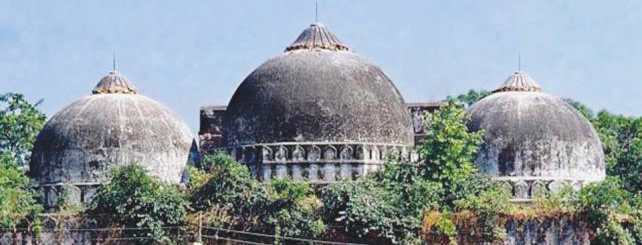
    A quick glance at his speeches shows that Mr. Modi’s refrain is Ayodhya’s Ram temple and Article 370 in Kashmir (Darbhanga on October 28 and Champaran on November 1), “Jungle Raj” spoken of often, a reference to the “double Yuvrajs” ostensibly of Tejashwi Yadav and Rahul Gandhi (Chhapra on November 1) struggling to “keep the simhasan/throne”, “BIMARU” Bihar, referring to an outdated acronym for Bihar, Madhya Pradesh, Rajasthan and Uttar Pradesh no longer used even in seminars. Almost all of the Prime Minister’s repeated references are jaded throwbacks to the past: Ayodhya’s Babri Masjid was brought down in 1992, ‘jungle raj’, referring to pejoratives for Lalu Yadav and Rabri Devi’s time as Chief Minister is 15 years ago and the last time that either Tejashwi Yadav or Rahul Gandhi’s fathers held public office was several years ago — there is certainly no ‘simhasan’ for them to defend. It is a negative agenda of a campaign anchored selectively in the past.

    No vision, invoking fear

    Nitish Kumar has been in power in the State for the past 15 years, mostly with the Bharatiya Janata Party (BJP), and there is little in the achievement columns of his report card for Mr. Modi to seek votes on. Soliciting support for another five years of a jaded government is tough, and thus the argument seems to be that “we are bad but they are worse” — not the most inspiring political pitch. More surprising is the lack of vision for either Bihar or India from the Prime Minister. The selective recall of the 1990s is odd when at 57.2%, Bihar has the highest proportion of those below 25 years of age in the country. This is like the captain’s proverbial yearning for the safety of the shore when the boat is in choppy waters mid-ocean, when, instead, it needs a vision to navigate ahead.

    The exponential rise of the BJP, now dominating the political scene with more than half of India’s States under its rule and having 302 Lok Sabha seats (as on October 1, 2020), began by leveraging the upheaval of the 1990s as the polity was challenged by newly opened fissures of caste, religion and economic disparity. Social and cultural issues are an integral part of Indian electoral politics, but to invoke the divisive issues of the past at this time points to a poverty of vision for the future, of the missing destination the ship of governance is aiming for when at sea. Instead of taking matters to a higher level of ‘aspiration’, the country’s top leadership has chosen to invoke not hope but fear.

    A lost opportunity and why

    When India has gone from one of the fastest growing three economies in the world to among the slowest, with an unprecedented decline of 23.9% in the first quarter of 2020, the country would have benefited from learning of the Prime Minister’s plan to get the economy back in shape. The novel coronavirus pandemic also offered an opportunity to speak of public health as a sharp arrow in its quiver, and take his party’s campaign to another high level. Quite the contrary happened when a free vaccine was offered as an election sop, hitting another new low for the BJP in 2020. Public health, at a time of a rapidly growing infectious disease, has always been handled centrally and has been universal and free. The smallpox vaccine, BCG or even the tuberculosis programme has been centrally driven and unconnected with electoral cycles.

    The appeal that proved invincible and lent a deathly blow to the Congress-led United Progressive Alliance in 2014 was a dream that Mr. Modi associated himself with. The ‘Gujarat model’, notwithstanding its merits, was about hope, about vikas, development (if not progress), and overall about improving lives of Indians, a formula that proved unbeatable. The promise, plastered on all available billboards was about ‘two crore jobs’ every year, ₹15 lakh in every bank account and the burnishing of an entrepreneurial spirit that would bring welfare and prosperity. Mr. Modi would make India great again and improve the conditions of its millions, who came out and voted for that dream. This appeal was developed on the campaign that Mr. Modi had carefully crafted around ‘Vibrant Gujarat,’ which had shut down his critics. It was Mr. Modi as the doer and the Vikas Purush that won accolades and eventually the seat of power in Delhi. The core Hindutva spirit that he stood for was just the backstory: Mr. Modi in 2014 worked, as he offered himself and much more.

    The youth connect

    Turning the tables on this, Tejashwi Yadav’s campaign in Bihar is frustrating the ruling party as it is using that very powerful appeal against a 15-year-old regime by citing the absence of bread and butter issues and taking the campaign out to the State’s youth. His primary emphasis during the election campaign has been on the high rate of unemployment, forming the backbone of his promise of providing 10 lakh new government jobs to the youth of Bihar. The BJP has been forced to play catch-up. After the results come in, there will be much to theorize on how caste politics has changed in north India. Enough has already been said about how this is the last of the Mandal elections (with Nitish Kumar on the backfoot, Lalu Prasad not campaigning and Ram Vilas Paswan no more); but on closer scrutiny, this is more about evolution of the social justice plank than its burial. Tejashwi Yadav in 2020 is doing a Narendra Modi in 2014, by not making it overtly about social justice alone. The Mandal campaign of the 1990s in north India was particularly anxious to underscore that it was not economics but social oppression that rankled and needed urgent redress. By threading economic upliftment seamlessly into the idea of social justice, Tejashwi Yadav has confounded his opponents. He need not even loudly talk about backward caste or utter the phrase social justice, any more than Mr. Modi had to proclaim that he is a proud bearer of Hindutva.

    In 2015 when Nitish Kumar and Lalu Prasad struck an alliance, they stumped the BJP by turning it into a ‘forward versus backward’ election. That was a case of political innovation in the face of the BJP juggernaut, at a time when the electoral machine of the BJP, with its freshness, was at its peak. But this time, what has annoyed Nitish Kumar and visibly frustrated the BJP is Tejashwi Yadav coming up from behind and smoothly introducing Social Justice 2.0 into the campaign in his own unique manner. The results of the elections will be known soon but if there is already a winner for political reimagination, it is Tejashwi Yadav against a weary Nitish Kumar and a rear-view mirror-gazing Narendra Modi.

    (The author  is a journalist based in New Delhi)

    (Source: The Hindu)

  • 15th Edition of Pravasi Bharatiya Divas Concludes

    15th Edition of Pravasi Bharatiya Divas Concludes

    President confers Pravasi Bharatiya awards on 28 overseas Indians and two organizations

    Chandra Shekhar Mishra, Gita Gopinath, Gitesh Jayantilal, Prakash Madhavdas Heda from the US are among the Honorees

    VARANASI(TIP): The three-day Pravasi Bharatiya Divas Sammelan concluded here on January 23, with President Ram Nath Kovind delivering the valedictory address and conferring the Pravasi Bharatiya Samman awards on 28 eminent personalities and two organizations of the Indian diaspora for their contributions and achievements in various fields.

    “Happy to have conferred the Pravasi Bharatiya Samman on 30 members of our diaspora. We value your committed efforts to promote India and to work for the welfare of Indian community abroad. You are a living bridge between India and the world,” President said.

    According to a list provided by the External Affairs Ministry, the awards were conferred in the fields of social, community and public service, business, business management, entrepreneurship, chartered accountancy, training and simulation, science, medical science, engineering, technology, architecture, academics, arts and diplomacy.

    Nihal Singh Agar, known for his services to the Hindu community in Australia, was conferred the award under the category of social service.

    Two organizations — Indian Community Association of Egypt and Guyana Hindu Dharmic Sabha — and Swami Saradaprabhananda of the Ramakrishna Centre of South Africa, got the award for community service.

    Himanshu Gulati, a Member of Parliament in Norway, and Shamim Parkar Khan of the United Arab Emirates (UAE) were honored for public service.

    Under the business category, Ramesh Chotai of Canada, Amit Waikar of China, Bitthal Das Maheswari of Italy, Bhavdeep Singh Dhillon of New Zealand, Vinodan Verambally Thazhikuniyil of Oman and Girish Pand and Surender Singh Kandhari of the UAE were honored.

    President Ram Nath Kovind presenting Pravasi Bharatiya Samman to an honoree.

    While Banwarilal Satya Narayan Goenka was conferred the award in the field of business management, Rajesh Chaplot of Uganda got it for chartered accountancy, Jagdeshwar Rao Maddukuri of Poland for entrepreneurship, and Purnendu Chandra Tiwary of Qatar for training and simulation.

    In the field of medical science, Guna Sekhar Muppuri of Jamaica, Prakash Madhavdas Heda of the US, and Zulekha Daud of the UAE were honoured.

    Rajendra Kumar Joshi of Switzerland and Chandrashekhar Mishra of the US were honoured for their contributions in the field of science.

    Rajinder Nath Khazanchi of Bhutan got the award for civil engineering, Gitesh Jayantilal Desai of the US for structural engineering, P.V. Sambasiva Rao of Kenya for technology and Rajpal Tyagi of Kuwait for architecture.

    Malini Ranganathan of France and Gita Gopinath of the US were honoured for their contributions in the fields of academics and arts.

    Veteran South African diplomat Anil Sookal was conferred the award in the field of diplomacy.

    Earlier, the PBD  got off to a start on January 21, with the External Affairs Minister inaugurating the Youth PBD.

    External Affairs Minister is speaking at the Youth PBD on January 21. UP Chief Minister Yogi Adityanath is seen on left.

    In her inaugural address, the External Affairs Minister said India is a land of limitless opportunities,  and Pravasi Bharatiyas are and will continue to be partners in  progress of our motherland. She emphasized that shared identity and shared commonness are the key features which bind us together which will grow manifold in years to come. The Minister said that the story of Pravasi Bharatiyas is a tale of courage, determination and  character and cited the examples of  Google CEO, Sunder Pichai, Microsoft COO Satya Nadella, IMF Chief Economist Gita Gopinath to name a few. She thanked the diaspora for kindling a new wave for India abroad

    Union Minister of State Information and Broadcasting (independent Charge) and Sports and Youth Affairs, Col. Rajyavardhan Rathore spoke about the unique and binding force of Indian identity and said Pravasi Bharatiya community is India’s best Ambassador. He urged them to join in the building of a New India. The Minister lauded the role of NRIs in preserving their cultural values and respect for the motherland.

    Chief Minister of Uttar Pradesh, Yogi Adityanath said Uttar Pradesh looks up to the diaspora community for its valued contribution. 30-year-old Norwegian MP, Himanshu Gulati recalled the journey of his parents from India to Norway 40 years ago. He said that natural resource are our biggest assets and youth must imbibe the values of Mahatma Gandhi, ‘Be the change you want to see’.

    Guest of Honor, MP from New Zealand, Kanwaljeet Singh Bakshi said  Agriculture and Horticulture are key areas in which India and New Zealand can collaborate. The MP put up the request for Dual citizenship and Nomination of NRIs to Rajya Sabha for active participation in politics. He urged people to take pride in their culture and heritage. Youth Pravasi Bharatiya Divas has been organized with a view to share the ideas for a New India among the NRI  youth  and the generation next back home

    Prime Minister  Narendra Modi inaugurated the PBD Convention on January 22. The Convention deliberated on the theme- Role of Indian Diaspora  in building  New India.

    Prime Minister Narendra Modi ready to light a lamp to inaugurate the Convention in the presence of Prime Minister of Mauritius, Pravind Jugnauth (extreme left). EAM Sushma Swaraj is seen on the right.

    Observing that his government helped changed perceptions regarding the country in the last four and half years, Modi said, “Earlier, people used to say India cannot change… but we have changed that perception and this mindset itself.” Addressing the over 4,000 NRI delegates from about 85 countries, he said that India is the fastest growing economy in the world and also urged the Indian diaspora across the to participate in the building of new India.

    A group of honorees with President Kovind

    Mauritius Prime Minister Pravind Jugnauth, the chief guest this year, surprised the audience by speaking in Hindi. Addressing the audience yesterday, Prime Minister Narendra Modi described NRIs as brand ambassadors of the country. While observing that people of Indian origin are in leadership roles in many countries including Mauritius, Portugal and Ireland, he said, “I consider NRIs to be India’s brand ambassadors. They are the symbols of our capacities and capabilities.”

    The 15th edition of the PBD was organized by the External Affairs Ministry in partnership with the government of Uttar Pradesh.


  • UTTAR PRADESH BY-ELECTION:Samajwadi Party wins Yogi Adityanath’s Gorakhpur, UP CM says result ‘unexpected’ UTTAR PRADESH

    UTTAR PRADESH BY-ELECTION:Samajwadi Party wins Yogi Adityanath’s Gorakhpur, UP CM says result ‘unexpected’ UTTAR PRADESH

    LUCKNOW (TIP): Delivering a major blow to the BJP, the Samajwadi Party won Gorakhpur and Phulpur Lok Sabha seats in Uttar Pradesh by-election. Samajwadi Party’s Nagendra Pratap Singh Patel defeated BJP’s Kaushlendra Singh Patel by 59,613 votes in Phulpur. In Yogi Adityanath’s bastion, SP’s Praveen Kumar Nishad defeated BJP’s Upendra Dutt Shukla by 21000 votes.

    Gorakhpur and Phulpur are highprofile constituencies as both the seats were represented by BJP’s firebrand leader and current UP Chief Minister Yogi Adityanath and Deputy Chief Minister Keshav Prasad Maurya respectively. Adityanath represented Gorakhpur five times in the Lok Sabha, and it went vacant in 2017 when he was elected to UP Assembly to take over as the Chief Minister of the state.

    In 2014, BJP had won both the seats with over 3 lakh vote margin. In Gorakhpur, BJP’s Yogi Adityanath had defeated SP’s Rajmati Nishad by 31,2783 votes. And in Phulpur, BJP’s Keshav Prasad Maurya defeated SP’s Dharam Raj Singh Patel by 3,08,308 votes. However, currently the BJP is trailing on both the seats. Ten candidates are in fray from Gorakhpur and 22 candidates contested from Phulpur.

    ALARM BELLS IN BJP

    The defeat of the Bharatiya Janata Party in all six Lok Sabha seats where byelections were held this year has sounded alarm bells in the party in Uttar Pradesh ahead of the 2019 Parliamentary polls, while stoking speculation about the Opposition stitching an alliance together to take the BJP on after tasting success in the recent bypolls.

    The BJP failed to break the jinx of repeated failures in Parliamentary byelections in 2018 when it was defeated yesterday in Gorakhpur, the bastion of Chief Minister Yogi Adityanath, and Phulpur, earlier held by deputy Chief Minister Keshav Prasad Maurya.

    The ruling partys candidates in the two constituencies lost to the Samajwadi Party (SP), triggering a debate on whether political outfits opposed to the BJP could forge a mega alliance before the 2019 Lok Sabha polls.

    The SP, supported by the BSP, romped home in the bypolls.

    SPs Pravin Nishad defeated Upendra Dutt Shukla of the BJP by 21,961 votes in Gorakhpur, a seat which had been with the BJP since 1989. Nagendra Pratap Singh Patel of SP cornered the Phulpur seat, drubbing the saffron partys Kaushalendra Singh Patel by 59,460 votes.

    As the results of the two by-election were declared yesterday, Adityanath said there was a “lesson” to be learnt from the outcome, and cited over-confidence and the inability to understand the implications of the pact between SP and BSP as the prime reasons for the BJPs defeat.

    UP Congress spokesperson Ashok Singh told PTI the outcome had brightened the prospects of the formation of a “maha gathbandhan” (grand alliance) ahead of the 2019 polls to defeat the saffron party.

    “We will ponder seriously about a larger alliance keeping the next Lok Sabha polls in mind,” he said. The Congress had contested the 2017 UP Assembly polls jointly with the SP and might want to tackle the polls together next year, too, another senior party leader told PTI, requesting that he not be named.

    The outcome of the March 11 bypolls has sparked talk in political circles about a continuing pact between the SP and the BSP — once bitter critics in Uttar Pradesh.

  • Modi’s $87 billion river-linking project set to take off as floods hit India

    Modi’s $87 billion river-linking project set to take off as floods hit India

    NEW DELHI (TIP): After years of foot-dragging, India will begin work in around a month on an $87 billion scheme to connect some of the country’s biggest rivers, government sources say, as Prime Minister Narendra Modi bets on the ambitious project to end deadly floods and droughts.

    The mammoth plan entails linking nearly 60 rivers, including the mighty Ganges, which the government hopes will cut farmers’ dependence on fickle monsoon rains by bringing millions of hectares of cultivatable land under irrigation.

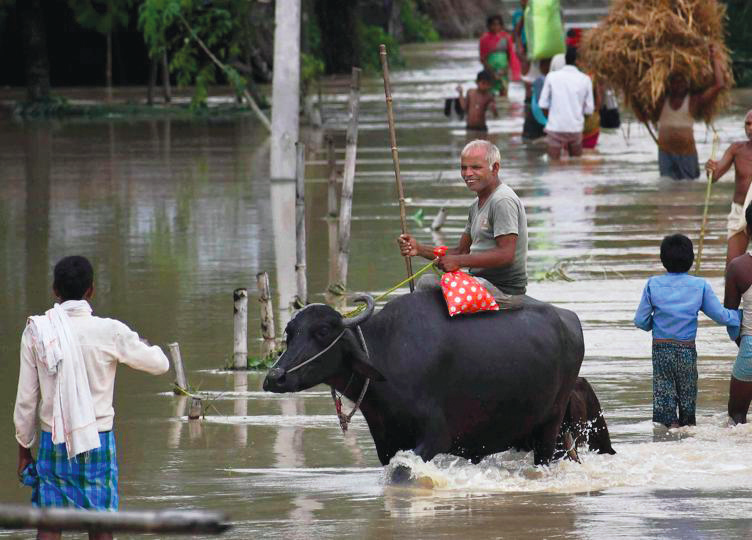
    In recent weeks, some parts of India and neighbouring Bangladesh and Nepal have been hit by the worst monsoon floods in years, following two years of poor rainfall.

    Modi has personally pushed through clearances for the first phase of the project – which would also generate thousands of megawatts of electricity – the sources say, despite opposition from environmentalists, tiger lovers and a former royal family.

    That will involve construction of a dam on the Ken river, also known as the Karnavati, in north-central India and a 22- km (14-mile) canal connecting it to the shallow Betwa.

    Both rivers flow through vast swathes of Uttar Pradesh and Madhya Pradesh, ruled by the Bharatiya Janata Party (BJP), and the prime minister hopes the Ken-Betwa scheme will set a template for other proposed river interlinking projects, one of the sources said.

    “We have got clearances in record time, with the last round of clearances coming in only this year,” Sanjeev Balyan, the junior water resources minister, told Reuters. “The Ken- Betwa interlinking tops the priority list of the government.”

    Government officials say diverting water from bounteous rivers such as the Ganges, Godavari and Mahanadi to sparse waterways by building a clutch of dams and a network of canals is the only solution to floods and droughts.

    But some experts say India would be better off investing in water conservation and better farm practices. Environmentalists and wildlife enthusiasts have also warned of ecological damage.

    The 425-km (265-mile) Ken flows through a tiger reserve nestled in a verdant valley. The government plans to clear out 6.5 percent of the forest reserve to build the dam, relocating nearly 2,000 families from 10 remote villages.

    Around half a dozen clearances, including on environmental and forest protection, have been obtained for the scheme to link the Ken and Betwa, according to two sources and documents seen by Reuters.

    Modi’s cabinet is likely to give its final go-ahead for the project within a couple of weeks, sources say, after which he will flag off construction at the site about 805 km (500 miles) from New Delhi, currently marked only by rows of red concrete slabs placed on the ground.

    Source: Reuters

  • Rahul Gandhi, Mayawati to skip RJD rally on August 27

    Rahul Gandhi, Mayawati to skip RJD rally on August 27

    Video clips of chief minister Nitish Kumar’s statements against PM Narendra Modi before the 2015 assembly elections and Modi’s DNA comment and other remarks against Kumar will be played at the rally.

    PATNA (TIP): RJD chief Lalu Prasad’s proposed ‘BJP Bhagao, Desh Bachao’ rally at Gandhi Maidan in Patna on August 27 seems to have lost its sheen.

    The rally, an effort at uniting the opposition parties to take on the BJP-led NDA in the 2019 Lok Sabha poll, will not be attended by Congress leaders Sonia Gandhi or Rahul Gandhi and BSP supremo Mayawati. However, the Congress will be represented by Ghulam Nabi Azad.

    Mayawati on Thursday justified her decision to skip the rally, saying her party has conveyed to the RJD that it will share the stage with it only if it is decided in advance which party gets how many seats.

    JD(U) dissident Sharad Yadav has also confirmed participation in the rally. Among other leaders who will attend the rally are West Bengal chief minister Mamata Banerjee, former chief ministers of Uttar Pradesh and Jharkhand Akhilesh Yadav and Hemant Soren, respectively.

    “We have extended invitations to 17 parties that have come together with the Congress to form a joint opposition platform,” said Bhola Yadav, a close aide of the RJD chief and MLA from Bahadupur in Darbhanga. He said Om Prakash Chautala-led INLD, DMK and a few other parties from Jharkhand will also be represented at the event. Prasad’s younger son Tejashwi Prasad Yadav has already undertaken a two-phase statewide tour to drum up support for the rally. “The rally will be different from the past with respect to ambience, extensive use of technology and less of rustic flavour. The change can be attributed to the advent of Tejashwi as the widely accepted next generation leader,” they added. Yadav himself is supervising the arrangements for the rally.

    Video clips of CM Nitish Kumar’s statements against PM Modi before the 2015 assembly elections and Modi’s DNA comment and other remarks against Kumar will be played at the rally. “Facts will speak for themselves before the ‘malik’ to make an assessment how Kumar insulted their mandate,” said RJD leader Sanjay Yadav.

  • Will decide on early hearing in Babri Masjid dispute case says SC

    Will decide on early hearing in Babri Masjid dispute case says SC

    NEW DELHI (TIP): The Supreme Court on Friday, July 21, said it would take a decision to list for early hearing a batch of petitions challenging the Allahabad High Court verdict in the Ram Temple-Babri Masjid land dispute case.

    “We will take a decision on it,” a bench comprising Chief Justice JS Khehar and Justice DY Chandrachud said when BJP leader Subramanian Swamy mentioned the matter for urgent listing and hearing.

    Swamy said the main appeals against the Allahabad High Court order were pending for the last seven years in the apex court and they required urgent hearing.

    He also said that a separate petition had earlier been filed by him seeking enforcement of his right to worship without much hassle at the site.

    He also said that he had been allowed by the apex court to intervene in the matter and is seeking expeditious disposal of the cases.

    The Lucknow bench of the Allahabad High Court had in 2010 ruled a three-way division of the disputed 2.77 acres area at the disputed site in Ayodhya in Uttar Pradesh.

    The three-judge bench, by a 2:1 majority, had said the land be partitioned equally among three parties, the Sunni Waqf Board, the Nirmohi Akhara and ‘Ram Lalla’.

    Source: PTI

  • EXPLOSIVE RECOVERED FROM UP ASSEMBLY, YOGI CLAIMS TERROR CONSPIRACY

    EXPLOSIVE RECOVERED FROM UP ASSEMBLY, YOGI CLAIMS TERROR CONSPIRACY

    NEW DELHI (TIP): Uttar Pradesh chief minister Yogi Adityanath said on July 14 (Friday) that the “white powder” recovered from the state Legislative Assembly on July 12 was an explosive substance and claimed there may be a “terror conspiracy” afoot.

    Citing a forensic report which confirmed that the white powder was the extremely powerful plastic explosive Pentaerythritol Tetranitrate or PETN, Yogi Adityanath called the incident a major security lapse and demanded an National Intelligence Agency (NIA) probe into the matter.

    “This is PETN, a higly explosive substance was found in the assembly. Action must be taken against those involved. How can we allow anyone to compromise the security of 403 MLAs? NIA must investigate this,” the chief minister said in the state assembly on Friday.

    “Strong security system must be established as this could be a terror conspiracy,” he said.

    Earlier, Yogi Adityanath had called a high level meeting to review the security measures in the assembly in light of Thursday’s incident. He told all MLAs present that everyone needs to be cautious and make sure to follow security guidelines. He also said that police should carry out background checks for all workers in the state assembly.

    Source: TOI

  • UP may face Mandsaur-like situation, warn farmer bodies

    UP may face Mandsaur-like situation, warn farmer bodies

    LUCKNOW: (TIP): The resentment among Uttar Pradesh farmers, especially sugarcane growers and potato cultivators, may snowball into protests if timely steps are not taken to prevent the simmering agrarian distress from going the Madhya Pradesh way, farmer bodies have warned.

    A faction of one of the organisations–the Bharatiya Kisan Union (BKU)–has even threatened to cut off supply of milk and vegetables to cities from Sunday if their demand for a CBI probe and an FIR into the police firing in Mandsaur, that claimed five lives, are not met.

    Taking a cue from their Madhya Pradesh counterparts, farmers in western Uttar Pradesh are gearing up to raise their own issues, ranging from unpaid dues to poor procurement infrastructure, which, they claimed, have not been adequately addressed by the Yogi Adityanath government despite numerous promises and repeated assurances.

    The activities of cow protection vigilantes in the recent times had added more trouble to the sector, they said.

    The farmers in UP have been closely following the agitations of Madhya Pradesh and Maharashtra, considering the stirs as their roadmap for the future. Under the banner of the BKU, a procession was taken out here on Wednesday to express solidarity with the agitating farmers of Madhya Pradesh and condemn the police action on them in Mandsaur.

    “Now, with these agitations, there is renewed energy among us. There is no end to the problems we face. We will also join the fight,” said Rakesh Tikait, president of the Bhartiya Kisan Union.

    His views have been echoed by leaders of other farmer groups. Another faction of the BKU submitted a memorandum addressed to the prime minister to the Lucknow district magistrate on Wednesday, demanding an FIR against officers responsible for the “unfortunate police firing” in Mandasur and a CBI probe.

  • Indian-Americans shine at Intel science fair in the US

    Indian-Americans shine at Intel science fair in the US

    WASHINGTON (TIP): While four Indian- Americans received top awards in various categories, an Indian boy has won the world’s largest pre-college science competition in the US in environmental engineering category for his project on biodegradation of pesticides.

    Prashant Ranganathan, a 12th grader from Jamshedpur, alongwith over 20 high school students from various parts of India, participated in the Intel International Science and Engineering Fair. “My project will actually help farmers in biodegrading the pesticide which is plaguing the country,” Prashant told PTI after he was declared winner in the environmental engineering category at this years’ competition.

    In all, more than 1,700 students from across the world participated in the week-long event which concluded here on Friday.

    Student of Carmel Junior College in Jamshedpur, Prashant’s project ‘Biodegradation of Chlorpyrifos using native bacteria’ said that farmers should not use pesticides.

    Prashant who bagged the coveted award for his innovation for fighting against pesticide and getting rid of its side effects through biodegradable use. “In almost all the states, like Uttar Pradesh and Punjab, Haryana and Bihar and Jharkhand, there’s extensive farming. Using excessive amounts of pesticides, is affecting the health and the environment around them,” he said.

    While the topmost Gordon E Moore Award of $75,000 went to Ivo Zell, 18, of Germany for designing and constructing a remote-control prototype of a new “flying wing”, almost every participant of the Indian delegation returned from the annual competition with one award or the other.

    “India really boasts really extraordinary mathematics, science, physics, education,” Maya Ajmera president and CEO of Society for Science and Public, told PTI in an interview. In fact, in every section the award ceremony had the budding Indian scientists on the stage.

    So were the Indian American high schoolers, prompting one of the Intel official to say, “Indians and Indian Americans rock today” as the awards ceremony concluded at the Los Angeles Convention Center in downtown Los Angeles.

    Indian-American Pratik Naidu from Virginia bagged an award in the category of computational biology and bioinformatics, Adam Nayak from Oregon was declared the winner in earth and environmental sciences, Karthik Yegnesh from Pennsylvania in Mathematics and Rahul Subramaniam from Connecticut in the microbiology category.

    As a result, Indians and Indian Americans accounted for nearly one-fifth of the top categories of the awards. “I think that many generations of Indian scientists and engineers and computer scientists, have truly paved the way of this generation of young people doing extraordinary things,” Ajmera said referring to the incredible and innovative projects of Indian students who participated in this year’s science competition.

    For instance, a sister-brother team – Sairandi Sathyanarayanan & Sacheth Sathyanarayanan – from the National Public School in Chennai have invented a gearbox that generates electricity when a fisherman’s boat is lying idle at night, which they said is enough to meet the energy needs of a fisherman’s house for a day.

    The team not only received accolades from the judges but were on the stage on Friday for receiving awards in various categories.

    Shinjini Ghosh, a 12 grader from South Point High School, Kolkata was recognized for developing a language identification kit based on the variations in intonation using discrete markov-chain model.

    Similarly, Sahithi Pingali from Inventure Academy, Bangalore received multiple awards for developing a new approach to monitoring lakes in developing countries in a crowdsourcing environmental science.

    Kunj Siddharth Dedhia, from the Dhirubhai Ambani International School in Mumbai has developed a smartphone application based on user feedback for cyclists to reduce incidence of lower back pain, while Chaitanya & Geeve George from the Little Rock Indian School in Udupi received an award for developing a smartphone-aided multispectral imaging system. (Source: PTI)

  • Prevention of Cruelty to Cows; not to humans: an emerging reality in Modi’s India

    Prevention of Cruelty to Cows; not to humans: an emerging reality in Modi’s India

             BY GEORGE ABRAHAM

    “This is a direct infringement of the fundamental right of the people as to what to consume, and this order may even have usurped the State rights in deciding vital issues that impact its citizens. The federal structure that stood the test of time since Independence may also be in the crosshairs. The socio-economic consequences from nutrition to the poor and backward in the society who rely on cheap meat as a staple food, and to the small farmers and traders who rely on these animals for their livelihood are yet to be seen”, says the author.

    The long anticipated cow slaughter ban across India under the BJP rule is already here! Most observers were expecting a legislative move probably after the 2019 election when BJP could muster majorities at both houses of the parliament. However, the Modi Sarkar found an ingenious way to test these waters under the guise of the ‘Prevention of Cruelty to Animals Act’ that was enacted in 1960 to prevent the infliction of unnecessary pain or suffering on animals.

    It is indeed a sinister move by the Environmental Ministry issuing new rules to regulate these animal markets with an eye towards limiting or stopping cow slaughter across the nation. The new rule states that animal markets can no longer be used to sell or purchase cattle for the purposes of slaughtering. The regulations apply to bulls, cows, buffaloes and camels. The reactions from the southern states were quick and predictable and the Chief Minister of Kerala, Pinarai Vijayan, took the lead in saying that “Malayali diet need not be decided by Delhi (read Union Government) or Nagpur (read RSS headquarters). Nobody can change our diet,” he said. Student organizations belonging to the Left front as well as Congress in Kerala protested the ban by organizing ‘beef fests’ across the state.

    However, some of the youngsters who belong to the Youth Congress wing of the Congress Party went to the extreme in slaughtering a bull in the open and thereby eliciting strong condemnation from the national leadership in addition to receiving walking papers from the Party’s State leadership. It is regrettable that their stupefied action did cast a shadow on the merit of their arguments in defense of the constitutional protection from the onslaught of religious fundamentalism and may have negatively impacted on the seriousness of the issue at hand.

    Nevertheless, what is most shocking to many of us who are living abroad is the overt and loud reaction to the slaughter of a bull in the open in comparison to the low-key responses to the ongoing lynching of human beings by the self-appointed vigilantes of cow protection. The medieval barbarism by these outlaws was on full display in 2015 when they falsely accused and then dragged Mr. Mohammed Akhlaq from his home in Dadri, U.P. to the street and lynched him before the gathering public.

    On 1 April 2017, Pehlu Khan and at least four others were injured when a mob attacked them while transporting cows that were legally bought in the market. Khan in his fifties later succumbed to his injuries suffered at the hands of these vigilantes. In March 2016, two Muslim cattle traders were found hanged to death in Jharkhand’s Latehar district. Mazlum Ansari and teenager Imteyaz Khan were heading to an animal fair in a nearby district when they were allegedly lynched and hanged by a mob.

    According to the report in The Indian Express, a 20-year old truck driver from Saharanpur was lynched by a village mob in Himachal Pradesh allegedly for carrying cattle from Uttar Pradesh.

    Mustin Abbas, a 27-year-old father of four, was traveling back home after buying bulls from Haryana was allegedly fired upon by Gau Raksha Dal members on April 5, 2016. A month later, a probe into his murder was ordered, according to ‘The Wire.’ In an incident that went viral on the social media, on 11 July 2016 Dalit youths were beaten up outside Mota Samadhiyala village, when they were skinning a dead cow brought from Bediya village.

    The victims included Vashram Sarvaiya, His brother Ramesh, and their cousins Ashok and Bechar, all residents of Mota Samadhiyala. Later the members of Gau Rakshak Dal took them to nearby Una town and again thrashed them with sticks and iron rods after tying them to a vehicle.

    They were paraded half-naked on the road in full display of public view. These are few of the ongoing instances cruel justice meted out to the human beings and the country and its leadership remained largely silent.

    With the issuance of this new order, the Gau Rakshak Dal will be further emboldened and will have the license to terrorize farmers and traders across the land.

    If the issue is indeed borne out of cruelty to animals, why this ban only applies to cattle, camels, and buffaloes but not extended to other species like sheep, goats, and chickens. India exports about 4 Billion dollars worth of beef every year, and it looks simply duplicitous on the part of the Government to close its eyes to the so-called ‘cruelty’ by these big slaughterhouses, many of them owned and operated by the cronies of those are close to power centers.

    This order may effectively cut the flow of red meat to consumers in those states where beef is consumed. All animal markets will be strictly regulated and will be brought under the control of the bureaucrats. As per the new rules, your butcher cannot buy any cattle from the market, and a declaration will have to be signed stating that ‘I promise not to resell the cattle for slaughter.’ In short, the center has made it near impossible to buy or sell cattle for meat or animal markets.

    By circumventing the legislative process in this instance, BJP is busy at work promoting its saffron agenda by imposing a uniform diet code on the people of India. The reason they have rushed it through as a directive may have dual purposes. The first and foremost will be to sow the seeds of division and intolerance well before the upcoming 2019 campaign, a vital environment to profit from.

    Also, this is a direct infringement of the fundamental right of the people as to what to consume, and this order may even have usurped the State rights in deciding vital issues that impact its citizens. The federal structure that stood the test of time since Independence may also be in the crosshairs. The socio-economic consequences from nutrition to the poor and backward in the society who rely on cheap meat as a staple food, and to the small farmers and traders who rely on these animals for their livelihood are yet to be seen!

    However, let us not be under any illusion that all these developments are taking place in a vacuum.

    But rather, it is part of a calculated plan being implemented by the Modi-Shah power structure to impose a majoritarian view and rule on the country thereby undoing the progress achieved post independence under the Nehruvian vision: respect for the minority religions and its traditions and equal protection under the law. The regressive forces that were in control of the nation in collusion with colonial powers are back indeed, and they are back with a vengeance!

    Mahatma Gandhi, who was a great advocate of Ahimsa said once: “How can I force anyone not to slaughter cows unless he is himself so disposed? It is not as if there were only Hindus in the Indian Union. There are Muslims, Parsis, Christians and other religious groups here.” Will we hear such sane voices of enlightenment ever from the heartland of India again!

    (The author is a former Chief Technology Officer of the United Nations and Chairman of the Indian National Overseas Congress, USA. He can be reached at gta777@gmail.com)


  • Oppn will leave no stone unturned to garner support: Mamata on Presidential poll

    Oppn will leave no stone unturned to garner support: Mamata on Presidential poll

    KOLKATA (TIP): The Opposition parties will leave no stone unturned to garner support for Presidential election, West Bengal chief minister Mamata Banerjee said. She also “hoped” that the Opposition combination leads to an anti-BJP political formation for the 2019 general elections. “We will talk to all possible sources of support. We will play our game and leave no stone unturned to reach out to other parties,” she said.

    The term of President Pranab Mukherjee ends in July. Banerjee, who had tried to rope in her Delhi counterpart Arvind Kejriwal in the Opposition camp, indicated she is in touch with her Odisha counterpart Naveen Patnaik, Shiv Sena and other parties.

    The Congress-led Opposition is falling short by more than 1.5 lakh votes from the majority mark and it’s an uphill task for them to get their candidate elected. The BJP-led NDA, which rules most of the bigger states and enjoys comfortable majority in the Lok Sabha, appears to have an advantage in the election.

    But Banerjee maintained, “I will be really happy if Pranab da (President Mukherjee) gets another term in office. It all however depends on the government to build a consensus around his name.”

    Odisha’s ruling BJD has around 36,500 votes in the electoral college of the Presidential election while Sena has more than 25,800 votes. “Naveen and I are old friends. I am talking to him for Presidential election,” said the Bengal CM. She is the second Opposition leader after CPI(M) general secretary Sitaram Yechury to woo Patnaik for the upcoming poll for the country’s top office.

    Banerjee’s Trinamool has the largest vote share after the BJP and the Congress in the electoral college with 64,500 votes. On Tuesday, she met Congress president Sonia Gandhi and pledged her support for an Opposition candidate. Trinamool sources said that she has also spoken to Bahujan Samaj Party chief Mayawati. “On the day she spoke to Gandhi, same evening Didi had a long conversation with Mayawati,” claimed one of Banerjee’s trusted lieutenants. Banerjee is popularly referred to as Didi, meaning elder sister in Bengali.

    When asked that if the positioning of different parties for the Presidential poll can lead to a potential alliance, Banerjee said, “I hope it leads to that situation. But right now, it’s too early to say. Parties should realize that the BJP is ruining the social and democratic fabric of our country.”

    Even as her party fought against the Congress-Left combination in Bengal last year, Trinamool chief said, she maintains excellent equation with both Congress president Sonia Gandhi and vice president Rahul Gandhi.“We know each other for a long time. Sonia ji knows me very well. Some state-level Congress leaders behave very badly but that doesn’t mean that my relationship with Gandhi family is spoiled,” she said.

    CONG, SP WELCOME MAYAWATI’S CALL FOR ANTI-SAFFRON FRONT, BJP SHRUGS IT OFF

    NEW DELHI (TIP): The winds of change are blowing, but will they be enough to tame the Modi wave? When BSP supremo Mayawati faced a humiliating defeat in the Uttar Pradesh assembly elections earlier this year, her initial reaction was to blame electronic voting machines for the development. But now, in order to protect what’s left of her vote bank and put an end to the saffron party’s advance through her strongholds, the Dalit leader has decided to adopt a time-honoured strategy that has brought down many a giant in the annals of history.

    She has called for unity among secular parties, which currently lie splintered across the country, and indicated that she is willing to be part of a larger anti-BJP front. Mayawati made the announcement while addressing BSP cadre during BR Ambedkar’s birth anniversary function at Lucknow’s Ambedkar Memorial on Friday. “To keep democracy alive, I am ready to be part of anti-BJP front. We have to cut poison with poison. Due to tampering of EVMs, the voters won’t be able to elect their favourite leaders. The anti-BJP front is necessary to make sure that popular candidates, who enjoy mass support, win the elections,” she said, amid a deafening applause from party workers.

    Source: HT

  • UTTARAKHAND Nestled in the lap of the Himalayas

    UTTARAKHAND Nestled in the lap of the Himalayas

    UTTARAKHAND

    Nestled in the lap of the Himalayas

    Uttarakhand is one of the most beautiful northern states of India located on the southern slope of the Himalayan range. Mighty Himalayan peaks and glaciers are on its north where it borders Tibet. Nepal is on its east, Indian state of Uttar Pradesh is on south and Himachal Pradesh lies on its west and northwest. 65% of its area is covered by dense forests that are home to Royal Bengal tiger, leopards and many other endangered animal and plant species. The glaciers of two of the most important rivers—Ganga and Yamuna— are located here.

    It has something to offer to every kind of traveller. For wildlife lovers, Jim Corbett National Park—the oldest national park of the Indian subcontinent is a must visit. Many rare Himalayan birds can also be spotted here besides Pangot and Sattal. For adventure seekers there are some of India’s best trekking trails like Valley Of Flowers, Roopkund, and Chopta-Chandrashila. It also provides immense opportunities for adventure sports, such as skiing at Auli and white water rafting at Shivpuri. Popularly known as the ‘Land of Gods’, it is home to numerous holy places like Gangotri, Yamnotri, Kedarnath, Badrinath, Rishkesh and Haridwar. Therefore, thousands of pilgrims throng the state every year. Amazing hill stations like Chakrata, Mukteshwar, Dhanaulti and Munsiyari make Uttarakhand a sought after tourist destination for leisure trips. Here’s a list of destinations in Uttarakhand that every nature lover would love to visit.

    CHAKRATA

    Having breakfast with the view of snow covered Himalayan peaks on a lazy morning while soft rays of winter sun embrace your body and soul while cool breeze kisses you is something city people always crave for. Chakrata located at a distance of 330 km from Delhi, is a tiny hamlet which is a perfect place to do so. There are two routes to drive from Delhi to Chakrata, one is via Panipat and Kurukshetra and the second one is via Loni and Saharanpur, which supposedly is more beautiful and has less traffic.

    Chakrata is a small cantonment town in Dehradun district resting at an elevation of about 7500 ft. The town gets a magnificent view of the snow covered Himalayas and is covered in deodar, Himalayan oak and rhododendron forest. Many day trips to places like Deoban, Koti, Kanasar can be done with Chakrata as base. There are some easy treks also around Chakrata that your hotel guys can arrange for you. There are not many hotels in the area so make sure to book your accommodation inadvance. Chakrata is a year round destination; the winter season is perfect to experience snow, greenery is at its best during the monsoon season and the summer season too is quite pleasant.

    AULI 

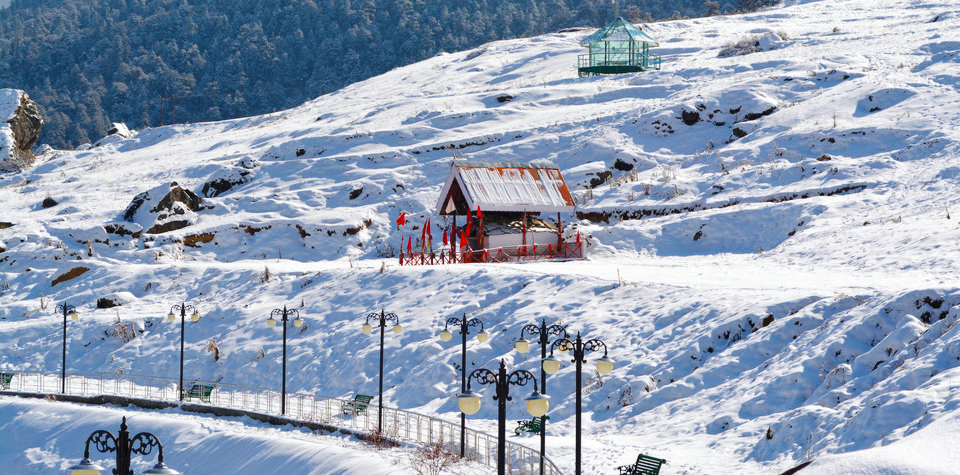
    Auli is one of the most beautiful places of Uttarakhand. Bordered by snow-covered Himalayan peaks, Auli is enveloped in dense golden oak and pine forest with green meadows and slopes ranging from a height of 2519 m to 3049 m. It is considered to be a world-class spot for skiing. GMVN winter resort here provides skiing facility, besides ski training for aspirants. Almost from everywhere in Auli, you can enjoy stunning views of the lofty mountain ranges—Nanda Devi, Mana Paravat and Kamat.

    The golden rays of sun on the snow-laden peaks fill the atmosphere with a divine glow. The 3rd highest peak of the world—Nanda Devi gleams like the crown of the region. There is an open cable-car to go up to the spot where skiing is done. Even if you do not want to ski, you have plenty of things to do. Climb up the slopes, play with snow, ride a sledge and who knows you might feel like trying skiing too. The best time to visit Auli is in between December and March.

    CORBETT

    Spread across an area of 520.8 sq km, Jim Corbett National Park is located in Nainital district of Uttarakhand. It is the oldest national park, and is named after Jim Corbett who was the main person behind this establishment. The park is divided in 5 zones—Bijrani, Jhirna, Durgadevi, Dhikala, Sitavani—and is inhabited by royal Bengal tiger, leopard, jungle cat, barking deer, hog deer, cheetal, sloth bears, otters, Himalayan goral, Indian pangolins, langur and many other wild animals.

    Many rare birds can also be spotted in the region. Gorgeous Corbett National Park is one of the favourite destinations equally for wildlife lovers and weekenders. It is just 235 km away from capital city and can be reached in couple of hours. It features splendid landscapes and offers a good amalgam of hills, rivers, forests, marshlands and grasslands. The park is open from the months of November through June. The park is kept closed in the monsoon season as the roads inside the park get washed away due to rain. After the monsoon season, repair work starts and ends only by November.

    TEHRI DAM

    A beautiful uphill drive through the hills covered in pines and small villages will take you to this dam. It is built on the Bhagirathi River in Uttarakhand and is the tallest dam in India. It is counted amongst 5 highest dams in the world, with 855 ft high rock and earth-fill embankment that makes it an engineering marvel. Its length is 1886 ft, crest width is 66 ft and base width is 3701 ft and generates 2400 MW of power. There is a viewpoint near the Bhagirathipuram bus stop from where you can have a majestic view of the entire dam. During the construction of the Tehri Dam, a huge water body was created. The tourism department has developed this 44 sq km artificial lake, as a tourist spot with arrangements of various water sports like jetski, kayaking, canoeing, boating, diving, snorkelling etc on the lake. You can also visit the botanical garden, located at New Tehri, that features a range of beautiful flowers.

    MUKTESHWAR

    Staying in middle of fruit orchards in tents and eating garden fresh meals while looking at the Himalayan peaks covered in fresh snow are a few of the many beautiful memories I have of Mukteshwar. You can walk through the dense pine forest and enjoy stunning views of the mighty mountains. Situated at an altitude of 7500 ft in the lap of Kumaon hills, Mukteshwar is an ideal nature get away from Delhi. It just takes 7 hrs from Delhi to reach Mukteshwar via Gajraula, Rampur, Haldwani and Bhowali. Summer months (March to July) are the best months to visit Mukteshwar. If you want to experience snow, visit during Jan or Feb when the whole area is covered in snow and looks stunningly beautiful. If you happen to visit this place around the month of June, the harvesting season, you’d find many fruits like peaches, plum and apricot. And if you still did not have your fill, Mukteshwar has many fruit orchards and you might get lucky to get offered the fruits just plucked from the trees by villagers.


  • Direct AI flights between Colombo and Varanasi from August

    Direct AI flights between Colombo and Varanasi from August

    Direct AI flights between Colombo and Varanasi from August: Modi


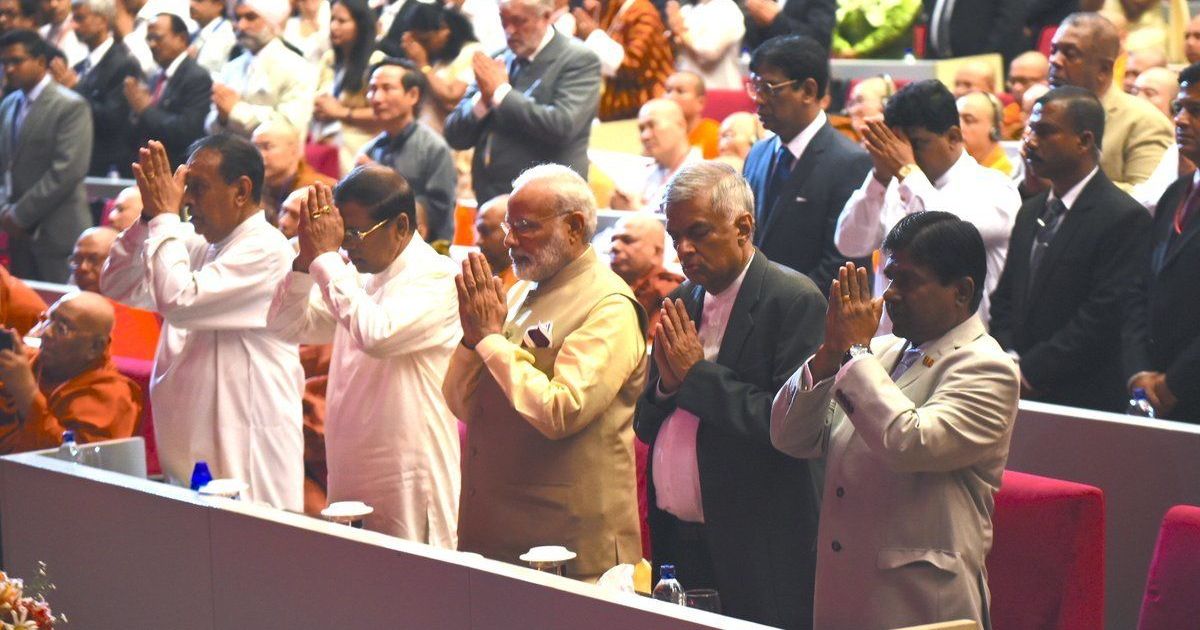
    COLOMBO (TIP): Prime Minister Narendra Modi announced, May 12, that India’s flag carrier Air India would begin direct flights between Colombo and the holy city of Varanasi from August. Modi, who is on a two-day visit to Sri Lanka, made the announcement of the beginning of the flights during his address at the inauguration of the International Vesak Day, the biggest festival of Buddhists.

    He said the flights will allow “my Tamil brothers and sisters” to visit Varanasi, the land of Kashi Viswanath. At a distance of 10 kilometres from Varanasi, lies Sarnath, one of the most revered Buddhist pilgrimage centres. It is believed that after attaining the enlightenment at Bodh Gaya in Bihar, it was in Sarnath that Lord Buddha preached his first sermon, sanctified as Maha Dharm Chakra Parivartan.

    The direct flights will aid pilgrims from Sri Lanka, a Buddhist-majority country, to visit Sarnath. Varanasi in Uttar Pradesh is the parliamentary constituency of the prime minister, from where he contested the 2014 Lok Sabha election. This is Modi’s second visit to Sri Lanka in two years. He arrived yesterday primarily to attend the International Vesak Day celebrations and his visit is aimed at reinforcing the traditional connect between India and Sri Lanka.

    (Source PTI)


  • INOC, USA deplores mob attack on Nigerian Students in Greater Noida, India

    INOC, USA deplores mob attack on Nigerian Students in Greater Noida, India

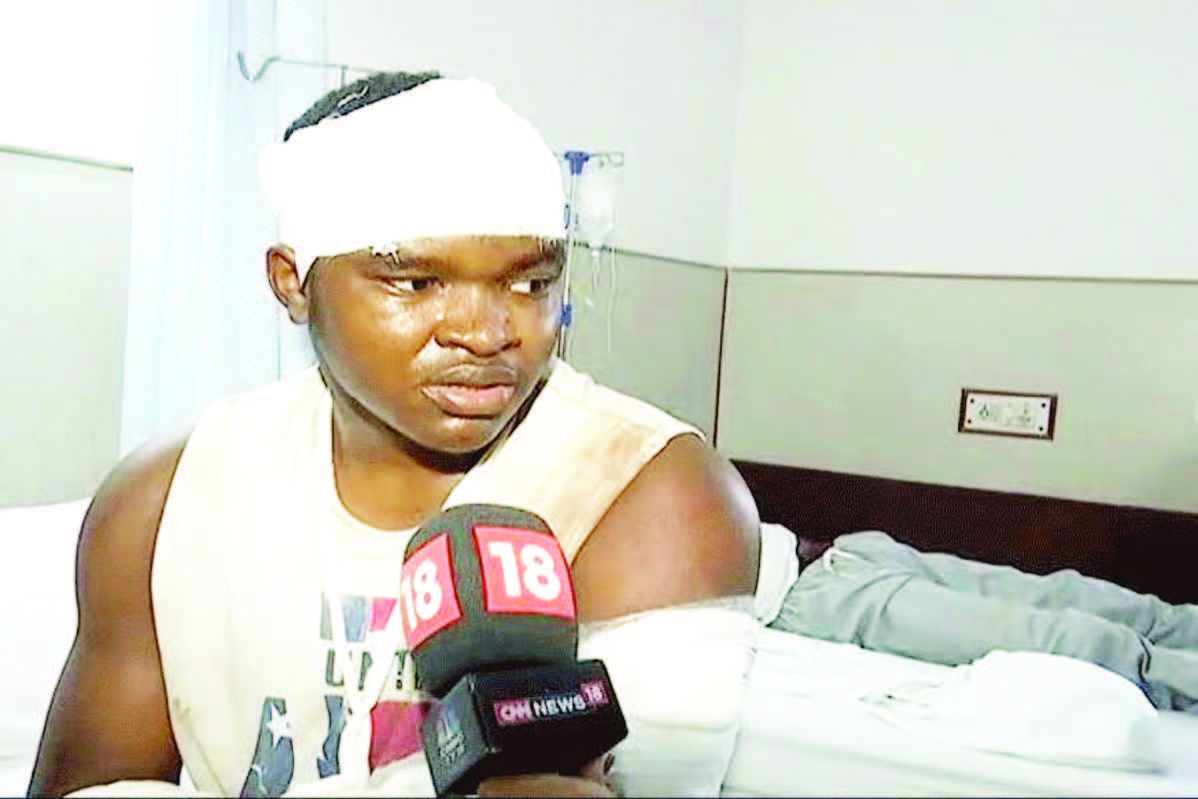
    NEW YORK (TIP): ‘It is a sad day for a nation when foreign nationals are targeted, harassed and beaten up. What kind of a country India wants to be?’ asked George Abraham, Chairman of the Indian National Overseas Congress, USA. ‘We strongly condemn the alleged racist and brutal attack on Nigerian students by a mob in Greater Noida, U.P and call upon the Ministry of External Affairs and the Chief Minister of Uttar Pradesh to take prompt action to identify and to bring the perpetrators to justice. Undoubtedly, these are hate crimes and should be dealt with seriously’ the statement added.

    Indians are one of the largest Emigrant groups to anywhere and demand freedom and opportunities wherever they seem to settle down. Those opportunities have enabled the NRIs to contribute substantially to the development of modern India. Therefore, it is incumbent on the Government of India as well its citizens to reciprocate and extend the same courtesies to foreigners who come to India whether it is for further studies or conducting business.

    We all had felt the pain when one of our own, an Indian Techie Srinivas Kuchibhotla was killed in Kansas. It is only fair that we express the same outrage when an injustice is done to foreigners who reside in India.

    However, we have serious doubts about the willingness and fortitude of the current BJP Government to seriously deal with racism and bigotry as they thrive on polarization and division. It should be noted that even students from Northeast are allegedly facing harassment and discrimination in their daily lives at the nation’s capital and only the strict enforcement of law and order and upholding of constitutional values may bring about any relief.

    As for NRIs, it is a moral imperative to voice their serious concern in this regard to the government of India. Demanding fairness elsewhere while remaining silent in the face of injustice towards the treatment of foreigners in India would tantamount to just plain hypocrisy, the statement added.

  • Centre accords Z+ VVIP security to UP CM Adityanath

    Centre accords Z+ VVIP security to UP CM Adityanath

    New Delhi (TIP): The Centre has accorded the top category ‘Z+’ VVIP armed security cover to newly-appointed Uttar Pradesh Chief Minister Yogi Adityanath.

    The cover will be provided by a special commando team of the CISF along with a small contingent of the Uttar Pradesh police.

    Adityanath was till now enjoying the smallest category of ‘Y’ category VVIP cover by the CISF in his capacity as a BJP Member of Parliament from Gorakhpur but officials said with his taking charge as CM, a threat perception report of central security agencies required his security paraphernalia to be upgraded.

    “The Chief Minister’s security has been bolstered and he will now be secured by a strong team of CISF commandos everytime he moves across the country. A similar commando contingent will be deployed at his official residence,” a senior officer said.

    As part of the new and upgraded security paraphernalia, Adityanath will have about 25-28 commandos accompanying him with sophisticated weapons at all times he is mobile and his convoy will have pilot and escort vehicles armed with jammers. Under the ‘Y’ cover, he was accompanied by about 2-3 commandos when he travelled, officials said.

    A Central Industrial Security Force squad from its Special Security Group (SSG) has recently taken charge of his security in Lucknow, they said.

  • INOC, USA expresses serious disappointment over Yogi Adityanath as the Chief Minister of U.P.

    INOC, USA expresses serious disappointment over Yogi Adityanath as the Chief Minister of U.P.

    NEW YORK (TIP): ‘It is a recipe for disaster for the state of Uttar Pradesh however; it is part of a carefully calibrated plan by the BJP to further sow the seeds of polarization and conflict to profit from especially looking at the upcoming Parliamentary election. The real face of the RSS will be on full display soon’ said George Abraham, Chairman of the Indian National Overseas Congress, USA.

    ‘We are indeed shocked to see that this firebrand Yogi Adityanath whose virulent public pronouncements often borders outright contempt for the minorities in India is anointed by the Narendra Modi-Amit Shah combine as the Chief Minister of Uttar Pradesh, the largest state in India’ said Harbachan Singh, the Secretary-General of INOC.

    According to the New York Times report, Mr. Adityanath, 44, was born Ajay Mohan Bisht, and studied mathematics before joining the priesthood. He rose to prominence as part of the campaign to rebuild the Ram temple, and has repeatedly been charged with fanning religious tensions.

    In 2007, he spent 15 days in jail on charges of inciting riots, The Hindustan Times reported. He was booked again later in the year, when riots broke out after he made a speech. He is still facing trial in the two cases, the newspaper reported.

    Mr. Adityanath was a forceful defender of the Hindu mob who lynched Muhammad Ikhlaq, a Muslim man suspected of slaughtering a cow, and argued that Mr. Ikhlaq’s family should be prosecuted for possessing the meat. When some Indians complained that they should not be required perform a “sun salutation” as part of International Yoga Day celebrations, saying it was a religious act, he recommended that those who were offended should “drown themselves in the sea.”

    Mr. Adityanath has openly called for India to be enshrined as a “Hindu Rashtra” and supports the rebuilding of the temple in Ayodhya in place of razed 16th-century mosque. During the State Assembly polls, Adityanath was a major campaigner for the party across UP. The Gorakhpur-based politician enjoys a substantial following in Eastern U.P. where he founded Hindu Yuva Vahini whose volunteers are known to use strong-arm tactics during communal riots, cow-protection drives and to prevent ‘love-jihad.’

    INOC urges the NRIs in America to strongly express their disapproval of the selection of a Hindutva extremist to be the leader of the most important state in India. ‘Opposing Trumpism in America while remaining silent on the fundamentalist ascendance in India would tantamount to nothing less than duplicity’ the statement added.

  • BJP Victory celebrated in New York

    BJP Victory celebrated in New York

    NEW YORK (TIP): Indian American community in New York celebrated victory of BJP in U.P., Uttarakhand and other states. Community leaders of various organizations joined in congratulating Modi for landslide victory.

    “Modi magic has worked again. It is the pro-poor and pro-farmer policies of the Prime Minister which have resulted in BJP’s historic victory in Uttar Pradesh,” said Jagdish Sewhani, president of American India Public Affairs Committee. “This is also an endorsement of the demonetization policy of the Prime Minister. This shows people have full faith in him,” he added

    This is vote for Development. People are happy with performance of Prime Minister Modi, said Mr Sewhani

    Dr Shashi Shah, president AIA, Mr Gobind Munjal, Nagendra Gupta andRavi Bhooplapur also spoke at the function.

  • Manoj Sinha in contention for UP CM’s post, Rawat front runner in Uttarakhand

    Manoj Sinha in contention for UP CM’s post, Rawat front runner in Uttarakhand

    NEW DELHI (TIP): Trivendra Singh Rawat, a leader with RSS background, has emerged as the front-runner in the race for the coveted chief minister’s post in Uttarakhand. He is likely to be elected the leader of the BJP legislature party in the hill state. The swearing-in ceremony will take place in Dehradun on Saturday in the presence of Prime Minister Narendra Modi and BJP chief Amit Shah.

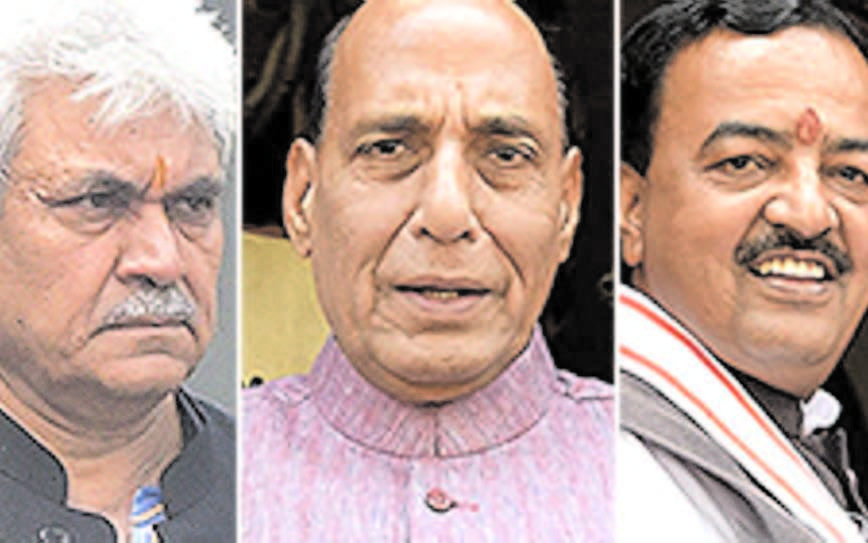
    BJP MLAs in Uttar Pradesh will also meet on Saturday to elect their leader and who will take over as the chief minister. Union minister M Venakaih Naidu and BJP general secretary Bhupendra Yadav will attend the legislature party meeting in Lucknow to brief the MLAs of Delhi’s choice. State BJP chief Keshav Prasad Maurya, Union minister Rajnath Singh, and Manoj Sinha are in contention. The date for the swearing-in of the chief minister of the country’s most populous state has not been decided yet.

    In Uttarakhand, Rawat faced stiff competition from former minister Prakash Pant and former MP Satpal Maharaj. Pant is MLA from Pithoragarh and Maharaj from Chaubattakal. Maharaj is a former Congress leader who joined the BJP ahead of the 2014 Lok Sabha elections while Pant was propped up by Rawat’s rival.

    “But Amit Shah’s support to Rawat seems to have tilted the balance in his favour,” a BJP source said.

    A Thakur, Rawat is close to Shah and was one of the three deputies attached to him in Uttar Pradesh during the 2014 Lok Sabha elections. As an RSS leader sent to the BJP, Rawat held the post of Sangathan Mantri (organisational secretary) of the Uttarakhand BJP between 1997 and 2002 and served as a minister in the BJP government in 2007.

    UP chief minister hopeful Keshav Prasad Maurya was admitted to the ICU at Ram Manohar Lohia Hospital here after falling ill. He had fever and high blood pressure when admitted. Doctors have placed him under observation.

    Uttar Pradesh CM to be decided on March 18

    The suspense over the new chief minister of Uttar Pradesh is expected to end at the BJP legislature party (BJPLP) meeting to be held in Lucknow on Saturday.

    The declaration of a new leader, in the presence of Union minister Venkaiah Naidu and party general secretary Bhupendra Yadav, will coincide with the party’s victory day celebration on that day. The BJP’s incumbent legislature party leader, Suresh Khanna, on Thursday confirmed the news about Saturday’s meeting of the party’s newly-elected lawmakers.

  • Assembly Elections 2017 Anti-Incumbency a dominant factor

    Assembly Elections 2017 Anti-Incumbency a dominant factor

    Exit polls find BJP ahead in UP, Goa; Cong & AAP neck-and-neck in Punjab

    NEW DELHI (TIP): Anti-incumbency appears to be a factor in deciding the fate of political parties in the fray in five States of India which have gone to polls. Results are expected on Saturday, March 11. However, exit polls, as in the past, have come up with their assessment of number of seats likely to be won by each of the parties in each of the States. The Bharatiya Janata Party could emerge as the single-largest party in three of five states, including Uttar Pradesh, which voted to elect new assemblies over the past month, exit polls showed on Thursday, March 9.

    The Congress and the Aam Aadmi Party were locked in a tight race in Punjab and the country’s principal opposition party was battling with the BJP to retain power in Manipur and Uttarakhand.

    The results, officially out on Saturday, March 11, will be seen as a referendum on Prime Minister Narendra Modi’s policies, including the shock recall of 500-and 1000-rupee banknotes – a decision that opposition parties slammed as anti-poor and turned into a poll plank.

    The five state polls are also billed as a virtual semi-final to the general elections in two years from now, and the results are likely to shape both upcoming presidential elections and policy formation. If the forecasts come true on March 11, the BJP-led central government could give a fresh impetus to politically unpalatable economic reforms, especially those in the labor sector.

    Exit polls have frequently gone wrong in the past, including in Bihar and Delhi in 2015. Analysts say states with diverse populations and complex caste, community and religious affiliations tend to throw pollsters off.

    Some of the polls predicted ranges of seats while others gave absolute numbers without mentioning any error margin.

    In UP, where the BJP is seeking to regain power after 14 years, all exit polls forecast a hung assembly. Two gave the BJP a clear advantage over its nearest rival, the Samajwadi Party-Congress alliance, while two others predicted a close fight between them.

    The Bahujan Samaj Party (BSP) was seen as a distant third in all four exit polls available for the 403-member house. In the event of the polls throwing a hung assembly in UP, post-poll re-alignments of political forces could not be ruled out.

    In a Facebook Live conversation with BBC Hindi on Thursday, UP chief minister Akhilesh Yadav was ambiguous about the possibility of the SP joining hands with the BSP to keep the BJP out of power.

    “No one will want President’s Rule in UP and that the BJP governs the state through a remote control,” he said in a cryptic reply to a query about the possibility of a post-poll arrangement with the BSP.

    The BJP was seen as surging ahead of the rivals in Goa and Uttarakhand as well.

    In Punjab, all exit polls unanimously predicted a drubbing for the ruling Shiromani Akali Dal-BJP combine. But the polls were divided on whether the Congress or the Aam Aadmi Party, which is fighting its debut assembly election in the state, will form the next government.

    Two exit polls predicted a photo-finish while two others were split between the Congress and the AAP in the 117-member assembly. The halfway mark is 59.

    In Uttarakhand, the BJP looked set to dislodge the Congress as four out of five exit polls gave a clear majority to the saffron party. One poll forecast a close fight in the 70-member legislature.

    Three exit polls suggested that the BJP could retain power in Goa. The AAP, which ran a high-voltage campaign in its debut outing in the state, was seen as failing to have had an impact in the 40-member assembly.

    But polls were split over Manipur, with one giving a majority to the BJP and the other to the ruling Congress.

    (With inputs from agencies)

  • ‘Denied sex for 10 yrs’, woman chops off husband’s organ

    ‘Denied sex for 10 yrs’, woman chops off husband’s organ

    GHAZIABAD (TIP): A 30-year-old woman allegedly chopped off her husband’s private parts after the man refused to have a physical relationship with her for 10 years of their marriage. The couple hails from Bulandshahr and has been living in Ghaziabad for the past eight years.

    According to the police, the couple has no children and there used to be frequent altercations between them over the issue. The incident took place around 9.30am on Thursday.

    “She told the police that her husband mentally tortured her by not having a physical relationship with her and avoided having children with her. Frustrated by his behaviour, she picked up a kitchen knife and attacked him when he came out of the bathroom after a bath,” said Anil Kumar Yadav, circle officer (Indirapuram).

    The police lodged an FIR at Khoda police station and also arrested the woman who said she had no alternative but to injure her husband. Her husband is a cab operator and owns two Innova MUVs.

  • Varun removed as BJP’s star campaigner in UP polls

    Varun removed as BJP’s star campaigner in UP polls

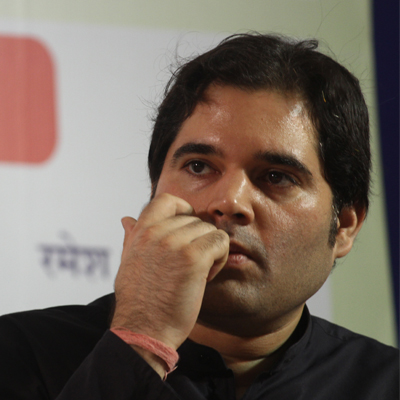
    NEW DELHI (TIP): BJP MP Varun Gandhi is conspicuous by his absence in the Uttar Pradesh polls. His cold war with party chief Amit Shah has left him out of the list of star campaigners yet again.

    Varun has not visited his own Lok Sabha constituency of Sultanpur after the announcement of the Assembly poll schedule, despite figuring in the party’s second list of campaigners for the third and fourth phase of polling; his constituency goes to polls on Monday.

    In a move that has caused great embarrassment to the party, Varun delivered a lecture in Indore on Tuesday, where he questioned the Modi government’s outreach to farmers. He said the farmers continue to commit suicide.

    He also criticised the government’s inability to do something substantial about absconding loan defaulter Vijay Mallya.

  • I’m UP’s adopted son, won’t betray, says PM Modi

    I’m UP’s adopted son, won’t betray, says PM Modi

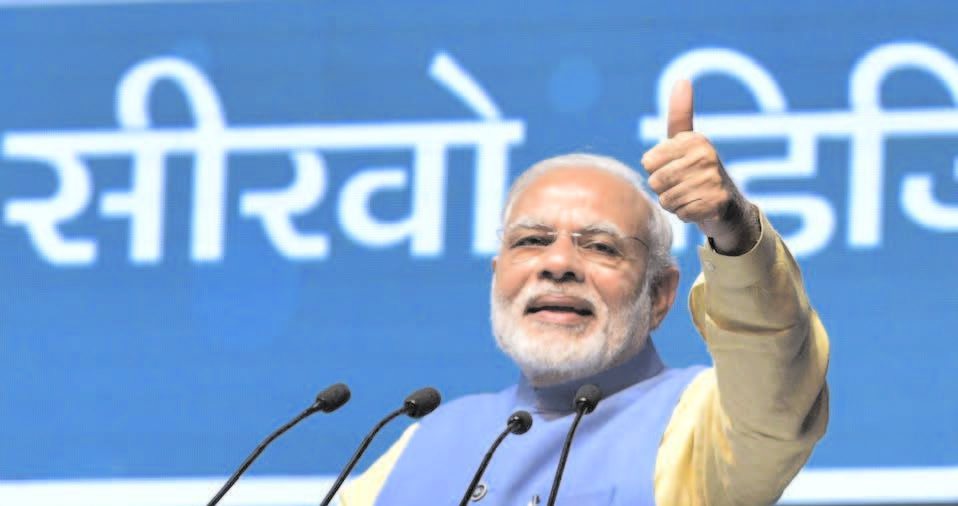
    HARDOI (TIP): Calling himself the “adopted son” of UP, Prime Minister Narendra Modi today said the future of the state cannot be ensured without ridding it of the SP, BSP and Congress.

    Invoking Lord Krishna at an election meeting here to suggest a strong connect between Gujarat and UP, Modi, who represents Varanasi Lok Sabha constituency, said the state was his ‘mai-baap’ (parents) and he would not desert it.

    “Lord Krishna was born in UP and made Gujarat his ‘karam bhoomi’ (land of work). I was born in Gujarat and UP has adopted me…Uttar Pradesh is my ‘mai-baap’. I am not the son who would betray his ‘mai-baap’. You have adopted me and it is my duty to work for you,” he said in an emotional speech at a poll rally here.

    “Vote for a full majority to the BJP government. I promise to show you the ways of all problems you are facing within five years,” he said, telling the crowd that all pollsters have predicted BJP getting massive support in the first two phases of polling.

    Highlighting the problems faced by the state and its national importance, Modi said poverty would be removed from the country only when it is eradicated from UP. “This is the land of Ganga and Yamuna where the land is most fertile with crores of labourers but poverty still exists here…why is this so? There is nothing wrong with the people here or their capabilities or shortage of resources,” he said. “It is the problem of the government’s lack of intention (which is responsible for it). SP, BSP and Congress have not thought as to how the state should be developed…all those who had been at the helm have only worked to safeguard their vote bank, help them in whichever way possible…the future of UP cannot be changed till it is freed of SP, BSP and Congress,” he said.

    SP-Cong alliance to continue for LS poll

    Senior Congress leader Ghulam Nabi Azad on Thursday said the SP-Congress alliance will continue for the 2019 Lok Sabha elections and that other secular parties would also be part of this coalition

    When asked whether BSP will be part of this grand alliance, Azad said they were asking all secular parties to come together and fight the saffron party

    “The secular parties suffered a loss during the 2014 elections and BJP gained from this and that is why they were able to win 73 seats in UP. However, if Congress, SP and RLD fight the 2019 Lok Sabha elections together, BJP will only be able to get 10-15 seats in the state,” Azad said

    ‘Inexperience’ barb: Akhilesh hits back

    CM Akhilesh Yadav on Thursday made light of the PM’s ‘inexperience’ barb at him, saying he has learnt to cycle fast so that neither BSP’s elephant nor BJP’s lotus can come anywhere near the SP

    A day after the PM questioned as to how the SP chief could form a coalition with

    ‘those who tried to murder’ his father, Akhilesh said Modi’s advisers could have done better by telling him to cite a more recent example of Firozabad

    “Modiji said in Kannauj that by entering into an alliance with Congress, I have shown inexperience…we have done this so as to remove all doubts about government formation,” he said

  • 65% voter turnout in UP, 68% in Uttarakhand

    65% voter turnout in UP, 68% in Uttarakhand

    LUCKNOW (TIP): A voter turnout of 66% was recorded in Uttar Pradesh as 69 constituencies went to the polls in the second phase of Assembly elections. In the first phase of polls in the state, 63%of the electorate voted. In Uttarakhand, where elections to 69 seats were being held, 68% of the electorate came out to vote till 5 pm.

    Assembly Elections 2017

    Voting began at 7 am in both states on Wednesday. In Uttar Pradesh, there were reports of glitches at some electronic voting machines.

    Polling in Uttarakhand’s Karnaprayag seat was postponed to March 9 on as Bahujan Samaj Party candidate Kuldeep Singh Kanwasi’s died in a road accident on Sunday.

    Around 74.2 lakh voters will elect the next government in Uttarakhand. As many as 628 candidates are in the fray. The ruling Congress party, headed by Chief Minister Harish Rawat, is combating anti-incumbency as well as corruption charges. The Bharatiya Janata Party, on the other hand, hopes to gain from this. Recently, Prime Minister Narendra Modi had accused the Congress of turning the “dev bhoomi” into “loot bhoomi”.

    In Uttar Pradesh, the 67 constituencies that are voting today are spread across 11 districts. The ruling Samajwadi Party had won 34 of these seats in the last Assembly election. However, the BJP and the BSP have upped the stakes this time, highlighting the state’s poor law-and-order situation.

  • Poll schedule for 5 states announced, UP to vote in 7 phases; counting on March 11

    Poll schedule for 5 states announced, UP to vote in 7 phases; counting on March 11

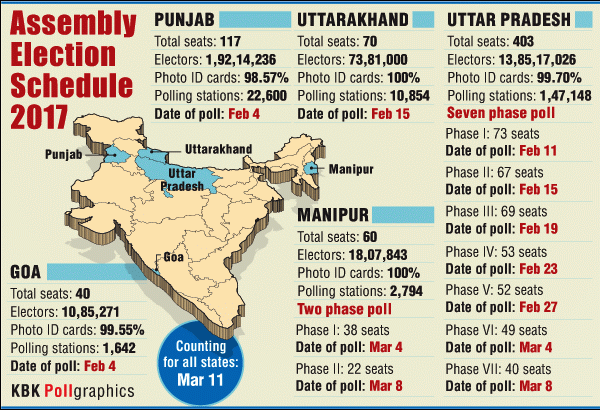
    NEW DELHI (TIP): The Election Commission on January 4 (Wednesday) announced the poll dates for Uttar Pradesh, Uttarakhand, Punjab, Manipur and Goa. Chief Election Commissioner Nasim Zaidi said that the state of Manipur will have a two-phase election and Uttar Pradesh will have a seven-phase election. Counting for all states will be held on 11 March.

    A total of 690 assembly constituencies will go to polls in these elections. Twenty three of these have been reserved from Scheduled Tribes candidates. Over 160 million voters – that’s the size of the electorate in these assembly elections. There will be 1,85,000 polling stations across five states.

    Seven-phase elections in Uttar Pradesh from February 11 to March 8; Punjab and Goa will vote on February 4 while Uttarakhand on Feb 15; results on March 11

    NEW DELHI (TIP): Assembly elections in UP, Punjab, Uttarakhand, Goa and Manipur will be held between February 4 and March 8, the results of which — to be announced on March 11 — are likely to be seen as a referendum on the demonetisation move by PM Narendra Modi.

    The terms of the legislative assembly of Goa, Manipur and Punjab are due to expire on March 18 while that of Uttarakhand expires on March 26. The legislative term of Uttar Pradesh ends on May 27. Goa has 40 assembly seats, Manipur has 60, Punjab has 117, Uttarakhand has 70 while Uttar Pradesh has 403.

    Election Commission made the much-anticipated announcement of dates on January 4 (Wednesday), setting in motion a process that will impact Indian polity in the coming months. The UP polls are already being dubbed as a “semi-final” to the 2019 general elections. These polls are significant for BJP as a good electoral harvest will boost its strength in the Rajya Sabha in the near future. The outcome will also have a bearing on the Presidential elections later this year.

    UP will have a seven phase election, with polling on February 11, 15, 19, 23, 27, March 4 and 8.

    Manipur, which continues to be under a blockade and is facing law and order problems, will have a twophase election with polling on March 4 and 8.

    Seven-phase elections in Uttar Pradesh from February 11 to March 8; Punjab and Goa will vote on February 4 while Uttarakhand on Feb 15; results on March 11Punjab and Goa will vote on February 4 while Uttarakhand on Feb 15. While the Code of Conduct has come into force with the announcement, the state-wise notification process will begin with Punjab and Goa on January 11.

    Demonetisation is likely to be a big issue in these elections, though the polling pattern will be guided by local factors, caste equations and identity politics. With the Centre propagating a less-cash economy, the extent to which money power is at play in these polls will be keenly watched. One of the new rules of these elections allows parties to use cash for campaign payments only up to Rs 20,000.

    Candidates will also have to take oath this time that they have no pending public utility bills. The SC order last week barring political parties and candidates from seeking votes in the name of religion or caste has also added to the worries of the contestants. While SP is seeking to retain power in UP and is facing a challenge from BJP and BSP, Congress is trying to beat anti-incumbency in Uttarakhand and Manipur. BJP is a part of the ruling coalition in Punjab and rules Goa. The caste-ridden politics of UP now has an added dimension with the feud in the first family of SP. CM Akhilesh Yadav is fighting over the symbol, bicycle, with his father and party patriarch Mulayam.

    SAD-BJP combine, which has ruled Punjab for two consecutive terms, has not lost hope, especially if AAP makes it a triangular contest at the expense of Congress. AAP is also making things difficult for BJP and Congress in Goa.

    BJP is still confident of retaining power. BJP is hopeful of defeating Congress in Uttarakhand while CM Harish Rawat is playing the victim card, citing the saffron party’s attempt to topple his government a few months ago. BJP is hopeful of defeating Congress in Manipur currently under Congress rule. Manipur has been facing an economic blockade on its two highways since November 1 over creation of seven new districts.

  • SP TO GO ALONE FOR NEXT YEAR’S UP POLLS: MULAYAM

    SP TO GO ALONE FOR NEXT YEAR’S UP POLLS: MULAYAM

    LUCKNOW (TIP): Samajwadi Party chief Mulayam Singh Yadav on Thursday said his party will go to polls alone and not enter into an alliance for the assembly elections in UP early next year. However he is open to mergers if any political party wants to join the SP, he said.

    “SP will not go in for any alliance for the UP polls as decided during the national convention of the party earlier,” Mulayam said, addressing a press conference on Thursday. “There maybe only mergers like ones which have happened in the recently,” he said in an apparent refernce to mafia-turned-politician Mukhtar Ansari’s Quami Ekta Dal (QED) which merged with the SP two months ago.

    Mulayam’s statement comes a day after UP chief minister Akhilesh Yadav expressed confidence that the SP will get a clear majority on its own in the next elections and that alliances were not easy. The UP CM too has not been keen over SP entering into any tie-up with other parties for the UP polls.