Year: 2013

  • Comment : Sequester Goes In To Effect

    Comment : Sequester Goes In To Effect

    While sequester that goes in to effect Friday, March 1 night, will not immediately hurt the Americans at large, it will have a devastating effect on some sections and departments of administration. It will also slow down the economic recovery process.

    The devastating budget cuts have very real consequences. On the chopping block are 10,000 teaching jobs, more than 70,000 kids’ spots in Head Start, $35 million for local fire departments, $43 million to make sure seniors don’t go hungry, and access to nutrition assistance for 600,000 women and their families.

    That’s just a few of the things Americans will lose. Now that the sequester has happened, attention shifts to the next key battle in Washington’s ongoing, partisan fiscal war.

    At the end of March, Democrats and Republicans must agree on how to continue funding the overall government if it’s not to shut down. the sequester, a government shutdown would likely be much more disruptive and noticeable to the average American – and politically damaging, especially to Republicans.

    The average American can only bemoan the insensitivity of politicians and lawmakers to the welfare of the people and the country, in preference for their political games.

    One is reminded of Duke of Gloucester’s words in Shakespeare’s King Lear: “As flies to wanton boys are we to th’ gods, They kill us for their sport.” (Act IV, Scene 1, 36-37)

  • As I See It : Emerging US Policies

    As I See It : Emerging US Policies

    One of the key policy initiatives during President Obama’s first term was what Secretary of State Hillary Clinton described in her article published in October 2011, titled “America’s Pacific Century”, as a “pivot” the “Indo-Pacific”” region, straddling the Asia-Pacific and the shores of the western Indian Ocean. This meant that the primary focus of American policies, diplomatically and militarily,would shift to the Pacific Ocean from its Atlantic shores.

    It was manifested by American participation in the East Asia Summit and a determination not to be excluded from the emerging economic, diplomatic and security architecture in the “Indo-Pacific” area. But the American confusion and uncertainty remain on how to deal with an “assertive” and growingly powerful China,which is not averse to using force to enforcing territorial claims on neighbors ranging from Japan, South Korea and Taiwan to Vietnam, the Philippines, Brunei and Malaysia.

    Within days of the commencement of the Obama Administration’s second term, an ebullient Vice-President Joe Biden returned from the Munich security conference. He turned the entire Asia- Pacific “pivot” on its head by proclaiming: “President Obama and I continue to believe that Europe is the cornerstone of our engagement with the rest of the world. It’s that basic. Nothing has changed. Europe remains America’s indispensable partner of first resort.”

    This was an astonishing U-turn from the earlier emphasis on the 21st century being America’s “Pacific Century” and its assertion that the global balance of power was shifting to Asia from Europe. President Obama confirmed the US intention to launch talks for a “comprehensive trade and investment partnership” with the European Union in his State of the Union Address.

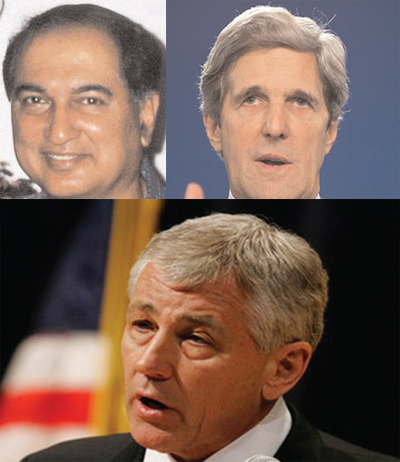
    This comes at a time when the US is confident that it will not only be a net exporter of gas but also the largest producer of oil in the world before the end of this decade. It has also led to the confidence of re-emergence of the US as a growing industrial power, readying to market its gas surpluses across the Atlantic. Given these developments, it cannot be a mere coincidence that both Senators Kerry and Chuck Hagel,who will steward the State and Defense Departments, favor the establishment of a trans-Atlantic trade and economic zone as the cornerstone of the 2013 agenda. Both are veterans of the Vietnam War and share President Obama’s aversion to military involvements abroad.

    This is evident from Obama’s decision on avoiding direct military involvement in the Anglo-French intervention in Libya and his caution in not getting excessively drawn into events in Syria, or the French military intervention in Mali. This same approach will guide the American approach to its “end game” in Afghanistan. The doubt that remains is whether the US will leave adequate forces behind in Afghanistan and how their role will be fashioned. The policy of using drones in a counterterrorism role against Pakistan-based terrorists operating in Afghanistan is also under review.

    Senator Chuck Hagel, labeled as “peacenik” by Republican Party colleagues, has been a critic of the American military policies in Afghanistan. He remarked: “One of the reasons why we’re in trouble in Afghanistan is because we went well beyond our mission. Is our mission to eliminate the Taliban? That never was our mission”? Hagel conveniently forgets that even before military operations commenced after 9/11, both the Saudis and the Americans tried to persuade Mullah Omar to hand over Osama bin Laden.

    The then ISI chief encouraged Mullah Omar to reject the American proposal. Mullah Omar flatly refused to yield.With the help of the Taliban and the ISI, Osama bin Laden was shifted to live comfortably with his many wives and children in the Abbotabad cantonment. Senator Kerry,who agreed in 2011 to a proposal involving the payment of “blood money” to secure the release of CIA operative Raymond Davis from Pakistani custody and was the co-author of the Kerry-Lugar Bill tripling economic assistance to Pakistan, has unique views on Pakistan’s support for terrorism.

    He lauded Pakistan for its “logistical” support,which he claimed led to the American forces getting Osama bin Laden. “Our folks were able to cooperate on the ground with Pakistan. That’s one of the reasons we were able to get Osama bin Laden. I don’t think the Pakistanis have gotten enough credit for the fact that they were helpful”. Kerry also observed that the Pakistanis “have lost some 6000 people just last year in their efforts to go after terrorists”.

    He pointedly failed to mention that while the Pakistan army targeted its citizens, whom it labeled as terrorists, it was not merely permissive, but colluding with outfits like the Mullah Omar-led Quetta Shura and the Haqqani Network in Afghanistan and their affiliates like the Lashkar-e-Toiba,which is now operating on Pakistan’s borders with both Afghanistan and India. Moreover,what Kerry has been saying contradicts everything said earlier on Pakistani support for terrorist outfits by President Obama, Hillary Clinton, Leon Panetta and General David Petraeus. It is doubtful if Obama shares the optimism of John Kerry on Pakistan’s support for terrorism.

    The American end-game in Afghanistan under the new dispensation is set to pose formidable challenges to Indian diplomacy in its Af-Pak neighborhood. Changes in the American policy vis-avis the Asia-Pacific in the coming years also appear to be underway. Senator Hagel has noted: “China is going to emerge and grow.We should welcome that. There are going to be competitors like India, Brazil and other nations. They (the Chinese) are a great power today and are going to remain a great power.

    But we should not cower in the wake of that.” There are indications that the new Obama team is going to ask its allies like Japan to avoid actions which displease or provoke China on disputed maritime frontiers. Priority is reportedly being given to “modifying the harder edges of the (Asia-Pacific) pivot and quietly reassuring China”. The outgoing Assistant Secretary of State for East Asian Affairs, Kurt Campbell, recently observed: “China is predominant in every aspect of political, financial, economic and security relations in Asia.

    India is still a nascent player in Asia. I think everyone has high hopes for the role India will play moving forward”. The message is that not much can be expected from a “nascent” India unless it sets its house in order, accelerates economic growth and enhances its defense potential. India’s relationship with the US will remain cordial and correct, but largely transactional.We will have to refashion our Af-Pak and Look East policies accordingly.

    (The author is a former career diplomat who retired from Indian Foreign Service in 2000. Presently, he is a Visiting Professor in the Centre for Policy Research in New Delhi. He can be reached at partha0@gmail.com)

  • Plea For Restoration Of Ferozepur-Amritsar Rail Line

    Plea For Restoration Of Ferozepur-Amritsar Rail Line

    Prior to 1947, Ferozepore in Punjab was a thriving transportation town with great rail and road connectivity with the provincial capital of Lahore and the industrial and commercial capital of Amritsar. Both links were via Kasur, a Tehsil headquarter town in Lahore district. Lahore in 1947 fell into the share of Pakistan and so did Kasur and, as a result, Ferozepore lost both important railway links. A much longer and indirect road linkage was subsequently established between Amritsar and Ferozepore via Harike Pattan confluence of the Beas and the Sutlej.

    But the railway link to date did not see the light of the day. After the 1947 partition of Punjab, the entire border region of East Punjab, which used to be a flourishing area became neglected. The boundary line of prosperity moved Eastwards towards Jalandhar, Ludhiana and Chandigarh. The entire border belt of Punjab from Pathankot, Gurdaspur, Batala, Tarntaran, Patti, Ferozepore, Guru Har Sahai, Jalalabad up to Fazilka became educationally and economically very backward. Amritsar, because of its pre-1947 economic momentum and due to the existence of the Golden Temple remained the only oasis of education, progress and prosperity. Several economists and men of wisdom have been suggesting the reconstruction of the railway link between Amritsar and Ferozepore.

    Former railway minister Laloo Prasad Yadav was requested by the Prime Minister Dr. Manmohan Singh in 2004 to build the missing railway link between Amritsar and Ferozepore. Even the local industry of Amritsar pitched for it. But an obsessed with Bihar only, Mr. Laloo Yadav half-heartedly ordered a survey,which was completed. Later on Mamata Bannerjee, in her lopsided over enthusiasm to dislodge the Left Front, directed all her energies towards the development of new railway lines in West Bengal.

    The not too long ago appointed railway minister Pawan Bansal is a son of the soil, a Punjabi. There was a lot of moral and political pressure on him to start the construction of this long ignored missing link. Finally in the All India Railway Budget of 2013, an announcement was made by the railway minister to include this missing link between Patti in former Amritsar district and the divisional headquarter town of Ferozepore on February 26, 2013. This strategic rail link will shorten the distance between Amritsar and the port of Mumbai by two hundred and forty kilometers.

    With the completion of this rail link, the entire backward border belt starting from Baramula in Jammu and Kashmir via Srinagar, Anantnag, Udhampur and Jammu and then the border belt in Punjab from Pathankot via Gurdaspur, Batala, Amritsar, Tarntaran, Patti, Ferozepore, Guru Har Sahai, Jalalabad, Fazilka and Abohar will be linked to Mumbai via Sri Ganganagar. Since there will be overall less traffic on this Jammu & Kashmir, Punjab, Rajasthan, Gujarat and Maharashtra corridor, the perishable fruits and vegetables shall be delivered in Mumbai and Gujarat within two to three days. Passenger travel time will be reduced by five to six hours.

    The most congested National Capital Region (NCR) shall be effectively avoided. This railway line will also give boost to tourism in Vaishno Devi (Katra), Amritsar, Bikaner, Jodhpur, Jaisalmer and Barmer. Mumbai shall be able to fast-track export its goods by rail to Northern Pakistan via Amritsar and Amritsar will be able to export to the world via Mumbai.

  • President Signs Order For “Sequester” Budget Cuts

    President Signs Order For “Sequester” Budget Cuts

    WASHINGTON (TIP): President Barack Obama on Friday, March 1, signed an order that starts putting into effect across-the-board budget cuts known as the “sequester” after he and congressional leaders failed to find an alternative budget plan. The White House released a copy of Obama’s directive entitled “Sequestration Order for Fiscal Year 2013.” Government agencies will now begin to hack a total of $85 billion from their budgets between Saturday, March 2 and October 1. Now that the sequester has happened, attention shifts to the next key battle in Washington’s ongoing, partisan fiscal war. At the end of March, Democrats and Republicans must agree on how to continue funding the overall government if it’s not to shut down.

    Unlike the sequester, a government shutdown would likely be much more disruptive and noticeable to the average American – and politically damaging, especially to Republicans. President Obama in his weekly address told the American people that a series of harmful budget cuts-called the sequester-have taken effect because Congress failed to act. Because Republicans in Congress refused to compromise to close tax loopholes for the wealthiest Americans, hundreds of thousands of Americans will lose their jobs or see their paycheck reduced, and middle class families will be hurt.

    Obama said, “On Friday, I met with leaders of both parties in Congress to try and find a way forward in light of the severe budget cuts – known in Washington as “the sequester” – that have already started to inflict pain on communities across the country. “These cuts are not smart. They will hurt our economy and cost us jobs. And Congress can turn them off at any time – as soon as both sides are willing to compromise. “As a nation, we’ve already fought back from the worst economic crisis of our lifetimes, and we’ll get through this, too. But at a time when our businesses are finally gaining some traction, hiring new workers, bringing jobs back to America – the last thing Washington should do is to get in their way.

    That’s what these cuts to education, research, and defense will do. It’s unnecessary. And at a time when too many of our friends and neighbors are still looking for work, it’s inexcusable. “Now, it’s important to understand that, while not everyone will feel the pain of these cuts right away, the pain will be real. Many middle-class families will have their lives disrupted in a significant way. “Beginning this week, businesses that work with the military will have to lay folks off. Communities near military bases will take a serious blow. Hundreds of thousands of Americans who serve their country – Border Patrol agents, FBI agents, civilians who work for the Defense Department – will see their wages cut and their hours reduced.

    “This will cause a ripple effect across the economy. Businesses will suffer because customers will have less money to spend. The longer these cuts remain in place, the greater the damage. Economists estimate they could eventually cost us more than 750,000 jobs and slow our economy by over one-half of one percent. “Here’s the thing: none of this is necessary. It’s happening because Republicans in Congress chose this outcome over closing a single wasteful tax loophole that helps reduce the deficit. Just this week, they decided that protecting special interest tax breaks for the well-off and well-connected is more important than protecting our military and middle-class families from these cuts.

    “I still believe we can and must replace these cuts with a balanced approach – one that combines smart spending cuts with entitlement reform and changes to our tax code that make it more fair for families and businesses without raising anyone’s tax rates. That’s how we can reduce our deficit without laying off workers, or forcing parents and students to pay the price. I don’t think that’s too much to ask. It’s the kind of approach I’ve proposed for two years now. A majority of the American people agree with me on this

  • Finance Minister P Chidambaram Boldly Votes For Growth Over Politics

    Finance Minister P Chidambaram Boldly Votes For Growth Over Politics

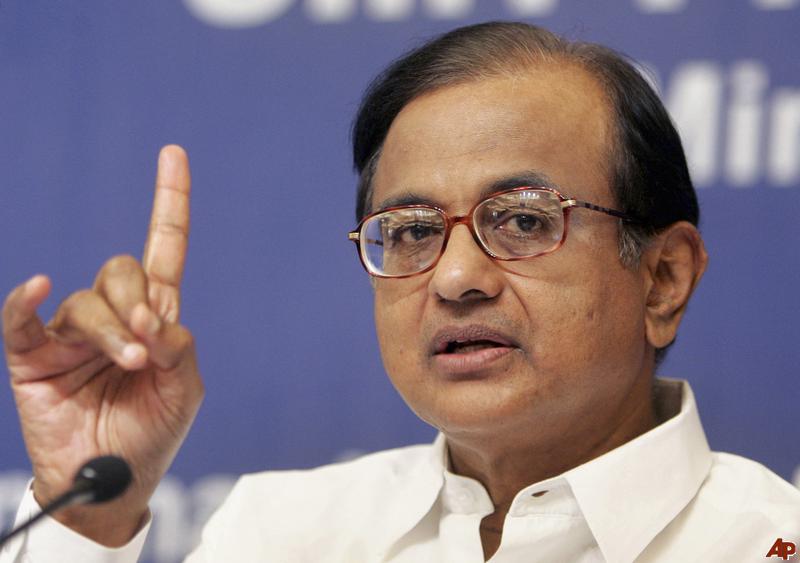
    NEW DELHI (TIP): Never before has a finance minister rejected populist giveaways so decisively in an election year. Never before has a finance minister sought to win the next elections not through tax breaks and freebies, but by accelerating GDP growth and taming inflation through fiscal consolidation. Palaniappan Chidambaram has gambled on good economics proving to be good politics too. This is risky, but admirably bold. Stock markets crashed, fearing that fine print in the Finance Bill implied capital gains tax on investors coming through Mauritius and other countries with which India has a Double TaxationAvoidance Agreement. However, finance ministry officials later clarified that capital gains through Mauritius would not be affected. If so, stock markets should rise sharply on Friday.

    How has Chidambaram delivered on his promise of fiscal prudence (restricting fiscal deficit to 5.2% of GDP this year and 4.8% next year), yet provided for a 29% rise in Plan spending next year? By assuming very high tax buoyancy. Against nominal GDP growth of 13.4%, he hopes tax revenue will rise 19%, a very optimistic estimate. He will fall short on this, and will surely also fall short on the 29% rise in Plan spending.Ministries are simply not geared for such acceleration. So the planned fiscal consolidation can indeed happen. The finance minister will get much additional revenue by accelerating GDP growth from 5% this year to around 6.5% next year. He has proposed no new taxes, only a temporary surcharge of 10% on high-income individuals and corporates for one year. That sits well with his commitment to tax stability. What’s in it for the aam aadmi?

    Or shall we say the aam voter? Chidambaram’s implicit promise is that he will conquer the high inflation that has dogged the economy for three years. The big electoral danger earlier was a credit downgrade by rating agencies. This would have meant an outflow of billions of dollars, causing the exchange rate to crash to maybe `60 to the dollar and inducing a big jump in prices of imported items. That would have sent inflation soaring to 15%, and doomed the UPA to a massive defeat in the next elections. His Budget now staves off any possibility of a ratings downgrade. Dollars should f low in, not out.

    That should help strengthen the rupee and put downward pressure on import prices. The consequent fall in inflation should then lead to a cut in interest rates, sparking fresh investment as well as reducing EMIs. A budget is just one element in the broad framework needed to improve the investment climate and rejuvenate growth. Much more is needed outside the budget to cut red tape, expedite clearances and improve governance. This Budget is low on election slogans, but aims to provide concrete outcomes in the form of faster growth and lower inflation. Success on these counts will win votes in the coming elections. It is a less showy approach than a farm loan waiver, but could be as effective.

  • Black Hole Spinning At Speed Of Light

    Black Hole Spinning At Speed Of Light

    WASHINGTON (TIP): The outer reaches of a ‘supermassive’ black hole, more than two million miles across, or eight times the earth-moon distance, is spinning at nearly the speed of light. The gigantic object is at the centre of the spiral galaxy NGC 1365. Astronomers measured its jawdropping spin rate using new data from the Nuclear Spectroscopic Telescope Array, or NuSTAR, and the European Space Agency’s XMMNewton X-ray satellites. “This is the first time anyone has accurately measured the spin of a supermassive black hole,” Guido Risaliti of the Harvard-Smithsonian Centre for Astrophysics (CfA) and INAF – Arcetri Observatory, who led the study, was reported as saying by the journal Nature. Astronomers want to know the black hole’s spin for several reasons.

    The first is physical – only two numbers define a black hole: mass and spin. By learning those two numbers, you learn everything there is to know about the black hole.Most importantly, the black hole’s spin gives clues to its past and by extension the evolution of its host galaxy. “The black hole’s spin is a memory, a record, of the past history of the galaxy as a whole,” explained Risaliti, according to the Harvard-Smithsonian statement. Although the black hole in NGC 1365 is currently as massive as several million suns, it wasn’t born that big.

    It grew over billions of years by accreting stars and gas, and by merging with other black holes. Similarly, if the black hole grew randomly by pulling in matter from all directions, its spin would be low. Since its spin is so close to the maximum possible, the black hole in NGC 1365 must have grown through “ordered accretion” rather than multiple random events. Studying a supermassive black hole also allows theorists to test Einstein’s theory of general relativity in extreme conditions. Relativity describes how gravity affects the structure of space-time, and nowhere is space-time more distorted than in the immediate vicinity of a black hole.

  • Ambassador Hardeep S. Puri And Consul General Prabhu Dayal Retire

    Ambassador Hardeep S. Puri And Consul General Prabhu Dayal Retire

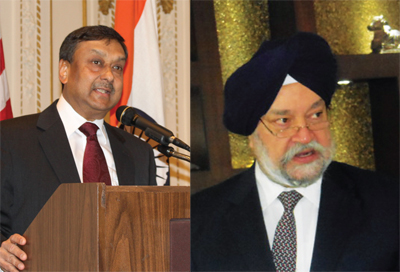
    NEW YORK (TIP): Two senior Indian diplomats posted in New York retired on February 28. Ambassador Hardeep S. Puri, India’s Permanent Representative to the United Nations retired after a brilliant diplomatic career spanning 39 years. Mr. Puri had joined the Indian Foreign Service at the age of 22. Mr. Puri had joined as PR in March, 2009 and had superannuated in 2012. But he was given an extension for one year. During his tenure, India presided twice over the Security Council.

    Known as an exceptionally dynamic diplomat, Mr. Puri can solely be attributed for the many successes India has found itself being lauded with at the United Nations. His vision and efforts have helped India play a pivotal role at the United Nations. It would take volumes to do justice to the man who contributed so much not only for India but for the world at large, during his four year tenure as India’s Permanent Representative to the United Nations. One of the most loved and admired diplomats, he won many friends for India and minimized opposition to India which all contributed to India’s strength at the world body.

    Ambassador Puri’s relentless working was much in evidence when The Indian Panorama team of Prof. Indrajit S. Saluja and Pooja Premchandran walked in to his office February 25. Ambassador Puri was working feverishly on a file, to meet a deadline. He was to give an interview to another news agency and then follow it up with a reception he had hosted for the media. And, as we learnt later, he was to proceed to Washington immediately after the reception which all meant he would hit the bed in early hours of February 26 and follow up with meetings in the morning. In an exclusive interview with The Indian Panorama, Ambassador Puri relived his diplomatic pilgrimage, speaking from the heart, of his experiences and moments of joy as well as despair. We found him reminiscing, with eyes closed for a jiffy, and then picking up the thread of conversation. Obviously, he was getting nostalgic. Here are the excerpts.

    Q. How do you feel when you are ready to demit your office after having a distinguished career as a diplomat, and more particularly, as one of the best known Permanent Representatives of India to the United Nations?
    This is not just handing over the PR of New York. This is the end to a 39-year old service to the ministry and the government. I have a deep sense of satisfaction, a sense of fulfillment that I have been able to devote the bulk of my life to the nation. I joined the Foreign Service at the age of 22. I am 61 now. So I have a deep sense of satisfaction.

    Q. Was serving in the Foreign Service always your ambition?
    Unlike most of my other colleagues I was born into the Foreign services. My father Bhagat Singh Puri was a part of the ministry for foreign affairs. I undertook my first journey accompanying him to Bonn when I was four years old. For me the ministry and the Foreign Service have been the only life I know. The kind of experience Foreign Service provides and the kind of opportunities that come your way lead to self-growth; it leads to widening one’s horizon. I have seen the country evolve. Slowly, but surely.

    Q. Surely you have one too many wonderful experiences to share with our readers?
    I have a very funny story to tell. When I was accompanying my father on an international posting, we underwent an internal form of McCarthyism. They suspected a Communist under every bed. My father was posted in Belgrade, former Yugoslavia. Those were the days when there was no air travel. We took ship to reach our destination. When we reached Geneva, there was a telegram waiting for my father diverting him to Bonn. The reason was that my grandfather was an educationist. He was a principle at a Khalsa school in Delhi. He had apparently reprimanded a teacher. To get even with my grandfather he decided to write an anonymous letter to the intelligence bureau stating that Sardar Kartar Singh Puri (my grandfather) subscribed to a paper titled Preet Larhi, which was a left of center newspaper. This lead to my father getting posted in Bonn instead of Belgrade. But Bonn was a wonderful experience. I studied in a Catholic school. My younger brother studied in a Protestant school. So everyone wondered, what kind of people are they? They wear a turban on their heads and have their children sent to different kinds of school. We had to explain to them that we were Sikhs. There were not too many Sikhs there back then. In all, Bonn was a terrific experience.

    Q. Can you recall your journey in foreign services?
    I married into the foreign services. We had postings together in Tokyo, Delhi, Geneva and in Colombo. Then we came back to Geneva where I joined the United Nations and she joined a mission. Even after that I traveled to many different places.

    Q. You seem to have trained your staff well. But do you think, without you at the helm they will be able to deliver?
    My staff was born well trained. Let me make that clear. I was very lucky to get one of the best teams there is. And even after I joined I had the opportunity to select a few exceptionally skilled staff members. At present, I am also in the process of completing a book about my selected speeches in the United Nations and many exclusive photographs. Therefore, I have decided to dedicate this book to my staff. They are the ones who write these wonderfully woven speeches and I thought it best to acknowledge them.

    Q. Of all the issues that you faced, which one was the most significant to you?
    I joined the Permanent Mission at the UN in March 2009. When I came here, clearly the highest priority was to get a seat in the Security Council. In 2006, it was an act of courage by my predecessor and his team to recommend contesting election for a seat on the Security Council. On the previous occasion in 1996, we contested an election against Japan and we were traumatized. We received only about 40 or 45 votes whereas Japan got about 140. It was a complete misjudgment. And in the last election we received 187 out of 190 votes in total. But our critics questioned our performance and undermined it saying that we did not have any opponent. To that I would like to reply that Kazakhstan contested the elections twelve years before I joined. So it was an act of courage by my predecessor to recommend participating in elections in 2007. When I arrived we had about 37 reciprocal votes. We needed 120 to win. At this point I felt awkward to meet and talk about the elections with my Kazakhstan counterpart. I always found myself wondering what I would tell her with just about 37 votes in my kitty. I was always nice to her but we never discussed the election issues. Eventually we received half of the total number of votes. So we crossed the fifty percent mark. At this point I knew that Kazakhstan did not have enough votes as us to win. I was now more confident about India winning the elections. Subsequently, we contested and received 187 out of a total of 190 votes, a miss of just three votes. It was a record of sorts. It will surely stand in the books. We worked extremely hard. We fought many elections. The election at ACABQ (Advisory Committee on Administrative Budgetary Questions) was one of the toughest elections. It was a straight fight between India and China to join the inspection unit. Our contestant was UN Ambassador to Geneva, Mr. Gopinathan. For three seats we had 5 candidates. In an electoral college of 192, India received 165 votes, Japan got about 140 and China got 137. Saudi Arabia withdrew its participation and Pakistan lost. It is indicative of India’s popularity and strength. We have won every election we contested. This also proved that India is a constructive part of the UN. We played an important role in establishing (albeit behind the screens) UN Women. We have helped in bridging gaps between the West and many other democracies. On the Security Council we couldn’t have done more. We had two Presidencies of the Council, in August 2011 and again in November 2012. We took up key issues such as peacekeeping, terrorism, women, peace, piracy and development, etc. We received excellent reviews. We left the Council extremely gratified. We acquitted ourselves with dignity. After 19 years we have a more enduring presence in the Security Council. My advice would be that we must continually contest for reelection or we must continually fight for Security Council reforms.

    Q. What is India’s position on Syrian crisis?
    On Syria, to date the only common position remains the Presidential stand that we received in August 2011. The operative part is that both sides need to walk away from violence. We also need to note that our stand during the Libyan crisis makes sense with the passage of time. During the peak of this crisis, the perception was that Gaddafi was a tyrant tormenting peaceful protestors. But now we know that the protestors weren’t that peaceful. There were scores of jihadists involved in the fight. Libya was the second largest contributor to Al Qaeda. The grievance against Gaddafi was strong and he did not receive any support from the Security Council either. After all, he was the leader who walked into the Security Council and tore up the UN Charter before the representatives of UN. So our question is that if there is a crisis should the immediate response be an attack from the international community? Or should we not try and solve the problem? In Libya, we had none of the defined war crimes. And now similarly in Syria, we have about 20000 tons of arms coming from the gulf. These are used to destabilize Syria, Algeria and Mali. At the end of the day, when the history is written we will notice that India has always been a voice of moderation. Many countries acted under media pressure and opted for more violent response. Yet when the death toll keeps mounting, can we expect the two parties to resolve the conflict? Especially when this was a part of the Six-point plan formulated by Kofi Annan? In any negotiation its take two to tango. If we tell Assad to have a discussion he will probably do that too. And someone needs to do that with the armed opposition as well. Opposition is not a group who are peaceful and innocent. These are armed jihadists.

    Q. We had Lakhdar Brahimi approaching the opposition as soon as he took office. Nothing sufficed out of that either?
    I was hopeful that maybe he could have done something but unfortunately he couldn’t. Currently, the situation in Syria looks bleak. The consequences are going to be disastrous. There will be sectarian violence and it will spiral down further. Kofi Annan said brilliantly that when Libya exploded it will destabilize the country, but when Syria explodes it will destabilize the whole Middle Eastern region. Syria constitutes a different kind of demographics and so do many other countries in the region. We can only hope that better sense prevails soon and there is an end to the meaningless violence.

    Q. What are your plans for the future?
    I am not leaving New York; just the office. I am extremely excited. I now plan to reinvent myself. In my whole career, I never took a proper leave. I will also write exclusively for The Indian Panorama. So I look forward to this now. The

    Indian Panorama wishes Ambassador Hardeep Singh Puri all happiness and fulfillment in his new avatar as a retired career diplomat.

  • E-Glasses To Hit Market This Year

    E-Glasses To Hit Market This Year

    LONG BEACH, CALIFORNIA: Gadget fans and gizmo addicts , keep an eye out for next big thingamabob. Soon you can have it keep an eye out for you. Google’s Sergei Brin let the world have a sneak peek at it on Wednesday, wearing the device that has acquired an almost mythical status since it was rumoured to be in the works some months back. It’s the Google Glass or Google Goggles, a hands-free , voiceactivated , augmented-reality headset from Google, which enables the world (or internet ) to just hang out on your spectacle frame. To take a picture while you’re wearing Google Glass, all you have to do is say “take picture” . That’s just the start.

    It can browse the internet, pull up maps, give you news, weather, and read email with voice commands… Revealing his vision, literally , Brin told the TED2013 conference that the new device would enable people to connect with information without disconnecting from people — like they do now when they have to look down into a smartphone or tablet. Google Glass, is a “spectacular” piece of equipment that has gearheads all agog. Just a few pieces are out and about, and Brin said a “few early, bleeding-edge adopters are applying to get them” by tweeting to #ifihadglass. Brin expects the device to be in the market by the yearend at $1,500 a piece.

  • India First To Put Smartphone In Space

    India First To Put Smartphone In Space

    LONDON (TIP): India has successfully launched the world’s first smartphone — loaded with a number of experimental ‘Apps’ , some serious and some just for fun — into the orbit. The University of Surrey’s Surrey Space Centre (SSC) said on Tuesday that the STRaND-1 , a nano-satellite carrying a smartphone, has successfully been launched into space from India. STRaND-1 is a training and demonstration mission, designed to test commercial offthe-shelf technologies in space. The Apps on board STRaND-1 were developed by winners of a facebook competition held last year. iTesa for example will record the magnitude of the magnetic field around the phone during orbit. Used as a precursor to further scientific studies, such as detecting Alfven waves (magnetic oscillations in our upper atmosphere ), the iTEsa app could provide proof of principle.

    The Scream in Space app was developed by Cambridge University Space Flight and will make full use of the smartphone’s speakers. Testing the theory ‘in space no-one can hear you scream, made popular in the 1979 film ‘Alien’ , the app will play videos of the best screams while in orbit and screams will be recorded using the smartphone’s own microphone . The STRAND Data app will show satellite telemetry on the smartphone’s display which can be imaged by an additional camera on-board . This will enable new graphical telemetry to interpret trends.

    The 360 app will take images using the smartphone’s camera and use the technology onboard the spacecraft to establish STRaND-1 ‘s position. The public will be able to request their own unique satellite image of Earth through the website, where images can be seen on a map showing where they have been acquired. Professor Sir Martin Sweeting, SSC director said, “STRaND-1 mission is a fantastic achievement.” STRaND-1 is a training and demonstration mission weighing 4.3 kg launched into a 785km Sunsynchronous orbit on ISRO’s PSLV launcher. Sir Martin added, “This launch is SSC’s first with Isro, and I am looking forward to exploring opportunities for further launches and a wider collaboration on space projects in the future.”

  • Asteroid Apophis may strike Earth in 2068

    Asteroid Apophis may strike Earth in 2068

    WASHINGTON (TIP): A 325-meter asteroid that will safely fly by the Earth in 2029 and 2036, may strike the planet in the year 2068, scientists have warned. However, the chances of 99942 Apophis striking the Earth are slim with impact odds being about 2.3 in a million, the article published on Nasa’s website said.

    The near-Earth asteroid has been the focus of considerable attention after it was discovered in December 2004 to have a significant probability of Earth impact in April 2029. While the 2029 potential impact was ruled out through the measurement of archival telescope images, the possibility of a potential impact in the years after 2029 continues to prove difficult to rule out. Based on optical and radar position measurements made in 2004-2012, the asteroid will pass the Earth in 2029 at an altitude of 31,900km, give or take 750km. The altitude is close enough for the Earth’s gravity to deflect the asteroid onto a trajectory that brings it back to an Earth impact during its next flyby.

  • Scientist Develops Harry Potter-Style ‘Invisibility Cloak’

    Scientist Develops Harry Potter-Style ‘Invisibility Cloak’

    NEW YORK (TIP): A Singapore-based scientist has developed a Harry Potterstyle ‘invisibility cloak’ which can shield objects behind it. Baile Zhang of Singapore’s Nanyang Technological University showed off his ‘magical’ device earlier this week at TED2013 conference in Long Beach, California.

    Despite being branded a cloak, the gadget is actually a box: two pieces of calcite, a natural carbonate mineral that can bend light and suppress shadows around objects, pieced together, New York Daily News reported. But it shares the same principles as the robe donned by the famous movie wizard, said Zhang. In the Potter movies and books, the invisibility cloak completely shields the wearer from sight and cannot be worn out by time or spells. 31-year-old Zhang told BoingBoing his latest creation, first dreamed up in 2010, was developed “more as a hobby than a serious breakthrough”. In a video posted to YouTube Zhang demonstrates the device’s ability to make things disappear. He passes a rolled-up Post-it note, in front of a patterned background, by the box. When the note is behind the cloak, neither can be seen.

  • Maha Shivratri-The Night Of Shiva

    Maha Shivratri-The Night Of Shiva

    Maha Shivratri, the night of the worship of Lord Shiva, occurs on the 14th night of the new moon during the dark half of the month of Phalguna. It falls on a moonless February night, when Hindus offer special prayer to the lord of destruction. Shivratri (Sanskrit ‘ratri’ = night) is the night when he is said to have performed the Tandava Nritya or the dance of primordial creation, preservation and destruction. The festival is observed for one day and one night only.

    Origin of Shivratri:
    According to the Puranas, during the great mythical churning of the ocean called Samudra Manthan, a pot of poison emerged from the ocean. The gods and the demons were terrified as it could destroy the entire world. When they ran to Shiva for help, he in order to protect the world, drank the deadly poison but held it in his throat instead of swallowing it. This turned his throat blue, and since then he came to be known as ‘Nilkantha’, the blue-throated one. Shivratri celebrates this event by which Shiva saved the world.

    A Festival Significant for Women
    Shivratri is considered especially auspicious for women. Married women pray for the well being of their husbands and sons, while unmarried women pray for an ideal husband like Shiva, who is the spouse of Kali, Parvati and Durga. But generally it is believed that anyone who utters the name of Shiva during Shivratri with pure devotion is freed from all sins. He or she reaches the abode of Shiva and is liberated from the cycle of birth and death.

    Shiva Rituals:
    On the day of Shivratri, a three-tiered platform is built around a fire. The topmost plank represents ‘swargaloka’ (heaven), the middle one ‘antarikshaloka’ (space) and the bottom one ‘bhuloka’ (earth). Eleven ‘kalash’ or urns, are kept on the ‘swargaloka’ plank symbolizing the 11 manifestations of the ‘Rudra’ or destructive Shiva. These are decorated with the leaves of ‘bilva’ or ‘bael’ (Aegle marmelos) and mango atop a coconut representing the head of Shiva. The uncut shank of the coconut symbolizes his tangled hair and the three spots on the fruit Shiva’s three eyes.

    Bathing the Phallus
    The phallus symbol representing Shiva is called the lingam. It is usually made of granite, soapstone, quartz, marble or metal, and has a ‘yoni’ or vagina as its base representing the union of organs. Devotees circumambulate the lingam and worship it throughout the night. It is bathed every three hours with the 5 sacred offerings of a cow, called the ‘panchagavya’ – milk, sour milk, urine, butter and dung. Then the 5 foods of immortality – milk, clarified butter, curd, honey and sugar are placed before the lingam. Datura fruit and flower, though poisonous, are believed to be sacred to Shiva and thus offered to him.

    Om Namah Shivaya!
    All through the day the devotees keep severe fast, chant the sacred Panchakshara mantra “Om Namah Shivaya”, make offerings of flowers and incense to the Lord amidst ringing of temple bells. They maintain long vigils during the night, keeping awake to listen to stories, hymns and songs. The fast is broken only the next morning, after the nightlong worship. In Kashmir, the festival is held for 15 days. The 13th day is observed as a day of fast followed by a family feast.

    Reasons to celebrate Shivratri
    The absolute formless God, Sadashiv appeared in the form of “Lingodbhav Moorti” exactly at midnight on Maha Shivratri. That is why all Shiva devotees keep vigil during the night of Shivratri and do “Shivlingam abhishekham” (coronation of the phallic idol) at midnight.

    Did You Know?
    God in his manifestation as Vishnu made his appearance as Krishna at Gokul at midnight, 180 days after Shivratri, commonly known as Janmashtami. Thus, the circle of one year is divided into two by these two auspicious days of the Hindu Calendar. Lord Shiva was married to Devi Parvati on Shivratri. Remember Shiva minus Parvati is pure ‘Nirgun Brahman’.With his illusive power, (Maya, Parvati) He becomes the “Sagun Brahman” for the purpose of the pious devotion of his devotees. It is also believed that on Shivratri, Lord Shiva became ‘Neelkantham’ or the blue-throated by swallowing the deadly poison that came up during the churning of “Kshir Sagar” or the milky ocean. The poison was so deadly that even a drop in His stomach, which represents the universe, would have annihilated the entire world.

    Hence, He held it in His neck, which turned blue due to the effect of poison. Shivratri is therefore also a day of thanksgiving to the Lord for protecting us from annihilation. The 14th shloka of Shivmahimna Stotra says: “O three eyed Lord, when the poison came up through the churning of the ocean by the gods and demons, they were all aghast with fear as if the untimely end of all creation was imminent. In your kindness, you drank all the poison that still makes your throat blue. O Lord, even this blue mark does but increase your glory. What is apparently a blemish becomes an ornament in one intent on ridding the world of fear.”

  • India Crush Australia By 8 Wickets In First Test To Take 1-0 Lead

    India Crush Australia By 8 Wickets In First Test To Take 1-0 Lead

    CHENNAI (TIP): India clinched the first Test against Australia with a comfortable eight-wicket victory to take a 1-0 lead in the four-match series on Tuesday with their spinners taking all the 20 wickets for only the third time in their Test history. The Indians took about 25 minutes in the morning to finally bring an end to the stubborn last-wicket partnership between Moises Hendriques (81 not out) and Nathan Lyon (11) as Australia folded up for 241 in their second innings, leaving the hosts a small victory target of 50.

    The hosts lost both their openers Murali Vijay (6) and Virender Sehwag (19) before overhauling the target with more than two full sessions to spare. Cheteshwar Pujara brought about the winning run off Nathan Lyon to trigger off scenes of celebrations in the galleries and the Indian dressing room as the players congratulated and hugged each other.

    It was a commendable show by the Indians, who have been under pressure of late following a series of indifferent performances in recent times, as they dominated the game right through at the M A Chidambaram stadium where the conditions suited the home team. While captain Mahendra Singh Dhoni expectedly got the man-of-the-match award for his game-changing knock of 224, off-spinner Ravichandran Ashwin scalped 12 wickets in the match to also play a stellar role. The margin of victory could have been bigger had the Indians managed to get rid of the last wicket pair on Day 4 itself and had they not lost both their openers despite chasing a small total.

    The two teams will now travel to Hyderabad for the second Test be played at the Rajiv Gandhi International stadium from March 2 to 6. This was the third time that Indian spinners managed to take all the 20 wickets in a match.

    The first time that Indian spinners bagged all the 20 wickets was at this same venue against England in 1972-73 while the second such instance was against New Zealand in Auckland in 1975-76. Resuming at the overnight score of 232/9, Australia could add just nine runs to their tally much to the relief of the Indians who had a frustrating time trying to dismiss the last-wicket pair.

    It took the Indians just nine overs on Day 5 to put an end to Australia’s resistance when Ravindra Jadeja broke the agonisingly long last-wicket partnership between Henriques and Lyon. Lyon, who showed a lot of grit and temperament to hang on, was dismissed by left-arm spinner Jadeja, caught by Murali Vijay at short-leg.

  • Chennai Knock Dhoni’s Best: Chappell

    Chennai Knock Dhoni’s Best: Chappell

    CHENNAI (TIP): Former Australia captain Greg Chappell has rated MS Dhoni’s double-century in Chennai as his best in Tests. Dhoni’s knock of 224 tilted the scales in India’s favour, according to Chappell, and helped them to a 1-0 lead in the four-match series against Australia. “He has played several memorable knocks in one-day cricket, but this was the best I have seen him play in Test matches,” Chappell told The Times of India. “I have seen him smack a yorker-length delivery from James Anderson for a six. It requires special talent. His success on a crumbling Chennai track stems from his ability to strike the ball hard on pitches where the ball tends to keep low. Had he scored just 124, the match would still have been in the balance. The manner in which he attacked a tiring Australian attack, shielding the tailenders, truly makes him a match-winner.” This was India’s seventh win in the last 21 Tests, five of which have come against West Indies and New Zealand. India lost eight consecutive overseas Tests, and conceded a series at home to England for the first time in 28 years.

    Chappell accepted that the Indian team looked average on their tour of Australia last summer but maintained that Dhoni’s captaincy shouldn’t be under doubt. “It is true that the Indian team under Dhoni looked below par during their tour Down Under, but he has answered his critics in the best possible way. In my book he remains the best man to lead India in all forms of the game. “At a time when players all over the world are struggling to cope with their workload, it is amazing how Dhoni manages to play every game with the same intensity. That he has done it successfully now for five years speaks volumes about Dhoni’s fitness, mental strength as well as his commitment. India are lucky to have him.” Although Australia crumbled under Dhoni’s onslaught to eventually lose by eight wickets, a few of their players had impressed.

    One of them was the debutant Moises Henriques, who scored halfcenturies in both innings, finishing with an unbeaten 81 in the second dig to help prevent an innings defeat. In Henriques, Chappell saw the makings of a long-term allrounder. “It was good to see Henriques coming good at last. He has been on the fringe for a while. I hope he can be the allrounder that Australia have been looking for, particularly after a question mark over Shane Watson’s ability to contribute with the ball.” Regardless of the result of the first Test, Chappell felt the series wouldn’t be onesided. “It will be a close series, but thanks to Dhoni, India do have a significant advantage.”

  • Russia Accuses Us Over Un Statement On Syria Attack

    Russia Accuses Us Over Un Statement On Syria Attack

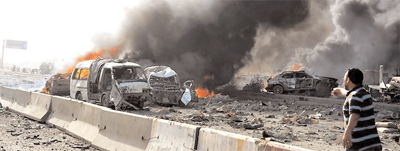
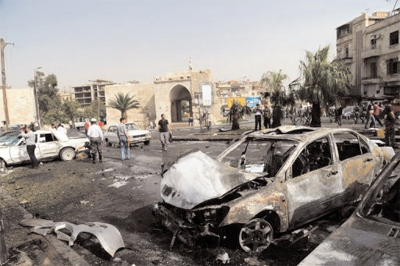
    UNITED NATIONS (TIP): Russia hasaccused US diplomats of blocking a UNSecurity Council condemnation of a bombattack in the Syrian capital that left at least59 dead.Russia’s UN mission said the United States”encourages” militant attacks by blockingthe council’s statements on attacks in Syria.Diplomats said however that Russia had inturn refused to include language criticizingally President Bashar al-Assad.The bomb near the offices of Assad’sruling party in Damascus also badlydamaged the Russian embassy. Syrianactivists said at least 59 people were killed.The 15-member council held talks on astatement proposed by Russia but the UnitedStates and other western nations had wantedto include criticism of Assad’s forces forattacking civilians, UN diplomats said.Russia refused this, they added.

    “The text confirmed the unshakableprinciples that terrorism in all its forms andmanifestations constitutes one of the mostserious threats to international peace andsecurity and has no justification,” said AntonUspensky, spokesman for Russia’s UNmission.”Unfortunately, such an indispensablereaction by the Security Council to thisterrorist attack has been once again blockedby the US delegation linking it with otherquestions,” he added.”We consider unacceptable this search forjustifications for terrorist actions. It isobvious that by doing so the US delegationencourages those who have been repeatedlytargeting American interests, including USdiplomatic missions,” he said.US mission spokeswoman Erin Peltin said:”We strongly condemn all indiscriminateterrorist attacks against civilians or againstdiplomatic facilities.

    “We agreed with the Russian draft of astatement from the Security Council andonly sought to add similar language on theregime’s brutal attacks against the Syrianpeople. Unfortunately, Russia refused toengage on a credible text,” she added.The council normally condemns attackson diplomatic missions. But it has beenbadly divided by the 23-month Syrian conflictwhich has left more than 70,000 dead,according to the UN.Russia and China have blocked threecouncil resolutions which would haveincreased pressure on Assad to endhostilities.UN leader Ban Ki-moon condemned theattack and others in the Syrian capital.”The secretary general reiterates his firmconviction that resorting to violence andmilitary means will only lead to moresuffering and destruction, and that apolitical solution is the only way out,” saidhis spokesman Martin Nesirky.

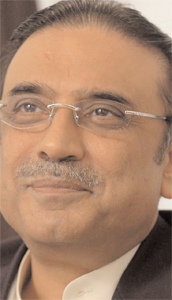
  • Zardari Raises Concerns Over Drone Attacks With US Delegation

    Zardari Raises Concerns Over Drone Attacks With US Delegation

    ISLAMABAD (TIP):President Asif Ali Zardari onThursday described US droneattacks in Pakistan’s tribalareas as “counterproductive”,saying the two countriesneed to “find a way out” inthe campaign againstmilitants operating in theregion.The drone attacks arecausing “great damage”among the people, Zardaritold a visiting delegation ofthe US Senate ForeignRelations Committee headedby its chairman RobertMenendez during a meetingat the presidency.

    Zardari also voicedconcern over continuedmilitant attacks on thePakistan army andparamilitary troops from theAfghan side of the border,presidential spokesmanFarhatullah Babar said.The president stressed theneed for NATO and Afghansecurity forces to act as an”anvil to Pakistan’s hammeroperations”.The two sides discussedseveral issues, includingbilateral relations, the fightagainst militancy and theregional situation, duringtwo rounds of talks.

    A delegation-level meetingwas followed by another onein which Zardari wasassisted by foreign ministerHina Rabbani Khar.CIA-operated spy planeshave carried out scores ofattacks in the lawless tribalbelt bordering Afghanistanthat have killed top al-Qaidaand Taliban leaders,including Tehrik-e-TalibanPakistan chief BaitullahMehsud.However, rights groups saydozens of civilians have alsodied in the attacks.During his talks with theUS delegation, Zardari alsoreferred to the need toacknowledge sacrifices madeby Pakistan in the fightagainst militancy.The blame-game “will notserve the common purpose ofdefeating militants”, he said.

  • Consul General Prabhu Dayal Bids Adieu

    Consul General Prabhu Dayal Bids Adieu

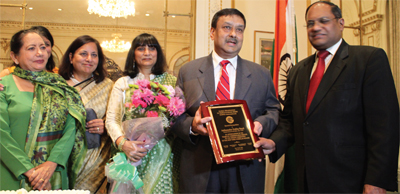
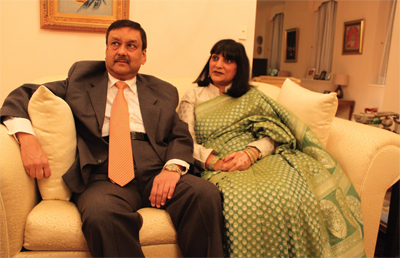
    NEW YORK (TIP): Retiring Consul General PrabhuDayal and his wife Chandini Dayal hosted a party onFebruary 15th at the Consulate of India to celebrate Mr.Dayal’s 60th birthday and to bid farewell to the couple’sfriends in New York.The event was graciously attended by many friends andassociates of the Consul General and his wife. Theattendees list included diplomats, highly distinguishedguests from both Indian and American community andmany family members.

    The guests gathered and raised many toasts while theDayals cut a cake for Mr. Dayal’ birthday. An emotionalDayal thanked the gathering present for their relentlesssupport and encouragement that he had received duringhis tenure.”I am extremely grateful to the crowd before me andothers who couldn’t be present here. It was your continualand never ending support that made this entire time sojoyful.

    I have served at many other places in the world. ButI can proudly say, East or West, New York is the best.”Esteemed guests made their way through the crowdedgathering to convey their wishes to Mr. and Mrs. Dayal.Some carried bouquets and gifts. Dr. Thomas and Ahujas ofthe worldwide organization of persons of Indian origin,GOPIO, presented a plaque to Mr. Dayal and a bouquet toMrs. Dayal.

  • Interview : Ambassador Prabhu Dayal

    Interview : Ambassador Prabhu Dayal

    Q. In your time as the Consul General ofIndia in New York, what were the mostsignificant highs and lows that youexperienced?
    Well, New York is the center of theUniverse. Although I have served in manyother places, I would say the stint in NewYork is different because of the sheerbunch of activities here. I enjoyed everysingle moment. I wouldn’t say I had anylows. Of course there was the court casewhich was filed by my former domesticassistant which gave me a certain amountof stress. But that is happily now out of theway. That has been settled. As far as myhighs, I had several many because NewYork is the best. East or West, New York isthe best. I really enjoyed my posting here.Particularly for the fact that I came to suchclose contact with some of the mostdistinguished members of the Indo-American community. And the IndianAmerican community of New York is veryvibrant. It is a bridge of friendship withIndia and the United States of America.This is the high point, so to say as I had theopportunity to serve such a vibrantcommunity.

    Q.Most people find the easiest way tosettle in America and get a Green Card isby coming in the country as a domesticservant. You have suffered significantlydue to the conniving schemes of suchpeople. What is your opinion aboutIndians who do such things?
    I have nothing to comment on that. Firstof all, it was a court case that has beensettled. I do not want to really go into anyother aspect to suggest if this is commonin the community. I have the highestrespect for the American judiciary which Ihave seen at close quarters.

    Q. You described the Indian communitysettled here as vibrant. How would youdefine this vibrancy of the IndianAmerican community?
    The Indian American community hassucceeded in all areas of activities. Such asbusiness, architecture, literature, culture,journalism, finance, etc. So this success isan account to the fact that this is a veryintellectually stimulating group. So it hasachieved this high level of success becauseit is a group that has a very high level ofcompetency. My experience recalls thecommunity as vibrant which goes down tothe fact that this very intellectual group ofpeople.

    Q. Do you see any weaknesses in thecommunity? What are your suggestionsto address these shortcomings?
    There are strengths and weaknesses inall communities. Sometimes I feel that thecommunity could be more united. This wayit would be able to get its act together asone community. We have too manydivisions. We have Punjabis, Malyalees,Gujaratis, etc. Although they do all cometogether on many occasions such as theIndia Day parade but they can be morehomogenous. Because one they come outIndia, it doesn’t matter what state, city orreligion they come from. The only thingthat matters is that they are all Indians.Americans only treat them as Indians notas Indians belonging to different states. Sowe must be more homogenous and unitedand in doing so we will be able to bring theIndian American relationship even closer.

    Q.You took a number of initiatives tointegrate the India America community.The Indian Consulate was open to allcommunities. Do you believe that wasright things to do or do you have anyregrets?
    Absolutely not, the consulate has alwaysopened its door for its community and it ispart of our mandate and responsibilities toserve this community in any way possible.We cannot do this by hiding behind closeddoors. So I try to organize many events forthis cause. Such as all the days of nationalimportance or Christmas, Eid andHanukkah for the Indian Jewishcommunity. We have organized manyevents were distinguished musicians fromIndia have performed for the communityhere. My only regret is that perhaps Ihaven’t done as much as I could have. Butthere are always many restraints onaccount of time or on account of the factthat the people in New York city are verybusy. Now that my term is coming to anend, I am reminded of the lines that say,”Fakirana Aaye Sada Kar Chale , MiyanKhush Raho Hum Dua Kar Chale”

    Q. In the troubled times that we live in itdoesn’t take too long to have discord orconflicts to destroy a good relationshipsuch as the one of India and America.What would be your word of advice foryour successor who will take up thepost?
    My successor should continue theefforts of all the Indian Americandiplomats here to both the communitiescome together. Ultimately, it is up to thecommunity to take the significant steps tomake this happen. We must realize that anIndian outside is just and Indian. If theyare in America then we are an IndianAmerican. And all the differences wecreated on the basis of geography orreligion or linguistics must be eliminated.This way we can strengthen ourrelationship with America even moresuccessfully.

    Q. Do you have any message for the Indo-American community here?
    My message to them is that they shouldcontinue to do the great work they havebeen doing. They have been a bridge offriendship between India and America.And they should continue to work atstrengthening this relationship.

    Q. Mr. Dayal, what are your future plans?
    Live life to fullest. I haven’t reallydecided to do with the remains of my life.There are a million ideas in my mind, butthere aren’t any clear agendas. For the nearfuture, maybe play gold, meet and greet ourfamily in India that would be theuppermost priority.

    Q. Mrs. Dayal, you are the first lady ofthis India away from India. How wouldyou recount your experience with theIndian American community here?
    They have been very affectionate andextremely supportive and I wish them thevery best. They have a special place in ourhearts. We will miss them. We go todifferent countries and we have to leavethem to go to another place. That is howour life is. So no matter where we went, wehave a special place in our hearts for allthe lovely people we met.

    Q. What is your most memorableexperience, Mrs. Dayal?
    I enjoyed all the times when I met newpeople. I also loved the times when mychildren come to visit me. So, in all, Ienjoyed every moment of it all.

  • Events

    Events

    The ( YIPNY )Young Indian Professional sNew York
    Sunday February24 , 20132 P.M. to 5 P.M.
    27 west 24 Street, New YorkCity, NY 10010
    The Young IndianProfessionals New York(YIPNY) holds monthlymeeting on third Sunday ofevery month for Young IndianProfessionals between theages of 23 years and 40years. The purpose of themeeting is to provideopportunity for net workingof the Young Indianprofessionals and to meetsocial , cultural andeducational aspects on thedifferent needs of life .
    Those interested to attendmust send email to YIPNY atwww.yipnyevents@gmail.comto register before the eventand get the details toattend.

    American Diabetic Association Health Expo
    Saturday, March 9, 2013 9 A.M. to 4 P.M.
    The New York State Academy of Dentistry will be conducting complimentary Oral cancer check and Oral health awareness program in the health expo. For any details for the Health expo , please call Dr. Verma at 718 699 8268. He can also be reached at www.implantdoc2004@yahoo.com

    THE HINDU TEMPLE SOCIETY OF NORTH AMERICA SWAMI VIVEKANANDA CELEBRATIONS ESSAY COMPETITION
    For College Students : Ages 18-25
    ESSAY TOPIC: ‘Life & Influence of Swami Vivekananda on me’
    (length of essay – 1500 words)
    The entrants to the
    competition may please send three copies of their essays. Entrants must also give their particulars including; NAME, ADDRESS, TELEPHONE No. on a separate sheet and their current academic standing by NO LATER THAN MARCH 2nd 2013. A panel of three judges has been established to adjudicate on the entries.
    1ST PRIZE WINNER : $300.00 o
    2ND PRIZE WINNER : $200.00
    Entries must reach Dr. Uma Mysorekar either by bringing directly to the Temple Counter, or by mail :
    The Hindu Temple
    Society of North America 45-
    57 Bowne Street, Flushing, NY
    11355.
    Or, email:
    hts@nyganeshtemple.org
    FOR FURTHER INFORMATION PLEASE CONTACT THE TEMPLE: (718) 460-8484 ext. 112

    THE HINDU TEMPLE SOCIETY OF NORTH AMERICA SWAMI VIVEKANANDA CELEBRATIONS
    Saturday, March 16, 2013 1: 00 PM
    Auditorium
    45-57 Bowne Street, Flushing,
    NY 11355
    Tel: (718) 460-8484
    Fax: (718) 461-8055
    Email: hts@nyganeshtemple.org
    FOR FURTHER INFORMATION PLEASE CONTACT THE TEMPLE:
    (718) 460-8484 ext. 112

  • Is Bobby Jindal preparing for a 2016 presidential run?

    Is Bobby Jindal preparing for a 2016 presidential run?

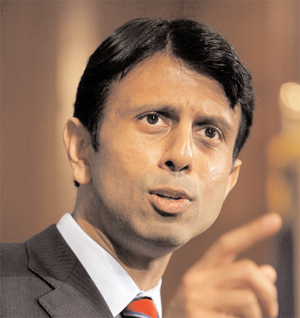
    WASHINGTON (TIP): Louisiana’s Indian-American Governor Bobby Jindal is laying the groundwork for a likely presidential bid and using his state as a testing ground for policies that play well with national conservatives, according to a media report. He’s passed a sweeping school voucher plan, rejected the Medicaid expansion in Obamacare and proposed scrapping the state income tax, all intended to please the Republican party’s conservative base, Politico, an influential media site focusing on politics noted in a report Sunday.

    It cited political observers who’ve watched Jindal up close for years as saying “it’s become increasingly fuzzy where his governing ends and his presidential ambitions begin.” It was unclear “whether the 41-yearold policy wonk’s plans are aimed at Louisiana’s problems or future GOP (Republican) voters in Iowa and New Hampshire,” the two states where the first presidential primaries begin, Politico said. Jindal’s bold policy proposals in Louisiana come at the same time he’s raising his profile nationally, both through his new post as head of the Republican Governors Association and his frequent commentary on the future of the Republican Party, the influential site noted. His headline-grabbing policies aren’t the only way Jindal is boosting his national profile, the Politico said noting that since the November election, he’s become a go-to commentator for cable news shows on the Republican party’s challenges and direction going forward. In a speech at the Republican National Committee’s winter meeting last month, Jindal said the Republican party needs to “stop being the stupid party” and that comments from some Republican candidates in 2012 inflicted “damage to the brand.” He also said on Fox News recently that any Republicans already thinking about 2016 plans “need to get their head examined.”

  • Hyderabad Twin Blasts: Cries And Chaos Rent The Air At Hospitals

    Hyderabad Twin Blasts: Cries And Chaos Rent The Air At Hospitals

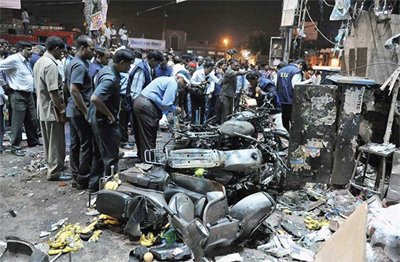
    HYDERABAD (TIP): A dazed childwith blood pouring down her foreheadand a 60-year-old man shrieking withpain summed up the scene in the cityhospitals as hundred of injured peoplepoured in with torn limbs, shrapnelwounds and blood-spattered bodiessoon after the twin blasts inDilsukhnagar on February 21 evening.In all, at least 70 people were rushedto various hospitals in the city afterthe blasts. With patients pouring intothe Emergencies all evening andworried relatives and friends movingfrom place to place in search of theirdear ones, the hospitals were a sceneof chaos.

    Eyewitnesses said that criesfor help echoed in the air and doctorsand nurses were constantly occupied.Most of the injured were taken toOsmania General Hospital wherearound 31 people are being treated forvarious burn injuries and multiplefractures. Around 10 bodies werereportedly brought to the mortuaryafter they were declared dead at OGHby 9.30pm.Among the patients at Osmania was37-year-old P Yadayya, resident ofSantosh Nagar and a real estate agentwho was returning home on Thursdayevening after collecting rent from histenants. He was in front of Venkatdritheatre in Dilsukhnagar when theexplosion occurred and left him withserious multiple fractures in both hislegs.His cousin, P Karunakar, a softwareengineer said it was very difficult tofind him in the hospital with all theconfusion.

    “I got a call from himasking me to come to Osmania but Icould not get into the building for agood 20 minutes. Moreover, he wasmoved around a lot from casualty, toemergency and then to another room,”he said.The confusion at Osmania led toaround eight cases being shifted toother private hospitals in the vicinity.Doctors at the hospital wereoverwhelmed with the sudden influxof patients and many injured peoplecomplained that they had to wait for along time to be attended. At YashodaHospital in Malakpet and very close tothe scene of the blasts the first batchof seven injured people were broughtin at 7.20pm. By 9pm, there were atotal of 16 patients of which 15 werecritical and four very critical withsevere burns and other shrapnelinjuries.

    The critical patients wereadmitted into the Acute Medical Careward.At least two patients were alreadyundergoing surgeries for abdominaland head injuries by 9.30pm. “Most ofthe patients have lost a lot of bloodand at least one patient is likely torequire amputation due to severedamage to a limb. Most patients willrequire surgery,” said a senior doctorat Yashoda.The burns ward of the hospital wasespecially chaotic with doctors andnurses running helter-skelter to tendto the ailing patients.One of the blast survivors at thehospital, 57 year-old L Vishwanathwho owns a mobile shop atDilsukhnagar said his shop wascompletely obliterated by theexplosion. “I only remember hearing ahuge sound and then everything wentblank. The entire shop caved in andwhen I came to my senses, I saw thatmy right leg was severely damaged,”he said.GHMC Commissioner KrishnaBabu, mayor Majid Hussain andcommissioner of police AnuragSharma visited the hospital andassured relatives of the injured peoplethat support will be provided.

    Two youths, Rajasekhar and Vijay, who areundergoing sub-inspector training, died on thespot. They were having snacks at the tiffin centre.This is the third time terrorists have madeDilsukhnagar their target. First, they planted ascooter bomb outside a famous Sai Baba Mandir, alittle away from Dilsukhnagar bus stop. Threeunexploded bombs were recovered in May 2008,during the serial blasts at Lumbini Park and GokulChat, killing 42.Though no outfit had claimed responsibility tillthe time of going to print, the police suspect thatthe blasts are the retaliation to the executions of2008 Mumbai attacks convict Qasab and the keyperson in the attack on Indian Parliament, AfzalGuru.Speaking to Mirror, a senior police official saidthey suspected the blasts to be the handiwork ofPakistan-based terror outfit Lashker-e-Toiba.

  • India’s Foreign Secretary Mr. Mathai meets with US Secretary of State Mr. Kerry

    India’s Foreign Secretary Mr. Mathai meets with US Secretary of State Mr. Kerry

    WASHINGTON (TIP): Foreign Secretary Mr. Ranjan Mathai completed a series of very useful and important interactions at the State Department, including a brief call upon the new U.S. Secretary of State,Mr. John Kerry here on February 21, says an Indian Embassy press release. “In his meeting with Secretary Kerry, Foreign Secretary extended to him the good wishes of our leadership, and their congratulations upon his appointment as Secretary of State.

    The Foreign Secretary discussed the proposed visit to India by Secretary Kerry for the Third Round of the Bilateral Strategic Dialogue.While dates for this being finalized, Secretary Kerry reaffirmed his invitation to the External Affairs Minister,Mr. Salman Khurshid to visit the United States soon. “Secretary Kerry offered his sincere condolences at the loss of life as a result of the terror attacks in Hyderabad today, and the condemnation of the government and the people of the United States.

    This was reiterated at all of Foreign Secretary’s meetings with United States officials today (February 21). “Foreign Secretary also called upon Deputy Secretary of State William Burns and Deputy Secretary of Energy Daniel Poneman.

    He had a conversation over lunch with Under Secretary of State for Economic Growth, Energy and Environment Robert Hormats as well as extensive and wide-ranging consultations with Under Secretary of State for Political Affairs Wendy Sherman during which the two sides covered bilateral, regional and global issues. “In these discussions, the importance of the bilateral partnership in key areas, including energy, trade and economic development, as well as our existing regional and international consultations were reaffirmed. ” In the year ahead, it is intended that the two sides would increase the frequency and pace of bilateral consultations, including at official and political levels.

    Earlier in the day, Foreign Secretary set out a detailed blueprint of the bilateral relationship in an address on India and the United States in the 21st century, covering all areas of the bilateral partnership at the Carnegie Endowment for International Peace. The text of the speech is available on the websites of Ministry of External Affairs and the Embassy of India in Washington DC.

  • Dilsukhnagar Has Been On Indian Mujahideen Radar Since 1999

    Dilsukhnagar Has Been On Indian Mujahideen Radar Since 1999

    NEW DELHI (TIP): The twin blasts at Hyderabad aresuspected to be the handiwork of IndianMujahideen(IM) commander Riyaz Bhatkal. Althoughintelligence agencies are in no rush to jump to ajudgment, their suspicion of IM’s role is derived fromthe fact that the terror outfit had targeted precisely thesame spot – near the foot overbridge in Dilsukhnagar -on August 25, 2007, when IM carried out serial blasts inHyderabad.While the bombs that Bhatkal and his team, essentialIM’s Pune module, set off at Gokul Chat Bhandar andLumbini Park killed 42 people, Dilsukhnagar escapedthe mayhem because the device planted theremalfunctioned. Residents of the locality, however, ranout of luck on February 21.

    During their interrogation in 2008 in connection withtheir involvement in the serial attack on Hyderabad theyear before, two members of IM – a Indian proxy ofLashkar-e-Taiba which was launched to cloak Pakistan’sinvolvement in the terror campaign against India -confirmed that Bhatkal was the mastermind.Speaking to reporters after the twin blasts onThursday, home minister Sushilkumar Shinde seemedto reflect the principal assumption of the agencies aboutBhatkal and his IM gang being the chief suspects whenhe said the latest attack was similar to the 2007 serialattacks in the city.The suspicion is derived also from the testimony ofthe three alleged IM terrorists to Delhi Police in October2012.

    Imran, Tabrez and Maqbool told the special cellthat they had been assigned by Bhatkal to do a recce ofDilsukhnagar and other communally sensitive areas inHyderabad.The motivation for the terror strike is suspected to bethe call given by Hafiz Saeed – Lashkar chief andprincipal mentor of IM terrorists – to avenge thehanging of Parliament attack convict Afzal Guru.United Jehad Council, with Lashkar as one of its mainconstituents, had on February 13 – four days after Guruwas sent to the gallows – vowed to retaliate against theexecution.Intelligence agencies did not treat it as rhetoric, anddid sound a countrywide alert earlier this week,although Shinde acknowledged that the warning wasgeneral in nature.

    Dilsukhnagar, a Hindu-dominatedlocality with a history of communal tension, has beenon the terrorists’ radar for long; at least since 1999 whena bomb was planted near a Hanuman temple. The devicewas detected in time by police.The timing was significant, just an year afterintelligence agencies zeroed in on Abdul Saleem Junaid.A Pakistani, Junaid was launched into India by Lashkarcommander Azam Cheema. While Junaid, who wasdesignated as the head of Lashkar in India, wassupposed to be based in Delhi, he found Hyderabad morehospitable and settled down there after marrying a localgirl. The cover of a regular couple proved useful forsetting up several sleeper cells, at least a few comprisingPakistanis.The terror group targeted Dilsukhnagar again in 2002,planting a bomb near the Saibaba temple killing twopersons.

  • Jallianwala Bagh Killings Deeply Shameful: UK PM

    Jallianwala Bagh Killings Deeply Shameful: UK PM

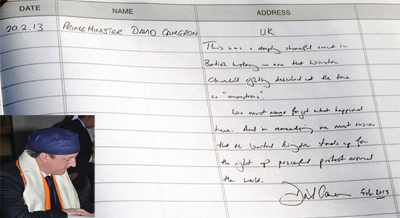
    AMRITSAR (TIP): British PrimeMinister David Cameron visited the site ofa colonial-era massacre in India onFebruary 20, describing the episode as”deeply shameful” while stopping short of apublic apology.On the last leg of a three-day trip aimedat forging deeper economic ties, Camerontook the bold decision to visit the city ofAmritsar and tackle an enduring scar ofBritish rule on the subcontinent, whichended in 1947.Dressed in a dark suit and bowing hishead, he laid a wreath at the memorial tothe victims at Jallianwala Bagh, whereBritish troops opened fire on thousands ofunarmed protesters in 1919.In a message in the visitors’ book, hewrote: “This was a deeply shameful event inBritish history and one that WinstonChurchill rightly declared at the time as’monstrous’.

    David Cameron at Jallianwala Bagh
    “We must never forget what happenedhere. And in remembering we must ensurethat the United Kingdom stands up for theright of peaceful protest around the world.”The number of casualties at theJallianwala Bagh garden is unclear, withcolonial-era records showing about 400deaths while Indian figures put the numberkilled at closer to 1,000.Bhusan Behl, who heads a trust for thefamilies of victims, has campaigned fordecades on behalf of his grandfather whowas killed at the entrance to the walledarea.

    He said he was hoping that Cameronwould say sorry for the slaughter orderedby General Reginald Dyer, which wasimmortalised in Richard Attenborough’sfilm Gandhi and features in SalmanRushdie’s epic book Midnight’s Children.The 1919 slaughter, known in India as theJallianwala Bagh massacre, was describedby Mahatma Gandhi, the father of theIndian independence movement, as havingshaken the foundations of the BritishEmpire.A group of soldiers opened fire on anunarmed crowd without warning in thenorthern Indian city after a period ofunrest, killing hundreds in cold blood.Cameron’s visit and expression of regretfor what happened will stop short of anapology – but will make it clear heconsiders the episode a stain on Britain’shistory that should be acknowledged.

    The gesture, coming on the third andfinal day of a visit to India aimed atdrumming up trade and investment, islikely to be seen as an attempt to improverelations with Britain’s former colonialpossession and to court around 1.5 millionBritish voters of Indian origin ahead of a2015 election.Before his visit, Cameron said there wereties of history between the two countries,”both the good and the bad”.”In Amritsar, I want to take theopportunity to pay my respects atJallianwala Bagh,” he said, referring to thesite of the massacre.Cameron is expected to visit Amritsar’sGolden Temple, a place of pilgrimage forSikhs, and to inscribe his thoughts aboutthe killings in the visitor book.When asked to comment on Britain’scolonial past, he said: “I would argue it’s astrength, not a weakness. Of course thereare sensitive issues, sensitive events, butactually the fact that Britain and India havethis history, have a shared culture and ashared language, I think, is a positive.

    “The British report into the Amritsarmassacre at the time said 379 people hadbeen killed and 1,200 wounded. But aseparate inquiry commissioned by theIndian pro-independence movement saidaround 1,000 people had been killed.Brigadier-General Reginald Dyer, theman who gave the order to fire, explainedhis decision by saying he felt it wasnecessary to “teach a moral lesson to thePunjab”.Some in Britain hailed him “as the manwho saved India”, but others condemnedhim. India became independent in 1947.Many historians consider the massacre aturning point that undermined British ruleof India.It was, they say, one of the moments thatcaused Gandhi and the pro-independenceIndian National Congress movement to losetrust in the British, inspiring them toembark on a path of civil disobedience.

    “Monstrous event”
    Other British politicians and dignitaries- though no serving prime minister – haveexpressed regret about the incident before.In 1920, Winston Churchill, then thesecretary of state for war, called theAmritsar massacre “a monstrous event”,saying it was “not the British way of doingbusiness”.On a visit to Amritsar in 1997, QueenElizabeth called it a distressing episode, butsaid history could not be rewritten.However, her husband, Prince Philip,courted controversy during the visit whenhe questioned the higher Indian death toll.Before he became prime minister, TonyBlair also visited, saying the memorial atAmritsar was a reminder of “the worstaspects of colonialism”.

    In recent years, British leaders havebegun to apologise for some of the excessesof Empire.Visiting Pakistan in 2011, Cameronangered traditionalists at home sayingBritain had caused many of the world’sproblems, including the Kashmir conflictbetween India and Pakistan.When in office, Blair apologised for the19th century Irish potato famine and forBritain’s involvement in the slave trade,while Gordon Brown, his successor,apologised for the fact that British childrenwere shipped to Australia and otherCommonwealth countries between the1920s and 1960s.Britain ruled or held sway in India viathe British East India company from the17th century until 1947.

    India’s colonial history remains asensitive subject for many Indians,particularly nationalists who want Britainto recognise and apologise for its excesses.Others believe bygones should bebygones.”What happened in the past happened inthe past,” Aamir Khan, Bollywood film star,told reporters after a meeting withCameron on Tuesday.”I don’t think we can hold the presentgeneration of Britishers responsible forwhat happened ages ago. It is not fair. Idon’t think that they owe us an apology forwhat happened a century ago.”Cameron has said the two countriesenjoy a “special relationship”, a termusually reserved for Britain’s relations withthe United States, but it is a relationshipundergoing profound change.For now, Britain’s economy is the sixthlargest in the world and India’s the 10th.But India is forecast to overtake its oldcolonial master in the decades ahead andLondon wants to share in that economicsuccess.

  • U.S. Condemns Hyderabad Blasts, Offers Assistance in Probe

    U.S. Condemns Hyderabad Blasts, Offers Assistance in Probe

    WASHINGTON (TIP): The United States has strongly condemned the terrorist bombings in Hyderabad Feb. 21 that killed more than a dozen people and offered assistance in investigation if requested by the Indian government. “We condemn the cowardly attack in Hyderabad, India, in the strongest possible terms, and we extend our deepest sympathies to those affected and to the people of India,” the State Department spokesperson, Victoria Nuland, told reporters at her daily news conference. “As you know, Secretary Kerry will have a chance to see Indian Foreign Secretary Mathai later this afternoon, and he will convey our sympathies in person and affirm our support for India during this difficult time,” she said. “The United States stands with India in combating the scourge of terrorism, and we are also prepared to offer any and all assistance that Indian authorities may need,” Nuland said.