Year: 2019

  • Heartwarming story of Hindu Muslim unity

    Heartwarming story of Hindu Muslim unity

    Manu Shah

    HOUSTON (TIP): There are plenty of heartwarming stories of Hindu-Muslim unity, but it’ll be hard to top the one that took place in Houston recently.

    The Indian Muslims Association of Greater Houston (IMAGH) invited Ramesh Bhutada, Advisor to the Hindus of Greater Houston (HGH) and Vice President of the Hindu Swayamsevak Sangh, USA (HSS) as the Chief Guest for their annual Eid Milan celebrations. In what turned out to be the evening’s epic moment, Bhutada’s simple yet powerful speech on Hindu-Muslim unity was met with a long-standing ovation from every seat in the room including the Consul General of India Dr. Anupam Ray who was among the first to rise and applaud.

    Bhutada, a Houston based industrialist, began his address by wishing the members of the Association Eid Mubarak and commended IMAGH on their mission of fostering amity across cultures, communities and religions.  The organization was formed 10 years ago to foster harmony, strengthen relationships between religions and cultures, and enrich the community as a whole through various Outreach programs. It is a non-profit, non-political and non-religious organization.

    Bhutada deliberately reiterated his introduction as a leader of the HSS and the Rashtriya Swayamsevak Sangh (RSS), an organization that inspires him, because he explained, he “wanted to have an open dialogue.” The RSS and HSS, he emphasized, are primarily involved in character building of the youth so that its members can become proud citizens of the country they live in.

    Bhutada expressed his concerns about the false propaganda in sections of the media and certain politicians who have sought to separate both communities for their vested interests. He assured the gathering that “the RSS and the HSS would like communal harmony and unity amongst all religions.”

    Elaborating on this point, he recalled an interview 10 years ago when RSS Chief Mohan Bhagwat, then General Secretary of the RSS, was staying at his house.  During the course of the interview, the journalist Haider Kazim asked Mohan Bhagwat, “Sir, what do you think of minorities’ development and progress.” Without missing a beat, Mohan Bhagwat replied, “India’s development cannot be complete without the development and progress of the minorities.” As Bhutada framed it, this statement came “straight from the horse’s mouth.” He also recalled spending several hours in discussions with Mohan Bhagwat on matters of India’s national interest.

    Coming to the core of his message, he continued, “We all have historical baggage – let’s acknowledge that, but we cannot look backwards. We have to look forward and that is the only way we can lead a peaceful life in this world.”

    How powerful is looking forward? To explain this, Bhutada alluded to Speaker Richard McKinney’s keynote. McKinney had served in the Marines for 25 years and harbored a deep hatred for Muslims. But a chance meeting with some members of the Muslim congregation changed his life dramatically and he became a Muslim. Bhutada noted that when McKinney was looking backwards, he was stuck in the mire of hate but the day the Marine began looking forward, his anger faded and was replaced by love. Bhutada observed, “This is the same person but look as the transformation.”

    Weaving one more example in his message, Bhutada spoke of another member in the audience – Consul General Dr. Anupam Ray. In 1947, Dr. Ray’s father had to flee East Pakistan, now Bangladesh and in 1971, religious violence forced his maternal grandparents to leave Bangladesh too. But Dr. Ray chose not to let these incidents dictate his life. A few weeks ago, the Consul General had “the heart and the courage” to hold an Iftar dinner at the Consulate, not because he had to as Consul General but because he wanted to. The only way, Bhutada said, we can win the hearts of people is by love and peace, cooperation and unity. That’s the only way the world can progress.

    Bhutada briefly touched on his support of the Kalam Center – an NGO started by a young Muslim youth Arshad Sheikh, in the old city of Charminar, Hyderabad. Bhutada did this on a friend’s recommendation and he has been funding their programs for the past four years. Today, the Center provides vocational training to 500 young Muslim boys and girls for ages 8 and up and 70% of the beneficiaries are girls. During the day, the children attend the Madrasas and from 5-7 in the evening come to one of the 20 centers spread across the old city to acquire vocational training in subjects taught in Urdu. Bhutada urged the gathering to support these poor children and give them a chance in “becoming proud citizens of India.”

    Lauding this much needed message of harmony and unity, IMAGH’s Past President Latafath Hussain, in a statement said “While we had no doubt that his presence and speech will add charchand to our Eid Milan, even we were overwhelmed when 500+ guests gave a standing ovation to his speech. He delivered it from the heart and the message of not looking back but forward was appreciated by all.”

    According to Vijay Pallod, an Advisor on the Board of IMAGH, the Kalam Center Project is just one of Bhutada’s many philanthropic endeavors but Bhutada himself is extremely reticent in talking about them.

  • America Celebrates Independence Day with a Bang

    America Celebrates Independence Day with a Bang

    Bidisha Roy

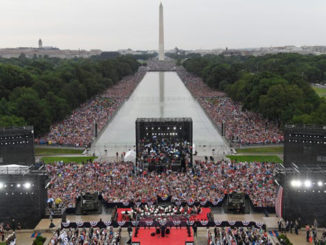
    WASHINGTON (TIP): Each year Washington, DC celebrates the Fourth of July with a bang. The 2019 extravaganza became very special, as President Donald Trump wanted to add a military flavor to this year’s Independence Day celebrations with Troops, tanks and a fly past. The President has re-branded the day as a “Salute to America” and the nation watched the biggest July 4 display of military pageantry since 1850.

    In America’s earliest decades, the Fourth of July saw plenty of military pageantry in Washington. The Smithsonian’s research found Presidents Jefferson, Madison, Van Buren and Polk presided over military parades on Independence Day. But the tradition died under Zachary Taylor in 1850.

    Trump has voiced his desire to show off with the American military ever since he attended a Bastille Day celebration with troops and tanks as a guest of French President Emmanuel Macron in 2017. And it happened.

    Under White House direction, the army moved tanks and other armoured vehicles into the nation’s capital on Wednesday night. The Pentagon arranged for an Air Force B-2 stealth bomber and other warplanes to conduct flyovers of the celebration on the National Mall. There were Navy F-35 and F-18 fighter jets, the Navy-Blue Angels aerial acrobatics team, Army and Coast Guard helicopters and Marine V-22 Ospreys.

    “Military Leaders are thrilled to be doing this & showing to the American people, among other things, the strongest and most advanced Military anywhere in the World,” Trump tweeted. “Incredible Flyovers & biggest ever Fireworks!”

    Two Bradley fighting vehicles were in place near the Lincoln Memorial, where Trump delivered a patriotic speech during an event that he has billed as honouring the U.S. armed forces. Thousands of people gathered albeit under low cloud cover following heavy rains earlier Thursday. Air Force One flew over the Mall as Trump approached the podium protected by rain-streaked bulletproof glass. It was the first time in decades that a President has addressed a crowd.

    “Today, we come together as one nation with this very special salute to America. We celebrate our history, our people, and the heroes who proudly defend our flag — the brave men and women of the United States military,” Trump said. “As long as we stay true to our cause; as long as we remember our great history; and as long as we never stop fighting for a better future; then there will be nothing that America cannot do.”

    The President highlighted the accomplishments of each branch of the military and added that “very soon” the U.S. will have a sixth branch – the “Space Force.”

    Aircraft representing each branch, such as a B-2 stealth bomber for the Air Force and F-35 Lightnings for the Navy, flew over the National Mall in time with Trump’s speech.

    Attendees also enjoyed live music from the Old Guard Fife and Drum Corps, the U.S. Army Band (“Pershing’s Own”), the Armed Forces Chorus and the United States Marine Corps Silent Drill Team.

    Along with viewing the dynamic fireworks show on the National Mall and attending the free Capitol Fourth concert, visitors celebrated America’s birthday in dozens of other venues in the capital.

  • Structural reforms needed for USD 5 trillion economy, says India’s Finance Minister

    Structural reforms needed for USD 5 trillion economy, says India’s Finance Minister

    NEW DELHI (TIP): India’s finance minister Nirmala Sitharaman presented the first budget of the second term of the Narendra Modi government on July 5.

    This is also the maiden budget for Sitharaman, who becomes the second woman finance minister after Indira Gandhi to do so in the history of independent India.

    “We need to make structural reforms to achieve USD 5 trillion economy in next few years. Indian economy was at USD 1.85 trillion five years back, reached USD 2.7 trillion now and within capacity to reach USD 5 trillion in next few years,”  said the FM.

    BUDGET HIGHLIGHTS

    *Focus on gaon, gareeb, kisan: FM

    *By 2022, every single rural family except those who are unwilling to take the connection will have an electricity and a clean cooking facility.

    *As world’s 3rd largest aviation market, time ripe to enter aircraft financing and leasing from Indian shores: FM.

    *Sitharaman said that public private partnership will be utilized to develop rail infrastructure. Railway infrastructure will require Rs 50 lakh crore till 2030 to develop. The FM said 657 km of metro rail network has become operational across country.

    *Number of patents tripled during 2018-19, says Sitharaman

    *We need to invest in infrastructure, digital economy and job creation in small and medium enterprises, says the FM

    *India’s economy will grow to become $3 trillion economy in current year; the sixth largest in world

    *Recent election was charged with brimming hope for a bright and stable India, says FM presenting Budget

    SITHARAMAN BREAKS TRADITION

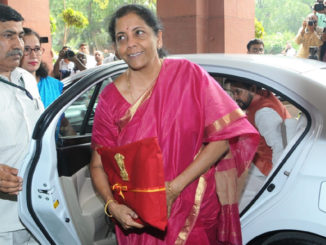
    Setting a new precedent, Sitharaman on July 5 was seen hugging the budget documents wrapped in a red cloth, the traditional ‘bahi khaata’ way, instead of the leather briefcase that until now her predecessors walked around with.

    Chief Economic Advisor K. Subramanian said that it was a departure from “slavery of western tradition”. The red cloth symbolizes the ‘bahi khaata’ traditionally used in every Indian business set up to maintain accounts.

    Sitharaman was seen carrying the red cloth wrapped budget papers that was neatly bound with the auspicious yellow and red ribbon. The Lion Capital shone brightly on top of the bahi khaata, as the first-time Finance Minister walked out of the North Block.

    Traditionally until now all former Finance Ministers have carried their Budget Document in a hardbound leather briefcase that takes after the parallel British custom.

  • Trump Pursues with  Census Citizenship Question

    Trump Pursues with Census Citizenship Question

    WASHINGTON (TIP): President Donald Trump said on Wednesday, July 3, that  he was moving ahead with adding a contentious citizenship question to the 2020 US census in a dramatic reversal after his own administration including Commerce Secretary Wilbur Ross announced a day earlier that the plan had been dropped.

    Following Trump’s announcement, made in a defiant Twitter post, a senior US Justice Department lawyer told a Maryland-based federal judge overseeing litigation in the matter that the administration was seeking a “path forward” to add a citizenship question after the Supreme Court last Thursday blocked it, at least temporarily.

    The Supreme Court found that administration officials had given a “contrived” rationale for including the query in the decennial population survey, but the court left open the possibility the administration could offer a plausible rationale.

    Facing a deadline to get the census forms printed, administration officials including Ross said on Tuesday they were going ahead without including the question.

    Critics have called the citizenship question a Republican ploy to scare immigrants into not taking part in the census and engineer a population undercount in Democratic-leaning areas with high immigrant and Latino populations. That would benefit non-Hispanic whites and help Trump’s fellow Republicans gain seats in the US House of Representatives and state legislatures when new electoral district boundaries are drawn after the census, the critics said.

    “The News Reports about the Department of Commerce dropping its quest to put the Citizenship Question on the Census is incorrect or, to state it differently, FAKE! We are absolutely moving forward, as we must, because of the importance of the answer to this question,” Trump wrote on Twitter.

    The Justice Department on Tuesday had told Hazel that the administration had made a final decision not to proceed with the citizenship question, according to two lawyers involved in the litigation. The judge then held a call with lawyers in the case after Trump’s Wednesday announcement.

    “We think there may be a legally available path under the Supreme Court’s decision. We’re examining that, looking at near-term options to see whether that’s viable and possible,” Hunt said.

    Hazel said he wants a final response by Friday afternoon on whether the government will press ahead with adding the citizenship question. Otherwise, legal claims accusing administration officials of being motivated by racial bias in adding the citizenship question will move forward.

  • July 5 New York & Dallas Print Editions

    July 5 New York & Dallas Print Editions

    [vc_row][vc_column][vc_column_text]

    Print Replica- Digitally

    E-Editions

    [/vc_column_text][/vc_column][/vc_row][vc_row][vc_column width=”1/3″][vc_custom_heading text=”New York Edition” font_container=”tag:h2|text_align:center” google_fonts=”font_family:Istok%20Web%3Aregular%2Citalic%2C700%2C700italic|font_style:700%20bold%20regular%3A700%3Anormal” link=”url:https%3A%2F%2Fwww.theindianpanorama.news%2Fwp-content%2Fuploads%2F2019%2F07%2FTIP-July-5-NYC.pdf|||”][vc_single_image image=”96913″ img_size=”full” add_caption=”yes” alignment=”center” onclick=”custom_link” link=”https://www.theindianpanorama.news/wp-content/uploads/2019/07/TIP-July-5-NYC.pdf”][/vc_column][vc_column width=”1/3″][vc_custom_heading text=”Dallas, Texas Edition” font_container=”tag:h2|text_align:center” google_fonts=”font_family:Istok%20Web%3Aregular%2Citalic%2C700%2C700italic|font_style:700%20bold%20regular%3A700%3Anormal” link=”url:https%3A%2F%2Fwww.theindianpanorama.news%2Fwp-content%2Fuploads%2F2019%2F07%2FTIP-July-5-Dallas-TX.pdf|||”][vc_single_image image=”96914″ img_size=”full” add_caption=”yes” alignment=”center” onclick=”custom_link” link=”https://www.theindianpanorama.news/wp-content/uploads/2019/07/TIP-July-5-Dallas-TX.pdf”][/vc_column][vc_column width=”1/3″][vc_single_image image=”82828″ img_size=”medium” alignment=”center” onclick=”custom_link” link=”https://www.theindianpanorama.news/advertising-media-kit-portal-indian-panorama/”][vc_single_image image=”82829″ img_size=”medium” alignment=”center” onclick=”custom_link” link=”https://www.theindianpanorama.news/advertising-media-kit-portal-indian-panorama/”][/vc_column][/vc_row][vc_row][vc_column width=”1/2″][vc_custom_heading text=”Lead Stories This Week” font_container=”tag:h2|text_align:center” google_fonts=”font_family:Istok%20Web%3Aregular%2Citalic%2C700%2C700italic|font_style:700%20bold%20regular%3A700%3Anormal” link=”url:https%3A%2F%2Fwww.theindianpanorama.news%2F|||”][/vc_column][vc_column width=”1/2″][vc_widget_sidebar sidebar_id=”mh-sidebar”][/vc_column][/vc_row]

  • TIRLOK MALIK LAUNCHES HAPPY LIFE YOGA, A NEW EDUCATIONAL PLATFORM FOR A HAPPY & HEALTHY LIVING

    TIRLOK MALIK LAUNCHES HAPPY LIFE YOGA, A NEW EDUCATIONAL PLATFORM FOR A HAPPY & HEALTHY LIVING


    NEW YORK CITY (TIP): In honor of International Yoga Day 2019, HAPPY LIFE YOGA, conceptualized by Filmmaker, Restaurateur, and  Ayurveda Speaker, will be launching on June 29th.  The curtain raiser event for this educational platform will be inaugurated by  Deputy Consul General of India in New York, Shatrughna Sinha. . Manhattan Borough President Gale Brewer will be the chief guest.   Padma Shri Dr. Sudhir M. Parikh will be attending as a guest of honor,  and many VIPs will be in attendance as well.

    This intriguing, interactive, and entertaining experience will include a panel discussion on topics such as how to use Ayurveda in every day life, the place of Western Medicine in holistic wellness, and the benefits of Yoga. Speakers include  Dr. Bhupendra Patel, M.D., Ayurvedic Dr. Bhaswati Bhattacharya, and Long Island yoga teacher Ranju Narang.

    HAPPY LIFE YOGA, created by Tirlok Malik, is the yoga of life. This educational platform offers a unique holistic approach to health and happiness using tools from Ayurveda, Indian Philosophy, and Yoga to help better manage modern day challenges such as work, finances, relationships, family and other social pressures and ultimately guides you towards a happier life.

    Tirlok Malik believes India has always been a spiritual teacher of the world and that Indian Philosophy provides the blueprint of how to live a happy life. Indian Philosophy teaches that we must practice balance in all four aims of human life: Artha, Dharma, Kama and Moksha. These philosophical concepts can be applied to all cultures.

    An asana yoga practice and healthy eating alone will not make us healthy. Kama, the world of all our desires, can be a double edge sword and we must understand and manage this part of the four aims of human life to be healthier and happier. According to Indian Philosophy we can have it all, but as Tirlok Malik says “Fix your Kama, and be happier!”

    Indu Jaiswal of The Indian American Forum, one of the oldest organizations of Indian Americans on Long Island, and Prof. Indrajit Saluja publisher and editor of the Indian Panorama, an Indian American Newspaper in New York & Dallas sponsored the event and are committed to spreading  the message of HAPPY LIFE YOGA.

    Tirlok Malik created HAPPY LIFE YOGA as well as Ayurveda Cafe in Manhattan. He is a happy lifestyle speaker and a New York Emmy Nominated Filmmaker. He is a proud Upper Westsider. He has promoted Ayurveda for the last 20 years and now he and the team bring  the gifts of India through HAPPY LIFE YOGA.

    HAPPY LIFE YOGA will provide workshops, excursions, events and more. A unique mix of tools and exercises are used in our workshops to apply these philosophical concepts in every day life.  www.happylifeyoga.org

  • India-Japan ties to become stronger in ‘New India’, PM Modi tells diaspora

    India-Japan ties to become stronger in ‘New India’, PM Modi tells diaspora

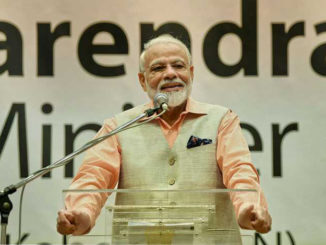
    KOBE, JAPAN (TIP): Prime Minister Narendra Modi on Thursday, June 27 said the ties between India and Japan will become stronger in ‘New India’ as he thanked the Indian diaspora for being part of the world’s largest democratic process, which saw the participation of 61 crore voters.

    “When it comes to India’s relationship with the world, Japan has an important place in it. This relationship is dated back to centuries. There is a sense of belonging, goodwill and respect for each other’s culture and civilization,” Modi, who is in Japan to attend the G20 Summit to be held in Osaka from Friday, said while addressing an enthusiastic Indian community at Kobe.

    “Almost two decades ago, prime minister Atal Bihari Vajpayee and then Japanese premiere Yoshiro Mori together made our relationship as a global partnership. After becoming Prime Minister in 2014, I got a chance to strengthen our friendship with my dear friend Prime Minister Shinzo Abe.

    “This relationship,” Modi said, “will become stronger in ‘New India’”.

    He also noted the contribution of Swami Vivekananda, Rabindranath Tagore, Mahatma Gandhi, Netaji Subhas Chandra Bose, Justice Radhabinod Pal and many other Indians in strengthening India’s relationship with Japan.

    Modi, who is visiting Japan for the first time after his re-election, said people of India have trusted him once again and have bestowed upon him much more responsibility.

    “I’m fortunate to be here once again after 7 months. It’s a coincidence that last time when I was here, election results were out here, and you had shown trust in my dear friend Shinzo Abe. Today, when I’m here, the world’s largest democracy has shown even greater trust in this ‘Pradhan Sevak’,” he said.

    Thanking the Indian diaspora for playing a vital role in the recently concluded Lok Sabha elections, in which Modi was voted back to power with a stronger mandate, the prime minister said, “I am aware that many of you have also contributed in this electoral victory.”

    While several Indians from Japan came to India and worked on the field, many used social media like Twitter to spread the message of the democratic process, he said.

    “For the first time since 1971, the country has given a pro-incumbency mandate to a government. This victory was the victory of truth and democracy,” he said.

    He noted that 61 crore voters, 10 lakh polling stations, over 40 lakh EVMs and more than 8,000 candidates took part in the world’s largest democratic process.

    The number of voters who participated in the Lok Sabha elections exceeded the population of almost all countries, barring China, he said.

    “Government with majority is an advantage in foreign relations…The mandate (given to us) to fulfil the hopes and aspirations of new India will give a fillip to our relations with the world. The mantra of ‘sabka saath, sabka vikas aur sabka vishwaas’ that we are following will help strengthen the world’s trust on India,” Modi said.

    During his visit to Kobe, the Prime Minister also witnessed the exchange of Letter of Intent on Ahmedabad-Kobe Sister City Partnership.

    ( PTI)

  • India and U.S. resolve to work through their trade differences

    India and U.S. resolve to work through their trade differences

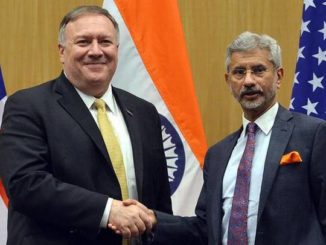
    NEW DELHI (TIP): India and the U.S. resolved to “work through” their differences which have led to an impasse on trade issues as External Affairs Minister S. Jaishankar hosted U.S. Secretary of State Mike Pompeo in Delhi ahead of a meeting between Prime Minister Narendra Modi and U.S. President Donald Trump in Osaka this week.

    “If you trade with somebody, and particularly if they are your biggest trading partners, it’s impossible that you don’t have trade issues. But I think the sign of a mature relationship is that ability to negotiate your way through that and find common ground,” Mr. Jaishankar said at the end of their meeting on Wednesday, although neither side announced any positive outcomes from the discussions. Mr. Pompeo and Mr. Jaishankar are understood to have thrashed out issues, including tariffs and counter-tariffs imposed by New Delhi and Washington on each other in the past year, as well as the U.S.’s specific concerns with India’s proposed laws on e-commerce and data localization, on price caps and market access.

    “The U.S. is clear that it seeks greater market access and the removal of trade barriers in our economic relationship, and today I addressed these differences in the spirit of friendship and I think we will be able to resolve these issues in the interests of our two countries,” said Mr. Pompeo.

    He clarified that the U.S. decision to withdraw India’s GSP preferential trade status this month had not come up for discussion.

    Mr. Jaishankar said both sides had come away with a “better understanding” of each other’s concerns on a wide variety of issues besides trade, including energy, defense, investment concerns and people-to-people contacts, as well as the growing conflict in the Gulf with Iran and the peace process in Afghanistan.

    Rejecting calls by the United States and the threat of sanctions under its CAATSA law, Mr. Jaishankar said that India will take its decision on the purchase of the Russian S-400 Triumf anti-missile system in its own “national interest”, and conveyed this to his American counterpart during talks here on Wednesday.

    “On the CAATSA ( Countering America’s Adversaries through Sanctions Act)issue) I explained to Secretary Pompeo in some detail that we have many relationships with many countries, and many of them have some standing and they have a history,” said Mr. Jaishankar, referring to India’s traditional relationship with Russia.

    Mr. Jaishankar also raised India’s concerns over growing U.S.-Iran tensions and their impact on India’s energy security.

    While India has zeroed out all oil imports from Iran since the U.S. sanctions deadline ran out on May 2, it has maintained a cordial and close relationship with the Iranian government. In response, Mr. Pompeo lashed out at the Iranian government, which he called a “terrorist regime”, adding that India and the U.S. had a “shared understanding” of the terrorist threat emanating from Iran.

    “We know that Iran is the world’s largest state sponsor of terror, and the Indian people have suffered from terror around the world. So I think there is a shared understanding of the threat and a common purpose to ensuring that we keep energy at the right prices and deter this threat,” Mr. Pompeo said.

    The MEA declined to comment on whether it supported Mr. Pompeo’s remarks, which were made in Mr. Jaishankar’s presence. Mr. Pompeo also met with PM Modi and National Security Adviser Ajit Doval on Wednesday, June 26.

  • InstaReM Partners with The ROOT Academy (R66T Academy)

    InstaReM Partners with The ROOT Academy (R66T Academy)

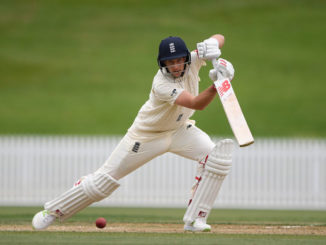
    SINGAPORE / LONDON (TIP):  InstaReM, a leading digital cross-border money transfer & payments service provider with presence across Southeast Asia, Europe and the Americas, has announced a partnership with The Root Academy (R66T Academy), the cricket coaching academy founded by the family of the England test cricket captain, Joe Root.

    The partnership – which is being announced as the Cricket World Cup tournament enters in an exciting phase – enables InstaReM customers to get an exclusive 30% discount off fees at The R66T Academy training camps throughout the world when they send their next money transfer abroad via the InstaReM website or app.

    InstaReM’s digital cross-border payments solutions stops its customers around the world from getting caught out from hidden fees, and now its customers can stop getting caught out at the crease. The Root Academy partnership gives InstaReM’s cricket-loving customers an opportunity to learn the art, science and craft of cricket from those who know it the best.

    Announcing the partnership, Prajit Nanu, co-founder and CEO of InstaReM, and a cricketing enthusiast, said, “Nothing connects nationalities like a sport. Cricket, which has English roots, is extremely popular in Australia-New Zealand, Southeast Asia, and more countries in Europe, Africa and Caribbean have started experiencing the thrill of the sport with the newer formats of the game. As a global payments fintech with global presence, we are delighted to partner with the R66T Academy, the gold standard in high-quality cricket coaching, to offer discounted programs in the finer aspects of cricketing to the enthusiasts from any part of the world.” 

    Joe Root, the co-founder of the R66T Academy and the current captain of the English Cricket Test Team said, “We are pleased to partner with InstaReM Money Transfer to offer an exclusive discount on our cricket training camps. The Root Academy is our commitment to unlocking the cricketing talent of tomorrow. Alongside InstaReM, we aim to reach even more cricket fans around the world, offering high-class learning experiences that change the game. We’re up to change the game with InstaReM and the Root academy.”

    The R66T Academy aims to encourage people to play more cricket, while preparing and empowering youngsters and teams to succeed at their highest level. Training camps are led by Shaun Siegert, the head coach of The R66T Academy and mentor/ coach of international cricketers like Joe Root, Jason Roy, Monty Panesar, Liam Plunkett, Sam Billings & many more. The R66T academy training camps are available to children up to 18 years – and with InstaReM’s exclusive offer, adults are also eligible to participate, subject to availability and schedules.

     For more information, visit https://www.therootacademy.co.uk/

    (Based on a press release)

  • Air India Mumbai-Newark Flight Diverted to London after Hoax Bomb Threat

    Air India Mumbai-Newark Flight Diverted to London after Hoax Bomb Threat

    LONDON / NEWARK (TIP): An Air India flight from Mumbai to Newark was diverted to London’s Stansted Airport on Thursday June 27 due to a bomb threat, according to authorities. The Boeing 777-337 was escorted by British fighter jets to land in Stansted.

    News agency ANI quoted an Air India official to say the bomb threat was a hoax. “Air India 191 Mumbai-Newark flight has landed safely at London and all passengers are safe. Earlier, the flight had made a precautionary landing due to a bomb threat that was declared hoax,” ANI quoted an Air India spokesperson.

    Stansted Airport authority said in a statement, “An Air India Boeing 777 “diverted into the airport at 10:15 hrs and landed safely with the Essex Police in attendance. It is parked on an isolated stand away from the normal airport operations. Our runway has now re-opened and is fully operational.”

  • IACFNJ awards  scholarships to students

    IACFNJ awards scholarships to students

    BRUNSWICK, NJ (TIP): Indo-American Cultural Foundation of Central Jersey – IACFNJ, a non-profit organization in New Jersey has been a leading community organization in central Jersey and has been very popular among young generation of Indian Americans in South Brunswick, North Brunswick, Monroe, Princeton, Princeton Junction and surrounding areas of heavily populated South Asians in North Brunswick, Franklin Park, Princeton, Princeton Junction, Monroe, East Brunswick and East and West Windsor to organize successful events like Navratri Garba, summer picnic, India’s Independence Day celebration, holiday party and spring festival to bring the community together for the past two decades.

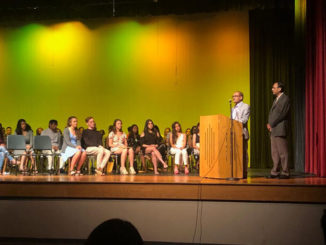
    IACFNJ provided scholarship to students from North Brunswick High School in 2018.  This year, the scholarships were extended to South Brunswick High School also and winners sponsored by IACFNJ were in literature and community service leadership and total of four students, two from each high school were chosen as per the criteria selected by North Brunswick High School and written essays submitted and overall academic achievers from South Brunswick High School.   The award ceremony was held on June 5, 2019, at North Brunswick High School and Chandler Mattis and Meha Pandejee received the scholarship by two members of IACFNJ.  The Senior Awards night was held at South Brunswick High School on June 12, 2019, where the scholarships were given to Tejasvi Kalakota and Rohil Sheth.  The goal of IACFNJ is to continue to expand scholarship programs to various high schools to promote academic achievements and encourage students to take leadership roles.   IACFNJ has been a leading organization in NJ to promote culture, heritage, art and values by doing cultural programs and community events throughout the year to unite people and embrace cultural diversity.

    The executive committee and committee members have been working so hard to keep the community together by becoming bridge between all culture and backgrounds.  The executive board includes Hitesh Patel, Chairman, Dr. Tushar Patel,  President, Mahesh Patel and Deven Patel as Vice President, Mac Shah, Secretary, Rajesh Patel as Treasurer and Surabhi Agarwal as Joint Secretary. The pillars and founders of the organization and trustees include Raojibhai Patel, Rewo Nawani, Murthy Yerramilli and Jadhav Chaudhary.

    The upcoming events of IACFNJ will be annual summer picnic on Sunday, July 28, 2019, from 11 a.m. to 7 p.m. at Mercer County Park – West Picnic area in West Windsor.   The details of rest of the year’s IACFNJ events to include Navratri Garba will be announced in the very near future.   For IACFNJ future events, please visit organization website at www.IACFNJ.org or         e-mail at

    iacfnj@yahoo.com.

    (Press release)

  • HAF Honors Kashmiri Pandits, Religion Freedom Advocates, Legislators, Linguists at Annual DC Reception

    HAF Honors Kashmiri Pandits, Religion Freedom Advocates, Legislators, Linguists at Annual DC Reception

    WASHINGTON (TIP): On Monday June 24th, more than 300 people filled the Foreign Affairs Committee Room in the Rayburn House Office Building in Washington, DC for the Hindu American Foundation’s 16th annual Capitol Hill Reception.

    In a first, this year’s Capitol Hill Reception was co-hosted by HAF and the Indian American Kashmir Forum, with the partnership of Kashmir Hindu Foundation — all groups advocating for justice for the Hindu Kashmiri Pandit community.

    “For too long the religio-ethnic cleansing of the Kashmiri Pandit community from the Valley of Kashmir has been overlooked by the international community,” noted HAF Board Member Rajiv Pandit, himself a member of the Kashmiri Pandit community, now living in Texas.

    “Some three decades ago thousands of Hindus were killed by their neighbors and Pakistan-sponsored militants, with several hundred thousand forced to flee under threat of horrific violence. Some of us emigrated from India entirely, but the majority of our community remains as internally displaced persons in other parts of India. All of us would like to see a time when we are able to return home safely,” Pandit added.

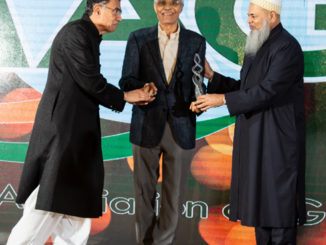
    In the wake of heightened violence in the Valley, HAF honored stalwarts of the Kashmiri Hindu community who have made significant and positive contributions in a variety of fields, including human rights, science, and the arts, as were individuals who have worked towards fighting for religious freedom of people around the world.

    “We’re humbled by the selflessness and achievements of these individuals in protecting, preserving, and promoting the indigenous cultural heritage of Kashmir, and in making incredible advances in a variety of fields,” said Suhag Shukla, HAF’s Executive Director. “And, after 30 years of largely remaining unheard, we were honored to recognize the efforts of American policy makers who have used their platforms to highlight the need for religious freedom and human rights for this and other minority communities.”

    Receiving awards in 2019 were: Representative Brad Sherman (D-CA) — Friend of the Community

    Ambassador Sam Brownback — Mahatma Gandhi Award for Advancing Pluralism

    Bansi Pandit — Dharma Seva Award

    Subhash Kak, Ashok Koul, Arti Tiku Kaul — Award for the Advancement of Dharmic Arts and Sciences

    Vijay Sazawal, Deepak Ganju, Sunil Fotedar — Award for the Advancement of Hindu Human Rights

  • Indian Envoy woos Silicon Valley Investors for Next Phase of India’s Development

    Indian Envoy woos Silicon Valley Investors for Next Phase of India’s Development

    WASHINGTON (TIP): Describing Silicon Valley as the best regional partner of India in the social innovation arena, India’s Ambassador to the US Harsh Vardhan Shringla expressed hope that more VC funding from Silicon Valley will go to India that are vital for the next phase of India’s development.

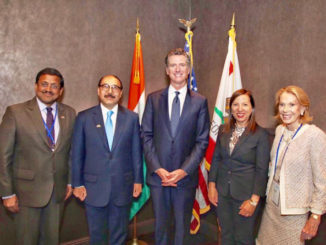
    During a short but productive visit to San Francisco June 21, Ambassador Harsh Vardhan Shringla, accompanied by Consul General Sanjay Panda, released the ‘Bay Area – Silicon Valley and India: Convergence and Alignment in the Innovation Age’ India Report. For the first time, the Bay Area Council of San Francisco launched a special focus Report on India.

    “As the report suggests, India’s third wave of venture capital investment shows maturity with US-based firms now steadying their local presence with dedicated India funds and shifting decision-making to local partners. A whole new breed of 10 Indian start-ups has become unicorns in 2018. This should interest more VC funding from Silicon Valley”, said the Ambassador.

    “India offers further opportunities for Silicon Valley companies in healthcare and life sciences, energy, IT, Smart Cities, Fintech, Telecom, Semiconductors and AI, as the report rightly identifies. Products and services that use AI for social innovation – applications in agriculture, irrigation, drinking water, education, life sciences, etc, are vital for the next phase of India’s development. There isn’t a better regional partner than Silicon Valley for us in this arena”, he further added.

    Earlier Ambassador Shringla met Governor of California Gavin Newsom and Lt. Governor Eleni Kounalakis. Ambassador also invited the Governor to lead the International Yoga Day 2019 event at Sacramento organized by Consulate General of India, San Francisco. Governor Newsome agreed to schedule a visit to India as early as possible and was appreciative of the growing popularity of yoga in USA. The Governor agreed to consider leading a business delegation to India to expand the India-California partnership. Ambassador thanked the Governor for his strong support for India-US ties.

    The Ambassador spoke on “Economic Prosperity in the Pacific” at the Pacific Summit of the Bay Area Council. At a Panel Discussion with Lt Governor Eleni Koulanakis, he highlighted how India has been a positive and stabilizing partner of the US in South Asia and Indo-Pacific region. “India and the US have formed a robust dialogue with each other and other partners to secure a peaceful, prosperous and inclusive Indo-Pacific. We are working very well with the U.S. side to make a success of our Indo-Pacific vision and strategy. The launch of India-US-Japan Summit-level Trilateral during 2017 and regular official meetings of the Quadrilateral with Japan and Australia have been a positive development” he said.

    Ambassador Shringla paid tribute to the martyrs of the anti-colonial Gadar Movement
    Pictures / Courtesy Indian Embassy

    Later, at a function hosted by CG Sanjay Panda in San Francisco, Ambassador Shringla paid tribute to the martyrs of the anti-colonial Gadar Movement and addressed members of the Indian community at the Gadar Memorial. “The voice of the Gadar Party and movement is one of sacrifice and justice. Gadri Babas dedicated their lives to the cause of India. To ensure that the voice does not fade from our memories, the Government of India has embarked on a restoration project. The project will restore this building’s original facade from the early 1900s. Inside, we will have a museum and a community hall, as well as spaces for books and artefacts from the Gadar period. We will also dedicate space for research scholars of the future who can study the writings of these brave men”, he assured.

    During the visit, Ambassador Shringla also met healthcare industry leader Bob Ingram and interacted with the California based media.

  • Indian American Foster Father gets life term in Sherin Mathews death

    Indian American Foster Father gets life term in Sherin Mathews death

    DALLAS, TX (TIP): Indian American foster father Wesley Mathews, accused of killing his three-year-old daughter Sherin Mathews and hiding her body in a ditch in Texas in 2017, has been sentenced to life in jail. Mathews, 39, on June 24 pleaded guilty to a lesser charge of injury to a child. He was originally charged for capital murder.

    The 12-member jury deliberated on June 26 for about three hours before coming to a united decision to give Wesley Mathews a sentence of life term in prison. Mathews and his wife Sini adopted Sherin in June 2016 from Bihar. Sherin Mathews disappeared on October 7, 2017. Her body was found in a culvert in Richardson under a road about one kilometer from her home in suburban Dallas on Oct 22, 2018.

    Mathews’ wife Sini was also charged with child abandonment, but her case was dismissed earlier this year due to lack of evidence.

  • Trump arrives in Osaka  for G-20 Summit;  to meet Modi, Xi and Putin

    Trump arrives in Osaka for G-20 Summit; to meet Modi, Xi and Putin

    OSAKA /WASHINGTON (TIP): US President Donald Trump on Thursday, June 27, arrived in Osaka, Japan  to attend the G-20 Summit over the weekend and to hold discussions on a host of bilateral and global issues with leaders of top 20 economies of the world.

    Besides Prime Minister Narendra Modi, the US president will meet his Chinese and Russian counterparts Xi Jinping and Vladimir Putin on the sidelines of the G-20 Summit.

    The White House said Mr. Trump and Mr. Modi would hold a bilateral meeting on June 28. This would be the third engagement of Mr. Trump on Friday, which would start with his meeting with Japanese Prime Minister Shinzo Abe at 8.30 am local time. Thereafter, Mr. Modi would join Mr. Abe and Mr. Trump for a tri-lateral meeting at 9.15 am.

    The Trump-Modi bilateral is scheduled to start at 9.35 am. Trump’s next engagement is with German Chancellor Angel Merkel at 10.15 am, according to the White House. He will also meet the Russian and Brazilian presidents later in the afternoon.

    This would be Mr. Trump’s first meeting with Mr. Modi after his recent electoral victory. It comes in the immediate aftermath of the India visit of Secretary of State Mike Pompeo, during which he met Modi, External Affairs Minister S Jaishankar and National Security Advisor Ajit Doval.

    The Trump-Modi meeting assumes significance in the wake of the strain that has popped up in the bilateral relationship on a host of trade and economic issues.

    This is Mr. Trump’s second visit to Japan in less than a month.

    The G20 is an opportunity for world leaders to discuss the biggest challenges facing the global economy, the White House said.

    Mr. Trump’s goal this week is to fight for the best deals and outcomes possible to lift up America’s workers, it said.

    A truly level-playing field means breaking down foreign barriers — both the tariff and non-tariff kind — that have stifled America’s economy and taken away too many jobs, the White House said.

    “Unlike his predecessors, Mr. Trump is willing to use every tool at his disposal to bring these countries to the negotiating table and agree to better terms for our citizens, it said.”

     (Source: PTI)

  • India’s Modi and   Japan’s Abe discuss economy, bullet train

    India’s Modi and Japan’s Abe discuss economy, bullet train

    OSAKA, JAPAN (TIP): Prime Minister Narendra Modi on Thursday, June 27,  held wide-ranging talks with his Japanese counterpart, Shinzo Abe, on the global economy, fugitive economic offenders and disaster management, and announced that President Ram Nath Kovind would participate in the coronation ceremony of Emperor Naruhito in October.

    It was the first meeting between the two leaders since the start of Japan’s Reiwa era and Mr. Modi’s re-election.

    Mr. Modi thanked Mr. Abe for the warm welcome for him and the delegation visiting Japan for the G-20 Summit. He appreciated Japan’s leadership as the G-20 chairman.

    Mr. Modi said he was looking forward to Mr. Abe’s visit later this year for the annual summit.

    Later, Foreign Secretary Vijay Gokhale told press persons that the meeting between the “old friends” was “warm” and they had a “very constructive and detailed discussion” on bilateral ties.

    “Abe initially began discussion with his expectation from the G-20 Summit. They spoke about the importance of focusing on global economy,” Mr. Gokhale said.

    “These are the areas where Abe hoped that he would get the understanding and support of the G20 members, including that of India,” Mr. Gokhale said.

    Mr. Abe also referred to his forthcoming visit to India.

    The two leaders also had a brief discussion on the Mumbai-Ahmedabad High Speed Rail Corridor and on a convention center  being built in Varanasi, Mr. Modi’s constituency.

    They agreed on the delivery of both the projects on time.

    (Source: PTI)

  • India Secures UNSC Non-Permanent Membership with Unanimous Support of Asia-Pacific Group

    India Secures UNSC Non-Permanent Membership with Unanimous Support of Asia-Pacific Group

    UNITED NATIONS (TIP): In an extremely significant diplomatic victory for India, the Asia-Pacific group of the world body, including Pakistan and China, unanimously endorsed India’s candidature for a non-permanent seat at the United Nations Security Council for a two-year term.

    “A unanimous step. Asia-Pacific Group UN unanimously endorses India’s candidature for a non-permanent seat of the security council for two-year term in 2021-22. Thanks to all 55 members for their support,” India’s Permanent Representative to the UN Ambassador Syed Akbaruddin tweeted on June 25.

    The Council is composed of 15 Members: Five permanent members: China, France, Russian Federation, the United Kingdom, and the United States, and ten non-permanent members elected for two-year terms by the General Assembly. Each year the 193-member UN General Assembly (UNGA) elects five non-permanent members for a two-year term.

    Previously, India has been elected as a non-permanent member of the Council for the years 1950–1951, 1967–1968, 1972–1973, 1977–1978, 1984–1985, 1991–1992 and most recently in 2011–2012.

  • Census citizenship question blocked by Supreme Court: Trump seeks 2020 Census delay

    Census citizenship question blocked by Supreme Court: Trump seeks 2020 Census delay

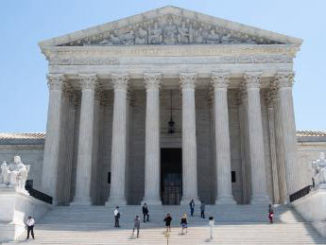
    WASHINGTON (TIP): In a setback for the Trump administration, the Supreme Court on Thursday, June 27,  rejected its stated reason for adding a question on citizenship to the census, leaving in doubt whether the question would appear on the census forms sent to every household in the nation next year., says New York Times.

    Chief Justice John G. Roberts Jr., writing for the majority, said the explanation offered by the Trump administration for adding the question “appears to have been contrived.” But he left open the possibility that it could provide an adequate answer.

    Executive branch officials must “offer genuine justifications for important decisions, reasons that can be scrutinized by courts and the interested public,” the chief justice wrote. “Accepting contrived reasons would defeat the purpose of the enterprise. If judicial review is to be more than an empty ritual, it must demand something better than the explanation offered for the action taken in this case.”

    The practical impact of the decision was not immediately clear. While the question is barred for now, it is at least possible that the administration will be able to offer adequate justifications for it. But time is short, as the census forms must be printed soon.

    President Trump commented on Twitter, writing that he had “asked the lawyers if they can delay the Census, no matter how long, until the United States Supreme Court is given additional information from which it can make a final and decisive decision on this very critical matter.”

    “We do not hold that the agency decision here was substantively invalid,” the chief justice wrote. “But agencies must pursue their goals reasonably. Reasoned decision-making under the Administrative Procedure Act calls for an explanation for agency action. What was provided here was more of a distraction.”

    Justices Ruth Bader Ginsburg, Stephen G. Breyer, Sonia Sotomayor and Elena Kagan joined the key part of the chief justice’s opinion.

    In dissent, Justice Clarence Thomas said the majority had done something extraordinary. “For the first time ever,” he wrote, “the court invalidates an agency action solely because it questions the sincerity of the agency’s otherwise adequate rationale.”

    Justices Neil M. Gorsuch and Brett M. Kavanaugh joined Justice Thomas’s partial dissent.

    Justice Samuel A. Alito Jr. filed his own partial dissent.

    “To put the point bluntly,” he wrote, “the federal judiciary has no authority to stick its nose into the question whether it is good policy to include a citizenship question on the census or whether the reasons given by Secretary Ross for that decision were his only reasons or his real reasons.”

    Government experts predicted that asking the question would cause many immigrants to refuse to participate in the census, leading to an undercount of about 6.5 million people. That could reduce Democratic representation when congressional districts are allocated in 2021 and affect how hundreds of billions of dollars in federal spending are distributed.

    Long Island Advocates React to Supreme Court Decision on the Citizenship Question

    MELVILLE,NY . Government and nonprofit leaders gathered at the Health & Welfare Council of Long Island’s office , June 27,  in response to the Supreme Court ruling that the explanation for inclusion of the Census question was inadequate.

    The decision will now be handed back down to the lower courts siting sufficient reason for concern about why the Department of Commerce wanted to add the question, and insufficient explanation.

    “While a partial and temporary victory- this is still a win. In these times in which we are living where there is assault after assault on our neighbors- every win- every moment, when humanity is reaffirmed, must be recognized.” Said Rebecca Sanin, President/CEO of the Health & Welfare Council of Long Island.

    “I welcome the news that all communities on Long Island will receive their fair share from the Federal Government and we must make sure that everyone is counted on Long Island.” Said New York State Senator Monica Martinez.

    “This is a significant win for making sure every person in Nassau County can be counted,” said Nassau County Comptroller Jack Schnirman. “We must keep up the pressure on Washington so that we have a fair and accurate count and get the resources our communities deserve. The stakes are too high for the entire region.”

    There are still significant challenges to ensuring that Long Island has a complete and accurate count in the 2020 Census. From anti-immigrant rhetoric to raids, to suburban sprawl, there is a lot to overcome less than a year out from the Census. To address these significant challenges, Nassau & Suffolk Complete Count Committees have been convening community leaders across the Island to understand the hurdles ahead, pool resources and knowledge bases, and devise strategies we can utilize to achieve a Complete Count in 2020.

    “Let us all come together today and be ambassadors of the Census,” said, Rebecca Sanin, President/CEO of the Health & Welfare Council of Long Island. “Let us use this momentary victory as a call to action- to start speaking to everyone we encounter about the need to be counted, about how every human counts, and let’s create a sustainable, inclusive and hopeful future for all Long Islanders.”

    Census Facts:

    • An undercount of more than .6 percent, could result in New York losing representation in Washington.
    • 800 billion dollars is allocated based on Census data in this country.
    • Suffolk & Nassau County are the fourth and fifth hardest to count counties in all of New York State.
    • Over 800,000 people on Long Island live in hard to count areas.
    • $73 billion is allocated from 55 spending programs based on the Census-including Medicaid, school funding, Headstart, WIC, school breakfast, Title 1 and special education.

    BIG WIN! The Citizenship Question will NOT be added to the 2020 Census: SALDEF

    WASHINGTON: The Supreme Court ruled that the Citizenship Question will not be added to the census, “‘saying that the administration’s explanation for adding it is insufficient’”. The unprecedented citizenship question has now been put on halt until further notice. While the U.S. Census Bureau is bound by Title 13 of the United States Code, prohibiting the information on the census from being disclosed. Inclusion of a citizenship question in the future has the potential to spark fear in immigrant communities.

    SALDEF Executive Director Kiran Kaur Gill said, “we are thrilled by the win today at the Supreme court and hope that all will now feel safe in participating in the Census. I encourage all individuals to take part in the 2020 Census to ensure a complete representation of the Sikh community and all communities.”

    The reinstatement of the citizenship question was introduced by Commerce Secretary Wilbur Ross in March 2018. Since then, Ross has been accused of trying to depress minority responses for political purposes. The citizen question sparked fear by immigrant groups of targeted harassment including deportation, that would have resulted in an undercount of the actual number of people living in a community. The count is used to allocate federal funding for communities, and resources such as food stamps, public schooling, and assistance programs. Giving a distorted count to the Census Bureau may leave immigrant communities with insufficient federal resources.

    The Asian Americans Advancing Justice group recognizes that along with federal funding, the Census data allocates the number of representatives communities will receive. The data provides communities an opportunity to “engage their elected officials in advocating for support and solutions for their community’s needs.” With distorted Census data, the voices of and concerns of immigrant communities will be suppressed. Lastly, the census data is used for redistricting and not giving immigrant communities substantial political power due to inaccurate Census data may falsify the outcomes of state-level elections.

    Meanwhile, Trump is asking his lawyers whether Census can be delayed for the Citizenship question.

    Washington Post  says President Trump said Thursday, June 27,  that he is seeking to delay the constitutionally mandated census to give administration officials time to come up with a better explanation for why it should include a citizenship question.

    Trump’s announcement, in tweets sent from Japan, came hours after the Supreme Court put on hold his administration’s plan to add a citizenship question to the 2020 Census, saying it had provided a “contrived” reason for wanting the information. He said  census would be ‘meaningless’ without citizenship question.

  • Huge Enthusiasm for Yoga: More than 15,000 people participated in various Yoga Day Celebrations

    Huge Enthusiasm for Yoga: More than 15,000 people participated in various Yoga Day Celebrations

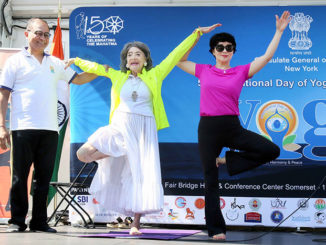
    NEW YORK (TIP): Consulate General of India in collaboration with Friends of Yoga celebrated the 5th International Day of Yoga on June 23rd, 2019 at Fair Bridge Hotel & Conference Center, 195 Davidson Avenue, Somerset, NJ 08873. Over 2000 Yoga enthusiasts joined this grand celebration. World’s oldest Yoga instructor and practitioner Padma Shri Ms. Tao Porchon Lynch taught some Yoga Asanas at the event. Mr. Vikas Khanna, celebrity chef and film maker spoke at the event. Motivational Speaker Mr. Gaur Gopal Das also spoke to the audience about the importance of Yoga. Assemblyman Mr. Daniel R. Bensen, New Jersey, Mr. Philip Kramer, Mayor, Franklin Township, New Jersey, Mr. Rajiv Prasad, Councilman At-Large, Franklin Township, New Jersey and Ms. Crystal Pruitt, Council woman At-Large, Franklin Township, New Jersey also attended the IDY 2019 celebration.

    Yoga enthusiasts doing Yoga

    Welcoming the participants to the Yoga Day celebrations, Mr. Sandeep Chakravorty, Consul General of India in New York, said that ‘Yoga for all and all for Yoga’ should be our motto. He highlighted worldwide momentum that Yoga is gathering in combating lifestyle related diseases, he noted that Yoga is a timeless gift from India to humanity. A guided yoga session based on the Common Yoga Protocol was performed by the participants.

    The session was led by Dr. Dayashankar Vidyalankar, Teacher of Indian Culture at the Consulate General of India, New York. Various other yoga sessions were conducted by professionally trained Yoga teachers. The Consulate had organized several curtain-raiser events in collaboration with yoga organizations resulting in a record turnout for the Yoga Day celebrations. In addition to the Consulate’s flagship event, Yoga enthusiasts gathered to celebrate the 5th International Day of Yoga in Pittsburgh, Westchester and Time Square, New York. The Times Square’s Summer Solstice Yoga event saw a gathering of over 11,000 participants.

    Representatives of participating organizations and guest speakers with Consul General Sandeep Chakravorty, Deputy Consul General Shatrughna Sinha who coordinated the celebrations, and the Consulate staff who all made it a memorable event. Seen in chair is Padma Shri Ms. Tao Porchon Lynch

    International Day of Yoga 2019 successfully managed to create a broad-based awareness about the benefits of yoga to all sections of the society and also reintroduced the ancient mind -body practice and breathing techniques to a technology driven, fast-paced world. The celebration in Somerset, NJ offered a wonderful and enriching experience thanks to the energetic performance by yoga schools and associations. The IDY event also featured several cultural performances by talented local artists and partner organizations.

    More than 30 organizations participated with the Consulate in the celebration of International Day of Yoga 2019. More than 15,000 people participated in the various Yoga day Celebration this year.

    Yoga is an ancient Indian discipline, which has evolved over thousands of years for physical and spiritual wellbeing of the humankind. The word ‘Yoga’ derived from Sanskrit, means to join or to unite, symbolizing the union of body and consciousness. It has gained worldwide popularity due to its immense health benefits. It not only helps in improving physical health but also brings about inner peace by reducing stress and anxiety. Medical research in recent years has uncovered many physical and mental benefits that Yoga offers, corroborating the experience of millions of practitioners.

    The United Nations General Assembly (UNGA) on December 11th,  2014 declared June 21st as the International Day of Yoga. The date of June 21st was chosen since this is the summer solstice which is the longest day of the year in the northern hemisphere and has special significance in many parts of the world.

  • June 28 New York & Dallas Print Editions

    June 28 New York & Dallas Print Editions

    [vc_row][vc_column][vc_column_text]

    Print Replica- Digitally

    E-Editions

    [/vc_column_text][/vc_column][/vc_row][vc_row][vc_column width=”1/3″][vc_custom_heading text=”New York Edition” font_container=”tag:h2|text_align:center” google_fonts=”font_family:Istok%20Web%3Aregular%2Citalic%2C700%2C700italic|font_style:700%20bold%20regular%3A700%3Anormal” link=”url:https%3A%2F%2Fwww.theindianpanorama.news%2Fwp-content%2Fuploads%2F2019%2F06%2FTIP-June-28-NYC.pdf|||”][vc_single_image image=”96840″ img_size=”full” add_caption=”yes” alignment=”center” onclick=”custom_link” link=”https://www.theindianpanorama.news/wp-content/uploads/2019/06/TIP-June-28-NYC.pdf”][/vc_column][vc_column width=”1/3″][vc_custom_heading text=”Dallas, Texas Edition” font_container=”tag:h2|text_align:center” google_fonts=”font_family:Istok%20Web%3Aregular%2Citalic%2C700%2C700italic|font_style:700%20bold%20regular%3A700%3Anormal” link=”url:https%3A%2F%2Fwww.theindianpanorama.news%2Fwp-content%2Fuploads%2F2019%2F06%2FTIP-June-28-Dallas-TX.pdf|||”][vc_single_image image=”96843″ img_size=”full” add_caption=”yes” alignment=”center” onclick=”custom_link” link=”https://www.theindianpanorama.news/wp-content/uploads/2019/06/TIP-June-28-Dallas-TX.pdf”][/vc_column][vc_column width=”1/3″][vc_single_image image=”82828″ img_size=”medium” alignment=”center” onclick=”custom_link” link=”https://www.theindianpanorama.news/advertising-media-kit-portal-indian-panorama/”][vc_single_image image=”82829″ img_size=”medium” alignment=”center” onclick=”custom_link” link=”https://www.theindianpanorama.news/advertising-media-kit-portal-indian-panorama/”][/vc_column][/vc_row][vc_row][vc_column width=”2/3″][vc_custom_heading text=”Lead Stories This Week” font_container=”tag:h2|text_align:center” google_fonts=”font_family:Istok%20Web%3Aregular%2Citalic%2C700%2C700italic|font_style:700%20bold%20regular%3A700%3Anormal” link=”url:https%3A%2F%2Fwww.theindianpanorama.news%2F|||”][/vc_column][vc_column width=”1/3″][vc_widget_sidebar sidebar_id=”mh-sidebar”][/vc_column][/vc_row]

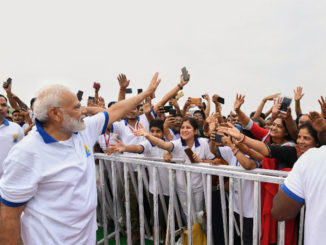
  • PM Modi performs yoga with 30,000 people in Ranchi

    PM Modi performs yoga with 30,000 people in Ranchi

    RANCHI (TIP): Prime Minister Narendera Modi performed yoga along with around 30,000 people in Ranchi on Friday, June 2,  on the occasion of the fifth International Yoga Day.

    The session continued for around 45 minutes at the Prabhat Tara ground here. The Prime Minister first addressed the participants before the session began.

    “Yoga has always been associated with peace and harmony. I thank people for adopting Yoga. I urge people to embrace it,” Modi said in his address prior to the session.

    He also spoke in English for a few minutes to reach out to the global audience.

    Saying “Yoga is beyond caste, religion, region and any boundaries”, the Prime Minister added “there is a solution to alcoholism and diabetes in Yoga”.

    “This year, Yoga’s theme is Heart Care. There has been a manifold increase in the heart-related problems in the country, particularly among the young generation. Yoga should be adopted as preventive measure,” the Prime Minister added.

    The session was conducted by M. Baswa Reddy, director of the New Delhi-based Morarji Desai National Yoga Institute.

    Different forms of yoga postures, including how to control blood pressure and strike metal peace, were performed.

    After the session was over, the Prime Minister spent time with the participants, where children and youth even clicked selfies and shook hands with Modi.

    “IT was a great moment for us to see our prime Minister from nearby,” said a participant.

    Echoing her view, another woman said: “I could not shake hand with the Prime Minister but his aura was enough.” Modi was accompanied by Jharkhand Governor Draupdi MUrmu, Chief Minister Raghubar Das, Ayush Minister Sripad Naik, state Health Minister Ramchandra Kesari, along with other senior government officials.

    International Yoga Day is celebrated annually since its inception by Modi in 2015.

    (Source: IANS)

  • Why social media needs to be regulated

    Why social media needs to be regulated

    By Manish Tewari

    The big social media platforms are not only monopolies in themselves but also the equivalents of a public square, albeit a digital one. The big five of the virtual civilization are now akin to public utilities and must be regulated as such. The argument, therefore, that they do not bear responsibility for content on their platforms is both dubious and disingenuous.

    It has been almost a month since the results of the General Election 2019 were announced. The time has come to seriously evaluate the role played by social media in spreading disinformation and hate speech in the election season. To do so it is imperative to first understand the structure of the social media platforms and for that, it is necessary to go back to the invention of the telephone itself.

    The telephone was invented by Alexander Graham Bell in 1875. Using tuned metal reeds, wire and magnets, he and his colleagues were able to harmonize a sending telephone with a receiver and reproduce sound. On March 10, 1876, Bell transmitted the first sentence, “Watson, come here, I want you”, through his contrivance. And, the communications revolution has not looked back since then.

    The telephone essentially is a platform that people still use to communicate with each other. Every telephone user has a number that he or she uses — that number is supposed to be linked to an identity. If the telephone network is misused for the purposes of making crank, anonymous or abusive hatemongering calls, the same can be invariably tracked to the miscreants.

    However, with the advent of calling cards that could be used from landline phones and later mobile telephony — the ubiquitous SIM cards — these networks are also abused. But the problem is not insurmountable.

    Telephone companies do not take responsibility for content transmitted over their networks, claiming that they are primarily network providers and how the subscriber uses the system is not their responsibility. With various value-added services getting added to the original voice transmission capacity over the past three decades, this paradigm also requires a revisit. Telecom operators globally should be made vicariously liable in certain instances when their networks become catalysts of mass social and economic disruption.

    Now fast-forward to the 1960s. The first practical model of the Internet came with the conception of ARPANET or the Advanced Research Projects Agency Network. Funded by the US Department of Defense, ARPANET utilized packet switching to allow multiple computers to interconnect over one specific network.

    By the 1970s, scientists conceptualized the Transmission Control Protocol and Internet Protocol, or TCP/IP, a communications template that set benchmarks on how data could be conveyed between manifold networks. ARPANET embraced TCP/IP on January 1, 1983, and from thereon began the interlinking of networks that became the modern Internet.

    The online world then took on a more discernible shape in 1990, when computer scientists developed the World Wide Web. While frequently confused with the Internet itself, the Web is essentially the most conjoint ways of accessing data online in the shape of websites and hyperlinks. It is the web that aided the propagation of the Internet among the masses. It functions as a critical tread in assembling the titanic trove of information that most of us now use on a daily basis.  The social media platforms like Facebook, WhatsApp, Twitter, Tik-Tok and a multitude of others are the flora and fauna of this World Wide Web.

    These social media platforms allow people to register themselves for using their services bereft of any tangible verification. As a consequence a number of individuals, companies, political parties, intelligence structures, non-state actors, terrorist groups and even governments abuse this anonymity in order to spread disinformation, abuse hate and vitriol that has serious implications including and not limited to interference in the sovereign and even democratic functioning of states, causing conflagrations, cyber warfare and interdiction of critical infrastructure to name but a few of the nefarious uses of this framework in the ether. This does not include the vicious dark net that requires very specific browsers to access.

    Human beings now live in two parallel civilizations concurrently — a physical and a virtual civilization. Notwithstanding as to whether the content in question is positive or negative, social media platforms claim that they neither have control over it nor can they verify it. They take no responsibility for allowing dissemination of content, irrespective of its portentous repercussions.

    Their rationale is that they are platforms and not content providers; therefore, they cannot and should not be expected to regulate content governed as they are there by the principles of free speech. They are also incorporated in jurisdictions that have strong freedom of expression laws that they hide behind to insulate themselves from lawsuits that could make them liable for what gets transmitted over their platforms.

    However, the big social media platforms are not only monopolies in themselves but also the equivalents of a public square, albeit a digital one. The big five of the virtual civilization are now akin to public utilities and must be regulated as such. The argument, therefore, that they do not bear responsibility for content on their platforms is both dubious and disingenuous.

    Recently, Assistant Attorney-General Makan Delrahim of the US Department of Justice and its anti-trust chief in a speech in Israel even alluded to the historic anti-trust actions against Standard Oil, AT&T and Microsoft and stated that there is no need for new anti-trust laws. Those on the books suffice for the new digital arena also, thereby implying that there is a case to break up these humongous digital monopolies.

    India has over 34 crore users who consume social media in over a dozen languages. Facebook is the preferred vehicle of this consumption. It has a serious disinformation problem, particularly during elections and in disturbed geographies. During the election season and in turbulent regions, posts with incendiary consequences are routinely shared, especially through the encrypted WhatsApp platform.

    While social media platforms may remove certain pages and delete certain users in response to an outrage, it is at best selective and at worst glaringly deficient in dealing with hate speech as I experienced firsthand during the recent elections. Though social media platforms claim that they have editorial filters, at a practical level they are virtually redundant.

    The effects of such content, circulated by social media in India, cannot be downplayed nor dismissed arbitrarily. In a society as disparate as ours, the cohesion we enjoy cannot be taken for granted in the face of unregulated technologies that people are not trained to use.

    In the context of the human, political, economic and even existential threats that manifest, it is irresponsible for social media outfits to refrain from taking responsibility for their content, especially when their actions undermine the very principles they profess as sacrosanct. An appropriate legal architecture to counter the enormous socio-political problem with its attendant national security implications should be the single biggest national security priority for us as a country.

    (The author  is a lawyer and a Member of India’s Parliament)

  • What a $5 trillion economy would look like

    What a $5 trillion economy would look like


    By Pulapre Balakrishnan

    At the meeting of the Governing Council of the NITI Aayog , middle of June, , Prime Minister Narendra Modi announced the target of a $5 trillion economy for India by 2024. It is necessary to think big when seeking to make a difference, for transformation does not come from modest plans. Hopefully, the Prime Minister will also use the drive to growth to place India’s official statistics on a firmer footing, so that we can be sure that economic policymaking is based on reality. However, getting the numbers right will not ideally end the task. What this task is may be illustrated by a question that was asked some years ago when a high-speed expressway connecting the polar extremities of one of our States had been proposed. A wit had asked what we would hope to find once we have reached our destination.

    A similar question can be asked of plans for growing the economy. What would we like to see in the proposed $5 trillion economy? Moreover, unlike in the case of an expressway, which can always be built by simply borrowing money and ideas from the global market, a quantum leap in the size of the economy is not so easily achieved. It will require design, funding and governance.

    Without investment

    The importance of funding, and to an equal extent design, may be seen in the failure of the quite sensible aspiration, ‘Make in India’. Though technically applicable to every sector, it was clearly focused on manufacturing. Articulated very early on in Mr. Modi’s first term (2014-19), and accorded a certain prestige in the pronouncements that followed, it played out as a damn squib. One of the reasons for this was the absence of commensurate investment outlay. To raise the share of manufacturing in the economy from its present 16% to 25%, an ambition declared by both the United Progressive Alliance and National Democratic Alliance governments, requires a scaling up of investment. This did not come about.

    Whether this was due to the corporate sector, Mr. Modi’s chosen vehicle, not having the wherewithal or due to it not being convinced of the plan is beside the point. Investment there must be and if the private sector is, for whatever reason, not coming forward to invest, then the government must. This is no more than accounting, but Mr. Modi’s government seems to be unfavorable to this diagnosis, perhaps on ideological grounds. Remember ‘minimum government’?

    A small digression should clarify matters. The first attempt to make in India was in the 1940s. Finance Minister Shanmukham Chetty’s first budget speech had identified increasing “internal production” as the economic priority. And this was achieved quite soon. Along with the quickening of the economy as a whole, the share of manufacturing had risen, the mocking epithet ‘Hindu rate of growth’ notwithstanding. This had not emerged as part of the moral victory of an oppressed people. The reason was that it had resulted from a surge in investment, led by the government. That resources could have been mobilized on such a scale in so short a time in an economy devastated by colonial rule is testimony to the availability of the three ingredients — design, resources and governance — necessary when contemplating a move to the next level, which is what aiming at a $5 trillion economy amounts to.

    The wish list

    While lauding the efforts of leaders of early independent India, however, we would do well to remember their follies. Principal among them was the failure to articulate, possibly even adequately imagine, the contents of the economy that was being raced towards. If this is repeated now, a moment of triumphalism different in character but nevertheless there, it would amount to not having learned the lessons of history. Something missing from “internal production” and ‘Make in India’ is the difference these intentions would make to the lives of Indians. At least in the 1940s, the priority was to get the economy moving in the first place. This is no longer the issue. Today the economy must be evaluated in terms of how much it contributes to the ease of our living. So what would be some of the characteristics of a valuable economy?

    First, Indians should feel empowered by the economy. We know that currently they do not feel so. India is placed very low in the United Nations’ World Happiness Report. Happiness, best understood as a sense of well-being, is directly related to empowerment, or being able to undertake the functioning’s we value. This is, in the first instance, related to being educated and experiencing good health. We are in India facing an education sector that is broken down and the majority are battling with almost non-existent public health infrastructure. The private sector has some worthy initiatives in these areas but they await an effective public presence on a gigantic scale. So, the first attribute of the valuable economy would be access to quality health and education for all.

    The second attribute of a valuable economy would be equality of opportunity. For over three decades now income inequality has been rising in India. According to some measures, India is today more unequal than China, itself a society widely perceived as highly unequal. Now some part of inequality of opportunity is related to unequal distribution of income but a part of it is not. Gender inequality manifested as women having less opportunity in life is not going to go away with a re-distribution of income along class lines or across social groupings. India is a serious outlier in this regard, and becoming richer as a society may do little to change the status quo. Shockingly, a sex ratio, already unfavorable to women, has shown a secular worsening since 1947. Inequality in India can only be ended by equalizing capabilities across individuals. Concerted public action via education is the means to this outcome. Income transfers, pushed relentlessly by policy entrepreneurs, evade the issue altogether.

    Conserving nature

    Finally, an economy, whatever its size, cannot be meaningfully evaluated independently of the extent of presence in it of natural capital. Till now, by referring to the imperative for growth, to eradicate poverty, any effort to conserve nature has not just been ignored but treated with derision, by both right and left. This is no longer a credible political stance. Two-thirds of the world’s most polluted cities are in India, when we accept less than a fifth of its population. Air pollution shortens lives and lowers productivity, reducing the capacity to earn a living when alive. The poor are the most affected as they cannot afford to live in gated communities that somehow manage to commandeer scarce natural resources. Some part of environmental depletion in India is due to the pursuit of unbridled growth.

    This implies that any improvement in the life of the majority would require a re-alignment of the growth process so that it is less damaging. This would very likely require that we have slower growth but the process can be configured to channel more of it towards poorer groups. We may end up in a situation of less tangible goods in the aggregate than otherwise but one in which more people are happier than in the past. Such an economy is more valuable.

    (The author  is Professor of Ashoka University, Sonipat and Senior Fellow of the Indian Institute of Management, Kozhikode)

  • Congressman Krishnamoorthi Convenes Meeting of Senior TSA Officials and Community Leaders

    Congressman Krishnamoorthi Convenes Meeting of Senior TSA Officials and Community Leaders

    CHICAGO (TIP): Indian American Congressman from Illinois Raja Krishnamoorthi on June 17 convened a meeting with community leaders and three senior TSA officials visiting from Washington, DC to discuss best practices for improving relations between TSA officers and the general public.  The Congressman was joined by TSA Acting Deputy Administrator Patty Cogswell, Assistant Administrator for Civil Rights and Liberties, Ombudsman and Traveler Engagement Christine Griggs, and Legislative Director Clint Fisher, along with leaders from more than a dozen civil rights organizations including: the South Asian Bar Association of Chicago, ACLU of Illinois, Anti-Defamation League, CAIR-Chicago, Catholic Charities, HANA Center, Latino Policy Forum, MALDEF, NAACP, Partners for Our Communities, and United for Peace.

    Topics of discussion included diversity and cultural sensitivity training for TSA officers, perceptions regarding discrimination in the TSA screening process, and the use of facial recognition technology by the TSA and at airports generally. At the close of the session, TSA officials and community leaders committed to an ongoing discussion on these matters, particularly as they relate to local practices at Chicago O’Hare Airport.

    “I’m glad we were able to have such an open, productive discussion for TSA leaders to gain a better understanding of the concerns of the community,” said Congressman Raja Krishnamoorthi. “I look forward to working with our community leaders to continue the work we started today so that so that the TSA and all federal agencies can work better on behalf of the people of the 8th district and all Americans.”

  • US religious waiver leads to many Sikh youths joining military

    US religious waiver leads to many Sikh youths joining military

    WASHINGTON  (TIP): The waiver granted by the US administration has allowed more children from the minorities to join the US military. At least 14 Sikh youths have been granted this waiver.

    Lt. Col Kamal Kalsi was the first to be granted the religious waiver in 2010 and it was one of the biggest changes that took place in the past 10 years.

    Another Indian American, Manav Singh Sodhi, 17, has been preparing to head to a boot camp for his military training, especially because he can keep his beard and turban.

    The other 13 Sikh recruits are from all around the US, Kalsi said.

    “It took me a year and a half and a lot of trouble—organizing, getting 50 Congressional signatures, etc.—just to get me and Capt Tejdeep Singh Rattan, the waiver,” Kalsi said about his experience.

    Sodhi, a graduate of Kings Park High School on Long Island, New York City, will shortly be on his way to bootcamp. “He wants to be where the action is, he wants to join the artillery,” Kalsi said.

    In a press release from the Sikh American Veterans Association (SAVA), an organization founded by Kalsi, he said: “As the first Sikh-American in over a generation to receive a religious accommodation in the military, I feel it’s important to take  it forward and help open doors for Sikhs, Muslims, Jews, Hindus and other religious minorities.”

    Sodhi’s accommodation to maintain his religiously mandated beard and turban while in uniform “bodes well for our community when we can become part of the fabric of this country,” said Kalsi.

    There are currently over 60 Sikh males serving in the US Army with their turbans and beards, according to SAVA.

    “I wanted to join the Army ever since I was a kid.  My great-grandfather served in the Army and I wanted to follow in his footsteps. My father and mother inspired me to follow my dreams and never give up, no matter what.  And that’s exactly what I did,” Sodhi is quoted as saying in the press release.

    “When I was a child, my mother took me to an event at City Hall where I met Lieutenant Colonel Kalsi for the first time, and he was in his army uniform with his turban and beard. That was a life-changing moment for me because I realized then that I can freely practice my religion and serve my country too,” Sodhi is quoted as saying.

    Lt Col Kalsi said the new recruit and his mother did not wish to give any press interviews but had forwarded some of his comments for the press.