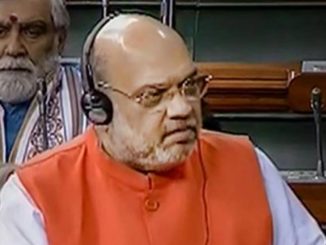
New Delhi (TIP)- Amid an increase in incidents of hate speech, chairman of the Parliamentary Standing Committee on Home Affairs, Anand Sharma, has written to Home Minister Amit Shah and urged the government to consider “legislative action”, including amendments to the IPC and CrPC, to deal with all manifestations of hate speech.
Pointing out that there is a “growing and disturbing trend” of hate speech targeting certain sections, Sharma said, “Actions of certain organisations and individuals in different parts of the country aimed at minorities and women, are a matter of serious concern.” Seeking the Home Minister’s intervention, Sharma wrote that “it is requested that Home Secretary be advised to sensitize the Chief Secretaries and DGPs of the states to take prompt and firm action to enforce the law and secure order”. He wrote, “…the Government may consider legislative action, including amendments in the Indian Penal Code and Code of Criminal Procedure to effectively counter all manifestations of hate speech in the larger national interest.”
It is learnt that the Standing Committee on Home has also written to the Home Ministry seeking a report on incidents of hate speech.
Sharma’s letter comes against the backdrop of a political row over hate speeches delivered at an event in Haridwar organised by Yati Narsinghanand, and another in Delhi by ‘Hindu Yuva Vahini’.
Sharma stated that “recent incidents and orchestrated acts of violence” are making headlines in both national and global media. “They also tarnish the image of our great country, which is the world’s largest democracy. Free speech, though quintessence of democracy and enshrined in the Constitution, cannot be allowed to be misused to advocate, incite, promote or justify hatred and violence against a person or community. It is an imperative that the spirit of the Constitution is reaffirmed and protected,” he wrote.
Hate speech, he stated, is being used as a tool to promote enmity and disharmony between different groups on grounds of religion, caste and ethnicity. “In my opinion, if left unchecked, this will severely undermine the rule of law and threaten the fundamental right of life, liberty and dignity of our citizens. India’s rich diversity is the strength of our mature democracy. This must be nurtured and preserved,” he said.
Propaganda claims PM doing everything for the good of country and its people
By Avijit Pathak
Our existence should not depend on the mercy or compassion of the messiah. Instead, it requires the spirit of a creatively nuanced critical thinking. You and I must recover our agency, regain our voice, scrutinize the discourse of power, and make our representatives accountable: they are not our masters; they ought to be humble; and they must listen to us. Possibly, amid the cult of narcissism, the perseverance of innumerable unknown farmers arouses our hope in this democratic possibility.
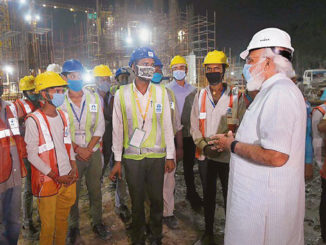
Amid a largely non-dialogic and personality-centric politics, we have been repeatedly asked to consume diverse images of the all-powerful Prime Minister, and accept that it is Modi who alone matters, and like a messiah, he is endowed with the extraordinary power to dictate the fate of the nation. Hence, in this age of media simulations and propaganda machinery, the spectrum of dramaturgical performances seems to hypnotize the captive audience. Yes, Modi is ‘unpredictable’; from demonetization to lockdown — his decision would surprise us, shock us, charm us, puzzle us; and we must accept it because he alone understands what is good for us. He is eternally energetic; he doesn’t rest; he only works and thinks of the nation. And hence, despite his busy schedule, he could be seen with the Army jawans in Kashmir, or construction workers engaged in the Central Vista project; and these images must be circulated with the speed of light. And he is all-pervading; the billboards in cities, small towns and even villages remind us time and again that his heart aches for us; he gives us free vaccines; he deposits money in the bank accounts of farmers; and he gives us all sorts of gifts — a temple at Ayodhya, an airport at Noida, and above all, a set of surgical strikes to give a tough lesson to the enemy of the nation. You and I are ‘safe’ because he is there to think for us. None should have any doubt of it!
We must regain our voice, scrutinize the discourse of power, and make our representatives accountable.
Think of it. Can a truly participatory/dialogic/democratic culture be reconciled with this sort of personality cult? Does democracy mean that we remain passive and lose our own voice, and keep waiting for the ‘supreme leader’ to decide our fate? Sometimes, I feel that we need not know the names and portfolios of the Union Cabinet. The reason is that we have been asked to believe that it is only Modi (or his deputy Amit Shah) who matters; and the other ministers exist only for condemning the Opposition, finding ‘Khalistanis’ or the brigade of ‘tukde-tukde gang’ in the farmers’ movement, and organizing press conferences to inform us of the ‘stupidity’ of Rahul Gandhi whenever he refers to the Rafale deal controversy, or pathetic handling of the Covid situation. It is sad that these days, we never say that it is our government; we regard it as ‘Modi government’. And this annihilates the very spirit of democracy. Well, personalities do matter; and even charisma has its role. However, a democratic leader is one who loves to sharpen the art of listening and respects the creative/critical faculty of ordinary people. A democratic leader is not God; instead, she/he walks with people, and collectively moves towards a better society. In other words, a democratic leader cannot afford to be a narcissist; she/he ought to be humble and dialogic. And this truth cannot be nullified by giving a counterargument: Indira Gandhi, too, behaved in a similar way!
See the way the historic farmers’ movement — characterized by intellectual clarity, people’s participation, and Gandhian endurance and moral power — was seeking to convey a message: we ought to be listened to; and Modi or his deputies cannot assume that they alone know what is good for the farmers. But then, for almost one year, we witnessed the rigidity of stubbornness on the part of the government resulting from the assertion of Modi’s image: almost like Friedrich Nietzsche’s ‘Superman’ driven by the will to power! He alone knows what is good for Indian agriculture and our farmers; he is, therefore, ‘firm’ and ‘determined’; and those who are against these farm laws are either stupid or misdirected. The irony is that even when he apologized, felt some shortcomings in his ‘tapasya’, and decided to repeal the farm laws with his characteristic monologue (no consultation with the farmers, no dialogue with the Opposition leaders, no parliamentary discussion, and just another dramatic surprise), he was not willing to accept that he was wrong; in fact, he thought that somehow, despite his best efforts, he could not convince a section of farmers of the efficacy of these three laws. Possibly, one’s egotistic pride does not wither away so easily.
We need not be surprised that if even this gesture of Modi is now used to construct yet another image of the ultimate messiah — ‘compassionate’/ ‘pro-farmer’ Modi! And the billboards throughout the country might remind us that we must thank Modi for his compassion. Furthermore, the propaganda machinery has already begun to popularize the idea that Modi withdrew the farm laws because the ‘anti-national’ conspirators were trying to exploit the situation and cause severe damage to the country. Nothing is more important to Modi than the interest of the nation! What else these ‘shiny’ anchors of toxic television channels could do as they were never tired of castigating and demonizing this historic movement? Now they must evolve their ways to handle Modi’s unpredictability (or is it a masterstroke for winning the elections in Uttar Pradesh?).
Our existence should not depend on the mercy or compassion of the messiah. Instead, it requires the spirit of a creatively nuanced critical thinking. You and I must recover our agency, regain our voice, scrutinize the discourse of power, and make our representatives accountable: they are not our masters; they ought to be humble; and they must listen to us. Possibly, amid the cult of narcissism, the perseverance of innumerable unknown farmers arouses our hope in this democratic possibility.
In last one year, rather than deploying resources in healthcare & vaccines; Prime Minister of India was busy in promoting himself, superstitions, quackery and mythology for Covid treatment like ringing of bells, banging of plates, clapping, lighting earthen lamps (diya) or candle, using Cow urine, Cow Dung, Quack Ramdev’s Coronil, his own minister Arjun Ram Meghwal’s Bhabhiji Pappad,and showering flower petals from helicopters on healthcare workers.
300,000 plus covid positive cases on April 21, 2021.2,000 plus deaths on April 21, 2021.
Trump lost elections because of his initial sloppy handling of Covid and rising Covid infections & deaths. Voters punished himfor that despite his administration worked on a war footing to get/develop vaccines by different Pharma companies for the entire world.Under Operation Warp Speed initiated in April-May 2020, billions of dollars were given to Pharma companies in USA, UK & EU countries for rapid development of a Vaccine. His administration totally revamped the healthcare infrastructure from testing tomedical supplies manufactured in USA, to availability of additional beds.
On Sep. 18, 2020, USA had 48,887 infections with 949 deaths and on that day, Indiahad peaked with 93,337 infections and 1,290 deaths. Think about it, India got almost a year. So did America. The second wave is hitting in America too, and the entire world. Entire universe knew about it that there will be a second and third wave. The only way humanity can be saved is rapid vaccination. Still Modi had no clear vision or plan or will or honesty on vaccinating Indians.
In USA, as of April 20, 2021 an average of 3.5 million shots are administered each day and nearly 1 in 4 adults are now fully vaccinated. According to CDC about 130 million or 50.4 % of the adult population have been vaccinated, 86.2 million or 33.5% of the adult population from 18 & above had been fully vaccinated. Vaccine doesn’t mean second wave won’t infect. Many have been infected despite being vaccinated. But the good of the bad, for which the second wave has not yet taken the form of an epidemic in America is the vaccine preparedness of this country. Today, America has 600 million Moderna and Pfizer vaccines in the special warehouses for its 340 million people. On top of that USA’s Fiscal response to Covid is $5.3 Trillion for 340 Million people with $12,900.00 direct cash payment to a family of 4 making less than $75,000.00 plus weekly Unemployment and Covid allowance. Modi’sfiscal response is $90 Billion (IMF data) for 1,400 Million people with no direct cash payment or unemployment to its citizens not even to poorest of the poor.
In May 2020, a European-led fund-raising effort brought $8 billion in pledges from the world’s governments, philanthropists and leaders for coronavirus vaccine research.By Aug 2020, US, UK & EU with a combined population of 800 million had placed orders for 850 million doses of vaccine. In contrast, India with 1,400 million population under Modi, placed its first order of 16.5 million doses in Jan. 2021 and later, 100 million to the domestic producer Serum Institute of India. A control-freak instinct took over Modi and he announced only Center would buy the vaccines. There will not be any private buying. Non-BJP ruled states like Punjab, Kerala, Maharashtra and Delhi have accused the Centre of not supplying enough vaccines. Modi “Nationalized” India’s private vaccine industry and now Indians are paying with their lives.
Since Modi had no clear vision or plan or will or honesty on vaccinating Indians; instead of vaccinating 1400 million Indians in the country, sent vaccines and medical supplies to 23 countries to assure India’s victory is all around! Knowingly that India is only 1 % fully vaccinated and 7 % has got one shot! Since Dec 2020 rate of infections was rapidly increasing and Modi ignored it, now when Covid has become epidemic, Modi is asking for Moderna and Pfizer vaccines from America! I mean Modi is forced!! The search for popularity is really a staircase to go down. Modi must understand that the procession of dead bodies cannot be stopped by promoting WhatsApp University. When the dead bodies will talk, can hisfans of WhatsApp University then stop this?
Prime Minister Narendra Modi’s visionary steps.
In last one year, rather than deploying resources in healthcare & vaccines; Prime Minister of India was busy in promoting himself, superstitions, quackery and mythology for Covid treatment like ringing of bells, banging of plates, clapping, lighting earthenlamps (diya) or candle, using Cow urine, Cow Dung, Quack Ramdev’s Coronil,his own minister Arjun Ram Meghwal’s Bhabhiji Pappad and showering flower petalsfrom helicopters on healthcare workers.
Asia’s richest person Mukesh Ambani & his family were seen banging bells made of gold to scare Covid to go away on the call of Modi!
Unfortunately, Modi is surrounded by “Yes Men” although some of them are highly educated,not uneducated like Modi, but they also believe in superstitions, quackery, and mythology. Modi takes credit for every work including work done by previous administrations even going back to Nehru, and his own ministers. People around him worship him like a Deity, once his minister now Vice President Naidu said,“Modi is a gift to the nation from God”. Recently, Modi, to look taller than one of the founding fathers,Sardar Vallabh Bhai Patel, replaced Patel’s name with his at the biggest Stadium in India. Since Dec. 2020 the number of daily infections was going up. A spokesmanof Modi, citing that reason, announced that the Kumbh Mela will not start on Makar Sankrantion Jan 14, 2021 but on March 11 and will end on April 10, 2021. It was not that Modi cared about people getting infected and dying; he was more concerned about 5 state assembly elections and influencing Hindu voters with Kumbh Mela. In January 2021, the rate of infections was much higher, still in Feb 2021, BJP declared Victory on Covid under the able leadership of Modi by passing a resolution.
BJP declared Victory on Covid under the able leadership of Modi in a resolution, February,2021
That ebullient mood was communicated across the country. It is not that they wanted to get the economy going but wanted to get back to campaigning.
CEC, ignoring the infection numbers in Feb & partial March 2021 declared the election dates for 5 State assembly elections starting from March 27 and ending on April 29. The worst hit was West Bengal with voting in 8 phases from March 27 to April 29, followed by Assam in 3 phases and Kerala, Tamil Nadu & Puducherry on April 6 in a single phase.
An 8-phase election in Bengal for whole 1 monthand a 3 phase in Assam gave to BJP an edge to play Hindu-Muslim card. It also gave Virus a chance to skyrocketagain because of mega election rallies of BJP, being the 2nd super spreader after the Kumbh Mela that was attracting 1 million devotees a day with a total of 100 million celebrants in a month -long festivitieswith no mask andno social distancing!BJP gave a full-page advertisement in local and national newspapers with Modi’s picture to invite people for Kumbh Mela and election rallies. All of this was done when the country was already grappling with a COVID-19 exponential surge on day-to-day basis.
BJP gave a full-page advertisement in local and national newspapers with Modi’s picture to invite people for Kumbh Mela. (Image : Courtesy TheHindu, March 31,2021)Amit Shah at a road show in Bengal, April 21,2021 No mask, no social distancing!.. Compare this with a strict lockdown when India had just over 500 cases.
Since 2014, there is a Hindu vs minority, including lower castes, Hindus and especially Muslims, narrative being promoted in India. It is a narrative to turn Indians against each other; to turn fellow countrymen against each other that they must hate each other based on their religion and caste. This is a sloppy, lazy and promiscuous argument that has been spreading in India since Modi took power in 2014. After the infections crossed 100,000 in a single day on April 6, 2021, Serum Institute asked for Rs 3,000 crore grant from the government so they can increase production. On April 21,2021, CEO of Serum Institute of India Adar Poonawalla told CNBC-TV18 on a question of price of vaccine. He said that GOI had only contracted for 100 million doses. Once the supplies were completed,SII revised the price. The new prices are Rs150 for the Center, Rs 400 for states and Rs 600 for Private Hospitals.
What Corona did last year –the first wave in India- that was just a trailer of a Tsunami. Because the first wave virus strain came from abroad. The basic immunity level of Indians is a little higher because 70-80% have been living in poor hygienic conditions, breathing foul air and drinking contaminatedwater. These are some of the benefitsof growing up in an immature country!
Modi ignored the warnings of epidemiologists who insisted that India would see a deadly second wave of Covid.The second wave has three major strains – they are so indigenous that they have mutated Indians in their immune system like in non-home ground adventure. It means, the Second Wave with domestic viruses ismuch more aggressive and much more infectious” and was now predominately affecting young people. Now it is people in their 20s and 30s who are having very severe symptoms and themortality rate among the young people is high. There is a shortage of beds, shortage of oxygen, shortage of drugs, shortage of vaccines, shortage of testing. Some have died waiting in the hospitals for want of oxygen. Some others died at the hospital entrances waiting to be admitted for necessary treatment.
India’s health scenario: 3 on a bed in a hospital.A Covid patient waits in a car for admittance to the hospital in Ahmedabad.
India is going to have catastrophic loss of human lives in the coming months and Modi is responsible for all lives lost till now and the ones that will be lost. Modi’s incompetence to deal with the fearful situation can no longer be hidden. It speaks loud in his lack of any vision or plan to deal with the crisis, his criminal negligence of the urgent health care needs of the people in preference for his favorite sport-electioneering- and the mad desire to win elections. He should be held responsible forculpable homicide of thousands upon thousands of children, young men and young women,old men and old women of India. Will justice be done?
Wants parity in privileges and benefits with Indian citizens in India
GOPIO Chairman Dr. Thomas Abraham welcomed the simplification of process with regard to the OCI card, but urged the government of India to treat OCI Card holders who have invested in business and creating jobs in India at par with Indian citizensJaipur Foot, USA Chairman Prem Bhandari who has been a relentless critic of the government policies on OCI Card, questioning how it could be a lifelong card when it required renewal time and again, said the Indian government has made a good beginning, but it has yet to meet the aspirations of the NRI community.
I.S. Saluja
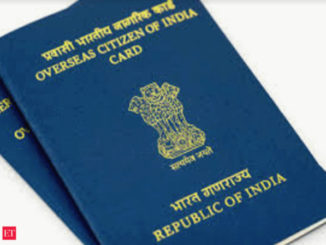
NEW YORK (TIP): A notification posted by Press Information Bureau on April 15, 2021 at 7.02 PM (IST) speaks of a government of India decision which is expected to significantly ease the process for re-issue of Overseas Citizen of India (OCI) cards. It says the Modi Government has decided to simplify the process. This decision has been taken on the directions of the Union Home Minister Amit Shah. The OCI Card has proved to be very popular amongst foreigners of Indian Origin and spouses of foreign origin of Indian citizens or OCI cardholders, as it helps them a hassle-free entry and unlimited stay in India. So far about 37.72 lakh OCI Cards have been issued by the Government of India. As per the extant law, a foreigner of Indian origin or a foreign spouse of an Indian citizen or foreign spouse of an Overseas Citizen of India (OCI) cardholder, can be registered as an OCI cardholder. OCI card is a lifelong visa for entry into and stay in India with a number of other major benefits attached to it which are not available to other foreigners.
Presently, the OCI card is required to be re-issued each time a new passport is issued up to 20 years of age and once after completing 50 years of age, in view of biological changes in the face of the applicant. With a view to facilitate the OCI cardholders, it has now been decided by the Government of India to dispense with this requirement. A person who has got registration as OCI cardholder prior to attaining the age of 20 years will have to get the OCI card re-issued only once when a new passport is issued after his/her completing 20 years of age, so as to capture his/ her facial features on attaining adulthood. If a person has obtained registration as OCI cardholder after attaining the age of 20 years, there will be no requirement of re-issue of OCI card.
With a view to update the data regarding new passports obtained by the OCI cardholder, it has been decided that he/she shall upload a copy of the new passport containing his/her photo and also a latest photo on the online OCI portal, each time a new passport is issued up to 20 years of age and once after completing 50 years of age. These documents may be uploaded by the OCI cardholder within 3 months of receipt of the new passport.
However, in the case of those who have been registered as OCI cardholder as spouse of foreign origin of a citizen of India or an OCI cardholder, the person concerned will be required to upload on the system, a copy of the new passport containing the photo of the passport holder and also a latest photo along with a declaration that their marriage is still subsisting each time a new passport is issued. These documents may be uploaded by the OCI cardholder spouse within three months of receipt of his/ her new passport.
The details will be updated on the system and an auto acknowledgement through e-mail will be sent to the OCI cardholder informing that the updated details have been taken on record. There will be no restriction on the OCI cardholder to travel to/ from India during the period from the date of issue of new passport till the date of final acknowledgement of his/ her documents in the web-based system. All the above services of uploading documents will be provided on gratis basis to the OCI cardholders.
Commenting on the government’s latest decision, USA based Global organization of People of Indian Origin (GOPIO International) Chairman Dr. Thomas Abraham saidGOPIO welcomed the new directives simplifying the OCI Card process.
“This will remove the confusion to many OCI card holders on the process of renewing the card at the age of 20 and 50 and one doesn’t have to go through the whole OCI card renewal process again,” said GOPIO Chairman Dr. Thomas Abraham. This will also encourage more overseas Indians to become OCIs and it will benefit India, through their travel, business and investment in India.
“However, GOPIO strongly urges the government to treat OCI Card holders who have invested in business and creating jobs in India at par with Indian citizens and they shouldn’t be termed as foreign nationals by various Govt. agencies while doing business including manufacturing and research in India,” Dr. Abraham added.
The government was forced to grant these concessions after the Diaspora leaders across the world raised their voice against the discriminatory policies which some openly condemned as double standards.
Jaipur Foot USA Chairman Prem Bhandari in particular has been in the forefront of demanding revision of rules to simplify the process of renewal of OCI card. He is the one who questioned the nomenclature “lifelong card” when it had to be got renewed so often. Asked by The Indian Panorama for his reaction to the revised “simplified” process, he said, it is still not an ideal situation. OCI card holders need to be treated at par with Indian citizens, living in India, and should be allowed the benefits and privileges which an Indian citizen in India normally enjoys. He added that much more needs to be done, a sentiment which Dr. Thomas Abraham also voiced.
The Indian Panorama will welcome readers’ comments on the issue which will keep kicking dust until a more NRI friendly approach is adopted by the government of India.
While there has been a lot of talk about Russian interference in US elections in 2016, and of its recurrence in 2020 elections, of Chinese interference attempts, but there has not been yet a mention of Indian meddling in US elections 2020.
An obvious evidence of Indian meddling in US elections is Prime Minister of India Narendra Modi’s endorsement of Trump in 2020 presidential elections. At the Howdy Modi rally in Houston on September 22, 2019 where President Donald Trump, too, was present, Prime Minister Narendra Modi had in the presence of an estimated 50,000 Indian Americans, spiritedly shouted the slogan “Ab ki bar Trump Sarkar” which means next time, it will be a Trump government (administration ).
The overseas arm of the BJP, OFBJP which has recently obtained registration under Foreign Agents Registration Act, and various other Hindu organizations owing allegiance to BJP and its affiliates, mostly the right wing fundamentalist Hindu groups, have been supportive of Trump , keeping in line with Modi’s declared support for Trump.
While it is their fundamental right as citizens of America to subscribe to any political ideology and to support any candidate or party, but when it is done at the behest of a foreign government, it raises doubts of foreign meddling in US elections.
Well, it is for law enforcement in US to determine what is meddling and interference, and what needs to be taken cognizance of and what can be ignored. The truth is, US elections 2020 interest too many countries in the world, for whatever diverse reasons.
13000 SOS calls made over 4 days of communal violence raging in some parts of Delhi, and no response from 85000 strong Delhi Police force to come to the aid of the victims. The result: 42 lives snuffed out. Over 350 injured. Property worth thousands of crores destroyed. And relationships ruptured, may be, beyond repair.
Reminds one of 1984 when thousands of Sikhs made frantic calls without any response from police. The result, over 10,000 lost their lives. Hundreds of women were raped. Thousands were injured.
Had the police done their duty in 1984, the barbaric and tragic incident could have been avoided, and precious lives saved.
The pattern was repeated in 2002 when in Gujarat, communal violence erupted taking a heavy toll of life and property. Police even there preferred to look the other way while the arsonists and perpetrators of violence continued to loot and kill without a finger being raised by the police.
It has happened again, in Delhi where over three to four days, goons went around, beating and killing, damaging property right under the nose of the police. Reports say, at places, police actively connived with the goons.
So, the 1984 and 2002 pattern were repeated in 2020. Is it a coincidence that the police in Delhi in 1984 and in 2020 conducted itself in a similar fashion as police did in Gujarat in 2002? Are the police all across the country trained that way? Or, is it the dharma of the police to obey, not the law, but those who control political power?
Is it a coincidence that 2002 Gujarat communal violence took place under the duo of Narendra Modi and Amit Shah when they were Chief Minister and Home Minister respectively of the State, and the 2020 Delhi communal violence took place under the same team with one being the Prime Minister and the other being the Home Minister? It is an interesting coincidence.
However, getting back to the conduct of police in Delhi, it is quite strange that the High Court had to pull up police to move forward in cases of hate speech which surely provoked people into violence. Those who make provocative statements and instigate people to communal violence are guilty of creating conditions of civil war and destabilizing the nation, and as such, should be treated as traitors.
India has suffered enough. Indians have suffered enough from 1947 through 1984 and 2002. Already, another wound has been inflicted in the body of the nation in the form of recent Delhi Communal clashes. Every time there is a communal clash it is a stab in the heart of Mother India. Let those who love Mother India desist from any further crimes against their mother.
Let us pledge today: “No more 1947; no more 1984; no more 2002 and no more 2020.”
NEW DELHI (TIP): The Lok Sabha passed the Citizenship (Amendment) Bill, which seeks to provide Indian citizenship to non-Muslim refugees coming from Pakistan, Bangladesh and Afghanistan after facing religious persecution there, a little past midnight on Monday, December 9, after a heated debate that lasted over seven hours.
The Bill, which was passed in the Lok Sabha with 311 members favoring it and 80 voting against it, will now be tabled in the Rajya Sabha for its nod.
Several amendments brought by opposition members, including one by a Shiv Sena MP, were defeated either by voice vote or division.
According to the proposed legislation, members of Hindu, Sikh, Buddhist, Jain, Parsi and Christian communities, who have come from Pakistan, Bangladesh and Afghanistan, till December 31, 2014 facing religious persecution there, will not be treated as illegal immigrants but given Indian citizenship.
In a hard-hitting reply to the debate on the proposed legislation, Union Home Minister Amit Shah said people belonging to any religion should not have any fear under the Modi government as he asserted that the bill will give relief to those minorities who have been living a painful life after facing persecution in neighboring countries.
Shah also said the Modi government will definitely implement the National Register of Citizens (NRC) across the country and when it will be done, not a single illegal immigrant will remain in the country.
Shah said there is a difference between illegal immigrants and those who have come after facing religious persecution in the three neighboring countries.
“No one should have any fear of being persecuted under the Narendra Modi government,” he said after nearly seven-hour-long debate which was marked by fiery speeches by MPs belonging to both the opposition and the ruling alliance.
The home minister said had India not been divided on religious lines in 1947, there was no need for the Citizenship (Amendment) Bill.
“Muslim population in India has increased from 9.8 per cent in 1951 to 14.8 per cent in 2011 while the Hindu population has decreased from 84 per cent in 1951 to 79 per cent in 2011.
“Whereas, the minority population in Pakistan has decreased from 23 per cent in 1947 to 3.7 per cent in 2011. Similarly minority population in Bangladesh has decreased from 22 per cent in 1947 to 7 per cent in 2011,” he said, adding India does not discriminate against anyone on the basis of religion.
The home minister said the Citizenship Bill will give relief and constitutional respect to those who have been living a painful life after facing persecution in neighboring countries.
Shah dismissed the suggestions that the Bill is violative of Article 14 of the Constitution, which guarantees equality for everyone, as it aims to give citizenship to persecuted people only.
“This Bill is not unconstitutional and not in violation of Article 14 and has nothing to do with Muslims in India,” he said but made it clear that Rohingya Muslims, coming from Myanmar, will not be given Indian citizenship.
The home minister countered the Congress charges that the bill is communal in nature, by taking a dig at the opposition party, saying “Congress is such a secular party which partners Muslim League in Kerala and Shiv Sena in Maharashtra”.
“Modi government’s only religion is the Constitution,” he asserted.
He also said India doesn’t need a refugee policy as the country has enough laws for the protection of refugees.
Earlier, initiating the debate, Shah said the bill has the endorsement of India’s 130 crore citizens as it was part of the BJPs’ election manifestoes in 2014 and 2019.
Opposition leaders Adhir Ranjan Chowdhury, Saugata Roy, N K Premchandran, Gaurav Gogoi, Shashi Tharoor and Asaduddin Owaisi opposed the introduction of the bill, saying it was violative of various provisions of the Constitution, including move to grant citizenship on the basis of religion.
While defending the introduction of the bill, Shah said the Congress had “divided” the country on the basis of religion that is why it was necessary to bring the bill and added that it was brought on the basis of reasonable classifications provided under the Constitution.
The tabling of the emotive bill through division of votes came in the wake of protests and incidents of violence in Northeastern states with most of the student unions and regional political parties opposing it, saying it will nullify the provisions of the Assam Accord of 1985, which fixed March 24, 1971, as the cut-off date for deportation of all illegal immigrants irrespective of religion.
“We will have to differentiate between intruders and refugees. Citizenship amendment bill does not discriminate against anyone and does not snatch anyone’s rights,” Shah said while initiating the debate on the contentious bill.
Trying to allay apprehensions of people of the Northeast, Shah said the Narendra Modi Government is committed to protect the customs and culture of people of the region and informed that Manipur will be brought under Inner Line Permit regime, where the proposed law will not be applicable.
The home minister said under the proposed legislation, citizenship will be granted to refugees coming from the three countries after facing religious persecution there even without documents, including ration cards.
Noting that India has given similar rights to people in the past, Shah said Manmohan Singh and L K Advani could become prime minister and deputy prime minister respectively due to this after they came from present-day Pakistan.
“This bill is not even .001 per cent against Muslims. It is against infiltrators,” he said earlier while introducing the bill.
During the debate, which was marked by heated arguments, AIMIM chief Asaduddin Owaisi also tore the bill, saying it was aimed at making Muslims “stateless” and will lead to another partition.
Opposing the bill, Congress MP Manish Tewari said the bill is “unconstitutional” and “contrary to the spirit of the Constitution which is secular”.
“Equals cannot be treated as unequal. When a person comes to India, he is a refugee. You cannot discriminate against him on the basis of religion,” he said during the debate.
“The bill is against the Constitution, against the spirit of Constitution and against the ideology propounded by Babasaheb Ambedkar,” Tewari said.
Discrimination on the basis of religion, he further said, was not in tune with the Preamble of the Constitution which specifically mentions the word ‘secularism’.
“Secularism is embedded in the Constitution,” he said.
Supporting the bill, BJP MP Rajender Agarwal said the country cannot ignore the suffering of the people who have come here after facing religious persecution.
He said Pakistan has failed to protect its minorities under the Nehru-Liaquat pact.
While NDA allies the JD(U) and the LJP extended support to the bill, fence sitters, including the BJD and the YSRCP also supported the bill while suggesting that Muslims should also be included in the bill.
Meanwhile, West Bengal Chief Minister Mamata Banerjee said the NRC and the CAB will never be allowed in Bengal as long as the TMC is in power.
“It’s a divisive bill and shall be opposed at any cost,” she said in Kharagpur while claiming that at least 30 people have committed suicide in the state due to panic over the implementation of the National Register of Citizens (NRC).
Adhir Ranjan Chowdhury, Leader of the Congress in Lok Sabha, said the government was trying to create impression that by opposing the legislation, the party was anti-Hindu.
“We are opposing the bill because it is discriminatory in nature. It wreaks havoc on the very foundations of the Constitution. This is a step towards Hindu Rashtra. India should maintain the essence of humanity,” Chowdhury said.
Surpriya Sule (NCP) said the perception is that every Muslim is feeling insecure and the largest minority community should not be felt left out.
Referring to DMK MP K Kanimozhi, Sule also asked, “What happens to those who practice atheism?”
As per the bill, “on and from the date of commencement of the Citizenship (Amendment) Act, 2019, any proceeding pending against a person under this section in respect of illegal migration or citizenship shall stand abated on conferment of citizenship to him.”
“Provided that such person shall not be disqualified for making application for citizenship under this section on the ground that the proceeding pending against him and the central government or authority specified by it in this behalf shall not reject his application on that ground if he is otherwise found qualified for grant of citizenship under section.”
The BJP-led NDA government had introduced the bill in its previous tenure and got Lok Sabha’s approval. But it did not introduce it in Rajya Sabha, apparently due to vehement protests in the Northeast and lack of majority in the House. That bill lapsed following the dissolution of the last Lok Sabha.
“If the BJP wins J&K by such plans, it will be at the expense of the unity and integrity of India, of which the state is an indelible part. India is on the verge of losing J&K, not to Pulwama-style attacks but by alienating the Valley to dissolve civil liberties and fair elections”, says the author.
The Modi-Shah plan to conquer all of India through elections and President’s rule, by fair means or foul, is self-evident. They have used allies in the Northeast, but the alliances in J&K have failed. They have burnt all boats in the Valley. No one will align with them. The only hope being the Jammu region and the Hindu vote. The latest maneuver is to increase the reserved seats by using President’s rule and parliamentary majorities, so that Jammu and Hindu constituencies acquire a dominant edge. This is nothing short of gerrymandering by using the Delimitation Commission to increase the Jammu seats to make it Hindu versus Muslim and also Hindu region versus Muslim region. Presently, Jammu has 37, Kashmir 46 and Ladakh four seats, with populations and areas, respectively, at 54.9% and 15.8% (Kashmir), 42.9% and 25.9% (Jammu) and 2.2% and 58.3% (Ladakh). The post-general election plan unfurled by Amit Shah is towards forced delimitation before the state elections to give the BJP an advantage. The plan is to empower Gujjars, Bakarwals, Gaddis, Sippis (SC and ST) with special seats to the Assembly and increase the Hindu share in the state as a whole. The English adage applies: ‘Play the game according to the rules, but if in doubt, change the rules.’
The concept of delimitation is to examine the population (demography) with accessibility (topography). In Kashmir, different valleys cannot be arbitrarily merged. In Ladakh, the surface area is large but demography low. Delimitation is necessarily for readjustment after a Census (Article 82, Constitution) through delimitation Acts. At times, delimitation has been controversial. In 2002, constituencies were frozen till 2026 for Parliament on the basis of the 1971 Census, and for state Assemblies it was the 2001 Census. Similarly, Article 47 of the J&K Constitution freezes readjustment in its Assembly till 2026. The next delimitation will come in 2031, before which a Census should take place. The freezing was done for the pragmatic reason of preserving Lok Sabha seats in various states, numerically and qualitatively, irrespective of population increase in some states at the expense of others. This must apply within reasonable limits to parts of states favorable to a political party or religion. The Farooq Abdullah freeze of 2002 was upheld by the high court. The Supreme Court rejected the Panther Party’s argument for SC and ST seats in the Valley. While the last delimitation was made by the KK Gupta Commission in 1995 with great difficulty, Governor Jagmohan had used President’s rule to enable the exercise. But for this freeze in J&K, the next exercise would have been done in 2005. Defreezing for one state but not the others is obviously an invidious political advantage.
It is obvious that in J&K under normal democratic rule, a new delimitation would not be possible. Ghulam Nabi Azad’s attempt of a 25% increase (22 seats) in J&K did not fructify because it required a two-third vote in the Assembly. So echoing 1993-95, the game plan is to proceed undemocratically under emergency rule. With J&K under President’s rule, the Governor can make legislative changes that would clearly not have passed in the Assembly. The Governor is the BJP-appointed Satya Pal Malik, who may be biased. A politically controversial delimitation exercise would destroy democracy even before the electoral process starts.
J&K has had its share of undemocratic misfortune, including Sheikh Abdullah’s arrest in 1953; Congress playing musical chairs with chief ministers; the rigged election in the 1980s, when Rajiv Gandhi was in power at the Centre; the subversion of power by Governors, including Jagmohan; and ruthlessness of the BJP at the Centre in bringing down its own Mehbooba Mufti coalition. But with the Modi-Shah duo hungry for an all-India conquest, J&K has become target No. 1. The proposed exercise to seek victory through manipulating seats is blatantly communal. The idea is to seek electoral division and cause a rift between J&K to make Jammu triumph over Kashmir. Since two separate states cannot be created, this plan would test drive a virtual partition running through the state, which the BJP wants to exploit to the hilt.
Pakistan would love such a solution which would make its claim to the Valley stronger. This plan would divide the state communally on the grounds of religion by fiddling with constituencies to increase the Hindu electoral power over Muslims. The purpose behind this is both anti-Muslim as well as to secure an electoral victory for the BJP in the forthcoming elections. After shouting from the rooftops that the BJP is not a communal party, it now sports a religious appeal and plays with communal agendas within days of its re-election. The idea is to have a Hindu chief minister. The tragedy is that these antics have begun soon after the recent election victory. If this represents a beginning, it will be followed by further Hindu fundamentalist measures through stealth and deceit. If the plan succeeds, would such a Hindu chief minister be from the saffron clan? Could we call this a surgical strike to defend India’s ‘secular’ democracy?
This, by itself, dashes all hope of a BJP secular agenda to bring communities and faiths together. If the BJP wins J&K by such plans, it will be at the expense of the unity and integrity of India, of which the state is an indelible part. India is on the verge of losing J&K, not to Pulwama-style attacks but by alienating the Valley to dissolve civil liberties and fair elections.
Amit Shah is the Home Minister of all of India and has sworn to uphold the Constitution which he ‘promises’ to trample on by deceit.
(The author is a Senior Advocate, Supreme court of India)
* 20 MPs take oath of office as cabinet ministers for the first time
* 24 cabinet ministers, ministers of state sworn in
* Nine sworn in as MoS (Independent charge)
* Smriti Irani, 5 other women in Modi government
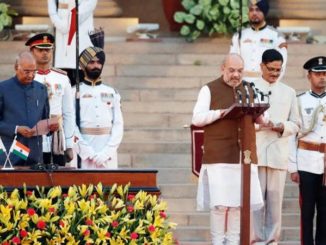
NEW DELHI (TIP): Narendra Modi took oath of office and secrecy as the Prime Minister of India for a second consecutive term amid thunderous applause from a select gathering in the sprawling forecourt of the Rashtrapati Bhavan, May 30th evening.
President Ram Nath Kovind administered the oath to Modi, 24 Cabinet colleagues, nine Ministers of State (Independent Charge) and 24 Ministers of State. The loudest cheer was reserved for BJP chief Amit Shah, whose induction means the party will have to elect a new president.
The event was marred by ally Janata Dal (United) deciding not to take oath even as party chief Nitish Kumar marked his presence by attending the ceremony. Among the allies, Lok Janshakti Party chief Ram Vilas Paswan retained his place in the Cabinet, as did Harsimrat Kaur Badal of the SAD.
Arvind Sawant, who defeated Milind Deora in South Mumbai, made it from the Shiv Sena quota. There was no representation from Tamil Nadu. Tamil-speaking Nirmala Sitharaman, who took oath as a Cabinet minister, represents Karnataka in Rajya Sabha.
Besides Shah, the new members from the BJP include Prahlad Joshi, former Chief Ministers Ramesh Pokhriyal Nishank and Arjun Munda, while party’s UP chief Mahendra Nath Pandey makes a comeback into the Council of Ministers and has been elevated to Cabinet rank, as was Giriraj Singh, who was MoS (Independent Charge) earlier.
Former Foreign Secretary S Jaishankar was the lone surprise inductee into the Cabinet, becoming the second former ranking Indian Foreign Service officer to be drafted into the new team led by Modi. Modi has retained former diplomat Hardeep Singh Puri as Minister of State (Independent Charge).
Missing among the Cabinet ministers from the outgoing government were Arun Jaitley and Sushma Swaraj. While the former opted out, Swaraj did not contest the polls, both citing health concerns.
Similarly, missing from the MoS (Independent Charge) list were Dr Mahesh Sharma, Rajyavardhan Singh Rathore and K Alphons, while Manoj Sinha failed to make the cut as he lost the election.
The new Ministers of State include Nityanand Rai, Suresh Angadi and first-time MPs G Kishan Reddy (Telangana), Debosree Chowdhury (West Bengal) and Pratap Chandra Sarangi (Odisha).
PM Narendra Modi has dropped parliamentarians and key economic ministers in the previous NDA government like Suresh Prabhu, Jayant Sinha and Manoj Sinha. The name of Rajyavardhan Singh Rathore was also missing from the list of ministers who took oath.
PATNA(TIP) : The decision to part ways with the RJD and join hands with the BJP was taken in the interest of Bihar and will ensure development and justice for the state, Nitish Kumar on July 27 said after being sworn in as the chief minister.
Kumar resigned the post Wednesday night after a fall out with the alliance partner RJD over corruption charges against Lalu Yadav and some of his family members, including son Tejashwi, who was the then deputy chief minister.
“Whatever decision we have taken will be in the interest of Bihar and of its people. It will ensure development and justice. It will also ensure progress. This is a collective decision. I ensure that our commitment is towards the people of Bihar,” Nitish Kumar told reporters. Kumar was sworn in as the chief minister of the state along side senior BJP leader Sushil Kumar Modi, who will be his deputy in the new government, at the Raj Bhawan in Patna.
NITISH-MODI REUNION NOT A HURRIED AFFAIR
The reunion of Narendra Modi and Nitish Kumar appeared hurried on Wednesday, but it was in the works for nearly seven months. Warmth returned to the chilly relationship between the Prime Minister and Bihar chief minister as early as this January. The two astute politicians met after a long gap at a function in Patna to commemorate the 350th birth anniversary of Guru Gobind Singh. It was January 5 and TV screens flashed images of the two politicians sitting together, smiling at each other and even holding hands at different moments. The bitterness of parting ways and poll campaign was over.
“The unease in the relationship between the two leaders was over,” a BJP leader said. “Over the next months, they remained in touch, directly and through emissaries.”
The onstage bonhomie between the two was quite palpable. Modi praised Nitish for arrangements he made for prakash utsav and going ahead with prohibition despite opposition. Kumar reciprocated by praising Modi for successfully implementing a liquor ban in Gujarat as its chief minister.
The event at the historic Gandhi Maidan in Patna happened within months of Kumar supporting Modi’s decision to recall high-value banknotes. He also supported Modi on the military “surgical strikes” against terrorist hideouts in Pakistan-occupied Kashmir. Less than a week after this bonhomie blossomed, Kumar had an ice-breaking meeting with a top BJP leader in Patna.
They met again in Delhi in February to explore if a reunion can happen and on what terms.
The subsequent months saw Kumar talking of a grand alliance against the BJP, and simultaneously sharing with the BJP leadership his unease about the functioning of RJD chief Lalu Prasad, his alliance partner.
He was jittery over Prasad calling the shots in departments headed by his son, deputy chief minister Tejashwi. This was not acceptable to a leader conscious of his image. A senior Union minister remained in constant touch with Kumar and every move was communicated to Prime Minister Modi and BJP chief Amit Shah.
A dispute between Tejashwi and another minister close to Kumar over a government project in Raxaul was another flashpoint. He was upset over friction between allies on sharing boards and corporation and the Congress’s dilly-dally on strategic matters.
LALU PRASAD TO TAKE FIGHT FOR BIHAR TO SUPREME COURT
Former Bihar Chief Minister and RJD supremo Lalu Prasad addresses a press conference in Ranchi on Thursday. Pic courtesy: PTI
PATNA (TIP): The battle for Bihar is expected to reach the Supreme Court but legal experts see little hope for Lalu Prasad, who has said that he will approach the top court against the governor’s decision to not call his Rashtriya Janata Dal for government formation.
Prasad’s ally Nitish Kumar dumped their so-called Grand Alliance on Wednesday and decided to partner with the Bharatiya Janata Party within hours, a development that Prasad has claimed should not have been allowed by governor Keshri Nath Tripathi since his was the largest party by elected legislators.
Legal experts say there is nothing illegal about the governor’s action and that he had the prerogative to invite whoever he thought had a better shot at forming government. “The idea of a single-largest party comes after election; after a crisis comes the concept of who has the larger and a stable combination – So the governor has the discretion to call on a combination or a party that will enjoy majority on the floor of the house,” said senior advocate Rajeev Dhawan.
Dhawan cited the example of Goa and Manipur,where too the governor’s action was challenged in the Supreme Court but nothing came of it.
The 2017 Goa elections saw a close contest in the 40-member assembly. BJP won 13 seats,while the Congress-NCP with 18 was the single largest collective. Yet the governor invited and appointed a BJP coalition with the MGP (three seats), Goa Forward Party (three seats) and three independents to form the government. Congress took the matter to the Supreme court but its petition was dismissed. Chief Justice of India J S Kehar had then said, “Where are your numbers? You could have finished the case in 30 seconds by showing that BJP don’t have the numbers. It seems you were not confident about the support you have. You should have asked the governor what nonsense she is doing and confidently said look we have the numbers. You should have sat on a dharna. You did nothing. You could have filed affidavits of your supporters before us. You are putting us in the position of the governor. These things you should have stated before the governor.”
Cow is not sacred and beef is not forbidden to Hindus, according to Vedas
By Dave Makkar
The author finds no mention in Hindu scriptures about cow being referred to as “mother” or as “holy”. He finds no evidence that cow slaughter was ever prohibited, that beef eating was forbidden. He wonders why Hinduwadis are so obsessed with cow. The Indian Panorama, with this article, is initiating a debate on an issue which has fiercely divided the Indian nation. The views expressed here are the author’s own.
The current atmosphere in India on the issue of cow defies all sane logic, Hindu religious Texts, thousands of years old sacred history, historians and scholars. On one hand the current Modi government talks of making India the biggest economic power in the world surpassing America and China. On the other hand, his own party and his Hindu affiliate’s members talk of what people can eat or cannot eat, how many children the Hindu couples should produce, what the women should wear, adult girls cannot be seen in the company of opposite sex friends, Hindu girl cannot marry a non-Hindu and any criticism of government policies make you anti-national that includes refusing to say Bharat Mata ki Jai or Cow is our mother.
Modi himself and his team members are biggest hypocrites on the issue of cow or meat. As CM of Gujarat under Modi meat production 10,600 tons in 2001-2 went up to 35,286 tons in 2011-12. Still Modi accused UPA government for cow slaughter for their support to meat exporters “Pink Revolution” during the run up to the 2014 elections that brought him to power. Ironically under Modi’s watch bovine/cow meat export has gone up by 70% according to the Commerce Ministry website. Now India is number 1 exporter of bovine/cow meat in the world.
Modi’s confidante Amit Shah during the 2014 campaign made several speeches that cow slaughter will not be banned in north eastern states of India. As BJP’s party president on May 28, 2015 in Goa; Amit Shah ruled out a nation-wide beef-ban or cow slaughter. Union Government and Goa Government both under BJP are jointly running a slaughterhouse in Goa.
Sangeet Som, the Hindutva poster boy & one of the main accused in 2013 Muzzafarnagar communal riots, UP Assembly Member and now Minister in Adityanath Yogi’s government had been personally associated with two meat processing and export companies, Al-Dua and Al-Anam. Al-Dua is one of the India’s leading halal meat export companies which exports meat to Arab countries.
BJP candidate Sreeprakash on April 2, 2017 in the run up to the Mallapuram Lok Sabha by election in Kerala said, “I will ensure quality beef and standard abattoirs in my constituency.”
Modi’s Minister of State for Home Affairs Kiren Rijiju in Aizwal on May 27, 2017 said that, “I eat beef, I’m from Arunachal Pradesh and can anybody stop me? So let us not be touchy about somebody’s practices. This is a Democratic country. Sometime some statements are made which are not palatable.” Kiren Rijiju also described as “unpalatable” his colleague Mukhtar Abbas Naqvi’s remarks that those who eat beef should go to Pakistan, and questioned whether anyone could stop him from eating beef. The BJP leaders in Arunachal, Meghalaya, Sikkim, Mizoram, Nagaland have been making statements to their constituents, sale of beef at subsidized rates is their commitment to them. After the new Cattle Trade Rules announced by the Modi government they went to the extent of saying “No Beef No Support to BJP”
BJP’s Karnataka spokesperson Vaman Acharya on May 28, 2017 while participating in a panel discussion on Suvarna News opposed the beef ban. He said that people from all communities including the Brahmin community, consumed beef. Before India became an agrarian nation, beef had been a staple diet. Even today, several people, including indigenous tribes in the North Eastern States consumed beef as a staple. Acharya had also said that as chairman of the Karnataka Pollution Control Board, he gave permission for the setting up of 16 abattoirs in the State. Lastly, he had said that he didn’t subscribe to the religious sentimentality attached to the cattle. He retracted his statements on June 6, 2017 under party pressure.
Modi’s Home Minister Rajnath Singh in Aizwal on June 12, 2017, said that people are free to choose what they want to eat. When asked about protests against the government’s ban on sale of cattle for slaughter, Singh clarified that the Centre will not impose any restrictions on one’s choice of food. However, even as Singh spoke, scores of people in the Mizoram capital participated in a “beef ban bashing banquet” organized by a local organization. (PTI)
Kerala BJP and RSS have joined hands to start a co-operative society to sell meat which includes bovine meat as well as fish, a Malayalam daily Deshabhimani reported on July 5, 2017.
July 17, 2017 Goa’s BJP CM Manohar Parikar who also holds the animal husbandry portfolio in the assembly session replied to BJP assembly members concern over the poor quality of Beef imported from Congress ruled neighboring state Karnataka; “Approximately 2,000 kg beef is produced per day at the state abattoir of the Goa Meat Complex Limited, while rest of beef is brought in from Karnataka. Parrikar said he would issue directions to the department concerned to carry proper inspection of beef imported from Karnataka. Parrikar further added that “The Goa Meat Complex Ltd has no problem in slaughtering more animals if they are brought there by traders,”
Modi’s New Cattle Trade Rules that have been stayed by the SC on July 12, 2017 violates Right of a Person to Freedom of Choice regarding Food as enshrined in Indian Constitution and it is also violating the rights of the farmers to trade. Under this law farmers cannot sell the cattle in the market for slaughter but slaughter houses can come to the farmer and buy cattle for slaughter. Then majority of the farmers are not educated how they can comply with filling out numerous forms about the origin & ownership of the animal in question? First, the farmers/dairy operators will be exploited by the bureaucracy and then by Slaughterhouses that can make a cartel to give them less price for their cattle.
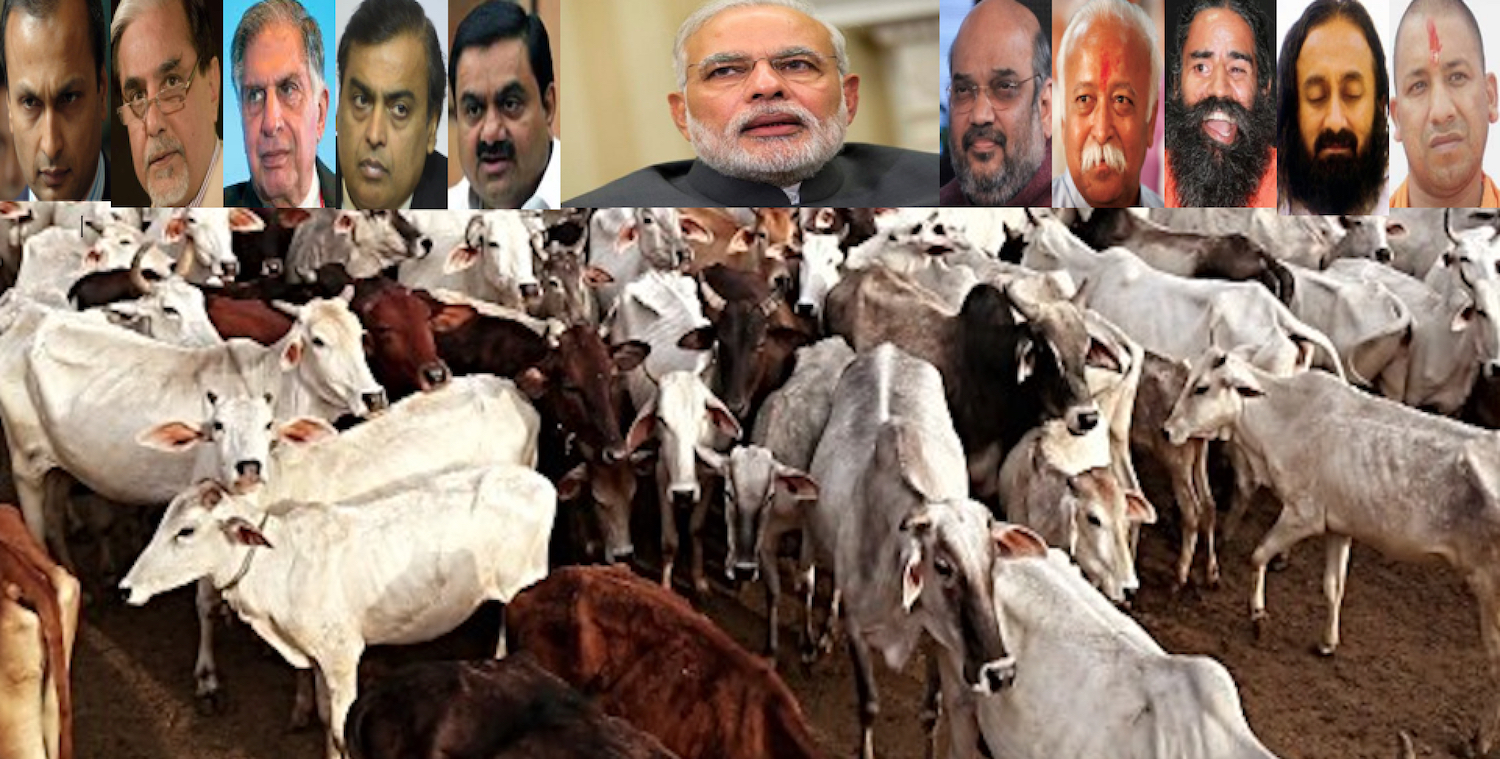
Modi aka BJP is paving the way for its handlers like Adani, Ambani, Tata and other foreign MNC’s to control the meat and animal hide trade that is worth Billions of Dollars. UP slaughterhouses alone employ 25 lac people with a turnover of Rs. 15,000.00 crore, the highest producer of meat in India. The meat industry is likely to grow at a compound growth rate of 8.4% over the next five years. The processed meat industry is growing even much faster, at about 20%. The meat export from India is about $4.5 billion and raw hide to leather goods is another $5.5 billion. About 22 million people are in the workforce and the meat export industry is expected to grow 50% in 5 years. Beside that 70% of Indians are non-vegetarians. Domestic per capita meat consumption in India is very low — around 5 kg as compared to the world average of 47 kg. With rising incomes between 2003 and 2012, their meat consumption rose by 6.3% a year. It is expected to rise by another 3.5% a year between 2013 and 2022.
Apart from 73.7 lakh tons of meat in 2016-17, India also produced 108 lakh tons of fisheries in 2015-16 ranking 2nd after China. India is the number One the and largest exporter of shrimp fish in the world. This industry is growing at a robust pace of 8% per annum. The business is valued at Rs. 1 Lakh Crore and employs about 150 lakh people. Andhra Pradesh occupies the first place, West Bengal 2nd and Modi’s Gujarat at 3rd place in fish production in India.
The demonetization was also done for these very influential people so that they can control food business worth billions that is traditionally run on cash basis by the informal sector. On top of that to pave the way for billions of dollars that can be made in transaction fees in the guise of digital money from the less fortunate and financially most vulnerable people of Indian society. Rich have credit cards; they don’t pay any fees to use it; rather they are rewarded with points and cash back for its use; it is the merchant that pays the fees for accepting it. The poor has to get a “Pre-Paid Debit Card” for a fee with a monthly maintenance fee and fee for loading money; one of the biggest Ponzi schemes ever invented by the American Financial Industry to loot the poor.
Coming to Team Modi & Hinduwadi’s understanding of Hinduism, its history, its writing on eating meat and views of various learned scholars, all of them are a very big disappointment. Team Modi should do some soul searching why Atal Behari Bajpai avoided the trap of cow laid by the bogus Hindutva supporters that has no love for their own 50 crore (500 million) extremely poor Hindus living a miserable life.
According to Sanskrit ScholarRajani K Dixit, “there is no such thing as Holy Cow in the Vedas”. The Vedas consider bovines important for milk, beef, agriculture and transport but not divine or holy. The word ‘Aghnyaa’ applies only to a milch cow because it is not economical to kill it. A Vaisha cow is meant for beef, and especially reserved to an extent for Brahmins only. Atharva 12.4(13) tells us that in case a Brahmin begs for a cow from a non-Brahmin, “even if that person has a beef-dinner at his house, he has to select another cow to slaughter for his own dinner, than the one that is asked for”. The word ‘Aghnyaa’ (not to be killed) coined by Rigveda for young milch cows was the main cause of the Hindu misunderstanding that cows or bovines are not to be slaughtered.
The Rigveda has never used the word ‘mother’ for a cow. There is no punishment recommended for a cow slaughterer even if someone kills a young milch cow. Beef-eating is also not taboo. Beef parties are not only allowed but highly appreciated, and a person who cooks beef for his guests is praised by the term ‘Atithi-gva’ ‘one who offers beef to guests’.
Ritual sacrifice of a bull is a must in worship to God Indra.Beef parties also seem a regular affair in weddings (RV 10.85). Cows are not sacred and beef is not forbidden to Hindus. Here is a line from a verse ascribed to god Savita, the presiding deity of the Gayatri Mantra, describing a dinner party he is hosting: “At night we are going to kill cows” (RV.10.85(19). RV 10.89 (14) mentions “cows for food, laying scattered on the grounds of a slaughter house”. Mark that the author does not use the word ‘animals’ but ‘cows’, showing that beef was the most popular item, and the cow the most slaughtered animal. RV 10.95(6) says that “old cows which do not give milk” are “only fit to be cooked”. It further states that “useless cows ….are taken to be cooked, but never milch cows”. It is clear that slaughter houses are not banned, beef is allowed and useless bovines are allowed to be slaughtered in Hinduism.
Aadi Shankaracharya born in 788 CEin Kerala: in his commentary on Brahadaranyako Upanishad 6/4/18 says: ’Odaan’ rice mixed with meat is called ‘maansodan’ on being asked whose meat it should be, he answers ‘Uksha’ is used for an ox, which is capable to produce semen. Currently 72 communities including some upper caste Hindus in Kerala prefer beef to the mutton and some prefer it because it is cheaper than mutton.
Hinduisms great propagator Swami Vivekaanand said: “You will be surprised to know that according to ancient Hindu rite and rituals, a man cannot be a good Hindu who does not eat beef “. (The complete works of Swami Vivekanand vol :3/5/36)
Vinayak Damodar Savarkar, the Hindutva Icon and Icon of Hindu religious & political parties including BJP, espoused his views in Vidnyan Nishta Nibandh, that the cow, like the peepal tree, should be cared for, as something useful to humans, which meant eating it as well if need be. He insisted that a superstitious mindset towards cows would ruin India’s intellect and that cows should be protected for their economic use to man, and not because of their ‘divinity’. Attributing religious qualities to it gives it a godly status. Such a superstitious mindset destroys the nation’s intellect. “When humanitarian interests are not served and in fact harmed by the cow and when humanism is shamed, self-defeating extreme cow protection should be rejected.”
Every now and then, an admirer of Savarkar raises the topic. “Can anyone imagine that the ‘Father of Hindutva’ advocated beef-eating (in special circumstances), rejected the divinity of the Vedas, denounced the sanctity of the caste system and launched a virulent attack on the hypocrisy of the priests?” wrote Ved Pratap Vaidik, a journalist close to several Hindutva figures. “Incidentally, Savarkar was a beef-eater,” wrote Varsha Bhonsle on Savarkar’s birth anniversary, February 26, in 1998. “For he was, above all else, a rationalist – a true Hindu – and eons ahead of contemporary Hindutvawadis.” (“Why is the Cow a Political Animal?” S. Joshi)
Mahatma Gandhi was approached for total ban on Cow Slaughter in India. His reply was, “I have been long pledged to serve the cow but how can my religion also be the religion of the rest of the Indians? It will mean coercion against those Indians who are not Hindus. The assumption of the Hindus that India now has become the land of the Hindus is erroneous. India belongs to all who live here. Earlier on 25th July 1947 he also said that “The Hindu religion prohibited cow slaughter for the Hindus, not for the world. The religious prohibition came from within. Any imposition from without meant compulsion. Such compulsion was repugnant to religion.”
A Brahmin’s Cow Tales by D. N. Jha, a high cast Brahmin himself. The cow as a sacred animal, Jha believes, did not really gain currency until Dayanand Saraswati’s cow protection movement in the 19th century”. The cow became a tool of mass political mobilization with the organized cow-protection movement,” the historian points out. “The killing of cows stopped gradually with the agrarian society and caste rigidity. The Brahmins found it convenient to say that those who ate beef were untouchable. But they themselves continued to consume it, recommending it for occasions such as shraadh. The beef-eating habits of Indians which existed in Rig Vedic times and continued till the 19th century and after, despite repeated Brahminical injunctions against cow-killing. That ancient Hindus, including Brahmins, were beef-eaters, willing to incur the minor penalty that an agrarian society began imposing on cow-killers, and that this fondness for cattle meat had nothing to do with Islam or Christianity.
For those who blame Muslims for the practice of Cow slaughter in India. Babar’s first act after conquering Delhi was to forbid the killing of cows. They must read Babar’s Directives (Wasiyyat namd-i-majchfi) a secret testament to his son Humayun and his future generations. For the stability of the Empire, O my son!, “The realm of Hindustan is full of diverse creeds. Praise be to God, the Righteous, the Glorious, the Highest, that He hath granted unto thee the Empire of it. It is but proper that thou, with heart cleansed of all religious bigotry, should dispense justice according to the tenets of each community.’ “And in particular refrain from the sacrifice of cow, for that way lies the conquest of the hearts of the people of Hindustan; and the subjects of the realm will, through royal favour, be devoted to thee. And the temples and abodes of worship of every community under Imperial sway, you should not damage. Dispense justice so that the sovereign may be happy with the subjects and likewise the subjects with their sovereign. The progress of Islam is better by the sword of kindness, not by the sword of oppression.” (Abstracted from the 1936 book The Mughal Empire From Babar To Aurangzeb, by SM Jaffar of Peshawar. It mentions that “the original document is in Persian and is treasured in the Hamida Library at Bhopal as one of its heirlooms.”)
The British Origin of Cow-Slaughter in India (published 2002) by Gandhian historian Dharampal. His book draws from official documents to show that the riots of 1880-1894 were not the obvious Hindu-Muslim conflagration they were made out to be. The book cites accounts of how “many prominent Muslims as well as the Parsis and Sikhs actively participated in the (cow protection) movement.” Dharampal wrote that large-scale cow slaughter was not the handiwork of Muslims who came to India from central and western Asia. “The question of the sacrifice of a cow did not arise as the land where Islam arose did not have many cows.”
Mughals were habituated to the meat of goats and mutton, sacrificing camels on the occasion of festivals like Eid or for large feasts, the book says. Dharampal rues the lack of research on cow killing between 1200 and 1700, when a series of Muslim kings ruled over a large part of India. But he goes on to show that systematic slaughter of cattle began in India with the East India Company establishing itself. The British, unlike the central and west Asians, were habituated to beef. The first slaughterhouse in India was built in Calcutta (now Kolkata) in 1760 by Robert Clive, then Governor of Bengal. It could kill 30,000 animals per day. Several more slaughterhouses were set up in various parts of the country by the Commissariat Wing of the three British armies of Bengal, Madras and Bombay Presidencies. A total of 350 slaughterhouses were constructed by 1910.
Nitya Sambamurti Ghotge, a veterinary surgeon who heads Anthra, a group in Pune that has worked with rural livestock rearers since 1992. Laws against cow slaughter and Trade Rules will only criminalize the livestock trade, not protect the animals, said Ghotge. Only the smugglers and the law enforcement officials will benefit from the ban on cow slaughter, not the poor farmers or the livestock. Like the agriculture scientist Ramanjaneyulu, Ghotge holds that the cow protection laws are unjust; it is about powerful urban people outsourcing the burden of cow protection on the rural poor, she said.
As for the BJP’s claim that “cow is the only divine animal that exhales oxygen”, no living being other than plants exhale oxygen is also a myth. Animals, however, exhale unused oxygen, as lungs cannot process all the oxygen that is inhaled. According to the 2006 FAO report, the livestock sector accounts for 9 per cent of carbon dioxide derived from human-related activities, but produces a much larger share of even more harmful greenhouse gases.
Team Modi is least concerned about the millions of Indians- Hindus as well as non-Hindus employed directly and indirectly in the cattle trade. The millions especially children and elderly that depend on bovine meat as the cheapest source of protein. In the name of misguided Hindutva they are imposing their personal believes on the cattle breeders, traders, farmers and bovine meat eaters without considering the economic realities. There was a time when the owner could get Rs 12,000.00 to Rs. 15,000.00 for the unproductive animal from a slaughterhouse, now that has been reduced to Zero by the Gau Rakshaks/cow vigilantes. Rs 2,500.00-3,000.0 per month is the cost just to keep the animal alive for 8-10 years after the end of its economic utility. If the 10 million or so cattle that possibly end up at the abattoir every year are not culled, farmers will simply stop caring for them and let them loose in towns and cities. It will cost upward of Rs 22,000 crore to take care of them. And since the 10 million-plus will keep adding each year, till they die in their natural course, these costs would only keep on mounting up every year. Just in the 4th year the cost could be more than Rs. 88,000.00 crore. In BJP ruled state Rajasthan the state government is providing Rs 70.00/day for cow and Rs 35/day for calf and at the same time it is providing Rs. 25.63/person on welfare schemes in the state. Under Modi, India has become an international joke where cow is more valuable than human beings.
(The author is a New Jersey based community activist and a regular commentator on burning issues. He can be reached at davemakkar@yahoo.com)
(The Indian Panorama invites comments on the article)
NEW DELHI (TIP): The BJP has decided to reach out to regional parties over the election of the next President in view of the party’s assessment that several smaller outfits could support an NDA nominee for the post.
Apart from the National Democratic Alliance coalition, BJP is looking for a bigger umbrella of support for its nominee who will replace President Pranab Mukherjee in Rashtrapati Bhavan.
The decision to consult regional parties was discussed at a meeting of senior BJP leaders called by party president Amit Shah on Thursday. It is understood that no names were discussed at the meeting.
The proposed consultations come at a time when BJP is weighing the benefits of proposing a ‘moderate’ face for President and in the process gaining wider support rather than a nominee seen to be imbued in a deep saffron hue.
This is a point of debate within senior BJP circles as the party begins the process of installing its choice in Rashtrapati Bhavan.
Though the candidate is expected to be pretty much a BJP-Sangh person, there is a discussion on image and perception as a more acceptable candidate can impact the opposition’s moves to put up a ‘joint candidate’.
As things stand, BJP is hopeful of garnering the support of Telangana Rashtra Samithi and the two AIADMK factions along with the support of some smaller outfits. The party has also received feelers about possible cross-voting but is considering the possibility of sealing the support of more parties as well.
Senior BJP leaders had recently asserted that the party was assured of the support of around 54% of the electoral college and was confident of having its way in the presidential poll. The opposition – led by Congress, Left and Trinamool – has been looking to put up a candidate against the NDA to signal their protest against BJP’s politics of “majoritarianism” and make a statement on the viability of an alternative view point.
NEW DELHI (TIP): Prime Minister Narendra Modi will give a pep talk to chief ministers of 13 BJP ruled states at the party headquarters here on Sunday. Party president Amit Shah too will join them.
The meeting comes within weeks of Modi holding a similar session with leaders of 33 NDA allies, who reposed faith in his leadership and resolved to win the 2019 elections again.
BJP sources described the meeting as an exercise to gear up BJP-ruled states for the next Lok Sabha election, a key electoral challenge that will also be seen as a referendum on Modi government’s five year tenure.
Three BJP ruled states, Chhattisgarh, Madhya Pradesh and Rajasthan, will also go to poll in 2018.
With the BJP ruling 13 states and sharing power in four others, party leaders admit the performance of the state governments will have a bearing on the performance of the BJP in 2019.
Modi doesn’t want any anti-incumbency to set in against the sitting BJP governments, which can pull down the party in 2019.
“At the Sunday meeting, he will reiterate that BJP needs to keep its focus on governance and avoid controversies that can provide fresh ammunition to the opposition looking for an opportunity,” a BJP leader said.
Activism by cow vigilantes, conduct of certain BJP leaders and several others issues have hogged the media limelight, putting the BJP in a tight spot.
At the just concluded conclave of the BJP in Bhubaneswar, Prime Minister Modi asked BJP leaders to be mindful of their conduct.
“Don’t let power go into your head. We should not get spoiled,” he told over 300 BJP leaders.
NEW DELHI (TIP): The Bharatiya Janata Party (BJP) registered a huge victory in the Rajouri Garden Assembly bypoll in the national capital on April 13 handing a humiliating defeat to the ruling Aam Aadmi Party (AAP), which finished a distant third and even lost deposit.
BJP-Shiromani Akali Dal (SAD) joint candidate Manjinder Singh Sirsa bagged 40,602 seats, over 50% of the total votes polled, in a boost for the saffron party ahead of the 23 April municipal polls.
Congress’ Meenakshi Chandela finished second with 25,950 votes while AAP’s Harjeet Singh managed to get only 10,243 votes, less than one-sixth of the total votes polled, and lost deposit.
In terms of vote share, the Congress staged a turnaround of sorts by getting around 33% of the total votes cast,in a jump of over 21% over the 2015 Assembly polls.
Around 47% of the over 1.6 lakh electors of the west Delhi seat had cast their vote on 9 April.
With the victory, the BJP’s tally in the 70-member Delhi Assembly will become four. The Congress does not have any presence in the House.
The seat fell vacant early this year after AAP’s Jarnail Singh quit as MLA to contest the Punjab Assembly poll against SAD patron Parkash Singh Badal.
Delhi’s richest MLA
Sirsa will be the richest MLA in Delhi with declared assets of over Rs 185 crore.
By this distinction, Sirsa dislodges AAP’s Pramila Tokas who topped the list of wealthiest MLAs until now with declared assets of Rs 87 crore. Tokas is an MLA from RK Puram in south Delhi.
Sirsa, who had contested the assembly election in 2015 also, had declared assets of Rs 239 crore at that time. However, the worth of his assets has dropped by over 22% since then. Sirsa, who calls himself an “agriculturalist and businessman” on his affidavit filed in 2017, has declared moveable assets, such as money, cars, and other valuables worth almost Rs 89 crore, and immovable assets, such as agricultural land and commercial buildings worth over Rs 120 crore. He has also declared liabilities and other outstanding dues, like bank loans, worth approximately Rs 24 crore.
According to an analysis by Association of Democratic Reforms (ADR), 11 of the 70 Delhi MLAs had total assets worth more than Rs 10 crore after the assembly election in 2015.
The Hindutva project has succeeded in projecting itself as speaking to the deep diversities that crowd U.P
“The invocation of Shiva and Shakti in this project that hitherto held firmly to a graded order and paternalism would have implications for Indian democracy that have been little envisaged so far”, says the author.
If symbols speak, and in the layered culture deposits of the Gangetic plain they do speak loud, one of the most memorable spectacles was Prime Minister Narendra Modi’s visit to Kashi Vishwanath Temple on March 4, 2017.
It was preceded by a roadshow in the narrow, winding streets of Varanasi all decked up for the grand effect, following the garlanding of the statue of Pandit Madan Mohan Malaviya at the Benares Hindu University. Within the temple precincts itself Mr. Modi appeared the great performer, oozing a burst of energy, while the archakas were transfixed in the archaic layout of the ancient temple complex. Place this spectacle alongside Mr. Modi’s salutation to ‘Ganga Ma’ at the Dashashwamedh Ghat of the river on May 17, 2014, a day after his victory from Varanasi Lok Sabha constituency, three years ago: and you have before you one of the most powerful symbols to reach out to the length and breadth of India, Shiva and Parvathi, alongside Ganga, and their complex personifications in myriad forms, the principles of dynamism and recreation, galore across India, in much more vivid forms than Ram lalan of Ayodhya.
Yogi Adityanath, the new Chief Minister of Uttar Pradesh, himself heads a temple, the Gorakhnath temple, named after a representation of Lord Shiva, a representation that gathers in its fold elements of Buddhism, the tantra practices, the Nathpanthi traditions, and renouncer cults.
Shiva in political pantheon
While the Hindutva project is unlikely to shed Ram from its political pantheon, it would be worth watching the deployment of Shiva and Shakti sites spread across the length and breadth of the country, particularly in its peripheral regions. Lord Shiva is the lord of the dissenter, the renouncer, the wayward, the very captive of his devotee, the great patron of arts and crafts, the yogi par excellence, while he is at the same time the great destroyer, angry and disdainful of the social order. He inhabits the peripheries of the Brahmanical dispensation that stipulates a tightly ordered social universe. He is primarily the lord of the lower social orders, of the margins. He is the presiding deity across the vast expanses of the Himalayas, most of the southern part of India, and the hills and ghats where the Brahmanical order is precariously present.
For the Hindutva ideologues, at least those who walk hand in hand with Mr. Modi, the conquest of Lord Ram’s place of birth at Ayodhya is over; what is important is to bind India together, its myriad differences and diversities through new bonds. Was the Prime Minister, who said little on the Ram Janmabhoomi issue during his numerous public meetings across the length and breadth of Uttar Pradesh, opening a new front for Hindutva? Are we, therefore, stepping into a religio-political project that was little seen as integral to Hindutva so far?
Finger on the U.P. pulse
The socio-political space that constitutes Uttar Pradesh today has always nurtured a complex internal debate with regard to the idea of India from the later part of 19th century. The great debate with regard to the future of Muslims in the subcontinent following the demise of the Mughal Empire was centred around this region in which the ulema of Deoband and Barelvi madrasas and later the Aligarh Movement played a decisive role.
One always found in this region informal groupings of religious adherents, be they Hindus or Muslims, who did not toe the line of any one political party. Besides, after the abolition of the zamindari system this region, as a whole, was not much shaken up by the powerful agrarian and anti-caste movements that have had such powerful impact in the neighbouring region of Bihar.
However, recent evidence suggests that a large number of traditional upper caste religious groupings in the region have been veering round to the Hindutva project, and orthodoxy has spread its appeal much wider among Muslims. The egalitarian social imaginary of the lower rungs among Hindus has thrown up new modes of religious gatherings, revitalised marginal deities, and much social effort has gone into the construction of shrines and temples and writing caste histories. The Hindutva expressions in this region have reached out to this imaginary while the other political formations in the region have had little say on it.
The cryptic comment that Samajwadi Party leader Mulayam Singh Yadav made, that Chief Minister Akhilesh Yadav’s defeat is on account of his departure from Lohiawad, has a ring of truth about it, although the former himself reached out to this social imaginary very little. The secular hat that the Congress wears is totally disconnected from this groundswell. The Bahujan Samaj Party did little to disabuse the charge that the Prime Minister made in his election rallies that it serves the good of one against its claims to represent the many. Besides, the impermeable walls that the dominant discourse within this party erects across castes and communities makes it difficult for it to access complex modes of oppression and cultural nuances that play a decisive role in an electorally surcharged arena such as Uttar Pradesh.
The strategy
In sum, over the years there has been little attempt to make the deep diversities that crowd Uttar Pradesh speak to one another. The Hindutva project has succeeded in projecting itself as speaking to this diversity through a phalanx of organisations. Mr. Modi was only the presiding deity, the organising centre of this process. The Uttar Pradesh strategy also demonstrates that the Bharatiya Janata Party (BJP) will adopt very distinct strategies in different regions of India, with a few slogans such as ‘Sabka sath, sabka vikas’ as common.
It is a pity to watch the plight of the Muslims in Uttar Pradesh if we ignore the local bravado on display in some places. The Hindutva project has been surreptitiously redefining the Muslim world in this region that has global ramifications. It has selectively extended support to the Sufi heritage, and Mr. Modi even addressed the World Sufi Forum in Delhi in March 2016. It has tried to win over a section of the Shias with an eye on Pakistan, Iran and West Asia, but also tapped the historic Shia-Sunni rivalry in the State to its advantage. It has not been sympathetic to the demand of Aligarh Muslim University for minority status and has expressed strong resentment against the relatively doctrinaire strand of Islam upheld by the Deoband madrasa. Organised Muslim political opinion has largely concentrated in carving out electoral strategies rather than propose ways by which people who subscribe to deep differences in beliefs and values but share much of everyday life in common can live together. The coexistence and toleration argument does not apply here because everyday life is deeply caught in conflicts and the language of sterile secularism does not offer a line of advance.
The language of vikas that the BJP spoke during the electioneering, therefore, may have to be seen through the lens of this expansive Hindutva project. Everyone is welcome to participate in the common economic endeavour, but the normative and cultural codes of such an endeavour will be governed by this project. The invocation of Shiva and Shakti in this project that hitherto held firmly to a graded order and paternalism would have implications for Indian democracy that have been little envisaged so far.
(The author is a former professor at the Centre for Political Studies, Jawaharlal Nehru University, and currently National Fellow, Indian Council of Social Science Research)
NEW DELHI (TIP): Trivendra Singh Rawat, a leader with RSS background, has emerged as the front-runner in the race for the coveted chief minister’s post in Uttarakhand. He is likely to be elected the leader of the BJP legislature party in the hill state. The swearing-in ceremony will take place in Dehradun on Saturday in the presence of Prime Minister Narendra Modi and BJP chief Amit Shah.
BJP MLAs in Uttar Pradesh will also meet on Saturday to elect their leader and who will take over as the chief minister. Union minister M Venakaih Naidu and BJP general secretary Bhupendra Yadav will attend the legislature party meeting in Lucknow to brief the MLAs of Delhi’s choice. State BJP chief Keshav Prasad Maurya, Union minister Rajnath Singh, and Manoj Sinha are in contention. The date for the swearing-in of the chief minister of the country’s most populous state has not been decided yet.
In Uttarakhand, Rawat faced stiff competition from former minister Prakash Pant and former MP Satpal Maharaj. Pant is MLA from Pithoragarh and Maharaj from Chaubattakal. Maharaj is a former Congress leader who joined the BJP ahead of the 2014 Lok Sabha elections while Pant was propped up by Rawat’s rival.
“But Amit Shah’s support to Rawat seems to have tilted the balance in his favour,” a BJP source said.
A Thakur, Rawat is close to Shah and was one of the three deputies attached to him in Uttar Pradesh during the 2014 Lok Sabha elections. As an RSS leader sent to the BJP, Rawat held the post of Sangathan Mantri (organisational secretary) of the Uttarakhand BJP between 1997 and 2002 and served as a minister in the BJP government in 2007.
UP chief minister hopeful Keshav Prasad Maurya was admitted to the ICU at Ram Manohar Lohia Hospital here after falling ill. He had fever and high blood pressure when admitted. Doctors have placed him under observation.
Uttar Pradesh CM to be decided on March 18
The suspense over the new chief minister of Uttar Pradesh is expected to end at the BJP legislature party (BJPLP) meeting to be held in Lucknow on Saturday.
The declaration of a new leader, in the presence of Union minister Venkaiah Naidu and party general secretary Bhupendra Yadav, will coincide with the party’s victory day celebration on that day. The BJP’s incumbent legislature party leader, Suresh Khanna, on Thursday confirmed the news about Saturday’s meeting of the party’s newly-elected lawmakers.
As expected the Manohar Parrikar government in Goa was able to prove its majority on Thursday, March 16, following a Supreme Court directive. Once the Governor had decided to invite the former Defence Minister, Parrikar to form the government, even though the Congress had emerged as the largest party, the dice got loaded in favor of the BJP.
In the end, the BJP with just 13 MLAs in a house of 40 managed to conjure up a slate of 22 legislators for voting in favor of chief minister Parrikar. The vote and the outcome are in perfect harmony with the Goan political culture of smaller parties and independents making themselves available for the highest bidder.
As the BJP is politically ascendant nationally and is flush with resources and imbued with resourcefulness, there was little doubt about its ability to win this round in Goa. Even before the final vote on Thursday, the Congress was making allegations of money changing hands.
It is the irony of our times that the winner not only gets to write the history but also re-writes the norms; it would be seen as cussedness to point out the ethical dimension of the denouement: the BJP was in power and it lost the majority in the election, ending up with only 13 MLAs yet storming its way back into power. Most curious and inexplicable is the case of all the three MLAs, belonging to the Goa Forward Party, siding with the BJP; in disgust, the GFP president, Professor Prabhakar Timble resigned from the party, accusing the BJP of inflicting a ‘political mafia raj’. So be it. The BJP’s cocky leadership would have the satisfaction of having one more state government under its belt.
Within days all the righteous anger about a ‘stolen government’ would subside. No one should be surprised if some of the Congress MLAs end up crossing over to the winning side. Goa would return to its happy and carefree habits and preferences. Above all, Manohar Parrikar’s exile in Delhi ends. Goa gets a chief minister it deserves and the country will, hopefully, get a defence minister it badly deserves.
PARTS USED FOR MANUFACTURING OF LED LIGHTS WILL ATTRACT BASIC CUSTOMS DUTY 5 PER CENT AND CVD OF 6 PER CENT FROM NIL EARLIER
NEW DELHI (TIP): Smokers and tobacco consumers will have to pay more for their indulgence as Finance Minister Arun Jaitley continued with the crackdown on cigarettes, bidis and tobacco products by increasing taxes in the Budget 2017-18. Besides, mobile phones and LED lights assembled in India will also become dearer with the finance minister increasing duties on imported printed circuit boards and components respectively.
UNION BUDGET 2017: WHO SAID WHAT
PRIME MINISTER NARENDRA MODI: “This is a Budget for the future – for farmers, underprivileged, transparency, urban rejuvenation, rural development, enterprise. This Budget is yet again devoted to the well-being of the villages, farmers and the poor. From railway modernization to economic reforms, from education to health, from entrepreneurship to industry, the aim at fulfilling the dreams of all is clearly visible in the Budget.”
RAILWAY MINISTER SURESH PRABHU: “It’s a pro- growth Budget. The growth will happen because of huge investments that is happening. For example in railways, the provision for Rs 1.31 lakh cr for capital expenditure is unprecedented in railway history.”
UNION MINISTER VENKAIAH NAIDU: “It’s a fine exercise taken up by the Finance Minister. It’s very inspiring, bold steps has been announced. Particularly the political funding has been made transparent. People will be happy. Some political parties will become poor. That is why our opponents are saying the budget is anti-poor.”
UNION MINISTER KIRAN RIJIU: “It will transform rural India and urban as well in terms enhancing the capacity of building infrastructure. It is a great relief to the common masses and it will transform the economy of the nation. At the same time, the reform in taxation is great.”
BJP PRESIDENT AMIT SHAH: “The Union B8udget is aimed at all-round development with sops for the youth, women, farmers, the poor and middle class and that it will usher in a new era of progress.”
CONGRESS VICE-PRESIDENT RAHUL GANDHI: “We were expecting fireworks, instead it was a damp squib. It is just ‘sher-o-shayari’ in the Budget. There is nothing for farmers and youth and nothing for job creation. There is no clear vision, no idea.”
CONGRESS MP MALLIKARJUN KHARGE: “They have promised all these things (proposals to cleanse political system) keeping polls in five states in mind. They have not said anything for farmers, youth, women. They have accepted that GDP growth has gone down.”
WEST BENGAL CM MAMATA BANERJEE: “A controversial Budget which is clueless, useless, baseless, missionless and actionless. No roadmap for the country or the future from a government that has lost all its credibility.”
MADHYA PRADESH CHIEF MINISTER SHIVRAJ SINGH CHOUHAN: ” union budget is a revolutionary step for a progressive India. The budget will increase the pace of development and growth to help poor and marginalized people.”
CPM GENERAL SECRETARY SITARAM YECHURY: “It an example of Finance Minister joining the Prime Minister and the BJP President to create ‘jumlas’. The budget is a classic example of that. It won’t boost employment or generate demand. The idea of infrastructure development is a farce because the data given by the FM is not related to reality, does not match to what he said in his speech.”
MAHARASHTRA CM DEVENDRA FADNAVIS: “Pathbreaking budget! It has the same disruptive effect as demonetization had. Country will leapfrog to next level. This is indeed Budget for Better India. Positive effect of demonetization, the increase in capital expenditure by 25%will generate more jobs.”
HARSH KUMAR BHANWALA, CHAIRMAN NABARD: “The Budget focuses a lot on the rural and agriculture sector. Though the thrust on digital continues, reforms announced in the Budget will generate employment and help in doubling farmers income.”
Jaitley, however, made an attempt to make it more affordable for clean energy sources by cutting duties on solar tempered glass, fuel cell based power generating systems and wind operated energy generator. With the expected implementation of GST, large scale tinkering of tax structure has been avoided in the Budget thereby sparing most of the commonly used daily items from price changes.
“Implementation of GST is likely to bring more taxes to both central and state governments because of widening of tax net. I have preferred not to make many changes in current regime of Excise and Service Tax because the same are to be replaced by GST soon,” Jaitley said while presenting the Budget.
Yet, tobacco and cigarettes have not been spared.
Excise duty on unmanufactured tobacco has been almost doubled to 8.3 per cent from 4.2 per cent earlier, while that on pan masala has been hiked to 9 per cent from 6 per cent.
Likewise, excise duty on cigar, cheroots has been changed to 12.5 per cent or Rs 4,006 per thousand, whichever is higher from 12.5 per cent or Rs 3,755 per thousand, whichever is higher. Excise duty on chewing tobacco, including filter khaini and jarda scented tobacco has also been doubled to 12 per cent from 6 per cent earlier.
Excise on paper-rolled handmade bidis has been increased to Rs 28 per thousand from from Rs 21 per thousand and the same for paper rolled biris has gone up from Rs 21 per thousand to Rs 78 per thousand.
Populated Printed Circuit Boards (PCBs) for use in the manufacturing of mobile phones, subject to actual user condition will also attract SAD of 2 per cent from nil earlier.
Similarly, parts used for manufacturing of LED lights will attract basic customs duty 5 per cent and CVD of 6 per cent from nil earlier.
As per the Budget announcement, imported cashew nut (roasted, salted or roasted and salted) will also become dearer as basic customs duty on the item has been hiked to 45 per cent from 30 per cent earlier.
Imported silver medallion, silver coins, having silver content not below 99.9 per cent, semi-manufactured form of silver and articles of silver will also be dearer as there items will now attract CVD of 12.5 per cent from nil earlier.
Jaitley has made a few announcements in the Budget that will help consumers.
Railway travel with e-tickets booked through IRCTC will become cheaper as service charge on it has been withdrawn. RO water purifiers are likely to be slightly cheaper with basic customs duty on imported membrane sheet and tricot/spacer for use in the manufacture of RO membrane element for household filters has been reduced from 12.5 per cent to 6 per cent.
However, with a view to encourage domestic production of RO membrane element, the government has hiked basic customs duty on it to 10 per cent from 7.5 per cent earlier.
Customs duty of LNG has been halved to 2.5 per cent which can lead to lower power and fertiliser costs.
With an eye on promoting clean energy source, the government has reduced basic customs duty on solar tempered glass used in solar panels from 5 per cent to nil.
Likewise, the basic customs duty and CVD on all items of machinery required for fuel cell based power generating systems to be set up in the country lowered to 5 and 6 per cent from 10/7 and 12.5 per cent earlier.
Also, the basic customs duty, on resins and catalyst for manufacture of cast components for wind operated energy generator has been lowered to 5 per cent from 7.5 per cent earlier, while CVD and SAD on these items have been slashed to nil from 12.5 per cent and 4 per cent, respectively earlier.
Continuing the focus on promoting leather industry, Jaitley announced that basic customs duty on vegetable tanning extracts used in making leather products such as bags and shoes has been slashed to 2.5 per cent from 7.5 per cent earlier.
Miniaturised POS card reader for m-POS, micro ATM as per standard version, finger print reader/scanner and iris scanner will also be cheaper as duty on these item have been reduced to nil.
For the defence forces, services provided or agreed to be provided by the Army, Naval and Air Force Group Insurance Funds by way of life insurance to their members under the Group Insurance Schemes of the Central Government is being exempted from service tax as against 14 per cent charged earlier.
In these four years, I also saw with, some disquiet, forces of divisiveness and intolerance trying to raise their ugly head. Attacks on weaker sections that militate against our national ethos are aberrations that need to be dealt with firmly. The collective wisdom of our society and our polity gives me confidence that such forces will remain marginalized, and India’s remarkable growth story will continue uninterrupted,”so said honorable Pranab Mukherjee, President of India, addressing the nation on the eve of the 70th yearof Independencefrom British colonialism.
It is indeed quite an emphatic and forceful statement coming from the bully pulpit of the highest office in the land. It also puts to shame those who refuse to acknowledge the growing intolerance and prejudice that is sweeping across India by the rightwing zealots who are emboldened by the election of Narendra Modi to power. The question to ponder is whether this is only an aberration or a growing trend that may have disastrous consequences to the way of life as we experience it today!
Just as India was celebrating its Independence Day, word has come out from Bengaluru that SEDITION charges are being filed against Amnesty International of India, an organization that promotes human rights and creates awareness when it is violated in any part of the world. Once again, it appears that the law enforcement agencies are madepawns by ultra-nationalists bent upon imposing their version of cultural hegemony on the diverse people of India.
Millions of Indians everywhere must be feeling the shame of India as the President has spoken out on the continuing assaults on Dalits. In a recent incident in Una, Gujarat, four Dalit youths were severely beaten up and dragged on the road for nearly a kilometer for allegedly possessing beef. It is widely known that the so-called upper castes will not touch the carcass and the Dalits are forced to clear or handle it and when they do, they are mercilessly beaten up in the name of self-appointed ‘Gau Rakshak Samiti.’
Dalits who constitute one-sixth of India’s population, some 170 million people, live in precarious existence, shunned by much of Indian society because of their rank as “untouchables” or Dalits – meaning broken people – at the bottom of India’s caste system. Dalits are discriminated against, denied access to land and basic resources, forced to work in degrading conditions, and routinely abused at the hands of police and dominant caste groups that enjoy state’s protection.
It appears that the Prime Minister had finally broken his silence when he made a statement in a town hall meeting saying that “I feel really angry that some people have opened shops in the name of cow protection. I have seen that some people commit anti-social activities through the night, but act as cow protectors by the day”. It is noteworthy that Modi did not call for the prosecution and punishment of these cow vigilantes but asked the authorities to prepare ‘dossiers’ on them and keep them under control!
Almost a year ago, a mob lynched Mohammed Akhlaq in Dadri U.P. on suspicion of possessing beef in his home refrigerator. Subsequently, the meat was sent for forensic examination. In June, Baliyan, who is a member of Modi’s Council of Ministers, BJP MP Yogi Adityanath and BJP MLA Sangeet Som defended the killers and demanded action against the dead man’s family for the ‘crime of eating beef.’
If there is growing intolerance on the dietary habits of Indians and rising violence by the emboldened vigilante groups who have taken up law unto their hands, many in the current leadership are in complicity, lending credence to their nefarious activities with their overt or covert support to this highly charged environment.
Amit Shah, the President of BJP, boasted once that wherever there is a BJP government, there is a ban on beef. Raja Singh, a member of Parliament, went even further stating that he extends his full support to all those who take it upon themselves to teach those Dalits a valuable lesson!Mohinder Lal Khattar, the current Chief Minister of Haryana, is on the record saying that Muslims can live in the country only if they give up eating beef. Panchajanyam, an RSS newspaper has quoted Vedic scriptures that ordered the killing of sinners who slaughtered cows and the Union Minister of Agriculture Radhamohan Singh termed cow slaughter a ‘mortal sin.’
There is no doubt that these vitriolic statements from higher ups have given fodder and cover to these cow vigilantes who roam the streets and become the judge, jury, and the executioners. Since BJP came to power, states like Maharashtra, Haryana and Jharkhand have tightened laws against cow slaughter, but those in the leadership used the beef issue as an emotive political tool without any repercussions from the Prime Minister. In Maharashtra state, one may get five years incarceration for possession of beef as opposed to two years for sexual harassment of a woman!
Prime Minister himself effectively conjured up the specter of a ‘pink revolution’ – cow killing on a mass scale – in the event of a BJP’s defeat in the 2014 election as part of a strategy to motivate people and to vote for his party. Both in Western Uttar Pradesh and again in Bihar Modi spoke at length about the dangers of ‘pink revolution.’ “The agenda of the Congress is the pink revolution,” he said. “we have heard of the green revolution and white revolution but never pink, and this means the slaughter of animals (pashu). You see, the color of mutton is pink, and they are committing the sin of exporting it and bringing revolution…Because of this, our animal wealth is being slaughtered, our cows are being slaughtered, or sent abroad to be slaughtered….And now the Congress is saying, ‘if you vote for us, we will give you permission to kill cows’”
It is quite apparent that if Modi has to call the heinous and brutal beating of the Dalit boys in Gujarat as criminal wrongdoing and ask that the perpetrators to be punished, he would have to cross that ideological line he and his party have helped to formulate in attaining the power. However, what he has done with his recent statement to the nation is an attempt to soothe the bruised feelings of Dalits who are critical to the BJP’s prospects in the upcoming elections in U.P. and Punjab. What else could explain his silence in all these months when Muslim youths were lynched or beaten up by cow vigilantes?
The very idea of a consolidated vote bank based on the ideology of ‘Hindutva’ to include the Dalits and other backward castes may be fast unraveling as the video footage of the beating has gone viral and stoked Dalit anger. The nation also witnessed the de-recognition of the Ambedkar Students Association in Chennai, mistreatment and subsequent suicide of the Dalit scholar Rohit Vemula in Hyderabad, torching of a Dalit home in Haryana and killing of two children. All these incidents may only reinforce the age-old Dalit thinking that BJP is essentially a party dominated by an upper caste ideology, and there may be very little room left in it for anyone else!
(The author is a former Chief
Technology Officer of the United
Nations and Chairman of the Indian
National Overseas Congress, USA)
GANDHINAGAR/NEW DELHI (TIP): Gujarat Chief Minister Anandiben Patel on August 2 submitted her resignation to Governor O P Kohli hours after the BJP Parliamentary Board accepted her offer to quit and authorised party president Amit Shah to pick her successor to lead the party in 2017 polls.
Nitin Patel Frontrunner for the Post AHMEDABAD (TIP): Nitin Patel, considered No. 2 in the cabinet of outgoing chief minister Anandiben Patel, seems to be emerging as the consensus candidate for the chief minister’s post in Gujarat, with state Bharatiya Janata Party (BJP) president Vijay Rupani withdrawing from the race and the party ruling out the candidature of national BJP president Amit Shah. The Patel factor also seems to be tipping the scales in the favour of the 60-year-old Gujarat health minister.
Anandiben, who will turn 75 this November, handed over the resignation letter to Kohli in the presence of ministers and party leaders at Raj Bhavan in the evening. Kohli has asked her to continue until the new cheif minister takes charge.
“Anandiben has submitted her resignation to the governor,” state unit BJP president Vijay Rupani told reporters after coming out of Raj Bhavan.
Earlier in the day, the BJP Parliamentary Board which met in Delhi authorised Shah to pick Anandiben’s successor after accepting her offer to resign.
The meeting of the Parliamentary Board, which was chaired by Shah and attended by Prime Minister Narendra Modi, appointed Union Minister Nitin Gadkari and BJP general secretary Saroj Pandey as party’s central observers to hold consultations with the MLAs for electing the new leader.
Shah will be travelling to Gujarat tomorrow where he will hold consultations with party leaders and attend the Legislature Party meeting, likely to be held on Friday to elect the new leader.
Though her departure was anticipated, the first woman chief minister of Gujarat had offered to step down on Monday ostensibly due to her age, as she is turning 75 soon.
Meanwhile, the political circles are abuzz with the likey choice of her replacement.
According to leaders in BJP, the decision on Anandiben’s successor could be taken within the next two days.
“We are yet to decide the time of the Legislature body meeting (to elect new leader) as state Observer Nitin Gadkari is busy. It (meeting) can happen any time after 3 PM tomorrow or even a day after. Our national president Amit Shah will decide it as he is arriving here tomorrow,” said state unit BJP in-charge Dinesh Sharma.
He said the Legislature Party meeting to decide the next CM will be held in the presence of state Observers as per the process.
Parrying a query on likely contenders for CM’s post, Sharma said, “A party worker will be chosen as next chief minister.”
Interestingly, state unit BJP chief Vijay Rupani whose name is in the reckoning for the post besides others, virtually ruled himself out of the race, saying he would like to work for the party organisation.
“I have told the party leadership that I would like to work for the organisation,” Rupani said.
Names of “number two” in state Cabinet and incumbent Health minister Nitin Patel, Union minister Purshottam Rupala and Assembly Speaker Ganpat Vasava, a tribal leader, are still doing the rounds.
Nitin Patel, who is considered to be the front-runner, said, “the party Central leadership will decide on who will be the chief minister.”
Anandiben, meanwhile, issued advertisements in newspapers here today listing the works done during her two-year tenure.
The BJP has just done a Bihar in Uttar Pradesh. In Bihar, its electoral prospects were damaged by no less than the RSS chief. In UP, a middling BJP leader called Mayawati, Dalit icon B R Ambedkar’s self-anointed legatee, words that shouldn’t be used even in drawing room conversation. The BJP has been swift in expelling the leader but it remains to be seen whether this is perception management to control the damage not just in UP but also Punjab, a state with the country’s highest Dalit population simultaneously going to the polls.
But for this intemperate statement, the BJP had learnt from the Waterloo in Bihar. It was luring away Mayawati’s lieutenants, started cobbling a Bihar-type grouping of backward caste leaders, party chief Amit Shah made the mandatory pilgrimage to a UP Dalit’s house and Prime Minister Narendra Modi inducted five Dalits in his first Cabinet reshuffle. However, Dalit ferment is underway elsewhere too, beginning with Rohith Vemula’s suicide. Mumbai saw a massive Left-Dalit rally against the demolition of Ambedkar Bhavan and large parts of Gujarat shut down against the public flogging of Dalits by vigilantes of a self-styled cow protection unit.
The BJP has scored all these self goals with no provocation from any quarters. Rather the heightened social and religious tensions in several parts of the country are due to the BJP’s upper caste-centric mindset and the low standards in public speaking set by its senior leaders. From Punjab to Maharashtra, the BJP has single-mindedly pushed a vigilante-led cow protection agenda that ignores the reality on the ground. As for using offensive words, wasn’t it junior Minister V K Singh who described journalists as “presstitutes”? And didn’t the Prime Minister term a fellow-politician’s companion as “50 crore ki girlfriend”? As no party can afford to be counted without the Muslim and Dalit votes, the BJP had no choice but to act contrite to keep the latter in good humor. As political temperatures rise in UP and Punjab, time will tell whether the expulsion of the UP BJP leader was a sincere effort to discipline the cadres.
Lt Gen (Retd) J F R Jacob, who played a key role in the 1971 war which liberated Bangladesh from Pakistan, died here today at the age of 92 due to “old age complications”.
Jacob, who was also Governor of Punjab and Goa, breathed his last at the Army Hospital here at around 8 am.
He was admitted to the Army’s Research and Referral Hospital since January 1 after suffering from pneumonia. Prime Minister Narendra Modi condoled his demise and said India will always remain grateful to Jacob for his impeccable service to the nation. He also recalled his association with him.
“RIP Lt Gen JFR Jacob. India will always remain grateful to him for his impeccable service to the nation at the most crucial moments.
“Lt Gen JFR Jacob and I interacted often. Had a memorable interaction when he presented his autobiography to me,” he tweeted.
Defence Minister Manohar Parrikar and BJP chief Amit Shah have also condoled his demise.
Army chief Gen Dalbir Singh Suhag expressed his deepest condolences towards this great loss, a statement by the Army said.
He said that Jacob was a pillar of military leadership and personified the best qualities of a soldier and a statesman who will always be remembered as one of the most prominent Leaders in the annals of Indian military history.
Jacob had negotiated the surrender of Pakistani troops in Dhaka after the 1971 Bangladesh liberation war when, as Major General, he served as the Chief of Staff of Indian Army’s Eastern Command.
Born in 1923 in Bengal Presidency under British India, Jacob joined the army at the age of 19 in 1942 and also fought in World War II and the Indo-Pakistan War of 1965 before he retired in 1978.
Post retirement, he joined BJP and headed its ex-servicemen wing. He was appointed Governor of Goa during Vajpayee government and then Governor of Punjab. He was also the Administrator of Union Territory of Chandigarh.
During his stint as Punjab Governor and UT Administrator, he would often conduct check in government offices unannounced.
He authored two books – ‘Surrender at Dacca: Birth of a Nation’ and ‘An Odyssey in War and Peace: An Autobiography Lt Gen J F R Jacob’.
NEW DELHI (TIP): NDA partner and Union minister Ram Vilas Paswan on Thursday spoke out on the Bihar election defeat for the first time since the verdict, saying the rival grand alliance benefitted from successfully convincing people that reservation for backwards would be withdrawn and minorities won’t be safe if the NDA came to office.
Even though Paswan refrained from directly blaming RSS chief Mohan Bhagwat, he agreed that the quota remark and the Dadri incident were the two major reasons for votes moving away from NDA parties.
Besides the two controversial issues, the decision of Bihar chief minister Nitish Kumar to shift a number of castes from OBCs to EBCs and from EBCs to SCs/STs also led to consolidation of votes in favour of the grand alliance, the LJP chief said at a press conference.
Replying to a question on Bhagwat’s remarks on quota review, Paswan said, “I do not think that this was the only issue. But this is true that the grand alliance leaders were to a large extent successful in misleading people with the help of that statement. That became a major issue. They were able to convince people that if NDA comes to power, reservation will be done away with.”
He added, “We were not successful in convincing voters from SCs and OBCs that it is not so, though all of us including Prime Minister Narendra Modi and BJP chief Amit Shah clearly said that there was no plan to undo reservation system.”
He hastened to add that he was not in a position to say in what context Bhagwat had made the remarks or whether he was saying this in response to Hardik Patel’s stir for reservation for Patels in Gujarat.
Besides, he spoke about the discomfiture in NDA over the lynching in Dadri on the beef issue and subsequent row. “The incident of Dadri was a law and order problem and the blame for it should have gone to Samajwadi Party, which rules Uttar Pradesh. It should have been treated as an issue concerning Mulayam Singh Yadav. Latching on to this incident, the opposition was also successful in convincing minorities in Bihar that they will not be safe if NDA came to power,” Paswan said.
In a huge setback to Indian Prime Minister Narendra Modi’s Bhartiya Janta Party (BJP), an opposition grand alliance ( Mahagathbandhan) led by chief minister Nitish Kumar has dealt a shocker to NDA by securing a landslide two-thirds majority in the legislative assembly of Bihar.
• The Bihar election results saw Grand Alliance decimate the BJP-led NDA in a bitterly-contested assembly polls.
• The BJP-led NDA, for which Modi mounted an aggressive campaign addressing more than 30 rallies, bagged 58 seats.
• For Modi, the Bihar results are seen as a personal setback.
The alliance, comprising of Nitish Kumar’s Janta Dal (United), JDU, Lalu Prasad Yadav’s Rashtriya Janta Dal (RJD) and Congress, has won 178 seats while BJP-led National Democratic Alliance (NDA) has been reduced to 58 as per Election Commission website. Nitish Kumar thanked everyone in his tweet after trends showed clear majority to the Grand alliance.
I thank the people of Bihar for their overwhelming support & blessings for the Mahagathbandhan. — Nitish Kumar (@NitishKumar) November 5, 2015
Prime Minister Narendra Modi, who had put up an aggressive campaign addressing over 30 rallies, called up Kumar to congratulate him on the poll victory.
“Had a telephone conversation with Shri @nitishkumar & congratulated him on the victory,” Modi tweeted.
Immediately thereafter, Kumar tweeted, “Just received a phone call from the Prime Minister congratulating me…thank you Modiji.”
BJP chief Amit Shah also congratulated Kumar and Lalu on the massive victory.
“Our good wishes to the new government to take Bihar on the path of development,” he said.
“We respect the mandate of the people of Bihar… I congratulate Nitish Kumar and Lalu Prasad Yadav on their victory in Bihar Assembly elections,” the BJP chief tweeted.
Initially, many television channels had projected the NDA to be in the lead. In the last assembly polls in 2010, the JDU had won 115 seats while BJP won in 91 when both parties had an alliance.
Election Commission has released the final tally of Bihar Assembly elections results. Here’s the status of 243 constituencies:
RJD: 80
JD(U): 71
BJP: 53
Congress: 27
Independent: 4
CPI (Marxist-Leninist) (Liberation): 3
LJP: 2
RLSP: 2
HAM(S): 1
NAGPUR (TIP): RSS chief Mohan Bhagwat on October 22 expressed support for reservations provided for under the Constitution, in a big relief to BJP which is having to fend off accusations of being “anti-quota” during the crucial Bihar polls.
The RSS chief began his annual Dussehra speech by praising Ambedkar. “He made a life-long struggle against the injustice of social inequality and made provisions in the Constitution thereby eradicating those discriminations from political and economic spheres of our national life,” Bhagwat said in what read like an endorsement of the reservations provided for under the Constitution for the socio-economically underprivileged- in other words, SCs/STs and the OBCs.
The speech was marked by praise for Modi government, absence of any reference to the recent flare-up in communal tensions in certain parts, criticism of judiciary for meddling with the rituals of Jains and an appeal for framing a policy for population control by disregarding ‘vote bank’ politics.
Significantly, Bhagwat stressed the importance for dialogue for bringing about a change in customary religious practices and cultural tradition. “We should not be guided by cheap popularity or political incentives. What is truthful and just should be our guiding principle. By adopting a compassionate approach towards every section of society, we can change their approach through a friendly and respectable dialogue,” he said. Although he made the remark in the context of a court verdict banning Santhara – the custom of Jain elders fasting themselves to death — it was at odds with the usual right-wing pitch of early enactment of the Common Civil Code.
For BJP, the remarks on reservation could not have been more timely. Its chief opponents in Bihar, RJD boss Lalu Prasad and chief minister Nitish Kumar, have cited Bhagwat’s advocacy for a review of the working of quotas to accuse BJP of being anti-quota and seek to mobilize Dalits and OBCs against the party. BJP chief Amit Shah has dismissed the charge by declaring party’s “unequivocal support” to quotas and even RSS, uncharacteristically, came out with a statement to say the same. However, opponents have refused to let go of the matter.
In fact, in his speech Bhagwat stressed that the year happens to mark the 125th birth anniversary of Ambedkar, and even quoted his powerful predecessor, M S Golwalkar, to describe the framer of the Constitution as “confluence of Acharya Shankar’s sharp intellect and Tathagat Buddha’s unbounded compassion”.
Bhagwat’s speech, 90th by a chief of the parent Hindutva outfit, came just before the Bihar battle enters the terrain BJP considers to be more friendly.
Bhagwat also gave a big thumbs up to the Narendra Modi government endorsing that it was moving in the right direction and should deliver results soon. “When we ponder over the present situation in the country, we get a very optimistic and soothing view. The atmosphere of disappointment and lost faith, which existed couple of years back, has evaporated.
An atmosphere of expectations has come to the fore, generating a sense of optimism that such expectations shall be fulfilled,” said the RSS chief, the remark contrasting so starkly with the perception about rise in communal tension in certain parts.
Signup to our Newsletter!
Don’t miss out on all the happenings around the world