Tag: BJP

  • BJP keeps options open in Bihar power struggle

    BJP keeps options open in Bihar power struggle

    NEW DELHI (TIP): BJP is keeping its options open of supporting Bihar chief minister Jitan Ram Manjhi in the trust vote he has to face on February 20. “We are keeping our options open,” senior party sources said in Delhi and in Patna, indicating that the party could abstain from voting necessitated by Nitish Kumar’s decision to remove his nominee as chief minister.

    The party is expected to take its final stand in the next couple of days. “We will come to a decision within two days,” a senior party source told TOI.

    Essentially, the choice will boil down to resolving the tension between the competing considerations of sending a message to dalits in the state by siding with Manjhi and assuaging the anxiety of its core upper caste support base over the militant empowerment politics of the chief minister.

    Manjhi got pitch-forked into chief ministership because of Kumar’s resignation from the post in the aftermath of his rout in the Lok Sabha polls last year. However, Manjhi has since projected himself as a leader of dalits in his own right. Protests, which broke out in several district headquarters and ‘welfare hostels’ (meant for SC students), attest to the success of his enterprise in promoting dalit officers in the bureaucracy. It has taken his appeal beyond the Musahar caste that he belongs to and generated sympathy for him among dalits as a whole who account for a big chunk of the electorate.

    In fact, Kumar’s political generosity for Manjhi was driven by a desire to carve a political constituency for himself among dalits.

    But while the lure of gaining dalit support in the assembly elections slated for later this year is tempting for the BJP, the party also has to factor in the unease that Manjhi’s aggressive dalit politics appears to have caused among a section of the upper caste saffron constituency. For all its reputation as a laboratory of social justice, dalits in Bihar continue to face hostility. To that extent, Manjhi’s steps like elevation of dalit officers to key positions have had their impact of jolting the equilibrium that OBCs and upper castes have achieved.

    BJP sources said the party leadership has to tread cautiously as a single political misstep can cause reverse injury at a crucial time.

  • J&K STALEMATE ENDS AS PDP, BJP SEAL ALLIANCE

    SRINAGAR (TIP): The PDP-BJP alliance is all set to put an end to the Governor’s rule in Jammu and Kashmir and finally provide the state a government. According to an NDTV report, the two parties reached a consensus on key issues. Reports indicated that PDP’s Mufti Mohammed Sayeed would be the chief minister while the BJP’s Nirmal Singh will be the deputy chief minister.

    The final details of the political arrangement is expected by next week.

    The state had witnessed stalemate since the assembly elections held last year. The hung assembly gave the PDP – 28 seats, BJP – 25 seats, the National Conference (NC) – 15 seats, Congress, – 12, and others – seven.

  • Meet AAP leaders

    Meet AAP leaders

    [vc_row custom_title=”Manish Sisodia”][vc_column width=”2/3″][vc_column_text]He is often termed Arvind Kejriwal’s Man. The 42-year-old former journalist has been closely working with Kejriwal since the days of the India Against Corruption movement. He had held several key ministries in the Delhi government formed by the AAP in 2013, including urban development, public works department, land and building, local bodies, and education. Sisodia is likely to retain most of these, as he is considered the best person, apart from Kejriwal, to co-ordinate with the Centre on crucial issues such as full statehood, allocation of land for building schools, colleges and re-structuring of bodies such as the Delhi Development Authority and the Municipal Corporation of Delhi.[/vc_column_text][/vc_column][vc_column width=”1/3″][vc_single_image image=”30905″ css_animation=”appear” alignment=”center” border_color=”grey” img_link_target=”_self” img_size=”full”][/vc_column][/vc_row][vc_row custom_title=”Kumar Vishwas”][vc_column width=”1/3″][vc_single_image image=”30904″ css_animation=”appear” border_color=”grey” img_link_target=”_self” img_size=”full”][/vc_column][vc_column width=”2/3″][vc_column_text]Kumar Vishwas (born 10 February 1970) is a Hindi-language performance poet and an Indian politician and National Executive of Aam Aadmi Party. Vishwas became a professor in Rajasthan in 1994. He has taught Hindi Literature to higher class students at Lajpat Rai Post-Graduate College for the last sixteen years. Vishwas supported the anti-corruption movement led by Anna Hazare. He contested the 2014 Lok Sabha election, as an Aam Aadmi Party candidate from Amethi, but lost to Rahul Gandhi.[/vc_column_text][/vc_column][/vc_row][vc_row custom_title=”Sanjay Singh”][vc_column width=”2/3″][vc_column_text]Sanjay Singh is a social activist[1] who has campaigned for the rights of street hawkers and Aam Aadmi Party core committee member. Sanjay Singh was born in Sultanpur, Uttar Pradesh, India. He did Diploma in Mining Engineering from Orissa School of Mining Engineering in 1990. Singh was among those who were involved in creating the Aam Aadmi Party in 2012. He was a Core Commitee Member of Team Anna[4] and spoke on behalf of it during the India Against Corruption movement.[/vc_column_text][/vc_column][vc_column width=”1/3″][vc_single_image image=”30903″ css_animation=”appear” border_color=”grey” img_link_target=”_self” img_size=”full”][/vc_column][/vc_row][vc_row custom_title=”Ashutosh”][vc_column width=”1/3″][vc_single_image image=”30907″ css_animation=”appear” border_color=”grey” img_link_target=”_self” img_size=”full”][/vc_column][vc_column width=”2/3″][vc_column_text]Ashutosh (born 1965) is a former Indian TV journalist, turned politician of the Aam Aadmi Party. He is the spokesperson of Aam Aadmi Party. He was previously associated with IBN7, of TV18 group, as Managing Editor. He contested the 2014 Lok Sabha elections from Chandni Chowk against Kapil Sibal of Congress and Harsh Vardhan of the BJP. He garnered more votes than Kapil Sibal of the Congress, but lost out to Dr Harsh Vardhan of the BJP.[/vc_column_text][/vc_column][/vc_row][vc_row custom_title=”Gopal Rai”][vc_column width=”2/3″][vc_column_text]A founder-member of AAP, Rai is slated to get a berth in the Delhi Cabinet. He has been a part of key decisions such as candidate selection for the just-concluded Delhi elections and the 2014 Lok Sabha polls. He has also helped strengthen AAP’s base nationally.[/vc_column_text][/vc_column][vc_column width=”1/3″][vc_single_image image=”30906″ border_color=”grey” img_link_target=”_self” img_size=”full” css_animation=”appear”][/vc_column][/vc_row]

  • Delhi vote is a rejection of BJP

    Delhi vote is a rejection of BJP

    BJP, in particular Modi-Shah duo, must be terribly disappointed at the turn of events in Delhi. Only the other day, a roaring Modi had said, “Jo desh ka mood hai wohi Delhi ka mood hai”. He has been proved wrong. “Aap ko mujh per bharosa hai?”, Modi had asked people of Delhi at a BJP rally, believing they would believe him as the whole nation had only a couple of months ago. The people of Delhi have given him the answer; it is a big NO. It is the same people who had blessed the BJP with all 7 Parliamentary seats just a few moths ago. What a fall!

    The Lok Sabha polls last year witnessed a total loss of faith in the ruling UPA, particularly the Congress Party. The Delhi elections are a rejection of BJP. People of Delhi realized that the BJP government led by Narendra Modi had done nothing for the nation  in the last 8 months of governance to be trusted to do any good to them. With he Congress Party already rejected by them, the only choice they had was the Aam Aadmi Party. They chose to give Kejriwal  benefit of doubt for his abdication of authority in his earlier 49 days tenure and graciously gave him another opportunity to prove himself. And this time, they ensured he did not have to depend on other political parties  to have his way.

    However, let the AAP understand very clearly that people expect them to deliver, not just make  promises. If the AAP comes up to the expectations of people of Delhi, they will have made a place for themselves nationally. AAP has a great opportunity to fill the void created by the  discredited Congress party. However, they must not be  in a hurry to do so. Let them  work to fulfill their promises made to people of Delhi and consolidate their position there. If they fail in Delhi, they will have no place in politics for ever. They are small enough to be devoured.

    The Congress party, if it ever thinks of regaining some strength, has to make sure it reaches out to common people, as it had done during the freedom struggle , listen to people’s problems, and struggle against the governments in the streets, if they do not have enough strength in the legislatures, to secure social and economic justice common people. It is through reaching out to common people that the Congress party can hope to regain its lost ground. If AAP fails, the Congress party will be the natural choice against the BJP.

    One hopes, the BJP by now  will have  learnt a few lessons. One, rhetoric alone does not help. Two, Indians do not accept the divisive and communal politics f BJP brand. People, in Delhi elections, have voted for peace, development and brotherhood. They have voted for united Indians in a secular India.

  • The AAP’s Second Coming

    The AAP’s Second Coming

    In the winter of 2013, at a dinner party hosted by a prominent Janata Dal (United) leader in the national capital, shortly after the Delhi Assembly elections, I was witness to an extraordinary conversation. Seated at a table on the lawns of a Lutyens’ bungalow, senior leaders from the Congress, the Nationalist Congress Party (NCP), the Bharatiya Janata Party, the Communist Party of India (Marxist), the JD (U) and the Samajwadi Party discussed the dramatic electoral debut of Arvind Kejriwal’s Aam Aadmi Party (AAP) that stood a close second to the BJP in the State polls. The surprise?Despite their differing world views, they unanimously described Mr. Kejriwal’s politics as the most serious threat to the future of their own parties.

    But 13 months later – a period that saw Mr. Kejriwal become Chief Minister, then quit and fade away, and Narendra Modi’s BJP achieve spectacular success in the general election – many of those opposition parties including the JD (U), the Trinamool Congress and those from the Left declared solidarity with the AAP ahead of this year’s Delhi Assembly polls. When the results arrived, the significance of the barely two-year-old party’s victory sank in, and congratulations started pouring in from opposition parties including the Shiv Sena and the People’s Democratic Party, BJP allies, old and new. The message?Thank you for stopping the BJP.

    So what does the AAP’s second coming in Delhi – a microcosm of India, with its privileged, powerful urban centre widening out into a hinterland of migrants – mean for the traditional opposition parties? Is it an opportunity or a challenge, as they read it in 2013? 


    Ending era of ‘anti-Congressism’

    Last year, the BJP became the first party other than the Congress to win a majority at the Centre, ending the era of “anti-Congressism.” If the BJP was to be defeated, the message of the electorate was that as many non-BJP parties as could unite would have to come onto one platform, flipping the concept of “anti-Congressism” formulated by the socialist leader Ram Manohar Lohia over half a century ago.

    It is, therefore, not surprising that those at the forefront of the emerging “anti-BJPism” in the country are Lohia’s disciples: Janata Parivar members who have, on several occasions, since the 1960s, worked closely with the BJP or the Jan Sangh against the Congress.

    Today, the Janata Parivar’s constituents are struggling to merge their identities to form one party to protect their turf in Bihar, Uttar Pradesh, Karnataka and Haryana against the imminent BJP onslaught, their efforts slowed down by the crisis within the JD (U) in Bihar where they will face their first challenge in State elections later this year.


    Challenging BJP in Parliament

    Simultaneously, the Janata Parivar has also been playing a key role in challenging the BJP on the streets and in Parliament. The Janata Parivar-sponsored agitations questioning the government’s failure to act on the BJP’s electoral promises of bringing back black money, enhancing prices of farm produce, etc. may have gone largely unnoticed. But in Parliament, along with other opposition parties, they have caused serious discomfort to the ruling dispensation.

    In the winter session, the opposition deployed its superior numbers to block the Modi government’s reforms agenda. Divided on economic issues, the opposition joined hands to demand a clarification on religious conversions and communal statements made by BJP MPs, before cooperating on legislative business. The government walked into the opposition trap, failing to clear the Insurance Bill and the Coal Mines Bill. Eventually, it issued a slew of ordinances, providing fresh fodder for the opposition, which accused the BJP government of bypassing Parliament.

    This show of opposition solidarity (that saw nine parties including the Dravida Munnetra Kazhagam, the Bahujan Samaj Party and the NCP working jointly) will be repeated in this month’s budget session of Parliament, with the AAP’s clean sweep in the capital only strengthening that unity. Indeed, the government will find it hard now to push the land acquisition ordinance, for it was on this issue that the AAP campaigned in Outer Delhi where it had failed to get even a single seat in 2013, thanks largely to its inability to crack the caste factor among the migrant population. In 2015, the AAP won 12 of the 14 seats here.

    But replicating opposition unity outside Parliament will be far more difficult. The compulsions of State politics will ensure that regional parties such as West Bengal’s Trinamool and Odisha’s Biju Janata Dal will continue to work alone in their States, especially when it comes to electoral politics. The All India Anna Dravida Munnetra Kazhagam and the DMK will remain the dominant parties in Tamil Nadu, joining hands with parties with smaller presence at election time. Of course, any of these parties might at some stage join a broader national opposition front, provided potential partners don’t encroach upon their own areas of influence.

    For the steadily declining Left parties, which are in power in Tripura and have a notable presence in West Bengal and in Kerala, forging issue-based unity with other parties in Parliament is even less likely to translate into electoral solidarity. At best, it will participate in street agitations and its trade unions may make common cause with similar organisations on specific issues. The Left parties – the CPI(M), the CPI, the Forward Bloc and the Revolutionary Socialist Party – are currently engaged in trying “to broaden the Left” by including the Communist Party of India (Marxist-Leninist) and the Socialist Unity Centre of India. But with its focus still on creating an alternative policy framework, one that still remains at odds with most other political parties, it is unlikely that it would have any meaningful electoral alliances.

    That leaves us with the country’s largest opposition party, the Congress. If party president Sonia Gandhi had forged electoral alliances ahead of the 2004 general election to lead the United Progressive Alliance to victory, one that sustained for a decade, her successor is not cut from the same cloth. Rahul Gandhi, poised to become party president, has not yet demonstrated the leadership qualities necessary to revive the Congress that touched a historic electoral low last year. Worse, say despairing members of the Congress Working Committee, he is unwilling to work towards building electoral alliances to regain political ground.

    Most opposition parties were looking to the Congress for revival of the opposition. But now with the party scoring a duck in a State that it had earlier ruled for 15 uninterrupted years, that hope will diminish further.

    Where does the AAP now fit into the opposition? A quick check with some opposition leaders suggests that while they would like Mr. Kejriwal to endorse their dying brands, they are wary of entering into an alliance with him. They know that his David-like slaying of the Modi Goliath means he could only join such a platform in one capacity – as the leader.

    The AAP’s historic win may have shattered the air of invincibility that Mr. Modi had acquired, but for traditional opposition parties to get another life outside Parliament, they must build a younger leadership, re-invent themselves or simply perish. The Delhi election reflected a change in the national mood and if they don’t adjust to it, their irrelevance will further grow. Arithmetic can only help up to a point.

    The AAP, on its part, is in no hurry. It first wishes to make Delhi a model State, then build its unit in Punjab where it has four MPs, and then gradually grow in the rest of the country. Any success – or failure – in Delhi, the AAP knows, will get it nationwide attention. For the traditional parties, the threat they spotted in 2013 still looms large.


  • ANNA HAZARE TO ADDRESS FARMERS’ RALLY AGAINST LAND ACQUISITION IN DELHI

    ANNA HAZARE TO ADDRESS FARMERS’ RALLY AGAINST LAND ACQUISITION IN DELHI

    NEW DELHI (TIP): Social activist Anna Hazare, who has been critical of Prime Minister Narendra Modi, will be in Delhi on February 24 to participate in a farmers’ rally being held to protest against the government’s ordinance on land acquisition.

    Sources close to Hazare said the social activist will address the dharna at Jantar Mantar. A few farmers’ organisations from North India have joined hands to oppose the Land Acquisition Act. Activists Dr PV Rajgopal and Medha Patkar have launched the agitation.

    Hazare is scheduled to join the dharna for a few hours and address the farmers. He is expected to return to Ralegan Siddhi next day after staying the night in Delhi, sources said.

    This decision comes two days after Hazare’s bitterly criticised Prime Minister Narendra Modi, holding him responsible for Bharatiya Janata Party’s (BJP) debacle in the Delhi Assembly elections. He remarked that the Modi government had lost its credibility on the issue black money, land acquisition and anti-poor policies.

    Though the sources add that Hazare has no any other engagements in Delhi, they have not ruled out a meeting with Delhi chief minister designate Arvind Kejriwal. Once a prominent member of Team Anna, Kejriwal is likely to meet him during his stay in the national capital.

    Sources close to Hazare said he had a telephonic conversation with Kejriwal on the day the Assembly elections results were declared. Though he initially refused to attend phone calls from Kejriwal, Hazare spoke to him in the afternoon. The Delhi CM designate invited Hazare for swearing-in ceremony, but he refused to associate himself with any political outfit.


    Team Anna will be back

    Hazare has launched a fight against the Modi government on three issues – the Land Acquisition Act, black money and Lokpal Bill.

    He had already expressed his displeasure for the government not taking any action on the Lokpal Bill, passed by the Parliament. He has written two letters to the PM in this regard. He has also announced to the re-launch of Team Anna to boost his efforts.

  • Friends of MP Conclave draws thousands

    Friends of MP Conclave draws thousands

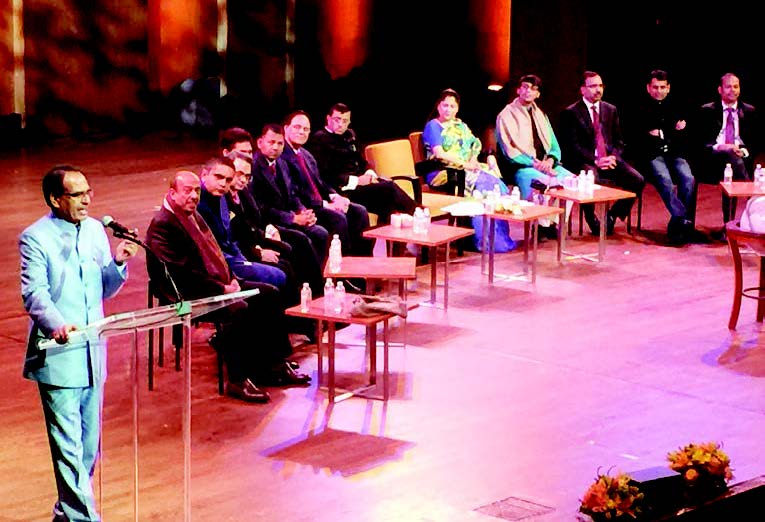
    NEW YORK CITY (TIP): “I am here to make friends”, said Madhya Pradesh Chief Minister Shivraj Singh Chauhan, amid applause from the audience, at the Friends of MP conclave at the iconic Avery Fisher Hall at Lincoln Center in New York City, February 1.


    Despite inclement weather more than 3000 people traveled to the centre of New York  to cheer Shivraj Singh Chouhan, when he arrived here to launch the initiative to connect the global  citizens with Madhya Pradesh and India. On the second day of his six-day visit to the tri-state area on  the US East Coast, Chauhan formally launched the Friends of Madhya Pradesh initiative (www.friendsofmp.com).


    The website is the  first of its kind of initiative by any state in the country following suggestion by  Prime Minister of India Narendra Modi that sought the creation of a global talent pool as a network of its friends anywhere in the world.


    Amid claps of a full house filled with NRIs, state senators, US congressmen and congresswomen, and other important business and community leaders from across New York, New Jersey, Long Island, Connecticut and other neighborhoods, beats of drums and dholaks, the fluttering of national flag, Chief Minister  and guests on the dais formally inaugurated the website friendsofmp.com by putting hands on the globe that symbolized the connected world and with that the site went live on a giant screen right above the stage.


    In his half-hour Hindi speech interrupted by loud applauses at several intervals and slogans in praise of Bharat Mata (Mother India) on various occasions, the chief minister stated that his government for the last decade has not only been undertaking welfare measures, but also useful employment-generating programs that have changed the face of the state.


    With GDP at  11.08 percent and more than 20%   rise in agricultural production in the last several years, the state has become one of the fastest growing states in the country.


    Citing estimates and positive outlook, he said India would soon overtake China in economic growth and Madhya Pradesh will take a significant part in that process.


    He mentioned that after Narendra Modi became the prime minister in May 2014, the self-confidence level of Indians-inside and outside the country-has risen in a significant way. Now  no longer the “policy paralysis”, the hallmark of the previous government, exists at the Center and in states.He added that Modi is not just the leader of India, but he is on the path to becoming a world leader. He spoke of the assets of his state-  a 24-hour power supply, availability of enough water, and calm and peaceful industrial climate. Around 26,000 hectares of land bank has been created to cater for potential investment and industrial opportunities. Steps are being taken to ensuring up to 30 percent police force is female in order to tackle more efficiently the crimes being perpetrated against women.


    He spoke about several issues that included religious harmony, America-India relations, and BJP’s determination in providing good governance and clean administration.


    Chief Minister  honored the recipients  of recent Padma awards on the occasion and praised their contributions and sought their services to India in general and the central state in particular.


    “I bring the best wishes of 7.5 crore (75 million) residents of Madhya Pradesh to you all,” he said. “You contributed to this society immensely and now you must do the same to India, your motherland.”


    A view of the gathering singing the American National Anthem Photos/ TIP- Prashant Desai-pradev98@yahoo.com 732-318-0130
    A view of the gathering singing the American National Anthem Photos/ TIP- Prashant Desai-pradev98@yahoo.com 732-318-0130
    Singing the national anthem
    Singing the national anthem

  • Was BJP’s Loss In Delhi Intelligently Planned?

    Was BJP’s Loss In Delhi Intelligently Planned?

    There were enough signs to indicate what you see in Delhi may not be true at all. 

    BJP is a very well organized outfit with sympathizers in every layer of government, judiciary, media, commerce and industry. It is unlikely all this is happening due to poor management. Then is all this ‘bad management’ part of a deliberate plan to lose Delhi? A lot actually.

    Here are some reasons why:

    1: BJP inducted three rejects of India Against Corruption movement and Aam Aadmi Party (AAP) into its fold — Kiran Bedi projected as BJP’s chief ministerial candidate, Shazia Ilmi and Vinod Kumar Binni. As per plans Bedi is BJP’s scapegoat to save Modi’s image.

    2: Kejriwal’s Delhi WIN will be projected as a victory of a mass movement, media will eulogize Kejriwal, hail him as a hero and will dissect AAP’s campaign for days. Also this will divert attention of the people who are getting restless from Modi’s inability to deliver on his election promises. 

    3: Kejriwal will have no honeymoon period, both media and voters will demand immediate results, at least on corruption, power tariffs, VAT (value added tax), health hotline and WiFi. A hostile government at the Centre will not help him either. This spotlight on Kejriwal will come as a huge relief for Modi.

    4: Sangh Parivar machinery can now unleash its foot soldiers to polarize voters with low-intensity disturbances ahead of the two big battles — Uttar Pradesh (UP) and Bihar.

    5: BJP’s top brass is aware that if the party plans to win Delhi, the state will remain a headache — partly due to Kejriwal in opposition and partly because of impatient voters who expect immediate results and good governance, something the BJP is unsure of delivering. Proving that losing Delhi isn’t such a bad idea! 

    6: Now BJP can deploy numerous tactics to not let Kejriwal do what he want’s thus proving him a failure in Delhi. BJP team knows that many of the promises by kejriwal are impractical and cannot be fulfilled and this will snatch his ‘Nayak'(Hero) image. 

    7: This undeliverable performance of Kejriwal will surely break his image through out the country making him unpopular in other states limiting his scope in next Lok Sabha Elections.

    8: Now the One-Man-Army AAP will not be able to spread itself in other states nationwide because the face(Kejriwal) of party will be busy managing Delhi for next 5 years. And there is no other mob-attractor face in AAP.

    9: BJP knows that if they win Delhi, Kejriwal in Opposition will make their life hell and will criticize their every action if its not the best one. 

    10: Now the media houses have 2 faces Modi and Kejriwal to criticize. BJP knows this will surely save Modi from being the only target of media & mass criticism.

    source: story alert

    Disclaimer: The opinions expressed are personal opinions of the author

  • How tables have changed – Delhi Elections

    How tables have changed – Delhi Elections

    In a dramatic change of events in the Delhi Assembly Elections, the results have swinged totally in favor of the Aam Aadmi Party (AAP).

    Aam Aadmi Party (AAP) the now well known anti-corruption party has won a stunning victory in the Delhi state elections in a huge setback for India’s Prime Minister Narendra Modi.

    [quote_center]Mr. Kejriwal’s party won 67 of the 70 assembly seats[/quote_center]


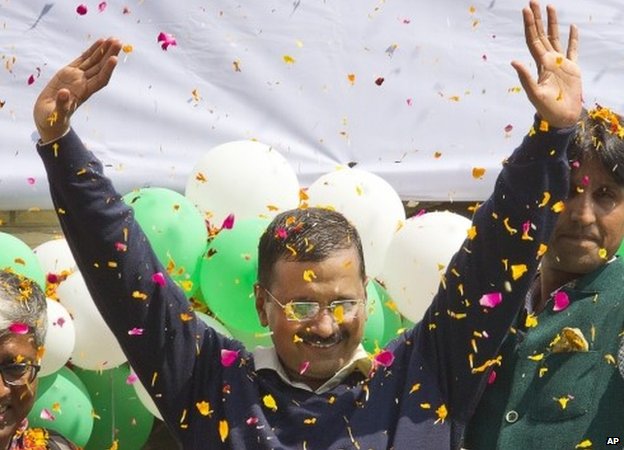
    Mr Kejriwal told cheering party supporters that the “people of Delhi have achieved something spectacular”.

    “With the help of people, we will make Delhi a city which both poor and rich will feel proud of,” he said.

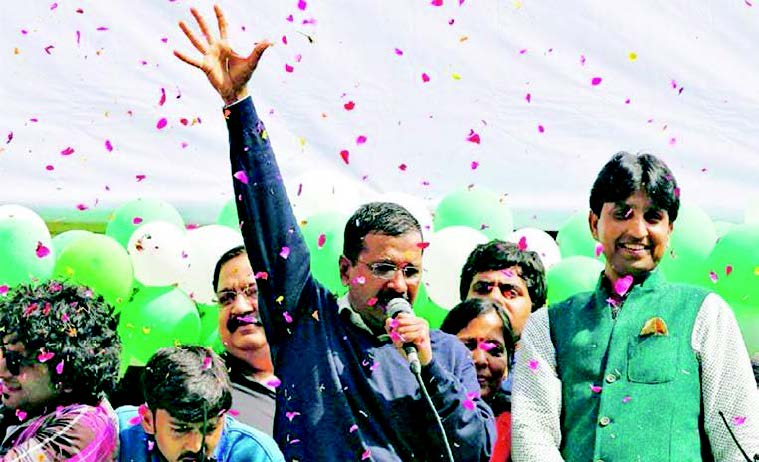
    As supporters showered him with rose petals, Mr Kejriwal said the huge mandate was “very scary and we should live up to people’s expectations”.

    [pull_quote_center]Final results gave Mr Modi’s Bharatiya Janata Party (BJP) just three seats. India’s main opposition Congress party failed to win a single constituency.[/pull_quote_center]

    NEW DELHI Elections 2015:  PARTY WISE SEAT SHARE
    NEW DELHI Elections 2015: PARTY WISE SEAT SHARE

    PM Narendra Modi congratulated the AAP leader, whose career seemed doomed a year ago when he quit as Delhi’s chief minister over a crucial anti-corruption bill. It is the BJP’s first setback since it triumphed in the 2014 general election.


  • DELHI ELECTIONS AND LESSONS TO LEARN

    DELHI ELECTIONS AND LESSONS TO LEARN

    Even if BJP wins the Delhi there are some reminders/lessons to Narendra Modi and BJP leaders that they cannot afford to ignore.   


    Lesson 1:  Local corruption:


    While BJP under leadership of Narendra Modi is addressing macro issues of investments and economy, they cannot afford to ignore the issues such as the oppressive and extortionist local corruption that are daily faced by common man. In this wonderful article Rediff details interviews on how petty corruption disappeared overnight during 49 day AAP rule in New Delhi. Whether that would have continued if they ruled further is debatable, but it struck a chord with the common man. A similar sentiment was expressed to me by an executive working in an MNC in Mumbai who was strong supporter of Modi saying AAP will be good for the country because it will force BJP leadership to address local corruption. He said such was disdain to Mumbai police even among middle class, if there is a police person found dying on the street, they would leave him or her to die. Whether getting a license or ration card or even a death certification for a dead family member, Indians are subject to horrendous extortion and nothing was done, nay even talked about in BJP circles. I remember when Modi won, there was this euphoria that the days of this extortion and oppressive local corruption will be gone, but none of that is even talked about today by BJP.


    Lesson 2:  Connecting with common man


    Narendra Bhai can take a leaf from the life of Mahatma Gandhi. If Modi wondered why does the feverish pitch for him during central elections is missing today, is it possible he is missing opportunity to associate with common man. Gandhi ji hardly spoke, but he was a powerful figure because he completely associated with common man, wearing simple loin cloth, eating most simple food, living humble life. Symbols matter and in a country where most people are poor it is important not to flaunt any displays. A poor man may not understand all the financial strategies but he quickly picks up the visual vibrations. True, the tragedy is most of the netas in India who plundered the nation to the hilt did so by wearing simple white khadi dress. 


    Even then, Modi should pay attention to wearing flaunting dresses. In spite of the hard work he is putting day and night, in spite of impeccable credibility, the common man associates with visual symbols and they do matter.


    Lesson 3:  The black money – managing expectations


    After  big words that they will get the black money BJP failed miserably in managing the expectations. The fact of the matter is in spite of talking about black money for more than three decades, Ram Jethmalani, who was himself once in power could do very little to get the money back. The secret banks exist for one thing only, protect the secrecy of their depositors and  they are not going to bend over backwards to hand over the details to India. We are just living in fools’ paradise that black money will be back in no time. But then it begs a question, what is stopping BJP in declaring the black money national asset and come up with amnesty scheme to instill confidence in the common man? In one of the interviews Narendra bhai said while he would not go after anyone with vengeance he would not obstruct legal proceedings. If this is correct, why is Dr Swamy case against Sonia continues to drawn out?   Many believe Jaitley is the biggest block. To be fair, Narendra Modi is thinking beyond and many of us may not realize his vision. If BJP goes after Gandhi family, with its entrenched 60 year rule and immense resources, they have potential to do enormous damage and immense harm to discredit Modi’s efforts for improving country. Modi may want to first focus on building the nation instead of getting distracted with those that can undermine his efforts. As he said why should India be satisfied with just 2 trillion why not target 20 trillion. This is in tune with how Modi handles things brilliantly where he does not spend energy fighting enemies, he simply makes them irrelevant. The problem is either Jaitley is being overzealous in protecting black money holders such as Gandhi family or BJP is doing a very poor job of managing expectations.


    Lesson 4:  The foreign economists obsession


    There seems to be this obsession with foreign educated economists, some who even went against India and that is supposed to show that we do not get carried away with smaller issues and use the best talent. But is the best talent only available from western educated economists only?   How about the economists from our own country. Here comes again the Jaitley view. While he is considered a brilliant person, his tendency to rely heavily on the West educated so called intellectuals shows India needs only western educated minds to solve it issues. Jaitley budget is considered no different that the budget of previous administration. There are many sane voices in the country with very constructive ideas whether it is water resource management, debt trap, food security etc., but does Jaitely have patience to get all inputs before finalizing the budget.


    Lesson 5:  The Jaitley factor


    There is no doubt Modi and Jaitley are very close. The problem is people voted for Modi but not for Jaitley. Talk to many people in RSS, BJP, they feel that Jaitley has the biggest stamp in administration and is viewed by many as a western educated intellectual who have little touch with real life issues of India. He grew up with wheeling dealings of corrupt Delhi establishment and can serve very important role, but is the importance he is playing in Modi administration in the best interest of the nation?   Issues like local corruption are not even on his radar.


    Lastly, the purpose of the article is not to show support for  AAP to capture power. They have potential to play a very pernicious role by playing into hands of dangerous western NGOs, the CIA, the missionaries who are hell bent to break the hold of nationalistic leadership that holds power in India today. But they are rabble rousers who can play an important role in a democracy and they are serving a call for course correction in BJP. It is a gentle reminder of India’s great democracy, ‘BJP, thy need to introspect’.


    By Satya Dosapati – (The author is a US based  social activist. He can be reached at narayanasd123@gmail.com)
  • CAMPAIGNING ENDS: ROADSHOWS, RALLIES MARK THE DAY AS CAPITAL BATTLE GOES DOWN TO THE WIRE

    CAMPAIGNING ENDS: ROADSHOWS, RALLIES MARK THE DAY AS CAPITAL BATTLE GOES DOWN TO THE WIRE

    NEW DELHI (TIP): The high-octane campaign for the Delhi Assembly came to a close on February 5, 48 hours ahead of the February 7 polls in which the BJP is seeking to gain majority in the face of strong challenge from the Aam Aadmi Party (AAP).


    February 5 saw some heavy duty and intense campaign by the principal contenders and the Congress, which still hopes to be up and counted having been rejected by the voters of Delhi towards the end of 2013.


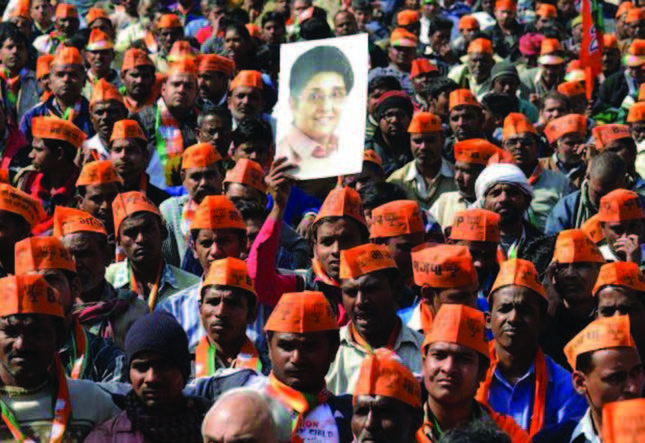
    BJP president Amit Shah and its chief ministerial candidate Kiran Bedi held roadshows to demonstrate the strength of the party. The strength of its cadres was no less than the large number of supporters AAP who joined a similar roadshow by Arvind Kejriwal in his Gole Market constituency.


    Although the focus was not so much on the Congress, the party vice president Rahul Gandhi stepped out in Sultanpur Majra for a roadshow which seems to be the more preferred way of reaching out to the people in an informal way.


    The BJP asked its battery of leaders to spread out in each of the 70 constituencies while its RSS
    ‘karyakartas’ began reaching out door-to-door. Stepping up the attack on AAP, BJP chief charged that the AAP received donations in black cautioning that the party “goes back on what it promises”. Speaking in Hindi he said Kejriwal’s challenge to arrest him was made knowing that no probe was possible during elections.


    The BJP chief harped on development and welfare schemes of the Modi government as also rise in the prestige of the country since the BJP government came to power. AAP chief Arvind Kejriwal attacked the BJP saying it’s their ‘religion’ to attack others and like Duryodhana of Mahabharat the entire administrative apparatus was with it, while the nascent AAP had God on its side.


    Kejriwal started his campaign from Mandir Marg in New Delhi constituency today and said he was getting amazing response. “Just amazing response. Unbelievable. Kuch adbhut hi ho raha hai. Its all divine,” Kejriwal said in a tweet.


    The AAP chief exuded confidence, saying the party was “following the path of truth”.


    Adding strength to the support base, the Trinamool Congress and the Janata Dal (United) too endorsed AAP in the battle for the ballot in Delhi. BJP leaders Shah and Union Minister M Venkaiah Naidu have already said that the Delhi election was not a referendum on the Modi government’s performance.


    The Congress, which had been in the saddle for 15 years till December, 2013, has been lagging way behind AAP and BJP in pre-poll surveys.

  • Delhi polls: Survey predicts absolute majority for BJP

    Delhi polls: Survey predicts absolute majority for BJP

    The BJP is projected to get absolute majority in Delhi and win between 41-45 seats and AAP is likely to secure the second place, according to a survey by Research and Development Initiative (RDI). The survey states that AAP is likely to win between 21-25 seats in the 70-member Delhi Assembly.


    NEW DELHI (TIP): The BJP is projected to get absolute majority in Delhi and win between 41-45 seats and AAP is likely to secure the second place, according to a survey by Research and Development Initiative (RDI).


    The survey states that AAP is likely to win between 21-25 seats in the 70-member Delhi Assembly.


    The vote share projection has given BJP 41 per cent and AAP 36 per cent. Where as, Congress is likely to bag between 0-4 seats with a vote share of 12 per cent, according to the survey in the last week of January.


    In the 2013 election, BJP had won 31 seats with a vote share of 33 per cent, while ally SAD had got one seat. AAP had bagged 28 seats with a share of 25 per cent and Congress got 8 seats with a share of 25 per cent votes.


    According to the survey, BJP’s Kiran Bedi is the top choice as a chief ministerial candidate with 46 per cent of people favouring her.


    The survey projected AAP chief Arvind Kejriwal second in the run with 40 per cent voters supporting


    him. Congress’ Ajay Maken managed to secure the third position in the survey with 12 per cent voters in his favour.


    The survey was conducted with a sample size of 21,000 registered voters with a representative sample of 300 registered voters from 25 polling booths drawn in each constituency.


    Delhi will go to polls on February 7 and the results will be declared on February 10.


    What other surveys say?


    BJP seems to have gained in four pre-poll surveys with three of them projecting it may touch the majority mark in the 70-member Delhi Assembly.


    While the India TV-C-Voter survey gives BJP 37 seats, it projects 28 seats for AAP and 5 for Congress in the polls.


    The Week-IMBR survey gives BJP 36 seats and AAP 29 seats while only 4 seats to Congress.


    Another pre-poll survey by Data Mineria, telecast by IBN-7, has also given BJP 36 seats and AAP 27 seats, with 7 to Congress.


    A Zee-Taleem survey has projected 32 to 36 seats for BJP, 30 to 34 for AAP and 4 for Congress while News Nation channel has given BJP 30-35 seats, AAP 30-34 and Congress 3-5. An internal survey by AAP claimed a clear majority for it giving itself 51 seats followed by 15 to BJP and four seats for Congress.


    AAP leader Yogendra Yadav, himself a psephologist, said in the best case scenario AAP may get 57 seats and in the worst it will bag at least 44 seats.


    The India Today-Cicero pre-poll survey yesterday projected AAP will get 38-46 seats and BJP will secure 19-25 seats. Congress was placed way behind with only 3-7 seats.


    In the ‘Poll of Polls’ by Times Now TV channel based on the results of five polls, AAP gets 34 out of 70 seat while BJP 32 and Congress 4. Yadav termed the survey results of some TV channels as “serious underestimation of the ground reality”.


    In the 2013 Assembly election, BJP had won 31 seats, AAP 28 and Congress 8.

  • J-K MAY GET NEW GOVT SOON AS BJP, PDP REACH UNDERSTANDING

    J-K MAY GET NEW GOVT SOON AS BJP, PDP REACH UNDERSTANDING

    JAMMU (TIP): Jammu and Kashmir may have a democratically elected government soon as both the Peoples Democratic Party and the Bharatiya Janata Party have arrived at a broad understanding over the issue of government formation in the sensitive border state. Significantly, indications about it came from senior leaders of both parties during their separate meetings with State Governor N N Vohra at Raj Bhawan. The BJP’s national general secretary (organization) Ram Madhav had nearly half an hour long meeting with Vohra in the afternoon. Madhav was accompanied by party’s state president and MP from Jammu-Poonch constituency, Jugal Kishore Sharma, and newly elected MLA from Billawar Dr Nirmal Singh who also happens to be party’s national executive member.


    Later, senior PDP leader and MLA from Rajpora, Dr Haseeb Drabu who has been authorized by the party to hold talks with BJP on government formation also met the Governor. Though both sides remained tight lipped over the deliberations having taken place between their respective leaders and the Governor, sources said that these were confined to political situation vis a vis government formation in the state. The meetings assumed significance as both Madhav and Drabu have been authorized by their respective party high command to hold talks with each other on government formation in the state. Sources said that both the respective party leaders apprised the Governor that their talks have reached a formal stage where almost all the issues between them stand sorted out. During the meeting, Governor told one of the party delegation that he too wanted an early government formation in the state so that it starts working soon. The PDP patron Mufti Mohammad Sayeed had only last week admitted that track-II talks between his party and the BJP were in progress. Pointing out that while people gave mandate to PDP in the Valley and BJP in Jammu region, Mufti said that “if my shaking hands with them (BJP) will benefit the state, I will do that.” Prior to it, Minister of State in the PMO Dr Jitendra Singh had admitted that some authorized leaders from both the BJP and PDP were in touch with each over issue of government formation. He, however, had refused to divulge details saying that it would create problems for
    “authorised” leaders holding talks on the matter. In the hung Legislative Assembly, PDP has 28 members, closely followed by BJP (25), NC (15), Congess (12) and others (7). Though Congress and NC had offered support to PDP for government formation, the latter preferred BJP as it would amount to defeating the mandate of the people who had defeated both these parties during the 2014 assembly elections. An indication of their having reached a broad understanding over government formation became evident recently when both the PDP and BJP decided to contest only two Rajya Sabha seats each so as to avoid fielding candidates against each other during elections being held on February 7. The Jammu Kashmir is under Governor rule since early this month.

  • PADMA AWARDS 2015 : REPORTS

    PADMA AWARDS 2015 : REPORTS

    PADMA AWARDS 2015 TO RAMDEV, AMITABH BACHCHAN, RAJINIKANTH, ADVANI, OTHERS: REPORTS NEW DELHI (TIP): Yoga exponent Baba Ramdev, Bharatiya Janata Party patriarch LK Advani, spiritual leader Shri Shri Ravi Shankar and veteran actors Amitabh Bachchan and Rajinikanth are among this year’s recipients of the prestigious Padma awards that recognises lifelong service to the country, according to a report.


    The awards this year, to be conferred on Republic Day, has several names seen as sympathetic to the ruling party, including lyricist and adman Prasoon Joshi, who worked on the BJP’s advertisement campaign for the Lok Sabha elections, and journalists Swapan Dasgupta and Rajat Sharma. Economist Bibek Debroy, a member of the newly instituted NITI Aayog, is also on the list.


    Padma awards, given since 1954 on Republic Day in honour of contributions in wide-ranging pursuits, have often been subject of controversy due to the arbitrary nature of the selection process and inevitable charges of favouritism by the government and the ruling party. They are given in three categories–Padma Shri, Padma Bhushan and Padma Vibhushan, in ascending order of distinction. It’s unclear which names have been picked for which awards.


    Punjab Chief Minister Prakash Singh Badal and Advani are the only two politicians in the list of 148 recipients, the report stated.


    Yoga exponent Ramdev, whose dedicated yoga television channel and camps are popular, is nonetheless a controversial figure, having said in the past that he can
    “cure” homosexuality, among other things. His company Patanjali Ayurveda makes consumer products such as soaps, oil and breakfast cereals and in five years had sales worth Rs. 450 crore, with a turnover expected to touch Rs. 2,000 crore.


    Actor Dilip Kumar, director Sanjay Leela Bhansali and scriptwriter Salim Khan, badminton player P V Sindhu, wrestler Sushil Kumar and Arunima Sinha, the first woman amputee mountaineer to climb Mount Everest, are among those honoured.


    Badminton player Saina Nehwal, who had kicked up a storm about not being nominated and was subsequently included in the list of contenders, has not been awarded, if reports are accurate. The official list is expected to be out today or tomorrow.


    T V Mohandas Pai, the Chairman of Manipal Global Education and a former director of Infosys, shares the honour with former bureaucrat N Gopalaswami (ex chief election commissioner), K S Bajpai and P V Rajaraman.


    Eminent vocalists Sudha Raghunathan, A Kanyakumari, Girija Devi and Malini Awasthi, actor Smriti Biswas, music directors Anu Malik and Ravindra Jain and Assamese film director Jahnu Barua are said to be on the list. This year two scientists from ISRO–S Arunan of the Mars Mission and S K Shivkumar of Chandrayaan–will also be felicitated, the Express report said.


    Padma Awards not yet announced: Govt 


    The Ministry of Home Affairs on January 23 said that the government has not yet announced any names for the Padma Awards, 2015, and added that the names appearing in the media are speculative.


    “Government has not yet announced Padma Awards for 2015. These awards are announced on 25th of Jan every year, on the eve of the Republic Day,” it said.


    “The names appearing in the media are speculative and there is no official confirmation for the same,” it added.


    Media 3reports have been speculating that spiritual guru Baba Ramdev, actor Amitabh Bachchan and BJP veteran L K Advani may be conferred the Padma awards on Republic Day.

  • POLL SHOWS BACKING FOR KIRAN BEDI

    POLL SHOWS BACKING FOR KIRAN BEDI

    NEW DELHI (TIP): The tables appear to be turning in favour of the Bharatiya Janata Party (BJP) as the Delhi assembly election draws closer. The difference is Kiran Bedi, the former police officer who is now the BJP’s campaign face. Instavaani asked the public if they approved of the BJP’s new chief ministerial candidate.


    A majority, 65%, said they approve of the new entrant, 28% disapprove and 7% have no opinion. Asked if the move would win the party their votes, 60% said they are likely to vote for the BJP because Bedi is the chief ministerial candidate, 24% said that they are less likely to do so and 16%said Bedi’s entrance has not influenced their choice.


    InstaVaani asked respondents which party they would vote for if the polls were to be held today. In a 15 January poll, the Aam Aadmi Party (AAP) was slightly ahead, with 49% saying Arvind Kejriwal’s party would win this election. Now 66% of the respondents polled say that if the elections were to be held today, their vote would go to the BJP, 27%said they would vote for AAP, 5%opted for the Congress and 2% for others.

  • Kiran Bedi joins BJP with Chief Ministerial  ambition

    Kiran Bedi joins BJP with Chief Ministerial ambition

    BJP chief Amit Shah presents a bouquet to Kiran Bedi to welcome her into the party during a press conference in New Delhi.

    NEW DELHI (TIP): Not unexpectedly, former Team Anna member Kiran Bedi on Thursday, January 15, joined the Bharatiya Janata Party (BJP), and laid bare her chief ministerial aspirations before party president Amit Shah as she marked her “40 years of experience in administration” and ability to “extract work” from people.

    Apart from Bedi, other well known women leaders, too, may join the BJP. Former Samajwadi Party MP and actor Jaya Prada and former Aam Aadmi Party leader Shazia Ilmi are in talks to join the BJP.

    Bedi was the first woman IPS officer. She joined the service in 1972. She made a high-profile entry into the BJP in the presence of Shah and Finance Minister Arun Jaitley during a press conference at the party’s Ashok Road headquarters.

    While the BJP was reluctant to disclose the seat identified for launching Bedi in the polls, the social activist used her introductory statement to pitch herself as an experienced administrator.

    “I have 40 years of administrative experience, now I am here to present my experience to Delhi,” she told the gathering.

    “I can work and know how to get work done from others. Together we will work and extract work from others as well.”

    The former top cop had met Prime Minister Narendra?Modi along with Shah before becoming a BJP member.

    She said she was inspired by Modi’s leadership qualities which prompted her to take a plunge into politics.

    The anti-corruption crusader stressed she was on a “mission mode” and would work towards a steady, stable and corruption-free government.

    Shah praised Bedi, saying that she would strengthen the BJP’s Delhi unit and offer “constructive contribution” in elections and government formation.

  • Delhi to go to polls on February 7, counting on 10th

    Delhi to go to polls on February 7, counting on 10th

    NEW DELHI (TIP): The national capital will go to the polls on February 7 with the Aam Aadmi Party (AAP) hoping to beat its stunning debut performance a year ago, while the Bharatiya Janata Party (BJP) faces another big test of its popularity after back-to-back election wins at the Centre and in state assemblies.

    Results will be announced on February 10. Delhi has been under President’s Rule for almost a year since the Arvind Kejriwal-led AAP quit after just 49 days in office, most of them dominated by public sit-ins, conflicts with electricity, water and law enforcement agencies as well as a power struggle with the Centre.

    Most analysts see the election as a two-way contest between the BJP and AAP with price rise and women’s safety emerging as key electoral issues, though the Congress is also looking to revive its fortunes in the 70-member assembly following a string of defeats last year.

    BJP: Eyeing absolute majority

    Unable to get the magic number in 2013 assembly elections despite a strong anti-incumbency wave against the ruling Congress, the BJP was forced to sit in the opposition as AAP formed the government with outside support from the Congress.

    But with consecutive wins in the Lok Sabha polls and then assembly elections in Haryana, Maharashtra, Jharkhand and a good showing in J-K, the BJP has the momentum going. Also, the party won all seven parliamentary seats in Delhi. However, like the last time, the party is finding it difficult to project a

    chief ministerial candidate. With too many in the race for the top post, the party has decided to bank entirely on brand Modi to keep infighting at bay.

    The party’s campaign has been designed solely around Modi and the Prime Minister will address a rally each in all parliamentary constituencies. Unlike AAP and Congress, the BJP is yet to announce its candidates.

    With successive electoral reverses leaving the Congress weak, the party is in a direct contest with AAP. The Arvind Kejriwal party has taken the lead by announcing names for all 70 seats and going door-to-door seeking votes. Though pre-poll surveys are giving a clear majority to the BJP, it remains to be seen whether it lives up to the hype.

    AAP: Looking to better 2013 tally

    When the AAP came second in 2013 on its electoral debut, winning 28 seats in the 70-member Delhi assembly, volunteers looked ecstatic. Even many of their leaders shared, in private, that the result caught them by surprise as the party went on to rule Delhi for a brief period.

    But the decision to quit is something that has never stopped hurting AAP. It still enjoys support among the lower-middle class and the poor of Delhi. But many of those more affluent did not—and continue not to—approve leaving Delhi for national footprint.

    The party is projecting its “governance potentials” to demonstrate that it is prepared to stay the course. Through policy blueprints, it is fighting its image of a one-issue (corruption) party driven only by agitation.

    The party also has built an organisational structure and is trying to build a perception about the “good works” it did ‘with Congress’ in those 49 days. But this time around nothing short of a clear majority will do.

    The question is: will the party get there, as Delhi BJP hides behind party strongman and PM Narendra Modi? “I will not claim that we’re sure to win. It’s tough for us, but it’s no less tough for the BJP,” senior party leader Yogendra Yadav said in a recent address to AAP volunteers.

    Congress: Fighting survival battle
    Unlike the BJP and the Aam Aadmi Party, which are aiming to form a government with a clear majority, something that the either party failed to achieve in the 2013 polls, the fight for the Congress is that of survival.

    Despite ruling the Capital for three consecutive terms — between 1998 and 2013 — and a long list of infrastructure projects it completed during its 15-year rule that changed the face of Delhi on its election agenda, the party could not withstand the anti-Congress wave that swept across the city. Its seat tally came down from 43 in 2008 to just eight in 2013. The party’s poor run continued in the 2014 Lok Sabha elections when all seven sitting members of Parliament lost by huge margins, four of them forfeiting their security deposit.

    Not much seems to have changed for the Congress in the past few months. The poor, Dalits and the minorities, which were ardent followers of the Congress and had been voting for the party for the past several years, started gravitating towards the Aam Aadmi Party, which was fighting its debut election, in 2013. The trend continued in 2014 Lok Sabha elections too. The party faces an uphill task of bringing these voters back to its fold.

  • TRINAMOOL MINISTER QUITS TO JOIN BJP

    TRINAMOOL MINISTER QUITS TO JOIN BJP

    KOLKATA (TIP): In a major blow to the ruling Trinamool Congress (TMC) government in West Bengal, minister Manjul Krishna Thakur quit the Cabinet on January 15 and joined the BJP.

    Thakur, the Minister for Refugee, Relief and Rehabilitation, joined the saffron party along with his son Subrata, who was also a Trinamool panchayat functionary.

    The TMC is already under pressure as the BJP is making inroads into the state’s political scenario and hundreds of ground-level Trinamool workers have switched sides.

    Thakur’s resignation is likely to give a jolt the party as he represents the Matua community, which forms a large block of the TMC vote bank.

    The Matuas, a community of Hindu refugees who migrated from Bangladesh over the years since partition, have played a major role in the state’s non-BJP vote bank.

    According to analysts, with about a crore voters coming from the community from across seven Assembly constituencies and three districts, Thakur’s departure is likely to hurt the Trinamool’s lot in the polls and could provide a much-needed boost to the BJP. Sources said Manjul Krishna, who acceded to Bongaon Parliamentary seat in a bypoll after it was vacated following the sudden demise of his elder brother Kapil Krishna, has been in talks with the BJP for some time. This is particularly since the ruling Trinamool did not make many moves over amendments in the Citizenship Act, which has been a longstanding demand of the Matuas.

    “The Matuas have been demanding official recognition as citizens since many of them have come from Bangladesh after 1951. The BJP has been making noise over that and the Matuas are hoping that Prime Minister Narendra Modi will be able to take some positive steps,” a senior member of the community said. Manjul Krishna, who admitted that he was disgruntled with the TMC for some time, hoped that his son Subrata would also get a nomination for the 2016 Assembly polls from the BJP.

    ‘No room for good men’

    “I failed to work for refugees despite being a minister. The TMC didn’t allow me to work and I resigned as my conscience asked me to. There is no scope for good men in Trinamool,” he said.

  • GOVT WON’T DILUTE KEY GREEN LAWS: JAVADEKAR

    GOVT WON’T DILUTE KEY GREEN LAWS: JAVADEKAR

    NEW DELHI (TIP): The government has refuted environmentalists’ allegations that key green laws in the country would be “diluted”. Environment Minister Prakash Javadekar says his aim is to improve and smoothen environmental clearance processes by bringing in them “clarity and openness” without compromising on green issues.

    Javadekar, who has indicated his keenness to bring about amendments to legislations during the upcoming Budget Session, says he is still studying the recommendations of the TSR Subramanian report and nothing has been finalised.

    “The report has not been adopted, it has just been put on the ministry’s website for comments. How can they
    (environmentalists) talk of dilution when the laws have not even been drafted? They should wait for the final drafts before reacting,” he says.

    Though the government is keen to amend green laws, these are unlikely to be introduced in the form of ordinances. The government wants the laws to be discussed in Parliament, officials say. “The aim is to bring clarity in law and process and reduce the court’s intervention in matters related to clearances. Linking the Subramanian committee report to laws is wrong. The report is in public domain. Anyone can see it and give their opinion on it. The standing committee also has its own opinion and rights,” said an official.

    The high-powered committee under former Cabinet secretary Subramanian was set up by the Narendra Modi government to assess the existing environment and forest laws and recommend amendments “to bring them in line with changing times”.

    These include the Environment (Protection) Act, 1986; Forest (Conservation) Act, 1980; Wildlife (Protection) Act, 1972; Water (Prevention and Control of Pollution) Act, 1974; and the Air (Prevention and Control of Pollution) Act, 1981.

    In a deposition before the Parliamentary Standing Committee on Environment and Forests, Science and Technology recently, several environmental groups criticised the recommendations of the panel as “counter-productive to the cause of environment”. The BJP-led dispensation is already under attack for “diluting” laws such as the Land Acquisition Act and any change in environmental laws is expected to be fiercely contested by the Opposition in Parliament.

  • 2014-THE YEAR THAT WAS

    2014-THE YEAR THAT WAS

    2014 has not been very different from its predecessors. It has been, like all other years preceding it, a year of mixed events of diverse hues.

    In India, on the political front, the year proved cruel for a 100 old Congress party. Also, it saw the emergence of a new political outfit-Aam Aadmi Party. More importantly, 2014 witnessed the emergence of a new national leader in Narendra Modi and found BJP being catapulted in to power as never before. It was after decades that a political party got a clear mandate to rule.

    On the economic front, the year has been troublesome for the common people of India. Inflation has been too much of a bother for them. However, because of falling prices of crude in international market, Indians were saved from rise in prices of gas, petrol and diesel. Also, it prevented price rise of commodities across the board.

    India did well in its space program. ISRO was successful in placing a low cost probe in to Mars’s orbit.

    India’s Kailash Satyarthi brought honor to the country by being awarded the Nobel Peace Prize.

    2014 saw India freeing itself from the scourge of Polio which had been devastating lives of hundreds of thousands of children every year.

    There was celebration for people of Telangana who got a new state carved for them in 2014.

    However, human tragedies, too, were around. The northern state of Jammu and Kashmir reeled under the worst floods ever. The September 2014 floods wreaked havoc in the State, snuffing out more than 250 lives, destroying more than 3.5 lakh structures, including 2.5 lakh residences, and rendering over 12 lakh families homeless.

    2014 has also been a year of social and communal tensions. The issues of Love Jehad and conversions or gharvapasi created an atmosphere of mistrust and, mutual hatred, to some extent among followers of different faiths. Obviously, it is not a good sign for the nation, prone to easy communal provocations.

    In the world theater, there has been more grief than joy. The Gaza massacre, the killing of school children in Peshawar, ISIS beheading of Western journalists, police killings of a young man in Ferguson and of another in New York, mounting tension between the people and the police in USA, the aviation tragedies involving two Malaysian aircrafts which left hundreds aboard dead, and the usual political rivalries of nations and internal disturbances and dissensions in countries of the world were enough to make people miserable.

    However, like in the past, we do not continue to look back for ever; we look ahead and move on.

    Good bye 2014!

  • NITI AAYOG repalces Planning Commission;  Indian American Arvind Panagariya appointed vice-chairman

    NITI AAYOG repalces Planning Commission; Indian American Arvind Panagariya appointed vice-chairman

    NEW YORK (TIP): Columbia University economist Arvind Panagariya will be the first vice-chairman of the National Institution for Transforming India (Niti) Aayog, which will have two full-time members — economist Bibek Debroy and former DRDO chief VK Saraswat, a statement issued by the Prime Minister’s Office (PMO) said Monday, January 5.

    Panagariya, 62, is a professor of economics at New York’s Columbia University, a former chief economist at the Asian Development Bank and has also worked with the IMF, WTO and World Bank in various capacities.

    A staunch advocate of free-market economics, Panagariya has over the last two years been writing advisories to the BJP about how to manage the fiscal situation, sources said.
    The PMO also nominated home minister Rajnath Singh, finance minister Arun Jaitley, railways minister Suresh Prabhu and agriculture minister Radha Mohan Singh as ex officio members.

    Transport minister Nitin Gadkari, HRD minister Smriti Irani and social empowerment minister Thawar Chand Gehlot will be special invitees of the Niti Aayog that replaces the 65-year-old Socialist-era Planning Commission.

    Prime Minister Narendra Modi will head the body and its governing council will include all chief ministers and lieutenant governors, in line with the PM’s thrust on cooperative federalism that advocates involving states in the Centre’s decision making.

    However, two elected chief ministers — of Delhi and Puducherry — will not be members of the new Niti Aayog.

    The Article 239 of the Constitution defines both Delhi and Puducherry as Union Territories and therefore, their administrators — lieutenant governors — will be members of the panel.

    Under the article, a law providing for assembly in Delhi was enacted in 1991. “As per law, Delhi is a Union Territory. It has been rephrased as National Capital Territory,” said SK Sharma, former secretary of Delhi Legislative Assembly.

    Government sources said that three more members will be appointed to the Niti Aayog soon. In all, the government plans to appoint five full-time members and two part-time members, who are expected to be representative for the academic world.

    Panagariya and other full-time members are expected to join office at Niti Bhawan,erstwhile Yojana Bhawan, in a couple of days.

    Officials could be seen Monday sprucing the rooms, lying vacant for the last eight months, for the new members.

    The government, meanwhile, archived the website of the Planning Commission, and an announcement on Twitter handle Niti Aayog said: “Administrative reforms are underway.

    The NITI Aayog website will be ready in a few days. The process for Transforming India has begun!”

    A new website of Niti Aayog will be launched once the new vice-chairman joins office as officials in Yojana Bhawan does not have authority to issue directions, sources said.

    The reason is that the government has not notified new business of transaction rules for Niti Aayog.

    Officials said Niti Aayog will primarily be an advisory body without having power to allocate funds. The government has allocated the fund disbursement job to the finance ministry, which is also mandated to generate revenue.

    Before the National Democratic Alliance (NDA) government came to power, the Planning Commission used to allocate funds to all central ministries and the state governments.

  • GOVERNOR’S RULE IMMINENT IN J&K

    GOVERNOR’S RULE IMMINENT IN J&K

    NEW DELHI (TIP): Jammu & Kashmir governor N N Vohra has sent a report to the Centre conveying a “political deadlock” in the state in the wake of failure of any party or political formation to cobble the numbers to form the next government as well as Omar Abdullah’s request to be relieved as the caretaker chief minister.

    “The ground situation in J&K is that of a political impasse,” a home ministry functionary said adding that the options indicated by Vohra to resolve it include a spell of Governor’s rule until a party or coalition of parties comes forward to stake claim to form the government.

    J&K elections that concluded on December 20 threw up a badly-hung House. PDP emerged as the single largest party with 28 seats, BJP bagged 25 seats, National Conference 15 and Congress 12 seats. Despite extensive talks on government formation between BJP and the regional parties, particularly PDP, a power-sharing formula is yet to be agreed upon.

    The impasse worsened on Wednesday night with Omar Abdullah requesting the J&K governor to be relieved as the caretaker chief minister. “Just to confirm I did meet Gov Vohra sahib last night and asked him to relieve me as caretaker CM. I had agreed to stay temporarily…Given the situation on the border and 10,000 displaced, the hardships of winter and the continuing need for relief for flood affected, I believe the interests of the state will only be served by a full-time administrator and not a caretaker with no mandate to govern,” Omar tweeted on Thursday.

    Incidentally, Constitutional experts insist that Governor’s rule is not the only option if Omar steps down as caretaker chief minister. “The governor can always appoint another caretaker chief minister, who may not necessarily be a member of the state assembly…This new caretaker may continue till a government is formed, or until the term of the incumbent state assembly expires on January 19, whichever is earlier,” legal expert Subhash C Kashyap said. A senior home ministry official, however, said it was “highly unlikely” that Vohra would go for a new caretaker CM.

  • Post-elections, what J &K needs

    Post-elections, what J &K needs

    The announcement of the election results has justifiably generated enormous excitement, both in the state as also the rest of the country, since the formation of a coalition government is proving to be a daunting proposition. With a turnout of 65 per cent-the highest in two decades-the people have voted overwhelmingly for change. It is a loud cry for basic amenities, people-sensitive governance, development, more jobs and justice. The results have been fragmented. In the 87-member House, the People’s Democratic Party is the largest with 28 seats. The National Conference, expectedly headed for a drubbing, has done better with 15. Its former coalition partner, the Congress, has escaped being fully singed and retains 12. Smaller parties and independents, having won seven seats, are now much sought after for support in forming a stable coalition. It is the BJP, the second largest party (25 seats), that has emerged as the belle of the ball.

    Having been inconsequential for long in the fractious politics of the Valley, the BJP, without even winning a single seat, has occupied political mind-space there, and emerged as a major player in the politics of the state. Its unsuccessful forays across the Pir Panjal range augur well for the democratic health of the state as all the ideological impulses of the political spectrum would now find traction. But on the flip side, it is the polarization of the Hindu vote in Jammu and the counter-polarization in Kashmir, to keep the BJP at bay, which has resulted in a vote palpably on religious and regional lines. Here lies the danger to the internal coherence of the sensitive border state, said to be a microcosm of India as an idea.

    Leaving the acrimony of electioneering behind, this is perhaps not the time to reheat the bubbling curry of recriminations in the state. Prime Minister Narendra Modi and the new coalition government would need to understand the looming dangers of fragmentation, and grapple with the highly complex challenges the state faces. For J&K is central to India’s vision of a truly secular, diversified and decentralized Union. It has consumed enormous political, economic, diplomatic and military resources, and remains to this day one of our national security pre-occupations. Post-elections, Narendra Modi and Mufti Mohammad Sayeed-in the event he heads the coalition – would have been cast in historic moulds. Modi must rise above his party’s Hindutva agenda, being pursued elsewhere in the country, and fulfill his promised commitment to Bharat Ratna Atal Bihari Vajpayee’s vision of “Insaniyat, Jamhooriat and Kashmiryat” to build a future for the youth of the state. The Mufti’s statesman-like and sagacious political attributes would help provide the psychological-emotional ‘healing touch’ for the much-needed youth engagement.

    Externally, India would have no truck with major powers taking initiatives to help address the Kashmir issue. Nor for that matter would it countenance the United Nations. The problem can only be resolved bilaterally by India and Pakistan. This track remains blocked. For even after the recent barbaric and heart-rending Peshawar school killings, it is unlikely that Pakistan would end its terror doublespeak any time soon.

    As Nida Fazli laments:
    Khoon ke napaak yeh dhabey Khuda se’ kaise chupaoge’ Masoomon ki kabron’ par chad kar Kaun se ‘jannat jaoge’?
    It is the internal New Delhi-

    Srinagar/Jammu/Leh pathway that offers myriad opportunities. First, in Kashmir, over a quarter of a century, the sense of alienation, notably among youth, runs deep. Their move from victimhood to grievance to resistance, with possible temptations of armed fighting is discernible. Afzal Guru’s hanging and the shoddy handling of the episode exacerbated the angst. Prime Minister Modi would need to encourage and empower regional sentiments and voices, and help provide political space rather than dilute regional identity. This is an important consideration to achieve greater cohesiveness of the three regions and dilute the consequential impact of religious identities and regional orientations affirmed by the vote.

    Secondly, equitable development of the three regions and promotion of a deep inter-regional (in effect, inter-faith) dialogue would dilute belligerence, and bridge the gap between Srinagar, Jammu and Leh. Simultaneously, layers upon layers of mutual inter-dependence, in a rising economic trajectory, would help create countervailing resilience against disruptive trends.

    Lastly, Wahabi-Salafi impulses have generated trends of religious radicalization among youth and its offshoot of willingness to take up arms, fanned by social media networking. This challenge is best met politically. Also the state’s inherently tolerant society, its elders, and community leaders, would need to draw upon the wellsprings of the sub-continent’s famed Sufi Islam which still envelops Kashmir, like the rest of India. Significantly, over 71 per cent of those elected are known to be committed to inclusive, secular and pluralistic sentiment.

    The important issues of Article 370, Armed Forces Special Powers Act
    (AFSPA) and return of Kashmiri Pandits need imaginative and creative handling. It would be instructive to recall that J&K is the only Part B state that negotiated its membership with the Indian Union, leading to its special status, legally sanctified by Article 370 of the Indian Constitution. It is a special identity marker the Kashmiris deeply cherish, and it would be unwise to seek to revoke it.

    As to AFSPA, people see it as one of the anti-democratic draconian statutes in force for decades along with the Disturbed Area Act and the Public Safety Act. Yet if the Army has to perform under tough conditions and circumstances, such powers are necessary for effective counter-terrorism operations. The answer perhaps lies in a discerning and gradual lifting of AFSPA from select areas, in consultation with the Army, along with stricter adherence to the guidelines, rules of engagement and standard operating procedures.

    The return of the hapless Kashmiri Pandit community, circumstantially clawed out from their geo-cultural moorings, has wide-ranging support in the Valley. But their proposed housing in ghetto-like conclaves would fly in the face of Kashmir’s inclusive and secular credentials, and give rise to a feeling of ‘otherness’. A dribble rather than mass flow needs to be encouraged through provision of liberal financial assistance, attractive employment packages and improved living conditions. Such initiatives would serve to create a congenial environment for the dignified return of a proud community that has for millennia been the cultural pivot of Kashmir.

  • BHARAT RATNA for Vajpayee, Malviya

    BHARAT RATNA for Vajpayee, Malviya

    NEW DELHI (TIP): Former Prime Minister Atal Bihari Vajpayeeand Madan Mohan Malaviya will be conferred the nation’s highest civilian honor, the Bharat Ratna, the government announced on December 24 This came on the eve of Vajpayee’s 90th birthday and Malaviya’s 153rd birth anniversary.

    Prime Minister Narendra Modi and other senior BJP members, including LK Advani, will be present when the Bharat Ratna is presented to Vajpayee at his residence in Delhi as he won’t be able to attend a ceremony at Rashtrapati Bhavan due to ill health, a government official said. The date for this hasn’t been decided.

    Pandit Bhimsen Joshi also received the award at his home, in Pune, in 2009. Modi moved the Bharat Ratna proposal to President Pranab Mukherjee on December 23 evening.

    It was accepted by him on December 24 morning. The government had decided a while ago to give the Bharat Ratna to Vajpayee, said the official cited above. “It was only looking for a fitting occasion and what better than his 90th birthday,” the person said. He said the government was also keen to bestow the honour upon Malaviya as he was considered a Hindu nationalist besides being founder of the Banaras Hindu University in Modi’s constituency, Varanasi.

    “Malaviya’s grandson, Giridhar Malaviya, was a proposer of Modi when he filed nomination papers from Varanasi,” the official said. A Bharat Ratna for Malaviya, who was Congress president in 1909 and 1918, also serves to show that the award is not dictated by political affiliation. PM Modi tweeted: “Atal ji means so much to everyone. A guide, inspiration & giant among giants. His contribution to India is invaluable. Pt. Madan Mohan Malaviya is remembered as a phenomenal scholar & freedom fighter who lit the spark of national consciousness among people. Country’s highest honour to these illustrious stalwarts is a fitting recognition of their service to the Nation.”

    The government steered clear of criticising the previous UPA government for not bestowing the honour on Vajpayee. “The time and occasion is correct for the Bharat Ratna to Vajpayee,” Home Minister Rajnath Singh said.

  • Jharkhand gets first non-tribal CM

    Jharkhand gets first non-tribal CM

    Ranchi (TIP): The Jharkhand BJP Legislature Party (BJPLP) on December 26 elected Raghubar Das as its leader, paving the way for the first non-tribal to become the chief minister of the state.

    Das’s name was announced in the presence of two central observers — Union Health Minister J P Nadda and BJP vice-president Vinay Sahasrabuddhe — who arrived here as Narendra Modi’s emissaries.

    The swearing-in will take place on December 28 at Morabadi ground here, which will be attended by the prime minister.

    Since its creation in November 2000, Jharkhand has seen five chief ministers in nine governments and was under President’s Rule three times.

    While Arjun Munda and Shibu Soren each served as the chief minister thrice, Babulal Marandi, Madhu Koda and Hemant Soren each were chief ministers once. Incidentally, all were tribals representing either Kolhan region or Santhal Parganas.

    Das, who began his career as an employee of Tata Group, and later as a trade union leader, has won the Assembly polls for the fifth consecutive time from Jamshedpur East this time.

    The 59-year-old OBC leader, who earlier served as deputy chief minister, had previously won from Jamshedpur East in 1995, 2000, 2005 and 2009. In 2014, he won from his bastion with the highest margin of 70,157 votes.

    In the good books of Modi and Shah, Das is presently the BJP vice-president and was an undeclared rival of Arjun Munda for the top job in the state.

    The defeat of Munda cleared the decks for him. On Friday, he promised “sabka saath, sabka vikas”.

    Deccan Herald was the first national newspaper to have carried a story last week how a non-tribal was likely to be sworn in as the chief minister.

    Senior BJP leader Saryu Roy who won from Jamshedpur West, is one of the contenders for the Speaker’s post. The MLA from Ranchi, C P Singh, who was earlier Assembly Speaker, is the other claimant for the top constitutional post.

    A small ministry is likely to be sworn in on December 28 when Das takes oath. His Cabinet may include Loius Marandi, the Christian BJP leader who defeated outgoing Chief Minister Hemant Soren in Dumka, besides Rajkishore Mahto.

    The All Jharkhand Students’ Union (AJSU), which contested the polls in alliance with the BJP and won five seats, on Friday gave a letter of support to the Jharkhand Governor, thereby taking the strength of the ruling BJP-led alliance to 42 (The BJP has won 37 seats in 81-member House).

    Since AJSU president Sudesh Mahto himself lost from Silli, the regional party elected Chandraprakash Choudhary as its legislature party leader. He, too, is likely to be sworn in as a minister in the Das government.