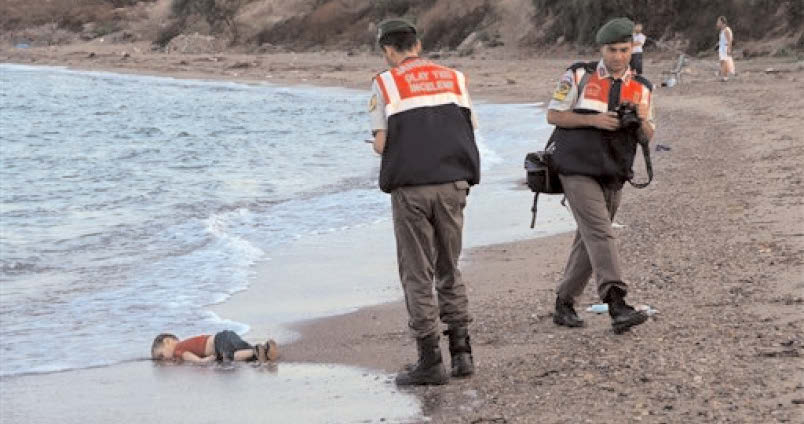
ANKARA(TURKEY) (TIP): Aylan Kurdi, whose 3-year-old body was captured face-down in the surf in images that have horrified the world, set out for Europe only after Canada rejected his family’s refugee application, a Canadian lawmaker says.
Images of Aylan’s body, clad in blue shorts and a red shirt on a Turkish beach, have heightened global attention to a wave of migration, driven by war and deprivation, that is unparalleled since World War II. They are also raising pressure on governments to be more welcoming to refugees fleeing the horror that Syria has become.
Aylan’s aunt, who lives in the Vancouver area, had sought to get Canadian refugee status for her relatives in the Syrian town of Kobani, which was devastated by battles between Islamic State and Kurdish fighters, legislator Fin Donnelly told the Canadian Press. Donnelly submitted the application on the family’s behalf.
Canadian immigration authorities rejected the application, in part because of the family’s lack of exit visas to ease their passage out of Turkey and their lack of internationally recognized refugee status, the aunt, Teema Kurdi, told the newspaper the Ottawa Citizen. It said she is a hair stylist who moved to Canada more than 20 years ago.
Teema Kurdi said the family her brother Abdullah, his wife Rehan and their two boys, 3-year-old Aylan and 5-year-old Galip_ embarked on the perilous boat journey only after their bid to move to Canada was rejected.
“I was trying to sponsor them, and I have my friends and my neighbors who helped me with the bank deposits, but we couldn’t get them out, and that is why they went in the boat,” she told the Citizen.
The tides also washed up the bodies of Rehan and Galip on Turkey’s Bodrum peninsula Wednesday. Abdullah survived the tragedy. In all, 12 migrants drowned when two boats carrying them from the Turkish coast to the Greek island of Kos capsized.
August 28, 2015 New York: Zee TV, the No.1 South Asian Network will now be available on Jadoo TV in Canada. The company has reached a subscriber licensing agreement for its flagship networks Zee TV Canada, Zee Punjabi and Zee Cinema with Jadoo TV. Beginning September 1st 2015, the three Zee networks will be available to all Jadoo TV subscribers in Canada. Zee TV Canada is currently available on all satellite, cable, telco and IPTV platforms and, is one of the fastest growing international channels in Canada. Zee TV Canada will be available in High Definition to all Jadoo TV subscribers.
“Canada is one of the fastest growing markets for us. Our business has more than tripled in last 2 years. This move helps us to further consolidate our position in the market. Jadoo TV has been one of the pioneers in over the top play, which has been the fastest growing category of access”, added Sameer Targe, General Manager, Asia TV USA Ltd.
“We’re excited about bringing Zee TV channels to the largest South Asian viewership base in Canada on JadooTV. Zee TV is not only popular amongst the Indian diaspora in Canada, but also has great appeal amongst the greater South Asian community. The addition of Zee TV, Zee Cinema, and Zee Punjabi will enhance our entertainment offering, making JadooTV the best value for end users. With this agreement, Jadoo TV has further cemented its position as market leader in the OTT space for South Asian diaspora worldwide” said Sajid Sohail, Founder & CEO of JadooTV, Inc.
About JadooTV, Inc.
JadooTV is a consumer technology and content services company based in Silicon Valley committed to delivering Live and On-Demand content to viewers via its proprietary Internet based set-top box (STB). JadooTV is the leading distributor of Internet based South Asian television content, bringing Television, Movies, and Music to South Asian diaspora from India, Pakistan, Bangladesh, Afghanistan, Nepal, and Middle East. JadooTV is privately held and backed by Intel Capital. For further information please visit: www.jadootv.com
TORONTO: A 21-year-old Indo-Canadian woman has mysteriously gone missing from her house in Surrey, prompting police to intensify their search by seeking public help.
Jessie Khatkar was reported missing on August 25 and was last seen at her residence in Surrey City in British Columbia, in the evening on August 23. She has not been seen since, the Royal Canadian Mounted Police said in a statement.
Police yesterday intensified their search by seeking public help to trace a “high-risk” Khatkar.
Khatkar is described by the police as a five feet and four inches tall South Asian female. Police said that it was not immediately known what was she wearing at the time of her disappearance.
According to the woman’s family, it is not usual that she remains out of her family’s touch for so long.
MISSISSAUGA (TIP): Sai Productions and ZEE TV Canada bring the living legend, Gurdas Maan, Live in Concert to Canada. The concerts are being held in 6 big cities across Canada in September, starting with Vancouver, BC on the 5th. The tour promises to entertain attendees with versatile performances and music that will make them want to get up and dance!
ZEE TV Canada is giving viewers a once in a lifetime opportunity to win VIP tickets to the much awaited tour. Additionally, the winner at each city will also receive a backstage pass to take picture with the legend himself !
Don’t miss to watch the up-close and personal interview with Gurdas Maan only on ZEE TV Canada on August 30th, 20:30 EST / 17:30 PST
Sameer Targe, Head of Business for ZEE Americas stated “Shri Maan Sahab is no less than a legend himself. I have never seen as high voltage and engaging performer like him, he can single handedly carry a 3 hour show by himself and still not be tired. It is our privilege to be part of this historic moment and bring an opportunity to our viewers to meet with him in person.”
Text ‘ZEE’ followed by your ‘full name’, ’email address’ and ‘concert city’ of your preference to 54500 OR email: eternaljogi@india.com
For concert schedule and details check out the event site here www.saiproductions.ca
ZEE Americas A pioneer in South Asian entertainment, ZEE TV has become synonymous with unparalleled quality in broadcasting for more than 20 years. An undisputed leader that reaches more than 169 countries, 959+ million viewers globally, ZEE TV has created strong brand equity and is the largest media franchise serving the South Asian Diaspora. As a global brand, ZEE is committed to delivering top notch international content. ZEE TV Canada is one of the fastest growing South Asian channels in Canada and is available on all Cable, Satellite, Telco and IPTV platforms.
The foundations of the Indian National Movement were laid by Surendranath Banerjee with the formation of Indian Association at Calcutta in 1876. The aim of the Association was to represent the views of the educated middle class, inspire the Indian community to take the value of united action. The Indian Association was, in a way, the forerunner of the Indian National Congress, which was founded, with the help of A.O. Hume, a retired British official. The birth of Indian National Congress (INC) in 1885 marked the entry of new educated middle-class into politics and transformed the Indian political horizon. The first session of the Indian National Congress was held in Bombay in December 1885 under the president ship of Womesh Chandra Banerjee and was attended among others by and Badr-uddin-Tyabji.
At the turn of the century, the freedom movement reached out to the common unlettered man through the launching of the “Swadeshi Movement” by leaders such as Bal Gangadhar Tilak and Aurobindo Ghose. The Congress session at Calcutta in 1906, presided by Dadabhai Naoroji, gave a call for attainment of ‘Swaraj’ a type of self-government elected by the people within the British Dominion, as it prevailed in Canada and Australia, which were also the parts of the British Empire.
Meanwhile, in 1909, the British Government announced certain reforms in the structure of Government in India which are known as Morley-Minto Reforms. But these reforms came as a disappointment as they did not mark any advance towards the establishment of a representative Government. The provision of special representation of the Muslim was seen as a threat to the Hindu-Muslim unity on which the strength of the National Movement rested. So, these reforms were vehemently opposed by all the leaders, including the Muslim leader Muhammad Ali Jinnah. Subsequently, King George V made two announcements in Delhi: firstly, the partition of Bengal, which had been effected in 1905, was annulled and, secondly, it was announced that the capital of India was to be shifted from Calcutta to Delhi.
The disgust with the reforms announced in 1909 led to the intensification of the struggle for Swaraj. While, on one side, the activists led by the great leaders like Bal Gangadhar Tilak, Lala Lajpat Rai and Bipin Chandra Pal waged a virtual war against the British, on the other side, the revolutionaries stepped up their violent activities There was a widespread unrest in the country. To add to the already growing discontent among the people, Rowlatt Act was passed in 1919, which empowered the Government to put people in jail without trial.
This caused widespread indignation, led to massive demonstration and hartals, which the Government repressed with brutal measures like the Jaliawalla Bagh massacre, where thousand of unarmed peaceful people were gunned down on the order of General Dyer.
Reformers as guides of Freedom Movement
The leadership of the freedom movement passed into the hands of reformists like Raja Rammohan Roy, Bankim Chandra and Ishwar Chandra Vidyasagar. During this time, the binding psychological concept of National Unity was also forged in the fire of the struggle against a common foreign oppressor.
Raja Rammohan Roy (1772-1833) founded the Brahmo Samaj in 1828 which aimed at purging the society of all its evil practices. He worked for eradicating evils like sati, child marriage and purdah system, championed widow marriage and women’s education and favoured English system of education in India. It was through his effort that sati was declared a legal offence by the British.
Swami Vivekananda (1863-1902) the disciple of Ramakrishna Paramahamsa, established the Ramkrishna Mission at Belur in 1897. He championed the supremacy of Vedantic philosophy. His talk at the Chicago (USA) Conference of World Religions in 1893 made the westerners realize the greatness of Hinduism for the first time.
Jallianwala Bagh Massacre
Jalianwala Bagh massacre of April 13, 1919 was one of the most inhuman acts of the British rulers in India. The people of Punjab gathered on the auspicious day of Baisakhi at Jalianwala Bagh, adjacent to Golden Temple (Amritsar), to lodge their protest peacefully against persecution by the British Indian Government. General Dyer appeared suddenly with his armed police force and fired indiscriminately at innocent empty handed people leaving hundreds of people dead, including women and children.
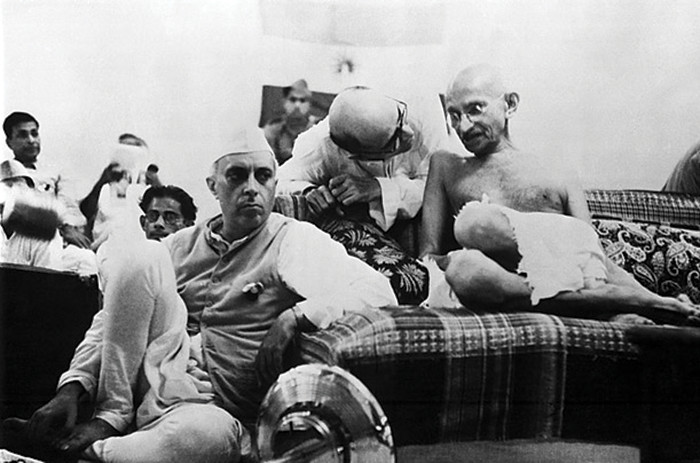
After the First World War (1914-1918), Mohandas Karamchand Gandhi became the undisputed leader of the Congress. During this struggle, Mahatma Gandhi had developed the novel technique of non-violent agitation, which he called ‘Satyagraha’, loosely translated as ‘moral domination’. Gandhi, himself a devout Hindu, also espoused a total moral philosophy of tolerance, brotherhood of all religions, non-violence (ahimsa) and of simple living. With this, new leaders like Jawaharlal Nehru and Subhash Chandra Bose also emerged on the scene and advocated the adoption of complete independence as the goal of the National Movement.
[vc_row][vc_column][vc_column_text]NEW YORK (TIP): Lilly Singh, who has more than 6 million subscribers on YouTube and nearly 800 million total views, is an Indo-Canadian comedian and rapper making her on of the biggest star of Indian origin on YouTube.
Entertainer Lilly Singh started a YouTube channel five years ago to avoid applying to grad school. Since then, she has collaborated with Arnold Schwarzenegger, James Franco and Jay Sean and amassed more than 6.2 million subscribers. She is popularly known as YouTube’s “Superwoman.”
Singh’s videos, usually filmed at home, take the form of personal comedic monologues and skits about banal but relatable topics. Lately, she’s branched out and produced a couple of slick music videos
Indian-origin YouTube sensation Lilly Singh, popularly known as Superwoman, is ready for her big-screen debut with her feature film “A Trip to Unicorn Island”. The 26-year-old Canada-based comedian said her new documentary, which will have an appearance by Dwayne “The Rock” Johnson, chronicles her world tour journey and life, reported Entertainment Weekly.
“It’s very close to my heart. It’s a story about me going through the trials and tribulations of my life, and really making the decision to be happy,” she said.
“How can I tell this story of not just my tour but my life in general to people that came to the show or couldn’t come to the show? I didn’t want to make it a video because I wanted to transcend beyond the audience I have.
“I wanted it to be in this fashion of storytelling where you could come on a journey through my life framed through my tour… The type of film this will be is a very no-barrier, no-holds-barred me being very honest with you, me talking about depression and overcoming that.”
“A Trip to Unicorn Island” is expected to release soon.
An Indian-origin man and his accomplice have charged by the City police after officers located and seized drugs, weapons, cash and a stolen motorcycle from inside a northeast apartment unit.
Following a two-week investigation stemming from tips from the public – Gurnazbir Singh Sandhu, 25, and his accomplice Richard Julies Rysdale, 28 were arrested from their Taradale city apartment by members of the drug unit and tactical unit with the help of Canada Border Services Agency (CBSA) officers, a report in Calgary Herald said.
The police were working out modalities to deport Sandhu to India.
Following a two-week investigation, drug unit officials were called to Sandhu’s residence on July 28 to execute a search warrant.
The two residents were at home at the time of search.
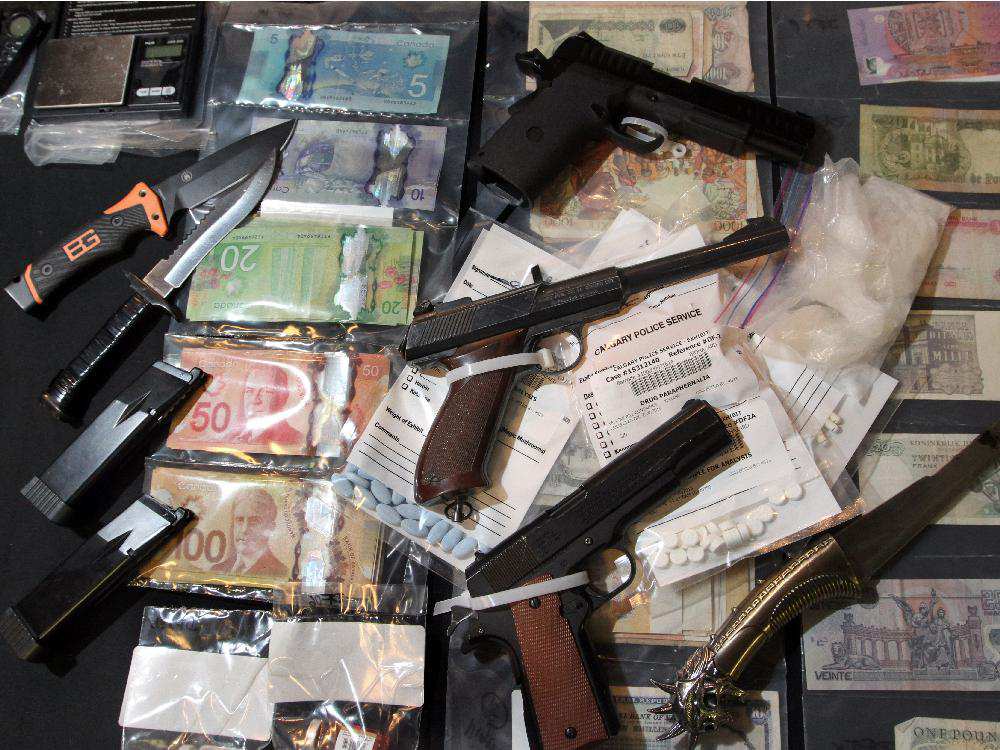
The police found 11,645 Canadian dollars ($8,866) cash, including 42 different types of foreign currency totalling about 2,800 Canadian dollars ($2,131).
About 104 grams of methamphetamine — an extremely addictive stimulant drug — with an estimated street value of 10,460 Canadian dollars ($7,964) and over 11 grams of cocaine with an estimated street value of 1,200 Canadian dollars ($913) were also recovered.
The police also recovered 57 undetermined pills which were sent to Health Canada for analysis.
Apart from these, three vials of steroids, three knives, three replica handguns, seven cellphones were found at the partment.
A stolen 2011 Kawasaki ZX600 motorcycle, scales and packaging material, some documents items were also found in the fourth-floor suite in which they were staying.
Sandhu and Rysdale were charged with possession of methamphetamine for the purpose of trafficking, possession of proceeds of crime, possession of stolen property and possession of a weapon for a dangerous purpose, the report said.
Sandhu, studying in British Columbia on a student visa that had expired eight months ago, was also charged of breach of probation.
“Pending the outcome of court, CBSA has issued an exclusion order, which ultimately will remove him from Canada,” drug unit Staff Sergeant Martin Schiavetta was quoted as saying.
“At this time, we don’t believe that they’re connected to any larger organised crime groups,” Schiavetta added.
OTTAWA: An Indian-origin budding independent film producer, whose recent film attracted millions of dollars, is being seen as the next famous person to come out of Canada, media reports said.
Komal Minhas has produced “Dream, Girl” — a feature-length film that has fetched millions in investor funding and has already created much excitement in the media, Daily Herald News reported on Monday.
Ms Minhas has partnered with US director and co-producer Erin Bagwell for the film.
According to her, “Dream, Girl” is part of a larger movement that aims to tell stories of entrepreneurs to inspire the next generation of leaders.
“We are mobilising the mid-20 to 30-year-old cohort of women to see themselves as a big part of the female economy. In the next decade, two-thirds of consumer spending will belong to women — that’s 66 percent of the economy,” Ms Minhas was quoted as saying.
“The global female economy accounts for $20 trillion. So we want to put a face to these economic powerhouses,” she added.
The 25-year-old was born and raised in Grande Prairie, Alberta to highly entrepreneurial Indian immigrants. She was an energetic child and did well in school.
She moved to Ottawa at the age of 17 and attended Carleton University, studying journalism, political science and human rights. Till the time she turned 23, she was already fired from two jobs. She later started working as an independent producer.
The GOPIO-Metropolitan Washington is very sad to learn of the passing away of Professor A. P. J. Abdul Kalam. It expresses heartfelt condolences on the demise of President Kalam.
Dr. Kalam-an extraordinary visionary and embodiment of the new India, and former President of India (2002- 2007) was affectionately known as the People’s President. He loved being a professor and sharing his knowledge with students. While delivering a lecture on “Livable Planet Earth’” at the Indian Institute of Management Shillong, he suffered a severe heart attack at around 6:30 p.m. local time. He was rushed to the Bethany Hospital in a critical condition; despite efforts to revive him, he died of cardiac arrest at 7:45 p.m. Monday, July 27, 2015. He was born on 15th October 1931 in Rameswaram, Tamil Nadu.
Dr. Kalam was honored with many national and international awards, including Bharat Ratna–the highest civilian honor bestowed upon by the Government of India. Kalam’s 79th birthday was recognized as World Student Day by the United Nations. He has also received honorary doctorates from 40 universities from all over the world. He is considered the main architect of India’s nuclear program. He also contributed in the development of a low cost coronary stent, named the “Kalam-Raju Stent” with cardiologist Soma Raju and rugged tablet computer for health care in rural areas, which was named the “Kalam-Raju Tablet.” An author of more than 20 technical books, he has left a legacy that will keep his contributions remembered for a long time.[/vc_column_text][/vc_column][vc_column width=”2/3″][vc_column_text]
Dr. APJ Abdul Kalam was a President of Uncritical Devotion
By Stephen Gill
Dr. APJ Abdul Kalam, 11th president of India, collapsed while delivering a speech at a seminar of Indian Institute of Management in Shillong, India. He died of cardiac arrest at Bethany Hospital in the capital of Meghalaya province on July 27, 2015 in the evening.
He was born in a poor Muslim family of a boatman in a rural area of Tamilnadu, South India. It was his education and hard work which led him to success. He was selected by the BJP Government in 2002 to be the president of India not because of his politics but because of his achievements as a missile scientist. He wrote inspirational poems for children, and led a simple life. It is clear that he was a child of the multicultural nature of Indian heritage.
Dr. Kalam will be remembered for his life of a harmonious marriage between art and knowledge. His ceaseless struggle in the narrow alleys of the bumpy orbits of bigotries to raise a stage for the goddess of peace to dance has set an example. This is an uncommon phenomenon at least in India, where he
cultivated a crop of the palpitation of human groans and a glory that is the essence of more than five thousand years old culture. He was respected by the majority as well as by the minority groups. He was easily approachable by the youth.
He is rightly known as “people’s president.” At this time, when India needs a citizen of uncritical devotion, the legacy of Dr. APJ Abdul Kalam shall remain alive for a long, long time.
(Stephen Gill is a celebrated poet and writer, based in Canada)
The kind of man he was, who loved India with an intense passion, beyond measure, will never be born again.
By Shahnaz Husain
It seems like the end of an era……Dr Abdul Kalam, President of India, from 2002 till 2007, also known as the Missile Man, is no more. India has lost yet another precious jewel, who dedicated his life to his country. We all know how he rose from a simple childhood to be one of India’s greatest minds and occupy the highest position of President of India……and yet, he never lost his humility.
Shahnaz Husain receives Padma Shri from President Kalam
The news of his passing evoked memories of the times I had met him. What struck me most was his simplicity. I remember the day when I received the Padma Shri Award from President Abdul Kalam at the Rashtrapati Bhavan. It was an added honour for me to receive it from the Missile Man. He congratulated me for the work I was doing in my effort to popularise India’s ancient Ayurvedic heritage. He said, “You are doing great work but you must document it.” The next time when I met him was at Rashtrapati Bhavan, when he was kind enough to launch my book, “Absolute Beauty.” Surprisingly, he remembered and said “Have you started documenting your work?”
Dr. Kalam was so right when he said, “You have to dream before your dreams can come true.” He also said, “Excellence is a continuous process and not an accident.” These struck a real chord within me, because I know how true and profound his sayings are. They will inspire generations to come.
Indeed, Dr. Abdul Kalam will always be remembered for his phenomenal mind and also as a great human being. The void he has left in the world of science and in our hearts will never be filled. Today, let us celebrate his love for India and his humble brilliance.[/vc_column_text][/vc_column][/vc_row][vc_row full_width=”” parallax=”” parallax_image=””][vc_column width=”2/3″][vc_separator color=”black” align=”align_center” border_width=”3″][vc_column_text]
Down the Memory Lane
By Prof. I.S. Saluja
In March, 2008, Dr. APJ Abdul Kalam visited New York. The PIO & NRI Community of Greater New York was exultant and keen to see him, speak with him and honor him, in whatever way they could. I was one of them. I spoke with Lal Motwani, who had organized a function to honor Dr. Kalam, to get me a few minutes with one of the best known scientists of India. The most popular epithet that stuck Dr. Kalam was “the Missile Man of India”.
Well, Lal did not disappoint me. I began with my questions and Dr. Kalam, as quick as a missile, answered them. When I asked him about his idea of “India by 2020”, he seemed to travel far, probably in to future, having his vision of India in 2020, and then turned to me and said, “It means perfect vision; 20/20 is the best vision”.
It was a long talk. He talked about his passion for teaching. H said he always wanted to return to teaching after his term as President. He spoke at length about his experiments in education in Tamil Nadu which had given miraculous results, with the consequence that not only the illiteracy rate went down but also young people aspired to go in for college and university education. He said he had faith in the youth of India. While he said that he added, rather proudly, that India was a nation of the young people and they are going to transform the country. The power of education and the strength of the young people were the two subjects that he emphasized on in my meeting with him . I did carry then the interview with him in The Indian Panorama, and with a couple of pictures, too but it makes me sad that I do not have a trace of it, since the computer crashed and all went with it.
I do not have the report that I published when he was honored by the PIO and NRI community at the Hindu Temple in Flushing, a favorite place with Indian Americans for holding cultural and social events. But from the cover of a souvenir then published, I arrived at the correct date which was March 25. [/vc_column_text][/vc_column][vc_column width=”1/3″][vc_column_text]
Here are some pictures from the event which have been provided by Lal Motwani who was at the helm in organizing the reception to honor Dr. Kalam in New York on March 25, 2008.
Prime Minister Narendra Modi ‘s emphasis on India having a huge and young work force and his assertions that India can provide work force to the whole world, clearly reveal his mind. He realizes that it will not be possible to create employment for the large number of young people in the country. Having learnt a long time ago from the experience of the Gujarati community how rewarding it could be to be working abroad, and realizing that there is enough demand from countries across the world for work force, Modi has set his ken on adding work force to the list of exports.
People from Gujarat are all over the world today. They are in African countries; in European countries, in USA, in Canada, in Australia and in New Zealand. They are everywhere. It is easier to list the countries where they are not present than to count the countries where they are. And they are amongst the best. They have established themselves particularly as sensible and intelligent businessmen. Business is in their blood. Look at all the top businessmen and industrialists in India and you will find they all belong to Gujarat. Similarly, those who are in professions are doing very well. It is another matter that every day you come across a dubious character who is involved in illegal activity and suffers the consequences.
Readers will recall that it is not for the first time that PM Modi has spoken of India having a huge work force. He had said that earlier too. Now, with the launch of “Skill India” campaign, he has added an adjective to work force. The adjective is “skilled”. It may sound ambitious to be creating Crores of skilled young people over the next 5 years, as claimed by the Prime Minister but then they say the goal should not be mean. And given the fact that the Indian Prime Minister believes in the best, whether it be clothes or travel, we should suspend our disbelief and go along with him.
Moreover, just as the NRIs , today, are making India rich with their remittances and investments, the would -be NRIs , too, would enrich the country. The mathematics is perfect. Young people will have jobs abroad and India will benefit from their presence overseas in terms of acquisition of foreign exchange. So we have employment generation and generation of wealth going hand in hand. One would wish it happens sooner than later.
WASHINGTON (TIP): The US economy’s stumble at the start of 2015 is dragging down the world’s growth prospects, the International Monetary Fund said on July 9.
The IMF forecasts 3.3 per cent global growth this year, down from the 3.5 per cent it predicted in April. The main culprit: The American economy, world’s biggest, shrank at a 0.2 per cent annual rate from January to March, hurt by nasty weather. The IMF last month cut the outlook for US growth to 2.5 per cent in 2015, from April’s 3.1 per cent. The US economy grew 2.4 per cent in 2014.
The fund expects the US economy to grow 3 per cent in 2016.
IMF research chief Olivier Blanchard downplayed the wider economic impact of the Greek debt crisis and the possibility that Greece could be forced to abandon the euro currency. “The effects on the rest of the world economy are likely to be limited,” he said.
The IMF expects global growth to improve to 3.8 per cent next year.
Meantime, America’s first-quarter troubles are pinching its neighbors.
The IMF trimmed Mexico’s 2015 growth forecast to 2.4 per cent from 3 per cent and Canada’s to 1.5 per cent from 2.2 per cent.
The multinational lending agency kept its forecast for China’s economic growth unchanged at 6.8 per cent this year and 6.3 per cent in 2016.
The Chinese stock market has plunged, with the Shanghai Composite index down 30 per cent from its peak less than a month ago. But Blanchard said: “We don’t see it as a major macroeconomic issue.” That is because ordinary Chinese mostly did not spend the paper gains in their stock portfolios as shares climbed to dangerous heights over the past year; so they are not likely to cut back now. Moreover, Blanchard said, the stock market is small compared with the size of China’s economy, the world’s second largest.
The IMF predicts the eurozone will grow 1.5 per cent this year, unchanged from April’s forecast; Japan will grow 0.8 per cent, down from an April forecast of 1 per cent; and the Brazilian economy will shrink 1.5 per cent, a downgrade from April’s forecast for a 1 per cent
drop.
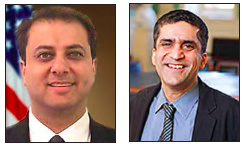
NEW YORK (TIP): The Carnegie Corporation has announced the 2015 “Great Immigrant”: The Pride of America” awardees. These are the individuals who have helped advance and enlighten our society, culture, and economy. Preet Bharara, U.S. Attorney, Southern District of New York is among 38 eminent personalities selected as 2015 ‘Great Immigrant’ honorees, on the eve of the nation’s birthday on July 4th by Carnegie Corporation.
The other Indian American awardee, Rakesh Khurana is the Marvin Bower Professor of Leadership Development at Harvard Business School (HBS), professor of sociology in the Faculty of Arts and Sciences (FAS), and co-master of Cabot House and dean of Harvard College.
“Our founder, Andrew Carnegie, came to this country as the son of impoverished immigrants and grew up to become one of the greatest contributors to American industry and philanthropy,” said Vartan Gregorian, President of the Corporation. “His devotion to U.S. democracy stemmed from his conviction that the new infusion of talent that immigrants bring to our country keeps American society vibrant.”
The 38 Great Immigrants honored this year come from more than 30 countries around the world and represent leadership in a wide range of professions.
They include:
Preet Bharara S. Attorney, Southern District of New York (India)
Indian shuttlers Jwala Gutta and Ashwini Ponnappa won the Canada Open women’s doubles title after upstaging the top-seeded Dutch pair of Eefje Muskens and Selena Piek in the summit clash here.
The third-seeded Indian pair triumphed 21-19 21-16 in the contest which lasted 35 minutes.
In a closely-contested opening game, Jwala and Ashwini broke away from the 19-19 and converted the lone game point opportunity to grab the initiative.
The Indians dominated the second game and raced to a 5-0 lead before going from 10-6 to 15-6 up.
However, Muskens and Piek fought back to win nine points straight and tie the game at 15-15. But Jwala and Ashwini did not let the advantage slip and won 6 of the next 7 points to clinch the title.
This was Jwala and Ashwini’s first title since their reunion after the 2012 London Olympics. — PTI
New York (TIP) July 1: The M&A Advisor, a New York-based advisory firm offering intelligence about merger and acquisition activity, recognized the winners of the 6th annual “40 Under 40 Emerging Leaders Awards” on June 29th, New York at the Roosevelt Hotel.
The M&A Advisor, renowned globally for its recognition and presentation of leading M&A, financing and turnaround professionals, created this recognition awards program to promote mentorship and professional development amongst the emerging leaders of our industry.
The Awards Gala is a feature of the 2015 Emerging Leaders Summit – an exclusive event pairing current and past 40 Under 40 winners together with their peers and industry stalwarts and to introduce the 40 Under 40 Emerging Leaders Award Winners to the business community and celebrate their achievements.
Seven Indian Americans and one Indo-Canadian were among the winners and were recognized at the Awards Gala held at the Roosevelt Hotel in Manhattan, June 29, New York.
Saurin Mehta, MD at Lincoln International; Satish Raman, global head of corporate development at Sutherland Global Services; and Vamsi Yadlapati, MD and co-head, M&A, at Focus Financial Partners from the “dealmaker” category.
Deepak Gill, partner at Cassels Brock & Blackwell LLP in Vancouver, Canada; and Henrik Patel, partner at White & Case LLP from the “legal advisor” category.
Navine Aggarwal, vice president of M&A at Allied World Assurance Company; Sanjeev Parlikar, managing director at Accordion Partners; Dhwani Vahia, head of private equity marketing at S&P Capital IQ; and Shashi Yadavalli, partner at Deloitte Consulting in Cleveland and Akron, Ohio from the “service professional” Category.
“In 2010, we initiated the 40 Under 40 Awards to recognize high achieving young women and men in our industries of M&A, financing and restructuring”, said David Fergusson, President and Co-CEO of The M&A Advisor.
The 2015 Award Winners have been chosen from a pool of prominent nominees for their notable accomplishments in business and in service to the community.
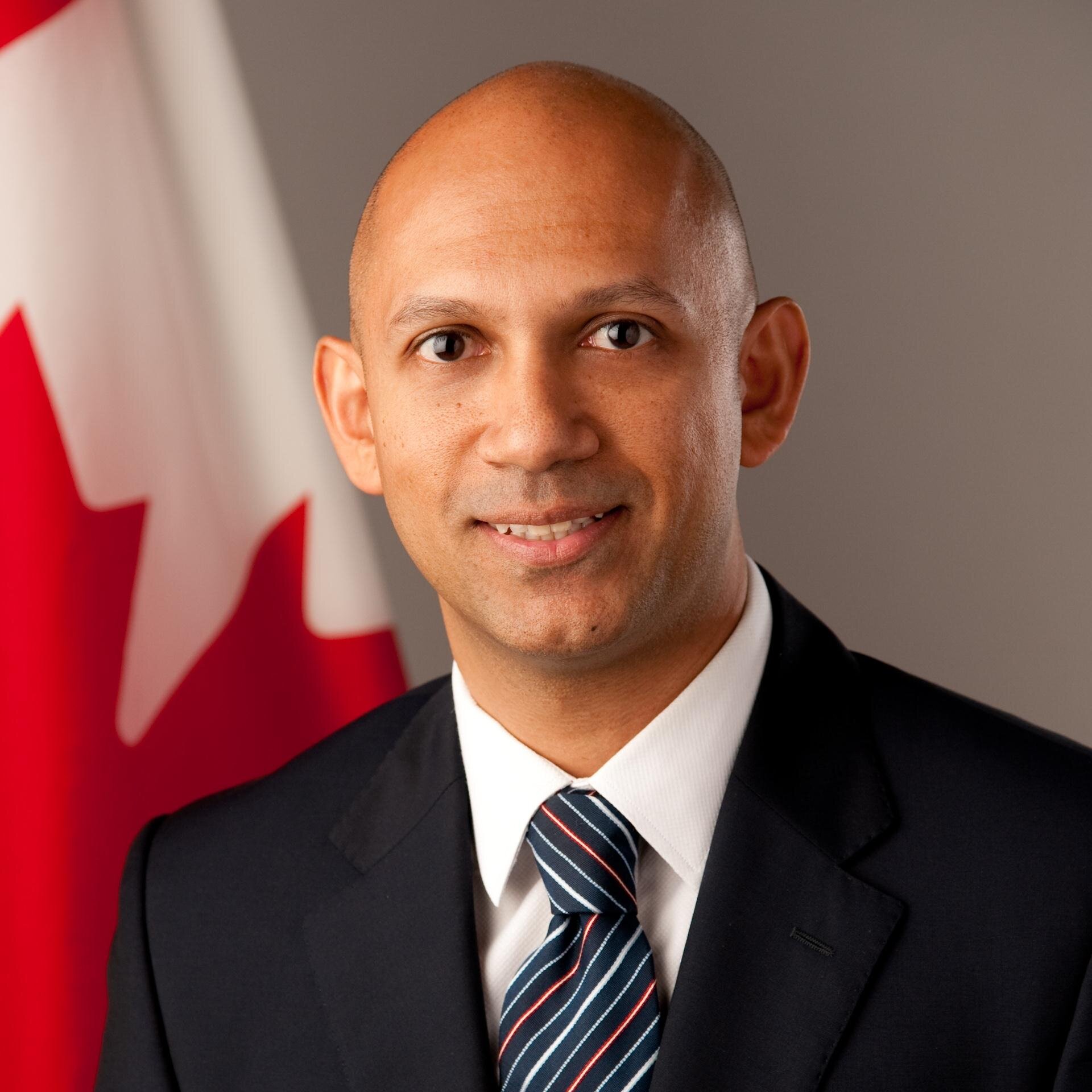
CHANDIGARH: Nadir Patel, Canadian high commissioner to India, highlighted possibility of greater educational collaboration with not just Indian students studying on Canadian campuses but also vice versa coming true.
“At present we have 46,000 Indian students studying in Canada. But we would like to see students from Canada also studying in Indian educational institutions. The number of Indian students in Canada has grown by 17% over the past five years and is surging every year,” he said while speaking on the topic ‘India-Canada relationship in today’s interconnected world’ at the Indian School of Business (ISB) in Mohali on Wednesday.
Pael, the first Indo-Canadian to be appointed to this top position, met Punjab deputy chief minister Sukhbir Singh Badal earlier in the day. He informed that Canadians of Indian origin had been contributing a lot to the $2 trillion economy of the North American country, yet there was immense scope to boost investment further in terms of entrepreneurial ventures in various sectors.
ISTANBUL (TIP): An influential group of business leaders have urged the G20 to improve the global trade system for the emerging digital economy as well as focus on reforms to ensure strong and sustainable growth.
The group known as B20, met in Turkey on the sidelines of the G20 sherpas meeting and discussed the recommendations which would be finalised for the G20 leaders meeting in November. It called for eliminating data flow restrictions and softening regulations on data privacy to decrease the cost of doing business. It said customs regimes must be harmonized to ensure that bottlenecks to e-commerce are minimized and transactions are made more predictable.The G20 comprises the largest and emerging economies, which account for 85% of global GDP and 75% of world trade. It comprises the US, the UK, the European Union, India, Argentina, Australia, Brazil, Canada, China, France, Germany, Indonesia, Italy, Japan, South Korea, Mexico, Russia, Saudi Arabia, South Africa and Turkey.
“Harmonize customer protection rules, specifically on core issues relating to purchase processes, to better facilitate e-commerce efforts and eliminate costs and administrative difficulties,” it said in its draft recommendations.
According to estimates, the digital economy is expected to contribute $4.2 trillion or more than 5% of GDP for the G20 countries in 2016 and is growing at 10% annually. Cross border e-commerce accounts for 10-15% of total e-commerce volumes, depending on the region. By 2025, annual global cross-border e-commerce revenues could swell to between $250 billion and $350 billion-up from about $80 billion now, according to Mckinsey Global Institute and BCG analysis. The B20 has six task forces on infrastructure and investment, trade, financing and growth, anti-corruption, employment and small and medium enterprises and entrepreneurship. Each of the task forces made specific recommendations to improve business prospects within the G20, which would help lift GDP growth.
It called for reaffirming the commitment to rollback of existing protectionist measures, particularly non-tariff barriers and said the G20 must start taking distinct actions by eliminating localization barriers to trade as a first step. Numerous reports show that G20 governments are not adhering to their standstill and roll back commitments with regards to regular tariff barriers, the B20 said.
“Non-tariff barriers can have a much greater negative impact on GDP growth than tariffs. The benefits of reversing all barriers introduced between 2008 and 2013 is at least $460 billion increase in global exports, a $423 billion increase in global GDP and 9 million jobs supported worldwide,” it said. The B20 strongly backed the creation of an enabling environment for increased flow of private funds into more sustainable infrastructure. It said there is a need to increase the number of projects developed through public-private partnerships (PPPs) and build capabilities of governments to deliver PPPs.
WINNIPEG (TIP): Police in the Canadian city of Winnipeg apologized on June 22 after a lewd conversation about sex was broadcast from the loudspeakers of a police helicopter to a neighborhood below.
Officers on a routine helicopter patrol on Monday night inadvertently activated the aircraft’s public address system while they were having a private conversation, the Winnipeg Police Service said in a statement.
“Some content of the conversation was inappropriate. The involved members were not able to hear the public address system from within the aircraft. They became aware their conversation had been broadcast and immediately turned the system off,” the police said.
News of the R-rated conversation took off on Twitter as the city residents who could hear the conversation took to social media to urge the police to turn off their loudspeaker.
“Pilots in the Winnipeg police helicopter having a conversation with their loudspeaker on. Pretty funny to hear,” tweeted one resident.
“Does the #Winnipeg chopper realize the entire West End can hear their convo about blow jobs right now?” tweeted another, who noted she was listening from her backyard.
The police service said the incident was being reviewed.
India-born Steve Rai has been appointed the new deputy chief constable of Canada’s Vancouver Police Department.
Vancouver Police chief Adam Palmer announced yesterday that Mr Rai has joined the department’s executive team as the new deputy.
Born in Punjab, Mr Rai has been serving the police department for the past 25 years. His brother Roger is also a police officer assigned to the Downtown Eastside.
Mr Rai drew on his cultural background to work extensively, at the street level, with the District’s South Asian community, using his skills in the Punjabi language.
He also completed assignments in the Vancouver Police Jail, as a Recruiting Unit investigator, and a secondment to the former Coordinated Law Enforcement Unit, according to a press release from Vancouver Police Department.
Vancouver, a bustling west coast seaport in British Columbia, has a large Indo-Canadian population and Prime Minister Narendra Modi had visited a temple and a gurdwara in the city during his visit to Canada in April this year.
MIAMI (TIP): A programme that teaches university-age women how to avoid rape has shown some success in reducing the numbers of women in Canada who are sexually assaulted, according to a study.
Previous research has suggested that as many as one in four young women are raped or are victims of attempted rape while attending college.
The findings published in the New England Journal of Medicine are based on a group of nearly 900 women at three Canadian universities.
The first-year students were randomly assigned to either look at brochures on avoiding campus rape or to complete the training course.
During four separate three-hour sessions, the women learn “information, skills and practices to assess risk from acquaintances, to overcome emotional barriers in acknowledging danger and to engage in effective verbal and physical self-defense,” the study said.
Instructors also helped students “explore their own sexual values, desires, boundaries and rights,” according to the study.
The programme, known as the Enhanced Assess Acknowledge Act Sexual Assault Resistance Program, has been in development for over a decade by Charlene Senn of the University of Windsor.
One year after completing the training, 23 women in the EAAA programme reported having been raped, compared to 42 in the group that browsed brochures on rape prevention.
Researchers found 46 per cent fewer rapes and 63 per cent fewer attempted rapes in the group that followed the training programme.
“We found that the one-year risk of completed rape was significantly lower for the women in the EAAA resistance group than in the control group,” said Senn.
“What this means in practical terms is that enrolling 22 women in the EAAA resistance programme would prevent one additional rape from occurring.”
The programme is the first developed in North America to show some success against preventing rape beyond a few months, said Senn.
New York (TIP): Nestle has issued multiple statements some contradicting their own top executive in the last few days. It is yet to be ascertained whether Nestle’s decision to burn Maggi packets recalled from the Indian Market & in its factories is a result of the Indian ban or Australia’s suspension of import from India.
As per Nestle’s global website, Nestle India currently exports small quantities of Maggi noodles to the US, Canada, UK, Australia, Singapore and Kenya.
Nestle has said it will burn $50 million worth of Maggi noodles in concrete incinerators after they were banned by India’s food safety regulator for containing too much lead.
The food regulator has accused Nestle of not complying with food safety laws.
Nestle continues to insist that the noodles are safe and that the ban is the result of issues with the interpretation of the law.
It has however started to recall the product and burn it in incinerators at five cement factories across the country.
According to the Indian paper AFP live, Nestle has 8 factories across India, five of which produce Maggi noodles.
Nestle has 38 distribution centres, where products are stored before being sent to distributors
63 Percentage of the noodle market owned by Nestle. Nestle dominates the Indian noodle market, according to Euromonitor. Nestle has been the market leader there since 2009.
Almost 28,000 tonnes, or $32 million-worth, of Maggi noodles were in the market on June 5, when the product was decided to be recalled. Another $17 million-worth of noodles are still in factories.
50 million dollars-worth of noodles will be burned. “These are broad estimates because it is impossible to calculate the final figure while the withdrawal is taking place,” Nestle said. It added that additional costs from bringing stock to the market and transporting it to incinerators to be destroyed had not yet been accounted for.
MIAMI (TIP): A programme that teaches university-age women how to avoid rape has shown some success in reducing the numbers of women in Canada who are sexually assaulted, according to a study.
Previous research has suggested that as many as one in four young women are raped or are victims of attempted rape while attending college.
The findings published in the New England Journal of Medicine are based on a group of nearly 900 women at three Canadian universities.
The first-year students were randomly assigned to either look at brochures on avoiding campus rape or to complete the training course.
During four separate three-hour sessions, the women learn “information, skills and practices to assess risk from acquaintances, to overcome emotional barriers in acknowledging danger and to engage in effective verbal and physical self-defense,” the study said.
Instructors also helped students “explore their own sexual values, desires, boundaries and rights,” according to the study.
The programme, known as the Enhanced Assess Acknowledge Act Sexual Assault Resistance Program, has been in development for over a decade by Charlene Senn of the University of Windsor.
One year after completing the training, 23 women in the EAAA programme reported having been raped, compared to 42 in the group that browsed brochures on rape prevention.
Researchers found 46 per cent fewer rapes and 63 per cent fewer attempted rapes in the group that followed the training programme.
“We found that the one-year risk of completed rape was significantly lower for the women in the EAAA resistance group than in the control group,” said Senn.
“What this means in practical terms is that enrolling 22 women in the EAAA resistance programme would prevent one additional rape from occurring.”
The programme is the first developed in North America to show some success against preventing rape beyond a few months, said Senn.
NEW DELHI (TIP): India’s total foreign tourist arrivals jumped last year but the number of foreign women travelling to the country slipped during the same period amid concerns about safety of women following the December 2012 gangrape.
Tourism ministry statistics show the main countries that logged a decline in female foreign tourists were Germany, Bangladesh and the Russian Federation while the number of women from Sri Lanka, the US, Canada, UK and Malaysia increased during this period.
The number of foreign tourists increased 10% in 2014 over the previous year while foreign female tourists slipped to 40.8% from 41.2% in the same period.
India’s tourism industry took a hit after the 2012 gangrape made international headlines, prompting the government to introduce a host of security measures such as a travel advisory with tips for foreign tourists, including suggestions on dressing in line with the country’s traditional culture. The country’s global image as a safe destination suffered following a series of sexual attacks on foreign women in recent years. “Some parts of India, particularly the smaller towns and villages, still have traditional dressing. Dress codes for some religious places can include covering your head, being barefoot,” says a 13-page booklet given to foreign tourists at the immigration counter.
According to sources, the tourism ministry is also working on a plan to hand a GPS-enabled SIMs to foreign travellers when they land in India.
“Safety of women foreign travellers is a matter of serious concern for us. We are taking several steps. We have started helpline numbers in two languages which we propose to make multilingual,” tourism minister Mahesh Sharma said.
“India’s culture, including that of dressing, is different from the West. We are not imposing anything on anyone. This is simply advice.”
SINGAPORE (TIP): Crude oil futures fell on Thursday as the World Bank cut its global economic growth forecast, ending a two-day rally triggered by a sharp US inventory drawdown.
In its twice-yearly Global Economic Prospects report, the World Bank predicted the global economy would expand 2.8 per cent this year, below its 3 per cent outlook in January, with India recording the biggest growth of major economies for the first time, ahead of slowing China.
Front-month Brent crude oil prices were down 13 cents at $65.57 a barrel by 0512 GMT, while US crude shed 23 cents to trade at $61.20 a barrel.
“Considering China’s economic slowdown, we lean towards lower prices today,” said Daniel Ang, an analyst at Singapore-based Phillip Futures. In South Korea, the world’s No. 5 importer of crude oil, the central bank cut its policy rate by 25 basis points to a record-low 1.50 per cent in a bid to shield a tottering economy from an outbreak of a deadly respiratory disease.
Despite Asia’s slowing economies, Iraq on Thursday increased its July official selling price for Basra Light crude following strong demand for the grade last month.
Crude prices, however, drew support from a big US stocks drawdown that has boosted the outlook for summer fuel demand.
The US energy information administration (EIA) reported that crude oil stocks shrank by 6.8 million barrels last week, their largest drop in almost a year and four times more than forecast by analysts in a Reuters poll. Prices in North America have been buoyed recently by high gasoline demand for road vehicles as well as low production in Canada as a result of wildfires.
“In Western Canada, crude oil inventories are at their lowest level since October as maintenance shutdowns and wildfires in northern Alberta take their toll on supply,” ANZ bank said.
PENNSYLVANIA (TIP): Authorities say a collision between a bus carrying Italian tourists and a tractor-trailer in Pennsylvania has left three people dead and many injured.
The accident occurred today morning on Interstate 380. Monroe County Coroner Robert Allen told reporters at the scene that the death toll had climbed from two to three.
He says all the passengers on the bus were from Italy. The tour bus has the name of the Academy Bus company but appears to have been operated by Viaggidea, an Italian tour operator whose name is also on the bus.
The company operates tours that head from New York to Niagara Falls and Canada.
The Prime Minister, Narendra Modi, scored most in foreign policy in his first year in power. No one anticipated Modi’s natural flair for diplomacy, to which he has brought imagination and self-assurance. Modi has been more emphatic than his predecessors in giving improvement of relations with neighbors greater priority. He invited all the SAARC leaders to his swearing-in, to signal that the decisive election victory of a supposedly nationalist party did not denote a more muscular policy towards neighbors. On the contrary, India would take the lead in working for shared regional peace and prosperity.
Bhutan, the only neighbor that has not politically resisted building ties of mutual benefit, was the first country he visited in June, 2014. He handled his August 2014 visit to Nepal with sensitivity and finesse, and followed it up with exceptional leadership in providing immediate earthquake relief to Nepal in May, 2015. In obtaining Parliament’s approval of the land boundary agreement with Bangladesh in May, 2015, Modi showed his determined leadership again.
He did falter with Pakistan, seemingly unsure about whether he should wait for it to change its conduct before engaging it, or engage it nevertheless in the hope that its conduct will change for the better in future. He announced foreign-secretary-level talks during Nawaz Sharif’s visit to Delhi, but cancelled them precipitately. He ordered a robust response to Pakistan’s cease-fire violations, yet sent the foreign secretary to Islamabad in March, 2015, on an unproductive SAARC Yatra. Relations with Pakistan remain in flux. In Afghanistan, President Ashraf Ghani’s tilt towards Pakistan and China has challenged the viability of India’s Afghanistan policy. Ghani’s delayed visit to India in April 2015 did not materially alter the scenario for us, but India has kept its cool.
Modi’s foreign policy premise, that countries give priority today to economics over politics, has been tested in his China policy, which received a course correction. After courting China economically, Modi had to establish a new balance between politics and economics. President Xi’s visit to India in September, 2014, was marred by the serious border incident in Ladakh. Modi showed a sterner side of his diplomacy by expressing serious concern over repeated border incidents and calling for resuming the stalled process of clarifying the Line of Actual Control. During his China visit in May, Modi was even more forthright by asking China to reconsider its policies, take a strategic and long-term view of our relations and address “the issues that lead to hesitation and doubts, even distrust, in our relationship”. He showed firmness in excluding from the joint statement any reference to China’s One Road One Belt initiative or to security in the Asia-Pacific region. The last minute decision to grant e-visas was puzzling, especially as the stapled visa issue remains unresolved. The economic results of his visit were less than expected, with no concrete progress on reducing the huge trade deficit and providing Indian products more market access in China. The 26 “agreements” signed in Shanghai were mostly non-binding MoUs involving the private sector and included the financing of private Indian companies by Chinese banks to facilitate orders for Chinese equipment.
Modi’s visit to Seychelles, Mauritius and Sri Lanka in March, 2015, signified heightened attention to our critical interests in the Indian Ocean area. Modi was the first Indian prime minister to visit Seychelles in 33 years. His visit to countries in China’s periphery in May, 2015, was important for bilateral and geopolitical reasons. During his visit to South Korea the bilateral relationship was upgraded to a “special strategic partnership’, but Korea nevertheless did not support India’s permanent membership of the United Nations Security Council. Modi’s visit to Mongolia was the first by an Indian prime minister to a country whose position is geopolitically strategic from our point of view.
Belying expectations, Modi moved decisively towards the United States of America on assuming office. He set an ambitious all-round agenda of boosting the relationship during his September, 2014, visit to Washington. In an imaginative move, he invited Obama to be the chief guest at our Republic Day on January 26, 2015. To boost the strategic partnership with the US, he forged a “breakthrough understanding” on the nuclear liability issue and for tracking arrangements for US-supplied nuclear material. Progress on the defense front was less than expected with four low-technology “pathfinder” projects agreed under the defense technology and trade initiative. The important US-India joint strategic vision for the Asia-Pacific and Indian Ocean region, issued as a stand-alone document, high-lighted the growing strategic convergences between the two countries, with China in view. A special feature of Modi’s September, 2014, US visit was his dramatic outreach to the Indian community, which has since then become a pattern in his visits abroad, whether in Australia, Canada or Beijing. No other prime minister has wooed the Indian communities abroad as Modi has done.
President Putin’s visit to India in December, 2014, was used to underline politically that Russia remains India’s key strategic partner. Modi was effusive in stating that with Russia we have a “friendship of unmatched mutual confidence, trust and goodwill” and a “Strategic Partnership that is incomparable in content”. He was careful to convey the important message that even as India’s options for defense cooperation had widened today, “Russia will remain our most important defense partner”. Civilian nuclear cooperation with Russia got a boost with the agreement that Russia will build “at least” ten more reactors in India beyond the existing two at Kudankulam. All this was necessary to balance the strengthened strategic understanding with the US and its allies.
Modi bolstered further our vital relations with Japan, which remains a partner of choice for India. Shinzo Abe announced $35 billion of public and private investment in India during Modi’s visit to Japan in September 2014, besides an agreement to upgrade defense relations.
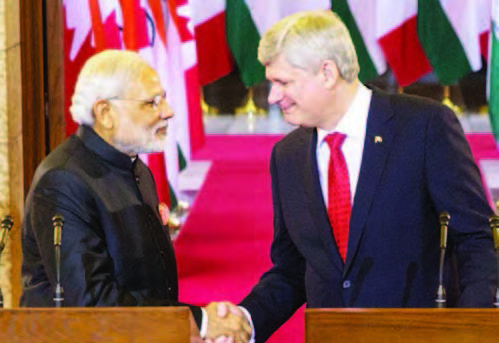
Modi’s visit to France and Germany in April, 2015, recognized Europe’s all-round importance to India and was timely. He rightly boosted the strategic partnership with France by ensuring concrete progress in the key areas of defense and nuclear cooperation by announcing the outright purchase of 36 Rafale jets and the MoU between AREVA and L&T for manufacturing high-technology reactor equipment in India. Modi’s bilateral visit to Canada in April, 2015, was the first by an Indian prime minister in 45 years. Bilateral relations were elevated to a strategic partnership and an important agreement signed for long-term supply of uranium to India.
Relations with the Islamic world received less than required attention during the year, although the Qatar Emir visited India in March, 2015, and the political investment we made earlier in Saudi Arabia aided in obtaining its cooperation to extract our people from Yemen. Gadkari went to Iran in May, 2015, to sign the important agreement on Chabahar. Modi did well to avoid any entanglement in the Saudi-Iran and Shia-Sunni rivalry in West Asia. He met the prime minister of Israel, Benjamin Netanyahu, on the sidelines of the UN general assembly meeting in September, last year, to mark the strength of India-Israel ties. So, Modi’s handling of India’s foreign policy in his first year is impressive. He has put India on the map of the world with his self-confidence and his faith in the nation’s future.
Signup to our Newsletter!
Don’t miss out on all the happenings around the world