Tag: Gujarat

  • Afzal Guru Hanged

    Afzal Guru Hanged

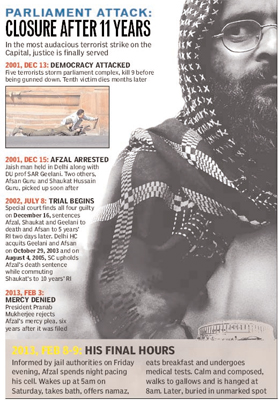
    New Delhi (TIP): AfzalGuru, convicted of plottingthe Parliament attack 11years ago, was quietlyexecuted at Tihar jail earlyon February 9. The hangingwas carried out indramatic secrecy amidfears that it could revivestreet protests in Kashmir.Guru was convicted ofplotting and providinglogistic support to the fiveJaish-e-Mohammedterrorists who stormedParliament on December13, 2001. The attack was foiled, the terrorists killedand a packed House oflawmakers saved, but notbefore eight securitypersonnel and a gardener losttheir lives. A tenth victim, ajournalist, died of injuries afew months later.The hanging is being seenas Congress’ renewedattempts after the party’srecent Jaipur conclave toappeal to the urban middleclass.

    As the UPA governmentdithered on taking a decisionon his mercy plea for years,Afzal came to symbolise whatthe BJP called the Congress’soft approach on terrorism.The hanging of Afzal, andbefore him 26/11 killer AjmalKasab last November, bluntsthis attack.On February 9 morning, aquiet but unrepentant Afzalwas hanged in Jail No. 3 ofTihar prison at 8am, less thana week after President PranabMukherjee rejected the mercypetition filed by the convictand his wife more than sixyears ago. Home ministerSushil Kumar Shinde andhome secretary RK Singhseparately stood in front ofTV cameras to announce thehanging.“Afzal Guru was hanged at8am. All legal procedureswere followed,” Shinde toldreporters.

    He was later buriedon the jail premises.RK Singh said Tiharauthorities had intimatedAfzal’s family in Kashmir ofthe rejection of his mercy pleathrough Speed Post andregistered post and the DG(director general of Jammu &Kashmir Police) had been toldto check with them whetherthey had got it or not.The BJP was quick towelcome the hanging. Leaderof Opposition Arun Jaitleysaid: “Though belated, justicehas been done.”

    Gujarat chiefminister Narendra Modi, whohas often used Afzal to attackthe UPA, tweeted: “Der aayedurust aaye (better late thannever).”Information andbroadcasting minister ManishTewari insisted in Chennaithat politics did not haveanything to do with theexecution, a point the homesecretary also made in Delhi.In Sopore, Afzal’s hometownin north Kashmir, and manyother places in the Valley,security forces imposedcurfew, detained separatistleaders and shut down cableTV networks. Chief ministerOmar Abdullah appealed forpeace and ordered police toexercise restraint in handlingstreet protests. By evening, 36people — mostly policemen —had been injured in strayviolence.

  • As I See It : Hindu Terrorism

    As I See It : Hindu Terrorism

    Is there such a thing as ‘Hinduterrorism’, as Home MinisterShinde is heavily hinting at?Well, I am one of that rare breed offoreign correspondents – a lover ofHindus! A born Frenchman, Catholiceducatedand non-Hindu, I do hope I’llbe given some credit for my opinions,which are not the product of myparents’ ideas, my education or myatavism, but garnered from 25 years ofreporting in South Asia (for LeJournal de Geneve and Le Figaro).

    In the early 1980s, when I startedfreelancing in south India, doing photofeatures on Kalaripayattu, theAyyappa festival, or the Ayyanars, Islowly realized that the genius of thiscountry lies in its Hindu ethos, in thetrue spirituality behind Hinduism.The average Hindu you meet in amillion villages possesses this simple,innate spirituality and accepts yourdiversity, whether you are Christian orMuslim, Jain or Arab, French orChinese.

    It is this Hinduness thatmakes the Indian Christian differentfrom, say, a French Christian, or theIndian Muslim unlike a Saudi Muslim.I also learnt that Hindus not onlybelieved that the divine could manifestitself at different times, underdifferent names, using differentscriptures (not to mention thewonderful avatar concept, the perfectanswer to 21st century religious strife)but that they had also given refuge topersecuted minorities from across theworld-Syrian Christians, Parsis, Jews,Armenians, and today, Tibetans.

    In 3,500 years of existence, Hindushave never militarily invaded anothercountry, never tried to impose theirreligion on others by force or inducedconversions. You cannot find anybodyless fundamentalist than a Hindu inthe world and it saddens me when I seethe Indian and western press equatingterrorist groups like SIMI, which blowup innocent civilians, with ordinary,angry Hindus who burn churcheswithout killing anybody. We know alsothat most of these communalincidents often involve persons fromthe same groups-often Dalits andtribals-some of who have converted toChristianity and others not.

    However reprehensible thedestruction of Babri Masjid, noMuslim was killed in the process;compare this to the ‘vengeance’bombings of 1993 in Bombay, whichwiped out hundreds of innocents,mostly Hindus. Yet the Babri Masjiddestruction is often described byjournalists as the more horrible act ofthe two.We also remember how SharadPawar, when he was chief minister ofMaharashtra in 1993, lied about abomb that was supposed to have goneoff in a Muslim locality of Bombay.

    I have never been politicallycorrect, but have always written whatI have discovered while reporting. Letme then be straightforward about thisso-called Hindu terror. Hindus, sincethe first Arab invasions, have been atthe receiving end of terrorism,whether it was by Timur, who killed1,00,000 Hindus in a single day in 1399,or by the Portuguese Inquisitionwhich crucified Brahmins in Goa.Today, Hindus are still being targeted:there were one million Hindus in theKashmir valley in 1900; only a fewhundred remain, the rest having fledin terror.

    Blasts after blasts havekilled hundreds of innocent Hindusall over India in the last four years.Hindus, the overwhelming majoritycommunity of this country, are beingmade fun of, are despised, aredeprived of the most basic facilitiesfor one of their most sacredpilgrimages in Amarnath while theirgovernment heavily sponsors the Haj..They see their brothers and sistersconverted to Christianity throughinducements and financial traps, see aharmless 84-year-old swami and asadhvi brutally murdered. Their godsare blasphemed. So sometimes,enough is enough.At some point, after years or evencenturies of submitting like sheep toslaughter, Hindus-whom the Mahatmaonce gently called cowards-erupt inuncontrolled fury.

    And it hurts badly.It happened in Gujarat. It happened inJammu, then in Kandhamal,Mangalore, Malegaon, or Ajmer.It may happen again elsewhere.What should be understood is that thisis a spontaneous revolution on theground, by ordinary Hindus, withoutany planning from the politicalleadership. Therefore, the BJP, insteadof fighting over each other as to whomshould be the next party president, orwho will be their PM candidate for the2014 elections, should do well to put itshouse together.

    For, it’s evident that the Congresshas decided on this absurd strategy ofthe absurd, the untrue, the unjust, thetreacherous, only to target Mr.Narendra Modi, their enemy numberOne.It should also fight the Untrue withTruth: there are about a billionHindus, one in every six persons onthis planet. They form one of the mostsuccessful, law-abiding and integratedcommunities in the world today. Canyou call them terrorists? Let the BJPcompile a statistics of how manyHindus were killed by Muslims since1947 and how many Muslims byHindus. These statistics will speak bythemselves.

    (The author can be reached atfgautier26@gmail.com)

  • 2014 strategy: BJP sticks to politics, dumps Hindutava

    2014 strategy: BJP sticks to politics, dumps Hindutava

    NEW DELHI (TIP): Defining the battlelines for 2014 Lok Sabha elections, the Sangh Parivar has decided that the BJP will focus on development and decisive leader agenda, while the affiliated groups — such as the VHP — will help revive the “Hindu Identity” through Ram Janmabhoomi movement and the UPA charge of saffron terrorism.

    While the BJP core group met on Feb 1 to work out the reconstitution of its Parliamentary Board, Central Election Committee and the National Executive by the end of this month, top RSS, BJP and VHP leaders met at the residence of Goa LS MP Shripad Naik on Thursday to chalk out the future strategy and coordination among the Sangh affiliates. The meeting was attended by top BJP, RSS and VHP leaders.

    Party sources said it was decided at the meeting that Sangh affiliates would work to revive and bring back the focus on Hindutva issues with Ram Janmabhoomi movement, which is being re-launched at Kumbh Mela at Sant Mahasammelan on February 7 a day after the VHP Kendriya Marg Darshak Mandal meets in Allahabad. The BJP, on its part, will concentrate on the political agenda ofattacking the “rudderless” UPA government and showcase the development achieved in states ruled by the party, particularly Gujarat.

    Besides discussion on giving Gujarat chief minister Narendra Modi a larger role at the national level, the party also talked of the possibility of including Madhya Pradesh chief minister Shivraj Singh in the BJP Parliamentary Board, the larger issue was coordination among the Sangh affiliates. With the Sangh Parivar determined to project a united face for 2014 elections, differences between BJP and VHP were ironed out to rule out possibility of any conflicting statements in the future on core issues.

    At Thursday’s meeting, the Sangh leadersalso decided to target the UPA on socalled saffron terrorism with the aim of polarizing voters on the grounds that the UPA ministers — P Chidambaram and Sushilkumar Shinde — were deliberately “hurting” Hindu sentiments. “Further fine-tuning will be done at the Akhil Bhartiya Pratinidhi Sabha of the RSS on March 15-17, 2013 at Jaipur after reviewing the response to Ramjanambhoomi movement revival,” a party leader said.

  • Indian NRIs’ Properties Back Home Becoming Targets Of Greedy Relatives And Dubious Developers

    Indian NRIs’ Properties Back Home Becoming Targets Of Greedy Relatives And Dubious Developers

    DUBAI (TIP): Greedy relatives and shady agents are unlawfully grabbing the properties of Indian expatriates living in Dubai. Caught in this miserable scenario, many Indian expatriates in Dubai are seemingly fighting the unending legal battles back home. According to Gulf News, and it is not easy to pay hassle-free frequent visits to India, and go through the notoriously lengthy legal process in the country. Some cannot even put on combat gear as the enemy, in many cases, is there own parents or siblings. According to lawyers, the misuse of power of attorney is rampant across India.

    Invariably, NRI owners top the list of victims. Chokshy, a seasoned lawyer with over 30 years of experience in Gujarat civil courts, said he has seen many NRIs go through bitter experiences where their parents or siblings have grabbed their property. According to the report, the illegal grabbing, occupation or confiscation of properties have long been a pressing issue for Indians residing out of the country, so much so that a US-based Global Organisation of People of Indian Origin (GOPIO) has demanded the establishment of fast-track courts for speedy disposal of their property disputes.

    The organization said that many USbased NRIs owning houses and land in Kolkata, New Delhi, Punjab and Kerala have been struggling for years to reclaim properties usurped by friends, families or caretakers. The increasing number of illegal and forceful land grabbing cases was also a topic of concern at the recently concluded 11th Pravasi Bharatiya Divas (PBD) conducted by the Ministry of Overseas Indian Affairs between January 7 and 9 in Kochi, Kerala. According to lawyers in India and the UAE, expatriates are particularly vulnerable to fraudulent elements back home because of time constraints and lack of legal support in fighting their cases.

    NRIs are at a great disadvantage as they reside far away from their home country and civil cases in India can take 15-20 years or even more due to an overloaded judicial system. So alarming is the situation that an army of ‘property managers’ have mushroomed in big cities in India like Mumbai, Delhi, Pune, Ahmedabad, Mangalore, Chennai and Kochi to manage the assets of NRIs, the report added.

  • SC restrains trial court from deciding on SIT report on Modi’s role

    SC restrains trial court from deciding on SIT report on Modi’s role

    NEW DELHI (TIP): The Supreme Court on January 17 restrained a special trial court in Ahmedabad from taking its final decision on the Special Investigation Team (SIT) report for closing the case against Gujarat Chief Minister Narendra Modi and 62 others in connection with a 2002 riots incident in which former Congress MP Eshan Jafri was burnt alive by a mob at the Gulberg Housing Society. A three-member Bench headed Justice DK Jain passed the order on a plea by Zakia Jafri, widow of the slain Congress leader, despite objections raised by the Gujarat government. The other members of the Bench were Justices P Sathasivam and Aftab Alam. Zakia has approached the SC seeking copies of the three SIT reports submitted in May and November 2011 and January 2012. The case would be taken up for hearing again on February 7. The SIT, headed by former CBI Director RK Raghavan, had interrogated Modi in the light of an apex court order asking the SIT to conduct a fresh investigation into the February 28, 2002 violence in the Gulberg Society, Ahmedabad.

  • Indian American Hoteliers Looking At Big Investments In India

    Indian American Hoteliers Looking At Big Investments In India

    NEW YORK (TIP): Hoteliers of Indian origin, who independently own over 8,000 properties in America valued at around $54 billion, are now keen on investing in various sectors in India including hospitality, healthcare and education. “Hospitality is where our members see the biggest value when making investments in India. For us, it will be very easy to replicate the business model that we have followed successfully in America for so many years. There is a huge requirement of rooms in India and the budget hotel model that we are looking at is different from the ones already there in India.

    For us budget properties mean quality hotels, which are safe, secure and clean and the opportunity in India, especially smaller cities, is huge,” Alkesh Patel, chairman of the Asian American Hotel Owners Association (AAHOA) of America, said at the Pravasi Bharatiya Divas event in Kochi. Patel is president of the familyowned Trupadi Inc., in Washington state, which manages branded and boutique properties and strip malls. “This is a very good time for Indian origin hoteliers in America to diversify their portfolio and enter the Indian market. In fact, it’s also a good time for business persons in India to tap opportunities in the US in the hospitality sector for a good return on investment through partnerships with us,” Patel added.

    Indian American hoteliers are looking at entering the Indian hospitality market through five-star management deals, new builds and conversions of old properties, both in smaller cities and metros. “Some of our members, such as the Lords Hotels group, have already made significant investments in India over the last couple of years. We are looking at more investments running into millions of dollars in the coming months. We run thousands of properties in America and have also been promoting the larger theme of tourism in India at our hotels to our guests in America,” Patel said. While many of the AAHOA members, who have their roots in Gujarat, have already started ventures in their home state, they are looking at investment opportunities all across India.

  • States Showcase Their Strengths To Woo Investments By Overseas Indians

    States Showcase Their Strengths To Woo Investments By Overseas Indians

    KOCHI (TIP): Ten states of India showcased the multifarious investment opportunities for the Indian Diaspora with a view to identifying areas for forging partnerships with overseas Indians at the concluding day of the 11th Bharatiya Pravasi Divas here on Wednesday, January 9th. Kerala, the host state for the three-day event, presented to the delegates its developmental agenda and looked for investment, support and the talent of overseas Indians in helping the State to realize its vision. The multi-point program envisioned for Kerala was spelt out by Mr. Sam Pitroda, Adviser to the Prime Minister on Public Information, Infrastructure and Innovation.

    The program envisages connectivity through coastal waterways for movement of goods, building knowledge cities in Kochi and Thiruvananthapuram, integration of all ayurveda activities in the state, egovernance, waste management through green technologies, skill development, promotion of traditional industries and creating high-speed rail corridor. Among those who invited overseas Indians to invest in Kerala included Mr. Oommen Chandy, Chief Minister of Kerala; Mr. Vayalar Ravi, Union Minister for Overseas Indian Affairs; Mr. K V Thomas, Minister of State for Consumer Affairs, Food & Public Distribution and Mr. K C Joseph, Minister for Non-Resident Keralites Affairs Department & Culture, Government of Kerala.

    The north Indian state of Punjab prides itself in having a strong agriculture base, high consumer index, best infrastructure index, best industrial and agri work culture, high per capita income, highest agriculture output, best human resource and an enterprising populace. According to S. S. Channy, Principal Secretary, Department of Technical Education & Industrial Training & Cultural Affairs and NRI Affairs, the mission was to make Punjab a top-notch state in terms of being surplus in power, best air connectivity, finest road network, futuristic town planning, upgraded transport facilities, maximum emphasis on education, health for all, engaging youth through sports, make Punjab an industry & IT destination, social development, employment generation, heritage preservation and governance reforms.

    On the industrial front, the state’s fiveyear mission is to create a textiles hub at Ferozepur, Barnala, Mansa, Bathinda; food hub (Amritsar, Ferozepur); IT hub (Mohali, Amritsar); petro park (Bathinda); automobiles hub (Patiala); sugar hub (Amritsar, Gurdaspur); hosiery, garments, knitting, weaving (Ludhiana); hand tools (Jalandhar); sports goods (Jalandhar) and leather goods (Jalandhar). Mr. Rajendra Pareek, Industries Minister, Government of Rajasthan, spelt out the reasons to invest in the state. These include a conducive business environment, strategic location and market accessibility, large land bank, strong backbone of industrial power, availability of skilled manpower at low cost, booming automotive sector, consistently growing IT/ITes industry, home to leaders in ceramic and glass, ever-expanding horizons in tourism, seamless possibilities in non-conventional power generation, rich mineral and oil wealth, active institutional support, a destination favored by corporate and a great place to live.

    “The business friendly initiatives of the Government of Rajasthan, such as Rajasthan Investment promotion Scheme 2010 and Rajasthan Enterprises Single window Enabling and Clearance Act 2011, have attracted leading companies from various sectors. JCB, Honda, Lafarge, Saint Gobain, Infosys, Deutsche Bank, Hero Motorcorp and Petro are some of the prominent companies that have chosen Rajasthan for their operations,” he says. The State of Gujarat holds many records in India for economic development: It boasts of 16% of the country’s industrial output, 22% of India’s exports, 35% of the country’s pharma products, 51% of chemical products and 62% of India’s petrochemical production.

    According to Mr. Arvind Agarawal, Principal Secretary, NRI, Government of Gujarat, the percentage of working days lost in Gujarat due to industrial strife is 0.42%, the lowest in India. And even during the worst years of recession, Gujarat registered double-digit industrial growth over the last seven years. Further, Gujarat is the only Indian state with an integrated state-wide gas grid. It has an extensive transmission network of almost 2200 km. Odisha enjoys its own prominence in the form of agriculture, industries, infrastructure developments, corporate hubs, top-tier educational institutes, good career opportunities, ports for exports and imports, investment avenues and natural beauty.

    Mr. Surya Narayan Patro, Minister for Revenue and Disaster Management, Government of Odisha mentioned that the Odisha Government was trying to create a favorable environment for attracting investment by streamlining the process for regulatory clearances through Single Window System approach, for which Clearance Authorities and Level Nodal Agencies at state and districts level were functional. The agencies provide facilitation and infrastructural support services to investors under the aegis of ‘Team Odisha’. The state is rich in minerals, agriculture and other natural resources. Odisha has 33% of iron ore, 55% of Bauxite, 95% of Chrome, in addition to large reserves of Coal, Dolomite, Graphite and Manganese in the country.

    Odisha has a large number of large, medium and small-scale enterprises in Steel, Aluminium, Chrome, Power, Textile, Handicrafts and IT/ITES. To accelerate the industrial progress in Bihar, the Government has adopted a number of measures. As many as, 939 proposals have been approved and Rs. 300807.45 crore is to be invested, of which investments worth Rs. 502120 crore has already been made. It is also estimated that 229641 job opportunities would be created. The areas of opportunities for investment were food processing, service sector, textile sector, sugar sector, information technology, leather, biotechnology, drug and pharmaceuticals. has strategic locational advantage in Eastern India and is close to Kolkata, Haldia and Paradeep Ports.

    Ranchi, the capital, is well connected by air, rail and road. Industrial towns have excellent Rail and Road connectivity with major market places of the country. Golden Quadrilateral Super Highway passes through Jharkhand. Jharkhand is an ideal location for EOUs interested in emerging markets of South East Asia, because of the freight advantage. According to Mr. D Gupta, Development Commissioner, Government of Jharkhand, the state offers significant opportunities in tourism, building power generation capacity, establishment of quality engineering and Medical Institutes (IITs/Polytechnics/Medical Colleges etc) and setting up of cold chains.

    Mr. Ponnala, Lakshmaiah, Minister for IT & Communication, Government of Andhra Pradesh, said, “I am happy to say that the state of Andhra Pradesh continues to be a favorite destination for industrial investment from all over the world. Industrial investment in the state is consistently growing and the investments received during 2010-11 stands at Rs 29,995 crore recording a growth of 67% over 2009- 10. The state is home to 4416 large industries and 180000 MSMEs, giving employment to nearly 25 lakh people. Today, Andhra Pradesh stands at the forefront of key manufacturing sectors, including cement, paper, pharmaceuticals, chemicals, textiles, steel, light and heavy engineering products, leather and food processing sectors.”

    Andhra Pradesh has emerged as the most ideal destination for ICT sector in India. It has the largest concentration of Fortune 500 companies based in AP. It is home for Indian and foreign IT majors such as TCS, Infosys, Wipro, HCL, Mahindra Satyam, Cognizant, Patni, Tech Mahindra, Sonata, Infotech, and Fortune 500 companies like Microsoft, Google, IBM, Oracle, DELL, Motorola, Deloitte, Convergys, UBS, Bank of America, HSBC, Honeywell, Siemens, JP Morgan, United Health Group, Facebook and so on. The Maharashtra Government’s policy and reforms driven initiatives are demonstrated by its policies on Biotech, IT & ITES, SEZ, Grapes Processing Industry, Tourism and Greenfield Port.

    Some key initiatives of the Government include stateof- the-art infrastructure, development of thrust industries, human resource development, labor laws reforms, cluster development – SME sector, provide information and facilitation, single window clearance portal, capital incentives for SSI and regional development. According to Mr. Vijay Suryawanshi, Joint CEO, Maharashtra Industrial Development Corporation, some of the key policy initiatives of the state government are 5% subsidy on capital equipment for technology upgradation limited to Rs 25 lakh, 50% subsidy on the expenses incurred for quality certification limited to Rs 1 lakh, 25% subsidy on cleaner production measures limited to Rs 5 lakh and 50% subsidy on the expense incurred for patent registration limited to Rs 5 lakh.

    Madhya Pradesh has witnessed rapid industrialization. The major clusters in the state where industrial activity has been observed are regions in and around Gwalior, Jabalpur, Bhopal and Indore. The state has been proactive in adopting a seamless approach across sectors to promote sustainable growth resulting in fructification of investments over Rs. 7 lakh crore in the state. As many as 562 projects worth INR 3,57,558 crore in manufacturing, mining, power, services and infrastructure sector are being set up of which 206 projects costing Rs. 1,55,149 crore are in advance stages of completion and projects worth Rs. 39,000 crore are in various stages of execution.

    According to Arun Kumar Bhatt, Managing Director, Madhya Pradesh State Industrial Development Corporation Ltd., the Government of Madhya Pradesh decided to create a ‘Land Bank’, parcels of government land at various places suitable for industrial use. Such land parcels have been identified and are in the process of being transferred to Industries Department. Regional AKVNs have been entrusted with the responsibility of creating basic enabling infrastructure in such industrial estates or regions. The State Government has created a land bank of about 20,000 hectares across the state, which is being offered to various investors. Further consolidation of government land holdings with various departments that are suitable for industrial use is being carried out to identify more land and provide industries an impetus to set up base in the state.

  • Out Of Wife’s Love, Pak Man Tears Up Passport To Get Off Plane

    Out Of Wife’s Love, Pak Man Tears Up Passport To Get Off Plane

    LAHORE (TIP): A Pakistani man tore up his passport in a bid to get off an Italy-bound flight after getting a phone call from his distressed wife who was upset about his decision to go abroad, officials said. Faisal Ali, a resident of Gujarat district of Punjab province, tore up the passport minutes before the Pakistan International Airlines flight was to take off from Lahore airport yesterday. Ali got his boarding card and entered the plane. However, he disembarked minutes later and informed immigration authorities that he had lost his passport, officials said. When he was interrogated by officials, Ali revealed he had acted out of “love for his wife”. He told officials that his wife was “very upset” about his decision to go abroad. Ali said he decided not to travel after his wife telephoned him while he was in the plane and began crying. “I decided to leave the aircraft after hearing my wife crying on the phone. I tore up my passport so that I can never even think of leaving my beloved wife,” Ali was quoted as saying by an official. Authorities released Ali after recovering his torn passport.

  • Sc Blow To Govt In High-Profile Cases, Death To Ajmal Kasab

    Sc Blow To Govt In High-Profile Cases, Death To Ajmal Kasab

    NEW DELHI (TIP): Judgements giving a body blow to the government in the highprofile Vodafone tax case and scrapping of 2G spectrum licences hogged the limelight in the Supreme Court which in 2012 also brought the curtains down on the 26/11 case by sending the lone surviving Pakistani terrorist Ajmal Kasab to the gallows.

    The 25-year-old Kasab’s nearly four-yearlong legal battle for life ended on August 29 and 84 days after the verdict he was hanged on November 21 for the crime of “unprecedented enormity” planned in Pakistan. While the day-to-day hearing in Kasab’s case was being watched, the then Army Chief V K Singh in an unprecedented move dragged the government to the top court where he lost his battle on the age row, forcing him to withdraw his petition.

    The apex court told Gen Singh that he cannot resile on his commitment that he would abide by the government decision to treat his date of birth as May 10, 1950 and rejected the contention of “prejudice” and “perversity”. However, before the age row, the year began on a bad note for the government which lost its tax case of Rs 11,000 crore against telecom major Vodafone and the apex court scrapping the 2G spectrum licences allocated during the tenure of A Raja as telecom minister. The government’s woes did not end here as its pleas for review of the Vodafone and 2G verdict fell flat.

    After failing to get any relief in the spectrum case, the Centre came out with Presidential Reference to overcome the direction in the 2G verdict that all natural resources have to be allotted through the route of “auction”. There was some solace for the government when on September 29, a fivejudge Constitution Bench came out with the opinion that auction is not the only method for allocating natural resources to private companies and made it clear that its 2G verdict was confined to spectrum and not to other resources.

    The 2G spectrum case also gave some anxious moments to Union Minister P Chidambaram after Janata Party chief Subramanian Swamy dragged him for his alleged involvement in the multi-crore rupee scam. Chidambaram finally got a clean chit from the apex court which also rejected the review petition against its verdict. The scam in the coal block allocation and government’s decision allowing FDI in retail were also dragged to the apex court which, though refused to interfere with the policy matter, put some searching questions to government on FDI and asked it to take corrective steps to remove legal hassles. However, the petitions alleging large scale irregularities in coal block allocation are pending in the apex court. Amid these developments, the UPA-II government survived a scare when the Supreme Court by a majority verdict of 3 to 2 dismissed the petition filed by former Lok Sabha Speaker P A Sangma challenging the election of senior Congress leader Pranab Mukherjee as the President.

    However, there was another reason for the Rashtrapati Bhavan to worry as President’s Secretary Omita Paul, who was advisor to Mukherjee when he was the Finance Minister, was impleaded as respondent in the petition seeking CBI probe into the appointment of U K Sinha as the chairman of SEBI. Market regulator SEBI was making news throughout the year by acting tough against the Sahara Group of companies which received a major setback when the Supreme Court directed two of its companies to refund around Rs 24,000 crore to their investors in three months with 15 per cent annual interest. However, desperate efforts brought some relief to the companies — Sahara India Real Estate Corporation (SIREC) and Sahara Housing Investment Corporation (SHIC) — as a Bench headed by Chief Justice Altamas Kabir modified the directions of another Bench by allowing them to comply with the August 31 order by first week of February. While the hearing was on in the SEBISahara matter, an unprecedented turn of event took place when the apex court decided to lay down guidelines for media for reporting the sub-judice matter following the alleged leakage of documents relating to the case.

    The then Chief Justice of India S H Kapadia’s decision was opposed by media houses which argued that such exercise would lead to infringement of fundamental right to freedom of expression and tantamount to encroaching the legislative domain. After a marathon hearing, a five-judge Constitution Bench refrained itself from laying down broad guidelines and evolved a principle of postponement for reporting the sub-judice matter which could be considered if any of the aggrieved parties sought such direction. The infringement of fundamental right to expression was well manifested when the apex court severely criticised Mumbai Police for booking two young girls under the controversial provision of cyber law for their posts on Facebook against the bandh after the death of Shiv Sena chief Bal Thackeray. Among the political heavy weights who hogged the limelight in the apex court in the year gone by were two former chief ministers of Uttar Pradesh.

    While BSP chief Mayawati got a relief in the assets case, her rival and Samajwadi Party supremo Mulayam Singh Yadav was not so lucky as in the fag end of the year, the court gave a body blow to him and his Chief Minister son Akhilesh Yadav by asking the CBI to continue with its probe against them in the wealth case. So was the case of former Karnataka chief minister B S Yeddyuruppa, who has been subjected to CBI probe along with his some former colleague in the illegal mining cases in Bellary, Tumkur and Chitradurga districts of the state. Some of the big business houses like companies associated with the Jindal Group and Adani’s are also under the CBI scanner.

    In Andhra Pradesh, rebel Congress leader Jagan Mohan Reddy, facing CBI probe in several cases including the disproportionate assets case failed to get relief from the Supreme Court which rejected his bail plea. However, as Gujarat went to the polls, CBI and NGO headed by social activist Teesta Setalvad left no stone unturned to vigorously pursue some of the cases arising out of the 2002 riots and encounter killings in the state involving Chief Minister Narendra Modi’s close aide and former minister Amit Shah. While there was no direct case against Modi in the apex court, the probe into the Tulsiram Prajapati murder case, an offshoot of the Sohrabuddin Sheikh fake encounter case involving Shah, was handed over to the CBI and trial shifted outside the state but with a relief to Modi’s aide, who was allowed to enter the state after two years to campaign and contest the polls which he eventually won.

    Congress general secretary Rahul Gandhi also had to battle in the Supreme Court which provided him relief by throwing out a petition by a former Samajwadi Party MLA from Madhya Pradesh, who had dragged him in a false rape case. Among the terror cases, while the apex court concluded the marathon hearing on the Mumbai blasts case of 1993 involving Bollywood actor Sanjay Dutt, it also granted bail to Syed Mohammed Kazmi, the lone arrested accused for the terror attack on Israeli diplomat here in February.

    Besides Kasab and Israeli diplomat terror case, other matter which had the international ramification was the acquittal of Pakistani microbiologist Mohammed Khalil Chishti of the murder charge in a 20-year-old criminal case with a direction to the authorities to complete all the “formalities” for his “smooth return” to his country.

    The case relating to the murder of fishermen in Kerala by Italian marines also reached the Supreme Court which reserved its verdict to quash the case against them. An inter-state legal battle which kept the apex court busy was the Cauvery water dispute between Karnataka and Tamil Nadu in which only interim orders were passed from time-to-time and the matter is still pending.

    Other matters which hogged the limelight in the apex court was its direction to the government to lift the subsidy in a phased manner granted for Haj pilgrimage and restrict the number of VIPs in it. The dwindling tiger population also drew the attention of the top court which after totally banning tourism in the core sector of tiger sanctuaries modified its order by allowing it in 20 per cent area in accordance with the guidelines prepared by the National Tiger Conservation Authority.

  • Gujarat Election Results 2012: How Congress Lost The Plot

    Gujarat Election Results 2012: How Congress Lost The Plot

    AHMEDABAD (TIP): The Congress went hammer and tongs about the issue of uneven development in Gujarat, handling of the draught situation in the state, malnutrition and water problems. They hoped to come back to power on the premise that Narendra Modi has ‘lost the plot’. But it seems the Congress is living in its own world away from reality. In one of the most bizarre post election results comment ever, Union Finance Minister P Chidambaram said the BJP may form a government in Gujarat but ‘the real winner’ in the state is the Congress. The Congress may have very marginally improved in these elections but it is more of a consolation prize and not really a ‘win’. This statement itself smacks of a defeatist attitude.

    The Congress party has always been accused of complacency. And these polls were no different. Any state elections and the Congress relies on the Gandhi family to exhort voters to vote for them – this without trying to strengthen its cadre base or backing a strong regional leader. For a party which has been out of power in Gujarat for years now, the Congress needs to be worried. Not only because it has no known face to counter Modi but also because its traditional vote bank like the dalits and the tribals are said to have voted for Modi in comparatively large number.

    And it goes without saying that the Congress cannot hope of coming back to power in Gujarat if does not make inroads amongst the urban voters, Modi’s strongest votebank. What could be worse for the Congress is that its state president Arjun Modhwadia, seeking third consecutive term from Porbandar constituency, was defeated by his BJP rival Babu Bokhiria by a margin of 17,146 votes. Remember Modhwadia had spearheaded a sustained and aggressive campaign against the BJP.

    Also the Congress needs to get over its short term syndrome and think of a long term solution if it is serious about getting back the regional space that it has lost. Come to think of it, going into the elections many of the candidates that the Congress fielded were ex-VHP men and disgruntled Modi detractors. To make matters worse the party was besieged by infighting and chaos in ticket distribution, which saw the defection of former deputy chief minister Narhari Amin from the Congress. One of the factors that Congress was hoping to benefit from was the breakaway of former BJP strongman, Keshubhai Patel from the party. However, it was not to be. Rather than relying on extraneous factors, the party will have to create its own base.

    Imagine a party which projects itself as the messiah of the minorities and the Muslims was scared of uttering a single word about those areas in Gujarat where the benefits of development may not have percolated down to the Muslims. A party which offered sops like cheap housing for low income groups cannot ever come back to power in Gujarat if it goes to the polls bereft of new ideas. If Modi said that these elections were about ‘pro-incumbency’ then he was right. The Congress almost played in to the hands of Modi by being extra careful in the run up to the polls. While Modi blamed the UPA-led government at the Centre for all its ills and publicly criticized Manmohan Singh and Sonia Gandhi, the Congress leaders were hesitant to take on Modi and attack him on his weak points.

  • Don’t expect Modi to be BJP’s next PM candidate: Swaminathan S Anklesaria Aiyar

    Don’t expect Modi to be BJP’s next PM candidate: Swaminathan S Anklesaria Aiyar

    It is a fantastic achievement that he has won the third election in a row with an increased majority and higher vote share. Does this mean that he is the next prime ministerial candidate? I am afraid, absolutely no. Do not just look at the result in Gujarat, look at the result in Himachal. Narendra Modi went to campaign for the party in Himachal Pradesh. In Himachal Pradesh, you had a party which had been doing about 8% GDP growth, good social indicators, doing quite well. Modi went and campaigned out there and it was a complete flop show.

    Earlier this year, there were state elections in Uttar Pradesh, Punjab and Uttarakhand where Modi was asked to campaign. He refused to do it. He was busy with Sadbhavana Programme. So we do not know what impact Modi would have done. However, while the BJP did badly in Uttar Pradesh, it won along with the Akali Dal in Punjab and it only lost in Uttarakhand. Overall, it was not a bad performance of the BJP, minus Modi. Now that has to be compared with what the performance of Himachal Pradesh with Modi was and that was a total flop show. So I would say the big thing that comes out is that the moment Mr Modi goes outside Gujarat, his midas touch disappears and if this is the case, what are his credentials as a national leader?

  • Think Local, Act Local

    Think Local, Act Local

    NEW DELHI (TIP): At an age when mostmen’s thoughts turn to retirement,Himachal Pradesh Congress chiefVirbhadra Singh has been in overdrive,working the crowds in his state over thesepast few weeks. Covering as many as 60 ofthe state’s 68 assembly constituencies, the80-year-old Congress veteran has deliveredthe state to the Congress with a comfortable36 seats with the incumbent BJP getting 26.If there are any lessons to be learnt fromthis for the Congress, it is the need tonurture strong regional leaders. Mr Singhhas been chief minister of the state fivetimes and it is said that no one knows thestate and its people quite as well as him. So,it was a gamble that paid off for theCongress.

    His opponents had hoped that theallegations of corruption against himwould eat into the Congress’s vote share.But what the BJP did not seem to factor inis that many in its own state leadership arenot considered pure as the driven snow. Itwas around the same time that chargeswere being levelled against Mr Singh thatBJP president Nitin Gadkari came under acloud for alleged corruption. So, in effect,the BJP’s attempt to tarnish Mr Singh’simage did not work.The Congress’s decision to hand overcharge of the campaign to Mr Singh servedto galvanise the party. It was this which hasenabled this victory in the state. TheCongress failed in Gujarat preciselybecause it did not have a strong state leaderto take on Narendra Modi.

    The victory inHimachal should perhaps serve as a wakeupcall for the Congress. It has to allowstrong local leaders to flourish and managethings rather than have to follow dictatesfrom the high command. It is always a pluspoint if the local leader is seen to have thesupport of the central leadership, but he orshe should be allowed a certain degree ofautonomy.Singh was given a free hand and he usedhis experience and reach to wrest the statefrom the BJP. The fact that Mr Singh is aformer raja also probably worked in hisfavour in a state which though highlydeveloped still retains many feudalcharacteristics. For the Congress, which isno doubt smarting from its defeat inGujarat, this win in Himachal willcertainly lift its spirits a bit.

    How BJP aimed at Virbhadra, shot itself
    The outcome of the assembly polls in bothHimachal Pradesh and Gujarat is onexpected lines, and demonstrates beyondany doubt that it is on account of two verystrong regional leaders. It can be safelyassumed that while Narendra Modi’sleadership helped the BJP score animpressive win in Gujarat, Virbhadra Singhwas the one who led the Congress to victoryin Himachal.Significantly, the tirade of corruptionlaunched by the BJP against Virbhadra inHimachal backfired essentially because thepeople were not convinced that the five-timechief minister was guilty. In fact, they sawbigger corruption in the government ofoutgoing chief minister Prem KumarDhumal, and allegations of financialirregularities against BJP chief NitinGadkari made things very difficult for thesaffron brigade.

    In addition, Virbhadra — who was alsobeing targeted by an ineffective section inhis own party — spearheaded the Congresscampaign and addressed meetings in asmany as 60 out of 68 assembly segments. Hisdetractors were thoroughly exposed whenparty nominees themselves requested him toaddress rallies in their areas. No other stateleader was as much in demand, and some ofthem could not even get out of theirconstituencies — given the tight positionthey found themselves in.During his campaign, Virbhadra did notshift focus from the Dhumal government’salleged wrongdoings, and used his vastexperience — extending over 50 years inpublic life — to touch a chord in every partof the state. While doing so, he energisedparty workers and simultaneously put theBJP on the defensive.

    He exploited the riftwithin the BJP, between Dhumal and ShantaKumar, to his advantage and was able toconvince the electorate that the presentgovernment was robbing the state of itsresources and amassing wealth outside. Asfar as the common people were concerned,they responded positively primarily becausethey felt that this could be the last time hewas leading the campaign.It is virtually certain that Virbhadra willbe made chief minister for the sixth time,even though he has left it on Sonia Gandhi.The party probably realises the importanceof a strong regional leader, and thisunderstanding may also extend to otherstates too.The Himachal victory is Virbhadra’sChristmas and New Year gift to his party.

  • Victory Raises Modi’s PM Candidature Prospects

    Victory Raises Modi’s PM Candidature Prospects

    After Modi’s massive victory in Gujarat, some party leaders have said Modi should now be projected as the BJP’s prime ministerial candidate

    NEW DELHI (TIP): Narendra Modi’s third successive victory in the Gujarat assembly polls is expected to pitch him for a more prominent role in the BJP, possibly as head of its campaign for the next general elections, while some party leaders even expressed their preference for him to be projected as the prime ministerial candidate. Modi’s victory, almost on the same scale as in 2007 polls, came as a morale booster for the Bharatiya Janata Party (BJP) which lost the electoral battle in Himachal Pradesh. Some party leaders said Modi should now be projected as the BJP’s prime ministerial candidate.

    BJP MP Tarun Vijay said Modi “is the best suitable candidate” for the post of prime minister on the basis of his performance. Another MP, Smriti Irani said that Modi would be her candidate for the country’s top post on the strength of his governance in Gujarat. BJP sources now say Modi would be given a prominent role to galvanise the party rank and file for the next Lok Sabha elections. ‘He is likely to be appointed chief of the party’s campaign for the 2014 Lok Sabha polls,’ a party leader saids on the condition of anonymity. The appointment could take place in January next year. Modi’s victory has come at a crucial time for the BJP as it has to decide its next party chief over the coming few weeks.

    Nitin Gadkari, who has been party president since December 2009, has faced controversy over alleged financial wrongdoing by a company linked to him and there have been suggestions from some party leaders against giving him a second term. The BJP had kept a final decision on its next president pending in anticipation of results of Gujarat and Himachal Pradesh and is now expected to take a call on the issue. With Modi having emerged as one of BJP’s powerful leaders, his views are likely to matter on crucial issues facing the party. Leader of Opposition in the Rajya Sabha Arun Jaitley said Modi was a very senior leader in the BJP and extremely popular with the party rank and file. ‘His views matter… taken very seriously in BJP,’ Jaitley told a news channel.

    Senior journalist S. Nihal Singh said Modi was expected to win Gujarat and the question was how well he does. ‘After an impressive victory, at least a section will push for him to be prime ministerial candidate,’ Nihal Singh said. ‘I think he (Modi) is a very ambitious man. That is what he wants,’ he said but added that it will increase complications within the BJP as there were other aspirants too for the post. Nihal Singh added there were apprehensions about Modi’s ‘divisive persona whether 2002 or otherwise’ and the BJP would have to take a call on how it will impact its prospects. He said there was doubt about Muslims voting for Modi and the community vote can influence outcome on several seats in states such as Bihar and Uttar Pradesh.

    ‘That is another problem for BJP.’ Janata Dal-United, an ally of the BJP, is not in favour of Modi being projected as a prime ministerial candidate. BJP sources said the party was unlikely to project a prime ministerial candidate before the Lok Sabha polls but Modi’s expected appointment as chief of the campaign committee would send the right message to the party rank and file without upsetting any of the allies. ‘We can tell the allies that a decision on prime ministerial candidate will be taken after the Lok Sabha elections,’ said a party leader, requesting not to be named. He said Modi’s appointment as campaign committee chief would make it a battle between him and Rahul Gandhi, who is heading Congress’s coordination committee for the next Lok Sabha polls. Nisar-ul-Haq of Jamia Millia Islamia’s political science department, however, said that Modi was unlikely to be effective outside Gujarat and added he would not be projected as prime ministerial candidate.

  • Diversification Plan Boosted Gujarat Farm Growth

    Diversification Plan Boosted Gujarat Farm Growth

    NEW DELHI (TIP): Gujarat strongman Narendra Modi’s hat-trick in assembly polls can not just be attributed to the success of BT cotton but also the massive crop diversification programme that has helped the state take pole position in farm sector growth. Experts say the massive crop diversification programme, irrigation and transport infrastructure are driving up production at a frenetic pace. While the Centre has been trying to achieve 9% gross domestic product (GDP) on a sustained basis, Gujarat has notched up a farm growth of 9.6% in 2010-11. The Centre has also been struggling to step up farm growth to the desired level of 4%.

    “BT cotton is just a small part of the Gujarat farm story. The larger story is diversification. It is the crop diversification which has helped tremendously. They have moved away from cereals,” said Pronob Sen, principal adviser in the Planning Commission. Sen said while BT cotton crop had failed in Vidharbha due to faulty seeds and high prices, the Gujarat government produced very high quality seeds and made them available at a cheaper price. “Seed quality is at the heart of the cotton story,” Sen added. “State support was very important,” said the Planning Commission adviser. Experts also said that the efficient road and transportation network also helped perishable farm produce to be marketed without getting destroyed.

    The robust farm sector growth has put Gujarat among the five top agro producing states in the country between 2001-02 and 2011-12. In addition, Gujarat did not figure in the list of top five farm producing states between 1991-92 and 2001-02. “It has a lot to do with the role of the government and is a strategy towards balanced economic growth and not just focus on industry. There is more to agriculture than cotton. They are strong in oilseeds, pulses, coarse grains and spices like jeera. They have made the best use of the agro-climatic conditions, soil and irrigation through proper structuring of,” said Madan Sabnavis, economist at CARE ratings.

  • Indian American Convenience Store Owners to Unite

    Indian American Convenience Store Owners to Unite

    TAMPA, FL (TIP): Meeting against the backdrop of national economic uncertainty that has significantly brought down their sales, convenience stores and gas stations owners at the seventh annual convention of the Asian American Convenience Store Association have vowed to join hands to enhance their collective bargaining capacity and purchasing power with large manufacturers and suppliers. “We feel that all these store owners, mostly independents, are not getting the best price for buying their products from the manufacturers. Unity will enhance their bargaining capacity and purchasing power,” said AACSA president Satya Shaw at the conclusion of the convention.

    The day-long event Nov. 17 was kicked off by the ribbon cutting ceremony by Bollywood actress Kashmera Shah and newly-elected Congresswoman Tulsi Gabbard from Hawaii at the India Culture Center here. Headquartered in Tampa, the AASCA was formed seven years ago after the arrest of some 50 Indian American store owners and their employees in Georgia as they were selling some products, which they should not have, because of their ignorance. Over the last seven years AASCA through its awareness campaign and activism has ensured that there is no repeat of such incident, Shaw said. The AASCA today has a nationwide membership of about 10,000 convenience stores and gas station owners.

    According to unofficial estimates of the 146,000 convenience stores and gas stations in the United States, some 50 percent of them are now being run by Indian Americans, a majority of whom are from Gujarat. “This is an effort to bring them under one platform. Uniting of all the independent store owners and with their combined purchasing power would reduce the cost of their products and thus enhance our profits in these tough economic times,” Shaw said. How to tackle the economic crisis was one of the major topics of deliberations during the education seminar held for the convenience store and gas station owners, which was addressed by eminent experts from the field.

    “Due to the current economic crisis, this year we have added some useful topics in the education seminar that will be beneficial to all store owners. Our strength and unity is the solution to ensure the growth and profitability of our trade,” said AACSA chairman Chandrakant Patel. The convention attracted a record number of participation from convenience store and gas station owners as well as a record number of 65 vendors. “We had to turn down a number of requests this year as we did not had space to accommodate them,” Shaw said. The day-long event was capped by a gala banquet attended by Gabbard, who delivered the keynote speech, as well as Shah and actor Junior Devanand.

  • BJP Retains Gujarat, Loses Himachal

    BJP Retains Gujarat, Loses Himachal

    NEW YORK (TIP): The recent polls for Legislative Assemblies in Gujarat and Himachal have mauled BJP and shown the party’s declining power. While the party managed to retain power in Gujarat, it has been routed in Himachal where it gained only 26 against the Congress that captured 36 seats in a house of 68. In 2007 elections BJP had won 41 out of 68 seats and formed the government, with Prem Kumar Dhumal as the Chief Minister. The much touted Modi magic failed to work in Gujarat where the party returned to power with 2 seats short of 2007 tally of 117. Modi enthusiasts had been speaking about a landslide for BJP (Modi) in Gujarat. They referred to ABP News-Nielsen Exit Poll that predicted landslide victory for Modi.

    Narendra Modi-led BJP in Gujarat is yet again set to trample the Congress party in the upcoming Assembly polls. ABP News-Nielsen Exit Poll has found that BJP will bag a landslide majority of 126 seats in the 182- member Assembly, a gain of nine seats since 2007. That did not happen. Instead Modi folded with just 115 seats. The ABP News-Nielsen Exit Poll predicted loss of seats for Congress. “The Congress which won 59 seats in the 2007 polls, is seen to win only 50 seats this time around, a loss of only nine seats compared to the last state elections However, the poll proved wrong here too. Congress won from 61 constituencies, adding 2 seats to its 2007 tally of 59 seats. Although BJP registered a victory, five of its ministers fell by the wayside.

    Those who lost included Agriculture Minister Dileep Sanghani (Amreli), Health Minister Jaynarayan Vyas (Siddhpur), Social Justice and Empowerment Minister Fakirbhai Vaghela (Vadgam), Minister of State for Forest and Environment Kiritsinh Rana (Limbdi) and Minister of State for Agriculture Kanubhai Bhalala (Visavadar). In Himachal, Prem… Kumar Dhumal barely retained his seat, with a margin of just 9500 votes.

  • Gujarat Witnesses 68% Voting in First Phase

    Gujarat Witnesses 68% Voting in First Phase

    AHMEDABAD (TIP): The hype around Gujarat elections 2012 had drawn an impressive voters turnout on December 13 in the first phase of elections—across Saurashtra and South Gujarat. Till 6 pm on December 13 the election commission was informed of an average 68 per cent polling across the state. However, voting was boycotted by two villages in Mota Gujariya in Bhesan taluka in Visavadar . In Dhulkot village in the same constituency only one voter turned up for voting. The reason for the apathy was the neglect of the state government on developmental projects in the two villages.

    In south Gujarat polling in districts Bharuch witnessed 67.6% polling, Narmada (71.8%), Surat (64% ), Tapi witnessed the highest polling with 72.99%, while neighboring Navsari district saw 72% polling. The tribal district of Dangs saw 63% polling, nearby Valsad district saw 67%, In Saurashtra region where heavyweights from the BJP, Congress and the Gujarat Parivartan Party are fightinga pitched battle , voter turn out was alao impressive. In Junagadh district for instance there was 65% polling , Rajkot district saw 63% , Amreli 62:3%, Porbandar district witnessed 57% polling , Jamnagr and Surendragar witnessed 65% polling whereas Bhavnagr district saw 63% polling and Ahmedabad rural saw 62:5 % polling.

  • Rahul Keeps Heat on Modi

    Rahul Keeps Heat on Modi

    PALANPUR (TIP): Continuing his veiled attack on chief minister Narendra Modi, Congress general secretary Rahul Gandhi said only one man is shining in Gujarat while others have been rendered insignificant. Unperturbed by Modi’s attacks on him, the Congress leader told a public rally in Palanpur that the youth is being suppressed in Gujarat . “You are being told that only one person is working and taking the state forward while in reality you are the ones sweating it out. According to him, all others are not doing anything,” he said.

    Rahul pointed that a good leader is the one who listens to the people he represents and makes their desires his goals. “But, here the common man’s voice is not being heard. It is being suppressed,” he said. The scion of the Gandhi family raised the issue of RTI and its implementation in the state. “In Gujarat people do not get replies to RTI applications as there is only one man who receives these applications and decides on the replies .”

    Raising the issue of appointment of a Lokayukta in the state again, he said the BJP was not interested in addressing corruption and is not allowing the Lok Pal bill to be passed in Parliament. He also attacked the Modi-led government for cutting short the days of assembly proceedings. He said the state has made history by letting the assembly function for just 32 days a year, and those who opposed this were expelled from the house. Rahul also lauded the entrepreneurial skills of the youth of Gujarat and said that they are even contributing to the economy of Belgium and making that country prosperous. He said the diamond business has thrived in the state since the days of their forefathers and not because of one man.

  • Passion and Adventure Propelled Bobby Kalotee to Success

    Passion and Adventure Propelled Bobby Kalotee to Success

    New York based businessman and philanthropist Bobby Kalotee has lately been in the news for his appointment by Government of Malawi as Liaison Envoy to India, Pakistan and Bangladesh. His charity work in Malawi did not go unnoticed and the government of Malawi conferred on him the rare honor. He is the first Non Malawi to be appointed to the prestigious position. Our readers would obviously like to know more about this gentleman who has done India and all Indians proud.Well, to begin with, Bobby was not born with a silver spoon in his mouth. He is a self-made man. A father of five children Bobby is a living example of courage and entrepreneurship. Born in Jalandhar, India, he left his home in early 1980 when he was still a teenager to begin the journey of his life. Supported by his family and his father, Bobby set off on a path to an alien worldobserving life and learning from experience.

    Working in a Greek owned merchant shipping company he landed in America and stayed here by chance. He also found his love in USA and married to an Irish lady who helped him fight the obstacles of life. A curious Bobby got interested in politics. He joined Republican Party in New York in 1983, observed the functioning of democratic institutions and learned to mobilize public support for various causes. Today, he not only runs his business but also is engaged in a variety of social work and activities, such as, shipping soccer balls to Latin American countries and raising funds for the earthquake victims of Gujarat. A firm believer in destiny and God Bobby remains deeply attached to his Indian roots. In spite of a busy and successful life in USA he cares about his native land and works hard to help his community. A man who denied himself a formal education learned everything from life.

    “I met at least 50 people from whom I learned a variety of lessonslessons that helped me become prosperous and successful”, he says. Currently National Chairman of All American Political Party. Chairman Independence Party of Nassau County, Vice Chairman of New York State Independence Party Committee and National Executive Director of the Independence Party of America, Bobby is associated with a number of political, social, cultural and financial institutions and organizations; and has profusely been awarded and honored. His offices in Long Island are a veritable museum of pictures with dignitaries from across the world, the charity work done by him and his organizations in Africa, Latin Ameerica, India and of course, USA, and scores of proclamations, citations, certificates and trophies. One man and so much, one begins to wonder.

    The Indian Panorama spoke with Bobby about his life and work.

    Here are the excerpts: Indian Panorama: How do you describe yourself?
    Bobby: I am a God fearing man, a happy father of five children and a compassionate community friend. I am thankful to God and my parents for their love and blessings because of which I accomplished great success in life. I believe in helping others and follow the path shown by Guru Nanak Dev ji, who said: ‘There is nothing greater than being
    humble and nothing worse than being proud of yourself’. I try to live a simple life following these thoughts.

    Q. How do you define success?
    Ans: You are successful if you reach the goal you set in your life. I always felt that I could accomplish the goal of my life with the blessings of God who writes the destiny of everyone. I used my brain and common sense to learn new trades. I was fortunate to get help from friends. I learned to deal with people. In America these things happened
    fast. I launched a number of successful businesses in the past and continued to do innovative things. Currently I am finalizing the launch of an electronic voting machine called EZ voting. I am confident about success of my new product.

    Q. Are you passionate about anything?
    Ans: I am very passionate about life. I am passionate about helping people. I have been very keen to help my community folks. I reach out to people who need me. I want to help more people.

    Q: Who in your family influenced you most?What was your family’s contribution in shaping your life?
    Ans: I was raised in a large family with 27 cousins and a number of uncles. My father influenced me most. He and a number of my family members served in the Indian Defense Forces. Dad was an independent minded man. He didn’t interfere in my life but always encouraged me. Because of his generosity I could leave home for abroad.

    Q: Tell me about your education?
    Ans: I didn’t receive a formal education. I didn’t want to go to school. I got my education in the Gurudwara and at home. I think the best education one gets is from life’s experience. I traveled a lot. I left home when I was a teen-ager and roamed around selling toys and household things. I worked in restaurant. After seven years of traveling in
    many parts of India I returned home.

    Q. How did you compensate for lack of education?
    Ans: I always learned from life. Any thing new I saw I wished to know about it. A number of friends helped me in life. Some taught me to do business. Others taught me how to deal with people. I learned a variety of lessons from at least 50 such people in my life.

    Q. Did you ever regret for not having a formal education?
    Ans: When I was in India lack of education was not a big issue. I knew many people who were helpful. It is an interdependent society so education doesn’t always matter. But I felt the need to be educated when I came to America and had to deal with people. At that time I realized that lack of education hampered my ability to communicate with
    others. I regretted not having a formal education.

    Q: How did you arrive in America? What challenges you faced here?
    Ans: I was working in a Greek owned shipping company and had to travel from USA to Greece quite a few times. Once, in
    1982, I missed my flight in New York. I stayed here and decided to make New York my home. It has been a long journey since then. I established my business, got involved in politics and then philanthropy.

    Q: Are you contented with your life? Do you miss something?
    Ans: I am very content with life I found my Irish wife in New York who gave me five wonderful kids. My businesses grew, so didmy network with people. In politics I worked in Republican and Independent parties. I mobilized votes for a number of politicians. I am involved in many charitable organizations in the fields of medicine, social welfare and
    community service due to which I was honored at various occasions and events.

    Q: How do you help your community?
    Ans: I have raised funds for a number of events on many occasions, especially to help the victims of earthquake in Gujarat. I worked with Jack Brewery Foundation to donate 50 thousand indestructible soccer balls for kids who could learn team building. This project was implemented in Latin America where 10 thousands such balls were distributed. Now we are going to do it in India.

    Q: What is your future plan?
    Ans: I want to continue helping people. I am planning to launch my electronic voting machine soon on which my staff is working since 2005.

    Q: What is your message for the younger generation?
    Ans: I want to tell the younger generation to focus on noble ideas. Set a goal for yourself and work hard to achieve that. One shouldn’t be deterred by anything as long as you have passion and courage to reach your goal.

    Bobby Kalotee can be reached at : bobby@apparty.com

  • Explore the Rann of Kutch

    Explore the Rann of Kutch

    Situated at the tip of western Gujarat, the Rann of Kutch is a land of many wonders. Its unique landscape and rich culture as well as the gifted artisans and colourful tribals that inhabit the area are enough win you over. Condé Nast Traveller lists a few things you shouldn’t miss out on before you leave this often overlooked destination.

    Visit traditional villages
    As captivating as the landscape is, it is the inhabitants of the Rann of Kutch who really draw you in. A large number of villages specialise in different forms of artistry. The Hodka Artist Village is home to a large number of artisans who specialise in everything from intricate Banni embroidery to leather work, while the Ludia Village boasts colourful mud houses that reflect the culture of its people. The Rann of Kutch also plays host to various nomadic communities who eventually settle down here. The Bharvads and the Mirs are two such groups of people who brought with them interesting forms of weaving and beadwork, which make for beautiful gifts and souvenirs.

    Go for a safari
    The Rann of Kutch—home to the Wild Ass Wildlife Sanctuary—is inhabited by the largest population of the endangered Indian wild ass. Also found here are nilgais, golden jackals, striped hyenas, Indian wolves, Indian and white-footed desert foxes, desert cats and a variety of lizards and reptiles. That isn’t the only interesting bit though. Keeping with the spirit of the Rann of Kutch, the safari options are far from conventional. Apart from the open-air jeep, you can choose to go on a horseback safari or even a camel safari. And, to make it just a little more interesting, you can even go animal-watching at night with nothing but the light of the moon to guide you.

    Bird watch
    If the land critters don’t interest you much and you’d rather spend time scouring the sky, then the Rann of Kutch doesn’t disappoint. It is home to a saline dessert nicknamed ‘Flamingo City’ located at the Kutch Desert Wildlife Sanctuary. Every year, during the winter season, thousands of flamingos migrate to this region to breed and make for a truly spectacular sight. Pelicans, cranes, stork, Indian and sand grouses, raptors such as eagles, falcons as well as endangered species like the Lesser Florican and the Houbara Bustard can be found here.

    Celebrate at the Rann Utsav
    To experience an amalgamation of everything that is Kutch, a visit to the Rann Utsav is a must. The monthlong festival travels to various other locations in Kutch as well and showcases the diversity of the region. With its varied terrains serving as a backdrop, under full moon nights with a perpetual breeze made comfortable by numerous bonfires and luxury tents to retreat to, the festival provides the perfect ambience to sit back, relax and enjoy the various forms of traditional art and culture on offer. Organised by the Gujarat Tourism Department and attracting over 800 tourists annually, the Rann Utsav is one big celebration filled with folk music, dance, carnivals and pageants. The Rann Utsav will take place from 15 December 2012 to 31 January 2013.

    Enjoy a sunset and the Chir Batti
    As natural as a sunset may be, the experience of watching the sun descend with no visual obstructions in the Rann of Kutch is far from ordinary. Pitch a tent and enjoy this picture perfect moment while simultaneously preparing for a sight that is bound to leave you in awe. Occasionally, on dark nights, a strange phenomenon known as Chir Batti (ghost lights) can be witnessed. Appearing in shades of white, blue, red and sometimes yellow, these lights can be seen hovering a few feet over the ground or travelling at fast speeds over the arid land.

  • Bal Thackeray dead – Maharashtra : Political Parties in mourning

    Bal Thackeray dead – Maharashtra : Political Parties in mourning

    Mumbai: ‘Owner of Mumbai’, Balasaheb Thackeray, has breathed his last on Saturday 3:30 PM here at his residence ‘Matoshree’ in suburban Bandra. Various political personalities made a beeline to ‘Matoshree’ to pay their last tribute to the late Shiv Sena chief Bal Thackeray, who had been critical for the last two weeks.

    Senior party leaders and Bal Thackeray’s nephew Raj Thackeray, along with family members and other political leaders, rushed to ‘Matoshree’ following the veteran leader’s death. “Maharashtra has lost a veteran, experienced leader….He was a politician, cartoonist, editor, organiser as well as art-lover and orator,” Chief Minister PrithvirajChavan said.Prime Minister Manmohan Singh has cancelled the dinner for BJP leaders to be held today while condoling the death of Bal Thackeray.

    On behalf of the entire Congress party PM said, “Thackeray had a key role to play in politics.”

    Gujarat Chief Minister Narendra Modi said Thackeray was a strong patriot and a good cartoonist who carved an identity of his own in Maharashtra. “He had great affection towards me and was a guide for me,” Modi said, offering his condolences.

    Leader of the Opposition in the LokSabhaSushmaSwaraj has termed the divine soul as a ‘lion’ and also paid him homage by saying “terribly pained to hear lion is dead.”

    Union Home Minister SushilkumarShinde said that Thackeray, as cartoonist, arrived on the scene like a storm after the collapse of communists in Mumbai, and took forward the legacy of his reformist father, ‘Prabodhankar’ Thackeray.

    Shinde said he knew Thackeray for over four decades, and always felt he will survive the current bout of illness.

    “He considered King Shivaji his idol. He worked for the people all his life. We took inspiration from him while governing in Maharashtra,” said BJP chief NitinGadkari, who served as a PWD minister in the saffron alliance government in the state between 1995-1999.

  • As I See It : Towards Maturity

    As I See It : Towards Maturity

    New Delhi’s ties with Washington are not problem-free but have evolved enough to weather transitions well. In the run-up to the U.S presidential polls, when bilateral diplomatic activity was expected to taper off, South Block logged as many as a dozen delegations from Washington between September 25 and end-October. Four of these were headed by cabinet minister-level officials.

    Even just a couple of days before the Americans went to the polls, U.S. diplomats landed in Delhi for a trilateral meeting with Japan and the U.S. Simultaneously, senior officials from the Pentagon arrived with a U.S. Navy complement that was to conduct joint exercises with the Indian Navy. “The relationship now is truly institutional in character. Regardless of the transition, the momentum would have continued. With Barack Obama’s reelection, many of the faces will remain the same,” said a senior diplomat.

    That does not mean it is a problem-free relationship. But officials on both sides are beginning to accept that there are some issues on which the two will never agree, and others that have evolved to the point they need to be ramped up to the next level of engagement. Defense is one area where India is keen to push up. Starting from scratch around 2004-2005, U.S. companies have sold $10 billion worth of military hardware to the Indian armed forces in under a decade.

    India is now eager to move to R&D and coproduction but is yet to find the same readiness on the other side. For its part, Washington feels the economic dividend of the India-U.S. strategic partnership has been below expectations although the decision to open the retail sector to foreign direct investment has given it some cause for cheer. India too has its own concerns including the clamping down of work visas for techies and the foot-dragging over access to U.S. fossil fuel.

    One big ticket item that has failed to make much progress is civilian nuclear cooperation. Having done the heavy lifting, the U.S was expecting quick rewards. But the Nuclear Liability Act has put paid to American hopes of quickly setting up multi-billion dollar plants in Gujarat and Andhra Pradesh. With anti-nuclear protests, and the U.S. demanding that the Act should be modified to conform to international legislation, the complication has increased. For India too, the rate of return from the nuclear deal has been negative. Issues remain relating to the transfer of top-end technology to India.

    Many of these are categorized as sensitive or dual use, and the U.S has been unable to help India enter four export control regimes including the Nuclear Suppliers’ Group. In the field of cyber security, the wariness about letting an outside agency get too close to the Indian cyber security set-up has not diminished the eagerness to learn from the U.S, as well as partner it. “After all most of the servers are in the U.S. We need to do a lot more in the area of cyber crime by getting to the stage where they respond to most of our information needs,” said an official. Officials say there is greater convergence on security cooperation, particularly counter-terrorism.

    While India and the U.S. have a meeting of minds on most global trends, whether it is partnership in Africa or beefing up collaboration in maritime security, politically, the biggest divergence is on West Asia. “We don’t want to compete with or undermine the U.S. position in the region but they should learn from us. And what’s most important is that the areas where both differ should not become disagreements or disputes. That is something India has to achieve with the second Obama administration,” said a senior official.

  • ONGC to sell 26% in K-G  Basin block to Inpex

    ONGC to sell 26% in K-G Basin block to Inpex

    New Delhi (TIP): State-owned explorer Oil and Natural Gas Corporation (ONGC) will sell 26 per cent stake in its KG Basin exploration block, KG-DWN-2004/6, to Japanese oil and gas explorer Inpex Corporation, a company statement said after the signing of an agreement here. The transaction will materialise after the government approves the deal.

    ONGC will continue as the operator of the deepwater block, KG-DWN-2004/6 with a 34 per cent participating interest in consortium with existing partners GAIL (India) Limited (10 per cent), Gujarat State Petroleum Corporation Limited (10 per cent), Hindustan Petroleum Corporation Limited (10 per cent) and Oil India Limited (10 per cent).

    No financial details have been shared on the deal. According to sources, the deal has been structured in such a way that Inpex will pay ONGC what it has spent on the block in the past proportionately and also meet future expenses according to its share.

    The block, awarded to an ONGC-led consortium under the NELP-VI licensing round, is located about 300 km off the Andhra Pradesh coast and covers an area of 10,000 sq km, with a water depth of approximately 3,000 metres. ONGC has completed most of the phase-I exploration programme in the block except drilling of one well. Two-dimensional and three-dimensional seismic data have already been processed and exploratory well drilling is planned shortly in the block.

    In a separate statement on its web site, Inpex said that several oil and gas fields have been discovered in the shallow water area of KG Basin since 1990s. “The block is expected to have large scale reserves of oil and natural gas,” the statement said. Participating in the block with high potentiality will be expected to contribute to continuous enhancement of Inpex’s exploration and production activities, the company added.

    The tie-up comes on the heels of ONGC’s recent alliances with global majors such as US-based ConocoPhillips, China’s CNPC and Colombia’s Ecopetrol SA. The alliance with Inpex “is yet another successful effort in its attempt to collaborate and expand its strategic interests”, said ONGC.

  • India pharma industry may be among top-10 by 2020: CII-PwC

    India pharma industry may be among top-10 by 2020: CII-PwC

    Ahmedabad (TIP): Stating that the Indian pharmaceutical industry is on a “good growth path’, a CII-PwC report on Monday said it is likely to be among the top-10 global markets in value terms by 2020.

    However, it also warned on Monday that the industry “will have to watch out for the regulatory interventions,” according to the report titled “India Pharma Inc: Gearing up for the next level of growth”.

    High burden of disease, good economic growth leading to higher disposable incomes, improvements in healthcare infrastructure and improved healthcare financing are driving growth in the domestic market.

    The Indian Pharma Industry has been growing at a compounded annual growth rate (CAGR) of more than 15% over the last five years and has significant growth opportunities. However, for the industry to sustain it till 2020, Companies will have to rethink their business strategy. They will have to adopt new business models and think of innovative ideas to service their evolving customers faster and better. Sujay Shetty, leader, Pharma Life Sciences, PwC India, said the Industry has seen many regulatory interventions over the last one year, which will require careful consideration by Pharma Companies as they plan their future strategies.

    Pharma Companies will continue to grow both organically and inorganically through alliances and partnerships and focus on improving operational efficiency and productivity. Developments in the health insurance, medical technology and mobile telephony can help in the industry’s growth by removing financial and physical barriers to healthcare access in India, he added.

    Rajiv Modi, Chairman CII Pharma Summit and Vice-Chairman, CII Gujarat State Council, said the report highlights the different levers that have fuelled the growth of the Indian Market, emerging new business models, as well as the key success factors that need to be kept in mind to achieve sustainable long-term growth.

  • Nitin Gadkari to continue as BJP president, but second term at risk

    Nitin Gadkari to continue as BJP president, but second term at risk

    New Delhi (TIP): BJP president Nitin Gadkari, confronting corruption charges, will remain in office for now despite corruption charges. He left for Himachal Pradesh today after the party allowed him to proceed with his scheduled campaign trail in the state ahead of next month’s elections.

    Mr Gadkari arrived in Delhi on Friday evening from Nagpur and met privately with the BJP’s senior most leader, LK Advani. He then met with other colleagues like Sushma Swaraj and Arun Jaitley.

    “The party is unanimous in backing him,” said spokesperson Prakash Javadekar late after the meetings ended. Mr Gadkari was praised for his willingness to accept an enquiry into his business dealings. Sources in the party say that he did not offer to resign. His term as president expires in December.

    Over the last week, allegations of financial malpractices by his businesses have engulfed Mr Gadkari. But the BJP has calculated that if he is removed now, it may appear as an admission of guilt or distract voters in the forthcoming elections in states like Himachal Pradesh and Gujarat. Selecting a replacement would also be messy – the party is finding it difficult to decide who to pick as its candidate for prime minister ahead of the general elections in 2014; there are many fractious contenders.

    But while his party is backing him for now, the chances of a second term as president for Mr Gadkari are quickly dissipating.

    He had reportedly been asked by the BJP’s parent body, the Rashtriya Swayamsevak Sangh or RSS to explain the charges against him to senior colleagues.

    In a statement earlier on Friday evening, the RSS suggested its support for Mr Gadkari has ebbed substantially. “It has been an article of faith with the RSS that any individual or organization in any illegal activity must be subjected to impartial probe,” the RSS said in an emailed statement today. “We are saddened with efforts to drag the RSS name into these allegations,” it said, stressing that the charges have not been investigated by an authorized agency.

    By striding away from the controversy, the RSS has reinvigorated its frisson with the BJP. In 2009, the RSS conferred presidency upon Mr Gadkari against the wishes of senior BJP leaders like LK Advani. Just last month, the BJP’s rules were amended, again under considerable pressure from the RSS, to allow Mr Gadkari a second consecutive term as president, a move that may soon be aborted.

    The shadowy credentials of his vast business empire, and the companies that have invested in it, were first reported on NDTV last weekend. Mr Gadkari had appeared in its studio to counter charges of ghost investors in Purti Power and Sugar Limited, co-founded by him in 2000. He quit as its chairman last year and now holds about 200 shares in the company.

    Since then, a series of reports have exhumed other insalubrious details. Some of the companies that have bought equity in Purti share bogus addresses; their directors have included his former driver, an astrologer and a baker. Yesterday, another NDTV expose highlighted that a firm that bought stake in Purti was, a year later, loaned money by Mr Gadkari and his firm, a tactic normally used for money-laundering and round-tripping, which involves selling an asset with the understanding that it will be bought back, often used for tax evasion.