Tag: Uttar Pradesh

  • Rape Survivor’s Tongue Slit In Uttar Pradesh

    Rape Survivor’s Tongue Slit In Uttar Pradesh

    NEW DELHI (TIP): Relatives and associates of a rape accused have allegedly slit the tongue of the victim in Pratapgarh, Uttar Pradesh. The incident took place on July 10, just a fortnight before the victim was to give her testimony before a designated court in Pratapgarh District.

    The victim was allegedly raped in January this year. Interacting with reporters, a relation of the girl, Raj Kumar, said that a brother of the main accused and some other unidentified men attacked the rape victim and attempted to chop off the girl’s tongue. “These men were hiding near a stream and when the girl went there for nature’s call, they attacked her. They sat on her chest, took out her tongue and slit it.

    They kicked her and injured her limbs,” he said. The main accused in the case is currently in judicial custody. Commenting on the incident, Pratapgarh District Superintendent of Police LR Kumar said a case has been filed against the brother of the main accused in the rape case. Meanwhile, social activists in New Delhi condemned this gory act. Social activist Annie Raja, the wife of D Raja, National Secretary of Communist Party of India (CPI), said, “Time and again such issues are coming up and it is high time.

    Government should taker note of it and take action against that and send a serious strong signal against these criminals. Government of UP (Uttar Pradesh) has failed in that. That’s why such things are happening repeatedly, and every day.”

  • Thousands Feared Dead In Rain-Ravaged Uttarakhand

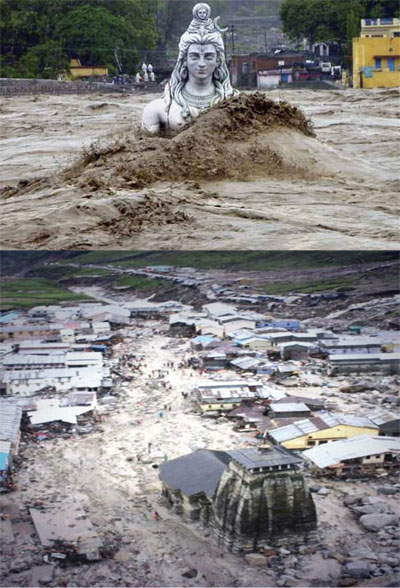
    Thousands Feared Dead In Rain-Ravaged Uttarakhand

    NEW DELHI (TIP): Nature’s fury continued unabated amid fears of the death toll rising rainravaged Uttarakhand as many pilgrims staying in 90 rest houses may have been washed away in flash flood even as rescue operations were stepped up. The the Uttarakhand State Disaster Mitigation and Management Centre in its report to the union ministry said casualties in the affected areas may run into thousands as about 90 guest houses with pilgrims were swept away in the flash floods.

    But official death toll still stands at 150. With the weather clearing up, rescue operation were stepped up. Chief Minister Vijay Bahuguna while seeking funds to help the affected people, said many kilometers of roads have been washed away in Uttarakhand due to the flash floods. The chief minister said many bridges, houses, water lines, canals, check dams, electricity lines, power houses and other public and private property had been severely damaged.

    He said the Chardam pilgrimage, which includes the shrines at Kedarnath and Badrinath, had been severely hit. He appealed to people and voluntary organizations to contribute to relief efforts in the wake of the devastation caused by heavy rains, landslides, cloud bursts and floods.

    Meanwhile, an official of the Badrinath- Kedarnath Temple Committee said that pilgrimage to the shrines of Kedarnath and Badrinath in Uttarakhand cannot resume for three years due to extensive damage caused by heavy rains and floods. Officials of the two shrines say the two places have been so badly devastated that there was nothing “but mud, devastation and death” around the highly revered temples visited by millions.

    “What we are seeing is very painful and unbelievable,” he said. “We don’t expect the Char Dham Yatra to resume in the next three years.” KEDARNATH SHRINE SAFE, EVERYTHING ELSE DESTROYED The ancient Kedarnath shrine has survived the devastating floods in Uttarakhand but virtually everything around it has been destroyed, an official of the temple committee said. “Call it a miracle but the Nandi statue and the other idols in the temple are intact,” the official said.

    “In fact, those pilgrims who were in the temple during the tragedy also survived. “But the destruction all around the temple has been terrible,” said the official, adding that the real death toll in the floods and cloudburst of the weekend would be much more than the officially stated 150. But he admitted that the temple had suffered some damage. The official said there was no trace of a large number of pilgrims who were either headed to or returning from the shrine, built by Adi Shankara around 1,000 years ago.

    He said Ram Bada, located about seven kilometres from the temple, had been destroyed. So was the case with Gaurikund where there was a parking lot and a rest house. “There were an estimated 5,000 people at Ram Bada when a cloudburst took place,” he said. “The shops and houses around Kedarnath temple have been either destroyed or severely damaged,” said the official. “From the reports we are getting, I don’t think the Kedarnath pilgrimage can restart for two to three years,” he added. According to the official, 1,000 to 2,000 pilgrims were rescued from the temple region Wednesday.

    “The rescue operations are still going on.” 1,446 people rescued from flooded areas A total of 1,446 people were rescued by the NDRF from areas affected by floods caused by torrential rains in various places of north India, including Uttarakhand, a disaster management official said Thursday. “While 443 people were rescued in Uttarakhand, NDRF teams rescued 930 people from Haryana out of which 844 from Karnal and 86 from Yamuna Nagar.

    Fifty were rescued from Reckong Peo in Kinnaur district in Himachal Pradesh and 23 in Uttar Pradesh,” a National Disaster Response Force (NDRF) official said in a statement. Twenty-nine teams of the NDRF have been deployed in various flood hit area of Uttarakhand, Himachal Pradesh, Uttar Pradesh, Haryana, West Bengal and Assam for relief operations.

    “The water levels have decreased, relief operations are continuing,” the statement added. Apart from NDRF, men and staff of the Indo-Tibetan Border Police (ITBP) and the army are carrying over the rescue operations particularly in Uttarakhand, the worst hit by heavy rains. Home Minister Sushilkumar Shinde has put the number of people stranded in Uttarakhand at some 62,000.

  • Emaar MGF Receives Rs 8.6k Crore Fine Notice

    Emaar MGF Receives Rs 8.6k Crore Fine Notice

    NEW DELHI (TIP): Realty giant and Commonwealth Games Village builder Emaar MGF was on Tuesday slapped with a show-cause notice of Rs 8,600 crore by the Enforcement Directorate for violating Foreign Exchange Management Act (FEMA). The company is alleged to have diverted FDI money to buy thousands of acres of agricultural land in violation of FEMA and FDI rules and could face a penalty in excess of Rs 25,000 crore.

    Significantly, the development comes on a day the Union Cabinet approved the Real Estate Regulators Bill. Sources said the company had used a modus operandi similar to as alleged in the case of Walmart, under investigation by the ED for diverting FDI money to retail sector through various subsidiaries. Emaar MGF allegedly used a maze of subsidiaries through which it diverted FDI money — brought in for investment in construction projects — to buy agricultural land. ED first raided 13 premises of the company here and elsewhere in 2009 in connection with the case and had seized several documents and large amounts of cash.

    Investigations then found that almost 70% of the company’s land bank was agricultural land. Out of over 12,000 acres of land bank with the company, close to 8,500 acres were found to be agricultural, most of which is alleged to have been bought by FDI money. The firm is also alleged to have floated over 300 companies as subsidiaries in India and abroad with several of its lowgrade employees listed as directors. Some of these companies were allegedly used to divert FDI into agricultural land bought around Delhi, Haryana , Punjab and Uttar Pradesh.

  • Half Of India’s Dalit Population Lives In 4 States

    Half Of India’s Dalit Population Lives In 4 States

    CHENNAI (TIP): Four states account for nearly half of the country’s dalit population, reveals the 2011 census. Uttar Pradesh stands first with 20.5% of the total scheduled caste (SC) population, followed by West Bengal with 10.7%, says the data released by the Union census directorate on Tuesday. Bihar with 8.2% and Tamil Nadu with 7.2 % come third and fourth. Dalits form around 16.6% of India’s population. The 2011 census recorded nearly 20.14 crore people belonging to various scheduled castes in the country. As per the 2001 census, the number was 16.66 crore.

    The dalit population showed a decadal growth of 20.8%, whereas India’s population grew 17.7% during the same period. “Though there is an increase in the population of dalits in the country, many states with a considerable number of dalits don’t have any legislation to protect the interests of the community. Dalit empowerment is very poor in many states,” said former Viduthalai Chiruthaigal Katchi (VCK) MLA D Ravikumar. Many scheduled caste families don’t own land or any other property, said Ravikumar.

    “Many dalits are landless and efforts to empower them by giving free land have not been successful in Tamil Nadu. Unlike Punjab, which has a considerable number of dalits as industrialists, here there is hardly any industrialist from our community,” the leader of the dalit party said. There are around 9.79 crore women among the total SC population, and the sex ratio works out to 946 females per 1000 males. Nagaland, Lakshwadeep and Andaman and Nicobar islands have no scheduled castes among their population.

    Though UP has the largest chunk of the total SC population, Punjab has the largest share of dalits in its population at 31.9%. Himachal Pradesh and West Bengal follow Punjab with 25.2% and 23.5%. In Tamil Nadu, dalits account for about 18% of the population. The state budget should also allocate funds for creation of assets for dalits, said Ravikumar.

    “Instead of distributing freebies, the state governments can set aside a portion of the total allocation for dalits. In many cases, funds are being diverted and dalits lose whatever is due to them,” he said. The states with considerable number of dalits in their population must pass a separate legislation on the lines of Andhra Pradesh, which has passed the SC/ST Sub Plan Act, said a dalit activist.

  • India protests questioning of UP minister at Boston airport

    India protests questioning of UP minister at Boston airport

    NEW DELHI (TIP): India has formally protested to the US the brief detention of Uttar Pradesh urban development minister Mohammad Azam Khan at Boston airport as he arrived to take part in an event at Harvard University. Khan, who is accompanying UP chief minister Akhilesh Yadav for the presentation of a Harvard study on the Kumbh Mela pilgrimage, was detained for about 10 minutes for “further questioning” at Boston Logan International Airport Wednesday, according to Indian officials.

    Once the visitors were cleared for entry by immigration, a woman officer of the US Customs and Border Protection wing of the Homeland Security took Khan to an adjacent room “for further questioning,” sources said. Incensed, Khan is reported to have kicked up a ruckus in the immigration area saying he was detained because he was a Muslim and sought an apology from the officer who merely said she was doing her duty.

    As arguments became heated, officials from the Indian consulate in New York intervened and Khan was escorted out of the airport. In Washington, Indian embassy spokesman M Sridharan said the mission has “taken up the issue with the State Department officially and we have conveyed our serious concern.” “We have asked them to intervene and take appropriate measures to avoid recurrence in the future.” At the State Department, when asked to comment on the incident, spokesman Patrick Ventrell said he was “not aware of the specifics of this case” as the Department of Homeland Security has jurisdiction over airport movements inside the US.

    But “I do want to underscore that we have a very important bilateral relationship with India and a very robust and thorough diplomatic exchange with our partners, he said. “We very much value our partnership with the Government of India.” The Azam Khan case is the latest instance of Indian VIPs being detained at US airports. Last year, Bollywood actor Shah Rukh Khan was detained for over two hours by immigration officials at a New York airport. Former President A P J Abdul Kalam was twice subjected to frisking at New York’s JFK Airport by US security officials. India’s then ambassador to the US Meera Shanker was patted down by a security agent in Mississippi in December 2010.

  • Missing Indian- American student Sunil Tripathi is confirmed dead

    Missing Indian- American student Sunil Tripathi is confirmed dead

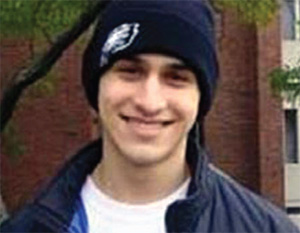
    Missing Indian- American student Sunil Tripathi is confirmed dead WASHINGTON (TIP): Sunil Tripathi, a Brown University student missing for more than a month, is dead. Rhode Islands medical examiner on April 25 said the body found in a river on April 23 is that of Sunil Tripathi. Health Department spokeswoman Dara Chadwick said the body was identified through a forensic dental exam.

    The cause of death has not been determined yet however. Tripathi, a 22-year-old philosophy student, was last seen on March 16. The body was found in Providence River behind the Wyndham Garden Providence Hotel at around 6 p.m. The coach of Brown’s rowing team, which practices in that area, saw the body floating in the water. The police waited for medical examiner to make the final determination. The family said in a statement on “Help us find Sunil Tripathi”, a Facebook page they had set up to help the search, they felt “indescribable grief” and were grateful for all-around support. Tripathi became the became the target of intense internet speculation last week if he was Suspect No 2 wanted for the Boston marathon bombings.

    Many thought it was him from the visuals released by the FBI. The Facebook page set up by his family to help in the search was hit by a storm of nasty hate messages. “It was outrageous, what they had to say,” Sunil’s father Akhil Tripathi told Hindustan Times. Reddit, a site that allows users to post news, apologized to the family for its role in it. The Tripathis are from Kanpur, Uttar Pradesh. Akhil Tripathi, an engineering graduate from Harcourt Butler Technological Institute, Kanpur, came to the US in 1968.

  • Mayawati Woos Upper Castes Ahead Of Ls Polls

    Mayawati Woos Upper Castes Ahead Of Ls Polls

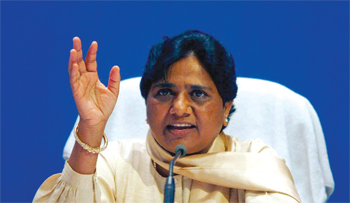
    LUCKNOW (TIP): With an eye on upper caste vote bank, BSP chief Mayawati announced names of 36 candidates for Lok Sabha polls, 18 of whom are Brahmins. Seeking to exploit the upper caste card to the hilt, she alleged atrocities were being committed on such people during the Samajwadi Party rule in Uttar Pradesh. “Just as Dalits are facing onslaughts, atrocities are being committed on Brahmins too under the Samajwadi Party government,” Mayawati told reporters on the sidelines of Brahmin Bhaichara Samiti office bearers’ meeting here.

    Citing the instance of humiliation to a Brahmin family in Etawah, she said most of those in the echelons of power in the SP government came from that district and it was a wellknown fact that people belonging to ‘sarv samaj’ (the entire society) are harassed there. “But Brahmins bear the maximum brunt of atrocities in Etawah…when the incident (of humiliation) took place, BSP raised the matter in the Assembly.

    Besides, its local unit tried to take up the issue and help them get justice,” she said. Mayawati regretted that during the last Assembly polls, the upper castes and Brahmins got influenced by non- BSP parties and did not vote for her party, “for which they are now repenting“. “For ensuring that they do not get further misled by the false propaganda of those parties, a detailed programme has been worked out by BSP to apprise them of various works done by my government in their interest. Besides, they would be apprised of atrocities on Brahmins under the SP rule,” she said. On why upper castes had got disenchanted with BSP in the last Assembly polls, she said, “Though our vote percentage rose, we lost seats due to our opponents’ (Congress and BJP) conspiracy, but we have learnt a lesson and would not allow them to succeed this time,” she said.

  • 24×7 power supply status to Amethi, Raebareli withdrawn

    24×7 power supply status to Amethi, Raebareli withdrawn

    LUCKNOW (TIP): In a move suggesting growing differences between the Congress and the Samajwadi Party (SP), the Uttar Pradesh Power Corporation Limited (UPPCL) has withdrawn the ‘VIP’ status of Raebareli and Amethi with regard to 24×7 power supply. The two districts are parliamentary constituencies of Congress chief Sonia Gandhi and Congress vice president Rahul Gandhi.

    The nine-month-old decision to provide round-theclock electricity to these two districts was revoked late Thursday, after which power went off for more than four hours, officials said. The Akhilesh Yadav government had run into rough weather when the power regulatory authority had sought a reply from it on the logic behind 24×7 power supply to nine districts, including Raebareli and Amethi, when other parts of the state faced acute power shortage.

    While officials preferred to keep mum on the matter, owing to its “sensitivities and political overtones”, officials privy to the decision told IANS that from now on, the unbridled power supply to these VIP districts would be “normal” – at par with other districts of the state. “I would not like to draw any political inference. The fact is that the two districts have lost their VIP status with regard to power supply,” a senior UPPCL official said. Officials justified the move, saying there was growing demand for power and stagnant supply. “With the onset of summer, power demand is at its peak.

    We have to devise ways to accommodate every district,” an official said. Uninterrupted power supply, however, continues to other VIP zones like Mainpuri (SP chief Mulayam Singh Yadav’s parliamentary constituency), Kannauj (Chief Minister Akhilesh Yadav’s wife Dimple’s parliamentary constituency), Etawah (home district of the `first family’ of UP), Sambhal (constituency of Mulayam’s nephew Dharmendra Singh Yadav) and Rampur (home turf of UP cabinet minister Mohd Azam Khan). Congress spokesman Amarnath Agarwal said the move smacked of politics. He sought to know why some districts continued to get uninterrupted power supply, if power shortage was really the reason behind the move.

  • President Confers Padma Awards

    President Confers Padma Awards

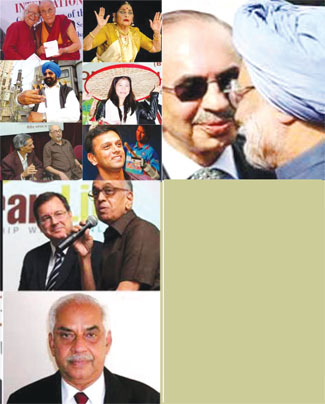
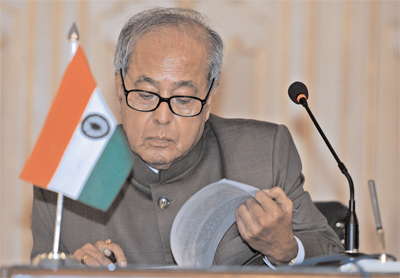
    NEW DELHI (TIP): President PranabMukherjee on April 5 conferred Padma Awards, the country’s highest civilian awards, to 108 personalities. The awards comprise 4 PadmaVibhushan, 24 PadmaBhushan and 80 PadmaShri Awards on Friday. 24 of the awardees are women and the list also includes 11 people in the category of foreigners, NRIs, PIOs and posthumous awardees. Noted physicist Yash Pal and space scientist Roddam Narasimha were chosen the second highest civilian honour Padma Vibhushan. Batting great Rahul Dravid and Olympic bronze medallist MC Mary Kom and late Bollywood actor Rajesh Khanna were named for the prestigious Padma Bhushan award, the third highest civilian award of the country. Renowned sculptor Raghunath Mohapatra and painter S Haider Raza were chosen for Padma Vibhushan.

    The list of 108 Padma awardees for this year also includes actress Sridevi, actors Nana Patekar and Malayalam star Madhu of Chemmeen fame and Olympians Yogeshwar Dutt and Vijay Kumar. Nobody was named for Bharat Ratna for this year too. The last awardee was late Bhimsen Joshi in 2008. Satirist Jaspal Bhatti, who died in a road accident last year, film maker D Rama Naidu, noted South Indian playback singer S Janaki, Bharatnatyam dancer Saroja Vaidyanathan, missile scientist Dr A Sivathanu Pillai of BrahMos programme, Industrialist Adi Godrej and R Tyagarajan, former bureaucrat M K Bhan were among the 24 Padma Bhushan awardees. In all four personalities were awarded Padma Vibhushan, 24 for Padma Bhushan and 80 Padma Shri. Of the awardees 24 are women, 11 belong to the category of foreigners, NRI, PIOs and posthumous.

    Padma Awards, the country’s highest civilian awards, are conferred in three categories, namely Padma Vibhushan, Padma Bhushan and Padma Shri.

    PADMA VIBHUSHAN
    Raghunath Mohapatra, Art, Orissa
    S Haider Raza, Art, Delhi
    Prof Yash Pal, Science and Engineering, Uttar Pradesh
    Prof Roddam Narasimha, Science and Engineering,Karnataka

    PADMA BHUSHAN
    Dr Ramanaidu Daggubati, Art, Andhra Pradesh
    Sreeramamurthy Janaki, Art, Tamil Nadu
    Dr (Smt) Kanak Rele, Art, Maharashtra
    Sharmila Tagore, Art, Delhi
    Dr (Smt) Saroja Vaidyanathan, Art, Delhi
    Abdul Rashid Khan, Art, West Bengal
    Late Rajesh Khanna, Art, Maharashtra
    Late Jaspal Singh Bhatti, Art, Punjab
    Shivajirao Girdhar Patil, Public Affairs, Maharashtra
    Dr Apathukatha Sivathanu Pillai, Science, Engineering,Delhi
    Dr Vijay Kumar Saraswat, Science and Engineering,Delhi
    Dr Ashoke Sen Science and Engineering,Uttar Pradesh
    B N Suresh, Science and Engineering, Karnataka
    Prof Satya N Atluri, Science and Engineering, USA
    Prof Jogesh Chandra Pati, Science and Engineering,USA
    Ramamurthy Thyagarajan, Trade and Industry,Tamil Nadu
    Adi Burjor Godrej, Trade and Industry, Maharashtra
    Dr Nandkishore Shamrao Laud, Medicine,Maharashtra
    Mangesh Padgaonkar, Literature and Education,Maharashtra
    Prof Gayatri Chakravorty Spivak, Literature & Education USA
    Hemendra Singh Panwar, Civil Service,Madhya Pradesh
    Maharaj Kishan Bhan, Civil Service, Delhi
    Rahul Dravid, Sports, Karnataka
    H Mangte Chungneijang Mary Kom, Sports, Manipur

    PADMA SHRI
    Gajam Anjaiah, Art, Andhra Pradesh
    Swami G C D Bharti alias Bharati Bandhu, Art,Chhattisgarh
    B Jayashree, Art, Karnataka
    Sridevi Kapoor, Art, Maharashtra
    Kailash Chandra Meher, Art, Orissa
    Brahmdeo Ram Pandit, Art, Maharashtra
    Vishwanath D Patekar alias Nana Patekar, Art,Maharashtra
    R Nageswara Rao alias Surabhi Babji, Art, Andhra Pradesh
    Lakshmi Narayana Sathiraju, Art, Tamil Nadu
    Jaymala Shiledar, Art, Maharashtra
    Suresh Dattatray Talwalkar, Art, Maharashtra
    P Madhavan Nair alias Madhu, Art, Kerala
    Apurba Kishore Bir, Art, Maharashtra
    Ghanakanta Bora Borbayan, Art, Assam
    Hilda Mit Lepcha, Art, Sikkim
    Sudha Malhotra, Art, Maharashtra
    Ghulam Mohammad Saznawaz, Art,Jammu and Kashmir
    Ramesh Gopaldas Sippy, Art, Maharashtra
    Mahrukh Tarapor, Art, Maharashtra
    Balwant Thakur, Art, Jammu and Kashmir
    Puran Das Baul, Art, West Bengal
    Rajendra Tikku, Art, Jammu and Kashmir
    Pablo Bartholomew, Art, Delhi
    Shri S Shakir Ali, Art, Rajasthan
    S K M Maeilanandhan, Social Work, Tamil Nadu
    Nileema Mishra, Social Work, Maharashtra
    Reema Nanavati, Social Work, Gujarat
    Jharna Dhara Chowdhury, Social Work, Bangladesh
    Late Dr Ram Krishan, Social Work, Uttar Pradesh
    Late Manju Bharat Ram, Social Work, Delhi
    Prof Mustansir Barma, Science and Engineering,Maharashtra
    Avinash Chander, Science and Engineering, Delhi
    Sanjay Govind Dhande, Science and Engineering,Uttar Pradesh
    Prof (Dr) Sankar Kumar Pal, Science, Engineering,West Bengal
    Deepak B Phatak, Science and Engineering,Maharashtra
    Dr Mudundi Ramakrishna Raju, Science and Engg,Andhra Pradesh
    Prof Ajay K Sood, Science and Engineering, Karnataka
    Prof Krishnaswamy Vijayraghavan, Science & Engg,Karnataka
    Dr Manindra Agrawal, Science and Engineering,Uttar Pradesh
    Dr Jayaraman Gowrishankar, Science & Engineering,Andhra Pradesh
    Prof Sharad Pandurang Kale, Science & Engineering,Maharashtra
    Vandana Luthra, Trade and Industry, Delhi
    Rajshree Pathy, Trade and Industry, Tamil Nadu
    Hemendra Prasad Barooah, Trade and Industry,Assam.
    Milind Kamble, Trade and Industry, Maharashtra
    Kalpana Saroj, Trade and Industry, Maharashtra
    Dr Sudarshan K Aggarwal, Medicine, Delhi
    Dr C Venkata S Ram alias Chitta, Venkata Sundara Ram, Medicine, Andhra Pradesh
    Dr Rajendra Achyut Badwe, Medicine, Maharashtra
    Dr Taraprasad Das, Medicine, Orissa
    Prof (Dr) T V Devarajan, Medicine, Tamil Nadu
    Prof (Dr) Saroj Chooramani Gopal, Medicine,Uttar Pradesh
    Dr Pramod Kumar Julka, Medicine, Delhi
    Dr Gulshan Rai Khatri, Medicine, Delhi
    Dr Ganesh Kumar Mani, Medicine, Delhi
    Dr Amit Prabhakar Maydeo, Medicine, Maharashtra
    Dr Sundaram Natarajan, Medicine, Maharashtra
    Prof Krishna Chandra Chunekar, Medicine,Uttar Pradesh
    Dr Vishwa Kumar Gupta, Medicine, Delhi
    Prof (Capt) Dr M Sharaf-eAlam, Literature & Education, Bihar
    Dr Radhika Herzberger, Literature & Education,Andhra Pradesh
    J Malsawma, Literature and Education, Mizoram
    Devendra Patel, Literature & Education, Gujarat
    Dr Rama Kant Shukla, Literature & Education, Delhi
    Prof Akhtarul Wasey, Literature & Education, Delhi
    Prof Anvita Abbi, Literature & Education, Delhi
    Nida Fazli, Literature & Education, Madhya Pradesh
    Surender Kumar Sharma, Literature & Education,Delhi
    Dr Jagdish Prasad Singh, Literature & Education,Bihar
    Late Shaukat Riaz Kapoor Alias Salik Lakhnawi,
    Literature & Education, West Bengal.
    Prof Noboru Karashima, Literature & Education, Japan
    Christopher Pinney, Literature & Education, UK
    Premlata Agrawal, Sports, Jharkhand
    Yogeshwar Dutt, Sports, Haryana
    Hosanagara Nagarajegowda Girisha, Sports,Karnataka
    Subedar Major Vijay Kumar, Sports, Himachal Pradesh
    Ngangom Dingko Singh, Sports, Maharashtra
    Naib Subedar Bajrang Lal Takhar, Sports, Rajasthan
    Ritu Kumar, Fashion Designing, Delhi
    Dr Ravindra Singh Bisht, Archaeology, Uttar Pradesh.

  • Fighting with govt can put you in jail: Mulayam

    Fighting with govt can put you in jail: Mulayam

    LUCKNOW (TIP): Raking up the issue of misuse of CBI, Samajwadi Party supremo Mulayam Singh Yadav said fighting with the government is not easy as it can use CBI and put one in jail. “Sarkar se ladna asan nahi hai. Sarkar ke hazaron haath hote hain. CBI ka upyog kar sakti hai…jail me dal sakti hai” (It’s not easy to fight with the government. It has thousands of hand and can use CBI and put one in jail),” he told reporters here in reply to a question.

    Yadav had earlier also attacked Congress-led UPA government blaming misuse of CBI by it. “Congress used to take support by threatening. I supported the UPA government in bad times but Congress has put CBI after me,” the SP chief had told reporters here on March 29. Asked about socialist leader Ram Manohar Lohia’s praise by BJP leader L K Advani in Chitrakoot, Yadav said that it is good if he has done so. “A lot of hue and cry was raised in the media when I appreciated Advani… Those who had done or are doing good should be appreciated. Should one who is doing good be abused ?” Yadav said after a meeting with his party’s district presidents. During the closeddoor meeting, Yadav asked the district presidents to remain prepared for Lok Sabha polls, according to sources.

    He told the party functionaries to work in their districts to redress the grievances of the common man and stressed on the need for strengthening booth committees. Yadav also asked them to remain cautious about the Opposition parties in Uttar Pradesh which have been making allegations against the government. “Promises made in the party’s manifesto in 2012 Assembly polls are being fulfilled and a number of schemes including distribution of laptops have already started…The message that the SP government was working for the people should reach them,” he said.

  • Choose sides, Congress tells Mulayam

    Choose sides, Congress tells Mulayam

    NEW DELHI (TIP): The war of words between Congress and Samajwadi Party (SP) chief Mulayam Singh Yadav sharpened on March 28 with Congress asking the Uttar Pradesh stalwart to decide which side of the secularcommunal divide he is on.

    Stung at being labeled a party that hoodwinks voters at poll time, Congress spokesperson Rashid Alvi said the SP boss had begun to praise BJP leader L K Advani despite his role in the demolition of Babri Masjid. Information and broadcasting minister Manish Tewari reminded Yadav that the “basic political polarization” is communal versus secular. “He will also have to decide which side he is on,” Tewari said, responding to the SP chief’s attacks. The note of impatience in Congress’s responses do not mean the party is looking for a showdown with SP, but indicates an increasing wariness about SP’s likely action in the light of Yadav’s fulminations.

    So far, SP has stopped well short of reviewing its “outside support” to the UPA despite chaffing at what it feels is its lack of influence at the Centre. The SP government in Uttar Pradesh has repeatedly demanded large dollops of economic assistance. Apart from being a competitor for the minority vote that is essential to its electoral success, Yadav might be provoked by reports that the Centre is considering Bihar CM Nitish Kumar’s claims for special assistance in order to reduce its vulnerability to SP. Besides DMK’s withdrawal of support increasing UPA’s dependence on allies like Yadav, SP is keenly weighing when an election will suit it most.

    The UP outfit is aware it must ensure Congress is eliminated as an option to maximize its gains in a national election. Addressing SP workers at his native Saifai, Yadav warned Congress might pull off a clever scheme like the farm loan waiver. “They will again do that. They are so clever and cheat…they take people for a ride when the time comes,” he said. Yadav’s repeated assertions that he is eyeing the prime ministerial chair – he said in Saifai Lok Sabha polls are the “real elections as Delhi means everything” – again serve to emphasize why he needs to target Congress. “As far as Mulayam Singh is concerned, we respect all our allies.

    He also knows in his mind that the basic polarization in this country is communal versus secular forces. He will also have to decide which side he is on,” Tewari said. He also brushed off Yadav’s revisiting the “third front” as a “most enduring mirage” and hoped that SP will continue its “very constructive support” and that “an atmosphere of harmony will prevail”. Alvi pointed out that “We do not want to comment…He himself, can explain it best. But only a few months back, Yadav shared the dais with the Prime Minister when the UPA’s report card on its three-year performance was released.”

  • Delhi Police Arrest  Suspected Hizbul  Operative, Foil Terror  Attack In National  Capital

    Delhi Police Arrest Suspected Hizbul Operative, Foil Terror Attack In National Capital

    NEW DELHI (TIP): The special cell of Delhi Police foiled a terror attack in the national capital after apprehending a suspected Hizbul Mujahideen operative from Gorakhpur, near Nepal border, in Uttar Pradesh. The suspect has been identified as Liaqat Ali who ‘came’ to Delhi by Kosi Express, a source in Delhi Police said. Liaqat Ali is considered a hardcore terrorist, who initially underwent rigorous training in Pakistan, and has been associated with Hizbul Mujahideen for the last 15 years, the source added.

    He has been involved in several operations. Based on inputs provided by him, the cops raided a guest house in Jama Masjid area on March 21 night. Special police teams and bomb squads reached the Hazi Arafat guest house in Jama Masjid area of central Delhi at 10.30pm and cordoned it off. They recovered assault rifles, hand grenades and more than 2kg of explosives from room number 304 of the guest house. The room was later sealed.

    The ammunition was delivered in the room by a third person and was reportedly to be used by Liaqat Ali, cops say. Two of the guest house staff were taken into custody for questioning but were let off later after the sleuths found nothing against them. They provided information about the identity of the accused who visited the guest house. The cops suspect that the terrorists had planned a huge strike in the national capital to avenge the executions of Parliament attack convict Afzal Guru and Mumbai terror attack convict Azmal Kasab.

    The officers, though, have not confirmed if the cricket Test match between India and Austrailia at Ferozeshah Kotla was the target of the terrorists. The stadium is barely 4 km away from the hotel. Liaqat Ali has told the cops about the presence of his associates in the national capital after which a manhunt has been launched to nab them.

  • President Pranab Mukherjee May Turn Down 5 More Mercy Pleas

    President Pranab Mukherjee May Turn Down 5 More Mercy Pleas

    NEW DELHI (TIP): The Union homeministry is learnt to have recommendedrejection of mercy petitions in five morecases as it seeks to speedily dispose of allthe cases of death row convicts pendingwith it.Seeking to have a swift closure on thecases of those who have filed mercy pleasagainst capital punishment awarded tothem, the ministry has sent all the pendingfiles to President Pranab Mukherjee for afinal call.Sources said that seven cases involvingthe fate of nine people have been sent to thePresident, with the ministryrecommending rejection of the mercy pleasin five cases. It has and left the tworemaining ones open for commutation ofdeath sentence to life imprisonment withthe rider that the life term means jail forthe entire life of the convict and not just 20years or 14 years in prison.

    The President had sent the files to Unionhome minister Sushilkumar Shinde onOctober 30 for his review and opinion.Shinde sent the files back within 100 daysin a major shift from the pattern wheredecisions on mercy petitions wereindefinitely delayed with files shuttlingbetween the home ministry and theRashtrapati Bhavan.Though the case-wise recommendationsfor convicts were not known as both thehome ministry and Rashtrapati Bhavancontinue to remain tightlipped on mercypetition files, the seven cases relate tomultiple murders, including one in which arape convict out on bail killed five membersof the victim’s family.

    While two files were sent to RashtrapatiBhavan on February 9 (the day ParliamentHouse attack case convict Afzal Guru washanged), the remaining five files weredispatched last month.The mercy files, which have beenpending for years while moving to and frobetween Rashtrapati Bhavan and the homeministry, saw unprecedented movement oflate, resulting in two quick hangings(Ajmal Kasab and Afzal Guru) within lessthan three months. Mukherjee had rejectedthe mercy plea of Kasab on November 5,and Guru on February 3.The files, which are now with PresidentMukherjee, include the longest pendingcase of Gurmeet Singh of Uttar Pradesh,who was convicted for killing 13 membersof a family on August 17, 1986.

    The otherscases are of Suresh and Ramji, also fromUP, who were convicted for killing fivemembers of their brother’s family andDharampal from Haryana, who hadmurdered five members of the family of agirl he had raped in 1993. He had murderedthe family while on bail in the rape case.The other cases are of Sonia, daughter ofa former Haryana MLA, and her husbandSanjeev, who drugged and killed eight ofher family in Hisar in 2001, including herparents. Sunder Singh from Uttarakhand isconvicted for rape and murder on June 30,1989, Jafar Ali from Uttar Pradesh who wasconvicted for killing wife and five daughterin 2002 and Praveen Kumar of Karnataka,convicted for killing four members of afamily on February 23, 1994.

    Mukherjee has so far disposed of mercypetitions of eight death row convicts in fivecases.The President has also rejected themercy petitions of Saibanna NingappaNatikar (Karnataka: convicted for killingwife and daughter) and mercy petitions ofslain forest brigand Veerappan’s associatesGnanaprakash, Simon, ‘Meesai’ Madaianand Pilavendran, who were sentenced todeath for killing 22 police personnel in 1993.However, the mercy petition of Atbir(Delhi), who was convicted for murder ofhis step-mother, step-sister and step-brotherover property, was commuted to lifeimprisonment by the President.

    Strained mercy:
    1,455 persons awarded death penaltyin India from 2001 to 2011Sentences for 4,321 persons werecommuted from death penalty to lifeimprisonment during the same period.Highest number of death penalty wasimposed in Uttar Pradesh (370)followed by Bihar (132), Maharashtra(125), Karnataka and Tamil Nadu (95each), Madhya Pradesh (87),Jharkhand (81), West Bengal (79),Delhi (71), Gujarat (57), Rajasthan (38),Kerala (34), Odisha (33), Haryana (31),Assam (21), Jammu & Kashmir (20),Punjab (19), Chhattisgarh (18),Uttarakhand (16), Andhra Pradesh (8),Meghalaya (6), Chandigarh and Daman& Diu (4 each), Manipur and HimachalPradesh (3 each), Tripura andPondicherry (2 each) and Goa (1)No death penalty imposed inArunachal Pradesh, Mizoram,Nagaland and Sikkim and UnionTerritories of Andaman & NicobarIslands, Dadra & Nagar Haveli andLakshadweepSentences of 4,321 persons werecommuted from death penalty to lifeimprisonment in the country during2001-11.

  • ‘Vishwaroop’ Releases To Average Response

    ‘Vishwaroop’ Releases To Average Response

    NEW DELHI (TIP): “Vishwaroop”, the Hindi version ofactor-director Kamal Haasan’s controversial film”Vishwaroopam”, released peacefully on February 1 toan average response, which was likely to pick up overthe weekend.The movie, the original Tamil and Telugu version ofwhich is currently banned in Tamil Nadu, releasedwithout any hassles in Delhi, Punjab and Rajasthan,while in Uttar Pradesh and Mumbai, security wasbeefed up at cinema halls for the release over fear ofprotests.

    “Vishwaroopam” is under the scanner of 24 Muslimorganisations, which objected to certain scenes of thefilm as derogatory to their community.However, the situation seems to have sparkedincreased interest in the movie in north India.In Delhi, the response was okay, but the collectionsare expected to increase during the weekend, says AnantVerma, director and business head, DT Cinemas.”Whoever has seen the movie has liked it – be it peoplefrom south India or north India.

    The publicity that themovie has got is working in favour of the movie. We areexpecting a hike (in collections) over the weekend,”Verma said. He says no security issues have beenreported at any of his halls here so far, and “everythingis under control”.”The occupancy for the first show was around 55 to 60per cent, but that is how it is every (early) Friday. Thefilms start picking up from Friday evening,” he added.Delhi-based distributor Joginder Mahajan admits thestart for “Vishwaroop” is “poor”, but “it is expected togrow over the weekend”.He pointed out how “since there has been so muchcontroversy, people avoid going on the first day”.

    In east Punjab, the film’s opening was below average,informed distributor Jaspal Dhingra of NanaksarEnterprises. “The response to the first show was belowaverage. The film may be good, but collections are veryaverage. Generally, dubbed films from south India don’tdo well in Punjab. There are very few people here whowant to watch the movie,” Dhingra said.”As far as security is concerned, there were no issueshere and I don’t think there will be any problems in thefuture too,” he said.

    In Jaipur, the film got a peaceful opening and therewere are no protests, said police officials.Meanwhile, Kamal Haasan and his brother ChandraHaasan are trying to reach a solution to end the ban on”Vishwaroopam” in Tamil Nadu, which has led to theirincurring losses of Rs.30-60 crore.

    Sporadic Protests In Lucknow
    Sporadic demonstrations were held in Old Lucknowarea demanding a ban on Kamal Haasan’s movie“Vishwaroopam” that was released in the state amidtight security on February 1. After running into troublein several states in South India, Haasan received majorrelief in Uttar Pradesh when Chief Minister AkhileshYadav decided to let the film be screened in the state.

  • India: The Growth Story-Agriculture

    India: The Growth Story-Agriculture

    Agriculture in India has a significant history. Today, India ranks second worldwide in farm output. Agriculture and allied sectors like forestry and fisheries accounted for 16.6% of the GDP in 2009, about 50% of the total workforce. The economic contribution of agriculture to India’s GDP is steadily declining with the country’s broad-based economic growth. Still, agriculture is demographically the broadest economic sector and plays a significant role in the overall socio-economic fabric of India.

    Overview
    Per 2010 FAO world agriculture statistics, India is the world’s largest producer of many fresh fruits and vegetables, milk, major spices, select fresh meats, select fibrous crops such as jute, several staples such as millets and castor oil seed. India is the second largest producer of wheat and rice, the world’s major food staples. India is also the world’s second or third largest producer of several dry fruits, agriculture-based textile raw materials, roots and tuber crops, pulses, farmed fish, eggs, coconut, sugarcane and numerous vegetables. India ranked within the world’s five largest producers of over 80% of agricultural produce items, including many cash crops such as coffee and cotton, in 2010. India is also one of the world’s five largest producers of livestock and poultry meat, with one of the fastest growth rates, as of 2011.

    Indian agriculture since 1947
    Over 50 years since its independence, India has made immense progress towards food security. Indian population has tripled, but food-grain production more than quadrupled: there has thus been substantial increase in available food-grain per capita. Prior to the mid-1960s India relied on imports and food aid to meet domestic requirements. However, two years of severe drought in 1965 and 1966 convinced India to reform its agricultural policy, and that India could not rely on foreign aid and foreign imports for food security. India adopted significant policy reforms focused on the goal of foodgrain self-sufficiency. This ushered in India’s Green Revolution.

    It began with the decision to adopt superior yielding, disease resistant wheat varieties in combination with better farming knowledge to improve productivity. The Indian state of Punjab led India’s green revolution and earned itself the distinction of being the country’s bread basket. With agricultural policy success in wheat, India’s Green Revolution technology spread to rice. However, since irrigation infrastructure was very poor, Indian farmer innovated with tube-wells, to harvest ground water.When gains from the new technology reached their limits in the states of initial adoption, the technology spread in the 1970s and 1980s to the states of eastern India – Bihar,[Orissa] and West Bengal.

    The lasting benefits of the improved seeds and new technology extended principally to the irrigated areas which account for about onethird of the harvested crop area. In the 1980s, Indian agriculture policy shifted to “evolution of a production pattern in line with the demand pattern” leading to a shift in emphasis to other agricultural commodities like oilseed, fruit and vegetables. Farmers began adopting improved methods and technologies in dairying, fisheries and livestock, and meeting the diversified food needs of India’s growing population.

    As with Rice, the lasting benefits of improved seeds and improved farming technologies now largely depends on whether India develops infrastructure such as irrigation network, flood control systems, reliable electricity production capacity, all season rural and urban highways, cold storage to prevent food spoilage, modern retail, and competitive buyers of produce from the Indian farmer. This is increasingly the focus of Indian agriculture policy. India’s agricultural economy is undergoing structural changes.

    Between 1970 and 2011, the GDP share of agriculture has fallen from 43 to 16 percent. This isn’t because of reduced importance of agriculture, or a consequence of agricultural policy.

    This is largely because of the rapid economic growth in services, industrial output, and non-agricultural sectors in India between 2000 to 2010. The initial increase in production was centered on the irrigated areas of the Indian states of Punjab, Haryana and western Uttar Pradesh.With both the farmers and the government officials focusing on farm productivity and knowledge transfer, India’s total foodgrain production soared.

    A hectare of Indian wheat farms that produced an average of 0.8 tons in 1948, produced 4.7 tons of wheat in 1975 from the same land. Such rapid growths in farm productivity enabled India to become self-sufficient by the 1970s. It also empowered the smallholder farmers to seek further means to increase food staples produced per hectare.

    By 2000, Indian farms were adopting wheat varieties capable of yielding 6 tons of wheat per hectare. Accomplishments As of 2011, India had a large and diverse agricultural sector, accounting, on average, for about 16 percent of GDP and 10 percent of export earnings. India’s arable land area of 159.7 million hectares (394.6 million acres) is the second largest in the world, after the United States. Its gross irrigated crop area of 82.6 million hectares (215.6 million acres) is the largest in the world. India has grown to become among the top three global producers of a broad range of crops, including wheat, rice, pulses, cotton, peanuts, fruits, and vegetables.Worldwide, as of 2011, India had the largest herds of buffalo and cattle, is the largest producer of milk, and has one of the largest and fastest growing poultry industries.

    The following table presents the twenty most important agricultural products in India, by economic value, in 2009. Included in the table is the average productivity of India’s farms for each produce. For context and comparison, included is the average of the most productive farms in the world and name of country where the most productive farms existed in 2010. The table suggests India has large potential for further accomplishments from productivity increases, in increased agricultural output and agricultural incomes. The Statistics Office of the Food and Agriculture Organization reported that, per final numbers for 2009, India had grown to become the world’s largest producer of the following agricultural produce.

    FRESH FRUIT
    Lemons and limes
    Buffalo milk, whole, fresh
    Castor oil seeds
    Sunflower seeds
    Sorghum
    Millet
    Spices
    Okra
    Jute
    Beeswax
    Bananas
    Mangoes, mangosteens, guavas

    PULSES
    Indigenous Buffalo Meat
    Fruit, tropical
    Ginger
    Chick peas
    Areca nuts
    Other Bastfibres
    Pigeon peas
    Papayas
    Chillies and peppers, dry
    Anise, badian, fennel, coriander
    Goat milk, whole, fresh
    Per final numbers for 2009, India is the
    world’s second largest producer of the
    following agricultural produce.
    Wheat
    Rice
    Vegetables, fresh
    Sugar cane
    Groundnuts, with shell
    Lentils
    Garlic
    Cauliflowers and broccoli
    Peas, green
    Sesame seed
    Cashew nuts, with shell
    Silk-worm cocoons, reelable
    Cow milk, whole, fresh
    Tea
    Potatoes
    Onions
    Cotton lint
    Cottonseed
    Eggplants (aubergines)
    Nutmeg, mace and cardamoms
    Indigenous Goat Meat
    Cabbages and other brassicas
    Pumpkins, squash and gourds

    In 2009, India was the world’s third largest producer of eggs, oranges, coconuts, tomatoes, peas and beans. In addition to growth in total output, agriculture in India has shown an increase in average agricultural output per hectare in last 60 years.

    The table below presents average farm productivity in India over three farming years for some crops. Improving road and power generation infrastructure, knowledge gains and reforms has allowed India to increase farm productivity between 40% to 500% over 40 years. India’s recent accomplishments in crop yields while being impressive, are still just 30% to 60% of the best crop yields achievable in the farms of developed as well as other developing countries. Additionally, despite these gains in farm productivity, losses after harvest due to poor infrastructure and unorganized retail cause India to experience some of the highest food losses in the world.

  • BJP president election Gadkari out, Rajnath in

    BJP president election Gadkari out, Rajnath in

    NEW DELHI (TIP): Rajnath Singh was on January 23 unanimously elected the new president of the Bharatiya Janata Party (BJP), succeeding Nitin Gadkari who decided against a second term till he was cleared of alleged corruption charges.

    Rajnath Singh will serve his term from 2013 to 2015, and lead the party in the 2014 general elections. A resolution supporting Rajnath Singh as the BJP chief was unanimously adopted by the parliamentary board of the party, after which he filed his nomination papers. The returning officer announced that 17 other nominations were also filed in Rajnath Singh’s favour. Rajnath Singh has previously been the president of the party from 2005 to 2009. He first became the party president in December 2005, following the resignation of L.K. Advani. He was re-elected in November 2006 unanimously and was succeeded by Nitin Gadkari in 2009.

    He also served as the chief minister of Uttar Pradesh from October 2000 to March 2002. Rajnath Singh’s name was zeroed upon for the post of party president Tuesday evening, following Income Tax ‘surveys’ of around nine locations connected to alleged financial wrongdoing by a company linked to Gadkari. According to informed sources, several senior leaders, including BJP veteran L.K. Advani, had reservations on Gadkari getting a second term in view of allegations surrounding the Purti group linked to him. Gadkari, meanwhile, said he voluntarily backed out from going for a second term as he wanted his name cleared of the allegations.

  • Rape Victim’s Dad Wants World To Know Her Real Name

    Rape Victim’s Dad Wants World To Know Her Real Name

    NEW DELHI (TIP): The 23-year-old Delhi gangrape victim’s devastated father says he wants the world to know his daughter’s real name as it will give courage to other women who have survived such attacks, a week after the brave heart succumbed to her gruesome injuries. Following the girl’s brutal assault in a moving bus in Delhi on December 16 by six men, the Indian media has refrained from naming her. She died on December 29 at a Singapore hospital where she was shifted to from Delhi’s Safdarjung Hospital in an extremely critical condition.

    “We want the world to know her real name. My daughter didn’t do anything wrong, she died while protecting herself. I am proud of her. Revealing her name will give courage to other women who have survived these attacks. They will find strength from my daughter,” the victim’s 53-year-old father told ‘The Sunday People’, the Daily Mirror’s Sunday edition, in his ancestral village in Uttar Pradesh.

    The girl’s family has retreated to their village to grieve away from their Delhi home. ‘At first I wanted to see the men responsible face to face but I don’t want to any more. I just want to hear that the courts have punished them and they will be hanged. ‘Death for all six of them. These men are beasts. They should be made an example of and that society will not allow such things to happen,’ the girl’s father said. What happened to her was ‘just gruesome and I hope no one ever goes through what she had to endure,’ he said. He now hopes mothers and fathers will teach their sons to respect women. ‘The police cannot handle this on their own. But parents need to keep an eye on their children too.’

  • Muslim Panchayat Bans Use Of Cellphones By Girls

    Muslim Panchayat Bans Use Of Cellphones By Girls

    JAIPUR (TIP): After the khaps in Haryana and Uttar Pradesh, a Muslim community panchayat in Rajasthan on banned girls from using cellphones and also from dancing and singing at weddings, ostensibly in an effort to prevent incidents like Delhi gang rape. Boys and girls have also been prohibited from marrying someone against the wish of their family members or someone from a different community, panchayat members said on Thursday. The restrictions have been imposed on the Muslim community members at Salumbar town in Udaipur district, some 400 km from Jaipur, by the Anjuman Muslim Panchayat, a minority community council.

    “We have decided to ban the girls from carrying and using cellphones. The decision was taken with a view that cellphones are spoiling girls,” panchayat secretary Habibur Rahman told reporters. He said that a slew of measures has been taken to ensure safety of girls belonging to the community in the area. “The girls would not be allowed to dance and sing during wedding functions. A couple cannot get married against the wishes of their family members,” said the panchayat secretary. He added that punitive action will be taken against girls who are found ignoring the panchayat edicts. “If a couple runs away from house to get married, they will be ostracized and a cash fine of Rs 51,000 will be imposed on them. Fine of Rs 51,000 has also been decided for those who marry someone from a different community,” said the secretary. He added that panchayat decisions have been communicated to all members of the community in the town.

  • Sc Blow To Govt In High-Profile Cases, Death To Ajmal Kasab

    Sc Blow To Govt In High-Profile Cases, Death To Ajmal Kasab

    NEW DELHI (TIP): Judgements giving a body blow to the government in the highprofile Vodafone tax case and scrapping of 2G spectrum licences hogged the limelight in the Supreme Court which in 2012 also brought the curtains down on the 26/11 case by sending the lone surviving Pakistani terrorist Ajmal Kasab to the gallows.

    The 25-year-old Kasab’s nearly four-yearlong legal battle for life ended on August 29 and 84 days after the verdict he was hanged on November 21 for the crime of “unprecedented enormity” planned in Pakistan. While the day-to-day hearing in Kasab’s case was being watched, the then Army Chief V K Singh in an unprecedented move dragged the government to the top court where he lost his battle on the age row, forcing him to withdraw his petition.

    The apex court told Gen Singh that he cannot resile on his commitment that he would abide by the government decision to treat his date of birth as May 10, 1950 and rejected the contention of “prejudice” and “perversity”. However, before the age row, the year began on a bad note for the government which lost its tax case of Rs 11,000 crore against telecom major Vodafone and the apex court scrapping the 2G spectrum licences allocated during the tenure of A Raja as telecom minister. The government’s woes did not end here as its pleas for review of the Vodafone and 2G verdict fell flat.

    After failing to get any relief in the spectrum case, the Centre came out with Presidential Reference to overcome the direction in the 2G verdict that all natural resources have to be allotted through the route of “auction”. There was some solace for the government when on September 29, a fivejudge Constitution Bench came out with the opinion that auction is not the only method for allocating natural resources to private companies and made it clear that its 2G verdict was confined to spectrum and not to other resources.

    The 2G spectrum case also gave some anxious moments to Union Minister P Chidambaram after Janata Party chief Subramanian Swamy dragged him for his alleged involvement in the multi-crore rupee scam. Chidambaram finally got a clean chit from the apex court which also rejected the review petition against its verdict. The scam in the coal block allocation and government’s decision allowing FDI in retail were also dragged to the apex court which, though refused to interfere with the policy matter, put some searching questions to government on FDI and asked it to take corrective steps to remove legal hassles. However, the petitions alleging large scale irregularities in coal block allocation are pending in the apex court. Amid these developments, the UPA-II government survived a scare when the Supreme Court by a majority verdict of 3 to 2 dismissed the petition filed by former Lok Sabha Speaker P A Sangma challenging the election of senior Congress leader Pranab Mukherjee as the President.

    However, there was another reason for the Rashtrapati Bhavan to worry as President’s Secretary Omita Paul, who was advisor to Mukherjee when he was the Finance Minister, was impleaded as respondent in the petition seeking CBI probe into the appointment of U K Sinha as the chairman of SEBI. Market regulator SEBI was making news throughout the year by acting tough against the Sahara Group of companies which received a major setback when the Supreme Court directed two of its companies to refund around Rs 24,000 crore to their investors in three months with 15 per cent annual interest. However, desperate efforts brought some relief to the companies — Sahara India Real Estate Corporation (SIREC) and Sahara Housing Investment Corporation (SHIC) — as a Bench headed by Chief Justice Altamas Kabir modified the directions of another Bench by allowing them to comply with the August 31 order by first week of February. While the hearing was on in the SEBISahara matter, an unprecedented turn of event took place when the apex court decided to lay down guidelines for media for reporting the sub-judice matter following the alleged leakage of documents relating to the case.

    The then Chief Justice of India S H Kapadia’s decision was opposed by media houses which argued that such exercise would lead to infringement of fundamental right to freedom of expression and tantamount to encroaching the legislative domain. After a marathon hearing, a five-judge Constitution Bench refrained itself from laying down broad guidelines and evolved a principle of postponement for reporting the sub-judice matter which could be considered if any of the aggrieved parties sought such direction. The infringement of fundamental right to expression was well manifested when the apex court severely criticised Mumbai Police for booking two young girls under the controversial provision of cyber law for their posts on Facebook against the bandh after the death of Shiv Sena chief Bal Thackeray. Among the political heavy weights who hogged the limelight in the apex court in the year gone by were two former chief ministers of Uttar Pradesh.

    While BSP chief Mayawati got a relief in the assets case, her rival and Samajwadi Party supremo Mulayam Singh Yadav was not so lucky as in the fag end of the year, the court gave a body blow to him and his Chief Minister son Akhilesh Yadav by asking the CBI to continue with its probe against them in the wealth case. So was the case of former Karnataka chief minister B S Yeddyuruppa, who has been subjected to CBI probe along with his some former colleague in the illegal mining cases in Bellary, Tumkur and Chitradurga districts of the state. Some of the big business houses like companies associated with the Jindal Group and Adani’s are also under the CBI scanner.

    In Andhra Pradesh, rebel Congress leader Jagan Mohan Reddy, facing CBI probe in several cases including the disproportionate assets case failed to get relief from the Supreme Court which rejected his bail plea. However, as Gujarat went to the polls, CBI and NGO headed by social activist Teesta Setalvad left no stone unturned to vigorously pursue some of the cases arising out of the 2002 riots and encounter killings in the state involving Chief Minister Narendra Modi’s close aide and former minister Amit Shah. While there was no direct case against Modi in the apex court, the probe into the Tulsiram Prajapati murder case, an offshoot of the Sohrabuddin Sheikh fake encounter case involving Shah, was handed over to the CBI and trial shifted outside the state but with a relief to Modi’s aide, who was allowed to enter the state after two years to campaign and contest the polls which he eventually won.

    Congress general secretary Rahul Gandhi also had to battle in the Supreme Court which provided him relief by throwing out a petition by a former Samajwadi Party MLA from Madhya Pradesh, who had dragged him in a false rape case. Among the terror cases, while the apex court concluded the marathon hearing on the Mumbai blasts case of 1993 involving Bollywood actor Sanjay Dutt, it also granted bail to Syed Mohammed Kazmi, the lone arrested accused for the terror attack on Israeli diplomat here in February.

    Besides Kasab and Israeli diplomat terror case, other matter which had the international ramification was the acquittal of Pakistani microbiologist Mohammed Khalil Chishti of the murder charge in a 20-year-old criminal case with a direction to the authorities to complete all the “formalities” for his “smooth return” to his country.

    The case relating to the murder of fishermen in Kerala by Italian marines also reached the Supreme Court which reserved its verdict to quash the case against them. An inter-state legal battle which kept the apex court busy was the Cauvery water dispute between Karnataka and Tamil Nadu in which only interim orders were passed from time-to-time and the matter is still pending.

    Other matters which hogged the limelight in the apex court was its direction to the government to lift the subsidy in a phased manner granted for Haj pilgrimage and restrict the number of VIPs in it. The dwindling tiger population also drew the attention of the top court which after totally banning tourism in the core sector of tiger sanctuaries modified its order by allowing it in 20 per cent area in accordance with the guidelines prepared by the National Tiger Conservation Authority.

  • Delhi Gang Rape Case The Beginning Of A Change In The Mindset— A Revolution

    Delhi Gang Rape Case The Beginning Of A Change In The Mindset— A Revolution

    A female physiotherapy intern was beaten and gang raped in Delhi on 16 December 2012, and died thirteen days later while undergoing emergency treatment in Singapore for brain and gastrointestinal damage from the assault. After watching a film in South Delhi in the early evening, she and a male companion boarded a bus being driven as a “joyride”, thinking it was a public bus.[2] The only other passengers were five men who were friends of the driver, who then assaulted the pair. She was taken to Safdarjang Hospital, received multiple surgeries, and was placed on mechanical ventilation. On 26 December, she was moved to Singapore for further treatment, where she died on 29 December. As of 21 December 2012, six men, including the bus driver, have been arrested. The incident has generated international coverage and was condemned by the United Nations Entity for Gender Equality and the Empowerment of Women, who called on the Government of India and the Government of Delhi “to do everything in their power to take up radical reforms, ensure justice and reach out with robust public services to make women’s lives more safe and secure”. Public protests took place in Delhi, where thousands of protesters clashed with security forces. Similar protests took place in major cities throughout the country.

    Incident

    The victims, a 23-year-old female physiotherapy intern and her male friend, were on their way home after watching a film in Saket in South Delhi. They boarded a chartered bus at Munirka for Dwarka that was being driven by joyriders at about 9:30 pm. The minor among the accused had called for passengers telling them that it was going towards their destination. The woman’s friend became suspicious when the bus deviated from its normal route and its doors were shut. When he objected, the group of six men already on board taunted the couple, asking what they were doing alone at such a late hour. When the victim’s friend tried to intervene, he was beaten, gagged and knocked unconscious with an iron rod. The men dragged the woman to the rear of the bus, beating her with the rod and raping her while the bus driver continued to drive.

    Medical reports later suggested that the woman suffered serious injuries to her abdomen, intestines and genitals due to the assault, and doctors say that the damage indicates that a blunt object (suspected to be the iron rod) may have been used for penetration. That rod was later described by police as being a rusted, L-shaped implement of the type used with a wheel jack. After the beatings and rape ended, the gang threw the two from the moving bus. Then the accused allegedly tried to drive the bus over the woman but she was pulled aside in the nick of time by her male friend. One of the perpetrators later cleaned the vehicle.

    Police impounded it the next day.[8][9] As she was pinned down and raped, the young woman put up a fight but was hopelessly outnumbered. She bit three of the men assaulting her. The bite marks on the three accused men are likely to be part of the Delhi Police’s evidence in their chargesheet. The woman and her companion were found by a passerby on the road, partially clothed and unconscious, around 11 pm. The passerby phoned the Delhi Police, who took the couple to a hospital, where the female victim was given emergency treatment and placed on mechanical ventilation. The victim was found with only 5% of her intestines left inside of her. A doctor at the hospital later said that the “rod was inserted into her and it was pulled out with so much force that the act brought out her intestines also. That is probably the only thing that explains such severe damage to her intestines.”

    Victims

    The female victim was born and raised in Delhi while her parents were from a small village in the Ballia district of Uttar Pradesh. Her father, who sold his agricultural land to educate her, works for a private company in Delhi. Pseudonyms have been used for her, including Jyoti (light), Jagruti (awareness), Amanat (after the Indian TV soap opera Amanat), Nirbhaya (fearless one), and Damini (after the 1993 Hindi film Damini), although some media commentators have raised questions on the judgement of using pseudonyms for her. The male victim is 28 years old, from Gorakhpur, Uttar Pradesh, and lives in Ber Sarai, New Delhi.

    Delhi police registered a criminal case against the editor of a Delhi based tabloid for disclosing the identity of the rape victim, as such disclosure is an offence under section 228(A) of Indian Penal Code. Shashi Tharoor, union minister, suggested that if parents have no objection, the identity of the victim may be made public, with a view to showing respect for the victim’s courageous response by naming future laws after her, but Tharoor’s remark created controversy.

    Treatment and death of rape victim
    On 19 December 2012, the damaged intestines of the victim were resected due to risk of gangrene, and she received intravenous nutrition and medication. On 21 December 2012, the government appointed a committee of physicians to ensure she received the best medical care. By 25 December 2012, she remained intubated, on life support and in critical condition. Doctors stated that the internal bleeding had been controlled to an extent, but her increased bilirubin level (suggesting hepatic dysfunction or hemolysis) was a “serious cause of concern”. At a cabinet meeting chaired by Manmohan Singh on 26 December, the decision was made to fly her to Mount Elizabeth Hospital in Singapore for further care. Mount Elizabeth is a multi-organ transplant specialty hospital. The decision to move the patient while she was still in critical condition has been criticised for being purely political. Doctors have questioned the need to transfer an ICU patient for organ transplants that were not scheduled for weeks or even months later. Government sources indicate that the Chief Minister of Delhi, Sheila Dikshit, was personally behind the decision. Hours earlier, Union Minister P. Chidambaram had stated that the woman was not in a condition to move.

    Some reports suggest that the decision to shift was taken when it was already clear that she would not survive the next 48 hours. During the six-hour flight by airambulance to Singapore, at 30,000 feet, the victim suddenly went into a near collapse. Her blood pressure dipped alarmingly, and doctors on the flight had to create an arterial line to stabilize her. That the doctors were able to perform this procedure in-flight was considered a medical feat.[30] However, the victim never regained consciousness in Singapore. On 28 December 2012, at 11 am (IST), her condition was “extremely critical” and the Chief Executive Officer of the Mount Elizabeth Hospital said that the woman suffered brain damage, pneumonia, abdominal infection, and that she was “fighting for her life.”Her condition continued to deteriorate, and she died at 4:45 am on 29 December, Singapore Standard Time (2:15 am, 29 December, IST; 8:45 pm, 28 December, UTC). Her body was cremated on 30 December at Delhi under high police security. The government denied access to the media and the public. The “fortification” of Delhi was criticised by many, including the main opposition party of India.

    Alleged perpetrators
    Police found and arrested some of suspects within 24 hours. From highway CCTV recordings, a description of the bus, a white privately operated charter bus with a name written on it, and details of the windows, blinds, and seats could be seen. Going to the bus stand where the victims boarded it, other operators identified it as being contracted by a south Delhi private school. They then traced it and found its driver, Ram Singh.

    Police had sketches of the assailants with the help of the male victim, and used a cell phone stolen from the pair to find one of them. Six men have been arrested in connection with the incident: Ram Singh, the bus driver, and his brother, Mukesh Singh, were both arrested in Rajasthan; Vinay Sharma, an assistant gym instructor, was arrested in Delhi, as was Pawan Gupta, a fruit seller; Muhammad Afroz aka Raju, a minor, and native of Uttar Pradesh was arrested by the police at Anand Vihar terminal in Delhi; and Akshay Thakur, a man who had gone from Bihar to Delhi seeking work, was arrested in Aurangabad in Bihar.

    The group had been eating and drinking together and “having a party” earlier that day. Raju had only met the others that day. Although the charter bus which Ram Singh drove on weekdays was not permitted to pick up public passengers or even to operate in Delhi because of its tinted windows, they decided to take it out “to have some fun”. With Mukesh Singh driving, they first picked up a carpenter who was charged Rs. 10 for a ticket and then robbed of Rs. 8,000 and dropped in South Delhi.[40] They then turned back and a half hour later, picked up the couple who were charged Rs. 10 each. Ram Singh was presented before the Metropolitan Magistrate on 18 December 2012. Mukesh Singh, who was placed in Tihar Jail after his arrest, was assaulted by other inmates and was kept in solitary confinement for his own protection.

    Ram and Mukesh Singh are from Ravi Dass Camp, a slum in South Delhi. Ram Singh suffers from a substantial disability in his right arm, sustained after a bus accident for which he had sought compensation. He refused to participate in an identification process. Shortly after the attacks, Gupta said he accepted his guilt and should be hanged

    Prosecution
    The male victim testified in court on 19 December. The female victim recorded her statement with a sub-divisional magistrate at the Safdarjung Hospital on 21 December 2012, in the presence of the Deputy Commissioner of police. The five adults accused will face murder charges and other charges under the Indian Penal Code. The juvenile suspect, Raju, may be subject to a separate legal process as a minor but Delhi Police are testing a bone marrow sample to determine his actual age. The police promised to file the charge sheet within one week, following public outrage and demand for a speedy trial and prosecution. At the suggestion of the Delhi Chief Minister, the Delhi High Court approved the creation of five fast-track courts to try rape and sexual assault cases.

    On 21 December 2012, the government promised to file the charge sheet “quickly” and seek the maximum penalty of life imprisonment for the perpetrators. The Union Parliament’s Standing Committee on Home Affairs met on 27 December 2012 to discuss the issue, and Union Home Secretary R. K. Singh and Delhi Police Commissioner Neeraj Kumar were summoned to appear. The first of the five approved fast track courts was inaugurated on 2 January 2013 by Chief Justice of India Altamas Kabir in Saket court complex in South Delhi. The fast track court will conduct the trial of the accused in gang rape. On 21 December 2012, the Delhi High Court reprimanded the Delhi police for being “evasive” in a probe status report providing details of officers on patrol duty in the area covered by the bus route. A further court hearing on the matter is scheduled for 9 January 2013.

    The following day, the Delhi Police initiated action against three Hauz Khas police station personnel for alleged inaction on an alleged robbery of the bus on which the gang rape and assault occurred. Just before the gang rape, the accused had robbed a carpenter, Ramadhar, after picking him up in their area. On 24 December 2012, two Assistant Commissioners of Police were suspended for failing to prevent the gang rape incident. On 29 December 2012, following the death of the victim, the accused were charged with murder by the police. Senior lawyer Dayan Krishnan has been appointed as the special public prosecutor and Delhi police is hoping to file the charge sheet by January 3, 2013.

    Public protests
    Public protests took place in New Delhi on 21 December 2012 at India Gate and Raisina Hill, the latter being the location of both the Parliament of India and Rashtrapati Bhavan, the official residence of the President of India. Thousands of protesters clashed with police, overturned cars, and battled Rapid Action Force units. Demonstrators were lathi charged, shot with water cannons and tear gas shells, and arrested.

    Yoga guru Baba Ramdev and former Army chief General Vijay Kumar Singh were among demonstrators who clashed with Delhi Police at Jantar Mantar. Police claimed that peaceful protests had been “hijacked” by hooligans and political activists. Similar protests have occurred throughout the country. More than 600 women belonging to various organisations demonstrated in Bangalore.

    Thousands of people silently marched in Kolkata. Protests have occurred online as well on the social networking sites Facebook and WhatsApp, with users replacing their profile images with a black dot symbol. Tens of thousands have signed an online petition protesting the incident.

    The Delhi Police has been accused of using excessive force against the protestors, causing more outrage. The Hindustan Times reported that 375 tear gas canisters were used at India Gate and elsewhere in Delhi to disperse the crowds. During a public protest, a policeman named Subhash Tomar collapsed and later died in hospital. Two witnesses claimed that Tomar collapsed without being hit by any protesters, while a third disputed this. Hospital doctors and the post-mortem gave contradictory reports: he died due to cardiac arrest, but it is not known if the heart attack was caused by blunt-force injuries that he suffered to his chest and neck. Some experts state that his chest injuries may have been a side effect of the administration of CPR.

    After the victim’s death
    Following the death of the victim on 29 December, large numbers of people staged protests near Jantar Mantar, New Delhi on 30 December. There were minor clashes between some groups of protesters and the police, the police then shifted some protesters from the spot. Certain group of protesters also observed one day hunger strike at Jantar Mantar. All roads leading to India Gate were closed by police and such areas where protesters gathered during previous week were out of bounds to public. Some of the protesters drew graffiti and slogans on papers spread on road, condemning the incident, demanding stricter laws and speedy judgement. The main opposition party of India, the BJP, renewed its demand for a special parliament session to discuss the case and to adopt stricter laws on crime against women. After the woman’s death, protests were staged all over India, including Chennai, Bangalore, Hyderabad, Thiruvananthapuram, Mumbai, etc.

    Many of the mourners carried candles, wore black dress and some pasted black cloth across their mouths. New year celebrations were scaled down to a large extent with the Indian armed forces, some clubs & hotels in Delhi cancelling their new year parties.

    Social context
    Segregation against women as well as Eve-teasing and rape are some issues threatening women in India. There are people who believe that though Indian law provides protection to women, certain local law enforcement personnel are reportedly negligent, downplay complaints and blame the victims for their clothing or imagination, and pressure victims of rapes, which can discourage registration of legal complaints. Cases of harassment and rape by police are cited. In cases of some registered legal complaints, lack of follow-up by suitable inquiries resulted in “do not prosecute”, which can further discourage rape reports by victims.

    This social context has been denounced as a cause for the widespread protests in India, with requests for police, societal, and legal reforms. Protestors also cited the sex crime rate statistics in New Delhi, which are among the highest among Indian cities; 92 percent of those accused of rape are known to their victims, and more than half are under the age of 25.

  • Opposition Steals UPA’s Food Bill Thunder

    Opposition Steals UPA’s Food Bill Thunder

    NEW DELHI (TIP): The benchmark has been set higher for the UPA’s overdue National Food Security Bill, with Opposition-ruled states expanding the coverage of cheap food grains and improvising services under the public distribution system. Chhattisgarh may have scored recently with its state food act that expands coverage to almost 90% of the state’s voters but other states are also gearing up to do more even as the central government is yet to legislate its bill that is stuck in a standing committee. The central draft envisages covering 67% of India’s population and while states are setting the bar higher.

    Uttar Pradesh has sought 100% coverage while in Tamil Nadu it is already universal. The slow pace of the draft bill’s progress has frustrated Congress as the proposed law has the strong backing of Congress chief Sonia Gandhi. Take the case of Madhya Pradesh where the state extended the PDS for below poverty line rates to 71 lakh families against 56 lakh odd beneficiaries the Centre currently approves of. With a bumper crop in 2012 and a decent coffer, the state is looking to reduce prices at which it offers food grains to the poor. Others, such as BJD-ruled Odisha too are buying food grains out of their own pocket to supply to bigger number of beneficiaries than what the Centre supports.

    Odisha’s BJD government may have come under the CAG scanner for altering norms, but it has been more than happy to advertise that it is buying 8,669 metric tonnes rice every month beyond what the Centre’s supplies. The state provides an additional annual subsidy of around Rs 189 crore to distribute subsidized grains. With the new BPL survey still pending, Congress’s task to churn out a law offering greater benefits to reap a political dividend could get tougher in coming days. The central government had retained flexibility in the design of the survey to prune or expand the list of beneficiaries after the raw data is available.

    But pruning the numbers – already a friction point with influential chief ministers like Bihar’s Nitish Kumar disputing the Centre’s numbers — by a fiat is bound to be politically imprudent and invite a backlash. Since the time it began working on the bill, UPA and its various arms and agencies – relevant ministries, National Advisory Council, PMO and the Planning Commission – have often been at loggerheads about what was billed as ‘the’ flagship scheme for UPA2. The differences in approach, coverage and benefits is continuing. The new ‘game-changer’ social sector scheme – cash transfers – has only confounded the case further.

    The government’s reluctance to provide food subsidy through cash transfers has also added greater uncertainty about the proposed law. Finance minister P Chidambaram reiterated that the government would not include food subsidy in the cash transfer scheme at the moment. But debate rages on within the government and while sections f the from civil society, including some NAC members, are opposed to the Centre’s formulations.

  • Rajya Sabha Passes UAPA Amendments Amid Protest

    Rajya Sabha Passes UAPA Amendments Amid Protest

    NEW DELHI (TIP): Parliament on Thursday passed a bill that makes economic offences, including circulation of high quality counterfeit currency, a terrorist act. The Rajya Sabha passed Unlawful Activities (Prevention) Amendment Bill, 2012 by voice vote while several parties, including Left, JD(U), RJD and LJP walked out in protest. The bill was already passed by Lok Sabha. In the Rajya Sabha, discussion on the bill generated much heat. Besides protests by opposition parties, some MPs of the Congress and its allies, the RJD and the National Conference, warned the government against misuse of the anti-terror law, especially against Muslims. The CPM moved an amendment seeking to take trade unions out of the purview of this Act, but it was defeated.

    CPM MP Sitaram Yechury likened the bill to POTA that the Congress-led UPA-1 government had repealed. The Left parties were proving outside support to the UPA government then. “We repealed the POTA together… by bringing this bill, you have brought back the same draconian measures (of POTA) that we repealed together,” Yechury said. The bill reverses the logic of jurisprudence by saying a person will be considered guilty until proven innocent, said Yechury. In response, minister of state for home R P N Singh said, “This bill has nothing to do with other laws (like POTA). It is to prevent counterfeit currency that is weakening our economy.” Member after member cited instances where Muslims arrested in terrorist cases were released after years in jail when the courts called them innocent.

    While Singh assured the bill was not against any religion, Shivanand Tiwari of JD(U) said even POTA was religion neutral but the ‘draconian’ law was misused. D Raja of the CPI asked the government to “defer the bill for wider consultation before passing it in hurry”. Md Adeeb, Independent MP from Uttar Pradesh, cited instances of misuse of existing anti-terror laws and asked the government to ensure accountability of policemen who frame innocent people. Besides economic offences, the bill expands the definition of terrorist act to include acts involving detention, abduction, threats to kill or injure, or other actions so as to compel an international or inter-governmental organization to comply with some demand.

  • Don’t expect Modi to be BJP’s next PM candidate: Swaminathan S Anklesaria Aiyar

    Don’t expect Modi to be BJP’s next PM candidate: Swaminathan S Anklesaria Aiyar

    It is a fantastic achievement that he has won the third election in a row with an increased majority and higher vote share. Does this mean that he is the next prime ministerial candidate? I am afraid, absolutely no. Do not just look at the result in Gujarat, look at the result in Himachal. Narendra Modi went to campaign for the party in Himachal Pradesh. In Himachal Pradesh, you had a party which had been doing about 8% GDP growth, good social indicators, doing quite well. Modi went and campaigned out there and it was a complete flop show.

    Earlier this year, there were state elections in Uttar Pradesh, Punjab and Uttarakhand where Modi was asked to campaign. He refused to do it. He was busy with Sadbhavana Programme. So we do not know what impact Modi would have done. However, while the BJP did badly in Uttar Pradesh, it won along with the Akali Dal in Punjab and it only lost in Uttarakhand. Overall, it was not a bad performance of the BJP, minus Modi. Now that has to be compared with what the performance of Himachal Pradesh with Modi was and that was a total flop show. So I would say the big thing that comes out is that the moment Mr Modi goes outside Gujarat, his midas touch disappears and if this is the case, what are his credentials as a national leader?

  • Victory Raises Modi’s PM Candidature Prospects

    Victory Raises Modi’s PM Candidature Prospects

    After Modi’s massive victory in Gujarat, some party leaders have said Modi should now be projected as the BJP’s prime ministerial candidate

    NEW DELHI (TIP): Narendra Modi’s third successive victory in the Gujarat assembly polls is expected to pitch him for a more prominent role in the BJP, possibly as head of its campaign for the next general elections, while some party leaders even expressed their preference for him to be projected as the prime ministerial candidate. Modi’s victory, almost on the same scale as in 2007 polls, came as a morale booster for the Bharatiya Janata Party (BJP) which lost the electoral battle in Himachal Pradesh. Some party leaders said Modi should now be projected as the BJP’s prime ministerial candidate.

    BJP MP Tarun Vijay said Modi “is the best suitable candidate” for the post of prime minister on the basis of his performance. Another MP, Smriti Irani said that Modi would be her candidate for the country’s top post on the strength of his governance in Gujarat. BJP sources now say Modi would be given a prominent role to galvanise the party rank and file for the next Lok Sabha elections. ‘He is likely to be appointed chief of the party’s campaign for the 2014 Lok Sabha polls,’ a party leader saids on the condition of anonymity. The appointment could take place in January next year. Modi’s victory has come at a crucial time for the BJP as it has to decide its next party chief over the coming few weeks.

    Nitin Gadkari, who has been party president since December 2009, has faced controversy over alleged financial wrongdoing by a company linked to him and there have been suggestions from some party leaders against giving him a second term. The BJP had kept a final decision on its next president pending in anticipation of results of Gujarat and Himachal Pradesh and is now expected to take a call on the issue. With Modi having emerged as one of BJP’s powerful leaders, his views are likely to matter on crucial issues facing the party. Leader of Opposition in the Rajya Sabha Arun Jaitley said Modi was a very senior leader in the BJP and extremely popular with the party rank and file. ‘His views matter… taken very seriously in BJP,’ Jaitley told a news channel.

    Senior journalist S. Nihal Singh said Modi was expected to win Gujarat and the question was how well he does. ‘After an impressive victory, at least a section will push for him to be prime ministerial candidate,’ Nihal Singh said. ‘I think he (Modi) is a very ambitious man. That is what he wants,’ he said but added that it will increase complications within the BJP as there were other aspirants too for the post. Nihal Singh added there were apprehensions about Modi’s ‘divisive persona whether 2002 or otherwise’ and the BJP would have to take a call on how it will impact its prospects. He said there was doubt about Muslims voting for Modi and the community vote can influence outcome on several seats in states such as Bihar and Uttar Pradesh.

    ‘That is another problem for BJP.’ Janata Dal-United, an ally of the BJP, is not in favour of Modi being projected as a prime ministerial candidate. BJP sources said the party was unlikely to project a prime ministerial candidate before the Lok Sabha polls but Modi’s expected appointment as chief of the campaign committee would send the right message to the party rank and file without upsetting any of the allies. ‘We can tell the allies that a decision on prime ministerial candidate will be taken after the Lok Sabha elections,’ said a party leader, requesting not to be named. He said Modi’s appointment as campaign committee chief would make it a battle between him and Rahul Gandhi, who is heading Congress’s coordination committee for the next Lok Sabha polls. Nisar-ul-Haq of Jamia Millia Islamia’s political science department, however, said that Modi was unlikely to be effective outside Gujarat and added he would not be projected as prime ministerial candidate.

  • DELHI GANG RAPE: Protests outside Rashtrapati Bhavan

    DELHI GANG RAPE: Protests outside Rashtrapati Bhavan

    NEW DELHI (TIP): A large number of women activists and students today marched towards Rashtrapati Bhavan to protest against the gang rape of a young girl in a moving bus and demand stringent action against rapists. The protesters under the aegis of AIDWA, YWCA and JNUSU among others started their march from Rajpath and as they reached Vijay Chowk, they went past the barricades erected at the entrance of Raisina Hills and moved towards Rashtrapati Bhavan and South and North Blocks. Police stopped the protesters near Rashtrapati Bhavan. Carrying placards and shouting slogans, the protesters demanded stringent punishment for rapists.

    Two days ago in a similar protest, around 200 people had gathered near North Block. They dispersed only after home minister Sushilkumar Shinde agreed to meet a delegation of JNUSU students. A girl identified as Swati managed to go near the Rashtrapati Bhavan but was escorted back later. “They say we need permission to enter there. Why do we need permission? When we are attacked and harassed, nobody needs any permission. We are here to raise our voices and for that we need permission,” she said. The protesters at Raisina Hills later marched towards India Gate. A group of people also staged protest outside Safdarjung Hospital and blocked traffic for sometime. The protesters demanded speedy justice for the victim.

    Meanwhile, Delhi Police detained the fifth accused in connection with the heinous incident in a late night raid on Thursday. The police detained the fifth accused, named Raju, in Badaun, Uttar Pradesh. “The fifth accused has been arrested in the rape case. His age is being verified before giving details. If minor, we have to hold back his particulars as per law,” Delhi Police commissioner Neeraj Kumar said on Twitter. With this, five persons have been arrested in the Sunday night incident which sparked widespread outrage across the country.

    Sources said the fifth accused was arrested from Badaun in Uttar Pradesh even as there were reports that the sixth accused has been picked from Bareilly. However, police is yet to confirm it. One of the four accused in the case was “identified” by the victim’s friend during a Test Identification Parade (TIP) at Tihar Jail here. The 23-year-old victim’s male friend, an engineer in a software company, identified Mukesh during TIP, a senior police official said. Out of the four accused, only Mukesh had agreed to TIP when he was produced before a court here. Other accused – Ram Singh, Pawan and Vinay – had refused to undergo TIP.

    According to the official, the positive identification of Mukesh by the friend, who was also beaten up by thegang before the men allegedly raped the girl, is a shot in the arm of the prosecution as it would help them nail the other culprits. Police have invoked the stringent charges of attempt to murder and destruction of evidence against the accused. Investigators had earlier pressed charges against them under sections 365 (kidnapping or abducting), 376 (2)(g) (gang rape), 377 (unnatural offences), 394 (hurting in committing robbery) and 34 (common intention) of IPC.

    Indian laws against rape are amongst some of the toughest in the world. Owing to regular interpretation of Section 376 of the Indian Penal Code (IPC), the victim’s word is now considered substantive proof to convict the accused and send him to jail for a minimum of seven years. In fact, in one case even the lack of conclusive medical evidence to show that a woman was raped did not prevent the Supreme Court from ordering a jail sentence for the accused. In a deeply conservative society, rape is an emotional subject which perhaps explains why the judiciary has been so recipient to making it easy to secure convictions.

    However, this approach as a crime prevention strategy has little value as it is reactive. It comes into play after a crime has already been committed. Research has shown that though we may like to believe that harsh sentences act as deterrents to future criminals, there is little evidence in favor of this belief. Most criminals either truly believe that they will get away with the crime, or are unable to think through the consequences of crime they are about to commit. The crime prevention premise on which First World criminal justice systems (which includes police, prosecutors, judges) now work is that criminals are deterred by their proximal conditions, and not the prospect of a distant punishment.

    Thus incidents of sexual harassment, and drug dealing in public toilets in London dropped drastically with the introduction of better lighting, and signs warning that plainclothes policemen often used those facilities. Similarly, to prevent cases of rape there is a need to view it as a crime in isolation from the emotional rhetoric that surrounds it. The most influential crime prevention philosophy of the last decade stated that a crime takes place when there is presence of a likely target (i.e. victim), and the absence of a capable guardian (examples : policeman, guard, a responsible elder, or even a good lock). Building on this notion police forces in cities like London, and New York write what are called ‘crime scripts’ of common crimes.

    Simply put, the policemen put themselves in shoes of a criminal and write down a detailed step by step procedure in the commissioning of a crime. Thereafter, they concentrate on ‘script disruption’, where interventions at certain stages of the criminal’s actions prevent him for carrying out his criminal act. For instance: jails in Australia reported several cases of inmates scalding other prisoners with hot liquids. The solution came in the form of thermos flasks with narrow opening that did not allow liquids to be thrown at each other. In case of Delhi too it would not be impossible for police to build a script of rapes that are committed. The ease with which criminals can use means of public transportation to pick up unsuspecting victims comes immediately to mind.

    Moreover, little application of mind would show that crimes against women are concentrated in time and space, or go in conjunction with other crimes. That could serve as a starting point for police in Delhi to frame a strategy on how to best use its limited resources for maximum deterrent effect. It is by using such scientific means that police forces in developed countries have been able to reduce crime rates to lowest than they have ever been. As is the case every time, after this rape case in Delhi too, we hear platitudes about falling moral standards of society, with the blame for the crime being laid on factors as wide ranging as erosion of family values to deindividualization of people in a metro.

    This kind of approach in reality is a disservice to women as it offers no solutions. At this stage it would be pertinent to remember that the instances of perverts making lewd calls to women – which was a common phenomena in 1990s – dropped to virtually nil within a few years not because the Indian male underwent some sort of moral renaissance, but because phones started coming with caller IDs, and in a way disrupted the script.