

The Indian-origin population has become more established and confident, so its political concerns increasingly resemble those of the wider electorate
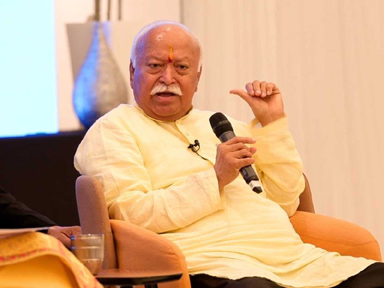
LONDON (TIP): Mohan Bhagwat, chief of the Rashtriya Swayamsevak Sangh, was asked in London last week what would happen if British and Indian interests ever diverged.
His answer was revealing. British Hindus, he said, would stand with Britain. “There is no conflict if British Hindus are Acha, Pakka, Sacha Hindus,” Bhagwat said at a London event on Sunday. “It is obvious that British Hindus will go with Britain.”
He went further. “Your Karma Bhoomi is where your loyalty lies,” he said. “From Janam Bhoomi you get your values, and you implement those values at your Karma Bhoomi. Hindutva never asks you to betray your Karma Bhoomi.”
The remark stretches beyond the immediate controversy surrounding Bhagwat’s visit. For Britain’s Indian-origin population is becoming politically much less predictable than it ever was.
Previous assumptions listed British Indians as broadly a Labour constituency, with the Conservatives making occasional inroads, particularly among more affluent voters. That calculation no longer applies.
Research by the 1928 Institute, a group of Oxford academics studying Britain’s Indian community, found that Labour support among British Indians had fallen from 48 per cent at the 2024 General Election to 35 per cent in its subsequent survey. Conservative support stood at 18 per cent, while Reform UK rose from just 4 per cent at the election to 13 per cent. The Greens had also reached 13 per cent, with particularly strong support among younger voters.
The significance lies not simply in Reform’s rise. It is that British Indians are fragmenting politically.
Nikita Ved, a co-author of the 1928 Institute report, put it bluntly: “Reform UK’s rise is disrupting traditional voting patterns within the British Indian community.”
As economic and social frustrations deepen, she argued, the major parties will face growing pressure to engage with a community “whose political loyalties can no longer be taken for granted”.
Striking examples include Savitha Prakash, a first-generation Indian immigrant and NHS doctor who chairs Reform UK’s Harrow branch. Prakash, who arrived in Britain from Mysore in 2003, sees a parallel between Nigel Farage and Narendra Modi.
“He’s [Modi] one of those people, like Nigel, he walks the talk,” she told the Guardian.
Her attraction to Reform is particularly interesting because she is herself an immigrant and supports the party’s tougher approach to immigration, rejecting the suggestion that this makes her hostile to other migrants.
“The country decides the amount of net immigration they need to have,” she said. “I wouldn’t be wanting to have more than the required number of people in more than the required number of places.”
Her conclusion?: “We have to put Britain first.”
Yet it would be a mistake to interpret these developments as a simple Hindu or Indian shift to the political right.
The Sikh experience demonstrates why.
Support for Reform among British Sikhs rose from 3 per cent in 2024 to 7 per cent in 2025, while Labour’s share fell from 40 per cent to 18 per cent, according to figures cited by the British Sikh Report. Reform has attracted Sikh activists and candidates in several parts of Britain.
“There’s a genuine battle going on between Reform UK and Labour for Sikh voters,” said Dabinderjit Singh of the Sikh Federation.
But the relationship between Sikhs and Reform is hardly straightforward. The party’s position on the wearing of the kirpan, the ceremonial Sikh dagger, has created serious unease among some of its own Sikh supporters.
Jasvir Singh, founder of the charity City Sikhs, said: “The Sikh community feels slightly adrift when it comes to political support.”
He also warned that if Reform followed through on proposals affecting the kirpan, there could be “an exodus of votes from Reform”.
This is precisely why the phrase “Indian vote” is becoming increasingly misleading.
British Indians are not one political constituency. Religion matters. So do age, class, occupation, generation and immigration history. A prosperous Hindu professional in Harrow may have very different political priorities from a second-generation Sikh in Wolverhampton, a Gujarati shopkeeper in Leicester or a young British Indian university graduate voting Green.
Even within communities, attitudes are shifting.
A Reform activist quoted by the Guardian, Navtaij Sangha, argued that support for the party among some ethnic-minority voters reflected a feeling that their identity as established Britons was under pressure from newer immigration.
“This isn’t discussed because ethnic minority groups are seen as single blocs,” he said.
For decades, British political parties tended to treat ethnic-minority voters as relatively homogeneous communities whose electoral preferences could be understood through questions of immigration, racism and representation.
That model is obsolete.
The Indian-origin population has become more established, more prosperous and more confident. Its political concerns increasingly resemble those of the wider electorate: the economy, education, crime, immigration and public services. The 1928 Institute research found that education remained the community’s top concern, while the economy had overtaken health as the second priority and crime had risen to third.
At the same time, identity has not disappeared. If anything, it has become more complicated.
This brings us back to Bhagwat.
His message to British Hindus was not that they should put India before Britain. Quite the opposite: he explicitly said that their loyalty should be to their “Karma Bhoomi”, their country of residence, while their “Janam Bhoomi” provides cultural and civilizational values.
That distinction will become increasingly important as Britain’s Indian-origin population debates what its identity means.
For some, Indian heritage strengthens a sense of Hindu civilizational identity. For others, Sikh identity is paramount. Still others are increasingly comfortable describing themselves simply as British, while retaining Indian ancestry as part of their family history.
Politically, they are no longer moving in one direction. Some are attracted to Reform’s nationalism and its tougher approach to immigration. Others remain committed to Labour. Younger voters are moving towards the Greens. Sikh voters are wrestling with questions of cultural identity and the limits of Reform’s appeal.
The result is not a British Indian community moving inexorably to the right.
It is something more consequential: the emergence of a genuinely contested political constituency.
For Labour, Conservatives, Reform and the Greens, Britain’s Indian diaspora can no longer be treated as a bloc that will automatically vote according to the habits of its parents.
The days when politicians could take the “Indian vote” for granted are disappearing.
Britain’s Indian diaspora is becoming politically unpredictable — and that may make it more important than ever.


Be the first to comment