
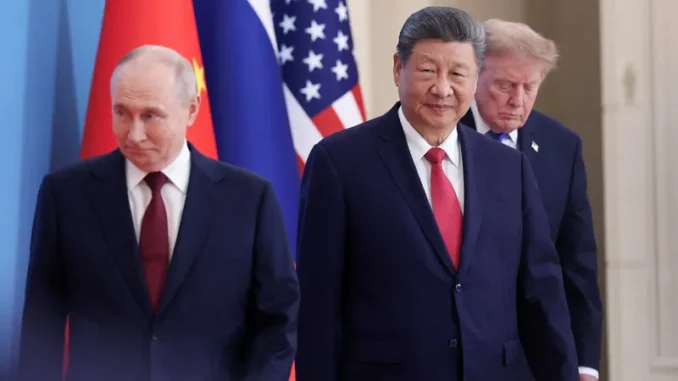

“Russia’s grit in the face of adversity; China’s dedicated climb to the top, no matter what; and a beleaguered America willing to pivot away from its burden, namely its war with Iran — I would like to think that as PM Modi watched Putin, Xi and Trump at Shenzhen, he must have wondered if the moral of the story was the fact that adversaries had no problem sitting around the same table.
Could he, Modi, also take a leaf out of Sun Tzu’s The Art of War?”

Prime Minister Narendra Modi returned home from the Quad and ASEAN meetings in Manila a couple of days ago to find the heir to the British throne, William, and his wife, Kate, waiting for him in Delhi. At least they were harmless — meaning, a photo op with them didn’t do anyone any harm.
The problem, as no one knows better than the PM, lies elsewhere — both within and without. Outside, India is managing fairly well, even if a certain schizophrenia prevails in the conduct of parts of its foreign policy, for example in the purchase and sale of US-sanctioned Russian oil. India has done well here, by using the rupee-rouble Vostro account to buy the oil, refine it — so that it is now described as an Indian export — and sell it onwards, including to European refineries.
Notwithstanding the occasional allegation of “ghost fleets” — where whole ships carrying thousands of barrels have simply gone missing — the fact is that the Modi government has paid for some Russian (and Iranian cargos) in Chinese yuan, via the ICICI Bank in Shanghai, especially set up for the purpose.
Think of it. India is paying for Russian oil in both rupees and yuan, rather than in dollars, in order to keep its economy afloat. And yet, India’s relationship with both Moscow and Beijing continues to be transactional, rather than strategic, because it is nervous about establishing closer ties with Russia and China — the latter keeping India astir, with its constant pinpricks across the Line of Actual Control.
Think, also, why India continues to play on the margins of realpolitik as you watched the Big Three — Vladimir Putin, Xi Jinping and Donald Trump — shake hands on TV in Shenzhen this week. The world’s most powerful men set up this trilateral for themselves because they have the capacity to change the world more than anyone else.
Each of these men was bad-mouthing the other only last week. This week, they were walking in step, both equal and unequal. Not one of them allowed ideology to come in the way of their independent pursuit of national interest.
Where does India fit in, you might ask. If Indians are so smart, why isn’t India anywhere remotely a big power despite being independent for 79 years?
There are several answers to this question, but none more important than hubris. Indians have begun to believe their own world-beating rhetoric. It took the PM to bring the captains of industry down a peg or two when he returned from Manila, asking why they had not worked hard to make India shine when the government had offered them all kinds of tax breaks. “…lekin aapki bhookh itni hai, kitna hi khilao pet bharta nahin…” (you are so greedy that no matter how much you are fed, your stomach is still not full.)
The PM’s caustic comment reminds one of his 2014 slogan that was instrumental in bringing him to power — “Na khaaonga, na khaane doonga.” I won’t take bribes and I won’t let you bribe anyone. Much has changed in the last 12 years. The BJP has become a far stronger party. But Modi is also keenly aware, as Uttar Pradesh and Punjab — and Manipur, Uttarakhand and Goa — go to the polls a few months from now, that the reason for the real dissonance on the streets, which the Cockroach Janta Party has tapped into, is because the benefits of government policy have not flowed down from the corporates to the man on the street.
The PM’s attack on the corporates must be seen in this light.
What else did the PM learn from watching Shenzhen, do you think? Perhaps it triggered the articulation of his favorite “Vasudhaiva Kutumbakam”, the world-is-one-family phrase, at the opening of SCO’s civilizational forum in Delhi on Friday, even as the Pakistani participant, Climate Change Minister Musadik Malik, sat in the audience. Remember that Malik’s request to visit the Nizamuddin Dargah, where the tomb of the much-loved 12th-century Sufi saint Hazrat Nizamuddin is located in New Delhi, only a few km from his hotel, has been turned down by the government.
How to explain this schizophrenia?
Remember, too, as The Tribune correspondent Shyam Bhatia recently reported from London, RSS chief Mohan Bhagwat told UK think tanks in a closed-door meeting in September that he was in favor of restarting “people-to-people” ties with Pakistan — despite the fact that his own government has shut down all conversation with Punjab’s neighbor since Op Sindoor last May.
Naturally, exceptions prevail — in the shape of Pakistani Sikh jathas being allowed to visit Indian Sikh shrines, including Hemkunt Sahib in Uttarakhand, as well as Indian Sikh jathas going to Pakistan; one went last year, and another is expected to travel soon. No prizes for guessing that the exceptions are being made with one eye on the Punjab polls.
And yet, some things, including the hardline on Pakistan, may change, especially if the coming state elections throw up unexpected results. Even if the results are predictable, changes are in the offing — never forget that foreign policy is deeply tied to domestic politics, and if the PM recognizes that India’s role as a regional power is being stymied by India’s hardline positions, then change is bound to come sooner than later.
That’s why the Big Three photo op in Shenzhen this week is so central to an understanding of India’s foreign policy. America’s decline is China’s gain, no doubt; while Russia has clawed back to the center of the magic circle, because it has persisted with the belief that it will continue to fight its righteous war in Ukraine — no matter how abhorrent wars are, and despite the awful fact that it has lost a million men — even though the war is being funded and prolonged by none other than the US.
Russia’s grit in the face of adversity; China’s dedicated climb to the top, no matter what; and a beleaguered America willing to pivot away from its burden, namely its war with Iran — I would like to think that as PM Modi watched Putin, Xi and Trump at Shenzhen, he must have wondered if the moral of the story was the fact that adversaries had no problem sitting around the same table.
Could he, Modi, also take a leaf out of Sun Tzu’s The Art of War?
(Jyoti Malhotra is Editor-in-Chief of The Tribune group of newspapers)


Be the first to comment