Tag: 1699

  • Creation of Khalsa

    Creation of Khalsa

    Khalsa, the purified and reconstituted Sikh community instituted by Guru Gobind Singh on March 30, 1699, on (Baisakhi Day. His declaration had three dimensions: it redefined the concept of authority within the Sikh community; it introduced a new initiation ceremony and code of conduct; and it provided the community with a new religious and political vision. Khalsa is used to denote both the body of initiated Sikhs and the community of all Sikhs.
    The early Sikh community had been shaped by three levels of authority: the masands (“Guru’s deputies”) were responsible for local congregations; the Guru was the active central authority; and the revealed word as recorded in Sikh scriptural text served as the symbolic base. With the establishment of the Khalsa, the authority of the masands was eliminated. They were expected either to become members of the community on a par with all others or to leave the fold.
    Guru Gobind Singh also introduced a new initation rite. More commonly called amrit pahul (“the nectar ceremony”) but also known as khande ki pahul (literally, “ceremony of the double-edged sword”), it was centred on a belief in the transformative power of the revealed word. The word was recited while water for initiation was stirred with a double-edged sword. Every Sikh who underwent the ceremony became a member of the Khalsa, was assigned the name Singh (“Lion”), and was expected to observe a rigorous code of conduct (rahit) symbolized by the wearing of five items: kes (long hair), kangha (a comb), kachha (a pair of shorts), karha (a steel bracelet), and kirpan (a sword). The names of these items begin with the Punjabi letter k and thus came to be known as the five Ks. The Singhs were also expected to forswear tobacco, alcohol, and certain types of meat.
    In its third aspect the Khalsa embodied a concrete political agenda: the pledge to realize the rule of the Sikh community (Khalsa Raj, “kingdom of God”) in the Punjab. These three interlocking dimensions have made the institution of the Khalsa perhaps the most powerful force in shaping Sikh identity during the past three centuries. Initially a male institution, it is now open to women (who take the name Kaur [“Princess]) as well, though Khalsa authority remains firmly in male hands.
    Foundation
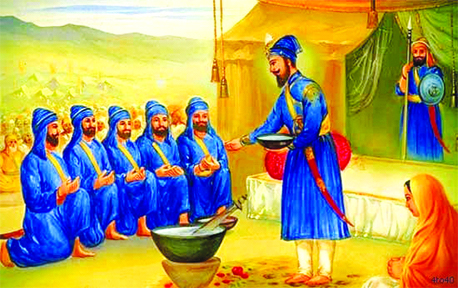
    The tenth master Guru Gobind Singh asked Sikhs to gather at Shri Anandpur Sahib on 13 April 1699, the day of Vaisakhi, the annual harvest festival. Guru Gobind Singh addressed the congregation from the entryway of a tent pitched on a hill, now called Shri Kesgarh Sahib. He drew his sword, according to the Sikh tradition, and then asked for a volunteer from those who gathered, someone willing to sacrifice his head. One came forward, whom he took inside a tent. The Guru returned to the crowd without the volunteer, but with a bloody sword.
    He asked for another volunteer and repeated the same process of returning from the tent without anyone and with a bloodied sword four more times. After the fifth volunteer went with him into the tent, the Guru returned with all five volunteers, all safe. Rather, the Guru had slaughtered 5 goats from which the blood had appeared. He called the volunteers the Panj Pyare and the first Khalsa in the Sikh tradition. These five volunteers were : Daya Ram (Bhai Daya Singh), Dharam Das (Bhai Dharam Singh), Himmat Rai (Bhai Himmat Singh), Mohkam Chand (Bhai Mohkam Singh), and Sahib Chand (Bhai Sahib Singh).
    Guru Gobind Singh then mixed water and sugar into an iron bowl, stirring it with a double-edged sword while reciting gurbani to prepare what he called Amrit (“nectar”). He then administered this to the Panj Pyare, accompanied with recitations from the Adi Granth, thus founding the khanda ki pahul (baptism ceremony) of a Khalsa – a warrior community. After the first five Khalsa had been baptized, the Guru asked the five to baptize him as a Khalsa. This made the Guru the sixth Khalsa, and his name changed from Guru Gobind Rai to Guru Gobind Singh.
    He introduced ideas that indirectly challenged the discriminatory taxes imposed by Islamic authorities. For example, Aurangzeb had imposed taxes on non-Muslims that were collected from the Sikhs as well, for example the jizya (poll tax on non-Muslims), pilgrim tax and Bhaddar tax – the last being a tax to be paid by anyone following the Hindu ritual of shaving the head after the death of a loved one and cremation. Guru Gobind Singh Ji declared that Khalsa do not need to continue this practice, because Bhaddar is not dharam, but a bharam (illusion).
    Not shaving the head also meant not having to pay the taxes by Sikhs who lived in Delhi and other parts of the Mughal Empire.However, the new code of conduct also led to internal disagreements between Sikhs in the 18th century, particularly between the Nanakpanthi and the Khalsa.
    “Guru Gobind Singh Ji” had a deep respect for the Khalsa, and stated that there is no difference between the True Guru and the Sangat (panth). Before his founding of the Khalsa, the Sikh movement had used the Sanskrit word Sisya (literally, disciple or student), but the favored term thereafter became Khalsa. Additionally, prior to the Khalsa, the Sikh congregations across India had a system of Masands appointed by the Sikh Gurus. The Masands led the local Sikh communities, local temples, collected wealth and donations for the Sikh cause.
    “Guru Gobind Singh Ji” concluded that the Masands system had become corrupt, he abolished them and introduced a more centralized system with the help of Khalsa that was under his direct supervision. These developments created two groups of Sikhs, those who initiated as Khalsa, and others who remained Sikhs but did not undertake the initiation. The Khalsa Sikhs saw themselves as a separate religious entity, while the Nanak-panthi Sikhs retained their different perspective.
    The Khalsa warrior community tradition started by “Guru Gobind Singh Ji” has contributed to modern scholarly debate on pluralism within Sikhism. His tradition has survived into the modern times, with initiated Sikh referred to as Khalsa Sikh, while those who do not get baptized referred to as Sahajdhari Sikhs.
    Dress and code of conduct
    Guru Gobind Singh Ji initiated the Five K’s tradition of the Khalsa.
    These are five items that are worn on the body. They can be considered a uniform for Amritdhari Sikhs, also called ‘Khalsa Sikhs’. These Sikhs outwardly show their commitment to the Sikh faith to others. However, many Sahajdhari Sikhs (Sikhs who have not gone through the Amrit Sanskar ceremony) often wear some or all of the five Ks too.
    Each of the five Ks has its own symbolic meaning:
    Kara
    Because it is a circle, the kara represents the eternal nature of Waheguru, without beginning or end. It reminds Sikhs of the unbreakable relationship they have with God. It is a reminder that they must do the work of God at all times and avoid the Five Vices (pride, greed, lust, anger and attachment to material possessions).
    Kesh
    Sikhs believe that the hair is a gift from God. They believe it was intended to be worn naturally and so it must not be cut. Hair is often viewed as a symbol of strength and vitality in Sikh culture. Sikhs often wear a turban to keep it clean. However, the turban is not one of the five Ks.
    Kanga
    Sikhs carry this around to help them keep themselves tidy. It also helps them to remember that they must keep themselves in a clean and tidy state both physically and mentally. Sikhs often refer to the kanga removing knots from their hair as a metaphor for how following the teachings of God removes the tangles and difficulties from a person’s life.
    Kaccha/kachera
    This plain, comfortable underwear is a reminder that Sikhs must show self-control, modesty and chastity. This means they cannot undertake sexual activity unless they are married, and they must not commit adultery. The kaccha also reminds Sikhs of what the warriors who fought for their faith wore on the battlefield.
    Kirpan
    Sikhs carry around this small single-edged sword to represent their duty to protect their faith and defend those in need. It reminds Sikhs to always fight for justice and protect the weak. It must never be used in anger. Today, the kirpan is worn for its symbolism, not as an actual weapon. Because of the practical difficulties of wearing a kirpan, some Sikhs prefer to wear an alternative, such as a pendant in the shape of a kirpan on a neck chain.
    The Guru also announced a code of discipline for Khalsa warriors. Tobacco, eating meat slaughtered according to Muslim ritual and sexual intercourse with any person other than spouse were forbidden. The Khalsas also agreed to never interact with those who followed rivals or their successors.The co-initiation of men and women from different castes into the ranks of Khalsa also institutionalized the principle of equality in Sikhism regardless of one’s caste or gender. According to Owen and Sambhi, Guru Gobind Singh Ji’s significance to the Sikh tradition has been very important, as he institutionalized the Khalsa, resisted the ongoing persecution by the Mughal Empire, and continued “the defense of Sikhism and Hinduism against the Muslim assault of Aurangzeb”.

    According to the Sikh Code of Conduct (Sikh Rehat Maryada), Amritdhari Khalsa Sikh men must wear a turban and the 5 K’s. Baptized women are not required to tie a turban, and it remains a personal choice. It also clearly states that it is not appropriate for Sikh women to cover their face with any type of veil as practiced in the Indian, Islamic, or Judeo-Christian traditions. Piercing of the nose or ears for wearing ornaments is forbidden for Sikh men and women. Sikhs cannot wear any token of any other faith. Sikhs must not have their head bare or wear caps. They also cannot wear any ornaments piercing through any part of the body.
    Duties and warriors
    A Khalsa is enjoined, to be honest, treat everyone as equal, meditate on God, maintain his fidelity, resist tyranny and religious persecution of oneself and others.
    One of the duties of the Khalsa is to practice arms. This has been deemed necessary due to the rising persecution of the rulers. Before joining the Khalsa, most of the people were from professions like farming, pottery, masonry, carpenters, Labanas, etc.
    Guru Gobind Singh Ji in Oct 1708 deputed his disciple Banda Singh Bahadur Ji to lead the Khalsa in an uprising against the Mughals. Banda Singh Bahadur Ji first established a Sikh kingdom and then brought in the Land reforms in the form of breaking up large estates and distributing the land to peasants. He and his comrades were eventually defeated and executed, but he became an icon among the Sikhs. After a long exile the Khalsa regrouped under Nawab Kapur Singh, who gathered local Khalsa leaders and created Dal Khalsa, a coalition army. The Dal Khalsa fought against the Mughals and the Afghans, eventually resulting in the establishment of a number of small republics called misls (autonomous confederacies) and later in the formation of the Sikh Empire. After the fall of the Mughal empire and the later establishment of the Sikh Empire in Punjab, the Khalsa was converted into a strong, multireligious and multinational fighting force, modernized according to European principles: the Sikh Khalsa Army which had a huge role in the expansion of the empire. Led by generals like: Maharaja Ranjit Singh Ji himself, Misr Diwan Chand and Hari Singh Nalwa. It successfully defeated all its adversaries, including the Afghan tribals and army, Hill Chiefs, Misldars, Chinese, Tibetan and Gurkhas. By the time of death of Maharaja Ranjit Singh Ji in 1839, the whole army of Sikh Empire was assessed at 120,000 men, with 250 artillery pieces. The irregular levies were included.
    The official name of the state (Sikh Empire) of Sikhs was “Sarkar-i-Khalsa”: Government of the Khalsa. The boundaries of this state stretched from Tibet to Afghanistan and from Kashmir to Sutlej in the south and included regions of Punjab, Khyber Pakhtunkhwa, Kashmir, Ladakh, etc. The “Sarkar-i-Khalsa” was dissolved during two wars fought against the British between 1846 and 1849.
    Sewa
    Sewa means ‘selfless service’. It is acting selflessly, helping others in a variety of different ways, without any reward or personal gain. Sewa is a way of life for Sikhs and is part of their daily routine. Sikhs believe that sewa is an act of service towards Waheguru and, therefore, that it will lead them to become gurmukh.
    Sikhs perform sewa in a variety of ways, such as helping the sangat and the local community, helping at the gurdwara, and cleaning, washing dishes or serving in the langar.
    Performing sewa is important for Sikhs because it demonstrates the belief in equality and the importance of all people, it serves others, showing humility (ie showing that people do not believe they are better than anyone else), it shows love for Waheguru – Sikhs believe that Waheguru is present in everyone, and so helping people means helping Waheguru, it helps Sikhs to become more gurmukh – this is because it helps them to develop five key virtues, which are truth and truthful living, compassion and patience, contentment, humility and self-control, love, and wisdom and courage, it stops Sikhs becoming manmukh, because their focus is on the needs of others rather than themselves, it helps Sikhs to move away from the five vices, which are anger, pride, lust, greed and attachment to material possessions.

  • The Invincible Spirit of Optimism-‘Charhdi Kala’

    By Amarjit Singh Anand

    “The Spirit of Charhdi-kala is all about rising to the occasion, whenever standing up and speaking out becomes quintessential, whether for one’s own rights or to protect another who is being subjugated, oppressed, tormented and annihilated. It also refers to wielding the sword, as the last resort, after all avenues have been explored and exhausted. It is optimism to the extent of intoxication with the Divine thought of “I (the soul) am fearless as my Parent (The Almighty Majesty) and so I must not buckle down”. Now, in such a state-of-mind, the very thought of being outnumbered 1 to 125,000 enemy-ranks, does not occur at all, and so the mind becomes absolutely fearless and invincible, just indomitable. It is not about winning or losing the battle, per se but it is only about being on the right side, ethically.”

    A Sikh Day Parade in New York. (File photo)

    There are various hues of the Spirit of Optimism ( ‘Charrhdi-kala’) which were inculcated in the Sikhs, right from the time of Guru Nanak Rai Sahib Ji (1469-1539)-the Divine Preceptor of ONENESS of humanity. It continued to be instilled amongst the Sikhs, during the lifetime of his nine  successor Gurus.

    Guru Gobind Singh Ji, the 10th Divine-Leader on the Spiritual Throne of Guru Nanak Sahib Ji, says: “When I empower sparrows to fight the hawks, when I transform the weak and the meek into fearless lions, when I make the castigated ones feel exalted, when I enable one Sikh face an army of one hundred and twenty-five thousand; and so I am recognized as Gobind Singh”. He says,“in egotism, one is assailed by fear, he passes his life totally troubled by fear.”

    Innumerable hues and connotations of Optimism

    There are various colors and shades of the Spirit of ‘Charrhdi-kala’, whether it is sacrificing oneself on the battlefront  or maintaining peace on the home front, inside the nation or within the local community; be it attaining success in a diplomatic breakthrough like the re-opening of Kartarpur Sahib Corridor between India & Pakistan after over seven decades of the bloodshed and partition that accompanied India’s independence from the yoke of the British colonial, imperial monarchic occupation of India; or serving food, medications, vaccines, ventilators and oxygen concentrators during Corona pandemic; saving people during natural calamities as floods, earthquakes and hurricanes; or achieving resounding success which the farming-community of Punjab led from the front to unite nationwide workers and farmers to force the Indian establishment to revoke ‘the 3 Black farming Laws’; or successfully enhancing awareness about Sikhs, in the wake of rising hate-crimes in the post-9/ 11 scenario when many Sikhs were murdered and many more suffered near-fatal injuries, as a retaliatory measure whereby the mistaken-identity syndrome was rampant. The Spirit of Charrhdi-kala is all about rising to the occasion, whenever standing up and speaking out becomes quintessential, whether for one’s own rights or to protect another who is being subjugated, oppressed, tormented and annihilated. It also refers to wielding the sword, as the last resort, after all avenues have been explored and exhausted. It is optimism to the extent of intoxication with the Divine thought of “I (the soul) am fearless as my Parent (The Almighty Majesty) and so I must not buckle down”. Now, in such a state-of-mind, the very thought of being outnumbered 1 to 125,000 enemy-ranks, does not occur at all, and so the mind becomes absolutely fearless and invincible, just indomitable. It is not about winning or losing the battle, per se but it is only about being on the right side, ethically.

    Sree Guru Nanak Sahib Ji says : “There is One Light of Our Creator pervading in the entire Creation and in all Creatures”.

    Guru Nanak Ji was the pioneer, enunciating the cause of Inter-Religious Peace and Harmony. His tenets emphasize upon truthful living, humility, liberty, equality, justice, compassion, honest earning, serving the needy selflessly and protecting the weak and the meek. All this, he said would be tantamount to a Divine Life and real, true, actual worship and attainment of God and fulfillment of the purpose of human-birth. Guru Nanak was on a Divine Mission. He was a Spiritual Maestro, a Renaissance-Man, a Crusader for Interreligious Amity, an extraordinary social-reformist much ahead his era and yet he utters the absolute TRUTH that “he is, what he is, ONLY because of the Gracious Mercy of The Almighty and he is nothing without GOD”. In other words, Divine Guru is teaching humanity to embrace humility, by refraining from self aggrandizement.

    The Golden Chain: The foundation of Sikhism was laid  by Guru Nanak who  infused his own consciousness into a disciple, then became Guru, subsequently passing the light on to the next, and so on. The word “Guru” is derived from the root words “Gu”, which means darkness or ignorance, and “Ru”, which means light or knowledge The Guru is the experience of Truth (God).

    For over a thousand years, India was invaded by a small bunch of horse-riders, from Mongolia,Persia,Afghanistan, and other regions. Taimur, Ghazni, Ghori, Nadir Shah, Abdali, Durrani, Babar, Sher Shah Suri are only a few of those invaders, who plundered Hindu Temples, looted gold, took women and children as slaves, killed all and sundry who crossed their path.

    And then, in 1469, appeared a man on earth, the likes of whom are seen, once in a millennium. God  sent GURU NANAK, The Divine Preceptor of ONENESS of humanity and the epitome of humility to HEAL humanity. He was blessed by The Creator, to win the hearts of all, and to bring about massive transformation, wherever he went. The Divine Preceptor traversed various continents, 27000 miles in 25 years of his 70-year sojourn on this planet, fostering Goodwill amongst races, cultures, religions.

    Two of the ten Gurus had to take up arms, to protect the masses from the extreme persecution and tyranny of the ruling elite. The sixth Guru Hargobind Sahibji and the tenth Guru Gobind Singhji, with their disciples were the Saint Warriors. The fifth Guru Arjan Sahibji and the ninth Guru Tegh Bahadur Sahibji embraced martyrdom, for refusing to follow the diktat of the barbaric regime. Such events forced the sixth and tenth Gurus to raise a martial force, the army named The Khalsa.

    Guru Arjan Sahib and Guru Tegh Bahadur Sahib attained martyrdom for the cause of Freedom of Religion and Interfaith acceptance and harmonious coexistence. Guru Gobind Singh Sahib, tenth Spiritual Master, sacrificed his entire family including four sons, all under 18, fighting the tyrannical regimes, bent upon annihilating the Freedom of Religion, Culture and Traditions. During these five centuries, hundreds of thousands of Sikhs have performed the supreme sacrifice of life, for the protection of their motherland.

    They have been in the forefront against marauding invaders and the oppressive British regime. The maximum number of those exiled from India or those executed by the British, after fake trials, were Sikhs.

    Illustrious Martyrs include Bhagat Singh, who instilled courage in the masses by kissing the gallows, as a reward for serving the cause of India’s freedom. Udham Singh avenged the Jallianwala Bagh massacre perpetrated by the British, after twenty-one years, and was also hanged.Kartar Singh Sarabha was the leading figure who played a predominant role, in the propagation of Ghadar Movement. He tried to dismantle the military structure established by the British who were fanning communal disharmony in the country.

    Amongst the heroic Sikh soldiers Air Marshall Arjan Singh of the Indian Air Force and Lt. General Jagjit Singh Aurora are the shining stars. Hardit Singh Malik was an expert pilot of various jets in the World War theatre. Known as The Flying Sikh of Biggin Hill, Hardit Singh Malik was the first Indian pilot of the First World War and would go on to become a distinguished diplomat and Indian Ambassador to France. Sikh regiments and battalions have served the United Nations Peacekeeping Forces, worldwide, whether in war-torn countries or civil-wars, and in regions ravaged by natural calamities as famines, floods, droughts or earthquakes.

    Fighting in the World Wars, as part of the British Indian Army, the highest number of “exceptional gallantry” Awards from the British Empire were bestowed upon the Sikhs. The epic saga of twenty-one Sikhs attaining martyrdom facing ten thousand Tribal Afghans is unparalleled in world history.

    The role of the Sikhs in the Liberation of France is well recognized.Today, the Sikhs reside in several countries and have made a mark for themselves, in various spheres of endeavor. The Sikhs, whether in India or while living as law-abiding citizens and contributing significantly to the economic growth of their adopted nations of abode, have maintained strong connections with their land of origin. The foreign exchange remittances to India, from the Sikhs are enormousand contribute to  rejuvenating the Indian economy.

    Whether the armed forces or politics. science and technology, business or various professions, the arts or sports, Sikhs have excelled un-proportionately, in correlation to their very negligible percentage of the world populace.

    Revered Saint Bhagat Puran Singhji, personally, served the residents in a leprosy-home which he established. Being an epitome of humility and selfless service, he refused to be nominated for the Nobel Prize.

    There are several Sikh parliamentarians in various countries. Gurbax Singh Malhi, elected to the Canadian Parliament in 1992, created history, when laws had to be amended, to accommodate a turban- wearing member to sit in the Parliament.

    In the scenario of the post 9/ 11 tragedy, several Sikhs were murdered and bore the brunt of hate crimes, due to the mistaken-identity syndrome, but succeeded through relentless endeavors, to enhance awareness about the Sikhs. During the current global pandemic, the Divine Guru’s teachings of compassionate sharing, came to the fore, when millions of people were served with edibles, medicines, clothing, shelter and all essential services.

    During the unprecedented lockdown, several governments officially requested the Sikhs to prepare food in Gurdwaras, to be served to individuals, as well as to be sent to hospitals and other institutions for the old and the infirm, orphans, and economically weaker sections.

    Wherever the Sikhs reside, they assimilate extraordinarily well, in the mainstream life of any nation, culturally, politically, socially, economically, lending a spiritual and ethically sublime touch to all that they are involved in or are called upon to do.Guru Gobind Singh Sahib ji says “Acknowledge Entire Humanity as One Race”

    Myriad connotations of Freedom

    Freedom cannot be awarded and attained by mere rhetoric of sloganeering or by guarantees in written constitutions of nations.

    Besides political freedom, each and every human has the natural right to their aspirations and expressions. Only then would everyone be empowered to enjoy the bliss of a healthy and productive lifestyle, whose components are emotional, mental, psychological health. Freedom to practice the religion, faith, belief, tradition, custom, rituals of their liking is equally paramount.

     Freedom of thought and expression is the natural birthright of all. The practices of amnesty and of diplomatic immunity are really very abhorrent, as these undermine the very premise and concept of human rights.

    Guru Gobind Singh Sahib ji was the multi-dimensional Prophet, the Beacon-of-Light, who strictly proclaimed an injunction upon his followers thus: “I am an insignificant slave of the Primordial-Being. Those who worship me as GOD shall have to endure hell”.

    Guru Gobind Singh ji was born  on December22, 1666 at Takht Shri Patna Sahib in Bihar. He was anointed Guruwhen he was merely 9by his predecessor and father, Guru Tegh Bahadur Ji, when the latter marched towards Delhi to voluntarily court arrest, in support of the Kashmiri Pundits who were being forced by the Mughal emperor, to give up their religion or to face death. Guru Tegh Bahadur Ji was, then, martyred by being beheaded, after witnessing the torturous martyrdom of his three disciples, Bhai Mati Das Ji, Bhai Sati Das Ji and Bhai Dayal Das Ji. This was a turning point in Indian history, which led to another historic event. On the day of Vaisakhi in 1699, Guru Gobind Singh Ji formalized the martial institution of ‘The Order of The Khalsa’, the valiant force, making it mandatory for all Sikhs to wear a turban and to retain unshorn hair and beard.

    Guru Gobind Singh created Khalsa on the day of Vaisakhi at Anandpur Sahib in 1699.

    The creation of the Martial Force, ‘The Order of the Khalsa’ on the day of Vaisakhi in 1699 proved to be a harbinger in the history of Hindustan (India). In a dramatic fashion, Guru Gobind Singh Ji tested the fearlessness of his followers by asking for their head as offering to their Guru. After an eerie silence, five Sikhs came forward and they were anointed as the Five Chosen Devoted Disciples (5 Piaare of the Guru),

    Such was this Spirit instilled in the Sikhs that all four sons (all under the age of 18) of Guru Gobind Singh Ji, also attained martyrdom, just like adult warriors. Two older ones martyred in the Battle of Chamkaur Sahib were Sahibzaada Ajit Singh Ji (17) and Sahibzaada Jujhar Singh Ji (14). The two younger sons, bricked alive at Sirhind, were Sahibzaada Zorawar Singh Ji (9) and Sahibzaada Fateh Singh Ji (6-year lad).

    In our contemporary world, the Khalsa-panth (Pathway) or ‘The Way of Life’ is what The Guru gave to the Sikh community, which constitutes a large part of the global diaspora where several Sikhs are the influencers, being in positions of authority, as Parliamentarians and officials in government, in U.S.A., Canada, U.K., Australia, New Zealand, Malaysia, Singapore amongst other nations. In numbers, Sikhism is the 5th largest religion in the world, with some 28 million adherents.

    The Sacred Utterances of the Tenth-Divine-Sovereign includethe poetic Zafar-Nama (The Epistle of Victory) as a voluminous letter to the tyrant Aurangzeb, who felt such immense remorse upon reading it, that he died,soon thereafterThis communication clearly said that the Mughal Emperor did not behave as behoves a Sovereign ruler.

    The Guru wrote: “The Lord is One and His Word is True. The Victory is of the Lord. Aurangzeb, you’ve been pretending to be a devout and pious Muslim, whilst in reality, you are a liar who committed a blasphemous act by swearing on the Oath of Holy Quran, which oath was falsified by your treacherous and devious actions like attacking my forces, who were promised safe passage, if we vacated the Fort of Anandpur Sahib. Furthermore, you ought to be castigated for the execution of my two minor sons, who were bricked alive in Sirhind”.

    Guru Gobind Singh Sahibji authored the ‘Resplendent-Drama’ or Play (Bachitar or Vichitra Naatak) a poetic-autobiography about the time on the Hemkunt range of mountains, where he was immersed in meditation, merged in Communion with The Divine. Thence, he was Commanded by The Almighty Majesty to assume the human-frame, in the form of the 10th Embodiment on The Spiritual Throne of The Divine Preceptor, Guru Nanak Sahibji, in order to thwart the nefarious designs of tyrannical forces. Bachitar-Natak is part of the ‘Dasam Granth’, the Sacred Texts written by the 10th Guru. One stanza reads thus: “I have come into this mortal-world for this purpose. The Supreme Lord has sent me for the propagation of Righteousness, everywhere, and to seize and destroy the sinful and the wicked. I have taken birth for this purpose, let all holy men understand this. I have come to disseminate Divine Religion. I am committed towards the protection of saints; and for annihilating all the tyrants”. 

    Shri Daulat Rai Ji, a prominent figure in the Arya-Samaj sect of Hinduism, wrote a book ‘Sahib-E-Kamaal’ Guru Gobind Singh, the Spiritual-Master par excellence. It is dedicated to Guru Gobind Singh’s life, his noble thought and his mission so that the populace at large could have a just view of the Guru’s greatness.”

    Mai Bhaago, the brave lady-soldier inspired the 40 deserters to return to the Guru and fight alongside of him against the Mughal forces, at the battle of Muktsar Sahib, he was rejoined by his 40 Sikhs, who had earlier deserted him. They were inspired by a brave lady Mai Bhaago Ji to return to the battlefield. Travelling through Gwalior, The Guru was headed towards The Deccan area, at the invitation of Aurangzeb who wanted to apologize. The Guru was forgiving and went ahead, considering that the Mughal Emperor was almost double his age. En-route, The Guru got news that Aurangzeb had died.

    The Living Guru Sree Guru Granth Sahib at a Gurdwara in France

    Finally, Guru Gobind Singh Ji decided to terminate human-Guruship and so he passed on the mantle to The Scripture, at Nanded, where Gurdwara Takht Hazoor Sahib attracts devotees and pilgrims, from all over the world. Now, The Scripture, Sri Guru Granth Sahib was anointed as the Eternal-Guru in 1708, when Guru Gobind Singh Ji realized his mission was accomplished and it was time to shed the mortal-frame. As a mark of humility, he did not include his Sacred Verses in Sri Guru Granth Sahib, as he opined, he was not evolved up to the level of 6 Gurus and 35 Hindu & Sufi Muslim Saints, whose compositions are enshrined therein.

    Takhat Sachkhand Sri Hazur Abchal Nagar Sahib, Nanded, India was  the final resting place of Guru Gobind Singh who left for heavenly abode on October 7, 1708.

    Guru Gobind Singh Ji was a Visionary, Saint, Scholar, Poet, Philosopher, Warrior, Connoisseur & Patron of artistes and skilled warrior. He  sacrificed his parents, spouse and 4 minor sons, at the altar of upholding human dignity and Freedom of Faith/Religion & Right to Expression. 

    Guru Gobind Singh Ji mastered many languages including Sanskrit, Urdu, Hindi, Braj, Gurmukhi and Persian. He also learned martial arts to become adept in combat. In his 42-year sojourn on this planet, he authored several poetic compositions like ‘Akaal-Ustat’ (Pristine-Praise of the Timeless One). The Great Guru accomplished all of this while remaining mindful of his Divine Assignment of steadfastly being the Defender of Human Rights of the populace. Hence, he did not shirk his duty, when he was pulled into fighting 16 battles against the overpowering might of the Mughal Emperor of India, who was equipped with a massive army and large arsenals. Although he braved several acts of betrayal, treachery, deception, jealousy from various quarters, yet his utmost trust in ONENESS of humanity brought him loyalty from both sides, all of the Divine-conscious and conscientious Muslims and Hindus, when they sacrificed their life, fighting against tyrannical oppressive forces of darkness.

          The five virtues recognized in Sikhism are Sat (Truth), Santokh (Contentment), Daya (Compassion), Nimrata (Humility) and Pyaar (Love). For the Sikhs, the final goal of life is to reunite or merge with God (Mukti). The Sikh Gurus taught that to achieve this goal it was important to work hard at developing positive human qualities which lead the soul closer to God. The Gurus taught that all human beings have the qualities they need to reunite with God but they must train their minds to make the most of these qualities. In order to reach the final goal of life, Sikhs believe that they must constantly develop their love for God by developing compassion for all God’s creation. The mind of someone who is gurmukh (literally, ‘Guru facing’), is constantly focused on God at all times; while the mind of Manmukh (literally, ‘mind facing’ or “mind centered”) is full of desire, attractions, doubts, greed, etc and he or she will be full of sorrow and pain.

    ‘The Spirit of Optimism and Oneness’ transcends race and religion. Amongst the faithful devotees of Guru Gobind Singh Ji, several notable loyal Hindus and Muslims are respected by all Sikhs. All these noble ones have gained immortality and have become a part of Sikh history.

    Bhai Nand Lal Ji (c. 1633-1713) was an eminent poet laureate in the Guru’s Darbaar. He fled from Aurangzeb’s persecution.

    Hakim Allah Yaar Khan Jogi, an unbiased Muslim poet/writer wrote two poems almost a century ago, one on Chamkaur, under the title Ganj-a-Shaheedan and the other on Sirhind, entitled Shaheedan -a-Wafa, in homage to the 4 minor sons of The Guru.

    Pir Bhikan Shah saw the Divine Light emanating from the birthplace of The Guru and started bowing in Islamic Prayer, towards the East instead of towards Mecca in the West. He visited the newly born Guru, tested him by presenting two bowls (representing Muslims & Hindus). The Guru placed his hands on both. The Pir further said that he was immensely impressed and pleased with this act of the Holy child. The Pir, his disciples and servants then returned to his home and remained a steadfast supporter of the Guru for his entire life.

    Pir Buddhu Shah was a Muslim-Divine whose real name was Badr ud Din, who was an admirer and ally of Guru Gobind Singh. He brought many hundreds of his followers and his family members to assist the Guru’s force. However, the Mughals executed him, after the battle, for supporting the Guru.

    Diwan Todar Mal Ji was a wealthy Hindu merchant of Sirhind,performed the cremation of the three martyrs: the two younger sons of Guru Gobind Singh, Gujri aged 9, Fateh Singh aged 6 and their grandmother, Mata Gujari Ji. The two children were bricked alive, for refusing to renounce their faith. Their grandmother at the news of the sudden and despicable execution of the innocent youngsters. This wealthy merchant had to cover the required ground for cremation with an estimated7,800 gold coins.

    Baba Moti Ram Mehra Ji served edibles and milk to the two little Sahibzadas and Mata Gujri Ji. He did not conceal his act and boldly told the Nawab that it was his pious duty to serve edibles to the imprisoned innocent children and their grandmother. Hence, Baba Moti Ram Mehra, along with his family, were sentenced to death by being squeezed in a Kohlu (oil press).The Guru blessed the brother-duo,

    Ghani Khan and Nabi Khan with a ‘Hukamnama’: a letter of commendation stating that both of them were the “Sons of Guru Gobind Singh”.

    Guru Gobind Singh Ji blessed Nawab Sher Khan, Ruler of Malerkotla, for vociferously protesting against the inhuman act of bricking-alive two minor sons of The Guru. Muslim-dominated Malerkotla is the only Muslim majority city in Punjab with 68.5% residents being Muslim and the rest being Hindus, Sikhs, Jains, Christians and Buddhists. Not a single one was harmed here, during the riots erupted during the partition of India.

    The Guru was an empathetic humanist to the core, a brave commanding general as well as a soldier, leading from the front. The Divine Guru Gobind Singh Ji gifted his disciples, a practical ‘Way of Life’, after sacrificing his entire family for Human-Rights. His unflinching resolve to stand up and to fight for Equality, Justice, Liberty, Peace and Harmonious Co-Existence which are as relevant, today, as they were over three centuries ago.

    “For this purpose was I born, let all virtuous people understand. I was born to advance righteousness, to emancipate the good, and to destroy all evil-doers root and branch.” —Guru Gobind Singh.

    Guru Gobind Singh Ji blessed Bhai Kanhaiya Ji, who served water and administered first-aid to wounded soldiers of both warring sides. This supreme selfless service became the precursor to the founding of The International Committee of Red Cross. Bhai Joga Singh stood up, in the midst of ‘Anand-Kaaraj’ (his wedding ceremony) when Guru Gobind Singh Ji tested his loyalty and devotion, by sending his followers. to inform Joga Singh that the Guru required his presence soon.

     Before the head of Guru Tegh Bahadur Ji was severed in Delhi, his disciples who were martyred included the two brothers Bhai Mati Das, who was sawed alive and Bhai Sati Das Ji, who was wrapped in cotton and burnt alive. Another follower, Bhai Dayal Das Ji was boiled alive in a cauldron.

    The epoch-making epic battle of Fort Saragarhi witnessed 21 young Sikhs face the onslaught of the ferocious Pathan tribals in 1897. They did not surrender. Some of them were so young that they didn’t have a beard and moustache.

    Baba Banda Singh Bahadur (16 October1670 – 9 June1716) aka Lachhman Dev alias Madho Dass Bairagi, originally from the Jammu region, is revered as one of greatest Sikh warriors as well as one of the most hallowed martyrs of the Khalsa Army.The Khalsa were engaged in a prolonged fight against the cruel Mughals, who were practising their tyranny and terrorism. His confrontation with the Mughal administration in Northern India, though brief, was strong and vigorous enough to shake the foundations of this evil empire.The agrarian uprising that he led in the Punjab was the underpinning on which the Dal Khalsa, the Sikh Misls and Maharaja Ranjit Singh built the edifice which finally culminated with Ranjit Singh capturing Lahore in 1799 and establishing the Sikh Kingdom of the Punjab. This resulted in the end of a dark period in the history of India.

    The valiant one Nawab Kapur Singh. When Zakariya Khan, who became the governor of Lahore in 1726, adopted rigorous measures against the Sikhs, Nawab Kapur Singh organized a band of warriors, who, with a view to paralyzing the administration and obtaining food for their companions forced to seek shelter in remote hills and forests, attacked government treasuries and caravans moving from one place to another. Such was the effect of these depredations that the Delhi government, in 1733, at the instance of Zakariya Khan, decided to lift the quarantine forced upon the Sikhs and made an offer of a grant to them. Subeg Singh, a Sikh resident of Jambar, near Lahore, who was a police-inspector of the city under Mughal authority, was entrusted with the task of negotiating peace with the Khalsa.

    General Hari Singh Uppal ‘Nalwa’conquered regions as far away in Afghanistan. He was held in immense awe by the ferocious Afghan Pathaan tribals, whom he vanquished but ruled with equality and respect.

    The Conquest of Delhi was effected in 1783 by Generals Baba Baghel Singh, Jassa Singh Ahluwalia and Jassa Singh Ramgarhia, when they captured Shah Alam, the Emperor of India, and hoisted theKhalsa Insignia called the ‘Nishaan-Sahib’, atop the Red Fort in Delhi. The famed Peacock Throne of Mughal Dynasty was uprooted from theconcrete ground and was tied with iron chains, to be pulled by elephants and taken to Punjab. It is placed as a Souvenir or trophy, in the Ramgarhia Museum.

    Sardar Sham Singh Attari (Circa 1785-1846), a Sikh general in the Sikh army of Lahore Darbar, belonged to a Jatt family of Sidhu Clan. was the only son of Sardar Nihal Singh Attari (d. 1817), and grandson of Sardar Gaur Singh Attari (d. 1763), The first in line to Convert to Sikhism in the early days of Sikh political ascendancy and joined the Jatha or band of Sardar Gurbakhsh Singh of Roranvala. He soon established his, protection over an area around Attari, a village he had founded some 16 miles west from the holy city of Amritsar. His son, Nihal Singh Attari, was known for his martial prowess and for his personal loyalty to Maharaja Ranjit Singh. Nihal Singh’s son, Sham Singh Attari, entered the service of the Maharaja in 1817 and, in 1818, took part in the military campaigns of PeshawarAttock and Multan. He also fought in Kashmir in 1819. He led Sikh forces against Sayyid Ahmad of Bareilly who had during the years 1826-31 carried on in the trans-Indus region a relentless crusade against the Sikhs. Sayyid Ahmad was overcome and killed on 6 May 1831, along with his chief lieutenant, Muhammad Ismail.

    Emperor (Maharaja) Ranjit Singh, the 19th century ruler of the Sikh Empire in India,was voted as the best administrator in world history. He overcame competition from around the world, to be named the “Greatest Leader of All Time” in a poll conducted by ‘BBC World Histories Magazine’. He was instrumental for the Unification of Sikh Martial Groups (Misals) into a strong Confederation. The title of Divine Kingship can well be used while discussing Sikh Emperor Ranjit Singh, who stands out amongst the Greatest rulers, who treated their subjects with fair play, equality, justice, respect and benevolence. Wisdom, bravery, strategy and tolerance for all religions were his hallmarks. He donated tones of gold to Hindu, Muslim and Christian shrines just as to Sikh Gurdwaras. His ministers, advisors, generals and functionaries hailed from all religions, and some were of other races from other nations. In the first half of the 18th century, state terrorism against the Sikhs was on the steady increase and was intensified by Mir Mannu. In 1748, the Mughals appointed Mir Mannu as Governor (Subedar) of Lahore and also as a Nawab of Multan (1748-1753).

    Sikhs were offered a choice : “conversion or death.

    In order to pacify Hindus, Mir Mannu appointed a Khatri Hindu of Lahore named Kaura Mall as his diwan or minister. He then ordered 30,000+ army of mughals at Lahore to finish the Sikhs. The mughal army swept the countryside and killed many of the Sikhs they found. By now, the faith of the common people in Sikhi and the strength of the Khalsa had increased tremendously. Despite Mannu’s extreme torture and reign of terror, nothing could deter the Sikhs. A Panjabi folk song of that period goes like this in English:

    The motto/slogan of the Sikhs was: “We are the plants and Mannu is a sickle; The more he cuts us, the more we grow.

    This is the time when the army of Mir Mannu was going from house to house searching for Sikhs. Many of the Sikhs took shelter in jungles but some Sikhs who were living with their families in the cities and could not just leave right away or join any jathas. They were captured by the army and all were being sent to Lahore. Most of the prisoners were Sikh women and children.Many of the old women were killed on the way because they were weak and could not walk for a long time. All of the Singhni’s and their children were put in Lahore jail.At that time Sikh population was very negligible. A decade earlier, a governor had decided to kill all Sikhs. At that point people thought that all Sikhs were finished, but Bhai Gharjha Singh and Bhai Bota Singh came out of hiding and fought with Mughals, just to show them that Sikhs were far from finished.

    Everyday Muslims would come and taunt them by saying “where is your Khalsa now? They can’t even come to rescue you. All of them have been killed by the army. So it is better for you to accept Islam and live a rich happy life.” Singhnis never ever thought of leaving Sikhi. The sacrifice of the Khalsa women that was so great that it became a part of the daily prayer. They kept reciting “Waheguru, Hail the Guru”.

    Sikh Women in Mir Mannu’s Death Camps

    Mir Mannu started deploying terror tactics. First of all, he ordered that all Sikh women be imprisoned. Every woman was given forty pounds of grain to grind daily. A very heavy stone was placed on the chest of those who could not grind. They were given just a bowl of water and a quarter of a piece of bread to eat in a single day. The tyrants then started killing the innocent children by throwing them up in the air and landing them on sharp spears. One soldier would throw a child up in the air and another soldier would spear the child before the child hit the ground. The dead bodies of these children were cut into pieces and the ladies were garlanded with those pieces. Pieces of flesh of the children were thrust into the mouths of their mothers.But the faith of Sikh women was unshakable.

    Such is the invincible spirit of optimism of the Sikhs.

    (The author is a thinker and a scholar on Sikhism. He can be reached at asa1ny@yahoo.com)
