Month: April 2013

  • Survivors Sought In Texas Fertilizer Plant Blast

    Survivors Sought In Texas Fertilizer Plant Blast

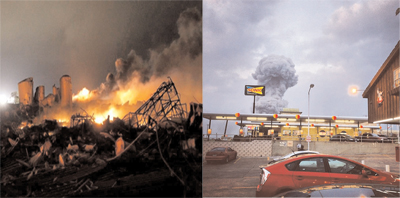
    WEST, TEXAS (TIP): Rescuers worked in cold rain on April 18 to find survivors amid the rubble of houses destroyed in a fiery explosion at a Texas fertilizer plant filled with hazardous chemical tanks. The death toll in West, Texas ranged from five to 15 people and was likely to change as rescuers went from house to house along the burned-out streets after the West Fertilizer Co. blew up on Wednesday night, said Sgt. William Patrick Swanton of the police department in nearby Waco. The cause of the fire and explosion, which occurred just before 8 p.m. and injured more than 160 people, was not known. Officials said no evidence of foul play had been found. The US Chemical Safety Board, a federal agency charged with investigating industrial chemical accidents, was on the scene, as was the Bureau of Alcohol, Tobacco, Firearms and Explosives.

    Firefighters had been battling a fire at the plant on Wednesday night for about 20 minutes before the blast rocked the town of 2,700 people about 20 miles north of Waco. Three to four volunteer firefighters were still missing, Swanton said. “They were actively fighting the fire at the time the explosion occurred,” he said at a news conference held in a cattle auction house, where cows lowed behind him. Swanton said the plant was storing huge tanks of anhydrous ammonia. Anhydrous ammonia is used by farmers as fertilizer to boost nitrogen levels in soil and increase crop production.

    According to the Centers for Disease Control, anhydrous ammonia and water produces a poisonous cloud. When ammonia mixes with air, it forms an explosive mixture, and containers may explode when heated, according to the CDC. The West plant is one of thousands of sites across rural America that store and sell hazardous materials such as chemicals and fertilizer for agricultural use, many within close range of residences and schools. Privately owned by 83-year-old Donald Adair, the company has fewer than 10 employees. The plant had not been inspected by state officials since 2006, when a complaint of an ammonia smell was resolved, said Zak Covar, executive director of the Texas Commission on Environmental Quality. State inspections are done only when there is a complaint, Covar said. The federal Environmental Protection Agency fined the firm $2,300 in 2006 for failing to implement a risk management plan. The plant’s owner could not be reached for comment.

    Fire, evacuations before blast
    The firefighters had been evacuating several blocks around the fire before the blast out of concern for dangerous fumes, Swanton said. That threat had abated, he said. In West, the middle school, which was badly damaged, was one fifth of a mile from the plant and the high school was one-third of a mile away.

    The blast destroyed 60 to 80 houses, reduced a 50-unit apartment complex to what one local official called “a skeleton standing up” and left a horrific landscape of burnedout buildings and blackened rubble. “Last night was truly a nightmare scenario,” said Texas Governor Rick Perry. “This tragedy has most likely hit every family.” Perry declared McLennan County a disaster area and said he would request federal disaster aid from President Barack Obama. Texas is no stranger to industrial disasters. In 1947, 3,200 tons of ammonium nitrate fertilizer detonated aboard a ship in a Texas City port, killing almost 600 people. It is believed to be the deadliest industrial accident in US history. More recently, a 2005 explosion at a BP refinery in Texas City killed 15 people and injured more than 170 others when hydrocarbon vapors exploded in a processing plant.

    The operation in West remained a search and rescue mission, Swanton said. “They have not gotten to the point of no return where they don’t think that there’s anybody still alive,” he said. He said rain and cooler temperatures were a concern. At early afternoon, the temperature was just 50 degrees Fahrenheit, or 10 degrees Centigrade. The average temperature for the area in April is closer to 67 degrees F. “With the temperature getting a little cooler, with the weather raining here – pretty significant rains came through – we certainly want to find folks,” he said. Bodies had been taken to a nearby ball field and then a community center, he said. Officials said they had moved 133 people out of a nearby nursing home.

    If it was an industrial accident, investigators would look at whether firefighters ignited the blast by pouring water on a volatile substance. Nim Kidd, chief of the Texas Division of Emergency Management, said it was too early to speculate. “A lot of firefighters will use their No. 1 tool, which is water, in a hazardous materials chemical situation to cool the surrounding environment,” he told a briefing in Austin. Obama, who flew to Boston for a memorial service for victims of the Boston Marathon bombing, offered support and prayers to the victims in Texas. Three hospitals in Waco and Dallas reported treating more than 160 injuries from the blast. Ground motion from the blast registered as a magnitude 2.1 seismic tremor and created a jolt felt 80 miles away in Dallas, the US Geological Survey reported.

  • Stage set for Narendra Modi-Will BJP’s NaMo chant save the party?

    Stage set for Narendra Modi-Will BJP’s NaMo chant save the party?

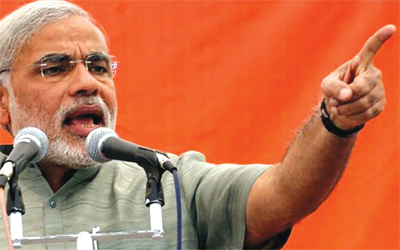
    NEW DELHI (TIP): Three days of rough political weather did not just wreck a 17-year-old BJP-JD(U) alliance, it also all but sealed the debate over Modi’s ascendancy in the BJP. Barely had Nitish Kumar finished a speech replete with derisive references to Modi on Sunday that the BJP brass was bombarded with messages and phone calls from the party rank and file. The message from below was unambiguous: The insult to the Gujarat CM shouldn’t be tolerated. A few senior leaders who demurred over the need to respond immediately felt the cadre’s pressure. The mismatch in moods was glaringly evident when at least two of the leaders, who are part of the grandly sounding “high command”, tried to reach out to Kumar just when the party rank and file was clamouring for a strong retaliation.

    The tide was tough to hold off. Eventually, a statement vehemently debunking the charges leveled against Modi was considered by leaders gathered at Advani’s residence and BJP chief Rajnath Singh quickly ordered its release. Apart from consolidating the support for Modi in the sangh parivar, the Nitish Kumar episode also brought out the cracks in the BJP leadership over Modi. For, what happened over the weekend has implications for leaders like L K Advani, Sushma Swaraj and Murli Manohar Joshi, each seen by his or her admirers as having strong credentials for leading the BJP into the 2014 race. The BJP parliamentary board, which theoretically takes the final call on whom to project as PM candidate, appeared split over the issue. How serious is the split? Not so serious as to jeopardise Modi’s candidature, it would seem. Some senior leaders are uncomfortable with the prospect of being overtaken by the Gujarat CM, and to that extent the resistance to Modi has not disappeared, but they risk every possibility of getting overwhelmed by the counter tide. RSS, initially not so enamoured of Modi, seems to be fast coming around to align itself with the mood of the party workers.

    The RSS chief hurt himself by seeking a second term for Nitin Gadkari even though the allegations against Gadkari were making him somewhat of a political liability. The weakening of the RSS boss’s authority has resulted in a decentralization of power within the Sangh and has created space for figures like Suresh Soni who are backing Modi. And seniors like Jaswant Singh and Yashwant Sinha in the BJP, who appear ambiguous about Gujarat CM or are opposed to him, risk being sidelined by the current pro-Modi mood. The BJP seems aware that fighting the polls under Modi is not without risks — loss of allies, consolidation of Muslim vote against the party, hostility of liberal intelligentsia, and a ruthless scrutiny of the Gujarat model, to list the main ones. However, it is banking on his energetic espousal of effective governance, swift economic growth, jobs and a development-oriented agenda to attract middle India that BJP had lost to the Congress in 2004.

    The task is not easy as BJP needs to cover a lot of ground and is hampered by geographical and social limits. As of now, BJP does not have a single MP from Andhra Pradesh, Kerala, Orissa, Tamil Nadu and West Bengal. Apart from Assam, the party has drawn a blank in the north east.

    In states like Madhya Pradesh, Jharkhand, Chhattisgarh and Himachal Pradesh, BJP’s numbers are already high. It can only look to improve in Rajasthan, Gujarat, Delhi and Uttarakhand. It needs new partners in Haryana and Jharkhand. Karnataka seems a lost bastion while the Shiv Sena infighting has made Maharashtra shaky. Yet, the party cadre and now an increasing number of leaders are getting in a mood to swim or sink with Modi. After angry exchanges with JD(U), BJP leaders are looking to assess options, preparing for the inevitable break with JD(U). Bihar leaders who met BJP chief Rajnath Singh on Monday set the tone by congratulating him for the party’s stern rejoinder to Kumar.

    Discussions are on to build an audacious campaign built around Modi who is poised to emerge as the clear successor to the Atal Bihari Vajpayee-L K Advani era. Powering BJP to 160 plus Lok Sabha seats will have to be followed by acquiring regional allies to take NDA past the 272 majority mark. Covering the last mile is not going to be easy. Yet, on balance, BJP finds Modi its best bet. Going to the polls under Modi may be risky but it is a risk worth taking because another dispiriting sub-par performance will put a serious question over the party’s future.

  • 2G case: JPC gives clean chit to PM, Chidambaram

    2G case: JPC gives clean chit to PM, Chidambaram

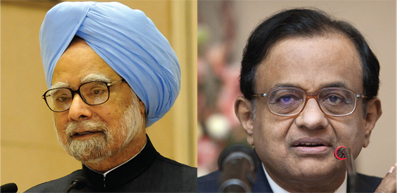
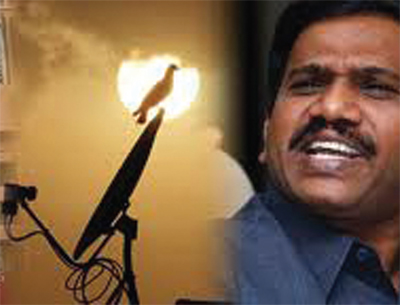
    NEW DELHI (TIP): The Joint Parliamentary Committee (JPC) on the 2G spectrum scam in its draft report on April 17 sought to give a clean chit to Prime Minister Manmohan Singh and Finance Minister P Chidambaram, saying then telecom minister A Raja had failed to keep them in the loop about changes made in the policy.

    According to sources, the draft report, which is yet to be approved by members, said the norms for allocation of spectrum under the “first-come-first-served” policy were tweaked at the last minute to enable a few companies to jump the queue, and neither Singh or Chidambaram played any role in this. Raja reportedly changed the rules without informing the PM.

    A news agency quoted the report as saying that “the committee is inclined to conclude that the PM was misled about the procedure decided to be followed by the Department of Telecommunications in respect of issuance of UAS licences.” It added that the “assurance” given by Raja “in all his correspondence with the PM to maintain full transparency in following established rules and procedures of the department stood belied”. Sources said the draft report also rubbished the loss figure of Rs 1.76 lakh crore estimated by CAG, saying it was “ill-conceived”.

    JPC chairman P C Chacko has to get the backing of a majority of the 30 members of the committee to carry through the draft report. The UPA has 12 members on the panel. Meanwhile, DMK spokesperson T K S Elangovan said: “If the JPC makes any charges against Raja without hearing him and calling him for deposition, then the report will be incomplete and biased. It will be a one-sided report.”

  • Parties reach consensus on Land Bill

    Parties reach consensus on Land Bill

    NEW DELHI (TIP): The government on April 17 achieved “broad consensus” on the long-pending Land Acquisition Bill, paving the way for the contentious legislation to be taken up for consideration and passage in the Budget Session that resumes on Monday. “We have reached a broad consensus on the Land Acquisition Bill,” Parliamentary Affairs Minister Kamal Nath and Leader of Opposition in Lok Sabha Sushma Swaraj said after the allparty meeting. The Bill proposes to replace the archaic Land Acquisition Act, 1894. The government agreed to a key demand of the BJP, which suggested that instead of acquisition, land could be leased to developers so that its ownership remains with farmers and also provides them with regular income. Sushma said the land mafia had bought huge tracts of land from farmers in the hope for four times compensation from the government. “I gave 12 suggestions and the government agreed to almost all of them.We have told the government that when you acquire land, you should give 50 per cent of the compensation to the original farmer and the government has agreed to that,” she said. Sources said the government would amend the Land Acquisition, Rehabilitation and Resettlement Bill, 2011, to provide the enabling provision for states to enact laws in this regard as leasing of land was a state subject.

    However, Left parties and DMK still have reservations on certain issues. The CPM is demanding consent of all families affected by land acquisition, whereas the Bill currently provides for agreement from at least 80 per cent affected persons. CPM leader Basudeb Acharia said the original Bill had been diluted and the current version was against the interest of farmers. “We will move amendments when the Bill is taken up in Parliament,” he said. DMK leader TR Baalu claimed that the Bill was against the Constitution’s federal structure.

    He has been asked to give suggestions on the issues by tomorrow. The forward movement on the Bill is a big relief for Rural Development Minister Jairam Ramesh. The first all-party meet on the Bill on April 9 had failed to iron out differences between the government and the BJP, SP and the Left Front. Ever since, Ramesh had been reaching out to leaders of various political parties to work out points of disagreement. Over the past one week, he met BJP leaders Sushma Swaraj, Arun Jaitley and CPM’s Sitaram Yechury for their support to the Bill. “The atmosphere was positive. If Parliament functions, we will be able to get this Bill through,” he said today.

    The Land Acquisition Bill has emerged as one of UPA’s flagship projects and is followed keenly by chairperson Sonia Gandhi and Rahul Gandhi. Congress strategists believe that land reforms can do for the UPA II what the job guarantee scheme and loan waiver had for the UPA I. It was Sonia who had vetoed the clause that said consent of 67% landowners would suffice for the government to acquire land.

    The draft legislation provides compensation for owners of acquired land to be four times the market value in rural areas and twice the market value in urban areas. In case of land acquisition for use by private companies or public-private partnerships, consent of 80 per cent displaced people will be required. Considering its far-reaching implications, the Bill has been through various procedural stages. Introduced in Parliament in September 2011, it was subsequently referred to a Parliamentary Standing Committee, which submitted its recommendations in May 2012. Ministries related to infrastructure and commerce insisted on changes to provisions that were perceived as hurdles to investment and industry. The industry felt that terms of compensation and rehabilitation provided by Bill would be detrimental to it.

    THE BREAKTHROUGH

    -The government agreed to a key BJP demand that instead of acquisition, land could be leased to developers

  • Badals Meet Prez, Seek Mercy For Bhullar

    Badals Meet Prez, Seek Mercy For Bhullar

    NEW DELHI (TIP): Punjab Chief Minister Parkash Singh Badal on April 17 filed a review mercy petition with President Pranab Mukherjee seeking clemency for 1993 Delhi bomb blast convict Devinder Pal Singh Bhullar and cautioned that hanging of the death row convict could disturb peace and harmony in the state.

    The 17-page mercy petition filed by Shiromani Akali Dal (SAD) president Sukhbir Badal urges the President to go into “the merits of the case” and says “it does not fall within the definition of rare of the rarest cases”. Justifying the second mercy petition, SAD said “changed circumstances” necessitate a review and cites an SC judgment of 2010 to argue “there is no bar in filing a second clemency petition”. Emerging from the meeting, Badal told mediapersons, “We have sought clemency for Bhullar and the main reason is that the hanging will affect communal harmony and peace in Punjab.” On whether he was in favour of abolishing the death penalty, Badal said, “That is a big issue and needs a wider debate”. The petition says, “The Akali Dal is extremely concerned about the volatile law and order situation in the state. The fallout of the Supreme Court order has led to is a surcharged atmosphere in the state.

    Our apprehension is if the death sentence is executed, it will create serious law and order problem and will give fresh breeding ground to the people who are averse to the idea of peace and communal harmony”. The petition comes just three days after Badal met Prime Minister Manmohan Singh and Home Minister Sushil Kumar Shinde on the same issue and submitted representations. Bhullar’s first mercy petition was rejected last year by former President Pratibha Devi Singh Patil.

    The Supreme Court had on April 12 rejected a plea that there had been a delay in deciding a mercy petition and upheld his death sentence. The petition said, “The Akali Dal is extremely concerned about the volatile law and order situation in the state. The fallout of the Supreme Court order has led to is a surcharged atmosphere in the state. Our apprehension is if the death sentence is executed, it will create serious law and order problem and will give fresh breeding ground to the people who are averse to the idea of peace and communal harmony”. SAD argued that Bhullar’s death penalty was confirmed following a split verdict of the Supreme Court. “Mr Justice MB Shah had dissented and held that if death sentence is altered to imprisonment for life, it would the sufficient to meet the ends of justice… the confession of the accused (Bhullar) is not voluntary.

    The main accused (Daya Singh Lahoria) has already been acquitted and further held that the accused is not guilty and deserves to be acquitted,” the SAD petition says while quoting the SC verdict. Badal’s plea is that the SC, while deciding Bhullar’s main appeal as well as review petition, had said “the President of India would keep in mind the view of Mr Justice MB Shah while deciding the clemency petition.” The Petition goes on to remind the President about powers under Article 161 of the Constitution of India: “The Constitutional powers are meant to do substantial justice.” Further citing a 1989 apex court judgment and referring to Article 72 of the Constitution, the petition says, “The President can go into the merits of the case decided by the courts and can take a different view. That would not amount to suppression of the judicial verdict”.

    The petition reminds the President how Daya Singh Lahoria, the principal accused for the 1993 Delhi blast in which Bhullar was convicted, was acquitted on the same set of evidence. “It is a travesty of justice that the person who is alleged to have only abetted is being hanged to death and the principal accused has been acquitted,” the SAD argument says.

    The party says Bhullar’s case is exceptional. He is mentally sick and under treatment. Further, India has assured Germany, from where Bhullar was extradited, of no death sentence.

  • Terror Strikes Bangalore; 16 Injured

    Terror Strikes Bangalore; 16 Injured

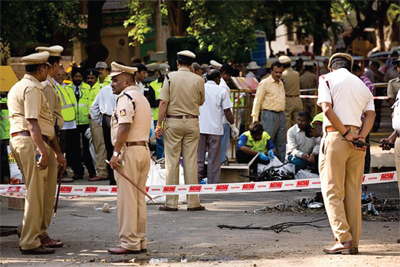
    BANGALORE (TIP): At least 16 persons, including 11 policemen, were injured in a bomb blast near the ruling Bharatiya Janata Party’s state office in the Malleswaram area of the city on April 17. The blast later triggered a mudslinging fest among politicians in the poll-bound Karnataka.

    Police personnel bore the brunt of the blast triggered by an IED mounted on a two-wheeler. Five civilians, including three women and two teenagers, were among the injured. Fire tenders rushed to the scene to douse the fire and the police combed the area with sniffer dogs. National Investigation Agency (NIA) officials and forensic teams were also present at the scene to look for clues. The explosion comes on the anniversary of a series of blasts outside the Chinnaswamy Cricket Stadium in 2010 that forced the shifting of IPL matches from Bangalore to Mumbai. Describing the blast as a “clear act of terror”, Deputy Chief Minister and Home Minister R Ashok said it was targeted at the party workers and its leaders. “It is a clear act of terror… It is targeted at the BJP, our senior leaders and workers,” Ashoka said. “State and central-level leaders keep coming to the party office for meetings in connection with the Assembly elections.

    The bomb was meant for them,” he said. Ashok said the date of the blast coincided with the Chinnaswamy Stadium blasts three years ago. The police would study this angle too during its investigations, he added. Congress leader and Leader of the Opposition in the Assembly Siddaramaiah said the blast could be the handiwork of the BJP to attract the sympathy of voters. This charge was furiously refuted by Bangalore (South) MP and former union minister Anantha Kumar and other BJP functionaries. “A bomb-like material on a motorbike exploded around 10.30 am, injuring 16 persons, including 11 policemen, near the BJP office at Malleswaram,” state DGP Lalrokhuma Pachau said. “The injuries are not serious.

    The injured are being treated in a nearby government hospital,” Pachau added. “We do not know the type of material or bomb used in the blast. It is under investigation. The NIA and forensic experts are examining the charred vehicles,” he said. The motorcycle suspected to have been used in the blast bore a Tamil Nadu registration number and was parked between two cars. The explosion ripped through the twowheeler and charred both cars. The explosion also shattered the windowpanes of houses in the vicinity. BJP spokesperson Prakash, who was at the party office when the bomb went off, said they heard a loud noise. No senior leader of the BJP was in the office at the time of the blast, he added. The BJP used the incident to target the Election Commission of India, which had transferred senior police officers, including the police commissioner, of the city recently

  • New foreign trade policy to boost exports, revive SEZs

    New foreign trade policy to boost exports, revive SEZs

    NEW DELHI (TIP): In a bid to boost exports and bring down the current account deficit (CAD), the government on April 17 announced the Foreign Trade Policy (FTP) which included major measures to revive the special economic zones (SEZ) and allowing exporters in all sectors to import capital goods at zero per cent duty under the Export Promotion Capital Goods (EPCG) scheme.

    This was announced by Commerce and Industry Minister Anand Sharma as part of the annual supplement to the Foreign Trade Policy (FTP) for 2013-14. Exports declined by 1.76 per cent to $ 300.6 billion during 2012-13 and pushed up the trade deficit to $ 190.91 billion. Acknowledging difficult global economic environment, the minister said in its latest report the World Trade Organisation (WTO) has revised the global trade growth projections downwards from 3.7 per cent to 2.5 per cent. “This is indeed a disturbing trend.

    We view exports not only as a valuable source of foreign exchange, which help in stabilising the Current Account Deficit, but also a key contributor to growth and employment”, he said. The FTP had announced significant measures for boosting SEZ scheme. The minimum land area requirement for setting up such zones has been reduced to half and there would be no ceiling for IT and ITes SEZs. On demands of exit policy for SEZs, the minister said it has been decided to allow transfer of ownership and sale of SEZ units. However, industry demands pertaining to removing minimum alternate tax (MAT) and dividend distribution tax (DDT) have not been accepted.

    The EPCG scheme, which allows exporters to import capital goods at zero duty, would be extended beyond March 2013 and would be applicable to all sectors. “We have decided not only to extend the zero duty EPCG scheme beyond March 2013, but also merge it with 3 per cent EPCG scheme. Now, the zero duty EPCG benefit will be available to all sectors,” the minister said.

  • German Bakery blast convict Baig to hang

    German Bakery blast convict Baig to hang

    MUMBAI (TIP): The Pune Sessions Court on April 17 sentenced to death Mirza Himayat Baig, 30, in connection with the 2010 bomb blast at Pune’s German Bakery that claimed 17 lives. Three days ago, Pune sessions court Special Judge NP Dhote had held Baig guilty in the case in which he was the lone accused arrested. A resident of Beed district, Baig was nabbed from Udgir town in neighbouring Latur district by the Maharashtra anti-terrorism squad (ATS) on September 7, 2010, nearly seven months after the attack. Investigators said they found 1,200 kg explosives in his possession. The chargesheet against Baig said the blast was planned by six persons at a meeting in Colombo two years before the event.

    On the day of conviction (April 15), Special Public Prosecutor Raja Thakre said Baig was charged under Sections 302, 307 (murder and attempt to murder), 435, 474 (mischief by fire and explosive and forgery) and 120-B (criminal conspiracy) of the IPC, besides other charges under the Unlawful Activities Prevention Act and the Explosives Act. The court upheld the prosecution contention that the blast was “a carefully planned and executed attack” calculated to terrorise the general public, causing extensive damage to life and property.

    The prosecution said the primary objective of the terror attack was to undermine and reduce faith of the common people in the elected government and destabilise the system of law. The special judge upheld the prosecution argument that the terror attack caused deaths of foreign nationals, earning the country a bad name. Five foreigners were among the 17 victims of the February 13, 2010, blast.

  • Dutt gets four more weeks to surrender

    Dutt gets four more weeks to surrender

    NEW DELHI (TIP): The Supreme Court on April 17 granted four more weeks to film actor Sanjay Dutt for his surrender to serve 3.5 years in jail, holding that the CBI had no business to oppose his plea as it did not even bother to challenge his acquittal under the prevention of terrorism law.

    A Bench comprising Justices P Sathasivam and BS Chauhan said Dutt could take four more weeks from tomorrow, the deadline set in its March 21 judgment, before his surrender. Dutt had approached the SC seeking six months for his surrender to complete his acting commitments involving seven movies and an investment of over Rs 278 crore. “We are not inclined to extend the time by six months. However, we extend the time by four weeks from tomorrow.

    It is made clear that no further extension will be granted,” it said in the order. A trial court set up under the Terrorist and Disruptive Activities (Prevention) Act (TADA) had cleared him of the charges of his role in the 1993 serial blasts at 13 locations in Mumbai in which over 250 people were killed and more than 700 injured. However, the TADA court convicted and sentenced him to six years for illegal possession of fire arms and ammunition. While the CBI did not challenge his acquittal under TADA charges, Dutt appealed against his conviction which resulted in the SC reducing his sentence by one year.

    Since he has already served 1.5 years of his sentence during the trial period, he has to serve out the remaining 3.5 years. “You did not seek review of his acquittal under TADA,” Justice Sathasivam told Additional Solicitor General Harin Raval when he objected to Dutt’s plea for extension of time.

    The Bench did not agree with the ASG’s contention that granting extension of time amounted to SC reviewing its own verdict without any review petition from Dutt. It said Section 148 of the Civil Procedure Code empowered it to release convicts for a maximum period of 30 days.

    The SC also enjoyed immense powers under Article 142 of the Constitution for the purpose, it said. Allaying the apprehension of the ASG, who argued for the CBI, that the relief being granted to Dutt would open the flood gates for other convicts, numbering about 100, in the case, the Bench said it would deal with such a situation on a case-to-case basis. Pointing out every case was different, the Bench carefully noted in its order that it was granting relief to Dutt in view of the “peculiar facts and circumstances of the case and the reasons stated in the petition.” Dutt’s senior counsel Harish Salve had clarified at the outset that his client was seeking “mercy” without resorting to any constitutional and legal provisions

  • Mayawati Woos Upper Castes Ahead Of Ls Polls

    Mayawati Woos Upper Castes Ahead Of Ls Polls

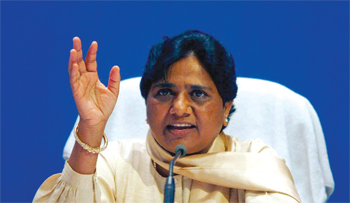
    LUCKNOW (TIP): With an eye on upper caste vote bank, BSP chief Mayawati announced names of 36 candidates for Lok Sabha polls, 18 of whom are Brahmins. Seeking to exploit the upper caste card to the hilt, she alleged atrocities were being committed on such people during the Samajwadi Party rule in Uttar Pradesh. “Just as Dalits are facing onslaughts, atrocities are being committed on Brahmins too under the Samajwadi Party government,” Mayawati told reporters on the sidelines of Brahmin Bhaichara Samiti office bearers’ meeting here.

    Citing the instance of humiliation to a Brahmin family in Etawah, she said most of those in the echelons of power in the SP government came from that district and it was a wellknown fact that people belonging to ‘sarv samaj’ (the entire society) are harassed there. “But Brahmins bear the maximum brunt of atrocities in Etawah…when the incident (of humiliation) took place, BSP raised the matter in the Assembly.

    Besides, its local unit tried to take up the issue and help them get justice,” she said. Mayawati regretted that during the last Assembly polls, the upper castes and Brahmins got influenced by non- BSP parties and did not vote for her party, “for which they are now repenting“. “For ensuring that they do not get further misled by the false propaganda of those parties, a detailed programme has been worked out by BSP to apprise them of various works done by my government in their interest. Besides, they would be apprised of atrocities on Brahmins under the SP rule,” she said. On why upper castes had got disenchanted with BSP in the last Assembly polls, she said, “Though our vote percentage rose, we lost seats due to our opponents’ (Congress and BJP) conspiracy, but we have learnt a lesson and would not allow them to succeed this time,” she said.

  • BJP slams JPC draft report

    BJP slams JPC draft report

    NEW DELHI (TIP): Slamming the leakage of the draft JPC report on 2G scam as a “gross breach of Parliamentary propriety”, BJP on April 18 said its contents appeared like Congress documents where attempts have been made to save its leaders including the Prime Minister. “The media showed the JPC draft report on 2G scam extensively.

    This is a gross breach of Parliamentary propriety where any report draft is debated, discussed, amendments are moved in the formal meeting and thereafter views are taken,” BJP spokesperson Ravishankar Prasad told reporters. “The draft report looks like a Congress document and not a JPC report in which there is an overpowering desire to save its leaders including the Prime Minister and the finance minister in the 2G scam and yet to objectively consider the wider ramification of this massive scam which shamed the country,” he said. Prasad said he was yet to go through the report as it was given to the members on Friday only. “This is a matter of grief and surprise that violating the tradition of discussing the draft report in the meeting in which amendments would be moved, even before a discussion could take place, this has come out in the media.

    This is highly unfortunate and we condemn it,” the BJP leader said. He said that whatever has come out in media on the contents of the JPC report, “We have strong objections over it and we shall convey our serious objection, firmly and forcefully in the formal JPC meeting which is scheduled for April 25.” However, the chairman of the JPC, PC Chacko rubbished opposition’s charges. Denying allegations of favouring the ruling party, Chacko said he did not work on the committee as a Congressman.

    Meanwhile, telecom minister Kapil Sibal warned against jumping to conlusions based on what had appeared in the media as the content of the draft report. He said it is time to learn from mistakes in the past so that they are not repeated in the future. The JPC has given a clean chit to Prime Minister Manmohan Singh on 2G spectrum allocation, saying he was “misled” by the then telecom minister A Raja whose assurances stood “belied”. The draft report of the JPC also rubbishes the loss figure of Rs 1.76 lakh crore estimated by CAG, saying it was “ill-conceived”.

  • J&K Minister Slaps Bureaucrat

    J&K Minister Slaps Bureaucrat

    SRINAGAR (TIP): A Jammu & Kashmir minister’s guards allegedly thrashed a bureaucrat after he slapped him thrice in the state’s Kishtwar town on Thursday. Kishtwar Development Authority chief executive officer Riaz Ahmad Choudhary said the guards attacked him after he questioned Sajjad Kitchloo why he had slapped him without any provocation. “But I do not know why he slapped me.” Choudhary said he would have killed him. “The minister was shouting at me telling his men to arrest me. They would have shot me.” Kitchloo said he was attacked while Kitchloo was waiting for CM Omar Abdullah’s arrival in presence of top police officers.

  • Forgotten mathematics legend Vashishtha Narayan Singh back in academia

    Forgotten mathematics legend Vashishtha Narayan Singh back in academia

    PURNIA (TIP) : Legendary mathematician VashishthaNarayan Singh, who had been languishing in penury, has joined the BhupendraNarayanMandal University (BNMU) in Madhepura as a visiting professor. The 67-year-old Singh started work on April 17 after the university’s academic council gave the goahead to his appointment following media reports, about how he was living like a destitute in his village home at Basantpur in Bhojpur district, 70km from Patna. Singh, who has a PhD from the University of California, Berkeley, is a schizophrenia patient. “It was a day of pride for BNMU when Singh accepted the university’s offer,” Anant Kumar, the university’s vice-chancellor, said on Thursday. He expressed confidence that Singh’s health would improve fast as a result of his association with academia again. “Teaching has always been Singh’s first love,” Kumar said.

    An alumnus of the well-known Netarhat School, Singh was in the US from 1965 to 1974 and worked on space theory at Nasa before returning home. He tied the knot in 1974, but his wife deserted him after he suffered his first attack of schizophrenia in 1976. He has taught at IIT Kanpur, the Tata Institute of Fundamental Research (Mumbai) and the Indian Statistical Institute (Kolkata). “An extraordinary teacher of mathematics, Singh will prove an asset to the university and a guiding spirit for research scholars and postgraduate students,” syndicate member Jai Krishna Mehta said.

    Former university faculty member Umesh Nandan hoped the appointment as a visiting professor would help Singh lead a normal, decent life. Registrar B N ‘Vibeka’ told TOI the university was yet to take a decision on the pay package to be offered to Singh. “He will be paid as per the provisions and statutes that govern the universities of the state,” he said. In his conversations with the university’s teachers and officials, Singh said he was fond of teaching functional mathematics. Singh, who arrived at the university headquarters on Tuesday, was accompanied by his brother Ayodhya Singh and nephew Nitesh Kumar Singh. In conversation with the university teachers and officials, including registrar B N ‘Vibeka’, Singh said he was very fond of teaching functional mathematics. He likes reading religious books and plays the flute as well in his spare time.

  • Indian American Devotee Ramalinga Raju Donates $3 Mn To Tirumala Temple

    Indian American Devotee Ramalinga Raju Donates $3 Mn To Tirumala Temple

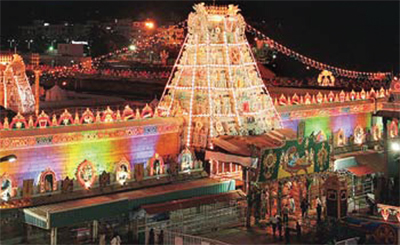
    TIRUPATHI (TIP): In a princely offering, an NRI devotee from US donated $ 3 Mn to the famous hill shrine of Lord Venkateswara at nearby Tirumala. M Ramalinga Raju, an entrepreneur based in the United States, handed over the offering in the form of a demand draft to top temple officials, temple sources said.

    They said this was the first such large cash offering made by an individual devotee from overseas. Raju presented the DD to Tirumala- Tirupati Devasthanams (TTD) Chairman K. Bapiraju and the temple Joint Executive Officer K.S. Srinivasa Raju at the temple. He requested the TTD, administering the cash-rich ancient temple, that Rs 11 crore be used to make a golden garland “sahasra nama mala” weighing about 35 kg and utilise the balance Rs five crore for the construction of a free-meal complex for pilgrims at Tiruchanur near here, they said. This is the second large cash offering since last month. On March 27, a Chennaibased pharmaceutical firm had donated Rs two crore to the hill shrine, they added.

  • Prachanda meets Xi, seeks more Chinese aid for Nepal

    Prachanda meets Xi, seeks more Chinese aid for Nepal

    BEIJING (TIP): Nepal’s Maoist leader PushpaKamalDahal alias Prachanda sought more financial and technical aid from China during his first meeting with the country’s new President Xi Jinping. Hailing the “traditional friendship” between the two countries, Prachanda thanked the Chinese side for its selfless assistance to Nepal, state-run Xinhua news agency reported. Known for his pro-China stance in Nepal, Prachanda who heads the Unified Communist Party of Nepal (Maoist) is visiting Beijing for the first time after Xi took over as the leader of the ruling Communist Party of China (CPC) and President. To take the Nepal-China friendship to a higher level, he looks forward to more financial and technical support from Beijing as well as more practical cooperation between the two sides on infrastructure, water conservancy projects and tourism, he said.

    China has scaled up its relations with its Himalayan neighbour in the recent years pumping in a lot of aid and resources. Nepal on its part is cracking down on the Tibetan refugees to prevent the spread of anti-China sentiments. Prachanda said Nepal will continue to firmly adhere to the one-China policy and he believes that the “Chinese dream” of national rejuvenation will be realised under the leadership of the Communist Party with Xi as the general secretary. Xi pledged to boost cooperation saying China attaches great importance to bilateral ties with Nepal. The China-Nepal friendship is not only in the fundamental interests of the two countries and peoples, but also conducive to stability and development in the region, he said. In pursuit of common development, Xi said China will continue to seek peaceful development and win-win cooperation with Nepal and other neighbouring countries. After his returns from Beijing, Prachanda is also likely to visit India.

  • North Korea lays out tough pre-conditions for talks

    North Korea lays out tough pre-conditions for talks

    SEOUL: North Korea laid down rigid preconditions on Thursday for dialogue with Seoul or Washington, including the withdrawal of UN sanctions and a guaranteed end to South Korea-US joint military drills. The list of demands from the North’s top military body was swiftly rejected as “incomprehensible” by South Korea which, together with the US, has made any talks conditional on the North taking steps towards denuclearisation. Dialogue has become the new focus of a blistering rhetorical battle that has sent military tensions soaring on the Korean peninsula ever since the North carried out its third nuclear test in February.

    Some analysts see the North’s engagement in a debate over dialogue — no matter how unrealistic the conditions — as a welcome shift from the apocalyptic threats of nuclear war that have poured out of Pyongyang in recent weeks. “I don’t think Pyongyang really expects these conditions to be met,” said Yang Moo- Jin, a professor at the University of North Korean Studies in Seoul. “It’s an initial show of strength in a game of tug-of-war that at least shows a desire to have a dialogue down the line,” Yang said. The first step demanded by the North’s National Military Commission was the withdrawal of “cooked up” UN sanctions that were imposed after the nuclear test in February. North Korea has repeatedly cited the sanctions as a prime trigger for the current crisis.

    The other main bone of contention has been ongoing joint South Korea-US military drills, which have involved the deployment of nuclear-capable B-52s and B-2 stealth bombers. Both countries must provide international guarantees that such “nuclear war drills” will never be repeated, the commission said. “Dialogue and war games can never go together,” it added. South Korean foreign ministry spokesman Cho Tai-Young called the North’s pre-conditions “absurd” and said it was time for Pyongyang to choose engagement with the international community over provocation. “We strongly urge the North to stop making such incomprehensible demands and to make the wise choice we have repeatedly urged,” Cho told a press briefing. Daniel Pinkston, a North Korea expert with the International Crisis Group, ruled out any suggestion that the North was softening its position and said those hoping a dialogue might emerge were being wilfully naive. The North, Pinkston argued, had bound itself to a course that could only end with its recognition as a nuclear power — a status that is anathema to the United States and its allies.

  • Bhullar’s Death Sentence-International NGO’s File “Urgent Appeal” With United Nations

    Bhullar’s Death Sentence-International NGO’s File “Urgent Appeal” With United Nations

    NEW YORK (TIP): Seeking United Nations intervention, international human rights NGOs have approached UN’s Special Rapporteur on Torture after the denial of commutation plea by the Supreme Court of death row convict Devenderpal Singh Bhullar. The urgent appeal to Honorable Juan Méndez UN Special Rapporteur on Torture seeking immediate intervention, has been jointly filed by “Sikhs For Justice” (SFJ) a US based advocacy group, “Canadian Sikh Coalition” (CSC), a Canada based NGO and “Movement Against Atrocities and Repression” (MAAR) a Swiss NGO.

  • Election council to audit vote in Venezuela

    Election council to audit vote in Venezuela

    CARACAS (TIP): Venezuela’s electoral council announced Thursday night that it would audit the 46 percent of the vote not scrutinized on election night in a concession to opposition candidate Henrique Capriles, who said he believed the stolen votes that cost him the presidency are among the unaudited. “We are where we want to be,” Capriles, looking satisfied but wary, told a news conference after the announcement. “I think I will have the universe of voters needed to get where I want to be.” Capriles had demanded a full vote-by-vote recount but said he could live with the National Electoral Council’s ruling, an apparent turnaround for President-elect Nicolas Maduro, whose government had looked all week to be digging in its heels.

    Maduro, the late President Hugo Chavez’s anointed successor, is being inaugurated on Friday and was in Lima, Peru, on Thursday night for an emergency meeting of South American leaders to discuss his country’s electoral crisis.”We know where the problems are,” said Capriles, referring to the votes cast in the 12,000 voting machines that council President Tibisay Lucena said would be audited beginning next week and would take a month to complete.

    The 40-year-old state governor called on his supporters to back down from confrontation and play music, preferably salsa, instead of banging on pots, as they have been nightly all week since the council ratified Maduro’s victory in order to protest what they considered a stolen ballot. Venezuela’s opposition had been battered for years by Chavez and many say political repression has only increased under Maduro.

    Capriles said he will insist that every single vote receipt be counted and compared to voter registries as well as to voting machine tally sheets. In announcing the audit, Lucena did not say whether authorities would do that. But a council spokesperson, speaking on condition of anonymity because she was not permitted to be named, said the audit would be done as Capriles specified. Venezuela’s electronic voting system emits receipts for every ballot that are boxed up with the tally machines.

    Maduro was declared the winner of Sunday’s election by a slim 260,000-vote margin out of 14.9 million ballots cast. He had squandered a double-digit lead in the polls as Venezuelans upset by a troubled economy, rampant crime, food shortages and worsening power outages turned away from a candidate they considered a poor imitation of the charismatic leader for whom he long served as foreign minister. Capriles maintains the vote was stolen from him through intimidation and other abuses and presented a long list of abuses. No international election monitors were scrutinizing the vote

  • Veerappan Proves Mast Cells Have Critical Role In Initializing Pulmonary Fibrosis

    Veerappan Proves Mast Cells Have Critical Role In Initializing Pulmonary Fibrosis

    NEW YORK (TIP): Pulmonary fibrosis is a chronic, deadly disease that affects five million people worldwide. It is irreversible, its cause is poorly understood, and it has a median survival of only about three years. A new study by a team led by Indian-American scientist Dr Arul Veerappan of Dr Silvers Lab of Weill Cornell Medical College of prestigious Cornell University in New York implicates mast cells-an immune cell involved in allergic asthma-in the development of idiopathic pulmonary fibrosis could lead to new, more effective therapies.

    The study is published in DNA and Cell Biology, a peer-reviewed journal from Mary Ann Liebert, Inc., publishers. In the article “Mast Cells: A Pivotal Role in Pulmonary Fibrosis,” Dr. Arul Veerappan and colleagues from Weill Cornell Medical College, New York, NY, showed that in mice unable to produce mast cells, a chemical trigger known to cause pulmonary fibrosis does not result in disease. However, when the researchers introduced mast cells into the lungs of these mice, disease protection was reversed and the mice developed pulmonary fibrosis. The authors identify a role for two key compounds produced by mast cells-histamine and renin-and propose that they promote fibrogenesis when mast cells are activated early in the course of the disease.

    Editor-in-Chief Carol Shoshkes Reiss, Departments of Biology and Neural Science, New York University, New York says, “Randi Silver’s lab has shown, in this compelling paper that mast cells contribute to the pathogenesis of pulmonary fibrosis. These observations are important and may lead to the development of new therapeutic modalities to prevent deterioration of lung function.” Dr. Arul Veerappan had earlier proved that an enzyme released by mast cells in the lungs appears to play a key role in the tightening of airways that is a hallmark of asthma – pointing to a potential new target for treatment against the illness.

    Reporting in the online edition of Proceedings of the National Academy of Sciences, a team led by Dr Arul Veerappan at Weill Cornell Medical College explained that during an immune response, mast cells release the enzyme – called renin – which in turn produces angiotensin, a potent constrictor of the smooth muscle that lines airways. Mast cells are normally present in small numbers in all organs, and are best known for their role in allergy, shock, wound healing and defense against pathogens.

    The genesis of the new study came through the efforts of the study’s lead author Dr. Arul Veerappan. He looked closely at rings of bronchial tissue from rodents, discovering that mast cells in these rings released renin along with other substances. “You ended up getting the same biochemical cascade that we had seen elsewhere – newly produced renin bringing about a local rise in angiotensin in tissues,” Veerappan says. “That’s a big achievement, because it supports the notion that the mechanism we have discovered is not just a laboratory phenomenon – it’s actually occurring in the living human lung,” co-senior author Dr. Roberto Levi, professor of pharmacology at Weill Cornell Medical College notes. New research suggests that local renin production may also be crucial in diseases marked by tissue fibrosis (stiffening). In fact, Dr. Silver’s lab is now looking at the role locally produced renin might play in a rare, deadly illness called idiopathic pulmonary fibrosis (IPF), where lung tissue becomes increasingly inflexible over time.

  • N KOREA TRIP: LSE Students Blame Institute For Risk

    N KOREA TRIP: LSE Students Blame Institute For Risk

    LONDON (TIP): Students from London School of Economics have started receiving email threats from North Korea after it was revealed that a BBC crew came with them undercover filming from within the secretive state. The students now blame the LSE for “putting them at risk”. LSE had last week accused the BBC of putting students in serious danger by infiltrating a college trip to get into North Korea and film. LSE said the BBC deceived the institution as one of its reporters lied about being a PhD student.

    In an open letter to the LSE, the students accused the Institute of putting them in danger by revealing details of the operation. “Our main consideration here was that the BBC agreed that the documentary would not reveal our names or that of the LSE,” they wrote. “We feel that we have now been put in more risk than was original thought of as a result of the LSE’s decision to go public with their story,” the letter said.

    They criticised the LSE for “going public” without consulting them, consequently exposing both the individuals involved and the institution. “We valued the trip as a rare chance to see North Korea from the inside,” they wrote in the letter sent to the chairman Peter Sutherland and the director of LSE Craig Calhoun. “Nothing happened on the trip which would indicate that we were put in danger, and we returned safely.” The BBC had said that the footage “is strongly in public interest” and will go ahead to air the programme.

    BBC also said that if they were caught, the students and the crew would face “possible arrest and detention”. Three BBC journalists formed part of three student group and spent eight days within North Korea. The journalists ravelled to North Korea with members of a LSE’s Grimshaw Club. LSE had last week sent a strong letter to all members of the university, deploring BBC’s actions. It said “The programme has been produced using as cover a visit to North Korea from 23 to 30 March 2013 in the name of the Grimshaw Club, a student society at LSE. The School authorities had no advance knowledge of the trip or of its planning.”

  • Older Adult Volunteers honored

    Older Adult Volunteers honored

    AAPI INFIGHTING TO THE FORE
    AAPI is a representative organization of American physicians of Indian Origin. The 30 year old organization has a membership of more than 52,000.

    AAPI claims proximity with the centers of political power in USA. Senators and Congressman are said to be at the beck and call of AAPI leadership. So far so good.

    But AAPI is not without its blemishes. There have been instances when scuffles broke out at meetings, particularly at election meetings, There have been accusations of gangsterism by some elected officials. There also have been allegations of misuse of AAPI funds against some officials of the organization. There were instances when some approached the courts with their complaints. Educated professionals have often been found to conduct themselves in an undignified manner unbecoming of their profession.


    img30

    Forget the number of AAPI members who have been sentenced to various prison terms and penalties for unethical and fraudulent practices. One can find them in hordes in public records.

    The latest in the series was a scuffle at a meeting to hold BOT election on March 22, 2013. We believe the following letter from Chair, AAPI Board of Trustee, Durgesh Mankikar to AAPI President Narendra Kumar throws ample light on the infighting in AAPI, an organization supposedly of gentlemen, and of course, ladies. When will our crème de la crème give a better account of themselves? Indian Americans will like to know

    “Dear Narendra, “I write in response to your March 25 email to your “BOT Friends.” “I have helped you in the initial stages of your Presidency in acquiring BOT loans, even beyond the 5%, since there was no money in AAPI, and to stabilize your fledgling Presidency.

    Again, I helped you during the Audit, when you were concerned about ” a Forensic Audit ” and losing Vijaya, who was exonerated previously twice by our AAPI committees, and some BOTs were still demanding a Forensic Audit, and I came to your rescue once more. Also, unlike previous Chairs, I even gave a personal donation both to the magazine as well as to the “Shreya Ghoshal” fundraiser. Even last year, I called Shobha Gupta to withdraw her suit against AAPI.

    I have given seed money this year for Shanker Mahadevan fundraiser and asked every BOT member to join the regional groups of this fundraiser. “But you came into Conference Rm 226, on March 22, at the Rennaissance Hotel at a duly pre arranged AAPI BOT Election, with a group of people to disrupt the meeting, and physically snatched ballots and tore off the ballots—a reprehensible act bordering on criminality.

    Only the Chair of BOT can decide when and where the BOT Election can be held, and all the voting members of the BOT were duly informed, including both the candidates and the non-voting members were invited to observe the process. “I became emotional during the Governing Body, because you were running a tirade against me all morning, despite the fact that I had helped you all along to survive and thrive as AAPI President. And you too, had returned the $ 175,000 to the BOT, and we had a wonderful EC/BOT relationship until then.

    I feel you are overly stressed out by the upcoming Convention and now your behavior has become bizarre. “This BOT meeting was announced over a month ago, and was informed to everyone, to start at 7 pm. The BOT Members did not feel they could make it until 9 pm, so it was postponed to 9 pm. Dr Suresh Gupta wanted to “dance” at the entertainment program, so it was delayed until he and Dr Naresh Parikh were available.

    Since we needed someone neutral to observe the process of voting, Dr Rajam Ramamurthy, ( ex-Chair, BOT ), Dr Jayesh Kanuga ( ex-BOT ), Dr Vijay Koli ( Past President ) and Dr VK Raju ( Chair, Blindness Prevention Committee), were invited by me, in the capacity of BOT Chair, when you, Dr Vinod Shah and Dr Singhvi came in, snatched the ballots and disrupted the meeting and tore off the ballots, which were numbered and signed by Dr Ramamurthy. Dr Suresh C Gupta, Dr Vinod Shah and Dr Ajeet Singhvi hurled loud innuendos and curse words, a behavior uncalled for from Physicians who are also Officers and ex-Officers of AAPI. “You and I may have disagreement about whether the ex-Presidents should or should not be allowed on the BOT, and I have asked you many times to send the issue to the General Body and get it approved, as until then, it is not a Bylaw, and we, as BOT, can only deal with that which is passed by the General Body.

    Again, after Dr Singhvi brought the suit against me as BOT Chair, I wanted the Arbitrator to decide the status of the ex-Presidents. As I mentioned at the Gov Body and later to you too, that I have learnt a lot from both Dr Sanku Rao and Dr VK Shah and even wanted to bring other Presidents including you, in future, to strengthen the BOT, but membership of the ex-Presidents has not yet been authorized by the ByLaws committee or the General Body.

    As I mentioned to you, the ex- Presidents “issue” should either be decided by the General Body or the Arbitrator, an opportunity that we have lost once again. “Your behavior of Friday evening was uncalled for, and reprehensible, especially since a) you are the President of the organization, and b) you also sit on the BOT as an ex-officio Member without a Vote, but were invited by me both by e-mail as well as in person in that capacity. Even at the Gov Body, I did not bring out this event, to maintain your dignity as the President of the organization and to maintain decorum, and I feel your this email from yesterday is uncalled for.

    Regardless of what the Gov Body passes, since it is filled with Presidential appointees, and may be because of that, your EC decisions or the Gov Body decisions, according to our Bylaws, are not binding on the BOT. Our Election was completed with a proper quorum that evening in the presence of ex-BOT Chair, Dr Ramamurthy and at our Spring Gov Body, as per our Bylaws, and I recommend that you accept our decision and do not send out any ballots by Tru ballots or by anyone else. I do not want to be party to breaking our own Bylaws.

  • Bank of America Profits up in Q1, but Mortgage Income falls and EPS come up short

    Bank of America Profits up in Q1, but Mortgage Income falls and EPS come up short

    NEW YORK (TIP): Bank of America BAC -3.66% recorded net income of $2.6 billion in the first quarter, significantly above last year’s $653 million, on $23.7 billion in revenue. Earnings of 20 cents per share were short of estimates. Shares dropped 3.3% on the miss in pre-market trading, to $11.88. The bank reported an increase in deposits and a 57% increase in mortgage originations, though mortgage banking income was down from a year ago. As a result, net income in consumer and business banking declined slightly from 2012.

    Chief Executive Brian Moynihan lauded “Solid increases in loan growth to small businesses and middle-market companies, four straight quarters of steady growth in mortgage originations, record earnings in wealth management, and another quarter near the top in investment banking fees,” while CFO Bruce Thompson touted a $1 billion decrease in noninterest expenses year-over-year. BofA lowered its provision for credit losses in the quarter, as did rivals JPMorgan Chase JPM -1.11% and Citigroup C -1.91%, given improvements in the U.S. housing market and a slowly improving outlook for the economy at large. The firm won Federal Reserve approval to repurchase up to $5 billion in stock last month, which marks its first buyback since being propped up by the government during the financial crisis.

  • Governor Cuomo Nominates Mta Chairman & Ceo

    Governor Cuomo Nominates Mta Chairman & Ceo

    ALBANY (TIP): Governor Andrew M. Cuomo nominated , April 12, Thomas F. Prendergast to serve as Chairman and Chief Executive Officer of the Metropolitan Transportation Authority (MTA). Mr. Prendergast has served more than three years as president of MTA New York City Transit, which runs the subway and bus system in New York City, and has served as the MTA Interim Executive Director since January 1, 2013.

    He replaces Joseph Lhota. “Tom Prendergast is a consummate public transit leader who is the ideal candidate to oversee the nation’s largest transportation system,” said Governor Cuomo. “The MTA plays a vital role in New York’s economy and the daily lives of the millions of commuters who use its services.

    Tom has vast experience in infrastructure and transportation and has spent years managing commuter railroads as well as New York City’s subways and buses. From the track bed to the budget to modernizing our system for the 21st Century, I can’t imagine anyone having a better understanding of how the region’s vast system operates and the challenges that it faces.” “It is an incredible honor to be nominated to lead the largest transportation network in North America, and to work with Governor Cuomo and his administration on the many challenges facing the MTA,” Prendergast said. “The MTA will improve the customer experience, operate more efficiently and build for the future. And we will aggressively rebuild smarter and better in the aftermath of Superstorm Sandy.

    Governor Cuomo has demonstrated his strong support of the MTA in fully funding our capital plan, in allocating additional funding to the MTA in his latest budget, and of course in his leadership during and after Sandy struck. I look forward to working with the governor, his management team, the MTA Board and the 66,000 dedicated employees of the MTA family.” In 2011, the Governor’s MTA Search Advisory Committee conducted a national search to find and recommend the most talented candidates to lead the MTA. Mr. Prendergast was highly recommended by the Committee, and Committee members were consulted in his nomination that was announced today.

    The advisory committee was composed of leading public transportation experts and management professionals in the public and private sectors. The Governor’s appointment of an MTA chairman and CEO is subject to Senate confirmation. Mr. Prendergast is a career public transit officer and former MTA executive who was appointed President of MTA New York City Transit in November 2009. Prendergast, then the CEO at TransLink in Vancouver, B.C., returned to New York and took office December 1, 2009. A native of Chicago, with a systems engineering degree from the University of Illinois, Mr. Prendergast began his career at the Chicago Transit Authority in 1975. From there, he joined the U.S. Department of Transportation in Washington, DC, then moved to the New York City Transit Authority in 1982 as Assistant Director of System Safety. In 1984, he was named Chief of the TA’s System Safety Department. In 1987 he became Staten Island General Manager, and in 1989, the agency’s Chief Electrical Officer. Then in 1991, he was named Senior Vice President of the Department of Subways.

    In 1994, Prendergast left Subways’ SVP office at Jay Street in Brooklyn to become President of the Long Island Rail Road. In 2000, he left the public sector to work as a consultant in transportation. Over the next eight years, he worked on numerous project and program management assignments in the UK, North America and Asia. He returned to the public sector in 2008 with his move to TransLink, Vancouver’s public transportation system.

    Fernando Ferrer, Acting Chairman of the MTA, said, “As a longtime public servant with broad expertise in transportation issues, Tom Pendergast will be a first rate leader for the M.T.A. He has served the M.T.A. well in his current and former positions, including playing an integral role in guiding the agency’s successful preparations and response to Hurricane Sandy. Governor Cuomo could not have chosen a stronger or more qualified individual to lead the M.T.A.” “Tom Prendergast has the hands on skill and long commitment to transit to make a great head of the M.T.A. The Straphangers’ Campaign has found Tom to be accessible, knowledgeable, smart and fair,” said Gene Russianoff, Staff Attorney for the NYPIRG Straphangers’ Campaign. “Tom is a great choice to provide continuity of strong professional leadership of the MTA in the face of daunting fiscal challenges and with a major capital program underway. He will have the full confidence and support of the business community,” said Kathryn Wylde, President & CEO of the Partnership for New York City.

  • GOPIO Condemns Bombings in Boston

    GOPIO Condemns Bombings in Boston

    NEW YORK (TIP): The Global Organization of People of Indian Origin (GOPIO) expresses strong and unequivocal condemnation of the bombings on April 15, 2013 directed against innocent victims in Boston, Massachusetts, USA that killed three persons and left many more injured. GOPIO considers this brutal, senseless and despicable act as unforgivable and unjustified criminal action targeted to create fear among innocent citizens. We recognize that these senseless attacks at other times in various cities around the world are meant to cause terror among innocent citizens of respective countries.We all grieve that such inhumane and uncivilized crimes have been perpetrated against innocent people in the country of so many immigrants from countries around the world.We join with all community organizations and agencies in USA and worldwide in our condemnation as we share the pain and anguish of innocent citizens affected by national tragedy.We extend our condolences to the families of the victims and offer prayers for the speedy recovery of those injured.

    GOPIO commends the first responders, the general public,municipal authorities and medical facilities of Boston, state officials of Massachusetts and federal government of USA for their prompt and diligent efforts in providing emergency services to the survivors and their families. GOPIO fully supports all measures taken by the all officials and community groups to bring security, calm and confidence to the people and encourages all efforts to prevent similar attacks in the future. For more information, please contact GOPIO International at +1-818-708-3885, Email: indersingh@sbcglobal.net GOPIO is a non-partisan, non-sectarian global organization with chapters in several countries, actively promoting the interests of people of Indian origin worldwide by monitoring and addressing current critical issues of concern, and by enhancing cooperation and communication between groups of Indians living in various countries

  • Alien Tort Statute’s extra-territorial wings clipped and Charles Dickens Smiles

    Alien Tort Statute’s extra-territorial wings clipped and Charles Dickens Smiles

    NEW YORK (TIP): The Alien Tort Claim Act or ATS violated the core principle of respectful co-existence by and between sovereigns/nations in the comity of nations – and invited retaliatory reciprocity whereby other nations could pass laws that exposed United States citizens to liability on foreign soil for acts done here in the United States. ATS was a sovereignty killer – and that was its core sin.

    The necessary clipping of its wings now makes it lawful. While it is risky to predict what the Supreme Court might do, I am glad my prediction came true in Kiobel v. Royal Dutch Petroleum. ATS, like Responsibility to Protect (R2P), while well-intentioned and humane, also has an underbelly of being a sovereignty-killer. Surely, no one can be against human rights, but using laws that have core birth defects or can be applied improperly need to be watched carefully – to paraphrase Charles Dickens, “the law must never be an ass.”