Month: May 2013

  • Bhutan Revisited: Balancing Modernity With Tradition

    Bhutan Revisited: Balancing Modernity With Tradition

    Like a giant Brahminy kite swooping down on its prey, Drukair’s Airbus, plumed in the national colours of orange and yellow, veered sharply to the left over the Himalayas to head for an unexpected v-shaped opening in the mountains. To the collective gasps of its passengers – who had barely recovered from the excitement of flying alongside the world’s mountain peaks, including Mount Everest, Kanchenjunga, Jumolhari, Dhaulagiri and Makalu among others – it emerged through the gap to present a vista that was both panoramic and breathtaking.

    A long strip of asphalt beckoned below in a welcoming carpet at the quaint Paro airport, the gateway to the mystical kingdom of Bhutan. It was flanked on either side by verdant slopes of cypress, pine and oak, dotted in the foothills by pretty traditional cottages and chhordens (Buddhist stupas), with their fluttering white flags, and the sparkling chu (river) that gives company a good way during the one-hour journey from Paro to capital Thimphu.

    Welcome to the country often described as “the last Shangri La on earth”, that Lonely Planet calls one of the world’s most enigmatic and intriguing nations. “Felicitations to the Royal Couple on their Wedding”, greeted a giant billboard with a coloured photo of HRH Jigme Kesar Namgyel Wangchuk, the fifth king of Bhutan, and his wife Gyaltusuen Jetsun Pema Wangchuk, as one set foot in a land whose benevolent rulers have chosen to measure their people’s well being through the unique concept of Gross National Happiness (GNH) rather than the universal metric of Gross National Product (GNP).

    Though the couple are observing their first wedding anniversary this month, the kingdom – it now calls itself a democratic constitutional monarchy – is still to get over the international attention it got when the world media came to cover the royal wedding last Oct 13.

    Immigration is a breeze (Indians require no visa but on the whole tourism has to be of high-value – other foreigners have to pay $200 each and travel in groups – ecologically friendly and cultural acceptable) and soon one is settled on the road to Thimphu in one of the Maruti Suzukis or Hyundai Santros that seem to predominate the 66,000 odd private vehicle population of the country.

    Although the snaking road to Thimphu is full of hairpin bends, no one honks because, as our driver put it sagely, the mountain gods “would feel disturbed”. Thimphu has changed since the time I was last here two decades ago. The city – which resembles an Indian hill town – of about 50,000 people is much more crowded, has many more markets, hotels and restaurants, and there is new construction everywhere, although everyone has to adhere to traditional Bhutanese architectural norms – white-washed rectangular buildings with sloping, crested roofs and gilded windows and all carrying the local icons of dragon and lotus.

    There is also the ubiquitous phallic symbol dangling from the eaves of Bhutanese homes to ward off malevolent spirits. In the words of a Bhutanese writer, “phallic rituals appear everywhere in our daily lives, marking events that range from the mundane to the momentous.

    “The birth of a calf, for instance, the purchase of a new truck, or the augury of a brand new home all merit a nod to the preeminent phallus.” Bhutan is a deeply spiritual nation of nearly 700,000 people whose history stretches back to the origins of Buddhism and who have developed a unique identity, derived largely from a religious and cultural heritage, designed for a harmonious evolution of man with nature.

    Such is the Bhutanese obsession with retaining their pristine lifestyle that the biggest media debate a few months ago was about the installation of the first traffic light at the busiest downtown crossing. Ultimately, the traditionalists, backed by the king, prevailed and the lights were dismantled. Today, a policeman directs traffic under a crafted canopy, traffic is orderly and noncacophonous and Bhutan, the land of the thunder dragon, continues with its delicate balance between tradition and modernity.

  • Cluster Of Hydrogen Clouds Found Lurking In Nearby Galaxies

    Cluster Of Hydrogen Clouds Found Lurking In Nearby Galaxies

    WASHINGTON (TIP): Astronomers have discovered a never-before-seen cluster of hydrogen clouds strewn between two nearby galaxies, Andromeda (M31) and Triangulum (M33). The researchers speculate that these rarefied blobs of gas – each about as massive as a dwarf galaxy – condensed out of a vast and as-yet undetected reservoir of hot, ionised gas, which could have accompanied an otherwise invisible band of dark matter.

    The astronomers detected these objects using the National Science Foundation’s Green Bank Telescope (GBT) at the National Radio Astronomy Observatory (NRAO). “We have known for some time that many seemingly empty stretches of the Universe contain vast but diffused patches of hot, ionised hydrogen,” said Spencer Wolfe of West Virginia University in Morgantown.

    “Earlier observations of the area between M31 and M33 suggested the presence of colder, neutral hydrogen, but we couldn’t see any details to determine if it had a definitive structure or represented a new type of cosmic feature. “Now, with high-resolution images from the GBT, we were able to detect discrete concentrations of neutral hydrogen emerging out of what was thought to be a mainly featureless field of gas,” Wolfe said.

    Astronomers are able to observe neutral atomic hydrogen, which is referred to as HI (H and the Roman numeral one), because of the characteristic signal it emits at radio wavelengths, which can be detected by radio telescopes on Earth. Though this material is abundant throughout the cosmos, in the space between galaxies it can be very tenuous and the faint signal it emits can be extremely difficult to detect.

    A little more than a decade ago, astronomers had the first speculative hints that a previously unrecognised reservoir of hydrogen lay between M31 and M33. The signal from this gas, however, was too faint to draw any firm conclusions about its nature, origin, or even certain existence. Last year, preliminary data taken with the GBT confirmed that there was indeed hydrogen gas, and a lot of it, smeared out between the galaxies.

    New and more thorough studies of this region with the GBT revealed that the hydrogen gas was not simply in the form of wispy streamers, as would be expected by the interactions of two galaxies in a gravitational ballet. Instead, a full 50 per cent of the gas was conspicuously clumped together into very discrete and apparently self-gravitating blobs that – apart for their lack of stars – would be dead ringers for dwarf galaxies.

    The GBT was also able to track the motion of these newly discovered clouds, showing that they were travelling through space at velocities similar to M31 and M33.

  • This Flying Car Can Take Off Vertically

    This Flying Car Can Take Off Vertically

    NEW YORK(TIP): Stuck in traffic jam? Use your car’s flying button. Seriously! US scientists have designed a gen-next flying car capable of taking off vertically and flying completely on its own — and it could be on the roads within a decade. An ambitious US engineering company has released images of the flying car, the four-passenger TF-X, and it won’t require a pilot’s licence to operate.

    The Terrafugia TF-X flying car can take off vertically and has a flying range of 805km. Once airborne, the two propellers fold back and propulsion is handled by an engine mounted behind the cockpit, ‘New York Daily News’ reported. Everything from take-off, to flying, and eventual touch-down at the chosen destination will be handled automatically by the Terrafugia.

    The manufacturers claim the TF-X is a plug-in hybrid. Electric motors handle road driving, and assist during takeoff and landing. Terrafugia claims its road-legal and highly automated flying car could be on the road (and in the air) within 8- 12 years.

    The TF-X’s vast array of sensors and GPS monitors make flying to a destination as simple as punching in an address in current satellite-navigation devices. The TF-X calculates the total distance, and determines whether there is suitable fuel range.

  • Streetlamps Out, Glowing Trees To Light Up Roads?

    Streetlamps Out, Glowing Trees To Light Up Roads?

    NEW YORK (TIP): Hoping to give new meaning to the term “natural light,” a small group of biotechnology hobbyists and entrepreneurs has started a project to develop plants that glow, potentially leading the way for trees that can replace electric streetlamps and potted flowers luminous enough to read by.

    The project, which will use a sophisticated form of genetic engineering called synthetic biology, is attracting attention not only for its audacious goal, but for how it is being carried out. Rather than being the work of a corporation or an academic laboratory, it will be done by a small group of hobbyist scientists in one of the growing number of communal laboratories springing up around the nation as biotechnology becomes cheap enough to give rise to a do-it-yourself movement.

    The project is also being financed in a DIY sort of way: It has attracted more than $250,000 in pledges from about 4,500 donors in about two weeks on the website Kickstarter. The effort is not the first of its kind. A university group created a glowing tobacco plant a few years ago by implanting genes from a marine bacterium that emits light. But the light was so dim that it could be perceived only if one observed the plant for at least five minutes in a dark room.

  • Now, Robot That Can ‘Discover’ New Objects On Its Own

    Now, Robot That Can ‘Discover’ New Objects On Its Own

    WASHINGTON (TIP): More than a good eye! Researchers, including an Indian-origin scientist, have developed a new ‘smart’ robot that can analyse and learn about new objects on its own. The two-armed mobile robot called HERB can ‘discover’ more than 100 objects in a home-like laboratory, including items like computer monitors and plants.

    Researchers at Carnegie Mellon University’s Robotics Institute built digital models and images of objects and loaded them into the memory of HERB – the Home-Exploring Robot Butler – so the robot could recognise objects that it needs to manipulate. With the team’s implementation of HerbDisc, the robot could discover these objects on its own. With more time and experience, HerbDisc gradually refines its models of the objects and begins to focus its attention on those that are most relevant to its goal – helping people accomplish tasks of daily living.

    The robot’s ability to discover objects on its own sometimes takes even the researchers by surprise, said Siddhartha Srinivasa, associate professor of robotics and head of the Personal Robotics Lab, where HERB is being developed. In one case, some students left the remains of lunch – a pineapple and a bag of bagels – in the lab when they went home for the evening.

    The next morning, they returned to find that HERB had built digital models of both the pineapple and the bag and had figured out how it could pick up each one. “We didn’t even know that these objects existed, but HERB did,” said Srinivasa, who jointly supervised the research with Martial Hebert, professor of robotics.

    “That was pretty fascinating,” said Hebert. Discovering and understanding objects in places filled with hundreds or thousands of things will be a crucial capability once robots begin working in the home and expanding their role in the workplace.

  • Nris Prefer Indian Stocks

    Nris Prefer Indian Stocks

    40% jump in demat accounts in 5 years
    NEW DELHI (TIP): Domestic investors may be sitting on the fence, but NRIs seem to be actively buying up Indian shares. At least going by the number of non-resident Indian investors who have opened demat accounts in recent years. The number of demat accounts held by NRIs with the National Securities Depository has risen 40 per cent in the last five years. It is now 1.35 lakh, up from 97,000 accounts in 2008.

    The total number of demat accounts (domestic and overseas investors put together) rose by a little over 29 per cent in this period. Also, 80 per cent of the 1,800-listed stocks on the NSE today have NRI investors compared with 69 per cent five years ago.

    Domestic mutual funds too have seen a rising NRI interest; non-residents account for about six per cent of the total assets under management by these institutions. What is driving NRI interest in India? Satish Menon, Executive Director at Geojit BNP Paribas, which has a large presence in West Asia, says many NRIs from Saudi Arabia and Oman, who make enquiries, are optimistic about India.

    “Even at 5.5-6 per cent growth, they think India is a safer and more lucrative market to invest in. They are a conservative bunch and look for bluechip stocks to invest.” NRIs have turned to India also because of the recent de-regulation of deposit interest rates, says Mr B. Gopkumar, Executive Vice-President of Kotak Securities.

    “The RBI’s move on liberalising interest rates on NRE deposits encouraged many non-resident Indians to remit money to India. A percentage of this is flowing into the equity market.” In terms of market-cap, Infosys, Reliance Industries and ITC figure on top of the NRI portfolio.

    Where they invested
    Recently, however, NRIs have increased their exposure to defensive sectors such as consumer durables, FMCG and pharmaceuticals. They have trimmed holdings in cement, capital goods and infrastructure companies. Grasim Industries, Prism Cement, Parsvnath Developers, AIA Engineering, ABB and Container Corporation are some companies where the number of NRI shareholders has dropped significantly.

    NRI interest has declined in Reliance Infrastructure, Reliance Capital and Reliance Communications. These have reported a fall not just in the value of NRI holdings, but also in the number of NRI investors. Reliance Industries, however, remains among the top 10 picks for these investors.

    However, rules stipulate that no individual NRI can hold more than five per cent of the paid-up value of shares of a company.Also, total holding by all NRIs put together in an Indian company cannot exceed 10 per cent of the paid-up capital (this ceiling can be raised to 24 per cent under certain conditions).

  • Global Coffee Chains Take The Cuppa To Smaller Towns

    Global Coffee Chains Take The Cuppa To Smaller Towns

    MUMBAI (TIP): International coffee retailers are brewing plans to launch more outlets, especially in smaller towns and cities. Discretionary spending may be low, but coffee chains are eyeing tier- 2 and -3 cities to beat the high saturation levels and rentals in the metros. While UK-chain Costa Coffee is gearing up to enter towns such as Ludhiana and Jalandhar in Punjab, Australia’s Di Bella Coffee recently launched a 5,000 sq. ft. outlet in Hyderabad, its largest.

    “High rentals are a challenge, but that is not going to stop us from opening 40-50 stores a year and entering more cities in Punjab,” says Santhosh Unni, Managing Director, Costa Coffee. With 107 outlets, the coffee chain intends crossing 150 outlets this year, and emerging as the second largest player after CCD (Cafe Coffee Day). Di Bella Coffee has two flagship stores measuring 3,000 sq. ft. and 5,000 sq. ft. in Hyderabad. “High rentals and saturation in cities like Mumbai has made us enter tier-2 and -3 cities, which are still not exposed to international coffee chains.

    There have been great sales out of Hyderabad as the city still does not have an international coffee chain. At 5,000 sq. ft., we are the largest coffee retail outlet in the country,” says Sachin Sabharwal, Managing Director, Di Bella Coffee.

    No slowing down

    Considering that the last quarter has been challenging for quick service restaurants, coffee chains do not believe in slowing down.“Discretionary spends have been down since the last quarter, but the boom in retail is still happening, which will offset it,” adds Sabharwal. Di Bella Coffee has ten outlets in Mumbai.

    Meanwhile, CityMax Hospitality, the master franchise for Gloria Jeans Coffee, plans to open at least 15-20 stores a year. While it is present in Mumbai and Delhi as well as smaller cities such as Pune and Ahmedabad, more tier-2 city launches are on the anvil.

    Much potential

    As Vishal Sawhney, President, City Max Hospitality says, “Coffee retail is still a huge market and there is demand. After tier 1 cities, we need to expand more into tier-2 and -3 cities.”

    Last week, Pan India Food Solutions, the master franchise for the Coffee Bean and Tea Leaf, entered Punjab with two stores in Chandigarh. “We intend opening one store every 3-4 weeks as there is demand for local area coffee formats even in smaller cities such as Chandigarh,” adds K.S. Narayanan, Chief Executive Officer, Pan India Food Solutions.

  • Mini Melts Ties Up With Honeybee Amusements For Its India Foray

    Mini Melts Ties Up With Honeybee Amusements For Its India Foray

    BANGALORE (TIP): US-headquartered Mini Melts the $200 million INC 500 company has tied up with Bangalore-based HoneyBee Amusements for a foray in to India’s Rs 2,500 crore organized ice-cream market. The domestic ice-cream sales, growing at 18-20%, has seen the entry of super premium international players such as Haagen-Dazs in the recent past.The local partner of Mini Melts would invest $16 million to develop the business in three years.

    The 20-year-old ice-cream manufacturer, which operates in over 20 countries across the world, differentiates itself from other international premium players by manufacturing ice-creams using liquid nitrogen, an ingredient used by chefs in molecular gastronomy. Liquid nitrogen is inert and tasteless.

    Mini Melts would set up kiosks in high footfall locations and kids cafes to gain a toehold in the local market, said Shoeab Salim, MD, HoneyBee Amusements. HoneyBee Amusements, owners of Q Cinemas and developers of the Delhi Eye are the sole franchisee for Mini Melts in India as well as neighbouring countries such as Sri Lanka, Nepal, and Bangladesh.

  • Govt Slashes TDS On Govt Securities, Corporate Bonds For Fiis

    Govt Slashes TDS On Govt Securities, Corporate Bonds For Fiis

    NEW DELHI (TIP): Foreign institutional investors (FIIs) and qualified foreign investors (QFIs) have cause for cheer. The Finance Minister, P Chidambaram, slashed tax deduction at source on interest payments to 5 per cent against 20 per cent earlier (for FIIs) on investments made by them in Government securities and rupee-denominated corporate bonds.

    This move is part of a larger effort by the Government to attract foreign capital to help finance a widening current account deficit. Currently, the ceiling for FII investment in G-secs is pegged at $25 billion. In the case of corporate bonds, it is $51 billion.

  • Leoni’s Pune Plant To Make Cables For Renewable Energy Sector

    Leoni’s Pune Plant To Make Cables For Renewable Energy Sector

    PUNE (TIP): Leoni, a German-based manufacturer of wires, cables and cable systems to industries, has begun manufacturing cables for the renewable energy sector at its new plant at Chakan near Pune. The company began manufacture of standard cables for the auto industry this year and plans to install electron beam equipment by 2015 to manufacture the latest generation of cables for solar applications and high-speed trains, locomotives, trams, metros and cargo railcars.

    “India promises attractive medium- and long-term growth prospects for several of our targeted industrial markets,” said Klaus Probst, President and CEO, Leoni AG. “Opening this new plant at Chakan is an essential move to better serve local customers and to drive our globalisation in India and close-by countries.”

    During this year, Leoni plans to invest around 11 million for the facilities and the equipment and to have about 140 employees, he added. The new facility will make cables for critical applications in oil & gas, petrochemicals, power plants, water treatment and other process industries and Leoni plans to export a major portion of such products. This is the company’s second production site in India.

  • Indian American Community Organizations Welcome The New Consul General

    Indian American Community Organizations Welcome The New Consul General

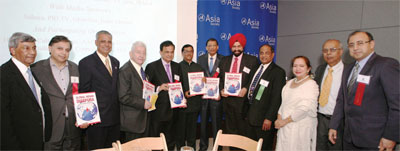
    NEW YORK, NY (TIP): The Global Organization of People of Indian Origin (GOPIO), in collaboration with several community organizations and groups in the New York/New Jersey/Connecticut tri-state area, held a well attended and highly successful welcome reception and dinner in New York for incoming Indian Consul General Dnyaneshwar Mulay. The event was held on April 26, 2013 at the Asia Society in New York and provided a unique opportunity to welcome, meet and greet the new Consul General. The Indian Consul General in New York is a high profile position in the largest city in USA amongst the highest concentration of Non- Resident Indians (NRIs) and Persons of Indian Origin (PIOs), and host to numerous visits on a regular basis by prominent officials of the Government of India for meetings with US officials, the United Nations and the Indian- American community on issues of interest to NRIs and PIOs. The welcome reception and dinner was a combined community event, organized by GOPIO in partnership with GOPIO Chapters of New York, New Jersey and Connecticut; GOPIO Health, Cultural, Youth,Women’s & Business Councils; Life Members; GOPIO News Team. The event was co-sponsored by various prominent community organizations and companies, with support from media groups and others as co-sponsors. Sponsors include: Indian American Chamber of Commerce – USA, Tulsi Restaurant, Asia Society, Bharat Travel, Kingfisher, Parikh Media, HH-Resorts, Peter Advani, TV Asia, Society of Indian American Architects & Engineers of America (SIAEA); Media- Sponsors: Sahara, PIO TV, GloboSat, India Abroad; and participating organizations: Hyderbadi Cultural Assoc, Association of American Physicians of Indian origin (AAPI), Indian Dental Assoc, Indian Jewish Council IJC), National Federation of Indian Associations (NFIA), Association of Indians in America (SAIA); attending organizations: TelugU Association, Bengali Association, Gujarati Association, and several others. Also in attendance were Ambassador of Trinidad & Tobago to USA, Dr. Neil Parsan; Ambassador of Mauritius to United Nations Milan Meeterban; former Ambassador of Suriname to United Nations, Krishna Nandoe; Deputy Speaker of New Jersey Assembly Upendra Chivukula; New York City Councilwoman, Leticia James; John Bartlett, Jr, Freeholder of Passaic County in New Jersey. Event coordinator was J. Nami Kaur, Secretary of GOPIO International, ably assisted by Mridul Pathak, GOPIO’s Director of Diaspora Development. Other members of the organizing team included: Anita Bhat, Dr Asha Samant, Ashook Ramsaran, Jaswant Mody, Lal Motwani, Patsy Leopold, Quddus Mohammed, Dr. Renuka Misra, Sangeeta Ahuja, Dr. Thomas Abraham. Following a video biography highlighting Ambassador Mulay’s career and his impressive accomplishments, GOPIO International president Ashook Ramsaran made the formal welcome, stating that, “the Indian American community of the New York/New Jersey/Connecticut area is a significant population of NRIs and PIOs, very progressive, quite supportive – and also very vocal on matters of interest and concern”. Ramsaran added that, “we bid you a warm welcome with open hearts and open arms, with confidence that you will achieve much success during your tenure as Consul General if India in New York”. Ambassador Mulay thanked GOPIO and the community organizations for the warm and overwhelming welcome. In his remarks, he stated that, “huge opportunities exist for the Indian Diaspora in connecting India and the USA. India requires massive investments, is looking for technologies, continuously expanding education sector and health services and looks forward to proactive contributions of Diaspora in its developmental aspirations”. He added that, “the Government of India has taken enormous measures for promoting the wellbeing of the diaspora and connecting them with India. Since the setting up of the Ministry of Overseas Indian Affairs Ministry several special steps have been taken and a number of schemes introduced”. “Global Indian Diaspora – GOPIO Making an Impact” a comprehensive publication authorized by GOPIO, was presented to Amb Mulay as part of the New York release during the program. In addition, GOPIO’s founding life member and former secretary general Dr Jagat Motwani presented his latest book “India Reborn: Bharat Mahan, As Perceived by Westerners, Gandhi, Nehru, Tagore & Others” to Amb Mulay. GOPIO’s founding president, Dr. Thomas Abraham, spoke about GOPIO and its long history of serving the interests of the diaspora on a global scale. Prominent community leaders and supporters also welcomed Amb Mulay, extending good wishes and support: Dr. Sudhir Parikh (Parikh Media); H. R. Shah (TV Asia); Norman Solovay (Indian American Chamber of Commerce – USA); Upendra Chivukula (Deputy Speaker of New Jersey Assembly); and others. GOPIO presented to Ambassador Mulay a “Memorandum of critical issues and suggestions from the Indian American community of the New York/New Jersey/Connecticut area”. These issues include recommendation for improved communication with the Indian-American community, including more responsiveness to telephone calls placed to consulate and staff for regularly needed consular services; recommendation to provide answers on a timely basis to more FAQs on current issues on website, email advisory. Examples: OCI card, Passport Surrender procedures and fees; recommendation to set up a community feedback system on matters of interest and concern via community and consulate meetings, interactive forum, interviews on television and print, outreach to Indian- American community and other ethnic groups; posting a “calendar of events” which can be readily viewed for advance planning purposes; holding or collaborating on seminars on current critical issues such as youth, health, inter-generation, inter-ethnic, etc. – as well notable events such as Gadar Centennial Commemoration in USA. Media, however, was not invited to the event. (Based on a press release issued by Dr. Thomas Abraham)

  • Dfw Sikhs Joined The Vigil For Victims Of Boston Bombings And The West, Texas, Explosion

    Dfw Sikhs Joined The Vigil For Victims Of Boston Bombings And The West, Texas, Explosion

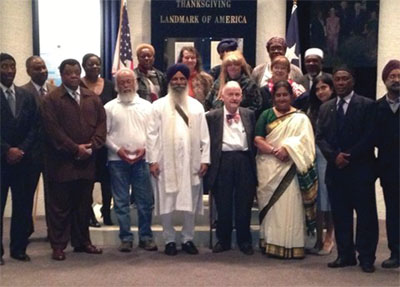
    Gurdwara Nishkam Seva’s sangat members Bhai Surat Singh, Shankar Moghe, Jean Tayler and Harbhajan Singh Virdee participated in this vigil which was held on May 2, 2013 at the Thanks Giving Square in downtown Dallas.

  • Children’s Champion Award For Borough President Helen Marshall

    Children’s Champion Award For Borough President Helen Marshall

    Marion White (C), founder and executive director of the Child Abuse Prevention Program (CAPP), presents the Children’s Champion award to Borough President Helen Marshall at workshop, Tuesday, April 30th, at Borough Hall for school guidance counselors. The CAPP program, which has reached more than 420,000 children – with the help of puppets like Sabrina and Steven, tells children that they have a right to be safe. Marshall said that the award meant a great deal to her, a former Early Childhood teacher. “Safety is a key issue in our society, where today as many as one out of five households experiences some form of abuse, whether physical or verbal or both,” said the Borough President. At left is Cathy Moore, who heads up Marshall’s Task Force on Sexual Assault, Child Maltreatment and Elder Abuse.

  • The supreme knowledge of Brahman

    The supreme knowledge of Brahman

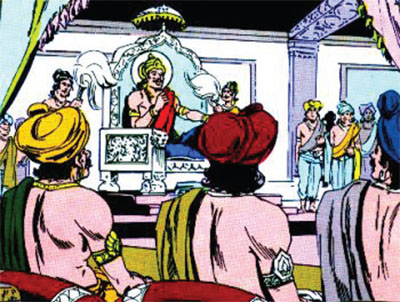
    Many years ago, in India, there lived a king named Janashruti (widely known). He ruled over the kingdom of Mahabrisha (meaning the big bull). He was a benevolent and generous ruler. He built rest houses for travelers along the roadside, distributed free food to the poor and needy, built hospitals for the sick and old and he taxed his subjects fairly. Quite naturally Janashruti was pleased with himself for having done so much for his kingdom. Unfortunately it did not take long for him to turn into a vain man. One evening while he was relaxing on the terrace of his palace he saw two swans flying over him and conversing. “Be careful while passing over the King Janashruti” one of them said. “The glow of his fame may burn you to ashes.” “You must be joking” replied the partner, “As if King Janashruti is greater than the humble cart-man Raikva!” The king understood their conversation and became thoughtful.”Who is this Raikva?” The king pondered. “How could he earn more merit than me?” King Janashruti felt restless and could not sleep for the rest of the night.The following morning, when the elaborate ritual of waking up royalty began, the king got irritated. “Stop all these adulations and empty praises for me. I am not worthy of it.” The king’s attendants were puzzled, “What happened Maharaj?” asked the bard. The king told the bard about the swan’s conversation he had overheard. “Now go and seek out Raikva,” the King ordered, “He is the most pious of all men.” A massive search was soon launched to locate Raikva. Many days had passed and finally they were told by a peasant that Raikva was a cart-man in their village. All the kings men then saw Raikva, a poor cart driver, sitting on the ground and engaged in his own thought. “Our king wishes to meet you” said an attendant. “Well, here I am,” said Raikva without budging from his place. “The king can come here if he wants to see me.” The attendants were surprised. “What does our worthy king seek from this ordinary man?” The king was pleased to hear that Raikva was finally found. He ordered to make preparations to leave for Raikva’s village the next morning. King Janashruti took with him an army of men with impressive presents of 600 cows, an expensive gold necklace and a chariot for Raikva. Upon arriving at the village, King Janashruti introduced himself and said, “I have heard a great deal about you. I am told that you are one of the rarest person who has the personal experience of Brahman, the supreme Lord.” “Oh Raikva” the king continued, “I will give you all that you desire, and in return I ask that you impart me the supreme knowledge of Brahman.” Raikva smiled. “So you want to buy the divine knowledge!” Then he scolded the king, “Oh ignorant king! The knowledge of Brahman cannot be purchased. It is not a commodity that can be bartered. You are not yet ready to receive the supreme knowledge. Go home.” The disappointed king returned to his palace. He became withdrawn, drowned in his sadness , always wondering, “What do I lack?” His sadness and sincere anxiety to know Brahman, made him humble. His ego disappeared and King Janashruti became a different person in just a few weeks. He then decided to go to Raikva once again. Upon reaching the village, the king could not help himself. He fell at the feet of Raikva begging to impart him the knowledge of Brahman. “Enlighten me” the king cried out “I have no peace. Your knowledge has more richness than my entire kingdom. Please give me a part of it. I beg you with all my sincerity.” This time Raikva saw that the king had lost all his vanity and the genuine desire for knowledge was evident. He picked up the king and said, “I bless you, O virtuous Janashruti. All the knowledge that is mine will now be yours as well.” Raikva then drew the king close to him and spoke at length, “The supreme knowledge cannot be imbibed unless one has shed one’s ego. Only the humble can perceive the Brahman. Now that you attained the humility, come with me and I will share wit h you whatever little I have about the knowledge of our creator.” So saying Raikva accepted Janashruti as his disciple. The king could realize that Raikva was materialistically poor but spiritually rich. As time passed by, Janashruti received the gospels of Raikva and dedicated his job of royalty as a service to Brahman without taking the credit of his personal achievements.

  • Bhagavad Gita And Sri Ramanuja

    Bhagavad Gita And Sri Ramanuja

    “Bhagavad Gita was spoken by Lord Krishna to reveal the science of devotion to God, which is the essence of all spiritual knowledge. The Supreme Lord, Sri Krishna’s primary purpose for descending and incarnating is to relieve the world of any negative, and undesirable influence that are opposed to spiritual development, yet simultaneously it is His incomparable intention to be perpetually within the reach of humanity” – Sri Ramanujar. The primary purpose of Bhagavad Gita is to illuminate the realization of the true nature of divinity; for the highest spiritual conception and the greatest material perfection to attain the love of God.

    It is considered as one of the greatest spiritual books the world has ever known. In a very clear and concise way the Supreme Lord, Sri Krishna, describes the science of self-realization and the process by which human beings can establish their eternal relationship with God. In terms of pure spiritual knowledge, Bhagavad Gita is incomparable. Its intrinsic beauty is that its knowledge applies to all human beings and does not postulate any sectarian ideology or secular view. It is approachable from the sanctified realms of all religions and is glorified as the epitome of all spiritual teachings. This is because the proficiency in Bhavad Gita reveals the eternal principles, which are fundamental and essential for spiritual life from all perspectives and allows one to perfectly understand the esoteric truths hidden within all religious scriptures. Many great thinkers have all contemplated and deliberated upon its timeless message. Sri Krishna shows His cosmic form to Arjuna in the battle field of Kurukshetra; and expounds the Bhagavad Gita (the essence of Upanishads) to him.

    The Gita starts with the psychological upheaval in the mind of Arjuna, at the battlefield in Kurushetra, with Sri Krishna as his charioteer. Arjuna is disturbed at the thought of the destruction of his own kith and kin, as well confused about the pathway of righteousness. Sri Krishna, the teacher of Gita addresses himself to the metaphysical question. Sri Krishna, in the Gita teaches that life itself is a battle. All the people in the world are to work. Work is a spirit of detachment; it is as good as renunciation. Even those who have risen above the necessity of work would do well to work without desire to set an example to others, to transform work into spiritual Sadhana. Give up all selfish desires, work for work’s sake, do your duty for duty’s sake and love for love’s sake. When our mind is fixed on the supreme reality, when we become Lords of yoga and Masters of selfless and detached action, and when all our powers are used for the good of the society then all prosperity, material and spiritual benefits will follow as a matter of course. The Gita is one of the clearest and comprehensive summaries of perennial philosophy. Sri Krishna was a great spiritual teacher who gave the character of religious liberty to all, harmonized all paths of yoga and made religion easy and brought it to the common man. He made us to feel the presence of God in our midst and showed us how to live in the world with compassion and equanimity, and placed before us the highest ideals of love, knowledge, yoga and work. Sri Krishnar says “I am the goal and the way”.

    In Bhagavad Gita, Sri Krishna declares himself as the Creator, Sustainer and Destroyer of the entire Universe. In particular in Chapter X and XI, Sri Krishna shows the entire Universe is but a fraction of His unbounded splendour and that everything emanates from Him and merges in His cosmic form. Sri Krishna declares unequivocally that He is the goal of existence and advises Souls to surrender to Him (Chapter XVIII.66). This is the sum of all teachings and is called “Charmasloka” in the Srivaishnava sampradayam. – “Sarva Dharmaan Parityajya Maam Ekam Saranam Vraja, Aham tva Sarva papebyo Moksha Isyaami maa Sucha”. This Maha mantra taught to Arjuna by Lord Sri Krishna and enshrined in Bhagavad Gita says “Leaving every other method taught for salvation, you surrender to me and only to me. I will cleanse you from all sins and give you salvation”. The Charama sloka of Srimad Bhagavad Gita was voluntarity taught to Sri Ramanuja. Sri Nammazwar has enshrined this very same principle in Tiruvaimozhi. Sri Ramanuja preached the Bhakti Marga. The stress was on “Prapatti” or complete surrender to Sriman Narayana in total abandonment of ego as exhorted in Bhagavad Gita. According to Sri Ramanuja the fundamental teachings of the Gita in regard to the pathway to man’s perfection is Bhakthi. He distinguishes instrumental Bhakthi from intrinsic Bhakthi. It is a steady flow of loving meditation directed to the Supreme Being.

  • Britain Avoids Triple-Dip Recession With Jump In First Quarter Growth

    Britain Avoids Triple-Dip Recession With Jump In First Quarter Growth

    LONDON (TIP): Britain’s economy dodged a return to recession and grew faster than expected in the first three months of this year, providing some political relief for a government under fire over its austerity drive. The Office for National Statistics said Britain’s gross domestic product rose 0.3 percent in the first quarter, well above forecasts for a 0.1 percent rise. The economy shrank 0.3 percent quarter-on-quarter in late 2012, so a second contraction would have put Britain into its third recession in less than five years. Year-on-year, the latest GDP reading was 0.6 percent higher, the strongest rise since the end of 2011.

    Finance minister George Osborne said on Thursday’s data was encouraging and vowed to stay the course on fixing Britain’s budget problems. “We all know there are no easy answers to problems built up over many years, and I can’t promise the road ahead will always be smooth, but by continuing to confront our problems head on, Britain is recovering and we are building an economy fit for the future,” he said in a statement. Sterling hit its highest level in two months against the dollar after the data and British government bond prices fell. Britain’s preliminary GDP figures are one of the first for a major advanced economy, and based mostly on estimated data, but it would be rare for a reading this high to be revised down into negative territory. The rise was driven by strong services sector growth and a bounce-back in North Sea oil and gas output. Politically, a slip back into recession would have been difficult for the government in general and Osborne in particular, coming just days after ratings agency Fitch.

  • Samsung Overthrows Nokia To Become The Largest Seller Of Mobile Phones In India

    Samsung Overthrows Nokia To Become The Largest Seller Of Mobile Phones In India

    KOLKATA (TIP): Samsung has overtaken Nokia to become the largest seller of mobile phones in the country’s major markets, as consumers lap up its new feature phones and its smartphones continue to do brisk business. According to market tracker GfKNielsen’s data, Samsung’s volume market share in urban areas in March rose to 31.4%, surpassing Nokia’s 30.1%. GfK-Nielsen urban panel tracks sales in 793 cities and towns with a population of over 50,000, which account for more than 70% of India’s total handset sales.

    This is the first time the Korean company’s volume market share has crossed that of Nokia’s in the GfKNielsen survey. The all-India figures, which will include rural sales, will be released shortly. Some months ago, Samsung’s market share, measured in value terms, had exceeded that of Nokia’s, and there is now a considerable gap between the two due to growing demand for the Korean firm’s smartphones.

    NEW MODELS PUSH SALES
    Last month, Samsung’s value market share in urban markets stood at 42.2% compared with Nokia’s 20.7%. Analysts say Samsung’s gain in volume market share last month is led by the recent introduction of the Rex feature phone series and strong demand for smartphones such as Galaxy Grand and Note 2, the topselling models at multi-brand retail outlets. Its newest premium smartphone, Galaxy S4, will be launched in India on Friday. A Nokia India spokesperson said the company did not comment on country-specific market data, and added that it was executing its strategy with ‘urgency and at a new clock speed’.

    The spokesperson said at the higher end of the price spectrum, the company had launched ten Nokia Lumia devices in the past 16 months and claimed that Asha 305 was the best-selling smartphone in India. “We are competing at every price point with better mobile experience. Nokia will continue to deliver new and innovative solutions to consumers,” she said. Notwithstanding these initiatives, analysts and experts feel that Nokia’s more than a decade-long leadership in the Indian handset market is under threat.

    The company, which once enjoyed a dominant 80% market share, has never completely recovered from its failure to anticipate and react to the dual-SIM handset boom a few years ago.

  • Hp Eyes $1bn Sale Of Mphasis Stake M

    Hp Eyes $1bn Sale Of Mphasis Stake M

    MUMBAI (TIP): Hewlett Packard (HP) has formally started work to sell IT services firm MphasiS Ltd with Citigroup managing the process, said people directly briefed on the matter. HP’s move is said to attract the interest of buyout private equity funds like TPG Capital, Carlyle Group and Advent, they added. The PC maker owns 60% stake in Bangalore-based MphasiS, which is worth $900 million at current market value.

    HP would expect a premium to the prevailing price, pushing the deal value to over $1 billion, said sources cited earlier. Citigroup has been selected to run the sale process after HP had direct talks with a few private equity firms in recent months to ascertain their interest. TOI on March 25 reported that buyout funds have held conversations with MphasiS management after sniffing a deal. The management led by CEO Ganesh Ayyar would work with the successful acquirer.

    Private equity biggies like TPG and Advent are hungry for a large play in India’s off-shoring story, but have not clinched too many deals except for Apax Partners backing iGate’s Phaneesh Murthy to snap up Patni Computer Systems. A spokesperson for HP declined to comment, when contacted. Citigroup also declined to comment. Former Citibanker Jerry Rao founded MphasiS 15 years ago, which became part of HP after the latter’s $14 billion buyout of Electronic Data Systems (EDS) in 2008.

    HP wrote off $16 billion relating to its recent acquisitions, including EDS, last year. HP’s falling business to MphasiS and a lack of visibility on future contracts were concerns in a deal making, said a private equity executive on condition of anonymity. The fact that HP, which is faced with declining global revenues, has a competing technology services arm of its own complicated the matter, he added. But, bankers familiar with the process said HP would extend an assured long-term business contract to a potential buyer.

    “A multi-year contract will be offered though it’s not mentioned upfront right now,” added this source, who did not wish to be named. MphasiS shares closed marginally down at Rs 369 in a buoyant Mumbai market on Thursday, pegging the market capitalization at Rs 7,770 crore ($1.5 billion). MphasiS, battling declining orders from the parent, has seen share price slump 40% in the last two years. An analyst with a foreign brokerage, who tracks MphasiS, said a non-HP investor would be a big positive since the parent’s persisting global woes were the biggest overhang for the stock. MphasiS will see HP revenue drop below 50% of the turnover by April this year, down from 70% in October 2010.

    The company has chased non- HP revenues in banking, capital markets and insurance verticals, besides pushing inorganic growth to offset the drop in business from the parent. It acquired Digital Risk in US , a mortgage services firm for $200 million last year and insurance solution provider, Wyde Corp, in the US, for $30 million in August 2011. Earlier, it had acquired AIG’s captive software unit in India, to boost insurance business.

    MphasiS has about $384 million left in cash, after paying for recent acquisitions, and is seen adding $30-50 million every quarter. While free cash on books could comfort any buyer, one of the suitors said the company would need to spend big bucks to build marketing muscle to develop non-HP revenue. “That’s going to a pain point for any acquirer and MphasiS,” the source added.

  • Hubble telescope spies incoming comet ISON

    Hubble telescope spies incoming comet ISON

    CAPE CANAVERAL (TIP): A recently discovered comet, dazzlingly bright even though it is still almost as far away as Jupiter, is racing toward a November rendezvous with the sun, officials said on Tuesday. If it survives the encounter — and that’s a big if — the comet may be visible even in daylight in Earth’s skies at the end of the year. Discovered by amateur astronomers in September 2012, Comet ISON is about to reach the outer edge of the asteroid belt, located some 280 million miles (451 million km) from Earth, said William Cooke, lead scientist at Nasa’s Meteoroid Environment Office at the Marshall Space Flight Center in Huntsville, Alabama. The comet is shedding dust from its nucleus at a rate of more than 112,000 pounds (50,802 kg) per minute, the result of heating by the sun, observations from Nasa’s Swift telescope show. That level of activity is unusual for a comet still so far away from the sun. It could spell its doom. Preliminary measurements made with the Hubble Space Telescope, which captured an image of the comet that was released on Tuesday, indicate Comet ISON’s body is no more than 4 miles (6.4 km) in diameter.

  • First Vaccine To Fight Gut Bacteria In Autistic Kids

    First Vaccine To Fight Gut Bacteria In Autistic Kids

    LONDON (TIP): The world’s first vaccine to help control symptoms of autism has been developed. The vaccine was created by Canada’s University of Guelph researchers for gut bacteria common in autistic children which will help control symptoms of autism. More than 90% of children with autism spectrum disorders suffer from chronic and severe gastrointestinal symptoms of which 75% suffer from diarrhea. The scientists have now developed a carbohydrate-based vaccine against the gut bacteria Clostridium bolteae which is known to play a role in gastrointestinal disorders. The bacteria often shows up in higher numbers in the gastric tracts of autistic children than in those of healthy kids. Researchers Brittany Pequegnat and Guelph chemistry professor Mario Monteiro believe toxins and/or metabolites produced by gut bacteria may be associated with symptoms and severity of autism, especially regressive autism. Publishing their finding in the journal Vaccine, they said, “Little is known about the factors that predispose autistic children to C bolteae. A vaccine would improve current treatment. This is the first vaccine designed to control constipation and diarrhea caused by C bolteae and perhaps control autism-related symptoms associated with this microbe.”

  • Graham Bell’s Voice Heard For First Time In 128 Years

    Graham Bell’s Voice Heard For First Time In 128 Years

    WASHINGTON (TIP): Hear my voice, I’m Graham Bell! Telephone pioneer Alexander Graham Bell’s voice has been identified for the first time on a wax disc recording from 1885, researchers claim. Bell’s voice was recorded on to the disc on April 15, 1885 at his Volta laboratory in Washington. On the wax-disc recording, the inventor of the telephone says: “Hear my voice, Alexander Graham Bell.” The inventions of Bell — most famously the telephone but also the methods of recording sound — have allowed many people to hear each other’s voices for more than 130 years. Until now, no one knew what the inventor himself sounded like. The Smithsonian’s National Museum of American History, through a collaborative project with the Library of Congress and Lawrence Berkeley National Laboratory, has identified Bell’s voice for the first time.

  • Campaigners Call For Ban On ‘Killer Robots’

    Campaigners Call For Ban On ‘Killer Robots’

    LONDON (TIP): Machines with the ability to attack targets without any human intervention must be banned before they are developed for use on the battlefield, campaigners against “killer robots” urged. The weapons, which could be ready for use within the next 20 years, would breach a moral and ethical boundary that should never be crossed, said Nobel Laureate Jody Williams, of the “Campaign To Stop Killer Robots”.

    “If war is reduced to weapons attacking without human beings in control, it is going to be civilians who are going to bear the brunt of warfare,” said Williams, who won the 1997 peace prize for her work on banning landmines. Weapons such as remotely piloted drones are already used by some armed forces and companies are working on developing systems with a greater level of autonomy in flight and operation.

    “We already have a certain amount of autonomy,” said Noel Sharkey, professor of Artificial Intelligence and Robotics at the University of Sheffield. “I think we are already there. If you asked me to go and make an autonomous killer robot today, I could do it. I could have you one here in a few days,” he told reporters. But the technology is a long way off being able to distinguish between a soldier and a civilian. “The idea of a robot being asked to exercise human judgment seems ridiculous to me,” Sharkey told Reuters. “The whole idea of robots in the battlefield muddies the waters of accountability from my perspective as a roboticist,” he added.

    No intention
    The British government has always said it has no intention of developing such technology. “There are no plans to replace skilled military personnel with fully autonomous systems,” a ministry of defense spokesman told Reuters. “Although the Royal Navy does have defensive systems, such as Phalanx, which can be used in an automatic mode to protect personnel and ships from enemy threats like missiles, a human operator oversees the entire engagement,” the spokesman added.

    But the organizers of the Campaign to Stop Killer Robots say Britain’s rejection of fully autonomous weapons is not yet watertight. “We’re concerned that there is a slide towards greater autonomy on the battlefield and unless we draw a clear line in the sand now, we may end up walking into acceptance of fully autonomous weapons,” said Thomas Nash, director of non-governmental organization Article 36.

    Rapid advancements in technology have allowed countries such as the United States, China, Russia, Israel and Germany to move towards systems that will soon give full combat autonomy to machines, according to a report by Human Rights Watch. “We think that these kinds of weapons will not be able to comply with international humanitarian law,” Steve Goose, Human Rights Watch executive director, told Reuters.

  • Found: Genes That Delay Pregnancy

    Found: Genes That Delay Pregnancy

    NEW YORK (TIP): Researchers, led by an Indian-origin scientist, have identified genes which help female mice and some other mammals delay the onset of pregnancy. Unlike in humans, the remarkable ability, known as embryonic diapause, is a temporary state of suspended animation that occurs when environmental conditions are not favourable to the survival of the mother and the newborn. A new study, published in the journal Open Biology, reveals the molecular mechanism responsible for pausing and resuming a pregnancy. After an egg is fertilized, it forms a cluster of cells known as a blastocyst, which implants in the wall of the mother’s uterus, ‘LiveScience’ reported. However, in diapause, the blastocyst is prevented from implanting and preserved in an dormant state until pregnancy resumes. How this process occurred was a mystery till now.

    Researcher Sudhansu Dey, from Cincinnati Children’s Research Foundation, and colleagues were studying the process of embryo implantation in mice when they noticed that a gene called MSX1 was very active just before implantation. They began to suspect that it might play a role in diapause, Dey said. Researchers used hormones to induce pregnancy delays in mice, mink and Tammar wallabies to investigate further. During this delayed state, Dey’s team measured how active the MSX1 gene and other related genes were in generating protein-making instructions. They imaged tissue from the animals to see where the gene was active. Finally, they tested whether these genes were being made into proteins. Researchers found that the MSX genes were more active when pregnancies were delayed, and found this was true for all three animals. The results show that MSX genes, which are part of an ancient family of genes, have been preserved over much of evolutionary time, and play an important role in delaying pregnancy under harsh conditions, Dey said. He wants to know whether the same genes may enable delayed pregnancies in other animals and if it could have implications for humans.

  • Pakistani Prisoner Attacked In Jammu Jail, Condition Serioussupreme Knowledge Of Brahman

    Pakistani Prisoner Attacked In Jammu Jail, Condition Serioussupreme Knowledge Of Brahman

    JAMMU: A Pakistani prisoner Sanaullah serving a life term was attacked inside the high-security Kot Balwal jail by a fellow inmate this morning and his condition is stated to be serious, official sources said. It was not immediately known whether the attack on the 52-year-old convict with a sharp weapon was a backlash against the death of Indian prisoner Sarabjit Singh in a hospital in Pakistan yesterday after being comatose for nearly a week following a brutal assault by fellow inmates in a high-security Lahore jail, officials said. Official sources said the Kot Balwal jail superintendent Rajni Sehgal has been suspended by the Jammu and Kashmir government which also ordered a probe. The sources said Sanaullah, a resident of Pakistan, was admitted in Government Medical College hospital in an unconscious condition with serious injuries on his head after being hit by a fellow inmate in the morning.

    A case of assault was registered against Vinod Kumar, an exserviceman who is also serving a life term in the jail in the outskirts of Jammu. Kumar hails from Uttrakhand. Meanwhile, Pak high commission in Delhi expressed serious concern over the attack on a Pakistani prisoner in the high security Kot Bhalwal jail in Jammu and sought immediate consular access to him. The sources said the health condition of Sanaullah was stated to be very critical as he was hit with a very sharp weapon. He may be shifted to Chandigarh’s PGI for treatment as his Glasgow Coma Scale (GCS) was pretty low.

    GCS is a scale for measuring level of consciousness, especially after a head injury, in which scoring is determined by three factors: amount of eye opening, verbal responsiveness, and motor responsiveness. Sanaullah was arrested on April 1999 in connection with five cases related to terror activities. The attack occurred ahead of Sarabjit’s funeral at his native village in Punjab. Following the death of 49-year-old Sarabjit in Pakistan, Union Home Ministry had issued advisories to all states for maintaining high vigil in jails and ensure there was no attack on any Pakistani prisoner lodged there. Excluding fishermen, there are about 220 Pakistani prisoners in Indian jails. A similar number of Indians are lodged in Pakistani jails.

  • Heart, kidneys, stomach missing in Sarabjit’s body, finds autopsy

    Heart, kidneys, stomach missing in Sarabjit’s body, finds autopsy

    AMRITSAR (TIP): Even as autopsy of Sarabjit Singh’s body was conducted at Patti hospital in Amritsar to ascertain the cause of death and to cross-check the claims of Pakistan over the same and the time of death, it shockingly turned out that Pakistan had sent the dead body of Sarabjit without the vital organs like heart, kidneys and stomach. A panel of five doctors, consisting of heads of the departments of Forensic, Anaesthesia, Orthopaedics, Surgery and Pathology from Amritsar Medical College, conducted the postmortem of Sarabjit’s body on May 2 night. Well placed sources told The Indian Express that the panel found vital organs like heart, kidneys and stomach missing from the body of Sarabjit. This will make the autopsy exercise in India grossly inconclusive, said doctors, raising further questions marks over the intentions and conduct of Pakistan in the case of Sarabjit, who was brutally assaulted inside the Kot Lakhpat Jail.

    The missing of these vital organs in Sarabjit’s body is set to create another controversy with a medical expert telling The Indian Express that the examination of said vital organs was very crucial in cases of poisoning. The development is set to ignite another debate whether Sarabjit was administered something in food or otherwise to make him vulnerable for the deadly assault on him in the Kot Lakhpat Jail. “Yes, we were not anticipating that Pakistan would send the body without these vital organs,” Head of the Forensic department Dr Gurmanjit Singh, who was among the panel members who conducted autopsy, said. He, however, added that as a standard medical procedure Pakistan could keep the vital organs for further testing. “We would have to rely on their reports on these organs,” Dr Gurmanjit said.