Month: June 2013

  • Movie Review – Shortcut Romeo

    Movie Review – Shortcut Romeo

    Cast: Neil Nitin Mukesh, Ameesha Patel, Puja Gupta
    Direction: Susi Ganesh
    Genre: Thriller
    Duration: 2 hours 15 minutes

    STORY: A jobless ruffian hits gold when he spots a millionaire memsaab having an extra-marital affair. He blackmails, she betrays – spinning into an endless chase for lust, love and money.

    MOVIE REVIEW: Welcome to the wild – lions, zebras, giraffes, deer, and leopards aplenty (film is shot in the stunning landscapes of Maasai Mara, Kenya). And of course, amongst them all lives the beastly man who hunts, hacks and kills his own kin for survival.

    This story has one such fierce and furious being called Suraj (Neil). His aimless life takes a sudden turn when he spots Monica (Ameesha), a wealthy businessman’s biwi (leading a sexless life) playing ‘ball-games’ at night (read: golf). Suraj sleazily captures her one-night ‘sexcapade’ with her golf-trainer, and blackmails her into being his lifelong ATM. He takes off on a vacation to Kenya, where he meets Sherry (Puja) and love blossoms (surprise!).

    Suddenly turning from loafer to loverboy; greedy for pyaar over paisa. At the other end, Mona darlin’ gives him a tough run for his maal and gal, which ends up in a wild chase where everyone falls prey to the call of the beast. Susi Ganesh has attempted to ‘Bollywoodize’ his first Hindi film (remake of Tamil film Thiruttu Payale). Desperately throwing in Munnis, Sheilas & Jalebi bais – of Kenyan origin. There are twists and (blind) turns, over-dramatized scenes with little shock value that’s mostly predictable.

    The supporting cast and dialogues (sample this: “Ek baar karogi toh galti lagegi, baar baar karogi toh style ban jayega”. Oof!) paralyze the feeble screenplay. Kenya is well shot; action junkies may enjoy some fight sequences and the climax saves the day. The songs puncture the pace and the plot doesn’t pulsate with the edginess of a thriller. Neil performs well as always, he looks good (he needs to tone down his physicality for such roles) and proves that actors like him need better scripts to justify their true potential. Ameesha is competent in her evil element. Puja makes a pretty picture with little scope to perform.

  • SONAKSHI TO TEAM UP WITH PRABHUDEVA AGAIN

    SONAKSHI TO TEAM UP WITH PRABHUDEVA AGAIN

    Actress Sonakshi Sinha has teamed up with Prabhudeva again for a dance number in upcoming film ‘Rambo Rajkumar’. Sonakshi, 26, who was last seen with the ace choreographer in an item number in ‘Oh My God’, will also dance with his co-star Shahid Kapoor in the song.

    “Time to put on my dancing shoes… Joining Prabhudeva and Shahid Kapoor for one dhamaal song in Rambo Rajkumar this morning!!,” she posted on Twitter. ‘Rambo Rajkumar’ is an upcoming action film directed by Prabhudeva and will hit theatres on November 29.

  • Susan Sarandon to Play Indira Gandhi

    Susan Sarandon to Play Indira Gandhi

    Natty Kumar, director of the 2011 film, ‘Tum Ho Yaara’, is working on a biopic on Indira Gandhi and he wants Oscarwinning Hollywood actress Susan Sarandon to play the role of the late Indian Prime Minister “It has been a longcherished dream to make a movie on the life of Mrs Gandhi,” said Kumar whose previous film Tum Ho Yaara was the Hindi remake of the Tamil movie Pani Thulli, and starred Tamil actor Ganesh Venkataraman.

    Tentatively titled Iron Lady Indira Gandhi, the film will be made in English, Hindi and Tamil and according to the director, Sarandon is perfect for the role. The Hollywood actress, who won the Academy Award for Best Actress in 1995 for her performance in Dead Man Walking, is best

  • TONE YOUR LOWER HALF

    TONE YOUR LOWER HALF

    High blood pressure affects 1 in 3 individuals and can cause serious and irreversible damage. Yet, those affected can be completely unaware of their condition. Fortunately, the control button is your hands. Because high blood pressure increases the risk of heart diseases, kidney diseases and diabetes, the WHO will be focusing on hypertension throughout the year.

    WORKOUT FOR SEXY LOWER BODY
    1: Uphill Walking or Running Walking and running are not only good for the lower body, but also for your heart, lungs, and bones. These cardio exercises also trim fat from your legs and butt. Add the intensity of an uphill climb with gravity pulling against you, and you will see the results dramatically. If you’re not ready for the uphill challenges, walking or running on a flat surface also strengthens lower body muscles. However, the more intense the workout, the faster you get results.

    Squats
    Squats are one of the best exercises for toned legs and firmer butt. Plus, there are several variations that activate different muscles and make the workout more interesting.

    Deadlifts
    If your glutes and hamstrings (back of thighs) need more attention, deadlifts are the best exercise for the job. You can boost the intensity by standing on a block or board, which puts more tension on muscles. However, if your goal is to build strength, you can lift more weight if you’re not standing on an elevated surface. Stand with feet shoulder-width apart Hold a barbell in front of your body or two dumbbells at your sides Look forward, and keep arms straight and knees slightly bent Slowly bend hip joint – not waist – and knees, and lower weights as far as you can without bending your back Squeeze glutes and lift weight back up For beginners: Take 4 seconds to lower down and 2 seconds to rise up Do 3 sets of 12 to 15 repetitions

    Step Ups
    Step ups can strengthen and sculpt the quads (front of thighs) and glutes. Combining deadlifts and step ups is a great way to get a comprehensive lower body workout. Stand behind a bench or box, holding a dumbbell in either hand Place right leg on the bench with knee bent Flex glutes and push with right leg to lift left leg onto the bench Return left leg to the floor After completing a set with the right leg, do a set with the left leg

    Standing Seesaw
    This simple workout targets outer thighs, hips, abdominal muscles, and shoulders. All you need is one dumbbell and a step to stand on. Place right foot on the step and let left leg hang off the side Hold dumbbell in right hand and place left hand on your hip Flex abs and keep back and legs straight Slowly lift left leg out to the side as high as you can and raise right arm straight out to shoulder level, palm down Return to starting position Do 15 reps, then switch sides and repeat The Bottom Line for Sexy Lower Body Uphill cardio, squats, deadlifts, step ups, and standing seesaw are the five best lower body workouts for building strength, burning fat, and toning. But you probably shouldn’t do them all in one session. Instead, change up your workout and switch between these exercises to optimise recovery and maximise results.

  • How To Check If You Are Pregnant

    How To Check If You Are Pregnant

    How to check if you are pregnant becomes easy if you immediately consult a doctor. But do you really need to keep checking with a doctor every time you get a pregnancy scare? In light of the fact that home pregnancy tests are not 100% accurate, you must be mindful of certain symptoms of pregnancy. Armed with these you will be able to make the right choice in consultation.

    Today, Dr. Keya Lahiri – Chief Pediatrician at Dr. D.Y. Patil Hospital, helps us out by providing a few possible symptoms which may point out that you are pregnant or not.

    Cramps
    The first signs after a few days of conception is spotting or cramping. This sign occurs as the fertilized egg attaches itself to the wall of the uterus. It can occur anywhere between 6-12 days after fertilization of the egg. This phenomenon is usually called as implantation bleeding. The cramps are similar to menstrual cycle, so don’t get yourself confused. Besides, slight bleeding and cramps a woman may experience slight white, milky discharge from her vagina. This occurs soon after conception. This condition can occur throughout your pregnancy period and is completely harmless, but if you experience stingy smell or burning sensation, then don’t hesitate to meet a doctor.

    Missed period
    Menstrual cycle occurs due to temporary halt in progesterone hormone production. If you have been getting regular periods and you notice that this month you have missed your periods than it indicates that you are pregnant. You miss your periods because your body starts producing progesterone to protect the baby. As your body starts using up progesterone you miss your periods.

    Changes in the breast
    If you are pregnant then your breast will show quite a few changes, especially if you are first time pregnant. The changes can be soreness or tenderness in your breasts, they will appear larger, and your nipples will turn darker and bulky.

    Increased urination
    Peeing more than usual or constantly getting up in the middle of the night to pee, is one of the common hints that you may be pregnant.

    Morning sickness
    This is one of the famous symptoms linked with pregnancy. It can happen any time of the day, so don’t assume that it will only occur in the morning due to its name. Nausea or morning sickness is caused due to pregnant woman’s hormone which slows down the process of emptying her stomach.

  • Even A Few Extra Pounds Deadly For Your Heart

    Even A Few Extra Pounds Deadly For Your Heart

    Researchers have proved for the very first time that being overweight can raise the risk of heart disease as well as diabetes and high blood pressure. A large-scale study, conducted on 200,000 people by a team at Uppsala University in Sweden, proved that an increase of one unit of Body Mass Index, between four and 12lbs depending on height, makes people at least 20 per cent more likely to develop heart failure.

    The group also analyzed whether an alteration in a gene, that regulates hunger and increases BMI, was also linked to cardiovascular diseases. Dr Tove Fall said that obesity and cardiovascular disease often occur together and it has been hard to determine whether increased BMI as such is dangerous.

  • Wearing Bra Makes Breasts Sag

    Wearing Bra Makes Breasts Sag

    Wearing bras make your breasts sag even more and they do nothing to reduce back pain, a French study spanning 15-years has found. Jean-Denis Rouillon, Research Professor on the French study, told Counsel and Heal that medically, physiologically, anatomically – breasts gain no benefit from being denied gravity.

    On the contrary, Rouillon added, women get saggier with a bra, News reported. The study that looked at the changes in breasts of 330 women using a slide rule and calliper concluded that breasts naturally become more toned and supported if no bra is used. When a bra is used, the breast becomes dependent on the artificial support, making them degrade more quickly.

    Moreover, the study found that going braless gives women a 7mm lift in their nipples for every year they go without, and aids in fading stretch marks. But Rouillon noted though they validated the hypothesis that the bra is a false need, it would be dangerous to advise all women to stop wearing their soutien-gorge as the women involved were not a representative sample of the population.

  • DECORATING HOME WITH MIRRORS

    DECORATING HOME WITH MIRRORS

    Different way to use mirrors in home decor to accentuate artefacts, add dimension, give the illusion of space and play with light Gone are those days when a mirror was used merely for the dressing table; it has now become an essential piece of home decor. According to the space and proportion, mirrors can be aesthetically used to reflect your taste and create drama. Says Subbanshu Jaiin, director of Blackberry Overseas, distributors of luxury mirrors, “Since mirrors are movable, they can be placed and moved around depending on your choice or need. They have the benefit of reflecting and accentuating the colours of artefacts and walls.”

    Mirrors add dimension
    Use mirrors to give a sense of visual expansion in a particular room. The location and placement of mirrors in a given space creates a focal point by avoiding undesirable reflections. For example, mirrors in a dining room can be used to create luminosity and add dimension to the space.

    Pieces of art
    Indian royalty used bold and gorgeous mirrors as a focal point of a room, so that they reflected the light from the outside and illuminated the room further. Mirrors themselves become artworks in this minimal setup. Says Jaiin, “You can create a dramatic effect by placing a fulllength mirror on the floor and resting on a wall. Long passages and hallways are most suitable for this placement.” Or hang multiple mirrors together on the same wall.

    For the outdoors
    Mirrors can amp up the aesthetics in a private garden or verandah. If you have a hanging garden, place mirrors adjacent to it with a source of light directly opposite so that the mirrors sparkle when the light falls on them.

    In the bedroom
    Using mirrors in the bedroom is crucial. As each bedroom reflects the energy of the space, a large stand up mirror works best. Says Jaiin, “If you want one only for the dressing table, consider a full-scale mirror — from ceiling to floor — with a light framework that reflects your personality.”

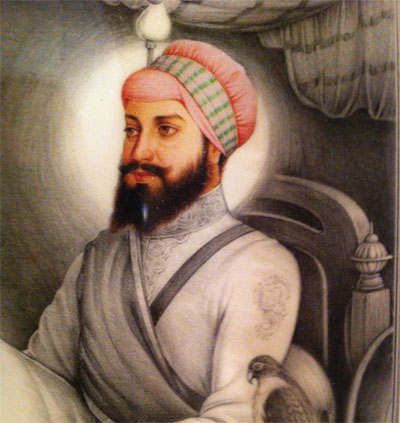
  • GURU HARGOBIND SAHIB

    GURU HARGOBIND SAHIB

    The birth anniversary of the Sixth Master of Sikhs falls on July 5
    Guru Hargobind was sixth in the spiritual descent form Guru Nanak, was born the only son of Guru Arjan and Mata Ganga on Har Vadi 7, 1652 BK / 19 June 1595 at Vadali, now called Vadali Guru, a village near Amritsar. As a child, he escaped being poisoned by a jealoous uncle and being bitten by a cobra thrown in his way. He also survived a virulent attack of smallpox and grew up into a tall and handsome youth.

    His contribution to Sikhism and Sikhs can be summed up in one phrase i.e. “making them Saints and Soldiers”. He received his early education and training at the hands of two revered Sikhs of that time Bhai Gurdas and Baba Buddha. The former taught him the religious texts and the latter the manly arts of swordsmanship and archery. He was barely 11 years of age when his father, Guru Arjan, was martyred in Lahore.

    Guru Arjan had on Jeth vadz 25 1663 Bikrami May 1606 nominated him his successor and, according to the Sri Gur Pratap Suraj Granth, sent him instruction “to ascend the throne fully armed, and have armed men, as many as you can, to accompany you.” For the ceremonies of succession which took place on 26 Har 1663 Bk/24 May 1606, Guru Hargobind chose himself a warrior’s equipment. He sat on a seat he had had erected in front of the holy Harimandar, with two swords on his person, declaring one to he the symbol of the spiritual and the other that of his temporal investiture.

    Hukamnamas were issued to sangats on Har vadz 2,1663 Bk/ 12 June 1606 to come with offerings of arms and horses. Guru Hargobind maintained a retinue of fiftytwo armed Sikhs. Many more came to offer him their services, and several of them were provided with horses and weapons. Manly sports became popular and bards such as ‘Abdulla and Nattha were engaged to recite heroic poetry. Guru Hargobind combined with soldierly demeanour a compassionate disposition and carried out his spiritual office in keeping with the custom of his predecessors.

    “He,” as says the Mahima Prakash, “arose three hours before daybreak and sat in seclusion, to concentrate on the Divine. Then he dressed himself and repaired to the presence of the Holy Book and began to recite it silently. None entered to interrupt him. None could fathom the depth of his spiritual absorption. ” Reports about the splendid style of Guru Hargobind led Emperor Jahngir to pass orders for his detention in the Fort of Gwalior.

    According to the Dabistan-i- Mazahib, the charge levelled against him was that he had not paid the fine imposed on his father. For how long he remained in the Fort cannot be stated with certainty. From forty days to twelve years, in Dabistan-i-Mazahib, several different periods of time are mentioned. It seems that Guru Hargobind remained in the Fort for a few months during 1617-19 whereafter he was required to stay in the royal camp under surveillance for some time.

    During his detention in Gwalior, Sikhs made trips to the city in batches to see him and, when disallowed to enter the Fort, they proffered obeisance from outside its walls and returned. As time came for Guru Hargobind to be released from the Fort, he came out on the condition that all other detenues were freed, too. He led fifty-two prisoners out of the Fort. Bandichhor? (Liberator Benign) is the title by which he is remembered to this day. When at last Guru Hargobind reached Amritsar Sikhs illuminated the town.

    The anniversary of the event is still celebrated at Harimandar, the Golden Temple, with Lights and fireworks. Emperor Jahangir from now on continued to be conciliatory and, according to Sikh tradition, he delivered to Guru Hargobind Chandu Shah, who took part of the responsibility far the execution of Guru Arjan and for his own incarceration. Chandu Shah met with a violent end at the hands of the Sikhs. On his lands, also made over to him, Guru Hargobind founded a new town Which came to be known as Sri Hargobindpur. As the work commenced, Bhagvan Das, a local landlord, objected and attacked the Sikhs with a party of his men.

    Bhagvan Das was killed in the skirmish. His son, Ratan Chand, and Chandu Shah’s son, Karam Chand, sought help from the Mughal faujdar of Jalandhar who sent a body of troops against Guru Hargobind. They were repulsed in the battle that ensued. Both these actions were fought in the vicinity of Ruhela, the first on 28 Assu 1678 Bk/28 September 1621 and the second on 3 Kattak 1678 Bk/4 October 1621. At Sri Hargobindpur, the Guru built along with the dharamsala a mosque for the Muslims.

    In 1628 the city of Amritsar witnessed the first onslaught on it by the Mughals. Shah Jahan, who succeded his father in 1627 knew that Sikhism had undergone a metamorphosis under Guru Hargobind, the only son of the martyred fifth Guru. This according to the Bhatt Vahi Multan Sindis, was fought on Baisakh 17,1691 Bk/14 April 1634. He had donned two swords of Miri (temporal) and Piri (spiritual), had raised an Akal Takht (1609), built Lohgarh (fortress), collected arms,3 recruited Pathan mercenaries under Paindeh Khan and was giving military training to his followers.

    On a pretext of getting a royal hawk released from the Guru an expedition of 7,000 strong under Ghulam Rasul Khan Panj Hazari and Mukhlis Khan, Deputy Nazim, was sent. Guru Hargobind would not have liked to make the holy place a battle-ground and had enjoined that “the Harimandir is specially devoted to God’s service. It should never be defiled with any impurity of the human body “. He was busy making preparations for the wedding of his daughter Bibi Viro.

    The combat with royal forces took place at Gumtala, then a suburb of Amritsar. Guru Bilas Patshahi Chhevin 4 gives a vivid account of the encounter, the feats of valour displayed by Bidhia, Jetha, and Piraga each at the head of 100 villagers from Kambowal, who at the moment had arrived to pay homage to the Sixth Guru. The royal troops suffered heavy casualities, including those of Mukhlis Khan the commander of the Mughal army, Maula Bux, son of Qutb-ud-Din, a Qazi of Lahore and Zaffar Beg, a commander. Ghulam Rasul Khan fled. Those thirteen killed on the Guru’s side were Bhais Nand, Jait, Piraga, Tota, Tiloka, Sain Das, Paira, Bhagtu, Ananta, Nihala, Takhtu, Mohan and Gopal.5 They died in the defence of the city, the temple and the Guru.

    Guru Hargobind left Amritsar, this time taking with him the holy Granth Sahib seated in the Harimandar. The first long halt was at Darauh, near Moga, in presentday Faridkot district. From there Gura Hargobind sent the Granth Sahib with the family to Kartarpur. He himself sojourned in the Malva, visiting his Sikhs and confronting, on 16 December 1634, the Mughal troops in yet another battle, this time at Lahira, near Mehraj, now in Bathinda district.

    Another armed clash took place at Kartarpur on 29-30 Baisakh 1692 Bk/26-27 April 1635, when Guru Hargobind’s own erstwhile Pathan follower, Painda Khan, led out a Mughal force against him. According to Teja Singh and Ganda Singh Guru Hargobind had won four battles, but as his purpose had always been only defensive. Guru Hargobind finally retired to Kiratpur where he spent the remaining nine years of his life in peace.

    The town was of the Guru’s own creation and had existed since Baba Sri Chand had, according to the evidence of the Bhatt Vahis, broken ground at his request, on Baisakh suds Puranmashl 1683 Bk/l May 1626. The site had been gifted by Raja Kalyan Chand of Kahlur, one of the chieftains who had won their reprieve at Gwalior through Guru Hargobind’s intercession. Kiratpur now became the centre of the Sikh faith. Sikhs came here from all parts to see the Guru.

    Guru Hargobind gave most of his time to religious devotions. Contact was maintained with sangats in farflung places, and old warriors like Bidhi Chand were sent out as preachers. For Sikhs the roles of saint and soldier had become mutually complementary. About the Guru himself, Bhai Gurdas wrote: “Great hero is Guru Hargobind. He is the vanquisher of armies, but his heart is full of love and charity.” This synthesis of the heroic and the spiritual was Guru Hargobind’s distinctive contribution to the evolution of Sikh society.

    Guru Hargobind had travelled extensively in the Punjab spreading the word of Guru Nanak. He had also visited places such as Nanakmata and Srinagar in Garhval (where the famous Maratha saint Samarth Ramdas met him) in the cast and Kashmir in the north. The journey to Kashmir was made in 1620 in the company of Emperor Jahangir, and Srinagar, Baramula, Uri and Poonchh were among the places visited. Gurdwaras in these and in many places in the Punjab and outside honour the memory of Guru Hargobind.

    Guru Hargobind, like all of his predecessors, lived a married life. He had six children – five sons and a daughter. Gurditta, Ant Rai and the daughter Bibi Viro, Suraj Mall, Atal Rai and Teg Bahadur. Two of his sons, Baba Gurditta and Atal Rai, died in his lifetime . Guru Hargobind passed away on Chet 5,1701 Bk/3 March 1644 at Kiratpur. THE INDIAN PANORAMA www.theindianpanorama.news RELIGION FRIDAY, JUNE 28, 2013 25

  • SRI GURU GRANTH SAHIB

    SRI GURU GRANTH SAHIB

    CONTD FROM Vol 7 ISSUE 25 || 5 || They are entangled with that wealth, amassed by bankers.Without devotion to the Lord, they do not become acceptable. || 6 || They are entangled with the Vedas, religious discussions and egotism. They are entangled, and perish in attachment and corruption. || 7 || Nanak seeks the Sanctuary of the Lord’s Name. One who is saved by the True Guru, does not suffer entanglement. || 8 || 10 || RAAG AASAA, FIRST MEHL, ASHTAPADEES, THIRD HOUSE: ONE UNIVERSAL CREATOR GOD. BY THE GRACE OF THE TRUE GURU: Those heads adorned with braided hair, with their parts painted with vermillion – those heads were shaved with scissors, and their throats were choked with dust. They lived in palatial mansions, but now, they cannot even sit near the palaces. || 1 || Hail to You, O Father Lord, Hail to You! O Primal Lord. Your limits are not known; You create, and create, and behold the scenes. || 1 || Pause || When they were married, their husbands looked so handsome beside them. They came in palanquins, decorated with ivory; water was sprinkled over their heads, and glittering fans were waved above them. || 2 || They were given hundreds of thousands of coins when they sat, and hundreds of thousands of coins when they stood. They ate coconuts and dates, and rested comfortably upon their beds. But ropes were put around their necks, and their strings of pearls were broken. || 3 || Their wealth and youthful beauty, which gave them so much pleasure, have now become their enemies. The order was given to the soldiers, who dishonored them, and carried them away. If it is pleasing to God’s Will, He bestows greatness; if is pleases His Will, He bestows punishment. || 4 || If someone focuses on the Lord beforehand, then why should he be punished? The kings had lost their higher consciousness, reveling in pleasure and sensuality. Since Baabar’s rule has been proclaimed, even the princes have no food to eat. || 5 || The Muslims have lost their five times of daily prayer, and the Hindus have lost their worship as well.Without their sacred squares, how shall the Hindu women bathe and apply the frontal marks to their foreheads? They never remembered their Lord as Raam, and now they cannot even chant Khudaa-i || 6 || Some have returned to their homes, and meeting their relatives, they ask about their safety. For some, it is pre-ordained that they shall sit and cry out in pain. Whatever pleases Him, comes to pass. O Nanak, what is the fate of mankind? || 7 || 11 || AASAA, FIRST MEHL: Where are the games, the stables, the horses? Where are the drums and the bugles? Where are the sword-belts and chariots? Where are those scarlet uniforms? Where are the rings and the beautiful faces? They are no longer to be seen here. || 1 || This world is Yours; You are the Lord of the Universe. In an instant, You establish and disestablish. You distribute wealth as it pleases You. || 1 || Pause || Where are the houses, the gates, the hotels and palaces? Where are those beautiful way-stations? Where are those beautiful women, reclining on their beds, whose beauty would not allow one to sleep?Where are those betel leaves, their sellers, and the haremees? They have vanished like shadows. || 2 || For the sake of this wealth, so many were ruined; because of this wealth, so many have been disgraced. It was not gathered without sin, and it does not go along with the dead. Those, whom the Creator Lord would destroy – first He strips them of virtue. || 3 || Millions of religious leaders failed to halt the invader, when they heard of the Emperor’s invasion. He burned the rest-houses and the ancient temples; he cut the princes limb from limb, and cast them into the dust. None of the Mugals went blind, and no one performed any miracle. || 4 || The battle raged between the Mugals and the Pat’haans, and the swords clashed on the battlefield. They took aim and fired their guns, and they attacked with their elephants. Those men whose letters were torn in the Lord’s Court, were destined to die, O Siblings of Destiny. || 5 || The Hindu women, the Muslim women, the Bhattis and the Rajputs – some had their robes torn away, from head to foot, while others came to dwell in the cremation ground. Their husbands did not return home – how did they pass their night? || 6 || The Creator Himself acts, and causes others to act. Unto whom should we complain? Pleasure and pain come by Your Will; unto whom should we go and cry? The Commander issues His Command, and is pleased. O Nanak, we receive what is written in our destiny. || 7 || 12 || AASAA, KAAFEE, FIRST MEHL, EIGHTH HOUSE, ASHTAPADEES: ONE UNIVERSAL CREATOR GOD. BY THE GRACE OF THE TRUE GURU: As the shepherd is in the field for only a short time, so is one in the world. Practicing falsehood, they build their homes. || 1 || Wake up! Wake up! O sleepers, see that the travelling merchant is leaving. || 1 || Pause || Go ahead and build your houses, if you think you will stay here forever and ever. The body shall fall, and the soul shall depart; if only they knew this. || 2 || Why do you cry out and mourn for the dead? The Lord is, and shall always be. You mourn for that person, but who will mourn for you? || 3 || You are engrossed in worldly entanglements, O Siblings of Destiny, and you are practicing falsehood. The dead person does not hear anything at all; your cries are heard only by other people. || 4 || Only the Lord, who causes the mortal to sleep, O Nanak, can awaken him again. One who understands his true home, does not sleep. || 5 || If the departing mortal can take his wealth with him, then go ahead and gather wealth yourself. See this, reflect upon it, and understand. || 6 || Make your deals, and obtain the true merchandise, or else you shall regret it later. Abandon your vices, and practice virtue, and you shall obtain the essence of reality. || 7 || Plant the seed of Truth in the soil of Dharmic faith, and practice such farming. Only then will you be known as a merchant, if you take your profits with you. || 8 || If the Lord shows His Mercy, one meets the True Guru; contemplating Him, one comes to understand. Then, one chants the Naam, hears the Naam, and deals only in the Naam. || 9 || As is the profit, so is the loss; this is the way of the world. Whatever pleases His Will, O Nanak, is glory for me. || 10 || 13 || AASAA, FIFTH MEHL: I have searched in the four directions, but no one is mine. If it pleases You, O Lord Master, then You are mine, and I am Yours. || 1 || There is no other door for me; where shall I go to worship? You are my only Lord; Your True Name is in my mouth. || 1 || Pause || Some serve the Siddhas, the beings of spiritual perfection, and some serve spiritual teachers; they beg for wealth and miraculous powers. May I never forget the Naam, the Name of the One Lord. This is the wisdom of the True Guru. || 2 || Why do the Yogis, the revellers, and the beggars wander in foreign lands? They do not understand the Word of the Guru’s Shabad, and the essence of excellence within them. || 3 || The Pandits, the religious scholars, the teachers and astrologers, and those who endlessly read the Puraanas, do not know what is within; God is hidden deep within them. || 4 || Some penitents perform penance in the forests, and some dwell forever at sacred shrines. The unenlightened people do not understand themselves – why have they become renunciates? || 5 || Some control their sexual energy, and are known as celibates. But without the Guru’s Word, they are not saved, and they wander in reincarnation. || 6 || Some are householders, servants, and seekers, attached to the Guru’s Teachings. They hold fast to the Naam, to charity, to cleansing and purification; they remain awake in devotion to the Lord. || 7 || Through the Guru, the Gate of the Lord’s Home is found, and that place is recognized. Nanak does not forget the Naam; his mind has surrendered to the True Lord. || 8 || 14 || AASAA, FIRST MEHL: Stilling the desires of the mind, the mortal truly crosses over the terrifying world-ocean. In the very beginning, and throughout the ages, You have been the Merciful Lord and Master; I seek Your Sanctuary. || 1 || You are the Giver, and I am a mere beggar. Lord, please grant me the Blessed Vision of Your Darshan. The Gurmukh meditates on the Naam; the temple of his mind resounds with joy. || 1 || Pause || Renouncing false greed, one comes to realize the Truth. So let yourself be absorbed in the Word of the Guru’s Shabad, and know this supreme realization. || 2 || This mind is a greedy king, engrossed in greed. The Gurmukh eliminates his greed, and comes to an understanding with the Lord. || 3 || Planting the seeds in the rocky soil, how can one reap a profit? The selfwilled manmukh is not pleased with Truth; the false are buried in falsehood. || 4 || So renounce greed – you are blind! Greed only brings pain. When the True Lord dwells within the mind, the poisonous ego is conquered. || 5 || Renounce the evil way of duality, or you shall be plundered, O Siblings of Destiny. Day and night, praise the Naam, in the Sanctuary of the True Guru’s protection. || 6 || The self-willed manmukh is a rock, a stone. His life is cursed and useless. No matter now long a stone is kept under water, it still remains dry at its core. || 7 || The Name of the Lord is the treasure; the Perfect Guru has given it to me. O Nanak, one who does not forget the Naam, churns and drinks in the Ambrosial Nectar. || 8 || 15 || AASAA, FIRST MEHL: The travellers travel from one road to another. The world is engrossed in its entanglements, and does not appreciate the Truth. || 1 || Why wander around, and why go searching, when the Guru’s Shabad reveals Him to us? Leaving behind egotism and attachment, I have arrived at my own home. || 1 || Pause || Through Truth, one meets the True One; He is not obtained through falsehood. Centering your consciousness on the True Lord, you shall not have to come into the world again. || 2 || Why do you weep for the dead? You do not know how to weep. Weep by praising the True Lord, and recognize His Command. || 3 || Blessed is the birth of one who is destined to abide by the Lord’s Command. He obtains the true profit, realizing the Lord’s Command. || 4 || If it pleases the Commander, one goes to His Court, robed in honor. By His Command, God’s slaves are hit over the head. || 5 || The profit is earned by enshrining Truth and justice in the mind. They obtain what is written in their destiny, and overcome pride.

    to be continued

  • Rs 195 Crore Package To Rebuild Char Dham Circuit

    Rs 195 Crore Package To Rebuild Char Dham Circuit

    Dehradun (TIP): A Rs195 crore package was announced by the government on June 28 for reconstruction of the ‘Char Dham’ pilgrimage circuit, which was badly affected by the Uttarakhand rain disaster. Tourism minister K. Chiranjeevi said the fund will be spent for renovation and reconstruction of the sacred pilgrimage sites of Kedarnath, Badrinath, Gangotri and Yamunotri, and its surrounding areas and the roads connecting it.

    Chiranjeevi told reporters here that the Uttarakhand government will utilise the fund according to its requirements. ‘Char Dham’ is an important Hindu pilgrimage circuit in the Himalayas located in the Garhwal region of Uttarakhand. The circuit receives large number of visitors in an average pilgrimage season, which starts from last week of April till October- November. The season is heaviest in the two-month period before the monsoon, which normally starts in July.

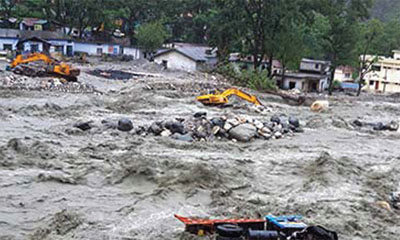
    The 15-16 June rains and floods have affected the ‘Char Dham’ circuit very badly, with the Kedarnath temple bearing the brunt of the disaster, leading to the death of many in the temple premises as well as its surrounding areas. The ‘Char Dham’ circuit roads continue to be snapped following the rains and floods.

  • 500 Relief Trucks Await Admn Nod

    500 Relief Trucks Await Admn Nod

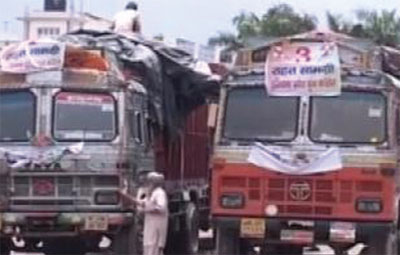
    DEHRADUN (TIP): At least 500 trucks carrying ration and foodrelated material meant for distribution among survivors in catastrophe-hit Rudraprayag, Chamoli, Uttarkashi and Pithoragarh districts are lying parked for the last four days in Rishikesh, Dehradun, Haridwar and Haldwani. The trouble is the administration is not clearing their onward journey for want clearances. Of these, 96 ration-loaded trucks were sent by senior Congress leaders on behalf of Congress chief Sonia Gandhi and its vice-president Rahul Gandhi.

    These have been lying on both sides of the 230km Haridwar- Gangotri bypass obstructing traffic – all because the administration’s failure to ensure its distribution among survivors far-flung places. A senior Congress leader in Dehradun said these ration trucks were stuck because the administration has refused to accept the supplies for want of storage space. “Unless the administration allows these trucks to move, these will remain jammed and perishables items would rot,” said an official.

    Dehradun additional district magistrate Harak Singh Rawat said as the government does not have any place to store the heavy quantity of ration, the question of issuing permits to the truck owners to proceed further does not arise. Members of different social and political organisations, including state BJP chief Tirath Singh, have accused Congress leaders of unnecessarily wasting food supplies like grains, biscuits, drinking water, and oil for the sake of scoring brownie points from floods victims.

    Singh said Congress workers are not at all inclined to trek for miles to distribute food items to victims. State Congress chief Yashpal Arya said the government will issue permit to stranded truck owners to proceed further soon so as to distribute ration and food material among victims in affected areas. However, Garhwal commissioner Suvardhan said as the government already has more than enough stock of ration for distribution among those in need, the stranded trucks will have to wait for a two more days.

    “We will definite issue permits to their owners to move further so that material is distributed among people who are genuinely affected,” said Suvardhan. All this while people in remote areas await precious supplies that could save lives.

  • Debris Makes DNA Sampling A Tough Job

    Debris Makes DNA Sampling A Tough Job

    DEHRADUN (TIP): The DNA sampling of the dead bodies, which is expected to establish the identities of those who died, is proving to be a daunting task. “DNA sampling is very important for insurance claims or giving relief to genuine people. We are taking DNA samples from bodies and giving them to the government,” said Dr Vijay Dhasmana, chairman of the Himalayan Institute Hospital and Trust, which has sent a team of forensic experts to collect DNA samples.

    The experts are first taking pictures of the bodies along with tissues for sampling. Though more than 300 samples have been collected, work is being hampered because of the 8ft-high debris that has covered the area. “There were very few bodies that could be removed completely from the debris in Kedarnath. A large number of bodies are buried beneath the debris or partially protruding from it.”

  • In Devastated Uttarakhand, Claims Of Rape And Robberyj

    In Devastated Uttarakhand, Claims Of Rape And Robberyj

    DEHRADUN (TIP): The police are in denial mode, but locals said rape, loot and killing of Uttarakhand disaster victims at Kedar Valley did happen. Victims too claimed to have been at the mercy of criminals of all hues. Locals said they helped the Ukhimath police arrest three men and recover R4lakh from them. But the police did not register any case against them, nor did they say where they were taken to. Most top police officers in Rudraprayag district remained incommunicado.

    Swatantra Verma, a victim from Raipur in Chhattisgarh, said he traded everything he had to prevent four persons from molested his daughter in the Jangalchatti area near Rambara. “They approached us on June 18 offering to take us to a safer location. Their attitude changed after it turned dark. No sooner did we reach Jangalchatti around 10pm than they pounced on my daughter,” he said. His wife Shalini said the experience was worse than the natural calamity they had escaped from. A similar incident happened with a group of pilgrims from Gujarat.

    They too had to hand over their belonging to criminals to save themselves. Gujarat principal secretary and disaster management commissioner PK Parmar said he didn’t receive any specific complaint of rape from Gujarat pilgrims but he had heard about women disrobed and harassed in Kedar Valley. There were also reports of miscreants chopping off body parts of corpses in front of the survivors. Police, however, said there were no criminal activities.

    “We haven’t received any complaint of loot or rape from anywhere. On the other hand, some 1,200 persons were screened at Rudrparyag area as a precautionary measure,” said RS Meena, IG (law and order). West Bengal transport minister Madan Mitra and state planning and development minister Rachhpal Singh alleged muleteers raped several pilgrims.

  • Rebuilding Lives Of Survivors The Biggest Challenge

    Rebuilding Lives Of Survivors The Biggest Challenge

    JOSHIMATH (TIP): As the helicopter weaves through the mountains along the Alaknanda valley to this roadhead to Badrinath, what you see can shake the stoutest heart. Village after village lies in ruins. Broken roads, damaged buildings, some of them houses, some shops or schools or infirmaries, twisted electric poles, scattered debris: it is a picture of total devastation.

    “Two years back, I took voluntary retirement to settle down in my village. I built a guesthouse here from my savings. This one disaster has taken away everything. My village house has been destroyed too and I am forced to live here in the relief camp,” said Prawesh Rana, a resident of Joshimath. Rana’s story is repeated, with minor variations, again and again. It adds up to a frightening reality of shattered lives — of people who have lost their everything, their homes, life’s savings and even the hope of finding income in the medium term.

    Helping these people rebuild their lives is easily the biggest challenge for the state government – in fact, for the whole country. The figures themselves give an idea of the daunting task ahead. Over 2,000 villages have been damaged by the flash floods (the degree of damage varies), said Bhaskaranand, in charge of disaster management and rehabilitation in the state. About 1,500 roads have been washed away and 150 bridges are damaged.

    The worst affected are the tourist towns of Kedarnath, Rudraprayag, Uttarkashi, Joshimath and Tehri Garhwal. Agriculture is hard here. And after the floods, the top soil has been washed away. Making these terraced tracts fit for agriculture will take time. The time to sow rajma and potatoes is now. But given the disruption, both in terms of infrastructure and land, this season is likely to be a washout.

    For most people here the religious tourism to the Char Dham is a crucial source of livelihood. This year’s as good as lost, but the prospects of tourists returning in the next few years are very dim. With the fear factor looming large, without hotels or inns, people expect the number of pilgrims to drop sharply. Then there’s something that everyone fears: could this calamity have shaken the believer’s faith in the Char Dham yatra, even if for a few years? After all, stories will spread how people came in here with great devotion and met horrendous suffering.

    Kanti Singh, one of the survivors, said: “In Kedarnath, at least 67 villages have been washed away. Over the last few years, hundreds of guest houses, hotels and transport businesses had mushroomed there to cater to the needs of the pilgrims. The nature’s wrath has instilled fear in them and shaken their faith for the deity.” Situated in Chamoli district of Uttarakhand, Joshimath is a gateway to pilgrim centre Badrinath and more recently, it has become an attraction for several Himalayan mountain climbing expeditions and trekking trails.

    Seeing the tourism boom, many people like Rana had invested in hotels, the transport business and restaurants. According to Udit Ghildiyal, director of the Himalayan Institute for Environment, Ecology and Development, natural disasters have happened here in the past too, the most recent being in August 2012 when flash floods washed away several bridges and houses in Uttarkashi district. “But this one is huge. All the tourist towns, the backbone of Uttarakhand’s economy, have been devastated and we have gone back several years,” he said.

    Ghildiyal said that farmers in Uttarakhand have land holding of about 200 square yards on average which isn’t enough for sustenance. “Most people here are dependent on tourism and related business for their livelihood. The government and the army is providing food and medical aid to those affected now but this effort must continue as the tragedy is far from over,” he added. Harsil in Uttarkashi is famous for apples. The crop is ready but is getting wasted as it cannot be transported due to poor road connectivity in the aftermath of the flood.

    Many villages are also reporting high incidence of water-borne diseases like diarrhoea. “As of now, there are relief camps nearby where the doctors are available.We also get food from the army and other organisations. What will happen after the evacuations are over?” wonders Swatantra Upadhya, one of the patients getting IV fluid at the relief camp in Gauchar.

    Mountain mayhem

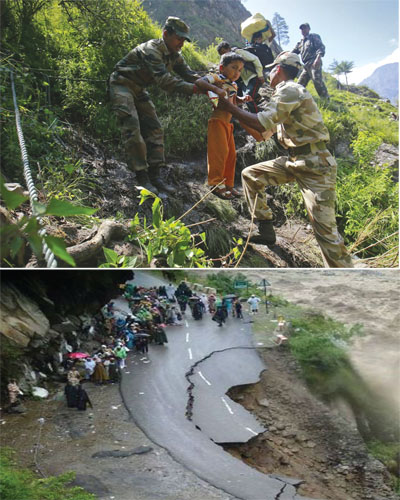
    June 16-17 | Torrential rains break 88- year-old record. Cloudbursts wreak havoc in Uttarakhand with rivers swelling beyond capacity. Mounds of earth crash into homes, topple trees and buildings. Dehradun records 220 mm of rain. Over 1 lakh pilgrims, including cricketer Harbhajan Singh on a visit to Hemkund Sahib, trapped in Uttarakhand. Three ITBP battalions stationed in state’ upper reaches begin rescue work. Himachal too affected.

    State CM, on poll tour, stuck in Kinnaur June 18 | Torrential rains continue. Raging Alaknanda and Bhagirathi engulf scores of hotels. Roads in Kedarnath washed away. Complete communication breakdown. Hundreds of dead bodies found around Kedarnath temple. IAF, Army, NDRF, BRO pressed into rescue work with ITBP. 10 choppers in service, yet air support inadequate June 19 | Rains ease up leaving trail of disaster. Thousands feared dead. IAF doubles number of choppers. Over 10,000 rescued. IAF makes air evacuation, ITBP opens roads June 20 | 45 choppers, 10,000 rescue workers in action.

    Over 15,000 evacuated by air and road. ITBP opens trek routes, builds rope bridges. Army, ITBP, NDRF commandos reach inaccessible areas: Rambada, Junglechatti in Kedarnath Valley June 21 | About 16,000 rescued. Forces in Rambada, Junglechetti. New helipads built. More roads opened, bridges built June 22 | Weather turns bad impeding rescue. Death toll crosses 1,000, hundreds of bodies found in Rambada, Junglechatti. Makeshift bridges built by forces break down. Armed forces increase number of choppers to 60. 10,000 rescued June 23 | Close to 12,000 evacuated. Kedarnath valley almost cleared.

    Death toll now feared to be 5,000 June 24 | Mass cremation of bodies planned. Rains hamper rescue work, armed forces clocked in over 1,000 flying hours. Worst over June 25 | In tragic chopper accident 20 IAF, ITBP and NDRF personnel — the first to reach Kedarnath for rescue — lose their lives June 26 | Focus shifts to locals as over 600 villages are found to be completely cut off. Mass cremation starts with 30 bodies cremated.

    Forces pull out of Kedarnath valley. June 27 | Forces begin pulling out from most areas. NDRF send a special team to extricate bodies from debris. Total 69 cremated since June 26 June 28 | Few sorties due to bad weather. 1,237 wait in Badrinath region for evacuation

  • NSA Shiv Shankar Menon In Beijing For Border Talks

    NSA Shiv Shankar Menon In Beijing For Border Talks

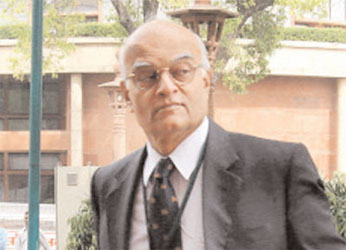
    BEIJING (TIP): China is according high importance to national security adviser Shiv Shankar Menon’s visit to the country, with Premier Li Keqiang and foreign minister Wang Yi among those scheduled to meet him. Menon will hold negotiations on the boundary issue and lay the ground for defence minister A K Anthony’s visit to Beijing early next month. At the same time, the Chinese foreign ministry has cautioned against having high hopes about the outcome of the two-day boundary talks that Menon will have with China’s state councillor Yang Jeichi from Friday.

    “The boundary question is an issue left over from history (and) it cannot be solved overnight, but you should see that (the) two sides have made long-lasting efforts in order to solve the issue and a lot of achievements have already been made,” Chinese foreign ministry spokeswoman Hua Chunying said. She said China was looking forward to an acceptable solution pending the final settlement of boundary question.

    “We should work together to maintain peace and tranquillity of (the) border areas and ensure the boundary issue does not affect overall relations between China and India,” she said. Chinese troops had recently entered Indian territory in Daulat Beg Oldi sector in eastern Ladakh. That stand-off could only be resolved after about three weeks.

  • US Fashion Photographer Bert Stern Dead At 83

    US Fashion Photographer Bert Stern Dead At 83

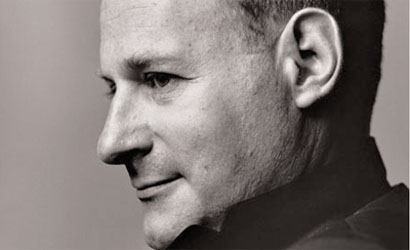
    NEW YORK (TIP): US fashion photographer Bert Stern, famous for his photos of Marilyn Monroe taken six weeks before her death, has died in New York, his partner said. He was 83. “Bert Stern passed yesterday, Wednesday,” Shannah Laumeister informed AFP on Thursday in a brief email. During a career of more than 50 years, he photographed some of the world’s most beautiful women, also including Audrey Hepburn, Elizabeth Taylor, Sophia Loren and Brigitte Bardot.

    But he was known above all for the moving pictures of a largely undressed Monroe, taken at the Hotel Bel-Air in Los Angeles in June 1962. Over three days he took 2,571 photos, turned years later into a book, “Marilyn Monroe: The Complete Last Sitting.” The actress died on August 5 that year. Stern also took publicity shots, and is considered a key figure in transforming such pictures into an art form in the 1960s. He also made the film “Jazz on a Summer’s Day” in 1959.

  • US: Boston Suspect Downloaded Bomb Instructions

    US: Boston Suspect Downloaded Bomb Instructions

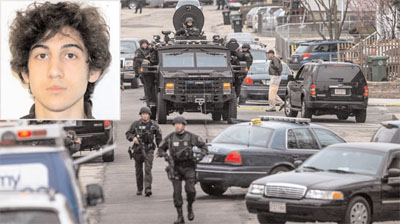
    BOSTON (TIP): Boston Marathon bombing suspect Dzhokhar Tsarnaev downloaded bomb-making instructions from an al-Qaida magazine, gathered online material on Islamic jihad and martyrdom and later scrawled anti-American messages inside the boat where he lay wounded, a federal indictment charged on June 27. The 30-count indictment contains the bombing charges, punishable by the death penalty, that were brought in April against the 19-year-old Tsarnaev, including use of a weapon of mass destruction to kill.

    It also contains many new charges covering the slaying of an MIT police officer and the carjacking of a motorist during the getaway attempt that left Tsarnaev’s older brother, Tamerlan, dead. “Tamerlan Tsarnaev’s justice will be in the next world, but for his brother, accountability will begin right here in the district of Massachusetts,” Suffolk district attorney Daniel Conley, whose jurisdiction includes Boston, said at a news conference with federal prosecutors.

    The indictment provides one of the most detailed public explanations to date of the brothers’ alleged motive – Islamic extremism – and the role the Internet may have played in influencing them. Three people were killed and more than 260 wounded by the two pressure-cooker bombs that went off near the finish line of the marathon on April 15. Dzhokhar Tsarnaev was captured four days later, hiding in a boat parked in a backyard in Watertown, just west of Boston.

    According to the indictment, he scrawled messages on the inside of the vessel that said, among other things, “The US government is killing our innocent civilians,” ”I can’t stand to see such evil go unpunished” and “We Muslims are one body, you hurt one you hurt us all.” The Tsarnaev brothers had roots in the turbulent Russian regions of Dagestan and Chechnya, which have become recruiting grounds for Muslim extremists.

    They had been living in the US about a decade. But the indictment made no mention of any larger conspiracy beyond the brothers and no reference to any direct overseas contacts with extremists. Instead, the indictment suggests the Internet played an important role in the suspects’ radicalization. Before the attack, according to the indictment, Dzhokhar Tsarnaev downloaded onto his computer the summer 2010 issue of Inspire, an online English-language magazine published by al-Qaida.

    The issue detailed how to make bombs from pressure cookers, explosive powder extracted from fireworks and lethal shrapnel. He also downloaded extremist Muslim literature, including “Defense of the Muslim Lands, the First Obligation After Imam,” which advocates “violence designed to terrorize the perceived enemies of Islam,” the indictment said. Another tract downloaded included a foreword by Anwar al-Awlaki, an American propagandist for al-Qaida who was killed in a US drone strike in 2011. US attorney Carmen Ortiz of Massachusetts said Attorney General Eric Holder will decide whether to pursue the death penalty against Tsarnaev, who will be arraigned on July 10.

    Some of Tsarnaev’s relatives have insisted he’s not guilty, and his mother has said the allegations against him and his brother are lies. The indictment assembled and confirmed details of the case that have been widely reported over the past two months and added new pieces of information. For example, it corroborated reports that Tamerlan Tsarnaev bought 48 mortar shells from a Seabrook, New Hampshire, fireworks store.

    It also disclosed that he used the Internet to order electronic components that could be used in making bombs. The papers detail how the brothers then allegedly placed knapsacks containing shrapnel-packed bombs near the finish line of the 26.2-mile race. The court papers also corroborated reports by authorities that Dzhokhar Tsarnaev contributed to his brother’s death by accidentally running him over with a stolen vehicle during a shootout and police chase.

    The charges cover the slaying of Massachusetts Institute of Technology police officer Sean Collier, who authorities said was shot in the head at close range in his cruiser by the Tsarnaevs, who tried to take his gun. In addition, prosecutors said that during the carjacking, the Tsarnaevs forced the motorist to turn over his ATM card and his password and Dzhokhar withdrew $800 from the man’s account. At the same time the federal indictment was announced, Massachusetts authorities brought a 15-count state indictment against Dzhokhar over the MIT officer’s slaying and the police shootout.

  • HATE CRIME? Hindu Temple In Canada Vandalized

    HATE CRIME? Hindu Temple In Canada Vandalized

    TORONTO (TIP): A Hindu temple in Canada has been vandalized by two men armed with baseball bats, outraging the country’s minority community which termed it as a “hate crime”. Video recordings show the men smashed three windows at the front entrance of the Laxmi Narayan Temple on June 23 in Surrey, British Columbia.

    “They left after breaking the windows and leaving those bats, which is self-explanatory,” a temple official was quoted as saying by local media. “When I came to know those facts I felt it’s not a regular break-in where somebody wants to damage, it’s a hate crime, which is unfortunate and disturbing,” said Parshotam Goel, president of the Vedic Hindu Cultural Society. Vinay Sharma, secretary for the society, said, “I was shocked.

    There was no robbery, there was no other damage, nobody tried to enter the building. Nobody has an idea that this kind of attack, or this kind or racism attack or hatred crime can happen here.” Surrey Royal Canadian Mounted Police (RCMP), who are probing the incident, said they don’t consider it as a hate crime. “A place of worship is one more place that people hold sacred. It’s a very personal attack,” said Surrey RCMP spokesman Dale Carr was quoted as saying by ‘CTV British Columbia’.

    According to reports, a bat with a ‘Sikh last name’ and a ‘khanda’ was recovered from the scene. The World Sikh Organization of Canada president Prem Singh Vinning, who visited the temple, has condemned the attack on the Temple. “Any attack on a place of worship must be strongly condemned. The perpetrators must be brought to justice as soon as possible.

    While we truly hope that this was not an attempt to create friction between the Sikh and Hindu community, the responsible thing to do is to let the RCMP complete its investigation before drawing any conclusions,” Vinning said. Meanwhile, Canadian minister of citizenship, immigration and multiculturalism Jason Kenney has condemned the attack.

  • Snowden Needs Legal Guarantees To Return To U.S., Father Says

    Snowden Needs Legal Guarantees To Return To U.S., Father Says

    WASHINGTON (TIP): Former U.S. spy agency contractor Edward Snowden might voluntarily return to the United States if given assurances of his constitutional rights, his father said in a letter to Attorney General Eric Holder. Lonnie Snowden was “reasonably confident” his son, who faces espionage charges in the United States for alleged leaking of secret surveillance information, would return if certain conditions were met, the June 27 letter said.

    It was written by a lawyer on Snowden’s behalf, and was obtained by Reuters. The younger Snowden, a former contractor for the National Security Agency, should not be detained or imprisoned before trial, should not be subject to a gag order, and should be tried in a venue of his choosing, the letter said. Edward Snowden, a U.S. citizen, fled the United States to Hong Kong in May, a few weeks before publication in the Guardian and the Washington Post of details he said he provided about U.S. government surveillance of Internet and phone traffic.

    He has not been seen since he arrived in Moscow on Sunday, but Russian officials said he was in a transit area at Sheremetyevo airport. He has requested political asylum in Ecuador. Representatives for the Justice Department could not be reached immediately for comment on the letter. Lonnie Snowden said he was concerned that his son was being manipulated by others, including people from the anti-government secrecy group WikiLeaks, he said in an interview on NBC television earlier on Friday.

    “I am concerned about those who surround him,” he told NBC. “Wikileaks – if you look at past history – their focus isn’t necessarily the Constitution of the United States. It’s simply to release as much information as possible. So that alone is a concern for me.” Snowden’s father said he has not had contact with his son since April, NBC reported. “I love him.

    I would like to have the opportunity to communicate with him. I don’t want to put him in peril,” he said in the interview. Snowden said he did not think his son had committed treason, even though he said Edward Snowden broke U.S. laws in releasing details about the federal monitoring programs. “He has betrayed his government, but I don’t believe that he’s betrayed the people of the United States,” he said.

  • Offices Of Egypt Islamist Party Torched

    Offices Of Egypt Islamist Party Torched

    CAIRO (TIP): Two offices of the Freedom and Justice Party, the political arm of President Mohamed Mursi’s Muslim Brotherhood, were torched today as rival rallies were held across Egypt. FJP offices were set alight in the Mediterranean city of Alexandria and in Aga in the Nile Delta province of Daqahliya, security officials said.

    Television footage showed plumes of smoke rising from the building in Alexandria as pro- and anti- Mursi protesters clashed. The offices in Aga were ransacked and then burned, the officials said. A Muslim Brotherhood spokesman, Gehad al- Haddad, in a Twitter message accused remnants of ousted president Hosni Mubarak’s National Democratic Party of attacking the offices.

    Tens of thousands of Islamist protesters gathered in Cairo’s Nasr City neighbourhood to defend Mursi’s legitimacy, while thousands of his opponents took to the streets in several parts of the country. The unrest comes ahead of mass protests planned against Mursi on Sunday’s first anniversary of his becoming president.

  • Eight Soldiers Killed In Thai South: Army

    Eight Soldiers Killed In Thai South: Army

    BANGKOK (TIP): Eight soldiers were killed by a roadside bomb in the restive Thai south early on June 29 morning, an army spokesman said. Another four people — two soldiers and two civilians — were wounded in the blast in Krongpinang district of the Muslim-majority Yala province. The soldiers had been on duty all night at their base and were returning to their residence in a military truck when the roadside bomb went off.

    “It was a very powerful bomb that completely destroyed the truck,” Colonel Pramote Promin told AFP by phone. “Ten soldiers were in the truck. Eight died and two were wounded,” he said, adding that two villagers had also been injured in the blast. There was no immediate claim of responsibility, but Islamic terrorist groups have carried out similar attacks in the past. A nine-year-old insurgency has claimed more than 5,500 lives in the Muslim-dominated south, where many local people complain of a long history of discrimination by Thai authorities in the Buddhistmajority nation.

    Security personnel and those connected with the government are regularly targeted in the attacks, as well as Muslims perceived to be collaborating with the authorities. Thailand held its first official talks with representatives of one of the main rebel groups, the Barisan Revolusi Nasional (BRN), earlier this year, but failed to reach an agreement and the daily violence continues. Two Muslim men, including a village headman, were shot dead in Narathiwat province in separate incidents on Friday afternoon, the police said in their daily update.

  • Taliban Gunmen Attack Presidential Palace In Afghanistan

    Taliban Gunmen Attack Presidential Palace In Afghanistan

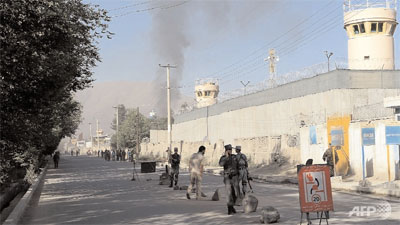
    KABUL (TIP): An early morning insurgent attack on Afghanistan’s presidential palace on June 25 has been put down with all the assailants killed, Kabul’s police chief said. General Ayoub Salangi told Reuters the gunfight ended after about 90 minutes with all the attackers killed. Taliban gunmen attacked Afghanistan’s presidential palace and surrounding buildings, including the CIA’s Afghan headquarters, with explosions and gunfire shaking the city centre.

    A Reuters reporter at the palace said the attack began soon after 6.30am (0200 GMT), when at least one man opened fire with an automatic rifle at a gate to the palace in the central Shash Darak district. Karzai’s whereabouts were not immediately known, though he was due to attend a press event at the palace after 9am (0430 GMT). Reporters had been gathering at the palace when the attack began and dived for cover as government forces returned fire. Heavy explosions resounded and the gunfire intensified. Schoolchildren walking to classes nearby were also caught in the exchanges.

    The Taliban claimed responsibility the attack in a text message to Kabul reporters from spokesman Zabihullah Mujahid. “Today at 6.30am a number of suicide bombers attacked the presidential palace, defence ministry and the Ariana Hotel,” Mujahid said. The Ariana Hotel is known to house the headquarters of the US Central Intelligence Agency (CIA) in Afghanistan. A thick plume of smoke was seen rising from the building.

    An Afghan official told Reuters the attackers had made their way into a nearby building from which they fired. Shash Darak includes the most important buildings in Kabul, including the palace, the headquarters of NATO-led forces in Afghanistan, the Afghan Defence Ministry and the CIA’s Afghan station.

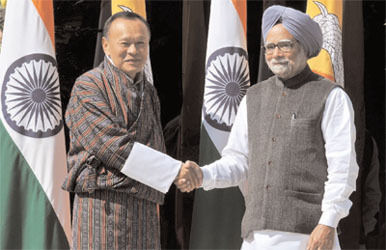
  • Bhutan’s Road To Democracy Leads To China?

    Bhutan’s Road To Democracy Leads To China?

    NEW DELHI (TIP): There’s a new anxiety in the top echelons of New Delhi about what’s arguably India’s only friendly neighbour, Bhutan. As the hill kingdom takes another baby step in its transition from monarchy to democracy with its second parliamentary election on July 13, there’s realization here that complacence has possibly allowed some disturbing developments there to go unnoticed. Friendship with Bhutan is often taken for granted by our foreign policy mandarins.

    So, it was a rude shock when they learned last year from a Chinese press release that the new Bhutan PM, JigmeThinley, has had a meeting with the then Chinese premier Wen Jiabao and the two countries were set to establish diplomatic ties. Given that Bhutan’s foreign policy is conducted by and large in close consultation with New Delhi, such an important step without its knowledge created disquiet.

    Although the PM’s office in Thimpu sought to play it down, senior officers recalled that Thinley had said months after taking over as PM that he only saw growing opportunities in China and no threat. As part of Bhutan’s outreach to China was the decision last year to procure 20 Chinese buses, typically the kind of purchase that would normally be booked with, say, Tata Motors. It raised eyebrows. It did not help that the person who got the contract for supplying the buses was reported to be a relative of Thinley.

    What’s ironic is that in his poll campaign, Thinley is said to be impressing upon the electorate that he was the best upholder of Bhutan’s ties with India, whereas he has possibly complicated them. Thinley’s Bhutan Peace and Prosperity Party is again the main contender for power in this tiny, landlocked nation of 700,000 which saw transition to democracy from an over 100-yearold hereditary monarchy in 2008.

    Democracy in Bhutan was ushered in by Bhutan’s benevolent fourth king Jigme Singye Wangchuck. The last month saw the Bhutanese repose faith in the system with 55% of 380,000-strong electorate braving thunderstorms and landslides to exercise their franchise. As the world’s largest democracy, India welcomed Bhutan’s transition in 2008, but not everyone in South Block realized that the proposed model wasn’t like India’s Westminister model of parliamentary democracy. It’s a diarchy in Bhutan with the monarch retaining certain overriding powers.

    Article 20.7 of Bhutan’s Constitution says the cabinet shall be collectively responsible to the Druk Gya88lpo (the king) and to Parliament”. The government must also enjoy the confidence of the king as well as parliament. Further Article 20.4 says “the PM shall keep the Druk Gyalpo informed from time to time about the affairs of the state, including international affairs, and shall submit such information and files as called for by the Druk Gyalpo”. It now appears that the king wasn’t quite in the loop as Bhutan expanded its diplomatic ties with 53 countries, as against 22 in 2008.

  • US Suspends Trade Preference Benefits For Bangladesh

    US Suspends Trade Preference Benefits For Bangladesh

    WASHINGTON (TIP): President Barack Obama announced on June 27 the suspension of US trade privileges for Bangladesh because of concerns over labor rights and worker safety that intensified after hundreds died there in the global garment industry’s worst accident. In a proclamation, Obama said that Bangladesh was not taking steps to afford internationally recognized worker rights to employees in the South Asian country.

    US Trade Representative Mike Froman said the US will, however, start new discussions with Bangladesh on improving workers’ conditions so the duty-free benefits that cover some 5,000 products can be restored. He didn’t say when that might be, saying it would depend on Bangladesh’s actions. Thursday’s announcement was the culmination of a yearslong review of labor conditions in the impoverished country.

    Democratic lawmakers have been pushing for the step since the April 24 collapse of Rana Plaza in Dhaka that killed 1,129 people. In November, a fire at a garment factory killed more than 100 people. “The recent tragedies that needlessly took the lives of over 1,200 Bangladeshi garment factory workers have served to highlight some of the serious shortcomings in worker rights and workplace safety standards in Bangladesh,” Froman said.

    The Generalized System of Preferences, that is designed to boost the economies of developing nations, covers less than 1 percent of Bangladesh’s nearly $5 billion in exports to the US, its largest market. The benefits don’t cover the lucrative garment sector but Bangladesh’s government was anxious to keep them. The action may not exact a major and immediate economic impact, but it carries a reputational cost and might deter American companies from investing in the country, one of the world’s poorest.

    The US action, which takes effect in 60 days, may also sway a decision by the European Union, which also is considering withdrawing GSP privileges. EU action could have a much bigger economic impact, as its duty-free privileges cover garments, which account for 60 percent of Bangladesh’s exports in that sector. The US Trade Representative review of labor conditions in Bangladesh follows a petition filed in 2007 by the AFL-CIO seeking withdrawal of the GSP benefits.

    The review was expedited late last year amid concern from US lawmakers over deadly industrial accidents, deteriorating labor rights and the April 2012 killing of prominent labor activist Aminul Islam — a case that has not been solved. Froman said despite close engagement with Bangladesh to encourage labor reforms, the US hasn’t seen sufficient progress. But he said the US is “committed to working with the government of Bangladesh to take the actions necessary to rejoin the program.” Bangladesh maintains it is doing all it can, by closing dangerous factories and moving to amend its labor law.

    Calls from both House and Senate Democrats for the US benefits to be curtailed had multiplied since the Rana Plaza disaster, and some of those lawmakers quickly welcomed Thursday’s decision. Democrat Rep. Joe Crowley, who is cochair of the congressional caucus on Bangladesh, said that in light of recent tragedies in the country, the suspension was “inevitable.” “I hope this action will propel Bangladeshi officials to develop a clear path forward that protects all workers in Bangladesh,” he said.

    Robert Menendez, chairman of the Senate Foreign Relations Committee, said it was long overdue for Bangladesh to reform its labor practices and ensure workers’ rights. “Bangladesh is an important trading partner, but we cannot and will not look the other way while workers are subjected to unsafe conditions and environments endangering their wellbeing,” Menendez said in a statement. He also called for American companies operating in Bangladesh to improve conditions for factory workers and work with European companies on a global standard for safety.

    Lawmakers have criticized US retailers that source garments from Bangladesh for not joining the more than 40 mostly European companies that have adopted a five-year, legally binding contract that requires them to help pay for fire safety and building improvements. The Bangladeshi garment manufacturers’ association says it stepping up inspections and has closed 20 factories.The garment industry employs some 4 million people in Bangladesh, 80 percent of them women.

    Mike Posner, a former senior US official and professor of business and human rights at New York University’s Stern School of Business, appealed to US and European firms to work with Bangladesh in the urgent task of improving working conditions in the garment sector. “The message should be not to bail out but to stay the course and make a sustained commitment to Bangladesh, otherwise things will never get better,” he said.